More Around the City

Bassishaw High Walk, City, 1987 87-11c-16-positive_2400
Bassishaw High Walk, City, 1987

There is still a section of the pedestrian route above traffic level here, leading from the yard behind the Guildhall and to a bridge across London Wall, though the bridge is now a more recent construction a little further west and crossing at an angle and leading on to the high walks that were built into the Barbican Estate. This area next to City Tower looks rather different now. Britannic House, one of the original six towers built along the new London Wall was refurbished in 1990 and renamed City Tower.

Highwalk, Moor Lane, City, 1987 87-11c-21-positive_2400
Highwalk, Moor Lane, City, 1987

Looking down Moor Lane with the Barbican at the right on a section of the high walk that has now gone, but which used to lead from close to Moorgate station. I think this gateway was roughly above the junction with Silk St. Empty when I took this picture (possibly on a Sunday) it was sometimes quite crowded during the rush hours with office workers making their way to the tube. The high walks were useful routes, avoiding the often dangerous traffic on the streets and also providing good vantage points for photographers, and I’m saddened at their loss. But I think they took up space that could be sold expensively as offices.

Ropemaker St, Islington, 1987 87-11c-31-positive_2400
Ropemaker St, Islington, 1987, City

This building on Ropemaker St was one of my favourite examples of modern office architecture when it was built, and I photographed it on several occasions. I suppose it doesn’t quite belong in this post as it was on the north side of the road and thus in Islington rather than the City, where I was standing on a section of high walk to take the picture.

Ropemaker Place, a 60m high block was completed in 1987 shortly before I made this picture. It didn’t last long and was demolished only 18 years later in 2005.

Holland House, Bury St, City, 1987 87-11c-51-positive_2400
Holland House, Bury St, City, 1987

Holland House in Bury St has lasted rather longer and is protected by its Grade II* listing. The only London building by leading Dutch architect Hendrik Petrus Berlage it was built in 1916 for the Dutch company Wm H Müller & Co, complete with a granite prow by Dutch sculptor J. Mendes da Costa.

More recently when I’ve photographed here I’ve stepped a little to the left to bring the ‘Gherkin’ into view – but construction of 30 St Mary Axe only began in 2001.

Cutler St area, City, 1987 87-11c-53-positive_2400
Cutler St area, City, 1987

I think this is a part of Devonshire Square, a private area of the City which was developed by the East India Company, then sold to St Katharine’s Dock and bought in 1909 by the Port of London Authority. The warehouses here were used to store the more valuable commodities imported from across the empire. The site was acquired by Standard Life Assurance together with Greycoat Estates Ltd in 1978 and became offices, but still remained something of a private enclave, if no longer used for the secure storage of “Ostrich feathers, chinaware, oriental carpets, cigars, tortoiseshell, silks, mother of pearl, clocks, watches, cameras, drugs, spices, musical instruments, perfumes, tea and other prized artefacts.”

Baltic Exchange, St Mary Axe, City, 1987 87-11c-63-positive_2400
Baltic Exchange, St Mary Axe, City, 1987

The Provisional IRA left a van packed with explosives outside the Baltic Exchange in St Mary Axe shortly before 9pm on 10 April 1992, and then made a call to the police warning them that a bomb was about to explode at the Stock Exchange – 370 metres away in direct line, but about half a mile by road. The bomb wrecked this facade and caused a total of £800 million worth of damage to this and surrounding buildings.

Perhaps the bombers were confused and looking for the old Stock Exchange building in Capel Court, off Bartholomew Lane, just to the east of the Bank of England, while the Stock Exchange had moved in 1972 to a new tower on Old Broad St.

21 New St, Cock Hill, City, 1987 87-11c-55-positive_2400
21 New St, Cock Hill, City, 1987

This listed archway with a Merino Ram was built in 1863 for Cooper’s Wool Warehouse. By the 1900s the wool storage business had largely moved further east closer to London Docks and in 1907 the warehouse was sold and used for other storage. It was converted into offices in 1981.

Newsprint, Bouverie St, City, 1987 87-11d-01-positive_2400
Newsprint, Bouverie St, City, 1987

Some newspapers were still being printed in ‘Fleet Street’ and the picture shows a lorry delivering newsprint to one of the printing works on Bouverie St.

The Seven Ages of Man, Richard Kindersley, sculpture, Baynard House, Queen Victoria St, City, 1987 87-11d-41-positive_2400
The Seven Ages of Man, Richard Kindersley, sculpture, Baynard House, Queen Victoria St, City, 1987

This sculpture stands in front of one of London’s bleaker Brutalist buildings, and for once its hard to disagree with Pevsner over a modern building, when he describes this a “acutely depressing.” But it does include a section of high-level pedestrian walkway with seating and this rather fine sculpture based on ‘As You Like It’. And it’s a pleasant enough place to sit and read a newspaper with a view of St Andrew by the Wardrobe, the last city church rebuilt by Sir Christopher Wren after the Great Fire of London.

All from Page 7 of my 1987 London Photos.


All photographs on this and my other sites, unless otherwise stated, are taken by and copyright of Peter Marshall, and are available for reproduction or can be bought as prints.
Schools Climate Strike


A bill is currently being introduced into the UK parliament which will severely restrict our ability to protest, giving police new powers to control both static protests and marches. Many of us see it as a major attempt to limit democratic and human rights and a major step in our movement towards a police state. Even the police are worried about some aspects of it. I think there are some aspects which the House of Lords may seek to alter or remove, but given the large Tory majority it seems likely to be passed more or less intact.

The proposals by Home Secretary Priti Patel are widely seen as a knee-jerk right-wing reaction to protests by Extinction Rebellion and the Black Lives Matter movement, and come at a time when Covid restrictions are being widely used by police to prevent protests, even where these seem to present little danger of spreading the virus.

XR promoted a policy of encouraging its supporters to be arrested, and were widely criticised on the left for doing so. In its earlier protests, relatively few of those arrested came to trial and many charges were found to be unlawful – as was the London-wide ban on protests the police later enforced. In later XR protests the Home Office clearly put pressure on police and CPS to ensure that charges were brought and the new bill reflects that much tougher attitude.

We already have a criminal justice system that is failing under extreme pressures, and was even before the extra constraints of Covid. Police are failing to pursue many types of crime and the chances of criminals being caught – always the most effective deterrent – are rapidly falling. In the 12 months up to March 2019, only 7.8% of reported offences in England and Wales led to someone being charged or summonsed – roughly on in every 13 – and unless a crime number is needed for insurance many now think it isn’t worth reporting most crimes. It’s a figure that halved since records were first published only four years previously.

I doubt if this bill will actually have the intended effect of reducing protests, but it will increase the number of arrests and further clog up the justice system – probably leading to the introduction of yet more draconian measures including the loss of civil rights.

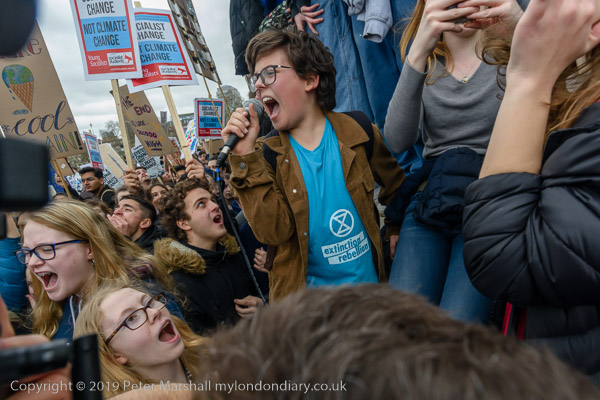
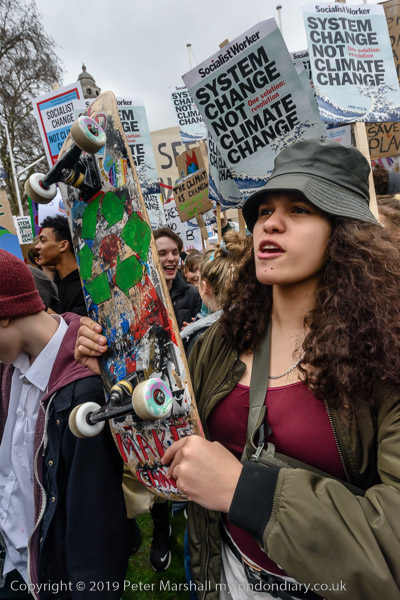
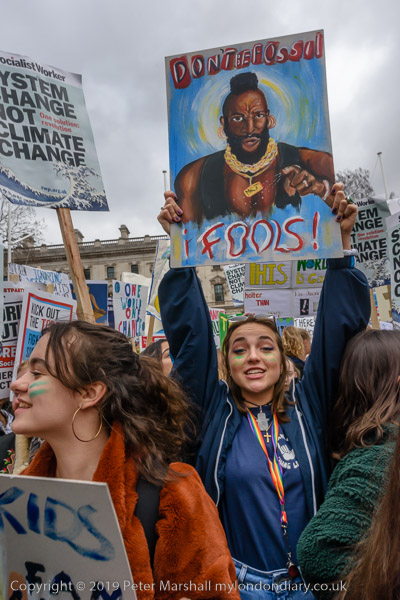
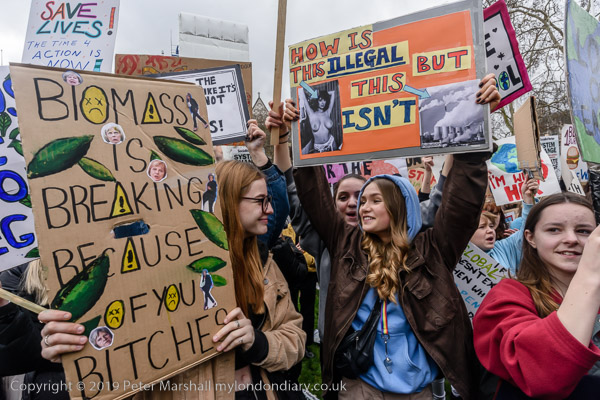
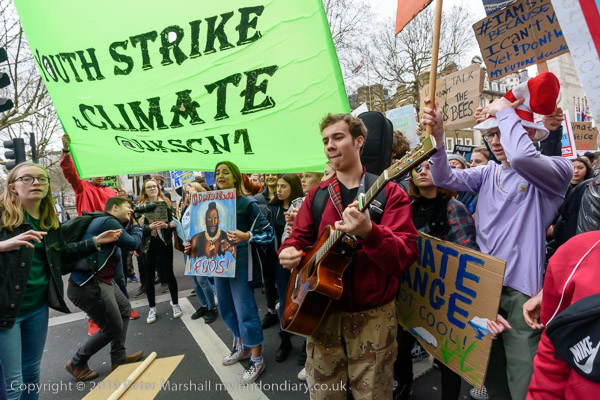
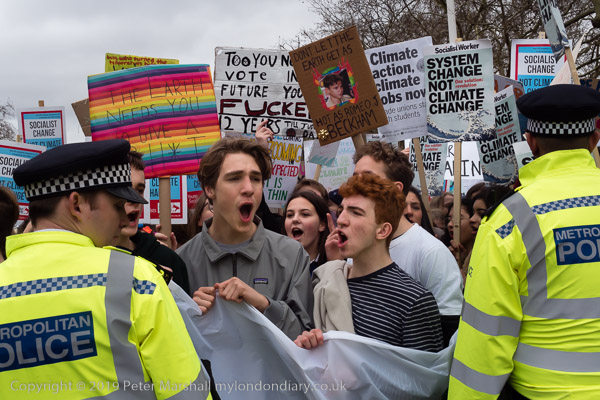
Quite how the Old Bill will react in future at protests like the London Schools Climate Strike on Friday 15th March 2019 is a matter for conjecture. If the Police, Crime, Sentencing and Courts Bill comes into law will they be prepared to undertake mass arrests of minors who refuse to accept direction? Clearly the police (and military) revelled in the freedom and encouragement from Thatcher to wade into the miners, but I hope they will still have sufficient human decency to draw the line when Patel’s orders come to attack children.

Of course what we really need is not to attack climate protesters but to take urgent actions to avoid climate disaster – as the several thousand school students who took part in the Big School Strike for the Future were demanding.

More about the protest at London Schools Climate Strike


All photographs on this and my other sites, unless otherwise stated, are taken by and copyright of Peter Marshall, and are available for reproduction or can be bought as prints.

City Heights, 1987

Throgmorton St, City, 1987 87-11a-66-positive_2400
Throgmorton St, City, 1987

The view from the west end of Throgmorton St has changed a little since 1987 but is still recognisable. Largely Victorian or Edwardian at ground level, but dominated vertically by the two towers, both technically on Old Broad Street, though the right hand one, then the Stock Exchange, had an entrance and a long frontage on Throgmorton St.

Stock Exchange, Throgmorton St, City, 1987 87-11a-62-positive_2400
Stock Exchange, Throgmorton St, City, 1987

The London Stock Exchange has a long history from its origins at Jonathan’s Coffee House in Change Alley (though presumably it only got that name later) in 1698. Even older was Stock’s Market, which the City of London plaque at Mansion House dates from 1282-1737, but despite that plaque being featured on the Stock Exchange web site, that was a food market which got its name from the wooden stocks where miscreants would have their legs locked and be subjected to insults and pelted with rotten food, stones and anything else that came to hand. Unfortunately despite being a hotbed of criminal activity there are no stocks at the modern stock exchange.

In 1972 the Stock Exchange moved from Capel Court where it had been since 1802 to a new building, the Stock Exchange Tower, at 125 Old Broad Street. This building with a squashed hexagonal floor plan had a long frontage on Throgmorton St and was 100m high with 26 floors. The Stock Exchange moved out to Paternoster Square in 2004, but the building is still standing, though in disguise, its concrete now hidden behind a glass wall, and with some added office space in new building at the side.

Nat West Tower, Old Broad St, City, 1987 87-11b-55-positive_2400
Nat West Tower, Old Broad St, City, 1987

Also still in place, though a little altered is the Nat West Tower, between Old Broad St and Bishopsgate, and in 1987 there was a highwalk underneath it that led to a pedestrian bridge crossing Bishopsgate.

The Natwest Tower, completed in 1980, was 183 metres tall, and was the talllest building in the UK until the Canary Wharf Tower was completed in 1990. It remained the tallest building in the City until 2009. It required extensive refurbishment over several years after being damaged by the IRA Bishopsgate bomb in 1993. Natwest moved elsewhere and in 1995 it was renamed Tower 42, referencing the 42 floors cantilevered out above its base. The highwalk was not replaced after the bombing.

Nat West Tower, Old Broad St, City, 1987 87-11b-64-positive_2400
Nat West Tower, Old Broad St, City, 1987

Although these walkways were open to the public, they were private property and although I photographed from them on several occasions, apparently photography was not allowed. On one occasion after taking some pictures I was approached by a very apologetic security manager in a suit and tie, who told me that photography was not allowed, before walking with me to the line on the pavement marking the the boundary to the property and inviting me to continue taking pictures from there.

Bishopsgate, City, 1987 87-11b-16-positive_2400
Bishopsgate, City, 1987

I think this was the door to a bank, and I’m sure it was on Bishopsgate or possibly its southern continuation, Gracechurch St. I’ve walked along there a few times in recent years and I think both the door and the building it was on have been replaced.

St Helen's Bishopsgate, Great St Helens, City, 1987 87-11b-32-positive_2400
St Helen’s Bishopsgate, Great St Helens, City, 1987

The bridge across Bishopsgate had steps down in front of an office building on the corner of Bishopsgate and Great St Helen’s, a short street leading to the church of St Helen’s Bishopsgate. This is really two churches and is one of the few churches in the City to have escaped destruction both in the 1666 Great Fire and the Blitz. The church (at left) was there before 1210 when permission was given to build a Benedictine nunnery at its right, the two parts almost but not quite indentical.

Interesting stories are told about some of the things the nuns and priests at times got up to, but it was more the marital activities of Henry VIII that led to him declaring himself head of the Church of England in 1536, following which this and other nunneries were dissolved with the wall dividing the two parts being removed in 1538. There have of course been various alterations since then, particularly in the Victorian era, and it required restoration after being damaged by IRA bombing nearby in 1992-3 providing an opportunity to reverse some of those Victorian changes.

Lloyd's, Leadenhall St, City, London, 1987 87-11b-21-positive_2400
Lloyd’s, Leadenhall St, City, London, 1987

Walking past the St Helen’s Bishopsgate leads to Undershaft, St Mary Axe and Leadenhall St, though much of the area that was back then open is now occupied by giant towers which hide the Lloyds Building until you are rather closer. Even back in 1987 it was a building I felt I’d photographed too much – though even now it’s difficult to resist yet another picture. But perhaps this one was just a little different.

More on page 7 of my album 1987 London Photos.


All photographs on this and my other sites, unless otherwise stated, are taken by and copyright of Peter Marshall, and are available for reproduction or can be bought as prints.

Fukushima 10 years on

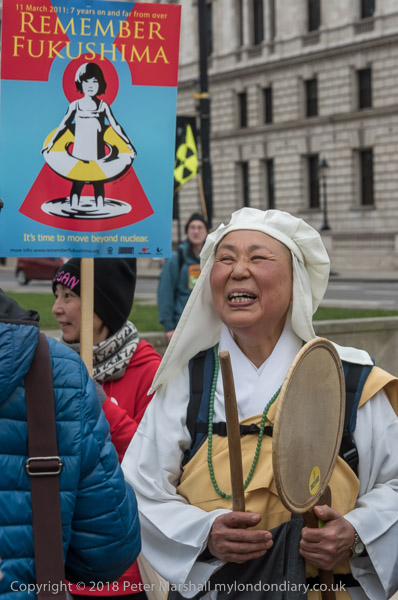
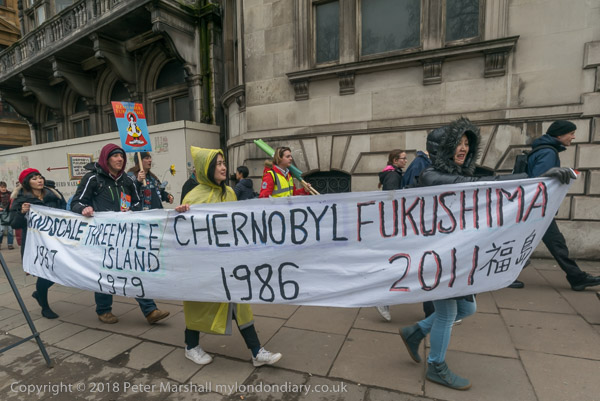
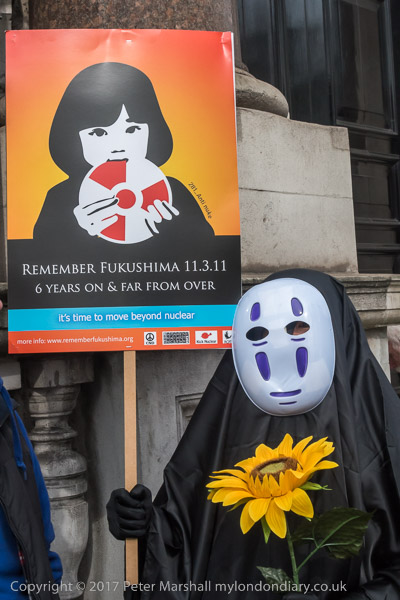
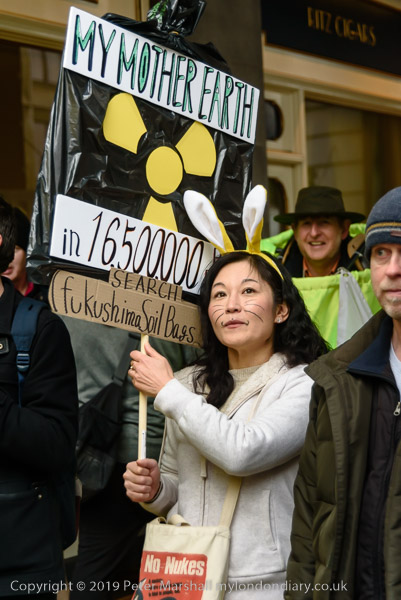
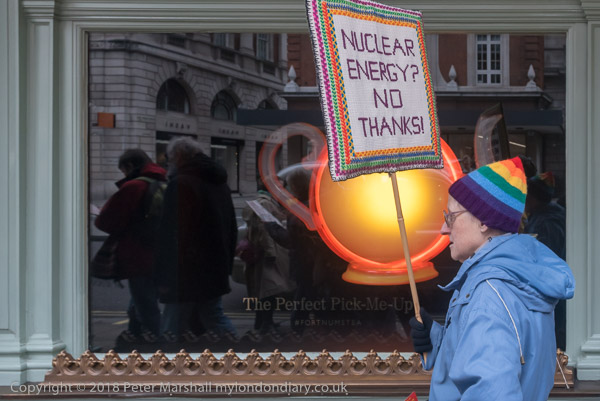
On 11th March 2011 the Fukushima Daiichi Nuclear Power Plant in Japan suffered the worst nuclear disaster since the 1986 Chernobyl meltdown. An earthquake had led to the reactors to automatically shut down their electricity production which led to the plant relying on emergency power generators to run the cooling pumps needed to keep the reactors safe. But the tsunami tidal wave almost 50 ft high caused by the earthquake swept over the plant’s sea wall and flooded the generators, cutting the power supply.

Windscale 1957, Three Mile Island 1979, Chernobyl 1986, Fukushima 2011′ 

Without cooling, three reactors heated up and then melted down and over the following three days there were three explosions of hydrogen gas and the release of huge amounts of radiation from the damaged reactors to the air and the Pacific Ocean. The release of radiation into the ocean was continued at high levels for at least 2 years, and there is still some leakage from the plant.

154,000 people in the area had to be evacuated from their homes in a area of 20km radius from the nuclear plant. The clean-up is expected to continue for another 20-30 years. You can read much more about the disaster in ‘10 Years Since The Fukushima Nuclear Disaster‘ by Philip White.

The possibility of such a disaster had been predicted in studies carried out some years earlier and an internal report by the company running the plant, TEPCO, had in 2000 recommended that there should be improved safety measures, but the management rejected both this and a 2008 internal report calling for better protection against seawater flooding.

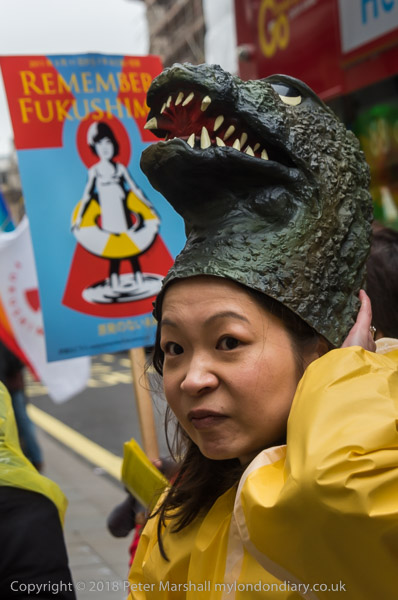
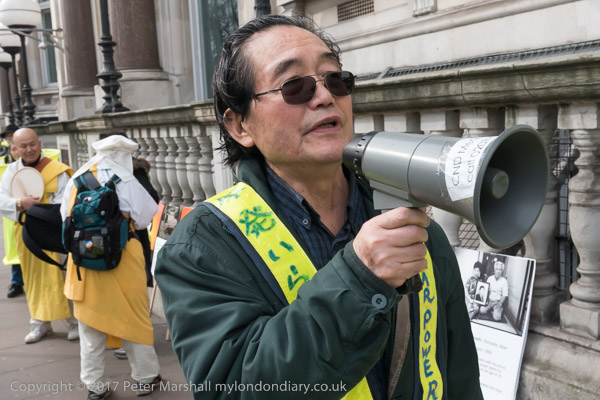
Campaigners in London held regular protests outside the Japanese Embassy and TEPCO’s London offices for some years and have organised larger annual protests on or close to the March 11th. Among the on-line events scheduled for 2021 is the free International Uranium Film Festival with two films online including Fukushima No Daimyo, a 2014 Italian film (in Japanese with Portuguese sub-titles) from March 11-18.

More pictures on My London Diary:

2017: Fukushima anniversary challenges nuclear future
2018: Remember Fukushima, 7th Anniversary
2019: Remember Fukushima 8 years On
and in 2011, 2013 and 2014.


All photographs on this and my other sites, unless otherwise stated, are taken by and copyright of Peter Marshall, and are available for reproduction or can be bought as prints.

1987 – In the City

St Botolph's Church Hall, Bishopsgate Churchyard, City, 1987 87-11a-15-positive_2400
St Botolph’s Church Hall, Bishopsgate Churchyard, City, 1987

St Botolph’s Church Hall in Bishopsgate Churchyard has changed little since I took this picture over 30 years ago and the churchyard is still a place you can stroll though away from the noise and fumes of Bishopsgate a few yards away.

Old Broad St, City, 1987 87-11a-21-positive_2400
Old Broad St, City, 1987

Back in 1987 you could walk through a considerable part of the City on the High Walks, pedestrian walkways above the streets, one of which could be accessed at the western end of Bishopsgate Churchyard and gave elevated views of the buildings on Old Broad St opposite. Boston House appears to be the name of the the block on Old Broad Street between London Wall and New Broad St, and to be made up of two similar buildings; this one, on the corner of London Wall appeared to me the more satisfactory.

Highwalk, view, St Botolph's Churchyard, City, 1987 87-11a-22-positive_2400
Highwalk, view, St Botolph’s Churchyard, City, 1987

This was the view from the highwalk looking back down Bishopsgate Churchyard. Much of the the highwalk has since been closed to the public.

Highwalk, View, Old Broad St, City, 1987 87-11a-24-positive_2400
Highwalk, View, Old Broad St, City, 1987

Perhaps surprisingly this view from the north end of the highwalk looked little different until recently, though I don’t think there is any public access to enable you to see it from my 1987 viewpoint. At far left is the corner of Broad Street Avenue and the building, 76-80 Old Broad Street, dates from around 1860 and is Grade II listed. The UBS building at 100 Liverpool St was completed in 1988, but UBS moved out a few years ago (to an even more hideous building in Broadgate, nominated for the Carbuncle Cup) and others moved in, but the building has been treated to a facelift, with a new skin over the old structure.

Highwalk, View, London Wall, Old Broad St, City, 1987 87-11a-34-positive_2400
Highwalk, View, London Wall, Old Broad St, City, 1987

Although the bridge across Wormwood Street from which I took this picture is still in place (or was last time I walked by before lockdown) the stairs leading to it were firmly blocked. It shows the junction between Old Broad St and the east end of London Wall, with Boston House, shwon in a picture above, on the corner at right.

Angel Court, City, 1987 87-11a-41-positive_2400
Angel Court, City, 1987

Angel Court is an alley in the centre of London’s finanacial district between Throgmorton St and Copthall Avenue, now leading between tall buldings.

Throgmorton Gardens, City, 1987 87-11a-43-positive_2400
Throgmorton Gardens, City, 1987

A little to the east of Angel Court, this garden is at the corner of Austin Friars and Copthall Avenue and was I think closed to the public, and my photograph was taken through the fence looking south from Austin Friars.

More from the CIty of London in a later post. All these pictures are in my Flickr album 1987 London Photos.


All photographs on this and my other sites, unless otherwise stated, are taken by and copyright of Peter Marshall, and are available for reproduction or can be bought as prints.

Kensington 1987

Kensington Square,  Kensington & Chelsea, 1987 87-10f-65-positive_2400
Kensington Square, Kensington & Chelsea, 1987

Kensington often seemed to me to be more a film set than a real place.

HyperHyper, Kensington High St,  Kensington & Chelsea, 1987 87-10f-55-positive_2400
HyperHyper, Kensington High St, Kensington & Chelsea, 1987

And it was certainly in places ‘HyperHyper’; this designer collective was launched in 1982 at 26-40 Kensington High St with stalls selling the latest and often looniest fashions from young designers. The caryatids were a hangover from the store’s previous incarnation as the Antiques Hypermarket. They are now long gone, and the site is now a rather down-market clothing store.

Viscount Hotel, Victoria Rd, Kensington,  Kensington & Chelsea, 1987 87-10f-02-positive_2400
Viscount Hotel, Victoria Rd, Kensington, Kensington & Chelsea, 1987

This building is still there, though under a different name and has lost its urns. Victoria Road is one of a number of streets that have at least once been named as the most expensive streets in the United Kingdom, though the hotel seems rather reasonably priced for the area.

Kensington Gardens,  Kensington & Chelsea, 1987 87-10e-56-positive_2400
Kensington Gardens, Kensington & Chelsea, 1987

Mainly I went to Kensington Gardens to sit and eat my sandwich lunch when I was in the area, but I did take the odd picture.

Kensington Palace Gardens, Kensington, Kensington & Chelsea, 1987 87-10e-01-positive_2400
Kensington Palace Gardens, Kensington, Kensington & Chelsea, 1987

And another, of the sunken garden, set out in 1908. In 2017 it was named the Princess Diana Memorial Garden, but this picture was taken around ten years before she was killed.

Man with model yacht, Round Pond, Kensington Gardens,  Kensington & Chelsea, 1987 87-10e-42-positive_2400
Man with model yacht, Round Pond, Kensington Gardens, Westminster, 1987

Parts of the gardens, including the Round Pond, are in the London Borough of Westminster. The Round Pond is not remotely round, closer to an oval, but more a rectangle with very rounded corners.

Kensington Rd, Kensington, Kensington & Chelsea, 1987 87-10e-23-positive_2400
Kensington Rd, Kensington, Kensington & Chelsea, 1987

This building with its magnificent winged lions is still there, and still a hotel, but with a different name, and a different entrance and railings.

De Vere Mews, Canning Place, Kensington, Kensington & Chelsea, 1987 87-10e-14-positive_2400
De Vere Cottages, Canning Place, Kensington, Kensington & Chelsea, 1987

As the out of focus area at right indicates, I took this picture of a private courtyard through a gate from the street. It was originally built as Laconia Mews in 1877-8, with rooms for coaches at ground level, a steeply curved ramp leading to stables on the first floor with living accomodation for the carriage drivers and grooms on the second floor. It was converted into cottages shortly after the First World War and most has been considerably rebuilt since then, and a ‘cottage’ here now sells for £2-3 million.

Kensington Church St, Kensington, Kensington & Chelsea, 1987 87-10d-62-positive_2400
Kensington Church St, Kensington, Kensington & Chelsea, 1987

This row of shops remains, although all the names are different. Then they were mainly antique dealers and galleries, now slightly more varied.


All photographs on this and my other sites, unless otherwise stated, are taken by and copyright of Peter Marshall, and are available for reproduction or can be bought as prints.


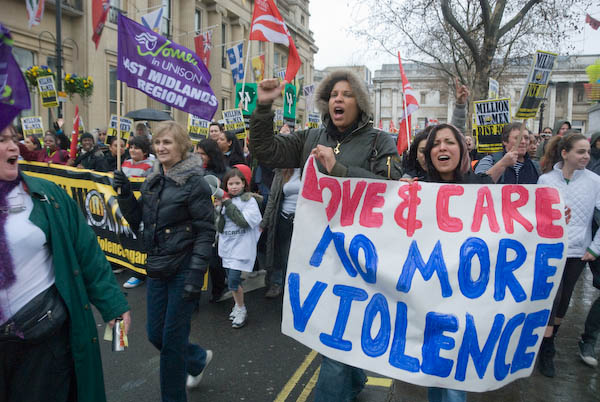
8 March: International Women’s Day

2002: Global Women’s Strike

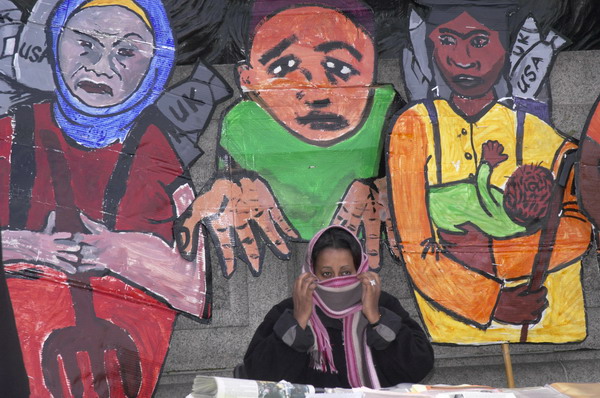
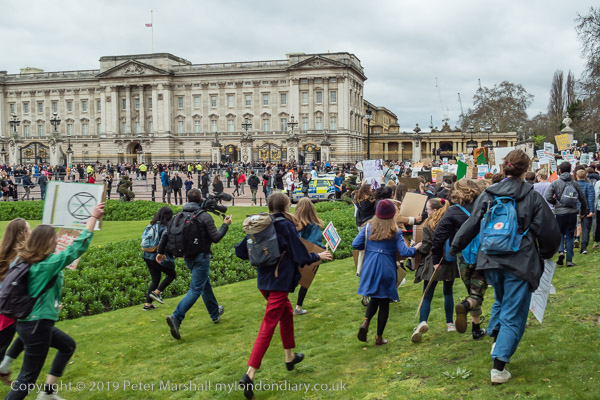
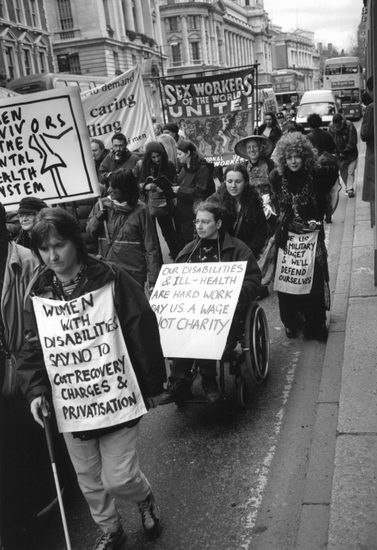
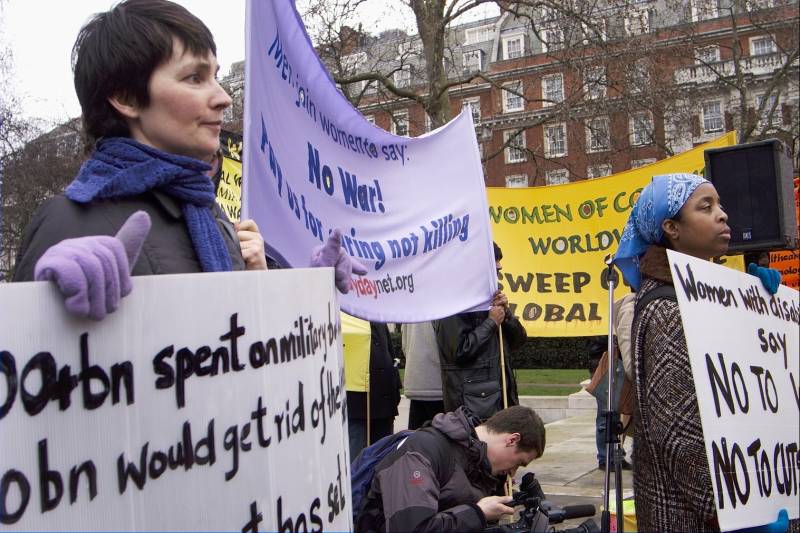
March 8th is celebrated in many countries around the world as International Women’s Day and is a national holiday in over 25, particularly across the former USSR, as it has its early roots in a 1909 National Woman’s Day organised in New York by the Socialist Party of America and was then taken up by socialist women in Europe, where there were widespread International Women’s Day protests on March 19, 2011.

2003: Global Womens Strike

The date of March 8th was set in Germany in 1914, and adopted since then in most countries.

2004: Global Women’s Strike

It was officially adopted by the Soviet Union after the 1917 revolution and spread to other communist countries including China, continuing as a largely communist festival until it was adopted in the late 1960s by feminists campaigning for equal rights and opportunities and an end to violence against women.

2008: Million Women Rise: International Women’s Day March

In 1975 the UN proclaimed March 8th as the UN Day for women’s rights and world peace, and since then we have seen both left wing protests and more corporate celebrations and events taking place on the day.

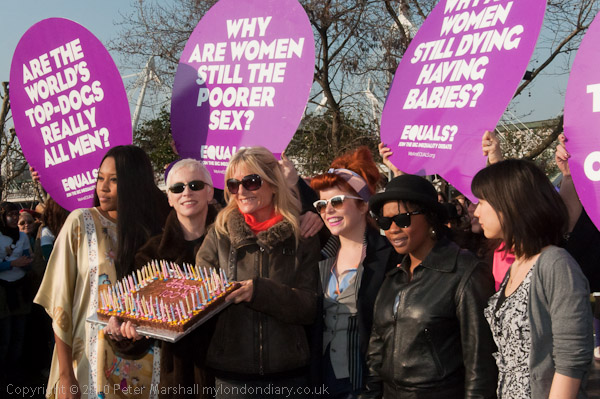
2011: 100 Years of International Women’s Day
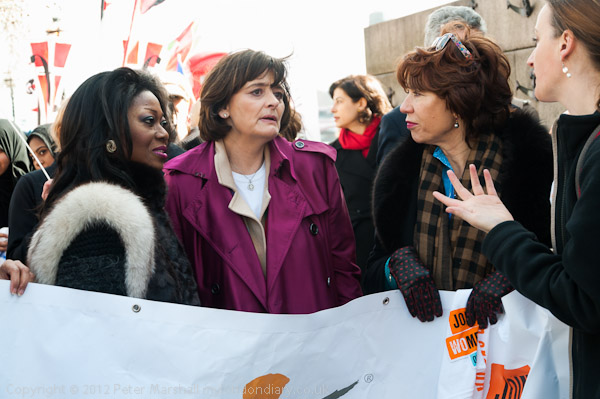
2012: Women on the Bridge: International Womens Day

Since March 8th is not a holiday in the UK, some Interternational Women’s Day events take place on the nearest weekend rather than on the day itself.

2014: Million Women Rise March
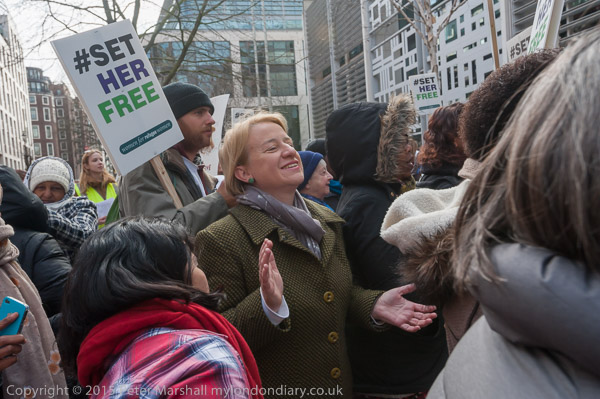
2016: Set Her Free – International Women’s Day
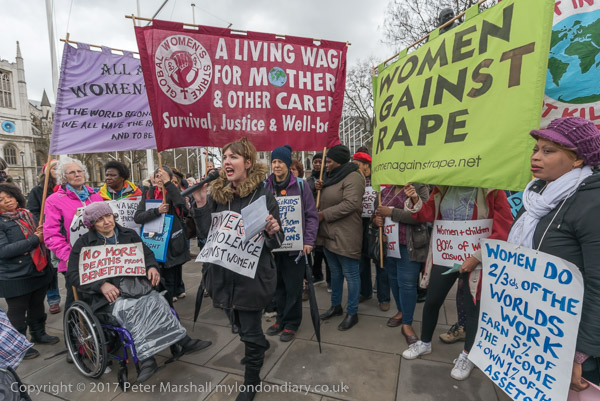
2017: International Women’s Strike
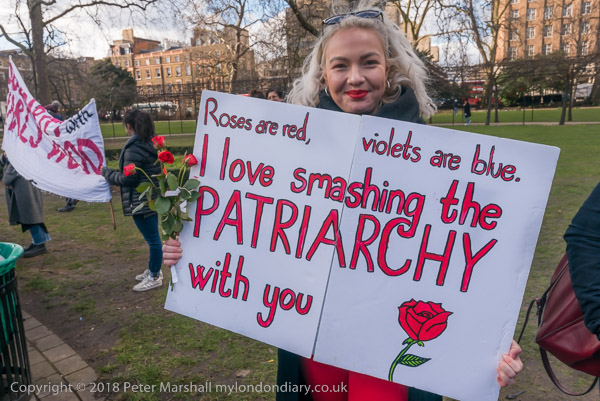
2018: London Women’s Strike

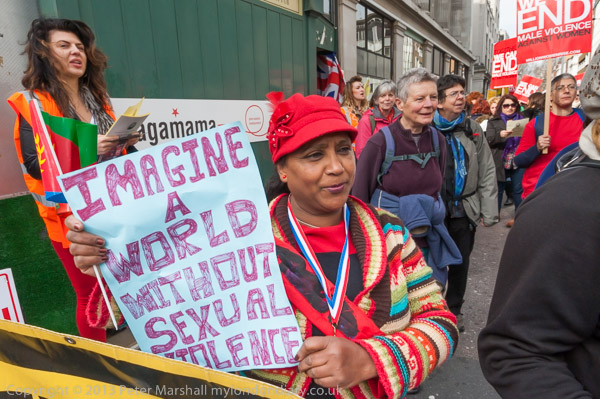
I’ve photographed many of these events over the years, sometimes several on the same day, though I’ve only used a picture from one event in this post.

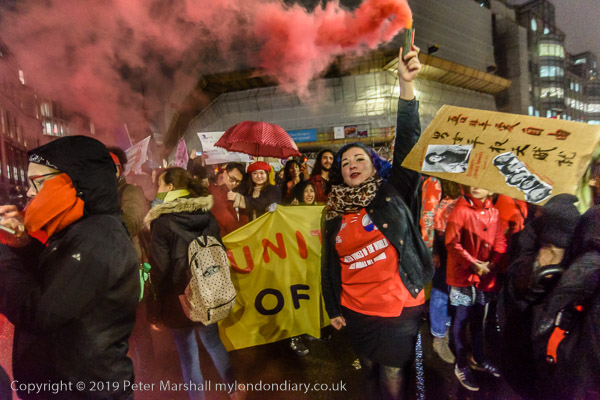
2019: Women’s Strike Red Feminist March

Recent years have seen an increase – until today – in the size and militancy of the protests on International Women’s Day, particularly with the emergence of the Women’s Strike Assembly which organises against racist agendas and far-right attempts to foment racism, and organises exploited migrant workers in the service industries.

2020: International Women’s Day block Oxford St

All of the pictures in this post were taken on March 8th and come from a variety of events over the years. All and many more are on ‘My London Diary’.


All photographs on this and my other sites, unless otherwise stated, are taken by and copyright of Peter Marshall, and are available for reproduction or can be bought as prints.


Climate Change and the Budget

Once again the recent budget has failed to show any real commitment to make the changes we need to combat the climate crisis. The chancellor’s speech and the treasury details were strong on rhetoric, telling use that we need to make radical changes and that cutting carbon was a major government priority, but there were few and only minor changes announced that will combat climate change, while more major announcements that will accelerate it.

Perhaps one of the more disappointing areas were the announcements on infrastructure and on road building. The expected UK national infrastructure strategy was not yet available and is now expected “later in the spring” but it is unlikely to change the commitment made already to wrongheaded project of which HS2 is the most glaring. And the promise of the “largest ever investment in England’s motorways and major A roads” goes completely against the need to get more people using sustainable public transport and will certainly lead to increased road traffic.

Another way the budget encourages car use is of course the continued freezing of fuel duty, which has remained at 58p per litre (+VAT) since 2011. Had the increases promised in the June 2010 budget taken place it would now be at 84p. While fuel duty has been frozen, rail fares have continued to rise.

Although there were minor changes intended to encourage the decarbonisation of heating buildings, any long term plans on the scale needed are still lacking. It is an area which could be addressed in that long promised infrastructure strategy, and one that could be an important source of ‘green jobs’ so fingers are firmly crossed – but I fear we will get yet another disappointment.

There are other disappointments in this budget too. The support for measures to combat the increasing risks of flooding seems lukewarm, and the ambitious programme of tree planting seems to be only roughly a fifth of that in earlier promises, and clearly insufficient. The budget also restates a commitment to invest in carbon capture and storage which still seems very unlikely to deliver any real dividends. It is also very unclear if the £900m for research into nuclear fusion, space and electric vehicles will make any positive contribution to combating climate change.

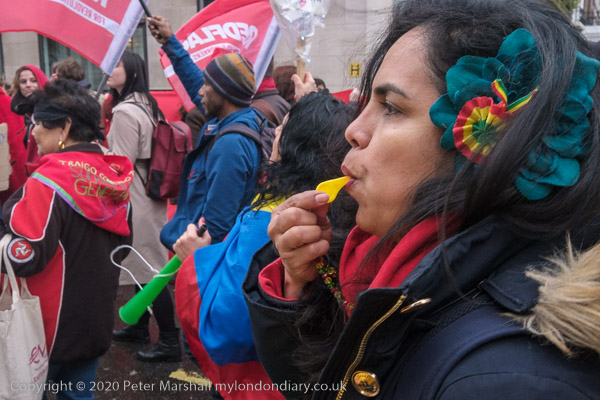
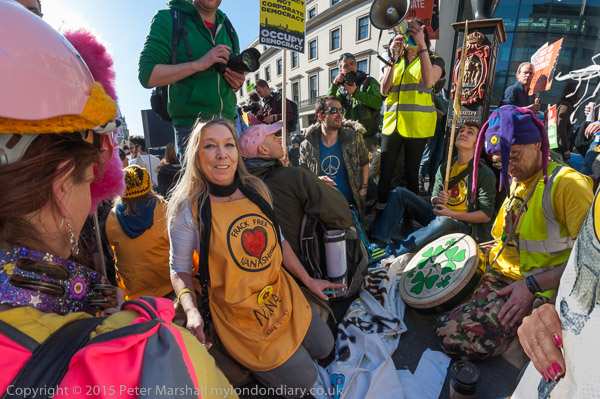
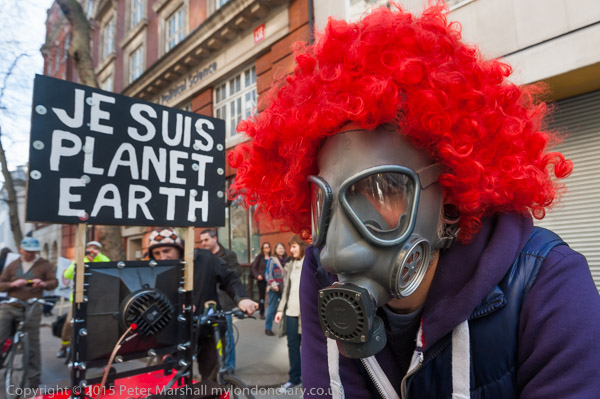
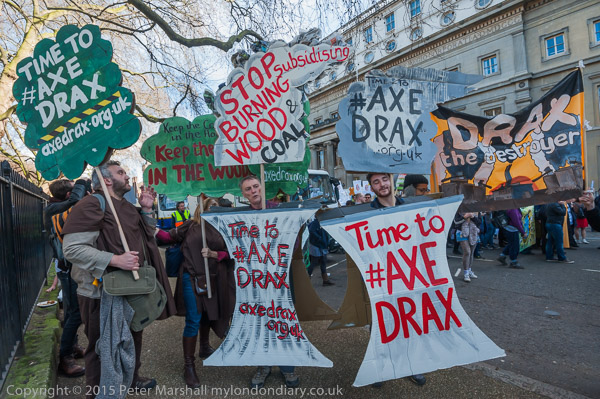
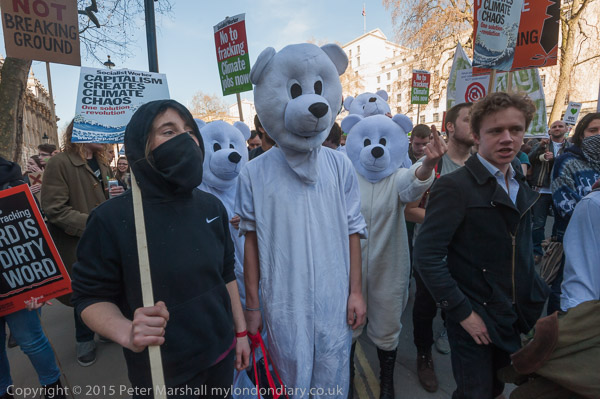
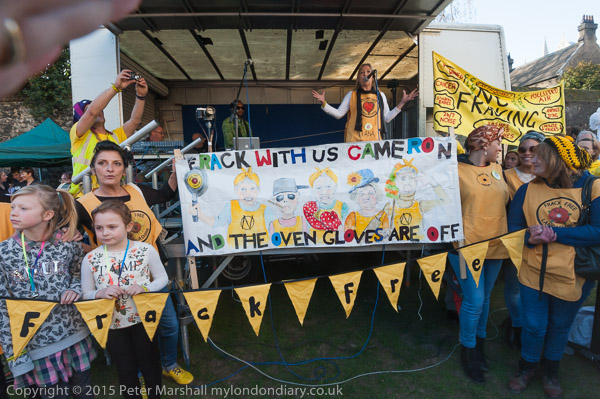
Six years ago, on Saturday 7th March, I was with over 20,000 protesters marching through London to a rally outside Parliament demanding action on climate change with divestment from fossil fuels, an end to fracking and damaging bio-fuel projects and for a 100% renewable energy future which would create a million new jobs.

The case then was clear and the protest made it firmly, but since then governments had spent six years talking about it but doing very little, listening more to the lobbyists from fossil fuel companies rather than the science. Slowly there have been some changes, and more politicians are now saying the right kind of things, but there has been precious little action. It’s probably now too late to avoid some pretty disastrous effects of the inevitable global temperature rise, but we may still be able to mitigate them and avoid the worst possible consequences. But it will need governments to stop fiddling while the planet burns.

More on My London Diary:
Climate Change Rally
Time to Act on Climate Change


All photographs on this and my other sites, unless otherwise stated, are taken by and copyright of Peter Marshall, and are available for reproduction or can be bought as prints.


Staines 1987

My photographic projects in London relied on being able to get a train from Staines, and although the service was generally rather better back in the 1980s than now, there were still times when I turned up at the station only to find there were no trains running. It was probably on one of these days when I’d arrived at the station with my camera bag on my shoulder that I decided instead of going back home to take a walk around the town instead. There is nothing spectacular about these images, but I think they are an interesting record of a time and place and one that in many respects has changed since I took them in October 1987.

Clarence St, Church St, Staines, Middx, 1987, Spelthorne 87-10i-51-positive_2400
Clarence St, Church St, Staines, Middx, 1987, Spelthorne

This corner has changed relatively little, but Johnson and Clark, the Staines department store said to have been the inspiration for a sitcom closed long ago, and its main building on the other side of the road not in this picture long demolished. It was a business which always seemed stuck in a 1950s time warp. The shop with a closing down sale at right had been Staines first supermarket, a small Tesco , but possibly it was a successor selling up; it is now a Wetherspoons, and the last pub I visited before the lockdown in December.

Market Square, Staines, Middx, 1987, Spelthorne 87-10i-41-positive_2400
Market Square, Staines, Middx, 1987, Spelthorne

The Blue Anchor was in business here, possibly from the 15th century, and the brick facade dates from 1721. Some of its windows are real but others only painted, presumably because of the window tax which first came into force in 1696 and was only repealed in 1851, and its hard to see the difference in this picture. One of the major inns in the old town, it closed as a pub around 2006, and has since been a series of restaurants, currently Turkish and of course only able to serve takeaway meals.

Staines Town Hall was built in 1880, financed by public subscription and the building became redundant when Spelthorne Council built new offices around a mile away – and at roughly the same time was Grade II listed. For some years it was used only for occasional concerts (and is the courtroom in the 1982 film Gandhi) but the council spent £1 million to convert it into a much-needed arts centre in Staines which opened in 1994. But this lost money and was closed in 1999 being at the wrong end of the borough to get support from the Tory council. It reopened as a wine bar from 2004-12, then was left empty (apart from a brief squat) before being sold off to a developer for £1.6 million with planning permission granted in 2018 for conversion to flats despite there being no parking space and inadequate disabled access. Many Staines residents regard it as a scandalous loss of what should have been seen as a major public asset for the town desperately short of cultural facilities.

Cock Tavern, Church St, Bridge St, Staines, Middx, 1987, Spelthorne 87-10i-31-positive_2400
Cock Inn, Church St, Bridge St, Staines, Middx, 1987

The Cock Inn, built in 1832 on a site that had been a pub for several hundred years, closed in 2009 and is now offices. Behind it was Ashby’s Brewery, where a modern building for Courage can be seen peeping over and to the left, but it served Brandon’s Fine Ales, brewed in Putney. Some of the older Ashby buildings still stand, converted to residential and office uses and the Quaker Ashby family was one of the most important in the growth of Staines.

A second Staines brewery, on Kingston Rd, set up by the Harris family was taken over by Ashby’s in 1903 and closed in 1914. Later it briefly became Staines Library and then an adult education centre for Surrey County Council but was closed 15 years ago and has been empty and unused since. Squatters occupied it in 2015 attempting to open up the buildings for community use but were evicted after a couple of months.

Clarence St, Staines, Middx, 1987, Spelthorne 87-10i-26-positive_2400
Clarence St, Staines, Middx, 1987

Clarence Street was built as the approach road to the new Staines Bridge designed by John and George Rennie and opened by King William IV and Queen Adelaide in 1832, a short distance upstream of previous bridges thought to have crossed the river since Roman times close to the Market Square. It was the fourth bridge to be built since the Civil War and is still in use, widened considerably in 1958, but still a bottleneck. The building on the corner of Bridge St was in the 1970s Staines Library.

High St, Staines, Middx, 1987, Spelthorne 87-10i-03-positive_2400
High St, Staines, Middx, 1987

Staines High St is still lined by a few buildings of some architectural interest from the Victorian era, along with some rather less exciting 20th century additions, but the big difference is that it is now pedestrianised.

High St, Staines, Middx, 1987, Spelthorne 87-10h-11-positive_2400
High St, Staines, Middx, 1987

Another view of the north side of the High St, this time looking east towards the ‘Iron Bridge’ which carries the Windsor Line across the road. Almost all of the buildings here have now been demolished, with a large hotel replacing most of them.

London Rd, Staines, Middx, 1987, Spelthorne 87-10h-36-positive_2400
London Rd, Staines, Middx, 1987

The main road through Staines, on the line of the Roman Road to the Southwest which became the A30, becomes London Road to the east of the Iron Bridge seen at the left of this picture. Fortunately the opening of the second section of the Staines bypass in the 1960s takes much of the traffic away from the town which had been a notorious bottleneck. Only the shop and pub barely visible here at the side of the bridge remain (though probably not for long), with both the 1950s shops, the 1930s Post Office and the rest all long demolished and now part of a new partly high-rise largely residential development currently nearing completion – and including a new Co-op store.

London Rd, Staines, Middx, 1987, Spelthorne 87-10h-35-positive_2400
London Rd, Staines, Middx, 1987

A little further along on London Road and some pleasant 1920s style parades of shops on the north side (with some of a similar age on the south side, which would have been in shadow – so I will have decided to photograph them another day in different lighting.)

London Rd, Staines, Middx, 1987, Spelthorne 87-10f-33-positive_2400
London Rd, Staines, Middx, 1987

Surprisingly the Three Tuns and the two shops to the left are still there today, though sadly closed at the moment. As with all pubs we wonder if it will one day reopen, though we hope so, though it isn’t one I frequent. It was listed on this site in 1798 and possibly dates from rather earlier. The large office block is long gone, and development is promised on the site, though when I last looked it was still just earth and rubble.

There are a few more pictures of Staines on page 7 of my album 1987 London Photos, including just a few of the common land and other open spaces around the area on the edge of London – but just inside the M25 which is perhaps its real boundary.


All photographs on this and my other sites, unless otherwise stated, are taken by and copyright of Peter Marshall, and are available for reproduction or can be bought as prints.


South of the River – 1987

Scrap Metal, Deptford Creek, Deptford, Greenwich, 1987 87-10l-45-positive_2400
Scrap Metal, Deptford Creek, Deptford, Greenwich, 1987

Many of my favourite London walks were by the River Thames, back in 1987 still lined with industry, most now replaced by luxury flats, and rather less interesting. Walking along Creek Road from Deptford to Greenwich took me past a power station, scrap metal yards, sand and gravel works and a former gas works with the creek flowing past them.

Scrap Metal, Power Station, Deptford Creek, Deptford, Greenwich, 1987 87-10l-44-positive_2400
Scrap Metal, Power Station, Deptford Creek, Deptford, Greenwich, 1987

The final section of Deptford power station had been decommissioned in 1983, but most of of it was still standing, though I think some demolition was taking place around it. And a smaller chimney, I think on the opposite bank of the creek, was still belching out smoke, and there were piles of sand and gravel on the opposite bank as well as the scrap metal at left where the creek went under Creek Road.

Scrap Metal, Deptford Creek, Deptford, Greenwich, 1987 87-10l-32-positive_2400
Scrap Metal, Deptford Creek, Deptford, Greenwich, 1987

Both banks of Deptford Creek here are in the London Borough of Greenwich, something I often forgot when captioning images, expecting the creek to be the boundary. The creek is of course still there, and more conveniently for walkers there is now a footbridge across it a few yards from where it enters the Thames. A path now runs beside the Thames too, where both the power station and gas works once stood, in some ways a gain, but there is now so much less of interest to see.

Art Gallery, Wood Wharf, Greenwich, 1987 87-10l-43-positive_2400
Art Gallery, Wood Wharf, Greenwich, 1987

I don’t remember going inside the Art Gallery at Wood Wharf, and I think it was probably now open when I took this picture. Wood Wharf is now tall residential blocks – with a riverside walkway, restaurants and a pub.

The Lone Sailor, pub, Francis Chichester, Old Loyal Briton, Thames St, Greenwich, 1987 87-10l-35-positive_2400
The Lone Sailor, pub, Francis Chichester, Old Loyal Briton, Thames St, Greenwich, 1987

The Loyal Briton at 62 Thames Street went through a variety of names over the many years since it was built, probably around the middle of the 19th Century, possibly as a fire station, though it was selling beer by the 1850s.Its renaming as The Lone Sailor was probably after Francis Chichester’s single-handed voyage around the world in 1966-7 when his yacht Gypsy Moth was put on display not far from the Cutty Sark in 1968, remaining there until 2004, when she was restored and put back into sail. The pub closed in the 1990s, later becoming the SE10 restuarant. It had a brief time as a Chinese takeaway and gambling den, and in October 2013 reopened as a pub, The Old Loyal Britons. But the lease was only for a year, and it closed permanently in October 2014 to be replaced in 2018 by a large block of 1,2 & 3 bedroom appartments.

Lambeth Hospital, Renfrew Rd, Kennington, Lambeth, 1987 87-10l-65-positive_2400
Lambeth Hospital, Renfrew Rd, Kennington, Lambeth, 1987

A workhouse was built in 1871 in Renfrew Rd to house 820 inmates and five years later the Lambeth Infirmary was built on an adjoining site, with the two being combined as Lambeth Hospital in 1922. It was taken over by the LCC in 1930 and by 1939 was one of London’s larger municipal hospitals. It continued in use under the NHS until 1976 when a new wing was opened at At Thomas’ Hospital. Parts still remain – including this building which since 1998 has housed the Cinema Museum.
87-10k-62-positive_2400
Trade Counter, Westminster Bridge Rd, Newington, Southwark, 1987

This is now a part of the Peabody Head Office building, Minster Court.

Royal Eye Hospital, St George's Circus, Newington, Southwark, 1987 87-10k-51-positive_2400
Royal Eye Hospital, St George’s Circus, Newington, Southwark, 1987

The South London Opthalmic Hospital opened with two beds in a house near here in 1857, but after some growth and several name changes it moved to this larger block on the NW corner of St George’s Circus as the Royal Eye Hospital in 1892. Badly damaged in the war it reopened in 1944, becoming part of the NHS in 1948. In 1976 patients were transferred to St Thomas’s Hospital with out-patient clinics ending in 1980. It was demolished in the 1990s and a student hall of residence, McLaren House, built on the site.

Temporary Housing, London Park Hotel, Dante Rd, Newington, Southwark, 1987 87-10k-33-positive_2400
Temporary Housing & London Park Hotel, Dante Rd, Newington, Southwark, 1987

The London Park Hotel was built in 1897 as the Newington Butts Rowton House, the third of its kind under Lord Rowton’s recently introduced scheme of hostels for down-and-out or low-paid working men in London. They had communal facilities including a dining hall, lounge, reading room, washrooms, barbers, cobblers and tailors shops, shoe cleaning rooms and parcel rooms for storage on the lower floors and on the upper floors were private cubicles each with a bed, chair, shelf and chamber pot, all for 6d a day. Lodgers were not allowed into the cubicles during the day. They could either eat in the dining room or cook there own food (more at http://www.workhouses.org.uk/RowtonNewington/).Originally having 805 beds, a new wing added in 1903 increased that to 1017. It was renamed Parkview House and in 1972 re-opened as the London Park Hotel. It closed in the 1990s but was for a while used to house refugees and asylum seekers. It was demolished in December 2007.

More pictures on page 7 of my 1987 London Photos on Flickr.


All photographs on this and my other sites, unless otherwise stated, are taken by and copyright of Peter Marshall, and are available for reproduction or can be bought as prints.