Around Swiss Cottage 1988

Sigmund Freud, sculpture, Oscar Nemon, Swiss Cottage Library, South Hampstead, Camden, 1988 88-7h-61-positive_2400
Sigmund Freud, sculpture, Oscar Nemon, Fitzjohn’s Avenue, Belsize Lane, South Hampstead, Camden, 1988 88-7h-61

Around Swiss Cottage 1988: Sigmund Freud (1856–1939) escaped from Austria after it was annexed by Nazi Germany and came to London, spending his final year until his death in the house in Maresfield Gardens which now houses the Freud Museum. Croatian sculptor Oscar Nemon made three busts of Freud for his 75th birthday in 1931 and visited him in London in 1938 to make a final bust on which the head of this sculpture was based. Funds were later raised for him to create this bronze sculpture which was unveiled in 1970 next to Swiss Cottage Library where I photographed it.

In 1998 it was moved to a more prominent position at the junction of Fitzjohn’s Avenue and Belsize Lane and it was Grade II listed in 2016.

Taplow, Winchester Rd, Swiss Cottage, Camden, 1988 88-7h-63-positive_2400
Taplow, Winchester Rd, Swiss Cottage, Camden, 1988 88-7h-63

The five tower blocks of the Chalcots Estate where built for the London Borough of Camden in 1967-8. Taplow, Burnham, Bray, and Dorney are 23 storeys while Blashford has 19. The land was owned by Eton College and the names come for the area around Eton.

Cladding was added to the towers in 2006 by the same companies that clad Grenfell Tower but using fire-resistant rock-wool. When a fire broke out in a flat in Taplow in 2012 the fire was contained and did not spread and there were no deaths.

Embassy Theatre, Eton Avenue, Swiss Cottage, Camden, London, 1988 88-7k-61-positive_2400
Embassy Theatre, Eton Avenue, Swiss Cottage, Camden, London, 1988 88-7k-61

Originally a stucco double-fronted Italianate Victorian villa, it was converted in 1890 into the Eton Avenue Hall for the Hampstead Conservatoire, a prestigious private music college; Cecil Sharp the great collector of English folk song was its principal from 1896-1905 and composer Arnold Bax one of his pupils.

The building was converted again after the college had closed and opened as the Embassy Theatre in 1928, with a school of acting from 1932. Damaged in the war it reopened in 1945, continuing as a theatre until 1956 when it was sold to the Royal Central School of Speech and Drama, now a college of London University.

College Crescent, South Hamnpstead,  Camden, 1988 88-7k-63-positive_2400
College Crescent, South Hampstead, Camden, 1988 88-7k-63

College Crescent was built by the Eyre family who were (and are) major landowners in Swiss Cottage and parts of Hampstead, with the first houses built in the late 1840s. Initially it was named as three streets, College Villas Road, College Terrace and College Crescent.

40 College Crescent was not one of the original houses, but was built around 1880 on the site of Abbey Farm Lodge as the family home for Samuel Palmer or Huntley and Palmer’s biscuit firm in Reading. Following his death this area of open space with a drinking fountain and shelter – as its inscription states – “presented to the Borough of Hampstead for the public benefit in memory of the late Samuel Palmer of Northcourt, Hampstead by his widow and family. 1904”. It was Grade II listed in 1993.

St. Thomas More, Roman Catholic, Church, Maresfield Gardens, Hampstead, Camden, 1988 88-7k-64-positive_2400
St. Thomas More, Roman Catholic, Church, Maresfield Gardens, Hampstead, Camden, 1988 88-7k-64

In 1938 the Archbishop of Westminster bought Hyme House at 3 Fitzjohn’s Avenue, for some years the studio of successful society portrait painter Philip de László (1869-1937) as the first English home for the Swiss-based Sisters of Mercy of the Holy Cross. The Sisters converted the studio into a church and bought the next two houses on the street to set up a girls school which they ran until 1985, after which it became a hotel.

In 1950 the studio had become too small and a second church was built on the site, but further expansion made this inadequate. The current church, built a restricted site on tennis courts at the back of the house and fronting onto Maresfield Gardens was designed by Gerard Goalen following the Second Vatican Council to maximise participation of the laity in the Mass. It was Grade II listed in 2016.

Netherhall Gardnes, Hampstead, Camden, 1988 88-7k-42-positive_2400
Netherhall Gardens, Hampstead, Camden, 1988 88-7k-42

A very rectangular house with a gate made largely of circles, but with the ironwork on the top of the gate reflecting the only non-rectangular feature of the frontage, and carefully positioned on top of it.

The Tower, Fitzjohn's Ave, Hampstead, Camden, 1988 88-7k-46-positive_2400
The Tower, Fitzjohn’s Ave, Hampstead, Camden, 1988 88-7k-46

An irresistable Gothic fantasy. Development in this area had been prevented for years after the death of the estate owner Sir Thomas Maryon Wilson in 1821, whose will prevented his sons building on the land, and efforts by his son (confusingly of exactly the same name) to get the will amended came to nothing. When he died, his brother Sir John inherited and was able to make a deal making part of the estate a part of Hampstead Heath and making development possible in other areas.

The Tower, Fitzjohn's Ave, Hampstead, Camden, 1988 88-7k-32-positive_2400
The Tower, Fitzjohn’s Ave, Hampstead, Camden, 1988 88-7k-32

Sir John divided the estate in 1873 with his son Sir Spencer Maryon Wilson who developed Priory Road and Fitzjohn’s Avenue from 1875 on, as a wide road with wide pavements linking Swiss Cottage and Hampstead which was described by Harpers Magazine a few years later as “one of the noblest streets in the world”.

The Tower, Fitzjohn's Ave, Hampstead, Camden, 1988 88-7k-33-positive_2400
The Tower, Fitzjohn’s Ave, Hampstead, Camden, 1988 88-7k-33

A much quoted Camden History Society article describes the Tower at No 25 as an ornate mansion which is now “a fine example of ‘Disneyland Gothic'”. The building with 25 rooms dates from 1880-1, its architect JT Wimperis, a very prolific Victorian architect for Herbert Fleming Baxter (1839-1905), an extremely wealthy American merchant who was a part of a family with extensive estates in Shropshire. The house has been restored and is now divided into flats. Rather surprisingly it was not Grade II listed until 1999.

My walk will continue in a later post.


Click on any of the pictures to go to a larger version in the album 1988 London Photos, from where you can browse through the album.
After Christmas – Brentford to Hammersmith

After Christmas – Brentford to Hammersmith was one of our more interesting walks in London to walk off our Christmas excesses in recent years. For once I’m not sticking religiously to my usual practice and this was three years AND one day ago, and the four of us set out on 27th December 2018.

Often in recent years we’ve gone away in the period after Christmas to visit one of our sons and his family in Derbyshire, with some great walks in the areas around where they have lived, and there are pictures from these on My London Diary, but in 2018 my other son and his wife were staying with us and came for this walk.

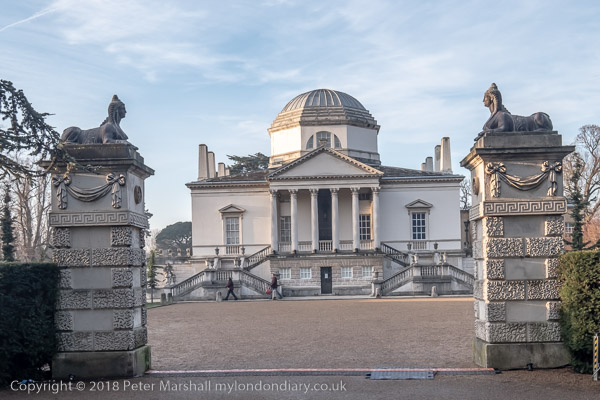
Public transport in the period between Christmas and New Year is at best restricted and rather unreliable, and 2018 was no exception and this always limits our starting point. Even for this relatively local walk what would have been just a short direct train meant taking the train to Twickenham and then catching a local bus to Brentford. And on our return trip again a bus took us back to Twickenham for the train home. It meant less time for walking and we had to abandon the idea of actually going inside Chiswick House in order to complete the relatively short walk of 5-6 miles before it got dark.

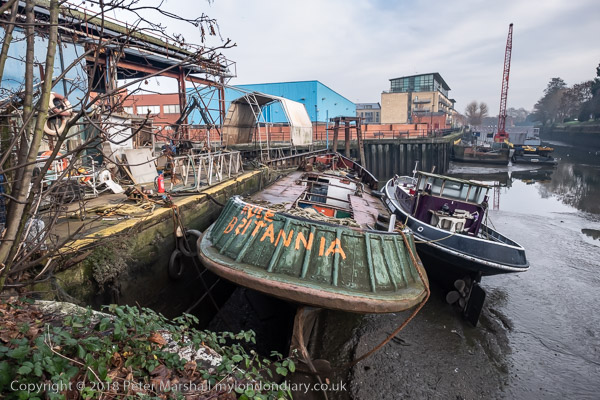
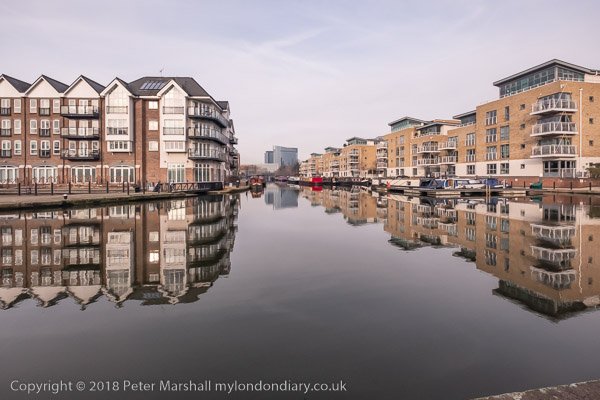
Brentford, and particularly the Grand Union Canal where we began our walk is now very different from how I remember it – and indeed since I first went back to photograph it in the 1970s. Commercial traffic on the Grand Union came more or less to an end in the early 1970s. What was once canal docks and wharves by the lock where boats were gauged and tolls charged the sheds have been replaced by rather uglier flats and a small marina.

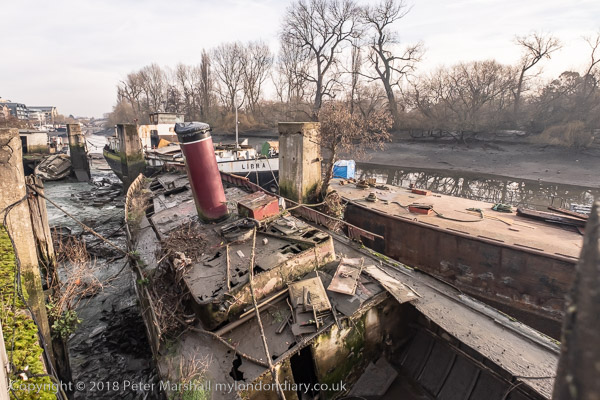
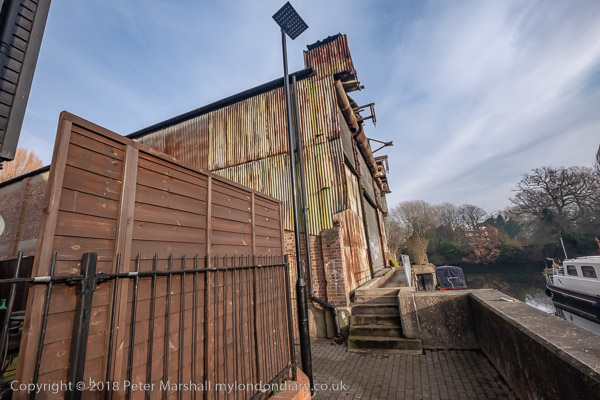
Walking by the canal towards its junction with the River Thames there are areas which still look much as they did years ago, and some rather more derelict than they were then. This is a side of Brentford invisible from the High Street but with much of interest. Probably in the next few years this too will disappear as gentrification advances.

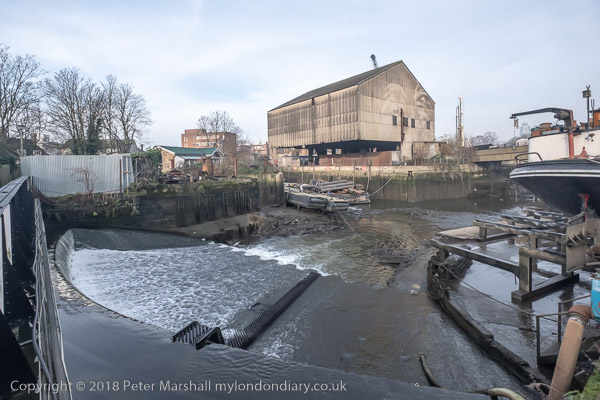
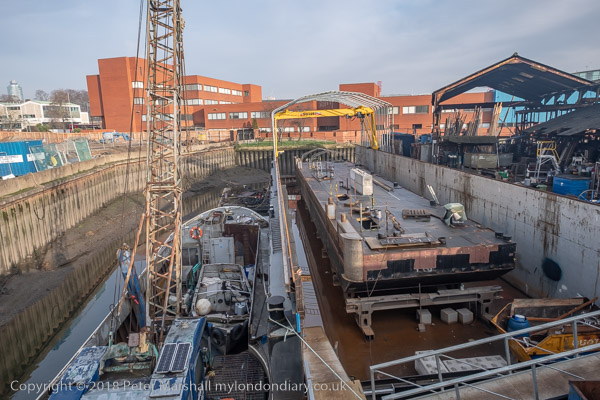
Shortly before the lock leading to the Thames, the River Brent which is here combined with the canal runs over a weir to make its own way to the main river. There are still working boatyards in the area around here, though a little downstream more new flats and a part of the Thames Path here was closed and a short diversion was necessary.

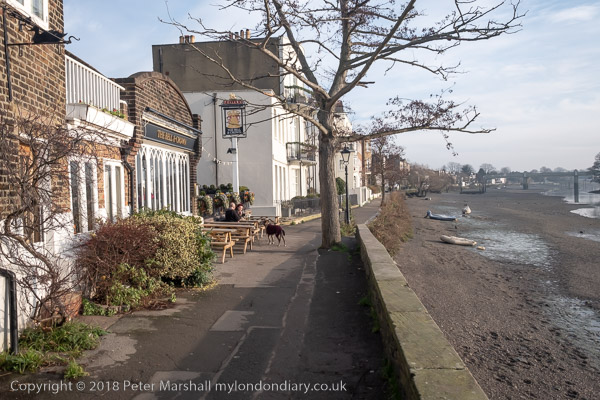
We continued along past new riverside flats and a new private footbridge to the recently revivied boatyard on Lot’s Ait to an area of open space which was a part of the old gas works site, then along the riverside path past more new flats to Kew Bridge and Strand on the Green. Here it was warm enough to sit in the sun and eat our sandwiches before leaving the river to walk to Chiswick House Gardens.

I’d planned to get here for lunch, perhaps spending an hour or so going around the house and then perhaps a drink in the cafe, but there was no time thanks to the rail problems, so we briefly visited the toilets before heading on to St Nicholas’s Church and Chiswick riverside.

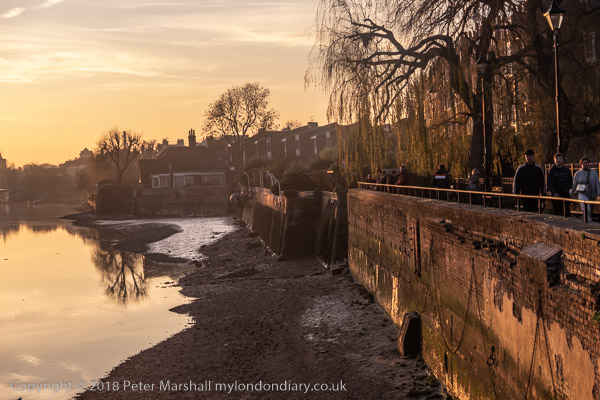
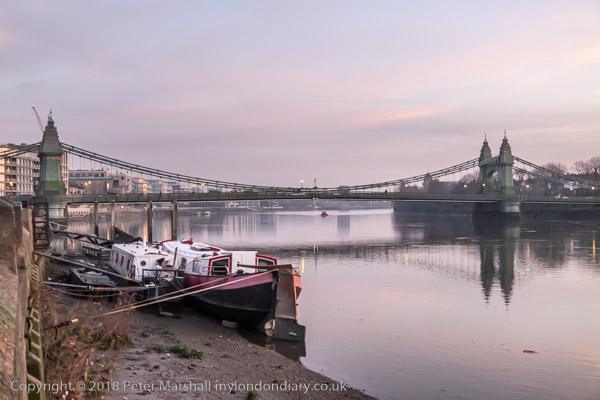
From there it was a straight walk by the river to Hammersmith Bridge, arriving around sunset with some fine views along the river – and then the short walk to the bus station for the bus back to Twickenham and the train home. The two bus journeys made our travel take much longer, but you do get some interesting views from the top deck of a double-decker and the journey was intereresting at least until it got too dark to see much.

More on the walk and many more pictures at Brentford to Hammersmith.


Desperate Day For Gaza

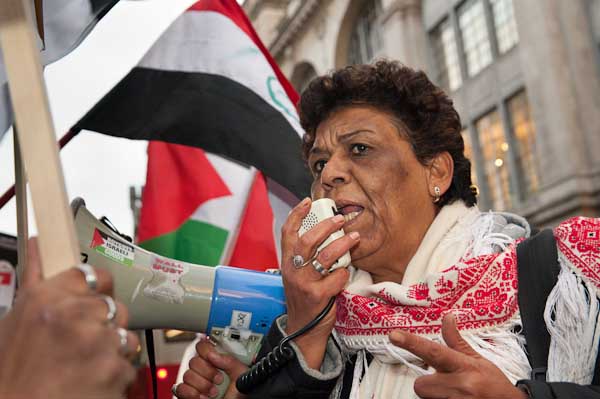
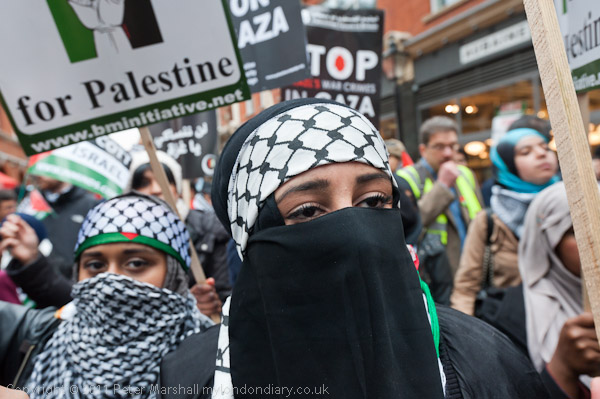
December 27th 2008 was a desperate day for Gaza, when the Israeli military launched the beginning of a massive air attack on the small enclave. Operation Cast Lead had been six months in the planning and 100 pre-planned targets were struck in less than four minutes. The initial air attack was followed by others and on the 3rd of January 2009 with a ground attack. Israeli Defense Forces ended their attacks on 18th January 2009.

According to Wikipedia, the Israeli government stated was a response to weapons smuggling into Gaza and to Hamas rocket attacks on southern Israel with, according to the Israeli military 3,000 rockets hitting Israel over the whole of 2008 – despite a ceasefire agreement which held for around 5 months before an Israeli attack on a cross-border tunnel in Gaza in November. Rockets killed 8 people in Israel in 2008, four of them after the attack on Gaza began on 27th December.

Again according to Wikipedia (I’ve removed the 14 references to sources which you can find in the original);

A total of 1,100–1,400 Palestinians (295–926 civilians) and 13 Israelis were killed in the 22-day war.

The conflict damaged or destroyed tens of thousands of homes, 15 of Gaza’s 27 hospitals and 43 of its 110 primary health care facilities,800 water wells, 186 greenhouses, and nearly all of its 10,000 family farms; leaving 50,000 homeless, 400,000–500,000 without running water, one million without electricity, and resulting in acute food shortages. The people of Gaza still suffer from the loss of these facilities and homes, especially since they have great challenges to rebuild them.

Wikipedia

There is much more detail on the attack and its consequences, as well as on later attacks on Gaza in 2014, 2018 and 2021 on Wikipedia in articles including those cited above and there would be little point in going further into the details here.

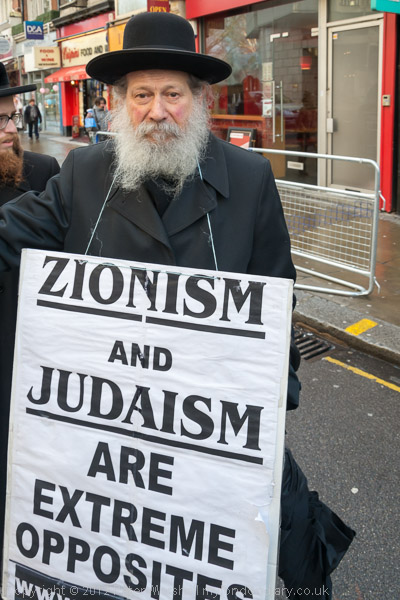
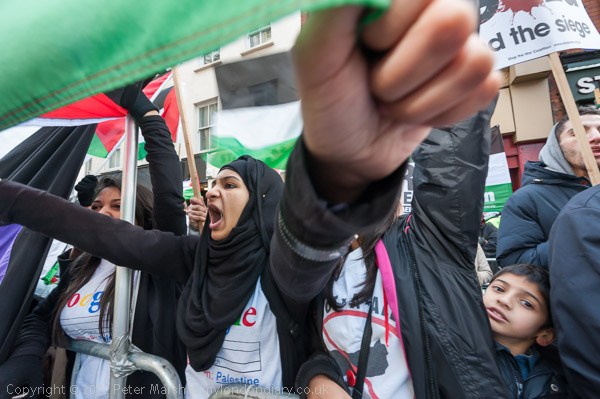
There was a large protest in London against the attack early in January 2009, and I photographed this an other protests, including those the anniversary of the start of the attack on 27th December 2009, 2010, 2011 and 2012. There I’ve written more about the protests and with many more pictures, including pictures of Tony Benn, Jeremy Corbyn and many others speaking against the attacks and ongoing siege of Gaza.

January 2009 Gaza: Protest March from the BBC
December 2009 Remember Gaza
December 2010 London Vigil For Gaza
December 2011 End The Siege Of Gaza
December 2012 Gaza – End the Siege


Selling Off The NHS

Two news items in recent days (neither given any great prominence in the media) show clearly how the Tories are selling off the NHS.

Though it was the Financial Times which reported why Rishi Sunak failed to attend a roundtable discussion with the UK hospitality sector. He was in California and the UK meeting was said by Treasury insiders to have clashed with his scheduled call with “US healthcare bosses.” Like me you probably don’t read the FT, but you are unlikely to have heard much about this from the BBC.

The second recent news is that Virgin Healthcare, a company that has been awarded contracts worth well over £2 billion for providing parts of our NHS services was this month sold to the private equity group Twenty20 Capital.

Virgin Care runs 400 NHS and local authority services including GP surgeries and Physiotherapy, generally concentrating on simple services which leaves more difficult and expensive work to be carried out by the NHS. It has a structure including Virgin Group Holdings based in the British Virgin Islands which sets up companies with large amounts of debt it uses to legally avoid paying UK tax – though the owners the Branson family have donated £70,000 to the Tory party.

You can watch a Labour Party video in which Jeremy Corbyn, then the Labour Leader, holds up a 451 page uncensored report and the considerably slimmer heavily redacted version released by Boris Johnson’s government. The unedited version confirms that the US demanded that the NHS is firmly on the table in the trade talks. “These uncensored documents leave Boris Johnson’s denials in absolute tatters… We’ve now got evidence that under Boris Johnson the NHS is on the table and will be up for sale.”

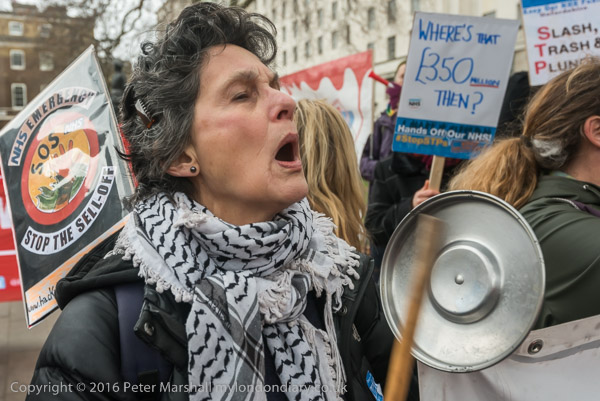
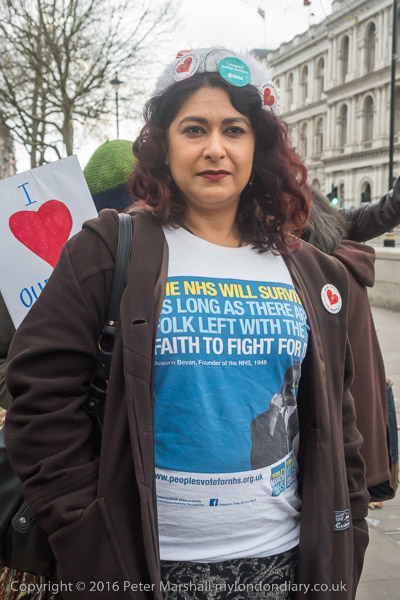
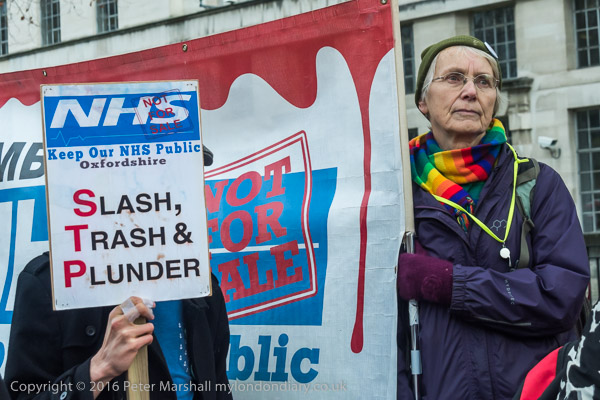
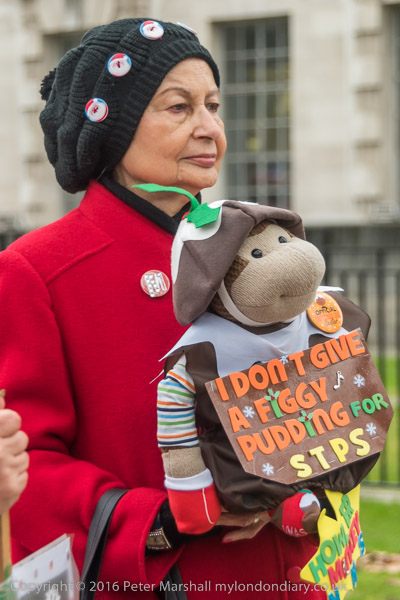
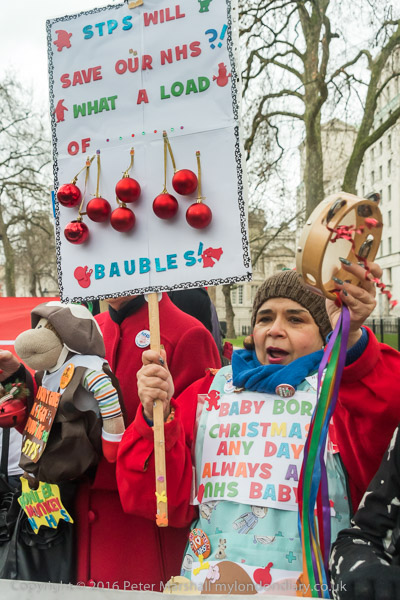
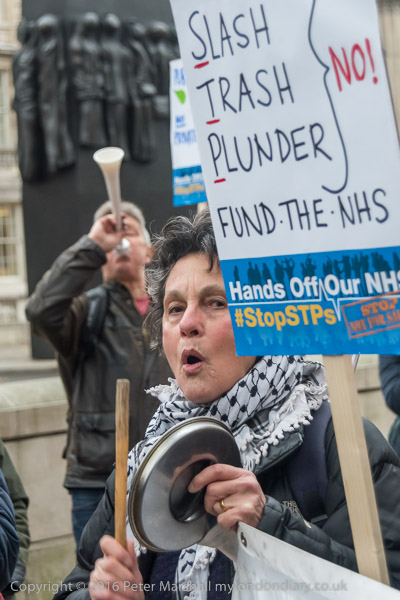
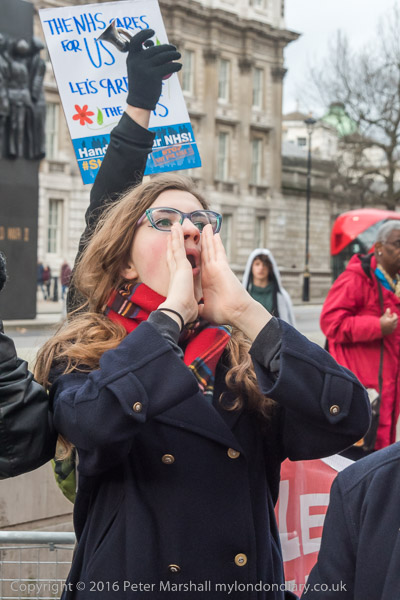
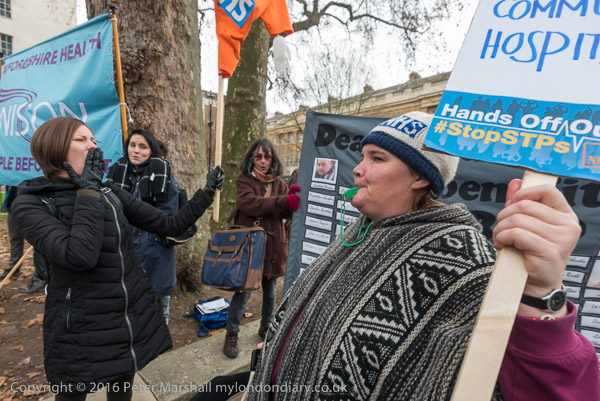
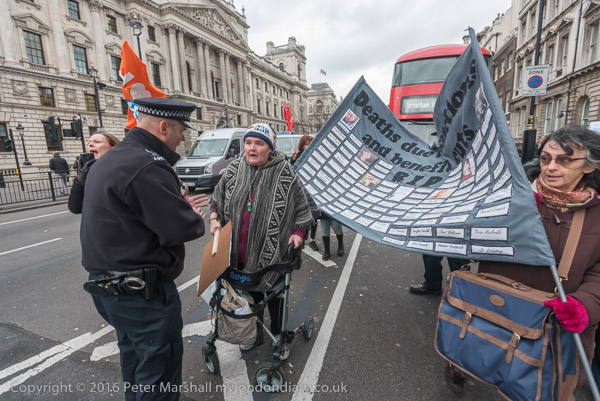
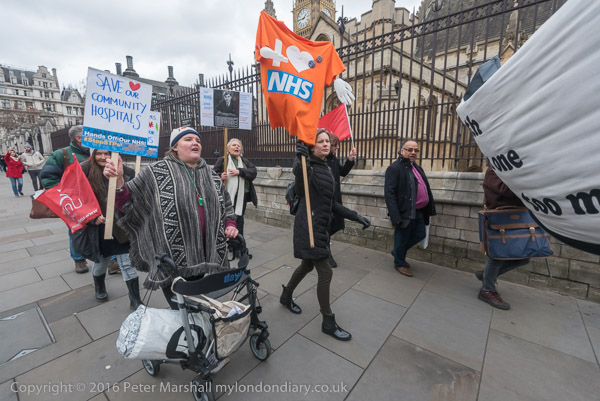
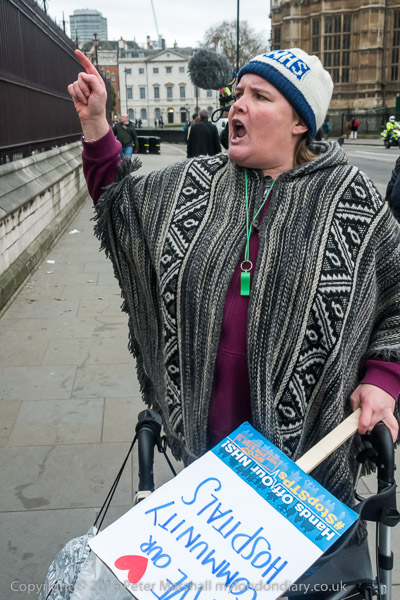
On Friday 23rd December 2016, I photographed ‘Howls of protest for death of the NHS‘, a protest at Downing St on the day that contracts were signed across the country to implement the government’s ‘Sustainability and Transformation Plans’ which effectively means the NHS can be handed over to private companies without any public engagement or consultation, ending a public service whose vision which has long been the envy of the world, signing the NHS over for private profit.

Every 15 minutes the speeches were interrupted for a long and loud ‘howl of protest’ by those taking part. These were timed to coincide with three social media ‘Thunderclaps’ across Facebook, Twitter & Tumblr by several hundreds of people mainly unable to be at the rally.

Speakers at the rally included Paula Peters of DPAC, Ealing Councillor Aysha Raza, trainee nurse Anthony Johnson of the Bursary or Bust campaign, a trainee mental health nurse, a patient and campaigner Gina and retired paediatrician and co-chair of Keep Our NHS Public Tony O’Sullivan.

At the end of the rally a small group of those present led by several DPAC campaigners, were harassed by police and threatened with arrest as they marched on the road to hold a final howl outside Parliament, with another short speech by Paula Peters.

Though the NHS has been deliberately weakened and made more available for private companies to run for profit by successive governments we still do have an NHS which is largely free at the point of need. But half of NHS beds have been lost since Thatcher began the cuts and privatisation and over 40% of services in UK healthcare are now provided by private companies and many of those who are now running the government have made clear in speeches, pamphlets and books that they favour an insurance backed scheme based on the US model.

The US model is expensive and flawed. Two thirds of personal bankruptcy in the USA is because people are unable to pay for the cost of healthcare either because they cannot afford the insurance or often because their insurance will not cover the treatment they require.

The Health and Care Bill 2021 continues the threats to the future of the NHS and gives much greater powers to the government to direct the NHS and will undoubtedly lead to greater penetration of the service by private providers, including the major US healthcare companies that Chancellor Sunak was making plans with in California while neglecting his duties in the UK.

More from 23rd December 2016: Howls of protest for death of the NHS


Nelson Mandela’s Birthday

Back in 1988 on the 17th July, the day before Nelson Mandela’s Birthday on the 18th July, I joined thousands of marchers through London demanding he be freed from jail.

Free Nelson Mandela - Birthday March and Rally - London 1988 88-7h-66

https://en.wikipedia.org/wiki/Nelson_Mandela Mandela was born on 18th July 1918, so this was his 70th birthday and he was still in jail, then held in Pollsmoor Prison, near Cape Town, having been removed with other senior ANC members from Robben Island to remove their influence on younger ANC members held there.

Free Nelson Mandela - Birthday March and Rally - London 1988 88-7h-55

He was well treated in Pollsmoor and international attempts to end apartheid was increasing, along with secret meetings with the South African Minister of Justice. President Botha had actually offered to release him, if he “unconditionally rejected violence as a political weapon”, but Mandela had refused to leave while the African National Congress was still banned.

Free Nelson Mandela - Birthday March and Rally - London 1988 88-7h-31

Mandela’s 70th birthday was celebrated around the world, with a televised tribute concert at Wembley Stadium attracting an estimated 200 million viewers.

Free Nelson Mandela - Birthday March and Rally - London 1988 88-7j-65

The march in London was a large one, and I wasn’t then a seasoned photographer of protests, though I had taken pictures at a number of smaller events.

Free Nelson Mandela - Birthday March and Rally - London 1988 88-7h-34

Because of the size of the event there were a number of feeder marches leading to a rally in Hyde Park. I joined the march coming from Camden and went with it to the rally, where I took some pictures in the crowd but didn’t attempt to cover the speakers, who included the Archbishop of Cape Town, Desmond Tutu.

Free Nelson Mandela - Birthday March and Rally - London 1988 88-7i-43

I took altogether only just over a hundred black and white pictures, of which I’ve now uploaded around a quarter to an album, Free Nelson Mandela – March and Rally – London 1988. You can also click on any of the images in this post to go to a larger version from where you can browse all the pictures that are online.


More St John’s Wood

Alexandra Rd, South Hampstead,  88-7g-63-positive_2400
Alexandra Rd, South Hampstead, 88-7g-63

Although the title of this post is ‘More St John’s Wood’, my walks were not constrained by local authority boundaries but often by more important physical restraints, here the main west coast railway line from Euston, and I walked beyond the St John’s Wood boundary a little into South Hampstead or Swiss Cottage.

I can find out little about Hillgrove Estate designed by Peacock, Hodges and Robertson for the LCC around 1960 and inherited by Camden following the local government reorganisation in that decade. This piece of sculpture is not on the list of public art in Camden and unfortunately I failed to record any details of it when I made this picture in 1988 if any were available then. Perhaps someone seeing this will be able to give details in a comment.

7, Boundary Rd, St John's Wood, Westminster, 1988 88-7g-65-positive_2400
7, Boundary Rd, St John’s Wood, Westminster, 1988 88-7g-65

This stucco detached villa dating from the 1840s is only Grade II listed for its ‘group value’, one of quite a number of similar properties in the area, though distinguished for me by its two substantial eagles on top of very substantial gate posts. The house next door, shown in the next few pictures, was much more remarkable.

Boundary Road, as its name suggests, marks a boundary, now between the City of Westminster – which includes St John’s Wood – and the London Borough of Camden, with this and other properties on its south side being in St John’s Wood. It was once a farm track on the boundary between two estates.

Alhambra Cottage,  Boundary Rd, St John's Wood, Westminster, 1988 88-7g-66-positive_2400
Alhambra Cottage, Boundary Rd, St John’s Wood, Westminster, 1988 88-7g-66

Alhambra Cottage is at 9 Boundary Rd certainly one of the most remarkable houses in London, a Grade II listed detached villa in a very detailed Islamic style and I made a number of photographs from the road outside. Later in 2011it was one of the buildings whose garden I photographed for the ‘Secret Gardens of St John’s Wood‘ project initiated by Mireille Galinou of the Queens Terrace Café and shown there in November 2011.

Alhambra Cottage, Boundary Rd, St John's Wood, Westminster, 1988 88-7g-53-positive_2400
Alhambra Cottage, Boundary Rd, St John’s Wood, Westminster, 1988 88-7g-53

Another view of Alhambra Cottage.

Alhambra Cottage, Boundary Rd, St John's Wood, Westminster, 1988 88-7g-54-positive_2400
Alhambra Cottage, Boundary Rd, St John’s Wood, Westminster, 1988 88-7g-54

I’m surprised not to find more information about this cottage online. Possibly the interest in the Alhambra may have been stimulated by the writing of American author Washington Irving who visited the Alhambra in 1828 and published his Tales of the Alhambra in 1832 and the lithographs of John Frederick Lewis, who became known as ‘Spanish’ Lewis published three years later.

At this time of year perhaps I should also mention that it was Irving who first put Santa (or rather St. Nicholas) flying over the rooftops at Christmas.

12 Blenheim Rd, St John's Wood, Westminster, 1988 88-7g-42-positive_2400
Loudon Rd area, St John’s Wood, Westminster, 1988 88-7g-42

This Grade II listed semi-detached house dates from the 1840s, but was altered in the mid-19th century. ‘An Englishman’s home is his castle‘ and this seemed to epitomise the proverb, with its castellated tower and sturdy gate. All that was lacking was a drawbridge.

Carlton Hill area, St John's Wood, Westminster, 1988 88-7g-44-positive_2400
Carlton Hill area, St John’s Wood, Westminster, 1988 88-7g-44

And finally before I left the area, another house with a tower, somewhere on my wandering between the junction of Abbey Road and Blenheim Rd and FInchley Rd. I took a few more pictures on my way south through St John’s Wood, but none are online.


Click on any of the images above to go to a larger version in my album 1988 London Photos, from where you can browse the album.


BP Or Not BP?

Since their birth as the Reclaim Shakespeare Company in 2012, BP Or Not BP? have carried out an incredible range of high-profile theatrical interventions which have received widepread media coverage against the abuse of our major cultural institutions by BP. One of the world’s major fossil fuel companies, BP uses its support of the arts to give it a respectable and worthy veneer while continuing to play its part in fuelling global warming and preventing real action against climate change.

According to the BP Or Not BP? website, the “have performed without permission at the Royal Shakespeare Theatre, the British Museum, the Edinburgh International Festival, the National Gallery, Cadogan Hall, the Royal Opera House, the Science Museum, the Roundhouse, the Noel Coward Theatre, the National Portrait Gallery and in Tate Britain.’

Some of these events have involved wide public participation, and have had considerable advance publicity andI’ve photographed a number of those that have taken place in London, but others have needed to be kept secret in advance, with only the players and a small number of trusted photographers and videographers being involved.

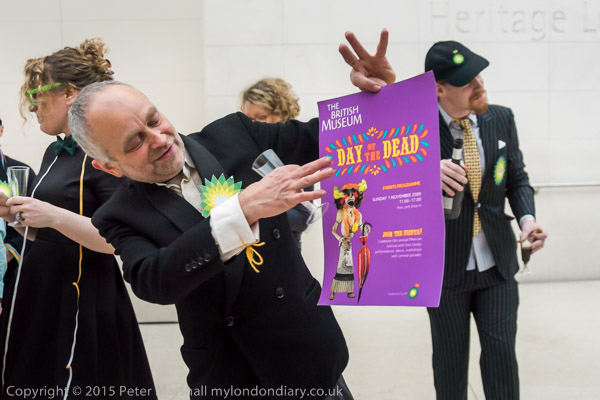
BP sponsored an exhibition on Mexico – the site of BP’s 2020 Deepwater Horizon disaster

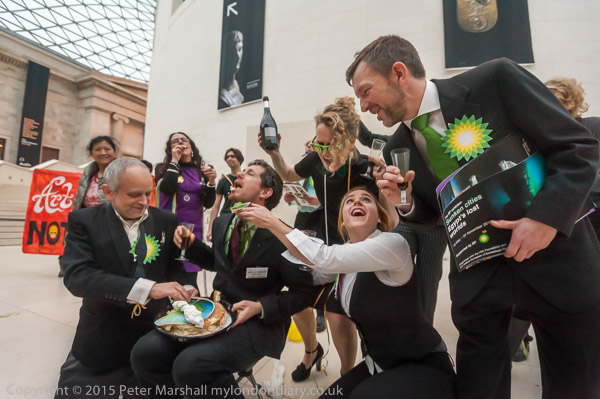
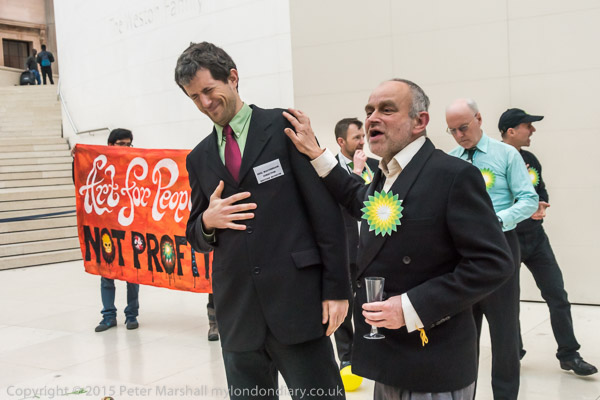
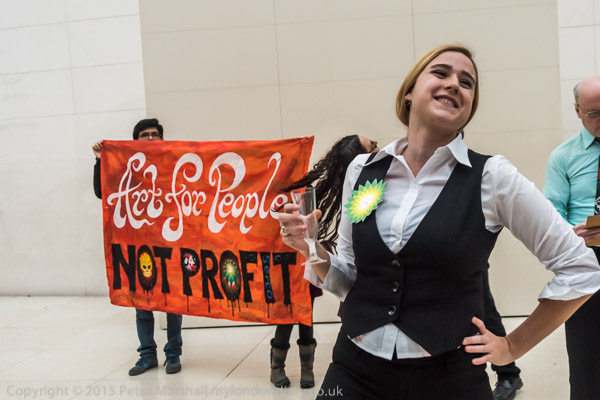
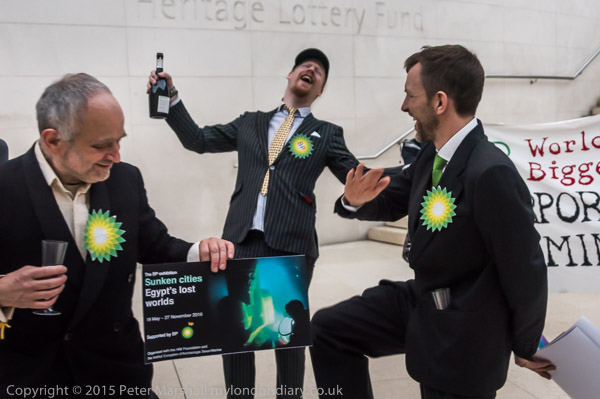
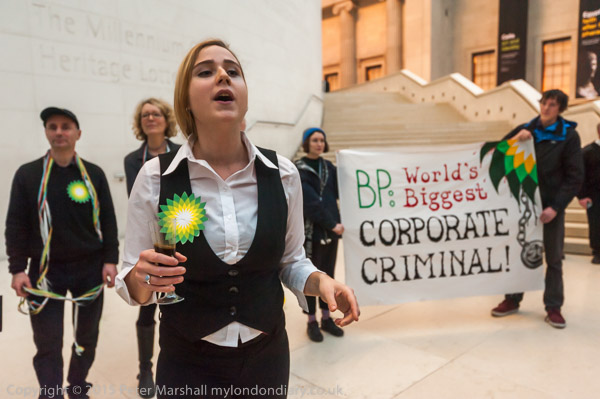
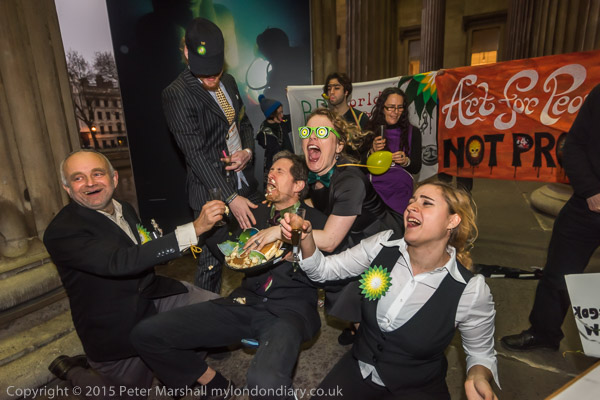
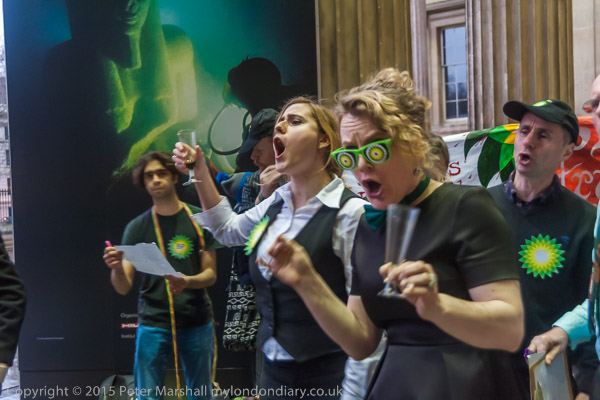
On 20th December 2015, I was pleased to be asked to photograph a performance of a play depicting ‘BP executives’ giving a farewell party to departing Museum director ‘Neil MacGregor’ inside the British Museum’s Great Court as visitors and security stood and watched. The pictures here are a small reflection of those I took on that occasion.

Sunken Cities – BP activities are causing sea level rise

You can read my account of the event at End BP’s British Museum Greenwash, along with a more detailed account of the proceedings including the full written script by BP or Not BP? on their web site. Although as I wrote, the actual performance contained considerable improvised embellishment.

In my account of the event, I included these paragraphs about the reasons behind the protest:

BP makes a relatively small contribution to the museums budget, a fraction of a percent, for which they get an engraved message on the wall of the rotunda in the Great Court and their logo prominently on the publicity for the museum’s major exhibitions, including Vikings, Ming, Indigenous Australia: Enduring Civilisation, the Mexican Day of the Dead and Sunken Cities, the last two perhaps particularly unfortunate as BP has been given the largest corporate criminal fine in history of $18.7 billion for the underwater Deepwater Horizon oil spill which caused huge pollution of the ocean around the coast of Mexico.

The current 5-year sponsorship deal between BP and the British Museum ends shortly and the museum and its new director will soon have to decide whether to renew its with the oil giant. While a good deal for BP, the amount concerned is a relatively small contribution to the museum’s budget, and thanks to the activities of BP or Not BP and other climate activists results in a great deal of bad publicity for the museum; hopefully they will look for less toxic sponsors.

After the performance inside the museu, there was another on the steps outside

Unfortnately the British Museum hasn’t ended its deal but renewed it and is still taking dirty oil money from BP. In November 2021 over 90 leading members of the archaeology and museum community sent an open letter to the Museum trustees calling on them to end BP sponsorship which they describe as “a strategy of reputational management. BP is taking advantage of the British Museum’s status as a highly respected institution, and of the public’s love of museums and heritage, to associate its brand with values of high culture, art, education, sophistication, reason, and knowledge. These values have powerful significance and appeal within our society and, crucially, among our political and civic decision-makers.”

BP or not BP? might put it more succintly: “‘greenwashing’ their very dirty, oily, reputation”.


MP Threatened Over Brexit

Anna Soubry MP harassed by extremists

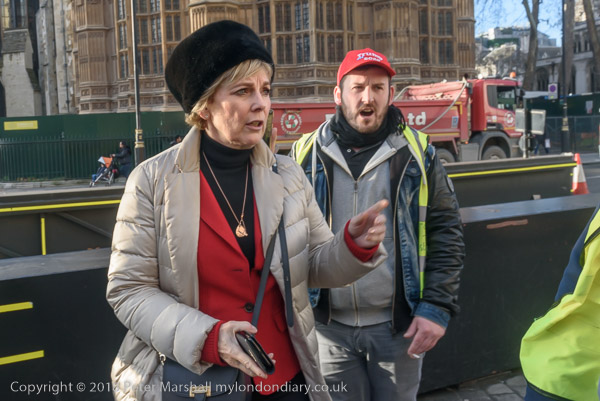
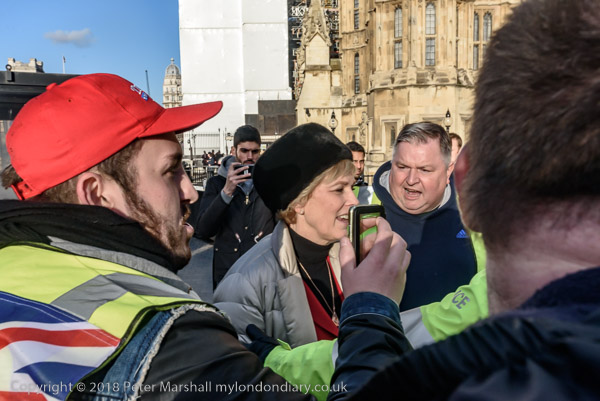
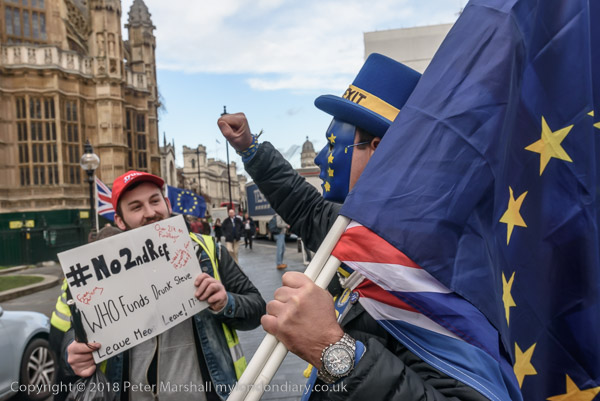
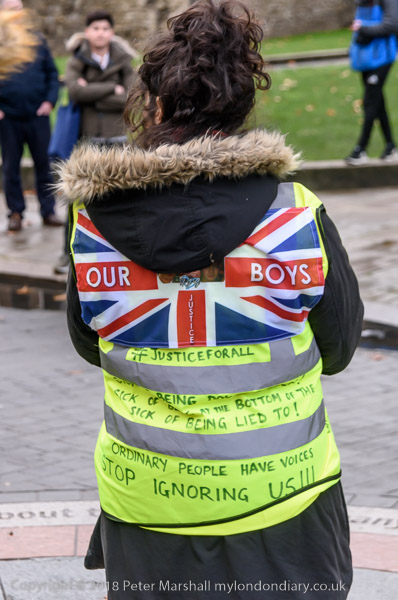
On December 19th 2018, tempers were still running high over Brexit, and I had been photographing extreme Brexiteers shouting at and threatening Steven Bray and other pro-Europeans as they continued their daily vigil outside parliament.

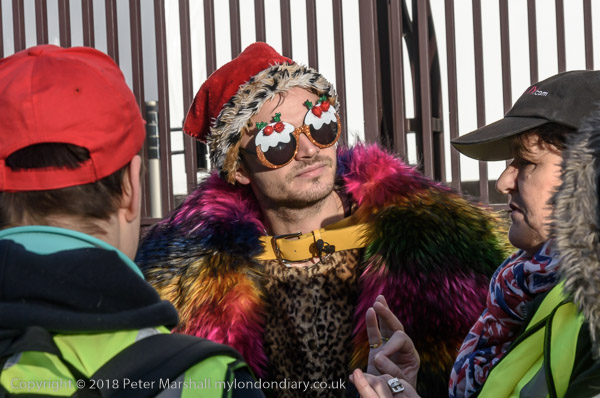
The protests across lunchtime seemed to be drawing to a close when I noticed the small group of extremists interviewing a bizarrely-dressed blogger outside the public entrance to the Houses of Parliament and went across to take some pictures.

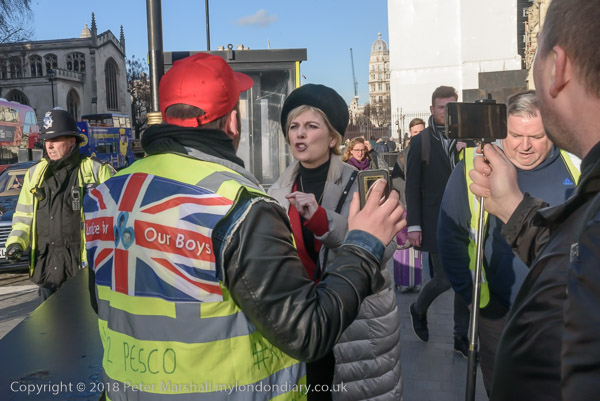
Then they saw Anna Soubry, then the Conservative MP for Broxtowe, on the west edge of Nottingham and a vocal pro-European walking past and confronted her. She stopped to talk and argue with them, and they angrily shouted at her. She called to a police officer nearby for support, but he simply told the protesters to stop and ignored them when they failed to do so. Eventually after a minute or so she managed to turn away and walk past more police into Parliament, and officers then prevented the Brexiteers from following her.

I filed the pictures rather more rapidly than usual to meet deadlines as I realised that I was the only photographer present (though at least one of the extremists was filming the confrontation) and was pleased to see a few of them in the papers later. Though had I been with a more active agency I would have made much more from the set.

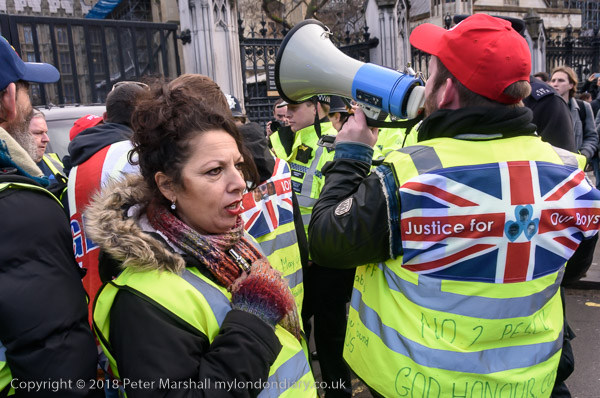
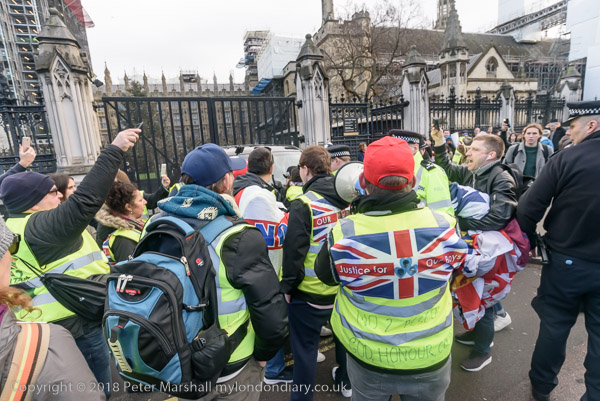
Extremist Brexiteers at parliament

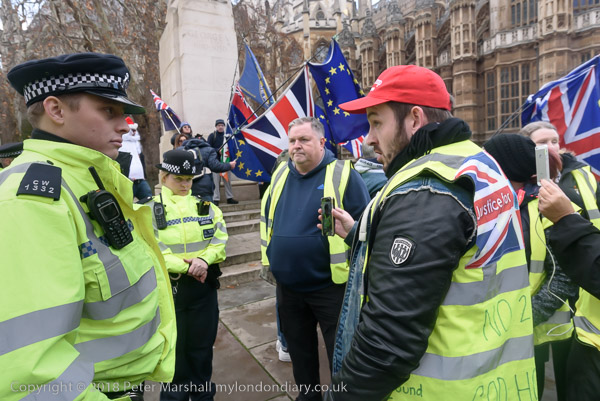
Here are a couple of the pictures from a few minutes earlier outside the gates of Parliament.

Police were holding them back as they tried to stop cars leaving through the gates.

Extreme Brexiteers clash with SODEM

Earlier the group of extremist Brexiteers had been harassing Steven Bray and the supporters of SODEM, (Stand of Defiance European Movement) the group he founded in 2017 and which was holding daily vigils whenever Parliament was in session.

They accused Bray of being a drunk and asked “Who funds Drunk Steve”, a question that was rather redundant as two large banners were covered with logos of a wide range of organisations supporting SODEM’s daily pickets. There was a lot of shouting, threats and aggressive gestures, but no actual violence with police trying with little success to separate the two groups.

I’d photographed both groups on previous occasions, and had given up on going specially to photograph them, but was still taking pictures when I had gone up to cover other events – as on this Wednesday. SODEM were always pleased to be photographed, but their opposition at times objected to my presence.

MP welcomes Delhi to London driver

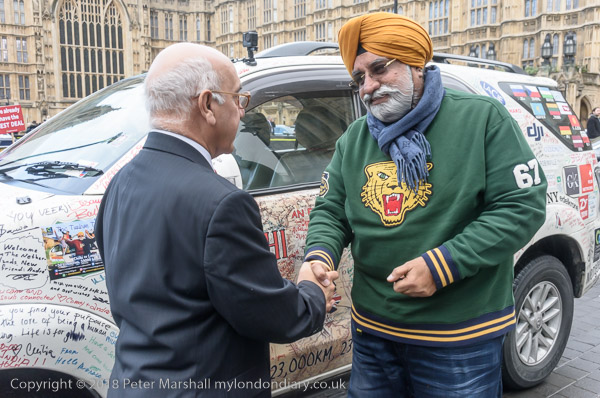
Another event that happened while I was there was the arrival of The Turban Traveller, a Sikh with a film crew from Creative Concept Films in Delhi who arrived in London today after driving overland from Delhi and was greeted by Virendra Sharma, Labour MP for Ealing Southall.

Cuts kill disabled people say protesters

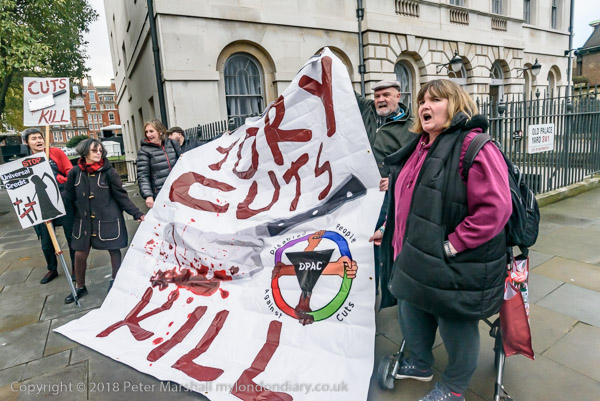
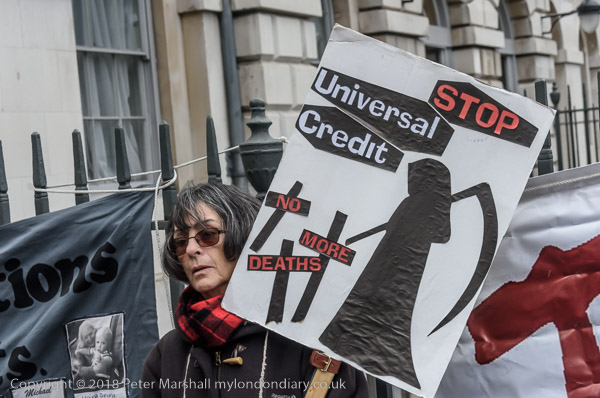
But I had come to Parliament to photograph disability groups DPAC (Disabled People Against Cuts) and MHRN (Mental Health Resistance Network) who together with WOW campaign were protesting against the cumulative impact of the cuts on the lives of disabled people.

The War on Welfare campaign attracted over 200,000 signatures to its petitions against welfare cuts, and the protest was in support of a debate due later in the day on the cumulative impact of the cuts on the lives of disabled people.

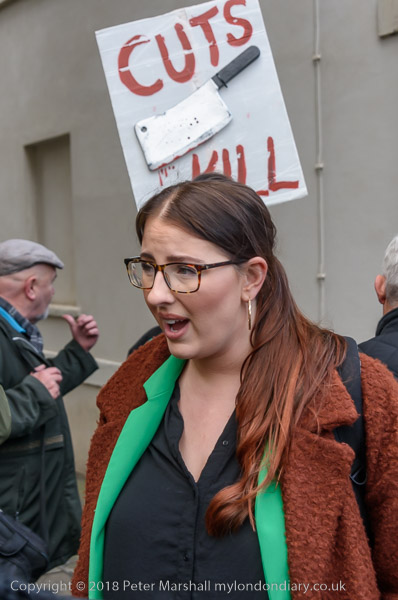
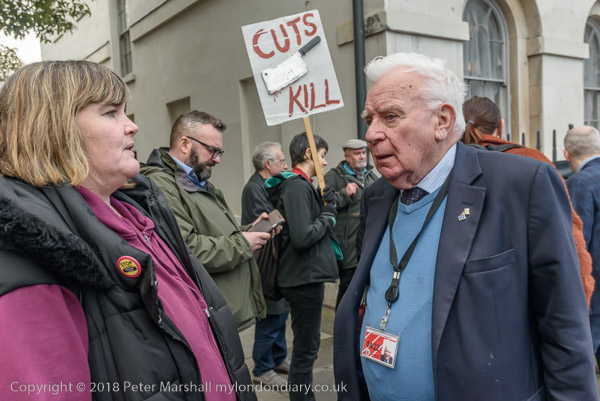
Among those who came to speak with the protesters was Virendra Sharma MP, who had come out to meet the Sikh overland traveller and although showing an interest seemed to be unaware of the problems the cuts had caused the disabled, Laura Pidcock (then MP for North West Durham) and Lib-Dem peer Lord Roberts of Llandudno. Both the latter seemed very concerned about the terrible effect the various cuts falling particularly on the disabled.


Anna Soubry MP harassed by extremists
Extremist Brexiteers at parliament
Extremist Brexiteers clash with SODEM
MP welcomes Delhi to London driver
Cuts kill disabled people say protesters


Fathers 4 Justice

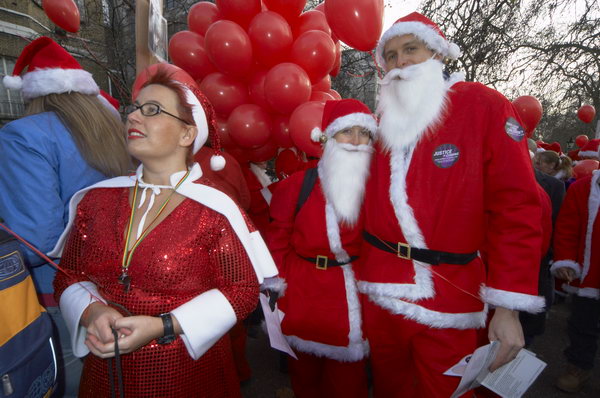
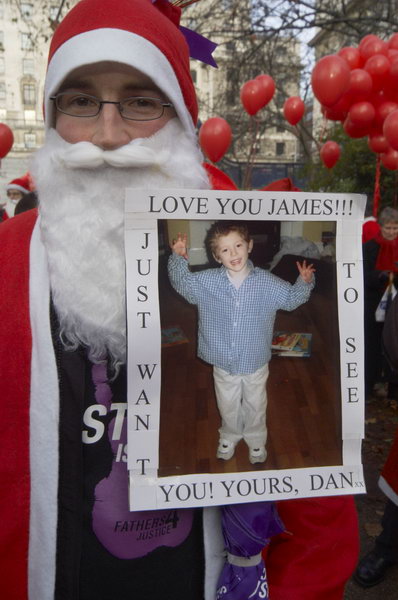
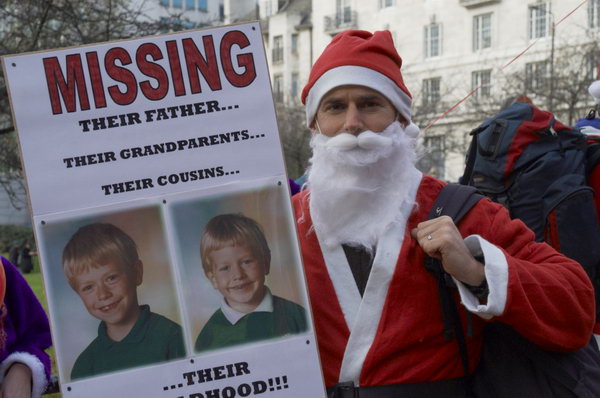
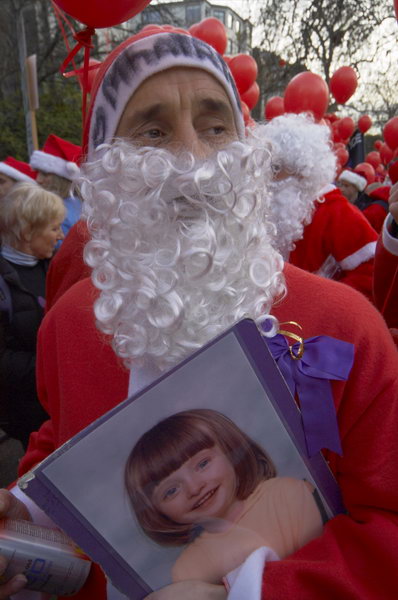
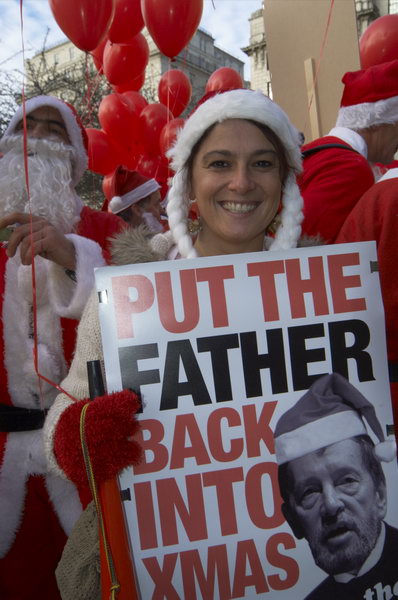
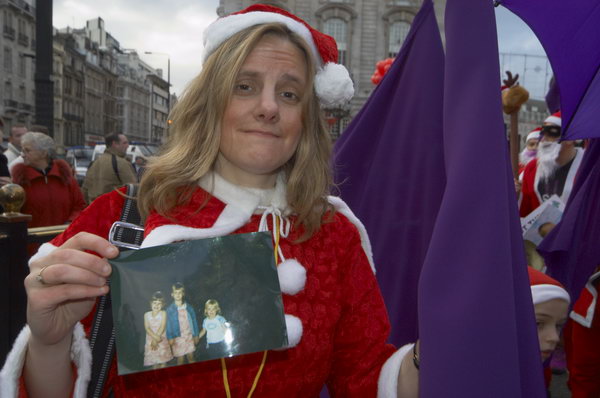
Fathers 4 Justice was a group begun in 2001 by marketing consultant Matt O’Connor to “champion the causes of equal parenting, family law reform, and equal contact for divorced parents with children.” The pictures here come from their protest in London’s West End on 18th December 2004

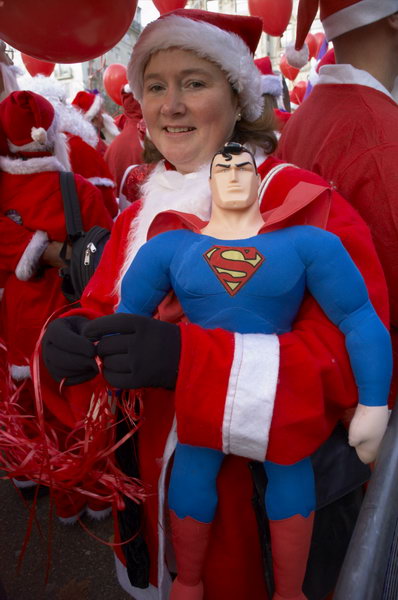
Between 2002 and 2008 members carried out a number of high-profile stunts which hit national headlines to promote their cause, the first of which saw a small group led by O’Connor storming the Lord Chancellor’s Office dressed as Father Christmas in December 2002. They went on to climb cranes and buildings including Tower Bridge and Buckingham Palace dressed as superheroes, to carry out a ‘citizens arrest’ on the Minister for Children, throw bags of purple flour at Tony Blair in the House of Commons during Prime Ministers Questions and more.

Although protests continued after 2008, there was a split in the group with O’Connor officially closing the group and others setting up New Fathers For Justice. And although both groups continued to carry out publicity stunts, these have gained less and less publicity.

The activities of these groups perhaps have had some effect, with increasing attention being turned on the activities of our secretive Family Courts, and some small and continuing moves toward transparency.

However the 2014 Children and Families Bill which it was hoped would improve the situation was watered down by a Lord’s amendment removing a legal presumption of automatic shared contact still failed to prevent obstructive parents who had been granted custody of childen preventing children from any meaningful relationship with absent parents.

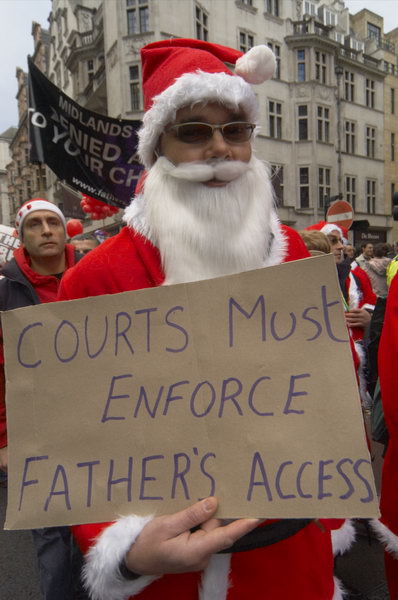
Although they were called Fathers 4 Justice, there are also mothers who were separated unjustly from contact with their children. But overwhelming custody of children in the Family Courts goes to the mothers, some of whom make it impossible for fathers to have the access to their children which the court has specified, but fails to enforce.

The protest on 18th December 2004 involved several hundred men, women and children dressed in santa gear (and a couple of individualists, including a young spiderman), a band, and a large and unwieldy balloon and hundreds of smaller ones parading peacefully around the West End. Their placards read ‘Put the Father Back Into Xmas’.

In 2005 I photographed two further protests by the group. In October Wakey Wakey Mr Blair, a ‘pyjama protest’ with those taking part asked to wear their jim jams, slippers and dressing gown, bring their hot water bottles, teddy bears and even their beds calling for overnight stays for children with their dads after separation and then in December 2005 24 Days of Christmas Chaos, when again Santas came to London to protest, this time at the Church of England Offices, Department of Education & Skills and Downing St on their way to the Royal Courts of Justice.

More from St John’s Wood

Marlborough Place, St John's Wood, Westminster, 1988  88-7e-14-positive_2400
Marlborough Place, St John’s Wood, Westminster, 1988 88-7e-14

More from St John’s Wood – and this next photograph is of the entrance to a large detached house at 38 Marlborough Place, St John’s Wood, where a blue plaque informs us that ‘THOMAS HENRY HUXLEY 1825-1895 Biologist Lived Here’.

Huxley was born into a middle-class family in Ealing, but when the school at which his father taught mathematics closed the family were plunged into poverty, and he had to leave school aged 10, only two years after his education had begun. But he determined to teach himself, and did so with great effect, becoming one of the most knowledgeable men in Britain over a very wide range of subjects, and probably the leading specialist in comparative anatomy of his era.

But he is now best-known for his defence of Charles Darwin whose theory of evolution published in On the Origin of Species aroused considerable controversy, particular from religious figures, and Huxley’s defence of Darwin in an 1860 Oxford public debate with Bishop “Soapy Sam” Samuel Wilberforce (one of William’s sons) led to him being nicknamed after his death as ‘Darwin’s Bulldog’.

The door to the street from the covered path to the front door was open, allowing me to stand outside and take this picture showing the path and canopy as well as the mosaic on the flooring.

Marlborough Place, St John's Wood, Westminster, 1988  88-7e-15-positive_2400
Marlborough Place, St John’s Wood, Westminster, 1988 88-7e-15

I moved back a few feet and a smidgeon to my left to take another picture of the house, which gives a better idea of the covered path to the street and also shows the plaque for Huxley.

In 1988 this was the Marlborough Family Service of the Bloomsbury Health Authority, a pioneering institution for child-protection cases, school-based interventions and family therapy, founded here by Dr Joshua Bierer in 1946 as the Marlborough Day Hospital, the first social psychotherapy centre in the world. It seems to have been closed and sold off around 2018.

Marlborough Place, St John's Wood, Westminster, 1988 88-7f-63-positive_2400
Marlborough Place, St John’s Wood, Westminster, 1988 88-7f-63

The door to the front garden at 59 Marlborough Place was shut, so I couldn’t see inside, but the gateposts has two rather grand eagles still present. This property, built in around 1840 was extensively refurbished in 2013 and you can see a large set of pictures on the web. It sold in 2016 for £14,900,000.

The Grade II listing has a very lengthy text and describes it as “good example of the early mid-C19 semi-detached villas erected on the Eyre Estate, are of special architectural interest on account of their early semi-detached format and their architectural form and detailing expressed on their front elevations.”

The listing text also mentions that between around 1950 and 1990 it was divided into four flats, one of which was for some time the home of composer Benjamin Britten.

Abbey Rd, St John's Wood, Westminster, 1988 88-7f-23-positive_2400
Abbey Rd, St John’s Wood, Westminster, 1988 88-7f-23

This Grade II listed Tudor Gothic detached house at 48 Abbey Road dates from around 1840.

Carlton Hill area , St John's Wood, Westminster, 1988 88-7f-31-positive_2400
Carlton Hill area , St John’s Wood, Westminster, 1988 88-7f-31

The doorway of another house in a similar stye in the area, possibly in Carlton Hill.

New London Synagogue, Abbey Rd, St John's Wood, Westminster, 1988 88-7f-22-positive_2400
New London Synagogue, Abbey Rd, St John’s Wood, Westminster, 1988 88-7f-22

Just around the corner in Abbey Road is the New London Synagogue.

This was the site of the first Jewish community to be established in 1876 by the new United Synagogue which had been formed in 1870; the permanent building for St. John’s Wood (United) Synagogue, now Grade II listed, was opened in 1882. Its architect Hyman Henry Collins, the City of London District Surveyor, designed eight synagogues in London, but all but this have been demolished.

St John’s Wood gained large Jewish population when people moved out of the East End in the 1930s and 1950s, but in 1964 the congregation had closed and the building was being sold off for demolition. It was saved when followers of Rabbi Dr Louis Jacobs who had been refused employment in the United Synagogue’s New West End Synagogue due to allegations of heresy secretly formed a shell company to buy it. They set up a new congregation with him as rabbi, the first in what became known as the Masorti movement in the UK.