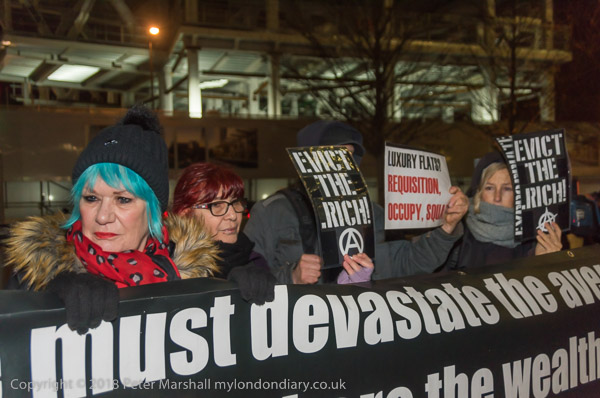
Deaths, Bedroom Tax & Feathers

After a day resting and recovering from our 3 day walk along the Thames Path in 2013 I was ready to go up to London again on Saturday 6th April.
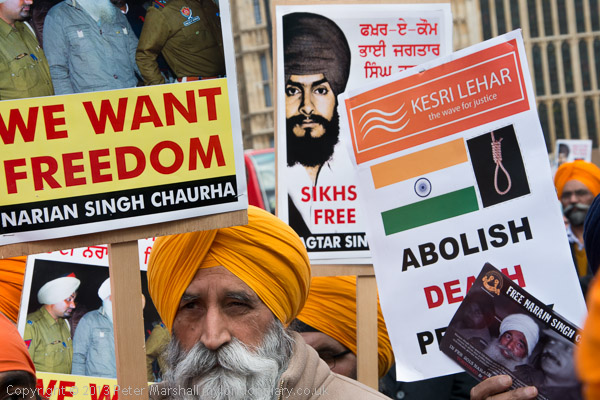
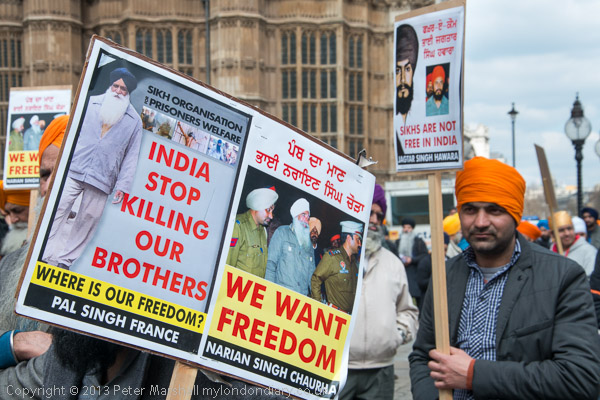
Sikhs had come to London at Vaisahki for a protest against the “ongoing and, disturbing atrocities that are being committed in the Republic of India, that, infringe the basic human rights of the minority communities, which includes but is not limited to the Sikhs, Christians, Muslims and Dalits (India’s untouchables).

In particular the Kesri Lehar (I Pledge Orange) campaign was protesting against the death penalty in India, with over 470 prisoners in Indian prisons on death row, though actual executions are rare. The House of Commons shortly before this protest had debated and agreed a backbench motion welcoming the Kesri Lehar petition and calling on India to abolish the death penalty.
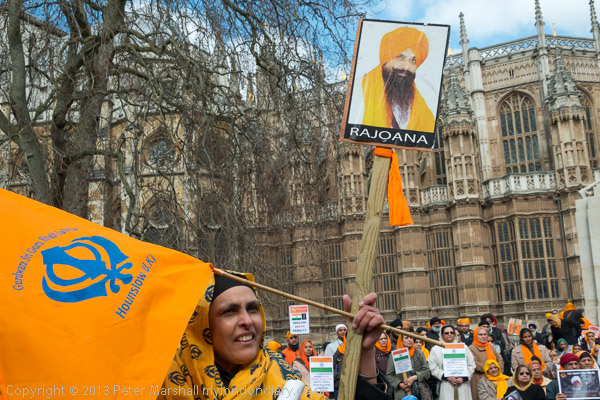
One of those on death was Balwant Singh Rajoana, sentenced for his part in a suicide bomb attack which killed a former Chief Minister of Punjab, Beant Singh and 17 others in 1995. Sikhs say that Beant Singh was responsible for the extra-judicial killing of over 25,000 Sikh civilians in a brutal attempt to eliminate Sikhs calling for an independent state.

Balwant Singh Rajoana was sentenced to death in 2007 and was due to be hanged in 2012, but execution was stayed after some Sikh organisation appealed for clemency. But in 2013 there were renewed demands for his execution. This did not happen and in 2019 his sentence was commuted to life imprisonment.
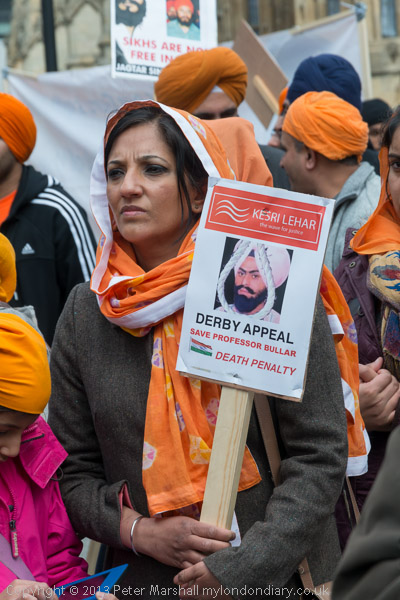
Campaigners also called for the release of Professor Devender Pal Singh Bhullar who has been on death row in India for 18 years, for his alleged involvement in a car bomb in Delhi in 1993. They say there is no evidence to connect him with the attack. His sentence was commuted to life imprisonment in March 2014.
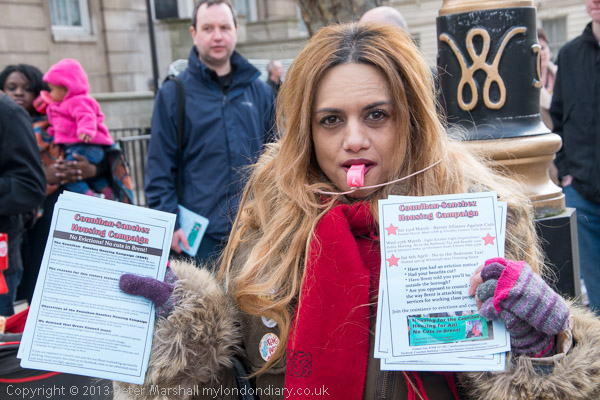
A rather smaller protest at Downing St had been organised by the Counihan-Sanchez Family Housing Campaign from Kilburn against the unfair Bedroom tax and benefit caps which are effecting so many people and called for the GLA to build more social housing. The family’s own problems with Brent Council have made them very aware of the huge problems faced by many others across London and elsewhere and how cuts and sanctions have had a cruel impact on so many.
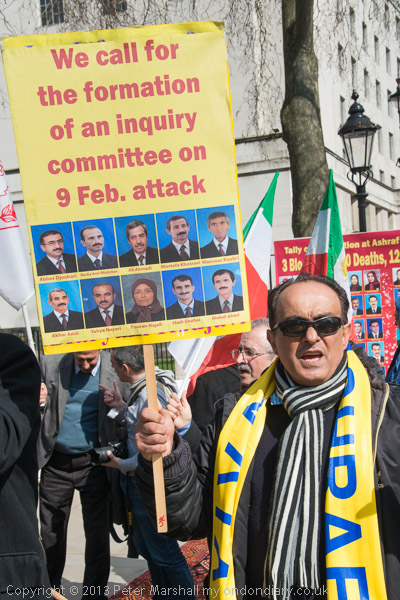
Also at Downing St, members and supporters of the People’s Mujahedin of Iran (PMOI) were calling for the UK government to support an enquiry into Iraqi attacks on Camp Liberty in Baghdad where its members are held. They had been given refuge in Iraq by Saddam Hussein and gave up their arms when the US invaded Iraq in return for US protection. But the US hand over control of their camps to Iraq in 2009 and there have been a series of attacks on them by Iraqi security forces sympathetic to Iran, with over over 50 being killed, more than a thousand injured and many arrests.
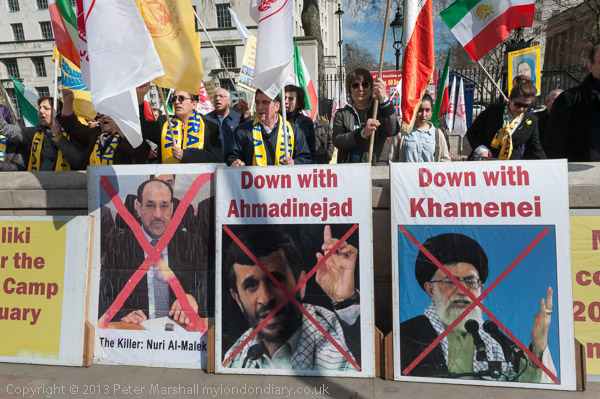
Later in 2013 the United States organised a move of the roughly 3,000 members of the group to a new base in Albania, providing a $20 million donation to the UN refugee agency to resettle them. The USA has continued to support them as a government-in-exile for Iran and they are also apparently supported by them in covert operations continuing in Iran against the current Islamic regime. There are groups of the PMOI and supporting organisations in a number of European Countries and the UK as well as in the United States, though they are generally thought now to have little support in Iran.
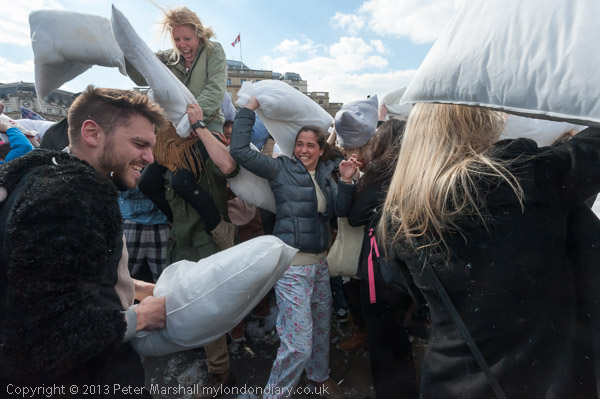
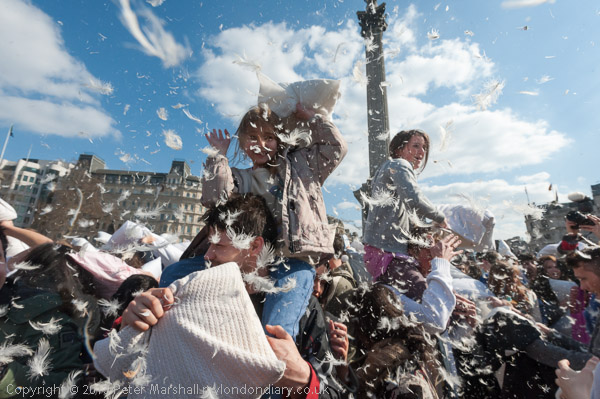
It was good to leave what had been rather intense protests and go on to something in a much lighter mood in Trafalgar Square. I think the first International Pillow Fight Day was in March 2008, when I photographed it in Leicester Square. In 2013 the event, organised by the urban playground movement, was taking place in 90 cities across 30 countries.
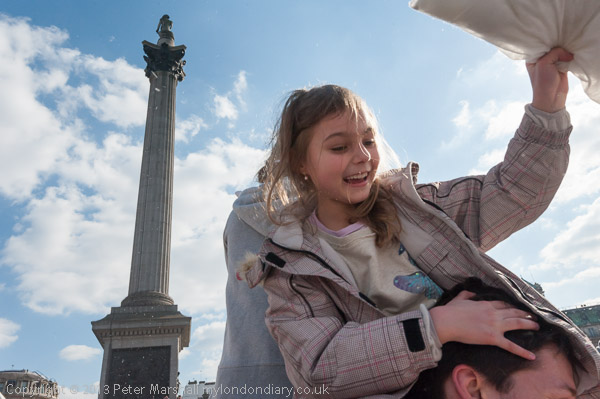
The aim of the event is to get people away from “passive, non-social, branded consumption experiences like watching television” and to consciously reject “the blight on our cities caused by the endless creep of advertising into public space.” The organisers hope this will result in “a global community of participants, not consumers.

The authorities frown on it, possibly as a subversive activity but perhaps because it makes something of a mess, as pillows inevitably break and feathers fly, leaving the ground covered with them after the event. Or perhaps they are just killjoys. Royal Parks police had prevented a fight in Hyde Park earlier in the day but the Heritage Wardens were overwhelmed by the numbers who had come to Trafalgar Square and were unable to stop. A small group of Westminster Council workers were standing on one edge ready to clean up afterwards.
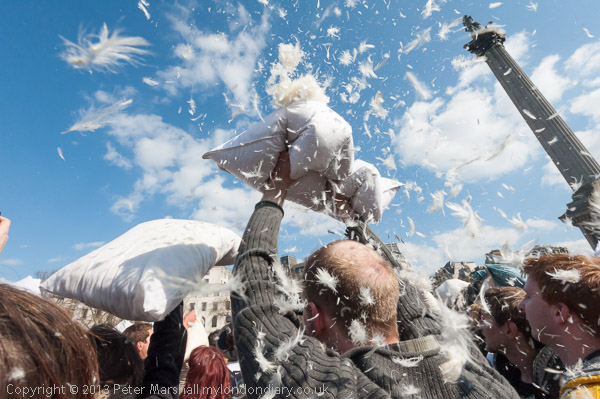
The feathers and dust do make these events something of a health hazard, and it would have made sense to wear a face mask – but back in 2013 these were only seen on Japanese tourists. Probably a once a year exposure to dust and feathers isn’t a huge risk, but this year they did rather get down my throat and I withdrew once the air was thick with them, deciding I’d taken enough pictures.

Feathers Fly in Trafalgar Square
PMOI Protest Iraqi killings
No to Bedroom Tax & Benefit Caps
Vaisakhi “Save a Live” Vigil
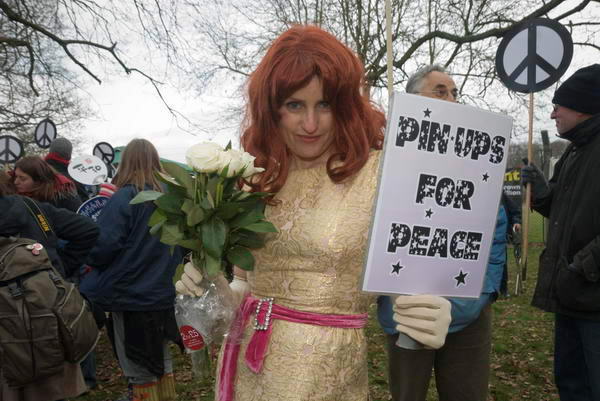
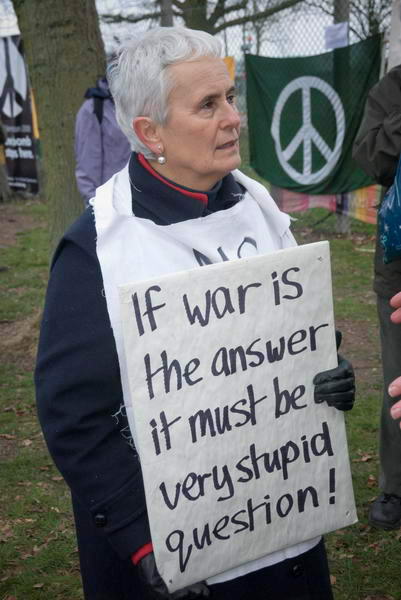
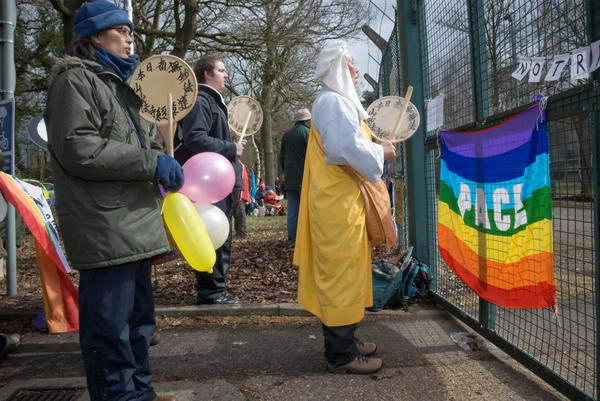
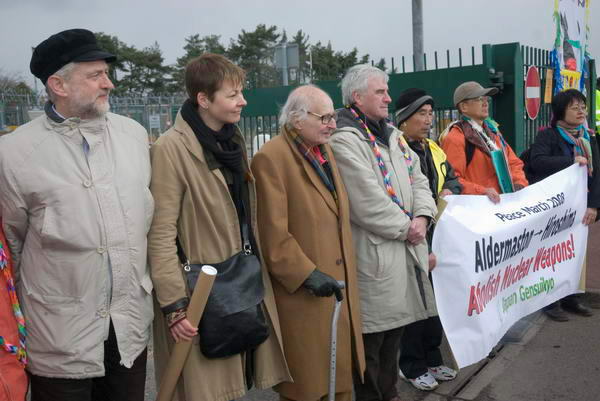
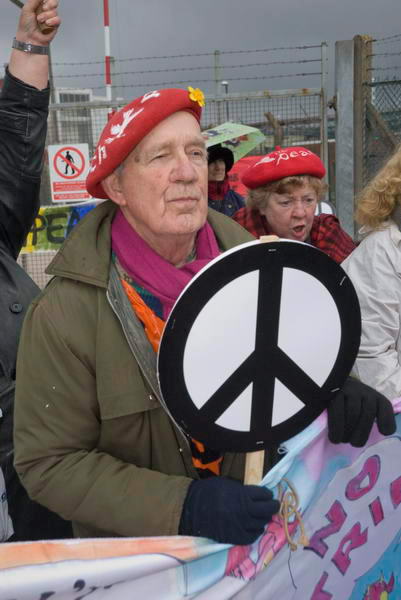
Aldermaston 2008 – 50 years

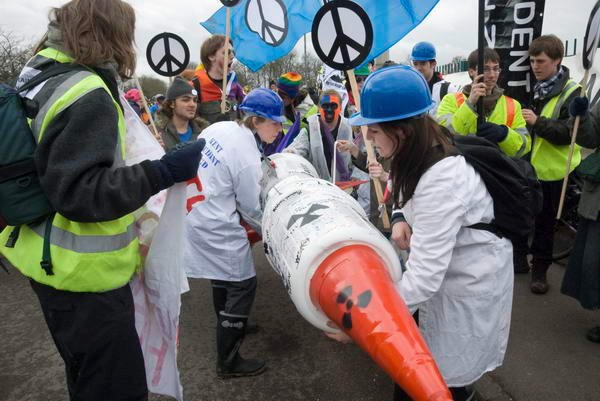
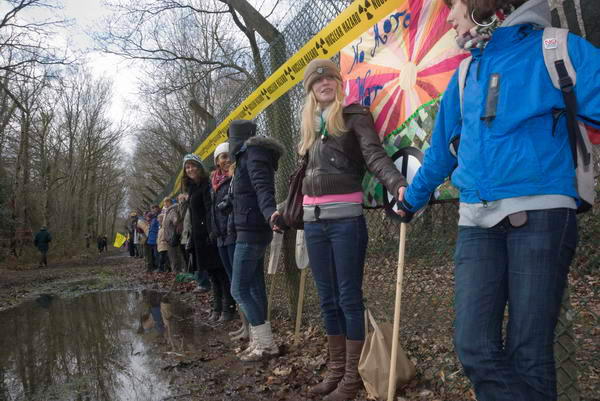
Protesters join hands to surround the nuclear weapon factory at Aldermaston

I missed the first major march to Aldermaston organised by the Direct Action Committee Against Nuclear War (DAC) and supported by the newly formed CND at Easter in 1958. I was only thirteen at the time and not that interested in politics at the time, but was very aware it was taking place as my two older brothers (both no longer with us) walked the full distance, coming back tired and rather muddy after four days of marching from Trafalgar Square in the centre of London to the Atomic Weapons Establishment in Berkshire to demonstrate their opposition to nuclear weapons.

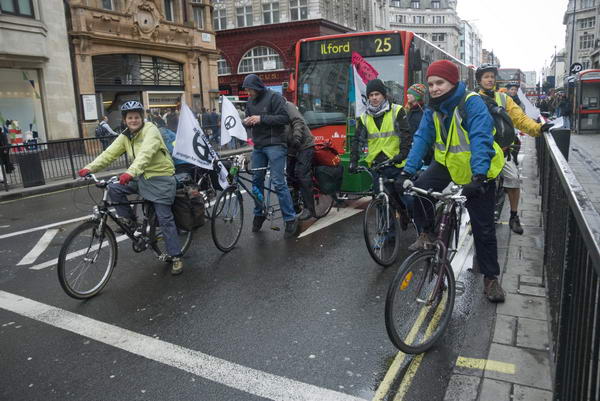
I didn’t go the whole way on the 50th anniversary in 2008, and although I had planned to join the group that were cycling from London I didn’t manage to do so, though I did photograph the cyclists as they rode down Oxford St.

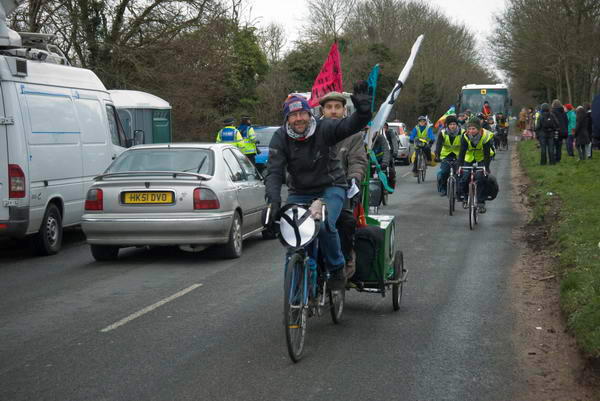
On the Bank Holiday Monday they were cycling from Reading where they had stayed the night along with the walkers, mainly sleeping on the floor in church halls, and I had hoped to join them there for the final stage to Aldermaston. But I got up too late and missed the early train which would have got me there in time – and the next train half an hour later ran late, so I missed their start. Instead I rode on my own along the route that I’d taken on the march there four years previously, finding that on a bike it was rather hillier than on foot.

The Bikes not Bombs group arrive at the Aldermaston bomb factory

Once at Aldermaston, the bike made it easy for me to go to all the gates around the large site of the AWE to take photographs of the protesters there who later moved to surround the perimeter of the base, holding hands around it. And although I’d left Reading later, my more direct route meant I was able to photograph the arrival of the ‘bikes not bombs’ group with their police escort of two cars and several motorbikes.

After making the human chain around the AWE – I think around 4 miles long – and speeches and performances at the main gate it was time to go home, and I got back on my bike for the 12 miles or so to Reading, a slightly easier ride as the wind was behind me and Reading is around 60 metres lower, though the road still had plenty of uphill sections. But I took my time, even stopping to take a few photographs on the way.

Our nuclear weapons programme has never made any sense and the idea of nuclear deterrence has served only to enrich the arms industry. The expense of our nuclear submarines and their warheads diverts money away from more useful areas such as health and education, and the nuclear programme has skewed our power generation to increase electricity costs for us all. It cannot be justified in military or economic terms, but for most of those protesting the most important aspect is that the use of nuclear weapons can never be justified on moral grounds.

The UN Treaty on the Prohibition of Nuclear Weapons which entered into force on 22 January 2021 prohibits the development, testing, production, stockpiling, stationing, transfer, use and threat of use of nuclear weapons, Instead of signing this, the British government have announced an increase in number of nuclear warheads – in contradiction to our previous international agreements about the non-proliferation of nuclear weapons.

Jeremy Corbyn, Caroline Lucas, Walter Wolfgang, John Mc Donnell and Japanese peace campaigners

More pictures at Aldermaston – 50 years


All photographs on this and my other sites, unless otherwise stated, are taken by and copyright of Peter Marshall, and are available for reproduction or can be bought as prints.


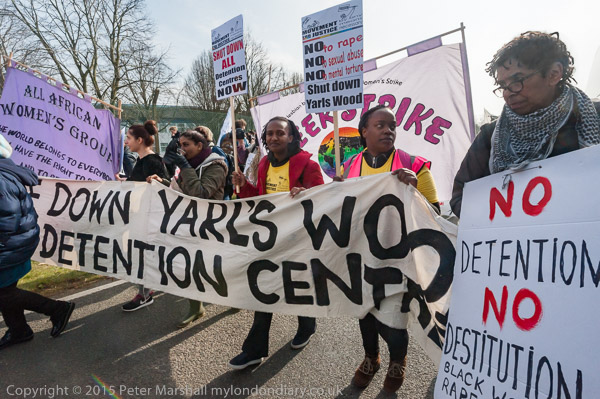
Yarl’s Wood 2016

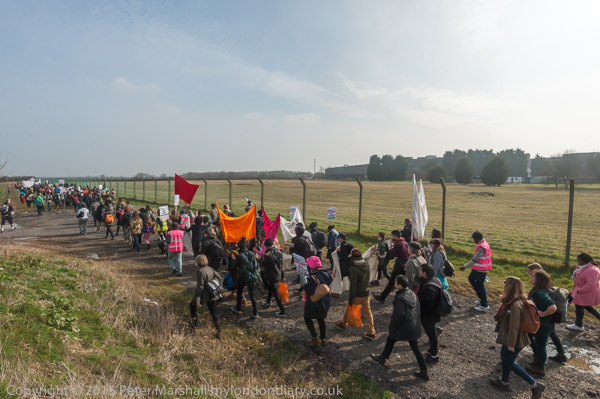
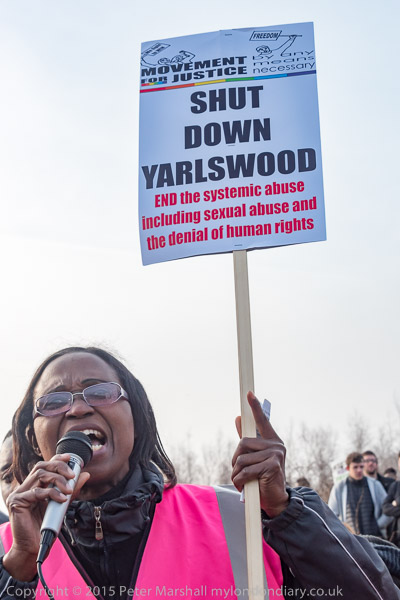
Since it opened in 2001, Yarl’s Wood, then the largest immigration detention centre in Europe has been an active demonstration of the racist nature of the UK and its attitudes to those seeking asylum here. Yarl’s Wood was used to house refugee women and a few families and soon gained a reputation for hostile mismanagement, which led to a number of incidents including a serious fire which burnt down the building in 2002.

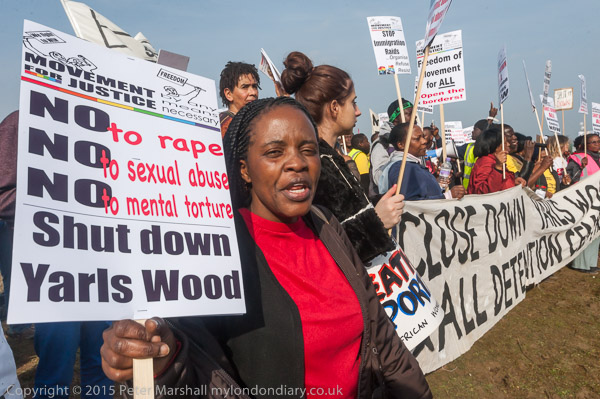
Things were not improved by handing the contract for running the centre to Serco in 2007 and there were a number of hunger strikes by groups of detainees over the following years, complaining about lack of medical treatment and other mistreatment including well corroborated allegations of sexual assaults by staff, many of whom were male on the women in the centre, many of whom had left their countries to seek asylum because of violence and often rape.

The first damning official report into allegations of racism, abuse and violence at the centre came in 2003, and over the years there was a steady procession of them, and in 2015 the chief inspector of prisons described Yarl’s Wood as a “place of national concern” , calling for decisive action to ensure women were only detained there as “a last resort”. In fact detention was both routine and open ended. Four out of five women held there were eventually released, and allowed to remain in the UK, and in 2018 only one in 7 of those released was deported. But the average time they were held in what is essentially a prison was over three months, and in one case a woman was only released after detention for a couple of days less than three years.

Covid brought about a huge drop in the number of women being detained, their release demonstrating that detention was always unnecessary. While at the start of 2020 there had been over 120 women detained, by August there were fewer than 20. The Home Office had been using detention both as a punishment for people coming to seek asylum and as a way to dissuade those considering coming to the UK.

The Home Office announced that Yarl’s Wood was not to close but would instead be used as a short-term holding facility for men arriving in the UK by boat. It is also now again in use – though without any official announcement – for the indefinite imprisonment of around ten women asylum seekers.

The latest development came on the heels of public scandal over the use of former military barracks in poor conditions to house men seeking asylum. The Home Office announced that they were to house around 200 of them in temporary prison-style accommodation to be erected at Yarl’s Wood, using emergency powers to construct this without planning permission. After considerably outcry from campaigners including MPs and religious leaders and legal challenges the Home Office dropped the plans, saying they had sufficient capacity elsewhere.

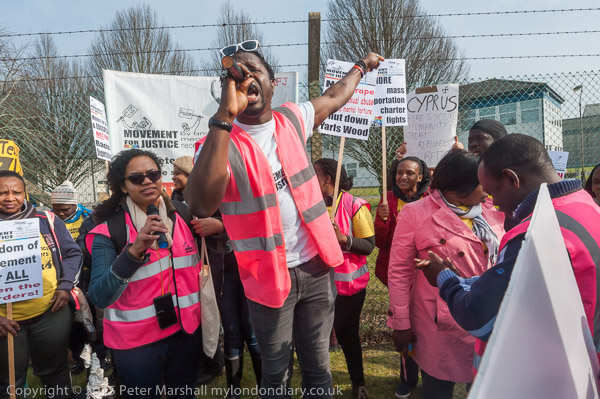
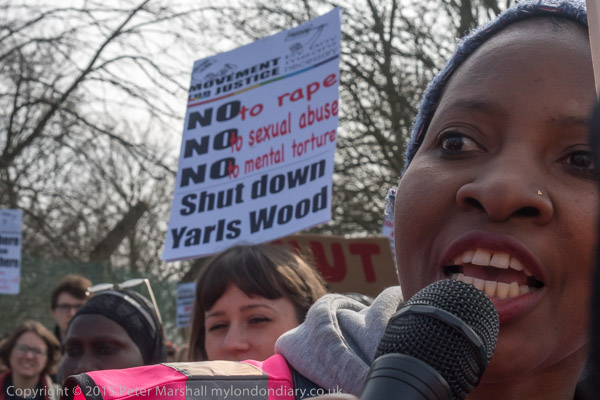
The protest outside the immigration prison on Saturday 12 March 2018 was organised by Movement for Justice which has been one of the leading campaigns against immigration detention, mobilising many of those who have previously been held in Yarl’s Wood and the other detention centres. Getting over a thousand protesters to the remote location around 5 miles north of Bedford involved hiring coaches from cities across the country as well as a shuttle service from Bedford Station which I made use of – and whose local driver got lost on the way there. Reaching the field next to the centre then involved walking over a mile along the road and a public footpath that runs past it.

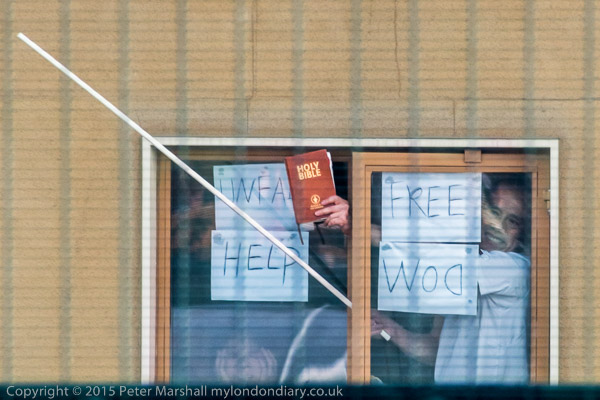
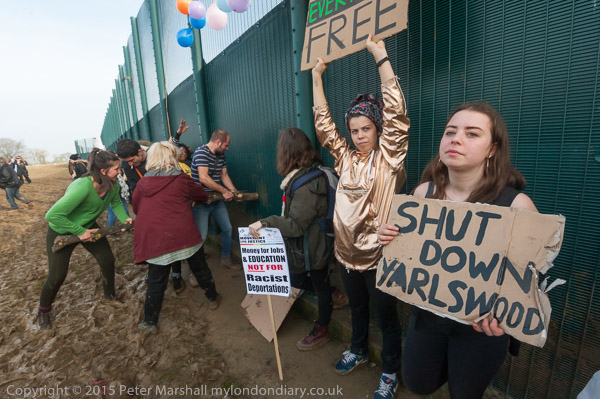
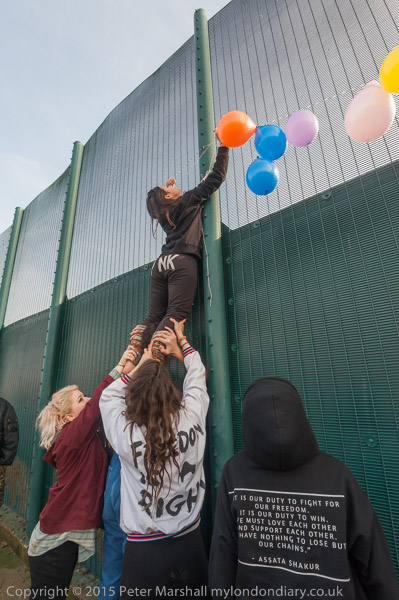
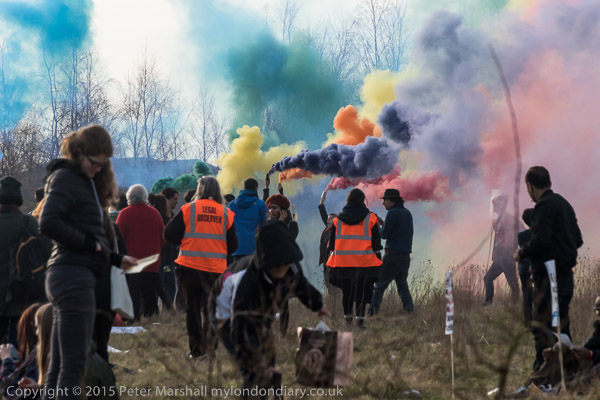
Surrounding Yarls Wood is a 20ft high fence – this is a serious prison. The first 10ft is solid metal but above that is another 10ft of wire mesh, though which, from a small hillock we could see the upper floors of one of the prison blocks. Detainees have limited freedom of movement within the centre, and some were able to come to the windows facing the field we were in and shout and wave and display hand-written messages, including some phone numbers through which a few could talk, their words relayed by a public address system MfJ had carried to the protest. A number of former asylum seekers also spoke at the protest, along with some of the organisers.

Those who have been held in this and other centres speak of feeling they are locked away and forgotten and protests such as these give them hope. MfJ and other groups also try to keep in contact with those inside and offer advice, and there are others who go into the centre weekly as visitors, ‘befrienders’ who offer emotional and practical support to a detainee.

Detaining people cuts them off from friends and communities and makes it much harder for them to make their cases for asylum – and also considerably slows the official processes involved in examining their claims. There are a very few cases where detention could possibly be justified on grounds of national security, but these apart no need to lock up the vast majority who have been held in these immigration prisons.

More on My London Diary: Shut Down Yarl’s Wood


All photographs on this and my other sites, unless otherwise stated, are taken by and copyright of Peter Marshall, and are available for reproduction or can be bought as prints.


Fukushima 10 years on

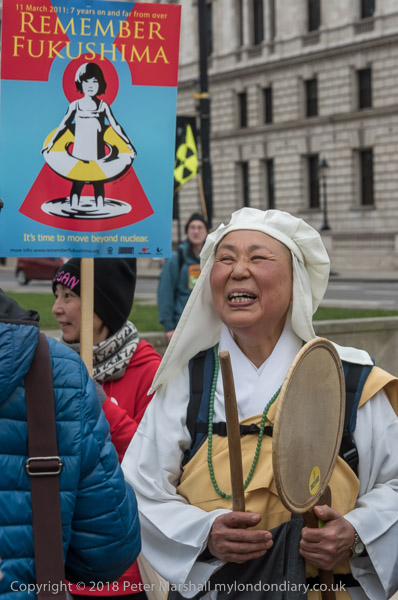
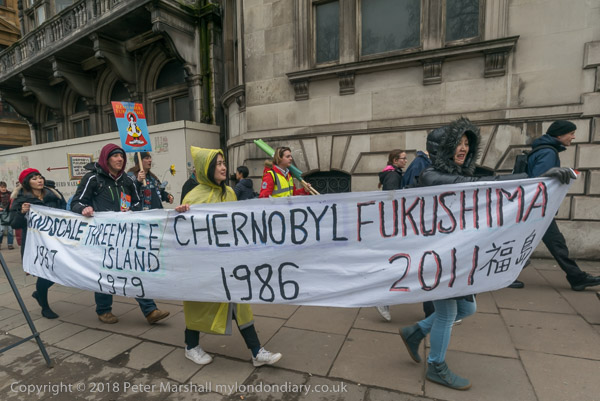
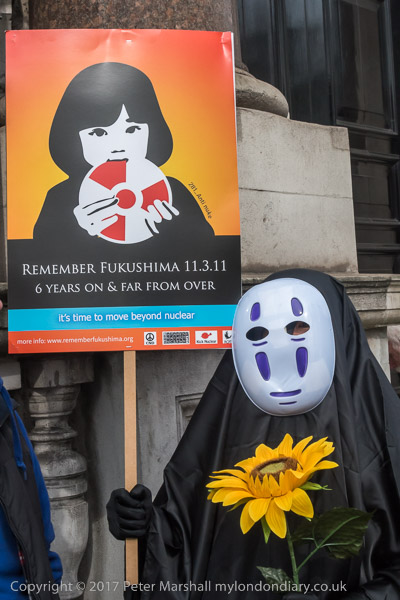
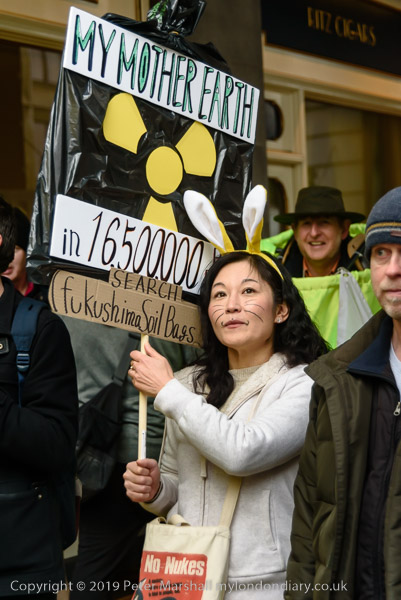
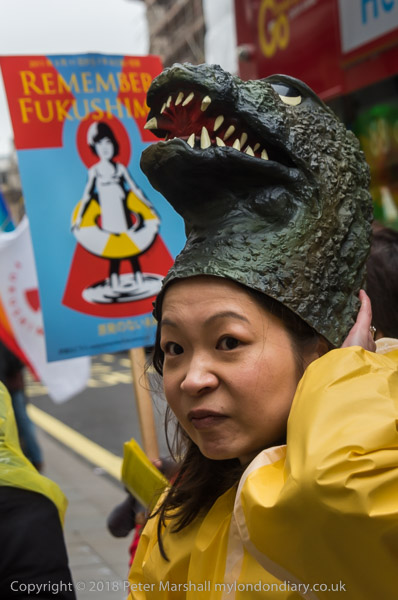
On 11th March 2011 the Fukushima Daiichi Nuclear Power Plant in Japan suffered the worst nuclear disaster since the 1986 Chernobyl meltdown. An earthquake had led to the reactors to automatically shut down their electricity production which led to the plant relying on emergency power generators to run the cooling pumps needed to keep the reactors safe. But the tsunami tidal wave almost 50 ft high caused by the earthquake swept over the plant’s sea wall and flooded the generators, cutting the power supply.

Windscale 1957, Three Mile Island 1979, Chernobyl 1986, Fukushima 2011′ 

Without cooling, three reactors heated up and then melted down and over the following three days there were three explosions of hydrogen gas and the release of huge amounts of radiation from the damaged reactors to the air and the Pacific Ocean. The release of radiation into the ocean was continued at high levels for at least 2 years, and there is still some leakage from the plant.

154,000 people in the area had to be evacuated from their homes in a area of 20km radius from the nuclear plant. The clean-up is expected to continue for another 20-30 years. You can read much more about the disaster in ‘10 Years Since The Fukushima Nuclear Disaster‘ by Philip White.

The possibility of such a disaster had been predicted in studies carried out some years earlier and an internal report by the company running the plant, TEPCO, had in 2000 recommended that there should be improved safety measures, but the management rejected both this and a 2008 internal report calling for better protection against seawater flooding.

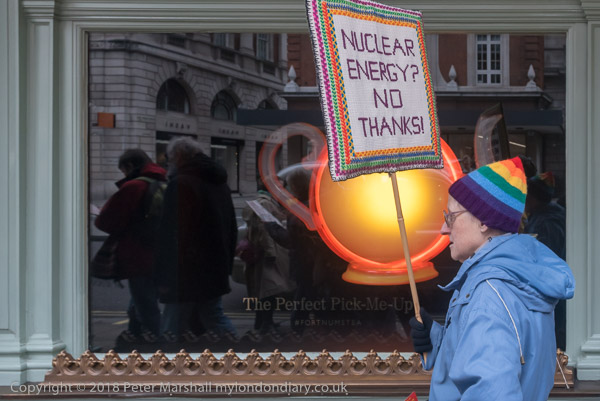
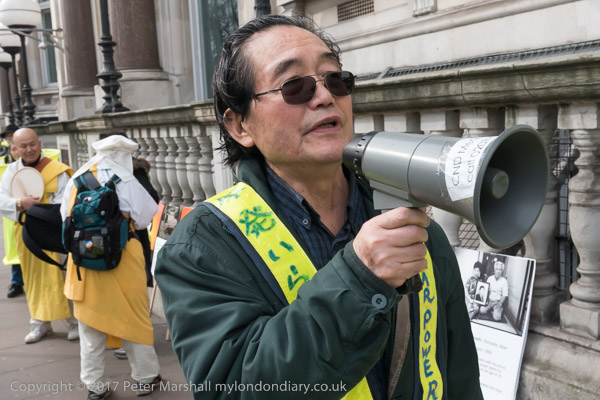
Campaigners in London held regular protests outside the Japanese Embassy and TEPCO’s London offices for some years and have organised larger annual protests on or close to the March 11th. Among the on-line events scheduled for 2021 is the free International Uranium Film Festival with two films online including Fukushima No Daimyo, a 2014 Italian film (in Japanese with Portuguese sub-titles) from March 11-18.

More pictures on My London Diary:

2017: Fukushima anniversary challenges nuclear future
2018: Remember Fukushima, 7th Anniversary
2019: Remember Fukushima 8 years On
and in 2011, 2013 and 2014.


All photographs on this and my other sites, unless otherwise stated, are taken by and copyright of Peter Marshall, and are available for reproduction or can be bought as prints.


Save Our NHS

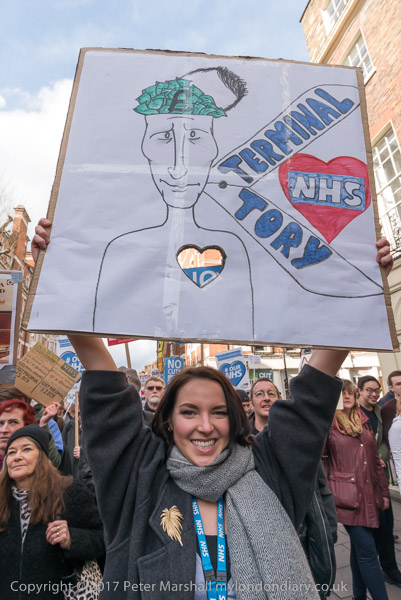
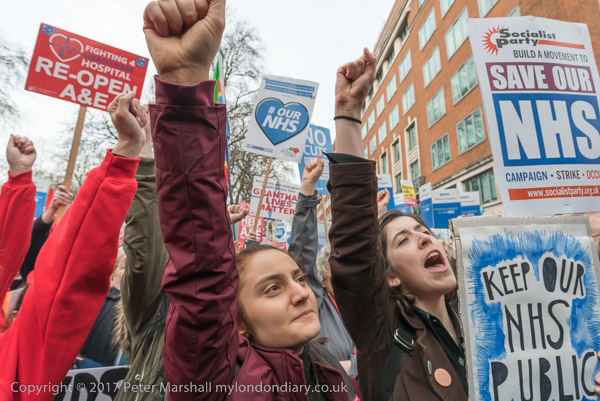
The past year has made all of us appreciate both what a great national asset our National Health Service is and also – unless we are blinkered Tories – to realise how much it has been run down as a deliberate Conservative policy ever since the Tories came into power in 2010. Though of course its problems also come from decisions taken by earlier governments, and in particular the disastrous PFI contracts taken out under New Labour which involve huge and continuing debt repayments by parts of the NHS.

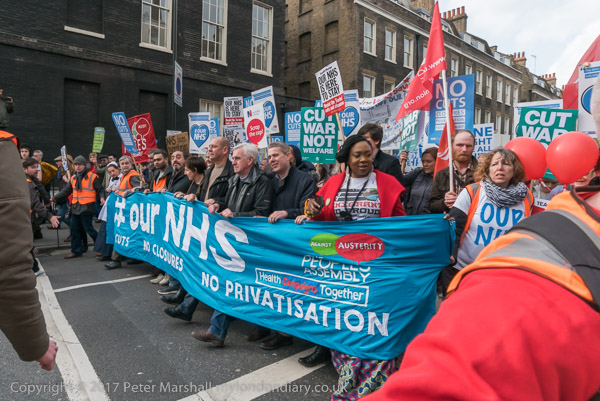
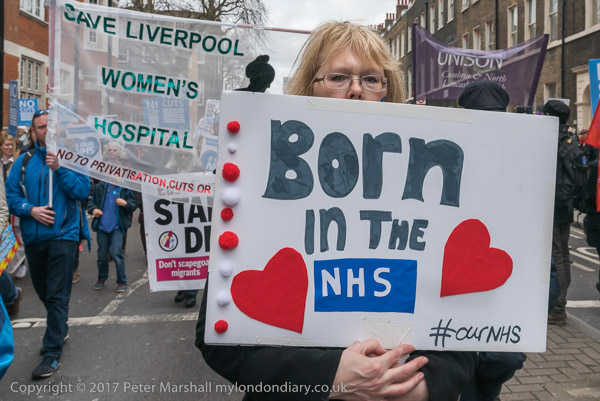
Even the Tories have come to realise that the NHS reorganisation under Andrew Lansley’s 2012 Health and Social Care Act were a mistake, although the fine print of their 2021 White Paper makes clear that they are still – as in 2017 when I photographed this ‘Save Our NHS’ march – pursuing their goal of rapid stealthy privatisation with medical services increasingly being run for private profit rather than public benefit, threatening an increasingly under funded public service which delivers high quality service at low cost and remains the envy of the world.

This privatisation is continuing. Last month it was announced that Operose Health Ltd, a UK subsidiary of one of the larger US health insurance companies, is taking over AT Medics, which runs 49 General Practice surgeries across London, with around 370,000 Londoners registered at them. When the takeover was finalised on 10th Feb, the six GPs who had been the directors of AP Medics resigned and were replaced by Operose staff – who include two who had in previous years held high-level positions in NHS England, a public body of the Department of Health set up to oversee the commissioning side of the NHS under that 2012 Act.

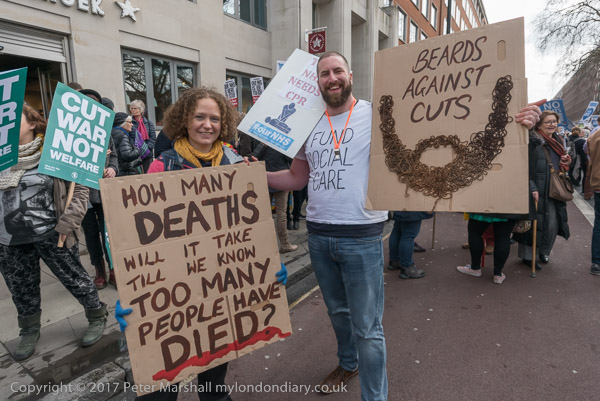
The Save our NHS March on March 4th, 2017 pointed out that the Sustainability and Transformation Plans which NHS organisations and local authorities were made to produce as 5 year plans from 2016-21, intended to counteract some of the worst effects of the 2012 Act, were leading to cuts in services and hospital closure and had already caused many premature deaths. They are a part of the rapid stealthy privatisation with medical services increasingly being run for private profit rather than public benefit, threatening an increasingly under funded public service which delivers high quality service at low cost and remains the envy of the world.

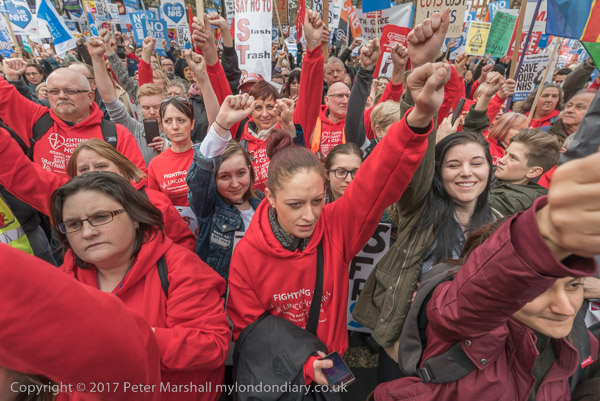
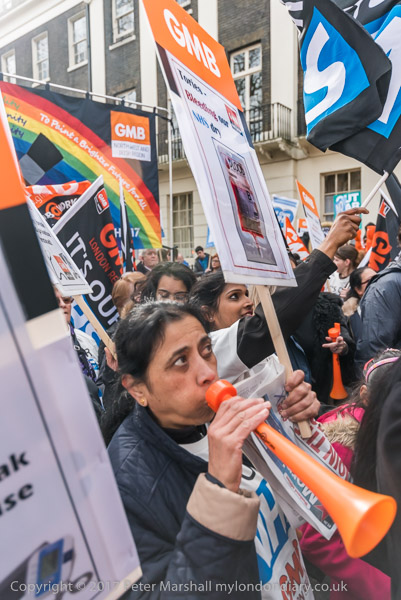
It was a large march, and made up largely of those who work in various parts of the NHS and have clear view of the actual consequences of the effects of government actions, and many of them spoke before the march set off. Most medical professionals do the work they do through a strong sense of vocation rather than being motivated by money, and as we have seen over the past year, many have worked long over their paid hours, and often with inadequate personal protection because of decisions taken to lower the stocks of supplies and the cuts in beds, the cutting of support for the training of nurses, changes to contracts for junior doctors and other measures.

Looking at the faces in these pictures – and I took many more on the day – I wonder how many of them have died because of their dedication to their job of saving our lives. I wonder how many are suffering the prolonged debilitating effects of ‘long covid’, how many mental illness because of a year of working under extreme stress.

Some carried signs ‘Born in the NHS’. I wasn’t but I grew up with it and it was there when I needed it, and still is. Others carried that quote attributed to Aneurin Bevan, though he probably never said it,”The NHS will last as long as there are folk left with the faith to fight for it.” There were perhaps 50,000 on this march showing they were ready to do so.

More pictures in My London Diary: Save our NHS March


All photographs on this and my other sites, unless otherwise stated, are taken by and copyright of Peter Marshall, and are available for reproduction or can be bought as prints.


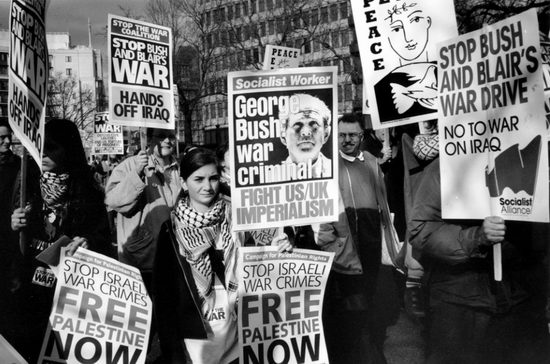
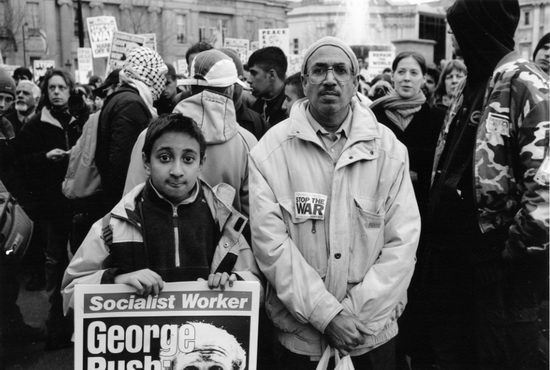
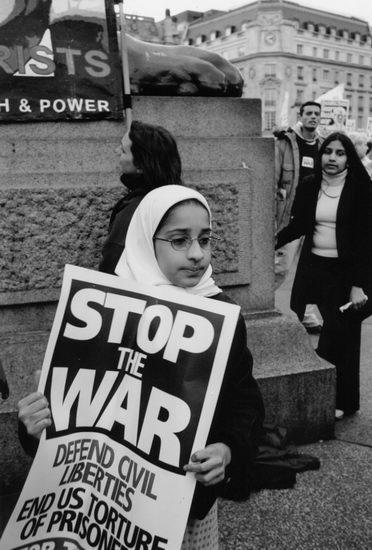
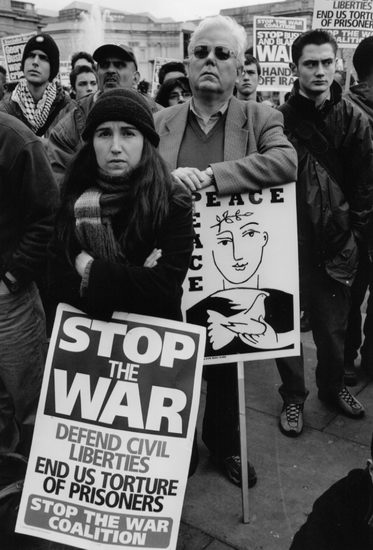
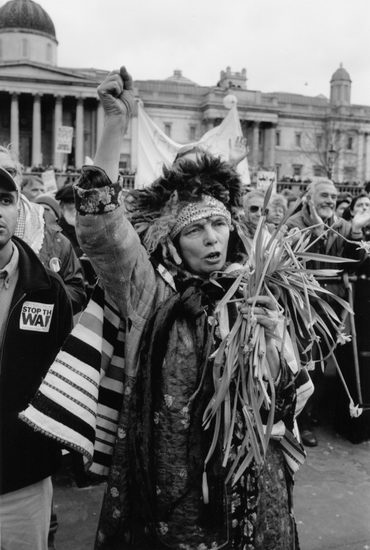
2 March 2002: Stop the War, Hands off Iraq

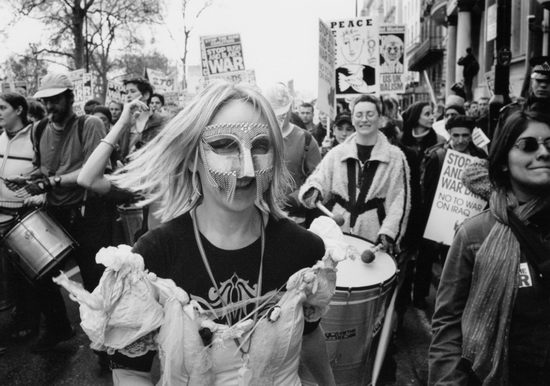
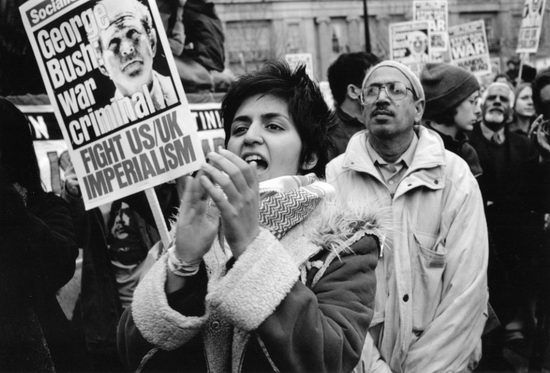
Back in 2002, protests were still in black and white – or rather I was still using film for my photographs and the library I was putting pictures into was still only taking colour pictures as transparencies – something I had given up taking seventeen years earlier as I found colour negative far better to work with.

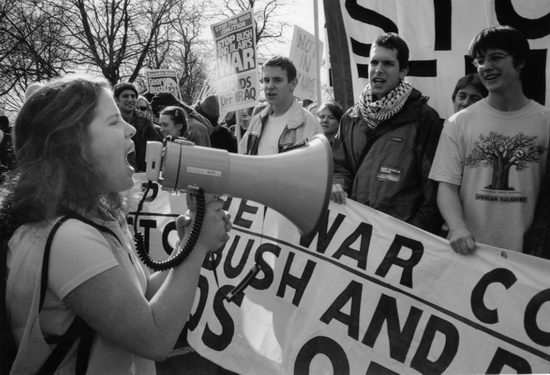
For the huge Stop The War protest on March 2nd, 2002 against the war in Afghanistan and the forthcoming invasion of Iraq I was actually working with three cameras, one with black and white film, a second with colour negative and the third a panoramic camera also loaded with colour negative film. Although I contact printed the developed films from all three, it was only selected images from the black and white work that was printed and went to the library.

Some day I hope to get around to printing some selected images from the seven or eight colour films I exposed on that day, but at the time I had no particular incentive to do so. It was difficult for me to use colour even on the web site, as my flatbed scanner at that time was a monochrome only scanner – and all the pictures on My London Diary from this event are black and white scans from the black and white prints I made to send to the library.

There are a few colour pictures from this era on my web sites, mainly those taken on a pocket-sized 2Mp digital camera I had begun to use as a notebook a year or two earlier, but the images were generally unsuitable for publication. Prints from them at much more than postcard size were poor quality.

Around this time I did get my first film scanner, but it was very slow to use and the quality wasn’t great. And at the end of 2002 I began using my first DSLR, the 6Mp Nikon D100, and soon began submitting digital images to agencies that would handle digital work.

Newspaper reports at the time rather followed the police in giving figures of 10-15,000 people at the protest, though I think the true number was at least twice this. As I reported, “people were still leaving hyde park at the start of the march when trafalgar square was full to overflowing two and a half hours later.” It takes more than 15,000 to fill Trafalgar Square and the tailback over the 2 mile route adds considerably to that number.

As I wrote back then:

police estimates of the number were risible as usual – and can only reflect an attempt to marginalise the significant body of opinion opposed to the war or a complete mathematical inability on behalf of the police.

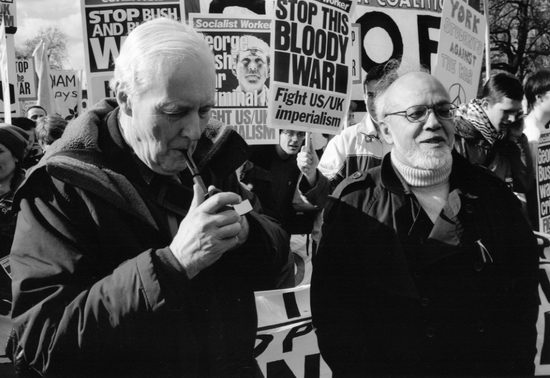
In my comments I also quote Tony Benn telling us photographers at the start of the march that it wasn’t worth us taking his picture, “it won’t get in the papers unless i go and kick a policeman” and he was quite right. They didn’t report his speech either, in which he said that for the first time in his life he though the situation was so desperate that he was advocating non-violent resistance, calling for everyone to stop work for an hour at the moment the bombing begins. “Stop the buses. Stop the trains. Stop the schools. It’s all very well going to Downing Street, I’ve spent half my life at Downing Street, in, outside Downing Street. It has to be more than that, its got to be something we take up in every town and village.” This he said would get the debate going. His speech received a huge reception from the crowd.

It was hardly a very radical suggestion – and after the bombing started it would have been too late. But had ‘Stop The War’ called for similar action before the parliamentary debate – and not just another A to B march planned months in advance – it might have made a difference. The message that this was simply a war for control of oil resources and would be a disaster for the region was getting through – and there were regular protests in towns and villages across the nation, including in the true-blue town where I live, and more radical actions could have prevented the UK joining in the US action.
More at http://mylondondiary.co.uk/2002/03/mar.htm


All photographs on this and my other sites, unless otherwise stated, are taken by and copyright of Peter Marshall, and are available for reproduction or can be bought as prints.


Gentlemen o’ Fortune in London

Ahoy! Some years ago I let me younger son, then in his 30s, use me ‘puter while he was stayin’ wit’ us, ‘n afterwards found that he had changed t’ language on me Facebook t’ “Pirate”. It loot a wee while fer me t’ change it back ‘n certainly wasn’t made easier by havin’ all th’ menus ‘n explanations in ‘Pirate’.

Or to put that in English rather than blabberin’ on in Pirate;

Pirates in London

Some years ago I let my younger son, then in his 30s, use my computer while he was staying with us, and afterwards found that he had changed to language on my Facebook to “Pirate”. It took a little while for me to change it back and certainly wasn’t made easier by having all the menus and explanations in ‘Pirate’.

As you may know, though I didn’t afore now, there are several online English to Pirate translators should you ever for any reason (or unreason) wish to convey your thoughts in that medium. England’s fortune was of course largely plundered by pirates including such well-known names as Sir Walter Raleigh, though now instead of galleons our pirates sail in the plush offices of hedge funds often registered in those distant tax havens around which many of the older pirates sailed in search of vessels to board and rob – and in whose sands they may have buried a little of their stolen treasures. Arrhh Jim Lad!

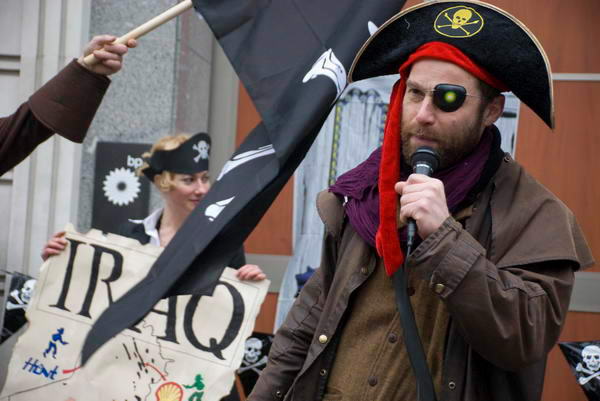
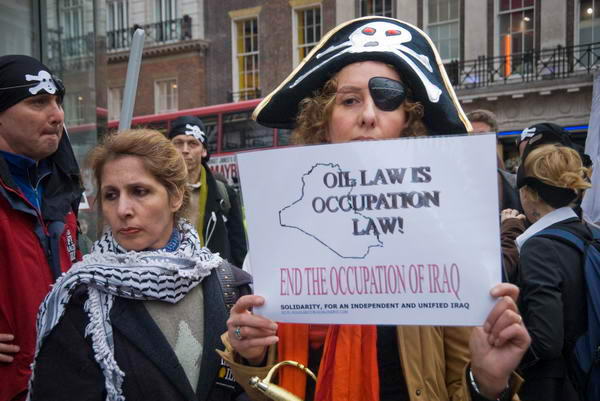
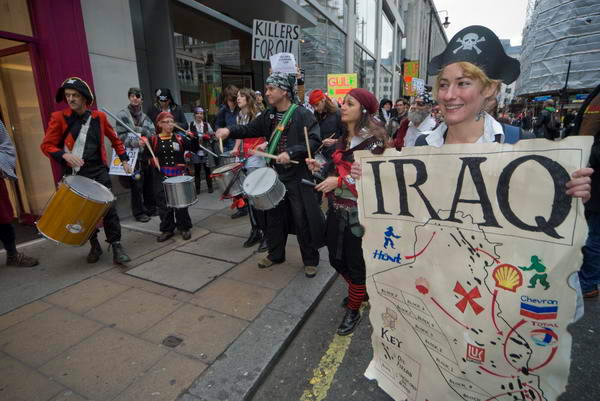
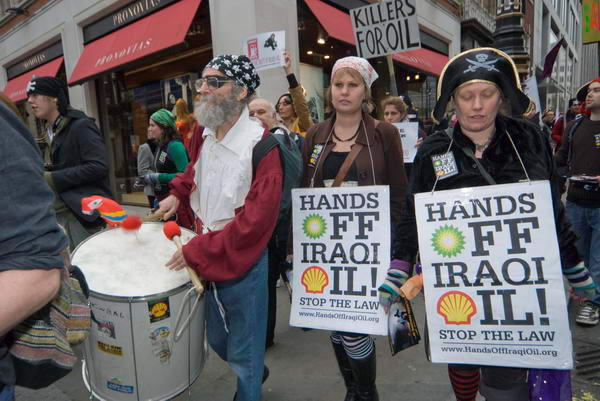
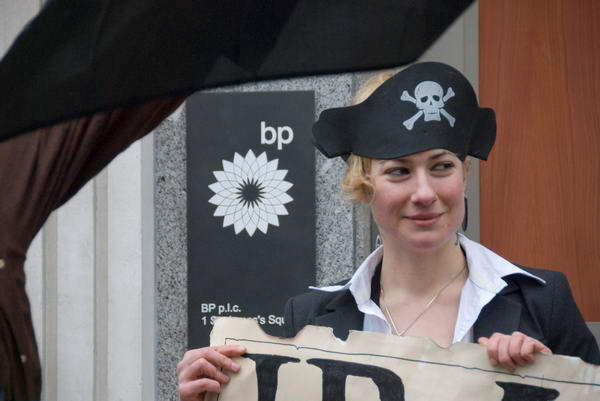
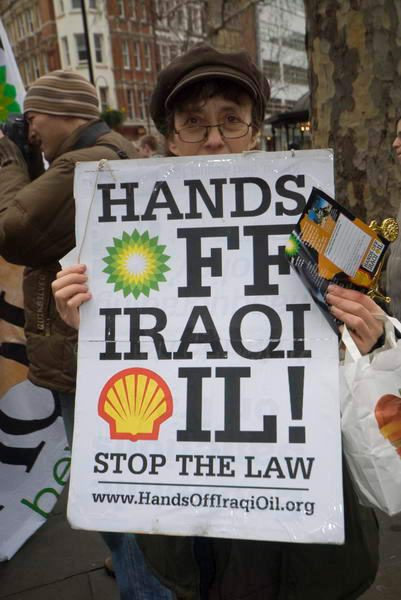
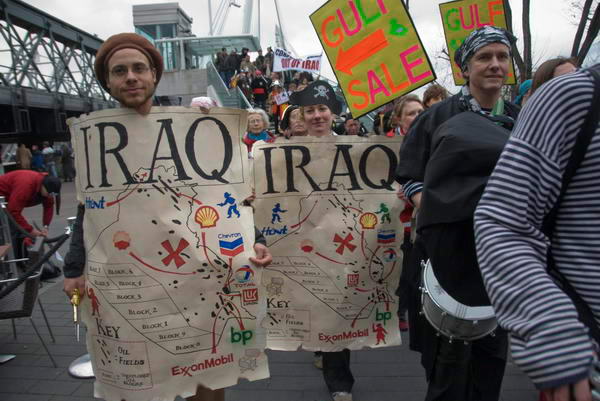
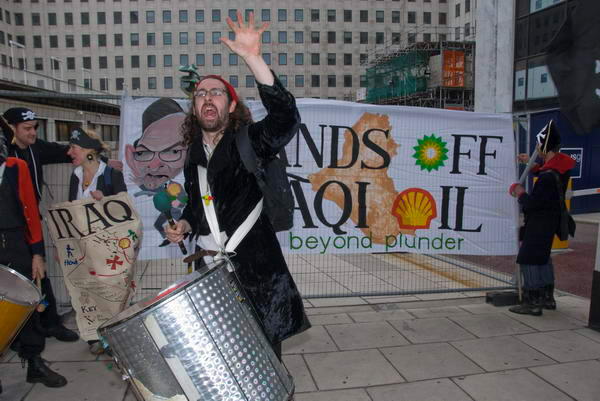
But on Saturday 23 Feb 2008 I was with pirates in London, taking part in the ‘Hands off Iraqi Oil Piratical Action Tour of London’, part of an international campaign in solidarity with the Iraqi people against the corporate theft of Iraq’s oil. The real pirates were of course the largely US oil companies busy profiteering in Iraq following the illegal US and UK invasion of that country.

Saddam was a dictator and committed many crimes, though producing weapons of mass destruction as the invaders claimed largely in contravention of the evidence of their spies, to justify their invasion was not one of them. Far more important but not stated was the fact that as long as he remained dictator, oil would remain a public sector industry in Iraq. So obviously, to further the interests of Shell, BP and other majors in the oil business and capitalism generally he had to be removed.

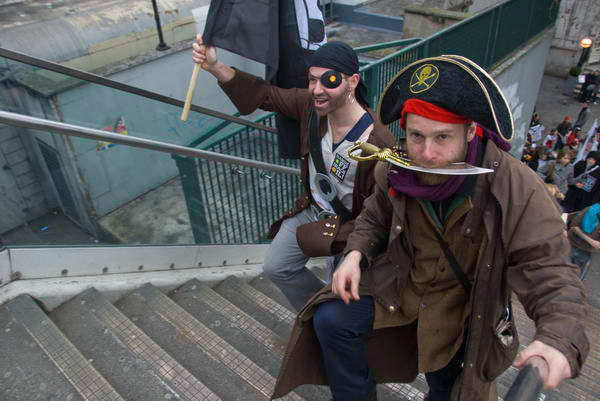
The pirate-themed protest included a number of protesters in pirate dress along with a samba band to make a great deal of noise and draw attention to the banners, posters and placards calling for corporate killers to get out of Iraq along with a small group with blacked faces in a large black sheet representing Iraqi crude.

The protest marched to the premised of various companies involved in the invasion or seeking to exploit Iraqi oil, stopping at them to speak about their activities and protest noisily. Before I met them some had gone inside the National Portrait Gallery to protest inside against BP sponsorship of their major awards.

The tour visited Erinys International Limited, a private military security company with a reputation for using excessive force which provides security services in Iraq as well as training Iraq’s Oil Protection force, BP whose former CEOs worked as advisors to the Iraqi Oil Ministry telling them let companies like BP come in a make vast profits and helping to draft new Iraqi hydorcarbon laws, and the International Tax and Investment Centre, which is paid by the big oil companies to lobby for a free-market approach which would let them dominate Iraqi oil.

Running late, the tour missed the Foreign and Commonwealth Office, whose policies have largely been to run around in support of BP and Shell, employing former oil executives as advisers on economic policy in the Middle East. And Development Program Worldwide Ltd (previously Windrush Communications) has offices too far away in the City for the tour; it promotes the establishment of private capital enterprises in places such as conflict zones where there are few controls over their activities and no effective government to represent the public interest.

The pirates stormed up the Jubilee footbridge, crossing it to reach the Shell Centre for a longer rally to end the tour. Shell executives have played a leading role in the re-purposing of the Iraqi oil industry from a state asset to a multinational profit opportunity and plan for three major oil fields there.

More at Hands off Iraqi Oil Piratical Action Tour.


All photographs on this and my other sites, unless otherwise stated, are taken by and copyright of Peter Marshall, and are available for reproduction or can be bought as prints.


A Bad Day Out

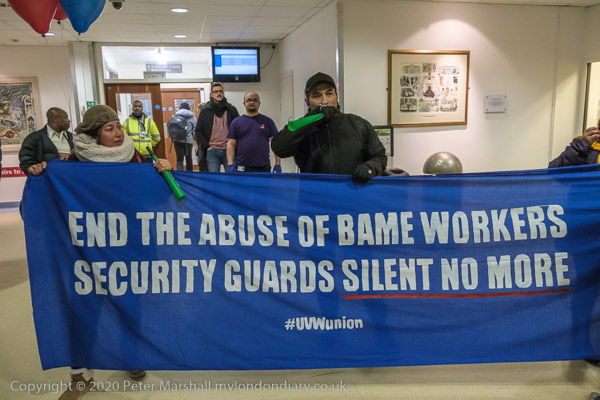
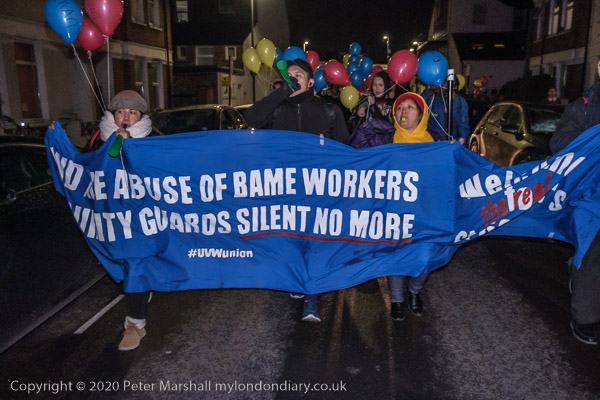
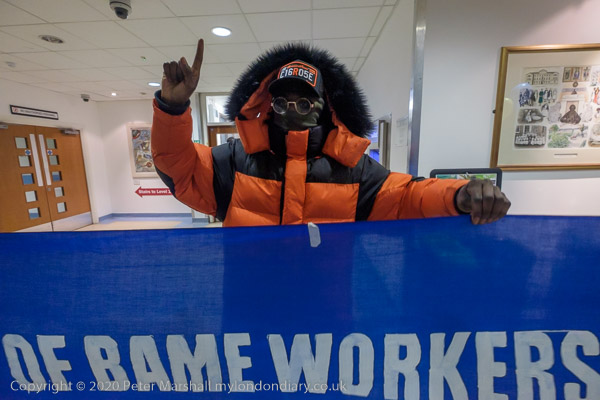
I didn’t much enjoy Thursday 20th Feb 2020, though I was pleased to be able to cover a protest by UVW Security guards working at St George’s University Hospital in Tooting. They had been on strike for 3 weeks demanding to be directly employed rather than outsourced to a private contractor and working under the minimum legal terms and conditions of service.

Although they belong to the United Voices of the World union, the university had refused recognise or talk with their union, and has called on the police to intimidate the workers and try to break their strike – and police even carried out an unlawful arrest of a UVW staff member and barrister. I’d arrived too late on that occasion to photograph the picket, when everyone had left the area.

On 20th Feb I arrived too early. Although when I had first been sent details of the protest planned to take place on an Open Day for postgraduate students they were planning to start at 4pm, the time had later been changed to 6pm and I’d not checked before setting out. So I arrived two hours early and was surprised to find that I was the only one there.

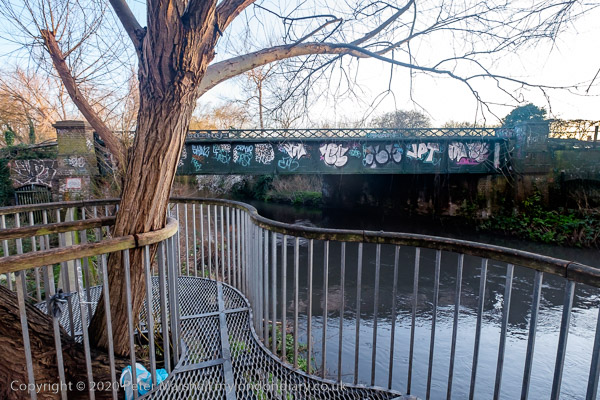
After a little checking on my phone I found out what was happening, and decided that rather than missing the event I’d go for a walk around the area. It wasn’t a bad day for February, and I enjoyed the walk by the Rover Wandle, but by the time the sun had gone down it did start to get rather cold.

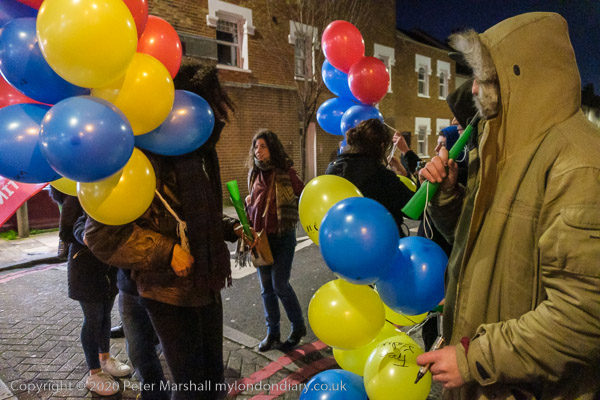
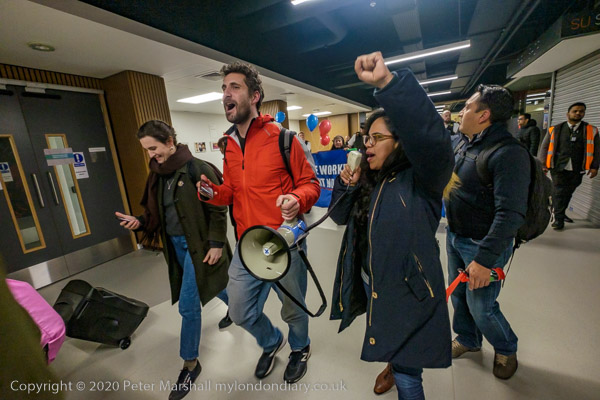
There was still no sign of the protesters, but after a phone call I met up with them close to Tooting Broadway station, where they had a large number of balloons to give the protest a party theme, and were writing slogans on them, which proved a little difficult. After some short speeches on a rather dark street corner they marched down to the hospital. It was hard to take photographs as they marched as the street lighting was poor and they were moving at a fast walking pace.

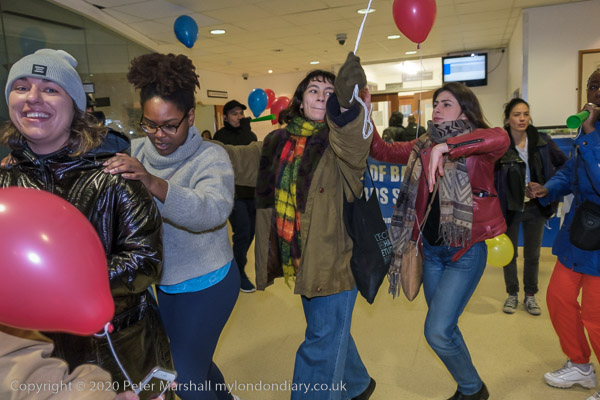
At the hospital they walked in though the main doors to a corridor area; there were very few security staff on duty, perhaps because most were on strike. I think perhaps the change of time for the protest had misled the hospital management as well as me, as there were no police present, though I had seen some when I arrived around 4pm.

Once inside there were more speeches with the union making their demands for the security guards to be made direct employees of St George’s University London and for them to receive pay and T&Cs of employment in line with SGUL standards. Among those to speak in support was drill music star Drillmaster who is standing for London Mayor.


It was a noisy protest, with music and dancing as well as speeches. Police arrived and after some fairly terse discussion came to an agreement with the protesters that they would leave in a few minutes time.

My day was not over, though I was already a couple of hours later than expected. I ran across Clapham Junction to jump on a train for home just as it was leaving, only for it to make an unscheduled stop at the next station, Wandsworth Town. After around 15 minutes we were all told to get off as the train would be going no further as the line was closed at Barnes where someone had committed suicide by throwing themselves under a train. Despite this being an unfortunately common happening at Barnes, South West Trains appeared to have absolutely no contingency plans. Eventually I got a bus back to Clapham Junction, a well-staffed station but where nobody seemed to know what was happening, and joined hundreds of passengers going from platform to platform in search of a train that would take one of the two alternative routes that avoid the accident location.

I took a chance and jumped on a Kingston train. No one on the platform or on the train knew how far it was going, but I knew that if necessary I could catch a bus home from Kingston. At Kingston the guard thought they might get to Twickenham – where again I might get a bus. Eventually it reached Twickenham, where everyone was told to leave the train. Fortunately by that time – two hours after the incident – someone had the sense to
set up a shuttle service for stations further west, and eventually I arrived home, around five hours later than I had expected when I set out and fuming at the incompetence of South West Trains.

More at:
St Georges’s Hospital Security Guards
Wandle Wander


All photographs on this and my other sites, unless otherwise stated, are taken by and copyright of Peter Marshall, and are available for reproduction or can be bought as prints.


Show Workers Some Love

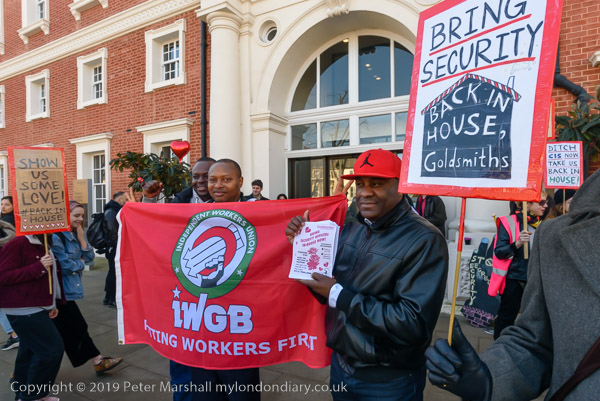
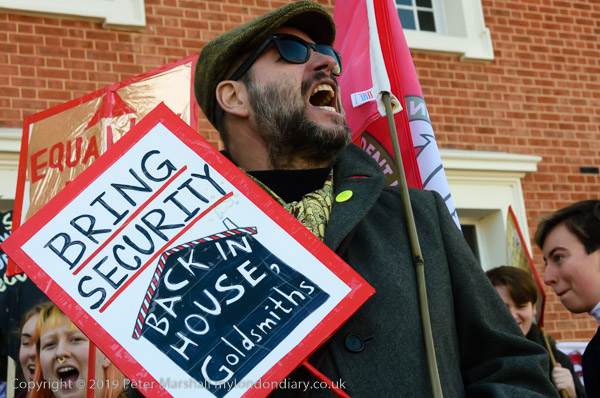
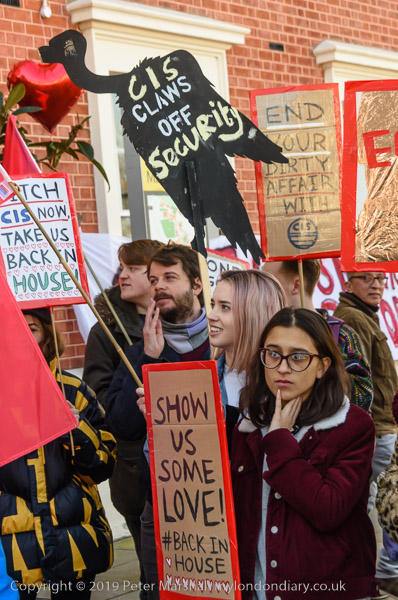
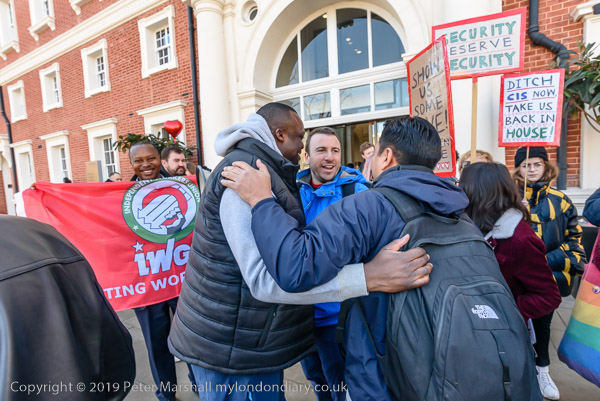
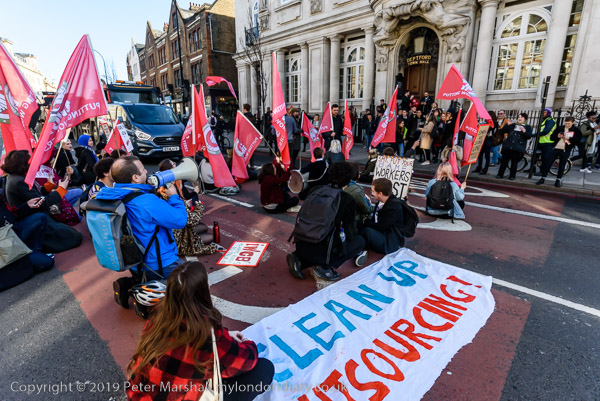
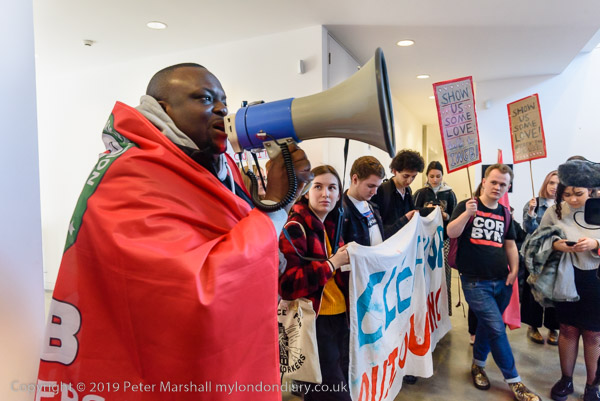
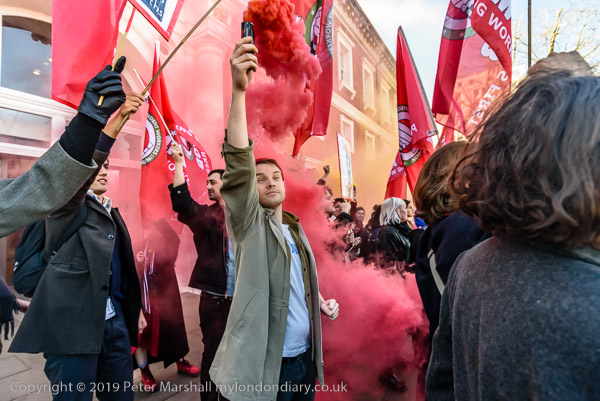
On St Valentine’s Day, Feb 14 2019, the Security and Receptionists Branch of the IWGB union and students launched their campaign for Goldsmiths University of London to directly employ its security officers, with a protest outside and inside the university buildings. The protest, on St Valentines Day, called on the university to show its workers some love.

I was pleased to be invited to go to photograph the event, and thankful that unlike many union pickets it was to take place at lunchtime rather than at the kind of ungodly hour of the morning that many of our worst paid have to clock in. I’m afraid I decline all requests that would involve me getting out of bed well before dawn and leave those to younger photographers who live closer, in part because travel until after the morning peak into London costs more than any likely return from reproduction fees.

Goldsmiths is in New Cross, a rather run-down area of South London that I’ve known for years and is rapidly sprawling over the whole area. Long ago, before I started taking photographs I made the pilgrimage to Chris Wellard’s Jazz & Blues Record Shop on Lewisham Way, probably the finest in the world until its closure in the mid-70s, later demolished for a new block for the college just a few yards further down the road. Goldsmiths has never quite gained the same reputation, though I have been there for the odd (sometimes very odd) meeting and event since. And more often to visit a late artist and photographer friend whose studios were just a little further on down the road at Lewisham Arthouse.

A group of students stood outside the old college building, waiting for the event to start, and eventually members of the IWGB arrived. Chris Wellard’s advertising always use to contain strict instructions to take the BR Southern trains from London Bridge rather than use the Underground (now the Overground) and perhaps they hadn’t observed these.

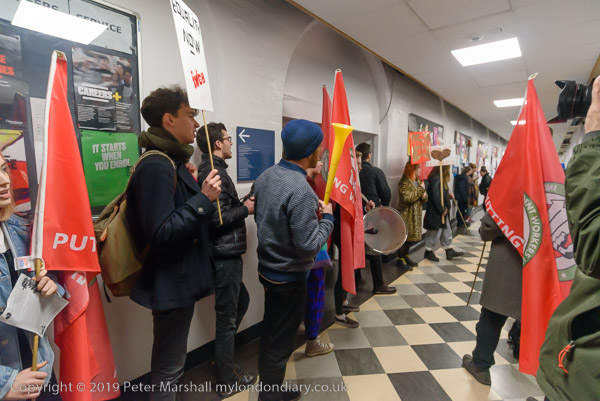
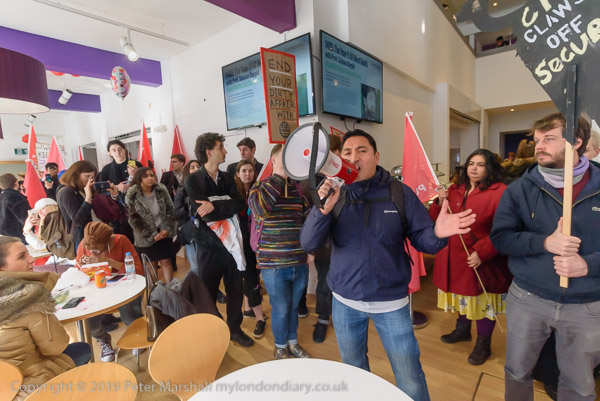
But things soon warmed up, and after some short speeches, including a warning from IWGB General Secretary Jason Moyer-Lee that this was a peaceful protest and we should be careful not to cause any damage a show of hands was voted to protest inside the building. We walked inside and made our way through the campus, stopping at various areas where people were eating lunch to for the union leaders to speak briefly – and to considerable applause from most – about the campaign.

The protesters then walked down to New Cross Road, where the university management no has its offices in the former Deptford Town Hall, and sat down in the busy road outside for a few minutes blocking all traffic.

Walking back into the university campus, they group briefly occupied the foyer of the Ben Pimlott Building, before walking back to the front of the main building for a final rally.

It had been a lively and highly noticeable protest, bringing the claim for security staff to be directly employed by the university with similar terms and benefits to others at Goldsmiths to the attention of a large number of students, staff and management.

Exactly a year later, on Valentines Day 2020, the IWGB Security Guards & Receptionists Branch tweeted (with a short video):

More pictures at Bring Goldsmith’s Security In-House.


All photographs on this and my other sites, unless otherwise stated, are taken by and copyright of Peter Marshall, and are available for reproduction or can be bought as prints.


Class War v. Qatari Royals

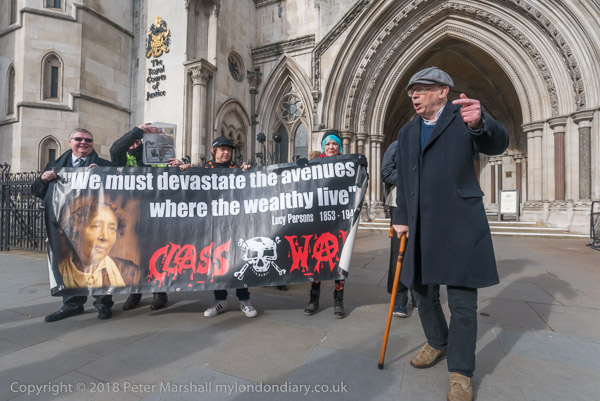
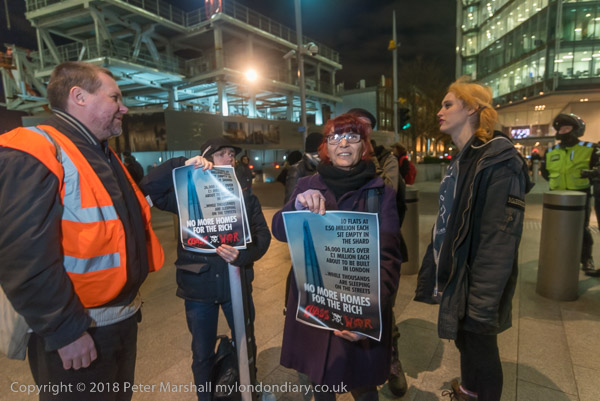
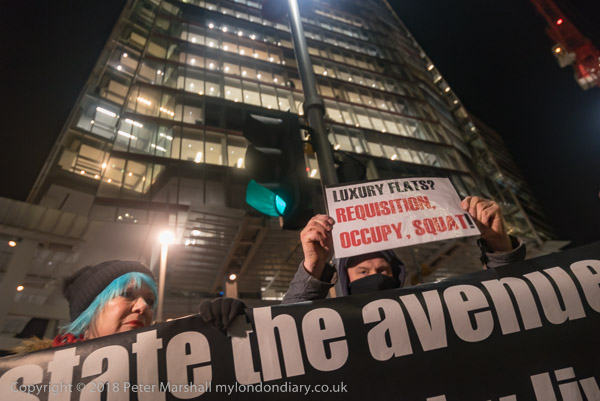
Three years ago today, on 8 Feb 2018, Class War had planned a protest outside London’s tallest building, the Shard, to point out the housing crisis, which is currently affecting many in London. They chose to protest at the Shard, because there are ten £50m apartments there which have remained empty since the building was completed.

We don’t actually have a housing shortage as there are more than enough properties for everyone to have a decent home. The problem is that current policies allow property to be left empty and encourage developers to build high priced flats which either remain unsold or are bought as investments and largely left empty for all or most of the time. There were then plans to build a further 26,000 flats in London costing more than a million pounds each, many on former council estates where social housing has been demolished at a time when London has a huge housing crisis with thousands sleeping on the street, and over 100 families from Grenfell were still in temporary accommodation.

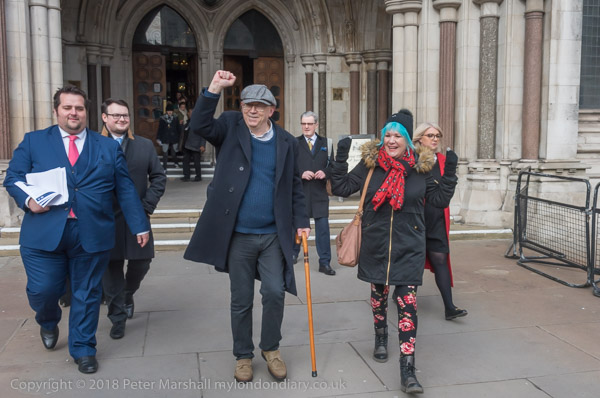
The owners of The Shard, the Qatari royal family, went to court to seek an injunction against the Class War protest, seeking an injunction against Ian Bone and “persons unknown” and, despite their fortune estimated at over £250 million pounds, seeking legal costs of over £500 from the 70 year-old south London pensioner.

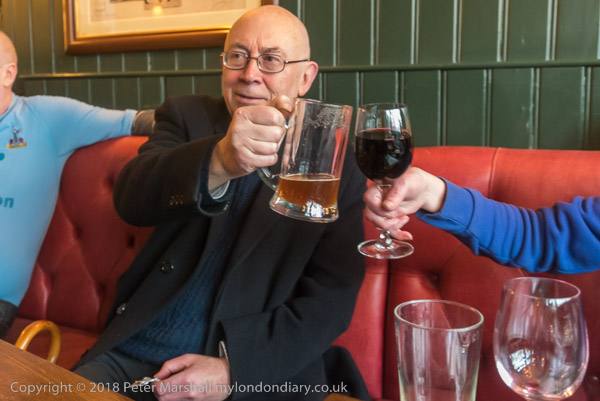
Fortunately barrister Ian Brownhill offered to conduct Bone’s defence pro bono and in the High Court hearing the Qatari royals were forced to drop the attempt to ban protests and the demand for fees but Bone accepted a legal restriction on him going inside the Shard and its immediate vicinity. But that meant the planned protest that evening could still go ahead, and Bone and his team emerged from the court victorious. His health issues meant that he was himself in any case unable to attend the protest.

At the protest there were large numbers of police and security, along with many in plain clothes and two officers with search dogs. The protest was always intended to be a peaceful one and the protesters were careful to remain outside the boundary of The Shard, marked with a metal line in the pavement. The police nonetheless harassed them, making a patently spurious claim that they were causing an obstruction to commuters attempting to enter London Bridge station and trying to move them further away from The Shard. Although the protest clearly wasn’t causing any serious problems to those entering or leaving the station, the larger numbers of police and security were.

Three years on, London still has a huge problem, with huge numbers of unaffordable flats still being built, particularly in the huge development area in Vauxhall and Nine Elms, including the developments around the US Embassy and the former Battersea Power Station. Some developments here include small areas of social housing, with ‘poor door’ entrances hidden away around the backs of some of the towers, the residents or which are excluded from the many facilities which are provided for the wealthy.

While blocks have large and well-furnished foyers with a concierge service for the rich, as well as some recreational facilities, social housing tenants typically enter a narrow bleak corridor with no space even for parcel deliveries. Just like the block in Aldgate where Class War’s long series of protests put the issue of ‘poor doors’, where poorer tenants are segregated from their wealthy neighbours on the national agenda back in 2014.

In July 2019, Communities Secretary James Brokenshire was “appalled” by the examples of segregation he had seen and promised to put an end to the use of “poor doors” in housing developments in England. It appears to have been a Broken promise, and Class War are thinking it is time for more action.

Class War protest at Shard
Class War victory against Qatari Royals


All photographs on this and my other sites, unless otherwise stated, are taken by and copyright of Peter Marshall, and are available for reproduction or can be bought as prints.