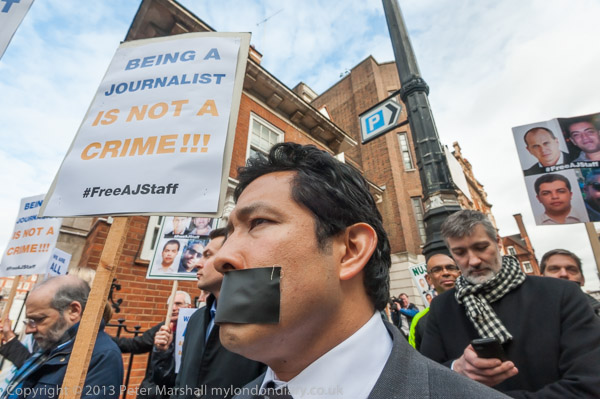
Two years ago – 26 Feb 2019

Class War protest Rees-Mogg freak show
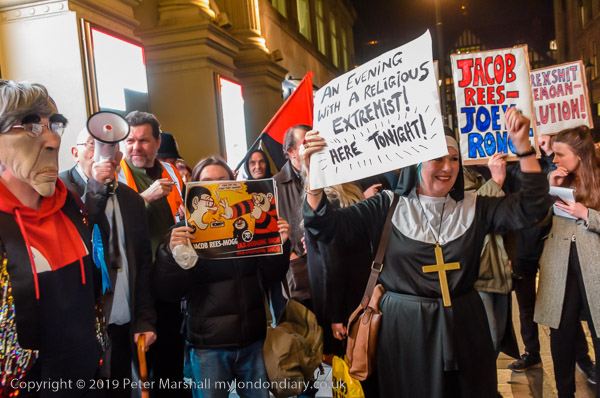
Two years ago today Class War protested outside the London Palladium against Jacob Rees-Mogg, who they accused of spouting “homophobic, transphobic, racist, pro-hunting, misogynist, classist, privileged” nonsense. Rees-Mogg had booked London’s best known venue to preach more of this to his fans, who had paid £38 for a ticket to this freak show.
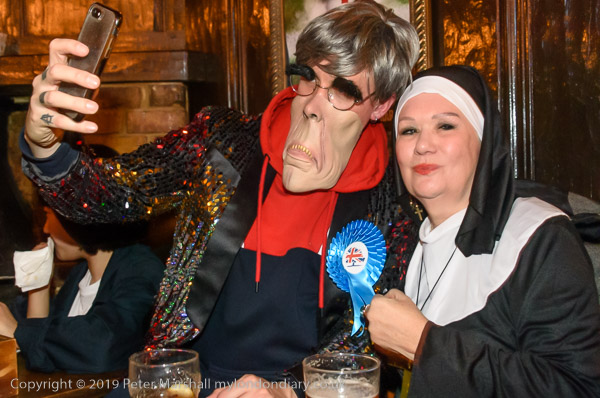
I met up with Class War at a pub a short walk from the Palladium and found a small group there with Jane Nicholl dressed as a nun, Mother Hysteria, and Adam Clifford as Jacob Rees Mogg and there was time for them to take a selfie and everyone to finish their drinks before the small group moved off to the entrance to the Palladium where a few more of there supporters were waiting and long queues were waiting to enter for the performance inside.
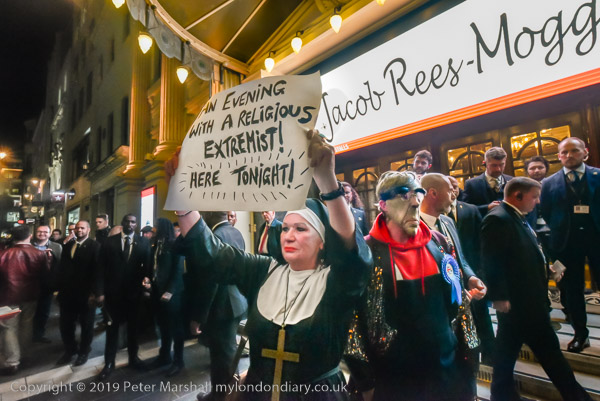
As well as the fans there were of course a large group of security men and police in attendance (all probably thanking Class War for the overtime.) And when Class War held up posters and banners the waiting crowd had their hopes for what they had paid to come and see confirmed. One or two did come across to insult the protesters, and a few others passing by came to share their similar views of Mogg with Class War.
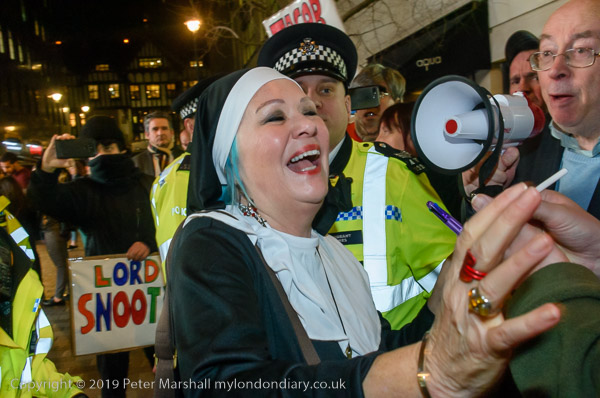
Police did their best to render the protest less effective and moved the group to the opposite side of the pedestrianised street and issued various warnings to harass them. Eventually they stopped and searched Jane Nicholl, threatening her with arrest as they found stink bombs in her handbag which they claimed were offensive weapons. I stood for almost 20 minutes watching the officer writing out “her notice of stop and search, perhaps because he is at a loss trying to find some way that doesn’t make the police action sound stupid” before deciding I had to go home and file my pictures.


Rally for an end to Outsourcing
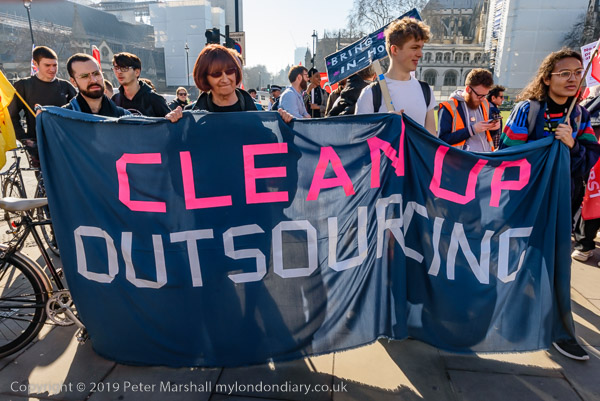
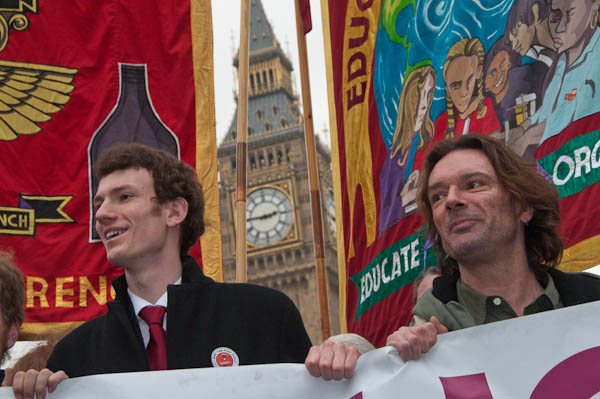
This protest had come at the end of a long and varied day for me, which had begun with a coordinated action by the UVW, IWGB, and the BEIS PCS branch demanding an end to outsourcing and the insecurity, discrimination and low pay it causes. A legal challenge was demanding better rights for the 3.3 million outsourced workers in the UK, and protesters had met at the University of London at 8am to march to a protest outside the High Court before moving on to a rally in Parliament Square where I joined them a couple of hours later.


Outsourced Workers protest at BEIS
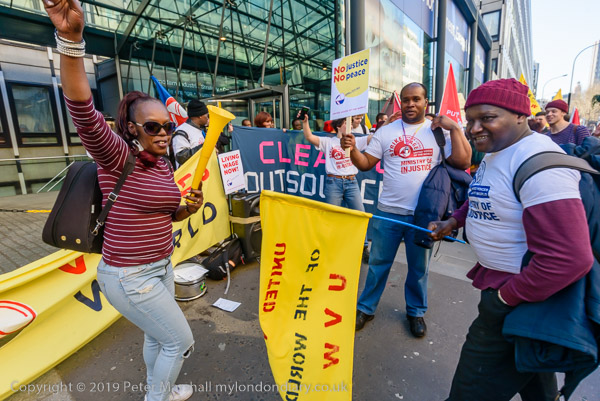
From Parliament Square it was a short walk to the Dept for Business, Energy & Industrial Strategy in Victoria St where outsourced workers including catering and security staff in the PCS were striking in support of their demand for the London Living Wage as well as end to outsourcing and the insecurity, discrimination and low pay it causes.


Outsourced Workers at Justice ministry
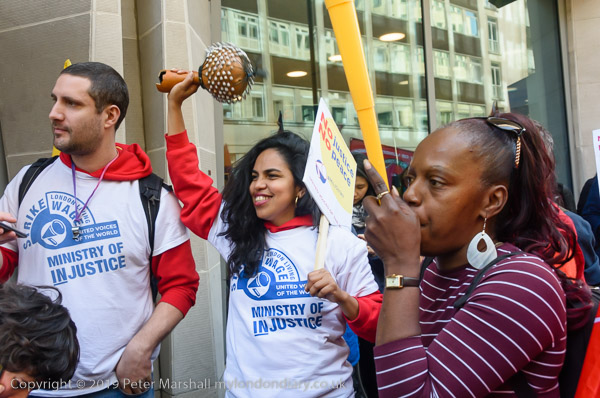
After a rally and speeches at the BEIS, the protest by outsourced workers moved on to the Ministry of Justice (though they call in the Ministry of Injustice) where low paid workers belonging the the United Voices of the World union who had been on strike for 24 hours were going back to work. They also want the London Living Wage and fair conditions of service rather than the poverty and insecurity of outsourcing.


North Woolwich
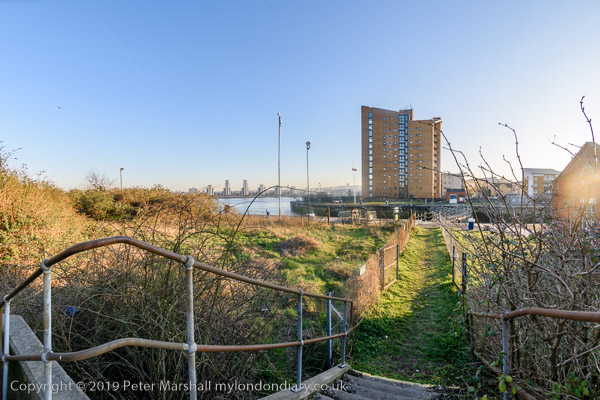
When the protest at the Justice Ministry came to an end I went to have a quick lunch and, as I had several hours to spare before the Class War action, went to take some photographs at North Woolwich. Unfortunately I arrived at Bank station for the DLR only to find there were no trains running – and no information as to when they might resume service.

It took me rather longer than anticipated to get there, taking the Northern Line to London Bridge and a train to Woolwich Arsenal. Fortunately by then services were running from there to North Woolwich, saving me a walk across the river but I still had rather less time than I needed and had to rush away before finishing my planned route, mainly beside the River Thames. It was a pleasant day for a walk, but a clear blue sky is not good for panoramic views.

As usual, more about all these on My London Diary:
Class War protest Rees-Mogg freak show
North Woolwich
Outsourced Workers at Justice ministry
Outsourced Workers protest at BEIS
Rally for an end to Outsourcing


All photographs on this and my other sites, unless otherwise stated, are taken by and copyright of Peter Marshall, and are available for reproduction or can be bought as prints.


Limehouse, Pimlico & the City

DLR, Limehouse Dock, Limehouse, 1992 92-3d-36-7a_2400
Panorama, DLR & Limehouse Dock, Limehouse, 1992

My walk down the Lea Valley from the source to the Thames took a long time on my posts here, and there are still many pictures in the Flickr album that have not featured here, including those around the other outlet from the Lea Navigation to the River Thames via the Limehouse Cut and Limehouse Basin by which barges could avoid the winding and rather treacherous Bow Creek. There are over 500 pictures in the album, including a number of colour images and they come from various visits over around ten years when I probably made several thousands of exposures. And I continued to make occasional visits there after 1992, the latest I think in 2018 or 2019. So here are just a couple of final images before I return to my wider explorations of London, back in 1987.

Heavy Rain, LimehouseBasin, entrance, River Thames, Limehouse, Tower Hamlets, 1983 33f-45_2400
Heavy Rain, Limehouse Basin entrance, River Thames, Limehouse, Tower Hamlets, 1983

1987 continued

St George's Drive, Pimlico, Westminster, 1987 87-10a-15-positive_2400
St George’s Drive, Pimlico, Westminster, 1987 87-10a-15-positive_2400

My last post about my pictures around London several months ago ended with two pictures from Pimlico taken in early October, and that’s where I will take up the story. The long streets of the area lined with Cubitt’s impressive stucco were developed from 1825, St George’s Drive, along with Belgrave Road were the two principla streets, with these opulent five storey town houses, were built (as Wikipedia quotes) for “professional men… not rich enough to luxuriate in Belgravia proper, but rich enough to live in private houses”.

By the 1980s many houses in the area were beginning to show their age; some had been converted to hotels and others offices, while others were in multiple occupation, often rather crudely converted. Developers were busy buying up properties to convert them into flats, as this picture with its estate agent’s boards and scaffolding illustrates.

Churton Place, Pimlico, Westminster, 1987 87-10a-02-positive_2400
Churton Place, Pimlico, Westminster, 1987

The side streets were also a part of Cubitt’s development, but here the houses were less grand and typically of three storeys.

River Thames, foreshore, Blackfriars, downstream, City, 1987 87-10o-63-positive_2400
River Thames, view downstream from Blackfriars, City of London, 1987

My next visit to London, later in the month took me further east, walking from Waterloo Station to the City meant I had to cross the River Thames and this picture shows a rather misty view downstream, with Southwark Bridge, Cannon St Rail Bridge, London Bridge and Tower Bridge. At the left is a tall warehouse on the upstream side of Queenhithe, London’s earliest dock. Now there would be another bridge, the Millennium footbridge, in the foreground.

White Lion Hill, City, 1987 87-10o-52-positive_2400
White Lion Hill, City of London, 1987

White Lion Hill leads up from the river to Queen Victoria St, where a rather dull office building, the Faraday Building, seems to have the dome of St Paul’s Cathedral on its roof. This part of the building was built in 1890 as a post office sorting office, which in 1905 became the GPO’s first London telephone exchange. A taller extension to the west (to the left of this view) was added in 1933, with the whole complex becoming known as Faraday House. This held the international telephone exchange and in its first years virtually all the world’s international telephone conversations were routed through here.

As this picture shows, Faraday House partly blocked the view of St Paul’s Cathedral from the Thames riverside and this led to the introduction of regulations restricting the height of new buildings in various locations giving a number of protected views from around London – including a well known one from Richmond Park. But the regulations only came in after Faraday House was built and were not retrospective. The photograph also shows another of Wren’s churches, St. Benet Paul’s Wharf, rebuilt after the Great Fire and reopened in 1683. Queen Victoria granted the church to Welsh Anglicans in 1879 and services are still conducted there in Welsh.

Knightrider St, City, 1987 87-10o-43-positive_2400
Knightrider St, City of London, 1987

Redevelopment was in full swing in the Knightrider St area as you can see from these pictures. I think the building at right is is the back of the building on Queen Victoria St now home to the Church of Scientology, and to the left is probably Faraday House. So many of what see like older buildings in the city are now just facades to more recent developments.

Knightrider St, City, 198787-10o-42-positive_2400

The web has many references to Knightrider St, but none that give useful information about its post-war past. Most are about its name, suggesting that Stow’s suggestion it came from being a handy route for knights riding to St Paul’s and Smithfield is unlikely (though there are no positive suggestions), or list buildings along the street which were demolished in the nineteenth century or earlier, and exactly the same information is in those reference books I’ve consulted which mention the street.

Knightrider St, City, 1987 87-10o-41-positive_2400

Addle Hill which runs down to the western end of Knightrider St, which continues west as Wardrobe Terrace. In between taking these pictures I photographed The Bell pub, on the corner of Addle Hill and Wardrobe Terrace which closed in 1989 and was demolished in 1998, one of many pictures not on-line. Further east on Knightrider St is The Horn Tavern, which was renamed The Centre Page in 2002 and is newspaper-themed.

These pictures are from Page 7 of my album 1987 London Photos.


All photographs on this and my other sites, unless otherwise stated, are taken by and copyright of Peter Marshall, and are available for reproduction or can be bought as prints.


The Spice of Life

Perhaps the hardest thing I’ve found about the last eleven months has been the lack of variety. I’ve been fortunate to probably avoid the virus – I was quite ill early in March 2020 but my symptoms didn’t match those then thought to typify Covid-19, though they did match some of those being reported by Covid sufferers – and none of my family or close friends have died from it.

But days mainly spent at home in front of a computer screen have followed days mainly spent at home in front of a computer screen relentlessly, though I have tried to get out for walks or bike rides most days. As someone of an age and medical condition that makes me vulnerable I decided not to travel up to London on public transport, although as a journalist I count as a key worker and could have done so. Apart from usually solitary exercise (occasionally a walk with my wife on Sundays) I’ve made a couple of trips out for pub meals with family or friends when these were allowed, and a few short journeys for medical and dental appointments – including most recently my first Covid vaccination.

There’s Zoom of course, and I hate it, though taking part in a few regular events. It’s a little better on my desktop computer which hasn’t got a camera, but on the notebook or tablet I find it disconcerting to see myself in close-up (and sometimes move out of frame and sit in a more comfortable chair watching the screen from a distance.) It’s perhaps more seeing the others, mainly in head and shoulders close-up that makes me uncomfortable with Zoom; in real life we would be sitting around at a sensible distance, seeing each other at full length and as a part of the overall scene, looking away when we want to at other things. Not those relentless talking or muted full-face heads.

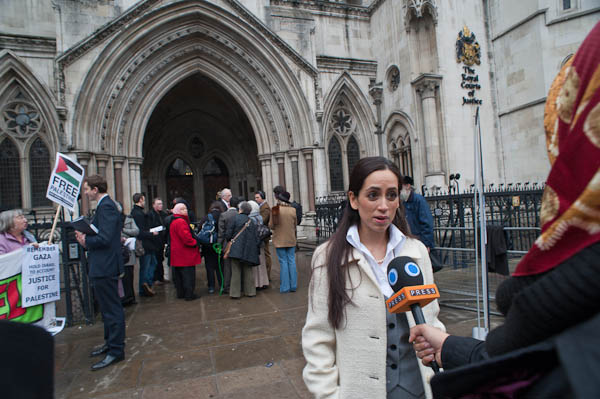
Tuesday 24th February 2009 wasn’t a typical day, and that’s really the point. Few days then were typical. I caught the train to Waterloo and took a bus across to Aldwych, a short journey but faster than walking. A short walk then took me to the Royal Courts of Justice where protesters were supporting the application for judicial review by Palestinian human rights group Al-Haq challenging the government’s failure to fulfil its obligations with respect to Israel’s activities in Palestine.

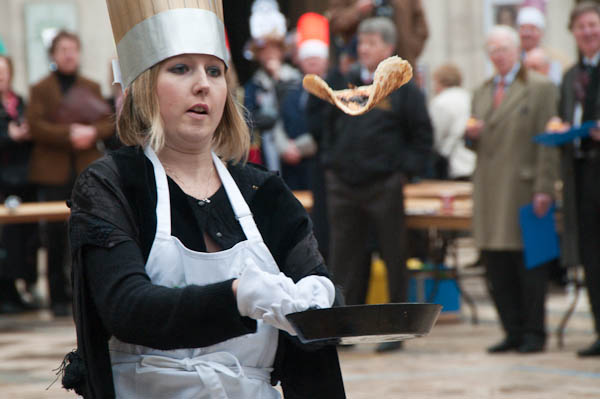
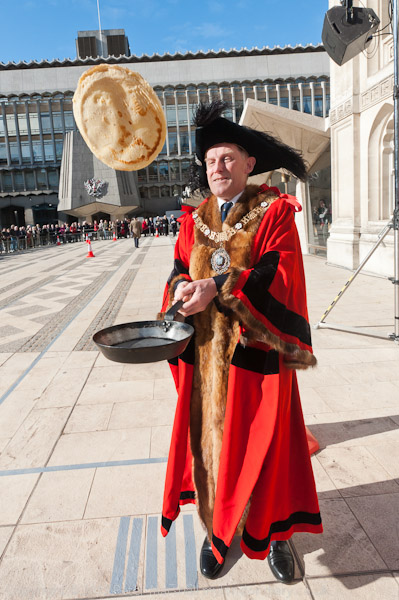
It was Shrove Tuesday, and from the Royal Courts another bus took me on one of my favourite central London bus journey, up Fleet St and Ludgate Hill to Bank, from where I hurried to Guildhall Yard to the Worshipful Company of Poulters Pancake Races. It perhaps wasn’t one of my better attempts to photograph the event, perhaps because I tried too hard to show the actual running and tossing of pancakes.

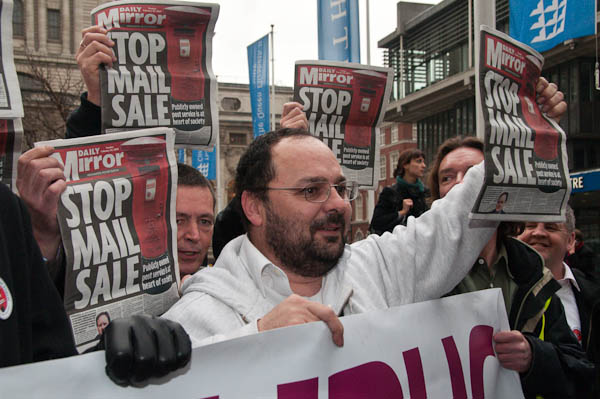
I couldn’t stay for the finals of the pancake race but hurried down to Mansion House for the District and Circle Line to Westminster to meet postal workers as they came out of a rally at Methodist Central Hall to protest at government plans to part-privatise the postal service and then proceeded to a short protest in front of Parliament.

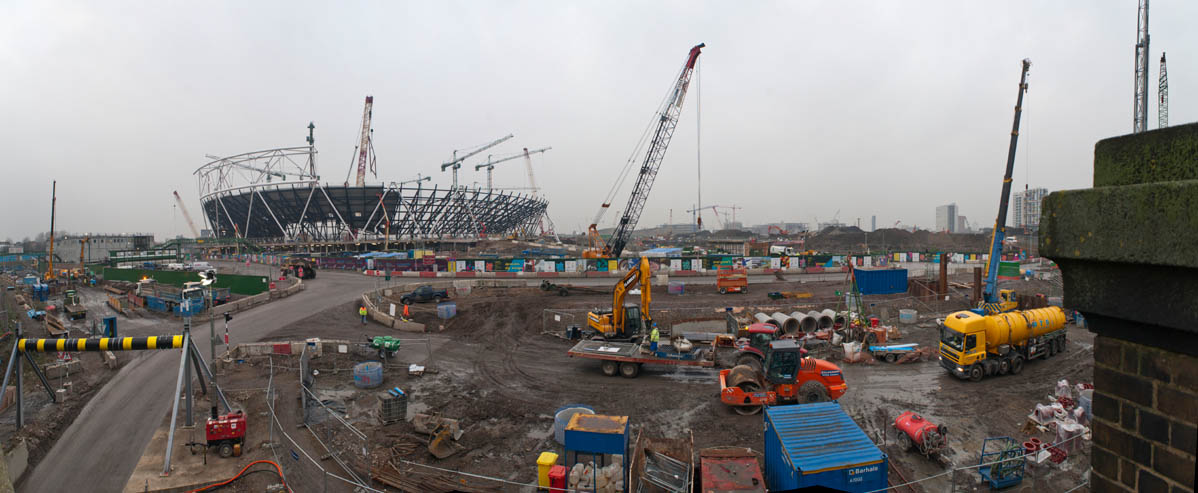
There was nothing in my diary for the next few hours, so I took the opportunity to jump onto the Jubilee Line to Stratford and then walk towards the Olympic site for one of my occasional reports on what was happening in the area – which I had been photographing since the 1980s.

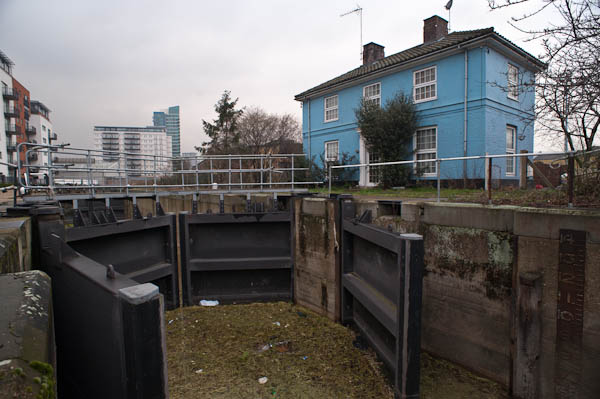
I made my way through the Bow Back Rivers, photographing the new lock gates at City Mill Lock. The Olympic site was sealed off to the public by the ‘blue fence’ but I was able to walk along the elevated path on the Northern Outfall Sewer to take a panoramic view of the stadium under construction. It was rather a dull day and not ideal for such wide views with such a large expanse of grey sky.

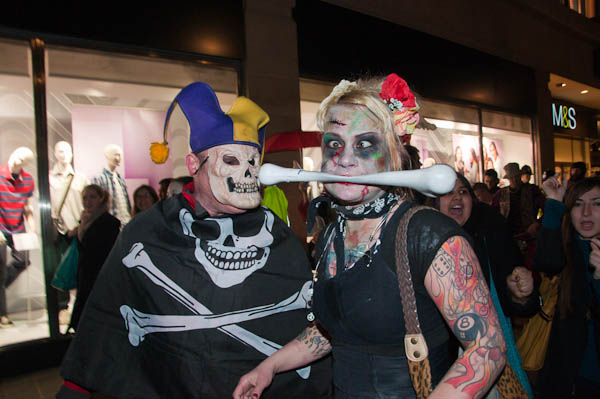
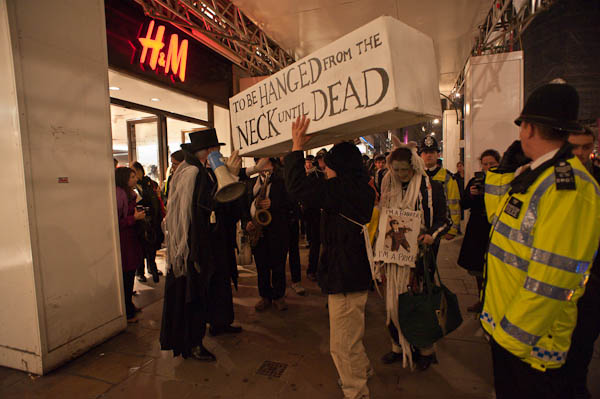
I took the Central Line back to Oxford Circus for the March of the Corporate Undead, advertised as a “Zombie Shopping Spree” along Oxford Street from Oxford Circus to Marble Arch, complete with coffins, a dead ‘banker’, posters, various members of the undead and a rather good band.

I left the zombies at Marble Arch where they were hanging an effigy of a banker and hurried to my final appointment, a London Bloggers Meetup. The evening’s meeting was being sponsored by Bacardi who were supplying free drinks, including blue and green Breezers which I thought would have been rather suitable for the zombies, but fortunately there was also free beer. I probably took a few pictures, but haven’t published them.

All just a little more interesting than staring at a screen, though there was rather a lot of that to do when I finally got home.

March of the Corporate Undead
Olympic Site Report
London Olympic site pans
Keep the Post Public
Poulters Pancake Race
Al-Haq Sue UK Government


All photographs on this and my other sites, unless otherwise stated, are taken by and copyright of Peter Marshall, and are available for reproduction or can be bought as prints.


Gentlemen o’ Fortune in London

Ahoy! Some years ago I let me younger son, then in his 30s, use me ‘puter while he was stayin’ wit’ us, ‘n afterwards found that he had changed t’ language on me Facebook t’ “Pirate”. It loot a wee while fer me t’ change it back ‘n certainly wasn’t made easier by havin’ all th’ menus ‘n explanations in ‘Pirate’.

Or to put that in English rather than blabberin’ on in Pirate;

Pirates in London

Some years ago I let my younger son, then in his 30s, use my computer while he was staying with us, and afterwards found that he had changed to language on my Facebook to “Pirate”. It took a little while for me to change it back and certainly wasn’t made easier by having all the menus and explanations in ‘Pirate’.

As you may know, though I didn’t afore now, there are several online English to Pirate translators should you ever for any reason (or unreason) wish to convey your thoughts in that medium. England’s fortune was of course largely plundered by pirates including such well-known names as Sir Walter Raleigh, though now instead of galleons our pirates sail in the plush offices of hedge funds often registered in those distant tax havens around which many of the older pirates sailed in search of vessels to board and rob – and in whose sands they may have buried a little of their stolen treasures. Arrhh Jim Lad!

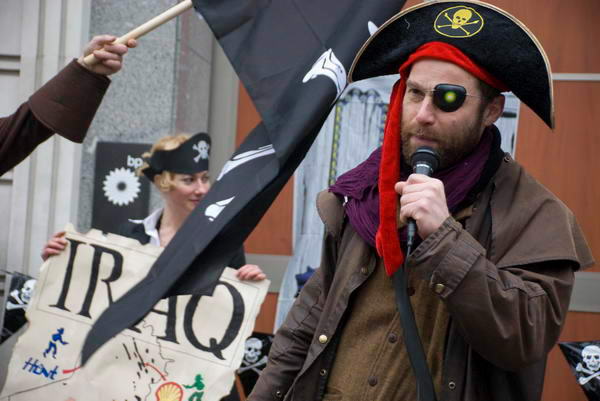
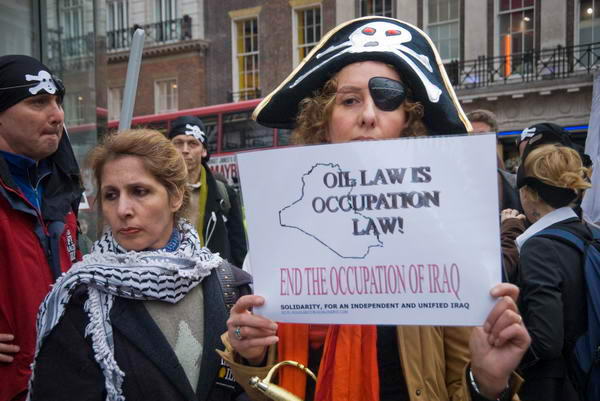
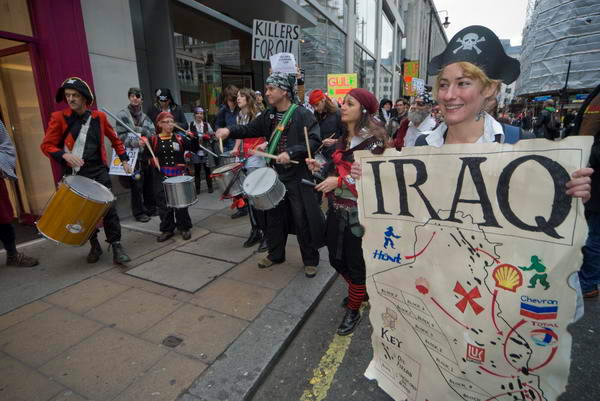
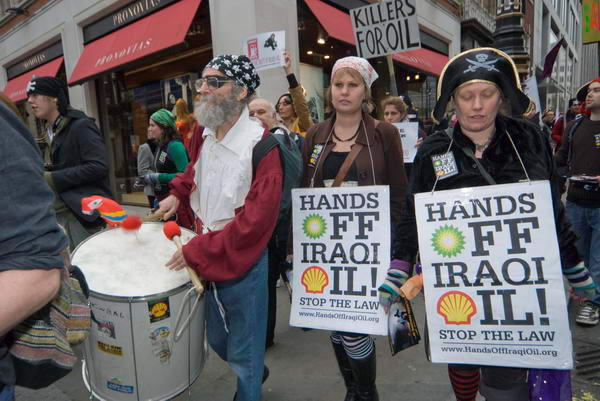
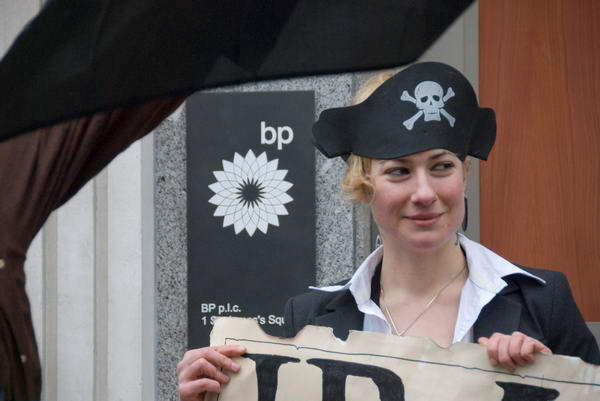
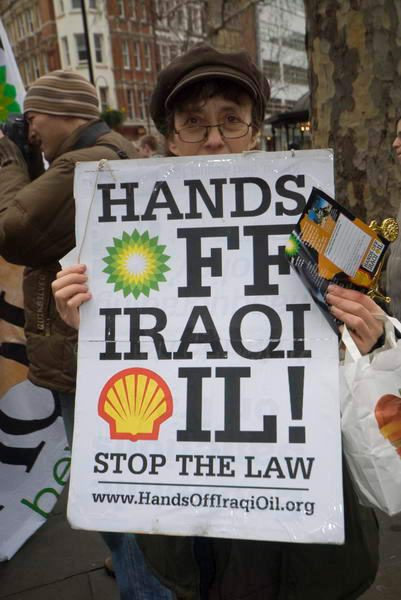
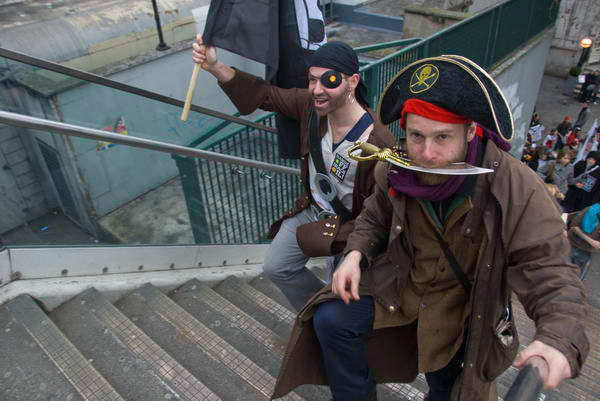
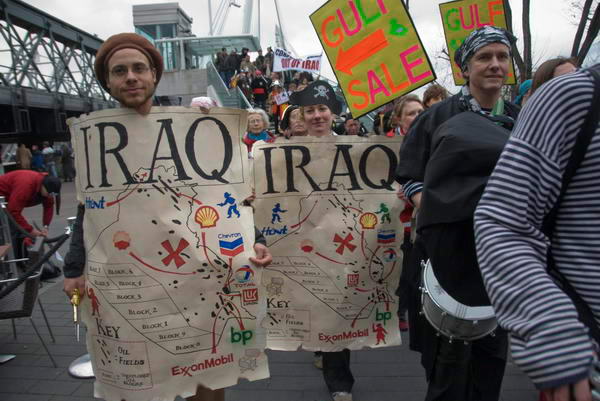
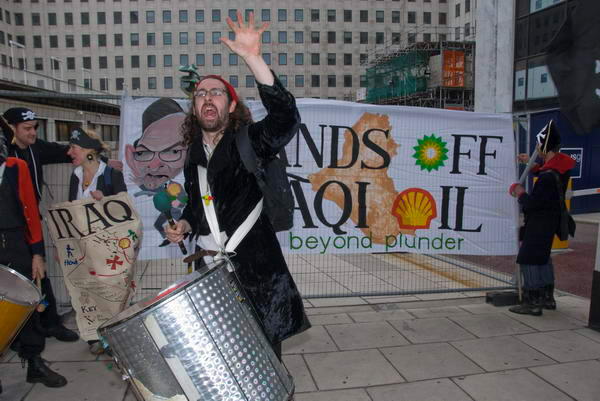
But on Saturday 23 Feb 2008 I was with pirates in London, taking part in the ‘Hands off Iraqi Oil Piratical Action Tour of London’, part of an international campaign in solidarity with the Iraqi people against the corporate theft of Iraq’s oil. The real pirates were of course the largely US oil companies busy profiteering in Iraq following the illegal US and UK invasion of that country.

Saddam was a dictator and committed many crimes, though producing weapons of mass destruction as the invaders claimed largely in contravention of the evidence of their spies, to justify their invasion was not one of them. Far more important but not stated was the fact that as long as he remained dictator, oil would remain a public sector industry in Iraq. So obviously, to further the interests of Shell, BP and other majors in the oil business and capitalism generally he had to be removed.

The pirate-themed protest included a number of protesters in pirate dress along with a samba band to make a great deal of noise and draw attention to the banners, posters and placards calling for corporate killers to get out of Iraq along with a small group with blacked faces in a large black sheet representing Iraqi crude.

The protest marched to the premised of various companies involved in the invasion or seeking to exploit Iraqi oil, stopping at them to speak about their activities and protest noisily. Before I met them some had gone inside the National Portrait Gallery to protest inside against BP sponsorship of their major awards.

The tour visited Erinys International Limited, a private military security company with a reputation for using excessive force which provides security services in Iraq as well as training Iraq’s Oil Protection force, BP whose former CEOs worked as advisors to the Iraqi Oil Ministry telling them let companies like BP come in a make vast profits and helping to draft new Iraqi hydorcarbon laws, and the International Tax and Investment Centre, which is paid by the big oil companies to lobby for a free-market approach which would let them dominate Iraqi oil.

Running late, the tour missed the Foreign and Commonwealth Office, whose policies have largely been to run around in support of BP and Shell, employing former oil executives as advisers on economic policy in the Middle East. And Development Program Worldwide Ltd (previously Windrush Communications) has offices too far away in the City for the tour; it promotes the establishment of private capital enterprises in places such as conflict zones where there are few controls over their activities and no effective government to represent the public interest.

The pirates stormed up the Jubilee footbridge, crossing it to reach the Shell Centre for a longer rally to end the tour. Shell executives have played a leading role in the re-purposing of the Iraqi oil industry from a state asset to a multinational profit opportunity and plan for three major oil fields there.

More at Hands off Iraqi Oil Piratical Action Tour.


All photographs on this and my other sites, unless otherwise stated, are taken by and copyright of Peter Marshall, and are available for reproduction or can be bought as prints.


Pancakes

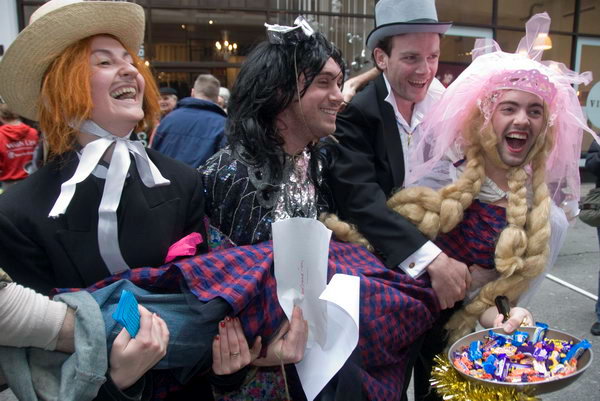
Pancake Race winners in Spitalfields, 2007

I’m not a pancake lover, and didn’t celebrate last Tuesday, Shrove Tuesday. For once there was not a pancake in sight in our household as I think I’ve finally made my views on the subject clear. It isn’t that I would refuse to eat them but more that I find their taste and texture mildly offensive and feel that whatever filling or topping is applied to them would go much better with something else such as potato or bread.

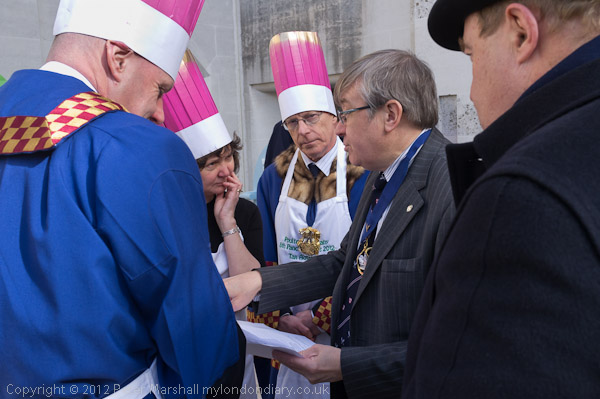
Guildhall Yard, 2012

That hasn’t stopped me going out to photograph some of the many “tossers” who take part in the many pancake races which have mushroomed in our cities in recent years. I think back when I was young, pancake races were confined to a few places around Milton Keynes. The tradition is said to have begun in Olney in 1445, but had died at the start of the Second World War and was revivied in 1948 by the Vicar of Olney the Reverend Canon Ronald Collins, going international when Liberal, a town in Kansas, USA, sent Olney a challenge to a timed race in 1950.

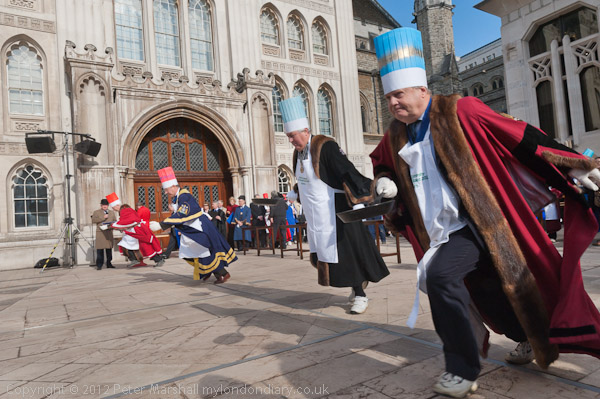
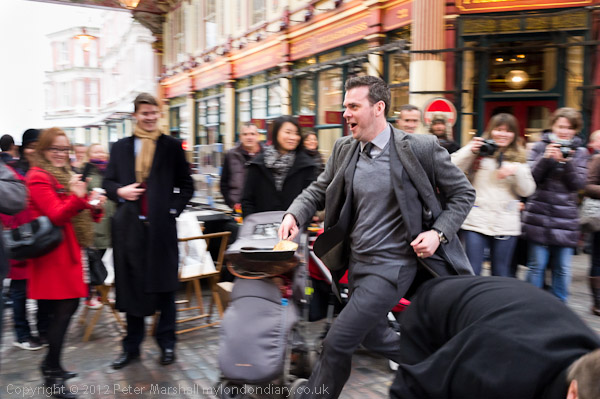
What had once been purely a local tradition was spread through film and TV coverage, but it was only relatively recently that we began to see pancake races in London. I’ve photographed them in half a dozen places, the most interesting of which, a highly competitive event between the City of London’s Livery Companies, takes place in Guildhall Yard, and was begun by the Worshipful Company of Poulters in 2004, though I only photographed it for the first time in 2007. All except the top picture on this post are from Tues 21 Feb 2012.

Back in 2007 I think I was one of very few photographers present, though a few of my friends came along too, at least in the following years, and by the time I last went in 2020 there was a whole crowd of photographers and things had become rather more organised and less interesting. There wasn’t a race this year, but even had things been normal I wouldn’t have bothered to go again.

Leadenhall Market, 2012

These races take place across lunchtime, and in some years there was another race by myself and my friends leaving the Guildhall before the final races to rush and cover one of the other events taking place, at Leadenhall Market (750 metres away) or Spitalfields, just outside the City, and 1.18km distant before these finished. Other pancake races take place south of the river in Southwark, though I’ve found them less interesting to photograph – and I’m not sure I’ve ever published any pictures.

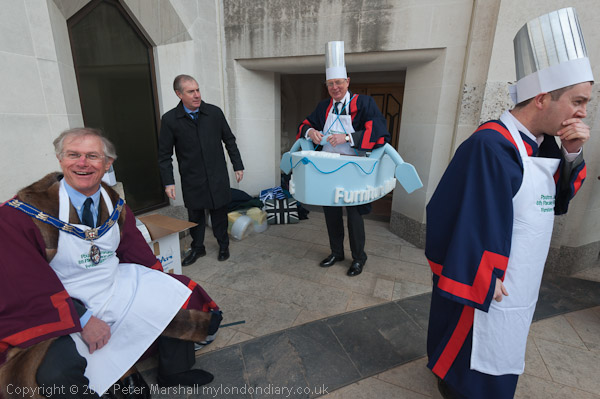
I think all of the London pancake races are raising money for charities and are team events. The Guildhall race is an opportunity for many in City businesses of all ages to let their hair down a little, with separate classes for the Masters of the guilds and women as well as other team members, and a separate fancy dress class; they have clear rules about gloves hats and more which are strictly applied, as well as timekeepers and a starting cannon. The other races are rather less organised, with teams from local businesses or pubs some in fancy dressthough others in their normal work clothes and generally rather younger.

Pancakes in the City – Leadenhall Market
Pancakes in the City – Guildhall


All photographs on this and my other sites, unless otherwise stated, are taken by and copyright of Peter Marshall, and are available for reproduction or can be bought as prints.


A Bad Day Out

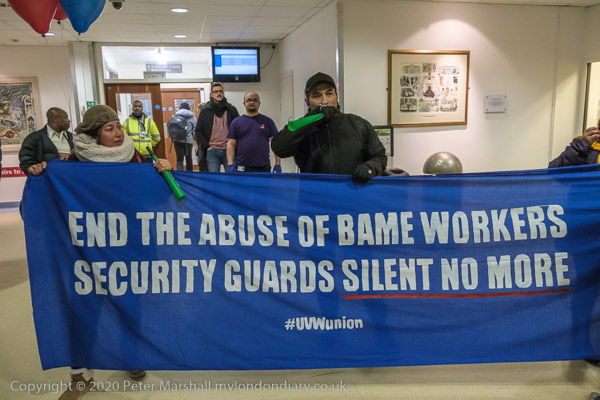
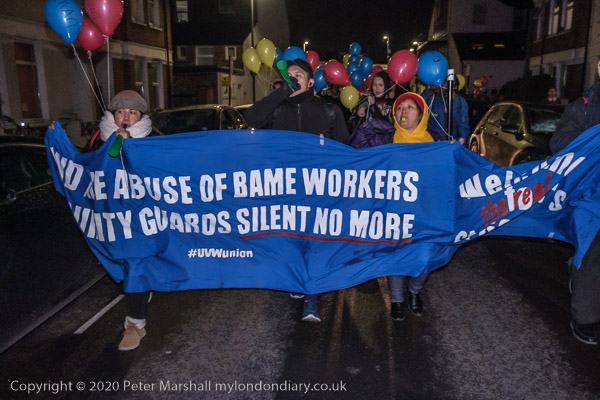
I didn’t much enjoy Thursday 20th Feb 2020, though I was pleased to be able to cover a protest by UVW Security guards working at St George’s University Hospital in Tooting. They had been on strike for 3 weeks demanding to be directly employed rather than outsourced to a private contractor and working under the minimum legal terms and conditions of service.

Although they belong to the United Voices of the World union, the university had refused recognise or talk with their union, and has called on the police to intimidate the workers and try to break their strike – and police even carried out an unlawful arrest of a UVW staff member and barrister. I’d arrived too late on that occasion to photograph the picket, when everyone had left the area.

On 20th Feb I arrived too early. Although when I had first been sent details of the protest planned to take place on an Open Day for postgraduate students they were planning to start at 4pm, the time had later been changed to 6pm and I’d not checked before setting out. So I arrived two hours early and was surprised to find that I was the only one there.

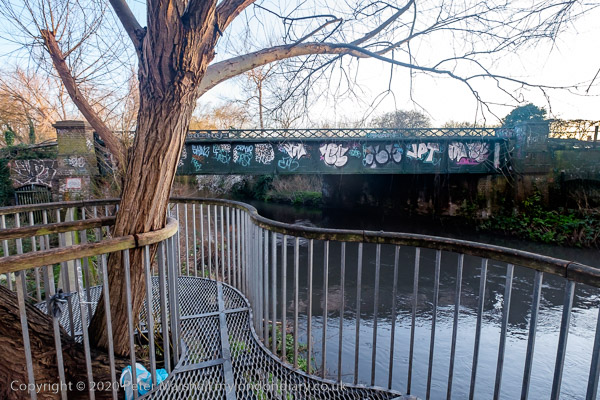
After a little checking on my phone I found out what was happening, and decided that rather than missing the event I’d go for a walk around the area. It wasn’t a bad day for February, and I enjoyed the walk by the Rover Wandle, but by the time the sun had gone down it did start to get rather cold.

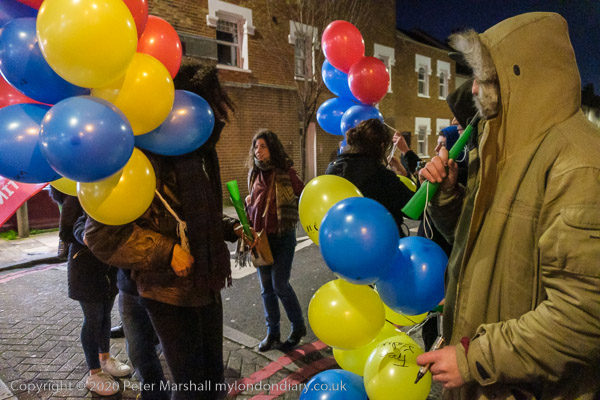
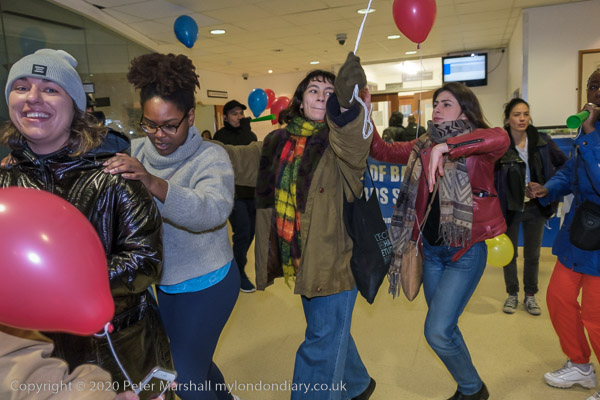
There was still no sign of the protesters, but after a phone call I met up with them close to Tooting Broadway station, where they had a large number of balloons to give the protest a party theme, and were writing slogans on them, which proved a little difficult. After some short speeches on a rather dark street corner they marched down to the hospital. It was hard to take photographs as they marched as the street lighting was poor and they were moving at a fast walking pace.

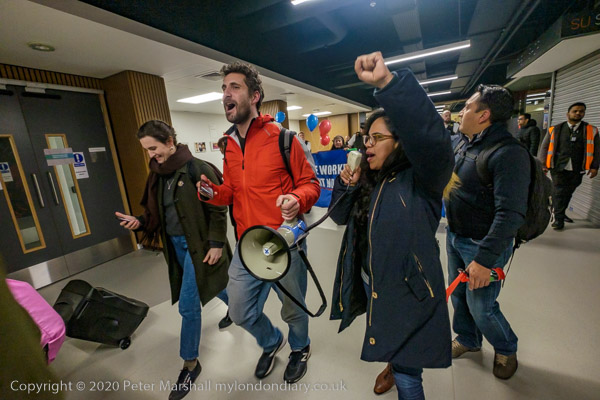
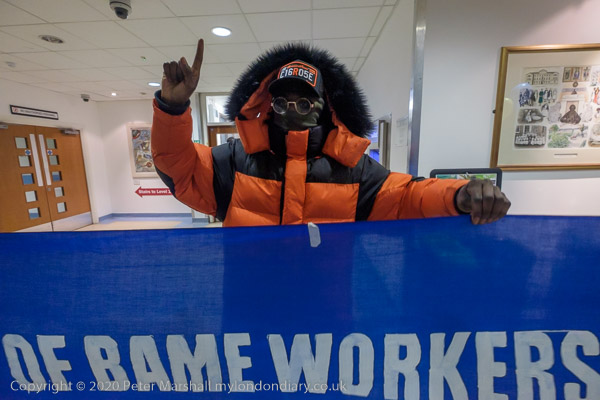
At the hospital they walked in though the main doors to a corridor area; there were very few security staff on duty, perhaps because most were on strike. I think perhaps the change of time for the protest had misled the hospital management as well as me, as there were no police present, though I had seen some when I arrived around 4pm.

Once inside there were more speeches with the union making their demands for the security guards to be made direct employees of St George’s University London and for them to receive pay and T&Cs of employment in line with SGUL standards. Among those to speak in support was drill music star Drillmaster who is standing for London Mayor.


It was a noisy protest, with music and dancing as well as speeches. Police arrived and after some fairly terse discussion came to an agreement with the protesters that they would leave in a few minutes time.

My day was not over, though I was already a couple of hours later than expected. I ran across Clapham Junction to jump on a train for home just as it was leaving, only for it to make an unscheduled stop at the next station, Wandsworth Town. After around 15 minutes we were all told to get off as the train would be going no further as the line was closed at Barnes where someone had committed suicide by throwing themselves under a train. Despite this being an unfortunately common happening at Barnes, South West Trains appeared to have absolutely no contingency plans. Eventually I got a bus back to Clapham Junction, a well-staffed station but where nobody seemed to know what was happening, and joined hundreds of passengers going from platform to platform in search of a train that would take one of the two alternative routes that avoid the accident location.

I took a chance and jumped on a Kingston train. No one on the platform or on the train knew how far it was going, but I knew that if necessary I could catch a bus home from Kingston. At Kingston the guard thought they might get to Twickenham – where again I might get a bus. Eventually it reached Twickenham, where everyone was told to leave the train. Fortunately by that time – two hours after the incident – someone had the sense to
set up a shuttle service for stations further west, and eventually I arrived home, around five hours later than I had expected when I set out and fuming at the incompetence of South West Trains.

More at:
St Georges’s Hospital Security Guards
Wandle Wander


All photographs on this and my other sites, unless otherwise stated, are taken by and copyright of Peter Marshall, and are available for reproduction or can be bought as prints.


Atos & more – 19 Feb 2014

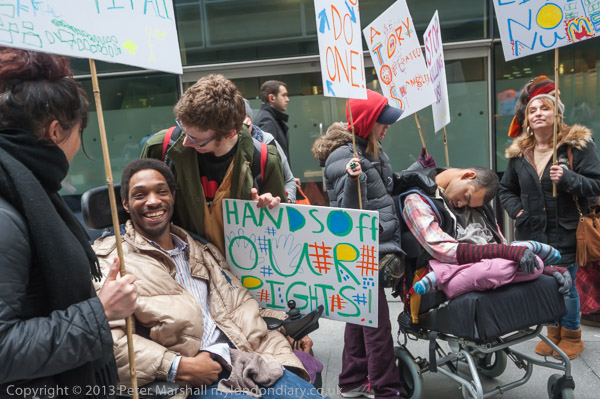
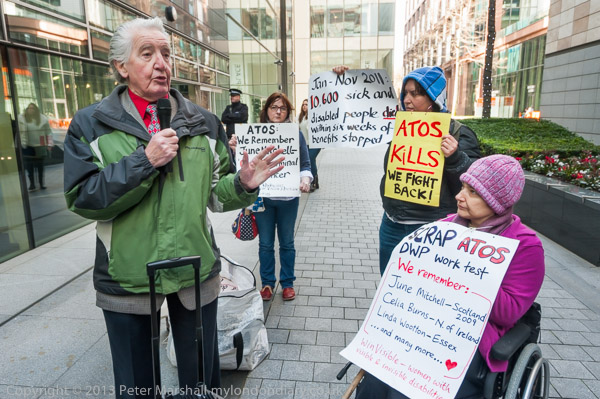
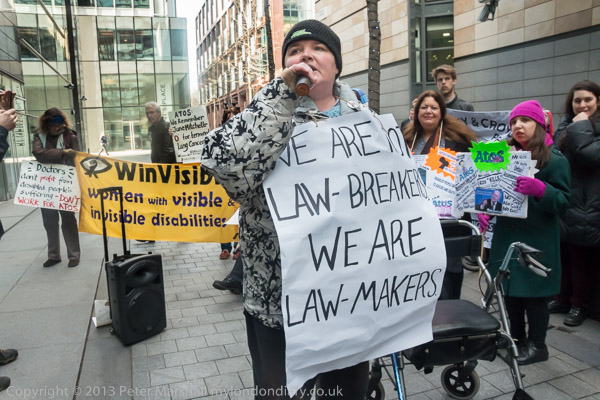
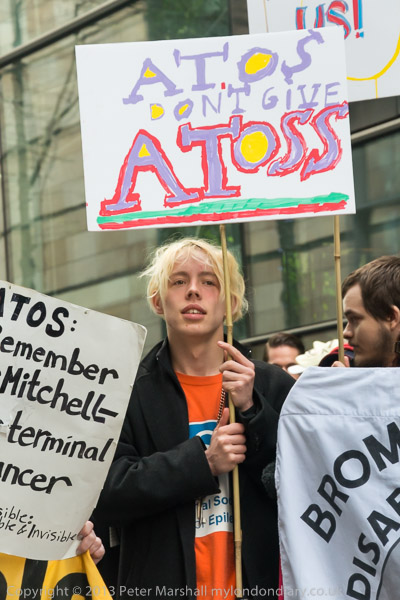
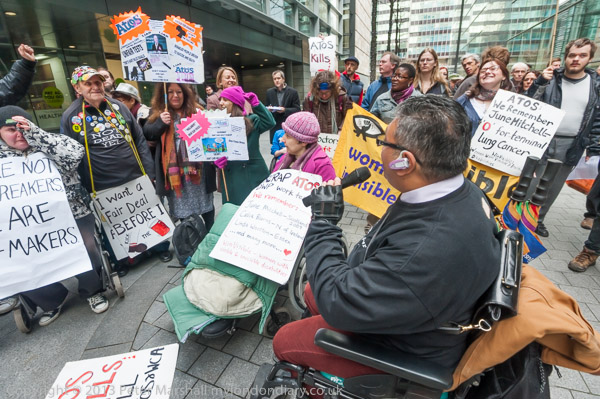
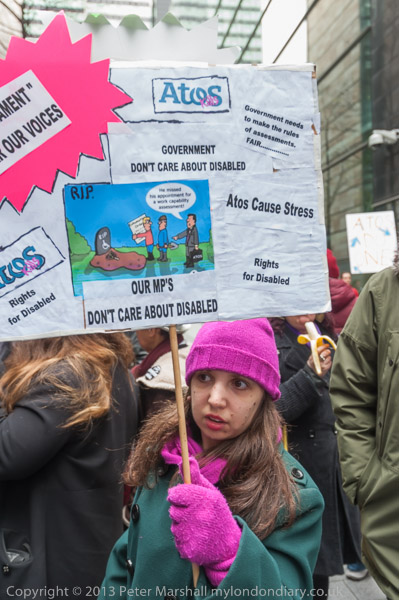
Seven years ago, 19 Feb 2014 was a big day for protests, particularly as campaign groups Disabled people Against Cuts (DPAC), Black Triangle, Atos Miracles, the Green Party, NUS, Occupy New Network, PCS, Unite and many others were taking part in a National Day of Action against Atos for its institutionally incompetent Work Capability Assessment testing of disabled people which has resulted in many disabled people being unfairly refused benefits.

There were protests at each of the 144 Atos testing centres around the country, including those at Wimbledon, Neasden, Marylebone, Highgate, Ealing, Balham and Croydon in London, but I only photographed them at the Atos offices in Triton Square, just north of the Euston Rd.

Even a report commissioned for the government pointed out serious flaws, and over 40% of appeals after people have had their benefits cut by Atos assessments have been allowed a figure rising to over 70% where the appellants have been assisted in their appeals by benefits experts. These appeals take months, during which people are thrown into abject poverty, and often having won on appeal claimants are within a few weeks again penalised by a new Atos assessment.

Atos apparently get paid more for finding people fit to work, and use simplistic tests and often tricks to do so, with no quality control or penalty for those tests which are overturned on appeal. The protesters called for the company to lose its contracts and be prosecuted for its mishandling of the tests, and for these tests to be abandoned and the Minister responsible, Ian Duncan Smith to be sacked.

Many disabled people have been driven to suicide by these failed tests and the stressful appeals procedures. The government figures for January to November 2011 showed that 10,600 people, an average of 223 a week, died withing six weeks of having been found fit for work by ATOS. The Department of Work and Pensions scandalous response to the public outcry when these figures were released was not to take action to make the improvements that were clearly needed, but simply to refuse to respond to requests for similar information for later years. The campaigners say that assessments of fitness to work should be made by qualified medical doctors, ideally by “the GP who regularly sees and treats the sick or disabled individual in question” who they say “is the only person able to decide if an individual is fit for work.”

Among those I heard speaking outside Atos HQ were MP Dennis Skinner, Paula Peters of DPAC, Among those I heard speaking outside Atos HQ were MP Dennis Skinner, Paula Peters of DPAC, Green Party leader Natalie Bennett, journalist Sonia Poulton and the Rev Paul Nicolson of Taxpayers Against Poverty. You can read more about the protest and see more pictures at Atos National Day of Action.


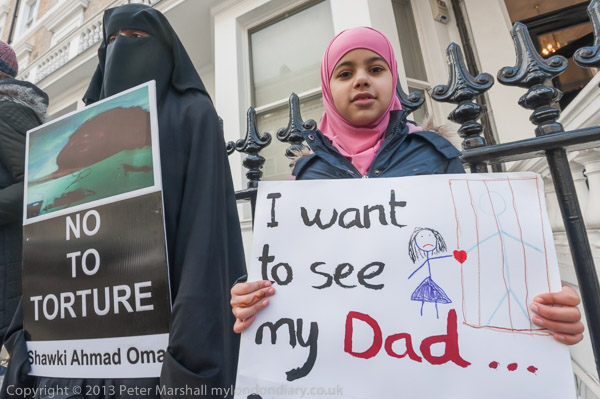
I left the Atos protest briefly to cover three further events. The first at the Iraqi consultate in Kensington was a solidarity vigil by the wife and daughter of Shawki Ahmed Omar, an American citizen held and tortured in Iraq by US and Iraqis since his arrest in 2004, and now in Abu Ghraib. They were accompanied by two supporters at one of their regular vigils calling for his release. You can read more about the vigil and the case at Solidarity vigil for Shawki Ahmed Omar.


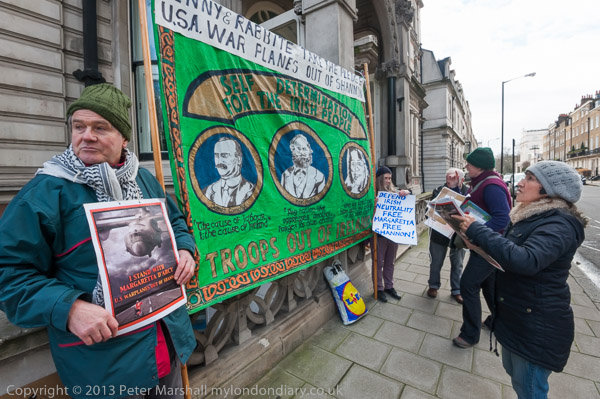
Next was a picket at the Irish Embassy close to Marble Arch to demand the immediate release of Margaretta D’Arcy, imprisoned for protesting against illegal US flights from Shannon Airport, and now in Mountjoy Women’s Prison, Dublin. More about this at Free Margaretta D’Arcy picket.


Third was a protest called by my own union the NUJ at the Egyptian Embassy in Mayfair, for press freedom in the country and calling for the release of all jailed journalists, including the four Al Jazeera journalists. More at NUJ demands Egypt release jailed journalists.


All photographs on this and my other sites, unless otherwise stated, are taken by and copyright of Peter Marshall, and are available for reproduction or can be bought as prints.


Bow Creek Panoramas – 1992

DLR Viaduct, Bow Creek, Leamouth Rd, Leamouth, Tower Hamlets, Newham, 1992 92-1j61pr_2400

At the end of 1991 I finally bought my first panoramic camera, a Japanese Widelux F8 which I couldn’t really afford. It was a camera that took around 21 pictures on a 36 exposure film, with the film curved around a part of a cylindrical path with the lens pivoting around the centre of the cylinder.

Bow Creek, Bridges, Leamouth Rd, Tower Hamlets, 1992 92-3a42a_2400

The lens is a 26mm f2.8, though it needs to be stopped down to around f8 for most pictures as the camera is fixed focus at around 6 ft and only gets sharp at infinity when stopped down. Winding on the film winds up a clockwork motor and returns the lens to its starting position. On pressing the shutter the lens swings around through about 140 degrees, exposing the film through a slit at its back which swings across close to the film. It has 3 shutter speeds, 1/15, 1/125, and 1/250th, but even at the fastest speed it still takes rather longer to actually complete the exposure.

92-3b38_2400

The design keeps lens to film distant constant – at around 26mm – right to the edge of the film across a negative 24mm x 56mm. If this was flat, the distance to the corner would be more like 40mm and so objects at the edges get stretched to around 1.5 times actual size. This camera eliminates this distortion, but at the expense of introducing its own which you can see in these pictures. This becomes particularly noticeable in the curvature of most straight non-vertical lines.

Pura Foods, Bow Creek, M & J Reuben, London Sawmills, Wharfside Rd, Newham, 1992 92-3b52_2400

In particular, horizons become curved unless the camera is kept absolutely level. The pictures of Bow Creek were made with the camera on a sturdy tripod and with the help of a spirit level. There is one on the top plate of the camera, but I found a larger separate one more useful.

Bow Creek, Orchard Place, River Thames, Lower Lea Crossing, Tower Hamlets, Newham, 1992 92-1n12_leamouth_2400

Although the angle of view is often stated as 140 degrees this is perhaps misleading and I think probably is the angle across the diagonal. Rather more useful is the horizontal angle of view, which I think is just slightly over 120 degrees. Theoretically it would be possible to create a full 360 degree view in three exposures, but practically it needed four, though I don’t think I ever succeeded on the few occasions I tried to make one.

Later I made many more panoramas here and around London, particularly with a similar Russian camera, the Horizon or Horizont which was rather more convenient to use, as well as a few with a much larger medium format version. I also used a Hassleblad X-Pan, a nice camera which was panoramic only in format, with a similar negative size, 58x24mm, but using rectilinear lenses which can’t acheive a really wide angle of view.


To the Thames – 1983

Canning Town, Newham, 1983 35t-36 (2)_2400

The whole area has changed so much since 1983 that I find it very confusing to locate the exact locations of many of the pictures that I took, and I’ve occasionally got some of the captions wrong. Often the only way I can be sure is by carefully studying other pictures that I took where I am sure of the location.

The building at the centre of the above image can be seen in one of the pictures posted yesterday, and is clearly on Victoria Dock Road, this section of the road completely obliterated in the construction of the Docklands Light Railway and the Canning Town transport interchange. Victoria Dock Road now begins on the other side of Silvertown Way. The picture above was taken from somewhere near the flood barrier.

Bow Creek, East India Dock Rd, Canning Town, Newham, 1983 35t-24_2400

The warning light for the flood barrier was some way to the north, where the river bends around close to the East India Dock Road. At the left of the notice is a pub the East India Dock Road, long demolished, but both pylons are still there, along with the Newham Way flyover.

Bow Creek, Orchard Place, Tower Hamlets,  Newham,  1983 36a-26_2400

I think this picture was taken roughly where the Lower Lea Crossing now goes across Bow Creek and the river bends around to the east.

Leamouth Wharf, Orchard Place, Blackwall Point Power Station, Bow Creek, Tower Hamlets, Newham, 1983 36a-15_2400

It is difficult to pinpoint the locations of these views taken on the same day as I walked down beside Bow Creek towards the Thames. The pylon visible here was on the north-east corner of the East India Dock Basin next to Orchard Place and has since been removed. The chimney is a small mystery as I think this is Brunswick Wharf power station which had two chimneys – but I may have carefully lined them up so one is hidden behind the other. In 1983 the station was still in use and only decommissioned in 1984.

Bow Creek, River Thames, Blackwall Point, Power Station, Trinity Buoy Wharf, Newham, Tower Hamlets, 1983 35t-34 (2)_2400

Things are much clearer as the River Thames comes into view, and the creek swings around yet again towards the south. The power station across the river is the Blackwall Point Power Station on a site close to where the Millennium Dome was later built.

Bow Creek, Thames Wharf, Newham, 1983 35t-65_2400

There was then still a railway line leading down to Thames Wharf, and this was still an industrial area. Things are rather busier not with these sheds still in use and the whole area here is now covered by piles of steel stocks as you can see from satellite images on Google.

River Thames, Bow Creek, Lighthouse, Trinity Buoy Wharf, Tower Hamlets, 1983 35t-31_2400

Across Bow Creek I got a good view of London’s only lighthouse, at Trinity Buoy Wharf. Some years later I was to visit this site on various occasions for several art projects, including a show in which a few of my pictures of Bow Creek were part of the display. And with the late lamented London Arts Cafe I came to a picnic on the riverside and sat in the lighthouse to listen for a few minutes to Jem Finer’s Longplayer which began its thousand year performance here at midnight on the 31st of December 1999. But until 1988 it was still owned by Trinity House and busy maintaining buoys.

Heavy Rain, LimehouseBasin, entrance, River Thames, Limehouse, Tower Hamlets, 1983

Thames Wharf on the River Thames was a busy industrial site which back then seemed mainly to be dealing in scrap metal, and I had to walk around a few heaps to make my way along the river. Although I rather felt I was trespassing, no one approached me. Security was far less strict back then.

Thames Wharf, Victoria Dock Entrance, River Thames, Silvertown, Newham 36a-51_2400

This was around the limit of my walk and having taken my pictures – you can see a few more on Flickr – I walked back up Dock Road to Silvertown Way. I doubt if you can follow much of my walk today, but you do get a good overhead view of the area from the dangleway, London’s cable car across the Thames from North Greenwich to Victoria Dock. But don’t wait too long, as the sponsorship deal with the Emirates Air Line ends in 2022 and the future of this hugely loss-making service must be in doubt.


All photographs on this and my other sites, unless otherwise stated, are taken by and copyright of Peter Marshall, and are available for reproduction or can be bought as prints.

Saw Mills & Flood Barrier

M & J Reuben, London Sawmills, Wharfside Rd, Newham, 1983 35t-25_2400

Standing more or less on the bank of Bow Creek beside the saw mill in 1983 I could see the elevated East India Dock Rd from which quite a few of my pictures were taken, and beyond it the box-like West Ham Power Station with its two pencil-like chimneys and cooling towers. Sawing timber creates a great deal of dust and a large extractor removes this, probably more for its commercial value than an anti-pollution measure.
Bow Creek, Flood Barrier, Saw Mill, Wharfside Rd, Newham, 1983 36v-25_2400

Looking down from East India Dock Rd onto the circular car park where Wharfedale Rd emerged from the tunnel under the road. There were few if any traces of the old railway line that used to run between the fence and the river here – where the DLR now runs. The picture gives a good impression of the densely packed industry on the peninsula beyond the creek. Taken with an extreme wide-angle lens – the 21mm on the Olympus OM1 you can see some stretching of objects closer to the edges of the frame which is a consequence of rectilinear perspective.

Bow Creek,  Flood Barrier, Wharfside Rd, Newham, 1983 35t-11_2400

Working from more or less the same position (but on a different day) with a less wide lens (probably a 35mm) gives a considerably less wide view, making distant objects seem larger, and also avoids any noticeable distortion. You can see the flood barrier on Bow Creek much more clearly.

Canning Town, Flood Barrier, Bow Creek, East India Dock Rd, Newham, 1982 36v-26_2400

Moving a little further along East India Dock Road gave a better view of the river now running south through the flood barrier. At left are the tower blocks of Canning Town. The row of buildings at right are on the far side of Victoria Road, and the railway line from Stratford to North Woolwich is in front of them, hidden by a bank of earth. Stairs led down from the road to this waste land and there were no fences to stop me walking along the river bank.

Flood Barrier, Bow Creek, Newham, Tower Hamlets, 1983 36a-32_2400

From the bank I got a good view of the flood barrier, its three gates in raised position, getting shorter from left to right to match the slope of the creek, deeper on the outside of the curve. Building the Thames Barrier at Charlton which first came into operation at more or less at the time I made this picture made this barrier, previously essential to prevent flooding along Bow Creek, redundant. It was removed shortly after I made these pictures.

Flood Barrier, Bow Creek, Newham, Tower Hamlets, 1983 36a-36_2400

Back in 1983 there were no barriers to stop me walking beside Bow Creek all the way to the River Thames, but not long afterwards this whole bank was closed off to the public. There have long been plans to open part of it as a riverside walkway, with the northern part of it built but fenced off, and in 2004 following a public competition a winning design was selected for a bridge further downstream a little below the Lower Lea Crossing across the river as a part of this foot and cycle path to Trinity Buoy Wharf. But in 2005 the Thames Gateway Delivery Unit withdrew funding and the bridge was never built. The last time I visited the area a couple of years ago the riverside walkway was open but ended around a hundred yards south of Canning Town station.

Flood Barrier, Bow Creek, Newham, Tower Hamlets, 1983 36a-23_2400

There is now a bridge across close to Canning Town station leading to the development of City Island which has replaced the edible oil factory on the peninsula which opened in 2014, though a far less interesting design than the competition winner.

The empty area to the east of Bow Creek which can be seen in some of these pictures was from 1837 to 1912 the home of the Thames Ironworks and Shipbuilding Company Ltd. More recently it was for some years given over to a construction works yard for Cross Rail and is now home to the Limmo Peninsula, a largely residential development scheme by a partnership between TfL and Grainger plc.

You can visit my Flickr album with more pictures of the area by clicking on any of the pictures above which will take you to a larger version from where you can explore the album. Future posts will look at a series of panoramic pictures I made in 1992 and continuing my walk to the Thames.


All photographs on this and my other sites, unless otherwise stated, are taken by and copyright of Peter Marshall, and are available for reproduction or can be bought as prints.