I sometimes wonder how many times I have photographed Battersea Power Station over the years. I still look out of the window of my train to see it in the distance, and when I’m sitting on the top deck of a bus going over Vauxhall Bridge, on my way to or from the station.
Occasionally I’ll walk across Vauxhall Bridge too, perhaps on my way to the Tate Gallery or the Home Office, and see it in the distance, often taking a picture. The riverside walk from Vauxhall Bridge upstream on the Surrey bank is one I’ve walked along many times, open years before we had a Thames Path, which it now forms a short part of. Back in 1977 when I first began walking much beside the Thames, the proposed long-distance path – then called the Thames Walk – only began a few miles upstream at Putney.
Henry Moore’s ‘Locking Piece’, Vauxhall Bridge, Nine Elms Cold Store and Market Towers
Recently, with the US Embassy having moved to Nine Elms, I have another reason to walk beside the river here, on my way to photograph protests there, or, more often when the light is so good that I can’t stop myself from making a little detour on my way home from one. But at the moment, this is just wishful thinking, as I’m still staying home and away from London and Covid-19.
But even in earlier days, my trips along the Middlesex bank here were rare. There was back in the 1980s relatively little riverside path, a little chance to get away from the busy Grosvenor Rd, though a short stretch of riverside path became available some time after the completion of Nick Lacey’s Crown Wharf in 1983.
Further on the small Pimlico Garden opens on to the riverside and also has a memorial to William Huskisson, the first widely reported victim of a railway accident, who was killed when he got down from the special train carrying the the Duke of Wellington and his guests on the official opening of the Liverpool and Manchester railway which had stopped at Parkside station in the middle of the line. He got down from the train to speak with the duke, ignoring the warnings of the railway company, and was hit and fatally injured by George Stephenson’s famous engine ‘Rocket’ pulling a train in the opposite direction.
Closer to the power station on the opposite bank, Grosvenor Rd runs beside the riverside and gives good view of the power station. A little downstream from it was a small gravel wharf, where until some time in this century a small ship came daily on the tide with shingle from the estuary. On one walk a few years ago as I photographed the ship I had a talk with the captain who, with his mate brought the ship up the river; I regret I failed to make a portrait of him. He told me then that this would be one of his last trips as the wharf was to close.
All photographs on this and my other sites, unless otherwise stated, are taken by and copyright of Peter Marshall, and are available for reproduction or can be bought as prints.
One of my favourite London walks has for many years been beside the River Thames on the path downstream from Greenwich. I first walked it in the 1970s and went back occasionally over the years, both on foot and later taking my Brompton bicycle to it on the train. When I was on foot I often went as far as Woolwich, not a great distance but I was always a photographer rather than a walker. Other riverside walks began from Woowlich or railway stations further east including Erith, Dartford and Gravesend.
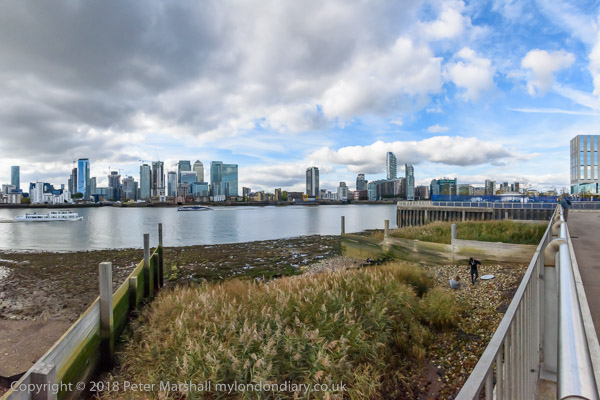
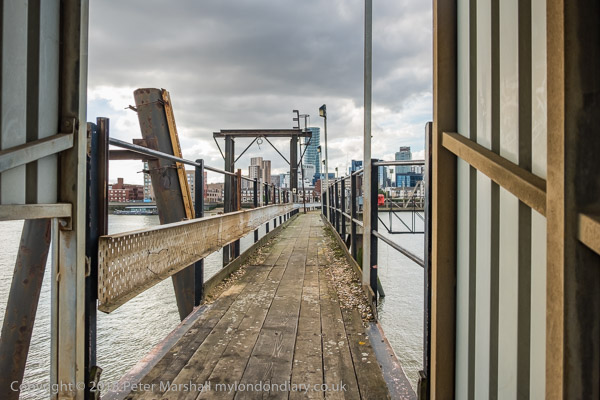
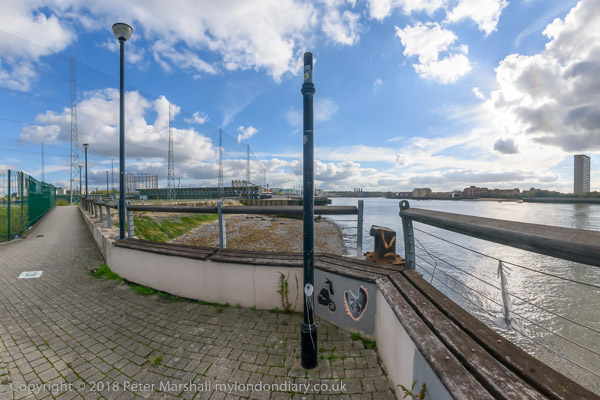
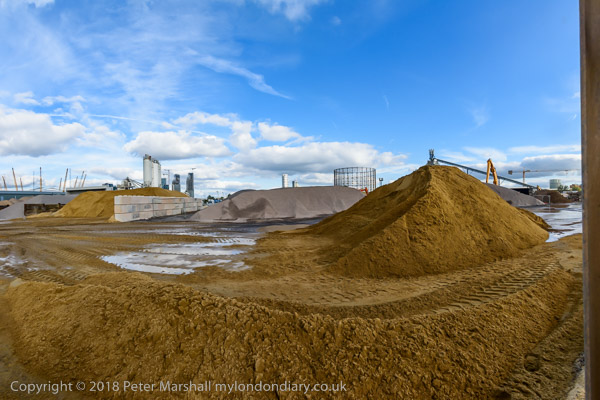
On October 18th 2018 my walk was rather shorter as I was with three other photographers, and we began at North Greenwich. Parts of the riverside walk had recently reopened after closure for the continuing process of ruining the Thames by lining it with tall blocks of expensive flats and I was keen to walk it again after some years away.
There were other reasons for the walk too. One was a visit to the Pelton Arms, arguably Greenwich’s finest pub. Its in a homely area, developed like the pub around 1844, though the Grade II listed street of granite setts from around 1870 stops a few yards short. It’s just a short walk from Granite Wharf, which got its name as it was here than Mowlem landed its granite from Guernsey that once paved much of the streets of London. But the real attraction is its fine range of real ales and comfortable atmosphere – and, although quiet when we visited is one of South London’s leading music venues.
We were also on our way to an evening event across the river in North Greenwich, and after a meal in the centre of the town hopped on the DLR at Cutty Sark for the single stop to Island Gardens and a short walk to where another of our photographer friends, Mike Seaborne was having the launch of his book on the Isle of Dogs. It was getting a little late when we had finished our meal otherwise I would have suggested going across the river on foot, not walking on the water but under it in the Greenwich foot tunnel.
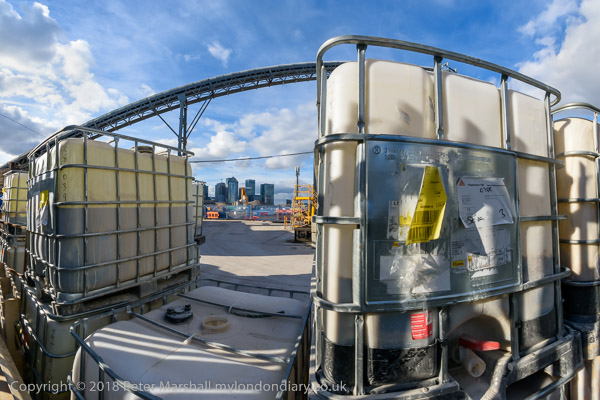
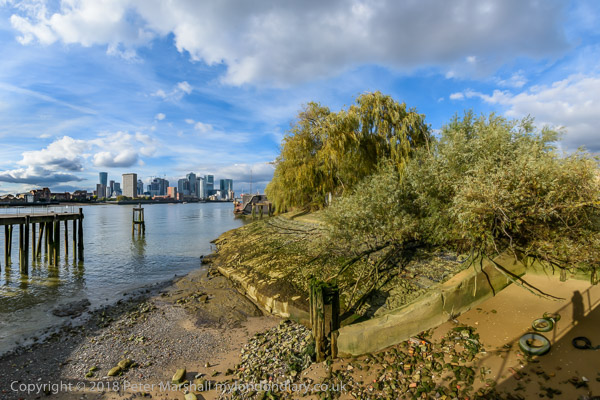
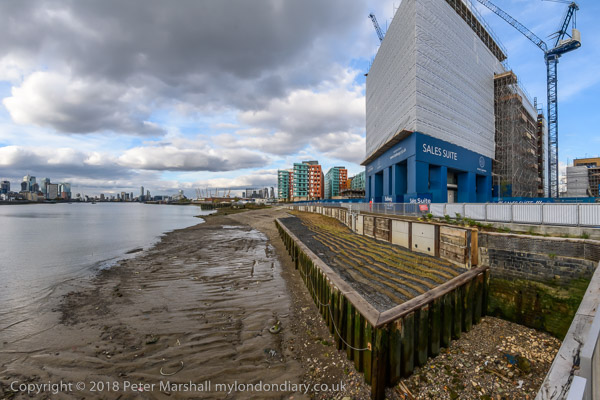
There are many more pictures from the walk on My London Diary. Most but not all are ultra-wide views with a horizontal angle of view of over 140 degrees. Often I crop these to a more panoramic format, but here I decided to leave them covering the full frame to fit better with the few less wide-angle images. All except one in this post are ultra-wide and they are presented in the order of the walk.
All photographs on this and my other sites, unless otherwise stated, are taken by and copyright of Peter Marshall, and are available for reproduction or can be bought as prints.
I think I had gone to Liverpool St to see off some visitors from Germany who had been staying with us and we arrived at the station long before their train was due to leave for Harwich, so I took them to see Christ Chruch, which was then in the middle of building works. The air was rather dusty and the light a little dim, but the structure was still impressive, and we were greeted by one of the clergy who gave us a short conducted tour.
One of Nicholas Hawksmoor’s great pentagram of London churches much celebrated in the writings of Iain Sinclair, Peter Ackroyd and others it is a building I find more satisfying seen close too and at and angle as in this picture than in more prosaic and distant views.
Close to the church in Commercial Rd was this builidng, housing Peach and several other fashoion and clothing firms as well as The Colour Assembly litho printers. But I didn’t have long to take pictures as our visitors had a train to catch and we made our way back to Liverpool Street.
St Katharine’s Way, Wapping, Tower Hamlets, 1987
Afterwards I walked down to St Katherine’s Way, where some of the old warehouse buildings were being gutted and turned into flats, while keeping the basic facades. Miller’s Wharf dates from 1865, but once beyond the front wall is mostly from 1989. A 2 bed flat with a river view is currently for sale at £1.6m should you be looking to move.
Tower Bridge, River Thames, Thames Path, Wapping, Tower Hamlets, 1987
Just a few yards east is a part of the Thames Path from which you can get similar views (though only at ground level) without the huge price tag. Somewhere around this time I went with a group walking along the north bank of the river with the person from Tower Hamlets responsible for footpaths and we found then a number of places where there was supposed to be public access to the river had their gates locked. More recently when I’ve walked along here I think I have been able to access most or all of them.
I think this picture, which has police launches moored in the foreground is taken from Wapping New Stairs – which are of course very old.
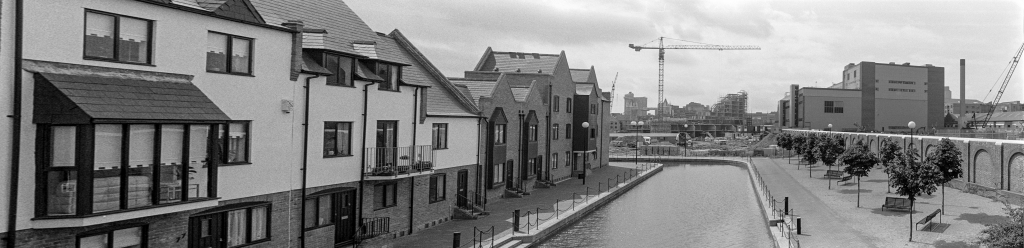
Little remains of the old London Docks, with new housing covering much of the area, here alongside the ornamental canal which I think includes some sections of the old dock wall. I took two pictures from the road overlooking the canal, one concentrating on the south and the other the north side.
The two pictures actually overlap and can be joined to make a narrow panorama, though I don’t think I particular intended this when I took them.
The right of the picture is dominated by the large Wapping printing works of News International, the site of a protests for over a year from 1986-7 by the print unions against Murdoch. The strike ended in what seemed an inevitable defeat for the unions who were trying to prevent the introduction of new technology, moving away from the hot metal of Fleet St which employed several thousand type setters to litho printing which allowed journalists to directly input there stories.
All photographs on this and my other sites, unless otherwise stated, are taken by and copyright of Peter Marshall, and are available for reproduction or can be bought as prints.
Although almost all the pictures I took at Notting Hill Carnival in 1993 were in black and white, I did make a few colour images, and here are a small selection.
Almost all of them were of the procession, and I think taken in a fairly short period of time, mainly on Ladbroke Grove.
I tried to cut my equipment to a minimum for carnival, partly to make it easier to move through the crowds, but also because I was just a little worried about taking what looked like camera bags full of expensive equipment to the event. And I wanted to be able to dance as I took pictures.
Instead of a normal camera bag, I took a small khaki canvas ex-army shoulder bag which I still use today when I want to travel light, issued in 1942 possibly for a gas mask, large enough to take a camera, one or two spare lenses, a decent supply of film, notebook, water bottle and a few oddments, which back in those days would usually include a Mars Bar for when my energy lagged, and sometimes a sandwich or two.
Probably when I saw some particularly attractive and colourful costumes and had finished a black and white film I picked a colour one to reload the camera – probably my Minolta CLE, a rather superior second version of the Leica CL which for some obscure reason Leitz decided not to put their name on, ending their collaboration with Minolta. I then took pictures quickly to finish the film so I could get back to my real work using black and white. I think that happened a couple of times on Children’s Day, but on the Monday I concentrated on more serious black and white work.
In crowds I always made sure to put the shoulder strap over my head and on one shoulder and hold the bag on my stomach so as not to get caught up behind me. I always kept the camera on a strap around my neck too. But generally the crowds were good-natured and in high spirits and I had no trouble taking pictures.
Just once, in the centre of a heaving crowd of dancers in front of a sound system I suddenly realised that someone had put their hand into my left trouser pocket. I grabbed it and held it there protesting, and slowly pulled it out to reveal it holding a wallet. But it wasn’t mine (I’d left that at home) and of course it had no money in it. I’m not sure why he was planting it on me, but pushed it back into the hand I was still firmly holding and told the guy to eff off and he ran off pushing through the crowd. It didn’t seem the place to investigate further.
All photographs on this and my other sites, unless otherwise stated, are taken by and copyright of Peter Marshall, and are available for reproduction or can be bought as prints.
The view from the bridge on Bishop’s Bridge Road is now rather different with the building over the canal having been replaced by a footbridge and an new entrance to Paddington station now obscuring the front of the station. You can still see the GWR Hotel and the canal, but the empty towpath has been much tidied and is now often thronged by people.
Paddington Basin and the area around the canal leading to it has been fairly dramatically redeveloped with tall blocks and leisure activities. There were few boats moving back when I took this picture and I think the rescue one in this picture was the only one I saw, though there may have been a few kayaks. Now the canal is rather busier, with small electric boats a popular but not cheap hire.
The bridge I was standing on was replaced by a wider modern bridge in 2006; shortly before it had been discovered that Brunel’s original 1839 iron bridge was still in place hidden under the 1906 structure – though its cast iron beams were clearly visible below. It was Brunel’s first iron bridge and of important historical and engineering interest but English Heritage agreed not to list it as it would have considerably affected the replacement plans; instead it was carefully dismantled and put into store on the understading it would be rebuilt for use as a footbridge across the canal around a hundred yards to the north.
Although planning permission was granted for this it never happened and the parts remain in a rather messy heap at English Heritage’s store at Fort Cumberland in Portsmouth, probably because the developers of the area preferred a nice modern and probably much cheaper design. Other former canalside artifacts removed at the same time with similar promises appear to have simply been lost, but the bridge was perhaps too large for that to happen.
Bishop’s Bridge Road only got its name after the Second World War, before which it had been simply Bishop’s Road, developed around the time the railway was built in 1836, replacing an earlier footpath. The Bishop was rather earlier, the manor of Paddington being given to Nicholas Ridley, Bishop of London by Edward VI around 1550.
Assembly of God Pentecostal Church, Harrow Rd, Maida Vale, Westminster, 1987
The Assembly of God Central Pentecostal Church on Harrow Road survived until 2015 on the edge of a huge area of high-rise development in North Paddington, but has now gone. It had moved to the ground floor of this building from the Edgware Road in 1946, and was relocated at a temporary site in Tresham Crescent in 2015 while Westminster Council built Dudley House, completed in November 2019. This provides 197 homes at ‘intermediate rent’ as well as new premises for the church, a secondary boy’s school and shops.
North Wharf Rd, Paddington, Westminster, 1987
You can see the curiously ugly QEQM (Queen Elizabeth the Queen Mother) building of Paddington’s Queen Mary’s Hospital towering above these simple but rather elegant buildings on North Wharf Road. That is still there but these buildings are long gone, replaced by towering glass fronted structures which now line Paddington Basin.
The redevelopment of this area, part of ‘Paddington Waterside’ began in the late 1990s and is now more or less complete, filled with high rise buildings. You can now stroll along beside the canal on both banks, while back in 1987 access was very limited. But the whole atmosphere of the area has changed. Although open to the public I think most or all of the open space is privately owned and some photographers, myself included, have been stopped taking pictures by security officers around Paddington Basin.
Warwick Avenue, Maida Vale, Westminster, 1987
Green Lane was named Warwick Rd on a plan made in 1827 and later became Warwick Avenue. There were some houses on it by 1840 and most of the rest were built shortly after, all rather grand and in an Italian style and covered in stucco. Many like this one which overlooks the canal basin at Little Venice are listed. The name ‘Warwick’ came from Jane Warwick of Warwick Hall, in Warwick-on-Eden in Cumbria, who in 1778 married the great-grandson of Sir John Frederick who had leased the land from the Bishop of London.
Just a few yards from the more industrial area around the canal at Paddington, this is at the southern edge of Maida Vale, an area which attracted many of the wealthier members of London’s Jewish population in the late nineteenth century.
Clifton Gardens, Maida Vale, Westminster, 1987
In the twentieth century parts of Maida Vale became one of London’s more respectable red-light areas. Large houses which were too expensive went into multi-occupation, let out as single rooms, usually sharing kitchens and bathrooms, and often became very run-down. Disruption of families by war and high levels of unemployment forced some women onto the streets where they would walk along keys dangling from their hands and invite passing gentlemen to take tea with them, though tea was apparently seldom served. But more recently the area has gone up in the world considerably again, and semidetached houses in the area sell for £5m or more.
Blomfield Rd, Maida Vale, Westminster, 1987
In 1805 Napoleon had defeated both Austrian and Russian armies at Austerlitz and forced Austria to sign a peace treaty and he had also made peace with Prussia. This left him free to try to conquer more of Italy and in particular the Kingdom of Naples, which despite a treaty of neutrality with France had allowed both Russian and British troops to land. Napoleon rapidly advanced and conquered much of that kingdom, with the King and government fleeing to Sicily along with the British troops. A British expeditionary force returned at the end of June to Calabria where there was an insurrection against the French occupation and on 4th July engaged with French forces at Maida.
The battle was was on a relatively small scale with around 5,000 troops on each side and only lasted a few hours before the French who had suffered heavy losses during a cavalry charge against superior British guns and muskets were forces to retreat in considerable disarray. The British commander, John Stuart, was given the title Count of Maida by the Italians and a pension of £1000 a year by the UK parliament as well as being made a Knight of the Bath.
Clifton Gardens, Maida Vale, Westminster, 1987
The victory on land against Napoleon’s forces who had been so successful elsewhere gave Britain a much-needed boost in morale, and gave both Maida Vale and Maida Hill their names.
There is now a pub in Shirland Rd named for Stuart, The Hero of Maida, but it was not built until 1878 and was then The Shirland Hotel, later becoming Idlewild and in 2014 the Truscott Arms. Opened under new owners in 2018 it was re-named ‘The Hero of Maida’.
All photographs on this and my other sites, unless otherwise stated, are taken by and copyright of Peter Marshall, and are available for reproduction or can be bought as prints.
In 1991 I photographed Carnival in both black and white and in colour. I went on both days, but I think it was only on Sunday, the Children’s Day, that I took any colour pictures. Nearly all were taken on Ladbroke Grove as the floats and groups went down, often stopping for quite long periods.
I’ll post a few pictures here, but there are quite a few in the album, Notting Hill Carnival – the 1990s, starting at this one if you want to see more.
The picture above is the last colour image from 1991 in the album.
All photographs on this and my other sites, unless otherwise stated, are taken by and copyright of Peter Marshall, and are available for reproduction or can be bought as prints.
One of William the Conquerers companions in his 1066 invasion was Ralph Baynard, and among the rewards for his services was an area of land in Paddington. Bayswater was in the 14th century Baynard’s Watering Place, where the River Westbourne or Bayswater rivulet passed under the Uxbridge Rd and horses could drink from it.
Lord Craven bought Upton Farm close to here in 1733 and soon after called the area Craven Hill. The Westbourne rises in Kilburn but springs on Craven Hill added to its flow. Large houses – like this one largely Grade II listed – were developed on Craven Hill and the surrounding area in the early 19th century and in the 1830s it became fashionable as a place of residence, particularly for the literary and artistic. The grand town houses here date mainly from the 1830s to 50s. The horse is an appropriate decoration for the area, but I can tell you nothing more about it or when it disappeared.
Chilworth St, Bayswater, Westminster, 1987
This ornate doorway is in Chilworth St, and not as the note on my contact sheet suggested in Devonshire Terrace, which is just around the corner. There is more carved brickwork on the frontage of this building, which is rather grudgingly Grade II listed for its ‘group value’.
Westbourne St, Paddington, Westminster, 1987
This area of London has been home to many ethnicities and nationalities at least since the Victorian era.
The Fountains, Hyde Park, Bayswater, Westminster, 1987
The River Westbourne used to emerge into the open in Hyde Park, and Queen Caroline had a dam built to make the Serpentine Lake in 1730. By the 1830s, with Bayswater being developed the river had become a sewer, and water was instead pumped from the Thames – and is now from deep boreholes into the chalk below the park. One borehole is in the Italian Gardens, which were built in the 1860s when Prince Albert decided it would be nice to have something here like those which he had made at Osborne House. The pavilion which held a pump for the fountains was designed by Sir Charles Barry and the gardens by James Pennethorne with sculpture by John Thomas.
Bayswater Rd, Bayswater, Westminster, 1987
This rather ugly truncated column on the corner of Lancaster Gate marks the service road in front of the building at left (now the Columbia Hotel) as a private road, running parallel to the Bayswater Rd. Planned in 1856-7, this was one of the grandest developments in London and took around ten years to complete. The architect for the two long terraces facing Hyde Park was Sancton Wood (1815–1886) who worked for his cousins Robert and Sydney Smirke and also designed many railway stations.
All Saints Rd, Notting Hill, Kensington & Chelsea, 1987
‘DOC ALIMANTADO SAY FREE SOUTH AFRICA’. Dr Alimantado, born in Kingston Jamaica in 1952 as Winston Thompson and also known as ‘The Ital Surgeon’ is a Jamaican reggae singer, DJ and record producer, best known in the UK for his ‘Born For A Purpose’, made after he was knocked down and injured by a bus and for his 1978 album Best Dressed Chicken in Town. He gained success for his ‘toasting’ over the work other singers and his own recordings as a vocalist were less successful.
All Saints Rd, Notting Hill, Kensington & Chelsea, 1987
‘REMAIN CAREFUL OF YOUR TRUE CONDUCT, DIGNITY, STEER AWAY FROM TRASHY INTEGRATION, BE WORTHY OF THE BEST’
This graffiti on one of Notting Hill’s best-known streets was based on advice given given to the young Dr Martin Luther King: “Remain careful of your conduct. Steer away from ‘trashy’ preachers. Be worthy of the best.”
All photographs on this and my other sites, unless otherwise stated, are taken by and copyright of Peter Marshall, and are available for reproduction or can be bought as prints.
A few more colour pictures from Notting Hill Carnival in 1990 – there are more on page 5 of the Flickr album.
This was the first year I went to Carnival, and set a pattern I followed in most years, taking the train from Hammersmith to Westbourne Park station, arriving around the middle of the day, before things really got going then walking along to All Saints Rd and photographing around there and Talbot Rd and the surrounding streets.
Later I’d walk up Portobello Rd and under the Westway and take pictures in the north of the area where the streets were less busy and I could still move around. I found the procession route in the south of the area very crowded and impossible for my kind of photography.
I think all these colour pictures were taken on the Sunday – Children’s Day, and that on Monday I worked only in black and white. Most of the pictures I made of the actual procession were on Ladbroke Grove.
If you want to look at more, and at those from later years you can go to page 5 of Notting Hill Carnival – the 1990s. Clicking on any of the pictures above will also take you to a larger version in this Flickr album.
A man studies the menu of a Chinese restuarant on Westbourne Grove while his partner stands uncomfortably a discrete distance to the side. This corner with Hereford Road is still recognisable, but the New Good World is long gone. It was for a while a Rodizio Rico, a Brazilian grill, then another Brazilian bar and grill and, most recently and possibly still Franco Marco Sourdough Pizza, while Vinyl Solution is now a Moroccan restaurant; opened around 1978 by Yves Guillemot after he sold his record shop in Le Havre it was during the 1980s stuffed with obscure records from around the world attracting collectors, as well as DJs including John Peel. It began its own record label and thrived, so much so that this shop became too small and the business moved to Portobello Rd.
This house is part of a long terrace of mid-19th century houses at 22-68 Chepstow Road in Westbourne Green that was Grade II listed in 1981, and was clearly in rather poor condition and recently sold and about to be renovated. These are large houses and now sell for over £2.5m; they are part of the Westbourne Conservation Area and were probably developed in 1850-55. I took an almost identical image on colour film which was a part of a show around 1990 and which now hangs on my stairs.
A number of the grander houses in Kensington have elaborate extended porches like this over the steps leading from their front doors to the street to protect people walking to and from their carriages . They are sometimes called porte cochères, though more strictly this refers to porches into which a coach may be driven. This one in Pembridge Villas, Notting Hill, is more elaborate than most and comes with a front door and a lion on top which this picture rather distorts. You can just see two more lions by the house, here peeping over the wall.
Another extended porch at 27 Pembridge Square has some delightful wrought iron work.
Some fine calligraphy in graffiti on a wall in Dawson Place, though not easy to read. I think I can make out the word ‘Saint’ but the rest escapes me – let me know if you can decipher more. Above the wall is some kind of creeping plant, which not long before had been trimmed back and you can still see the marks it left below.
Brighton has often been called “London by the sea”, and since the railway was built in 1841 has been a popular destination for days out as well as ‘dirty weekends’. So I felt I could include just a few pictures from one of my days out with family and friends to see the sights. I don’t think the girls were greatly impressed by the Royal Pavillion and we didn’t manage to drag them inside, but they did enjoy the Lanes and the Volk’s railway.
36 Letterboxes in one door must be something of a record, and it was hard to imagine how 36 flats could be fitted in to this pair of houses, though the one at bottom left is labelled ‘Other Mail’. Presumably the entrance leading to all the flats is the door at left, and as well as the 18 bells which can be seen there is presumably another block of similar size on the wall at the right of the door.
I think most or all of the flats are one bedroom flats, and in this area would probably be rented at around £500 per week, so all 36 would bring in a weekly income of £18,000 – not far off a million a year.
All photographs on this and my other sites, unless otherwise stated, are taken by and copyright of Peter Marshall, and are available for reproduction or can be bought as prints.
Though I think my best pictures of Notting Hill Carnival were in black and white, most years until I moved to using digital cameras I photographed there in both black and white and colour. By 1990, when I first photographed Carnival, for colour I was exclusively using colour negative film.
I could process colour negative film myself, and by this time much of my black and white work was taken using Ilford’s chromogenic films, at first XP1 which had been introduced in 1980, then XP2 which replaced it in Spring 1991, which was designed to be processed in the standard C41 chemicals used for colour neg, though Ilford still produced its own specific processing kit just for the black and white versions.
While it was simple to contact print black and white negatives, producing these in colour from colour negatives was rather more difficult, and it was only after I’d squeezed a colour paper processing line into my diminutive darkroom in the mid 1990s that I began to do so. Even then, getting reasonably correct colour was a problem.
Before that time, I sent away my colour films for trade processing, and being a little short of cash mostly that meant using cheap non-professional processing labs, paying for processing and printing as 4″x6″ enprints. The film processing was fine, but the printing varied from good to a rainbow range of colour casts and variable contrast. Eventually I found a cheap postal amateur service that was reasonably consistent and still cost only around a third of my local pro lab.
Now I’ve digitised most of the colour negatives from the 1990 Notting Hill Carnival, and have found them rather more interesting than I expected. Having them in digital form makes it easier to work on the pictures as I could when making black and white prints, with some dodging and burning where needed.
There are a few pictures in this post, and I’ll put at least one more set from 1990 on here in another post, but if you want to look at more, and at those from later years you can go to page 5 of Notting Hill Carnival – the 1990s. Clicking on any of the pictures above will also take you to a larger version in this Flickr album.
All photographs on this and my other sites, unless otherwise stated, are taken by and copyright of Peter Marshall, and are available for reproduction or can be bought as prints.