Crime, Cleaners and Lewisham – 2007

Crime, Cleaners and Lewisham: On Saturday 15 September 2007 I went to Brent for a march against gun and knife crimes. Next I was in the City of London, usually deserted on a Saturday, but this was Open House Day and cleaners were taking the opportunity to protest at Lloyd’s of London where people were queueing to visit the buildings. Finally I travelled to New Cross where an event was taking place to remember the Battle of Lewisham on 13th August 1977, a month after its 30th anniversary.

Below are my three posts from My London Diary in 2007 (with usual corrections) and a few of the pictures and links to those I posted back then.


Not Another Drop – March against Gun and Knife Crime

Stonebridge Park, Brent
Crime, Cleaners and Lewisham - 2007
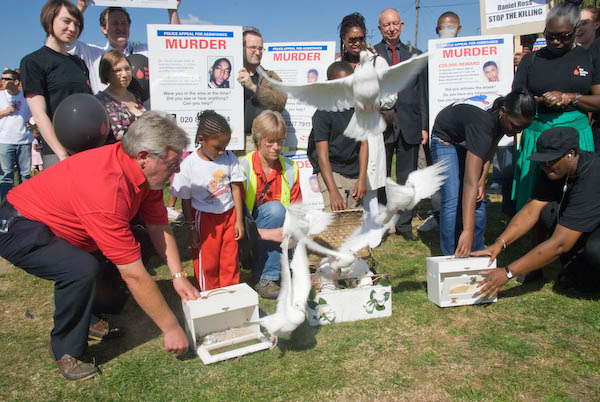
White doves were released just before the start of the march
Crime, Cleaners and Lewisham - 2007

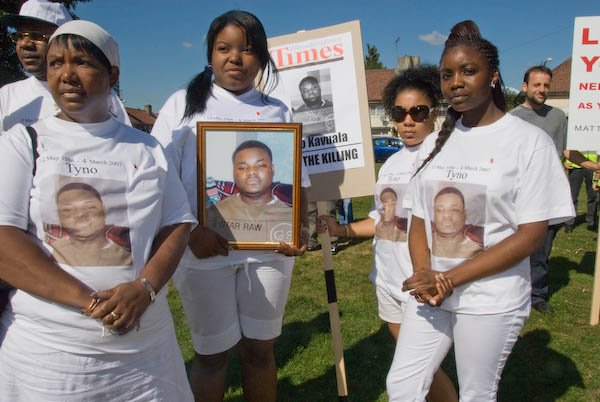
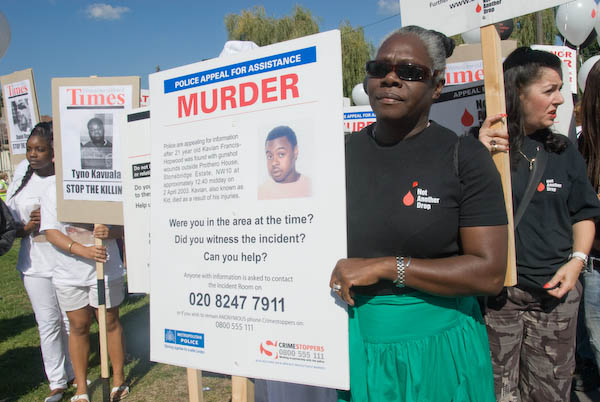
Brent has suffered more than most London boroughs from gun and knife crimes resulting in the deaths of far too many young men (and women) on its streets.
Crime, Cleaners and Lewisham - 2007

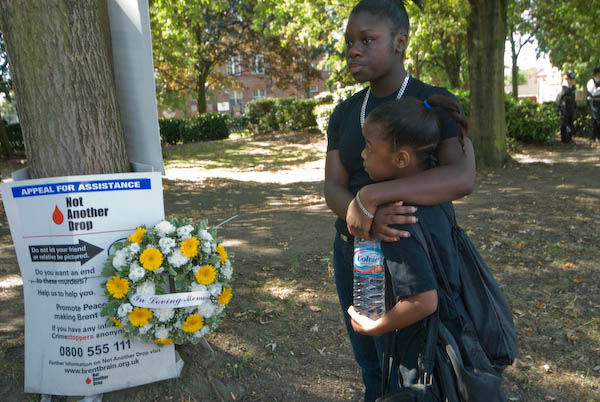
The annual police march was started in 2004 by Patsy Hopwood, whose son, Kavian Francis-Hopwood was shot dead on the Stonebridge Estate in 2003, and is part of the ‘Not Another Drop’ campaign organised by the Met and Brent Council.
Crime, Cleaners and Lewisham - 2007

Around 250 people including two large church groups set off on the march across the borough to South Kilburn.

More pictures on My London Diary at not a drop more


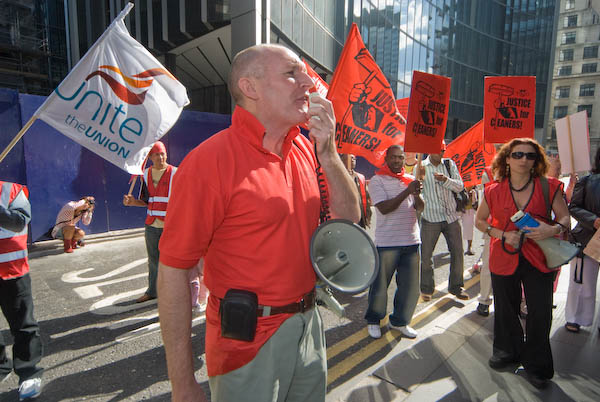
Cleaners picket Lloyd’s Building

City of London
Crime, Cleaners and Lewisham - 2007
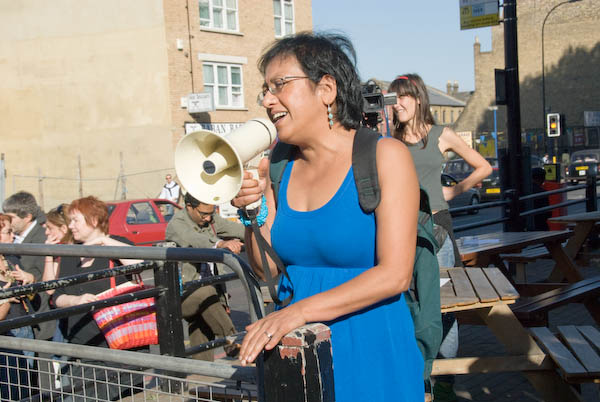
Cleaners from London Citizen Workers picket for a living wage

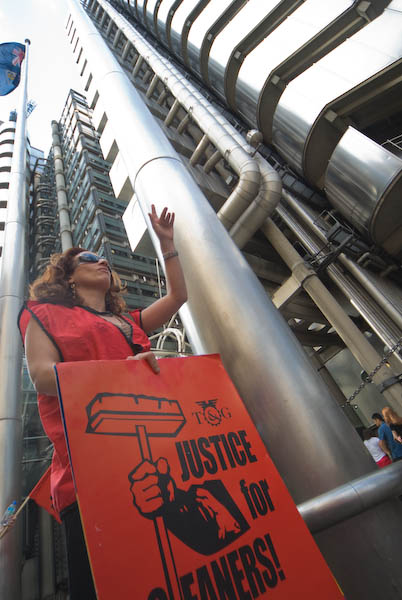
Cleaners at Lloyd’s Of London – a bastion of wealth and privilege in the City – are among the lowest paid workers in London and don’t get sick pay or holiday pay.
Crime, Cleaners and Lewisham - 2007

Open House Day provided a good audience for the London Citizen Workers Association to publicise their appalling treatment.
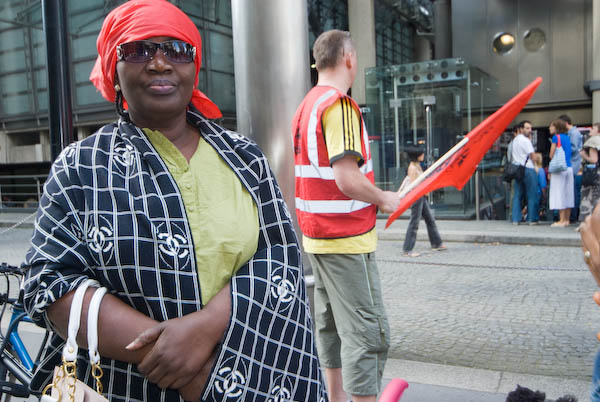
Crime, Cleaners and Lewisham - 2007

[The cleaning at Lloyd’s – and almost all other office buildings is outsourced with cleaners being employed by contractors, notoriously poor employers.]

More pictures at Picket at Lloyd’s.


Remembering The Battle of Lewisham

New Cross to Lewisham
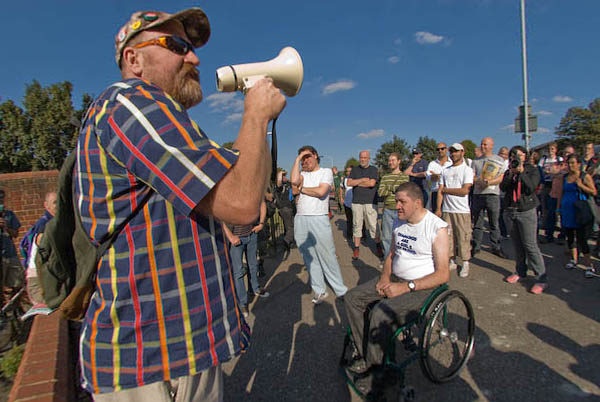
Photographer Red Saunders talks about his experiences in Lewisham on 13 Sugust 1977

It is now just over 30 years since the battle of Lewisham in which protesters humiliated the National Front when they attempted a march through the area.
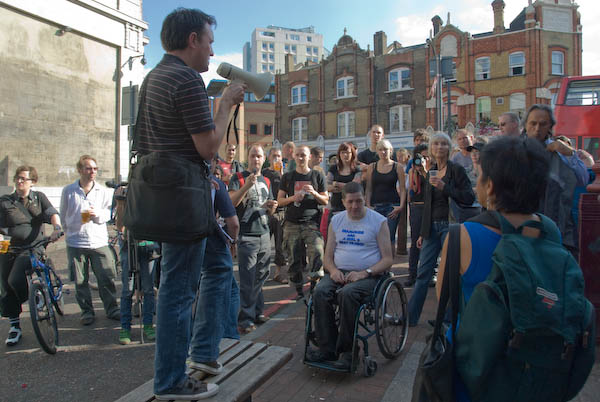
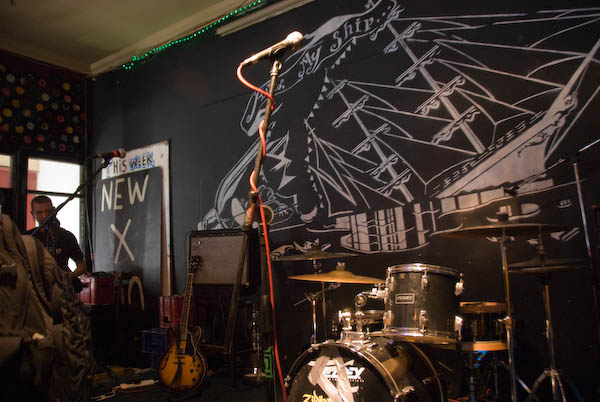
The event began outside the New Cross Inn

Having escorted the National Front home, the police then turned on the anti-racist protesters, using horses, batons, and, for the first time on the British mainland, riot shields.

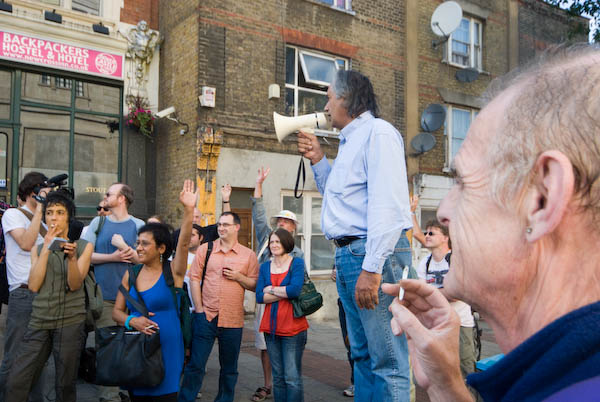
Batwinder Rana describes what happened to him in 1977

At this incredible outbreak of police violence, the community came out onto the streets and the police lost control. Lewisham now has a massive police fortress.
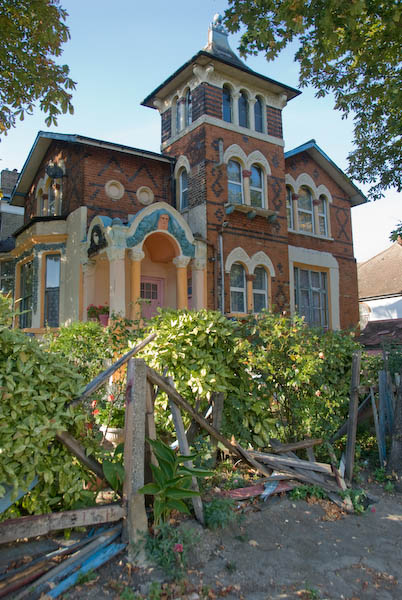
Our route took us past Mr Brenton Pink’s painted house on Loampit Hill

On a walk around the area, a number of those present [in 1977] talked about the event and their own experiences on the day.
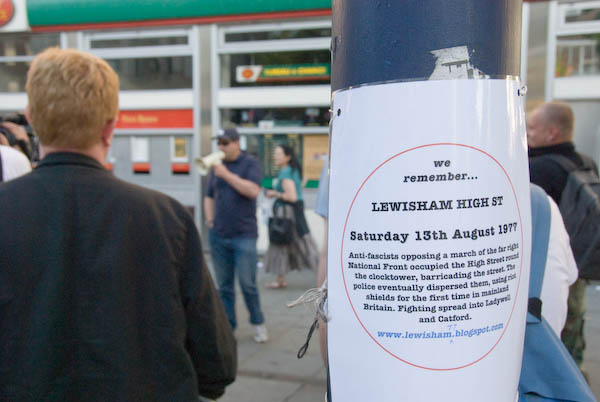
and on to Lewisham High Street where the police used riot shields for the first time on the UK mainland
Here more people shared their experiences and the event ended.

On My London Diary you can see many more pictures including of others who spoke at the event at Lewisham77


Flickr – Facebook – My London Diary – Hull Photos – Lea Valley – Paris
London’s Industrial Heritage – London Photos

All photographs on this page are copyright © Peter Marshall.
Contact me to buy prints or licence to reproduce.


Lewisham and Deptford – 1990

More From Lewisham: More pictures from my walk on 18th March 1990. The previous post on this walk was St Johns Lewisham – 1990.

Denture Repairs, Loampit Hill, Lewisham, 1990, 90-3g-45

False teeth were still very common when I was growing up. Many if not most adults still went to bed with their teeth in a glass of water beside them on the bedside table like my parents. One of their wedding presents in 1932 from a wealthy relative had been for both of them to be given a ‘full set’, while others were often given the same as a coming of age present for their 21st birthday.

As many of us are still aware, tooth pain can be excruciating and few working-class people could afford proper dentistry. People extracted their own teeth or those of their friends with pliers, or tied strong thread around them and fixed it to a door handle asking for someone to slam the door. With current problems in getting NHS treatment there are again now people resorting to painful and dangerous DIY treatments.

Denture Repairs, Loampit Hill, Lewisham, 1990, 90-3g-32

Things had improved a little after the war, particularly with the school dental service, and I went regularly to the clinic on Bath Road until I was 16 and no longer qualified for their services. It was around ten years before my teeth saw a dentist again and by then the rot had truly set in. But back then it was simple to find a NHS dentist and become a regular patient.

Dentistry never really became a proper part of the NHS and NHS dentistry is now in dire straits, though there have been great advances in dental treatment – and so little need for shops such as this. I’m fortunate still to have a NHS dentist with regular check-ups and still enough of my own teeth to just about eat. And although the NHS charges increase regularly it remains cheap compare to private practice. But sorting it out should be another item on Andy Burnham’s list.

R Holt, Crash Centre, Thurston Rd, Lewisham,  1990, 90-3g-33
R Holt, Crash Centre, Thurston Rd, Lewisham, 1990, 90-3g-33

Car crashes are still common and there are still garages offering crash repairs, though I think rather more cars now get written off after crashes, partly because of changes in the way cars are built but also because of stricter safety laws. MOT testing was introduced in the 1960s but the tests are now much more detailed and rigorous.

Behind the yard is a row of trees at the edge of the site and a railway viaduct on the line to Lewisham station. This yard is long gone and the street is lined with tall flats.

R Holt, Crash Centre, Viaduct, Thurston Rd, Lewisham, 1990, 90-3g-34

The crashed cars on the lorry close to my camera make those by the fence look like toy models. I think many these cars would have been cannibalised for parts and then sold as scrap as they look beyond repair, even by specialists such as R Holt. The picture also gives a better view of the railway viaduct.

Crescent House, Bliss Crescent, Lewisham, Greenwich, 1990, 90-3g-22

A bridge over the River Ravensbourne leads to the flats of Crescent House, a large 1950s council development. A few years later the DLR extension to Lewisham from Island Gardens was built through here, opening in 1999. The Elverson Road DLR station is a short walk away.

Carrington House, Brookmill Rd, Deptford, Lewisham, 1990, 90-3g-24

Built for the London County Council in 1903, Carrington House was a lodging house which replaced several small doss houses on the site. It was based on the Rowton Houses founded by Lord Rowton to provide cheap lodging for working men and named after Lord Carrington, chairman of the LCC’s Housing of the Working Classes Committee.

Carrington House, Brookmill Rd, Deptford, Lewisham, 1990, 90-3g-26

It provided cubicles for 800 men to sleep in and communal facilities including washrooms, dining, reading and smoking rooms. During the Great War it housed refugees, afterwards returning as a lodging house, continuing in this at least until the late 1970s and possibly still when I took these pictures.

In 1995 it was converted into social housing flats and renamed Mereton Mansions. The railings are said to be made from wartime stretcher frames.

More to come from Deptford.


Flickr – Facebook – My London Diary – Hull Photos – Lea Valley – Paris
London’s Industrial Heritage – London Photos

All photographs on this page are copyright © Peter Marshall.
Contact me to buy prints or licence to reproduce.


St Johns Lewisham – 1990

St Johns Lewisham: More pictures from my walk on 18th March 1990. The previous post on this walk was More From Brockley.

I walked up Malpas Rd, taking a few pictures on my way that I’ve not digitised, and on to Lewisham Way, where I turned into Friendly Street, wondering how it got that name. No one seems to know. There is also a Friendly Place in Lewisham, some distance away.

Clarendon Cottages, Scotts Coachworks, Friendly St, St Johns, Lewisham, 1990, 90-3g-61
F H Pierce, Friendly Upholstery, Friendly St, St Johns, Lewisham, 1990, 90-3f-16

Friendly Street was built as a part of the Deptford New Town development which had begun in around 1795, though the earliest existing buildings in Friendly Street (earlier named Dog Kennel Row and then George Street) date from 1806 and most from the 1840s. Its name was apparently officially changed from George Street in the early years of the twentieth century to avoid confusion with other George Streets in London.

Friendly Upholstery at No 2 and Boot Repaier F H Pierce at No 4 have long closed. No 2 still has the shopfront but that at 4 has been replaced and both properties are now residential.

Clarendon Cottages, Scotts Coachworks, Friendly St, St Johns, Lewisham, 1990, 90-3g-61

This property at 3 Friendly Street is still standing though that on the left has been replaced by a new building. The open area to the right is Friendly Gardens, an area cleared after bomb damage in the Second World War.

The Deptford New Town estate was developed on land owned by the Lucas family, who grew rich from building and running rice mills in the USA. Many of the early residents were shipbuilders and sailors. The opening of the railway in 1836 with a station at New Cross Gate in 1839 with trains to London Bridge prompted further development in the area as a commuter suburb. St Johns got its church in 1855 and its own station in 1873.

Bank, Lewisham Way, Friendly St, St Johns, Lewisham, 1990, 90-3g-63

The former bank at 293 Lewisham Way was acquired by Barclays in 1918. The building was Grade II listed in 1994 and according to this: “The London and South Western Bank – New Cross Branch at 293 Lewisham Way was acquired by Barclays in 1918. ” and was “designed in 1885 and built in about 1886 by J and J S Edmeston.”

It appeared to have closed as a bank by the time I made my picture and has been converted into residential apartments.

Stone House, Lewisham Way, St Johns, Lewisham, 1990, 90-3g-64

Grade II* listed house built 1771 – 1773 designed by architect George Gibson the Younger (or possibly his father, also George Gibson) as built as his own residence, it was known in the 19th century as the Comical House for its unusual design.

House, 70, Loampit Hill, St Johns, Lewisham, 1990, 90-3g-53

One of four similar highly ornamented houses built late 1850s by local architect Alfred Cross who also built one for himself at No 62, now particularly notable for its vibrant colour scheme – and which I photographed on several occasions in colour.

House, Loampit Hill, St Johns, Lewisham, 1990, 90-3g-55

A closer view of one of the houses, largely hidden by greenery shows a little of the decorations.

90-3g-42-Edit
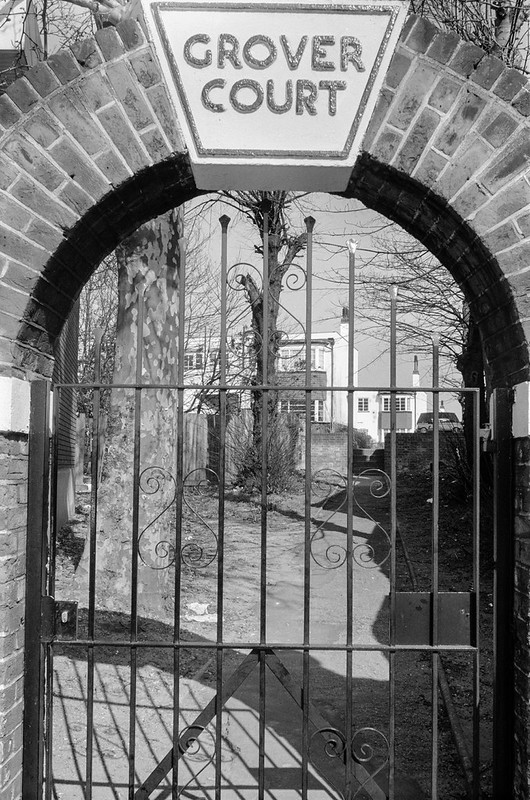
Grover Court, Loampit Hill, Lewisham, 1990, 90-3g-42
Grover Court, Loampit Hill, Lewisham, 1990, 90-3g-44

Grover Court was built as a luxury Art Deco estate of 51 residential flats in 1938, on the site of Ellerslie House, built in the 1790s for the brothers John and Henry Lee who owned the neighbouring brickworks. A large house, after the Lee family moved out in 1860 it became a private girls preparatory school.

More from Lewisham in a later post.


Flickr – Facebook – My London Diary – Hull Photos – Lea Valley – Paris
London’s Industrial Heritage – London Photos

All photographs on this page are copyright © Peter Marshall.
Contact me to buy prints or licence to reproduce.