St Johns Lewisham: More pictures from my walk on 18th March 1990. The previous post on this walk was More From Brockley.
I walked up Malpas Rd, taking a few pictures on my way that I’ve not digitised, and on to Lewisham Way, where I turned into Friendly Street, wondering how it got that name. No one seems to know. There is also a Friendly Place in Lewisham, some distance away.

Friendly Street was built as a part of the Deptford New Town development which had begun in around 1795, though the earliest existing buildings in Friendly Street (earlier named Dog Kennel Row and then George Street) date from 1806 and most from the 1840s. Its name was apparently officially changed from George Street in the early years of the twentieth century to avoid confusion with other George Streets in London.
Friendly Upholstery at No 2 and Boot Repaier F H Pierce at No 4 have long closed. No 2 still has the shopfront but that at 4 has been replaced and both properties are now residential.
This property at 3 Friendly Street is still standing though that on the left has been replaced by a new building. The open area to the right is Friendly Gardens, an area cleared after bomb damage in the Second World War.
The Deptford New Town estate was developed on land owned by the Lucas family, who grew rich from building and running rice mills in the USA. Many of the early residents were shipbuilders and sailors. The opening of the railway in 1836 with a station at New Cross Gate in 1839 with trains to London Bridge prompted further development in the area as a commuter suburb. St Johns got its church in 1855 and its own station in 1873.

The former bank at 293 Lewisham Way was acquired by Barclays in 1918. The building was Grade II listed in 1994 and according to this: “The London and South Western Bank – New Cross Branch at 293 Lewisham Way was acquired by Barclays in 1918. ” and was “designed in 1885 and built in about 1886 by J and J S Edmeston.”
It appeared to have closed as a bank by the time I made my picture and has been converted into residential apartments.

Grade II* listed house built 1771 – 1773 designed by architect George Gibson the Younger (or possibly his father, also George Gibson) as built as his own residence, it was known in the 19th century as the Comical House for its unusual design.

One of four similar highly ornamented houses built late 1850s by local architect Alfred Cross who also built one for himself at No 62, now particularly notable for its vibrant colour scheme – and which I photographed on several occasions in colour.

A closer view of one of the houses, largely hidden by greenery shows a little of the decorations.
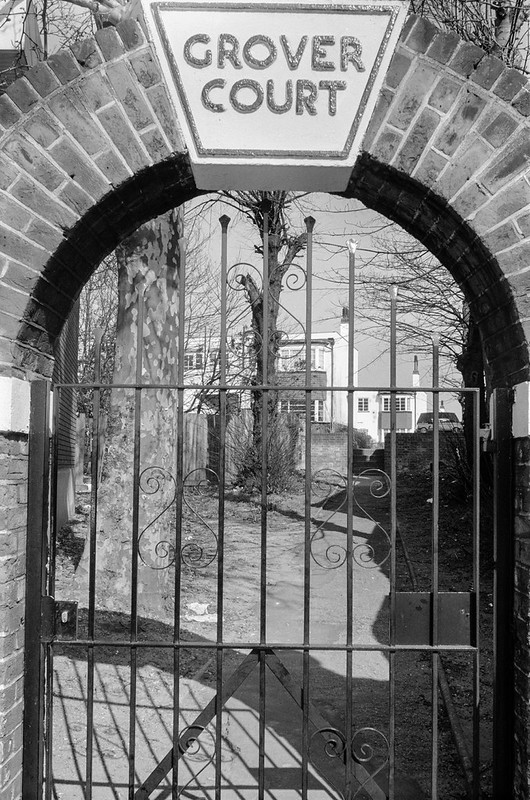

Grover Court was built as a luxury Art Deco estate of 51 residential flats in 1938, on the site of Ellerslie House, built in the 1790s for the brothers John and Henry Lee who owned the neighbouring brickworks. A large house, after the Lee family moved out in 1860 it became a private girls preparatory school.
More from Lewisham in a later post.
Flickr – Facebook – My London Diary – Hull Photos – Lea Valley – Paris
London’s Industrial Heritage – London Photos
All photographs on this page are copyright © Peter Marshall.
Contact me to buy prints or licence to reproduce.