Doctors and Blood Diamonds – 2016

Doctors and Blood Diamonds – 2016

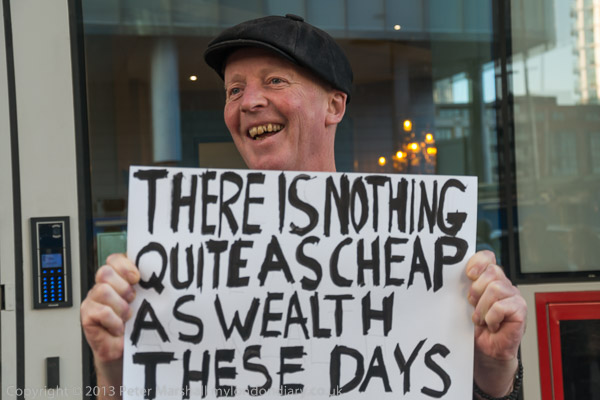
There is no real connection I’m aware of between doctors and blood diamonds other than the fact I photographed both protests on 6th February 2016 – and I thought it made a nice headline.

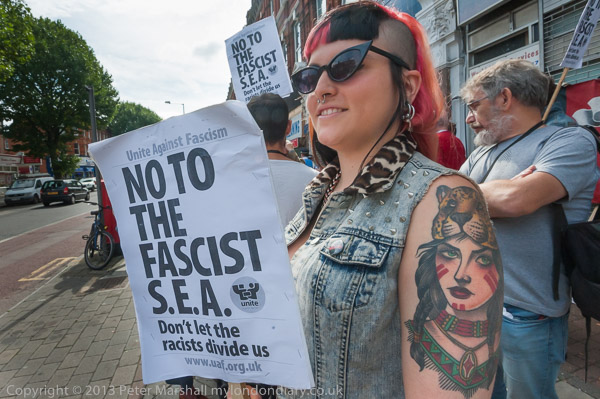
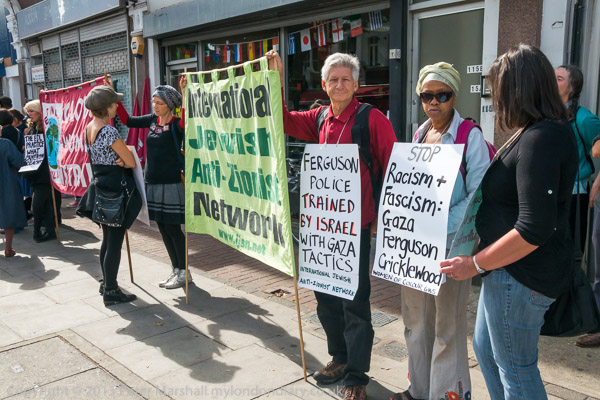
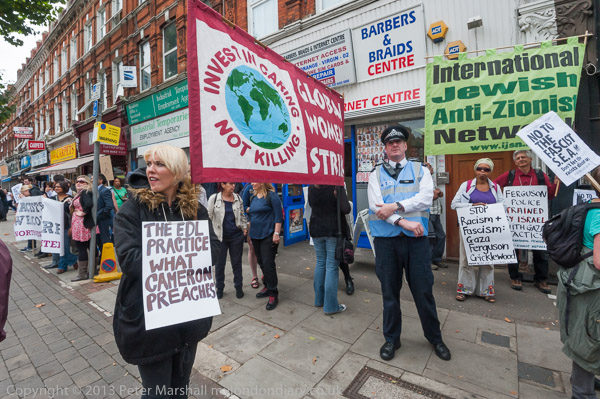
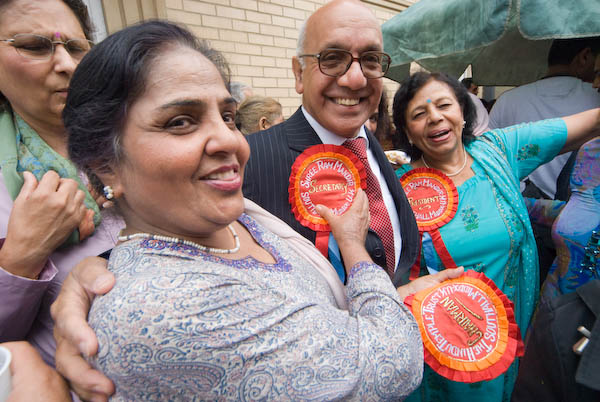
Valentines Israeli Blood Diamonds protest

My working day started on Old Bond Street in Mayfair, an area of London I generally try to avoid, packed with businesses which represent the true scum on the capitalist system and their customers largely representing those most successful at exploiting the system and the great majority of the population. While the City of London is still the world capital of dodgy financial management, Mayfair is where much of the more commercial aspects of our current system ply their trade.

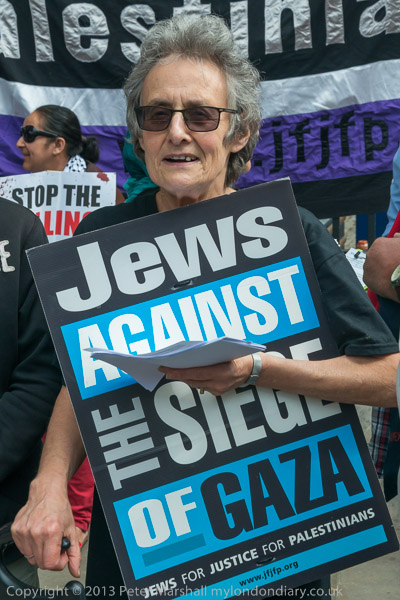
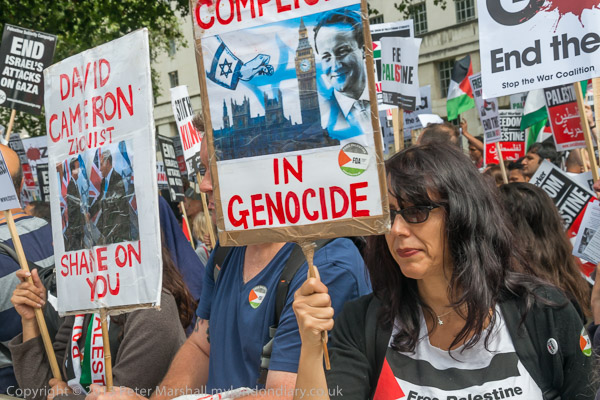
There are no diamonds mined in Israel, but diamonds are Israel, largest manufacturing export – then at around $10 billion a year and contributing around $1 billion a year to Israeli military and security industries. In a direct connection the Steinmetz Diamonds Group which supplies companies including De Beers and Tiffany supports the Israeli Givati Brigade through the Steinmetz Foundation. One banner was a message from the Samouni family, 29 of whom were killed by the Givati Brigade in 2008 in cold blood.

A week before St Valentines Day, protesters stood outside diamond sellers including De Beers and Tiffanys with banners urging people not to buy engagement rings these shops that sell rings using diamonds from Israel’s Steinmetz Diamonds Group.


Junior Doctors Rally & March

I left for the short walk to Waterloo Place, where Junior Doctors and supporters were gathering for a rally against against the imposition of new contracts they say will destroy the NHS and make it unsafe for patients. Supporting them were many other medical professionals – consultants, GPs, nurses and others – who all saw the contract as a part of an attack on the NHS to move towards a privatised medical system.

Speaker after speaker – including Dame Vivienne Westwood, her son Ben, and Vanessa Redgrave as well as many medical professionals – stressed how Health Minister Jeremy Hunt Hunt was misleading the media and public about the need for changes in the contract, carefully selecting evidence that supports his case while ignoring the much wider evidence against it.

Dame Vivienne Westwood and Vanessa Redgrave at the rally

Among the many placards were those naming doctors who had already left the NHS to work abroad, with the message ‘You’ve driven me out Jeremy… Stop bleeding the NHS dry’. Others named junior doctors supporting of the protest who were unable to attend the protest because they were working in what is already a 24 hour 7 day profession.

The protesters marched to Downing St where they sat down blocking the road wearing surgical masks while a deputation went into Downing St to deliver a message to the prime minister; they emerged a few minutes later to announce that the people inside No 10 had refused to accept any message from them.

We have seen in the current pandemic how this and other changes made in recent years have put the NHS under severe strain. As I wrote in 2016:

Of course it isn’t just junior doctors; new income rules for immigrant workers are likely to lead to up to 30,000 nurses being deported, and the cutting of bursaries for nurses and now proposed for all other medical courses will have disastrous effects. Add to this the effects of PFI which is bankrupting hospitals leading to privatisations and its hard not to see the end of the NHS as we have known it as inevitable.

It’s almost certainly too late to save the NHS in its current incarnation. The only solution is the kind of radical change that happened before under Nye Bevan and others to create a new NHS. But for that we would need a new revitalised Labour party in power – or a people’s revolution. Don’t hold your breath – and don’t get old or ill.


More on both protests on My London Diary
Junior Doctors Rally & March
Valentines Israeli Blood Diamonds protest


Guantanamo, Privatisation, the Elephant, Social Cleansing & a Book Launch

Guantanamo, Privatisation, the Elephant, Social Cleansing & a Book Launch.
Thursday 5th February 2015 was an extremely varied and rewarding day for me.


Close Guantanamo – 8 Years of protest

The day started rather quietly with the London Guantánamo Campaign and their monthly lunch-time protest at the US Embassy in Grosvenor Square which had been taking place every month for 8 years, calling for the closure of the prison and release of those still held, including Londoner Shaker Aamer. I’ve not photographed them every one of those almost a hundred months, but most times when I have been working in London on the day they were protesting.

Close Guantanamo – 8 Years of protest


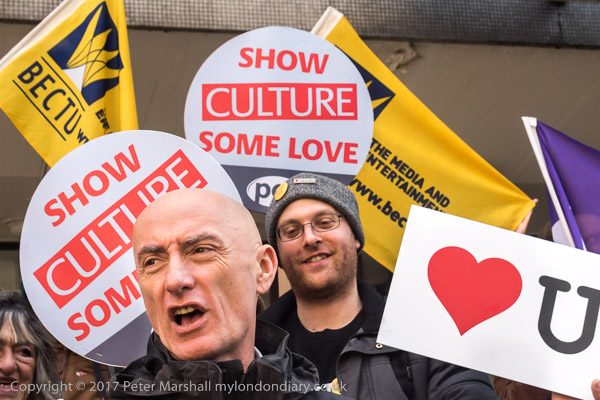
From Grosvenor Square I went to Trafalgar Square, joining protesters outside the National Gallery where management had told 400 of its 600 staff they were no longer to be employed by the gallery but by a private company. Staff there were incensed when on a five day strike one of their PCS union reps, Candy Udwin, was suspended.

Nobody answered the door.


The National Gallery was then the only major museum or gallery in London not paying its lowest paid staff the London Living Wage. The privatisation further threatened the pay and conditions of loyal and knowledgeable staff already living on poverty pay. These staff are responsible for the security of the paintings and the public, provide information about the collection, organise school bookings and look after the millions of visitors each year.

Eventually the petition was handed to the Head of Security


Staff who were then on a five-day strike had come with supporters to present a 40,000 signature petition to management against the privatisation and call for the reinstatement of their union rep. First they tried the management door, but no one came to open it, so some entered the Sainsbury Wing of the gallery to try to deliver it. Security asked them to leave, and promised that the Head of Security would take the petition would personally hand it to management who were refusing to come down to meet the strikers.

Jeremy Corbyn joins the march and Candy Udwin speaks

After consultation with the members the petition was handed over and the strikers and supporters marched down Whitehall to the Dept of Culture, Media and Sport where the minister concerned had agreed to receive a copy of the petition. A rally took place outside, with speakers including Jeremy Corbyn, while the petition was being handed in.

No Privatisation At National Gallery


Around the Elephant

I took the tube to the ELephant and Castle on my way to visit the continuing occupation against Southwark Council’s demolition of the Aylesbury Estate and had time to walk a little around the area before and afterwards.

Around the Elephant


Aylesbury Estate Occupation

Protesters against the demolition of council estates and its replacement by private developments with little or no social housing across London had marched to the Aylesbury Estate and occupied an empty block, part of Chartridge in Westmoreland Road at the end of the previous Saturday’s March for Homes.

Entering the occupied building required a rather tricky climb to the first floor, and both my age and my heavy camera bag argued against it, although I was told I was welcome. Instead I went with a group of supporters who were distributing flyers for a public meeting to flats across the estate. They split into pairs and I went with two who were going to the top floor of the longest single block on the whole estate, Wendover, where one of them lived.

There are I think 471 flats in the block and from the top floor there are extensive views to the east, marred by the fact that the windows on the corridor seem not to have been cleaned since the flats were built. But there was one broken window that gave me a clear view.

Aylesbury Estate Occupation


Getting By – Lisa’s Book Launch

Ken Loach, Jasmine Stone and Lisa McKenzie


My final event of the day was the book launch for Lisa McKenzie’s ‘Getting By’, the result of her years of study from the inside of the working class district of Nottingham where she lived and worked for 22 years, enabling her to view the area from the inside and to gather, appreciate and understand the feelings and motivations of those who live there in a way impossible for others who have researched this and similar areas.

St Ann’s in that time was undergoing a huge slum clearance project, but though providing more modern homes relieved some of the worst problems of damp, dangerous and over-crowded housing, it left many of the social problems and provided new challenges for those who lived there.

It was a great evening, attended by many of those I’ve photographed over the years at various housing campaigns.

Getting By – Lisa’s Book Launch


More on all these on My London Diary:
Getting By – Lisa’s Book Launch
Aylesbury Estate Occupation
Around the Elephant
No Privatisation At National Gallery
Close Guantanamo – 8 Years of protest


10 Years Ago – London, Atos & Guantanamo

10 Years Ago – London, Atos & Guantanamo – 3rd Feb 2012


London Walking

I was early for the protest I had come to photograph so I took a little walk around the area just north of the Euston Rd. I’d used Transport for London’s Journey Planner, but forgotten that this sometimes hugely exaggerates the time taken to make changes between trains and between train and bus for those familiar with routes. Walking helped stop me from completely freezing with the temperature around zero and a cutting wind. Some days even thermal underclothing isn’t enough.

Later I walked around Kings Cross looking for a protest outside a place that didn’t seem to exist – I think the organisers had got the address wrong – but in any case I could find nothing happening in the area and then went to get a bus and photographed the St Pancras hotel from near the bus stop. Eventually my bus came.

London Walking


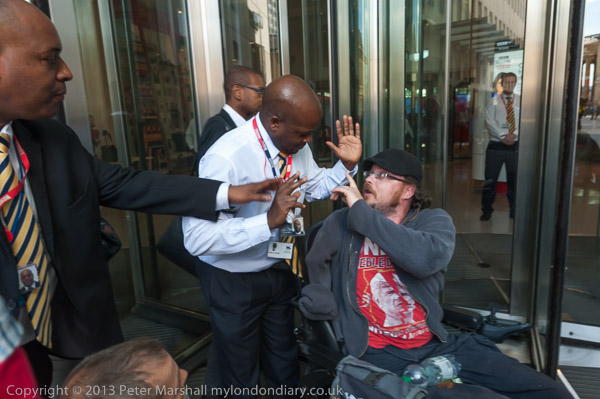
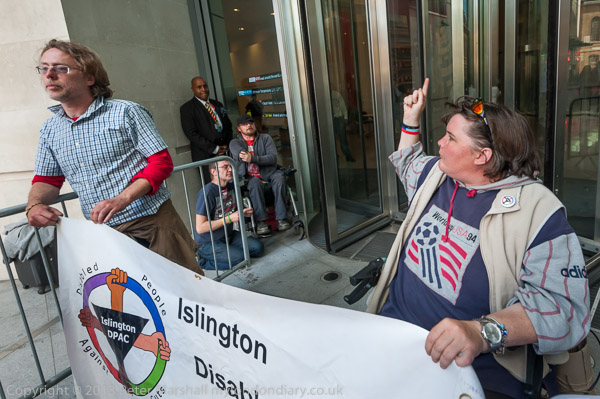
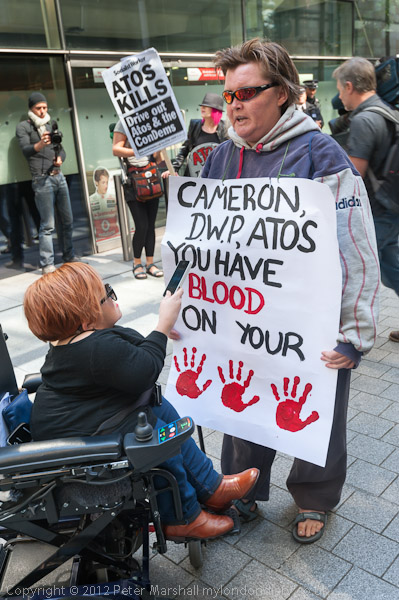
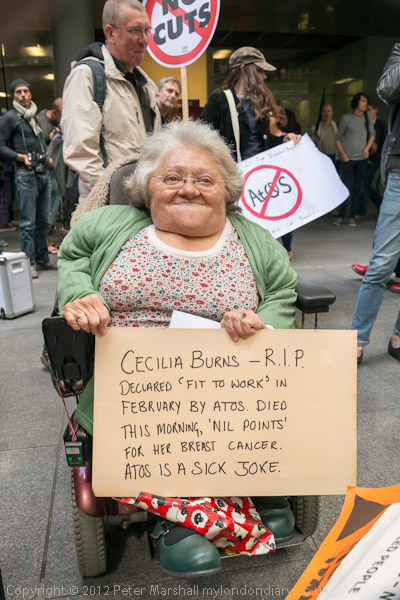
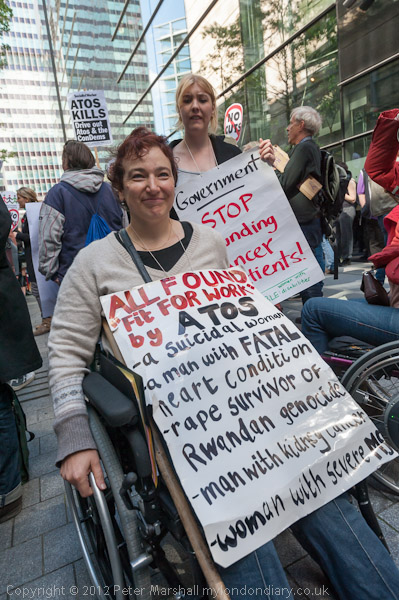
Disabled Protest Supports the Atos Two

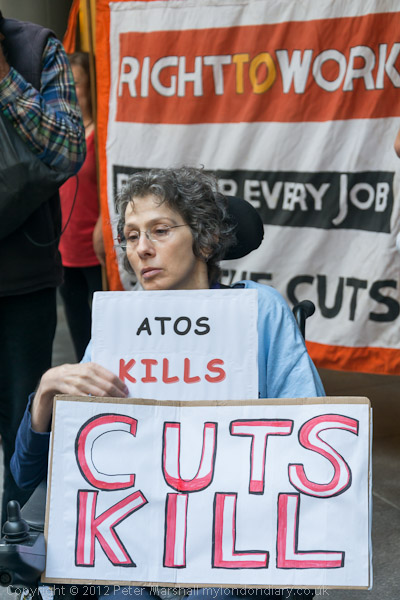
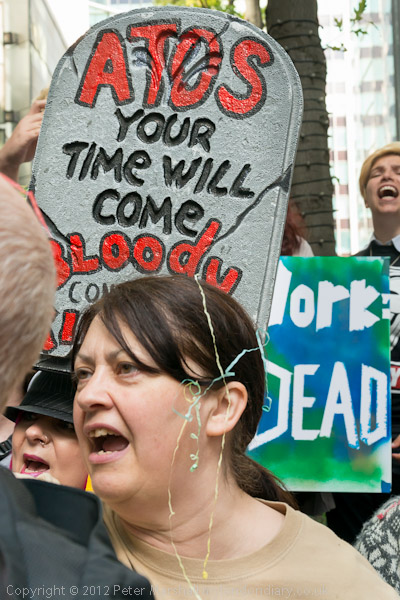
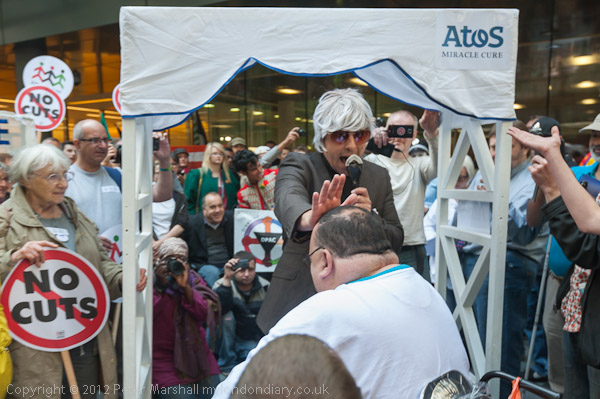
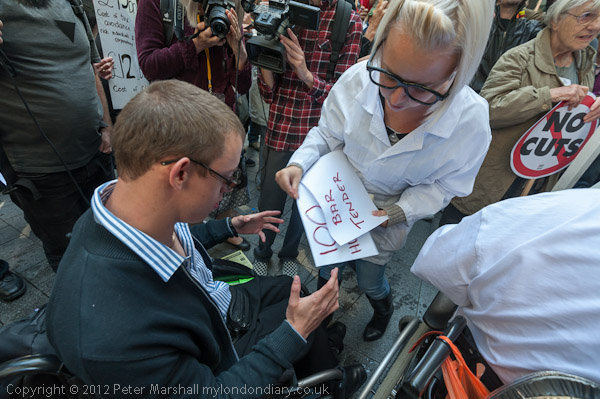
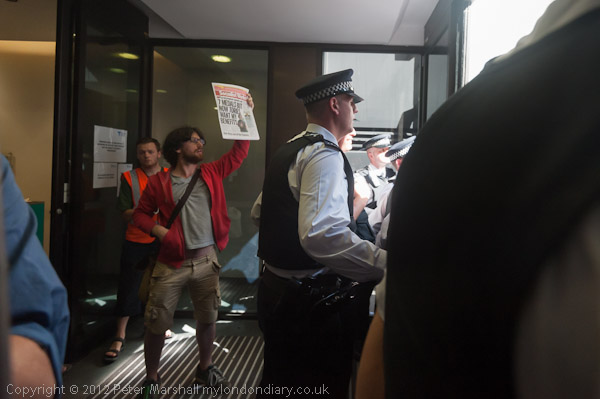
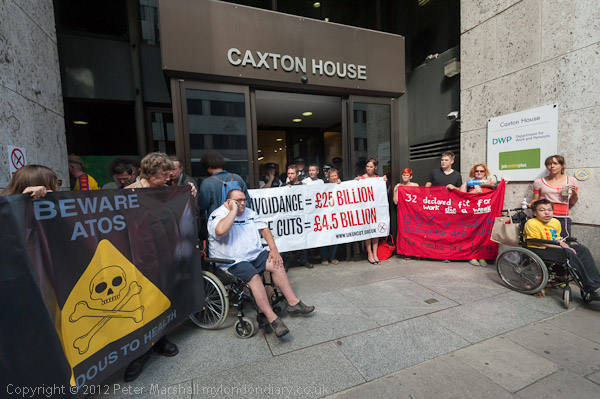
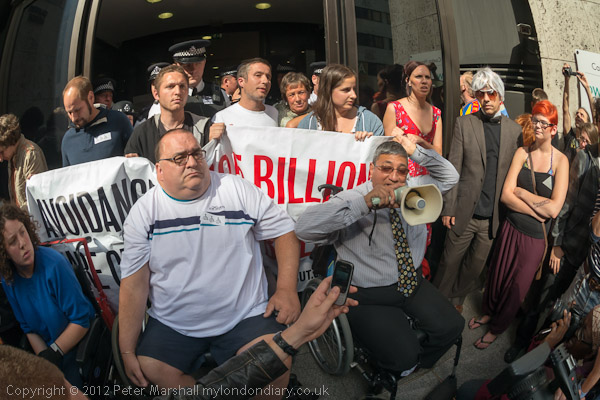
Disabled people and their supporters braved freezing weather to stage an hour-long protest outside the UK offices of Atos, protesting against the unfair testing of fitness to work and benefit cuts and supporting the ‘Atos 2’.

The Atos 2 were a wheelchair user and a pensioner, Notts Uncut activists who were charged with ‘aggravated trespass’ after peacefully entering an Atos assessment centre in Nottingham on a National Day of Action Against Atos and the Benefit Cuts last December. The charges were eventually dropped but the arrest and illegal confiscation of video material marked a new and disturbing attitude by police towards peaceful protest. There was another protest in Nottingham at the same time as that in London.

Disabled Protest Supports the Atos Two


London Guantánamo Campaign Candlelit Vigil

The London Guantánamo Campaign marked 5 years of regular protest at the US Embassy and over 10 years of illegal detention with a candlelit vigil, calling for the shutting down of the camp and the return of UK residents Shaker Aamer and Ahmed Belbacha.

Ahmed Belbacha was eventually released without charge in 2014, having been twice cleared for release in 2007 and 2009. He had come to the UK from Algeria as an asylum seeker and lived and worked here for a couple of years before his claim was rejected, after which he went to Pakistan to study the Koran. He made a visit to Afghanistan and was arrested on his way back to Pakistan.

Shaker Aamer, a Saudi citizen and legal UK resident married to a British woman who was applying for British citizenship went with his family to work for an Islamic charity in Afghanistan in 2001. He was arrested by Afghans and handed to the US in return for a ransom. Again he was cleared for release in 2007 and 2009, but continued to be held until October 2015.

London Guantánamo Campaign Candlelit Vigil


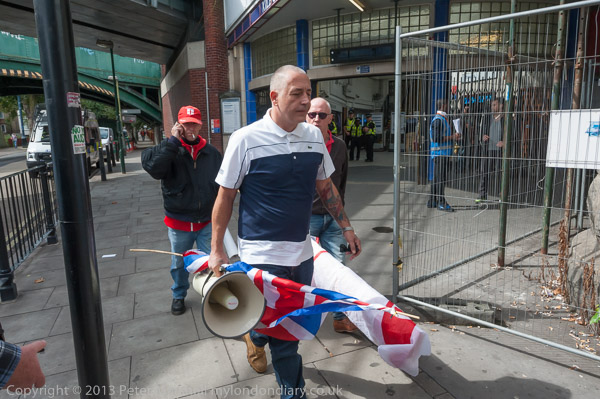
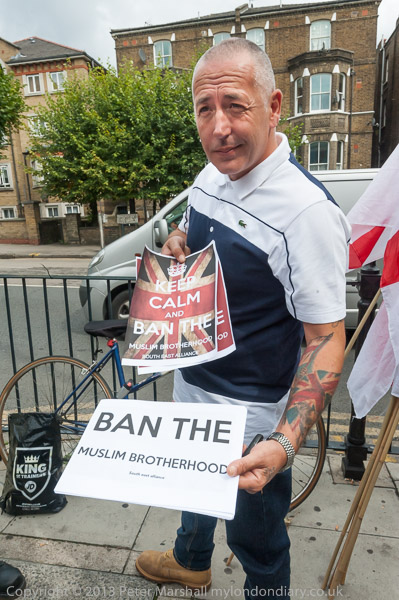
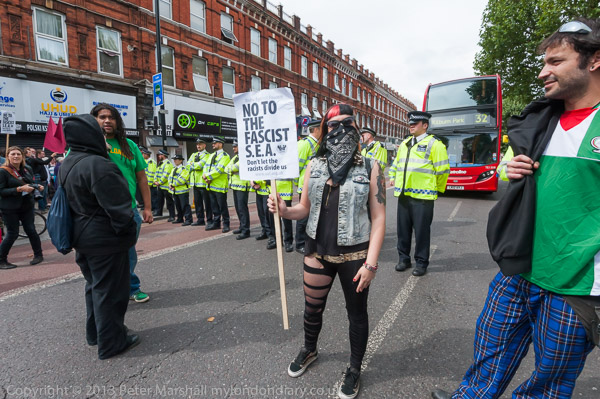
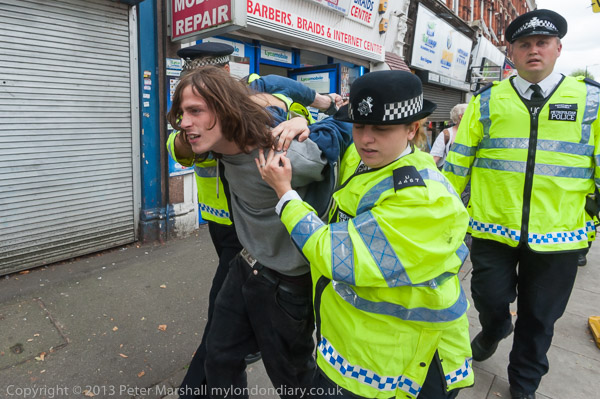
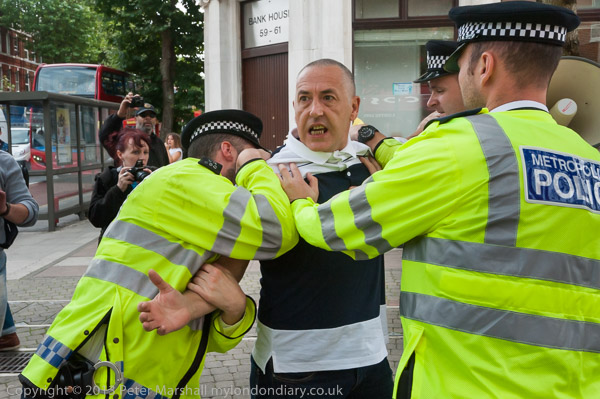
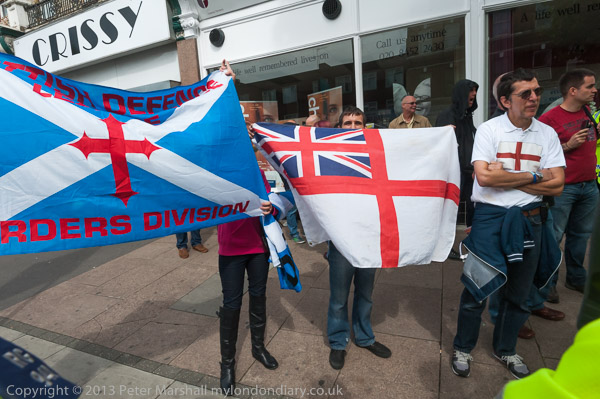
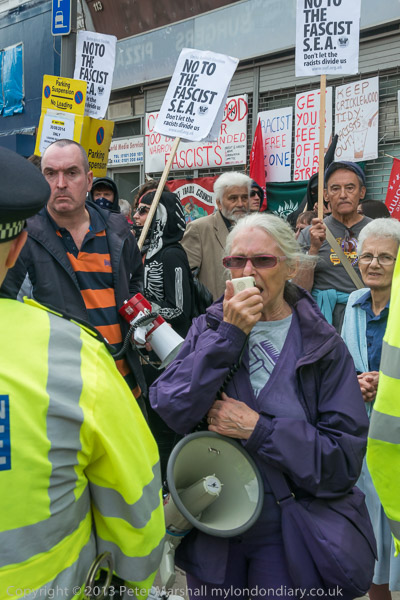
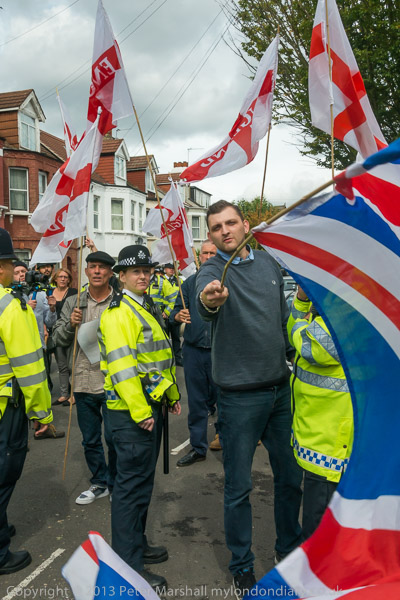
EDL Saved by Police in Slough

EDL Saved by Police in Slough – 1st February 2014.

Berkshire Anti-Fascists were among those trying to stop the EDL marching

I don’t often go to Slough. While I wouldn’t entirely share John Betjeman’s sentiments “Come, friendly bombs, and fall on Slough! It isn’t fit for humans now” it isn’t one of my favourite places, and although its only a fairly short bike ride or bus journey away, I seldom feel moved to go there.

Back in the 1990s I did go to take pictures, particularly on the trading estate, the largest industrial estate in single private ownership in Europe. I was then working on a project related to Thatcher’s de-industrialisation of the UK, as well as beefing up the almost non-existent selection of industrial buildings in one of our national collections.

And later in the 2000’s I rode there a couple of April Sunday mornings to photograph the annual Sikh Vaisakhi procession from the Gurdwara in the north of the town, always a very enjoyable experience. Most recently I went to reclaim my phone which I’d dropped on a bus journey and was handed in at the bus station after the driver found it at the end of the route. And I’ve been driven through Slough a few times on the way back from walks in Burnham Beeches and other sylvan walks in the countryside on its fringes.

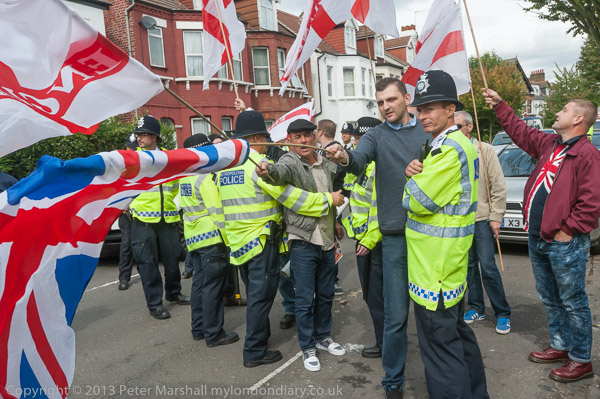
But on February 1st eight years ago I was there for a very different reason. A couple of hundred EDL supporters from around the country had come to march to a rally in the centre of Slough in an anti-Muslim protest over plans for a new mosque and Islamic community centre.

Large numbers of local people along with a few activists had gathered to opposed them, probably outnumbering them by around 10 to 1. As well as local Asian youths and trade unionists there were black-clad anti-fascists and supporters of Unite Against Fascism. There were two distinct large groups both holding rallies and hoping to prevent the EDL from marching through the centre of the town to hold their rally.

Unusually, as I wrote:

The EDL seemed determined to show they could behave rather better than on many previous occasions, and had banned drinking on the protest. There were plenty of EDL stewards on hand having an occasional word with anyone who seemed to be getting out of hand. A man who started to shout out their well-known chant “Allah is a pedo” was greeted by shouts to stop and quickly grabbed, though later things seemed to get a little out of hand with a large group if not the entire protest joining in with chanting “Allah, Allah, who the f**k is Allah.”

EDL Saved by Police in Slough

There was also a very large police presence, including a number of mounted police, and they very physically cleared a way for the march, with a number of charges by police horses and some very rough handling. As I wrote: “There were a number of minor injuries caused by police and protesters, and I was hit by a barrier thrown over by EDL supporters as well as a plastic bottle thrown by an Asian youth, as well as getting a few bruises from the pushing, mainly by police.”

The barrier hit me as I was attempting to photograph the EDL rally from outside the barriers and police around it. It hit me on one ankle and was extremely painful, and for a few minutes I could hardly walk. But soon I decided nothing seemed to be broken and managed to hobble around and take just a few more pictures.

Then I decided I’d done enough and needed to rest my ankle. Fortunately I’d come by bus, as cycling home would have been agony, and I was able to leave the town centre and sit on the bus for the longish ride home. Fortunately it isn’t a very long walk from the bus stop.

More on My London Diary at EDL Saved by Police in Slough.


2015 March for Homes – Shoreditch to City Hall

2015 March for Homes – Shoreditch to City Hall. A year before the march Against the Housing and Planning Bill featured in yesterday’s post there was another march about housing at the end of January, the March For Homes.

Outside Shoreditch Church

The event called by Defend Council Housing, South London People’s Assembly and Unite Housing Workers Branch involved two separate marches, one coming from Shoreditch in north-east London and the other from the Elephant & Castle in south London converging on London’s City Hall close to Tower Bridge for a final rally.

Max Levitas, a 100 year old communist veteran of Cable St

I couldn’t be in two places at once and chose to go to Shoreditch, partly because I knew people from several groups I had photographed at a number of housing struggles would be marching from there. The event was certainly enlivened by the arrival of activists who had marched from Bethnal Green, including supporters of Class War, Focus E15 and other groups.

Many couldn’t get into the churchyard

The Shoreditch Rally was held in a crowded area in Shoreditch churchyard at the front of St. Leonard’s, Shoreditch, the ancient parish church of Shoreditch, and I took the opportunity to go inside and have a look at the church before the rally. The list of speakers there showed the wide range of community support for fairer housing policies, including more social housing desperately needed in London and included Jasmine Stone of Focus E15, Lindsey Garratt from New Era, Paul Turp, vicar of St Leonards, Nick from Action East End, Paul Heron of the Haldane Society of Socialist Laywyers, Max Levitas, a 100 year old communist veteran of Cable St, a speaker from the ‘Fred and John Towers’ in Leytonstone and Tower Hamlets Mayor Lutfur Rahman.

Tower Hamlets Mayor Lutfur Rahman

Tower Hamlets benefits from having been formed from some of the London Metropolitan Boroughs with the best records of social housing – such as Poplar, where in the 1920s councillors went to jail to retain more money for one of London’s poorest areas. Unfortunately Rahman, the borough’s first directly elected mayor was removed from office in April 2015 after he was found personally guilty of electoral fraud in his 2014 re-election. Many of the other charges made against him in the media were dismissed by police after investigation.

It was raining slightly as over a thousand marchers set off for City Hall behind the March For Homes banner.

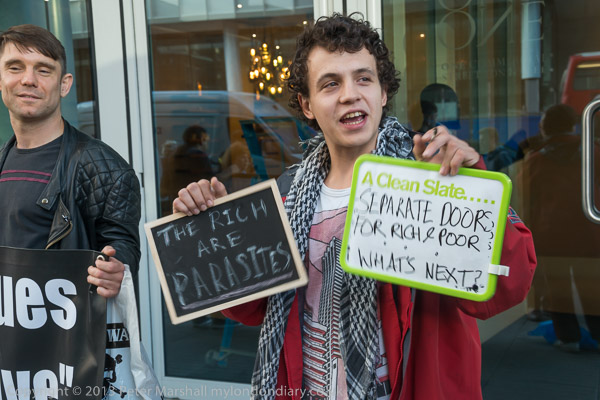
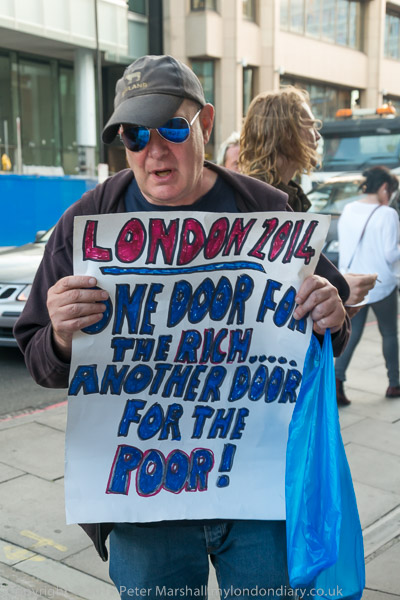
As the march came to the junction with Aldgate High St, Class War split off for a short protest at One Commercial St, where they had held a lengthy series of weekly ‘Poor Doors’ protests against separate entrances for residents owning or leasing at market rates and the smaller section of social housing tenants who had to enter through a door down a side alley. Class War had suspended their 20 weeks of protest for talks with a new owner of the building a month or so earlier, but these had broken down without a satisfactory resolution and the protests there restarted the following week.

As the march approached the Tower of London it was met and joined by Russell Brand riding a bicycle,

and on Tower Bridge, Class War came up to lead the march.

I rushed ahead to meet the South London march as it turned into Tooley Street for the last few yards of its march.

The rally in front of City Hall was large, cold and wet. By now the rain was making it difficult to take photographs, with drops falling on the front of my lenses as I tried to take pictures, and my lenses beginning to steam up inside. But I persisted and did the best I could, though the rain-bedraggled speakers in particular were not looking their best.

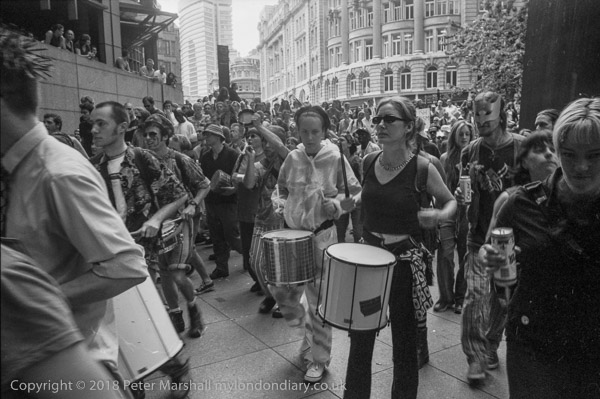
The rally was still continuing when some of the activists, including Class War and the street band Rhythms of Revolution decided they needed to do something a little more than standing in the rain listening to speeches. They moved onto Tooley Street and blocked the road. More police arrived and blocked the road even more effectively as the activists moved eastwards to protest at One Tower Bridge, a new development mainly for the over-rich next to Tower Bridge and then left for a long walk to the occupied Aylesbury Estate. But I decided it was time to go home.

More on My London Diary:
March for Homes: After the Rally
March for Homes: City Hall Rally
March for Homes: Poor Doors
March for Homes: Shoreditch to City Hall
March for Homes: Shoreditch Rally


March Against Housing & Planning Bill

The March Against Housing & Planning Bill on January 30th 2016 was organised by activists from South London, particulary from the London boroughs of Lambeth and Southwark.

These include many who are fighting against the demolition of social housing that is taking place across London, including in Lambeth and Southwark. Council tenants and leaseholders on council estates are fighting to save their homes – and fighting against Lambeth and Southwark councils who together with private developers and estate agent advisers are bent on demolishing the estates and replacing them with new estates which are largely for private rent or sale at London’s inflated market prices.

Southwark Council in particular carried out an expenisive PR exercise to demonise the Heygate Estate at the Elephant & Castle, having failed to carry out necessary maintenance and flooded the estate with people with various social problems over a number of years. The whole disastrous history has been documented in depth on the Southwark 35% site. A prize-winning estate with 1,214 homes built in 1974 to provide social housing for around 3,000 people was deliberately run-down and demolished. It’s replacement, Elephant Park has less than 100 social housing units. Many of its new flats are simply investments for overseas owners.

Southwark sold the Heygate to developers for one third of its previous valuation, and spent more on the scheme than it received. A study by Global architect firm Gensler concluded that the £35m spent by Southwark in rehousing the estate residents was exactly the same as it would have cost to refurbish the estate up to modern standards – and would have avoided the huge carbon footprint of demolishing and rebuilding.

A well as Heygate, Southwark Council’s main target has been the Aylesbury Estate, where Tony Blair chose to launch the Labour regeneration policy which has enabled corrupt councils to destroy much of what remained of social housing. For many council officers and some councillors it has enabled them to move into highly paid jobs with developers as a reward for their services. Lambeth has also been pursuing similar policies (along with other boroughs in London) and in particular with the Central Hill estate close to Crystal Palace.

An angry heckler – their argument continued after the speech by Livingstone

The protest against the Housing & Planning Bill in 2016 was also attended by people from both Lambeth and Southwark Council, and when Southwark Council Cabinet Member for Housing Richard Livingstone stepped up to the microphone to speak at the rally before the march some trouble was inevitable. Among those loudly heckling him was another of the speakers, Simon Elmer of Architects for Social Housing.

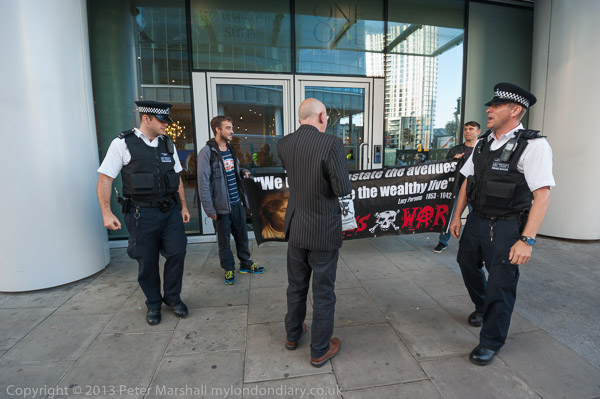
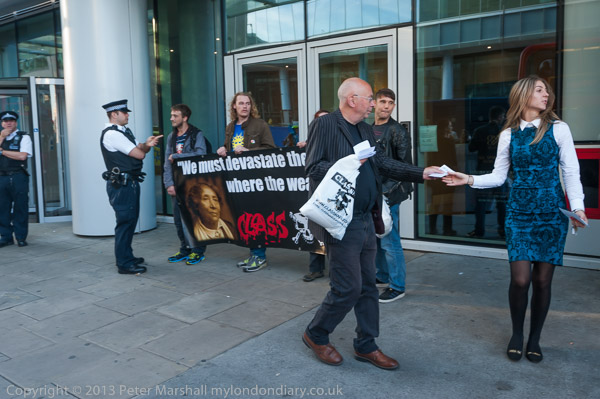
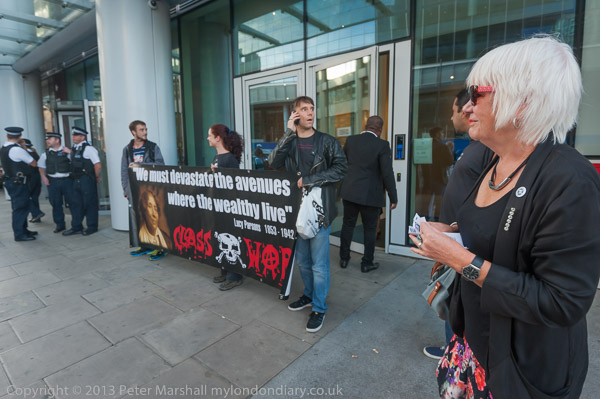
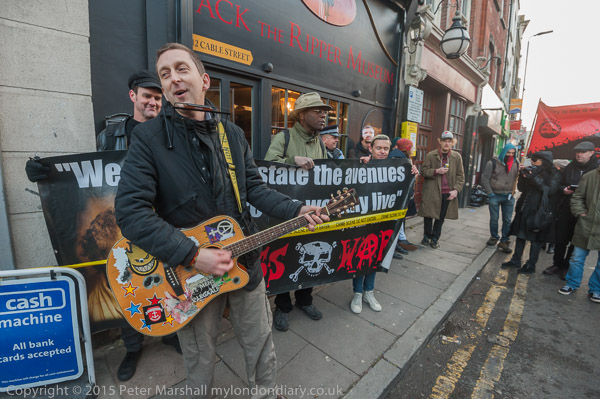
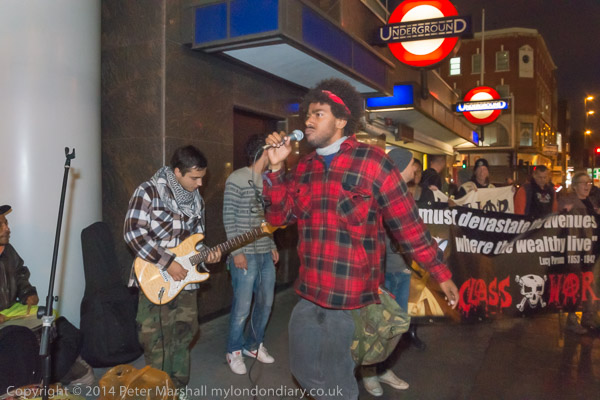
Class War have also been active in support of social housing in South London in particular and livened up the march by dancing along the street with banners singing the ‘Lambeth Walk’. One banner carried the words of a leading US Anarchist Lucy Parsons (1853-1942), “We must devastate the avenues where the wealthy live” and another had a field of crosses with the message “We have found new homes for the rich“.

Class War supporters rushed across the street for a short impromtu protest in front of a large branch of one of the leading estate agents driving the gentrification of London and advising councils and government on housing policies, but soon rejoined the main march of around 2,000 people heading for Westminster Bridge and Downing St.

At Downing St there was another protest outside the gates. Police had formed a line across Whitehall and directed the march to the opposite side of the street opposite Downing St. The march followed them across but then many simply walked back across the street to mass in front of the gates for a rally led by Fight Racism! Fight Imperialism! who have been active in supporting the Focus E15 Mothers in their campaign against the housing failures of Newham Council.

More on My London Diary at Housing and Planning Bill March


Student Fees & Cuts And Two Views On Egypt

The main event I covered 11 years ago on 29th January 2011 was a march by thousands of students, teachers, parents and others through London to defend education and the public sector. The demonstration, backed by the National Campaign Against Fees and Cuts was one of two national marches today, with another taking place in Manchester.

Two months earlier on Nov 10th a similar national protest had ended with some protesters storming into the Conservative Party HQ on Millbank, where considerable damage was caused and a number of protesters and police injured. Protest stewards tried to stop them but were unable to do so, and there were apparently very few police around as they rushed in. It was an hour before riot police arrived and began to fight the students and force them out. Around a dozen of the protesters were injured badly enough to require hospitalisation, along with three police officers. Fortunately no one was killed when a protester threw a fire extinguisher off the roof into the crowd below. 54 people, mainly students were arrested.

I’ve often criticised the police estimates of numbers taking part in protests, typically less than a half of the actual participants, and on that occasion they had been misled by their own estimate that only 20,000 would attend the protest. On the day it was more than twice that number, and the 225 officers deployed was far too few.

There were further student protests in November and December where police came out in larger numbers and some seemed to be taking revenge for their earlier failure – including twice dragging one protester from his wheelchair and across the roadway and almost killing another who was later charged with taking part in violent disorder along with four others – and eventually all were found not guilty.

But by 29th January police tempers had cooled, and too many videos and reports of their extreme actions had been aired on social media and even in the mass media. They were taking no chances this time and there were many more police around, but they were also doing their best not to provoke confrontation.

As I commented in my report on My London Diary:

Police do seem to have learnt lessons after their mistakes last year, and I saw no real problems arising today. Despite the number of protesters in anarchist dress with facemasks, most students are not out to cause trouble. But if police start pushing people around, or kettling them, problems are going to arise.

And later:

At one point outside the Millbank tower complex, police wanted to drive a couple of vans of reinforcement through a crowd, and some people sat down on the street. Police asked them to move but met with no cooperation. Rather than try and force the issue, police just formed a line so that the two vans could bypass the seated students and drive along the pavement. It was a simple solution that avoided further friction. Later there were reports of half a dozen people arrested in minor incidents.

My London Diary

As in November, the event ended with a rally close to Tate Britain on Millbank, but by the time I arrived with the tail end of the march this had ended. I was a little surprised by this as it was a much smaller event then in November, with perhaps 5,000 marchers, but perhaps few speakers had wanted to attend. Some of the marchers planned to go on to protest in Oxford St and at the Egyptian Embassy, but for me it was a chance to walk across Vauxhall Bridge and catch a train home.

I’d been at the Egyptian embassy earlier in the day, and photographed two protests taking place there. Opposite the embassy Egyptians had gathered “”to show our solidarity & support of our fellow Egyptians in our beloved country, who decided on making Tuesday 25/01/2011 a day of protests & demonstrations in Egypt against the unfair, tyrant, oppressive & corrupt Egyptian regime that has been ruling our country for decades.”

A hundred yards away Hizb ut-Tahrir, an Islamist group calling for the establishment of a Muslim caliphate was also holding a protest. The Egyptians opposite the embassy had told very firmly that the embassy protest – like the Egyptian revolution – was to be entirely non-sectarian and that they were not welcome there.

More about all three protests on My London Diary:
No Fees, No Cuts! Student March
Solidarity with the Egyptian Revolution
Hizb ut-Tahrir Turned Away


University of London 3 Cosas Strike

On the IWGB battlebus

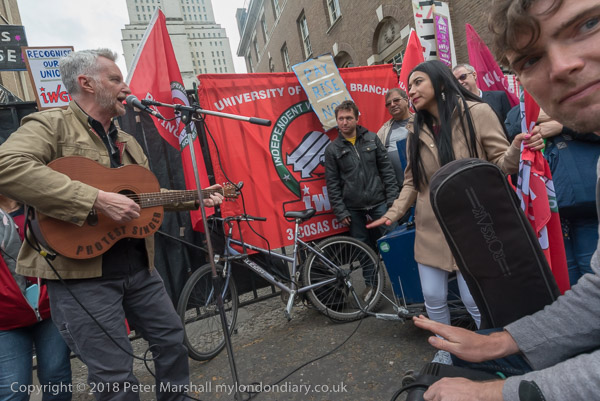
Eight years ago on Tuesday 28th January 2014 low paid workers at the University of London were on the second day of their 3 day strike. Their union had organised a day of action around London and I had been invited to come and photograph it, having photographed a number of their previous protests.

University cleaners, maintenance and security staff were demanding that the University recognise their trade union, the IWGB (Independent Workers’ Union of Great Britain) and give them better pay and conditions, comparable with other university staff they work alongside. The ‘3 Cosas’ were sick pay, paid holidays and pensions – all areas where these staff were only being given the legal minimum (and sometime not even that.)

As I wrote in 2014:

“although these workers work at the university and carry out work essential for the running of the university, the university does not employ them. Most low paid workers – cleaners, maintenance and security staff, catering works and others – at the University of London are no longer directly employed by the University, but work in the University on contracts from contractors Cofely GDF-Suez (who took over the former contractor Balfour Beatty Workplace at the end of last year.) The policy of outsourcing these workers seems largely intended to evade the responsibilities of London University towards an essential part of their workforce.”

3 Cosas’ Strike Picket and Battle Bus

It meant an early start for me, although the pickets had been outside Senate House for four hours when I arrived at 9am. Living outside London though on its edge I seldom arrive before 10am as it doubles my travel costs and I’ve never been a happy early riser. Fortunately the weather was good, a bright winter day and I’d dressed for the weather with thermal underwear, thick socks and a woolly hat, though it was still pretty chilly on top of the open-top bus.

The bus turned out to be a 1960 Routemaster which was sold by London Transport in 1986 but only converted to open-top in 2001. (I’d long thought that there was a plentiful supply of such vehicles after drivers attempted routes under low bridges, but apparently not, although a couple of bridges near where I live have had quite a few victims over the years.) Compared to modern buses, Routemasters offered a very bumpy ride with considerable vibration, and taking pictures on the upper deck required some faster than normal shutter speeds and most of the time working one-handed while clinging on with the other.

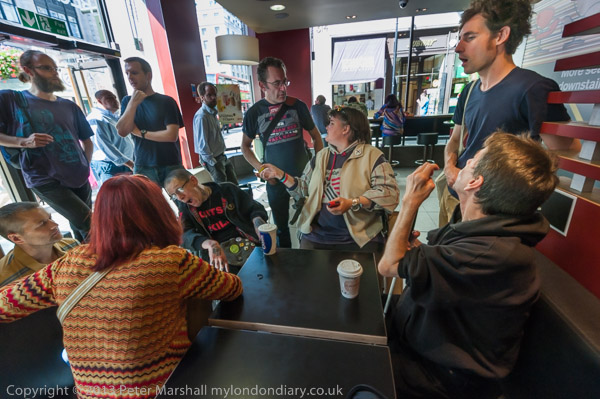
Space on bus tops is also quite small and moving around impeded both by the seats and the other riders (I think it’s a more appropriate term than passengers) and though they were very cooperative the top of the bus was pretty full. Most of the pictures I made were taken when the bus was stopped either at junctions or for short protests and my fisheye lens proved really useful.

The bus trip began at Senate House, and then began an extensive tour around central London, making a tour of various university sites where IWGB members were striking. There was a great deal of booing as we passed the Unison headquarters on Euston Road, as many of the workers had left Unison in disgust as they felt the were not supporting the demands of low-paid workers. The IWGB had intended to stop outside the offices of The Guardian newspaper, but had been held up too much by London’s traffic and drove past and on to Parliament Square.

Here we jumped off the bus and marched to Parliament where the IWGB had arranged to meet Labour MPs John McDonnell and Jeremy Corbyn for a short rally (and Andy Burnham sent a short message of support.)

There was a short shower before the bus came to pick us up on the Embankment, taking us to a side street near the Royal Opera House. Everyone kept quiet as we got off, then rushed around the corner and into the foyer. IWGB members there had voted for a strike the following month for union recognition and the London Living Wage.

In the foyer we were met by a man who introduced himself as the Unison Health & Safety rep and told the IWGB President and the other protesters that the ROH had already agreed that the cleaners will get the Living Wage, but had not yet told them. The Opera House recognises Unison, despite the workers almost entirely being IWGB members. It’s a ridiculous situation but one which is allowed under our poor trade union laws, though not one that makes sense for either workers or employers.

After making their views clear the IWGB members left quietly and got back onto the bus for the final visit of the day, to the Angel Islington, where Cofely GDF-Suez (who took over employing the workers at the University of London from the former contractor Balfour Beatty Workplace in December) has its offices. As at the Royal Opera House, there were plenty of police present and waiting for the protesters, but here they managed to lock the metal gates on the two entrances to Angel Square as the bus arrived, leaving the protest to take place in front of one of them in Torrens Place.

From here the bus was going on to the union offices at the Elephant and Castle and I was invited to join them for a very late mid-afternoon lunch but unfortunately I had work to do on the many pictures I had taken and had to leave them and make my way home.

IWGB at Cofely GDF-Suez
IWGB in Royal Opera House
IWGB at Parliament
‘3 Cosas’ Strike Picket and Battle Bus


Defend Afrin, end Turkish Attacks

The largest protest I attended on Saturday 27th January 2018, four years ago was against the Turkish attacks on Afrin in Northern Syria, then a part of the Democratic Federation of Northern Syria (DFNS) or Rojava, a de facto autonomous region in northern Syria.

Turkey, a NATO member with probably the largest and best-equipped army and air force in the Middle East was taking on the small and poorly equipped Kurdish forces, and despite a valiant fight the final result was predictable, particularly once Russia, the other major player in the Syrian conflict had given them their blessing.

Turkey has continued its attacks on Northern Syria, but mainly through air strikes, but these are seldom reported in UK media although covered by specialist sources such as ‘Foreign Policy‘, part of the Slate Group.

The US gave some support in other battles fought by the Kurds against Islamic State forces, but this was always limited and mostly ended with the withdrawal of US troops which was announced by Trump in December 2018, and again in October 2019, although around 900 were still there in October 2021. Turkey has been a major source of finance for ISIS, allowing them to profit from smuggling of oil, and backing some groups which were fighting with them.

In recent days there have been short mentions on the BBC about the continuing battles being fought by the Syrian Democratic Forces, a US-backed, Kurdish-led militia against Islamic State in Northern Syria. The prisons and refugee camps where former ISIS fighters and supporters are held are largely in Kurdish territory and ISIS are still active and fighting to release people from detention to increase their strength.

As I wrote in 2018, “the constitution of Rojava treats all ethnic groups – which include Arabs, Assyrians, Syrian Turkmen and Yazidis as well as Kurds – equally and liberates women, treating them as equal to men. The constitution is based on a democratic socialism and its autonomy is seen by many as a model for a federal Syria.”

Unfortunately there seems little chance that such a model with be adopted more widely. Turkey continues to attack the Kurdish areas and does so using weapons sold to them as a NATO member by the UK, France and UAE. Turkey claims that the Kurdish forces fighting ISIS are an extension of the Kurdistan Workers’ Party, PKK, founded in 1978 which began its armed struggle for self-rule for Kurds in Turkey 1984.

PKK leader Abdullah Ocalan has been held in a Turkish jail since 1999 and the organisation has been proscribed in many countries allied to Turkey, including the USA and UK. Several PKK flags were seized by police at the start of the march.

More at Defend Afrin, stop Turkish Attack.


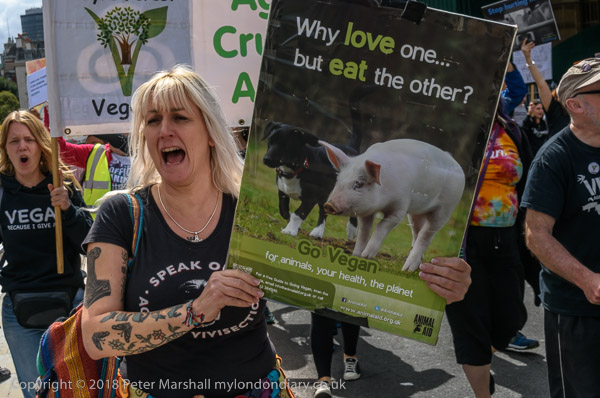
This was not the only protest in London on that day, and I also photographed two other events. African Lives Matter and the International Campaign to Boycott UAE were outside the UAE Embassy in London protesting against the funding by the the United Arab Emirates United of armed Groups in Libya which imprison, torture and kill African migrants and sell them as slaves. On Regent St, the long-running protest outside the Canada Goose flagship store in Regent St was continuing asking shoppers to boycott the store because of the horrific cruelty involved in trapping dogs for fur and raising birds for down used in the company’s clothing.

Canada Goose protests continue
End UAE support for slavery in Libya


Poplar To Limehouse 1988

Poplar To Limehouse 1988 – my walk continued on the East India Dock Road.

East India Dock Rd, Poplar, Tower Hamlets, 1988 88-7q-51-positive_2400
East India Dock Rd, Poplar, Tower Hamlets, 1988 88-7q-51

From the posters in the window this was clearly a video rental store, a relatively new thing back in 1988 – the first Blockbuster Video store only opened in Dallas, Texas in 1985. Home video recording only began to be popular after the introduction of Betamax in 1975, followed in 1977 by VHS (along with other formats.) By 1988 VHS had become the dominant format.

But my attention was caught by the notice on the door, ‘NO DOGS OR BIKES ALLOWED’ with a very small ‘Thankyou’ and the two bikes (I think a BMX and a racer) flung down on the pavement outside unlocked by their two young owners.

Poplar Labour Party, East India Dock Rd, Poplar, Tower Hamlets, 1988 88-7q-53-positive_2400
Poplar Labour Party, East India Dock Rd, Poplar, Tower Hamlets, 1988 88-7q-53

Poplar Labour Party, led by George Lansbury, gained control of Poplar Borough Council in 1919. Poplar was one of the poorest areas of the country and so rateable values there were low. With councils then being responsible for supporting the unemployed and poor, council rates thus had to be set at a much higher level than in wealthy boroughs, which was clearly unfair on boroughs like Poplar who had so many more people needing support. Their rates were the highest in London, twice as high as in the wealthy borough of Kensington.

Poplar Labour had come into office to make changes, to provide greater support for the poor, to set a higher minimum wage for council workers and to pay women equally to men. When a demand from government came in 1921 to increase contributions for cross-London authorities Poplar council refused to pay, instead voting to use the money for the local poor. The authorities took them to court, and 30 councillors marched there with two thousand supporters. All of the councillors were sentenced to prison, where one of the six women, Minnie Lansbury, died, only 32.

Public outcry with large demonstrations and some riots – and other councils following Poplar’s lead – led to the councillors being released with an Act being rushed through Parliament to make the system more fair, with richer boroughs contributing more and the poorer less.

Their protest had clearly been illegal, but was clearly justified, and it led to a much-needed reform. It’s a lesson which still has relevance, particularly with such current matters as statues and the Government’s Police, Crime, Sentencing and Courts Bill.

Richard Green, statue, Poplar Baths, East India Dock Rd, Poplar, Tower Hamlets, 1988 88-7q-54-positive_2400
Richard Green, statue, Poplar Baths, East India Dock Rd, Poplar, Tower Hamlets, 1988 88-7q-54

The statue of Richard Green still stands outside Poplar Baths, a Grade II listed building from 1933, replacing an earlier baths from 1852. The baths were largely to provide washing facilities when few homes had bathrooms in this poor area of the city. As well as ‘slipper baths’ there were also vapour baths, showers and laundry facilities. The new baths in 1933 was a huge building including these facilities and two swimming pools, the larger of which could be covered over and used as a dance hall, theatre and sports hall.

The baths reopened in 1947 after the war despite considerable damage and was closed and converted into a training centre in 1988. My picture from 1988 shows a board advertising the support of the London Docklands Development Corporation in providing disabled access.

The building later became derelict but after a strong local and national campaign for its restoration work began on its redevelopment in 2014 and it reopened again as Poplar Baths Leisure Centre and Gym, along with 100 new homes, in 2016.

Richard Green (1803-63) was a local shipowner, shipbuilder and philanthropist, supporting a Sailors’ Home, schools, an orphanage and hospitals in the area, some of which had been founded by his father, George Green. His Blackwall Yard built many ships for the East India Company and for trade with Australia and China. His company, R & H Green in 1919 joined with Silley Weir as R. and H. Green and Silley Weir, with large premises at the Royal Albert dry docks and others and continued in business until sold to become a part of the government owned River Thames Shipbuilders in 1977.

George Green School, East India Dock Rd, Sturry St, Poplar, Tower Hamlets, 1988 88-7q-43-positive_2400
George Green School, East India Dock Rd, Sturry St, Poplar, Tower Hamlets, 1988 88-7q-43

George Green (1767-1849) was the father of Richard Green whose statue with his dog still sits outside Poplar Baths. George married the boss’s daughter and made the reputation of the Blackwall Shipbuilding Yard, building many whalers.

As well as this school dating from 1828 on the East India Dock Road the older Green also endowed schools in Chrisp Street and Bow Lane. The current huilding from 1883 is part of Tower Hamlets College. George Green School in new buildings on Manchester Road became the secondary school for the Isle of Dogs with its first comprehensive intake in 1975.

Poplar Recreation Ground Memorial, schoolchildren, Poplar, Tower Hamlets, 1988 88-7q-44-positive_2400
Poplar Recreation Ground Memorial, schoolchildren, Poplar, Tower Hamlets, 1988 88-7q-44

The War memorial to the children of Upper North Street School is https://britishlistedbuildings.co.uk/101065215-war-memorial-to-the-children-of-upper-north-street-school-poplar-ward Grade II* listed and includes the inscription: ‘IN MEMORY OF/ 18 CHILDREN/ WHO WERE KILLED/ BY A BOMB/ DROPPED FROM A/ GERMAN AEROPLANE/ UPON THE L.C.C./ SCHOOL UPPER/ NORTH STREET/ POPLAR ON THE/ 13TH OF JUNE 1917./ ALFRED H. WARREN O.B.E./ MAYOR/ J. BUTEUX SKEGGS,/ TOWN CLERK. ‘

There is a fuller story at the link above about the first mass German raid on London by Gotha bombers on 13 June 1917 which killed 162, including these 18 children mainly aged 5 or 6. At least 37 other children at the school were among the 432 injured by the raid.
St Mathias, church, Woodstock Terrace, Poplar, Tower Hamlets, 1988 88-7q-45-positive_2400
St Mathias, church, Woodstock Terrace, Poplar, Tower Hamlets, 1988 88-7q-45

St Mathias Church is also Grade II* listed, with a number of Grade II listed monuments. Poplar’s oldest church, it was built in 1766 as the Chapel of the East India Company, and became St Mathias as a parish church in 1866. You can see the company’s arms in the roof, and allegedly its columns came from wrecks of the Spanish Armada.
The exterior of the church was altered and enlarged by Teulon in 1875. The church closed in 1976 and was restored for community use by the LDDC in 1990.
Grieg House, Garford St, Limehouse, Tower Hamlets, 1988 88-7q-36-positive_2400
Grieg House, Garford St, Limehouse, Tower Hamlets, 1988 88-7q-36

Built in 1902–3 as an officers’ annexe to the Scandinavian Sailors’ Temperance Home, founded by Swedish Free Church missionary Agnes Hedenstrom (1849–1928) who began her mission in the East End in the 1870s, opening the home here in 1888. The mission was taken over by the Salvation Army in 1930.

This was I think the last picture I took on my way to Westferry station where I returned a couple of days later for another walk – and the subject of a later post.


Click on any image to see a larger version in my album 1988 London Photos from where you can browse other images.