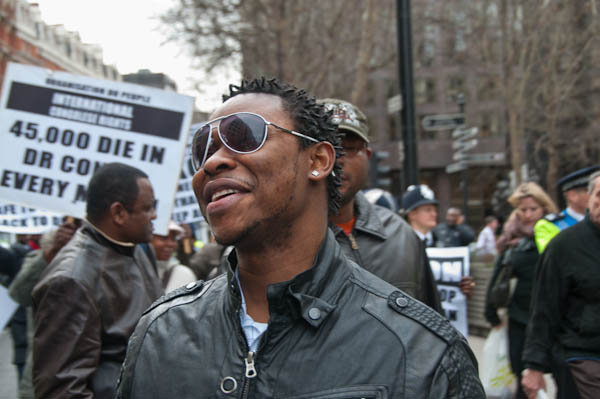
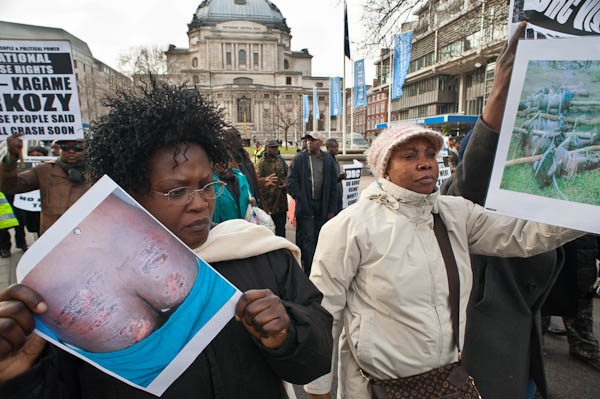
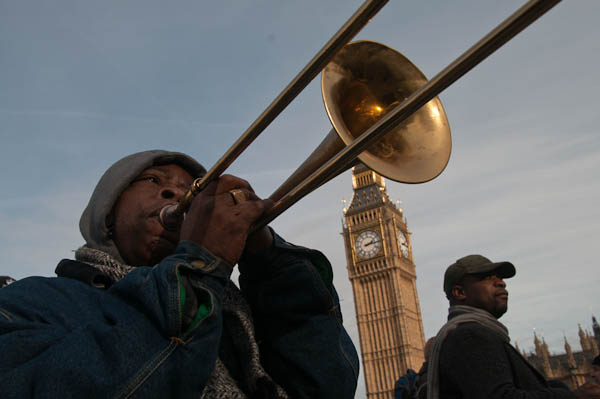
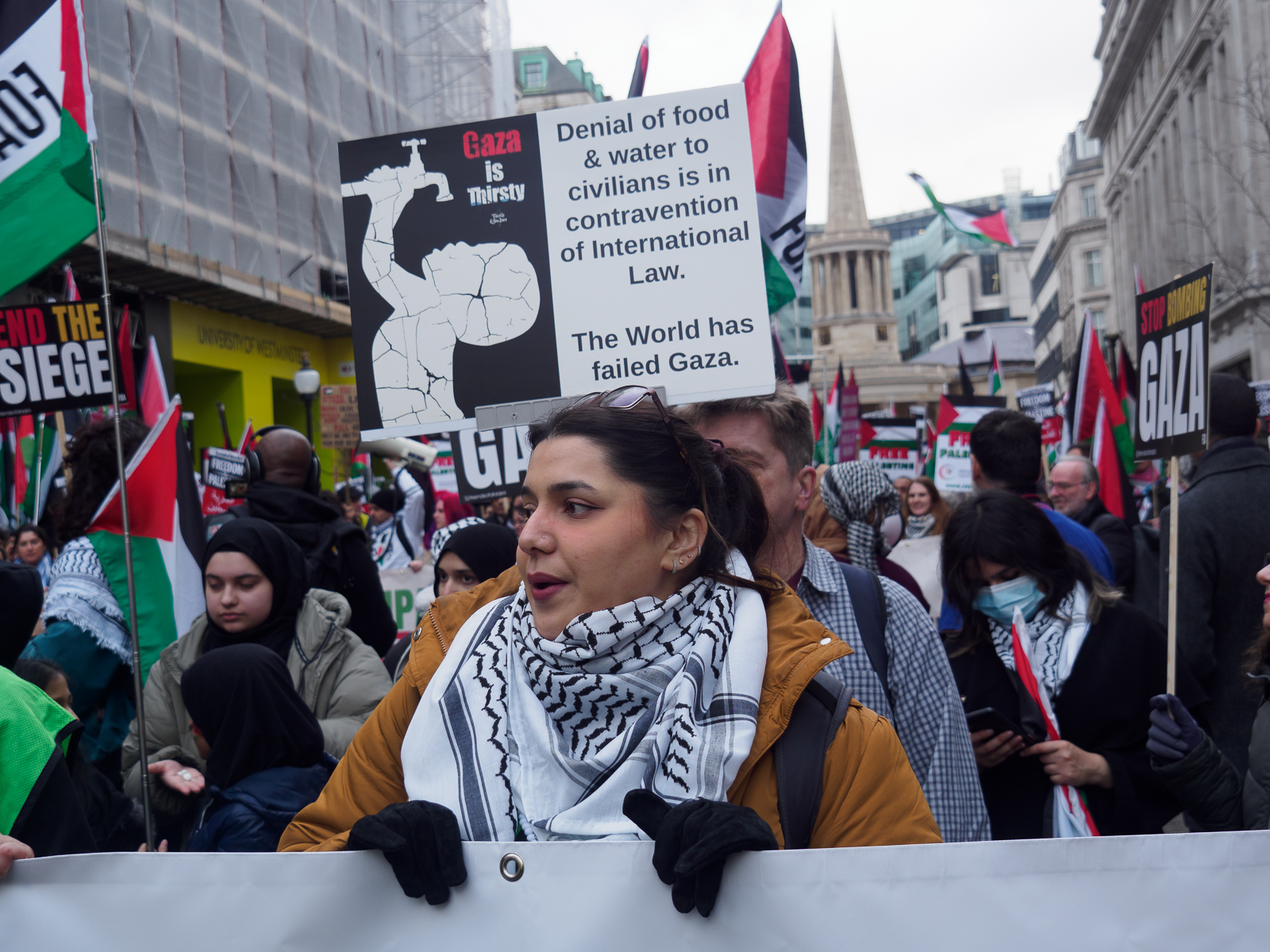
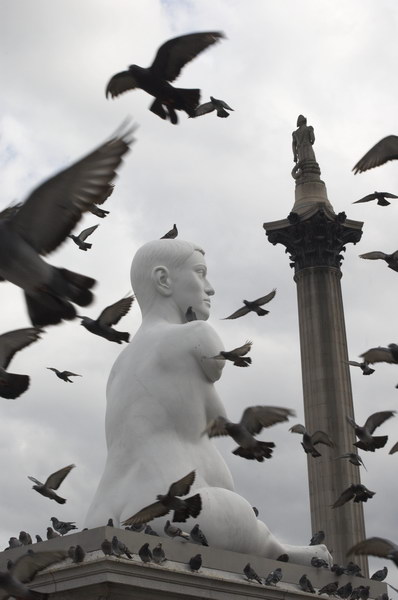
International Day in support of victims of Torture

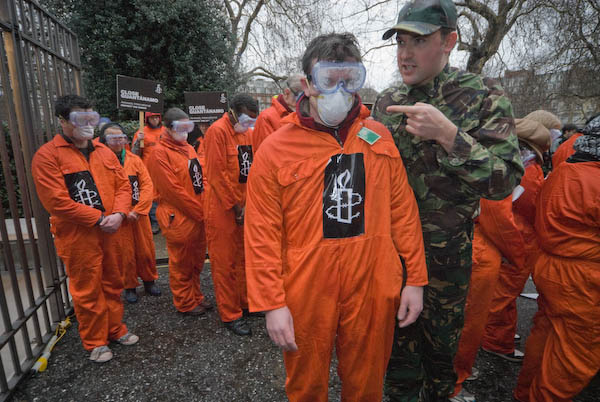
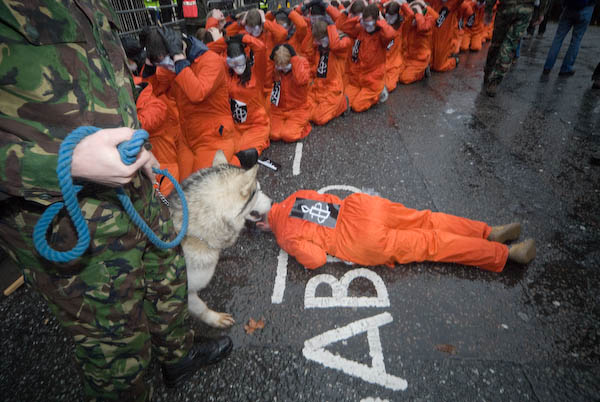
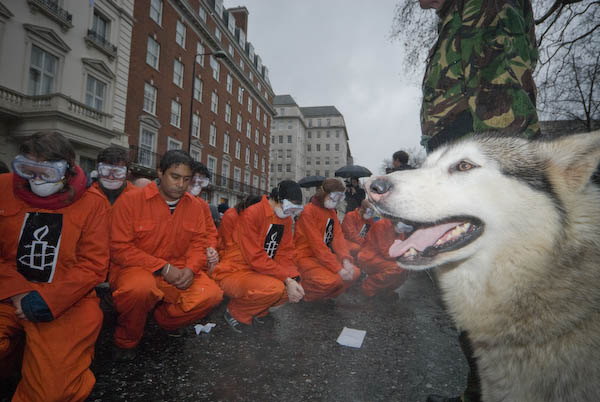
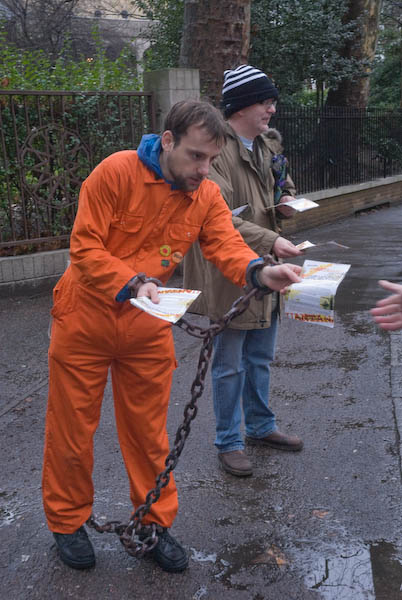
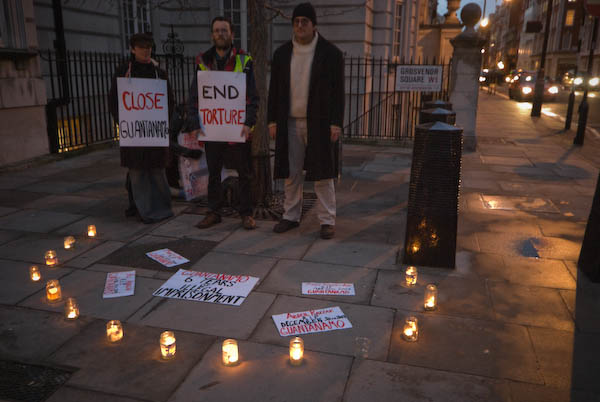
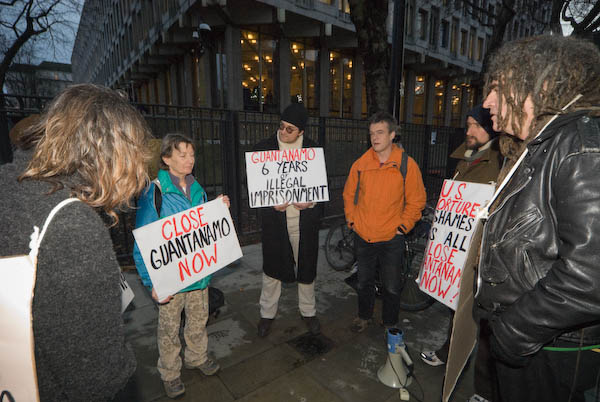
International Day in support of victims of Torture: The United Nations Convention against Torture and Other Cruel, Inhuman or Degrading Treatment or Punishment came into force internationally on 26 June 1987, and in 1998 the UN declared the 26 June of every year to be the International Day in Support of Victims of Torture.

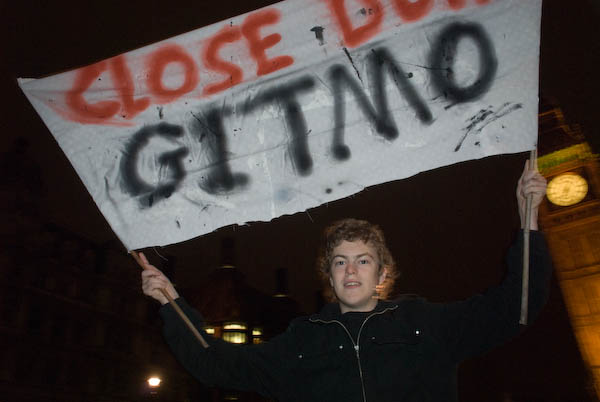
Over the years I’ve photographed a number of vigils and protests marking the day in London by various groups concerned with human rights, mostly organised by the London Guantánamo Campaign but often joined by others.


No to Torture Vigil – Trafalgar Square, London. Tue 26 June 2012

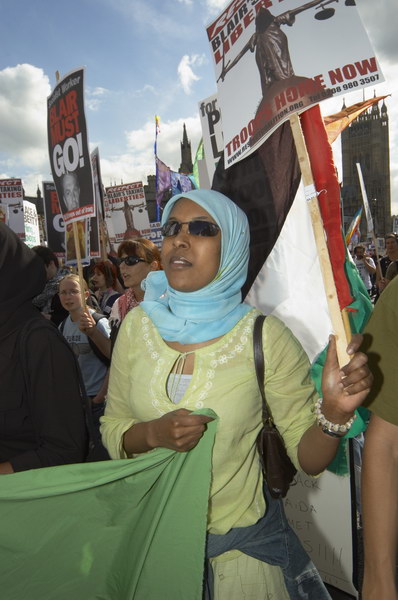
Supporters of the The London Guantánamo Campaign and other human rights activists held up placards saying “NO to torture” in over 30 languages. Other protesters against various human rights violations joined in the protest, including campaigners calling for an end of the Iranian executions of the Baloch people, those against the extraditions of Babar Ahmer, Talha Ahsan and others to the US and the Free Mumia campaign.

International Day in support of victims of Torture

More on My London Diary at No to Torture Vigil.


Say No To Torture – Trafalgar Square, London. Wed 26 Jun 2013

International Day in support of victims of Torture

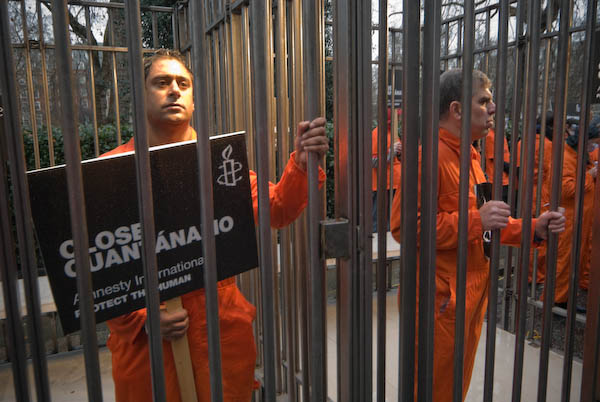
The London Guantanamo Campaign which has been active in calling for the closure of Guantanamo and other prisons including Bagram in Afghanistan since 2006 again held a vigil in Trafalgar Square.

International Day in support of victims of Torture

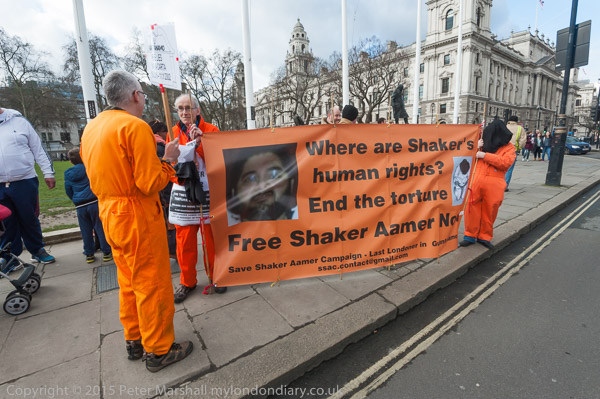
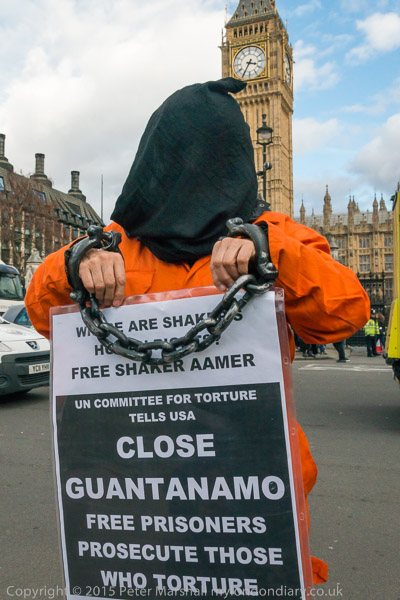
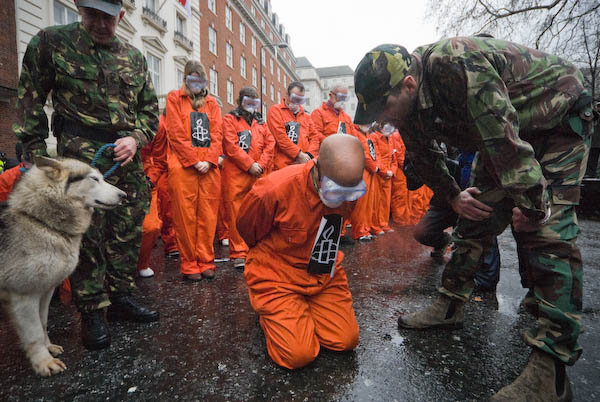
Some wearing orange Guanatanamo-style jump suits and black hoods, they stood in a lin in front of the National Gallery, calling for the release of London resident Shaker Aamer and the other detainees held and tortured without trail. Shaker, along with most of the other prisoners was on the 141st day of a hunger strike, being subjected to regular beatings, being brutally forcibly fed and held in solitary confinement – which also constitues torture under the UN definitions.

International Day in support of victims of Torture

Among those taking part in the vigil was veteran peace campaigner Bruce Kent. The ‘Say No To Torture’ protest overlapped with another human rights protest over Balochistan, a ‘nation without a state.’ Balochs live mainly in Pakistan and have been subject to arrests and other human rights violations including torture by the Pakistan authorities for campaigning for independence.
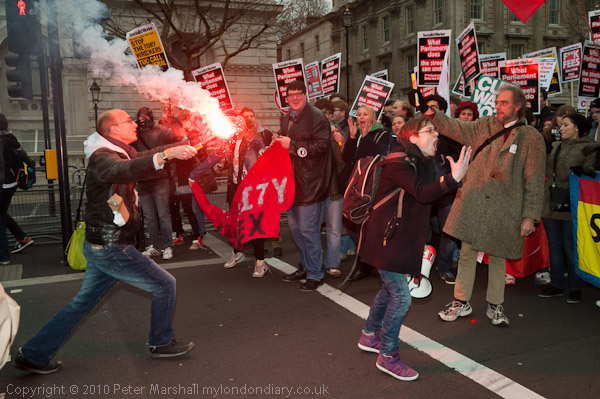
More on My London Diary at Say No To Torture.
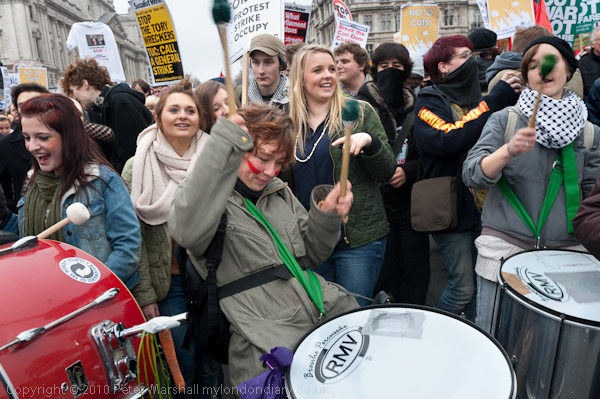

Torture Solidarity Vigil – Trafalgar Square, London. Thu 26 Jun 2014
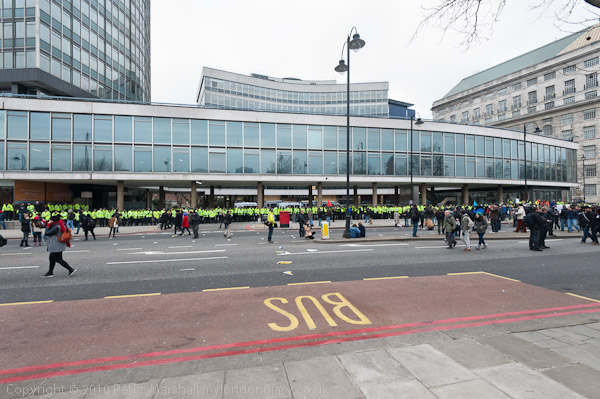
In 2014, Kashmiris wore black hoods and headbands with messages ‘Mutilated’, ‘Raped’, ‘Tortured’, ‘Executed’ and waved Kashmiri flags to protest at the widespread human rights abuses by the 7,000 custodial killings and torture of prisoners by the Indian state Indian state in Kashmir- 1 in 5 Kashmiris is a torture victim.

Also in Trafalgar Square was a vigil by the The London Guantanamo Campaign with people holding posters and blindfolded or gagged, calling for the release of prisoners from the US prison camp and an end to impunity for torturers.

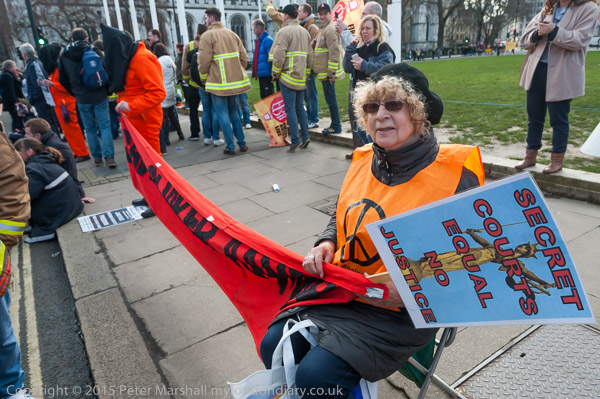
The UK has failed to take proper action over allegations of prisoner abuse by the British military in Iraq and Afghanistan and has continued to be involved in the “rendition” and torture of British and foreign nationals abroad. Our government prevents violations becoming public knowledge, relying on secret courts and partial and biased investigations.

More on My London Diary at Torture Solidarity Vigil.


UN Day for Victims of Torture – Trafalgar Square, London. Fri 26 Jun 2015

The London Guantánamo Campaign and others were back again in Trafalgar Square in a solidarity vigil in recognition of the suffering and rights of victims and survivors of torture, calling on those in positions of power able to put an end to the use of torture.

Obama had promised in 2010 to end the shame of Guantanamo, but the detentions and torture continued throughout his presidency, though there were some releases.

More on My London Diary at UN Day for Victims of Torture.


Here are links to further protests I covered in recent years on 26 June against torture, in Trafalgar Square in 2016, at the US Embassy in Nine Elms in 2018 and by Balochs in Trafalgar Square in 2019. In 2017 I had a day off work for medical tests, and in 2020 there was no vigil because of the lockdown.


National Day of Action against Universal Credit 2018

National Day of Action against Universal Credit 2018
Campaigners spell out ‘stopuniversalcredit’ in the Tate Modern Turbine Hall; the ‘#’ was delaying security

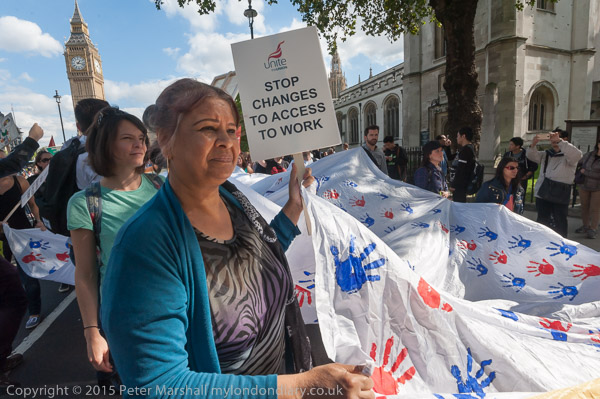
Thursday 24th May 2018 was the Unite National Day of Action against Universal Credit and I photographed two of the events in London for this, a protest by a group of campaigners from Camden Unite Community at Tate Modern and a rally outside Parliament which was followed by a march to protest outside the Department of Work and Pensions. The pictures come from these events.

National Day of Action against Universal Credit 2018

Back in 2010 when the idea of Universal Credit was announced by Iain Duncan Smith it was true that the UK’s benefits system was something of a muddle, and the aim of producing a simpler system which brought six existing benefits together was probably laudable. But its implementation has been a disaster for many.

National Day of Action against Universal Credit 2018

Those six benefits had each been introduced to deal with particular needs, and though not perfect they more or less worked. Trying to fit everything into a single system has proved to be far more difficult, and many of the decisions made about how the system might work failed to take into account the circumstances in which those on low incomes actually live and the lack of supporting resources the wealthier take for granted, such as friends and family with money and bank accounts with savings.

National Day of Action against Universal Credit 2018

When announced, Iain Duncan Smith promised it would make the social security system fairer to claimants and taxpayers, but as it came into being it became clear that the main objective was to cut the cost to taxpayers and to provide what is effectively a handout to companies and organisations which employ workers on low rates of pay.

The plans for introducing UC hugely underestimated the complexities of the system, particularly as it applies to the the most precarious of workers, many of whom are now employed on zero hours contracts with no guaranteed weekly hours of work. There were huge problems with computer systems partly because of the complexity but also because of a failure to understand the problems and to properly specify what was needed.

The real motivation behind UC was made clear in 2015 when George Osborne announced a future £3.2 billion a year cut to the overall Universal Credit budget, reducing work allowances and reducing and limiting the per-child element of support. These cuts were later partly reversed by Philip Hammond.

The transition from the legacy benefits to UC has been extremely hard for many, particularly as some have had a period of up to 13 weeks before receiving their first payment under UC. Food banks have been put under great strain because of this and benefit sanctions. 60% of tenants put onto UC have been forced into arrears on their rents and many have faced eviction.Some have become desperate enough to take their own lives.

Wikipedia quotes a report that in 2018 a million working “homeowners now getting tax credits will have less with the new system and lose on average £43 a week. 600,000 working single parents will lose on average £16 per week and roughly 750,000 households on disability benefits will lose on average £75 per week. Nearly 2 in 5 households receiving benefits will be on average worse off by £52 per week.”

Universal Credit has become a mess and various small changes the successive governments have been forced into making have hardly improved it. There are some measures which could be taken to improve the situation. Large increases in the minimum wage with the aim of moving to a situation where those in work would be adequately paid and not need UC would help. Changes in employment law including the replacement of zero hours contracts by a fair flexible contract system would also make a contribution. But almost certainly the best solution would be to move to a universal basic wage.

Thursday 24th May was the Unite National Day of Action against Universal Credit and I photographed two of the events in London for this, a protest by a group of campaigners from Camden Unite Community at Tate Modern and a rally outside Parliament which was followed by a march to protest outside the Department of Work and Pensions.

More details on the protests on Thursday 24th May 2018 by campaigners at Tate Modern, the rally outside Parliament and march to protest outside the DWP on My London Diary.

Universal Credit rally & march
Universal Credit protest at Tate Modern

March of the Beekeepers 2013

March of the Beekeepers 26th April 2013: Where would we be without Bees? Personally as I’ve written before I wouldn’t be here at all. I owe my own very existence to them, as when my father as a young man decided to become a beekeeper he went to a class at the Twickenham and Thames Valley Beekeepers Association in Twickenham, given by a professional beekeeper, Alf. Fred and Alf became friends, and both had sisters (my father five of them, but Alf only one.) And so I grew up with an Uncle Alf, my mother’s brother and his wife Mabel was one of Dad’s sisters.

March of the Beekeepers

Alf and Dad were both beekeepers with prize certificates for honey etc to prove it. In our house, honey came in 28lb tins which I’d spent hours in a room sealed against bees sweating turning the handle of an extractor, and there were hives at the bottom of the garden against the factory wall, often surrounded by the sharp metal curls of swarf which came over, more dangerous than the bee stings.

March of the Beekeepers

My father had hives in several other gardens in the area, and looked after bees for at least one nearby middle-class resident, and for some years the hives at the Twickenham apiary, a job he took over from Alf. I think most of dad’s bees came from swarms which the police would regularly call and ask him to deal with – and he would get on his bike with a box to bring them back. He was something of a jack of all trades, growing vegetables to feed us and doing odd painting, decorating, plumbing and building work as well as selling a few jars of honey. Alf was a dedicated beekeeper and travelled further afield, with hives as far away as Gloucestershire, busily pollinating the orchards.

March of the Beekeepers

Somehow I never took up beekeeping, though I’d helped Dad for years. Living in various flats for around ten years took me out of the loop, and when I finally moved to a house with a garden I was too busy with other things, not least photography.

March of the Beekeepers

Bees are essential for all of our lives as one of the major pollinators of fruit and they are under great threats. Bee colonies have been dying, and a major cause of this has been the use of neonicotinoid pesticides. These can kill bees but also seriously weaken their resistance to other factors – including climate change and the Varroa mite.

Though there had been strong pressure particularly in the EU for these pesticides to be banned, the UK had abstained from a vote to ban them following a report by the European Food Safety Agency (EFSA). This was despite the decline in bee numbers being particularly drastic in England, with the number of colonies down to under half of those present in the 1980s. These pesticides don’t only kill bees they also kill other pollinating insects such as moths, which have also seen a huge decline in recent years.

The protest on Friday 26th May 2013 was supported by a wide range of organisations including Friends of the Earth, Greenpeace, Pesticide Action Network (PAN), RSPB, Soil Association, The Natural Beekeeping Trust, the Wildlife Trusts and 38 Degrees and urged Environment Secretary Owen Paterson to take urgent action and to support a further EU ban being debated the following Monday.

While the protesters stayed in Parliament Square I went with a small group led by fashion designers Dame Vivienne Westwood and Katharine Hamnett to take a petition with 300,000 signatures to Downing St.

A ban on the use of three neonicotinoids came into force in the UK and EU in 2018, but the UK government has since in the last three years running allowed a so-called emergency use of the banned pesticide thiamethoxam – a teaspoon of which is enough to kill around 1.25 billion bees on sugar beet crops. This is against the advice of the government’s own Expert Committee on Pesticides and would be unlawful were we still in the EU. Brexit means we can kill bees.

More at March of the Beekeepers.


Bike Theft, Tributes, Housing Benefit, Fascists & UAF

Bike Theft, Tributes, Housing Benefit, Fascists & UAF

Saturday 1st April 2017 turned out to be a busy day in London, though the buses in my picture on Westminster Bridge were not then going anywhere – and the driver of the No 12 at the front of this row was taking a rest from his seat. Various protests and the police had brought traffic to a stop. As in many other months you can see more of my pictures taken as I travelled around in a London Images section.


Motorcycle Theft Protest Ride – Westminster

Bike Theft, Tributes, Housing Benefit, Fascists & UAF

I’d vaguely wondered about paying another visit to the Ace Café on the North Circular Road at Stonebridge, but not riding a bike I would have felt something of an outsider, and the journey back to central London by the Bakerloo line wold have taken me around 40 minutes and I would have missed other things that were happening.

Organised gangs are still making rich pickings around the whole of London – and one of my neighbour’s had his bike targeted a few months ago, but the two men cutting through a substantial lock were spotted from the house opposite, and ran away when they were challenged halfway through.

Bike Theft, Tributes, Housing Benefit, Fascists & UAF

In 2017 there were reported thefts in London of 8,131 motorbikes, 4,121 moped and 3,218 scooters, a total of almost 15,500 thefts. That amounts to one for every 7.5 powered bikes registered in the city. Motorcyclists came with a petition to the Mayor of London and the Home Secretary to give the police greater resources to tackle this crime, and for them to give it higher priority, for more ground anchors in bike parking bays and for tougher sentencing of offenders.

Motorcycle Theft Protest Ride


Flowers for London Victims – Westminster

Bike Theft, Tributes, Housing Benefit, Fascists & UAF

Ten Days after the Westminster terror attack by a deranged driver, people were still stopping to look and and photograph the flowers for the victims, around the lamp standards on Waterloo Bridge, along the whole of the front of Parliament Square and in front of New Scotland Yard in its new building on the Victoria Embankment, where an eternal flame also remembers all police who have died while doing their duty.

There was a long strip of tributes along the front of Parliament Square opposite were PC Keith Palmer was killed to him and the others who died.

More pictures Flowers for London Victims.


Youth protest over housing benefits loss – Parliament Square

A grass roots group of young people, ‘#1821Resist’, were in Parliament Square to protest against the scrapping of housing benefit for young people which coming into force on this day.

They say that under Tory rule since 2010 homelessness has doubled and that this change will continue to leave vulnerable people without homes, making it almost impossible for them to get into work or education.

Youth protest over housing benefits loss


Iraqis protest US killing in Mosul – Downing St

Iraqis, mainly women dressed in black, were protesting opposite Downing St against the killing of civilians by US and Iraqi forces during the assault on Mosul. Attacks on the city, then held by the Islamic State (ISIL) begun in October 2016 and continuing until ISIL were defeated there in July 2017. According to Wikipedia (and the BBC) “The battle was the world’s single largest military operation since the 2003 invasion of Iraq and was considered the toughest urban battle since World War II.”

The women said that hundreds have been killed by US air strikes after being told to stay in Mosul; people were stopped from leaving were then bombed. The protest was organised by a group of Iraqi women, one of whom told me a nine-year old relative in Mosul had died earlier today. The photographs they held up showed some of the results of the US bombing.

Iraqis protest US killing in Mosul


Britain First & EDL exploit London attack – Westminster

Extremist right-wing groups including Britain First and the EDL (English Defence League) were quick to exploit the London terror attack to fuel their anti-Muslim and anti-migrant racist propaganda, both organising marches. Police had imposed restrictions on both marches confining them to particular short routes to rally points on the Emabankment. London Antifascists and Unite Against Fascism (UAF) who had come to opposed them were only allowed to hold a static protest.

I was able to photograph Britain First at their designated meeting point in the taxi area outside Charing Cross station where their leader Paul Golding arrived with a van full of flags and handed them out, while his deputy Jayda Fransen was busy talking to the media.

The EDL were supposed to be meeting in Trafalgar Square, but were actually gathering in their usual pub, Lord Moon of the Mall, close to the top of Whitehall. Police were busily and rather forcefully keeping back a crowd of antifascists against the shops on the opposite side of the road, injuring a few of them in the crush. Police behind them were shouting at them to go forward, but police in front were preventing them from doing so.

I photographed the EDL on the pavement in front of the Lord Moon of the Mall over the shoulders of a line of police protecting them, but left as police pushed them back inside the pub and returned to Britain First at Charing Cross station where they were getting ready to march.

There were few people on the street as they marched down to the Embankment for a rally, but a couple of women shouted at them calling them racists. Police stopped the marchers from moving towards them, but they had to refuse a Britain First fake-news team who tried to stop them for an interview.

I listened to the rally for a few minutes then tried to go back up Northumberland Avenue to photograph the EDL march, but it was hard to see for police surrounding it. The police quickly went to grab one woman who started to shout at this march.

But the police relaxed their cordon when the marchers reached their rally pen on the Embankment and I was able to walk past them and began to take pictures.

But after a couple of minutes one of the stewards saw me and objected to me being their and called on the police to remove me, after which I had to photograph over the shoulders of the police. One of the officers came to tell me off for having been in with the marchers, but I simply told her I had every right to be there. Shortly after I decided to leave as I had taken enough pictures, and I decided to go to photograph the counter-protesters.
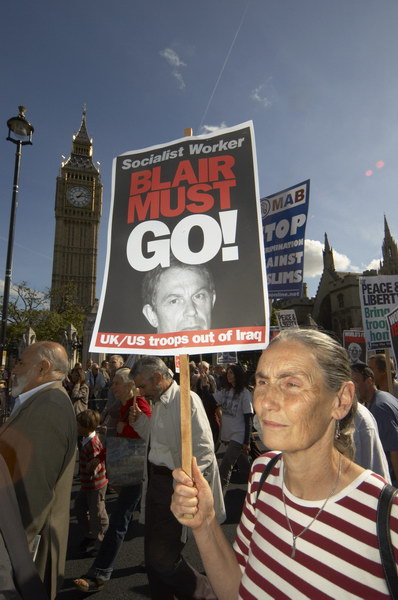
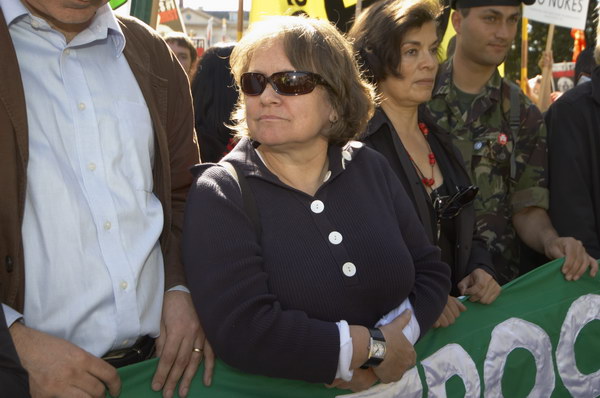
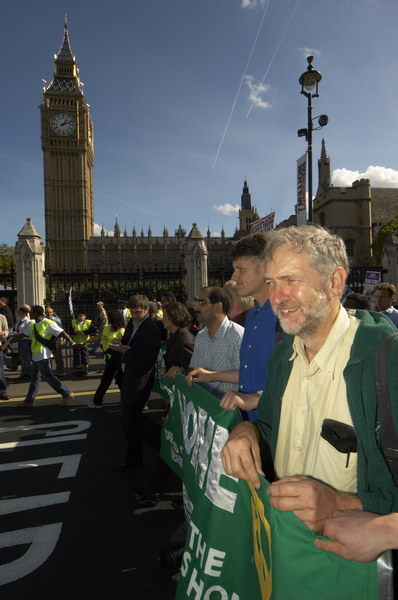
More at Britain First & EDL exploit London attack.


UAF protest extreme right marches

Police had decided that the UAF could only hold a static protest on the Embankment rather than their intended and already advertised march to there from South Africa House in Trafalgar Square, despite ‘facilitating’ the two extreme-right marches. The UAF had turned up at South Africa House on the morning and police had slowly with unnecessary force pushed them down the march route as I’d witnessed earlier in the day.

From the EDL rally I could see and just hear the Unite Against Fascism rally taking place perhaps a hundred yards away down the Embankment, shouting ‘Fascist Scum off our streets’ and other slogans. From the speeches I had heard at the two right-wing rallies both groups were clearly racist and Islamophobic and among the marchers I recognised many faces from clearly fascist organisations I had photographed in the past.

I could see and hear that there were speeches at the UAF rally but not make out what was being said from the distance and over the noise. I tried to walk down towards the UAF but police would not let me take the short direct route despite my showing my press card.

I had to walk back and out onto Whitehall and then around to get to be back of the UAF rally, and by the time I got there many of the counter-protesters had left for home and the speeches had ended, though there were still rather more around than at the two right-wing rallies combined.

UAF protest extreme right marches


Ford/Visteon, Ethiopian Tyrant, Rioters United!

On Wednesday 31st March 2010 I reported on three unrelated protests in London.


Ford/Visteon Workers March For Pension Justice

Ford/Visteon, Ethiopian Tyrant, Rioters United!

In 2000 Ford when split of some of its parts factories to Visteon, a company described as ‘An Enterprise of Ford Motor Company’ and initially with the same shareholders, promising the workers their conditions and pensions would remain exactly the same as they had been with Ford. Ford’s assurances were repeated by Visteon.

Ford/Visteon, Ethiopian Tyrant, Rioters United!

But in 2009 Visteon closed down and workers in their factories in Belfast, Enfield, Swansea and Basildon were given just six minutes to leave the sites. In Belfast and Enfield workers refused and occupied the sites for a month, but were let down by their union, Unite who failed to give them support. The occupations eventually forced Visteon/Ford to pay the redundancy pay they were entitled to under their agreements, but pensions were not covered and they only received the lesser amounts covered by Pension Protection Fund compensation.

Ford/Visteon, Ethiopian Tyrant, Rioters United!

Since then their fight for the pensions they were promised has continued. I met around 500 former Visteon workers outside the Unite Offices in Theobalds Road, Holborn, where many wore hats and t-shirts with the Ford logo, but with the name replaced by the word ‘Fraud’, which succinctly expressed their view of the company’s action.

Ford/Visteon, Ethiopian Tyrant, Rioters United!

I marched with them to Downing Street where they had problems in delivering a letter and petition. As I commented then: “it does now seem unnecessarily complicated and difficult to get access to our elected government, hiding away behind their tall gates and high security. Its both an expression of and doubtless fuels their paranoia over terrorism far in excess of the real threat.

The marchers then went on to a rally in Parliament Square.

Their fight for a fair deal over their pensions went on for another four years, when eventually as the case was about to go to the High Court, Ford agreed to top up the Pension Protection Fund compensation so that they would receive the full value of benefits accrued when working for Ford. It didn’t cover the nine years they had worked for Visteon, but Unite recommended acceptance as it would settle the claim without the expense (and possible failure) of a court hearing.

Ford/Visteon March For Pension Justice


Ethiopians Protest Bloodthirsty Tyrant – Downing St

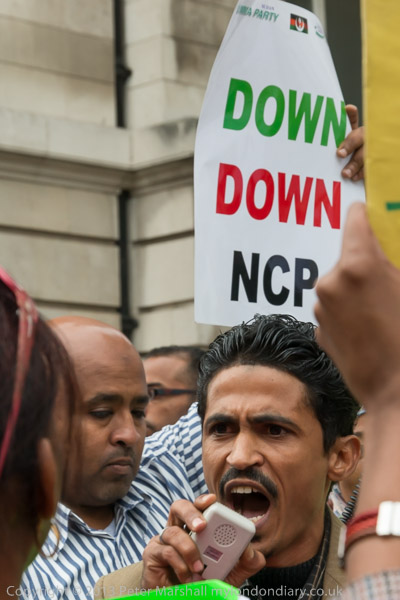
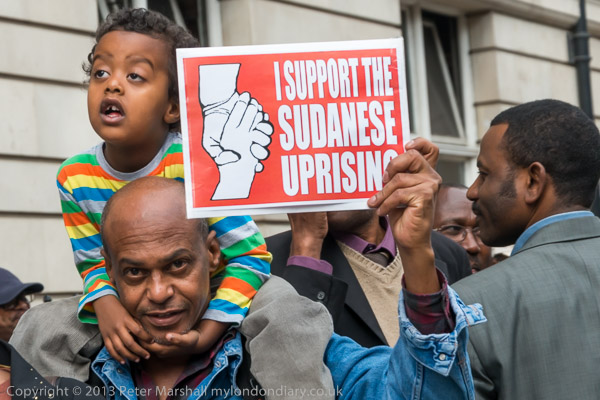
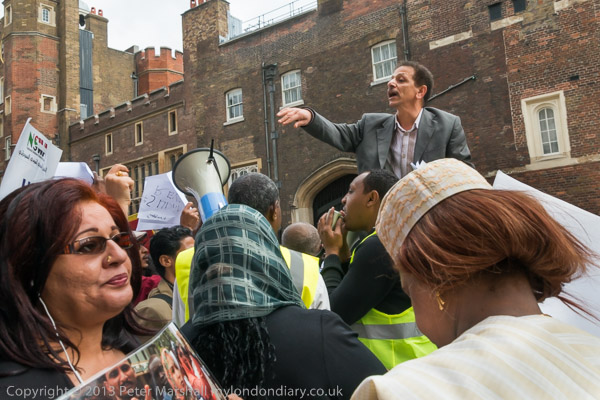
Ethiopians came from across the UK to for a day of demonstration opposite Downing St where Prime Minister Meles Zenawi was co-chairing the UN climate finance group. They demanded the UK stop appeasing the Ethiopian dictator, and calling for the release of opposition leader Birtukan Mideksa and other political prisoners in Ethiopia.

Zenawi who became chair of one of the leading military groups fighting in the Ethiopian Civil War was the leader of a coalition that took power in 1991, becoming President then and was Prime Minister from 1995 until is death in 2012. His control of the military made Ethiopia an effective one-party state.

Although the country formally has democratic organisation and elections, elections have been rigged and oppostion politicians jailed, notably the leader of the main opposition Unity for Democracy and Justice (UDJ) party, Mideksa (or Midekssa), a former judge. Many other politicians and journalists have also been jailed and in 2007 the Committee to Protect Journalists (CPJ) named the country as “the world’s worst backslider on press freedom over the previous five years.”

Human rights violations and corruption are rife in Ethiopia, and food aid, education and jobs all depend on membership of the ruling party. His opponents regard Zenawi as a bloodthirsty tyrant and call for him to be brought to trial at the ICC at The Hague on charges of genocide. Human Rights Watch (HRW) have accused it of war crimes in the Somali regions of Ethiopia and against the Anauk communities in Gambella in 2003-4. Human rights abuses have continued in Ethiopia since Zenawi’s death.

Ethiopia is one of the larger countries in Africa and has received large amounts of development aid and humanitarian support from the USA and the UK.

Ethiopians Protest Bloodthirsty Tyrant


Rioters United! 20 Years Since the Poll Tax Riots – Trafalgar Square,

The largest protest against Margaret Thatcher’s Poll Tax was in central London on Saturday 31 March 1990, shortly before the tax was due to come into force. Unfortunately I had missed that event, probably deciding it was best to keep out of trouble. Back in 1990 I was photographing relatively few protests, mainly concentrating on urban landscapes and culture.

Around 30 people turned up for a rally to commemorate the occasion when “the London mob who brought Thatcher down … as well as to promise that the mob were still in business and to pronounce sentence on politicians.”

The ‘Carnival of Death‘ they were promising was not of course a literal death threat, but street theatre in which the effigies of George Brown, David Cameron, Nick Clegg and Nick Griffin were to be executed at a May Day Party. As Chris Knight reminded the gathering, “the only good politician, the only honest politician is a dead politician.”

Our police often fail to understand the difference between rhetoric and reality, and protests involving anarchist groups such as Class War are often ridiculously over-policed, sometimes with disastrous consequences, but almost always provoking more violence than they prevent. On April 1st 2009 for the G20 – Financial Fools Day they had turned up with squads of riot police psyched up to batter largely innocent and joyful protesters – and one of the police killed a newspaper seller simply walking home through the area.

So in my account of this event in Trafalgar Square I was at pains to tell them that the ‘Carnival Of Death’ was “called a carnival; if you want to take part, come ready to dance.”

Shortly after people began the commemoration, a PCSO came to tell those taking part they were not allowed to hold protests or other events in Trafalgar Square without permission. When he was laughed at, he brought over a Heritage Warden who told us the Square was the property of the GLA (Greater London Authority), and that permission was needed for events.

Fine” said those present. “The GLA is a public body; we own it, this is a public place and we give ourselves permission and intend to continue.” As I pointed out in my account, Trafalgar Square is not just a public place, but one that since its building in the 1830s has been a traditional place for demonstrating radical dissent. It was a tradition that those present were determined to continue.

Fortunately the dozen or so police who arrived shortly after the PCSO had phoned to call for reinforcement simply stood and watched and had enough sense not to try and stop the commemoration, which ended after around 30 minutes when the organisers decided it was time to go down the pub.

At the end of the event, copies of an anti-Election manifesto and a suitably defaced poster showing the leaders of the Labour, Conservative, Liberal Democrat and BNP leaders were distributed by the Whitechapel Anarchist Group. They advised us to “Use your cross wisely”, under a picture of the four leaders in the cross-hairs of a gun sight, and attached to the bottom was a ‘Free Gift’ – a safety match, with the message ” Burn Your Ballot”.

As they wrote: “It’s time to end the unjust, corrupt system of terror and build a fair, equal society that will benefit the majority. We all know voting doesn’t change anything and our collective apathy allows this folly to continue. It’s time for REAL change. It’s time for revolution.”

Rioters United! celebrate Poll Tax Riots


Brexit Day – 31 January 2020

The UK finally left the on 31st January 2020. The wrong decision taken for the wrong reasons and one which we will continue to suffer from for many more years.

But having thrown out the baby the government are still busily throwing out the bath water. Three years on their are just some small signs that our government is beginning to realise this and finally get down to some serious dialogue with the EU over at least some of the problems it has caused rather than make threats and silly demands. Though any progress is still likely to be blocked by the Tory far right, at least until the next General Election.

But on that day, three years ago, there were groups in Westminster both celebrating and regretting Brexit, and I spent some time photographing both of them.


Brexiteers celebrate leaving the EU – Parliament Square

Brexit Day - 31 January 2020

I arrived in Parliament Square long before the more official celebrations were due to begin, but it was already beginning to fill up with Brexiteers, many with Union Flags, celebrating.

Brexit Day - 31 January 2020

Some had placards and posters repeating the idle hopes on which much of the Leave campaign had encouraged – and lied about. By now perhaps some at least will be realising that much of what they had been promised was illusory. It’s really hard to find anything positive that has come out of Brexit which has left a huge trail of broken promises.

Brexit Day - 31 January 2020

Of course the people who made most of these never believed them. They supported leaving because it would enrich them greatly and never mind the nation. Some made huge profits, others were more concerned about protecting their obscene wealth from an EU that was beginning to tighten restrictions on offshore funds and other scams.

Brexit Day - 31 January 2020

But the in main, most just came with union flags and posters about being ‘free’, ironic when we now have a government that has done more to restrict our freedoms than any other in our history, and is still hell-bent on removing much of the protections on our liberty which came from not just the EU, but also from the UN Universal Declaration of Human Rights which our government in 1948 played a central role in establishing.

The UK parliaments The Human Rights Act 1998 incorporated the rights set out in the European Convention on Human Rights (ECHR) into domestic British law. In its new bill, the UK will join with Russia and Greece (when under military dictatorship), as the only countries to have abandoned the ECHR.

There were just a few of the more lunatic fringe present and I largely managed to avoid them. I left a couple of hours before the square really became crowded – the official celebrations were timed for much later in the day.

Brexiteers celebrate leaving the EU


British National (Overseas) Passport Holders – Old Palace Yard

There were more union flags a few yards away in Old Palace Yard, but this turned out not to have any direct connection with Brexit. Holders of British National (Overseas) Passports from Hong Kong were calling for the UK government to identify BNO holders as British Nationals and grant their children British Nationality.

BNO passports were a device invented in the talks between China and the UK over the future of Hong Kong, and give no right of abode in the UK and the special status is not passed onto children. Only those who could provide evidence of not being of Chinese origin qualified for them. These were sham passports, a compromise driven by both British institutional racism refusing to give full British citizenship to the Chinese and Chinese nationalism wanting to keep Chinese as citizens of China.

Further repression in Hong Kong led exactly a year later to the UK Government setting up an immigration route on 31 January 2021, providing British National (Overseas) passport holders from Hong Kong and their eligible dependants with the opportunity to come to the UK to live, study and work, on a pathway to citizenship. The government stated that this reflected the UK’s historic and moral commitment to those people of Hong Kong who chose to retain their ties to the UK by taking these passports.

British National (Overseas) Passports


Extremist Brexiteers Behaving Badly – Whitehall

Supporters of staying in the European Union had come to Downing Street for procession to the European Commission at Europe House in Smith Square to say goodbye. Extreme right wing Brexiteers came there to abuse and attack them, with police trying hard to keep the two groups apart.

A few tried to talk reasonably with the EU supporters, but most were there just to shout insults and gloat that we were leaving, calling them traitors and telling them they were not British, bad losers and more.

Police eventually moved them away to the centre of Whitehall facing the pro-EU group. There, surrounded by photographers they tried to set fire to EU flags. This proved difficult as the flags were nylon which doesn’t burn well and had to be assisted, mainly by a flammable aerosol spray.

Extremist Brexiteers Behaving Badly


À bientôt EU, see you soon

Finally the procession of EU supporters set off on their march from Downing Street to the European Commission at Europe House in Smith Square.

They went to “bid a fond farewell to our much loved friends in the EU, hoping that we will be united again one day soon“. As the organisers wrote, for many this “may be a sad day but let’s celebrate the 47 years we were in the EU and all we contributed and the positive influence it has on our country.”

The march had been organised to take place much earlier in the day than the official Brexit celebrations in an attempt to avoid any confrontation, but as well as the few extremists who came along to cause trouble at Downing Street there there were continued jeers from Brexiteers as they made their way down Whitehall and through Parliament Square.

At Europe House staff came out to greet them and were handed flowers as they bid goodbye, celebrating 47 years of cooperation and hoping that we will be reunited with Europe before too long. As they said outside Europe House, they are no longer remainers but rejoiners.

I finished my report: “I went home. I’d had enough of Brexit. We will have to live with its consequences for some years and I’m not looking forward to it. Times are likely to be tough for the poor, the disabled, the sick and for workers generally, including most of those who voted for it and were celebrating in Parliament Square. The wealthy will of course gain – not least by avoiding the clamp down on tax evasion which the EU is now beginning.”

À bientôt EU, see you soon


Stop Trident & Occupy Democracy

On Saturday 24th January 2015, eight years ago, I photographed three protests against the replacement of our so-called independent nuclear deterrent, Trident with new nuclear submarines and missiles and Occupy Democracy asserting the right to protest and challenging the attempt by then London Mayor Boris Johnson to prevent protests in Parliament Square.


Christian CND against Trident Replacement – St Martins-in-the-Fields to Whitehall

Stop Trident & Occupy Democracy

I began work at St Martin-in-the-Fields in Trafalgar Square with a Christian CND service. Thet held a long piece of the seven mile knitted pink peace scarf which had been joined together the previous August between the UK atomic bomb factories at Burghfield and Aldermaston on Nagasaki Day in a protest against the senseless waste of £100bn in replacing Trident missiles, which would clearly breach the nuclear non-proliferation treaty.

Stop Trident & Occupy Democracy

CND has since revised the figure of the costs of this senseless programme, which was stated by the defence minister in the parliamentary debates and in the November 2015 National Security Strategy and Strategic Defence and Security Review to be £31 billion. This turned out to be simply the estimate for the four new submarines. Using government figures CND later calculated the total cost to be £205 billion, well over a year’s total spending on the NHS. And of course like all defence programmes it will end up costing considerably more. Of course cost is not the main reason why people oppose nuclear weapons but this is an entirely senseless waste of resources that should be put to better use.

Stop Trident & Occupy Democracy

After their brief service they walked with the part so the scarf to the main CND protest against Trident replacement outside the Defence Ministry.

Christian CND against Trident Replacement


Wrap Up Trident’ surrounds Defence Ministry – Whitehall

Stop Trident & Occupy Democracy

Several thousand CND supporters met at the Defence Ministry before surrounding the block with a knitted peace scarf and then moving off for a rally opposite the Houses of Parliament calling for the scrapping of the UK’s Trident missiles.

A group held the front of the scarf outside the Ministry of Defence building in Horseguards Avenue and then led off down Whitehall, left into Bridge St and left again up the Embankment and back to the MOD. While the leaders set off with the scarf at a cracking pace, gaps soon developed further back as those adding lengths from the many rolls of scarf were unable to keep up. So while there was far more scarf than needed to wrap the whole block – and it went back and forth on the river side of the ministry – it may never have entirely joined up completely.

When the leading group arrived back at the MOD there where certainly people spread out along the whole of the course holding parts of the knitting, and most seemed at a loss of what they were supposed to do next. Eventually the message came for them to walk on and take their pieces of knitting back to the MOD.

Here the knitted and crocheted lengths of scarf were rolled up. Rather than being wasted most of it was later turned into blankets for refugees, with just a few of the more interesting lengths being retained for further protests and displays.

The CND supporters then marched the short distance down Whitehall and Parliament Street and on to Old Palace Yard where they were to hold a rally.

Many more pictures at ‘Wrap Up Trident’ surrounds Defence Ministry.


CND Scrap Trident rally at Parliament – Old Palace Yard,

Lindsey German of Stop the War

Among the speakers were at the rally were Lindsay German,

Jeremy Corbyn, Labour MEP Julie Ward, Shahrar Ali, the Deputy Leader of the Green Party,

Kate Hudson and

Bruce Kent of CND,

Rebecca Johnson, an internationally-recognized expert on nuclear disarmament and non-proliferation,

Heather Wakefield of UNISON, the Rt Revd Alan Williams, Bishop of Brentwood, Khalil Charles from the Muslim Association of Britain, Ben Griffin, of Veterans for Peace,

and Angie Zetter, who thought up the idea of the peace scarf.

The rally ended with a new song composed for the occasion by Leon Rosselson. There are more pictures including all the speakers and those in the crowds at the rally at CND Scrap Trident rally at Parliament.


Occupy defy GLA ban on Democracy – Parliament Square

As people streamed away from the CND Trident protest, several hundred supporters of Occupy Democracy most of whom had been at the CND protest walked on to the grass of Parliament Square to hold discussions on foreign relations and war as the GLA private security guards (Heritage wardens) and police watched.

This was one of a series of monthly events in which Occupy are asserting the right to protest and challenging the attempt by London Mayor Boris Johnson to prevent protests in Parliament Square.

Police and the Mayor’s ‘Heritage Wardens’ watched the protest. I followed the wardens as they went across to the police and asked them to take action to stop the protest. Police lacked the officers needed to take effective action and if they had tried to do so many more of those leaving the CND protest would have joined those on the square. They told the wardens that the protesters would eventually leave of their own accord, which apparently they did a few hours later.

More pictures at Occupy defy GLA ban on Democracy.


Heat, Democracy & Gaza – 2014

Some issues stay with us – and it seems they will never go away. But things can change and do change, and I remember the long years of protest against apartheid in South Africa. But apartheid is now going strong in Israel, and things are even worse so far as democracy and fuel poverty are concerned in this country. There seems little hope now that even if Labour were to get into power things would become any better.

More and more people are getting expelled from the Labour party including many for expressing support for Palestine, including some leading Jewish members and prominent anti-racists as the party lurches towards a right-wing dictatorial stance. I’m not a party member – and would soon be expelled for what I’ve written over the years here and elsewhere were I to join, including this post. But I did vote for Labour for over 50 years though at the moment I can’t see myself ever doing so again.


Dying For Heat – Downing St, Saturday 20th Dececember

Heat, Democracy & Gaza - 2014

It makes me feel frozen just to look at this picture. It wasn’t quite as cold as it has been here over the past week but was still pretty chilly back in 2014. I would have been wearing an extra layer of thermals under a heavy jacket, scarf hat and long johns. Photography usually involves a lot of standing around and keeping warm in winter is often hard.

Heat, Democracy & Gaza - 2014

This small group of protesters had been there since 8am, around three hours by the time I arrived determined and they were determined to complete a 24hr vigil to draw attention to the impact of fuel poverty which killed more than 10,000 in the UK in 2012/3.

Heat, Democracy & Gaza - 2014

Others came for shorter periods over the day to support them and Fuel Poverty Action’s ‘Energy Bill of Rights‘ to protect the poor and end these deaths. None of the eight points in this have been taken up by the government and energy costs have risen sky high in the past year. The government blames this on Putin’s invasion of Ukraine, but this fails to explain why people in the UK are paying far more than those in other countries across Europe – and their blatant lies over this don’t fool many.
More at Dying For Heat.


Occupy Democracy Return To Parliament Square – Sat 20 Dec 2014

Heat, Democracy & Gaza - 2014

Police and private security ‘heritage wardens’ watched from the fenced off grass as protesters held a rally on the paved area at the edge of the square facing the Houses of Parliament. This is not covered by the bylaws that prohibit protests on the square without official permission.

The grass had been ‘temporarily closed’ and fenced by the Greater London Authority, officially for ‘important works‘ but actually simply to deny access to people who wanted to engage in this peaceful discussion about democracy – and of course to everyone else who might want to be on what is normally a public square. There was no sign of activities of any kind being carried out on the grass or pavements under GLA control in the square.

A series of speeches and other activities was planned calling for real democracy in a Britain where 3.5 million are living in poverty. The first speaker was the then Green Party Deputy Leader Shahrar Ali, and after speaking he responded to a lengthy and wide-ranging question and answer session about Green Party policies.

Following this was to be another performance of the Fossil-Free Nativity which I had photographed two weeks earlier, so I left to go elsewhere, returning briefly later in the day when activities were still proceeding.

More at Occupy Democracy Return To Parliament Square.


Don’t Buy Israeli ‘Blood Diamonds’ – Bond St , Sat 20 Dec 2014

Campaigners came to Bond Street to protest outside shops there which sell diamonds cut and polished in Israel, which are the main source of funding for Israeli military attacks on Gaza. Many diamonds cut there come illegally from conflict zones. Palestinians have called for a boycott of all Israeli diamonds.

Israeli attacks on Gaza had led a decline in tourism and other exports of goods and services but increased diamond sales have helped Israel fill the gap, and are said to provide $1 billion a year to the Israeli military.

My post on My London Diary includes details of some of the Israeli diamond companies and their activities which include the sponsorship of the notorious Givati Brigade of the Israeli army, accused of war crimes in Gaza by the UN Human Rights Council and responsible for the Samouni family massacre.

I photographed the protest outside De Beers, the worlds largest company involved in rough diamond sales and Leviev, whose company is reported by the New York Times to be “the world’s largest cutter and polisher of diamonds” and which is also involved in the construction of illegal Jews-only settlements on the West Bank.

There were speeches about the involvement of the diamond companies in Israeli military attacks on Gaza and many people passing the protest took fliers calling for a boycott of Israeli diamonds and expressed their support. There were also a few who clearly disapproved of the protest, including just one man who stopped briefly to hurl a few insults while I was there.

More at Don’t Buy Israeli ‘Blood Diamonds’


Extinction Rebellion Funeral, Iran Protest – 2018

Saturday 24th November 2018 was the second day of action in London by Extinction Rebellion calling for urgent action over the climate crisis which threatens the future of life on Earth. After photographing their protest I walked through Trafalgar Square where Iranian activists were calling for the release of political prisoners in Iran.


Extinction Rebellion Parliament Square

Extinction Rebellion campaigners gathered in Parliament Square and set up road blocks to prevent traffic moving on the roads leading into the square.

Police tried to move the protesters who were blocking the road, but they refused to move and some had ‘locked on’ to make their removal more difficult and time-consuming.

On the grass in the middle of the square a rally began with the mass reading of XR’s Declaration of Rebellion, which was followed by a number of speeches and musical and poetry performances related to the forthcoming environmental collapse.

Many had come with flowers for a funeral and eventually grave-diggers began to dig a hole in the centre of the crowd for the coffin. They carefully cut the turf and set it aside in squares to avoid damage before beginning to dig down into the hardened earth.

Then the police pushed their way in from one corner of the square through the crowd who had linked arms to stop them approaching. They trampled the area, destroying the carefully piled up turf and pushing the protesters back. The crowd remained non-violent but tried to hold their ground, standing and facing the police who pushed them roughly and shouted in their faces.

Soon the police were in the centre of the large crowd, standing on the area where XR had begun to dig the grave.

Pall bearers arrived in the corner of the square carrying a black coffin with the text ‘OUR FUTURE’ on its side and lilies on top. Police stopped this and were again soon surrounded by a large crowd of XR supporters as well as photographers and legal observers.

Eventually the XR organisers decided it was time to abandon plans for the burial in Parliament Square and began a funeral procession.

Extinction Rebellion Parliament Square


Extinction Rebellion Funeral Procession – Whitehall & The Mall

Campaigners formed up behind the behind the coffin, with its message ‘OUR FUTURE’ for a funeral procession, led by drummers and a trumpeter.

The procession made its way slowly up Parliament Street to Whitehall coming to a halt at Downing Street where there was a silent sit in for several minutes.

After the main body of campaigner moved off, some stayed behind and lay on the roadway to form the XR symbol for a few minutes before getting up to rejoin the procession.

There were several arrests on Whitehall as a few protesters sprayed slogans or wrote on walls of government buildings and a memorial. A few police tried to stop the procession as it turned into The Mall, but soon gave up as people simply walked past them, continuing on its way to Buckingham Palace.

Extinction Rebellion Funeral Procession


Extinction Rebellion Buckingham Palace

The coffin halted in front of the gates of Buckingham Palace, where the bearers lifted it high in the air – but the gates were much higher.

They put it down on the ground and began shouting for climate action.

XR posed for a group photo in front of the palace and then

Gail Bradbrook read out a letter calling on the Queen to get her government to take the urgent action needed to save her country – and the world

before the crowd was led again in reading their Declaration of Rebellion. After this there were a few more speeches and a silence to remember those already killed by global warming, and the species that have become extinct.

During the silence those who had brought flowers, wreaths and other objects then laid them on the coffin in front of the palace gates. After this ceremony there was music and dancing but I was tired and walked back to catch a bus in Trafalgar Square.

Extinction Rebellion Buckingham Palace


Free Political Prisoners in Iran – Trafalgar Square

As I walked across Trafalgar Square to catch a bus in Duncannon Street I met activists from the Worker-Communist Party of Iran – Hekmatist who were protesting in solidarity with the Iranian People’s Struggle and calling for the release of all political prisoners.

Many opposition politicians were arrested earlier in 2018 following widespread protests in cities across Iran, and there have been many executions. The protesters called for all of the political prisoners to be released and the executions to stop, and for there to be properly independent trade unions in Iran.


Students March against Fees and Cuts – 2012

A student displays the #DEMO2012 t-shirt

One of the main issues that led to a huge slump in votes for the Liberal Democrats in the 2015 General Election was their support as a part of the Conservative-Lib Dem coalition government for increasing student fees. In 2010, there were 57 Liberal Democrat MPs, but their number fell to 8 in 2015, and has only recovered slightly in the two following elections, with currently 11 MPs. Of course the drop is exaggerated by our first past the post electoral system which is grossly unfair to minority parties, but it still reflects an enormous drop in public confidence in the party.

Students March against Fees and Cuts - 2012

Before the 2010 election, the Lib-Dems had been seen as a moderate centrist party opposed to both Tories and Labour, but their actions in the coalition shifted perceptions; in many eyes they became seen as simply a rather lightweight branch of the Conservative Party and certainly no longer a credible opposition.

Students March against Fees and Cuts - 2012

It was the Labour Party who had introduced student tuition fees under Blair’s New Labour government in 1998, setting them at £1,000 a year. New Labour again raised them in 2006 to £3,000. But in 2012 the Tory Lib-Dem coalition tripled them again, to £9,000 – so totalling £27,000 for a normal 3 year course. The fees were stated to be a maximum, but it was soon what almost all universities were charging.

After World War 2, most local authorities had provided maintenance grants for students, enough to cover their living costs for the roughly 30 weeks a year of most courses. The 1962 Education Act made this a legal obligation; the grants were means-tested with a minimum of around a third of the full grant, with wealthier parents being expected but not obliged to make up the difference. But all of us from poorer families got the full grant.

When the Tories under Mrs Thatcher replaced these grants with student loans in 1980 there was an immediate fall in university applications – the 1981 figures showed a drop of 57% from 1979. The loan system was a boon to students from wealthy homes, taking the obligation from their parents for supporting them – and at the start the terms of the loans made it an advantage for rich students who had no need for them to take them out. Since then the terms of the student loans have worsened considerably.

Many have since found that with rising costs the maintenance loan available isn’t enough to pay for their accommodation and food and some need to take out more expensive loans than the student loan to keep alive during their course. I’ve seen too the long queues for the free food offered by Hare Krishna in Bloomsbury at lunchtimes, and students have also had to go to food banks and other places offering support.

Many students now work during term-time, some putting in long hours in bars and other part-time work which must affect their studies. When I was a student, taking paid work could have led to me being thrown off my course, although of course I did work during vacations, and needed to, as these were not covered by the grant.

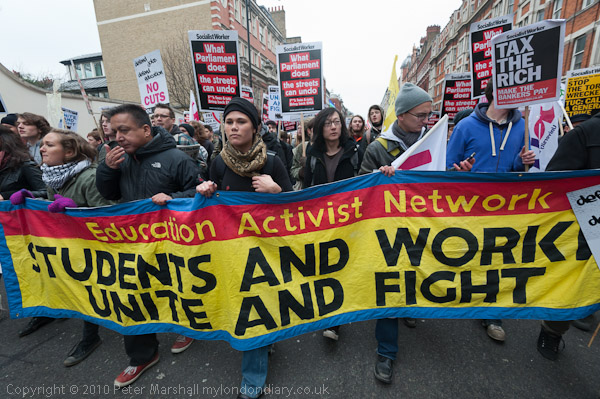
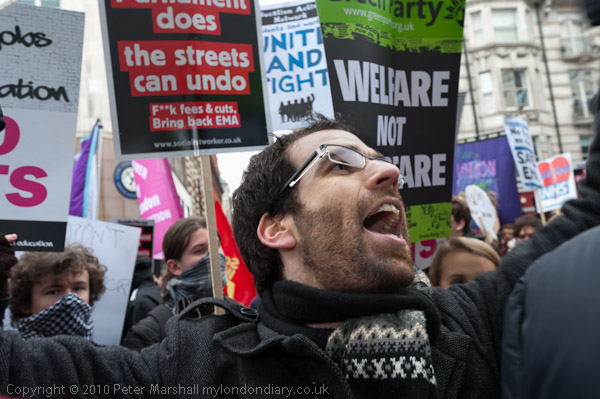
Higher education students are not the only ones who were suffering from the cuts made by the Coalition government. Younger students, 16-18 year olds still in schools, sixth form colleges and FE, were angry at the loss of the Educational Maintenance Allowance (EMA) of up to £30 per week, which many needed to pay their fares to college and to buy midday meals while studying.

And as I pointed out “Students are also concerned about other cuts being made by the government which will affect them, and also by the increasing efforts to privatise the education system at all levels. There were also many placards pointing out the class-based nature of our education system and our government, with a cabinet stuffed with privately educated millionaires who appear to have little idea of how difficult times are for ordinary people and no real sympathy for them.”

Since the student protests of November and December 2010 the police had become very worried about the possibility of violent scenes – often provoked by police action – at student protests, and were out in force. The march organisers too had agreed a route with the police which would cut down the possibilities, taking the marchers across Westminster Bridge to end with a rally in Kennington Park, well away from any government ministries and Tory and Lib-Dem party headquarters. This was a peaceful protest although the roughly 10,000 attending were clearly very angry and small groups who attempted to break away from the protest in Parliament Square where the march stopped for a photocall and many sat down on the road were fairly soon moved on.

There were still a few sitting on the road or standing around outside parliament when I decided to leave; it was raining slightly and dark clouds suggested a downpour was on the way. I decided nothing more was likely to happen at Westminster and that a rally in pouring rain was unlikely to be of great interest and started on my way home.

More at Students March on Parliament.