Protests – May 16th 2015

The purpose of protests is to bring whatever cause they support to the attention of others, particularly those who bear some responsibility for them or who could act in a different way to address the problem that led to the protest.

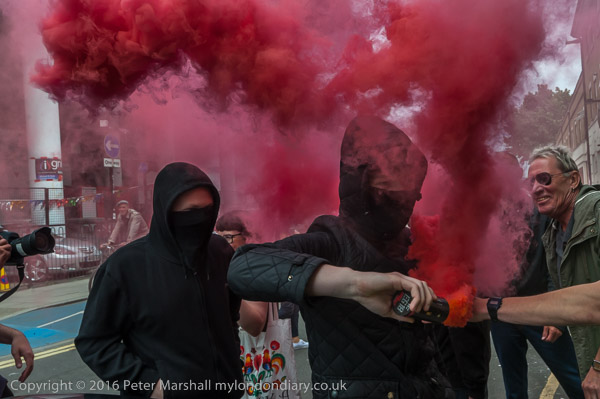
The current Police, Crime, Sentencing and Courts Bill seeks to make protests entirely ineffectual – allowing police to insist they will only take place where they will not be noticed and banning them from making any noise or causing any inconvenience. Given the Tory majority and the lack of concern for civil rights shown by most MPs it seems likely to come into force, but I think unlikely to actually be enforceable by police, though it will lead to clashes and arguments which will greatly reduce public trust in the force.

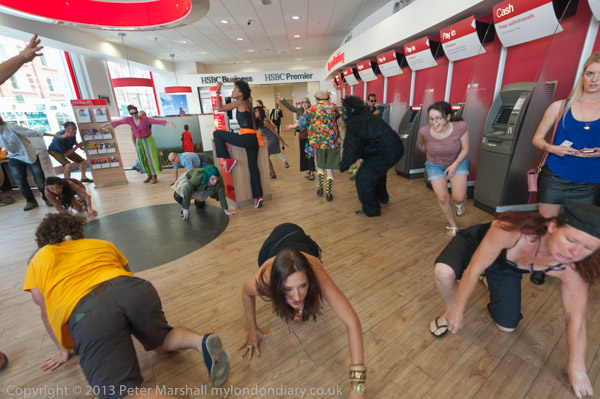
On May 16th 2015 I was privileged to be able to cover a protest by the grass roots trade union United Voices of the World from their meeting before the protest to the end of the event. Most of the members are low-paid migrant workers and most of the business was conducted in Spanish, with some key items translated into English for the benefit of me and the few other non-Spanish speakers.

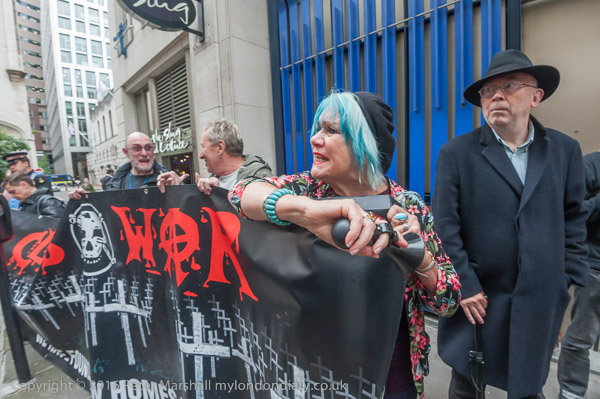
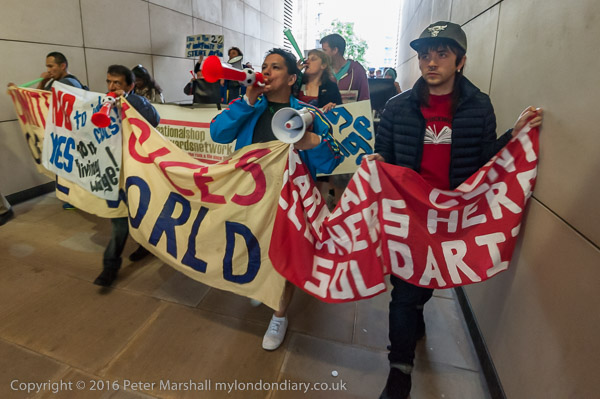
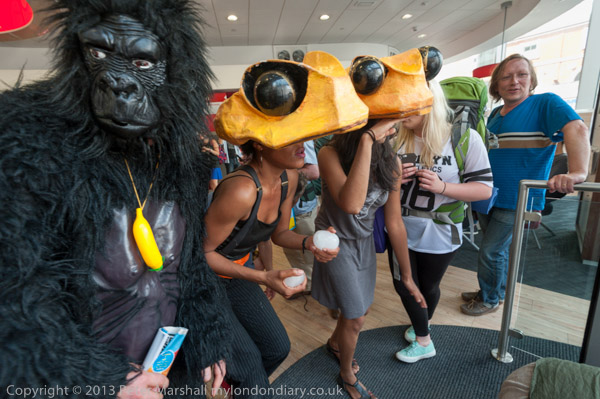
From the meeting in Bethnal Green we travelled by bus to Liverpool St and then walked quietly as a group to meet up with others close to the Barbican. Many were carrying drums, flags and placards as they rushed past the two security guards on the door of the centre who held up a couple of them but couldn’t stop the rest, and the group made its way to the heart of the Barbican Centre, where people were already gathering for evening performances.

Rather than employ cleaners directly, the Barbican Centre uses a contractor, Mitie. The Barbican is a relatively good employer and offers its employees decent terms and conditions, but MITIE cuts costs to a minimum and has threatened the cleaners with sacking if they protest for a living wage and proper sick pay and other conditions, and the union says they employ bullying managers who disrespect staff and fail to provide proper working conditions. One disabled worker had recently been assaulted by a manager and accused of ‘terrorism’ after posting a short video clip showing his working conditions.

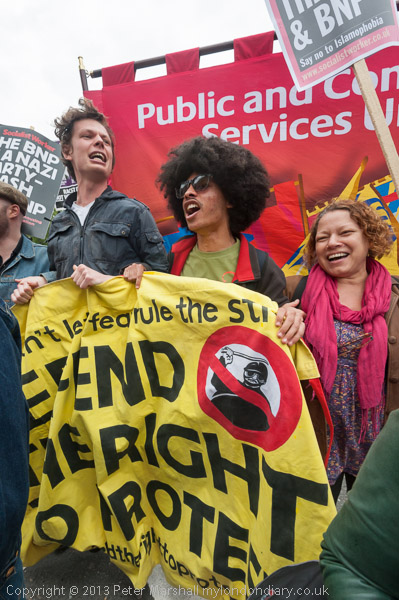
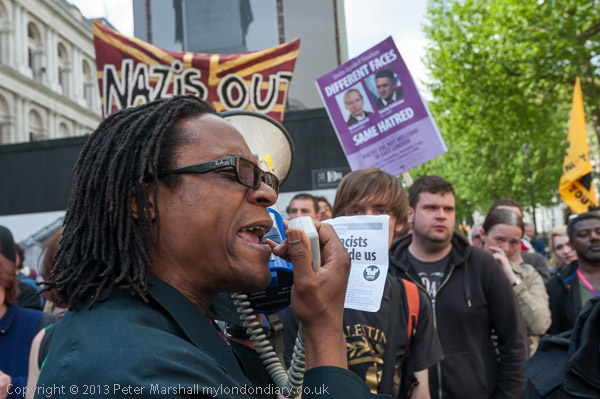
The protesters held a short noisy protest, using a megaphone to let the public know why they were protesting and calling for an end to the victimisation of trade unionists and for negotiations to get satisfactory conditions of work and service and a living wage. They called on the Barbican to meet its obligations to people who work there by insisting that any contracts they make include safeguards to protect the workers – rather than denying any responsibility for those who keep the centre clean.

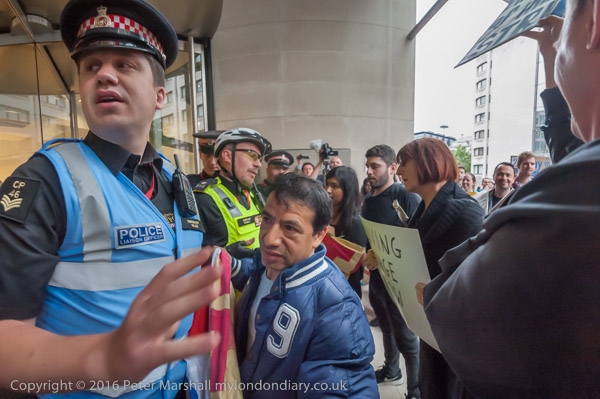
After a few minutes, police arrived and argued with the protest organiser Petros Elia who agreed to move, and the protesters then went on a walk around the centre to make sure all those in it where aware the protest was taking place and why the union was protesting. Finally they agreed with police to leave the centre, going out the way they had come in and rejoining members who worked at the Barbican who had stayed outside to protest. The protesters then walked around some of the public streets around the Barbican before returning to protest in front of the main entrance, where I left them still protesting noisily.

Under the Police, Crime, Sentencing and Courts Bill all of this would have been illegal, and perhaps they might have been allowed just a small and quiet display some distance across the road from the centre, which few would have noticed.

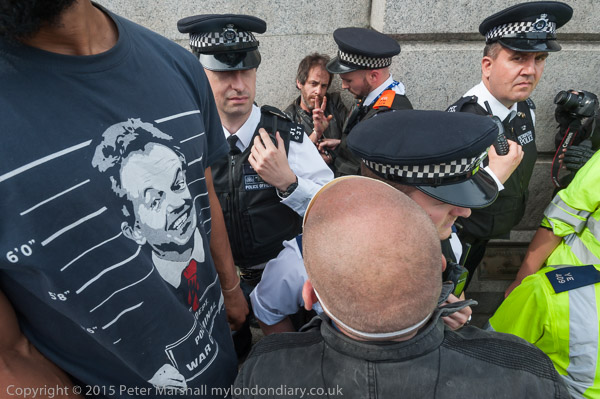
I’d earlier photographed three other protests, two of which I’m sure would have fallen foul of the proposed new law. Newham Council had been trying to get rid of Focus E15’s weekly street stall in Stratford Broadway since it started almost two years earlier, and today’s protest celebrated the dropping of a contrived case against Jasmin Stone, one of the protest leaders. Later in the year the police and council came and ‘arrested’ the Focus E15 table – but had to release it a few days later.

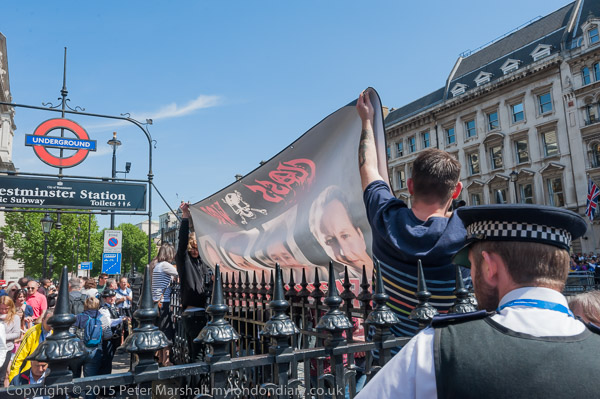
While it might have been possible for the Free Shaker Aamer campaign to get permission for their protest on the North Terrace of Trafalgar Square, I think their activities and use of the megaphone would have been severely curtailed.

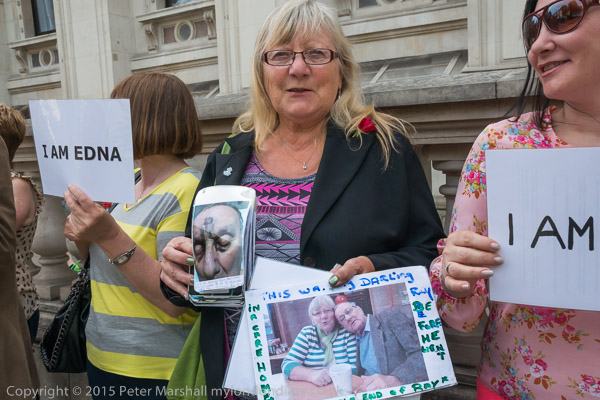
The small, silent ‘Stay Put’ vigil – seven people holding posters in silence by the wall in a corner of the square – is perhaps a model of what Priti Patel considers an acceptable level of protest. Though more probably she would like to go full North Korea.

Cleaners invade Barbican Centre
Silent protest over Sewol ferry disaster
Caged vigil for Shaker Aamer
Victory Rally For Jasmin Stone

London 14 May 2016

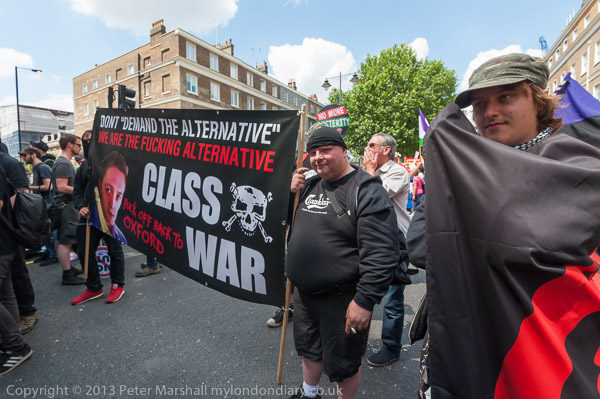
Class War at UVW protest against Topshop sacking and suspensions of cleaners

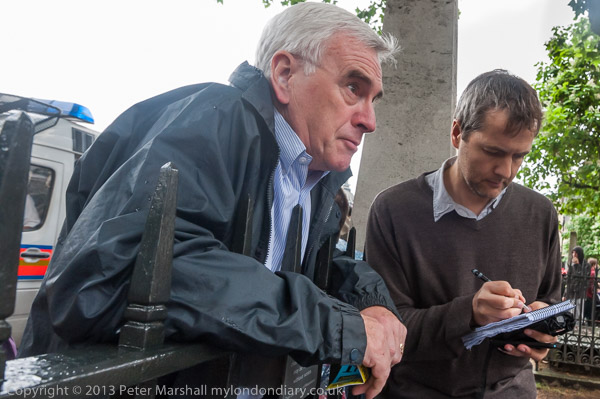
May 14 has always been a special day for me, and five years ago I celebrated my birthday on the streets of London photographing various protests around town before going home to a more private event. The day’s work ended for me on Oxford St, where the United Voices of the World union were protesting against Philip Green’s Topshop after members who work as cleaners were suspended and one sacked for their union activities – demanding the London Living Wage. The protest was supported by other groups including Class War, cleaners from the CAIWU and other trade unionists including Ian Hodson, General Secretary of the BWAFU and Shadow Chancellor John McDonnell. Although Philip Green makes millions, the cleaners were on the national minimum of £6.70 per hour, nothing like a enough to live on in London.

Police were out in force to prevent the protesters entering the Topshop store and there was a noisy protest on the pavement for some time facing the line of police before Class War led the protesters into the centre of the road to block Oxford St.

Police tried to clear the road, and began threatening arrests and the protesters decided to march west down Oxford St, briefly blocking Oxford Circus

before stopping to protest outside John Lewis, where the UVW have been campaigning for several years to get the cleaners recognised as a part of the workforce with similar respect and conditions of service to other John Lewis staff.

There were heated arguments as police manhandled some of the protesters there, but things calmed down a little and the campaigners moved on for a final protest outside the Marble Arch Topshop.

Things seemed to be coming to an end and I was late for dinner so I hurried away.

My day’s work had begun in Holloway, where Islington Hands Off Our Public Services, Islington Kill the Housing Bill and the Reclaim Justice Network were holding a rally and march to HMP Holloway, demanding that when the prison closed the site be used for much-needed social housing and community facilities, rather than for expensive private flats. Local MP and Labour Party leader Jeremy Corbyn rode up on his bike to speak at the rally.

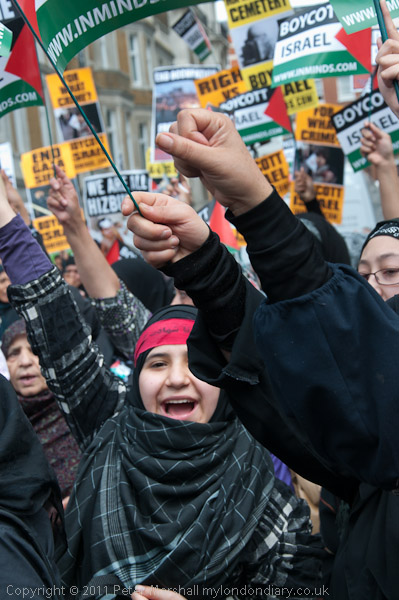
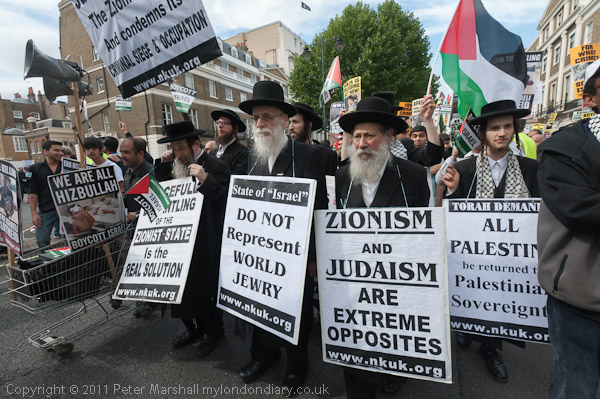
I moved on from the rally at the end of the march outside Holloway Prison to Oxford St, where the Revolutionary Communist Group and friends were reminding shoppers of the continuing oppression of the Palestinian people, and opposing attempts to criminalise and censor the anti-Zionist boycott, divestment and sanctions (BDS) movement. The rolling picket urged shoppers to boycott stores which support and fund Israel, including Marks and Spencer, and stopped for brief speeches in front of some of them for short speeches.

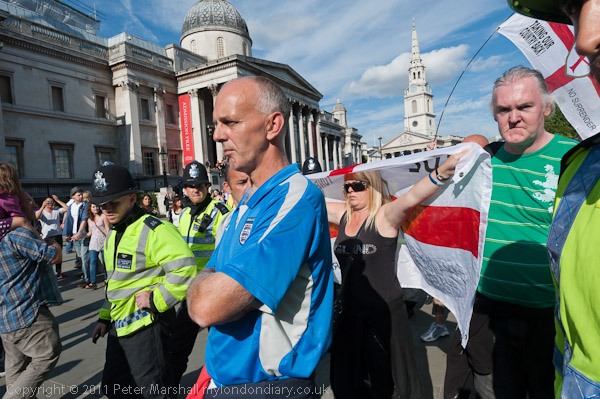
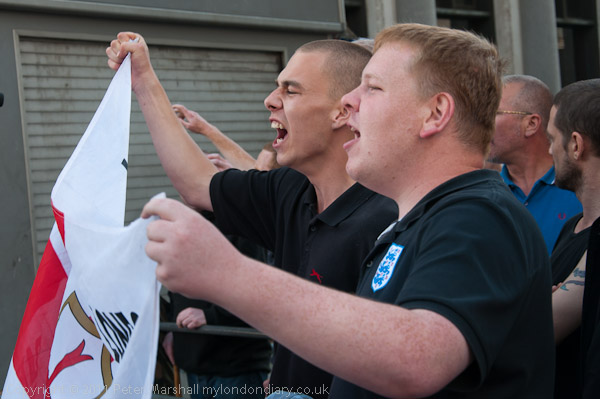
A small group of militant Zionists had come along to wave Israeli flags and shout insults at them. The protesters (who included several Jews and some Palestinians) made clear that this was not an anti-Semitic protest but against some actions of the Israeli government and it took place the day before Nabka Day, the ‘day of the catastrophe’, remembering when roughly 80% of the Palestinian population were forced to leave their homes between December 1947 and January 1949, and later prevented by Israeli law from returning to their homes, or claiming their property. This year the attacks on Palestinians in Jerusalem have largely been precipitated by the continuing attempts by Jewish settlers to displace the Palestinian population of Sheikh Jarrah in East Jerusalem. Founded in 1865, the area became home to Jerusalem’s Muslim elite, but in 1948 became home to Palestinian refugees from Jerusalem.

Vegans had come to Trafalgar Square holding laptops and tablets and wearing masks to show the film ‘Earthlings’ which includes scenes of horrific cruelty to animals and calling for an end to the farming and eating of animals. Some also pointed out the contribution that becoming vegan could make towards solving the climate crisis as Vegan dietts use less water, land and grain and produce less CO2.

Also on the North Terrace of Trafalgar Square were a small group of protesters standing in front of the National Gallery who held posters calling for human rights, fair treatment and support for refugees. Some held a banner with the message ‘free movement for People Not Weapons’.

More about all these protests on My London Diary:

Topshop protest after cleaners sacked
Refugees Welcome say protesters
Vegan Earthlings masked video protest
68th Anniversary Nabka Day
Reclaim Holloway

Occupy Gandhi – 4 May 2015

All pictures from Occupy Ghandi – Stop Fossil Fuel Criminals, 4 May 2015

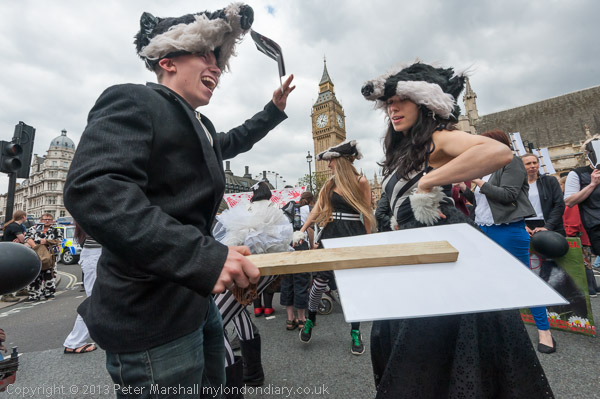
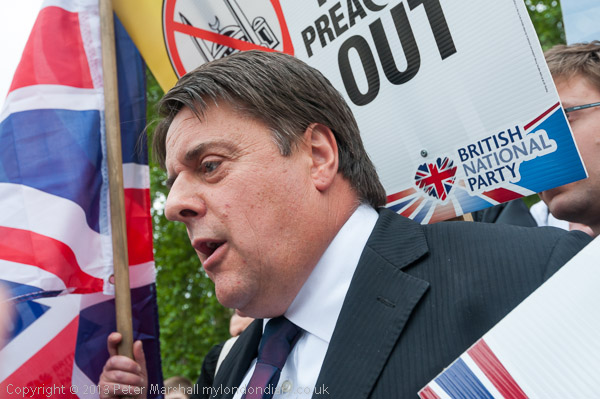
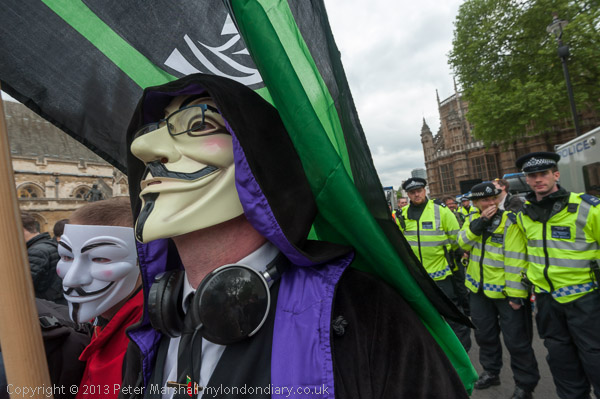
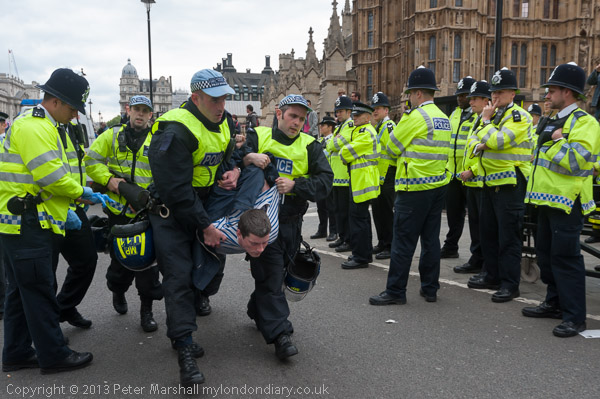
Successive UK governments have legislated in various ways to restrict the right to protest, particularly concentrating on the area of Westminster close to the Houses of Parliament, and the current Police, Crime, Courts and Sentencing Bill amends the “Police Reform and Social Responsibility Act 2011 to expand the “controlled area” around Parliament where certain protest activities are prohibited” as well as creating a new prohibited activity of “obstructing access to the Parliamentary Estate”.

The 2011 Act (which was also amended by the Anti-Social behaviour, Crime and Policing Act 2014) replaced previous restrictions which had been brought in under SOCPA, the Serious Organised Crime and Police Act 2005 which the New Labour government had brought in as an attempt to stop the long-term protest in Parliament Square by Brian Haw who had set up his camp there on 2 June 2001 in protest against the effect of economic sanctions which were resulting in child deaths in Iraq.

Haw’s campaign widened into a more general protest against war and became the Parliament Square Peace Campaign, and he was joined by other long term protesters as well as receiving support from many others which enabled him to remain in the square. Various attempts to remove him legally failed and SOCPA was passed in an attempt to stop his protest. But poor drafting led to the eventual failure to achieve this, though Haw had to apply for permission which was granted subject to strict conditions – which he and his supporters failed to adhere to.

Police carried out a major raid in May 2006, removing most of the placards and other material and Haw was taken to court for breach of SOCPA. But after several hearings he was acquitted as the judge found the conditions lacked clarity and were not workable. He was assaulted on numerous occasions by police and by others believed to be working for the security services and arrested again on the day of the State Opening of Parliament for the Tory-LibDem coalition in 2010. But his protest was continued even after he left for cancer treatment in Berlin on New Years Day 2011, by his colleague Barbara Tucker who had joined him in 2005, and stayed in Parliament Square until 2013, despite being denied the use of tent, blankets and eventually even a chair and umbrella in 2012.

The whole grass area of Parliament Square was fenced off and the protest moved onto the pavement in 2011 after Boris Johnson gained a High Court injunction. Early in 2013 more protesters had arrived to support Tucker who had begun a hunger strike in December 2012. She left the square for urgent medical treatment and the Westminster Council removed the tents which supporters had brought there in March 2013, reopening the square for public use in May.

In October 2014, Occupy Democracy arrived to occupy Parliament Square “for 9 days in October, to broadcast and demand the solutions we already know exist, to inspire people to be the active citizens required to take back democracy from powerful economic interests.” They were met by police and private security ‘Heritage Wardens’ (outsourced by the GLA) and signs put up the previous day stating the grass was ‘closed for repair’, and there was considerable harassment with the police seizing anything they thought might be ‘camping equipment’ the occupied the square. The following day, much larger numbers of protesters turned up, including a number of MPs and some celebrities, and after trying hard to stop them, the police melted away and the camp was set up.

Over the following three days there were a number of arrests and police moved protesters off the main grass areas, but the various workshops and activities continued until the whole square was cleared. There had been a number of battles between police and protesters over large squares of blue plastic tarpaulin they had used to sit on the wet grass and mud, and the Democracy Camp had gained the name ‘Tarpaulin Revolution’ (#tarpaulinrevolution).

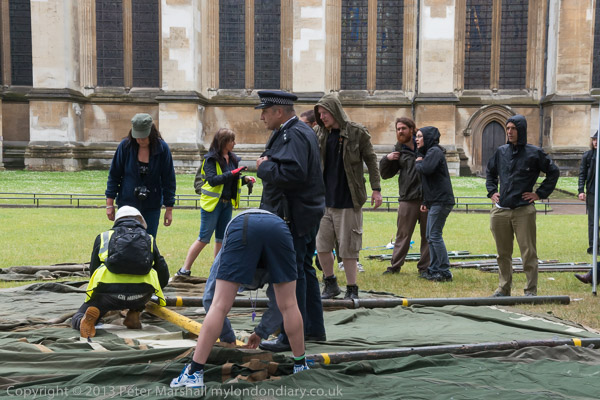
On May Day 2015, Occupy Democracy returned for a 10 day ‘Festival of Democracy’ in Parliament Square “building a movement for real democracy: free from corporate control, working for people and planet!” just a few days before the general election. On Monday 4 May there was a rally and meditation by Occupy Democracy at the statue of Gandhi, noted for his direct action civil disobedince, called for fossil fuel exploration and investment to be made a crime, and defied the ban on tarpaulin and tents in Parliament Square.

After short speeches there was a period of meditation, and the protesters wrapped a blue tarpaulin around the statue. Heritage wardens demanded its removal, and seized it when their request was ignored. Other protesters then stood with another blue tarpaulin, holding it around the statue but taking care not to touch it.

At the end of the mediation, Donnachadh McCarthy who had been leading it announced an act of civil disobedience and pulled a folding tent onto the tarpaulin on the pavement in front of him and erected it. Several people then came and sat inside it, and the protest continued. Police came and told them they were committing an offence and might be arrested if they failed to leave. Shortly after 20 police came and surrounded the tent and arrested those who refused to leave.

Occupy Gandhi – stop fossil fuel criminals
Occupy Festival of Democracy

A Mixed Day – May 3rd, 2014

Saturday May 3rd 2014 provided me with quite a range of events to photograph around London, finishing with a protest against the abuse of staff employed by MITIE at the Royal Opera House. IWGB members including the workplace rep have been sacked or lost work, with others being brought in to take their places.

This protest was one of the “noisy” events that the Police, Crime, Sentencing and Courts Bill 2021 being pushed through parliament would criminalise, a very successful non-violent tactic used by smaller unions such as the IWGB (Independent Workers Union of Great Britain) to shame managements into talking with them. MITIE and the Royal Opera House had been refusing to talk with the union to which the majority of the cleaners belong, and instead recognise a large union with few members at the ROH which has come to an agreement with them which fails to address any of the workers grievances.

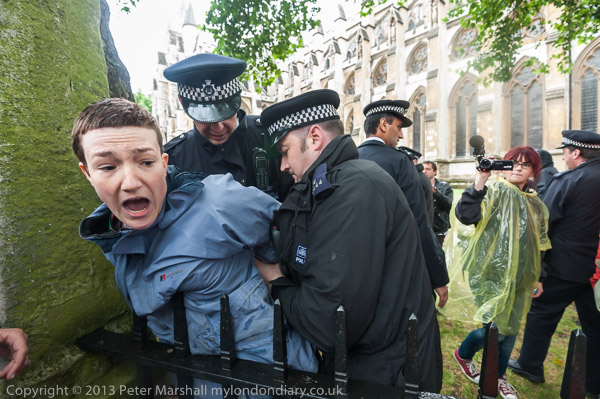
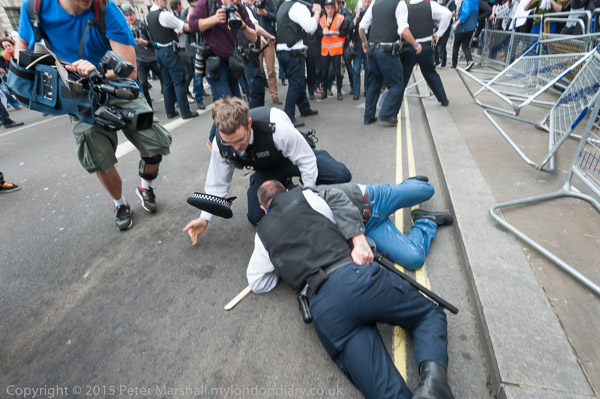
There were angry scenes with some of the opera goers who seemed to feel that the workers had no right to protest, and ROH security staff intervened when one man began assaulting union organiser Alberto Durango. When a large group of police arrived there was an ugly scene when they tried to grab one of the protesters, but she was pulled away by her colleagues, and the police then withdrew to form a line around the opera house. After an hour there were some short speeches, including one by another woman protester complaining that she and others had been assaulted by the police officer in charge, Inspector Rowe, and other officers.

My first event had been to cover a march to Parliament by Families fighting to abolish the 300 year old law of ‘Joint Enterprise’ that has wrongfully imprisoned family members in a gross breach of human rights. Under this people are convicted of crimes they took no part in for having almost any connection with those who actually committed the criminal act – without any real evidence being required or given. Originally intended to enable doctors and seconds who attended duels to be arrested as well as the actual duellists, it is now disproportionately used against Afro-Caribbean young men following stabbings and other street violence. As well as its inherent injustice, the sentences can be extremely long, in some cases up to 30 years in jail. In 2015 police attempted to use it against a protester after they could find no evidence of her committing the ‘criminal damage’ she had been accused of, but the court sensibly refused to consider the charge.

Next I went to the Ethiopian Embassy in Kensington, where Rastafarians from the Church of Haile Selassie I in Cricklewood were holding their annual protest calling for the restoration of the Dynasty of Emperor Haile Selassie 1st to bring about economic liberation of the country. Selassie died following an economic crisis which led to a coup in 1974 at the age of 83. Under his leadership Ethiopia, the only African country to defeat the European colonialists, was the first independent African state to become a member of the League of Nations and the UN.

I stopped off on my way back to the centre of London at Knightsbridge to photograph the weekly vigil outside fashion store Harvey Nichols calling on shoppers to boycott them for selling animal fur products, which come almost entirely from farms with exceedingly cruel practices banned in the UK. It is hard to see why using fur from these farms is not also banned here.

The largest event taking place was the celebration of the 20th anniversary of the first women to be ordained by the Church of England, and a thousand or more women priests went to a rally in Dean’s Yard before marching to St Paul’s Cathedral for a service.

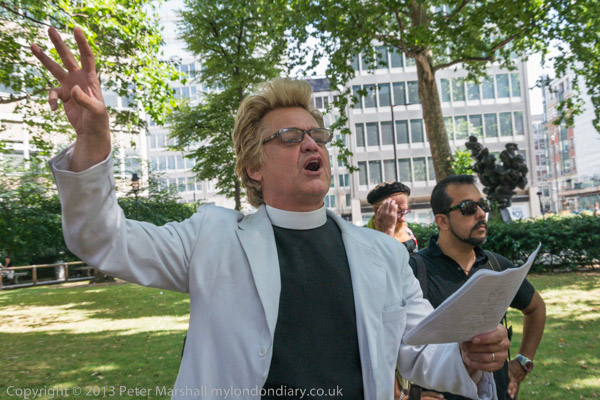
I was brought up in the Congregational tradition, and the Congregational Church had its first women minister in 1919, but it took the Church of England another 75 years before they caught up. They ordained their first women as priests in 1994, and women now make up a large proportion of the church. Among those on the march was the Rev Rose Hudson-Wilkin, the Jamaican-born vicar of Holy Trinity Church, Dalston and All Saints Church, Haggerston (and also finding time to be Speaker’s chaplain at the House of Commons, priest vicar at Westminster Abbey and chaplain to the Queen.) She marched with the same placard she carried when the church was making its decision to ordain women in 1994, with the message “Women – beautifully & wonderfully made in the image of God!” and became Britain’s first black female bishop in 2019.

I left the women priests marching along Whitehall to photograph a protest opposite Downing St, where Balochs were staging a token hunger strike on Whitehall calling for the immediate release of all those forcefully disappeared by Pakistani forces. The action was in solidarity with the hunger strike by student activist Latif Johar of the Baloch Students Organisation-Azad (BSO-A) who began a hunger strike outside the Karachi Press Club on April 22 in protest at the disappearance by Pakistan security forces of the BSO-A chair Zahid Baloch in March.

From Westminster I walked to Covent Garden where I was to meet the IWGB for their protest at the Royal Opera House, and sat and waited for them to arrive. To my surprise as I sat reading I heard the sound of hooves clattering on the road, and looked up to see half a dozen horse-drawn traps coming towards me up the street. They stopped briefly and appropriately at the Nags Head, where some of the drivers went in to refresh themselves, and I talked with those left holding the horses outside, and they told me the ride had started at Forest Gate and they had already visited Borough Market on their route around London.

More on all these events:
IWGB Cleaners at Royal Opera
Horse Traps at the Nag’s Head
Baloch Hunger Strike
20 years of Women Vicars
Anti-Fur Picket at Harvey Nichols
Restore the Ethiopian Monarchy
Joint Enterprise – NOT Guilty By Association


All photographs on this and my other sites, unless otherwise stated, are taken by and copyright of Peter Marshall, and are available for reproduction or can be bought as prints.
No to the Crook, the Toff, The Fascist or Cop

Protesters kettled outside City Hall as the Mayoral election results announced in 2008


London’s electors in a few days time will be faced with a rather bewildering array of candidates, with 20 names appearing on the ballot paper.

Ian Bone of Class War and banner ‘No to the Crook, the Toff, The Fascist or Cop’ 2008

Current mayor Sadiq Khan is hoping for re-election and his chances are probably good and he has enjoyed a good lead in opinion polls with a roughly 20-25% lead over his nearest rival, the Conservative Shaun Bailey. He could even get the 50% needed to win on the first preference votes and is likely to end up with over 60% when second preferences are included.

Anarchists raise the anti-fascist banner at City Hall 2008

Bailey, like Conservatives standing in the various elections around the country, is rather likely to pick up votes because of the success of the Covid vaccination rollout, a rather unfair consequence as it was Tory incompetence that really got us into the huge mess – with bodies piling up in mortuaries if not on the streets, and the NHS, which they have been doing their best to privatise out of existence over the years, which got ahead and got on with the jabs – and fortunately the government, having perhaps learnt a little from the test and trace debacle, let them get on with it rather than giving jobs to their mates.

It’s a slightly unusual voting system, with the second round of counting including only the two leading candidates. But it does mean that if you are a Khan supporter you could safely vote for any other candidate than Bailey as first preference, knowing that you second preference for Khan would count for him in the end.

Fitwatch hold their banner in front of the police photographer 2008

Opinion polls suggest that on this basis YouTuber Niko Omilana might come out third on the first preference votes, well above either the Green Party’s Sian Berry or Lib Dem Luisa Porritt, either of whom would clearly make rather better mayors than him.

Police TSG arrive to clear the area. 2008

The 15 other candidates seem unlikely to gain much benefit from the voting system and will almost certainly all lose their £10,000 deposit. They cover a wide range from various fringe parties, serious single-issue candidates to various more or less entertaining idiots such as Count Binface. Even at odds of 800 to 1 it isn’t worth betting on him.

Police arrest a man who had been sitting quietly by the river

Back in 2008 there were fewer candidates, but it was sadder times as London was announcing the election of its worst mayor yet, though at least he did continue some of the previous incumbent’s policies, and some of the advisers he employed were competent. But the years Johnson was mayor were something of a disaster for Greater London – which he has gone on to repeat for the country as a whole.

Some of the protesters were surrounded and held for several hours

The ‘No to the Crook, the Toff, The Fascist or Cop’ protest by anarchists had its moments of farce, beginning with the police photographer taking an unusual interest in me as I sat reading a paperback. I just happened to be in the middle of John Updike’s ‘Terrorist’ at the time. Although I clearly watched him taking pictures, when I later made a freedom of information request about this an other occasions I’ve been photographed, the answer came back that there were no pictures of me.

Others had escaped as police moved in and showed the banner from a balcony before going to the pub

You can read more about what happened and see more pictures on My London Diary:
No to the Crook, the Toff, The Fascist or Cop


All photographs on this and my other sites, unless otherwise stated, are taken by and copyright of Peter Marshall, and are available for reproduction or can be bought as prints.

May Day #KillTheBill

May Day 2000

Unfortunately May Day is not a public holiday in the UK, and when I was in full time teaching it was usually just a normal working day for me and I was unable to celebrate it except in those years where it fell at a weekend. Even when I cut my teaching to 30% for a few years, that 30% seemed always to include May Day, and it was only from 2003 that I began to attend May Day in London every year – until 2020, when it went online.

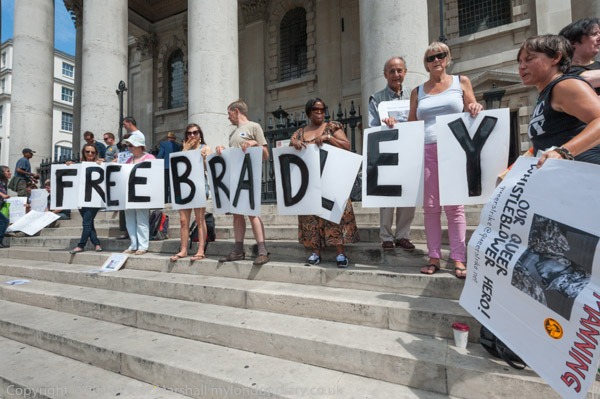
This year, when May Day is on a Saturday, the official May Day celebrations are also taking place online, but May 1st is now a nationwide day of action against the Police, Crime, Sentencing and Courts Bill 2021 with which the government is attempting to severely limit the right to protest and in particular to criminalise “noisy” protests and prosecute people in the Gypsy and Roma communities. Noisy protests shaming businesses have been vital in recent years in gaining better wages and conditions for low paid workers particularly in the City of London.

The Bill will give the police much greater powers to place conditions on protest – and to make it a crime to break these conditions if they “ought to have known” they were in place but didn’t. They introduce a new offence of “intentionally or recklessly causing public nuisance” which can lead to a sentence of up to ten years.

Police also gain greater powers to stop and search on the streets under a new Serious Violence Reduction Order, an arbitrary power that removes even the need for any suspicion and will doubtless lead to an even more racist implementation of stop and search, worse than the old ‘Sus’ law that led to the Brixton riots 40 years ago.

As a knee-jerk reaction to Black Lives Matter protests there is a new offence of causing damage to statues and memorials which could also lead to sentences of ten years, twice the maximum sentence for assault causing actual bodily harm.

The bill also seeks to create a wide “controlled area” around parliament where protests would not be allowed – and so MPs and ministers would no longer be made aware of any public opposition to their actions. Many see the bill as denying our right to freedom of assembly and association under Article 11 of the European Convention on Human Rights .

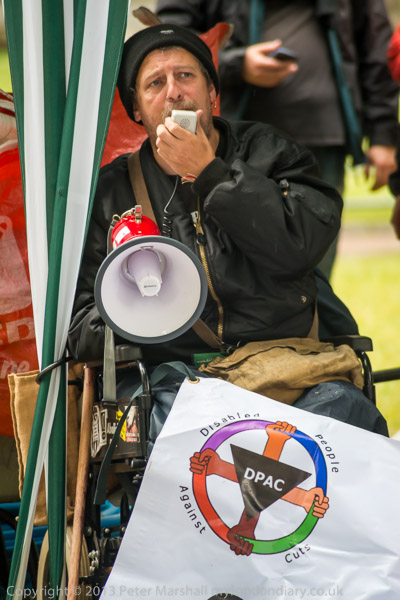
A long list of organisations are coming to Trafalgar Square at noon today for a MayDay #KillTheBill protest (and to similar protests in Sheffield, Leeds and Manchester.) They include Sisters Uncut, Women’s Strike Assembly, Black Lives Matter UK, Disabled People Against Cuts, the Independent Workers Union of Great Britain, Lesbians and Gays Support the Migrants and Docs not Cops. With the current large Tory majority in the House of Commons the bill is likely to pass with only minor amendments, and the fight will move to the streets where with strong opposition much of the new law will be unenforceable.

Seconds later an officer knocked this man offering plants flying

Pictures are from 21 years ago, May Day 2000. There are some black and white pictures from the same day on My London Diary.


All photographs on this and my other sites, unless otherwise stated, are taken by and copyright of Peter Marshall, and are available for reproduction or can be bought as prints.

Unite Against Racism

Two years ago today, 27 April 2019, I joined with a large crowd in Southall remembering the murders there of Gurdip Singh Chaggar and Blair Peach, calling for unity against racism.

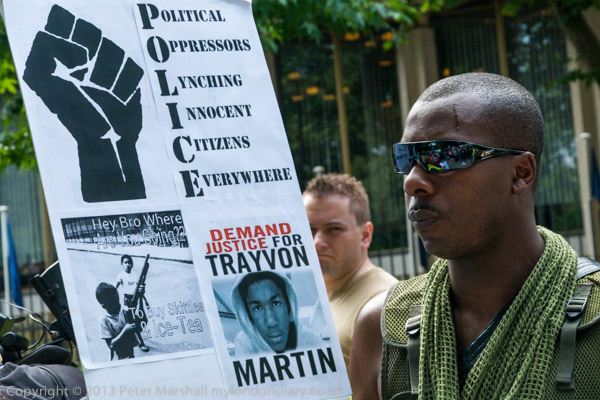
The march took place on the Saturday after St George’s Day, and marked the 40th anniversary of Blair Peach’s murder by police officers. Several thousand police had packed the town to defend the National Front who were holding a meeting at Southall Town Hall. A large group of the local community and supporters from across London had come to oppose the meeting, and and police rioted and attacked what had been a determined but largely peaceful protest. Wikipedia has a long and well referenced article on the murder from which many of the facts below are taken, though speeches at the 2019 protest also included some eye-witness accounts. Peach was a member of my own union at the time, the NUT, which also made me very aware of the events and was prominent in the fight to see justice.

Blair Peach was in a group of friends who tried to escape the violent police attacks on Southall Broadway and make their way home down a side street, but unfortunately this led nowhere and the police Special Patrol Group drove up in several vans and began attacking the crowd there, who responded with bricks and bottles. Witnesses, including residents on the street say the police were hitting everybody and fourteen saw a police officer hitting Peach on the head.

People obseve a minute of silence where Gurdip Singh Chaggar was killed

Forensic evidence found he had been hit with an illegal weapon, probably a lead-filled cosh or pipe, and searches of the lockers of the SPG unit involved found 26 illegal weapons. None of the witnesses were able to identify the police officer involved – perhaps because one officer had shaved off his moustache and another grew a beard and refused to take part in the identity parades. Many also had their uniforms dry-cleaned before the police investigation inspected them.

Although the police investigation had produced a great deal of evidence against the SPG, the DPP decided it was insufficient to justify a prosecution. The report was kept secret, though parts appeared in the press early in 1980, and the inquest was hampered as the legal team acting for the Peach family were not allowed access to it. The verdict of the inquest, ‘death by misadventure’ was widely considered – even by The Times – to have been inappropriate. The coroner afterwards wrote an article including his comments that some of the civilian witnesses had lied as they were “politically committed to the Socialist Workers Party” of which Peach was a member and that some Sikh witnesses “did not have experience of the English system” to enable them to give reliable evidence but was persuaded not to publish it.

At Ramgarhia Sabha Gurdwara


The fight to get justice over the murder continued, but none of the officers involved was ever brought to trial. Apparently all left the police force shortly after the investigaton. Peach’s family were awarded £75,000 compensation in a tacit admission of police guilt by the Metropolitan Police in 1988, but requests for a public inquiry were turned down by the Home Office. The SPG was disbanded in 1987, but replaced by a very similar Territorial Support Group. It was only following a member of the TSG killing newspaper vendor Ian Tomlinson as he was walking home past the G20 protests at Bank in 2009 that the report of the police investigation into Blair Peach’s death was finally made public.

The 2019 march and rally in Southall convened close to where Gurdip Singh Chaggar, an 18 year old student, was murdered by racist skinheads in June 1976 as he left the Dominion Cinema and began, at the request of his family with a karate display. It paused for a minute of silence where his was killed before moving on to stop at the Ramgarhia Sabha Gurdwara which the Chaggar family attend, where prayers were said.

Flowers were handed out which were then laid at the street corner where Blair Peach was murdered before we moved on to a rally outside Southall Town Hall where the National Front held their meeting. Peach’s murder inspired the formation of both the anti-racist grassroots group The Monitoring Group, whose founder and director Suresh Grover introduced the event and of Southall Black Sisters, whose founder Pragna Patel who was one of the speakers, along with other community leaders and anti-racists.

Perhaps surprisingly absent was the local Labour MP, Virendra Sharma, who in 2019 lost a vote of no-cofidence by the local party apparently due to his low attendance at party meetings, slow responses to constituents and failure to campaign over local redevelopment issues. John McDonnell, Labour MP for a neighbouring constituency and then Shadow Chancellor was there from the start of the march and made a powerful speech.

More about the event and many more pictures: Southall rally for unity against racism

Police surround Berta Cáceres

The pink yacht that Extinction Rebellion had brought to Oxford Circus was named after Honduran environmental activist Berta Cáceres. On March 7th 2016 year I had photographed a vigil in her memory outside the Honduran Embassy in London. The leader of the Civic Council of Popular and Indigenous Organisations of Honduras (COPINH) who had been awarded the Goldman Environmental Prize for her work against the Agua Zarca Hydroelectric Project in Río Blanco, funded by the World Bank and the Dutch government, she was murdered in her home on March 3. She had previously received death threats from the Honduran National Police.

The Met didn’t actually arrest the pink yacht, which had been at the centre of the circus since Monday, but on Friday 19th April 2019 surrounded it and arrested any of those who had been protecting it in the centre of the road junction who refused to move away, including a number who had been locked on to the boat.

A larger police cordon surrounded the whole of the road junction, and people inside it were instructed to leave or face arrest. XR’s ‘Red Rebel Brigade’ made their way around the outside of this cordon, while others sang and danced inside.

The numbers inside slowly fell as police allowed people to leave but stopped anyone – including a man who told them he was the owner of the yacht – from entering. He made an effort to persuade the crowd to break the cordon, but was held back by friends and the crowd followed the XR principle of non-violence against the police and sat still, watching as the police made arrests or slow drifting away to Marble Arch or other areas still occupied by protesters.

Slowly and deliberately the police cleared the protesters, carrying away many to the waiting police vans. I stayed for several hours taking pictures before deciding it was time to leave.

Earlier that day I had been at the Oxford Circus ‘Sea of Protest’ for the start of the day’s activities to show ‘Love For The Earth’ on the 5th day of the occupation, and had photographed Dame Emma Thompson arriving and speaking at the event.

She received a warm welcome from Extinction Rebellion supporters but some snide comments from the press about having come from the USA by plane to speak at the event. She could hardly have swum and although I’d rather we had a system that didn’t worship celebrities, given the world as it is, I welcome them using their fame to support the fight against global extinction and other essential causes.

I left a few minutes after she had finished speaking and was still being besieged by photographers and journalists, answering their questions from the deck of Berta Cáceres. There had been another event I’d wanted to photograph scheduled for Trafalgar Square, but no sign of it when I arrived, so I returned to Oxford Circus. In the short time I’d been away, Emma Thompson had left and police had moved in to surround the yacht and begin the process of clearing the junction. By the evening the yacht had been towed away.

Police clear XR from Oxford Circus
Emma Thompson speaks at XR


All photographs on this and my other sites, unless otherwise stated, are taken by and copyright of Peter Marshall, and are available for reproduction or can be bought as prints.

Saturday 16th April 2016

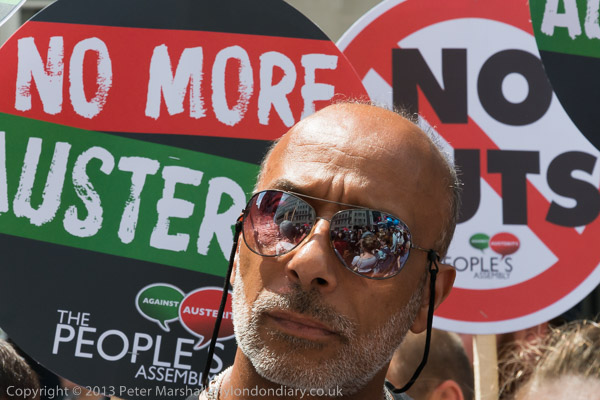
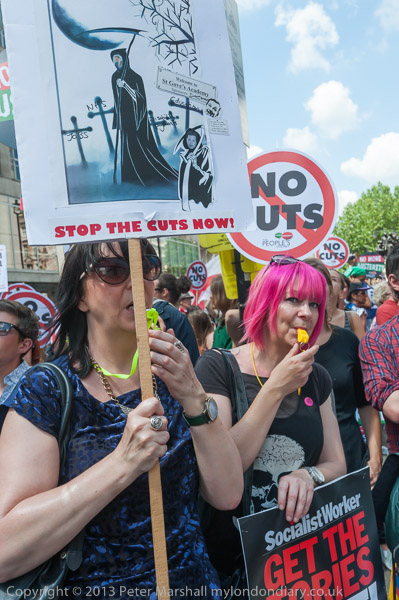
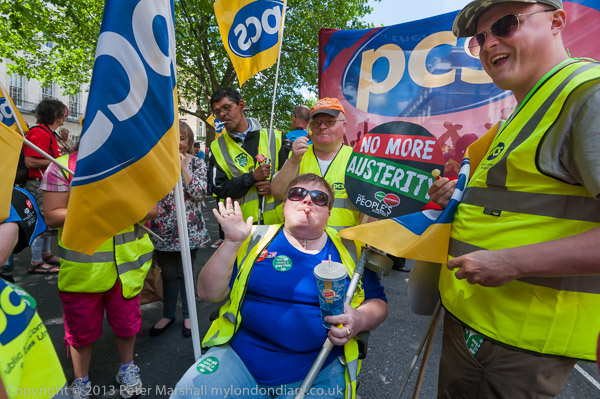
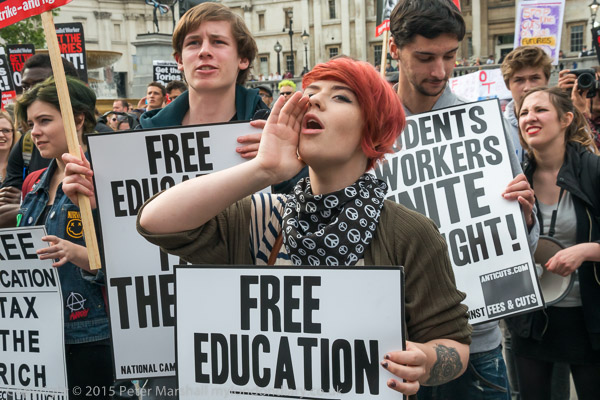
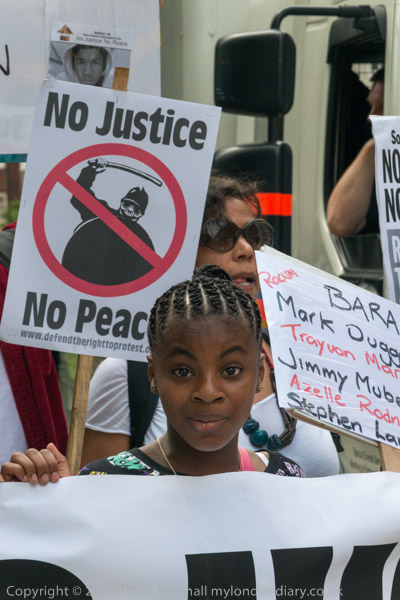
There was a lot happening in London on Saturday 16th April 2016, and I managed to catch some of it. The largest march was organised by the Peoples Assembly Against Austerity. It demanded an end to privatisation of the NHS, secure homes for all, rent control and an end to attacks on social housing, an end to insecure jobs and the scrapping of the Trade Union Bill, tuition fees and the marketisation of education.

It was a large march and by the time I arrived people were fairly tightly packed on around 500 metres of Gower St waiting for the march to start, and it took me some time to make my way through to the gazebo where speeches were being made before the start of the the march – though I found plenty to photograph as I moved through the crowd.

Finally I made my way to the front of the march and photographed some of the main banners lined up there, but police held up the start of the march and I had to leave before it moved off.

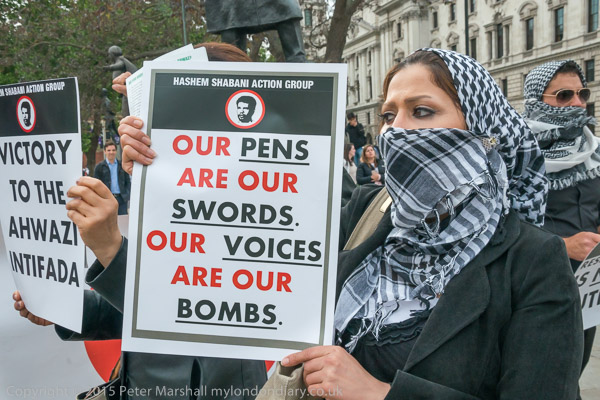
I was disappointed in Whitehall as there was no sign of an event I had been expecting to take place there – or perhaps I was too late. But in Parliament Square I met Ahwazi Arabs from the Ahwazi Arab People’s Democratic Popular Front and the Democratic Solidarity Party of Alahwaz who have demonstrated London in solidarity with anti-government protests in Iran every April since 2005, on the anniversary of the peaceful Ahwazi intifada in which many were killed and hundreds arrested by the Iranian regime.

The Ahwaz region, an autonomous Arab state, was occupied by Iran in 1925 iand they incorporated it into the country in 1935 largely to allow the British Anglo-Iranian Oil Company (BP since 1954) to exploit its rich oil reserves. Since then Iran has pursued a campaign to eliminate Ahwazi culture and change the ethnic makeup of the region by encouraging Persian settlers. BP dominated Iranian oil until Iran nationalised it in 1951, and again became an important force there after the CIA (and MI6) engineered coup in 1953 and the company is still the major partner supplied by the National Iranian Oil Company.

I walked back up Whitehall to Trafalgar Square, by which time the Peoples Assembly marchers were arriving for a rally.

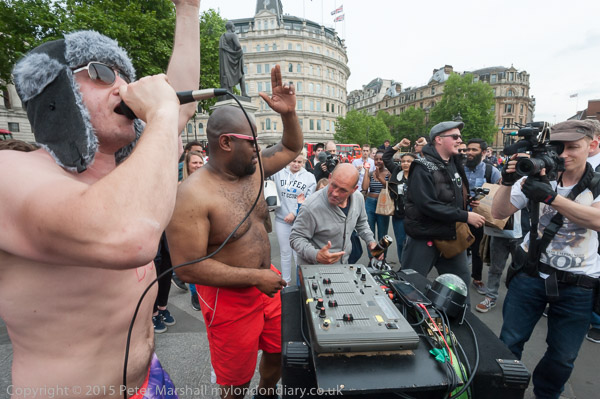
Things were visually rather more interesting on the North Terrace, where people were dancing to the ‘dig it sound system’, which carried a message from Tom Paine: “The World is my country – All people are my brethren – To do good is my religion”.

And in one corner the Palestine Prisoners Parade were attracting attention with juggling, hula hoops and speeches to the often arbitrary detention without proper trial suffered by many Palestinians held in Israeli jails. Many of them are on rolling detention orders, released and immediately re-arrested and put back in prison.

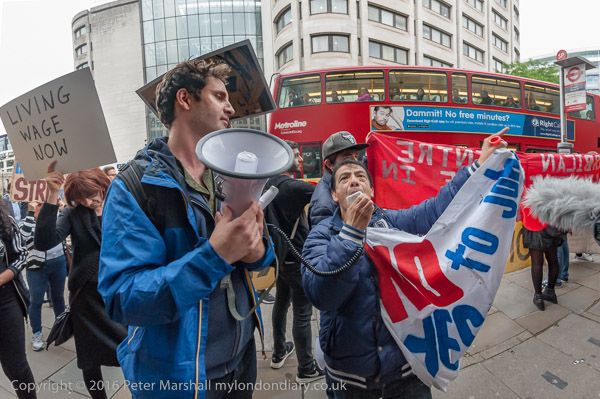
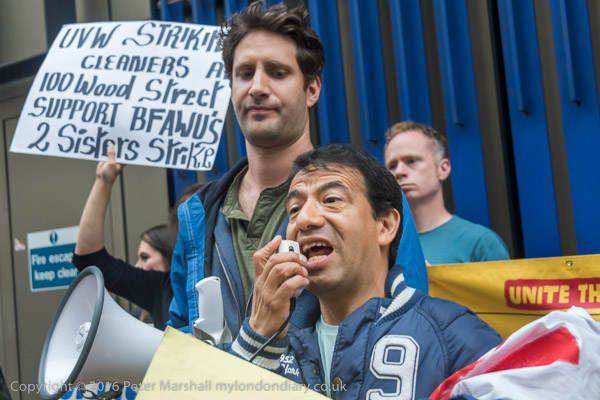
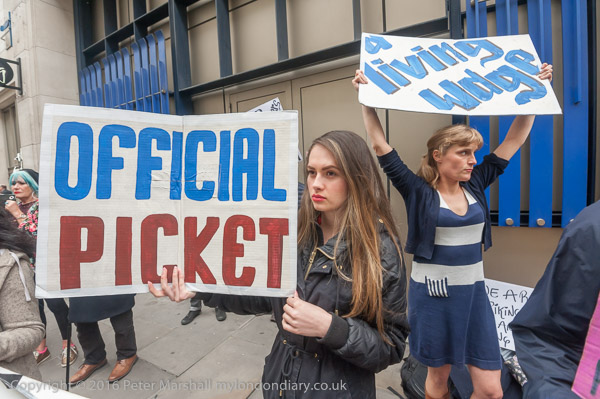
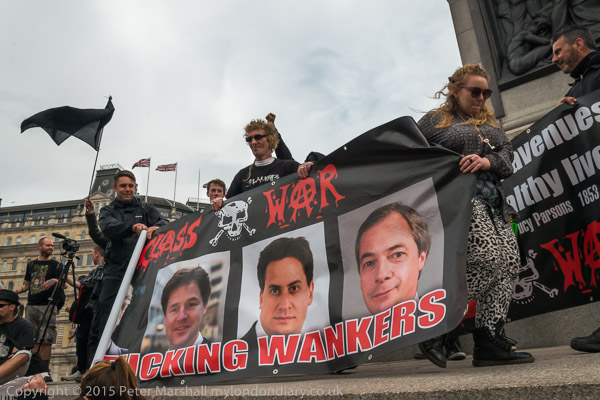
As the rally came to an end the United Voices of the World trade union began a protest a short distance away on the Strand, supported by Class War and others, demanding the reinstatement of 2 workers suspended by cleaning contractor Britannia for calling for the London Living Wage of £9.40 an hour for all those working at Topshop. The UVW say Brittania is systematically victimising, bullying and threatening cleaners and Topshop refuse to intervene.

The fairly small crowd held a noisy protest outside the shop entrance, with was blocked by security men, and a large group of police arrived and began to try to move the protesters, and began pushing them around. The protesters didn’t retaliate but simply moved back; some holding up placards in front of the police cameraman who was filming the event were threatened with arrest.

Eventually the protesters marched away, walking back along the North Terrace of Trafalgar Square where they picked up a few more supporters and then on to Top Shop at Oxford Circus for another protest and stand-off with the police.

After a fairly short protest there the protesters marched on to John Lewis, where the UVW have a long-standing dispute calling for the cleaners to be treated equally with others who work there. As they approached the store some police became more violent and one woman was thrown bodily to the ground several yards away.

Other police and protesters went to help her and the protesters called for – and eventually got – an apology for the inappropriate use of force. Things calmed down and the protest continued, but as it moved off after several speeches with many leaving for home the police picked on two individuals and began searching them and threatening arrest and the situation became more tense, with police threatening both protesters and press.

More on My London Diary
UVW Topshop & John Lewis Protest
UVW Topshop 2 protest – Strand
Palestine Prisoners Parade
Dancing for Homes, Health, Jobs, Education
Homes, Health, Jobs, Education Rally
Ahwazi protest against Iranian repression
March for Homes, Health, Jobs, Education

Extinction Rebellion and more

Extinction Rebellion (XR) began 11 days of protest which initially brought most of central London traffic to a halt on Monday 15th April 2019. They didn’t manage to keep up the protest until “the government takes necessary action on the global climate and ecological emergency” as we have yet to see that two years later, but they did considerably raise public and media awareness about the severity of the problem the world faces.

Unfortunately there seems to be little chance that effective action will be taken in time to halt biodiversity loss and reduce greenhouse gas emissions to net zero by 2015 as they demanded, though perhaps the half-hearted measures that will come out of the delayed climate summit later this year will do just a little to slow the rate our our planet’s decline, possibly enough to see my life out, though I worry about the future of my children and despair for that of my grandsons and daughters.

XR have now very much lost the initiative, mainly I think because of internal dissensions, perhaps inevitable because of some of the rather odd characters that they attracted. But some of their ideas, particularly over the police and arrests cut them off from many on the left who attacked them as a movement funded by shady capitalists and led by wacky idealists, more a Glastonbury festival than a political movement. Much of the criticism was ill-founded but not all.

The major effect they had on our government was for them to put pressure on the police to get rid of these pesky protesters – first by more arrests and prosecutions and now by the Police, Crime, Courts and Sentencing Bill to give the police greater powers to control all protests.
Early on the Monday morning, XR protesters set up camp at a number of key locations in London in a well-planned exercise. I turned up rather later to take photographs, first at Waterloo Bridge, which XR had turned into a ‘garden bridge’, blocking all traffic and bringing flowers and trees. There had been arrests earlier, but police had been unable to stop the protesters and the bridge – despite many further arrests – remained closed for over a week.
Because of the XR actions traffic all around the centre of London was at a halt, with buses not moving. Fortunately the tube was unaffected and took me to Oxford Circus, which now had a large pink yacht at its centre, named after the Honduran environmental activist and indigenous leader, Berta Cáceres, assassinated for her activism in 2016. It was here that I met the dance troupe dressed in red that were such a visible presence in XR protests.

XR were not the only environmental game in town, and I took the Underground to St Paul’s Cathedral for a protest organised by the Green Anti-Capitalist Front, Earth Strike and London Students for Climate Justice. I arrived when there protest was due to start, but there were only a few of them present. I hung around for half an hour or so, and then gave up and left. Later I saw the accounts of their protest which did eventually attract a small crowd and was sorry I’d missed the action.

But there was rather more happening at Marble Arch, one of London’s main gyratory systems, where XR had blocked Oxford St, Park Lane, Edgware Road and a couple of other routes and had set up a stage, workshops and a tent village as well as the road blocks.

But XR had also planned an event for Parliament Square, where the roads around were blocked for a New Orleans funeral procession with jazz band to make its way around the square.

The funeral was perhaps also designed as a diversion for some more direct action, which I again missed at the Shell Centre on the South Bank. A small group of activists daubed slogans across the front of the building and two occupied the glass porch over the door. The activists had deliberately broken the glass in one of the doors, with the intention that this would result in a trial before a jury rather than by magistrates, enabling them to present the reasons for their action, and three had been arrested and taken away by the time I arrived, but the two were still up on the porch and others holding banners on the street in front.

My day had not quite finished as I made a small diversion on my way home to visit Brixton, where staff, families and children from children’s centres were protesting against plans by Lambeth Council to close five centres and make drastic cuts at seven others. The council had recently spent £68 million on refurbishing the Town Hall and building a new Civic Centre.

Save Lambeth Children’s Centres
Extinction Rebellion at Shell
Extinction Rebellion Funeral Procession
Extinction Rebellion Marble Arch
Anti-capitalist environmental action
Extinction Rebellion Sea at Oxford Circus
Extinction Rebellion Garden Bridge


All photographs on this and my other sites, unless otherwise stated, are taken by and copyright of Peter Marshall, and are available for reproduction or can be bought as prints.