Saffron Revolution & Slave Trade Abolition – 2007

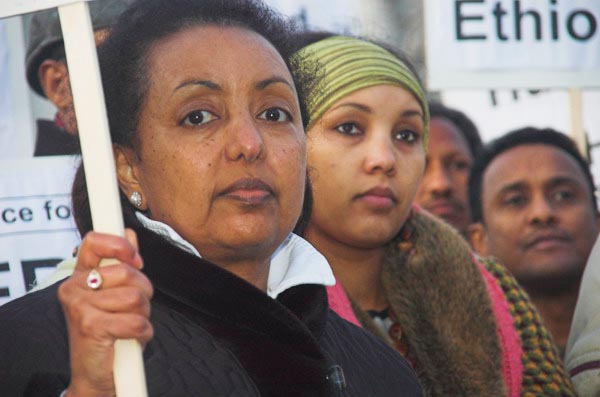
Saffron Revolution & Slave Trade Abolition: On Saturday 6th October 2007 I photographed a protest against the brutal repression of the Saffron Revolution protest in Myanmar (Burma) and a celebration of the 200th anniversary of the abolition of the slave trade,


Global Day of Action for Burma – Westminster

There was considerable support in the UK and UK media for the Burmese people who were taking part in non-violent protests against the military dictatorship there after it decided to remove subsidies on fuel, exacerbating a cost-of-living crisis in the country.

The protests were led by thousands of along with students and political activists and were often referred to as the Saffron Revolution.

The protests had begun in August 2007 and in late September after protests involving many thousands in various cities the government began a huge crackdown using military force to stop the protests and imposing curfews and prohibiting gatherings of more than five people.

Monasteries were raided, thousands of arrests were made and some protesters were killed. Wikipedia gives a great deal of detail, and on 1st October it was reported that around 4,000 monks were being detained at a disused race course, disrobed and shackled.

The official death toll over the period of the protests was 13, but the independent media organisation Democratic Voice of Burma based outside the country produced a list of 138 names of those killed.

The march began at Tate Britain on Millbank, proceeded over Lambeth Bridge and then returned to Westminster over Westminster Bridge. Many of the roughly 10,000 marchers wore red headbands and a small group of monks were allowed to tie strips of cloth onto the gates of Downing Street before the march continued to a rally in Trafalgar Square, where I left them.

More at London Burma March.


Slave Trade Abolition Bicentenary Walk

In 1787, Thomas Clarkson, Granville Sharp and ten other anti-slavery campaigners founded The Society for the Abolition of the Slave Trade. Nine of the twelve founders were Quakers, including the wealthy banker Samuel Hoare Jr which prevented their having much involvement in parliament.

Perhaps because of this the society became the first modern campaigning movement, working to educate the British public about the cruel abuses of the slave trade through publication of books, prints, posters and pamplets, organising lecture tours, including that by former slave and author Olaudah Equiano and by boycotting of goods produced by slaves.

The Quakers had organised petitions against slavery and presented these regularly to Parliament, and in 1787 William Wilberforce, MP for Hull was persuaded to join the movement, presenting the first Bill to abolish the slave trade in 1791 which was heavily defeated.

Further Bills followed on an almost annual basis, and finally in 1807 the Abolition of the Slave Trade Act was passed, with a majority of 283 votes to 16 on its second reading in the House of Commons. A similar act was passed by the USA in the same year taking effect at the start of 1808.

Despite this it took another thirty years for slavery in the British Empire (except those parts ruled by the East India Company) to be abolished in 1838. And when this was done the freed slaves received no compensation but massive amounts were paid to the former slave owners, a total of around £20 million, around 40% of the national budget and allowing for inflation around £2, 800 million today. Fact checking by USA Today confirms that the UK Government only just finished paying its debts to the slave owners in 2015.

The Slave Trade Abolition Walk organised by Yaa Asantewaa & Carnival Village was only one of a number of events commemorating the abolition of the slave trade taking place in 2007, but was I think the most colourful. Yaa Asantewaa was named after the famous Queen Mother of Ejisu in the Ashanti Empire who led the Ashanti Kings in the War of the Golden Stool against British colonial rule in 1900 and was exiled to the Seychelles where she died in 1921.

Among the costumes was one winner from Notting Hill, and a rather fine ‘Empire Windrush’ depicting the ship which brought the first large contingent of migrant workers from the Caribbean to England in 1948. They had been recruited to fill the gap in UK workers needed to restore the British economy after the war and came to a country where they met much racist discrimination, which more recently became government policy under the Windrush scandal, still continuing.

As of course is slavery. ‘Modern slavery’ is no less slavery than the slavery that was at the core of the British Empire and which provided the wealth that once made Britain ‘Great’.

Slave Trade Abolition Bicentenary Walk


FlickrFacebookMy London DiaryHull PhotosLea ValleyParis
London’s Industrial HeritageLondon Photos

All photographs on this page are copyright © Peter Marshall.
Contact me to buy prints or licence to reproduce.

Unite The Kingdom & Rejoin Europe – 28 Sep 2024

Unite The Kingdom & Rejoin Europe: Although I’m not covering as many protests as I used to I haven’t entirely given up covering them. But my priority at the moment is in digitising as much as possible of the photographs which I took on film before I moved to digital around 20 years ago.

Unite The Kingdom & Rejoin Europe

I think those images are a historical record of those times showing London in the latter years of the 20th century. You can see around 35,000 of them already on Flickr.

Unite The Kingdom & Rejoin Europe

But also I’m feeling my age, and get tired much more quickly; after spending two or three hours covering events I’m ready to go home. But still most weeks I try to get out at least one day covering protests, usually on Saturdays.

Unite The Kingdom & Rejoin Europe

Of course over the past year many of the protests I’ve photographed have been about the continuing events in Palestine. But last Saturday there were only a few small events related to this taking place – the next big protest comes this Saturday, 5th October, starting at 12 noon in Russell Square. Unfortunately I’ll miss that one as I’m away at a conference.

Unite The Kingdom & Rejoin Europe

I covered two events on Saturday 28th September, both unfortunately starting at noon, but one in Trafalgar Square and the other on Park Lane, around 2 kilometers to the west. Fortunately the journey by tube between the two is fairly fast.

I began taking pictures in Trafalgar Square, where Stand Up To Racism had called on its supporters to come to oppose a threatened far right racist protest which was to take place there.

The far right group was calling itself “Unite the Kingdom”, inspired by that phrase used by ‘Tommy Robinson’ at his protest in Trafalgar Square in July. He and his followers incite hate against migrants and asylum seekers, and their racist and Islamophobic rants were what led to the extreextreme right, right-wing, me right riots in Stockport, Birmingham, Hull and elsewhere – which tried to burn down buildings housing migrants.

There were a few short speeches and by the time I left Trafalgar Square half an hour or so later there were perhaps a little under two hundred people who had come to oppose the extreme right, with banners from various parts of London and a few from various organisations including GiK-DER Refugee Workers Cultural Association, and more were still arriving. But there was no sign of the extreme right protest.

The third annual grassroots National Rejoin March was a rather larger event, with several thousand people crowding around the area close to the Hilton Hotel, and I had time to take some pictures and talk to a few of the protesters before the march set off.

There is now a fairly large proportion – almost 50% of us – in the country who realise that leaving Europe was a huge mistake, while support for staying out is under 35%, and opinion polls in 2023 showed a hugely different result – around 70% to 15% – if a referendum was held then.Despite this there now seems very little chance that we would return into membership of the EU in the foreseeable future.

Singer Madeleina Kay, Young European Movement, with her guitar.

In England & Wales the Green Party, Plaid Cymru, and the Liberal Democrats want to rejoin, but the two major parties and Reform are committed to stay out. It may well have contributed to the success enjoyed by the Lib-Dems in the recent general election, and there seemed to be a strong presence at the protest from some of their stronger areas.

One of the main themes in the protest was that the question of rejoining Europe is the ‘elephant in the room’ of current British politics. Both Labour and Tories seem to believe that if the came out in favour of it would give the other party a huge boost.

This march seemed smaller than the previous two annual marches and it took less than ten minutes for the whole body of marchers to pass me as I stood on the street corner before rushing back to the tube to return to Trafalgar Square.

When I arrived there around a dozen ‘Unite The Kingdom’ protesters had arrived. Police had formed two lines on the North Terrace perhaps 50 yards apart separating them from the Stand Up to Racism supporters. Most of these had left with their banners leaving only a small fraction – still considerably outnumbering the racists. But police now seriously outnumbered both groups.

I took a few pictures, but couldn’t really be bothered – and it shows. But I think we are likely to see much larger numbers at future extreme right-wing protests than this disorganised damp squib.


FlickrFacebookMy London DiaryHull PhotosLea ValleyParis
London’s Industrial HeritageLondon Photos

All photographs on this page are copyright © Peter Marshall.
Contact me to buy prints or licence to reproduce.


No More Fur March – 2008

No More Fur March: Harrods has been getting a lot of attention in the media recently for the activities of its former owner, but on Saturday 27th September 2008 it was the destination of a march by the Campaign Against the Fur Trade.

No More Fur March

Shamefully you can still buy fur coats at Harrods, A ‘secret shopper’ filming for animal protection charity Humane Society International/UK who raised concerns was lied to in 2021 by sales staff wearing Harrods-branded name badges about the conditions in which the fur is farmed.

No More Fur March

Sales staff assured this customer that the foxes were kept in “separate rooms” with “enough space to play and everything“, and that they were “literally put to sleep” by injection when in practice they are confined in some farms in cages barely longer than their body length and anally electrocuted without any anaesthetic. The Harrods staff dismissed the many reports and videos of animals suffering in the fur trade as “only propaganda, madam“.

No More Fur March

You can find out more about the actual practices of fur farming with evidence on many pages acriss tge web, including on the Humane Society International web pages which also have information on the other ways animals are mistreated in research, farming and other areas.

No More Fur March

Fur farming was banned in the UK as ‘unethical‘ in 2000, but fur is still being imported into the UK from countries where fur farms raise and kill animals in desperately cruel conditions. Humane Society International has a letter you can sign to send Prime Minister Starmer calling on the UK government to end our association with fur cruelty for good and impose a fur import and sales ban.

Of course Harrods is not the only store still selling fur, and the march from Belgrave Square in 2008 also targeted other shops in Knightsbridge including “Gucci, Prada, Escada, Versace, Fendi, Joseph, Armani and Burberry” but in 2008 Harrods was the only department store in the UK still selling real fur.”

Since 2008 and despite many protests – as well as large events such as this there are smaller protests every weekend at Harrods and other shops selling fur – the sales of real fur in UK shops have continued.

Harvey Nicholls which had been fur-free since 2004 decided in 2014 to sell animal fur products again at its branches in London, Edinburgh, Manchester, Liverpool, Bristol, Dublin, Leeds and Birmingham and the largest national anti fur campaign for many years was been directed against them. In 2023 they finally announced that they were returning to their no-fur policy.

More at No More Fur March.


FlickrFacebookMy London DiaryHull PhotosLea ValleyParis
London’s Industrial HeritageLondon Photos

All photographs on this page are copyright © Peter Marshall.
Contact me to buy prints or licence to reproduce.

Trade Justice At Brighton 2004

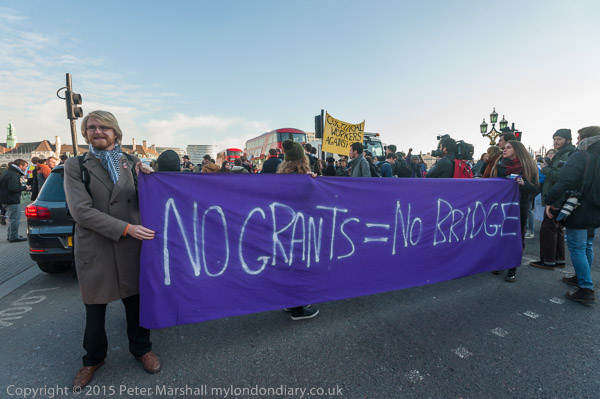
Trade Justice At Brighton: Twenty years ago on Sunday 26th September 2004 I spent the day in Brighton, not with my bucket and spade on the beach but with my Nikon D100 camera, and both a wide-angle and telephoto zoom lenses.

Trade Justice At Brighton 2004

I was there with around 6000 other people at an event organised by the Trade Justice Movement going to lobby at the Labour Party conference – who at that time were in government with Tony Blair as prime minister.

Trade Justice At Brighton 2004

According to its web site, “The Trade Justice Movement is a UK coalition of nearly sixty civil society organisations, with millions of individual members, calling for trade rules that work for people and planet.

Trade Justice At Brighton 2004
Caroline Lucas, Green Party, MP for Brighton Pavillion 2010-2024

They want not free trade but fair trade “with the rules weighted to ensure sustainable outcomes for ordinary people and the environment. We believe that everyone has the right to feed their families, make a decent living and protect their environment. But the rich and powerful are pursuing trade policies that put profits before the needs of people and planet.”

Trade Justice At Brighton 2004

And of course the rich and powerful are still in charge, still driving headlong towards global catastrophe while concentrating on amassing global power and vast fortunes, amounts far beyond what anyone can actually spend or benefit from. Certainly the world does not need – and cannot afford – billionaires.

We need a fairer system to share the world’s resources, and fair trade has a large part to play in this. Back in 2004 the Trade Justice Movement tried to get our government to change its policies but with little effect – and it is still trying to do so.

On the web site they list that they are calling on the UK government to:

  • Ensure that trade rules allow governments, particularly in poor countries, can choose the best solutions to end poverty and protect the environment;
  • Ensure that trade rules do not allow big business to profit at the expense of people and the environment.
  • Ensure that decisions about trade rules are made in a way that is fully transparent and democratic.

My description of the day in Brighton in 2004 was that it began with a rally on the promenade and “continued with a march along the seafront to the centre where the Labour party annual conference was in session. With around 6000 on the march, it straddled about a quarter-mile of seafront.

Outside the conference centre there was a two-minute silence before a further several minutes of deafening cacophony from whistles, banging on drums and saucepans and anything else that could make a noise.”

Then ballot papers calling for trade justice were collected in and put into large ballot boxes along the seafront. Many people had brought cards completed by friends and a good start was made towards collecting the million signatures aimed at.

On My London Diary I divided the pictures into four groups, General, Speakers, Performers and pictures from the March. This now seems rather confusing, but this was a time when few of those accessing the site were then on broadband. So there were pages of large postage-stamp sized thumbnails which would load reasonably rapidly, with the instruction “Click on any image to load these; they will be slow to download unless you are on broadband.

The links on the September My London Diary page still go to the pages of thumbnails, but you can go directly to the larger images now on the links below.

General
Speakers
Performers
March & Ballot


FlickrFacebookMy London DiaryHull PhotosLea ValleyParis
London’s Industrial HeritageLondon Photos

All photographs on this page are copyright © Peter Marshall.
Contact me to buy prints or licence to reproduce.


Haringey Development & Ritzy Strike – 2017

Haringey Development & Ritzy Strike: On Saturday 23rd September 2017 hundreds marched from a rally in North London against the council’s plans to make a huge transfer of council housing to Australian multinational Lendlease, which would result in the demolition of thousands of council homes, replacing them largely by private housing. I left the march close to its end taking the tube to Brixton where strikers at the were marking a year of action with a rally.


Haringey Against Council Housing Sell-Off

Haringey Development & Ritzy Strike

People had come to a rally and march against Haringey Council’s ‘Haringey Development Vehicle’, HDV, which proposed a £2 billion giveaway of council housing and assets to a private corporation run by Australian multinational Lendlease.

Haringey Development & Ritzy Strike

This would result in the speedy demolition of over 1,300 council homes on the Northumberland Park estate, followed by similar loss of social housing across the whole of the borough.

Haringey Development & Ritzy Strike

Similar ‘regeneration’ schemes in other boroughs such as Southwark, Lambeth and Barnet had resulted in the loss of truly affordable housing, with the result of social cleansing with many of the poorer residents of the redeveloped estates being forced to move out of these boroughs to areas with cheaper private housing on the outskirts of London and beyond.

Haringey Development & Ritzy Strike

London’s housing crisis has been made much worse by the activities of wealthy foreign investors buying the new properties and keeping them empty or only occasionally used as their values rise. Among the groups on the march were those such as Class War and Focus E15 who have down much to bring this to public attention.

In London it is mainly Labour Councils who are in charge and responsible for the social cleansing of the poor and the loss of social housing that is taking place on a huge scale.

Along with speakers from estates across London where similar schemes are already taking place there were those from Grenfell Tower where cost cutting and ignoring building safety and residents’ complaints by private sector companies including the TMO set up by the council created the disaster just waiting to happen.

On My London Diary I quoted part of a speech by then Labour Leader Jeremy Corbyn a few days later at the Labour Party conference which condemned current practice on estate ‘regeneration’ and housing of which the HDV is the prime example.

The disdain for the powerless and the poor has made our society more brutal and less caring. Now that degraded regime has a tragic monument: the chilling wreckage of Grenfell Tower, a horrifying fire in which dozens perished. An entirely avoidable human disaster, one which is an indictment not just of decades of failed housing policies and privatisation and the yawning inequality in one of the wealthiest boroughs and cities in the world, it is also a damning indictment of a whole outlook which values council tax refunds for the wealthy above decent provision for all and which has contempt for working class communities.”

You can hear the speech in full on the article by Architects For Social Housing on the conference, where they give their comments and more detail on the section I quoted above:

Indeed it has. And high in the list of that brutality is the estate regeneration programme that threatens, is currently being implemented against, or which has already privatised, demolished or socially cleansed 237 London housing estates, 195 of them in boroughs run by Labour councils, which vie with each other for the title of ‘least caring’, and among which the councils of Hackney, Southwark, Tower Hamlets, Lambeth and Haringey could give the Conservative-run Kensington and Chelsea council a lesson in disdain, privatisation, failed housing policies and the inequality they produce. But it’s good to hear Corbyn discard the Tories’ contemptuous terminology of ‘hardworking families’ and ‘ordinary people’ and finally – if belatedly – refer to the ‘working class’.

They go on to comment less favourably on Corbyn who they say had ignored “the estate regeneration programme that is at the heart of London’s transformation into a Dubai-on-Thames for the world’s dirty money” and so had failed to perceive that “every estate undergoing demolition and redevelopment could produce a similar testimony of inept and incompetent local authorities, bad political decisions and a failed and broken system of democratic accountability.”

The grass roots revolt against the HDV plans resulted in a political change and the scrapping of the plans. But the Labour Party has also changed radically, and those very people responsible for those ‘least caring’ local authorities in London and across the country are now in government.

More pictures at Haringey against council housing sell-off.


One year of Ritzy strike – Brixton

A quite different vehicle was the star of the show in Brixton, where BECTU strikers at the Ritzy Cinema were celebrating a year of strike action with a rally supported by other trade unionists, including the United Voices of the World and the IWGB and other union branches.

The strikers continued to demand the London Living Wage, sick pay, maternity and paternity pay, for managers, supervisors, chefs and technical staff to be properly valued for their work, and for the four sacked union reps to be reinstated.

After speeches in English and Spanish, came the surprise. The vehicle in Brixton was the newly acquired ‘Precarious Workers Mobile’, a bright yellow Reliant Robin, equipped with a powerful amplifier and loudspeaker, and after more speeches this led the protesters in a slow march around central Brixton.

Various actions at the Ritzy had started three years before this, when workers called for a boycott of the cinema. In 2019, after an industrial tribunal had won some of their claims BECTU suspended the boycott and the Living Staff Living Wage campaign although still continuing to fight for equal pay and against other dismissals.

More pictures at One year of Ritzy strike.


FlickrFacebookMy London DiaryHull PhotosLea ValleyParis
London’s Industrial HeritageLondon Photos

All photographs on this page are copyright © Peter Marshall.
Contact me to buy prints or licence to reproduce.


Druids, Paddington & Hizb ut-Tahrir – 2013

Druids, Paddington & Hizb ut-Tahrir: This year the Autumn Equinox is on Sunday 22 September at 12.44pm GMT (1.44pm BST), and the Druid Order will again be holding their ceremony on Primrose Hill in London as they have for many years. They meet earlier to get things ready but the ceremmony begins around 12.30 The pictures here are from the event in 2013, and afterwards I took a walk around Paddington Basin before going to photograph the start of a march by the women and children of Hizb ut-Tahrir against the massacres of civilians being committed by the Assad regime in Syria.


Druids Celebrate Autumn Equinox – Primrose Hill

Druids, Paddington & Hizb ut-Tahrir - 2013

The Druid Order celebrated the Autumn Equinox (Alban Elued) with a ceremony on top of Primrose Hill in London at 1pm on Sunday 22 September 2013 in their traditional robes. They have been organising similar celebrations for just over a 100 years.

Druids, Paddington & Hizb ut-Tahrir - 2013

In My London Diary you can read a description of what takes place at this event, which marks the start of the Druid year.

Druids, Paddington & Hizb ut-Tahrir - 2013

On their web site they write “The harvest festival, when the power of heaven is infused into the fruits of the earth, and you reap what you have sowed. You see the full reality, what you made of your dreams, projects and plans, the actual reality, the truth that gives understanding and wisdom.”

Druids, Paddington & Hizb ut-Tahrir - 2013

The pictures on My London Diary are in the order in which I took them and I think include all the key moments in the ceremony, together with some commentary in the captions.

I had photographed this and the Spring Equinox ceremony at Tower Hill on a number of previous occasions and you can find pictures on the March and September pages for most years from 2007 to 2013.

By 2013 I was beginning to feel I had little more to say about the event and the following year, 2014 was the final time I went to take pictures.

A few of the pictures were taken with the help of a monopod which enabled me to hold the camera several feet above my head and take pictures with the help of a remote release. But although I could control the moment of release it was tricky to keep the lens pointing in the right direction.

Also on My London Diary is a brief history of the Druid Order, which although it has ancient roots in the Druidic tradition was founded a little over a hundred years ago.

There are a number of other Druid orders, some with very similar names, and members of the Loose Association of Druids including the Druid of Wormwood Scrubbs watched for a while before leaving for their own ceremony in the nearby Hawthorn Grove.

More on My London Diary at Druids Celebrate Autumn Equinox.


Paddington Basin

I had some time after the end of the Equinox ceremony before a protest I was to photograph and decided to take a walk around Paddington Basin, close to where that was to start.

Paddington Basin is the London end of the Paddington Arm of the Grand Union Canal and was opened in 1801 to bring goods by canal into Westminster and to the start of the New Road, a toll road across the north of London, now the A501. The Paddington end is now Marylebone Road and further on it becomes Euston Road.

Paddington Basin lost some of its traffic a little over twenty years later with the opening of the Regent’s Canal, which led from the Paddington Arm at Little Venice directly to the edge of the City and on to the River Thames at Limehouse.

Development of the area around the canal began in 1998 in one of London’s larger development areas under the Paddington Regeneration Partnership, later the Paddington Waterside Partnership.


Hizb ut-Tahrir Women March for Syria – Paddington Green

Women of Hizb ut-Tahrir appalled by the chemical attack and other massacres of women and children in Syria marched in London to show solidarity and called for Muslim armies to mobilise to defend the blood of their Ummah.

Hizb ut-Tahrir protests are always segregated and often seem to marginalise women, but this was clearly their show, with only one small group of men with a banner and a heavy public address system and around a thousand women and children.

The call to the march stated “rows upon rows of dead children in their burial shrouds have no doubt brought us to tears as Muslim women, for this is our beloved Ummah that is being killed.” They called on women to “Stand in solidarity with your sisters in Syria and speak out against the shedding of their blood and that of their families and children.”

Hizb ut-Tahrir oppose the current corrupt rulers in Islamic states and call on Muslims to rise up and get rid of corruption, and in particular of “the criminal regime of the butcher Bashar Al Assad” in Syria, and for “Muslim armies to mobilise and replace the rule of the dictator with the rule of Allah.”

I left the marchers as they went down the Edgware Road on their way to the Syrian Embassy in Belgrave Square.

Hizb ut-Tahrir was banned in the UK as a terrorist organisation in January 2024 after protests in London in which it praised attacks on Israel.

Hizb ut-Tahrir Women March for Syria


FlickrFacebookMy London DiaryHull PhotosLea ValleyParis
London’s Industrial HeritageLondon Photos

All photographs on this page are copyright © Peter Marshall.
Contact me to buy prints or licence to reproduce.

Guns & Knives, Pineapple, Orange & Thames 2008

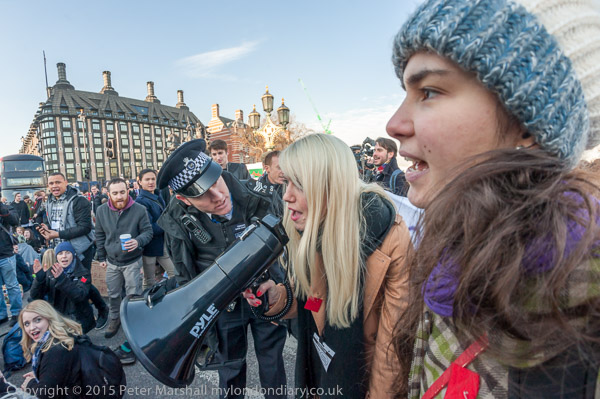
Guns & Knives, Pineapple, Orange & Thames: On Saturday 20th September 2008 after photographing a protest over gun and knife crime, a festival in Stockwell and being assaulted at an Orange March I went to Open House Day at Trinity Buoy Wharf and then crossed the river to walk along the riverside path from North Greenwich to Greenwich.


The Peoples March – Kennington Park

Guns & Knives, Pineapple, Orange & Thames

The Peoples March’ against gun and knife crime from Kennington Park was organised by the Damilola Taylor Trust and other organisations and supported by the Daily Mirror and Choice FM and came at the end of London Peace Week.

Guns & Knives, Pineapple, Orange & Thames

In 2007 there were 26 teenagers killed on the streets of London, and many of those on the march “were the families and friends of young people whose lives were ended prematurely by violent death, and the grief felt by many of those I photographed was impossible to miss. They were stricken and angry and demanding that something was done to stop the killing.”

These deaths continue. They peaked in 2021 when 30 were killed, but most years there have been around 20 such tragic deaths. Despite many marches such as this and projects such as the Violence Reduction Unit set up in 2019 by London Mayor Sadiq Khan these deaths continue.

Prime Minister Keir Starmer met with victims’ families just a few days after the election and earlier this month held a knife crime summit at Downing Street aimed at halving it over the next decade. Earlier in the year King Charles and actor Idris Elba hosted a mini-summit on knife crime at St James’s Palace in July. A ban on the sale and possession of zombie-style knives and machetes will come into force in 4 days time.

Guns & Knives, Pineapple, Orange & Thames

It remains to be seen if these initiatives will have any effect. Back in 2008 I commented that “Effective action would involve huge cultural shifts and a direction of change that would reverse much of what we have seen over the past 50 or so years” and unfortunately there still seems little chance of this happening.

The Peoples March


Stockwell Festival – Pineapple Parade

Guns & Knives, Pineapple, Orange & Thames

My spirits were lifted by seeing so many people taking part in the Pineapple Parade, part of the Stockwell Festival, clearly enjoying themselves taking part with others in the event. As I commented, “Community festivals such as this have an important role in building the kind of relationships that lead to healthy communities.”

John Tradescant the Elder (1577-1638) and his son John Tradescant the Younger (1608-1662) had their extensive nurseries a little up the road from where I was taking pictures and brought many exotic species to this country in the seventeenth century, and possibly pineapples were among them, although sources differ on this. Some pineapples were imported here in that era but apparently they were only cultivated here in heated greenhouses in the nineteenth century.

But as I wrote in 2008 “among the dancing and fancy dress I also found a reminder of violent death, Stockwell is probably best known for the brutal shooting by police of an innocent unarmed Brazilian man who had just boarded an underground train at Stockwell Station in 2005.”

More pictures Stockwell Festival – Pineapple Parade.


Apprentice Boys of Derry March – Temple

I shivered a little as I went down the escalator and boarded the tube on my way to Temple to photograph the Apprentice Boys of Derry March in which various Orange Order associations were taking part.

As you can see from my pictures, most of those taking part were proud to be there and happy to be photographed.

“But at one point I found myself being pushed backwards by a large man in dark glasses and instructed very fimly to leave. This kind of intimidation certainly isn’t acceptable and of course I continued to take pictures of the event. But it was a reminder of the darker side of Loyalist Ulster, which I hadn’t expected to see on the streets of London.”

More pictures on My London Diary at Apprentice Boys of Derry March.


Open House at Container City – Trinity Buoy Wharf, Leamouth

I took the tube to Canning Town and then walked down the long way to Trinity Buoy Wharf, cursing that the path beside Bow Creek and long-promised bridge had not been built. Part of the walkway is now open and an new bridge to the redeveloped Pura Foods site now provides more convenient access.

It was Open House Day in London and I took advantage of this to visit Trinity Buoy Wharf and the Container City there, a set of artists studios built using containers. Begun on the site in 2001, this had by then expanded considerably.

Trinity Buoy Wharf is open every day of the year except Christmas Day, but in 2008 as this year there were many extra activities for Open House. And at the end of 2023 the only complete Victorian steam ship in existence, the SS Robin has joined the collection of Heritage Vessels there, though tours for Open House on Sat 21st & Sun 22nd September 2024 are fully booked.

The containers were interesting but I think it was other aspects of the site and the view from it that interested me most, as well as the chance to take the specially laid-on ferry across the Thames to North Greenwich.

Open House at Container City


North Greenwich to Greenwich – Thames Path, Greenwich

The riverside walk is one I’ve done many times and its always of interest although the section at North Greenwich was only opened up in the 1990s and in more recent times parts of the walk have been blocked during the construction of some of the new blocks of riverside flats.

A large aggregate wharf remains although most of the riverside industry has gone, including the silos and the rest of the works at Morden Wharf. And only Enderby House remains of the site from which ships left to lay undersea cables across the world.

Greenwich of course retains its grand buildings, now a part of Greenwich University.

On My London Diary there are also some views across the river, both to buildings Canning Town, Leamouth, Canary Wharf and the Isle of Dogs. It’s a walk I’ve done several times since and might well do again, probably starting from North Greenwich Station. You can see pictures from a walk in 2018 on My London Diary. And there are still some good pubs when you reach Greenwich on your way to the buses or stations there.

More pictures from September 20th 2008 at North Greenwich to Greenwich.


FlickrFacebookMy London DiaryHull PhotosLea ValleyParis
London’s Industrial HeritageLondon Photos

All photographs on this page are copyright © Peter Marshall.
Contact me to buy prints or licence to reproduce.


Save Hospitals & Secular Europe – 2012

Save Hospitals & Secular Europe: On Saturday 15th September 2012 almost two thousand people marched from Southall to meet others at a rally in Ealing to save Accident & Emergency Services at their local hospitals. Later I photographed humanists, atheists and others marching in Westminster.


Thousands March to Save Hospitals – Southall

Save Hospitals & Secular Europe

A large crowd had come to Southall Park for the start of a march against the the closure of A&E and other departments at Ealing, Central Middlesex, Charing Cross and Hammersmith hospitals. Another march was going from Acton to the rally in Ealing.

Save Hospitals & Secular Europe

A few days ago Keir Starmer talked about the crisis facing the NHS, and how it will take perhaps eight years to put it on a firmer footing for the future. He and Health Secretary Wes Streeting blamed its current parlous position on the reforms criticised by Lord Darzi as “disastrous” introduced by the coalition government in 2012 and the lack of investment in infrastructure under the Tory-led years of cuts since 2010.

Save Hospitals & Secular Europe

Of course both these things are true, but not the whole picture and they say little that was not said by those working in the NHS and almost every commentator at the time about Andrew Lansley’s controversial Health and Social Care Act which came into force under his successor Jeremy Hunt, as well as lack of proper funding.

Save Hospitals & Secular Europe

But they also leave out the disastrous effects of the many PFI schemes introduced under New Labour which landed the NHS with huge debts and continue to impose severe costs on many hospitals with excessive maintenance and other charges. PFI did provide much needed new hospitals, but did so at the expense of the NHS, transferring the costs away to make government finance look better; avoiding short-term public financing but creating much higher long-term costs.

New Labour also accelerated the privatisation of NHS services, which has of course increased greatly since the Tories came to power. Both parties became enamoured of a move away from the original NHS model to an insurance based system modelled on US Healthcare, a system that leaves many poorer US citizens with inadequate access to healthcare and is responsible for around 62% of the two million annual bankruptcies in the USA when for various reasons people’s insurance does not cover their treatment costs.

We in the UK spend almost a fifth less on health than the EU average, and only around a third of the per person spending in the USA – according to a 2010 article in the Journal of the Royal Society of Medicine comparing the two systems.

We all now have complaints about the level of service provided currently by our overloaded and cash-strapped NHS. Waiting times are sometimes ridiculously long and appointments hard to get. We need a better NHS, and to pay more for a better NHS, one that is better integrated rather than divided by Lansley’s competitive marketing-based model. But I have little confidence that our current government will make the right changes for either the NHS staff or the people.

We also need much better industrial relations, and the efforts by the new Labour government to sort out the disputes with healthcare workers deliberately engineered by the Tories which led to the strikes are encouraging. But many more changes to improve staff morale and retention are necessary. To remove the reliance on agency staff there needs to be an improvement in the treatment of NHS employed staff – and a number of simple measures including the removal of staff parking charges would help. And of course we also need to train more healthcare staff at all levels and in all specialities.

The rally on 15th September 2012 was supported by local councils and local MPs and there were many speakers with years of experience in the NHS who gave short speeches about the effects the closures would have – and the inevitable deaths that would result, particularly from the longer journey times through often highly congested streets to the remaining A&E services. Fortunately most of the politicians were told they would have to wait for the rally at the end of the march to speak. So I missed them as I walked a few hundred yards with the marchers along the main road towards Ealing and the rally, but then left them and walked to the station to take a train into central London.

More about the rally and march on My London Diary at Thousands March to Save Hospitals.


March & Rally for a Secular Europe – Westminster

Around 250 humanists, atheists and others marched from Storey’s Gate, next to Methodist Central Hall and across the road from Westminster Abbey, both in their different ways reminders of the links between the state and states and religion. And I presume the rally venue in Temple Place was chosen for the same reason.

They had come protest against the privileged status of religion and call for a truly secular society with freedom of religion, conscience and speech with equal rights for all in countries across the world, but particularly in Europe.

They demanded a secular Europe with complete separation between church and state and with no special status on grounds of religion, one law for all without execeptions.

The main banner read ‘For Universal Human Rights‘ and marchers chanted slogans including ‘2,4,6,8, Separate church and state‘ and of course ‘What do we want? A Secular Europe. When do we want it? Now‘, as well as stating that Women’s rights (and Gay Rights, Children’s Rights etc) are Human Rights.

But perhaps the most popular chant was one directed in particular against the Catholic Church, ‘Keep your rosaries Off my ovaries.” And at the rally in Temple Place Sue Cox of Survivors Voice, reminded us not just of sexual abuse of children by priests, but also of the continuing failure of the Catholic Church to deal with this, as well as the sinister power that that church still wields in countries including Italy.

As the march arrived at the rally there the London Humanist Choir performed some Monty Python songs before a number of speeches from Peter Tatchell and others. As he said, many people of faith also support both equality and the separation of religion and state, and that “for every bigot there are also people of faith who are with us.”

More at March & Rally for a Secular Europe.


FlickrFacebookMy London DiaryHull PhotosLea ValleyParis
London’s Industrial HeritageLondon Photos

All photographs on this page are copyright © Peter Marshall.
Contact me to buy prints or licence to reproduce.


Trans Pride & Anti-Racist March in Brixton – 2019

Trans Pride & Anti-Racist March in Brixton: Five years ago today on Saturday 14th September I photographed the start of London’s first Trans+ Pride march before taking the tube to Brixton for an anti-racist march and rally.


London’s First Trans+ Pride March

Trans Pride & Anti-Racist March

Hundreds met at Hyde Park Corner to march along Oxford Street to Soho Square in London’s first Trans+ Pride March, was both a celebration and protest for trans, non-binary, intersex, and gender non-conforming individuals and their family, friends and allies.

Trans Pride & Anti-Racist March

They marched to increase the visibility of the trans+ community and to protest against the continuing discrimination in the UK and around the world against trans people.

Trans Pride & Anti-Racist March

Many carried placards and posters with messages such as ‘Trans Rights Matter‘ and ‘Trans Rights Are Human Rights’.

Trans Pride & Anti-Racist March

There has been increasing transphobia in British media, with trans people being attacked on the streets, and this has continued to grow since 2019.

Trans Pride & Anti-Racist March

The charity Stop Hate UK reports that in “2020/2021, 2,630 Hate Crimes against transgender people were recorded by the Police, an increase of 16% from the previous year” though they say the actual number of incidents is much greater as 88% of transgender victims of serious incidents did not report them.

Incidents reported to Stop Hate UK were of “verbal abuse, threatening behaviour, harassment and anti-social behaviour, such as having derogatory terms shouted at them, having invasive or inappropriate questions asked of them or facing harassment from neighbours, co-workers or strangers. “

In 2018 Trans Exclusionary Radical Feminists had disrupted the Pride March in London with an anti-Trans protest and there were fears they might try to disrupt this march. There were many feminists supporting trans rights on this march.

More pictures at London’s First Trans+ Pride March.


Brixton anti-racist march

I took the tube from Green Park to Brixton where Movement for Justice and Lambeth Unison Black Workers’ Group were protesting against the continuing persecution of Windrush family members and other migrants.

They called for freedom of movement, the closure of immigration detention prisons, and an end to Brexit which is being used to whip up immigrant-bashing and nationalism to establish a Trump-style regime in Britain under Boris Johnson.

I missed the start of the rally in Windrush Square, but heard several of the speakers including Eulalee who has been fighting the Home Office for 16 years to remain in the UK with her family and was wearing a ‘More Blacks! More Dogs! More Irish‘ t-shirt.

People picked up their posters and marched the short distance to busy Brixton Market.

Here they stopped for more speeches, with many shoppers stopping briefly to listen and taking the fliers that were being handed out.

The protest seems to get a very positive reception in the market.

Green MEP for London Scott Ainslie joined the protest to speak about his ‘LDNlovesEU‘ campaign calling for an end to Brexit.

After his speech the protesters picked up their posters and moved on along Electric Avenue,

and turned into Atlantic Road,

They then marched down Brixton Road back to Windrush Square where the protest ended with some brief speeches and photographs.

More pictures on My London Diary at Brixton anti-racist march.


FlickrFacebookMy London DiaryHull PhotosLea ValleyParis
London’s Industrial HeritageLondon Photos

All photographs on this page are copyright © Peter Marshall.
Contact me to buy prints or licence to reproduce.

Corbyn Victory & Refugees Welcome – 2015

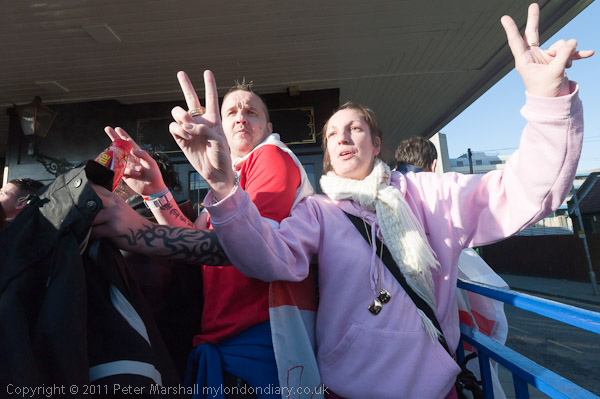
Corbyn Victory & Refugees Welcome: Saturday 12th September 2015 was a day of hope when Jeremy Corbyn won the Labour leadership election with a landslide victory, getting more than three times the vote of his nearest rival, Andy Burnham. Several hundred Corbyn supporters met at Speakers’ Corner before the Refugees Welcome march to listen to the results of the Labour Leadership election.


Victory Party for Jeremy Corbyn – Speakers’ Corner, Hyde Park,

Corbyn Victory & Refugees Welcome

Tension built as the Deputy Leader results came and then erupted with Jeremy Corbyn’s first round victory.

Corbyn Victory & Refugees Welcome

Corbyn had only been able to stand in the election because some Labour MPs who did not support him were prepared to nominate him so that the Labour left would have a candidate in the ballot and not feel it was rigged against them. They thought he would only get a miserably low percentage of the votes.

Corbyn Victory & Refugees Welcome

According to Wikipedia, the release of opinion polls before the election which showed Corbyn in the lead prompted “high-profile interventions by a number of prominent Labour figures including Gordon Brown, Tony Blair, Jack Straw, David Miliband, and Alastair Campbell, among others” who felt Labour with Corbyn as leader would be unelectable.

Corbyn Victory & Refugees Welcome

These interventions almost certainly increased support for Corbyn, and although these and other Labour figures such as Peter Mandelson, along with most of the media and press did their best to try to get rid of Corbyn, including various plots and mass resignations from the Shadow Cabinet, he remained popular in the country.

The 2017 election turned out to be a much closer contest than most had imagined, and it was only due to deliberate sabotage by Labour party officials that Corbyn lost. A leaked report in 2020 which demonstrated this led to the setting up of the Forde report into Labour party factionalism which although it called the earlier report “factional” confirmed many of its suspicions and conclusions – as well as criticising both sides in the party – remained secret until July 2022.

What shocked many of us was the evident relief shown by some leading members of the party as the 2017 election results were coming out that their party had lost. And the witch-hunt against the left in the party continues unabated.

On the 12th September 12th 2015 there was much more media interest in the few hundred celebrating Corbyn’s victory than in the huge Refugees Welcome march which followed, and in the media scrum I got knocked flying and my equipment scattered, but managed to gather it up and continue work.

Victory Party for Jeremy Corbyn


Refugees Welcome Here Rally & March

From Speakers Corner I joined the huge crowd – at least 50,000 – filling Park Lane as far as I could see. This national march was a response to the many reports of refugees fleeing war and persecution, with people wanting to show their support for refugees facing death and hardship and their disgust at the lack of compassion and inadequate response of the British government.
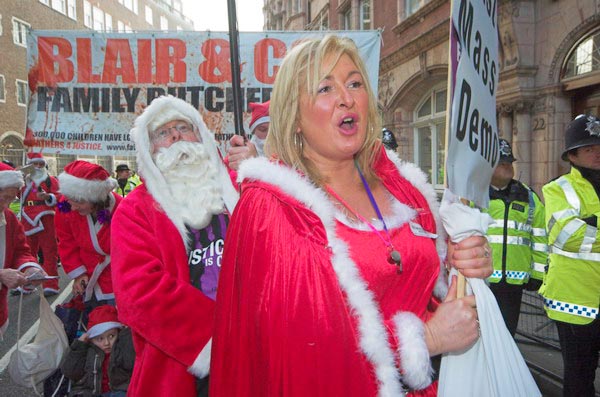
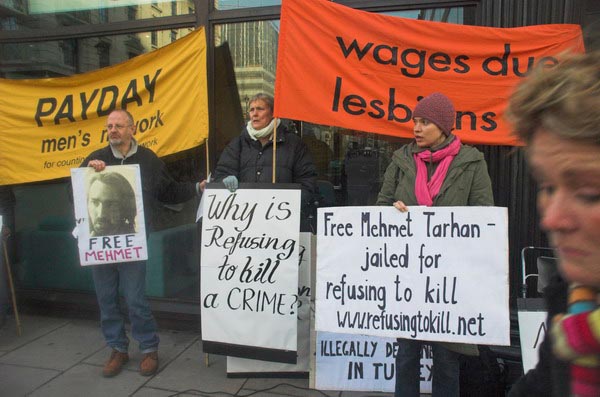
On My London Diary is a list and photographs of some of the speakers before the march set off. I photographed the front of the march as it set up at the southern end of Park Lane and went with it for the first couple of hundred yards into Piccadilly, where I stopped to photograph the rest of the march as it came past.

The marchers were fairly densely packed and spread across the whole of the roadway (and sometimes on to the pavement too) and it took exactly an hour to go past me.

There were many at the protest who were not the usual protesters, people who said this was the first protest they had ever attended, as well as those that I knew from previous protests, and there were many interesting placards and banners to photograph – and many more pictures on My London Diary.

As the end of the march passed me I rushed into Green Park Station and took the tube to Westminster, arriving on Whitehall as it went very noisily past Downing Street.

I ran back to Parliament Square, and this soon filled up with people and banners. I sat down on the wall close to the Churchill statue, realising I was rather tired and hungry.

Many marchers left rather than stay and listen to the speeches, though the square was still crowded and I decided I would leave too.

More on My London Diary:
Rally Says Refugees Welcome Here
Refugees are welcome here march
Refugees Welcome march reaches Parliament


FlickrFacebookMy London DiaryHull PhotosLea ValleyParis
London’s Industrial HeritageLondon Photos

All photographs on this page are copyright © Peter Marshall.
Contact me to buy prints or licence to reproduce.