I can no longer remember whether the short excursion to Greenland Dock from Rotherhithe came at the end of my previous walk or a few days later at the beginning of my walk on 28th October 1988, though of course it doesn’t really matter. The story of my previous walk began at Greenwich and Deptford Creek October 1988 and ended with Deptford to Rotherhithe October 1988.
I’m unsure now whether I took the fist few of these pictures at the end of my previous walk or at the start of my next one, but it hardly matters as they are in the same area and within a few days of each other.
This is one of the two bridges that linked the riverside areas of Rotherhithe and the Surrey Docks to the area around Lower Road and Surrey Quays station, then on the East London which ran between Shoreditch and alternately to New Cross or New Cross Gate, linking to the District line at Whitechapel. Both have been preserved, though not in working order and this one a short distance from it former site.
At the centre of the picture you can see the curved lower end of the bridge and below it the flat rail on which it rolled back to raise the bascule, with a heavy counterweight above so very little power was needed to raise the bridge.
Four people in kayaks link up and stop to talk to each other in Greenland Dock. I was standing at the end of Greenland Quay and looking towards the tower blocks of the Barkantine Estate on the Isle of Dogs across the Thames.
Southwark Park, Rotherhithe, Southwark, 1988 88-10j-62
My next picture was made in Southwark Park, which I think I walked through to Jamaica Road. I’m not absolutely sure what the building in the background was, and I think the area it was in has now been re-developed. Somewhere in the north-east corner of the park it was probably a part of the former St Olave’s Hospital which closed in 1984 and was demolished and replaced by Ann Moss Way in the 1990s.
I seem deliberately to have tried to make this picture mysterious, taking three near-identical frames, an unusual number for me at the time when film was relatively expensive.
Major Works, James Jackson and Co, Jamaica Rd, Bermondsey, Southwark, 1988 88-10j-51
This works was next to Major Road, though I’m not sure if it took its name from the road or gave its name to it. It was demolished to build Bermondsey Underground Station on the Jubilee Line Extension which opened at the start of 2000. According to the text on its frontage the company was ‘Established 1827’ and made ‘Flooring Adhesives, French Polishes, Wax Polishes, Varnishes, Seals, Staines – Etc.’
Relatively few streets in the area aspire to a No 90 and none that I can find that look anything like this now. This was a part of a terrace of 5 similar houses starting at a street corner, with two pairs of doors on the street and one around the corner as another frame (not digitised) shows. It appears to be later Victorian and I suspect has been demolished. The gate was perhaps a 1930s addition.
Lockwood Square was a 1960’s addition to the council’s Southwark Park Estate with flats around a central grass area. There had been a Lockwood Street here and it was probably badly damaged by wartime bombing. The buildings are bounded by Drummond Road, Clements Road and Southwark Park Road. Some of the ground floor is garages and there are a few shop units. To the north is a play area and Saint Crispin with Christ Church Bermondsey and the similar block of New Place Square.
Magna Carta Under Threat – Runnymede Eco Village 12 June 2015
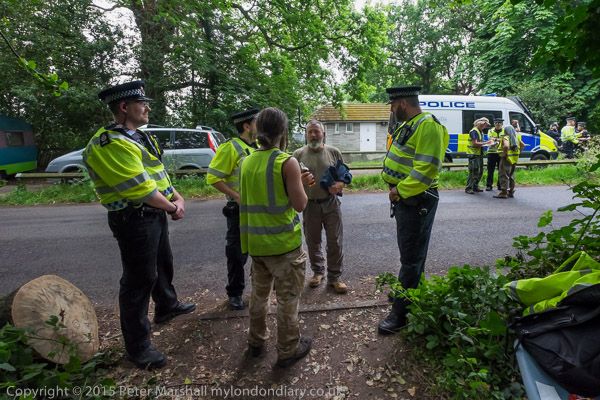
Police question people and refuse to allow them to enter the site
On 15th June 1215, rebel barons forced King John to sign a royal charter of rights at a meeting at Runnymede, just a short bike ride from where I live. According to Wikipedia, “it promised the protection of church rights, protection for the barons from illegal imprisonment, access to swift justice, and limitations on feudal payments to the Crown.” While good news for the church and the barons, it had little to offer the common men, and neither side took much notice of it and was in any case rapidly annulled by the Pope.
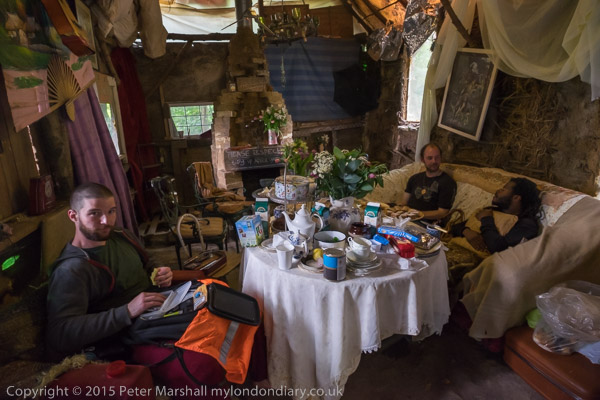
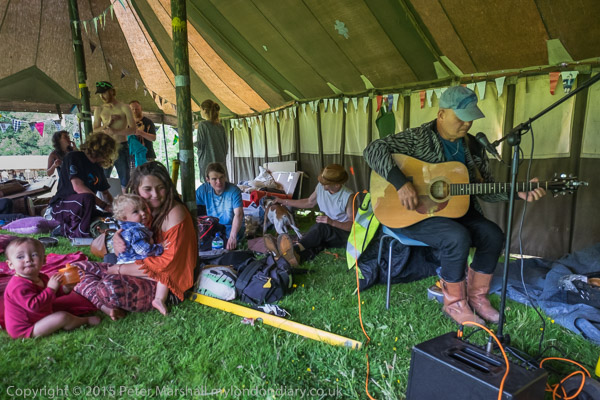
Tea and cakes inside the Long House at Runnymede Eco-Village
Two years later after the death of John and a war by the Barons a revised version was part of the peace treaty, and this was then given the name Magna Carta, as there was another smaller Charter of the Forest also agreed between the parties in 2017. This re-established the rights of free men in royal forests which the Normans had largely removed, at the same time making about a third of the land in the south of England into royal forests, giving rights to collect firewood, burn charcoal, graze pigs and other animals and cut turf – all vital activities for keeping alive.
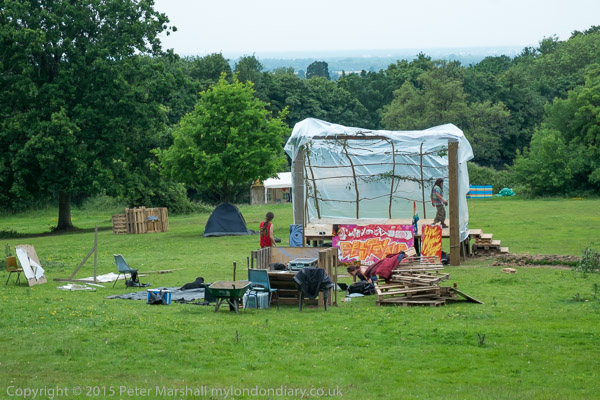
Getting the festival stage ready
Although the legal significance of Magna Carta soon faded away, it re-emerged from the 16th century on as it became seen as the basis for the English constitution, restoring the freedoms that the conquering Normans had removed, and it became widely seen as the basis for “the contemporary powers of Parliament and legal principles such as habeas corpus.” Various British monarchs tried to supress even its discussion but it remained “a powerful, iconic document, even after almost all of its content was repealed from the statute books in the 19th and 20th centuries.” And these discussions had a powerful effect on those writing the US Constitution.
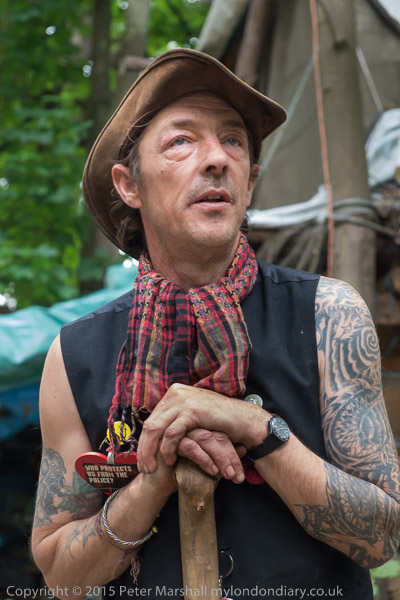
Vinny wears a badge “Who Protects Us Form the Police?”
The only clauses of Magna Catra that remain in force are those protecting the Church and the City of London and Clause 29 which stated “The body of a free man is not to be arrested, or imprisoned, or disseised, or outlawed, or exiled, or in any way ruined, nor is the king to go against him or send forcibly against him, except by judgment of his peers or by the law of the land.” But when Occupy London tried to make use of this to resist eviction their argument was unsuccesful.
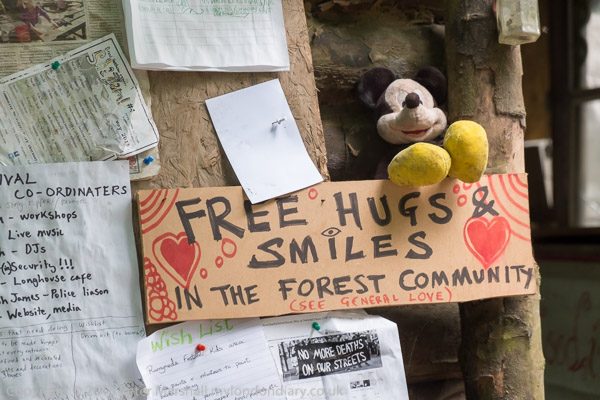
The Eco-Village was a friendly, peaceful and welcoming place
More recently Magna Carta “truthers” have unsuccfully tried to use it against various legislation, including the Covid laws, particularly over wearing masks. But without any chance of success. Freedom to flout the law seems mainly to be granted to those in government. And much of the legislation being pushed through the UK parliament now by a large Tory majority does go against our principles of freedom, such as severely restricting our rights to protest and deporting asylum seekers.
The Magna Carta celebration is proposed 3 years earlier – Runnymede, Surrey, Sat 16 Jun 2012
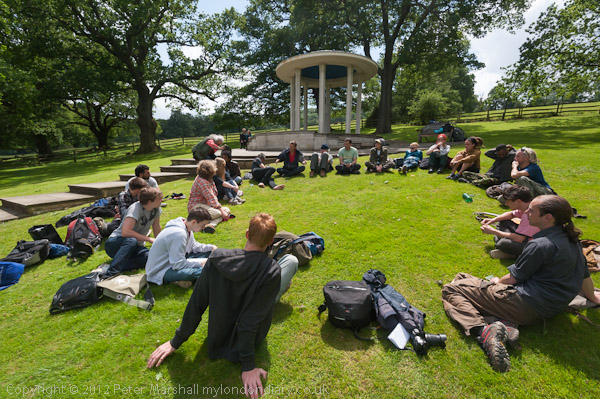
Back in June 2012 I had sat on the grass with ‘Diggers’ camped on Cooper’s Hill close to the US Bar Association Magna Carta memorial (and possibly close to where King John and the Barons met, though that may have been rather closer to Staines.) The original Diggers or ‘True Levellers’ were founded in 1649 after the first English Civil War by Gerard Winstanley who stated “England is not a free people, till the poor that have no land have a free allowance to dig and labour the commons.” His ideas of the sharing of property came from the New Testament.
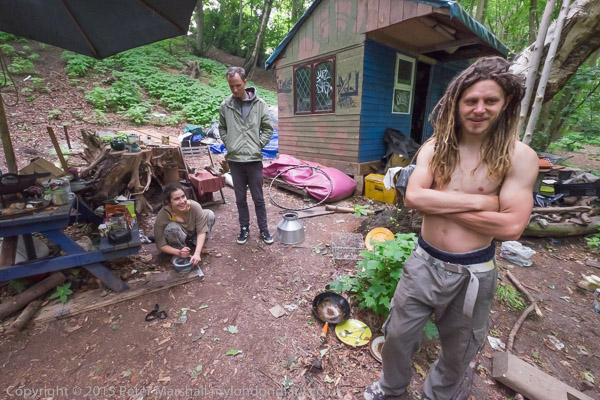
Luke, trained as a forester, says the woodland had been sadly neglected
This year it is particularly appropriate to recall the Biblical idea of ‘Jubilee’, where after 49 years there would be a ‘Year of Release’ when slaves and prisoners would be freed, and debts would be forgiven. The land would be allowed to lie fallow and all land and other properties (except houses in walled cities) would be returned to the original owners or their heirs.
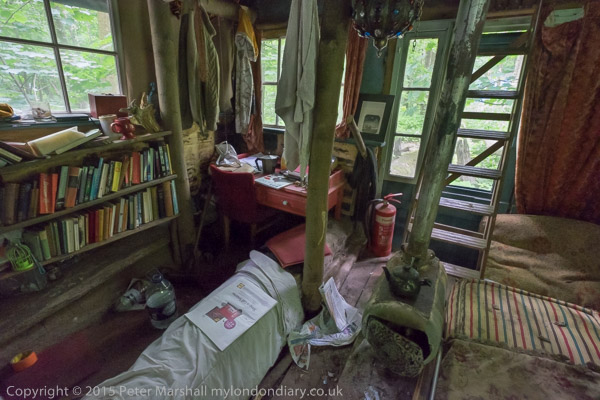
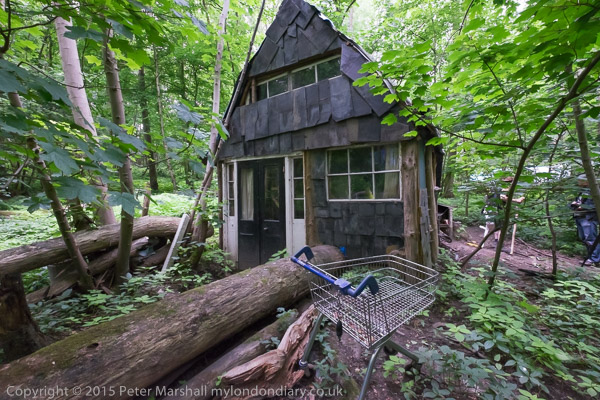
One home was built around a fallen tree running across the floor
Land ownership in the UK has changed relatively little since the Normans took it away from the inhabitants after 1066, with the same families still owning the great majority of English land. A minute fraction of the UK population – 0.65% – currently own more than two thirds of the UK land area. Land ownership is the foundation of our class system and while a revolution seems unlikely in the near future, any reforming government should be putting a land tax at the centre of its programme.
The Diggers at Runnymede in 2012 had heard a discourse on Magna Carta and the Diggers from a historian at the nearby college of London University, and talked about more recent occupations of disused Land by ‘The Land Is Ours’ at the Wandsworth/Battersea Guinness site in 1996, at the Kew EcoVillage in 2009 and at Grow Heathrow.
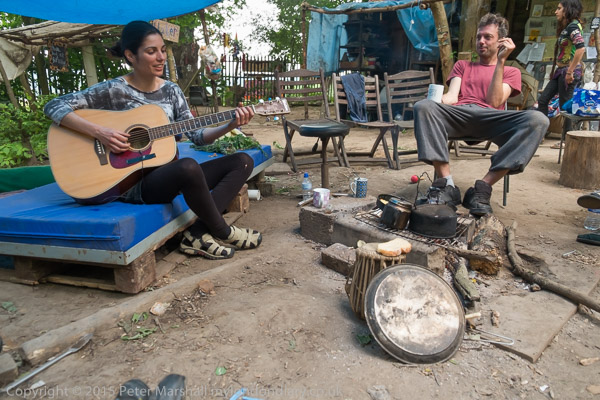
A TV Crew set up a picture of one of the residents playing guitar
My post Diggers at Runnymede Call For Freedom gives some detail on the 2012 event as well as the setting up of the Runnymede Eco Village. At the meeting people agreed to hold a celebration of the 2015 anniversary of Magna Carta at the village site.
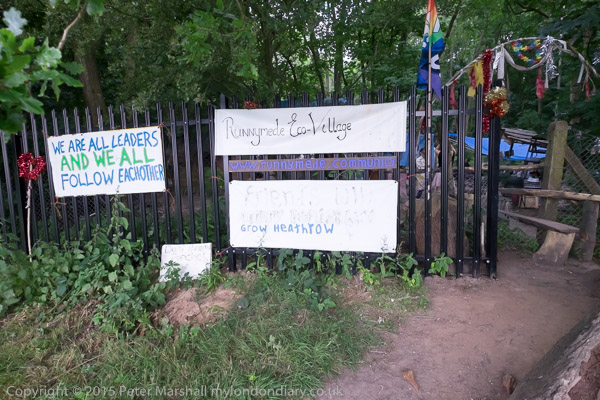
Police watched me closely as I came out of the gate to take this picture. They were stopping people entering.
Many in the local community welcomed the presence of the Eco-village, and the community work they had done over the three years. What little trouble there had been had been caused by outsiders, thought by some to have been encouraged by landowner and police. And although the celebrations were planned to be entirely peaceful, police, urged on by Surrey County Council and almost certainly some government ministers, laid on a huge and almost certainly illegal exercise to prevent the event taking place.
The festival began – but police stopping people coming & threatening them with arrest
I wrote: “Police surrounded the Runnymede Eco Village as the Magna Carta weekend Festival For Democracy was to start and prevented some people entering, issuing some with exclusion notices covering a wide area.“
“The police action appeared to be an entirely politically motivated action against the community and its many friends to prevent their long-planned celebrations of Magna Carta, a charter supposed to represent freedom under the law but here at its very source 800 years ago it was being suppressed in an unfair and arbitrary manner by the forces of the Law.”
Deptford to Rotherhithe October 1988 – the continuation and end of my photographic walk in October 1988. The previous post on this was Liquor, Motors, Furniture, Packing & Timber.
I turned around on Grinstead Road and made this picture as I returned to Evelyn Street. Directly ahead on the other side of Evelyn St was the car auction site shown in a previous post, and towering above that two of the towers on the Pepys Estate. On my right was the grim factory wall of the former galvanised iron and zinc Ida works, at the back of Neptune Wharf on the now filled-in Surrey Canal
Clare Villas, Evelyn St, Deptford, Lewisham, 1988
Clare Villas at 114-116 Evelyn Street and the neighbouring semi-detached pair Oak Villas whose doorway is at the left of the picture show us that there were then some wealthy local residents. These houses back on to Deptford Park and probably date from when this land was market gardens around the time this was bought by the London County Council in 1884. I think one of the two pairs was a little earlier than this date; Pevsner mentions both Clare Villas and Oak Villas, dating the latter to 1881.
Another picture of Clare Villas. I walked further along Evelyn Street stooping to take a couple of pictures of a large block on the corner with Bestwood Street, with six rounded columns going up between its four storeys of windows with a vaguely deco feel, I think where MacDonalds now is, which I seem to have forgotten to digitise, along with an interestingly angled four-storey building with balconies on the north side of the junction, also not digitised.
I often saw this block of two storey properties with their neatly trimmed hedges from the top floor of a bus, but this time I was on foot and stopped to make a couple of pictures, of whcih this, with its row of striped posts is more successful. Though I think it looked better from the higher viewpoint of the bus. This is a council development from the 1930s.
Scorer’s Corner has conveniently placed road signs among its wealth of text to tell us that this is the corner of Plough Way and Lower Road. The buildings on Lower Road were demolished before 2008 and the site remained empty until replaced by a rather boring development in 2015-6. This includes the site of the Dreadnought pub at right, first recorded in 1849, although its mock Tudor frontage is rather later.
The buildings along Plough Way at left are still standing, though the Prince of Wales pub, there since at least 1861 closed and became a betting shop around 2012.
The Crystal Ball, Rotherhithe New Rd, Rotherhithe, Southwark, 198888-10i-15
The Crystal Ball frontage at 30 Rotherhithe New Road survived until around 2011 although I think the shop probably closed rather earlier. The building was then converted into residential use.
The Crystal Ball, Rotherhithe New Rd, Rotherhithe, Southwark, 1988 88-10i-16
It name ‘The Crystal Ball’ was inspired by the pub next door, the Crystal Tavern, first recorded here on the corner of Rotherhithe Old Road in 1852 but the current building, a fine example of a late Victorian pub, is dated 1895. Although it still has the pub sign (altered to read ‘Christ All Tavern’) and the Courage cockerel you can see in part at top left of this picture, it has since 1996 been home to the Christian Arise & Shine Evangelistic Association as their London Outreach Centre.
I think this walk ended here, at Surrey Quays Station, though it was then a rather longer an inconvenient journey for me by Underground back to Waterloo, requiring changes at Whitechapel from the East London Line to the District, then at Embankment onto the Northern Line one stop to Waterloo. The extension of the Jubilee Line to Stratford, opened at the start of 2000 made journeys to Rotherhithe considerably more convenient.
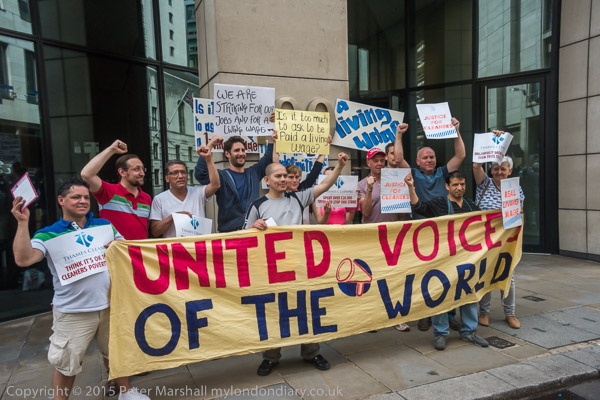
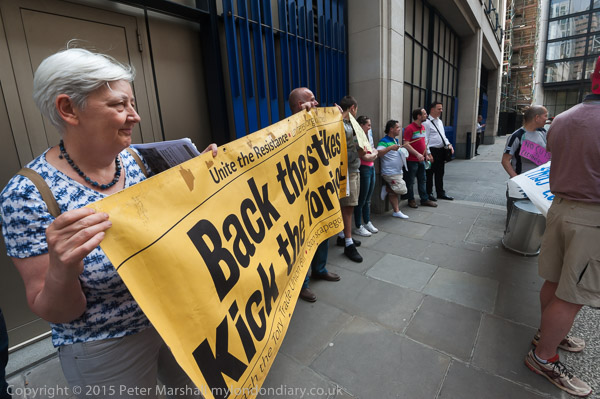
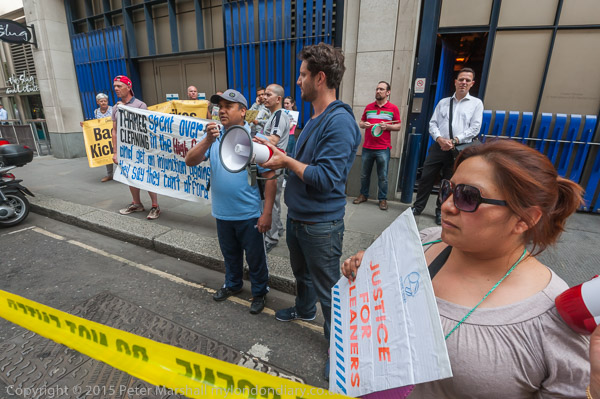
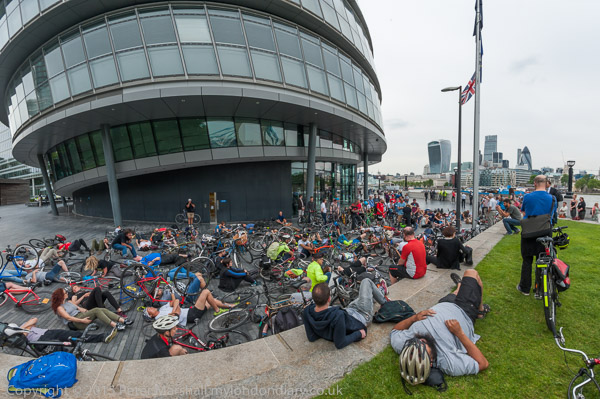
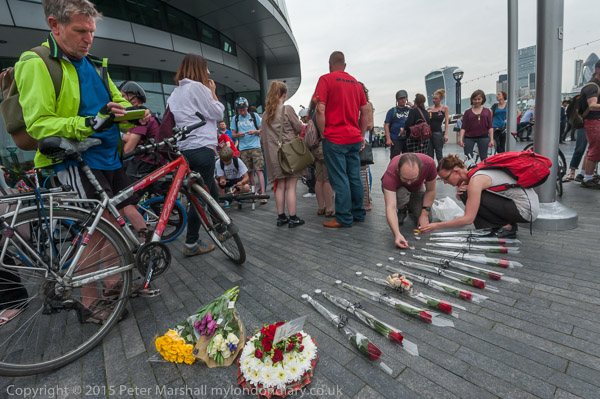
City Cleaners Strike, Cyclists mourned – A rally on Wood Street on Friday 10th June 2016 marked the third day of what became the longest strike ever in the City of London, and later at City Hall a vigil remembered 11 road users killed on London streets since the mayoral election last month, including three cyclists.
Day 3 UVW Wood St Cleaners Strike – 100 Wood St, City of London
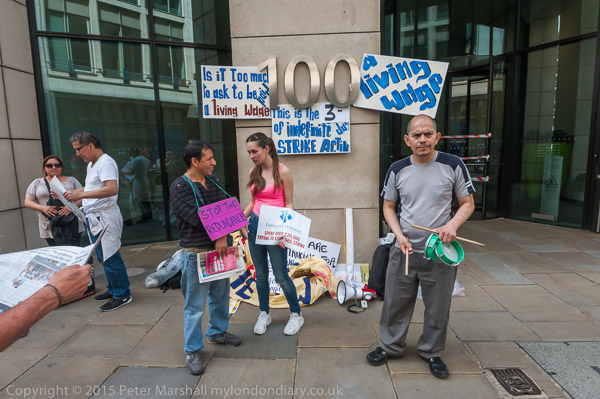
Cleaners belonging to the United Voices of the World union employed by anti-union cleaning contractor Thames Cleaning to clean the 100 Wood St offices managed by CBRE held a rally at the end of their picket on the third day of their strike.
The picket
The offices there are mainly used by Schroders and J P Morgan, both large and highly profitable companies, but the cleaners are on poverty wages and several union members had been sacked and others served with notice by Thames Cleaning for organising the workers to demand a living wage.
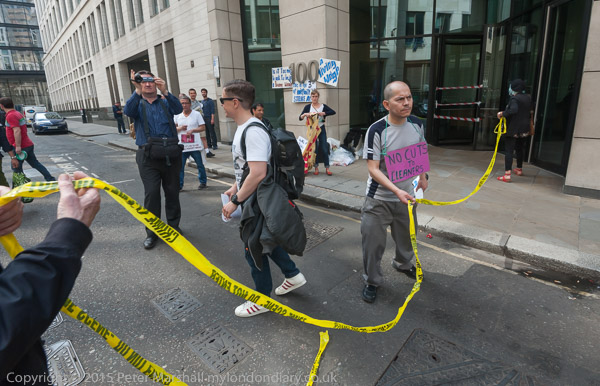
Measuring the 10m required by the injunction
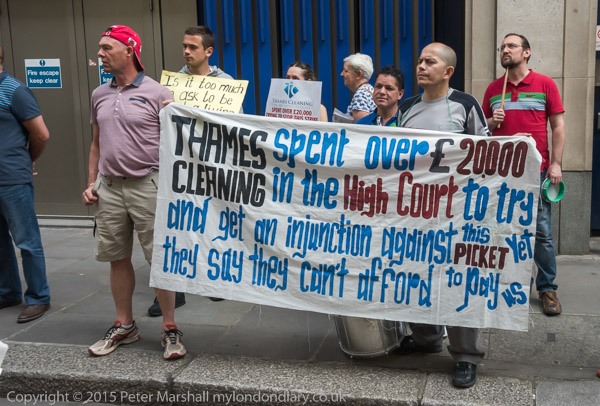
Rather than talk with the UVW, Thames’s response to the strike threat had been to spend over £20,000 in the High Court trying to get an injunction to prohibit the strikes and protests. Although the court would not stop them, they issued an injunction which set down strict conditions for the picket and protest and this left the UVW with crippling legal costs.
The UVW is a small grass roots union supported only by dues from its members and unlike the large established trade unions has little or no money to run its activities which include educational workshops as well as supporting its members in the workplace and at employment tribunals. Those who perform duties for it are paid the London Living Wage for the time spent and there are no highly paid union officials. The union had to issue an emergency appeal for cash – and received support from people and union branches across the trade union movement.
Candy Udwin, PCS Rep at the National Gallery holds a banner
One aspect of the injunction was that any protest connected with the strike had to keep at least 10 metres from the doorway of the offices. Of course picketing is covered by strict trade union laws and a lengthy code of practice that requires it to be as reasonably close as possible to the entrance and exit, and limits it to six or less clearly identified pickets with a supervisor (and possibly also a union organiser) behaving in a peaceful manner.
The protest took place over a carefully measured 10 metres away on the opposite side of the street after a picket which had begun in the early morning when the cleaners would normally have arrived for work. The strike continued for 58 days before the UVW was able to announce that a satisfactory agreement had been reached with the employer and all further action was ended.
Although London had an impressive purpose-built County Hall on the south bank just downstream of Westminster Bridge, this was sold off when Margaret Thatcher vindictively disbanded the Greater London Council, leaving London rudderless for 14 critical years. After the Greater London Authority was created in 2000, it was without a proper home for two years before leasing and moving into a purpose-built oddly spherical building by Norman Foster in the misleadingly named ‘More London’ currently owned by the Kuwait sovereign wealth fund who disguise themselves as St Martins Property Investments Limited.
Many saw the move to the new building as a failure of purpose by the Labour government in noy re-acquiring County Hall for the new London-wide authority – but then Labour under Blair continued most of Thatcher’s policies rather than move away from her individualist greed-based approach towards one getting back to the social welfare which had been at the heart of post-war Labour.
London’s City Hall moved in 2022 to Kamal Chunchie Way, Newham, E16 into the former ‘The Crystal’ exhibition centre beside the northern end of London’s ‘Dangleway’ cable car, though this is expected to close fairly soon as no replacement sponsor has come up to keep it running.
Sadiq Khan had retaken London as a Labour Mayor on May 5th 2016, with a decisive win over Conservative Zac Goldsmith and the Green candidate Siân Berry trailing badly in third place. Since then, 11 people had died on the streets of London, roughly around the average for that period in Greater London (in 2019, the total for the year was 125.)
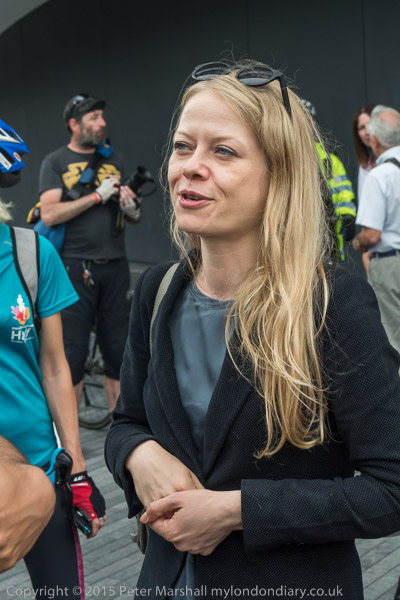
Siân Berry
Protests are – at least theoretically – not usually allowed in ‘More London’, but this one was hosted by Green Party London wide Assembly Member Caroline Russell, a member of the GLA Transport Committee and organised by London Women on Bikes (LWOB), #LondonBusWatch, Westminster Living Streets and BMX Life. Of the 11 who died, 3 were cyclists and the others were on foot.
Most road deaths are not ‘accidents’ but “happen because road users make mistakes, often made harder to avoid because of poor vehicle or road design. Many of them result from a lack of proper facilities for pedestrians and cyclists in a road system which prioritises getting motorised vehicles from A to B as fast as possible rather than safety. Some are caused by the failure of police to enforce road traffic law – for example on advanced stop lines at traffic lights.”
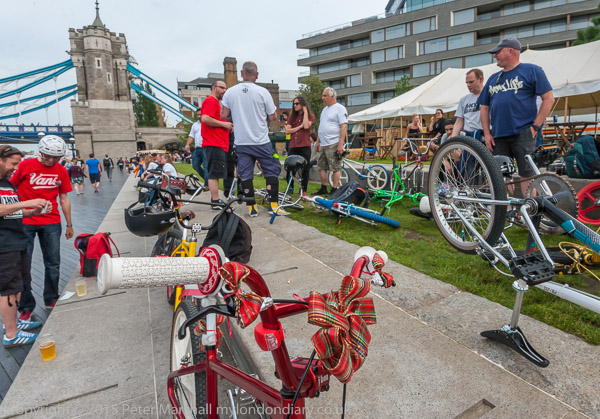
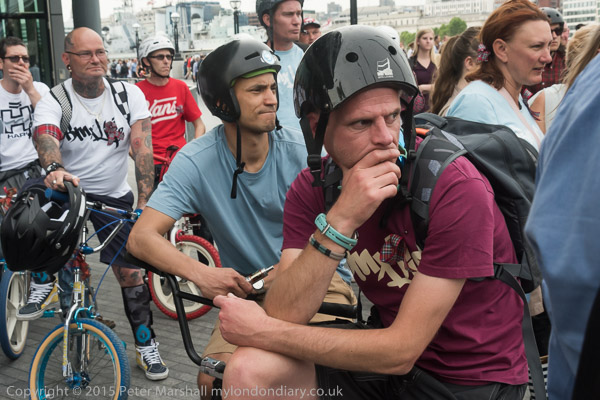
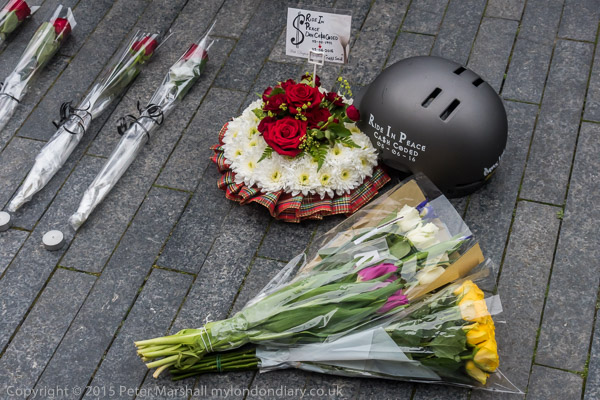
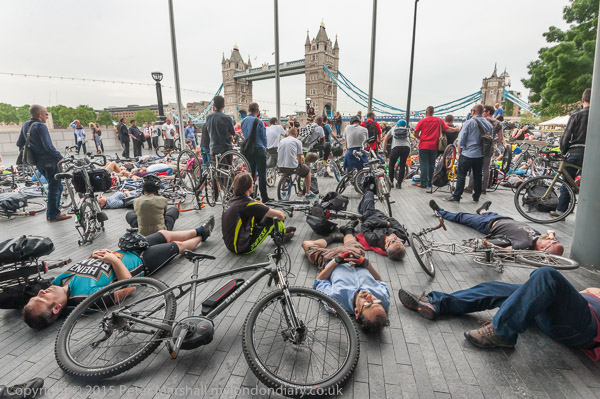
One of the cyclists killed was BMX rider Dan ‘Cash’ Stephenson, hit by a bus on the Strand during a BMX Life charity ride and many other BMX riders had come to the vigil, wearing tartan ribbons in his memory as he always rode in tartan. There were a number of speeches and then the names of those killed were read, followed by an eleven minutes of silence when those at the vigil were invited to stand in silence or to lie down, with or without bikes, in a silent ‘die-in’.
As the vigil came to an end and people were beginning to leave we were all called back for a highly emotional moment when Dan ‘Cash’ Stephenson’s daughter spoke through tears about her father.
Housing Crisis & the Carpenters Estate: Like many other areas, the 1945 Labour government laid the foundations of a sensible policy on housing which has now been lost. Among other things the 1947 Town and Country Planning Act brought in the need for planning permission and included a charge on developers which was assessed as the difference between the cost of the undeveloped land and its value after it had been developed. It gave local authorities the power to use compulsory purchase and either develop land themselves or lease it for private developers, and provided government grants to authorities for major redevelopment.
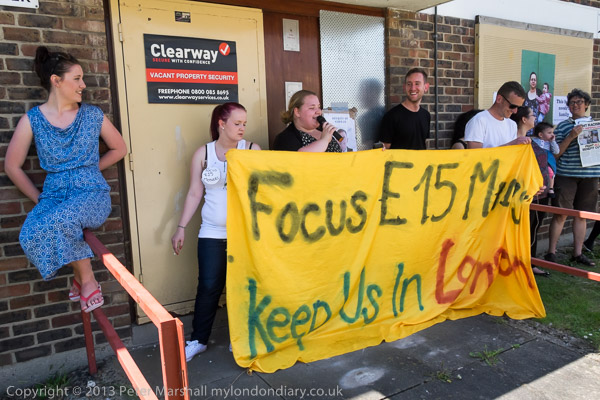
Focus E15 Mums protest at empty properties on the Carpenters Estate
Times were hard after the war, and there were shortages of material with so much needing to be done. Even so around 600,000 new council homes were built in the first five years, and built to high standards. One of the election-winning pledges made by the Conservatives for the 1951 election was that they would build 300,000 houses a year – something they managed under Housing Minister Harold Macmillan in 1953, including both private and council houses, but it was achieved in part by reducing the standards of properties.
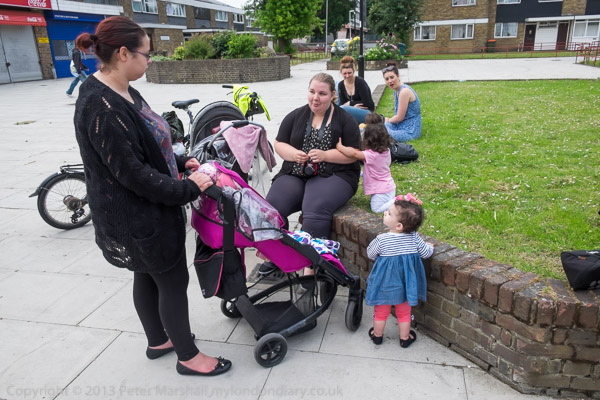
All pictures in this post come from the Focus E15 Mums protest on 9th June 2014
The Tories made other changes, including removing the development charge and limiting government subsidies, which in 1956 became limited to the building of high rise flats. While Labour had seen council housing as a way to provide good quality housing affordably to all, the Conservatives increasing limited its scope to providing only for the least well off, with private development and private leasing providing good profits for building firms and private landlords at the expense of house buyers and tenants of private rented properties.
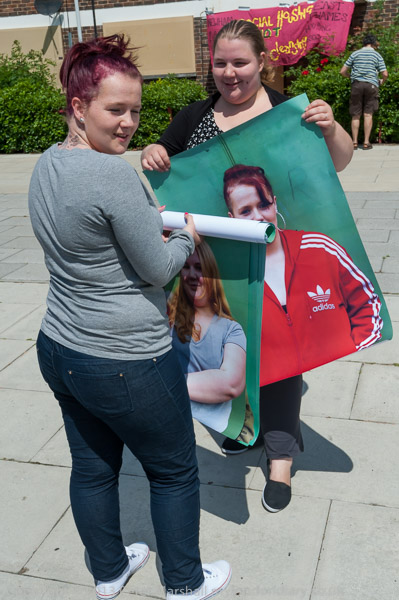
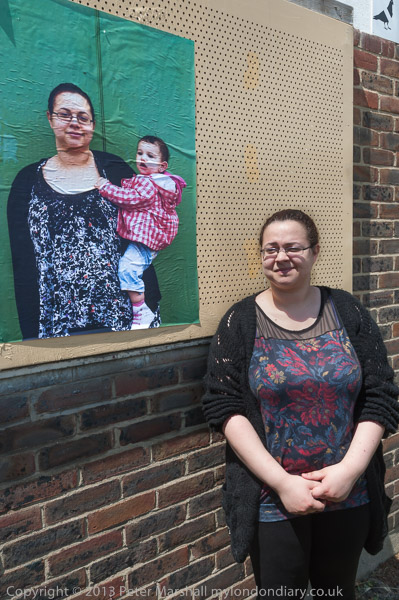
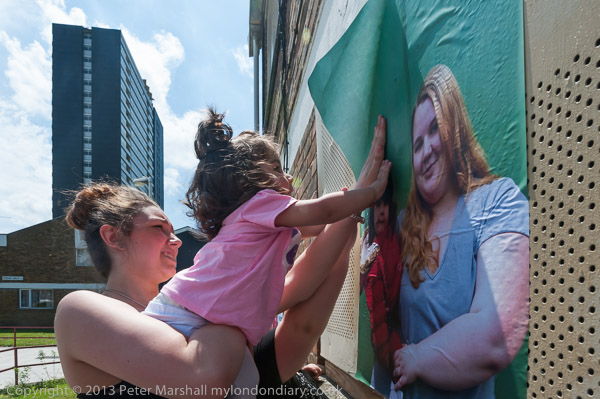
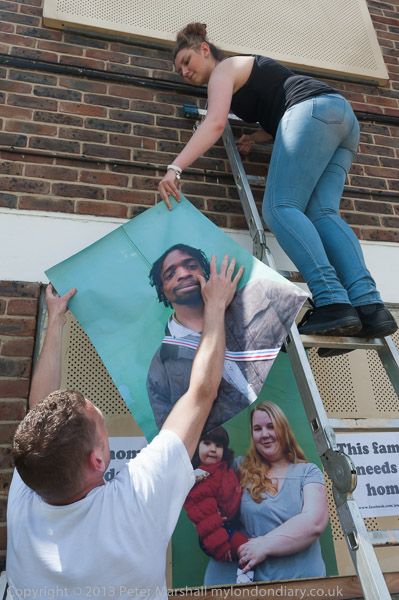
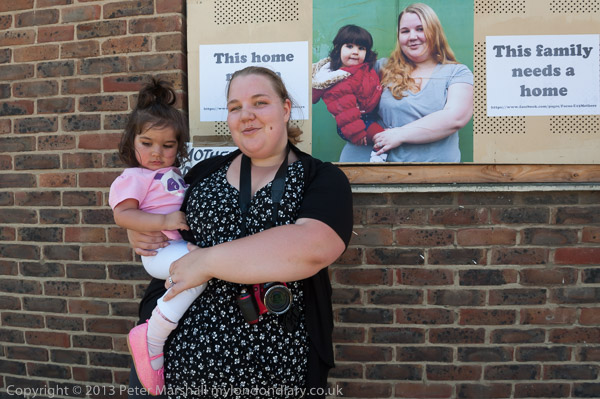
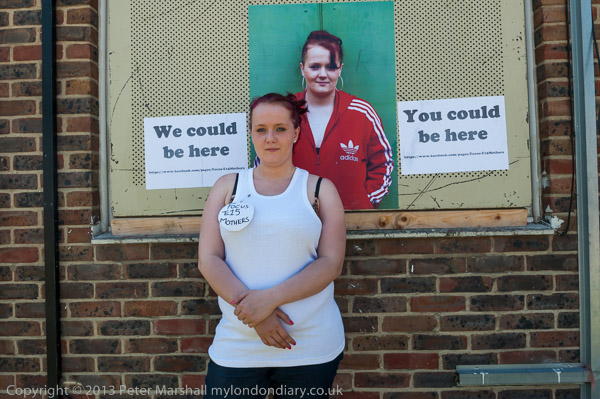
The Focus E15 mothers had brought life-size colour portraits of themselves
Although it was Labour who had first proposed the idea of ‘right to buy’ it was of course Thatcher who made it policy and introduced it in a way which was intended to severely reduce the amount of council housing, in particular forbidding the use of the receipts from sales to build new council homes. Cash-starved local authorities were often unable to keep up proper maintenance of their housing stock and much was allowed to deteriorate.
Jessica
Labour under Blair and Brown continued the Tory policies, including the transfer of council run properties to housing associations, and amplified their effects with their programme of ‘regeneration’ which led to the wholesale replacement of large council estates – most still in sound condition which could have cheaply been repaired and brought up to current standards. But developers profited hugely from demolition and redevelopment for private sale and councils hoped also to cash in, though in some cases they made a significant loss, as at the Heygate in Southwark, where around 1200 council homes were demolished, the tenants and leaseholders displaced largely outside the area, and the two and a half thousand new properties built included only around 80 at social rents. Other Labour policies, including the disastrous Private Finance Initiative also worsened the housing crisis.
The young mothers of Focus E15 came up against the the housing crisis when their Labour Council in Newham decided they should be evicted from their hostel. Most were told they had to move into private rented properties with little or no security of tenure miles away from families, friends and facilities in the Stratford area, some in Wales or the north of England. They got together and decided to fight the council, then run by elected Mayor Robin Wales and its policy of removing the poor from the area – social cleansing.
Newham is a borough with one of the worst housing problems in the country, and although there has been a huge building programme, partly around the 2012 Olympic site, this is largely student housing or private development. But one council estate close to the centre of Stratford had been largely empty for around ten years. Newham had ‘decanted’ the residents beginning in 2004 hoping to cash in on what would be a prime development site. The Carpenters Estate was a very popular estate, with low rise housing and three tower blocks overlooking the Olympic Park, a stone’s throw from the excellent transport links of Stratford Station and the town centre.
For some years Newham had hoped to sell off the area as a new campus for University College London, but local opposition and protests by students and academics at UCL led to the college abandoning the plans. In 2020 the council handed over the regeneration project its Housing Company Populo Living.
Jasmin Stone
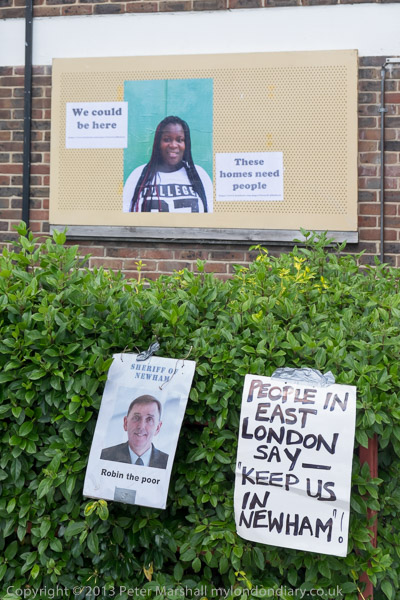
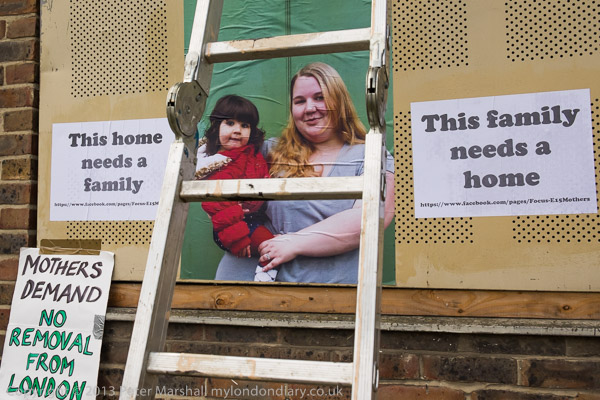
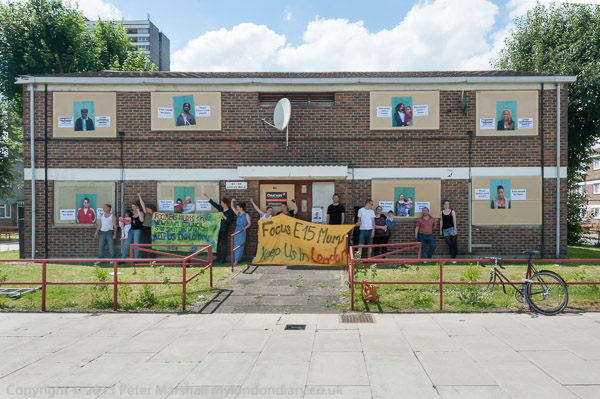
Focus E15 came to the Carpenters Estate on Monday 9th June 2014 to highlight the scandal of the empty homes, bringing with them life-size or larger colour portraits of the mothers which they pasted on the shuttered windows of a small block of flats at the centre of the estate, along with posters stating ‘We Could be Here’, ‘This home needs a family’, ‘These homes need people’, ‘You could be here’.
Sam Middleton
The protest gained some publicity for their campaign, which had moved on from being simply about the mothers to a much more general ‘Housing For All’ campaign, which still continues, with the group holding a weekly Saturday Morning stall on Stratford Broadway, supporting homeless families in getting proper treatment from the council and preventing evictions in the area.
I returned with Focus E15 to the Carpenters Estate a few months later in September when on the first anniversary of the start of their campaign they occupied this low-rise block of flats on ‘Open House Day, gaining national publicity, staying in occupation for around two weeks, and have photographed various other of their events.
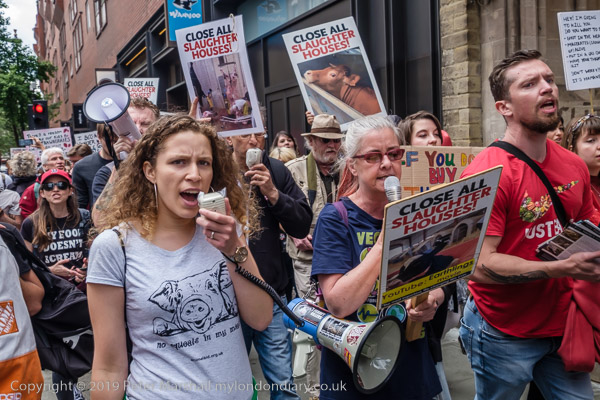
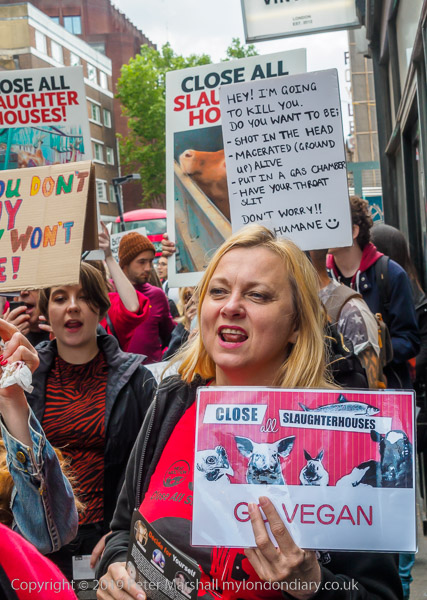
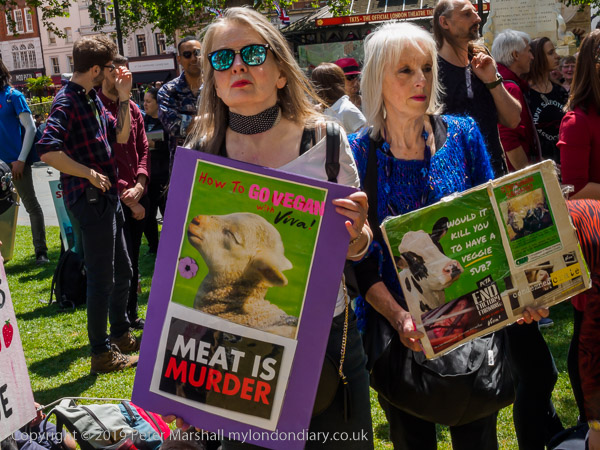
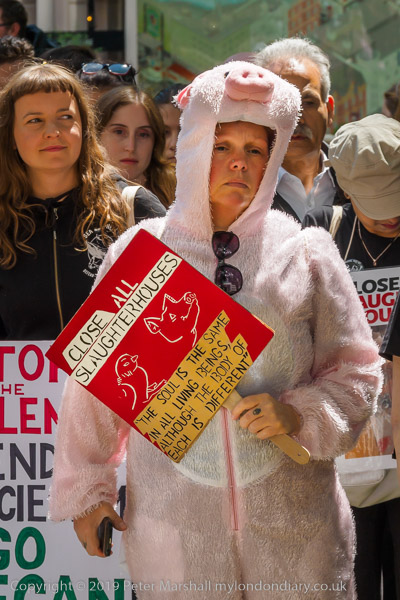
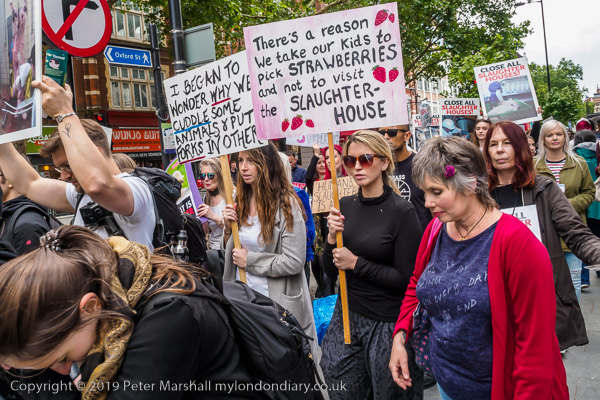
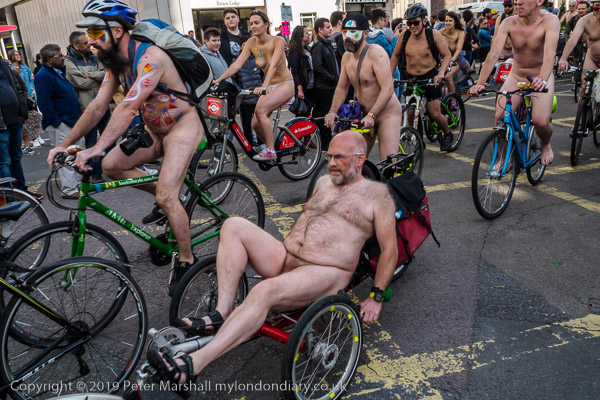
Close Slaughterhouses & Naked Bike Ride: I had mixed feelings about both of the protests I photographed on Saturday June 8th 2019. I began with the vegans whose ‘Close all Slaughterhouses’ march was calling for an end to the breeding, fishing and slaughter of animals and then covered the 2019 Naked Bike Ride.
Close all Slaughterhouses – London
It was a slightly uneasy gathering in Leicester Square for me as I felt rather out of place among a crowd of vegans. I’m against cruelty to animals and certainly oppose cruel farming practices, but I still eat some meat and rather more diary products as a part of a varied diet, and I think my shoes may have been leather and my belt certainly was. My lunch in my bag certainly contained both cheese and ham sandwiches and I’d buttered the bread, so I couldn’t eat it while covering the event.
Of course veganism makes a contribution towards reducing our carbon footprint, as vegetable production generally produces much lower amounts of greenhouse gases, although I think there are some exceptions to this. But I think if everyone became a vegan it would have some very undesirable consequences, not least in almost entirely removing currently farmed animals from our landscape. We might be left with just a few cows, pigs and sheep etc in rare-breed petting zoos.
I’d like to see an end to some agricultural practices which have been adopted to produce meat, and I now quite happily pay extra for free-range eggs and grass-fed beef. But some of the slogans on the banners and placards at this protest are I think over-emotional and misleading. Meat is not murder, we don’t steal milk from cows and animals are not “just like us” though they obviously share many characteristics. As I wrote “the human species is very clearly different in some respects.“
Nature may sometimes be fluffy and adorable, but it is also often “red in tooth and claw”, often killing most cruelly. Many animals are carnivorous, others like us omnivores.
I’d had enough of the vegans after listening to some of the speeches at their rally in Soho Square and walked away – I was in any case getting rather hungry and found a corner away from them to eat my non-vegan lunch.
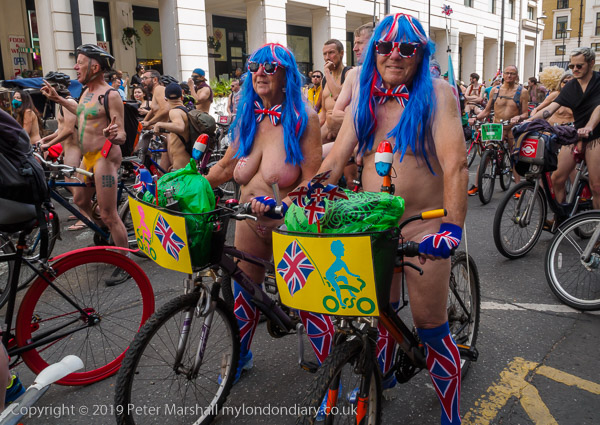
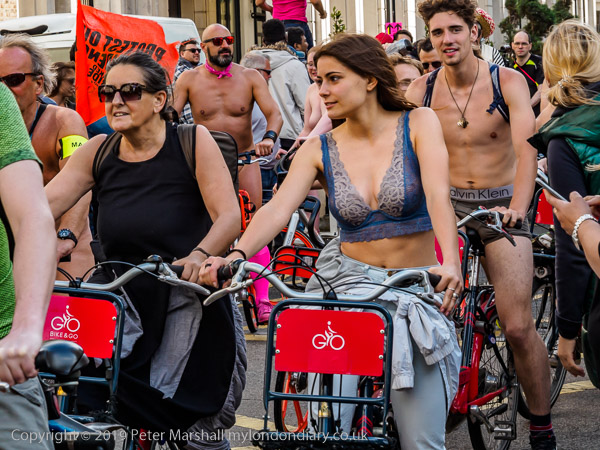
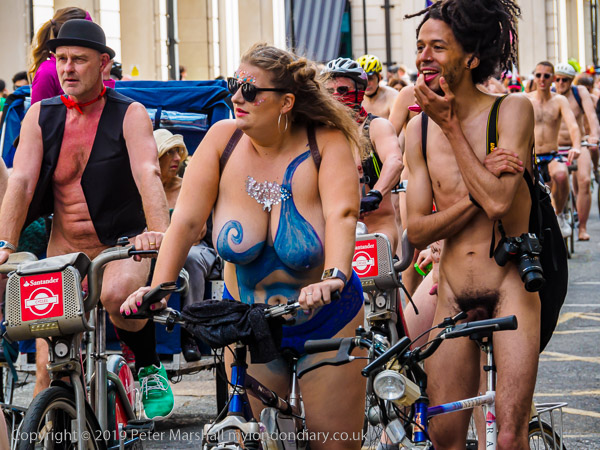
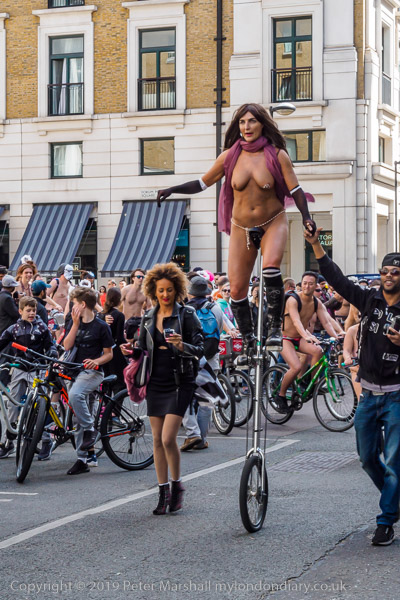
I’ve never been quite sure that the World Naked Bike Ride is really a protest. As I wrote in 2019 “It’s more a fun ride for people who want to ride around London with no or very few clothes on”, though clearly some of them do want to protest over various issues, including the safety of cyclists on the road, reducing oil dependence and saving the planet.
Nudity doesn’t worry me, though as a photographer I spend some time trying to take pictures which show the event without producing images which might offend the more prudish of editors and publications, which is not easy. I wouldn’t take part myself in the WNBR, but largely because our climate is seldom really suitable for being without clothes; of course not everyone on the ride was entirely naked, but I do feel the cold. So were I to decide to join the ride it would be ‘as naked as you can stand’ rather than ‘as bare as you dare’.
Like most of those watching from the pavements I find the ride both entertaining and interesting showing the incredible variation of the human form rather more emphatically than any normal street crowd.
But overall the ride is in some ways lacking in diversity, with relatively little representation of London’s ethnic communities and this year their seemed an even greater than previous gender imbalance, with perhaps 10 or 20 men for every woman. This isn’t truly represented in my pictures partly because of my greater interest in them, but also because a greater proportion of them have slogans or body paint.
I’d arrived late and didn’t take many pictures before the ride moved off – there are a few more on My London Diary. I didn’t bother to follow them or try to meet them later on their route but went to a nearby pub for a drink with a friend before making my way home.
The Racist UK Immigration System: The Home Office a couple of years ago commissioned a report following the huge publicity over the Windrush scandal after government ministers had been forced to agree to educate all Home Office employees about our colonial history and the experiences faced by black people coming to the UK.
The report, “The Historical Roots of the Windrush Scandal“, by a well-known historian the Home Office refuses to name, details how the whole history of post-war British immigration legislation since the Second World War was “designed at least in part to reduce the number of people with black or brown skin who were permitted to live and work in the UK“, reflecting the “racist ideology of the British Empire.”
For over a year politicians and others have been calling for the report to be published but the Home Office has refused. Last month it was leaked in full to The Guardian, but is still not available to the public, despite having been paid for by our taxes. Many requests for its publication from MPs including the home affairs select committee and campaigners over the past year had been turned down and a freedom of information request about it was refused.
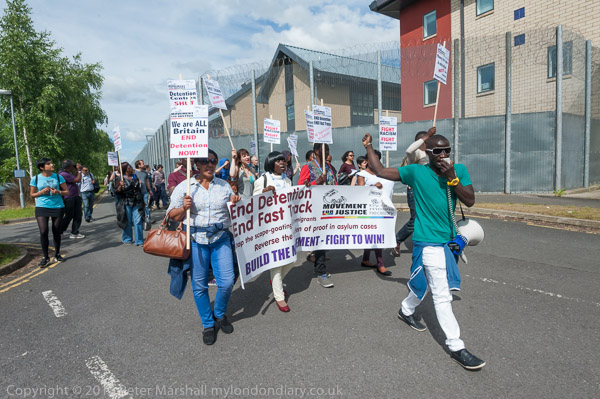
The protest began on Bath Road in front of the Immigration Removal Centres
Some speculate that the true reason for it being kept secret was because it was in direct contradiction to last years report from the Commission on Race and Ethnic Disparities which had ludicrously concluded there was “no evidence to suggest that Britain was an institutionally racist place.“
Others suggest the refusal to publish was that it would bring new highly discriminatory policies being introduced – such as the attacks on cross-channel migrants and the deportation of asylum seekers to Rwanda – liable to greater opposition as a development of an already clearly racist immigration system.
Colnbrook on the left, Harmondsworth at right
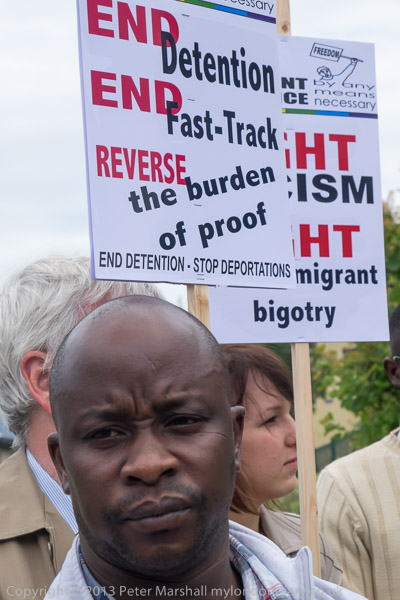
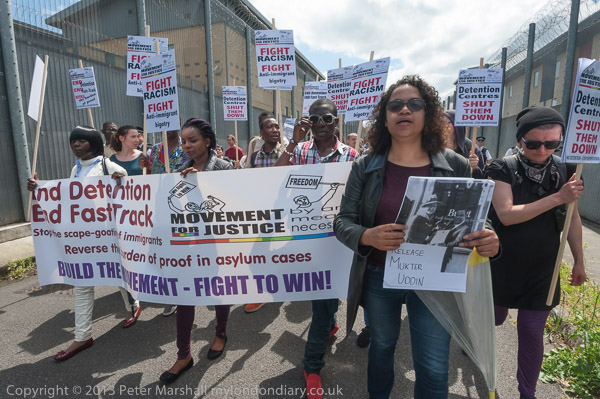
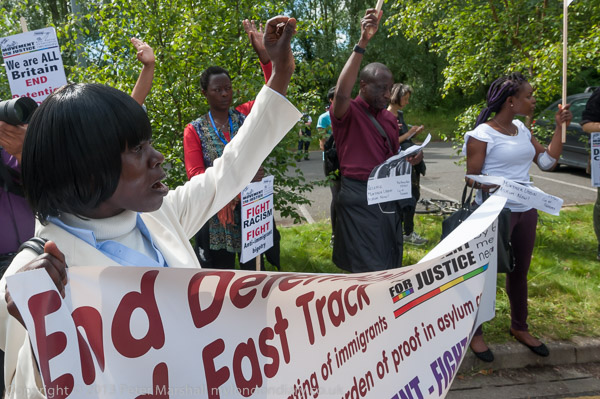
Back in June 2014, when the Movement for Freedom organised a protest on June 7th outside the adjoining Harmondsworth and Colnbrook detention centres on the northern boundary of London Heathrow, the thrust of the protest was against the the unjust ‘Fast Track System’ and mistreatment of detainees by private security firms inside these immigration prisons.
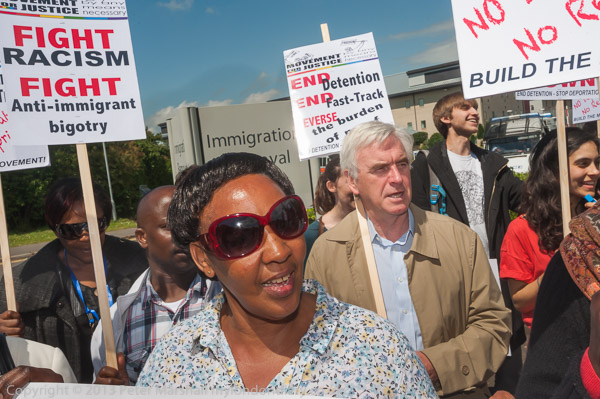
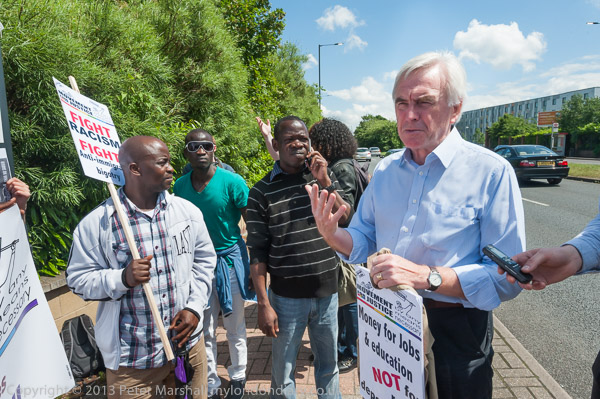
John McDonnell speaks outside the detention centres on Bath Road
Local MP John McDonnell who came to speak told the protest that when he first became MP for the area in 1997 the immigration detention centre was only a small building housing a dozen or so detainees rather than the two large blocks the protesters were in front of. The protesters argue that immigration detention is almost entirely unnecessary, existing only to deter immigration and harass and punish those who come here to seek asylum.
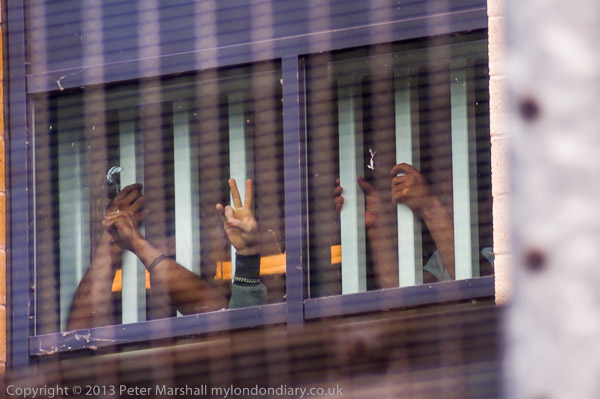
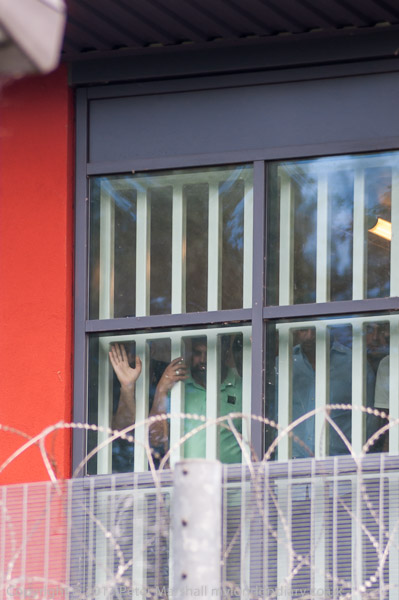
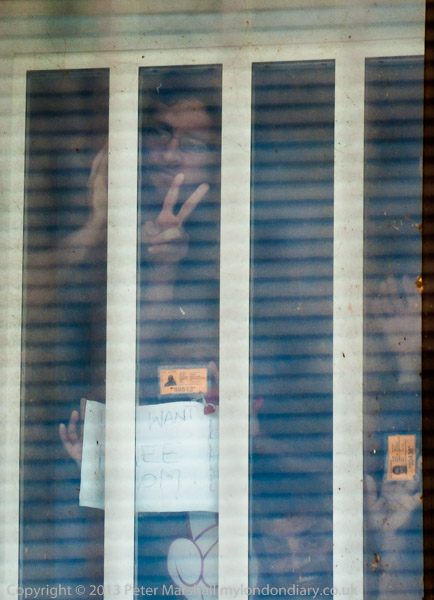
Asylum seekers wave from behind the 20ft fence, razor wire and window bars
The fast track system was set up with the deliberate aim of deporting people before they had time to put together the evidence that would enable them to properly present their case to remain. You don’t get a certificate given to you for being tortured or raped but our system treats all of them as guilty, trying to evade our immigration laws and rather than the Home Office having to prove their stories are fabricated calls on them to provide proof of threats, torture, rape and other events that forced them to flee. Legal challenges including that by Detention Action in 2015 found “rules setting the tight timescales for asylum-seekers to make appeals were unlawful and ‘ultra vires’ and that the strict time limits in and of themselves were ‘structurally unfair’.”
Although the legal judgements led to the suspension of DFT, the deportations of asylum seekers to Rwanda currently about to take place clearly represent a ratcheting up of this punitive approach and seem likely also to be successfully challenged in the courts – thought not before hundreds or thousands have been wrongfully deported.
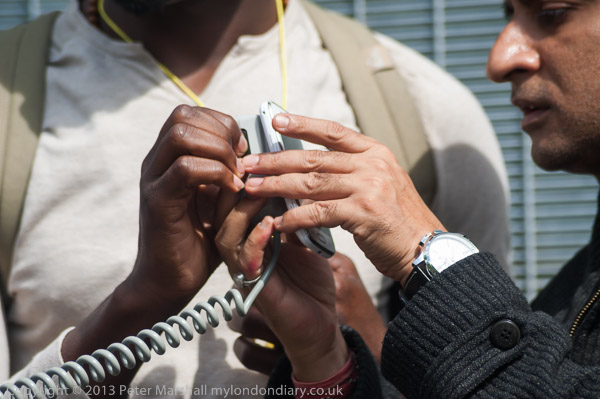
The detention centres were built on a site which has a private road leading to a BT site at the rear. After the speeches on the public highway in front of the site, the marchers walked down this road, making a lot of noise chanting and shouting as well as with whistles and other noise-makers. Detainees came to the windows and waved thanking the protesters for their support, and some were able to communicate using mobile phones.
Mobile phone messages from inside were broadcast to protesters using a megaphone
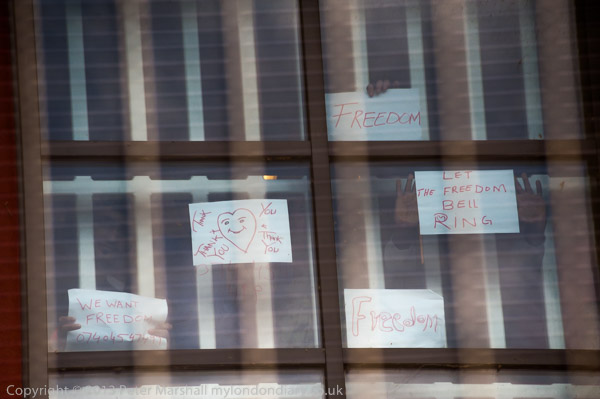
The two detention prisons are both surrounded by 20 foot high fences, the lower half solid metal sheets and the upper half with a dense solid wire mesh, which makes photographing the windows difficult. But we could clearly see the detainees and they could seem the long banner with the message ‘Stop Racism – End Fast Track – End Detention’ which was held up, and we could make out some of the messages they had written calling for freedom.
We were able to walk completely around the Harmondsworth building (but not the higher security Colnbrook one) and when I left the march organisers were planning to return their route in the opposite direction as they had so many phone calls from those inside, but I had to leave.
Diane Abbott published an opinion piece in The Guardian on the leaked report at the end of May this year, “The truth is out: Britain’s immigration system is racist, and always has been. Now let’s fix it“. Unfortunately I think our current government is unlikely to have any interest at all in doing so. She ends her piece: “The system is calibrated for racism. It always was. We know it, and now we know that, behind closed doors, Priti Patel’s Home Office knows it. The dirty secret is no longer secret.”
Liquor, Motors, Furniture, Packing & Timber My previous post on this walk in in Deptford on October 1988, More From Deptford, ended at Tooheys Liquor Barn on Evelyn Road, where this section starts.
Toohey’s Brewery was founded by two brothers, John Thomas Toohey,born in COunty Tipperary whose family emigrated to Melbourne in 1841, and his younger Australian-born brother Matthew. They ran pubs in Melbourne and then moved to Sydney where they set up their brewery in 1869, brewing Tooheys Black Old Ale. The company went public in 1902 and began brewing lager in 1930, though normally it comes in rather smaller bottles than this one. After various mergers and takeovers the company is now owned by Japanese brewer Kirin. Evelyn St. Wines of which this was a part was on this site until around 2015.
City Motor Auctions, Evelyn St, Deptford, Lewisham, 1988 88-10h-64
City Motor Auctions Ltd was just to the east of the Liquor Barn on Evelyn St and car auctions, latterly under the name Docklands City Car Auctions continued here until around 2014. Like the Liquor Barn it became a part of the large development site
Bucks were still here at Bridge Wharf immediately to the west of the former Surrey Canal until around 2012 and their site was then briefly taken over by the car auctions, with Bucks returning briefly when those moved to Charlton at the start of 2015. The site was derelict by the end of 2015 and demolition was complete by 2017.
I was unsure if the circular bricked area with a post at its centre was a relic of the former wharf or simply a sculpture recalling the past. I couldn’t see any particular purpose in it, so it was probably art!
Evelyn St, Deptford, Lewisham, 1988 88-10h-53
Ocean wharf was at the south-west corner of the bridge built to take Evelyn Street over the Surrey Canal. Parker Packing Co Ltd were presumably the Parker whose corner was a few yards away on the opposite side of Evelyn St on its corner with Dragoon Road. The sign at an angle points to Neptune Wharf and a sign for a company dealing in polythene sheeting, polythene & paper sacks and other items, while a larger sign behind the branches is completely blank.
The view from Blackhorse Bridge looking towards the southwest where once the Surrey Canal ran, with timber sheds along its east bank. Timber would have been a major part of the canal traffic, as the Surrey Docks were largely used for timber imports and had large timber ponds. By 2008 the timber sheds had been replaced but otherwise the view was much the same, but in 2016 the empty space was filled by a large Shurgard self-storage shed.
All the buildings along Grinstead Road have been demolished and replaced by residential properties. This was the only building I found of interest in the long stretch facing Deptford Park. The park was opened to the public in 1897 and probably Grinstead Road dates from then or shortly afterwards. I can find no explanation for the street name.
Another view of its distinctive doorway. I can find nothing out about this property and there are few if any clues although it interested me enough to take nine frames concentrating on the doorway. The logo above the door is I think made of the letters J & J and this house was around halfway down the street, a short distance past the former galvanised iron and zinc Ida works, at the back of Neptune Wharf. It probably dates from the early 20th century.
HP in Israel, Nurses bursaries, Hungary, Congo & Syria – five protests that I photographed on Saturday 4th June 2016.
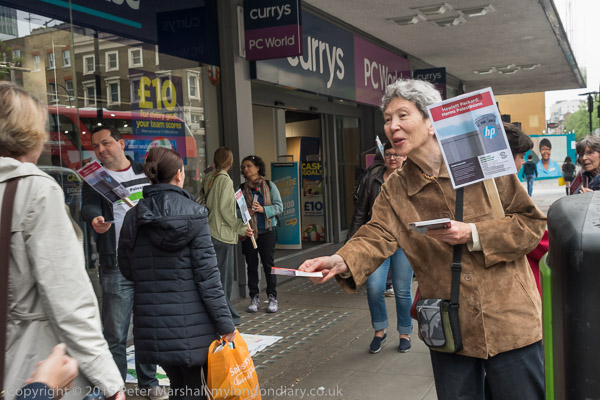
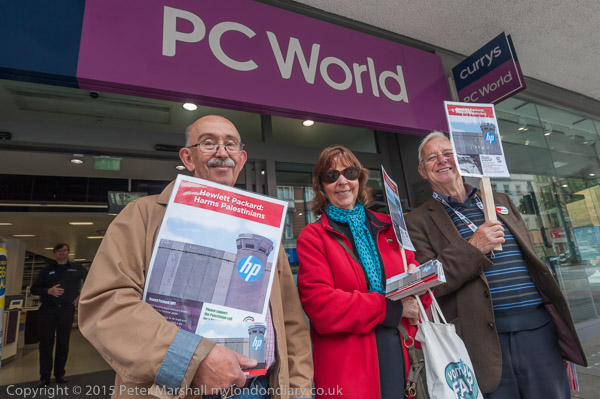
Boycott HP against Israeli apartheid – PC World, Tottenham Court Road
A protest outside PC World on Tottenham Court Rd was one of around 20 actions around the UK held to raise awareness of Hewlett Packard’s heavy involvement the Israeli oppression of the Palestinian people and encourage a boycott of HP.
HP provides the biometric system used for ID cards used to control movement of Palestinians inside Israel and in the occupied Palestinian territory, technology for the Israeli military and supporting the illegal settlements.
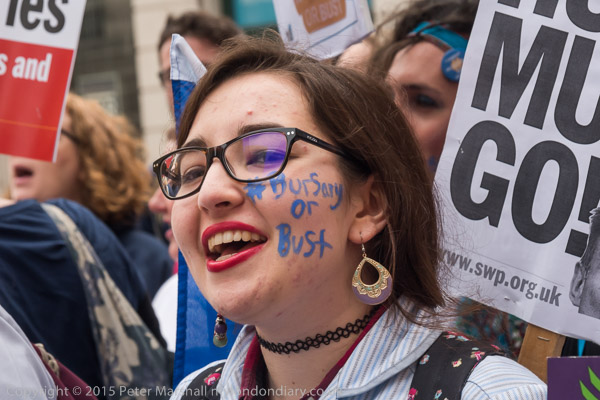
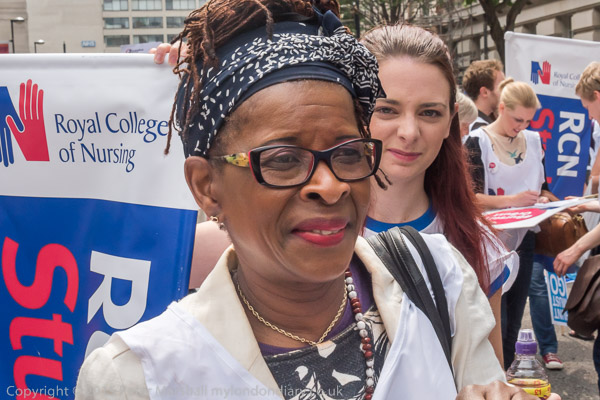
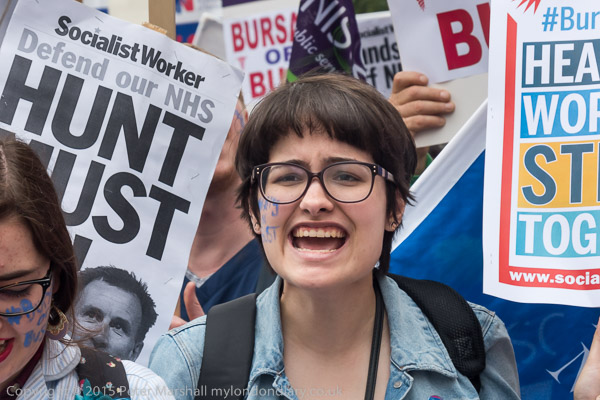
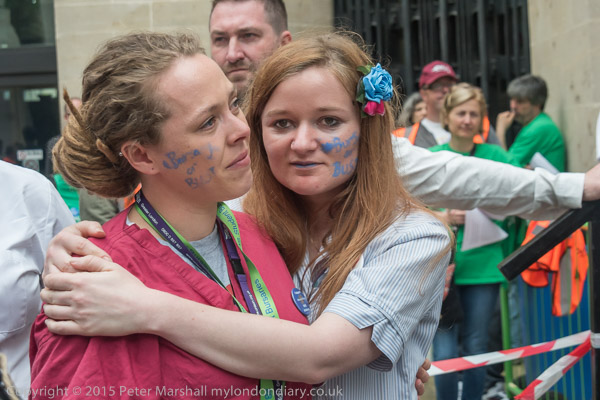
NHS students and supporters marched from St Thomas’s Hospital to the Department of Health in Whitehall along a route over Waterloo Bridge where there was a brief sit-down, and along the Strand to Charing Cross, where they were joined by disabled protesters who went with them to a rally in front of the Dept of Health at Richmond House on Whitehall.
Cecilia Anim, Royal College of Nursing President
Student bursaries are essential for nursing students as they have to spend 50% of their course working in the NHS and unlike other students are unable to work part-time to support themselves. Their work as students is important in keeping the NHS running and the bursaries also allow mature entrants to the profession to train.
Our current nursing shortage is in part due to the ridiculous decision by Jeremy Hunt who ignored the nursing unions and almost everyone else in making the cut. He claimed that removing the bursary would mean that there would be up to 10,000 more training places. In fact the number accepting places on nursing courses in 2018 dropped to its lowest level for five years, 8% less than when bursaries were available. The maintenance grant was reinstated in 2020, leading to an increase in student numbers, particularly in those over 30, where the increase was around 40%.
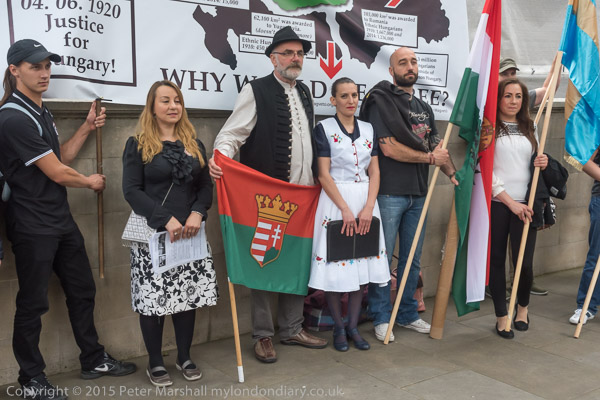
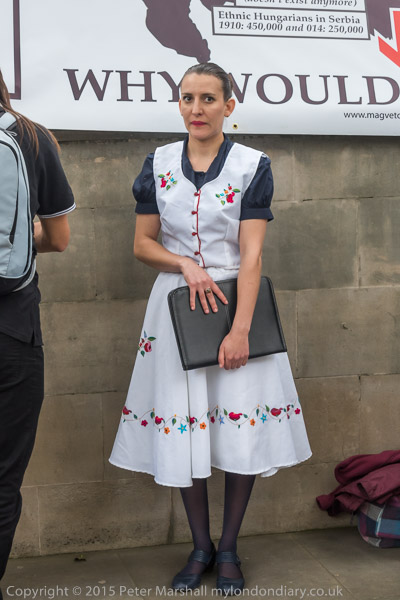
Hungarian nationalists marched to Downing St calling for the restoration of the pre-1920 borders of Hungary, including the Székely Land in Romania.
The right-wing Jobbik party or Movement for a Better Hungary has grown considerably in support and in 2018 became the second largest party in the National Assembly and is often accused of seeking the restoration of the borders before the 1920 Trianon Treaty. Around a quarter of ethnic Hungarians live outside of Hungary and many suffer discrimination because of their culture and language. But according to Wikipedia, “Jobbik has never suggested changing borders by force, and believes that the ultimate solution is territorial and cultural autonomy within a European Union framework of minority rights.“
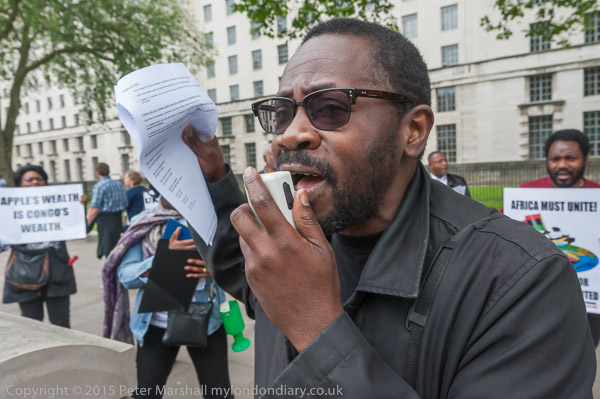
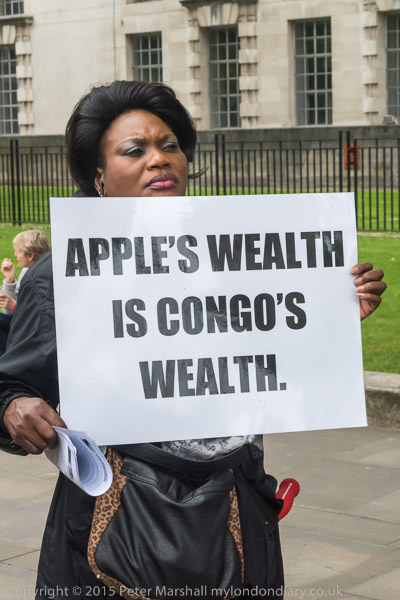
The Patrice Lumumba Coalition protested opposite Downing St after the massacre last month of 120 people in Beni, North Kivu, Congo. They say that since 2014, 1000 people have been horrifically murdered in the region, despite the presence of a UN army and the Congolese armed forces.
They blame the massacres in Congo which have resulted in over 10 million being killed on the US-backed overthrow of the Mobutu regime and the support by the US, UK, Belgium and Canada of President Museveni in Uganda and President Kagame in Rwanda, whose proxy armies and militia groups attack the Congolese. This war is driven by multinational corporations to provide the mineral reserves of the Congo, gold, oil, tin and particularly coltan, essential for the production of smart phones, laptops and other electronic gadgets.
The UK backs the genocide with around £500m a year in support of Congo’s President Kabila, and £90m to prop up the Rwandan regime. They want those responsible for backing the genocide – including Tony Blair and the Clintons as well as African leaders to be brought to justice.
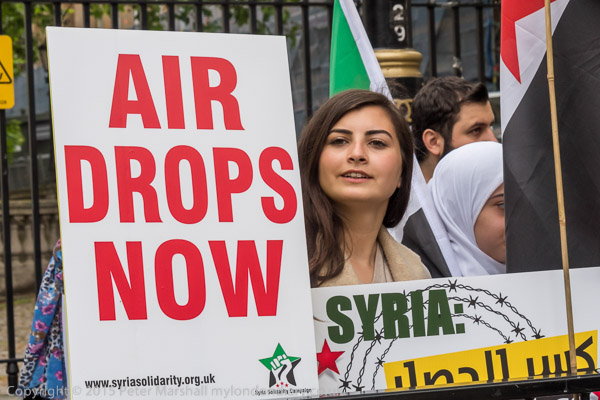
Syrians demand break the siege of Alwaer – Downing St
Syrians at Downing St called on the UK and international community to take urgent action to end the siege of Alwaer and 50 other besieged towns in Syria. People are without electricity, drinking water, food, fuel, and medical care and are at risk of dying from malnutrition
Alwaer, a town of more than 100,000 people, has been under siege by Syrian government forces for over 3 years and many have been killed and others are suffering disease. Assad’s forces are carrying out a systematic and deliberate policy of starvation of civilians, a war crime in grave breach of the Fourth Geneva Convention.
Democracy, Black Cabs, Murad & Zionists – My agenda for Wednesday 2nd June 2010 was a busy one, with protests about democracy in Parliament Square, London’s Black Taxis at Aldwych, a picket at BP’s St James’s Square HQ, trade unionists protesting at the Turkish Embassy and Zionists supporting the Israeli attack and killings on the Gaza aid flotilla.
Democracy Village Protest – Parliament Square
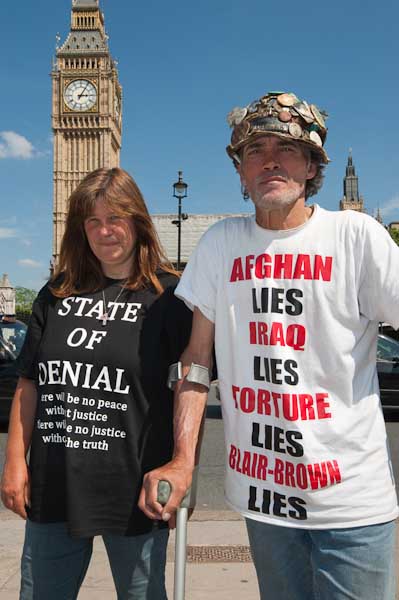
People had been camping in the Democracy Village in Parliament Square for just over a month and a few of them had come across the road with banners to protest. They held up banners, including a large one saying ‘We Respect The Soldiers We Do Not Support The War‘ and another ‘We Demand Peace In Afghanistan and No More War‘ and several made speeches with a megaphone. Another very artistically written notice on a large square of cloth on the pavement read ‘With Each Conscious Breath May You Know How Loved You Are in All Ways. You Are Divine. Let Your Light Shine’.
Brian Haw – Summons Marks 9 Years in Parliament Square
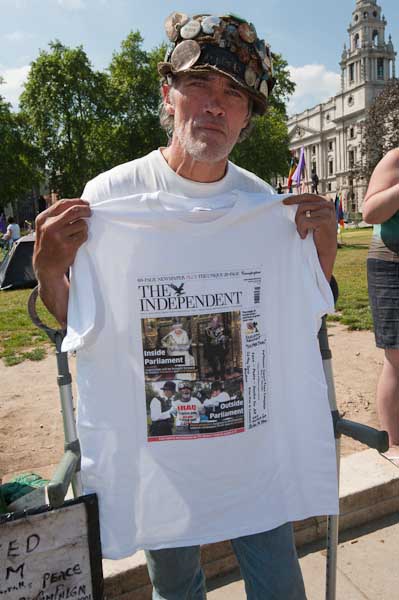
I went back to the other side of the road to talk with Brian Haw and Barbara Tucker who I had come to visit on the 9th anniversary of the start of Brian’s protest vigil opposite the Houses of Parliament in Parliament Square. A week ago they had been arrested and held for 30 hours on the day of the state opening of Parliament before the court released them on bail.
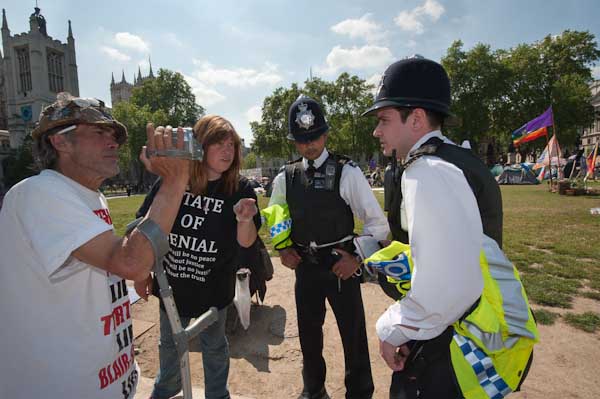
The arrest had come after Brian objected to police searching his tent in the early morning without a warrant – the 13th or 14th illegal search they have made, all part of a continual campaign of harassment. As we were talking we became aware of three police a few yards away standing and watching us. They then came over and served Barbara Ticker with a summons for using a megaphone in Parliament Square.
Brian and Barbara asked why she was being singled out for attention as there were at that time others In the Democracy Village actually using a megaphone and she was not at the time doing so. The officers made no attempt to answer this question.
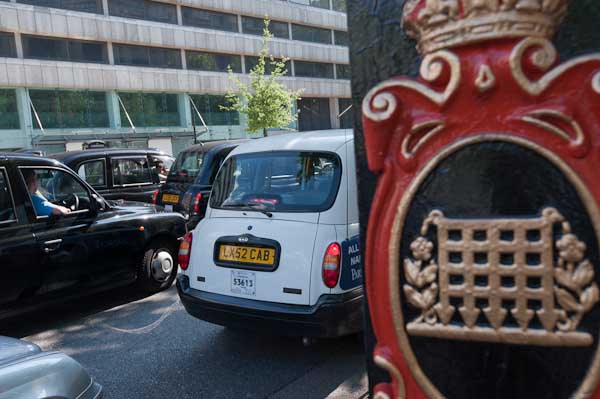
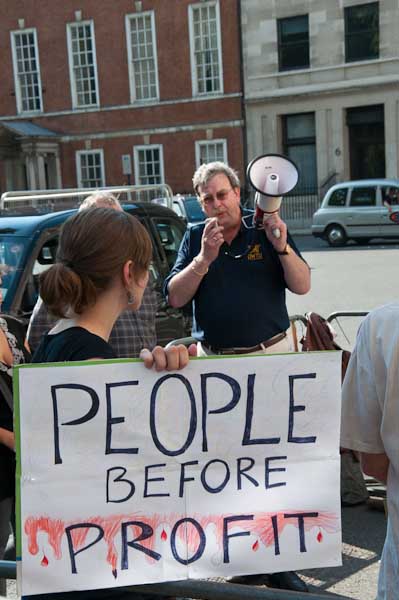
I don’t use taxis in London – or at least very seldom. I can only remember two occasions in the last thirty or so years, both when others insisted I go with them. It’s a wasteful, outdated and overpriced system which is responsible for much of the congestion in London, both by cabs carrying only small numbers of people compared to other public transport and also by ‘cruising for hire’ with no passengers on board.
My account on My London Diary gives some of their grievances, some of which I have some sympathy with, and I agree the police should be enforcing the law (rather than harassing protesters) but the whole system needs to be updated, taking into account the general availability of smart-phones and improvements in satellite navigation systems which increasingly make the ‘knowledge’ redundant and can provide real-time congestion information.
I didn’t find it an easy protest to photograph, which I think shows in the results. Lots of taxis are frankly rather boring, and not that unusual in London, where I commented that “While standing at a bus stop a couple of weeks ago I counted over 30 empty taxis going past before my bus arrived, and I couldn’t help but think we could have a better public transport system without taxis.”
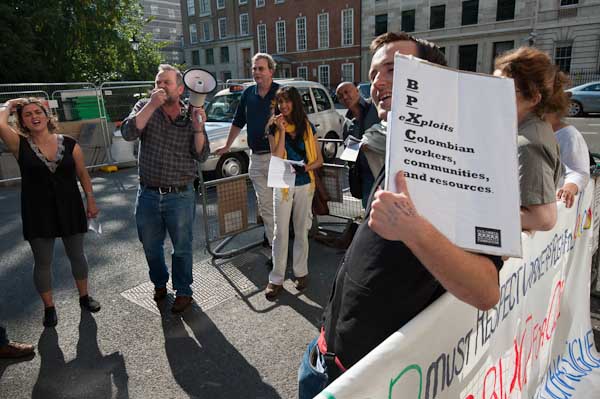
BP Picket for Colombian Oil Workers – St James’s Square
BP have a long-running dispute with the workers on the Cusiana oilfield in the Casanare department of Colombia, and its one where they are playing dirty, with union members accusing BP of carrying out a campaign of misinformation about what is happening in the plant, and in particular of falsely claiming the support of government officials for their lies about the action.
More or less as this picket was taking place, armed commandos from the Colombian army leapt over a security grid at the plant and attacked the workers who were carrying out a peaceful occupation of the Cusiana CPF (Central Processing Facility) in Tauramena.
Previously BP had come to an out of court settlement on a UK High Court challenge over the pipeline from this oilfield to the coast, when farmers alleged that BP benefited from the actions of Colombian paramilitary forces who harassed and intimidated them in their protection of the pipeline. During the preparation of the case, of the lawyers for the farmers discovered she was on a death list and fled the country; she was granted political asylum in the UK.
The protest was organised by the Colombia Solidarity Campaign and was supported by the ICEM, the International Federation of Chemical, Energy, Mine and General Worker’s Unions, based in Switzerland which represents more than 20 million workers around the world, uniting trade unions in its sector around the world.
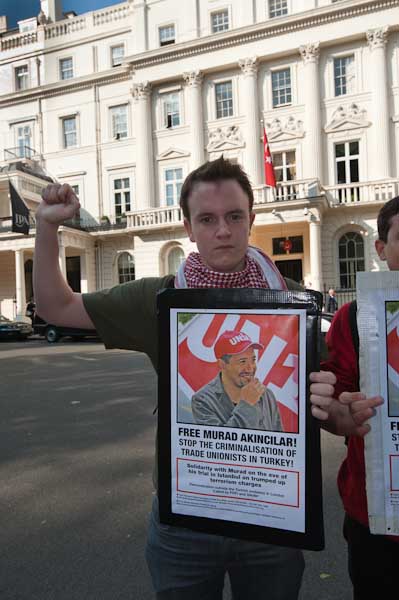
Protest for Murad Akincilar Turkish Embassy, Belgrave Square
Trade unionist Murad Akincilar was arrested on a spurious charge of belonging to a terrorist organisation while on an extended holiday in Turkey last September and was in prison in Istanbul. His treatment in prison has resulted in serious eye damage and partial blindness. He was known personally to some of the protesters as he studied for a Masters Degree at the LSE, but since 2001 he has lived in Switzerland and worked for Swiss trade union Unia which was leading the campaign for his release.
The protest opposite the Turkish Embassy was organised by Fight Racism! Fight Imperialism! and Gik-der, an organisation founded in north London in 1991 by migrants fleeing political and racial persecution in their home countries of Turkey and Kurdistan.
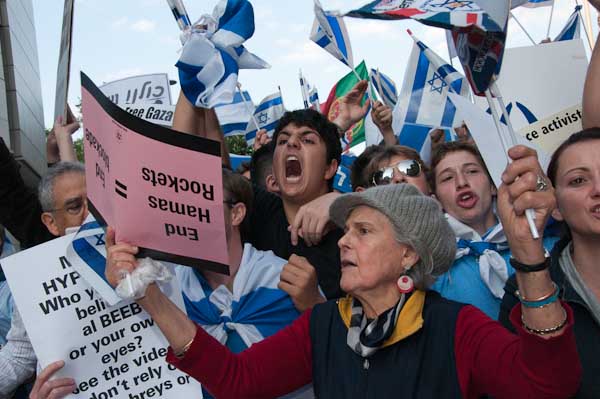
Zionist Federation Support Israeli Atrocity – Israeli Embassy, Kensington
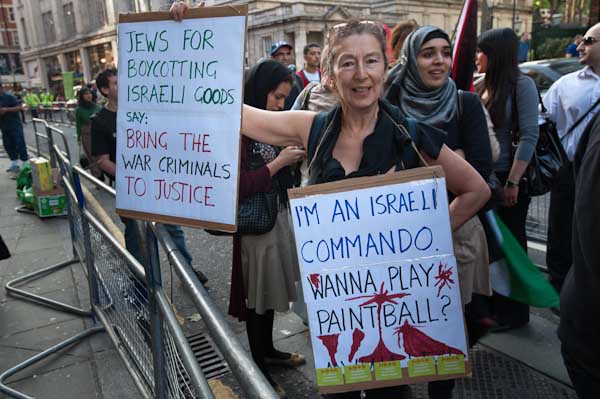
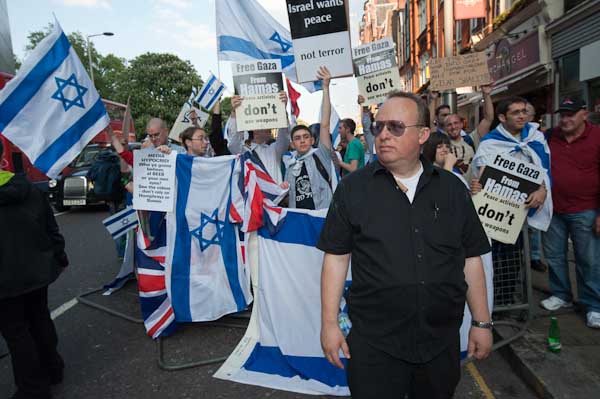
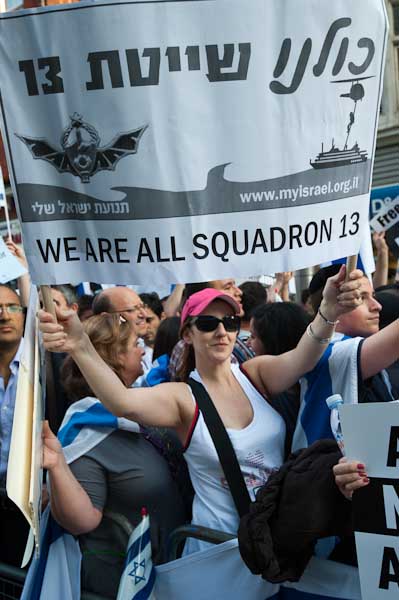
The Zionist Federation together with members of the English Defence League demonstrated opposite the Israeli embassy in support of the Israeli Defence Force killings in the attack on the Gaza aid flotilla.
A smaller group of pro-Palestinian protesters had come to oppose them, although both the Palestine Solidarity Campaign and the Stop the War Coalition had decided not to support the counter-demonstration to avoid conflict.
Although official Zionist sources had expressed some regret at the violence and loss of life, the mood of the supporters here appeared to be one of a gloating triumphalism that seemed entirely inappropriate to the situation. I was “sickened when at one point a large group of the demonstrators began chanting ‘dead Palestinian scum’ ” and appalled to find this was “a demonstration jointly with the Zionist Federation and the English Defence League, some of whose members many of us have seen and heard chanting racist slogans on our streets. It seems unbelievable that a Jewish organisation should align itself – even if unofficially – with people like this.”
Attempts to justify the summary execution of one of the victims by shots to the head at close range by the existence of so-called weapons on the ships seemed insulting – almost all those shown in the photographs are “exactly the kind of tools that would be expected to be found on any ship in its galley and for general maintenance, as well as items being taken for building work in Gaza. The possible exceptions are a few canisters of pepper spray, some catapults and what looks like some kind of ceremonial knife.”
I’m very much in favour of peace in Palestine and Israel, but like many I feel “the actions of the state of Israel in their attacks on Gaza, their disruption of everyday life for the Palestinians and the blockade is making the possibility of peace much more distant… Like other conflicts, resolution depends on winning hearts and minds and this can’t be done with tanks and bulldozers.”
Police had to step in at the end of the protest when four press photographers were surrounded and chased by a an angry group of threatening Zionist demonstrators but all I suffered were a few threats and hostile gestures.