Bermondsey Street & Guideline Stores, 1988

The previous post on this walk, Alaska, The Grange and Leather, 1988 ended at the London Leather, Hide and Wool Exchange in Weston St, Bermondsey.

Leathermarket St, Bermondsey, Southwark, 1988 88-10n-22-Edit_2400
Leathermarket St, Bermondsey, Southwark, 1988 88-10n-22

I turned into Leathermarket St and a few yards down photographed this four storey building at No. 20-22 – this was the warehouse of leather factor, for once not a typo. Factors were agents who sold goods on commission, actually storing them in their properties, on behalf of the actual manufacturers of the goods. When I made this picture it was home to some studios and a couple of other businesses, each with a floor, though the basement was vacant, and you can see the lights are on through the second floor window.

The frontage can still be seen, looking a little tidier on Leathermarket St, and standing back you can also see the stepped back two-flor loft extension. The bricked up windons on the wall just visible at the left have now been covered with false black doors and at the centre of this wall is now an artwork by Joseph Kosuth, ‘A Last Parting Look (for C.D.)’ which consists of a quotation from Dicken’s Pickwick Papers, unveiled in 2006.

Morocco St, Bermondsey St, Bermondsey, Southwark, 1988 88-10n-23-Edit_2400
Morocco St, Bermondsey St, Bermondsey, Southwark, 1988 88-10n-23

Taken from Morocco Street and looking across to 103 and 105 Bermondsey St the overall view at first glance remains now much the same as in 1988. The Grocer’s shop is now a café. But the lower building to the right, No 105, has mysteriously grown to be a replica of its neighbour, complete with fake crane on its upper storey.

And the pub at 99-101, of which only a small sliver is visible, was then the Yorkshire Grey – and a pub of that name had been there since at least the 1820s, though the building dates from 1908. For a while it became The Honest Cabbage restuarant and since around 2003 a Michelin rated gastropub, The Garrison.

Bermondsey St, Bermondsey, Southwark, 1988 88-10n-24-Edit_2400
Bermondsey St, Bermondsey, Southwark, 1988 88-10n-24

78 Bermondsey Street with its jutting out first floor window and attic was one of the buildings in the area I photographed most, and was Grade II listed. It dates from the late 17th century though the shopfront is a twentieth century alteration. Just beyond are more offices of Ash & Ash, printers suppliers who occupied these premises and later became sellers of computer printers.

Although still listed at this address in web trade catalogues the offices their name is long gone from the shopfronts and there are other companies housed here including a dedicated Pilates studio. These buildings from the mid-18th century are also Grade II listed.

Bermondsey St, Bermondsey, Southwark, 1988 88-10n-26-Edit_2400
Bermondsey St, Bermondsey, Southwark, 1988 88-10n-26

A more frontal view of 78 Bermondsey St. There are two logos on the plates by the right-hand door, one of which appears to be for IBI and another which looks familiar but I can’t for the moment place.

Bermondsey St, Bermondsey, Southwark, 1988 88-10n-13-Edit_2400
Bermondsey St, Bermondsey, Southwark, 1988 88-10n-13

The notice states that these premises have been acquired for development. Thomson Bros Ltd, established in 1857 were packaging specialists and shared the gateway with Tempo Leather Co Ltd at 55 Bermondsey St. Thomsons had move to Bermondsey St in 1952. Their sign at right of the picture is still there and the fine Victorian facade has been restored, and this is now the entry to ‘The Tanneries’.

Bermondsey St, Bermondsey, Southwark, 1988 88-10n-16-Edit_2400
Bermondsey St, Bermondsey, Southwark, 1988 88-10n-16

This frontage with an ornamental frieze about its first floor at 63 Bermondsey St is now an estate agents, established in 1998. To its right, Bramah House at 65-71 was in my pictures. It is said to be a former tea warehouse but recently renovated as offices for a number of companies, including architects. In 1988 the building was occupied by Turner Whitehead Industries Ltd, polythene converters.

I’m not sure what connection the building has with Bramah, who were one of the most famous names in tea, and in 1992 a Bramah Tea & Coffee Museum was opened not far away on Butler’s Wharf, later moving to Southwark St and closing in 2008 after its founder, Edward Bramah, died. Various of his ancestors invented the modern lavatory, the tea caddy and the Bramah lock and also include Sir Joseph Banks, who in 1788 suggested that tea could be grown in North East India, not just in China – with obvious advantages to the British Empire. The building in Bermondsey St was bought by life assurance company Canada Life in 2016 for £14.25 million.

Morocco St, Leathermarket St, Bermondsey, Southwark, 1988 88-10o-54-Edit_2400
Morocco St, Leathermarket St, Bermondsey, Southwark, 1988 88-10o-54

Guideline Stores on the corner of Morocco St and Leathermarket St , just a few yards from Bermondsey Street is a rather strange building with its windowless rounded corner tower. A former spice warehouse said to date from the it was converted to luxury flats in 1997. No signage was visible on the white painted area but as a part of its gentrification, a painted sign ‘THE MOROCCO STORE’ was added by the developers, who also obliterated its previous name ‘Guideline Stores’. Its address is now 1 Leathermarket Street. The building is said to be Victorian, though some sources suggest it is older. Although several buildings around were listed this remained unlisted despite – or perhaps because of – its distinctive character.

My walk was now almost complete, but 2 days later on Sunday 30th October I returned to
Bermondsey for my next walk, and I will end this one and continue in Bermondsey in a later post.

Anti-Racist & Migrant Rights reclaim Pride

Anti-Racist & Migrant Rights reclaim Pride – 8 July 2017

Anti-Racist & Migrant Rights group unofficially leads Pride 2017

In 2017 the organisers of the official London Pride decided to strictly limit those taking part to groups that had made an official application with those who were approved being issued with armbands for their members to go on the route. In previous years the parade had been open to all, with smaller and more radical groups joining on the end of the march behind the main participants.

For years many in the gay community had protested that, as I reported “Pride over the years has degenerated from the original protest into a corporate glitterfest led by major corporations which use it as ‘pinkwashing’ to enhance their reputation and it includes groups such as the Home Office, arms companies and police whose activities harm gay people in the UK and across the world.”

They set off to join Pride

The new policing of participation seemed to them a further step in the direction of corporate control, making it no longer a community event, but one dominated by commercial interests.

Walking into Oxford Circus

I don’t think those who organised the Migrants Rights and Anti-Racist Bloc had deliberately set out to challenge the policy, more they had simply not anticipated that it would be applied strictly to prevent them joining in at the end of the parade as usual.

Stewards stopped them moving to the back of Pride, so they stayed in front

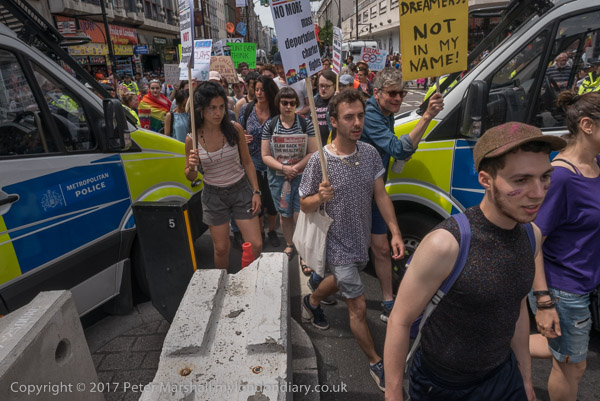
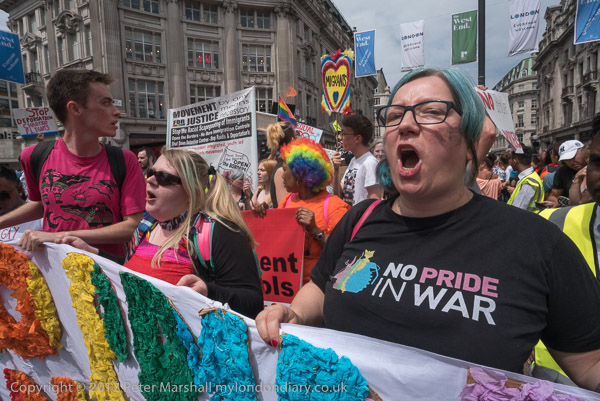
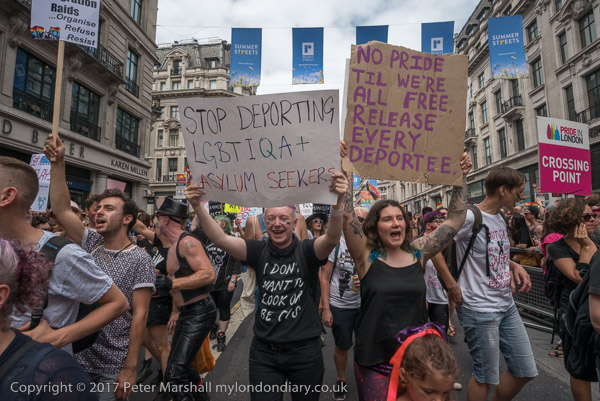
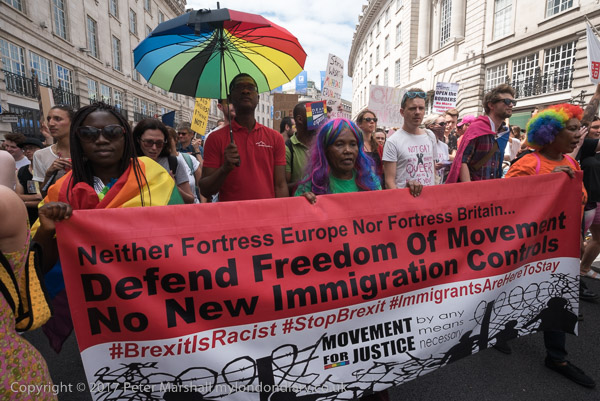
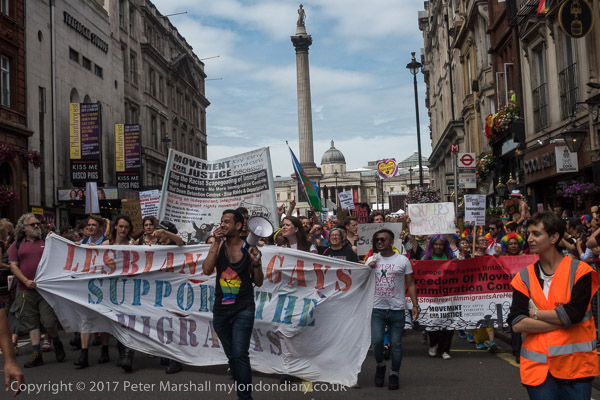
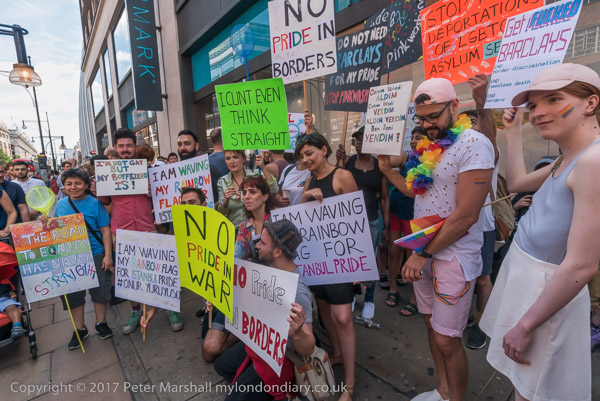
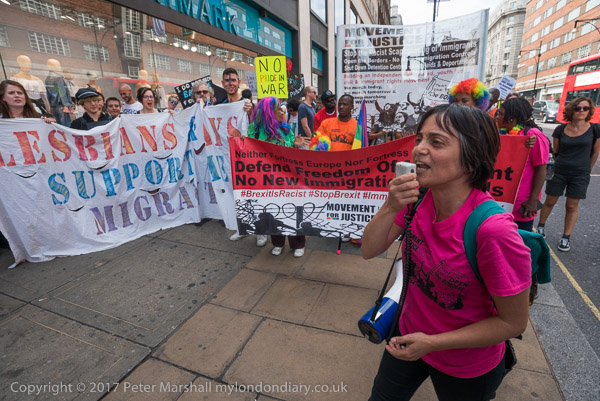
They met up at the west end of Oxford Street. As well as Movement For Justice, Queers Against Borders, Lesbians & Gays Support The Migrants and No Pride in War there was a strong contingent from London Supports Istanbul Pride. They made the point that being gay is still illegal in many countries, and that the persecution of gays is a major reason for many people coming to the UK to seek asylum.

Police let them march along the main route in front of the rest of Pride

Eventually the group of a few hundred marched off down Oxford Street towards Oxford Circus, where they intended to go up Regent St to join the end of the main parade. Their way onto Oxford Circus was blocked by barriers and police vans, but they simply split up to walk around these, lifting up some of them and grouping up again on Oxford Circus. And of course I went with them.

Here they were directly in front of the head of the main parade, stopping it from starting, and surrounded by large crowds of people who had come to see the procession. They tried to march up past the Pride stewards to the back of the parade but were stopped. There followed some minutes of argument, with the group staying in place in the middle of Oxford Circus and stewards refusing to let them go to join the main event.

And the crowds cheered

Police made some effort to get both sides to come to a compromise or get the Anti-racist and Migrants group to leave the area, but failed. Too many people were watching for them to use force to disperse the group – and there were probably many among the spectators who would have joined in to support them. Eventually police decided the group could march along the route and held up the rest of the parade for around ten minutes before they followed.

The march ends on Whitehall

So rather than being as in previous years at the back of the parade, going along the route hardly being noticed, with many of the spectators having by then drifted away to nearby bars or on their way home, the Migrants Rights and Anti-Racist Bloc lead the procession, marching past cheering crowds (though a few did look rather confused) all the way to Whitehall.

But No Pride in War decide to block the road

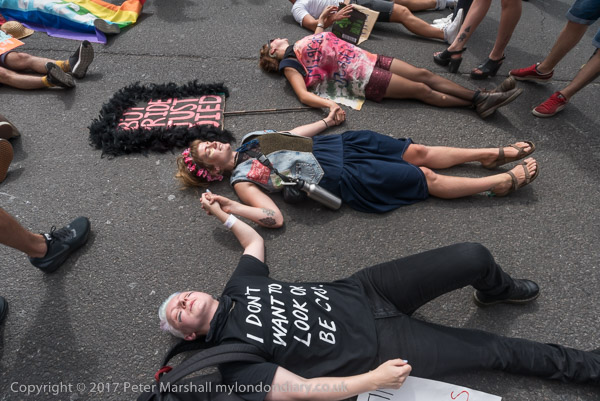
While most of the group ended their protest here, No Pride in War protesters proceeded to lie down across the road with their placards, blocking the route of the official procession which had to wait at Trafalgar Square until police finally managed to clear them, threatening them with arrest.

And the official parade has to wait again.

Later that day and on the day afterwards I watched and read the news reports on Pride, some giving it lengthy coverage. But although they had been there with their reporters and cameras, all of the mainstream media had for some reason decided that the very successful – if unintended – gatecrashing of the event by people protesting over Migrant Rights and other issues to wide acclaim by spectators along the route was not news.

More at Anti-Racist & Migrant Rights reclaim Pride.


World Pride & Spanish Civil War

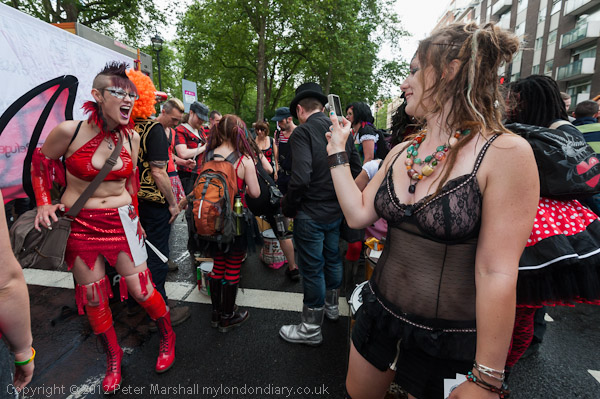
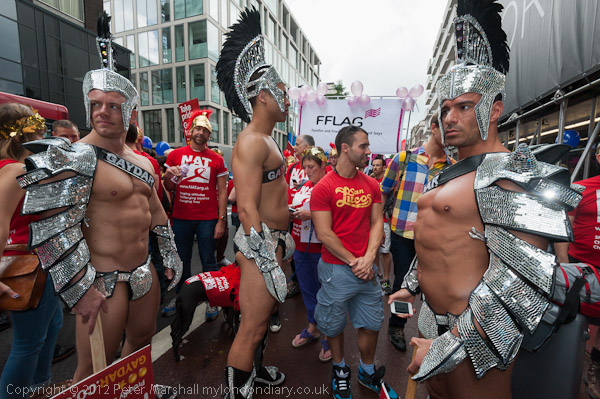
World Pride & Spanish Civil War. On Saturday 7th July 2012 there were two events taking place at the same time and I was determined to cover both. Fortunately having begun at the start of the WorldPride procession in Marylebone I was able to jump onto the Bakerloo Line to Waterloo and photograph the annual International Brigades Commemoration at Jubilee Gardens before returning on the same line to Charing Cross to photograph the end of the march.


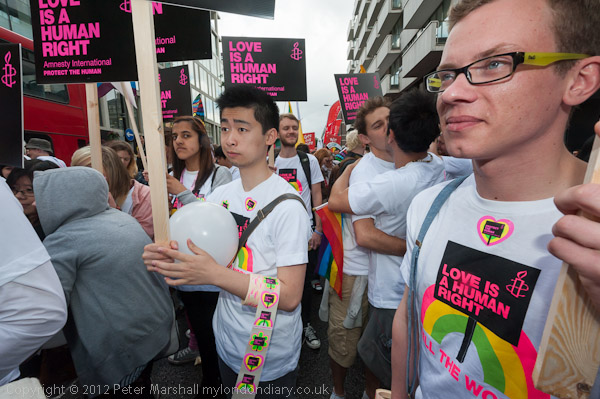
WorldPride London – Portman St & Westminster

Pride almost didn’t happen in 2012 as the organisers were met shortly before the event to provide financial assurances to the GLA, Met Police, Westminster Council, London Fire Brigade and Transport for London, which they were unable to do. Quite why London Mayor Boris Johnson decided to try to stop Pride in this way is not at all clear.

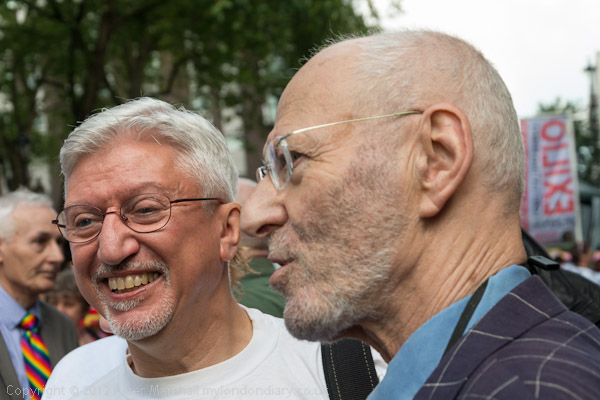
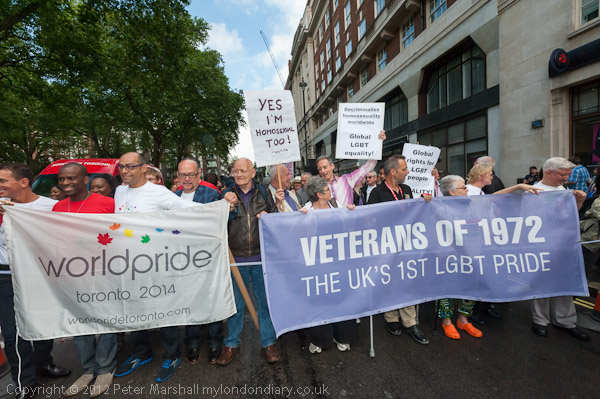
Two marchers in a group who had been at the first Gay Pride in 1972

So rather than the planned event they decided to stage a ‘peaceful protest’ march or ‘procession’ specified as a democratic right under the Public Order Act 1986. This meant there were none of the corporate floats that have in recent years come to dominate the event, although company staff still marched in their company outfits.

Gay Pride had in recent years lost much of its political edge, becoming a carnival of different lifestyles and a commercially sponsored jamboree, with large and expensive floats. Without these, although the corporates were still present, everyone was on the street together and the whole event seemed more intimate.

WorldPride 2012 was again a protest – as it used to be, though in a very different situation from when it began when for many that took part it was where they ‘came out’, taking the significant step in affirming themselves as gay and standing together against the prejudices of a society which was only just beginning to accept that being gay was not a perversion.

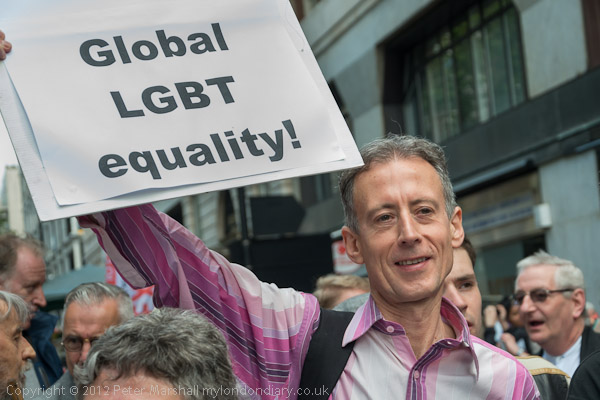
Of course there are still some communities in the UK where being gay remains unacceptable, and as campaigner Peter Tatchell reminded us, there are still some countries where people are being killed because they are gay.

There were a number of heavy showers while people were arriving for the event, and many put off arriving as late as possible. Although at first it looked as if the event might be a washout, by the time I was making my way towards Baker Street station the street was tightly packed making my progress slow.

When I returned to photograph marchers at the end of the event in Whitehall and Pall Mall I had missed the front of the march, but there were still many arriving hours after the procession had begun.


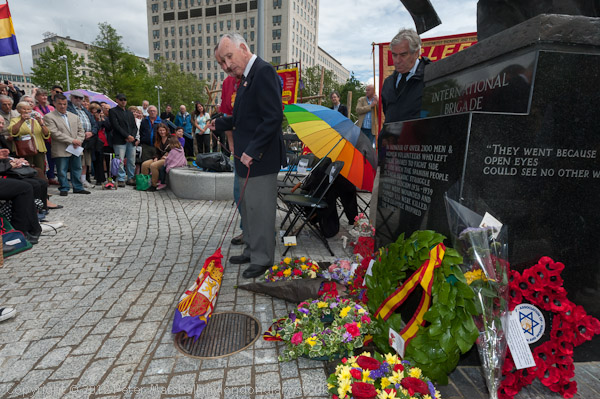
Sacrifice For Spain Remembered – International Brigade Memorial

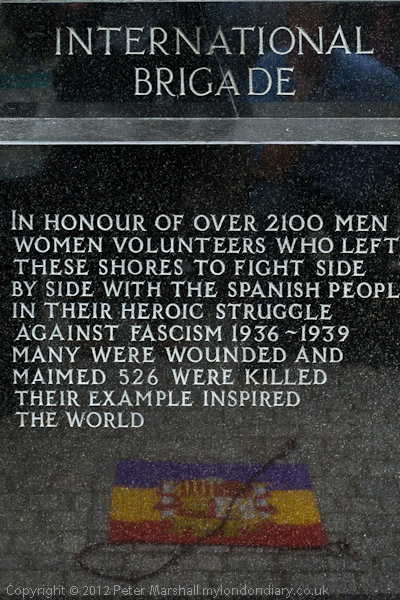
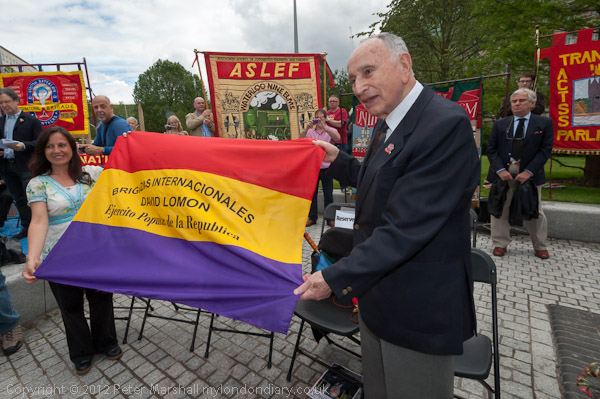
David Loman unveils the new plaque in Jubilee Gardens

The annual International Brigades Commemoration has been on the same day as Pride in several years, and recording both has often been a problem. I was particularly keen to be there this year as it could well be the last to be attended by any of those who volunteered to go to Spain.

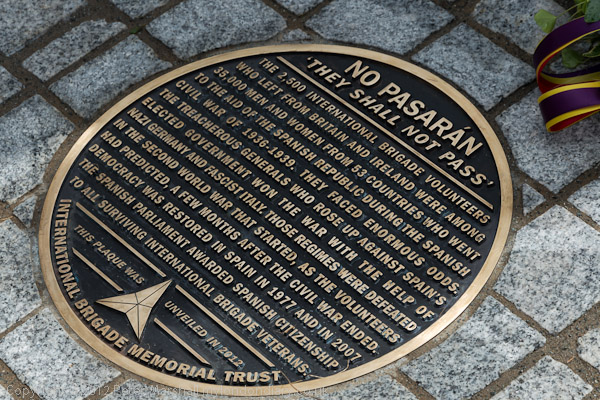
The war in Spain began in 1936, 76 years earlier. A new plaque was being unveiled in Jubilee Gardens by David Loman who was an 18 year old Jewish lad, David Soloman, from the East End when he went to fight in Spain in 1936, changing his name to Loman (also know as Lomon) because it was illegal. He was captured by Italian soldiers in 1938, surviving some months in a prison camp before being repatriated. He served in the Royal Navy in the Second World War and like other surviving members of the International Brigades he was awarded Spanish nationality in 2007 for his services to the Spanish nation and presented with a Spanish passport in 2011.

Now 94, and looking very sprightly Loman is one of only three remaining British veterans – the others being Lou Kenton then 103 and Stanley Hilton. Both Loman and Kenton died during before the commemoration in 2013. Hilton, who was living in Australia, died in 2016 aged 98.

David Loman holds the flag he was presented

There were many family members of those who fought in Spain at the commemoration, and there were a number of speeches and performances by folk musician Ewan McLennan, performance poet Francesca Beard, singer-songwriter Paco Marin and folk duo Na-Mara, but Loman was definitely the star of the occasion.

More at Sacrifice For Spain Remembered.


Alaska, The Grange and Leather, 1988

The previous post of this walk, Alma Grove & Grange Road, Bermondsey, 1988, ended on Grange Road.

Alaska, The Grange and Leather, 1988: The area of Bermondsey south and east of Bermondsey Street used to be known as The Grange, though I think now estate agents have re-christened it Bermondsey Spa. It was once the farm or grange of Bermondsey Abbey which covered much of the locality from the Norman conquest until the dissolution of the monasteries by Henry VIII. Bermondsey Priory was established by Cluniac monks around 1089 and enlarged into an abbey around three hundred years later. Estate agents have renamed the area Bermondsey Spa.

Alaska Works, Grange Rd, Bermondsey, Southwark, 1988  88-10m-14-Edit_2400
Alaska Works, Grange Rd, Bermondsey, Southwark, 1988 88-10m-14

The gateway on Grange Road with its carved seal was the works entrance to C W Martin & Sons Ltd who made products from sealskins, mainly imported from Alaska and Canada. The Alaska factory dated from 1869, though it was only taken over by Martin and a partner four years later. The seal skins were de-haired, dressed and died in the factory, which employed around a tenth of all UK fur workers. In its final years until it closed in the 1960s it was owned by Martin Rice Ltd.

Traditionally sealskin was used to make waterproof jackets and boots by the Inuit and other aboriginal people, and seal fur was used for warm coats. Sealskin made tobacco pouches for sailors and sporrans for Scotsmen. Although there are now bans in many countries on the export and import of seal pelts, the trade continues, and seal fur is still used as trims by some of the leading fashion brands.

Alaska Works, Grange Rd, Bermondsey, Southwark, 1988  88-10n-64-Edit_2400
Alaska Works, 61, Grange Rd, Bermondsey, Southwark, 1988 88-10n-64

The market for seal products diminished in the twentieth century and Martin’s increasingly moved into other fur products such as sheepskin jackets and the cleaning of fur coats etc. In 1932 the factory was rebuilt in a striking Art Deco design by Wallis, Gilbert & Partners and it was partially rebuilt after being damages in fire damage. It closed in the 1960s. At some time the legend MARTIN’S on the tower was replaced by the ALASKA now present.

The building was redeveloped as offices in the early 1990s and converted to residential use together with new development on the former Grange Road Baths site later in that decade. Like many former industrial and commercial buildings of merit it reflects a long-held prejudice of the listing authorities and is unlisted. For many years too there was (and perhaps it persists) a peculiar snobbishness among architectural historians and critics against what the called ‘moderne’ buildings.

88-10n-55-Edit_2400
Jaguar Specialists, Grange Rd, Bermondsey, Southwark, 1988 Car side and wheels on brickwork. 10n53

Perhaps surprisingly, this house at 8 Grange Road with its neighbours in a row of four houses to the left of the picture was Grade II listed in 1972. They date from around 1800.

Jaguar Specialists,  Grange Rd, Bermondsey, Southwark, 1988 88-10n-53-Edit_2400
Jaguar Specialists, Grange Rd, Bermondsey, Southwark, 1988 Car side and wheels on brickwork. 10n55

What attracted me was of course the unlisted (and since removed) part car body advertising the Jaguar Specialists above its ground floor windows. You can just see some marks left by this on the brickwork, but the name board has gone without trace. Above the archway at right is still the notice GREATER LONDON COUNCIL PRIVATE ACCESS DO NOT OBSTRUCT and there is not a gate across the entrance

Former, Bacon's School, Grange Rd, Bermondsey, Southwark, 1988 88-10n-42-Edit_2400
Former Bacon’s School, Grange Rd, Bermondsey, Southwark, 1988 88-10n-42

Josiah Bacon who had become wealthy as a leather merchant left an annuity in 1703 of £150 a year to establish a Free School, at first in St Mary’s Church on Bermondsey St. It later moved to a building on Grange Road which was replaced by this one in 1890. The school moved to Pages Walk in 1962, later becoming a City Technology College. It moved to Rotherhithe in 1991 and is is now co-educational secondary school and sixth form with academy status since 2007.

London Leather, Hide and Wool Exchange, Weston St, Bermondsey, Southwark, 1988 88-10n-35-Edit_2400
London Leather, Hide and Wool Exchange, Weston St, Bermondsey, Southwark, 1988 88-10n-35

I’ve written at some length before about the London Leather, Hide and Wool exchange in Weston Street. Leather traders had moved from Leadenhall Street in the City to a new Skin Market on an adjoining site in 1832-3 and 50 years later decided on building a new headquarters for the Leather Industry next door, engaging noted local architect George Elkington. Perhaps his flamboyant and eclectic design was made to please the committee responsible, and it was described as ‘an ornament to the district‘.

London Leather, Hide and Wool Exchange, Weston St, Bermondsey, Southwark, 1988 88-10n-34-Edit_2400
London Leather, Hide and Wool Exchange, Weston St, Bermondsey, Southwark, 1988 88-10n-34

It’s overdone porch is supported by Atlas on each side, with a head in the centre that reminds me of Old Father Thames. Above the ground floor windows are five roundels representing various stages of the preparation and sale of leather; fellmongering to scrape the skins clean, tanning to harden the leather, flattening the skins, storing them for sale and finally a customer inspecting a hide.

London Leather, Hide and Wool Exchange, Weston St, Bermondsey, Southwark, 1988 88-10n-33-Edit_2400
London Leather, Hide and Wool Exchange, Weston St, Bermondsey, Southwark, 1988 88-10n-33

Originally on the rounded tower at the corner with Leathermarket street there was a clock and above this a balcony and cupola, but these were not replaced after wartime damage. The building had a club area for the leather merchants on its first floor as well as public rooms and a tavern at the rear, now a pub. The exchange closed in 1912.

London Leather, Hide and Wool Exchange, Weston St, Bermondsey, Southwark, 1988 88-10n-21-Edit_2400
London Leather, Hide and Wool Exchange, Weston St, Bermondsey, Southwark, 1988 88-10n-21

Bermondsey had a long history of tanning leather and in 1703 The Master, Wardens and Comonalty of the Art or Mistery of Tanners of the Parish of St Mary Magdalen Bermondsey of Surrey received a royal charter making them a guild responsible for the training of tanners and the inspection of tanning within a 30 mile radius of Bermondsey, which continued in force until 1835. Tanning was one of the major industries in the area, but the last tannery in the area closed in 1990. The guild still exists and awards bursaries and prizes etc to young people in the area.

My walk around the leather district will continue in a later post.


NHS and Housing Marches in East London, 2014

NHS and Housing Marches in East London, 2014


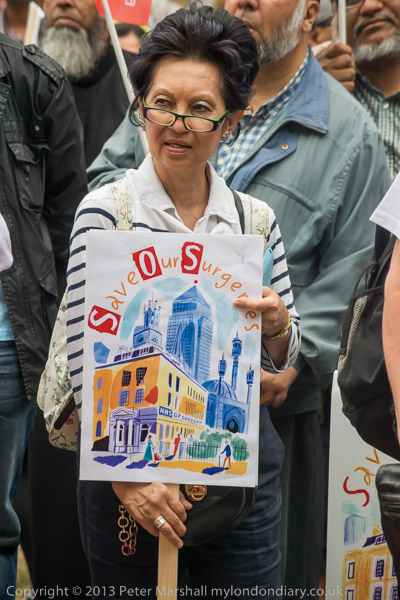
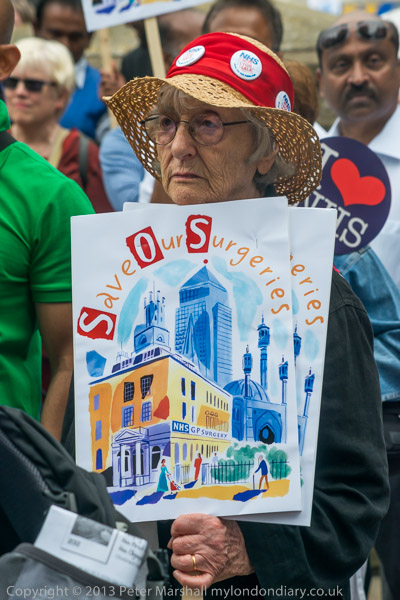
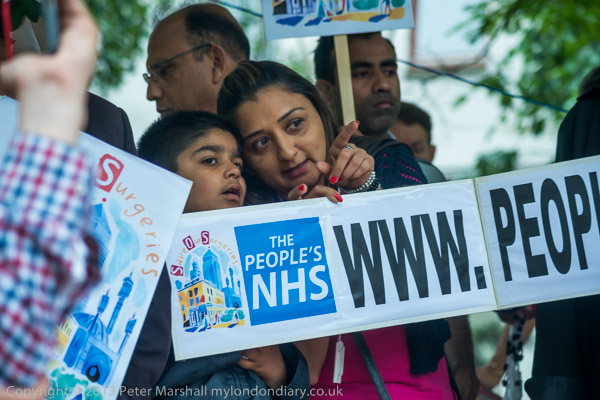
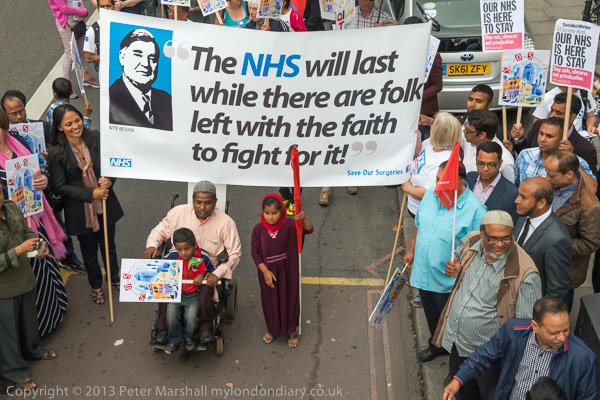
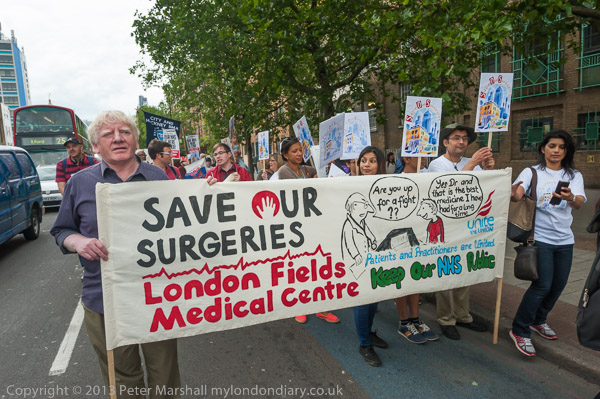
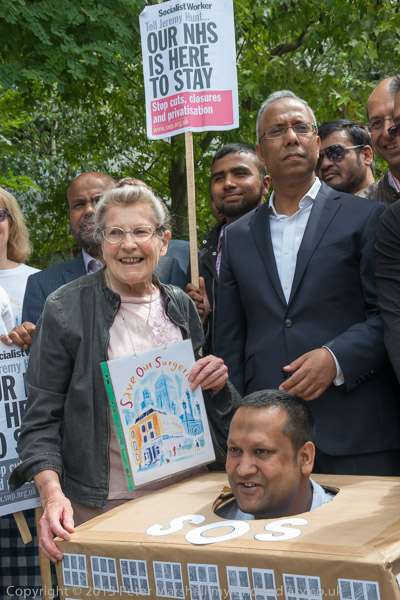
Save our Surgeries on NHS 66th Birthday – Whitechapel

The National Health Service came into operation in the UK on 5th July 1948, established by a Labour government despite considerable opposition from the Conservative Party and some doctors’ organisations. In most recent years there have been protests marking the anniversary against the increasing privatisation of the system, large parts of which have now moved away from being provided by the NHS itself to being provided by private companies, motivated by profits rather than public service.

The opposition to Aneurin Bevan’s plans in the 1940s led to a number of compromises, but the NHS was launched with three basic principles – to meet the needs of everyone, to be free at the point of delivery, and to be based on clinical need rather than the ability to pay. Although those principles remain, there are some respects in which they are not entirely met.

Prescription charges – currently £9.35 per item – were introduced in England in 1952, removed from 1965-8 but then re-introduced, remaining free for under-16s and over 60s, with some other exceptions. And we pay too for NHS dentistry, and many people find it impossible to get dental treatment under the NHS as no practice in their area will take them on.

Access to GPs and other services at surgeries around the country is also much more difficult for many, and it can be difficult or impossible to get an appointment in a timely fashion. Many services dealing with relatively minor medical issues are no longer available, and people have either to pay for them or continue to suffer. Some of these problems have been exacerbated by the take-over of many surgeries by healthcare companies as a part of the creeping privatisation of the NHS.

Twenty years ago, when I had a hospital stay of several weeks, hospitals have been forced to put some essential services – such as cleaning – out to tender, resulting in two of the three hospitals I was in being in filthy conditions.

In 2014, cuts in funding were threatening the closure of surgeries in Tower Hamlets as they failed to pay for the extra needs faced in inner-city areas. Local hospitals were also threatened, particularly because of the huge debts from PFI contracts for the building an management of new hospitals. The deals with the private sector made under New Labour have left the NHS with impossible levels of debt – and the companies involved with high profits, continuing in some cases for another 20 or 30 years.

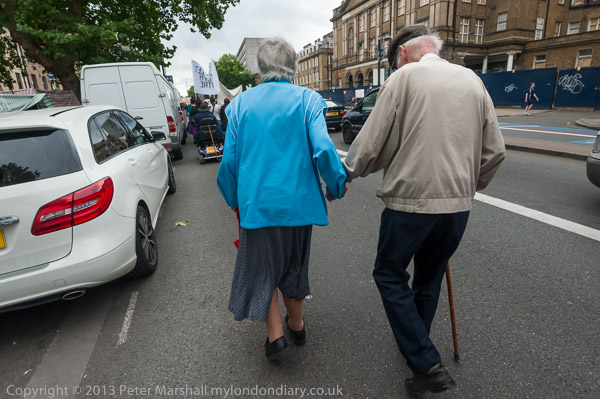
After a short rally with speakers including the local mayor and MP as well as health campaigners including local GPs, there was a march by several hundreds to a larger rally in Hackney. But I left the marchers shortly after it passed Whitechapel Station.

Save our Surgeries on NHS 66th Birthday


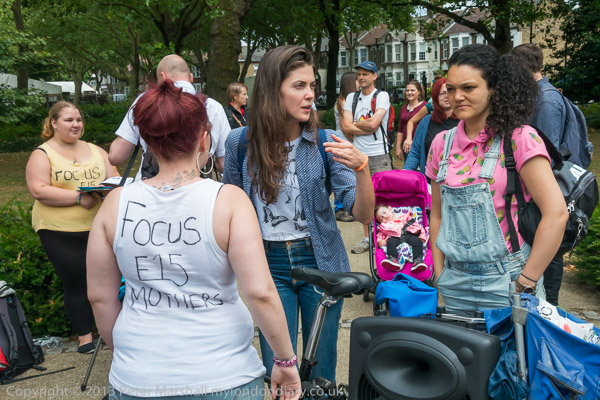
Focus E15 March for Decent Housing – East Ham

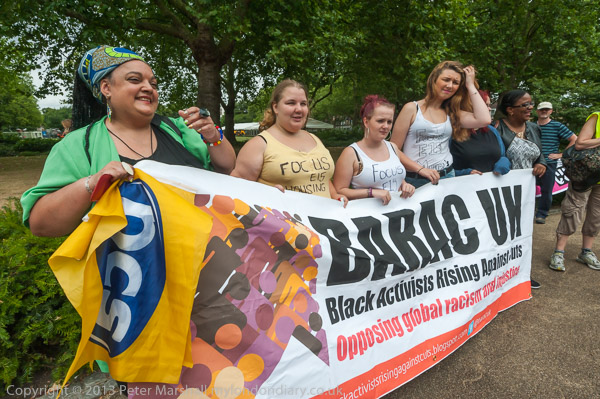
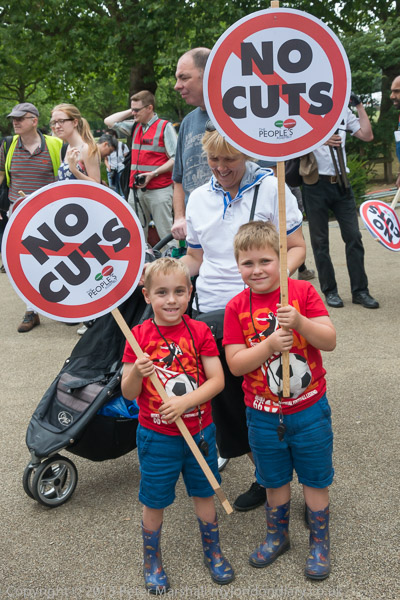
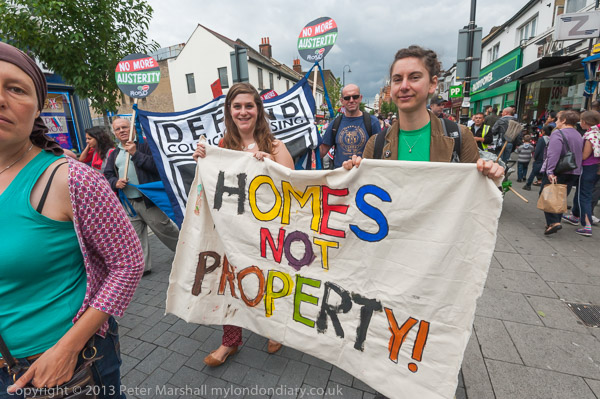
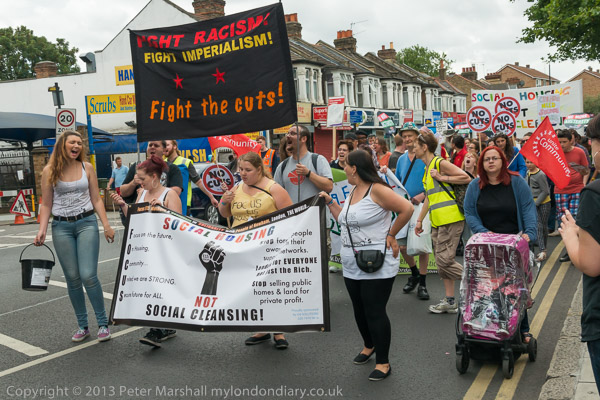
Earlier I had been to photograph a march through East Ham and Upton Park in a protest over the terrible state of housing in England, and in London in particular. The event had been organised by Focus E15 Mums with the support of Fight Racism Fight Imperialism, but included many other protest groups from Hackney, from Brent and from South London on the march as well as groups including BARAC, TUSC and others.

They included a number of groups who had stood up and fought for their own housing against councils lacking in principles and compassion who had suggested they might move to privately rented accommodation in Birmingham, Hastings, Wales or further afield, but who had stood their ground and made some progress like the Focus E15 Mothers.

Many London councils are still involved with developers in demolishing social housing and replacing it with houses and flats mainly for high market rents or sale, with some “affordable” properties at rates few can afford, and with much lower numbers than before at social rents. Many former residents are forced to move to outer areas of London in what campaigners call ‘social cleansing’.

Families that councils are under a statutory duty to find homes for are often housed in single rooms or flats, sometimes infected by insects or with terrible damp, often far from their jobs or schools. Councils are under huge pressure and funding cuts sometimes make it impossible for them to find suitable properties, though often there are empty properties which could be used, particularly on estates such as the Caarpenters Estate in Stratford which Newham had been emptying since around 2004 in the hope of redeveloping.

Government policies and subsidies for housing have largely been a way of subsiding private landlords, and we need national and local governments – as I worte ” determined to act for the benefit of ordinary people, making a real attempt to build much more social housing, removing the huge subsidies currently given to private landlords through housing benefit, legislating to provide fair contracts for private tenants and give them decent security – and criminalising unfair evictions.” Housing really is a national emergency and needs emergency measaures.

Much of what is currently being built in London is sold to overseas buyers as investments and often left empty as its owners profit from the rapid rises in property values in London. We need to make this either illegal or to impose heavy duties on overseas owners including increased council taxes on empty properties.

The march attracted considerable attention on the streets of East London, and as I note several motorists stopped to put money in the collection buckets – something I’ve never seen happen before. I left the march as it reached East Ham Station to go to the NHS event.

Focus E15 March for Decent Housing


Alma Grove & Grange Road, Bermondsey, 1988

My previous post on this walk, West Lane & Spa Road Bermondsey 1988, ended in the Longfield esate on Fort Road.

Man, Pickaxe, Bermondsey, Southwark, 1988 88-10m-51-Edit_2400
Man, Pickaxe, Bermondsey, Southwark, 1988 88-10m-51

I met this man working I think somewhere on the Longfield Estate, and as often happens he was interested in seeing me wandering around with a camera and stopped his work to pose for me.

Alma Grove, Bermondsey, Southwark, 1988 88-10m-55-Edit_2400
Alma Grove, Bermondsey, Southwark, 1988 88-10m-55

Streets such as Alma Grove and one I had walked down earlier in the area Balaclava Rod clearly show that this area was built up around the time of the Crimean War of 1853-6. when Britain and its allies, France, the Ottoman Empire and Piedmont-Sardinia defeated Russia. It was a war largely about Palestine (then part of the Ottoman Empire) and the relative religious rights there for the Orthodox Church, backed by Russia and the Roman Catholic Church, but also against imperial expansion by Russia as the Turkish Ottoman empire was declining. The Allies landed in Crimea won a battle at Alma in September 1854, then managed to repel a Russian counterattack in October at Balaclava, but with heavy British losses.

The Crimean War was an important milestone in the history of photography as the first to be widely recorded in photographs, taken using the cumbersome wet-plate process by Roger Fenton, whose work was also a part of what was probably the first major mass propaganda exercise aimed at the growing British middle class and industrial working class.

The infamous Charge of the Light Brigade took place at Balaclava, and Lord Lucan who passed on the misleading order which led to it had his home close to where I now live. Though the local Lucan Arms pub named in his family’s honour is now ironically renamed ‘The Retreat’.

Grange Cafe, Grange Rd, Bermondsey, Southwark, 1988 88-10m-24-Edit_2400
Grange Café, Grange Rd, Bermondsey, Southwark, 1988 88-10m-24

Walking westwards along Southwark Park Road takes you, after the junction with Dunton Road into Grange Road, where I admired the frontage of the Grange Café. THis later became the Jasmine Garden Chinese take-away and is now Chicken World, but has long since lost its interesting frontage, though the pillars at each end remain.

F T W, Motorcycles, Grange Rd, Bermondsey, Southwark, 1988 88-10m-25-Edit_2400
F T W, Motorcycles, Grange Rd, Bermondsey, Southwark, 1988 88-10m-25

Although there was once a magazine ‘Forever Two Wheels’ or ‘FTW’ I suspect the name of this motorcycle shop on Grange Road probably came from the initials of its owner. Ii think this shop and the row of houses has since been demolished. As well as selling motorbikes it was also a bike breaker, stripping down bikes no longer in working order to sell as spare parts.

The Look In, Grange Rd, Bermondsey, Southwark, 1988 88-10m-26-Edit_2400
The Look In, Grange Rd, Bermondsey, Southwark, 1988 88-10m-26

The Look In offering House Clearances and Removals was very firmly shuttered and closed when I made this picture in 1988. Certainly I couldn’t look in. It was next to F T W motorcycles. The shop at left appears to be number 85, but numbering in Grange Road is difficult to follow. I think these shops were shortly after replaced by a rather anonymous housing block.

F T W, Motorcycles, Grange Rd, Bermondsey, Southwark, 1988 88-10m-12-Edit_2400
F T W, Motorcycles, Grange Rd, Bermondsey, Southwark, 1988 88-10m-12

As I was photographing the shop fronts this man came out from FTW Motorcycles and we talked for a few minutes, after which I asked him if I could take his photograph. I took two frames and both are just a little sharper on the shopfront than on his face.

I went on from here to take a number of pictures of the Alaska Works, where my next post on this walk will begin.


Haringey Residents protest housing sell-off

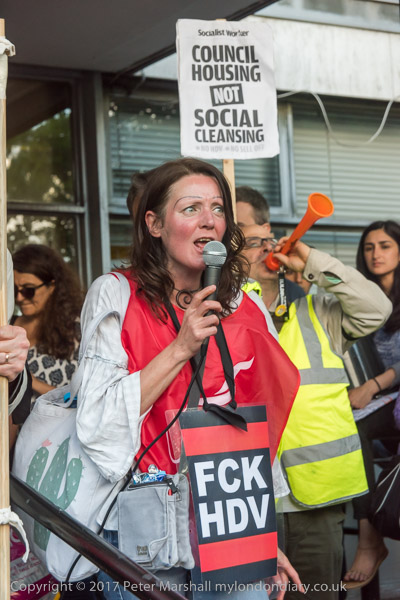
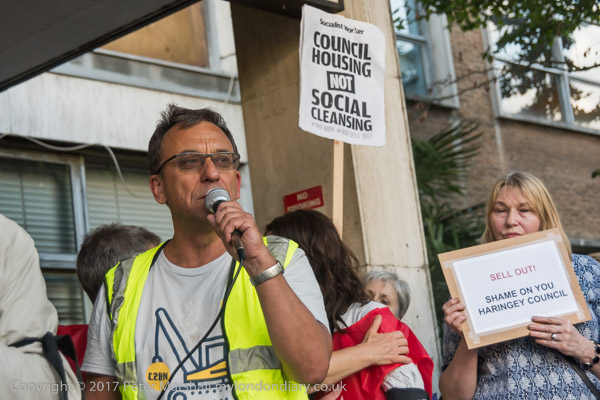
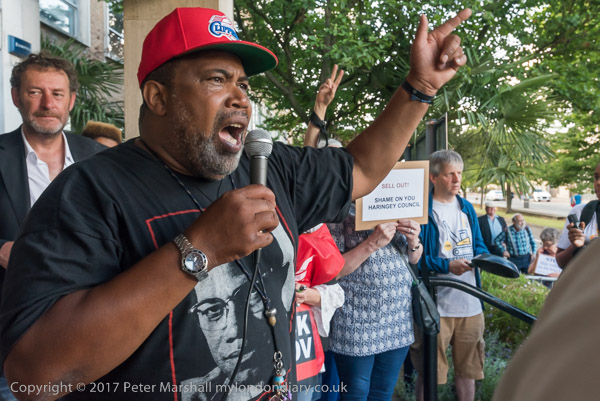
Angry residentshold up placards and posterson the glass wall of the Civic Centre

Haringey Residents protest housing sell-off – Wood Green, London. Monday 3 July 2017.

One of the London Labour councils whose housing policies were causing much local distress was Haringey, where the council was in process of setting up the Haringey Development Vehicle (HDV), Britain’s biggest collaboration yet between a local authority and a property developer, which will demolish a third of Haringey’s social housing, handing over half of an estimated £2 billion worth of publicly owned housing estates, schools, public facilities and private housing acquired through compulsory purchase orders to developer Lendlease.

Time to march from Duckett’s Common

Many feel that the cabinet system for local government is anti-democratic, removing decisions from the elected councillors as a whole to small highly selected groups for the convenience of administration. It means that ideas such as the HDV are not properly debated, and in this case it was about to be imposed without any real public consultation, and to many its only real purpose appeared to be to hand huge profits to the developer.

Marching through Wood Green shopping centre

The scheme to build 6,400 new homes would result in the demolition of many existing properties, and would have the consequence of driving many existing tenants and leaseholders out of the area as they would be unable to afford to buy the new properties or afford the rents. It would mean a massive wave of social cleansing.

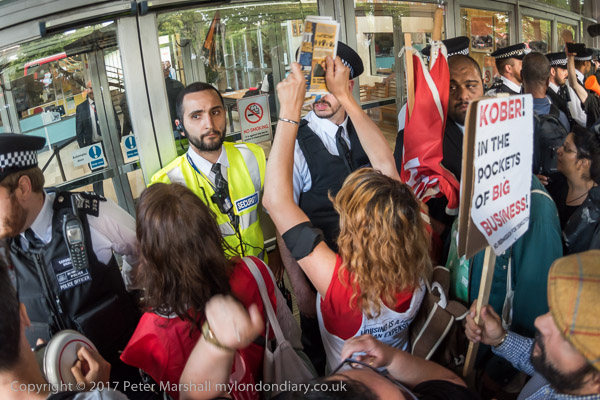
Police & security stop all but a few entering

The formation of the HDV was opposed by many in the borough’s Labour Parties, trade unionists, Greens, tenants, small businesses and community groups and well over 500 of them came to make their opposition clear.

A large crowd at the front of the CIvic Centre

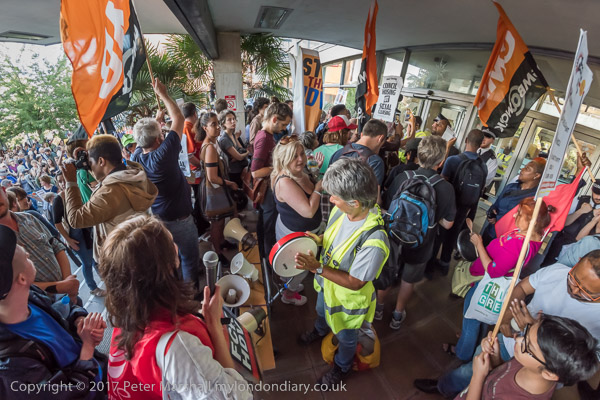
They had met at Ducketts Common and then marched through the centre of Wood Green, stopping briefly to block traffic on a road junction before moving on to the front of the Haringey Civic Centre where the council was meeting later to approve the HDV. They soon pushed aside the barriers which had been set up in front of the building to continue their noisy protest, with a row of police standing across the entrance.

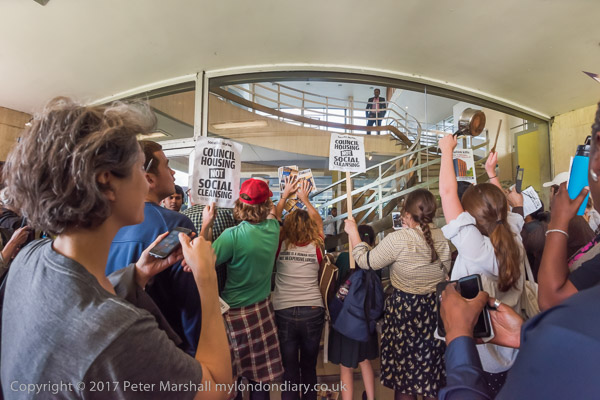
But others went around to protest in front of the large glass windows at the back

After an angry and noisy protest outside some made a rush to get into the building though a side entrance. I decided not to try and enter with them, and security and police managed to stop all but a few and then locked the building, leaving even some of the councillors coming to attend the meeting unable to enter.

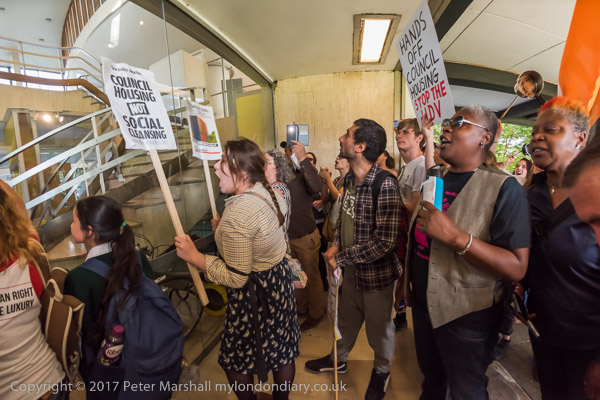
Many of the protesters moved the to the rear of the building and banged noisily on doors and large glass windows, and at one point the large glass panes began to flex by almost half an inch as people pushed against them and I moved back fearing they might shatter.

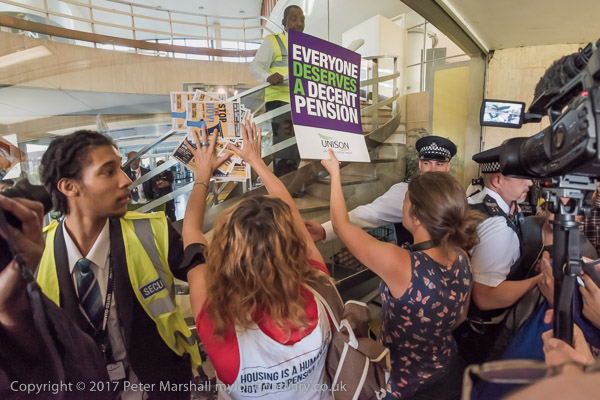
Eventually police came and pushed the people away from the glass

It looks from some of the pictures I took as if the protesters were actually inside, but they were on the outside of these large glass panels which gave a good view of the interior. Eventually police arrived and pushed the people back, forming a line in front of the glass.

A rally continued in front of the building entrance

I moved back to the front of the building where a rally was taking place with a number of mainly local speakers. This was still continuing as I left and the noise would have been very noticeable to councillors inside who were voting to go ahead with the scheme to give away around £2 billion to the Australian developers Lendlease.

Although this battle was lost, the war was at least partly won. The HDV was a major issue in the next set of council elections in the following May, with the many councillors from the left of the Labour Party strongly opposed to it getting elected, and the new council quickly voted to scrap the scheme to redevelop the Northumberland Park council estate with Lendlease. Instead Haringey set up its own housing company, Haringey Homes, and will carry out developments – including some with private developers such as Lendlease – in a way that avoids some of the social cleansing and retains more affordable and social rented properties. It has met some of the issues raised by the campaigners but by no means all.

The council’s new approach was in part made possible by a government decision to remove the cap on councils’ borrowing in their Housing Revenue Accounts (HRA) and also by a funding grant from the Mayor of London. But they still need to build some properties for market sale, though they state they are committed only to do this so they can deliver the “greatest possible number of council-rented homes.”

More at Haringey Residents protest housing sell-off.


XR Carmen’s Carbon Procession

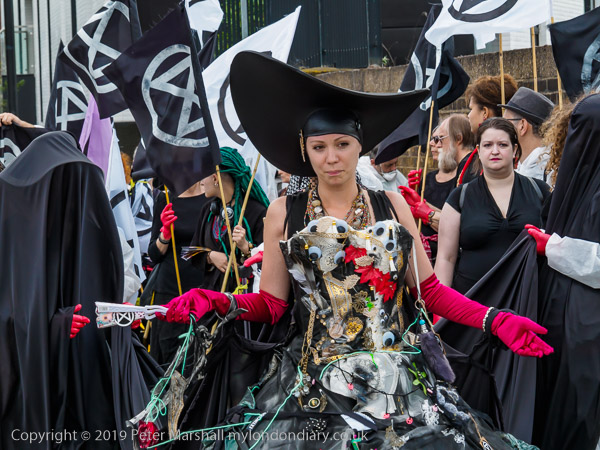
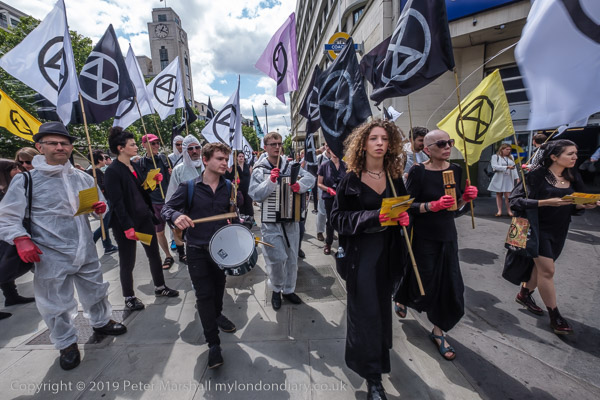
Carmen leads the XR Carbon Procession at Hyde Park Corner

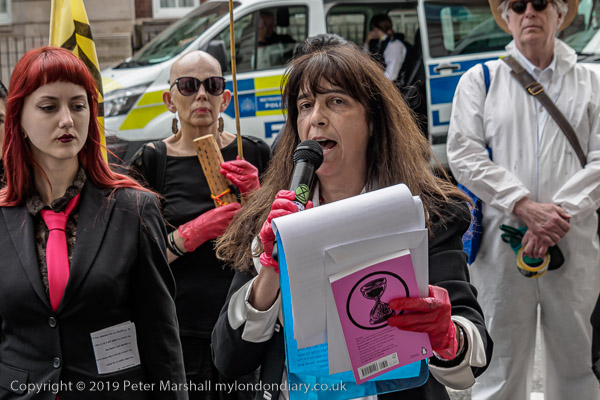
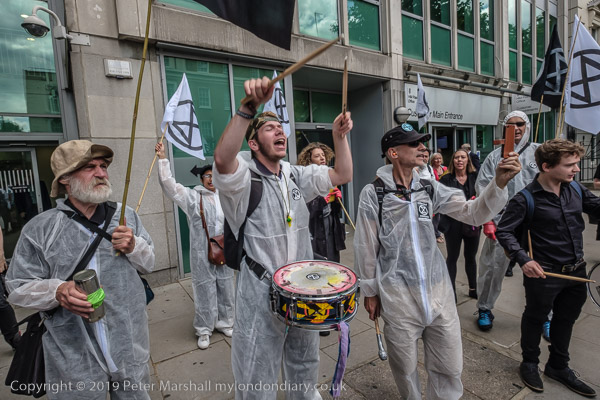
Extinction Rebellion had obviously put in a lot of thought and effort into their Carmen’s Carbon Procession on July 2nd, 2019, and there were quite a few photographers and videographers who came to photograph it. Doubtless all of us filed our pictures with the agencies or publications, but I don’t know how many got published. Probably the only pictures used came from later in the day when they ended the event with a protest in Trafalgar Square close to where a large audience had gathered to watch the opera.

Protests in the UK seldom get reported, unless they result in considerable disruption, violence or involve celebrities behaving badly. So far as most editors are concerned they are not ‘news’. Of course much of the press and media is owned by a small group of billionaires whose interests those editors have to bear in mind even where there is not explicit direction. But more generally they operate under a general restraint of upholding the status quo and from their personal position as part of the well paid middle class – something which has been very apparent in the coverage of the recent RMT strikes.

But overall Extinction Rebellion have done much to bring the climate crisis into a wider public consciousness, and I applaude them for this even if I agree with some of their left and anarchist critics. And perhaps an opera-based protest exemplifies the middle-class nature of the organisation. But mobilising such a large middle-class movement is certainly an acheivement, and many of their harshest critics are those who have failed to mobilise more than a tiny fraction of the working class. Though nothing at the moment suggests that XR’s efforts will result in any of the decisive action needed to be anything but too little too late.

Relatively few people actually see protests on the streets, and most who do are too intent on getting on with their life, shopping or hurrying to meetings or to catch trains to take much notice. Much of XR Carmen’s Carbon Procession in any case took part on fairly empty back streets and it was more an event staged for the media than a protest.
The protest took place on the day that BP, a company which began life in 1909 as the Anglo-Persian Oil Company, Ltd, a part of our imperial exploitation of Iran’s vast oil reserves was greenwashing its polluting and climate-damaging activities through sponsorship of a Royal Opera House performance of Carmen to be relayed to 13 BP giant screens in major cities across the UK.

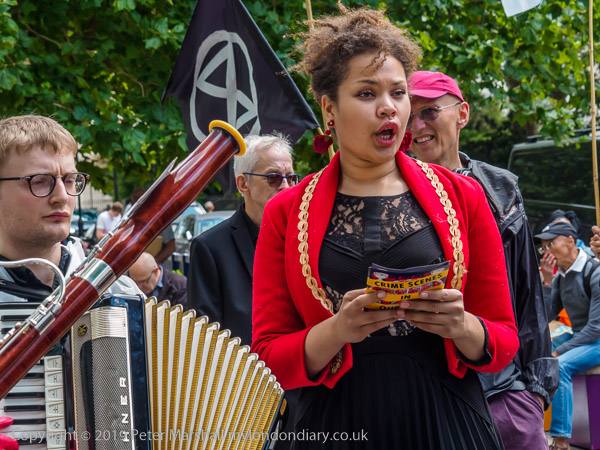
An opera singer performs a little from Carmen

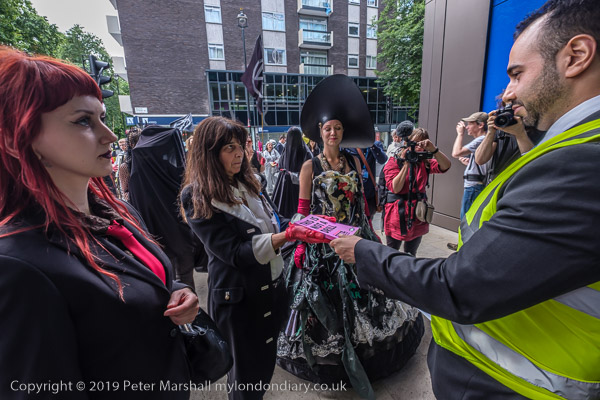
It toured the offices of oil companies belonging to the Oil and Gas Climate Initiative (OGCI) urging them to abandon the pretence they can combat global warming without a huge cut in oil production and delivering copies of the Extinction Rebellion Handbook ‘This is Not A Drill’.

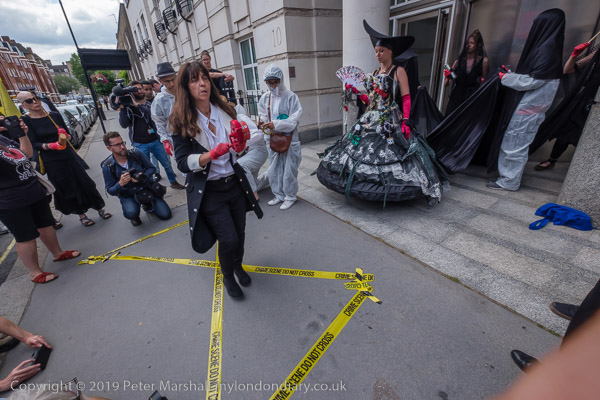
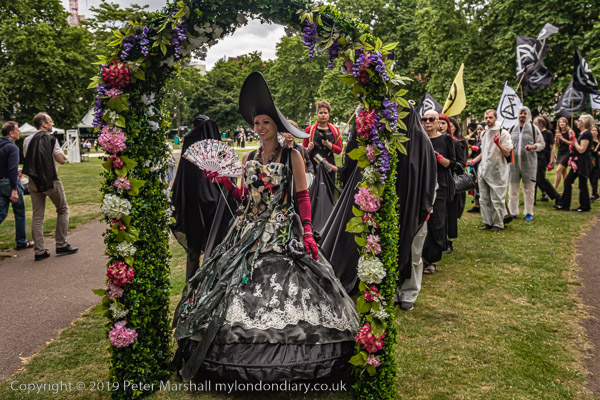
As well as Carmen in costume, there was a fine opera singer and a group of musicians, XR drummers to draw attention to the event and a team who marked out the company offices as crime scenes.

The procession found a floral arch in Grosvenor Square

The event met on Ebury Bridge before marking to perform in front of the nearby offices of Italian petroleum company ENI, on an otherwise rather empty street in Pimlico. They then moved on for another performance on a busy lunchtime street corner in Eccleston Square and then the China National Petroleum Corporation (CNPC) close to Victoria Station. By then they needed a rest in Hyde Park before going through Mayfair to the offices of Saudi Aramco at 10 Portman Square.

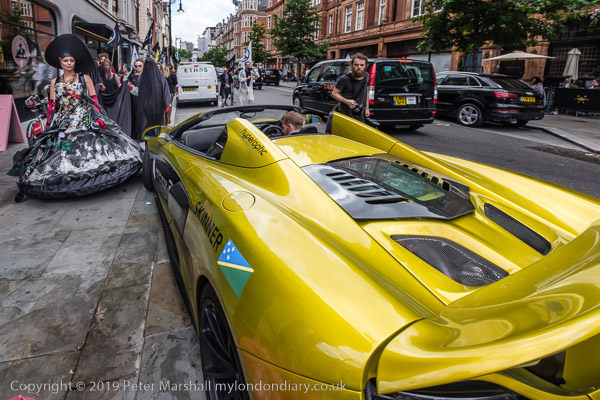
And an illegally parked symbol of the kind of extreme wasteful consumption that has got the planet in such a mess

It had taken them around three and a half hours to get there, and I decided I’d taken enough pictures and was getting tired. But probably the parts of the event more likely to be featured as news in the UK were to come. Their next planned performance was outside BP in St James’s Square, from where they were going on to protest close to the giant screen in Trafalgar Square, hoping to make clear to the audience there that the Royal Opera House should end their greenwashing sponsorship by BP.

Security at Saudi Aramco take a copy of the XR Handbook ‘This is not a Drill’

More at XR Carmen’s Carbon Procession


Tories Out March – 1st July 2017

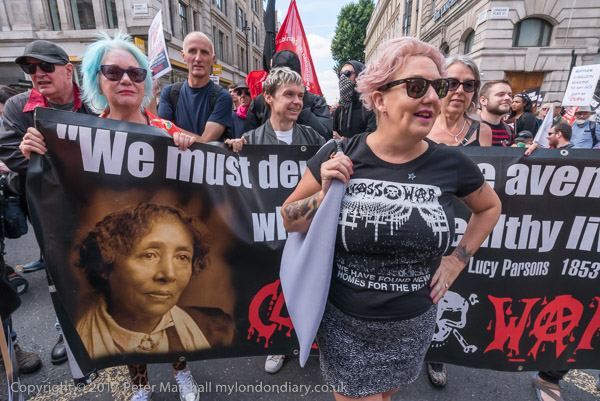
Class War wrap a march steward in their banner at the start of the march

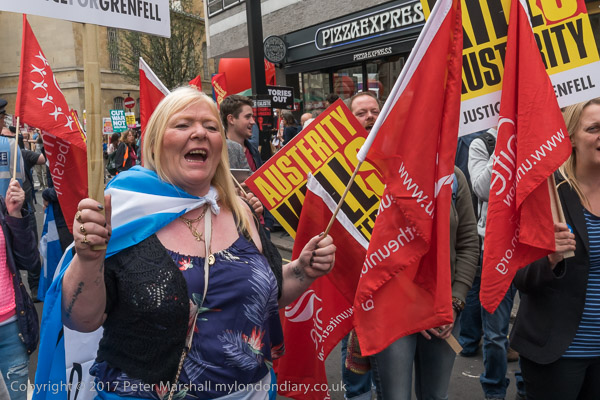
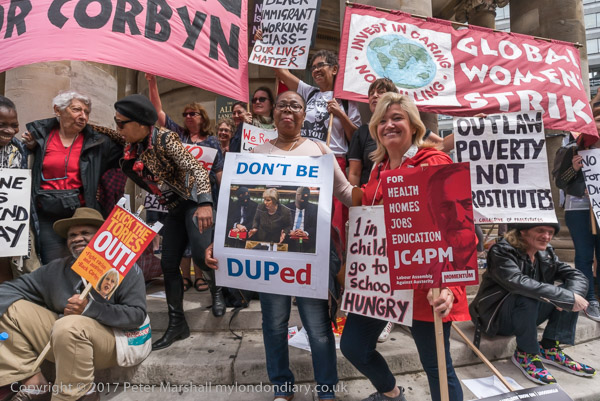
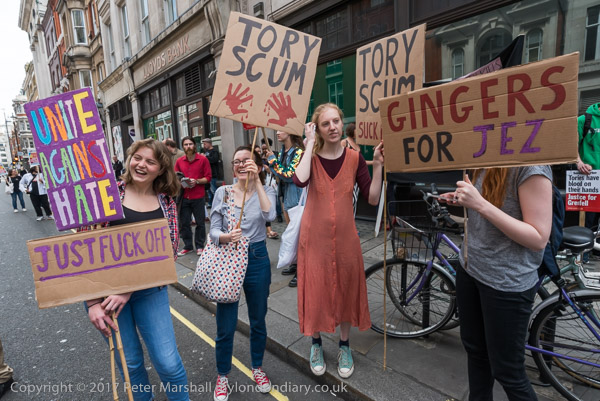
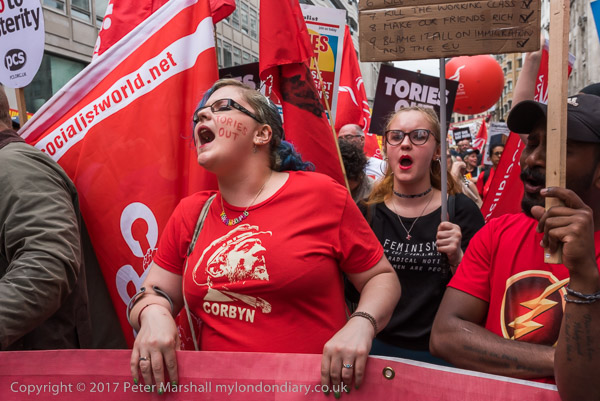
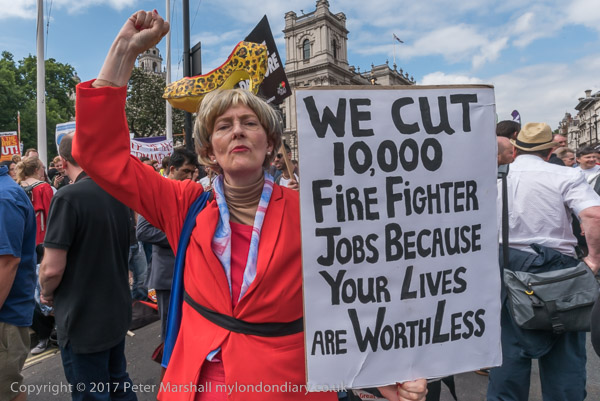
Tories Out March – 1st July 2017: Five years ago, shortly after the Labour right working inside the party had managed to prevent a Corbyn victory by sabotaging the campaign for the 2017 General Election, the People’s Assembly Against Austerity organised a march through London calling for Theresa May and the Conservatives to go.

Of course they didn’t go, and later when Boris Johnson called an election over Brexit, he gained a landslide victory, rather than the close call in 2017 which left Theresa May having to bribe the Northern Irish DUP, a deeply bigoted party with links to Loyalist terrorists to support her.

This reliance on the DUP has eventually led to the current problem over the Irish Sea border arrangements which Boris Johnson persuaded the EU to adopt as a vital part of his Brexit deal, and which the government is now pushing through a bill to enable us to renege on.

And the Johnson administration has continued and worsened the Tory policies which in 2017 should have resulted in a Labour victory. In my account of the protest march 5 years ago today I wrote

“The election showed a rejection of … austerity policies and the Grenfell Tower disaster underlined the toxic effects of Tory failure and privatisation of building regulations and inspection and a total lack of concern for the lives of ordinary people. The protesters, many of whom chanted their support of Jeremy Corbyn, say the Tories have proved themselves unfit to govern. They demand a decent health service, education system, housing, jobs and living standards for all.”

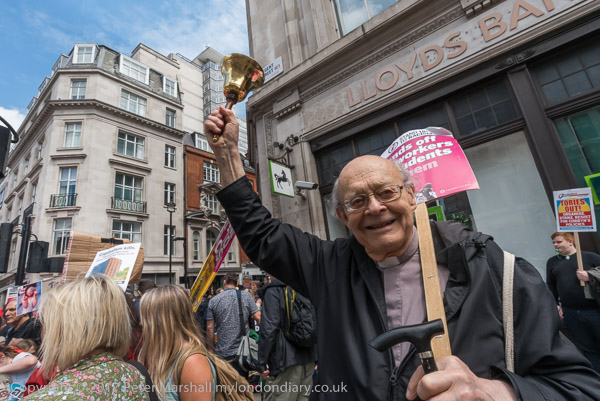
Rev Paul Nicolson from Taxpayers Against Poverty rings his bell

The full facts of the sabotage of the Labour election campaign from inside the party had not then come to light – and we are still waiting for the Forde inquiry into the leaked report which exposed the racism, hyper-factionalism and electoral sabotage by party officials as well as the misguided attempts of the Corbyn leadership such as the expulsion of Jackie Walker and the resignations of Chris Williamson and Ken Livingstone.

But although this was largely a march of Labour supporters there were still a number of groups on the march who were critical of Labour’s policies and the practices of London Labour councils, particularly on housing, where councils are “demolishing council estates and colluding with huge property developers to replace them with expensive and largely private housing. It is a massive land grab, giving away public land often at far below market value and pricing the former residents out of London in what they call ‘regeneration’ but is quite clearly a process of social and ethnic cleansing.”

It is also a process that has resulted in considerable personal financial advantage for some of those who have led it, with councillors and officers either leaving to work for the developers or in organisations set up by councils to manage their estates. Setting up organisations such as the TMO responsible for the unsafe condition of Grenfell Tower has enabled these bodies to hide information about such activites as using consultants to advise them on circumventing adequate fire inspections outside of the purview of Freedom of Information requests.

Most obvious among these groups was Class War, alway ready to make their views known and to challenge authority. At the start of the march close to the BBC they had a little run-in with the march stewards, which resulted in them briefly wrapping their banner around one of him – though of course they soon released him. Later at the rally in Parliament Square I unfortunately missed a confrontation in which Lisa McKenzie stood in front of both Len McCluskey, General Secretary of Unite the Union and Labour Leader Jeremy Corbyn and loudly asked them the simple question ‘When are you going to stop Labour councils socially cleansing people out of London?’. Both men simply ignored her and walked away.

Much more about the event and many more pictures at Tories Out March.

Independent Living Ends, Robin Hood Gardens

Independent Living Ends, Robin Hood Gardens. On Tuesday 30th June 2015 I joined disabled people at Downing St marking the ending of the Independent Living Fund before going to Robin Hood Gardens, a brutalist estate in Poplar doomed for demolition.


DPAC’s ILF Closing Ceremony – Downing St to Old Palace Yard

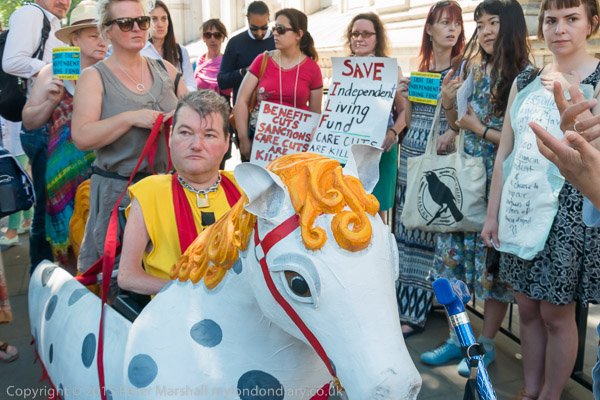
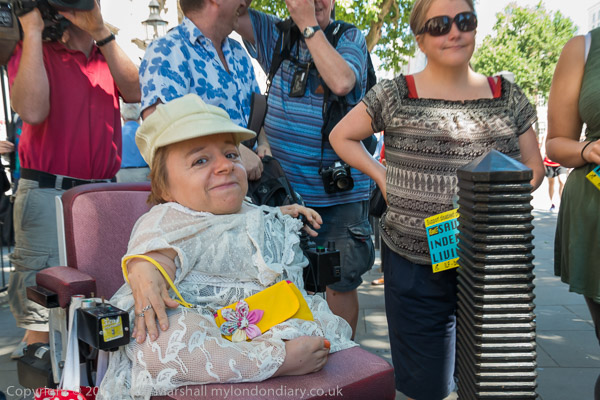
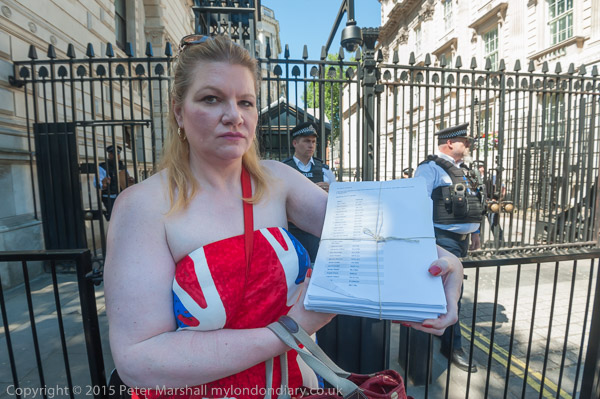
Disabled people and supporters of DPAC, Disabled People Against Cuts, met outside Downing St to bring a petition with over 25,000 signatures calling for a continuation of this essential support for the disabled.

Sophie Partridge, disabled Actor, Writer & Workshop artist

The Independent Living Fund which was coming to an end on that day had given them to money to employ support to enable them to live with dignity and for many to continue in work and make a contribution to society. Without it they fear they will simply be shut away and left to rot, many fearing they will now be left for many hours at a time in incontinence pads.

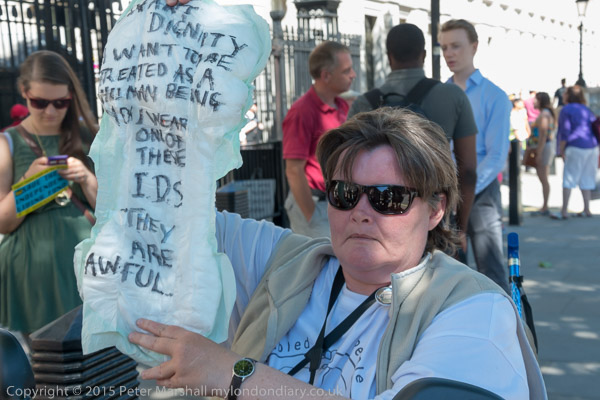
Paula Peters

Outside the gates of Downing Street they wrote slogans on incontinence pads; Paula Peters of DPAC had a message for Iain Duncan Smith, then Secretary of State for Work and Pensions responsible for the ending of support, ‘I want dignity – I want to be treated as a human – You wear one of these I. D. S. They are awful’.

A campaigner dressed as Brittania was among those who had come to hand in the petition which had gained support from a video by the stars of Coronation Street and the Graeae Theatre Company’s 2014 UK Tour of The Threepenny Opera. One of those stars spoke in front of the gates of Downing Street.
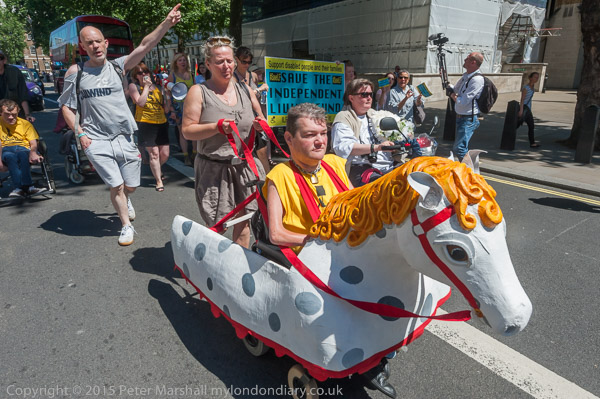
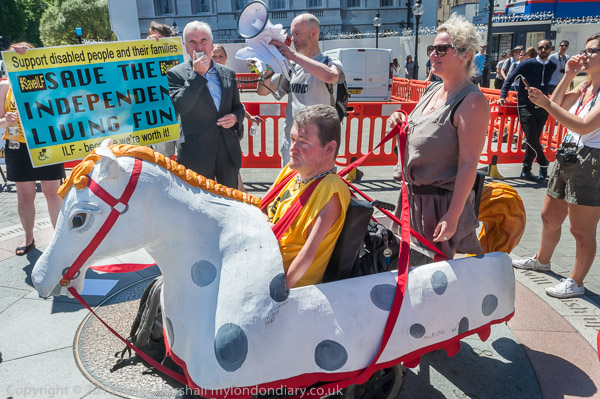
John Kelly as Schimmel leads the march

From Downing Street the campaigners marched the quarter mile or so to Old Palace Yard opposite the Houses of Parliament, led by John Kelly as Schimmel, the equine star and proud battle horse of the Threepenny Opera.
Here they were joined by others including Labour MP John McDonnell who spoke at the rally marking the end of the Independent Living Fund, at the end of which a wreath with the message’s ‘RIP ILF’ was laid.

DPAC’s ILF Closing Ceremony


Robin Hood Gardens – Poplar

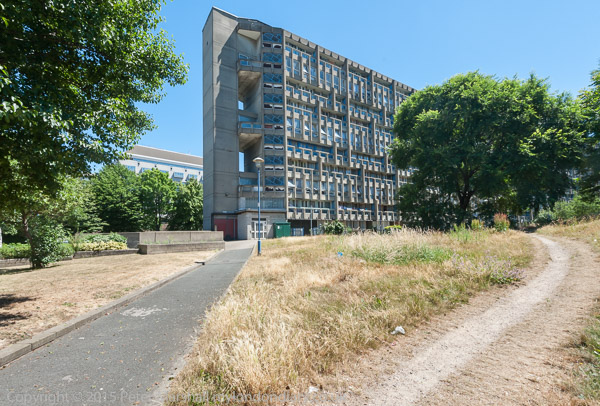
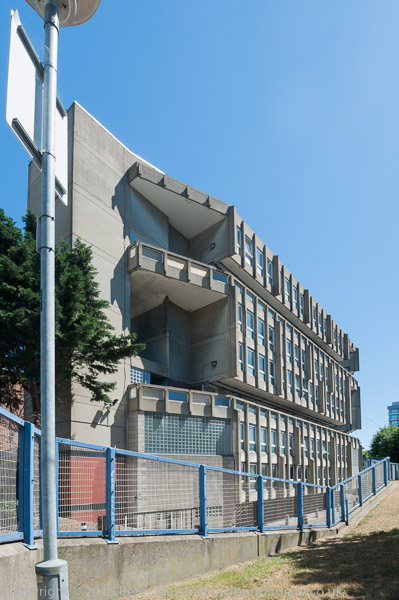
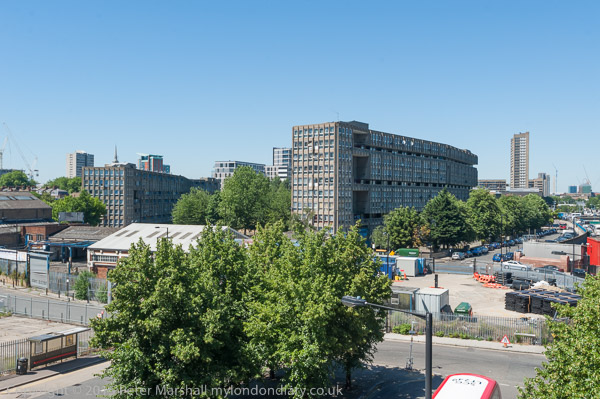
Two walls of flats protect an inner garden area

The ILF protest had ended a little before 1pm and it was a fine day and I decided to take another visit to Robin Hood Gardens in Poplar, where demolition had begun after the refusal to list the site. Listing had been recommended for listing by the advisory committee of English Heritage in 2009, but the then Minister of Culture Andy Burnham had issued a certificate of immunity against listing which expired in 2014.

These are large and desirable properties, but often have been used to house difficult residents

A further attempt was then made to have the site listed, supported by almost every well-known British architect, but Historic England, now responsible for listing buildings rejected this.

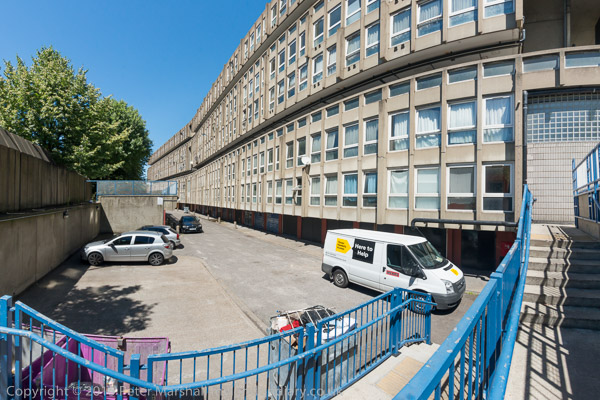
A wall at left screens the estate and there is a lower service and parking area

An open letter signed by many leading architects including Richard Rogers made clear the value of the site, and I quoted from this in My London Diary.

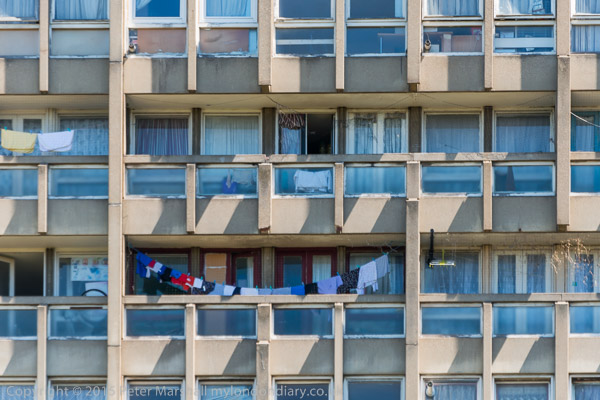
The buildings, which offer generously sized flats that could be refurbished, are of outstanding architectural quality and significant historic interest, and public appreciation and understanding of the value of Modernist architecture has grown over the past five years, making the case for listing stronger than ever.”

The end of the ‘street in the sky’

The refusal to list on both occasions was clearly a political one, almost certainly driven by the huge profits demolition and rebuilding on the site would make for the developers.

As with the award-winning Heygate Estate in Southwark, and the fine Central Hill Estate at Gypsy Hill, Lambeth, the local council, Tower Hamlets, was keen to get rid of the estate and had carried out what I described as “a well funded campaign of vilification“, seeing it “only as a large area with potential for redevelopment at a higher density“, working with “developers who see any area of social housing in London as rich pickings for redevelopment and sale to the rich.”

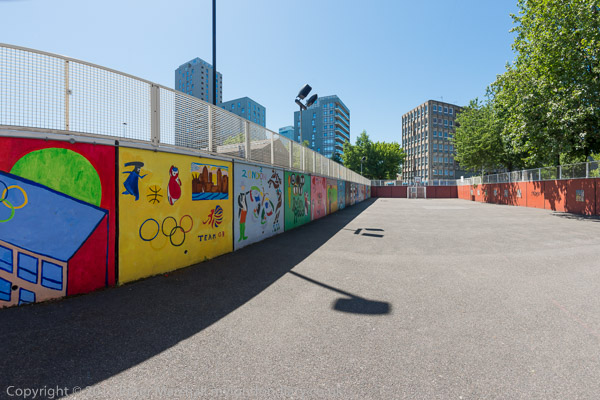
A large enclosed playground at the south end of the site

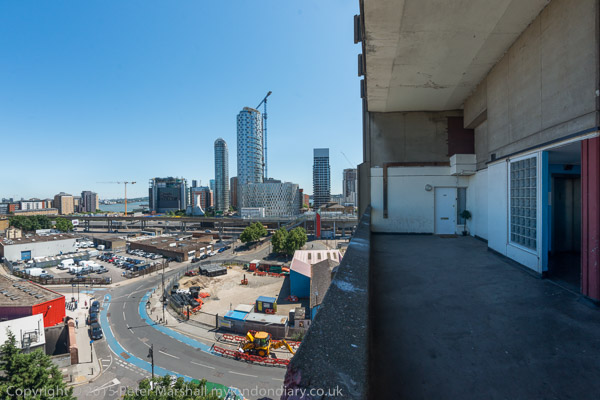
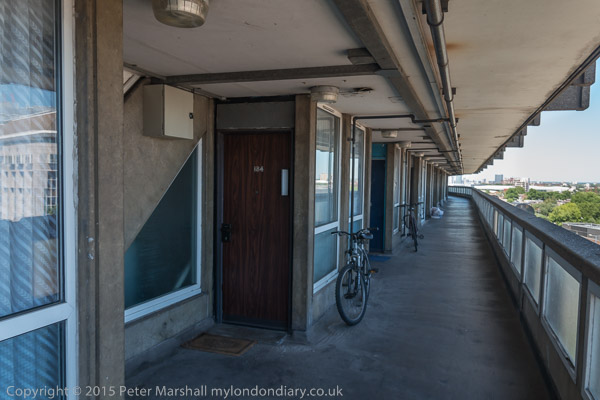
By the end of June 2015 most of the west block seemed empty and boarded up and I was unable to gain entry. But I could roam the large garden in the centre of the estate, now let to grow wild, and went inside the still occupied east block, going up to the highest public level, a ‘street in the sky’ built rather less wide than the architects had originally intended, overlooking the Blackwall Tunnel approach. From there I took a number of pictures of the views from the block looking towards the east.

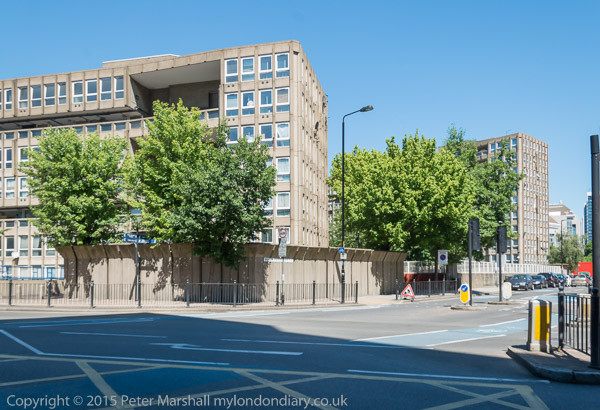
The south end of Robin Hood Gardens was on Poplar High St

As on a couple of previous visits I talked briefly with some of the residents who all told me they were pleased to be living in the block and sad they would have to leave – though some did complain about the lifts (I think only one of the two at the entrance I went in was working.)

Knocking down buildings like these which are structurally in good condition is inexcusable in terms of the huge carbon footprint involved in their construction, demolition and rebuilding. The estate could and should have been refurbished at relatively low cost and would have continued to provide good quality homes for many years. Its replacements – the west section already built – are of lower quality and will almost certainly not last as long as this could have done. The advantage of their roughly three times higher density is at the expense of possible amenity.

As well as walking in and around the estate I also took some pictures of it from the surrounding area, and some other pictures you can see on My London Diary, including a few when I stopped at Canning Town station and took a few pictures of people on the new footbridge across Bow Creek.

Robin Hood Gardens