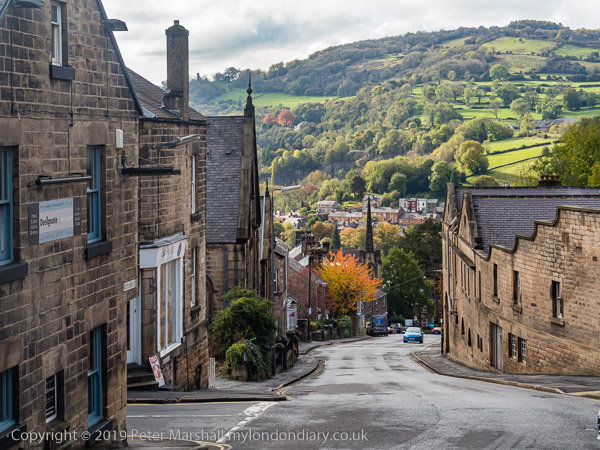
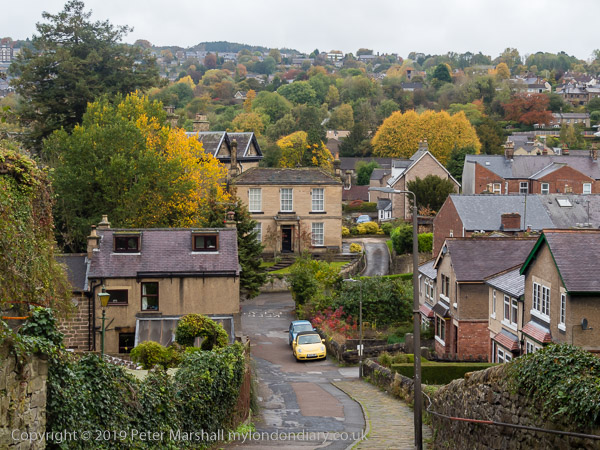
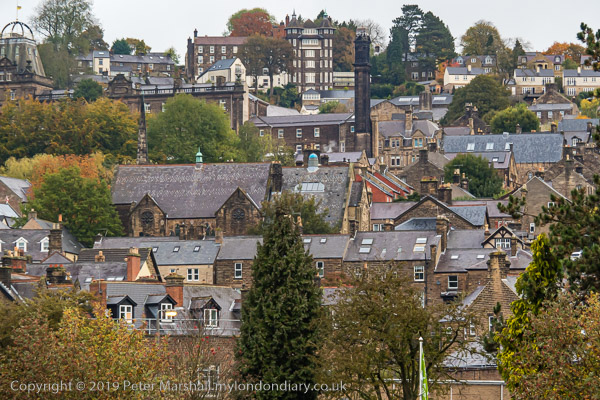
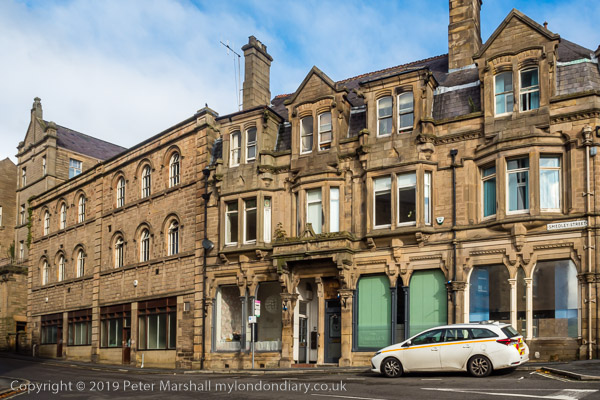
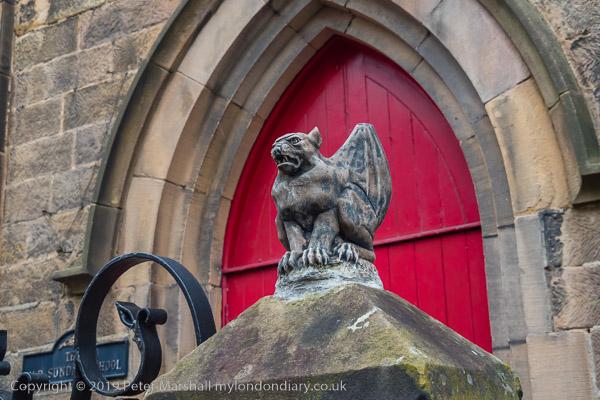
Last October seems now so long ago. Linda and I had gone to Matlock to look after two of our grandchildren for a couple of days in what turned out to be a small family emergency.
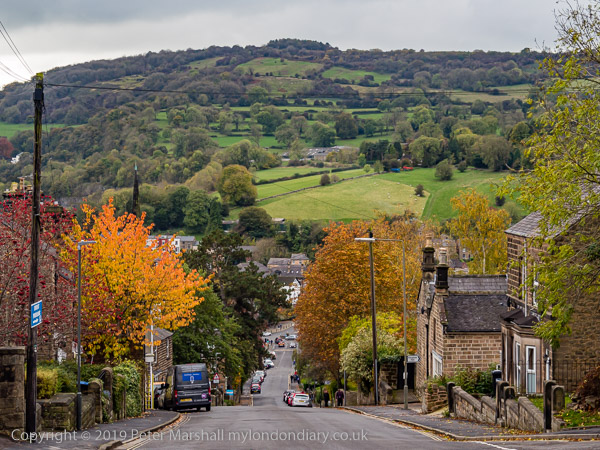
I took a few photographs on the walk back from taking the girls to school, and then went out later in the day for some exercise. Matlock is a pretty hilly kind of place, so I got plenty of it.
Matlock Bank is an area on a hill that rises up from the riverside at the centre of Matlock, with Bank Road rising pretty steeply up the hillside. It doesn’t have any banks on it, though there are some shops, the post office and police station close to the bottom, several churches higher up as well as offices for the local council and, close to the top those for Derbyshire County Council in what used to be Smedley’s Hydro.
It was this hydro, and other similar smaller establishments that made Matlock the town it is, and the spa became an important tourist centre in the nineteenth century. I knew, having done my research earlier in The Crown.
In 1893 a cable-hauled tramway opened on Bank Road, “Tuppence up, Penny Down” for the ride up around 300ft of hill on the world’s steepest tramway on public roads, a gradient of 18% – 1 in 5½. Unfortunately it was closed in 1927, with the council who ran it replacing it with a motor bus service.
There are still buses. Occasionally, though I didn’t see one while out for my walk. But I was glad I hadn’t brought my bike. I just don’t have the gears forgetting up 1 in 5½ – or the brakes for going down.
I’d gone to North Woolwich in February for a walk by the Thames and intending to go around Albert Dock Basin, but because of transport problems I had run out of time and had to cut the walk short to go and photograph a protest in central London. Since then I’d been trying without success to find time to complete the walk. It seemed a long way to go just to finish this short walk so I hadn’t wanted to go out just to do this, but on Thursday August 1st I had an event beginning in the morning in Brixton and then another starting around 7pm in Mayfair, and as it was a fine day I thought I would have plenty of time.
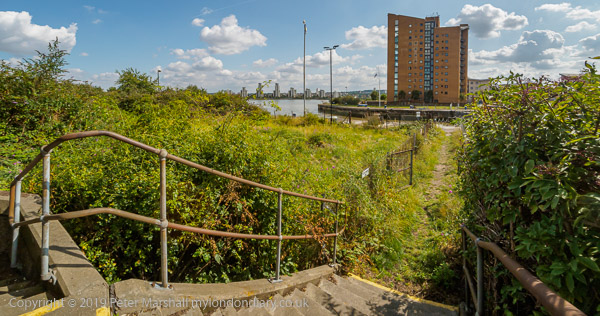
I made my way from King George V station as directly as possible to the entrance lock to the Royal Docks where I had cut short the walk on the previous occasion, taking few pictures, and then began a leisurely stroll along a section of the Capital Ring.
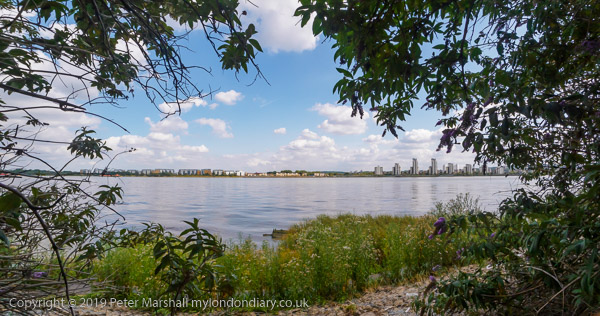
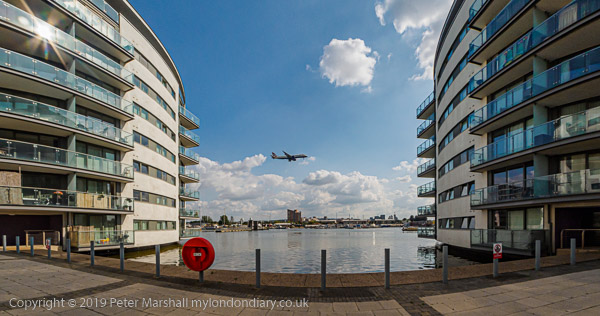
I was mainly interested in making some panoramic images of the area. I was disappointed to find that the riverside path still stops at Armada Green and I hope one day it will be possible to walk aong to Barking Creek. Instead I had to follow the Capital Ring and go down Atlantis Avenue and then turned down Gallions Road to go down past the Gallions Hotel (which I photographed around 40 years ago) and then beside Albert Dock Basin to go up on the Sir Steve Redgrave Bridge, which passes at a high level over the Albert Dock Basin, giving some good views of the dock and the surrounding area.
On My London Diary you can see over 60 panoramic images I made on the walk along with a slightly smaller number of less wide views. The panoramas(except for a couple including the example above) are cropped to a 1.9:1 ratio, while the other images have the standard 1.5:1 aspect ratio. The panoramas use a cylindrical perspective, which results in some curvature of any non-vertical straight lines except for the horizon which I place at the centre of the image when making the picture, though the crop may raise or lower it. The curvature is more marked towards the top and bottom edges.
All photographs on this and my other sites, unless otherwise stated, are taken by and copyright of Peter Marshall, and are available for reproduction or can be bought as prints.
There are no adverts on this site and it receives no sponsorship, and I like to keep it that way. But it does take a considerable amount of my time and thought, and if you enjoy reading it, please share on social media. And small donations via Paypal – perhaps the cost of a beer – would be appreciated.
I think I joined the Greater London Industrial Archaelogy Society (GLIAS) in around 1979, forty years ago, but it had then been going for 10 years. I’ve not been the most active of members, particularly in recent years when I’ve been too busy with other things, but over the years I’ve been on numerous walks, several outings, attended talks and lectures and even made some tiny contributions. I still enjoy reading the newsletters and occasional publications of the group.
The various walks usually took me back to areas of London I’d already explored when taking photographs, and they often made me much better informed about buildings I had already photographed. I’ve not been on any lately as they almost always take place when I’m now working. But in previous years, the walks were often followed by the publication of small walk leaflets giving the route and pointing out the IA features.
The first of these walk leaflets was for Tower Hill to Rotherhithe and this anniversary event more or less retraced its steps, led by one of the two original authors, Prof David Perrett, now Chairman and Vice-President of GLIAS. It was a walk I’d first taken – without the aid of the leaflet – in the opposite direction back in 1983 (though I’d photographed parts of the area previously) and quite a few pictures from that are now online on my London Photographs site.
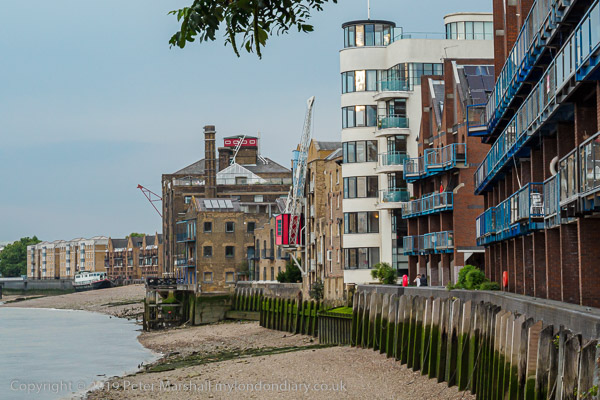
This area on Bermondsey Wall has changed considerably since then, though the riverside of Wapping seen at the top of the image still looks much the same. Of course you can’t see it from this same point, which I think is now occupied by expensive flats.
Inspired by these walk leaflets I went on to produce one of my own, a folded A4 sheet printed on thin card by my laser printer, largely as an exercise in Desktop Publishing which I was then teaching a course on.
Over the next few years I made and sold over well over 500 copies, charging I think 20p for each of them, though I never got the cash for some that were sold locally in Bermondsey (it rankled though the money was insignificant.) My best paying customer was a local historian who used them for several years for the guided walks he did on the local area. I think it is now seriously out of date, but ‘West Bermondsey – The Leather Area‘ has for a long time been available as a free download. (PDF)
The first time I put images from the area on line was in a site called ‘London’s Industrial Heritage‘, designed for me by my elder son, and you can see some pictures from this area from the links on the Southwark page.
I haven’t put many of the pictures from the walk on My London Diary, but there are a few more at GLIAS 50th anniversary walk. If you live in or around London and have any interest in industrial archaeology you would find GLIAS worth joining – and it has a very reasonable annual subscription of £14 (£17 for family membership.)
All photographs on this and my other sites, unless otherwise stated, are taken by and copyright of Peter Marshall, and are available for reproduction or can be bought as prints.
There are no adverts on this site and it receives no sponsorship, and I like to keep it that way. But it does take a considerable amount of my time and thought, and if you enjoy reading it, please share on social media. And small donations via Paypal – perhaps the cost of a beer – would be appreciated.
This short section of the Capital Ring is one of my favourites, or at least goes though some of my favourite areas, as this was the first time I’ve actually walked the whole section as a continous walk. It’s also one of the shorter sections of the London walk, which makes it rather easier for me now that my legs aren’t as young as they used to be.
Walkers too often have a distance fetish, where the purpose of the walk becomes a matter of getting as many miles (or kilometres) as possible under your feet, heading from A to B without deviation or even stopping to enjoy the points in-between. I’m more of a wanderer and an explorer, happy to go where the mood or interest takes me. And if you look at the pictures you will find that we didn’t entirely stick to the published route.
I spent around 20 years wandering around London in this way with a camera (or two), walking with a starting point and sometimes a few likely points of interest marked on a photocopied page of the A-Z, wandering until I felt tired or time was up, then finding a bus stop or station – never far away in London – to make my way home. It’s a practice that is celebrated in my self-published ‘London Dérives‘, images from 1975-83, still available from Blurb as a PDF or expensive hard copy – or direct from me.
Some of these pictures were more like coming across old friends, locations that I’d photographed perhaps thirty or more years ago, while there were other parts of the route that I’ve walked many times over the years. Perhaps some of them are more pictures of loss than records of the present, taken because of what was there before rather than what is there now.
Around 1983 I made an unsuccessful attempt to get funding for a photographic project on the River Lea and the Lea Navigation, submitting a small portfolio of pictures I had already made of the area and a brief description, along with a letter of support from a well-respected photographer I knew and a CV in which the major (in fact the only significant) entry was a large exhibition in a provincial art gallery – much also now in another self-published book and web site.
At the time I was naive in the ways of the small elite controlling awards in the UK and failed to realise that the support of a leading member of the London Salon was the kiss of death. I didn’t make any further applications for funding and until 2003 the only official support I got for photographs came from the Arts Council poetry funds, payment for a portfolio and pictures in several issues of a magazine.
I went ahead and completed the project without financial support – fortunately a full-time teaching post giving me both enough to live on and relatively long holidays as well as weekends – even though during term I was putting in an average 60 hours a week into teaching, preparation and marking. Another self-published book, Before the Olympics, contains many of the pictures from this as well as later work, and more can be seen on my River Lea web site.
There are no adverts on this site and it receives no sponsorship, and I like to keep it that way. But it does take a considerable amount of my time and thought, and if you enjoy reading it, please share on social media. And small donations via Paypal – perhaps the cost of a beer – would be appreciated.
All photographs on this and my other sites, unless otherwise stated, are taken by and copyright of Peter Marshall, and are available for reproduction or can be bought as prints.
There is something about walking with other photographers that inhibits the making of photographs. The best companion when you are taking pictures are your thoughts.
I often see invitations to walks led by other photographers or group photographic walks, and back when I was still starting in photography I used to go out with a group of other photographers and we would take pictures.
That was useful, partly because I got taken to places I would not otherwise have been, sunset at Stonehenge, the South Wales Valleys, the Isle of Portland, deserted coastline in Kent and Essex and more, but mainly because we would meet up later and rip each other’s pictures to pieces in no-holds barred critical sessions.
But we were pretty independent guys who would usually walk in different directions and not as a group. We travelled together but seldom worked together and I can’t recall the others getting in my way or I in theirs. We had different ways of working and different interests.
Of course there are times when you need companions. Places photographers wouldn’t get to or wouldn’t dare to go without a fixer. But that isn’t the kind of photography I do. There are no ‘no-go’ areas in London, though quite a lot I’d avoid at some times of night.
But the walk I went on with a few others at the end of August wasn’t like this, and although my companions were photographers it was more a social event. And to be honest, more of a pub crawl, though on this occasion we did manage to walk quite a long way before meeting our first Wetherspoons.
Even then, we only rushed to get there because the rain started. Which may be why I didn’t take any more pictures after that. But by the time we got there I had made a remarkable number of exposures for me on a photographers’ walk.
It was Easter Weekend and on the Saturday I went for another walk with my wife, another short section of the Capital Ring which goes around London, carrying on from Hendon, where we had ended our previous walk with a kosher ice cream.
There was no ice cream on offer today, as it was not only Saturday, but also Passover, and for the next few miles we passed or were passed by numerous small groups of Jewish men, and a few Jewish women, one of whom stopped to ask us why she saw so many people walking past her house and had never heard of the capital Ring – though there were signs for it at both ends of her street.
One of the advantages of walking the Capital Ring is that it is generally extremely well marked, with signs on lamp posts at most junctions as well as waymarks on paths though the various areas of woodland. However we did manage to take a wrong turning, or rather not to turn where we should have done, mainly because I was busy trying to photograph the start of the River Brent, formed by the junction of the Mutton Brook and the Dollis Brook.
Because I’m busy taking photographs I tend to leave the navigation to Linda, who is in charge of the book of the walk. We took a walk up the Dollis Brook as far as the North Circular before I realised we had come the wrong way and we turned back. But it wasn’t a great problem, and I think this section was really one of the highlights of the walk.
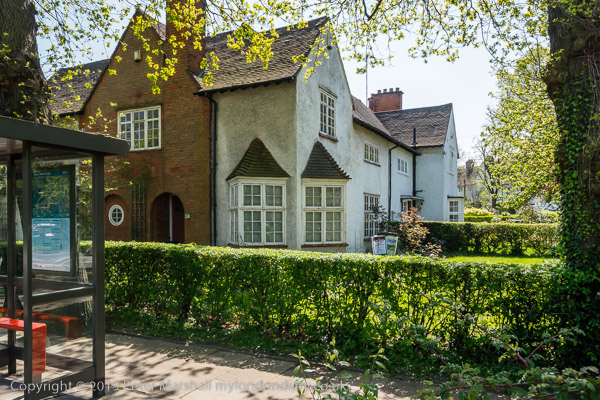
Hampstead Garden Village which the walk goes through is really a failed experiment; built to be a garden village to house a community of all classes in 1906 it was soon taken over by the rich.
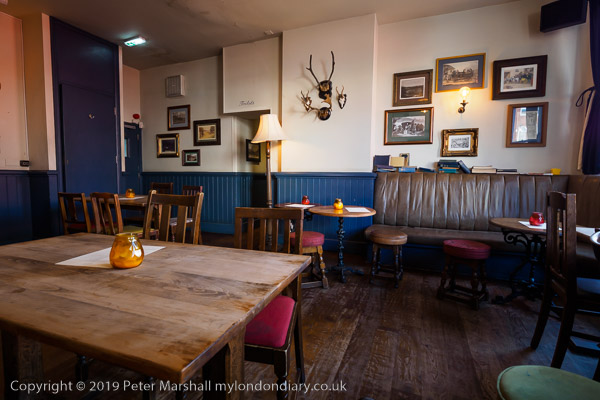
It was a very hot day, and by the time we reached East Finchley I was able to persuade Linda to take a rest at the Bald Faced Stag, a short distance off the route in East Finchley. The name comes from a stag with a white streak or stripe on its face which was apparently caught nearby. It seemed a decent enough place despite being a ‘gastropub’, though the beer was at a fiver a pint .
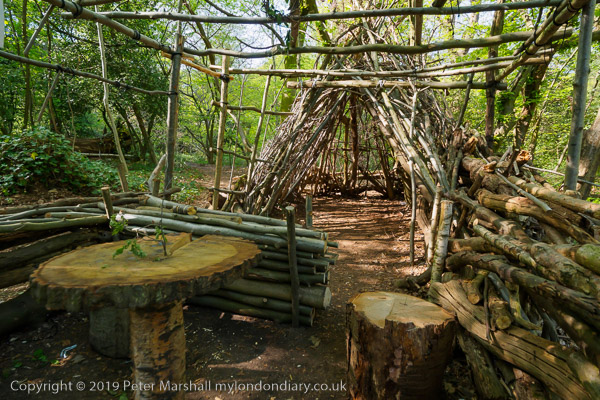
Most of the rest of the walk was through Highgate Woods, and close to the end we came across an interesting and controversial structure, built without permission and threatened with destruction. It seemed so entirely in keeping with its woodland location that I felt it should be allowed to remain.
It really was a nice walk, though my legs were tired by the time we reached Highgate. It isn’t a long walk, but we did make a few diversions, and photographers always wander rather to add to any distance. You can see many more pictures at Capital Ring – Hendon to Highgate on My London Diary.
All photographs on this and my other sites, unless otherwise stated, are taken by and copyright of Peter Marshall, and are available for reproduction or can be bought as prints.
There are no adverts on this site and it receives no sponsorship, and I like to keep it that way. But it does take a considerable amount of my time and thought, and if you enjoy reading it, please share on social media. And small donations via Paypal – perhaps the cost of a beer – would be appreciated.
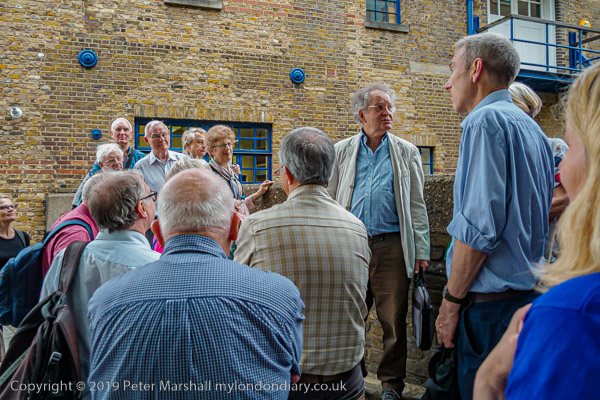
Last Wednesday evening I went on a short walk with members of GLIAS, the Greater London Industrial Archaeology Society, from City Hall to Rotherhithe, one of a number of events marking 50 years of the society.
I’ve been a member of GLIAS for much of that time, first coming across it in 1977 when I visited Kew Bridge Engines, ostensibly for the benefit of my one-year-old son, and picking up a leaflet about it there. I’m not sure whether I joined it then, or after a second visit, when we took a party of slightly older boys on an outing for one of his birthdays.
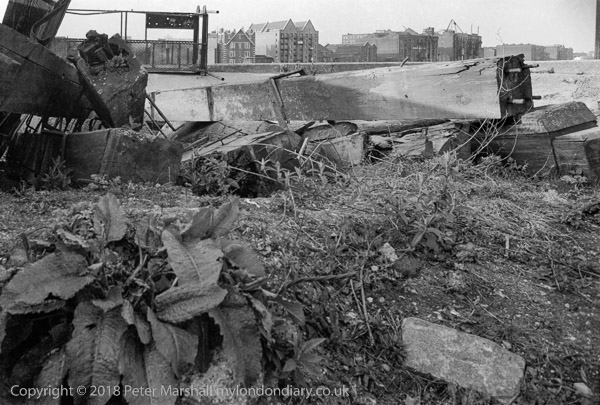
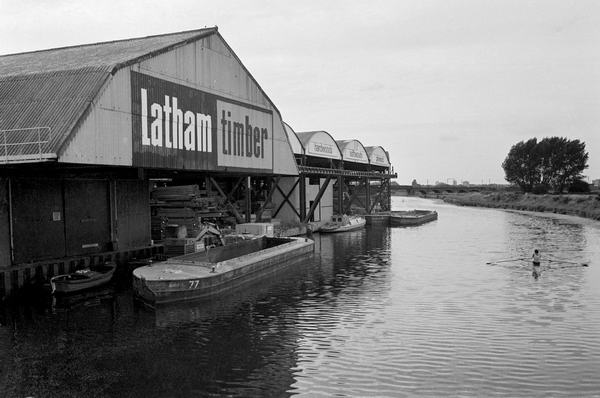
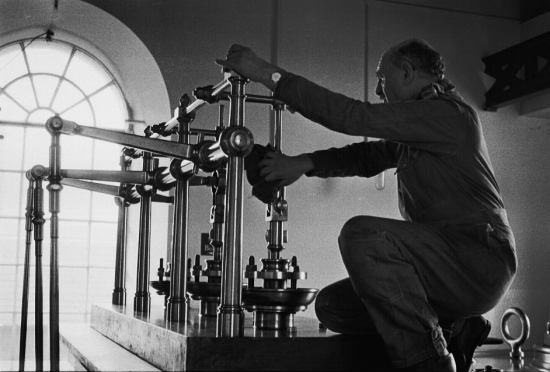
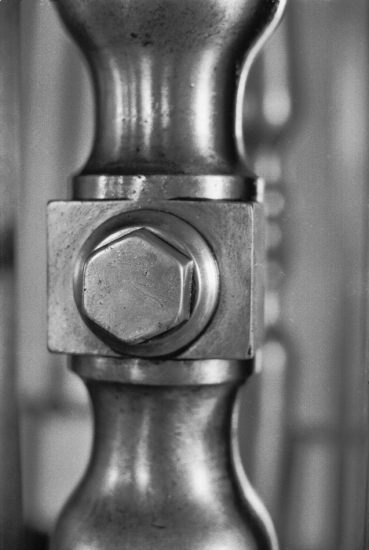
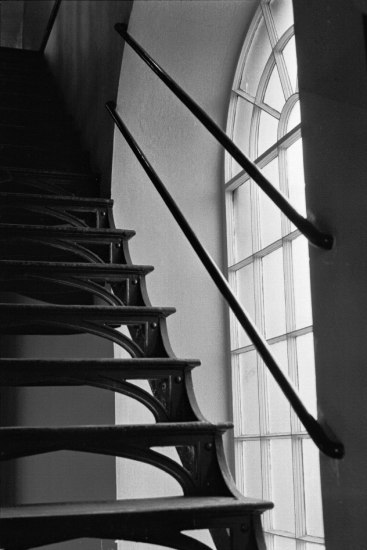
Later that same son wrote a web site for me 20 years ago as a birthday present, London’s Industrial Heritage, a rather more professional site than my own various offerings, on which the black and white pictures here can be found, along with a couple of hundred others, dating from 1973-1986. Its a nice design which creates the site from templates, a database file and of course the images using a batch file which runs a Perl script, but in some respects it is now a little dated. Back then, 550 pixels seemed a sensible size for web images.
Although I have an interest in industrial archaelogy, I lack to engineering knowledge to be a true GLIAS member, and my one real attempt at site recording as a part of the organisation was frustrating. But then I’m not always very impressed by the standards of photography in many of their communications. ‘Record photography’ is sometimes used as a perjorative term, but the best record phography has a power and resonance that is undeniable, for example some of the work of Walker Evans.
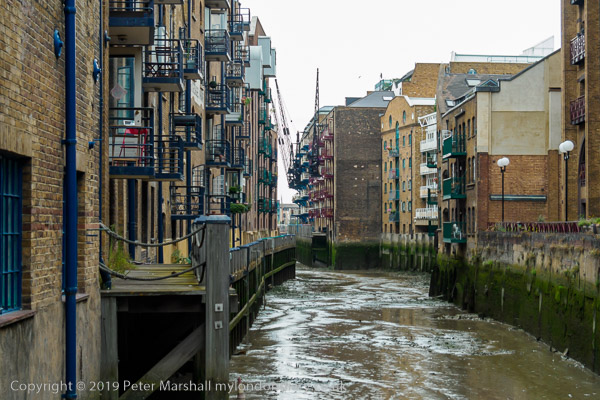
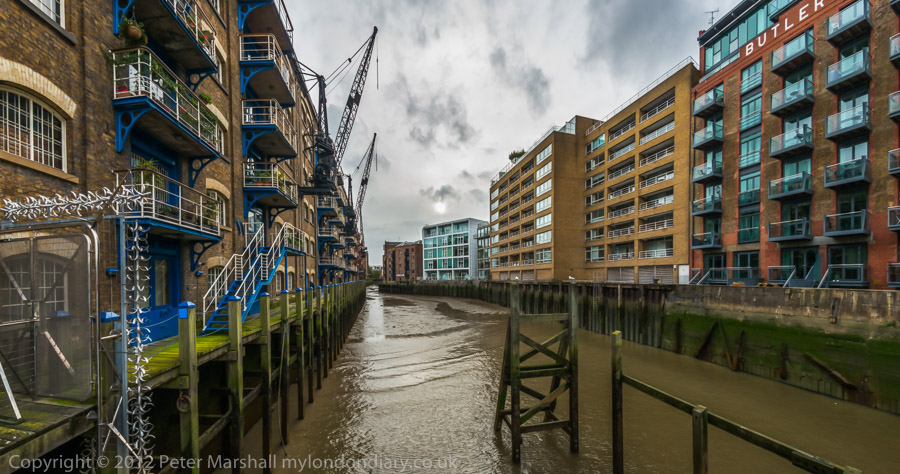
St Saviour’s Creek, 2014. We walked around its landward end this week
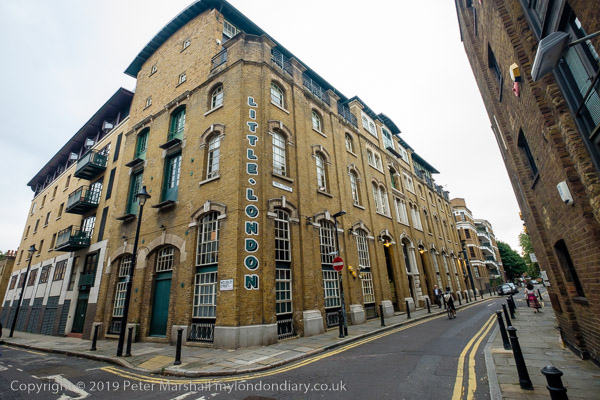
Our walk the other night was a reprise of one made earlier by two leading GLIAS member back in the 1970s and published in a GLIAS walk leaflet. One is now longer with us, but Professor David Perrett, now Chairman and Vice-President was there to lead us. These published walks, sent free to members also sold well for a few pence at a number of tourist sites in the area. They prompted me to produce a similar leaflet, partly as an example for a desk-top publishing course I was then teaching, on West Bermondsey in 1992, in part based on a walk led by Tim Smith for the GLIAS Recording Group :
“a downloadable illustrated leaflet for a walk that concentrates on the industrial archaeology of the former leather area of Bermondsey in South East London. I wrote this in 1992 largely to show how simple, cheap and easy it was to produce such things with Pagemaker and a laser printer. I sold around five hundred copies over the next five years, gave some to the church in Bermondsey St to sell, and gave away many more, before deciding to put it on the web rather than bother to print any more. Although the area has changed considerably, it it still an interesting walk to follow. “
The area has changed even more since I wrote this, but you can still download and follow the walk and find much of what was there in 1992.
There are no adverts on this site and it receives no sponsorship, and I like to keep it that way. But it does take a considerable amount of my time and thought, and if you enjoy reading it, please share on social media. And small donations via Paypal – perhaps the cost of a beer – would be appreciated.
All photographs on this and my other sites, unless otherwise stated, are taken by and copyright of Peter Marshall, and are available for reproduction or can be bought as prints.