End The Torture 2004

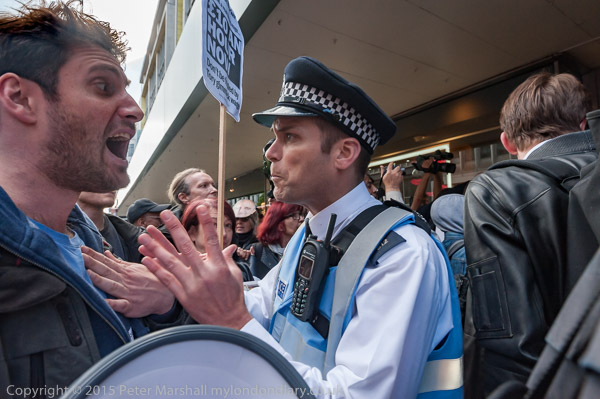
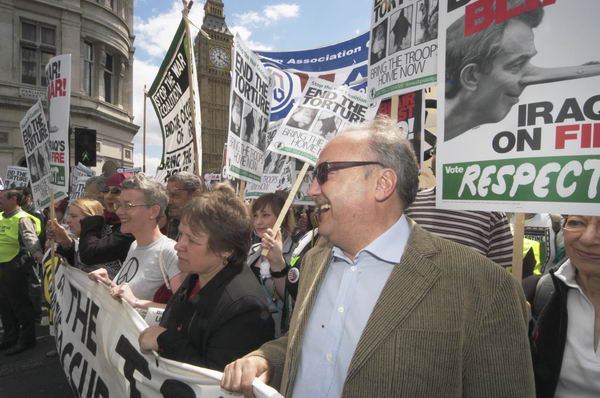
Pictures from the End The Torture – Bring The Troops Home Now protest 20 years ago today on 22nd May 2004.

End The Torture - Bring The Troops Home Now

Back in May 2004 I was still taking pictures using the Nikon D100, the DSLR camera that really first made professional quality digital imaging available outside of highly paid professional photographers. I’d bought this 6.1Mp camera in 2002, but for the first year or more used it in tandem with film cameras, not least because at first I only had one Nikon-fitting lens, a 24-85mm, equivalent on the camera’s DX-format sensor to 36-128mm on full frame.

End The Torture - Bring The Troops Home Now

With film cameras I’d been used to a much wider range of focal lengths, from 15mm to 200mm and while I could do without the longer end, I still needed film for wider images. But by May 2004 I had some new lenses, a Sigma 12-24mm (18-36mm eqiv) and a Nikon telephoto zoom that stretched out to 210mm, equivalent at the long end to 315mm.

End The Torture - Bring The Troops Home Now

Both were fairly large and fairly heavy lenses, but together with the 24-85mm gave me a full range of focal lengths. Though with only a single D100 body I probably spent almost as much time changing lenses as taking pictures. None of them would have impressed the kind of photographers who like to spend their time photographing test charts or pixel peeping, but they were certainly adequate for normal photographic work.
End The Torture - Bring The Troops Home Now

The pictures from the Bring The Troops Home protest on 22nd May 2004 show I was determined to use the entire range of my new lenses, perhaps not always entirely appropriately. I think sometimes I zoomed out too far with the telephoto and occasionally would have been advised to use a rather less wide view with the Sigma. But others work well.

The protest was called at short notice by the Stop the War Coalition, CND and the Muslim Association of Britain to respond to the atrocities being committed in Iraq, following the publication of pictures showing abuse and torture of Iraqis by US soldiers in Abu Ghraib prison in Iraq. Some pictures were first published by CBS in April 2004 but more came out in May.

The march organisers stated “The whole world is horrified at the terrible pictures of torture of Iraqi prisoners now emerging. They are the tip of an iceberg of abuse – dozens of civilians have died in custody of British and American troops in occupied Iraq. We are demanding the withdrawal of all troops from Iraq and for the Iraqi people to be allowed to govern themselves.”

At the rally there was an impressive array of speakers including Tonny Benn, Ken Livingstone, George Galloway, Lindsay German, Bruce Kent, Jeremy Corbyn, Jean Lambert and others from peace and Muslim movements and I photographed most of them on the march and as they spoke.

In Trafalgar Square the speakers were as usual on the raised area at the base of the column with a press area in front of that, and we are always looking up at the speakers. The longer lens let me get tightly framed head shots, but a few are perhaps too tight.

As well as speakers there were also theatrical reenactments of prisoner abuse by the ‘Theatre of War’ group with the march pausing briefly at various points for the three military personnel to abuse their roped and hooded victims. The also stood and performed on the plinth at the rally in Trafalgar Square.

Looking back at these pictures now I feel that perhaps because I had that long lens I concentrated more on the celebrities taking part in the event, and rather less than I would now on the bulk of protesters and their placards and banners. But I’m still pleased with a number of the images I made. Some I think could be improved by going back to the RAW files and reprocessing them in our now improved software to give them a little more contrast and clarity.

My London Diary has a little more about the protest and a much larger selection of the images I made at this event beginning some way down the May 2004 page. You can go directly to the pictures at END THE TORTURE – BRING THE TROOPS HOME NOW.


FlickrFacebookMy London DiaryHull PhotosLea ValleyParis
London’s Industrial HeritageLondon Photos

All photographs on this page are copyright © Peter Marshall.
Contact me to buy prints or licence to reproduce.
Free Palestine March & Rally 2005

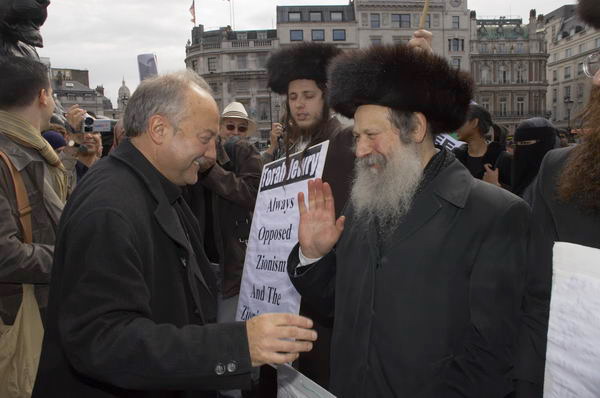
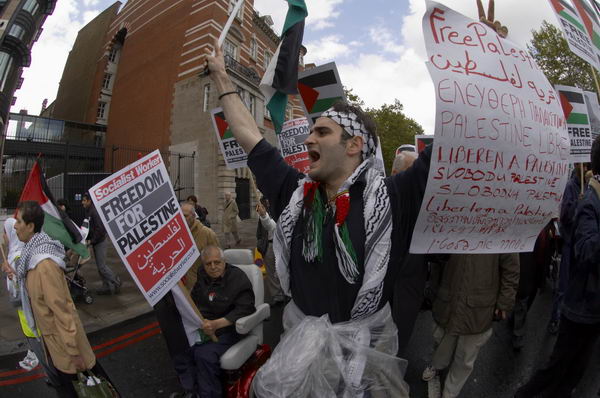
Free Palestine March & Rally – May 21st 2005. George Galloway, then MP for Bethnal Green, was clearly the man of the hour at the rally in Trafalgar Square, fresh back from his hearing in front of a US Senate committee. As I commented in 2005, “the senators were clearly outclassed and outgunned as Galloway gave them a verbal ‘Glasgow kiss.’ It was an impressively sustained performance of concentrated power, a pit-bull seeing off a pack of ineffectual spaniels.”

Free Palestine March & Rally

The crowd gave him “a tumultous ovation when he arrived at the Trafalgar Square rally” at the end of the march, and his speech there did not diappoint them. I commented “he has built up a great rapport with the many muslims now living in this country, not least in his own Bethnal Green constituency, the youths from Bradford were excited when he promised to come and visit their city.” Of course many things have happened since then, but it wasn’t surprising to see him elected for Bradford West at the 2012 by-election or more recently when he won the seat at Rochdale this February.

Free Palestine March & Rally

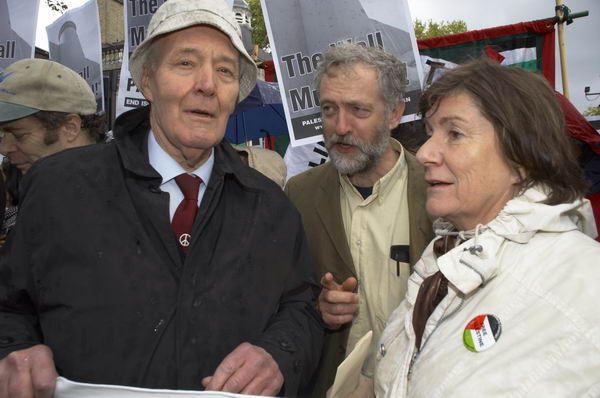
Galloway was not the only powerful speaker at the rally, with putting in his usual performance as “probably the best living political speaker at least using the english language” and Jeremy Corbyn, still a much underrated speaker, also showing what he could do. And there were others too, including Paul Mackney of the higher education teachers’ union, NATFHE.

Free Palestine March & Rally

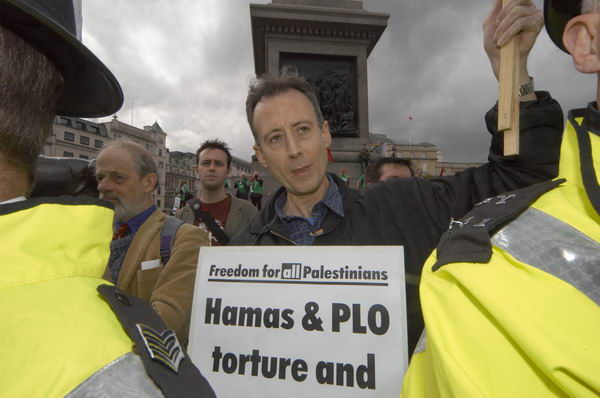
The march from Embankment to Trafalgar Square had been reasonably large but not huge, though more had arrived for the rally. Waiting at the side of the march as it reached the square was human rights activist Peter Tatchell with a group from Outrage!

Free Palestine March & Rally

They supported the Palestinian struggle for freedom and justice, but demanded an end to the “so-called ‘honour’ killing of Palestinian women, and the arrest, jailing, torture and murder of lesbian and gay Palestinians by factions of the PLO, Hamas, Islamic Jihad and the Palestinian Authority.”

Free Palestine March & Rally

At first police stopped the group from getting to the march and handing out leaflets, but after a complaint by Tatchell they were allow to do so. Some march stewards tried to stop people taking the leaflets, but many did so and expressed their support.

You can read more about the event on the second May page on My London Diary under the heading George’s Triumph and the pictures begin at the right of this page.


FlickrFacebookMy London DiaryHull PhotosLea ValleyParis
London’s Industrial HeritageLondon Photos

All photographs on this page are copyright © Peter Marshall.
Contact me to buy prints or licence to reproduce.

Nakba, NHS, Guantánamo, Sri Lanka – 2013

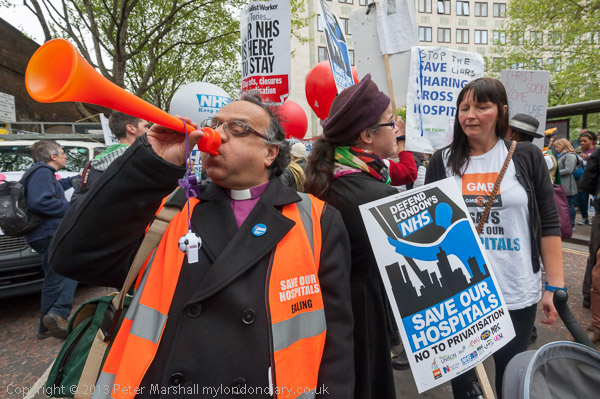
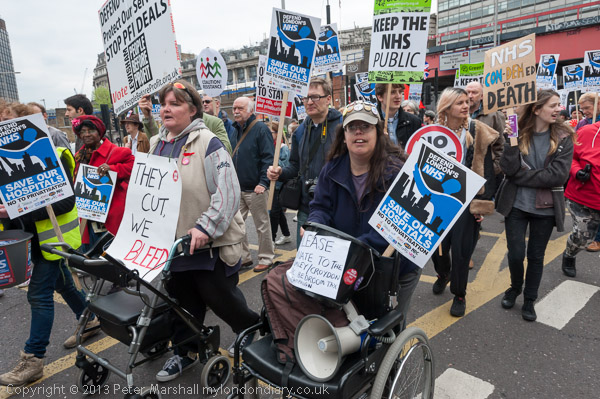
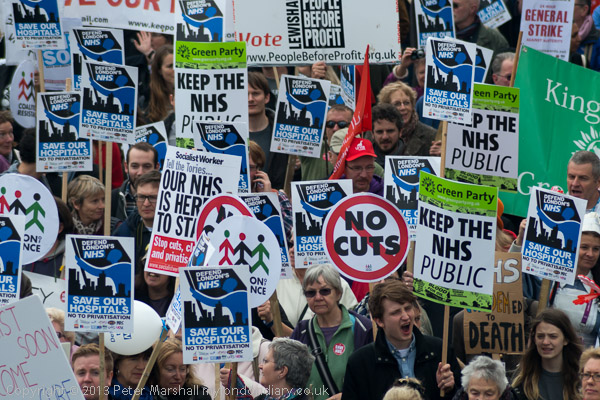
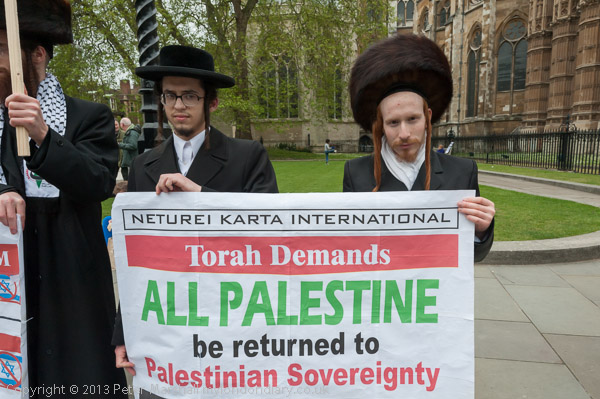
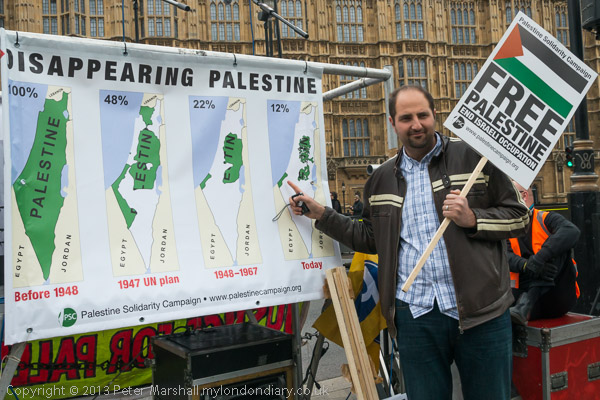
Nakba, NHS, Guantánamo, Sri Lanka: On Saturday 18th May 2013 I began work outside Parliament at a protest against Israeli ethnic cleansing of Palestinians, then went across the Thames to the Festival Hall for the start of a march to defend the NHS before going the US Embassy in Grosvenor Square for a ‘murder scene’ in solidarity with hunger strikers at Guantánamo. There I also photographed a woman protesting for the release of her husband arrested 9 years ago by US forces in Iraq. Finally I met a march by several thousands of Tamils calling for and end to the continuing genocide in Sri Lanka. You will find much more detail (and many more pictures) on each of these protests at links below to My London Diary.


End Israeli Ethnic Cleansing – Old Palace Yard, Westminster

Nakba, NHS, Guantánamo, Sri Lanka

65 years after 700,000 Palestinians were driven out of their homes as refugees in the ‘Nakba’ (catastrophe) when Israel was created, Palestinians call for an end to the continuing ethnic cleansing and a boycott and sanctions until Israel complies with international law.

Nakba, NHS, Guantánamo, Sri Lanka

Several hundred people came to the protest, including a group of extreme orthodox Neturei Karta Jews who see themselves as guardians of the true Jewish faith, and reject Zionism, as well as many of Jewish or Palestinian origin. As well as the Palestine Solidarity Campaign the protest was also supported by many other groups – a long list on My London Diary – and speeches were continuing when I left for another event.

Nakba, NHS, Guantánamo, Sri Lanka

More about the Nakba and the protest at End Israeli Ethnic Cleansing.


London Marches to Defend NHS – South Bank to Whitehall

Nakba, NHS, Guantánamo, Sri Lanka

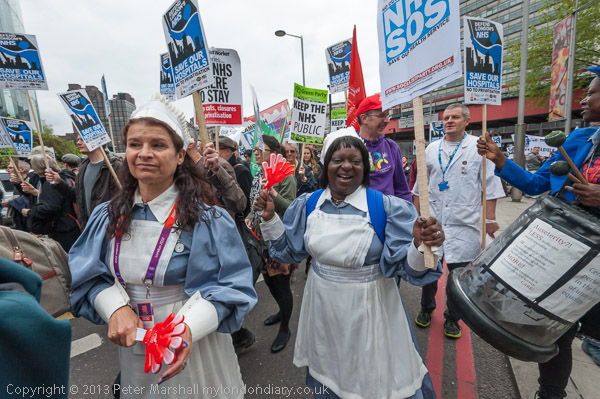
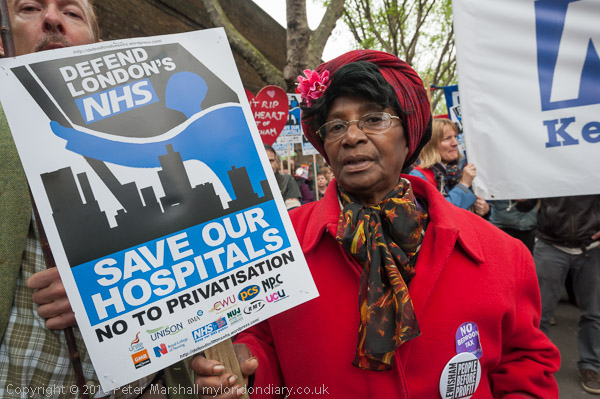
Thousands had gathered by the Festival Hall to march against cuts, closures and privatisation of the NHS, including many groups opposed to hospital closures around London, trade unionists and others concerned the the government is ending the NHS.

An unprecedented coalition of Londoners, including medical staff, trade unions, health campaigners, patients and others have been alarmed at what they see as an attack by the government on the principles that underlie our National Health Service and the threats of closure of Accident and Emergency facilities, maternity units and hospital wards which seem certain to lead to our health system being unable to cope with demand – and many lives put at risk.

You can read more about the crisis in the NHS in 2013 in the post on My London Diary, but of course this has continued and is still making the news. Despite their protestations it seems clear that the Tories are trying hard to run down the NHS so that the population lose its trust and love for our universal free public – and would allow them to eventually replace it with US-style insurance based healthcare which would greatly increase costs and generate huge profits for private health companies.

I went with the march across Waterloo Bridge and down Strand to Charing Cross, leaving it as it was waiting to enter Whitehall for a rally there.

More information and pictures at London Marches to Defend NHS.


Guantánamo Murder Scene – US Embassy, Grosvenor Square

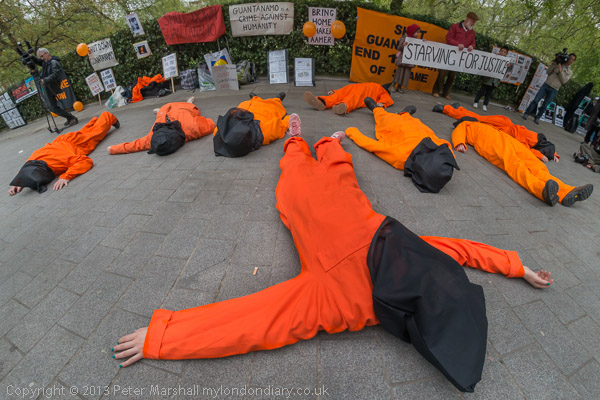
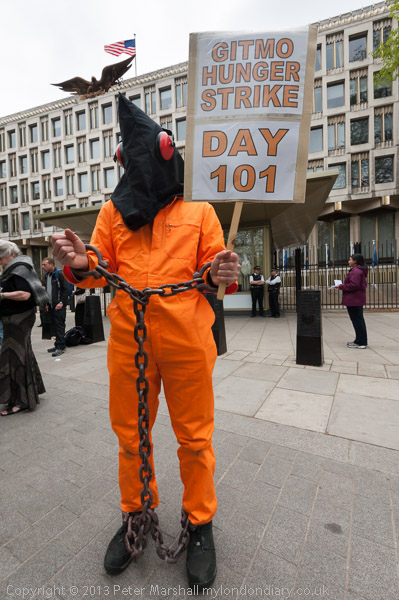
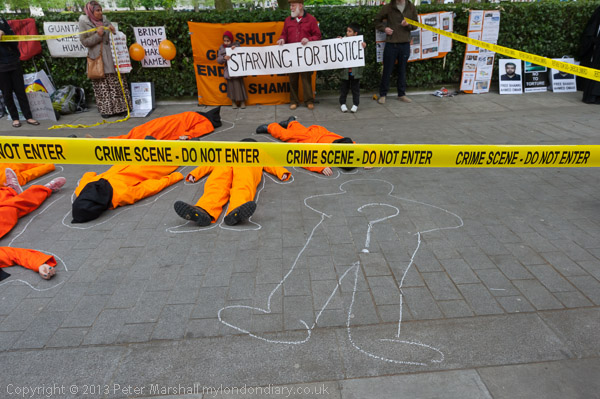
London Guantánamo Campaign staged a ‘murder scene’ at the US Embassy on the 101st day of the Guantánamo Hunger Strike in which over 100 of the 166 still held there are taking part, with many including Shaker Aamer now being forcibly fed.

As I arrived there were 8 black-hooded ‘prisoners’ in orange suits lying on the pavement, the number of prisoners who have died there in suspicious circumstances who had previously taken part in sustained hunger strikes. At least seven of them had the cause of death reported as ‘suicide’.

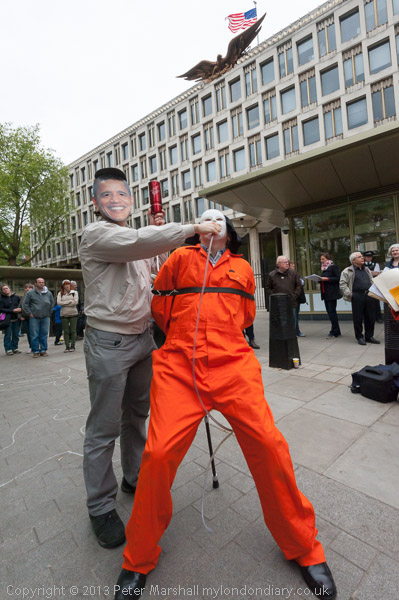
Other protesters drew lines around the bodies on the ground and surrounded the area with ‘Crime Scene – Do Not Enter‘ incident tape. The bodies then stood up and there was a short enactment of forced feeding by a man wearing an Obama mask.

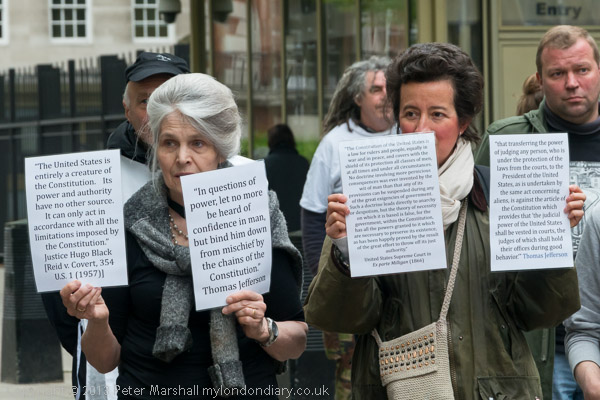
Others held placards and posters, some including quotations from Thomas Jefferson and other historic and prominent Americans, and there were speeches about the events in Guantanamo, where British resident Shaker Aamer was still held despite having been cleared for release. You can read more, including a statement by one of the organisers, on My London Diary.

As I left some of the poems written in Guantánamo by Shaker Aamer were being read.

More at Guantánamo Murder Scene.


More US Embassy Protests – US Embassy, Grosvenor Square

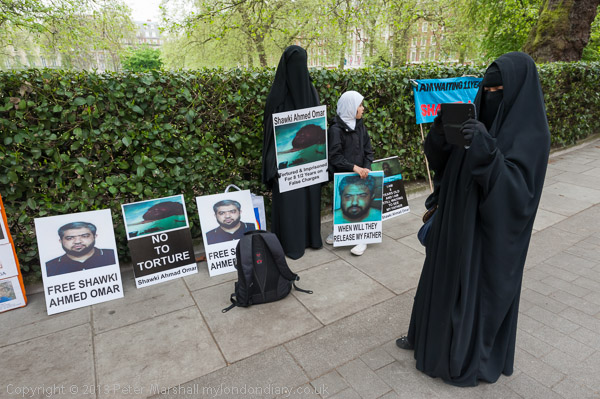
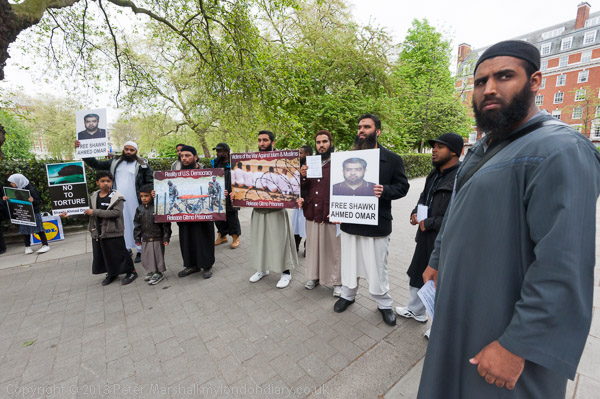
Also protesting outside the embassy as she has for a number of weekends was Narmeen Saleh Al Rubaye, born in the US and currently living in Birmingham, whose husband Shawki Ahmed Omar, an American citizen, was arrested in Iraq by American forces in 2004 and turned over to Iraqi custody in 2011. He was tortured by the Americans when held by them, and his now being tortured by the Iraqis. He is also on hunger strike. His young daughter Zeinab came and spoke briefly to the Guantanamo protesters, telling them that she wanted her daddy to be released.

Later she was joined by a small group of Muslim men and boys who stood with her.

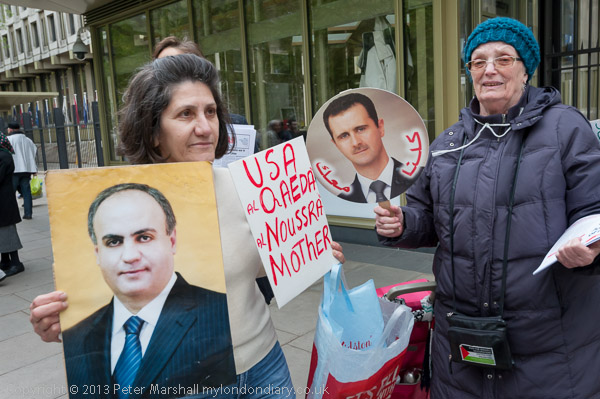
It was a busy day for protests at at the US Embassy were a small group of supporters of Syrian President Assad, including some from the minor Communist Party of Great Britain (Marxist-Leninist) who had come to protest against western intervention in Syria.

More about these protests at More US Embassy Protests.


Tamils protest Sri Lankan Genocide – Hyde Park to Waterloo Place

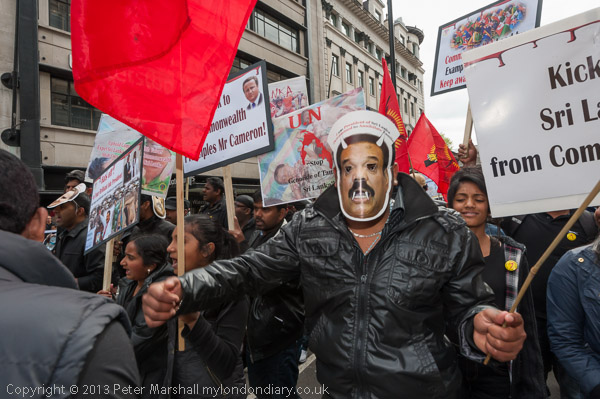
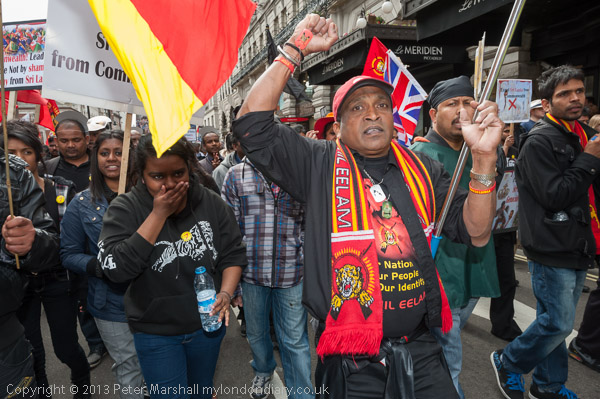
Finally I rushed away to join thousands of British Tamils and dignitaries and politicians from India, Sri Lanka and the UK who were marching through London on the 4th anniversary of the Mullivaikkal Massacre. Many were dressed in black in memory of the continuing genocide in Sri Lanka and some wore the tiger emblem and called for a Tamil homeland – Tamil Eelam.

Tamils are disgusted at the lack of response by the UK, the Commonwealth and the world to the organised genocide that took place and is still continuing in Sri Lanka, of which the massacre at Mullivaikkal four years ago was a climax. I noted on My London Diary that I could see no other non-Tamil photographers covering the event.

On My London Diary you can read a statement by the British Tamil Forum who had organised the march. I left as the rally in Waterloo Place was about to start, partly because I was tired but also because I thought few of the speeches would be in English.

Tamils protest Sri Lankan Genocide.


FlickrFacebookMy London DiaryHull PhotosLea ValleyParis
London’s Industrial HeritageLondon Photos

All photographs on this page are copyright © Peter Marshall.
Contact me to buy prints or licence to reproduce.

Conscientious Objectors, Olympics, Cleaners, Iraq & An Opening – 2008

Conscientious Objectors, Olympics, Cleaners, Iraq & An Opening – Back in 2008 I had rather more stamina than now and my day on Thursday 15 May 2008 included three protests and a walk around the outskirts of the closed Olympic site, ending with attending an exhibition opening in Brixton.


International Conscientious Objector’s Day – Tavistock Square

Conscientious Objectors, Olympics, Cleaners, Iraq & An Opening

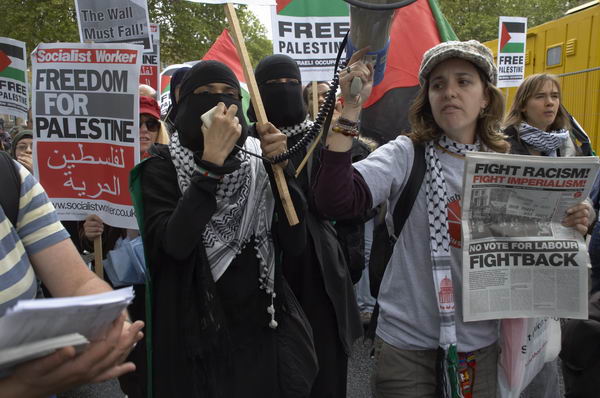
I’ve just checked on a web site which events are marked on 15th May, and although it lists nine, including National Nylon Stocking Day, it fails to mention the most important of all, that this is Nabka Day remembering the Palestinian Catastrophe, the violent ethnic cleansing of Palestinians from their land, belongings and homes following the establishment of Israel in 1948.

Long commemorated by supporters of Palestian rights, the commemoration of the 75th anniversary in 2023 was recognised by a UN General Assembly resolution. Today many are marking this around the world with events in many UK workplaces and Saturday 18th May there is a national march in London for Nabka 76 calling for and ent to the genocide in Gaza and for the UK to stop arming Israel.

Conscientious Objectors, Olympics, Cleaners, Iraq & An Opening

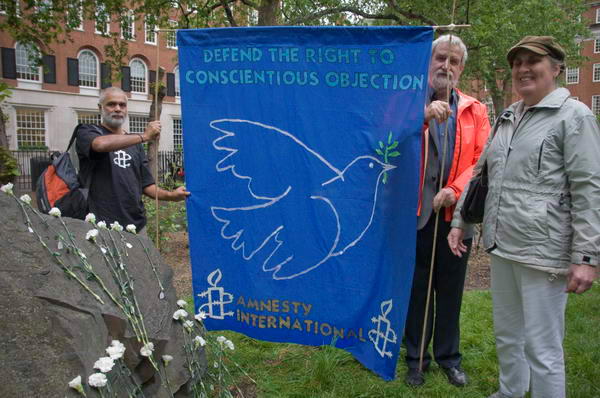
Less well known (and also not mentioned on that web site), May 15th is International Conscientious Objector’s Day, first observed in 1982 as a European day and in 1985 adopted by War Resisters’ International. In London today (15 May 2024) there will be a ceremony in Tavistock Square as there was in 2008, though starting an hour later at 1pm.

In 1987 the United Nations Commission on Human Rights recognised “the right of everyone to have conscientious objection to military service as a legitimate exercise of the right of freedom, thought, and religion“. However in many countries around the world this right is still denied.

Conscientious Objectors, Olympics, Cleaners, Iraq & An Opening

Tavistock Square has a number of memorials including at the centre of the garden a statue of Mahatma Ghandi given to the city of London in 1967 by the Indian High Commissioner, and a cherry tree planted by the then mayor of Camden Millie Miller in 1967 to commemorate the victims of the Hiroshima bombing, as well as a memorial to the holocaust. On the railings of the square is a memorial plaque to those killed in the bus destroyed in the square by the London suicide bombing of 7 July, 2005.

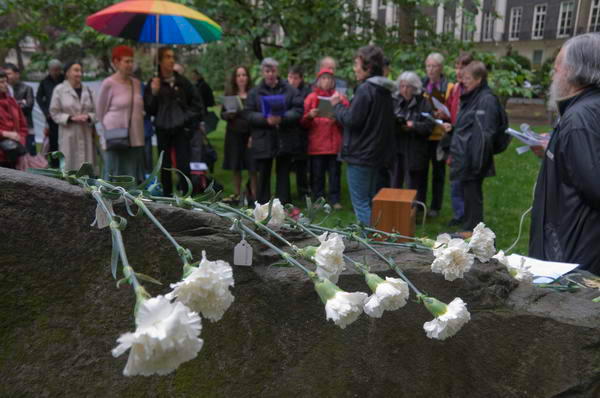
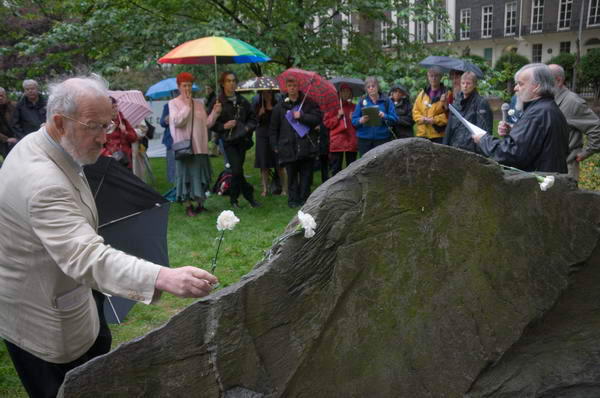
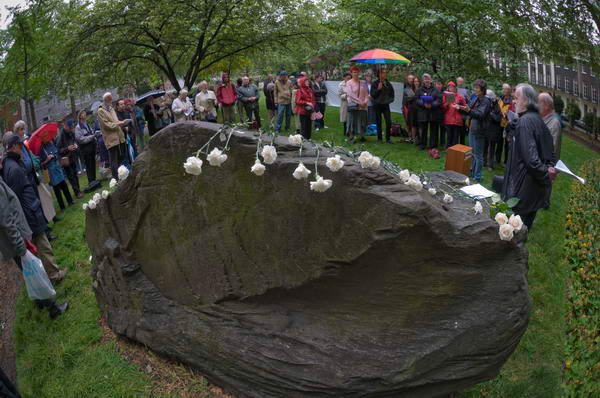
At the north end of the garden, close to the cherry tree, is a large grey rough-hewn boulder of Cumbrian slate was unveiled in 1994 as a memorial to conscientious objectors by composer Sir Michael Tippett, himself a conscientious objector, and people gathered on the grass in front of this.

Conscientious Objectors, Olympics, Cleaners, Iraq & An Opening

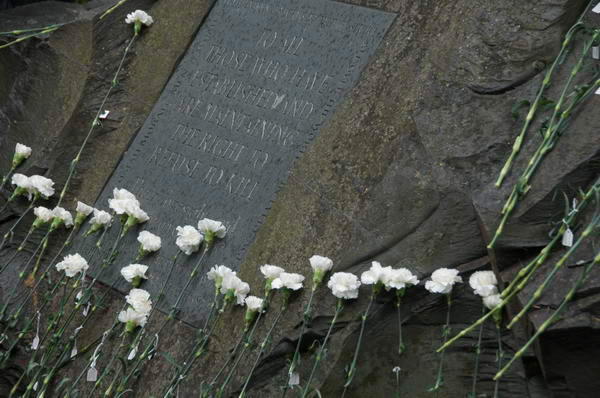
After speeches and songs Bill Hetherington of the Peace Pledge Union read out the names and gave brief details of individual COs, past and present, from over 80 countries around the world, as a small representation of those who, as the words engraved on the memorial read, “…have established and are maintaining the right to refuse to kill.

As the names were read, those taking part brought up white carnations – a symbol of the peace movement – and laid them on the stone. Each had on it a label with the country and name of a CO. The inscription on the stone continues: “Their foresight and courage give us hope.”

On My London Diary at International Conscientious Objectors’ Day you can read more about the speakers and the event.


Stratford – Bow: Olympic Site

I had time before the next protest to go to Stratford and make my way around the southern edge of the Olympic site, now surrounded by a tall blue fence.

I went as far as the Lea Navigation where I photographed the notice closing the entrance to the Bow Back River channels which run through the site to navigation.

From the Greenway I could see huge piles of earth which are having to be processed because of their contamination from years of industrial production on the site. The site area was more or less unrecognisable although the City Mill River still flowed through it. It was a dismal day, with light rain or drizzle and everything looked bleak.

More pictures Stratford – Bow: Olympic Site.


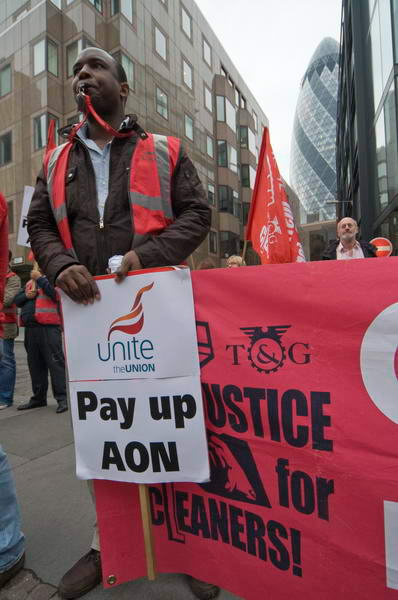
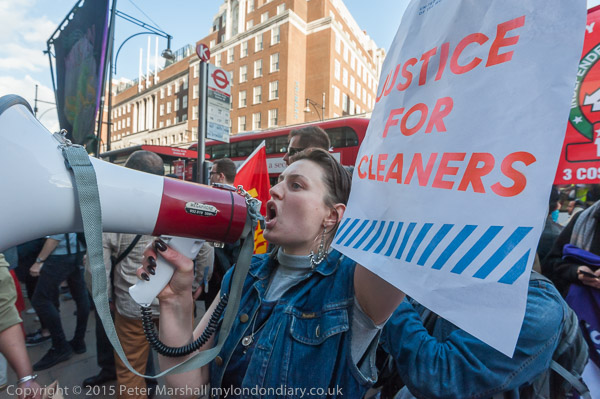
Justice for cleaners demonstrate at AON

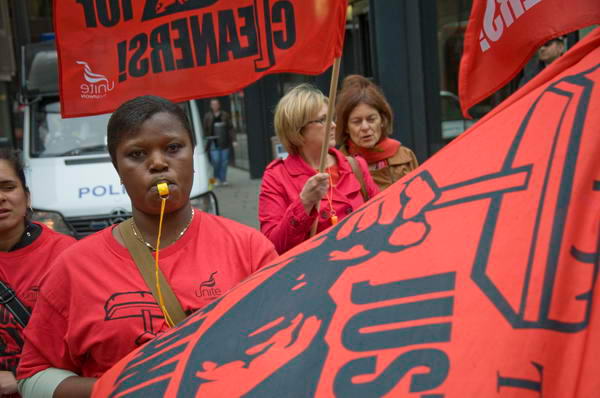
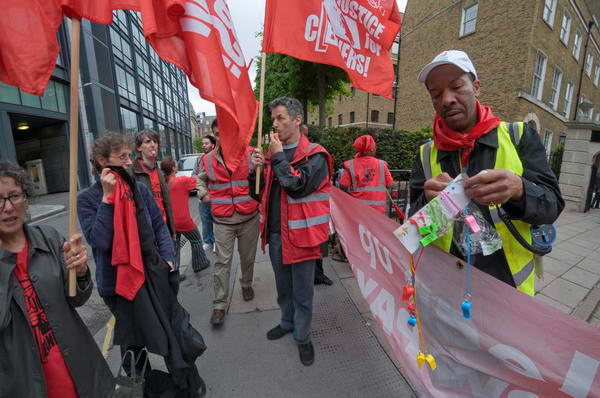
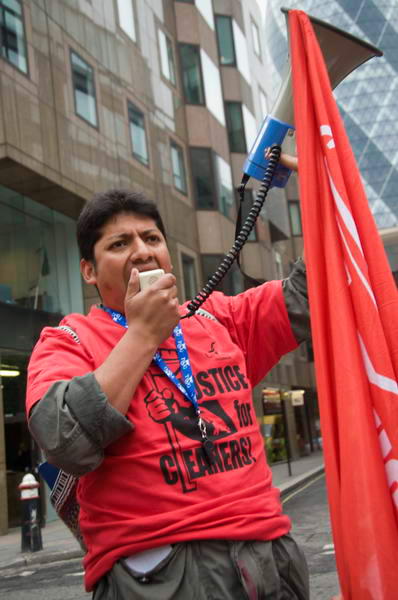
Justice for Cleaners brought together London’s largely migrant cleaners in a campaign for a living wage, sick pay, holidays, trade union rights and respect and was backed by major unions including Unite (and the TGWU which had then recently merged with Amicus to form Unite.)

On May 15th 2008 they had planned a protest outside the RBS offices in Bishopsgate, where cleaners were employed by Pall Mall, but negotiations had led to some success and the demonstration had been switched to AON in Devonshire Square, EC2, a short walk away.

AON, based in Chicago, is one of the world’s leading companies in insurance, with a first quarter net income for 2008 recently announced as $218 million. The cleaners at its City of London offices take home less than it takes to live on in London.

Their offices are on private property where I’d previously been prevented from taking pictures by security officers, and the protest took place in front of the gates on the street.

Noisy public protests such as these are effective because they draw attention to the shameful way these workers are treated even though they work to clean the offices of prestigious companies – which is why the Tories brought in highly restrictive laws in an attempt to stop them.

Watching them through the gates were a number of security men as well as City of London police. Workers in Devonshire Square were walking post the protesters and those inside the offices will have been able to hear the protest which took place with a lot of whistle blowing, shouting and a powerful megaphone used to express the cleaners’ demands.

Although Unite were supporting the cleaners here, migrant workers in London soon largely lost confidence in them and other major unions, who they felt were at times making deals with management that were not truly reflecting their interests, particularly in some workplaces where they seemed to be more interested in preserving wage differentials than getting good deals for the poorest workers. The cleaners – and many other low paid workers – are now largely represented by grass roots unions such as United Voices of the World.

Justice for cleaners demonstrate at AON


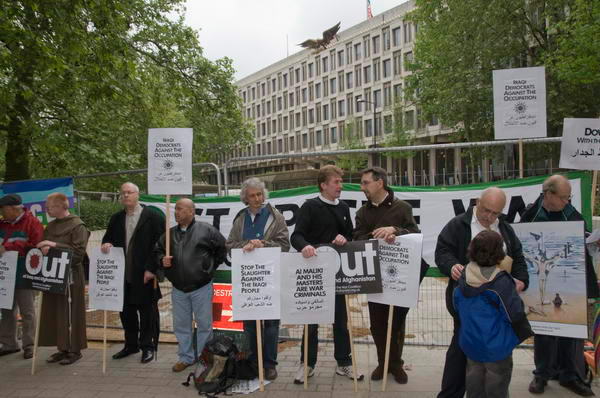
Iraqi Democrats Against the Occupation – US Embassy

Stop the War Coalition and Iraqi Democrats Against the Occupation protested at the US Embassy in Grosvenor Square calling for an end of actions against the Iraqi people and the withdrawal of US forces.

They handed in a letter condemning the continuing US occupation which had caused an “unimaginable level of death and destruction to the people and country in the past five years” and noting the similarity between US actions and the Israeli repression of Palestinians, with the building of concrete walls to divide Baghdad into what Pentagon sources have described as “30 killing zones“.

Iraqi Democrats Against the Occupation


Photofusion opening – Changing Spaces

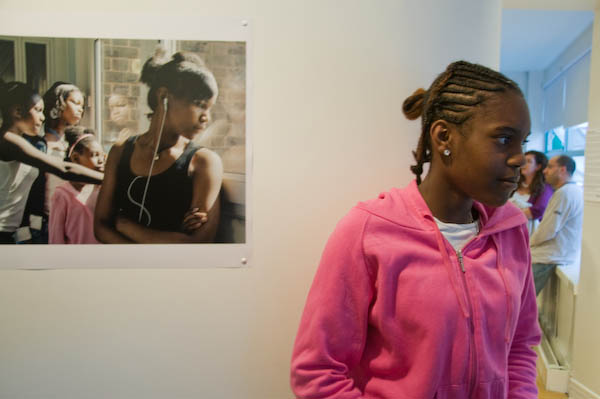
On my way home I took a few pictures of Brown Hart Gardens in Mayfair before going to Brixton to view the opening of the ‘Changing Places‘ show.

This picture wasn’t posed – I just walked up to look at the photograph by Simon Rowe and saw the young woman standing there with her head at a very similar angle. You can see a few more picture from the opening on My London Diary.


FlickrFacebookMy London DiaryHull PhotosLea ValleyParis
London’s Industrial HeritageLondon Photos

All photographs on this page are copyright © Peter Marshall.
Contact me to buy prints or licence to reproduce.


Holloway, Nabja, Vegans, Refugees & Topshop – 2016

Holloway, Nabja, Vegans, Refugees & Topshop – I celebrated 14th May 2016 with a busy day of protests around London.


Reclaim Holloway

Holloway, Nabja, Vegans, Refugees & Topshop
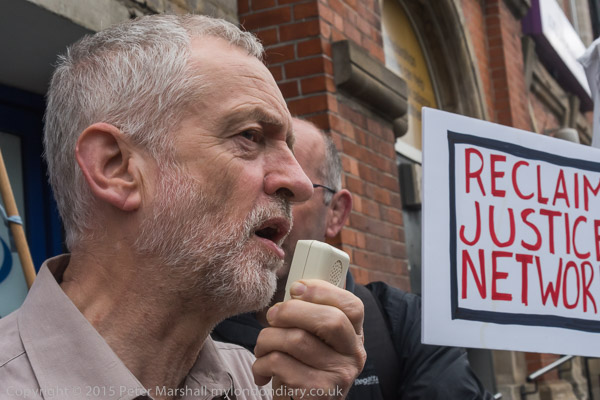
Jeremy Corbyn

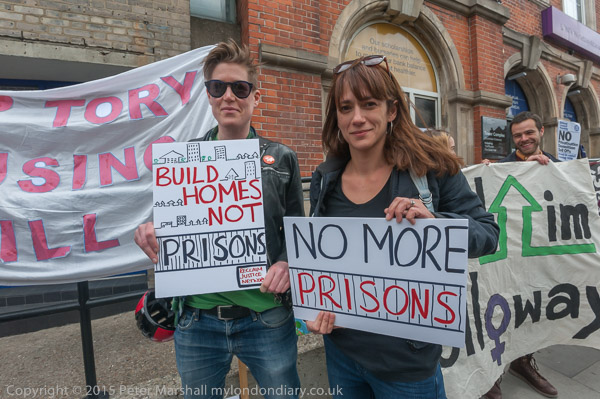
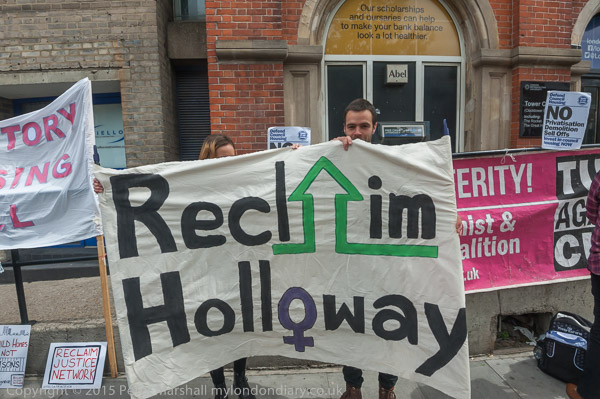
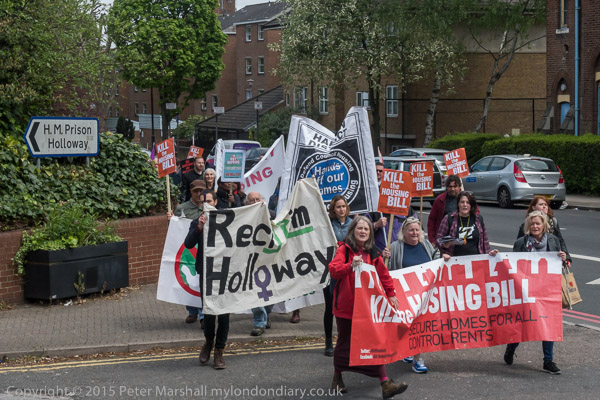
Islington Hands Off Our Public Services, Islington Kill the Housing Bill and the Reclaim Justice Network marched from rally on Holloway Road demanding that when Holloway prison is closed the site remains in public hands, and that the government replace the prison with council housing and the vital community services needed to prevent people being caught up in a damaging criminal justice system.

Holloway, Nabja, Vegans, Refugees & Topshop

The prison is in Jeremy Corbyn’s constituency and the then Labour leader turned up on his bike to speak before the march to give his support.

Holloway, Nabja, Vegans, Refugees & Topshop

There was a long rally outside the prison with speeches by local councillors, trade unionists and campaigning groups.

Holloway, Nabja, Vegans, Refugees & Topshop

Islington Council wanted to see the site used for social housing and in 2022 gave https://www.ahmm.co.uk/projects/masterplanning/holloway/ planning permission for a development by Peabody, who bought the site in 2019 with help from the GLA, and London Square for 985 new homes. 60% of these will be affordable, including 415 for social rent, together with a 1.4-acre public park, a Women’s Building, and new commercial spaces.

Reclaim Holloway


68th Anniversary Nabka Day – Oxford St

Holloway, Nabja, Vegans, Refugees & Topshop

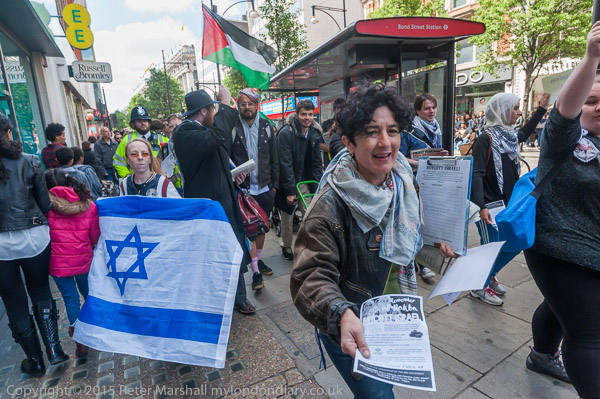
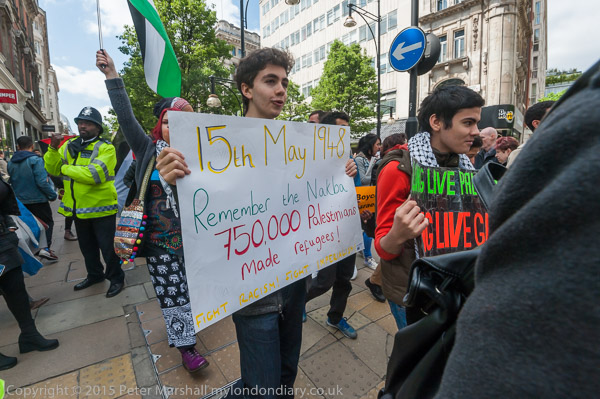
A rolling protest outside shops which support the Israeli state made its way along Oxford St from Marks and Spencers, with speakers detailing the continuing oppression of the Palestinian people, and opposing attempts to criminalise and censor the anti-Zionist boycott, divestment and sanctions (BDS) movement.

It came on the day before Nabka Day, the anniversary of the ‘day of the catastrophe’ which commemorates when around 80% of Palestinians were forced to leave their homes between December 1947 and January 1949, and later prevented by Israeli law from returning to their homes, or claiming their property.

The protesters included both Palestinians and Jews opposed to the continuing oppression of the Palestinians by the Israeli government. They were met by a small group of people holding Israeli flags who stood in their way and shouted insults, accusing them of anti-Semitism.

The organisers were clear that the protest was not anti-Semitic but against Zionism and some actions of the Israeli government. Both police and protesters tried hard to avoid confrontation with those who had clearly come to disrupt and provoke.

Many UK businesses play an important part in supporting the Israeli government by selling Israeli goods and those produced in the occupied territories and in other ways, and their were brief speeches as the protest halted outside some of them detailing some of these links.

More on My London Diary at 68th Anniversary Nabka Day.

This Saturday, 18th May 2024, you can join the march in London, starting at the BBC on the 76th anniversary of the Nabka calling for an end to the current genocide in Gaza.


Vegan Earthlings Masked Video Protest – Trafalgar Square

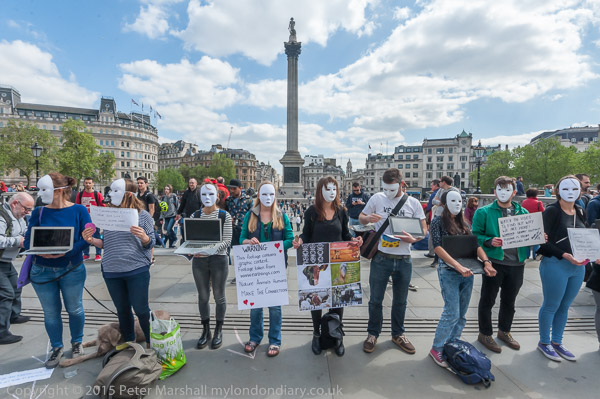
Vegans in white masks from London Vegan Actions were standing in a large circle on the North Terrace of Trafalgar Square, some holding laptops or tables showing a film about the mistreatment of animals in food production, bullfighting, etc. Although bright sun made the laptop screens almost impossible to see and the sound outdoors was largely inaudible the large circle of people standing in white masks did attract attention.

More pictures Vegan Earthlings masked video protest.


Refugees Welcome say protesters – Trafalgar Square

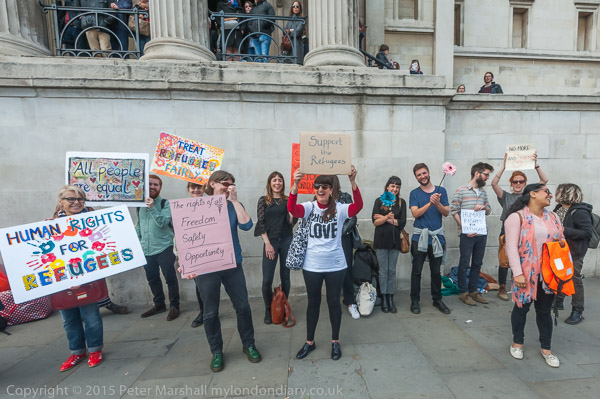
Also protesting in front of the National Gallery were a small group holding posters calling for human rights, fair treatment and support for refugees. Some held a banner with the message ‘free movement for People Not Weapons‘.

More pictures Refugees Welcome say protesters.


Topshop protest after cleaners sacked – Oxford St

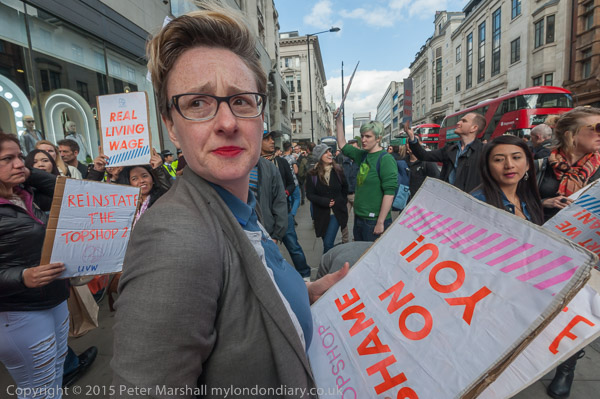
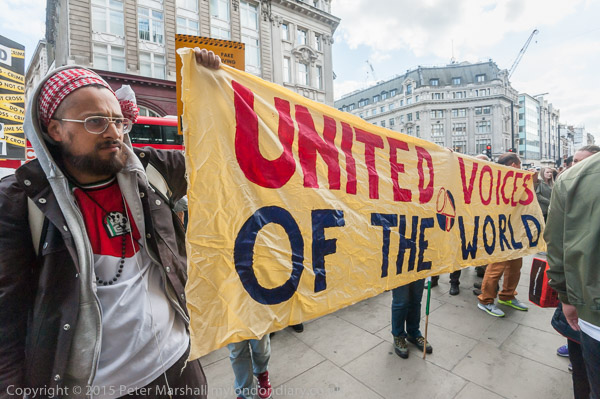
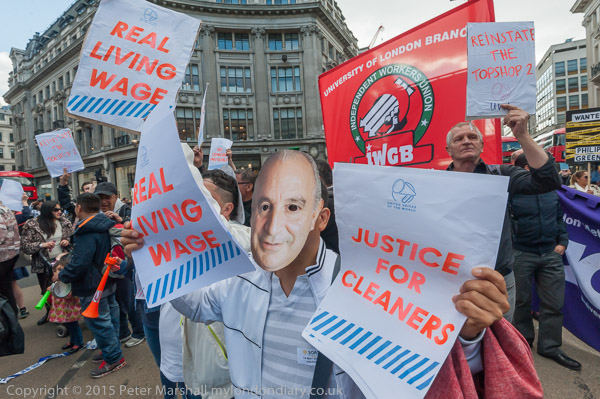
After Topshop suspended two cleaners who were members of the United Voices of the World trade union for protesting for a living wage and sacked one of them protests were taking place outside their stores around the country.

The UVW were supported by others at the London protest which began outside Topshop on Oxford Street by others including trade unionists from the CAIWU and Ian Hodson, General Secretary of the BWAFU as well as then Shadow Chancellor John McDonnell and Class War.

A large crowd of police and extra illegal security guards wearing no ID blocked the entrance to the shop stopping both protesters and customers from entering. The several hundred protesters held up placards and banners and protested noisily but made no serious attempt to go in to the store.

A man wears a mask of Topshop owner Phillip Green

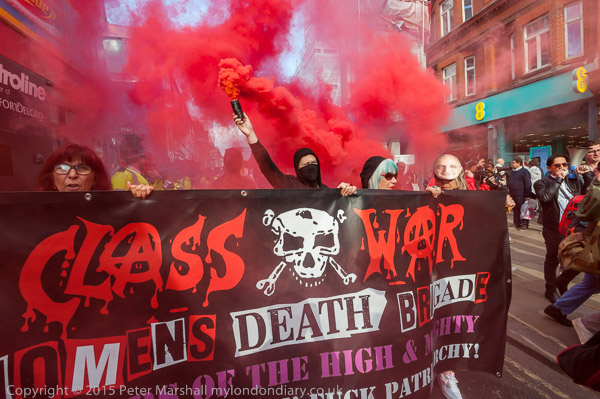
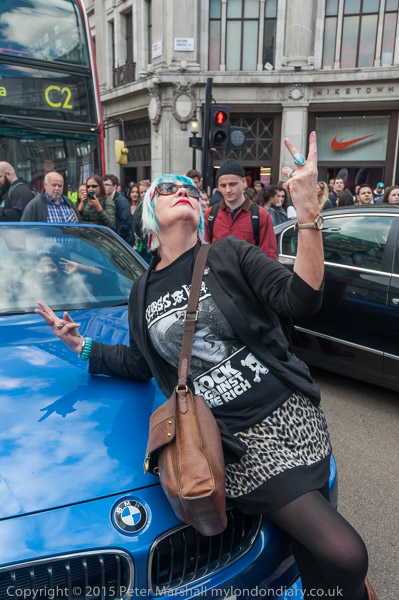
Some protesters, led by the Class War ‘Womens Death Brigade’ moved onto the road, blocking it for some minutes before the whole group of protesters marched to block the Oxford Circus junction for some minutes until a large group of police arrived and fairly gently persuade them to move.

They stopped outside John Lewis, another major store in a long-running dispute with the union as it allowed its cleaning contractor to pay its cleaners low wages, with poor conditions of service and poor management, disclaiming any responsibility for workers who keep its stores running.

The protest there was again noisy and there were some heated verbal exchanges between protesters and police, but I saw no arrests. After a few minutes the protesters marched off to continue their protest outside another Oxford Street Topshop branch close to Marble Arch.

More at Topshop protest after cleaners sacked.


FlickrFacebookMy London DiaryHull PhotosLea ValleyParis
London’s Industrial HeritageLondon Photos

All photographs on this page are copyright © Peter Marshall.
Contact me to buy prints or licence to reproduce.


Shut down Yarl’s Wood Immigration Prison – 2017

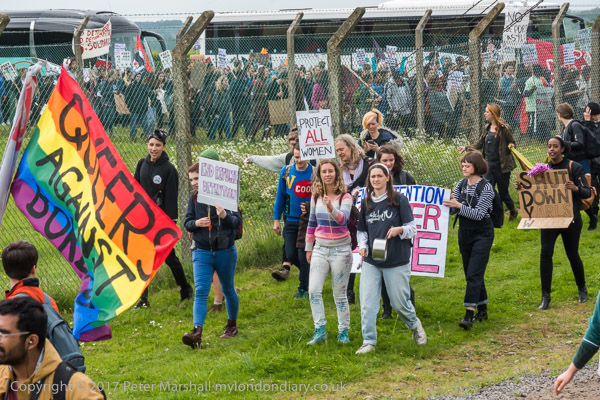
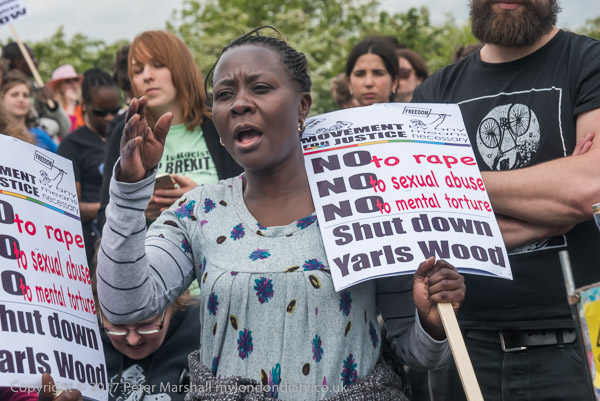
Shut down Yarl’s Wood Immigration Prison: Saturday 13th May 2017 was the 11th protest outside Yarl’s Wood in the Movement for Justice campaign to shut down this and other immigration detention centres.

Shut down Yarl's Wood Immigration Prison

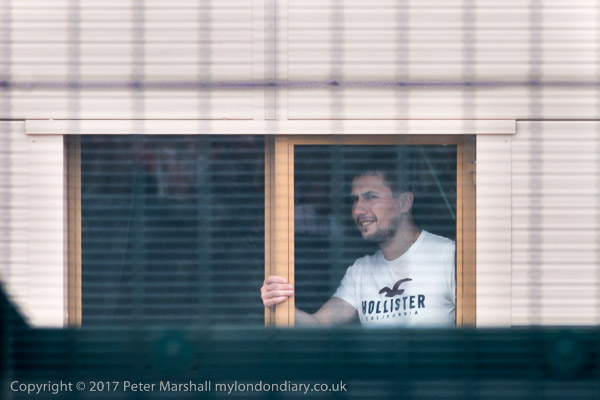
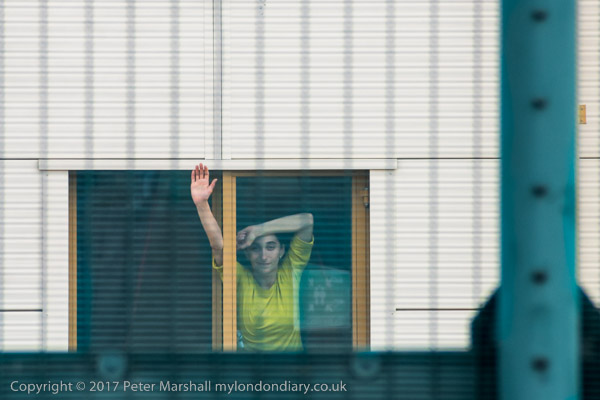
For once the weather was fine and there was little or no mud in the field facing the prison. And for some reason – perhaps the windows had been cleaned – we could see the detainees more clearly than on some previous occasions. And I seem to have written rather more clearly than on some occasions about the day – so here I’ll just reproduce the text from My London Diary, with a few of the pictures.

Shut down Yarl's Wood Immigration Prison

I’d caught the train from St Pancras to Bedford as usual, but instead of waiting for the MfJ bus had brought my Brompton, so could just jump on it and cycle towards Yarlswood. It was a ride of around 6 miles, mainly along side roads or on cycle paths beside busier roads, and it was a pleasant enough ride, though Yarl’s Wood is on a former airfield on a plateau rather higher than the city, and so it was uphill quite a lot of the way. And the climb up from the nearest village, Milton Ernest, was rather long and steep, though at least I didn’t have to bother about traffic, as the police had closed the road. But I was a little out of breath and tired as I arrived.

Shut down Yarl's Wood Immigration Prison

But Yarl’s Wood really is in the middle of nowhere, making those inside feel very isolated, and visits to them by anyone without a car are tedious and expensive for those on low income. So events like this are important in reminding those inside that they have not been forgotten.

Shut down Yarl's Wood Immigration Prison

There were several hundreds of people already at the roadside – and a long row of coaches that had brought them there, and there were speeches and chanting while they waited for others to arrive.

Most of the detainees are women, but there are men in a family section of the prison

From the road there is still a long walk along field edges following a public footpath, around three-quarters of a mile. Parts of this were heavy going on the Brompton, not designed for off-road use, and I did have to walk part of the way, as well as occasionally stopping to photograph the marchers, now around a thousand strong.

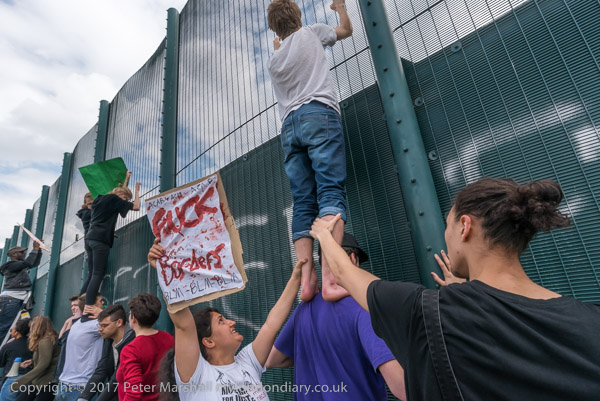
When the protesters arrived at the field in front of the tall fence around the centre, they were welcomed by shouts and waving from those imprisoned inside who held up messages calling for justice in the narrow slits the windows open. Only those who could get to the upper windows on the block facing the fence could see the protest, but others inside could certainly hear it.

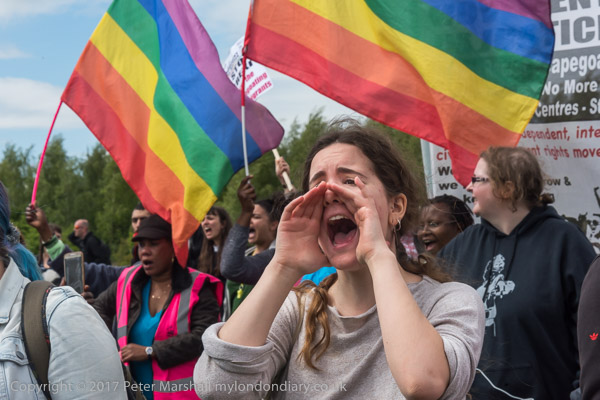
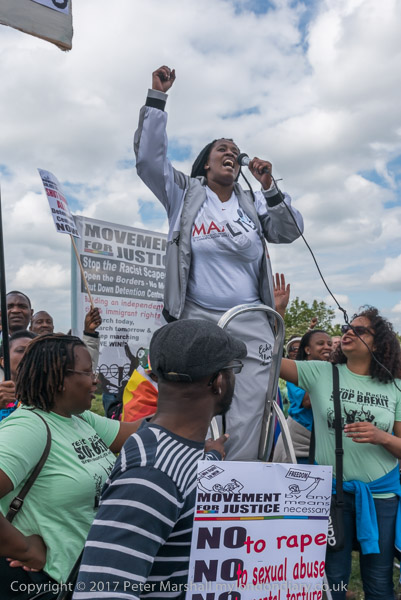
There were speeches from former detainees, including several women who had been held at Yarl’s Wood, including Mabel Gawanas who was recently released a few days short of 3 years inside, and other former immigration detainees. People kicked on the fence to make a terrific racket and held up banners, posters and placards to show the detainees in what the protesters describe as as ‘racist, sexist hell-hole’ they have not been forgotten. Some inside spoke to the protest by mobile phone.

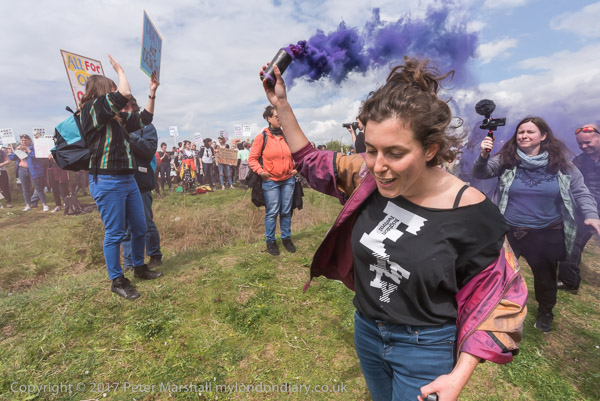
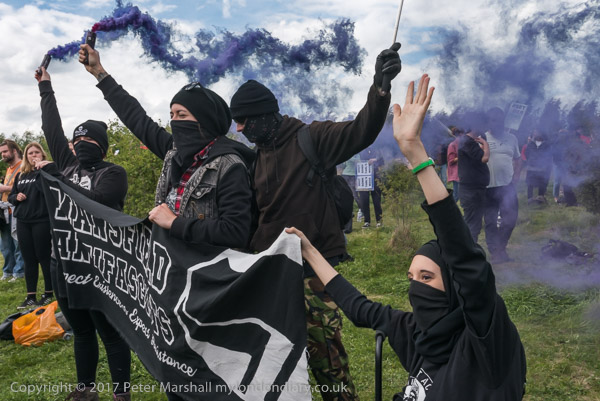
Some of the protesters climbed ladders to hold banners and placards above the first solid 10 feet of the 20 foot fence, while others had long poles or lit flares to make the protest more visible. A few yards back from the fence where the ground slopes up we could see those at the windows and photograph them through the mesh fence, though it wasn’t easy.

I left as the protest began to draw to a close, cycling back along the footpath to the road and then enjoying the long downhill stretch to the village and the main road. But I had to pay for this, as a short uphill modern stretch of road off stretched me almost to exhaustion. 40 metres doesn’t sound a lot, but feels in on a bike. And while the road up from Milton Ernest does the climb at a fairly sensible rate, Oakley Hill up from the A6 is at least twice as steep. I should have got off and walked, but pride doesn’t allow it unless it becomes really impossible. For some reason my three-speed gear had decided to be a two speed gear, but probably it wouldn’t have helped here as I think it was only the top gear I was missing – and I needed something considerably lower. But after than it was downhill most of the way to Bedford and a train probably an hour earlier than had I been on the bus.

More pictures at Shut down Yarl’s Wood Prison,


FlickrFacebookMy London DiaryHull PhotosLea ValleyParis
London’s Industrial HeritageLondon Photos

All photographs on this page are copyright © Peter Marshall.
Contact me to buy prints or licence to reproduce.

British Gas & Independent Living – 2014

British Gas & Independent Living: Two protests on Monday 12th May 2014 in Westminster. the first about fuel poverty and climate change and the second over plans to end the Independent Living Fund which enabled many disabled people to continue to work and have an independent life.


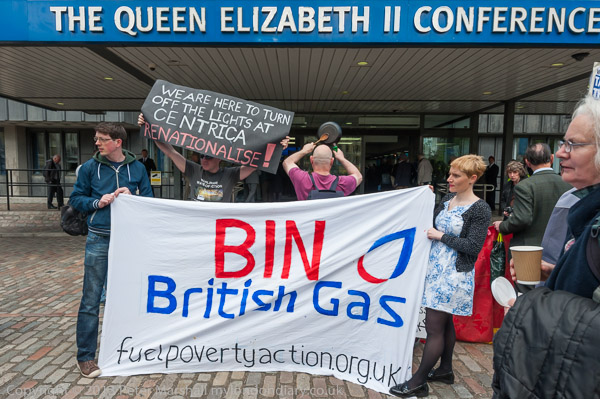
Bin British Gas – QEII Centre, Westminster

British Gas & Independent Living

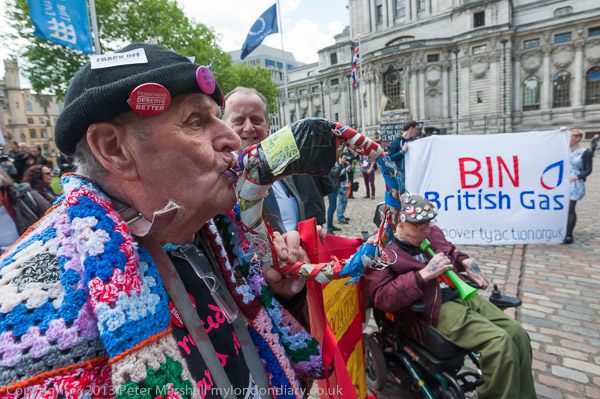
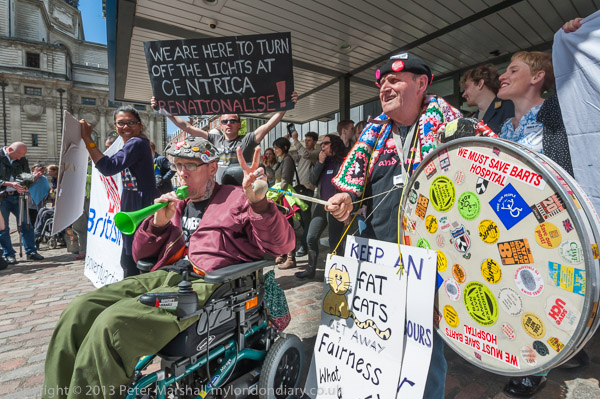
British Gas were holding their AGM in the QEII centre and a protest outside demanded they stop profiteering from high energy prices and end support for fracking.

British Gas & Independent Living

The protest was called by Fuel Poverty Action who say there were over 10,000 extra deaths last winter because people were unable to heat their homes, while Centrica, the parent company of British Gas, made £2.5 billion in 2013. While they raised gas prices by 10.4% and electricity by 8.4%.

British Gas & Independent Living

They also called for government and energy companies to end support for fracking which as well as threatening water supplies in the UK would also lead to more climate-wrecking carbon dioxide emissions.

British Gas & Independent Living

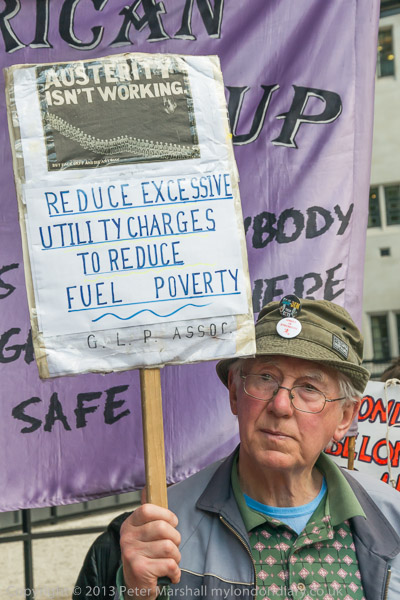
The campaigners called for greater investment in renewable energy, which in the long term will result in cheaper energy and will help us tackle climate change. But this isn’t popular with the big six energy companies (and the government which is led by their lobbyists) as it enables greater local generation and control of energy, threatening their monopoly of energy production and profits.

At the protest were representatives from fuel poverty, pensioner, climate, housing groups and renewable energy co-operatives. After a number of speeches including from Green Party leader Natalie Bennett, Paula Peters of Disabled People Against Cuts, people came together too tear up British Gas energy bills.

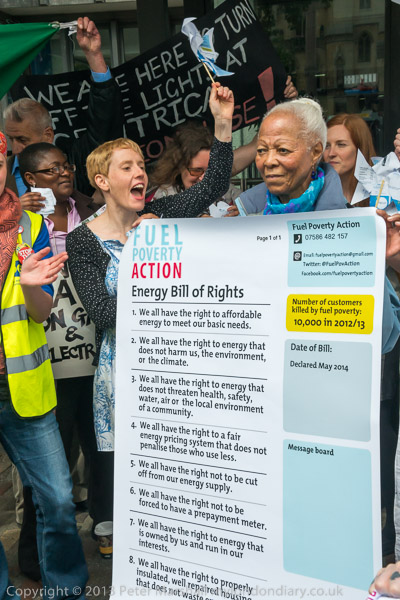
A giant bill was torn up and Lambeth pensioner, Ellen Lebethe, brought out a poster-size Fuel Poverty Action ‘Energy Bill of Rights.’

  • We all have the right to affordable energy to meet our basic needs.
  • We all have the right to energy that does not harm us, the environment, or the climate.
  • We all have the right to energy that does not threaten health, safety, water, air, or the local environment of a community.
  • We all have the right to a fair energy pricing that does not penalise those who use less.
  • We all have the right not to be cut off from energy supply.
  • We all have the right not to be forced to have a prepayment meter.
  • We all have the right to energy that is owned by us and run in our interests.

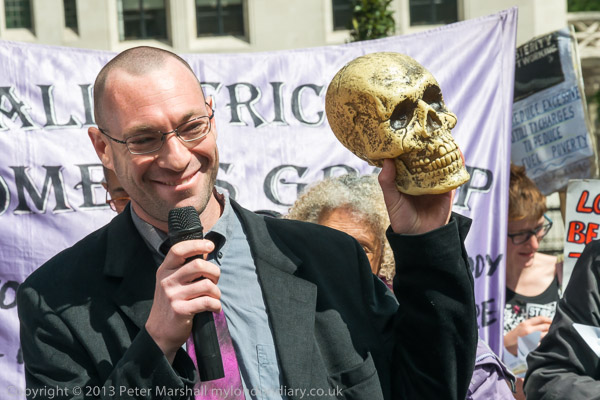
Inside the Centrica AGM, a member of Reclaim Shakespeare Company had stood up holding a can of beans and a skull to read a version of Hamlet’s iconic monologue, entitled “To Heat or Eat, that is the question”, and this was read out at the protest. Shortly after the actor came out from the building to tell us about what had happened inside.

The protest ended with people planting 100 small windmills made from folded British Gas bills in the grass outside the QEII centre.

More pictures at Bin British Gas.


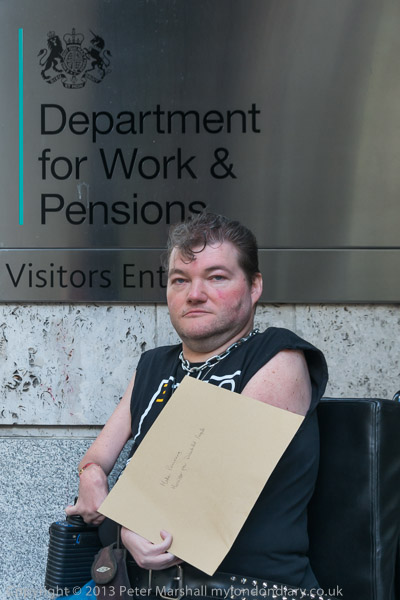
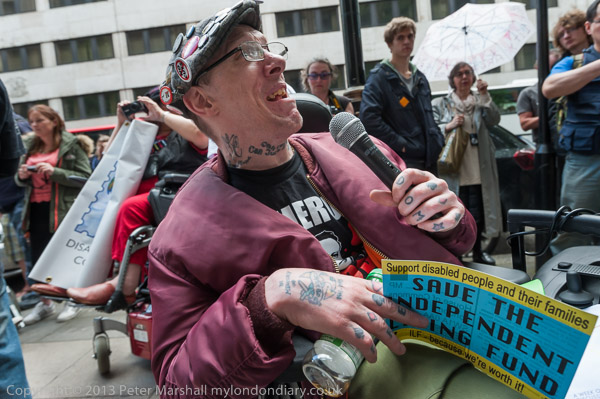
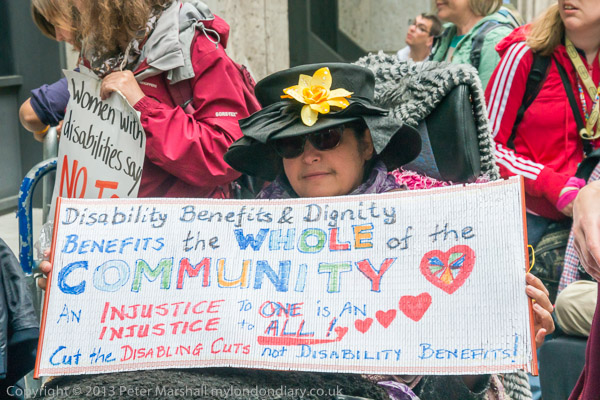
Save Independent Living Fund – Dept of Work & Pensions

The Independent Living Fund (ILF) was set up in 1988 under the Thatcher government to provided financial support to some of the most severely disabled people in the UK. Its main use was to enable them to have carers and personal assistants so they could live in their communities and for many to continue in useful employment.

The ILF was administered by a separately funded body and was highly cost-effective, providing support at much lower costs than residential care as well as enabling those receiving support to live independent lives Around 18,000 people were being assisted by the fund in 2014.

When the government announced it was scrapping the scheme in England in 2010 it was met with protests by disabled people and in 2013 was taken to court. The government won the case that its decision was lawful, but lost in the Court of Appeal.

A revised proposal was then made by the government to announce once again in March 2014 that ILF would close. A fresh legal challenge failed in December 2014 and the scheme ended in June 2015, with responsibility for supporting disabled people being passed to local authorities who were given funding roughly 12% less than the ILF – and which was not ring-fenced.

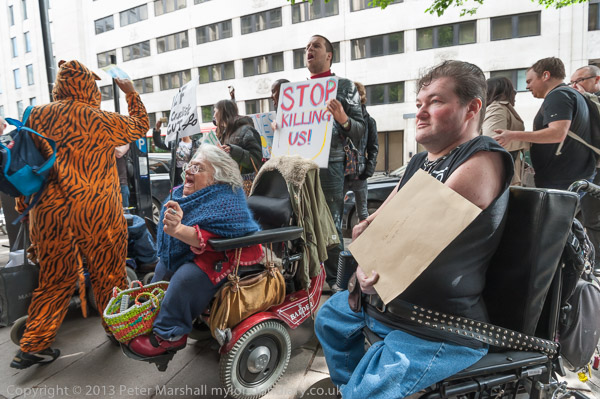
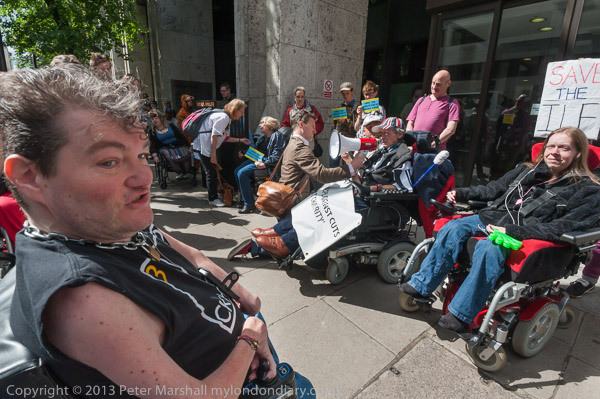
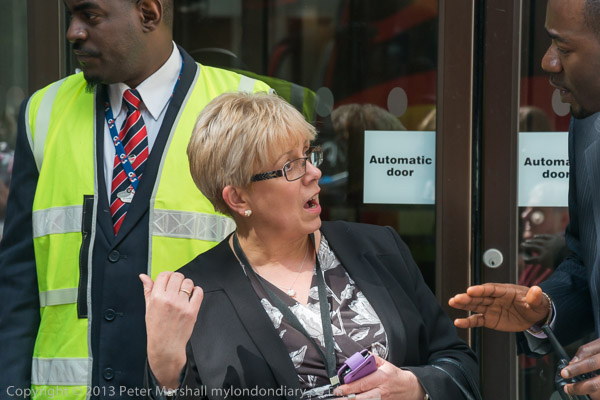
Police tried to persuade the protesters to keep to a small area well to one side of the Dept of Work & Pensions but they refused and protested in a larger space in front of the two main doors, which were both locked for the event.

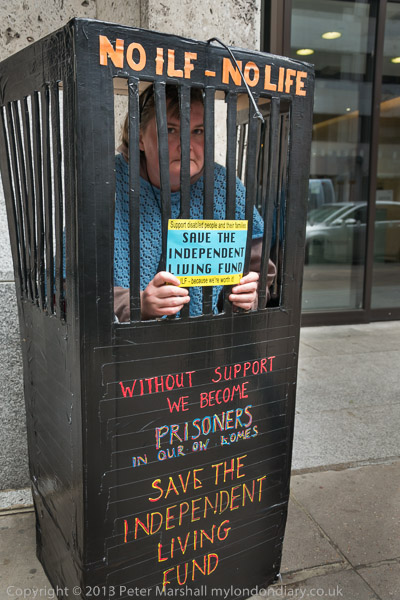
At the centre of the protest was a small cage, with the message ‘NO ILF – NO LIFE‘ across its top, and below the barred window ‘Without Support We Become Prisoners In Our Own Homes – Save the Independent Living Fund’. Squeezed into this was Paula Peters of DPAC, Disabled People Against Cuts, the group who had organised the protest.

A number of people told their ‘ILF stories‘ of how the fund had helped them and how they feared its closure would seriously limit their lives. DPAC tried to deliver a letter to Minister for the Disabled Mike Penning but were refused entry to the building and no one from the department was prepared to come and receive it.

One of the protesters who had travelled from Newcastle phoned her MP from here wheelchair outside the DWP, and Mary Glindon, the Labour MP for North Tyneside came down to support the protest. She failed to get DWP security to let the protesters deliver their letter but offered to deliver it for them. She was let in through a side entrance to do so then came out and spoke briefly giving her support to the protest.

More at Save Independent Living Fund.


FlickrFacebookMy London DiaryHull PhotosLea ValleyParis
London’s Industrial HeritageLondon Photos

All photographs on this page are copyright © Peter Marshall.
Contact me to buy prints or licence to reproduce.

Police, Public Sector & Peace Campaign – 2012

Police, Public Sector & Peace Campaign – Thursday 10th May 2012 saw two rather different marches by workers taking place in London, with a large protest by police and a day of public sector strikes with trade unionists marching to a rally. I also visited the Parliament Square Peace Campaign.


Police March Against Cuts and Winsor

Police, Public Sector & Peace Campaign

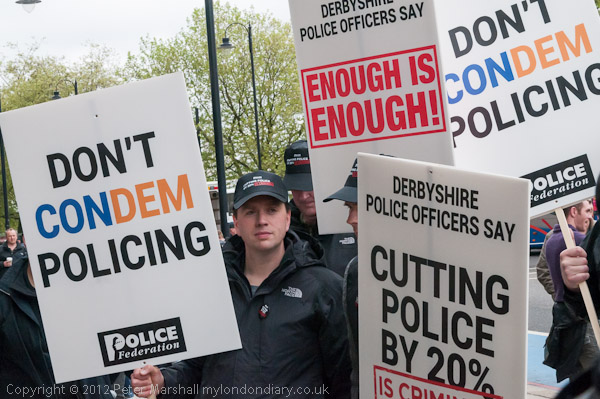
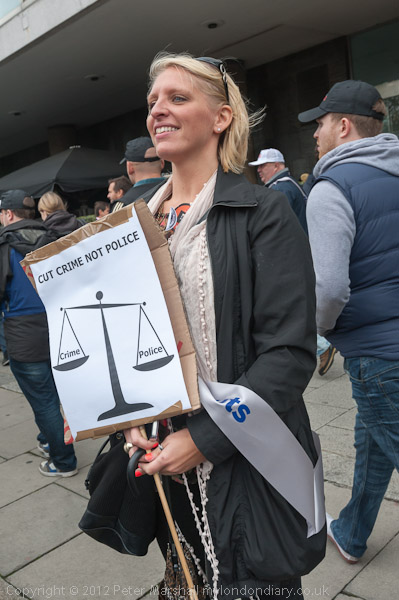
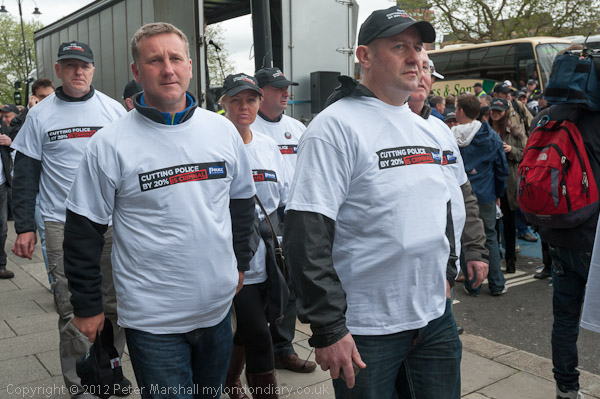
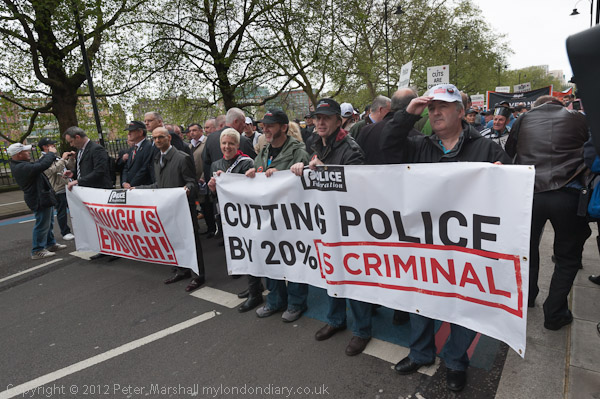
An estimated 20,000 police from all 43 forces in England & Wales marched through central London in protest at 20% cuts in police budget and proposed restructuring following the Winsor review. Other groups including Occupy and Right To Protest and others joined in call for justice in the policing of protest.

Police, Public Sector & Peace Campaign

Police are not allowed to strike or belong to a proper trade union but can join the Police Federation, a staff association that can represent and support their interests. Although it cannot call for strike action it can organise demonstrations such as this one, attended by off-duty police and some family members.

Police, Public Sector & Peace Campaign

It was an impressively large march, but rather dull as it marched past the Home Office, the Houses of Parliament and Downing St, most wearing black caps. The Police Federation had provided 16,000 black caps to represent the number of warranted officers expected to be lost over the next four years due to the cut in the police budget of 20-30%.

Police, Public Sector & Peace Campaign

My pictures concentrate too much on the relatively few officers from some areas who had come with placards. Most simply marched and mainly in silence. A few carried carried small posters with the names of officers who had been unable to attend due to being at work – and there were some police who were policing the police protest, on rather better behaviour than at some other protests.

Some people also came to protest against the police, with the Space Hijackers setting up a ‘professional protest stall‘ at the side of the march offering advice on making placards and chanting. Most of the police marchers were amused by their chants such as ‘One Solution – Institution’ and some of the mock placards, although there were a few jeers.

Those Police policing the protest were less amused, and threatened the Space Hijackers with arrest unless they removed one of their placards with the well-known acronym ACAB. They also stood in front to try and hide them and other protesters including those with a ‘Defend the Right to Protest’ who were shouting slogans against police violence and over deaths in custody for which there is seldom if any justice.

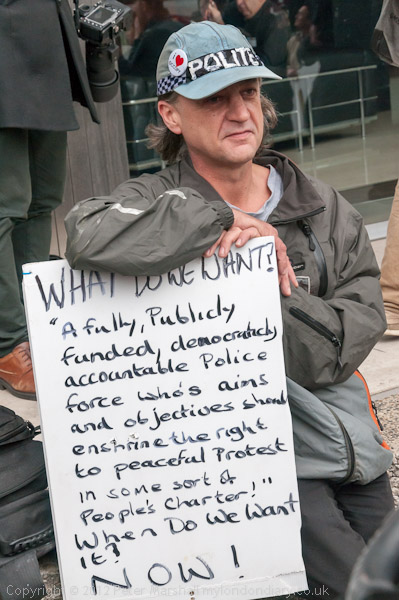
Some from Occupy London had come with plastic police helmets to join in the march, saying they were not against the police but called for a force that worked for the 99% rather than the 1%, or as one long-winded placard put it, “A fully, Publicly funded, democratically accountable Police force who’s aims and objectives enshrine the right to peaceful Protest in some sort of People’s Charter!”

Others taking part on the march included Ian Puddick who got intimidated, attacked and prosecuted by City of London Terrorism Police and Counter Terrorism Directorate in an operation costing millions carried out on behalf of a giant US security corporation after he discovered his wife had been having an affair with one of her bosses. He marched with a sign ‘Police Corruption‘ and unfortunately there is still a great deal of that as well as racism in forces around the country.

More on My London Diary at Police March Against Cuts and Winsor.


Public Sector Pensions Strike and March

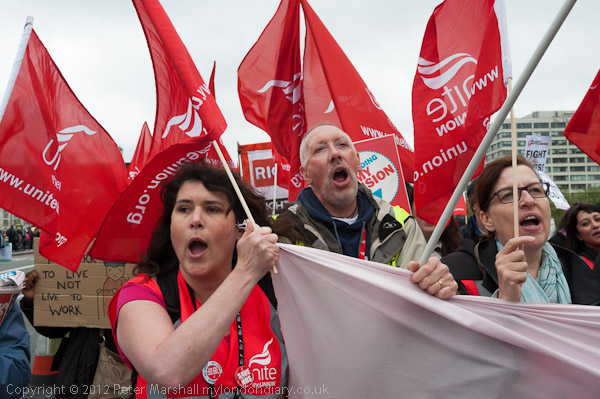
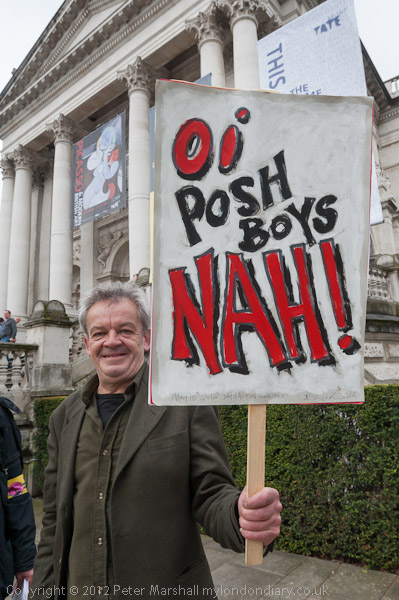
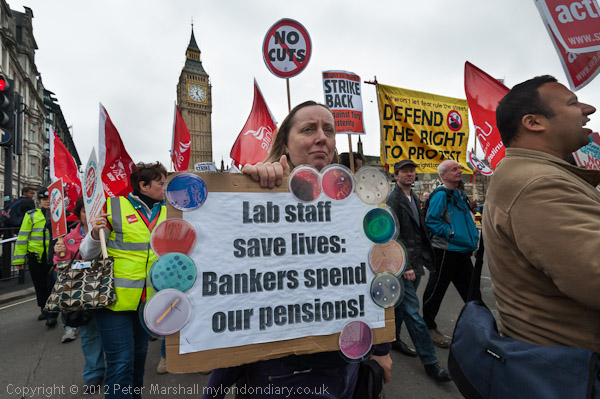
Unite, PCS and UCU were holding a one day strike against public sector cuts in pensions, jobs and services. Many had been up in the early hours picketing at their workplaces long before I arrived in London, but there were still pickets in place when I visited Tate Britain and walked past the House of Commons on my way to a rally outside St Thomas’ Hospital on the opposite bank of the Thames.

I arrived late for the rally there and people were just getting ready to march to a larger rally at Methodist Central Hall.

Workers are incensed by increases in their pension contributions and plans to increase them further. They are also worried by the increasing state retirement age which also applies to their pensions. Now in 2024 it is 66 and will increase to 67 between 2026 and 2028. A further rise to 68 is planned and the date for that is likely to be brought forward – as the rise to 67 was.

As they marched, people were chanting “Sixty-eight – is TOO Late“. Pensioners also feel they are being cheated by the government’s decision to index them to the CPI inflation rather than the higher RPI inflation figures, which will mean them receiving some 15-20% less. Over 94% of Unite’s NHS members voted to reject the government’s proposals and take strike action today along with members from the Ministry of Defence and government departments as well as others from the PCS and UCU.

I left the marchers as they went into the rally at Central Hall and returned to photograph the police march and visit the peace camp in Parliament Square.

More pictures at Public Sector Pensions Strike and March.


4000 Days in Parliament Square

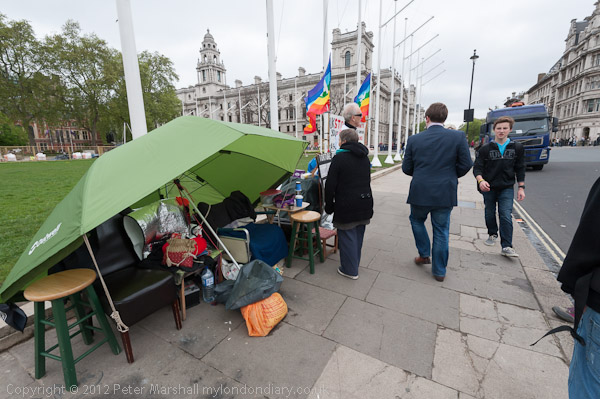
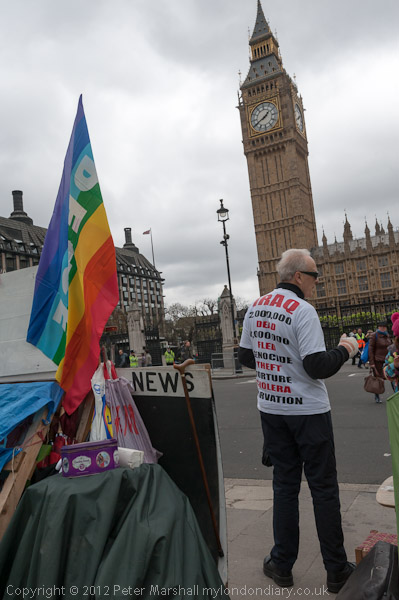
I went to talk with Barbara Tucker who was continuing the Parliament Square Peace Campaign begun by Brian Haw on the 2nd June 2001. The protest, continued by her and other supporters was about to reach a total of 4000 days of 24 hour protest in the square, with others in the group maintaining the presence on those various occasions when Brian or Barbara was arrested and held overnight.

They had then continued for almost 11 years despite constant harassment years by police, who have been pressured by politicians – as well as passing two Acts of Parliament intended to end the protest.

As I wrote in 2012:

A few hours before I arrived, police had come and spent 90 minutes “searching” the few square meters of their display in the early morning, and three days later, at 2.30am on Sunday 13 May, police and Westminster Council came and took away the two blankets that Barbara Tucker, no longer allowed to have any “structure designed solely or mainly to sleep in” by law was using to survive in the open. This was apparently one of two visits over the weekend by police and council in which they illegally removed property from the site.

4000 Days in Parliament Square.

Despite an increase in harassment as a great attempt was made to clean up the capital for the Olympics, the peace protest continued in the square for another year, with Barbara Tucker starting a hunger strike in January 2013. Eventually she became too ill to continue and the protest came to an end in May 2013.


FlickrFacebookMy London DiaryHull PhotosLea ValleyParis
London’s Industrial HeritageLondon Photos

All photographs on this page are copyright © Peter Marshall.
Contact me to buy prints or licence to reproduce.

Croydon, Abortion & Windrush – 2018

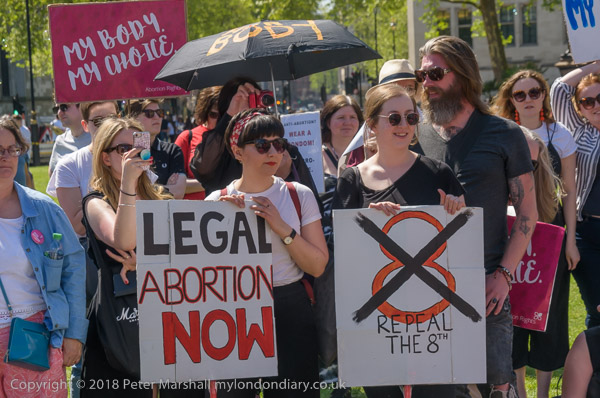
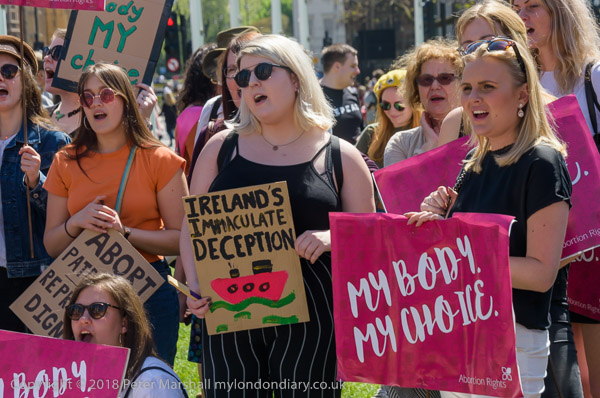
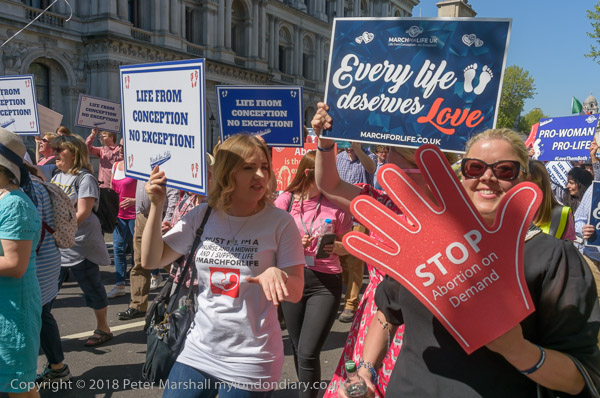
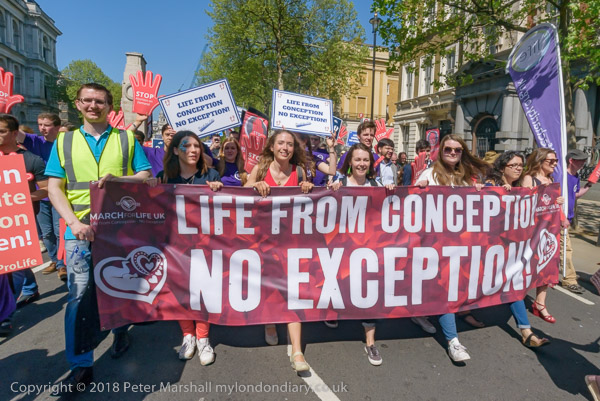
Croydon, Abortion & Windrush – I began work on Saturday 5th of May with a late May Day march in Croydon, then came to Westminster where abortion rights protesters were meeting to oppose a ‘March for Life’ anti-abortion march and rally. At Downing Street there was a rally against the racist attacks by Theresa May against the Windrush generation, which later marched to continue at the Home Office, where I ended the day after photographing the anti-abortion march.


Croydon march for May Day – Saturday 5th May 2018

Although International Workers Day is celebrated internationally on May 1st, in Croydon there was a march and rally on the following Saturday.

Croydon is just 15 minutes by public transport from the centre of London, and those who were able to do so had probably joined the main London march on May Day, while others will have had to wait for the weekend to celebrate, so the march and rally on Saturday made sense.

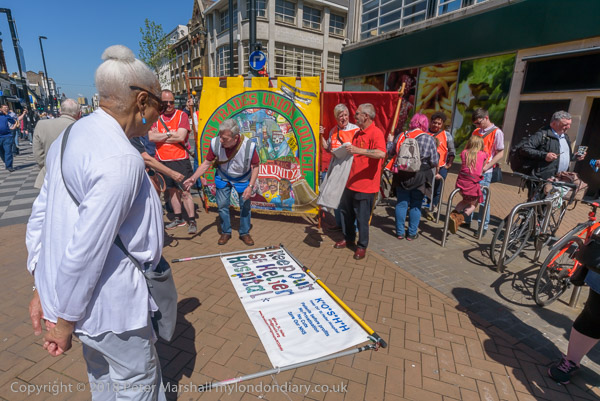
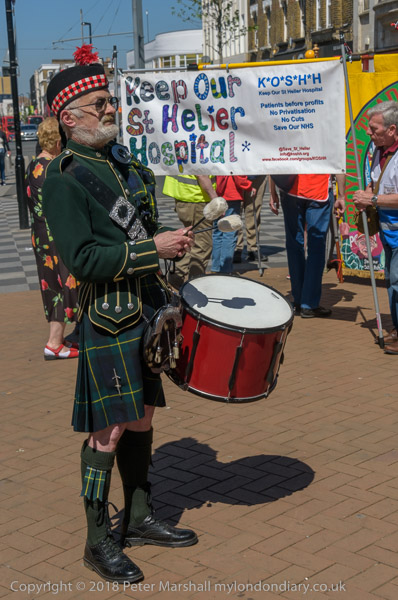
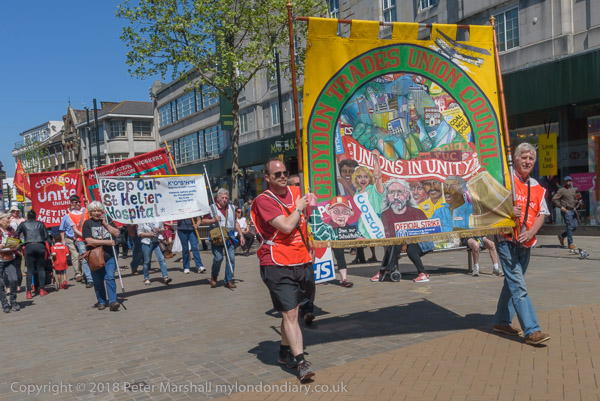
It wasn’t a huge march, though doubtless more made their way to the rally later at Rusking House, where the speakers were to include Ted Knight, once the leader of Lambeth council and then one of the best-known Labour politicians, derided in the press of the day as ‘Red Ted’. One of the largest groups on the march was the supporters of the local Keep Our St Helier Hospital campaign fighting against proposed cuts there.

More pictures at Croydon march for May Day.


Women protest anti-abortion march – Parliament Square

Feminists in the abortion rights campaign held a rally in Parliament Square before the annual March for Life UK by pro-life anti-abortion campaigners was to arrive for their rally.

They opposed any increase of restrictions on abortion and called for an end to the harassment of women going into clinics and called for women in Northern Ireland to be given the same rights as those in the rest of the UK, as well as supporting the Irish referendum to repeal the 8th amendment to the constitution dating from 1983 which effectively banned abortion in Ireland.

More pictures at Women protest anti-abortion march.


Anti-Abortion March for Life – Whitehall

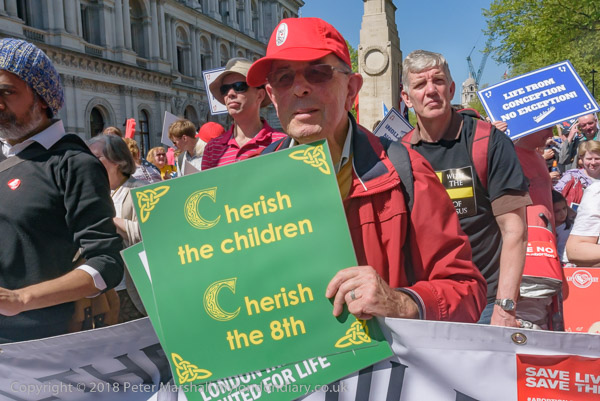
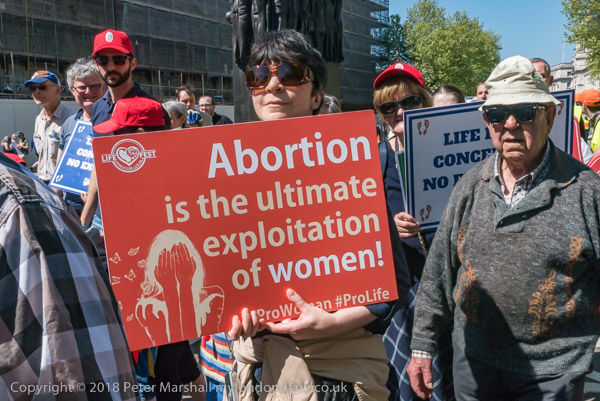
I walked up Whitehall to meet the several thousand anti-abortion campaigners, mainly Catholics, marching to their rally in Parliament Square.

They argue that even at conception the fertilised egg should be awarded an equal right to life as the woman whose body it is in, and call legalised abortion the greatest violation to human rights in history.

This was the first London march by ‘March for Life UK’ who had previously held marches in Birmingham and came a few weeks an Irish vote was expected to repeal the 8th amendment and allow abortion in Ireland, and some posters and placards called for a ‘No’ vote in this.

More pictures at Anti-Abortion March for Life.


Windrush rally against Theresa May – Downing St

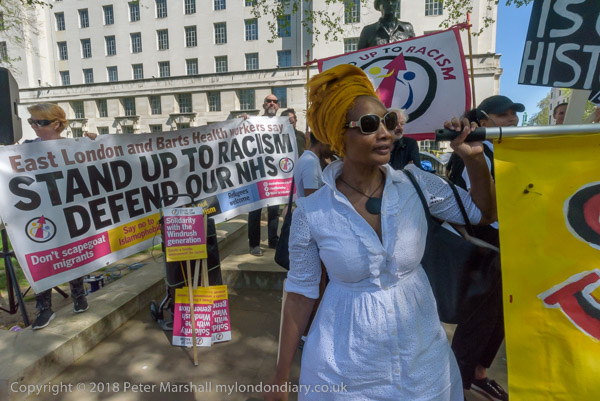
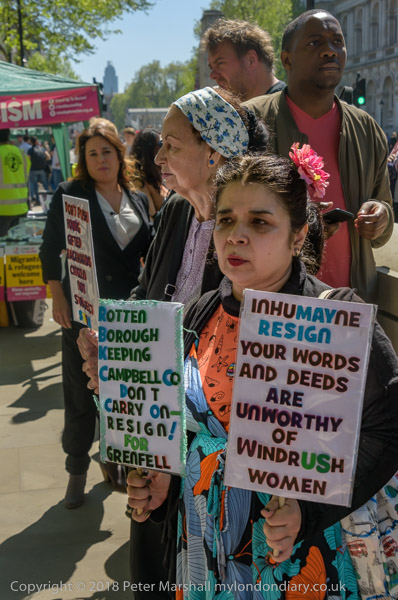
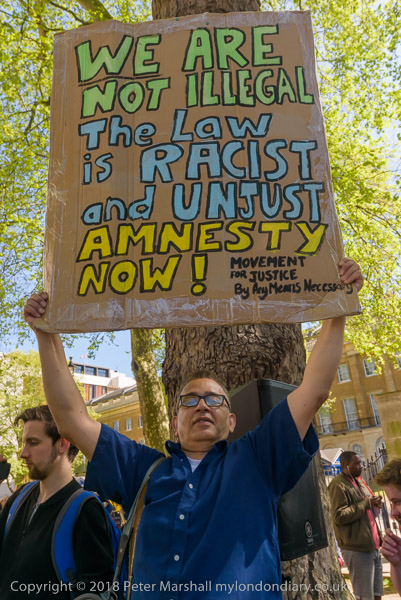
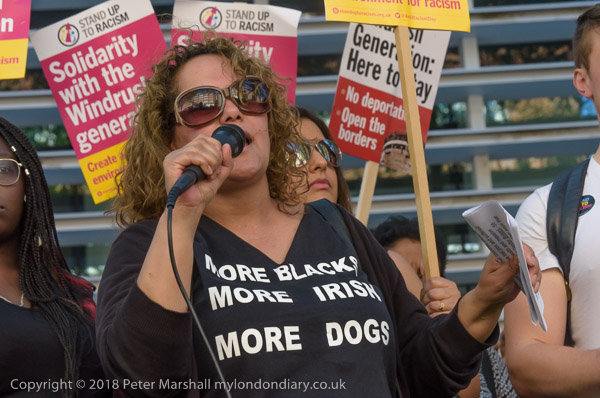
I remained on Whitehall to join a rally at Downing St organised by Stand Up to Racism calling for Theresa May’s racist 2014 Immigration Act to be repealed and an immediate end to the deportation and detention of Commonwealth citizens, with those already deported to be bought back to the UK.

It demanded guaranteed protection or all Commonwealth citizens and for those affected to be compensated for deportation, threats of deportation, detention, loss of housing, jobs, benefits and denial of NHS treatment and an end to the ‘hostile environment’ introduced by Theresa May.

Speakers also condemned the unusual moves by the Tories in ways that threaten the normal working of Parliament to try and keep information about the Windrush scandal secret. Aong those speaking were Shadow Home Secretary Diane Abbott, trade unionists, and people from organisations standing up for immigrants and opposing immigration detention including Movement for Justice who brought two women who had been held in Yarl’s Wood to speak.

After the rally at Downing Street protesters marched to the Home Office for a further rally there.

More pictures on My London Diary:
Home Office: Windrush Immigration Act protest
Downing Street: Windrush rally against Theresa May


FlickrFacebookMy London DiaryHull PhotosLea ValleyParis
London’s Industrial HeritageLondon Photos

All photographs on this page are copyright © Peter Marshall.
Contact me to buy prints or licence to reproduce.

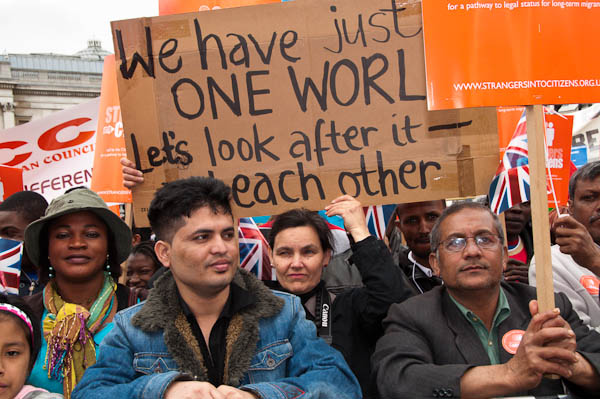
Strangers Into Citizens – 2009

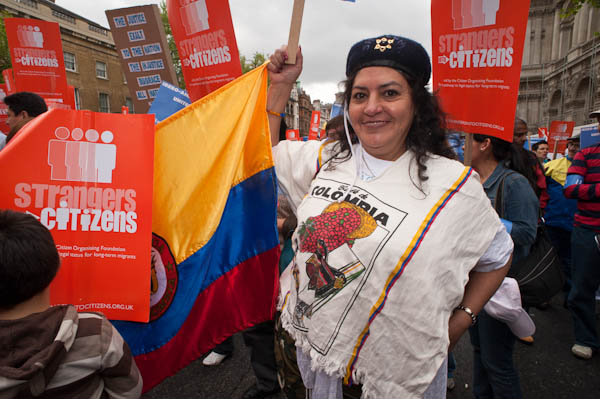
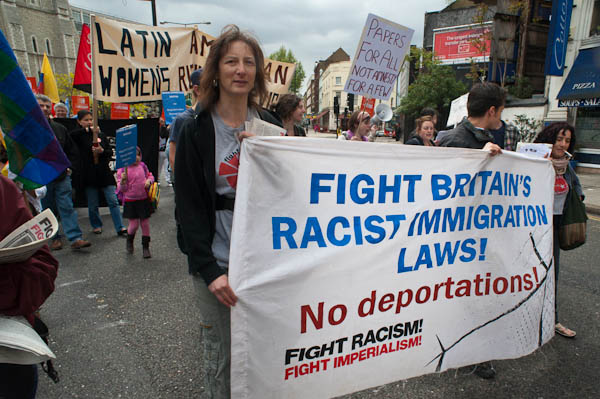
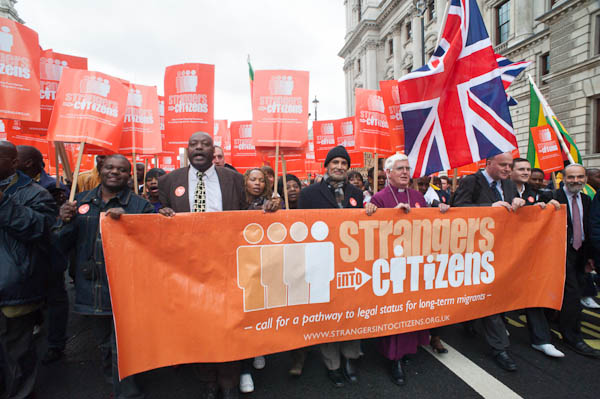
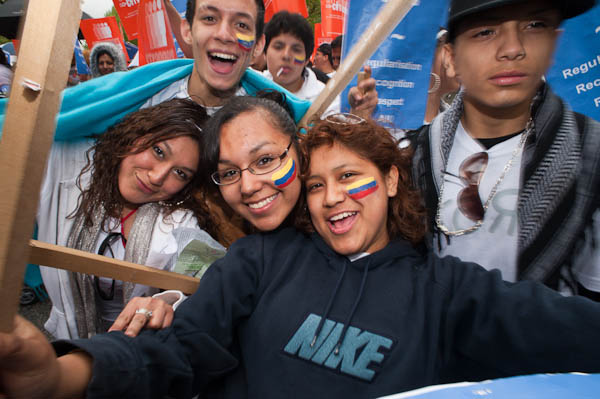
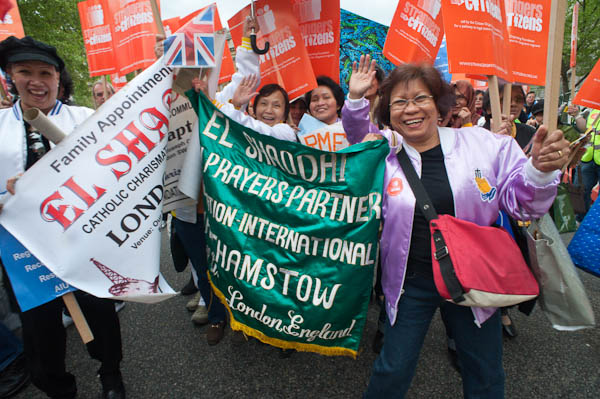
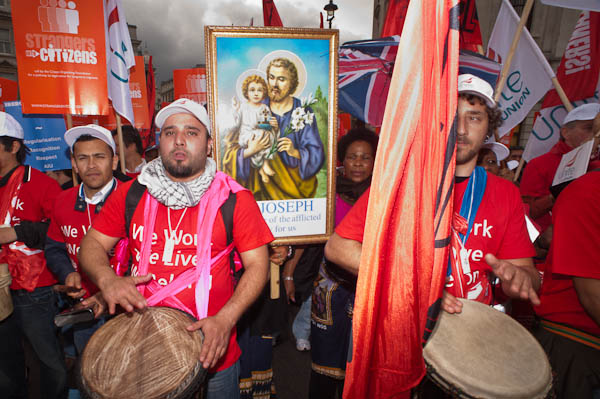
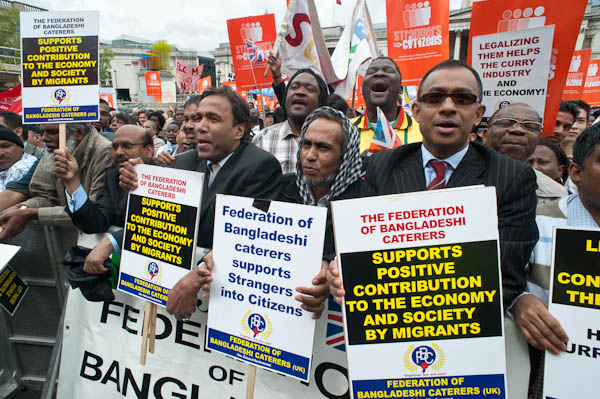
Strangers Into Citizens – Strangers into Citizens held a march and rally on Monday 4th May 2009 calling for long term irregular migrants living in the UK to be provided with a way to earn indefinite leave to remain here.
Strangers Into Citizens

There are thought now around 800,000 people living in the UK without a legal permit to do so. Accurate figures are impossible to find as these people obviously do not want to be recorded by the authorities.
Strangers Into Citizens

Many are working and carrying out work that others do not want to so but are essential to keep our economy running. One of the reasons why the UK is attractive to migrants is the size of our hidden economy, economic activities entirely hidden from HMRC.

Strangers Into Citizens

Almost one in ten UK citizens takes some part in this hidden economy, though for many their activities are on a small scale and often transitory. But almost half of those gain an income that if declared would put the above the current tax threshold. Some of these are people without legal residence, while there are others who have permission to be here but not to work. And of course others are just tax evaders.

Strangers Into Citizens

It would benefit the economy and those concerned to regularise their position so they could both work here legally and pay tax. There are also a significant number with qualifications which could take them out of the largely unskilled manual work that makes up much of the hidden economy and put their skills to work, profiting both themselves and the country. Having people with Maths or Engineering degrees making a poor living as cleaners (and I’ve met them) makes no sense when they could make a much greater contribution.

The UK has an ageing population and increasingly fewer of us are likely to be economically active – the ONS model suggests there will be an additional 317,000 people economically inactive in the UK by 2026 compared to 2023, and this trend seems likely to continue. We need migration to make up the gap and regularising the position for those already here would certainly help.
There are no legal routes to enter the UK to claim asylum and those who want to do so must either enter irregularly or come on tourist or other visas. The majority of migrants enter the country legally but overstay the terms of their visas, some claiming asylum, others just melting into the community. Another large group of migrants are the children born here to irregular migrants – until 1st January 1983 this automatically made you a British citizen but now this is only the case if one of your parents is British.

Over many years now we have seen an increasing ratcheting up of racist rhetoric and policies by the two major parties, each determined to outflank the other in appeasing the extreme right and playing on fear. The Tory government has increasingly introduced criminal sanctions against those who enter the country in ways it calls illegal, with all those arriving by them now being threatened with deportation to Rwanda, whether or not that country is actually a safe destination.

But the number Rwanda expects to take over a five years is only 1000, just 200 per year. In the year ending June 2023, official statistics show 52,530 irregular migrants were detected on, or shortly after, arrival to the UK on various routes, 85% of them on small boats. There are of course no figures for how many came and were not detected.

The UK currently does have a very limited partial amnesty scheme. Those who have managed to stay – legally or illegally – continuously for 20 years can apply for a visa which grants another 30 months of residence, while those with 10 continuous years of legal residence can also apply for an extension.

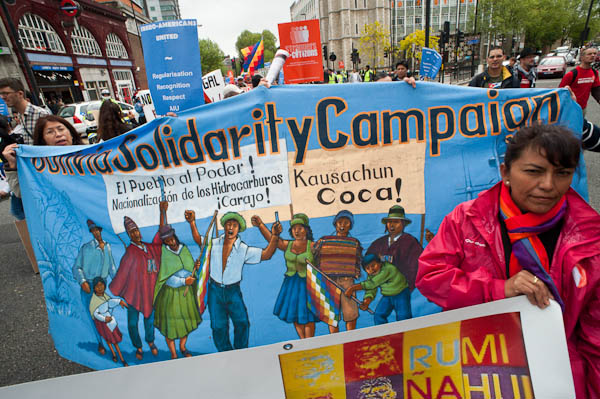
Many of those who I marched with on Monday 4th May 2009 from Lambeth were from London’s large Latin American community. Some were probably irregular but most will have entered the country legally as EU citizens and some have been given asylum here or be waiting for the Home Office to process their claim. The Home Office states the average time is six months, but the actual average is estimated to be somewhere between one and three years.

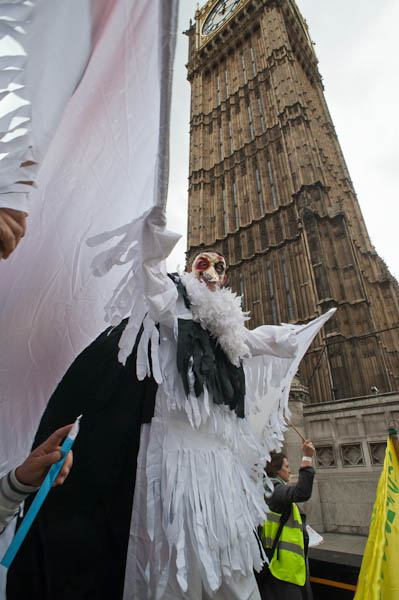
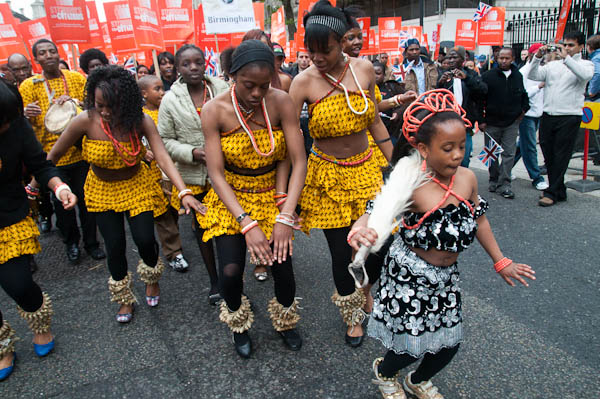
Others had marched from other areas of London, many starting from seven religious services in various parts of the city. The marches joined in Parliament Square to march together to Trafalgar Square where there were a large number of speeches in support of an amnesty from religious, political and trade union groups as well as representatives of various ethnic groups and migrants from a number of countries, followed by music and dancing.

More on My London Diary at Strangers Into Citizens.


FlickrFacebookMy London DiaryHull PhotosLea ValleyParis
London’s Industrial HeritageLondon Photos

All photographs on this page are copyright © Peter Marshall.
Contact me to buy prints or licence to reproduce.