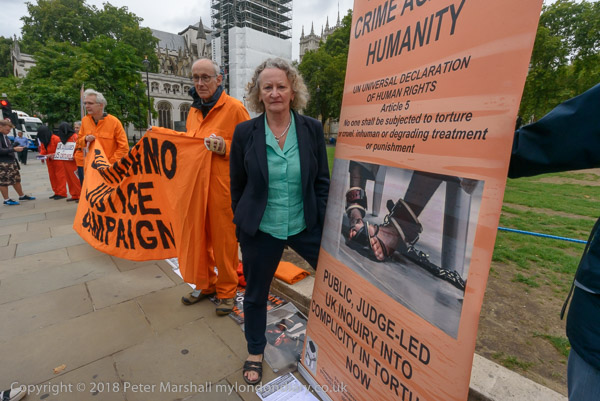
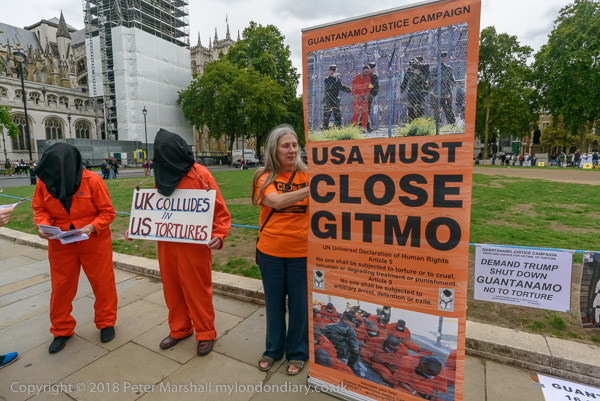
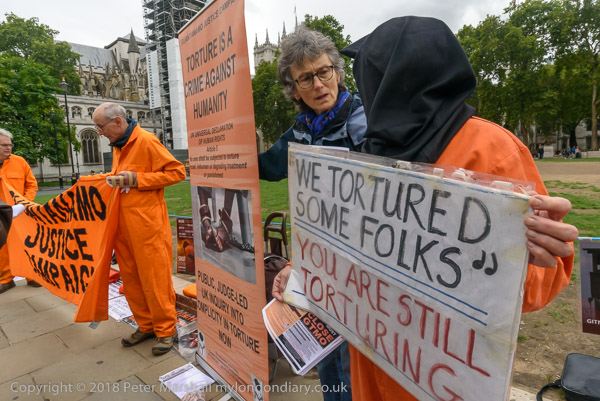
Guantanamo & Nanas Against Fracking: On Wednesday 12th September 2018 I went to Parliament Square where the Guantanamo Justice Campaign was holding a monthly vigil calling for an end to the illegal torture camp at Guantanamo and Nanas from Lancashire with others were calling for the government to end fracking. Later I went with the Nanas who marched to protest at the Department for Business, Energy and Industrial Strategy in Victoria St.
Trump told to close Guantanamo
Parliament Square
Baroness Jenny Jones came to visit the vigil
Another monthly vigil opposite Parliament called on UK Prime Minister Theresa May to make urgent representations to President Trump to close Guantanamo and end the brutality and torture which is continuing against the 40 men then still held there in indefinite detention.
They demanded Trump respect human rights and internation law, saying the illegal camp is a legal and moral outrage and a symbol of US torture and injustice.
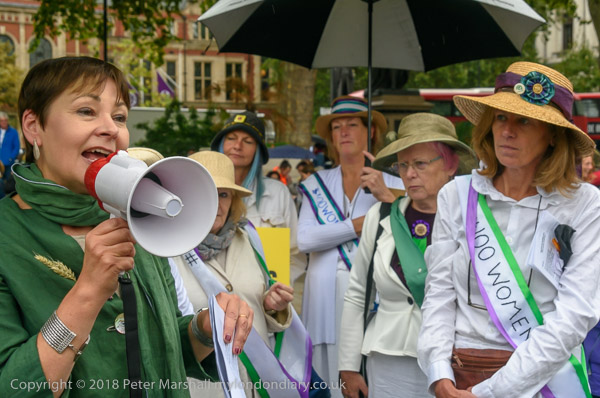
The protesters were joined briefly by Green Party member of the House of Lords Jenny Jones, Baroness Jones of Moulsecoomb.
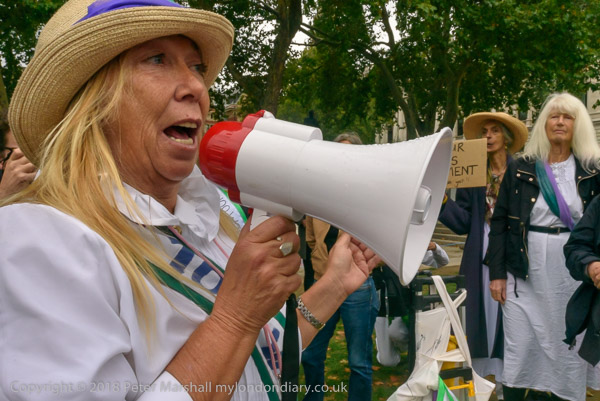
Lancashire Nana Tina-Louise Rothery speaks at the protest
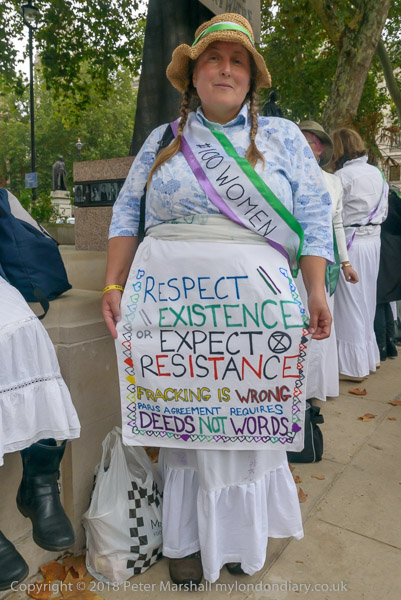
Following 3 months of “Love & Defiance” that took place from April-June in Lancashire by the Nanas they came to London to tell the government to stop ignoring science and the will of the people and ban fracking.
As well as threatening the areas of the country in which it was taking place with earthquakes and pollution, fracking is also a threat to the future of the planet through its high level of carbon emissions.
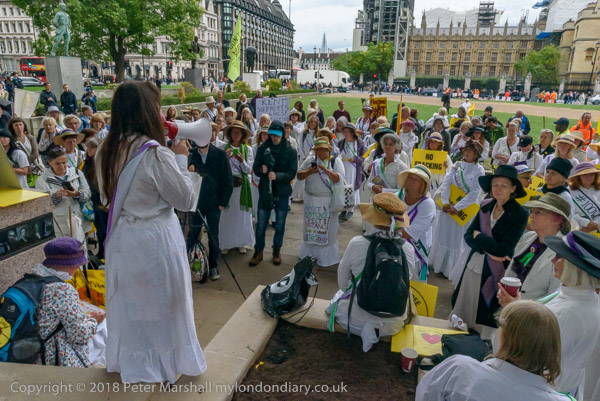
Many of the protesters wore suffragette costumes to mark the 100th anniversary of women first getting the vote in 1918 and called on the government now to make voting mean something. The rally took place in front to the statue of suffragist campaigner Millicent Fawcett.
Green Party MP Caroline Lucas
Speakers at the rally included Ruth George, Labour MP for High Peak, Jenny Jones, Baroness Jones of Moulsecoomb, Mike Amesbury, Labour MP for Weaver Vale, Lancashire Nana Tina-Louise Rothery, Shadow Chancellor John McDonnell and Green Party Deputy Leader Amelia Womack.
Also speaking at the rally were women against a proposed move of the statue of suffragette Emmeline Pankhurst, funded by suffragettes in 1930, from Victoria Tower Gardens next to the House of Lords to Regent’s Park, which they described as an “act of vandalism against women’s history“.
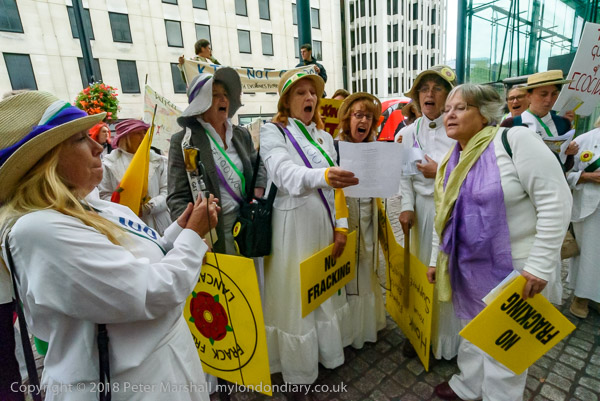
Nanas sing in protest against fracking at the BEIS
At the end of the rally in Parliament Square, the anti-fracking women protesters in Suffragette dress marched around the square and on to the Department for Business, Energy and Industrial Strategy in Victoria St for a noisy protest there.
Women get ready to march to the Department for Business, Energy and Industrial Strategy in Victoria StOutside the Department for Business, Energy and Industrial Strategy
One woman climbed on the low wall in front of the delivery bay at the centre of the frontage and others followed with more moving inside behind to support them.
The protest continued between the two wings of the offices and on the pavement in front with much shouting and singing.
Suicide, Arms Dealers & Letting Agent; Friday 11th September 2005 I began with a protest outside Parliament on a matter which is still being debated inside Parliament today, having been talked out by opponents in the House of Lords earlier this year – Assisted Suicide. I went on to the continuing protest outside the DSEi Arms Fair at the Excel Centre in Newham before finally going further east to Goodmayes in Redbridge where United Voices of the World were supporting a member to get back his life savings from a letting agent who failed to provide the property and was refusing to repay the money.
Assisted Suicide Debate Lobbies
Old Palace Yard, Westminster
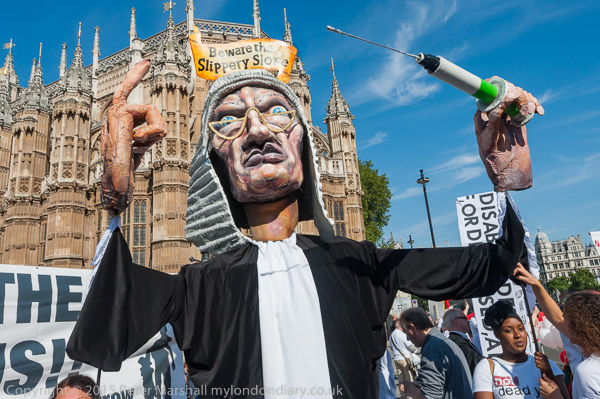
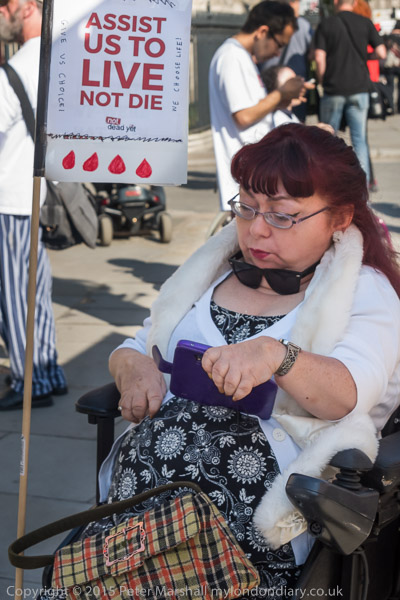
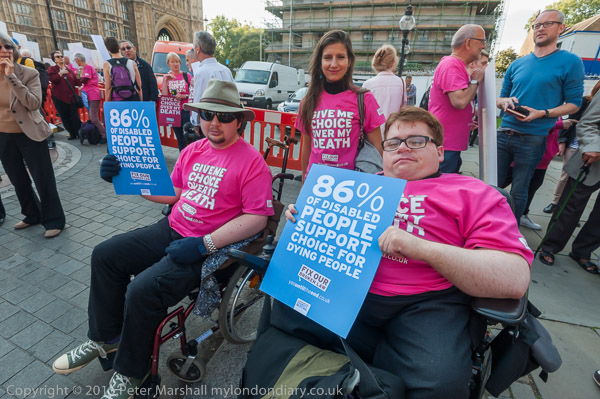
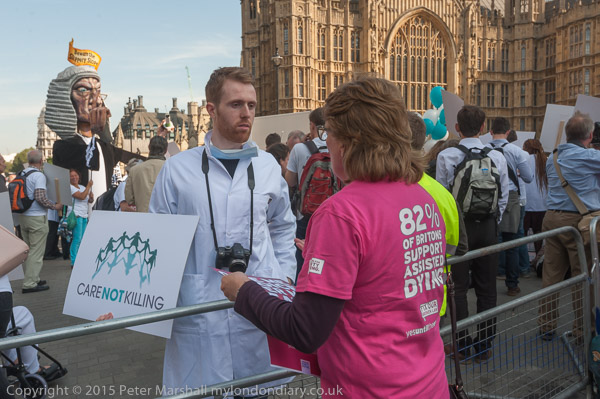
Rival groups of protesters for and against the Assisted Suicide Bill were protesting at Parliament on the day that the bill was being debated.
Not Dead Yet UK were opposing the bill and were supported by disabled protesters who had recently lost ILF support now feel threatened by the Bill.
The Campaign for Dignity in Dying had come to support it, calling for our broken law to be fixed. There were also some disabled protesters supporting them, and claiming the support of 86% of disabled people.
There was a barrier between the two groups and there were some quiet arguments across it. The current law is certainly not satisfactory but it is hard to see how it can be changed without putting some at risk. For good reason the activities of doctors are now much more in the open – we remember Harold Shipman, thought to have killed around 250 of his patients over 24 years as a Manchester doctor, but perhaps now there are too many who “strive needlessly to keep alive” rather than risk allegations of misconduct.
The ‘Alternative Border Farce’ attempt to stop lorries bringing exhibits to the arms fair
I arrived at the protest camp close to the East Gate into the Excel Centre while a rally was taking place on the side of the road leading into the centre.
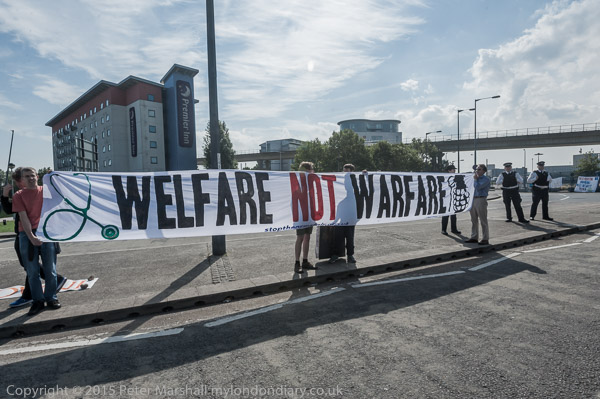
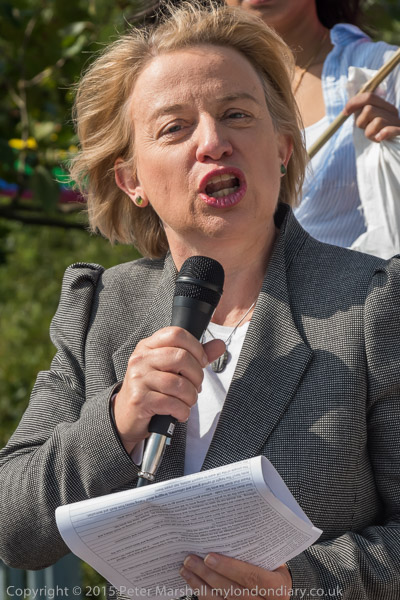
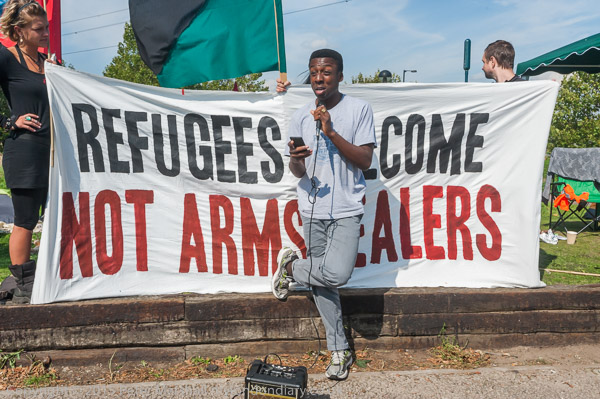
‘Welfare NOT Warfare’ was the message of a long banner held on the central pavementGreen Party Leader Natalie Bennett speaks about the UK’s failed foreign policy and massive arms supply at the root of the world’s worst refugee crisis since the Second World War.
Speakers, including Green Party leader Natalie Bennett, Simon from Occupy The Arms Fair, Rita Chadha of Refugee and Migrant Forum of Essex and London, Cecil of Black Dissidents, Spike of Veterans for Peace pointed out the injustice in allowing free movement of arms while restricting the movement of the refugees the use of arms creates.
Cecil of Black Dissidents speaks about the racism behind the treatment of migrants
Arnold (from Sierra Leone) and Kiarash (from Iran) talked of their personal experiences of the problems faced by those seeking asylum in the UK, and some refugees waiting to come here from Calais were able to speak by phone.
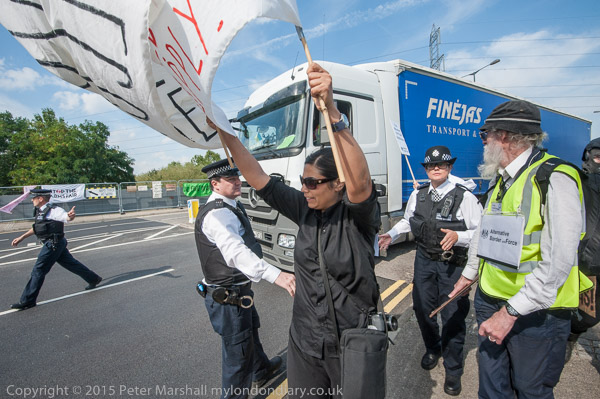
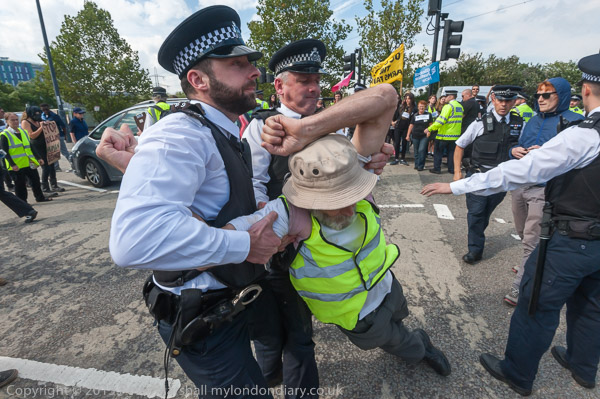
When the rally ended a group of protesters formed themselves into an ‘Alternative Border Farce’ and stood in the road in front of lorries attempting to go into the Arms Fair. Police warned them they might be arrested but while I was there simply pushed them, occasionally rather more forcefully than seemed necessary, out of the road when each lorry approached.
The protesters managed to hold up several lorries for a few minutes, but more police arrived and by the time I left they were able to escort the lorries through with a line of police on each side.
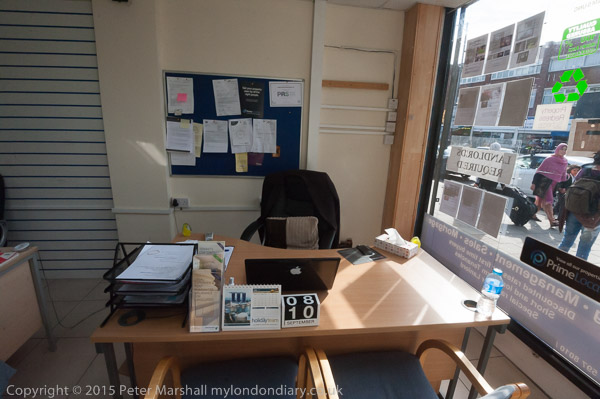
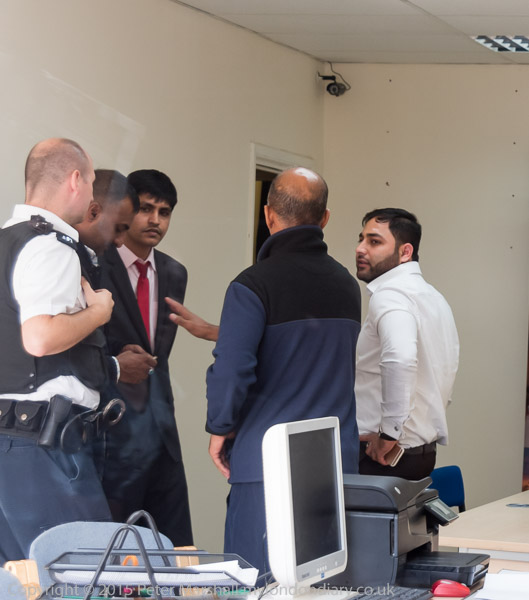
Hunter Home Properties Ltd is this single desk by the window
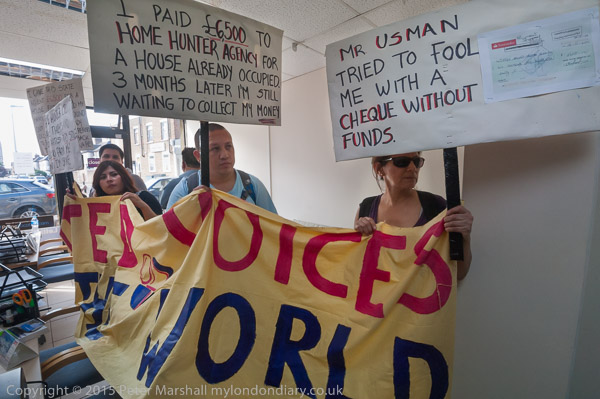
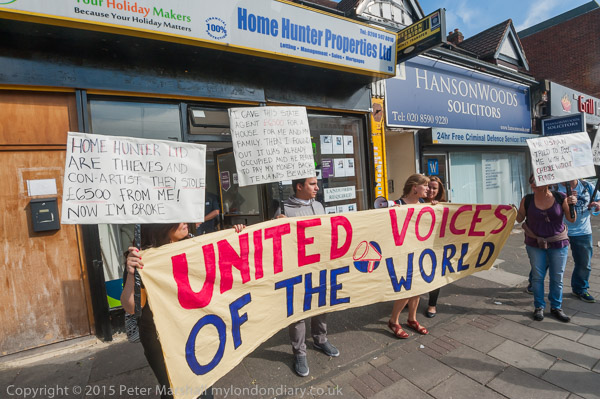
United Voices of the World trade union member Carlos had paid his life savings of £6,500 to estate agent Usman Bhatti of Home Hunter Properties Ltd in Goodmayes as deposit and 2 months rent on an house for his family. But the house was not available and he was now homeless and unable to get most of his money back.
The UVW had been trying to get Carlos’s money back for several month, and had been promised it would be paid and even given a cheque – which bounced. But now Mr Bhatti was not answering calls so the union decided to pay him a visit.
I went with a dozen members of the UVW and Carlos to the office in Goodmayes which Bhatti shares with other businesses – he had a single desk by the window though his company name was prominent on the shop front.
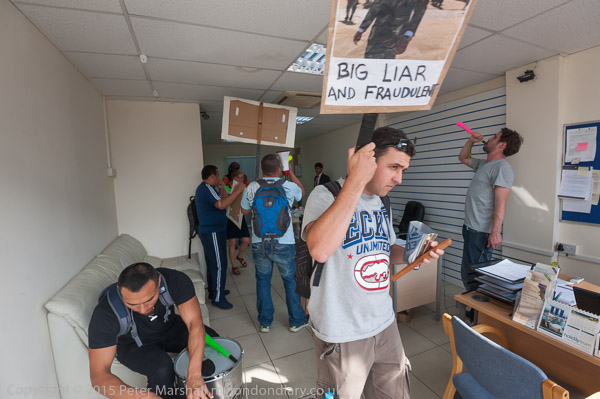
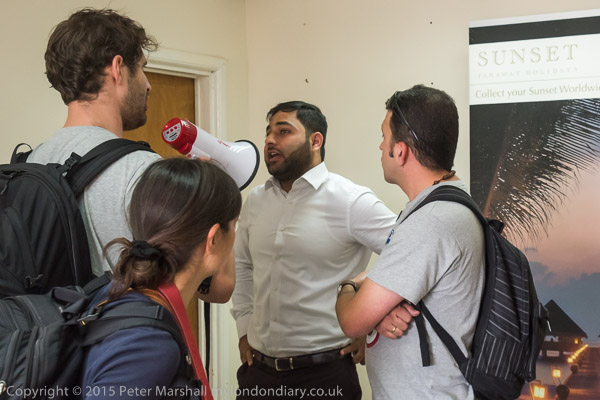
They went inside the shop and began a noisy protest with drums and horns, bringing in their banner and placard. UVW General Secretary Petros Elia then talked to Bhatti and the others went to continue the protest on the pavement outside.
Mr Bhatti promised to pay but could not do so immediately and said he would do so within two weeks, but the protesters were not convinced as he had make similar offers in the past and not kept to his promises.
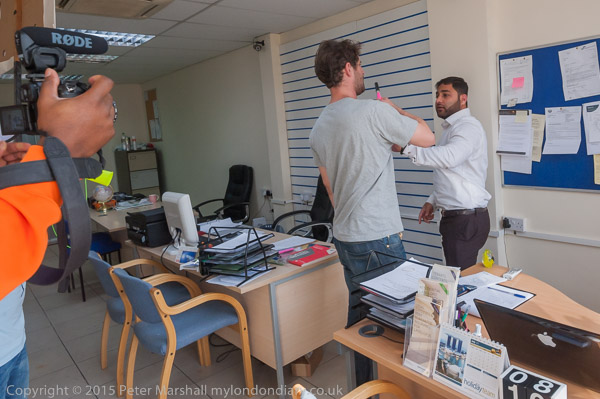
The protesters went back into the shop and Mr Bhatti then lost his temper and tried to grab a vuvuzela that Elia was blowing in his direction, assaulting him. But he soon calmed down and took Carlos and Elia into a back room for more talks, accompanied by the videographer who was also recording the protest.
Shortly after they came out, two police officers arrived, talked to both the protesters and people inside the office. There seemed to be no problems and the protest was ending so I left to catch a train back into London.
Back home I I heard that shortly after I left the police had arrested Petros and another of the protesters, and that Petros was being charged with assaulting Mr Bhatti. I was shocked, not least because I had seen the opposite happening.
DSEi Arms Fair & Sotheby’s 2: On Monday 7th September 2015 I went to the protests outside the world’s largest arms fair which was takes place in East London every two years and on my way home went to a protest in Battersea Park at Sotheby’s international car auction calling on the company to reinstate two sacked cleaners.
DSEi Arms Fair protest Israeli Arms Sales
Excel London, Royal Victoria Dock
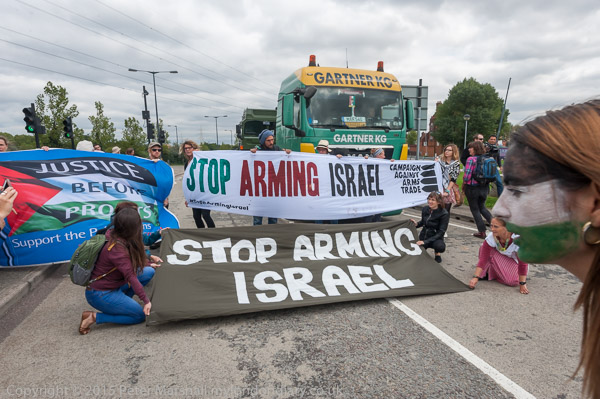
Protesters stopped a lorry going to the DSEi arms fair with a military vehicle for around 2 hours
Protests were taking place on the first of six days outside the world’s largest arms fair, sponsored by the UK government at the Excel Centre. Occupy Democracy had set up a protest camp close to the East Entrance to the Excel Centre.
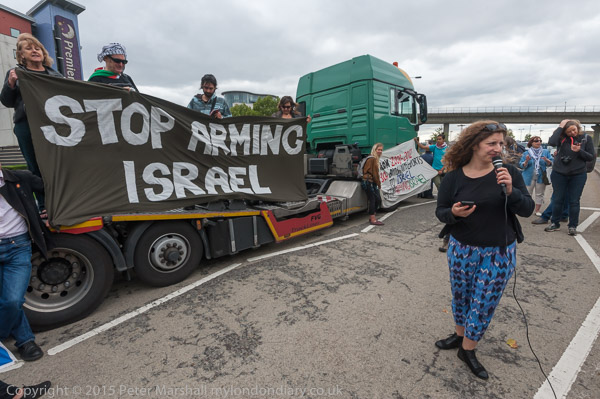
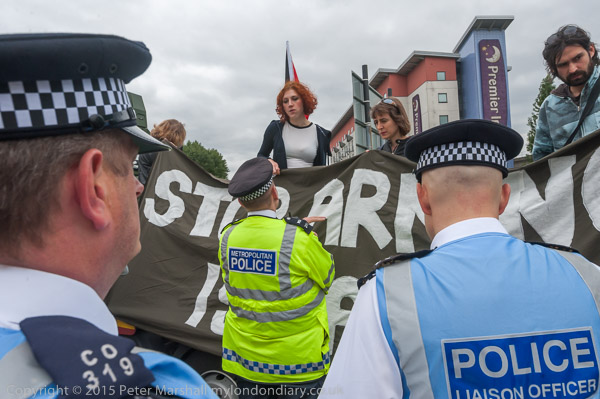
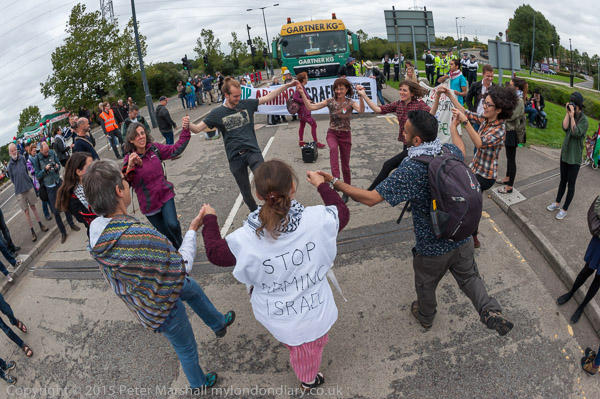
The theme of this day’s protest organised by the Stop The Arms Fair Coalition and Occupy Democracy and supported by Campaign Against The Arms Trade and a broad coalition of protest groups was ‘Stop Arming Israel’.
Israel also has a large arms industry and they were selling their arms at the fair which were said to be ‘battle-tested’, having been used against the Palestinian people in Gaza as well as in Syria.
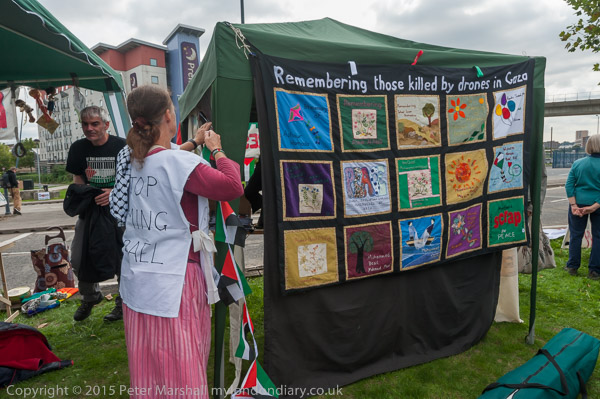
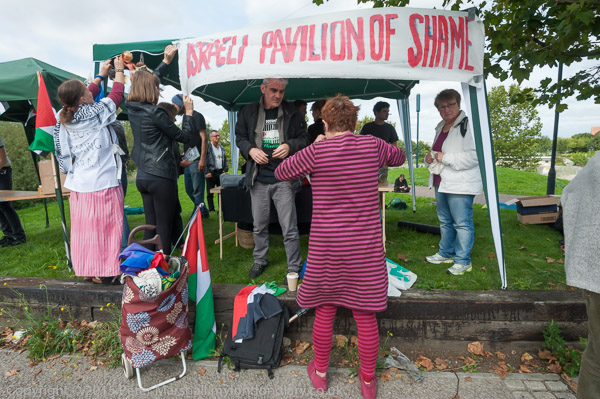
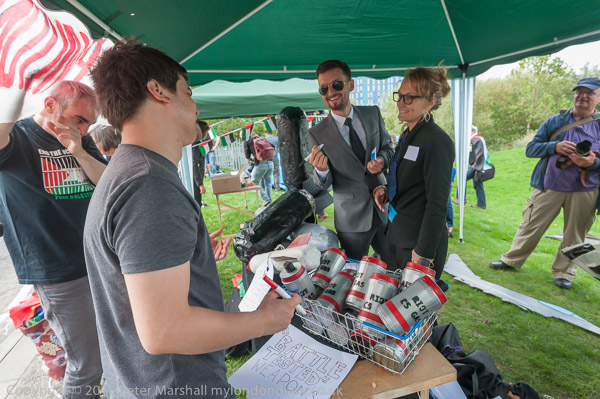
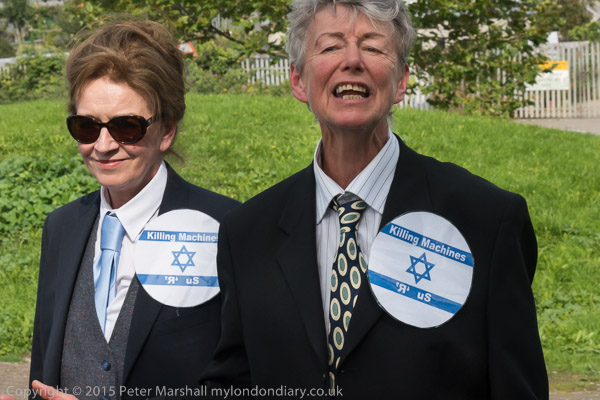
When I arrived protesters were setting up a couple of stalls, one to ‘sell’ mock Israeli arms – with arms dealers D. Eath and C. Arnage, who were later joined by two enthusiastic sales representatives apparently from a proudly Israeli firm ‘Killing Machines Unlimited.’
Sales reps from the (fictional) Israeli company ‘Killing Machines ‘R’ Us’
Excel had fenced in the roundabout at the gates, claiming they owned it, so that protesters were unable to camp there. Later it was found that it belonged to Newham Council and that they had not given permission for the fence, but it did provide a good place to put up a huge banner with the message ‘Stop Arming Israel.
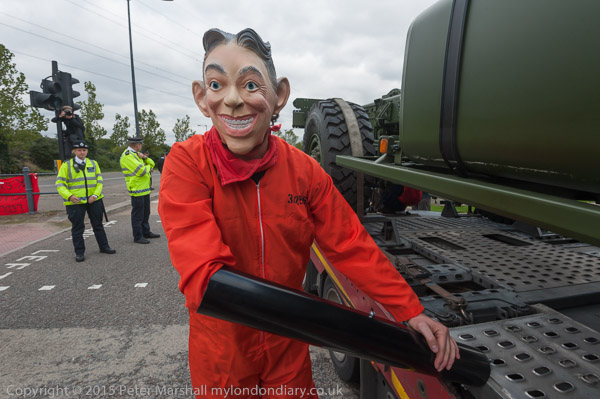
When a large low-loader arrived carrying a military vehicle protesters rushed into the road to block it and one in an orange jumpsuit and Tony Blair mask locked on to it. Others jumped up on to it. A woman who used a white-board marker to write ‘ARMS TESTED ON CHILDREN’ was arrested for ‘criminal damage’ although the slogan would easily wipe off without trace.
‘Tony Blair’ locked on. Protesters still hope to see him tried for war crimes onver the invasion of Iraq
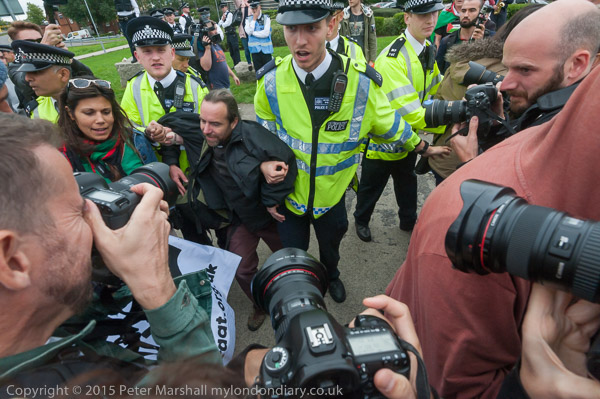
After around 45 minutes police warned the protesters they might be arrested unless they moved away and most did, but then began a Dabke Arab folk dance workshop in front of the lorry. The police then called for reinforcements and when they arrived they pushed the protesters off the road, allowing the bemused Hungarian driver to move on.
Police come and warn the protesters on the lorry, asking them to leaveThe Dabke dance workshop in front of the lorry. Police watch but don’t danceEventually police lose patience and a large group come and push or drag eveyone from the road, watched by the photographers
In 2026 the UK still sells arms to Israel which are being used in the genocide of the Palestinian people and some of those protesting against this have been given long prison sentences as ‘terrorists’.
A line of police stopped the protesters at the entrance to the auction site
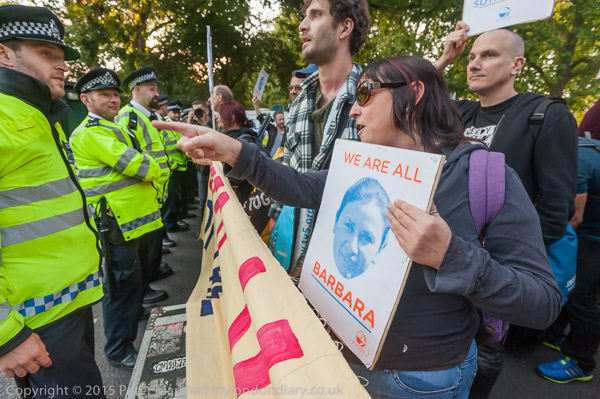
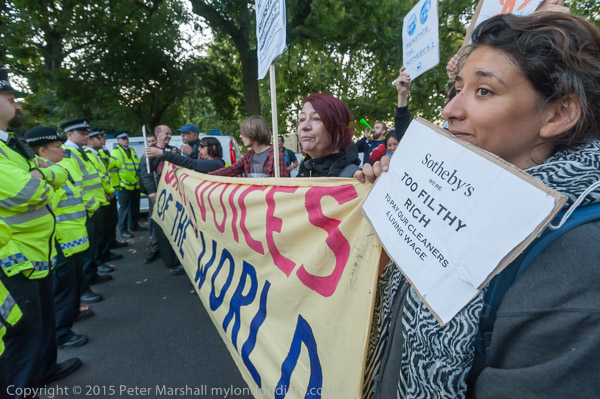
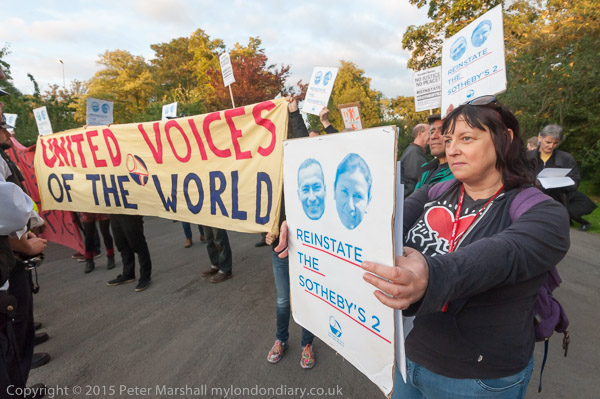
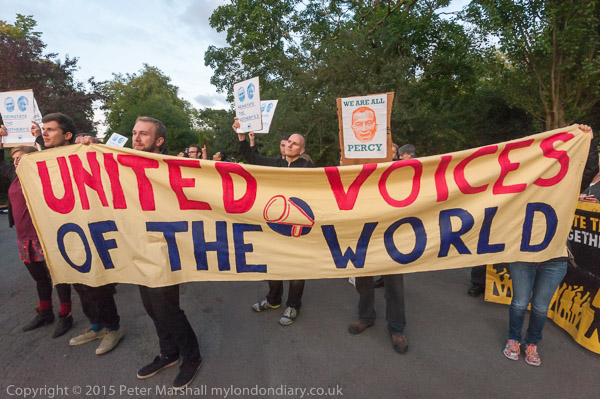
Barbara and Percy, two cleaners at Sotheby’s in New Bond Street had been sacked after they took part in a protest calling for proper sick pay, holiday pay and pensions, and their trade union, the United Voices of the World had organised a number of protests including this one to demand their reinstatement.
Along with members of the UVW the protest was supported by Class War, SOAS Unison and Unite the Resistance and I met them outside Battersea Park Station from where they marched to the Sotheby’s auction site, Battersea Evolution inside Battersea Park, where police prevented them from entering.
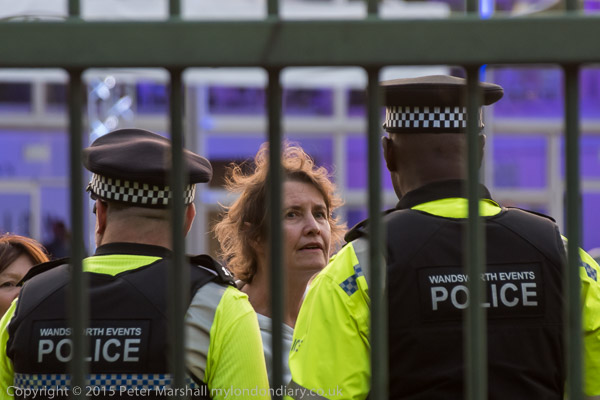
Although they were some distance from the actual auction, the noisy protest could clearly be heard there, as one of those present at it, the mother of UVW General Secretary Petross Elia, came to tell us across the gates.
The protest continued for some time and I was tired and left before the end, missing a a spectacular performance of fire breathing by one of the protesters.
The campaign by the UVW eventually resulted in all outsourced workers there including cleaners, security guards and caterers becoming the first group of outsourced workers in the private sector to receive occupational sick pay – at a significantly enhanced rate to statutory sick pay.
Monkey Business, Wrecked Cars & Roupell: I’d thought when I wrote my previous post about 1990 that my day on April 1st 1990 had finished when my walk in Stoke Newington ended, but my contact sheets and the dates written on them tell a different story.
I’d not gone to the Poll Tax demonstration the previous day, but from Stoke Newington took the tube down to Covent Garden and walked to St Martin’s Lane and Tottenham Court Road where I photographed a few burnt out cars before going on to Waterloo East and catching a train to Lewisham to take more photographs there.
Monkey Business was a restaurant in Covent Garden which apparently came to an untimely end around 1991. In a Facebook post Sajan Narain relates: “While I was studying at Cambridge, a few of us friends went to Monkey Business, an aptly named restaurant in Covent Garden. While we were dining in the basement there, we heard loud sounds of guns being fired, and smashing of glass, like sound effects from an action movie. Waiters and staff were running around shouting.
We saw lots of huge red marks on white shirts worn by waiters. It turned out to be blood. There was a huge gang war going on above us. Many shots were fired and glass windows at the front of Monkey Business had been smashed.
Armed police, ambulances, doctors and paramedics arrived while we were there. We survived the gang war without any injuries. After that incident, Monkey Business had to be shut down, unfortunately.”
Burnt out car, St Martin’s Lane, Covent Garden, Westminster, 1990, 90-4b-21
Back in 1990 I rarely photographed demonstrations, mainly only on the large marches of organisations to which I belonged such as the Anti-Apartheid movement and CND. Although I was aware of protests against the Poll Tax – and had photographed people burning their community charge demands – I did not attend the major protest called for March 31st when around 200,000 crowded into the area around Trafalgar Square.
The police had thought there would only be a few thousand and laughed at the protest organisers when they had suggested there could be 20,000 but it turned out much, much larger and the police were unprepared.
Heavy-handed policing, including the violent arrest of a man in a wheelchair and a charge by mounted police into the crowd in Trafalgar Square, followed by police driving riot vans into the crowd aroused huge anger from the protesters, many of whom began attacking the police with anything to hand, including scaffold poles. The police actions turned what would have been an angry but largely peaceful protest into a riot.
According to Wikipedia “Scuffles between rioters and police continued until 3 am. Rioters attacked numerous shops, most notably Stringfellow’s nightclub, and car showrooms, and Covent Garden cafés and wine bars were set ablaze, along with motor vehicles.”
A police report the following year found “no evidence that the trouble was orchestrated by left-wing anarchist groups”, though some of these definitely claimed the credit. As usual at protests, most of those responsible for attacks on police evaded arrest and those arrested were largely bystanders and many were acquitted with video evidence showing the police had “fabricated or inflated charges”.
Protests including this one against the Poll Tax led to the questioning of Margaret Thatcher’s position as Prime Minister and led to her replacement by John Major. In 1991 he announced his intention to replace the Poll Tax by a new Council Tax, still in operation.
This returned to basing tax levels on property valuations but was in many respects a much cruder and less fair system than the former rates, particularly favouring owners of large and expensive properties at the expense of those in moderate and smaller homes.
Rooftops, Waterloo, Lambeth, 1990, 90-4b-26
My day was still not finished and I was on my way to Lewisham. As I walked down to the platform at Waterloo East station I pushed my camera through the gap in one of the slightly open windows and took this picture of the rooftops of Roupell Street and its neighbours.
These densely packed late Georgian worker’s cottages were developed by metal merchant John Roupell in 1824. He had married the daughter of a wealthy City wine merchant and after she inherited a wealthy aunt’s estate in Essex bought around 7 acres here at a cost of £8,000 to develop the Roupell Park Estate, its streets named after his family.
In their early years many of these small 4-roomed houses will have housed perhaps four large families, one to a room, perhaps over 20 people. These streets are much used as settings for films and TV, and the small houses now sell for around £1.5m
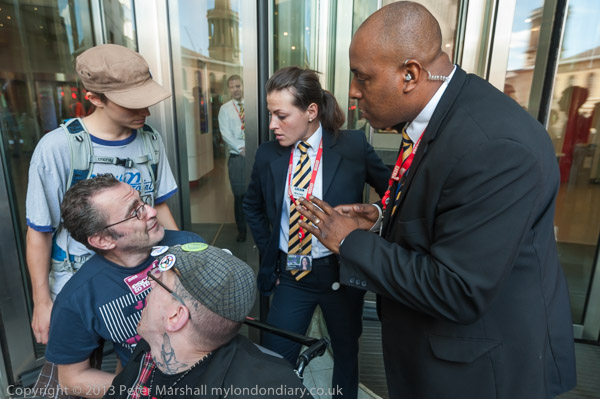
BBC security try to get a protester to move – but he refuses
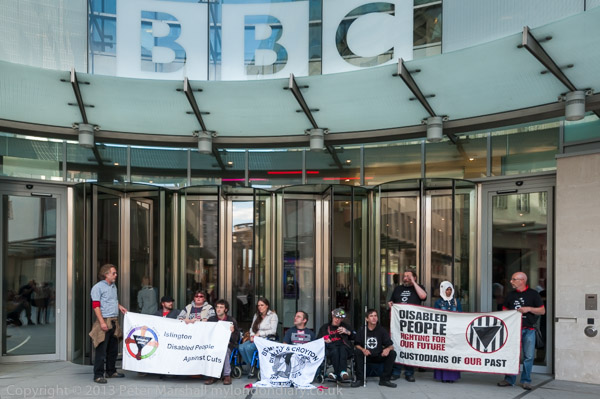
DPAC at BBC – Tell The Truth! Although the BBC has some excellent reporters and produces some great programmes, particularly on Radio 4 and in its World Service, in its coverage of the UK it too often acts as a government mouthpiece. In particular few if any protests get reported, and I would be fairly sure that this one on Monday 2nd September 2013 at Broadcasting House got no mention in the day’s news.
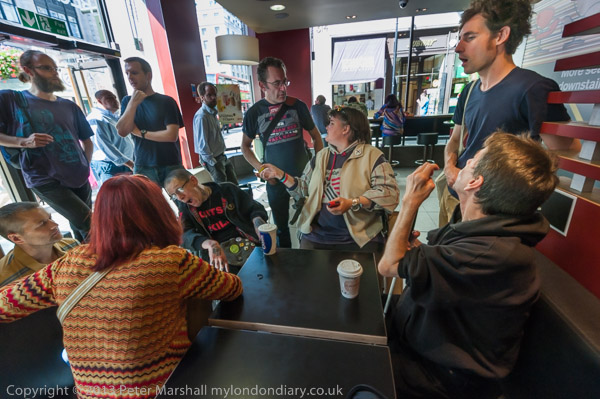
Activists meet up in a McDonalds not far from the BBC
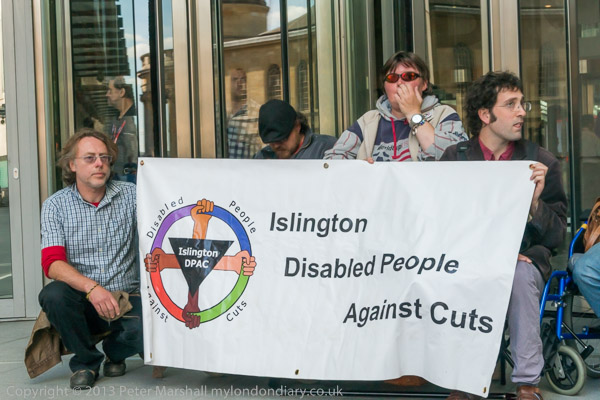
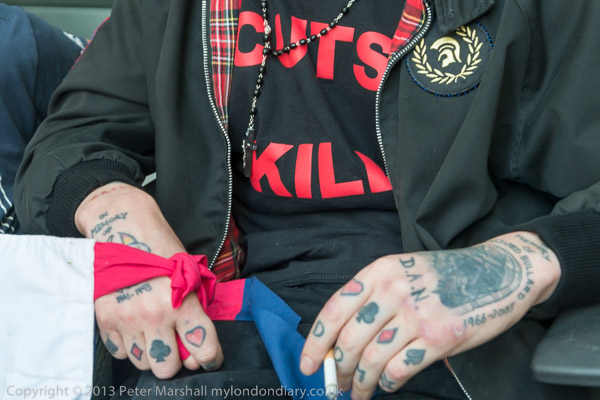
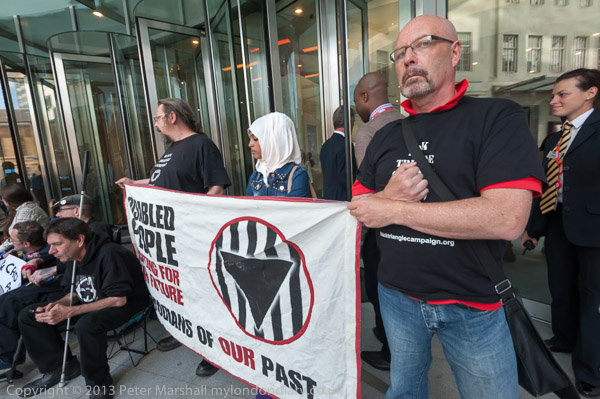
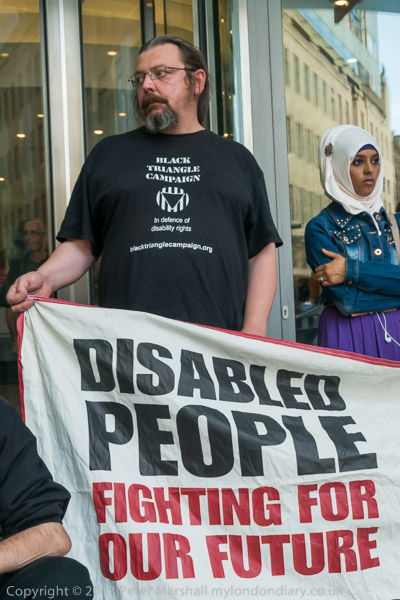
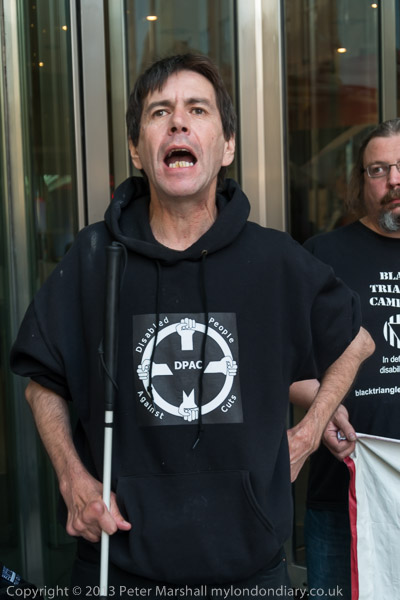
Disabled People Against Cuts (DPAC) and the Scottish Black Triangle campaign came to protest at the failure by the BBX to report truthfully the effects of government cuts – particularly hard on the disabled – blocking the main BBC entrance to Broadcasting House for an hour.
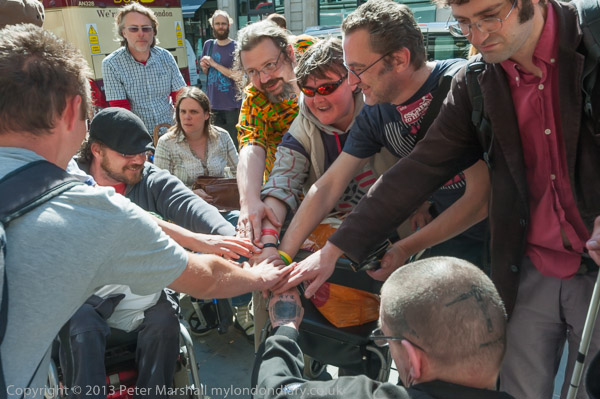
Outside they joined hands before setting out on the protest
The BBC of course relies on the government to award the licence fee settlement and it also appoints the members of the trust which is responsible for its running. And many appointments of senior staff – from the Director General down are essentially made by the government, so it is perhaps unsurprising that the BBC as a whole fails to offer any radical perspective on UK affairs.
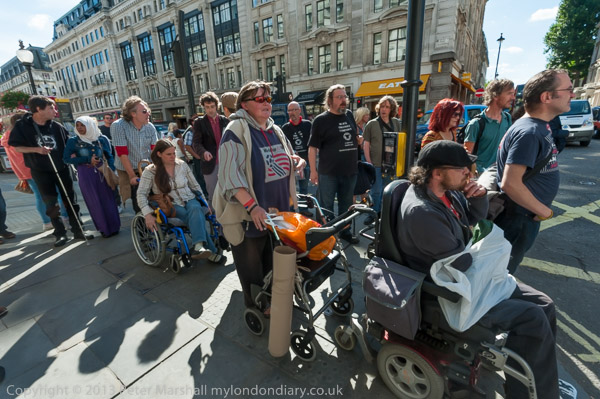
They make their way along the street to the BBC
When the Tories came back into power – at first with the help of the Liberal Democrats to whom they threw a few minor carrots (including the 2011 rigged referendum on proportional representation) they instituted an austerity programme that in particular targeted the disabled.
The protesters set up quickly across the entrance
They clearly thought that supporting the disabled was a waste of money and that they would be an easy target to reduce benefits. DPAC and others had shown them they were wrong, with a series of direct action protests – which the BBC largely failed to report, although some were covered by foreign media.
Disabled people had several advantages which aided their protests. Firstly they enjoyed a great deal of public support which meant in particular that police (who often also sympathised with their case) had to handle them with much more consideration and care than non-disabled protesters, particularly when the press were present. Batoning people in wheelchairs would not be good for the public image – and I never saw it happen.
And secondly they presented practical problems for the police, particularly in making arrests of protesters in wheelchairs or on mobility scooters. Police cars and vans are not generally equipped to handle these safely. I can only remember one protest where the police had hired a suitable vehicle – and it only accommodated a single wheelchair.
DPAC invited me to photograph this protest and I met them in a nearby cafe to discuss final plans before making their way with legal observers and a few photographers unnoticed to the main entrance of the BBC building.
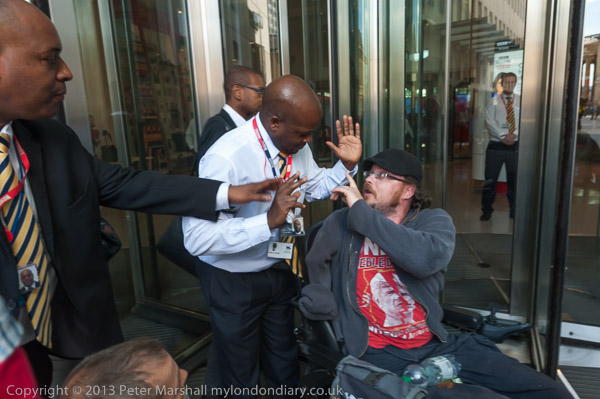
Here they spread across the doors and brought out their banners. BBC security failed to stop them but did manage to keep one door at the end free so people could still enter and leave the building.
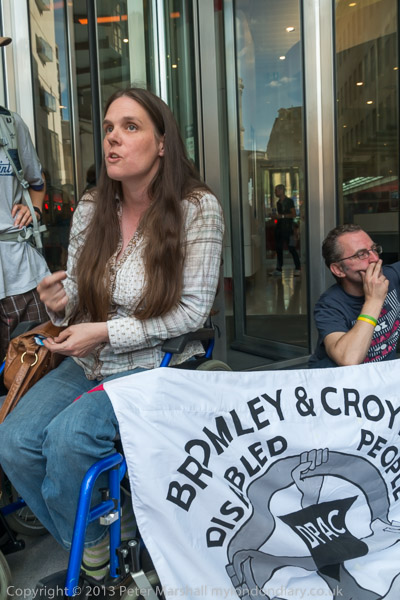
Many of the protesters spoke about why they were there, calling on the BBC to do its job and report properly on the effects of the cuts on the disabled
A number of the protesters then spoke in turn about the failure of the BBC to report the real hardship caused by ATOS assessments and the withdrawal of benefits, benefit cuts and caps and the bedroom tax. They were all fed up with the BBC repeating the lies and half-truths of government and asked why the real problems and numerous deaths from the austerity programme and the protests over these were not being properly reported.
BBC security try to move the protesters but after some argument they backed off
The situation was dire for many poor and disabled people, with over 500,000 having to resort to food banks set up by churches and charities to fend off starvation.
The protesters chanted ‘BBC, Tell the Truth’ and called for someone from the BBC to come and discuss the issue with them – but no one came. They made clear they were not asking for special treatment for the disabled but for the BBC to live up to the reputation it once had for impartial reporting.
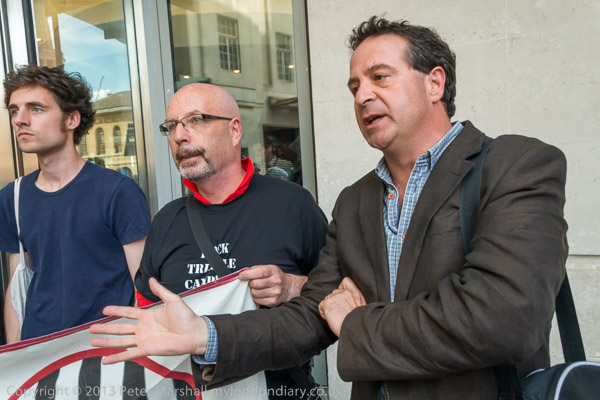
Mark Thomas congratulated the protesters and expressed his support for their attempt to get the BBC to report in an unbiased manner
They were joined for some minutes by activist comedian Mark Thomas who had been at a meeting inside the BBC. He recognised some of the protesters, talked with them and gave a short speech in support.
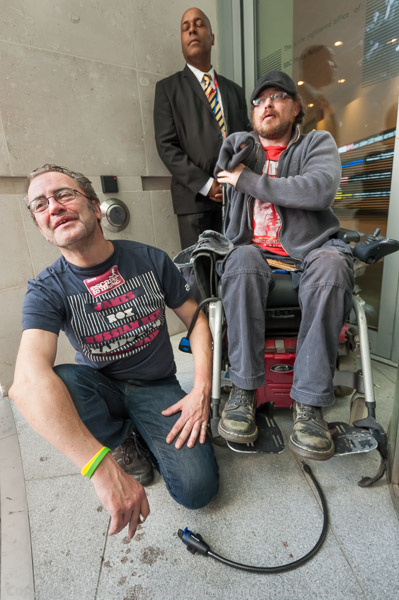
Shortly after two of the protesters in wheelchairs moved to lock themselves in front of the remaining open door closing it for the remainder of the protest. BBC security then called the police and two cars arrived.
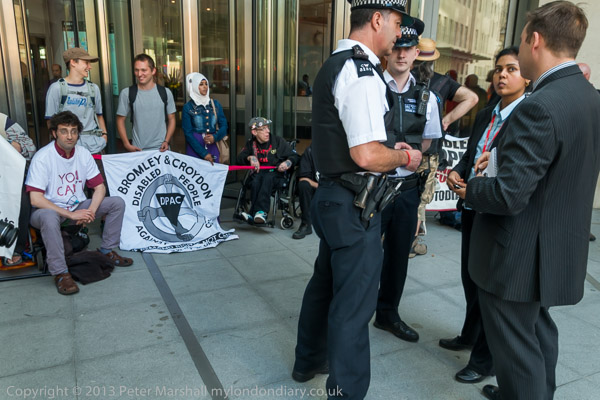
Police talked with security and then came and talked to the protesters. The told the police it was a one hour protest and they would then leave peacefully. Police stayed and watched until the end of the hour when the protesters got up and left.
Before they did so, a BBC cameraman arrived having been asked to film the protest – not for news but for possible use in the future. “I joked with him he might try and sell the footage to Sky or some other broadcaster who were rather more likely to use it.”
Diana & Mass Lone Demo: On Thursday 31 August I went with a friend to the gates of Kensington Palace on the ninth anniversary of the killing of Princess Diana (I think I deliberately misspelt her name twice as Diane to show my lack of interest in the royals) before going to a pub in Kensington.
Later in the day I went to Parliament Square for the Mass Lone Demonstration suggested by Mark Thomas in response to the ludicrous and dangerous restrictions on protests in a large area around Parliament and other designated sites imposed in the Serious Organised Crime and Police Act 2005.
Princess Diana, 9th Anniversary commemoration
Kensington Palace
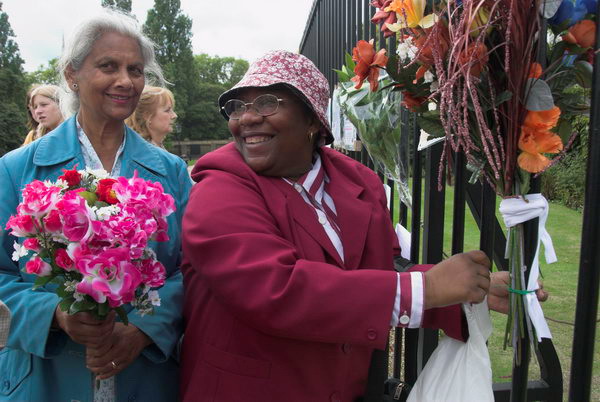
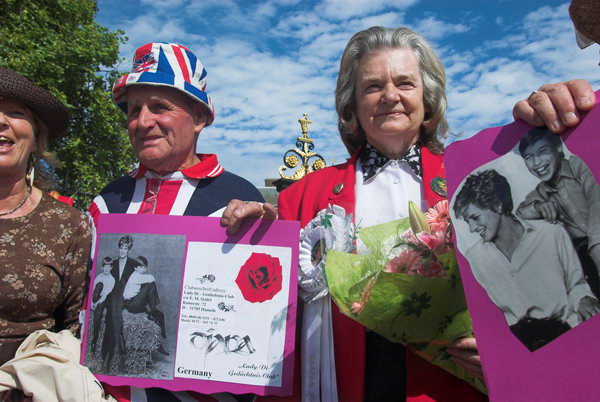
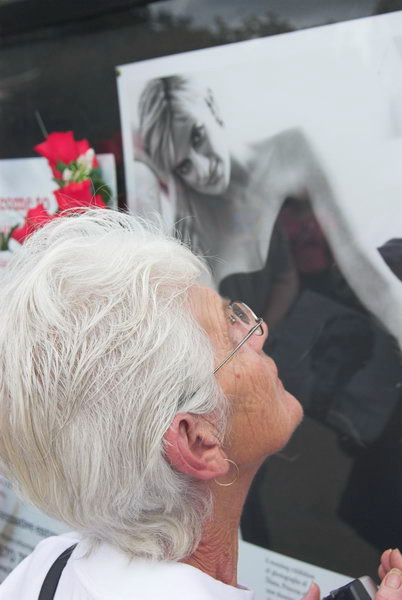
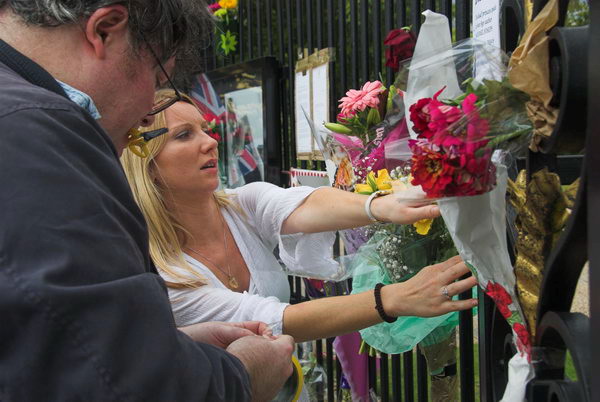
The last day of the month was the ninth anniversary of Diana’s death, and her fans, including members of the Diana Circle, were at Kensington Palace to mark the event, taping flowers and tributes to the gates and fence. I’d gone to meet a friend, who had extensively photographed the scenes there in the days immediately following her death.
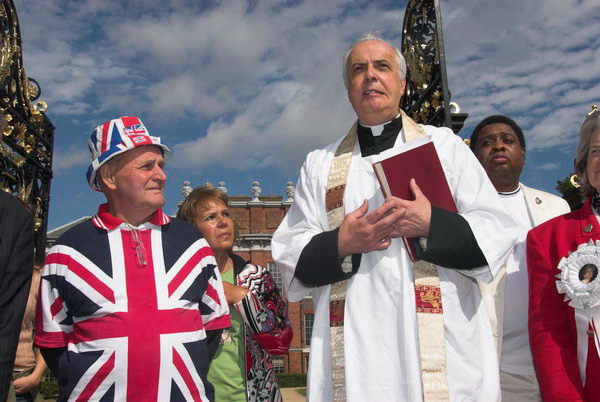
The fans had come from all over the country, and from Germany and elsewhere. Father Frank Gelli, who was curate of St Mary Abbots just down the road at the time of her death, led prayers at a short memorial service. Throughout the day more people arrived with tributes and flowers. Next year on the 10th anniversary there are hopes for a bigger event. [And I went again then.]
Kensington Palace has had a bit of a face lift, doubtless benefiting from the Diana effect on visitor numbers. However, rather than taking a visit there, we went to visit the Elephant And Castle, and old press pub, taking a short detour through St Mary Abbots on our way.
Later in Parliament Square I got a small badge ‘Mass Lone Demonstration 31/8 Parliament Square‘. This was an idea from Mark Thomas, who had suggested that as many people as possible should give the required one weeks notice to the police that they planned a solo demonstration in parliament square from 6-7pm.
I’m not sure how many did so, though there were perhaps around 50 with different placards while I was there. If I’d heard about it in time, I would perhaps have applied and arrived with a poster “End Police Harassment Of Photographers“.
One of the stupidest things that the Labour government have done was to try to pass a law to get rid of Brian Haw, whose continuing protest opposite the Houses of Parliament was causing minor embarrassment to Labour ministers, particularly Mr Blair. They managed to tag it on to something called SOCPA, the Serious Organised Crime And Police Act 2005.
The blunt weapon they wielded banned all demonstrations without a weeks notice within a kilometre or so of parliament, and much to their disappointment it has so far failed to get rid of Brian. Actually he’s a reasonable man, and if they had instead done something serious to stop children being killed in Iraq he would have been out of the square immediately.
Instead they choose to strike at free speech for all of us. It’s a law that has so far resulted in some farcical prosecutions (though with serious consequences for those taken to court.) Many of the police I’ve talked to obviously feel the law is an ass, and resent having to try and enforce it. Often they’ve turned their backs and walked away from illegal events (or even escorted the people carrying them out when they were company directors), but it has also wasted huge amounts of public money when they have been pushed into action.
One of the provisions of the law is that a lone demonstration – one person with a placard – is automatically to be granted permission provided a week’s notice is given, although conditions may be attached either when the permission is granted or by a police officer on the spot. It was Mark Thomas who had the idea that there could be a large number of such demonstrations at the same time and place, and it was made public on several blogs and web sites.
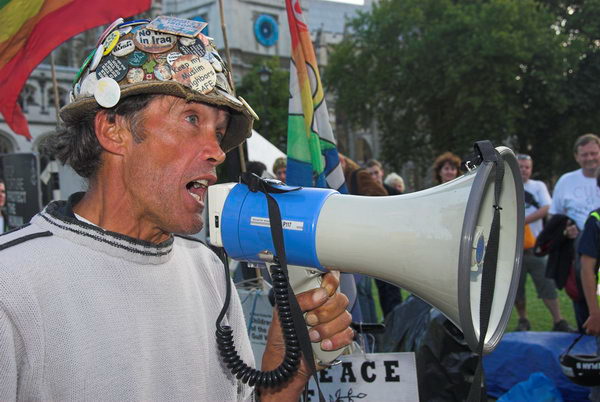
Those taking part were encouraged to pick their own subject of protest – serious or silly – and you can see some of these in my pictures. Brian Haw, who has received limited permission to use a megaphone, was able to do so.
English Results & Vedanta AGM: On Tuesday 28th August 2012 I photographed a protest by London teachers over Michael Gove’s interference with GCSE English grading before going on to Lincoln Inn Fields for a lively protests outside the AGM of London-based mining company Vedanta.
Regrade GCSE English
Dept of Education, Westminster
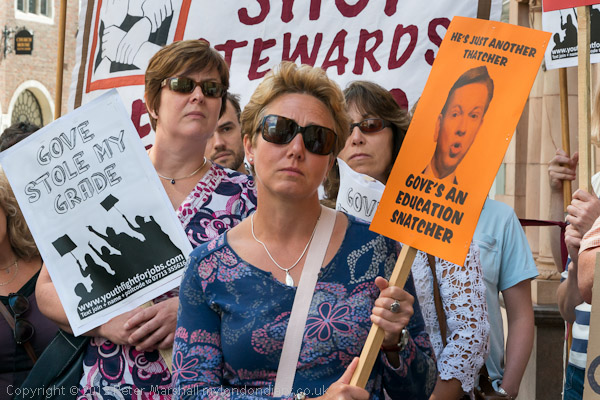
London teachers protested outside the Education Ministry against Michael Gove’s intervention in the grading of GCSE English results, which had moved the mark boundary between Grad C and Grade D, meaning that many students who previously would have achieved a C grade were now graded at D.
GCSE had been introduced as a system to grade students with no particular significance to the C/D boundary, but over the years has been altered by governments to make C a pass and D a fail, both for the students and also for the schools.
Students who fail to get a C or above in English (and Maths) may be prevented from goning on to further study even in unrelated subjects, and schools which fail to get passes for the required 40% pass benchmark are at risk. Some teachers may also lose pay as a result – even though their students have actually performed at the same level.
The change in the grade boundaries is seen as part of Gove’s agenda to blame schools and teachers for ‘failing’ students and provide a rationale for closing down schools run by democratically elected local councils and replacing extending the privatisation of education by their replacement by ‘academies.’
The altered grading disproportionately affects students from working class backgrounds, whose aims to better themselves through education have already been hit by this government with the removal of EMA, the educational maintenance allowance for 16-18 year olds, and by the hike in University fees.
Then NUT Deputy General Secretary Kevin Courtney speaking
The grade shift was estimated to result in an increase of around 10,000 in the number of young people not in education, employment, or training, “NEET“s. and on the same day as this protest Employment Minister Chris Grayling announced that young unemployed Londoners would be forced to do three months of unpaid full-time work or have their benefits cut.
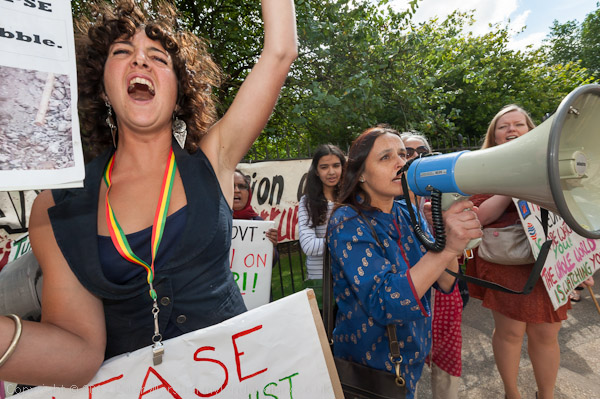
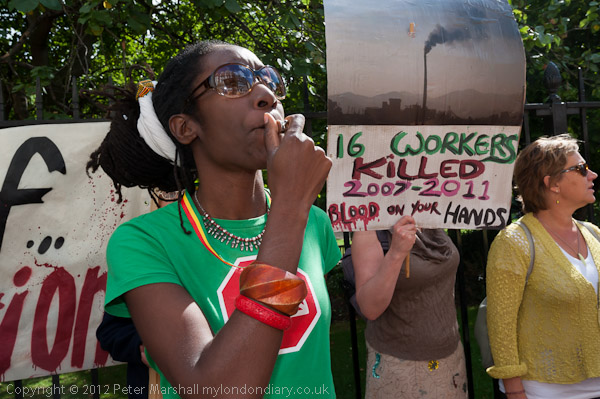
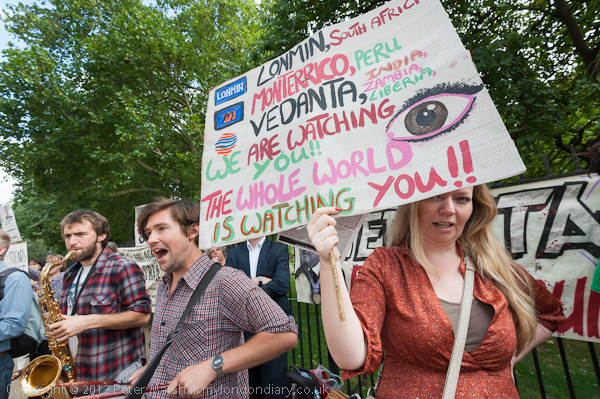
Mining company Vedanta, owned by Indian billionaire Anil Agarwal and backed by the UK government was opposed by groups in India, Goa, Liberia, Namibia, South Africa, Ireland, Zambia and Sri Lanka because of the environmental damage, pollution and human rights abuses caused by its mining of bauxite and other minerals.
Protesters from Goa ask ‘Where have all the trees gone!’?
Vedanta’s activities had been condemned by Amnesty International and many organisations had withdrawn their investments including the Norwegian Government Pension Fund, Martin Currie Investments, the Church of England, the Joseph Rowntree Charitable Trust and the Dutch Pension Fund PGGM.
But the company was still supported by over 30 major banks and financial agencies including HSBC, RBS, Deutsche Bank, Axa, Royal Bank of Canada, Credit Suisse, J P Morgan Chase, Goldman Sachs, Lloyds Banking Group, Nordea Bank, ICICI, Citigroup, National Bank of Kuwait, ANZ and Merrill Lynch.
Samarendra Das of Foil Vedanta speaks, John McDonnell MP listens
In Odisha, India, the smelting of bauxite had left over 10,000 displaced people landless, contaminated drinking water and devastated vast areas of formerly fertile land, with famines every year since 2007. Only widespread and determined resistance by the indigenous Advasi people over seven years has so far prevented the devastation of their sacred Niyamgiri hills.
There had been many huge protests in Tamil Nadu where their subsidiary “has flouted laws without remorse, operating and expanding without consent, violating environmental conditions, and illegally dumping toxic effluents and waste” and had overturned court decisions against them by “large scale corruption and bribery.”
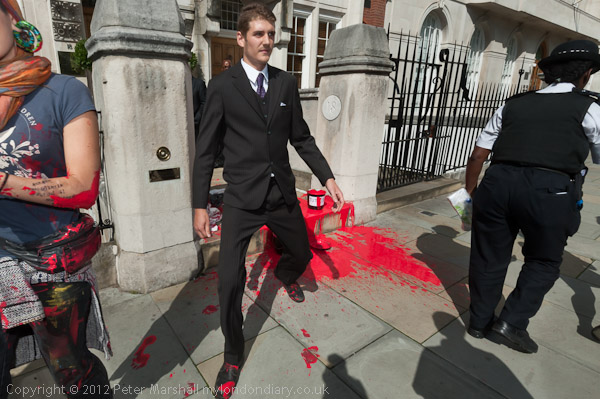
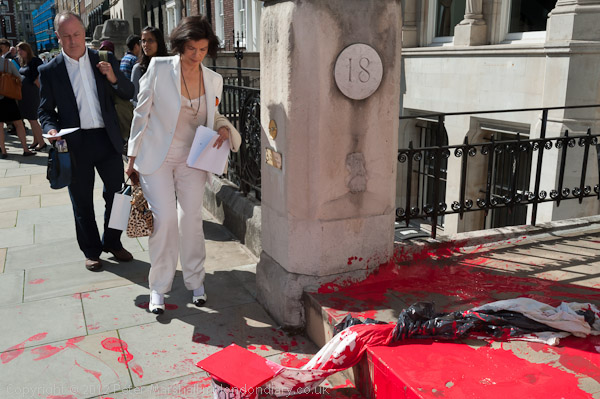
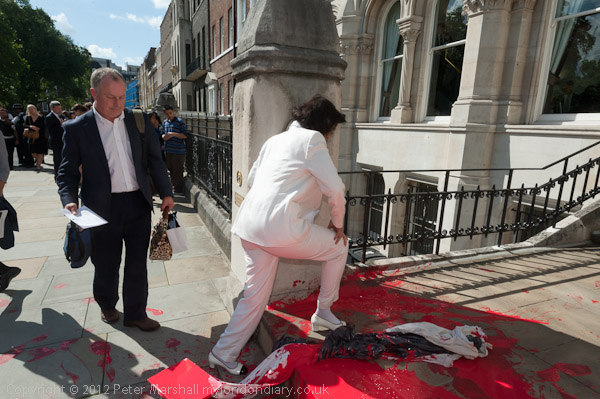
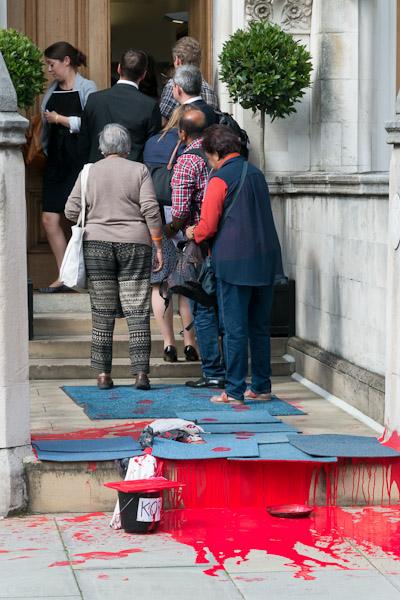
The lively protest was organised by Foil Vedanta. At one point well-dressed protester who walked up to the gate leading to the AGM and threw fake blood on the pavement before rushing away.
Shareholders attending the meeting then had to step carefully over the pool of blood to go in to the meeting until some minutes later a cleaner was sent out to clear the mess.
Four of the protesters, icnluding Bianca Jagger, dressed as usual in white, had to step over it as they went in, having become shareholders to they could attend the AGM and raise questions about the company’s actions.
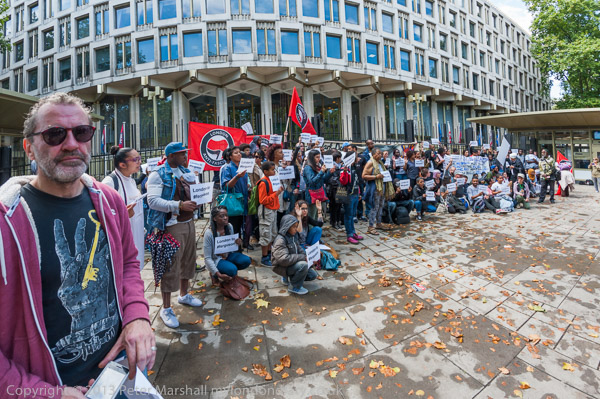
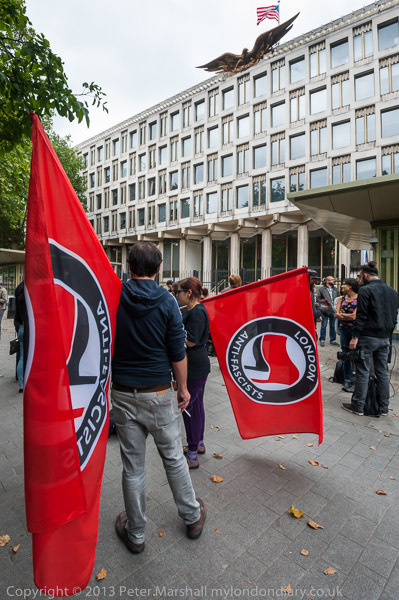
Solidarity With Fergusson & Talha Ahsan. Sunday 17th August 2014 I photographed a protest outside the US Embassy, then still in Grosvenor Square, in solidarity with the people of Ferguson, Missouri where there had been huge community protests after police shot unarmed black teenager Michael Brown. Later a party outside the UK Home Office celebrated the release of poet and translator Talha Ahsan from a US prison while condemning UK Prime Minister Theresa May for having allowed his extradition despite his diagnosis of Asperger syndrome.
Solidarity with Ferguson
US Embassy, Grosvenor Square
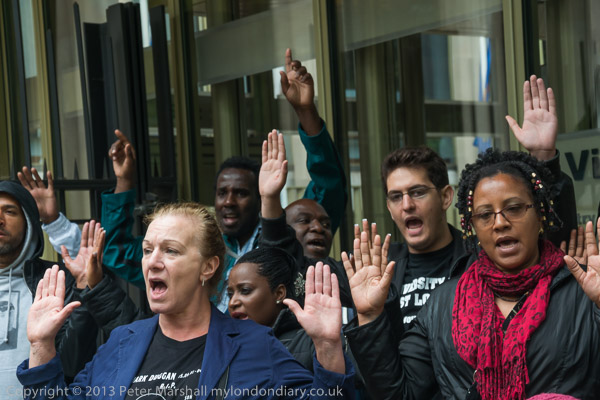
After an altercation on the street in Ferguson, Missouri, on August 9, 2014,police officer Darren Wilson chased and shot Michael Brown, killing him. Some witnesses claimed that Brown had turned to face the officer with his hands up, shouting “Don’t shoot” . Six bullets hit the front of his body, including one to his head which was immediately fatal. Wilson claimed that Brown had charged at him but witnesses dispute this.
Hands Up, Don’t Shoot
The slogan “Hands Up, Don’t Shoot!” became widely used in the protests over the killing. There were immediate widespread protests in Ferguson, mostly peaceful but some which led to violence and looting; it was an area were there were “longstanding racial tensions between the minority-black population and the majority-white city government and police.“
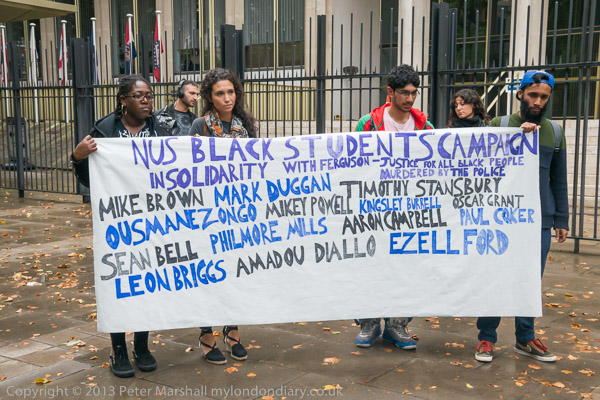
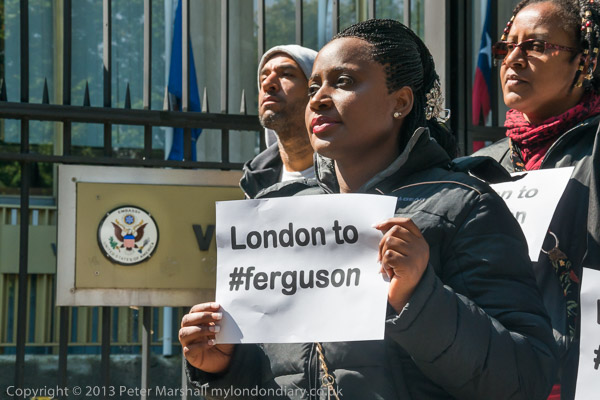
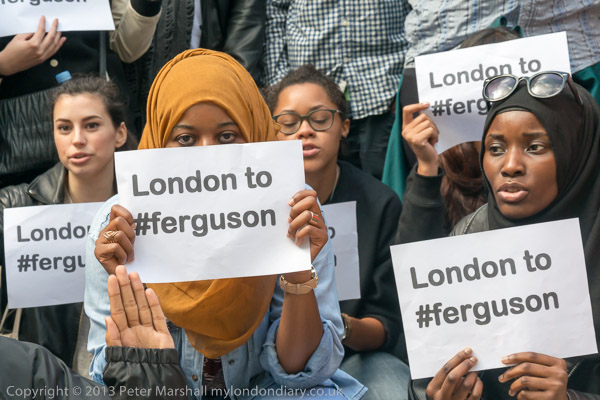
NUS Black students banner lists just a few of the Black people who have been murdered by the policePeople hold up posters ‘London to #ferguson’ in front of the US embassy badge
There were widespread protests in cities across America and around the world – including this one in London. The anger at the killing was amplified by a media campaign which portrayed Brown as a ‘thug’ and labelled the community protests as riots.
Later there were more protests after a grand jury decided not to indict Wilson, following an extended examination of a vast body of evidence,. Many felt the unusual way it had been conducted had influenced the jury’s decision.
The shooting and its aftermath attracted so much attention that Amnesty International for the first time ever sent a team to investigate Ferguson, finding significant human rights abuses. Their report “cited the use of lethal force in Brown’s death, racial discrimination and excessive use of police force, imposition of restrictions on the rights to protest, intimidation of protesters, the use of tear gas, rubber bullets, and long range acoustic devices, restrictions imposed on the media covering the protests, and lack of accountability for law enforcement policing protests.”
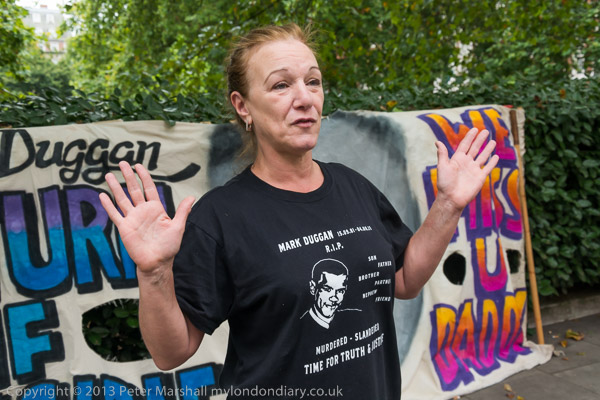
Carole Duggan, the aunt of Mark Duggan, unarmed and surrendering to police when they shot him
In the UK many saw a parallel to the police killing of Mark Duggan in 2011, also unarmed and surrendering when killed by police (and where a gun was apparently planted later by an officer some yards away.) His aunt, Carole Duggan spoke at the vigil.
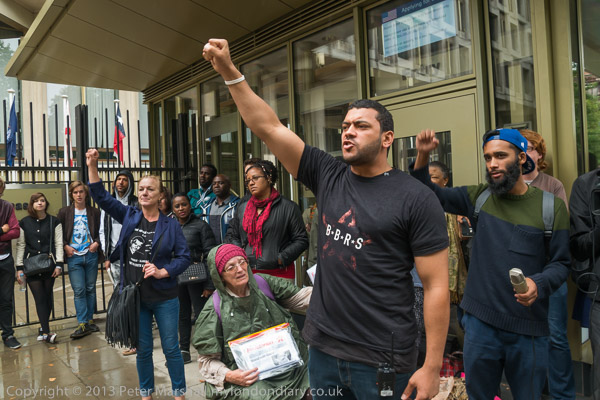
The London vigil was organised by ‘London Black Revolutionaries’, a recently formed group of militant black activists who called “for the US to stop violently oppressing, Black People and Black Protests” – and for an end to similar oppression in the UK. Earlier known as B.B.R.S (I think Black British Revolutionary Socialists) they were Black British and British Asian youths who had split away from the Socialist Workers Party some months before this protest and were largely based in Brixton.
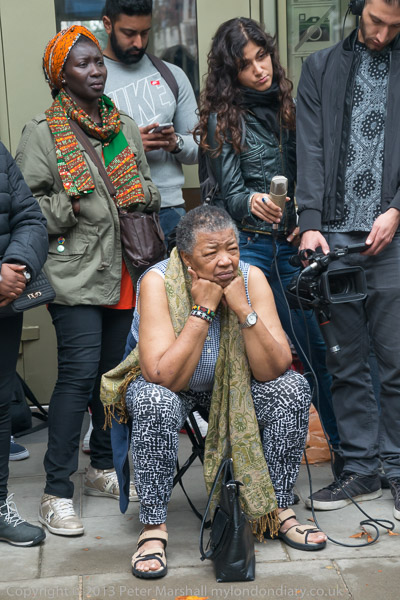
Those at the vigil were from across London’s communities although a majority were black. There was some audible dissent from all sides when one of the speakers suggested that the struggle for justice was one that only black people could understand and that they should fight it alone.
Talha Ahsan, a poet and translator, had been arrested in London in July 2006 following a n extradition request made by the USA. He was held here in maximum security for over 6 years without trial or charge while a number of appeals were heard against his extradition, until this was finally rejected by the European Court of Human Rights. He and five others had argued that the charges should be heard in the UK, but the court decided they could all be extradited.
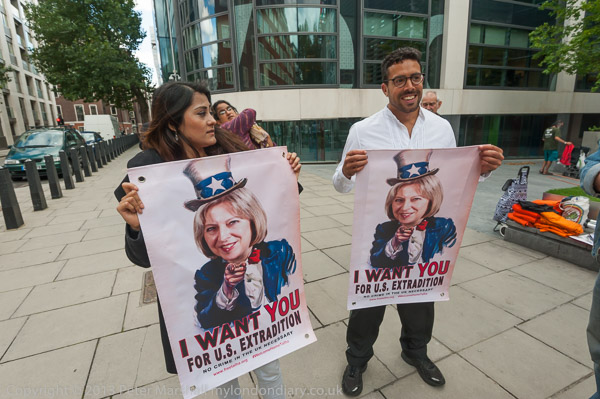
Posters showing Home Secretary Teresa May who agreed the extradition of Talha Ahsan despite his diagnosis of Asperger syndrome – and the lack of any credible evidence against him
The US authorities had requested his extradition alleging that in London in 1997-2004 he had worked for a London company on material for a series of websites, hosted on a server in the United States, “designed to designed to incite readers to violent jihad and to provide material support to terrorist related entities“.
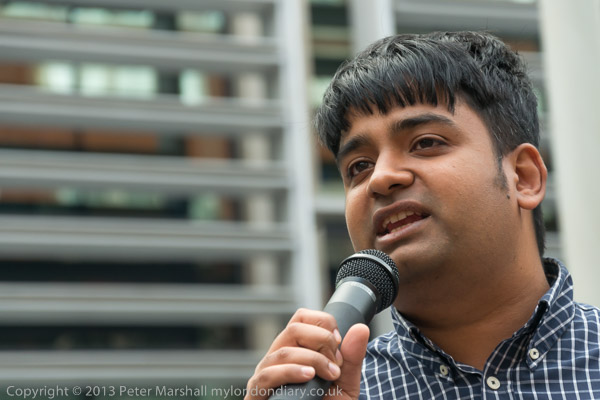
Hamja Ahsan, Talha’s brother
Theresa May, Home Secretary at the time, approved his extradition despite his suffering from Asperger syndrome which it was argued would make it extremely difficult for him to cope with the shocking changes this would cause. May stopped another extradition request for another Asperger’s sufferer, Gary McKinnon, and the different treatment led to widespread accusations of double standards.
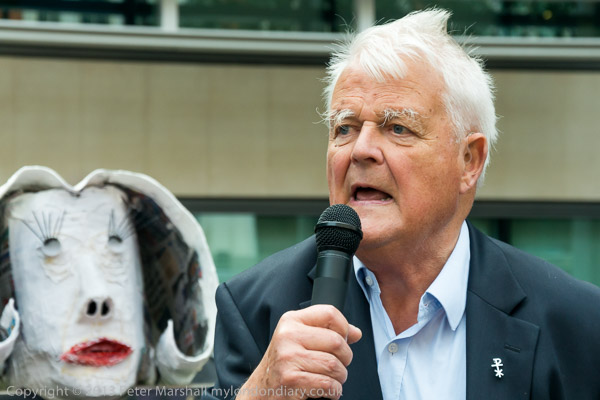
Bruce Kent speaking next to a caricature of Teresa May
Talha Ahsan had been released by a judge following a plea bargain in the US courts, but at the time of this party was still held in the USA, coming back shortly after.
He agreed to admit to charges of conspiracy and providing material support for groups in in Chechnya & Afganistan – although as in many similar cases, there was probably little substance in the allegations – but the bargain released him from other charges for which he could have spent the rest of his life in solitary. And because of the time he had already served he was due for release.
Zita Holborne reads a poem – with ‘Teresa May’ looking over her shoulder
A number of people came to speak and read poems – including some by Talya – at the event and you can see pictures of most of them on My London Dairy at Shame on You Theresa May,
Marikana, Bangladesh, Bahrain & Lula: Monday August 13th 2018 was a day of protests around London concerned with overseas events, though also about the freedom to protest here. There is a very long history of political movements across the world, particularly from the British Empire protesting here, often when protests were not permitted in their home countries, now mainly carried on by those from them who have settled here.
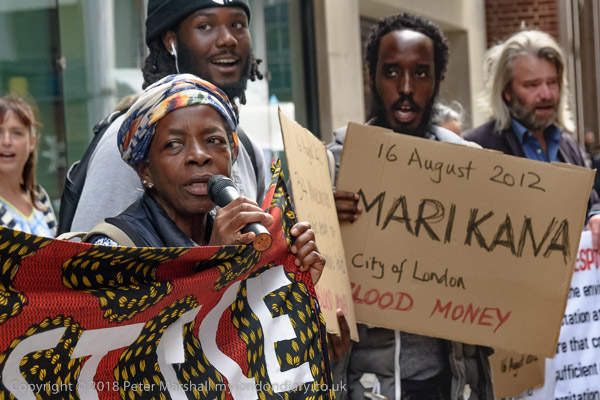
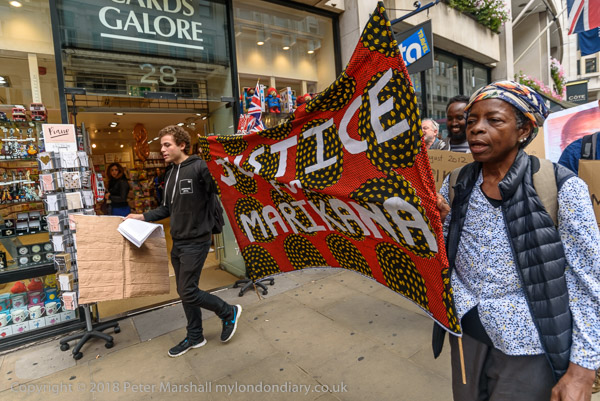
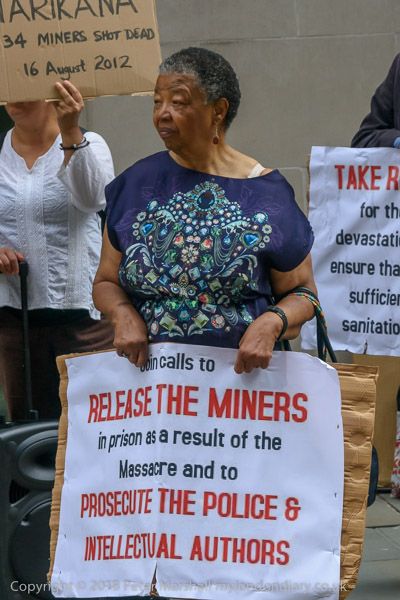
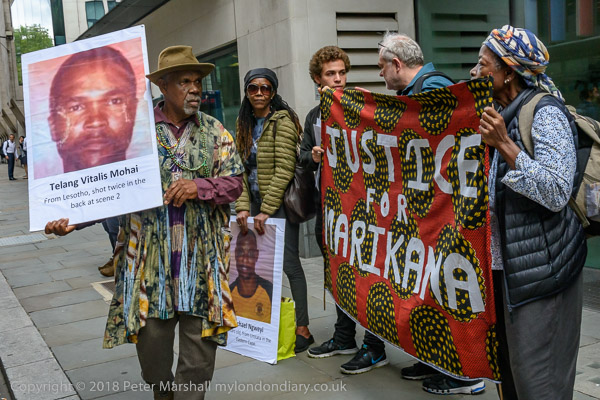
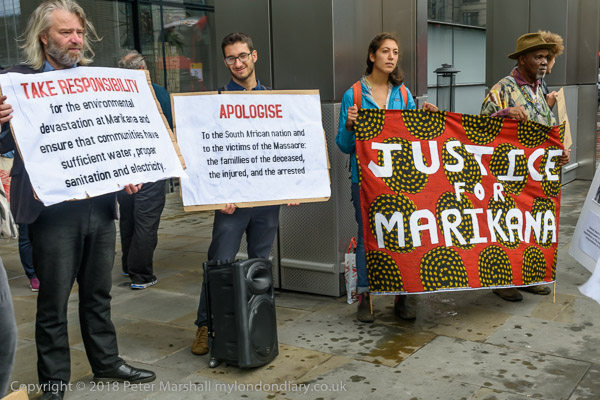
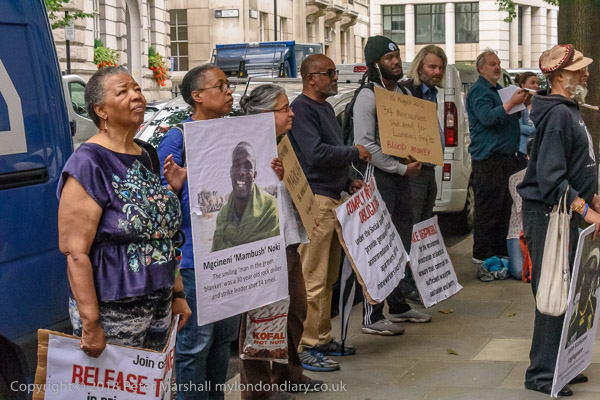
Justice For Marikana – 6th Anniversary Protest
City of London
The mining industry in southern Africa was largely developed by British companies and much is still owned and financed by companies based in the City of London, which also provides financial services including insurance.
The London and Rhodesian Mining and Land Company Limited was set up in London in 1909, and later became Lonhro and later Lonmin, still listed on the London Stock Exchange on 16th August 2012 when 34 striking miners were shot dead by South African police at its Marikana platinum mine.
The miners were striking for better wages and living and working conditions and were trying to disperse and hide when they were shot; another 10 had been killed previously since the strike began. Among those who encouraged the police violence against strikers was Lonmin board member Cyril Ramaphosa, a former mining union leader who since 2018 has been president of South Africa.
People carried large photographs of some of those who were killed by the police shooting
I photographed a tour of City of London investors, insurers and shareholders who profited from the violence against people and nature in Marikana. It stopped outside each of the offices for speeches giving details of their involvement and about the colonial roots of the huge wealth of the City of London. There were brief protests outside Majedie, Schroders, Investec, Legal & General and BASF, the major customers for Marikana’s platinum.
There had been no compensation for the victims’ families or for the injured mineworkers. The protest by the Marikana Solidarity Collective supported the demands of women’s organisation Sikhala Sonke and victims’ representatives that Lonmin must fulfil a social covenant with the community instead, including reparations, releasing the imprisoned mineworkers, prosecuting the physical and intellectual authors of the massacre, and taking responsibility for the environmental destruction in Marikana.
The international outcry over the massacre eventually led to Lonmin being acquired in 2019 by multinational mining and metal processing group Sibanye-Stillwater.
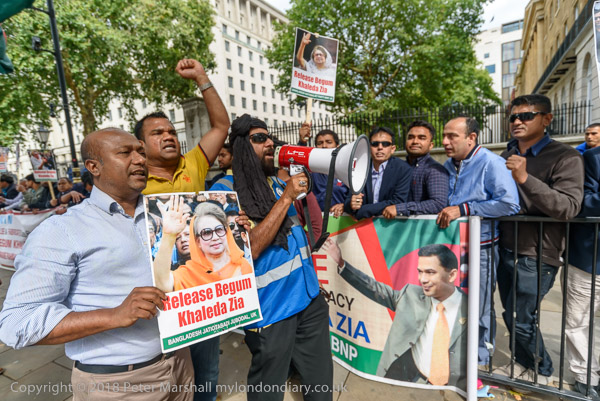
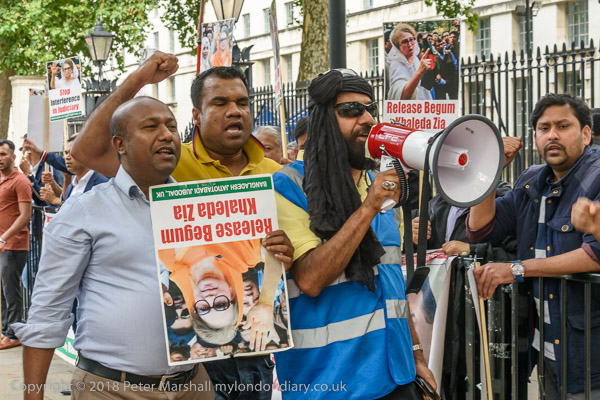
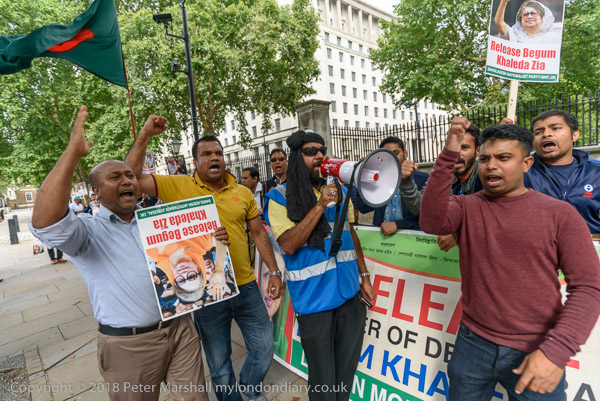
Protesters from the Bangladeshi Nationalist Party UK called for the release of their party leader, Begum Khaleda Zia, jailed in February for five years for embezzlement of international funds donated to Zia Orphanage Trust.
The BNP claim the charges are politically motivated, though there appeared to be many charges and a great deal of evidence against the woman who became Bangladesh’s first female head of government from 1991-6 after the BNP won the country’s first democratic election in 20 years, and served as prime minister later in 2001-6. Her sentence was later increased to 10 years.
In 2020 she was released from prison on medical grounds and was later acquitted on some charges and in 2025 allowed to go to London for medical treatment. She died in Dhaka as the end of December 2025.
Some Bangladeshi friends tell me there was little to chose between the her and her political rival Sheikh Hasina Wazed and their parties, and that both are corrupt and neither represented the interests of the people of their country.
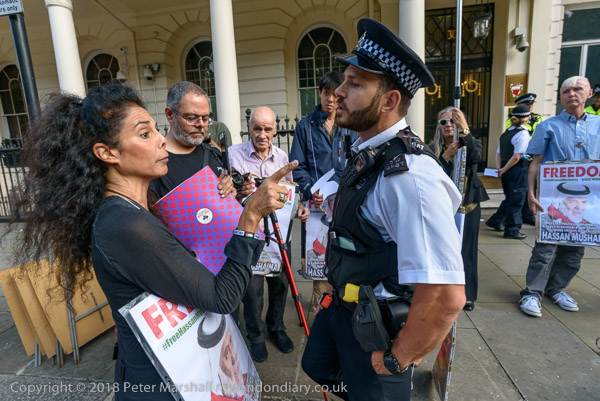
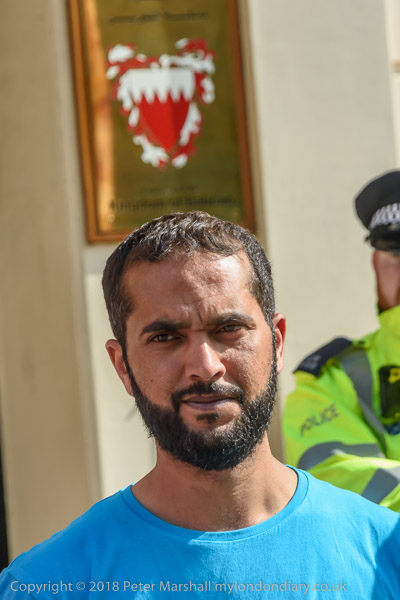
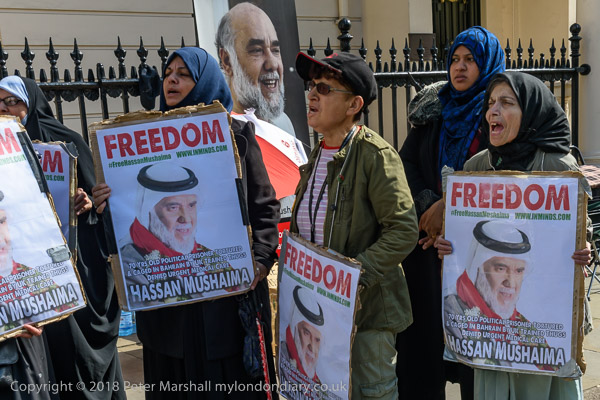
Islamic human rights group Inminds came to protest outside the Bahrain Embassy on Monday after hunger striker Ali Mushaima who was protesting outside there had been attacked early on Sunday morning by staff inside the embassy. A bucket of an unknown liquid was thrown on him from the ambassador’s balcony.
Mushaima’s hunger strike, which had begun on August 1st, was calling for his 70-year old father in prison in Bahrain to be given urgently needed medical care, family visits (stopped 18 months ago), and access to books.
Hassan Mushaima and other human rights defenders and opposition leaders were abducted in March 2017, brutally tortured and given life sentences in mock trials for calling for democracy in Bahrain.
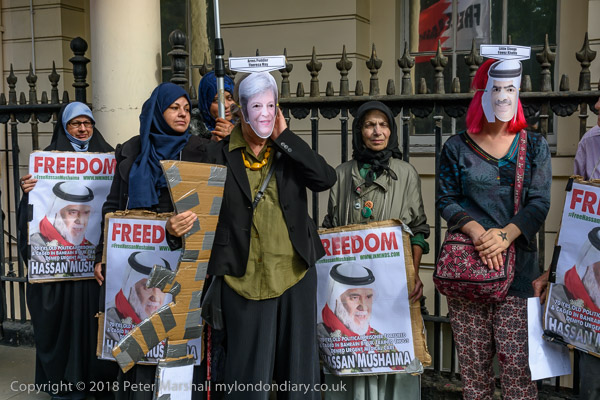
The cast included Theresa May, with the Butcher of Bahrain Hamad Khalifa and Little Stooge Fawaz Khalifa
Inminds called for his release along with that of around 5,000 other Bahraini prisoners of conscience languishing in the Al-Khalifa regimes jails, as well as an end to UK complicity in the Al Khalifa dictatorship and Saudi crimes against the Bahraini people.
Britain sells arms which are used to shoot Bahraini people
The attack had been reported to police who had failed to investigate it fully, but did come to harass the protesters, telling them they could not protest on the pavement outside the embassy.
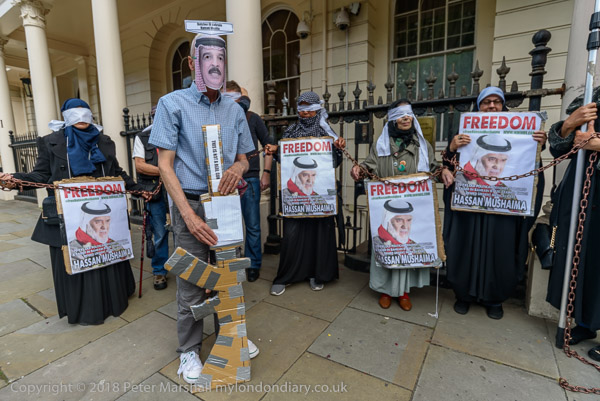
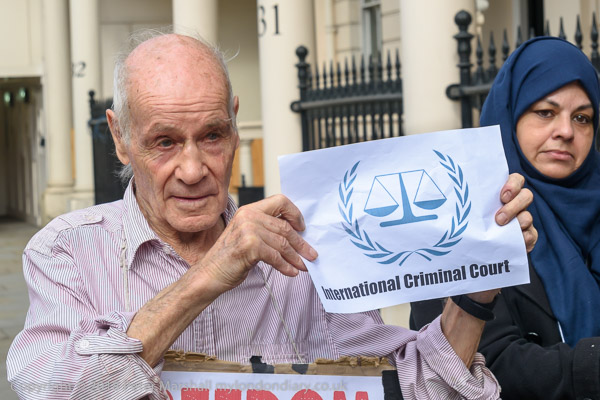
The International Criminal Court arrived and the members of the criminal regime were brought to justice.
Inminds refused to move and continued their protest with some street theatre in which Theresa May sold arms to the Bahraini dictator which he used to shoot protesters, who were then chained up. Unlike in real life the International Criminal Court came to their rescue, released them and condemned the Bahraini regime for their crimes against humanity.
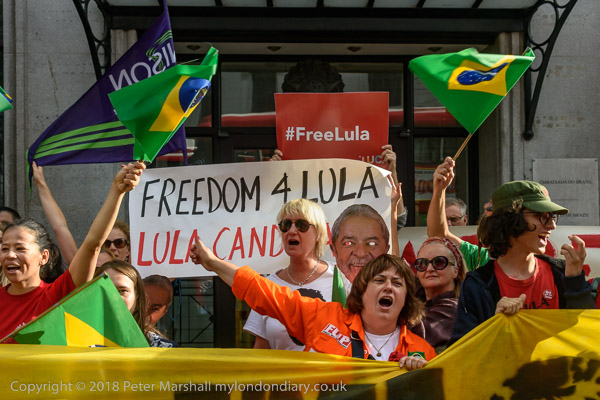
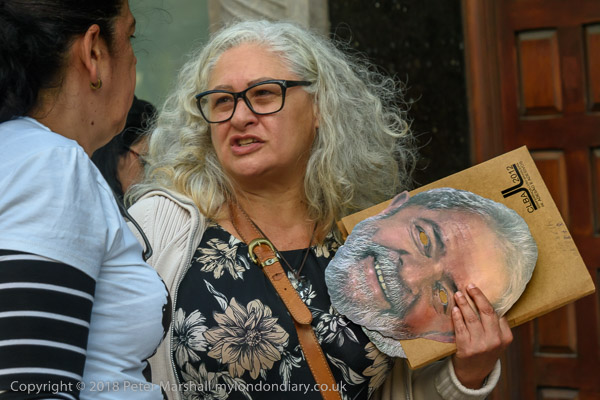
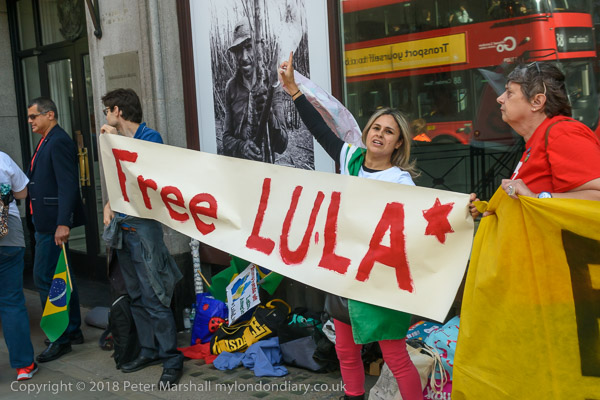
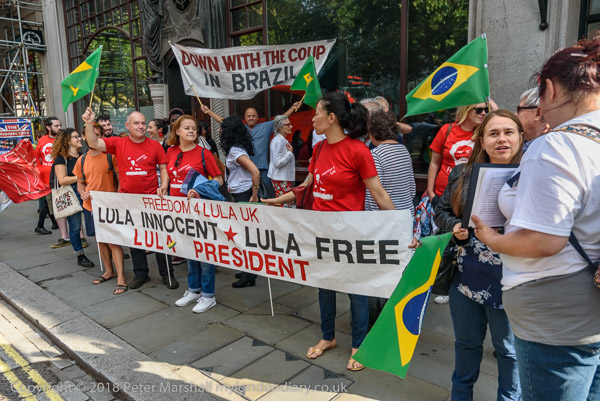
Finally I joined protesters outside the Brazilian Embassy calling for the release of Lula – Luiz Inacio Lula da Silva – a former trade union leader who was President of Brazil for two terms from 2003-11- to enable him to stand for election again in October.
Lula had announced in late 2017 that he would stand in the 2018 presidential election against right-wing incumbent President Jair Bolsonaro and opinion polls showed him clearly in the lead. But in April 2018 he was finally imprisoned on charges of having taken bribes to help an engineering firm gain contracts from the state oil company.
Despite his imprisonment he was kept as the Worker’s Party candidate although being in prison made him ineligible to take part in the election. Brazil ignored the protests and a suggestion from the UN Human Rights Committee that he be allowed to stand and Lula withdrew shortly before the vote in which Bolsonaro won another term.
All convictions against Lula were annulled in 2021 and in October 2022 he was elected for a third term as president.
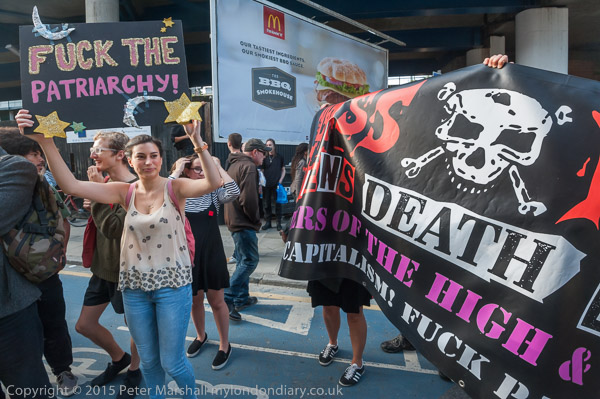
Former Google diversity chief Mark Palmer-Edgecumbe had applied to Tower Hamlets Council for planning permission to open a “Museum of Women’s History” meant to celebrate suffragettes, equal-pay campaigners, and local social struggles, and got a number of historians, academics and others to advise on the project.
It was a shock when the building renovations were completed and those involved as well as the council saw from the frontage that it was instead to be a tourist trap celebrating the gruesome Victorian murders of ‘Jack the Ripper’.
Ian Bone asks “Would you protect it if it glorified the killing of police officers”
Many local residents, and others including descendants of the poor working class victims of the sadistic murderer where shocked, and even Tower Hamlets Council was moved to protest following its opening. Unfortunately the council found it had no power to close down what was described as a ‘sick horror attraction’.
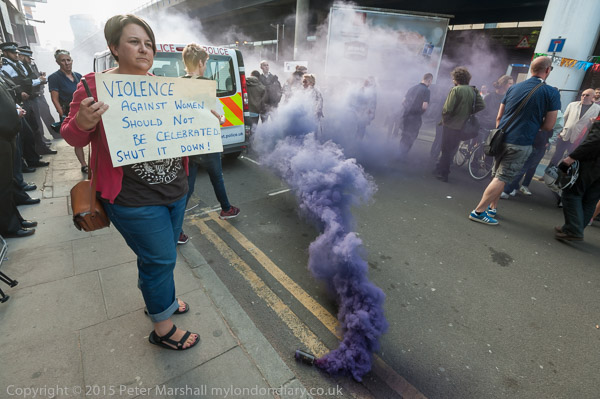
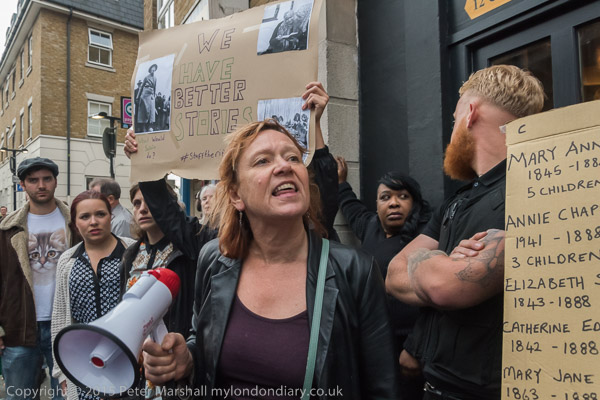
We have better stories’ says a poster with some images of women who should be celebrated rather than celebrating a brutal and deranged upper-class killer who attacked working class women
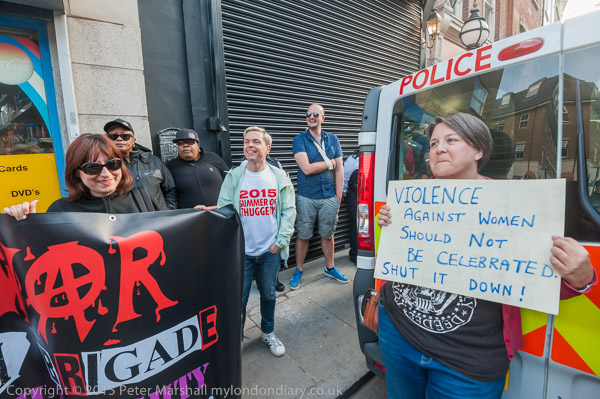
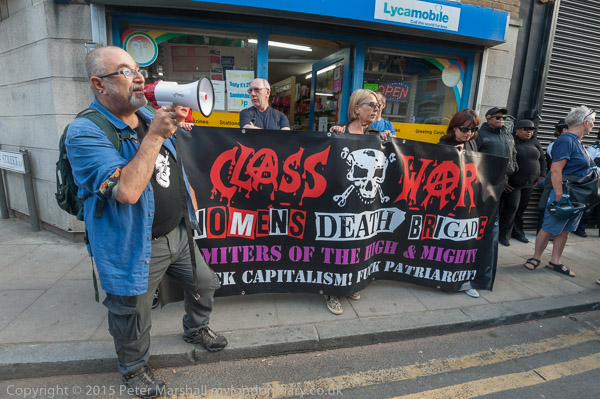
But the most sustained protests came from anarchist organisation Class War who carried out a series of colourful protests outside the so-called ‘museum’, including this one in which they were joined by Action East End and Fourth Wave and other feminists.
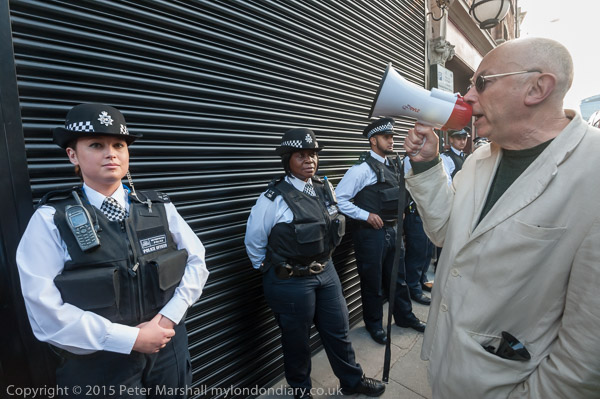
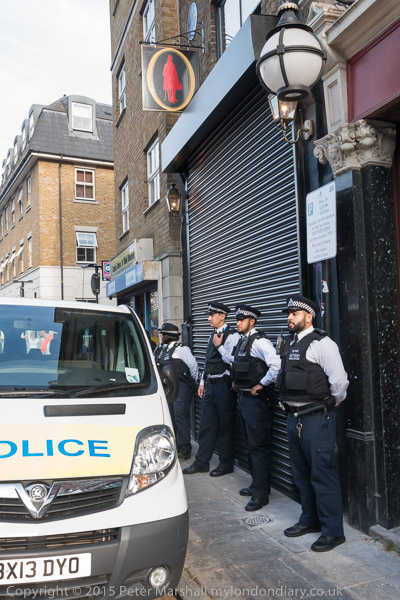
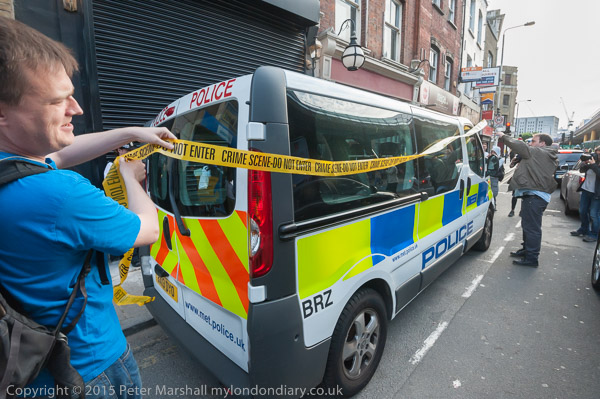
When protesters came to the tourist attraction they found it was hidden behind a heavy metal shutter, with police standing in front guarding it, erected since the previous protest a week ago. This was in breach of planning regulations and they were some time later foreced to remove it.
Among those who spoke at the protest was East End historian David Rosenberg who spoke about the real history of women in the East End, as well as Class War’s Ian Bone and Lisa McKenzie.
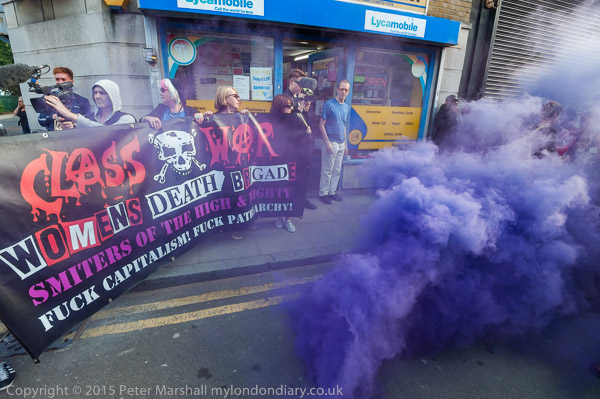
After the speeches and a couple of smoke flares the protesters, including some local residents blocked the road for some time though leaving the cycle path open. Police attempted to move them with no success, the women protesting asking them whether they would defend a museum celebrating the murders of police officers.
My final comment in 2015 was: “Protests will continue until the museum closes down or turns into what was promised, a museum of women’s history rather than of women’s degradation and brutal slaughter. It sensationalises the tragic fate of the working class victims at the hands of a deranged upper class murderer, presenting a voyeuristic experience that sickens anyone with any decency and humanity.”