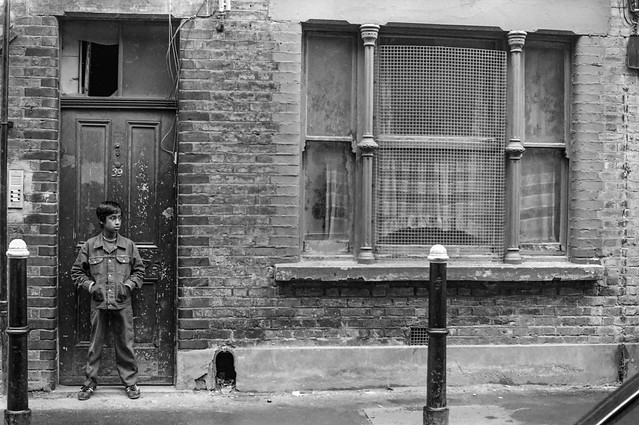
Land Of My Fathers

Well, not quite, but our family do have strong Welsh connections. The only grandparent I ever knew was a small woman dressed in black who sat in a corner of the parlour beside the coal fire, with its permanent kettle on the hob, and if she spoke at all it was at least with a strong Welsh accent, though she had a quiet voice and I was never certain it was in English.

She had a name, Eliza, though she died before I knew her as anything other than Gran’ma, and was born in Llansantffraed, Radnorshire in 1865 where her family farmed. Llan-Santfraid Yn Elvael is a few miles from Builth Wells, one of quite a few places named after St Ffraid the Nun, better known outside Wales as St Brigit, including another in Radnorshire, Llansantffraid Cwmmwd Deuddwr (aka Cwmtoyddwr.) Her family farmed at Llan-gyfrwys, or Llangoveris, not far from Hundred House and every Christmas my father or uncle would go up to Paddington Station to collect a bird sent up for the family table, a duck or a goose, which around 20 of us, my aunts, uncle, father, mother and cousins would sit around the table to eat, though I insisted on eating only the chipolatas, not liking the rather greasy birds.

As a young woman she had been sent up to London to work in a family business, a Welsh dairy near Mount Pleasant, on the Gray’s Inn Road, and I imagine Fredrick Marshall, a young tradesman around her age who had moved into London from Cheshunt came into the shop as a customer, and they were married at Highgate Road, later moving to set up home in Hounslow were he set up a small cart-making business and she running a small shop and bearing five girls and two boys, one my father.
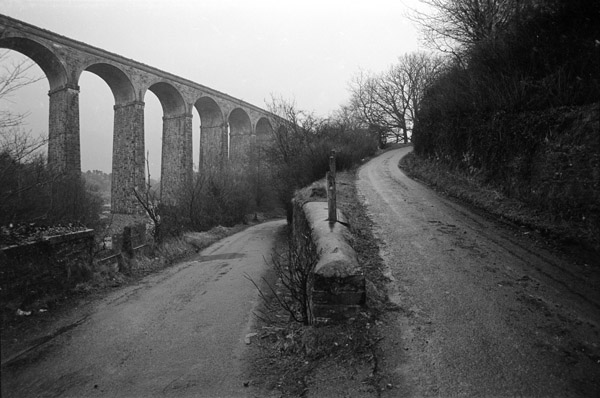
One of those girls married a Welsh man who I think she met when she was sent to Wales to look after an elderly relative there, and they had a home at Aberedw, a few miles south of Builth where her husband was a river warden on the Wye. I spent several summers in their house as a small child, probably when my mother was in hospital and I think we often ate salmon.

Back then we travelled to Aberedw by train (the line closed at the end of 1962) and there were several possible routes, though trains were infrequent on all. Trains from Hereford or Cardiff I think took us to Three Cocks Junction where we changed for Aberedw. When I last went to Aberedw by train in the late 1950s you had to tell the guard when boarding that you wanted to alight there, and to catch the train from there you stood on the platform and waved frantically at the driver.
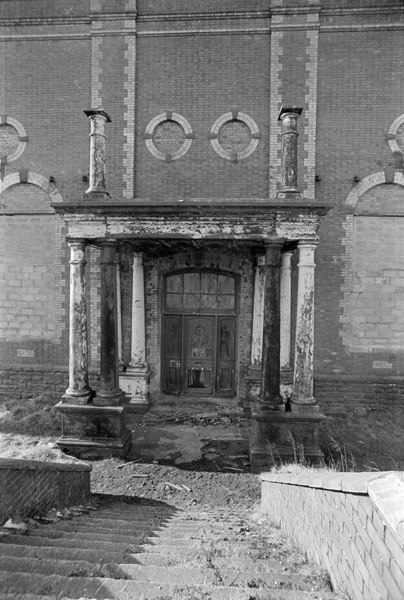
The most exciting route was to come up through the valleys from Cardiff through Merthyr Tydfil (though I don’t remember the details, and I think there was probably another change involved) but the scenery with mountains, colleries and factories was rather more impressive than the lusher fields of Hay and Hereford.
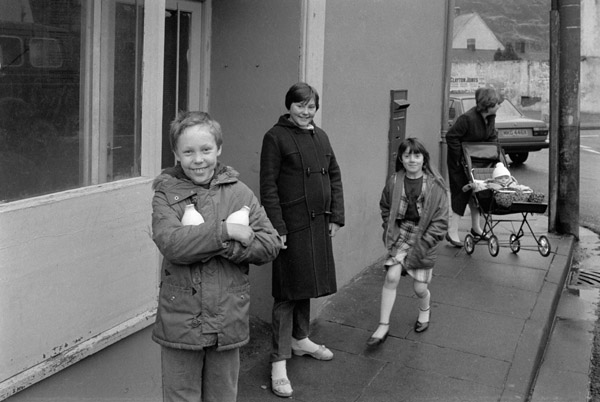
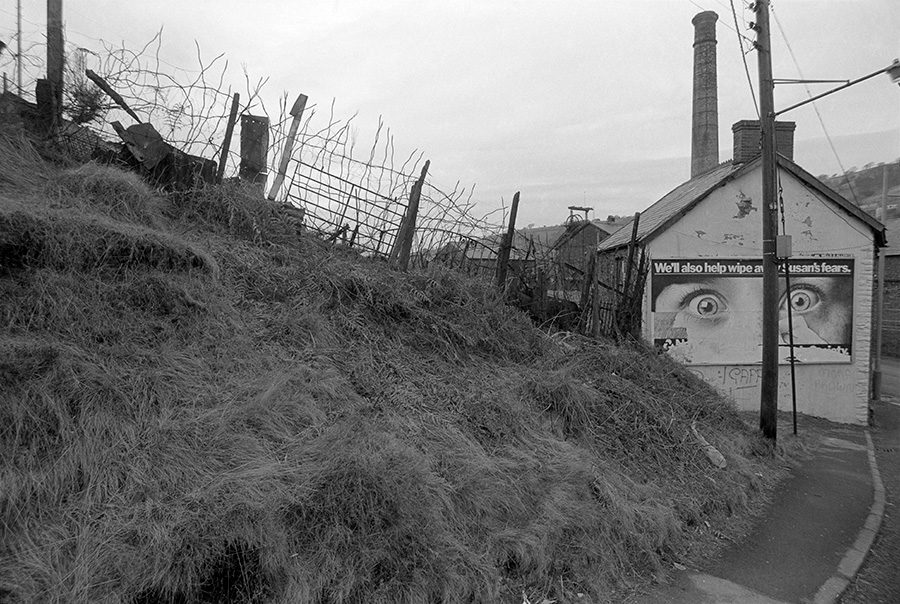
I can’t now exactly remember how my trip to Merthyr came about, but I think I probably managed to persuade several friends from a small group of photographers that it would be a great place to go at that time, within a day or two of the announcement by the National Coal Board of the closure of more than 20 pits that led to the Miners’ Strike. It was clear that this was the end of an era for industry in South Wales, and was a part of Thatcher’s plan to end manufacturing and turn the UK into a service economy – which I had been documenting with a series of pictures of closed factories around London.
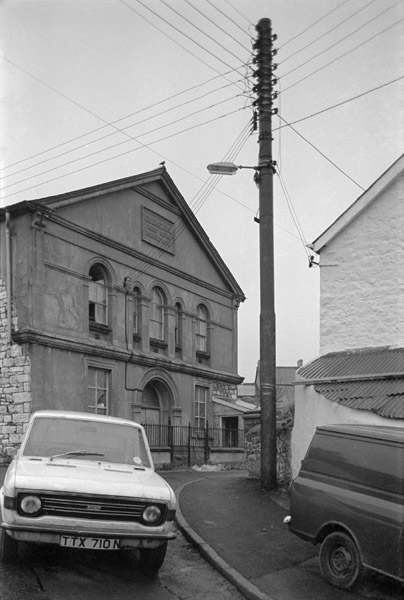
I think I was the only one of the four who didn’t have a car, but the four of us drove down I think together in Terry King, who had organised a couple of nights at a guest house and read up a little on the area.

I’ve just put a album with many of the pictures I took on this trip onto Flickr, where you can browse all of them at high resolution. Most are from Trehafod around the Lewis Merthyr colliery and from Cwmaman, as well as Dowlais and Cefn Coed. As always I’m happy for images to be shared on social media but retain copyright, and a licence is needed for any commercial or editorial use.

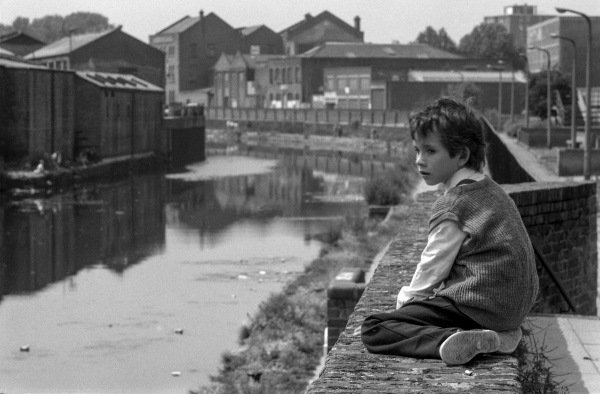
Wales 1984 – Views from the valleys

After taking these pictures I made some attempt to get funding to return and do more work in the area, but without success.


All photographs on this and my other sites, unless otherwise stated, are taken by and copyright of Peter Marshall, and are available for reproduction or can be bought as prints.

There are no adverts on this site and it receives no sponsorship, and I like to keep it that way. But it does take a considerable amount of my time and thought, and if you enjoy reading it, please share on social media.
And small donations via Paypal – perhaps the cost of a beer – would be appreciated.
Easter Pictures

Easter is of course the major Christian festival of the year, but here in the UK is seldom one that lends itself to photography. There are rather more public events around Good Friday, some of which I have photographed over the years, but we have never had the kind of large-scale Easter Parades like that in New York and some other cities overseas.

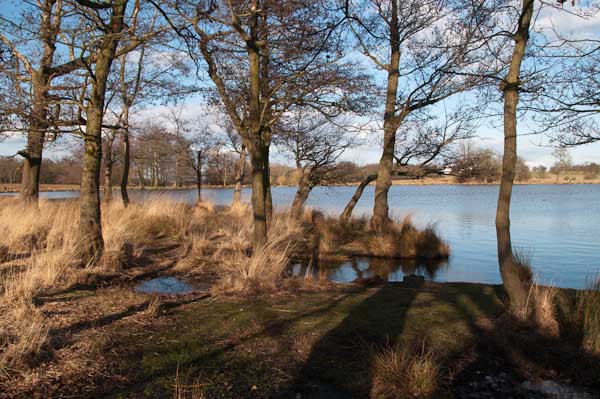
Easter Sunday in Richmond Park, 2010

So Easter has usually been a rather quiet time for me, sometimes with an outdoor almost-dawn service and perhaps a long walk later in the day or on Easter Monday. This year for obvious reasons it will be a little quieter than normal, though perhaps I will take my allowed daily exercise with a walk or bike ride.

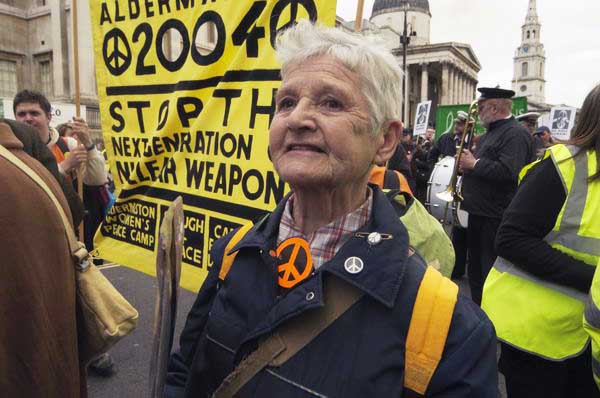
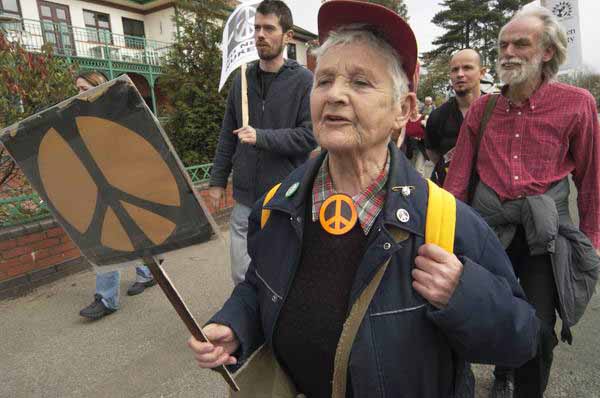
Pat Arrowsmith

Two exceptions to my normal pattern in have both involved visits to Aldermaston with CND. In 2004 I began on Good Friday in Trafalgar Square, where there was a ‘No New Nukes‘ rally, with speakers including Tony Benn, Jenny Jones, Pat Arrowsmith, Jeremy Corbyn and many more.

The march proper began at Hyde Park, with around 2,500 people beginning the first leg, and I started with them, but soon gave up, leaving them at Kensington High St station to come home and file pictures while they made their way towards Slough.

I had a day off on the Saturday as my son was visiting us and we went on a family walk in the lower Lea Valley – and I forgot to put any pictures from this on my web site.

Pat Arrowsmith on the march

On Easter Sunday I got on my bike and rushed to Maidenhead where I locked my machine up and met the marchers who were arriving after an early morning start from Slough. There were now only several hundred walking the full distance, and they took a brief break for tea and coffee and then continued on their way towards that evening’s stop at Reading. I walked with them for the next few miles until their lunch stop, and photographed them from a footbridge over the road as they walked on towards Reading. I had a rather long walk back to Maidenhead for my bicycle and then the ride home.

On Monday I was feeling tired and rather than the heavy camera bag with the Nikon D100 and a film camera I took just a small knapsack with a water bottle and a lightweight Canon Digital Ixus 400, all of 222g. This took only 4Mp jpeg files, though at 2272×1704 these were not hugely smaller than the 3024×2008 of the Nikon. It had a useful zoom range, equivalent to 36-108mm, but the autofocus was sometimes rather slow, giving a highly unpredictable shutter lag. I sometimes found I had given up and moved the camera away from the subject by the time it fired.

The results were generally quite acceptable, and could produce an excellent A4 print, with the jpegs which were generally bright and sharp, often looking rather better than some from the larger Nikon files taken using RAW. In 2004 RAW conversion software was at times rather primitive and probably I was even less skilled at using it.

I took the train to Reading, along with my wife and one of our sons, and we walked the 12 miles or so to Aldermaston where I photographed the rally and then walked at least halfway around the perimeter fence of the large site. Fortunately we then got a lift to the station for a train back to Reading.

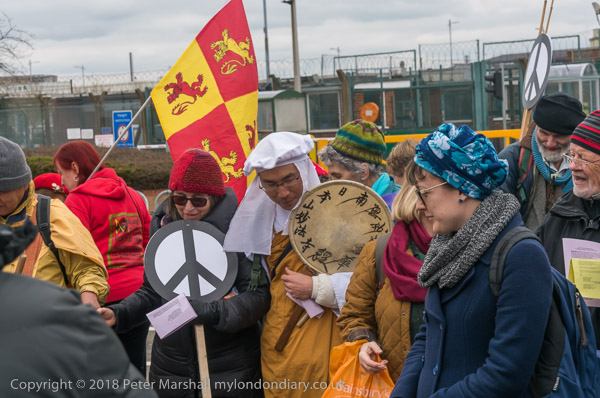
In 2018 it was the 60th anniversary of the first Aldermaston March, and on Easter Sunday I joined the crowds there for a rally. As well as calling for the UK to abandon its ridiculously expensive and totally useless nuclear weapons (our so-called deterrent) it also had something to celebrate – A UN treaty banning nuclear weapons which was finalised in 2017 and had then been signed by 122 nations.

This time I put my bike on the train to Reading and enjoyed a pleasant country ride in good weather to the rally and then back from Aldermaston.


All photographs on this and my other sites, unless otherwise stated, are taken by and copyright of Peter Marshall, and are available for reproduction or can be bought as prints.


1986 Complete – Page 1

Images in this post are embedded from Flickr where you can view them at a large size by clicking on the image. You will need to use your browser back button to return to this post. Or you can right-click and select ‘Open link in new tab’.

Commercial St, Tower Hamlets 86-2d-51_2400

My album 1986 London Photographs is now complete on Flickr, and this is the first of a short series of posts pointing out a few of my favourite images from the year.

Of course the 1370 pictures in the album are not all I took that year, but perhaps about a quarter or a fifth. Quite a lot more than I would have selected or shown back in 1986, but the content has aged well, even if sometimes the actual physical negatives have deteriorated. Images that might have seemed a little mundane when I first saw them on the contact sheets have often gained considerably in interest as historical records.

There is a little redundancy in those 1370, and I’ve sometimes included several pictures of the same subject, where I’ve tried different ways to approach it. But the great majority of subjects were treated to only a single frame.

Crosby Row, Southwark 86-4f-11_2400

Many of those not included still have interest and value as historical records, but preparing them to go on line is tedious and time-consuming, particular as some need quite extensive digital retouching after the ‘scanning’ stage – mostly done by photographing the negatives with a Nikon D810 and Nikon 60mm macro lens. Some of my negatives were damaged by minute insects in search of gelatine, leaving their track as they chewed their way across them and depositing their frass and occasional body parts and complete restoration isn’t always possible.

Reuter, Royal Exchange, City 86-4l-66_2400

I’ve also been having problems in getting even lighting at the negative edges. This isn’t a problem with mounted slides, where the image is cropped, but I want the whole image, and possibly the problem is with light diffusing from the clear film edges. But it does mean every frame needs correction in Photoshop – rather like the little bit of edge-burning we used to do under the enlarger.

Courtenay Square, Kennington, Lambeth 86-4q-45_2400

I was working on a number of themes at the time and as well as recording buildings that interested me was particularly interest in sculptures, shopfronts, shop window displays and trees in the city. The first page of pictures on Flickr (100 images) includes work mainly from Southwark, the City of London and Spitalfields.

Brick Lane area, Spitalfields, Tower Hamlets 86-4p-55_2400

I took very few pictures of people at this time, partly because I was rather shy, but more that I had been affected by some feelings being strongly expressed by some at the time about privacy and arguments that it was wrong to photograph people without first seeking their permission. I was never convinced by these, but they were off-putting, and I was sometimes shouted at when taking pictures. Perhaps more importantly I wanted to direct attention to the things being photographed, and was aware that people almost always steal the frame.

There are another 95 pictures on the first page of the album, all with a location, taken from the usually rather incomplete information I recorded on the contact sheets. I’ve tried to check these before posting, but corrections and other comments are always welcome. I’m happy for these pictures – with suitable attribution – to be shared on social media, but they remain copyright and any commercial or editorial use requires a licence from me.


All photographs on this and my other sites, unless otherwise stated, are taken by and copyright of Peter Marshall, and are available for reproduction or can be bought as prints.

There are no adverts on this site and it receives no sponsorship, and I like to keep it that way. But it does take a considerable amount of my time and thought, and if you enjoy reading it, please share on social media.
And small donations via Paypal – perhaps the cost of a beer – would be appreciated.

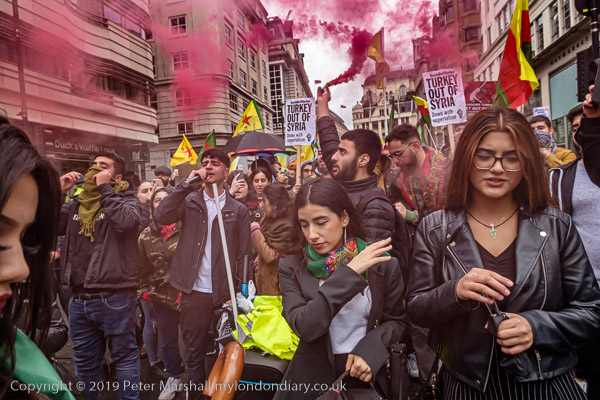
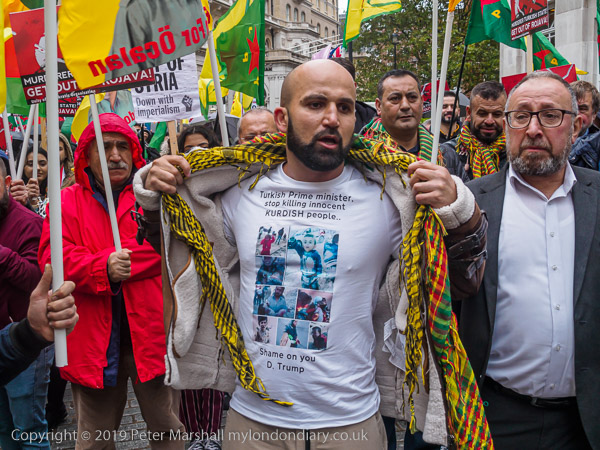
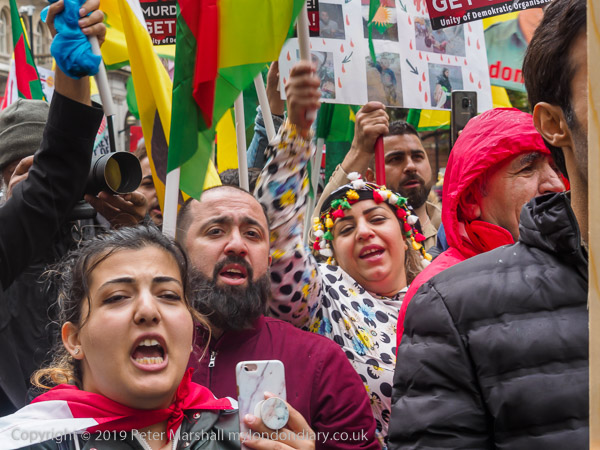
Solidarity with Rojava

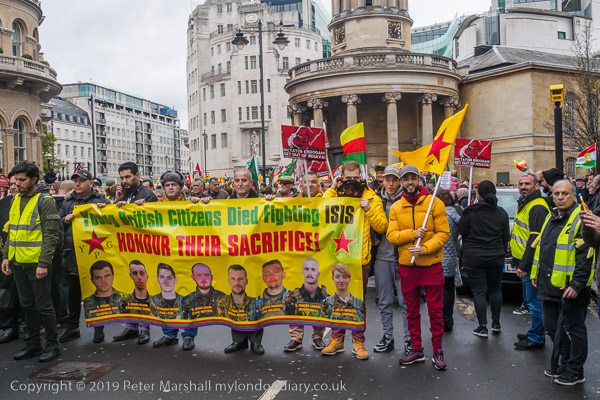
While we may feel cooped up in isolation in the UK, and are mourning the deaths of several thousand from COVID-19, the situation for many around the world is far worse. Particularly at risk are the people of Rojava in North-East Syria, mainly Kurds, at risk both from Turkish invasion forces and from the virus.

Kurds are the largest minority community in Turkey as well as being widespread across the northern parts of Iran, Iraq and Syria. They were promised an independent state at the end of the First World War, but that promise was denied when the boundaries of modern Turkey were defined in 1923.

Since 1923 Turkey has attempted a programme to eliminate Kurdish culture and identity, at times with massive military campaigns as well as repressive legislation. The Kurds, around 20% of the population, have fought back the opposition led since the 1980s by the Kurdistan Workers’ Party or PKK led by Abdullah Öcalan who has been in jail in Turkey since 1999.

In recent years Turkey has been aggressively attacking Kurds outside Turkey and in early 2018 they invaded Afrin canton in northern Syria, part of the territory where Kurds with other minority ethnic groups had established a de-facto autonomous region of Rojava, with a constitution based on decentralisation, gender equality, direct democracy and guaranteeing ethnic minority rights and religious freedom.

Kurdish forces in the People’s Protection Units, the men of the YPG and the women of the YPJ, were the most effective force in fighting the ISIS in Syria, with the help of US air support. But Turkey is second only the the US in military strength in NATO, and has benefited greatly from NATO support and arms supply, and were able to take Afrin from these lightly armed Kurdish forces. Many Kurds were forced out of the area, which had been overwhelmingly Kurdish and they are now a relatively small minority.

President Trump’s announcement of a US withdrawal from Syria gave Turkey’s President Erdogan a green light to continue his country’s invasion of Rojava, and left the Kurds there no alternative but to call on the Syrian government for support, a move which in the longer term seems likely to end their autonomy.

Turkey is now using the coronavirus to threaten Kurds in Turkish prisons for political reasons – including many journalists, excluding them from its plans to release them with other prisoners because of the pandemic. They are also refusing to refer prisoners with COVID-19 symptoms for medical treatment.

For the 4 million inhabitants of North and East Syria, including 600,000 refugees the situation is also dire. The World Health Organisation refuses to support the area directly and little comes to them through the Assad regime. There are no WHO test kits or test machines and only 35 intensive care beds and 40 ventilators.

More pictures from October’s protest: Solidarity with Rojava – Kurdish Syria


All photographs on this and my other sites, unless otherwise stated, are taken by and copyright of Peter Marshall, and are available for reproduction or can be bought as prints.


Strength in Grief

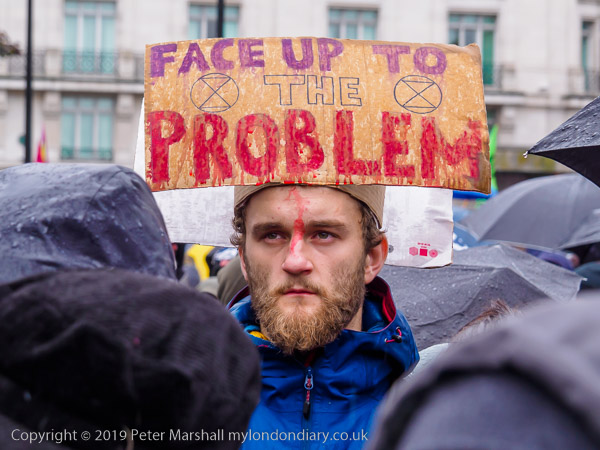
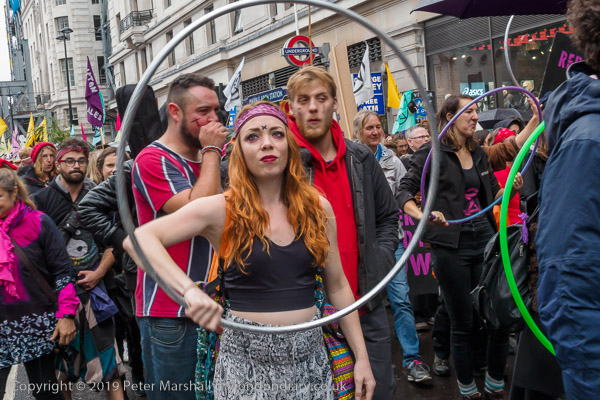
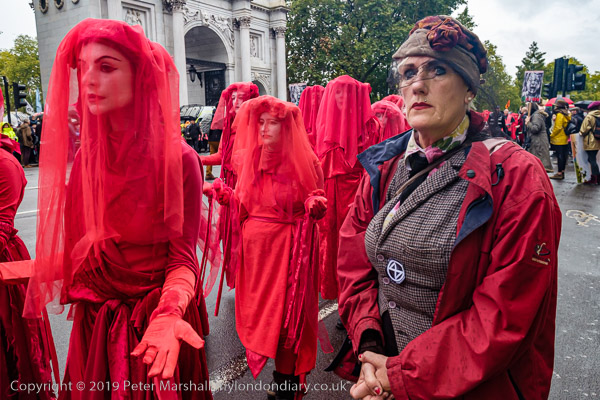
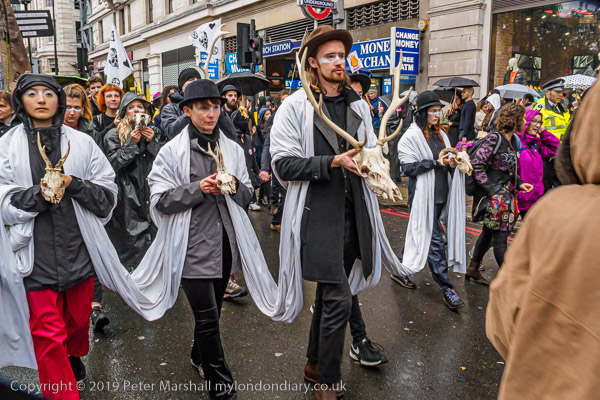
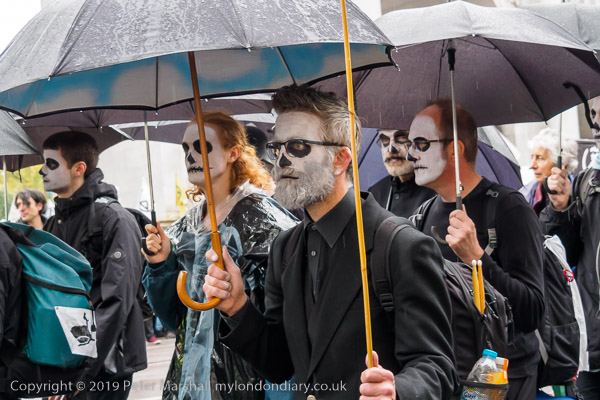
With so much bad news around I hesitate to write about a funeral, but in October Extinction Rebellion held their ‘Strength in Grief’ rally at Marble Arch to express their profound grief at the extinction of species taking place due to global warming and which threatens the future of human life, and followed this with a funeral procession along Oxford St.

We are now facing another great threat to human life, one we are all personally threatened with, and many of us are at particular risk from, some because they are having to work closely with people suffering from coronavirus, others because they are particularly likely to die should they catch it. As someone in the high risk category, though not with governmental ‘extremely vulnerable’ status I’m worried and also isolating myself as much as possible.

The XR rally and march took place on the anniversary of Colombus landing in South America, truly a black day for the population of that continent, bringing disease and exploitation. While some celebrate Columbus Day, for many others the 31st October is the Day of Indigenous Resistance, and a number of the speakers reminded us of this. Climate Change has already killed many in the Global South.

While in the UK the lack of preparation has been a matter of government policy, part of their programme to run down and sell off the NHS through the back door to private health companies and their more general cuts to public services and local authority spending, for many countries it is impoverishment through centuries of colonialism and neo-colonialism that has left them unable to cope with the current pandemic.

The UK is one of the world’s richest nations – thanks in large part to our imperial past which fed our economy and fertilised the inventiveness of which we can still be proud. I grew up in the immediate post-war period when the experience of the war had led to the realisation that we had to work together as a society. From that came secondary education for all, the NHS and the whole welfare state. I hope COVID-19 will have the same galvanising effect as we can’t afford to go back to ‘business as usual’. The world needs to wake up and ‘Face Up to the Problem’. I hope I’ll still be around to see it starting to happen; at least I’ve not yet had a letter from my doctor with a DNR form, though it could still come.

More pictures at XR Strength in Grief Procession.


All photographs on this and my other sites, unless otherwise stated, are taken by and copyright of Peter Marshall, and are available for reproduction or can be bought as prints.

There are no adverts on this site and it receives no sponsorship, and I like to keep it that way. But it does take a considerable amount of my time and thought, and if you enjoy reading it, please share on social media.
And small donations via Paypal – perhaps the cost of a beer – would be appreciated.

Trafalgar Square protests

Ian Hodson, BFAWU President

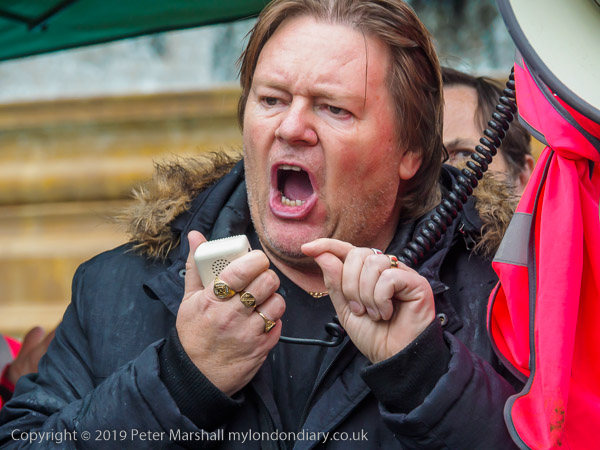
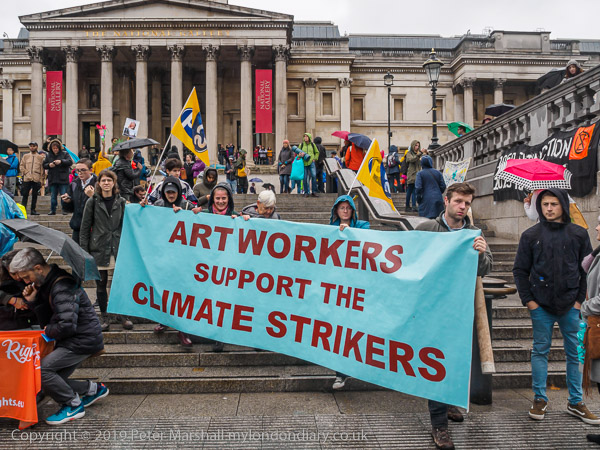
Back on Saturday 12th October there were two protests taking place in Trafalgar Square and it was raining. One was by trade unionists supporting Extinction Rebellion and the school climate strikers, and there was a powerful speech from Ian Hodson, National President of the Baker’s Union BFAWU.  His union is one of the older and smaller unions in the TUC, founded in 1847 in Manchester though it has changed its name a couple of times.

The BFAWU is a union that still fights actively for its members and isn’t afraid to take on large organisations, including McDonald’s, Burger King, and KFC in its campaign to unionise and improve pay and conditions for fast food workers.

The rain came on rather more heavily, and I kept my cameras in my camera bag or under my coat, and took rather fewer pictures than I would otherwise. Working in wet conditions is still rather a pain, even though some cameras and some lenses are ‘weatherproof’ this doesn’t really keep them going in the rain.

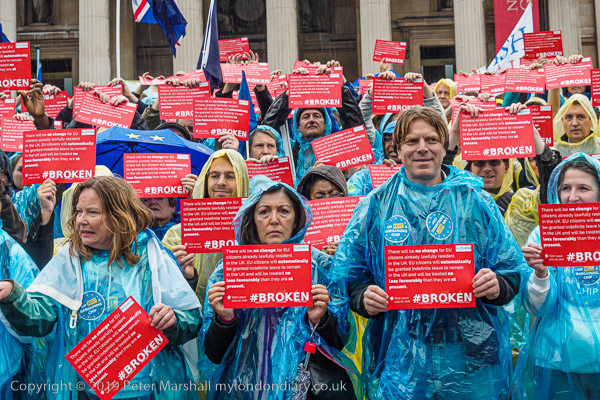
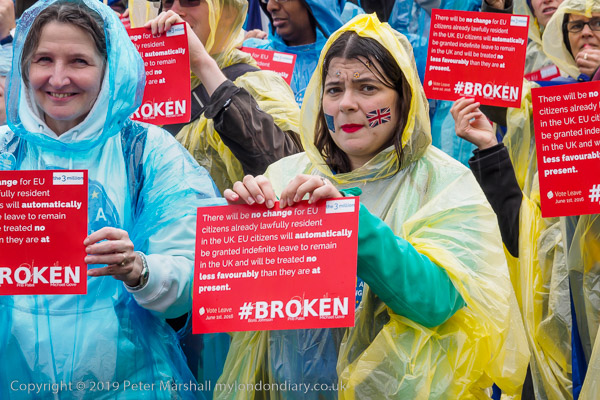
The 3million organisation representing the three million EU citizens who were living in the UK had come prepared, wearing blue and yellow plastic rain capes with a sticker on them also in the colours of the EU flag and the message ‘I am not a bargaining chip’.

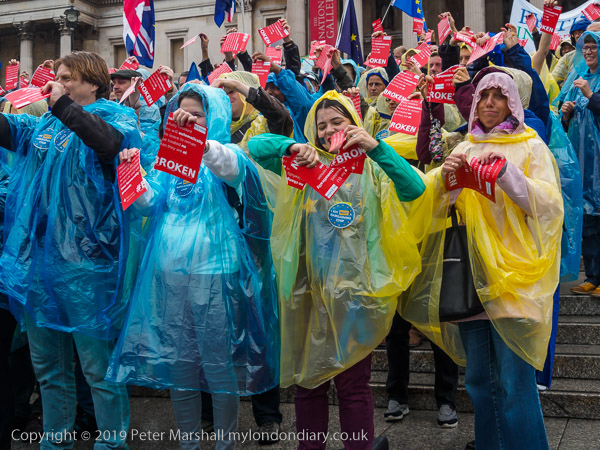
They had come to protest at the broken promise made by the Vote Leave campaign, which had clearly stated that EU Citizens currently living in the UK would “automatically be granted indefinite leave to remain in the UK” in the event of Brexit. Instead we have a complex scheme of applications, with many who have applied for leave to remain having their applications rejected. Some who have lived here for over 50 years, and have children who are UK citizens may face deportation.

Together they tore up copies of the promise, though the light had dropped and the pictures I took on a longer lens were rather blurred by their motion – I hadn’t got my camera set to a high enough ISO.

I still can’t decide which is the best way to work with my digital cameras when lighting conditions are likely to change. The different cameras I use – and on this occasion it was an Olympus OMD M5 II and a Fuji XT-1 – have slightly differing implementation of auto-ISO, which would seem to be a good answer, but in practice can mean that you are too often working at full aperture.

Probably the answer is to work in manual mode, setting both aperture and shutter speed when using auto-ISO, but it is then very easy to find that either you have reached your maximum ISO set and the camera then underexposes everything, or, even worse, you are at the minimum ISO in your range and all your images are overexposed with burnt out highlights.

More on both protests:

Brexit unfair for EU citizens
Trade Unionists join the Rebellion


All photographs on this and my other sites, unless otherwise stated, are taken by and copyright of Peter Marshall, and are available for reproduction or can be bought as prints.


A Slice of London

What do the following have in common?

Crystal Palace
Peckham Rye
Bermondsey
Wapping
Whitechapel
Bethnal Green
Hackney

ANSWER

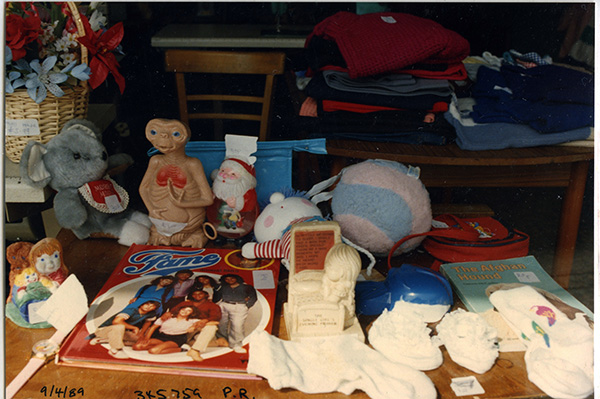
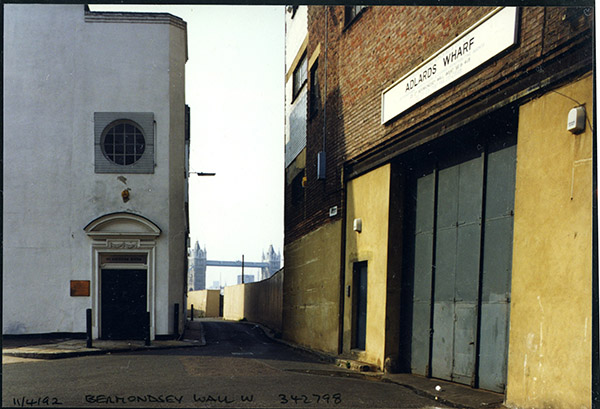
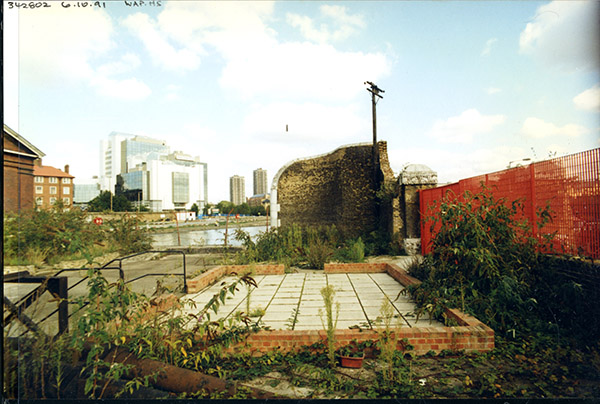
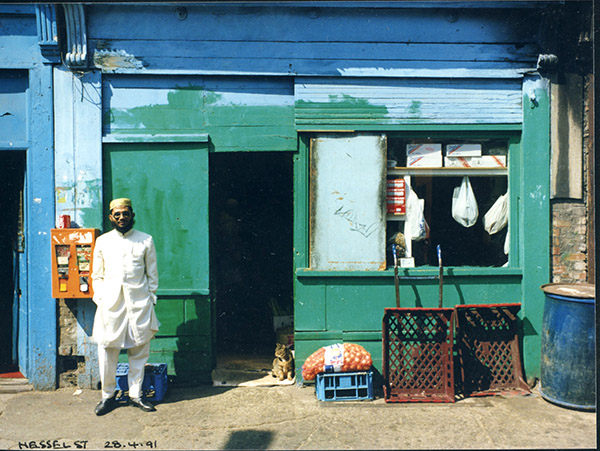
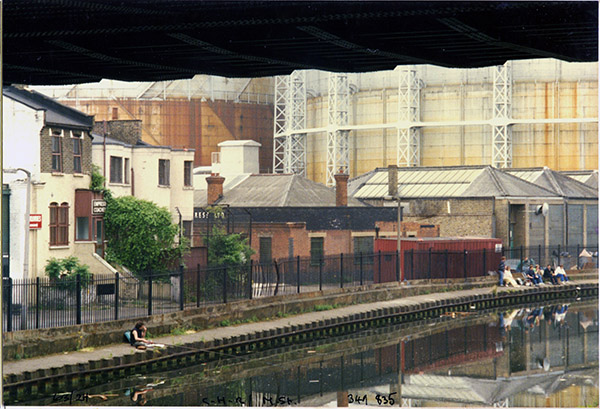
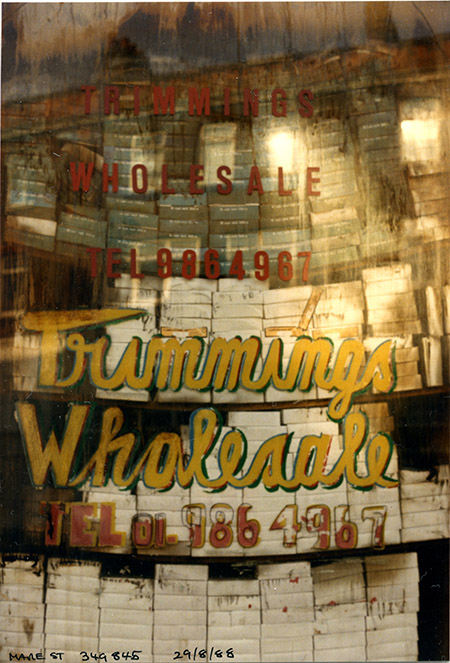
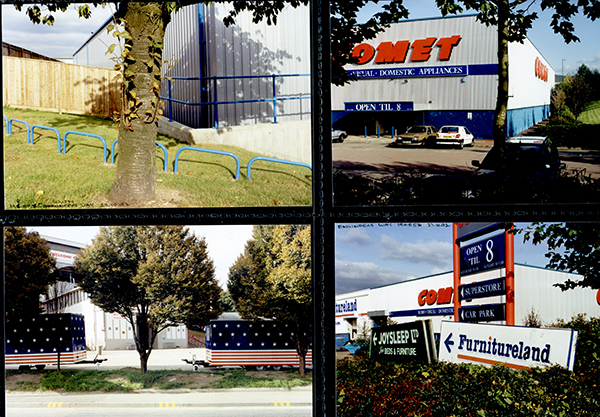
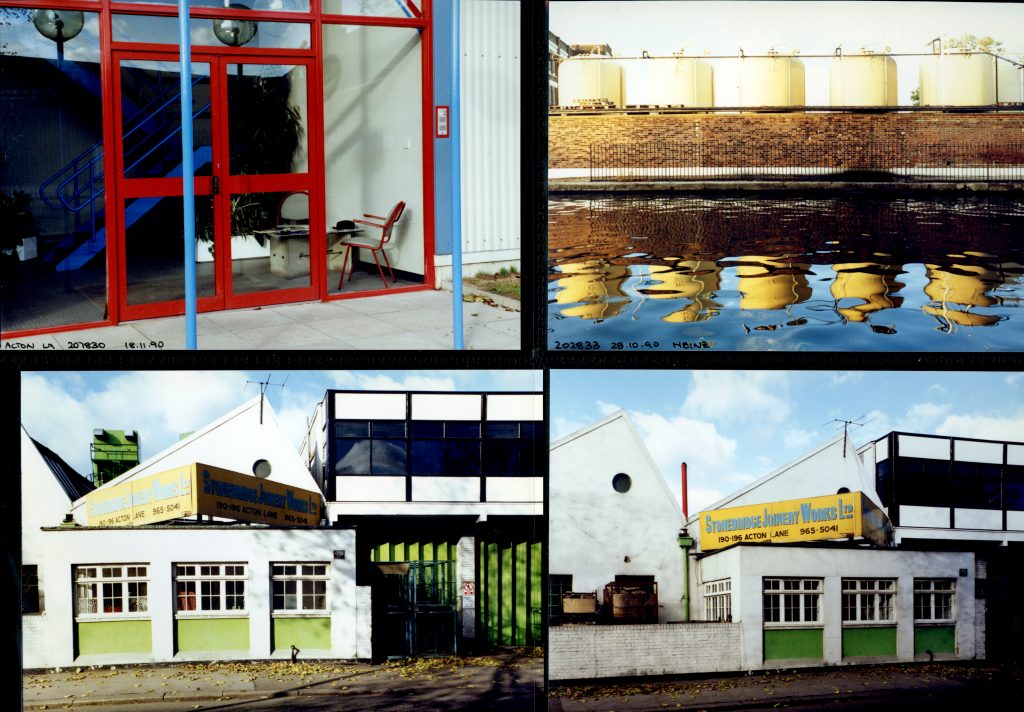
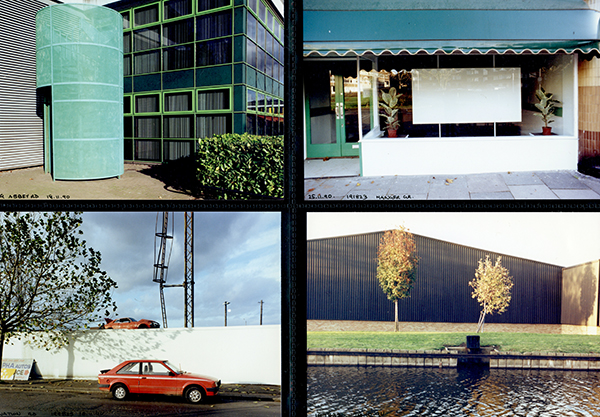
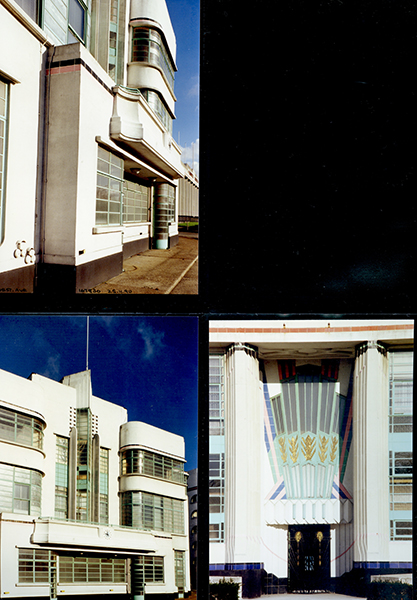
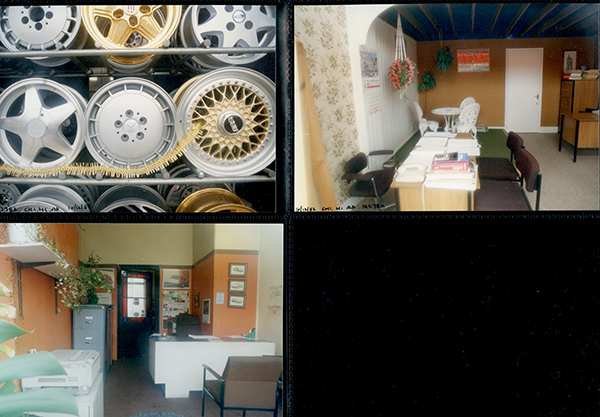
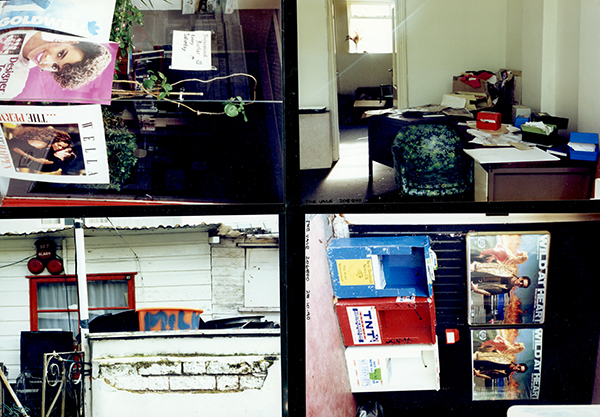
They all fall on the National Grid in the vertical column TQ34, and there are more pictures from all of them in the albums of colour enprints I put together from 1986 to 1992 as a project with the rather tentative title ‘Cross-section’. TQ34 is just one km wide and I have a row of A4 files covering around 20 such columns across the city, though those at the outer edges have fewer images.

The roughly A4 album pages could each hold four 6″ x 4″ enprints. I started by gluing the prints in place on scrap cartridge paper (unused from A level Art exams and cut down to size) but though that worked well it became tedious, and I moved on to purpose-designed plastic filing sheets, at first transparent and later black.

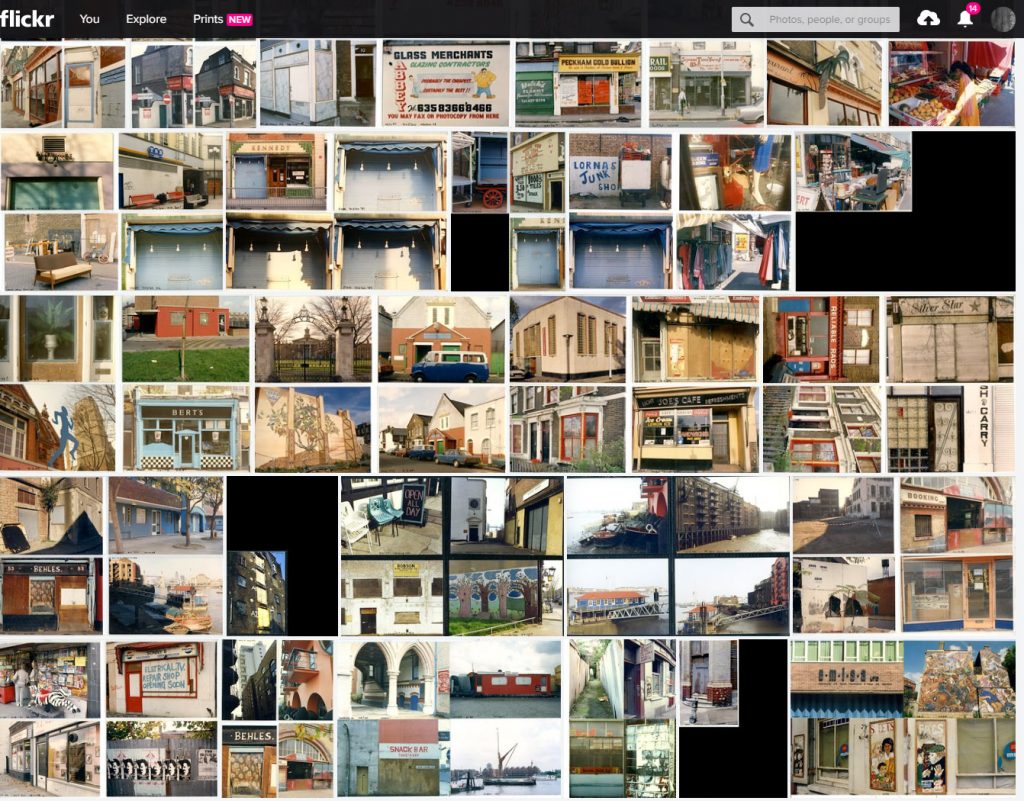
I tried at first to keep all four prints on any page either landscape or portrait format and from the same kilometre grid square, but as you will see on Flickr there are a few exceptions. The album TQ34 includes just over 70 pages and is shown on Flickr as in the album with most images having four prints.

These enprints were all trade processed and I sent the films off to various cheap consumer labs. The different colour casts they produced for each roll of 35mm film I felt added to the project, and I accepted some packets of pictures where I really should have demanded a reprint. A few of the worst I have done a little colour correction before posting online.

I finished – or rather abandoned – this project around 1992 when I installed a print processing line in my own darkroom and going over to bulk loading and home processing of my colour negative film. Producing enprints was too slow and fiddly, but I was able to make larger prints, and a small selection of these images where exhibited and sold over the years.

We are all stuck inside but you can take a virtual walk through London with me on Flickr.

July 1986 on Flickr

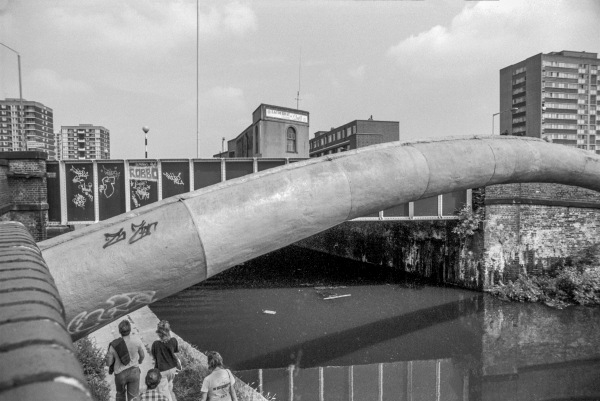
Pipe Bridge, Regent’s Canal, Baring St, Islington

I had more time to take pictures in July as my teaching came to an end for the summer vacation around halfway through the month. This meant I could go up to London on some weekdays, though I still had two small boys to look after on days my wife was working. That usually meant staying at home, but sometimes I took them both out with me to London.

Regent’s Canal

I spent some time in Shadwell and Bethnal Green, but also further north in Shoreditch, Hoxton and Dalston, occasionally wandering into Islington. Though I obviously photographed on foot, I had to travel from my home outside London and then around London to the starting point for my walks, and the One Day Capitalcard, valid on all public transport in London after 9.30am made this much simpler after its introduction in June 1986 – the one-day Travelcard launched in 1984 had been for bus and tube only.

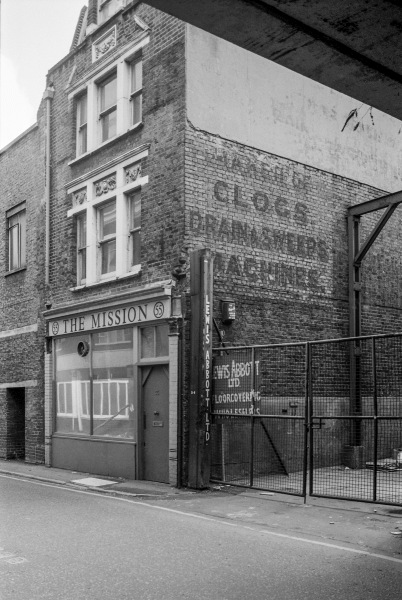
The Mission, Holywell Lane, Shoreditch, Hackney

Towards the end of the month I moved my focus to the City of London, even easier for transport then as the Waterloo and City line was still run by British Rail and my ‘London Terminals’ ticket was valid all the way to Bank.

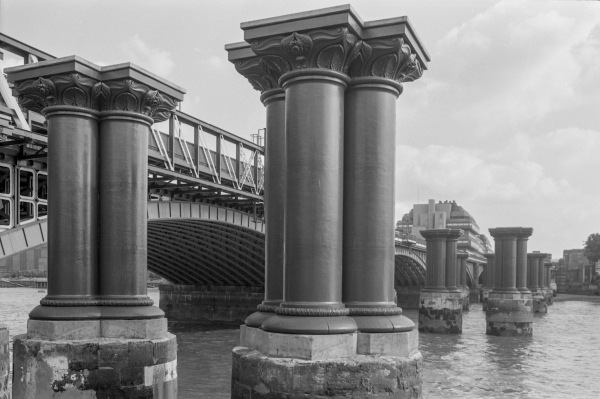
Blackfriars Rail Bridges

When I began photographing London there were two railway bridges across the River Thames at Blackfriars, but all that remained of one of these by 1986 were the pillars that had supported it. And while these were rather a fine set of pillars they were (and remain) a rather curious river feature, presumably left in position simply to save the cost of removing them.

Queenhithe and the River Thames

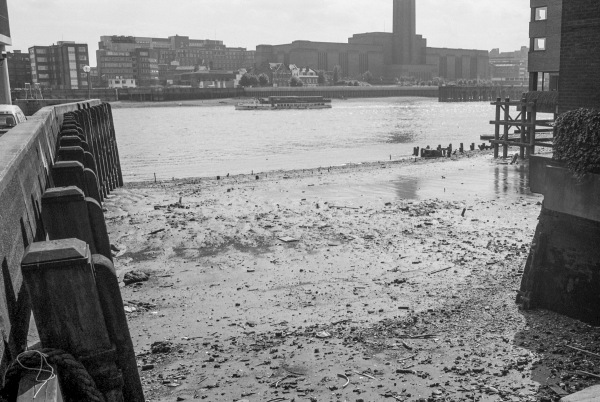
Queenhithe, a small inlet on the City side of the river has a long history. The Romans built a quay here, and buried deep down in the wet mud some of the timbers they put here survive, as do remains of the dock contructed when Alfred the Great, King of Wessex re-established the City of London aroudn 886 AD. It got the name Queenhithe (a hythe is a small harbour) when Henry I gave the right to levy dues on goods landed there to his wife Matilda around the time of their marriage in 1100. Queenhithe was still a major harbour for the city hundreds of years later and remained in use, with lighters bringing skins for the fur trade which was based a short distance to the north until the Second World War.

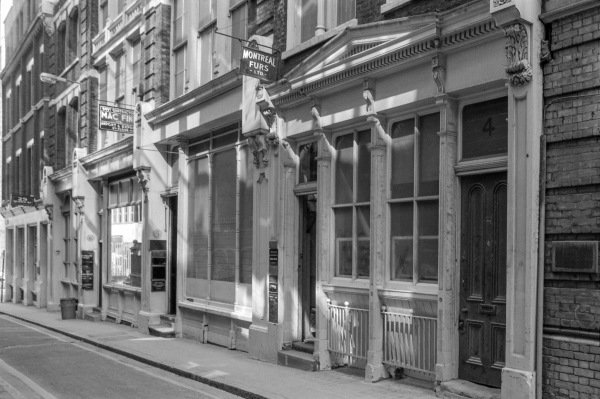
Fur shops in Great St Thomas Apostle

Around 300 of the black and white pictures I took in July 1986 are now online:
Peter Marshall: 1986 London Photographs on Flickr.
July’s pictures start here.

The images are copyright but may be shared on non-commercial personal social media. A licence is required for any corporate, commercial or editorial use.


All photographs on this and my other sites, unless otherwise stated, are taken by and copyright of Peter Marshall, and are available for reproduction or can be bought as prints.

There are no adverts on this site and it receives no sponsorship, and I like to keep it that way. But it does take a considerable amount of my time and thought, and if you enjoy reading it, please share on social media.
And small donations via Paypal – perhaps the cost of a beer – would be appreciated.


On the Third Day

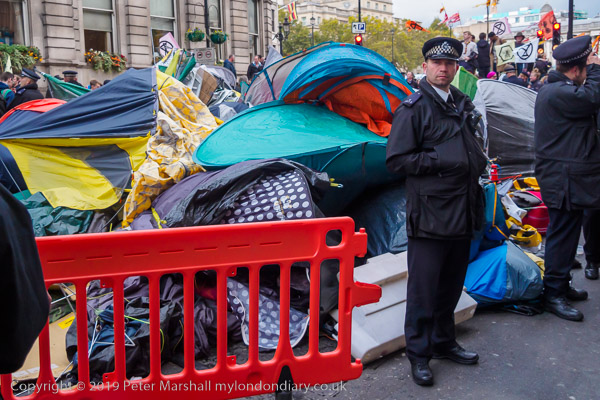
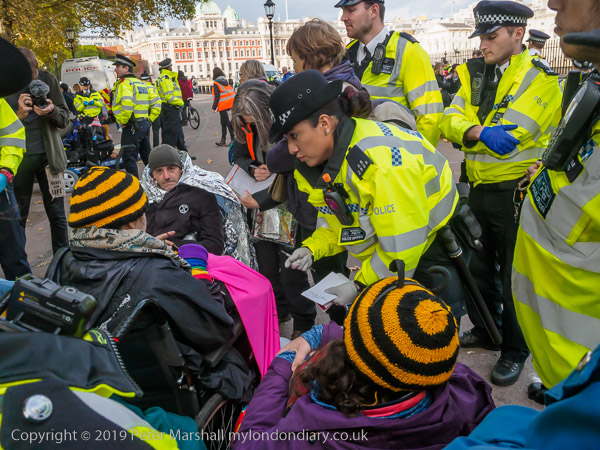
The rather tense stand-off between police and Extinction Rebellion protesters who were still blocking much of Westminster continued, with the police at times adopting rather rougher tactics, including the deliberate destruction of tents and other property as well as making arrests.

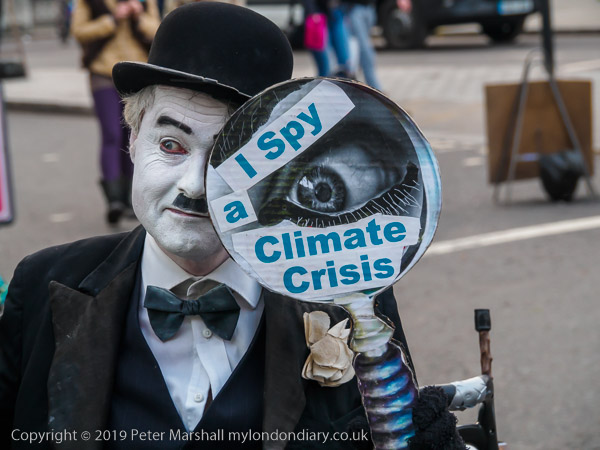
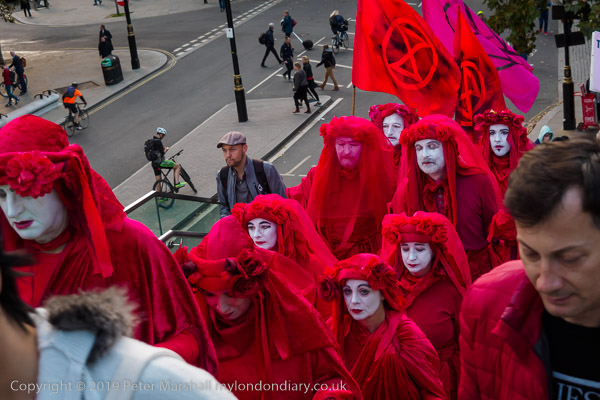
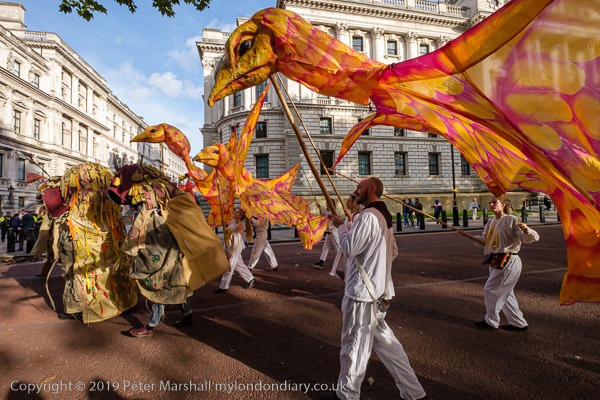
XR’s protest continued to be rather remarkable, with street performers, music and mimes including Charlie X as well as XR’s red and green robed troupes.

People were still determined to continue their protest and it was clear that the police were coming under increasing political pressure to end them, though quite a few officers seemed rather unhappy at what they were being ordered to do.

Prime Minister Boris Johnson had attacked the protesters, insulting them as ‘crusties’ but was still failing to take any action. XR’s demands remain, calling for the government tell the truth about the climate and ecological emergency, act to halt biodiversity loss, reduced emissions to net zero and create and be led by a Citizens Assembly.

There were many arrests during the day, with XR’s non-violent approach being maintained, and police succeeded in clearing some of the areas.

Extinction Rebellion Day 3


All photographs on this and my other sites, unless otherwise stated, are taken by and copyright of Peter Marshall, and are available for reproduction or can be bought as prints.

There are no adverts on this site and it receives no sponsorship, and I like to keep it that way. But it does take a considerable amount of my time and thought, and if you enjoy reading it, please share on social media.
And small donations via Paypal – perhaps the cost of a beer – would be appreciated.


Scanning London

TQ1985

A few months back I was lying prone inside a giant metal tube on a flat bed which moved me slowly backwards as successive slices across my body were scanned for the purposes of research, and the CT scan reminded me of a project on London which I began in the 1980s.

Nowadays we are all familiar with the idea of geotagging and some cameras can add geotags to the Exif date as you photograph, while gadgets can be fixed onto other cameras to add the data. Smartphones do the same, as they always track you position. The web site https://www.geograph.org.uk Geograph was set up in 2005 to “collect geographically representative photographs and information for every square kilometre of Great Britain and Ireland” and so far 13,114 contributors have submitted 6,397,064 images covering 280,384 of the 1km grid squares, still leaving around 15% should you wish to strike new ground.
TQ2083

I’ve occasionally added geotags to my own landscape pictures in Lightroom, using a free little phone app by one of my sons, ‘Easy GPS Logger’ which records GPS location and time data to a file. You load this into LR along with the pictures, match up any one of them with a particular place on a map and LR then uses the file to add the information to the other pictures. There are only two problems – remembering to turn on the logger at the start of your walk, and secondly to turn it off when you finish!
TQ1982

Back in 1986, the only way to add location data to your photographs was by hand, using a map to find the grid reference. Of course you had to know where you were to do so. I had the idea of doing a series of South to North cross-sections of London based on the Eastings and Northings of the National Grid using colour negative film.

Rather than attempting a series of south-north walks, I simply took a camera with colour negative film on more normal walks while I was photographing London in black and white, then sent the films for processing and printing 6×4″ enprints. When these came back from processing I’d sort out those I wanted to keep and use a map to find the grid references and add these and the date with a technical pen along the lower edge of the print. The date meant (at least in theory) I could find the negatives in my files.

TQ1683

At first I glued the prints onto card sheets to file them under the grid reference in a set of A4 files, but this soon became tedious and I bought filing sheets which held 8 prints, four on each side. Each of the kilometre grid squares had its own filing sheet, and some soon had several, with the series expanding to fill around a dozen A4 files. Each file holds around 50 double-sided sheets and so could hold around 400 prints, though many sheets are not full, so the project probably has around 3,000 or 4,000 prints.

TQ1978

Of course what was more important were the scenes I chose to photograph. I carried in my wallet a reminder of things I was interested in photographing (an idea picked up from reading a list made by Walker Evans), in a small zipped pocket together with a folded £20 note for emergencies. Of course colour was important, not just for itself, but as an illustration of how and why colour was used, and I had a great interest in representations of people and things, in ethnic differences and in the evolution and fashion of colour.

I can’t remember exactly when I ended the project, though it certainly continued well into the 1990s. But at some point I stopped sending colour negative film to be processed and began developing it myself, and producing enprints wasn’t really an option. Instead I made 8×10″ contact prints and worked from these, producing very many fewer but larger prints.

TQ2080

Over the years I’ve probably published or shown only around a hundred of these pictures, the largest group from 1986-90 in the book dummy and web site ‘Café Ideal, Cool Blondes, and Paradise

As with my black and white images of London, this is a body of work which I think has a great deal of historical interest as well as some photographic interest and it would be good to see it in some permanent museum or similar collection rather than simply gathering dust on my shelves.


There are no adverts on this site and it receives no sponsorship, and I like to keep it that way. But it does take a considerable amount of my time and thought, and if you enjoy reading it, please share on social media.
And small donations via Paypal – perhaps the cost of a beer – would be appreciated.