Darent Valley Path & Thames

Darent Valley Path & Thames, Dartford, Kent. On Saturday 4th July 2015 I went by train with my wife and elder son to Dartford for a day’s walking mainly beside the River Darent and River Thames.

Darent Valley Path & Thames

It was a hot summer day and the sky was blue with just a few small patches of white cloud. It probably wasn’t the best day to have chosen, as this was a walk with relatively little shade, but as usual there was a little breeze by the rivers to cool us slightly.

Darent Valley Path & Thames

I’d walked (and cycled) along the paths we took several times before, first in the 1980s, but they were new to my companions. After taking a short look at the Darent in Dartford we made our way to Hythe Street. Its name means a landing place or small port, and the Darent was once an important navigation at least as far as the mills in the centre of Dartford. The has been a pub here since 1764 and the Hufflers Arms gets its name from the men who guided and pulled the barges up the river to here.

Darent Valley Path & Thames

A footbridge takes the path across the Darent here, and past the backs of some industrial sites on towards the half-lock which stopped the river above it drying out at low tide, long derelict. It was something of a surprise to see a narrow boat moored close to it.

Darent Valley Path & Thames

There has been a huge change here since 2015, with volunteers working on and around the lock and the river. You can read more about the work of the Dartford and Crayford Creek Restoration Trust on the Facebook page of the Friends of Dartford and Crayford Creek, and see some of the changes in the pictures there.

Darent Valley Path & Thames

Later in the day I photographed a yacht making its way through the flood barrier from the Thames and going upriver. I heard afterwards that it had reached the recent bridge under the Bob Dunn Way bypass when the tide was just a fraction too high for it to creep underneath with its mast lowered.

The Thames is pretty wide here and the channel deep enough to take fairly large ships, with the ferries including the ship in the picture operating regular contianer services to Rotterdam and Zeebrugge.

I made a few panoramic images, but the sky was a little empty and blue for it really to be a good day for that. This one which shows my two companions walking on ahead is interesting to me as I have managed to make use of the curvature inherent in these very wide angle views. The path on which I was standing to make the image was more or less straight, though in the picture it seems to bend at roughly a right angle.

The Littlebrook Power Station had only recently ceased operation, and we walked past some interesting structures there before making our way under the Dartford Bridge.

I was pleased that the ferry was leaving and I was able to take a series of photographs of it going under the bridge and sailing on downriver. Some of the pictures give a better impression of the relative heights of ship and bridge with an enormous amount of headroom for the passage.

By now I was getting tired, mainly from the heat and the lack of any shade, and I took few pictures on the rest of the walk to the station at Greenhithe. We didn’t see any sign of the path marked on the map which would have taken us up to the church at Stone as I had planned, but I think I was releived not to have had to climb up the hill, and perhaps didn’t look too hard. After all I’d been there and taken pictures on various occasions before. And if you are walking this way it’s worth the detour.

More about the walk and more pictures at Darent Valley Path & Thames.


Votes, Love, Arms & Al Quds

Votes, Love, Arms & Al Quds: Sunday 3rd July 2016 was a busy day for me, photographing young people demanding the right to vote, a board remembering murdered MP Jo Cox, a picket against sponsorship of the London Transport Museum by one of the largest arms companies in the world and then the always controversial annual Al Quds Day march and its Zionist counter-demonstration.


16-17 Year olds demand the vote – Trafalgar Square to Parliament Sq

Votes, Love, Arms & Al Quds

Many young people who were not old enough to vote in the EU referendum were outraged at not being able to take part in the vote which will impact their future more than that of older generations.

Votes, Love, Arms & Al Quds

They point out that many of those who did vote will die before the worst effects of Brexit are felt, and that it was the vote of the eldest in the population to leave Europe than swung the vote. Young people, including those too young to have a vote were strongly in favour of staying in Europe.

Votes, Love, Arms & Al Quds

The march by several hundred people, mainly 16-17 year olds, called for a lowering of the voting age to 16. Most of the speakers at the rally in Parliament Square were teenagers.

More pictures at 16-17 Year olds demand the vote.


Jo Cox banner of love – Parliament Sq

Votes, Love, Arms & Al Quds

People were still coming to sign and write tributes on a giant board in Parliament Square to Labour MP Jo Cox, brutally murdered on 16th June on the street in Birstall where she had gone to hold a constituency surgery.

Cox, who had worked for some years at Oxfam GB as head of policy and advocacy had become an MP in 2015 and had founded and chaired the parliamentary group Friends of Syria, campaigning over the Syrian Civil War, and supported Palestinian rights and the BDS campaign. She was one of few MPs who stood up and campaigned for refugees and their rights.

Her murderer, a constituent with far-right white supremacist obsessions, shot her three times before multiple stabbings. He was sentenced to life with a whole-life tariff.

Jo Cox banner of love


Arms dealers out of LT Museum – London Transport Museum, Covent Garden

I stopped briefly outside the London Transport Museum to talk with and photograph campaigners from the London Campaign Against Arms Trade (CAAT) who were holding a picket to demand the museum end its sponsorship by Thales, the worlds 12th largest arms company. Thales supplies missiles, drones and other military products, selling them to repressive regimes around the world including Saudi Arabia, Russia, Colombia, Kazakhstan and the UAE.

More pictures at Arms dealers out of LT Museum.


Al Quds Day March – BBC to US Embassy

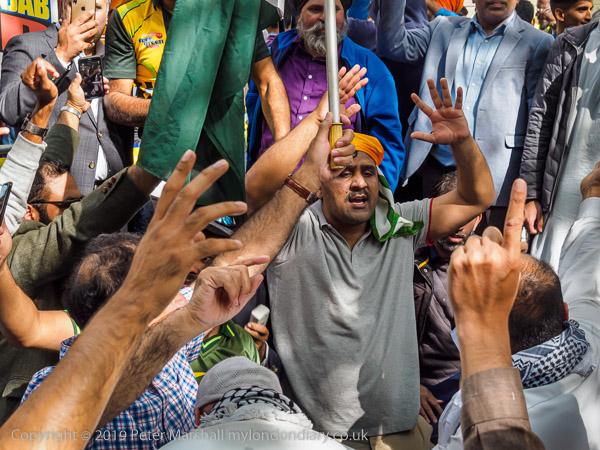
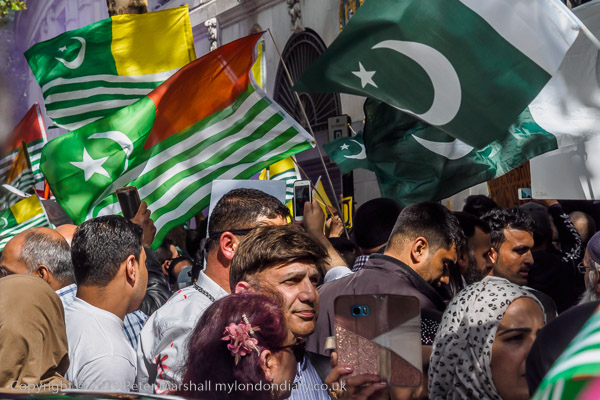
Several thousands, mainly Palestinians and Muslims from around the country, as well as other supporters of Palestinian freedom marched from the BBC to a rally at the US Embassy.

The final Friday of every Ramadan was designated Quds (Jerusalem) Day by Ayatollah Khomeini in 1979 as a day when Muslims around the world would demonstrate their solidarity in support of the Palestinians and call for an end to the Israeli occupation of Palestine. The London march takes place on the Sunday following.

A few supporters of Israel tried to protest against the march, holding Israeli flags and shouting at the marchers, but police kept them away.

Some of the marchers came with flags and t-shirts supporting the Lebanese Shia Islamist political party and militant group, Hizbullah (Hezbollah). Since 2019 this entire organisation has been proscribed in the UK, but in 2016 we still followed the EU in making a distinction between it as a political party with MPs in the Lebanese government and as a terrorist group.

Among the marchers were a group of Neturei Karta Orthodox Jews whose religious beliefs reject Zionism and the Israeli state. Their posters say Judaism is ‘G-dly & Compassionate’ while Zionism is ‘G-dless & Merciless’ and that ‘Jews True to their faith will Never recognise ZIONIST occupation’ and other similar statements.

At the US Embassy a large force of police separated their rally from a counter-protest by Sussex Friends of Israel, the Zionist Federation and the Israel Advocacy Movement. They displayed placards demanding ‘Peace Not Hate’ and Israeli flags.

This group reserved its loudest and most angry shouting for the anti-Zionist Neturei Karta Jews who came and stood facing them from a wall in front of the US Embassy.

Much more on My London Diary:

Al Quds Day March
Supporters Stand Up for Israel


Hate Crime & Brexit

Hate Crime & Brexit: I tend to think of Brexit as a hate crime, inflicted on the British nation by millionaires out to make a quick buck (or rather a few million) like Mogg, but this title refers to two quite different protests on Saturday 2nd July 2016, both Brexit related.


Love Islington – NO to Hate Crime – Highbury Fields

Hate Crime & Brexit

This protest in Islington was called by Islington Labour Party in reaction to the increase in hate crime against racial, faith and other minorities following the Brexit vote.

Hate Crime & Brexit

Speakers at the event included local MPs Jeremy Corbyn and Emily Thornberry, London Assembly members Jennette Arnold and Caroline Russell, faith leaders, including a gay Catholic priest, a leader of the Somali community, Richard Reiser of DPAC, the leader of Islington council and councillors.

Hate Crime & Brexit

They came to declare that Islington was proud to be a diverse, tolerant and cohesive community with good relations between all who live there, regardless of race, faith, sexual orientation, disability and transgender identity, and to urge everyone to stand up against hate crimes and report any incidents to the police.

Hate Crime & Brexit

For once one of my pictures was picked up by some of the national press, not to talk about the event or the problem of hate crimes and the role of the Brexit referendum in encouraging some very nasty characters out from under their stones, but to make snooty remarks about the jacket which Jeremy Corbyn was wearing. The obviously saw it as another Michael Foot donkey jacket moment.

Foot of course did not wear a donkey jacket at the Cenotaph in November 1981. He wore a short, blue-green Jaeger overcoat bought by his wife at Harrods so he would look smart, and on which the Queen Mother complimented him on. But the press was out to get him and the lie, invented by a right-wing Labour MP, stuck.

I had taken the pictures of Corbyn while wearing a jacket very similar to his, appropriate for the weather that rather cool July morning. Mine certainly didn’t come from a charity shop, and I’ve no idea whether his did but if so he was fortunate to find it and made a very sensible decision to purchase it.

Pictures of the other speakers and more at Love Islington – NO to Hate Crime.


March & Rally For Europe against Brexit

More than 50,000 people marched through London to a rally in Parliament Square to show their love for the EU and in protest against the lies and deception from both sides of the EU referendum campaign.

Many feel that the result did not truly reflect the will of the people and that the majority was too small to be a mandate for such a drastic change.

David Cameron had been so convinced that the result would be to remain in Europe that he had failed to act rationally. It was a decision that has dramatically changed our nation and one that in any sensible system should have required a truly decisive majority, rather than just creeping past halfway at 51.8%.

I was raised in a church where all decisions were made by consensus, with discussions continuing until all were willing to agree, often requiring considerable concessions on all sides. It was sometimes a rather slow process.

Since I’ve belonged to other organisations where constitutional changes required a two-thirds majority. Perhaps this is a little too high, but the Brexit vote was hardly a mandate with only 37.4% of those registered to vote backing it.

We’ve now begun to see what Brexit means in practice, with many of the problems dismissed as false by Brexit campaigners becoming evident, while few if any of the advantages they trumpeted have appeared. Last month an opinion poll showed that 55% now think Brexit a mistake while only 32% think it was a good decision, and their number continues to fall. But there doesn’t seem any easy way out of this mess, though perhaps a new government that understands how to negotiate would one day help ease some of the worst effects.

The march was a huge one. I had arrived at Hyde Park Corner just as it was starting and it was over 90 minutes later that I left the end of the march as its end was getting close to Green Park station less than half a mile away. I took the Jubilee Line the single stop from there to Westminster and only arrived in time for the last few minutes of the rally which had begun and only heard the two final speakers, David Lammy MP and Bob Geldorf speaking to a packed Parliament Square. Marchers were still arriving there after the rally had finished but I went home.

Mand more pictures on My London Diary:
March For Europe against Brexit
Rally For Europe against Brexit


Sotheby’s ‘Dignity under the Hammer’ protest – 2015

Sotheby’s ‘Dignity under the Hammer’ protest: Art is big business, and Sotheby’s is arguably the biggest name in that business. Like all businesses they rely on the services of cleaners, porters and other low paid workers to keep the business running smoothly. But back in 2015 they decided they didn’t want to pay them a proper wage and give them decent conditions of service.

Sotheby's 'Dignity under the Hammer' protest - 2015 - United Voices of the World

While the protest by the United Voices of the World trade union members and friends was taking place, wealthy art investors were attending and making their bids at a a Contemporary Art Evening Auction including works by Francis Bacon and Andy Warhol. Sotheby’s later announced that the evening “realised £130.4m ($204.7m / €183.9m), Sotheby’s highest-ever total for a sale of Contemporary Art in Europe. Warhol’s only hand-painted one-dollar bill painting sold for £20.9 million, the highest price for any work sold in London this week.”

Sotheby's 'Dignity under the Hammer' protest - 2015 - United Voices of the World

Many wealthy people and institutions which spend lavishly on themselves and their business seem to begrudge paying the low paid workers they depend on a living wage. Perhaps that’s how these people got wealthy in the first place, screwing the peasants and workers.

Sotheby's 'Dignity under the Hammer' protest - 2015 - United Voices of the World   - Ian Bone of Class War

The cleaners at Sotheby’s are not directly employed but are outsourced – so Sotheby’s were able to deny responsibility for the way they were treated. Earlier representations and threats of protests by the workers had resulted in them being promised by their then employers a settlement including the reinstatement of suspended trade union members, contractual sick pay, the backdated payment of the London Living Wage and an end to the use of toxic cleaning products.

Sotheby's 'Dignity under the Hammer' protest - 2015 - United Voices of the World

But after this agreement was reached with contractor CCML, Sotheby’s fired the company and brought in new contractors, Servest, who refused to honour the agreement, instead sending a letter to all the workers threatening with sacking if they protested. They also began unfair unfair disciplinary action against one of the union reps, while refusing to investigate his report of threats of violence made to workers by their managers.

The day after this protest four cleaners reporting for work were stopped and told they were not allowed to enter because they had been at this protest. The United Voices of the World union continued their actions in support with further protests and they were supported in parliament by an Early Day Motion and sponsored by John McDonnell and Jeremy Corbyn.

Eventually there was victory for the UVW, and in early 2016 they were able to report that “ALL outsourced workers at Sotheby’s, including cleaners, caterers, porters and security guards would receive both the London Living Wage and contractual (much improved) sick pay.” There is more information on their web site including a video and photographs and links to other news items on the campaign.

The protest was much enlivened as you can see in some of the pictures by the support of other groups, notably Class War, and you can read an account of this protest on My London Diary (link below) with more comments in the picture captions.

It’s interesting to see the very different attitudes of the police towards the protesters and Sotheby’s staff in the pictures. Eventually after urging from Sotheby’s police brough in reinforcements and tried to clear the protesters well away from the auction entrance, although the protesters had made no attempt to impede those entering, simply offering them fliers about the dispute.

Sotheby’s ‘Dignity under the Hammer’ protest

NHS – Free, For All, Forever?

NHS – Free, For All, Forever?. Five years ago on Saturday 30th June thousands marched through London to celebrate 70 years of the National Health Service, which began on 5th July 1948. In a few days we will celebrate the 75 anniversary. The pictures here are from that march.

NHS - Free, For All, Forever?

A few days ago the Kings Fund published their report comparing the NHS to health care systems of other countries. It made depressing reading, but its findings were already well-known – and the result of government policies over the years.

NHS - Free, For All, Forever?

Conservatives were opposed to the setting up of the NHS and voted against it on numerous occasions when Aneurin Bevan was campaigning for its setting up and taking the bill through parliament. Bevan established the three basic ideas, that it should benefit everyone, that healthcare would be free and that care would be provided on the basis of need rather than ability to pay.

NHS - Free, For All, Forever?

Many doctors and dentists were opposed to the new system, which they saw as a threat to their lucrative private practices and this led to a number of compromises which have had serious consequences over the years.

NHS - Free, For All, Forever?

Dentistry has never really been made properly a part of our health care system and now large areas of the country have few if any dentists who will take on NHS patients. Private medicine has continued and grown parasitically on the NHS – who train those working in it, while it now gets paid by the NHS to provide many of the simpler aspects of treatment while leaving the heavy lifting to our public service.

Both Conservative and Labour governments since its formation have made changes which have diluted Bevan’s principles. Contracting out of various services began under the Tories, sometimes resulting in disastrous lowering of standards. Proper cleaning services etc are essential in hospitals.

New Labour brought in Private Finance Initiative projects (they borrowed the idea from the Tories) which have led to huge ongoing debts for some NHS trusts – and closures of some vitally needed hospital departments to meet these.

Since the Coalition and then the Tories came back into power there has been a huge increase in the creeping privatisation of the NHS, with Andrew Lansley’s 2012 Health and Social Care Act forcing the NHS into a market-based model based on competitive tendering, which even his successor as Health Minister, Jeremy Hunt has described parts of as ‘frankly, completely ridiculous’. So much so that even the Tories have no had to row back a little.

The King’s Fund report makes clear that “The UK has below-average health spending per person compared to peer countries” and it “lags behind other countries in its capital investment, and has substantially fewer key physical resources than many of its peers, including CT and MRI scanners and hospital beds.”

Successive governments have prevented the training in the UK from expanding the numbers of university places for medical training, and a few years ago the Tories removed the bursaries available for nurses. Since the start of the NHS this had been a failure, and as the report states there are now “strikingly low levels of key clinical staff, including doctors and nurses” and the NHS is “heavily reliant on foreign-trained staff.” Only in recent days have we seen an effort by government to put forward plans to address the issue – and almost certainly one that is inadequate.

There is also the question of pay, brought to the fore in recent months by strikes by nurses and doctors. The government’s response has mainly been to refuse to enter into meaningful talks and mutter about the impossible demands being made.

Of course nobody expects junior doctors to get a 35% rise, but all that it would take to resolve the dispute is a much lower figure, combined with a commitment to make a small above inflation increase in a number of following years to reduce the gap that has opened up.

You can read more about the march and rally and some of the issues in my post on My London Diary from June 2018, which also includes some information about the interests or many MPs and peers in private healthcare and connections to those wanting to see the NHS abolished. It may be ‘OUR NHS’ but many of those who have power to determine its future want it to belong to them.

And of course, many more pictures at NHS at 70 – Free, for all, forever.


UAF, EDL and Pride – 2013

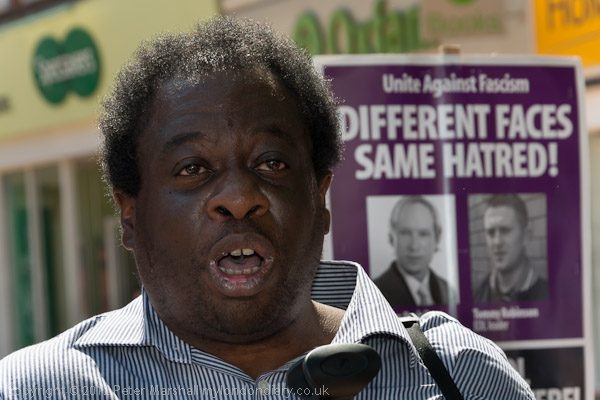
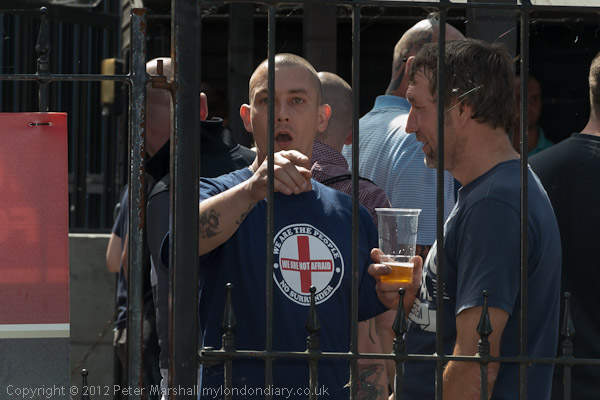
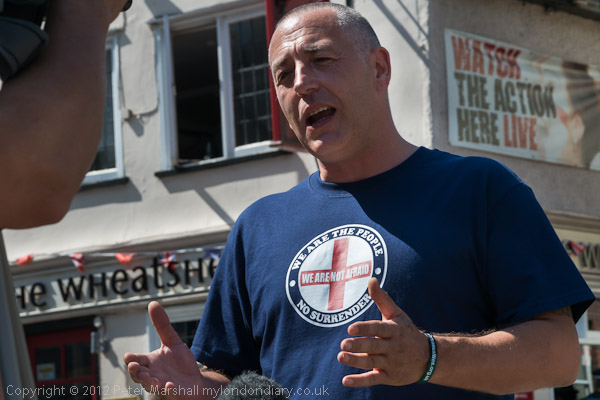
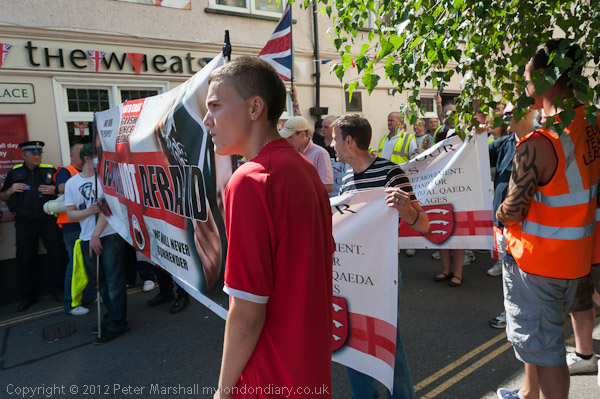
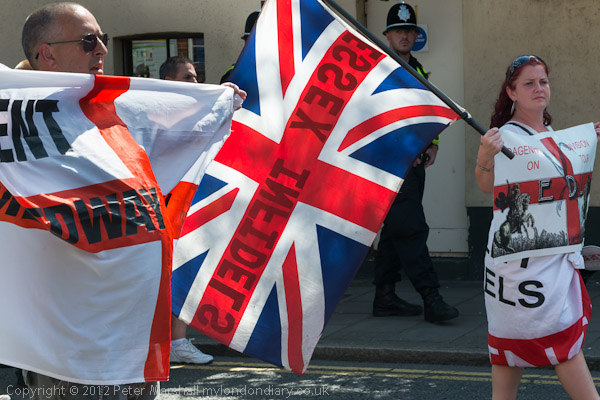
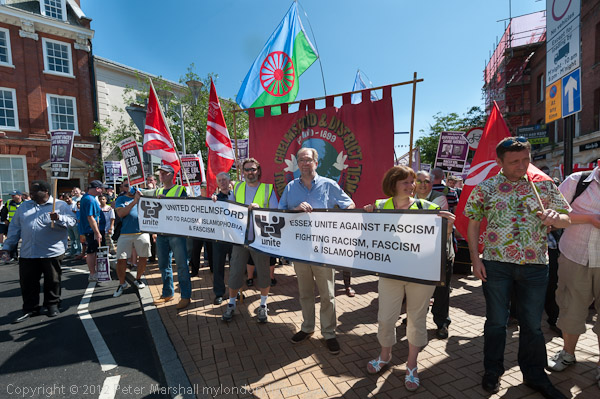
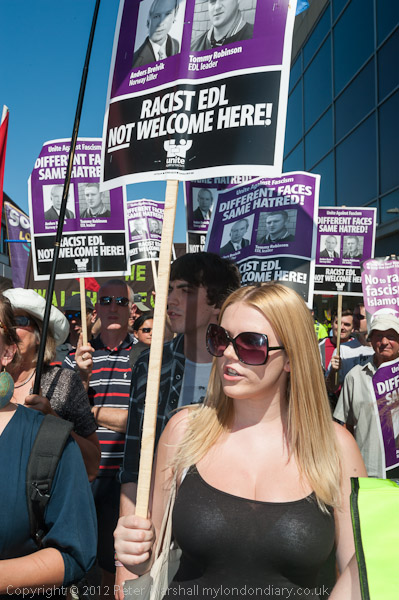
UAF, EDL and Pride : Ten years ago on Saturday 29th June 2013 my work began in Hyde Park where anti-fascists had gathered to oppose an EDL march – for which very few had arrived. I left to photograph the 2013 Pride London event.


UAF Oppose, EDL Don’t Come – Hyde Park

UAF, EDL and Pride - 2013

Police had banned the EDL from marching past the East London Mosque in Whitechapel and from any assembly or procession in Woolwich where Lee Rigby had been cruelly slaughtered under the Public Order Act.

UAF, EDL and Pride - 2013

Instead they had allowed a march by the EDL from Hyde Park to a rally near Parliament, and had also allowed Unite Against Fascism to march in protest against the EDL.

UAF, EDL and Pride - 2013

But the two EDL leaders, Stephen Lennon and Kevin Carrol had called themselves ‘charity marchers’ and had turned up in Tower Hamlets and been arrested by police. This news was relayed to the UAF supporters in Hyde Park and they gave a loud cheer. There were at most a hundred of them, and they had intended to march to the starting point of the EDL march, but none of the EDL had turned up. I left to photograph Pride.

More at UAF Oppose, EDL Don’t Come.


Pride Celebrates Love and Marriage – Baker St – Trafalgar Square

UAF, EDL and Pride - 2013

Over 150 groups had turned up for the 2013 Pride Parade to welcome the equal marriage Bill in England and Wales and celebrate the love that binds the London LGBT+ community together and links it with the wider community.

They included many of the figures I had photographed at previous Prides over the years – such as ‘The Queen’ , including some I had photographed back in the 1990s.

As always, some of the costumes were spectacular, while others were, frankly, just very odd. But variety is of course the spice of life, and there was certainly no shortage of spice.

My pictures show many of the individuals taking part, as well as smaller groups, but no the more commercial aspects of the parade which now tend to dominate. And I also like to show those using the occasion to make a political point. Pride is still for some a protest.

After photographing the marchers at the start – always where the most interesting photographs of the event can be found, I made my way to Trafalgar Square to photograph people arriving at the end of the parade.

By the time the march ended I’d been on my own feet too long and went home.

Many more pictures at Pride Celebrates Love and Marriage.


Rain on Pride Parade

Rain on Pride Parade: Times have changed since 2014 when I made a large set of pictures at the start of London’s annual Gay Pride on Saturday 28 June. Back in 2014 I was able to walk around freely and meet and photograph those taking part before the parade started. The colour pictures here are all from that event, where there were some short but heavy showers as people gathered.

Rain on Pride Parade

I don’t think I had actually bothered to apply for accreditation, though I did on some previous years, as I didn’t intend to photograph the actual parade. But in 2017 security around the event was stepped up and it became necessary for everyone to have applied for permission to take part to get near.

Rain on Pride Parade

I’d first photographed Pride in 1993 and it was then a very different event. Pride was then a protest and a defiant gesture, while now it has become a corporate-dominated gay parade.

Rain on Pride Parade

I was pleased when some of these photographs were shown as a part of the exhibition Queer is Here at the Museum of London in 2006 and a larger set at at ‘Changing the World’, a Gay and Lesbian History and Archives Conference at London Metropolitan Archives in 2005.

Rain on Pride Parade

Those pictures were in black and white, though I think I may also have taken some in colour, yet to be re-discovered in my archives, and they covered the 10 years from 1993-2002. You can view a set on-line, though there are hundreds more in my files. These include a small number from Pride 1998, which according to Wikipedia didn’t happen.

In 2017 I had decided to photograph the Migrants Rights and Anti-Racist Bloc who had joined the official parade in 2016. But in 2017 they were refused entry and instead – as I put it – “reclaimed Pride as protest, gate-crashing the route at Oxford Circus and marching in front of the official parade along the route lined by cheering crowds.”

This should have been the big story about that day’s Pride, but hardly made the news, and I think was totally ignored by the BBC – and doesn’t even get a mention in the Wikipedia article.

After this I decided not to cover Pride in 2018, going instead to photograph a march against the closure of acute facilities at Epsom and St Helier Hospitals in south London while it was happening. The following Saturday I went the following week to photograph the third Croydon Pride Procession, a much smaller and friendlier event.

In 2019 I went to Regent’s Park where people were preparing to join on the end of the huge Pride Parade as a Queer Liberation March in protest against the increasing corporate nature of Pride.

They included some LGBT groups unable to afford the fees to take part in the official parade, but mostly people were there because they felt it vital to get back closer to the origins of Pride, which began with the Stonewall riots 50 years ago led by trans women of colour.

I had to leave well before they set off to join the parade. The did eventually manage to do so, but had to force their way past the Pride stewards. The police had initially tried to stop them but then decided they had to be allowed to march.

Pride was cancelled in both 2020 and 2021. On July 1st 2022 I photographed the Gay Liberation Front UK commemorating their first London Gay Pride March 50 years ago marching through London on exactly the same hour and date. London Pride 2022 took place the following day but I went elsewhere.

More pictures from Pride 2014 on My London Diary at Rain on Pride Parade.


Thousands rally to Keep Corbyn

Thousands rally to Keep Corbyn: Parliament Square, London, Monday 27 June 2016

Jeremy Corbyn remains in the news today, although the BBC in its wide coverage of the festival has ignored the dropping of the official screening of ‘Oh, Jeremy Corbyn: The Big Lie’ at this year’s Glastonbury Festival. It was cancelled after various groups, mainly of people who had not seen the film, claimed it was anti-Semitic, a claim vehemently denied by the maker, Platform Films.

Thousands rally to Keep Corbyn

Those actually at Glastonbury, despite the ban, have been able to see the film and make up their own minds as it has been screened on several stages there despite the main ban. Many also have attended screenings at venues around the country, although it has not made it to cinemas in this country. You can see a trailer here – and this makes it very clear why those now in control of the Labour Party are trying to stop it being widely seen.

Thousands rally to Keep Corbyn

Platform Films are asking for people who can arrange screenings in their local area and it has been screened in many halls around the country – though pressure from Labour and some Jewish groups has apparently led to some of these also being cancelled. Platform obviously needs to recoup some at least of its expenses in making the film by sales. Once it has done so I think the film will probably be made available widely on DVD and probably on-line free to view to reach a wider audience.

Thousands rally to Keep Corbyn

The film which explores widely the forces behind the downfall of Corbyn is narrated by Alexei Sayle and includes a contribution by film-maker Ken Loach. Its producer, Norman Thomas issued a press statement last Friday in which he says that the Glastonbury ban has backfired “wonderfully”, giving a great publicity boost:

The Glastonbury ban will mean many more people will now be able to see the film. They will be able to see the truth of the film, as opposed to the ridiculous claims made about it. It is NOT a conspiracy film. And it is in no way antisemitic. It simply tries to tell the story of the rise and fall of Jeremy Corbyn which hasn’t been told.”

It was at a music festival in Tranmere in May 2017 that the crowd first began the chant ‘Oh Jeremy Corbyn’ to the tune of Seven Nation Army by the White Stripes, but it was at Glastonbury later that year when hundreds of thousands took up the refrain that it became iconic.

The previous year, 2016, thi protest took place against a coup by Labour MPs against their leader, happpening despite the fact that the latest opinion poll had shown that under his leadership the party had caught up with the Tories. And despite the huge support Corbyn had from the majority of party members who had given him a huge mandate in the leadership election. And that party membership had almost doubled under his leadership.

More than ten thousand grass-roots Labour supporters came to Parliament Square to support Corbyn in a rally organised by Momentum as Labour MPs were revolting against him. Three days earlier MPs Margaret Hodge and Ann Coffey had tabled a motion of no confidence in him as Labour leader. The previous day, Hilary Benn had been sacked from the Shadow Cabinet after it emerged he had been organising a mass resignation of Shadow Cabinet members – and 23 of 31 others had walked out.

Corbyn was the final speaker at the rally, promising he would not resign if he lost the motion of no confidence – as he did the following day. He made clear that he would stand again if MPs forced a leadership election, and that party rules clearly state as the incumbent he would not need to collect nominations to be on the ballot.

And later in the year, there was a leadership election. Corbyn was proved right about the rules despite attempts to prevent him from being on the ballot, but the National Executive Committee limited the membership vote to those who had been members for over six months and decided that “registered supporters” could only vote if they paid a £25 fee. They were almost certainly shocked that over 180,000 did – mainly Corbyn supporters.

The election took place in September that year, with Corbyn winning decisively with almost 62% of the vote – a small increase over his initial leadership contest.

The message to the right of the party was clear. If they wanted to defeat Corbyn they had to fight even dirtier – and ‘Oh, Jeremy Corbyn: The Big Lie’ exposes some of the ways they did so.

More at Thousands rally to Keep Corbyn.


International Day in support of victims of Torture

International Day in support of victims of Torture: The United Nations Convention against Torture and Other Cruel, Inhuman or Degrading Treatment or Punishment came into force internationally on 26 June 1987, and in 1998 the UN declared the 26 June of every year to be the International Day in Support of Victims of Torture.

Over the years I’ve photographed a number of vigils and protests marking the day in London by various groups concerned with human rights, mostly organised by the London Guantánamo Campaign but often joined by others.


No to Torture Vigil – Trafalgar Square, London. Tue 26 June 2012

Supporters of the The London Guantánamo Campaign and other human rights activists held up placards saying “NO to torture” in over 30 languages. Other protesters against various human rights violations joined in the protest, including campaigners calling for an end of the Iranian executions of the Baloch people, those against the extraditions of Babar Ahmer, Talha Ahsan and others to the US and the Free Mumia campaign.

International Day in support of victims of Torture

More on My London Diary at No to Torture Vigil.


Say No To Torture – Trafalgar Square, London. Wed 26 Jun 2013

International Day in support of victims of Torture

The London Guantanamo Campaign which has been active in calling for the closure of Guantanamo and other prisons including Bagram in Afghanistan since 2006 again held a vigil in Trafalgar Square.

International Day in support of victims of Torture

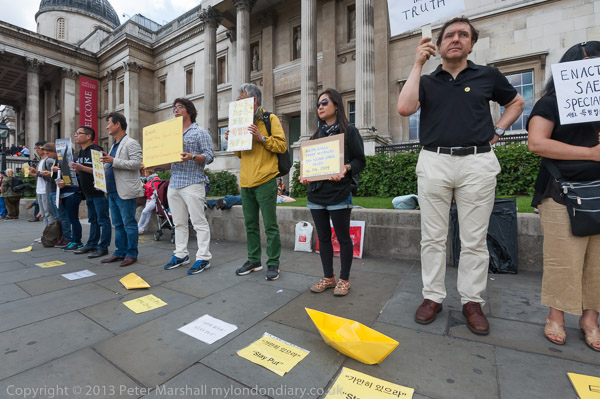
Some wearing orange Guanatanamo-style jump suits and black hoods, they stood in a lin in front of the National Gallery, calling for the release of London resident Shaker Aamer and the other detainees held and tortured without trail. Shaker, along with most of the other prisoners was on the 141st day of a hunger strike, being subjected to regular beatings, being brutally forcibly fed and held in solitary confinement – which also constitues torture under the UN definitions.

International Day in support of victims of Torture

Among those taking part in the vigil was veteran peace campaigner Bruce Kent. The ‘Say No To Torture’ protest overlapped with another human rights protest over Balochistan, a ‘nation without a state.’ Balochs live mainly in Pakistan and have been subject to arrests and other human rights violations including torture by the Pakistan authorities for campaigning for independence.

More on My London Diary at Say No To Torture.


Torture Solidarity Vigil – Trafalgar Square, London. Thu 26 Jun 2014

In 2014, Kashmiris wore black hoods and headbands with messages ‘Mutilated’, ‘Raped’, ‘Tortured’, ‘Executed’ and waved Kashmiri flags to protest at the widespread human rights abuses by the 7,000 custodial killings and torture of prisoners by the Indian state Indian state in Kashmir- 1 in 5 Kashmiris is a torture victim.

Also in Trafalgar Square was a vigil by the The London Guantanamo Campaign with people holding posters and blindfolded or gagged, calling for the release of prisoners from the US prison camp and an end to impunity for torturers.

The UK has failed to take proper action over allegations of prisoner abuse by the British military in Iraq and Afghanistan and has continued to be involved in the “rendition” and torture of British and foreign nationals abroad. Our government prevents violations becoming public knowledge, relying on secret courts and partial and biased investigations.

More on My London Diary at Torture Solidarity Vigil.


UN Day for Victims of Torture – Trafalgar Square, London. Fri 26 Jun 2015

The London Guantánamo Campaign and others were back again in Trafalgar Square in a solidarity vigil in recognition of the suffering and rights of victims and survivors of torture, calling on those in positions of power able to put an end to the use of torture.

Obama had promised in 2010 to end the shame of Guantanamo, but the detentions and torture continued throughout his presidency, though there were some releases.

More on My London Diary at UN Day for Victims of Torture.


Here are links to further protests I covered in recent years on 26 June against torture, in Trafalgar Square in 2016, at the US Embassy in Nine Elms in 2018 and by Balochs in Trafalgar Square in 2019. In 2017 I had a day off work for medical tests, and in 2020 there was no vigil because of the lockdown.


Loughborough Estate, Angell Town & a Garage – 1989

The fourth post on my walk in Kennington and Brixton on Sunday 6th May 1989. The posts began with Hanover, Belgrave, Chapel, Shops, Taxis. The previous post was Brixton Road and Angell Town -1989

Loughborough Estate, Flats, Loughborough Rd, Brixton, Lambeth, 1989 89-5d-44

I’m not sure which of the nine eleven-story slab blocks on the estate is shown in my picture; the estate was and remains a rather confusing area. Possibly this is Leicester House on Loughborough Road, or more likely Harpur House on Angell Road where I think I walked to next, but the lower buildings in front of the block appear to have gone.

The sign ‘NO HATS’ is not a reference to any headgear but to Housing Action Trusts, an important part of Margaret Thatcher’s marginalisation of local authorities. Having ochestrated the run-down of council estates by earlier restrictions on council spending and the right to buy schemes, the Housing Act 1988 aimed to transfer these estates to non-departmental public bodies which were to redevelop or renovate them so they could be transferred into private ownership.

Opposition to HATs was intense, with the Labour Part, local authorities and estate residents all fighting their imposition, and the first six areas intended to becom HATs managed to avoid implementation, though later six were formed, but none in south London.

Lunch Club, Loughborough Estate, Angell Rd, Brixton, Lambeth, 1989 89-5d-45

I think this rather temporary-looking building as on Angell Road close to Harpur House, but no sign of it remains. I photographed it largely for the posters showing opposition to Housing Action Trusts in Broxton.

As well as a Luncheon Club for pensioners it also has a sign for the Loughborough Sports & Social Club.

Fence, St John the Evangelist, Angell Park Gardens Angell Town, Lambeth, 1989 89-5d-32
Fence, St John the Evangelist, Angell Park Gardens, Angell Town, Lambeth, 1989 89-5d-32

Further along Angell Road – named like the area after the Angell family who had owned large parts of the Lambeth and developed this area in the 1850s. In 1852 Benedict John Angell gave a site here for the building of St John the Evangelist Church which was consecrated in 1853. Unfortunately trees along the edge of the site along Angell Road and Angell Park Gardens had too many leaves in May to clearly see the church.

These paintings on the fence around the church are still visible but rather faded. I took a few pictures of them both in black and white and in colour before walking on past the church and across Wiltshire Road into Villa Road and back onto Brixton Road, where I photographed the rather austere Our Lady of the Rosary Catholic Church (not yet digitised.)

Abeng Youth Community Centre, Gresham Rd, Brixton, Lambeth, 1989 89-5d-22

I walked on down Brixton Road to the Police Station where I turned back east along Gresham Road, stopping to photograph what looked to me to be a former chapel. In 1877 this was the Angell Town Institution and later became Brixtons first telephone exchange.

In the 1970s the Rev Tony Ottey founded the Abeng Centre here to provide supplementary education and youth services to the local children. In 2003 it was relaunched with new management as the Karibu Centre, its Swahili name Karibu meaning welcome, with similar aims. It is also hired for weddings, funerals, birthdays and business meetings.

Wyck Gardens, Loughborough Estate, Millbrook Rd, Brixton, Lambeth, 1989 89-5d-24

Soon I was walking through the Loughborough Estate again, going along Millbrook Road and through Wyck Gardens, a public open space which is thought to be the remnant of a larger wood knwon as Wickwood in the Manor of Lambeth Wick which had been cleared by the end of the 17th century.

The land had belonged to the Archbishops of Canterbury and was bought by the London County Council from the Church Commissioners for a new public open space, opened in 1959 and since extended and improved. You can see more pictures from the park on Brixton Buzz.

I think the large block here is Barrington Court, the first of three I walked past on my way through the park towards Loughborough Junction.
Garage, Railway Arch, Ridgway Rd, Loughborough Jct, Lambeth, 1989 89-5d-25

I left the park and walked along Ridgeway Rd, beside the railway line from Brixton which curves around to a junction just north of Loughborough Junction Station. The next station on this line is at Elephant & Castle.
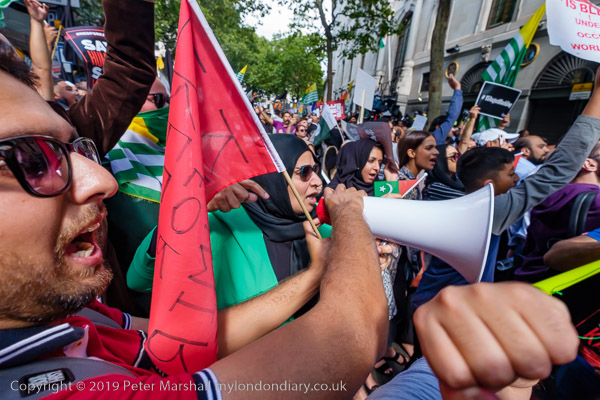
Some extensive work seems to be in progress on what I am reliably informed (thanks to comments on Flickr) is a Ford Escort, while inside the garage a Renault 4 and a Rover P5 await their turn.
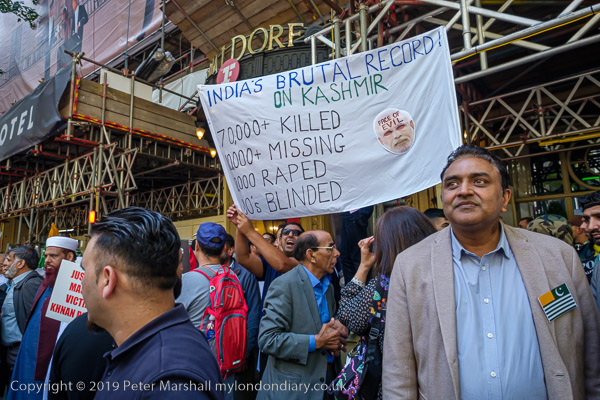
Arch 500 was empty for some years but later became home to the very Brixton Buzwakk Records Recording Studio a few years ago. The arches on both sides are still garages.
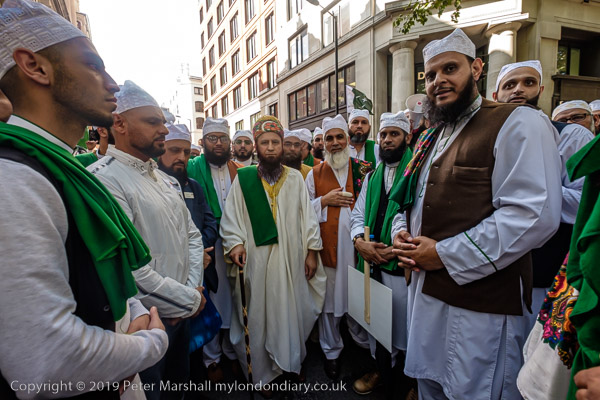
More about this walk in May 1989 in a later post.