King’s Cross Road – 1989

My walk around King’s Cross on Saturday 8th April 1989 continues in this post. The previous part was Winged Lions, A School, Thameslink, Wine, Buses

Kings Cross Road, Lorenzo St, King's Cross, Camden, 1989 89-4d-32
Kings Cross Road, Lorenzo St, King’s Cross, Islington, 1989 89-4d-32

140-142 King’s Cross Road on the corner with Lorenzo Street had a distinct style to it, with the two oval windows and some interesting brickwork. British History Online states “This five-storey office block is largely of 1991 but incorporates the front and side elevations of a tenement building of 1888” and the view from where I made this picture is still much as it was before the rebuilding.

The two terracotta panels facing Lorenze Street are still there and together give the date of AD 1888. The BHO article suggests the architect was probably W. Youlle who was the architect for a similar building on Pentonville Road. The ground floor was occupied by shops – bricked up and fly-posted in my picture – with rooms and a toilet on each of the upper floors.

Almost legible in my picture is a line of text above what had been a shopfront on Lorenzo Street which appears to read ‘B R E E D O M E T E R S’ though some letters are unclear and part obscured by the no-entry sign. Perhaps someone will be able to clear up this mystery.

Leeke St, King's Cross, Camden, 1989 89-4d-33
Leeke St, King’s Cross, Camden, 1989 89-4d-33

The buildings at 5-11 Leeke St have become the offices for the Paul Hamlyn Foundation, established by Paul Hamlyn in 1987; after his death in 2001 this became one of the largest independent grant-making foundations in the UK. At left is a doorway with the date 1890 and an arm in armour holding the butt of a broken spear, the Irish Foster family crest for the Foster Parcel Express Co. The conservation area document describes it as “a microscope emblem”.

Kings Cross Road, King's Cross, Camden, 1989 89-4d-35
Kings Cross Road, King’s Cross, Camden, 1989 89-4d-35

These buildings are still there but their uses have changed and the café is now a property management company. The fine block at 150-158 was being refurbished in 1989 and is now home to an advertising agency.

Again British History Online is informative and suggests it was a speculative development. Built in 1902–3 with what it describes as a ” mildly ambitious” facade, it says that 154 and 156 had goods hoists and winches, though there is no sign of them in my picture.

Kings Cross Road, King's Cross, Camden, 1989 89-4d-36
Kings Cross Road, King’s Cross, Camden, 1989 89-4d-36

Again the BHO article linked above tells us that this was built as an office, workshops and stabling in 1899–1900 and was from many years occupied by J J Connelly who probably built it. The wide doorway at left was for horses with a ramp leading up to stables on the upper floor. It was apparently still being refurbished when I made this picture as offices for Community Service Volunteers. The structure is still there but looks rather different as the striped window shades have been removed and the frontage painted a uniform white.

The taller building at right was the Mary Curzon Hostel for Women, built in memory of his wife for Lord Curzon in 1912-3 to provide inexpensive hostel accomodation for working women. Again there is a fuller description in the BHO article. When it was taken over by the LCC in 1955 it was renamed the Susan Lawrence Hostel.

Dodds the Printers, Kings Cross Road, King's Cross, Camden, 1989 89-4d-24
Dodds the Printers, King’s Cross Road, King’s Cross, Camden, 1989 89-4d-24

Dodds the Printers had these shopfronts at 193-5 on King’s Cross Road for many years and their signage shown looked like something from a different age in 1989. From around 2013 the shopfronts have been put to other uses but the printers still appear to be in business at the rear of the premises down St Chad’s Place, the alley through the doorway in this picture. I’d taken a few photographs in this alley in 1986, which show the signs for Dodds on the back of their property.

Kings X Radio Cars, Kings Cross Road, Kin Pentonville Rd, King's Cross, Islington, Camden, 1989 89-4d-11
Kings X Radio Cars, Pentonville Rd, King’s Cross, Islington, 1989 89-4d-11

I turned left onto Pentonville Road, and took a picture of these shops on the north side of the road, all of which are now a Pizza Restaurant, though not the same Italian snack bar as in my picture.

There is still a clock high more or less in the same position though that blank wall has now got four windows. The rectangular clock permanently at three minutes past four which had I think once advertised a businness here has been replaced by a slightly bulky circular one which appears to change with the hours.

I walked a few yards west and tuned right up Caledonian Rd where the next post on this walk will begin. The first post on this walk was Kings Cross, St George’s Gardens & More.


Housing, Low Pay, Arms Sales, A Political Arrest & More

Too much was happening on Thursday 2nd April 2015 to fit it all into a headline, with protests against evictions, jailed Palestinian children, arms companies, sacking of trade unionists at hotels in Ethiopia and the Maldives, a politically motivated arrest and a failed visit to a squat in a prominent London building.


Sweets Way at Annington Homes – James St,

Housing, Low Pay, Arms Sales, A Political Arrest

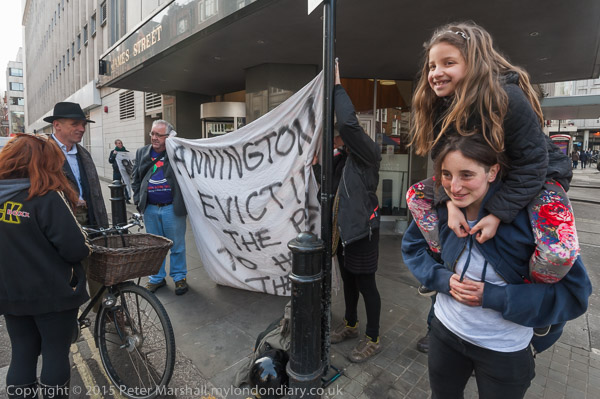
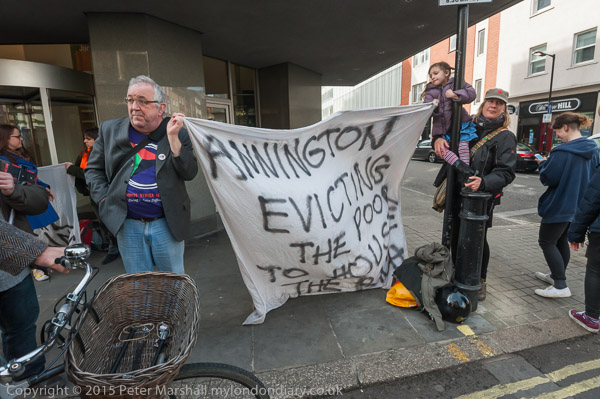
I began work at a lunchtime protest outside the offices of Annington Homes, the tax-dodging equity investor owned company which owns the Sweets Way estate in north London, calling for an end to evictions and the right to return for all decanted residents.

Housing, Low Pay, Arms Sales, A Political Arrest

It was a small but lively protest and attracted considerable attention and support on a street busy with office workers taking their lunch break.

Despite the efforts of the campaigners this small former Ministry of Defence estate of 142 social homes was finally forcibly evicted by evicted by dozens of High Court bailiffs and 7 vans of Met police on 23-24th September. Annington planned to replace these with around 170 homes for private sale at up to £700,000, along with just 59 so-called ‘affordable’ homes at £560,000. Nothing on the new estate was to provide social housing and this was clearly an exercise in social cleansing for profit.

Sweets Way at Annington Homes


Admiralty Arch Occupied by A.N.A.L. – The Mall

Housing, Low Pay, Arms Sales, A Political Arrest

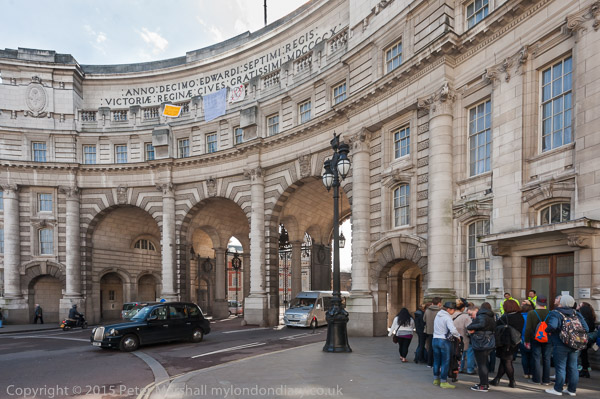
Admiralty Arch, the landmark Grade I listed building providing an impressive entrance to the Mall from Trafalagar Square was commissioned by King Edward VII to commemorate Queen Victoria’s death, designed by Sir Aston Webb and completed in 1912. Initially a residence for the First Sea Lord and offices for the Admiralty it was later more general government offices. The government sold it off in 2012 to be developed as a hotel.

Housing, Low Pay, Arms Sales, A Political Arrest

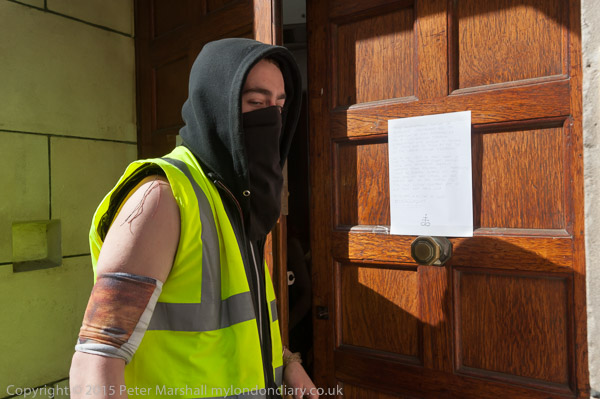
Activists from the Autonymous Nation of Anarchist Libertarians had entered the building through the roof at night and were occupying it. I photographed the various notices and banners on the outside of the building and some activities of security and occupiers outside, and talked to a couple of the them. I and a couple of other journalists were offered entry if we brought tobacco or alcohol but felt it wise to refuse and left. I think the squatters were evicted within 24 hours.

Admiralty Arch Occupied by A.N.A.L.


Free the Palestinian Children – G4S, Victoria St

Housing, Low Pay, Arms Sales, A Political Arrest

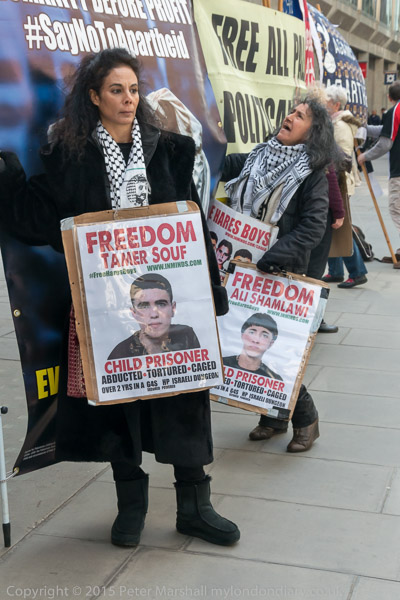
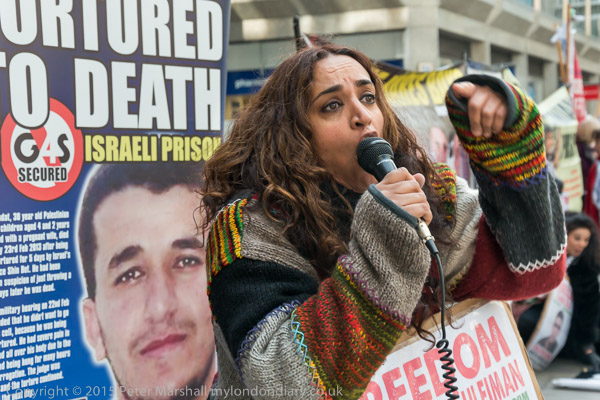
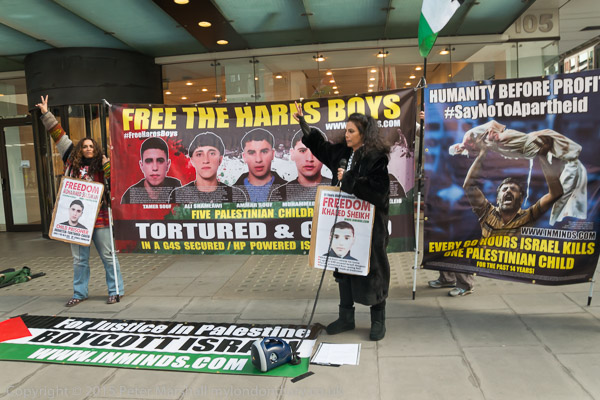
G4S provides security services for Israeli jails in which Palestinian children are held, some as young as 12 years old. The most common charge is throwing stones. Typically there have been 500-700 of them a year in the Israeli military detention system with between 120 and 450 held at any one time. In 2014 Israel held 1266 Palestinian children for interrogation; campaigners say 75% of them are physically tortured and many sexually abused.

Housing, Low Pay, Arms Sales, A Political Arrest

One of the protesters who spoke about G4S involvement in the imprisoning and torture of Palestinian children also spoke about her mistreatment by Israeli Security, who forced her to remove her clothes and stand naked to be inspected in public because she was going to visit Palestinians in jail

Free the Palestinian Children


Stations of the Cross Pilgrimage – Westminster

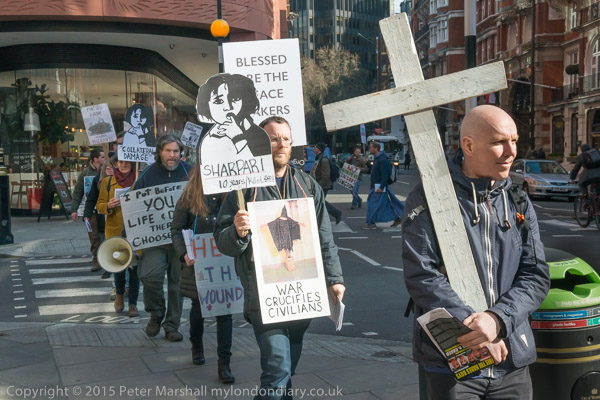
Thursday 2nd April 2015 was Maundy Thursday and Catholic Workers were taking part in a walk around the “geography of suffering” in London halting outside the offices of companies in the arms trade for prayers against the arms trade, war, torture, nuclear weapons, international debt, homelessness, immigration policy and climate change. The ‘Stations of the Cross’ was a day early as this usually takes place on Good Friday.

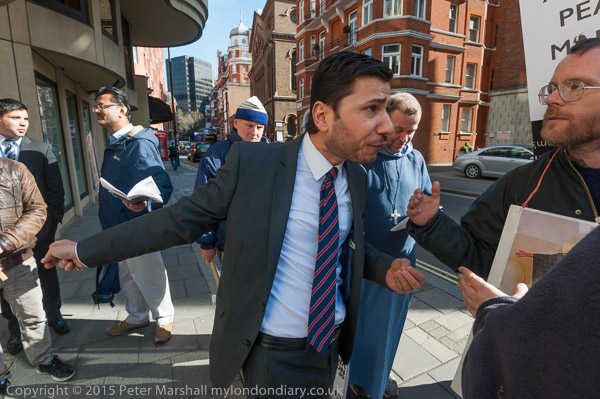
Among the companies whose offices they prayed outside were arms company Qinetiq in Buckingham Gate, where a security man came out and told them they could not protest there. They told him they were on the public highway and if they wanted to protest they could do so. But they had come to pray not to protest and continued, leaving as they finished their service.

Among other companies I photographed them outside were Rolls-Royce, another weapons manufacturer, where the pilgrimage ended. I had only joined them part way through the event, when the came past the protest at G4S.

Stations of the Cross Pilgrimage


Shame on Sheraton – Hotel Workers – Mayfair

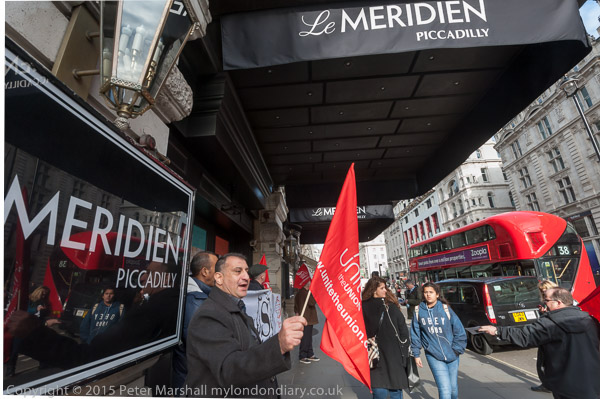
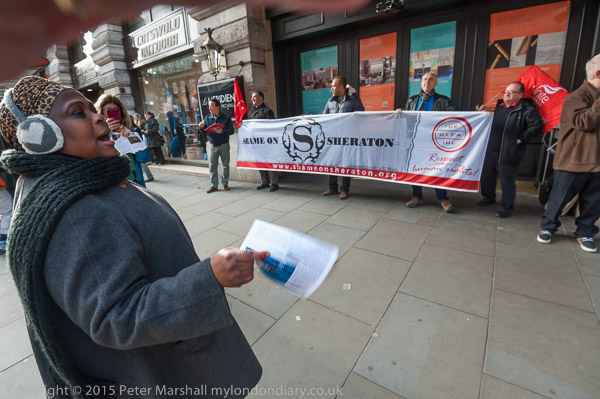
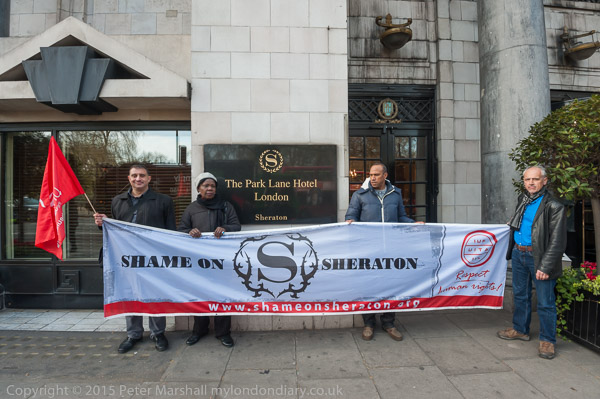
Workers at Sheraton hotels in Ethiopia and the Maldives have been sacked for trade union organising and members of the fast-growing Unite Hotel Workers Branch protested in solidarity with them outside Sheraton’s two Mayfair hotels.

Hotel workers are one of the most marginalised groups of workers in the UK, and many are exploited because their English is poor or non-existent. Here in the UK they can also get sacked for joining a union but despite this, the Hotel Workers branch is the fastest growing branch of Unite because of its determined support for the workers.

I met and photographed their protest outside Le Meridien on Piccadilly for around half an hour before walking down with the to the Park Lane Hotel where I had to leave them to go to Aldgate.

Shame on Sheraton – Hotel Workers


Chingford candidate arrested at Poor Doors – One Commercial St, Aldgate

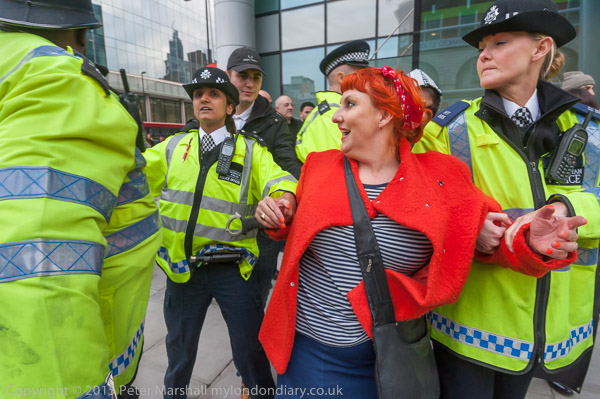
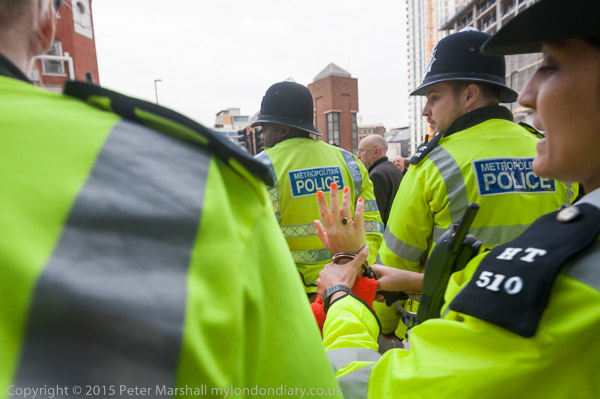
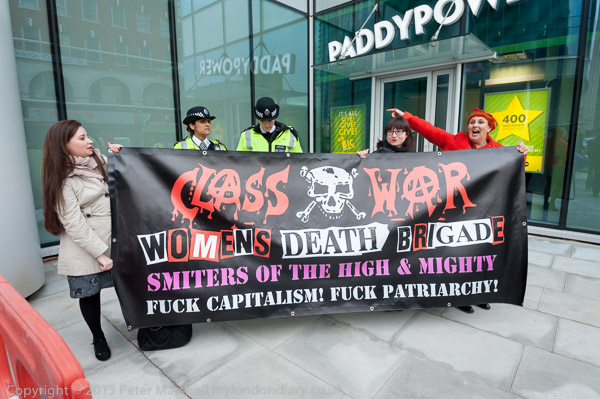
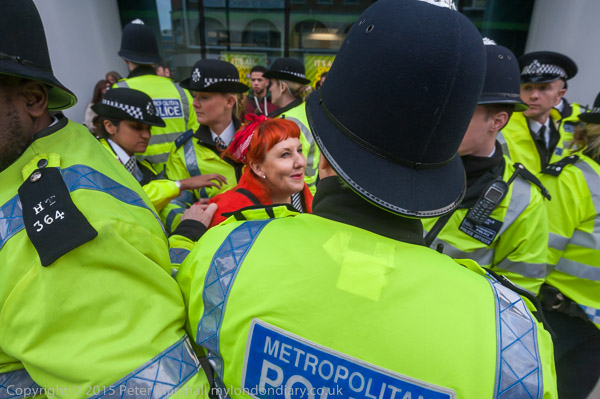
Police clearly had it in for Lisa McKenzie and during this weekly Poor Doors protest outside One Commercial St a woman officer came up to her a and told her she was being arrested, accused of criminal damage. The officer said she had stuck a Class War sticker on the glass next to the rich door two weeks earlier on March 19th. A snatch squad surrounded her, and despite opposition from the protesters she was led away and put in a waiting police van to be taken to Bethnal Green police station.

While many people had stuck posters and stickers onto the glass windows at almost every Poor Doors protest, this was the first arrest. It’s doubtful whether this is an offence, and it is certainly not criminal damage, as glass is not damaged, with posters and any glue residue being easily removed leaving the surface in as new condition.

I had photographed Lisa and others at the Rich Door fairly extensively on March 19th and was ready to testify that she had not herself stuck anything on the glass – though when her case eventually came to court it was thrown out before I was called.

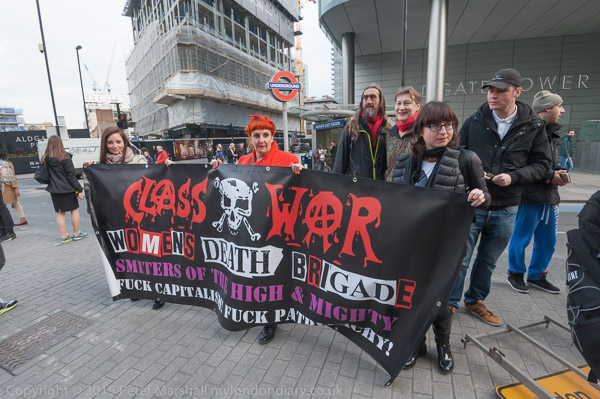
Lisa was certainly a very vocal protester (as usual) but it’s hard to avoid thinking what picked her out was political pressure because of her candidature for Class War against Iain Duncan Smith in Chingford in the forthcoming general election.

Before her arrest the protest had been hampered by barriers for work on the wide pavement outside the Rich Door of the building, and the protest had started on the opposite side of the main road.

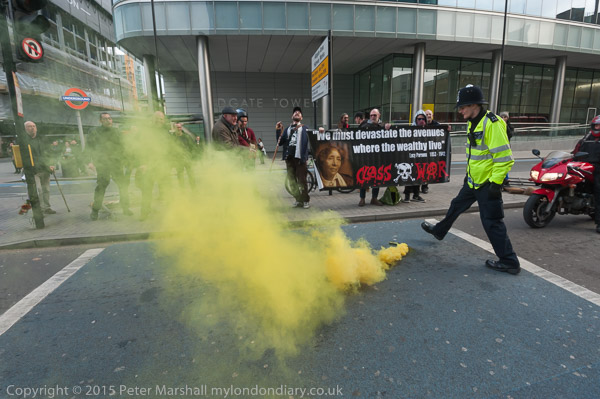
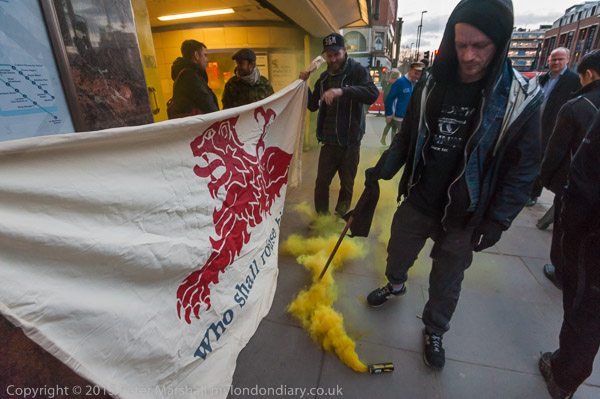
Two incidents caused some hilarity, one where a police officer came to deal with a yellow smoke flare that had been thrown into the road, first seeming to kick it, then picking it up and carrying it away down the alley towards the poor door. It had burnt out by the time he reached this, but as I commented “Everyone else may throw their rubbish here but I was surprised the police thought it a good idea.”

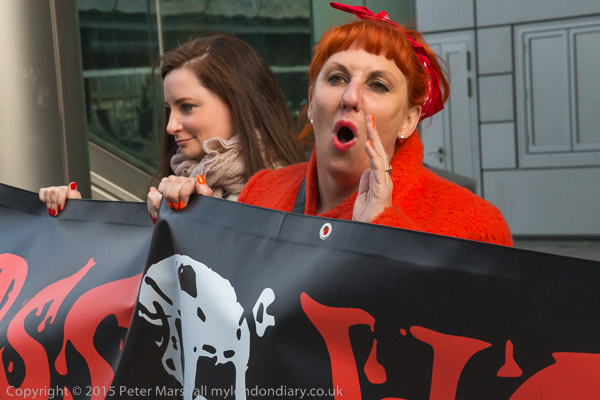
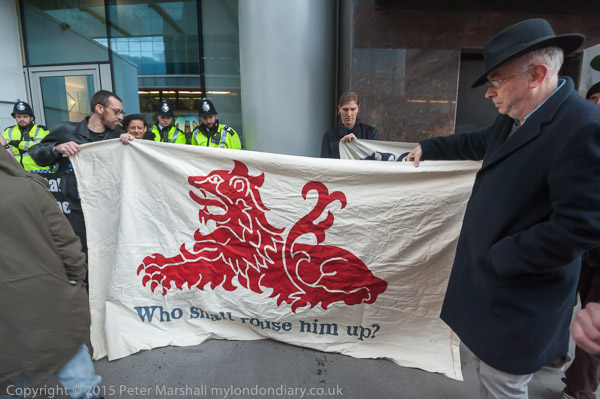
The second was when Lisa pointed out that one of the two women officers standing behind the banner she was holding had taken part in plain clothes in a previous ‘poor doors’ protest, and Ian Bone offered her the megaphone to speak – but this was immediately followed by another woman officer coming to arrest Lisa.

There were some angry scenes as she was driven away, and police refused to talk with the protesters. The protest continued with several speeches before people went home.

Much more at Chingford candidate arrested at Poor Doors.


Bike Theft, Tributes, Housing Benefit, Fascists & UAF

Bike Theft, Tributes, Housing Benefit, Fascists & UAF

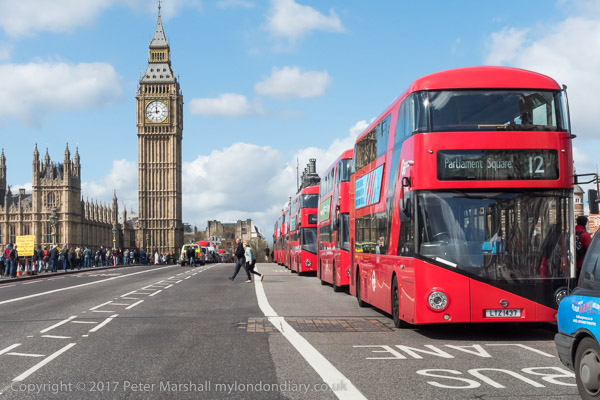
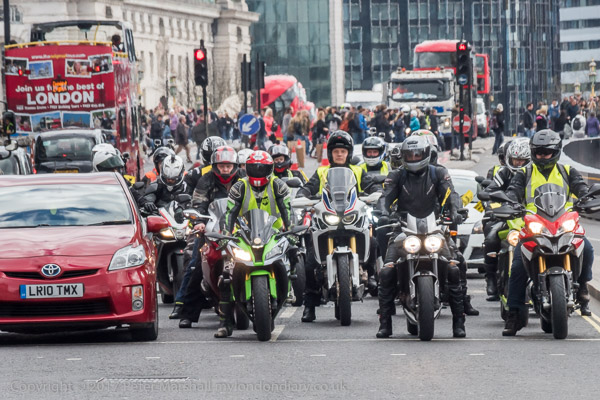
Saturday 1st April 2017 turned out to be a busy day in London, though the buses in my picture on Westminster Bridge were not then going anywhere – and the driver of the No 12 at the front of this row was taking a rest from his seat. Various protests and the police had brought traffic to a stop. As in many other months you can see more of my pictures taken as I travelled around in a London Images section.


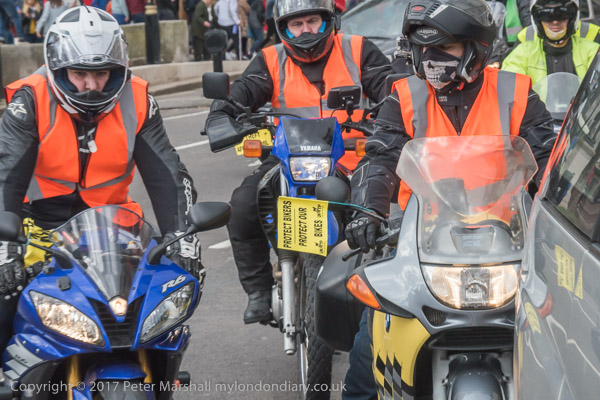
Motorcycle Theft Protest Ride – Westminster

Bike Theft, Tributes, Housing Benefit, Fascists & UAF

I’d vaguely wondered about paying another visit to the Ace Café on the North Circular Road at Stonebridge, but not riding a bike I would have felt something of an outsider, and the journey back to central London by the Bakerloo line wold have taken me around 40 minutes and I would have missed other things that were happening.

Organised gangs are still making rich pickings around the whole of London – and one of my neighbour’s had his bike targeted a few months ago, but the two men cutting through a substantial lock were spotted from the house opposite, and ran away when they were challenged halfway through.

Bike Theft, Tributes, Housing Benefit, Fascists & UAF

In 2017 there were reported thefts in London of 8,131 motorbikes, 4,121 moped and 3,218 scooters, a total of almost 15,500 thefts. That amounts to one for every 7.5 powered bikes registered in the city. Motorcyclists came with a petition to the Mayor of London and the Home Secretary to give the police greater resources to tackle this crime, and for them to give it higher priority, for more ground anchors in bike parking bays and for tougher sentencing of offenders.

Motorcycle Theft Protest Ride


Flowers for London Victims – Westminster

Bike Theft, Tributes, Housing Benefit, Fascists & UAF

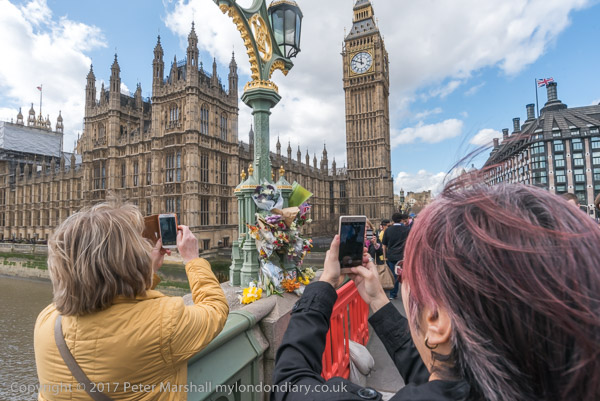
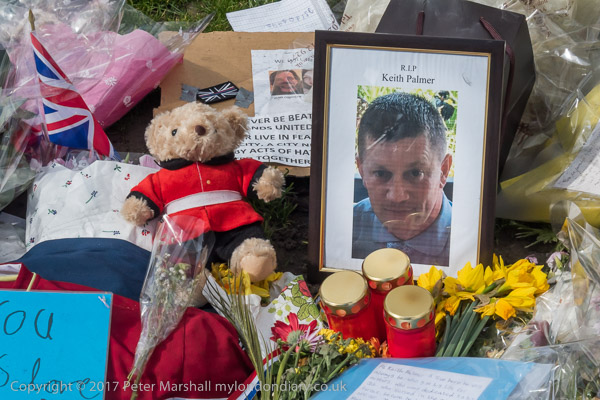
Ten Days after the Westminster terror attack by a deranged driver, people were still stopping to look and and photograph the flowers for the victims, around the lamp standards on Waterloo Bridge, along the whole of the front of Parliament Square and in front of New Scotland Yard in its new building on the Victoria Embankment, where an eternal flame also remembers all police who have died while doing their duty.

There was a long strip of tributes along the front of Parliament Square opposite were PC Keith Palmer was killed to him and the others who died.

More pictures Flowers for London Victims.


Youth protest over housing benefits loss – Parliament Square

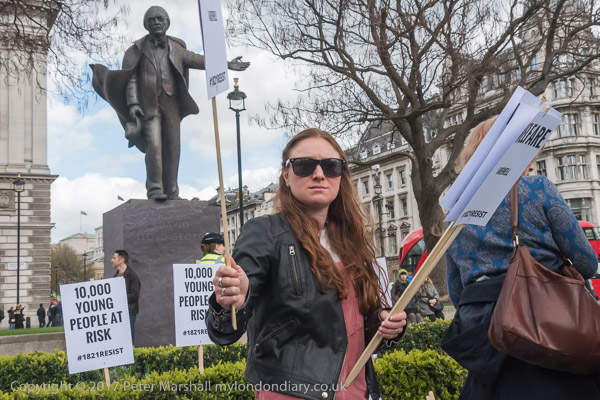
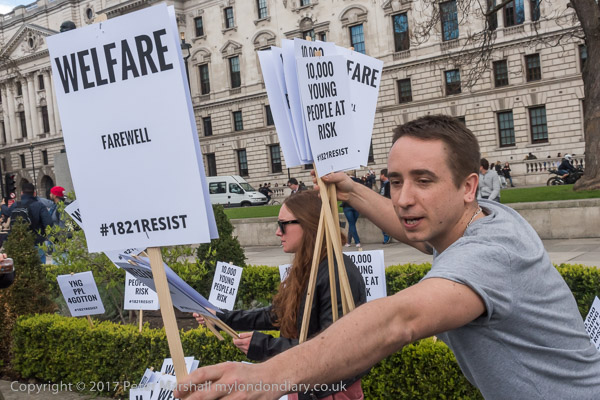
A grass roots group of young people, ‘#1821Resist’, were in Parliament Square to protest against the scrapping of housing benefit for young people which coming into force on this day.

They say that under Tory rule since 2010 homelessness has doubled and that this change will continue to leave vulnerable people without homes, making it almost impossible for them to get into work or education.

Youth protest over housing benefits loss


Iraqis protest US killing in Mosul – Downing St

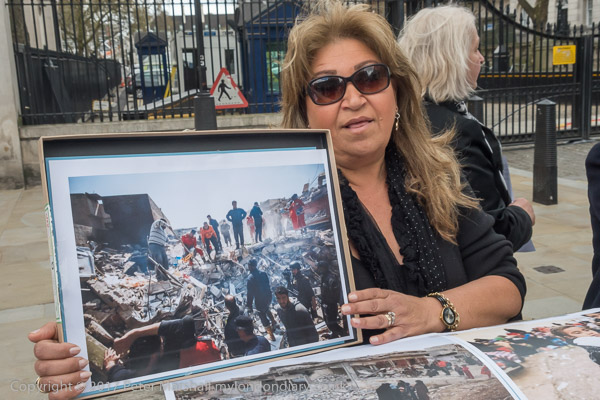
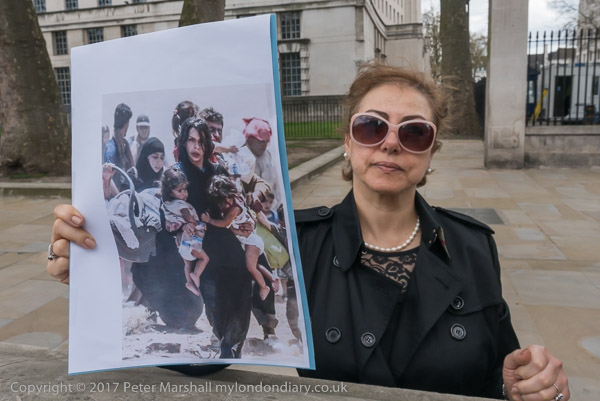
Iraqis, mainly women dressed in black, were protesting opposite Downing St against the killing of civilians by US and Iraqi forces during the assault on Mosul. Attacks on the city, then held by the Islamic State (ISIL) begun in October 2016 and continuing until ISIL were defeated there in July 2017. According to Wikipedia (and the BBC) “The battle was the world’s single largest military operation since the 2003 invasion of Iraq and was considered the toughest urban battle since World War II.”

The women said that hundreds have been killed by US air strikes after being told to stay in Mosul; people were stopped from leaving were then bombed. The protest was organised by a group of Iraqi women, one of whom told me a nine-year old relative in Mosul had died earlier today. The photographs they held up showed some of the results of the US bombing.

Iraqis protest US killing in Mosul


Britain First & EDL exploit London attack – Westminster

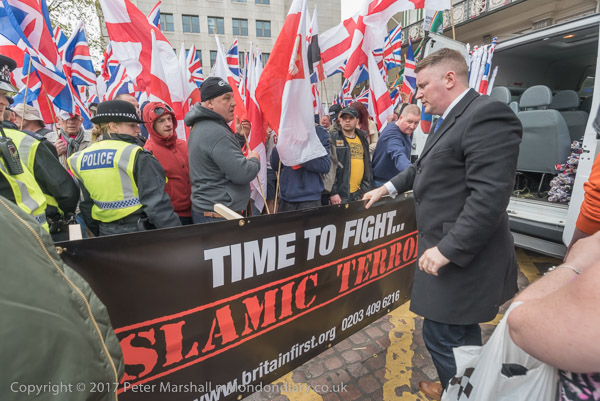
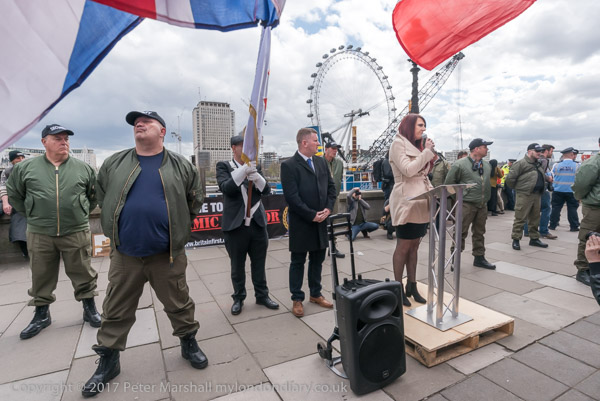
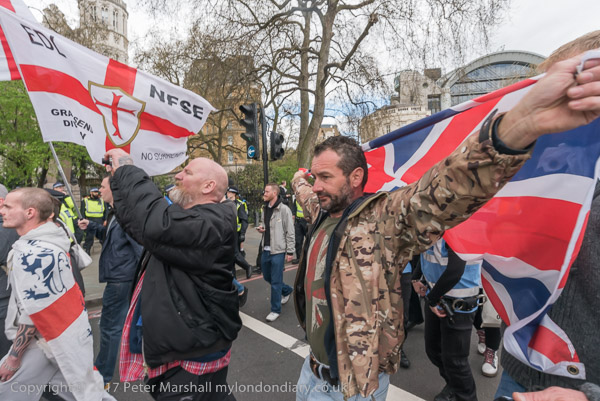
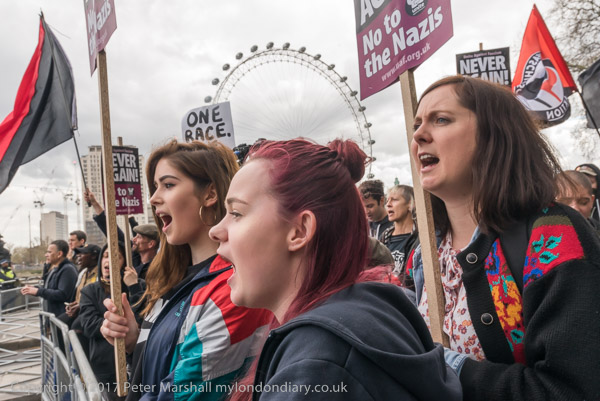
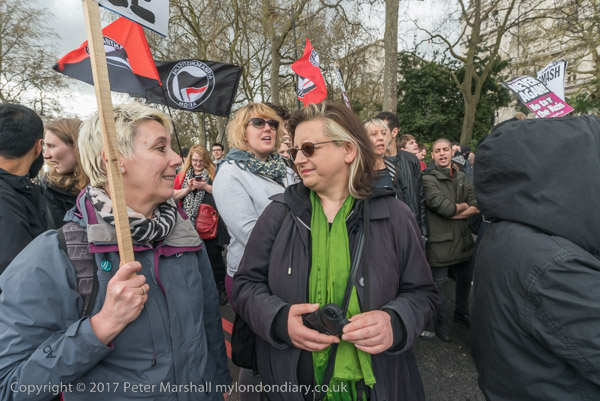
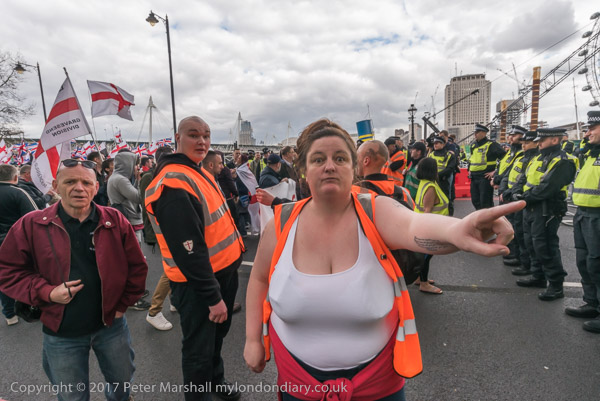
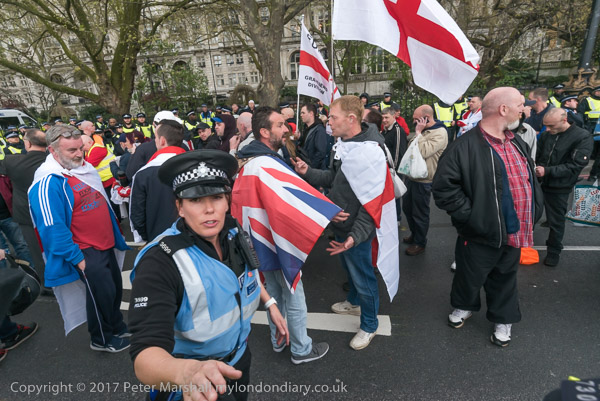
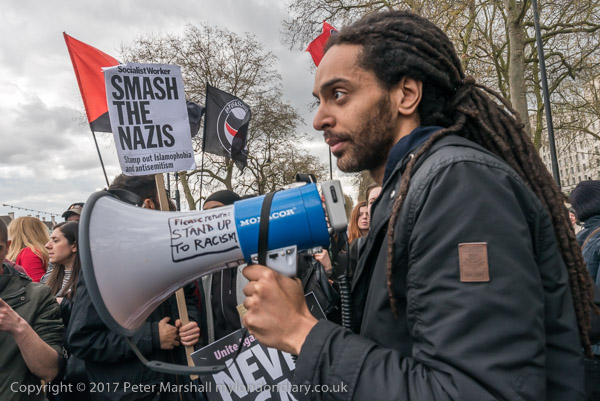
Extremist right-wing groups including Britain First and the EDL (English Defence League) were quick to exploit the London terror attack to fuel their anti-Muslim and anti-migrant racist propaganda, both organising marches. Police had imposed restrictions on both marches confining them to particular short routes to rally points on the Emabankment. London Antifascists and Unite Against Fascism (UAF) who had come to opposed them were only allowed to hold a static protest.

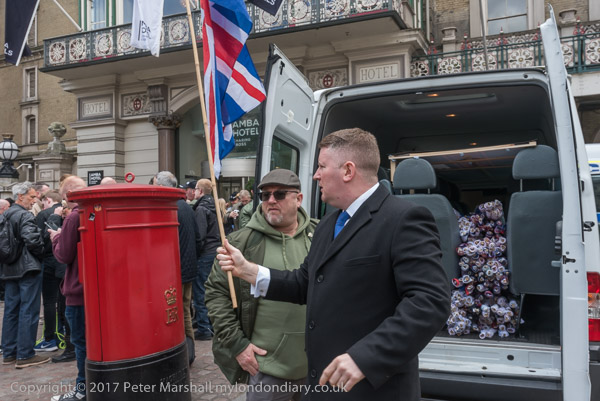
I was able to photograph Britain First at their designated meeting point in the taxi area outside Charing Cross station where their leader Paul Golding arrived with a van full of flags and handed them out, while his deputy Jayda Fransen was busy talking to the media.

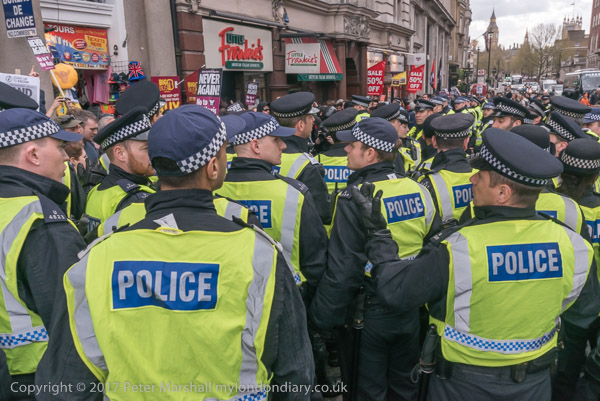
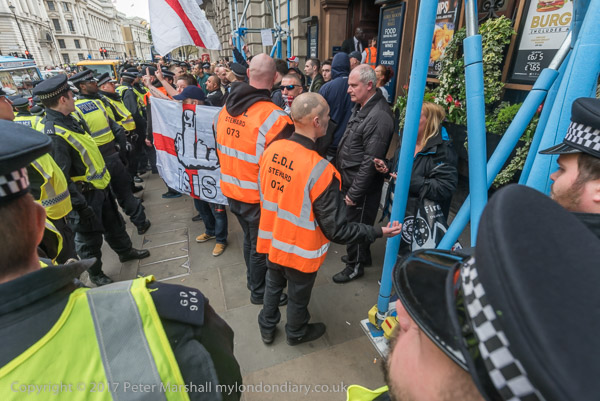
The EDL were supposed to be meeting in Trafalgar Square, but were actually gathering in their usual pub, Lord Moon of the Mall, close to the top of Whitehall. Police were busily and rather forcefully keeping back a crowd of antifascists against the shops on the opposite side of the road, injuring a few of them in the crush. Police behind them were shouting at them to go forward, but police in front were preventing them from doing so.

I photographed the EDL on the pavement in front of the Lord Moon of the Mall over the shoulders of a line of police protecting them, but left as police pushed them back inside the pub and returned to Britain First at Charing Cross station where they were getting ready to march.

There were few people on the street as they marched down to the Embankment for a rally, but a couple of women shouted at them calling them racists. Police stopped the marchers from moving towards them, but they had to refuse a Britain First fake-news team who tried to stop them for an interview.

I listened to the rally for a few minutes then tried to go back up Northumberland Avenue to photograph the EDL march, but it was hard to see for police surrounding it. The police quickly went to grab one woman who started to shout at this march.

But the police relaxed their cordon when the marchers reached their rally pen on the Embankment and I was able to walk past them and began to take pictures.

But after a couple of minutes one of the stewards saw me and objected to me being their and called on the police to remove me, after which I had to photograph over the shoulders of the police. One of the officers came to tell me off for having been in with the marchers, but I simply told her I had every right to be there. Shortly after I decided to leave as I had taken enough pictures, and I decided to go to photograph the counter-protesters.

More at Britain First & EDL exploit London attack.


UAF protest extreme right marches

Police had decided that the UAF could only hold a static protest on the Embankment rather than their intended and already advertised march to there from South Africa House in Trafalgar Square, despite ‘facilitating’ the two extreme-right marches. The UAF had turned up at South Africa House on the morning and police had slowly with unnecessary force pushed them down the march route as I’d witnessed earlier in the day.

From the EDL rally I could see and just hear the Unite Against Fascism rally taking place perhaps a hundred yards away down the Embankment, shouting ‘Fascist Scum off our streets’ and other slogans. From the speeches I had heard at the two right-wing rallies both groups were clearly racist and Islamophobic and among the marchers I recognised many faces from clearly fascist organisations I had photographed in the past.

I could see and hear that there were speeches at the UAF rally but not make out what was being said from the distance and over the noise. I tried to walk down towards the UAF but police would not let me take the short direct route despite my showing my press card.

I had to walk back and out onto Whitehall and then around to get to be back of the UAF rally, and by the time I got there many of the counter-protesters had left for home and the speeches had ended, though there were still rather more around than at the two right-wing rallies combined.

UAF protest extreme right marches


Ford/Visteon, Ethiopian Tyrant, Rioters United!

On Wednesday 31st March 2010 I reported on three unrelated protests in London.


Ford/Visteon Workers March For Pension Justice

Ford/Visteon, Ethiopian Tyrant, Rioters United!

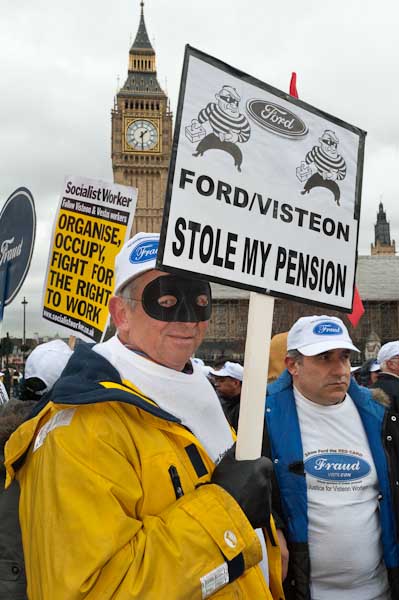
In 2000 Ford when split of some of its parts factories to Visteon, a company described as ‘An Enterprise of Ford Motor Company’ and initially with the same shareholders, promising the workers their conditions and pensions would remain exactly the same as they had been with Ford. Ford’s assurances were repeated by Visteon.

Ford/Visteon, Ethiopian Tyrant, Rioters United!

But in 2009 Visteon closed down and workers in their factories in Belfast, Enfield, Swansea and Basildon were given just six minutes to leave the sites. In Belfast and Enfield workers refused and occupied the sites for a month, but were let down by their union, Unite who failed to give them support. The occupations eventually forced Visteon/Ford to pay the redundancy pay they were entitled to under their agreements, but pensions were not covered and they only received the lesser amounts covered by Pension Protection Fund compensation.

Ford/Visteon, Ethiopian Tyrant, Rioters United!

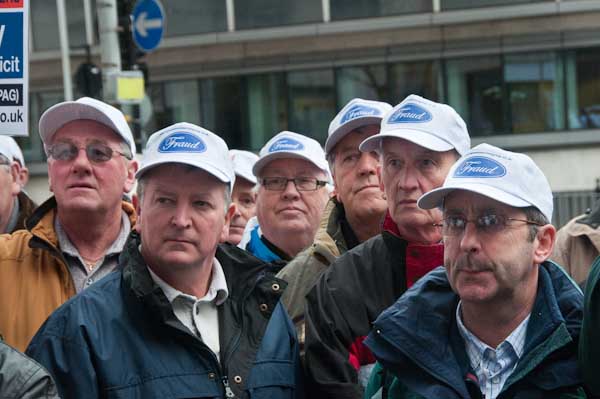
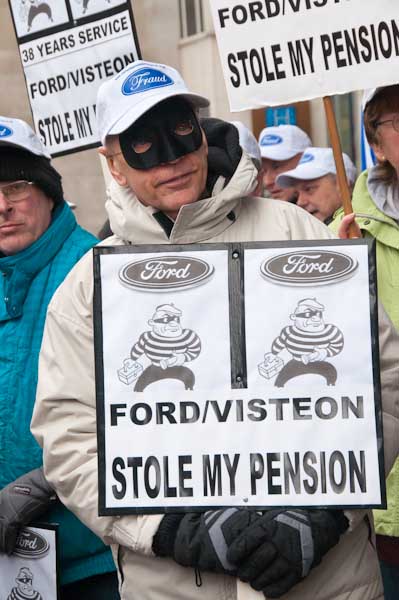
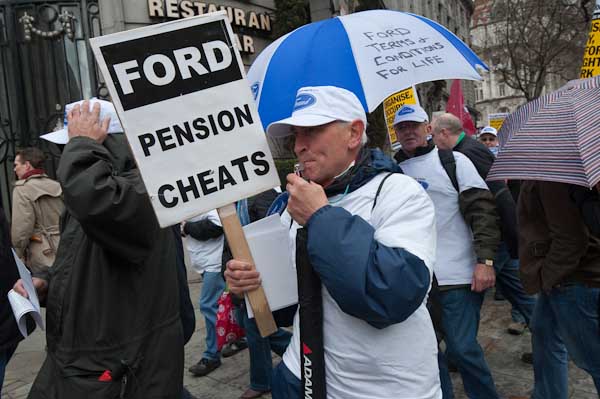
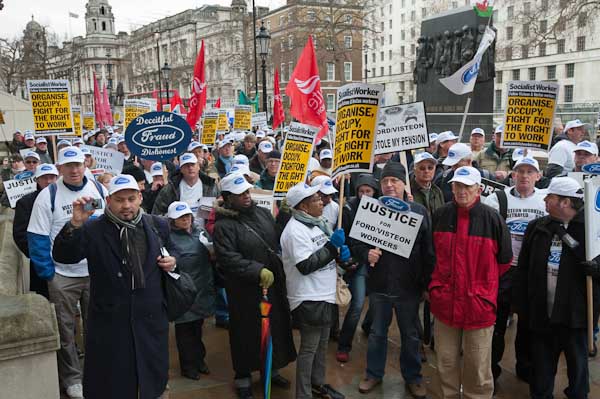
Since then their fight for the pensions they were promised has continued. I met around 500 former Visteon workers outside the Unite Offices in Theobalds Road, Holborn, where many wore hats and t-shirts with the Ford logo, but with the name replaced by the word ‘Fraud’, which succinctly expressed their view of the company’s action.

Ford/Visteon, Ethiopian Tyrant, Rioters United!

I marched with them to Downing Street where they had problems in delivering a letter and petition. As I commented then: “it does now seem unnecessarily complicated and difficult to get access to our elected government, hiding away behind their tall gates and high security. Its both an expression of and doubtless fuels their paranoia over terrorism far in excess of the real threat.

The marchers then went on to a rally in Parliament Square.

Their fight for a fair deal over their pensions went on for another four years, when eventually as the case was about to go to the High Court, Ford agreed to top up the Pension Protection Fund compensation so that they would receive the full value of benefits accrued when working for Ford. It didn’t cover the nine years they had worked for Visteon, but Unite recommended acceptance as it would settle the claim without the expense (and possible failure) of a court hearing.

Ford/Visteon March For Pension Justice


Ethiopians Protest Bloodthirsty Tyrant – Downing St

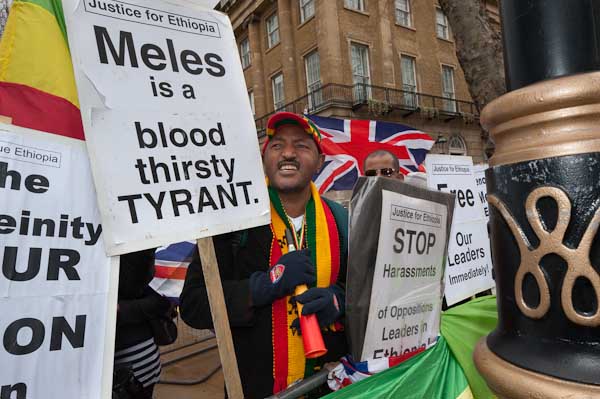
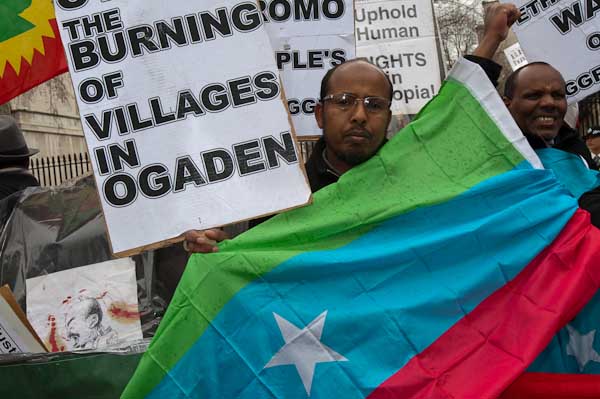
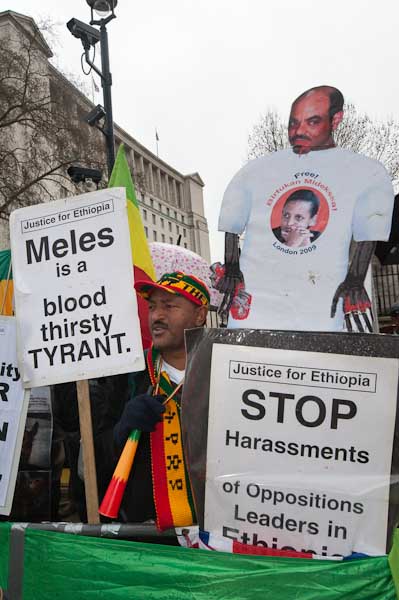
Ethiopians came from across the UK to for a day of demonstration opposite Downing St where Prime Minister Meles Zenawi was co-chairing the UN climate finance group. They demanded the UK stop appeasing the Ethiopian dictator, and calling for the release of opposition leader Birtukan Mideksa and other political prisoners in Ethiopia.

Zenawi who became chair of one of the leading military groups fighting in the Ethiopian Civil War was the leader of a coalition that took power in 1991, becoming President then and was Prime Minister from 1995 until is death in 2012. His control of the military made Ethiopia an effective one-party state.

Although the country formally has democratic organisation and elections, elections have been rigged and oppostion politicians jailed, notably the leader of the main opposition Unity for Democracy and Justice (UDJ) party, Mideksa (or Midekssa), a former judge. Many other politicians and journalists have also been jailed and in 2007 the Committee to Protect Journalists (CPJ) named the country as “the world’s worst backslider on press freedom over the previous five years.”

Human rights violations and corruption are rife in Ethiopia, and food aid, education and jobs all depend on membership of the ruling party. His opponents regard Zenawi as a bloodthirsty tyrant and call for him to be brought to trial at the ICC at The Hague on charges of genocide. Human Rights Watch (HRW) have accused it of war crimes in the Somali regions of Ethiopia and against the Anauk communities in Gambella in 2003-4. Human rights abuses have continued in Ethiopia since Zenawi’s death.

Ethiopia is one of the larger countries in Africa and has received large amounts of development aid and humanitarian support from the USA and the UK.

Ethiopians Protest Bloodthirsty Tyrant


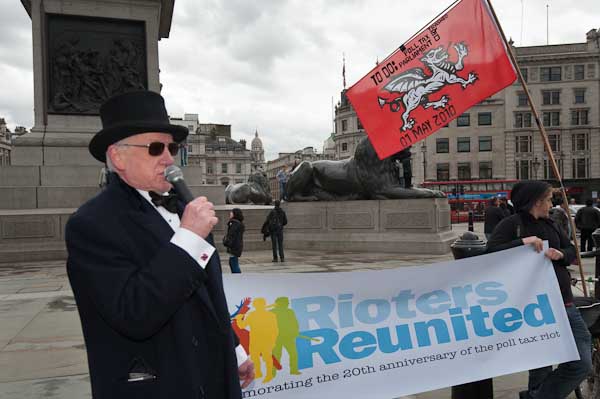
Rioters United! 20 Years Since the Poll Tax Riots – Trafalgar Square,

The largest protest against Margaret Thatcher’s Poll Tax was in central London on Saturday 31 March 1990, shortly before the tax was due to come into force. Unfortunately I had missed that event, probably deciding it was best to keep out of trouble. Back in 1990 I was photographing relatively few protests, mainly concentrating on urban landscapes and culture.

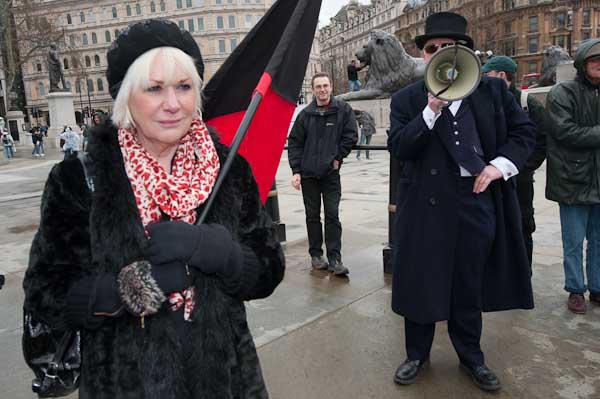
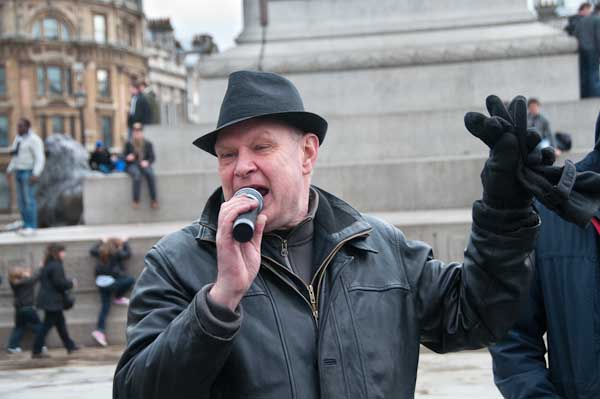
Around 30 people turned up for a rally to commemorate the occasion when “the London mob who brought Thatcher down … as well as to promise that the mob were still in business and to pronounce sentence on politicians.”

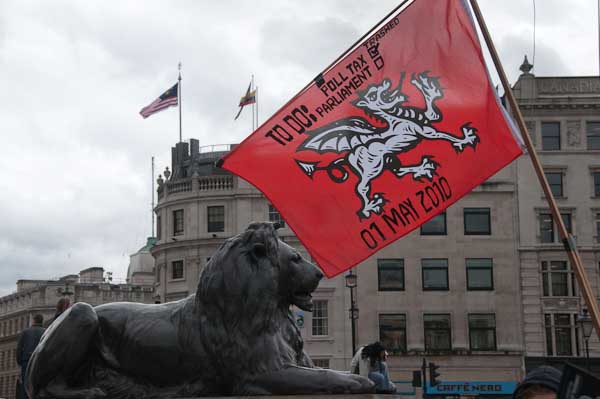
The ‘Carnival of Death‘ they were promising was not of course a literal death threat, but street theatre in which the effigies of George Brown, David Cameron, Nick Clegg and Nick Griffin were to be executed at a May Day Party. As Chris Knight reminded the gathering, “the only good politician, the only honest politician is a dead politician.”

Our police often fail to understand the difference between rhetoric and reality, and protests involving anarchist groups such as Class War are often ridiculously over-policed, sometimes with disastrous consequences, but almost always provoking more violence than they prevent. On April 1st 2009 for the G20 – Financial Fools Day they had turned up with squads of riot police psyched up to batter largely innocent and joyful protesters – and one of the police killed a newspaper seller simply walking home through the area.

So in my account of this event in Trafalgar Square I was at pains to tell them that the ‘Carnival Of Death’ was “called a carnival; if you want to take part, come ready to dance.”

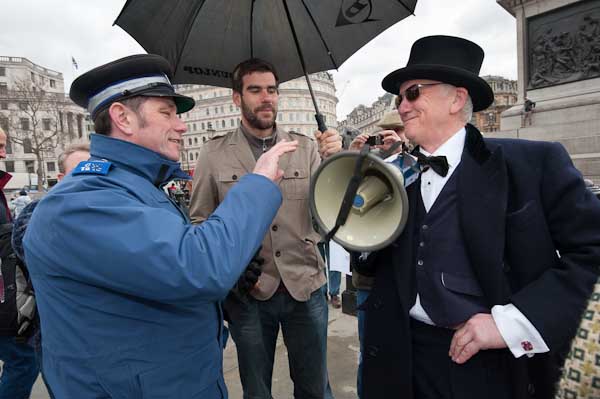
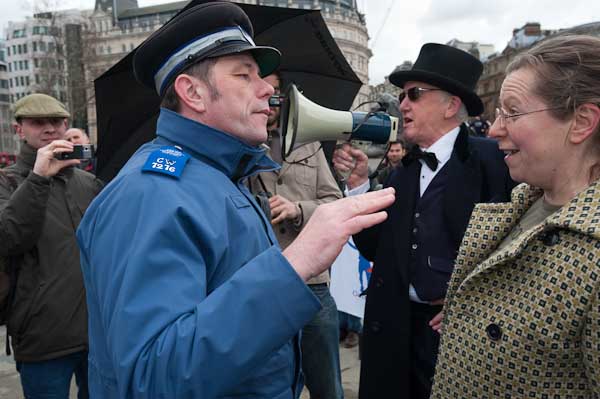
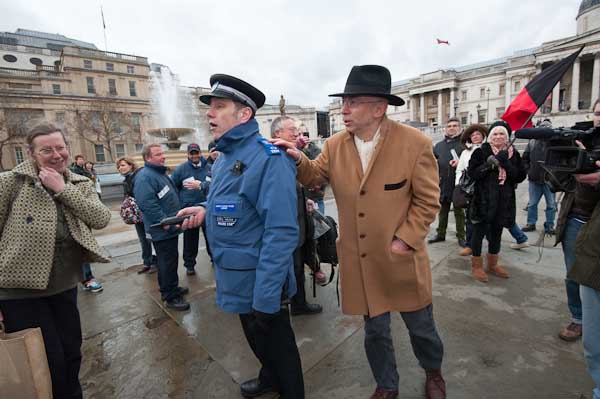
Shortly after people began the commemoration, a PCSO came to tell those taking part they were not allowed to hold protests or other events in Trafalgar Square without permission. When he was laughed at, he brought over a Heritage Warden who told us the Square was the property of the GLA (Greater London Authority), and that permission was needed for events.

Fine” said those present. “The GLA is a public body; we own it, this is a public place and we give ourselves permission and intend to continue.” As I pointed out in my account, Trafalgar Square is not just a public place, but one that since its building in the 1830s has been a traditional place for demonstrating radical dissent. It was a tradition that those present were determined to continue.

Fortunately the dozen or so police who arrived shortly after the PCSO had phoned to call for reinforcement simply stood and watched and had enough sense not to try and stop the commemoration, which ended after around 30 minutes when the organisers decided it was time to go down the pub.

At the end of the event, copies of an anti-Election manifesto and a suitably defaced poster showing the leaders of the Labour, Conservative, Liberal Democrat and BNP leaders were distributed by the Whitechapel Anarchist Group. They advised us to “Use your cross wisely”, under a picture of the four leaders in the cross-hairs of a gun sight, and attached to the bottom was a ‘Free Gift’ – a safety match, with the message ” Burn Your Ballot”.

As they wrote: “It’s time to end the unjust, corrupt system of terror and build a fair, equal society that will benefit the majority. We all know voting doesn’t change anything and our collective apathy allows this folly to continue. It’s time for REAL change. It’s time for revolution.”

Rioters United! celebrate Poll Tax Riots


Mothers Against Fracking, Sindhi Congress, Sexy Soho

Sunday 30th March 2014 I was in Westminster for three very different protests, opposite Parliament in Old Palace Yard, on to Downing Street and finally to Soho and Piccadilly Circus. Only the first was related to it being Mother’s Day.


Mothers Against Fracking – Old Palace Yard

Mothers Against Fracking, Sindhi Congress, Sexy Soho

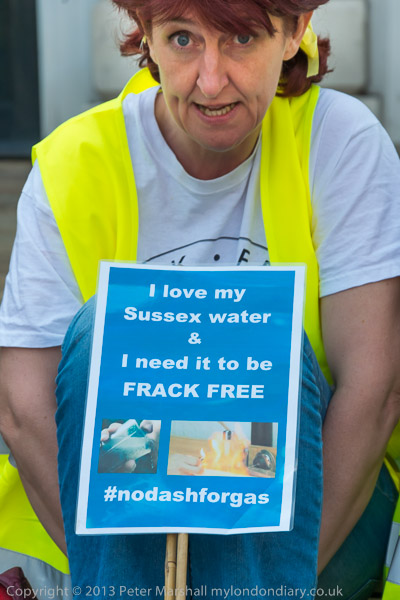
As I pointed out in My London Diary, “fracking is something the world cannot afford. Increasingly we are aware that we need to move away from fossil fuels and the carbon emissions they cause to avoid further dangerous climate change, and fracking has an even higher carbon footprint than normal natural gas. Increasingly we need to keep carbon – and in particular difficult carbon sources such as this and tar sands – in the ground if we hope to save the planet and its population.”

Mothers Against Fracking, Sindhi Congress, Sexy Soho

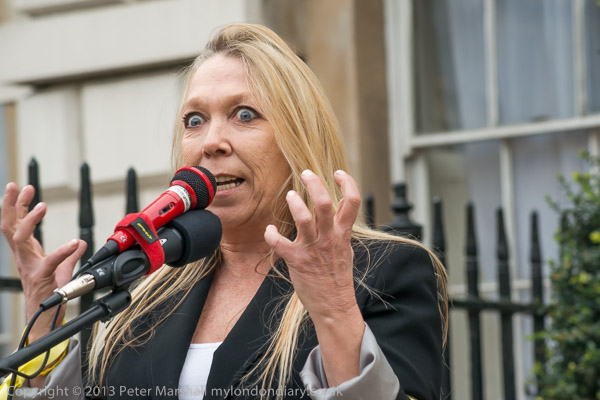
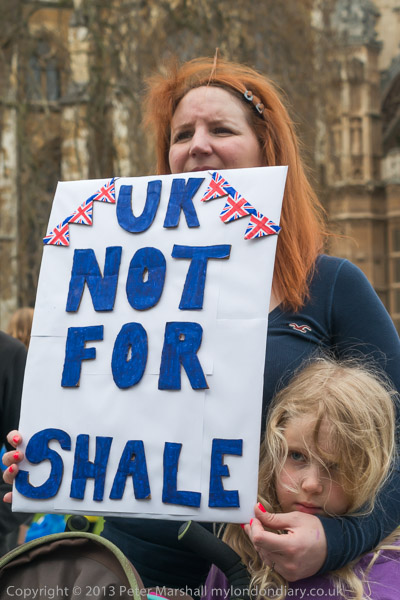
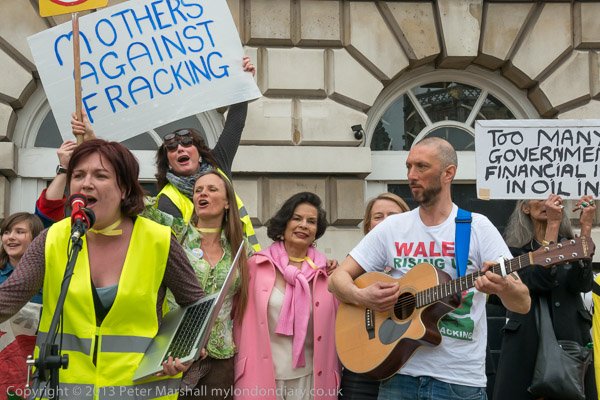
Mothers Against Fracking had brought together a number of campaigners from around the country for a Mother’s Day rally opposite the Houses of Parliament, particularly from the various camps and protests where drilling had begun. It is an issue that brings together local residents and environmental campaigners and as I commented was “causing mayhem even in the Tory heartlands such as Balcombe in deepest Surrey. “

Mothers Against Fracking, Sindhi Congress, Sexy Soho

I listed and photographed many of those who came and spoke, “including Vanessa Vine of BIFF (Britain & Ireland Frack Free), Tina Louise Rothery of RAFF (Residents Action on Fylde Fracking), Louise Somerville Williams (Frack Free Somerset), Green Party leader Natalie Bennett, Eve McNamara of REAF (Ribble Estuary Against Fracking), Julie Wassmer (East Kent Against Fracking). Dr Becky Martin (Mothers Against Fracking) and Tammy Samede from the Barton Moss Camp in Salford.”

Mothers Against Fracking, Sindhi Congress, Sexy Soho

But this relatively small protest attracted rather more interest than most from the press, bringing some photographers I’ve never seen at a protest before because of the presence of Bianca Jagger, who took a leading part in the event as my pictures show, and gave an excellent well-prepared and written speech.

As I also pointed out, her speech “lacked the kind of intense personal involvement of many of the others” who spoke. And I wrote “I admire Bianca for her support of this and other campaigns but wish the media would show more interest in causes rather than personalities.”

Much more on My London Diary at Mothers Against Fracking.


World Sindhi Congress Protest – Downing St

The Sindhi are an ancient culture with their own Sindh language and Sindh is now the third largest province in Pakistan. Many Sindh who were Hindu went over the border to India at partition, while other largely Urdu speaking migrants moved into Sindh, on the Arabian Sea between India and the Indus River. The province contains much of Pakistan’s industry and its largest city and former capital, Karachi.

Until 1988 the area was normally referred to in English simply as Sind. When General Charles Napier conquered it for the British Empire in 1843 he famously sent the Latin one-word telegram “Peccavi” (I have sinned) to the Governor General.

The World Sindhi Congress is a human rights organisation for Sindhi people based in Canada, the UK and the USA which organizes cultural events, rallies, seminars, protests and conferences around the world.

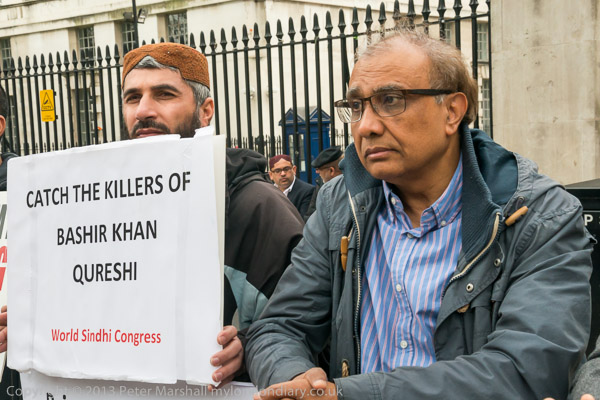
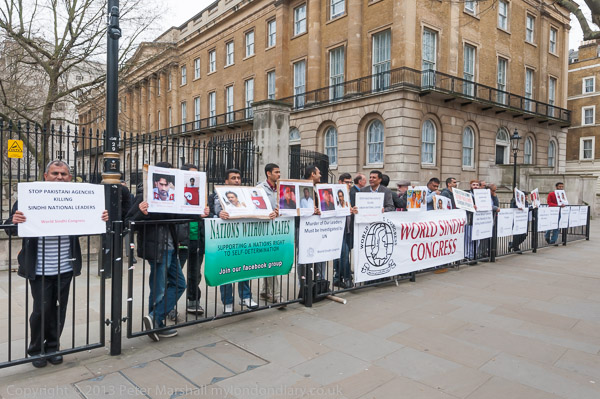
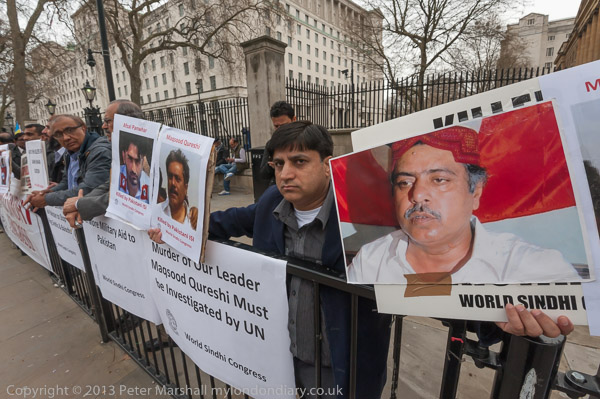
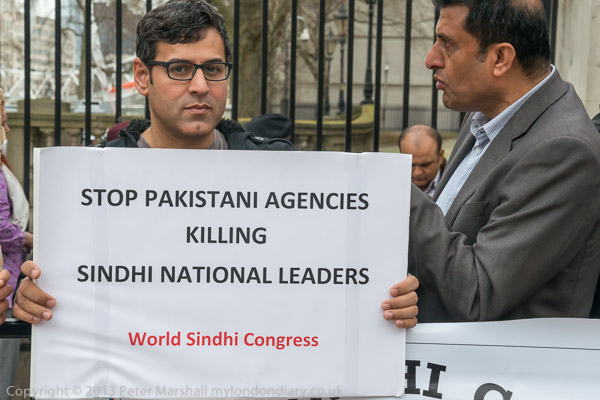
They had come to Downing St to protest against the extra-judicial killings of Sindhi human rights activists by the Pakistani security agencies and called on the UK to press the Pakistani government to stop these violations.

The protest followed the assassination in Sindh of two Sindhi political activists, Maqsood Ahmed Querishi and Salman Wadho, one of the latest in a series of atrocities against Sindhi nationalists allegedly carried out by the Pakistani intelligence agencies. The killing on 21 March was followed by protests and riots in Sindh and the closure of shops, markets and several universities in many cities and a strike on the following day.

Qureshi was the leader of Sindhi separatist movement Jeay Sindh Qaumi Mahaz (JSQM) and was involved in organising a ‘Freedom March’ to be held the Sunday after he was killed (which was Pakistan Freedom Day) in Karachi to inform the international community of the continuing violation of the human and civil rights of the Sindhi people.

Sindh separatists point out that the province has not been given the autonomy it was promised and that despite generating 70% of the country’s revenue and providing 60% of it natural resources it recives only around an eighth of national expenditure. But Wikipedia suggests there is relatively little popular support for separation from Pakistan.

World Sindhi Congress Protest


Keep Soho Sexy – Piccadilly Circus

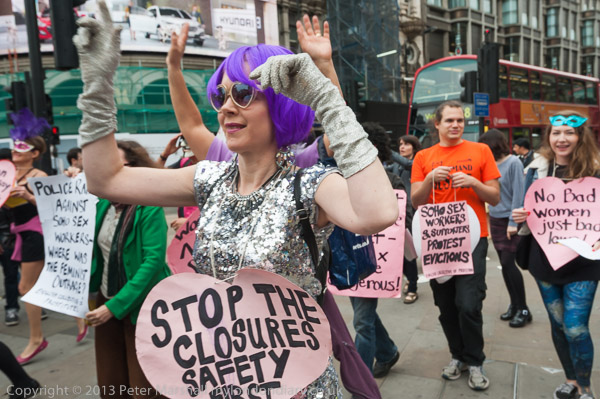
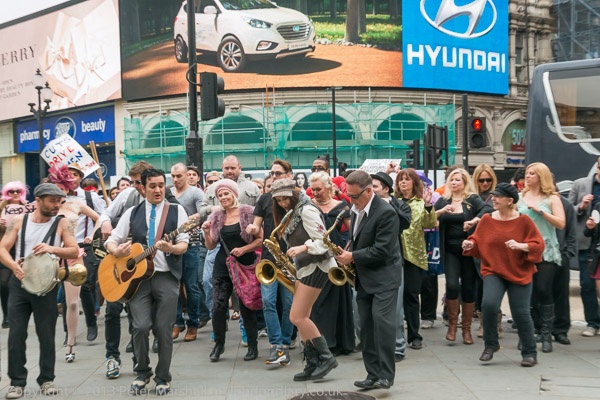
The event at Piccadilly Circus was something of a hybrid one, part protest and part film set for the latest music video by singer songwriter The Soho Hobo (Tim Arnold.) As I wrote:

This was the only protest I’ve ever attended that came with a clapper board, with its title ‘Picadilly Trot – Soho Hobo’ (sic) and where those taking part had to go back and dance across Piccadilly Circus for another take, and then doing it again without the musicians. I assume they’ll manage to spell the name right on the final edit and I hope it gets the protest more publicity, but I don’t think its a good way to run a protest and I wasn’t amused at having to stay out of shot while taking pictures.

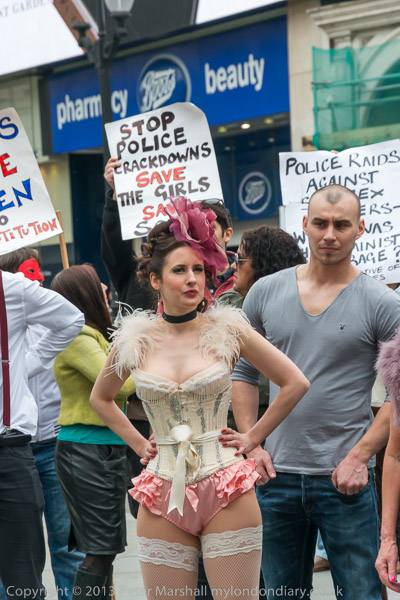
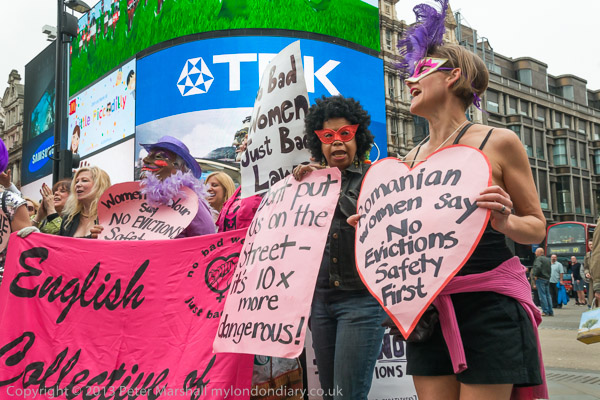
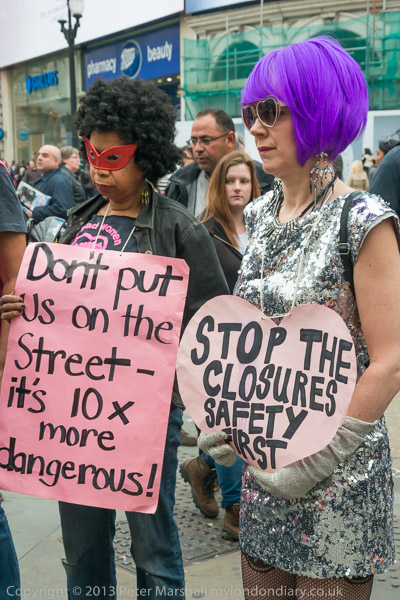
Mainly off the film cameras but very much on mine were protesters with placards from the English Collective of Prostitutes (ECP) and Queer Strike calling for an end to the raids on flats used by women sex-workers. The protesters are there at the back at some scenes in the finished video, but I doubt if anyone watching could get any idea of who they were or what they were protesting about.

The previous October I photographed a protest outside the Soho Estates offices in Greek Street after a number of women were evicted from their flats in Romilly St. Because these flats are self-contained and housed only a single sex-worker they were not legally brothels, but police and Westminster Council threatened to prosecute the landlord who refused to stand up for his tenants and simply evicted them.

The women involved say that the flats provided a much safer environment and they are much less safe if forced to work on the streets.

Campaigners say that the evictions are a part of a wider threat to the unique character of Soho, which has long been reputed for its cosmopolitan nature and various and often risqué entertainments of various kinds. The ECP say “if sex workers are forced out it will lead the way for other small and unique businesses and bars to be drowned out by major construction, chain stores and corporations.”

The police (and Westminster Council) are widely seen as being agents of the property developers who want to make billions from knocking down Soho and redeveloping parts of it as hotels and luxury flats, destroying the unique atmosphere of the area.

Keep Soho Sexy


Brexit, Fridays For Future & Turkey

I’d not been well for a few days in March 2019 and was still feeling rather weak and tired on Friday 29th March, but decided to go up to London and cover some events happening in and around Parliament Square. But I found I wasn’t really well enough, and had to leave and come home much earlier than I had intended, before things were expected to get rather livelier later in the day when extreme right protesters were expected to march join those already in the square.


Brexiteers protest Betrayal – Parliament Square

Brexit, Fridays For Future & Turkey
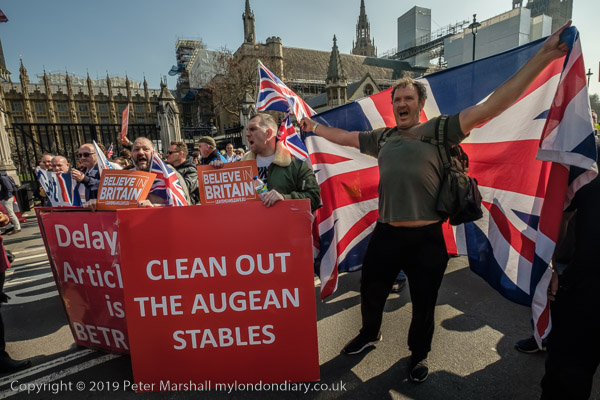
‘Clean out the Augean Stables’ was doubtless the kind of snappy slogan that would appeal to Rees-Mogg

Friday 29th March had been the original deadline for the UK to leave the EU established when Theresa May triggered Article 50 and this was approved by the House of Commons, officially notifying the European Council of its intention to leave.

Brexit, Fridays For Future & Turkey

But things had not gone to plan, Parliament had dithered and there had been no real attempt to make the necessary negotiations for our departure – and indeed these have only really been completed with the Windsor Framework more or less agreed a month ago. Boris Johnson won an election on his promise of an ‘oven-ready agreement’ but this turned out as might have been expected to be half-baked.

Brexit, Fridays For Future & Turkey

Even with the agreement over the Irish border – if it proves workable, much still need to be agreed to really sort out our relationship with the EU and get things back to normal, though even that will be rather unsatisfactory compared with EU membership.

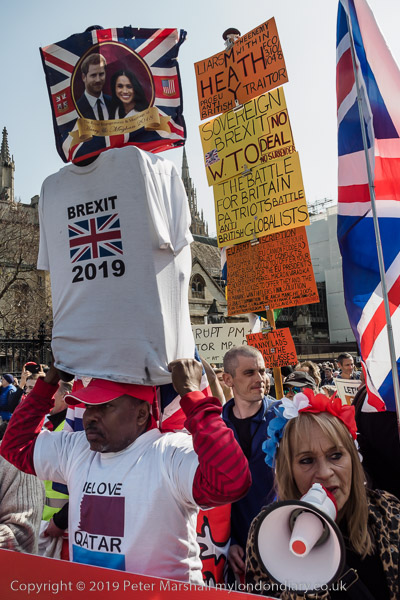
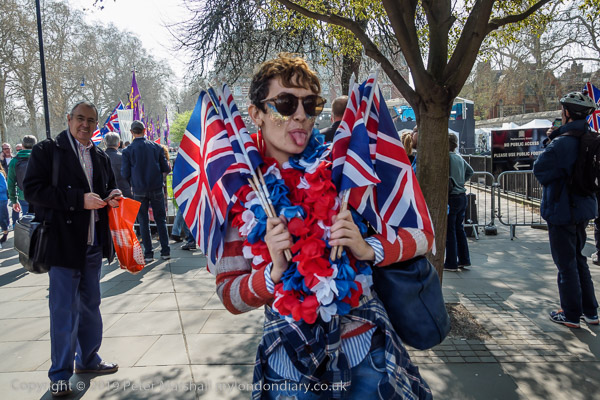
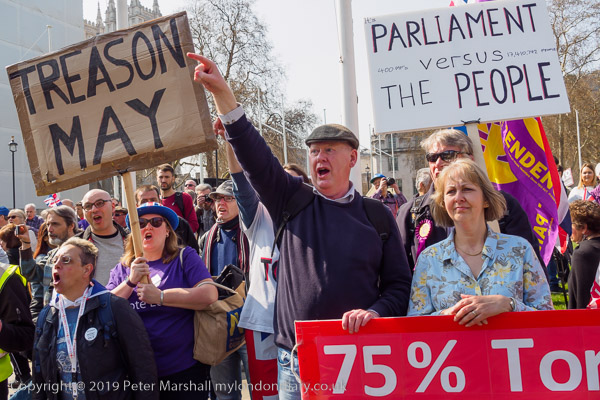
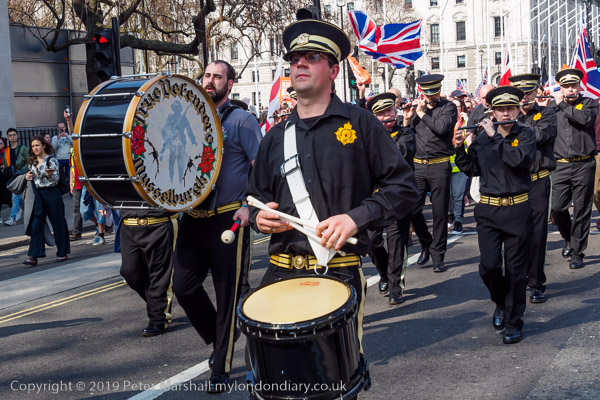
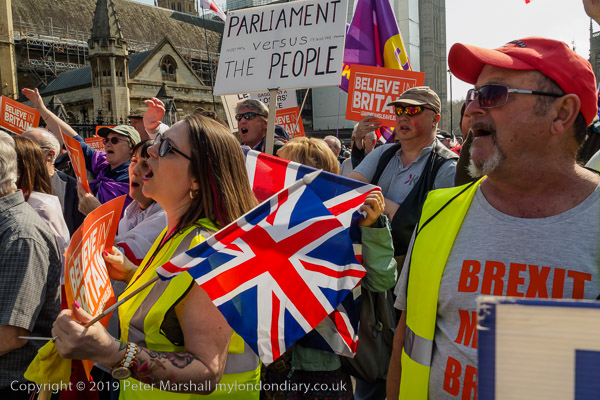
Brexiteers came to Parliament Square to protest against this failure to leave by the deadline, holding posters and banners. Later a ‘Leave Means Leave’ march arrived with two Orange marching bands.

There was a lot of noisy shouting and some MPs who walked through the crowd were subjected to angry abuse, while a few who were ardent supporters of Brexit stopped riedly to talk with the protesters.

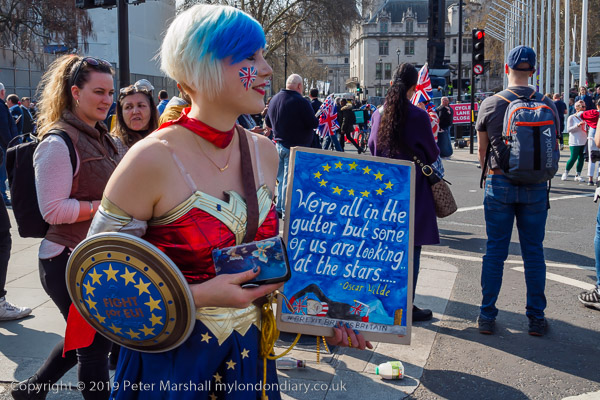
There were also a few Remain supporters, and while I was present they were largely ignored by the Brexiteers and the atmosphere remained generally calm. Among them was #EUsupergirl Madeleina Kay dressed as Britannia.

But after a couple of hours I was feeling very out of breath and weak and decided I was in no state to continue working, particularly as things were expected to get rather more heated as the extreme right Tommy Robinson and the Democratic Football Lads Alliance were expected to arrive shortly.

Brexiteers protest Betrayal


Fridays for Future climate protest – Parliament Square

Although the Brexiteers were the largest and noisiest group in Parliament Square, others were also protesting and I photographed them too.

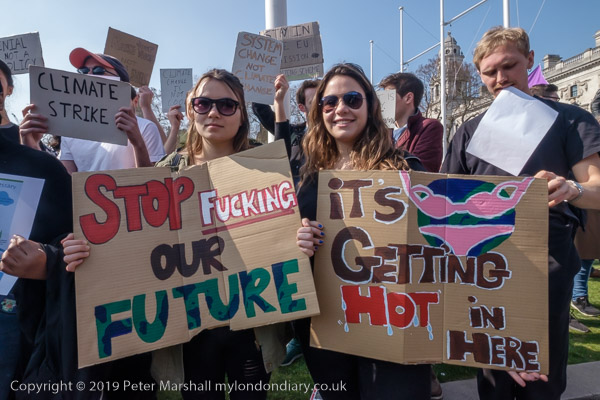
The school strike for climate was one of many weekly #FridaysForFuture events taking place in many cities and towns across the world. These protests were inspired by the action of 15-year old Greta Thunberg who instead of going back to school at the end of the Summer break in August broke the law by protesting outside the Swedish Parliament.

Fridays for Future climate protest


Kurds support hunger strikers – Houses of Parliament

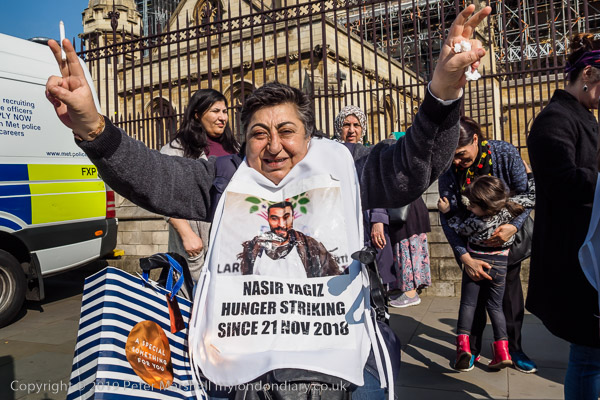
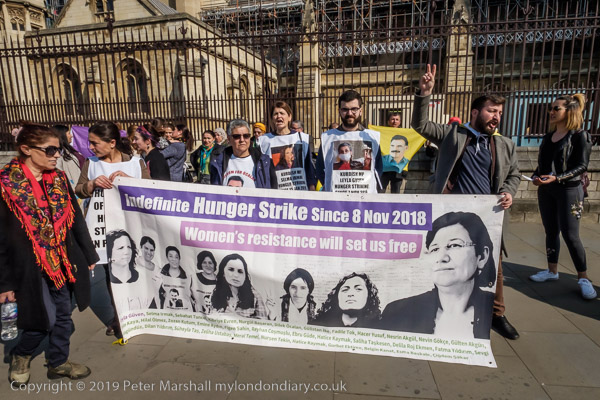
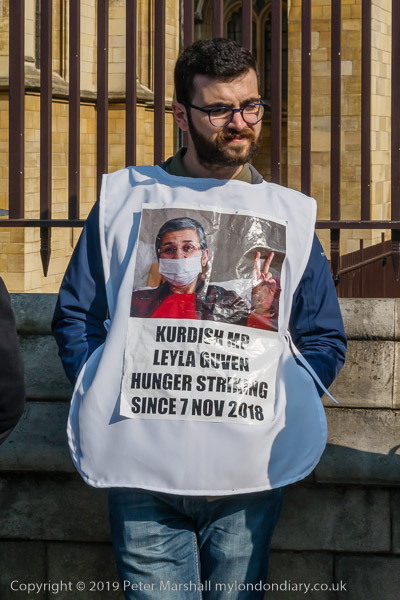
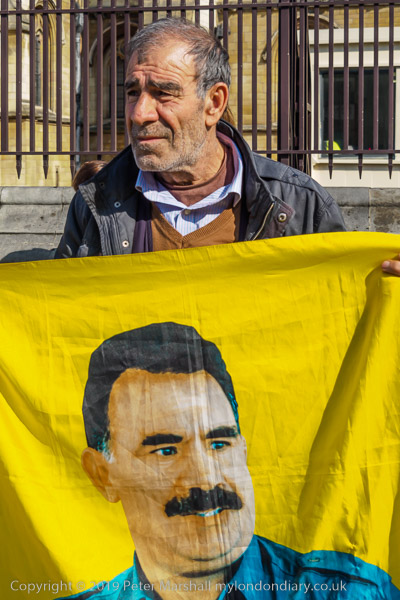
On the pavement in front of Parliament as I was getting ready to leave I photographed a group of Kurds who were protesting in solidarity with hunger strikers in Turkey, some of whom had been on hunger strike since November.

The strikes began on November 7th and were against the imprisonment of members of the HDP (Peoples’ Democratic Party) and the Free Women’s Congress, as well as many journalists, socialists and LGBTI+ campaigners. A number of Kurds in the UK have also gone on hunger strike in sympathy, including two of those taking part in this protest.

Leading the hunger strike in Turkey was HDP MP Leyla Güven, on indefinite hunger strike for over 110 days, vowing to continue until death unless the isolation of Kurdish Leader Abudullah Ocalan in prison was ended – and called an end to her hunger strike in May when this happened, having kept alive by consuming only Vitamin B and salty and sugary liquids.

The UK government continues to support Turkey as a fellow member of NATO despite the continuing human rights abuses there. Ocalan and many other Kurds remain in jail and many Kurds have been killed.

Kurds support hunger strikers


Winged Lions, A School, Thameslink, Wine, Buses…

My walk on Saturday 8th April 1989 continued. The first (and previous) part was Kings Cross, St George’s Gardens & More.
Carving, Willing House, Gray's Inn Rd, King's Cross, Camden, 1989 89-4d-63
Carving, Willing House, Gray’s Inn Rd, King’s Cross, Camden, 1989 89-4d-63

Close to the north end of Gray’s Inn Road, at 356-364 on the corner with St Chad’s Place, is a remarkable early 20th century building in a style described as French Baroque, Willing House, built in 1909 as offices for Messrs Willing Advertising, architects Alfred Hart and Leslie Waterhouse. It’s Grade II listing is perhaps deserved more for the carvings on its facade by William Aumonier Junior, than its rather quirky style.

On the peak of its roof, not shown in these pictures, though appearing rather small on another not digitised, is Mercury, a sculpture by Arthur Stanley Young. According to Wikipedia, Mercury “is the god of financial gain, commerce, eloquence, messages, communication (including divination), travelers, boundaries, luck, trickery, and thieves“, most of which seem appropriate for one of London’s major advertising companies.

This bas-relief by Aumonier, one of a pair, shows one man blowing a long trumpet and another more obvious with a horse, though what he is supposedly doing to the poor beast is unclear. Above them is a highly stylized sun.

Doorway, Willing House, Gray's Inn Rd, King's Cross, Camden, 1989 89-4d-64
Doorway, Willing House, Gray’s Inn Rd, King’s Cross, Camden, 1989 89-4d-64

This is the ornate main doorway to the building, with giant winged lions on the pilasters at each site. Above them is a frieze with one old man holding a globe and another blowing a trumpet, and Aumonier has thrown in a few cherubs for good measure.
London Details provides a great deal of information about Willing and Co, founded in 1840, and this building. There is also an unusually long description in its Grade II listing.

Winged Lions, Willing House, Gray's Inn Rd, King's Cross, Camden, 1989 89-4d-65
Winged Lions, Willing House, Gray’s Inn Rd, King’s Cross, Camden, 1989 89-4d-65

A closer view of one of the two winged lions. In 1989 this building was apparently in use by Camden Council but has since been converted into a hotel. Mercury on the roof has also recently been given a comprehensive makeover, repainted to his original grey and his caduceus regilded.

King's Cross Thameslink, Railway Station, St Chad's Place,  King's Cross, Camden, 1989  89-4d-52
King’s Cross Thameslink, Railway Station, St Chad’s Place, King’s Cross, Camden, 1989 89-4d-52

The railway runs under part of Willing house and the unfortunate guests may get a room overlooking the lines, which carry Thameslink between Kings Cross and Farringdon. Railway nerds might welcome this but I hope for others the soundproofing is effective.
This site had been opened as King’s Cross Metropolitan in 1863, on London ‘s first underground line, and a second pair of lines added in 1868. The platforms for the Metropolitan, also serving the Circle and Hammersmith & City Lines, were closed and replaced by some a little nearer King’s Cross in 1940, but the station remained in use. It was rebuilt and opened here in 1988 as King’s Cross Thameslink. It closed for good in 2007 and Thameslink trains now stop at new platforms somewhere in the bowels of Kings Cross and St Pancras.
Former Church School, Brittania St, Wicklow St, King's Cross, Camden, 1989 89-4d-41
Former Church School, Brittania St, Wicklow St, King’s Cross, Camden, 1989 89-4d-41

This Grade II listed Church School built in 1872, its architect Joseph Peacock who had previously designed St Jude’s Church, the first church to be constructed in London using monies from the Bishop of London’s Fund, which was consecrated in 1863. In June 1936 the parish was united with with Holy Cross, Cromer Street and the church was demolished with many of its memorials being moved to Holy Cross. The school became offices.

Brittania Wine Warehouse, Britannia St, King's Cross, Camden, 1989 89-4d-43
Brittania Wine Warehouse, Britannia St, King’s Cross, Camden, 1989 89-4d-43

This building now has a sign in stone I think revealed by the removal of that for the Brittania Wine Warehouse ‘LONDON GENERAL OMNIBUS COMPANY LIMITED’. The company was founded in 1855 and remained the main bus operator in London until 1933. It was originally an Anglo-French company, the Compagnie Generale des Omnibus de Londres, and now we once again have many buses in the capital run by a French company, London United being a part of the French state-owned RATP ( Régie autonome des transports parisiens.)

This was the horse bus depot of the LGOC, and later their motor bus depot, and their last late horse-drawn bus ran in 1911.

Derby Lodge, Britannia St, King's Cross, Camden, 1989 89-4d-45
Derby Lodge, Britannia St, King’s Cross, Camden, 1989 89-4d-45

Derby Lodge, Grade II listed philanthropic flats from erected around 1865 for Sydney Waterlow’s Improved Industrial Dwellings Company with the help of builder Matthew Allen. Grade II listed. Listed in the 1990s and since refurbished.

Like other similar flats of the era their design was based on the model cottages erected for Prince Albert as a part of the 1851 Great Exhibition in Hyde Park and later re-erected in their current location in Kennington Park where they still are.


Kings Cross, St George’s Gardens & More

The day after my short trip to Canning Town the weather was again looking good and so on Saturday 8th April 1989 I was out again walking and taking pictures. This time my starting point was King’s Cross St Pancras Underground Station (not then International.)

Kings Cross, Lighthouse, Pentonville Rd, Gray's Inn Rd, Islington, Camden, 1989 89-4c-41
Kings Cross, Lighthouse, Pentonville Rd, Gray’s Inn Rd, Islington, Camden, 1989 89-4c-41

Immediately on coming out of the station I crossed the Euston Road and took a photograph looking across the busy junction between Pentonville Road and Grays Inn Road. Later this was to be transformed into the death trap for cyclists it now is, after the road engineers were told to ignore cyclists in planning the junction, and I’ve photographed a number of protests there. In the past ten years at least three cyclists have been killed and 15 seriously injured here.

Back in 1989 before the redesign it was almost certainly safer, as traffic here was usually moving rather more slowly – and in my picture I think is at a complete standstill.

The building at the centre of the image is the famous “lighthouse” whose presence has invited a litany of stories, almost all empty fabrication and speculation. But it seems that it was built between 1875 and 1885 to promote Netten’s Oyster Bar then doing a roaring fast food service at street level. Later the block became home to one of London’s best known jazz record stores, Mole Jazz, which opened at 374 Gray’s Inn Road in July 1978 – and I became one of its early customers, though I had given up buying records long before it closed in 2004.

The lighthouse seems in decent condition in my picture, but more recently deteriorated and became covered in graffiti. The building has recently been refurbished as the Lighthouse King’s Cross office space, with a top floor bar and roof terrace around the lighthouse itself.

Kings Cross Station, Euston Ed, Camden, 1989 89-4c-42

I turned around and took another picture, looking back at Kings Cross Station across Euston Road. The view here remained much the same until around 2021 when the more recent buildings in front of the 1851-2 station building, designed by Lewis Cubitt, the younger brother of both Thomas Cubitt responsible for much of London’s nineteenth century housing and William Cubitt, another important developer, who gave his name to Cubitt Town on the Isle of Dogs and later served two consecutive terms as Lord Mayor of London.

The station building is Grade I listed, and the recent changes have I think greatly improved it.

St George's Gardens, Sidmouth St, Camden, 1989 89-4c-32
St George’s Gardens, Sidmouth St, Camden, 1989 89-4c-32

There are many parts of London which it is hard to assign a name to, and the one I was walking around on this Saturday was one of them. My street atlas calls it ‘St Pancras’, I think it is part of Camden’s King’s Cross Ward, and when I’ve often walked across it from Tavistock Square I’ve always thought of it as Bloomsbury. Wikipedia has a rather lengthy discussion which says in part “Bloomsbury no longer has official boundaries and is subject to varying informal definitions, based for convenience“.

St George’s Gardens began in 1713-4 as a joint burial ground for St George-the-Martyr, Holborn (in Queen’s Square, now known as St George’s Holborn) and St George’s Bloomsbury and still has a line of stones marking the division of the area between the two churches, both of which had run out of space for burial in their churchyards. It was one of the earliest London burial sites situated away from the churches it served.

St George's Gardens, Sidmouth St, Camden, 1989 89-4c-34
St George’s Gardens, Sidmouth St, Camden, 1989 89-4c-34

But people kept on dying, and where buried here, mainly in unmarked graves. By 1885 there was no more room, and it was closed for burials. As a consecrated burial ground it could not be built on and burial grounds such as this were fast becoming the only open spaces in central London. “Campaigners including Miranda Hill and the Kyrle Society and Octavia Hill fought to create ‘outdoor sitting rooms’ to ‘bring beauty home to the poor’. St George’s Gardens were opened in 1884.”

St George's Gardens, Sidmouth St, Camden, 1989 89-4c-33
St George’s Gardens, Sidmouth St, Camden, 1989 89-4c-33

I made ten pictures here, of which three are online. The Friends of St George’s Gardens say that by 1997 the gardens were very run down, though I don’t think this is apparent in my pictures which show neatly cut grass and generally well-tended areas. The Friends were formed in 1994 when they say there had been a “prolonged period of neglect” and the gardens have been restored since then, with a lottery grant in 2001 and other and continuing work by the Friends.

Houses, Frederick St, Camden, 1989 89-4c-12

Frederick Street was one of those developed by Thomas Cubitt and Numbers 48-52 date from 1815-1821, a few years earlier than some of the other Grade II listed houses on the street. Before making this picture I’d also photographed (not online) on of his terraces in Ampton Street, parallel and a few yards to the south. Both run east from Greys Inn Road, where in later years I often visited the NUJ offices on the corner with Acton Street.

Royal National Throat, Nose and Ear Hospital Swinton St, Camden, 1989 89-4c-16
Royal National Throat, Nose and Ear Hospital Swinton St, Camden, 1989

Walking north up Greys Inn Road past the NUJ offices (now at ground floor Bread&Roses @ The Chapel Bar) the next corner a few yards on is Swinton Street, and a few yards down there is this five floor frontage of the Royal National Throat, Nose and Ear Hospital towering above the fairly narrow street.

This hospital remained in use until March 2020, when it was closed a few months earlier than planned due to Covid-19. Until then it was still offering inpatients ear, nose and throat (ENT) and oral surgery, sleep diagnostics and allergy day case services.

The hospital had been set up in 1874 as the Central London Throat and Ear Hospital by two doctors who had previously worked at the first specialist throat hospital in the country, the Hospital for Diseases of the Throat in Golden Square.

The hospital’s original building was begun on the Grays Inn Road in 1875, and various other buildings and wards were later added, with the hospital eventually covering a large site between here and Wicklow St. This rather odd building on Swinton Street was the Nurses’ Home, built in the 1930s.

More about my walk in later posts.


Murdoch, Tower Bridge and Poor Doors

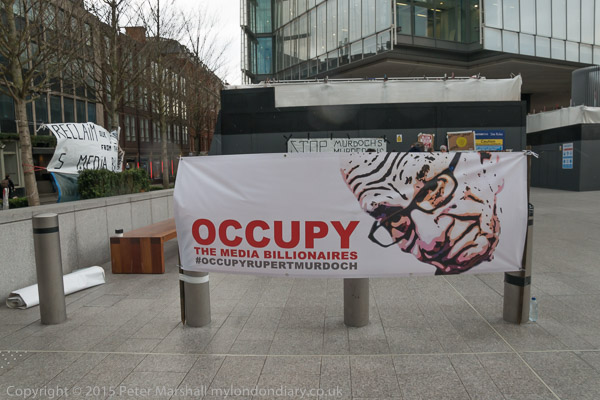
I came up to London on the afternoon of Thursday 26th March 2015 and began my work by going to News International opposite the main entrance to London Bridge Station where te week of Occupy Rupert Murdoch was on its fourth day. Not much was happening there, so after taking a few pictures I went for a short walk to Tower Bridge and back. Things were only just beginning to start for an evening of events there when I needed to leave and cross the river for another weekly protest by Class War at One Commercial Street.


Occupy Rupert Murdoch – News International, London Bridge

Thursday 26th March 2015

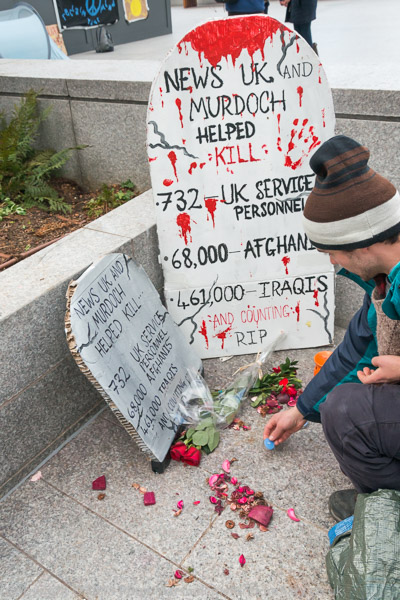
I’d been at News International three days earlier on Monday 23 March 2015 when campaigners against the scandal of the UK’s media monopoly, with 5 billionaires owning 80% of the media, had marched there the short distance from London Bridge to present an arrest warrant for Rupert Murdoch, charging him with for war crimes, phone hacking, political blackmail, tax avoidance and environmental destruction.

Thursday 26th March 2015

Someone from News International had come and taken the warrant, and the campaigners had then set up camp on the pavement outside for a week of activities, Occupy Rupert Murdoch Week. I’d been busy for a few days and this was my first opportunity to return and see what was happening.

Thursday 26th March 2015

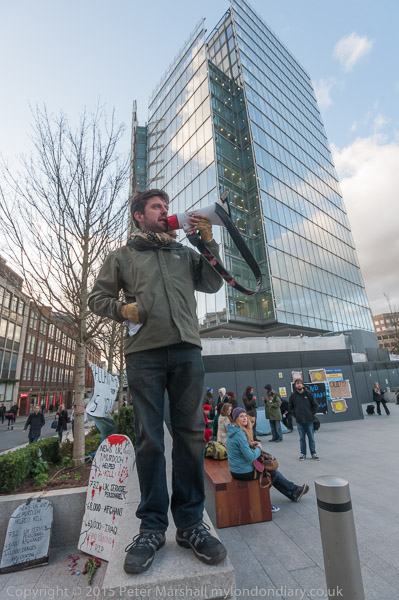
The answer when I arrived late on Thursday afternoon was not very much, though the camp and some of its supporters were still there, and still putting up posters and telling people going into London Bridge Station opposite the camp why they were protesting.

Thursday 26th March 2015

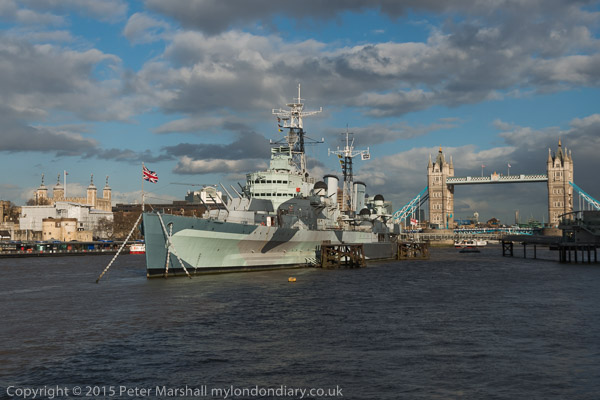
I went for a short walk along the riverside to Tower Bridge and came back later when more people were beginning to arrive for the evening session. But unfortunately I needed to leave to walk across the river and join Class War in Aldgate before things really got going.

Occupy Rupert Murdoch


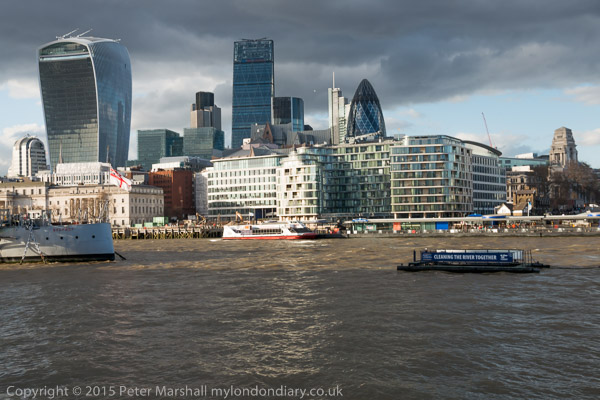
Around Tower Bridge

I’d thought that Tower Bridge was probably the most photographed building in London but a survey of Instagram tags in 2022 showed that Big Ben had inched ahead with 3.2 million posts to Tower Bridge’s 2.6 million.

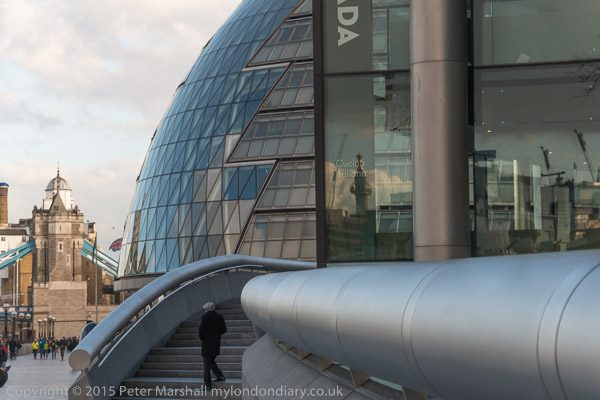
I don’t often feel a great need to add to the number of pictures of London’s most famous bridge, which I think I first photographed 50 years ago, though I’d gone under it on a school trip almost 20 years earlier, back before primary children had cameras. Most of the pictures which I’ve taken including it in the last 25 or so years have a group of protesters outside nearby City Hall in the foreground.

London’s City Hall is now no longer within sight of Tower Bridge, hidden out beside the ROyal Victoria Dock in Canning Town, though it was still in its rented home, bought back by the Kuwaiti state a couple of years earlier. Tower Bridge is still owned by Bridge House Estates, a charity set up in 1282, its only trustee THE MAYOR AND COMMONALTY AND CITIZENS OF THE CITY OF LONDON.

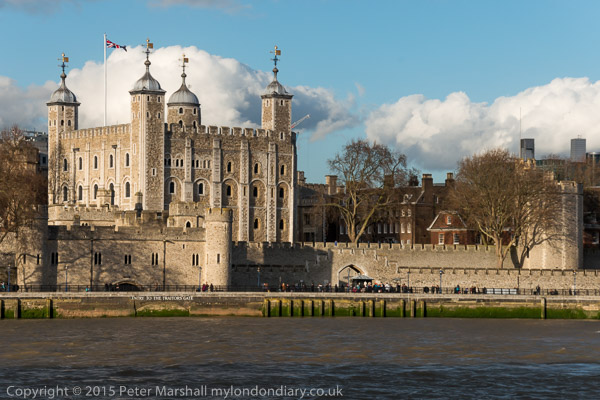
But mostly my attention was on the north bank of the river now rather dominated by a cluster of ugly and idiosyncratic towers in the centre of the City of London, until close to Tower Bridge where the Tower of London, actually outside the City in Tower Hamlets, still stands out despite its relatively low height.

Around Tower Bridge


A Quiet Night at Poor Doors – One Commercial St, Aldgate.

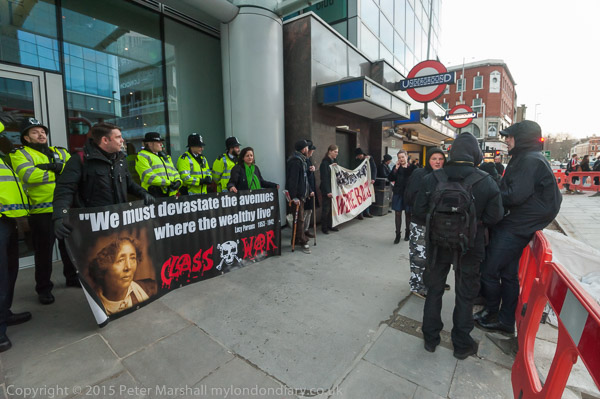
Eight months earlier in July 2014 Class War had started a series of weekly protest outside the massive largely residential block of One Commercial Street on the corner of that street and Whitechapel High St. The block includes flats for both private owners and a smaller number of socially rented flats, with the two groups having separate entrances.

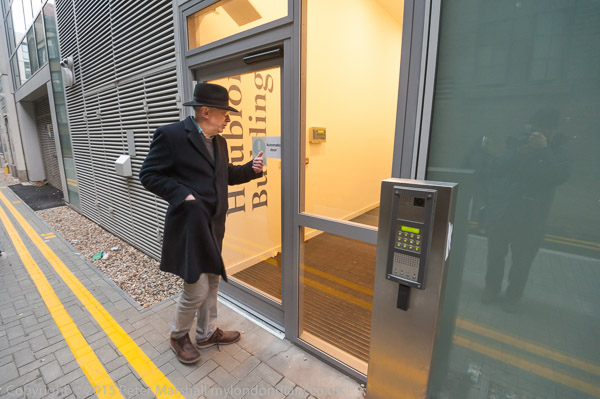
The ‘rich door’ is on the main road, next to the Underground station entrance, while the ‘poor door’ is down a side alley. When the protests began the alley was dark, with dumped rubbish and a strong and persistent smell of urine, but one positive result of the protests has been that the alley has been cleaned up and new lighting installed.

As the protesters were getting ready at the rich door, I went after Ian Bone of Class down the alley to look at the poor door. We returned to the front of the building and the rich door, followed by two police officers who had come to watch us.

It was good to see again among the banners the ‘Epiphany’ banner based on the Fifth Monarchists who led a short-lived rebellion in London which began on 6th January 1660. Class War had taken part in the filming of a re-enactment of this event in 2013.

It began as a fairly quiet protest with speeches and some chanting, and at some point a yellow smoke flare rolled across the pavement.

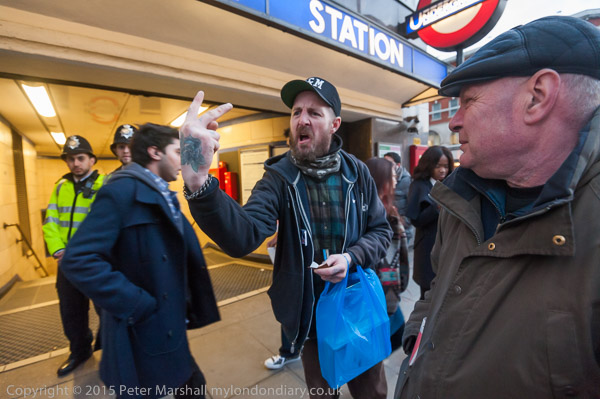
There was a small confrontation when one resident entering the rich door pushed rather roughly past the protesters, but very few came in or out of the rich door. The ground floor also includes shops and a hotel, and I think residents could probably use the hotel entrance. We had also found that they were able to exit via the ‘poor door’.

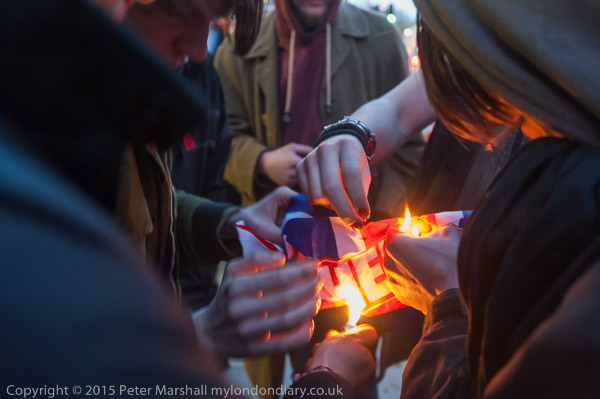
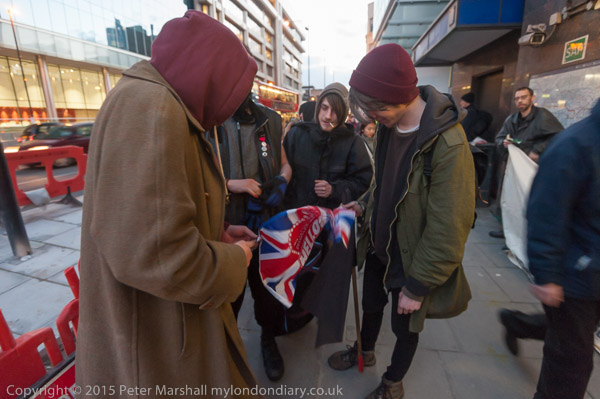
At the end of the protest some of the protesters who had brought a Hello! magazine Queen’s Diamond Jubilee flag attempted to burn it. But this turned out to be difficult and it melted a bit but didn’t catch fire. Some then when down the alley to look at the poor door before everyone left.

More pictures on My London Diary at Quiet Night at Poor Doors.


Canada Water, Southwark Homes & Cody Dock

Canada Water, Southwark Homes & Cody Dock: Events and pictures from Saturday 25th March 2017


Canada Water, Southwark.

Canada Water, Southwark Homes & Cody Dock

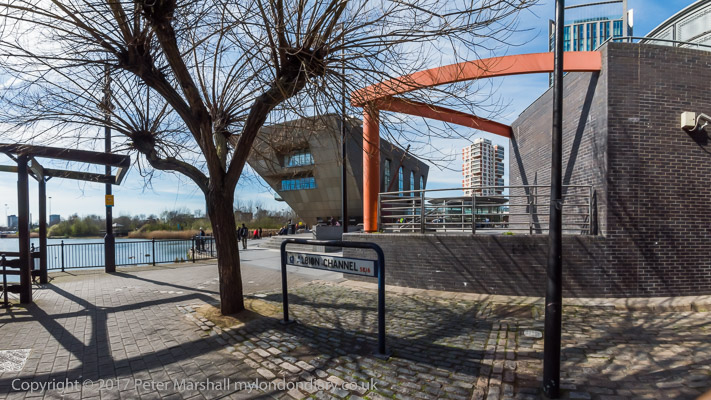
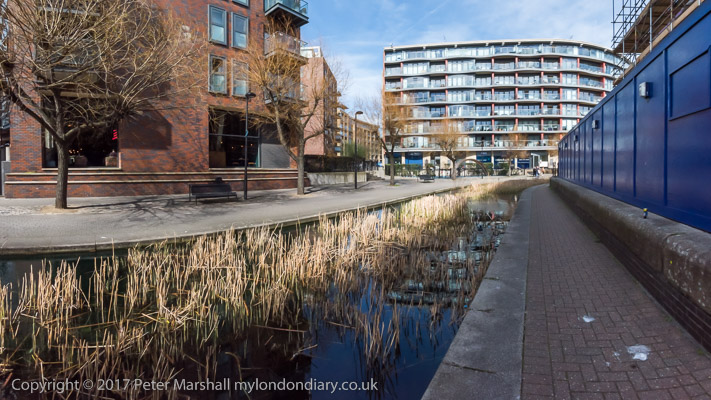
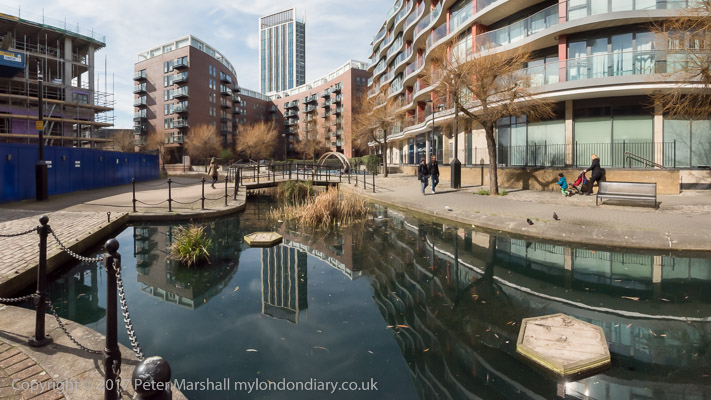
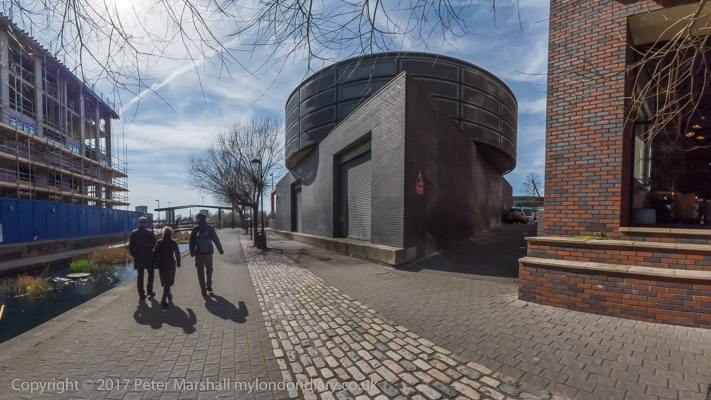
The Surrey Commercial Docks were the largest area of London’s Docklands and the only large docks on the south bank of the River Thames, built on a large marshy area at Rotherhithe, a little closer to London than the Royal Navy dockyard at Deptford.

Canada Water, Southwark Homes & Cody Dock

The first dock here was dug out in 1696 and was the largest dock of that age, and could take 120 sailing ships. Later the dock became Greenland Dock, a base for the Arctic whaling trade, but in the 19th century there was a huge increase in trade with Scandanavia and the Baltic, and other docks were dug, as well as huge timber ponds which soon became its major trade.

Canada Water, Southwark Homes & Cody Dock
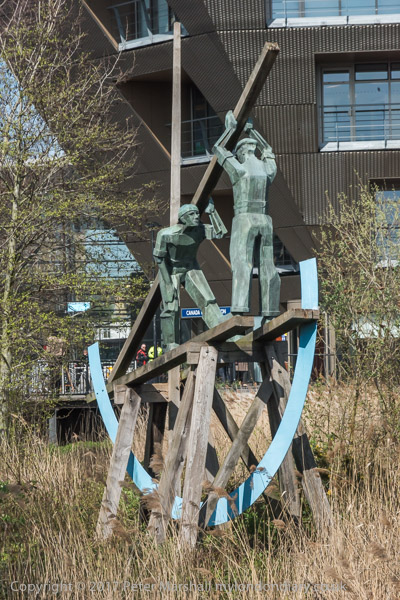
Deal Porters sculpture by Philip Bews

Surrey Docks was in full swing the in the Victorian age, with nine docks, six timber ponds and the Grand Surrey Canal. Badly damaged by bombing in the Second World War, the docks never fully recovered and were then hit by containerisation. The docks were too small to handle container ships and closed in 1970. Most of the docks were filled in and the whole area was redeveloped.

Canada Water, Southwark Homes & Cody Dock

By the time the London Docklands Development Corporation was set up by the Tories in 1980 the redevelopment initially led by Southwark Council was well under way and the area was set to have a rather different character from the redevelopments on the north bank.

But the LDDC appeared as the principal objector, to the council’s statutory development plan and was backed by the Department of the Environment. Southwarks plan for the whole of the south riverside from London Bridge to Deptford was rejected for showing ‘unrealistic commitment to public housing‘ and for its ‘opposition to office and other private development’. The LDDC went ahead with selling land and buildings for speculative development.

The LDDC rubbed its hands in glee at the thought of selling riverside sites which Southwark had planned for low cost rented housing to developers of large blocks of luxury flats, and rushed to clear aging council estates and replace them with privately owned properties, policies which were strongly opposed by Southwark Council.

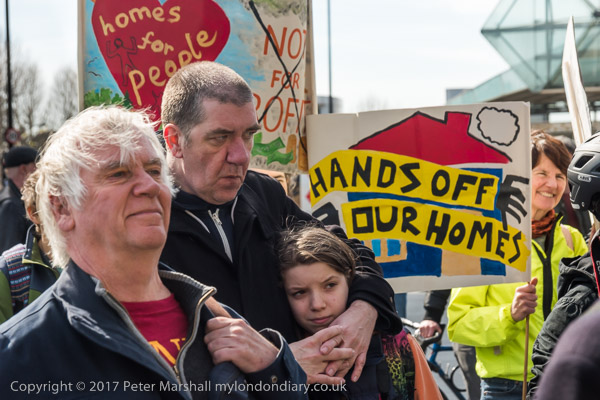
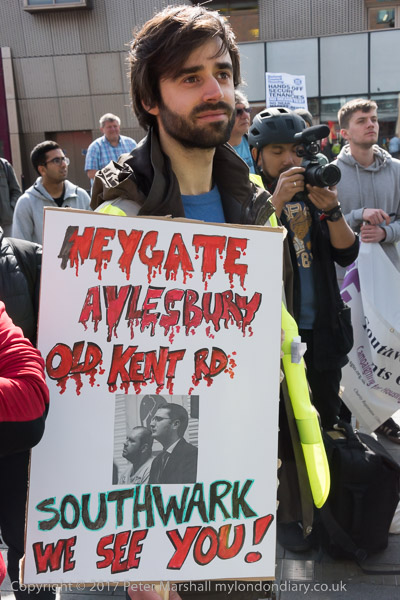
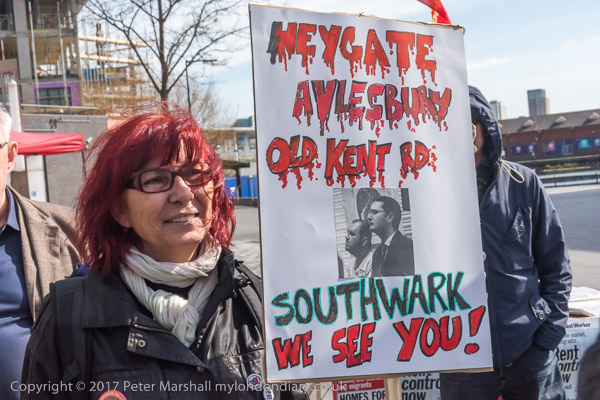
But times have changed, and I had come to Canada Water for a march where local people had come to protest against very similar policies by Southwark’s Labour council, working for and with developers to demolish estates such as the Heygate and Aylesbury, with the replacements including only a very small percentage of social housing. I’d arrived early on purpose to give me time for a short walk around before the protest began.

More at Canada Water.


Southwark march for homes & businesses

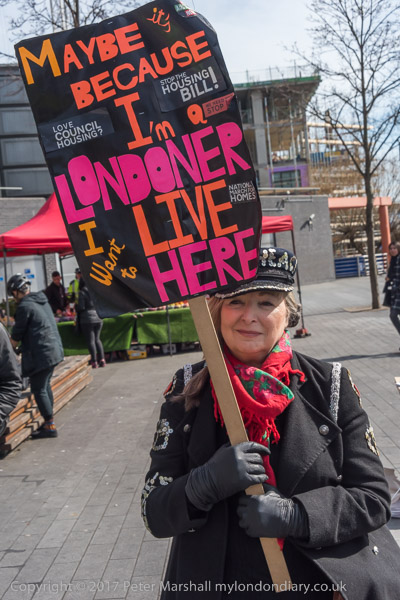
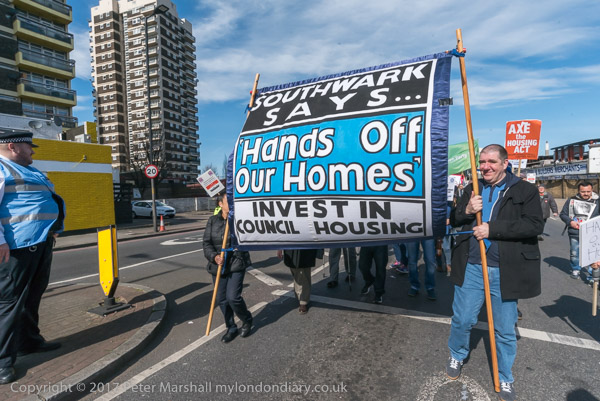
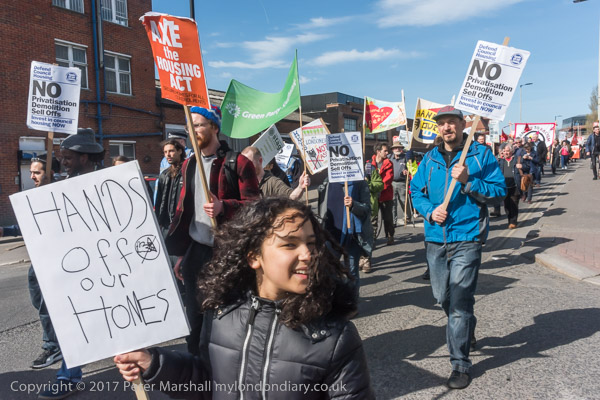
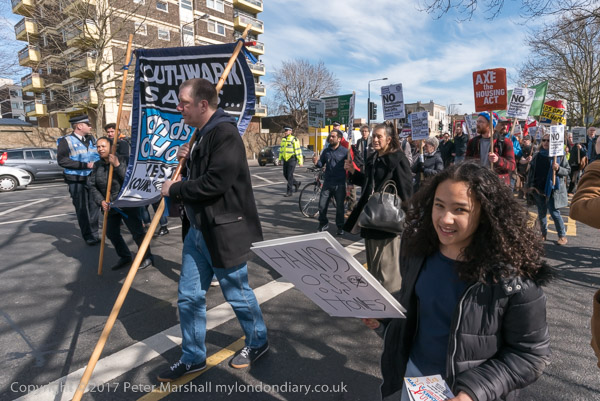
Southwark campaigners marched from Canada Water to protest at Thurlow Lodge Community Hall on the Aylesbury Estate, calling on Labour-run Southwark Council to save homes and jobs in the borough.

Marchers and speakers at the rally before the march included those from tenants and residents organisations, local business networks and others. They had come to oppose Southwark Council demolishing council estates for luxury home building, selling off public land to private developers and profit-oriented housing associations and forcing out small businesses through policies they say are solely concerned with realising asset values and trample on the rights and needs of local residents.

On My London Diary there is a long list of some of the groups involved, but there were others too.

One of the bigger battles, still continuing, is over the future of the Aylesbury Estate in Walworth, just south of the Heygate Estate at the Elephant and Castle, where the council lost a great deal of public money in providing a huge site with great transport links to allow a private developer to make huge profits, losing around 2000 social rent homes. Many of the new flats are empty boxes, investments for wealthy foreigner profiting from rapid increases in London property prices.

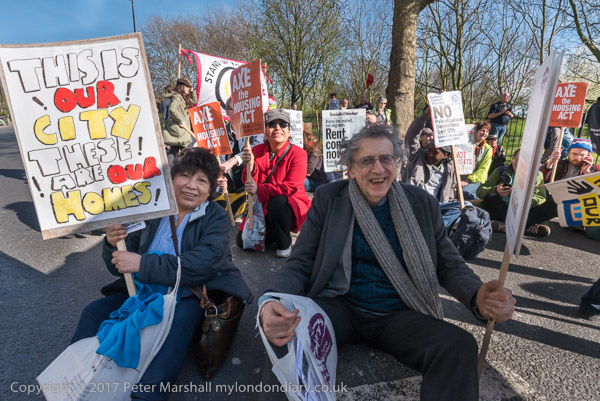
Piers Corbyn with others sitting down on Albany Road at the end of the march

Much of the Aylesbury estate has now been emptied, and some demolished. The council was found to have acted acting unfairly towards leaseholders who were being offered derisory compensation – usually less than half the market value of comparable properties in the area. Those who took the court case got improved offers, but there is little evidence of it changing its ways and trying to cheat others. Among those involved in fighting to save the Aylesbury on this march was Piers Corbyn, Jeremy’s older brother, in the news more recently over arguably less worthwhile causes, particularly in opposition to Covid restrictions.

The Aylesbury Estate had been at the centre of the Labour Party’s plans for the regeneration of council estates, the site of Tony Blair’s first big press event. But Labour’s policy was more about grabbing headlines than providing the good low-cost housing that a proper social housing policy requires. Councils such as Southwark have used it to demonise and run-down their large estates, spending large sums with PR companies to do so and working with major developers, rather than properly consulting with residents and putting the necessary cash into estate maintenance, running them down on purpose.

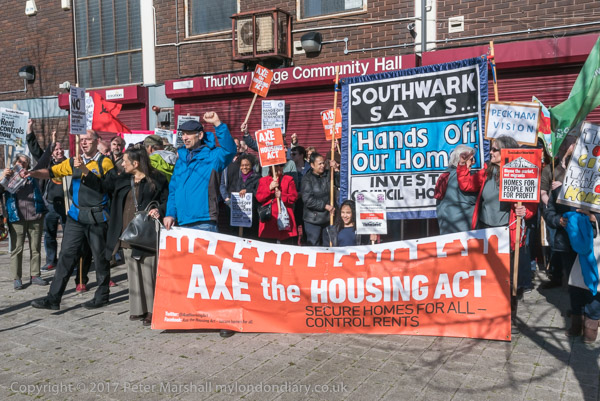
It was a long march to the Aylesbury Estate, detouring to pass several housing estates and business areas threatened by the council, and a tiring one on a warm and sunny March Day, and we were all tired by the time it ended outside Thurlow Lodge Community Hall. This had been saved earlier this year by a community occupation after Southwark Council had wanted to evict the occupants, Divine Rescue, a body with a soup kitchen offering support, training and meals to around a hundred homeless people, and runs a a food bank. Southwark wanted to sell or let the community hall to make more money.

The march organisers had planned to end the march here with Divine Rescue providing hot drinks and toilet facilities after the long walk, but Southwark Council had warned Divined Rescue that there lease would again be threatened if they had anything to do with the protest, forcing them to withdraw their offer. The hall was locked and shuttered, guarded by Southwark Council security when we arrived. It seemed a very petty piece of bullying by the council.

The protesters sat down on Albany Road blocking traffic for around 10 minutes in protest at this, then moved to the area in front of the community hall for a final rally.

Many more pictures from the march and the rallies before and afterwards on My London Diary at Southwark march for homes & businesses.


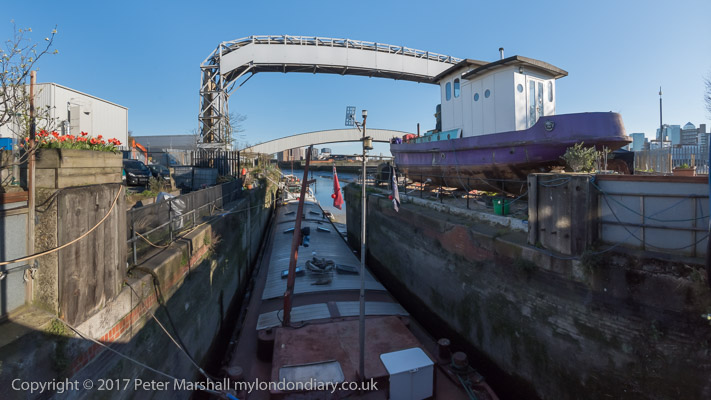
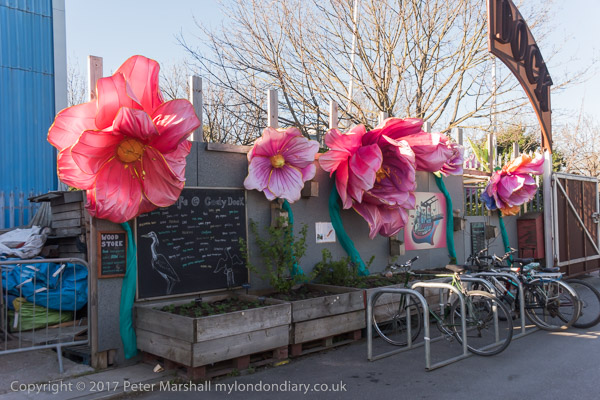
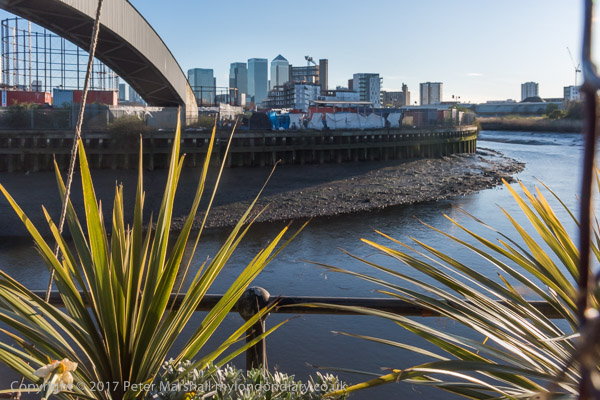
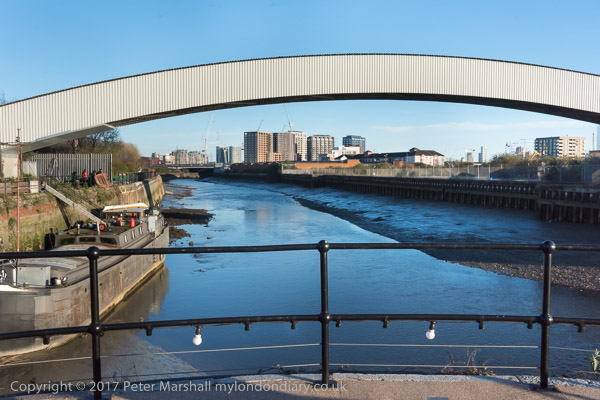
More From Cody Dock

From the Aylesbury Estate I made my way to Cody Dock for the opening of my show there, ‘All Along the Lea‘, black and white photographs from the 1980s and 90s, arriving an hour or two early.

This gave me time to take a few more pictures, but also to have some food and a beer and listen to some live music and just to enjoy being there.

It was a pleasant opening with a decent crowd, with plenty of people coming to look at the pictures and talk, including the local MP. As I said and wrote, “When I took these pictures many people wondered why I was wasting time and film on such scenes, so I’m really pleased to have them appreciated now. “

I hadn’t chosen the title for the show, and it wasn’t accurate fro the pictures that were on the wall, almost all from Bow Creek. But I had photographed ‘All Along the Lea’ and my web site and the book ‘Before the Olympics‘ have pictures from the source at Leagrave to the outlets into the Thames both at Bow Creek, and, via the Limehouse Cut, at Limehouse Dock.