1995 Colour – Kent Landscapes: Part 7 of my posts on my colour work in 1995. In the early months of 1995 I continued working in both Walthamstow, Chingford and other areas of North London but also made a number of visits south of the river to St Mary Cray, Belvedere and elsewhere. But most of my work was in black and white, though I’ve already posted a few colour images in this series.
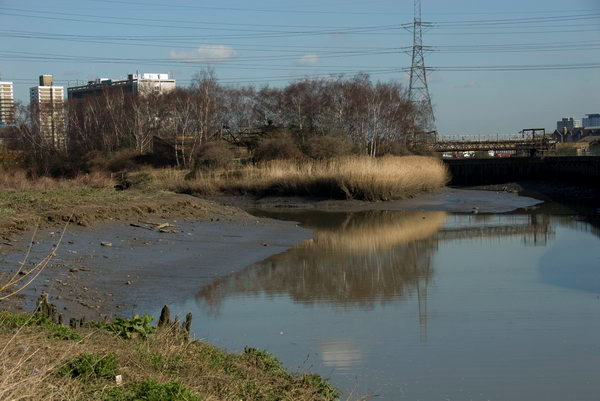
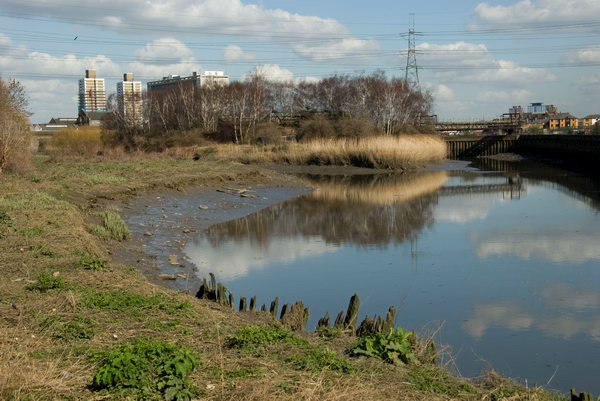
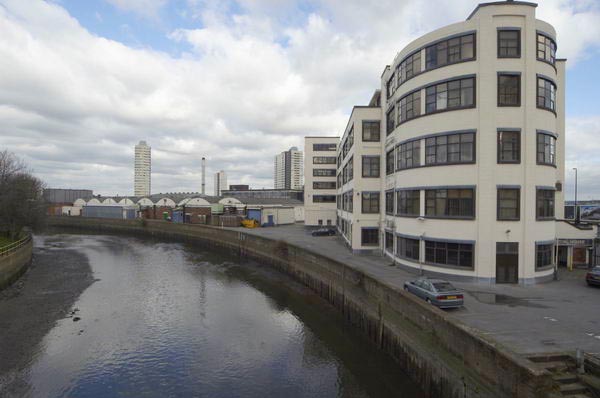
River Darent, Dartford, 1995, 95p4-342
I took far fewer colour pictures and at the time kept few records of locations and dates of these, relying on the annotations I made on my black and white contact sheets.
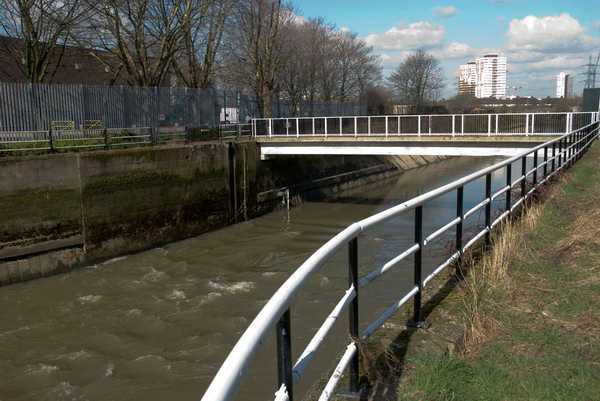
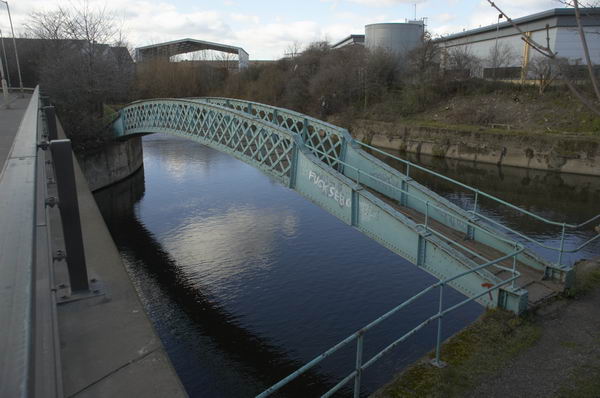
Brooklands Lakes, River Darent, Dartford, 1995, 95p4-472
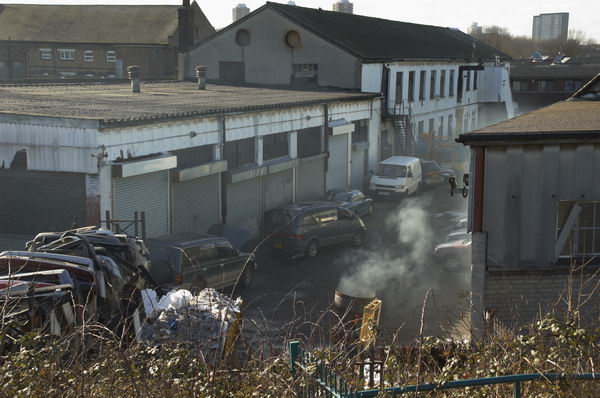
On April 1st 1995 I took the train to Dartford, a town I had previously photographed and visited occasionally to visit a friend. Dartford is just outside the east edge of London in Kent and at the west edge of an area beside the Thames which had for many years been the home of the cement industry with huge chalk quarries and riverside cement factories, the largest of which was still operation in the 1990s and which I’d photographed fairly extensively.
Farm, River Darent, Dartford, 1995, 95p4-473
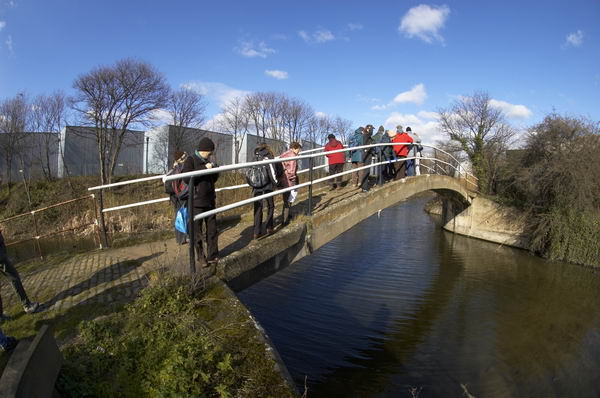
I made a long walk around the area south of Dartford, beginning along the river that runs through the town, the Darent, but then through some of the countryside to the south.
As well as photographing traces of the cement industry – including a no longer working mineral conveyor which had carried chalk from a quarry to the factory I also photographed the two major roads which have impacted on the landscape south of Dartford, the A2 Dartford By-Pass and the M25 motorway.
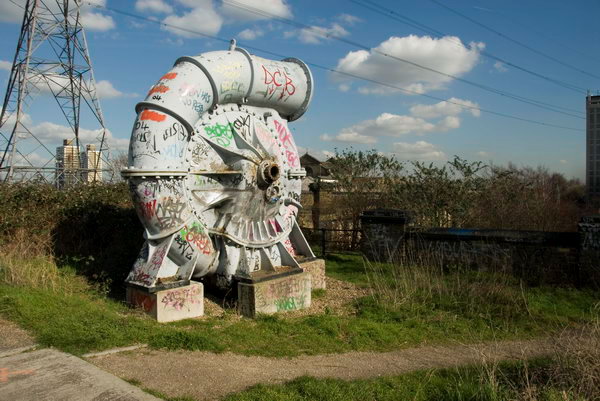
Mineral Conveyor, M25, Hawley, Dartford, 1995, 95p4-433
You can see larger versions of the images by clicking on them which will take you to my Flickr album 1995 London Colour. More colour pictures from Dartford in a later post.
Bow Back Rivers, Plaistow & Upton Park: March 8th is of course International Women’s Day, and most years I’ve found events related to that to photograph, though often the main events take place not on the day itself but on the closest Saturday. In 2007 March 8th was a Thursday and I did something completely different, taking a stroll around the various rivers and channels to the south and west of the Olympic site.
Canning Rd from the Greenway
Many of the paths and roads I walked were soon to be closed for various works connected with the Olympics, including the building of a new lock. This was much heralded as being a part of making London 2012 green, with boasts that it would lead to a huge reduction in lorries taking spoil from the site out and bringing materials in to the area by barge. In fact I think it was only ever used for a few photo opportunities and the piece I wrote for My London Diary perhaps suggested the real driver behind its construction.
Channelsea River (now just a tidal creek)
Another unnecessary aspect of the Olympic development was putting the power lines between Hackney and East Ham underground, perhaps also more driven by the desire by developers of the area, now with its many new tall blocks flats more attractive and profitable.
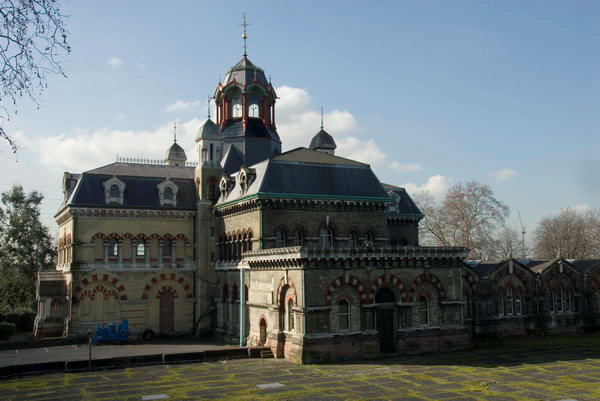
Abbey Mills pumping station (Charles Driver, 1865-8), the “cathedral of sewage”, viewed from the Greenway
There was also a very half-hearted attempt to use the rivers and navigation as a means of access to the games, with a river-boat service. It was said to be a part of opening up the area as a major leisure attraction, but didn’t ever work and was soon abandoned.
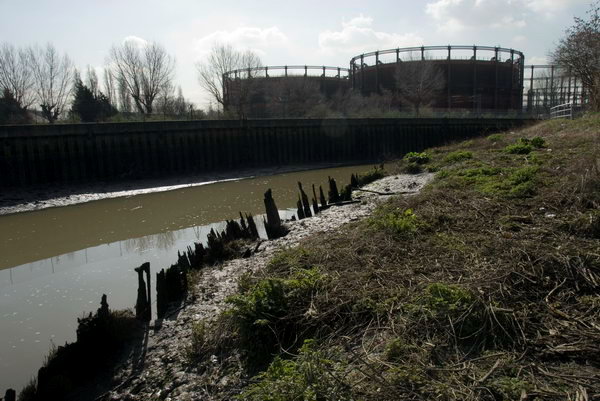
Longwall footpath, looking towards the gasholders over the Channelsea RIver.
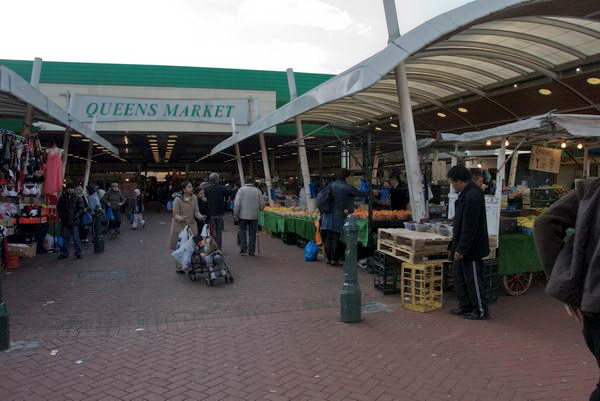
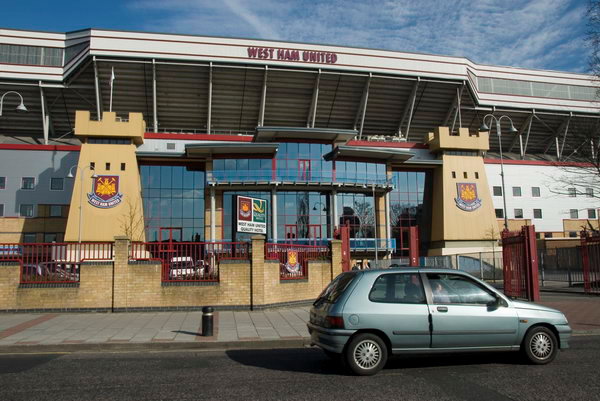
After walking around the area I walked east along the Greenway – the elevated walkway over the Northern Outfall Sewer – to Upton Park, also affected by the Olympics, with West Ham abandoning their Boleyn ground and moving to the Olympic Stadium after the games. Close to their ground is Queen’s Market, which Newham Council had being trying to demolish and redevelop since 2004. It is still currently under threat as it doesn’t fit with their dreams of gentrification but remains as an important community resource.
Channelsea Rvier and the island, with Abbey Creek to left
My post on My London Diary contains a lot of background but doesn’t really describe the walk I made – the pictures tell that story, along with their captions. It is rather more fanciful than most of my posts. As usual I’ve tidied it up slightly, changing to normal capitalisation and making a few minor amendments.
Bow Back Rivers – Prescott Lock Site
The tide flowing out fast from the Prescott Channel, officially opened in 1935
If you are a water molecule starting in the River Lea at Leagrave on the outskirts of Luton, your route to its mouth on the Thames can be rather convoluted – even assuming you don’t get diverted on the way for drinking by Londoners. Below Hertford the river runs in concert with the Lee Navigation, part river, part canal, and examining a map you would soon be confused.
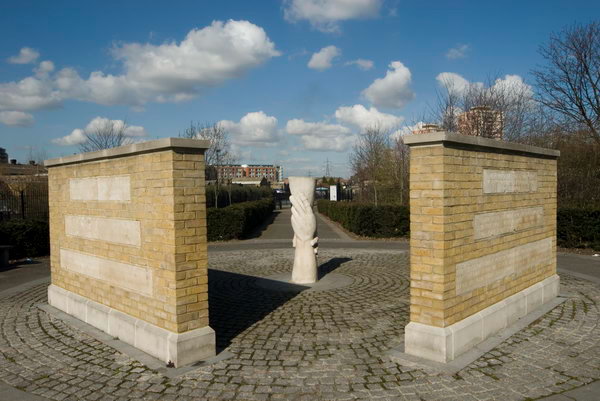
A memorial on Three Mills Green marked the heroism of distillery workers who died trying to rescue a workmate in 1901. The sculpture ‘Helping Hands’ by Alec Peevers replaced an earlier large cross
Since work by the Lee Conservancy Board and the West Ham Corporation started in 1931 and officially opened in 1935, the major flow of water in the southern area has been along the Flood Relief Channel (built in the 1970s following the 1947 floods) and the River Lea to Hackney Wick, and then along the Waterworks River, into the Three Mills Wall River and down the newly built Prescott Channel onward to Bow Creek and finally the Thames.
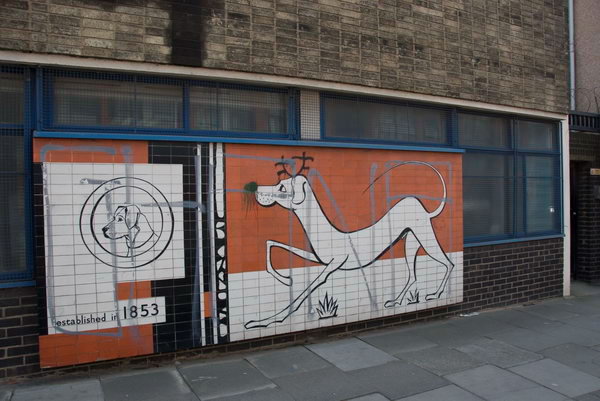
James Dane established Dane & Co. making news, letterpress and lithographic inks in Sugar House Lane in 1853. Recently much production had moved to Stalybridge.
All of these streams have been fully tidal since the Prescott Sluice was removed in the late 1950s (at the same time as most of the Channelsea River was culverted and filled in). Also tidal are the vestigial sections of the Channelsea River and Abbey Creek to the south of Stratford. So in your molecular progress, you might well spend some days being flushed north by tidal inflow from the Thames and then flowing south as the tide falls.
Three mills complex from the south
Flushed with you, at least on around 50 stormy days a year, might be some considerable sewage overflow from Abbey Mills sewage pumping station into Abbey Creek, lending its sweet smell to the banks of these streams in the Olympic area. Largely to avoid the delicate athletes (and spectators) being thus nasally assaulted a new lock and sluice is to be built on the Prescott Channel.
It remains to be seen whether the promises that the back rivers will actually carry the suggested 170,000 lorry loads in and out of the Olympic site will be met [of course it wasn’t], but it would certainly seem to be a useful development for the area longer term, opening up more of these waterways for leisure and possible commercial use. Currently there is a navigable loop on the Bow Back Rivers from the Lea Navigation, using St Thomas’s Creek, City Mill River and the Old River Lea, although this may well be restricted for the Olympics. [It was, for many years.]
The Long Wall path took me back to where I had begun taking pictures on the Greenway
The footpaths crossing the Prescott Channel bridge will be closed mid-March [2007] for around 18 months to allow the lock to be rebuilt, so I thought it a good time to take some pictures before the work begins.
Also in some of the pictures are a number of the sites which have been the subject of compulsory purchase to put the power lines between Hackney and East Ham underground for the Olympics. There are two lines, one going just north of the Greenway and curving down south through the Channelsea River.
In October 2006 I photographed a march asking Newham Council to keep Queen’s Market in Upton Park. Although it is an exceedingly ugly ensemble, not helped by poor maintainence and an utterly depressing choice of colours, it is still a great local resource. The market is perhaps the most ethically diverse in London, and many rely on it as a great source of cheap fresh foods and other goods. As well as the market stalls there are many small shops around the side of the market.
[There was] then an online petition at the government web site urging the prime minister to “to ensure that strategic street markets such as queen’s market, upton park are given proper protection against the combined threat of negligent local authorities and predatory property developers. as part of this we seek an open and transparent consultation process.”
We go down to our local market a couple of times most weeks. The fruit and veg is much cheaper than in the supermarket, and it is fresh and not wrapped in 7 layers of plastic. We’d hate to see it go, and can see why the people who shop at don’t want their market replaced with yet another supermarket, and less small shops and stalls.
But Queen’s Market could do with doing up, perhaps replacing the roof, new stalls, a rethinking of some of the central space in the development which is a kind of wasteland where guys sit with cans to make it a more pleasant and family-friendly space. It could be a real centre for Upton Park, perhaps with more shops, cafés with outdoor seating and some kind of performance area and perhaps a playground. I’d get rid of the pub too, or at least give it a complete makeover.
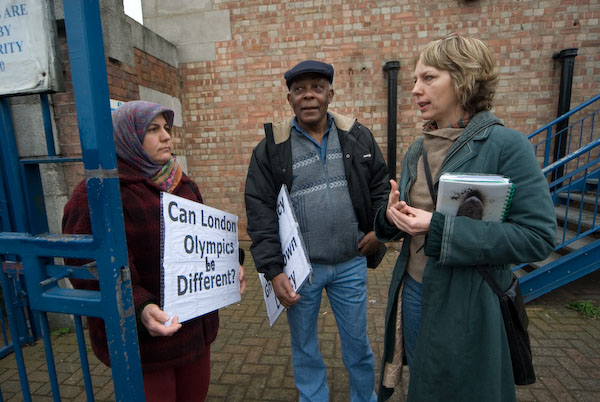
Manor Gardens and Hackney Wick: The allotment holders at Manor Gardens Allotments were still fighting to be allowed to keep their allotments on a site next to the River Lea inside the London 2012 Olympic site. On Sunday 4th March 2007 I went to the community centre at Hackney Wick where the Olympic delivery authority had agreed to meet with the plot holders to discuss their future and later went on to take more pictures on the allotment site. It was a cold, dull and wet day and the pictures reflect the weather and the mood. Here us the piece I wrote in 2007 with the usual minor corrections.
Manor Gardens Allotments Meeting
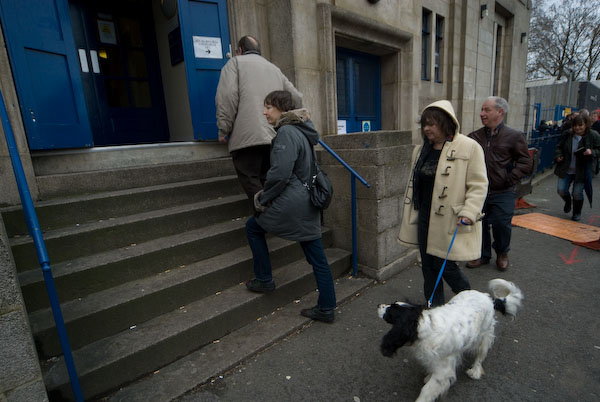
Plot holders outside the community centre before the meeting
Sunday I went back to Hackney Wick, where the London Delivery Authority for the Olympics had arranged to meet with the plot holders from Manor Gardens Allotments. But hearing that the media were likely to be around, the LDA had pulled out, leaving the plot holders to hold their meeting on their own – which they did, without the other supporters or the media present.
The plotholders go into the community centre for their meeting; the press and supporters are left to demonstrate outside
The situation is a mess, and the LDA appear unable to make any suitable provision for plot-holders, or to accept the idea of a green heart to the Olympics with the allotments in place.
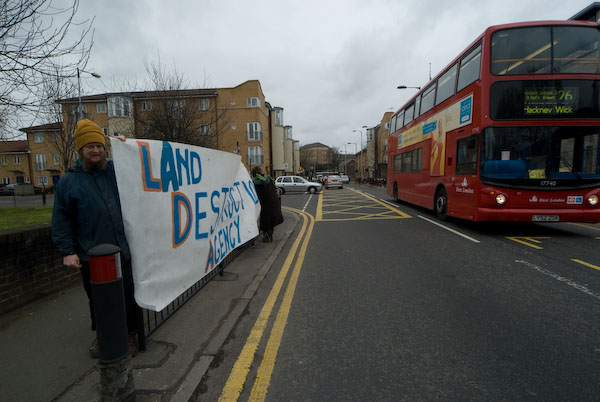
LDA = Land Destruction Agency
The LDA don’t actually seem to have any real use for the allotment site – possibly a footpath may run through it – but I think feel that its presence would sit oddly with the mass corporate sponsorship they rely on. One of their ideas is to put a giant scoreboard advertising Coca-Cola in its place.
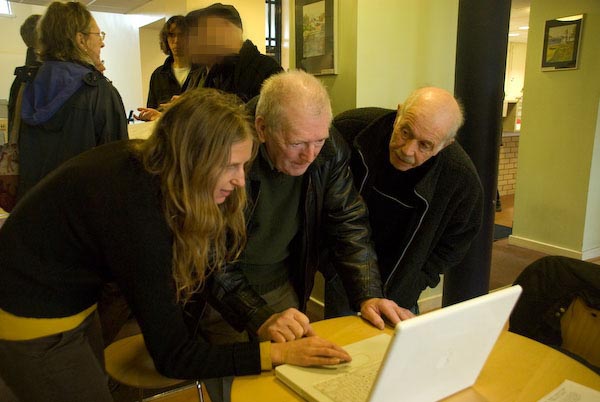
After their meeting, plot holders look at the Manor Gardens website
Eventually we were too cold and wet, so we came inside to wait for the meeting to end.
After the meeting, we went with the plot holders to look at the Manor Gardens allotments.
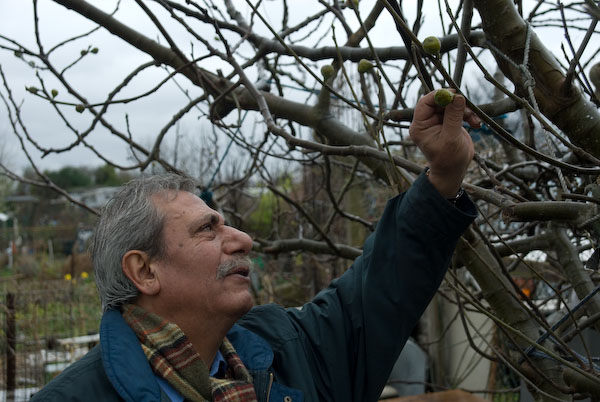
A bridge led to the allotments were on an island between the River Lee and the fiChannelsea River, both tidal.The water was fairly high. The bushes are in blossom – some is wild plum which apparently makes fine jam. Fray Bentos once made pies and puddings in the factories to the right of the river.These figs will be ripe in August if allowed to grow
At the allotments, I was able to take pictures of a few plot holders at work, clearing their plots. A few are still planting in the hope that they will be able to continue there.
Some were still planting crops, hoping they will be able to harvest.
Films were being screened in the community hut, and I watched one about the fight to keep urban gardens in New York; although some were lost, the fight led to others being protected.
A film show in the community hut on saving the gardens of New York
Only 4 weeks remain until the date set for the site to be vacated. The LDA have failed to come up with a replacement. It is just possible they may change their mind at the last minute, or at least delay the closure, but unless the Manor Gardens Plot holders come up with a credible legal challenge the chances seem poor.
Many have comfortable areas where they can enjoy their work – and eat the vegetables – Jerusalem artichokes are being peeled ready to cook
Manor Gardens raises many questions about the kind of democracy we live in and the kind of future we want. If it goes it will be a powerful message that regeneration will be at the expense of the local community and at the expense of the environment. If were are to have a future it needs to be considerably more green than our present, and places like Manor Gardens are the models on which we need to grow and develop.
Ready for planting – but when and where, plot holders ask. Will Mayor Ken have any answers?
The question really isn’t a matter of deciding between a green or a brown future. Increasingly I’m convinced there isn’t a future unless we go green. More than that, we also need to move rapidly from a top-down society to a bottom up one, where people have more control over their lives rather than being controlled.
Work stops for tea in the shed on one of the plots
Manor Gardens is a site that is more important than the few acres of land and the small community who grow there. It is a part of our battle for survival.
I say goodbye to everyone and hope to come back and photograph when the weather is better. Manor Gardens is a great resource, and was bequeathed in perpetuity for growing food. It would be a great loss and a great missed opportunity if it isn’t still there in 2012 and beyond.
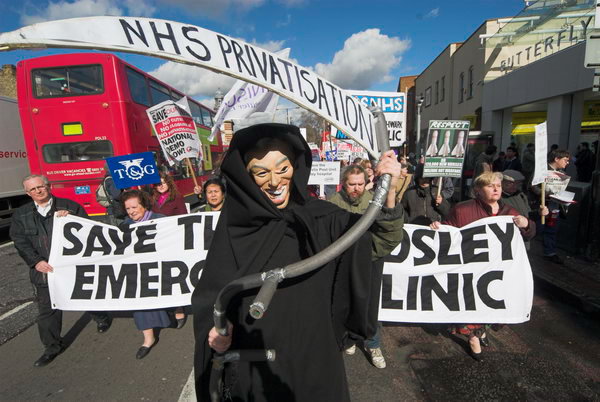
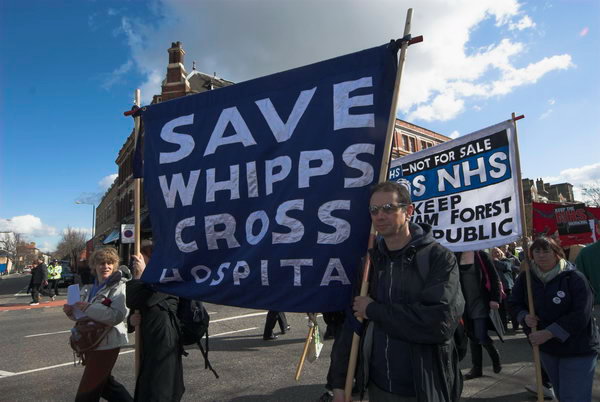
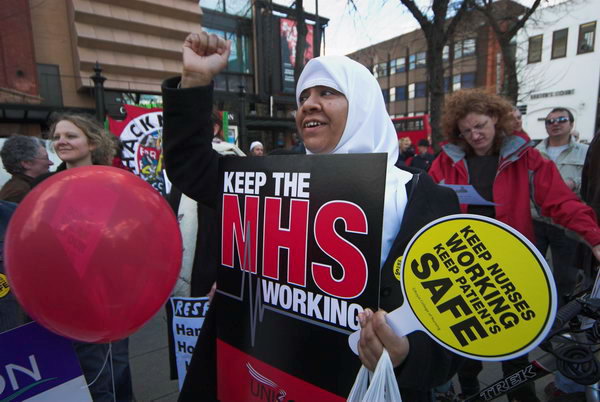
Keep our NHS Public: Saturday 3rd March 2007 saw protests around the country against the increasing privatisation of the National Health Service and I managed to cover several of these events in London, a march in Camberwell followed by a march from Whitechapel to Hackney Town Hall where they joined others who had marched in Hackney. After finishing my coverage of these events I photographed the Hare Krishna in Soho and then went to the Photographers Gallery.
The march on its way to the Maudsley Hospital
Here I’ll publish what I wrote back then on My London Diary with the usual corrections to spelling and capitalisation. Reading what I wrote below again now I think I was far too generous to New Labour. Although some MPs may have been well-intentioned I think the policies were largely driven by those with personal financial interests in private healthcare and other sectors that would profit from them. The NHS (and us) are still suffering from their actions and I have little confidence in the changes the current Labour government is now making.
Keep our NHS Public – Saturday 3rd March 2007
Local MP Kate Hooey gave her support to keeping the NHS public
Although health workers and other trade unionists had called for a national demonstration in London, the union bosses declined to organise one, perhaps not wanting to embarrass an already beleaguered Labour government. What took place instead was a whole series of local demonstrations – including at least 7 in the Greater London area – across the whole country.
The overall effect was perhaps to make it more impressive, and certainly it seemed to get more coverage in the media that might otherwise have been expected, although there were few reporters and no TV crews at the three events I photographed (for some reason they preferred Sheffield.)
Largely well-intentioned attempts to improve the health service have failed to deliver as they should, with many services being cut. Part of this has been caused by a dogmatic insistence on making use of private finance with results that range from fiasco to farce, inevitably accompanied by long-term financial loss.
A second disastrous dogma has led to bringing in private enterprise to do the simple work at artificially inflated prices (they even get paid for work they are not doing) which has the secondary result of making the NHS services appear more expensive, as they are left to deal with the trickier cases.
Kate Hooey holds the main banner with others on the Camberwell march
Further blows to our national health service have been through the predictably disastrous IT projects; as well as going millions over budget, these have largely failed to deliver. Add the proliferation of management and expensive consultants, along with crazed assumptions in negotiating doctors’ pay leading to an unbelievably generous offer, and it it hardly surprising that the whole system is in financial chaos.
The government clearly lacks a real commitment to the kind of National Health Service many of us grew up with, run for the benefit of the people rather than to make money for healthcare corporations. The health service certainly needed a shake-up to reduce bureaucracy and eliminate wasteful practices, but instead new layers of both have and are being added.
Outside the Maudsley Hospital – reading the letter which a delegation then delivered
I started off in Camberwell, and had time for a short walk before the speeches and march began. It wasn’t a huge event, but there was strong support from those in the service, from patients and from pensioners, as well as local MP Kate Hooey. From Camberwell Green the march went down to the Maudsley Hosptial where a letter was handed in and I got on a bus and left for Bethnal Green and Hackney.
Going up the Cambridge Heath Road in the centre of Bethnal Green, I saw the march from the Royal London Hospital in Whitechapel to Hackney in the distance. Unfortunately the bus was held up in the traffic behind it, taking almost five minutes to reach the next stop before the driver would open the doors and let me off. Some things were a lot easier with the Routemasters.
This was a smaller march than that from Camberwell, and after a few minutes I felt I’d photographed all I could, so I ran ahead and caught a bus for the centre of Hackney, arriving there just a couple of minutes before the Hackney march, which had come from Homerton Hospital, had returned to the town hall. I photographed them arriving and then the rally that ensued.
The Hackney march was a little larger, perhaps around two hundred, and there were quite a few speakers, including local councillors and representatives from the various organisations that had helped to organise the march.
A big cheer went up as the march from Whitechapel arrived, swelling the numbers in the square at the town hall.
Lindsey German who lives in Hackney
Among the better known speakers taking part were George Galloway, whose speech lived up to his usual high standards of wit and common sense. Lindsay German, a hackney resident well known for her work for ‘Stop The War’ also spoke with feeling on the issues of health and the NHS. Several of the other speakers were old enough to have known the problems before the health service was set up.
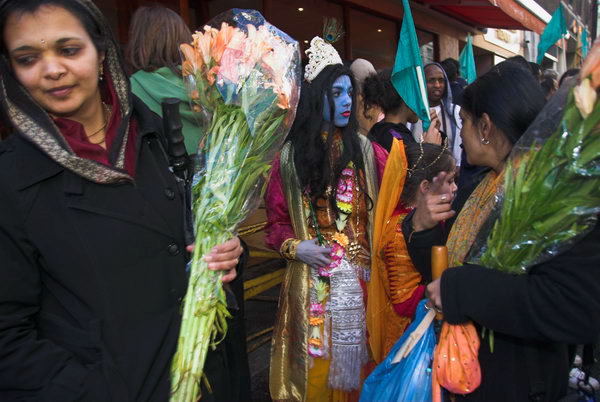
As the meeting began to wind down, I caught a bus to Bethnal Green and then the tube to Tottenham Court Road. Just to the north of Soho Square I got to the Hare Krishna Temple just as the annual Gaura Purnima [Golden Full Moon] procession was arriving back from its tour around the area.
Churchill and an entrance to a stairway with a red light
From there I went to the Photographers’ Gallery to have a good look at this year’s photography prize contestants. I hope the prize goes to one of the two photographers on the shortlist, Philippe Chance or Anders Petersen. [Neither won.] Walking through Soho and Westminster I took a few more pictures.
Canning Town, Cody Dock and Stratford: On Thursday 2nd March 2017 I made a rather convoluted walk along Bow Creek and the Lea Navigation, arranged around a meeting I had at Cody Dock. You couldn’t then – and can’t quite yet walk beside the river the whole way, but to get to the meeting I had to abandon a small part of the first stretch and catch the DLR, walking on from the meeting to Stratford High Street where I caught the DLR again to go back and complete the short part I’d had to miss out earlier.
In this section of My London Diary I included pictures taken both at the start and at the end of my walk, which began at Canning Town Station.
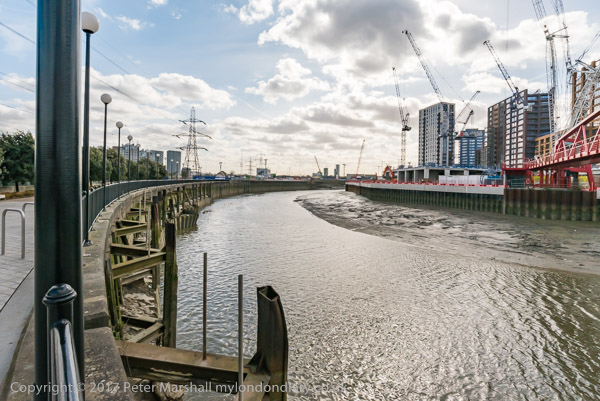
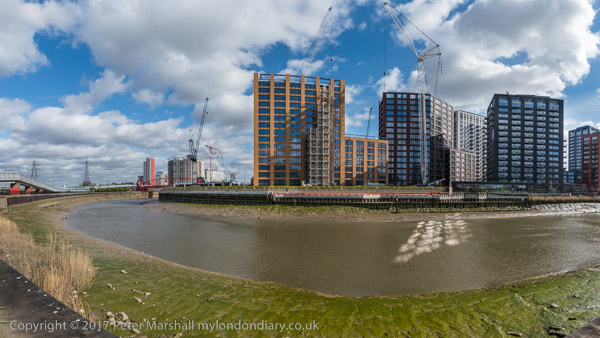
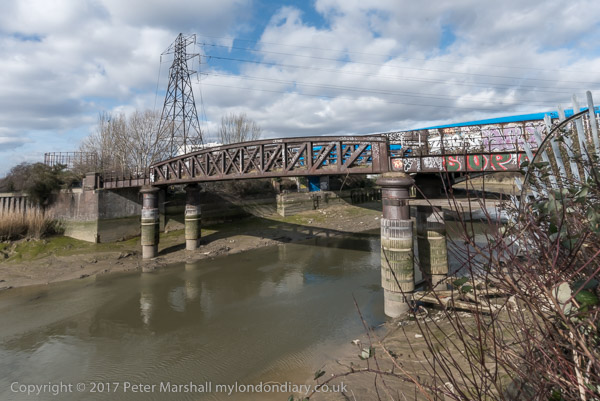
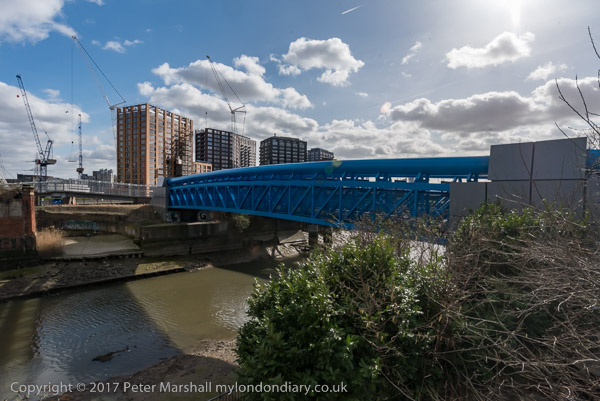
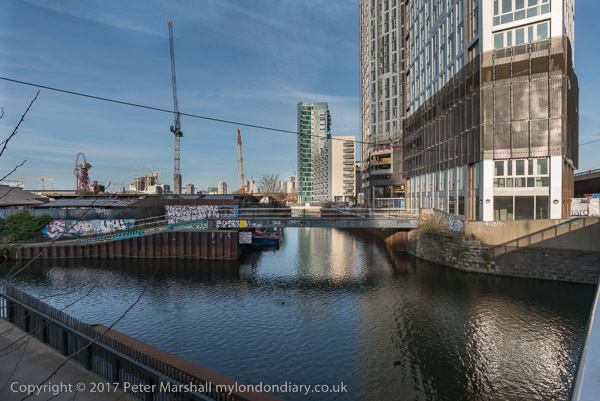
The riverside walkway at Canning Town is open after many years and can take you to the bridge to London City Island.
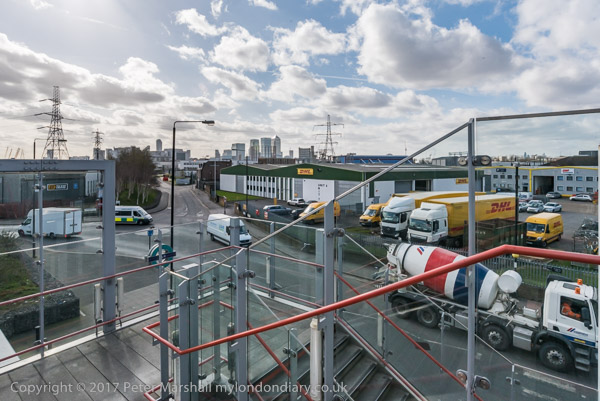
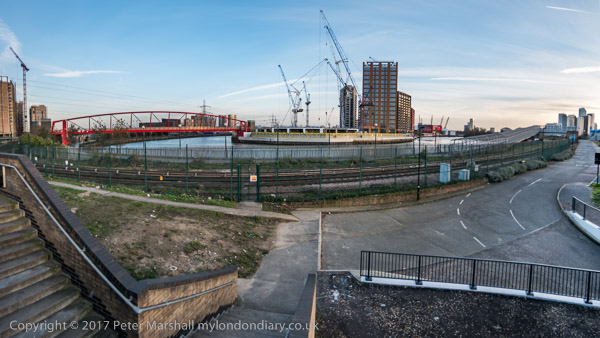
People were living in some of the blocks on the “Island” but there was still a lot of work continuing in this area which Bow Creek loops around on three sides. Another bridge was built across the DLR tracks to allow people from South Bromley in Tower Hamlets a pedestrian route to the riverside path and Canning Town station. Open for a short time it closed well before the station entrance became open, and a gate on it was firmly locked when I tried to cross it.
This meant I had to make a lengthy detour walking around the Ecology park to get to the Blue Bridge which took me to the East India Dock Road.
This meant I had to hurry back to Canning Town Station to get the DLR to Star Lane for my meeting at Cody Dock and couldn’t then walk along the north side of the road to take more pictures.
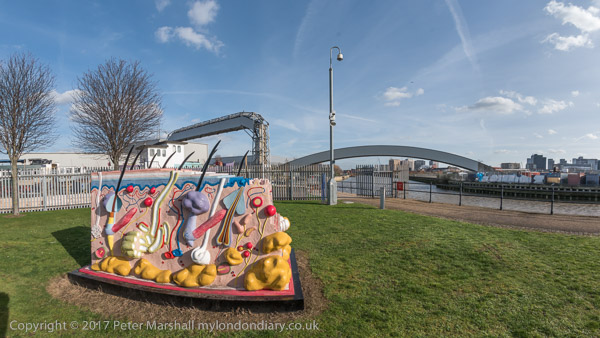
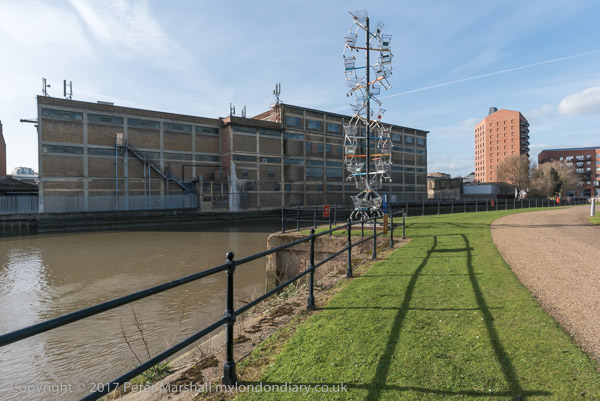
I paused briefly to photograph a sculpture made from shopping trolleys in a mock DNA double helix.
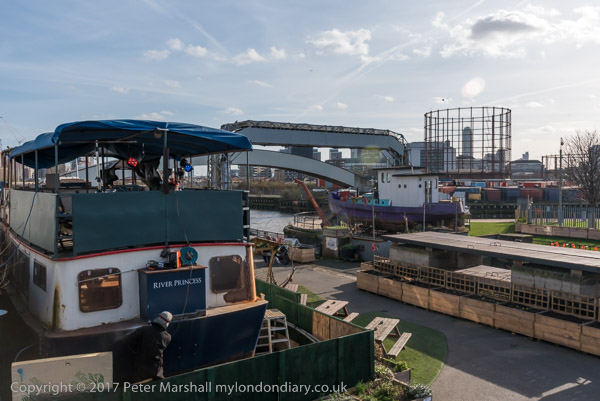
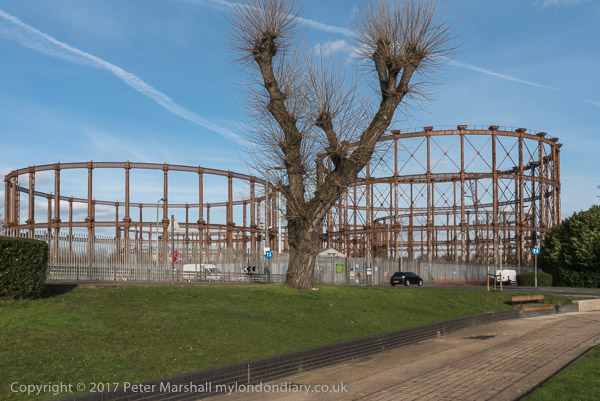
My next stop was to photograph the The Imperial Gas Light and Coke Co’s 1872-8 Bromley-by-Bow gasholders and the war memorials – originally at Beckton – with an eternal flame next to a monument to company workers killed in both World Wars.
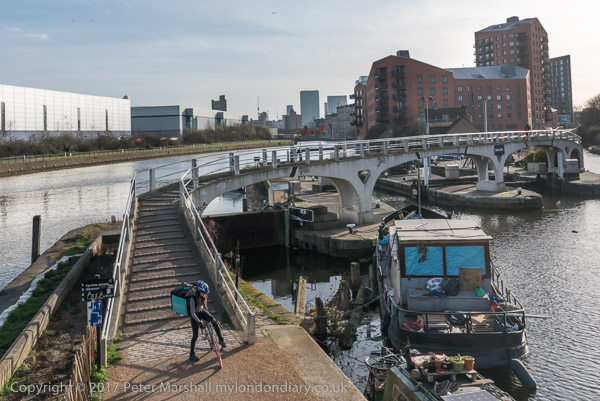
Steps leading down from Twelvetrees Bridge at Bow Locks took me down to the towpath beside the Lea Navigation.
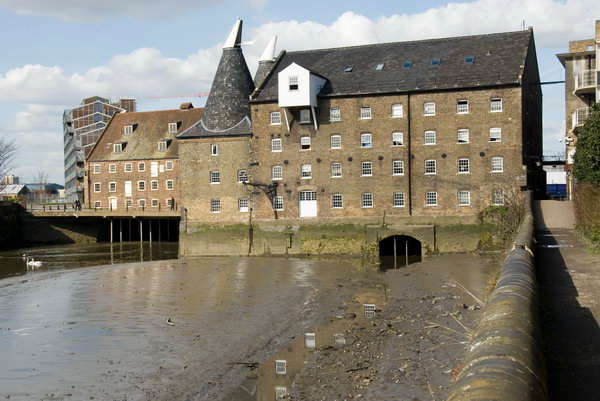
Three Mills is a tide mill dating from 1776 (though on the site of earlier tide mills mentioned in the Domesday Book) on the Three Mills Wall River. It is the largest tide mill in the UK and the largest surviving in Europe.
Another sculpture on The Line, unveiled on the centenary on Three Mills Green and moved to this position on Short Wall is by Alec Peever and commemorates three men who died in 1901 They died going to the aid of a fourth who had been overcome by the lack of oxygen at the bottom of a well they were investigating.
I walked on to Stratford High Street, turning west to go to Bow Bridge and the Lea Navigation before going back beside St Thomas’s Creek and along Stratford High Street to the DLR Stratford High Street Station for the train to Canning Town.
More from Bow Creek
It was beginning to get a little dark as I came out from the station to photograph from the north side of East India Dock Rd.
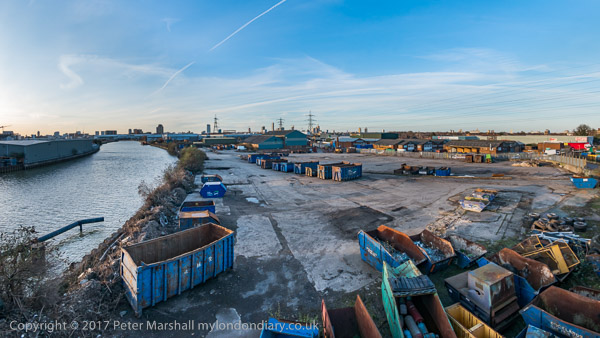
This was still an industrial area although a large area seemed now to be unused. I thought it would probably not be long before this area too was covered in flats as I walked back to the station.
St Peter’s Church, Black Lion Lane, Hammersmith, Hammersmith & Fulham, 1989, 89-12c-35
St Peter’s Church is at the south-east corner of St Peter’s Square on Black Lion Lane and is now uncomfortably close to the Great West Road, this section built well over a hundred years later in the late 1950s. In 1829 the church would have been surrounded by trees, meadows and market gardens with a pleasant walk to the nearby Thames. Now you need to seach for the subway to get across one of the busiest roads out of London.
The architect was locally born Edward Lapidge, whose father was an assistant to Capability Brown as a landscape gardener at Hampton Court. As well as a wider practice he also built other local churches at Hampton Wick and Putney. The Classical church building is Grade II* listed and William Morris who lived nearby had a hand in redecorating its interior in 1887.
Leaning Woman, Karel Vogel, North Verbena Gardens, Hammersmith, Hammersmith & Fulham, 1989, 89-12c-36
This 1959 concrete sculpture by Karel Vogel, (1897-1961) a Jewish Czech-born artist who fled here from the Nazis in 1938, was Grade II listed in 2016. It was commissioned by the London County Council’s Patronage of the Arts scheme when the Great West Road was being built through St Peter’s churchyard in 1959 “provide visual amenity in compensation for” this major road scheme. The sculpture, cast concrete over a metal framework, took Vogel over a year to complete and was extremely controversial in the local area.
By 2016 the sculpture had seriously deteriorated and Radio Prague reported in 2023 on its planned renovation at a cost of over £50,000. The restored statue now looking in grand shape was unveiled in July 2024.
Metropolitan Water Board, Hammersmith old pumping station, Great West Rd, Hammersmith, Hammersmith & Fulham, 1989, 89-12c-21
This 1909 building (described by some estate agents as Victorian) has now been converted into ‘exclusive’ flats.
Upper Mall, The Dove, Hammersmith, Hammersmith & Fulham, 1989, 89-12c-11
You can see the sign for The Dove pub which has its entrance on the footpath here at 19 Upper Mall. This Grade II listed public house is well worth a visit. It has probably been serving beer since the 1730s and was bought by Chiswick Brewery in 1796. Although a charming enough place its listing probably more reflects its stories and associations rather than any particular architectural merit. Of course as the very detailed The Dove, Hammersmith – a tiny mystery on Zythophile states its popularity has resulted in “most of the “facts” printed about it being demonstrably wrong.”
Also worth a visit is the William MorrisSociety Museum, just behind me as I made this picture in the lower floor of the house he lived in for the last 18 years of his life, renaming it as Kelmscott House. Doubtless he enjoyed the facilities of The Dove (then called The Doves, apparently by an error of the sign-maker) including the marbles game of bumblepuppy.
This pier is on the corner of Furnivall Gardens. Previously this had been mouth of Hammersmith Creek which ran north as far as King Street. The fishermen here were replaced by noxious industries in the nineteenth century, with brewery malthouses to its west and a lead mill on the east. The creek was filled in by Hammersmith council in 1936 and they built a new town hall across it which opened in 1939 – still there facing the Great West Road.
Wartime bombing removed the Phoenix Lead Mills and the Friends Meeting House with its burial ground and the area was opened as a public park, Furnivall Gardens, named for Frederick James Furnivall, one of the founders of the Oxford English Dictionary as well as Working Men’s College and the Hammersmith Rowing Club (now renamed after him) as well as the probable inspiration for ‘Ratty’ in the Wind in the Willows.
The pier here was opened at the same time as Furnival Gardens in 1951 for the Festival of Britain to enable people from the area to board steamers to take them to the Festival. After the end of the Festival there was little use for it. Eventually the PLA sold it to the owner of the Dove pub, and it was extended to provide more moorings.
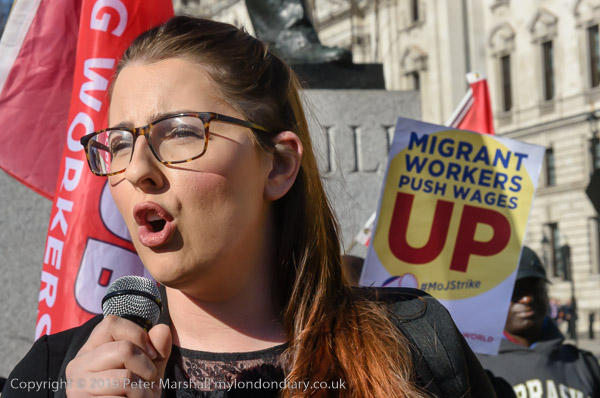
Outsourcing, North Woolwich & Rees-Mogg Freakshow: Tuesday 26th February 2019 was a long day for me, beginning with a day of action over the outsourcing of workers on the day of a High Court challenge to extend the legal rights of the 3.3 million outsourced workers. In the afternoon I went to complete a walk I’d begun several months earlier in North Woolwich, returning to cover a protest by Class War outside a performance by Jacob Rees-Mogg at the London Palladium.
Rally for an end to Outsourcing – Parliament Square
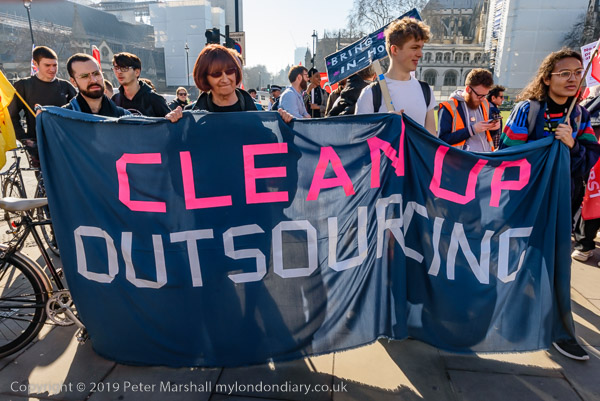
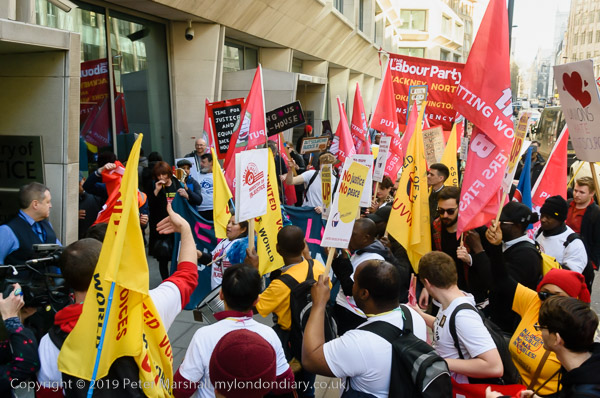
The day of action by outsourced workers had actually begun several hours earlier at 8.00am at the University of London from where they had marched to protest outside the High Court before I met them for a rally against outsourcing in Parliament Square.
The day was a part of a coordinated strike action by outsourced workers, mainly migrants, working at the Ministry of Justice, Dept for Business, Energy & Industrial Strategy and the University of London, organised by the grass roots unions United Voices of the World (UVW), the Independent Workers’ union of Great Britain (IWGB) with the BEIS PCS branch .
The unions argued that outsourced workers should be able to collectively bargain with the management of their actual workplace as well as the outsourced employer and that not being allowed to do so was in breach of article 11 of the European Convention on Human Rights. You can read more about the case which the High Court dismissed in an insightful article by Tom Long for Personnel Today.
Had the legal challenge been successful it would have greatly extended the legal rights of the UK’s 3.3 million outsourced workers and have led to a great improvement in their working lives.
Labour Shadow Business minister Laura Pidcock – she lost her seat in 2019
Several Labour MPs came to speak at the rally and support the demand to end outsourcing which creates insecurity, discrimination and low pay.
After the rally the the protesters marched around Parliament Square and then along Victoria Street to protest outside the Dept for Business, Energy & Industrial Strategy.
Strikers at BEIS included catering and security staff who are members of the PCS and are demanding the London Living Wage as well as end to outsourcing.
Chris Williamson MP
Among the speakers at the rally here was then Labour MP for Derby North Chris Williamson who was under investigation for his comments about the party’s response to allegations of antisemitism in the party – and was eventually barred from standing for Labour in the 2019 election.
The protesters marched on to the Justice Ministry in Petty France.
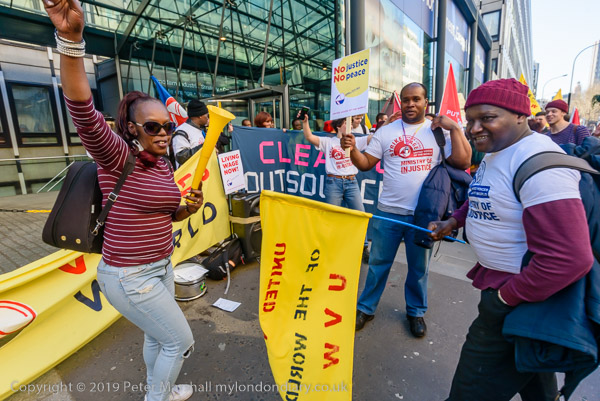
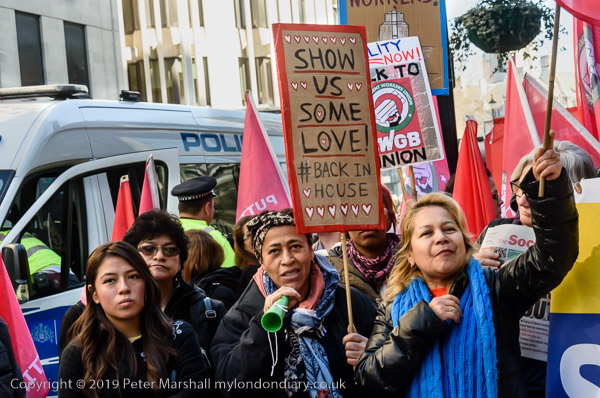
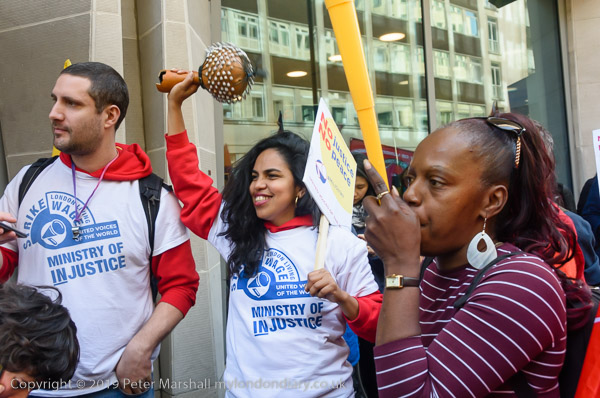
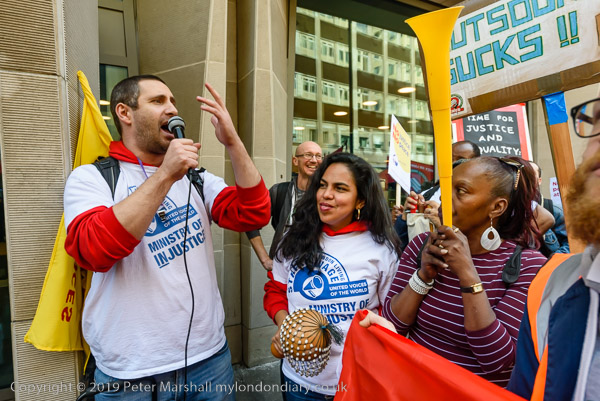
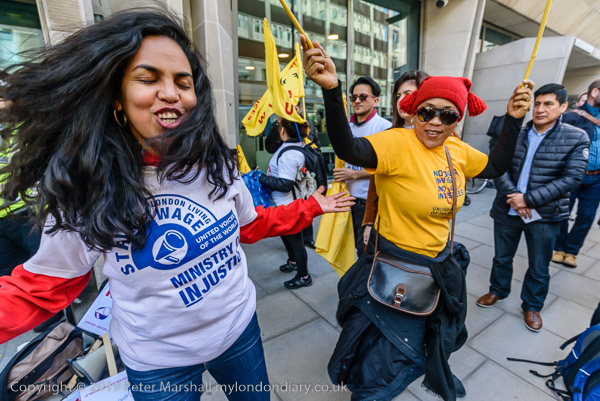
Low paid workers belonging to the United Voices of the World union at the Ministry of Justice have been campaigning for some time to get the London Living wage, but the Justice Minister has been unwilling to talk with them. They call it the Ministry of Injustice.
They are also calling for an end to outsourcing and the insecurity, discrimination and low pay it causes. A number of trade unionists came to speak in support of outlawing outsourcing and to support the strikers in their claims.
This was a loud and boisterous protest with drumming, music and dancing on the pavement and street outside the ministry.
During the protest some of those who had already been on strike for 24 hours went back into the ministry to resume work, to cheers and hugs from those outside.
My attempt to go for a walk along the Capital Ring in North Woolwich was made difficult by the DLR having a temporary shut-down and I arrived an hour later than intended and was unable to finish the walk – I came back several months later to do so.
It wasn’t ideal weather particularly for the panoramas I was trying to make with a clear blue sky. And finally I failed to put all the pictures I had intended onto the web page – including these two
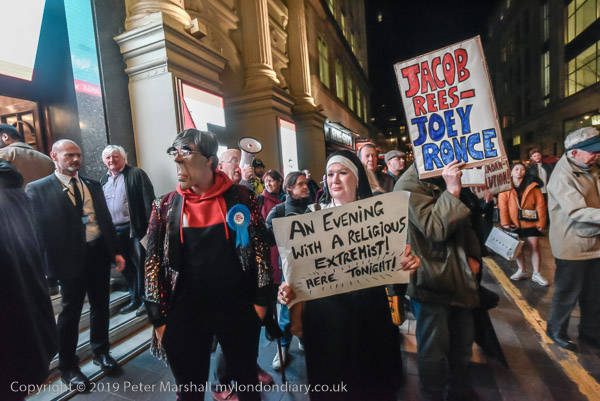
Class War protest Rees-Mogg freak show – London Palladium
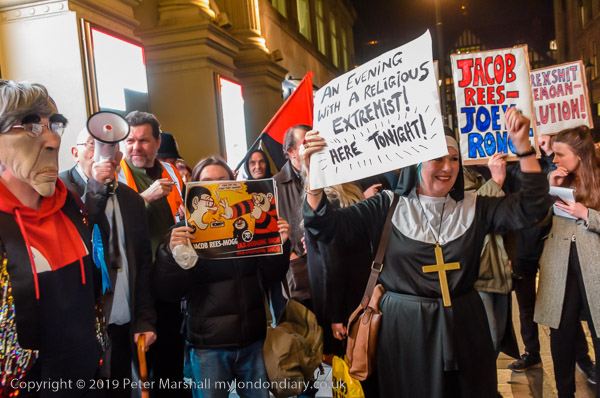
Class War protest outside the London Palladium as fans who had paid £38 for a ticket entered to listen to Jacob Rees-Mogg.
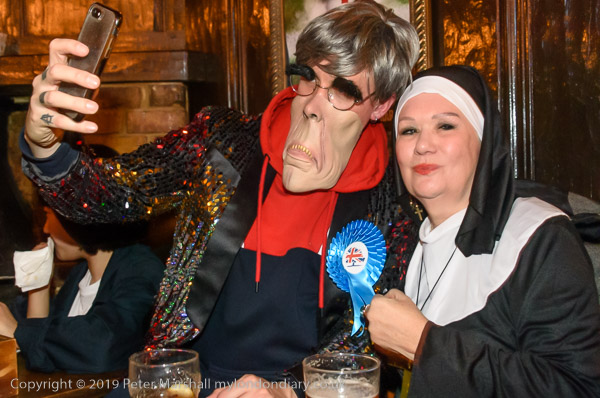
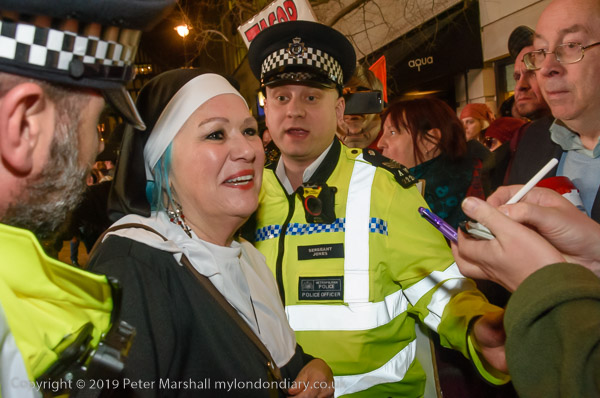
With Jane Nicholl dressed as a nun, Mother Hysteria, and Adam Clifford as Jacob Rees Mogg they loudly asked why people had come to listen to him “spout homophobic, transphobic, racist, pro-hunting, misogynist, classist, privileged” nonsense.
It was certainly a better show than anything that would take place later inside the venue, and all for free. You can read an excellent account of it on Inside Croydon.
Later Police searched Jane Nicholl and threatened to arrest her for carrying offensive weapons after it emerged she had brought some novelty stink bombs to the protest. Class War protest Rees-Mogg freak show
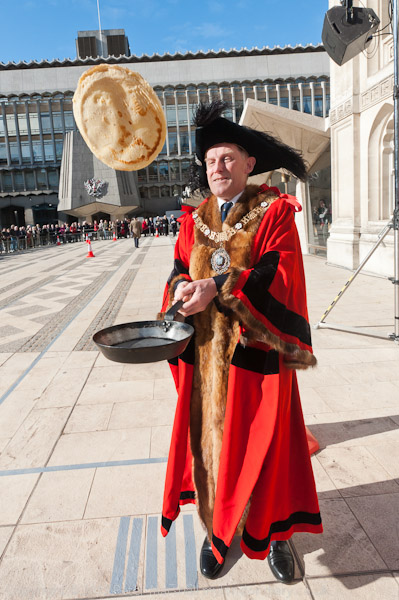
Pancakes in the City: Tuesday 21st February 2012 was Shrove Tuesday – Pancake Day – and there were a number of pancake races taking place around London. I photographed two of these with very different ethos.
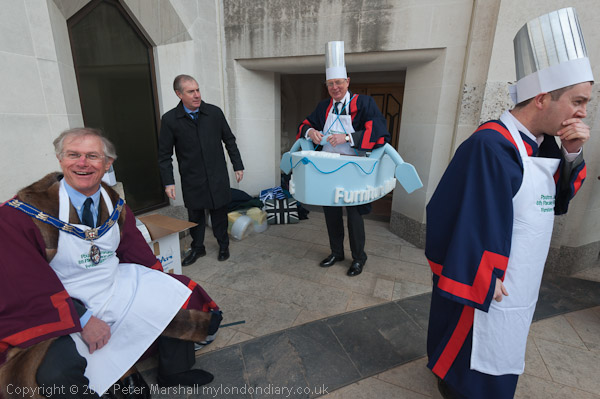
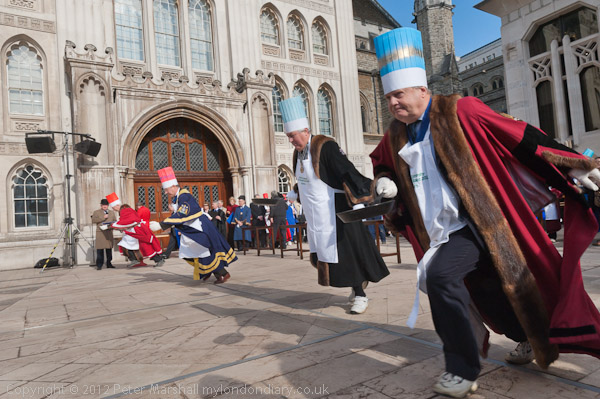
At the heart of the City in Guildhall Yard the various City of London Livery companies showed the City at its most competitive in what has now became a tradition of inter-livery pancake races on Shrove Tuesday, organised by the Worshipful Company of Poulters since 2004.
Here there were carefully drawn up rules and practices.
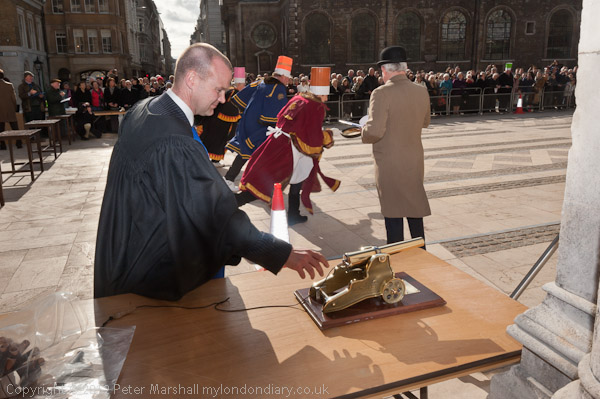
“The Gunmakers start each heat using a miniature cannon (which can make a very loud bang), the Clockmakers hold stopwatches to time the races , the Fruiterers provide lemons, the Cutlers plastic forks, the Glovers white gloves required to be worn by each runner, while the Poulters provide the eggs essential to make the pancakes.”
This is a highly organised event raising funds for the annual Lord Mayor’s charity – in 2012 the Barts and The London Charity, on behalf of the Trauma Unit at The Royal London Hospital.
This was the first year in which women taking part in the Ladies events were allowed to wear trousers – previously they had been required to have skirts reaching below the knee. And there are many other rules including the wearing of special hats for the occasion.
This is the City having fun in their own rather circumscribed and very serious way.
I photographed this event for a number of years, but haven’t done so for a while, partly because it became difficult to work at it without prior accreditation which I couldn’t be bothered with, but mainly because I thought I had got everything I could out of it and I was just repeating myself.
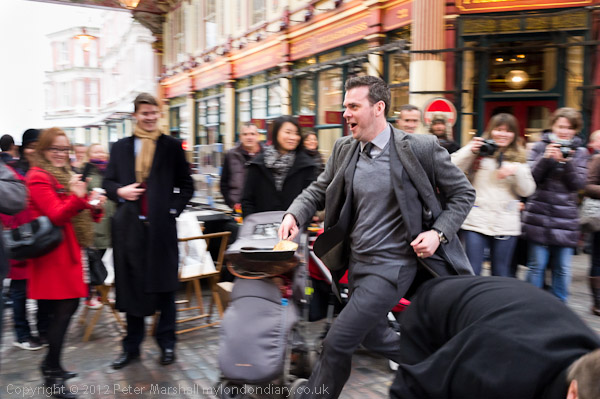
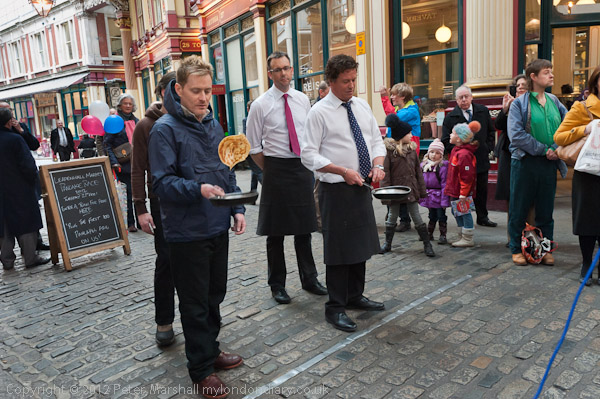
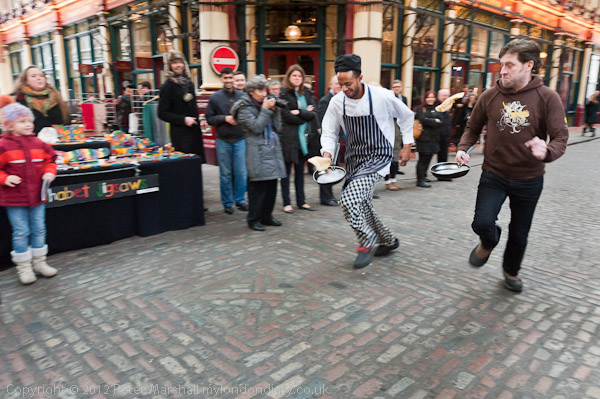
I left before the final races to photograph a very different event taking place in Leadenhall Market, along a much more restricted course and between ad-hoc teams from various businesses in and around the market.
There were far fewer rules, just those needed to outline the races, with teams carrying and tossing the pancakes in this relay event. The narrow space available limited the heats to two teams at a time.
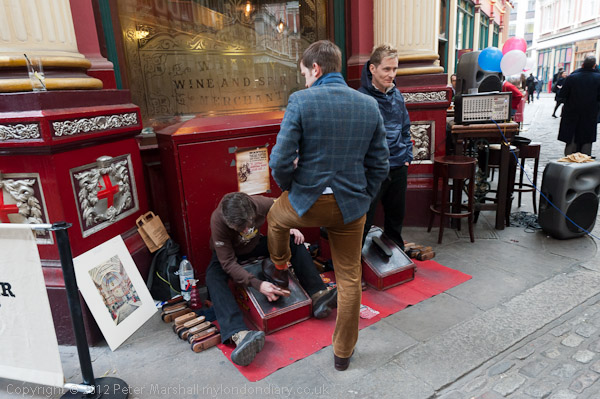
The shoe polishers kept working between races
There were prizes provided by The Lamb Tavern in the market, who also fielded a team along with outers including the cheese shop and the shoe shiners who fought it out in the final.
Or at least they did when after an initial run when the cheese shop team simply walked the course as they preferred the second prize – a bottle of champagne and a £50 bar tab at the Lamb – to the first of a restaurant voucher.
“Some haggling followed and a re-run was demanded – and after the Lamb had agreed both teams would get the bar money there was a close-fought battle for the honour of winning, won narrowly for the second year in the short history of the race by the team from the shoe stall.”
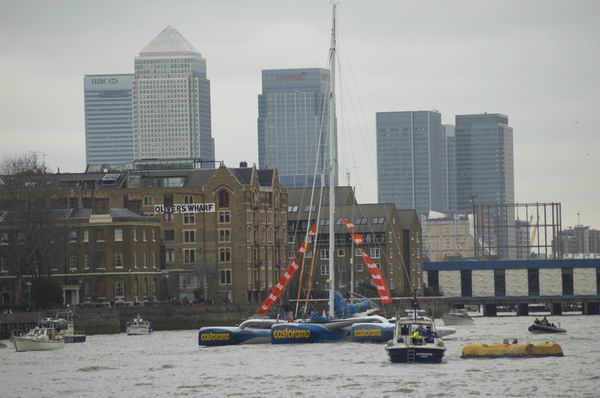
Ellen MacArthur, Brian Haw & Ashura. On 20th February 2005 I froze on the riverside in Bermondsey waiting for Ellen MacArthur’s catamaran to come up-river to Tower Bridge after her 71 day voyage had made her the fastest solo sailor to sail around the world. Five years later “she set up the Foundation in her name to accelerate the transition to a circular economy“. I didn’t get any very good pictures as I was far to far away as she raised here arm to acknowledge the crowd that had gathered to welcome her – I needed a much longer telephoto than I’ve ever had.
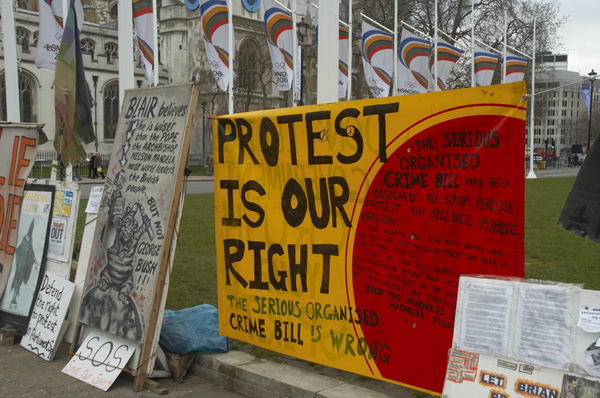
Afterwards I took a little walk around the Bermondsey riverside before making my way back to Parliament Square where I took a pictures of the display there by Brian Haw’s Peace Campaign, now joined by promotional flags for the 2012 Olympic bid. There was more of this in Trafalgar Square too, where I dropped in briefly to see some of our pictures and warm up.
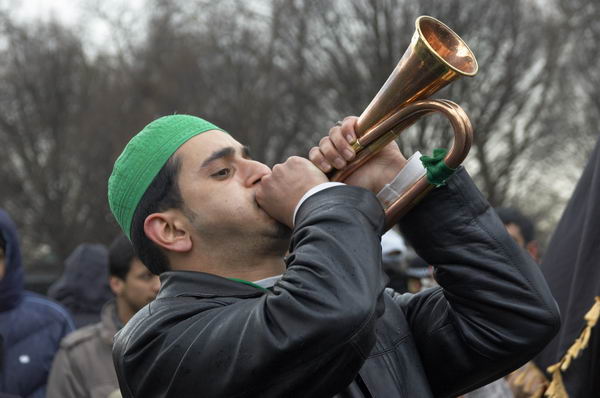
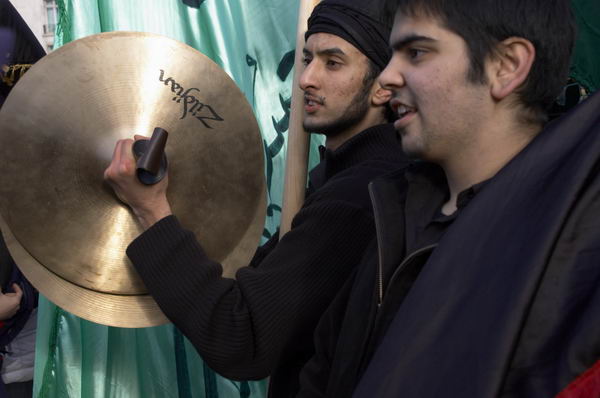
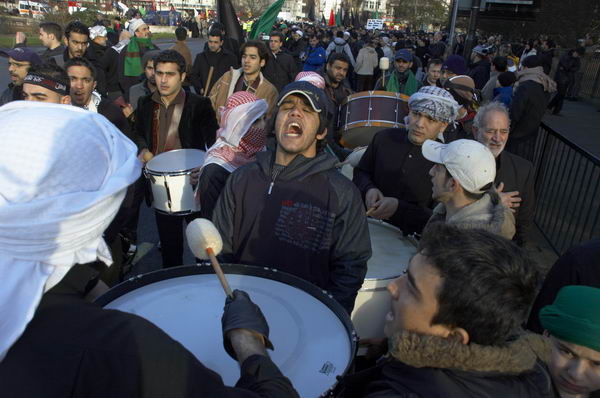
Finally at Marble Arch I photographed the start of the Ashura procession by Shi’ite Muslims. I didn’t stay too long as I was still cold and I was keen to get home and warm.
Here – with the usual minor corrections – is the piece I wrote in 2005 to go with the pictures on My London Diary:
Sunday was another bitter day, and I froze on Butlers Wharf waiting to see Ellen MacArthur aboard her catamaran as it was driven up to Tower Bridge and back from Greenwich, disappointingly not a sail in sight.
Ellen MacArthur is just visible, arm upraised in the centre of the picture
The crowds were not huge, but respectable, but like me, few could be bothered to go to Greenwich. The various press boats buzzing round the catamaran added a little interest, but made me glad I wasn’t on one.
I was more interested in taking some pictures along the riverside, then took the tube to Westminster to call in on Brian Haw, still in Parliament Square since 1st June 2001, with the government now cooking up a personal law against him.
The signs on the square are no augmented by a line of mute London 2012 flags, and along in Trafalgar Square (on my route to the National Gallery) was a giant tent and Olympian figure. Nobody can accuse London 2012 of not spending money on promoting their cause. more pictures
Shi’ite Muslims in London were celebrating the stand of the grandson of the Prophet, Imam Hussain, who died a glorious martyr along with his small band of supporters at Karbala in Iraq, choosing death rather than dishonour, in the year 680. Ashura represents a key point of difference between Sunni and Shi’a traditions and Saddam Hussein rigidly prevented its observance in Iraq during his years in power.
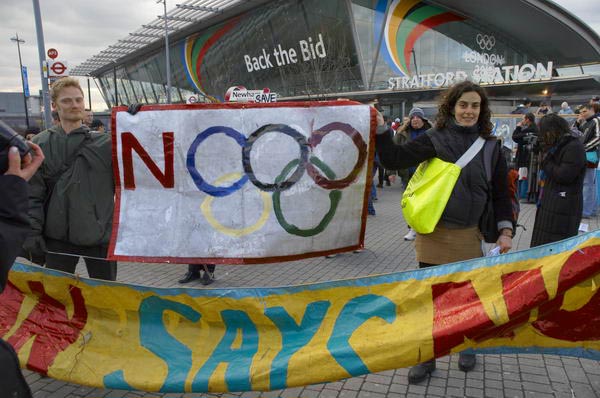
Protesting the London Olympics Bid: On Saturday 19th February 2005 I sent for a guided walk around the proposed Olympic site on Stratford Marsh and then joined others in a protest march through the area to Hackney Marshes which would also be affected.
Small industries giving local employment which will disappear
The favourites for the games were Paris, and although public opinion in Britain largely backed the bid, there was rather less support by locals both because of the effects it would have on the area and the high coast which would mean an extra £20 per year on council tax.
One of the larger industrial sites, and a building in use as artists studios
Paris accused London of violating the rules but the decision was was made by a small majority in London’s favour.
Pudding Mill River and Old River Lee
After the success of the bid in July 2005 there were fears around the rest of the country that the extra spending on the games would mean diverting funds for more necessary work away from the rest of the country – which it did.
City Mill River and Warton House, formerly the Yardley perfume company’s Box Factory – preserved
And locally many suffered from the disruption of the works over an extensive area – with local businesses and some residents being forced out of the area.
This bridge had a local message for Seb Coe who heads London’s bid for the 2012 Olympic Games
Here I’ll reproduce – with appropriate minor corrections – the article I wrote along with some of the pictures I took on the day.
Site Walk, Bow Back Rivers
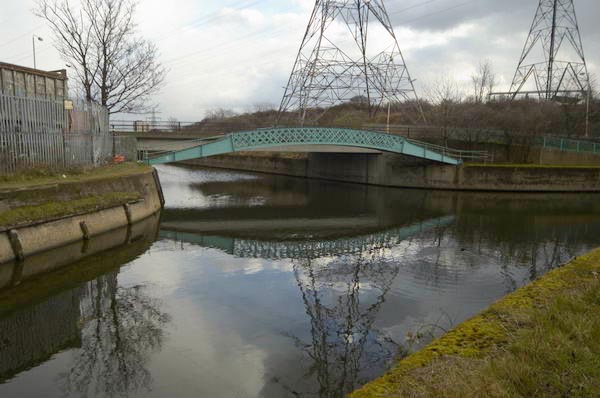
Saturday 19th February saw me in the Bow Back Rivers again, on another guided walk looking at the areas threatened by the London 2012 Olympic Bid. We walked along The Northern Outfall Sewer from Stratford High Road to Old Ford, then along the Old River Lea and back down the City Mill River.
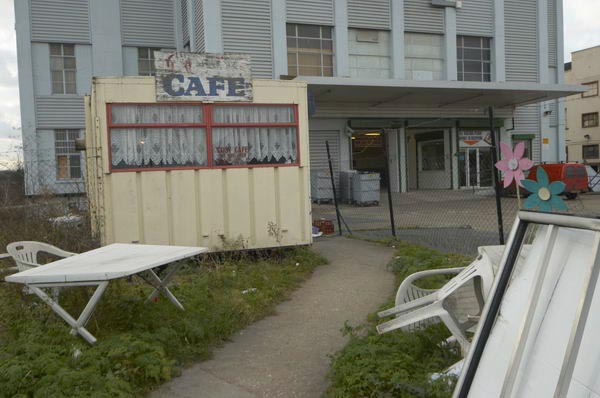
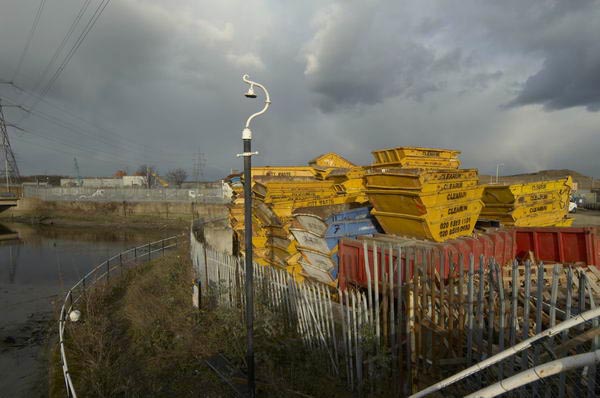
Traditionally an area for dirty industries on the east of the city, a health and safety hell-hole, now with plenty of derelict land, but still providing local jobs that will all disappear if the bid goes through.
Much of the area will disappear under concrete, almost all redundant after the big event, with plans for its after use unpublished and unfunded.
At the moment it’s a rich wildlife environment, but all that will go, and the tidal Bow Back Rivers are likely to be lost or severely altered.
If the bid goes ahead it will severely distort a regeneration that needs to be based on local needs and priorities, and the trumpeted increased investment will largely create unwanted facilities that will be future millstones.
Hackney marshes. Football pitches will be concreted car parks for the Olympics
Not to mention the disruption over perhaps 15 years as the site is developed and then (if finances materialise) restored for use.
No London 2012 Olympics March
More local businesses that will close on Waterden Rd.
After the walk, we went to join the demonstration and protest march that was forming in Meridian Square outside Stratford Station. It wasn’t a huge event, with just over a hundred marchers, but I was surprised at the positive response from those hurrying by to catch trains or go shopping, many expressing support.
The march, on a bitter, dull afternoon, ended on Hackney Marshes, where considerable local sports facilities are due to be covered by car parks if the bid succeeds, with people playing games and a very spirited sack race.
View from the walkway over Carpenters Lock
I walked back to Stratford, again through the Olympic site, crossing over the Lea at one of the locks and along the side of the Waterworks River, with often dramatic lighting and the occasional light flurry of snow.