Borough Market & Apprentice Boys – 2006

Borough Market & Apprentice Boys: On Saturday 21st October I went to the 250th anniversary celebrations at Borough Market and then to a march celebrating the closing by apprentices of the gates of Derry to the forces of King James II in 1688 which led to the siege of Derry the following year. Here are my accounts of both events from My London Diary in 2006 with a few minor alterations to make them more readable and links to more pictures on the site.

Borough Market: 250th Anniversary – Southwark
Borough Market & Apprentice Boys

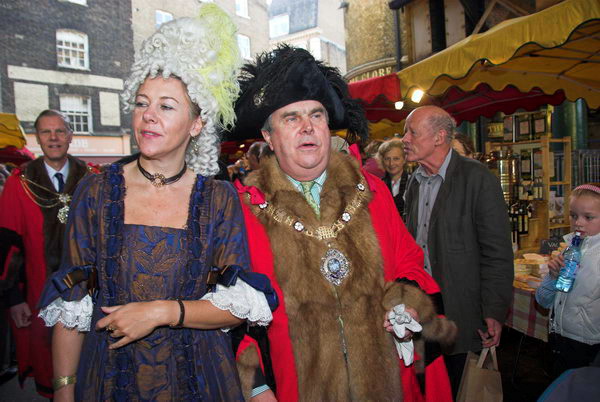
Borough Market started with the Romans a couple of thousand years ago, and around a thousand years ago was thriving on and around London’s only bridge across the river Thames. In the next few centuries it moved a little south into Borough High Street, and in 1550 received a royal charter, although like all London markets it was under the control of the City of London.
Borough Market & Apprentice Boys

Increased congestion in Borough High Street lead to the first of nine Acts Of Parliament about the market’s activities in 1754, which moved it out of the road a few yards west to its present site. The agreement with the city authorities, which established the new market was made 250 years ago in 1756. Every year the Lord Mayor of London visits the market and collects fruit for the poor. It is now the only remaining wholesale and retail market in London.

Borough Market & Apprentice Boys

The market is now officially a charity, but has always existed to support the residents of St Saviour’s Parish. Any surplus made by the market now goes to Southwark Council and the residents of the former parish get a rebate on their council tax.
Borough Market & Apprentice Boys

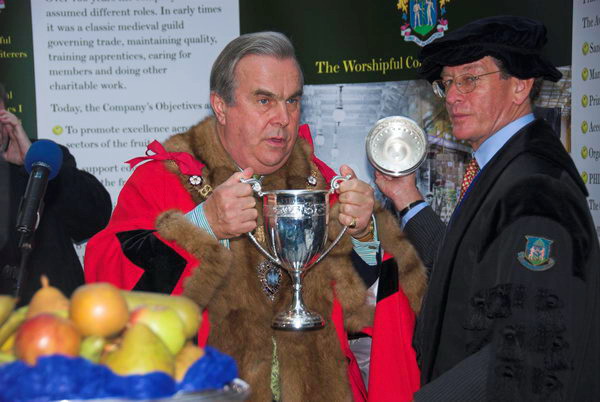
The Worshipful Company of Fruiterers have also been celebrating the 400th anniversary of their Royal Charter in 1605. They had been inspecting (and levying duty) on London’s fruit and veg since 1292 or earlier, and received ordinances in 1463.

Borough Market & Apprentice Boys

Until recently, Borough Market was a wholesale market, but its small size and transport problems meant that ten years ago it was almost empty and in a very poor state. Since then it has grown as a retail site for high quality food and drink, with many small specialist suppliers, as well as other small businesses. Two small parts of the site have been sold to provide money to rebuild and improve the market.
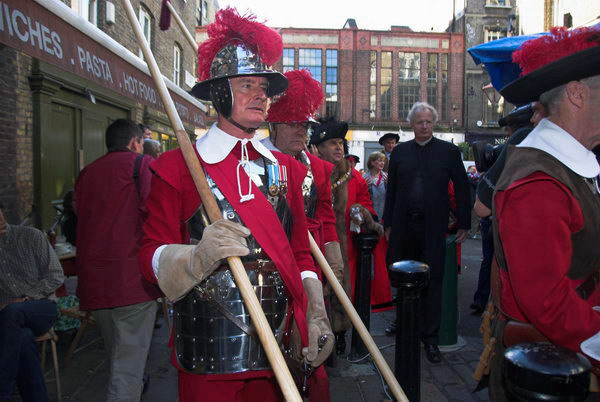
The Lord Mayor arrived with a small guard of pikemen and there were a few speeches. The fruiterers provide fresh fruit for a number of shelters for the homeless. The Lord Mayor and his party then toured the market, which had some fine displays of produce as well as its normal superb foods.

more pictures


Apprentice Boys of Derry March – Westminster
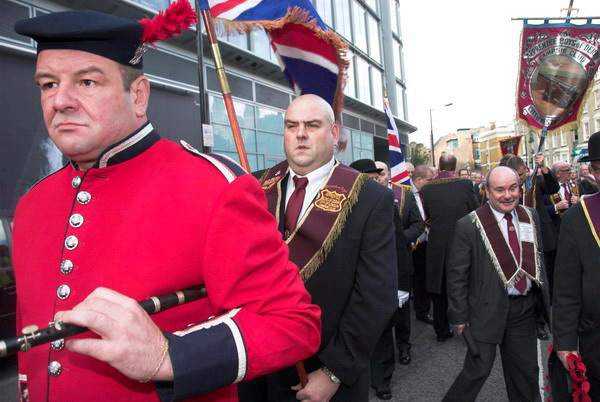
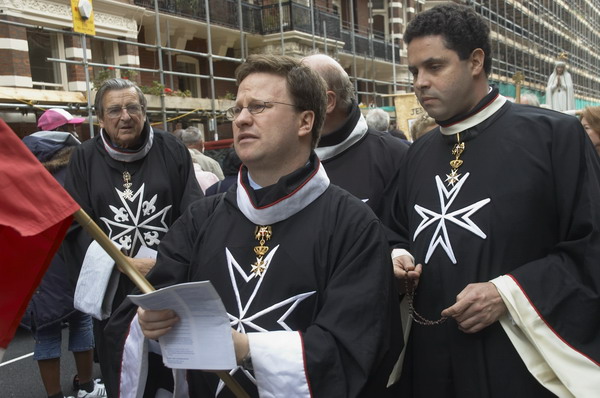
The Apprentice Boys Of Derry is a protestant organisation dedicated “to maintaining the spirit of liberty” displayed by the 13 apprentices who closed the gates of the city to the approaching army of the Catholic King James II in 1688. He demanded that the city surrender, receiving the now famous reply “No surrender!” The association which now organises parades to commemorate this was founded in 1814.
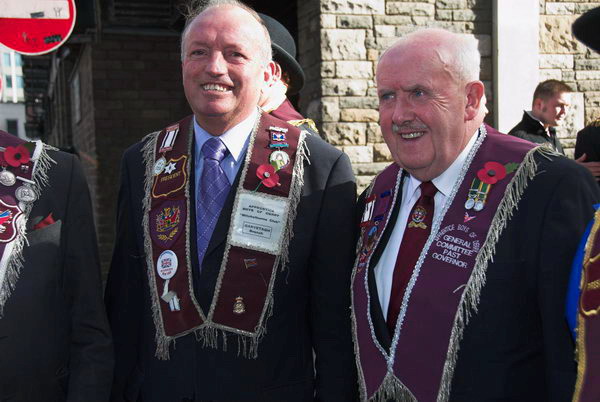
As well as in Derry itself, there are Apprentice Boys Clubs around the world, and each year there are several marches in London. At times their marches by or through largely Catholic areas have been extremely contentious, and the banning of their Portadown march in 1986 led to serious riots. Recent events in today’s calmer climate have caused fewer problems.
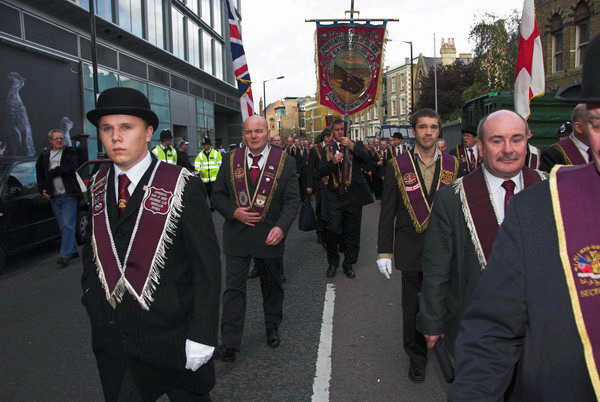
The march started near Victoria Station and went through Parliament Square to the Cenotaph in Whitehall where a wreath was laid. I left them at Trafalgar Square, on their way to a service at the Independent Congregational Church in Orange Street, behind the National Gallery, followed by a social evening.
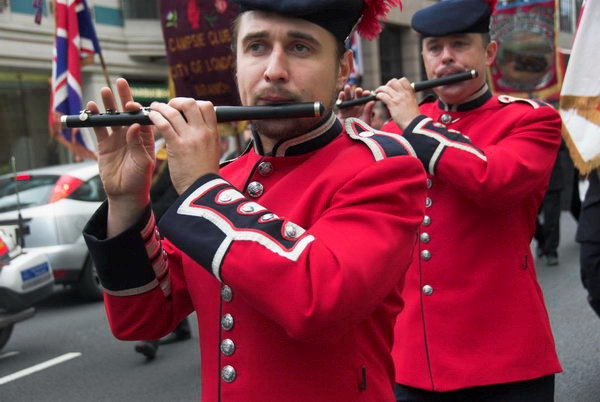
more pictures


FlickrFacebookMy London DiaryHull PhotosLea ValleyParis
London’s Industrial HeritageLondon Photos

All photographs on this page are copyright © Peter Marshall.
Contact me to buy prints or licence to reproduce.
Fracking, Congo & Caste 2013

Fracking, Congo & Caste: On Saturday 19th October 2013 I began work at a protest calling on the former boss of BP to resign from the House of Lords because of his vested interest in fracking, then photographed a protest against the atrocities being committed in the battles for mineral wealth in the DRC, Uganda and Rwanda before covering a march bringing a petition to Downing Street against the continuing delays in making caste discrimination illegal in the UK.


Global Frackdown: Lord Browne resign! Mayfair

Fracking, Congo & Caste

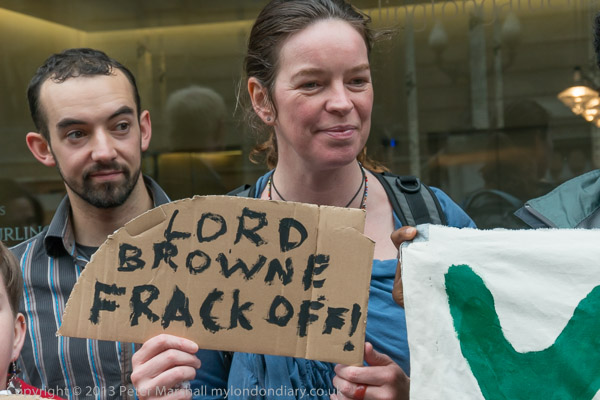
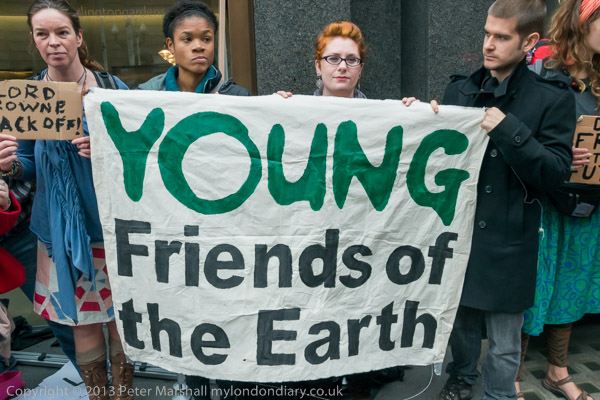
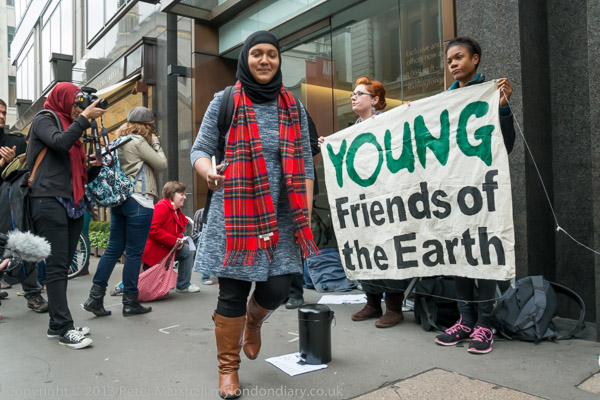
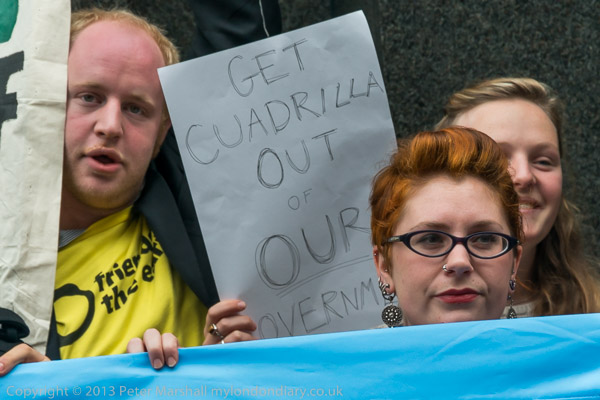
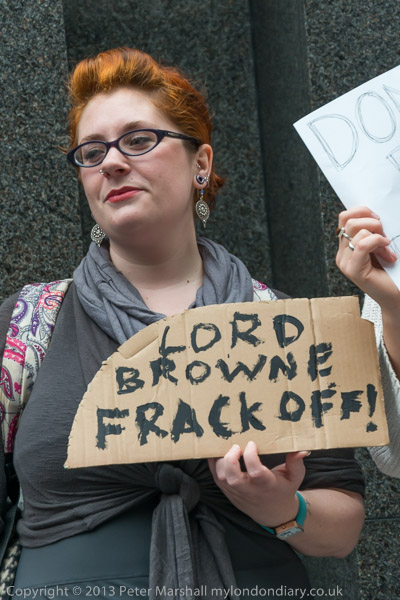
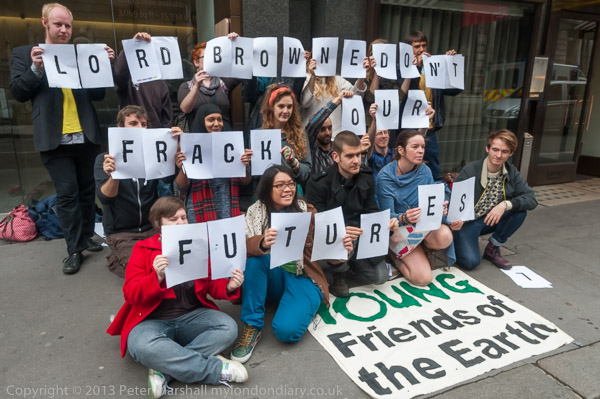
Campaigners went to the offices of private equity firm Riverstone Holdings to call on its managing director Lord Brown of Madingley, a former boss of BP, to resign his seat in the House of Lords because of his vested interests in fracking.

Fracking, Congo & Caste

John Browne joined BP in 1966 and worked his way up the company to become CEO in 1995. Knighted in 1998, he joined the House of Lords as Baron Browne of Madingley. in 2001 while still being BP CEO. In 2007 he resigned from BP when accused of perjury in atempting to stop newspapers publishing details of a former homosexual relationship and of alleged misuse of company funds.

Fracking, Congo & Caste

In his time at BP he was responsible for a ruthless programme of cost-cutting that many feel compromised safety and contributed to the 2005 Texas City Refinery explosion and in 2010, the Deepwater Horizon oil spill.

Fracking, Congo & Caste

In 2013, Browne was Managing Director and Managing Partner (Europe) of Riverstone Holdings LLC, and more significantly for today’s protest the chairman of Britain’s only shale gas driller Cuadrilla Resources.

The protest outside Riverstone was a part of a day of a ‘Global Frackdown’ with protests against fracking in 26 countries and in other cities in the UK.

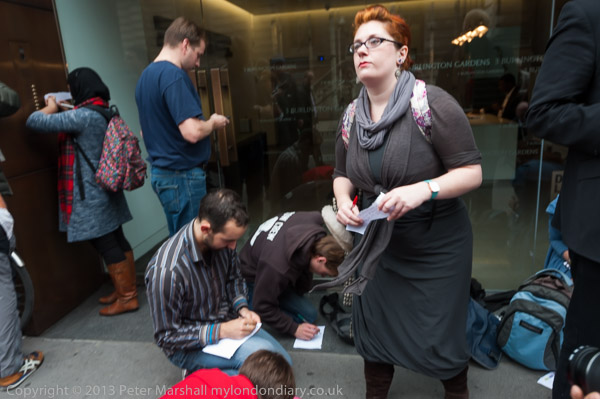
Friends of the Earth activists met on Oxford Street and walked to the office in Burlington Gardens, where after a brief speech about Lord Browne’s involvement in fracking people were invited to write messages and put them in a small brown rubbish bin which would be left at the offices for him.

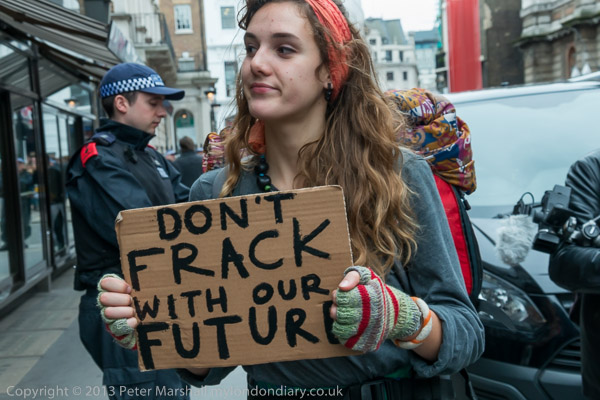
People wrote messages and posed with them calling for an end to fracking at Balombe and elsewhere in the UK as well as showing support for the Elsipogtog First Nation who had a few days earlier been attacked by the Royal Canadian Mounted Police with live ammunition and tear gas while protesting against fracking in New Brunswick, Canada.

Fortunately police in London merely came to ask the protesters what they intended to do before saying ‘Fine, no problem’ though they did later ask them to ensure there was a free path along the pavement and remind them and photographers of the danger from the slow moving traffic.

The activists point out that fracking contaminates huge volumes of water with sand and toxic chemicals and also that any fossil fuel production should be avoided as using fossil fuels increases the climate crisis.

Global Frackdown: Lord Browne resign!


Don’t Be Blind to DR Congo Murders – Piccadilly Circus

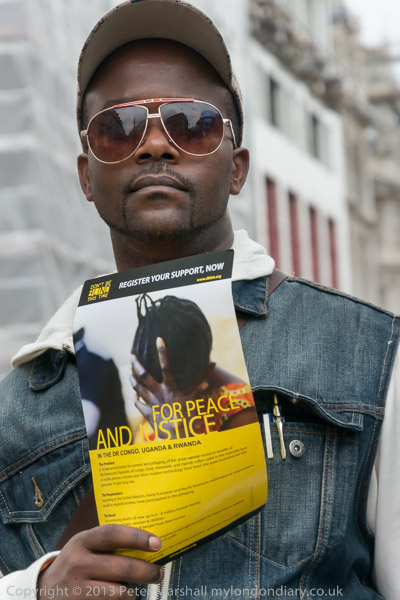
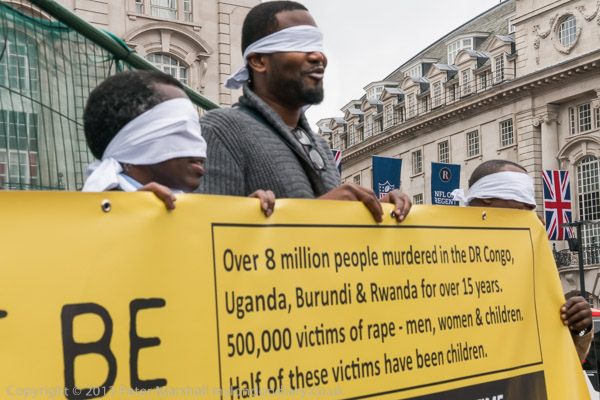
Continuing battles over the mineral wealth of the Democratic Republic of Congo, Uganda and Rwanda have led to the murder of more than 8 million people and over 500,000 men, women and children have been raped by the various armies funded by various European and African multinational companies.

Gold, diamonds, coltan, tungsten, tin and other ores should make these countries rich, but have led to huge devastation. Coltan, containing both niobium and tantalum is vital for the mobile phones, computers, missiles and other modern technology on which we rely. The fight for it has been the main incentive behind the genocidal wars that have waged in the area.

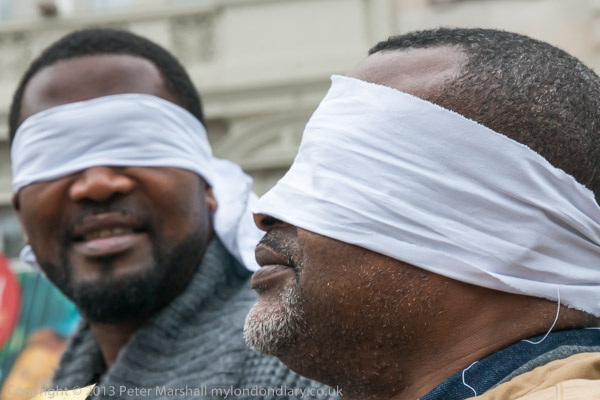
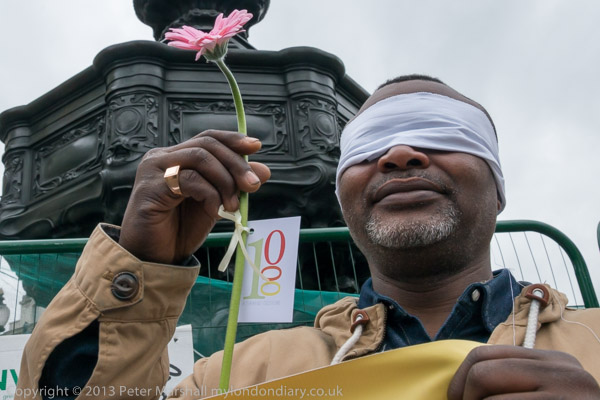
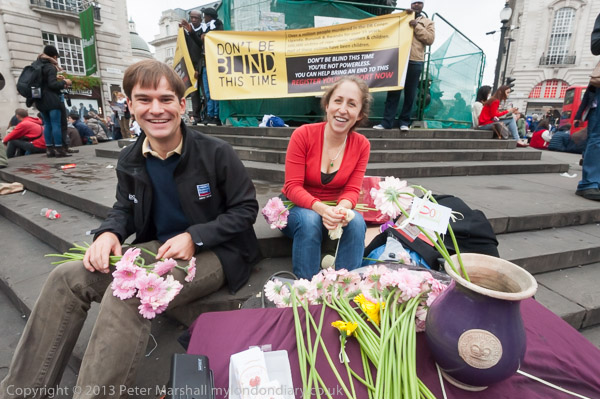
Despite various protests over the years by Congolese in London there has been little publicity to the atrocities and no action by our government. The ‘Don’t be Blind This Time’ campaigners came to Piccadilly Circus to raise public awareness, some posing in blindfolds and others handing out a thousand free flowers, with the message that that we need to demand justice and an end to the impunity and cover up around this conflict.

The wars continue in 2024 and have recently intensified. China now also being increasing involved as US companies have since 2013 sold their mines to Chinese companies who now own most of the mines in the DRC.

I don’t remember seeing any mention of this protest in the media, and we see few reports of the terrible situation continuing in the area. British editors seldom seem to regard this or conflicts in other areas of Africa such as Sudan as news.

Don’t Be Blind to DR Congo Murders


Make Caste Discrimination Illegal Now – Hyde Park to Whitehall

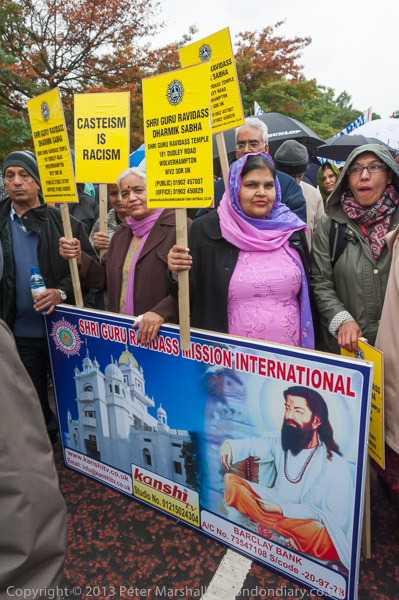
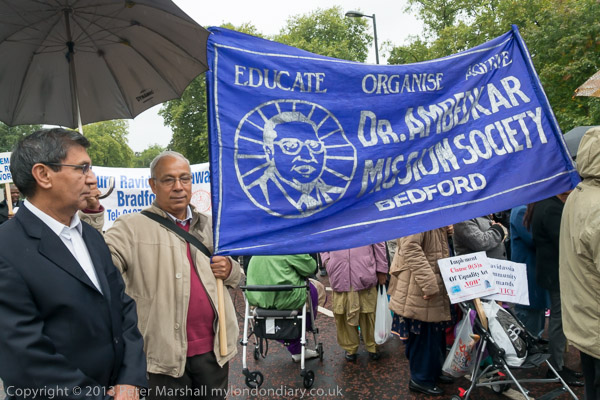
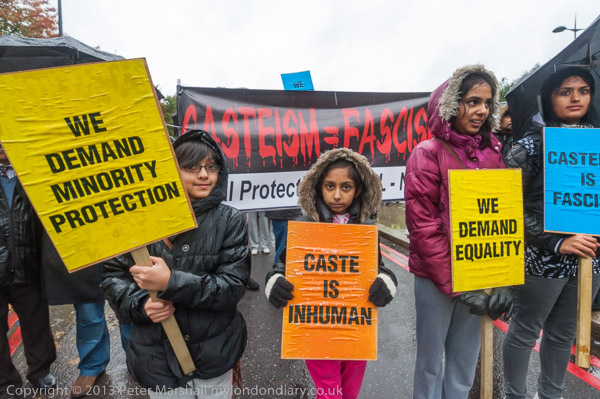
Negative discrimination on the basis of caste, long a traditional part of Indian society, was banned by law there in 1948 and is a part of the 1950 constitution, though it still continues. In the UK The Equality Act 2010 passed under New Labour in 2010 gave our government the power to make caste discrimination illegal but they lost the election before doing so.

The incoming coalition government was reluctant to action, but pressure continued and in 2013 the Enterprise and Regulatory Reform Act 2013 mandated this to be done; instead the government set up a two year consultation, apparently as a result of lobbying by the Alliance of Hindu Organisations, (AHO) a body set up to oppose what they call “the threat posed by this proposed amendment to the Equality Act 2010.”

The consultation appears also to be only with established groups dominated by upper caste interests, and its length entirely unnecessary. It isn’t clear why a simple elimination of a clearly discriminatory practice should be regarded as a threat.

A report on the consultation was finally published in 2018. In it the government rejected the idea of a law against caste discrimination and instead concluded:

Having given careful and detailed consideration to the findings of the consultation, Government believes that the best way to provide the necessary protection against unlawful discrimination because of caste is by relying on emerging case-law as developed by courts and tribunals. In particular, we feel this is the more proportionate approach given the extremely low numbers of cases involved and the clearly controversial nature of introducing “caste”, as a self-standing element, into British domestic law.

They also state that any law would “as divisive as legislating for “class” to become a protected characteristic would be across British society more widely.” I don’t think this comparison has any merit. Not to act seems to me to be accepting a foreign practice, illegal in its country of origin, into British society, and the low number of cases they comment on surely means that case-law will only emerge at a snail’s pace. Our new Labour government should follow the example begun by New Labour in 2010 and make caste discrimination illegal in the UK.

Make Caste Discrimination Illegal Now


FlickrFacebookMy London DiaryHull PhotosLea ValleyParis
London’s Industrial HeritageLondon Photos

All photographs on this page are copyright © Peter Marshall.
Contact me to buy prints or licence to reproduce.

Inequality, Democracy Camp & the Blessed Sacrament – 2014

Inequality, Democracy Camp & the Blessed Sacrament – On Saturday 18th October 2014 over 80,000 people marched in London to call for workers to share in the economic recovery which has seen a great increase in wages of chief executives while workers have lost out. Later I went to Parliament Square where the Democracy Camp finally took over the area. When police left, I left to photograph a Catholic religious procession.


Britain Needs A Pay Rise – Embankment

Inequality, Democracy Camp & the Blessed Sacrament

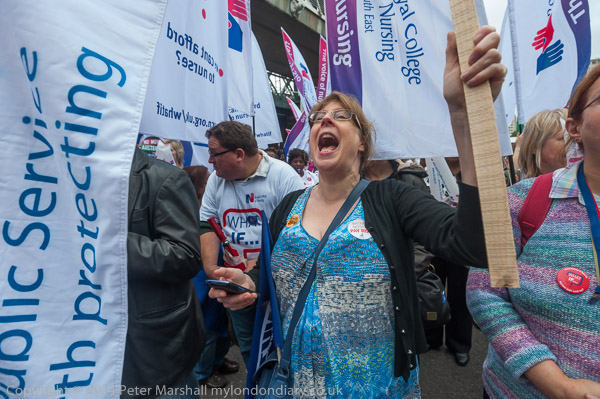
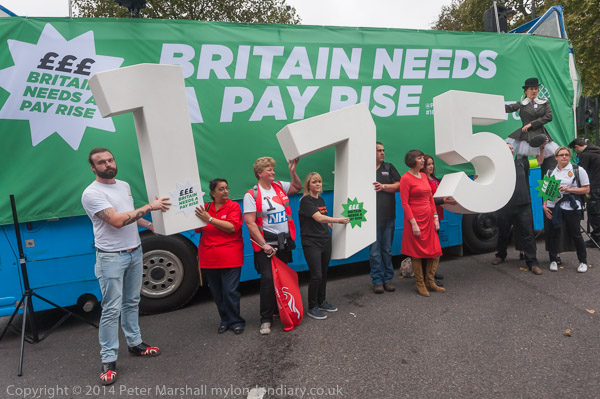
I walked along the Embankment a couple of hours before the march was due to start and already it was beginning to fill up with marchers, and I returned later from photographing Democracy Camp protesters in Parliament Square just in time to catch the end of a photocall with TUC General Secretary Frances O’Grady in front of a bus covered with a green banner with the message ‘Britain Needs a Pay Rise’ and people holding large white numbers 1,7 and 5.

Inequality, Democracy Camp & the Blessed Sacrament

The gap between rich and poor is widening in the UK, with company chief executives in 2014 getting 175 times the pay of the average worker. Wealth is also hugely unequally divided, with the “the richest 50 families in the UK held more wealth than half of the UK population” by 2023. Only 8 of the 37 Organization for Economic Co-operation and Development countries are now less equal than the UK.

Inequality, Democracy Camp & the Blessed Sacrament

Eventually the march set off, and after photographing the start of the march I stayed in place to photograph the rest of the march as it came past me.

Inequality, Democracy Camp & the Blessed Sacrament
Matt Wrack, FBU

“At the front were the major unions, the health workers and the teachers, the firefighters and more, a reminder of how much we still depend on unionised workers despite the largely successful attacks by Thatcher and later governments which have almost eliminated the unions in many areas.”

“Further back the marchers were more varied, and I met rather more people I knew, including those with CND, Focus E15, Occupy London and other radical movements.”

I kept taking pictures as people came past me for around an hour and a quarter, when people were still coming past but it was close to the end. Rather than continue with them to Hyde Park where the final rally would be starting I considered taking the Underground – it would probably be over before those marchers arrived. But I decided I had enough pictures of the event and went instead to Parliament Square to see what was happening at the Democracy Camp.

Many more pictures at Britain Needs A Pay Rise.


Democracy Camp Takes the Square – Parliament Square

When I arrived the tense standoff between police and protesters around the edges of the grassed area was continuing. Many of the protesters had temporarily left the square to join in with the TUC march but were beginning to arrive back.

One group “from UK Uncut came into the square dancing to the sound of a music centre on a shopping trolley. As they danced on the pavement in front of the statue of Churchill, Westminster Council officials prompted police into action and together with one of the Heritage Wardens the police moved to attempt to seize the sound system.”

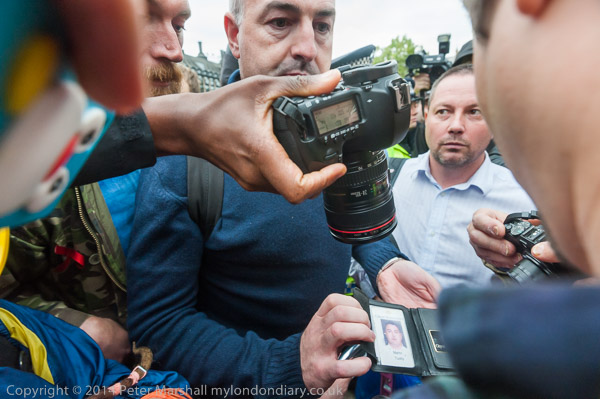
Democracy campers linked arms to make it difficult for the warden and police to reach the system” but eventually the group were surrounded and “Martin Tuohy showed his ID as Senior Westminster Warden at Westminster City Council and together with another employee grabbed the system with police looking on.”

After some tense argument the UK Uncut group were allowed to leave the square along with their sound equipment with the warning that unless they took it away from Parliament Square it would be taken from them.

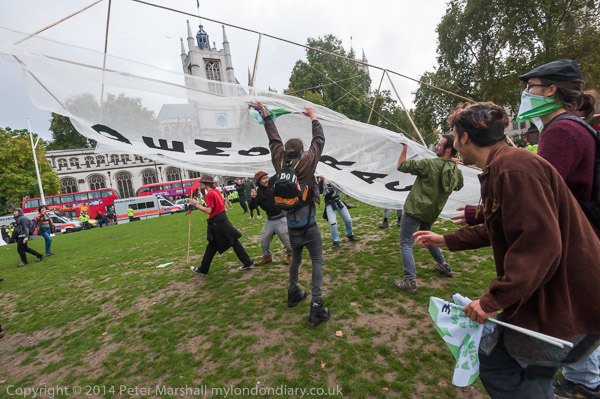
More people arrived from the TUC march, where some had carried “two large wood and fabric towers, one with the words POWER and OCCUPY and the other the word DEMOCRACY. Together with other protesters they ran onto the grass square and raised the towers

Others joined them including some carrying a long ‘Real Democracy Now!’ banner and the rally began.

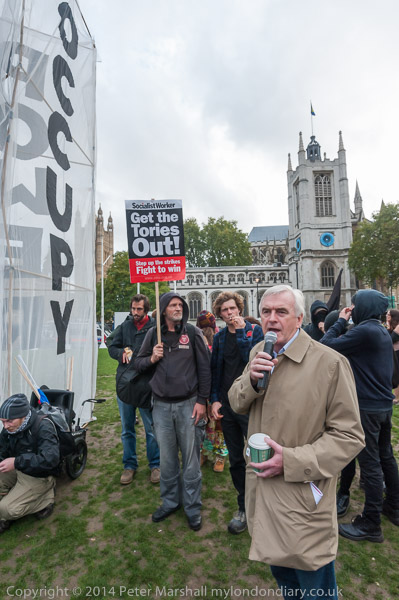
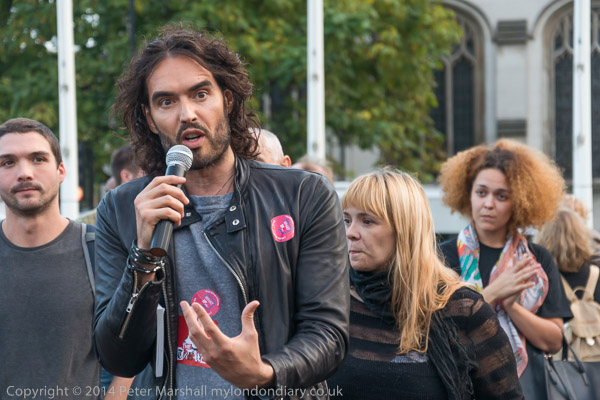
The first speaker was “Labour MP John McDonnell. Among the other speakers were Occupy’s George Barda, environmentalist Donnachadh McCarthy and Russell Brand, who after speaking posed for photographs together with many of those present. “

The sudden invasion of the grass had taken the police and Heritage Wardens by surprise, and they had been unable to do anything to prevent it. But during the rally police began “massing around the square in blocks of around 20, obviously posed in a military looking formations ready to run onto the square.” As well as perhaps 200 ordinary police, reinforcements arrived “arrived with two larger groups of blue-capped TSGs obviously spoiling for a fight.”

“Then the police suddenly started to disappear while Brand was speaking. Perhaps someone had realised that with Russell Brand talking, any attack on the protesters would have generated massive and largely negative media coverage. Much better to come back late at night and do it after the mass media had left (which they did.)”

Nothing seemed likely to happen until much later, so I left for another event.

More at Democracy Camp takes the Square.


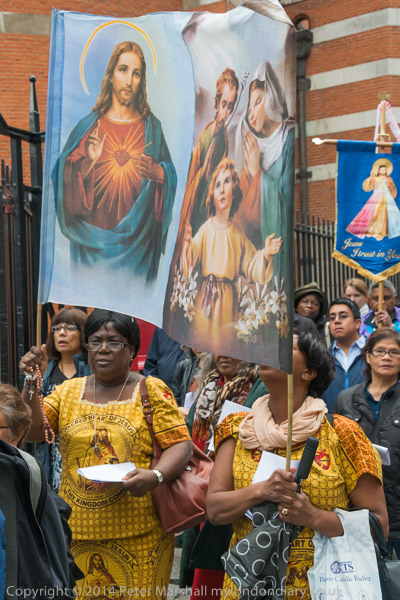
Procession of the Blessed Sacrament – Westminster Cathedral to Southwark Cathedral

I arrived just in time to see the procession emerge from Westminster Cathedral – no photography was allowed inside.

I followed it down the road to Lambeth Bridge where they stopped for a change of dress as Auxiliary Bishop Paul Hendricks put on his robe to carry the sacrament in Southwark diocese.

I left the procession at the south end of the bridge to catch a bus back to Waterloo and make my way home.

Procession of the Blessed Sacrament.


FlickrFacebookMy London DiaryHull PhotosLea ValleyParis
London’s Industrial HeritageLondon Photos

All photographs on this page are copyright © Peter Marshall.
Contact me to buy prints or licence to reproduce.

Occupy London Begins – 2011

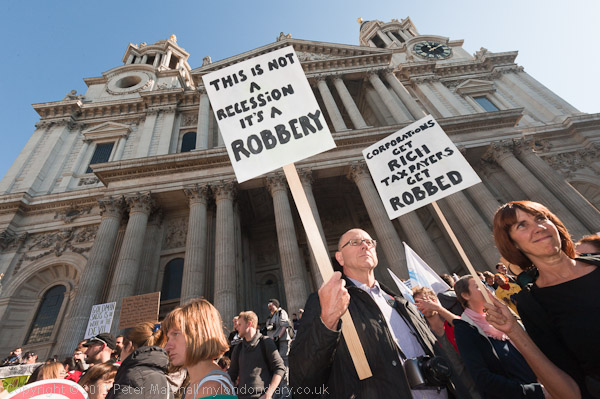
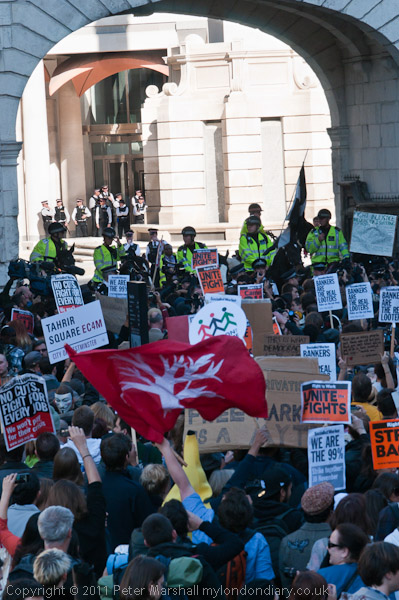
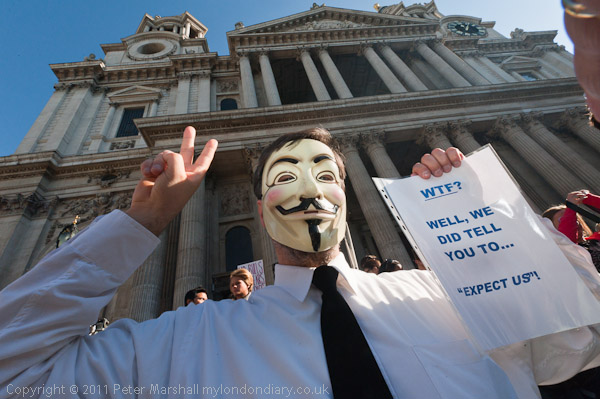
Occupy London Begins: On Saturday 15 Oct 2011 over 2000 protesters came to St Paul’s Cathedral as a part of a world-wide ‘Occupy’ protest “Inspired by Occupy Wall Street and the Arab Spring, and answering to the call out made by the Spanish Plataforma ¡Democracia Real YA! in May 2011 for a Global Day Of Action” and Occupy London began.

Occupy London Begins - 2011

Similar protests were taking place in “Spain, Rome, New York, Portugal, Chile, Berlin,Brussels, Zageb, and many more … inspired by the example of Occupy Wall Street and the Arab Spring.”

Occupy London Begins - 2011

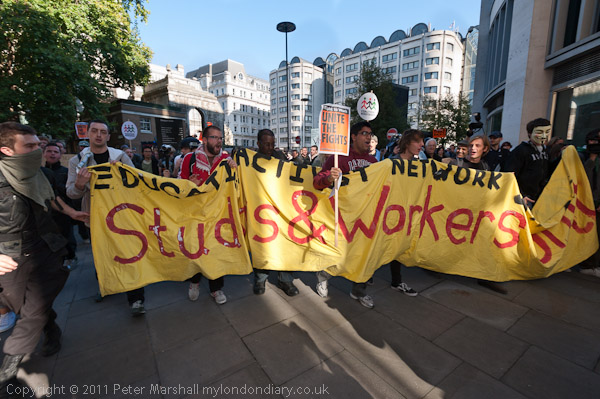
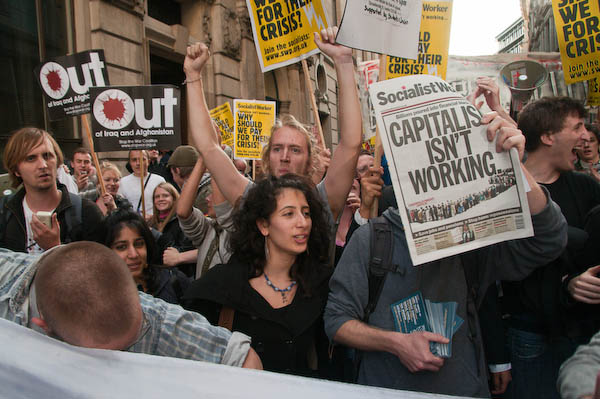
Although people from various groups were present, including the Education Activists Network, Socialist Workers Party, Anonymous, Right to Work, UK Uncut, South London Solidarity Federation and there were several well known figures present who spoke including Peter Tatchell and Julian Assange, the whole movement deliberately lacked overall organisation with all decisions being taken by General Assemblies with the slogan ‘No Leaders, No Hierarchy’.

Occupy London Begins - 2011
A General Assembly on 9th October on Westminster Bridge plans the occupation

The event had actually come about from one such assembly on Sunday 9th October at the end of the ‘Block the Bridge NHS Protest‘ when a ‘General Assembly’ of several hundreds had come together at the north end of Westminster Bridge to discuss and endorse a planned occupation of the London Stock Exchange area.

Occupy London Begins - 2011

In response to this the Stock Exchange obtained a High Court injunction to prevent public access to Paternoster Square, one of the increasingly large areas which appear to be public space in the city but are actually now privately owned, although previously Paternoster Row was a public street and police were present in force to enforce this injunction.

Most of the several thousand protesters were intent on an entirely peaceful protest, calling for a democratic revolution to “fight for a new political and economic system that puts people, democracy and the environment before profit.” They saw that “Our political elites have chosen to protect corporations, financial institutions and the rich at the expense of the majority.

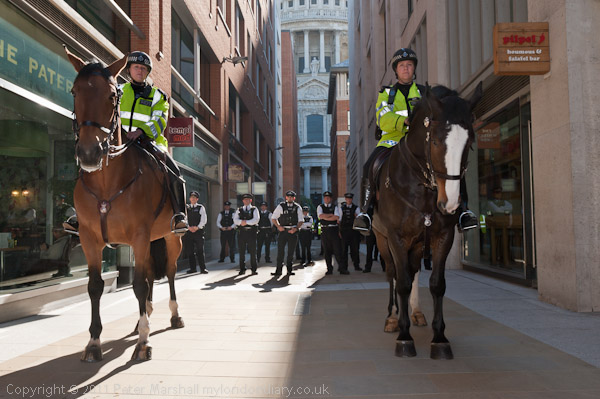
After a few short speeches a few hundred protesters, led by the banner of the Education Activist Network made and attempt to enter the square through Temple Bar, but police on foot and horses were waiting for them, and the relatively narrow entrance of the Bar, moved here a few years ago, was designed to be easily defended.

They then made a tour around the block containing the Stock Exchange but found the narrow passages leading to Paternoster Square heavily defended by police. When finally they found one with only a thin line of a thin line of police, the protesters hesitated for long enough for the police to bring up reinforcements. It was probably for the best as they would have immediately been easily kettled inside the square had they got in.

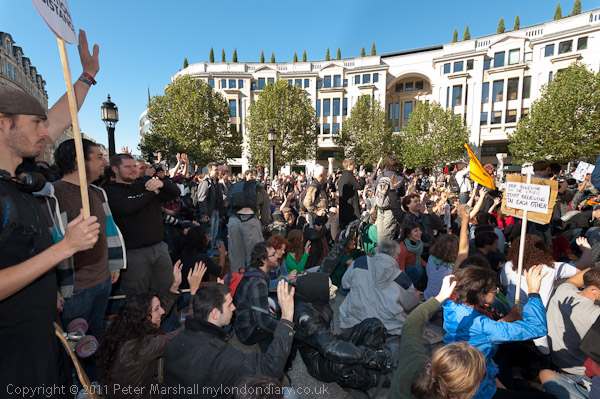
Eventually a General Meeting began on the steps of St Paul’s. There were a few minor scuffles when police pushed protesters around, which could probably have been avoided had police explained clearly that they only intended to clear a path to clear a path into and out of the cathedral at one end of the steps. Several people were arrested then and later.

I decided to leave, as it really seemed unlikely that anything much more would happen for some time. As I was leaving, police decided to block Ludgate Hill, but along with a group of several hundred protesters I managed to get through their line as it was forming.

The General Assembly takes a show of hands to remain at St Paul’s

Police continued to clear protesters from the steps of St Paul’s and urging people to leave the area, but many set up tents on the level area of St Paul’s Churchyard and the occupation had begun – and was to remain in place until finally removed on 28th February 2012. You can read a great deal about the occupation in the Occupy London web site which includes the various statements agreed by consensus at Occupy London General Assemblies. Unfortunately Wikipedia’s article on Occupy London is unusually poor and misleading about the events of 15th October.

More at Occupy London Kept Out Of Stock Exchange


FlickrFacebookMy London DiaryHull PhotosLea ValleyParis
London’s Industrial HeritageLondon Photos

All photographs on this page are copyright © Peter Marshall.
Contact me to buy prints or licence to reproduce.

March on the City 2008

March on the City: On Friday 10 October 2008 several hundred anti-capitalist protesters, mainly students, took to the streets of the City of London to say “We Won’t Bail Out the Bankers’.

March on the City 2008

The financial crisis had started in 2007, but reached a climax with the bankruptcy of Lehman Brothers on September 15 2008 which precipitated an international banking crisis.

March on the City 2008

Wikipedia sets out the causes of the crisis in some detail, but essentially US banks had been allowed to make more risky loans by changes in US laws which loosened regulations and allowed banks to take part in high risk operations such as proprietary trading and investment banking.

March on the City 2008

In the US one result of this was the proliferation of mortgage loans to people on low incomes who could really not afford the repayments and eventually defaulted. The problems with ‘subprime mortgages‘ particularly given to many in minority communities in the USA came to a head as a boom in US house prices in the early 2000s was followed by a sharp drop in the value of properties which were the security for the loans.

March on the City 2008

As Wikipedia comments, “governments deployed massive bail-outs of financial institutions and other palliative monetary and fiscal policies to prevent a collapse of the global financial system.” This resulted in the widespread feeling that those who had created the crisis were being rewarded for their failures.

In the UK, the New Labour government under George Brown made a massive financial intervention, paying £137 billion to the banks in loans and new capital, some of which was later recouped, but leaving a cost of £33 billion. While some support was necessary to avoid a total breakdown of the financial system, many felt that the government should have taken a firmer line and that those responsible should have had to pay for their mistakes and not to seem to have kept their highly paid jobs.

Both Northern Rock – the first UK bank to fail in July 2007 and Bradford & Bingley were taken into public ownership, and RBS/Nat West into majority public ownership. But RBS still ended up costing us £35.5 billion – and the leading bankers still ended up getting huge salaries and big bonuses. The Royal Bank of Scotland seemed to be getting off scot free.

Part of the problems we still see in financial markets came from changes worldwide in the way that trading now takes place. In the UK Margaret Thatcher had brought in the ‘Big Bang’ which abolished traditional practices and introduced electronic trading, greatly increasing volatility.

On My London Diary I give a fairly full account of the actual protest which started at Bank where some protesters tried to storm into the Royal Exchange – long just a prestige shopping centre – and the Bank of England but were easily stopped by police.

There then followed a slow march around parts of the City, with police attempting to stop them at various points and the marchers pushing their way through police lines.

As my pictures show, there was some rather forceful policing at times and some of the press also suffered with the protesters. As I write, “I got a few bruises and my glasses were damaged when police rushed in as I was taking pictures in Lombard St.” But there was none of the confrontational use of trained riot squads that have led to extreme violence at some protests policed by the Met. Policing here was by the City of London Police – along with a guest appearance by one French cop.

Eventually there was a short rally with a few speeches on the corner of Bishopsgate and London Wall after which the demonstrators dispersed. Police seemed fairly relaxed at the end of the protest and I saw no arrests.

I don’t think the protest got much if any coverage in the mass media and most accounts I read on-line were confused, with many suggesting it went to the Stock Exchange. While that might have been a logical place to protest, the marchers actually went in the opposite direction.

March on the City.


FlickrFacebookMy London DiaryHull PhotosLea ValleyParis
London’s Industrial HeritageLondon Photos

All photographs on this page are copyright © Peter Marshall.
Contact me to buy prints or licence to reproduce.

Land Army, Charity Pull & Rosary Crusade – 2005

Land Army, Charity Pull & Rosary Crusade: Saturday 8th October 2005 was a day of considerable variety as well as some tricky travelling around London for me, beginning in Whitehall with the women of the Land Army, rushing to Lewisham for a charity event organised by the Mayor and then back to Westminster Cathedral for a religions procession.


Commemoration of the Women’s Land Army – Cenotaph, Whitehall

Land Army, Charity Pull & Rosary Crusade

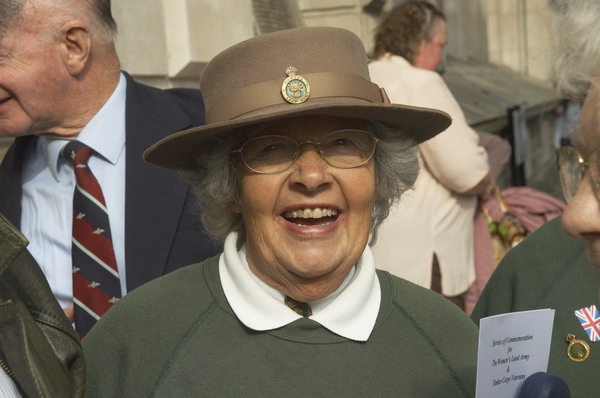
During the Second World War many women joined the Women’s Land Army. First set up in 1917 during World War One, it was reformed in June 1939 when World War Two seemed inevitable, before the war actually began at the start of September.

Land Army, Charity Pull & Rosary Crusade

During WW2, over 200,000 Land Girls worked in the Women’s Land Army, playing a crucial role in feeding the nation at war – and it continued for some years after the war ended in 1945, finally ending in November 1950.

Land Army, Charity Pull & Rosary Crusade

For many joining up was a healthy alternative to working in munitions or joining the other services, less regimented and offering a wide range of activities. Few had any previous experience in agriculture, but “they ploughed, grew produce, milked cows, caught rats, drove tractors – and much more.”

Land Army, Charity Pull & Rosary Crusade

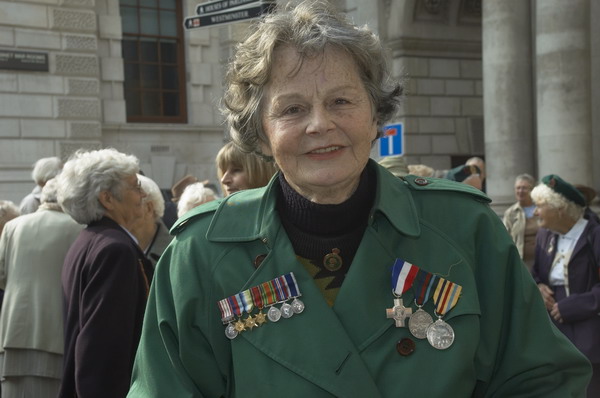
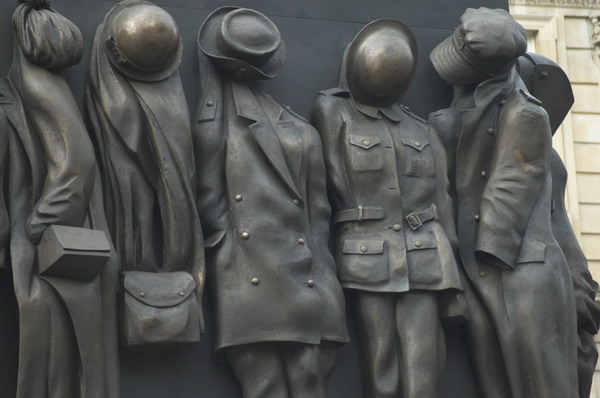
But the war had ended 50 years earlier and they were now in their 70s and 80s when I met them opposite the memorial to the Women Of The Second World War which had recently been unveiled near the Cenotaph.

Some I talked to had been at the unveiling of that memorial and were extremely scathing about it and had been and were disappointed that the Queen had not spoken at all at the event.

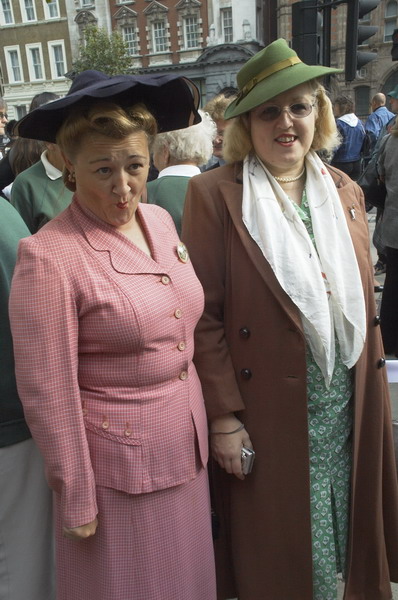
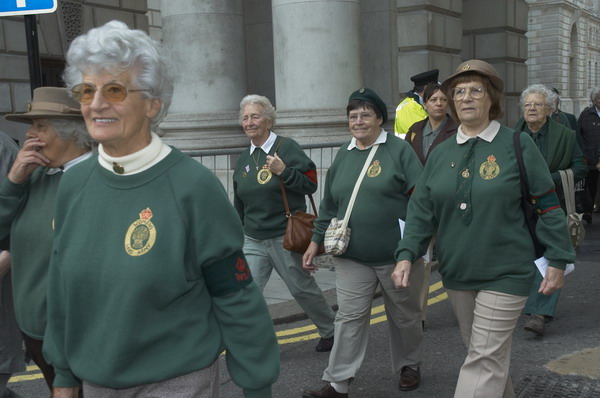
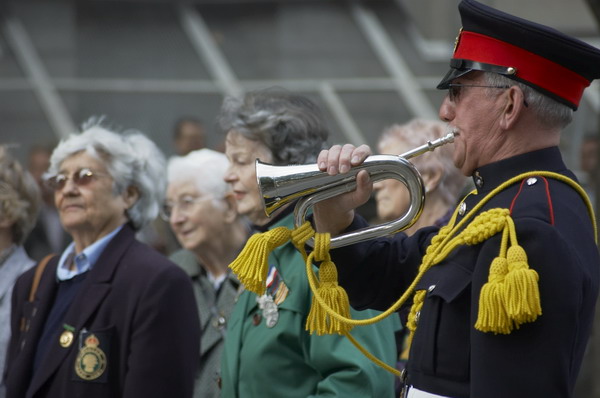
They were a sprightly and feisty group despite their age. A few had come in 1940s dress but most wore some of their uniform often with a number of medals. They marched to the Cenotaph where wreaths were laid and a bugler sounded ‘The Last Post’. After which I rushed away to Charing Cross to catch a train as the event had run late.

More pictures


Lewisham: Mayor’s Charity Vehicle Pull

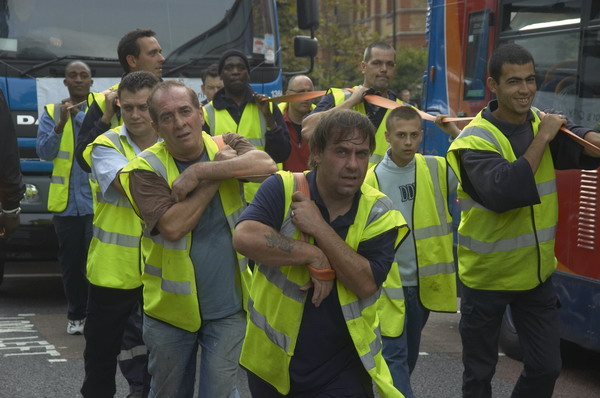
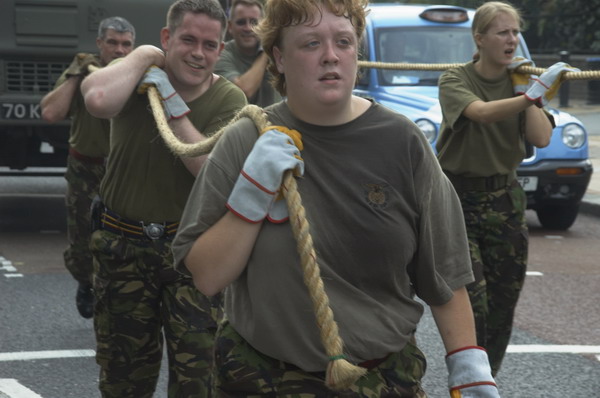
Every year like most Mayors the Mayor of Lewisham has a charity appeal and for some years a Charity Vehicle Pull from Downham to Lewisham was organised as a way of raising money for this.

I’d got a later train than I’d hoped, so sat on the train trying to work out where the vehicle pull would be by the time the train arrived in the area. I left the train at Ladywell and rushed from the station to Lewisham High Street and fortunately found my guess had been correct.

I took a few pictures – there isn’t a huge lot you can do with an event like this – and then got on the top floor of a bus which was travelling along the open lane inside the event, hoping to overtake them. It would have worked, but for an illegally parked vehicle that was blocking the lane.”


Rosary Crusade of Reparation – Westminster Cathedral

At Lewisham Station I’d missed the Victoria train, and had to run under the subway to jump on a Charing Cross service just as the doors were closing, changing at Waterloo East to Southwark Station on the Jubilee line, then at Green Park to the Victoria line to Victoria.

I hurried the short distance from Victoria Station to Westminster Cathedral arriving just at the right time for the start of the Rosary Crusade of Reparation.

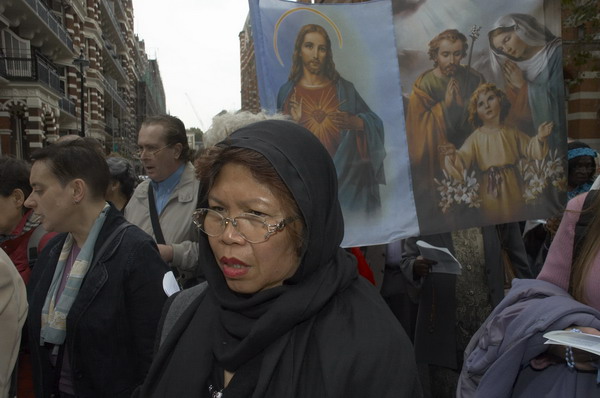
The Rosary Cruade had started in Vienna in 1947, with a series of processions with the statue of ‘Our Lady of Fatima’.

The Virgin Mary appeared to Portuguese children at Fatima in 1917 and had asked for prayers and penance to avoid further wars and achieve world peace. This call was renewed in the Rosary Crusade by Father Petrus Pavlicek following a vision during his visit to a Marian shrine in 1946.

The processions became an annual event, held on or around 12th Sept, the Feast of The Name of Mary (which celebrated the defeat of Turkish armies surrounding Vienna in 1683), and soon spread to other countries.

When Russian troops left Austria in 1955, many Austrian catholics ascribed this to their prayers in the rosary crusade.

More pictures on My London Diary.


FlickrFacebookMy London DiaryHull PhotosLea ValleyParis
London’s Industrial HeritageLondon Photos

All photographs on this page are copyright © Peter Marshall.
Contact me to buy prints or licence to reproduce.

Extinction Rebellion October Rebellion – 2019

Extinction Rebellion October Rebellion – London 7 Oct 2019

Extinction Rebellion October Rebellion - 2019

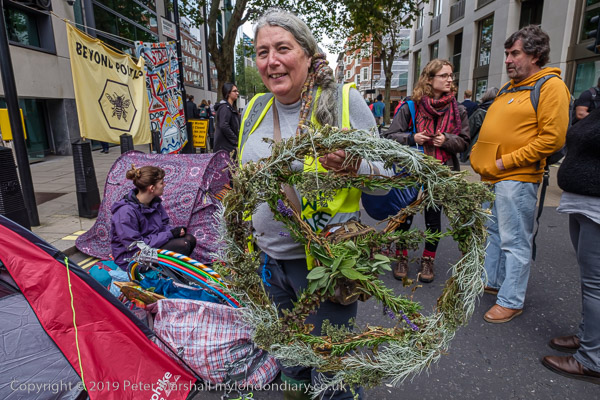
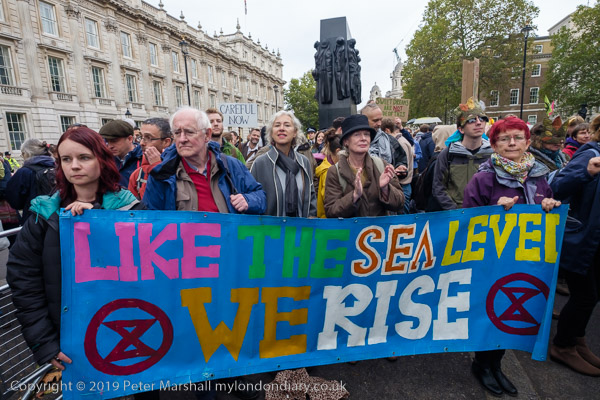
Five years ago today Extinction Rebellion began their day of October Rebellion in London by occupying eleven locations at government ministries, Downing St, The Mall, Westminster and Lambeth bridges, bringing traffic in the centre of London to a halt.

Extinction Rebellion October Rebellion - 2019

The action was billed as an International Rebellion and there were other actions taking place in New York, Sydney and possibly elsewhere and you can read much more about them on the XR web site.

Extinction Rebellion October Rebellion - 2019

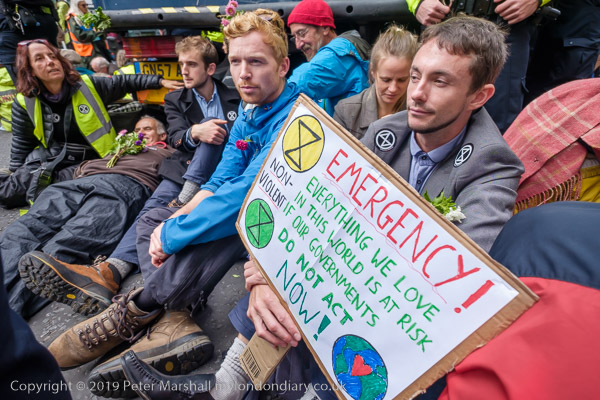
XR demand the government tell the truth about the climate and ecological emergency, act to halt biodiversity loss, reduce emissions to net zero and create and be led by a Citizens Assembly.

Extinction Rebellion October Rebellion - 2019

I managed to get to some but not quite all of these 11 locations during the day and take pictures. Police hindered movement around the city to some extent, making me have to walk rather further than I wanted when they completely closed Lambeth Bridge to all pedestrians after XR had closed both ends to traffic.

Extinction Rebellion October Rebellion - 2019

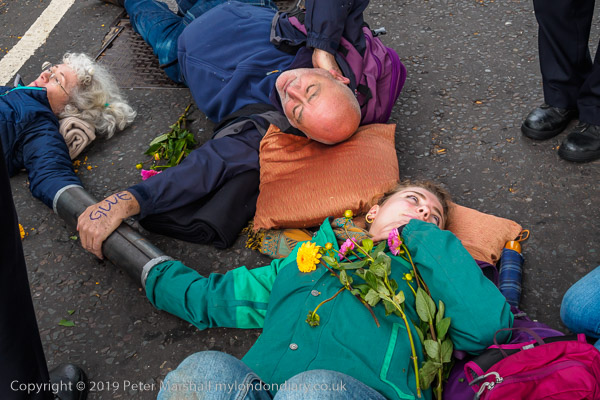
Police made a few arrests here and there but it was hard to see any logic in their actions. Some people had locked themselves together but generally I think the police were simply overwhelmed by the large number of protesters.

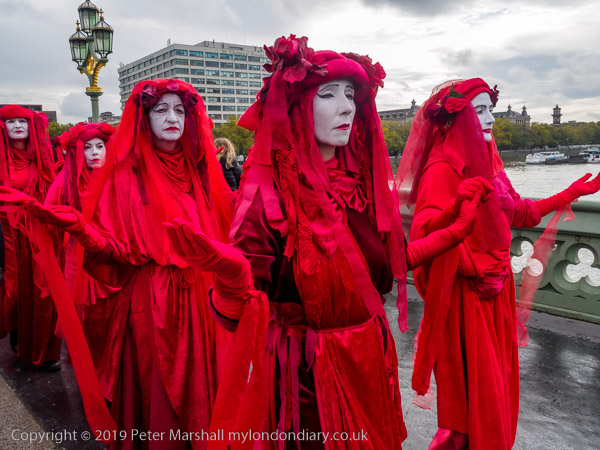
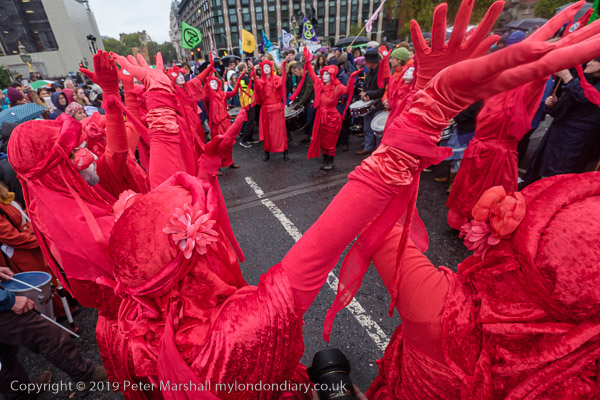
As before XR’s ‘Red Brigade’ made a colourful splash and like most photographers I took too many pictures of them.

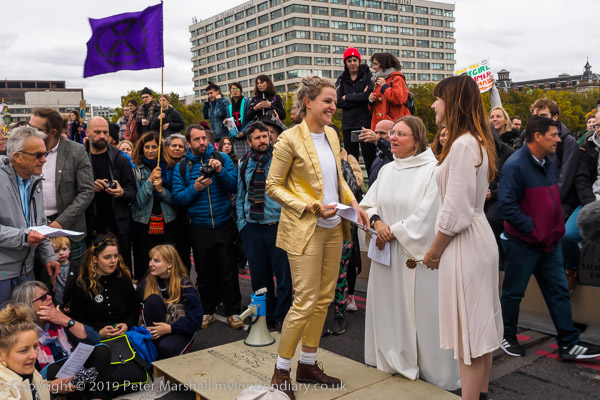
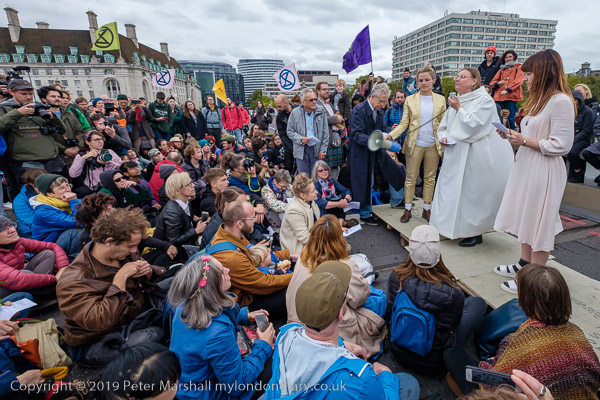
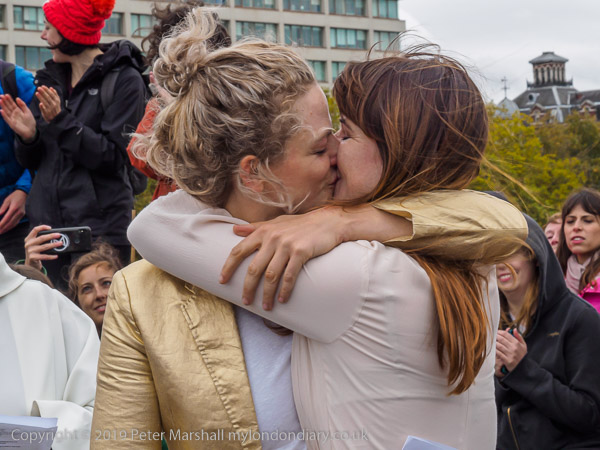
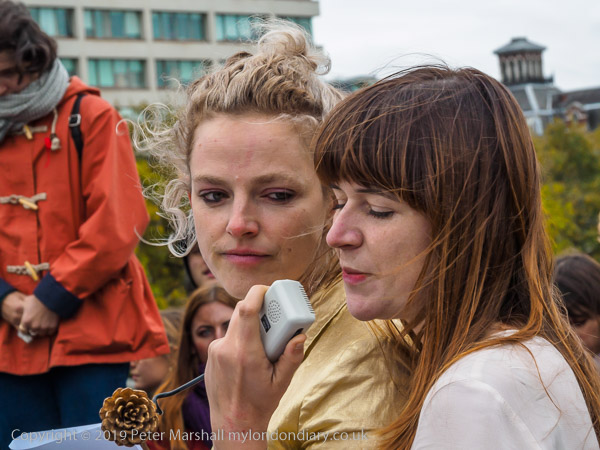
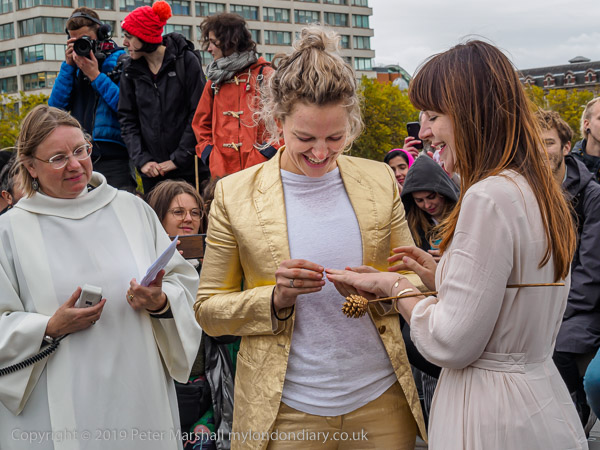
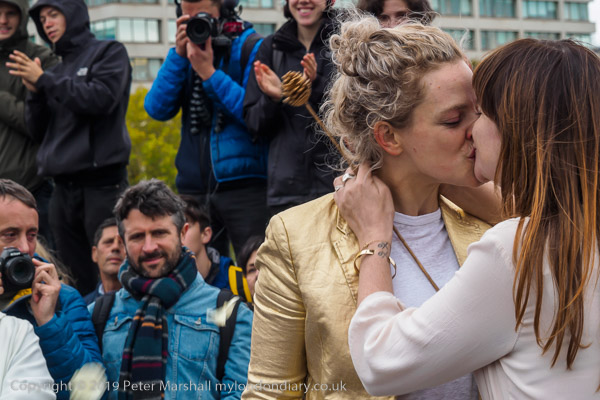
As a part of the protest two XR rebels Tamsin and Melissa were married on Westminster Bridge.

Everything was ready, the clergy had arrived, but only one of the two people being married – and she had gone to look for the other who was taking part in a protest at BEIS in Victoria St. So we had to wait – and the jazz band entertained us.

Eventually Tamsin comes and tells the band to stop playing as the couple are ready to start the wedding.

And the ceremony begins.

The couple kiss and make promises.

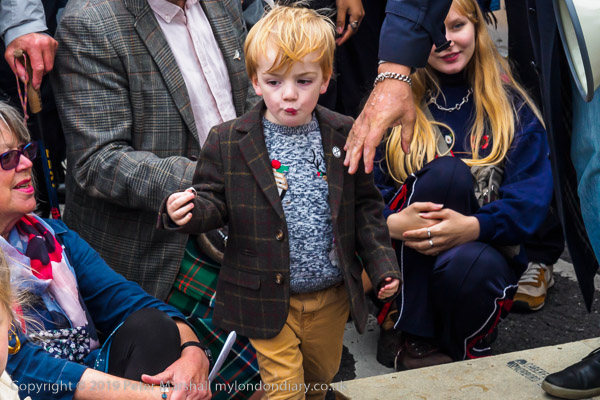
A young boy comes forward with a ring

Melissa gives Tamsin a ring and then Tamsin places a ring on Melissa’s finger

And they kiss again.

More pictures on My London Diary:
XR Rebels marry on Westminster Bridge
Extinction Rebellion occupy Westminster


FlickrFacebookMy London DiaryHull PhotosLea ValleyParis
London’s Industrial HeritageLondon Photos

All photographs on this page are copyright © Peter Marshall.
Contact me to buy prints or licence to reproduce.

Saffron Revolution & Slave Trade Abolition – 2007

Saffron Revolution & Slave Trade Abolition: On Saturday 6th October 2007 I photographed a protest against the brutal repression of the Saffron Revolution protest in Myanmar (Burma) and a celebration of the 200th anniversary of the abolition of the slave trade,


Global Day of Action for Burma – Westminster

There was considerable support in the UK and UK media for the Burmese people who were taking part in non-violent protests against the military dictatorship there after it decided to remove subsidies on fuel, exacerbating a cost-of-living crisis in the country.

The protests were led by thousands of along with students and political activists and were often referred to as the Saffron Revolution.

The protests had begun in August 2007 and in late September after protests involving many thousands in various cities the government began a huge crackdown using military force to stop the protests and imposing curfews and prohibiting gatherings of more than five people.

Monasteries were raided, thousands of arrests were made and some protesters were killed. Wikipedia gives a great deal of detail, and on 1st October it was reported that around 4,000 monks were being detained at a disused race course, disrobed and shackled.

The official death toll over the period of the protests was 13, but the independent media organisation Democratic Voice of Burma based outside the country produced a list of 138 names of those killed.

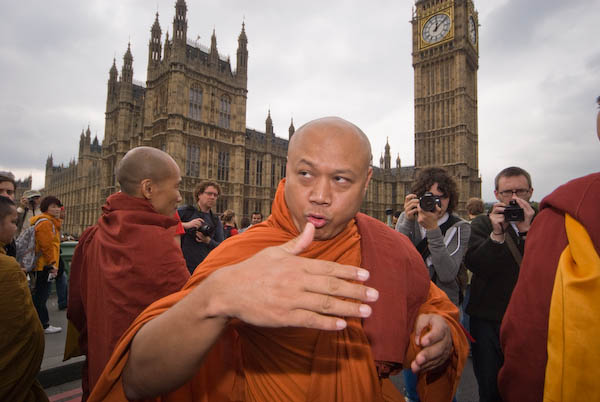
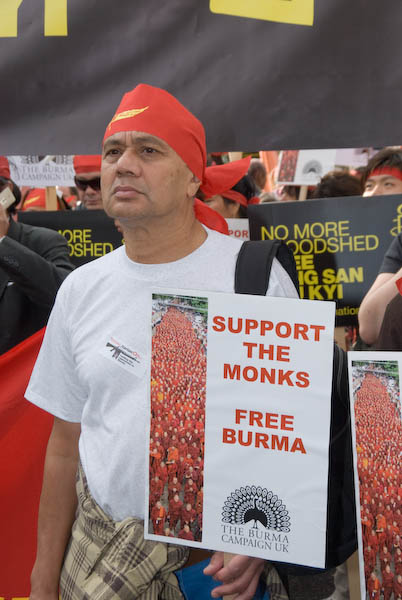
The march began at Tate Britain on Millbank, proceeded over Lambeth Bridge and then returned to Westminster over Westminster Bridge. Many of the roughly 10,000 marchers wore red headbands and a small group of monks were allowed to tie strips of cloth onto the gates of Downing Street before the march continued to a rally in Trafalgar Square, where I left them.

More at London Burma March.


Slave Trade Abolition Bicentenary Walk

In 1787, Thomas Clarkson, Granville Sharp and ten other anti-slavery campaigners founded The Society for the Abolition of the Slave Trade. Nine of the twelve founders were Quakers, including the wealthy banker Samuel Hoare Jr which prevented their having much involvement in parliament.

Perhaps because of this the society became the first modern campaigning movement, working to educate the British public about the cruel abuses of the slave trade through publication of books, prints, posters and pamplets, organising lecture tours, including that by former slave and author Olaudah Equiano and by boycotting of goods produced by slaves.

The Quakers had organised petitions against slavery and presented these regularly to Parliament, and in 1787 William Wilberforce, MP for Hull was persuaded to join the movement, presenting the first Bill to abolish the slave trade in 1791 which was heavily defeated.

Further Bills followed on an almost annual basis, and finally in 1807 the Abolition of the Slave Trade Act was passed, with a majority of 283 votes to 16 on its second reading in the House of Commons. A similar act was passed by the USA in the same year taking effect at the start of 1808.

Despite this it took another thirty years for slavery in the British Empire (except those parts ruled by the East India Company) to be abolished in 1838. And when this was done the freed slaves received no compensation but massive amounts were paid to the former slave owners, a total of around £20 million, around 40% of the national budget and allowing for inflation around £2, 800 million today. Fact checking by USA Today confirms that the UK Government only just finished paying its debts to the slave owners in 2015.

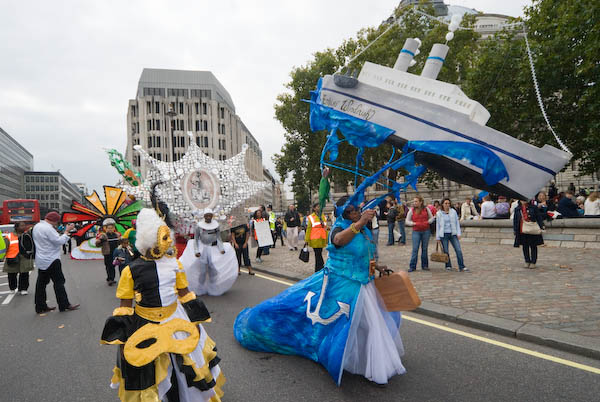
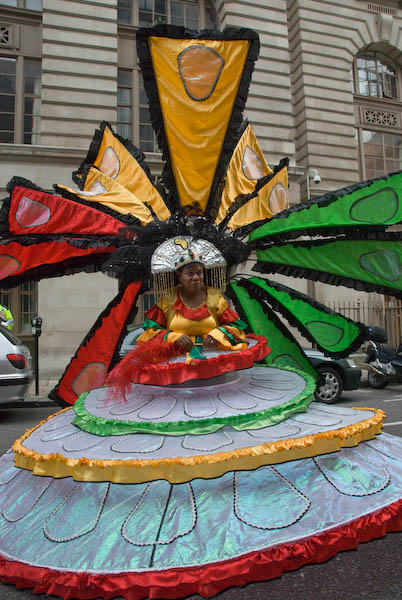
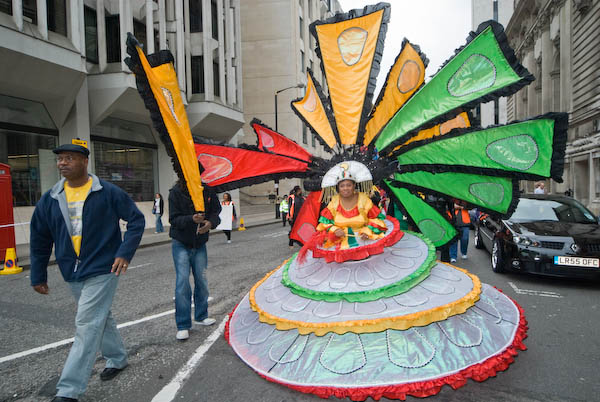
The Slave Trade Abolition Walk organised by Yaa Asantewaa & Carnival Village was only one of a number of events commemorating the abolition of the slave trade taking place in 2007, but was I think the most colourful. Yaa Asantewaa was named after the famous Queen Mother of Ejisu in the Ashanti Empire who led the Ashanti Kings in the War of the Golden Stool against British colonial rule in 1900 and was exiled to the Seychelles where she died in 1921.

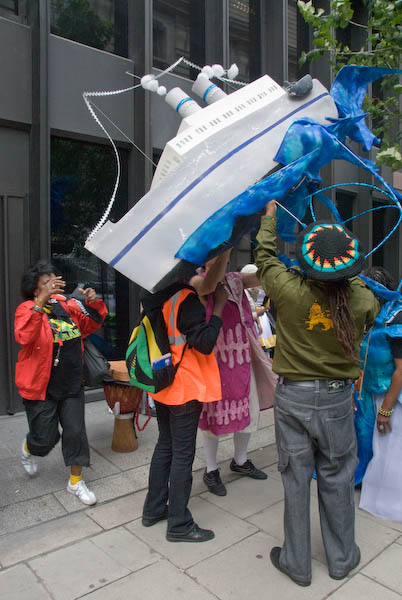
Among the costumes was one winner from Notting Hill, and a rather fine ‘Empire Windrush’ depicting the ship which brought the first large contingent of migrant workers from the Caribbean to England in 1948. They had been recruited to fill the gap in UK workers needed to restore the British economy after the war and came to a country where they met much racist discrimination, which more recently became government policy under the Windrush scandal, still continuing.

As of course is slavery. ‘Modern slavery’ is no less slavery than the slavery that was at the core of the British Empire and which provided the wealth that once made Britain ‘Great’.

Slave Trade Abolition Bicentenary Walk


FlickrFacebookMy London DiaryHull PhotosLea ValleyParis
London’s Industrial HeritageLondon Photos

All photographs on this page are copyright © Peter Marshall.
Contact me to buy prints or licence to reproduce.

Unite The Kingdom & Rejoin Europe – 28 Sep 2024

Unite The Kingdom & Rejoin Europe: Although I’m not covering as many protests as I used to I haven’t entirely given up covering them. But my priority at the moment is in digitising as much as possible of the photographs which I took on film before I moved to digital around 20 years ago.

Unite The Kingdom & Rejoin Europe

I think those images are a historical record of those times showing London in the latter years of the 20th century. You can see around 35,000 of them already on Flickr.

Unite The Kingdom & Rejoin Europe

But also I’m feeling my age, and get tired much more quickly; after spending two or three hours covering events I’m ready to go home. But still most weeks I try to get out at least one day covering protests, usually on Saturdays.

Unite The Kingdom & Rejoin Europe

Of course over the past year many of the protests I’ve photographed have been about the continuing events in Palestine. But last Saturday there were only a few small events related to this taking place – the next big protest comes this Saturday, 5th October, starting at 12 noon in Russell Square. Unfortunately I’ll miss that one as I’m away at a conference.

Unite The Kingdom & Rejoin Europe

I covered two events on Saturday 28th September, both unfortunately starting at noon, but one in Trafalgar Square and the other on Park Lane, around 2 kilometers to the west. Fortunately the journey by tube between the two is fairly fast.

I began taking pictures in Trafalgar Square, where Stand Up To Racism had called on its supporters to come to oppose a threatened far right racist protest which was to take place there.

The far right group was calling itself “Unite the Kingdom”, inspired by that phrase used by ‘Tommy Robinson’ at his protest in Trafalgar Square in July. He and his followers incite hate against migrants and asylum seekers, and their racist and Islamophobic rants were what led to the extreextreme right, right-wing, me right riots in Stockport, Birmingham, Hull and elsewhere – which tried to burn down buildings housing migrants.

There were a few short speeches and by the time I left Trafalgar Square half an hour or so later there were perhaps a little under two hundred people who had come to oppose the extreme right, with banners from various parts of London and a few from various organisations including GiK-DER Refugee Workers Cultural Association, and more were still arriving. But there was no sign of the extreme right protest.

The third annual grassroots National Rejoin March was a rather larger event, with several thousand people crowding around the area close to the Hilton Hotel, and I had time to take some pictures and talk to a few of the protesters before the march set off.

There is now a fairly large proportion – almost 50% of us – in the country who realise that leaving Europe was a huge mistake, while support for staying out is under 35%, and opinion polls in 2023 showed a hugely different result – around 70% to 15% – if a referendum was held then.Despite this there now seems very little chance that we would return into membership of the EU in the foreseeable future.

Singer Madeleina Kay, Young European Movement, with her guitar.

In England & Wales the Green Party, Plaid Cymru, and the Liberal Democrats want to rejoin, but the two major parties and Reform are committed to stay out. It may well have contributed to the success enjoyed by the Lib-Dems in the recent general election, and there seemed to be a strong presence at the protest from some of their stronger areas.

One of the main themes in the protest was that the question of rejoining Europe is the ‘elephant in the room’ of current British politics. Both Labour and Tories seem to believe that if the came out in favour of it would give the other party a huge boost.

This march seemed smaller than the previous two annual marches and it took less than ten minutes for the whole body of marchers to pass me as I stood on the street corner before rushing back to the tube to return to Trafalgar Square.

When I arrived there around a dozen ‘Unite The Kingdom’ protesters had arrived. Police had formed two lines on the North Terrace perhaps 50 yards apart separating them from the Stand Up to Racism supporters. Most of these had left with their banners leaving only a small fraction – still considerably outnumbering the racists. But police now seriously outnumbered both groups.

I took a few pictures, but couldn’t really be bothered – and it shows. But I think we are likely to see much larger numbers at future extreme right-wing protests than this disorganised damp squib.


FlickrFacebookMy London DiaryHull PhotosLea ValleyParis
London’s Industrial HeritageLondon Photos

All photographs on this page are copyright © Peter Marshall.
Contact me to buy prints or licence to reproduce.

No More Fur March – 2008

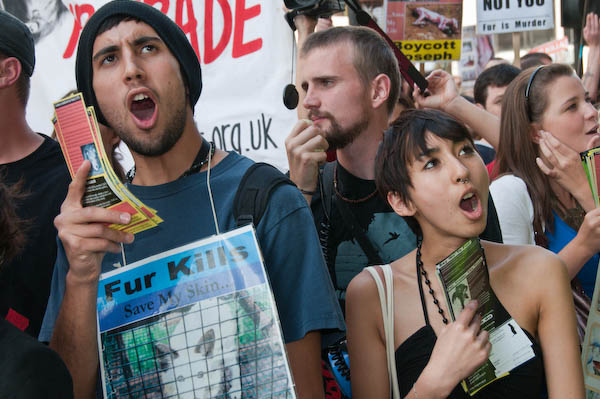
No More Fur March: Harrods has been getting a lot of attention in the media recently for the activities of its former owner, but on Saturday 27th September 2008 it was the destination of a march by the Campaign Against the Fur Trade.

No More Fur March

Shamefully you can still buy fur coats at Harrods, A ‘secret shopper’ filming for animal protection charity Humane Society International/UK who raised concerns was lied to in 2021 by sales staff wearing Harrods-branded name badges about the conditions in which the fur is farmed.
No More Fur March

Sales staff assured this customer that the foxes were kept in “separate rooms” with “enough space to play and everything“, and that they were “literally put to sleep” by injection when in practice they are confined in some farms in cages barely longer than their body length and anally electrocuted without any anaesthetic. The Harrods staff dismissed the many reports and videos of animals suffering in the fur trade as “only propaganda, madam“.
No More Fur March

You can find out more about the actual practices of fur farming with evidence on many pages acriss tge web, including on the Humane Society International web pages which also have information on the other ways animals are mistreated in research, farming and other areas.

No More Fur March

Fur farming was banned in the UK as ‘unethical‘ in 2000, but fur is still being imported into the UK from countries where fur farms raise and kill animals in desperately cruel conditions. Humane Society International has a letter you can sign to send Prime Minister Starmer calling on the UK government to end our association with fur cruelty for good and impose a fur import and sales ban.

Of course Harrods is not the only store still selling fur, and the march from Belgrave Square in 2008 also targeted other shops in Knightsbridge including “Gucci, Prada, Escada, Versace, Fendi, Joseph, Armani and Burberry” but in 2008 Harrods was the only department store in the UK still selling real fur.”

Since 2008 and despite many protests – as well as large events such as this there are smaller protests every weekend at Harrods and other shops selling fur – the sales of real fur in UK shops have continued.

Harvey Nicholls which had been fur-free since 2004 decided in 2014 to sell animal fur products again at its branches in London, Edinburgh, Manchester, Liverpool, Bristol, Dublin, Leeds and Birmingham and the largest national anti fur campaign for many years was been directed against them. In 2023 they finally announced that they were returning to their no-fur policy.

More at No More Fur March.


FlickrFacebookMy London DiaryHull PhotosLea ValleyParis
London’s Industrial HeritageLondon Photos

All photographs on this page are copyright © Peter Marshall.
Contact me to buy prints or licence to reproduce.