The Elephant, Sewol and Brexiteers

The Elephant, Sewol and Brexiteers
Saturday 13th April 2019 in London, three years ago seems very distant to me now.


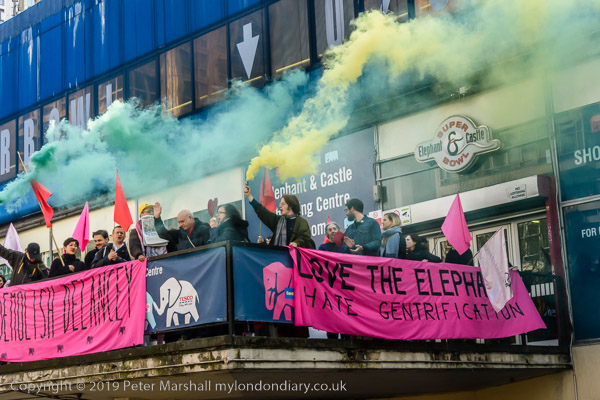
Love the Elephant, Elephant & Castle, London
The Elephant, Sewol and Brexiteers

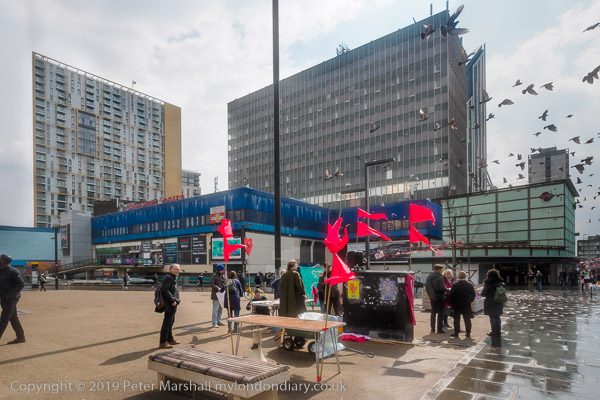
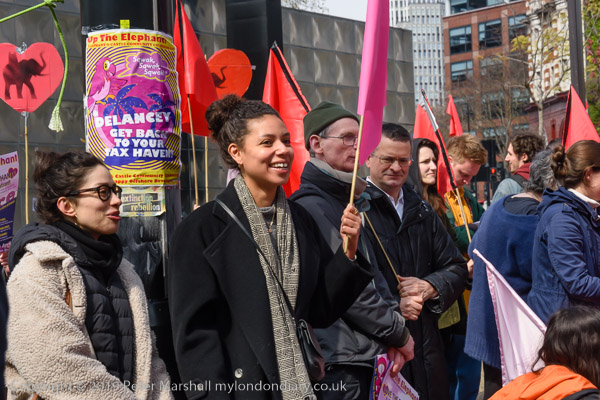
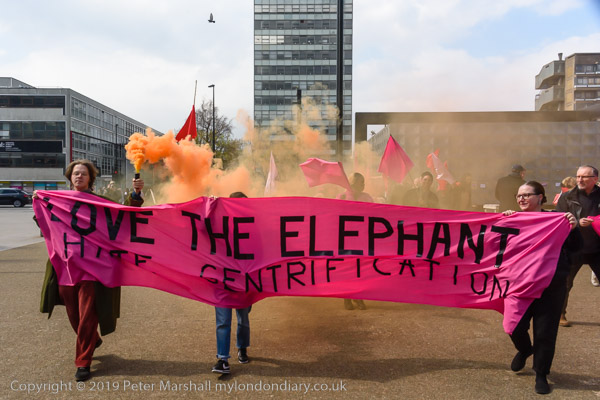
The main event I covered on the day was at the Elephant & Castle shopping centre in south London, where local people and supporters were calling on Southwark Council and developers Delancey to improve the plans for the redevelopment of the area.
The Elephant, Sewol and Brexiteers

The campaigners main banner had the message ‘LOVE THE ELEPHANT – HATE GENTRIFICATION’ and this is an area that epitomises the changes that have been taking place in many of London’s poorer areas for many years now. Traditionally working class South London, this area has been at the centre of major demolitions of large council estates and their replacement largely by expensive high rise blocks at market rents with a nominal amount of so-called ‘affordable’ and miniscule amounts of truly social housing.
The Elephant, Sewol and Brexiteers

Immediately to the east of the shopping centre had been the award-winning Heygate Estate, completed in 1974, once popular for its light and spacious flats, but long subjected to a process of managed decline by Southwark Council who even employed PR consultants to emphasise a negative view of the estate, together putting together what the estate’s architect Tim Tinker described in 2013 as a “farrago of half-truths and lies put together by people who should have known better.” The council deliberately used parts of it in the latter years to house people with mental health and other problems, and as temporary accommodation. I photographed the estate on several occasions, most recently on a tour by residents opposed to the redevelopment of both the Heygate and the neighbouring Aylesbury Esate in 2012, Walking the Rip-Off.
The Heygate estate had a mixture of properties with large blocks of flats on its edges and contained 1,214 homes, all initially social housing, though many were later purchased by residents who became leaseholders. It’s replacement, Elephant Park is far less well planned but according to Wikipedia will “provide 2,704 new homes, of which 82 will be social rented. The demolition cost approximately £15 million, with an additional £44m spent on emptying the estate and a further £21.5 million spent on progressing its redevelopment.” The council sold the estate to the developers at a huge loss for £50m.
Many of the flats on Elephant Park were sold overseas as investment properties, the continuing increases in London property prices making these a very attractive holding. The new estate will also provide housing for those on high salaries in London, with a railway station and two underground lines providing excellent transport links for professionals working elsewhere in the city. Those who previously lived and owned properties on the Heygate have had to move much further from the centre of the city, some many miles away.
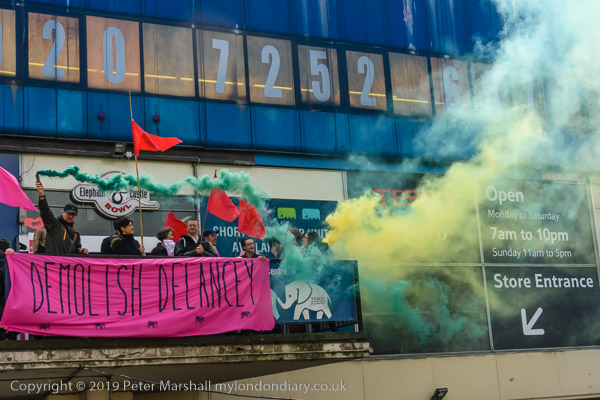
The Elephant & Castle Shopping Centre, was opened in 1965 on the site of the 1898 Elephant & Castle Estate which had been badly damaged by wartime bombing, and was the first purpose-built shopping centre in the UK and certainly one of the first in Europe. Many of its 115 shops were then owned by local traders.
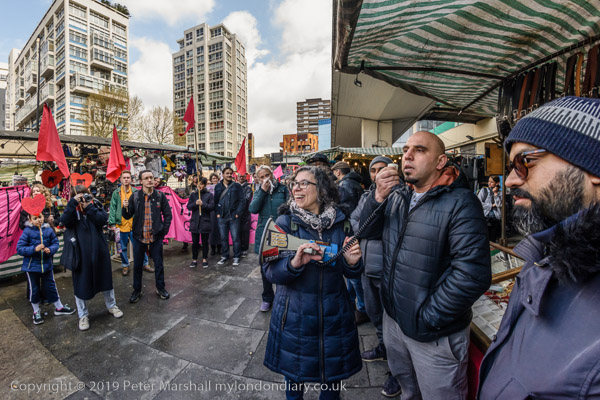
A market trader speaks about the poor deal they are getting

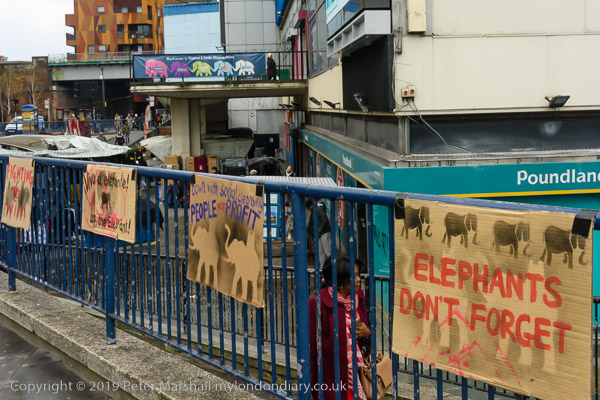
The rally and procession by Southwark Notes, Latin Elephant and Up the Elephant at the Elephant & Castle called on Southwark Council and the developers Delancey to develop the Elephant for the existing population and users, rather than as social cleansing to attract new, wealthier residents and shoppers. They would like to see a development that retains the existing character of the area which has become very much a centre for South London’s Latin community many of whom live in the surrounding area. It became the most diverse and cosmopolitan shopping centre in London, with also other amenities such as a bowling alley and bingo hall, serving the population of the area.
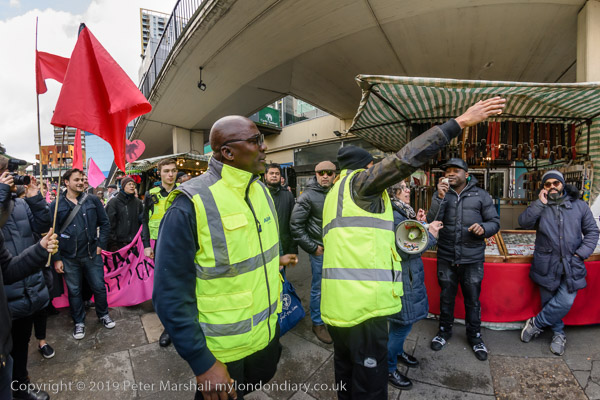
Security officers order the campaigners out of the market area

They say the development should include more social housing and call for fairer treatment of the market traders, who should be provided with ‘like for like’ new spaces at affordable rents and be given adequate financial compensation for the disruption in business the development will cause.

A long series of protests in which locals were joined by students from the London College of Communication whose new building forms a part of the redevelopment did lead to some minor improvements to the scheme by the developers, but the shopping centre closed in September 2020 and demolition went ahead and was complete around a year later. The new development will include high-rent shops, almost certainly mainly parts of major chains, expensive restaurants and bars and plenty of luxury flats, along with a small amount of “affordable” housing.


Sewol Ferry Disaster 5 years on – Trafalgar Square
The Elephant, Sewol and Brexiteers

The good transport links that make the Elephant so attractive to developers also took me rapidly into the centre of London as the procession of protest there came to and end, although events there were continuing all afternoon – only four stops taking 6 minutes on the Bakerloo Line to Charing Cross.
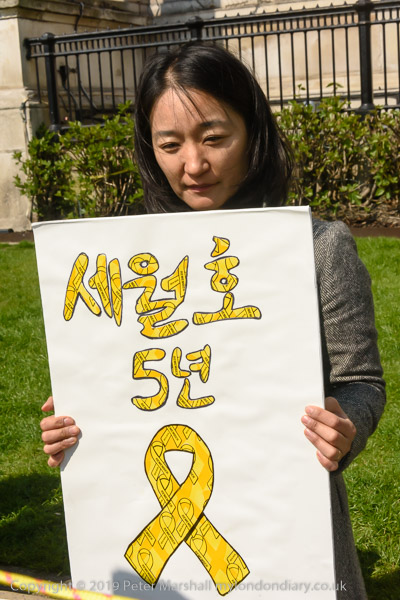
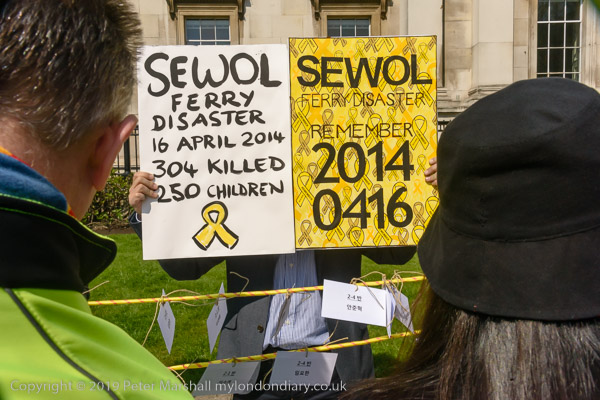
I’ve photographed the small monthly vigils by campaigners in remembrance of the victims and in support of their families of the 304 people who died in the Sewol Ferry Disaster of 16 April 2014 on a number of occasions, though its always difficult to find anything new to say, either in words or pictures.

But this was a special event, the fifth anniversary of the disaster, and the 60th 60th monthly vigil. Campaigners continue to call for a full inquiry, the recovery of all bodies of victims, punishment for those responsible and new laws to prevent another similar disaster. They tie cards on lines with the class and name of the 250 high school children who were drowned after being told to ‘stay put below deck’.


Brexiteers march at Westminster – Westminster Bridge
The Elephant, Sewol and Brexiteers

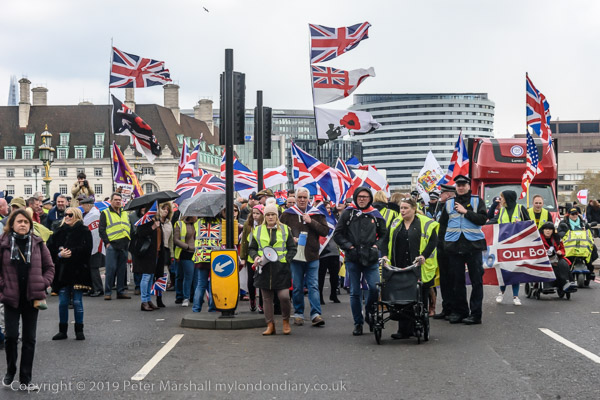
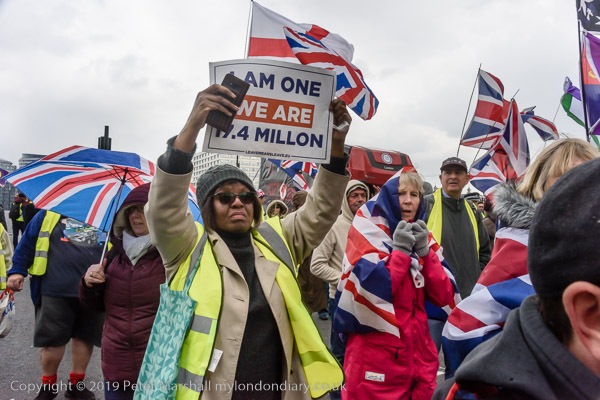
Brexiteers were continuing to march weekly around London holding Union Jacks, St George’s flags and placards and many wearing yellow high-viz jackets because although there had been a small majority in favour of leaving Europe in the 2016 referendum, Parliament had not found a way to get a majority to pass the legislation needed. It was this indecision that led to a resounding victory for Boris Johnson in the 2019 election in December, though unfortunately his ‘oven-ready’ agreement has turned out to be extremely half-baked and most of the things dismissed by Brexiteers as scaremongering have turned out to be true, while the promises made by the Leave campaign have so far largely failed to materialise and most seem unlikely ever to do so.
Johnson’s deal – important parts of which he seems not to have understood, particularly over the Irish border arrangements has left us in the worst of all possible worlds, though it has made some of his wealthy friends – including some cabinet members – considerably wealthier and protected them from the threat of European legislation that would have outlawed some of their tax avoidance. Back in 2019 I commented “We were sold the impossible, and things were made worse by a government that thought it could play poker when what was needed was a serious attempt at finding a solution to the problems that both the UK and Europe face.”
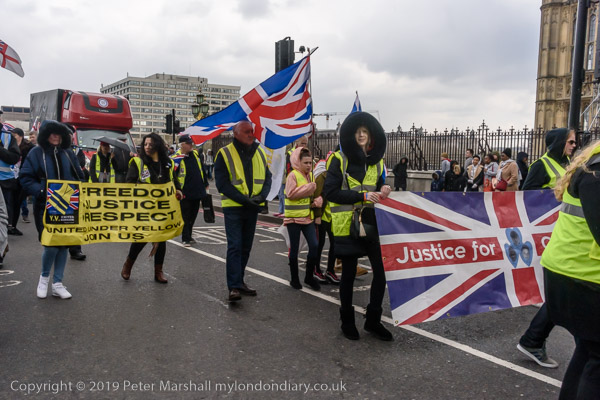
The protesters were also protesting with flags and banners supporting members of the armed forces against their trial for killings in Northern Ireland and for the Islamophobic campaign ‘Our Boys’ which seeks to have a drunk driver of Hindu origin who killed three young men prosecuted as a terrorist.
Harmondsworth – A Middlesex Village

Harmondsworth – A Middlesex Village

Harmondsworth - A Middlesex Village

Going back to Harmondsworth feels very much like going back to my childhood as I grew up only a few miles away and lived for years on a bicycle cycling out from Hounslow and along country lanes through villages like this on the edges of London, before the M25 and M4 chopped up the country around here and the growing airport at Heathrow produced both sprawling new housing estates and a huge increase in traffic in the area.

Harmondsworth - A Middlesex Village

From 2003 to 2009 I took part in the protests against the plans to build another huge runway for Heathrow, which now only uses two though it was built with more on its existing site. The shorter runways were abandoned partly because planes grew larger. I was very pleased when one closed as on the few days a year when there were strong cross-winds it brought planes at low heights over my current home a couple of miles away, sometimes low enough to shake the whole building. I think building Terminal 4 which opened in 1986 put an end to its use.

Harmondsworth - A Middlesex Village
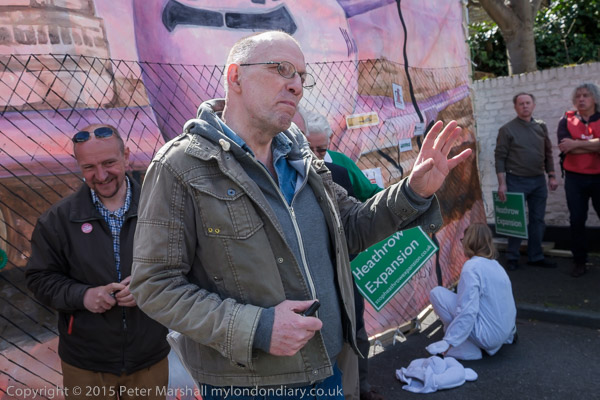
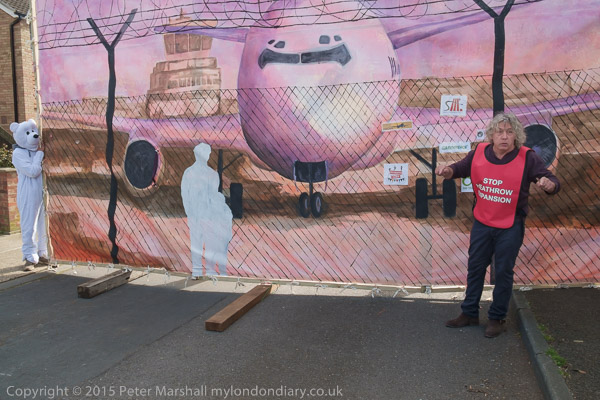
A mural across where the airport would end

We celebrated in 2009 when plans for a third runway were dropped, but the lobbyists for Heathrow expansion didn’t take no for an answer and persuaded the coalition government to set up the Davis Commission to put the plans back on the table again. The protest in Harmondsworth on Sunday 12th April 2015 was before the report came out, but its conclusion was predictable – and the one it had been set up to come to.

John Stewart of HACAN

Since then and the government’s acceptance of the case it made for expanding Heathrow, the world has changed, or at least our understanding of the future has. The case for airport expansion has disappeared and we now know that we have to have rapid decarbonisation of the economy to survive. Instead of looking forward to exponential growth we need to find ways to stabilise and reduce demand and aviation is one of the most climate-damaging sectors.

While Davis took as its basis that expansion is necessary to continue growth, it is now clear that expansion would be a disaster. At last I think that message is beginning to get through to our government, though too often it is still thinking in terms of short-term financial benefits to the pockets of its members and their friends.

Harmondsworth - A Middlesex Village

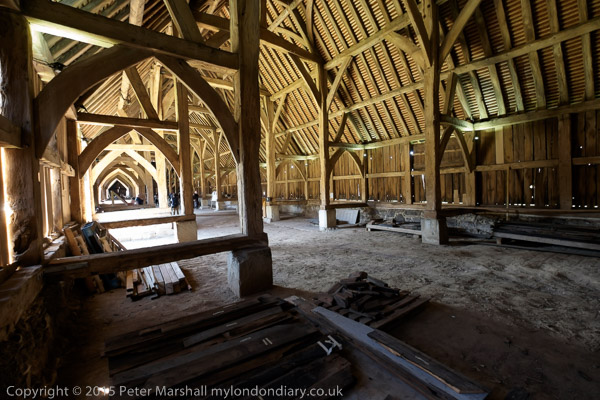
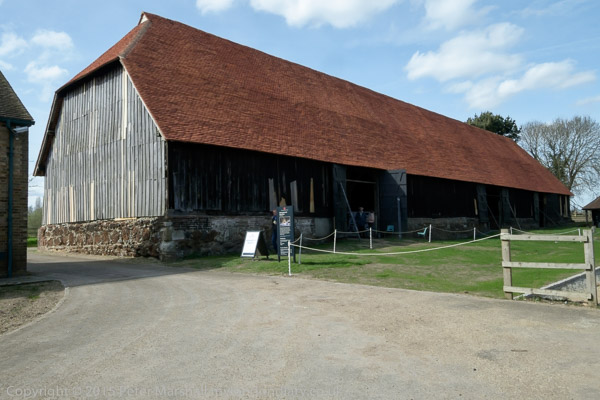
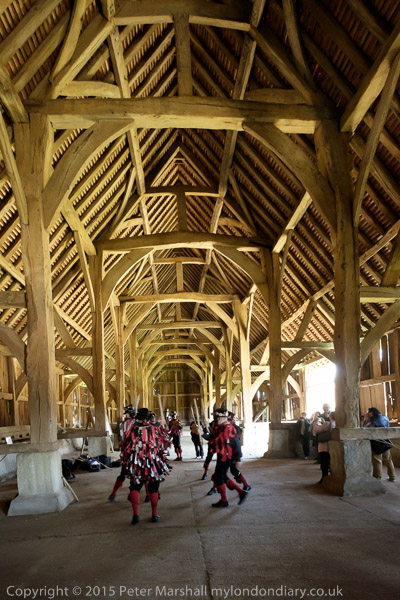
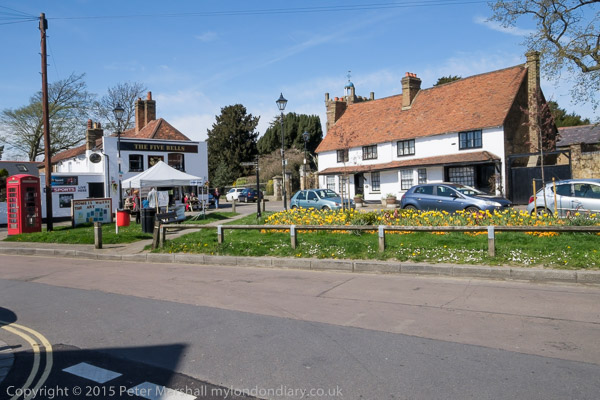
Harmondsworth is still one of the most interesting of the small villages on the fringes of London, with a fine church in its churchyard, and although its village green is a pocket handkerchief compared to many it still has a couple of pubs and some picturesque cottages along its north side. But the real gem of the village is tucked away immediately to the left, its magnificent Grade 1 listed Great Barn, built in 1426 , the largest surviving example all-timber barn which Sir John Betjeman called ‘the Cathedral of Middlesex’.

Harmondsworth - A Middlesex Village

In agricultural use until the 1980s, it was then allowed to decay until a public campaign strongly supported by the local MP John McDonnell persuaded English Heritage to take it over in 2012. They carried out a substantial restoration leading to it being re-opened to the public free of charge on selected days and it is managed by the Friends of the Great Barn at Harmondsworth. My pictures of the barn are not available for any editorial or commercial use.

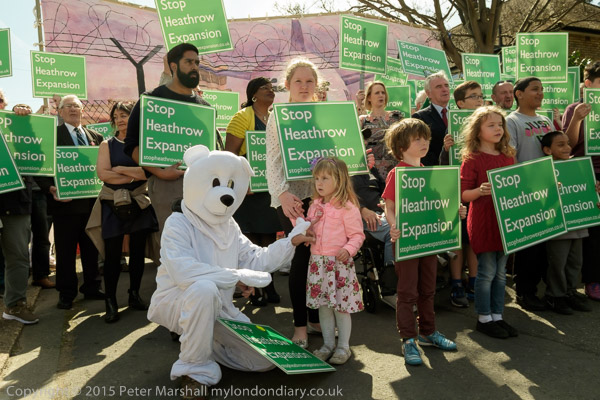
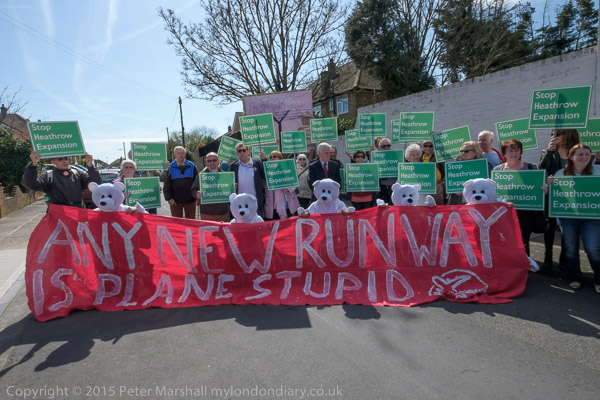
On the 12th April 2015, the Datchet Border Morris were dancing inside the barn and around the village green during the day. The campaign to save the village (again!) was launched with a huge mural and speeches from all but one of the candidates standing for the area in the general election the following month. The Lib-Dem candidate also supported the campaign but had been sent the wrong date for the rally. Also present were campaigner John Stewart of HACAN, and five polar bears who had held a protest a few weeks earlier with the banner ‘Any New Runway Is Plane Stupid‘.

Harmondsworth - A Middlesex Village

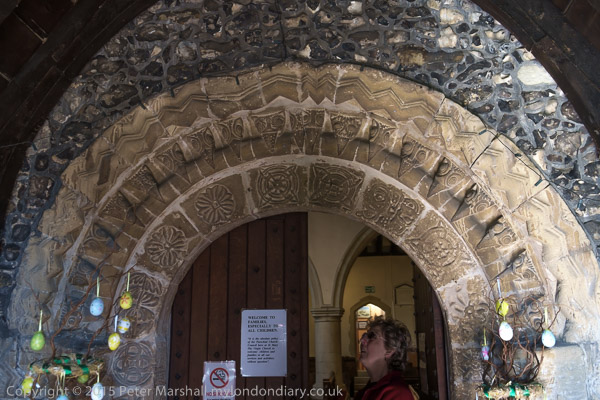
The weather was fine and it was an interesting day – and warm enough for me to sit outside and eat a quick lunch in the garden of the Five Bells, before rushing to photograph the Morris performing again outside The Crown. And before leaving for home I went to take another look around the interior of the parish church, parts of which date from the 12th century.

More at Heathrow Villages fight for survival.


Old Ford, Hertford Union & Hackney

Old Ford, Hertford Union & Hackney

Gunmakers Lane, Hertford Union, canal, Old Ford, Tower Hamlets, 1988 88-8am-33-Edit_2400
Gunmakers Lane, Hertford Union, canal, Old Ford, Tower Hamlets, 1988 88-8am-33

The short street which goes across the canal on Three Colts Bridge probably got its name from the pub, the Gunmakers Arms, which stood opposite it 438 Old Ford Road on the west side of St Stephens Road – and perhaps there were once some guns made nearby. In April 1915 the pub was taken over by the East London Federation of Suffragettes, led by Sylvia Pankhurst, a more militant and working class breakaway from Women’s Social and Political Union who turned it into a day nursery and clinic.

The Connaught Works here on Old Ford Road was a furniture factory and is said to date from the 1920’s though it looks earlier and was extended to the east around 20 years later.

Gunmakers Lane, Hertford Union, canal, Old Ford, Tower Hamlets, 1988  88-8am-34-Edit_2400
Three Colt Bridge, Gunmakers Lane, Hertford Union, canal, Old Ford, Tower Hamlets, 1988 88-8am-34

This early 19th century cast iron bridge presumably dates from the building of the Hertford Union Canal which opened in 1830. It is Grade II* listed Scheduled Ancient Monument. A pub, the Old Three Colts, was close by at 450 Old Ford Rd from 1792 or earlier but was I think demolished a few years after WW2. St Stephens Road used to be called Three Colts Street, possibly because this pub was more or less at its end.

Victoria park Rd, Homerton, Hackney, 1988 88-8am-35-Edit_2400
Victoria park Rd, Homerton, Hackney, 1988 88-8am-35

The Three Colts Bridge leads to the Gunmakers Gate of Victoria Park, and I walked across the park to Victoria Park Road. This gothic fantasy of a building is now the Mossbourne Victoria Park Academy but was built in 1864-5 by Robert Lewis Roumieu as a French Protestant Hospital by a Huguenot charity, La Providence, who had decided to move out of earlier almshouses and hospital in Finsbury to a larger and more rural site here.

After WWII, La Providence moved to Rochester, selling the building to Roman Catholic nuns, the Faithful Companions of Jesus, and it reopened as the St Victoire Convent Girls’ Grammar School. When I made this picture it had become Cardinal Pole RC School and in 2014 was sold to be an academy school. The building is Grade II* listed.

Terrace Rd, Church Crescent, South Hackney, Hackney, 1988 88-8am-21-Edit_2400
Terrace Rd, Church Crescent, South Hackney, Hackney, 1988 88-8am-21

These Tudor-style group of cottages are thought to have been built in 1847-8 to designs by George Wales who was the architect of Monger’s almshouses further down Church Crescent. The other houses between the two sites are more classical in design but also thought to be by Wales.

They are Grade II listed and still there and look now rather neater, with the middle property of the Tudor three having had its brickwork cleaned and looking considerably brighter. It also appears to lack the variation in colour of the darker brickwork which I find more attractive, though perhaps it looks more like when it was newly built.

Terrace, Cassland Rd, Hackney, 1988 88-8am-25-Edit_2400
Hackney Terrace, Cassland Rd, Hackney, 1988 88-8am-25

This remarkable terrace at 20-54 Cassland Road overlooking Cassland Crescent is Grade II listed and was built from 1794 using funding from subscribers who made monthly payments over a period of four years, with the houses being allotted by ballot to a subscriber as each was built. All 18 were completed and occupied by 1801. This kind of co-operative funding of a development predates the earliest more conventional building societies.

James Taylor, gallery, Collent St, Hackney, 1988 88-8am-26-Edit_2400
James Taylor, gallery, Collent St, Hackney, 1988 88-8am-26

The James Taylor warehouse was built in 1893 in Collent Road, which was described by the James Taylor gallery as “Formerly a Victorian factory, china warehouse, squat and film location.” Around ten years ago it was transformed with the facade and front building on the site being retained, along with a long wall along the north almost to Cresset Road as a part of a complex redevelopment with up to 10 storeys containing 69 flats, office space and an underground car park.

I made a few more exposures around Well St and I think my walk probably ended on neaby Mare Street, where I photographed the Crown pub (not online) and then probably caught a train from Hackney Central.


Clicking on any of the pictures will take you to a larger version in my album 1988 London Photos, from where you can browse other images in the album.


Old Ford, Middlesex Filter Beds & Hertford Union

After my stay in Paris in August 1988 I was back in London and managed to fit in one more walk before the end of the month, starting from where I had finished one of my previous walks in Bethnal Green.

Old Ford Rd, Old Ford, Tower Hamlets, 1988 88-8am-66-Edit_2400
Old Ford Rd, Old Ford, Tower Hamlets, 1988 88-8am-66

Old Ford Road runs parallel to Roman Road but a couple of hundred yards to the north, and almost certainly follows the real Roman route to the east out of London, fording the River Lea somewhere close to where the Northern Outfall Sewer (The Greenway) now crosses. The river here is a part of the Lea Navigation and now very much more constrained between banks than it once was, though then it will still have been tidal here.

There was a route here even before the Romans, leading along the way of modern Oxford St and Old Street to Bethnal Green and Old Ford and then continuing through what were then marshes to Wanstead Slip north of Stratford and on the Colchester.

There are long stretches of Victorian houses as well as modern flats along Old Ford Road, but the house at the left of this picture is No 218, and is a terrace beginning with 196 and ending at 224 a little to the west of the bridge over the Regent’s Canal and immediately north of the Cranbrook estate.

Roman Rd, Bethnal Green, Tower Hamlets, 1988 88-8am-52-Edit_2400
Roman Rd, Bethnal Green, Tower Hamlets, 1988 88-8am-52

I wasn’t sure what to make of this establishment on Roman Road, which seemed to be both a Patisserie and Bar, offering Light Lunches & Coffee, as well as catering for all functions, with rather curious window decoration and an odd bit of statuary in its entrance.

Middlesex FIlter Beds, Lea Bridge, Waltham Forest, 1988 88-8am-42-Edit_2400
Middlesex Filter Beds, Lea Bridge, Waltham Forest, 1988 88-8am-42

I did a lot more walking without taking many photographs, going south down Usher Road and then going east to cross the East Cross Route on Wick Lane before joining the towpath on the opposite bank of the Lea Navigation to get to the Middlesex Filter Beds at the north corner of the Hackney Marshes – something over 2 miles before I took the next black and white pictures in what had been turned into a nature reserve.

The filter beds were built in the early nineteenth century to combat cholera in London by providing clean drinking water which was still killing thousands but were unable to cope with the increasing population and were finally closed in 1969, left to become a nature reserve. I think they may have recently been made open to the public when I made this short visit. Going back more recently they seem to have been made a little less overgrown than they had become over the 19 years since they were abandoned. This image seems to me the more interesting of the five frames that I took – film was still expensive.

Lea Navigation, Eastway,  Hackney Wick, Hackney, 1988 88-8am-45-Edit_2400
Lea Navigation, Eastway, Hackney Wick, Hackney, 1988 88-8am-45

Walking back south along the towpath I made three exposures of this derelict building with its broken windows and the reflection in the canal by the Eastway Bridge. I probably took few pictures on this part of the walk as I had photographed fairly extensively along the Lea a few years earlier – some pictures you can see in the book ‘Before the Olympics‘ which has images from the source to the Thames.

Hertford Union, canal, Old Ford, Tower Hamlets, 1988 88-8am-46-Edit_2400
Hertford Union, canal, Old Ford, Tower Hamlets, 1988 88-8am-26

At Hackney Wick I crossed the bridge and took the towpath beside the Herrtford Union Canal, a short section joining the Lea Navigation to the Regent’s Canal. Then there were still a number of canal wharves, mainly for timber, though it was a few years since commercial traffic here had ended.

Hertford Union, canal, Old Ford, Tower Hamlets, 1988  88-8am-32-Edit_2400
Hertford Union, canal, Old Ford, Tower Hamlets, 1988 88-8am-32

Another view of the same wharf, and one of the lorries which now served them rather than canal boats. The Challenge, owned by the Docklands Canal Boat Trust, a registered charity formed in 1985 that provides boating holidays and day trips for people with disabilities, is a specially built boat for the purpose – and it was a challenge to get the money to build it. Still in operation it is now based on the Lea at Clapton.

Hertford Union, canal, Hackney Wick, Tower Hamlets, 1988  88-8am-31-Edit_2400

Hertford Union, canal, Hackney Wick, Tower Hamlets, 1988 88-8am-31

There was still plenty of timber along this stretch of the canal.

More from the end of this walk in a later post. You can see a larger version of any of these pictures by clicking on them which will take you to my album 1988 London Photos.


Libraries, Cameron, Grand National, Abortion & Colombia

Libraries, Cameron, Grand National, Abortion & Colombia – Saturday 9th of April 2016 was a busy day for me photographing protests across London.

Libraries, Cameron, Grand National, Abortion & Colombia

Lambeth Libraries Occupation and March, Herne Hill

Libraries, Cameron, Grand National, Abortion & Colombia

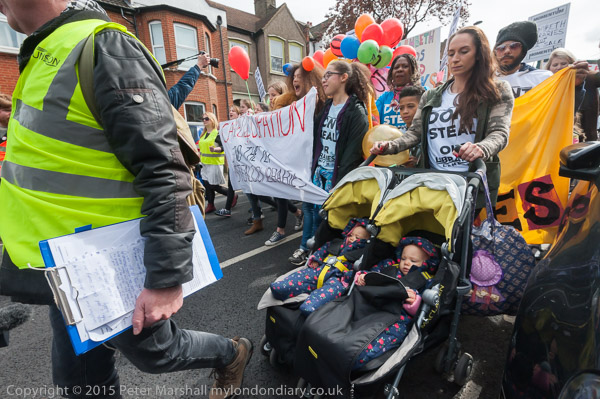
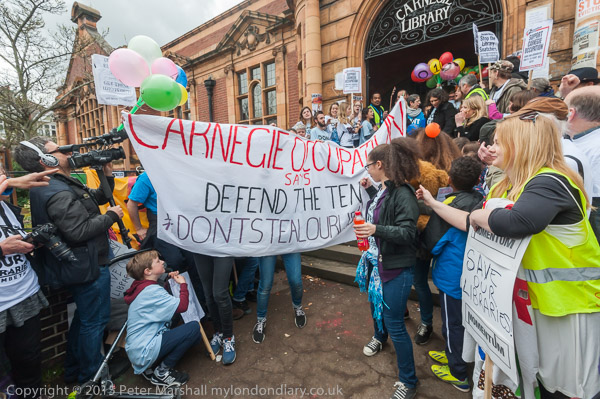
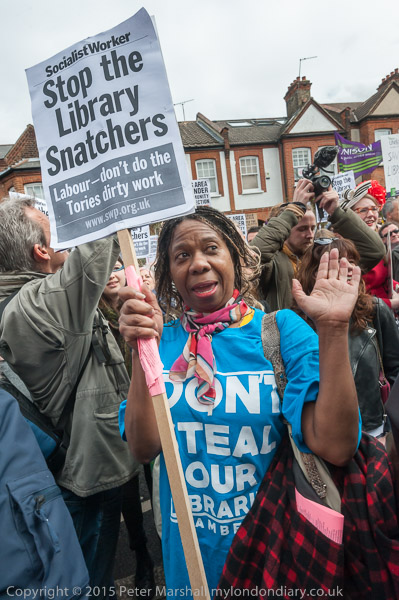
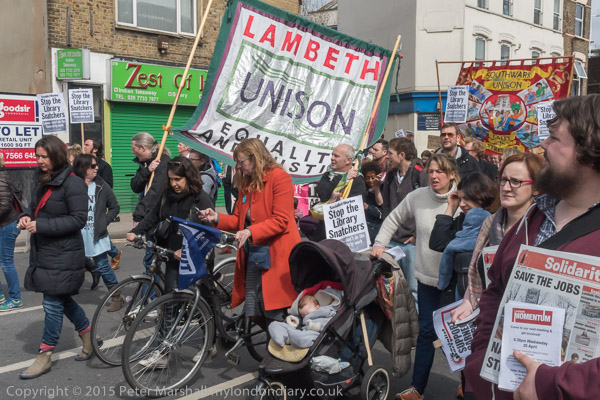
My day began in Herne Hill in South London, where campaigners had been occupying the Carnegie Library since March 31st fighting Lambeth council’s plans to turn the building into a fee-charging gym run by Greenwich Leisure Ltd with an just unstaffed lounge with books. They emerged to a huge welcome from over a thousand campaigners after their occupation had given the campaign national news coverage and huge support from around the country.

Libraries, Cameron, Grand National, Abortion & Colombia

The came out to lead a march to save all of Lambeth’s Libraries after they had been forced to leave by an injunction obtained by Lambeth Council. The march was going via the Minet Library, also closed by the council on 31st March to a rally opposite the town hall in Brixton.

Libraries, Cameron, Grand National, Abortion & Colombia

I left the marchers to take a train from Loughborough Junction back to the centre of London.

Carnegie Library Occupation Ends
March to Save Lambeth’s Libraries


Cameron must go! Downing St

Libraries, Cameron, Grand National, Abortion & Colombia

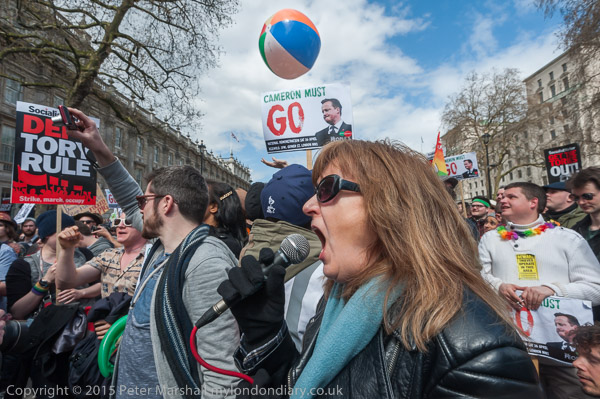
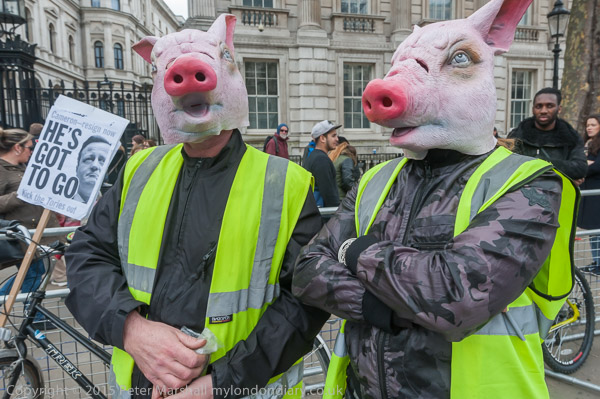
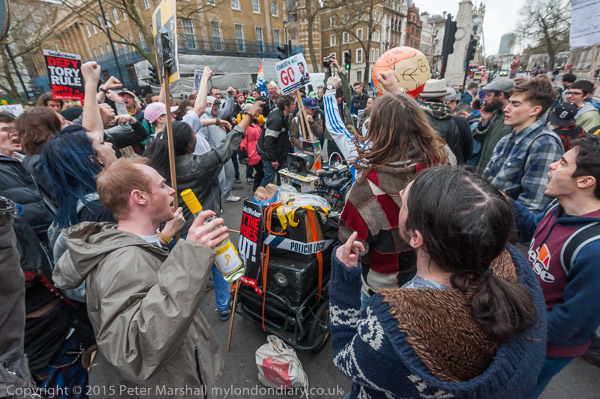
When I arrived, a large and lively protest outside the gates of Downing St was blocking traffic in Whitehall calling on Cameron to resign because of the lack of trust about his financial affairs following the revelations in the Panama papers.

Libraries, Cameron, Grand National, Abortion & Colombia

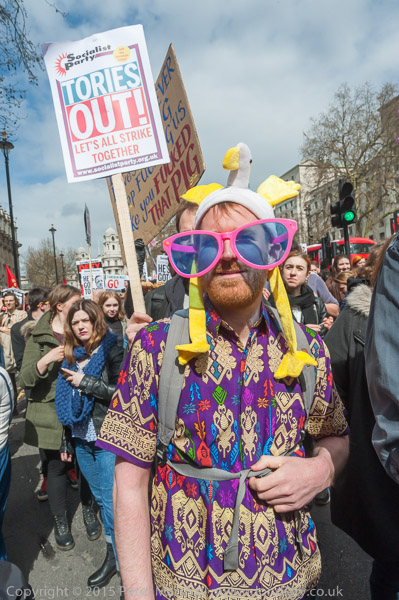
Many protesters had come in party mode, with flowered garlands, Panama hats and suitably Central American dress and some with placards and posters referring to Cameron’s pig-related activities.

Cameron must go!


Stop Grand National horse slaughter, Channel 4, Horseferry Rd

Libraries, Cameron, Grand National, Abortion & Colombia

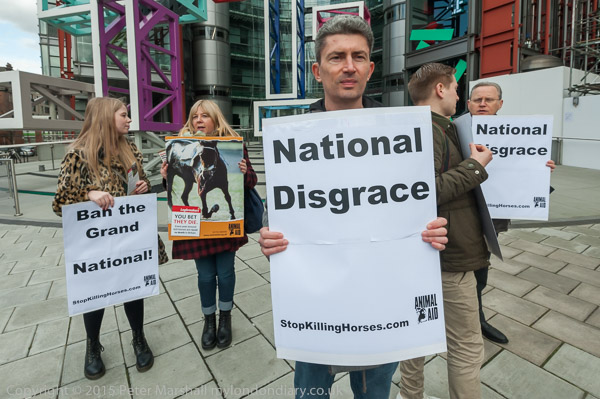
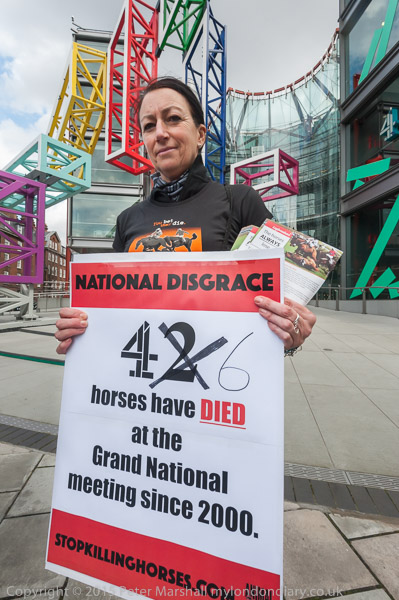
I left Whitehall where the party was still continuing outside Downing Street and walked to Channel 4’s London HQ, where a small group was protesting the cruelty to horses involved in the Grand National and other similar races. Already 4 horses had been killed that year in the current race meeting at Aintree, and at least 46 following accidents at the annual meeting there since 2000.

Libraries, Cameron, Grand National, Abortion & Colombia

Race horses seldom if ever actually die from the accidents, but a broken leg makes them worthless and rather than spending money on keeping them alive they are killed.

Stop Grand National horse slaughter


Don’t Criminalise Abortion in Poland, Polish Embassy

Libraries, Cameron, Grand National, Abortion & Colombia

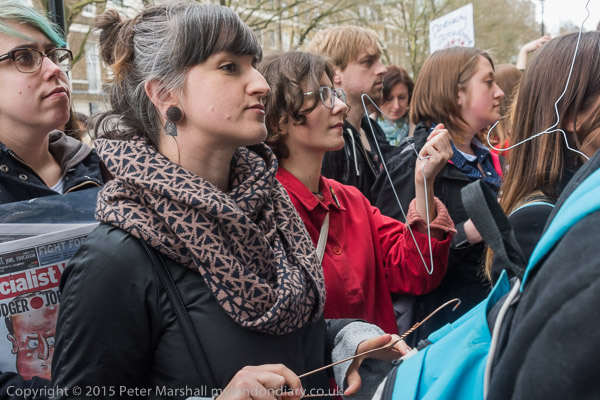
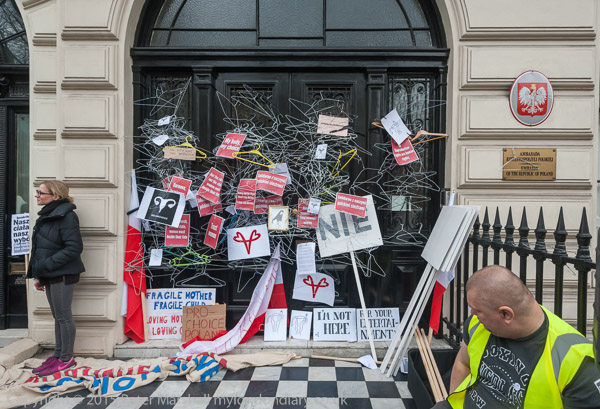
From Horseferry Road where the protesters told me more people were coming to join the protest I took the tube to Oxford St and rushed up Regent St and Portland Place to the Polish Embassy, where a crowd of several hundred Poles and supporters were supporting large protests in Poland against the bill proposed by the Law and Justice Party (PiS) which will outlaw abortion in all cases, protecting the life of the unborn child even where this may cause extreme distress or even death for the mother.

Libraries, Cameron, Grand National, Abortion & Colombia

At the end of the protest they hung wire coat-hangers, a traditional crude tool of back-street abortionists, on the embassy door and fence.

Don’t Criminalise Abortion in Poland


Party against Cameron, Downing St

Libraries, Cameron, Grand National, Abortion & Colombia

I took the tube back to Charing Cross and walked down to Downing Street and the party which had begun before lunchtime was still going on there at 4pm, though most of the people had gone home.

Libraries, Cameron, Grand National, Abortion & Colombia

They were still blocking the side of Whitehall next to Downing Street and there was dancing on the street to a sound system and it was more of a street party. Police were still standing back and watching but seemed to be making no attempt to clear the street.

Party against Cameron


End Killings in Colombia, Trafalgar Square

Libraries, Cameron, Grand National, Abortion & Colombia

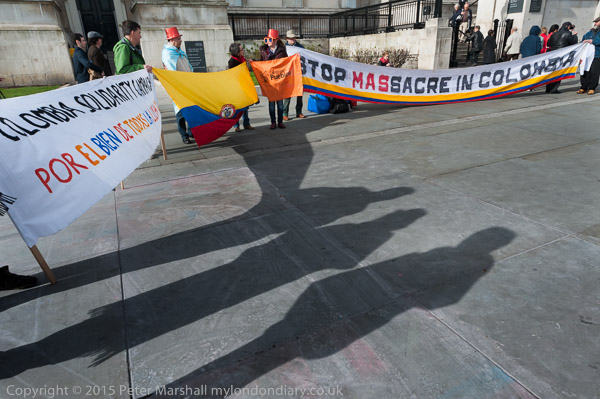
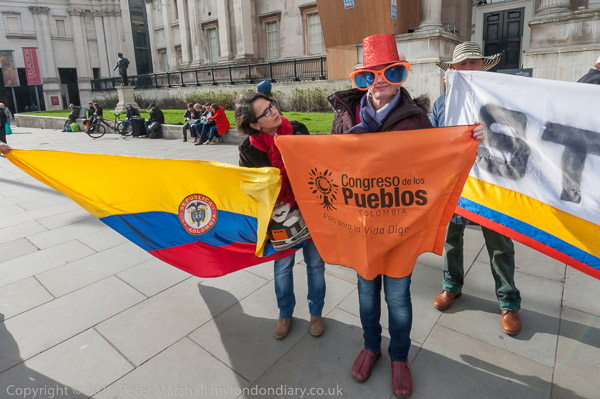
In Trafalgar Square an emergency protest was taking place on the North Terrace against the massacres in Colombia, organised by the UK Congreso de los Pueblos and Marcha Patriotica supported by the Colombia Solidarity Campaign. The protest was held in solidarity with those taking place that day in Colombia against political persecution and calling for an end to paramilitary killings. They want peace, human rights and democracy in Colombia.

Libraries, Cameron, Grand National, Abortion & Colombia

It’s sometimes difficult to understand what is happening in Colombia – as in some other foreign countries. Our news media seldom report fully and often take a very biased view, relying on reports reflecting only the views of big business, the wealthy classes and US propaganda. Here’s what I wrote about the situation:

Conservative opposition politicians led by former president Alvaro Uribe have protested against ongoing peace talks with leftist rebel groups by President Juan Manuel Santos. Uribe is opposed to talks with FARC and the ELN. If there was a peace agreement there could be investigations of the various human rights abuses and corruption scandals that took place while he was in power. The conservative protest follows earlier protests last month by mainly left and rural Colombians in support of Santos and the peace talks.

End Killings in Colombia

I was tired and it was time to go home.


End Killings in Colombia
Party against Cameron
Don’t Criminalise Abortion in Poland
Stop Grand National horse slaughter
Cameron must go!
March to Save Lambeth’s Libraries
Carnegie Library Occupation Ends


Paris, August 1988

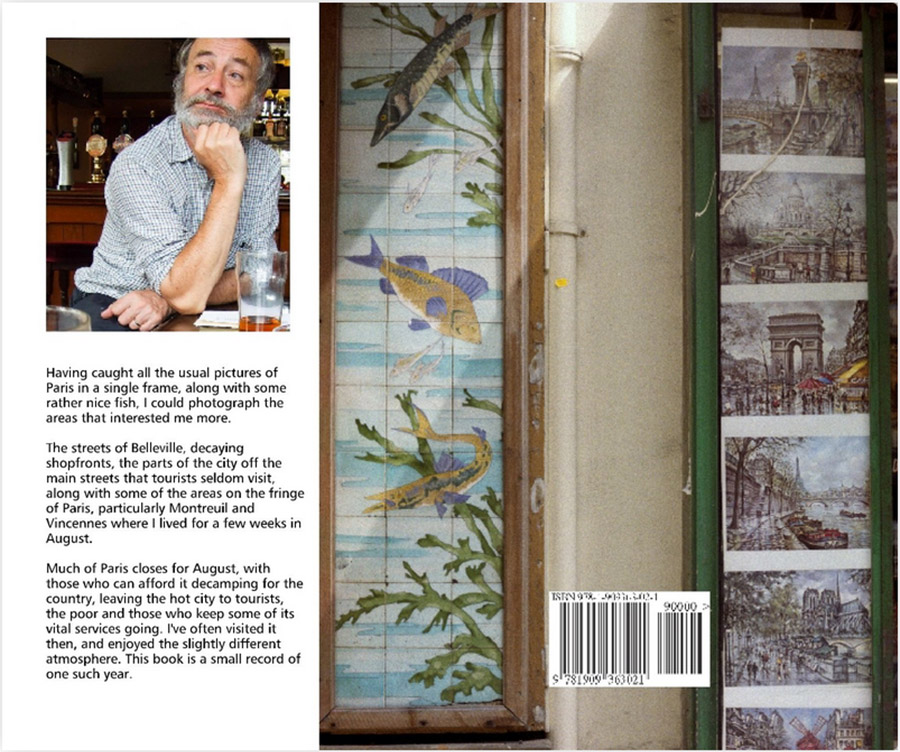
Paris, August 1988. Most of August 1988 I spent in Paris with my family, although I rather deserted them at times to go out in long walks through the city on my own. But some of them do appear on quite a few of the roughly 1500 pictures I took.

La France, Paris, 2e, 2nd, 1988 88-8u-21-Edit_2400
La France, Paris, 2e, 1988 88-8u-21

Back in November 2020 I posted here Montreuil, Paris which told a little about our stay in a flat in Montreuil on the east edge of the city, and where “Most days I went out for a walk before breakfast to buy bread and sometimes croissants, often with one of my sons, and always with a camera. Many of the bakers were closed for August and others took it in turns to be open for a week, making some of these walks a little longer, and I often diverted down streets that looked interesting.”

Montmartre, Paris 1988 88-8m-22-Edit_2400

As I also mentioned there, almost the first thing we did after arriving was to get photographs of our two sons at a photobooth so we could get their ‘Carte Orange’ and then buy weekly tickets for the Metro system – as I commented at ” little more than the cost of a day travelcard in London.” We made good use of those tickets, travelling around Paris and its outskirts as you can see from the album Around Paris 1988.

Saint-Denis,  Seine-Saint-Denis, Paris, 1988 88-8x-32a-Edit_2400
Saint-Denis, Seine-Saint-Denis, Paris, 1988 88-8x-32

The final sentence of my post in 2020 ended by saying I would feature more of the pictures in some later posts, but I don’t think I’ve ever got around to it. Nor have I put together a book from these images taken in 1988, though I there is one of the colour images I made, Photo Paris 1988. As usual with Blurb, the price of a hardcopy is ridiculous, but there is a much more reasonable PDF version. And you can view a good selection of the images for free on the preview. I haven’t yet put an album of these colour images on Flickr, but perhaps I will.

Here is the description of the book:

An evocative look at a Paris much of which was disappearing as the photographer walked the streets and took these pictures in 1988.

Peter Marshall’s pictures show a city and its fringes beyond the tourist circuit, capturing some of the flavour of the real Paris, but it is also very much a Paris of the imagination.

It’s time took a good look again at the black and white images from 1988 and made a book of them – and perhaps that will happen some time. A few have been published elsewhere, including a few I printed by alternative printing processes which I was dabbling with around this time, such as salt prints, kallitype and cyanotype. But I soon came back to more normal photographic printing.

Fauborg St Antoine, 11e, 11th, Paris, 1988 88-8y-61-Edit_2400
Fauborg St Antoine, 11e, 11th, Paris, 1988 88-8y-61
88-8ab-22-Edit_2400
Arcueil, Val-de-Marne, Paris 1988
Paris, 10e, 10th, 1988 88-8w-34-Edit_2400
Self-portrait, Paris, 10e, 1988 88-8w-34

There are 366 images online in the album Around Paris 1988 and the selection here has just a few of my favourites, all uncropped. It would be difficult to make a selection but I think it could make a good book.


Regent’s Canal 200 Years at UCH

Regent’s Canal 200 Years at UCH – As this post goes online today, Thursday 7th April 2022 I am helping with the hanging of a dozen of my pictures, half of a joint show, Myths & Realities, with artist Hilary Rosen at The Street Gallery in University College Hospital on Euston Road.

Regent's Canal 200 Years at UCH

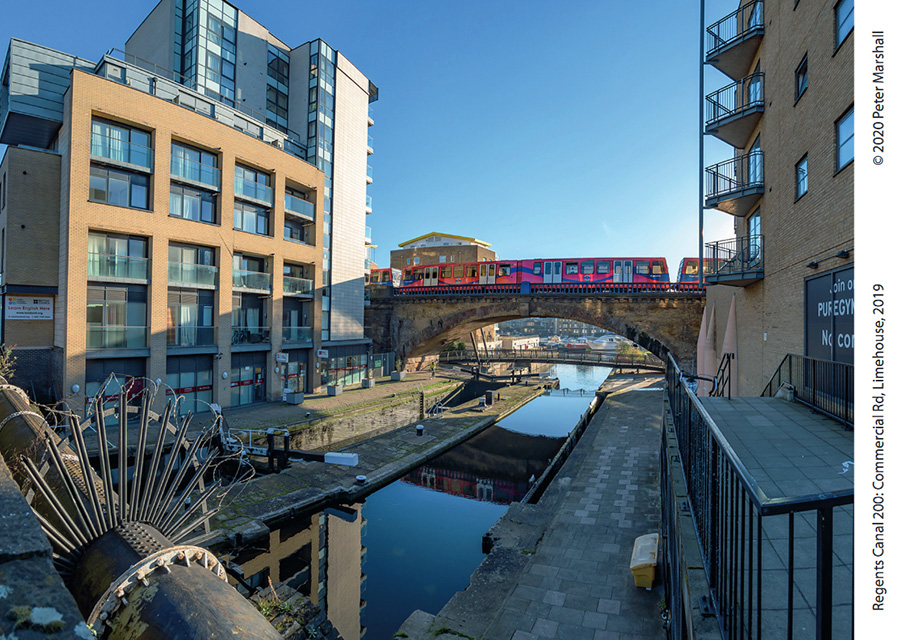
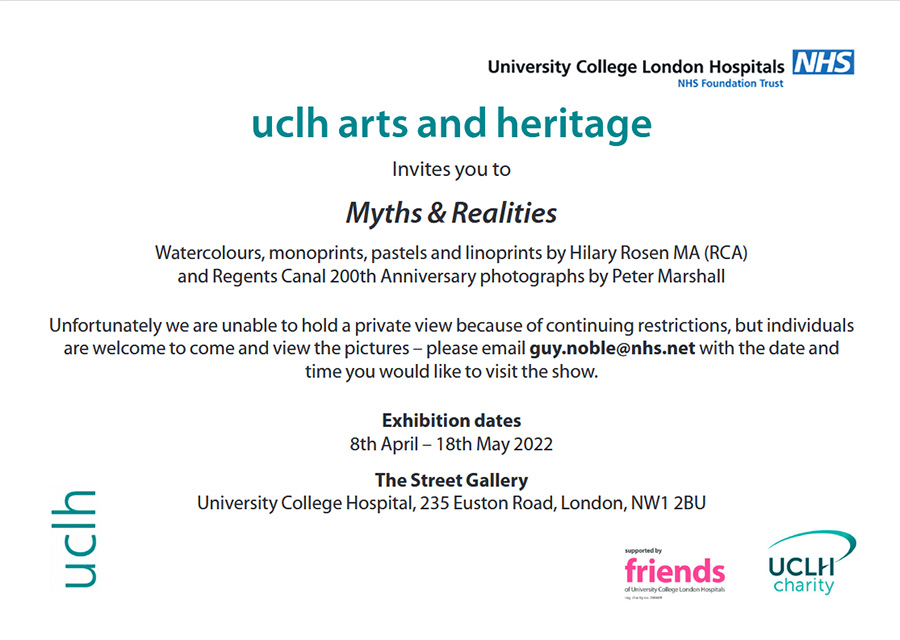
The show was due to open in March 2020 as we went into Covid lockdown, and although now our government seems to think Covid is all done with, others know better and there are still restrictions in place in hospitals, so we are unable to host an opening. And although you are very welcome to visit the show you will need to make an appointment by emailing guy.noble@nhs.net at UCH. Both Hilary and I have invitation cards and are handing out copies to people we meet as well as sending some by post and more electronically – and the two images show both sides of mine. I’m very sorry I won’t be able to see you all there.

Regent's Canal 200 Years at UCH

Below is a little more about my project which is in the show. As well as the 12 pictures on the wall at UCH I have put a larger group including these in an online album, Regent’s Canal 200 Years.

Regents Canal 2020: Maida Hill Tunnel entrance 03-20190717-d028

The Regent’s Canal was opened in 1820 to connect the inland canal system to the River Thames at Limehouse, so 2020 was its 200th anniversary. To commemorate this I began a series of colour panoramas along the canal for an exhibition in March-April 2020 at The Street Gallery in University College Hospital London, half of a joint show, ‘2020 Vision – Vistas and Views’ with artist Hilary Rosen. Unfortunately this show had to be postponed due to COVID-19, but has now been rescheduled with the title ‘Myths & Realities’ for 8th April 2022– 18th May 2022 at The Street Gallery, University College Hospital, 235 Euston Rd, London, NW1 2BU.

Regents Canal 2020: Lisson Grove 06-20190717-d0218

I first photographed the Regent’s Canal in 1979 and have taken many pictures along it over the years since then. I began my work for ‘Regent’s Canal 2020’ early in 2019 and made around eight visits in the following 12 months, producing several hundred images, of which 43 are online.

Regents Canal 2020: Camden High St13-20190308-d0708

These images have an extremely wide angle of view, is roughly similar to the entire field of human vision and to record this on a camera and in print requires a move away from normal rectilinear perspective. They use a cylindrical perspective which retains vertical lines and edges as straight lines but shows other straight lines (except those passing through the image centre) with varying curvature, more pronounced towards the edges of the image. I’ve worked with various equipment in this way since around 1991 when I first bought a specialised panoramic camera.

Lyme Terrace, Camden 16-20190821-d0235

Exhibiting on-line enables me to show more images than the 12 I had selected and printed for the UCLH show. They are presented in the order of a walk from Little Venice where the Regent’s Canal leaves the Paddington Arm of the Grand Union Canal, a pleasant walk of around 9 miles (with a couple of diversions for tunnels) which can easily be done in a day if you are not stopping to make pictures.

Regents Canal 2020: St Pancras Lock and Gasholder Park 19-20190821-d0081

All images are available either as unframed C-Type photographs (image size approximately 16×9″ or 16×10.5″) at £220, as 40x60cm latex prints on canvas (£200) or as 40x60cm dye sublimation prints on canvas (£220). Dye sublimation prints are less intense and carry the image in the canvas, while latex inks sit on the canvas surface and give a more photographic effect.

Regents Canal 2020: Mare St, Hackney 34-20190411-d0238

Peter Marshall Regent’s Canal 200 Years.


Al-Bashir & the Sultan of Brunei

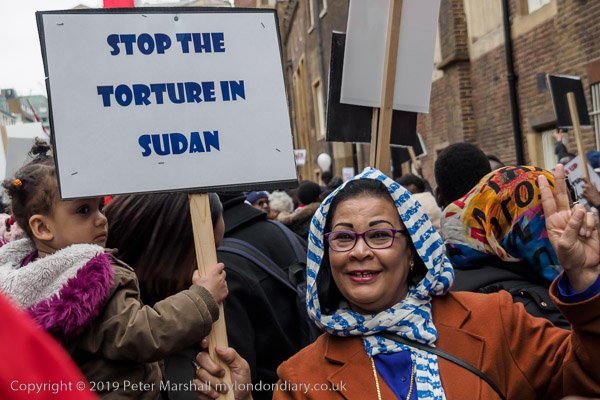
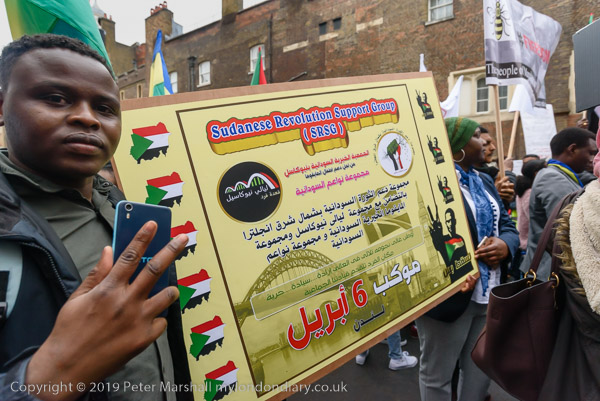
Al-Bashir & the Sultan of Brunei – On April 6th 2019 I photographed two protests in London both linked with the brutal excesses of Sharia law, in the Sudan and in Brunei.

Al-Bashir & the Sultan of Brunei

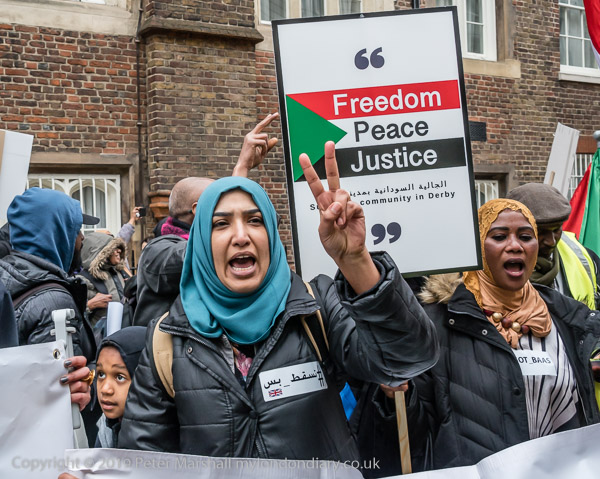
Sudanese for Freedom, Peace and Justice – Sudan Embassy, St James’s

Al-Bashir & the Sultan of Brunei

Sudan became united under Egyptian conquest in the 19th century and then coming under British rule in the 1880s after the British occupied Egypt in the 1880s, though since 1899 its governance was nominally shared by Britain and Egypt. After the 1952 Egyptian revolution Britain was forced to end its shared sovereignty and Sudan became independent in 1956.

Al-Bashir & the Sultan of Brunei

Independence led to a civil war which eventually resulted in the independence of South Sudan in 2011. There was a military coup in 1958, then a return to civilian rule from 1964-9 with another military coup in 1969 and yet another in 1985 that overthrew dictator Jaafar Nimeiri. But in 1989 came the military coup led by Omar Hassan Ahmad al-Bashir, who became its dictator under various titles from 1989 until 2019 when the large-scale protests in Sudan which this London protest supported led to him being deposed by the military on 11th April. Later in the year power was transferred to a mixed civilian-military Sovereignty Council.

Al-Bashir & the Sultan of Brunei

Under al-Bashir the country had been run under a severe implementation of Sharia law, with stoning, flogging, hanging and crucifixion. In 2020 Sudan ended the rule under Islamic law and agreed there should be no state religion. It abolished the apostasy law, public flogging and the alcohol ban for non-Muslims, and criminalised female genital mutilation with a punishment of up to 3 years in jail.

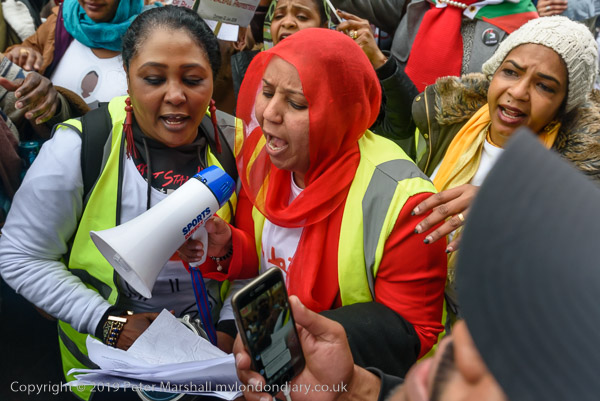
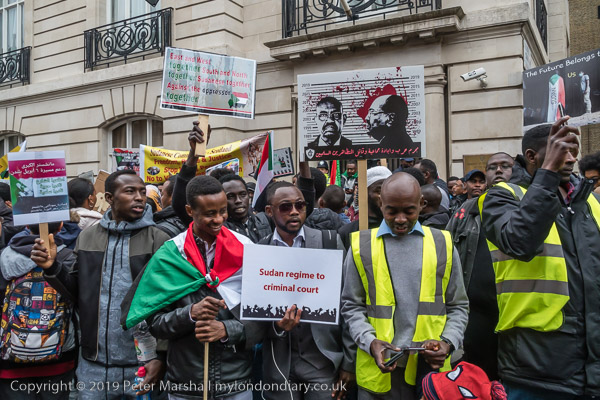
The protest was large and high energy, and called for an end to the violent and corrupt Sudanese regime and for president Omar al-Bashir to ‘Just Fall’ and stand trial by the ICC for genocide in Darfur, the Nuba Mountains and South Blue Nile.

Sudanese for Freedom, Peace and Justice

Brunei Sultan gay sex stoning protest, Dorchester Hotel, Park Lane

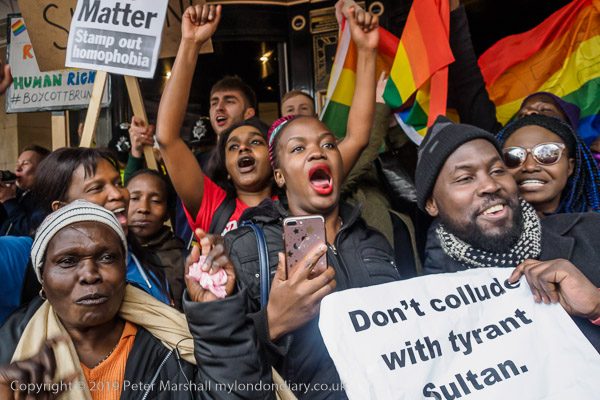
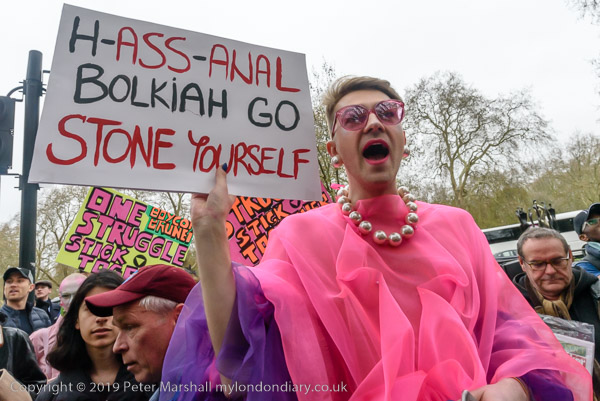
I arrived rather late at the protest outside the Dorchester Hotel on Park Lane, a short walk away (though I ran much of it) from St James’s to find a rather staid protest taking place against its multi-billionaire Sultan of Brunei who has announced death by stoning as a punishment for gay sex, adultery and blasphemy. The hotel was bought by him in 1985.

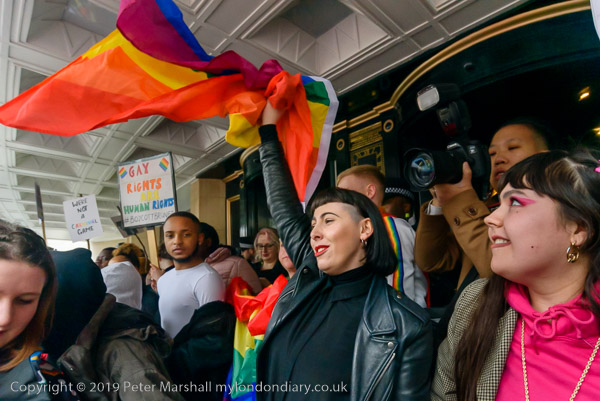
Although it was a colourful crowd, with a number of people in rainbow clothing and a few in drag, along with several well-known figures who spoke, including Labour Shadow Secretary of State for Foreign and Commonwealth Emily Thornberry MP and Peter Tatchell, the protesters kept outside the hotel yard with police harassing them to keep the road clear despite there not being enough room on the pavements, and to allow cars and taxis to take and collect hotel guests to the main entrance.

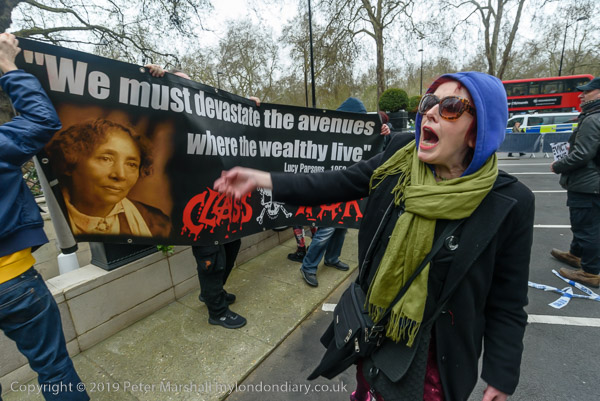
It took Class War to liven up proceedings, pushing aside the barriers in front of the hotel entrance and running inside the hotel yard with their Women’s Death Brigade and Lucy Parsons banners, ignoring the attempts of security and police to stop them. They stood on the steps of the hotel entrance, stopping guests entering or leaving and after a short delay many of the other protesters joined them, bringing placards and rainbow flags.

The protesters ignored the hotel staff who told them to leave and the police who came and threatened them with arrest, and were still blocking the entrance when I left 50 minutes later.

Brunei Sultan gay sex stoning protest


Bromley-by-Bow Gasholders

Bromley-by-Bow Gasholders: A week ago on Monday 28th March I was invited to go with a team from Cody Dock on a site visit to the gasholders which are a prominent feature of the local landscape, seen by many thousands every day from the Underground and National Rail lines as they travel in and out of London as well as local residents and walkers along the Lower Lea and Bow Creek, including those following The Line sculpture trail. We were there invited to study the heritage, history and ecology of the Bromley-by-Bow Gasworks site which has just been sold by its future developers.

Bromley-by-Bow Gas Holder Site Visit

The seven gas holders, all to a similar design were built between 1872 and 1882 and are all Grade II listed. Nine were built on the site but two are no longer there, the base of one now forming a large circular lake in the site. Holder No 1 was given an extra upper tier in steel in 1925-7 to more than double its capacity. All were taken out of use in the 1980s.

Bromley-by-Bow Gas Holder Site Visit

The real value of the site is not in the individual holders although these were some of the “most aesthetically distinguished and finely detailed gasholders ever built” (according to the listing text) but in the ensemble, thought to be “the largest group of Victorian gasholders known to remain in the world, which is testament to the scale of Britain’s pioneering gas industry and its contribution to the Industrial Revolution.” It is a heritage site not just of national importance but of world importance.

Bromley-by-Bow Gas Holder Site Visit

Given their importance the group, together with the adjoining memorial garden with its Grade II listed memorial lamp and statue of Sir Corbett Woodall surely deserves both Grade I listing and preservation, and the former gas works offices could form a heritage centre for the area. The offices were for some time a gas museum.

Bromley-by-Bow Gas Holder Site Visit
The circular pond is the base of a former gasholder

Just across the Channelsea river from the site is the Grade I listed Three Mills and a little to the south the former gas works Dock at Cody Dock, now a thriving creative and community hub, the sites linked by a riverside path which currently stops at Cody Dock but which should long ago have been opened as planned to lead to the Thames at Trinity Buoy Wharf, passing on the way the Bow Creek Ecology Park. Many sites along here played an important part in Britain and the world’s industrial history, but unfortunately little evidence remains, making it essential to preserve what does.

Bromley-by-Bow Gas Holder Site Visit

We were shown around the site in the morning by two of those responsible for planning the development who expressed their wish for the development to retain these elements which make the site unique and to open them up to the public, but good intentions are not enough, particularly for company accountants.

Bromley-by-Bow Gas Holder Site Visit

Given what has happened at other sites greater protection is required to make sure that any development in the area leaves the gasholders intact and preserves their landscape value, in particular the views of the ensemble from the railway and Underground lines, from Three Mills and the riverside footpaths by the Channelsea River and River Lea and the navigation. We do need more housing, or at least more social housing rather than luxury flats many of which remain largely unoccupied as investments, but we also need to preserve important monuments such as these which record and could celebrate our history.

Many more pictures from the day, mainly inside the holder site in my album Bromley-by-Bow Gas Holders. You can click on any of the images above to see a larger version in the album – and browse from there. Most of the images have an horizontal angle of view of approximately 145 degrees. There are more pictures of the area in various posts on My London Diary including Bow and The Fatwalk, Bromley-by-Bow to Star Lane and Gasworks Dock Revived.


Cost of Living Protest – 2022

Cost of Living Protest – 2022
Last Saturday, 2nd April 2022, I photographed a protest opposite Downing Street organised by The People’s Assembly Against Austerity and Stop the War Coalition. The People’s Assembly said on their web page:

Public outrage over the Cost of Living Crisis is growing fast and our response is gaining momentum. Right now is the time for us all to come together in unity and build our collective resistance.
Now is the time to get out onto the streets to send a clear message to the government that we refuse to pay for their crisis.

The People’s Assembly Against Austerity

Cost of Living Protest - 2022

The protest in London was one of 25 in cities around the country against the price increases and National Insurance contribution raise which will mean the largest fall in living standards since records began 80 years ago and a fall in real wages greater than ever in the past 200 years.

Cost of Living Protest - 2022

The Spring Statement by Chancellor Rishi Sunak made clear that it is the lower paid workers (and students), pensioners, those on benefits and the public sector workers in particular who will pay the price, while putting in place measures to protect big business and high earners.

Pay inequality in the UK – the ratio between what the average worker earns and the pay (including bonuses) of the bosses of leading companies – has risen spectacularly in recent years. Had the minimum wage kept up the the rise in what they are paid it would now be over £25 an hour – but went up on April 1st to £9.50 an hour for those aged 23 and over – with lower rates for younger workers.

Cost of Living Protest - 2022

Food banks are now struggling to keep up with demand, and report that some people coming to them are turning down anything which requires heating up as they cannot afford gas or electricity. Advice workers say more and more people are coming to them who have to chose between heating and eating – and many can only eat basics on alternate days and are depriving themselves of food to feed their children.

Cost of Living Protest - 2022
London, UK. 2 Apr 2022

I listened to the UK’s leading money-saving expert saying he had run out of tips to help people cope – and most of the advice he and others have given on energy saving are things we have always done in our household.

My wife and I have relatively low outgoings, living in a house we own and choosing not to own a car. Over the years we’ve been able to invest large amounts in double-glazing and insulation – and a few solar panels to supply a little of our electricity needs. When we moved in 48 years ago to a small Victorian semi built for agricultural workers we replaced the draughty rattling windows and draught-proofed doors. We decided central heating would be wasteful, so our energy bills are relatively low. Even so, they have now roughly doubled from what they were a year ago, with more increases coming later in the year. But we will be able to get by even though our income is low. Others are much less fortunate.

Jeremy Corbyn - Cost of Living Protest - 2022
London, UK. 2 Apr 2022. Jeremy Corbyn.

And in particular the effects on disabled people are savage and shameful. Research shows they are five times as likely to be at risk of food insecurity and twice as likely to be living in cold homes as the non-disabled. And in a particularly targeted cruel and inhuman decision around 210,000 people on disability benefits have now been barred from claiming the Warm Home Discount payment despite the fact that they often have greater than normal needs for heating, hot water and energy to run specialist equipment.

More pictures from the event online at Downing Street Cost of Living Protest, London, 2 Apr 2022