England under water

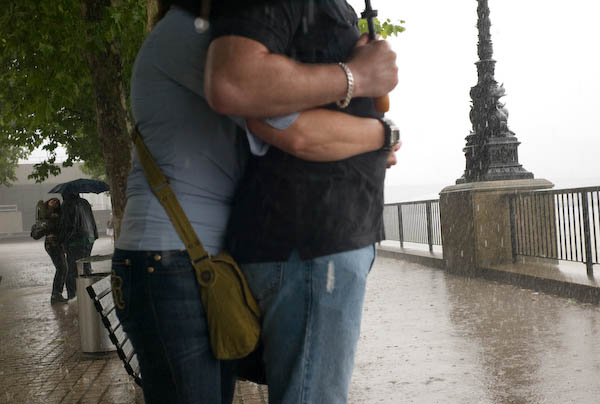
So far I’ve been fortunate to escape the floods that appear to have crippled much of England, though last week I was in Hull and East Yorkshire where around 17,000 homes were damaged in June. In London just over a week ago I sheltered under a tree on the embankment during one of the heaviest rain storms I’ve ever seen; at its worst there was an almost total white-out, with anything further than around 25 metres disappearing from sight.

I’d kept dry under the tree for some time, but when it really came down it offered no protection at all, and the umbrella I put up wasn’t entirely effective either, though it kept the worst off. I was too busy trying to keep dry to take pictures until the worst was over, and even then it was difficult to keep the camera dry.

London (C) 2007, Peter Marshall
I took some pictures when the rain eased off

The floods are moving down river towards where I live at the moment – we have a flood warning in force and its likely we will get flooded. Its 60 years since the house was last flooded, and the levels are said to be a few inches higher than then. So I’m starting moving what I can to the first floor.

Queens and Looking Glasses

My own notions about Queens are largely based on those of Lewis Carroll (an interesting photographer in several ways) in ‘Alice’s Adventures in Wonderland‘ and its sequel. Queens – like the Queen of Hearts in the Dormouse’s tale were apt to come out with “Off with his head!” at the slightest provocation.

So I was shocked to hear on the BBC News one morning this week, that photographer Annie Leibovitz had dared to tell the Queen to off her tiara, and surprised that her maj’s reported response was as mild as saying “I’m orf” (shouldn’t it have been “We are orf” or perhaps “One’s orf”? At the very least Annie would surely have ended up spending a night or two in the Tower of London.

So it came as no surprise to learn that the whole thing appears to have been an ill-advised publicity stunt, using a clever bit of cutting, or that, having carefully allowed the story to play to maximum effect, the big bosses of the Beeb were down on their knees grovelling for the royal pardon.

It’s a sad story. The BBC, and in particular its ‘World Service’, has a proud record that has led to it being a trusted around the world – and listened to in many situations, even at times and places when it was illegal. TV has of course its own needs to present constant noise and controversy, frenetic and demotic, that at times override sense and taste, and always sacrifices subtlety.

For those with a little knowledge of photographic history, there was a certain sense of the similar, remembering the famous image of Winston Churchill, taken by Karsh immediately after he had apparently snatched Winston’s trademark cigar from his mouth, and there was baby without his dummy glaring into the camera, apparently on the edge of bursting into tears.

At least Annie wasn’t said to have snatched the tiara – and once anchored by the Queen’s hairdresser this would probably have taken some doing (and headlines ‘Annie Scalps Queen’). The pictures she made aren’t bad, if perhaps not her best work. But good portraits don’t always arise from making your subject comfortable, and some well-known for the apparent psychological depth of their images have taken quite different approaches. Paul Strand is said to have told his subjects where to stand and then to appear to have ignored them, although obviously he was waiting for the expression or stance that he wanted.

I thought a little about this yesterday, when another photographer butted in (perhaps unintentionally) while I was setting up a photograph and proceeded to give all of the people in it clear and precise directions as to what to do. Well, it isn’t the way I like to work, though of course I do sometimes need to attract people’s attention, and I like to work with people and let them react to me and what I do, but not to direct them.

Peter Marshall

28 Seconds

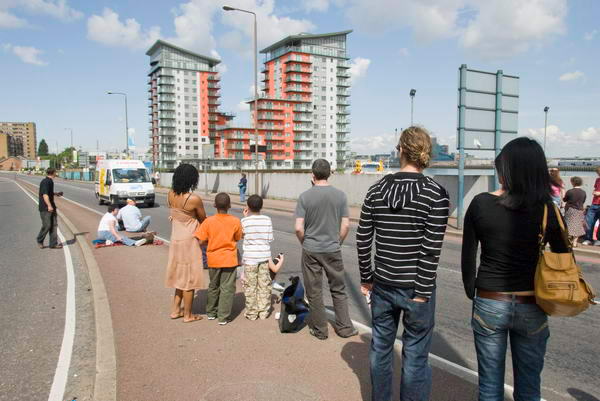
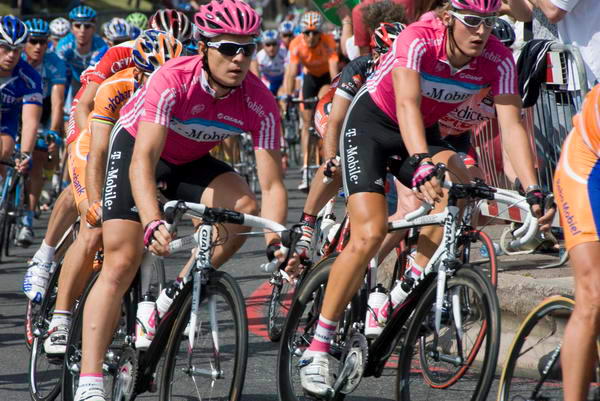
It took 28 seconds from my first view of the cyclists as they rounded the corner some distance down the road until the last of the 189 cyclists had passed me. Last Sunday, the Tour de France started in London, and I thought I shouldn’t entirely miss it. I decided Woolwich would be a good place, just a few miles down the road from the real start of the race in Greenwich.
(C) 2007, Peter Marshall
People had already started to gather along the route when I arrived an hour before the riders. Fortunately it was a fine day and many settled down at the roadside with the Sunday newspapers or a book as the occasional race vehicle drove past.

Finally, along came the pack of riders.

(C) 2007, Peter Marshall
I’m not a sports photographer, and hadn’t really though I’d take more than one or two pictures, but the excitement carried me away a little and I found I’d made around 30 shots – and for the first time ever had managed to fill the 21 shot buffer on the D200. Had I really been intending to take pictures I should have switched from raw to jpeg for the event, and I could have shot many more.

Normally the only time I ever run into buffer problems is when the card is nearly full. The camera won’t allocate more images than it thinks it has space to write to disk, so you can find the buffer will only hold a few images. It usually makes sense to put in a new card whenever you find there are less than 21 shots (the full buffer capacity) left.

Actually it gets a bit silly, as the current Nikon firmware doesn’t attempt to estimate the actual number of shots left if you are using compressed NEF. So it acts like there are only 21 left when in fact you will fit roughly double this number onto the card. It’s a problem that Nikon fixed on the D70 in a firmware upgrade, but which they have left on the later D200.

From the race I went back to the cycling festival in Hyde Park, where there was some more racing (and I took a few more snaps) as well as other related activities.

(C) 2007, Peter Marshall
More pictures coming on My London Dairy

Peter Marshall

Szarkowski Dies

one’s point of view is formed by the work one chooses to write about, because it is challenging, mysterious, worthy of study, fun.
John Szarkowski ( interview with Mark Durden, 2006.)

It would be hard to overstate the importance of John Szarkowski to photography, so I suppose it is inevitable that some of the obituaries following his death following a stroke last Saturday at the age of 81 have done so.

Great that Szarkowski was, he didn’t invent photography, and its progression into commercial galleries and the art world would certainly have ocurred (although undoubtedly rather differently) without his presence. One or two writers also need reminding that photography had started to play a significant role at the Museum of Modern Art some 25 years before he arrived there in 1962.

He built his work – as he always acknowledged – on that of others, notably Beaumont Newhall and Edward Steichen. Walker Evans, whose work had a key role in Szarkowski’s pantheon, had his first show at the museum in 1933, thanks to Lincoln Kirstein and Alfred Barr, and his major outing there, “American Photographs” in 1938, a year after Beaumont Newhall’s groundbreaking “Photography, 1839-1937“. (Kirstein, a wealthy “friend” of the museum, was also largely responsible for the publication Walker Evan’s classic book to accompany his show there.) Szarkowski’s 1971 retrospective of Evans was very much following in Newhall’s footsteps.

Szarkowki’s immediate predecessor at the museum, Edward Steichen, had given sterling service as the captain at the helm of photography, doing much to increase its popularity as an art form, particularly with his record-breaking “The Family of Man“.

But of course Szarkowski’s acheivements were immense. During his time as director from 1962-91, the museum set out a coherent direction in photography with shows such as “The Photographers Eye“, (1966), the catalogue from which remains an important text for photographers. “New Documents” (1967) introduced the work of Diane Arbus, Lee Friedlander and Garry Winogrand, giving a new impetus, and one that few critics of the time were ready for. Similar reactions greeted “William Eggleston’s Guide” in 1976, although here the main problem for many was that Eggleston worked in colour. These shows and others changed the course of photography.

Among his other writings, “Looking at Pictures” remains one of the most engaging books on photography, and certainly one that has inspired many writers on photography, as well as encouraging photographers to think more deeply about their own work. If you don’t already own a copy, I’d suggest you go out right now and buy or steal one.

One of the great treasures of MoMA is perhaps the finest collection of the works of Eugene Atget; most came when Szarkowski acquired the Berenice Abbot collection. The set of four volumes, “The Work of Atget” by Szarkowski and Maria Morris Hambourg that were published from 1981-5 are a fine work of scholarship superbly presented.

Szarkowski retired as director in 1991, although fortunately he continued to both curate shows and write, but he was no longer the emperor of photography. At times he must indeed have had grave doubts about the new clothes worn by some of the new emperors who took his place, and photography does sometimes seem to have lost its way and be moving down strange paths with odd bedfellows.

In recent years there have been several shows of Szarkowski’s own photographs. As might be expected, they show a great care and lucidity of thought. However his much greater legacy to us is through his work as a curator and writer.

Peter Marshall

Alec Soth: Badgering Parr

I take back almost all of those bad things I may ever have said about Gerry Badger, whose writing long ago in the British Journal of Photography was surely designed to wring the most from curmudgeonly misers by using twenty five words where one would have been more appropriate, surely sacrificing clarity for another thousand words at their ridiculously low rates.

His account, recently published by Alec Soth under the heading Badgering Parr is a hilarious story of Magnum’s recent New York sheenanigans. What makes it even more hilarious are the responses of some of the readers, some of whom show a complete inability to comprehend irony – and I assume Soth’s introduction was meant to provoke such AOL responses. I’m not going to join in the controversy about the description of Deborah Bell as ‘fragrant‘ but she is certainly one of the nicest gallery owners I’ve met. (As one of the comments points out, the word is a reference to a notorious British court case.)
I’m rather less certain that Martin Parr’s photography of the event was also meant to be a joke, though I rather hope so. Surely he cannot be serious!

Soth also quotes a letter from Philip Jones Griffiths, surely the greatest of Welsh photographers, and the man whose Vietnam Inc, made such a clear indictment of the Vietnam War that had me in tears as I read it, written in opposition to Parr’s Magnum entry. It is an interesting document, and I wonder how different Magnum would have been today had he swayed just one more Magnum member to vote against Parr. Not just  Magnum, but photography too.

I’m in many ways a fan of Parr. He sometimes makes images that I stand in front of and feel are exactly right and why didn’t I have the nous to do it like that. But at times he does things that make me feel uneasy, or that I just don’t like. Some of these party pictures make me feel that, but others I’m afraid are just, well, boring. I didn’t know Martin had it in him.

But do read the whole piece. As they say on the Internet, it had me ROTFLMGO.

Plossu and Sandberg

In a way it wasn’t a suprise to find Alec Soth, a photographer whose work I greatly admire, and a guy who obviously knows his photography and writes about it well, hadn’t heard of Bernard Plossu. After all, Soth is an American.

In my 8 years at About Photography (currently my material is still on line, but I am replaced by a shadowy grey presence and no longer contributing or updating content) one of my major aims was to show a largely American Internet public that photography existed outside of the USA.

It wasn’t so much a crusade as a mere statement of fact; the great flourishing of photography that had made America (and particularly New York) the centre of photography from the time of the Photo League, past the Family of Man and on through the reign of Szarkowski at MoMA has more or less burnt itself out, but in its magnificence had blinded the public, particularly in the USA, to the existence of photography elsewhere. Many of us – including some leading Usanian* curators – had just begun to discover the riches of Latin America, Africa, Nothern and Central Europe, Arabia, Asia and elsewhere.

Of course I made sure to cover American photography – that is photography from the USA. As well as American (Usanian) photography I also covered wider American photography, including photographers from Canada, Mexico, Argentina, Brazil, and most of the other countries of the continent. (I worked alphabetically by country for Central and Latin America, making it as far as Peru before my time was up, so here’s an apology to Uruguay and Venezuela.)

Outside of the Americas, I wrote on photography from Australia, India, China, Japan (I had plans for much more on this), a little on Africa, on Arab photography, as well as of course on Europe including Russia. There were of course many gaps still, and editorial pressures had unfortunately forced me to turn my main attention to other things over the last year. But so long as the material is on line you can find out more about photography in Albania or Iran, about my favourite Greek photographer, about at least two great Turkish photographers, and even a little about photography in Java.

So of course I’ve written a little on Bernard Plossu, and most of the links, including the one to documentsdartistes which has the best collection of his work on-line still work. He was one of the 200 or so photographers who featured in the ‘Directory of Notable Photographers‘ that I produced soon after taking the site on (and had more recently been augmenting in the Photographers A-Z), and got occasional mentions thereafter, such as in the feature on Contretype, a leading Francophone gallery in Brussels, for which he produced his ‘En Ville‘(2000), perhaps one of his more interesting works, with over a hundred images of the city.

Soth also has some information and pictures on Tom Sandberg (b 1953), one of the most acknowledged Norwegian photographers today. Sandberg’s own web site is still under development, but you can view some of his work at Galerie Anhava

Peter Marshall

*It’s revealing that despite the evident cultural aggression in the appropriation of the term ‘American’ (first objected to almost 200 years ago,) it remains as normal usage and alternative terms such as ‘Usanian’ have not made the mainstream.

Gillian Laub – Testimony

Gillian Laub (b1975, Port Chester, NY) is a New York based photographer who completed a BA in Comparative Literature at the University of Wisconsin before studying photography at the ICP in New York. Her show at the Bonni Benrubi Gallery in New York, An American Life, closes tomorrow, July 7, 2007, and is a series of large colour images that show often intimate moments in the life of her own extended family, in Florida, New York and the suburbs. It’s work that gives an insight into the life of some Americans, and certainly very proficiently done, with several images that I like considerably (Grandpa eating on the beach at Naples, Florida for example) but overall I had a certain feeling of deja-vu, not least because I photographed a very different family some twenty or more years ago with occasionally similar results.

(C) 1982, Peter Marshall
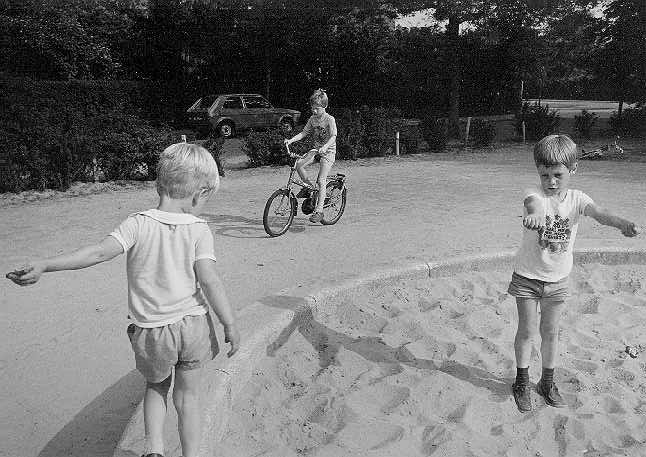
Joseph, Jan Willem & Samuel 1982 © Peter Marshall
(C) 1977 Peter Marshall
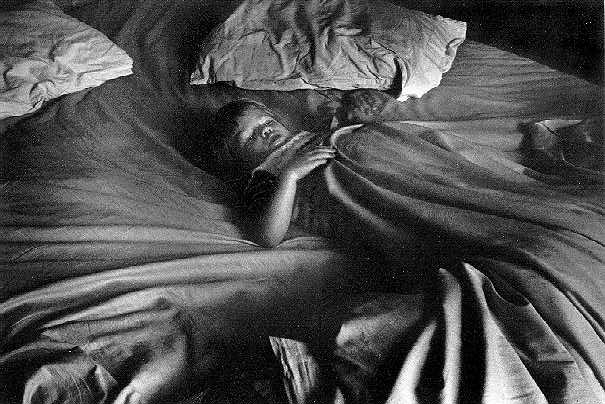
Samuel 1977 © Peter Marshall

Well, families are families, although in some ways it is what is in the background of these pictures that that is of more interest, setting Laub’s particular family in a social context, and perhaps seen most clearly in ‘ Jamie Practicing for the Family, Armonk, NY 2003′.

What I find considerably more interesting than ‘An American Life‘ are Laub’s images from Israel and Palestine, some of which were shown earlier at Bonni Benrubi, and can be seen in the fine PDF portfolio ‘Beyond Wounds‘, as well as on Laub’s own web site. This work, some of which is in her newly published Aperture book, Testimony, seems to be of entirely a different and higher order of magnitude. These images of Israeli Jews, Israeli Arabs, displaced Lebanese families, and Palestinians all caught up in conflict in the region, taken over a four year period have an incredible depth and complexity.

If you are in London next Thursday, 12 July, 2007, you can hear Gillian Laub talking about her book at the Photographers’ Gallery at 6.30pm, followed by a book launch and signing in the Bookshop. It’s a free event, and no booking is needed.

Family Album was the first web site I ever wrote, and is still on the Internet (with some very minor changes to the code.) I also wrote a feature for About.com, Family Pictures at About Photography, which became one of my more popular features on the site. The discussion about the problems of nudity in images of children it contains surprisingly caused some controversy, although only around five years after it was put on line.

Fourth of July Celebrations

This morning I woke up to the news that Alan Johnston had been released in Gaza, and thought it was great that I had something to celebrate on the 4th of July. Other than getting shot of those troublesome colonials in America of course. Having spent 8 years writing for an American-owned web site (in recent years About.com has been a part of the New York Times) it was a relief to think I could write without having to keep American festivals and feast days in mind.

Although the site had many thousands of visitors from around the world, those from the USA were in a majority, and my non-American sensibilities were a problem so far as the management were concerned, though probably less of a problem than my interest in photography.

Our pleasure at the release of one brave journalist should not make us forget the others who are still in captivity – including Bilal Hussein, an AP photographer who now been held by the US military in Iraq for 448 days without being charged. You can sign a petition for his release at the ‘Free Bilal’ web site4:

According to an IFJ press release, at least 82 journalists have been kidnapped in Iraq. Of those, 28 have been killed and six are still being held, though I don’t think there statistics include people held by the US and other occupying forces
Of course many have been killed. This year so far, up to 4 July, at least 87 journalists have been killed, many of them photographers. Most – appropaching half – have died in Iraq. You can read the details, and the figures for earlier years at the News Safety Institute.
Photographers (still or video) are very much exposed and at risk, becuase they can’t work without putting their heads up above the parapet and actually confronting the motif. There are plenty of stories of people who’ve made their start in photography by picking up a camera and rushing out to cover a war, but we seldom tell of those who went out and met an early death without becoming famous. Of course many of those who did get started like this in the old days had some military training or experience, if only through national service.

Wars and many other situations are now more dangerous. Old ideas about respecting the freedom of the press and the right to report often no longer apply in modern conflicts; you are thought to be on one side or another, often because of your nationality rather than your views. With the Internet (and for photographs, the ubiquity of digital cameras) groups no longer need the press to get their views across in the old way.

If anyone is thinking of working in any hostile situations, it is vital to take advice and to get proper training. You might start by reading the book ‘A survival guide for journalists’, published in 2003 by the International Federation of Journalists, available as a PDF file.

Peter Marshall

Laburnum Street

Even if you’re a Londoner, you probably don’t know Laburnum Street. Haggerston has never been the most glamorous area of Hackney, itself on many measures one of the more deprived areas of the country. Even the artist-led regeneration that has brought Shoreditch, Hoxton, Bethnal Green and elsewhere back onto the map of London hasn’t quite got to Haggerston yet, although there are a few studios around in old industrial buildings.

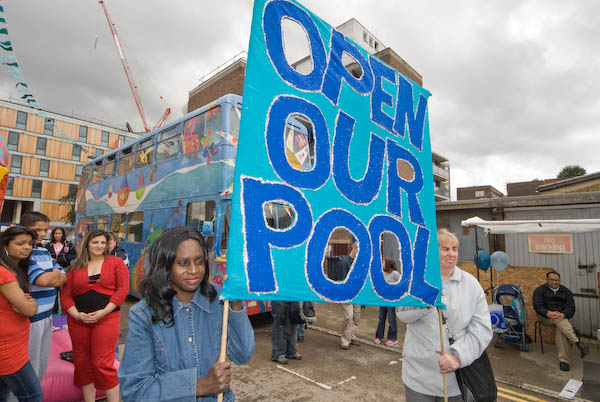
It’s an area with quite a lot going for it. Walking distance from the city. A canal, with an increasing number of desirable waterside properties being built. A new city academy rising. The large Suleymaniye Mosque on the corner. And plenty of other new developments not far away. But for the moment its most interesting features are the lively and very ethnically mixed people who live in the area, and (C) 2007, Peter Marshall, long neglected by Hackney Council, closed without notice in February 2000, and the subject of a lively local campaign to see it re-opened.

(C) 2007, Peter Marshall

The pool is a listed building, and English Heritage want it retained as a pool, as do the locals. Hackney Council have worked on feasibility studies which include a 25 metre pool together with other uses for the west side of the site, and the pool campaign have added their ideas to these proposals through a people’s consultation. The plans for the future are there, but not the £21 million to put them into practice.

(C) 2007, Peter Marshall
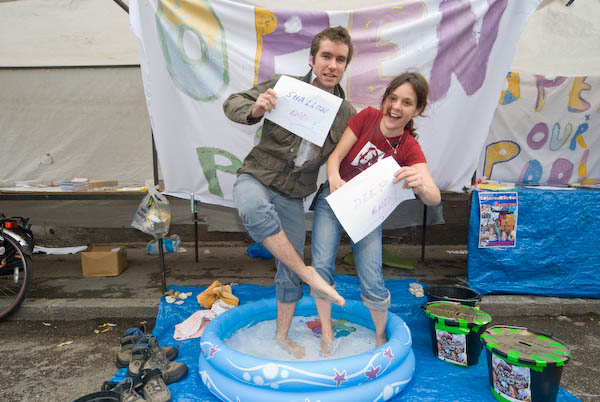
This was the only pool open for the street party

The first Laburnum Street Party was organised in 2004 to celebrate the 100th anniversary of the pool, and to raise the profile of the campaign for its re-opening. I went to photograph the third party in 2006, and was pleased to have one of my pictures used as the main image on the flyer, poster and programme for this year’s party.

This year the event was bigger than ever, and attracted more sponsorship. There were around 75 street stalls of various types, including food, bric-a-brac and various informational stands. Two stages with performances of very different types and a childrens street parade, following workshops organised by Lucia Wey of Mush Arts, who I first met photographing the 2004 Shoreditch Parade. Free canal boat trips and various kids activities. So much going on that I could only photograph a small part of it, and was sorry to miss some of the acts I’d been looking forward to.

(C) 2007, Peter Marshall

Of course there were many other photographers there, as well as several film makers, including Dan Edelstyn whose hilarious film (with Hilary Powell) on the Olympics I mentioned here a week or so ago in More than the Olympics.

The weather was fairly kind to us, just a few minutes of heavy showers around lunchtime, and then some sun, and we made hay. Too soon it was time for me to go home.

More pictures from Laburnum Street Party 2007 on My London Diary shortly.

Pride & Climate Change

London carries on, despite the terrorist threat with two car bombs left close to gay nightclubs which fortunately failed to explode early on Friday morning. Saturday’s Pride Parade was much the same as last year, and if there were more police present, it was only noticeable in the several groups of officers actually taking part in the parade.

Despite the publicity and high figures given in the media (which perhaps relate to the whole festival) the Pride parade itself is now a relatively small event, a fraction of the size of the major political marches that make their way through London largely unreported by the press perhaps half a dozen times a year, although considerably more organised and more colourful. It seems to attract considerably fewer marchers than it did a few years back, with many more simply turning up for the events in Trafalgar Square and Soho.

Ten years ago, taking part in the Pride march was an important personal and political statement for many, sometimes marking their going public about their sexuality. Now it’s largely a fun event, although a few individuals and groups still attempt to get a more serious message across.

Much of the event has now settled into a pattern, with many of the same floats and costumes as in previous years, but there are some changes, and I tried to concentrate on these. Its an event where it is hard to get away from the stereotypes, because so many of those taking part embrace them whole-heartedly.
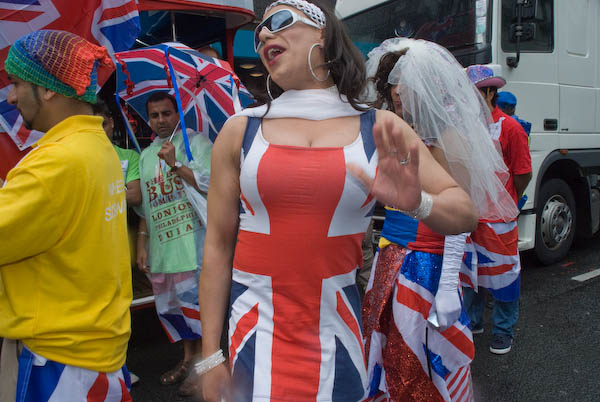
Pride 2007 (C) 2007, Peter Marshall
Many, especially from minority ethnic groups, use Pride as an occasion to stress their British identity as well as their gay identity

I seldom pose people for pictures, but at Pride, everything is a pose. Certainly as soon as people see a camera, most play to it, and its a game you can’t avoid, something you need to work with. Getting below the surface is often a problem, but at least the surface often fascinates.

What was new was ‘Bird Pride’, describing itself as a “Queer Femme Carnival”, organised by the Bird Club, whose aim is to “celebrate femininity on the queer scene”.
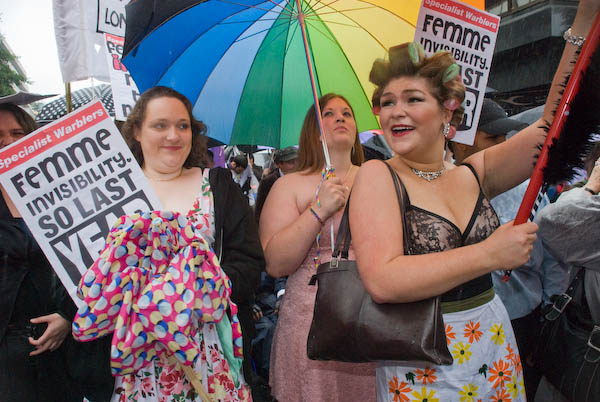
Pride 2007 (C) 2007, Peter Marshall
Bird Club ‘Specialist Warblers – Femme invisibility, so last YEAR’

More pictures from the Pride march on My London Diary shortly.

The two car bombs were on the route of the parade, and there were rumours that it was a badly failed attempt to attack the parade itself, but they didn’t appear to have put the marchers off. The crowds watching the event in Oxford St did seem rather lighter than normal for a Saturday, but this could have been more a matter of the weather, light rain interspersed with heavier downpours, which at times made taking pictures tricky, but some of the best opportunities were in pouring rain.

Photographing in the rain is a problem. In the old days, mechanical cameras such as my old Leica M2 carried on almost whatever hit them, and the standard lens at least had a lenshood that was a fairly effective rain shield. Keeping it under your coat when not in use, and an occasional wipe with a handkerchief kept you going through rain, hail and snow.

Digital cameras are more of a problem. I gave up on the Nikon D70 as unsuitable for London weather, but the D200 is much hardier. My main problems are with lenses. Larger filter sizes, more glass – in zooms in particular – mean more rain drops and more condensation inside lenses with changes in temperature and humidity. Zoom mechanisms pump in damp air, and also draw in moisture from the damp lens barrel. Increasing use of wide angle lenses is also a problem, as their lens hoods offer little or no rain protection – and the same is true of zoom lenses that start at wide angles.

Nikon’s 18-200mm VR lens is a great and very flexible lens, but becomes useless when there is even a hint of moisture in the air. Sensibly, I’d left it at home and was shooting with a Sigma 18-125 which holds up rather better. The Sigma 12-24mm has the problem of a large front element open to raindrops, but if you can keep it clear, also works well in wettish conditions. Handkerchiefs aren’t really a good idea, and in a special, otherwise unused pocket of my jacket I had a large, clean microporous cloth that saw frequent use to wipe both glass and other surfaces of lens and camera.

Sometimes I’ve improvised a plastic cover for camera and lens from a suitable bag, but such things get in the way. But these – or specially made camera rainwear – can keep you shooting in really bad weather. Unfortunately they don’t stop condensation inside the lens, which is often a problem – and all you can really do is wait for it to clear, or change lenses. ‘Pumping’ zoom lenses can sometimes help.

I decided I couldn’t face more rain to photograph the Pride rally in Trafalgar Square or the cabaret performances elsewhere, and in any case I had a mermaid to photograph.
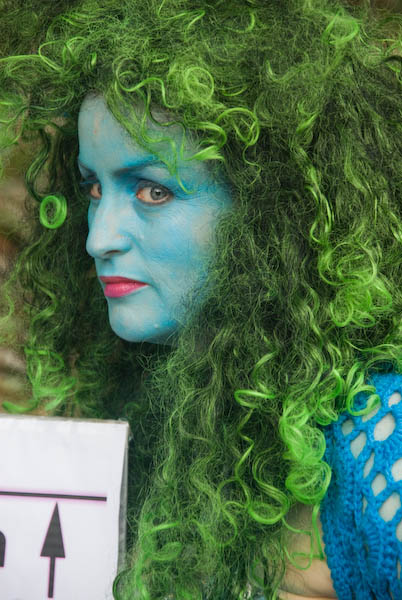
Rising Sea Levels (C) 2007, Peter Marshall
Lucy warns about the perils of global warming – her arrow indicates sea level in 2012

The climate change event was designed as a reminder to Gordon Brown that this is still the most urgent problem we face. Without a planet that is livable on, none of the rest will matter. So far the politicians have largely stayed on the edge of the pool, hanging on to ideas of technology or carbon offsets to avoid taking the real action that is needed, talking about cuts in carbon dioxide emissions while these continue to rise.

Effective action is vital, before it is too late (and we hope it is not yet too late.) Energy saving that means more than turning off the odd light or buying a more fuel-efficient car.

More pictures on My London Diary now for Pride and Climate Change Rally
Peter Marshall