Shops, Houses, A Library, Car Sales 1988

Shops, Houses, A Library, Car Sales 1988 – a walk around Lower Clapton, and Hackney which continues from post Jews, a Bishop and the Sally Army.

Gulluoglu, A & A Jewellers, Golden States, Chinese Takeaway, Lower Clapton Rd, Lower Clapton, Hackney,  88-10b-11-Edit_2400
Gulluoglu Bakery, A & A Jewellers, Golden States, Chinese Takeaway, Lower Clapton Rd, Lower Clapton, Hackney, 88-10b-11

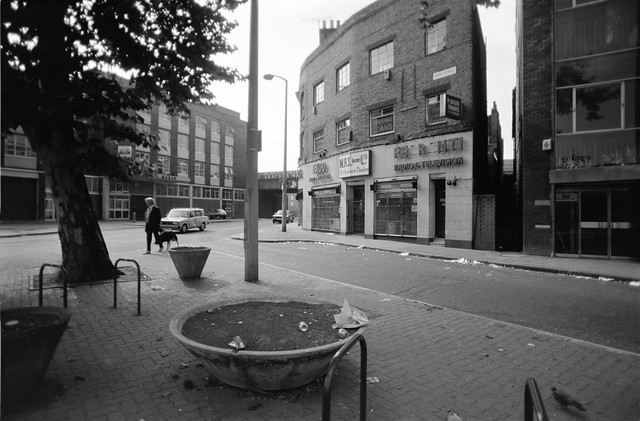
Shops at 63-67 Lower Clapton Rd two of which are still under the same names in 2021. Even the jewellers is still a jewellers though under a different name. Some businesses are more essential than others and family businesses like these often survive longer than some others.

Median Rd, Lower Clapton, Hackney, 1988 88-10b-13-Edit_2400
Median Rd, Lower Clapton, Hackney, 1988 88-10b-13

I stood shocked and wondering how these three houses, at 61-65 Median Road had got into the state they are in. I imagine the when built 61 and 63 had similar windows – and what had possessed someone to replace those of 61 something so much plainer. Was it a matter of bomb damage or owner derangement. Equally a sore thumb was the cladding imposed on 61, quite out of character. These houses have changed little since I took the picture, though fortunately the trees in the trangle in front of them have grown considerably and they are rather less visible.

I turned around and walked back into the centre of Hackney, probably mainly to buy a snack to keep me going.

Hackney Central Library, Mare St, Hackney, 1988 88-10c-01-Edit_2400

Hackney Central Hall and Library was built in 1907, its architect Henry A Crouch, and was still in use when I made this picture. Hackney now has a new library just across Mare Street, appropriately at 1 Reading Lane. The building was converted into a music venue and community arts centre, the Ocean at a cost of £23m (including a £15m Arts Council grant) and opened in 1999. Music events were supposed to fund the community projects, but failed to do so and Ocean Music Trust and Ocean Music Enterprises ceased trading in 2004. In 2010 it was leased to City Screen who converted it into the Hackney Picturehouse which opened in autumn 2011.

Clarence Rd, Hackney, 1988 88-10c-65-Edit_2400

I’m unsure whether these shops were in the part of Clarence Road (then called Back Street) which were built by 1821 as Down Terrace or were built later in the century. At extreme left is a part of No 22 and at the left is No 42.

Almost all of these except those at the far left have been extensively re-furbished or rebuilt since 1988 and only a couple remain with shop fronts, the rest of the row being simply housing, with an added second floor stepped slightly back.

Sutton House, Homerton High St, Hackney, 1988 88-10c-41-Edit_2400
Sutton House, Homerton High St, Hackney, 1988 88-10c-41

Sutton House is a Grade II* Tudor manor house owned by the National Trust, built in 1535 for Sir Ralph Sadler who was the Principal Secretary to Henry VIII and an aide to Thomas Cromwell. Although the building was later given a Georgian frontage its interior retains many Tudor features.

Its name is the result of a mistake, named after Thomas Sutton, the founder of Charterhouse School who lived not in this house but next door. His house was demolished in 1806. As the plaque on the wall records, W A Robertson gave money as a bequest in memory of his two brothers killed in the First World War which was used to buy the house. Although it bought the property with his money in 1936, the National Trust appears not to have been very interested in it.

https://www.flickr.com/photos/petermarshall/50581050732/in/album-72157715589148871/
Sutton House, Homerton High St, Hackney, 1988 88-10c-42

From the 1930s it was leased to various tenants including the ASTMS trade union. After they left in the 1980s it fell into disrepair and was squatted in the mid-80s as the Blue House, holding parties and music events. After the squatters were evicted it continued to decay until the Save Sutton House Campaign, founded in 1987, campaigned for its renovation and it was first opened to the public in 1991, though only fully in 1994. You can now book guided tours.

Mehetabel Rd., Hackney, 1988 88-10c-43-Edit_2400
Mehetabel Rd, Hackney, 1988 88-10c-43

Mehetabel means ‘how good is God’ and was the name of the wife of Hadar in the biblical book of Genesis and a patriach in Nehemiah. One of John Wesley’s six sisters was the poet Mehetabel Wesley Wright (1697–1750.)

Mehetabel Road is a short street with close to its centre the Chesham Arms pub, declared in 2013 as Hackney’s first Asset of Community Value to protect it when the owner wanted to convert it into flats. The houses at the far left are in Isabella Road.

https://www.flickr.com/photos/petermarshall/50580922666/in/album-72157715589148871/
Morning Car Sales, Off Morning Lane, Hackney, 1988 88-10c-45

Morning Car Sales is in one of the railway arches of the North London Line, I think Arch 200 is just to the left of Link St, where the ‘Hackney Walk’ fashion development opened in 2016 – and is now ‘To Let’.

Car showroom, Morning Lane, Hackney, 1988 88-10c-46-Edit_2400
Car showroom, Morning Lane, Hackney, 1988 88-10c-46

Inside the office were a strange selection of pictures, including Maria Whittaker from the Sunday Sport along with a pastoral riverside and a more maritime painting, with a couple of calenders for September 1988 and a table with tea-making facilities. Although pictures such as this half-naked woman might not now be suitable for Parliament, they were common in many workplaces back then.

The walk will be continues shortly. You can see a larger version of any of the pictures by clicking on it to go to my album 1988 London Photos.


Jews, a Bishop and the Sally Army

Jews, a Bishop and the Sally Army: Continuing my walk in October 1988 around Clapton – the previous pos was Hats, Bags, Passports, Mansions, Biocrin & Hollywood.

Jewish Free School,  Lea Bridge Road, Clapton, Hackney, 1988 88-10b-41-Edit_2400
Jewish Free School, Lea Bridge Road, Clapton, Hackney, 1988 88-10b-41

The Jewish presence in Hackney dates back to the late 17th century and grew greatly in the late nineteenth and early twentieth century, and by the 1950s it was said to have the largest and densest Jewish population in the country. Many were supporters of the Labour party and local councillors and leaders, and among former Jewish Free School pupils is Labour life peer Maurice Glasman, Baron Glasman. Other well-known Jewish people who grew up in Clapton include Helen Shapiro, Harold Pinter, Lord Levy and Lord Sugar. Since the 1970s the area has been home to a fast growing ultra orthodox community.

The Clapton Jewish Day School was established next to the synagogue in Lea Bridge Road in 1956, though these splendid gates may be older. The school moved to Cazenove Road in 1973 as the voluntary aided Simon Marks Jewish Primary School and is the only remaining mixed Jewish school in inner London.

Clapton Federation Synagogue, Lea Bridge Road, Clapton, Hackney, 1988  88-10b-43-Edit_2400
Clapton Federation Synagogue, Lea Bridge Road, Clapton, Hackney, 1988 88-10b-43

Clapton Federation Synagogue or Sha’are Shomayim (Gates of Heaven) was founded in 1919 by Elias Ephraim Frumkin (1880-1958) whose family were well-known East End wine merchants Frumkin & Co. In 1932 the synagogue moved into this fine Art Deco new building by architect Marcus Kenneth Glass with a polychrome facade and mosaics at 47 Lea Bridge Rd. In 2005 the congregation moved out to hold its services in the Springfield Synagogue on Upper Clapton Road. Attempts to have the building listed unfortunately failed and it was demolished in 2006, replaced by a rather ugly large block of flats.

The Frumkin family had settled in Whitechapel around 1893, and opened a shop the following year selling Kosher wines on the corner of Commercial Road and Cannon Street Road. Elias, the son of the founder developed the Cherry Brandy for which the company became famous. The firm which supplied wine for many weddings and Bar Mitzvahs later opened branches in Edgware and the West End but finally closed in 1997.

Bishop Wood's Almshouses, Lower Clapton Rd, Lower Clapton, Hackney, 1988 88-10b-44-Edit_2400
Bishop Wood’s Almshouses, Lower Clapton Rd, Lower Clapton, Hackney, 1988 88-10b-44

This is said to be Hackney’s oldest building. These Grade II listed almshouses facing Clapton Pond were opened in 1665 by Dr Thomas Wood, who had been born in Hackney, to provide homes for 10 poor elderly widows over the age of 60 years. In 1671 Wood was made Bishop of Lichfield and Coventry, but he preferred to stay living at home in Hackney and was eventually suspended as Bishop in 1684.

A very small chapel, with just 10 seats for the widows was added in 1845, and the almhouses refurbished in 1888, then in 1930 converted by the trustees into five self-contained apartments with separate facilities. After being requisitioned in World War II they reopened in 1948, and were further refurbished in 1985. Around 2010 the trustees decided that they were too expensive to maintain and bring up to modern standards and moved the residents to refurbished almshouses nearby in 2013. The buildings were put up for sale.

Lower Clapton Rd, Lower Clapton, Hackney, 1988 88-10b-46-Edit_2400
Lower Clapton Rd, Lower Clapton, Hackney, 1988 88-10b-46

Pond House at 162 Lower Clapton Rd was clearly not in the best of condition when I photographed it in 1988, despite having been Grade II* listed back in 1951. It has this fine semicircular Doric porch and was built in a Greek Revivial style for City stockbroker Benjamin Walsh between 1802 and 1803. Walsh became an MP in 1808 to escape bankruptcy proceedings but had to sell the house in 1809. He was expelled from the Stock Exchange and convicted of felony after defrauding a fellow MP of £22,000 but was pardoned for dubious reasons.

In 1877 it changed from a family house to a Girl’s school which closed in 1904, and it then became a clothing factory. In 1939 it became a social club for volunteers in the Hackney Rifle Regiment, who made several alterations and repairs causing it to be placed on English Heritage’s At Risk register. The social club sold it for development in 2008.

After a two rejected planning applications it was finally redeveloped by One Housing Group with four homes in the main building and it looks in fine condition as pictures on the The Clapton Pond Neighbourhood Action Group web site show.

Former Salvation Army HQ, Congress Hall, Linscott Rd, Lower Clapton, Hackney, 198 88-10b-31-Edit_2400
Former Salvation Army HQ, Congress Hall, Linscott Rd, Lower Clapton, Hackney, 198 88-10b-31

You can still see the shell of the former London Orphan Asylum dating from around 1823 by William Southcote Inman. The orphanage moved to Watford in 1867. In 1882 it became the the Salvation Army’s Congress Hall with a meeting hall built in what had been an open courtyard that could seat 4,700. Until 1929 it also housed the Salvation Army’s training college with accomodation for 150 men and 150 women. Congress Hall closed in 1970 and the building was acquired by Hackney Council, who demolished most of the building in 1976 to build Clapton Girl’s School on the site, leaving only the west portico and its flanking colonnades standing.

Former Salvation Army HQ, Congress Hall, Linscott Rd, Lower Clapton, Hackney, 198 88-10b-34-Edit_2400
Former Salvation Army HQ, Congress Hall, Linscott Rd, Lower Clapton, Hackney, 198 88-10b-34

In 2003 permission was granted for a rear extension and use by The Learning Trust Hackney as the Portico City Learning Centre, with work costing £1.9m supported by a Heritage Lottery Grant which restored the deteriorating structure. You can read a recent detailed heritage statement on the Hackney Council web site.

Lower Clapton Rd, Lower Clapton, Hackney,  1988 88-10b-24-Edit_2400
Lower Clapton Rd, Lower Clapton, Hackney, 1988 88-10b-24

A showroom wall display of spraying equipment somewhere on the Lower Clapton Road, between Linscott Road and Clapton Passage. There seemed to me a certain surreal quality to the display of around seventeen near identical spray guns.

My walk will continue in a later post. You can click on any of the images to go to larger images in my album 1988 London Photos, from where you can browse the album. The images in this post, but not in album, are displayed in the order they were taken on my walk.


Hats, Bags, Passports, Mansions, Biocrin & Hollywood

Hats, Bags, Passports, Mansions, Biocrin & Hollywood: This post continues my 1988 walk South Stokey & Hornsey Detached posted a few days ago.

Marmel & Grossmith, Hat Co Ltd, Boleyn Road, Dalston, Hackney, 1988 88-10a-24
Marmel & Grossmith, Hat Co Ltd, 1 & 2 Boleyn Road, Dalston, Hackney, 1988 88-10a-24

Back Road Kingsland dated from 1839 and was renamed Boleyn Rd in 1877, one of a number of local streets given names associated with Henry VIII who was alleged to have used a hunting lodge on nearby Newington Green. Until 1877 the road like many others in London was divided into a number of blocks or terraces each given its own name by the developers and many streets were renamed around then to end this confusion.

I’m not sure when Marmel & Grossmith set up their hat factory here, but in 1940 they had a hat factory at 159 Commercial St, Whitechapel. I don’t know when hat production ended in Boleyn Road, though the fly-posting suggests the works was no longer in use. The 33 flat Dalston Hat apartments into which the factory was transformed bear little resemblance to it but have an entrance marked by a giant top hat.

Cambay Ltd, Alpha House, Tyssen St, Dalston, Hackney, 1988 88-10a-25

Alpha House was on Tyssen St which runs north from Dalston Lane, just to the south of where it bends 90 degrees to the east until 2014, although around 2010 the signs for Cambay Bags Luggage & Travel Goods were replaced by those for Cyclone Design Lab. The new flats have solicitors offices on the ground floor.

I was attracted by the confusion of notices and also by the pictures of a large bag, and on the van, a man perhaps cleaning a car.

Dalston Lane, Dalston, Hackney, 1988 88-10a-12-Edit_2400
Dalston Lane, Dalston, Hackney, 1988 88-10a-12

Back on Dalston Lane there was a photographer’s shop window, something I always stop and have a look in. . The most interesting part to me was a framed selection of 16 passport pictures (with a label stating PASSPORTS in case we were not sure), which I thought gave a good representation of the local community.

Navarino Mansions, Dalston Lane, Hackney, 1988 88-10a-15-Edit_2400
Navarino Mansions, Dalston Lane, Hackney, 1988 88-10a-15

Walking towards Hackney I went past Navarino Mansions built in 1885 by the Four Percent Industrial Dwellings Society as 300 flats for Jewish workers from the East End. The architect, Nathan S.Joseph, set new standards for social housing in creating a building that was in finest style of the era as well as providing for the time high standards of provision.

Still owned in 1986-92 by the same organisation, then called simply the Industrial Dwellings Society [IDS] they were treated to a major refurbishment in 1986 to bring them up to modern standards, including the provision of lifts and new gardens in the courtyards and providing more spacious family accommodation.

House, St Mark's, Church, Colvestone Crescent, Dalston, Hackney, 1988 88-10b-61-Edit_2400
House, St Mark’s, Church, Colvestone Crescent, Dalston, Hackney, 1988 88-10b-61

I think I continued my walk back towards Dalston, probably going along Ridley Road – I liked going to the market there, though seldom took photographs – and turning up St Mark’s Rise with the intention of photographing St Mark’s Church which is a prominent local landmark – sometimes called the ‘Cathedral of the East End’, it is one of the largest parish churches in London and used once to have over 2,000 attending its Sunday services.

The church is Grade II* listed, with a nave by Chester Cheston Junior built in 1864-6 and its distinctive tower by Edward Lushington Blackburne added in 1877-80. The area around was developed in the 1860s as housing for the wealthier middle class who worked in the City.

Vine's Biocrin Ltd, Clarence Rd, Lower Clapton, Hackney, 1988 88-10b-52-Edit_2400

Vine’s Biocrin Ltd, 111, Clarence Rd, Lower Clapton, Hackney, 1988 88-10b-52

You can still buy a range of Vine’s Biocrin hand sanitiser, oils and creams although I think the original company, incorporated in 1937 for the “Manufacture of soap and detergents – Manufacture and wholesale of toilet preparations ” was dissolved around 2000.

The products, apparently still largely made for hairdressers, are now made elsewhere as this small factory has been replaced by flats, although the building part shown at the left is still there, now Capital Die-Stamping and The Hill Church at “Holy Anointing Christian Centre Where All Yoke Are Broken By The Anointing.” I don’t know if Vine’s make an anointing oil.

Kenninghall Rd, Hackney Downs, Hackney, 1988 88-10b-54-Edit_2400
Kenninghall Rd, Hackney Downs, Hackney, 1988 88-10b-54

I think this is De Vere Court at 63 Kenninghall Road, but if so the details on the impressive porch have been lost presumably in the conversion to 14 flats. Their are other impressive porches on the street but the brickwork around the first floor windows is unusual.

Hollywood Studios, Upper Clapton Rd, Clapton, Hackney, 1988 88-10b-56-Edit_2400
Hollywood Studios, Upper Clapton Rd, Clapton, Hackney, 1988 88-10b-56

The Lea Bridge Tramway Depot at 38-40 Upper Clapton Road was built in the Victorian era for horse-drawn trams, opening in 1873, and remains, its future under much doubt, as one of the few remaining examples of a Victorian horse-drawn tram depot in London.

The existence of the trams, taking people to work in the City and the West End until 1907 drove the development of a thriving suburb in Clapton. Until recently many of the buildings were in use by a range of businesses who were forced to quit after planning permission was given for this locally listed building to be demolished and the site redeveloped in 2011. Statutory listing was refused in 2005, probably because of English Heritage’s snobbish lack of interest in our industrial past. Hollywood Studios was a rehearsal room and recording studio used by groups including Iron Maiden occupied a part of the buildings for a few years from 1983.

My walk around Clapton in 1988 will continue in a later post.

More South Hackney 1988

More South Hackney 1988

Bucknell House, Victoria Park Rd, Hackney, 1988 88-9c-13-Edit_2400
Bucknell House, Victoria Park Rd, Hackney, 1988 88-9c-13

After eating my lunch in Victoria Park where I finished my previous post on this walk I went back to Victoria Park Rd and photographed No 78, Bucknell House, which seemed to be the site of a great deal of building activity, though I suspect not by Barry Bucknell who had been the great DIY expert on TV in the 50s and 60s with “Do it Yourself” and then “Bucknell’s House”.

Back then TV was broadcast live, and the programmes often ended in disaster, much to the viewers amusement. The street was built after Victoria Park, bought by the Crown, opened in 1845, stimulating development in the area which had before been slow.

Warneford St, Hackney, 1988 88-9d-64-Edit_2400
Warneford St, Hackney, 1988 88-9d-64

Much of the land in the area belonged to St. Thomas’s hospital and the trustees of the Sir John Cass Foundation (hence the name Cassland Rd.) I think these houses in Warneforde Street probably date from around the 1880s.

Victoria Park Rd, Hackney, 1988 88-9d-52-Edit_2400
Victoria Park Rd, Hackney, 1988 88-9d-52

These are some of a row of six very similar detached houses on the north side of Victoria Park Road just to the west of Clermont Road, numbers 69-81, I think these are probably 73 to 69. No house numbers are visible in the picture as is often the case, with properties either not having a number or these being too small to be visible. There were seldom bins visible back in 1988 with large house numbers on them, though now we all have wheelie-bins these are often the easiest way to find house numbers.

The Triangle, Mare St, Hackney, 1988 88-9d-53-Edit_2400
The Triangle, Mare St, Hackney, 1988 88-9d-53

I’d walked past The Triangle where Mare St and Westgate Street meet earlier and had taken one picture (not online), but coming back later I made three more, another similar to this one and a third from a few yards further back including a large three-legged notice board telling me the is as the London borough of Hackney and a couple of modern telephone booths. But my main interest was in the building housing M.R.S.[Hackney]Ltd., T.V.s & Appliance Dealers and above them Baker Finance offering Personal Loans.

Just a few yards away I found more large graffiti, urging ‘Don’t mug me. MUG A YUPPIE!!!MUG A YUPPIE!!!’ but so far I’ve not scanned that frame.

Fashions, Mare St, Hackney, 1988 88-9d-43-Edit_2400
Fashions, Mare St, Hackney, 1988 88-9d-43

I walked further up Mare St, past the Cordwainer’s College, now part of the London College of Fashion but originally built in 1877 as Lady Hollis’s School for Girls, which moved to Hampton as Lady Eleanor Hollis in 1936 and it later turned down my sister for having working class parents (picture not online.) I then photographed this entrance, I think on the west side of Mare St, to Le Duman – Fashions of London – Ladies Fashions Factory Shop. It claimed to be ‘Now Open To The Public’ but that was only Monday-Friday, and it was Sunday.

Darnley Rd, Hackney, 1988 88-9d-46-Edit_2400
Darnley Rd, Hackney, 1988 88-9d-46

Further on up Mare St I photographed another block with an interesting corner on Darnley Rd and then this rather narrow alley leading to some industrial premises which I think was between two more interesting buildings on Darnley Road I failed to photograph!

Darnley Rd, Hackney, 1988 88-9d-31-Edit_2400
Darnley Rd, Hackney, 1988 88-9d-31

In Darnley Road I came across these houses which although they seemed to be in poor condition were still lived in. I wondered at their wide double doors. They are still there, though I think most have now been extensively refurbished into expensive flats. Darnley Road dates from 1853 and was one of the areas in which the well-to-do late Victorians lived.

Darnley House, Darnley Rd, Hackney, 1988 88-9d-33-Edit_2400
Darnley House, Darnley Rd, Hackney, 1988 88-9d-33

And also in Darnley Rd, No 57, the last house before the corner with Brenthouse Road was certainly very much in the middle of its complete refurbishment, and I was unsure if it was to be demolished. It looks very smart now, except that its gateposts do not quite match. That on the left has a low pyramidal cap with the word DARNLEY on its front edge, while at the right of the entrance is much flatter and wordless – and the brickwork below is not quite the same. The wall and posts are separately Grade II listed to house, and the listing of the posts mentions the inscribed word HOUSE – which isn’t there. My picture only shows a side of the left post. In 1927 this was the home of Dinshaw Phiroze, physician & surgeon, about whom I can tell you nothing more.

More pictures from this walk in South Hackney to follow in a later post, Paragon, Fashion, Morning Lane & Nautilus 1988.


South Hackney Walk 1988

South Hackney Walk 1988
It was not until Sunday 18th September 1988 that I had the time for another walk with my cameras around London, taking a train and tubes to Bethnal Green Station and walking north up Cambridge Heath Road to Mare St in Hackney.

Victoria Buildings, Mare St, Hackney, 1988 88-9c-53-Edit_2400
Victoria Buildings, Mare St, Hackney, 1988 88-9c-53

I stopped to take another photograph of the fine late Victorian commercial building with its row of shops at ground level and a bricked up doorway, particularly attracted by the multiple identities of No 7 as Aarons Van & Car Rental with Doris Car Service partly covering yet another. In the top left corner of the shop window it tells us ‘UNDER NEW MANAGEMENT’ while a rather drunken notice lower down states ‘YOU DRINK WE DRIVE’. Above Simply Seconds at No 9 were peeling posters and the upper floors appeared largely unoccupied.

Rich Scum out of Hackney!!, Westgate St, Hackney, 1988 88-9c-56-Edit_2400
Rich Scum out of Hackney!!, Westgate St, Hackney, 1988 88-9c-56

A little further up Mare St I wandered briefly down Westgate St, to record the graffiti on its railway bridge, which above the advert for LEATHER MERCHANTS gave the clear message ‘RICH SCUM OUT OF HACKNEY!!’. The bridge has been regularly repainted over the years, but I think later graffiti has been non-political.

King Edwards Rd, Hackney, 1988 88-9c-43-Edit_2400
King Edwards Rd, Hackney, 1988 88-9c-43

On King Edwards Road off to the west of Mare Street I came across a fine piece of architectural decoration with peeling paint and shrubs growing from it at No 6. The house next door, No 8 had a similar feature in better condition and a little more ornate which I also photographed but is not on-line.

Synagogue, Ainsworth Rd, Hackney, 1988 88-9c-31-Edit_2400
Synagogue, Ainsworth Rd, Hackney, 1988 88-9c-31

The South Hackney Federation Synagogue or Yavneh Synagogue at 25 Ainsworth Rd was founded in 1904 and was an Ashkenazi Orthodox synagogue incorporated into Clapton Federation Synagogue in the 1990s. It was demolished and replaced by a block of flats.

Church Crescent, Hackney, 1988 88-9c-21-Edit_2400
Southborough Road area, Hackney, 1988 88-9c-21

I often made use of framing a view through some kind of arch – in this case of trees – which had been emphasised by the writers for Amateur Photographer when as a grubby teenager I spent hours perusing it in my local library. And while it can be a useful device it is certainly a cliché and is often used ironically in my work. I’ve also here carefully joined together a 22 storey tower block and the rather grand porch of an older house.

I think the block could be Clare House in Hawthorne Avenue, on the other side of Victoria Park where I was standing on a street corner, somewhere not far from Church Crescent where I made a previous exposure and the next on the corner of Southborough and Lauriston Roads. But I cannot find its precise location

Derby Rd, Hackney, 1988 88-9c-24-Edit_2400
Derby Rd, Hackney, 1988 88-9c-24

These houses were on Derby Road, awaiting demolition as well as those in the image below. There is now a modern two-story housing development on this side of the street.

J Roler, Derby Rd, Hackney, 1988 88-9c-25-Edit_2400
J Roler, Derby Rd, Hackney, 1988 88-9c-25

J Roler was at the corner of Derby Rd though I think its address as No 6 may have been in Rutland Road. It appeared long closed when I made this picture. Perhaps someone reading this will remember visiting the shop and tell us all more in a comment to this post.

Shelter, Victoria Park, Hackney, 1988 88-9c-26-Edit_2400
Shelter, Victoria Park, Hackney, 1988 88-9c-26

A curiously organic shelter in Victoria Park with a generous coating of graffiti, none of any interest. In the background people are sitting beside the lake. I don’t think I walked far into the park and although I can’t identify and of the buildings in the background I think this is somewhere close to Victoria Park Road on the north side of the lake.

I suspect I sat here or somewhere close by drinking a cup of coffee and eating my sandwiches for lunch. Back in 1988 there were still relatively few places you could rely on getting a decent cup of coffee and my camera bag always included a space for a thermos. After a short rest I will have continued my walk – and there will be more pictures in a future post.


Chiswick House & Gardens 1988

Chiswick House & Gardens 1988

Classic Bridge, Chiswick House Gardens, Chiswick, Hounslow, 1988
Classic Bridge, Chiswick House Gardens, Chiswick, Hounslow, 1988 88-9b-56

I think we managed to get most of our students together at Kew Bridge after our walk along Brentford Riverside to take the train for the single stop to Chiswick, from where we walked the third of a mile or so to Chiswick House Gardens.

Sphinx, Chiswick House, Chiswick House Gardens, Chiswick, Hounslow, 1988 88-9b-35

As it says on the web site, “Chiswick House and Gardens is one of the most glorious examples of 18th-century British architecture and landscaped gardens, with over 300 years of discovery, inspiration and delight.” The house and gardens were created between 1725 and about 1738 by William Kent working for his friend Richard Boyle, the third Earl of Burlington and represent the birth of the English Landscape Movement and the house one of the finest examples of neo-Palladian architecture in England.

Lion, Exedra, Chiswick House Gardens, Chiswick, Hounslow, 1988 88-9b-32

I don’t think we told the students a great deal about this, but we had showed them some pictures before the outing, including some fine photographs by Bill Brandt and Edwin Smith, and perhaps even some of my own.

Steps, Chiswick House, Chiswick, Hounslow, 1988 88-9b-14

Over the years the grounds and the house had deteriorated and before it had been sold to Middlesex County Council in 1929 had been a mental health institution. The house was taken over by the Ministry of Works (now English Heritage) in 1948, and they embarked on a major project to restore both house and gardens to their original state.

Bust, Chiswick House Gardens, Chiswick, Hounslow, 1988 88-9b-15

The gardens at the time of our visit in 1988 were in parts rather less restored than they are now, and I think access was a little less restricted and we could wander freely around them. The park is open free of charge to the public every day and is well worth a visit. Back in 1988 there were relatively few visitors and apart from our group they were mainly locals walking their dogs. Now after another major restoration with £12m of national lottery money and a new café completed in 2012 it gets rather more visitors.

Bust, Chiswick House Gardens, Chiswick, Hounslow, 1988 88-9b-16

The café was the London Building of the year in 2011, and the ‘artisan’ food isn’t bad if you like that sort of thing, though back in 1988 we brought sandwiches.

Burlington Lane, Chiswick, Hounslow, 1988 88-9c-63
From Station footbridge, Burlington Lane, Chiswick, Hounslow, 1988 88-9c-63

We didn’t get all of the students back to catch the train home from Chiswick station on any of the occasions we took them there. I think this may have been the year when police held two of them as they ran across the park to try and get to the train on time and held them for several hours without allowing them to contact anyone. But normally when we took students out some would disappear and go clubbing in London, coming back bleary-eyed to college the following morning to sleep in our lessons.


Brentford, Lot’s Ait and the Thames, 1988

Brentford, Monument, pillar, Ferry Lane, Brentford, 1988 88-9a-56
Battles of Brentford, Monument, pillar, Ferry Lane, Brentford, 1988 88-9a-56

I had to go back to my full-time work as a teacher at the start of September 1988, and the start of a new year always kept me fairly busy. Back then we had large groups of beginners taking photography courses – it was one of the most popular course in the college, partly because many thought it would be an easy option to make up the number of subjects they were required to take.

Red Lion, pub, Brentford High St, Brentford,  Hounslow, 1988 88-9a-32
Red Lion, pub, Brentford High St, Brentford, Hounslow, 1988 88-9a-32

We spent a week or two instructing them in the basics – shutter speeds and apertures, and then took them out en masse each with a camera an a 36 exposure film to some local area for a day out to take some pictures so they would then have a film to learn how to develop and print. They would also get a very loose brief suggesting the kind of things they might look for in making pictures.

Dock, River Thames, Brentford, Hounslow, 1988 88-9a-41

In 1988 we chose to take them to Brenford riverside and then on to Chiswick Park and I think we had around 30 students with myself and another member of staff. Things were a lot easier then – no such things as risk assessments and having students who were all over 16 we simply told them a few very basic safety rule and that if they missed the train back home they would have to find their own way.

Boatyard, Lot's Ait, River Thames, Brentford, Hounslow, 1988 88-9a-21
Boatyard, Lot’s Ait, River Thames, Brentford, Hounslow, 1988 88-9a-21

It wasn’t unknown back then for myself and the other member of staff having set the students into action to find a convenient place for a pint or two, though I don’t think we did on this outing.

Boatyard, Lot's Ait, River Thames, Brentford, Hounslow, 1988 88-9a-24
Boatyard, Lot’s Ait, River Thames, Brentford, Hounslow, 1988 88-9a-24

I think on this occasion I walked along the riverside with the students, taking a few pictures myself and giving advice to anyone who needed it. It was low tide, and even if they took few photographs many of the students enjoyed walking in the mud, though I tried to keep my own shoes reasonably clean and dry, keeping to the shingle.

Decaying Boat, Lot's Ait, River Thames, Brentford, Hounslow, 1988 88-9a-13
The Good Ship Variety, Decaying Boat, Lot’s Ait, River Thames, Brentford, Hounslow, 1988 88-9a-13

The stretch of riverfront we took them down to, by Lot’s Ait, was then lined with largely derelict industrial buildings, but is now lined with luxury flats. On Lot’s Ait itself there was a boatyard, opened in the 1920s by The Thames Lighterage company to build and repair lighters; it was one of the last on the tidal Thames when it closed down in the early seventies. Fortunately it has so far escaped redevelopment and was reopened a few years ago as John’s Boat Works, with the island now linked to Brentford by a footbridge.

Lot's Ait, River Thames, Brentford, Hounslow, 1988 88-9a-12
Brentford Ait, Lot’s Ait, River Thames, Brentford, Hounslow, 1988 88-9a-12

We came off the river to go along the High St to Kew Bridge station, where we took another train for the second half of our day out in Chiswick Park which you will see in a later post.

Old Ford, Hertford Union & Hackney

Old Ford, Hertford Union & Hackney

Gunmakers Lane, Hertford Union, canal, Old Ford, Tower Hamlets, 1988 88-8am-33-Edit_2400
Gunmakers Lane, Hertford Union, canal, Old Ford, Tower Hamlets, 1988 88-8am-33

The short street which goes across the canal on Three Colts Bridge probably got its name from the pub, the Gunmakers Arms, which stood opposite it 438 Old Ford Road on the west side of St Stephens Road – and perhaps there were once some guns made nearby. In April 1915 the pub was taken over by the East London Federation of Suffragettes, led by Sylvia Pankhurst, a more militant and working class breakaway from Women’s Social and Political Union who turned it into a day nursery and clinic.

The Connaught Works here on Old Ford Road was a furniture factory and is said to date from the 1920’s though it looks earlier and was extended to the east around 20 years later.

Gunmakers Lane, Hertford Union, canal, Old Ford, Tower Hamlets, 1988  88-8am-34-Edit_2400
Three Colt Bridge, Gunmakers Lane, Hertford Union, canal, Old Ford, Tower Hamlets, 1988 88-8am-34

This early 19th century cast iron bridge presumably dates from the building of the Hertford Union Canal which opened in 1830. It is Grade II* listed Scheduled Ancient Monument. A pub, the Old Three Colts, was close by at 450 Old Ford Rd from 1792 or earlier but was I think demolished a few years after WW2. St Stephens Road used to be called Three Colts Street, possibly because this pub was more or less at its end.

Victoria park Rd, Homerton, Hackney, 1988 88-8am-35-Edit_2400
Victoria park Rd, Homerton, Hackney, 1988 88-8am-35

The Three Colts Bridge leads to the Gunmakers Gate of Victoria Park, and I walked across the park to Victoria Park Road. This gothic fantasy of a building is now the Mossbourne Victoria Park Academy but was built in 1864-5 by Robert Lewis Roumieu as a French Protestant Hospital by a Huguenot charity, La Providence, who had decided to move out of earlier almshouses and hospital in Finsbury to a larger and more rural site here.

After WWII, La Providence moved to Rochester, selling the building to Roman Catholic nuns, the Faithful Companions of Jesus, and it reopened as the St Victoire Convent Girls’ Grammar School. When I made this picture it had become Cardinal Pole RC School and in 2014 was sold to be an academy school. The building is Grade II* listed.

Terrace Rd, Church Crescent, South Hackney, Hackney, 1988 88-8am-21-Edit_2400
Terrace Rd, Church Crescent, South Hackney, Hackney, 1988 88-8am-21

These Tudor-style group of cottages are thought to have been built in 1847-8 to designs by George Wales who was the architect of Monger’s almshouses further down Church Crescent. The other houses between the two sites are more classical in design but also thought to be by Wales.

They are Grade II listed and still there and look now rather neater, with the middle property of the Tudor three having had its brickwork cleaned and looking considerably brighter. It also appears to lack the variation in colour of the darker brickwork which I find more attractive, though perhaps it looks more like when it was newly built.

Terrace, Cassland Rd, Hackney, 1988 88-8am-25-Edit_2400
Hackney Terrace, Cassland Rd, Hackney, 1988 88-8am-25

This remarkable terrace at 20-54 Cassland Road overlooking Cassland Crescent is Grade II listed and was built from 1794 using funding from subscribers who made monthly payments over a period of four years, with the houses being allotted by ballot to a subscriber as each was built. All 18 were completed and occupied by 1801. This kind of co-operative funding of a development predates the earliest more conventional building societies.

James Taylor, gallery, Collent St, Hackney, 1988 88-8am-26-Edit_2400
James Taylor, gallery, Collent St, Hackney, 1988 88-8am-26

The James Taylor warehouse was built in 1893 in Collent Road, which was described by the James Taylor gallery as “Formerly a Victorian factory, china warehouse, squat and film location.” Around ten years ago it was transformed with the facade and front building on the site being retained, along with a long wall along the north almost to Cresset Road as a part of a complex redevelopment with up to 10 storeys containing 69 flats, office space and an underground car park.

I made a few more exposures around Well St and I think my walk probably ended on neaby Mare Street, where I photographed the Crown pub (not online) and then probably caught a train from Hackney Central.


Clicking on any of the pictures will take you to a larger version in my album 1988 London Photos, from where you can browse other images in the album.


Old Ford, Middlesex Filter Beds & Hertford Union

After my stay in Paris in August 1988 I was back in London and managed to fit in one more walk before the end of the month, starting from where I had finished one of my previous walks in Bethnal Green.

Old Ford Rd, Old Ford, Tower Hamlets, 1988 88-8am-66-Edit_2400
Old Ford Rd, Old Ford, Tower Hamlets, 1988 88-8am-66

Old Ford Road runs parallel to Roman Road but a couple of hundred yards to the north, and almost certainly follows the real Roman route to the east out of London, fording the River Lea somewhere close to where the Northern Outfall Sewer (The Greenway) now crosses. The river here is a part of the Lea Navigation and now very much more constrained between banks than it once was, though then it will still have been tidal here.

There was a route here even before the Romans, leading along the way of modern Oxford St and Old Street to Bethnal Green and Old Ford and then continuing through what were then marshes to Wanstead Slip north of Stratford and on the Colchester.

There are long stretches of Victorian houses as well as modern flats along Old Ford Road, but the house at the left of this picture is No 218, and is a terrace beginning with 196 and ending at 224 a little to the west of the bridge over the Regent’s Canal and immediately north of the Cranbrook estate.

Roman Rd, Bethnal Green, Tower Hamlets, 1988 88-8am-52-Edit_2400
Roman Rd, Bethnal Green, Tower Hamlets, 1988 88-8am-52

I wasn’t sure what to make of this establishment on Roman Road, which seemed to be both a Patisserie and Bar, offering Light Lunches & Coffee, as well as catering for all functions, with rather curious window decoration and an odd bit of statuary in its entrance.

Middlesex FIlter Beds, Lea Bridge, Waltham Forest, 1988 88-8am-42-Edit_2400
Middlesex Filter Beds, Lea Bridge, Waltham Forest, 1988 88-8am-42

I did a lot more walking without taking many photographs, going south down Usher Road and then going east to cross the East Cross Route on Wick Lane before joining the towpath on the opposite bank of the Lea Navigation to get to the Middlesex Filter Beds at the north corner of the Hackney Marshes – something over 2 miles before I took the next black and white pictures in what had been turned into a nature reserve.

The filter beds were built in the early nineteenth century to combat cholera in London by providing clean drinking water which was still killing thousands but were unable to cope with the increasing population and were finally closed in 1969, left to become a nature reserve. I think they may have recently been made open to the public when I made this short visit. Going back more recently they seem to have been made a little less overgrown than they had become over the 19 years since they were abandoned. This image seems to me the more interesting of the five frames that I took – film was still expensive.

Lea Navigation, Eastway,  Hackney Wick, Hackney, 1988 88-8am-45-Edit_2400
Lea Navigation, Eastway, Hackney Wick, Hackney, 1988 88-8am-45

Walking back south along the towpath I made three exposures of this derelict building with its broken windows and the reflection in the canal by the Eastway Bridge. I probably took few pictures on this part of the walk as I had photographed fairly extensively along the Lea a few years earlier – some pictures you can see in the book ‘Before the Olympics‘ which has images from the source to the Thames.

Hertford Union, canal, Old Ford, Tower Hamlets, 1988 88-8am-46-Edit_2400
Hertford Union, canal, Old Ford, Tower Hamlets, 1988 88-8am-26

At Hackney Wick I crossed the bridge and took the towpath beside the Herrtford Union Canal, a short section joining the Lea Navigation to the Regent’s Canal. Then there were still a number of canal wharves, mainly for timber, though it was a few years since commercial traffic here had ended.

Hertford Union, canal, Old Ford, Tower Hamlets, 1988  88-8am-32-Edit_2400
Hertford Union, canal, Old Ford, Tower Hamlets, 1988 88-8am-32

Another view of the same wharf, and one of the lorries which now served them rather than canal boats. The Challenge, owned by the Docklands Canal Boat Trust, a registered charity formed in 1985 that provides boating holidays and day trips for people with disabilities, is a specially built boat for the purpose – and it was a challenge to get the money to build it. Still in operation it is now based on the Lea at Clapton.

Hertford Union, canal, Hackney Wick, Tower Hamlets, 1988  88-8am-31-Edit_2400

Hertford Union, canal, Hackney Wick, Tower Hamlets, 1988 88-8am-31

There was still plenty of timber along this stretch of the canal.

More from the end of this walk in a later post. You can see a larger version of any of these pictures by clicking on them which will take you to my album 1988 London Photos.


Regent’s Canal 200 Years at UCH

Regent’s Canal 200 Years at UCH – As this post goes online today, Thursday 7th April 2022 I am helping with the hanging of a dozen of my pictures, half of a joint show, Myths & Realities, with artist Hilary Rosen at The Street Gallery in University College Hospital on Euston Road.

Regent's Canal 200 Years at UCH

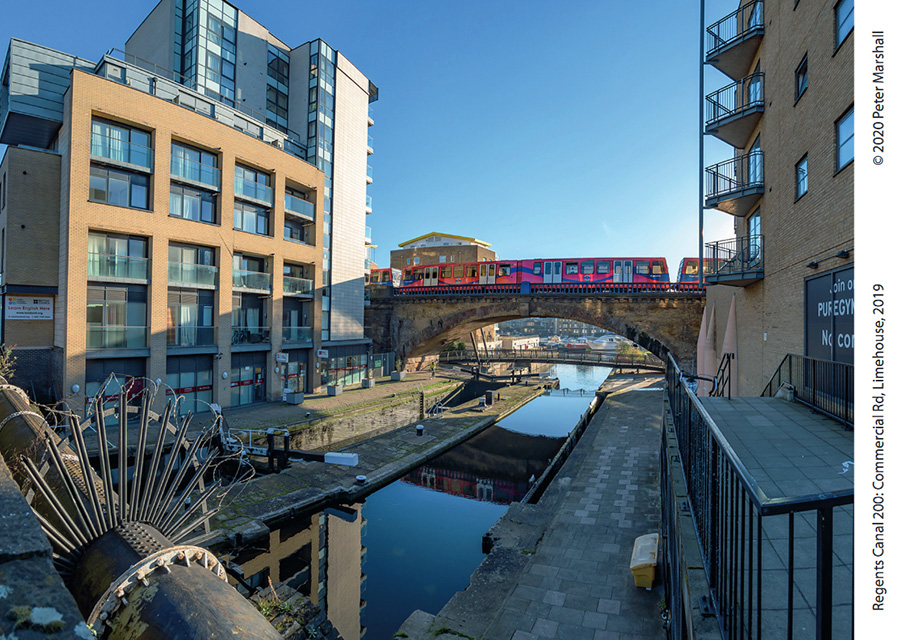
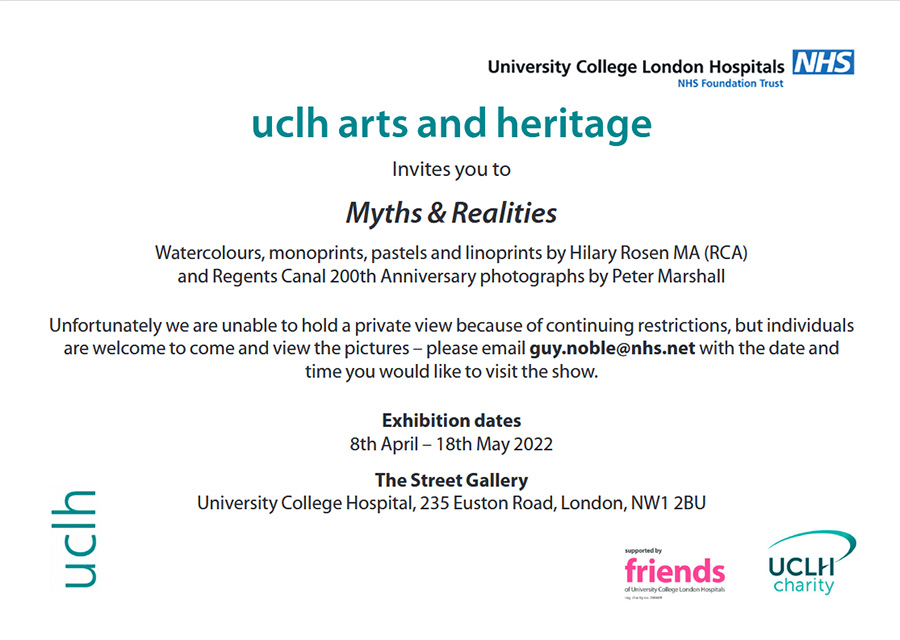
The show was due to open in March 2020 as we went into Covid lockdown, and although now our government seems to think Covid is all done with, others know better and there are still restrictions in place in hospitals, so we are unable to host an opening. And although you are very welcome to visit the show you will need to make an appointment by emailing guy.noble@nhs.net at UCH. Both Hilary and I have invitation cards and are handing out copies to people we meet as well as sending some by post and more electronically – and the two images show both sides of mine. I’m very sorry I won’t be able to see you all there.

Regent's Canal 200 Years at UCH

Below is a little more about my project which is in the show. As well as the 12 pictures on the wall at UCH I have put a larger group including these in an online album, Regent’s Canal 200 Years.

Regents Canal 2020: Maida Hill Tunnel entrance 03-20190717-d028

The Regent’s Canal was opened in 1820 to connect the inland canal system to the River Thames at Limehouse, so 2020 was its 200th anniversary. To commemorate this I began a series of colour panoramas along the canal for an exhibition in March-April 2020 at The Street Gallery in University College Hospital London, half of a joint show, ‘2020 Vision – Vistas and Views’ with artist Hilary Rosen. Unfortunately this show had to be postponed due to COVID-19, but has now been rescheduled with the title ‘Myths & Realities’ for 8th April 2022– 18th May 2022 at The Street Gallery, University College Hospital, 235 Euston Rd, London, NW1 2BU.

Regents Canal 2020: Lisson Grove 06-20190717-d0218

I first photographed the Regent’s Canal in 1979 and have taken many pictures along it over the years since then. I began my work for ‘Regent’s Canal 2020’ early in 2019 and made around eight visits in the following 12 months, producing several hundred images, of which 43 are online.

Regents Canal 2020: Camden High St13-20190308-d0708

These images have an extremely wide angle of view, is roughly similar to the entire field of human vision and to record this on a camera and in print requires a move away from normal rectilinear perspective. They use a cylindrical perspective which retains vertical lines and edges as straight lines but shows other straight lines (except those passing through the image centre) with varying curvature, more pronounced towards the edges of the image. I’ve worked with various equipment in this way since around 1991 when I first bought a specialised panoramic camera.

Lyme Terrace, Camden 16-20190821-d0235

Exhibiting on-line enables me to show more images than the 12 I had selected and printed for the UCLH show. They are presented in the order of a walk from Little Venice where the Regent’s Canal leaves the Paddington Arm of the Grand Union Canal, a pleasant walk of around 9 miles (with a couple of diversions for tunnels) which can easily be done in a day if you are not stopping to make pictures.

Regents Canal 2020: St Pancras Lock and Gasholder Park 19-20190821-d0081

All images are available either as unframed C-Type photographs (image size approximately 16×9″ or 16×10.5″) at £220, as 40x60cm latex prints on canvas (£200) or as 40x60cm dye sublimation prints on canvas (£220). Dye sublimation prints are less intense and carry the image in the canvas, while latex inks sit on the canvas surface and give a more photographic effect.

Regents Canal 2020: Mare St, Hackney 34-20190411-d0238

Peter Marshall Regent’s Canal 200 Years.