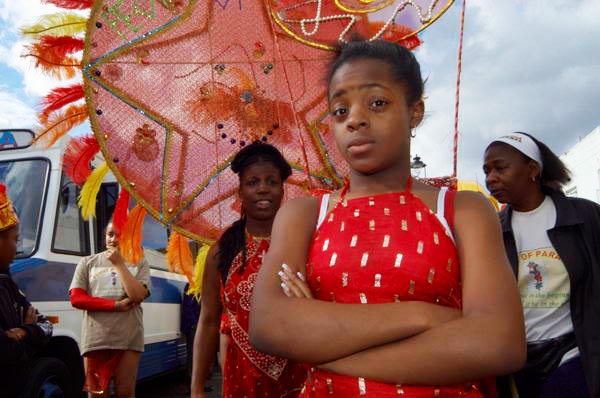
Brent is the London Borough with the largest Irish population and there are also significant numbers in the neighbouring boroughs of Camden and Islington and Hammersmith & Fulham, with Kilburn and Willesden Green being the in particular having large populations of Irish descent,
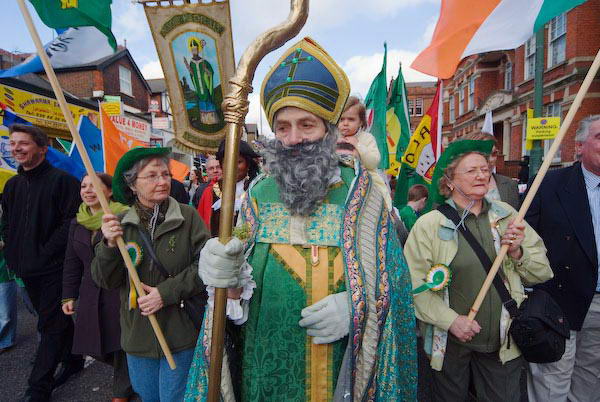
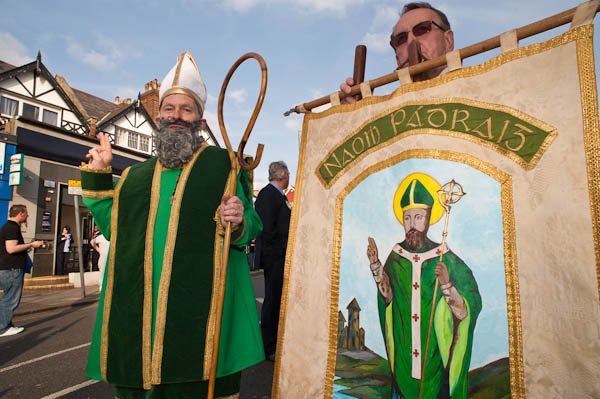
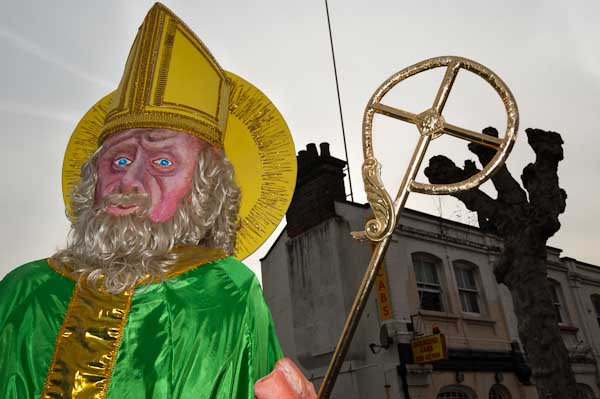
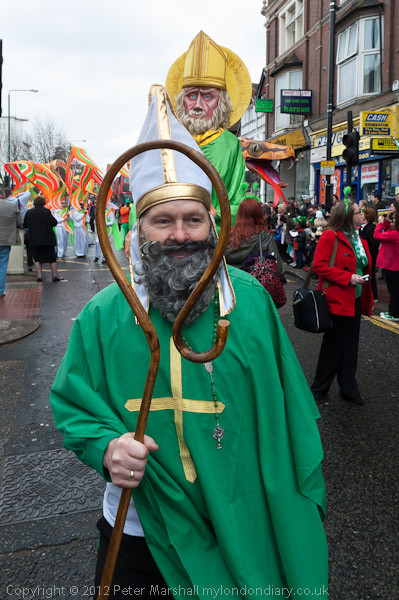
St Patrick, Willeden Green, 2007
So it was hardly surprising that Willesden Green for some years had its own St Patrick’s Day procession, held on the day itself, March 17th, as well as the London celebration begun in 2002 when Ken Livingstone was Mayor on the nearest Sunday. Labour Brent also celebrated days for some of its other communities until recently cuts in funding from a Tory dominated central government made this no longer possible.
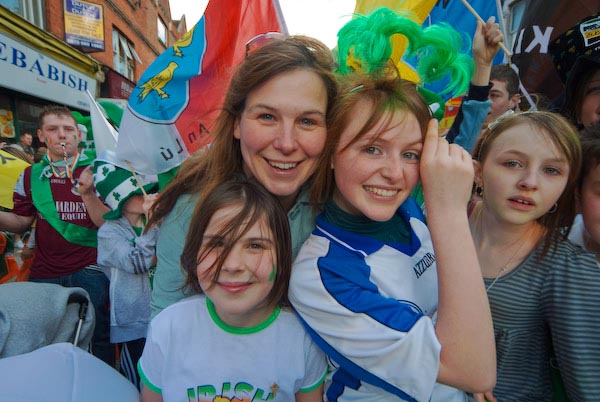
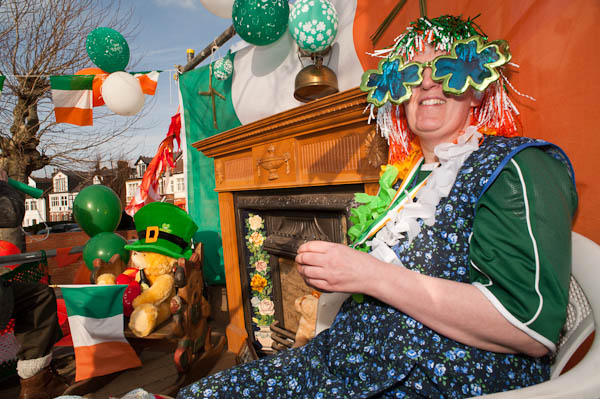
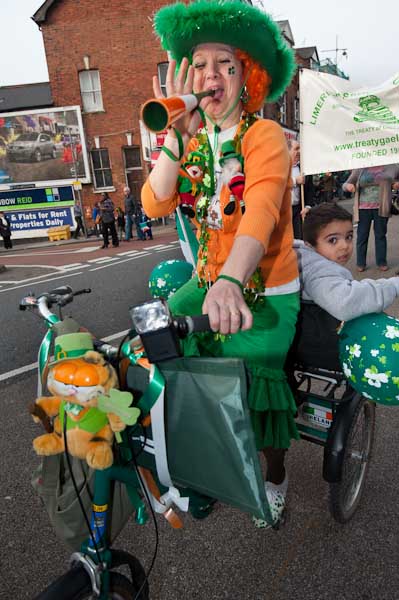
Willeden Green, 2007
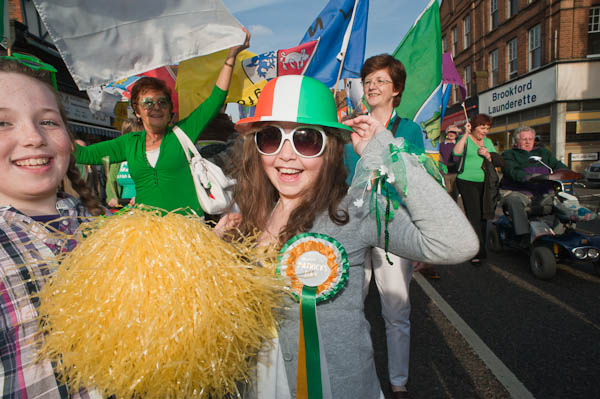
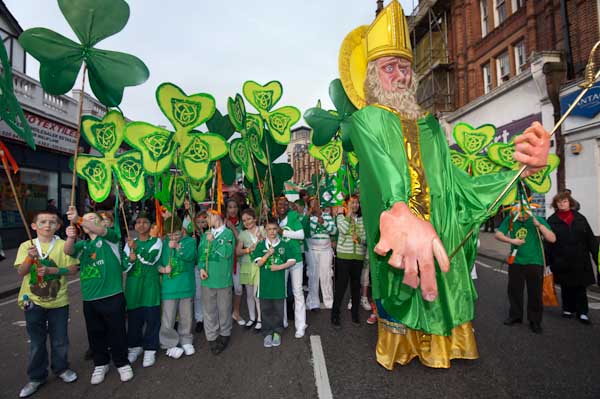
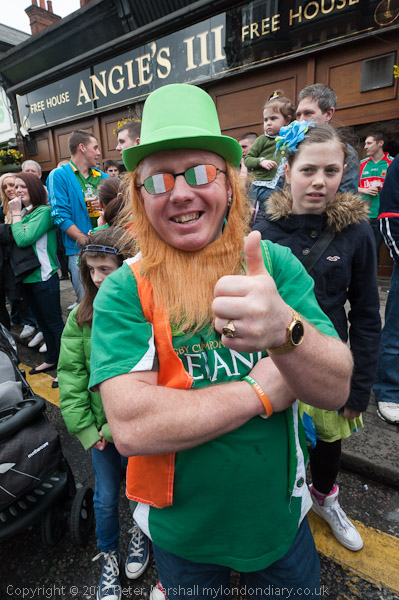
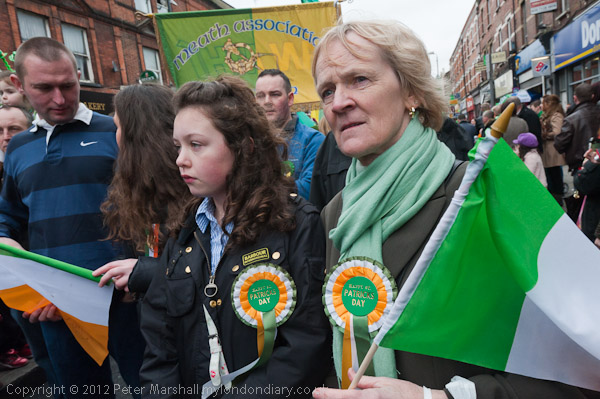
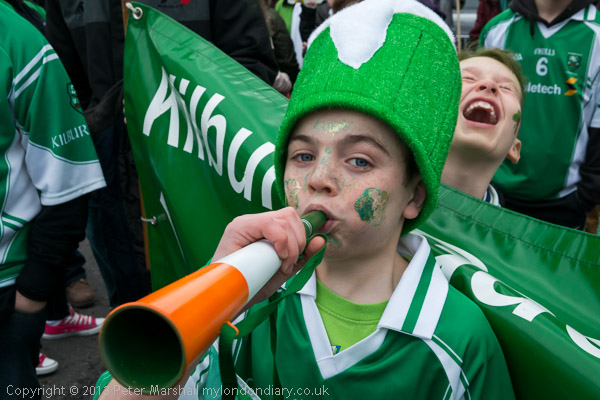
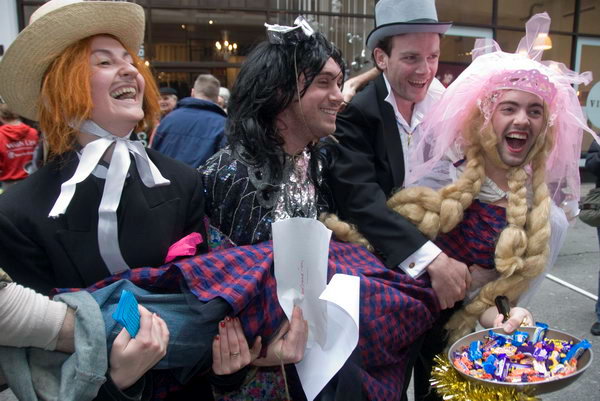
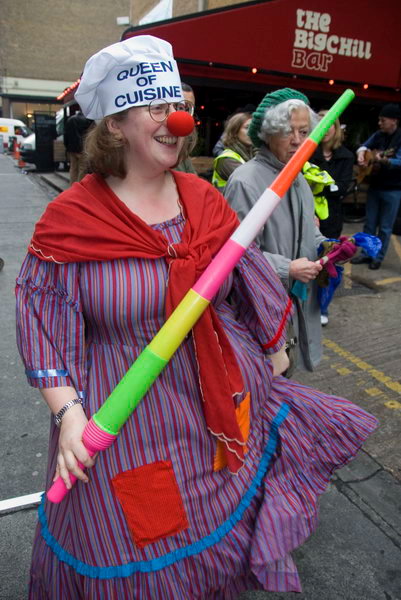
The parade in Brent was on a smaller and friendlier scale than the London parade, and far more a community festival on the street, with others as well as the Irish joining in and having a good time.
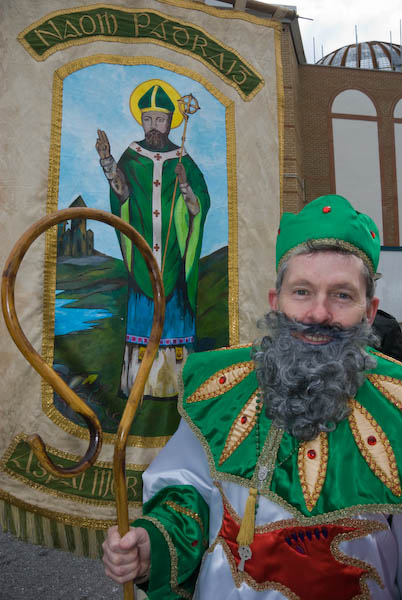
St Patrick, Willesden Green, 2008
The multi-cultural nature of Brent was clear in that the parade began outside an Islamic Cultural Centre and those taking part included many local school-children from a whole mix of heritages. Brent as well as St Patrick’s Day also then celebrated Diwali, Eid, Christmas, Chanukah and Navrati, and Holocaust Memorial Day, along with a black history programme, its own ‘Respect’ festival and a world food and music festival.
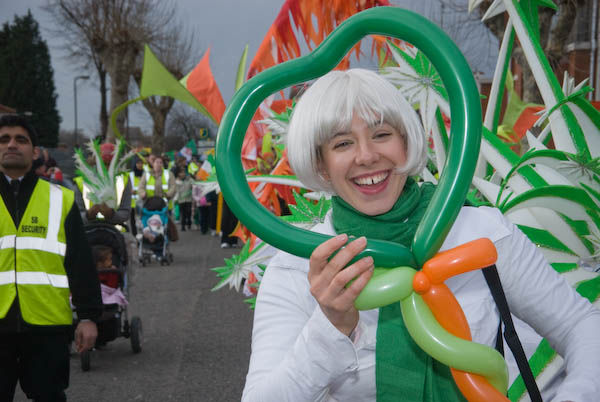
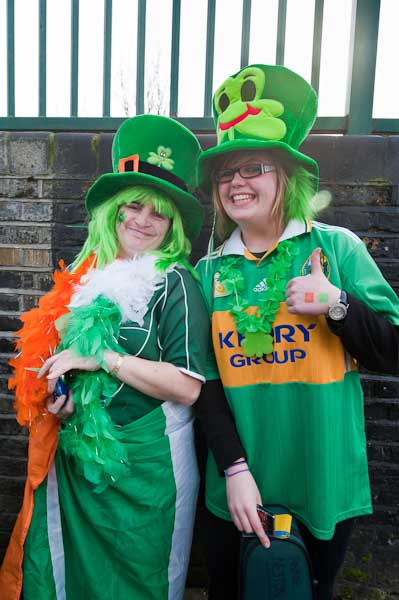
Willesden Green, 2008St Patrick blesses the photographer, Willesden Green, 2009
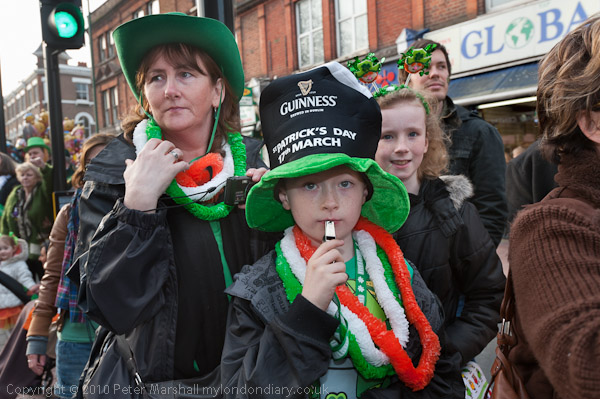
But it was very clearly an Irish event, with Irish people from all across London coming to watch and take part, both in the parade and in the various pubs and bars along the route.
Willesden Green, 2009
Some of the floats in the parade were also in the main London St Patrick’s Day parade, but the atmosphere here was much more relaxed. Here are a few pictures that I made from 2009-2013.
In 2013, the event was much smaller as council funding had been cut, thanks to Tory austerity policies. And because St Patricks Day that year was on the Sunday, the celebration in Brent was held a day earlier so not to clash with the London parade.
I think this was the last St Patrick’s Day Parade in Brent – certainly it was the last I photographed. You can see many other pictures from Brent St Patrick’s Day Parade on My London Diary
The family vault of the Bear Family is marked by one of the more impressive monuments of Tower Hamlets Cemetery, with a long list of names, ages ad date of death which is headed by George Huxley Bear, who died in 1855 aged 4 years and six months. Several of the other entries are also for children, though their father lived to the age of 76. Child mortality was very much a feature of Victorian life.
I made two other pictures of this memorial, with its stems of wheat at the bottom and the consoling text from John XII, v 24 “Except a corn of wheat fall into the ground and die, it abideth alone: but if it die, it bringeth forth much fruit.” As with all the other pictures you can click on this one to get a larger version and then browse back and forward to see them.
Bromley Public Hall, Bow Rd, Bow, Tower Hamlets, 1988 88-8b-41
Until last year this was the Tower Hamlets Register Office. The Grade II listed building dates from 1880 and was built as the vestry hall for St Leonard’s parish and extended in 1904. At least one web site confuses this with the much older and very different Bromley Hall, on the Blackwall Tunnel Approach road, though to be the oldest brick building in London, built around 1490 but extensively remodelled with a Georgian frontage around 1700.
Former Co-op store, Bow Rd, Bow, Tower Hamlets, 1988 88-8b-42
Stratford Co-operative & Industrial Society built this splendid store on Bow Road in 1919, proudly listing the names of its leading members under the bee hive signifying co-operation.
In my youth every high street (and some rather lower) had its own Co-operative store, benefiting from the huge buying power of the Cooperative Wholesale Society. We bought most of the few new clothes we could afford there as well as shoes and other items, and it was the Co-op who delivered our milk seven days a week. My mother’s Co-op number is still etched in my memory, essential when making any purchase, and leading to a ‘divi’ at the end of the year which saw us through Christmas.
In 1988 this was the PLH Kakkad Supermarket and although it sold a wide range of goods its frontage was devoted to Rothmans, “The best tobacco money can buy“. More recently it became a Costcutter and then a Nisa local since around 2008.
Lea Navigation, St Thomas Creek, Bow Back Rivers, Stratford, Newham, 1988
I walked further east and crossed the busy Bow roundabout to take this picture looking across the Lea Navigation and up St Thomas Creek, one of the Bow Back Rivers. Stratford High Street at right is now lined with tall flats, and Global Caravans with one stacked on top of a couple of containers is long gone, along with almost all of the rest of the industrial buildings. A few of those nearest on the left before Cooks Road remained but in derelict condition in 2021.
Walking back west up Bow Road took me to Bow Theatre on the west corner of Fairfield Road. This Grade II listed building was a new Poplar Town Hall built in 1937-8 and was said to be the first modernist town hall, designed by Ewart Culpin and his son Clifford. The frieze by David Evans depicts the various trades of the builders of the town hall and is said to include a welder, a labourer, a mason, a carpenter and an architect. Unfortunately it is hard to decide the occupations of some of those in my picture, partly as they are not critically sharp.
After Poplar became a part of Tower Hamlets, this was no longer a town hall, but remained in use for some years as council offices and also as a theatre. The council sold it in the 1990s and it is now Bow Business Centre.
The Caledonian Arms on the corner of Blondin St is still standing but no longer a pub, having closed around 2000 and extensively converted to office and residential use in 2010. The building possibly dates from 1851 though it may have replaced a former building later that century. For years a Watney’s pub it later became owned by Shepherd Neame.
The cafe on the opposite corner has gone completely, its site part of a car park for new buildings down Blondin St. The name suggests that the street was built at the time of the famous tightrope crossing of the Niagra by ‘The Great Blondin‘ in 1859.
Douro St, Bow, Tower Hamlets, 1988 88-8b-35
This was a short street with small houses shown in the picture with front doors opening directly onto the street and a car breakers behind the fence at left.
The cobbles and the small houses are still there, but the car breakers have been replaced by a large block of flats, Altius Apartments, at 714 Wick Lane, with 4 floors and a roof garden, at a taller 9 floor tower at the east end. The guide price for one of those small houses in the ‘Bow Quarter’ is given as £800,000 and the estate agents rather creatively describe Douro St as ‘tree-lined’.
Tredegar Rd is just to the north of Douro St, on the other side of the flats. I think this is at its junction with Wick Lane and I think absolutely nothing of what was in my picture remains, with even the road layout having altered at least slightly.
What was H Bates & Son Scrap dealers is now occupied by a block of around 12 floors, offices at ground level and flats above, but the ‘Bow Quarter’ area is so different that this could well be another nearby corner – also covered with new housing. But my next pictures show I turned south down Wick Lane to the rear of the former Bryant & May match factory, where the next instalment of this walk will begin.
Click on any image to see a larger version in my album 1988 London Photos, from where you can browse other images. You can view most of the sites today on Google Streetview.
The buildings of the Diary and the Rose & Crown are still standing at the north end of Stroudley Walk where it meets the end of Bromley High St, but the closed diary became Hussains Convenience Store and then Jalalabad Grocers and half is now a mobile phone repair shop.
The Rose & Crown had opened here around 1720, as the Bowling Green Inn, though the building here is from the 1880s. It closed in 2007, was boarded up for some years before reopening around 2014 as a coffee bar and fast food restaurant.
This was formerly the north end of Devons Road, and a sign for this painted on the brickwork at the left of the pub had virtually disappeared when I made this picture in 1988. Later repainted it has now almost disappeared again.
I wrote more about Kingsley Hall and the sisters Muriel and Doris Lester in the previous post on this walk. They used a legacy from their younger brother Kingsley to set up a house where they lived in relative poverty and served the neighbourhood as well as campaigning for peace and justice across the world. A plaque on the building records that Mahatma Gandhi lived in a small cabin here during his three month stay attending a government conference as a representative of the Indian National Congress. You can read and see more about his visit and the sisters on the Muriel Lester web site.
This image gives a better view of the whole building, which dates from 1928. It faces the Devons Estate, built for the London County Council in 1949 and described by Pevsner as being in their ‘pre-war manner, but with all the drabness of post-war austerity‘. Those moved from slums into its maisonettes and flats would have taken a far more positive view and the estate was solidly built and well-designed to the standards of the day.
Clyde House, Bruce Rd, Bromley-by-Bow, Tower Hamlets, 1988 88-8a-26
Clyde House is still there at 46 Bruce Road, looking in rather better condition now. Built in 1884 it appears to have been built as a pair with its double-fronted neighbour at 48.
Sisters Muriel and Doris Lester helped to set up the Children’s House on Bruce Road 1923. Doris had trained as a teacher and they commissioned Charles Cowles-Voysey to design a building based on Maria Montessori’s ideal learning environment for young children. The school was opened in 1923 by H G Wells and is still a school, run by Tower Hamlets Council.
Inside there is a 12 metre mural painted in 1935 by Eve Garnett, the illustrator, artist and writer of the first children’s book about working class characters, The Family from One End Street, in 1937. There is now a campaign to save and restore the mural which is dirty and damaged and the web site is asking for donations to pay for this.
Regent Square, Bow, Tower Hamlets, 1988 88-8a-15
The Crossways Estate, built in 1970 was apparently at the time known as the ‘Pride of Bow’, for its three 25 storey towers and a low rise block, Holyhead Close, built over the railway line. Later it was more prosaically referred to as the ‘three flats.’
It was here that Grime developed in 2003, after Rinse FM squatted in a flat and broadcast illegally from here, and it was also where Dizzee Rascal and others grew up.
Like many council developments the area around the estate was hard to navigate, with walkways and roads often not shown on maps. My contact sheet says ‘Regent Square and gives grid reference 375827 for the first of the five images I made. The three towers were Hackworth Point, Mallard Point and Priestman Point and are on Rainhill Way.
And also like many council estates, it was subjected to a policy of ‘managed decline’ and by 1999 was in a very poor state, so bad its demolition was under consideration. Tower Hamlets decided to retain and refurbish the estate which passed to Swan Homes after a residents ballot in 2005. Its towers now refurbished and clad more brightly this is now the Bow Cross Estate.
The ‘three flats’ seen from Bow Road and Bow Church DLR station which opened on 31 August 1987.
Mornington Grove, Bow, Tower Hamlets, 1988 88-8b-61
Mornington Grove not only gets a mention in the London 5: East volume of Pevsner (p619) which describes these houses as “unusually grand for the area” but also has an extensive web site covering its history by Ken Ward, a resident in the street, from which this information is extracted – and which has far more detail. And it really is an interesting history – if you have the time do click the link and read more.
The land of a nursery here was bought by the Quaker meeting in Ratcliff in 1812, and houses on Mornington Road were developed by them from 1854-1889 – those on the east side in this picture being among the later development. Arthur Wellesley, the 1st Duke of Wellington was the son of the first Earl of Mornington, and the fourth Earl lived nearby on the north side of Bow Road.
Many of the houses in Mornington Road were compulsory purchased and demolished for the Whitehapel and Bow Railway (later the District Line) and others by World War II bombing of what had in 1939 been renamed Mornington Grove. Under the Quakers, at least 5/7th of the rents of the houses went to the support of the poor.
Most of the houses in the street, by then under multiple occupation, were sold by the Quakers to a housing association in 1980, becoming social housing, though many have now been sold off.
More from Bow in the next post from my walk in 1988. You can see larger versions of any of these pictures by clicking on the image which will take you to my album 1988 London Pictures from where you can browse.
Stanstead House, Devas Street, Bromley-By-Bow, Tower Hamlets 1988 88-8a-53
My previous walk on 31st July ended at Bromley-by-Bow, and I returned there the following day to continue my wanderings, starting on Devas St and the Coventry Cross West Estate, built by the LCC in the early 1950s, and in 1988 it had recently passed from the GLC to Tower Hamlets. Like all council housing it was very much compromised by the opposition under Thatcher to social housing, with the ‘right to buy’ policies selling off properties to tenants on the cheap and local authorities being largely prevented from building more as well as being starved of cash.
The estate serves as a reminder of an age where councils were able to provide large numbers of socially rented homes before we moved to an era dominated by private profit. Many council tenants who bought their own properties found it very impossible to pay back the loans they had taken on, and sold them as soon as they were able, with many of them now privately rented as ‘buy to let’ properties with rents several times social housing rates.
The six-storey Newmill House at left is linked to the four storey Stansted by a massive archway, with another the west linking to another six storey block, Brimsdown. The estate is now managed by Poplar HARCA and has been renovated around ten years ago.
Stanstead House, Devas Street, Bromley-By-Bow, Tower Hamlets 1988 88-8a-54
A portrait orientation view of the same arch into the estate. When built Newmill House at left, a long block running parallel to the Blackwall Tunnel Approach, contained 55 flats.
North of the railway line, my walk took me to Patrick Connolly Gardens, now rather lost in the Devons estate, and then on to Powis Road where I made this picture of Kingsley Hall.
Kingsley Hall was opened in 1928 by philanthropists and peace campaigners Muriel and Doris Lester who opened the centre using the legacy from their brother Kingsley who died in 1914 when only 26. They had previously helped to set up a Children’s House on Bruce Road nearby in 1923. Muriel Lester (1883-1968) was one of the world’s leading pacifists, and is thought to have been unsuccessfully nominated for the Nobel Peace Prize in the 1930s.
The building had previously been Zion Chapel built by Strict Baptists but was then disused. The sisters were also Baptists, but of a very different nature, they were radical and committed to a social gospel and justice issues and the hall became a centre for their community work with Muriel also serving as its pastor. They donated their wealth to serving the people of Bow and lived a simple and humble life.
Muriel had met and travelled with Mahatma Gandhi often in her work as Travelling Secretary of the International Fellowship of Reconciliation and when he came to London as the representative of the Indian National Congress Party to argue in a conference for independence he rejected the suite offered him by the government at the Hilton Hotel, saying he would rather stay with Muriel Lester at Kingsley Hall. He stayed there for three months, living in a cell on the roof in the same simple style he did in London.
Bromley-By-Bow, Tower Hamlets, 1988 88-8a-44
I doubt if I would have photographed this street corner were it not for the message ‘big Love’ in large letters on the corrugated iron sheeting. Though it does look as if the writer went on to write something beginning with HATE. This was somewhere fairly close to Kingsley Hall.
Edgar Rd, Bromley-By-Bow, Tower Hamlets, 1988 88-8a-46
The fence here has several messages as well as some peeling posters. The longest text reads ‘AS LONG AS WE HAVE NOT SMASHED EVERYTHING THERE WILL BE RUINS!!’, an exceedingly philosophical example of graffiti which I’ve not seen elsewhere, though I wonder if it could be from a song lyric.
Considerably more common is the ‘VICTORY TO THE MINERS’, and I think the Female Sign – the planetary symbol for Venus ♀ – may mean the painter was a woman.
This may have had some connection with Tudor House, whose grounds were bought in 1898 by the LCC to make a public park, which is now Bromley Recreation Ground a couple of hundred yards away, but more likely just with the Tudor family who lived in Tudor House and in the Old Palace closer to where Tudor Lodge used to be.
The archway informs us that this was Tudor Lodge Sports and Social Club, catering for Weddings and Funerals; over a door at left it tells us the ‘Bow Bridge Sports & Social Club Meets Here’. It was by then a large men’s social club, but the impressive cross above the doorway suggests that this was originally a Christian institution of some kind, perhaps a convent or priory
In the 1980s it became a venue for Drag Balls which had begun as the Chelsea Arts Ball, before moving to the Parchester Hall and then on to here. Later in the 90s was the home of Ron Storme’s Transvesti Extrodinaire club.
There is now a completely different modern Tudor Lodge at 95 Bromley High St on the corner with St Leonard’s Road.
How Memorial Gateway, St Leonards Priory, St Leonard’s St, Bromley-by-Bow, Tower Hamlets, 1988 88-8a-33
The only part of the parish church of St Mary with St Leonard to survive following bombing in 1942 and the building of the Blackwall Tunnel Approach Road. The church was built in 1843 to replace the former chapel of St Leonard’s Priory, a Benedictine nunnery first recorded in 1122 and destroyed after the dissolution of monasteries in 1536, after which its chapel had been used as a parish church. Chaucer wrote of the nunnery as the “Scole of Stratford atte bowe“.
The How Memorial Gateway was erected in 1893 as a memorial to the Rev G A How, vicar of the church from 1872-93. It is Grade II listed and in poor condition.
Bromley High St, Bromley-By-Bow, Tower Hamlets, 1988 88-8a-34
There is still a large tree and a telegraph pole on the corner of Bromley High St with St Leonards Street, but the lower buildings on the left of the picture were demolished a year or so ago.
Just visible in this picture is the coat of arms of the London County County on 72-4 Bromley High St (Barry wavy of six Azure and Argent on a Chief of the last the Cross of St. George charged with a Leopard of England. The Shield is ensigned with a Mural Crown Or – though it’s too small on the photo to see any details) announcing this as the Bow Bridge Estate, which was completed in 1934. I hope Poplar HARCA kept this when they demolished the building.
My walk through Bow will continue in a later post. Click on any of the images above to see a larger version in my album 1988 London Photos, from where you can browse the album.
Spratt’s, Far Famed Cakes and Bromley by Bow. My walk on 31st February 1988 was coming to an end as I made my way towards Bromley-by-Bow District Line station to begin my journey home. You can see the previous part at Lansbury, Brownfield, Teviot and St Leonards Road.
St Leonard’s Road beyond Langdon Park becomes Uamvar St, an odd name whose origin I can’t find. It used to be a little west of its current route and I think with St Leonard’s Road used earlier to be Bow Lane. I soon turned left onto Clutton St and climbed onto the footbridge over the railway. The bridge has now been replaced by a metal structure on which it would be rather harder to write ‘Happy Birthday’ and ‘I Love You’.
The railway line here carries the Docklands Light Railway line from Poplar to Stratford, but had been a part of the North London Railway (founded in 1846 as the East and West India Docks and Birmingham Junction Railway.) The Spratt’s Patent Limited Offices Fenchurch St are still there, with an entrance from Fawe St.
The Far Famed Cake Company began in 1881, and was bought by Fitch Lovell in 1950. They merged it with another company to form Hales Trent Cakes in 1962. In 1974 this was bought by Lyons. The factory had employed around 320 people. I think this site is now occupied by a large new block of flats with some shops on Morris Road.
Separated by a long yard from the block of Spratt’s Patent beside the DLR is another block of Spratt’s Patent Limited, still there and now the A B Fine Art Foundry.
The Foresters Arms at 253 St Leonards Road, on the corner with Clutton St, a former Charrington & Co pub closed in 2004 and was sold. It was extended and converted to 6 flats in 2005. There had been a pub on this site since before 1856. It still has an address on St Leonards Road lthough my map calls the road huere Uamvar St.
I continued my walk up Uamver St and on to the Blackwall Tunnel Northern Approach, and this picture was taken beside Tweed House, part of which can be seen at the extreme left. The buildings in the centre have now been replaced by a lower-rise redevelopment but that visible above the wall at the right of the picture is still there.
This section of the Limehouse Cut towpath was then rather overgrown and little used. It is now much busier, with a new floating section taking the path from Bow Locks under the busy tunnel approach road.
I photographed this mural on a nursery and clinic in the flats beside the Blackwall Tunnel North Approach close to Devas St. This was part of the Coventry Cross West Estate, built by the LCC in the early 1950s as an addition to their 1935 Coventry Cross Estate. The name Coventry Cross came from a long-closed pub in the area since 1690 – at 68 St Leonards Street in 1861. The estate passed to the GLC and then TOwer Hamlets before after consultation and vote they joined Poplar HARCA.
From here is was a short distance to the end of my walk at Bromley-By-Bow District line station – from where I began my next walk in early August 1988
This had been an good walk for me and I hope readers will have found the pictures and text about them interesting. There are some more pictures from it in my album 1988 London Photos including some from earlier in the day at Petticoat Lane, in Whitechapel and Tower Hamlets cemetery before I started the walk proper.
Lansbury, Brownfield, Teviot and St Leonards Road. My previous post in the series on this walk, Back to Poplar in 1988 contained information about George Lansbury, a leading politician in Poplar and around from when first elected as an MP in 1910 to his death in 1940. From 1932-35 leader of the Labour Party he was forced to resign because he stuck to his principles.
Lodore St, Poplar, Tower Hamlets, 1988 88-7t-45
Because of its closeness to the docks and the River Thames Poplar had been one of the worst hit areas by bombs from German Zeppelins and bombers in World War I, but suffered far great damage in WW2, with almost a quarter of the buildings in the area being destroyed.
Redvelopment of the area after the war was slow, although part was finished in time to be included as the Live Architecture Exhibition section of the 1951 Festival of Britain, development of the whole of the area designated as the Lansbury Estate, between the East India Dock Road, Burdett Road, Limehouse Cut, and the North London railway line was only completed in the 1980s. The area at the south-east of this was developed by the GLC as an eastern extension to Lansbury, now known as the Brownfield Estate, designated in 1958.
By then its nature had changed with the original and highly praised plans begun under Patrick Abercrombie in 1943 and carried forward by Frederick Gibberd and the LCC Architect’s Department for the Festival being greatly modified, particularly after the Conservative Government which came to power in 1950 altered the housing priorities to provide more homes – which meant more high-rise.
From the GLC, the Lansbury estate passed to Tower Hamlets Council and was badly affected by Thatcher’s ‘right to buy’ and other policies against council housing. Much was transferred in 1988 to Poplar HARCA.
The iconic block of Balfron Tower is one of three – Balfron Tower, Carradale House and Glenkerry House – listed blocks by architect Erno Goldfinger on the Brownfield Estate and dates from 1965-8. His development of Carradale House was held back so displaced local residents could be housed in Balfron and it was comleted in 1967-8, with Glenkerry House by Goldfinger’s studio being completed in 1972-5.
Goldfinger and his wife lived in one of the flats in Balfron for 8 weeks after completion. Balfron passed from Tower Hamlets to Poplar HARCA in 2007, promising residents to refurbish the building and re-house them there. They reneged on that promise, converting the block to luxury flats sold at market prices.
St Leonard’s Arms, St Leonard’s Rd, Poplar, Tower Hamlets, 1988 88-7t-32
The St Leonard Arms at 162 St Leonards Rd is said to have closed in 1988 and was later converted to flats, probably in 2002. It had been there at least since 1861, when its address was 17 Wilson Terrace and St Leonard’s Road was then Bow Lane. In my picture from 1988 it looks as if it had closed some time earlier.
At the left the Grade II listed St Michael and All Angels, built 1864-5 is undergoing extensive building work – probably part of its conversion to flats as St Michael’s Court.
Five Ways Mission, War Memorial, St Leonard’s Rd, Poplar, Tower Hamlets, 1988 88-7t-33
Close to the church is an impressive war memorial with the “Christ with one hand raised in blessing and the other holding a wreath above the head of a kneeling warrior in the armour of a crusader“, sculptor A R Adams erected in 1920 with funds from a public “appeal, a football match and tickets for a special matinee performance at the queen’s theatre, high street on Saturday 24 April 1920“.
On the opposite side of the road is the former Fiveways Mission and a car hire service. This building is now smartened and extended at right as private housing.
Five Ways Mission, St Leonard’s Rd, Poplar, Tower Hamlets, 1988 88-7t-34
A closer, head-on view of the properties at 161-165 St Leonard’s Rd, with some light flare.
St Leonard’s Rd, Bright St, Poplar, Tower Hamlets, 1988 88-7t-36
A view of from the side of the two properties and the adjoining former London Cooperative Society with a fading and crumbling advertisement for BALSAM for COUGHS and Colds (perhaps the word FRIARS’ had already gone.) Above the shuttered frontage is the word HEADACHES.
St Leonard’s Rd, Bright St, Poplar, Tower Hamlets, 1988 88-7t-22
On the side of the building is a giant sign for the TEVIOT FESTIVAL, OPEN TO ALL and an arrow pointing in its direction. I also photographed this sign in colour. Much of this area was redeveloped as the Teviot Estate, which is now being redeveloped by Poplar HARCA. It is now often called Langdon Park, a green area at the end of Bright St where there is a newish DLR station.
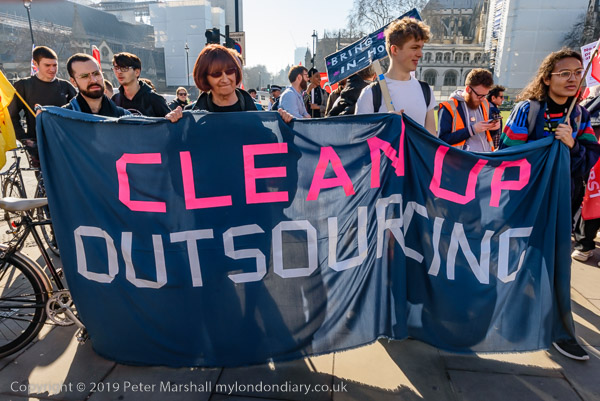
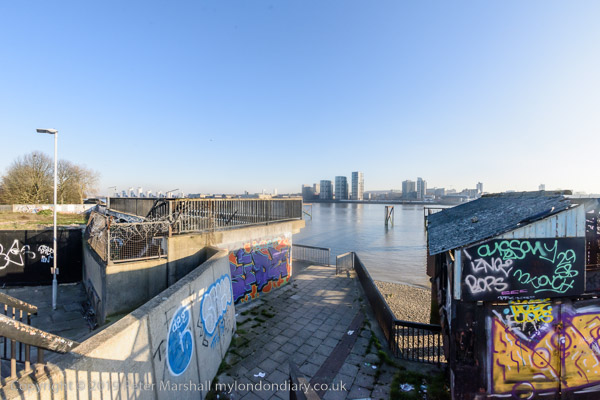
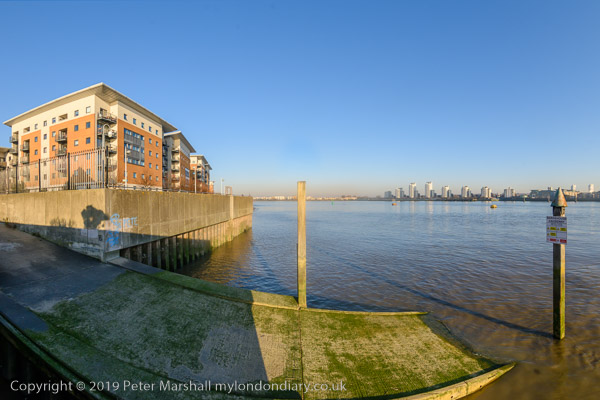
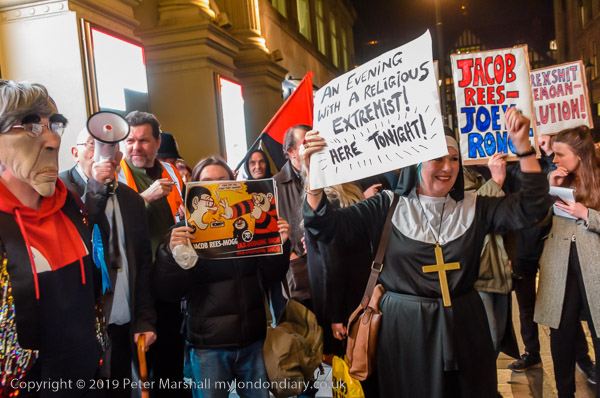
Outsourcing, North Woolwich & Class War v. Rees-Mogg. Three years ago on Tuesday 26th February I spent the morning photographing several protests against outsourcing, had a rather late pub lunch, then went to North Woolwich for a short walk before rushing back to meet Class War who were protesting outside a Palladium show by Jacob Rees-Mogg.
Rally for an end to Outsourcing
A legal challenge was taking place at the High Court on this day to extend the employment rights of the 3.3 million workers whose jobs are outsourced from the companies where they work to contracting companies which then sell them back to their place of employment at cut rates.
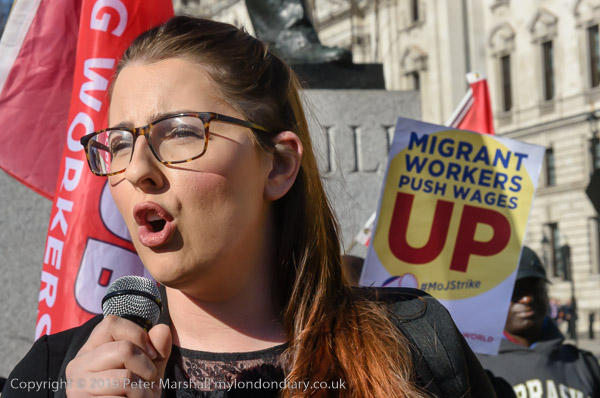
Labour Shadow Business minister Laura Pidcock
The contractors do this by cutting wages, trimming things such as pensions, maternity pay and holiday pay to the bare legal minimum, increasing workload and reducing hours of work and often bullying managers. Outsourced workers generally have little job security and are often denied necessary safety equipment and not given proper safety training.
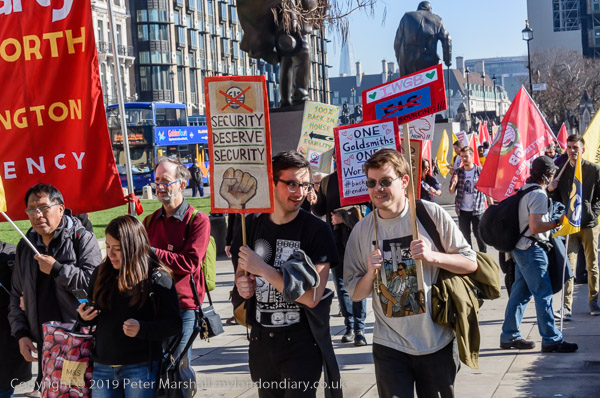
Workers, mainly migrants who work for the Ministry of Justice, Dept for Business, Energy & Industrial Strategy and the University of London were taking part in a one day strike in a coordinated action by the UVW and IWGB trade unions and the BEIS PCS branch to demand an end to outsourcing and the insecurity, discrimination and low pay it causes. They had started their march at 8.00am at the University of London and after a rally outside the High Court had marched to Parliament Square where I met them at 11am.
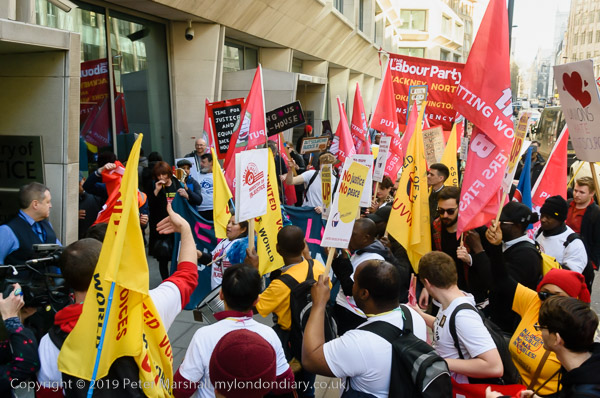
From Parliament Square the marchers went on to hold a further rally outside the Dept for Business, Energy & Industrial Strategy in Victoria St. Those striking at the BEIS included catering and security staff who are members of the PCS and are demanding the London Living Wage as well as end to outsourcing and the insecurity, discrimination and low pay it causes.
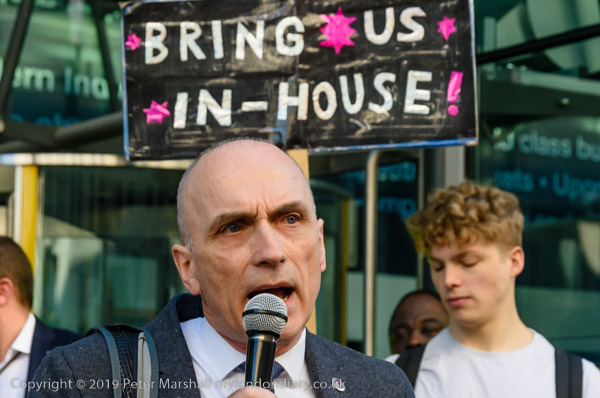
The PCS strikers led a lively rally with plenty of singing, dancing and shouting of slogans expressing their demands, which was followed by several speeches, including from Labour MP Chris Williamson, who brought messages of support from Labour shadow cabinet members and promises that a Labour government would end outsourcing.
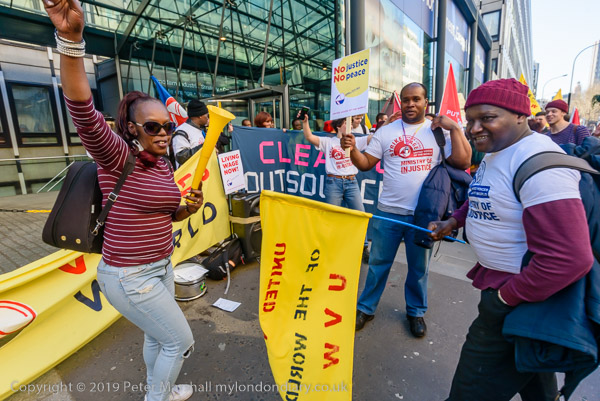
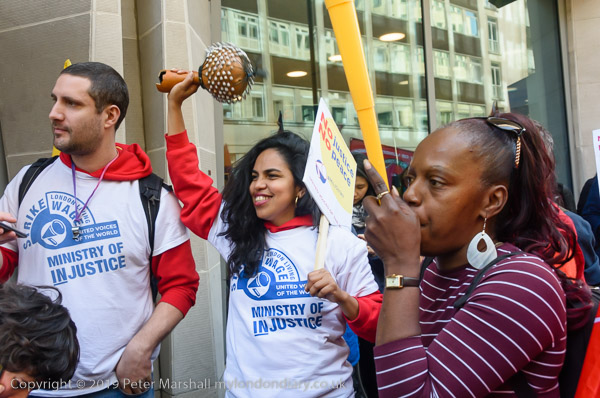
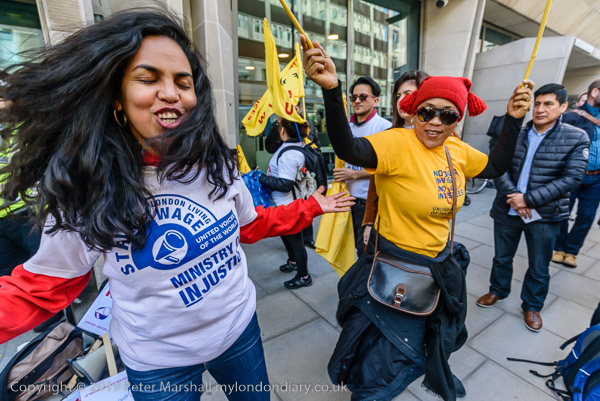
The marchers continued the short walk to the Ministry of Justice in Petty France, where low paid workers belonging to the United Voices of the World union at the Ministry of Justice have been campaigning for some time to get the London Living wage, but the Justice Minister has refused to talk with them. Many wore t-shirts calling it the Ministry of Injustice.
During the rally outside the building some of the UVW workers who had already been on strike for 24 hours went back into the ministry to resume work, to cheers and hugs from those on the street outside. The rally ended with music and dancing on the pavement, and I left for a rather late pub lunch in Holborn.
I’d been intending to walk a short section of the Capital Ring, mainly beside the River Thames, for some months as it had been quite a few years since I’d last been there and wanted to see how it had changed. I had an afternoon with nothing else I needed to photograph and although the sunny weather with clear blue skies was not ideal it seemed a good opportunity.
Panoramic photographs almost always have large expanses of sky, and on days like this it tends lack interest, as well as often giving unnatural looking variations in tone when getting closer to the sun. Getting to North Woolwich should have been simple and reasonably fast, but unfortunately there was trouble on the DLR and I had to make a less direct route, so had to rather rush on the walk and leave it half-finished. It was a few months later before I found time to go back and complete it.
I find it hard to understand why anyone should want to come and listen to Jacob Rees-Mogg, let alone pay £38 for a ticket to do so at the London Palladium.
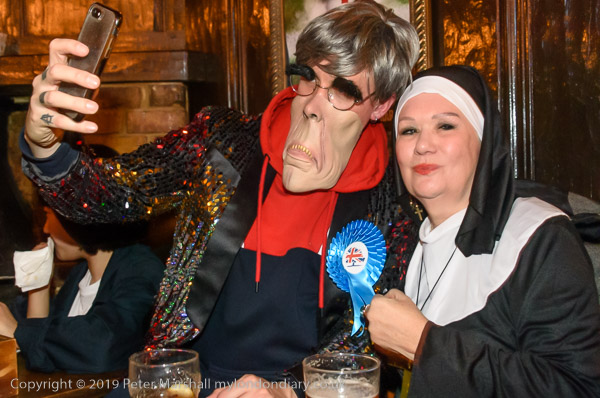
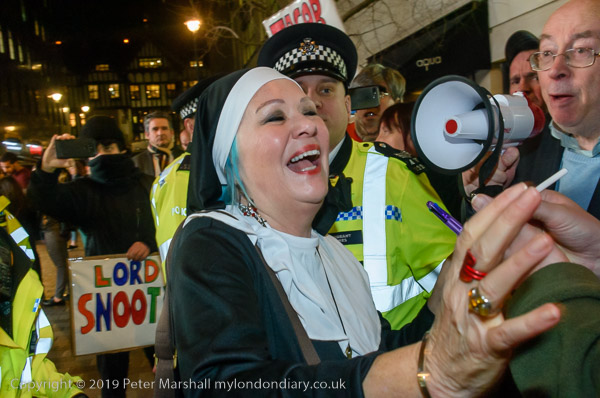
So too did Class War, and with Jane Nicholl dressed as a nun, Mother Hysteria, and Adam Clifford as Jacob Rees Mogg they loudly asked why people had come to listen to him “spout homophobic, transphobic, racist, pro-hunting, misogynist, classist, privileged” nonsense.
Their show on the street outside was almost certainly a better show than anything that would take place later inside the venue, and all for free. Police spent a considerable amount of public money on harassing them, and provided their own rather hilarious input by searching Mother Hysteria and threatening to arrest her for carrying offensive weapons after some novelty stink bombs were found in her handbag. When I left the officer who had stopped and searched her had already spent 20 minutes trying to write her notice of stop and search, probably at a loss trying to find some way to put it that doesn’t make it sound incredibly stupid.
My previous post, Around Devons Road, Bow 1988, ended outside Spratt’s Patent Limited on Morris Road on the south bank of the Limehouse Cut. My walk continued south down Chrisp St to the East India Dock Road, then turning east for around 350 yards and then back up the next main route north, St Leonards Road.
Plaque, George Lansbury, Poplar Councillors, East India Dock Rd, Poplar, Tower Hamlets, 1988 88-7t-66-positive_2400
This ‘blue plaque’ is actually and appropriately a red one, placed here by Tower Hamlets Environment Trust with the text ‘Near this place on July 29th 1921 George Lansbury led the people and councillors of Poplar on their march to the high court for the equalisation of rates to poor boroughs.’
According to a long article in Wikipedia, as a youth Lansbury was a supporter of the Liberal Party and particularly Gladstone, but while campaigning for the party he became greatly influenced by leading socialists including William Morris, Eleanor Marx, John Burns and Henry Hyndman, and resigned in 1892, joining the Social Democratic Federation. He worked for a short period as the SDF paid national organiser, leaving that job to return to Bow to take over the running of the sawmill owned by his wife’s family.
Lansbury was first elected to Poplar Borough council in 1903 and in 1910 became MP for Bow and Bromley. He resigned in 1912 in order to fight a by-election in the constituency standing as the ‘Women’s Suffrage and Socialist’ candidate, and although neither Labour nor Liberal parties put up candidates to oppose him he lost to a Conservative candidate with the name of Blair. Reginald Blair had campaigned under the slogan “No Petticoat Government”.
Earlier in 1912 Lansbury had campaigned with others to found a daily socialist newspaper, the Daily Herald, and became editor in 1914. Under his editorship the paper opposed the 1914-18 Great War with Germany and supported the 2017 Russian Revolution.
Lansbury and 29 fellow Poplar councillors were jailed in 1921 for refusing to pay unfair sums from the rates to fund the London County Council, Metropolitan police and other London-wide bodies, instead using the money to support the local poor. Their imprisonment led to public outcry and they were released after six weeks, with a law hastily passed to make richer London boroughs pay their fair share. The campaign made Lansbury a popular hero, and the following year he was elected as local MP with a large majority, holding the seat until his death in 1940.
From 1932 to 1935 Lansbury was the Leader of the Labour Party, but was forced to resign because his Christian pacifist principles became increasingly unacceptable as war with Germany and Italy looked increasingly inevitable. Ernest Bevin put in the final knife, pointing out at conference that his beliefs contradicted the party policy to oppose fascist aggression. Lansbury resigned a few days later, his deputy Clement Atlee becoming leader.
The Falcon, pub, East India Dock Rd, Poplar, Tower Hamlets, 1988 88-7t-51
The Falcon was at 202a East India Dock from 1869 until it closed in 1985. In my picture you can see some of the windows are boarded up inside and one in Bullivant Street is broken. The first building here was around 1819 and was owned by a Poplar wine merchant, so it may have been a pub earlier. The Truman, Hanbury & Buxton building in the picture dates from 1911 and was demolished shortly after I took this picture.
The A13 here has been widened and nothing on the south side of the road here remains. There are flats on the corner of Bullivant St, a few yards further south than the front of the former pub.
Chinese, East India Dock Rd, Poplar, Tower Hamlets, 1988 88-7t-52
I think this heavily metal shuttered frontage was a Chinese restaurant on the north side of East India Dock Road, probably in the block opposite Bullivant St. Unfortunately I can’t read the two Chinese characters but was intrigued by them and the hanging curtain behind them in this small aperture at the bottom of the doorway.
Tunnel Furnishers Ltd, East India Dock Rd, Poplar, Tower Hamlets, 1988 88-7t-53
Tunnel Furnishers, a furniture warehouse, was as few doors along East India Dock Road east from The Falcon pub on the corner of Bullivant St. A rather fine 1930s building, this was also lost in the widening of the road not long after I photographed it.
It looks rather like a cinema, but was built in 1938 for the Borough of Poplar as Electricity Showrooms and Offices, replacing an earlier showroom on the site. Closed in 1972, the upper floors continued to be used for training by the London Electricity Board until 1975, after which it was sold for commercial use. Like the rest of the block it was demolished in 1991.
My walk took me into what is now the St Frideswide’s Mission House Conservation Area, where a couple of days earlier I had photographed the Follett St Seamen’s Mission, and I took another, very similar picture of that building, before going further along the street and turning into Lodore St.
The view above is I think from Follett St, and shows the rear of one of the buildings of St Frideswide’s on Lodore St, but I think the archway, probably part of the chapel, has been demolished.
Christ Church, Oxford was originally the church of St. Frideswide’s priory, and St Frideswide’s Mission was set up by members of Christ Church College led by the father of Alice in Wonderland, Dean Liddell. A church was built here around 1892, with the Mission house opened in 1893, devoted to a girl’s and mother’s group.
The building was paid for by Miss Catherine Phillimore (1847-1929) , who I think was then well-known as an author as well as a translator of Italian books on artists, a wealthy spinster living at Shiplake House in Henley-on-Thames. A number of her books have been reprinted in recent years and are still available.
St Agnes House, 18, Follett Street Poplar, Tower Hamlets, 1988 88-7t-43
This was built to allow the work of the mission to expand in 1899, and also paid for by Catherine Phillimore. In 1900 it became the Hostel of the Poplar Association for Befriending Girls. The washing on the balcony shows it was still in use in 1988.
St Frideswide’s was the inspiration for the TV series ‘Call the Midwife’ and there is a good article on the Poplar London web site which praises the accuracy of the series and its depiction of the Religious Sisters of Saint John the Divine and their midwives, though complaining that it unfairly makes the residents of Poplar look dirty.
My walk will continue in a later post. You can see larger versions of the pictures by clicking on any of them, which will take you to the album where you can browse more.
Pancakes, a Farm and More From London 2007. Fifteen years ago on Tuesday 20th February 2007 I had a long but enjoyable day.
Worshipful Company of Poulters Pancake Race
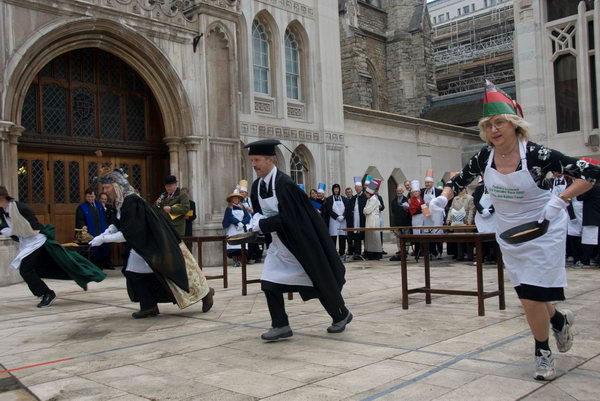
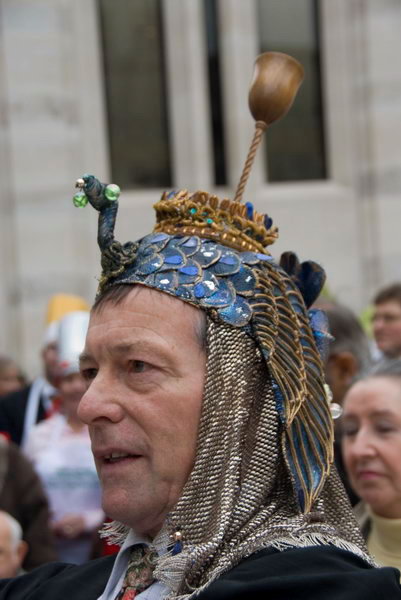
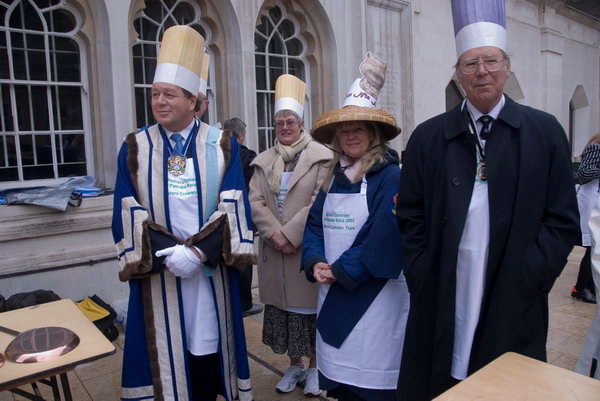
It was Shrove Tuesday, and my working day began in Guildhall Yard at the centre of the City of London, where some of its older institutions were enjoying letting their hair down a little in the Worshipful Company of Poulters Pancake Race.
I wrote then: ” it was first run in 2005, but as befits the city it has a serious set of classes and rules, music from the Worshipful Company Of Musicians (1500), time-keeping by the Worshipful Company Of Clockmakers (1631) and a starting cannon for each of the many races provided and fired by the Worshipful Company Of Gunmakers (1637.)
The guilds are now largely charitable organisations and the event each year supports the current Lord Mayor’s charity, which in 2005 was Voluntary Service Overseas, VSO. But although it is just a bit of fun, it also strongly showed the competitive nature of the the City.
Great Spitalfields Pancake Race
There was a very different feel to the Great Spitalfields Pancake Race at Trumans Brewery in Spitalfields, organised by Alternative Arts where teams from local businesses were competing in fancy dress on Dray Walk. Rules there were minimal and the emphasis was on fun.
I arrived rather out of breath and very late, having run most of the way from the Guildhall, and was only just in time to see the final race and the prize-giving.
Spitalfields Urban Farm
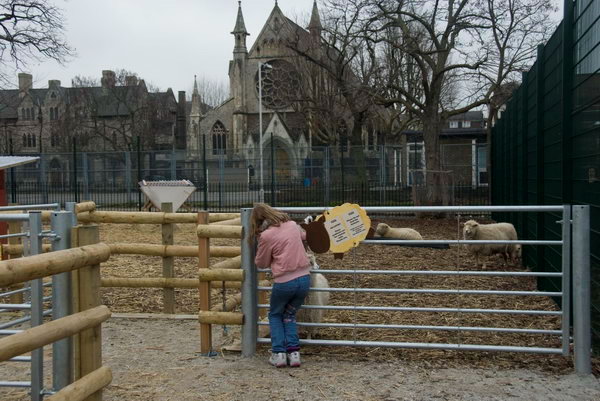
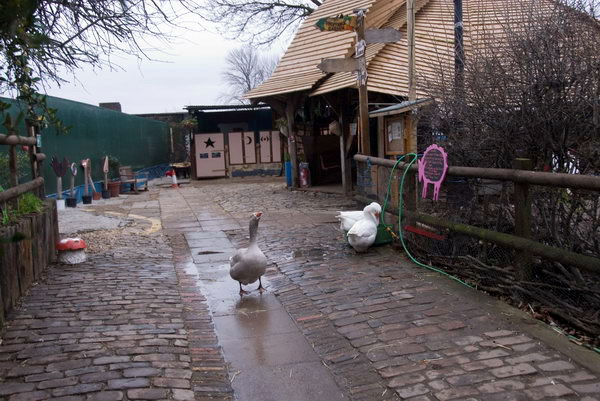
I had nothing particular to photograph for the rest of the day and decided to accompany a friend who was looking after a couple of his neighbours children and take a look at the Spitalfields Urban Farm. A late friend of mine had helped to set up and running an urban farm in Vauxhall in 1977 a year earlier than the Spitalfields farm, but part of the same movement in those years.
The farm was set on land which had previously been a part of a goods yard for the railway coming from East Anglia into Liverpool St. I imagine the only animals then would have been coming to slaughter in London markets, but now they had a happier future, providing environmental education and a great deal of enjoyment to people of all ages in the local community.
Art, Architecture and a Hoody
I said good goodbye to my friend and the children he was with at the farm and went for a short walk around Spitalfields on my way to catch a bus on Norton Folgate, one of those great historical names that we still have in London.
Norton Folgate, on the north edge of the City of London used to be an “extra-parochial liberty”. According to Wikipedia there are several theories about the name. Norton probably came from Old English words north and tun, the latter meaning farmstead. But Folgate is more of a mystery; possibly it came from the name of a Lord of the Manor or alternatively from the Saxon ‘foldweg’ meaning highway, but I think its derivation is probably a mystery lost in time.
Before the Reformation the area was occupied by the Priory and Hospital of St Mary Spital, and when the priory closed down it became Crown property, and was not included in the neighbouring parishes. Being a liberty meant the King surprisingly didn’t claim an income from it. In 1900 it became a civil parish and in 1921 it was divided in two the west part going to the borough of Shoreditch and the east to the borough of Stepney. Both these were abolished in 1965 with the formation of the London Boroughs of Hackney and Tower Hamlets. Finally in the 1990s parts of the area were transferred to the City of London, though my walk was streets of Tower Hamlets.
Another London
I was on my way to New Malden where I was meeting Paul Baldesare and a few other photographers in an Italian cafe before going on to give them a guided tour of our show (with Mike Seaborne), Another London, then taking place in Kingston Museum.
The website I think shows all of the photographs in the show by all three of us. My own contribution was on photographs of public events in London, concentrating on those “related to particular ethnic communities in the capital, while others are from very local events such as street parties and festivals.” It includes quite a few made with the show in mind in the London Borough of Kingston.
My photographs from 20th February 2007 are linked from the February 2007 page of My London Diary, but you will need to scroll down to find both the texts and links to the images, a problem with the site design which I improved the following year.
Around Devons Road, Bow 1988. My previous post about my walk on Sunday 31st July 1988 ended on Rounton Road, but I knew I wanted to take more pictures in the area around Devons Road, so I headed back there.
Devons Rd, Bow, Tower Hamlets, 1988 88-7s-24
There is still a patch of grass and a zebra crossing here, close to the junction with Violet Road (now a mini-roundabout) but the bus shelter and the closer shops, including Hilton Furniture Centre, the Car Service, the Bookmakers and six more, some boarded up, which had been up for auction (by order of the L. R, B – “3 investment and 6 vacant“) six months before I took the picture are long gone. In the distance is the Lighthouse Baptist Chuch, still a local landmark.
The LRB was not of course the London Review of Books (as Google now thinks) but the London Residuary Body, set up in 1985 to dispose of the assets of the Greater London Council after its abolition by Thatcher in 1986, a decision which continues to blight London.
Service Station, Violet Rd, Bow, Tower Hamlets, 1988 88-7s-25
I was amused by Violet Road Service Station which appeared to me to be trying to be a caravan and had an impressive pile of wooden pallets on its forecourt. Long demolished and I think replaced by flats.
Works, Yeo St, Bow, Tower Hamlets, 1988 88-7s-26
The building at right with the exterior staircase in what seemed to me a 1950s style has been replaced by a Tesco Express and flats. The large pile of pallets and the caravan both connected in my mind with the the previous image I had made (above).
The low building on Violet Road at left survived into this century when it served as a huge billboard along the street for the Caspian Wharf development whose sales & marketing suite and showhome were in Yeo St, but was replaced by a 7-storey canalside block around 2012.
Spratts Patent Limited buildings are still there – one clearly being converted into flats when I made this image.
Glaucus St, Bow, Tower Hamlets, 1988 88-7s-14
I think this is the best of four frames (two on Flickr) I made of this heap of crumpled metal on the clearance site on Glaucus St and Yeo St. I couldn’t make up my mind exactly what it had once been.
According to the Greek myths, Glaucus of Corinth was a son of Poseidon who loved the beautiful nymph Scylla and who showed little interest even after had himself turned into a merman to pursue her. He made the mistake of going to her jealous rival Circe for a love potion which whem she swallowed it instead changed her into a sea-monster who went on to lived in the rocks beside the whirlpool of Charybdis.
However I suspect the street name did not come directly from the Greeks, but was possibly the name of one of the ships built in a nearby shipyard. The name is also used for a genus of sea-slugs and was the title given to a book of scientific reports on the voyages of HMS Challenter in 1873-6.
Glaucus St, Bow, Tower Hamlets, 1988 88-7s-15
Another view of the development site in Glaucus St.
Works, Yeo St, Bow, Tower Hamlets, 1988 88-7s-16
Yeo Street still contains some industrial buildings on the wharves along the Limehouse Cut, but this one is of the same site as a previous image in this post, now a Tesco Express and flats on the corner with Violet Road.
This was formerly Violet Street, and I wonder if the name may have been linked to dyes produced in chemical factories along the cut. Mauveine, the first synthetic dyestuff was discovered not far away by William Perkin working in the attic of his family home in 1856, though he set up his factory in Greenford. But the dye was a Victorian sensation and perhaps increased the popularity of the name Violet, though other flower names also became popular around the 1880s.
Violet Rd, Bow, Tower Hamlets, 1988 88-7t-61
Another view of the building on Violet Road, on the corner of Yeo St, which shows a similar external staircase on the opposite end of the building.
Morris Rd, Bow, Tower Hamlets, 1988 88-7t-62
Across the bridge over the Limehouse Ct, Violet Road becomes Morris Rd, and a board in front of Spratt’s Patents Limited tells us this is now Tower Studios and that the two luxurious penthouse appartments due for completion in May 1987 have now been sold.
Still more pictures from my walk on 31st July 1988 in a later post here.