The Wall Must Fall & Kyoto March

Back in 2004 I was still working with the Nikon D100, one of the first really affordable DSLR cameras which I bought when it came out in 2002. It used a 6Mp Sony sensor in what Nikon called DX format – though it could have been called half-frame. For years Nikon insisted we didn’t need larger sensors, and though they were correct, marketing pressure eventually forced them to move to “full-frame” and us zombies followed them.

The D100 was a decent camera, but let down by a rather small and dim viewfinder, and to some extent by the processing software available at the time for its RAW images. If I had the time to go back to the RAW files these images would look sharper and brighter. Here are a few of those I posted on My London Diary from the two events I photographed on 16th May 2004 along with the two sections of text (with some minor corrections.)


The wall must fall. Free Palestine rally, Trafalgar Square
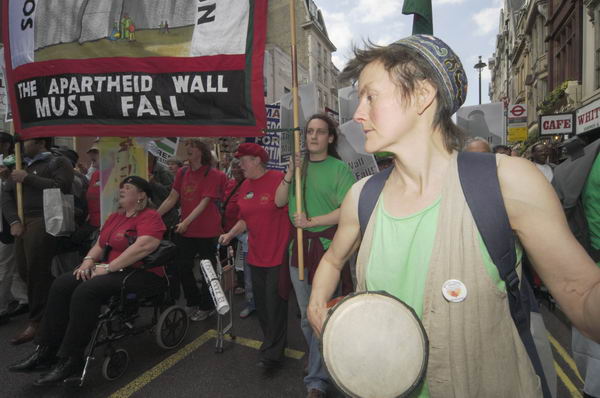
Israel has a right to exist and defend itself, but not to put itself outside international law. We all need peace in the Middle East. Support for Palestine is also support for an Israel that can coexist with the rest of the world, and for the rest of the world.
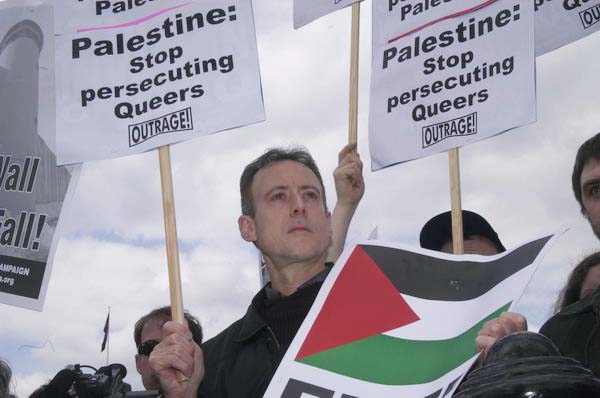
Peter Tatchell protests the persecution of Queers in Palestine

The wall must fall rally in Trafalgar square on 16 May 2006 started with an an ugly scene, when stewards stopped Peter Tatchell and a group from Outrage from being photographed in front of the banners around Nelson’s column.
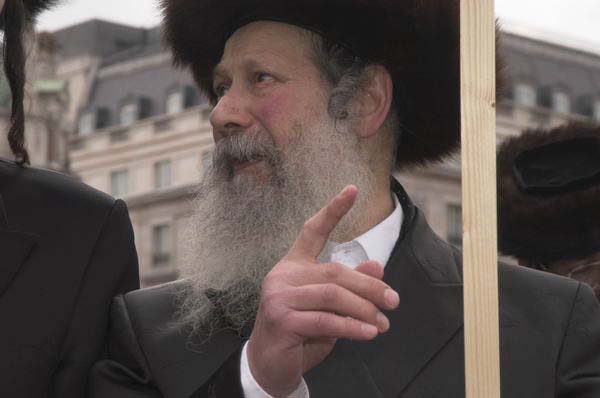
Neturei Karta orthodox Jews had walked down from Stamford Hill on the Sabbath to oppose Zionism

The rally organisers argued that raising the question of the persecution of gays in Palestine distracted attention from the Palestinian cause. Their childish attempts to distract the attention of photographers by jumping in front of the outrage protesters, holding placards in front of theirs and shouting over them simply increased the force of Tatchell’s arguments.
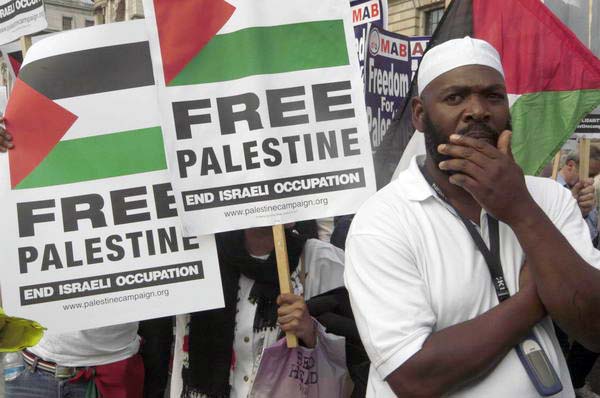
Fortunately the rally soon got under way, the main speaker was Jamal Jumaa – director of the Stop The Wall campaign in Palestine, although there were many other speakers, including Sophie Hurndall, the brother of Tom the murdered peace activist, Green MEP Caroline Lucas, Afif Safieh, Palestinian general delegate to the UK, George Galloway and more. Too many more for most of us.
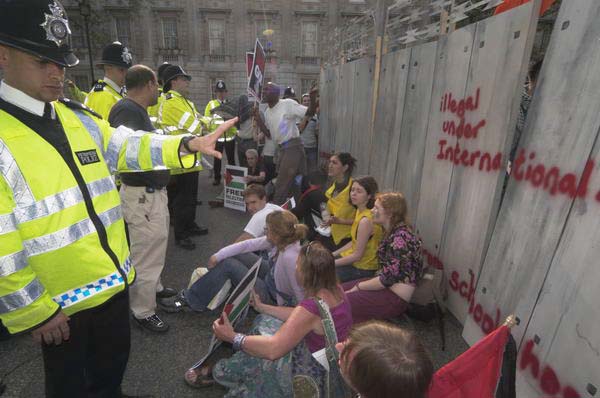
War On Want activists came with a wall to dramatize the effect of the wall in Palestine. When the march moved off down Whitehall, the wall walked with them, and it was erected opposite Downing Street. There was a short sit-down on the road before the event dissolved.


Campaign against Climate Change Kyoto March, London
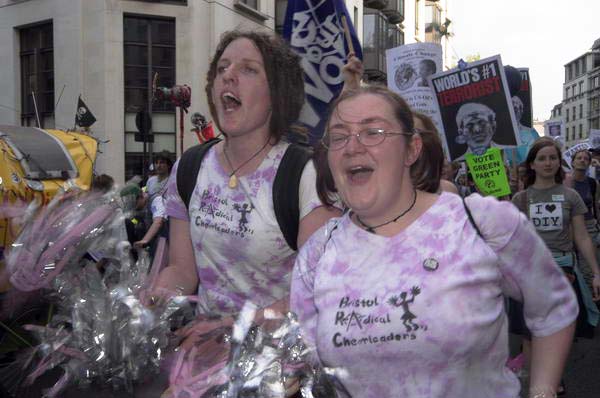
Bristol Radical Cheerleaders in the Kyoto march to the US embassy

I caught up with the Kyoto march, organised by the campaign for climate change, as it reached Berkeley Square on the last quarter-mile of its long trek from the Esso British HQ in Leatherhead. Esso are seen as being one of the main influences behind the refusal by George Bush and the US administration to ratify the Kyoto accord. The campaign has organised a number of marches in London, and this is an annual event.
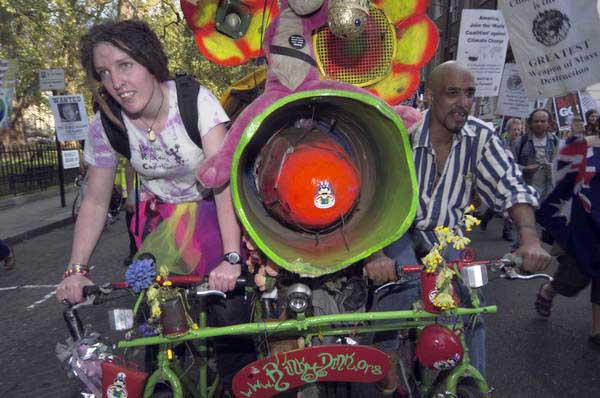
Among the marchers it was good to find a number dressed ready for the promised ‘dinosaur party’ at the US embassy, as well as the fantastic Rinky Dink cycle-powered sound system. It was also good to meet a couple of the Bristol Radical cheerleaders again, bouncing with energy as ever. A little colour was also added by a small group of of Codepink activists forming a funeral cortege, carrying the globe on their coffin.
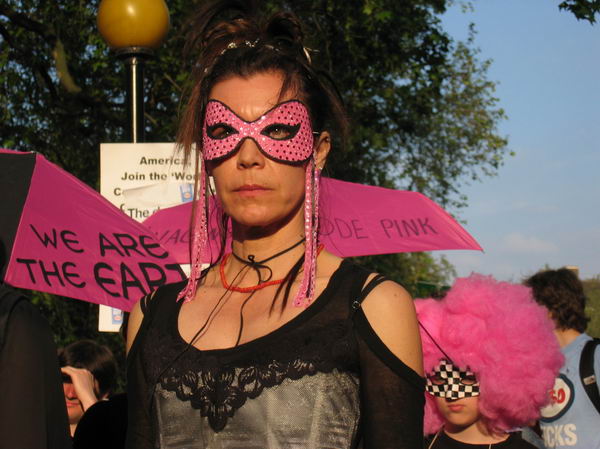
The police in Grosvenor square were not helpful, but eventually the speeches got under way in the corner of the square.


You can find more pictures on My London Diary starting from the May 2004 page or from the pages for the two events, The Wall Must Fall and Campaign against Climate Change.
Holloway, Nakba, Refugees & Topshop

Holloway, Nakba, Refugees & Topshop – Six years ago, the 14th May 2016 was also a Saturday, and like today there was a protests for Nakba Day, the ‘day of the catastrophe’, remembering the 80% of Palestinians forced to leave their homes between December 1947 and January 1949, but also several others on the streets of London which I covered.


Reclaim Holloway – Holloway Road

Holloway, Nakba, Refugees & Topshop

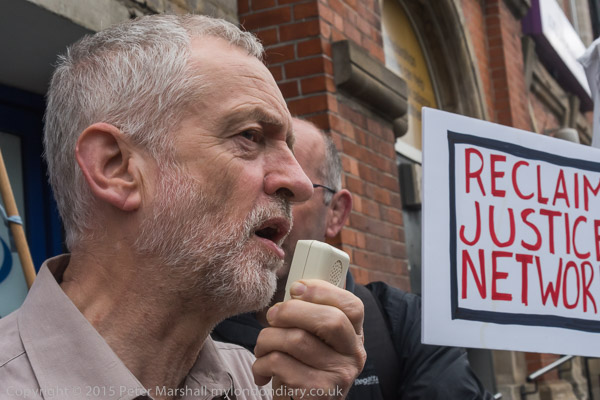
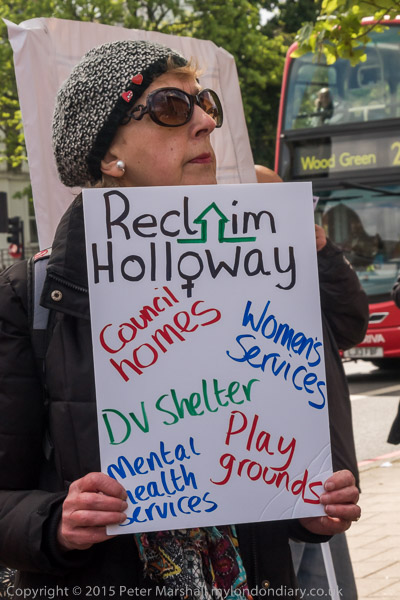
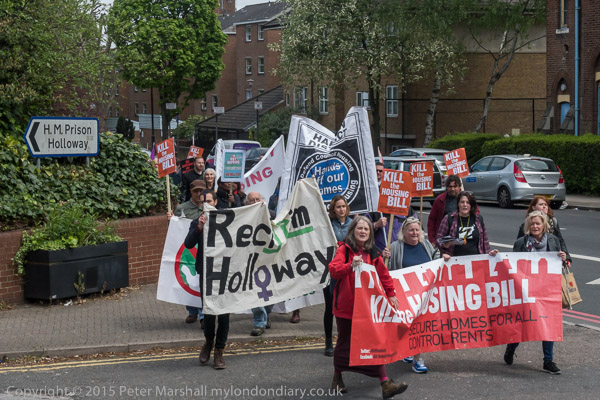
Local MP and Labour Party leader Jeremy Corbyn spoke outside London Met on Holloway Rd at the start of the march by Islington Hands Off Our Public Services, Islington Kill the Housing Bill and the Reclaim Justice Network to HMP Holloway demanding that when the prison is closed the site remains in public hands, and that the government replace the prison with council housing and the vital community services needed to prevent people being caught up in a damaging criminal justice system.

Holloway, Nakba, Refugees & Topshop

A group of around a hundred then marched from there to Holloway Prison, apparently already largely emptied of prisoners, and held a long rally there with speeches by local councillors, trade unionists and campaigning groups. Islington Council would like to see the prison site and adjoining housing estate then owned by HM Prisons used for social housing rather than publicly owned land being sold for private development.

Holloway, Nakba, Refugees & Topshop

The Ministry of Justice sold the site to housing association Peabody for £81.5m in 2019 and their plans include 985 homes and offices, with 60% of so-called affordable housing as well as a women’s building with rehabilitation facilities reflecting the site’s history. The development stalled in February 2022 with Peabody saying they were unable to afford the money needed to fit out the women’s centre.

Reclaim Holloway


68th Anniversary Nabka Day – Oxford Street

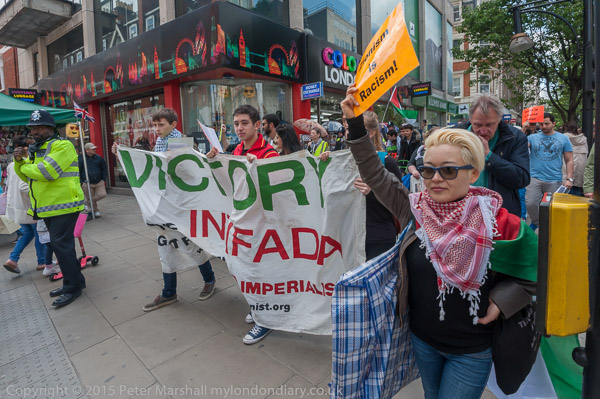
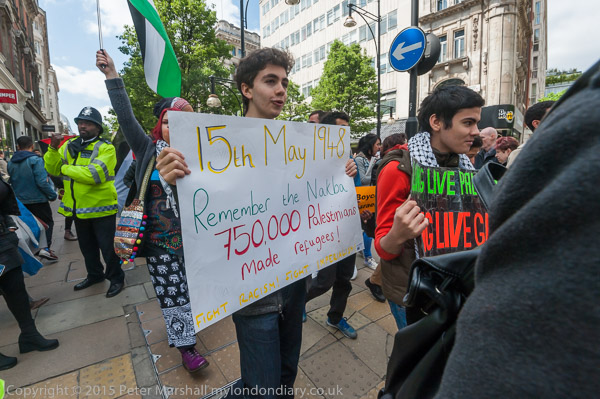
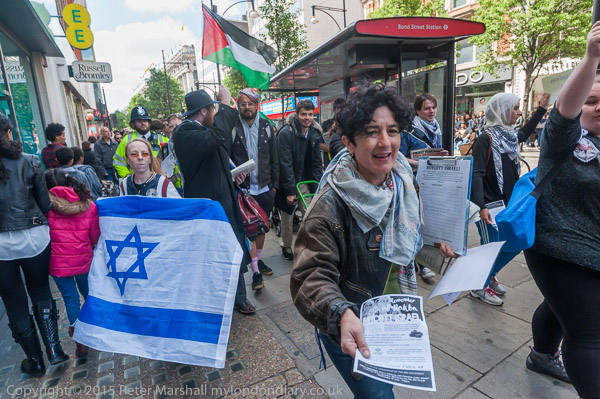
Protesters made their way along Oxford St from their regular Saturday picket outside Marks & Spencers, handing out leaflets and stopping outside various shops supporting the Israeli state for speeches against the continuing oppression of the Palestinian people and attempts to criminalise and censor the anti-Zionist boycott, divestment and sanctions (BDS) movement.

Nabka Day, the ‘day of the catastrophe’ remembering the 80% of Palestinians forced out of their homes between December 1947 and January 1949 is commemorated annually on May 15th, but the protest was a day earlier when Oxford Street would be busier. The Palestinians were later prevented by Israeli law from returning to their homes or reclaiming their properties, with many still living in refugee camps.

The protesters included a number of Jews who are opposed to the continuing oppression of the Palestinians by the Israeli government. A small group of counter protesters shouted insults and displayed Israeli flags, accusing the protesters of anti-Semitism but the protest was clearly directed against unfair and illegal policies pursued by the Israeli government rather than being anti-Semitic. The counter-protesters tried unsuccessfully to provoke confrontation, standing in front of the marchers and police had at times to move them away.

68th Anniversary Nabka Day


Vegan Earthlings masked video protest – Trafalgar Square

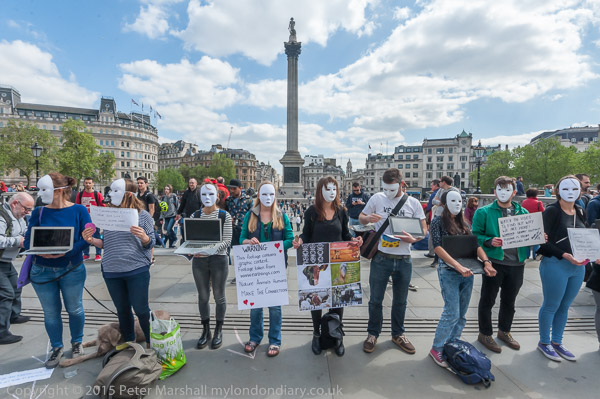
Vegans wearing white masks stood in a large circle in Trafalgar Square holding laptops and tablets showing a film about the mistreatment of animals in food production, bullfighting, etc. The protest was organised by London Vegan Actions and posters urged people to stop eating meat to save the environment and end animal cruelty.

Vegan Earthlings masked video protest


Refugees Welcome say protesters – Trafalgar Square

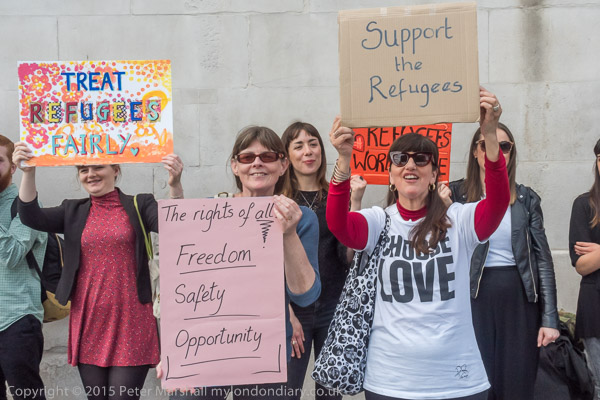
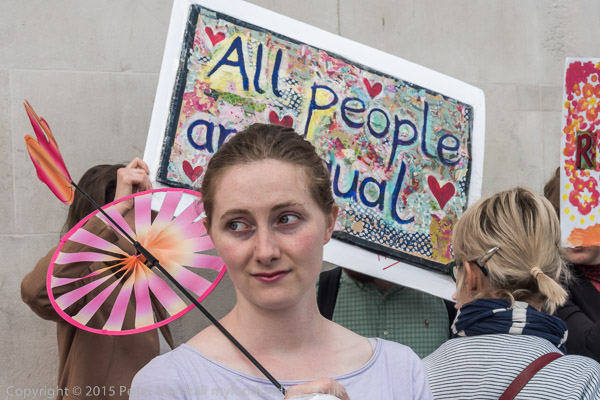
Another small group of protesters stood in front of the National Gallery held posters calling for human rights, fair treatment and support for refugees. Some held a banner with the message ‘free movement for People Not Weapons’.

Refugees Welcome say protesters


Topshop protest after cleaners sacked – Oxford St

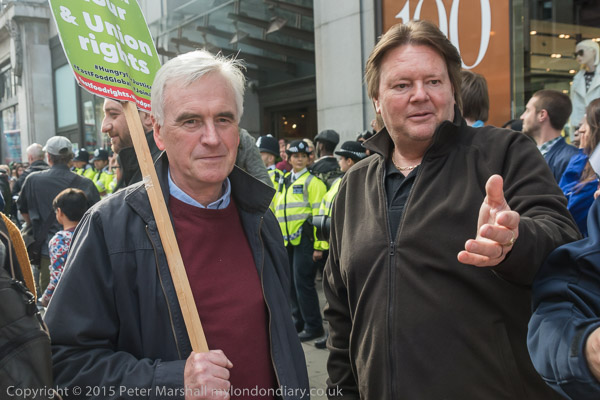
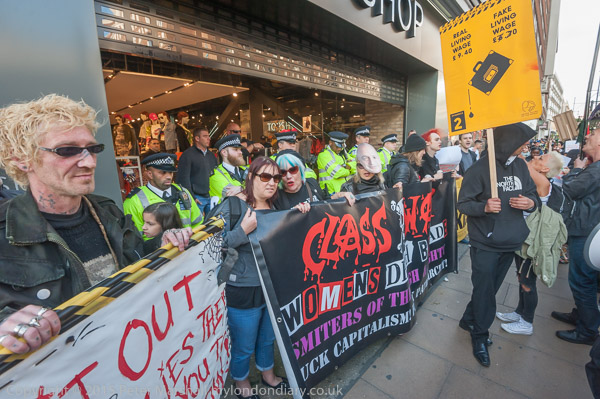
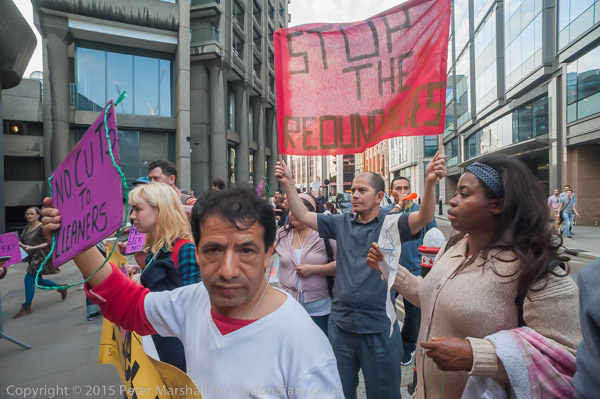
Finally I was back on Oxford St where cleaners union United Voices of the World (UVW) was holding one of protests outside Topshop stores around the country following the suspension of two cleaners who protested for a living wage; one has now been sacked. Joining them in the protest were other groups including Class War, cleaners from CAIWU and other trade unionists including Ian Hodson, General Secretary of the BWAFU and Shadow Chancellor John McDonnell.

Shadow Chancellor John McDonnell, MP and Ian Hodson, Baker’s Unions General Secretary outside Topshop

The Oxford Street Topshop was heavily defended by police, as well as by illegal extra security guards wearing no ID. Several hundred protesters held up banners and placards and with the help of the police blocked the entrance to the shop, though the protesters made no serious attempt to enter the building.

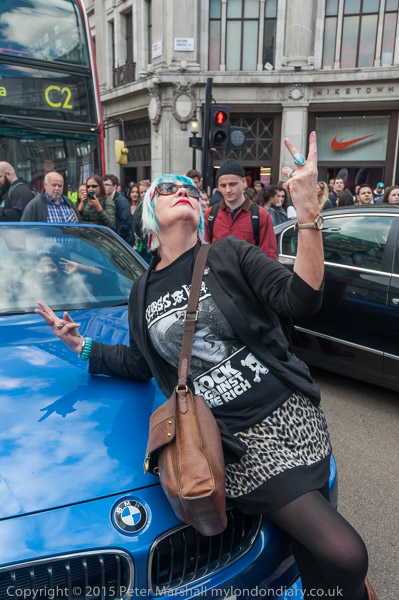
Jane Nicholl of Class War poses on a BMW as they block Oxford Circus

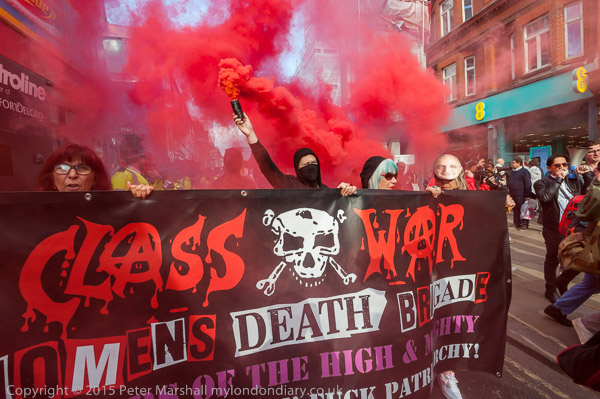
After a while some of the protesters, led by the Class War Womens Death Brigade, moved onto the road, blocking it for some minutes as police tried to get them to move. The whole group of protesters then moved to block the Oxford Circus junction for some minutes until a large group of police arrived and fairly gently persuaded them to move.

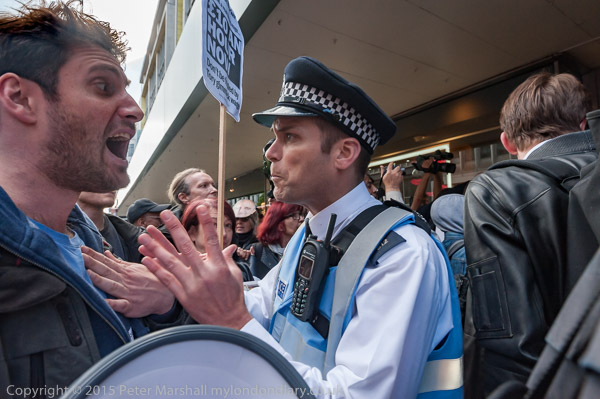
UVW’s Petros Elia argues with a police officer outside John Lewis

They moved off, but rather than going in the direction the police had urged them, marched west along Oxford St to John Lewis, where they protested outside the entrance, where cleaners have a longstanding dispute. The cleaners who work there are outsourced to a cleaning contractor who John Lewis allow to pay low wages, with poor conditions of service and poor management, disclaiming any responsibility for these workers who keep its stores running.

There were some heated exchanges between protesters and police but I saw no arrests and soon the protesters marched away to the Marble Arch Topshop branch to continue their protest.

Topshop protest after cleaners sacked


Whistleblowers, Ticks, FGM & Barnet

Whistleblowers, Ticks, FGM & Barnet – four very different events in London on Wednesday 13th May 2015


End Child Abuse, support Whistleblowers – Parliament Square, London

Whistleblowers, Ticks, FGM & Barnet

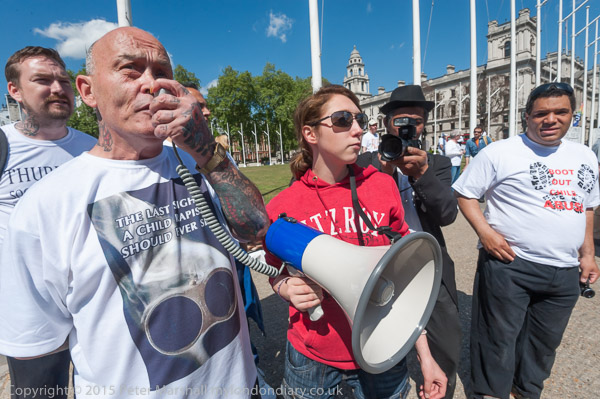
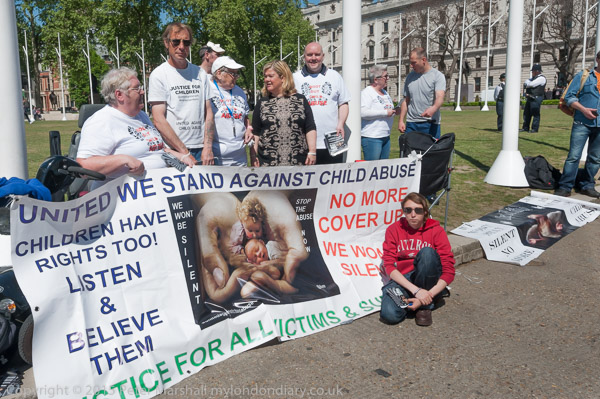
Adult survivors of child abuse and Whistleblowers United called on parliament to end abuse in the care system, to believe and act upon children’s reports of being abused and to end the covering up of abuse by social services and police.

Many of those at the protest had personal stories of the failure of police to take action, and some who had complained about abuse of their children had found themselves under investigation and their complaints had led to their children being taken away or access to them being refused. But though I am sure many of their personal complaints were justified, they were also promoting some of the widespread conspiracy theories and draconian punishments for child abuse which made me uneasy.

End Child Abuse, support Whistleblowers


Lyme Disease – Urgent action needed -Downing St

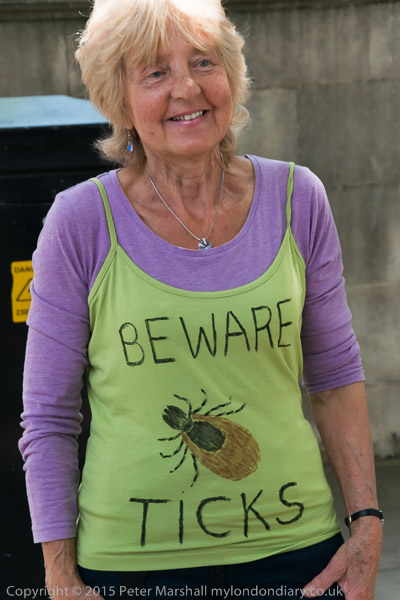
Campaigners at Downing St highlight the serious dangers of Lyme Disease from tick bites, calling for public education and for the NHS to abandon useless tests and tackle this killing disease seriously with effective tests and treatments.

Lyme disease, or borreliosis, is becomiing increasingly more common and all who walk or work in woods, parks and even gardens are at risk. Spread by bites from infected ticks, it is hard to diagnose and often goes untreated, with few doctors being aware how serious and widespread it is, often leading to partial or complete disablement.

Prompt proper removal greatly reduces the risk of infection, and is best performed with the aid of a small cheap plastic tool (such as the O’Tom Tick Twister) which could be made very readily available for a few pence – although currently they cost from around £2.60 up. It would be useful for these to be included in commercial First Aid kits. If tick removal is carried out improperly, the risk of infection is high.

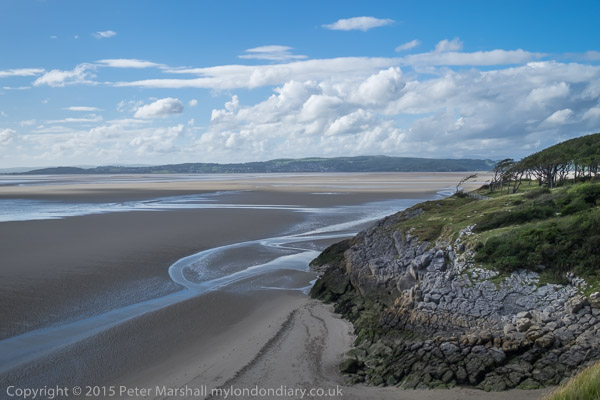
In August that year I was on holiday with friends in Silverdale, a truly beautiful area of the country but with woods full of ticks. The tick remover was an essential part of our holiday equipment, removing many of them from various parts of our bodies. It was fortunate that I had met the Lyme Disease campaigners earlier in the year.

Lyme Disease – Urgent action needed


Grant FGM campaigner Maimuna Jawo asylum – Home Office

Maimuna Jawo fled The Gambia in her fight against FGM (Female Genital Mutilation), refusing to take over her family’s duty as her village’s ‘cutter’ when her mother died. In the UK she was held in Yarls Wood, and now her asylum claim has been rejected.

Grant FGM campaigner Maimuna Jawo asylum


Sweets Way & West Hendon at Barnet Council – Barnet Town Hall

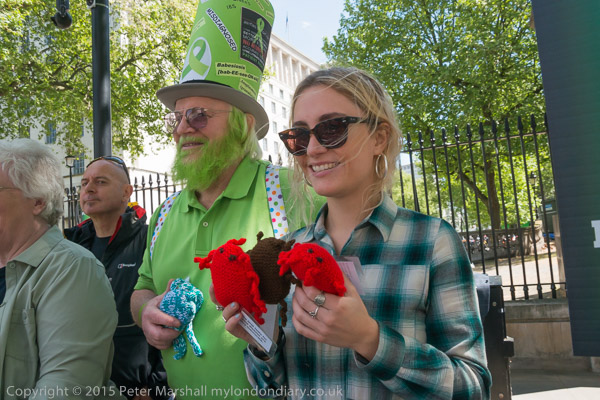
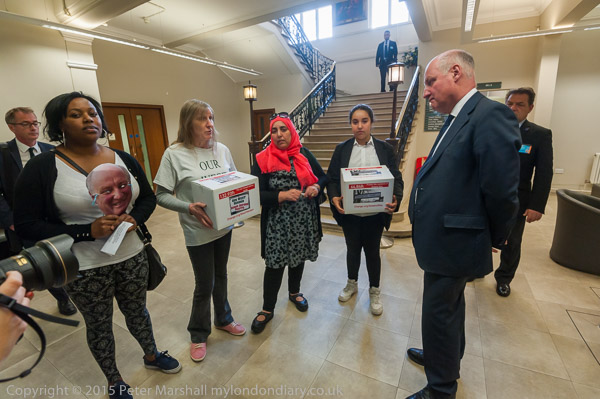
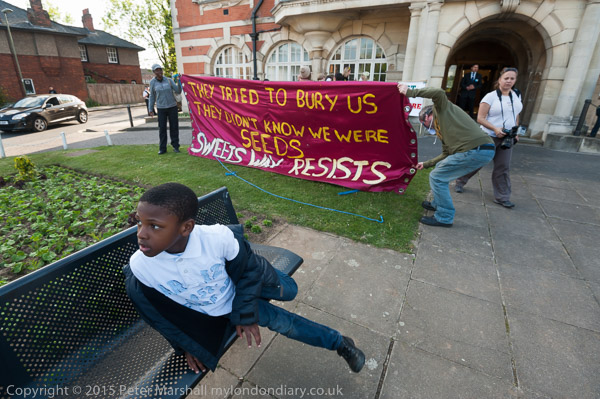
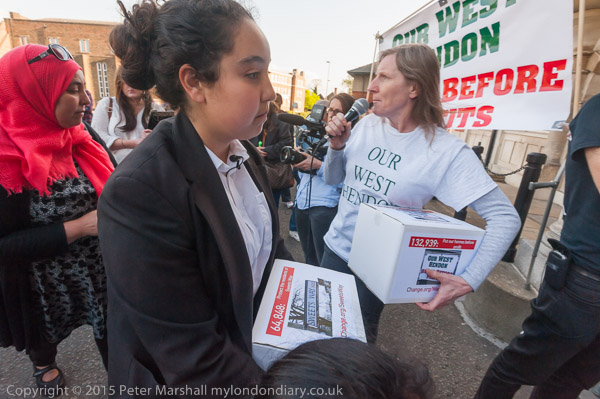
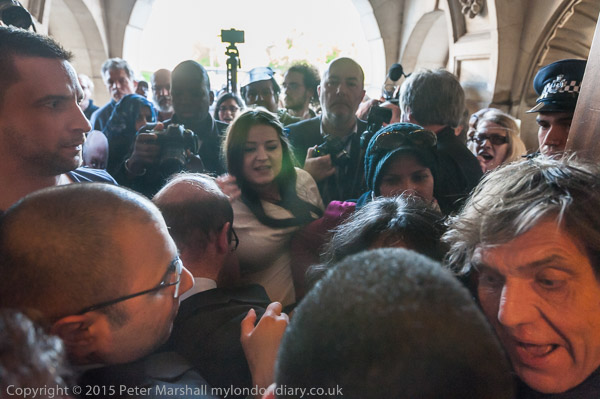
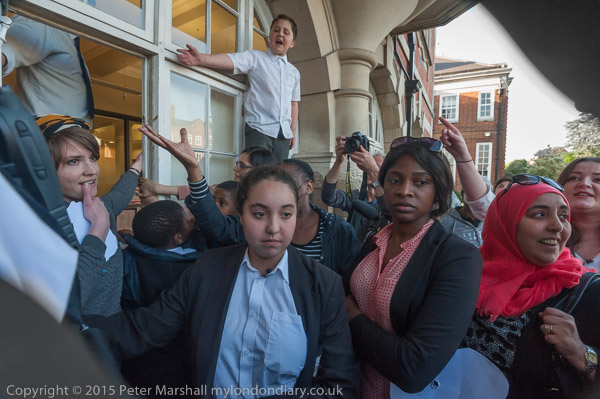
People facing eviction as Barnet Council hands their estates to property developers brought petitions with over 200,000 signatures to council leader Richard Cornelius (above). There were angry scenes as security restricted access to the town hall meeting which the protesters wanted to attend.

I showed my UK Press Card and security admitted me with the group carrying the petition into the town hall. But when I started to photograph the handover, a council press officer intervened, looked at my press card and told me I could not take any pictures of the handover. Fortunately by the time he told me I had already taken several. He instructed security to take me out of the building.

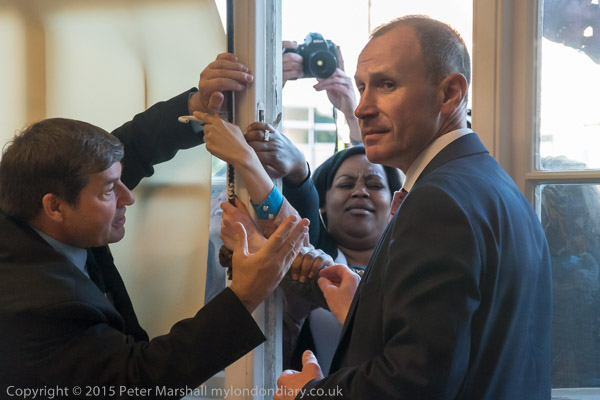
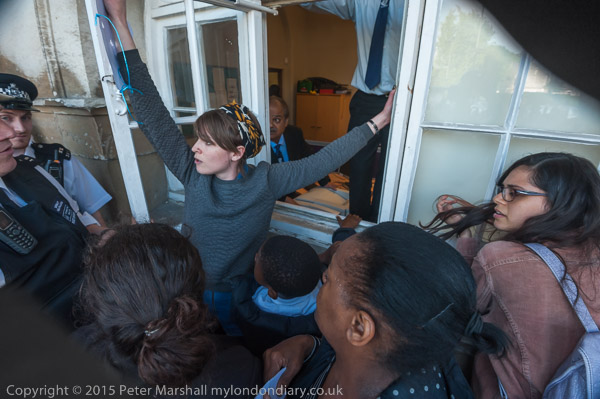
That proved to be impossible as a large crowd of protesters was attempting to push its way inside. Another photographer who had been allowed to take photographs of the handover stood in the lobby with me, and we both took pictures, despite the security men telling me I was not allowed to do so. A council officer attempted to block my view of what was going on as they stopped people trying to climb through a window, but there seemed to me to be clearly an attempt to block press freedom in recording events in which there was a clear public interest and I continued to work as best I could.

Eventually the security officers were able to help me out through the crush, which had subsided a little. They had behaved reasonably and I think were not happy at having to carry out the orders they had been given by the council officer. Our disagrements were relatively polite, but they made it clear that I would not be allowed back into the town hall as I had taken photographs when instructed not to do so. By the time they could evict me I wanted to be outside to photograph the protest continuing there.

Protesters are stopped from entering by a window

Barnet had been a leader in the destruction of themselves as local authorities in the application of austerity and outsourcing of services under their ‘Easy Council’ policy, begun in 2008 but reaching its peak in 2013 with huge contracts to Capita – and on which they ended up spending £217million more than orginally agreed . As Aditya Chakrabortty wrote in The Guardian about Northamptonshire and Barnet “Both true blue Tory; both preaching the need for sound finances while raiding their contingency funds and refusing to raise council taxes; both happy to chuck millions at consultants and build themselves swanky headquarters. And, crucially, both adamant that their council’s future lies in smashing itself up and handing out the shards to big companies to provide the bulk of public services… It was cartoonish, it was reckless, it was grotesque.”

Finally I am escorted out and can photograph the protesters outside

And it failed, with the Tories having to admit huge losses and announce that the major contracts would not be renewed when they expired in 2023. And though I was pleased to hear that the recent local elections had resulted in Labour gaining control with 41 seats to the Conservative’s 22, it will give them the problem of picking up the pieces. And London Labour Councils have a notoriously bad record over the demolition of council estates and the treatment of residents and leaseholders.

Sweets Way & West Hendon at Barnet Council


Police & Public Sector March, 4,000 Days

PPolice & Public Sector March, 4,000 Days of the Parliament Square Peace Campaign approaches – some of my pictures from Thursday 10th May 2012.


Police March Against Cuts and Winsor – Westminster

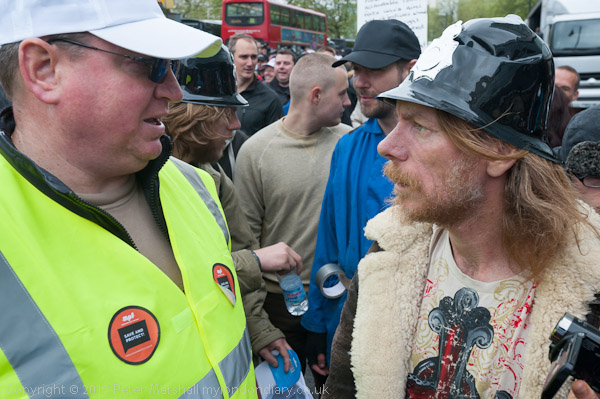
Occupy supporters in plastic helmets joined the police march

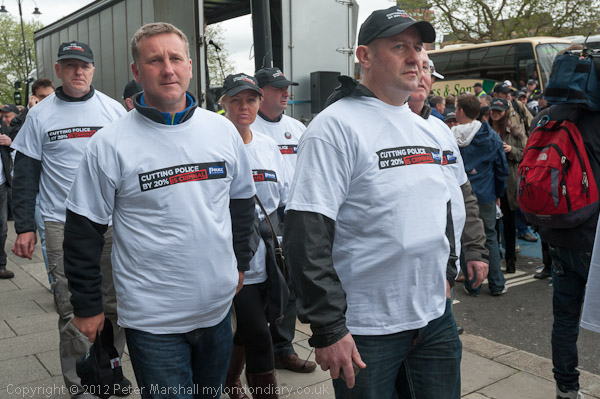
An estimated 20,000 police from all 43 forces in England & Wales marched through central London in protest at 20% cuts in police budget and proposed restructuring following the Winsor review. Occupy, Right To Protest and others joined in to protest for justice in policing.

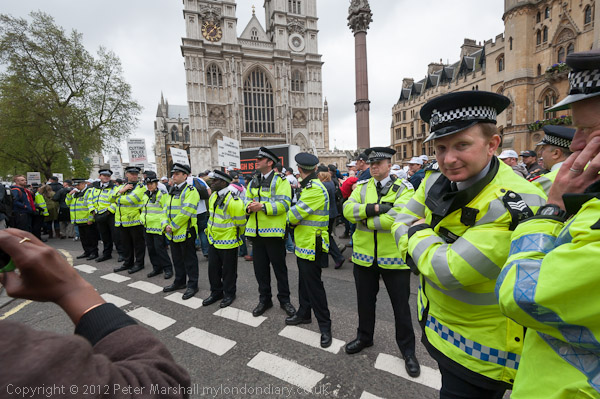
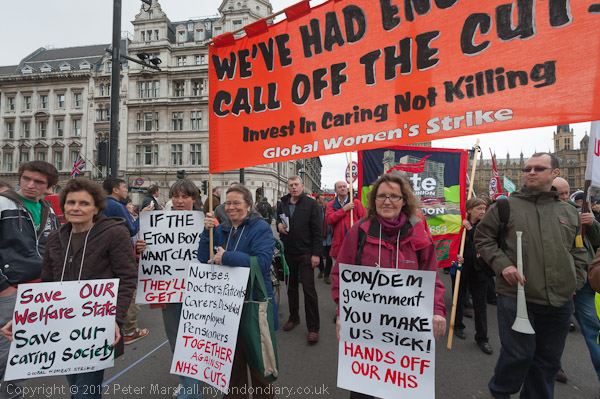
Police are not allowed to strike or belong to a proper trade union, but the Police Federation can organise demonstrations like this when thousands of off-duty police, some with family members made a impressively large if rather dull protest past the Home Office, the Houses of Parliament and Downing St. Most wore one of the 16,000 black caps produced for the protest, the number of officers expected to be lost over the next four years as the police budget is cut by 20-30%.

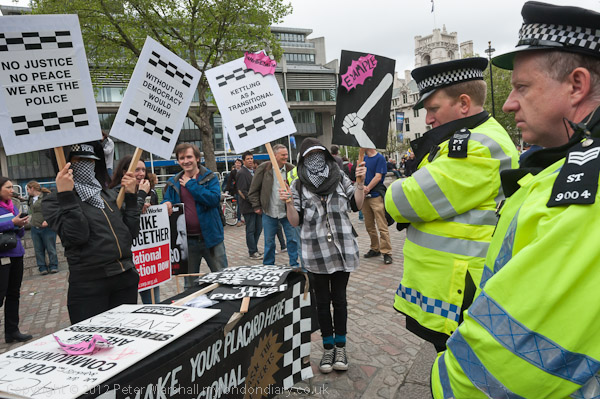
Police officers attempt to intimidate the Space Hijackers

Like other public sector workers, police had suffered a two year wage freeze, as well as increases in pension contributions and many have also had large cuts in overtime. As well as those protesting, police were also on duty controlling the protest, though it was unlikely to get out of hand. But there were others as well as police, including the Space Hijackers who had a stall giving advice on how to protest, and also Occupy protesters who were calling for “a fully, Publicly funded, democratically accountable Police force who’s aims and objectives enshrine the right to peaceful Protest in some sort of People’s Charter!

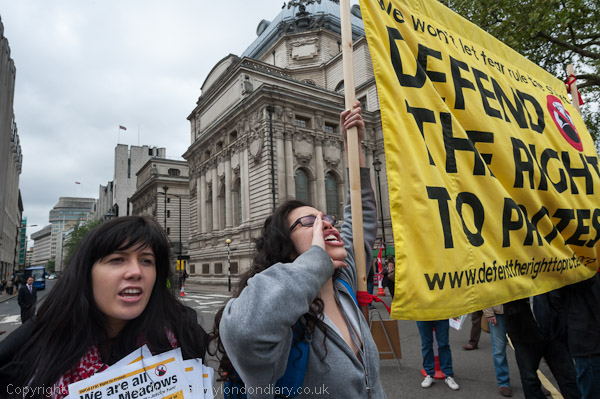
Others were there to protest against various aspects of police corruption and faced some aggravation from the officers on duty as well as some protesters. The Defend The Right To Protest group reminded police marchers of Alfie Meadows, Sean Rigg, Ian Tomlinson, Jean Charles de Menezes and many others killed or seriously injured by police officers. Officers on duty made some attempts to intimidate some of the non-police protesters – and also photographers covering the event.

More at Police March Against Cuts and Winsor


Public Sector Pensions Strike and March – St Thomas’ Hospital to Westminster

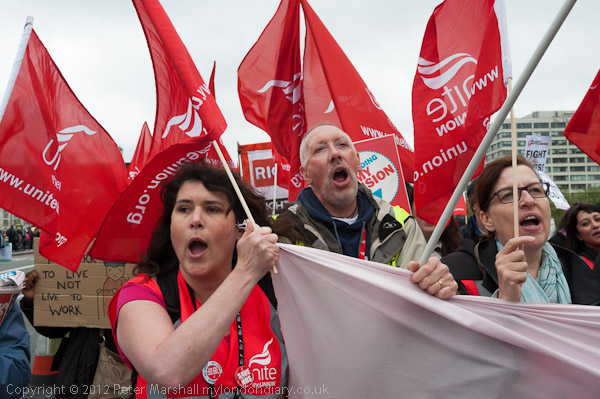
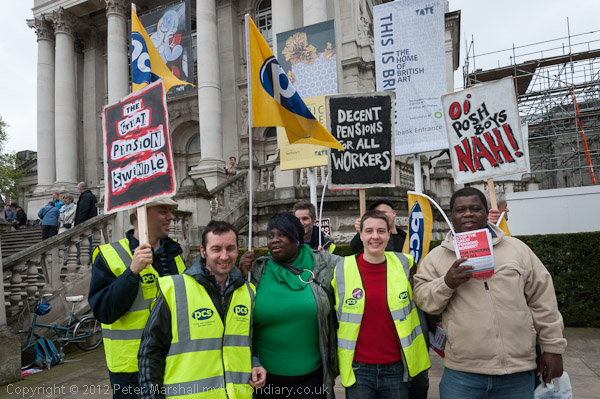
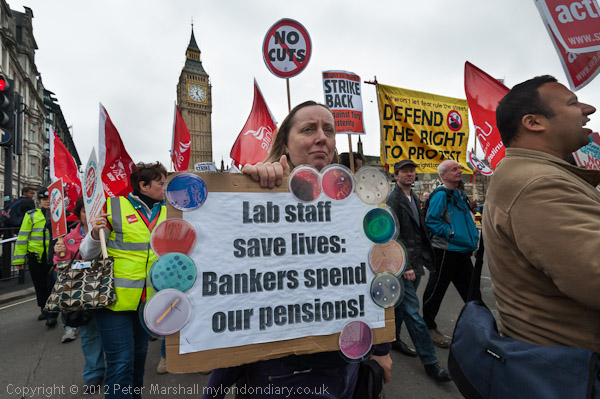
Public sector workers in Unite, PCS and UCU were on a one-day strike against cuts in pensions, jobs and services, and picketed workplaces and marched from a rally at St Thomas’ Hospital across Westminster Bridge to Methodist Central Hall for a further rally.

PCS picket at Tate Britain

Some of the pickets had begun at 5am, and a few were still in place as I walked past workplaces in Westminster – including the Houses of Parliament to meet the marchers coming over Westminster Bridge.
As they marched, many chanted “Sixty-eight – is TOO Late”, as retirement age is set to increase to 68 and beyond, while retirement contributions are increasing. They are also losing out because the government has decided to index pensions to the lower CPI inflation figures which mans they get around 15-20% less. Over 94% of Unite’s NHS members voted to reject the government’s proposals and take strike action today along with members from the Ministry of Defence and government departments as well as others from the PCS and UCU.

More on My London Diary at Public Sector Pensions Strike and March.


4000 Days in Parliament Square – Parliament Square Peace Campaign

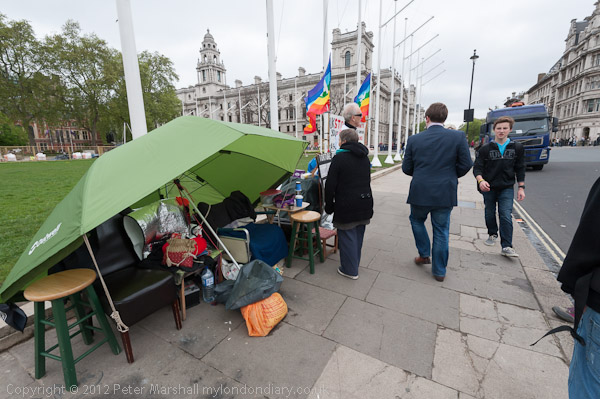
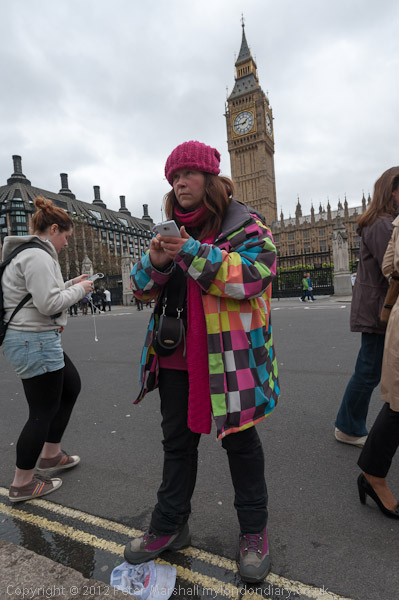
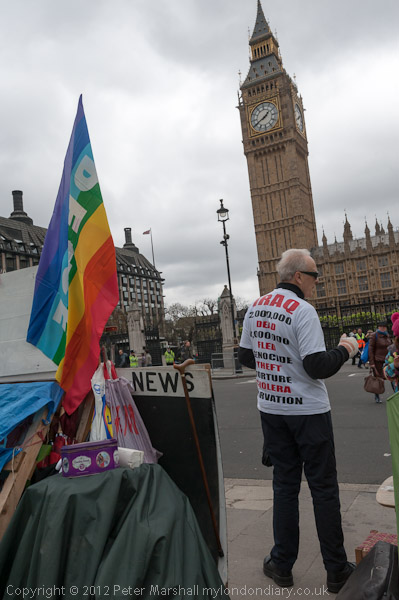
Brian Haw came to Parliament Square to begin his protest there on the 2nd June 2001, and the Parliament Square Peace Campaign he started had been there for almost 4,000 days, with a presence night and day, 24 hours a day since then.

Barbara Tucker

After Brian’s death from cancer the protest was continued by Barbara Tucker and other supporters who have maintained the protest on those various occasions when Brian or Barbara was arrested and held overnight. Over the years the campaign has been subjected to frequent illegal harassment by police officers, Westminster Council officials and thinly disguised members of the security service, and laws have been enacted intended to bring the protest to an end.

A few hours before I arrived, police had come and spent 90 minutes “searching” the few square meters of their display in the early morning, and three days later, at 2.30am on Sunday 13 May, police and Westminster Council came and took away the two blankets that Barbara Tucker, no longer allowed to have any “structure designed solely or mainly to sleep in” by law was using to survive in the open. Clearly a blanket is not a structure, and police and council have also removed other items of property. Later her umbrella was also taken away. Barbara’s health deteriorated and she eventually had to leave the square, and the protest finally ended early in May 2013.

4000 Days in Parliament Square


End Indefinite Detention, Don’t Sack Cleaners

End Indefinite Detention, Don’t Sack Cleaners – two protests I photographed on Saturday 7th May 2016, one on the edge of London and the other in the centre.

Detention Centres Shut Them Down – Harmondsworth, Saturday 7th May 2016

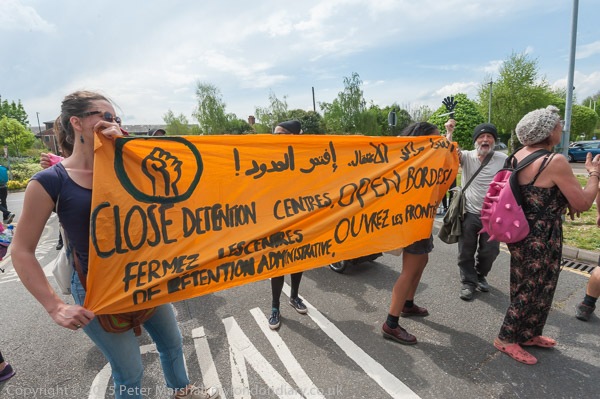
Mostly protests begin later than expected and I was surprised when I arrived at Europe’s largest detention centre complex at Heathrow, two Category B prisons, Colnbrook & Harmondsworth, managed by private security company MITIE to find that the action organised by the Anti Raids Network as a part of a day of action at all UK detention centres had already begun.
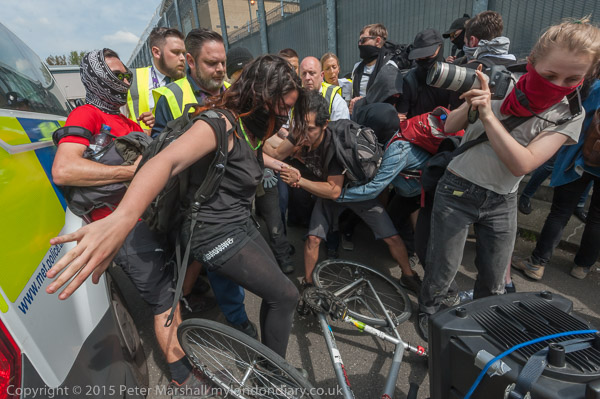
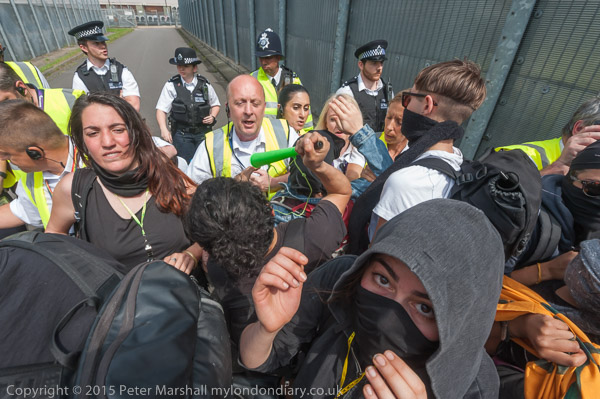
Most of the protesters had come out to the protest on the west edge of Greater London from the centre and had apparently got there earlier than they expected and had immediately rushed past the few security guards onto the private roadway between the two prisons to communicate with the detainees who had gathered around the windows of the two blocks behind their 20 ft high fences. I’d photographed earlier protests here where the protesters had walked noisily around the Harmondsworth block (strangely on the Colnbrook side of the complex) on the rough track around the fence, but the centre was now under new management and MITIE were determined to keep them further away.

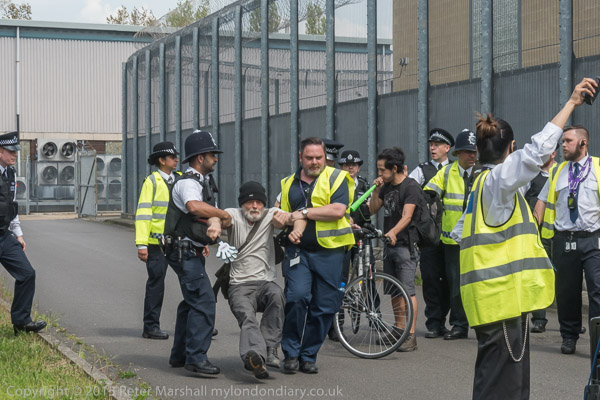
As I arrived and talked with the small group who had remained at the entrance those inside appeared at the far end of the road, being slowly moved out by the police reinforcements who had arrived shortly before me, and I followed protesters down the road to join them.

As well as making a lot of noise with pots and pans, megaphones and kicking the solid metal bottom of the fence, the protesters also held up a large banner with a phone number so that the detainees could contact them and tell them what was happening inside. At first the police made slow progress in moving them along, but soon another police van arrived with more officers and they were able to move them quickly to the front of the complex.

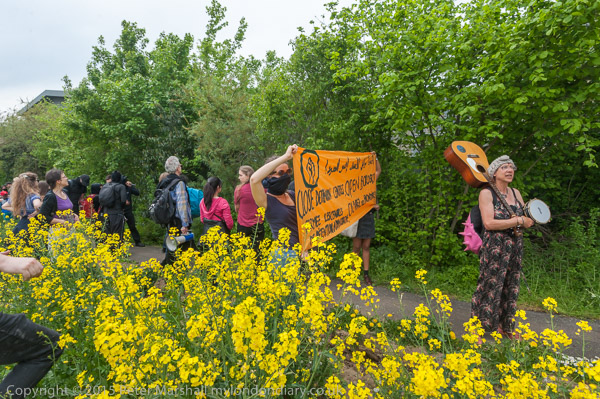
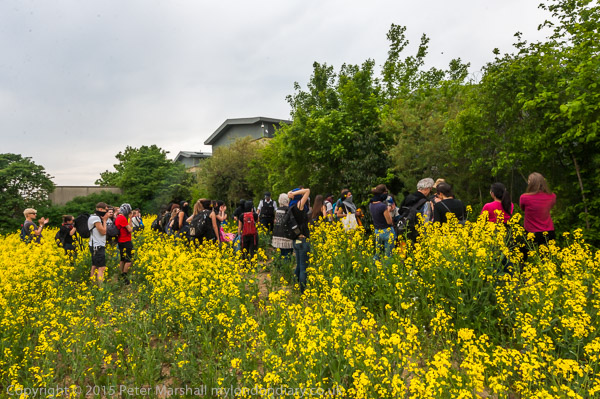
After regrouping there, most decided to walk along to the public footpath that runs along the east edge of the centre. Although bushes and small trees in front of the fence made the centre almost invisible, it was easy to hear the detainees shouting from inside and for them to hear the protest. Soon phone contact was made with some of them and they were able to speak over a megaphone. As I wrote back in 2016:

“Bashir from Lebanon told us he had been held in detention for 18 months and that his wife and children need his help, but he is stuck inside, unable to see them or do anything. Indefinite detention such as this seems a clear breach of so many of the human rights that everyone in the UK should be entitled to under our Human Rights Act 1998. Treating people like our system does is simply shameful.”

Detention Centres Shut Them Down – where there is more about the protest.

Cleaners invade Barbican Centre – Barbican, London, Saturday 7th May 2016

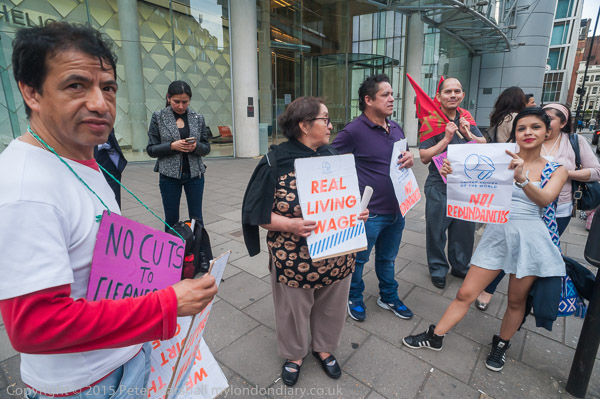
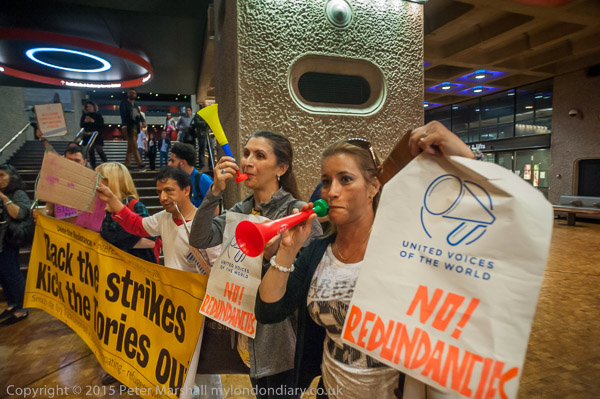
I left to make my way to central London where Cleaners union United Voices of the World were holding a flashmob at the Barbican Centre after cleaning contractor Servest proposed making many of the cleaners redundant or severely cutting their hours and pay. As well as the UVW, the action was supported by activists from the Bakers Union, Class War, SOAS Unison, Unite Hotel workers branch and IWGB Couriers branch.

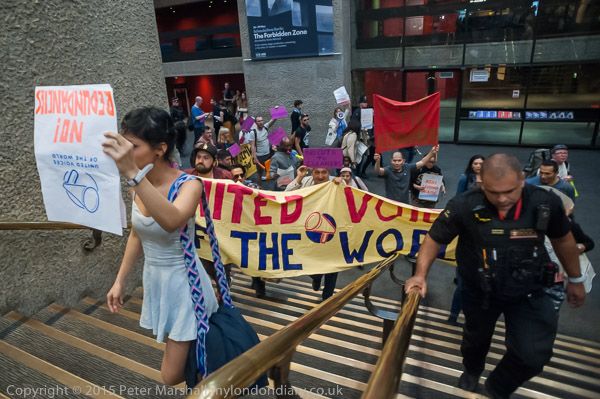
I met the cleaners close to Moorgate Station and walked with them towards the Barbican, where they burst into a run as they turned a corner and rushed into the main entrance, past a couple of security guards who had no chance of stopping the unexpected arrival. They made there way to the middle of the arts centre, to protest noisily outside the hall where customers were entering a sold-out concert of music by Yann Tiersen.

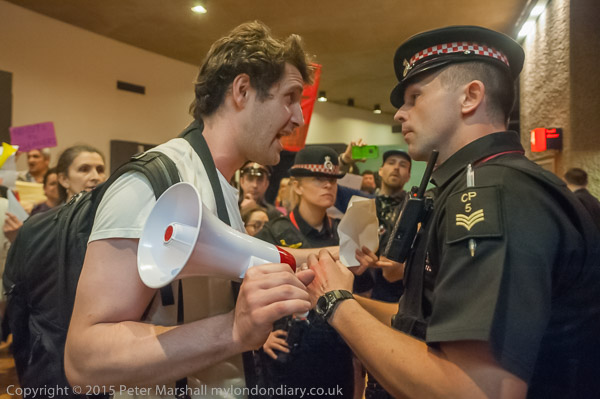
After a few minutes police arrived and told the protesters they must leave or be arrested, and after some argument they slowly and noisily made their way back towards the main entrance, with police continuing to harass them.

They continued to protest on the street outside the main entrance, and the protest was still continuing there when I left for home.

More on My London Diary at Cleaners invade Barbican Centre.


Occupy Gandhi – Stop Fossil Fuel Criminals

Occupy Ghandi - Stop Fossil Fuel Criminals

Occupy Gandhi – Stop Fossil Fuel Criminals – on Monday 4th May 2015 Occupy Democracy were on the fourth day of their ‘Festival of Democracy’ in Parliament Square “building a movement for real democracy: free from corporate control, working for people and planet!”

Occupy Ghandi - Stop Fossil Fuel Criminals

Occupy had come to Parliament Square in defiance of the law criminalising the use of tarpaulins, tents and other protection in the square, and were making six key demands:

• reform of party funding so that members of parliament act in the interests of those who elect them rather than the 1% who bankroll them
• major democratic reform of the media to break the stranglehold of vested interests
• a fundamental overhaul of lobbying and the way powerful economic interests inhabit the corridors of power within government
• the introduction of proportional representation so that everyone’s vote counts
• that MPs should not have conflicts of interests from either paid employment or corporate shareholdings
• a citizen-led constitutional convention for real democracy.

Occupy Festival of Democracy
Occupy Ghandi - Stop Fossil Fuel Criminals

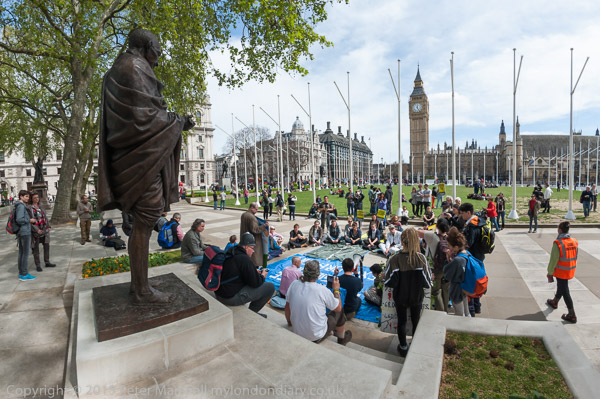
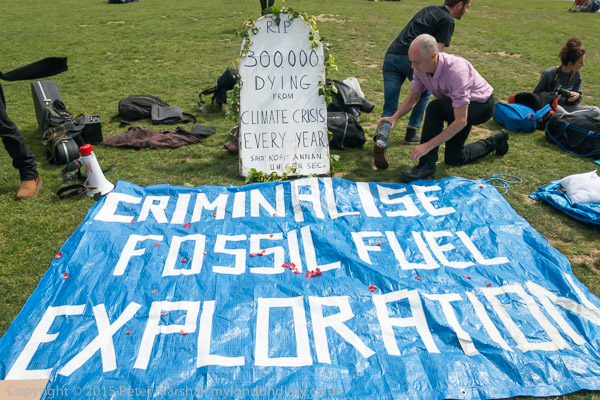
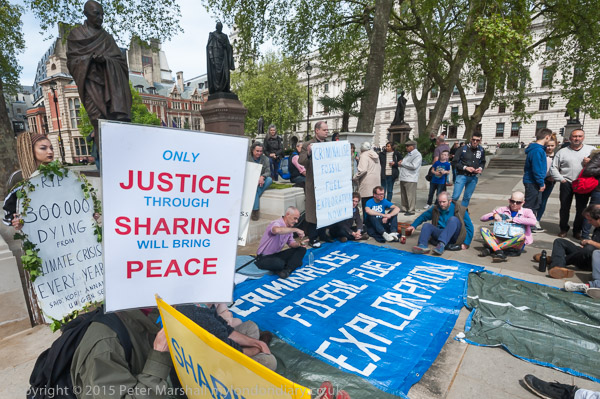
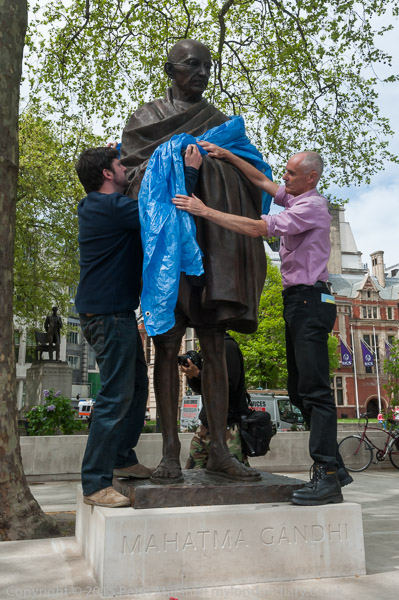
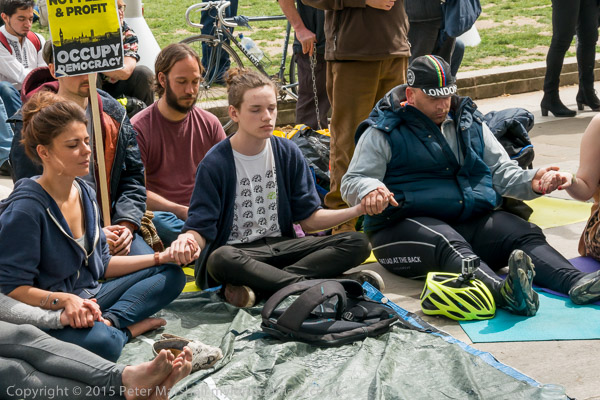
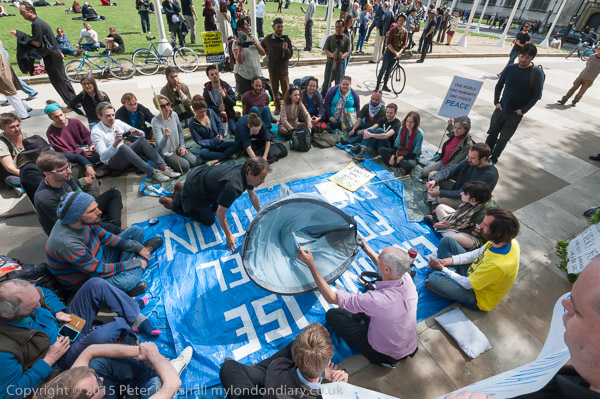
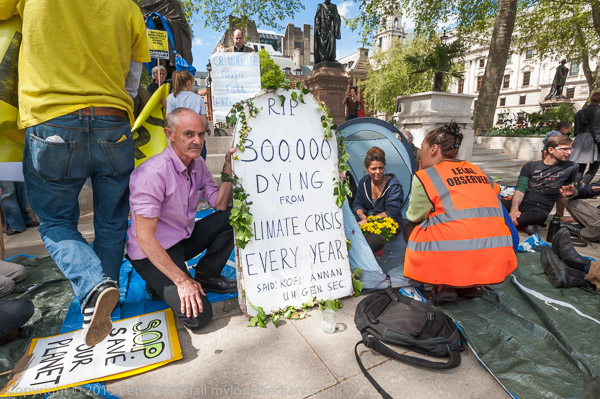
On Monday 4th they began a rally and meditation at the foot of the statue of Gandhi, noted for his direct action civil disobedience, calling for fossil fuel exploration and investment to be made a crime. Donnachadh McCarthy laid out a large blue banner with the message ‘Criminalise Fossil Fuel Exploration‘ and a mock tombstone with the inscription ‘RIP – 300,000 Dying from Climate Crisis Every Year Said Kofi Annan UN Gen Soc‘.

Occupy Ghandi - Stop Fossil Fuel Criminals

People then brought tarpaulins to sit on around these on the paved area in front of Ghandi’s statue and began a series of short speeches, meditation and songs about climate change and fossil fuel use.

They took a small blue tarp to the statue of Gandhi and wrapped it carefully around him. After a short pause two of the GLC’s private security heritage wardens who had been watching the event with a few police officers came up and removed the blue tarpaulin. A replacement was brought up and carefully held by two of the protesters without touching the statue (much) and the meditation continued.

There was another minor intervention by the heritage wardens who objected to burning incense sticks being placed in the flower beds. The protesters removed them and instead held them.

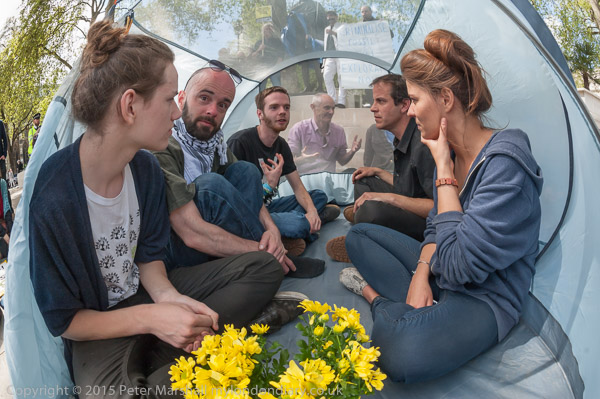
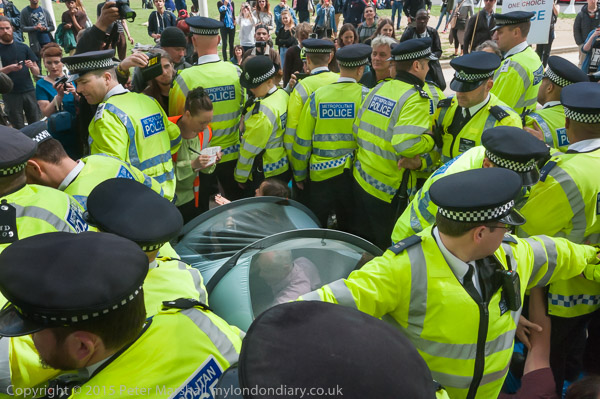
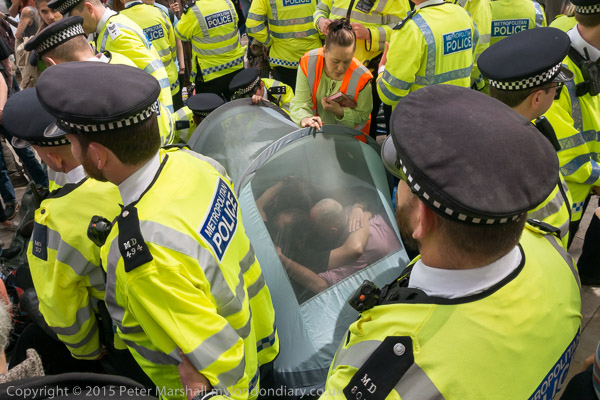
Donnachadh McCarthy then produced a blue folding tent and erected it, announcing that he was going to defy the ban on tents and inviting others who wished to join him.

People climbed in and after posing for a photograph with the tent the protest continues, with Donnachadh joining them inside as police approached. The police warned those inside the tent they were committing an offence and warned them they could be arrested – and then walked away.

Some minutes later, at exactly 2pm a larger group of police returned and surrounded the tent.

They gave those inside a final chance to leave without being arrested. Three people remained inside the tent, holding each other tight.

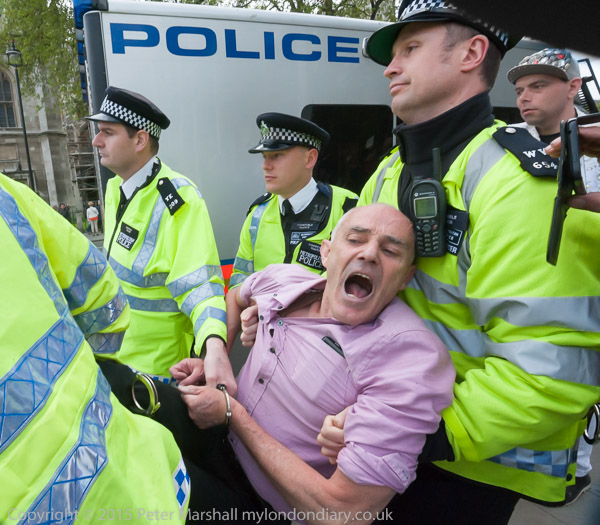
Finally they were arrested, handcuffed and taken away to waiting police vans. The whole police operation seemed a massive waste of public money enforcing a ridiculous law. The real criminals are not a few protesters with tents and tarpaulins in public squares, but those who sit in boardrooms and continue promote and produce fossil fuels which are driving us towards extinction, plotting actions to derail attempts to make the changes the planet needs in order to increase their profits.

More pictures at Occupy Gandhi – stop fossil fuel criminals.


May Day – International Workers Day

May Day – International Workers Day – May 1st was chosen as the date for International Workers’ Day in 1889 by the Second International socialists and communists, and adopted by anarchists, labor activists, and leftists in general around the world, to commemorate the 1886 Chicago Haymarket affair and the struggle for an eight-hour working day. It continues to be celebrated in many countries around the world.

May Day - International Workers Day
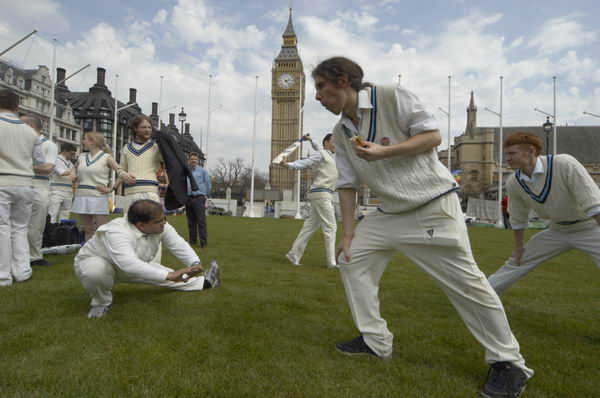
Space Hijackers Anarchist Cricket, Parliament Square, London, May 1, 2005

Although I tested negative for Covid on Wednesday I’m still short of breath and short of energy, with still a little of a cough and have been strongly advised to take things easy for the next week or two. So I’m not sure if I’ll be out celebrating May Day today, much as I yearn to be.

May Day - International Workers Day
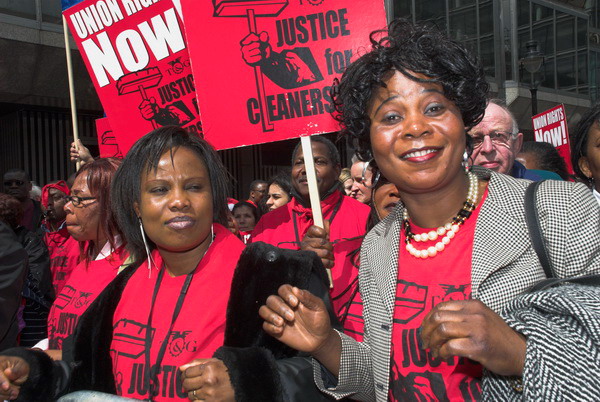
Justice for Cleaners, Westminster Cathedral, London, May 1, 2006

Before 2000 I was usually unable to celebrate May Day properly as May 1st was usually a normal working day and I went out around 8am and arrived home from work around 5.30pm, usually with more to do at home after an evening meal. Not much time to celebrate International Workers Day!

May Day - International Workers Day
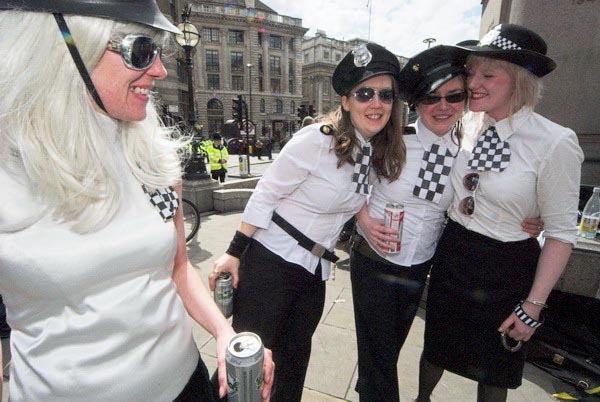
Space Hijackers Police Victory Party – Bank, May 1, 2006

Of course, May Day sometimes fell at the weekend, so I would have been free to take part in events that were taking place, but even in 1999 when it was a Saturday I think I had other things on.

May Day - International Workers Day
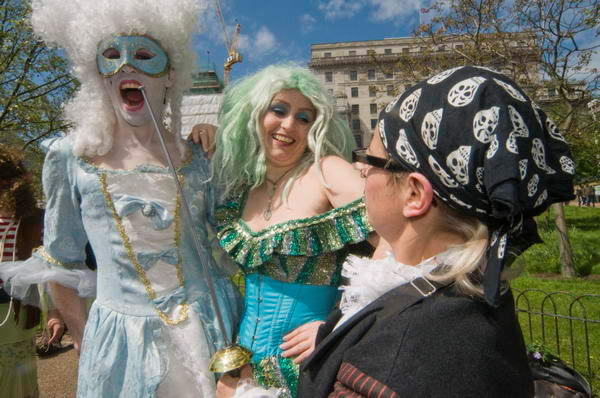
Space Hijackers Mayfair Mayfayre – May 1st 2008

There were of course May Day related events that I went to most years, but usually these were on the Saturday or Sunday before the early May bank holiday Monday which was introduced by a Labour government in 1978, when they lacked the nerve to make May Day itself a public holiday. We still have that bank holiday despite plans made by Conservative governments under both John Major and David Cameron to replace it by a Trafalgar Day holiday in late October.

May Day - International Workers Day
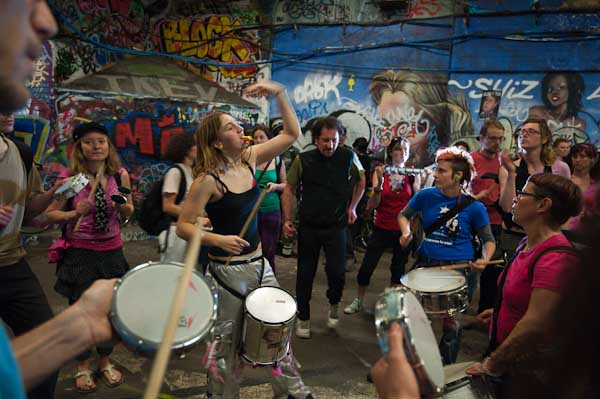
Rave Against The Machine – Leake St, Waterloo, London. Saturday 1 May 2010

By 2003 I was getting rather blasé about the London May Day march, writing “May Day Has perhaps settled into a rather predictable event now. The socialist left – and what is left seems to be a few unions and a number of ethnic communist party groups – march from Clerkenwell to Trafalgar square, while anti-capitalist protesters do not a lot around town“, but that didn’t stop me going again to photograph it that year or in 2004, 2005, 2006, and every year until 2019. Covid put an end to the sequence in 2020, but I came out of seclusion for May Day 2021, though perhaps I’ll miss it again today.

May Day - International Workers Day
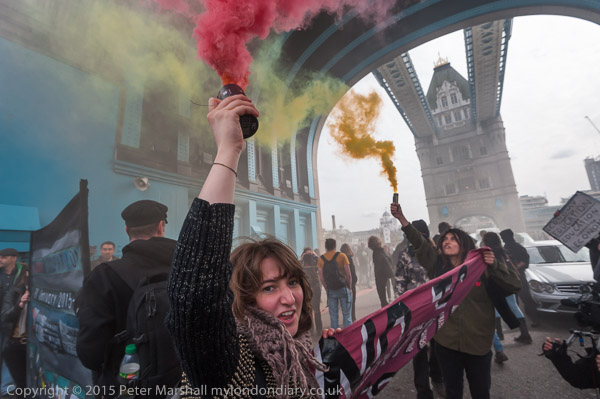
Anti-Capitalists block Tower Bridge – Tower Bridge, London. Fri 1 May 2015

And I will miss it. Miss the sense of solidarity on the streets. And most of my life I’ve been feeling a loss of what might have been had we ever had a socialist government since my first few years growing up in a welfare state. Tory governments largely did what was expected of them but the various Labour administrations largely failed the people. Perhaps the final straw came in 2017, when people inside Labour actively worked against a Labour election victory.

May Day - International Workers Day
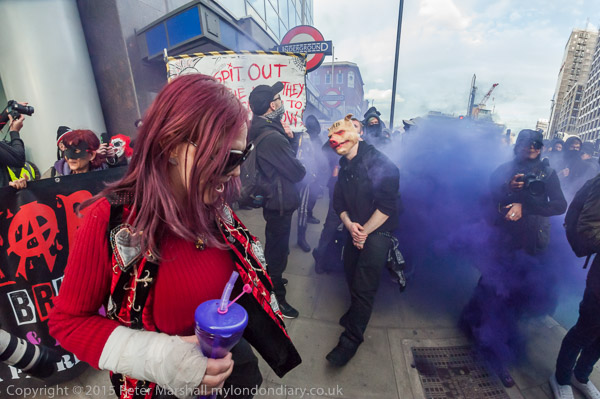
Anti-Capitalist May Day Street Party Starts – One Commercial St, Aldgate, London. Sun 1 May 2016

The pictures here come from some of the other May Day events I’ve photographed in the last 20 years or so. You can find other May Day pictures on My London Diary simply by choosing a year at the top of the page and then the month of May at the left of the year page.
May Day - International Workers Day
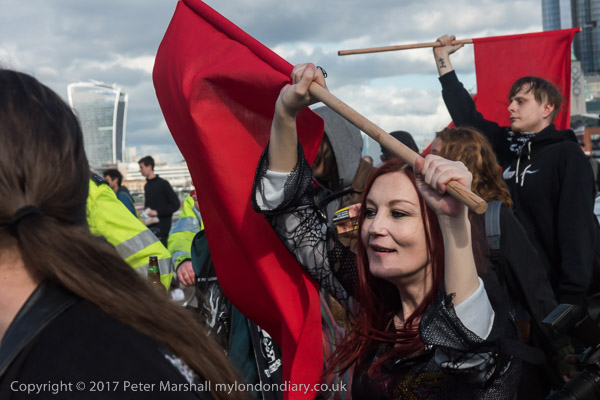
May Day F**k Parade – London. Mon 1 May 2017

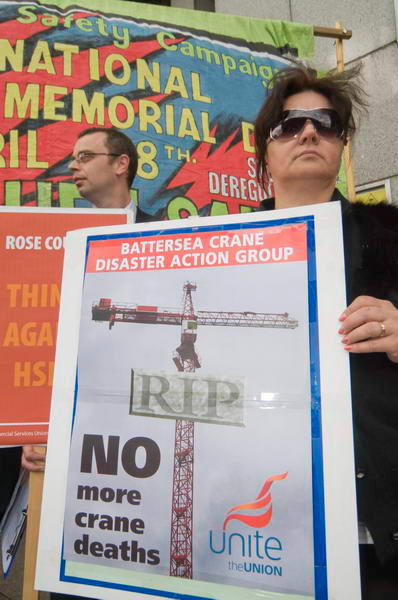
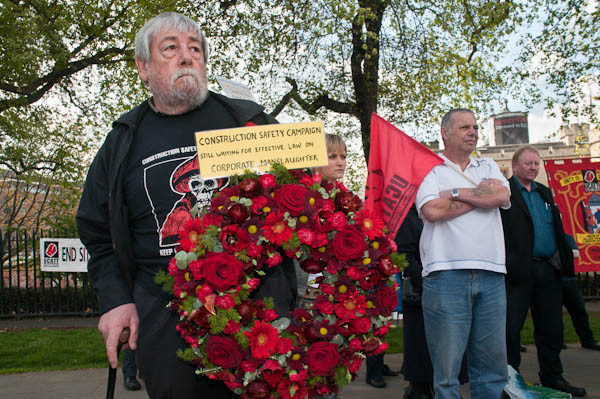
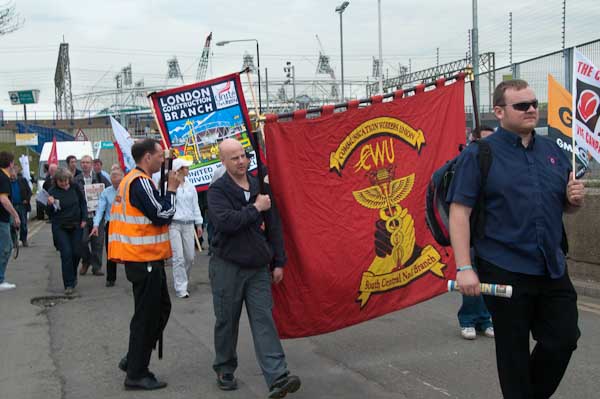
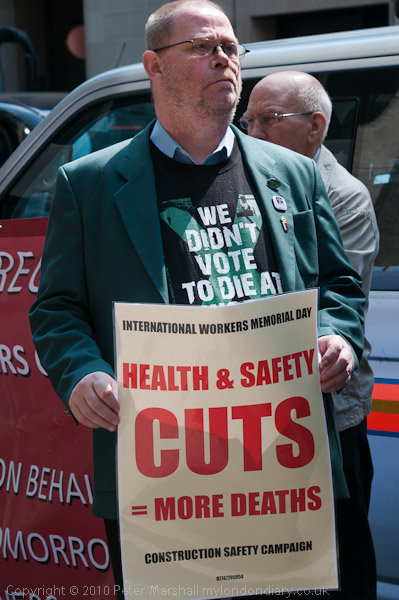
International Workers’ Memorial Day (IWMD)

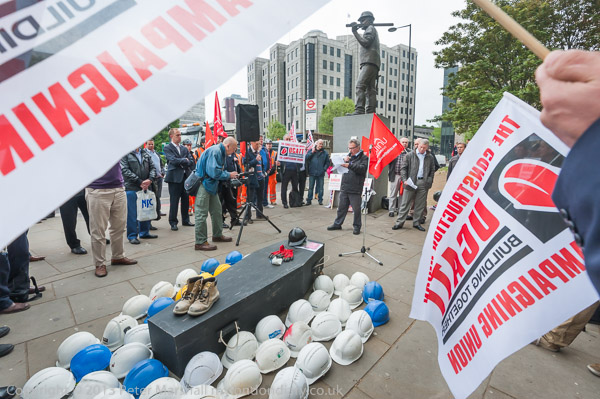
International Workers’ Memorial Day (IWMD). On the TUC web site it states:

Every year more people are killed at work than in wars. Most don’t die of mystery ailments, or in tragic “accidents”. They die because an employer decided their safety just wasn’t that important a priority. International Workers’ Memorial Day (IWMD) 28 April commemorates those workers.

International Workers Memorial Day
International Workers’ Memorial Day (IWMD) 2006
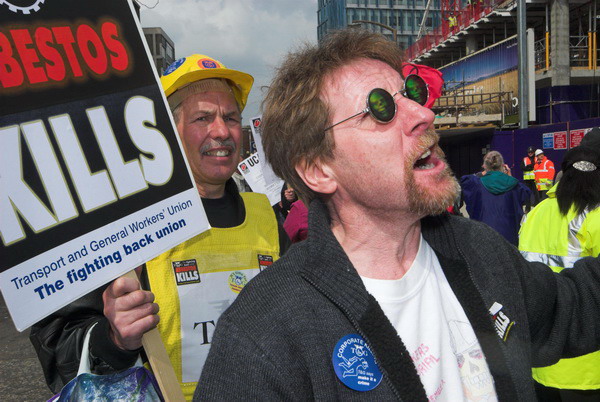
Asbestos Kills – April 2006

The TUC explains:

We remember those who have lost their lives at work, or from work-related injury and diseases. We renew our efforts to organise collectively to prevent more deaths, injuries and disease as a result of work.

International Workers Memorial Day is commemorated throughout the world and is officially recognised by the UK Government.

We remember those we have lost. We organise in their memory.

International Workers’ Memorial Day (IWMD) 2008
2008

Official statistics for workplace fatal injuries – 142 deaths in Great Britain in 2021 minimise the impact of work on worker’s health. These are the actual deaths on the job, at the workplace, mainly among workers in construction and agriculture. But many more die from longer-term consequences of their employment, such as handling hazardous materials without proper protection, perhaps leading to death 20 years after exposure.
International Workers’ Memorial Day (IWMD) 2009
2009

Both Labour and Conservative governments have attacked and removed necessary safety measures as ‘red tape’, cutting down safety inspections. It was an approach that made tragedies such as the terrible Grenfell fire inevitable and one that also endangers workers. Employers have lobbied for these changes to increase their profits. Few ‘accidents’ are accidental; most are predictable effects of failures to have or to observe proper safety measures.

International Workers’ Memorial Day (IWMD) 2010
Stratford 2010

Each year the International Trades Union Congress sets a theme for the day, and this year’s is ‘Make safe and healthy work a fundamental right’. In particular Covid-19 has exposed an occupational health crisis in workplaces worldwide, with many workers in this country and elsewhere being made to work in situations which have led to them becoming ill and some dying, particularly in healthcare where in this country and others around the world proper protective equipment was not available, but also in construction and manufacturing where social distancing at work was impossible.

International Workers’ Memorial Day (IWMD) 2011
2011

Many across the world have been unable to access the vaccines which have helped make Covid less life-threatening now here, though even with this in the UK government figures now show over 190,000 deaths with Covid-19 on the death certificate.

International Workers’ Memorial Day (IWMD) 2014
2014

Around London this year there are events in Barking and Waltham Forest as well as at the Covid Memorial Wall on the embankment opposite the Houses of Parliament where there will be an event starting at 1.30pm with a one-minute silence at 2pm.

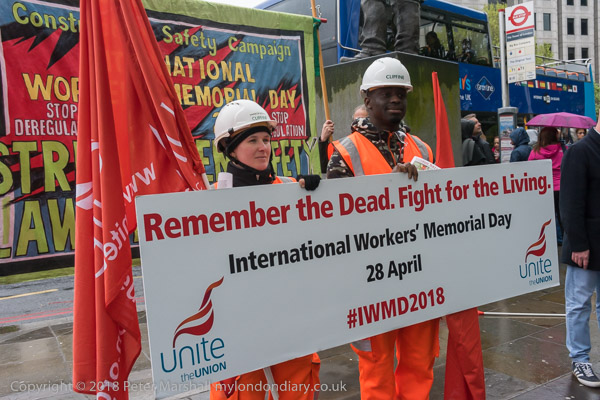
International Workers’ Memorial Day (IWMD) 2018
2018

The pictures are from a few of the #IWMD events I’ve attended over the past years. Although my current Covid infection has been relatively mild, I am still feeling too weak to be there today.

Remember the dead – fight like hell for the living!’


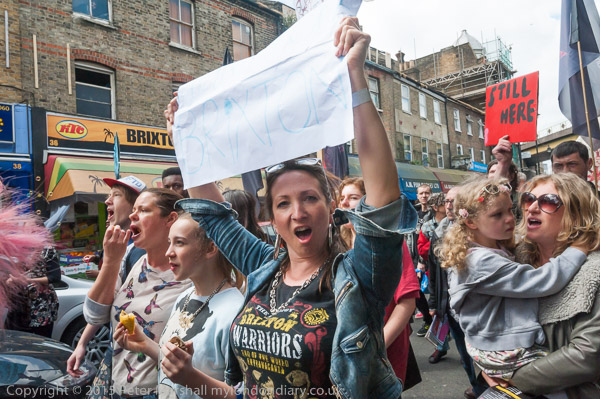
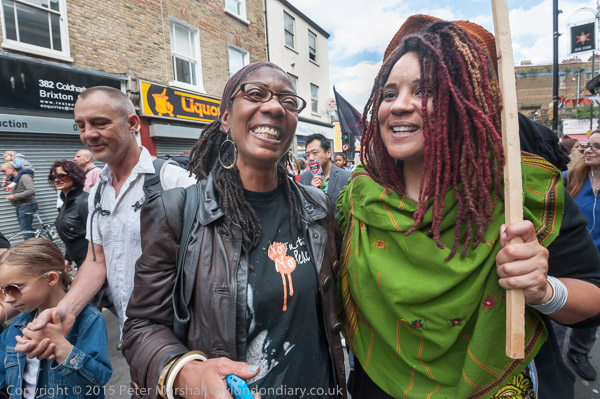
Reclaim Brixton – Arches, Markets & More

Reclaim Brixton – Arches, Markets & More – 25th April 2015

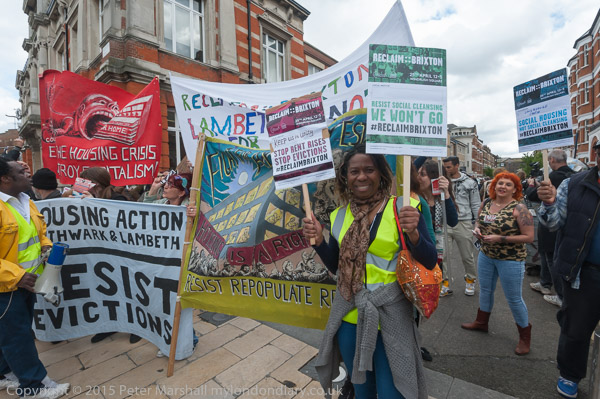
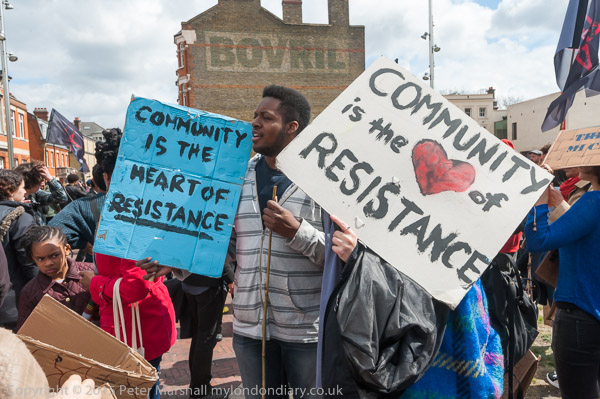
A day of events in central Brixton on Saturday 25th April 2015 celebrated its social & cultural diversity, increasingly under threat as increasing rents and property development are forcing out local businesses and residents.

Brixton boomed after the railways arrived here in the 1860s, the new transport links making it both a popular middle-class suburb and the major shopping centre of South London; it had the first purpose built department store in the UK, Bon Marché, opened in 1877 and continuing in business until 1975 and probably the first street market in the world to be lit by electricity in Electric Avenue. While the wealthier moved out in the first half of the twentieth century to leafier areas, the increasingly working-class population grew, as did the markets, cinemas, pubs and other facilities.

After the war Brixton became increasingly multiracial. Arrivals on the Windrush were given temporary housing in the Clapham South deep shelter, and found jobs from the nearby Brixton Labour Exchange and housing in rooms and flats in the area. Though many had intended to go back to the Caribbean, most remained here, bringing over family to joint them and over the years Brixton became a centre of the British African-Caribbean community. In 1981 locals rose up against heavy handed policing but the conclusions of the Scarman report were largely ignored and it was only after the death of Stephen Lawrence that the police were declared “institutionally racist.”

There was further unrest after the death of Wayne Douglas in police custody in 1995, and there was an increasing attempt by Lambeth Council to change the nature of the area seen by them as regeneration but by many in the area as gentrification.


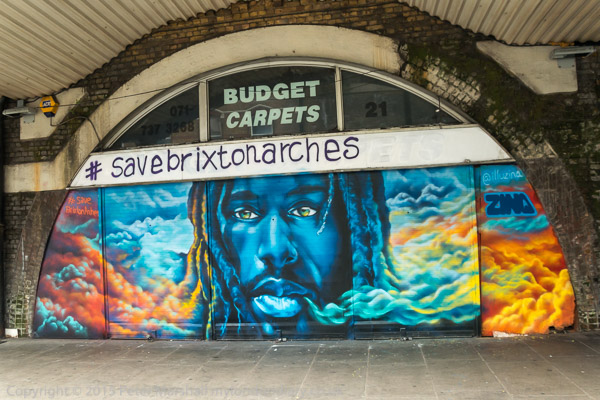
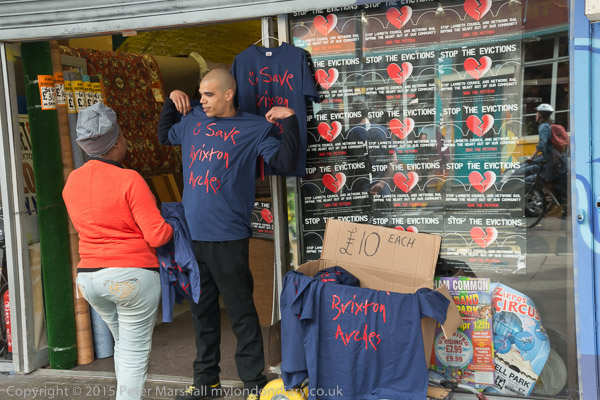
Brixton Arches tenants protest eviction

The railways run on viaducts through central Brixton, and the arches below them, particularly along Atlantic Road and Brixton Station Road have long provided low cost spaces for local businesses.

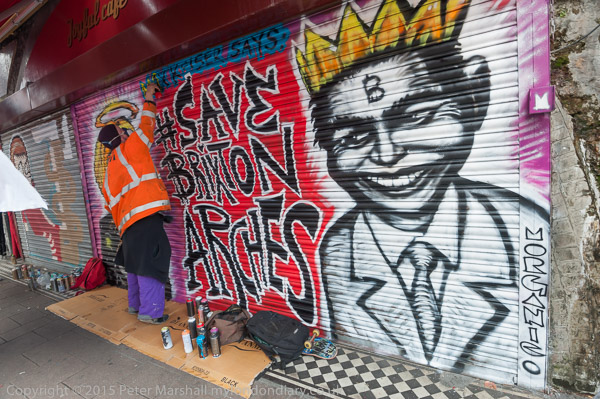
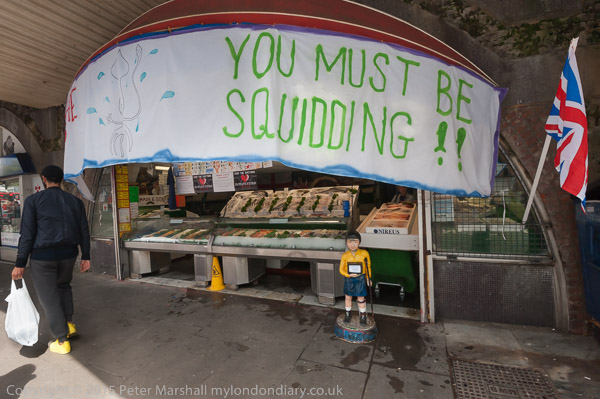
But Network Rail decided to increase the income from these spaces and the existing tenants were threatened with eviction and then a tripling of rent for the refurbished space. One of the businesses, fishmongers L S Mash & Sons, had been trading here since 1932 and others since shortly after the war.

The businesses closed for two hours on Saturday lunchtime, many hanging white sheets with messages across the frontage and others inviting graffiti artists to decorate the shutters. These businesses, the arcades and the market really are the heart of Brixton.

Brixton Arches tenants protest eviction


Take Back Brixton against gentrification

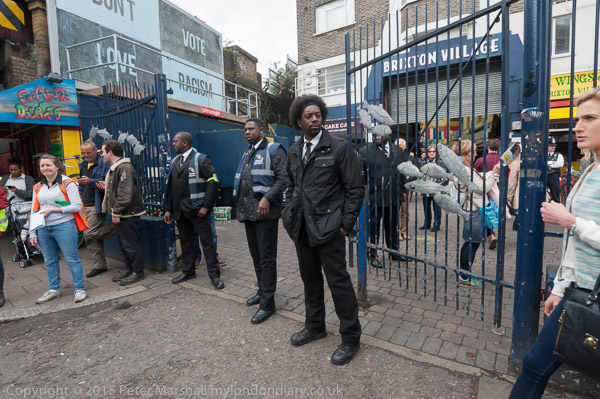
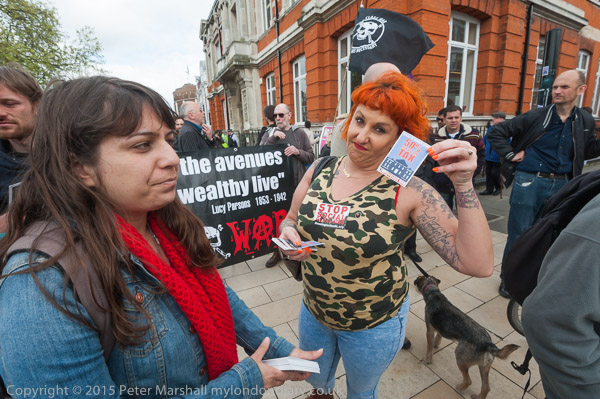
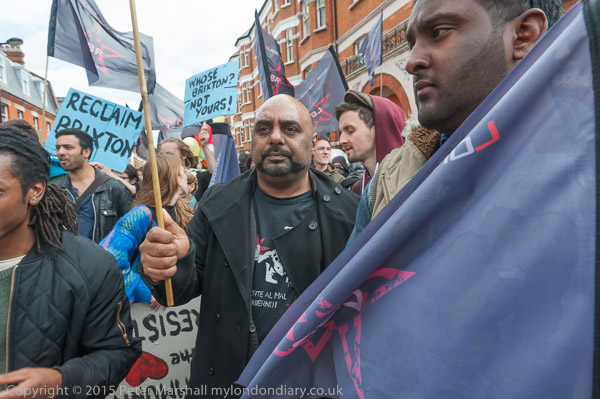
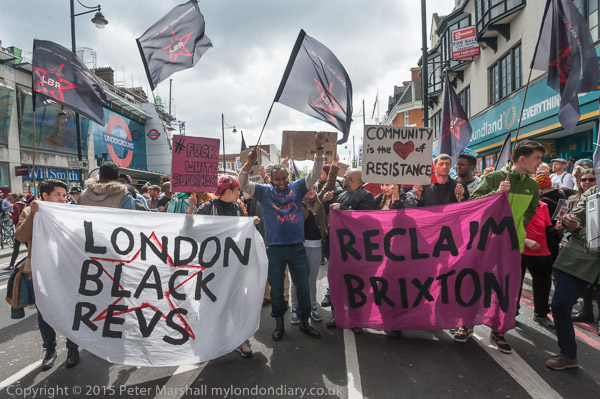
Brixton Black Revs (revolutionaries rather than reverends) had wanted to march peacefully through the gentrified ‘Brixton Village’, but police and security guards blocked their way into the arcade, and instead it became a very short march to take housing and other activists directly to the Reclaim Brixton gathering in Wind rush Square

Granville Arcade which links Coldharbour Lane, Atlantic Road and Popes Road was built in 1937 with over 100 shops in its covered avenues, and was named after its developer, P Granville-Grossman. The site had previously been the Lambeth Carlton Club, a large Georgian-style mansion buit in the 1870s and home to the Brixton Conservative Association.

It was renamed Brixton Village around 2005 and was saved from demolition by a powerful local campaign which resulted in it and Reliance Arcade, Market Row being given Grade II listing. The listing text makes much of the importance of the Afro-Caribbean nature of the markets, but although listing saved them from demolition it has not protected them from gentrification and the replacement of much of this character by trendy restaurants and boutiques.

Take Back Brixton against gentrification


Reclaim Brixton celebrates Brixton

The area in front of the Tate Library and Brixton Ritzy was renamed Windrush Square in 1998. It had long been a popular meeting place for locals and local events, but Lambeth Council with offices in the town hall opposite clearly saw that as something of a threat, and spent a large amount on turning it into a desolate, bleak and unwelcoming windswept area to discourage the informal gatherings that took place there.

Although today the area was reasonably crowded, there seemed to be nothing very organised happening. Unite Community had a microphone at one side and there were a speeches, but few seemed to be taking any notice of them. When I walked around there was a group playing classical music, another of African drummers, and the Revolutionary Communist Group had its own megaphone and speakers, while people were having a light-hearted limbo competition to a musical accompaniment from the Unite ‘stage’. And some of my friends had disappeared to a nearby pub.

Reclaim Brixton celebrates Brixton


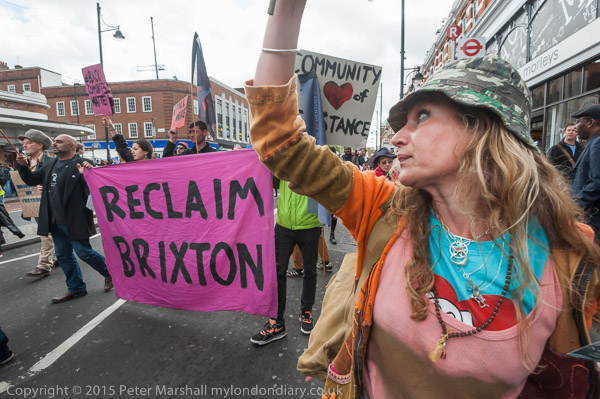
London Black Revs ‘Reclaim Brixton’ march

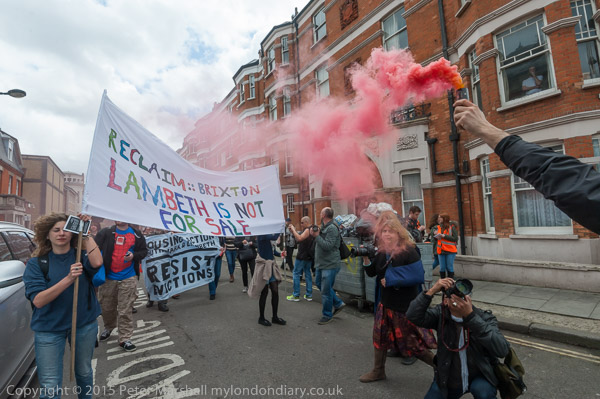
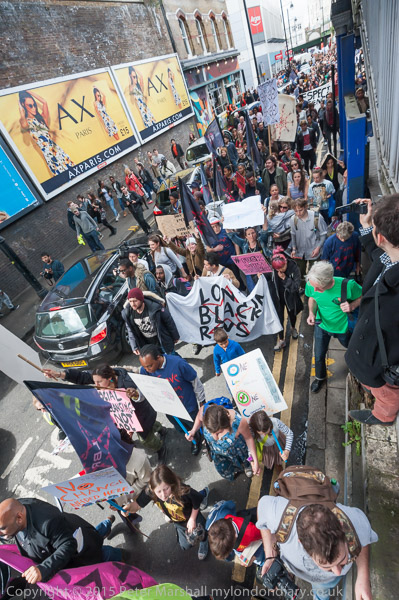
After an hour or two hanging around in Windrush Square, activists again took to the street for a lively march around Brixton.

Rather to my surprise, the march simply returned to Windrush Square. I hung around for a bit but everything seemed very peaceful and I mistakenly thought that perhaps nothing more would happen and decided to take a bus to begin my journey home.

Shortly after I left some people stormed and briefly occupied Lambeth Town Hall and a large window at Foxton’s estate agents was broken, and a few activists went into Brixton Village with banners.

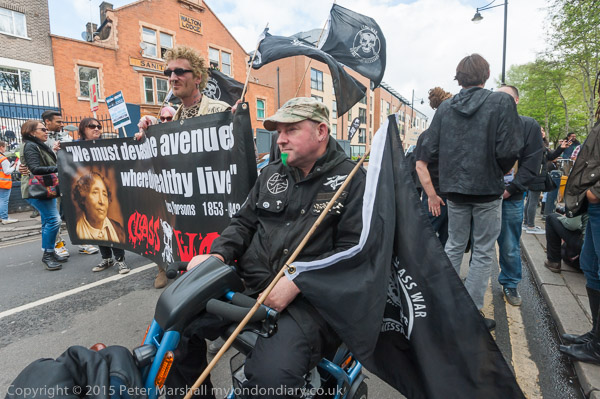
Marcia Rigg whose brother Sean Rigg was killed in Brixton Police Station in 2008

London Black Revs ‘Reclaim Brixton ‘march


Things in Brixton have got worse since 2015. In 2018 Hondo Enterprises owned by Texan property developer and part-time DJ Taylor McWilliams bought Brixton Market which includes the arcades and the following year announced plans for a 20 storey office block, which were approved by Lambeth Council in November 2020. Hondo now brand the whole market area as Brixton Village.

More from the protests:
London Black Revs ‘Reclaim Brixton ‘march
Reclaim Brixton celebrates Brixton
Take Back Brixton against gentrification
Brixton Arches tenants protest eviction


Scientists Demand Politicians Listen, Family Justice & Chechnya

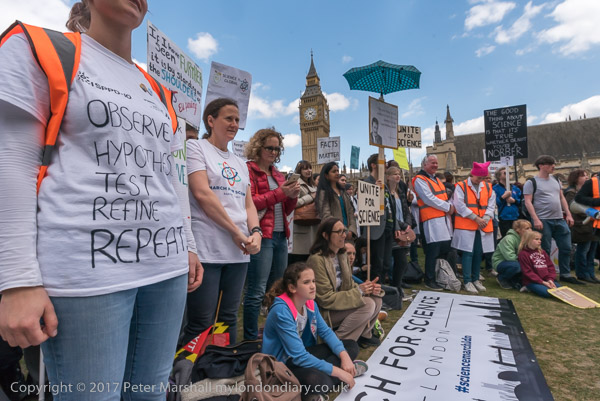
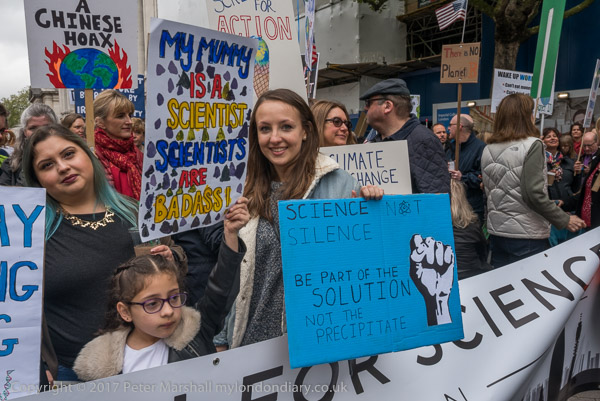
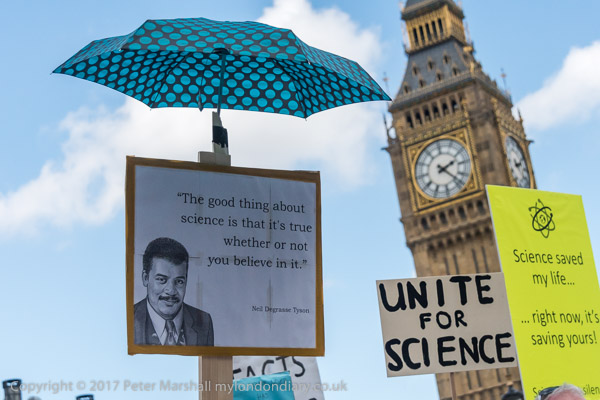
Scientists Demand Politicians Listen, Family Justice & Chechnya – Five years ago on Saturday 22nd April 2017, thousands of scientists marched from outside the Science Museum to a rally at Parliament to demand policies based on proven research rather than fake news and fake science. Elsewhere in London people called for urgent reform of our secretive Family Courts and against the torture and killing of gay men in Chechnya.

Scientists Demand Politicians Listen, Family Justice & Chechnya

Scientists march for Science – Kensington

Scientists Demand Politicians Listen, Family Justice & Chechnya

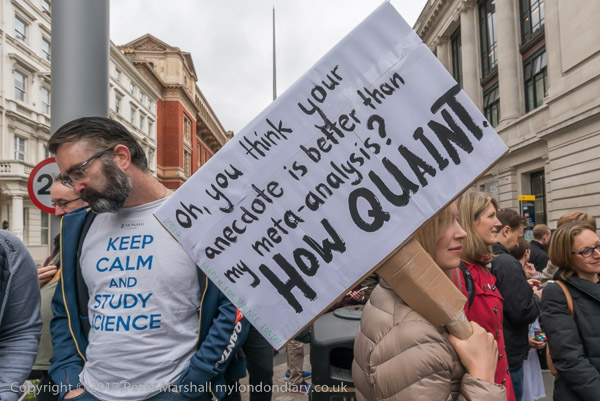
I began my working day on Exhibition Road outsed the Science Museum where a large crowd of people was gathering, many wearing white lab coats, to clebrate the vital role of science in our lives and to demand that the UK and other governments stop listening to fake news and fake science and base policies on proven research.

Scientists Demand Politicians Listen, Family Justice & Chechnya

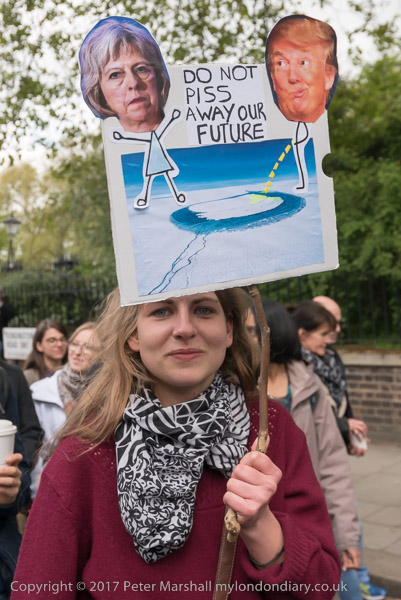
They saw a particularly dangerous situation in the USA, where President Trump was promoting climate denial and other policies in the face of the well-established science and giant US companies particularly the fossil fuel producers have been spending unimaginable sums over the years to promote biased research and lobby to produce doubt over established facts – just as the tobacco lobby did to undermine the science behind the cancer risks of smoking.

‘The New Greenwashing’, an article just published by Nick Dowson’s article in the May-June 2022 issue of New Internationalist spells out the 6 ‘Tricks’ that Big Oil has used to prevent any meaningful action to make the drastic reductions needed in fossil fuel use and ensure that they continue to make massive profits from oil and gas as we move closer and closer to extinction.

They “Distract, delay and obfuscate” by setting distant targets and coming up with vague ideas like ‘net zero’ when what is needed is an end to fossil fuels, “Sell false solutions” such as carbon credits, carbon offsets, ecosystem services, “Greenwash gas” as being natural and clean, “Peddle futuristic-sounding fictions” particularly around hydrogen use, “Divert subsidies from renewables to unproven technologies” in particular carbon capture and storage and “Individualise, demobilise” making us feel it is our personal responsibility through gadgets such as the carbon footprint calculator invented by BP rather than a problem caused by their activities

Here in the UK Brexit is threatening our international cooperation in science and the BBC uses the excuse of impartiality to give equal billing to accepted and tested science and fake science often presented by non-scientists.

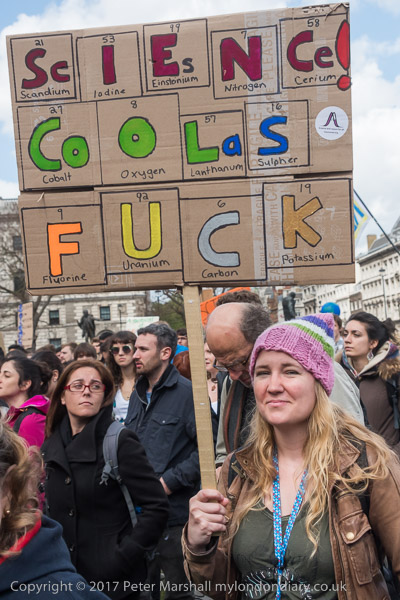
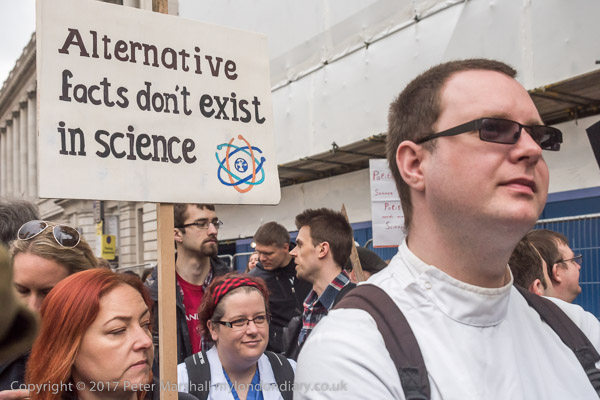
I spent some time watching the march go past, turning into Kensington Road on its way to Parliament Square, wondering what people who saw them going past would make of some of the slogans, such as like ‘Do I have large P-value? Cos I feel Insignificant‘ or ‘dT=α.ln(C1/C0)‘. Many scientists do seem to have a problem in communicating with the rest of us. Fortunately there were others easier to understand.

Scientists march for Science


Scientists Rally for Science -Parliament Square

I rejoined the scientists rather later than hoped after the rally in Parliament Square had begun, missing quite a few of the speeches.

Scientists Rally for Science


Reform Family Courts – Kensington Gardens,

When the scientists marched off from Kensington to Parliament I went in search of another group of protesters who had marched in the opposite direction, from Parliament Square to the statue of Peter Pan in Kensington Gardens.

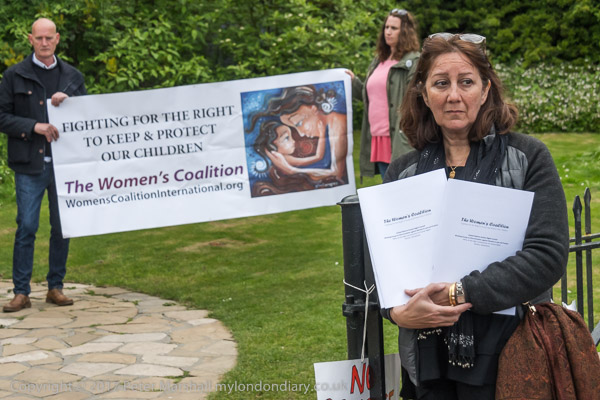
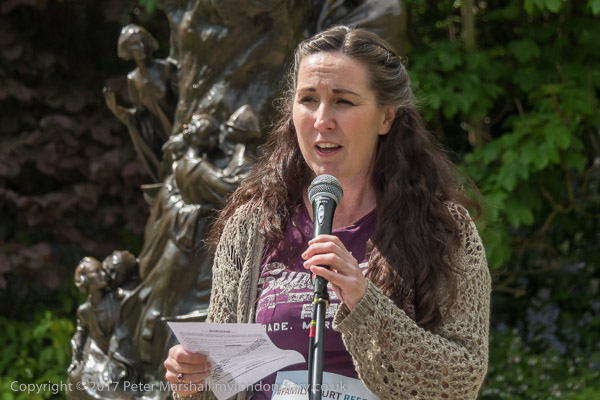
The had come to protest against the injustices perpetrated by our secret Family Court system and police and social services, and several told horrific real stories of children being taken away from victims of domestic violence, mothers who had reported child abuse by partners or former partners, and other cases of what appeared to be miscarriages of justice. Among those taking part were some unable to speak because they had been gagged by court orders. One woman was being forced to live away from friends, job and family. Another told us how the battle to regain her daughter had taken 7 years and cost her £14,000.

One of the organisers explains why we cannot mention the name of the woman the protest was organised to support

The protest had been arranged, along with another taking place in Nottingham to support a woman currently involved in a family court case. But on the afternoon before this protest, a family court judge had ruled her name could not be mentioned. Although everyone at the protest knew it, we had to refer to her only as ‘S’ to avoid committing an offence and the protest had to be renamed as ‘Justice4S’.

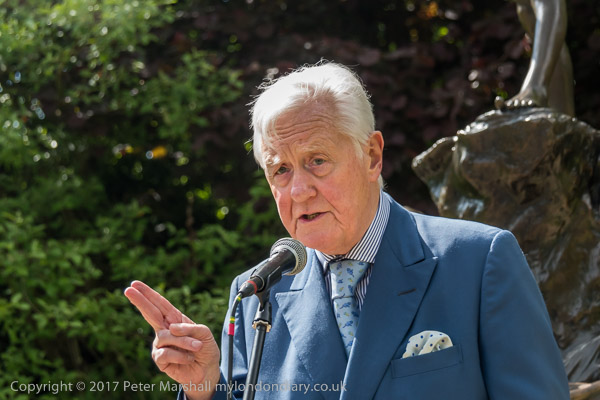
Also present was Sir Benjamin Slade, the owner of two castles in Somerset who had hit news headlines earlier in the week by advertising for a young wife to serve his needs. He had fought the case for one of his former workers whose children had been taken away by social services for what appeared to be trivial reasons, getting a friend who was a major newspaper editor to run a campaign which eventually got them returned. He came to the protest together with a young woman whose case he was currently involved in who was being forced against her will to live in Torquay.

Reform Family Courts


LGBT rights abuses in Chechnya – Russian Embassy, Kensington

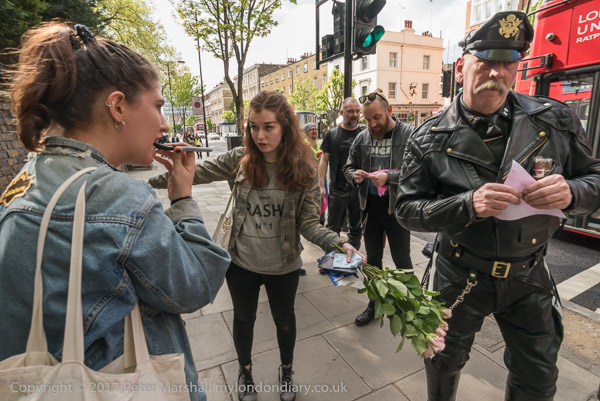
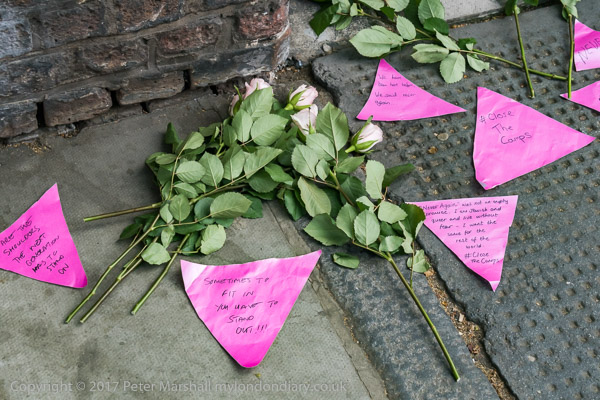
After rushing back by tube from Kensington Gardens to Westminster for the Scientists Rally, as soon as that ended I was back on the tube to the Consular Section of the Russian Embassy on Bayswater Road where people had brought pink flowers and wrote messages on pink triangles to leave outside the tall gates of the Consular department of the Russian Embassy in a vigil to show solidarity with LGBT people in Chechnya.

The vigil was one of several taking place across the UK after over a hundred men, suspected by the authorities of being homosexual have been rounded up an put into camps and tortured, with three thought to have been killed. Those held include many well-known in the country, including TV personalities and religious figures. An Amnesty petition stated “The Chechen government won’t admit that gay men even exist in Chechnya, let alone that they ordered what the police call ‘preventive mopping up’ of people they deem undesirable”.

LGBT rights abuses in Chechnya