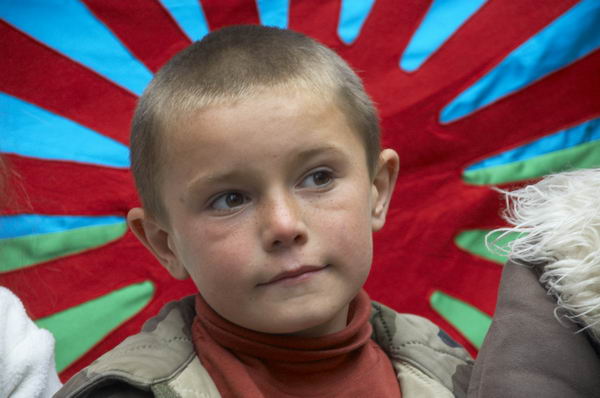
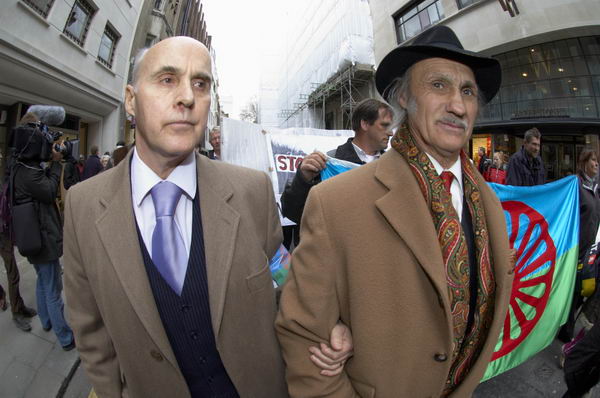
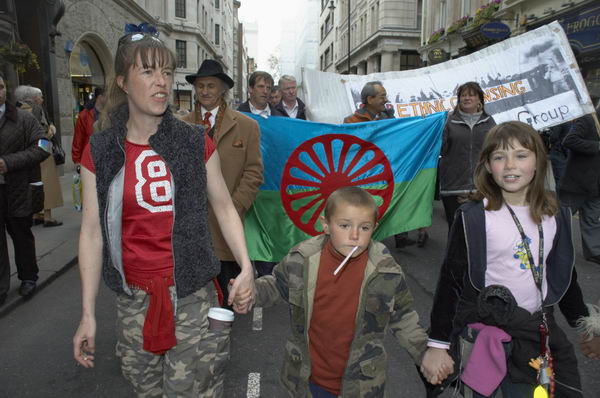
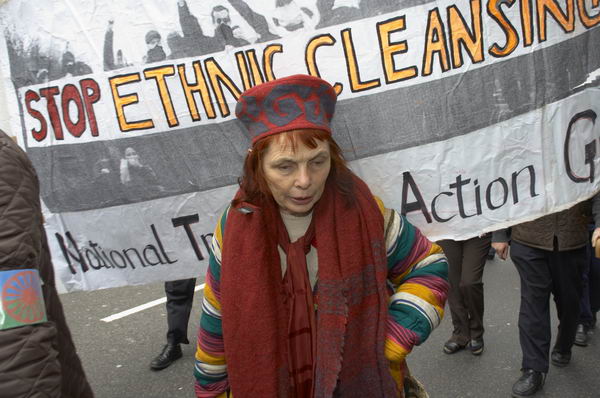
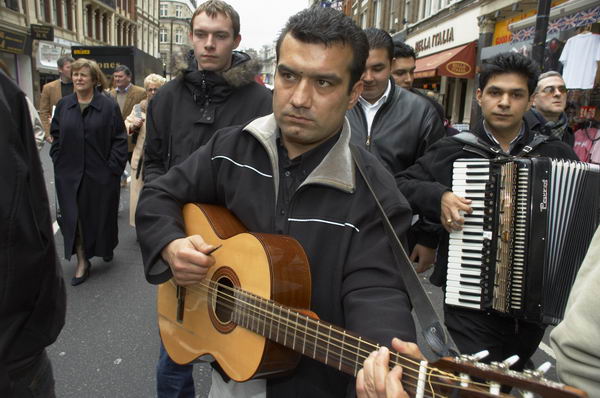
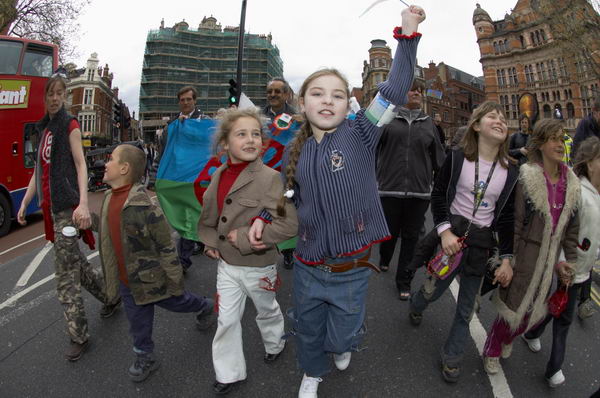
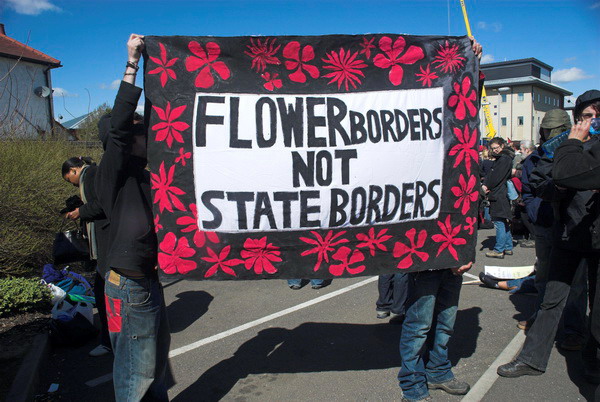
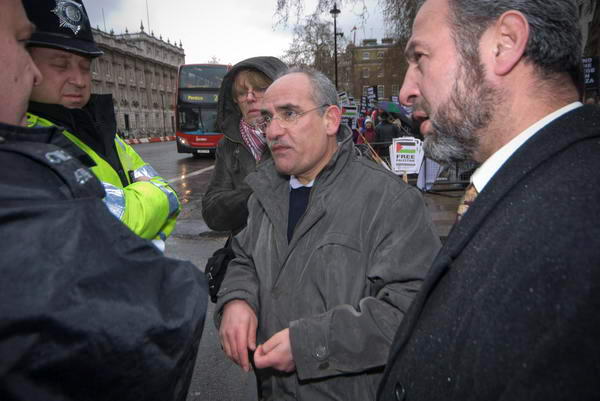
On 8th April 1971 the first World Roma Congress met at Chelsfield in southeast London. It called for Roma self-determination and international unity and the delegates unanimously rejected all of the names given to them by outsiders, including Gypsy (or Gipsy), still often used in English, which the community viewed as insulting. Both Rom and Romany have also been in use in English since the 19th Century, but throughout Europe the term Roma is now officially used, though in German-speaking countries the name Sinti is common.
Waiting for the march outside St James Piccadilly
https://en.wikipedia.org/wiki/Romani_people Linguistic and more recent DNA studies show that Roma originated in northwestern India around 1500 years ago and later migrated to Europe, reaching the Balkans around 900 years ago. They have long been subject to persecution and in some central and east European countries were slaves until the 1840s and 50s.
In 1930s Germany Roma in Germany were stripped of their citizenship and many were interned and there was a programme of compulsory sterilisation. In 1942 the Porajmos or Romani Holocaust began, with Roma being sent to extermination camps. Estimates vary wildly of the number killed in Germany and German occupied territories, between 200,000 and 1,500,000.
Roma as well as Jews were victims in the Holocaust
Roma still suffer considerable persecution in some countries including Romania, and the end of communist control has led to an increase in prejudice and persecution there and elsewhere. And across all countries including our own there is still widespread denial about the persecution they still face.
8th April, the day of the first congress, was adopted in 1990 as the International Roma Day of Action. Perhaps because of that denial it has not received much attention.
Roma have generally taken on the predominant religions of the countries they have settled in and the London action began with a church service at St Jame’s Piccadilly before marching through central London. I photographed them outside the church and on the march, ending my pictures as they went up Charing Cross Road.
In my account on My London Diary in 2005 I used the term gypsy as this was still almost always used in the media and Roma was not widely understood. Commonly too, Roma are called ‘travellers’ although many Roma are settled and most ‘travellers‘ are not Roma. Here’s what I wrote in 2005:
After a church service commemorating the 500,000 Roma murdered in the Nazi holocaust, Roma from several countries marched across London against the ethnic-cleansing of 30,000 gypsies from their own land and in protest over threatened evictions at Dale Farm, Essex, Smithy Fen, Cambridgeshire, and elsewhere.
After the march, gypsy Richard Sheridan was to announce that he was standing against sitting Tory MP John Baron at Billericay in the general election on 5th May 2005 in order to make the travellers’ voice heard. [He did not actually stand, but did attract some media attention to the cause.]
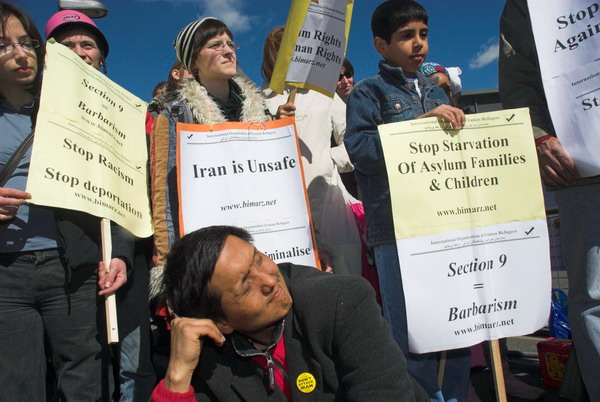
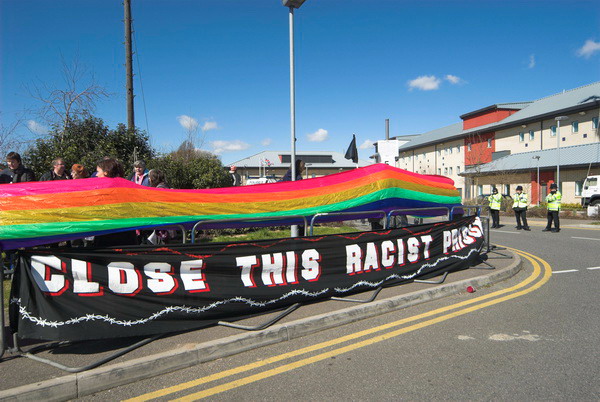
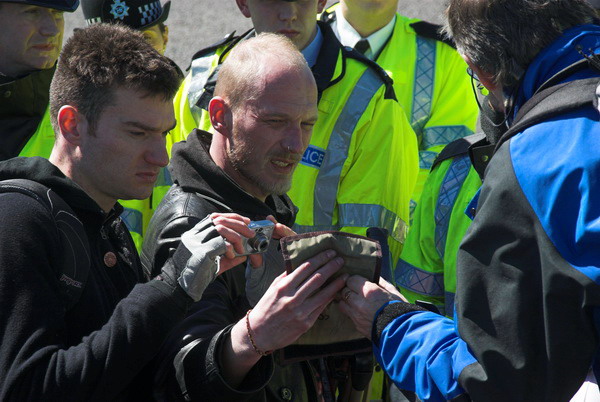
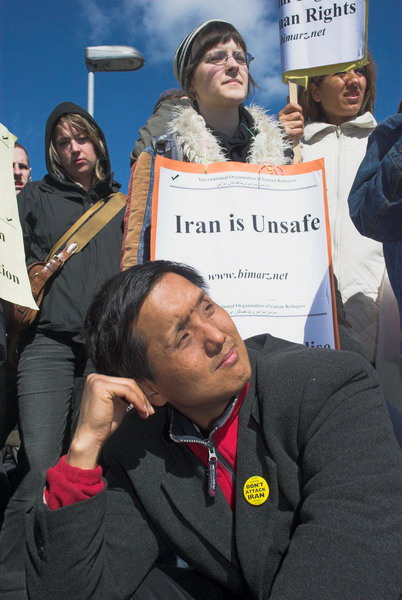
No Borders: Harmondsworth Detention Centre: Twenty years ago on April 8th 2006 I was outside the two large detention centres on the Bath Road at Harmondsworth on the northern edge of Heathrow Airport. A protest there had been called by No Borders and among those protesting with them were the International Organisation of Iranian Refugees,
Detainees were kept way from the front of the building so they could not see the protes, but they could hear they were there.
It’s hard to find the text I wrote back in 2006 or the pictures, so I’ll include the text below along with a link to the start of the pictures.
No Borders: Harmondsworth Detention Centre
Harmondsworth, London
‘CLOSE THIS RACIST PRISON’
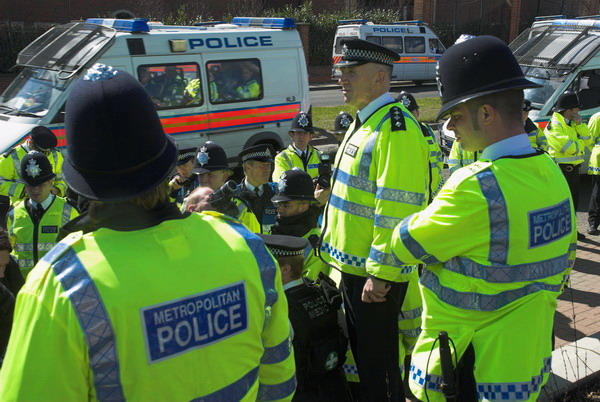
The No Borders demonstration outside Colnbrook and Harmondsworth detention centres – the two are separated only by a narrow road – was at times loud and noisy, so those kept in these secure prisons knew that they were receiving support, even though they were cleared from that side of the building so they could not hear the speeches. [Some who phone the protest clearly could hear them.]
A senior officer informed them they are being held under Section 14 of the Public Order Act, though there seemed to be no likelihood of the serious public disorder required for this to apply.
Some demonstrators who went along a public footpath to a field at the back of the building were forcibly removed and detained for around an hour.
[Among those detained and kettled by police was a videographer, a fellow NUJ member, and when he showed his press card, police told him it wasn’t a real press card and refused to let him leave. He called up to me and a few other photographers asking one of us to come down and show them a press card, which is supposed to ensure that police let us get on with our job. I fished mine out from my pocket, then saw it had expired at the end of March, and put it back again. Another photographer went to his aid.
After around an hour the protesters were taken out from the kettle one by one and police demanded their names and addresses – threatending arrest if they did not give them – although the police had no power to do so.]
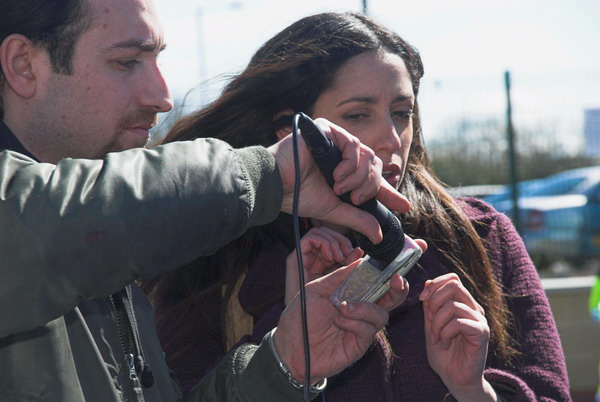
A number of the detainees actually did speak to protesters on their mobile phones [from inside Harmondsworth detention centre] and their calls were held to a microphone and relayed over the protester’s public address system. The detainees thanked the demonstrators for coming and also told us about the inhumane and arbitrary treatment they were receiving.
Many of those held have fled from violence and repression in their own countries, only to arrive here and find that immigration officials refused to listen to or believe the stories they told. Some have been held in detention for more than 3 years.
Detainees include some who have been living in this country for a number of years, working and paying taxes, setting up lives in this country and contributing to it. Then they are taken without prior warning and imprisoned in these units, sometimes more because the immigration service has targets to meet than anything to do with their case.
Possibly we need an immigration policy, although I’m not actually convinced. It’s an area where I have more faith in those market forces our governments now seem to worship than most. But whether or not we need one, if we have one it should be honest, transparent, just and efficient. At the moment it fails on every count.
Many of us are ashamed of the way our government has decided to let families and children in particular exist without proper support. Ashamed when we hear stories of families who get a knock on the door at 4am and are taken away in a matter of hours.Ashamed that we are sending people back to countries where we know they are almost certain to be imprisoned, tortured and possibly killed
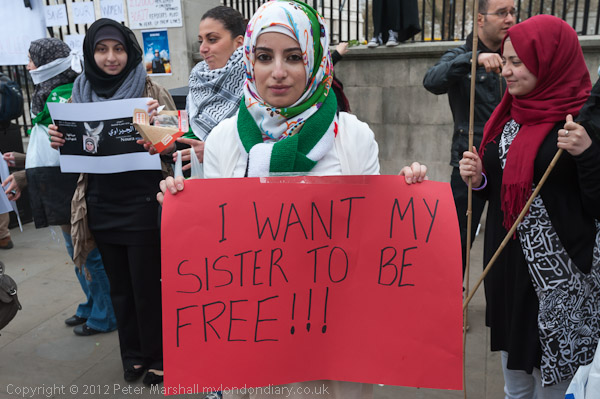
World Health, Syria & a Pillow Fight: Saturday 7th April 2012 was World Health Day and health campaigners protester against the increasing privatisation of the NHS. It was also International Pillow Fight Day which was celebrated by hundreds in Trafalgar Square. Between these I photographed Free Syria supporters calling for the UK government to do more over the atrocities by the Assad regime against their relatives still in Syria.
World Health Day: Lansley’s Bill
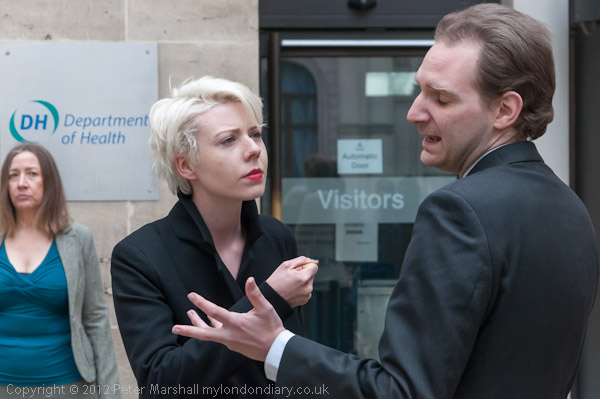
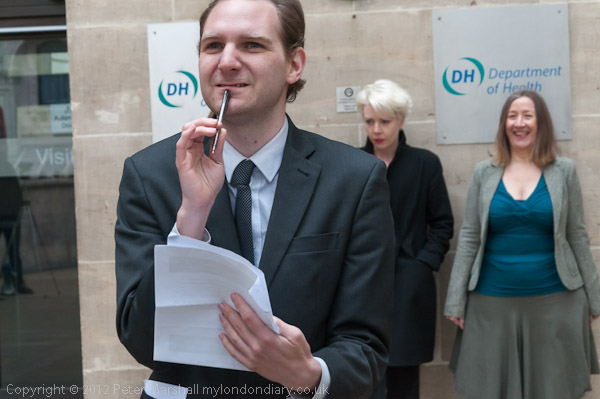
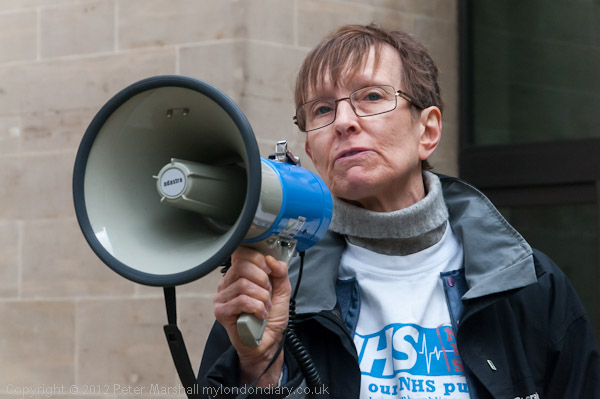
Dept of Health, Whitehall
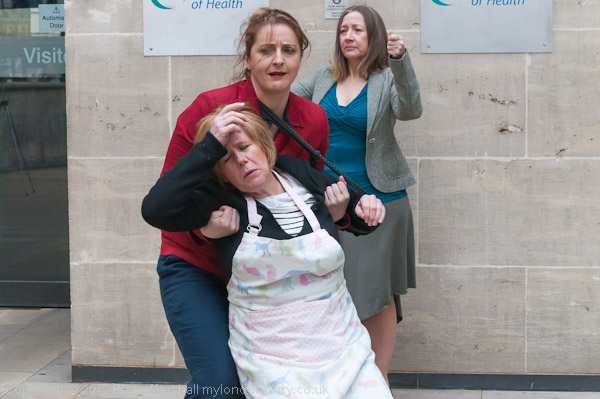
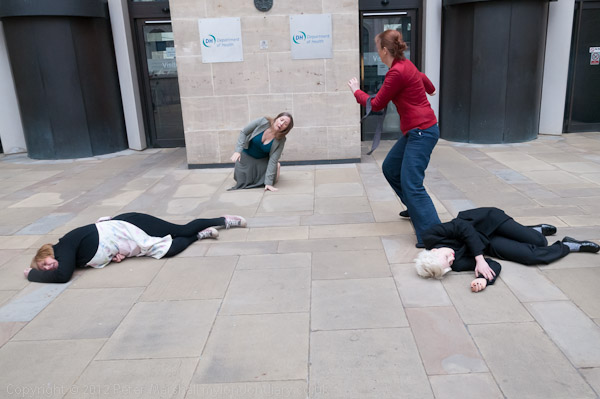
Lansley’s Bill – Lansley lies to the media in the play performed outside the Dept of Health
The Health and Social Care Act 2012 was now law, having gained royal assent on March 27th 2012. Secretary of State for Health, Andrew Lansley had pushed through the most extensive reorganisation of the structure of the NHS despite the united opposition of the Royal College of Nursing, the Royal College of Midwives, the British Medical Association and the Royal College of General Practitioners and many campaigning groups.
‘Lansley’ looks at the Tory plan to hand the NHS to private companies and decides to present it as giving more choice to the public
The Act led to a greater marketisation of the NHS with an greatly increased role for private companies who mainly ‘cherry picked’ the simpler and so more readily profitable areas of service, and its structural reforms were damaging, with new complex systems of governance and accountability, while removing the system leadership needed to cope with major changes. And it didn’t give any more choice to the public – unless they went private.
Lansley’s Act failed, largely because it tried to introduce a system based on competition into a an NHS where care and cooperation was the bedrock, but it did succeed in diverting much needed funds to the private sector. By 2019 the policy of competition was effectively abandoned. Labour in 2024 commissioned a report led by Lord Darzi which called it a “broken system” and conclude it “was a calamity without international precedent – it proved disastrous. The result of the disruption was a permanent loss of capability from the NHS“.
Nurse Gail Lee began the protest by explaining that the Act was designed to lead eventually to the NHS being converted to an insurance-based healthcare system that will provide high-cost medical services for those who can afford it while retaining only a basic provision for others. So far this has not happened but there are still politicians – Labour as well as Conservatives – who are urging this.
After her short talk there was a performance of the play ‘Lansley’s Bill’ by Mike Hart, based on the facts of the planning by McKinzey Consulting and the Tories which led to the Lansley Bill, a bundle of Tory lies which opens up healthcare to the market under the misleading mantras of ‘choice’ and ‘efficiency’.
Without a public health service to treat them, people are dieing – we are told we must fight and throw out Lansley
Based around the problems of a cleaner who needs the help of the new version of the NHS but is told to wait, and wait – until she dies, it makes the point that “you have a choice. You can fight for the NHS, become rich, or you can make sure you are never ill. The least worst case is to get out there and fight.”
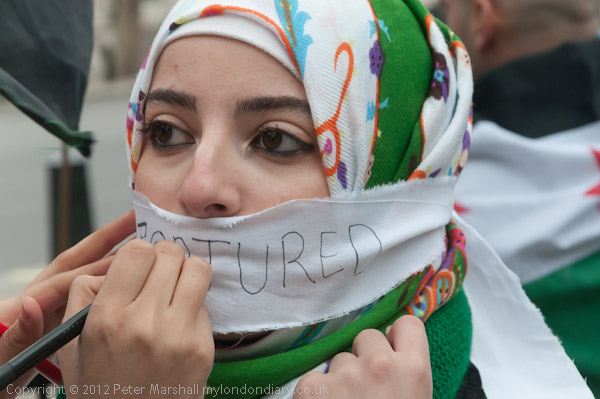
Free Syria Supporters protested aaginst the continuing killing, torture, imprisonment and abductions of their relatives by the Assad regime, calling on the UK government to take greater action
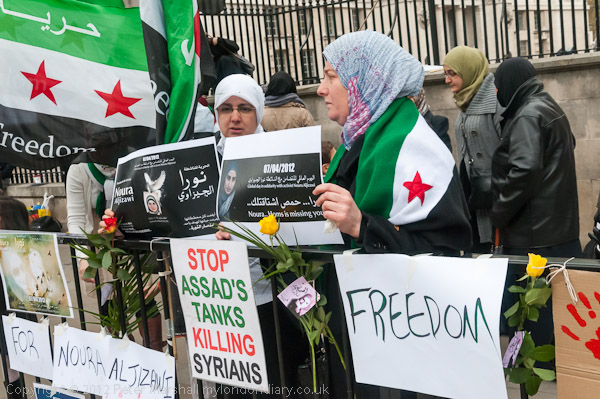
Some held up placards ‘For My Sister’, ‘For My Mum’ and for some at least of those wearing gags with the words ‘Freedom’ or ‘Tortured’ it was there own family who was tortured or missing or held in jail. Their protest over human rights violation was personal.
Some held family snapshots, blown up to A4, and others were taped to the railings along with lists of names, and roses dedicated to the missing and dead.
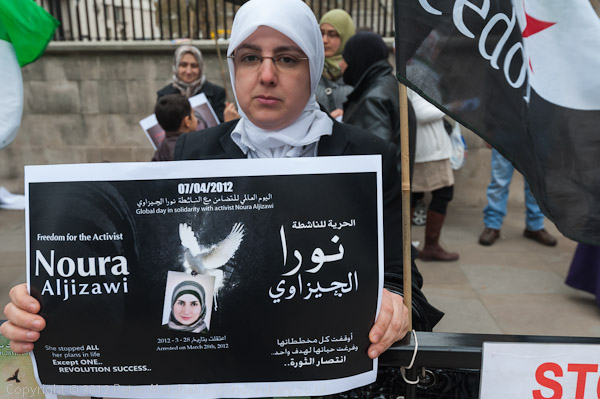
Many also called for the release of human rights activist Noura Aljizawi, who had led protests against the Asad regime, worked in hospitals to support women and children and written for the Syrian underground newspaper Hurriyat. Arrested on 28th March she was tortured and denied access to family and lawyer; an international campaign led by Reporters without Borders eventually led to her release and she fled to Turkey, continuing her campaign against the Assad government, finally relocating to Canada.
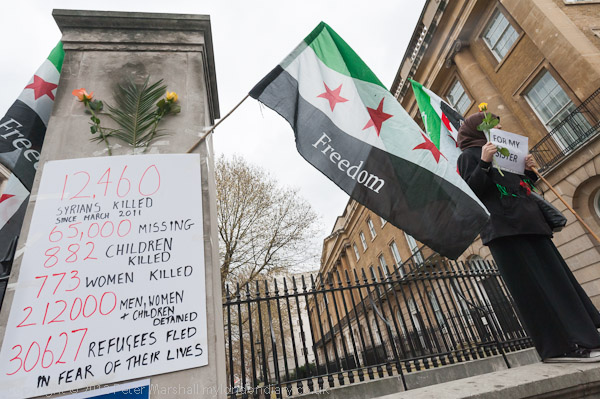
My final paragraph on the protest on My London Diary: “On a pillar behind and on the leaflets handed out were the grim statistics. 12,460 Syrians killed since March 2011; 65,000 innocent Syrians are missing; 882 children and babies murdered, 773 women slaughtered; 212,000 men women and children are detained; 30,627 refugees fled in fear of their lives. And the numbers are still rising.”
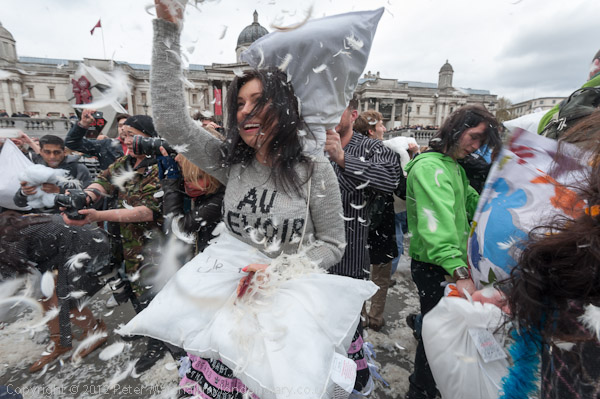
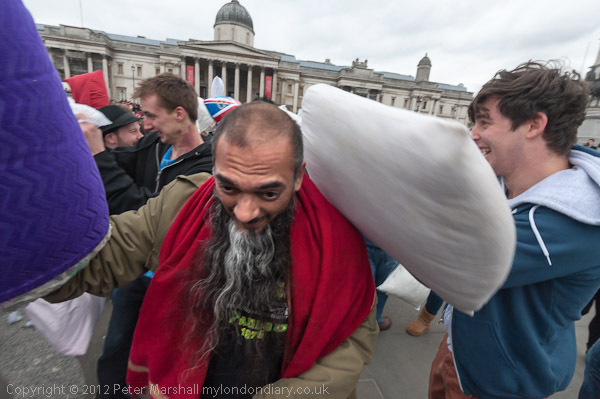
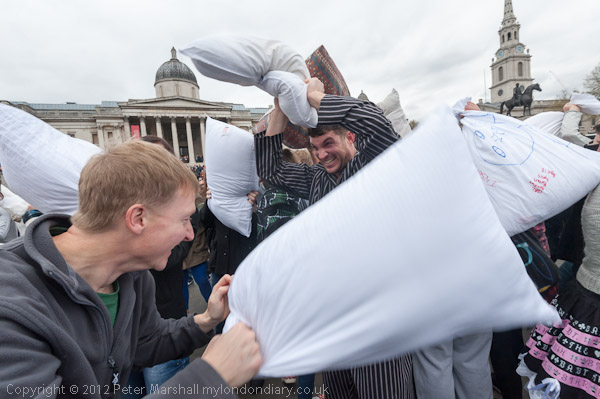
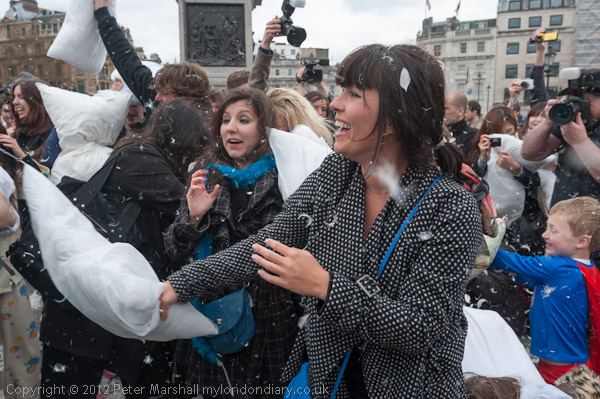
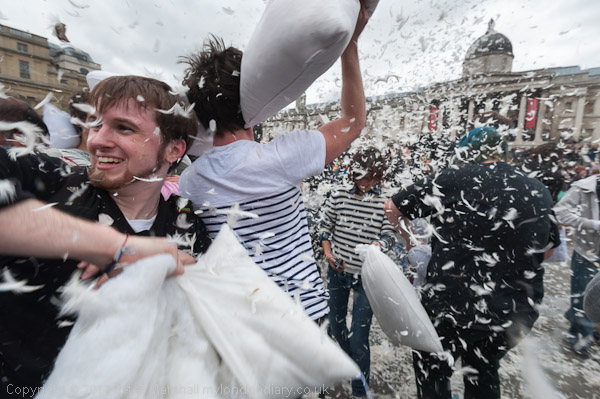
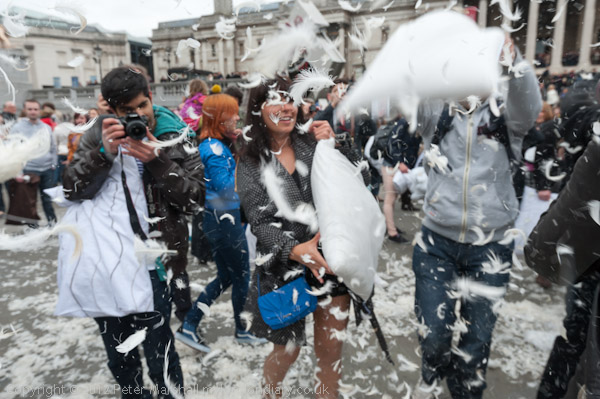
It was International Pillow Fight Day with fights arranged in 111 cities around the world in an event promoted by the urban playground movement.
A whistle signalled the start of the fight
As well as London there were fights in cities from Amsterdam to Zürich, with the majority being in the USA, but they were also in virtually every European country, as well as in Canada, Greenland, Turkey, Bahrain, South America, Cape Town, Australia, Hong Kong and China.
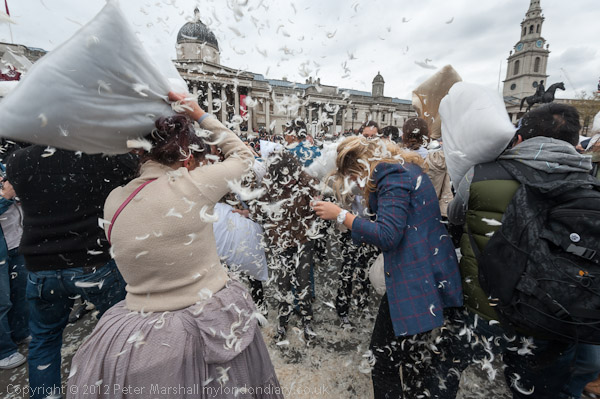
The organisers had set out a list of nine rules, some of which were adhered too, but others were clearly ignored – such as “6) NO FEATHERS, let’s not make a mess”.
Another that was often ignored was “4) Do not swing at anyone without a pillow or holding a camera”, though some did apologise after hitting me.
As I commented, it “was half an hour of glorious chaos as people of all ages – though mainly in their teens and twenties – rushed around attacking anyone with a pillow.”
Generally the attacks were random, but there were occasional cries to “attack the panda, or the guy in stripes or spiderman or one of the others in identifiable costumes”.
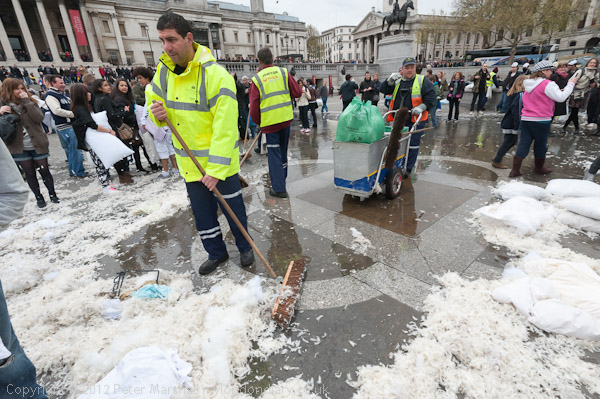
After around 20 minutes when the air (and my lungs) was full of dust and feathers the council cleaners began to pour buckets of water and sweep the dampened feathers away, but the fighting continued until a whistle blew to end the fight at the end of 30 minutes – with just a few continuing to fight.
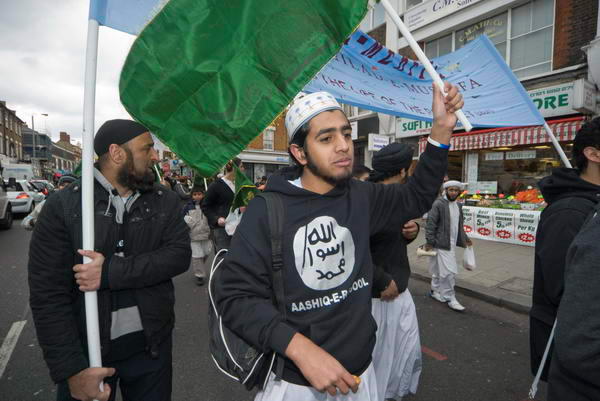
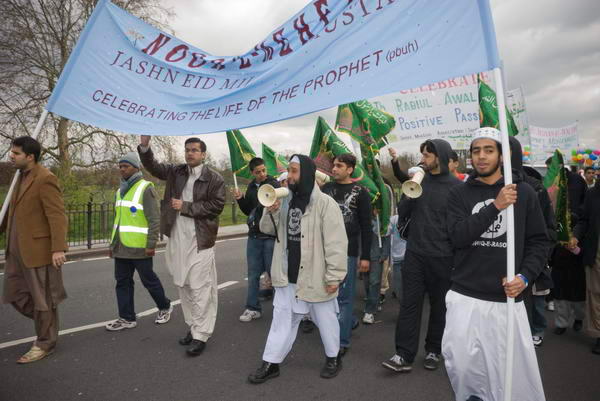
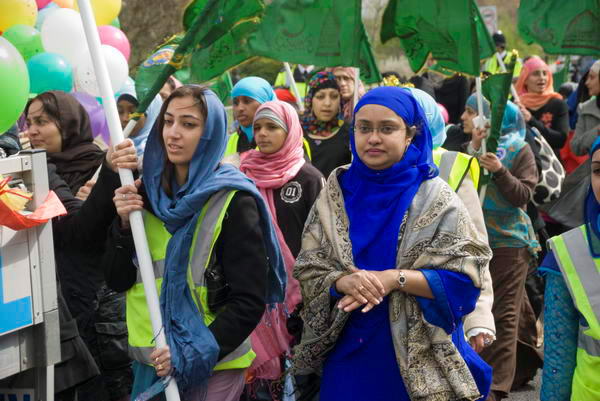
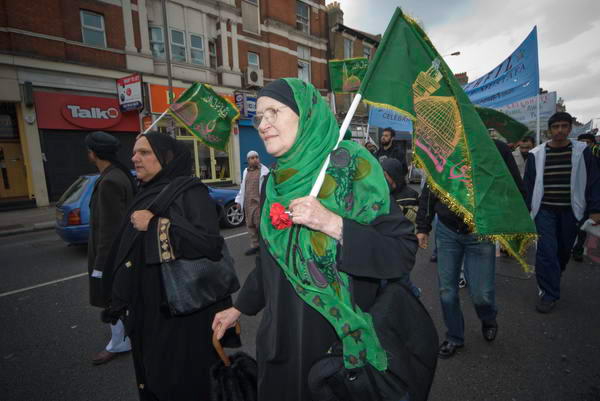
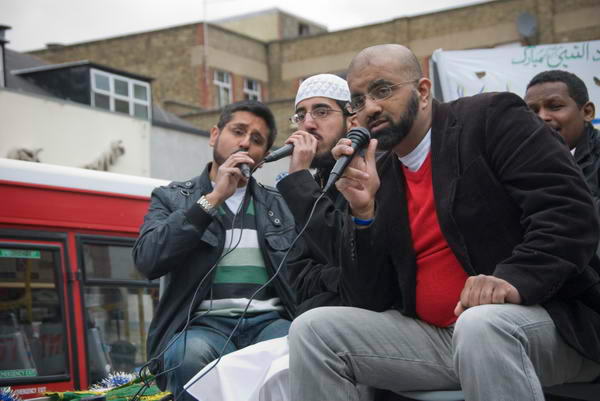
Eid Milad-Un-Nabi & End the Siege of Gaza: On Saturday 5th April 2008 was a rather frustrating day for me. I struggled to get to Tooting for the procession honouring the birthday of the Prophet as rail services to the west of London came to a halt. I finally made it but left as the procession neared its end. Thankfully the tube was working to take me into central London to view some exhibitions and photograph a protest at Downing Street calling for an end to the Israeli siege of Gaza.
Milad 2008 – Eid Milad-Un-Nabi
Procession and Community Day, Tooting
As usual I’d planned my journey into London carefully, intending to arrive in Tooting well before the start of the procession but a cable fire stopped all services into Waterloo with trains piling up back along the lines. Mine “came to a halt in Feltham, then crept forward slowly to Twickenham where it expired completely. Ten minutes later another service took me the few hundred yards further to St Margarets, where I abandoned rail and jumped onto a passing bus to Richmond.”
Then as I commented “Should you ever want a slow and frustrating ride through some of the more obscure southwest London suburbs I recommend the 493 route, which even includes a ride past Wimbledon Park and the world’s most famous tennis club before taking you past the dog track and on to Tooting.”
A full 50 stops and over an hour later I jumped off the bus and ran the last mile or so towards where the procession was to start on Tooting Bec Road, meeting the procession a few hundred yards from its start. Back in 2008 I wrote “half a mile” but I’ve just measured it and my run was at least double that. The Tooting Sunni Muslim Association’s procession for Eid Milad-Un-Nabi had started ‘promptly’ only around 20 minutes late so I hadn’t missed too much.
The Juloos to honour the birthday of the Prophet was part of an all-day community event and as well as the Muslims there were other local community representatives taking part including the Deputy Mayor of Wandsworth, Councillor Mrs. Claire Clay.
The previous year I’d gone on after the procession to the celebrations at Tooting Leisure Centre, including the impressive whirling dervishes – who I photographed again there in 2009. But in 2008 there were exhibitions I wanted to see in London – and a protest at Downing Street, so I left as the procession turned into Garratt Lane and took the tube from Tooting Broadway.
A demonstration on a wet Saturday afternoon at Downing St
In September 2007 the Israeli government had imposed a siege which was preventing vital medicines and other supplies from entering Gaza. This was a collective punishment against the population, illegal under international law and had by April 2008 already resulted in a number of deaths.
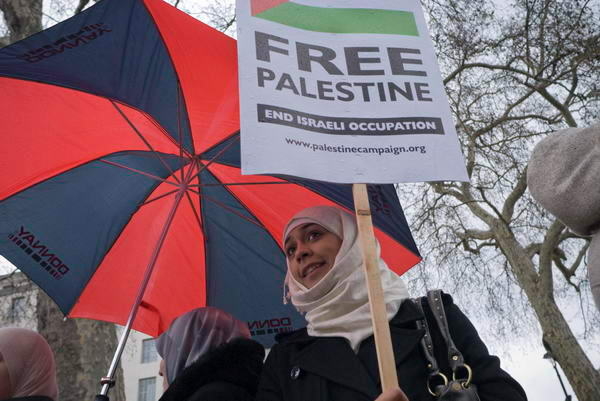
It was one of a series of protests organised by the Palestine Solidarity Campaign on a rather smaller scale than the hundreds of thousands in some more recent demonstrations, but sharing similar aims. It called on the British government to end the arms trade with Israel, and to press Israel to abide by international law, end its illegal occupation and allow the return of refugees.
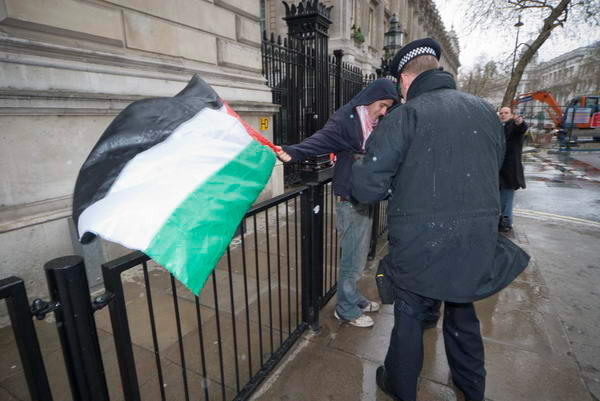
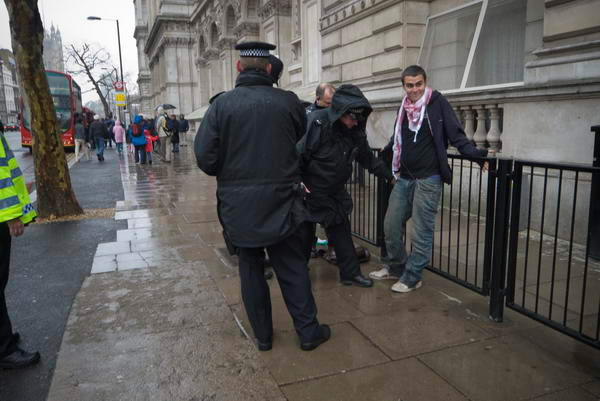
During the protest one young man with a Palestinian flag crossed the road and stood in front of the gates of Downing Street holding it. It was the police reaction to this – and their attempts to stop me photographing it that made up most of my report in 2008.
The man picks his flag up from the wet pavement and the officer shouts at him, telling him to put the f***ing flag down
Police pulled him to one side and questioned him, telling him that the SOCPA had made it a crime to protest there. They pulled his flag from his hands and dropped it on the pavement, and when he picked it up an officer swore at him, dragged it out of his hands and dropped it on the pavement again. He was then told he was being stopped and searched under the Terrorism Act 2000, though waving a flag is clearly not terrorism.
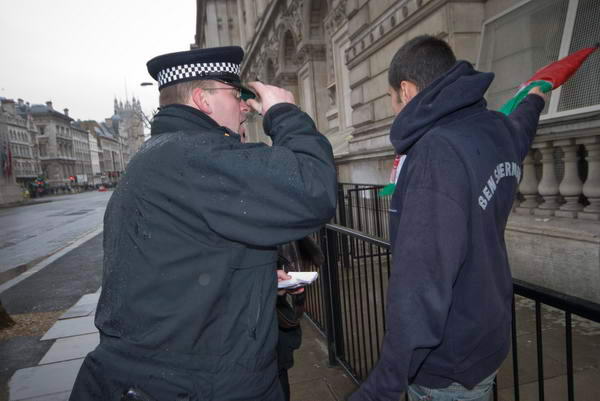
Clearly I was a already a good distance away when the officer on the left edge of this picture ordered me to move away
At this point an officer stood in front of me to stop me taking photographs. I told him I was press but he insisted I move further ways as I was “interfering with the actions of the police.” Clearly I wasn’t and I made this clear to him before moving back as ordered.
A woman officer came up and held her hand in front of my lens. I told her that this was illegal and a senior officer in the Met had told a colleague that he would consider it “a sacking offence” and she hurriedly moved off across the road and away from the area. Unfortunately I failed to get a good picture of her or to take her number.
I went back across the road to continue photographing the protest. Police officers at the protest on the other side of the road were approached by the event organisers about the man being held but denied any connection with the officers on the other side of Whitehall. The officer did attempt to excuse their actions on possible grounds of security, but I didn’t feel he felt too happy about it. The man was still being held by police when I left the area.
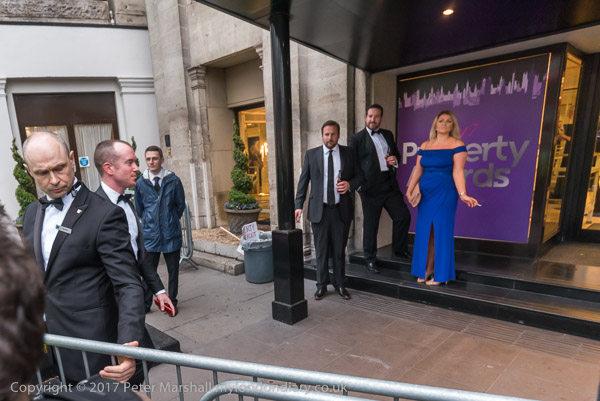
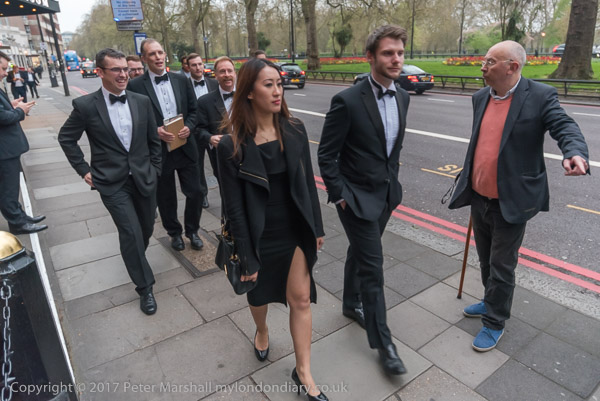
Property Developer’s Awards: On Tuesday 4th April 2017 I joined protesters on the pavement in front of the Grosvenor House Hotel in Mayfair where the annual Property Developers Awards were being held .
Property developers largely operate at one of the greedier ends of capitalism, many clearly putting their profits above everything else. Of course we need to build things, but we need to build the right things rather than those that maximise profits for the developers. Capitalism and the market doesn’t serve the interests of the vast majority.
Rev Paul Nicolson of Taxpayers Against Poverty speaks
In London we are clearly not building the right things. The desperate need is for social housing, while developers are working together with local councils to destroy this, demolishing council estates and replacing them with largely private developments with rents and prices beyond the reach of Londoners in desperate need of housing. And landlords are making obscene profits for lousy (sometimes literally) accommodation.
Landlord – Parasite!’ poster from Private Renters Unite – many rented properties suffer from damp and are infested by cockroaches etc
London councils have huge waiting lists for social housing and an estimated 210,000 Londoners are homeless and living in temporary accommodation, including 102,000 homeless children. The situation is now even worse than in 2017 and London councils now spend around £5.5 million per day on homelessness.
And yet there are huge developments taking place in London, but so many of these are for student housing and expensive private flats, many bought by overseas investors and remaining empty for all or most of the year. Because these are the kind of developments that make the largest profits for the property developers.
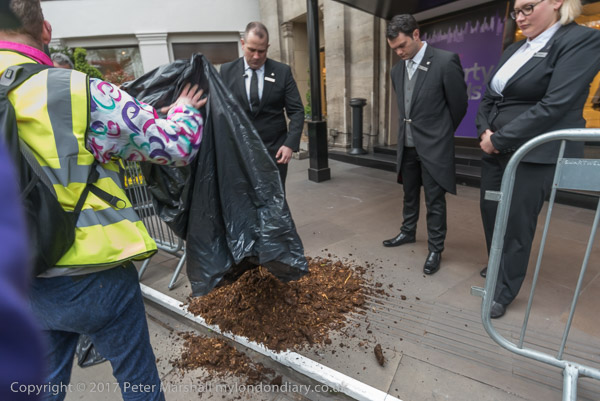
Activists rush up with a sack of horse manure and tip it on the hotel entrance
Of course gaining planning permission for many developments require them to include social housing and ‘affordable housing’. “Affordable housing is used by governments to mean 80% of market prices – something totally unaffordable for most people – the term true Orwellian doublespeak.” But if the developers feel they are not getting enough profit when building they can simply ask for a reduction in these and it gets granted.
Cockroaches crawl around a poster next to the manurewhich a hotel employee tries to sweep up as Ian Bone walks in front with a siren
London Mayor Sadiq Khan has funding of up to £11.7 billion for a ‘London Social and Affordable Homes Programme 2026-36‘, but it remains to be seen what this will actually deliver – other of course than profits for the developers.
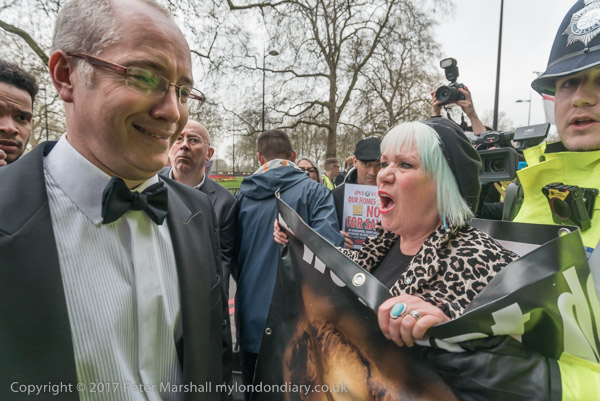
Jane Nicholl confronts a man going into the Property Developer’s Awards who seems amused by being accused of social cleansing
Of course both developers and councils who work with them do so in a political atmosphere which since Thatcher has made providing social housing much more difficult. But some councillors and officers have joined with developers in pursuing their personal fortunes rather than public good.
People from the Property Developer’s Awards came out to have a cigarette and watch the protest
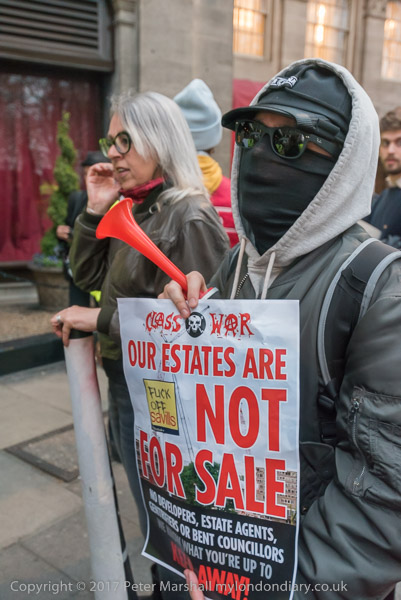
“The protesters, who included queer coalition the Sexual Avengers and Class War say the developers demolishing social housing and community facilities across London in a process of social cleansing aided by largely Labour councils and led by Savills who sponsor the awards and were nominated for six of them. They are demolishing council estates and replacing most of their social housing with high cost private developments, often largely sold to foreign investors and making obscene profits – and tickets for this event were £396 per seat.”
Ian Bone directs some of those coming to the Property Developer’s Awards, calling them “rich scum”
The protesters made their views very clear, calling those entering the Award beanfeast ‘scum’ and ‘parasites.’ A small group rushed up to the hotel entrance and dumped a sack of horse manure and coackroaches in front of it. A hotel employees came out with a bin and broom to try to sweep it up.
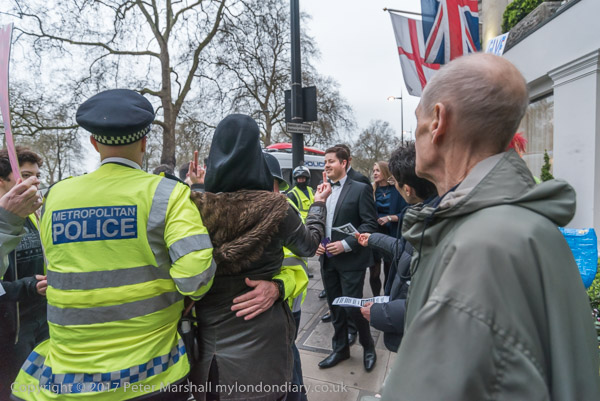
Police hold back a woman giving those coming to the awards the finger
The protest continued with Class War in particular confronting the developers as they arrived and police ensuring they could walk past and enter, holding back the protesters. Some of those entering appeared to be amused by the idea they were ‘social cleansing’ and a small group came out to watch the protest.
Class War – Our Estates Are Not for Sale – No Developers, Estate Agents, Gentrifiers or Bent Councillors – We Know What You’re Up to – Keep Away!
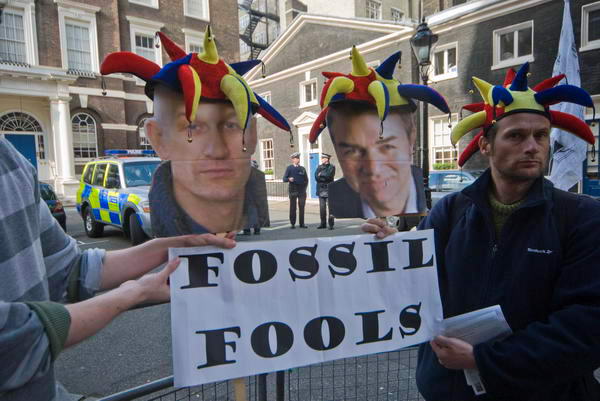
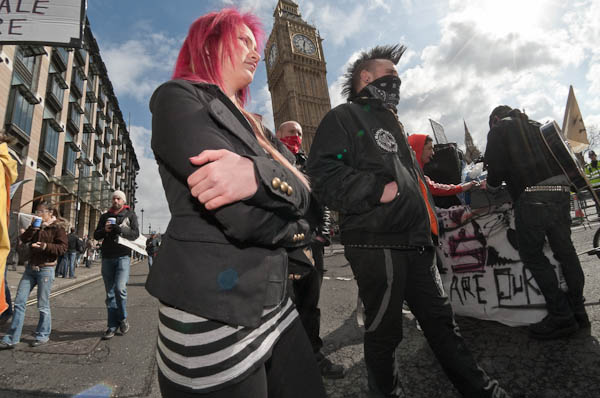
Fossil Fools Day: Tuesday 1st April was Fossil Fools Day, a day of protests around the world over our increasing use of fossil fuels, despite the effect they are having on global climate.
The ‘greenhouse effect‘ of various gases in the atmosphere had first been described in 1824, although the actual term only dates from 1901. But already in 1856 American scientist and women’s rights campaigner Eunice Newton Foote had shown that carbon dioxide was very effective in trapping the sun’s energy and warming the atmosphere.
Almost all polyatomic gases are ‘greenhouse gases’ with some such as methane much more effective than carbon dioxide. But its great importance is because of the huge amounts of it formed when carbon-containing fuels are used. And burning wood, coal and oil and their use in powering machines of all types and electricity production became the basis of the industrial revolution and our whole civilisation from around the beginning of the nineteenth century.
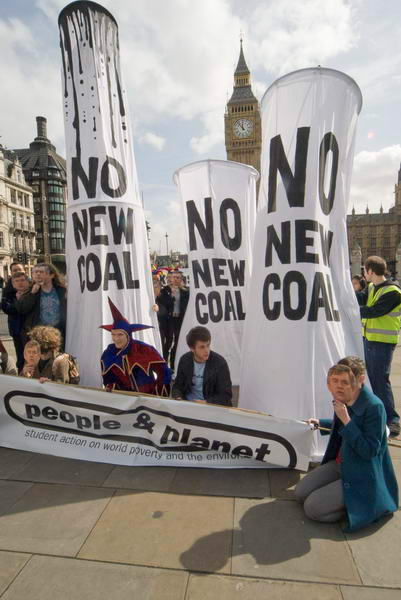
Protesters with power station ‘cooling towers’ in Parliament Square
Wood is not of course a fossil fuel, and in pre-industrial times the carbon dioxide produced by burning it was more or less in balance with the amount that was removed from the atmosphere by photosynthesis producing new plants, trees and other organisms. CO2 levels remained roughly constant during human history at around 280ppm until they began to rise more and more rapidly after 1850, and increasingly rapidly since then. They are now around 430ppm and rising steeply.
The full effects of the current levels only become apparent over a period of around 50 years, though we are already seeing some of them already, particularly in the global South – though we too are beginning to see the effects on our climate, not just in terms of temperature but even more as instability.
For well over fifty years it has been obvious that we need to take urgent action to stop burning fossil fuels, but that urgency has not led to any really significant action. Talk, investment in renewable energy – but fossil fuel use, even of coal, is still increasing. If life on this planet is to have a future we need to see a rapid drop in the consumption of coal, oil and gas – and also aathe development of ways to use renewable energy to remove greenhouse gases from the atmosphere, as well as increasing natural ways such as planting more trees.
And there is another reason to end the use of oil for fuel, as I first mentioned in the 1970s. These finite resources are of much greater use as a chemical feedstock for producing other essential materials of our modern life, including plastics.
Everything at the moment is still going in the wrong direction – and the huge energy requirements of AI are making things worse.
Fossil Fools Day: No New Coal
Parliament Square
Lighter fuel goes up in flames on the Climate BIll
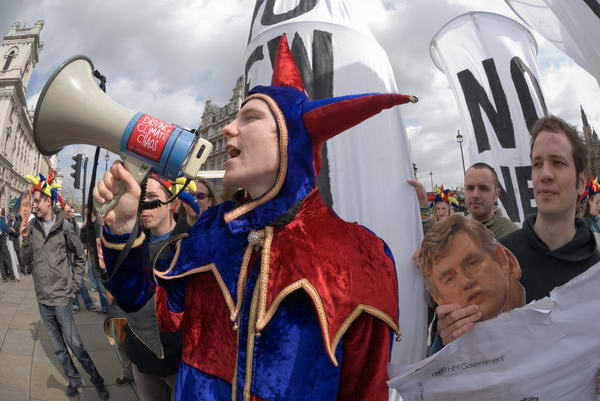
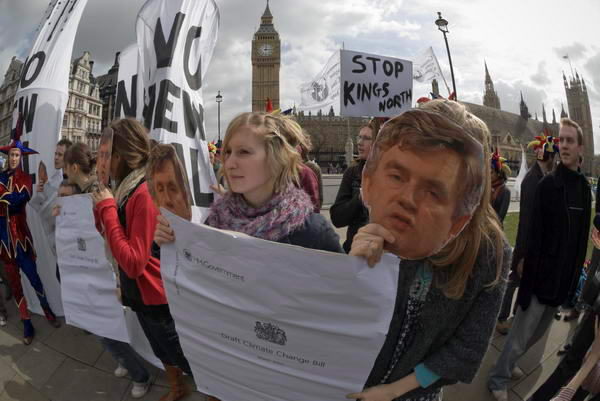
The focus of the protest by students from ‘People and Planet’ and other climate activists were the plans by E.ON to build a new new coal-fired power station at Kingsnorth in Kent.
The protesters brought three large white ‘cooling towers’ and many had cutout masks of Gordon Brown’s face as they shouted out advice to him over the ridiculous Draft Climate Change Bill which would have resulted in an increase in carbon emissions.
The launch of ‘ev-eon Unnaturally Carbonated Water’
They were joined by a group with the spoof launch of ‘ev-eon Unnaturally Carbonated Water’ a new carbon capture technology to be used at E.ON’s Kingsnorth Power Station.
“‘Ev-eon’ uses the CO2 from coal burning to carbonate water which you then swallow. And if you can swallow the governments coal-fired policy you can swallow anything. And of course with Ev-eon, should you burp, breathe or otherwise release that CO2 you’ve swallowed, global warming is all your fault – and not E.ON’s.”
As a result of this and other environmental protests and criticism by a wide range of organisations E.ON eventually dropped the plans.
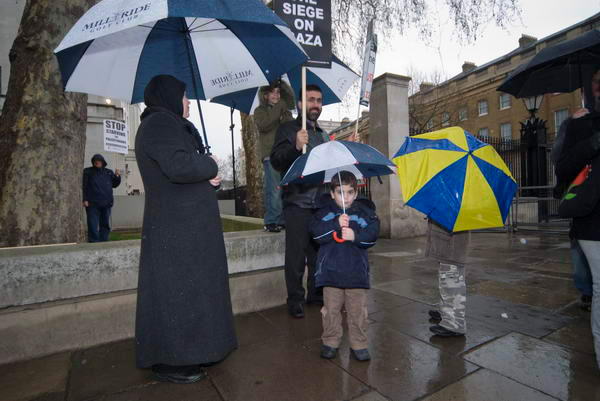
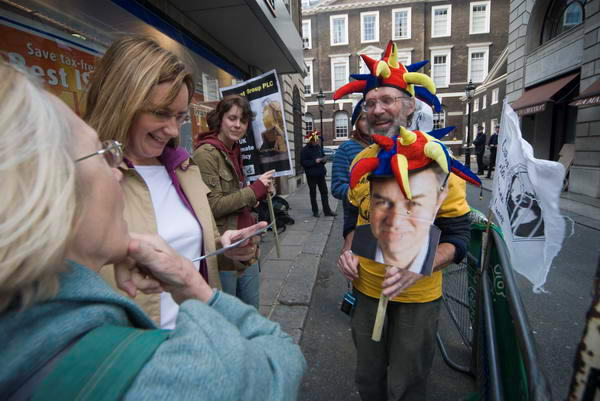
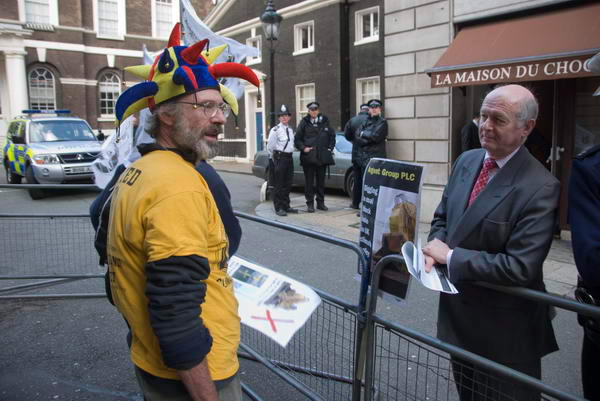
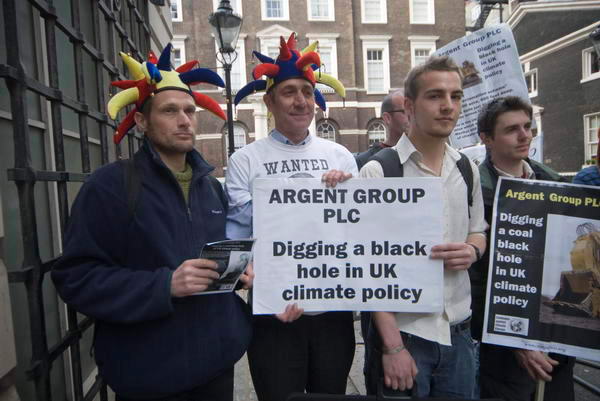
Campaign against Climate Change protest at the offices of Argent Group PLC in Piccadilly over the UK’s largest opencast coal mine, Ffos-y-Fran in Merthyr Tydfil, South Wales, run by Miller-Argent.
The manager of Albany talks with the demontrators, taking some information for Argent
As well as the at least 30 million tons of CO2 of carbon dioxide from the coal the mine was expected to produce over the next 15 years, this mine was also only 36 metres from the nearest houses – compared to the Scottish Safety standards of 500 metres. The Welsh Office delayed the implementation of a Welsh safety standard to enable the mine to go ahead.
Locally it produced years of misery and health hazards through air-borne dust, diesel fumes and noise to the 70,000 or so people who live in Merthyr. A Health Impact Study commissioned by the authorities was so damning they refused to accept it.
The initial scheme for the mine had been approved by the Welsh Assembly in 2005 despite huge local objections and residents took it to the High Court which quashed it – but this was reversed on appeal in 2006.
The mine licence expired in 2022 and an appeal for an extension was refused with the mine shutting down in November 2023.
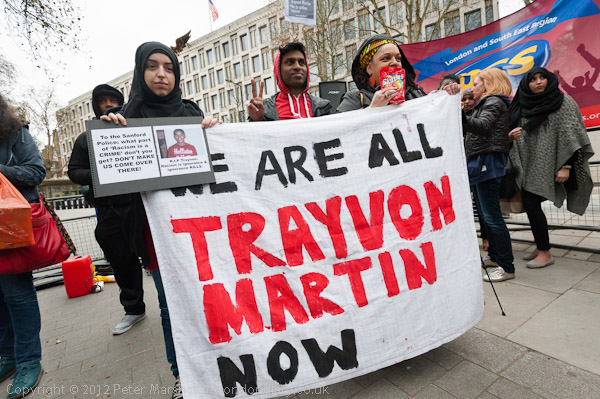
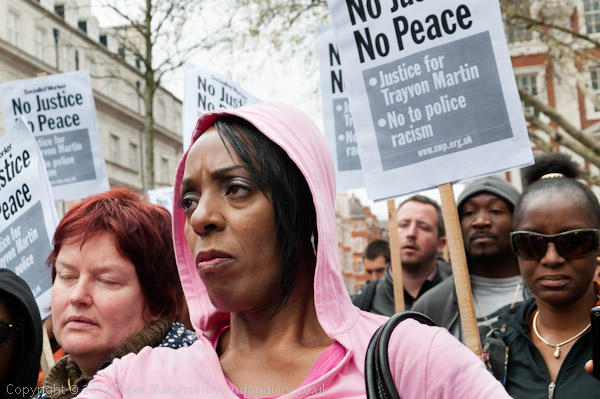
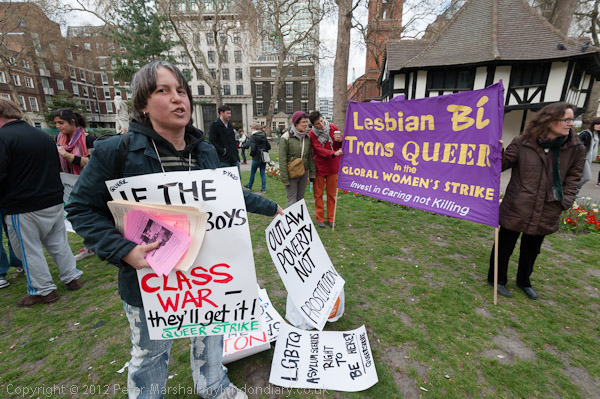
National Gallery, Trayvon Martin & Dykes: Saturday 31 March 2012 I began outside the National Gallery were the Campaign Against the Arms Trade (CAAT) were demanding that the gallery stopped hosting events for the arms trade. From there I went to the US Embassy in Grosvenor Square for a protest about the US failure to prosecute the killer of black teenager Trayvon Martin. Finally I went to London’s first Dyke March since the 1980s.
Disarm The National Gallery
Trafalgar Square
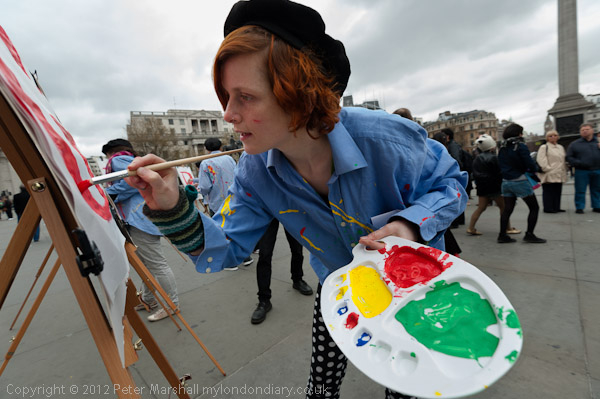
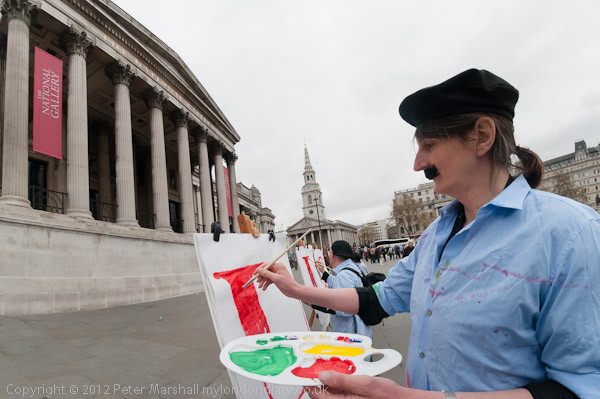
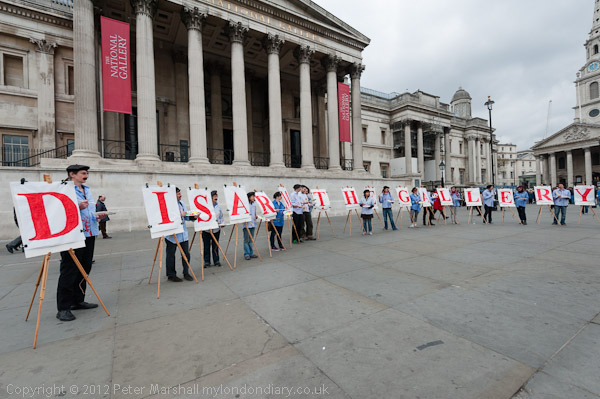
Around 20 protesters had come to Trafalgar square as ‘artists’, dressed in blue paint-stained smocks and equipped with moustaches, berets, paint brushes, palettes and easels with large sheets of paper and a smattering of Franglais.
They erected their easels in a line on the North Terrace in front of the National Gallery and painted the letters D, I, S, A, R, M, T, H, E, G, A, L, L, E, R and Y anbefore standing with them in front of the gallery.
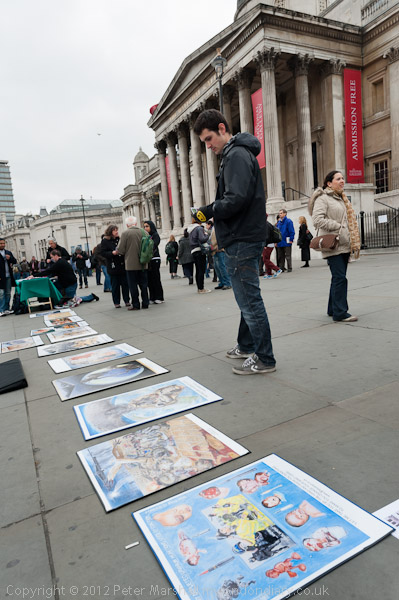
There also brought other anti-war artworks to display and handed out postcards for onlookers to sign calling on Nicholas Penny, Director of the National Gallery, to end his support of the arms trade.
The main entrances of the gallery were closed during the protest and a long queue built up at the lower entrance. Many in that line were amazed to find that an art gallery was supporting arms sales. As the postcard says – and people overwhelmingly agreed – Art and arms don’t mix.
The Disarm the Gallery protest was organised by the Campaign Against the Arms Trade (CAAT) as the during the DSEi arms fair the previous September, weapons manufacturer Finmeccanica had paid the gallery £30,000 to hold events there.
DSEi is the worlds largest arms fair with buyers and sellers from around the world including many corrupt and tyrannical regimes, selling the equipment used by dictators around the world to equip armies and police to keep order and fuelling conflicts which kill thousands if not millions.
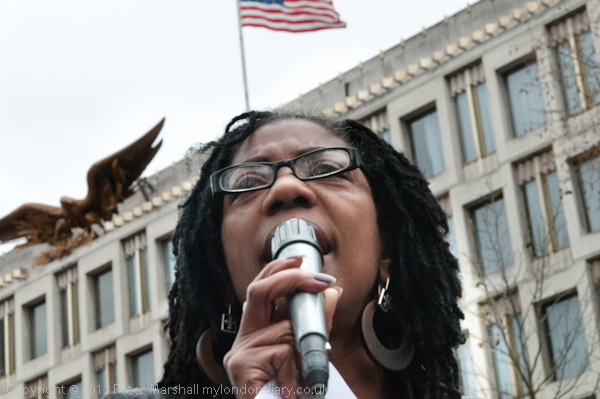
Marcia, sister of Sean Rigg, killed by police in Brixton police station speaks at the US embassy protest
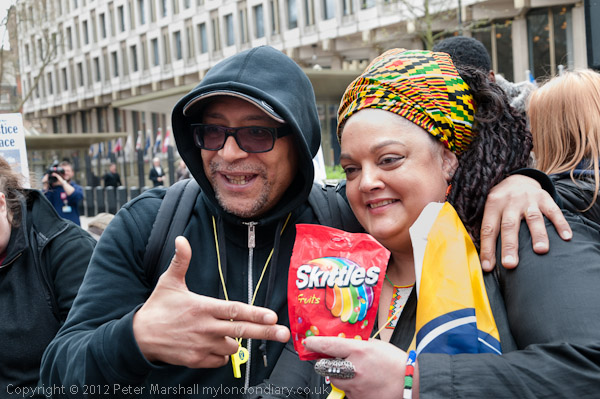
Black teenager Trayvon Martin was walking back from a local convenience store to the house in Florida where he was staying with this father when he was stopped and then shot dead by George Zimmerman, a self appointed neighbourhood watchman who claimed he had felt threatened by a black teenager wearing a hoodie.
He had gone to the shop to buy a soft drink and some Skittle sweets and many at the protest wore hoodies and carried packets of Skittles and soft drinks.
Lee Jasper and Zita Holbourne of BARAC
Florida police backed Zimmerman’s story that he had acted in self-defence and refused to arrest or charge him. Later the pressure from protests like this across America and around the world led to him being brought to trial, but a Florida jury acquitted him.
People stressed that the killing of Trayvon Martin very much reflects the treatment of black people not just in the USA but elsewhere including the UK
The embassy protest was was chaired by Merlin Emmanuel, brother of Smiley Culture, killed by police in his own kitchen, and speakers included Marcia, the brother of Sean Rigg, murdered in Brixton Police Station. Other speakers also brought up cases of deaths and discriminaton by police in the UK.
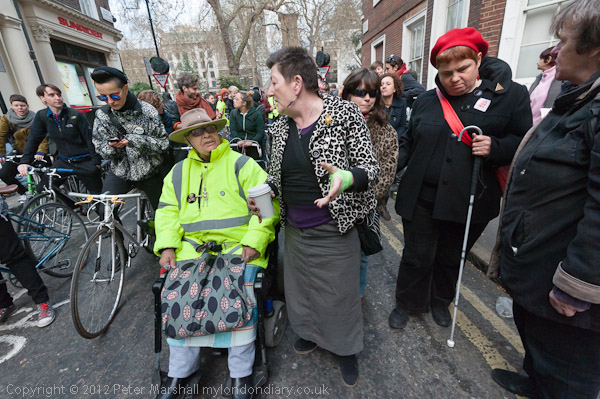
Stella and Lucy of DIVA magazine in Soho Square for the London Dyke March
After a rally in Soho Square over 600 women marched through Soho and Trafalgar Square to the National Theatre.
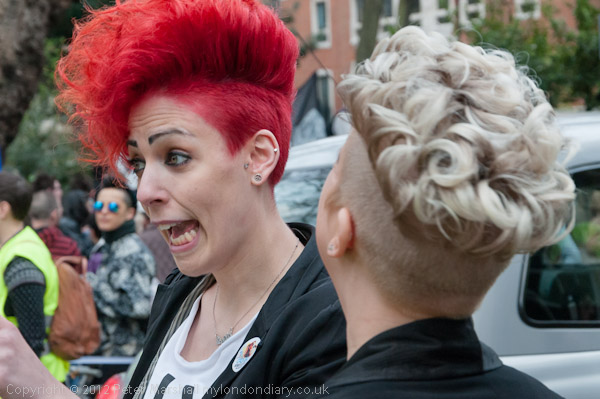
The march was the first dyke march since the 1980s and set out to support dyke visibility and welcomed “dykes, queers, bisexuals, transwomen, genderqueers and allies” and “all folk who want to support dykes to march with us” in “a grassroots, non-commercial, anti-racist, community-centred, accessible, inclusive event.”
Speakers at the rally “were Kirstean Hearn, the chair of Inclusion London and someone who as a member of Equality 2005 gives disability equality advice to government, Lady Phyll Opoku, co-founder and Managing Director of UK Black Pride, journalist and founding editor of METQ magazine Paris Lees, Shi tou, an artist and film-maker who was the first lesbian to come out on Chinese TV and one of China’s most prominent lesbian activists, and Clare B Dimyon, awarded a MBE in 2010 for her work supporting LGBT people in Central and Eastern Europe.”
You can view many more pictures of the march and rally on My London Diary, including pictures of most or all of the speakers at London Dyke March 2012.
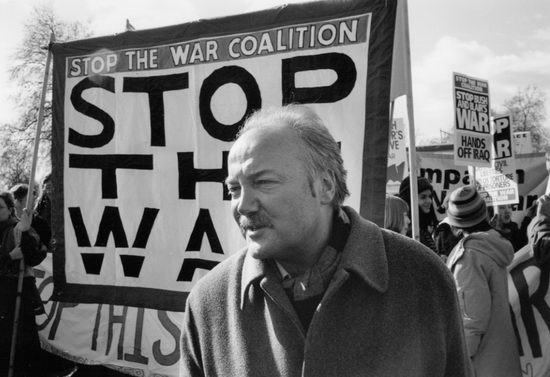
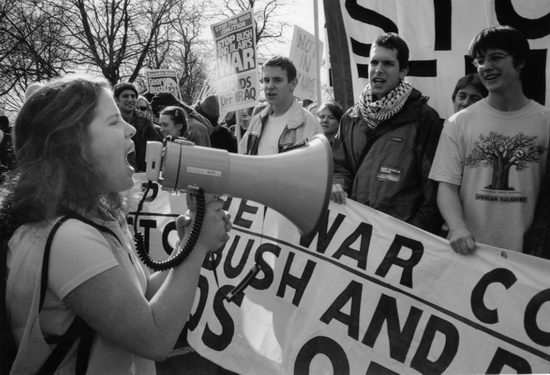
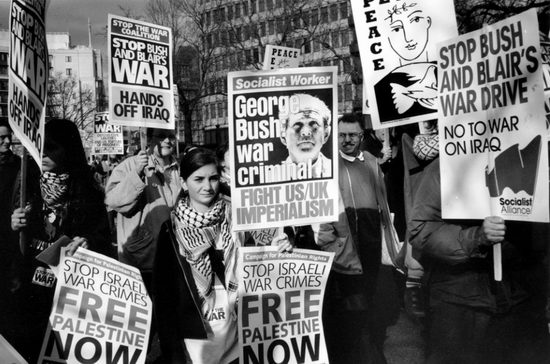
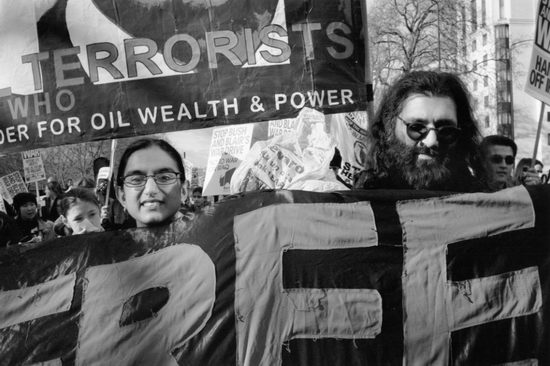
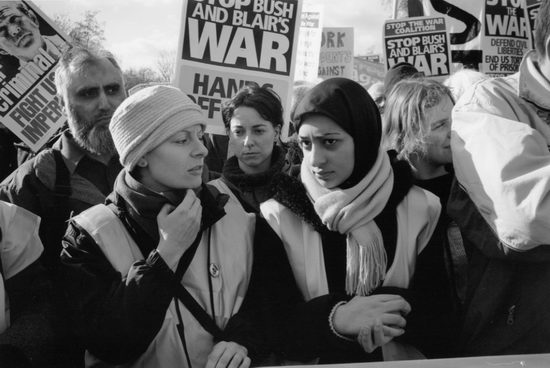
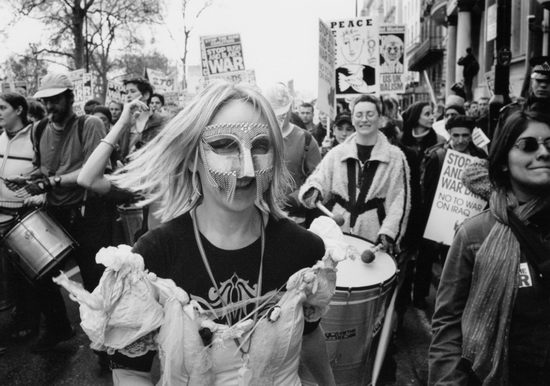
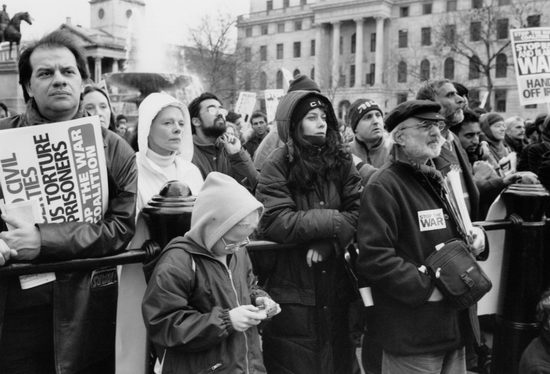
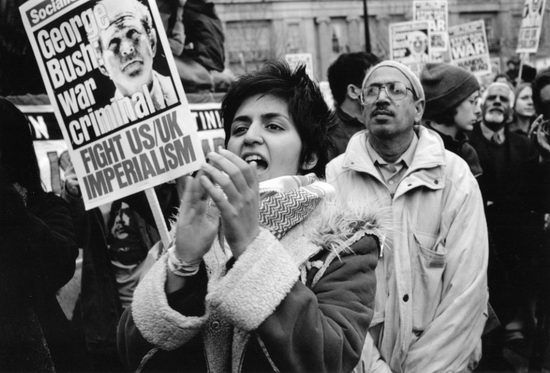
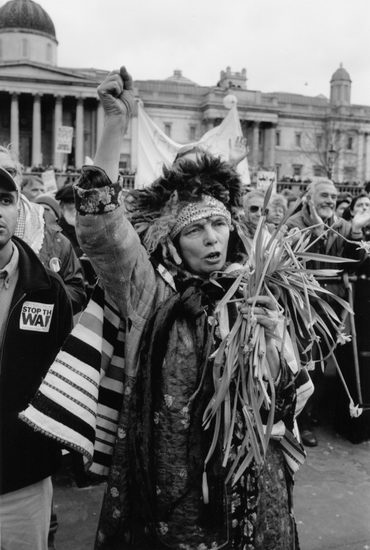
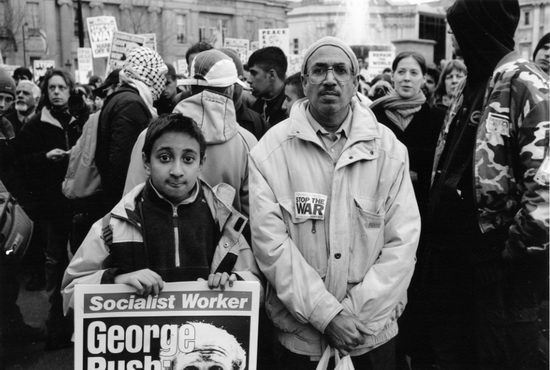
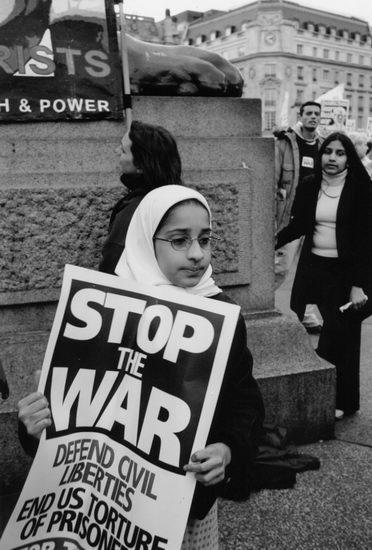
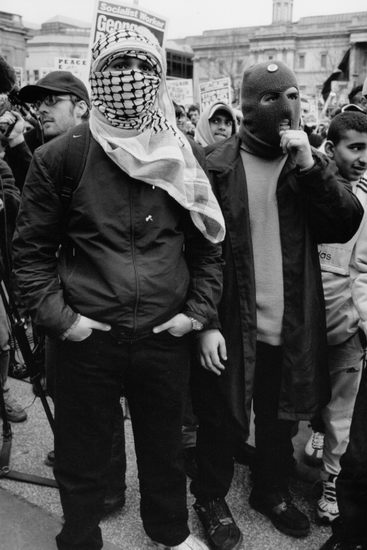
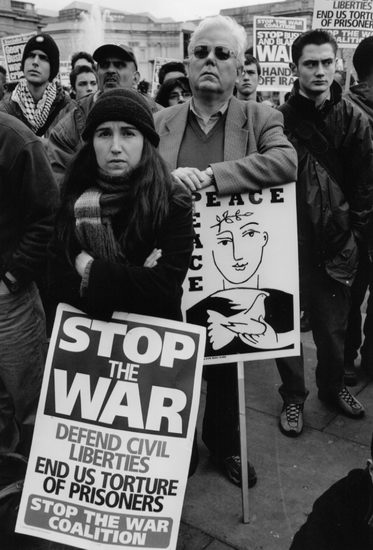
Stop The War – Hands Off Iraq: The protest in London against the US plans to invade Iraq on Saturday 30th March 2002 was I think the first of the really huge protests in London and across the world against the invasion then being planned by U.S. president George W Bush following the September 11th terrorist attacks on the United States.
George Galloway MP at the start of the march in Hyde Park
The Stop the War Coalition had been formed shortly after the 9/11 attacks and had organised this protest together with the Campaign for Nuclear Disarmament and the Muslim Association of Britain.
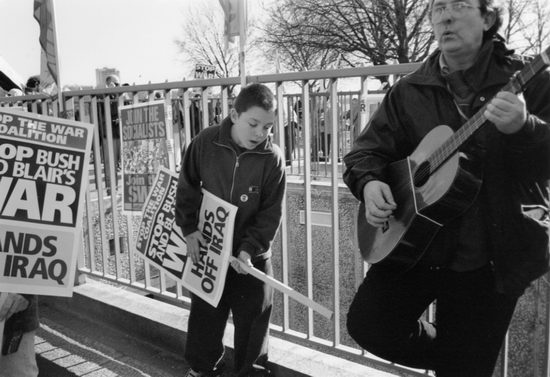
Air guitar – hyde park
It is hard to give any accurate estimate of the numbers taking part in protests as large as this, but I think there must have been well over a hundred thousand marching – much smaller than the well over a million that marched in London 11 months later in February 2003, but still a very significant number. It received very little coverage in the mass media and so it is now still difficult to find anything about it online.
Helen Salmon and students, Hyde Park
By March 2002 the initial huge public sympathy with the USA over the 9/ll attacks had given place to a feeling that Bush and his “war on terror” was determined to attack Iraq at all cost even though it seemed unlikely that there was any real link between Iraq and Al-Qaida, and there was little if any evidence that Iraq still possessed “weapons of mass destruction“.
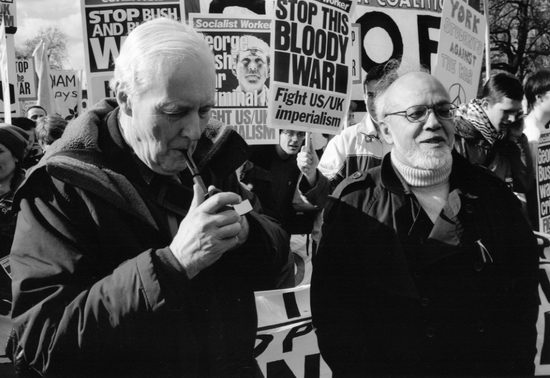
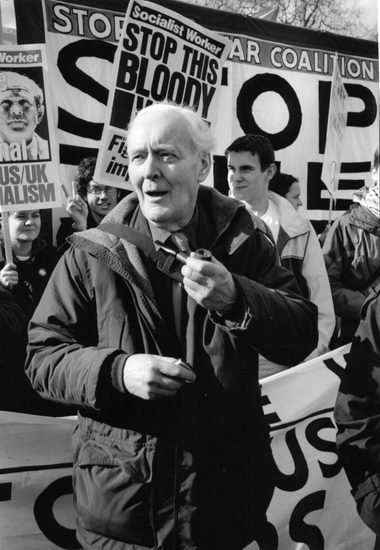
Tony Benn and Dr Siddiqui at Hyde Park
Iraq had ended work to produce biological, chemical, and nuclear weapons in the 1990s and most or all of its stockpiles had been destroyed. In November 2002 Saddam Hussein had allowed UN inspectors search Iraqi facilities for WMDs and they found none. The US alleged that Iraq had hidden them – and forged documents were produced about uranium. No WMDs were found during the US invasion and occupation of Iraq in 2003-2011 and US secretary of state Colin “Powell and George Bush eventually admitted Iraq had not had them.”
Stop The War – Hands Off Iraq – 2 Mar 02 – Park Lane
Despite then known facts, Tony Blair had decided to support the US invasion against the huge opposition from the British public. He and his government lied to parliament, most notably with the “Dodgy Dossier” and other documents. The dossier, “sexed up” by Alistair Campbell was largely plagiarised from a thesis by a graduate student at California State University, and contained many errors and unchecked statements, and contradicted much of actual evidence from intelligence sources. It should have ended the political career and any credibility for both.
PiccadillyTrafalgar Square
Back in 2002 I was working with both black and white and colour film, but it was difficult for me to digitise the colour work – and I only posted black and white images on My London Diary. I still have only digitised a few of the many colour images I made at that time.
Included in this post are all of the images I posted on My London Diary and below is the short text I wrote to go with them. The files are small and they were posted across several pages as many then still accessed the web on slow dial-up modems. They are reduced versions of the images I filed to my agency, made by scanning black and white prints.The original post is still online, but adds nothing to this post.
The Stop the War, Hands off Iraq demonstration on 2 March was a large sign of public opinion. People were still leaving Hyde Park at the start of the march when Trafalgar Square was full to overflowing two and a half hours later.
Police estimates of the number were risible as usual – and can only reflect an attempt to marginalise the significant body of opinion opposed to the war or a complete mathematical inability on behalf of the police.
Tony Benn told us it wasn’t worth taking his picture – “It won’t get in the papers unless I go and kick a policeman” but he didn’t and was quite right.
World leaders were to hold the G20 London Summit at the Excel Centre in Docklands beginning on April 1st (a date some thought highly appropriate), with the stated themes “Stability, Growth, Jobs“, and chaired by Prime Minister Gordon Brown. Countries and organisations taking part, included Argentina, Australia, Brazil, Canada, Chile, China, Ethiopia, France, Germany, India, Indonesia, Italy, Japan, Mexico, Netherlands, Russia, Saudi Arabia, South Africa, South Korea, Spain, Switzerland, Thailand, Turkey and the USA, as well as the European Union and organisations including the International Monetary Fund, World Bank and the World Trade Organisations.
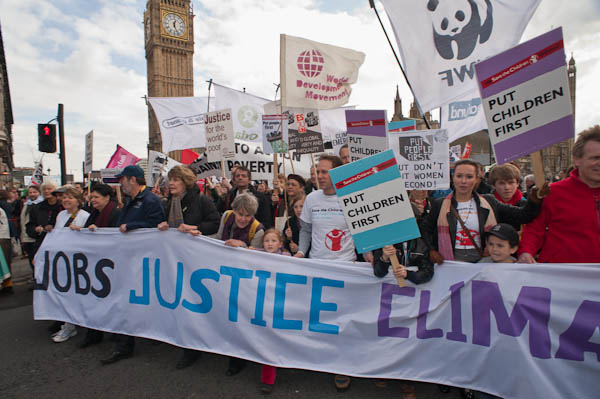
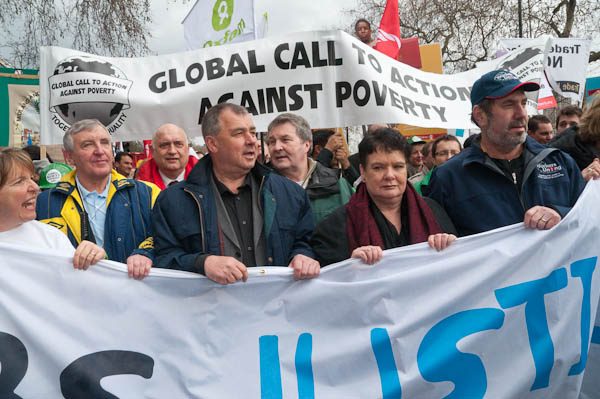
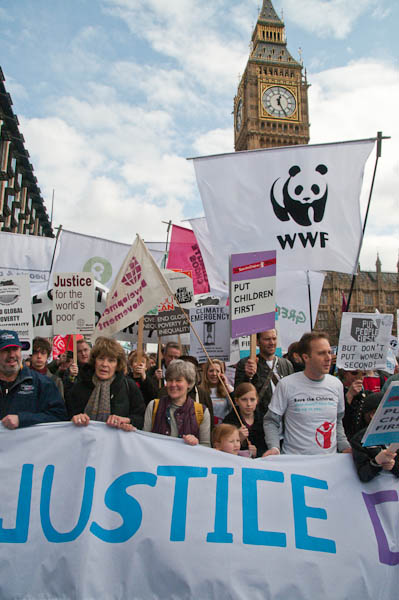
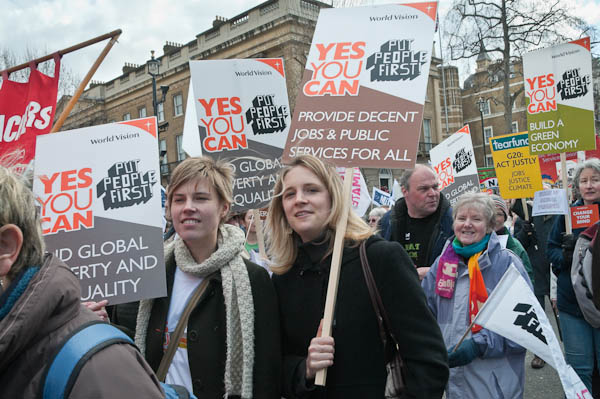
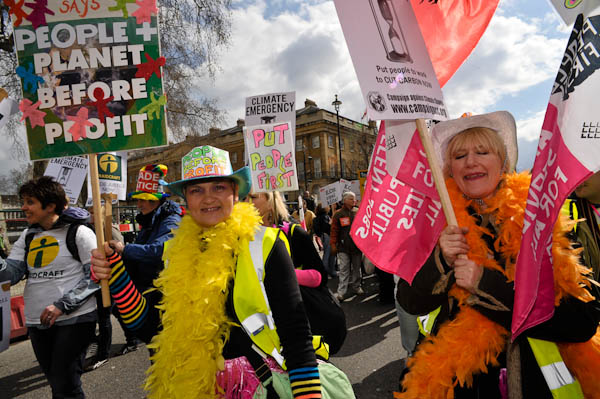
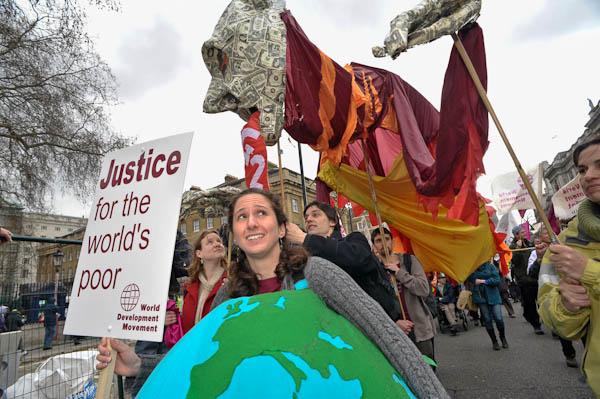
The ‘Put People First’ march was the first of several major demonstrations aimed at influencing the meeting and was backed by a very wide range of over 150 organisations, both from this country and abroad.
As well as trade unions, charities, and pressure groups there were also many other less organised groups and individuals.
Those marching were calling for a new approach to social justice for the world as a whole, and for urgency in action by world leaders not just to find a solution for the current financial problems, but to tackle the even deeper problems of global inequality and of climate crisis.
But the G20 went ahead very much to prop up the banks and financial institutions that had caused the financial crisis, though agreeing on the need for greater regulation, making none of the wider changes that this and other protests demanded. If anything it worsened those deeper problems.
Unsurprisingly it was a very large march with probably several times the official police estimate of 35,000 taking party.
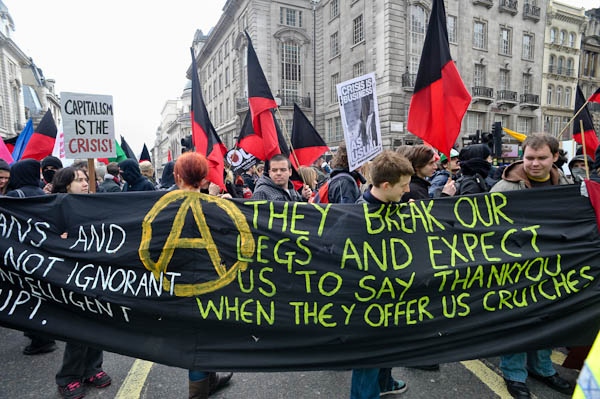
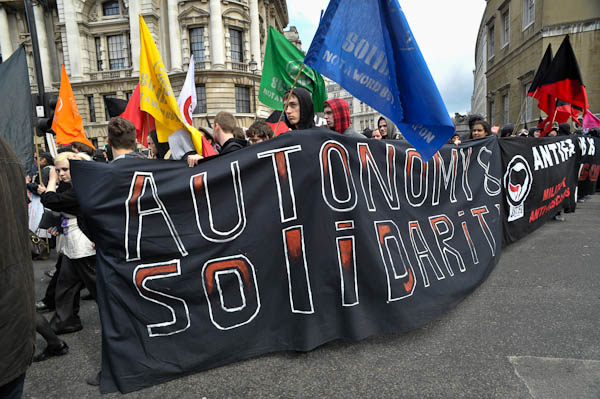
Most police attention was on a relatively small ‘autonomous’ block of around 800 people in the middle of the march which had a strong police escorted. They objected to the police behaviour, particularly very obtrusive photography by FIT teams and some sat down in the road blocking the march behind them for around half an hour.
Police had bullied the front of the march to set off at a cracking pace, hard for photographers to keep up with and the march soon spread out over much of the route.
I wanted to photograph as many of the marchers as I could, walking slowly and letting them go past me as they walked along the Embankment, up Bridge Street and Whitehall to Trafalgar Square. Then I rushed to get to the rally in time.
On My London Diary you can read more about the rally, and see pictures of many of the speakers. This protest was “a well ordered event with at times a carnival atmosphere, which made some of the police prognostications look rather silly.“
Politicicans and Businessmen are not ignorant – they are intelligent and corrupt. They break our legs and expect us to say thankyou when they offer us crutches
One of my fellow NUJ members filming the ‘autonomous’ block rally was stopped and searched, and he and others reported a mysterious ‘man in black’ rushing into this alternative rally and emptying half a dozen small tightly wrapped packages from a black bin bag at the bottom of the stepladder from which people were speaking before exiting rapidly stage left.
Someone kicked one of these packages open and found it contained a catapult, and all the packages were quickly kicked away under a fence into an area under maintenance behind the speakers. Around 20 minutes later, a policeman entered that area and collected the packages; the anarchists saw what was happening and rapidly dispersed.
As I ended my post on My London Diary: “Earlier in the week a police spokesman had given a widely broadcast media interview in which he predicted that there would be violence – and that some protesters would use catapults. It seems as if someone was determined to make this loony-sounding prophecy come true.”
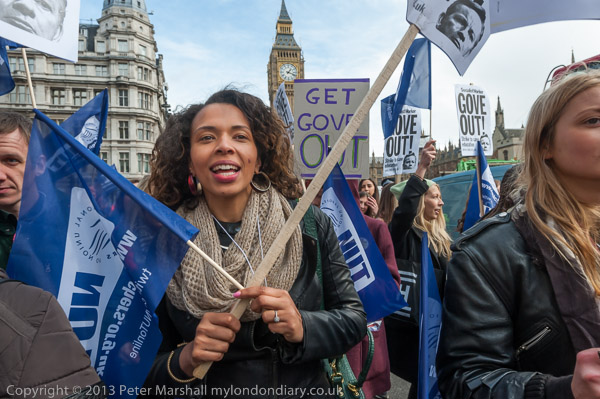
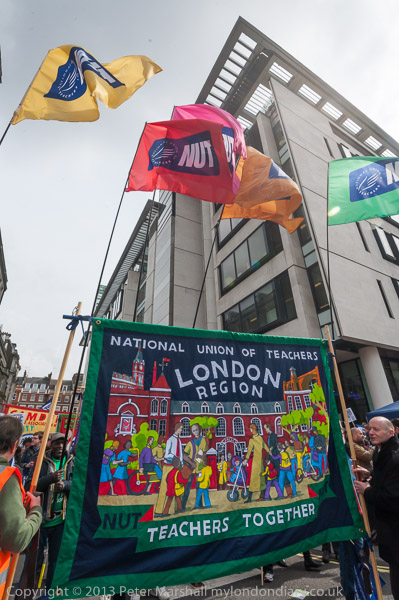
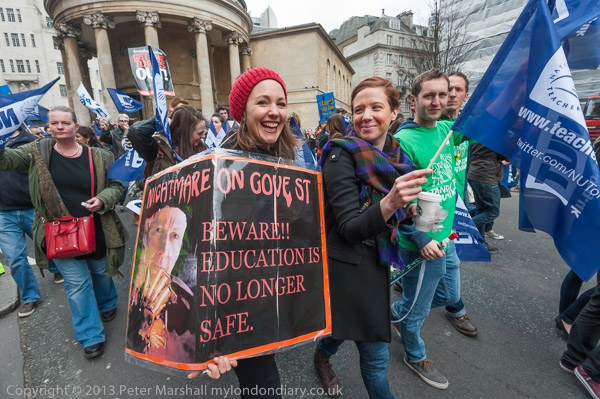
Teachers march past Parliament on their way to a rally at Central Hall Westminster
In 2024 Dr Stephen Burley wrote in ‘School Management Plus’ “The impact of the Govian education reforms has been unremittingly negative. Content heavy GCSEs have squeezed Key Stage 3, with many schools using Year 9 to cover over-burdened specifications. The EBacc, in the state sector, has devastated uptake in the creative and technical subjects, with music and DT fairing worst. Learning has narrowed to focus much more on memorisation as students cram for final exams.”
Those reforms were only a part of his ill conceived actions as Education Minister which included a rapid expansion of academies and multi-academy trusts and the introduction of ludicrous changes to the curriculum – such as ‘fronted adverbials’. He probably would have liked to see all those primary children seated in neat rows going through those ‘times tables’ as I spent so much time doing in the 1950s – and actually stated they should be learning the names and dates of the Kings and Queens of England.
He seldom if ever missed an opportunity to denigrate the work of dedicated teachers and clearly showed a fundamental distrust for the views of teachers and educationalists, relying instead in the strange and unsupported advice of a few often working outside their areas of academic competence.
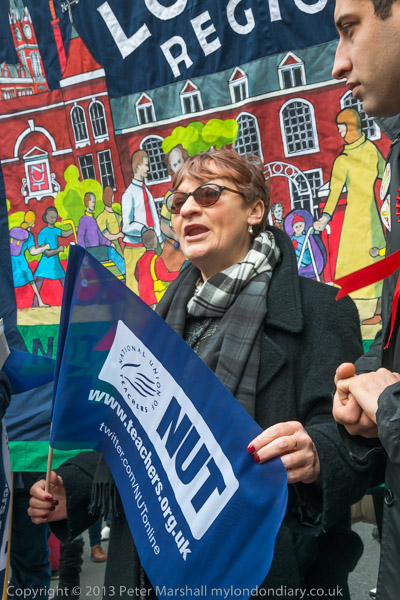
Christine Blower, NUT General Secretary
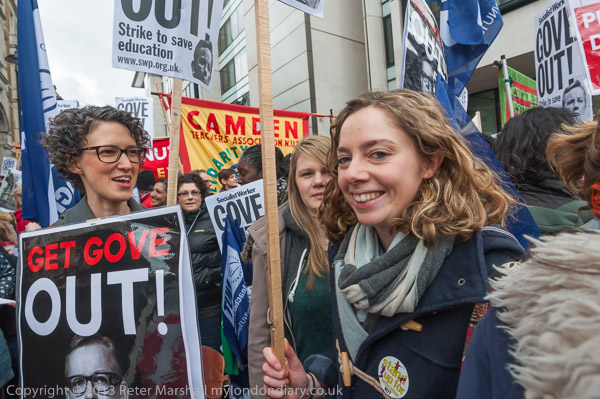
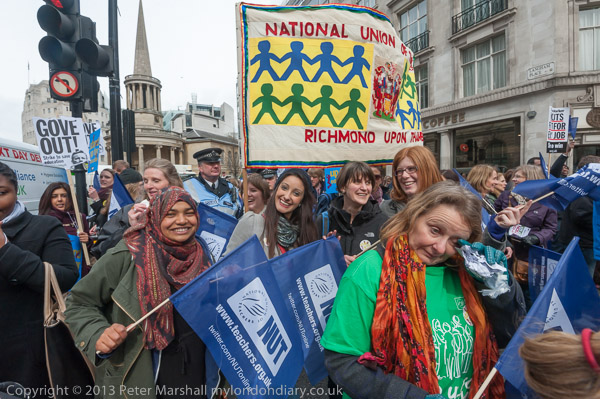
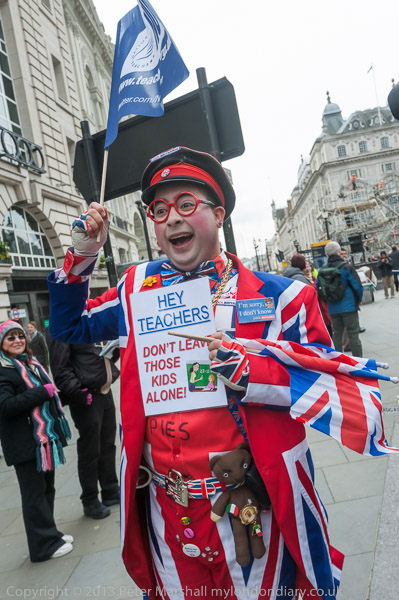
The strike on 26th March 2014 came after Gove continually refused to engage in meaningful discussions with the unions over the changes his department is pushing through over pensions, performance related pay and the dismantling of a national pay structure.
I was fortunate to have left teaching after 30 years well before Gove and in my last years to teach mainly on courses not approved by the Ministry of Education (Ofsted inspectors didn’t come to judge my teaching but had to request my permission to observe and learn) and to teach other courses that were largely or entirely teacher assessed where students learnt by doing and creating rather than regurgitating.
Thousands came to London on their stike day, March 26th 2014 calling for Gove to resign or his attacks on their pay, pensions, conditions and job security and his denigration and undermining for their professional status, and I felt a great deal of empathy with them.