Tibet, Syrians, Nuclear Melt-Down, Islamophobia & Lions
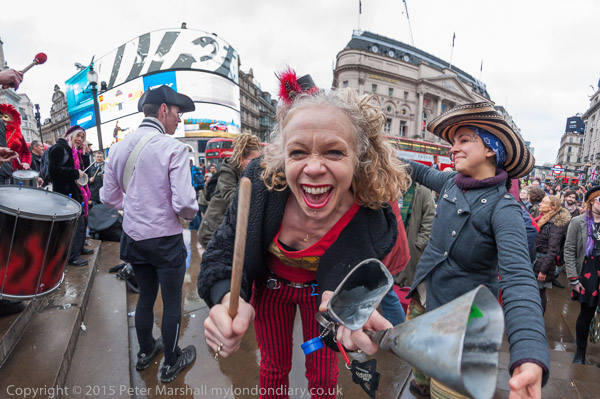
Tibet, Syrians, Nuclear Melt-Down, Islamophobia & Lions. Saturday 15th March, seven years ago was another typically varied day of protests on the streets of London which I covered.


London March for Freedom for Tibet

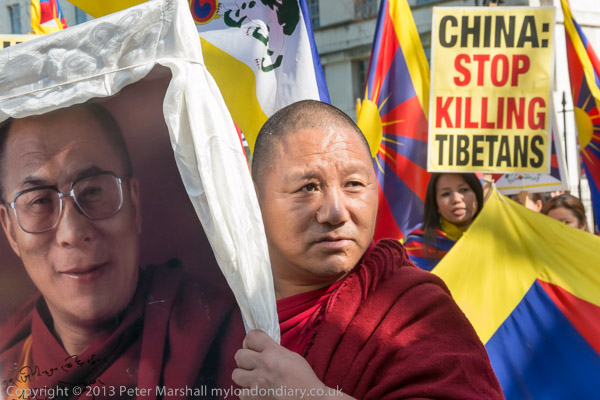
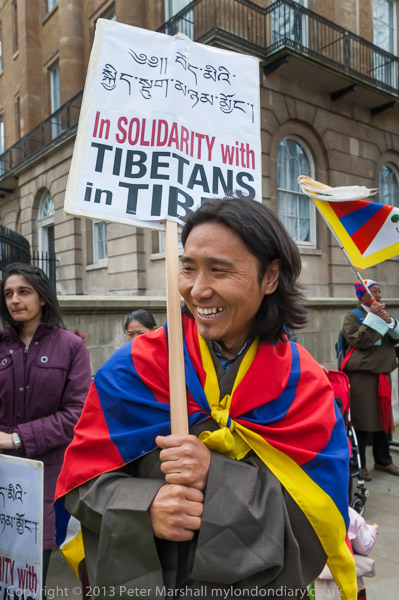
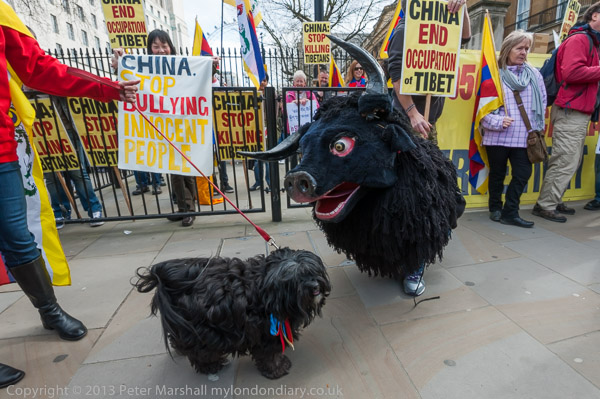
Every year Tibetans and supporters in London protest around the anniversary of the Tibetan National Uprising against Chinese rule in 1959, ten years after the Chinese invasion of the country. In 1959 the Dalai Lama and 120,000 Tibetans escaped to India and established the Tibetan Government in Exile.

In 2014 they met at Downing St for a march to a rally outside the Chinese Embassy in Portland Place, calling for Tibet to be free and in charge of its own destiny again and for an end to the illegal Chinese occupation. They say China is destroying Tibetan culture, and Tibetans are rapidly becoming a minority in their country as thousands of migrants are brought in. Peaceful protests by Tibetans are met by arrests, torture, death and lies, and China’s economic power means western countries adopt what they have called a policy of ‘constructive engagement’ with China, effectively turning a blind eye to the occupation and to human rights abuses in Tibet.

I left the Tibetans shortly after their march went through Trafalgar Square to photograph another protest.

London March for Freedom for Tibet


Syrians March for International Action

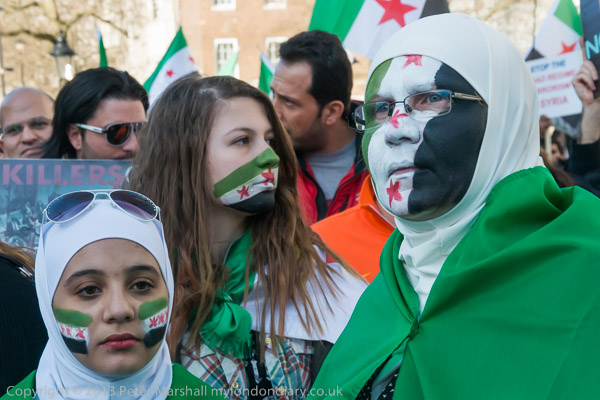
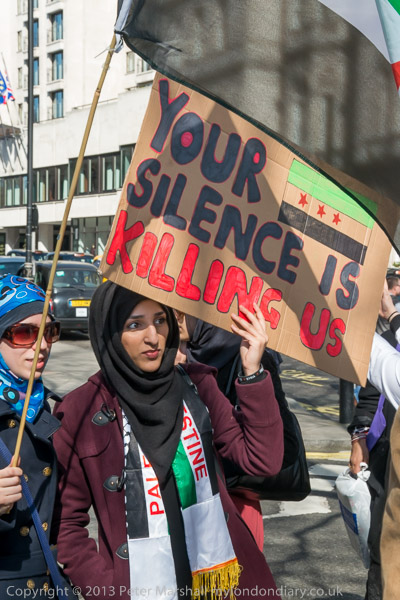
I had met the Syrians before the start of their march close to Hyde Park corner and had left them as they began their march along Piccadilly on the third anniversary of the start of their fight for freedom. I met them again as they came down Whitehall for a rally at Downing St to show their commitment to the cause and their solidarity with fellow Syrians inside and outside Syria.

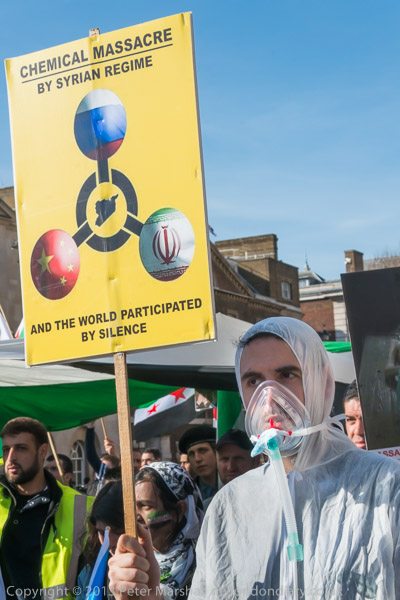
The marchers from the National Coalition for Syrian Revolutionary and Opposition Forces and the UK Syrian community called for Assad to go and were appealing to the Britain and the international community to help them to get rid of him. Unfortunately although western leaders condemned the actions of the Syrian government they were not prepared to back up their words with action, and it was left to Russia, who backed Assad to determine the future of the country. Few can doubt that the weakness shown by the west over Syria was not a major factor in Putin thinking he could successfully invade Ukraine.

Ukraine is not of course Syria, but it is hard to read the statement made by the Syrians I quoted in my post without seeing some parallels: “Syria, once proud of its contribution to culture, its distinguished history and its beautiful mosques and churches has been overwhelmed with a brutal dictatorship. Syrian homes have turned to rubble, echoing the unheard screams of its inhabitants. The regime has tried to silence the call of freedom by murdering over 150,000, injuring 500,000, imprisoning 250,000, making 1.5 million refugees and caused over 4.5 million internally displaced people within Syria, and recently started using chemical weapons…” Putin in Syria saved a brutal dictatorship, while in Ukraine it seems his aim is to impose a different regime on the country, perhaps less brutal but requiring similar means for it to be imposed.

Syrians March for International Action


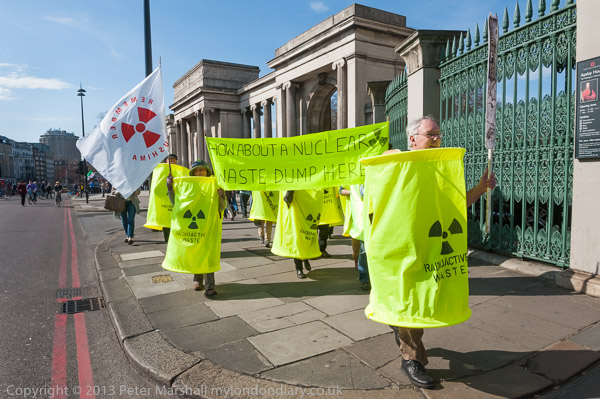
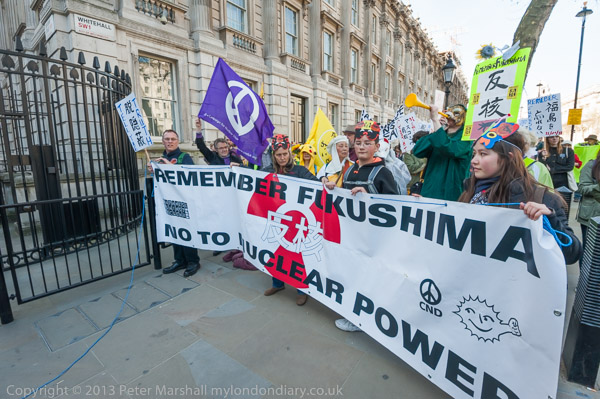
Fukushima Nuclear Melt-down Remembered

Earlier I had been at Hyde Park Corner where protesters had gathered on the third anniversary of the nuclear melt-down at Fukushima to march through London, first to the Japanese Embassy and then on to a short stop at Downing St before a rally in Parliament Square.

I photographed them again at Downing St, but had to leave as they marched away to their rally.

Fukushima Nuclear Melt-down Remembered


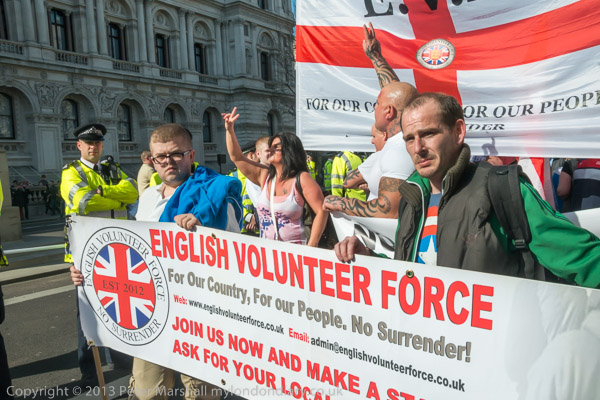
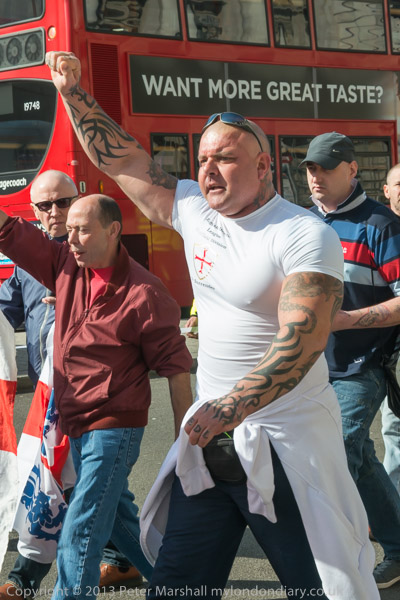
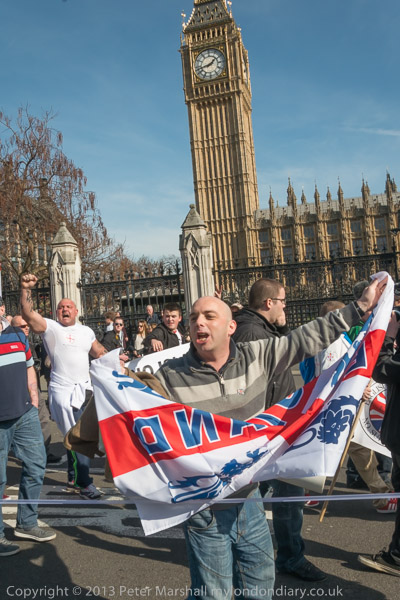
English Volunteer Force march in London

The English Volunteer Force is a coalition of various far-right groups and described the protest on Facebook as “highlighting multiple issues from immigration, Islamic hate preachers, sharia law, Sharia zones, Sharia patrol groups, banning the Burhka!, Halal meat, endless applications for more mosques etc.”
They insist that they are ‘patriotic’ and are not racist, and claim not to be against Muslims but simply against Muslim extremists, though I found this hard to take seriously.

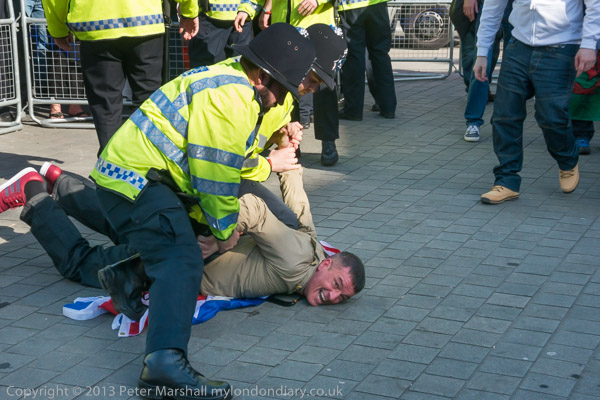
The march started outside the Lord Moon of the Mall pub close to the Trafalgar Square end of Whitehall where people were just coming out of the pub as I arrived. Police were taking a great deal of trouble to keep anti-fascist who were intent on stopping the march from getting close to it, but were unhelpful when I complained about an assault by one of the protesters who shouted at me and pushed my camera into my face.

A few minutes before the assault I’d mingled with the protesters as they walked down to Downing St, joking with some I knew from earlier right-wing protests I’d covered previously. They seemed pleased that I was covering the event – and although they were clear we differed greatly in our views had personally invited me to some cover some ‘patriotic’ events as they trusted me to report accurately on them.

There were several groups of counter-protesters but generally they were kept apart by police – and by stewards in an official protest area against the EVF opposite Downing St. There were a few arrests both of anti-fascists and of EVF marchers who tried to attack them, and one of the larger groups of anti-fascist was kettled by police on Parliament St.

English Volunteer Force march in London


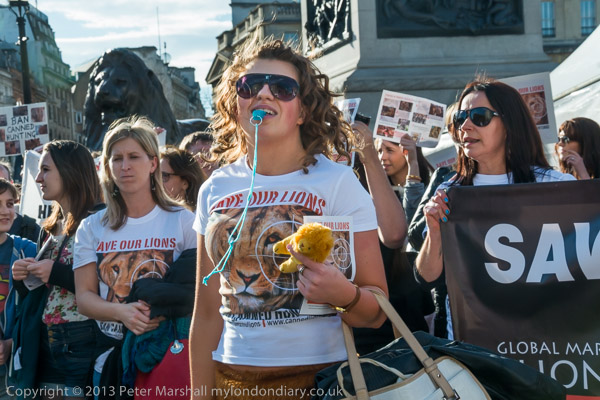
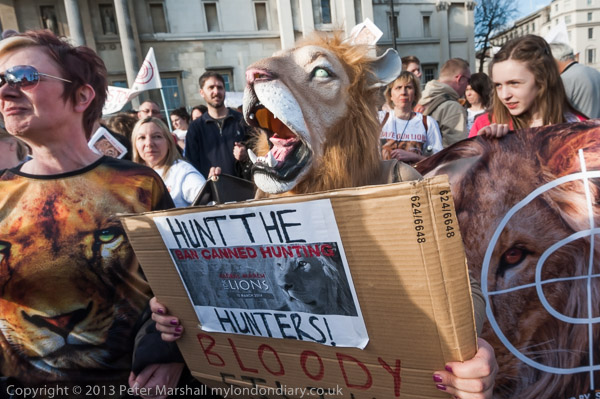
Save Our Lions – Ban Canned Hunting

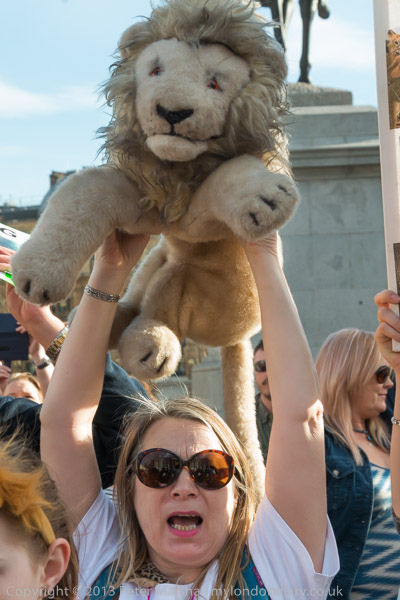
Finally I walked back up Whitehall to Trafalgar Square, where hundreds had come for the Global March for Lions, marching from different starting points to meet and call for a ban on the ‘canned’ hunting of captive lions by wealthy trophy tourists.

Legal but unscrupulous, ‘canned hunting’ is big business in South Africa, with more than 8,000 lions in captivity, bred on lion farms. Rich visitors pay large sums to take part in lion shoots, where the targets are unable to escape, often raised to be tame and used to human presence and drugged to make them easy kills. Over 160 lion killing camps have been set up in South African in the last 15 years.

As I commented: “It is a terrible way to treat a wild and noble animal, but it also greatly threatens the wild lion population. To prevent the inbreeding that is rife in captive lion populations, wild lions continue to be captured, while the growth in the Asian lion bone trade increased poaching.”

Save Our Lions – Ban Canned Hunting


More about all these events on My London Diary:
Save Our Lions – Ban Canned Hunting
English Volunteer Force march in London
Fukushima Nuclear Melt-down Remembered
Syrians March for International Action
London March for Freedom for Tibet


Shut Down Racist Yarl’s Wood

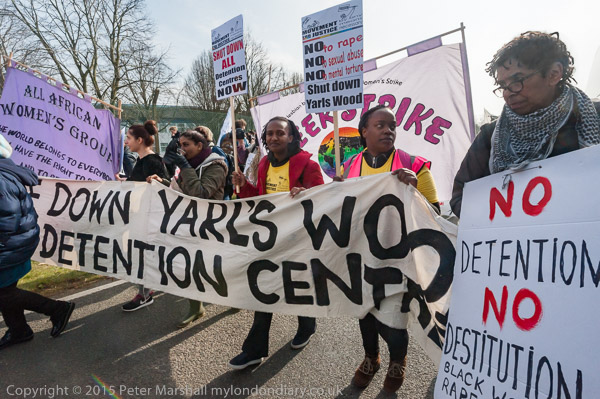
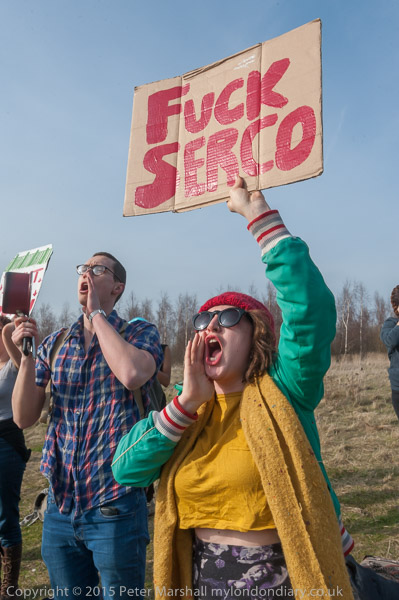
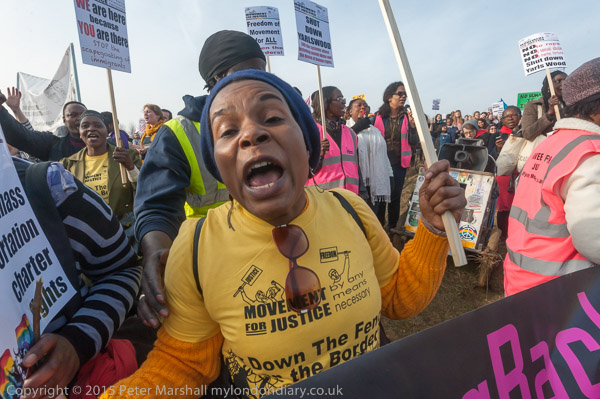
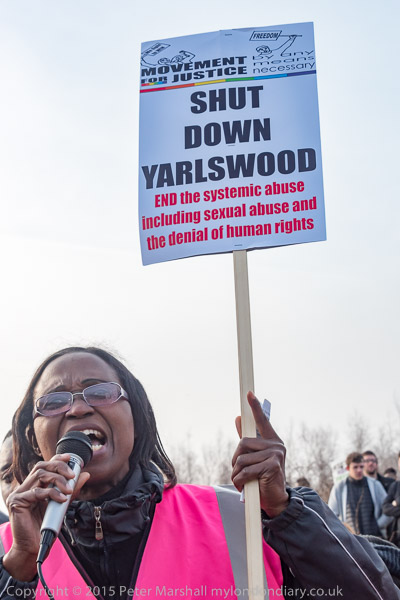
Shut Down Racist Yarl’s Wood. On Saturday 12th March 2016, six years ago today, I made another visit to the immigration detention centre at Yarl’s Wood where the Movement for Justice (MfJ) had organised another large protest.

Shut Down Racist Yarl's Wood
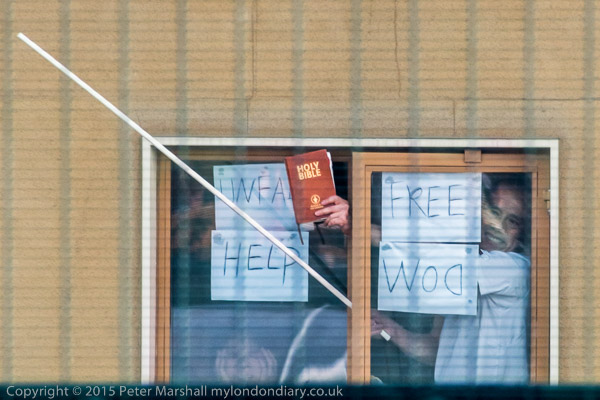
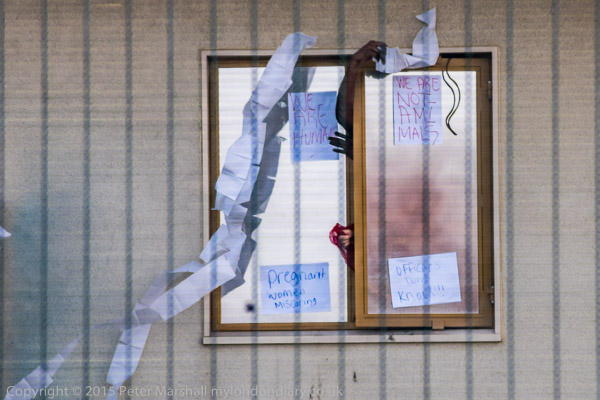
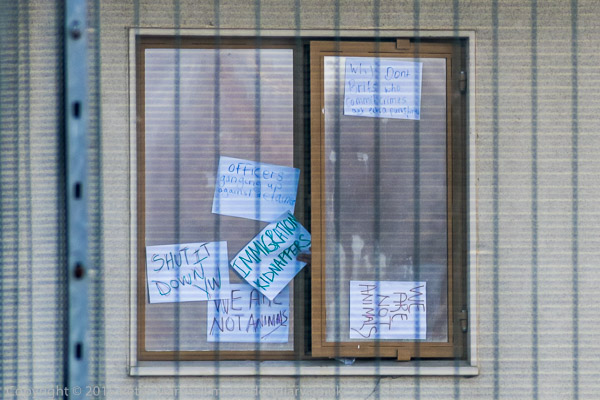
Women at the windows – one holds a bible through the narrow window opening

The Home Office no longer uses Yarl’s Wood to house large numbers of women asylum seekers, but unfortunately this does not mean their cruel and racist policies have changed. Women were at first moved out because of Covid, but Priti Patel has set up a new immigration prison, Derwentside Immigration Removal Centre, to hold 80 detainees to replace it, with around 88 women being moved and locked up there for Christmas 2021.

Shut Down Racist Yarl's Wood
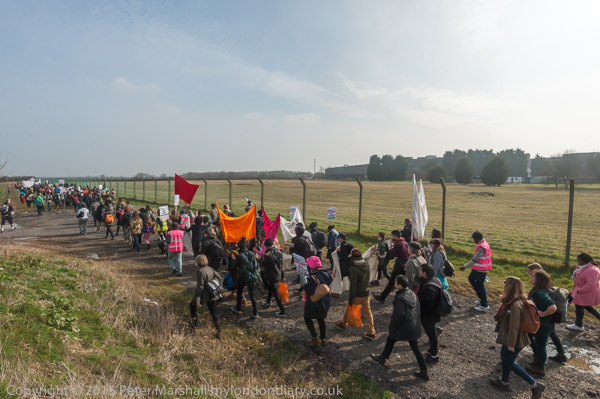
People march down the road to a footpath leading to Yarl’s Wood

The new centre at Hassockfield is on the site of the notorious Medomsley Detention Centre, where over 1,800 young male detainees were abused in the 1960s to 1980s, and is at at Medomsley Edge, 13 miles NW of Durham, 1.7 miles North of Consett. It has been renamed again as Derwentside, to give it a more friendly image, though the river is around a mile away as the crow flies. Almost certainly the Home Office was fed up with the protests organised by MfJ and others at the already rather remote site at Yarl’s Wood, around 5 miles outside Bedford, and thought it a good idea to move it rather further away from London, where there are many former detainees and activists who came to demonstrations.

Shut Down Racist Yarl's Wood
Marching along the footpath

But of course people came from all over the country – including from Scotland – to Yarl’s Wood, and protests will continue, with an active ‘No to Hassockfield‘ local group at their centre, although it’s too far away for me to photograph them.

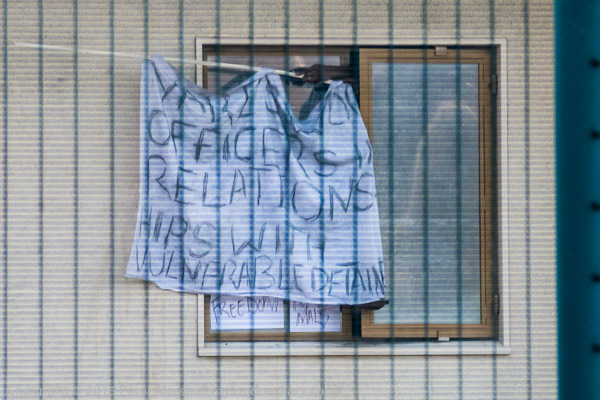
Women have little to protest with and the windows only open an inch or so. They hold messages to the glass and throw out toilet paper

Hassockfield is so remote that the Home Office was unable to find law firms which would give satisfactory tenders to give legal advice there and abandoned the search – with detainees now only able to get advice by phone. Women for Refugee Women are calling for donations to mount a legal challenge over this lack of support. There is a great deal more information about the cruel and racist treatment of asylum seekers with many telling their own stories on their web site.

Yarl’s Wood like almost all of the immigration prisons is privately run for the Home Office, with companies cutting costs for profit

Back on 12th March 2016, my own journey to Yarl’s Wood didn’t go too well, with a train cancellation. But I still got to Bedford Station in a little over two hours and in time for the coach organised by MfJ to the meeting point at Twinwoods Business Park, around a mile walk from the prison. Unfortunately the coach driver didn’t know the way and police had put up large signs stating the road up from the A6 was closed (though in fact they were letting traffic to the protest to go through.) The result was a rather lengthy tour of the Bedfordshire countryside – with another wrong turning, meaning we arrived the best part of an hour late.

Shut Down Racist Yarl's Wood
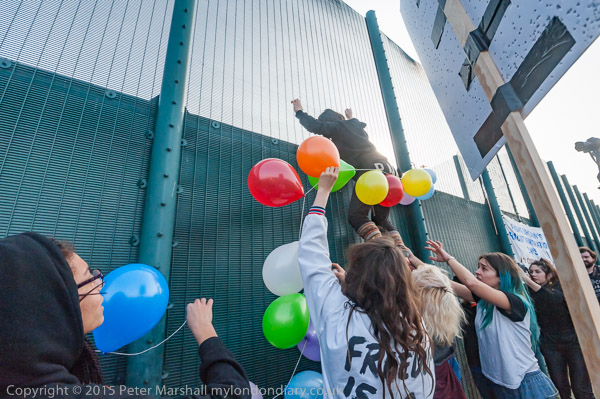
Protesters climb up to show placards and balloons to the women

Fortunately the event had started with a rally on the road waiting for people from around the country to arrive, and the mile or so walk to the prison was waiting for us and only just about to begin.

Shut Down Racist Yarl's Wood
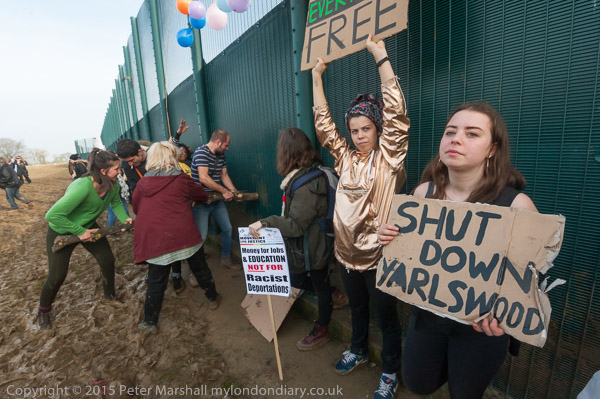
Battering the fence makes a lot of noise

Fortunately it was a fine day for the walk, but there had been heavy rain in previous days and some of the footpath and the field beside the prison where the protest took place was full of mud and some puddles, making it hard to move about and keep my balance. As you can see in some pictures close to the fence it was a sticky mess.

Shut Down Racist Yarl's Wood
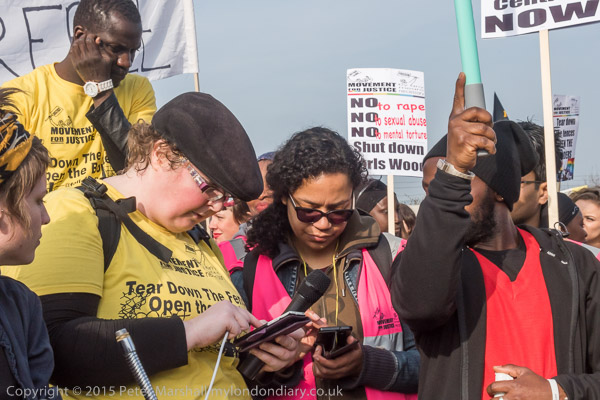
Many of those protesting were former detainees, some of whom spoke at the event

The field has a fairly steep slope up from the 20ft prison fence, which does enable protesters to see over the lower 10ft of thick metal sheeting and to glimpse the women waving, shouting and holding posters at the upper floor windows inside.

Shut Down Racist Yarl's Wood
Women had written messages on towels and clothing to hang out through the narrow openings.

It is tricky taking pictures through the 10 ft upper section of the fence with its thick wire grid and I don’t have the kind of long and fast lenses for this. I actually declined the invitation from the organisers to photograph the first large MfJ protest here as I knew I didn’t really have the right gear, suggesting they invite a colleague. But for later protests I decided that there were many other pictures I could take and I could at least get some kind of pictures through that fence.

Shut Down Racist Yarl's Wood
Many reports have confirmed the abuses taking place inside Yarl’s Wood

Many of those at the protest were people who had been locked up inside Yarl’s Wood or other detention centres, and almost all of those who spoke had stories to tell about how their mistreatment – having been physically and sexually assaulted, locked in rooms, denied medical assistance, unable to get proper legal advice and more. Most had come to this country fleeing from violence, often from rape and in dire need of care and understanding and instead were locked up, their stories disbelieved and further subjected to hostile and inhuman treatment.

Shut Down Racist Yarl's Wood
Detainees are allowed phones and some were able to speak from inside the immigration prison

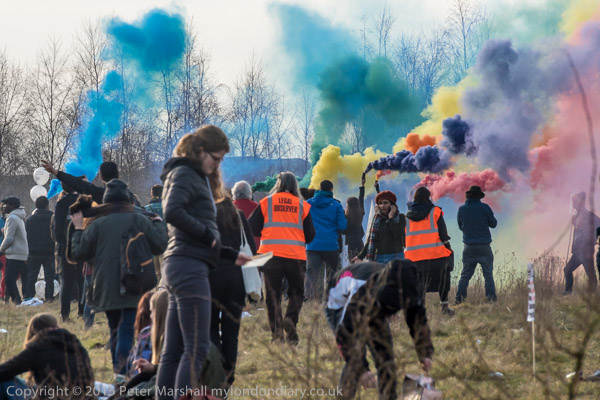
At the end of the protest people let off a number of coloured flares before the long walk back to the coaches. I was rather caught in the mud and unable to get close to where this was happening. On the path and road back to the coach I tried to scrape the worst of the mud from my boots and trousers on the grass and on the kerb of the road, and found some sticks to help, but Bedfordshire mud proved extremely persistent.

Shut Down Racist Yarl's Wood
Most of the speakers were former detainees and friends inside could hear them

We needed to remove our boots before getting on the coach, and fortunately I had a plastic bag to put them in for the journey, getting back into them where we were dropped off at the station. The journey home was slow but uneventful and I was exhausted and needed a good meal and a bath when I arrived – but at least unlike those detainees I was free.

Shut Down Racist Yarl's Wood

More at Shut Down Yarl’s Wood on My London Diary, where you can also find accounts of other protests at Yarl’s Wood as well as other immigration prisons at Harmondsworth and Colnbrook using the site search.


Valentine’s Day 2015 – Reclaim Love and Release Shaker

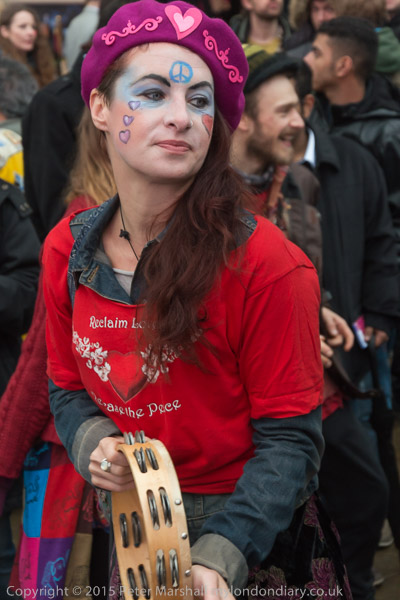
Valentine’s Day 2015 – Reclaim Love and Release Shaker – two events I photographed on St Valentine’s Day, February 14th 2015.


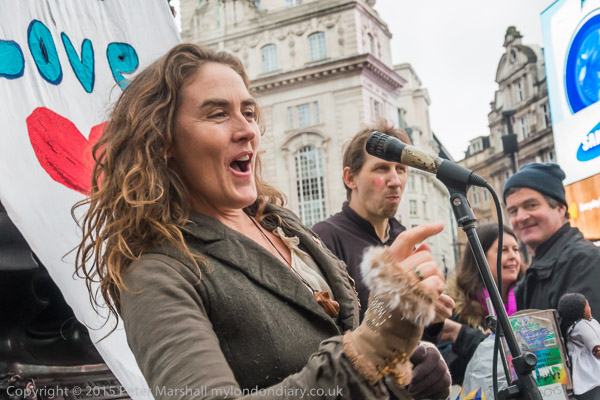
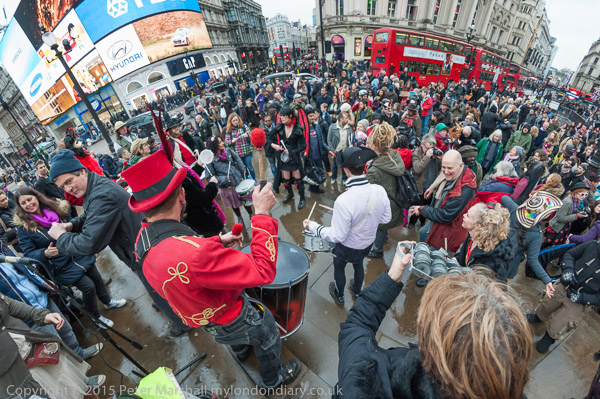
Venus CuMara Reclaim Love 13 at Eros

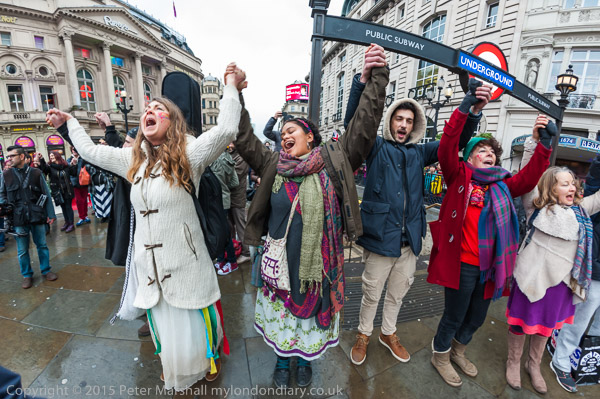
I’ve photographed the Valentine street party at Piccadilly Circus most years, though I missed the first one, but it seldom takes place actually on the 14th February, as since the event began in (I think 2003) there have been only two years where that has been a Saturday – 2009 and 2015.

A 2010 article in ‘Resurgence’ described the intentions of the event well:

Valentine’s Day, which has its origins as far back as the Middle Ages, is traditionally a day where people show their affection by sending each other handwritten ‘love notes’. But again, this simple affirmation has been hijacked by corporations to the point where cards, chocolates, jewellery – even weekend breaks – are now expected.

But not everybody wants to participate in this orgy of consumerism. Now in its seventh year, Reclaim Love is a global movement away from celebrating Valentine’s Day with flowers and chocolates towards a day of celebrating Love itself. All around the world people are taking to the streets, parks or organised venues to link hearts and minds to send a warm message of love, unity and joy out into the world

Resurgence magazine
Venus Cumara

The event was conceived and coordinated by Irish poet Venus CuMara, and spread to a number of cities around the world, where at 3pm UTC also join hands in a large circle and recite together the mantra ‘May all the beings in all the world be happy and at peace’, an English translation of an ancient Sanskrit prayer.

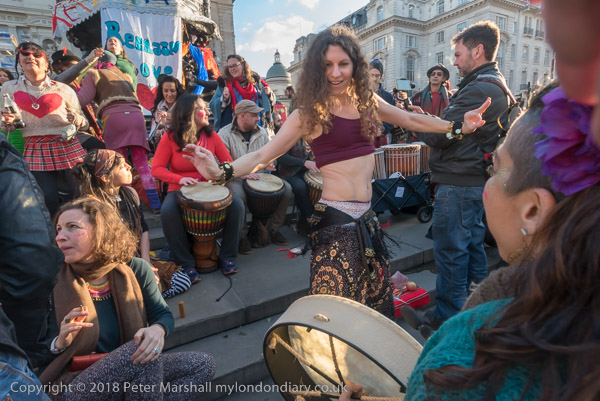
Before and after this there is a great deal of celebration, with drumming, dancing and various free gifts of food and often t-shirts bearing the mantra. I have a couple of these, though have to admit I have seldom worn them, though I did give one away to one of my sons.

It wasn’t possible to hold a public gathering in 2021, but Venus asked for people to meditate at 3.30pm and hosted a livestream. I missed the event in 2020 as I was busy elsewhere, but it was very small, probably because of the abysmal weather.

2018

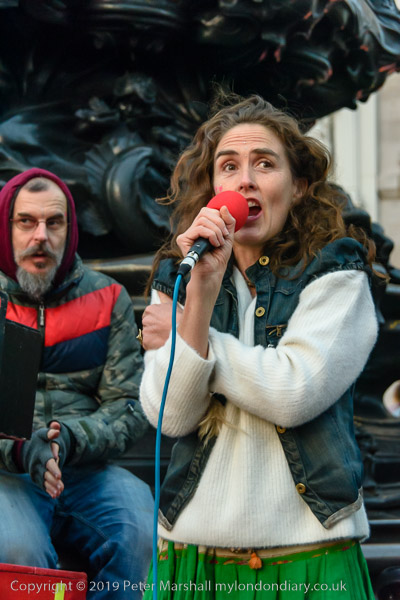
The last time I photographed Reclaim Love was in 2019, when we were all delighted to see Venus who despite suffering from cancer which is spreading through her body, was in great spirits and able to speak about her message of love. She had missed the previous year’s event as she was in Indonesia being treated for her cancer.

Venus in 2019

Venus asked people to go to Piccadilly Circus for Reclaim Love on 12 Feb 2022 in a video on the Facebook page, though this was only posted the previous day, and she apologised for not being able to be there in person. I went along to see if anything was happening a little after 3pm and found nothing, waited a few minutes and then left as I had another event to attend. Later I saw a photograph of around five people who were there at 3.33pm, the ‘circle’ time. Perhaps next year there will be more.

Venus CuMara Reclaim Love 13 at Eros


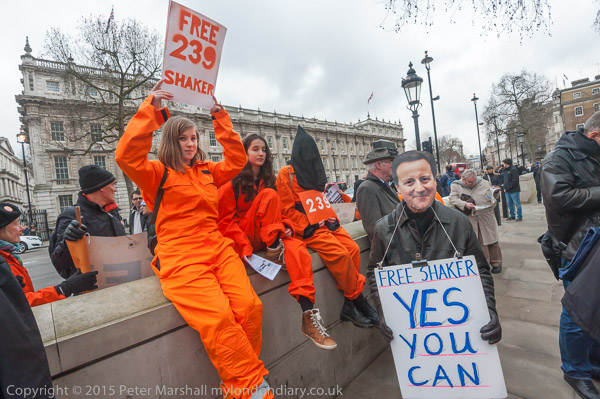
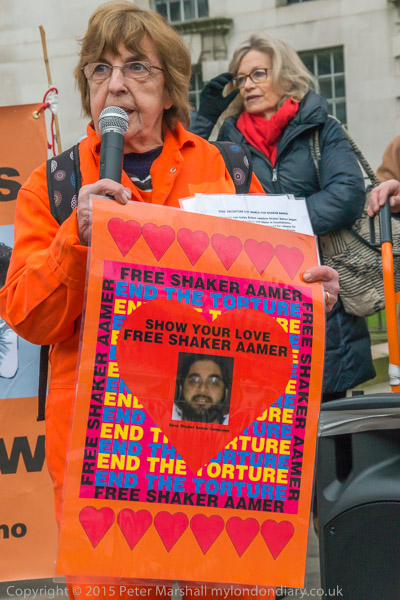
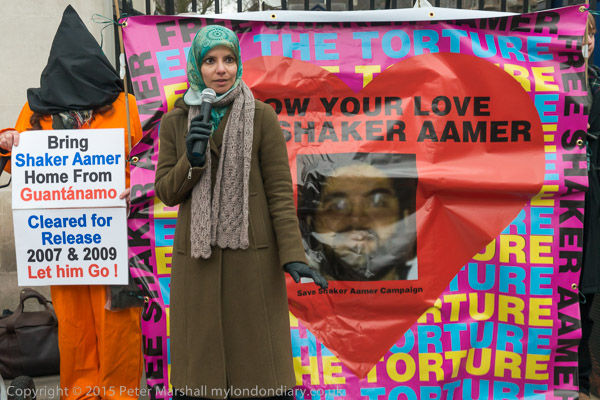
Valentine Day – 13 years for Shaker Aamer

Earlier in the day I’d walked with protesters from Parliament Square to a rally opposite Downing St calling for the urgent release of London resident Shaker Aamer from Guantanamo, where he arrived has been held and regularly abused for 13 years without charge or trial.

He arrived at Guantanamo on the 14th February 2002, and there has been subjected to several hundred incidents of beating and torture, including one notorious occasion in June 2006 where he was taken to a special secret interrogation site; three men who were taken with him for similar treatment that day died from asphyxiation, but he survived similar treatment.

Long cleared for release he continued to be held, probably because his evidence would be embarrassing both for the US and UK authorities. He has a British wife and resident status, and a campaign led to the UK government eventually making requests for him to be freed after he was cleared for release in 2007 and again in 2009. Despite this they UK had also spent over a quarter of a million pounds in legal fees to prevent his legal team gaining access to evidence to prove his innocence.

He was eventually released at the end of October 2015.

Valentine Day – 13 years for Shaker Aamer


Women March, Bolivians Protest, Antifa Solidarity

Women March, Bolivians Protest, Antifa Solidarity
Saturday 19th January 2019 was another day of protests in London.

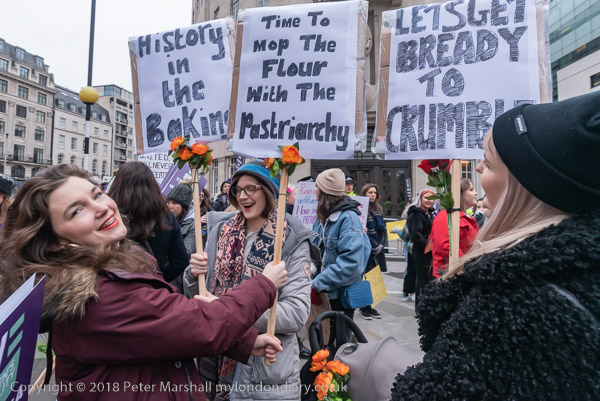
Women’s Bread & Roses protest

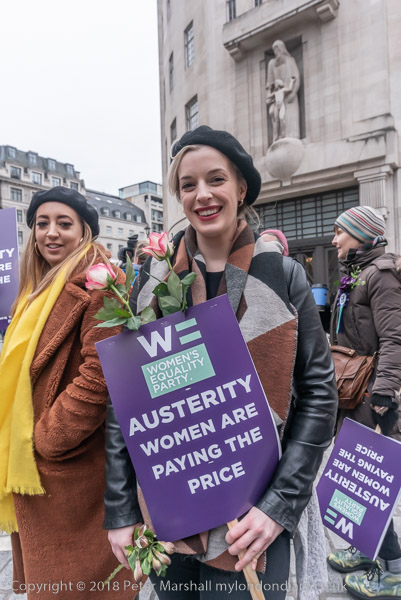
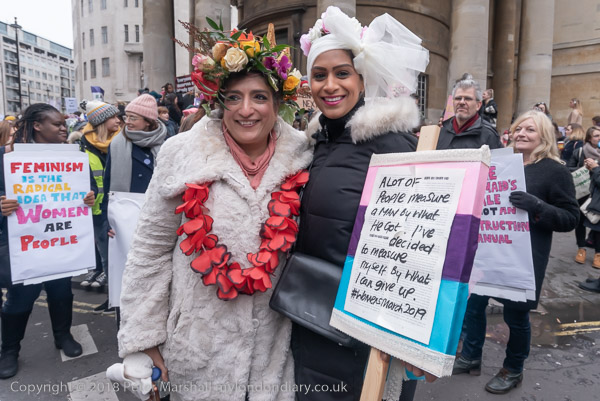
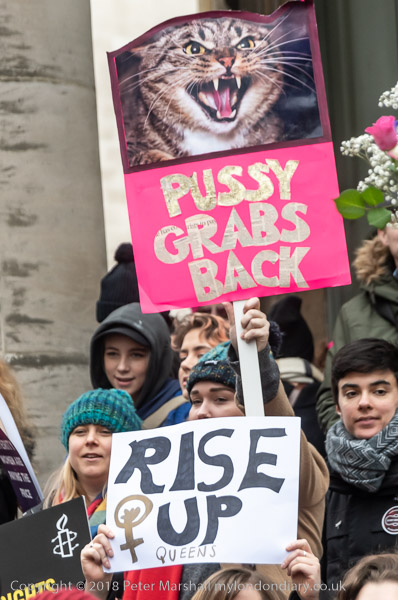
Inspired by the Bread & Roses protests which revolutionised workers’ rights for women in 1912, Women’s March London marched from the BBC to a rally in Trafalgar Square. The march was a part of an international day with women marching in many countries across the world and particularly in the USA.

Women were marching against economic oppression, violence against women, gender pay gap, racism, fascism, institutional sexual harassment and hostile environment in the UK, and they called for a government dedicated to equality and working for all of us rather than the few.

It began rather oddly outside the BBC with a carefully organised and scripted rally by a TV crew working for the BBC to produce what they called a documentary, though it seemed to have little real connection with the event that was taking place.

I walked with the women photographing them as they marched to another hopefully less scripted rally in Trafalgar Square where I left them to go to another event.

Bolivians protest against Morales

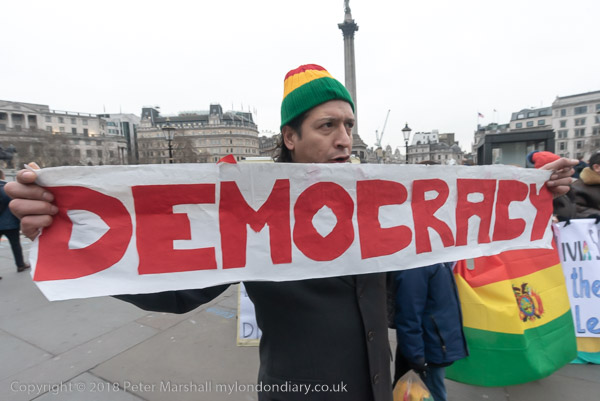
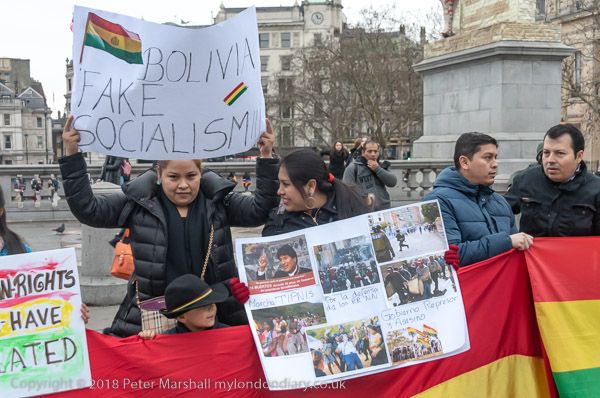
While in Trafalgar Square I photographed another protest taking place on the North Terrace, where Bolivians from the 21F movement had gathered against the ruling by Bolivia’s Electoral Tribunal that President Evo Morales could stand for a fourth term in office. Morales was first elected president in 2005, and supported the 2009 constitution which only allowed two consecutive terms in office. But later he tried to change this and the matter was put to a national referendum on 21st February 2016 which narrowly rejected the change.

Morales then went to the courts and they ruled that the limitation to two terms was an infringement on human rights and allowed him to stand again,, and he won a third term in office. The protesters were from the 21F movement, named from the referendum debate who accused him of corruption and interfering with the court system and say he is behaving as a dictator by trying to remain in power for a fourth term. He stood and won in October 2019, but a coup attempt in November 2019 forced him to flee the country, though he was able to return after MAS candidate Luis Arce won a clear victory in the 2020 general election and was sworn in as President.

Morales, the head of the Movement for Socialism party (MAS) while in office implemented leftist policies, reducing poverty and illiteracy and combating the influence of the United States and multinational corporations in Bolivia which has made him very unpopular with many of the middle class who were used to running the country – as well as the USA who have encouraged and financed opposition to him. Perhaps the 21F protest was really more about his policies than a concern for the integrity of the constitution.

Solidarity with Russian anti-fascists

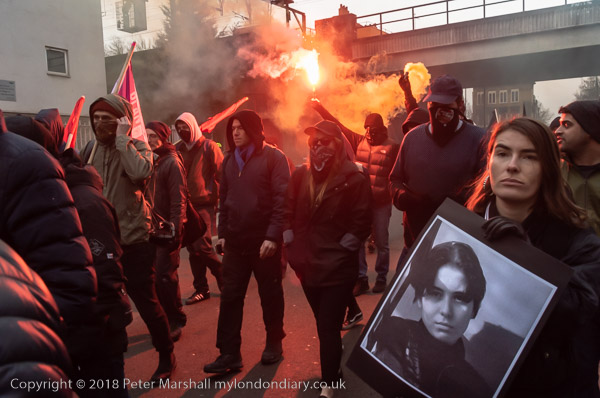
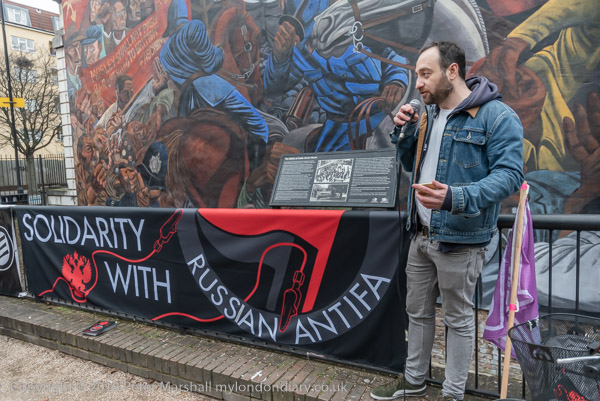
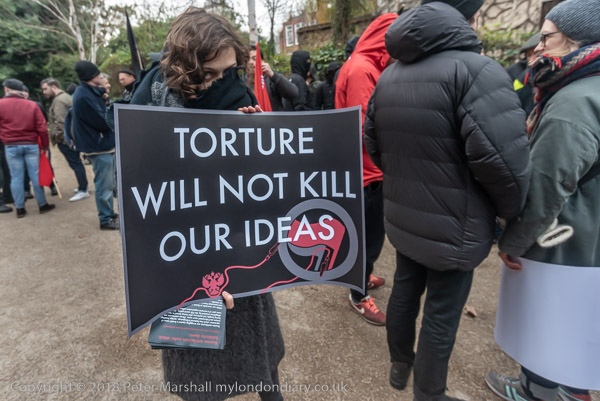
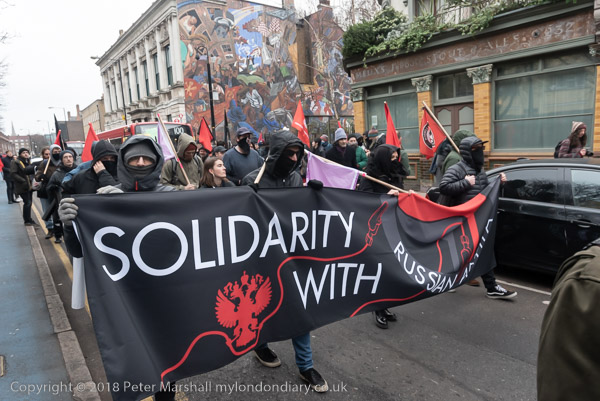
From Trafalgar Square I made my way to the Cable Street Mural on the former Stepney Town Hall in St George’s Gardens Shadwell, where Anarchist and Anti-fascists were gathering to march to oppose racism, xenophobia, fascism and the upsurge of far-right populism and to show solidarity with Russian anti-fascists who have been arrested, framed and tortured in a brutal wave of repression.

There were speeches by Russian and Ukrainian comrades and a message from some of those under arrest in Russia. Six were arrested in 2017 by the Russian Federal Security Service (FSB) and charged with belonging to a non-existent organisation, ‘The Network’. They have been and beaten and tortured in the pre-trial detention facility using electrical torture and hanging them upside down to get them to sign confessions, which they were forced to memorise.

Five more anti-fascists have been arrested since and also tortured to admit they were members of ‘The Network’, which the FSB claims were planning explosions during the Russian presidential elections and the World Cup. They could be jailed for up to 20 years for membership of the fictional group.

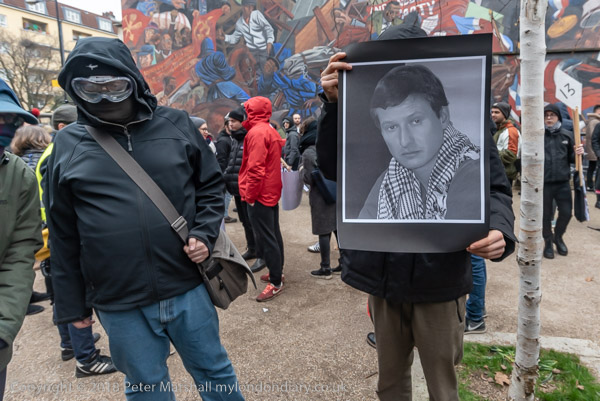
Stanislav Markelov, murdered by fascists in broad daylight on January 19th 2009.

January 19th was the 10th anniversary of the brutal murder on a Moscow street in broad daylight of two Russian anti-fascists, journalist Anastasia Baburova and lawyer Stanislav Markelov. Russian anarchists and anti-fascists hold events to remember them on this day every year.

From the fine mural celebrating the 1936 Battle of Cable Street, when the East End rose up to fight the police who tried to force a way for Mosley’s Blackshirts to march through the Jewish East End, the protesters marched to Altab Ali Park in Whitechapel, re-named after a young Bengali textile worker, 24 year old Altab Ali, who was murdered here on May 4th 1978 in a brutal unprovoked racist attack by three teenage boys as he walked home from work.

More on all three protests on My London Diary:
Solidarity with Russian anti-fascists
Bolivians protest against Morales
Women’s Bread & Roses protest


Guantanamo – America’s Shameful Prison

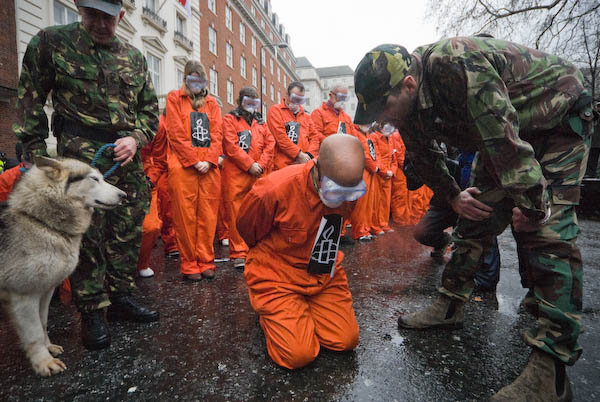
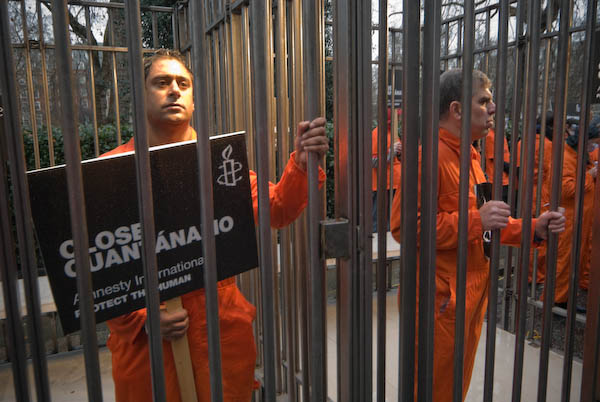
Amnesty International protesters close to the US Embassy

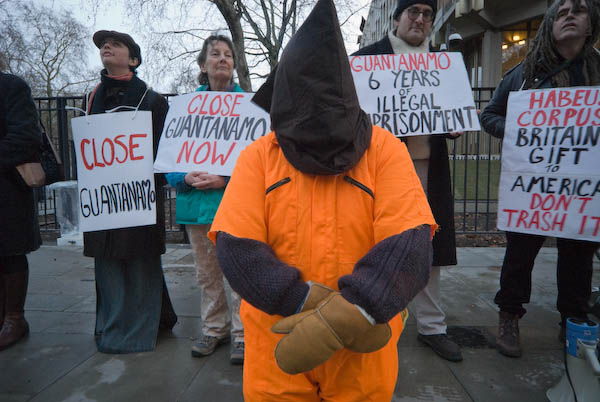
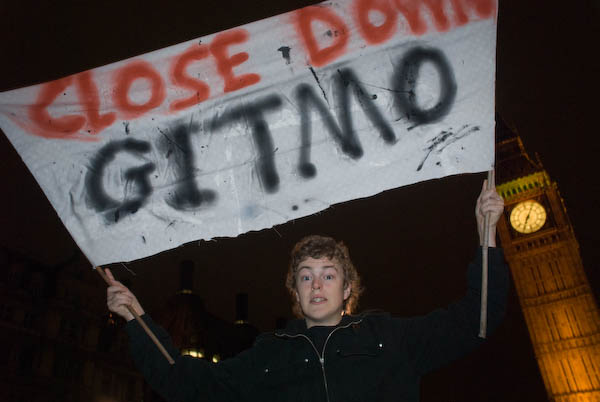
January 11th was for quite a few years a busy day for protests; it marked the anniversary of the setting up by the United States of a military prison as a torture camp at the disputed US Guantanamo Bay naval camp on the island of Cuba.

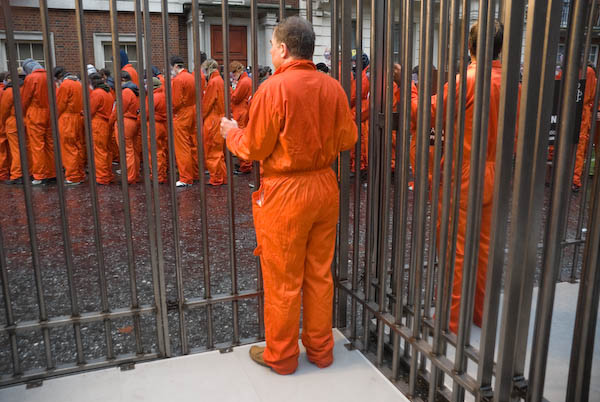
Prisoners’ had taken turns in the cage overnight

Set up in the aftermath of the 9/11 attack as a part of George W Bush’s ‘War on Terror’, the camp and the activities which took place there destroyed any final vestige of higher moral ground America could lay claim to in its role of world policeman, something that its various largely clandestine involvements in various South American American coups and activities in the Middle East and elsewhere had already largely laid waste.

Guantanamo is still there, still open, though the great majority of the 779 men brought there have been released. Most were totally innocent, victims of a US policy of offering $5,000 rewards for the capture of ‘terrorists’ to Pakistani and Afghan groups, who took the money for turning in anyone they felt would get them the money.

In October 2021, there were still 39 men held at Guantanamo, including ten who had long been cleared for release. Very few of those held over the years have faced trails trials and very few were involved in any acts of terrorism. Bush and Obama acted slowly but together released well over 700 of the prisoners, but Trump only released one, effectively stopping the process.

Protests continue in the UK, but on a much smaller scale, particularly since the last British resident, Shaker Aamer was released without charge or trial after 13 years of imprisonment and torture in 2015.

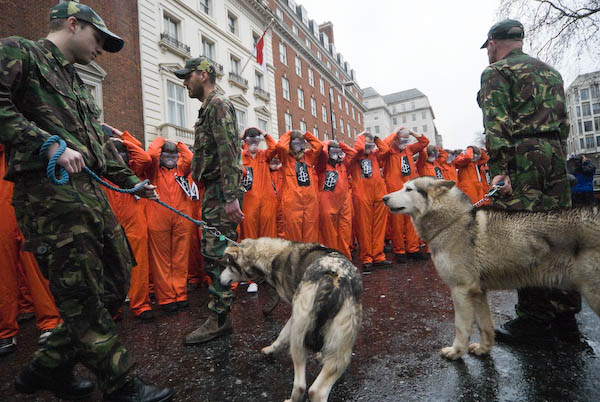
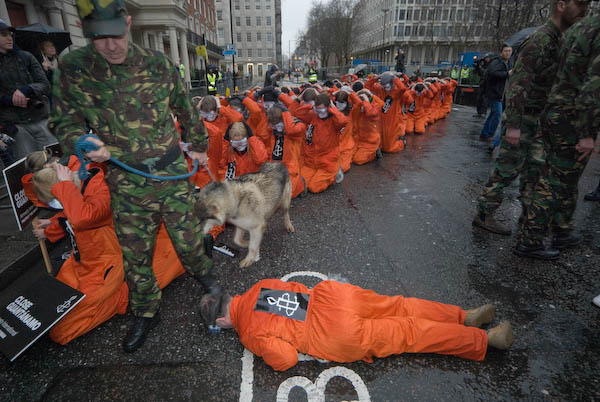
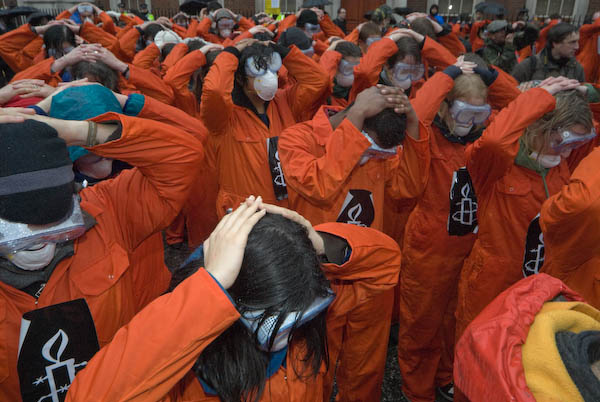
In 2008 Amnesty International organised a large protest in Grosvenor Square, a few yards from the US Embassy, though the street in front of the embassy had been closed to prevent protests there. They brought with them two cages, similar to those in which the prisoners were imprisoned outdoors at Guantanamo, with a large group of people wearing the orange jumpsuits which they are made to wear there. Protesters dressed as guards in military style uniforms harassed the ‘prisoners’ interrogating them and threatening them with violence and with aggressive-looking dogs.

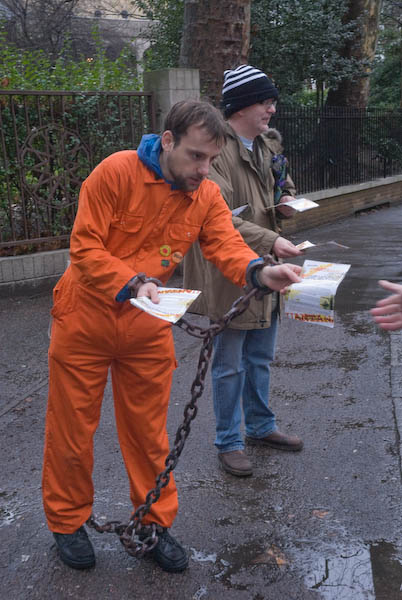
From Grosvenor Square I went up to the Regents Park Mosque, where activists from Cageprisoners and the London Guantánamo Campaign, some also in those orange jumpsuits and one manacled hand and foot. There they were handing out leaflets to those attending Friday Prayers.

Later I went with them to Paddington Green Police station, where terrorist suspects are detained and questioned in this country. They were going on to continue to protest in Parliament Square, but I returned first to the US Embassy, where the London Catholic Worker Community was holding a two hour vigil closed to the corner of the Embassy, holding placards and lighting candles for those still held and several who had died there. Several were alleged to have committed suicide, but later evidence emerged strongly suggesting they had died during torture.

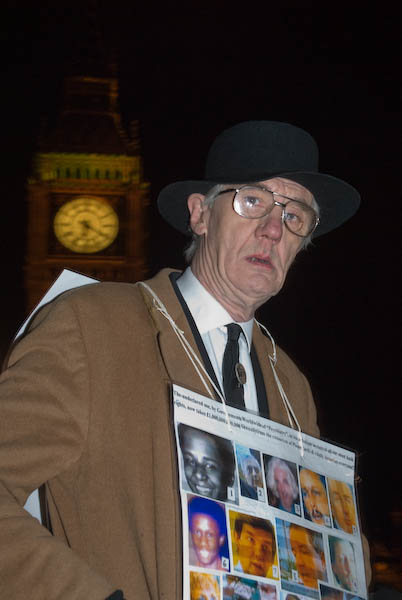
The final event of the day was a rally in Parliament Square organised by Cageprisoners and the London Guantánamo Campaign with a number of speakers including Victoria Brittain, former Guantanamo prisoner Moazzam Begg, laywers including Gareth Peirce, Bruce Kent, Yvonne Ridley and Jean Lambert MEP.

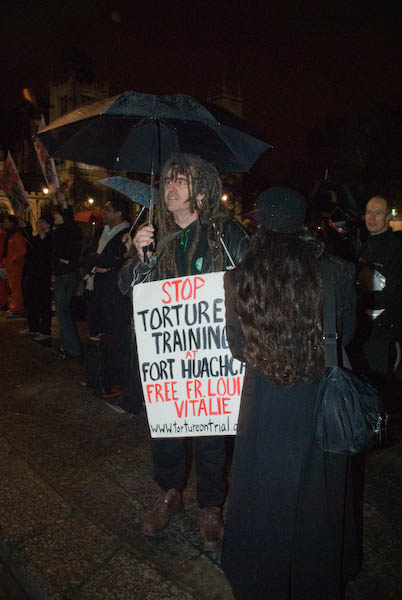
It was dark, cold and wet, but those present were cheered by the announcement at the end of the rally that Scotland Yard were investigating allegations of 14 criminal offences committed by Tony Blair and Lord Goldsmith and others which resulted in the deaths of Iraqi citizens during the armed invasion and occupation of Iraq.

Unfortunately and predictably these investigations came to nothing, and though the Chilcot report was damning in parts, Blair not only got off scot-free but this New Year was awarded a knighthood. A few days ago one of several petitions to have his “Knight Companion of the Most Noble Order of the Garter” rescinded reached over a million signatures. Mine was one of them.

Six years of Guantanamo: Amnesty
London Guantanamo Campaign / Cageprisoners
Guantanamo – London Catholic Worker
Guantanamo – Parliament Square Rally


Legal Aid & Illegal Confinement

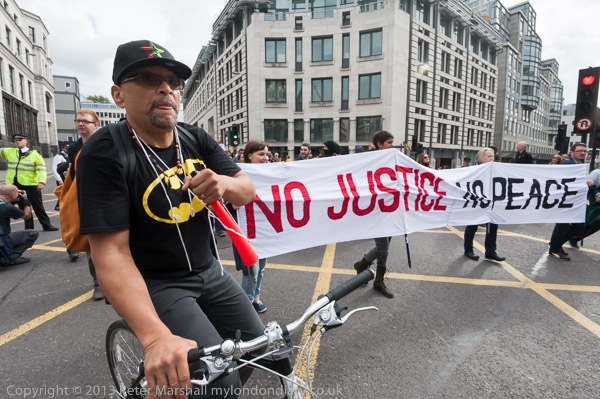
Eight years ago on Saturday October 5th 2013 I turned up outside the Old Bailey to cover a protest against the governments proposals to demolish a vital part of our justice system, Legal Aid. The proposals will mean that justice becomes largely only available to the very rich, with one law for the rich and another for the poor.

Of course our system of law in the UK is one which has as its base the protection of the wealthy and the establishment and in particular the rights of property owners, dating back to the ideas of private ownership of land introudced and used for its appropropriation by our Norman conquerers, but legal aid has provided a small and important gesture towards equality. The rich and powerful can still use the law to protect their interests, with injunctions and threats of libel and other actions. They can still call upon the police to protect their property and rely on our secret services to work for their interests.

Lee Jasper

The protest came after the government had been consulting on the changes to the legal aid system which proposed making it more restrictive and also cutting the fees to solicitors and barristers. Our combative in nature system of law is complex, time-consuming and allows those who can pay large fees to prolong litigation and have a better chance of success, with costs in some cases being in £millions. It’s a system that favours not the establishment of truth, but those who can employ the most persuasive liars.

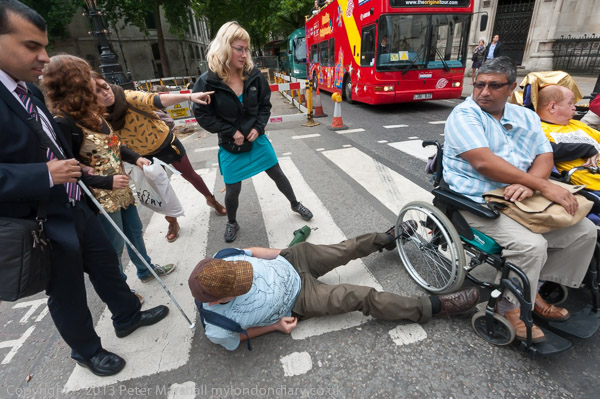
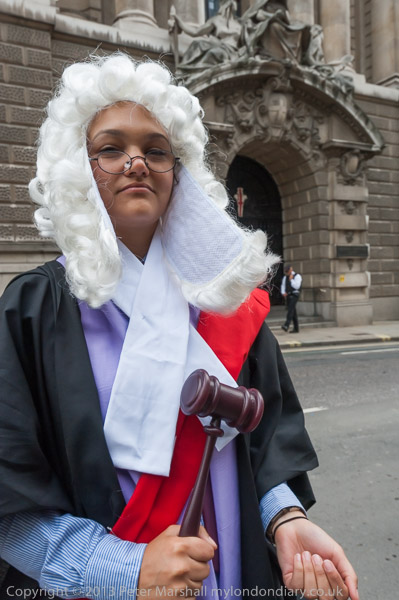
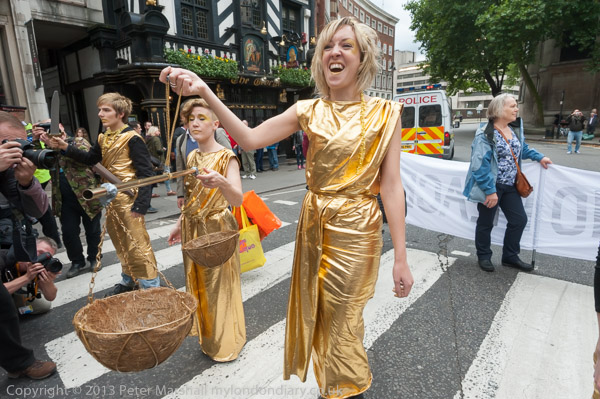
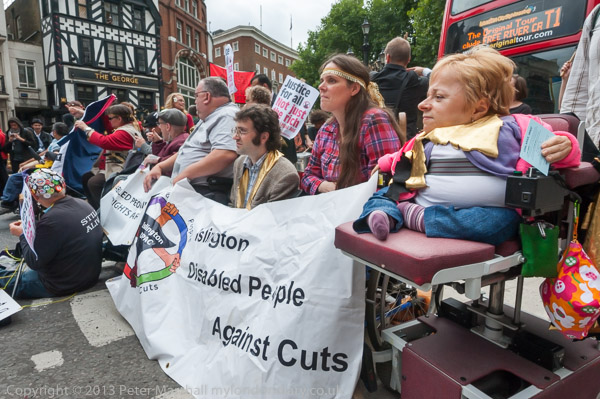
From the Old Bailey the march made its way to the Royal Courts of Justice in the Strand, where I rushed ahead to find DPAC (Disabled Activists Agains Cuts) already making their way onto the pedestrian crossing to block the road. “They stopped on it and began to padlock together to form a block. The far half of the crossing was blocked by a line of figures dressed in gold, one holding the (plastic) Sword of Justice, and another her Scales.”

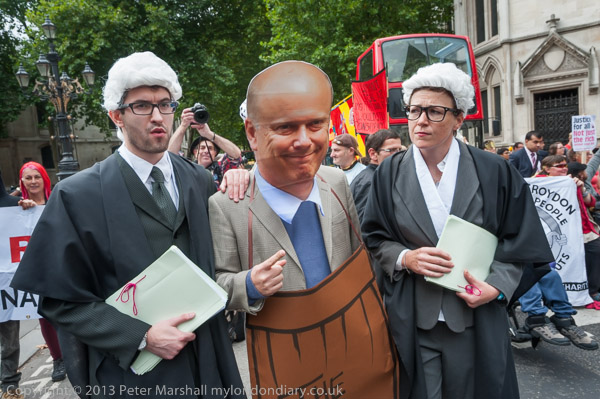
Police came and asked them politely to move but they didn’t respond. The marchers arrived for a noisy protest and then a mock trial of Justice Secretary Chris Grayling. A number of witnesses were called, some giving testimony of how without Legal Aid they would have been unable to fight their cases, and others reading written testimony from others, and then there was more chanting and drumming as well as poetry and some legal advice before the inevitable guilty verdict.

Police had been getting more impatient and insistent about the protesters leaving the road. They don’t like to arrest people in wheelchairs, partly because it looks bad in the photographs and videos, partly because of the difficulty of providing suitable transport, but also because like the rest of us (except possibly Tory ministers) they have a human sympathy with the disabled. “The DPAC activists in wheelchairs who were still blocking the road consulted with each other and decided it was time to leave, and that they would have a final five minutes of protest and then all leave together.”

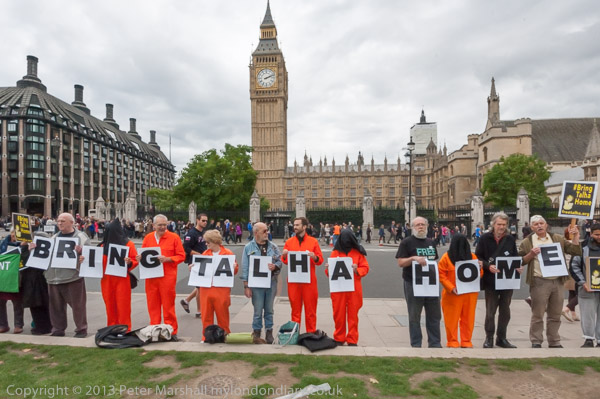
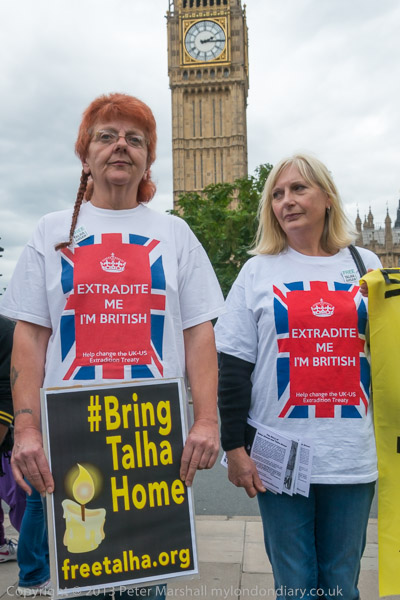
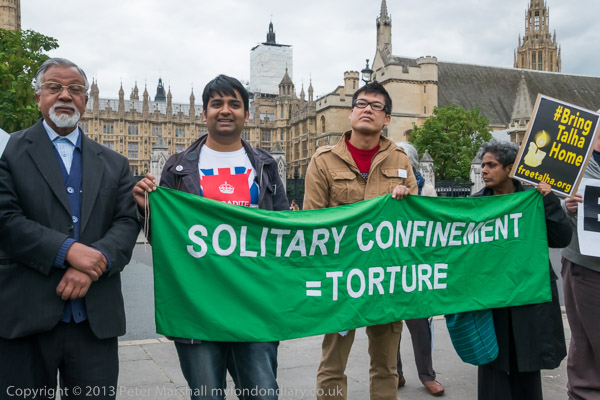
I left for Parliament Square where a peaceful vigil was marking a year since British poet Talha Ahsan was extradited to the US. Those taking part, including his brother Hamsa and other family members said that his long-term solitary confinement comes under the UN definition of torture and call for him to be returned home and unjust US-UK extradition laws repealed.

As I wrote:
“Talha Ahsan, an award-winning British Muslim poet and translator has been detained for over seven years without trial and was extradited to the USA on 5th October 2012 with his co-defendant Babar Ahmad. Although he was diagnosed with Asperger’s syndrome, the Home Secretary Theresa May refused to prevent his extradition, unlike that of Gary McKinnon, raising suspicions that this relected an anti-Muslim predjudice.”

Talha is a UK citizen and his supporters say that he should have been tried in the UK. Eventually in the US he accepted a plea bargain and pleaded guilty to one of the several charges and was sentenced. The time he had already served meant he was then free and was returned to the UK. His six years before extradition in detention without trial or charge here remains among the longest in British legal history.

More at:

Bring Talha Ahsan Home
UK Uncut Road Block for Legal Aid

A Busy Saturday – August 15th 2015


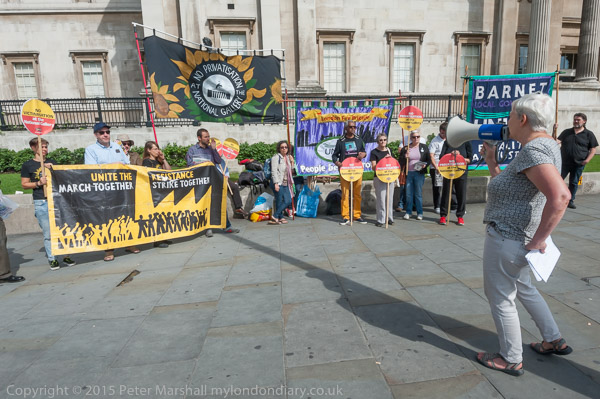
I began my working day rather later than the pickets outside the National Gallery, who held a short rally after picketing since the early morning on the 61st day of their strike against plans to outsource the jobs of 400 gallery assistants and the sacking of PCS union rep Candy Udwin for her union activities.
More at: National Gallery 61st day of Strike

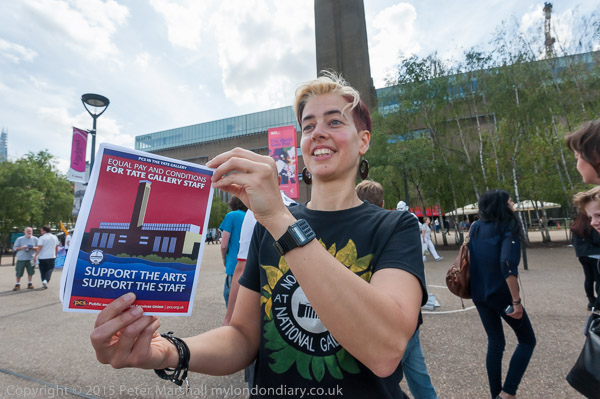
A related protest against the privatisation of visitor assistants was taking place a little later outside Tate Modern on Bankside, with workers giving out leaflets calling for equal pay and conditions for outsourced and in-house workers at both Tate Britain and Tate Modern in London. Privatised staff doing the exactly the same job have zero hours contracts with no guarantee of regular work, get £3 an hour less, and do not get the decent pensions, sick pay and holidays enjoyed by their colleagues.
More at: Equalitate at Tate Modern

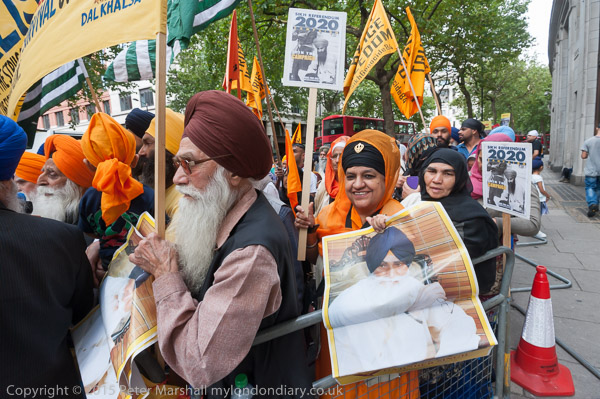
Back over the river to Aldwych and the Indian High Commission, where two protests were taking place on Indian Independence Day. Sikhs were supporting the call by hunger striker Bapu Surat Singh, now on hunger strike for over 200 days, calling for the release of Sikh political prisoners and other prisoners of all religions who have completed their jail terms but are still in prison.

Many of the Sikhs held posters of Gajinder Singh, a founding member Dal Khalsa which calls for an independent Sikh state, Khalistan, and they called for a referendum to be held in the Punjab and among the Sikh diaspora around the world on the setting up such as state.
More at: Sikhs call for release of political prisoners

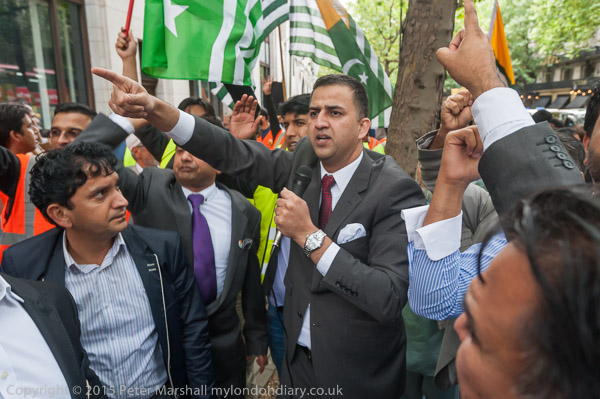
Also protesting outside the Indian High Commission were a crowd of Kashmiris calling for freedom. Kashmir is a disputed territory with parts occupied by India, Pakistan and China, and since 1987 the Indian occupation has turned their area into one of the most militarised places in the world, with around one Indian soldier for every 14 Kashmiris.

Over 100,0000 Kashmiris have been killed since the current uprising against Indian occupation began in 1987, and torture is used as a mean to get confessions and terrorise the civilians including women and children. In Kashmir Indian Independence day is observed as ‘Black Day’.
More at: Kashimiris Independence Day call for freedom

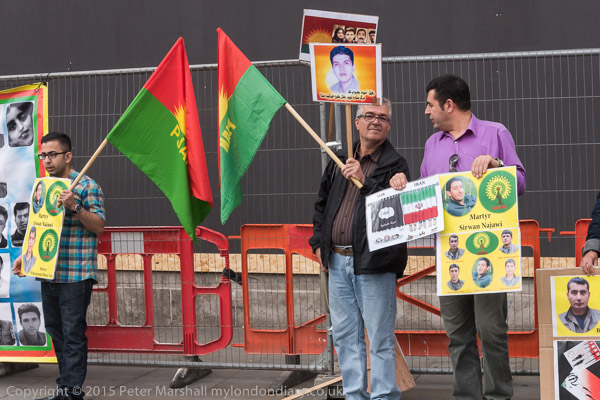
Back in Trafalgar Square Iranian Kurds from the Party of Free Life of Kurdistan (PJAK) remembered its fighters killed in the fight against Iran and ISIS for self-determination. Like the PKK, PJAK owes allegiance to Abdullah Öcalan and the ideals of the Rojava revolution.
More at: Kurdish PJAK remembers its martyrs

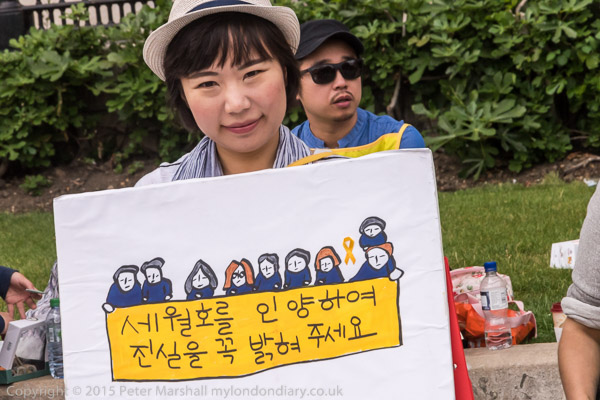
A few yards away, Koreans were holding their monthly silent protest for the victims of the Sewol ferry tragedy, mainly school children who obeyed the order to ‘Stay Put’ on the lower decks as the ship went down. They continue to demand that the Korean government raise the Sewol ferry for a thorough inquiry and punish those responsible as well as bringing in special anti-disaster regulations.
More at: 16th ‘Stay Put’ Sewol silent protest

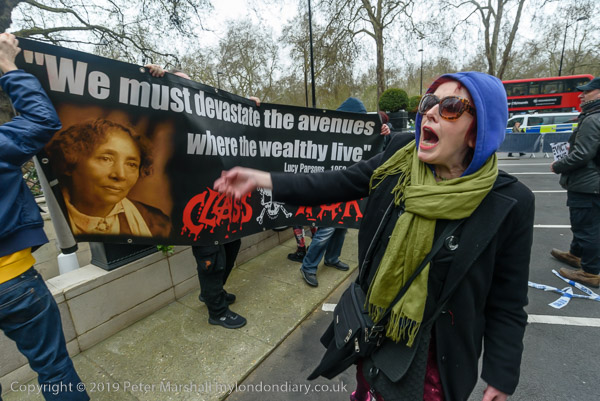
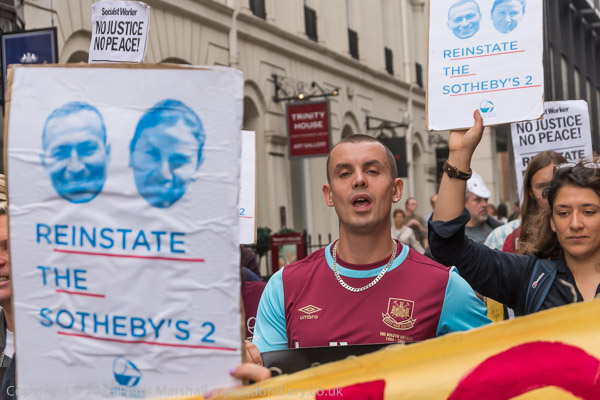
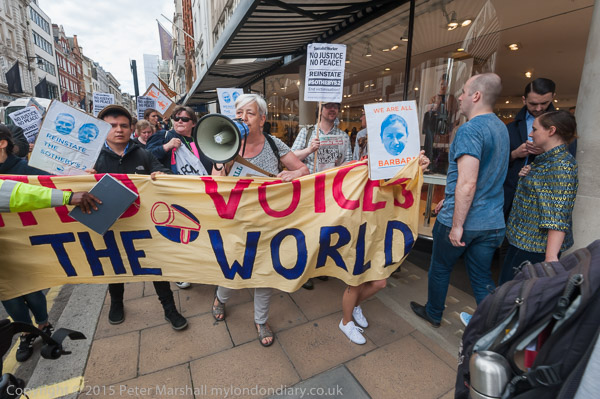
Finally I made my way to Oxford Circus to meet members of the United Voices of the World and supporters including those from SOAS Unison, the National Gallery strikers, Class War and others who were marching to protest outside Sotheby’s in Old Bond St. The UVW werecampaigning for proper sick pay, paid holidays and pensions for the cleaners who work there, and so far Sotheby’s response had been to sack two of the union members, Barbara and Percy.

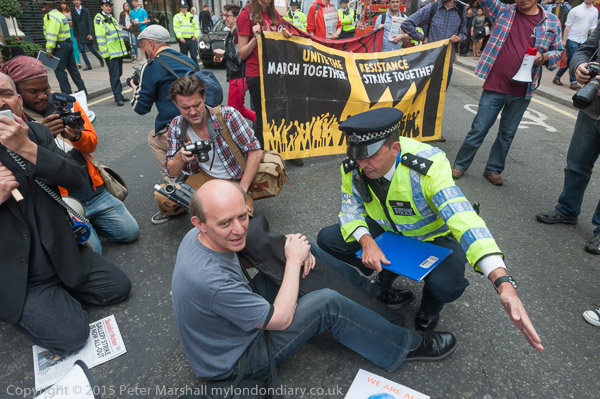
Police harassed the protesters as they arrived outside Sotheby’s, trying to move them off the road they were marching along and onto the pavement, and they responded by sitting down on the road and refusing the police orders to move. After some minutes they got up and marched around the block, past the rear entrance to Sotheby’s, with two union officials going into some of the shops on the way to hand out leaflets explaining the action. Police tried to stop these two going into the shops and some arguments developed.


The marchers returned to the street in front of Sotheby’s and held a short rally, again ignoring police who tried to move them off the road. Police then tried to stop them marching around the block again, holding some while others surged around and the marchers made another circuit, returning to Sotheby’s for a short final rally before marching back towards Oxford Circus.
More at: United Voices – Reinstate the Sotheby’s 2.

My day wasn’t quite over, and I moved to Grosvenor Square, where two young women, one black and one white, had organised a Black Lives Matter protest close to the US embassy in solidarity with events across the US against the collective and systemic unlawful arrests and killings of black people in America. The protest around the statue of Franklin Delano Roosevelt was supported by groups including BARAC (Black Activists Rising Against Cuts) and the Nation of Islam.

More at: BlackoutLDN solidarity with Black US victims.

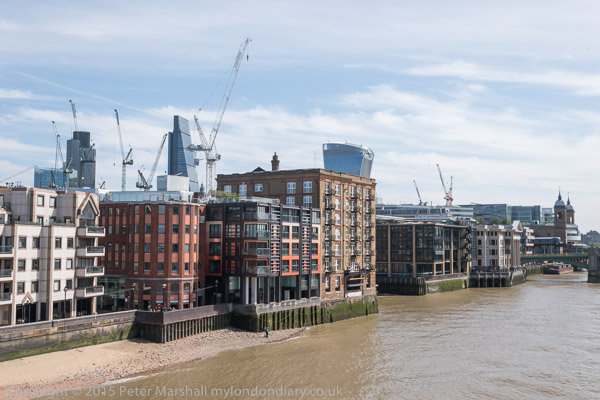
In all the travelling around central London on foot or by bus, I had time to take a few pictures between protests.
More at: London Views.


All photographs on this and my other sites, unless otherwise stated, are taken by and copyright of Peter Marshall, and are available for reproduction or can be bought as prints.


Human Rights Day

Today, 10th December is UN Human Rights Day. I think the 10th December 2016 may have set a personal record in that I covered seven events, although one was only a fleeting meeting with a Rhino as I passed through Parliament Square. But five were human rights protests.

My work began in Old Palace Yard, in front of the House of Lords and around the rather ugly statue of George V. On 10th December 1948 the UN General Assembly adopted the Universal Declaration of Human Rights (UDHR) and since then the day has been celebrated in countries around the world as Human Rights Day.

The UK was one of the countries that played a large part in both the establishment of the UN, whose first General Assembly was held in the early months of 1946 just a few hundred yards away in Methodist Central Hall, and in the UDHR, which “proclaims the inalienable rights which everyone is entitled to as a human being”.

But our current government finds some of its provisions inconvenient and one of the driving forces of Brexit is that it will provide the opportunity to weaken compliance with the UDHR, threatening our human rights including workers rights to paid holidays, maternity leave and fair treatment at work, disability rights and the right to freedom from discrimination.

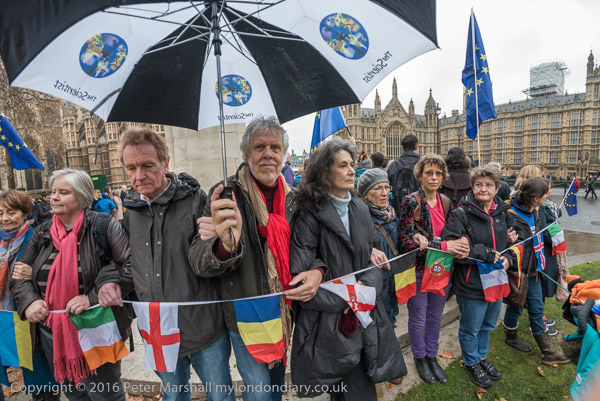
Supporters of the UK remaining in Europe were protesting in silent chains in towns and cities across the country and several hundred had come to do so in the centre of London. I didn’t find it easy to produce interesting pictures of what was a rather static event.
Silent Chain for Europe


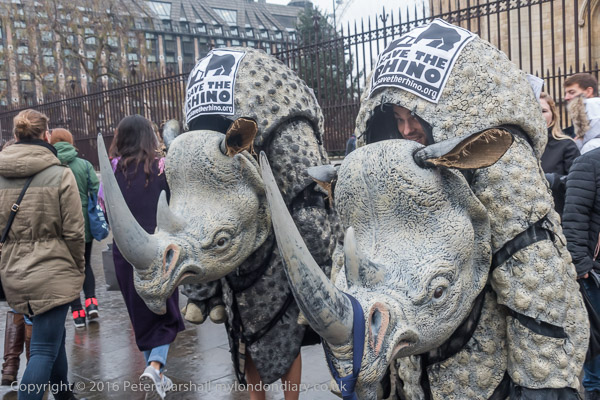
As I walked across the front of Parliament towards Westminster tube station I came across two people in rather impressive rhinoceros costumes who were being photographed in front of the House of Commons, and paused briefly to take a couple of pictures.

What rather surprised me was the almost total lack of interest in them shown by the many tourists walking past. After all it isn’t every day you pass two rhinos on the street.
Save the Rhino


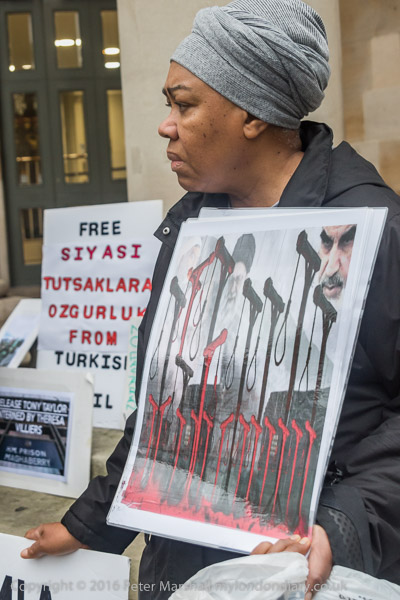
People from various campaigns had come to Broadcasting House to protest and hand in a letter about the BBC’s failure to report on political prisoners held unjustly in jails around the world. They accuse the BBC of an institutional policy of ignoring such cases, including a hundred Irish Republican prisoners, former Black Panther Mumia Abu Jamal held on Death Row in the USA for over 30 years, many Palestinians held in Israeli jails, the victims of Erdogan’s purge in Turkey, the many hanged in Iran and other cases of illegal imprisonment around the world.
BBC censors prison struggles


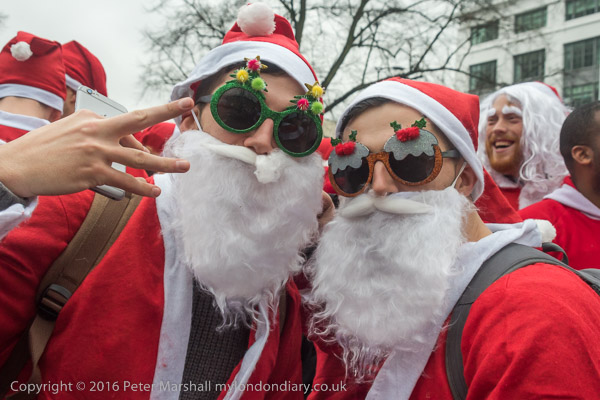
From the BBC I made my way north to Mornington Crescent, where I met one of the four groups of Santacon; the north London group had met up in Camden and were coming down into Central London and soon stopped in a small park.

I found it a little disappointing – as I wrote then,

“this year the event did seem rather more organised and tame, lacking some of the anarchic charm and chaos that brought much of London’s traffic to a halt in previous years – or perhaps I just took these pictures earlier in the day before the Christmas spirits, wine and beer had really kicked in. “

London Santacon 2016

I think police had leaned rather heavily on the organisers and insisted that they move off the streets into areas such as this for much of the event. I didn’t stay with the Santas long because there were other Human Rights Day events to photograph.


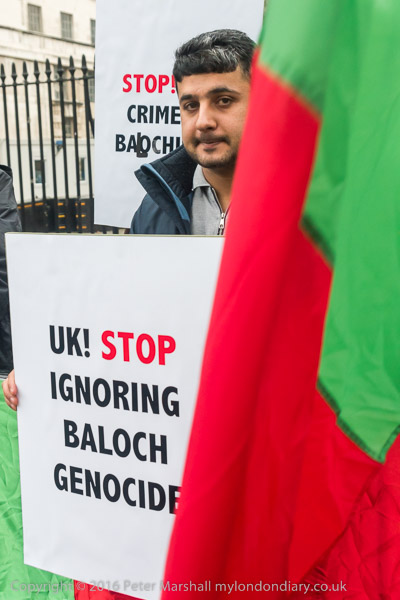
I took the tube back to Westminster where I found Balochs protesting opposite Downing St, calling on Theresa May to speak up for the Baloch people and their freedom against the Pakistan regime which they claim has a policy of genocide against the Baloch people and has killed thousands of Baloch activists and abducted more than 25,000 of them.

They say those abducted are tortured and then killed, with their bodies being dumped in deserted areas. Balochistan was an autonomous kingdom on the border of Pakistan and Iran, and was merged with Pakistan in 1948, the year after Pakistan was created. Since then there have been various Baloch separatist movements which have been brutally repressed by both Pakistan and Iran.
Balochs UN Human Rights Day protest.


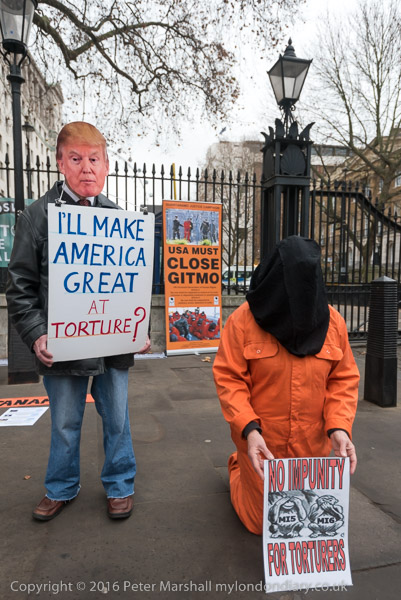
I’d come to Whitehall to report on the Guantanamo Justice Campaign protest on UN Human Rights Day opposite Downing St calling for an end to torture, the closure of Guantanamo and an end to British complicity in torture.

It wasn’t a well attended protest probably because there had been relatively little publicity, but also reflecting the problem of keeping up interest in long running issues such as this which no longer attract much if any attention from our news media. They will argue that it is no longer news, but that is only because they choose not to cover it, instead filling pages and programmes with empty speculation and inconsequential affairs of insignificant so-called celebrities rather than matters of importance.
Human Rights Day call close Guantanamo


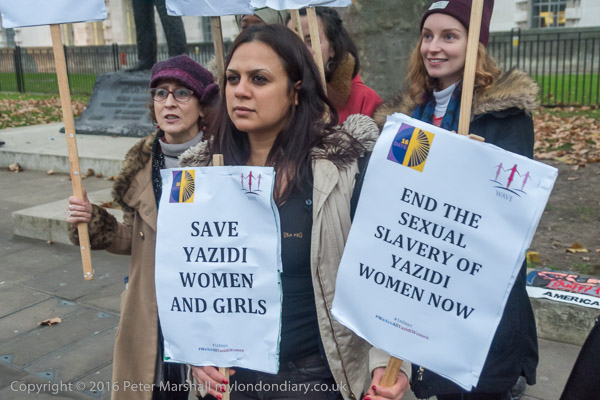
Another issue which has slipped almost completely off the news agenda is the plight of the Yazidi women and girls targeted and captured by ISIS (Da’esh) in Iraq. According to UN reports, more than 5000 Yazidis had been murdered and 5-7,000 abducted. Over 3,400 are believed to be still held, the women subjected to physical and sexual violence, including systematic rape and sex slavery.

The visit to the UK by UN goodwill ambassador Nadia Murad Basee Taha for 16 days of action prompted little or no news coverage.
Save Yazidi women and girls


More about all these events and more pictures on My London Diary.

Save Yazidi women and girls
Human Rights Day call close Guantanamo
Balochs UN Human Rights Day protest
London Santacon 2016
BBC censors prison struggles
Save the Rhino
Silent Chain for Europe


All photographs on this and my other sites, unless otherwise stated, are taken by and copyright of Peter Marshall, and are available for reproduction or can be bought as prints.


Enforced Disappearance

A post by Shahidul Alam, The journalist who got too close, reminded me of the dangers faced by journalists and photographers in some countries of the world, and in Bangladesh in particular, where extra-judicial killings and ‘disappearances’ are now common, despite government protestations there that they show ‘zero tolerance’ to extra-judicial killings, or torture and death in custody.

Alam writes:

On March 10, 2020, the Bangladesh police registered a case against photojournalist Shafiqul Islam Kajol and 31 others under the country’s draconian Digital Security Act for publishing ‘false, offensive and defamatory’ information on Facebook. He has not been seen since.

You can read more about his case at Amnesty International who have released a video showing CCTV footage of unidentified men interfering with his motorbike outside the offices of his Bangla daily Dainik Pokkhokal for which he was both editor and photojournalist shortly before he left the office and rode away on the evening of 10 March 2020. He has not been seen since. Police filed a new case against him three hours after he was last seen.

You can see a few photographs by Shafiqul Islam Kajol on the Majority World agency web site. His disappearance took place after he and 31 others were accused of publishing “false, offensive and defamatory” information on Facebook. He had been publishing about sex scandals by members of the ruling party. He had previously been badly injured in several attacks when covering their political rallies.


Parliament Square

While I used to think of Trafalgar Square as being the centre of protests in London, and it still is a place where protests take place, over the years there does seem to have been a shift towards Parliament Square (and the nearby Old Palace Yard), largely I think after the years of vigil there by Brian Haw and supporters. And often when I’m in the area for one or two events I’ll come across others that I’d not known about it advance.

Of course Steve Bray and his SODEM campaigners against Brexit are always around when Parliament is sitting, day in day out – and even during the recent recess they only moved as far as the Cabinet Office. But today was a special day for them, marking the number 50. Not the number of years they have been protesting, but the fiftieth birthday of their founder.

There was so much else going on that I managed to miss the peak of the celebrations, arriving back just as they were finishing. But though I try, you just can’t be everywhere all of the time. I should have asked them when I walked past earlier about their plans, but I was in a hurry to get elsewhere.

And that elsewhere was in front of the gates to Parliament, where Operation Shutdown , a group of families and friends bereaved by knife crimes were calling for urgent action by government over knife crimes. I don’t share their faith that a meeting of the government’s emergency  response committee COBRA would do much to help – or that tougher sentences for carrying and using knives and guns would have any real impact on knife crime, but there is clearly a need for action.

Clearly a starting point should be to reverse the government cuts to youth services and family support and to look at programmes to work with young people. London Mayor Sadiq Khan has come in for a great deal of criticism, but has set some reasonable policies in this area, but it really needs a reversal of the harmful policies imposed on local councils by the Coalition and Tory governments. So Operation Shutdown were clearly demonstrating in the right place, and of course their pain and grief is only too clear. Though they were I’m afraid talking to a government with little idea of how most people live and close to zero concern so long as they and their friends are getting richer.

Sometimes I have a problem with cropping. Often there is a tension between making an image visually strong and the text which locates and explains what the picture is about, and perhaps this image is a good example, where I think I have cropped just slightly too tightly. It’s often a good idea to give the reader some slight puzzle, but it’s hard to know if most people on seeing this will actually decipher ‘Stop the Mass Slaughter Of a Generation Now!’ Another inch or two at the left would have helped.

On the Olympus camera which has now become a part of my standard outfit, I work with the camera set on RAW and the aspect ratio as 3:2. But when working with raw images, the camera actually always records the whole sensor, with a roughly 4:3 ratio, which includes a small strip on top and below the 3:2 frame. When editing the pictures I do sometimes find that including some or all of this improves the images. Just a pity that there isn’t any similar leeway at the picture edges!

Just across the street, on the pavement in front of the grassed centre area, there was another protest, by the UK Chapter of the Free Balochistan Movement. It was the United Nations International Day in Support of Victims of Torture, and they were calling for an end to the large-scale disappearances, arrests and torture of anyone suspected of having links to the Baloch nationalist movement by Pakistan military forces and the Iranian Revolutionary Guards.

My day which had begun with the mass lobby, hadn’t ended, and I returned just a little too late to SODEM, before going on to photograph two other protests, to which I’ll refer in a later post.

More pictures from these three protests at:

SODEM Steve’s 50th Birthday
Operation Shutdown against Knife Crime
End torture in Balochistan


All photographs on this and my other sites, unless otherwise stated, are taken by and copyright of Peter Marshall, and are available for reproduction or can be bought as prints.

There are no adverts on this site and it receives no sponsorship, and I like to keep it that way. But it does take a considerable amount of my time and thought, and if you enjoy reading it, please share on social media.
And small donations via Paypal – perhaps the cost of a beer – would be appreciated.