Climate Rush Protest Heathrow: On 4th September 2009 I joined Climate Rush at Sipson, one of the villages immediately north of Heathrow under threat from the plans to build a third runway.
Their 3 day stay here was their first stop on a one month tour of South West England and they were staying at the Sipson ‘Airplot’, bought by Greenpeace in what was planned to be the centre of the new runway. The legal owners of the plot were now “Oscar winning actress Emma Thompson, comedian Alistair McGowan and prospective Tory parliamentary candidate Zac Goldsmith and Greenpeace UK.”
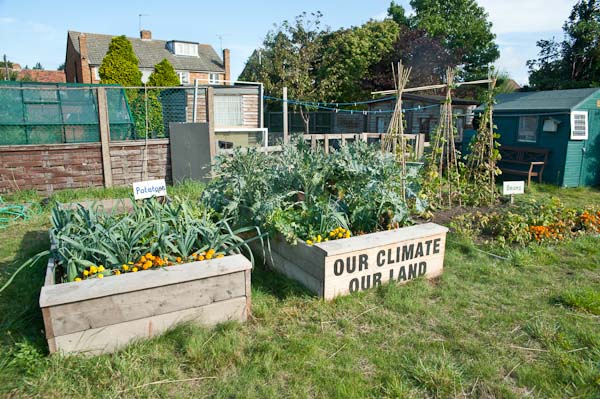
Greenpeace had invited others to sign up to become ‘beneficial owners’ of small 1 metre square plots within the site and I was among the many who did so. They had hoped this would make it harder for the developers as they thought we would all need to be served with legal notices for the development to go ahead.
I’d long been opposed to the expansion of Heathrow. It remains clear that this is an airport that was set up in the wrong place, to close to London in a fairly densely populated area and with flight paths over the centre of London. And with the increasing threat of climate change and global extinction one of the last things we should be doing is increasing the carbon emissions and pollution from aviation; instead we should be looking at ways to cut down both the number of flights and the pollution from traffic and congestion in the area surrounding the airport.
I’ve lived most of my life close to Heathrow. As I wrote on My London Diary:
“I grew up under the main flight path in use for landing a couple of miles from touchdown. Although I was a plane spotter at an early age, all of us living there felt the disruption it caused in our lives, even back in the 1950s.
My teachers often had to stop and wait in mid-sentence for a plane to go over. We could often smell the fuel, and see and feel the oily grime although I don’t think the term “pollution” had then really entered normal vocabulary.
At a deeper level, I still sometimes have nightmares about planes going over in flames (as they sometimes did) and crashes, although since Terminal 4 blocked one of the existing runways (Heathrow was built with six though only two are now used) thankfully planes no longer shake my present house as they come in low on landing or take off. “
I wrote more about this back in 2009, as well as the continuing history of lies and deceit by which the airport was established and has since grown and grown. And also about the area as it was before the airport, rich agricultural land with market gardens and orchards. Of course I didn’t know it myself but my father did and cycled through it.
In the 1950s on my own bikes I cycled through the villages which would be destroyed by a third runway, particularly Harmondsworth which has retained much of its original charm, with a village green with a pub and church and, a few yards away, one of the finest medieval tithe barns (2 pictures at bottom of this page.) There is much more to read on My London Diary.
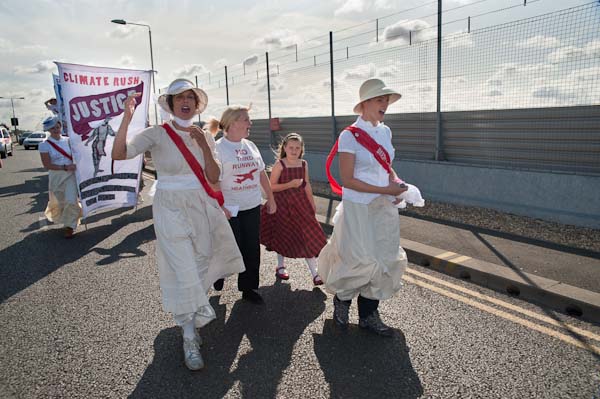
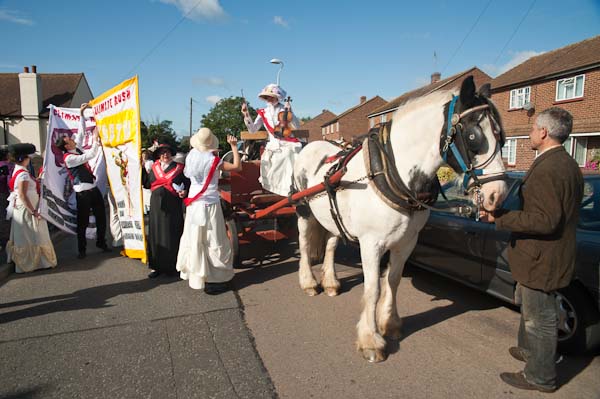
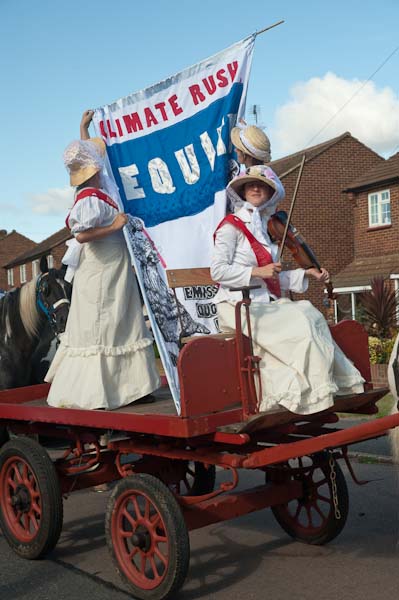
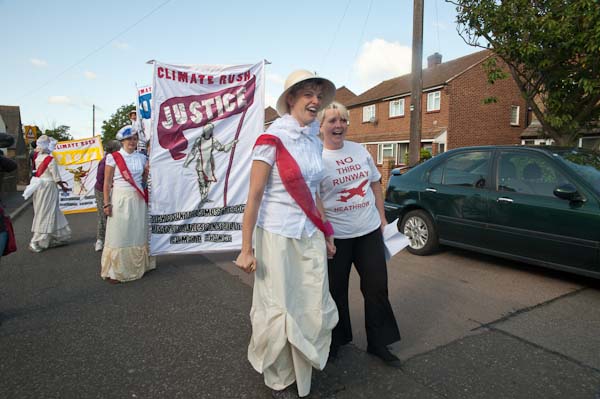
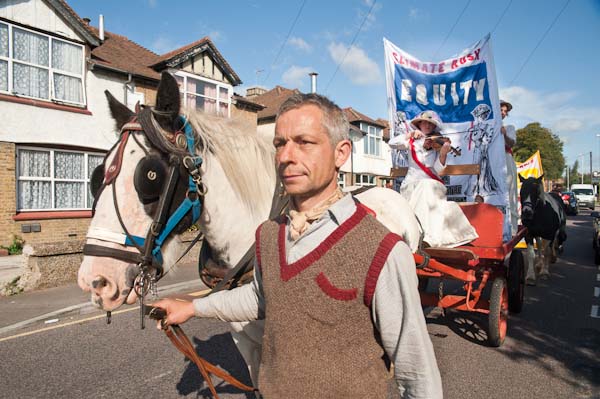
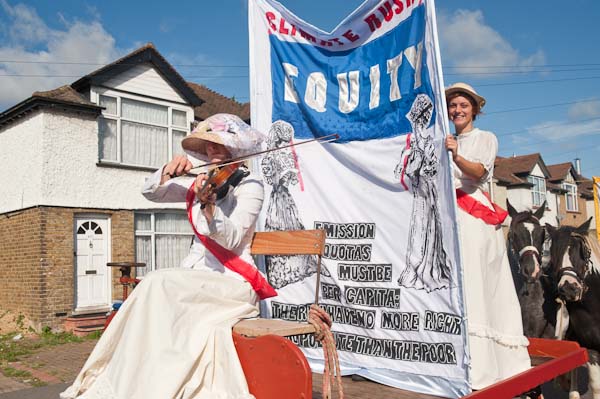
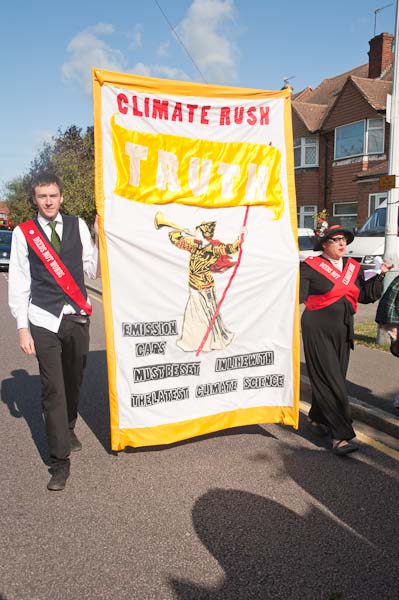
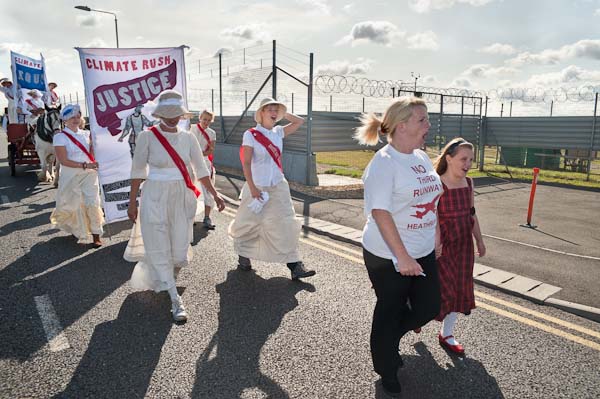
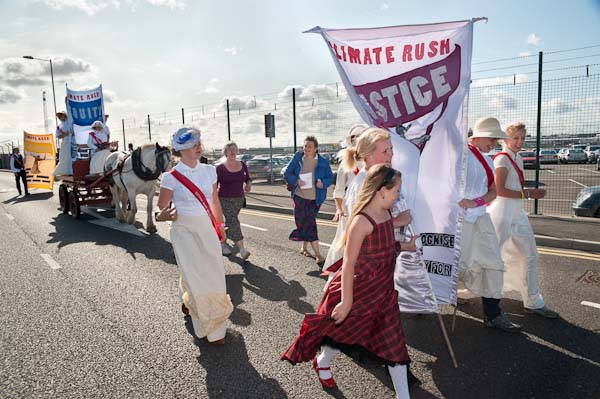
Climate Rush had organised a procession from the Sipson Airplot, led by local residents from NoTRAG, though most were at work today – more were expected later in the day and at the ‘Celebration of Community Resistance’ at Sipson the following day. “Suffragettes (including a ‘token’ male) wearing ‘Deeds Not Words ‘ and ‘Climate Rush’ red sashes carried three banners, Justice, Equity and Truth; Equity traveled on a horse-drawn cart along with a violinist. “
The banners read: JUSTICE: Rich Countries must recognise historic responsibility for climate change. EQUITY: Emission quotas must be per capita; the rich have no more right to pollute than the poor. TRUTH: Emission caps must be set in line with the latest climate science.
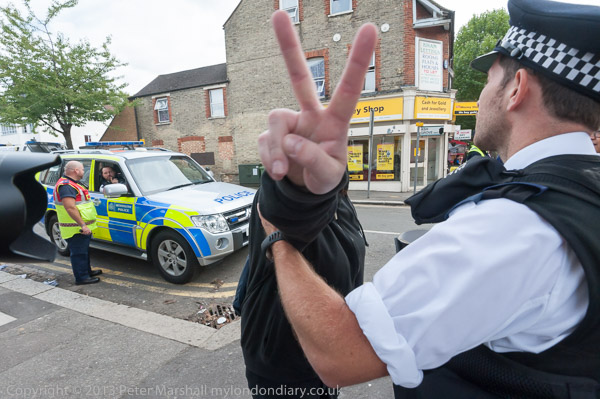
The procession went down the Heathrow and along the Northern Perimeter Road beside the perimeter fence, where we were joined by a police car, which stopped traffic for us before retuning to the Airplot.
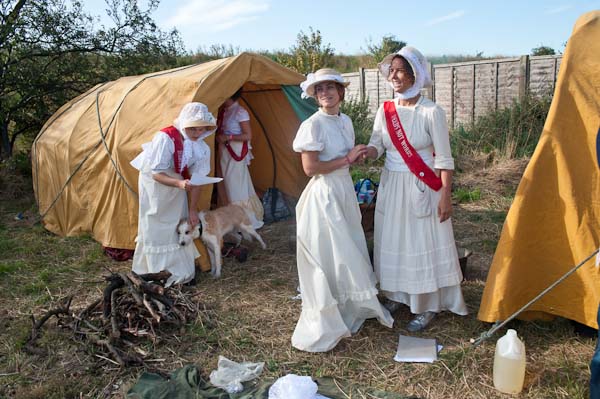
There it was time to rest, and to eat some of the apples from the side of the plot. “A couple of the suffragettes climbed a tree to pick some more, but they turned out to be cookers. The kettle had been hanging over the embers of a wood fire and a few more sticks soon brought it to the boil for tea.”
I’d come to Sipson on the bike which I had ridden through there fifty years earlier – a present on my thirteenth birthday – and had got a puncture just a few hundred yards short of my destination.
“I sat down to mend my puncture. Unfortunately I its a while since I checked the repair kit in my pannier, and having found two largish holes found I didn’t have a large enough patch to cover the two of them and the rubber solution had dried up. It was time for me to walk the six miles home.”
Brian Haw, Syria And EDL Stopped: My working day on Saturday 3rd September 2011 began in Parliament Square, then an extreme right protest in Westminster, Syrians at Downing Street and finally to Whitechapel where several thousand came to stop the EDL entering Tower Hamlets.
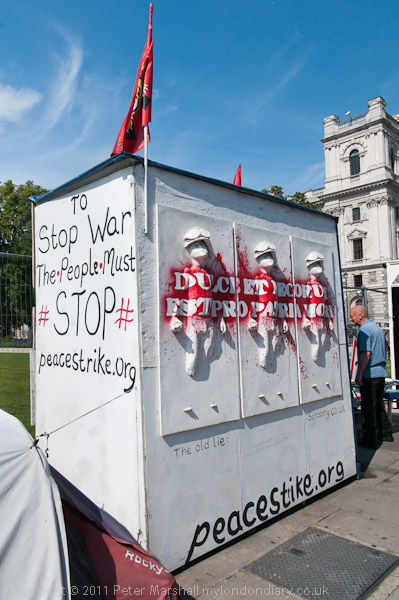
Brian Haw Peace Protest Continues
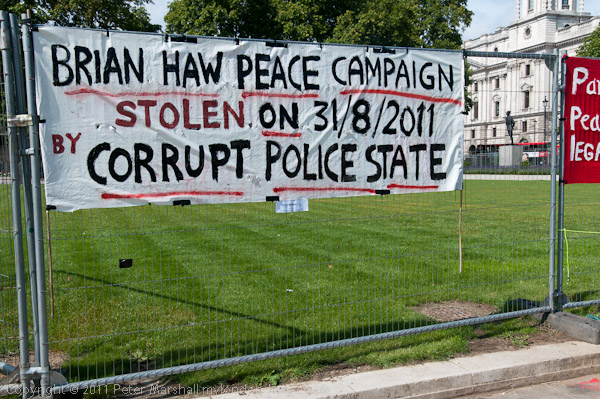
Three days earlier, police had come to Parliament Square and taken away all of the material in the permanent 24/7 peace protest there begun by Brian Haw in 2001 and now continued after his death in June 2001 by Barbara Tucker and other supporters.
Despite the protestation by those carrying on the protest there, the police claimed the material had been abandoned and removed it. The police have for years been under pressure from politicians to end the protest and took advantage of the fact that Barbara Tucker was then being held in Holloway Prison. But a team of others had kept up the protest while she was away and were there when the police came are were still continuing the protest.
This was not the first time that the display here has been stolen by police, the most famous being in May 2006, after which a reconstruction by an artist was controversially put on display at Tate Britain. Since 2006 there had been restrictions on the size of the display allowed there and continuous harassment and arrests of Brian Haw, Barbara Tucker and others involved.
Parliament Square had then been fenced off to the public for some time, with the public denied access to the statues of Churchill, Lloyd George and others, with protests and public limited to the pavements around two sides of the square. But the fencing was useful to display a number of banners. Police did not touch the other peace protest on the pavement by Peace Strike.
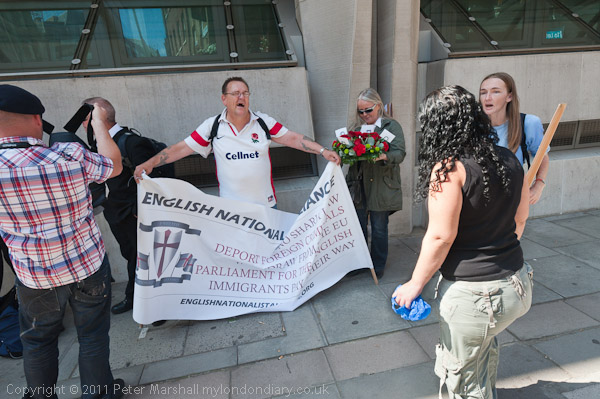
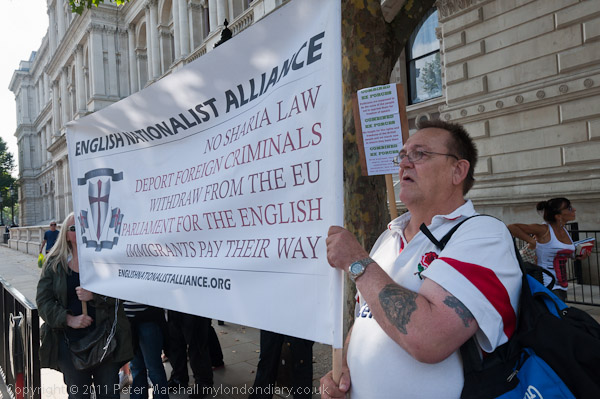
Alternative Action brought together “patriot activist groups” from the far-right who had previously taken part in EDL protests. They said they wanted to dissociate themselves from the loutish behaviour, violence and racism of EDL protests and in particular from the inflammatory incursion into Tower Hamlets the EDL were intending later in the day.
Among the groups involved were the English Nationalist Alliance, the British Patriotic Alliance, the Combined Ex Forces, the Ex EDL Association and the National League of Infidels. ‘Tommy Robinson’ had been reported as saying that the EDL would come to disrupt the peaceful march they had organised but this did not happen.
The setting up of Alternative Action reflects various bitter disputes over the leadership and policies of the EDL, in particular over the lack of accountability in the organisation and the behaviour of some of its self-appointed leaders, including Robinson and the ‘Jewish division’ of the EDL.
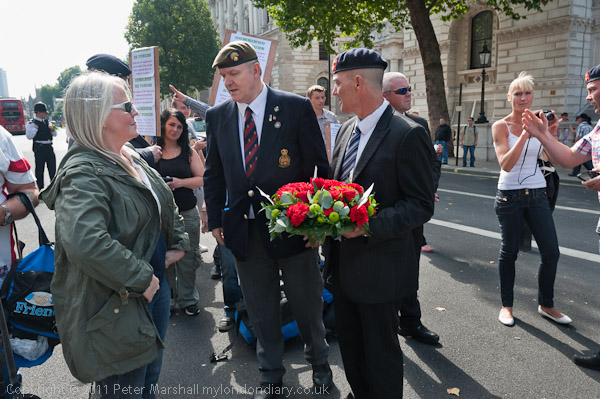
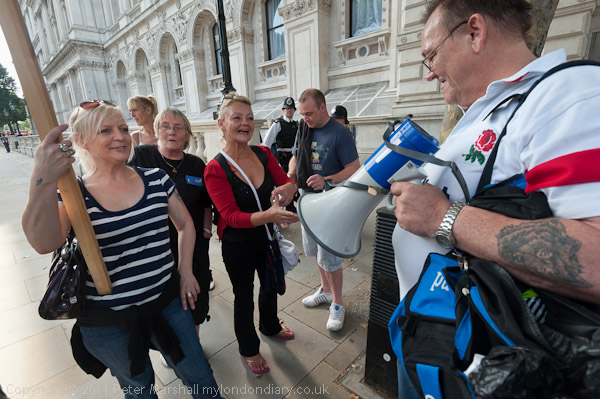
They had come to march from the Ministry of Justice to Downing Street to hand in a letter calling for one system of law in the UK and an end to Sharia courts. The march was peaceful although there was one minor incident when English Nationalist Alliance leader Bill Baker shouted at Syrian protesters, mistaking them for Islamic extremists, but others soon persuaded him to stop. Later some of those on the march expressed the view that it was inappropriate to allow protests involving foreign flags so close to the Cenotaph with its flags honouring our military dead.
Although well over a hundred had indicated on Facebook that they would march, only around 20 turned up. The march paused at the Cenotaph to lay a wreath and observe a minute’s silence in memory of the soldiers who have given their life for their country before continuing to the gates of Downing Street.
Although they had earlier made arrangements with the Downing St police liaison officer to deliver their letter, police at the gate refused to let them do so and would not take the letter. Other protests have had the same reception, which seems to me to be against the letter and spirit of democracy. The marchers then stopped on the pavement just past Downing Street for a rally and after a few minutes I left.
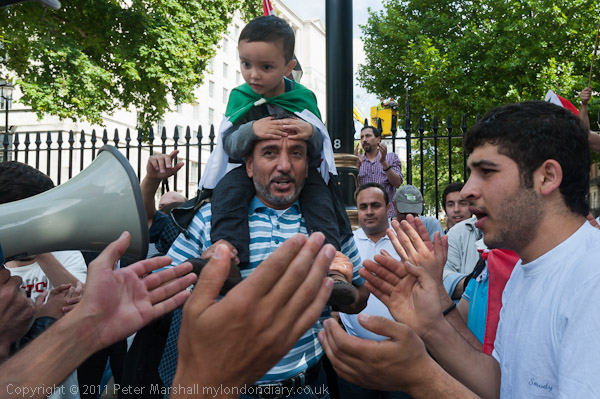
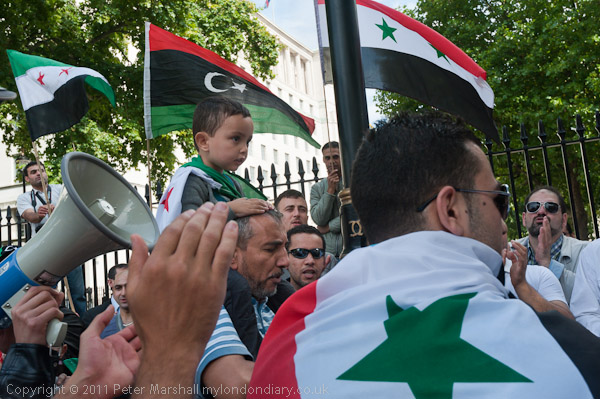
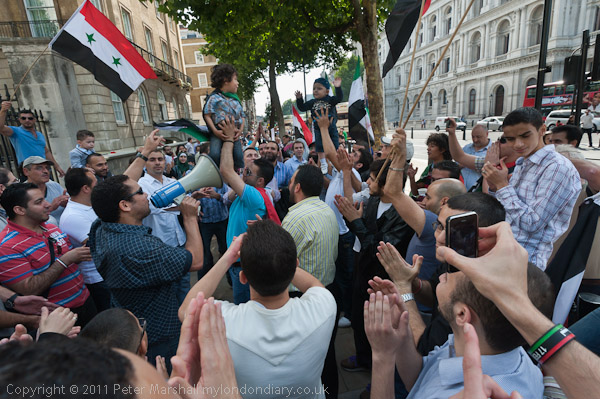
Around a hundred members of the Syrian Community in London had marched from the Syrian Embassy to hold a noisy protest at Downing St calling for freedom in Syria and an end to oppression, atrocities and humiliation by the Assad regime.
They called on the UK to support further sanctions and bring diplomatic pressure to support the peaceful protests in Syria against the Assad regime which had begun on 15th March 2011 and had met with brutal repression.
Marches has been met with tanks, cities and villages attacked by helicopter gunships, men, women and children tortured and more than 1800 people killed, including many children. Soldiers who refused to open fire on civilians or take part in torture have been themselves killed.
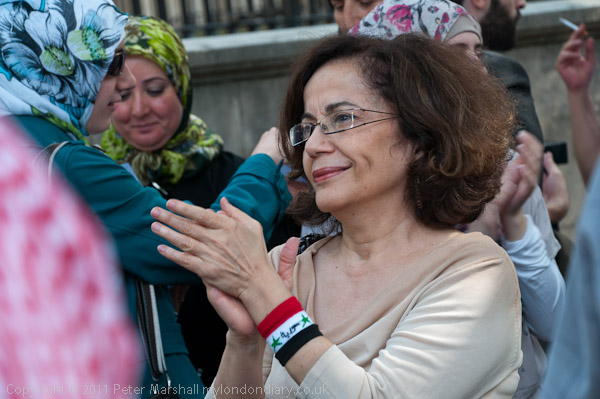
Many of the women taking part wore Muslim headscarves, but there were others who did not, and although most of the drumming, dancing and flag-waving was by the men, this was not a rigidly segregated event although men and women mainly stood it separate groups. The variety of Syrian flags suggested that those taking part included those from various groups opposing the Assad regime.
The protest in Tower Hamlets by residents and their supporters against the plans by the English Defence League to hold a rally somewhere in their borough had started around 11am, but I only arrived later at the time the EDL rally was scheduled to start close to Aldgate East Station.
The street there was empty but blocked by a row of police who refused to let me through despite showing my press card, and I was prevented from going to where the EDL were holding their rally a short distance to the west, just inside the City of London.
Initially the EDL had planned to march through Whitechapel but home secretary Theresa May had banned marches. The EDL then tried to have a static demonstration on a supermarket car park close to the East London Mosque, but the supermarket and other possible sites in the area refused them. Pubs in the area where they intended to meet up for the protest also said they would deny access, and the RMT announced they would close the Underground stations because of the danger to staff.
Police stopped some EDL supporters and turned them back as they tried to enter London. Others got lost wandering around London trying to find pubs that would serve them, and the numbers at the EDL rally were apparently considerably less than the organisers or police had anticipated.
I gave up trying to get to the EDL rally and went instead to the large crowds who had come to Whitechapel High Street and Brick Lane to stop them, and then on to another large crowd who had come to defend the the East London Mosque. The community had clearly united to stop the EDL and there was a huge cheer when it was announced that EDL leader Stephen Yaxley-Lennon (aka Tommy Robinson) had been arrested after speaking at the EDL rally, where he had apparently boasted of having broken his bail conditions.
There was more jubilation when the crowd heard that police were moving the EDL away from the rally at Aldgate to Liverpool street and their coaches waiting across the river in Tooley Street.
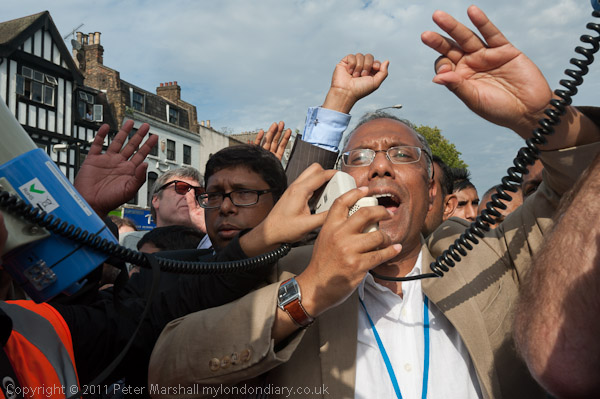
The protesters began a ‘Victory March’ from the bottom of Brick Lane along Whitechapel High St, led by the Mayor, councillors and others who linked arms across the width of the road.
It stopped at the East London Mosque, but some activists decided to continue and were briefly stopped by police who told them their march was illegal because of the ban in place in Tower Hamlets.
They walked around the police who tried to stop them but a few hundred yards on stewards and some of the protest leaders including Mayor Lutfer Rahmen managed to bring the march to a halt, telling them to enjoy their victory and not continue as arrests now would become the story of the day for the press rather than it being one of a community victory over racism. They calmed down, some took up the offer of a cup of tea back in the Muslim Centre, while others, including myself, went home.
Stoke Newington Shops: Continuing my walk on Sunday 8th October 1989 which had begun at Seven Sisters Station from where I had walked south down the High Road and the previous post, Church of the Good Shepherd, Synagogue & Stamford Hill had ended on Stamford Hill.
Star Mews, Cafe, Windus Rd, Stoke Newington, Hackney, 1989 89-10d-15
I continued walking down Stamford Hill, taking a brief look down each side street, but nothing particularly attracted my attention until I reached Windus Road. Some way down this I came to the entrance to Star Mews.
The archway to Star Mews is still there between 52 and 54 Windus Road but there is no longer a cafe, the property is now residential with a small walled front garden. Star Mews is one of two mews in the street and leads to two single storey (now with roof windows) in the area behind which were presumably once stables.
The houses here are not grand, and I think these were probably built for small businesses who will have had horse-drawn carts for delivery rather than the carriages of mews in grander districts.
I went back to Stamford Hill and at the entrance to Stoke Newington Station turned into a small pedestrian side-street, Willow Cottages with this row of three shops, one of them Marshall’s School of Motoring so had to take this picture. These are still there beside the new station building, and G’s Car Service is now Ron’s Car Service. – the old station was almost invisible at street level – but this small area has altered so much I can’t be sure. The jewellers is now a hair salon and Marshalls have left the building, now occupied by Ria money transfer and a takeaway.
I crossed the busy A10 Stamford Hill and went down Manor Road opposite where there was this row of shops on the north side. These three shops are single storey buildings, at the end of the two storey buildings of Manor Parade, but seem to have been built in the same style, probably like their larger neighbours in 1906, according to an ornamental date on their gable.
The site with two large advertising hoardings at right is on the side of the railway line, here in a cutting, and there is be little level land behind these shops.
This noticeboard without notices on the top of what was until fairly recently a private hire service office, Hill Cars, is another of the pictures which I used in my web site, exhibition and self-published book ‘1989’, ISBN: 978-1-909363-01-4, still available, and this picture is from those. The first paragraph refers to the page before this one in ‘1989’.
The house here is still at 16 Manor Road and is now residential and without the clutter and signage. Andora’s builders yard is now commercial premises on the ground floor with flats above and a vehicle entrance to more in the yard behind.
L T Locking, Estate Agent, 18, Manor Rd, Stoke Newington, Hackney, 1989 89-10e-65
This short row of shops was just beyond the builders yard, all at 18 Manor Road, although they seem to have been built at different times. Locking’s estate agency is in a taller and more elegant four storey tower, and the closer building at right was, according to a ghost sign under its first and second floor windows, the DEPOSITORIES of T HARRIS, though his name is not clear. This industrial warehouse is now an events and filming venue and was the birthplace of the original TV “Dragons Den” where the first season was shot in 2005.
Also now I think a filming location as ‘The House Next Door‘ (or possibly a part of The Depository’ and that is the next shop.) Earlier it had been home to the curiously named Balloon Lagon (lagon is French for lagoon), which sold odd balloons and then a property agency.
The post at left looks like a lamp post, perhaps for a gas lamp, but could also have simply held an advertising sign. Srill on the pavement it has now lost its upper half.
Back on the A10, I walked down to the end of Stamford Hill at Cazenove Road, where it becomes Stoke Newington High Street, and went briefly down Cazenove Road and photographed a couple of the shops there. I’d previously photographed Madame Lillie on a walk in July 1989 so haven’t digitised the picture I took this time, but this one of Rabinowitz, Kosher Butcher & Poulter and The Metaqphysical & Inspirational World Universal Book Shop at 2 and 4.
I returned to the main road and crossed it to the gates of Abney Park Cemetery where the next post on this walk will begin.
Church of the Good Shepherd, Synagogue & Stamford Hill: Continuing my walk on Sunday 8th October which had begun at Seven Sisters Station from where I had walked south down the High Road. The previous post, South Tottenham & Stamford Hill had ended on Rookwood Road.
Church of the Good Shepherd, Ancient Catholic Cathedral, Rookwood Rd, Castlewood Rd, Clapton, Hackney, 1989 89-10d-34
This Grade II* listed church was built in 1892-5 for the Agapemonites, aka the Community of the Son of Man, a group founded by former Church of England minister Henry Prince who set up the Agapemone community whose name means ‘Abode of Love’.
Various scandals ensued when it emerged that this love was sometimes rather more than spiritual. Prince died in 1899 and John Smyth-Pigott became leader of the sect and his relations with numerous female followers caused greater scandal. In 1902 Smyth-Piggot declared the Second Coming had arrived and that he was Jesus Christ, the Son of Man.
An angry mob chased his carriage across Clapton Common and he retired to Somerset where he died in 1927.
St Luke, Ox, St John, Eagle, Church of the Good Shepherd, Ancient Catholic Cathedral, Rookwood Rd, Clapton, Hackney, 1989 89-10d-36
The church was built by Joseph Morris and Sons of Reading, the sculptures were by A G Walker and the church apparently has remarkable stained glass by Arts & Crafts artist Walter Crane. When the last Agapemonites died it became in 1956 the Ancient Catholic Cathedral Church of the Good Shepherd and in 2007 the Georgian Orthodox Cathedral Church of the Nativity of Our Lord.
St Mathew, St Mark, lion, Church of the Good Shepherd, Ancient Catholic Cathedral, Rookwood Rd, Clapton, Hackney, 1989 89-10d-22
Another picture of the sculptures on the church by A G Walker. The stained glass which I was unable to see was by Walter Crane. There is a lengthy description of the building in its Grade II* listing, first made when it was the Church Of The Ark Of The Covenant.
New Bobov Synagogue, Egerton Rd, Clapton, Hackney, 1989 89-10d-24
Built around 1914-15 in an Edwardian Baroque style the Grade II listed New Synagogue was bought in 1987 by the Babov Community Centre from the United Synagogue. The Bobov congregation (Beth Hemedrash Ohel Naphtoli) was founded in Poland but now has its headquarters in New York and is Strictly Orthodox Ashkenazi.
Newsagent, Used Cars, Stamford Hill, Hackney, 1989 89-10d-11
The Hill Candy & Tobacco Stores Ltd at 141 Stamford Hill was well covered with advertising for Camel, Marboro and others as well as sensational posters for the Evening Standard, ‘LONDON MURDER SPARKS ‘RIPPER’ FEAR. Tabloid journalists were probably the only people in London who were affected by this particular anxiety.
The shop is now an off-licence. The used car sales with its bunting at right is no longer but there is a parking area in front of the offices there now. The Turnpike House pub just visible in the distance on the corner with Ravensdale Road closed in 2021 and is now boarded up.
Eshel Hotel, Stamford Hill, Hackney, 1989 89-10d-12
Eshel is the Hebrew for Tamarisk. Genesis chapter 21 verse 33 states that Abraham planted one at Beersheba and prayed there to Yahweh in thanks for God’s covenant with him. That species of tamarisk is a slow growing desert tree and at some times in the year it secretes a sticky honeydew which some think was the manna which provided food for them in the wilderness.
I think this building is now offices for Orthodox Jewish organisations. The delicate wrought iron gates and railings with the menorahs in them were replaced a few years ago by rather more secure fencing.
My walk continued to Stoke Newington – another instalment shortly.
Racist Thugs Not Welcome: Recent events in Southport and elsewhere have brought racist thugs to the attention of politicians and police, but many of the same people have been out on our streets for many years, under various different names – the National Front, BNP, EDL, Football Lads and more, their activities largely ignored by the media and sometimes assisted by police.
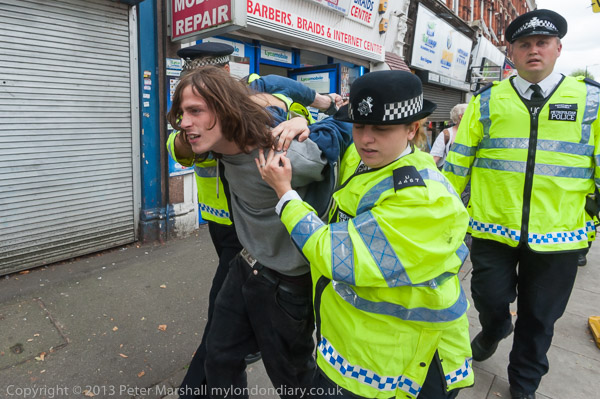
An anti-fascist protester sends a clear message to the South East Alliance as police drag her away
They represent a small rotten mouldy patch on the skin of our society, which inside and at its core is decent and open-minded, but they have been encouraged by the red-top newspapers of the right and also by the speeches and actions of politicians of both our leading parties in their ever rightward rhetoric around “illegal immigrants“, hostile environments and more, and the attacks on Muslims as a whole while refusing to take Islamophobia seriously.
As many – including Amnesty International point out, there is no such thing as an illegal immigrant. The term is a “pejorative term of uncertain meaning“. As the Migrant Rights Network puts it more directly, it is “dehumanising, immoral, and contributes to the demonisation of migrant communities.” It is a clearly racist term and one that politicians and media should be treating in the same way as the ‘N‘ word, the ‘P‘ word and others.
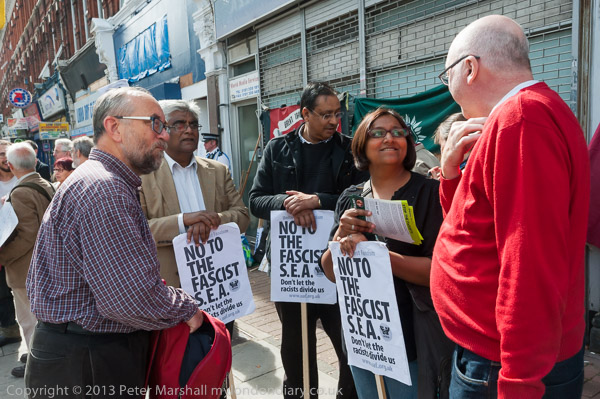
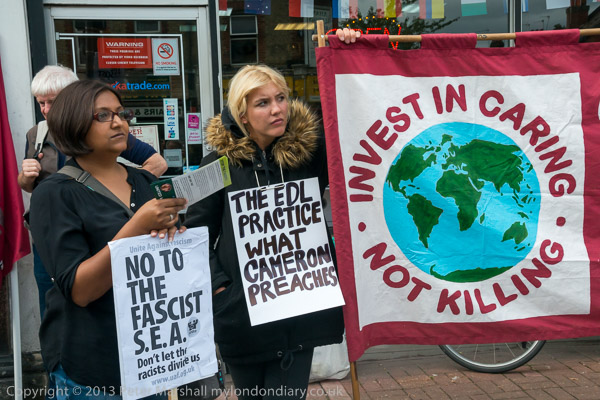
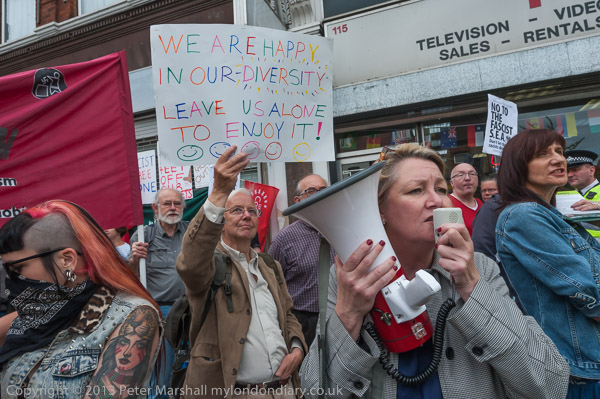
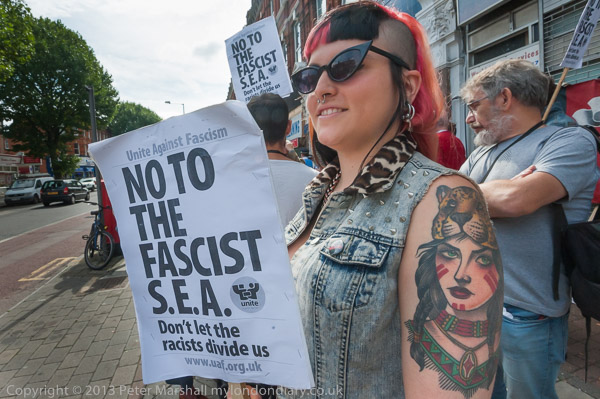
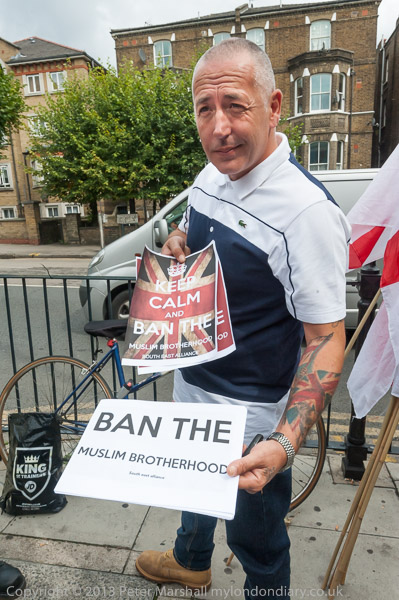
Ten years ago today, on Saturday 30th August 2014, racist thugs who then called themselves the ‘South East Alliance’ (SEA) came to Cricklewood to protest close to the empty offices they say are used as a recruiting centre by the Muslim Brotherhood.
They were a small group, perhaps around 30 people and a much larger group which grew to several hundred organised by ‘North West London United’ had come to oppose their protest.
The office had been that of World Media Services, run by Egyptians who supported the Muslim Brotherhood, an organisation set up in their country in 1928 which had set up hospitals, schools and businesses as well as preaching Islam. In 2012 its candidate Mohamed Morsi had become the first Egyptian president to gain power through a democratic election, but a year later had been overthrown by a military coup and the group was banned in Egypt. World Media Services had, along with other publishing services, produced an unofficial English Language web site about the Brotherhood.
Police were also out in force and from the bus from Kilburn along the route the SEA were to march later saw around a dozen police vans as well as a row of motorcyclists. Outside the offices on Cricklewood Broadway I found people had already started to gather with banners around 90 minutes before the march was due to arrive – and by the time I got on the bus to go back to the start of the march there were around 150 there, with more arriving.
At Kilburn Station it was very different. The SEA were supposed to be arriving from 12 and the march setting off at 1pm, but when I arrived there were only a small group of police. Ten minutes later, SEA leader Paul Pitt (I met him before when he was the Essex EDL organiser) arrived with three others. There were still only four when the march set off at 1.15pm and after photographing them marching I got on a bus back to Cricklewood.
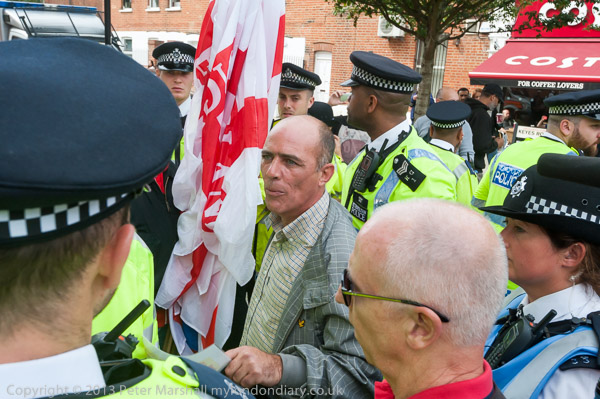
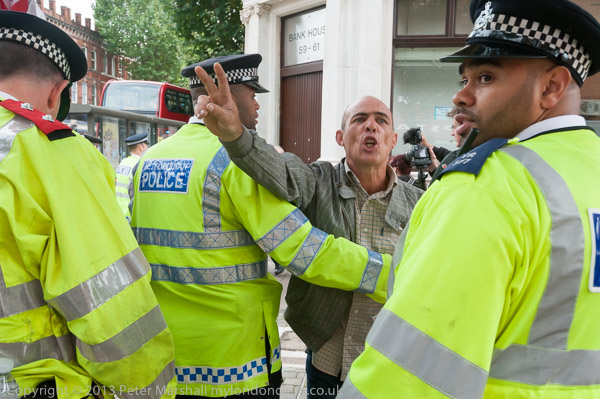
By this time a few SEA protesters had arrived directly in Cricklewood and been directed into a pen on the pavement opposite the offices, and police were keeping the two groups well separated. But around 30 anti-fascists moved towards the march – now up to 11 people – as they saw its flags in the distance. Police stopped both groups in “an uneasy confrontation, with just a double line of police separating the two groups, and photographers milling around.“
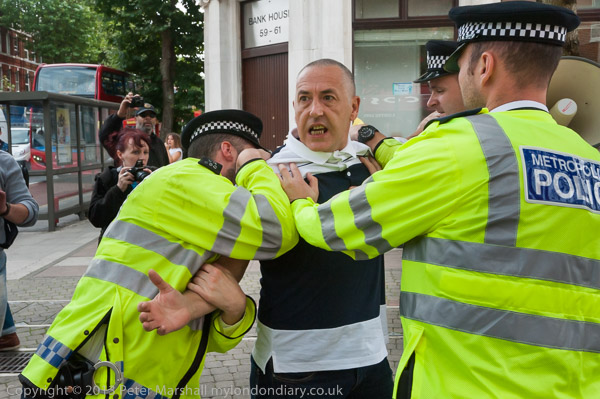
At one point Paul Pitt who had refused to stop shouting foul abuse was warned by police and then when he tried to push through the police line was handcuffed and cautioned.
But another officer then intervened and he was was freed. Police then escorted the 11 to the pen with the other SEA protesters.
A few minutes later another small SEA march came down a side street, with a few holding up posters, banners and flags. They used the poles holding the flags to try to injure photographers, but police did nothing to stop them.
Later when I was photographing them inside the pen they again used these long bamboo poles as weapons. Rather than warn them or take away the poles, police moved photographers back and set a small line of police to keep us out of range. I complained to the officers but as usual they took no notice.
While I was there a number of the anti-fascists were arrested and taken away by police, but none of the SEA were arrested and the police made it clear to them that they were ‘facilitating their protest‘. The extreme right often complain about “two-tier policing” and this did seem to be a clear example of this, but with the SEA being awarded kid glove treatment.
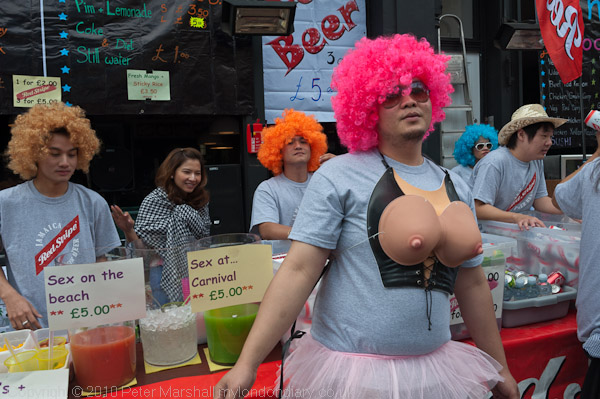
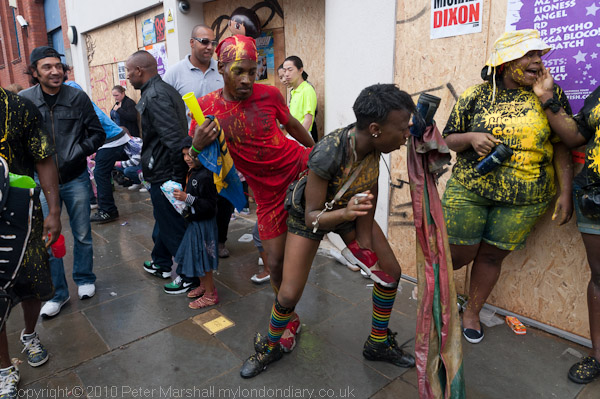
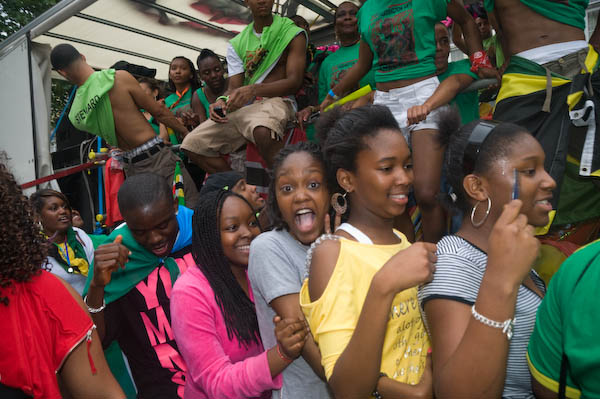
Childrens’ Day at Notting Hlll: Sunday 29th August 2010 was the first day of the two day festival though it’s called Childrens’ Day there are also plenty of adults there and sometimes having some rather adult fun. You will fine rather more pictures of children in the collection on My London Diary than in this post.
(C)2009 Peter Marshall – Right -Click and select ‘Open Image in new tab’ to load a larger version in a separate web page.
It does have the advantage of being just a little less crowded than the main Monday of carnival, when even though I try to avoid the most crowded places where it’s hard to move let along take photographs, but there is perhaps just a little less excitement and mayhem.
But by 2010, the carnival had begun to lose its charm for me and was no longer one of those dates entered into my calendar at the beginning of the year, and I had decided only to go on the slightly quieter (it’s relative) day of the year.
The sound is always a vital part of carnival, but can be a threat to health. When the beat makes your internal organs jump up and down and you can see the tarmac vibrating you know its really a bit too loud. And it could take several days for the pain in my ears to dissipate and normal – or at least near-normal – hearing return.
When I was young I seemed to recover but I think now the changes could well be permanent. My hearing isn’t perfect and some of those high notes are long gone, but its good enough to get by most of the time and I don’t want to risk it more.
I used to laugh a bit at the TV crews at carnival wearing ear protectors and think they were missing the spirit of it, but at least they were sensible. But I don’t think I could have produced the work I did wearing them.
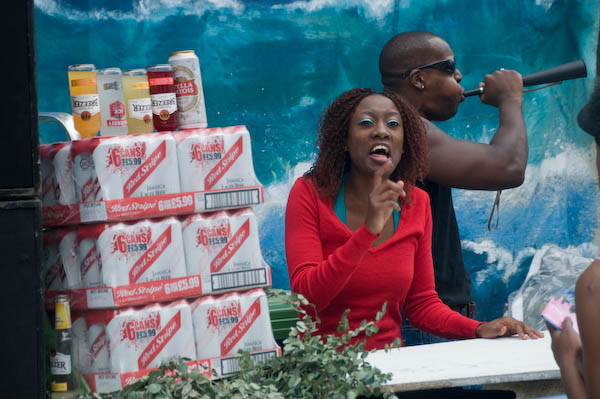
2010 wasn’t the final carnival I attended – and one year I might just go again though I’ve not done so since 2011. But if I do I think I’d probably only stay long enough to drink a can or two of Red Stripe and probably take few pictures.
As I commented on My London Diary I took only one DSLR camera – the Exif Data remings me it was a Nikon D700 – and one lens, a Sigma 24.0-70.0mm f/2.8 and I worked all the time in full-frame Raw mode. The great majority of the pictures were made within 1-2 metres from the subject so people were very aware a photographer was pointing a large camera and lens at them, though many were too engaged in what they were doing to act up for the camera.
I was pleased with the pictures, but the small versions on My London Diary don’t really do them justice. So I’ve included a large one at the top of the post. Like some of the other pictures it was taken in a heavy shower that sent many of those watching rushing for cover but the carnival continued. If you double click on the top image it should open at a larger size on its own page in your browser.
Sipson Celebrates Third Runway Victory: On Saturday 28 August 2010 residents of Sipson and the neighbouring Middlesex villages of Harmondsworth and Harlington held a Family Fun Day to celebrate the successful end to their campaign against BAA’s plans to create a larger airport at London Heathrow by building a new runway and destroying their villages.
One of the first acts when the new Tory Lib-Dem coaltion came into power was to cancel the plans for the expansion of Heathrow by the building of a third runway, which had been agreed under New Labour. It was perhaps one of the few positive results from the coalition between the Conservatives and the Liberal Democrats, with leading MPs from both parties at least those in the London area having earlier campaigned against the plans.
The fight against expansion had been long and hard, involving what leading campaigner John Stewart of HACAN described as ‘a ‘Victory Against All The Odds’, putting “success down to three main things: the building up of what it calls the largest and most diverse coalition ever to oppose expansion of an airport in the UK; a willingness to challenge the economic case for expansion; and a determination by the campaigners to set the agenda.”‘
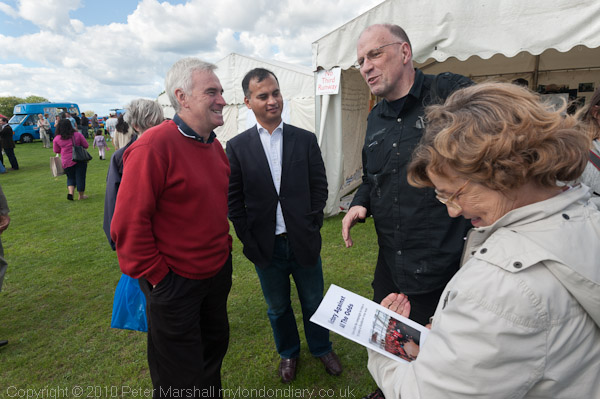
Local MP John McDonnell talks with John Stewart of HACAN and then London Assembly member Murad Qureshi
In 1999 the owners of Heathrow, the largely Spanish owned BAA plc – the company formed by the privatisation of the British Airports Authority and now the Heathrow Airport Holdings Limited, had pledged at the Terminal 5 inquiry that they would never ask for a third runway. But only three years later they had brought forward massive plans for airport expansion, including a third runway.
And although again they had promised they would not call for a sixth terminal the plans soon included one, along with ground areas for standing aircraft and a relocated motorway spur that would cover most of Harlington, Sipson and Harmondsworth, as well as subjecting a further area of West London to increased aircraft noise and excessive pollution. BAA even declined to rule out making a request for a fourth major runway at Heathrow.
The first large-scale protest march took place in June 2003 and their were many further actions, including a mass protest at Heathrow in May 2008 and many smaller events, lobbies and meetings. The Climate Camp had come to Harmondsworth in 2007, Greenpeace who bought a local orchard as their ‘Airplot’ and direct action campaigners such as ‘Plane Stupid’, ‘Camp for Climate Action’ and ‘Climate Rush’ all gained publicity for the case against expansion.
John Stewart of HACAN
But Heathrow didn’t give up, and kept up the lobbying to persuade the Tories to give the project the go-ahead. The government set up an Airport Commission with a employee of one of Heathrow’s major owners having to leave his job with them to chair it. As intended this came up with preferring expansion at Heathrow in 2015, and this was adopted as government policy in 2016. But when it became clear that Heathrow would have to come up with the money, their plans were cut down – and in 2017 they dropped the plans for Terminal Six.
Geraldine Nicholson, Chair of NoTRAG
After a judicial review in 2020 ruled that the plans for expansion were unlawful because they had not taken into account the commitment to combat climate change, the government announced it would not appeal. But Heathrow did, took the case to the Supreme Court who in December 2020 lifted the ban so the planning application could go ahead.
Covid then came to the rescue, with the drop in passenger numbers meaning plans were put on hold. But according to Wikipedia, from which some of the above information comes, “as of June 2024 the third runway is still planned with a projected completion date around 2040.”
Back in 2010, although celebrating victory, campaigners and local residents were clear that the fight had to go one, and it has done. It seems rather unlikely giving the increasingly clear nature of our global climate catastrophe that Heathrow will ever get a third runway. Although the celebrations in 2010 may have been somewhat premature I think it was then that Heathrow really lost the battle. Since then we have been seeing the thrashings of a dying great beast.
You can read more about the Family Fun Day, organised by Hillingdon Council and NoTRAG on 28 August 2010 and see many more pictures on My London Diary at Sipson Celebrates Third Runway Victory.
Climate Camp at Blackheath – Wednesday 26th August 2009
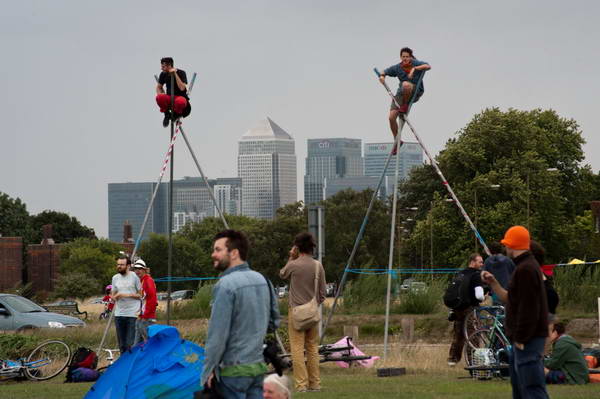
On Wednesday 26 August 2009 I joined Climate Campers who were meeting at several locations around London to go to an as yet unspecified location for that year’s Climate Camp.
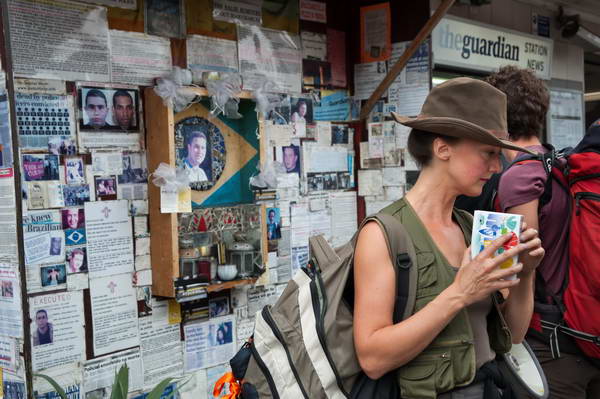
I’d chosen to go with the Blue Group who were meeting at Stockwell Underground Station in south London, chosen as one of the starting points because of the events of 22 July 2005.
As I wrote back then, on “the escalator at Stockwell station it’s hard not to shiver at the memory of those videos showing Jean Charles de Menezes strolling down to catch his last train, and police coming though the gates in pursuit. There is a memorial to him outside the station, including a great deal of information about the event and the misinformation and covering up by police.“
Arriving there I found around 80 Climate Campers and half a dozen police being filmed and photographed by around 30 media and nothing very much happening. It was like that for the next couple of hours, during which we all went to a local park to have our sandwiches and some played games.
Eventually around 2pm we were called back to the station where we followed the leader who had a blue flag onto a train and off at Bank, where all trooped to the DLR, alighting at Greenwich. From here we trudged up the hill to Blackheath Common. Police were keeping a low profile, watching from a distance.
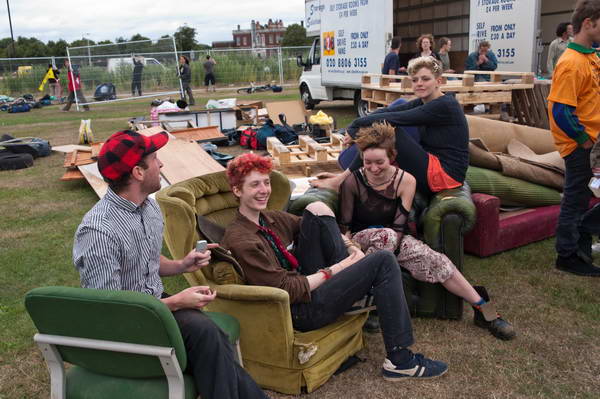
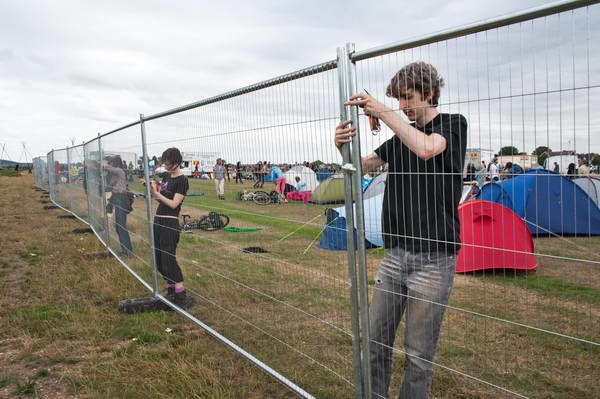
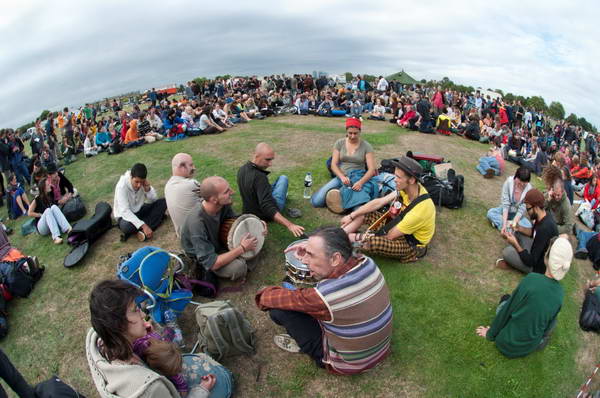
When we arrived the site on the common was still being secured and some people were hard at work erecting fences and vital resources – such as toilets. Legal observers were holding a meeting, but others were just making use of some comfortable furniture on the site or listening to singers.
I tried to photograph as many of these activities as I could.
In earlier years I’d had problems with Climate Camp and in particular their media policy. As I wrote “Press photographers visiting the site will be required to sign a media policy that most of us would find unacceptable and to be accompanied while on the site by a minder. (It can’t of course apply to the police photographers in their helicopter or cherry picker.) The policy appears to be driven by a few individuals with paranoid ideas about privacy and a totally irrational fear of being photographed. It really does not steal your soul!“
On the Wednesday the camp was still being set up and everyone had unfettered access. But this year in any case I’d actually been invited to take part as part of the media team for the camp – and on my later visit was provided with a sash to identify me as such – though I did still come across a little of that paranoia even when wearing it.
But there were also so many people I knew and others who recognised me from from other events that I felt very much at home walking around the site. The main problem I had was trying to keep moving rather than being drawn into lengthy conversations.
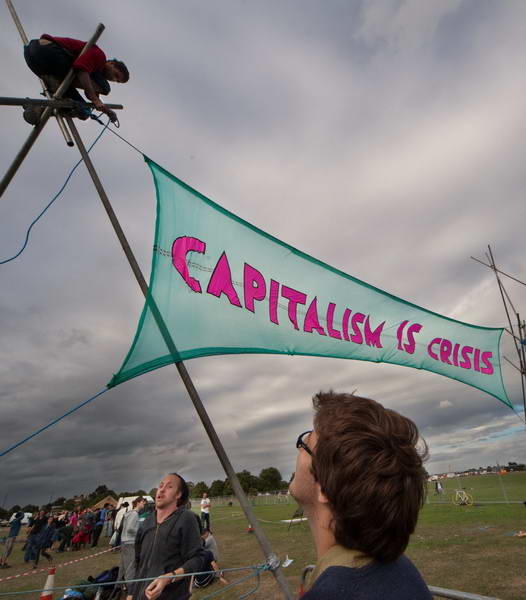
There was a meeting to welcome us all to the Climate Camp, after which the preparations for the camp continued, with water supplies being laid on, even baths plumbed in, various larger tents being erected as well as a large banner CAPITALISM IS CRISIS.
I had other things to do on the Friday and Saturday, but was able to return for a day at the camp on the Saturday, to make a record of the camp’s activities and of the campers at work and play, as well as some of the visitors who came to see what was happening. You can see my accounts and pictures from both days on My London Diary.
Notting Hill Carnival: Here with some minor alterations is the piece I wrote for My London Diary about Carnival in 2008, with a few of the pictures. You can see many more pictures from the day on My London Diary.
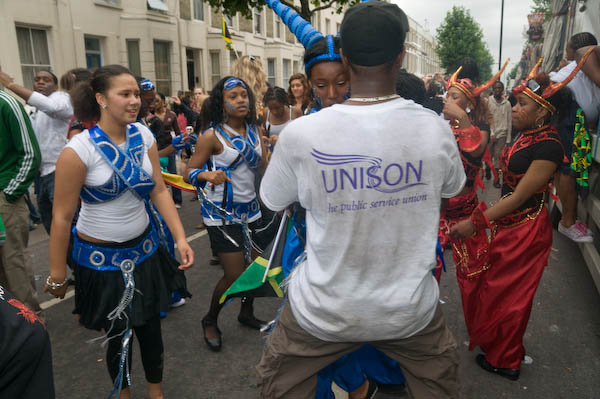
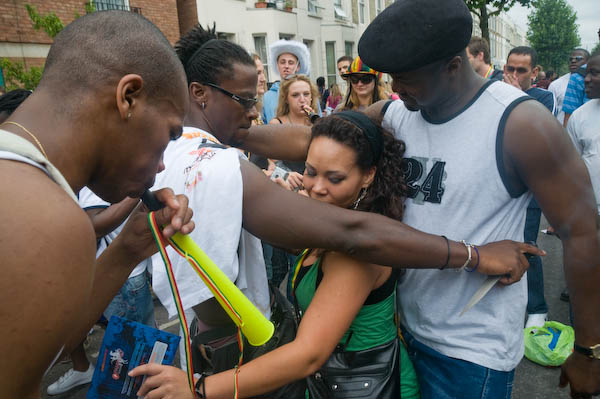
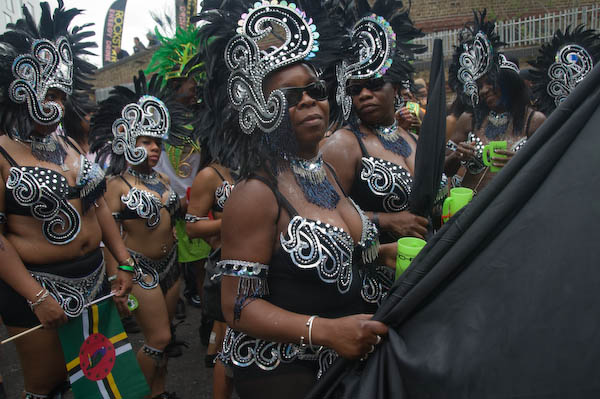
There isn’t a great deal more to say about Notting Hill, although it did seem to be significantly less crowded than in recent years (some sources estimate attendance yesterday as three quarters of a million), and I walked easily through a number of areas that have usually been filled with seething masses. There did also seem to be fewer lorries and groups on the circuit than in previous years, but the big mas bands at the core of the event were out in force as usual.
Perhaps there are just too many other events on over the weekend and people were tired. Perhaps with the difficult economic times there is less funding for groups and less commercial interest (though Unison were still behind South Connections.) The weather wasn’t great either, though it didn’t rain.
Of course there are still many people who won’t go to carnival because they are scared of possible crime and violence. Police have reported that they had over 300 crimes reported to them at carnival on Monday and made around 150 arrests – considerably up on last year. With a reported 11,000 officers on duty it was still probably the safest place in the country, although I saw no sign of the metal detectors that were intended to prevent knifes being carried. In around five hours I only saw one brief incident as a young man was escorted away. The only knives I saw were plastic.
Of course carnival did go through troubled times. Its genesis was as a black response to the race riots in Notting Hill fifty years ago, although it only became a parade around the streets in 1965. In 1976 there was serious fighting when 3000 police attempted to take over and control the event and had to withdraw. Since then there have been various attempts to control and even stop carnival in Notting Hill, including the organising of alternative events elsewhere. And carnival itself has become much more managed and along with this, much safer to attend
I first went to carnival and took pictures around 20 years ago and have returned every year except one when a knee injury made it impossible (I made an effort, limping from home to our local station where I collapsed, unable to climb the footbridge, and decided I really wasn’t up to it.)
In October 2008 I took part in a show in the Shoreditch Gallery at the Juggler (now long close) in Hoxton Market, confusingly half a mile away from the site in Hoxton St where Hoxton Market is held and I was photographing Sunday’s ‘1948 Street Party‘. Hoxton Market is immediately to the north of the Holiday Inn on Old Street. The show, still online, was called ‘English Carnival’ and was a part of the East London Photomonth 2008.
The other 3 photographers, Paul Baldesare, Dave Trainer and Bob Watkins, showed pictures from ‘traditional’ English carnivals – like the Hayling Island one at the beginning of this month (August 2008), but my pictures were from Notting Hill – which now with other carnivals drawing their main inspiration from the Caribbean and elsewhere around the world is very much a part of the English carnival scene.
The work I chose for this show was a black and white portfolio of 20 images which had been previously published in ‘Visual Anthropology Review‘, where it accompanied a scholarly essay on carnival by distinguished academic, George Mentore along with his perceptive comments on my pictures.
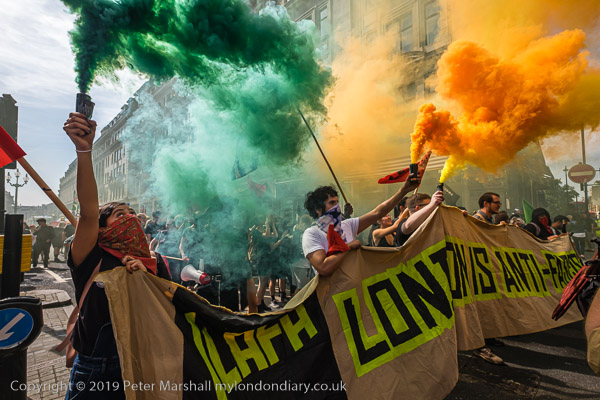
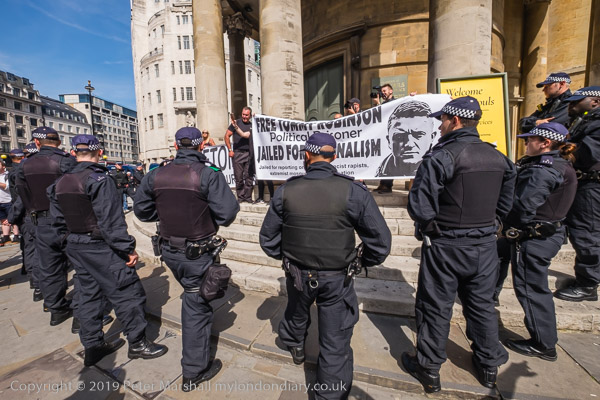
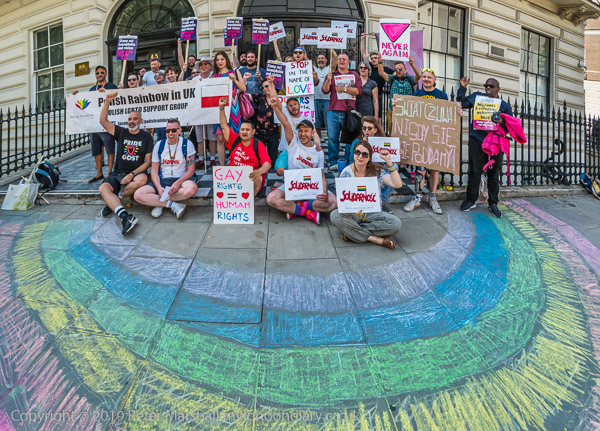
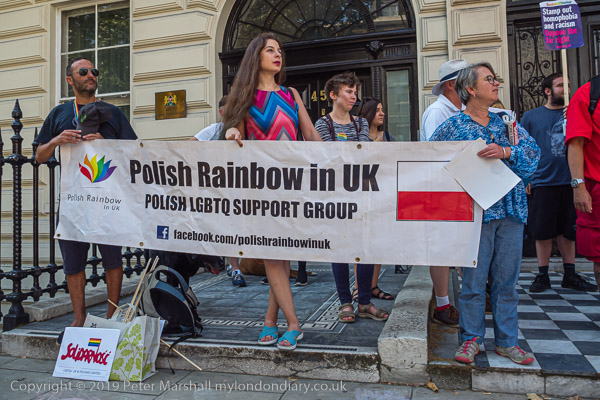
‘Tommy Robinson’ & Poland: Five years ago today, Saturday 24th August 2019 I covered two protests in London against the extreme right. Anti-fascists opposed a protest outside the BBC after far-right activist Stephen Christopher Yaxley-Lennon, better known as Tommy Robinson was jailed for violating a court order, and there was a protest at the Polish Embassy in solidarity with LGBTQ+ people in Poland whose lives are under threat from the right-wing Law & Justice Party and the Catholic Church.
Anti-fascists outnumber ‘Free Tommy’ Protest
Robinson was sentenced to 9 months for 3 offences outside Leeds Crown Court which could have led to the collapse of a grooming gang trial, and has previous convictions for violence, financial and immigration frauds, drug possession and public order offences.
The claim by his supporters that he was imprisoned for ‘journalism’ and in some way is a defender of free speech is simply ludicrous. He knew he was breaking the law and pleaded guilty.
Free Tommy supporters shout at the opposition
All journalists know that they have both rights and responsibilities and we are governed by the laws of the country, particularly with respect to the publication of material. Good journalists often publish material that some people would not want published, citing the public interest in doing so, but in this case Robinson’s actions were clearly against any public interest and could have led to a serious criminal prosecution having to be abandoned.
Two groups of protesters came to oppose the protest outside the BBC by Robinson supporters. I met the London Anti-Fascist Assembly and others at Oxford Circus and accompanied them as they marched up Regent Street towards the BBC.
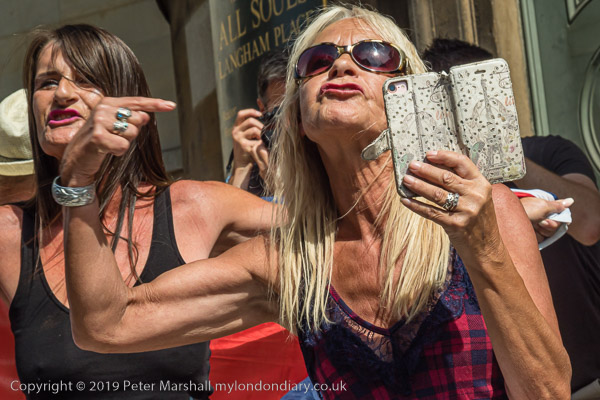
Police marched with them too, and stopped them a few yards from the Robinson protest. When we arrived there were only a handful of ‘Free Tommy’ supporters waiting on the steps of All Souls Langham Place. They shouted back as the Anti-Fascists shoted at them and a police officer warned one of the women about her language as the police moved the Anti-Fascists back to the other side of the road
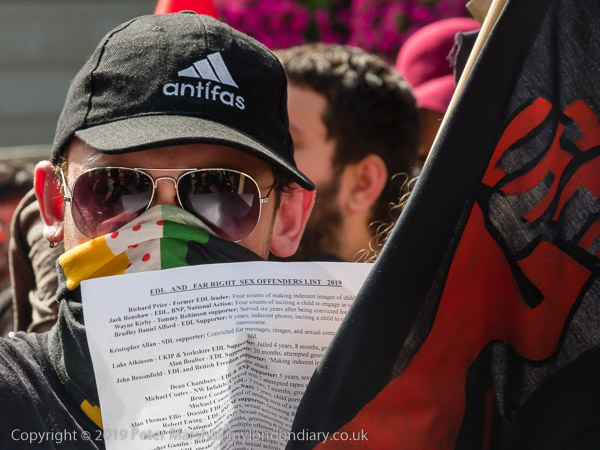
After some considerably shouting at the extreme right they were pushed by police into a pen on the opposite side of the road. Here they continued to shout at the extreme right protesters and a long list of EDL and Far Right convicted sex offenders was handed out.
Shortly after a large group of Stand Up to Racism supporters arrived to stand beside the Antifa protesters. A couple of police horses came as well as a few more Free Tommy supporters who had marched from Trafalgar Square protected by a police escort.
But theirs was still a small protest, greatly outnumbered by those opposed to them.
The stand-off shouting match continued, with police largely keeping the two groups apart. I left for 45 minutes to cover another protest, and returned to find little had changed, but saw one anti-fascist being led away to a police van after being arrested for refusing to get off the road when ordered by police.
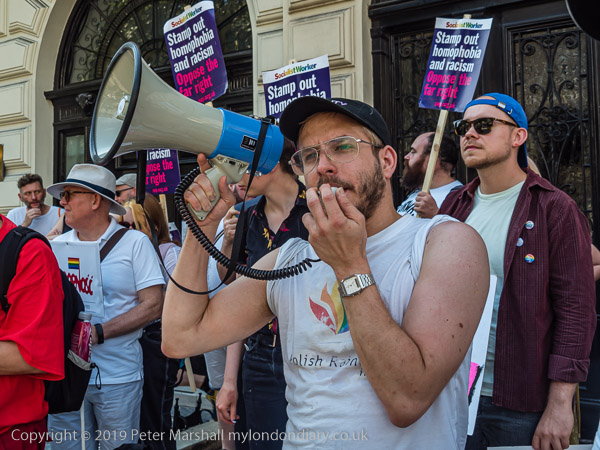
Solidarity with Polish LGBTQ+ community – Polish Embassy
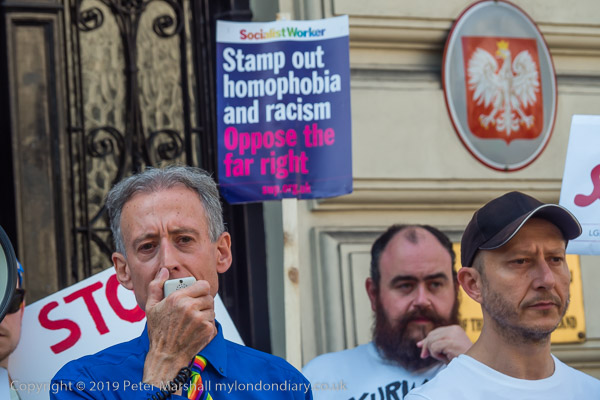
Conveniently the Polish Embassy where protesters had gathered to show solidarity the LGBTQ+ community in Poland is only a few minutes walk from the BBC
LGBTQ+ people in Poland are currently living in fear, their lives threatened under the rule of the right-wing Law & Justice Party which together with the Catholic Church have accused them of being a threat to children and to Poland itself.
Some local authorities have declared ‘LGBT Free Zones’ and nationalists groups have actively attacked members of the LGBTQ+ community and Pride events.
Among those who came to speak at the rally alongside Polish gay rights activists were Nicola Field of Lesbians and Gays Support The Miners, Peter Tatchell and Weyman Bennett of Stand Up to Racism