Whitechapel & Illegal Dates

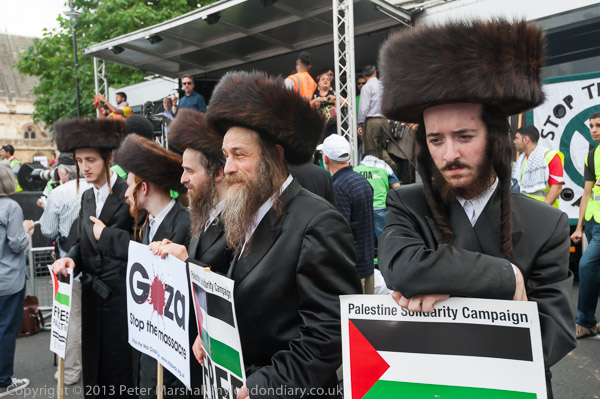
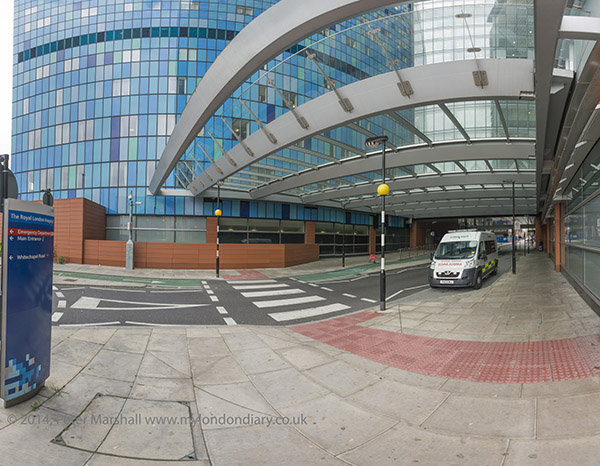
Whitechapel & Illegal Dates; On Saturday 27th September 2014 I went to Whitechapel early to photograph campaigners who were to protest against Sainsbury’s who were selling dates and other goods from illegal Israeli settlements, in defiance of international law. Around two years earlier I had made a panoramic image of part of the new Royal London Hospital which interested me but I felt was not quite what I wanted.
Whitechapel & Illegal Dates

Going back to re-take photographs is often disappointing, with key features having changed, but I think this time I did at least come up with an improvement. This was a more complex panorama than most of those I now make, and needed me to stitch together three separate exposures. It would perhaps be a little better with some slight cropping on the botton edge.
Whitechapel & Illegal Dates

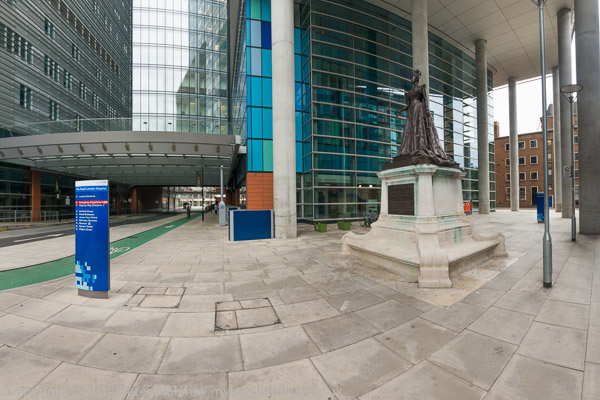
The Royal London Hospital has much great problems, all arising from the poor PFI deal that was used to finance its construction. All PFI schemes have turned out to be a mistake, but this was worse than most and I think has left the hospital group in financial trouble while providing excessive profits to the investors, with payments continuing for many, many years. The contract means they can charge silly prices for necessary services,
Whitechapel & Illegal Dates

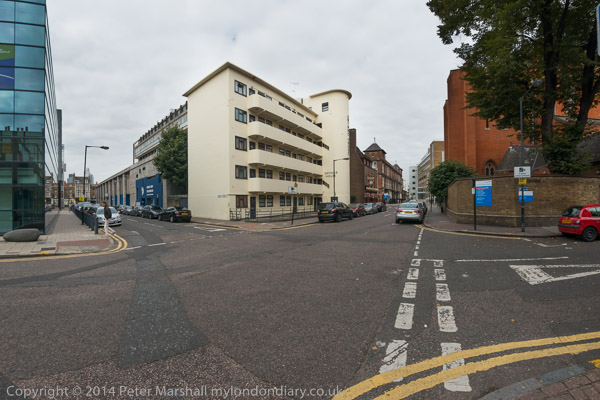
After several attempts at producing the picture I wanted I went for a short stroll around the area making a few more panoramic images before it was time to join th protest.

More pictures at By the Royal London.


Sainsbury’s told Stop Selling Illegal Goods – Whitechapel High St
Whitechapel & Illegal Dates

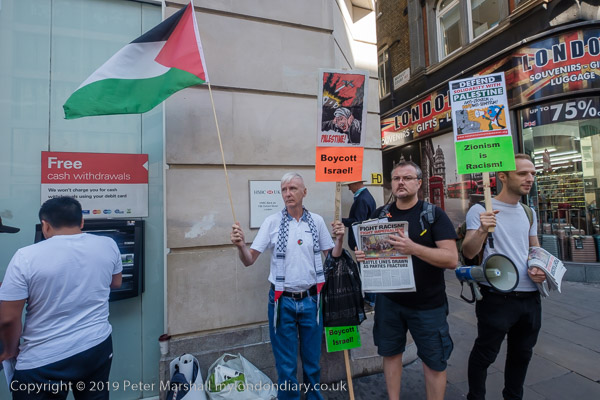
Campaigners from the Tower Hamlets & Jenin Friendship Association held a protest on the high Street close to Sainsbury’s, calling on the store to end selling dates and other goods from illegal Israeli settlements, in defiance of international law.

The protes was part of the international BDS campaign calling for a Boycott of Israeli goods, divestment from Israeli firms and sanctions against Israel until it ends the persecution of Palestinians and comes into line with international law and UN resolutions.
Similar protests earlier outside Co-op stores had led to the company in 2013 stating they would ‘no longer engage with any supplier of produce known to be sourcing from the Israeli settlements’.

The BDS campaign was given added impetus early in 2014 by the disproportionate use of force against the people of Gaza. During the recent Israeli attacks on Gaza over 2,100 Palestinians were killed, roughly 1500 of them civilians, among them over 500 children. 66 Israeli soldiers died, along with 5 Israeli civilians (including one child.) Over 500,000 people – roughly 30% of the population of the Gaza strip were displaced from their homes, and over 17,000 homes made uninhabitable, with over twice that number suffering less severe damage.
The raids also destoryed much of Gaza’s industry, including factories making biscuits, ice cream factory, plastics, sponges, cardboard boxes and plastic bags as well as the main electricity plant. Two sewage pumping stations were damaged, as were the main offices of the largest diary product importer and distributor.
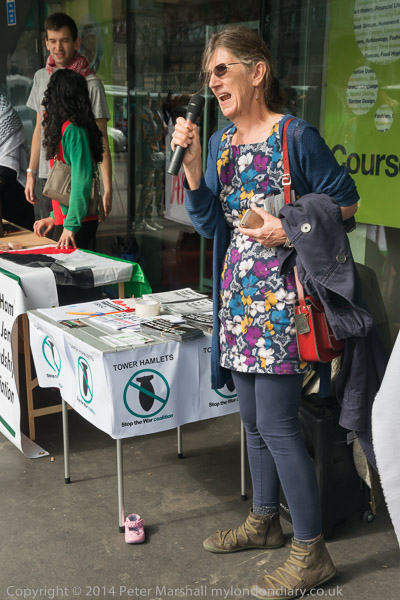
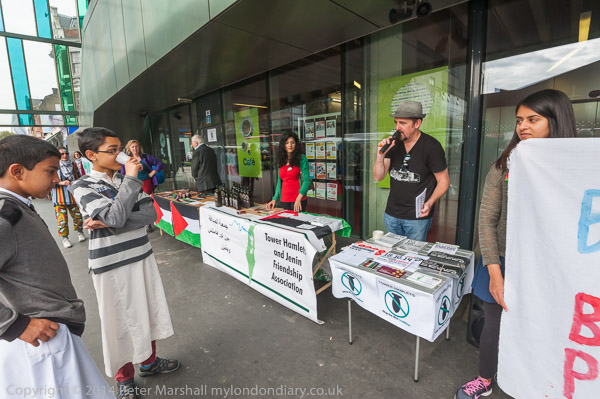
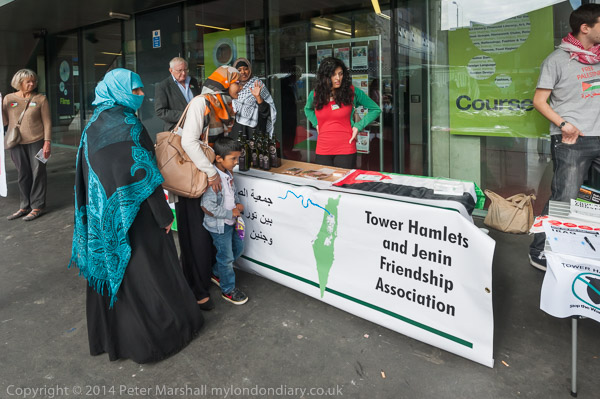
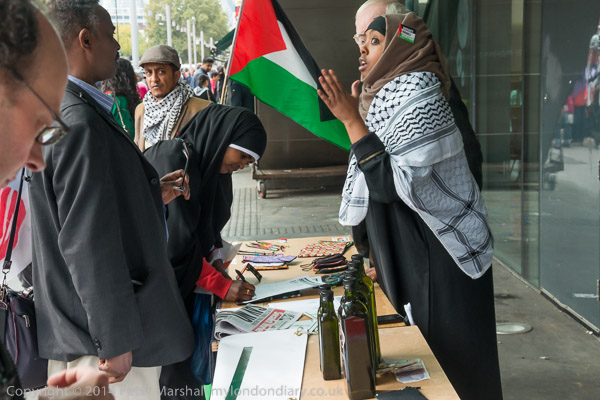
The protesters had several tables on the pavement outside the library on Whitechapel High St ,one selling Palestinian olive oil, almonds and a range of decorated purses etc. Some handed out leaflets and a postcard ‘Sainsbury’s: Taste the Indifference’, while others held banners or collecting signatures for petitions. At intervals people made short speeches about the Palestinian situation and the campaign to get Sainsbury’s to stop selling illegal Israeli goods.
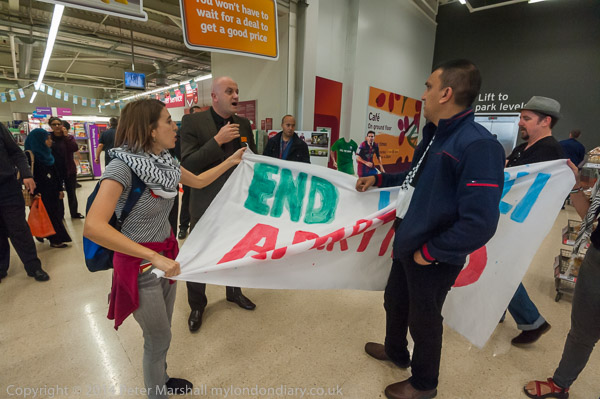
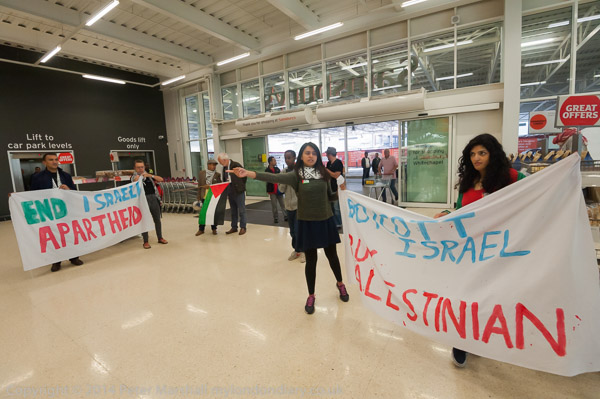
After an hour or so on the busy street, some of the protesters decided it was time to visit Sainsbury’s, just a couple of hundred yards away down a side-street. They folded up their banners and walked down to the store, where Sainsbury’s were ready and waiting for them with extra security on duty, and they were stopped in the very spacious lobby area in front to the store.
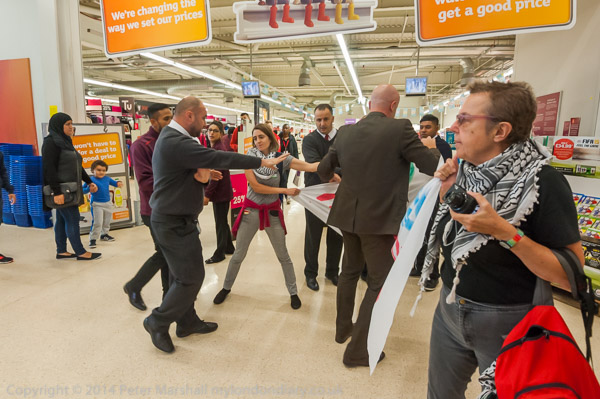
Here they opened up their banners and protested for a little over 10 minutes. There were a few moments of some tension, when store employees or security tried to grab one of the banners, but the whole protest and Sainsbury’s response was pretty civilised.
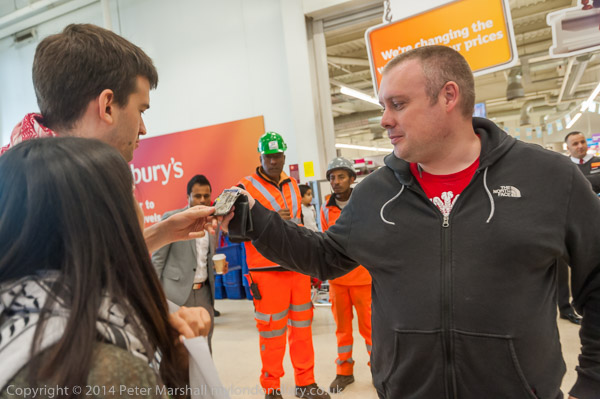
After 12 minutes, a man in casual dress arrived, and after asking the store manager to request the protesters to leave came across and talked with the the protesters, showing them his poolice warrant card and apologising that the police station didn’t have anyone in uniform available to send at the moment.

Having made their point by their protest, they decided to go quietly and a little exultantly back to the High Street, where others had been continuing the protest. Shortly after I decided it was time for me to leave.
Sainsbury’s appears still to refuse to follow its own ethical guidelines and still apparently sells some products from the occupied West Bank and to deal with suppliers who source goods from there, although probably rather less than in 2014. They have claimed not to source goods from the occupied territories but do still deal with wholesalers who deliberately mislable such produce.
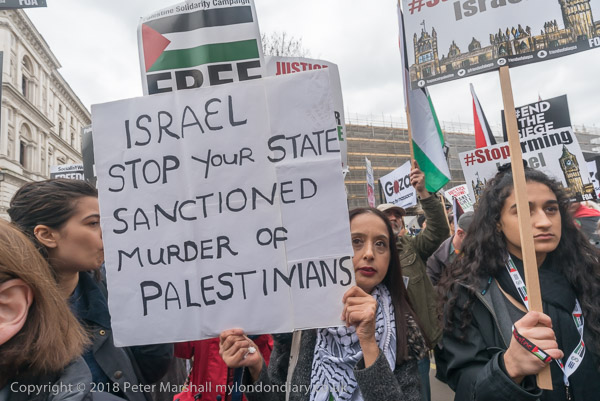
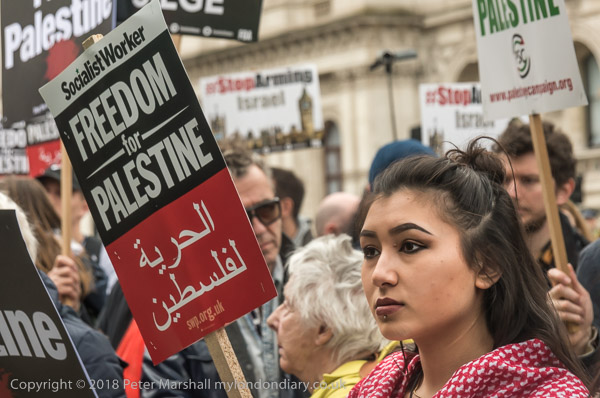
Sainsbury’s told Stop Selling Illegal Goods

Stop Israeli Snipers Killing Palestinian Protesters – 2018

Stop Israeli Snipers Killing Palestinian Protesters

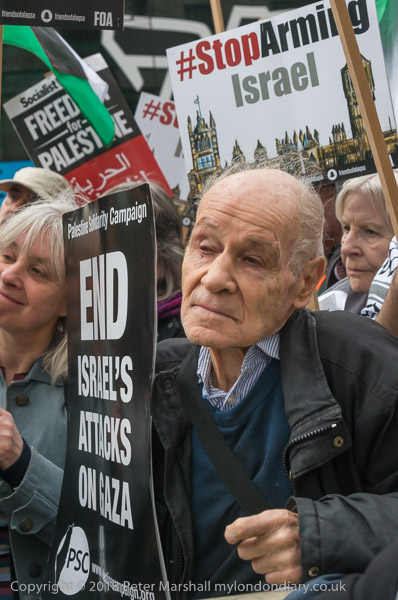
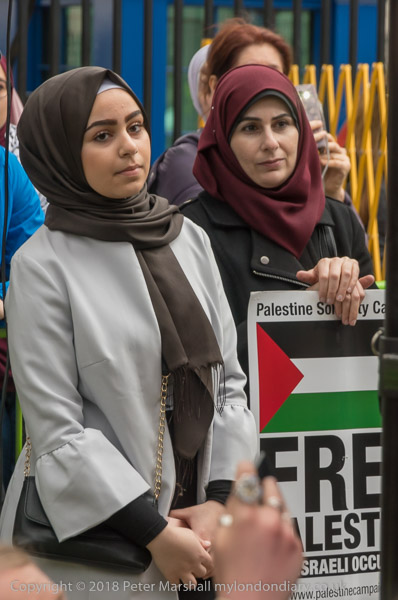
On Saturday 7th April 2018 around 2,000 came to Downing Street to condemn the shooting by Israeli snipers of peaceful unarmed Palestinian protesters on the first day of the Great March of Return, a peaceful protest at the separation wall in Gaza on Land Day, 30th March 2018.

Stop Israeli Snipers Killing Palestinian Protesters

Live fire by the Israeli army had killed 17 and wounded over 750 unarmed protesters on that day. The second protest had taken place a week later on the day day before the London protest in this series of protests planned to continue in Palestine every Friday until Nakba Day (May 15th). Another nine Palestinians, one a journalist had been targeted and killed, and around 1,350 injured.

Stop Israeli Snipers Killing Palestinian Protesters

Many had been appalled by videos of the shooting, and by seeing Israeli citizens who had gone to watch and support the snipers who were shooting to kill.

Stop Israeli Snipers Killing Palestinian Protesters

The UK parliament was in recess and there were few UK politicians at the event, with only Baroness Jenny Tonge and a Sinn Fein MP among the speakers, although both Jeremy Corbyn and Caroline Lucas had sent messages of support.

Stop Israeli Snipers Killing Palestinian Protesters

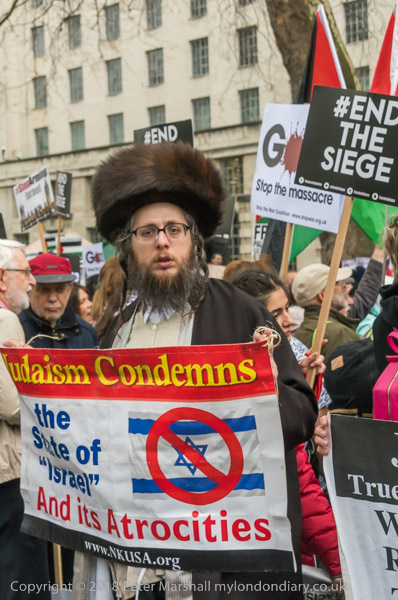
With the current threat of accusations of anti-Semitism being raised against any who speak out to support the Palestinians, perhaps some did not want to speak out in public, but there were many Jews at the protest, including those in Jewish Voice for Labour, many Jewish supports of the Palestine Solidarity Campaign and others including a group of ultra-orthodox anti-Zionist Neturei Karta members. A speaker from Jewdas recited a prayer for peace in Hebrew and then in English translation.

Stop Israeli Snipers Killing Palestinian Protesters

Among those who spoke at the event was Glen Secker of JVL, the captain of the Jewish Boat to Gaza in 2010. In 2018 he was suspended from membership of the Labour Party on a vague and unspecified accusation of anti-Semitism. Many other Jewish members of the Labour party, including the sons, daughters and grandchildren of holocaust survivors, have also been expelled from the party for the same reason.

Other supporters of Palestine, including Jeremy Corbyn have been banned from standing as Labour candidates in what can only be seen as a witch-hunt.

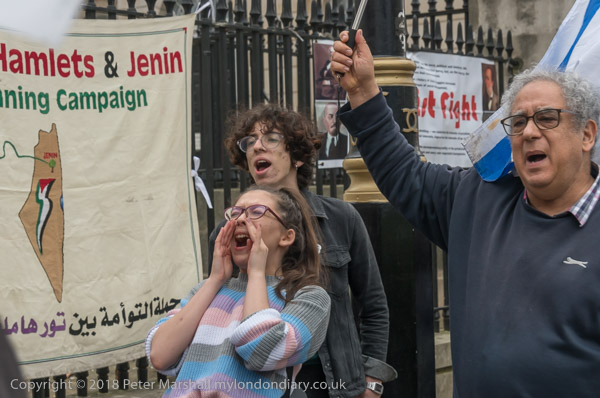
A few yards down the road were a handful of right-wing Zionist supporters waving Israeli flags and shouting slogans in support of the shootings and against Hamas. The few protesters who could hear them simply turned their backs on them and ignored them.

At the end of the protest the names of those murdered last week were read out and there was a two minute silence honouring them. The London protest was organised by the Friends of Al-Aqsa, Palestine Solidarity Campaign, Palestinian Forum in Britain and Stop the War, and supported by EuroPal, Olive and Muslim Association of Britain.

On My London Diary you can see photographs of many more of those at the event, including most of the speakers at Great March of Return – Stop the Killing.


Smash EDO Protest Moulsecoomb Arms Factory – 2010

Protests had begun against a small EDO-MBM factory at Moulsecoomb on the outskirts of Brighton in 2003 after the press had revealed that it was making parts for a guided bomb that was being used in the invasion of Iraq.

Smash EDO Protest Moulsecoomb Arms Factory
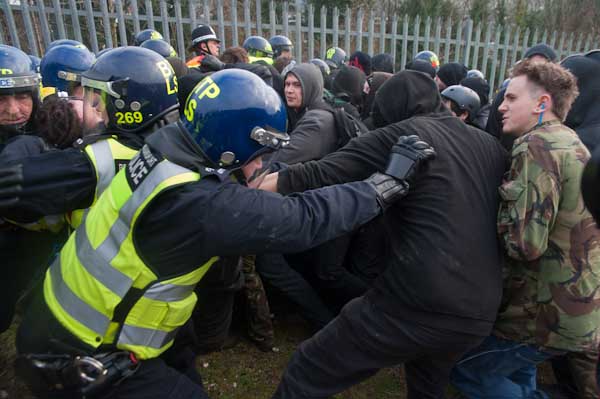
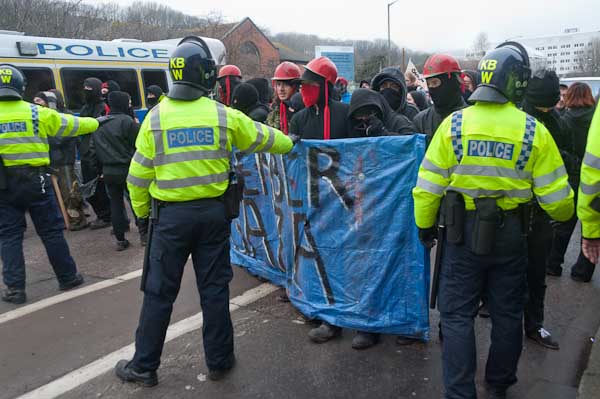
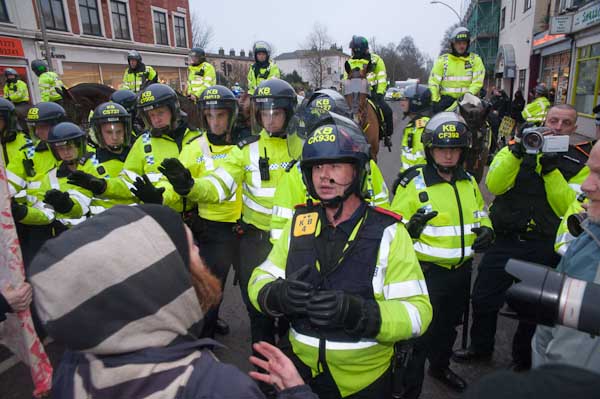
Police push Smash EDO protesters, 2010

In April 2005, EDO attempted to get a wide-ranging injunction to prevent protests at the site, including stepping onto the road outside the factory, playing music and taking photographs. This was the start of a lengthy legal action in which the UK Attorney-General became involved, as the defendants had submitted a detailed dossier on war crimes involving air strikes on civilian areas and infrastructure and were arguing that the invasion was an illegal war of aggression in breach of the UN Charter.

Smash EDO Protest Moulsecoomb Arms Factory

The Wikipedia article states “The court found that if there was an imminent war crime that the protesters believed on reasonable grounds, was about to take place, in which EDO were complicit, then preventative direct action could lawfully be taken against the company without waiting for the authorities of the state to intervene. This ruling effectively allowed proportionate direct action against companies by protesters, if the threat of the crime was imminent and specific.”

Smash EDO Protest Moulsecoomb Arms Factory
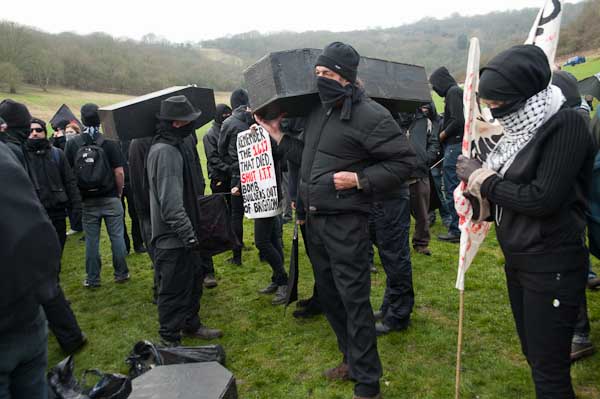
Coffins to remember the 1417 Palestinians killed – some by Brighton-made bombs

Some of the defendants signed an out of court settlement with EDO in April 2005 after it was put forward by Keir Starmer and they were then told legal aid would be withdrawn unless they agreed. They then intervened with a suggestion which was them he would withdraw their legal aid and they signed “undertakings not to do certain things that they had never done and had no intention of doing” with EDO agreeing to pay their costs, as well as their own, and the injunction against those not in court was lifted.

The case against three defendants who were conducting their own defence continued as they refused to sign these undertakings. In March 2006 a judge agreed with them that EDO had failed to make the preparations for a speedy trial as ordered by the court, and the company dropped the case rather than face further proceedings for abuse of process, paying the full costs of all those involved. The whole legal business is thought to have cost EDO between £1-1.5m, more than a years annual profit for the Brighton factory.

Police block the road to the factory

In 2009 weapons supplied by EDO were being used in the Israeli attacks on Gaza and a small group of activists decommissioned’ the factory to prevent exports to Israel. Again EDO went to court and they were again unsuccessful with the court finding all of those charged not guilty.

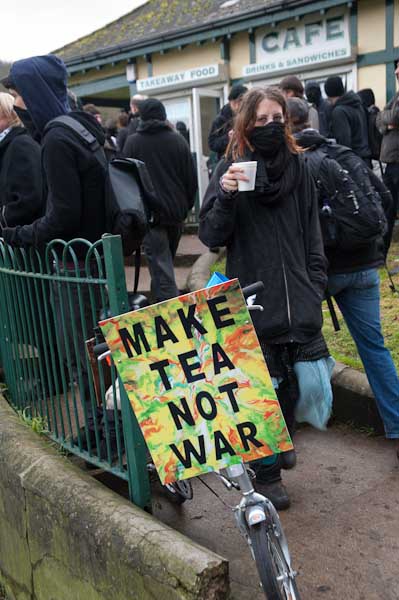
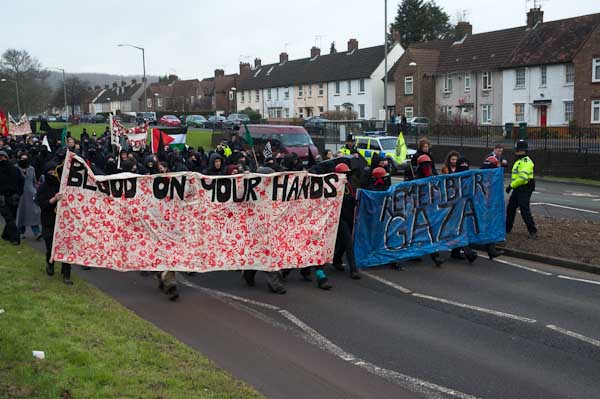
On Monday 18th January 2010, the first anniversary of the end of the Israeli war against Gaza, I went to photography Smash EDO activists in Brighton who were protesting against arms manufacturer EDO MBM/ITT who made some of the weapons that killed 1417 Palestinians, mainly the elderly, women and children, during the three-week assault.

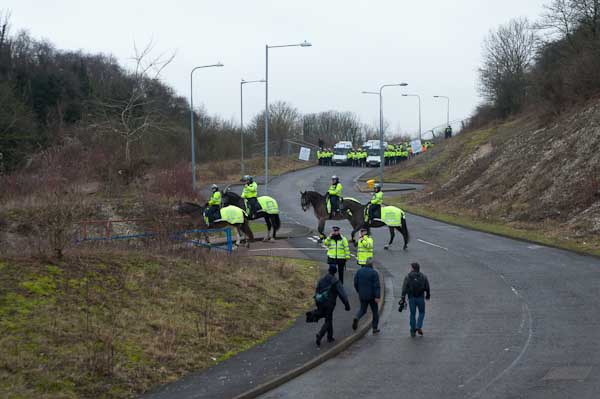
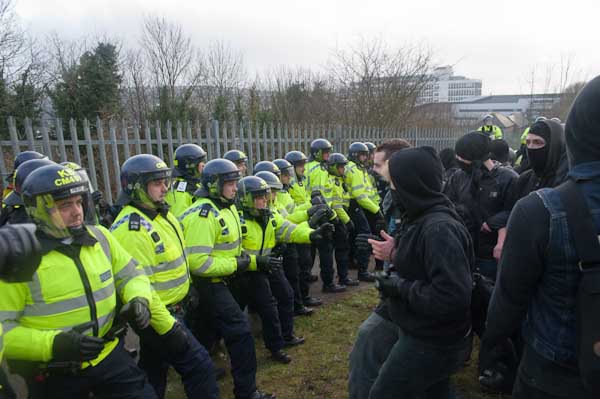
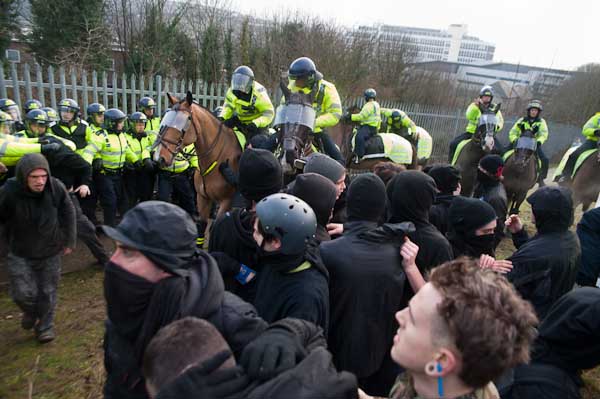
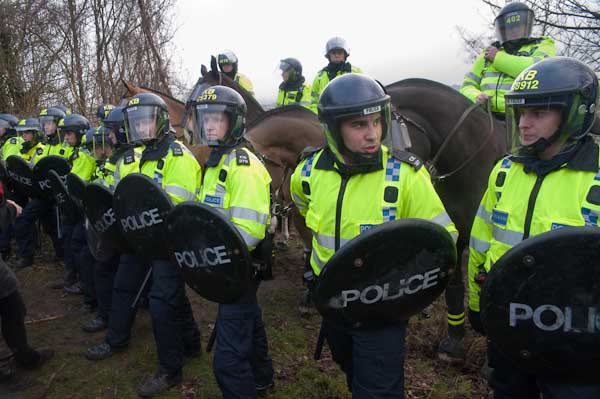
Despite earlier rulings that such protests were legal, the police had come determined to stop this one taking place, responding to the protesters who they probably outnumbered with an impressive display of force and violence as they attempted to make their way to protest at the factory.

I went with the protesters as they tried to go around the police lines through the woods and along a footpath and was able to photograph some of the confrontations. You can see more of what happened on that day in the pictures and the captions in my post on My London Diary.

What I don’t mention there is that like many of the protesters I was also assaulted several times by some of the officers while taking pictures, and at one point only just managed to stop myself going over a roughly 50ft drop when pushed violently by one of them. Other officers helped me up and to move away from the edge, but it was at times a scary event to cover. I was bruised and shaken as well as tired and left Brighton while the police were still harassing the protesters who had marched back towards the centre of the town.

Protests continue at EDO’s factory, now led by Brighton Against the Arms Trade, after the Moulsecoomb factory was found in 2019 to have produced arms used in a Saudi ‘attack that violated international law’ against a civilian target in Yemen and to be involved in helping Turkey to get around US attempts to prevent the proliferation of drone warfare.


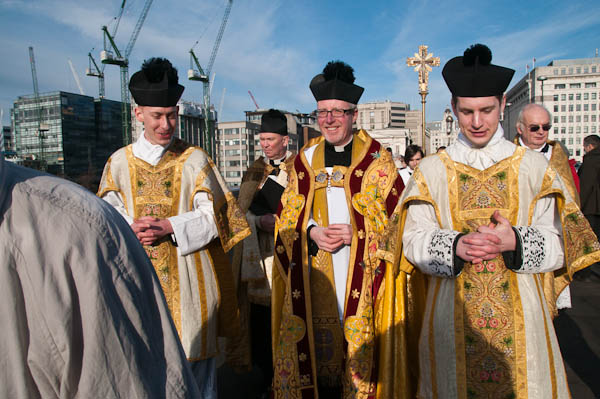
Blessing The River Thames

Blessing the Thames London Bridge, Sunday 11th January, 2009

Blessing The River Thames
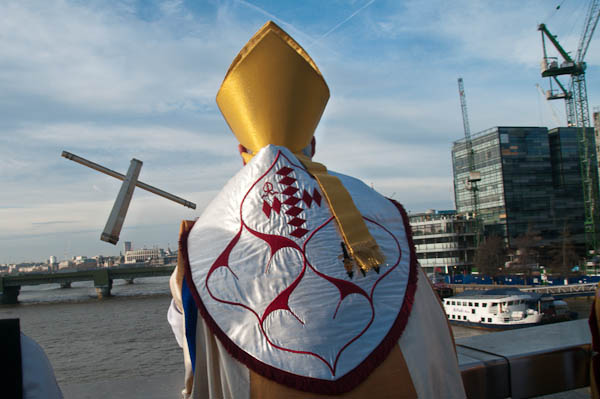
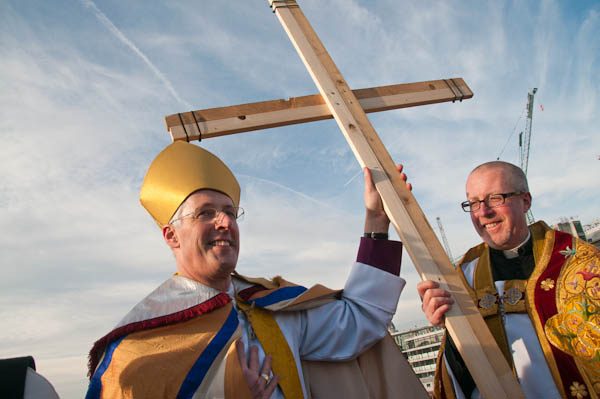
The Bishop of Woolwich throws a cross into the River Thames – below another cross in the sky

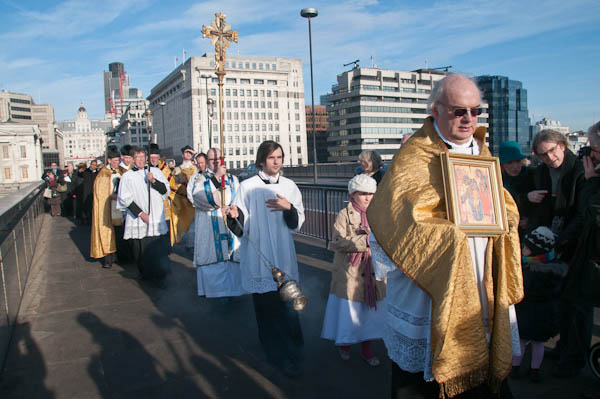
Fr Philip Warner was impressed by the annual Blessing of the Waters ceremony he saw in the Orthodox churches of Serbia. When he became the priest at St Magnus the Martyr at the City end of the old London Bridge he decided to begin an annual ceremony to bless the River Thames.

Blessing The River Thames
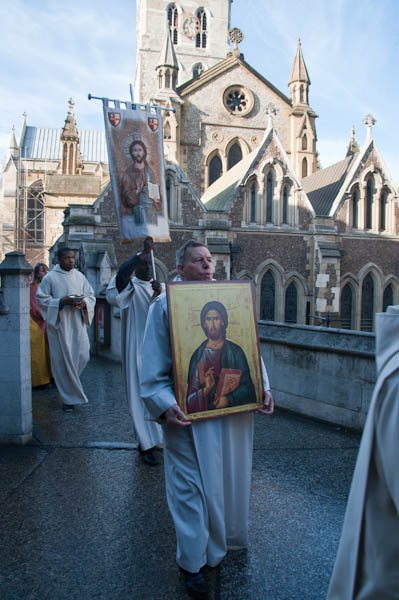
The procession from Southwark Cathedral

His parish and that of Southwark Cathedral meet at the centre of the current London Bridge, and in 2004 processions from both churches met there on the Sunday closest to Epiphany (January 6th) for a short service.
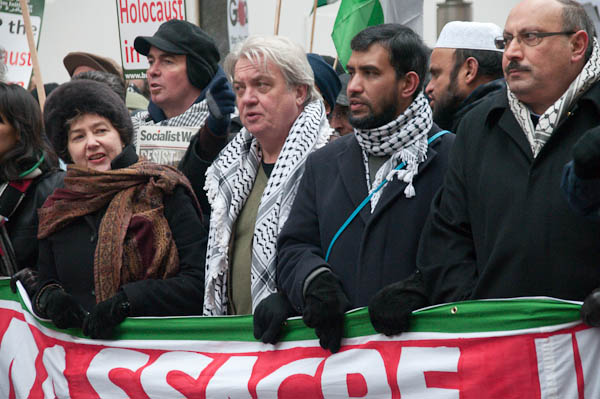
Blessing The River Thames
The procession from St Magnus the Martyr comes to join them

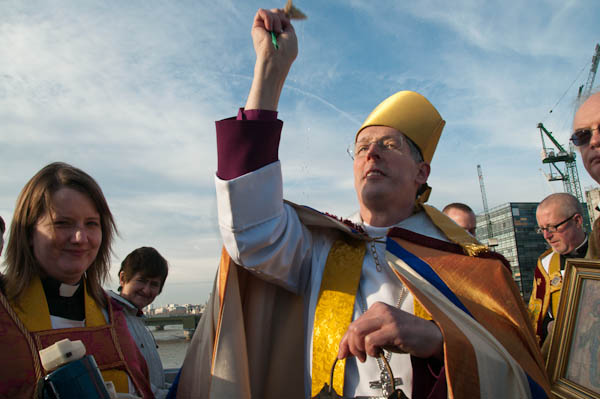
Prayers were said for all those who work on the river and in particular for those killed close to this point in the 1989 sinking of the Marchioness. Incense was swung around liberally, but dispersed by the breeze. The river was then blessed by throwing in a large wooden cross. Water was then sprinkled over those taking part in the ceremony before all those present were invited to process to one of the churches for a lunch.
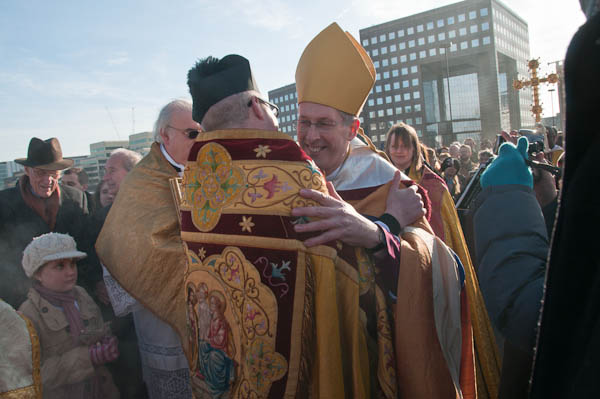
They meet

I photographed this event in 2007 and 2008 as well as 2009, though it was only in 2008 that I was able to stay for the lunch, that year at St Magnus. By the third of these years the event had grown, with too many photographers, mainly amateurs, coming along and getting both in my way and in the way of those celebrating. I felt I had already taken enough pictures by then and crossed it off my list of annual events to cover.

The bishop prepares to throw the cross in the river

When I first began photographing events in London, both protests and cultural events, there were few photographers at most of them except the large national marches. At many smaller events I would find myself the only person with a camera, and of course everything was still on film. But in the last 15 or so years things have changed.

And we all get sprinkled with water

Back then even when there were more of us taking pictures we were all photographers and at least doing so in a professional way. We tried to respect the others and so far as possible keep out of each others way, though of course that wasn’t always possible. Sometimes there were arguments between those of us who liked to work close to our subjects with wide-angle lenses and those who carried giant, heavy, usually white, telephoto zooms and always wanted to use them from a distance. But generally we worked together.
And everyone (except me) goes back to Southwark Cathedral for lunch

Then came cheap digital cameras and camera phones. Everyone now has something that can take picture, and can readily share them on social media. And there has been huge movement from taking still images to recording video. Video leads to a different attitude, with many becoming unaware of anything outside the screen of their phone around them. At any event now I can be sure that at least one person will walk in front of my lens talking into their phone totally oblivious of my presence and blocking my view.

Of course I don’t claim any special right to take pictures, and others have the same rights as me. But unless we respect the rights of others it becomes difficult and frustrating to work; we have to work together.
More pictures from 2009 Blessing the Thames.


Protests on January 11th

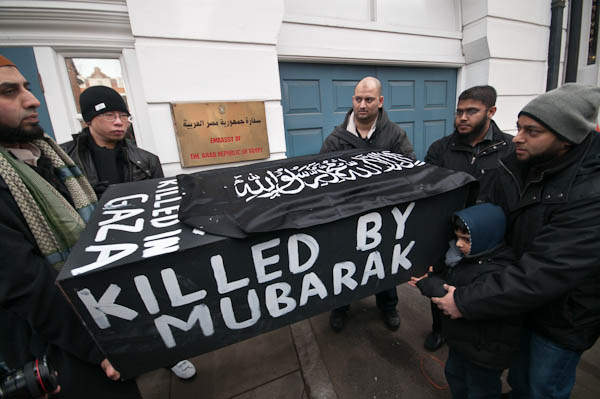
In 2009 I was sorry not to have time to stay for the lunch at Southwark Cathedral, particularly as two of my friends were present, one a frequent worshipper there. But there were a couple of protests to photograph. The first was a march by Hizb ut-Tahrir Britain against the Israeli attacks on Gaza, aimed at Arab dictators who collude with Israeli terrorism and going to Egyptian, Syrian and Saudi Embassies.

More at Hizb ut-Tahrir Britain Gaza march.

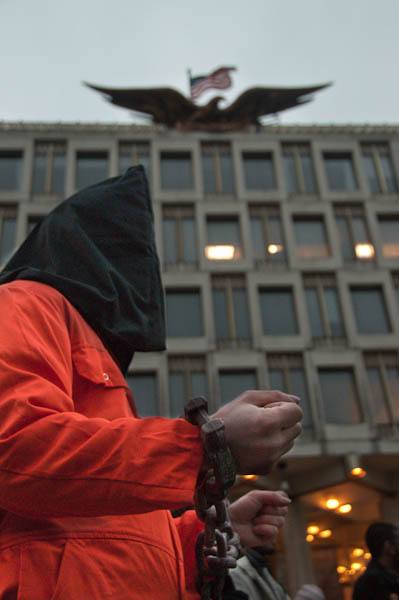
And it was the 11th of January, and the anniversary of the setting up of the US torture camp at Guantanamo in 2004 was marked by a late afternoon protest at the US Embassy, still then in Grosvenor Square.

More at Guantanámo – 7 Years


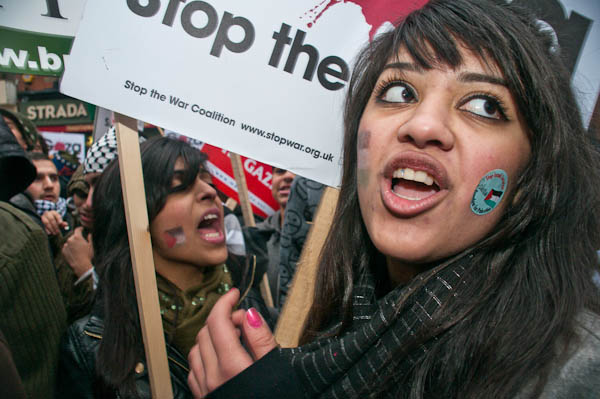
Stop the Gaza Massacre – National March

National March, Hyde Park to Israeli Embassy, London, Saturday 10 January 2010

Stop the Gaza Massacre - National March

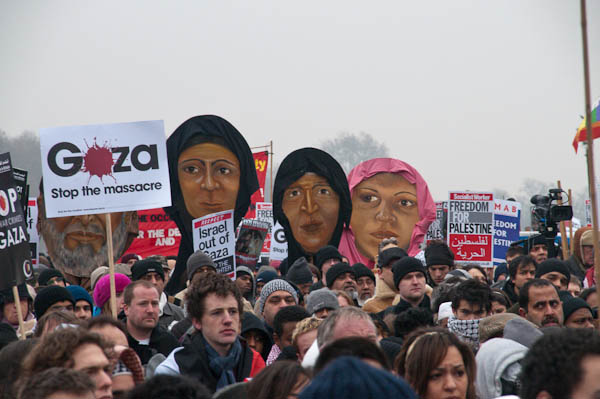
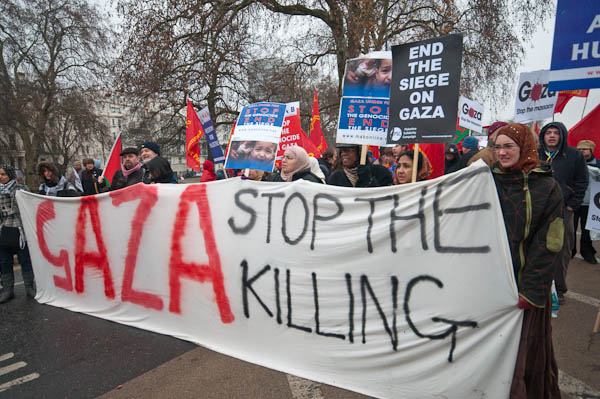
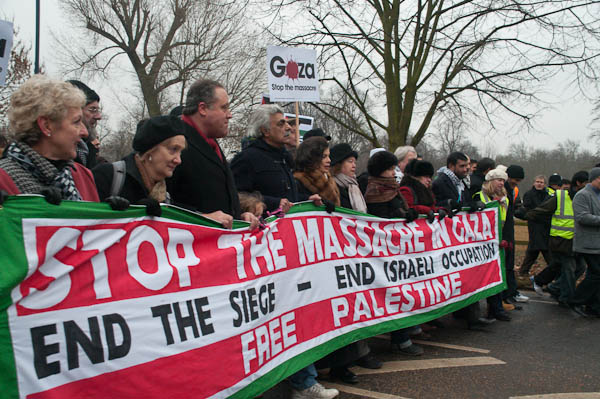
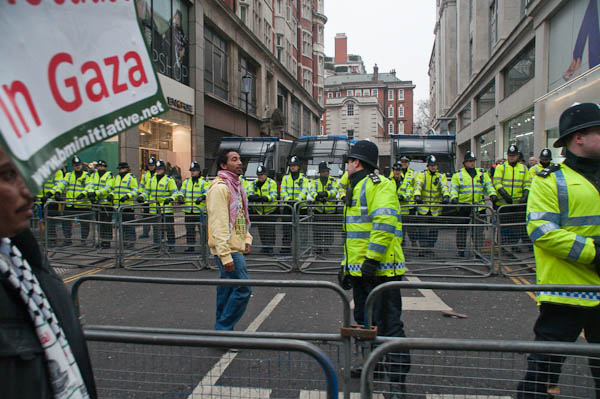
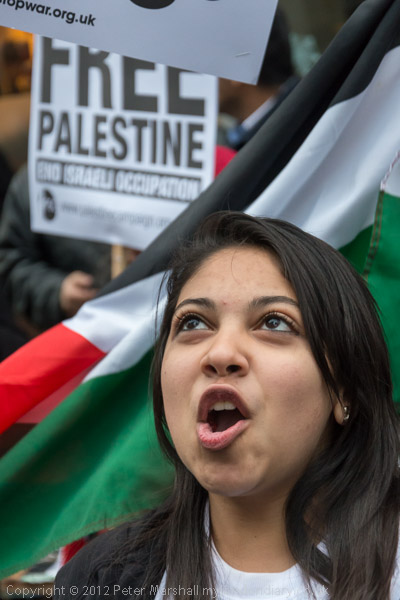
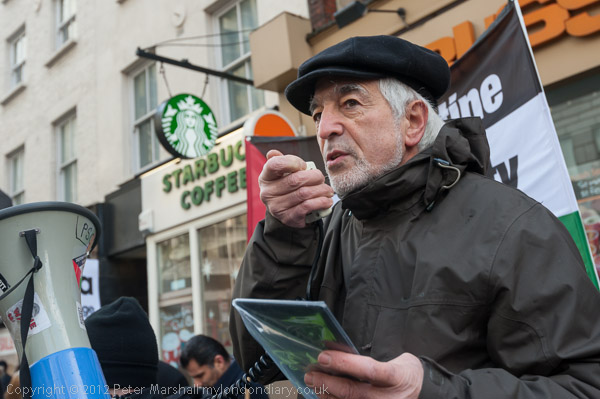
Well over 100,000 marchers turned up to Hyde Park in London on Saturday 10 January 2010 to show their opposition to the Israeli attacks on Gaza and call for an end to the killing there. After a rally there they marched

Stop the Gaza Massacre - National March

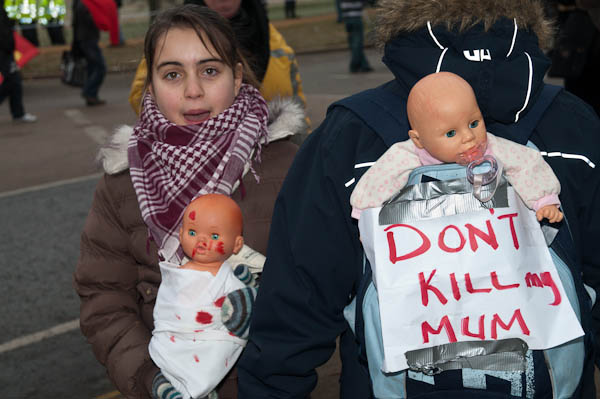
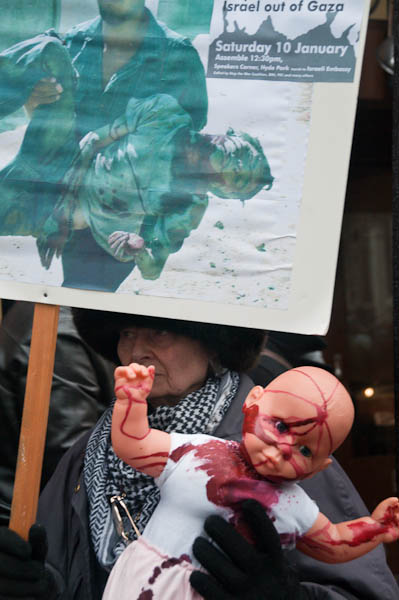
As well as posters and banners, some carried dolls as a reminder of the 300 or so children already killed by the Israeli attacks in the current offensive, the Israeli Operation Cast Lead which had begun on 27th December 2008 and was still continuing.

Stop the Gaza Massacre - National March

The Gaza Massacre ended with Israel declaring a ceasefire eight days after this protest on 19th January 2009, by which time the Israeli attacks and killed (figures from Wikipedia) between 1,166 and 1,417 Palestinians. There had been 13 Israeli deaths, four of them killed by their own Israeli forces.

Stop the Gaza Massacre - National March

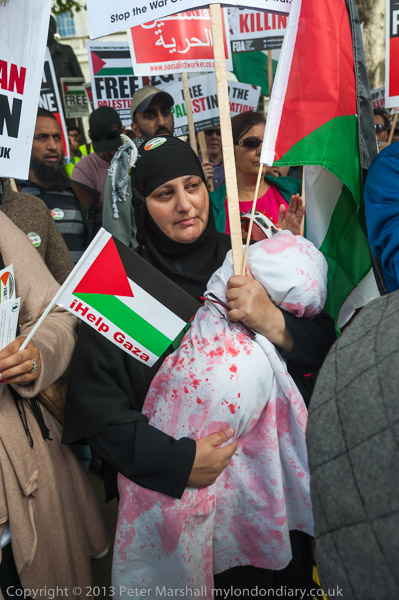
Many children were among the Palestinians killed and some protesters carried dolls or bundles of blood-stained clothing to represent the 300 already known to have died at the time the protest took place. It remains unclear exactly how many civilians were among the killed as Israel allowed few international workers into the area and denied access to journalists. Around a sixth of those killed were police officers in Gaza.

The attacks severely damaged half of Gaza’s hospitals and health facilities. A survey by the United Nations Development Programme estimated that 14,000 homes, 68 government buildings, and 31 non-governmental organisation offices were either totally or partially destroyed. The Israeli blockade on Gaza meant that it was not possible to import the building materials needed for essential repairs and rebuilding.

The police had severely under-estimated the likely size of the protest, failing to believe the figures suggested by the march organisers. They had planned for a much smaller protest and this led to problems. Quite rightly, feelings run very high over Gaza and there were many who wanted to get to the Israeli Embassy and make their feelings clear.

I had no problems with the police, but was assaulted close to the Embassy by several Stop the War stewards some of whom do seem to have a real problem with the press. They pushed me around and tried to stop me from working, although other stewards who who saw what happened did apologise to me for the treatment I received.

The official front of the march – well behind some of the angrier protesters eventually arrived and paused briefly close to the embassy, safe down a private road behind barriers and police before moving on and dispersing. But many of those on the march remained in the area and the street soon became completely blocked. I could only watch from a distance over the heads of the densely packed crowd as there seemed to be some fighting with police as demonstrators tried to climb the barriers. Placards, sticks and shoes were being thrown either towards the embassy or at the police.

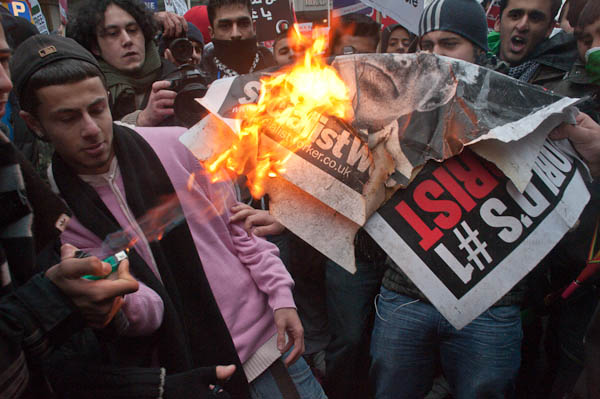
I walked a few yards further down the road where a group of young men burning placards with a picture of the “World’s #1 Terrorist”. A little further still things were much quieter with some Muslim men saying prayers. It looked as if there would be protests here continuing long into the night, but I had to leave as I had promised to take pictures elsewhere at a private event.

Much more at Gaza Massacre – National March.


Remember Gaza – 2012

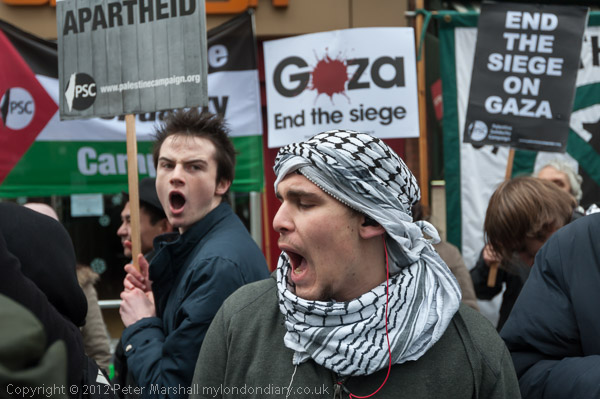
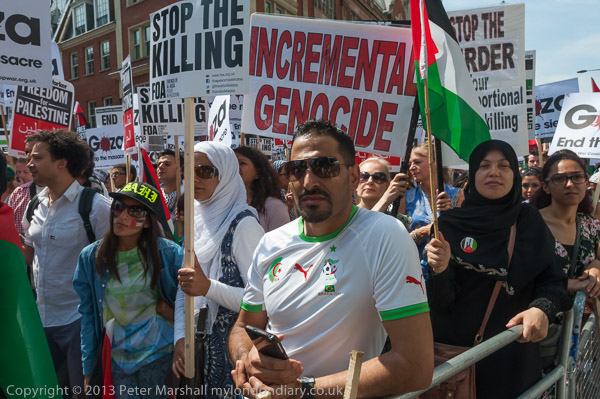
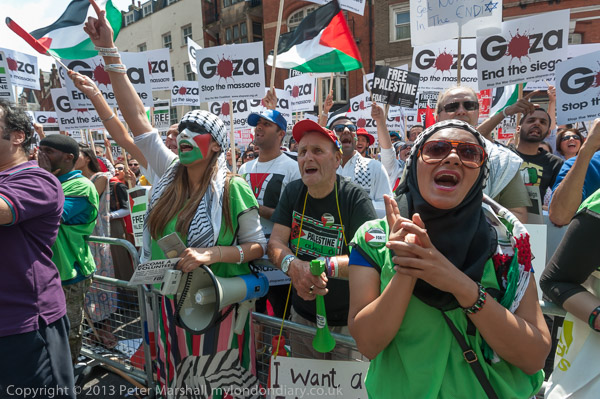
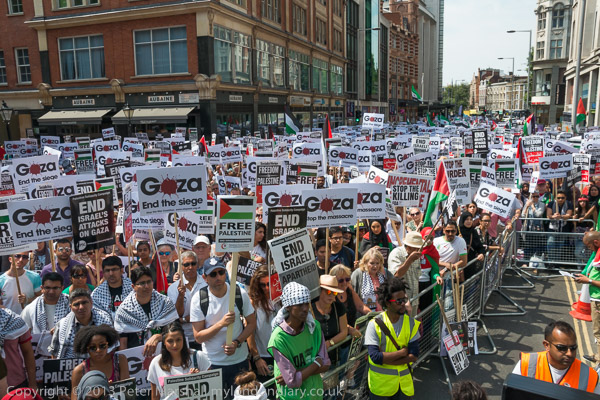
Remember Gaza - 2012

On 27th December 2008 the Israeli military began ‘Operation Cast Lead’ after 6 months of planning, striking 100 targets in Gaza in less than four minutes. This initial attack was followed by other air attacks and on January 3rd by an invasion on the ground. Israeli Defense Forces ended their attacks on 18th January 2009 by which time around 1400 Palestinians had been killed, with only 13 Israeli deaths, four killed by their own forces. You can read more on Wikipedia.

Remember Gaza - 2012

Every year for the next four years there were large protests close to the Israeli Embassy in London on December 27th against calling for an end to attacks on Gaza and an end to the siege of Gaza which prevents the imports of building materials and other vital goods needed for health and reconstruction. But the 2008-9 attacks on Gaza have been followed by others in 2014 and 2018 and more air strikes in 2021 and 2022.

Remember Gaza - 2012

Things now seem likely to get even worse with a new Israeli government under Benjamin Netanyahu including anti-Arab ultra-nationalists in key posts including the finance minister, a defence ministry post and national security minister as well as in the education ministry.

Among promises made to form the coalition are the legalisation of illegal Israeli settlements in the Palestinian West Bank, lifting of restrictions on Jewish prayer at the Al-Aqsa Mosque and a loosening of the restrictions on using live fire against Palestinian protesters. The new government also intends to end any independence of the judicial system in Israel, making the Supreme Court subservient to government.

So far as I am aware there will be no particular protest in London today, and the last I attended on December 27th was in 2012, four years after the start of the 2008 massacres – and the pictures here come from that day. The Israeli embassy is on a private road where a ban on protest is rigorously enforced, with police and barriers preventing access, and protests take place on Kensington High Street, opposite the private street.

There are still large protests in London calling for an end to Israeli Apartheid and for freedom for Palestine – such as that on 14th May 2022 marking 74 years after the Nakba as well as many smaller actions calling for a boycott of Israeli goods and services and divestment from Israel, with the BDS movement gaining strength world-wide. Attempts by Israel to categorise any support for Palestine as anti-Semitism have largely failed because of increasing repression and increased reporting of repression by the Israeli government, Israeli forces and attacks on Palestinians by some Jewish settlers. Many of those taking part in the protests supporting Palestine are Jewish, standing alongside others from Palestine.

This year I’m pleased to feel able to have another day of relative rest after Christmas, particularly as train services are disrupted as the UK government tries to prop up our dysfunctional rail system at the expense of rail workers – while continuing the handouts to the private companies – including several European state railway companies. As in gas, electricity, water and more privatisation has proved an entirely predictable economic disaster, selling off the family silver for short-term gain.

More at Gaza – End the Siege.


Heat, Democracy & Gaza – 2014

Some issues stay with us – and it seems they will never go away. But things can change and do change, and I remember the long years of protest against apartheid in South Africa. But apartheid is now going strong in Israel, and things are even worse so far as democracy and fuel poverty are concerned in this country. There seems little hope now that even if Labour were to get into power things would become any better.

More and more people are getting expelled from the Labour party including many for expressing support for Palestine, including some leading Jewish members and prominent anti-racists as the party lurches towards a right-wing dictatorial stance. I’m not a party member – and would soon be expelled for what I’ve written over the years here and elsewhere were I to join, including this post. But I did vote for Labour for over 50 years though at the moment I can’t see myself ever doing so again.


Dying For Heat – Downing St, Saturday 20th Dececember

Heat, Democracy & Gaza - 2014

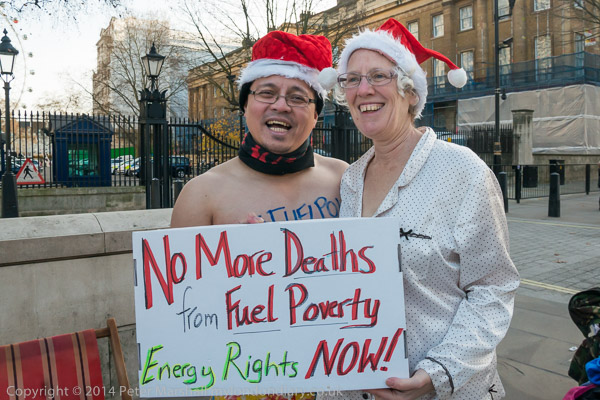
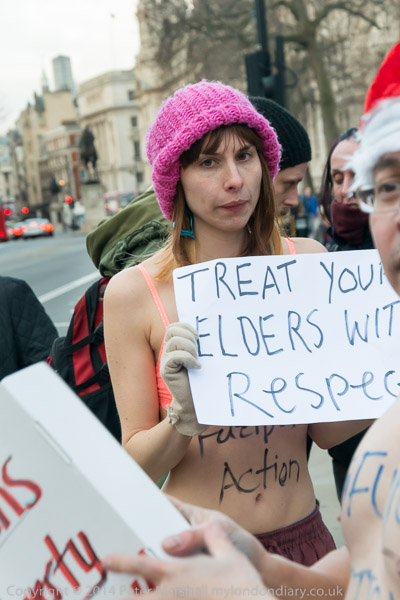
It makes me feel frozen just to look at this picture. It wasn’t quite as cold as it has been here over the past week but was still pretty chilly back in 2014. I would have been wearing an extra layer of thermals under a heavy jacket, scarf hat and long johns. Photography usually involves a lot of standing around and keeping warm in winter is often hard.

Heat, Democracy & Gaza - 2014

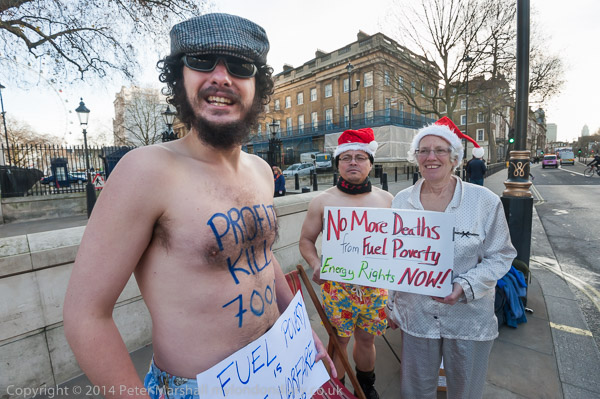
This small group of protesters had been there since 8am, around three hours by the time I arrived determined and they were determined to complete a 24hr vigil to draw attention to the impact of fuel poverty which killed more than 10,000 in the UK in 2012/3.

Heat, Democracy & Gaza - 2014

Others came for shorter periods over the day to support them and Fuel Poverty Action’s ‘Energy Bill of Rights‘ to protect the poor and end these deaths. None of the eight points in this have been taken up by the government and energy costs have risen sky high in the past year. The government blames this on Putin’s invasion of Ukraine, but this fails to explain why people in the UK are paying far more than those in other countries across Europe – and their blatant lies over this don’t fool many.
More at Dying For Heat.


Occupy Democracy Return To Parliament Square – Sat 20 Dec 2014

Heat, Democracy & Gaza - 2014

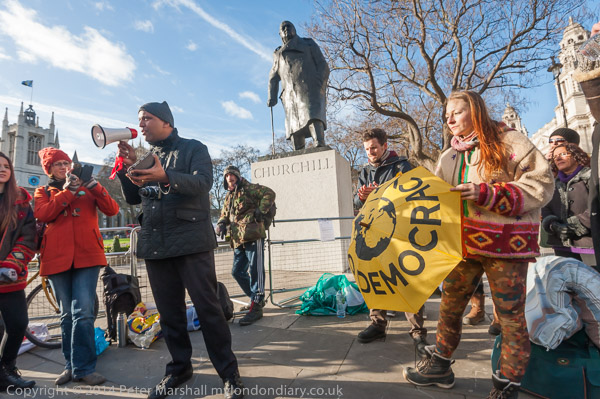
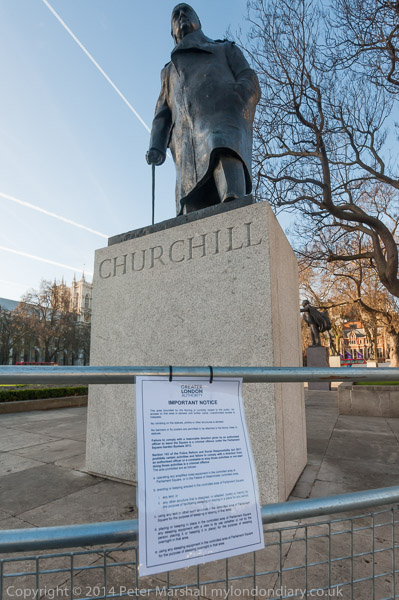
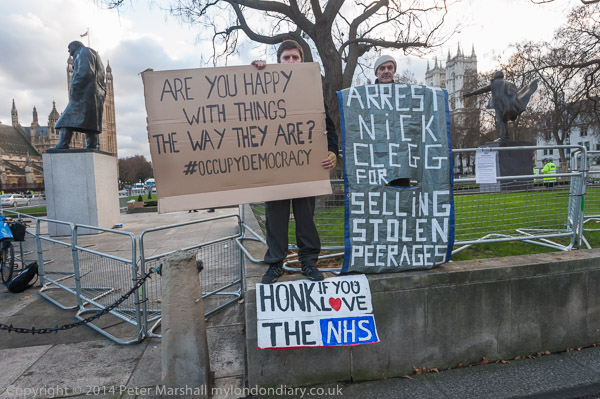
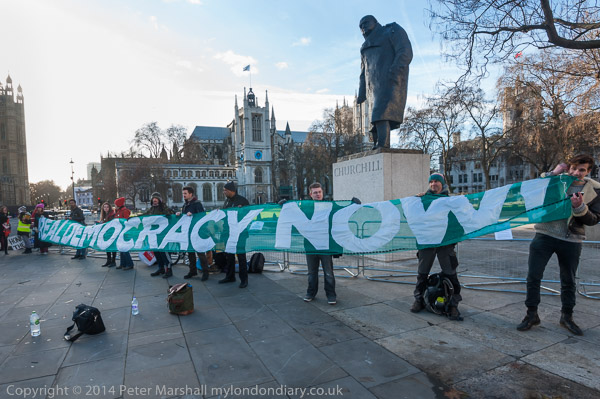
Police and private security ‘heritage wardens’ watched from the fenced off grass as protesters held a rally on the paved area at the edge of the square facing the Houses of Parliament. This is not covered by the bylaws that prohibit protests on the square without official permission.

The grass had been ‘temporarily closed’ and fenced by the Greater London Authority, officially for ‘important works‘ but actually simply to deny access to people who wanted to engage in this peaceful discussion about democracy – and of course to everyone else who might want to be on what is normally a public square. There was no sign of activities of any kind being carried out on the grass or pavements under GLA control in the square.

A series of speeches and other activities was planned calling for real democracy in a Britain where 3.5 million are living in poverty. The first speaker was the then Green Party Deputy Leader Shahrar Ali, and after speaking he responded to a lengthy and wide-ranging question and answer session about Green Party policies.

Following this was to be another performance of the Fossil-Free Nativity which I had photographed two weeks earlier, so I left to go elsewhere, returning briefly later in the day when activities were still proceeding.

More at Occupy Democracy Return To Parliament Square.


Don’t Buy Israeli ‘Blood Diamonds’ – Bond St , Sat 20 Dec 2014

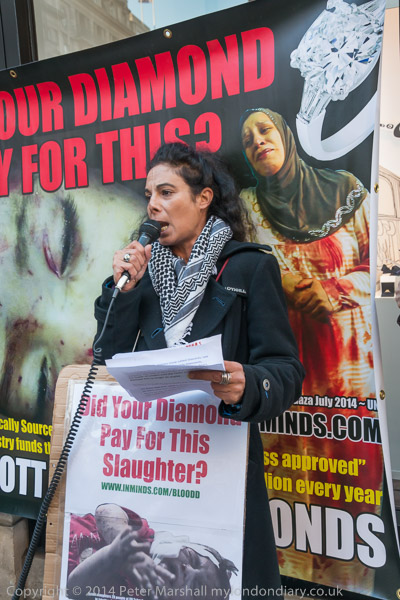
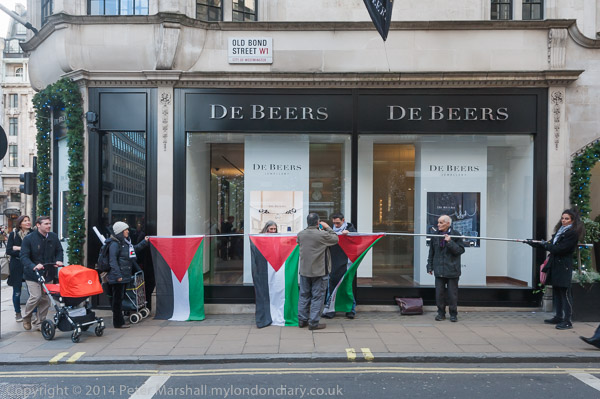
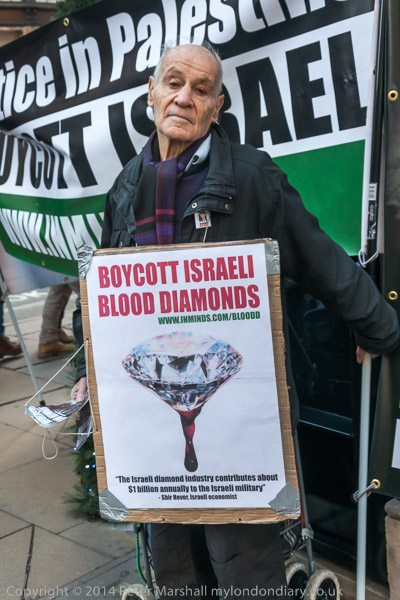
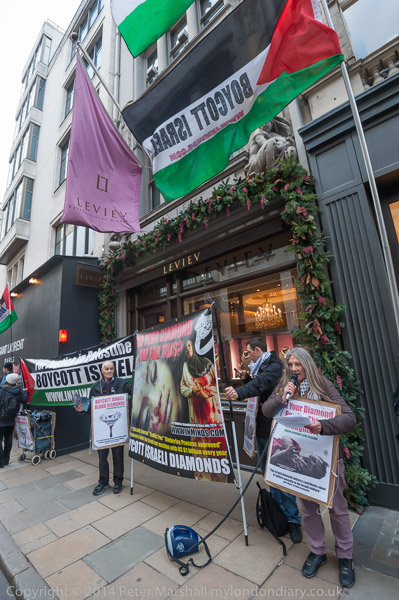
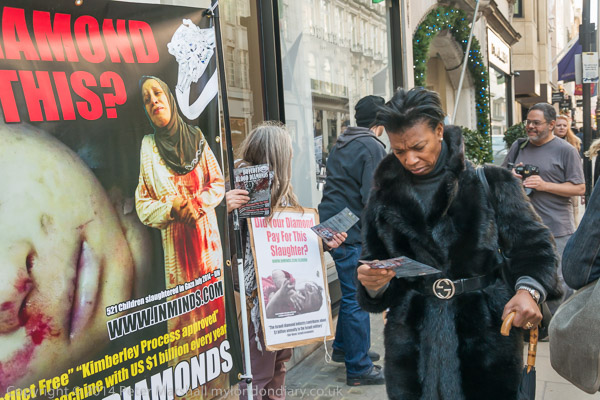
Campaigners came to Bond Street to protest outside shops there which sell diamonds cut and polished in Israel, which are the main source of funding for Israeli military attacks on Gaza. Many diamonds cut there come illegally from conflict zones. Palestinians have called for a boycott of all Israeli diamonds.

Israeli attacks on Gaza had led a decline in tourism and other exports of goods and services but increased diamond sales have helped Israel fill the gap, and are said to provide $1 billion a year to the Israeli military.

My post on My London Diary includes details of some of the Israeli diamond companies and their activities which include the sponsorship of the notorious Givati Brigade of the Israeli army, accused of war crimes in Gaza by the UN Human Rights Council and responsible for the Samouni family massacre.

I photographed the protest outside De Beers, the worlds largest company involved in rough diamond sales and Leviev, whose company is reported by the New York Times to be “the world’s largest cutter and polisher of diamonds” and which is also involved in the construction of illegal Jews-only settlements on the West Bank.

There were speeches about the involvement of the diamond companies in Israeli military attacks on Gaza and many people passing the protest took fliers calling for a boycott of Israeli diamonds and expressed their support. There were also a few who clearly disapproved of the protest, including just one man who stopped briefly to hurl a few insults while I was there.

More at Don’t Buy Israeli ‘Blood Diamonds’


Gender-based Violence, Arming Israel, Trans Pride, Anti Racism

Protests in London three years ago today on Saturday 14th September 2019 all with some connection to human rights violations.


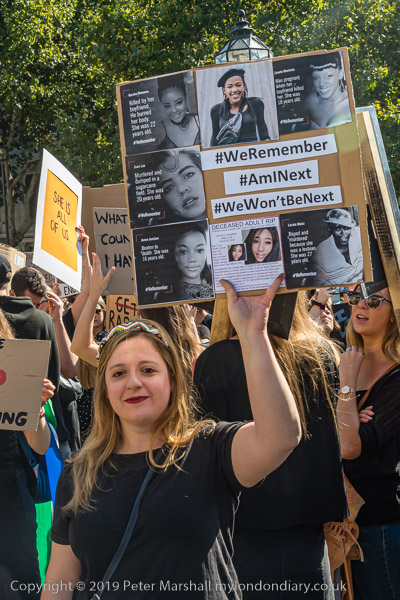
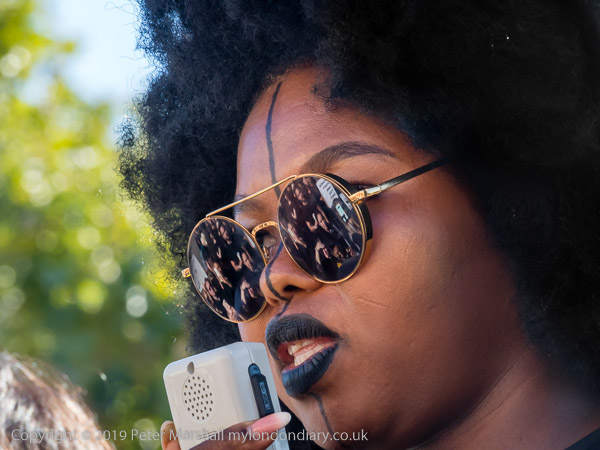
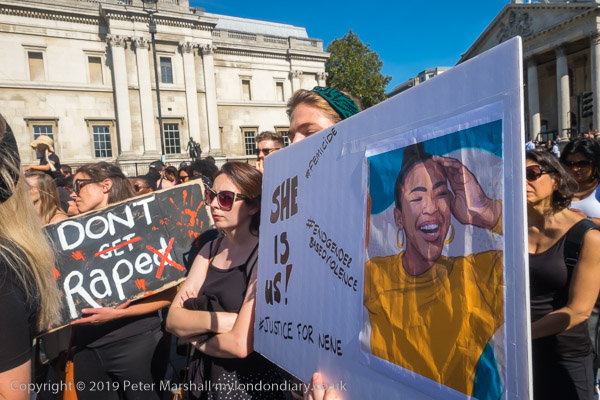
Criminal Abuse of Women in South Africa – Trafalgar Square

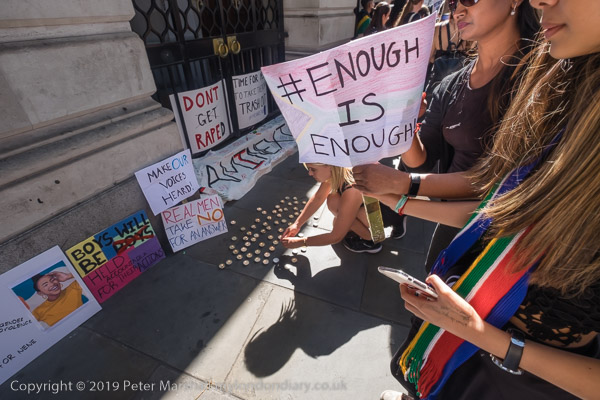
People, mainly women and including many South Africans, dressed in black to protest in Trafalgar Square following the rape and murder of Uyinene Mrwetyana and many other women in South Africa.

Protests were taking place across South Africa calling for the government to declare a state of emergency over gender based violence, and to protest against gender-based violence across the world.

After speeches and silences on the North Terrace they moved to light candles for the victims at the entrance to South Africa House.

Criminal Abuse of Women in South Africa


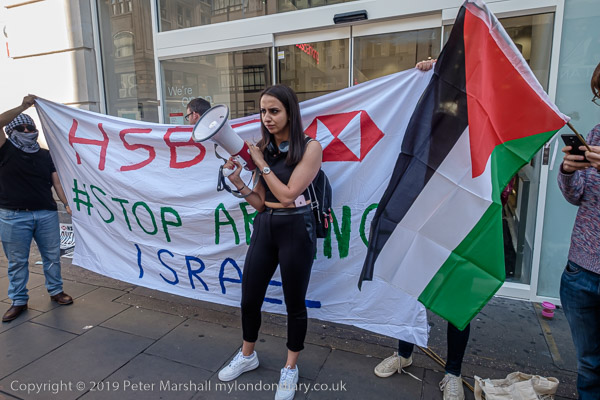
HSBC Stop Arming Israel – Oxford St

Protesters led by Young London Palestine Solidarity Campaign took part in a National Day of Action outside the Oxford St branch of the HSBC Bank calling on it to stop its support of military and technology companies that sell weapons and equipment to Israel to be used against Palestinians. The bank had closed for the protest.

Although HSBC had divested from Israel’s largest private weapons company, it still owned shares in Caterpillar whose bulldozers are used to destroy Palestinian homes and construct illegal apartheid settlements, BAE Systems whose fighter jets attack Gaza and Raytheon which suppliers the ‘bunker buster’ bombs used to target Palestinian civilians in Gaza.

Stop Arming Israel HSBC Protest


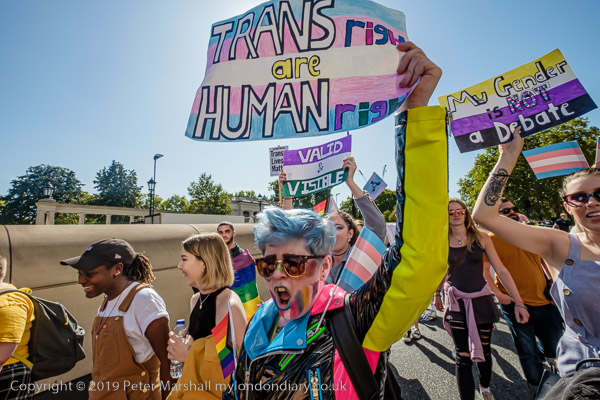
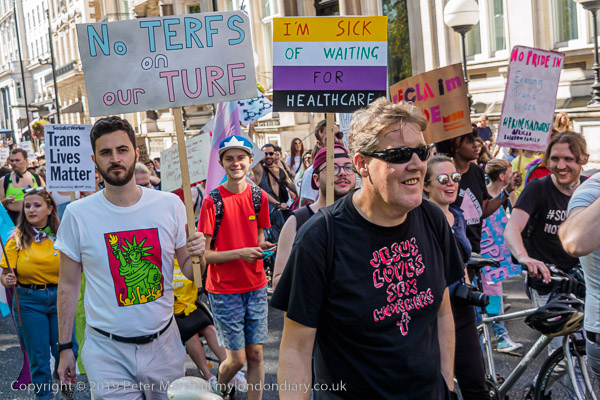
London’s First Trans+ Pride March

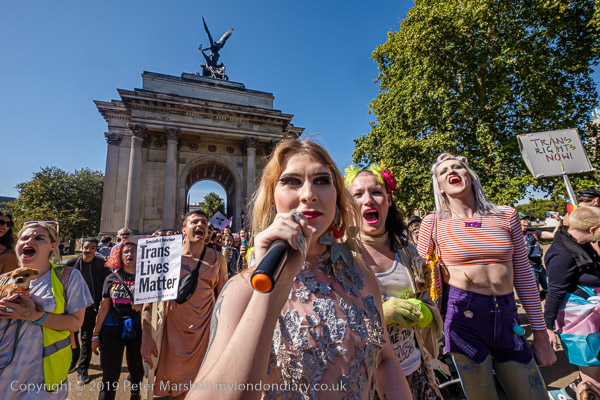
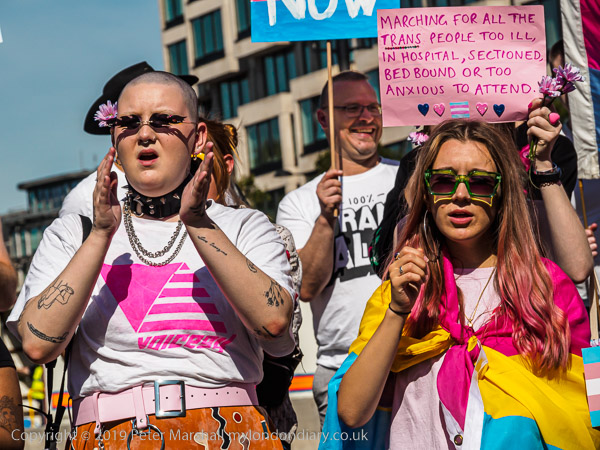
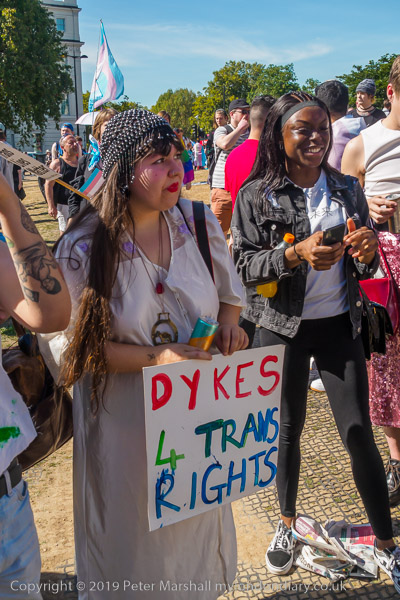
People met at Hyde Park Corner for this first march in the city to celebrate trans, non-binary, intersex, and gender non-conforming individuals and to protest against the continuing discrimination here and around the world against them.

As well as many from the trans+ community there were family, friends and other supporters taking part in an event which aimed to increase the visibility of trans+ people.

Recent years have seen an increasing transphobia in the British media with considerably publicity being given to the views of anti-trans activists. There has been an increase in attacks attacks on trans people on the streets, hate speech by trans-exclusionary feminists, and by right-wing national and state governments around the world.

Too often trans+ people around the world are subject to human rights abuses. They have always been an integral part of the gay community and at the forefront of the fight for gay rights – from the Stonewall rebellion on.

There were a few short speeches before the march set off, going along Piccadilly to a rally in Soho Square. I marched with them as far as Green Park where I caught the Underground for a protest in Brixton.

London’s First Trans+ Pride March


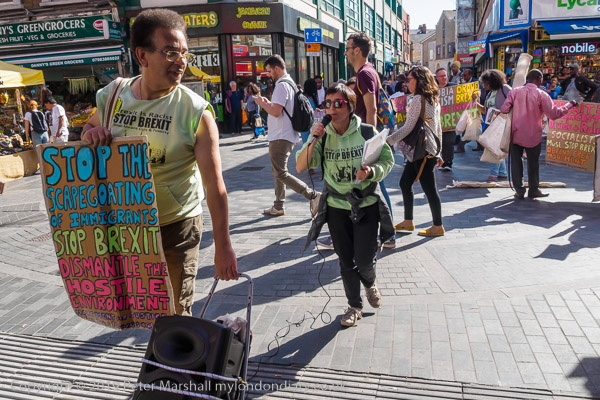
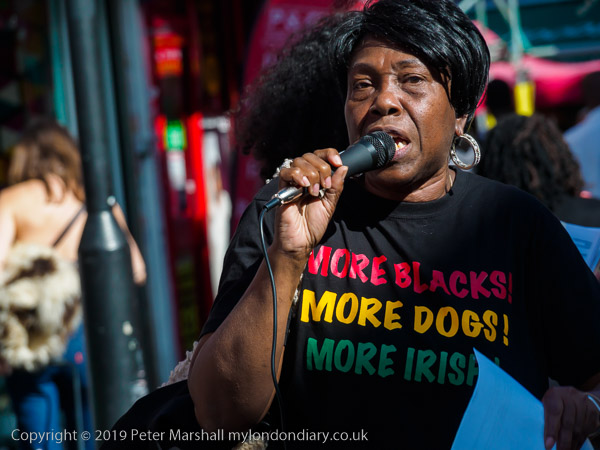
Brixton Anti-Racist March

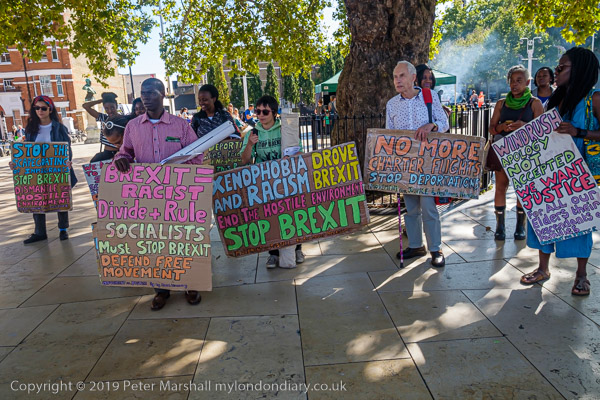
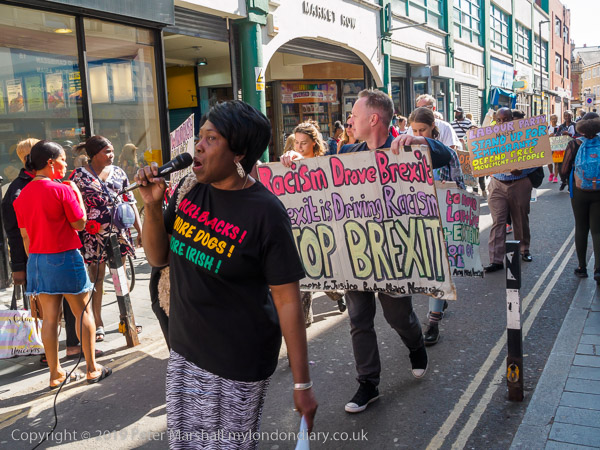
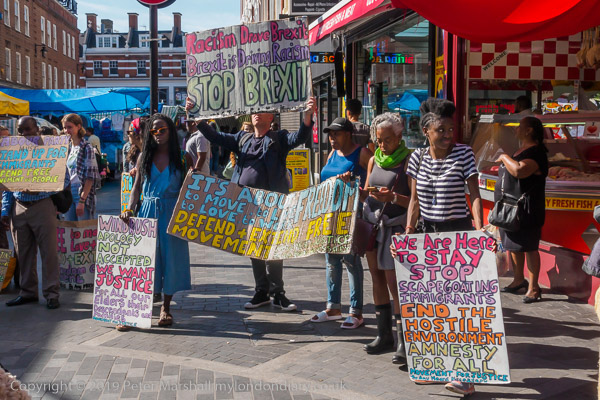
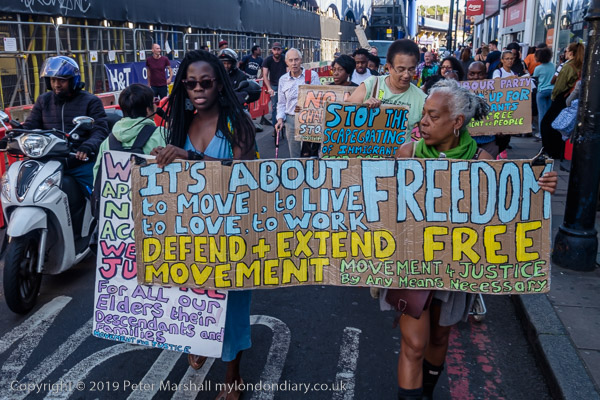
Movement for Justice and Lambeth Unison Black Workers’ Group were protesting in Brixton against the continuing persecution of Windrush family members and other migrants, calling for freedom of movement, the closure of immigration detention prisons, and an end to Brexit which they see being used to whip up immigrant-bashing and nationalism by Boris Johnson.

The event began in Windrush Square, where one of the speakers was Eulalee Pennant, a Jamaican great-grandmother who has been fighting the Home Office for 16 years against deportation. Here uncle was one of the Windrush generation, her grandfather had served in the UK armed forces for his working life, and her cousins, daughter, grandchildren and great-grandson were British. She had worked and paid tax here for many years but was detained days before her 60th birthday and locked up in Yarls Wood, where she contracted a serious stomach infection. She was still vomiting blood when the Home Office tried to put her on a deportation flight.

Eulalee had tried to regularise her and her son’s immigration status with the Home Office in 2003, and among the documents she sent was her passport. The Home Office kept claiming they did not have it, and it was only in court 15 years later they finally admitted they had failed to send in back. Her son spent five years fighting his case to stay in the UK but was deported to Jamaica in 2008, and was murdered there the following June. Her fight against deportation has cost many thousands in legal fees and she has been unable to work since 2003.

There had been relatively few at the gathering in Windrush Square but there was a larger audience when the group marched to Brixton Market to continue the protest there and Green MEP for London Scott Ainslie also came to speak about his LDNlovesEU campaign.

The group then set off to march noisily around central Brixton, returning to Windrush Square for some final speeches.

Brixton anti-racist march


Families Separated, Gaza, Ghouta and Sri Lanka

Families Separated, Gaza, Ghouta and Sri Lanka – On Saturday 23rd August 2014 I photographed four protests in Westminster, one against an aspect of our racist immigration policies, the second against the UK selling arms to Israel which have been used in attacks on Gaza (along with a counter demonstration), the anniversary of chemical attacks by the Syrian regime and a protest calling for UK support against the continuing genocide of the Tamil nation.


Divided Families protest over cruelty – Downing St

Families Separated, Gaza, Ghouta and Sri Lanka

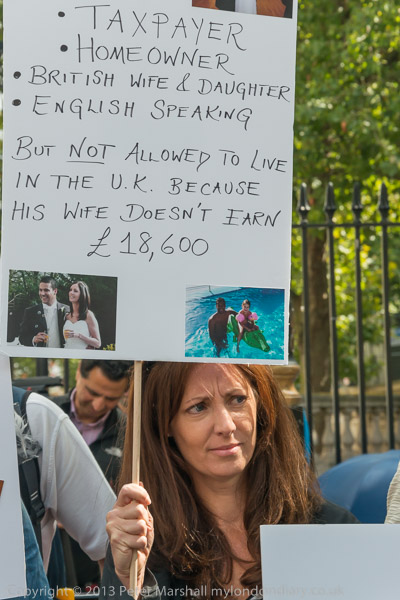
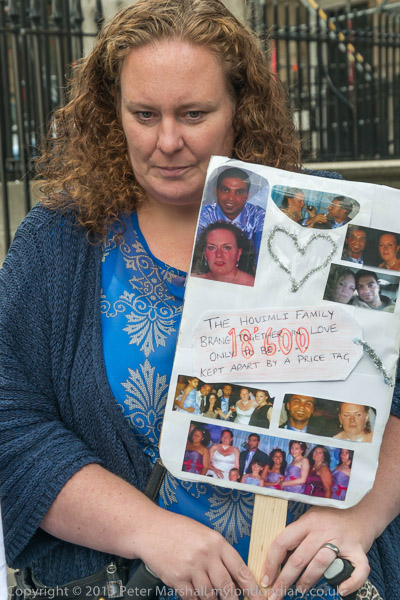
The cruel and unfair immigration rules set up by the Home Office under Theresa May mean that anyone earning less than £18,600 was unable to bring a non-EU spouse into the country (Brexit means that similar rules now apply to most EU countries.)

Families Separated, Gaza, Ghouta and Sri Lanka

This income requirement discriminates against women, the retired and disabled young and many minority ethnic people who have on average lower incomes than the general population. For couples with children, the income limit is even higher, and to secure visas for a spouse and two children you would need an income of £24,800.

Families Separated, Gaza, Ghouta and Sri Lanka

Fees for applications are also expensive – from £1048 to £1538 per person and applicants may also need to pay a healthcare premium of from £1560 to £3120 for adults and around three-quarters of this for each child. For applications made in the UK there is an extra £800 if you want a faster decision. And applicants also need to supply a great deal of documentation.

The policy, which also includes tougher English Language tests, a proof of greater attachment to the UK than of any other country and extending the probationary period from two to five years, is in direct contradiction of the Universal Declaration on Human Rights which states:

‘No one shall be subjected to arbitrary interference with his privacy, family, home or correspondence, nor to attacks upon his honour and reputation. Everyone has the right to the protection of the law against such interference or attacks.’

Universal Declaration on Human Rights

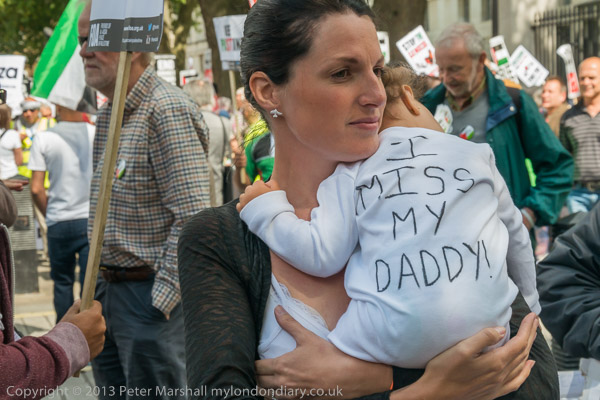
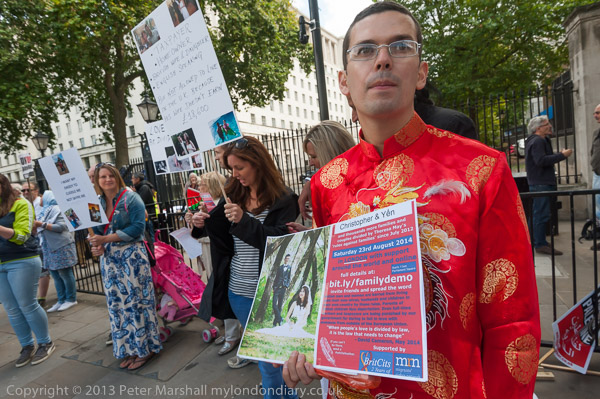
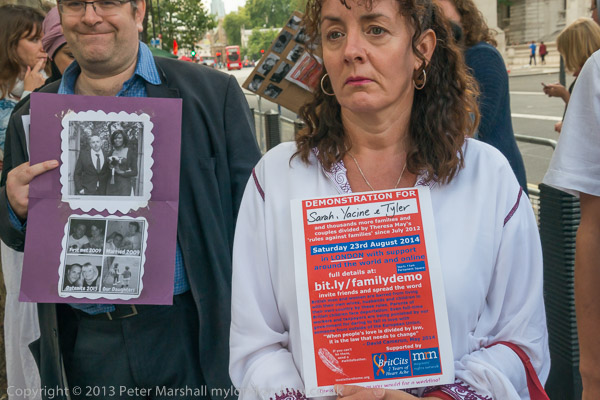
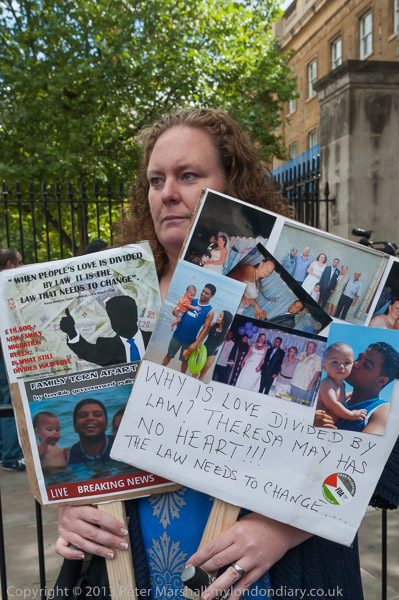
People at the protests included many whose families were divided as they were unable to meet the income levels, as well as a number of parents and friends of divided families.

Many carried placards with images of the divided families, along with captions such as ‘I WANT MY DADDY TO CUDDLE ME NOT SKYPE ME’. I felt deeply for those caught by what seem to be vindictive, unnecessary and totally insupportable polices. It was impossible not to agree with the placards with messages such as ‘WHY IS LOVE DIVIDED BY LAW? THERESA MAY HAS NO HEART!!! THE LAW NEEDS TO CHANGE….’

Divided Families protest over cruelty


Gaza Protest – Stop Arming Israel – Downing St

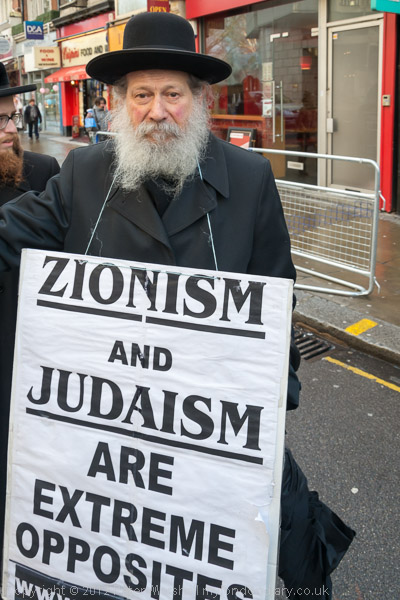
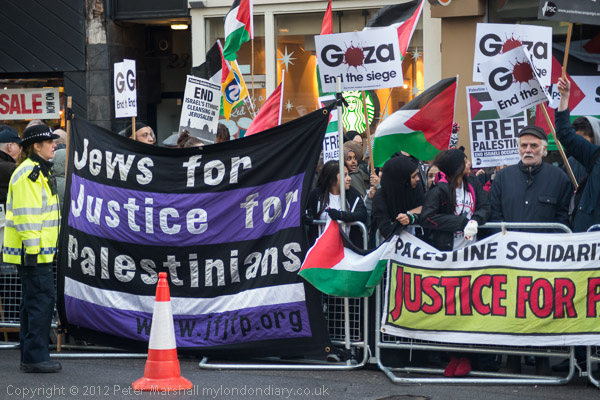
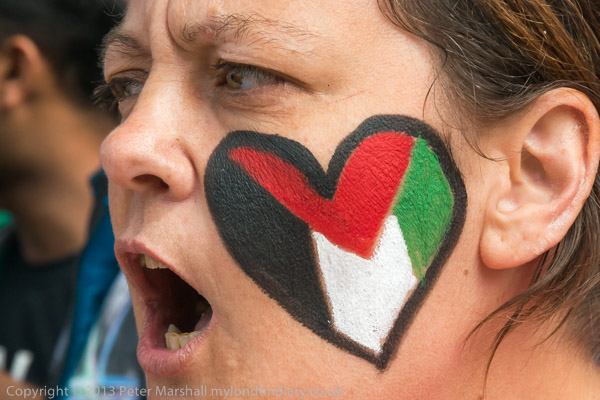
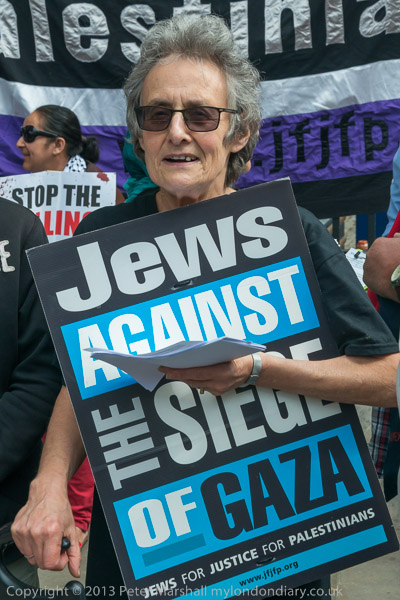
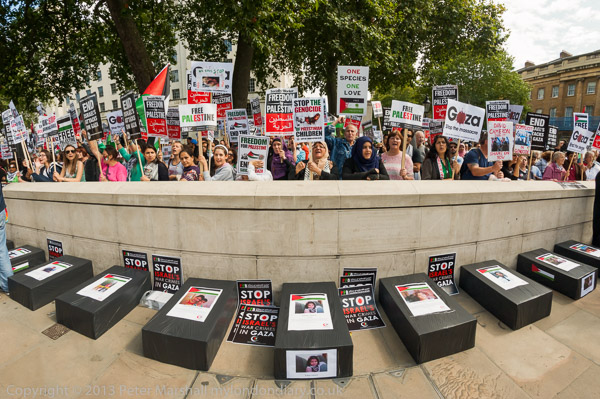
A large rally at Downing St called on the UK to stop selling arms to Israel, and for an end to Israeli war crimes. Among the protesters were many Jews from various Jewish groups, including the ultra-orthodox Neturei Karta who had walked down from north London to support the protest.

Israel had carried out air strikes on Gaza in July 2014 following a number of incidents including the shooting by the IDF of two Palestinian teenagers and the kidnapping and killing of three Israeli teenagers in the West Bank. There were other incidents including house demolitions and the kidnapping and killing of a Palestinian youth. Hamas replied to air strikes with rocket fire on Israel.

The Israeli invasion of Gaza began in earnest on 20th July and the ground war was still continuing though on a lesser scale when this protest took place, with a ceasefire being agreed and coming into effect on 26th August.

There are more details about the invasion in the Wikipedia Timeline, which states “2,256 Palestinians and 85 Israelis died, while 17,125 Palestinians, and 2,639 Israelis suffered injuries.”

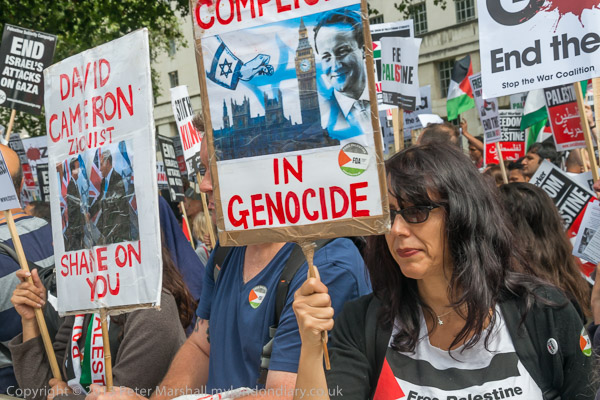
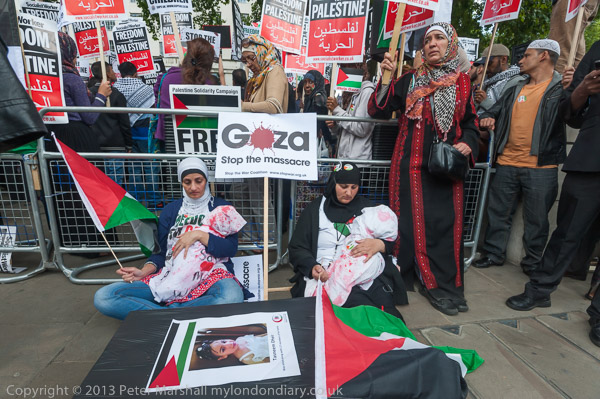
At the protest there was a row of black boxes representing coffins and the names of children killed, and some people carried ‘bloodstained’ bundles representing dead children

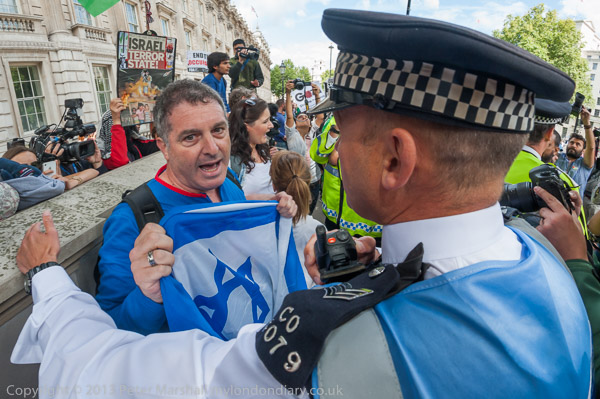
Three people came to wave Israeli flags across the road and were led away for safety by police.

Earlier one of the Palestinian protesters had tried to seize one of the flags and was dragged away by police. At the end of the rally opposite Downing St some of the protesters marched around London and I went with them as far as Trafalgar Square where I had another event to cover.

More pictures: Gaza Protest – Stop Arming Israel


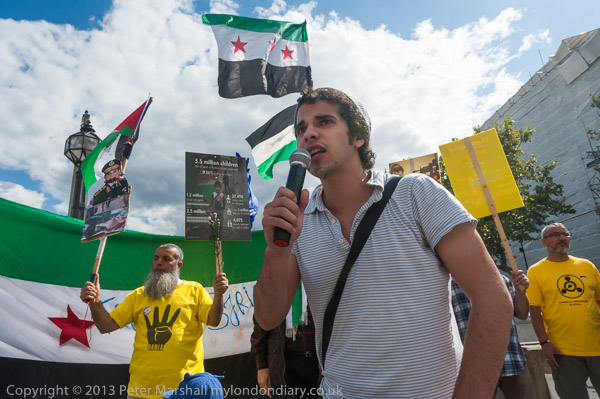
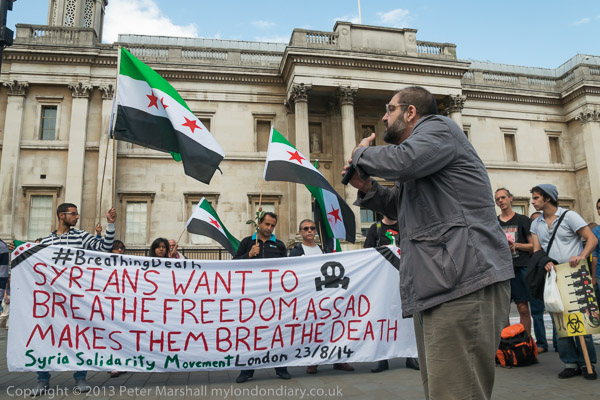
Syria Chemical Massacre Anniversary – Trafalgar Square

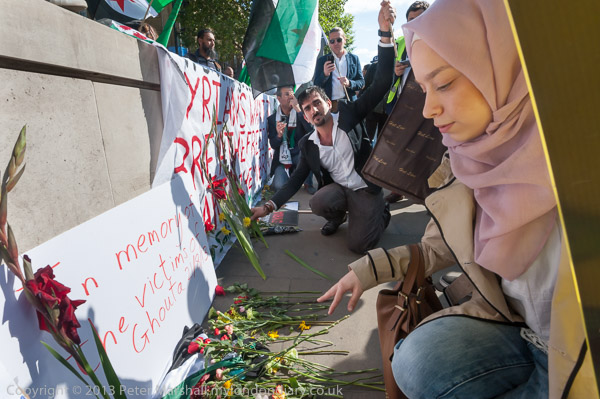
A rally marked a year after the Ghouta massacre of 21/08/2013 when Assad regime forces outraged the world by using Sarin gas, killing 1,477 residents including over 400 children in this Damascus suburb. The world failed to act against Assad.

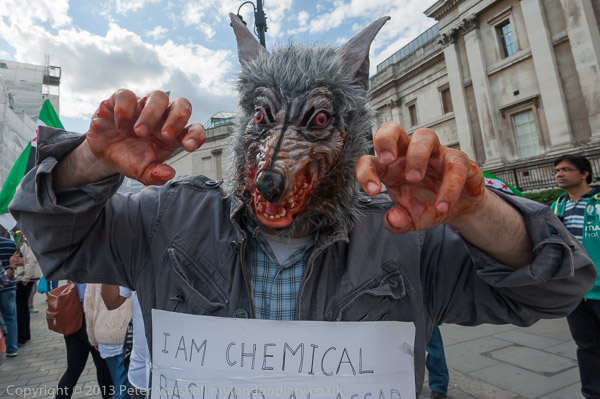
One man was wearing wolf head with bloody hands and placard ‘I AM CHEMICAL BASHAR AL ASSAD AND ONE YEAR ON I AM STILL GASSING SYRIAN CHILDREN. THANK YOU FOR UN VETO’

After an hour-long rally in Trafalgar Square the protesters, who were mainly Syrians, marched along the pavements to Richmond Terrace, opposite Downing St, where they laid flowers in memory of the dead.

More pictures: Syria Chemical Massacre Anniversary


Tamils protest Sri Lankan rapes & killing – Downing St

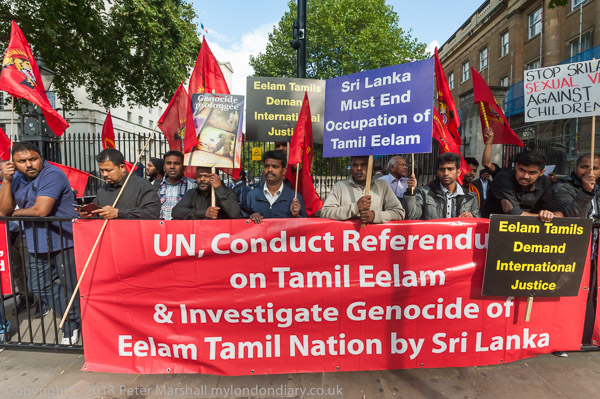
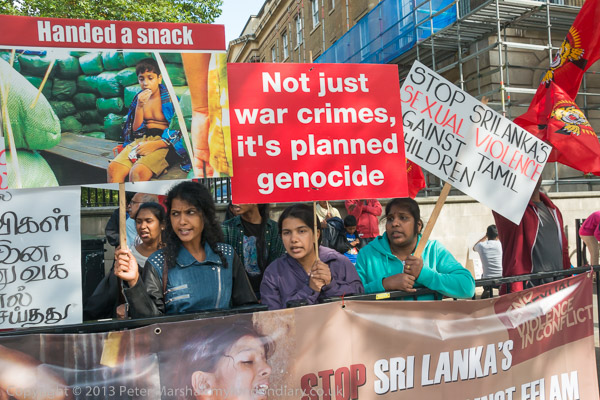
Also present when I returned to Downing St were Tamils protesting over the continuing genocide of the Tamil nation, calling for a UN investigation and referendum on Tamil Eelam.

Placards called for an end to the use of rape to destroy their nation and sexual violence against children.

More pictures: Tamils protest Sri Lankan rapes & killing


End The Israeli Invasion Of Gaza – 2014

End The Israeli Invasion Of Gaza – 2014 On 8th July 2014, Israel had begun Operation Protective Edge with air strikes and artillery bombardment on the narrow Gaza strip of Palestinian territory.

The previous month 3 Israel teenagers had been kidnapped close to an Israeli settlement on the West Bank; several weeks later their bodies were found – they appeared to have been shot shortly after capture and Israeli Prime Minister Benjamin Netanyahu vowed that Israel would have a tough response.

After the kidnapping the Israel Defence Forces had immediately arrested 350 Hamas members in the West Bank, and in response Hamas fired rockets into Israel from the Gaza strip. Israel’s bombardment failed to stop the rocket attacks and after 10 days on 17th July they began a full-scale ground invasion, attempting to destroy the military tunnels which Hamas had created in Gaza.

Israel ended the ground invasion on 5th of August and a cease-fire was announced on 26th August. During the war between 2,125 and 2,310 Gazans were killed and over 10,000 badly injured, many of them permanently disabled. The homes of over 10,000 families were destroyed and more severely damaged. The huge military imbalance meant that deaths on the Israeli side were 72, five of them civilians.

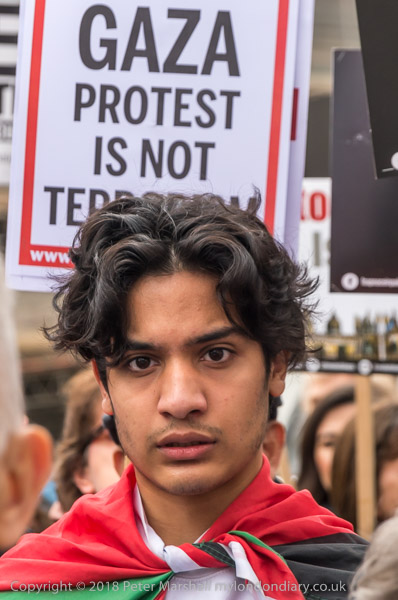
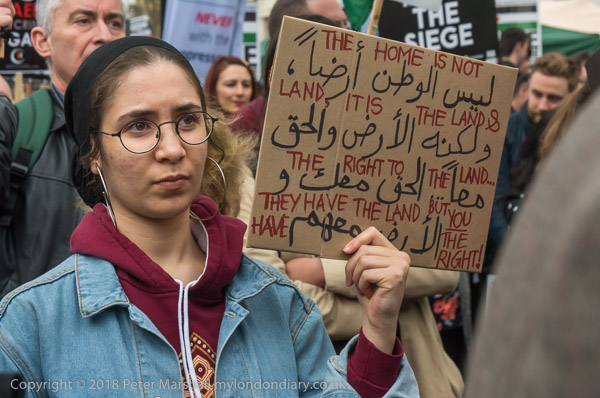
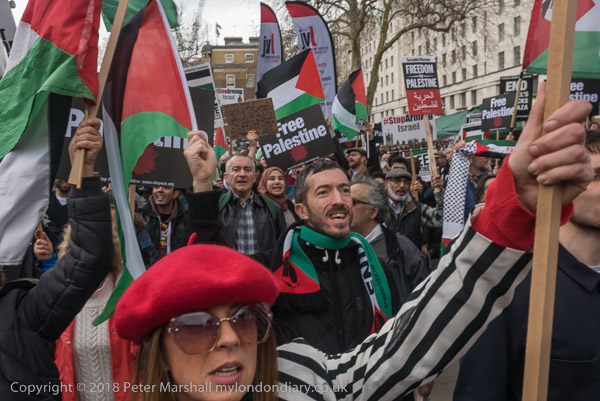
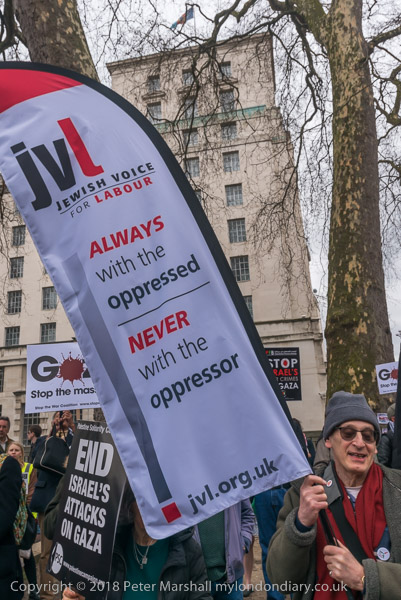
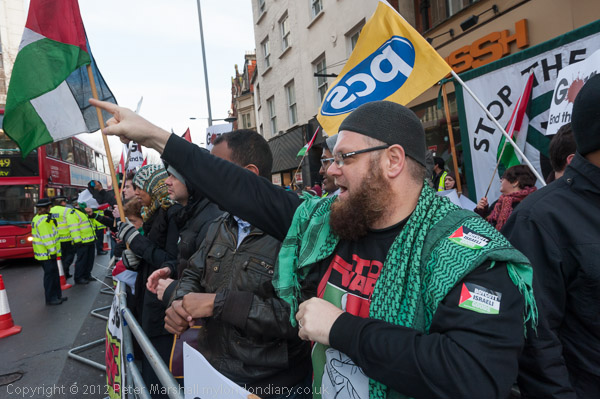
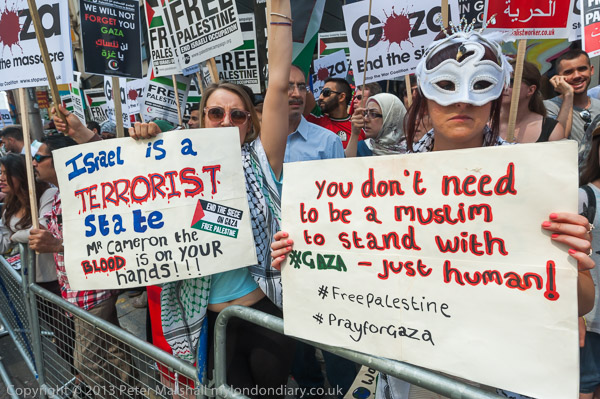
The protest in London on Saturday 26th July called for an end to Israeli attacks on Gaza which had already killed over a thousand Palestinians, mainly civilians.

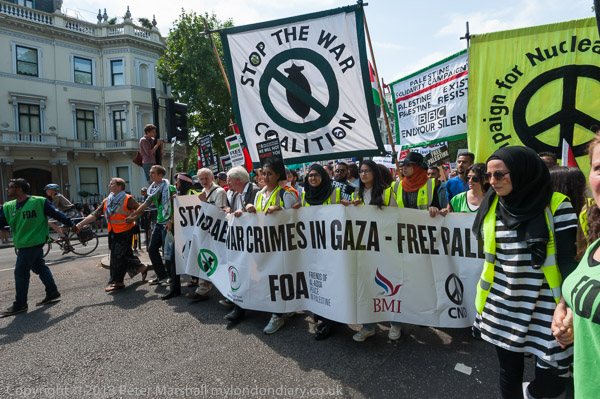
It began with a rally on the main road close to the Israeli embassy a short distance down a private road which was heavily defended by barriers and police. The police tried to keep the protesters on the pavements and traffic flowing, but there were soon far too many protesters for this to be possible and it spilt out to block the road.

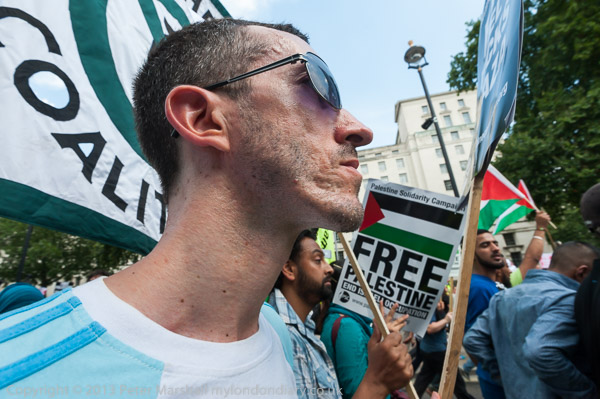
The rally here was fairly short, with speakers including Owen Jones and Labour veteran Walter Wolfgang. It was hard to estimate the number of protesters, but the wide street was packed with people for around 300 yards, many too far away to hear the speeched. I photographed the front of the march as it moved off and stayed with it for around half a mile before walking slowly back against the flow of the march taking more pictures of the protesters. There were still people coming out of the tube station for the march as I took a train to photograph another protest at Westminster.

After covering another event briefly I met up with the front of the march at Trafalgar Square as it turned into the top of Whitehall and was able to photograph it going down. It stopped briefly opposite Downing St, then continued to Parliament Square for the main rally.

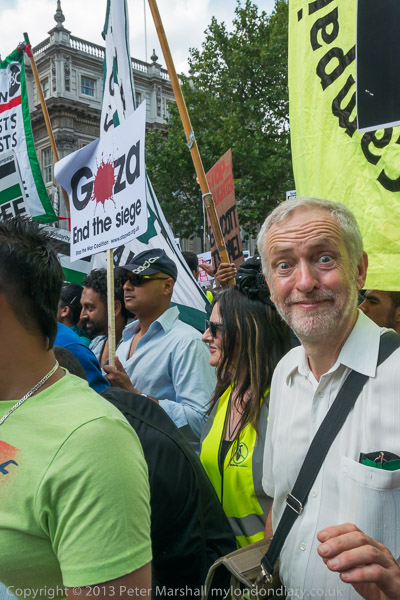
Jeremy Corbyn sees me taking his picture

Parliament Square is almost square with its large central area, mainly grassed about 205×230 feet, and for this protest was mainly fairly crowded, with people spilling out onto the roadways around its edge in places. Though quite a few protesters had felt they had done their bit by marching on a hot day and were making their way to the station or elsewhere.

I stayed for some time, photographing the marchers and speakers but after listening to around 17 of them (you can see my pictures of them on My London Diary) I began to feel rather faint. It was a hot day, and although there is some shade, to take photographs I had needed to stand in the sun. The rally was still continuing as I left for home.

Stop the Massacre in Gaza Rally
End Gaza Invasion March to Parliament
Israeli Embassy rally – End Gaza Invasion