Back in 1988 on the 17th July, the day before Nelson Mandela’s Birthday on the 18th July, I joined thousands of marchers through London demanding he be freed from jail.
https://en.wikipedia.org/wiki/Nelson_Mandela Mandela was born on 18th July 1918, so this was his 70th birthday and he was still in jail, then held in Pollsmoor Prison, near Cape Town, having been removed with other senior ANC members from Robben Island to remove their influence on younger ANC members held there.
He was well treated in Pollsmoor and international attempts to end apartheid was increasing, along with secret meetings with the South African Minister of Justice. President Botha had actually offered to release him, if he “unconditionally rejected violence as a political weapon”, but Mandela had refused to leave while the African National Congress was still banned.
Mandela’s 70th birthday was celebrated around the world, with a televised tribute concert at Wembley Stadium attracting an estimated 200 million viewers.
The march in London was a large one, and I wasn’t then a seasoned photographer of protests, though I had taken pictures at a number of smaller events.
Because of the size of the event there were a number of feeder marches leading to a rally in Hyde Park. I joined the march coming from Camden and went with it to the rally, where I took some pictures in the crowd but didn’t attempt to cover the speakers, who included the Archbishop of Cape Town, Desmond Tutu.
I took altogether only just over a hundred black and white pictures, of which I’ve now uploaded around a quarter to an album, Free Nelson Mandela – March and Rally – London 1988. You can also click on any of the images in this post to go to a larger version from where you can browse all the pictures that are online.
Although the title of this post is ‘More St John’s Wood’, my walks were not constrained by local authority boundaries but often by more important physical restraints, here the main west coast railway line from Euston, and I walked beyond the St John’s Wood boundary a little into South Hampstead or Swiss Cottage.
I can find out little about Hillgrove Estate designed by Peacock, Hodges and Robertson for the LCC around 1960 and inherited by Camden following the local government reorganisation in that decade. This piece of sculpture is not on the list of public art in Camden and unfortunately I failed to record any details of it when I made this picture in 1988 if any were available then. Perhaps someone seeing this will be able to give details in a comment.
7, Boundary Rd, St John’s Wood, Westminster, 1988 88-7g-65
This stucco detached villa dating from the 1840s is only Grade II listed for its ‘group value’, one of quite a number of similar properties in the area, though distinguished for me by its two substantial eagles on top of very substantial gate posts. The house next door, shown in the next few pictures, was much more remarkable.
Boundary Road, as its name suggests, marks a boundary, now between the City of Westminster – which includes St John’s Wood – and the London Borough of Camden, with this and other properties on its south side being in St John’s Wood. It was once a farm track on the boundary between two estates.
Alhambra Cottage, Boundary Rd, St John’s Wood, Westminster, 1988 88-7g-66
Alhambra Cottage is at 9 Boundary Rd certainly one of the most remarkable houses in London, a Grade II listed detached villa in a very detailed Islamic style and I made a number of photographs from the road outside. Later in 2011it was one of the buildings whose garden I photographed for the ‘Secret Gardens of St John’s Wood‘ project initiated by Mireille Galinou of the Queens Terrace Café and shown there in November 2011.
Alhambra Cottage, Boundary Rd, St John’s Wood, Westminster, 1988 88-7g-53
Another view of Alhambra Cottage.
Alhambra Cottage, Boundary Rd, St John’s Wood, Westminster, 1988 88-7g-54
I’m surprised not to find more information about this cottage online. Possibly the interest in the Alhambra may have been stimulated by the writing of American author Washington Irving who visited the Alhambra in 1828 and published his Tales of the Alhambra in 1832 and the lithographs of John Frederick Lewis, who became known as ‘Spanish’ Lewis published three years later.
At this time of year perhaps I should also mention that it was Irving who first put Santa (or rather St. Nicholas) flying over the rooftops at Christmas.
Loudon Rd area, St John’s Wood, Westminster, 1988 88-7g-42
This Grade II listed semi-detached house dates from the 1840s, but was altered in the mid-19th century. ‘An Englishman’s home is his castle‘ and this seemed to epitomise the proverb, with its castellated tower and sturdy gate. All that was lacking was a drawbridge.
Carlton Hill area, St John’s Wood, Westminster, 1988 88-7g-44
And finally before I left the area, another house with a tower, somewhere on my wandering between the junction of Abbey Road and Blenheim Rd and FInchley Rd. I took a few more pictures on my way south through St John’s Wood, but none are online.
Click on any of the images above to go to a larger version in my album 1988 London Photos, from where you can browse the album.
Rowley Way, South Hampstead, Camden, 1988 88-6d-54
Camden council bought the Alexandra Road estate, part of the Eyre estate in North London and their architect Neave Browne designed this ziggurat style terrace in 1968, but construction only began in 1972. Browne saw the design, with vehicles restricted to the basement level as a better solution than tower blocks, which had been discredited by the Ronan point collapse and other problems. Family flats with small gardens opened onto the walkway at ground level, with smaller flats stepped back above them, so all got good light and air. The height of the 8 storey block at left gave some protection to the rest of the estate from the noise of the main West Coast railway line from Euston.
I had wrongly titled this Langtry Walk, which runs at the south of this estate a few yards away with a single lower row of flats by Browne built on similar principles. The name Langtry walk refers to royal mistress Lily Langtree, nicknamed “The Jersey Lily”, who, as local historians Dick Weindling and Marianne Colloms have shown had no connection with the area but was co-opted by a resident whose house in Alexandra Road was to be demolished for the new estate.
The estate was Grade II* listed in 1993, remarkably early in its life and the first post-Second World War council estate and one of very few public housing schemes to acheive this status.
This photograph was made from Abbey Road, with the back of Rowley Way at the right of the picture. Snowman House at left is on Abbey Road and Casterbridge at the corner of this and Belsize Rd and both are in Camden Council’s Abbey Estate. Both were approved in 1965 and building completed in 1967. They have 20 storeys above ground and are 59.4m tall – about 195 feet.
A bridge across Abbey Road connects the Casterbridge tower with another Abbey estate building, Emminster, which has a parade of shops at ground level. Both the 8 storey Emminster and another block, Hinstock, are scheduled for demolition to make way for new affordable homes to be built, and improvements to the road layout. This bridge was still there in April 2021, but will presumably soon be gone.
Finchley Rd, Camden, 1988 88-6d-35
I walked back towards Kilburn Grange Park and then to West End Lane, and then across to FInchley Road. On my contact sheet this row of heraldic figures on the front garden wall of a house is labelled ‘Finchley Rod’, but it may have been a few yards down a side turning.
The Alcove Cafe, Finchley Rd, Camden, 1988 88-6d-36
The Alcove Cafe was in a part of the former station entrance for the Finchley Road (Midland) station which first opened as Finchley Rd & St John’s Wood in 1868. Around 1905 a row of seven shops and offices named Midland Crescent was added to the entrance on the west side of FInchley Road. The station closed in 1927 but the shops remained, being demolished in the early 1990s for the building of the O2 Centre here. Various planning, finanacial and other problems held up the new building which finally opened in 1998.
Neasden Electronics was roughly opposite the former station, and these buildings have now been replaced by a hotel.
Broadhurst Gardens, South Hampstead, Camden, 1988 88-6d-22
I walked down towards Swiss Cottage turning briefly into Broadhurst Gardens to make a picture of the rear of the St John’s Court flats on FInchley Rd, built in 1937-8, architect T P Bennett, with the lower three floors for the department store John Barnes, with five floors above housing 96 flats. In 1940 the store became part of the John Lewis Partnership. It closed as a department store in 1981 and the ground floor are now occupied by Waitrose.
Swiss Cottage, South Hampstead, Camden, 1988 88-6d-24
I made a couple of photographs of new office buildings at Swiss Cottage.
Swiss Cottage, South Hampstead, Camden, 1988 88-6d-25
And then went on the photograph Ye Olde Swiss Cottage, a Grade II listed Samuel Smiths pub originally built as an alpine-style chalet and called The Swiss Tavern.
Ye Olde Swiss Cottage, Finchley Rd, Camden, 1988 88-6d-26
Various dates for the building of the chalet can be found on the web, including both 1804 and 1840. Possibly CAMRA may be more reliable given the nature of the building, which they state “was built in 1830 by T Redmond and it stood next to a toll gate; travellers would stop at the tavern while waiting to pay their fees. There had been a gabled building on the site called Lausanne Cottage said to have been used by Charles II as a hunting lodge and their may have been an earlier pub called the Swiss Tavern.”
I didn’t pop in for a pint of ‘Old Brewery Bitter’ (and probably it wasn’t then on tap) but continued my walk – and will do so in a later post.
Click on any of the pictures to go to a larger version on the album 1988 London Photos from where you can browse the whole album. Pictures there are usually in file name order which differs from the order in which they were taken.
St Lawrence Mansions, Priory Park Rd, Kilburn, Brent, 1998 88-6d-03
I continued my walk along Kilburn High Road, photographing again some of the buildings I had photographed on my previous walk in Kilburn, and going down Priory Park Road to take a couple of pictures of St Lawrence Mansions, Victorian flats. These were used for some years by Brent Council to house homeless families, and applications by the owners to demolish them were turned down in 2012. In 2017 they were in used to house over 200 asylum seekers in desperately poor and overcrowded conditions in a hostel run by run by Clearsprings Ready Homes, a company that has been criticised in media reports about this and other asylum hostels.
I’ve always been interested in trade signs and liked the large keyhole of this locksmith’s,on Willesden Lane, close to its junction with Kilburn High Rd.
Willesden Lane, Kilburn High Rd, Kilburn, Brent, 1998 88-6d-62-positive_2400
Taken just a few yards closer to Kilburn High Rd, with Kilburn State Cinema tower visible. The large sign for Brondesbury Garage above Brondesbury Mews entrance has now gone, the Gentlemen’s convenience has disappeared, the billboards have gone and Biddy Mulligans is now a betting shop, but the view is still much the same.
Kilburn State, cinema, Kilburn High Rd, Kilburn, Brent, 1998 88-6d-63
Grade II* listing has protected the Gaumont State Theatre, a splendid art deco building withh opened in 1937, seating over 4,000. Since 2007 it has been a church and still contains one of the largest fully functioning Wurlitzer organs in Britain.
The National Club, Kilburn High Rd, Camden, 1998 88-6d-65
The National Club is another building I’ve previously photographed and written about in my postTo Kilburn High Rd 1988 – and like the Kilburn State is now also a church. The boundary between Brent and Camden runs down the Kilburn High Road, with properties on the east side being in the LB Camden.
Wallace Manufacturing Chemists Ltd is still active according to Companies House, but no longer in Netherwood St. Its business is described as ‘Manufacture of basic pharmaceutical products’ with a registered office in Brentwood and I think is now a part of the Alinter Group based in Abingdon. Perhaps the graffitied ‘INFECTION’ was a mildly humourous comment on the closure of the premises making medicines – Histergan cream and tablets, Ironorm drops and Malarivon and Vigranon-B syrups.
Quex Rd, Kilburn, Camden, 1988 88-6d-45
These pictures show the doorway at 15 Quex Rd, on the corner with Mazenod Avenue, part of a set of mansions at 9-15 Quex Rd, just a few yards from Kilburn High Rd. I’ve called it Kilburn, but certainly for estate agents this is West Hampstead.
The road was built on a large estate on both sides of West End Lane which had been inherited in 1813 by John Powell Roberts following the death of his brother who fell from a horse. His brother had previously inherited this and a large house a Quex Park in Birchington, Kent under a trust following the death of his uncle, and the terms of that trust meant changing his surname to Powell, and John Powell Roberts became John Powell Powell. When he died in 1849 the various estates held by the trust passed to his nephew, Col Henry Perry Cotton.
Quex Road, named after the Powell-Cotton family seat, was at the heart of plans for the development of the estate made in 1866, which included a Roman Catholic church and Wesleyan Methodist and Unitarian chapels on Quex Rd built in 1868-9 and the street was more or less fully developed by 1885.
Eugene de Mazenod was a leading French Catholic bishop in the nineteenth century and founder of the Oblates of Mary Immaculate who became missionaries across the world and founded the Church of the Sacred Heart of Jesus in Kilburn in 1866, though their temporary building was replaced by one designed by E W Pugin and built after his death from 1875-1899.
Quex Rd, Kilburn, Camden, 1988 88-6d-45
Click on any image to go to a larger version in my album 1988 London Photos from where you can browse the other images in the album.
The Kilburn State Theatre was built on grounds formerly occupied by houses and since the 1890s by a furniture factory, The Palmerston Works. From 1916 to 1926 it was the home of the Central Aircraft Company which built cheap wooden aircraft and also gave flying courses and joy rides from Northolt Airport. The flights were a great success but although the planes only cost £250 sales were poor and the factory returned to making furniture.
The site was bought by Gaumont and opened in 1937 as the Gaumont State Cinema, designed by George Coles and this now Grade II* listed Art Deco masterpiece has a tower inspired by the Empire State Building in New York and when built had seating for over 4000, making it the largest purpose-built cinema in Europe. You can read much more about it in The Kilburn State Cinema.
Gascony Avenue, Kilburn High Rd, Kilburn, Camden, Brent, 1988 88-5m-64
This wall on the corner of Gascony Avenue and Kilburn High Road was almost totally covered with advertising and branding, including three giant posters for the Invalid Children’s Aid Nationwide, (I CAN), founded in 1888 as the Invalid Children’s Aid Association by Allen Dowdeswell Graham to help poor children in London’s East End who were either seriously ill or handicapped. It is now a national charity for children with speech and language difficulties.
People, Kilburn High Rd, Kilburn, Brent, Camden, 1988 88-5m-51
Walking along the Kilburn High Road with a camera (or possibly two) around my neck attracted the attention of several groups of people on the street, who demanded I take their pictures.
People, Kilburn High Rd, Kilburn, Brent, Camden, 1988 88-5m-66
And I was happy to do so. They were all in a good mood, possibly in some cases helped by a little exposure to Guiness. I think all had good Irish accents.
Posters, Kilburn High Rd, Kilburn, Brent, Camden,1988 88-5m-53
And flyposters on several buildings advertised Irish events in London.
Kilburn Banks Ltd, Springfield Joinery, off Kilburn High Rd, Kilburn, Camden, 1988 88-5m-54
I think the Springfield Joinery was probably at 1Springfield Lane, but no trace of this building remains. Possibly it was where the beer garden of the Old Bell Inn now is. If so it was in the LB Camden.
The Animals War Memorial Dispensary, Cambridge Ave, Kilburn, Brent, 1988 88-5m-46
Animals, particularly horses, dogs, carrier pigeons and donkeys, but also many other species played an important role in the FIrst World War, and many were killed carrying out their duties. After the war the RSPCA proposed a memorial to them, and plans were drawn up for one at Hyde Park Corner but this was never built – though many years later in 2004 one was unveiled on Park Lane. The RSPCA changed its plans and decided on a more practical project, buying this site in Kilburn for The Animal War Memorial Dispensary in 1931.
There are two memorial inscriptions, one on each side of the door, but too small to read in my photograph. They are given in full on the Imperial War Museum web site.
LEFT: THIS BUILDING IS DEDICATED AS A MEMORIAL TO THE COUNTLESS/ THOUSANDS OF GOD’S HUMBLE CREATURES WHO SUFFERED AND/ PERISHED IN THE GREAT WAR 1914 – 1918 KNOWING NOTHING OF THE/ CAUSE. LOOKING FORWARD TO NO FINAL VICTORY. FILLED ONLY WITH/ LOVE FAITH AND LOYALTY THEY ENDURED MUCH AND DIED FOR US./ MAY WE ALL REMEMBER THEM WITH GRATITUDE AND IN THE FUTURE/ COMMEMORATE THEIR SUFFERING AND DEATH BY SHOWING MORE/ KINDNESS AND CONSIDERATION TO LIVING ANIMALS.
RIGHT: 1914 – 1918 THIS TABLET RECORDS THE DEATH BY ENEMY ACTION/ DISEASE OR ACCIDENT OF 484,143 HORSES MULES CAMELS AND/ BULLOCKS AND OF MANY HUNDREDS OF DOGS CARRIER PIGEONS AND/ OTHER CREATURES ON THE VARIOUS FRONTS DURING THE GREAT WAR/ IT ALSO RECORDS THE FACT THAT IN FRANCE ALONE 725,216 SICK AND/ WOUNDED ANIMALS WERE TREATED IN VETERINARY HOSPITALS/ PROVIDED BY THE RSPCA.
Bas-relief, The Animals War Memorial Dispensary, Cambridge Ave, Kilburn, Brent, 1988 88-5m-55
The Grade II listed dispensary is a converted mid-nineteenth century house memorial plaque above the door on the facade of the building is by Frederick Brook Hitch of Hertford who won the competition for the design. The dispensary continued in use until a RSPCA reorganisation in 2016.
Next door to the dispensary is Kilburn’s ‘Tin Tabernacle’, Grade II listed as Cambridge Hall and erected as St James’s Episcopalian Church in 1863. Active as a church until the 1920s it became an “Air Raid Precautions store during the Second World War, and was later known as the Lord Lloyd of Dolobran Memorial Hall. The building was taken over by the Sea Cadets in about 1949, and from then on was known as Training Ship Bicester“. In the 1950s they remodelled the interior as a mock-up of a Ton-Class Minesweeper. It had been built with a spire which was apparently stolen in the 1980s before this picture was taken.
74 Maida Vale, St John’s Wood, Westminster, 1988 88-5m-34
The pineapple was a symbol of wealth and found a place on many gateposts, but 74 Maida Vale is unusual in also having three on the parapet wall. I think the house probably dates from some time between 1829-1840 and that the rooms behind those upper pineapples are a later addition, but have found no specific information about this particular house; although several others on the block are listed this is not.
West Kilburn Baptist Church, Carlton Vale, West Kilburn, Brent, 1988 88-5l-33
My wanderings around Kilburn Park had taken me back through the South Kilburn Estate to Carlton Vale and this fine example of a Baptist Church, built for the Rev Thomas Hall in 1865. Money was tight, but his brother who was an architect worked on the plans without payment. According to the Commemoration Booklet issued for its centenary the foundation stone was laid on ‘Several coins of the Realm bearing the portrait of her most Gracious Majesty Queen Victoria – one shilling, one sixpence, one halfpenny‘ and ‘the text, “Other foundation can no man lay than that is laid, which is Jesus Christ” (1 Corinthians 3:11).’ Six years later, the church still owed £380 of the £1250 it cost to build.
Willesden Lane, Brondesbury, Brent, 1988 88-5l-21
From Carlton Vale I continued northwest up Salusbury Road then turned right along The Avenue in Brondesbury to reach Willesden Lane opposite this house which is numbered as 66 Cavendish Rd, although this frontage is on Willesden Lane. This house struck me as having a intriguing individuality, although certainly not great architecture, incorporating several distinct variations of style and a rather oddly situated small window. Currently divided into around 13 small flats a planning application has been submitted to demolish it and use the site with its long garden along Willesden Lane to build a new 5 to 6 storey building with 21 flats.
Lawrence & Aitken , incorporated in 1927 but founded earlier and now dissolved, filed its last accounts in 1990. It gave the nature of its business as “Manufacture of other articles of paper and paperboard n.e.c. -” and was said to employ five people. The works date from 1904 and were built for cardboard makers Lawrence & Aitken under an agreement with the Simms Manufacturing Company Limited which is reproduced (but very hard to read) on the RAC website. The works is still there, though the building on the right has been replaced by housing called Kimberley Court.
Willesden Lane, Brondesbury, Brent, 1988 88-5l-24
In one of those mysteries that I’ve sometimes come across, the extension at left to J Green’s shop at 136 Willesden Lane has grown to the same height as the rest and the building is now wider, having four windows at first and second floor levels and a new floor on top while retaining the Graeco-Egyptian style of the original.
Both 134 and 136 were built for John Cramb, monumental mason supplying many monuments in the cemetery opposite, 134 in 1896 designed by George Neal and 136 by F C Dare in 1883-1884 . Both are locally listed.
Willesden Lane, Brondesbury, Brent, 1988 88-5l-26
These shops are still there but I think all now different businesses. So many flats and shops were for sale in 1988.
Willesden Lane, Brondesbury, Brent, 1988 88-5l-12
Missing ‘O’, ‘M’, ‘B’ and ‘G’ perhaps made this frontage more interesting.
The National Club, Kilburn High Rd, Kilburn, Camden, 1988 88-5l-13
In 1910 after the death of its owner, The Grange, a large house with extensive grounds on Kilburn High Road was sold to Oswald Stoll, the owner of the London Coliseum, who began building a theatre here. By the time it opened in 1914 his plans had changed and it became the Grange Cinema, with over 2,000 seats.
The cinema closed in 1975 and was opened as Butty’s Club and Dance Hall by Kilburn Irish publican Michael ‘Butty’ Sugrue, and later in 1976 also became the Kilburn National Club, owned by three local brothers who were builders, originally from Tipperary. The club was a major music venue, where stars including Johnny Cash and David Bowie played (there is a longer list here, along with more detailed information about the site.)
Applications to demolish the building were turned down in 1991 as English Heritage had listed it earlier in the year, as was another application in 1993. After the National Club closed in 1999 the building remained empty until it became the Victory Christian Centre in 2001 – but the church was closed in 2002 by the Charity Commission who didn’t approve of Pastor Goodman’s extravagances on expensive holidays and cars and a house in Northants. In 2003 it became a site of the worldwide Universal Church of the Kingdom of God.
The Secondhand Furniture Shop, Kilburn High Rd, Kilburn, Brent, 1988 88-5l-15
An interesting example of a window display.
Loveridge Rd, Kilburn, Camden, 1988 88-5l-16
A few yards east of Kilburn High Rd the Underground – here decidely overground – goes across Loveridge Rd. I liked the washing hanging over Loveridge Mews, not something often found across a London street.
Confusingly, the boundary between the London Boroughs of Camden and Brent runs down the Kilburn High Road, splitting Kilburn in two. I’m sure there are still some pictures in the album where I’ve indicated the wrong borough.
Gosheron Tapes, Kensington Church St, Kensington, Kensington & Chelsea
I’m often surprised by people who look at some of my photographs and say to me “ I never notice that”, but I think it’s true of all of us that we walk around without really noticing things. Even buildings like Vicarage House, home of Gosheron Tapes, whose frontage screams out onto the street. But Gosheron’s days – at least at this address – had clearly passed, as an estate agent’s sign and flyposts on the windows clearly show, though they seem to have continued making packaging materials elsewhere until at least 2005.
The building now has antiques on the ground floor and serviced offices elsewhere, including the Nicaraguan Embassy. I’ve failed to find any information about its exact date – somewhere around 1900 – or the monogram which appears to be CS on its frontage. Information is welcome.
Godfrey’s Model Bakery, Arlington Rd, Parkway, Camden, 1987
The ‘Tasty Corner’ on Arlington St and Parkway in Camden is now an estate agentss and its large sign with its baker for Godfrey’s Model Bakery has disappeared.
Palmers Pet Stores, Parkway, Camden, 1987
Many passed Palmer’s Regent Pet Store on their way to and from London Zoo from Camden Town Station. It was established by Mrs Florence Palmer around 1918 but was run from 1924 by George Palmer, who built up the business and expanded into a second neighbouring shop in the late 1930s. Perhaps surprisingly this shop was listed Grade II in 2007, largely for its shop front which the listing text suggests dates from around 1940, though the houses containing the shop were built in the 1820s.
The shop, which had sold Winston Churchill his cat Orlando as a kitten which later moved into Downing St, and a couple of Abyssinian kittens to Charlie Chaplain, stopped selling animals around 2005 and moved across the road. After being empty for several years it became a tea room.
Clarence Cottage, Albany St, Regent’s Park, Camden, 1987
On their way to the Zoo walkers might have walked down Albany St, or at least past its corner close to this hous, Clarence Cottage, which stii has its row of ornaments with a rather weather-beaten lion at its centre. Previously called Glenhaven, it isn’t clear to me why the mid-19th century house was Grade II listed in 1974, though it’s a pleasant enough building of its age, only really distinguished by this extension with a Ionic pedimented doorway onto the pavement outside and the ornaments above it – including that lion.
It’s in a area of London that has many fine buildings from that era and earlier – much of which is probably also listed.
Sussex St, Pimlico, Westminster, 1987
I came across two dogs in Westminster, looking to me rather snooty. But I’d failed to note down their exact location and it took me a long time to hunt them down again – but they are still there in Sussex St.
Perhaps the most surprising thing about the Romany Hotel is that it is still there as the Romany Hotel, though the signage has changed and now includes an e-mail address and a fairly discrete extra floor has been added on top.
But in keeping with today’s theme is the bird in flight at the top left corner. Although I’m no ornithologist at first glance it looked like some bird of prey, but I think it is really just a pigeon doing a good impression.
All photographs on this and my other sites, unless otherwise stated, are taken by and copyright of Peter Marshall, and are available for reproduction or can be bought as prints.
I suppose my photography is always a catalogue of obsessions, but at times and in particular places this shows more strongly.
Most of these pictures were taken in Kensington, with just a couple in Primrose Hill.
Photographically there is a certain interest in rendering these essentially white surfaces – as some photographers have found with subjects like white eggs on a white plate.
But I suppose that there might be more Freudian interpretations of at least some of these pictures.
London developed hugely in the nineteenth century with stock brick for the workers and stucco for the middle classes, and I still feel something of an outsider in these wealthy areas, although some had become pretty down-at-heel by the 70s and 80s when I was making these pictures.
Since then, most of them have been tidied up and refurbished, and more divided into flats now often worth rather my than my own outer suburban house.
There are times I find myself rather despising what appears to be overdone icing on the architectural cake, and looking for something with a little more depth and variation.
There is something of the fairly tale about these houses and the pictures, and although I had committed myself to photographing all of London I felt a longing to get away from Kensington and back to the real world.
Clicking on any of the pictures above will take you to my Flickr Album 1987 London Photos where you can view larger versions.
All photographs on this and my other sites, unless otherwise stated, are taken by and copyright of Peter Marshall, and are available for reproduction or can be bought as prints.
Although I first took pictures at protests in the 1970s, I had been taking part in protests since the middle of the 1960s. But I was then a penniless student with no idea about how you could cut costs by developing and printing your own films; I did own a camera, a Halina 35X, but had dropped it in the lake at Versailles and it never worked reliably after that, delivering random but usually very slow shutter speeds from its rusty leaf shutter.
Even after I had taken a short photographic course and got a job and could afford a new camera (a cheap Russian Zenith SLR) and had rigged up a temporary darkroom in the kitchen of our flat, I was still going on protests as a protester and took few if any photographs.
BBC
Of course there were fewer protests back in the 70s and 80s, or at least it was harder to find out about them in the days before the World Wide Web. There were of course huge events such as the Miners’ Strike, but unless you lived in the mining areas or could travel to them, which didn’t fit with my full-time job you read about most of these after the events were given newspaper coverage if at all. Many other protests related to strikes and union issues were simply impossible to know about unless they concerned your own union.
My attendance at protests was largely limited to the big national demonstrations organised by groups I belonged to – such as CND and the Anti-Apartheid movement and a few others that were advertised in advance in the alternative press. Many protests were only advertised by fly-posting on walls mainly in the areas they were to take place in – and there were few if any such postings in the area where I lived.
I began to be more a photographer of protests than an actual protester in the 1980s, particularly after a few of my photographs were accepted for an exhibition on protest (and I think one won a prize.) I began to realise that I could make a great contribution to the various causes with a camera than simply marching or attending rallies, and, a little later, began contributing my photographs to a picture library concerned with social issues, and later still providing my services directly to some protest groups.
As more and more people and groups went on-line things began to change. I found out about more and more protests, at first as groups set up web sites to promote their activities. I’d spend an evening or more a week going through a list of perhaps 20 or thirty different groups and using sites which listed bus and travel diversions and various search engines to find out about events and put them in my diary. Then Google arrived and made searching easier and finally Facebook and I had little time to photograph anything but protests.
The Free Nelson Mandela march in London was on Saturday 17th July 1988, the day before his 70th birthday and two years before he was released from prison. I walked with the protesters taking pictures from Camden Town to Hyde Park, and took a few pictures in the crowds in Hyde Park, but none of the stage and speakers at the rally. You can see more of the pictures in the Flickr album uploaded a couple of days ago. Clicking on any of the pictures above will take you to the larger version in the album.
All photographs on this and my other sites, unless otherwise stated, are taken by and copyright of Peter Marshall, and are available for reproduction or can be bought as prints.
Three years ago on October 21st I spent an interesting Saturday travelling around London and photographing several quite different events – unlike last Saturday when all I did was sit at a computer and work on old pictures and take a short walk along a familiar stretch of the River Thames close to my home, taking care to avoid getting close to the other strollers.
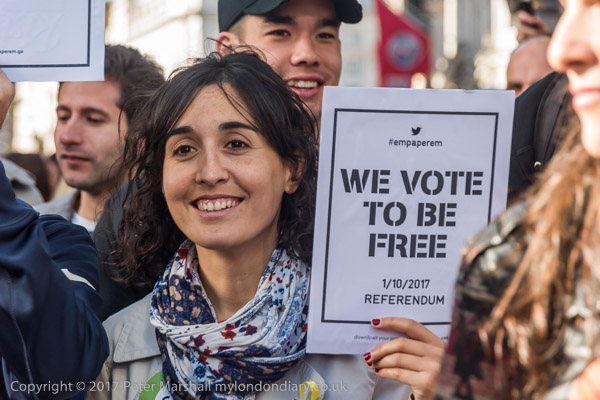
The Catalan protest at Piccadilly Circus was colourful, with many of the several hundred present fyling or wearing flags and calling for independence. And many of the placards were in English, unlike some other protests about overseas events. While Spain seems to have managed so far to have stopped the indepenence movement by forceful policing and political trials in the longer term I think there has to be movement towards a more federal approach with much greater autonomy for the region. We are begining to see a similar trend here in the UK, where our government appears to be failing to honour the 1707 Acts of Union between England and Scotland as well as creating increasing division between Wales, Northern Ireland and Westminster, with the likely no-deal (or very limited deal) over Brexit seeming certain to lead to to a break-up of at least parts of the union.
Conveniently the Catalan march took me to Parliament Square where I could take the Circle line to Kensington and join a small group of Class War in their attempt to levitate the offices of the Royal Borough of Kensington and Chelsea, responsible for the disastrous fire at Grenfell Tower.
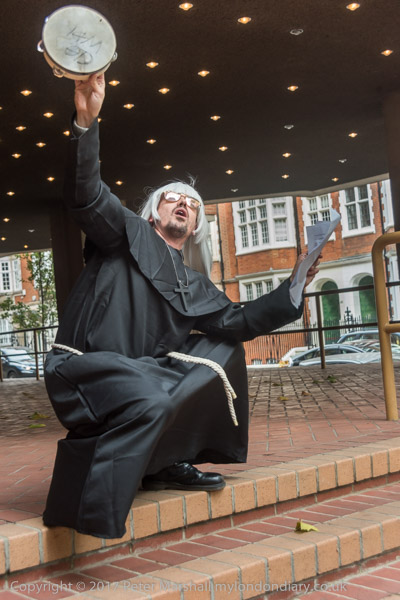
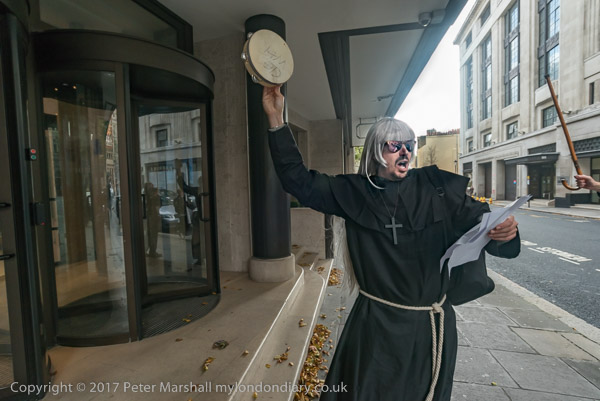
It was also a celebation of the 50th anniversary of the Yippee levitation of the Pentagon during anti-Vietnam War protests, and Class War’s Ian Bone and shaman Jimmy Kunt (aka Adam Clifford) stood on the steps of the town hall and called “Out, demons, out! Out, demons, out!” to the demons of councillors Nicholas Paget-Brown, Rock Feilding-Mellen & Elizabeth Campbell in their attempted to levitate the town hall to a height of over 70 metres. Unfortunately I failed to capture a photograph of the building in mid-air.
As I reported in My London Diary:
Inspired by their success at the town hall, Class War’s Levitation Brigade then moved on to Northcliffe House, the home of the Daily Mail.
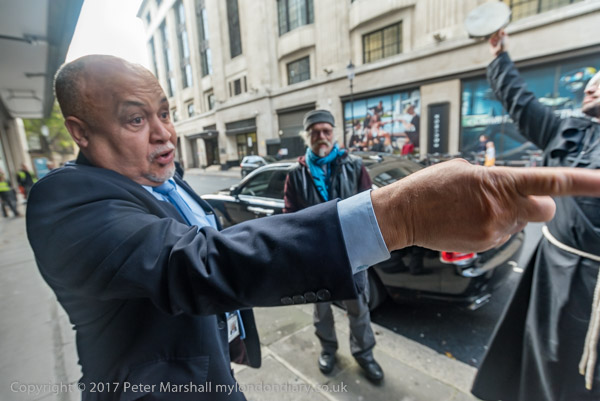
Security staff there reacted angrily to Class War calling out the demon of Paul Dacre and their attempt to raise the building by over 70 metres, perhaps fearing it might damage the Rolls-Royce parked outside, but the levitation ceremony went ahead despite considerable interference.
Several security staff objected to the protesters and told me that I couldn’t take pictures, although there is strong evidence that this was not the case, though I did have to move back several times when one attempted to grab my lens. But most of the time at least I was on the public highway and knew I had the right to photograph as I liked and told him so. But it was perhaps this harassment that again made me miss the moment of actual levitation – or perhaps not.
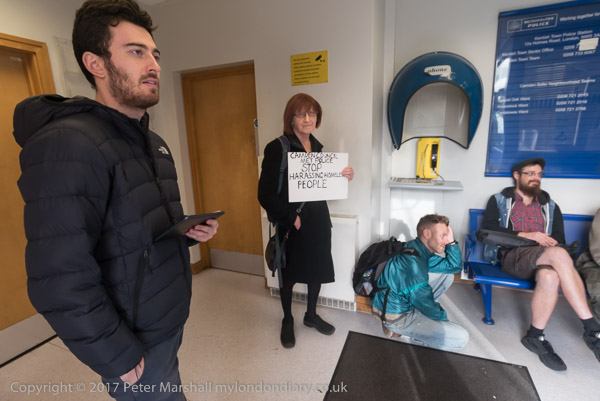
It was a rather longer journey to Kentish Town by Underground, but only around half an hour (Circle to Embankment and then the Northern line) and I arrived in good time for the protest outside Kentish Town Police Station. Police, urged on by Camden Council had been removing and stealing tents from homeless people on the nearby streets ‘in the interest of public safety‘.
A small group of protesters met outside the police station carrying tents before five of them went inside to hand themselves in for being in possession of these now illegal items, calling on the police to arrest them. The police were rather suprised and kept them waiting for an hour or so, before telling them after I had left that carrying a tent was not a crime.
Later both police and Camden Council denied they were harassing the homeless – in direct contradiction to the evidence from the street that they had done so. Perhaps this small protest meant that at least in Camden this cruel policy used in some other boroughs in London and elsewhere will no longer apply.
All photographs on this and my other sites, unless otherwise stated, are taken by and copyright of Peter Marshall, and are available for reproduction or can be bought as prints.