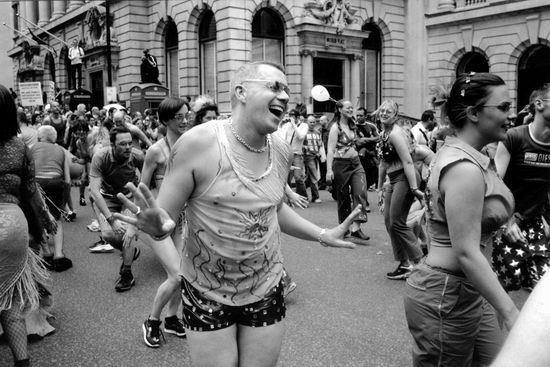
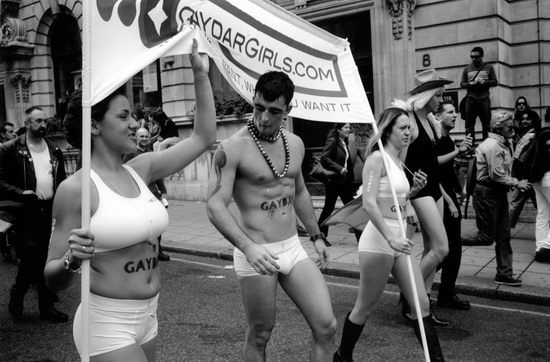
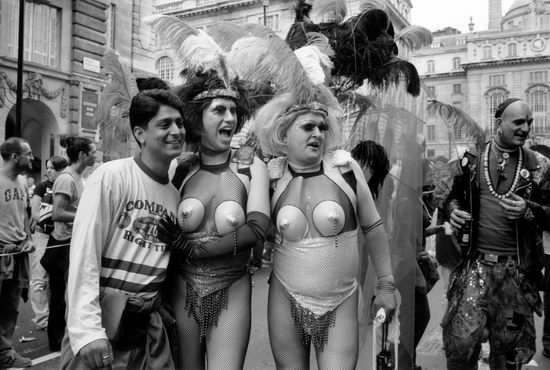
Pride in 2002: Back in 2002 Pride was still in black and white, or at least the pictures I posted on My London Diary were, as were those I took to the picture library I was then working with. They still only worked with black and white prints and colour transparencies and I was working with colour negative.
It would have been possible for me to convert those colour negatives into transparencies, but it wasn’t worth the time and expense in the hope of possible sales to do so.
For my personal use and to exhibit work I could make colour prints – and I had crammed a colour processor into my darkroom so could feed the exposed Fuji paper in at one end, shut the lid and let the machine do the rest before I took the print to the print washer.
I had a smart colour enlarger with a linked probe that at least almost got the necessary filtration somewhere close, though I always ran at least one test strip – and often 2 or 3 – before making the final print. Making prints was a rather tedious business working in near total darkness with just a very, very dim sodium light.
The way forward was obviously to scan negative film to provide digital files, but in 2002 the equipment I had was fairly primitive and the scans I produced in 2002 looked rather poor, which is probably why I only posted the black and white images on My London Diary at the time. Scanning the black and white 10×8″ press prints gave rather better results.
Back then I only wrote two short paragraphs about the event in My London Diary – and here they are in full (with the usual corrections):
July started for me with the annual Pride march. This year it was probably the smallest I’ve attended, and was a rather sad event compared to previous years.
It was enlivened a little by some visitors from Brazil, but the whole thing seems to be more of a commercial event now. Much less fun and joy.
For this post I’ve revisited some of those 2002 scans and improved them significantly with the aid of some smart sharpening and other minor adjustments to post here. You can click on these colour images to see them larger.
Most of the colour images are of the same subjects as I took in black and white, and at least for some I still prefer them in black and white. But generally I think the event is best seen in colour.
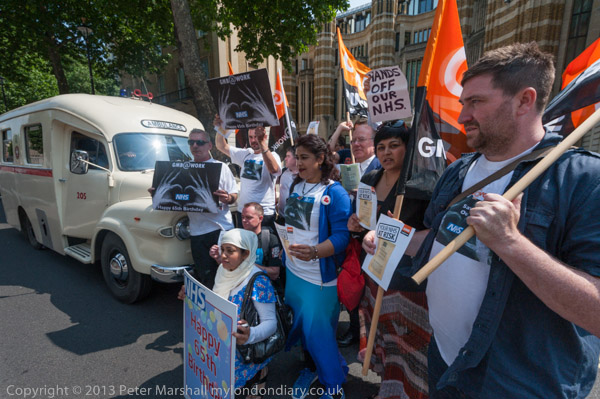
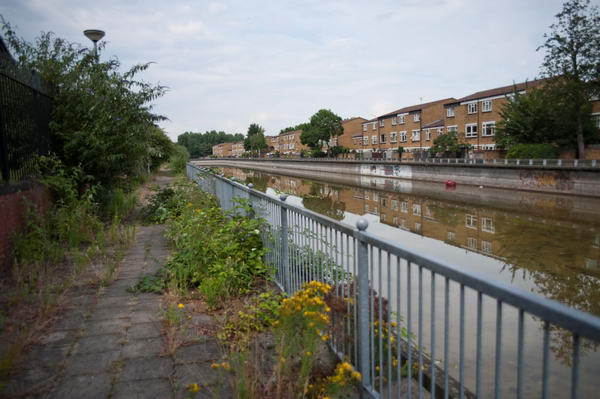
NHS at 65, Lewisham & the DLR: Friday 5th July 2013 was the 65th anniversary of the founding of our National Health Service and I photographed three events connected with this, two in Westminster and one opposite Lewisham Hospital where campaigners were fighting to keep services. And on the way back from Lewisham I took some pictures though the window of the DLR train, mainly as we went past Deptford Creek.
The National Health Action Party was a publicity stunt and single issue parties such as this are never likely to make much widespread impact on British politics. But given the strength of the recent Labour rebellion over Starmer’s attack on the disabled I wonder if a new left of centre political party might result in a radical change in our political system, with possibly a significant number of Labour MPs deserting the sinking ship in favour of a party which represents traditional Labour values. We could then have two different parties fighting out the next election.
NHS 65: GMB – Westminster
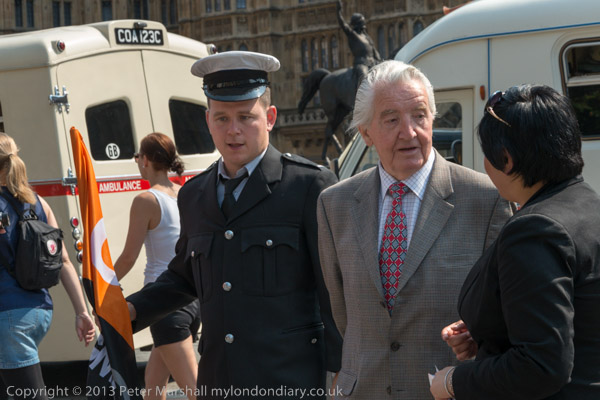
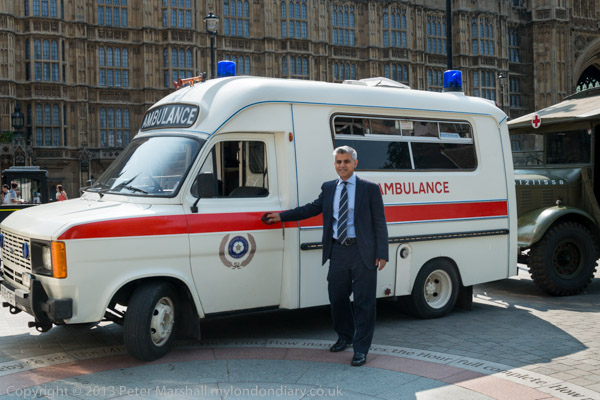
The GMB trade union came with three vintage ambulances to protest outside Parliament where trade unionists in vintage ambulance uniforms posed with MPs including Dennis Skinner and Sadiq Khan warning that the NHS is at risk.
Dennis SkinnerSadiq Khan, then MP for Tooting, poses for his own photographer
I’m afraid I’ve forgotten who the other MPs were, but you can see a couple more in the pictures on My London Diary I took as the photographer for the GMB posed and photographed them. I have a personal antipathy to posing people, though I might occasionally deliberately attract their attention and even very occasionally ask them to keep still or look at me. But generally I see my role as recording what is happening rather than directing it. And here what was happening was that people were being photographed.
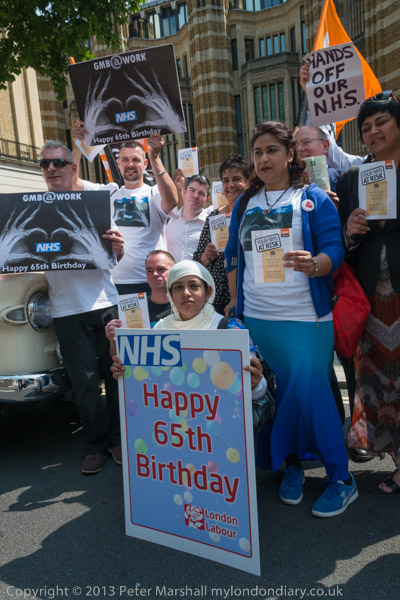
Later I went with them (and the ambulances) as they took 65th Birthday cards for the NHS, with the message inside “Do Not Pension Off Our NHS’ to the Ministry of Health, then still in Richmond House on Whitehall.
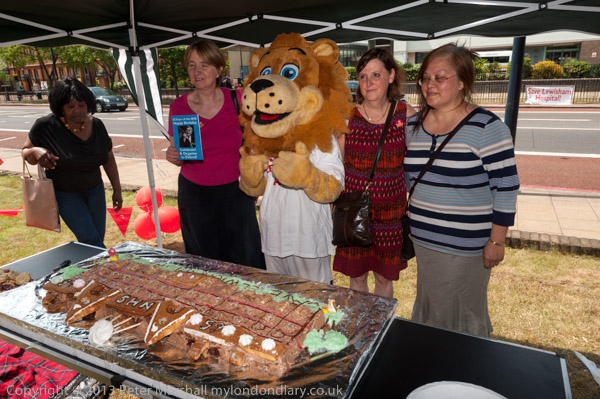
In the memorial garden opposite the Save Lewisham Hospital Campaign were holding a lunchtime party to celebrate the 65th Birthday of the NHS, and as a part of their campaign to keep this busy, successful and much needed hospital open.
The plans for its closure were not related to the hospital’s performance in any way but because the health authority needed to make drastic cuts to meet the disastrous PFI debts of a neighbouring hospital.
There had been a massive community campaign to save vital NHS services at the hospital, backed by “Patients, NHS staff, Lewisham Council, MPs, schools, pensioners, families, businesses, faith groups, charities, unions, students and health campaigners” – the whole community including the Millwall Football Club.
Later at the end of July 2013 the High Court ruled in favour of the Judicial Reviews by the Save Lewisham Hospital Campaign and Lewisham Council and quashed the Government’s closure plans. And ten years later in July 2023 on the 75th anniversary of the founding of the NHS a newly engraved community bench was unveiled to celebrate the victory. I’m sorry I wasn’t present to record that occasion.
I decided to travel back from Lewisham into central London by taking the DLR to Canary Wharf where I could change to the Jubilee Line because I could try to take some pictures from the train, particularly on the section where the viaduct goes alongside and over Deptford Creek.
There are many problems in taking pictures from trains. Finding a reasonably clean window is the first, and avoiding reflections another. It was easier back in the 1970s when there were windows you could pull down and lean out! And now apparently AI can remove reflections, though I’ve yet to try it.
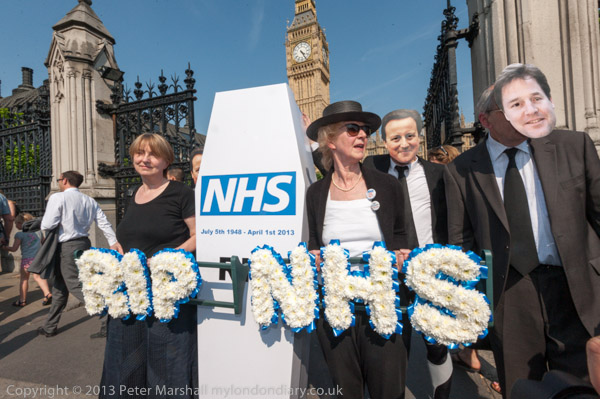
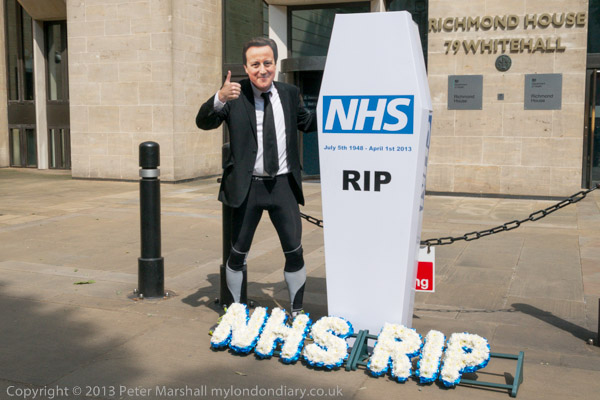
On the 65th Birthday of the NHS, Dr Clive Peedell began a 65 mile ultramarathon to David Cameron’s Witney constituency to bury the NHS coffin and launch the National Health Action Party plan by doctors and health professionals to revive the NHS.
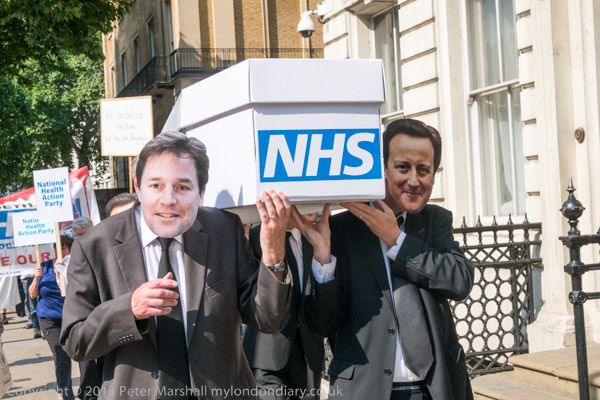
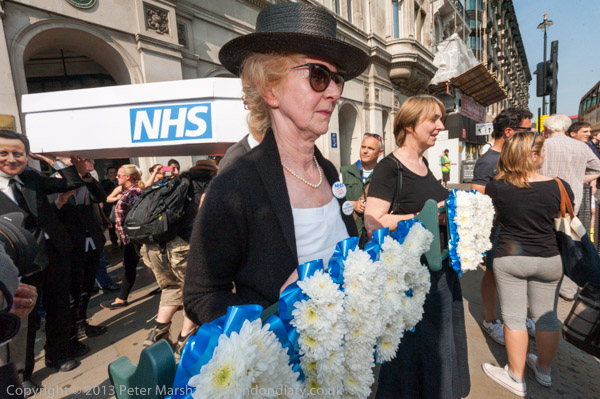
Dr Clive Peedell posed in a Cameron mask with the coffin and wreath and had come with a small group of supporters, including one wearing a mask of his coalition partner Nick Clegg. Campaigners accuse both of deliberately running down our NHS, with more and more NHS services being delivered by private healthcare companies.
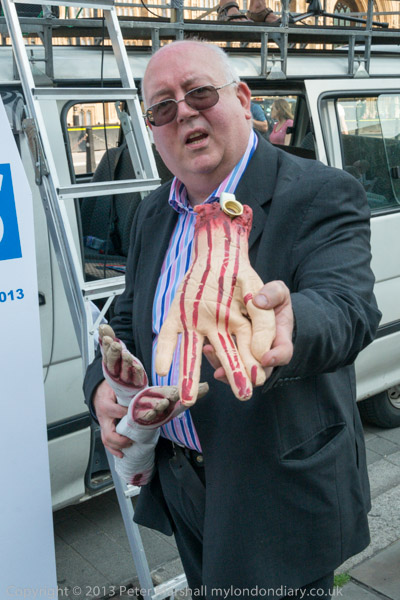
After posing in front of the Ministry of Health, the campaigners crossed Whitehall to stand in front of the gates of Downing St before processing behind the coffin to Parliament for more pictures, ending with some street theatre involving severed hands and speeches by several distnguished health professions including the Chair of the Royal College of GPs in Old Palace Yard.
I left before Dr Peedell and two others set off on his long run – though I’m sure others would be carrying the wreath and coffin. The event had clearly been set up to attract the media, but received little publicity.
On My London Diary you can read a long statement by Dr Peedell about how the “2012 Health and Social Care Act, will result in the NHS being increasingly dismantled and privatised” with the Labour Party whose “previous pro-market, pro-privatisation reforms, actually set the platform for the current changes” had failed to sufficiently oppose. Health professionals had “formed the National Health Action Party to raise awareness and inform the public about what is happening to their NHS” and had today “set out our own 10 point plan to reinstate, protect and improve the NHS“.
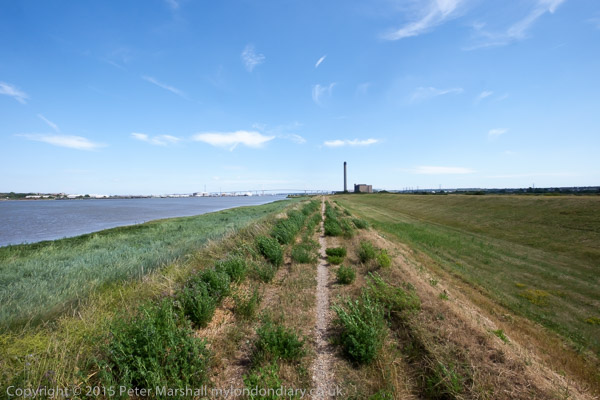
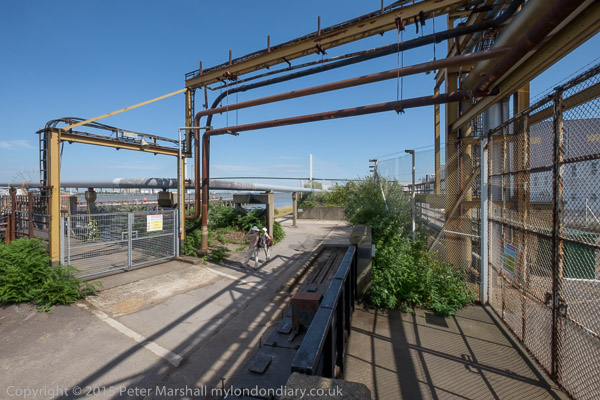
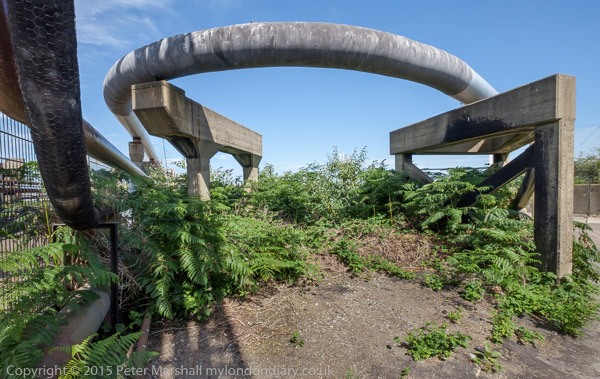
Darent Valley Path & Thames: The route we took on Saturday 4th July 2015 was new to my wife and son, but one I’d taken quite a few times before, both on foot and on my Brompton, but this time I left the bike behind and walked with them.
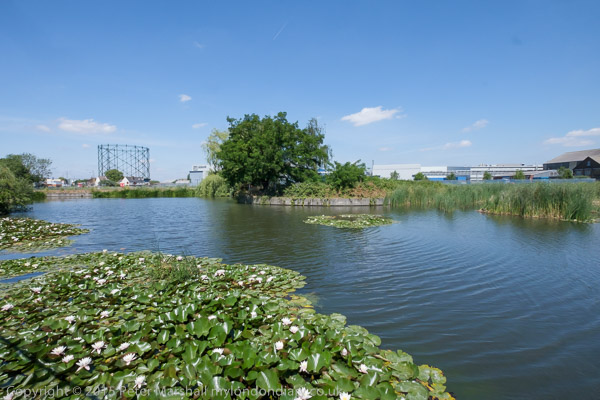
From Mill Pond Road, Dartford
Or rather more or less with them, as I often stopped or walked a few yards to one side or other to take pictures, and then had to scurry after them to catch up. Walking with a camera is very different from walking. My son does have a camera (one of the Fuji fixed lens X100 series) but takes far fewer pictures than me – and did much less running about.) But his captions are often rather more droll than mine, and seldom constrained by the 5W’s – Who What Where When Why.
Footbridge across the Darent
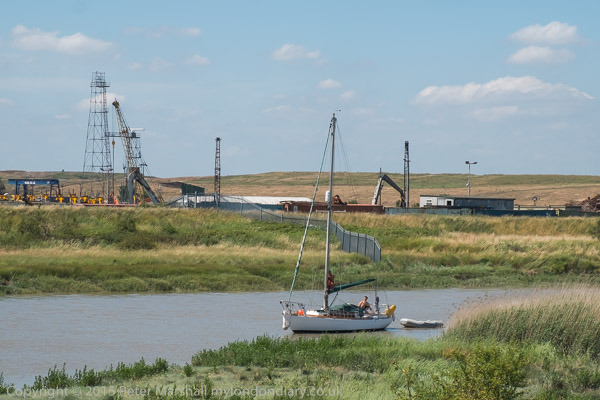
It was a bad day for this walk, hot and sunny with virtually no shelter between Dartford and Greenhithe along the banks of the Darent and Thames. But I’d heard that there would be a boat sailing up Dartford Creek, a rare occasion at the time and decided it would be good to photograph it.
This route is now one end of the Darent Valley Path, a 19 mile path which ends at Sevenoaks, most of which I’ve walked or cycled on other occasions, and the part beside the Thames is on the England Coast Path.
Dartford Half-Lock
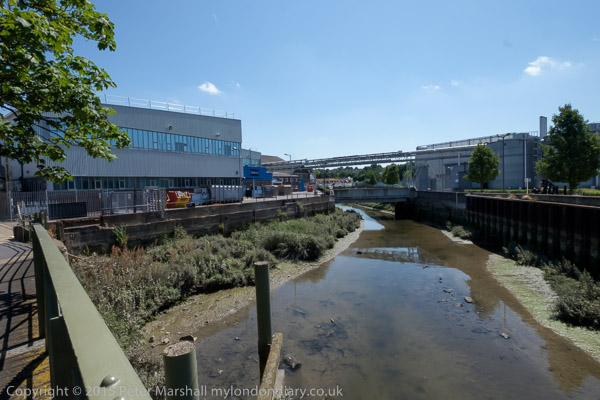
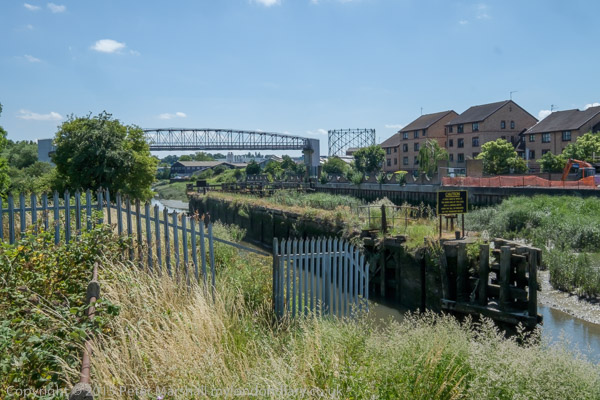
The Darent used to be navigable at least up as far as Dartford, where barges brought in and took out cargoes. Close to Dartford is a half-lock which holds back water above it when the tide goes out, long out of use but now slowly being restored to bring the waterway back into regular use.
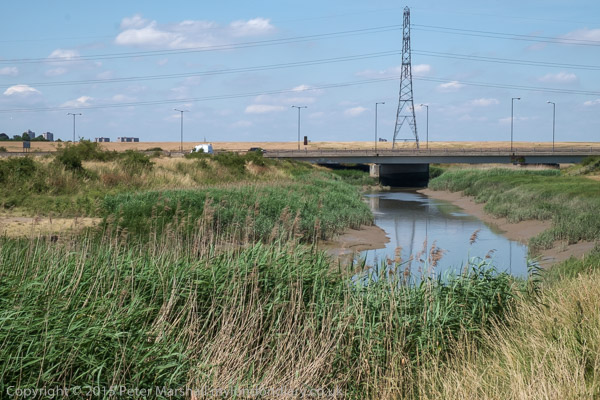
A fixed low bridge impedes navigation. This bypass was built as University Way, but the University never came so they renamed it Bob Dunn Way
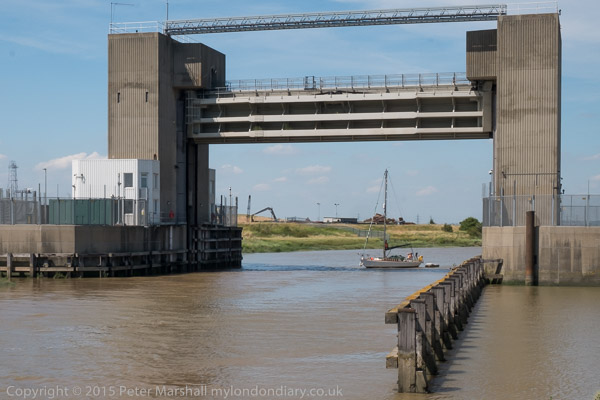
There used to be a lock which craft could go through when then the tide was high enough downstream, but that was replaced by a fixed barrier. Boats can still go through in either direction close to high tide when their is enough water for them to clear the sill.
The yacht arrived later than expected and I had to run back to photograph it coming under the flood barrier. It was too late to get under the bridge on the same tide.
As well as the Darent, barges also went up the River Cray which joins the Darent downstream from the half-lock. This too is being brought back into leisure use.
Where the Darent meets the Thames
By the river in the centre of Dartford was the industrial estate dominated by the pharmaceutical manufacturing plant of Burroughs Wellcome who took over a former paper works here in 1889. In 1995 this became Glaxo Wellcome, the largest pharmaceutical company in the world. The works was wound down from 2008 by the then owners GlaxoSmithKline with manufacturing ending in 2013. Much of the site was empty by 2015 and now has large blocks of flats.
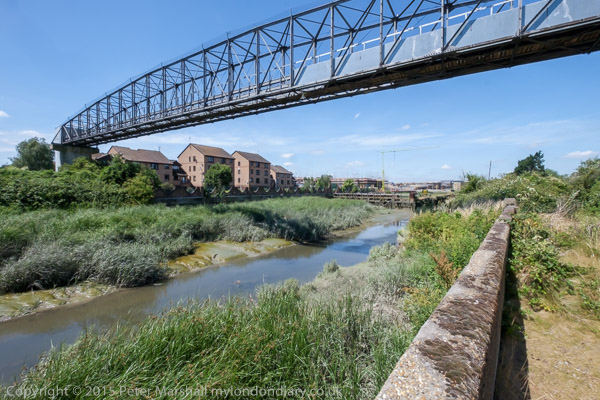
On the west side of Dartford Creek had been paper mills, but the last of these, owned by Wiggins Teape closed in 2009 and there was by 2015 housing on the site.
QEII bridge and Littlebrook Power station, River Thames, Dartford
When the third Dartford Bypass was built around 1988 barges were no longer bringing esparto grass and other raw materials for the paper works up the river and no thought was given to navigation. Boats that can lower masts or without them can creep under the road for a short time on a rising or falling tide when there is enough water to allow them to float but not high enough for the bridge to block their transit.
Riverside path at Littlebrook
Much of the land to the east of the creek was marshes, which made it a suitable location for the Wells fireworks factory, long closed. But I think it or an adjoining site was now in use for clay-pigeon shooting, and for much of this section of the walk we sounded under gunfire.
At the Littlebrook jetty
There had once been a pub, Longreach Terrace, and a ferry to Purfleet on the Thames close to the the mouth of Dartford creek, but both were long gone. It was here too that smallpox victims were brough ashore to the islolation wards of Orchard Hospital, demolished around 1975, part of the Joyce Green Hospital which was demolished around 2000.
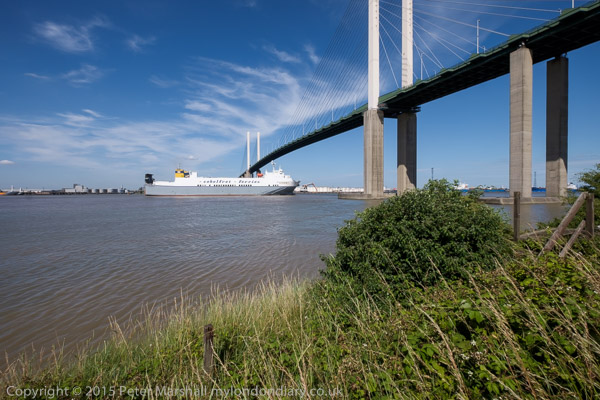
The Purfleet to Zeebruge ferry goes under the QEII bridge
Further downstream on the banks of the Thames we passed Littlebrook power station – the final plant there, Littlebrook D, had ceased operation only four months earlier – before going under the Dartford QEII bridge and past Crossways Business Park. I had meant to climb up the hill to Stone Church, but missed the footpath and ended our walk in Greenhithe. But I was too tired anyway – and had stopped taking pictures on this last part of our walk.
Latymer, Cromwell, Britannia, Chapels, Shops & Bevan: The first post from my walk on Sunday 7th January was Stamford Brook, Ravenscourt Park and a Bull – 1990 and it ended on King Street Hammersmith where this post begins. As usual you can click on any of the pictures in these walk posts to go to a larger version in one of my Flickr albums.
Latymer Upper School, King St, Ravenscourt Park, Hammersmith & Fulham, 1990, 90-1d-36
Like many other well-known schools Latymer School began with a bequest for the education of poor boys. Edward Latymer in 1624 left money to provide 8 poor boys with clothing and education to the age of 13. Later bequests added to the foundation and in 1811, Ann Wyatt left £500 to build a new school together with £100 for its maintenance. Schools were set up in both Edmonton and Fulham.
The Fulham school moved to Hammersmith in 1648 and since then has had various buildings in the area. This building, Latymer Upper School was opened in 1895 and taught boys up to the age of 16. Following the 1945 Education Act it became a Direct Grant Grammar School, taking both state and fee-paying pupils.
When I took my 11-plus I could have applied to go here, but my parents were worried both by the cost of uniforms etc they couldn’t afford and also the long journey times I would have had to make and sent me to a more local Grammar.
The Direct Grant scheme was abolished in 1976, with Latymer becoming a fee-paying “Public School“, though still retaining some means-tested grant assisted places. When I made this picture it was still a boy’s school, but girls were admitted into the sixth form in 1996 and beginning in 2004 the whole school slowly became co-educational.
Cromwell Avenue is a street off King Street to the south, and these flats cover its whole east side. I think the street runs along what was the west side of Hammersmith Brewery, set up in 1780 by Joseph Cromwell on Hammersmith Creek, then navigable as far as King Street. The brewery was later run by his brother James Cromwell but seems to have stopped brewing in the 1840s.
Hammersmith Creek was the mouth of Stamford Brook, a small stream running from Gunnersbury. As well as the brewery on its west bank it also had wharves on its east side and in the early 19th century still had a flourishing industry. It was filled in in the early 20th century and Stamford Brook now reaches the Thames in a culvert under Furnivall Gardens.
Formerly known as the Ebenezer Chapel and Albion Congregational Church, was said to have built in the 1780s when recently offered for sale, although Pevsner dates it to 1891-2 by F W Stocking.
The congregation of the Ebenezer Chapel moved to a church on this site from King St in 1855. The church closed in 1938 and became a Salvation Army chapel which has now recently closed.
The buildings are still here at 108-116 Glenthorne Rd but there is no trace of Britannia. During the corona virus pandemic they were used by the volunteer community aid network launched by Hammersmith & Fulham Council, H&F CAN to give support to residents. Before that the windows were full of fireplaces, wood-burning stoves and mirrors
Gospel Hall, King St, Hammersmith, Hammersmith & Fulham, 1990, 90-1e-03
The Gospel Hall of the Kelly Mission was at 170 King Street and the site has now been redeveloped. Until 1919 this was the site of the Cock and Magpie pub and the Gospel Hall was built soon after
These buildings are still there at 157-163 King Street though Maplin, Shelly’s Shores and Pizza Inn have all been replaced by different businesses. Even the more modern building beyond has survived.
I couldn’t make out much of the remains of an advertisement on the Holcome Street wall though it seems to have a very large ‘UNN’ in it. No traces of it remain but there are now some wall bracing plates on the wall.
These blocks of flats in Aspen Gardens have a 1930s look to them but were built shortly after the end of the war clearing a large slum area and were opened in 1948 by Aneurin Bevan.
Best known for the NHS, Bevan was also responsible for housing and advocated for a national housing scheme to ensure everyone had decent and affordable homes. He wanted social housing for all, creating “create new homes and communities with a place for all sections of society” like that in English and Welsh villages “where the doctor, the grocer, the butcher and the farm labourer all lived in the same street.”
Despite incredible post-was shortages of materials and skilled labour, in 1948 there were 227,600 new homes built.
Disabled Lose Independence & Robin Hood Gardens Doomed: The Independent Living fund which enabled many disabled people to live useful and fulfilling lives ended on Tuesday 30th June 2015. After photographing the delivery of petitions ouside Downing St against its ending I went to Poplar for another visit to Robin Hood Gardens where a second attempt to get these important buildings listed had recently been rejected.
DPAC’s ILF Closing Ceremony – Downing St to Old Palace Yard
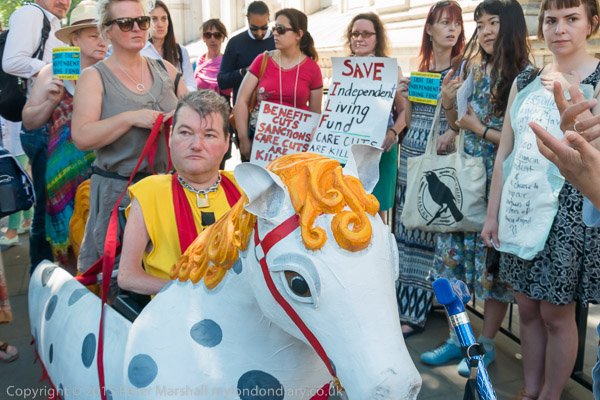
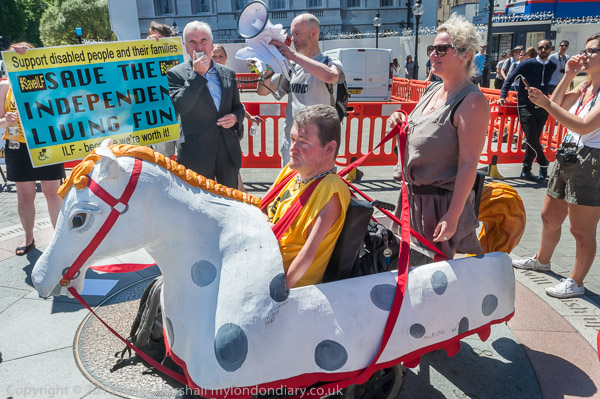
John Kelly as Schimmel, the equine star and proud battle horse of the Threepenny Opera
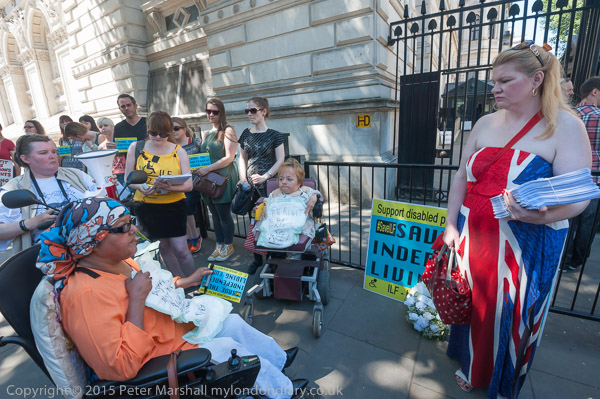
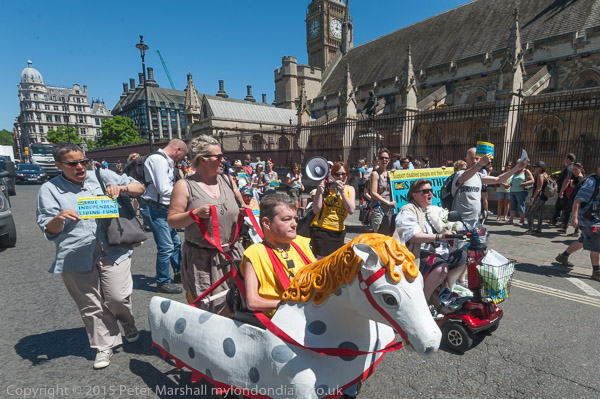
On the day the Independent Living Fund closed, campaigners for independent living for disabled people led by DPAC, Disabled People Against Cuts, presented petitions to the Prime Minister before marching behind the Threepenny Opera horse to Parliament to continue their fight for dignity and equality.
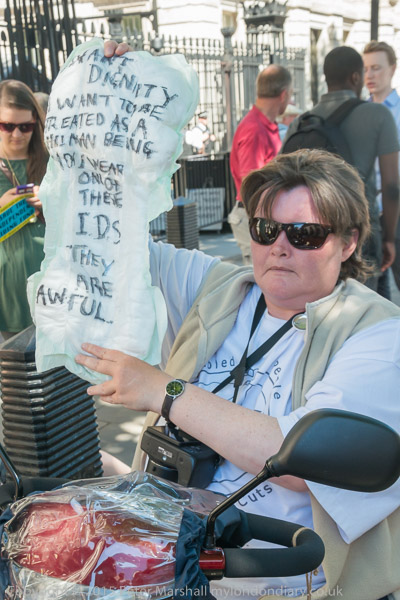
At the gates of Downing Street protesters wrote slogans on incontinence pads which losing the support means some will be forced to use. Paula Peters had this message for Iain Duncan Smith: ‘I want dignity – I want to be treated as a human – You wear one of these I. D. S. They are awful‘.’
As Secretary of State for Work and Pensions IDS was responsible for the decision to end this support, which had been introduced in 1988 to enable disabled people to live in their own homes and to pay for care, and in particular to employ personal assistants.
They had brought a petition with over 25,000 signatures to hand in and after this they marched to a rally at Old Palace Yard at the end of which a wreath with the message’s ‘RIP ILF’ was laid.
The government lost a legal challenge over ending the ILF but still closed it for new claimants on 1st July 2015. The responsibility for existing claimants in England was passed from the Independent Living Fund to local authorities who became responsible for care provision and all assessments. Support which had been well-administered became a post-code lottery.
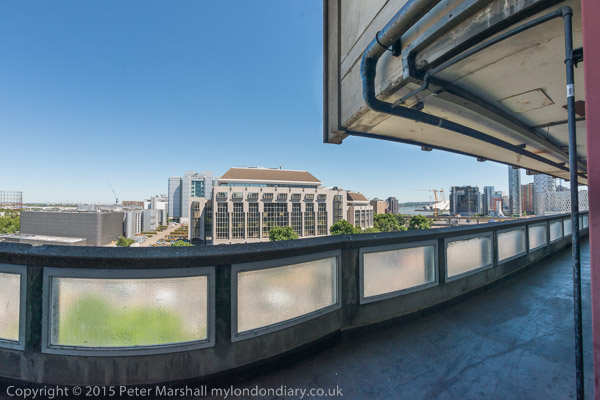
The end of the street in the sky – and it looks like the end for Robin Hood Gardens
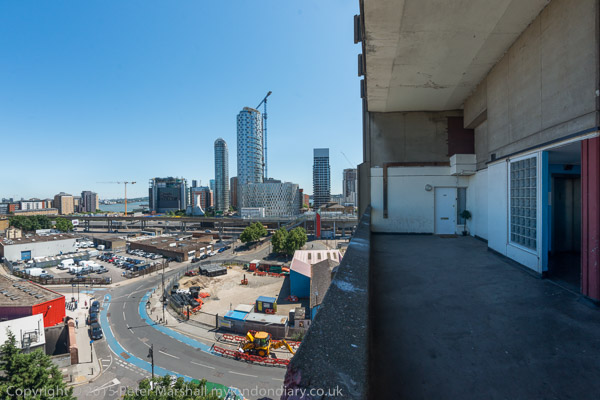
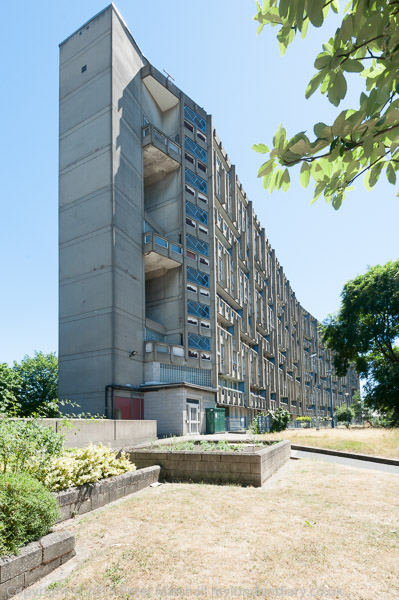
Robin Hood Gardens, designed by Alison and Peter Smithson and completed in 1972 was a nationally important and internationally recognised work of Brutalist architecture. Built for the London County Council with 213 flats, it was designed as two slab blocks, the east 10 storeys and the west 7 storeys on a difficult site next to one of London’s busiest roads – the Blackwall Tunnel Approach – but with a large and peaceful green inside.
There appears to be a forest between the two slabs of Robin Hood Gardens
It was very solidly built and the flats were generous, with wide ‘streets in the sky’ outside. Inside the flats next to the roadway you could hardly hear the traffic.
The East block seen from the decorated wall above the Blackwall Tunnel entrance
In 1965 ownership passed to Tower Hamlets Council who neglected the site, allowed the green to become overgrown and later actively demonised the estate and housed many problem families there.
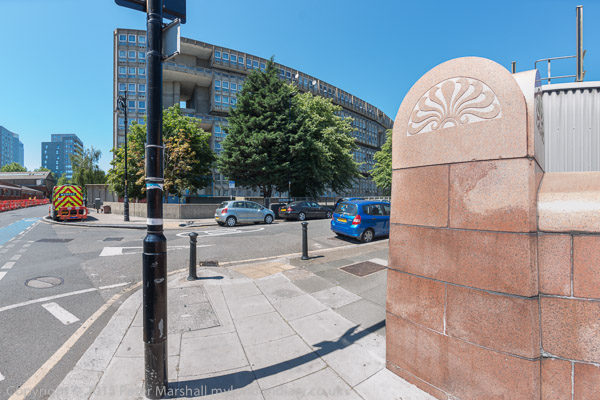
Two tall walls of flats protecting a large open garden area
Following a visit there in 2009 on an Open House Day tour led by Bridget Cherry I commented it was “in many respects a fine solution to a difficult site with some superb landscaping in the large interior space. Deliberately encouraged to ruin by overcrowding and use as a sink estate by Tower Hamlets, it is now in a sorry state, but the decision not to list it is unfathomable (or perhaps simply political.) I hope the campaign to save it from demolition succeeds. “
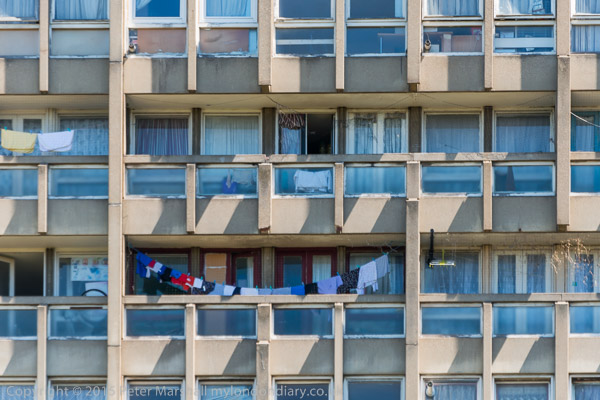
Most of the flats in the East block were then still occupied. They are large and desirable properties, but often have been used to house difficult residents.
During the New Labour government the listing advisory committee of English Heritage wanted to list it, but were overruled by the politicians, with then Minister of Culture Andy Burnham issuing a certificate of immunity in 2009 and allowing the local Labour Tower Hamlets council to proceed with plans for demolition and redevelopment of the area. But for the moment it was saved by the financial difficulties.
A tall concrete wall protected the flats from the traffic on Cotton St
The immunity expired in 2014 and a further attempt, backed by almost every well-known British architect, was then made to get it listed, but was rejected by Historic England, the body that now control listings.
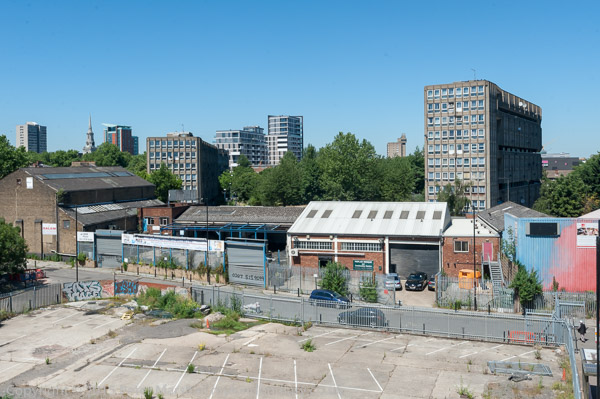
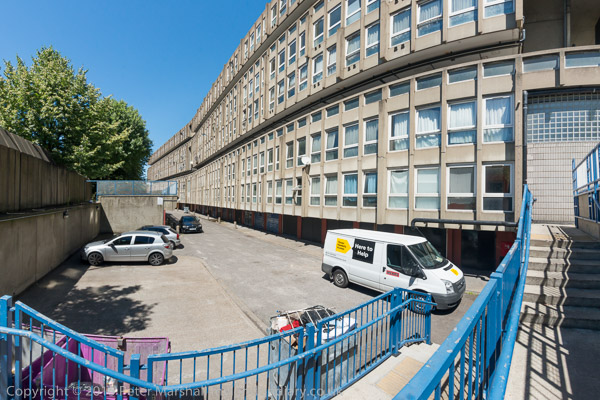
Parking areas on the outside of each of the two blocks
An open letter signed by Richard Rogers and others stated:
"The buildings, which offer generously sized flats that could be refurbished, are of outstanding architectural quality and significant historic interest, and public appreciation and understanding of the value of Modernist architecture has grown over the past five years, making the case for listing stronger than ever."
Historic England went along with the local council’s views and judged that it “fails as a place for human beings to live“. This wasn’t the impression I got from talking to residents on my visits.
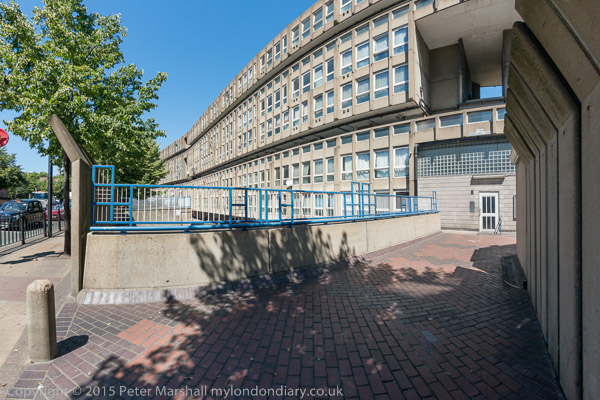
The top street on the east block – the curve is from my fisheye lens
The defects of this and other soundly built modern estates that have been demolished – such as the Heygate at Elephant & Castle in Southwark can generally be easily and relatively cheaply overcome by refurbishment – improved door security, lift maintenance, window replacement, non-combustible cladding etc. The true reasons for demolition are financial, driven by the profits of the developers and also the financial problems of local authorities.
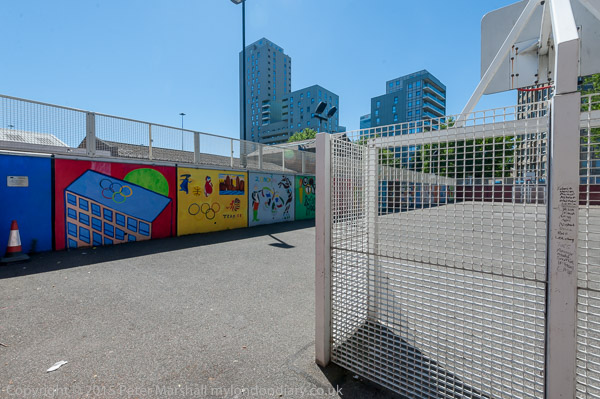
A large enclosed playground at the south end of the site
Demolition of sound buildings like this with the expectation of many years of useful service should be criminal. It represents a huge wastage of resources and an incredible carbon footprint both in the actual demolition and also for the rebuilding. The west block was demolished in 2017-8. The east block took around nine months to demolish and this was only completed in March 2025.
Chariot Festival, Plumstead & Woolwich: Sunday 28th June 2009 I photographed the Hare Krishna Chariot Festival from Hyde Park to Trafalgar Square then travelled to Plumstead Common for short visit to the annual Mela there. But I didn’t find much to interest me and instead took a walk down to the Thames at Thamesmead West and then back alongside the river to Woolwich. On My London Diary I wrote at some length about the walk, which turned out to be surprisingly interesting and about how I thought the area could be improved.
Sri Jagannatha Rathayatra Festival – Hyde Park to Trafalgar Square
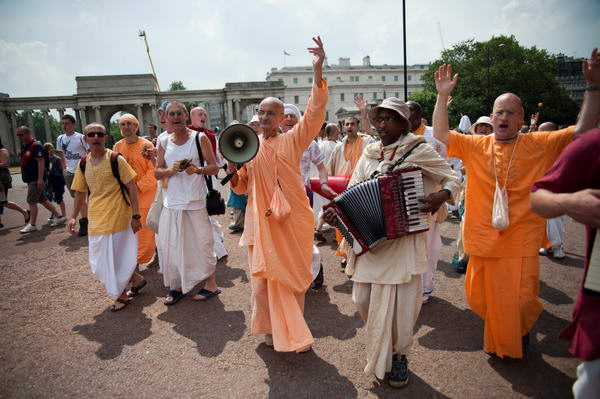
Musicians in the procession as it leaves Hyde Park
I didn’t write much about the chariot festival on My London Diary in 2009 as I had written at some length about it the previous year – and I won’t say much here either as I posted about the 2012 Rathayatra festival a few days ago.
The three giant chariots are pulled by people on large ropes
In 2009 I concentrated mainly on the people rather than the chariots.
Plumstead & Woolwich – Plumstead, Thamesmead West, River Thames
It was a long walk up the hill from Plumstead station to the common where the Mela is held and I arrived rather tired and was disappointed to find the the event seemed to be only just starting. But I’d stopped to take a few pictures on the way, and found several things of interest on the walk.
So after a short time at the Mela I decided it was too hot to wait around longer and to take a walk instead.
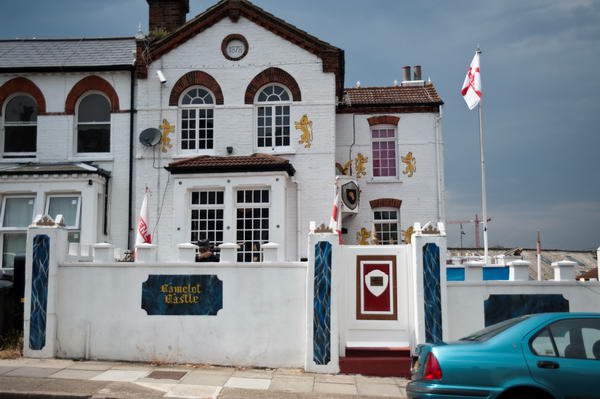
I walked down to Camelot Castle, home of self-proclaimed “celebrity gangster Dave Courtney“, who was made bankrupt in May 2009, owing £400,000 including an estimated £250,000 to HM Revenue & Customs.
Shouldn’t, I mused looking at the St Georges flags, patriots be pleased to pay taxes? I photographed the house and then onto the gates with a giant knuckleduster at their centre. Courtney also awarded himself a blue plaque with the text ‘Dave Courtney OBE lived here’ where the OBE stands for “One Big Ego”.
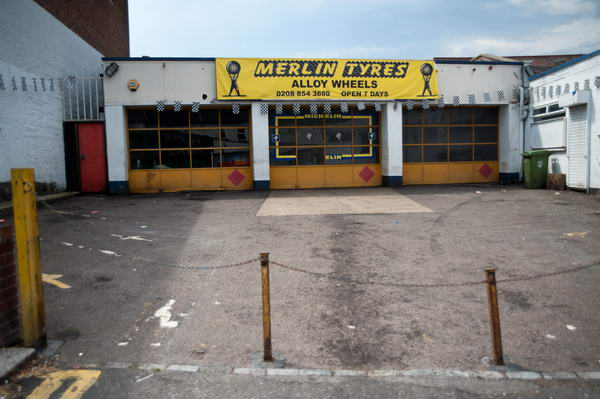
Soon after I came across Merlin Tyres. Is it coincidence that Merlin was one of the six main characters of Camelot?
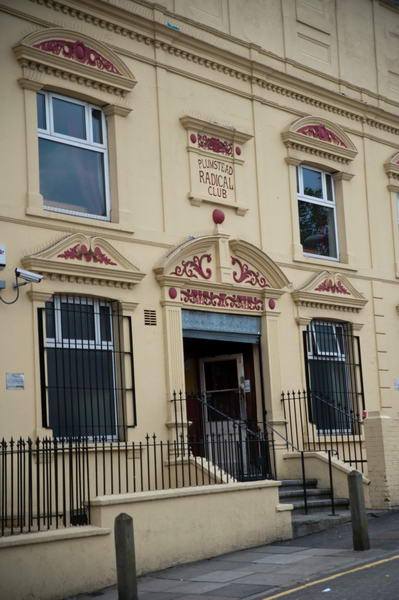
The Plumstead Radical Club is a working mens club formed by local Liberals who later became members of the Labour party, but most working mens clubs lost any real political connection, though they still sell cheap beer to members. From Plumstead I walked into Thamesmead.
This part of Thamesmead West had failed to make good use of its location and what should have become a vibrant area at Broadwater was derelict and depressing.
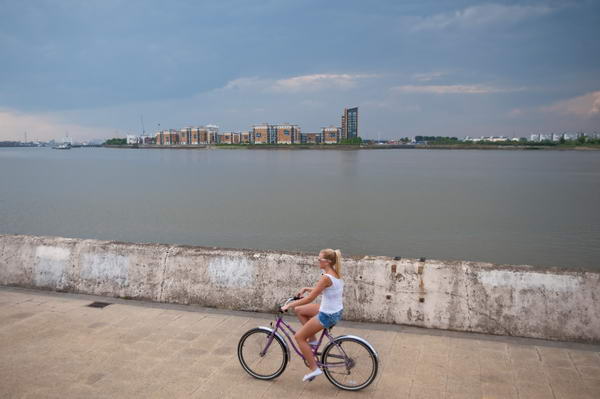
But soon I reached the Thames path and photographed this woman cycling along it with the recent flats of North Woolwich around a third of a mile away on the opposite bank of the wide river.
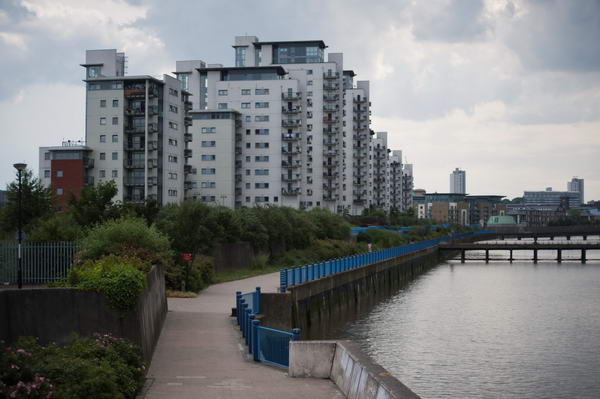
And there are plenty of new riverside flats on the south bank too, with residents enjoying riverside views. These flats are perhaps less of an eyesore than some.
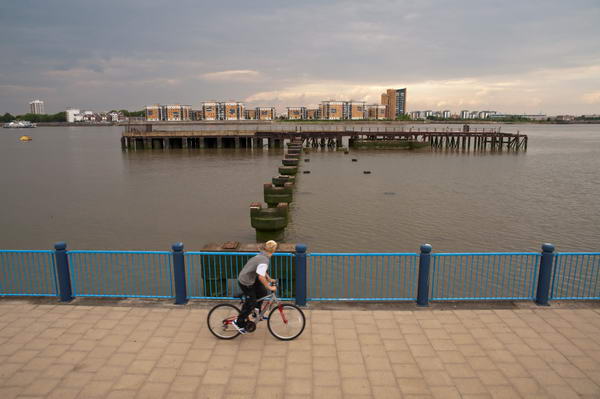
Woolwich Arsenal had three piers – this was the one in the middle, known as the Iron Pier, and you can see why from my picture. To the east was the Coal Pier, the lower parts of which still remain – built in 1917-20 it was used to bring in around 1500 tons of coal a week and is fenced off as a dangerous structure, The largest of the three piers, the T Pier has I think gone completely though there is now a Uber Boat pier.
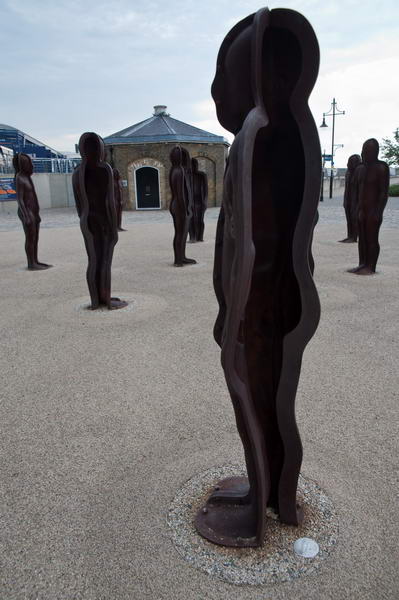
In the Woolwich Arsenal site I came across a group of aliens, ‘Assembly’ by Peter Burke (b1944) placed here in 2004. I stopped to photograph them before heading to Woolwich Arsenal station for a train.
Stamford Brook, Ravenscourt Park and a Bull: My photographs on Sunday 7th January 1990 began with a couple of views of the Thames though the window of my District Line train which I’ve not put online, but my walk started after I got off at Stamford Brook station and walked south down Goldhawk Rd.
This fine house at 397-399 attracted my attention. It had been Grade II listed in 1976, but the listing text was unusually vague about its date, calling it “Early to mid C19” and the Westcroft Square conservation area document is equally vague.
Beyond the house is a large noticeboard for ‘Z GREGORY BROTHERS, BUILDING CONTRACTORS’ at 399a, still there and I think only the phone number has changed, and another fairly grand semi-detached house which I think are late Victorian.
St Peter’s Square, Hammersmith, Hammersmith & Fulham, 1990, 90-1d-53
Since I was so close I couldn’t resist another short visit to St Peter’s Square south of the main road which changes its name here from Chiswick High Road to King Street. After the county of London was formed in 1889 this was the boundary between London and Middlesex and it is now the boundary between the London boroughs of Hounslow and Hammersmith & Fulham.
I’d photographed this square fairly extensively the previous month – see my post here) and only stopped to take a handful of pictures – this the only one online – and I was rather pleased with it.
Back on the main road I photographed the corner of Goldhawk Road and King Street, known as Young’s Corner and, as a plaque at first floor level also informs us, ‘REBUILT 1894’, though I’m rather surprised the architect wanted his name on the rather drab two storey buildingon the corner. But at least it doesn’t completely hide the much grander Victorian building at 417 Goldhawk behind behind with its slim turret – and it is perhaps this building for which the architect was claiming credit rather than the shop.
Grocer John Young had leased a shop here in 1830, and it later also became a post office. When at his death in 1860 his youngest son Charles Spencer Young took over the business he eventually turned it into a shop to display prints as a successful picture dealer. When horse-drawn trams ran to here in 1882, the tramway stop was named Young’s Corner.
King St, Stamford Brook, Hammersmith & Fulham, 1990, 90-1d-56
A fine row of three shops at 352- 356 King Street. At left is a basic and rather ugly more modern building – described in the conservation area document as “modern infill of no merit and bulky appearance“.
Ravenscourt Park, Hammersmith & Fulham, 1990, 90-1d-45
Ravenscourt Park is not just an Underground station, but a decent sized park with a lake fed by Stamford Brook, which originally was part of a moat around the manor house of Palingswick (or Paddenswick) Manor. It and the area got its name after the house was bought in 1747 by Thomas Corbett who renamed it Ravenscourt, thought to be a not very good pun on his name – ‘corbeau‘ being French for raven.
I hardly went into the park, and this house is 260 King Street.
The house at 260 King Street is at the left of this picture, followed by a row of shops including one of more interest to me than most, Mac’s Cameras. Max Irming-Geissler set up the shop here in the late 1950s and it continued more or less until his death in 2012. It was a great place to look at a window full of second-hand cameras and lenses, though I don’t think I ever actually bought anything there.
The Bull, Ravenscourt Arms, King St, Hammersmith, Hammersmith & Fulham, 1990, 90-1d-31
This Grade II listed black bull was created by Obadiah Pulham of Pulham & Son in Woodbridge, Suffolk, a well-known maker of garden ornaments, grottoes and follies. It is almost certainly made from Pulhamite, their own proprietary artificial rock, similar to the better-known Coade stone. I think it might actually have been William Lockwood’s Portland Stone Cement. James Pulham was an apprentice to Lockwood and became manager of Lockwood’s Spitalfields office around 1820 with his brother Obidiah as his assistant.
It was created as a pub sign for the Black Bull coaching inn at 122a Holborn and gets a mention from Dickens in Martin Chuzzlewit published in 1843. The pub was demolished in 1904 for an extension to Gamages but the bull was saved by Hammersmith MP Sir William Bull to put above the entrance to his law firm in King Street.
When these offices were demolished it was located outside a 1960s pub, at 257 King Street, a short way down Vencourt Place. The pub later changed its name from the Ravenscourt Arms to the Black Bull. The pub closed around 2018 but it and the bull are I think still there.
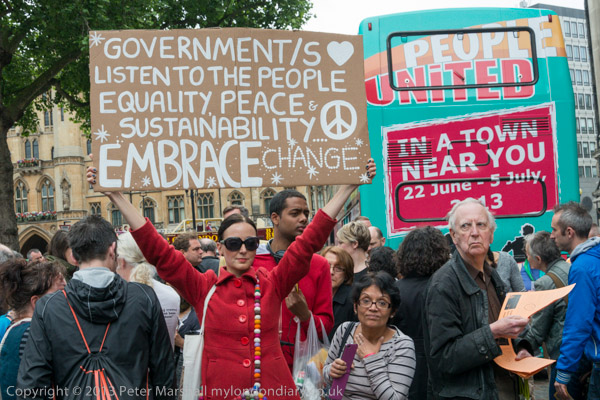
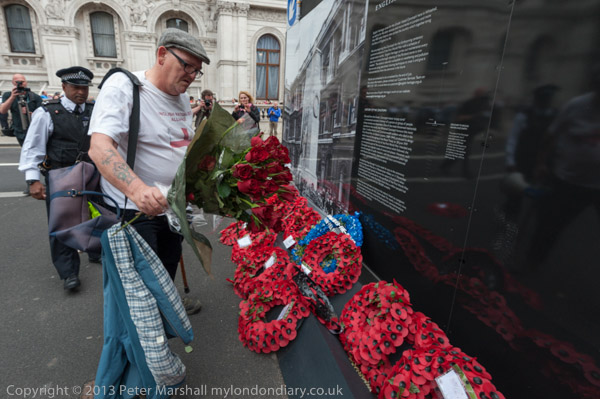
People’s Assembly, English National Alliance, Dykes: Saturday 22nd June 2013 saw a major rally by the Peoples’ Assembly in Methodist Central Hall with smaller protests outside by Class War, Occupy and others and a small march by the English National Alliance march to lay flowers at the Cenotaph and take a letter to David Cameron. My photography ended for the day at the Dyke March London 2013.
People’s Assembly – Methodist Central Hall
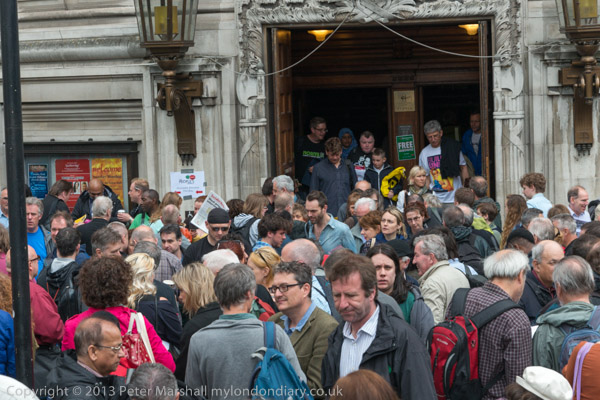
I didn’t actually go to the People’s Assembly but did take pictures of some of the people and groups outside and people as they come out from the event. It had seemed to me and to others that it had been deliberately organised as a ‘safety valve’ “used by the trade union establishment to “disperse some of the head of steam that had built up among the rank and file” rather like “the huge ‘Stop the War’ protest in Feb 2003, when leaders who were now prominent in the Assembly failed to take any decisive action – simply calling for another (and in the event rather smaller) protest a while after Blair had declared it was war. “
The events inside were “stage managed so that any criticism of the Labour Party and trade unions was banned from the main hall – with for example Ken Loach being told there was no room for him to speak at the plenary.” The groups I photographed outside were also denied any voice. This was clearly as I described it, a “Labour love-in“.
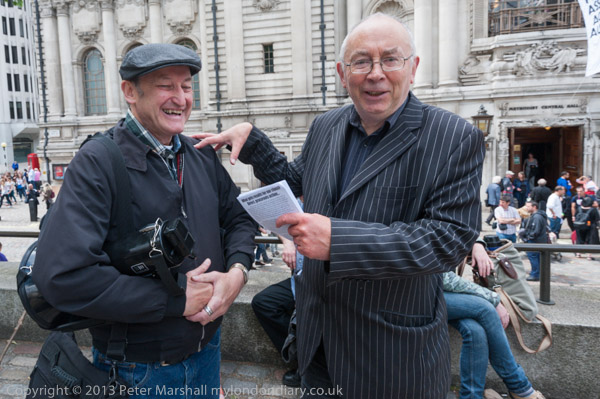
Ian Bone had called for “a f**king big mob outside” (my asterisks) the People’s Assembly, but the mob largely failed to turn up. Around enough for a football team. And in a questionable piece of timing his rally in the pulpit facing Methodist Central Hall started just a few minutes after the faithful had gone inside for another session of the “pointless jamboree“.
So Comrades Bone and Heath and the other speakers called for an end to talk talk, and for action on the streets following the examples of Turkey and Brazil to a largely empty London street. Even the Anonymous masked guys from Occupy couldn’t be bothered to leave their picnic to listen, though I found it amusing. And sad, because much of what was said was just too true.
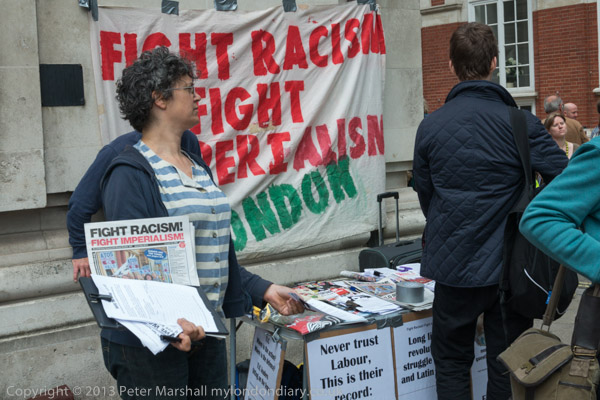
A small group of Occupy London supporters, some wearing ‘Anonymous’ masks handed out leaflets, offered free hugs, and had a picnic on the grass area outside the QEII centre in front of the People’s Assembly Against Austerity. There were also several other groups offering an alternative to the talk-shop going on inside Methodist Central Hall.
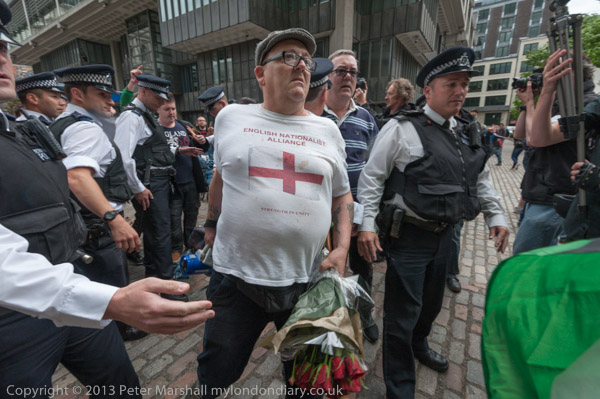
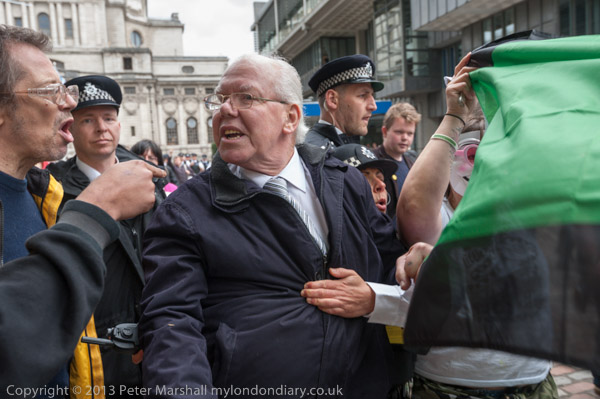
English National Alliance leader Bill Baker leads his group away as police hold back anti-racists
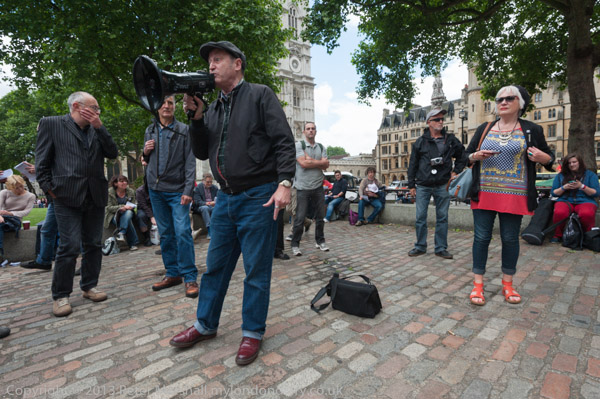
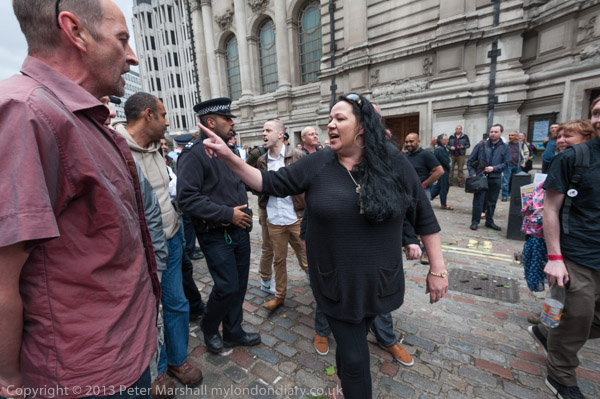
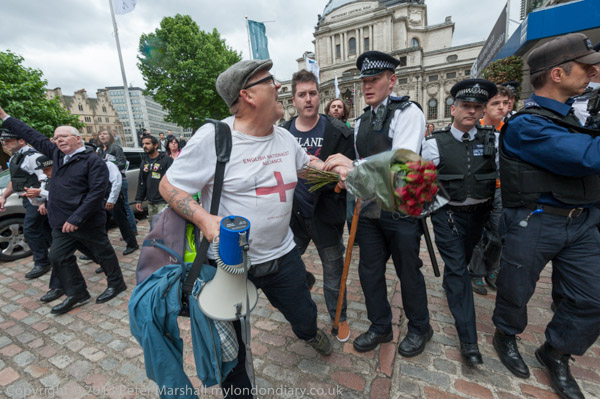
With a major left-wing event taking place in and around Methodist Central Hall it was probably not the best day for the extreme right English National Alliance to hold a march in Westminster, but it would have gone a little more smoothly if the police had not led them into the area filled with more radical small groups in front of the hall.
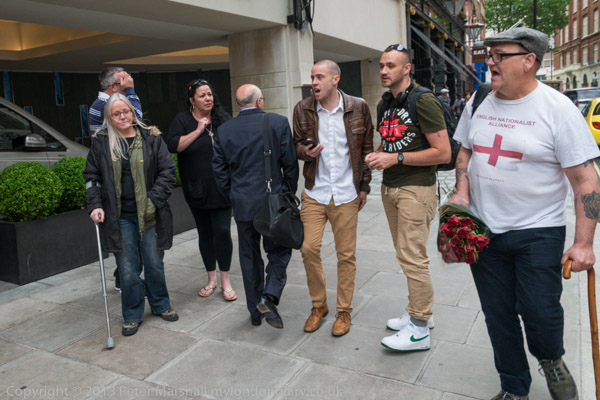
The march set off with around ten people
After the ENA had only gone a few yards into the area, some still shouting slogans including “No Surrender” they were surrounded by people shouting “Fascist scum!”, “Racists!” and some trying to bar their way. Police pushed them (and me) out of the way, but minor scuffles developed, with police making one arrest. A woman taking photographs told me she was hit by the stick one of the ENA was using.
Police rushed the marchers into the area in front of the QEII conference centre and then back onto Broad Sanctuary to Parliament Square, with a few counter-protesters accompanying them and shouting. I went with them to the gates of Downing Street where I declined their request to go with Baker, but did take a copy of the statement they were intending to deliver to David Cameron.
On My London Dairy I wrote more about the ENA and their complaints against the press as well as their policies. The start of the march was delayed as they waited for more to arrive (they didn’t) and we had a long discussion. I argued that accurate reporting was important and had that I tried hard to represent people’s views even when I don’t agree with them.
It was a sensibly conducted discussion but I was unable to convince them that the problems in housing were not caused by immigration by “the failure of successive governments to invest in social housing, exacerbated by the Thatcher’s right to buy policy and the subsidies to landlords through housing benefit.” Or that “Education is in a mess not because our pupils now have to learn about Muslims, or that we don’t teach British history (schools still do) but because of the failure of politicians to listen to those who know anything about it and a target-driven culture that mistakes better test results for better education etc.“
But I did try to present the views they expressed to Cameron in my piece on My London Diary, and I think these include some points the left might find surprising. As I concluded, “It seems to me to reflect a deeply felt dissatisfaction with changes in our society but to fail to see the real causes – largely class and capital – and instead to blame these on immigration and immigrants, who have enriched our society in so many ways through the ages and continue to do so.“
The previous year had seem the first Dyke March London for many years, but this years march had had less publicity and support and there were less than half as many people in Berkeley Sqaure for the start.
Speakers at the opening rally included the writer, critic, poet and deputy editor of the trans digital magazine META Roz Kaveney who read one of her poems, and founder of the UK’s LGBT History and long-standing LGBT activist Sue Sanders.
Queer Sluts + Godesses – Empowerment though music Eros + cake’
Sanders tested the crowd of several hundred women on their knowledge of lesbian icons such as Dame Ethel Smyth, a suffragette who was one of the better British composers of the twentieth century. I think I did better than average on her quiz.
From Berkeley Square the march went down to Piccadilly on its way to a rally in Soho Square, but I left them at Piccadilly Circus.
Last Saturday I photographed a couple of protests, went to a disappointing photographic exhibition, took a snap of the Red Arrows and found myself with time to spare to go and photograph the 2025 London World Naked Bike Ride at its start and then later on my way to my last protest of the day.
London, UK. 14 June 2025
The first year I photographed this event was in 2006 and I came back to it in almost every year until 2014, then again rather briefly in 2019. Here I’ll post some of what I wrote about it on that first occasion and then my comments on returning to photograph it in 2019, and end with my thoughts about the 2025 ride. All the pictures in this post are from Saturday 14th June 2025.
London, UK. 14 June 2025
Unfortunately Facebook’s “community standards” prevent me from publishing an album of my pictures there, but you can find a selection of images on my Alamy portfolio pages. Though you may have to search or browse a few pages to find them after I upload more work.
2006
People in over 50 cities around the world were taking place in the World Naked Bike Ride as a protest against oil dependency and car culture. In London. over 600 cyclists, along with a few rollerskaters, rollerbladers and others took part.
London, UK. 14 June 2025
As a change, I congratulate the Met police for allowing the event (unlike the Brighton cops.) Police cyclists – looking rather over-dressed in their usual uniform – led the event in its ride around some of the busiest streets in central London, and kept riders safe from traffic. Most of them seemed to be amused by the event.
London, UK. 14 June 2025
So too were the crowds in central London. Many obviously found it hard to believe the evidence of their eyes, but all I saw seemed amused and none offended. Riders handed out a leaflet explaining the purpose of the event and advising “if you don’t wish to see nudity, please avert your gaze – we’ll soon be out of sight,” but I didn’t see anyone following this advice. Indeed it looked like the event should attract even more tourists to the city.
London, UK. 14 June 2025
I don’t have a great problem with nudity. I was brought up told we were created in the image of our maker, so feel it would be blasphemous to object about the display of the naked body, although generally we may find it more prudent to keep it covered, especially in our climate. As my pictures show, not all those taking part rode entirely naked: the invitation was to ride “as bare as you dare!”
London, UK. 14 June 2025
Photographing an event like this could be awkward, but I recognised many of those taking part and they knew me. There were a few conditions, but only one person out of the several hundred made it clear she didn’t want me to take a picture, and of course I didn’t.
London, UK. 14 June 2025
It was an afternoon when it was more comfortable to be without clothes than in them (so long as you had plenty of sun-screen) and it certainly made an interesting spectacle. I had chosen not to ride a bike, and just pretended to be one as I ran up Piccadilly fully dressed with the mass of cyclists. By the time we got to the top of Haymarket I was pretty much whacked, and continued by tube to Waterloo to meet the ride as it came up York Road and get a different viewpoint.
London, UK. 14 June 2025
2019
I’ve never been too impressed by the protest side of this. It’s more a fun ride for people who want to ride around London with no or very few clothes on. For those of us watching on the streets it is certainly unusual and entertaining, and I think very few could be seriously upset by it. The normal response seems to be a lot of pointing and laughing.
London, UK. 14 June 2025
Perhaps if it were more of a protest there would be more women taking part. This year the imbalance seemed even greater than previously, with perhaps 10 or 20 men for every one woman, though I didn’t try to make an accurate count. My pictures do tend to concentrate more on the women than the men for various reasons. To state the obvious, these pictures involve nudity. Please do not click on the link if you may be offended or if you are in a place where others may be offended.
2025
This year there were even fewer women on the ride which now seems to be dominated by male nudists, with some coming from the continent to take part. It has become an event very much more about “body positivity” than a protest about car culture and cycle safety. And it illustrated the huge anatomical variation of male members of our species.
London, UK. 14 June 2025
A mere handful rode with political messages written on their bodies and even fewer with flags or posters on their bikes. There was little of the creative face and body paint and fancy dress which had enlivened earlier years. It’s an event that has lost much of its interest for me and is far more drab than my pictures, which concentrate on the things that still interest me. Perhaps this is an event which has outlived its times.
Wimbledon, Pensions & Hammersmith: On Saturday 19th June 2004 I paid a short visit to Wimbledon Village Fair before photographing a TUC protest calling for changes in pension law and better pensions in Westminster and then going for a short riverside walk in Hammersmith. There are more pictures from the protest on My London Diary, I’ll include the short text I wrote at the time about the day as well as some from the captions I wrote in 2004.
Wimbledon Village Fair
Home of tennis and the Wombles, Wimbledon always strikes me as an alien implant in London by some civilisation with a time machine, a sense of humour and a very fat wallet. I dropped in to the Village Fair just to see it still existed.
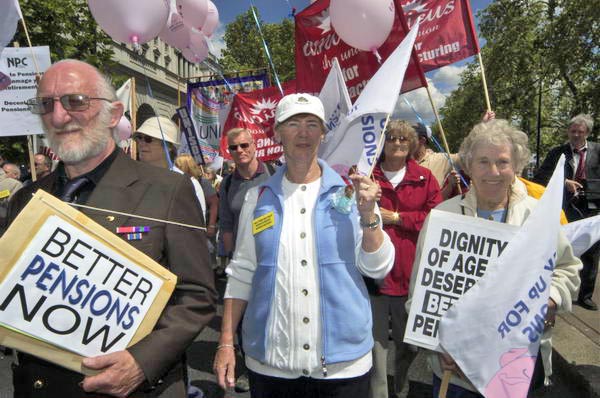
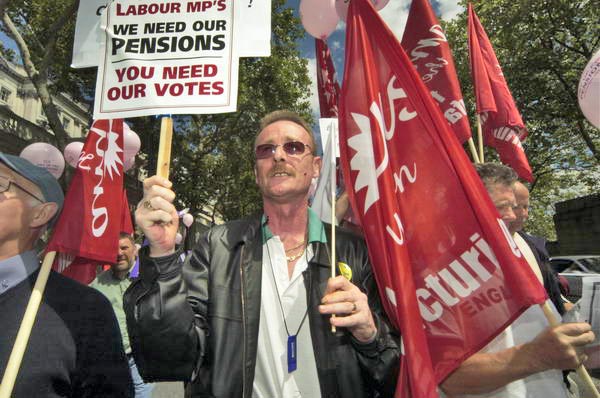
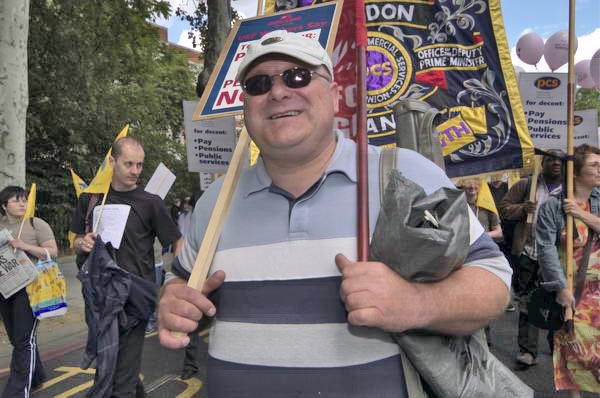
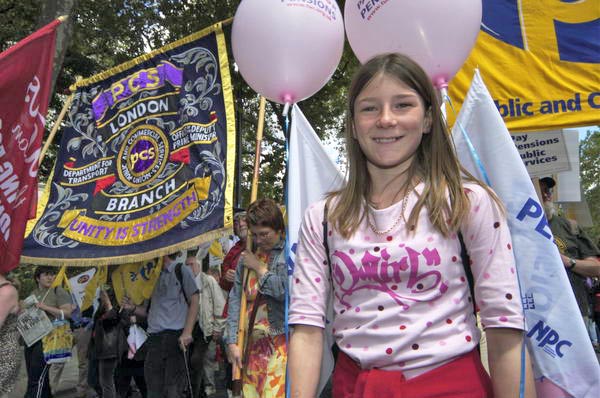
Pay Up For Pensions – Trade Union Congress March and Rally
Half an hour later I was back in the real world. Where companies make off with the pension funds leaving people who have paid in to schemes for years with no pensions. where other creditors come before pension holders when companies go bust.
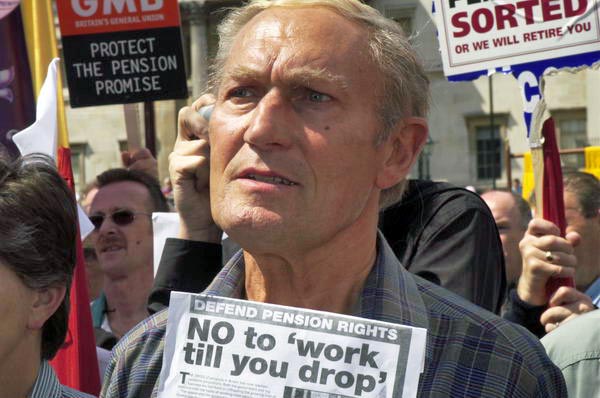
Where millions of lower paid workers now have no employment pension rights at all. Where women have always been treated unfairly in many respects. Where government has worsened conditions for civil servants, teachers and others. As TUC General Secretary Brendan Barber says “Those who used to have good pensions now have poor pensions. Those who used to have poor pensions, now have no pension.”
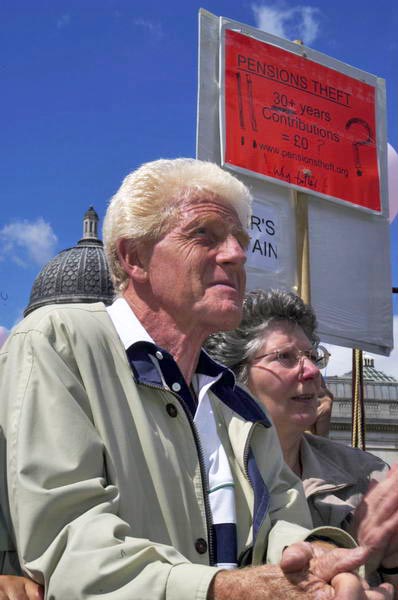
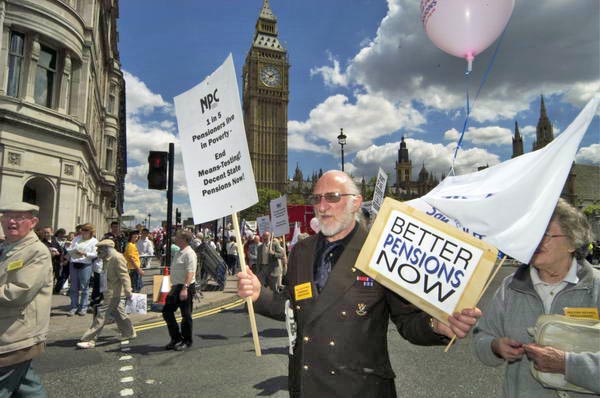
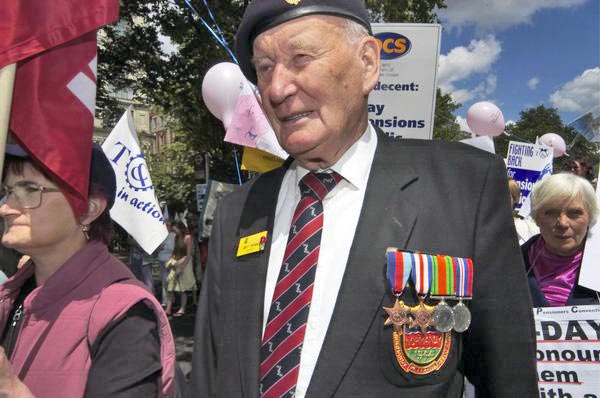
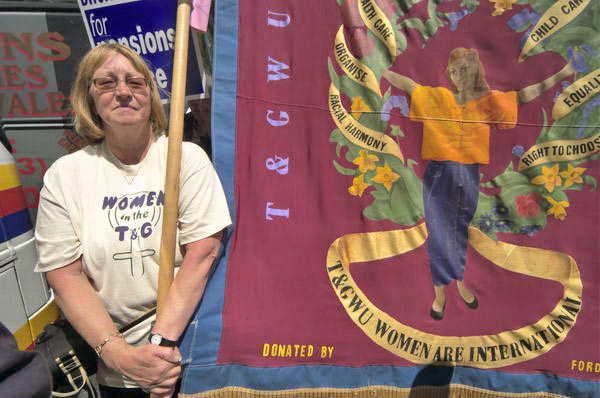
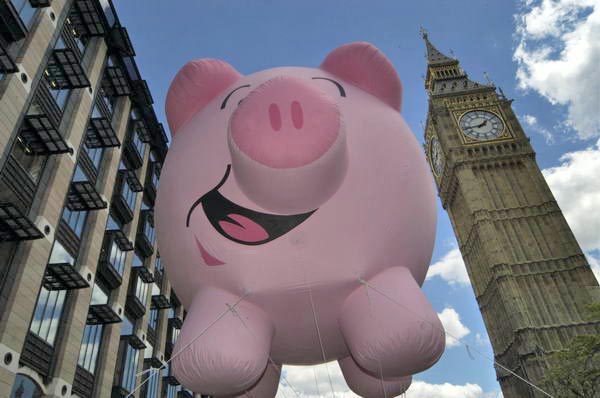
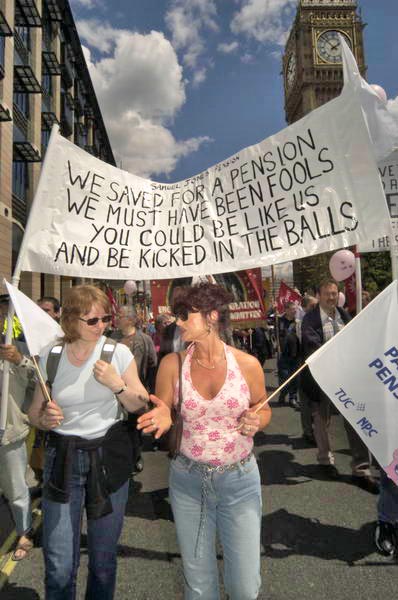
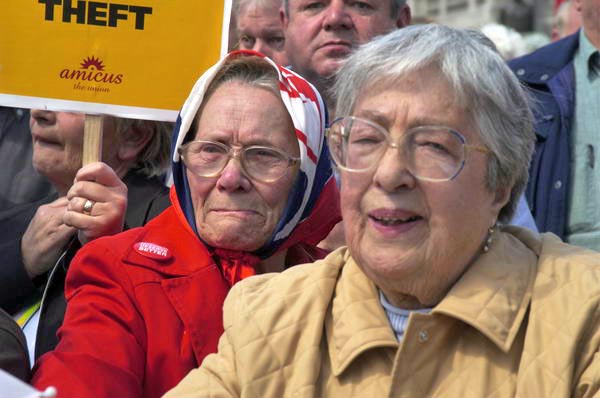
Around 5-10,000 people marched down from Temple towards the Houses of ParliamentMarchers included many workers who have already lost their pensions when their companies foldedBanners on the march included many union branches including those for civil servantsPeople of all ages took part; not only the old are affected by pensions.Marchers included pensioners who had served in WW2Women have never been treated fairly over pensions by employers or stateThe pink pensions pig caught between Big Ben and Parliamentary OfficesWorkers from Samuel Jones lost their pensions when the company was taken over‘Protect the Pension Promise’, ‘NO to work ’till you drop”. The labour movement looks to the government to act on pensionsPensioners want a better deal, and the unfairness of pension theft is widely recognised
Unfortunately the New Labour Government wasn’t listening and the “the great British pension theft” begun by Margaret Thatcher and taken over by Gordon Brown continued, while ineffectual legislation introduced after the scandal when Robert Maxwell stole £460 million from the Mirror pensioners continued to allow companies to steal pensions from their workers. Despite pension protection schemes, workers can still lose when companies are taken over or fail.
River Thames at Hammersmith – Furnival Sculling Club
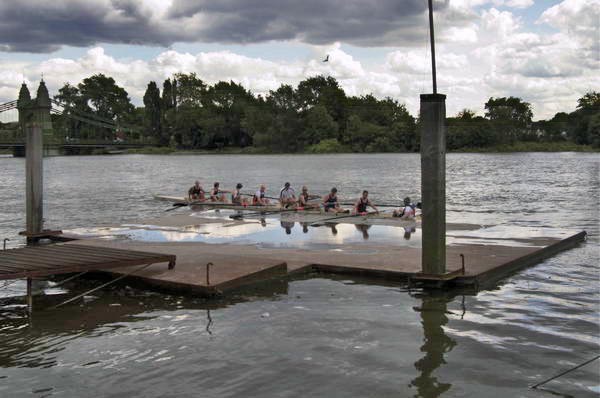
On the way home I went for a walk by the river in Hammersmith, another area of London strongly associated with William Morris. The Funivall Sculling Club here was established in 1896 as the Hammersmith Sculling Club For Girls – the world’s first women’s rowing club – by Dr Frederick Furnivall; it went unisex in 1901. Furnival had earlier championed rowing for working men. He served as the model for Ratty, the water rat in ‘Wind In The Willows’, as well as being involved with the preparation of the Oxford English Dictionary.
Hammersmith Mall – The second building is the Furnival Sculling ClubWeeds and pollution in the ThamesPlastic bottles and other rubbish collected up by this landing stage near Hammersmith Bridge
The former BBC Riverside Studios – part converted to offices which were advertised by the banner at roof level. It was imaginatively redeveloped in 2014-6 to provide better public facilities, a riverside walkway and 165 flats.