Global Human Rights Torch Relay: Thursday 25th October 2007 I photographed this rally in Trafalgar Square and the torchlit march which followed to a protest at the Chinese Embassy.
The 2008 Summer Olympics was to be held in Beijing, China from 8th to 24th August 2008 and the official Summer Olympics Torch Relay – which had been a feature of the Olympics since the 1936 Berlin games – was announced in April 2007, though it was to take place from March 24 until August 8, 2008. This travelled the world in a very roundabout 129-day route from Athens to Beijing and was met with protests in many cities including San Francisco, London and Paris.
The Coalition to Investigate Persecution of the Falun Gong in China (CIPFG) organised a series of torch relays in cities around the world beginning in April 2007 to raise awareness about human rights violations, particularly in China and countries surrounding area and in particular the persecution of crimes including torture and the harvesting of human organs of Falun Gong practitioners.
The policing of the event and the intervention of Westminster Council officials showed that there was huge political pressure in London against protests against China and against the Olympics as London was preparing for the 2012 Olympics here. We saw it again when the official torch relay came to London in April 2008.
Here I’ll post – with minor corrections – my account of the event from 2007 with a few of the pictures – many more on My London Diary.
Global Human Rights Torch Relay – 2007
Trafalgar Square to Chinese Embassy
Thursday was a miserable day, with persistent drizzle or light rain, and Trafalgar Square was clogged up with some computer games fair, so that there was little space left for the Global Human Rights Torch Relay on the North Terrace. Organised by the ‘Coalition To Investigate The Persecution Of The Falun Gong‘ this also highlighted other human rights abuses in China, as well as some in countries within the Chinese sphere of influence, notably Burma (Myanmar.)
This relay had started in Athens in August, with events in several European countries, and it is going on to Australia and North and South America before ending in Asia next year.
The relay points out that the these human rights abuses are at odds with the ideals of the Olympic Movement and calls for the Beijing Games to be moved to one of the previous Olympic venues unless there are dramatic improvements in human rights in China. Among the speakers were a couple of Lords and several ex-Olympic competitors.
Westminster Council officials arrived after an hour or so and tried to stop the event, which thanks to the gaming festival, was indeed blocking the pavement. They made the protestors form a narrow line against the back wall. Then they and the police ruled out the use of the sound system, declaring it was a hazard in the wet conditions. Speakers had to make use of a battery operated megaphone.
Despite this harassment, the protest continued, with a ‘Greek Goddess’ bringing the flame to light the torches of figures representing England, Scotland , Wales and Ireland, and perhaps a couple of hundred marched through the West End to the Chinese Embassy for a candle-lit protest.
Here photographers met with deliberate antagonism from the police. Officers are standing in a line around 2 metres into the road in front of the protest. The area between the police and the demonstration is completely clear, absolutely safe, and it is where we need to be to take pictures or film the protest. Much to our disgust, we are ordered out when we attempt to get on with our work.
Hardest Hit, Biofuels, Tibet and OccupyLSX: Saturday 22 October 2011 began for me with a protest at City Hall (still then in Southwark close to Tower Bridge) Next in Whitehall I photographed a protest against the pollution, environmental damage and human rights abuses of burning forests produce energy. Also on Whitehall I met Tibetans and supporters marching from the Chines Embassy to Downing Street demanding an end to China’s increasing repression in Tibet. Finally I went to St Paul’s Churchyard for a brief visit to Occupy London a week after their camp there had begun.
Hardest Hit Protest At City Hall
City Hall, More London
The Hardest Hit campaign, organised jointly by the Disability Benefits Consortium and the UK Disabled People’s Council were holding a rally outside City Hall as a part of protests in cities and towns across the country calling on the government to stop the cuts in benefits and services and changes in the assessment of disabilities which have hugely affected their lives.
Of course the Mayor of London was not responsible for the cuts, and I assume this was just a convenient location he had made available for the protest. Of course many services provided by local government had been cut as a result of the government funding cuts. And as usual the government claimed to be concerned with the plight of the disabled and to be trying to help them while at the same time making cuts that really hurt them.
The protest took place in the Scoop, an outdoor sunken amphitheatre next to City Hall, part of the More London development, an events space which can seat around a thousand and it looked a little empty though there were many disabled protesters, some with carers and supporters.
Protesters against Barton Renewable Energy in Davyhulme, Manchester
People had come from across the country to protest at continued government support for biofuel energy production despite it now being clear that this is contibuting to climate change, causes deforestation and the loss of valuable forest land, results in a loss of food production and threatens human rights in many areas.
Biofuels were once seen as a green alternative which would help us reduce global warming, but it is now clear that are worse polluters than coal or oil. Despite this, they still receive huge payouts from funding meant to encourage renewable energy sources. The huge wood-burning plant at Drax in Yorkshire in 2024 received £869 million in public subsidies – over £2 million a day for polluting the planet.
At last in February 2025 the UK government has announced a cut in the subsidies for Drax, and the winding down of using imported wood pellets for energy generation. But even when this comes into force in 2027 Drax will still be getting £1.2 million a day. Drax will cut its power production to around half its current level and further reductions are expected from then.
Tibetans shout their message to Downing St, across Whitehall
Several hundred Tibetans and supporters marched from the Chinese Embassy to Downing Street in a protest over China’s increasing repression in Tibet, where in March 2011 eight young monks and a nun had set themselves on fire in desperate protests. Five had died.
Protests around the world like this one aimed to get the international community to end their silence over the Chinese abuses of human and civil rights in Tibet. It was supported by the Tibet Society, Free Tibet, Students for a Free Tibet, Tibetan Youth UK and the Tibetan Community in Britain.
The held a rally opposite Downing Street and delivered a letter to the Prime Minister calling for the UK Government to take action.
There was to be a world-wide day of action on Wednesday 2 Novemeber, the to call for action from international governments the day before world leaders meet in Nice, France for the G20 Summit.
A week earlier on 15th October 2011 I had been at the protest when around 2000 Occupy protesters had tried to protest outside the Stock Exchange but were prevented by police. They had returned to the steps of St Paul’s and held a general meeting. Police kettled the protesters (and me) there, but I left when a group of them forced their way through the police line. Those that were still kettled decided to stay and occupy the area after police told them they should leave. A week later they were still there and I went back to see what was happening.
There was a full program of events for the day, and a general meeting was taking place with Selma James speaking.
A mother and daughter concerned about privatisation of the NHS at OccupyLSX
As I said “the organisation of the camp is impressive, although clearly there are some people around who don’t respect the camp’s ‘no alcohol’ rule. But like the previous camps in central London, the camp attracts a number of the rough sleepers and odd characters who normally wander the streets of our city. It’s a useful service for people who are normally neglected, but does bring some problems.”
Iraq Oil, Freedom, Rosary Crusade & Parliament Square: Saturday 11 October 2008 was another varied day, beginning with protests against the US grab of Iraq’s oil and tthe increasing control over our lives by governments and corporations. I then photographed a walk of public witness by Catholics in London before going to Parliament Square were I found a number of smaller protests.
100 Days to stop Bush & Cheney’s Iraq Oil Grab!
Shell Centre
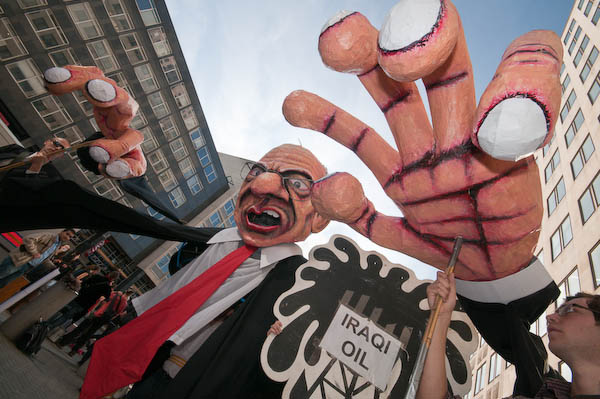
A giant Dick Cheney looms over Iraqi Oil outside the Shell Centre
In 1972 the Iraqi government took over Iraqi oil, nationalising the Iraq Petroleum Company which was jointly owned by the world’s largest oil companies, and it provided 95% of government revenue.
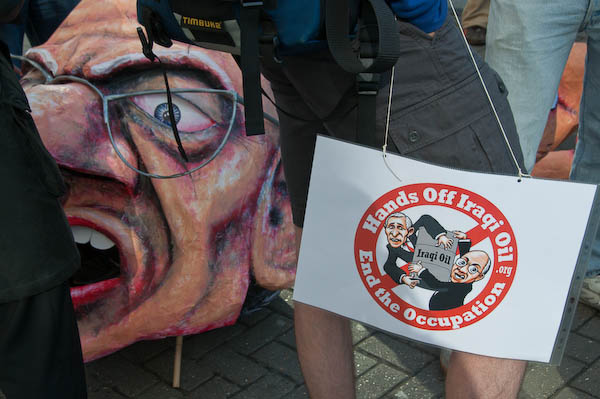
Many of us thought that the main reason behind the 2003 invasion of Iraq was to get the country to hand over most of the oil reserves to foreign companies, particularly Shell and BP.
In 2007 the US-backed Iraqi cabinet had approved a new oil law, strongly opposed by Iraqi trade unions and oil experts, but driven by expert consultants supplied by the UK and US who previously worked at a high level for companies like Shell and BP which would give the foreign oil companies control over oil production and in 2008 the Iraqi Oil Ministry began to announce contracts with former partners in the IPC, ExxonMobil, Shell, Total and BP as with Chevron and others.
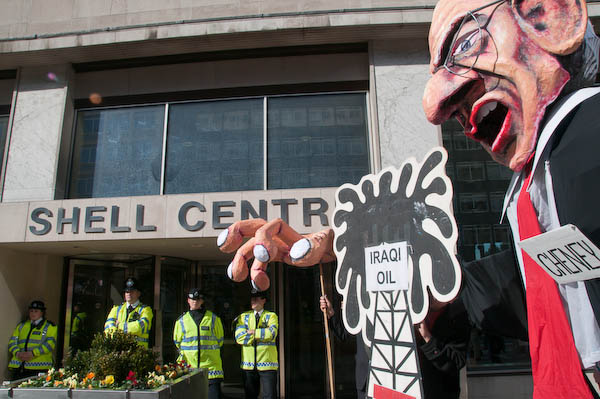
The protest came at the start of the final 100 days of President Bush’s administration in the US and was organised by ‘Hands of Iraqi Oil’, a coalition whose members include Corporate Watch, Iraq Occupation Focus, Jubilee Iraq, PLATFORM, Voices UK, and War on Want and supported by the Stop the War Coalition and others.
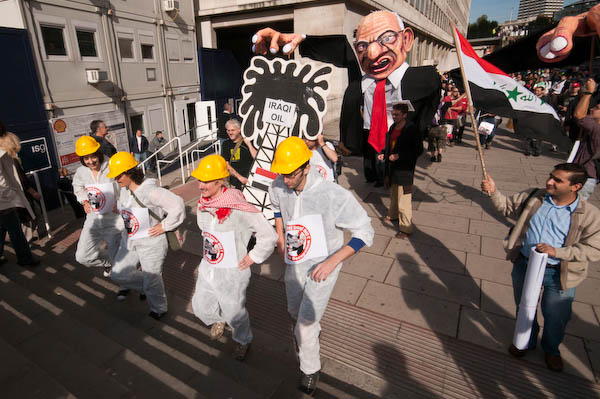
The samba band, brass band, ‘oil workers’ and others came to protest at the Shell Centre with a giant figure of US Vice-President Dick Cheney and a mock oil well as well as some with Iraqi flags.
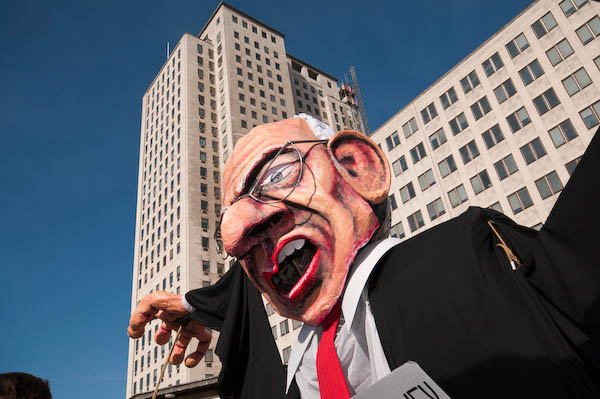
I left them shortly after they set off to march first to protest outside BP’s headquarters in St James’s Square and then on to the US Embassy to go to New Scotland Yard.
Freedom not fear 2008 was an international protest in over 20 countries against excessive surveillance by governments and businesses, organised by a broad movement of campaigners and organisations.
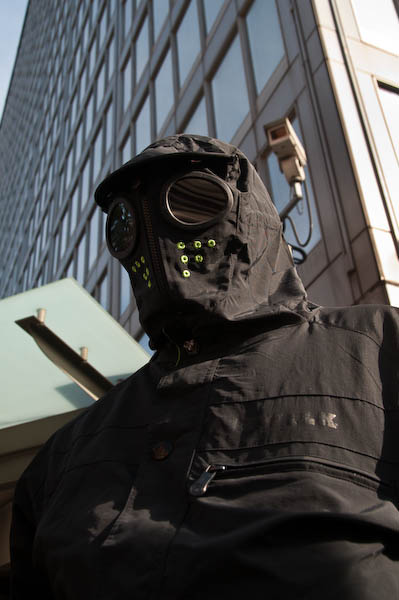
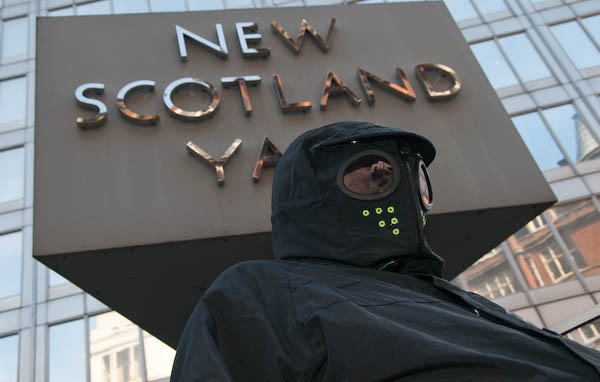
A camera behind this person dressed in a sinister black suit and hood
The main UK event was a protest outside the Metropolitan Police headquarters, New Scotland Yard, then still in Victoria Street, Westminster. The protest was against the restriction of the right to demonstrate under SOCPA, the intimidatory use of photography by police FIT squads, the proposed introduction of ID cards, the increasing centralisation of personal data held by government, including the DNA database held by police, the incredible growth in surveillance cameras, ‘terrorist’ legislation and other measures which have affected our individual freedom and human rights.
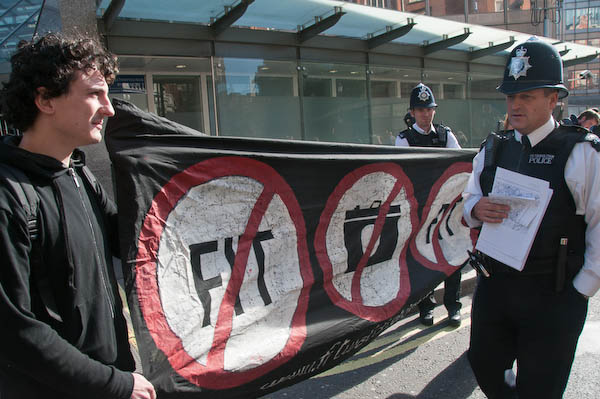
The protest was within the area where restrictions on protests were introduced by the Serious Organised Crime and Police Act 2005 (SOCPA) which required the protesters to have given written notice to the Commissioner of the Metropolitan Police six days in advance for the event. But of course they had not as a part of the protest.
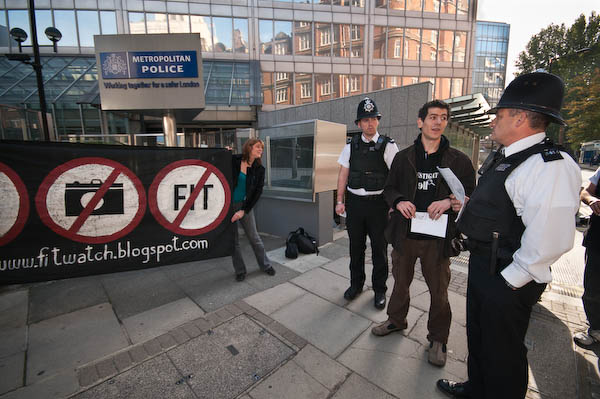
Police tried hard to give protesters SOCPA notices telling them that the protest was illegal but few took them or any interest in them. Some of the officers joked with the protesters who included People in Common and FitWatch, but sensibly they did not attempt to break up the protest or make any arrests, or at least not in the three-quarters of an hour or so I was present.
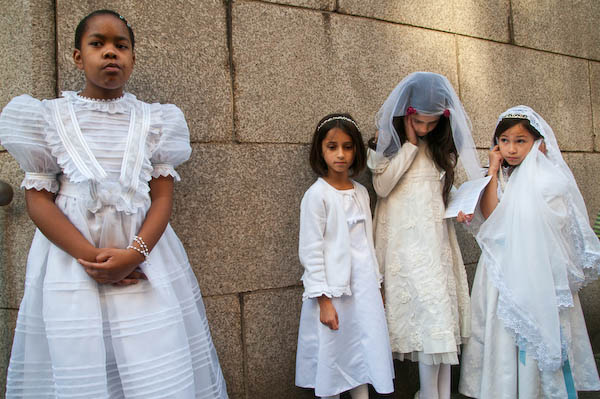
Young girls in white communion dress walked beside the statue of Our Lady of Fatima
I walked the short distance along Victoria Street to Westminster Cathedral where people were gathering for the Rosary Crusade of Reparation. This began in Austria in 1947 as a campaign by a Franciscan priest to free the country from communist control, and is said to have played a part in the Russian decision to allow Austria its independence in 1955.
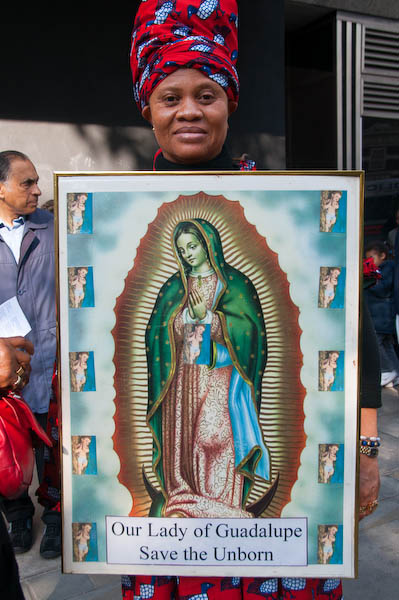
THe first annual procession with the statue of Our Lady of Fatima took place in 1948 in Vienna on the feast of the Name of Mary, Sept 12th. This feast was set up by Pope Innocent XI in 1683 after Turkish invaders surrounding Vienna were defeated by Christian armies who had prayed to the Blessed Virgin.
Families at the front of the large crowd in the procession
The procession in London takes place on the nearest Saturday to the final appearance of Our Lady at Fatima in October 1917, close to the end of the First World War, when those present saw the sun dancing around in the sky, and she promised peace and an end to war if men showed contrition for their sins and changed their lives.
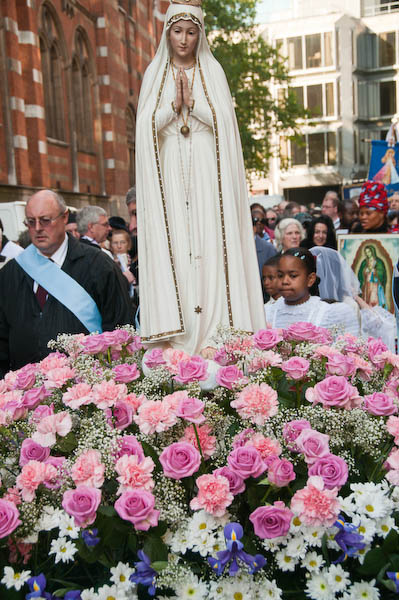
This was the 25 annual procession in London and had as its special theme atonement for the Human Fertilisation and Embryology Bill then passing through Parliament.
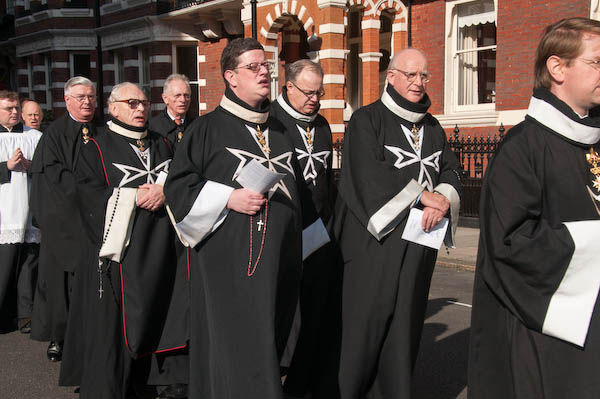
I photographed the start of the procession which was making its way slowly to Brompton Oratory.
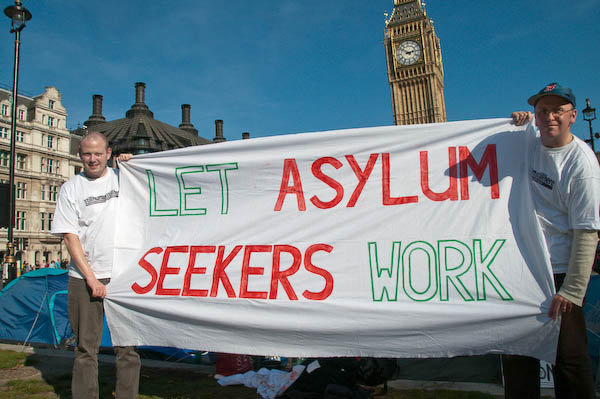
I’d gone to Parliament Square to look for a two-man protest by the two Bens from the ‘Still Human Still Here‘ campaign dedicated to highlighting the plight of tens of thousands of refused asylum seekers who are being forced into abject poverty in an attempt to drive them out of the country. The two men had spent two weeks in a tent in the square living on the emergency rations that the Red Cross will supply to these inhumanely treated asylum seekers.
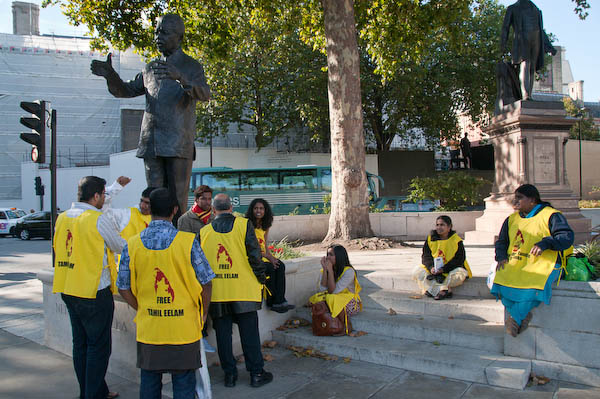
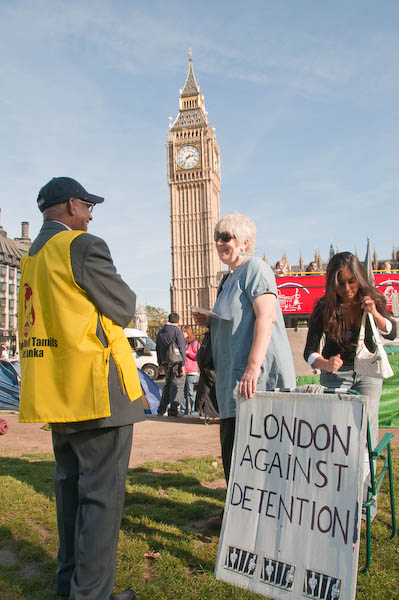
In the square I found a number of other protests taking place. Of course Brian Haw was there – as he had been for over 7 years – and I saw him being insulted by a man who smelled strongly of alcohol. There was a small group of Tamils who told me that they were part of a campaign giving out leaflets all over the centre of London about the ethnic cleansing taking place in Sri Lanka. Another small group, ‘London Against Detention’, was campaigning to close down Asylum detention centres.
In the corner close to the statue of Churchill was a man who told me he had been on hunger strike for two weeks in a protest to get his case properly investigated. He claimed to have been abused by police and social services following an incident in which as a seven year old child in Llanelli he was implicated in the death of a baby brother.
Finally I saw another group of people hurrying along the street opposite towards Whitehall carrying posters. I chased after them and found that they were Obama supporters hoping to persuade Americans they met to register and vote in the US election.
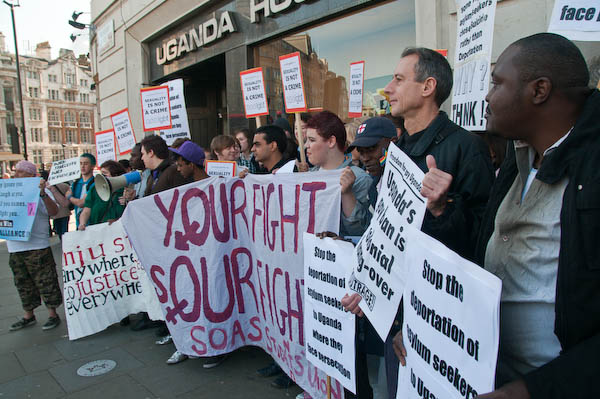
Uganda, Green Belt, Olympic Site: Thursday 9th October 2008 was Uganda Independence Day and I began work at a protest at the Ugandan Embassy in Trafalgar Square against the persecution of gays in that country. In Parliament Square I met protesters who had come from Dorset to bring a petition against a proposed new town on Green Belt land on the outskirts of Bournemouth and Poole. Then as I had a few hours before a meeting it was an opportunity to take another walk to see what I could by then of the fenced off Olympic site.
Demonstration Against Ugandan Human Rights Abuse
Ugandan Embassy, Trafalgar Square
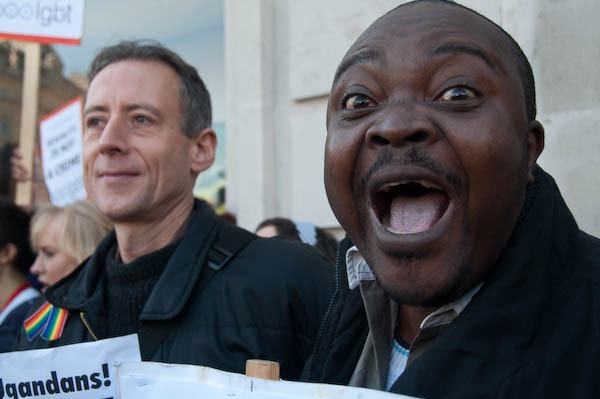
Peter Tatchell of Outrage! and Davis Makyala of Changing Attitudes in the demo outside Uganda House
As I wrote in 2008, “October 9 is Uganda Independence Day, but for gay Ugandans in particular there is little to celebrate… “Homosexuality is illegal in Uganda and the penalty can be imprisonment for life, and gay rights campaigners have been imprisoned and subjected to torture. The Ugandan Anglican church is a leading force in anti-gay campaigns.”
The Ugandan government intimidates and tortures gay people and excludes them from healthcare. British arms exports have been used against protests there, killing at least three demonstrators by 2008.
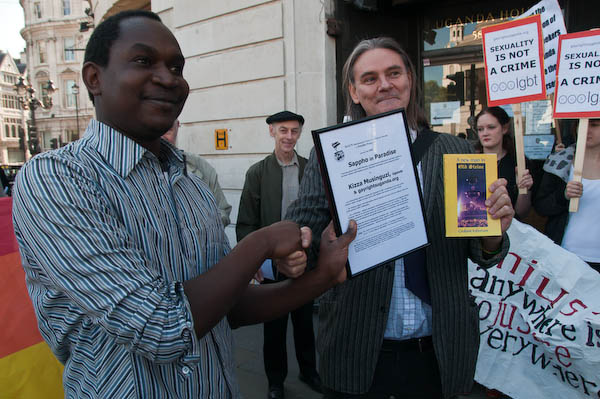
Kizza Musinguzi who was jailed and tortured in Uganda receives the 2008 Sappho in Paradise book prize
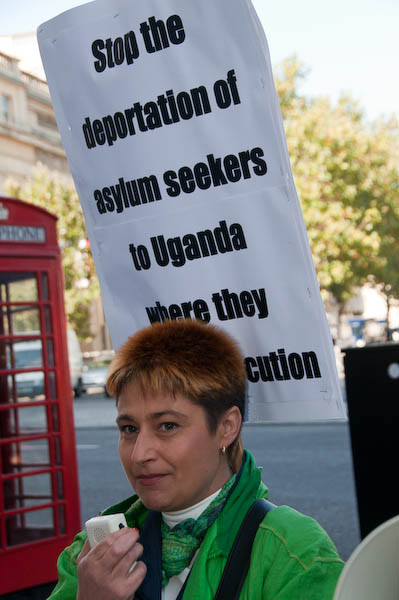
Ugandans fleeing the country because of persecution and seeking asylum in the UK were among those forcibly sent back to the country without proper consideration of their cases under our “fast-track” process which was later declared unlawful.
Emma Ginn of https://medicaljustice.org.uk/ Medical Justice
The LGBTQ rights situation in Uganda is now even worse following the passage of ‘the Anti-Homosexuality Act, 2023, which prescribes up to twenty years in prison for “promotion of homosexuality”, life imprisonment for “homosexual acts”, and the death penalty for “aggravated homosexuality“.’
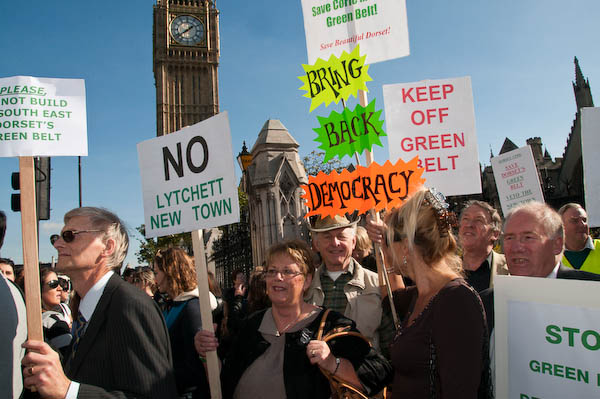
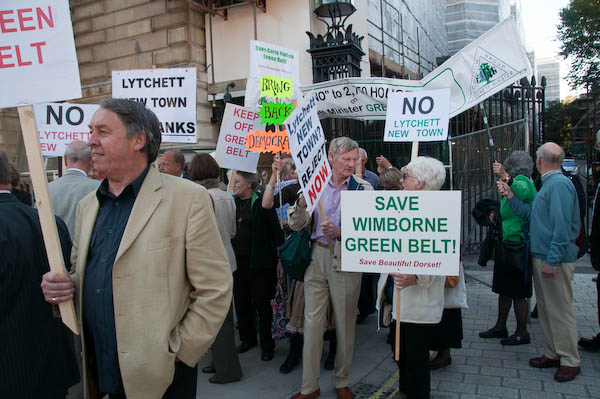
People from villages on the outskirts of Bournemouth and Poole had come to protest against the proposed Lychett New Town on Green Belt land in Dorset.
Apparently Hazel Blears, Secretary of State, had told Dorset County Council it must build a New Town at Lytchett Minster with over 7,250 houses in the Green Belt around Poole & Bournemouth, and local residents had set up a campaign about it.
Octavia Hill had first proposed the idea of green belts in 1875 but it was the 1947 Town and Country Planning Act which allowed local authorities to set them up and they were further encouraged to do so by Tory Housing Minister Duncan Sandys in 1955. The idea was to put an end to the unplanned sprawl of ribbon development along major roads leading out from all our cities and provide areas for local food growing, forestry and outdoor leisure.
As I commented, “it has made a valuable contribution to improving the quality of life in our towns and villages and to conserving the countryside.” But as I also wrote, “Many of us feel that the whole of the current planning structure works against sensible and ecological development, but the answer to this is not to relax planning controls but to bring in improved – and in some respects tighter – controls.”
Unfortunately the changes announced by Labour in 2024 which include some Green Belt being re-classified as ‘Grey Belt’ seem largely intended to make things easier and more profitable for developers.
Consultations took place in 2025 over proposals for Lytchett Minster & Upton in the Dorset local plan which lists opportunity sites for over 5000 new homes – and a new petition was set up opposing them.
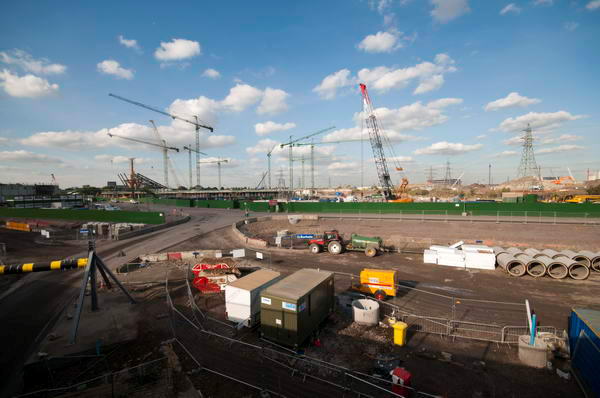
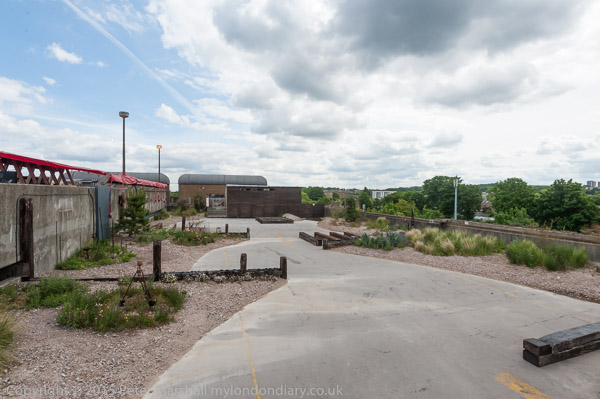
Looking towards the main stadium in left half of picture, along what was once Marshgate Lane.
“It has always been an interesting walk through Stratford marsh on top of the Northern Outfall sewer, although rather more so in the past when there were so many places one could leave it to explore further rather than coming up against the big blue fence.”
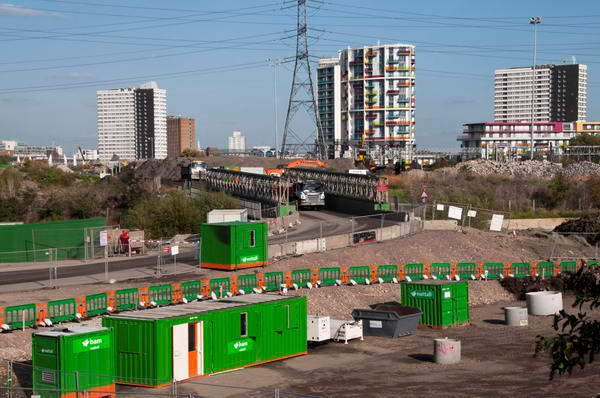
Bridge over City Mill River from the Greenway
I commented back then of my annoyance at the statements made by the Olympic authorities that after the Olympics they would be opening up the previously inaccessible area to the public. In fact they were destroying the area where it had always been interesting to wander along the various largely riverside footpaths – many of which had been cleared to make them easier to walk in the 1990s.
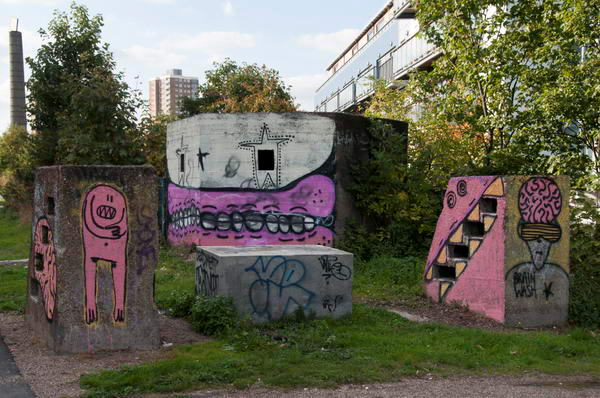
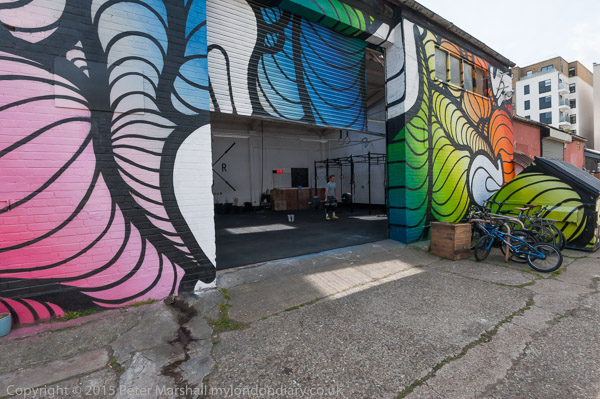
Work by Hackney Wick’s most prolific artist
You can see many pictures that I took in the area on my Lea Valley website And as a replacement we now have a park which seems rather arid. Perhaps by 2112 it might look better.
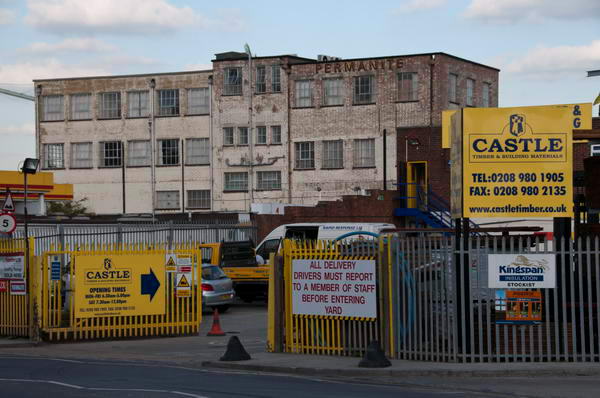
Foarmer Permanite Works
In 2008 most of the Olympic area was fenced off, but I enjoyed the walk along the ‘Greenway’ on top of the Northern Outfall Sewer to Hackney Wick where I dound much to interest me and “taking the train back from Hackney Wick to Stratford there were many signs of fairly frenzied activity visible.”
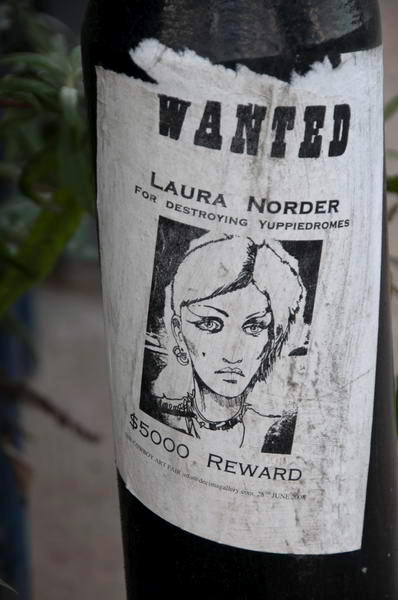
Wanted – Laura Norder – $5oo Reward – advertising an art fair at Decima Gallery in Hackney Wick
Stop Starving Palestine Pan Protest: Last Friday evening thousands of us came to Whitehall shocked by the news and photographs coming out of Gaza, where much of the population is now suffering from malnutrition and over a thousand have already died of starvation.
The famine there is entirely due to the actions of the Israeli government and their army, the IDF. Over the past months they have denied access to the normal humanitarian supplies of foods and essential items to Gaza.
Israel has also disrupted the well-established channels through which food was distributed in Gaza through the UN and humanitarian agencies. Together with the USA they have set up an alternative way to supply food which has operated at only four centres; the amount of food supplied has been vastly inadequate and over a thousand of those queueing for it have been killed by the IDF.
A holocaust survivor speaks outside the Foreign & Commonwealth Office.
The world has been shocked by the pictures coming out from Gaza, and by well-documented stories from medical staff that snipers and not only target those queueing for food but ‘gaming’ by targeting different parts of the anatomy on different days. One day hospitals treated many who had been shot in their testicles.
For months we have been appalled by the accounts of the shelling and bombing of hospitals, medical facilities and the arrests and interrogation of medical staff, some of whom have clearly been tortured.
L
Large areas of Gaza are now covered with the rubble of people’s homes and people forced to flee and living in makeshift tents, often in so-called ‘safe areas’ have been killed by the military.
The attack began after an attack by Hamas across the border into Israel in which over a thousand died – including some by Israeli military fire and hundreds were kidnapped as hostages. But it has continued for over 600 days, with the killing of many, many thousands of innocent Palestinians, men, women and children in what has clearly become a series of war crimes.
Some Israeli ministers have clearly stated their intention to entirely rid Gaza of Palestinians, and Donald Trump has supported them, with plans to turn the area into a holiday resort. Israel clearly wants to settle the area with Israelis.
From the rest of the world we have seen words of condemnation, but little or no real action, with the USA using its veto in the UN. The UK has banned some of its arms exports and is nowmaking plans for air drops of food – but these will only be a small – and dangerous – drop in the ocean of desperate need.
On Friday evening I travelled up to London with my wife – carrying a large pan and a wooden spoon to bang it with in a protest calling on our government to take effective action.
I began by photographing a rally outside the Foreign & Commonwealth office by the International Jewish Anti-Zionist Network UK who began weekly protests in October 2023 against the Israeli Ambassador to the UK who had called for the illegal annexation of the West Bank and for “every school, every mosque, every second house” in Gaza to be destroyed. Their protests have been hounded by police, banned first from being outside her residence and then from Swiss Cottage.
Among the speakers I photographed there was a woman holocaust survivor who received tremendous support with people banging their pans and was unable to continue for several minutes. This was also one of the few parts of the evening of protest where many people had also come with placards.
A few yards up Whitehall there were crowds of protesters banging pans on both sides of Whitehall. Police tried to keep them on the pavement but when they appeared to be trying to arrest one of those who refused to move, crowds surged around them and occupied the whole of the highway.
There were a couple of speeches from in front of the gates to Downing Street, but many of those present were too far away to hear them and people kept up the banging of pans.
Eventually the organisers asked people to come and leave their pans in front of Downing Street and start moving towards Trafalgar Square. Some did, but many others still needed them to cook with. A thin police line held up the movement towards the square for around ten minutes – though the protesters could easily have broken through they waited patiently and then marched on to the square where I left them.
Vedanta AGM Protest: Westminster, Wednesday 28 July 2010
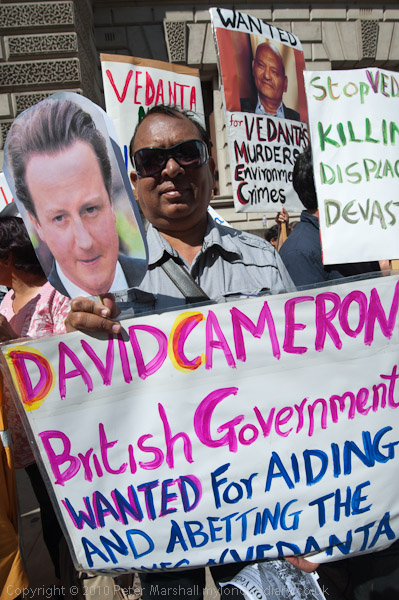
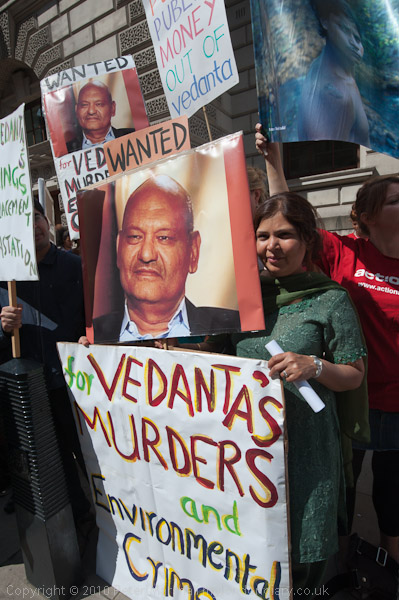
The protest outside Vedanta’s AGM held in Westminster on Wednesday 28th July 2010 was the first time I really became aware of the company and its mining activities. This protest concentrated on its plans to displace and wipe out an ancient civilisation in the Niyamgiri Hills of Orissa, India by bauxite mining.
The hills which would have been destroyed by their mining are sacred to the region’s Adivasis, primarily the Dongria Kondh tribes. By 2010 Foil Vedanta who organised the protest were saying that Vedanta had caused more than 100 deaths in the area though accidents, police shooting, forced displacement, injury and illness.
More than a thousand people have already been displaced, with 8000 under threat, moved away from their traditional sources of income and dumped into shanty towns where there is no work. Thousands of acres of fertile agricultural land have been destroyed, rivers and streams disrupted and drinking water contaminated by fly ash and toxic red mud.
Anil Agarwal is CEO of Vedanta
Vedanta Resouces is an Indian company founded and still run by the Agarwal family, but in 2003 was listed on the London Stock Exchange following a two year ban by the Securities Exchange Board of India from accessing capital markets after they were found guilty of cornering shares and rigging share prices.
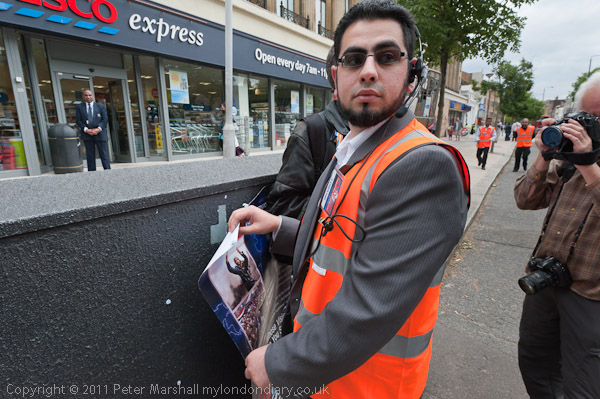
Police push back security who assaulted activists who tried to enter the building
A damning report, Vedanta’s Billions: Regulatory failure, environment and human rights‘, issued by Foil Vedanta in 2018 accuses “the City of London and the Financial Conduct Authority” of minimising the risks associated with Vedanta’s legal violations and human rights and environmental abuses’ and failing to investigate or penalise any London listed mining company on these grounds.”
Among other crimes, the report names Vedanta as “the latest in a string of London listed mining companies linked to the murder or ‘massacre’ of protesters, including Lonmin, Glencore, Kazakhmys, ENRC, Essar, GCM Resources, Anglo Gold Ashanti, African Barrick Gold and Monterrico Metals.”
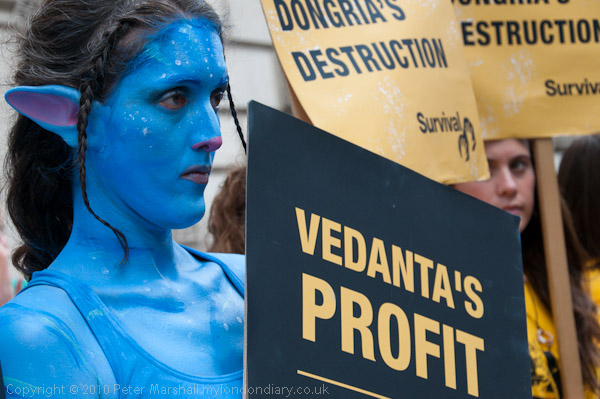
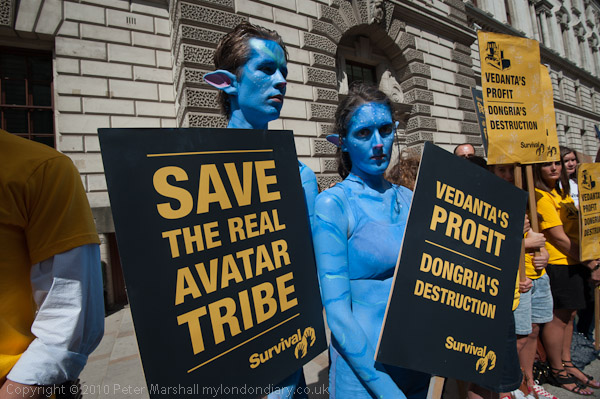
As well as Foil Vedanta the campaign against them was supported by Amnesty International, Survival International and Action Aid, and a number of campaigners had become shareholders so they could attend the meeting and attempt to question the company’s activities – and these included Bianca Jagger. Her presence and that of two bright blue aliens from the tribe destroyed in the James Cameron film ‘Avatar’ ensured that the protest for once got some press coverage. Also supporting the protest were the South Asia Solidarity Group, South Asian Alliance, Brent Refugee and Migrant Forum and London Development Education Centre.
The campaign against Vedanta had already been successful in getting various shareholders to end their investment, including the Church of England, the Joseph Rowntree Trust and the Dutch pensions company in ending their investments due to concerns about its approach to human rights and the environment. And continued protests by Foil Vedanta undoubtedly played a part in the company’s decision to de-list from the London Stock Exchange in 2018.
The company was helped to list in London by the British Government’s Department of Trade and Industry and the Department for International Development (DfID), and was getting continued support from the DfID Building Partnerships for Development programme and the Orissa ‘Drivers for Change’ research project, and former British Ambassador to Saudi Arabia and High Commissioner of India David Gore-Booth had been a directory.
Its billionaire CEO Anil Agarwal was said to have close links with the extremist umbrella group for Indian Hindu right-wing organistions, Sangh Parivar, said to be responsible for many attacks on Muslim and Christian communities in Orissa, Gujurat and other parts of India.
The Foil Vedanta report has a “special focus on illegal mining in Goa, pollution and tax evasion in Zambia, as well as illegal expansion and pollution in Thoothukudi, Tamil Nadu, industrial disaster at Korba in Chhattisgarh, land settlement and pollution issues in Punjab, displacement and harassment of activists in Lanjigarh, Odisha, and a mineral allocation scam in Rajasthan.“
You can see and read more about the 2010 protest on My London Diary at Vedanta AGM Protest.
End the Genocide, Stop Arming Israel: Last Saturday, 19th July 2025, the weather forecast for London was dire. Thunderstorms and heavy rain until clearing a little later in the afternoon, with up to several inches of rain leading to some localised flooding. In the event it was a bit under two inches, with small rivers running along the side of some streets.
London, UK. 19 July 2025. Many thousands march in pouring rain in London
In this account I intend to write about my personal experiences and working as a photographer on the day rather than my views on the terrible situation in Palestine and the reprehensible actions of the Israeli government and army – and Hamas. I’ve often written about the need for peace and justice, for an end to occupation and destruction and for the release of hostages and prisoners.
London, UK. 19 July 2025.
Linda and I were determined to go out and join the national demonstration, to show our support for the people of Gaza, to demand our government stop selling arms to Israel and to call on the Israeli government to end its terrible destruction and genocidal attacks and to allow humanitarian aid for the people of Gaza, many now starving. A little rain was not going to stop us.
As usual I checked online for our trains, only to find that our services into London were subject to delay and cancellation due to signalling problems. We dropped everything and hurried to get an earlier train than we had intended – and which actually was more punctual than usual – only two or three minutes late into Waterloo.
It was raining fairly heavily as we walked out of the station and by the time we’d crossed the Jubilee bridge to the Embankment where the march was gathering we were already quite wet.
As the forecast was for afternoon temperatures in the low to mid twenties I’d grabbed a lightweight waterproof jacket on my way out, which was a mistake. It did keep the water off to start with but was soon getting soaked through in places. I realised too late that I should have worn my poncho – or a heavier jacket that although too warm would have kept me dry. At least I’d had the sense to put on my truly waterproof walking boots rather than my usual trainers.
We joined the large crowd that was sheltering under the bridge carrying the rail lines into Charing Cross and I started to take photographs. It was dry – so long as you avoided the areas where water was leaking down from above – but rather dark.
I was working with my Olympus OM-D E-M5 Mark III (what a crazy mouthful of a name) a camera that came out over 5 years ago. It’s a Micro 43 camera with a sensor only around half the size of full-frame, but that does mean it can be significantly smaller and lighter – something increasingly important to me as I get less able to carry heavy camera bags. And, vitally important today, it is a camera that has good weather protection.
I also had my Fuji X-T30 in my camera bag, with a 10-24 zoom fitted. Had I not rushed out I might have chosen a more suitable body and wide angle for use in wet weather. Neither that camera or lens are weather sealed (the more recent 10-24mm is) and for most of the day they stayed in my bag. I did take them out a couple of times when the rain had eased off, but hardly any of the pictures I took with them were usable.
Under the bridge light was low, but the Olympus has good image stablisation and the main problem was subject movement, as people shouted slogans, jumped up and down, banged drums and more. Being very crowded also meant people were often banging into me as I was working.
I also use small and light lenses – in the case the Olympus 14-150mm F4-5.6 – equivalent to 28-300mm on full frame, going from a decent but not extreme wide-angle to a long telephoto. Its a small, light and incredibly versatile lens, but not one at its best in low light with its rather small aperture.
I started off working with the lens on the P setting, the programme choosing suitable shutter speed and aperture – with the lens wide open and shutter speeds of around 1/15 to 1/25 second. But I soon realised to stop action I would need a faster speed and switched to manual, deliberating underexposing at 1/100th second, f5.0 and at ISO 3200. The RAW images were dark but I knew that I could get Lightroom to make them look fine – if sometimes lacking in shadow detail.
Eventually people began to move out into the rain and march and I went with them, holding my camera under my jacket and only taking it out quickly to take pictures. I looked in my bag for the chamois leather I usually hold to dry and hold in front of the lens filter and it wasn’t there – I’d left it back home in the pocket of the jacket I was wearing when it last rained while I was taking pictures. I had to make do with a handkerchief instead, giving the protective filter a quick wipe before each exposure.
Outside it was a little brighter and I was able to increase the shutter speed to something more sensible, and was using manual settings of 1/160 f5.6 with auto-ISO giving me correct exposure. I was mainly working at the wider focal lengths of the lens and f5.6 gave me enough depth of field.
I hadn’t got out my umbrella, but of course many others were carrying them to keep dry. I find it hard to work with one hand while holding an umbrella in the other. But other people’s umbrellas were a little of a nuisance, with water often pouring from them onto me as I took pictures, adding to the effect of the rain.
So I was getting increasing wet – and soon retreated to the sheltered area under the bridge where different groups were now coming through. Keeping close to the end of the sheltered area I was able to keep working at the same settings, with the ISO now 3200.
London, UK. 19 July 2025. Stephen Kapos and another holocaust survivor on the march.
After a while I went out into the wet again – the rain had eased off slightly, and took more pictures. Then I noticed the banner for the Jewish holocaust survivors and their descendants and went over to greet Stephen Kapos, photograph him and another survivor as they set off on the march.
Shortly after I decided I would move to Westminster Bridge to take pictures of the marchers with the Houses of Parliament in the background, and walked as quickly as I could to there. Crowds of marchers and tourists watching the march slowed my progress somewhat.
The bridge is open to light and I was now using 1/250 second, but still with the Olympus lens at its wide-angle lens there was no need to stop down and I was working at around ISO 640.
I think around half of the march had gone over the bridge before I got there and I stayed taking pictures around halfway across the bridge for around half an hour, only leaving when I could see the end of the march coming on to the bridge. Fortunately the rain had eased off, but I was still getting wet.
I then hurried taking a short cut to get to Waterloo Bridge, taking just a few pictures where hurried past the march again on York Road. I took more photographs as people came onto Waterloo Bridge and then saw that a large group had stopped in the shelter underneath the railyway bridge and were having a spirited protest there – so I went to photograph them. When they marched off I went with them to Waterloo Bridge.
I looked at my watch. I had thought about taking the tube to Westminster and then going to photograph the rally in Whitehall, but decided it was perhaps too late to bother. I’d taken a lot of photographs and was rather wet and also hungry and decided it was time to go home.
I went to Waterloo and got on a train. Eventually, 15 minutes late, it decided to leave, and with a few stoppages at signals got me home around 25 minutes later than it should. Fortunately I’d packed some sandwiches and was able to eat them sitting at Waterloo, though the view wasn’t interesting. I’d edited and filed my pictures by the time Linda arrived home.
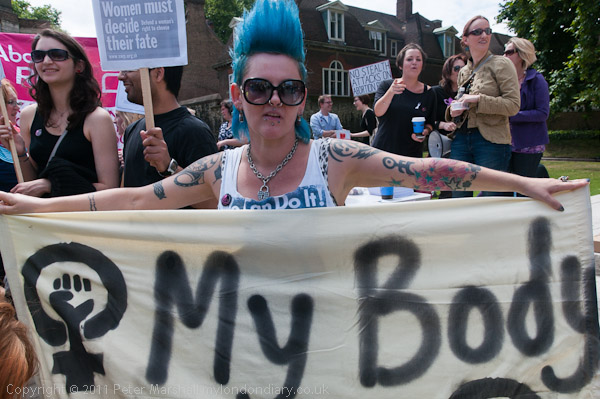
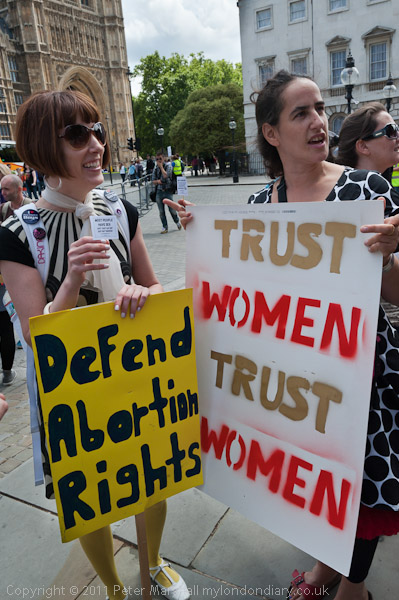
Against Clerical Fascism & Women For Choice: On Saturday 9th July 2011 I photographed a protest against the imposition of religious laws outside a Hizb ut-Tahrir conference in East London and then a larger protest at Westminster against amendments to the Health and Social Care Bill which would severely damage the provisions of the 1967 Abortion Act.
Protest At Hizb ut-Tahrir Conference – Whitechapel
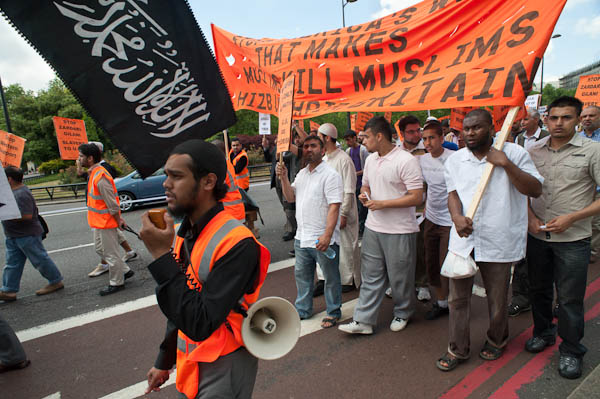
Hizb ut-Tahrir were proscribed in the UK as a terrorist organisation in January 2024 after a protest following the Hamas attack on Israel at which they called on Muslim armies to attack Israel. I had photographed various protests by them for around 20 years and had found them to be a deeply worrying organisation both in their views and in the way their events were run and was surprised that they had been allowed to continue their activities so long. They appeared to many to have some kind of special secret licence from our security organisations for their extremism.
Hizb ut-Tahrir were holding their International Khilafah conference at the former Wickham’s department store in Whitechapel and a small group of protesters including Peter Tatchell had come to protest outside.
On My London Diary I quoted Tatchell’s statement about the group:
“Hizb ut Tahrir opposes democracy and wants to establish a religious dictatorship where non-Muslims and women are denied equal human rights. The group has a long history of anti-Semitism, homophobia and bigotry towards Hindu people. It is also guilty of extreme intolerance towards Muslims who do not share its harsh, fundamentalist interpretation of Islam.”
There were separate entrances to the venue for men and women and photographers who attempted to photograph the women in front of their entrance were approached by security and told they must not photograph the women – and shortly after “a group of around a dozen Hizb ut-Tahrir security men and male stewards came and stood around the women to make further photography difficult.”
I’d earlier photographed a poster advertising the event on a cabinet in the pavement outside, and was photographing Peter Tatchell holding a placard reading ‘Hizb ut-Tahrir = clerical fascism No to Hizb / EDL /BNP‘ when one of the security men came and ripped the poster from the cabinet.
The protest was multi-racial and multi-ethnic and one Muslim woman held a poster stating ‘Hizb-ut-Tahrir does not represent Muslims.’ And, as I reported, ‘A Muslim man in his thirties walking past asked me what was happening and when I told him, described Hizb ut-Tahrir as “absolute nutters.“‘
Pro-Choice Rally at Parliament – Old Palace Yard, Westminster
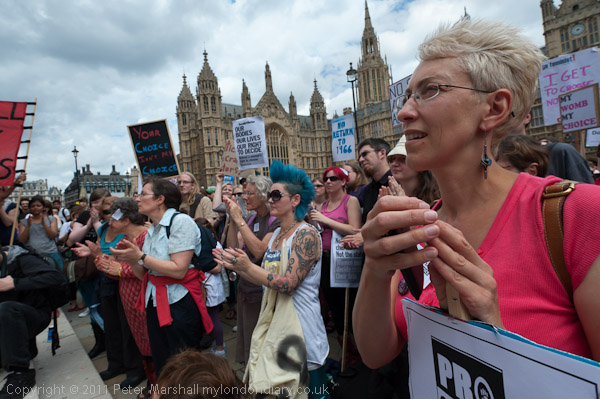
The crowd, mainly women, applaud one of the speakers at the rally
Many different groups had come to the rally to oppose the “attempts by right-wing Christians and some Conservatives to turn back the clock towards the position before the 1967 Act, where many women had dangerous illegal back-street abortions, often with disastrous effects on their health. “
That Act, legalising abortion, had “led to one of the greatest single improvements in health for women of the last century.” But the amendments proposed by Nadine Dorries and others to the Health and Social Care Bill being debated in parliament in 2011 would have imposed “a further delay on abortions and would open the door to counselling provided by unregulated and unlicensed organisations including those opposed to abortions on religious grounds, and would remove the current obligations to provide medically sound and unbiased information.”
Under the coalition government a new advisory group on abortion had been set up which excluded ‘the Pregnancy Advisory Service but includes Life, an anti-abortion group which preaches abstinence and, according to its web site, “is opposed to abortion on principle in all circumstances.’
The government was also under strong “pressure from anti-abortion groups to lower the time limit for abortions from the current 24th week of gestation” despite clear medical advice against this from The Royal College of Obstetricians and Gynaecologists.
On My London Diary you can also see many of the speakers at the event, including “including those wanting an extension of abortion rights to women in Northern Ireland, along with Labour MP and women’s rights campaigner Diane Abbott, columnist Penny Laurie (Penny Red), Green Party London Assembly member Jenny Jones, and doctor and former Liberal Democrat science spokesman and MP Evan Harris” – who was the only man who spoke while I was at the rally.
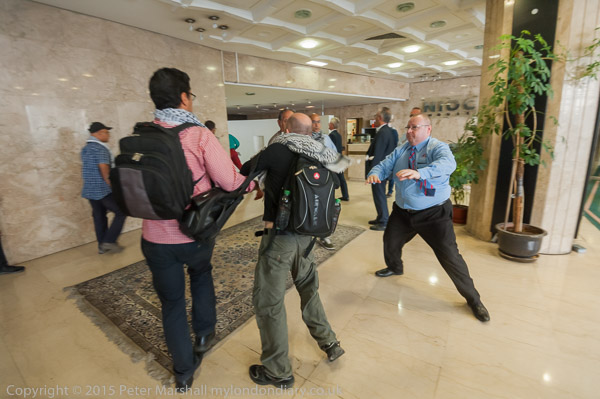
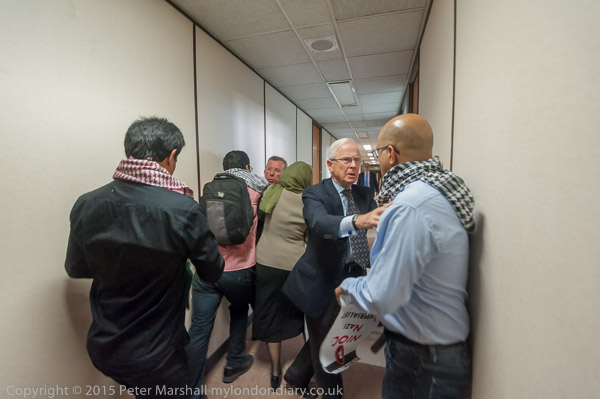
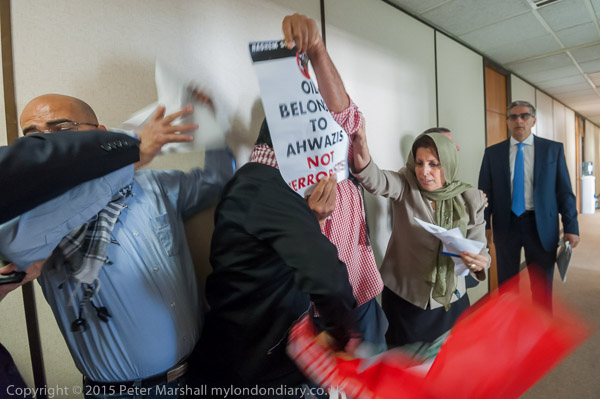
Ahwazi Crash Secret UK-Iran Business Meeting: On Friday 3rd July 2015 I went into the offices of the British Iranian Chambers of Commerce (BICC) with a group of British-Iranian Ahwazi Arabs and human rights activist Peter Tatchell to gatecrash a secret meeting promoting UK-Iran trade and investment in NIOC (National Iranian Oil Company) House in Westminster.
Peter Tatchell and the Hashem Shabani Action Group discuss their plans
Iran of course is very much back in the news now, following the attacks on its nuclear installions by Israel and the USA, concerned that Iran might be developing nuclear weapons. At the moment Israel is the only state in the Middle East with nuclear weapons and they and their US partners are very much concerned to keep it that way. But this protest was against the continuing savage oppression of the Awazi in Iran.
There were a few security men who tried to stop the protesters – with no success
Iran is of course a state with a highly oppresive authoritarian religious regime – as Amnesty International report they surpress “the rights to freedom of expression, association and peaceful assembly” with “Women and girls, LGBTI people, and ethnic and religious minorities” experiencing “systemic discrimination and violence.”
We ran up the stairs to the sixth floor where the meeting was taking place
The Awazi Arabs are Iran’s largest Arab speaking community and their largely autonomous state of Al-Ahwaz was forcibly taken over by Persia in 1925. And they suffer more than any other ethnic group from Iranian oppression.
People try to stop the protesters who rush past,
Oil was first discovered in Al-Ahwaz in 1908, and the Anglo-Persian Oil Company formed to exploit it (in was renamed the Anglo-Iranian Oil Company in 1935) was directly controlled by the British government from 1914 to 1951 when oil was nationalised under the the National Iranian Oil Company (NIOC.) Almost all of Iran’s oil is in the Ahwazi regions. Anglo-Iranian is now rather better known as BP.
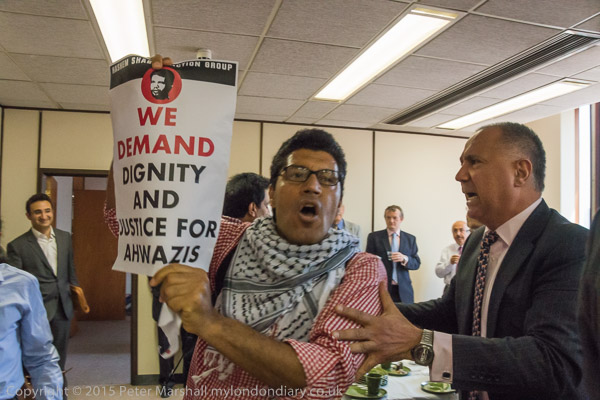
They protest inside the room where the conference delegates were taking refreshments
Iranian violent persecution, forced displacement and the suppression of Ahwazi Arabs and their culture has continued since 1925, turning their homeland, thought to have been the inspiration of the Biblical ‘Garden of Eden’ into a a desolate wasteland, the poorest area of the Middle East.
Peter Tatchell talks with some of those taking part in the secret meeting
A recent Facebook post gives a short clear summary of Iran’s history – here’s the text:
“IRAN ONCE HAD DEMOCRACY – THE WEST DESTROYED IT. Every time Western leaders talk about “freedom and democracy” in Iran – they either don’t know history – or they’re hoping you don’t.
IRAN HAD DEMOCRACY – Until the CIA and MI6 overthrew it. Why? Because Iran dared to nationalize its own oil. That was 1953. The elected Prime Minister, Mohammad Mossadegh, was toppled by Operation Ajax. Why? Because British Petroleum (yes, that BP) didn’t want to lose control.
So let’s stop pretending the West ever cared about the Iranian people. It was always about oil and imperial control. And those parroting “freedom” today – without this context – are sadly, useful idiots for empire.”
The post goes on to promote the book “The Devil’s Chessboard” by David Talbot, founding editor of Salon, which apparently “tells the full story” of how the “Dulles brothers weaponized the CIA to crush democracy abroad – from Iran to Congo to Guatemala” though I’ve not read it.
‘We demand Dignity and Justice for Ahwazis’
You can read more about what happened inside NIOC House on My London Diary, though I think the pictures and captions give a good idea there are many more there. I had some difficult in working in the low lighting in the corridor and from some trying to stop me taking pictures, but was not seriously harrassed, though I was stopped and wasn’t able to get a picture of Lord Lamont as he was confronted by some of the protesters, although the other photographers did.
The protest continues in the corridor
One man – recognised by the protesters as an Iranian Embassy official – began to assault one of the photographers but was restrained by others from the meeting. After ten minutes the protesters decided they had make their point and we all made our way down to the foyer. Here we were met by police who stopped us leaving.
While we were not arrested we were prevented from leaving for over 45 minutes, although I and the other journalists all showed our press cards. It was hot and I was pleased to drink some of the cold fruit juice the building manager hospitably offered. The photographer who had been assaulted complained to the police before went up to the sixth floor – when they came down he was told his assailant might have diplomatic immunity and the photographer decided not to press charges.
Eventually all of us were released, presumably as the BICC wished to avoid publicity about their meeting. The protesters including some who had stayed outside the building then posed on the steps for photographs.
Hizb ut-Tahrir, Spain and Copyright: on Sunday 31 May 2009 I photographed a march by Hizb ut-Tahrir against attacks by Pakistan army on Taliban militants in Swat and then went to the ‘Taste of Spain’ festival in Regent Street, which led me to think and write about the copyright position over reproductions of works of art.
As I pointed out then, if works of art are out of copyright because of their age – now because the artist died over 70 years ago – then any reproduction of them “intended to be a faithful 2D representation” lack “the the artistic intent necessary for copyright to exist and so is also in the public domain.“
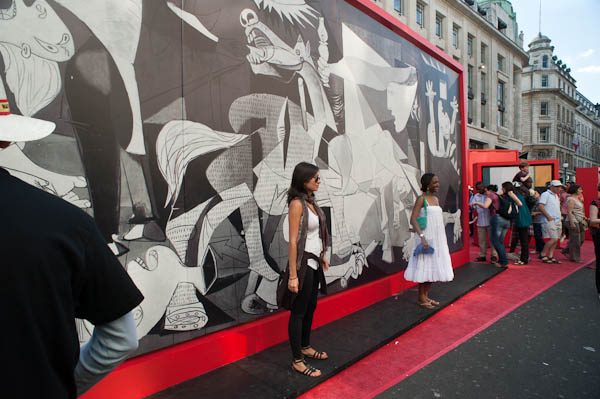
Picasso died in 1973 so his work will remain copyright until 2043
I wrote in 2009:
However copyright lawyers in the employ of many museums and photographic agencies who make money selling or licencing art reproductions take a rather different view of intellectual property law.
A judgement in the UK Court of Appeal in 2023 clarified the situation as far as the UK is concerned, confirming that photographs of two dimensional artworks which are out of copyright are indeed also in the public domain, and that museums and collections etc can no longer use copyright to restrict the circulation of images or make any charge for doing so.
Hizb ut-Tahrir protest US War in Pakistan – US Embassy – Pakistan High Commission
Hizb ut-Tahrir Britain was proscribed as a terrorist organisation in the UK in January 2024 after it organised protests which supported Hamas following their October 7th attack on Israel. I had been concerned about their activities since I first photographed them over 20 years earlier.
They marched from the US Embassy to the Pakistan High Commission in protest against the attacks by the Pakistan army on Tehrik-i-Taliban Pakistan militants who had taken control of parts of the Swat Valley. They called this an “American War”, blaming them on American pressure on the Pakistan government and called for an immediate end to attacks by Muslims on Muslims.
I ended my report on the protest with a long criticism of Hizb ut-Tahrir Britain calling on them to “have a proper respect for human rights, including the rights of women, although an Islamic interpretation of this may well differ in some respects from a Western one. It’s very hard not to agree with Hizb ut-Tahrir when it talks about the corrupt regimes currently leading Muslim countries, but it would also be welcome to see them standing against repression – and in particular the repression of women – that is currently practised in places including Swat and states such as Iran.”
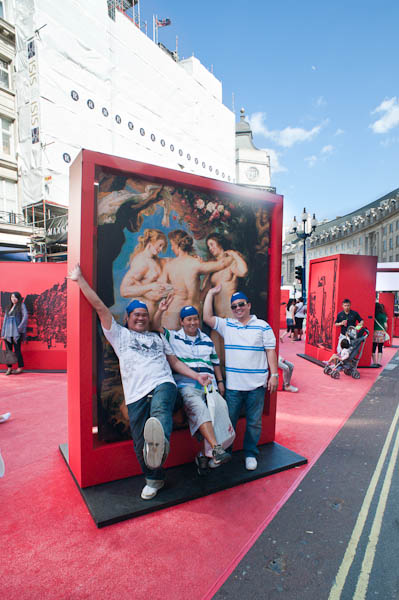
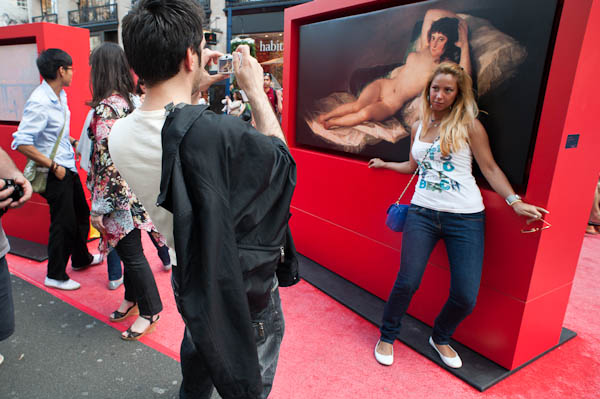
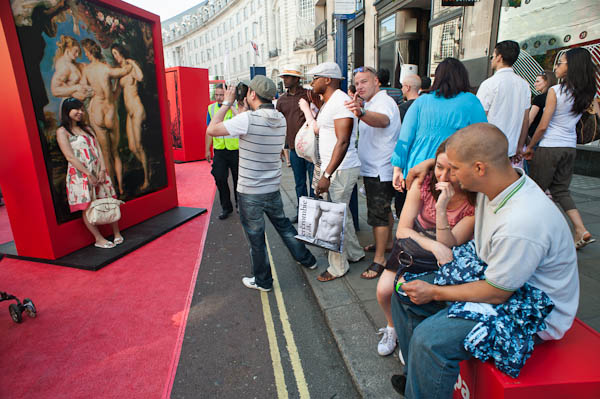
The most impressive part of the ‘Taste of Spain’ festival in Regent Street was the display of large photographs of pictures from the Prado in Madrid which largely attracted attention because of the female nudity in some of the works (and it’s a shame that Ruskin had apparently not studied this work in detail before his wedding night, which might then have been less of a shock to his system.)
Quite a few people posed in front of it to have their picture taken – but by their friends rather than by me, but I and other photographers took advantage of this.