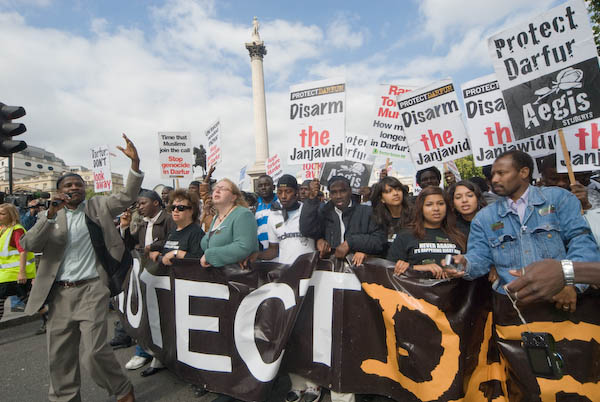
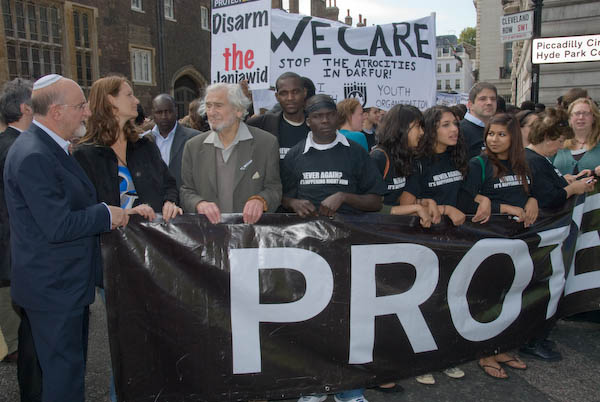
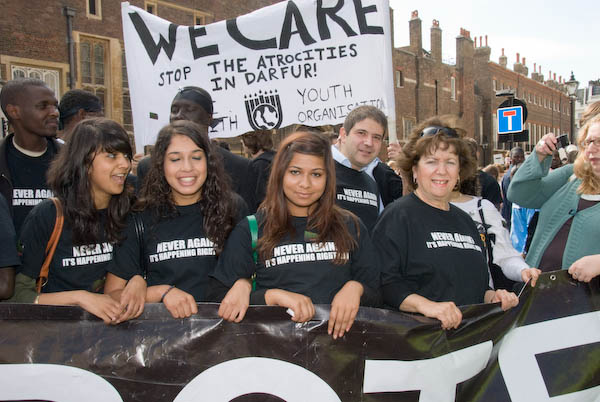
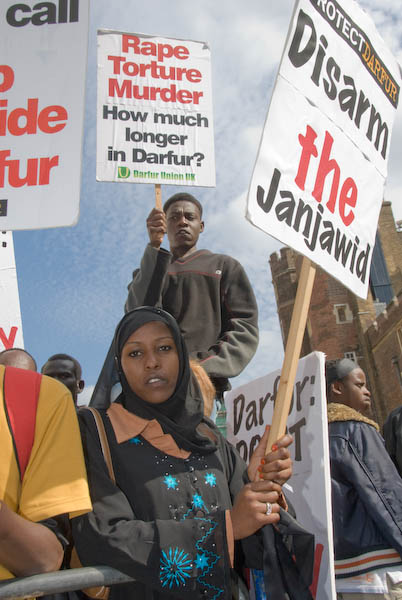
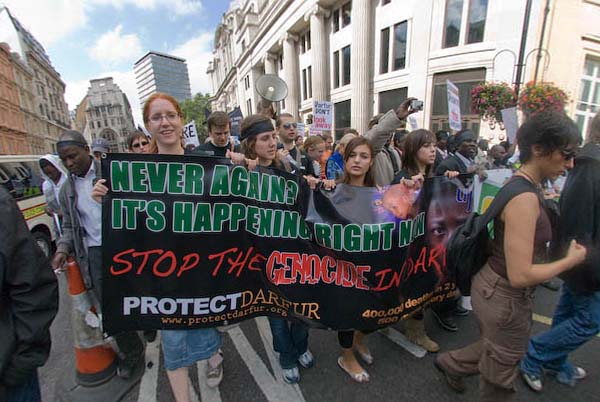
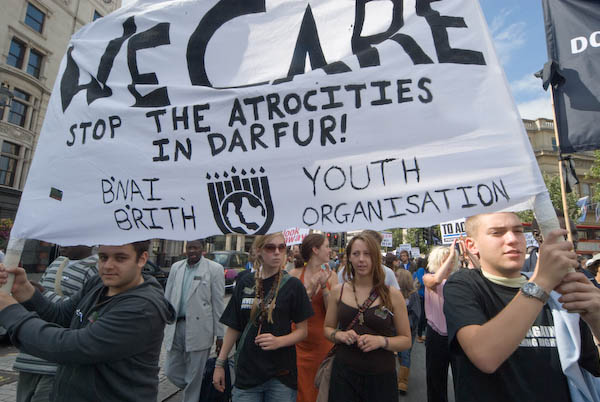
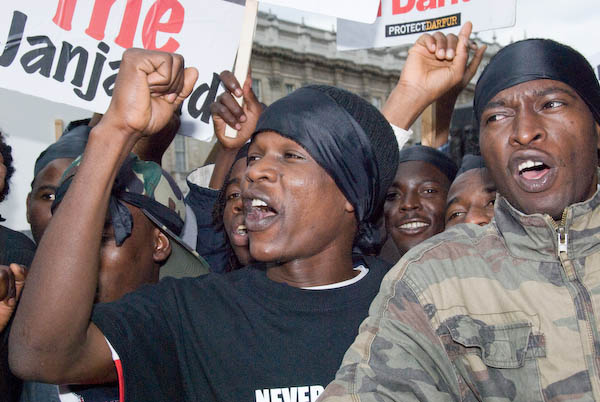
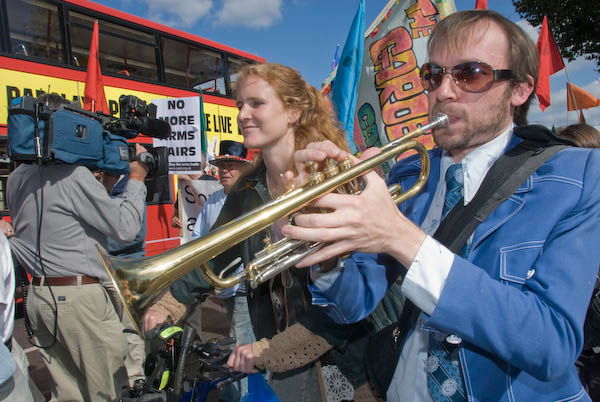
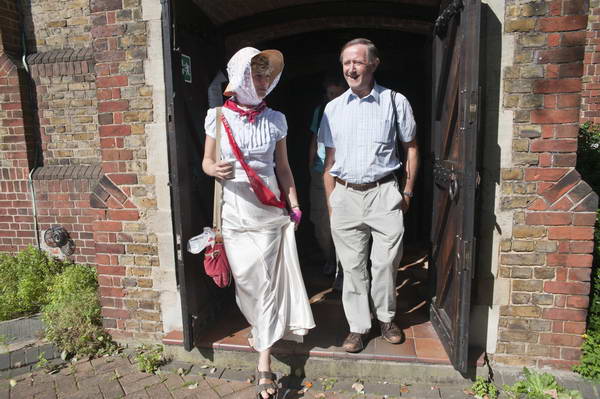
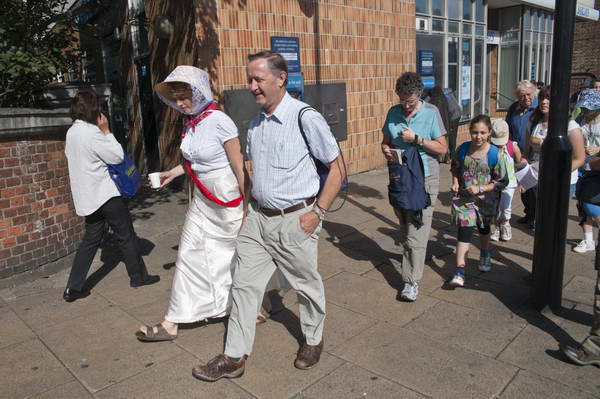
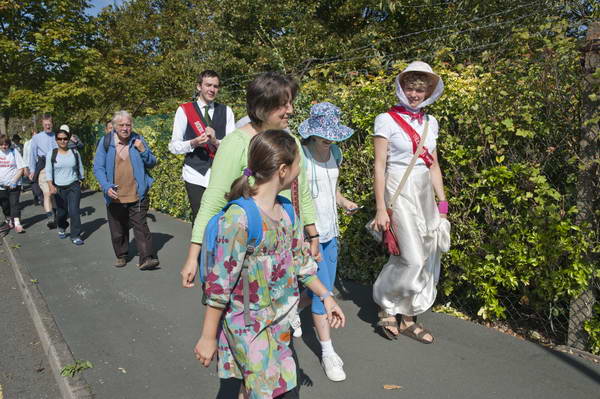
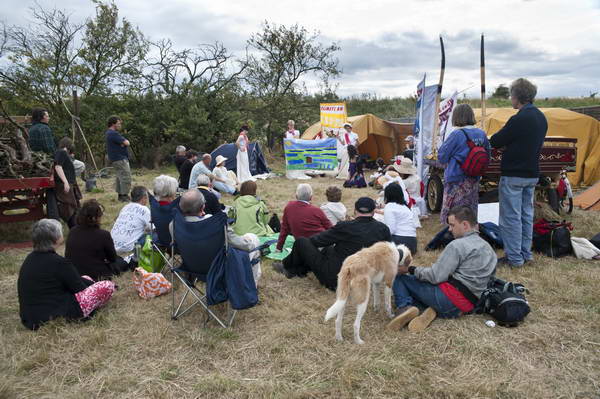
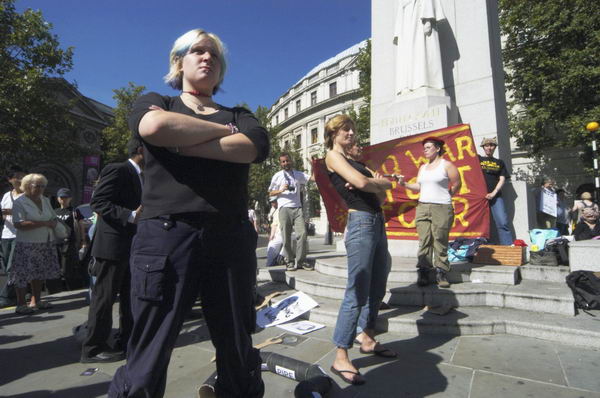
Darfur and the Mayor’s Thames Festival: On Sunday 16th September 2007 I went to London to photograph a march on an International Day of Action over the genocide which had been taking place on a large scale in Darfur since 2003, with around 300,000 civilians killed. My comments at the time are in italics below. After the end of the march I went to walk along the riverside wher the Mayor’s Thames Festival was taking place, though I found little actually happening.
Protect Darfur – International Day of Action
“Several hundred marched from the Sudanese Embassy in St James to Westminster where a protest rally was held opposite Downing Street over the continuing failure of the international community to take effective action over Darfur.”
“Among the mainly African demonstrators were groups of Jews, concerned that, as in the 1930s, too many are happy to turn a blind eye to what is going on.”
The Sudanese government had earlier co-opted and armed the Arab Janjaweed militias against those opposed to it in Darfur and they created what the UN described as one of the worst humanitarian disasters in the world.
In July 2007 the UN and the African Union approved a the largest joint peacekeeping mission in the world UNAMID to the area, and over the years there were various peace agreements, but despite this conflicts continued and in 2023 a civil war broke out in Sudan between the Rapid Support Forces (RSF) (which developed from the Janjaweed) and the government’s Sudanese Armed Forces (SAF) – and genocide returned to Sudan.
The BBC has an article, ‘Sudan war: A simple guide to what is happening’ about the renewed genocide and famine in Darfur and across the country which again the United Nations has called the world’s largest humanitarian crisis.
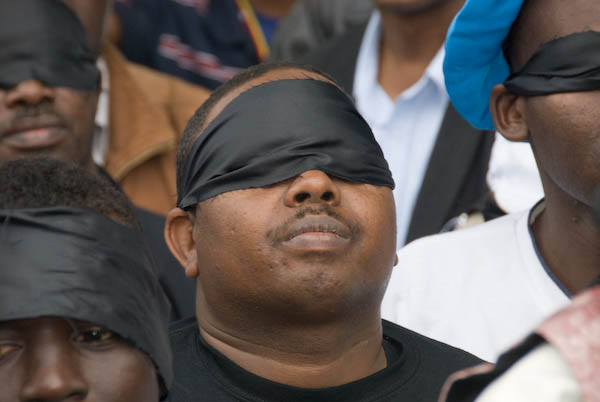
At the rally opposite Downing Street, demonstrators were asked to put on their blindfolds as a reminder that leaders around the world are refusing to see the problem in Darfur.
“I didn’t stay to hear all the speakers. The position of the rostrum made it hard to photograph, working directly into the sun behind the speakers’ heads from any available close positions, and photographs were not going to be of great interest.
The message on Darfur is clear, and the international community needs to take action.”
Many more pictures (too many) on My London Diary at protect darfur.
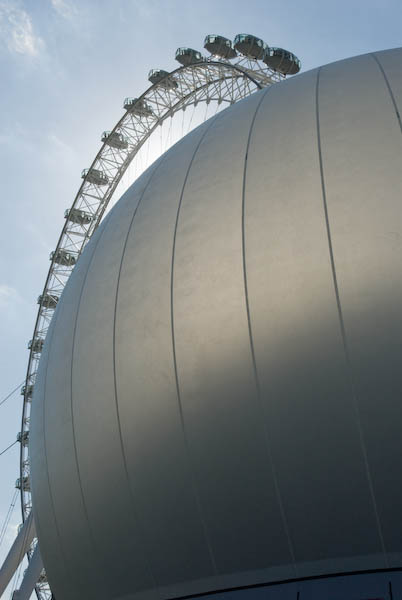
River Thames and the Mayor’s Thames Festival
“We were promised that Sunday was the end of our short, late summer, and I took a walk along the south bank of the River Thames from Westminster to Tower Bridge, among the crowds who had turned up for the Mayor’s Thames Festival.“
Nothing much exciting seemed to be happening while I was there (it seemed mainly a commercial opportunity for the very large number of stalls along the riverbank), but I then didn’t hang around for the procession and fireworks promised later.
I did take quite a few pictures which you can see at river thames and the mayor’s festival – and it looks as if I found it a little more interesting than my account suggested.
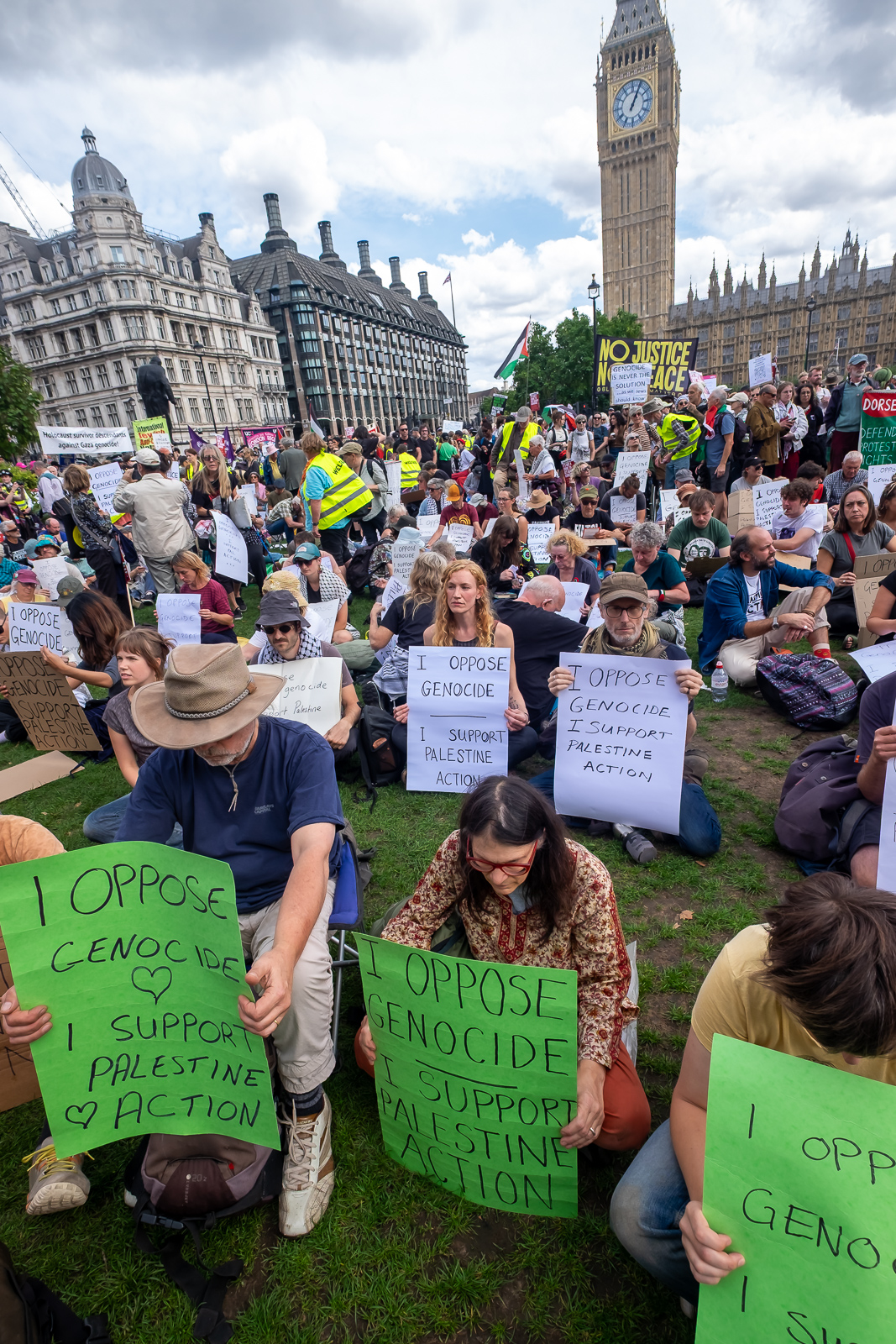
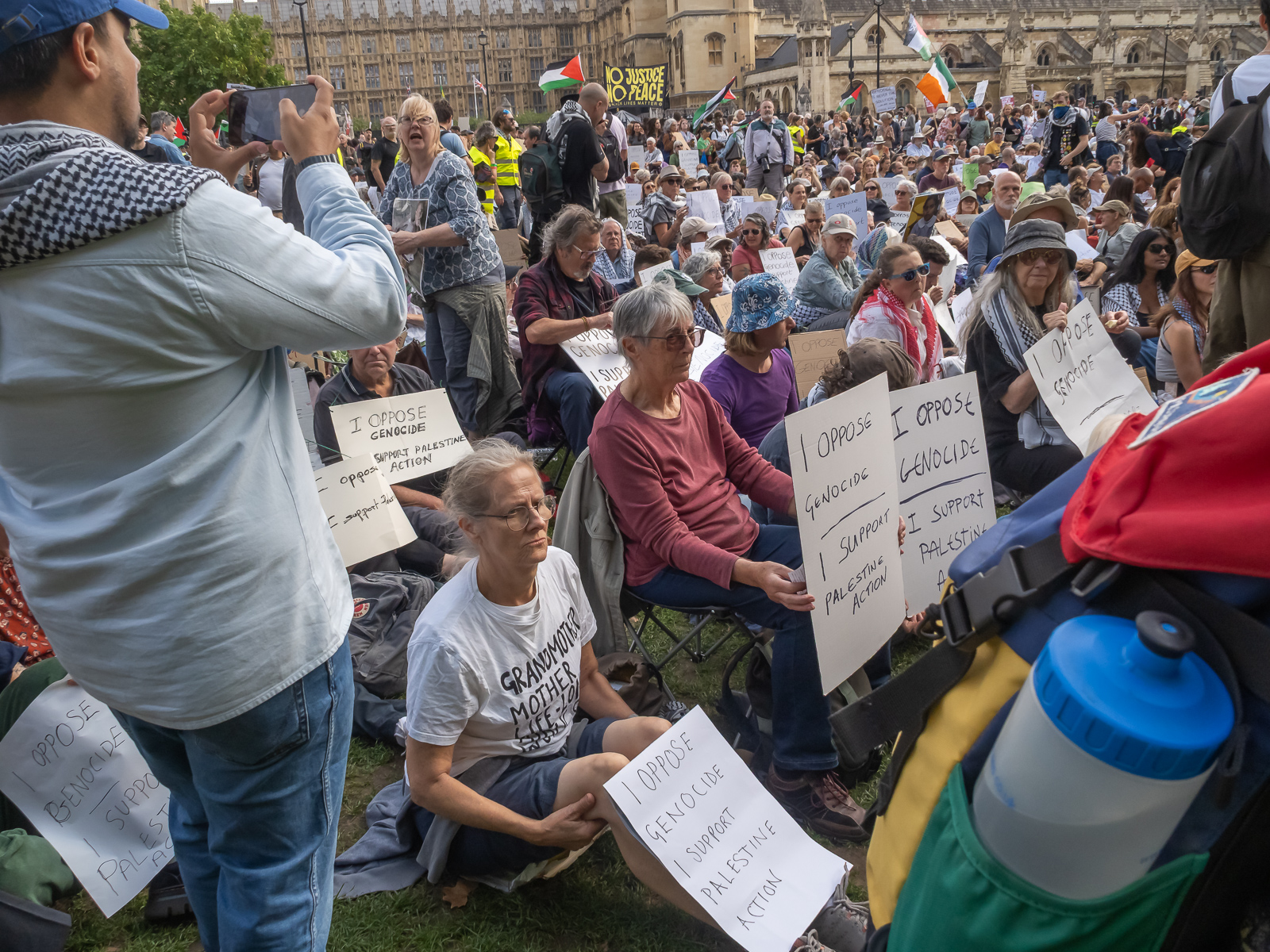
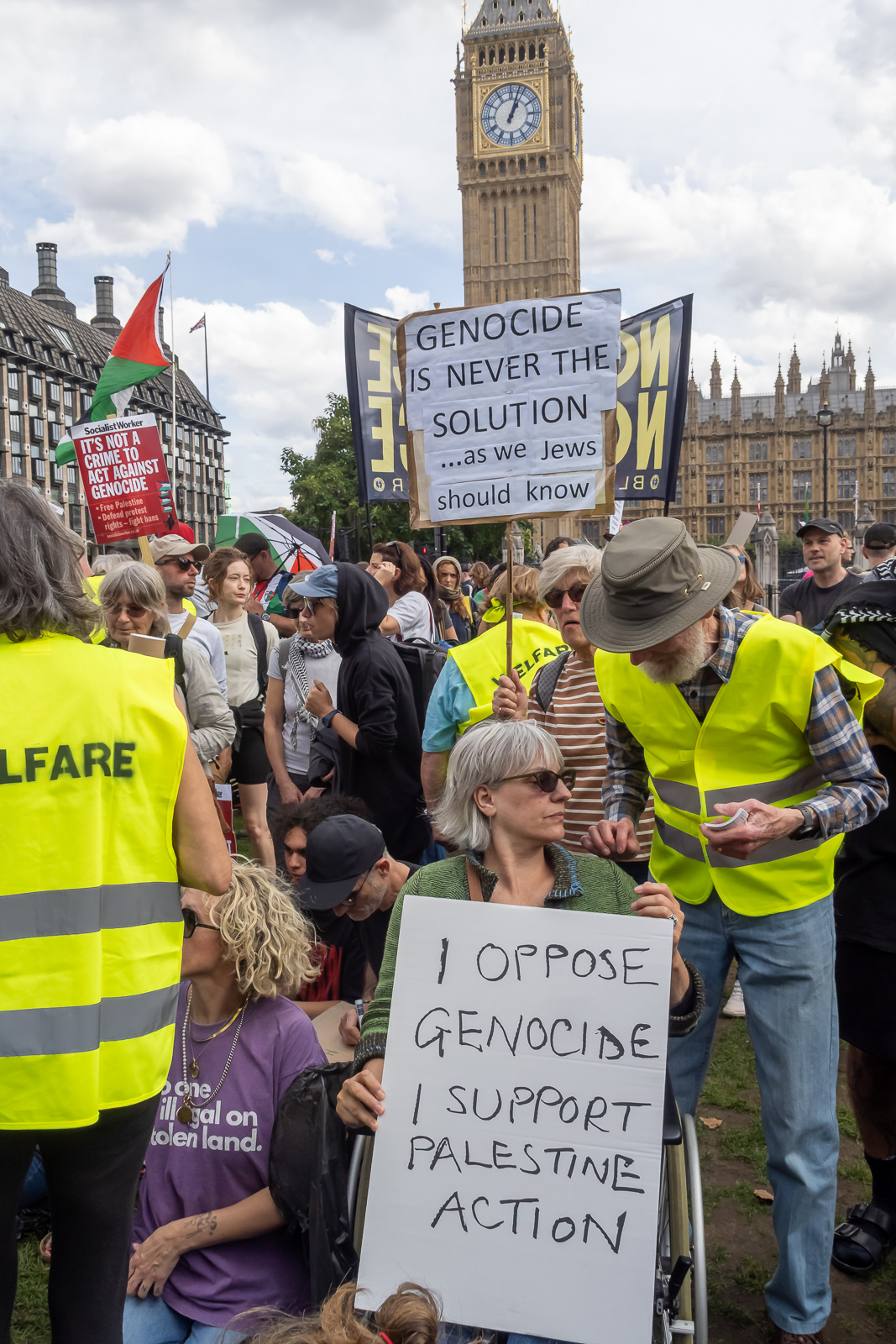
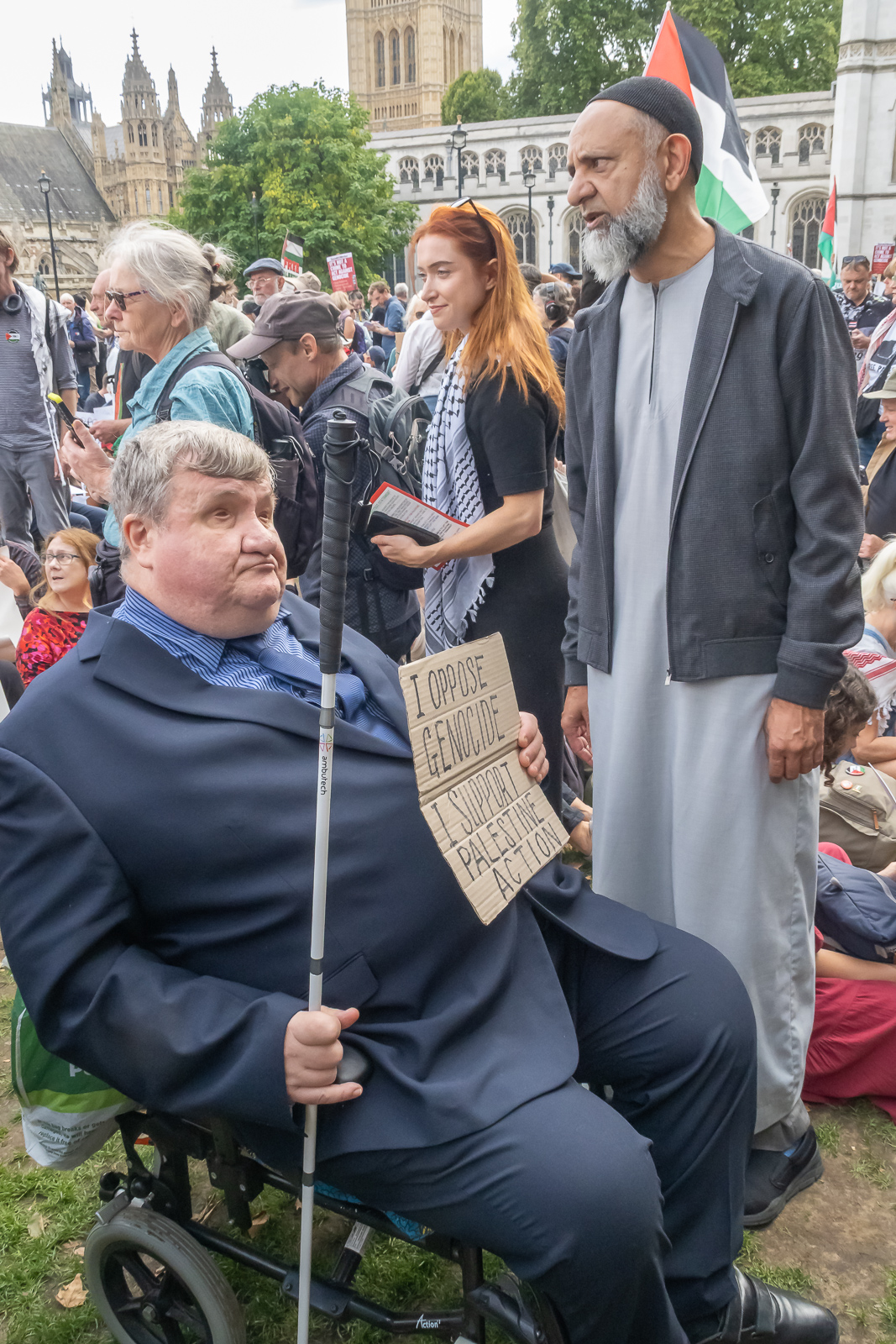
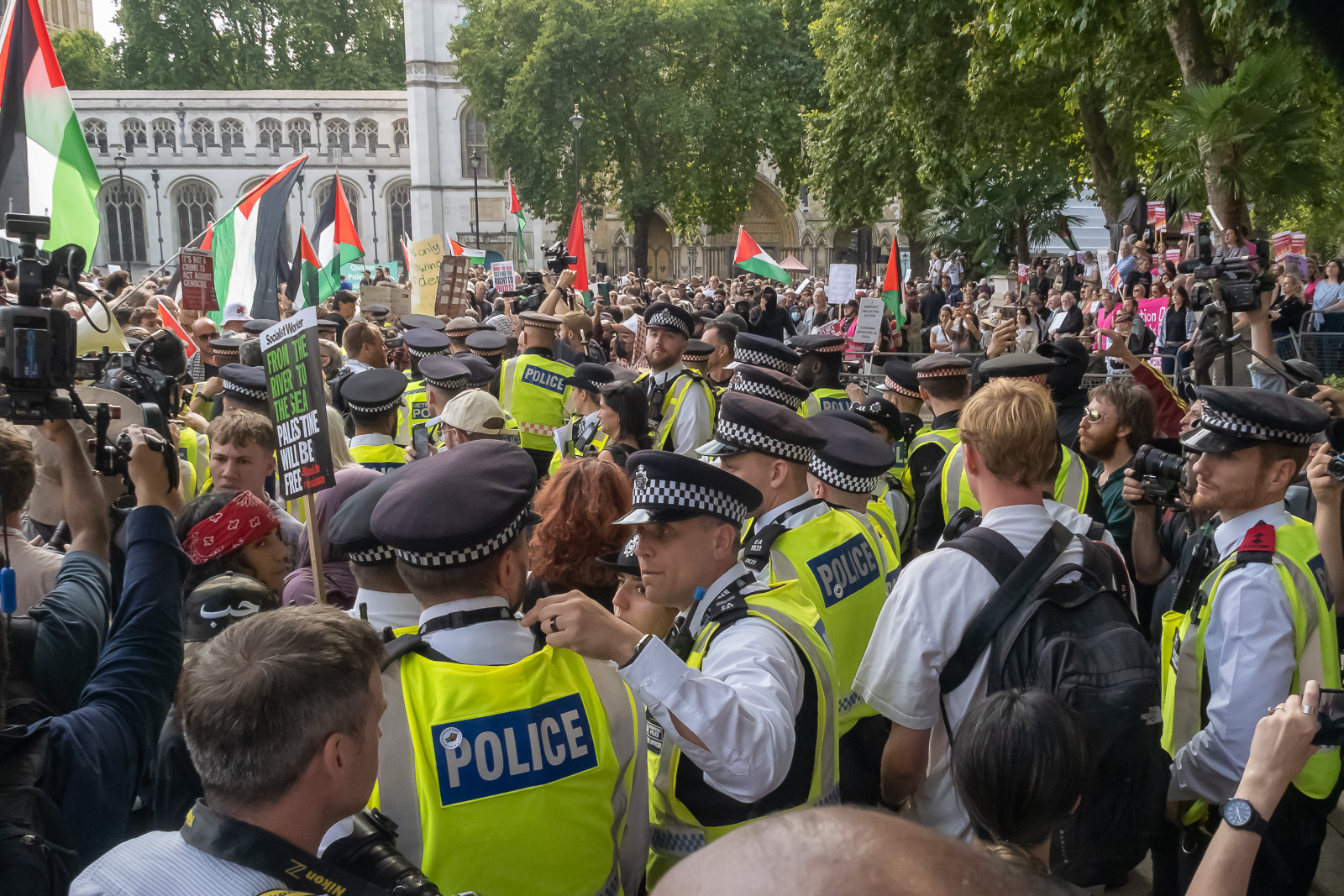
Defend Our Juries Protest Palestine Action Ban: Last Saturday, 6th September, 2025 around a thousand people came to sit calmly and peacefully in Parliament Square holding signs with the message ‘I OPPOSE GENOCIDE – I SUPPORT PALESTINE ACTION’.
London, UK. 6 Sep 2025
The protest was against the ban on Palestine Action imposed in July by then Home Secretary Yvette Cooper who designated the direct action group as a ‘terrorist organisation’ following extensive and dishonest lobbying from arms manufacturers and the Israeli government. Yvette Cooper is said to have received £215,000 from the Israel lobby last year.
London, UK. 6 Sep 2025.
The protest was the second mass protest in Parliament Square organised by Defend Our Jories, (DOJ) an organisation set up to defend the jury system against attempts by the government to “violate the most basic principles of natural justice and the right to a fair trial.“
The jury system is designed to “put the moral intuitions of ordinary people at the heart of the criminal justice system“. As DOJ says, “when juries have heard evidence of why people have taken direct action to advance climate or racial justice, or to stop genocide in Gaza, they have repeatedly reached not guilty verdicts.”
“These verdicts are deeply embarrassing to the government and the arms and oil industries, contradicting the narrative that the public supports the ‘crackdown on protest’. Lobbyists for the arms and oil industries, such as Policy Exchange, embedded within government, have been working to put a stop to them.”
London, UK. 6 Sep 2025.
As they say “extraordinary measures have been taken that violate the most basic principles of natural justice and the right to a fair trial“, with judges telling juries that they cannot acquit a defendant as a matter of conscience, and in at least one case threating the jury with criminal proceedings if they did so.
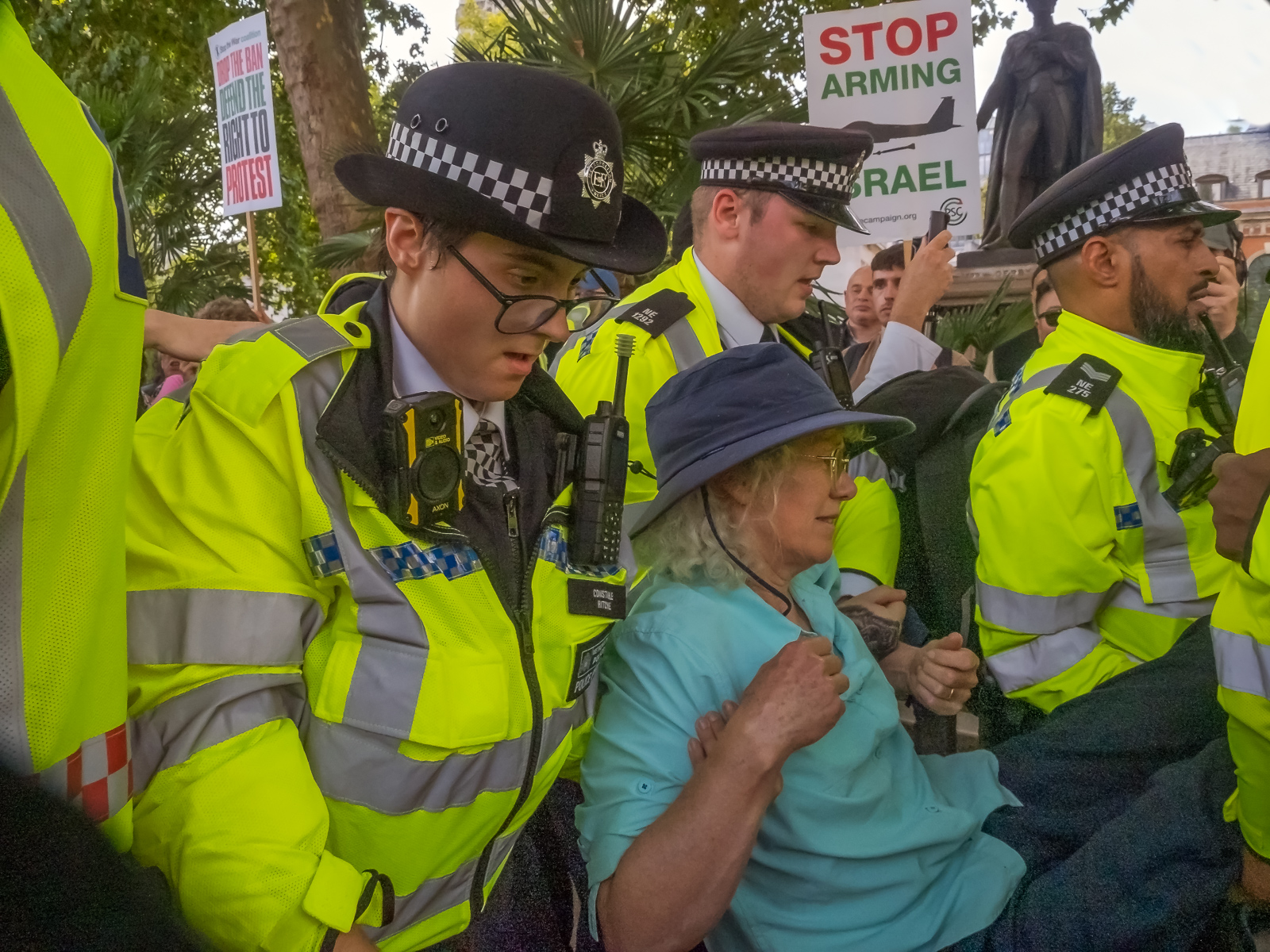
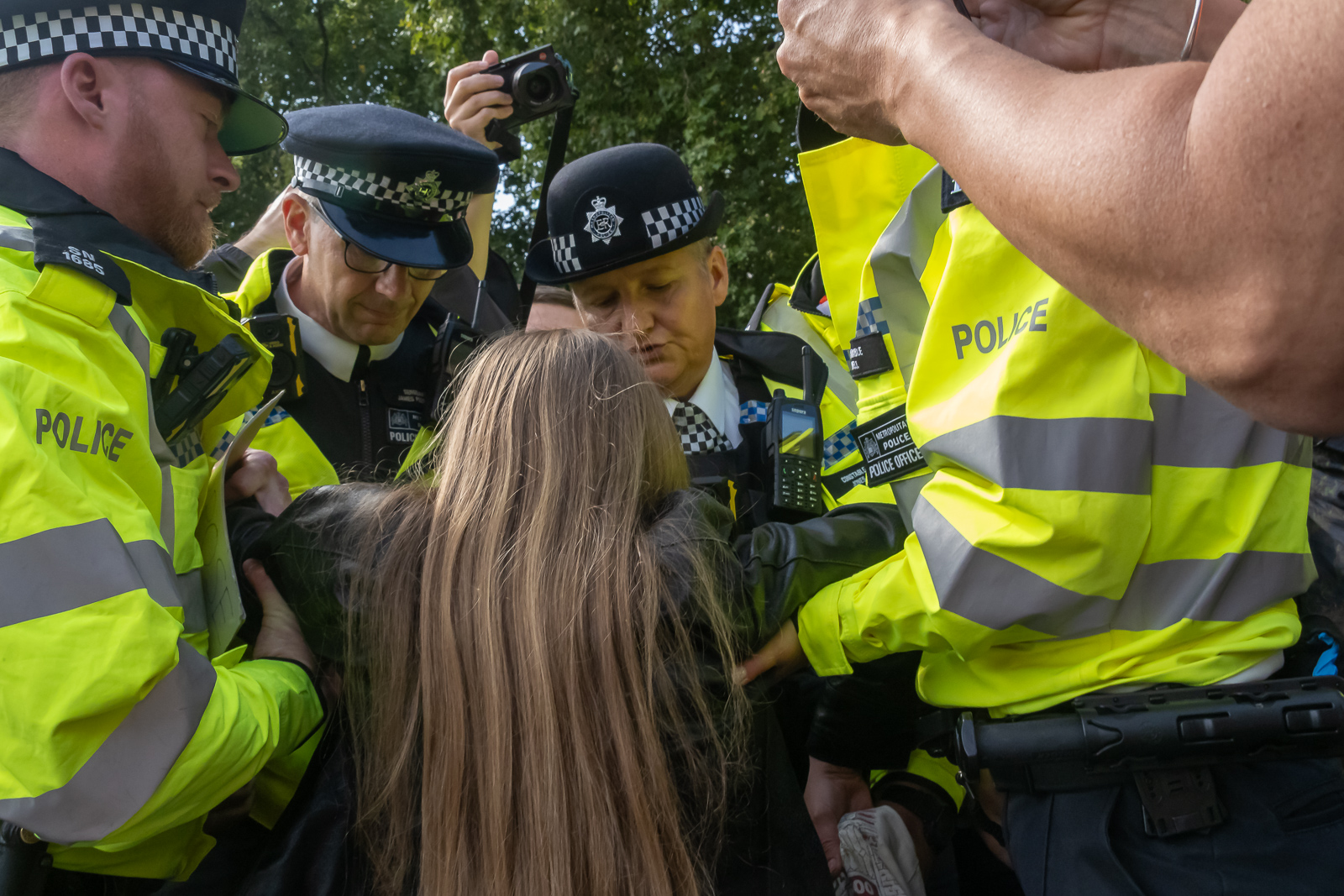
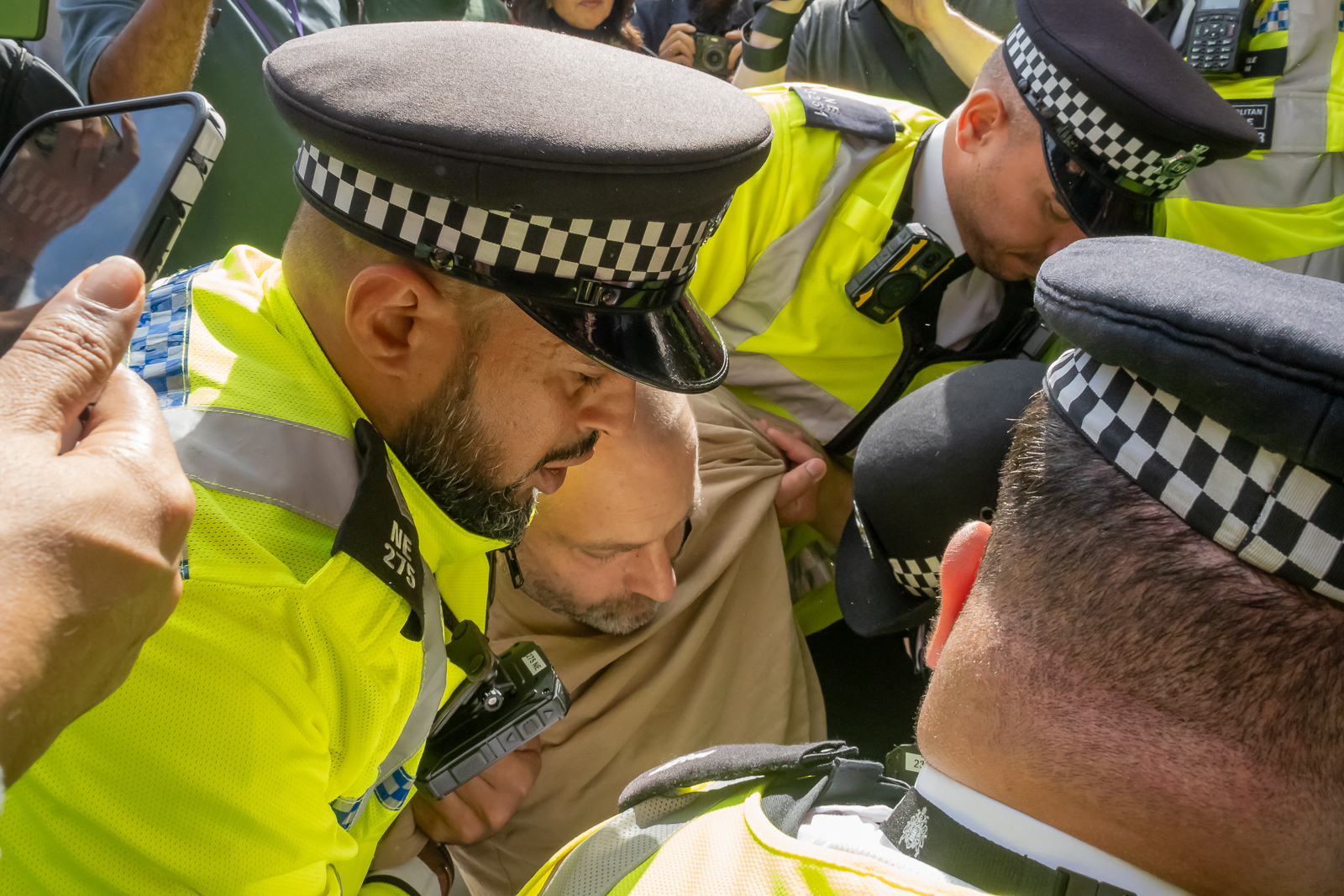
London, UK. 6 Sep2025. A woman is arrested.
Defendants have been banned from mentioning climate change in court and two Insulate Britain members were jailed for 7 weeks for doing so. Giovanna Lewis, a town councillor from Dorset told judge Silas Reid why she had defied his ruling, “I continue to be astonished that today in a British court of law, a judge can or would even want to ban and criminalise the mention of the words ‘fuel poverty’ and ‘climate crisis’. I wanted to bring public attention to the scandal of thousands of deaths in the UK due to fuel poverty and thousands of deaths around the world due to climate change. There is no choice but to give voice to the truth.”
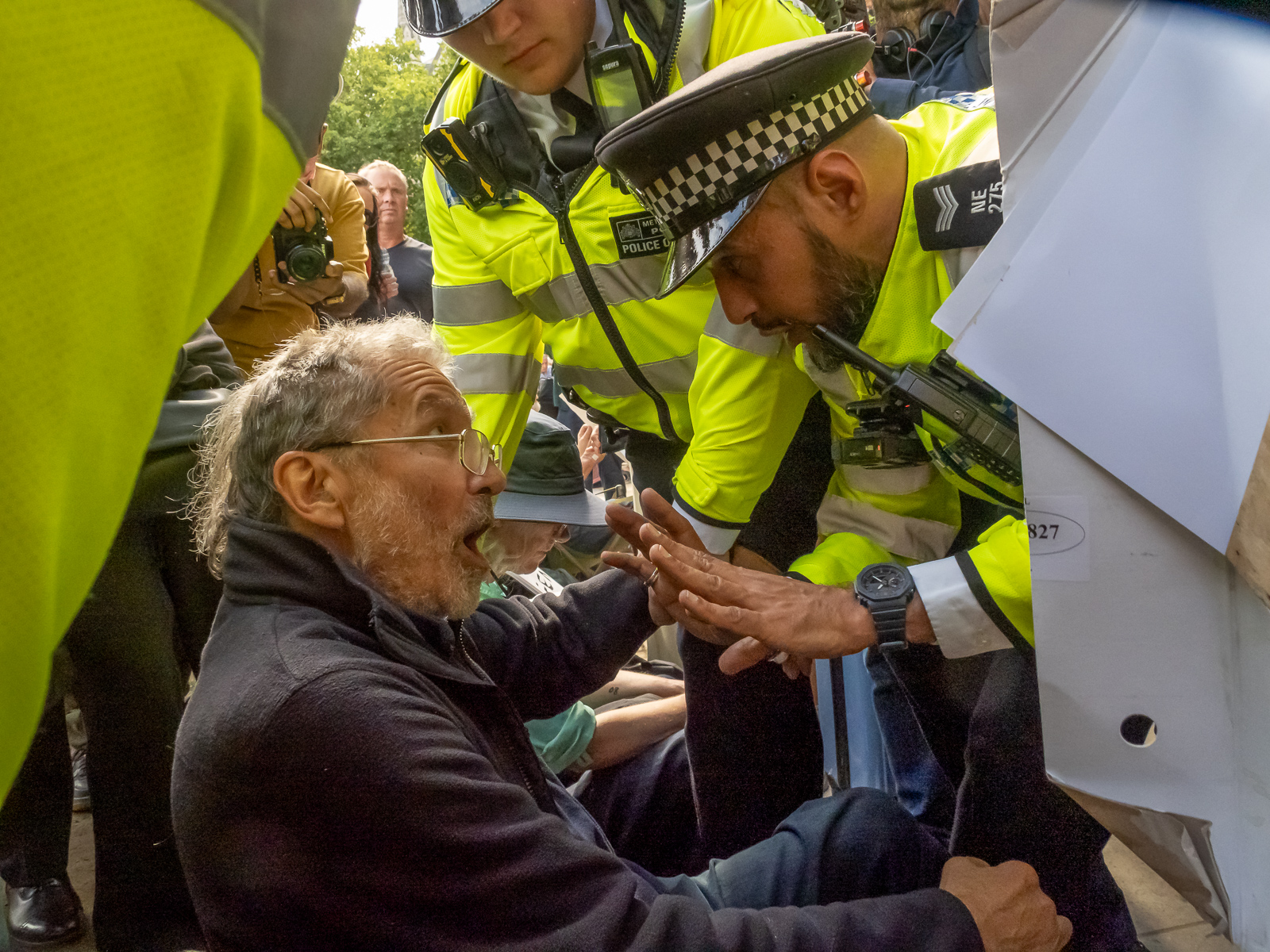
London, UK. 6 Sep2025. A man is arrested.
The UN have declared that this violates international law, and carried out a mass protest after Trudy Warner was prosecuted for holding a sign “Jurors you have an absolute right to acquit a defendant according to your conscience” outside the trial of Insulate Britain activists, re-stating the principle of ‘jury equity’. This had been enshrined in a English law since 1670 as a memorial at the Old Bailey states. Eventually the High Court rejected the government’s application to send her to prison.
London, UK. 6 Sep2025. Mike Higgins, blind and in a wheelchair was arrested here in August, back here today
The protests by DOJ against the ban on Palestine Action in August and last Saturday were both entirely peaceful. Those taking part had come to be arrested and sat waiting for the police to do so. But a crowd of supporters in the square were appalled at the way in which the police did so, with snatch squads going into the protest and picking on individuals seemingly at random.
London, UK. 6 Sep2025.
The squads were soon surrounded by crowds, many intent on recording the arrests on cameras and mobile phones, many shouting ‘Shame on You‘ at the police for their actions. While other police simply stood around the perimeter of the square and watched in silence, some clearly uneasy about what was happening, those making the arrests sometimes reacted violently to the crowds around them. I saw one officer lashing out with his baton, though his colleagues soon stopped him.
London, UK. 6 Sep2025. A man is arrested.
It was difficult to understand the police tactics. Rather than go about making arrests in an organised and systematic manner by using the very large forces present to surround an area of the protest and carry out the arrests within that cordon, they appeared to have decided to do their job in the most provocative manner possible. Perhaps it was to put on a display for their political masters – and our now Home Secretary Shabana Mahmood was impressed as she watched the screens in the police control room.
London, UK. 6 Sep 2025.
I think they had decided to arrest first some particular individuals in the crowd – perhaps those who were in breach of bail conditions from the previous month’s protest. But nobody present was trying to evade arrest – the 1500 (according to DOJ) had all come to be arrested, although I think almost half got fed up with waiting and left. Others were still being arrested seven hours after the protest began.
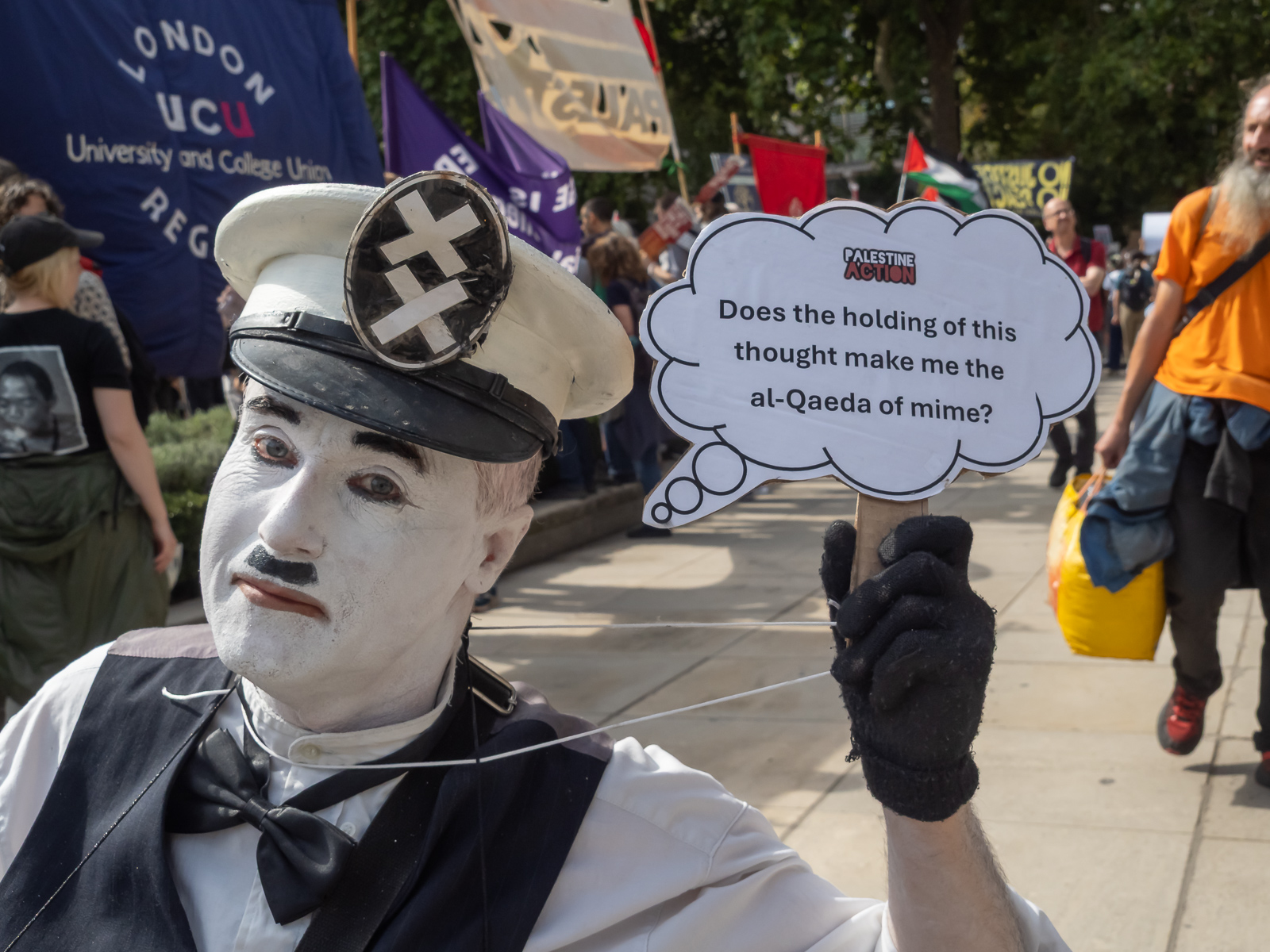
London, UK. 6 Sep 2025. Neil Goodwin as Charlie X was later arrested
I left after watching for almost an hour to photograph the Palestine march, with around 200,000 people slowly marching towards the rally in Whitehall. Later that afternoon I uploaded around thirty images of this protest to Alamy and these together with a few more to a Facebook album.
One of the founders of Palestine Action has been granted an appeal against the ban – although the government is appealing against her right to appeal – almost certainly because they fear it will succeed. I hope for the future of our legal system and country it does.
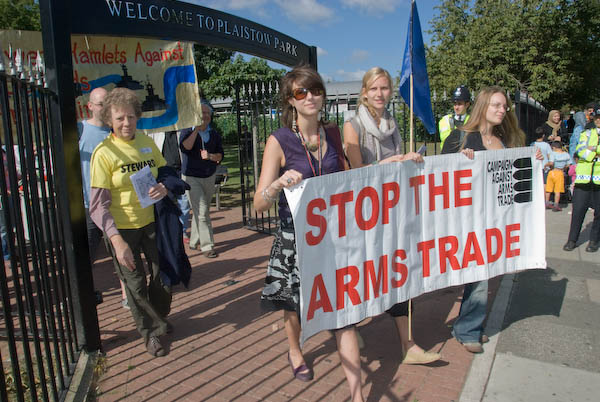
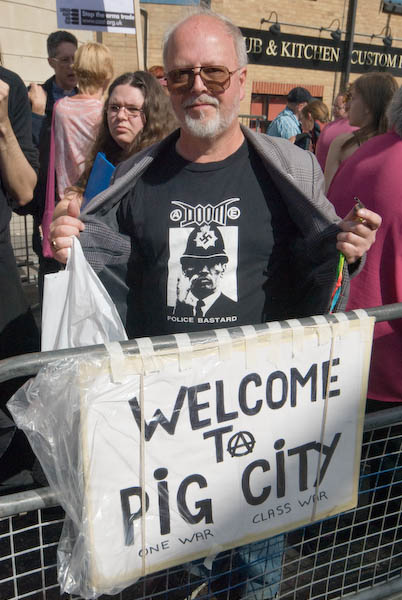
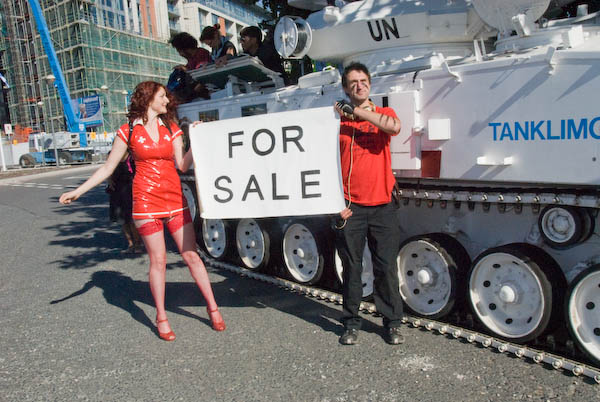
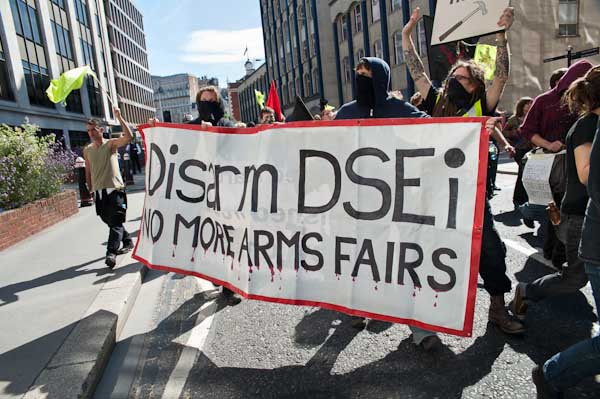
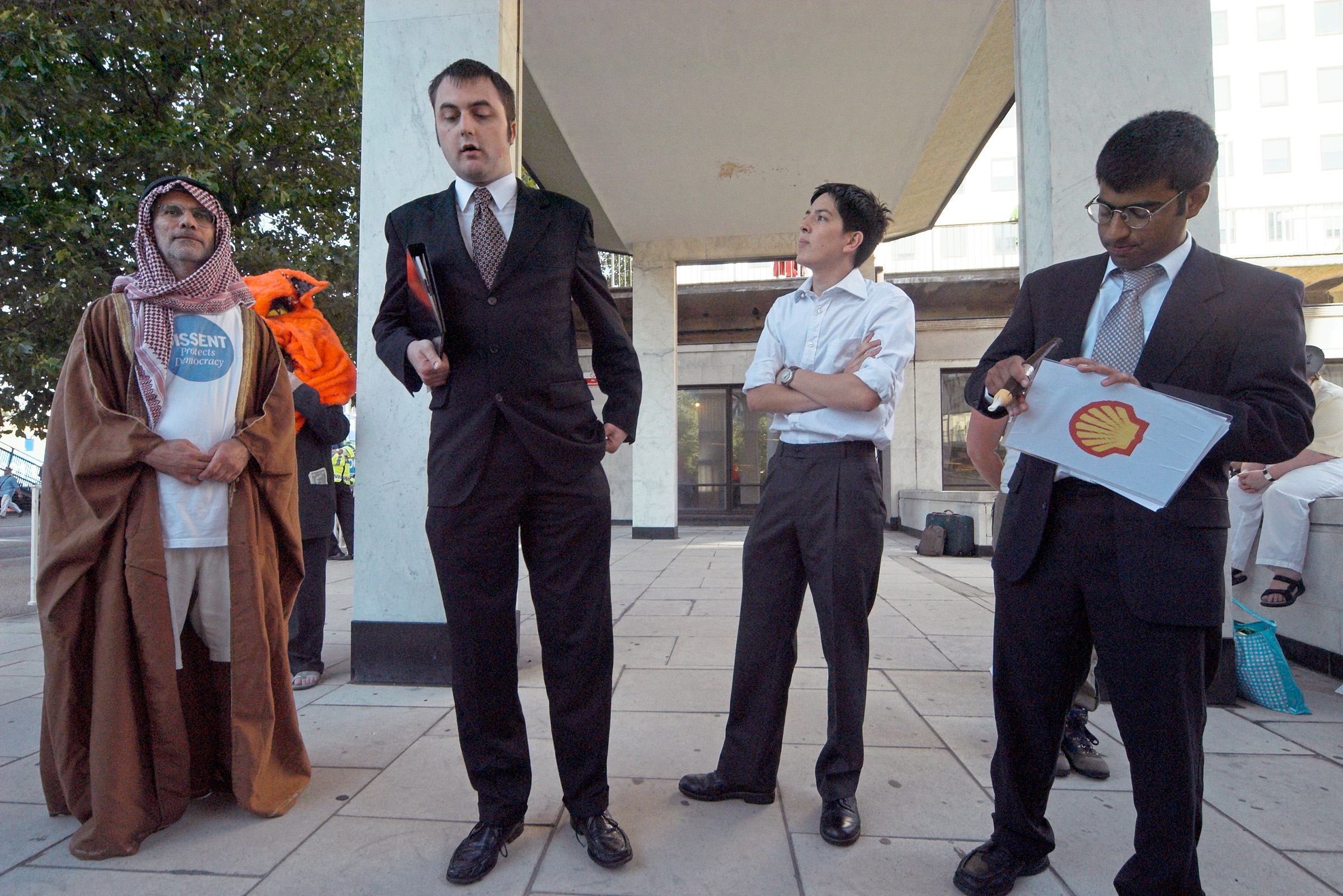
DSEI March and a Tank: On Tuesday 11th September 2007 I marched with protesters from Plaistow Park to Custom House were the largest arms fair in the world was being held, – it is still held every two years and is again taking place now. Then I went to the main entrance by the side of the Royal Victoria Dock to welcome the Space Hijackers, “an international band of anarchitects” who had promised to come with a tank to sell it at the fair as a protest.
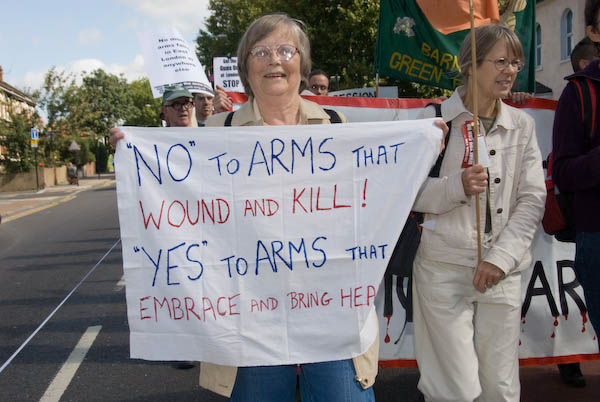
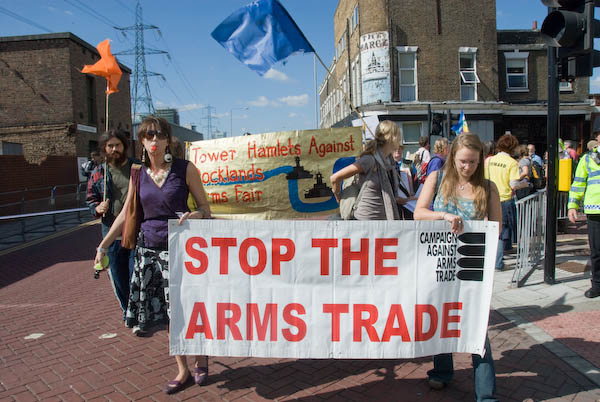
Over 150 people marched from Plaistow Park to Custom House
Here, with some minor corrections, is what I wrote about the day’s events back in 2007, along with some of the pictures I took and links to where you can see more of my pictures on My London Diary.
CAAT March Against DSEi East London Arms Fair
One of the more scandalous events to take place in London is the DSEI (Defence Systems & Equipment International Exhibition) arms fair, held every two years since 2001 at the Excel Centre on the side of the Royal Victoria Dock in Newham.
Even if you are not a pacifist (and I’m not) it is a trade that has its sickening side, with arms sales to corrupt regimes who use them to kill, torture and deny human rights to their own people, as well as endless shady deals by arms dealers that end up with weapons traded there in the hands of criminals around the world – including some used on the streets of this country.
Britain also has a thriving business in implements of torture, which have been exposed as on sale in earlier shows here. The show also features all the other kinds of nasty devices used by police forces around the world to keep corrupt governments in power.
Of course our government claims to have an ethical policy so far as arms sales are concerned, but in reality it is more about making deals look clean on paper than really worrying about where the arms will end up and what they will be used for. DSEI isn’t just a UK show, it is the world’s largest arms fair – the 2005 show had over 1200 exhibitors from 35 countries present.
The Campaign Against Arms Trade (CAAT) organised a peaceful protest against the fair with a march through Newham from Plaistow Park to a rally outside Custom House Station, as close as they were allowed to get to the Excel Centre. Around 150 people walked the 2 miles to the rally where they met around 50 others who had travelled there directly, and later they were joined by a group of ‘Critical Mass’ cyclists.
Unfortunately the police set up a long thin pen along the side of the road opposite the station, and would not allow speakers to use the small cycle-towed sound system. So the demonstrators were too spread out for many to hear the speeches, by local residents Len Aldis and Bill Perry, local councillor Alan Craig, Green Party Mayoral Candidate Sian Berry, CAAT’s Ian Prichard and comedian Mark Thomas.
The DSEI causes major disruption to the area, with millions spent on extra policing and a number of roads and paths being closed – including the very useful high-level bridge across the dock itself. But the very minor inconvenience of a slightly louder amplification for a few minutes was apparently out of the question. It was a decision that clearly indicated police priorities.
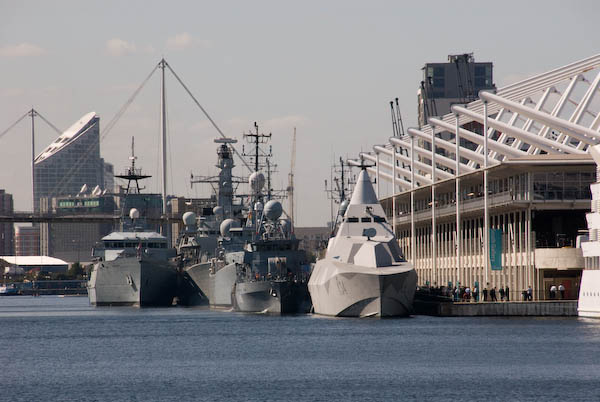
Normally the Royal Victoria dockside is open to the public, but this week the whole northern side was off limits as I found. I took a walk past the eastern end of the dock and then around to the dockside at Brittania Village to get a view of the Excel Centre and the military vessels moored alongside, including a Swedish Stealth Corvette, with odd profiles and jagged camouflage designed to reduce its visibility and radar and other profiles.
The ‘tank’ makes its way down Tidal Basin Road to the ExCeL entrance
I was slowly making my way around the the Tidal Dock Basin Road which leads to the main vehicle entrance to Excel. The Space Hijackers had announced they would be bringing a tank to the fair, and this seemed to be the likely route they would take.
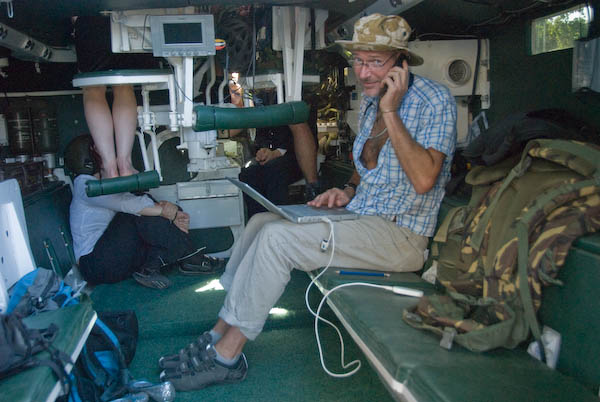
Police had earlier stopped their actual tank almost as soon as it hit the road for some so-called ‘road safety checks’, but the Space Hijackers had tank number 2 in reserve. I think it was strictly a converted Armoured Personnel Carrier, but still a very impressive vehicle. I was pleased to find my guess was right when it made its way down the road, led by someone on a bicycle.
No surprise, the police wouldn’t let it into the arms fair, but it was allowed to park by the side of the entrance and a party and auction took place.
When people began to leave the arms fair, the protesters were able to make a very visible and audible protest as they drove slowly by. At one stage the police helped by blocking the traffic for a while so they could get a better view of the protest.
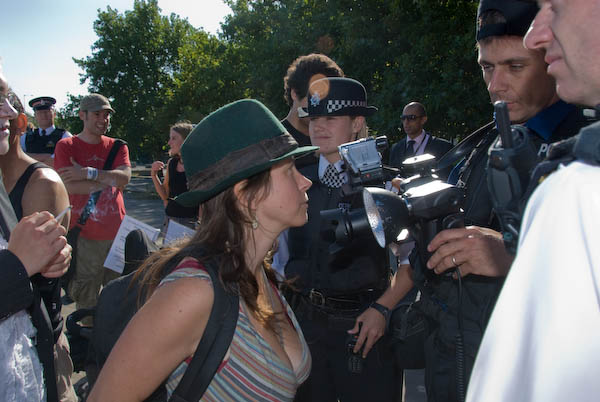
Generally the police were unnecessarily restrictive, penning the protesters to one side of the road, and harassing press. That isn’t a genuine press pass one said when I showed my NUJ issued press card [from the UK Press Card Authority Ltd and recognised by the National Police Chiefs’ Council as showing me “a bona fide newsgatherer” who were trying to stop me doing my job], threatening me with arrest unless I got back behind the line of police.
The police FIT team did its usual best to stoke up the atmosphere with their intimidatory tactics – certainly something that gives photographers a bad name. It is hard to believe that those hundreds (probably by now thousands) of pictures they have of me – mainly with a camera obscuring my face – are of any great use in protection national security. [Later when I made a ‘Freedom of Information’ request they denied having a single image of me.]
Communications centre inside the ‘tank’
I’m not worried about being photographed – my appearance is pretty much public property since until recently a picture of me was viewed around a million times a month on the commercial site I used to write for.
I stayed until the tank had been auctioned, with some interesting bids but then had to leave to attend a meeting where my presence was vital. I was rather annoyed at having to walk an extra half mile or so to the station when police refused to let anyone use the direct route. There was really no reason or logic for this kind of minor harassment.
You can see much more about the event and also read more comments on the police harassment of journalists on My London Diary at space hijackers auction tank at dsei.
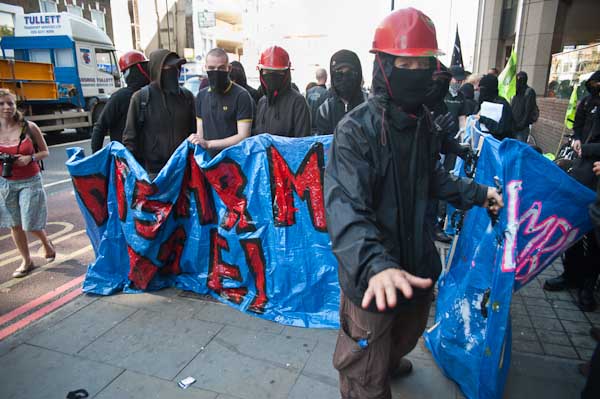
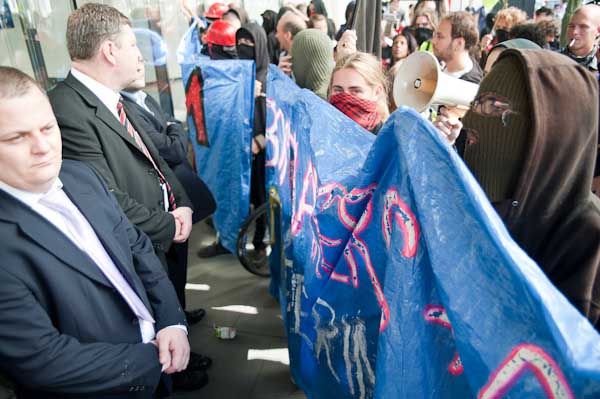
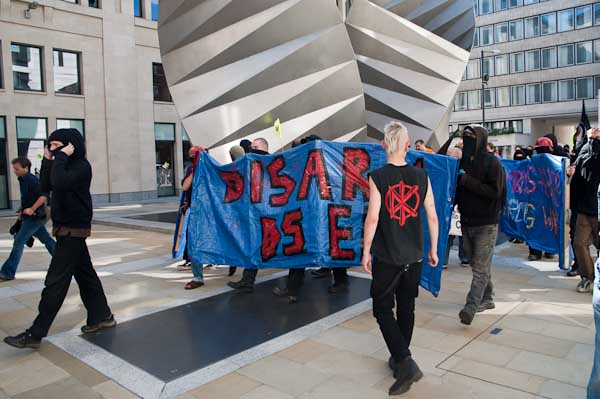
Disarm DSEI – City of London: on Tuesday 8th September 2009, the day that year’s DSEI Arms Fair opened at the Excel centre in East London, campaigners came to protest outside the city offices of companies heavily involved in the arms trade.
There were also protests outside the Excel Centre, but the protest in the City would be seen by many more people and was more likely to receive coverage in the media. Later in the day protesters from CAAT (Campaign Against the Arms Trade) also came into central London for a protest outside the government offices of UK Trade and Investment (UKTI) in Westminster. Their Defence and Security Organisation provides financial, political and logistical support for the arms fair, channelling our taxes to help private companies to profit from making the arms used to kill people.
The protest in the City of London was by Disarm DSEI, who had provided an excellently produced and well-researched ‘infopack’, 4 A4 pages with a map listing over 25 companies – including arms traders, law firms, institutional investors and banks with heavy involvement in the arms trade and which I quoted from extensively in my post on My London Diary. But Disarm DSEI stressed that the protest had no organisers but that those present would together decide on what it would do.
There were also people who had come prepared to speak at the stops the protest made about the activities of the companies, and after meeting outside the RBS in Aldgate (“the world’s leading creditor to the arms industry … over £44.6 billion in the last ten years including loans to producers of cluster bombs and depleted uranium munitions” we went on to Barclays “the largest investor in the global arms trade with £7.3 billion in shares.”
From there the protest moved on to Schroders and Lloyds TSB, the “principal banker to BAE Systems and QinetiQ” and who have made loans “to produces of of cluster bombs and depleted uranium munitions.”
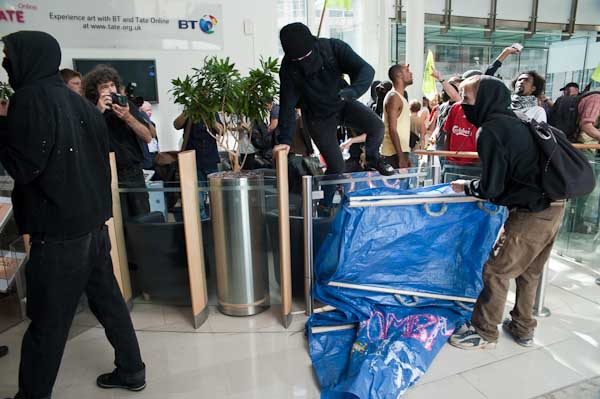
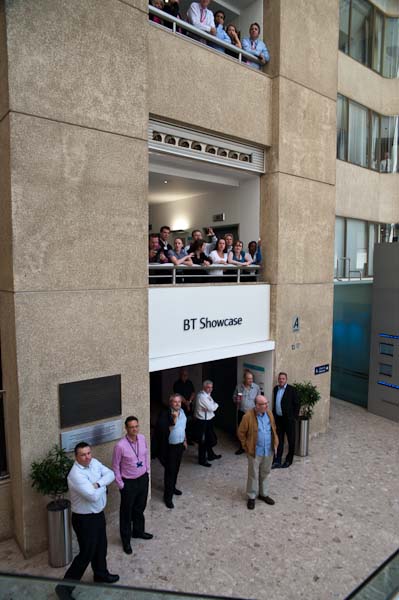
When we reached the BT offices, some protesters made a rush for the door and managed to push their way into the atrium, with others following them for a short protest inside – with staff and visitors to the building gathering on the balconies to watch.
Apart from a little possible damage to the door and from jumping over the security gates I saw little if any deliberate vandalism and no attempt to attack any of the people inside. “BT hold £59 million worth of shares in the international arms trade.” And after making their point, the protesters simply walked out.
Things got a little rougher at AXA Investments (“£2,259 million worth of shares in the UK arms trade and &6,207 million investment in the international arms industry”) where some smashed the glass with a reinforced banner, but the protest then moved away to the Stock Exchange (“where all the dirty dealing gets done“) – where after a short protest the banners were put away and the protest ended.
Police had not tried to stop the march and seemed to just stand back and watch, though there was a FIT team taking photographs. The ‘infopack’ had advised protesters to ‘mask up’ and many did as you can see in my photographs.
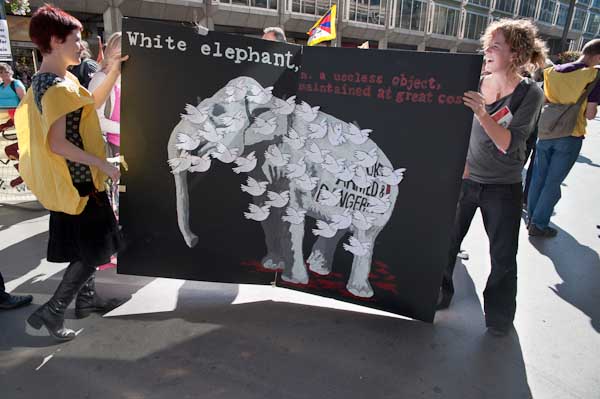
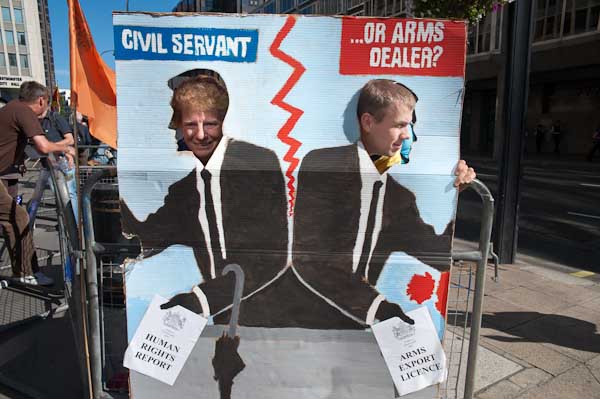
From there I took the tube to Westminster, where CAAT had brought a white elephant with doves on it along with a petition calling for an end to the support of the arms trade by the UKTI Defence and Security Organisation. Another banner had the message “Civil Servant … Or Arms Dealer” and accused the government of handing out arms export licences to repressive regimes – some of whom also sell arms as well as buy them at DSEI.
This year, 2025, the government made a highly publicised statement about not inviting the Israeli government delegation to the DSEI arms fair – but failed to mention that Israeli arms manufacturers will still be selling their weapons there, selling them as being “battle-tested” after their use in the long series of attacks on Gaza, killing Palestinians in the ongoing genocide.
Among those at protest outside the UKTI was peace activist Dan Viesnik on his 100 hour Famine for Victims of the Arms Trade at various government offices and other locations around the city.
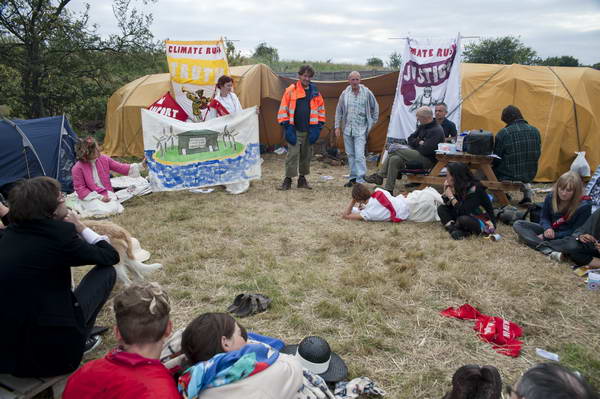
Climate Rush in Hayes & Sipson: On Saturday 5th September 2009 I went to Hayes to join a small group of Climate Rushers at a service at the start of a walk by the London Churches Environmental Network. We joined the marchers for the first part of their walk to the Sipson Airplot, set up to oppose plans for a third runway at Heathrow, rushing back there to prepare for the Celebration of Community Resistance which took place in the afternoon.
Climate Rush on the Run – Hayes & Sipson
On My London Diary you can read more about the Climate Rush, a group of women who had come together to celebrate the centenary of the 1908 ‘Suffragette Rush‘. In 1908 more than 40 women were arrested in an attempt to rush into the Houses of Parliament, and on 13 Oct, 2008, at the end of a rally in Parliament Square Climate Rush again tried to rush in.
Their protest in 2008 called for “men and women alike” to stand together and support three key demands:
* No airport expansion.
* No new coal-fired power stations.
* The creation of policy in line with the most recent climate science and research.
The walk begins
Since then Climate Rush had organised and taken part in various other climate protests and in September 2009 were taking part in “a rollicking tour of South West England“, staging events, supporting campaigns and “entertaining the towns, villages and hamlets” on their route with “16 Climate Suffragettes, 3 horses and 2 glorious caravans“. The Airplot at Sipson was their starting point and I’d photographed their procession to Heathrow the previous day, and later photographed them at a Green Fayre in Aylesbury.
After a service at St Anselm’s Church, Hayes attended by several Climate Rushers we set off with the the London Churches Environmental Network to walk back to Sipson. We left the marchers at Cranford Park to take a shorter route to get back to the Airplot to prepare for the Celebration of Community Resistance taking place there in the afternoon.
Climate Rush: Celebration of Community Resistance – Sipson
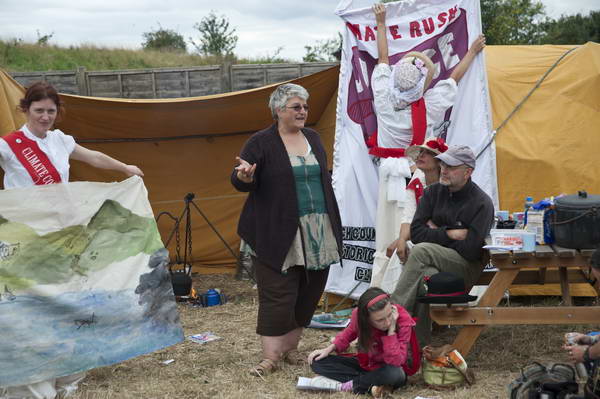
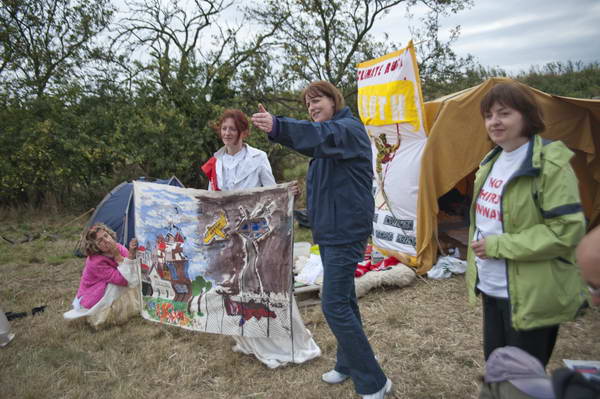
Tamsin plays the villain BAA while Geraldine talks about the NoTRAG campaign
Greenpeace had the idea of setting up the Airplot, an orchard in the centre of the village of Sipson, one of those under threat from Heathrow’s plans for expansion. They bought the site and created one metre square plots of land there and invited the public to become “beneficial owners“, I think paying one pound for the privilege and receiving a certificate of ownership. Somewhere I may still have mine, but here is one on Wikimedia.
It had seemed a good idea which would make the development more complex, though I suspect would have had little or no effect in practice, but it was never put to the test as plans for the third runway were scrapped by the government in 2010 on environmental grounds – though they have since been revived.
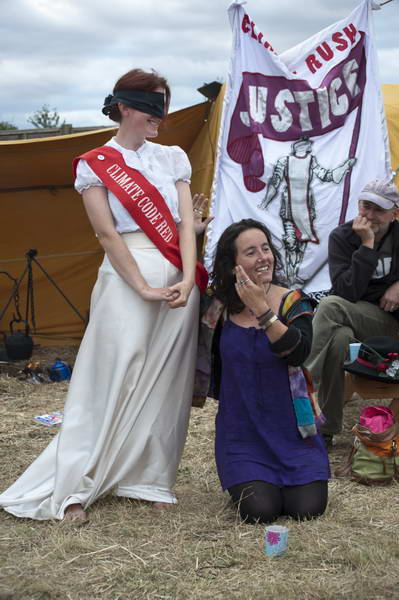
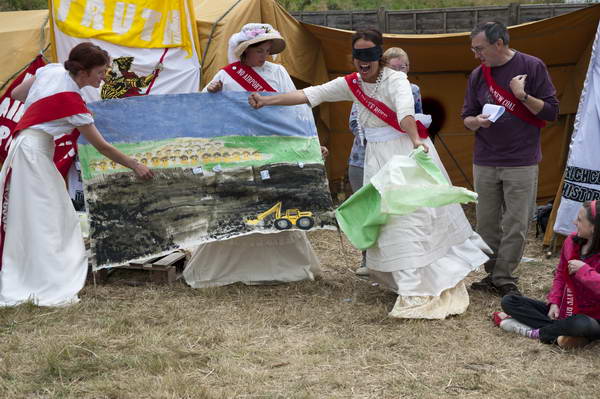
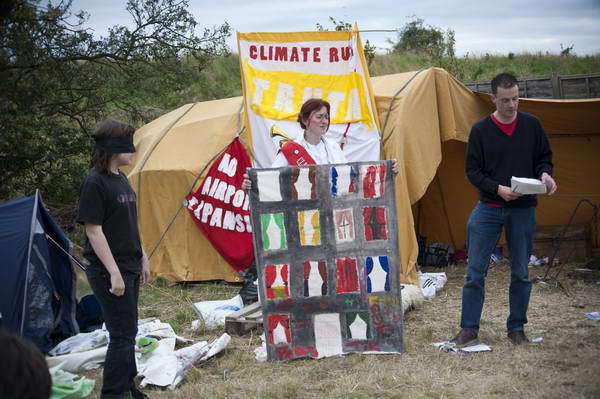
The Airplot was the first stop on the Climate Rush tour and for the Celebration of Community Resistance they had invited activists from around the country to come and give short presentations on their campaigns.
The first example of community resistance we heard about was Radley Lakes at Didcot which npower wanted to fill in with pulverised fuel ash. Although some lakes had been filled, the campaign managed to save three of them. You can see more about them on the Radley Lakes Trust web site.
Next we heard about the scandal of opencast mining at Ffos-y-Fran, common land at Merthyr Tydfil. I photographed a Campaign Against Climate Change demonstration against this mine at the London offices of Argent Group plc in April 2008.
“Argent form half of Miller-Argent who run the UK’s largest opencast coal mine, Ffos-y-Fran in Merthyr Tydfil, South Wales. Just 36 metres from the nearest houses, extraction will continue for more than 15 years (perhaps as along as 40 years), producing coal that will add at least 30 million tons of CO2 to to our atmosphere. Scottish safety standards demand a minimum gap of 500 metres from housing, but the implementation of a 350 metres limit by the Welsh office has been delayed – allegedly to allow the Merthyr working to go ahead.”
Coal mining continued here until November 2023, and local residents say that the plans for the future of the site represent the “ultimate betrayal“.
Protesters had come earlier in the year from County Mayo in Ireland for a St Patrick’s Day protest at the Shell building against the Corrib Gas Project. We heard how the Rossport Solidarity Camp and the Shell to Sea campaign were fighting this against a corrupt government and thugs who protect the oil companies interest by illegal methods. While the protests failed to stop the project, the environmental groups involved continue to highlight related issues.
Cathy McCormack, a community activist in Glasgow Easterhouse was unable to attend but a colleague came to read her views on poverty and the financial crisis, and in particular the part played by the World Bank and the IMF.
Next we heard from two former Vestas workers who sat in their factory in Newport on the Isle of White when the company proposed the closure of what was then the UK’s only major wind turbine production site. Unfortunately they failed to prevent the closure.
The last group to talk were the No Third Runway Action Group (NoTRAG), and Geraldine described how they had opposed the BAA plans for airport expansion.
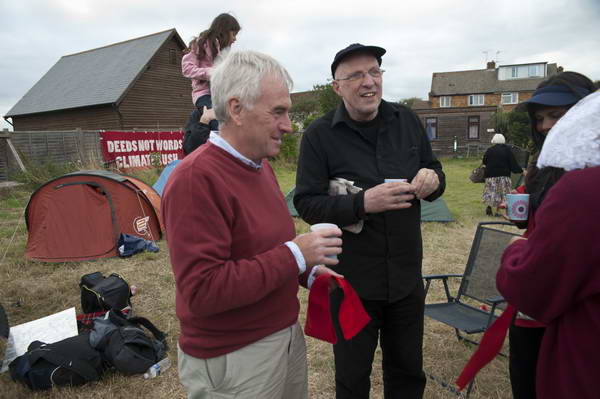
In the audience watching the presentation were local MP John McDonnell and airport campaigner John Stewart of HACAN. The campaigners won that round against Heathrow’s plans – and we celebrated in 2010, but today there are new plans – and a government which only plays lip-service to the coming environmental diaster seems sure to back either Heathrow’s own proposals or that from the Arora group, and the fight is on again.
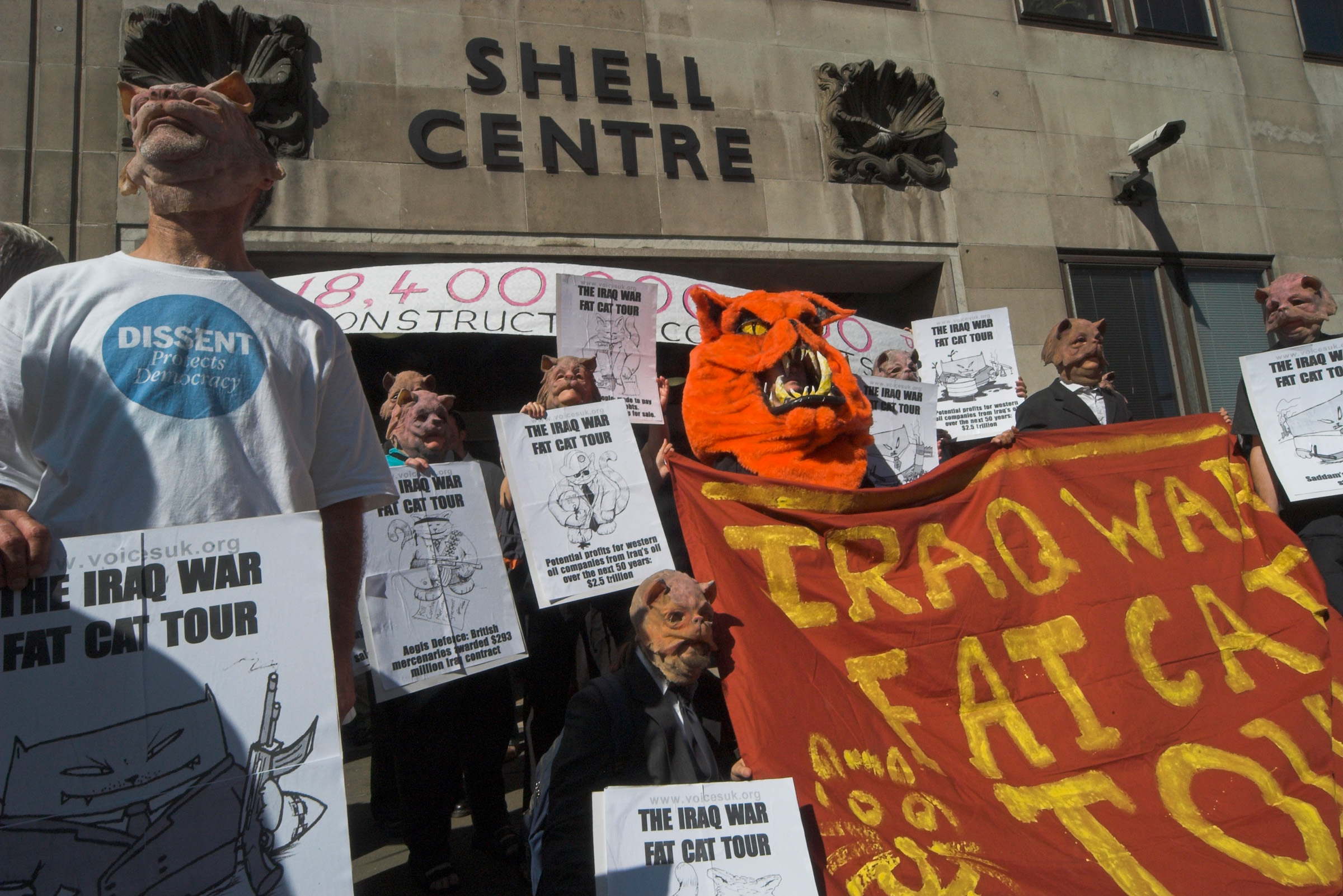
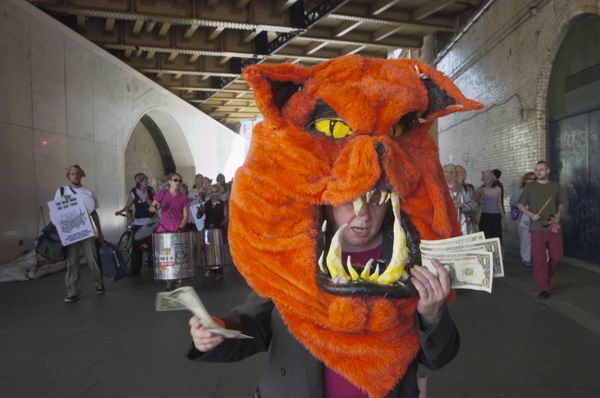
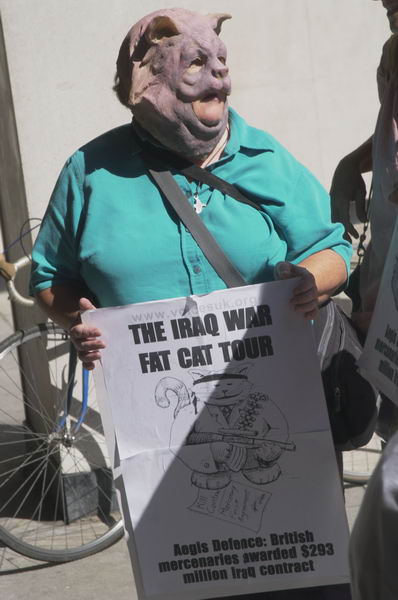
The Iraq War Fat Cat Tour: On Saturday 4th September 2004 I met campaigners from organisations including Voices in the Wilderness UK, a group opposed to the sanctions on Iraq and the war in Iraq, which between March 1996 and May 2003 had sent over 70 sanction-breaking delegations to Iraq.
I had photographed many of the protests leading up to the illegal invasion of Iraq in 2003 – and there are pictures and accounts from some of these on My London Diary, and of the protests after the invasion, particularly when it became clear that Tony Blair had deliberately misled Parliament and the facts about the “dodgy dossier” became clear. Many called for Blair to be indicted as a war criminal.
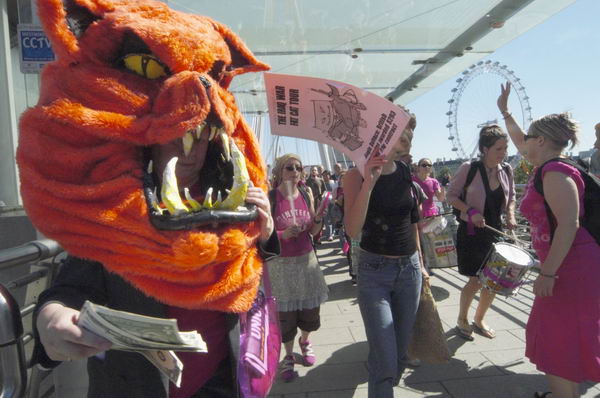
A fat cat handing out dollar bills next to the Shell Centre
Despite the huge protests and determined opposition of a huge proportion of the British people to the war, we failed to stop our army supporting the US, and many thought the protest movement had deliberately failed to press home its position – as Tony Benn and others had urged – thanks to the domination of its leadership by members of the SWP. Let’s hope that “Your Party” does not get sunk by the same hands – or by the efforts of those close advisers to Jeremy Corbyn when he was Labour leader.
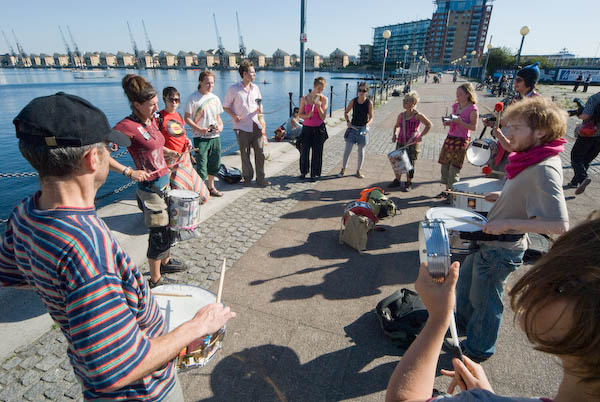
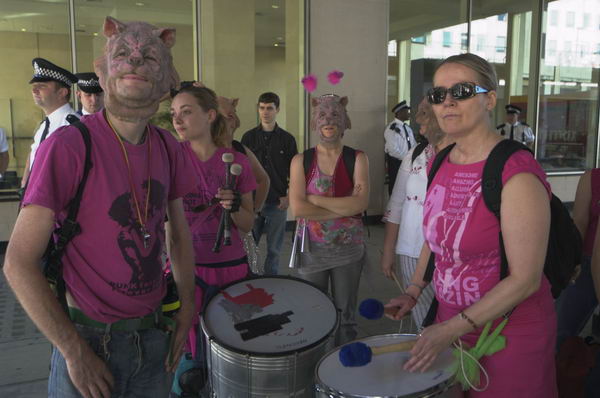
‘Rhythms of Resistance’ samba band at the Shell Centre, Waterloo, London
I only wrote a short piece about the protest back in 2004, now rather hard to find on that web site, so here it is, with a few of the pictures from it in this post and there are more here on My London Diary.
Protestors walk across the new Hungerford Bridge (Jubilee Bridge)
After the initial military victory in Iraq, the American government were determined that their friends would profit from the situation. Lucrative contracts went largely to US companies that just happened to have friends and beneficiaries in the top level in the USA. Capitalism is always a winner from wars, with arms suppliers laughing all the way to the bank, but this extended the gravy train rather more widely and rather too obviously. Bush’s cronies sell the arms that knock the infrastructure to pieces, then get high margin contracts to rebuild.
The Iraq War Fat Cat Tour of London aimed to visit some key sites to point out the profiteering from the occupation of Iraq. it started at the Shell Centre (Western oil companies look set to make $2.5 trillion from Iraqi oil over the next 50 years), then made its way across the new Hungerford Bridge to the Cavell statue at the north east of Trafalgar Square (where I left it) and continuing to some other key sites.
More street theatre in front of the Cavell memorial
There was singing from the Strawberry Theives Socialist Choir (the name a reference to a William Morris wallpaper design), who thoughtfully provided the words for the Internationale in case any of us had momentarily forgotten them, (Arise! ye starvelings from your slumbers, Arise! ye criminals of want… ), samba playing from Rhythms Of Resistance, and a couple of street theatre groups.
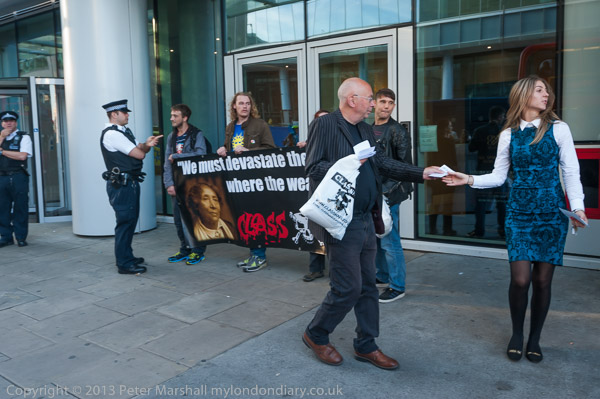
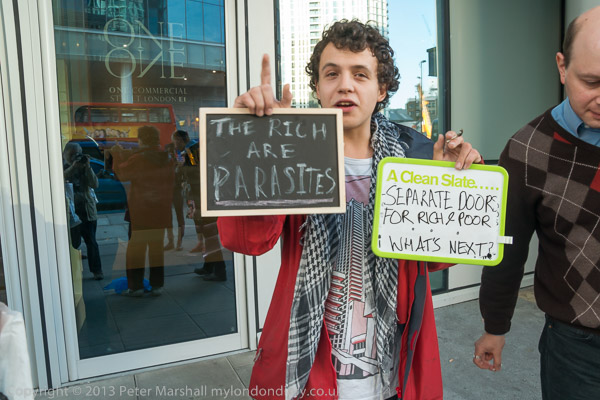
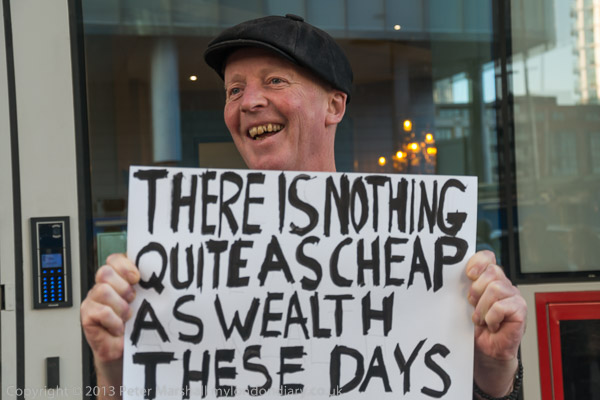
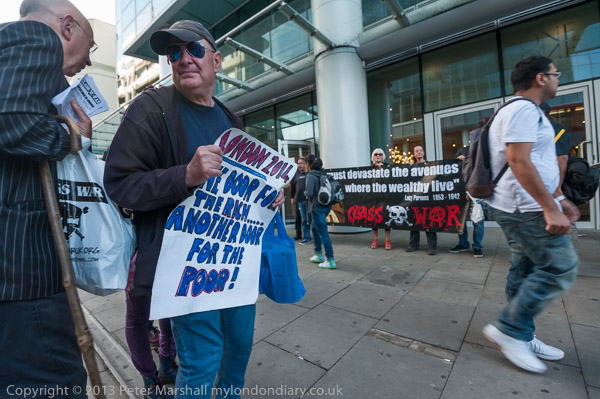
Isle of Dogs and Poor Doors: On Wednesday 3rd September 2014 the weather was fine with blue skies and clouds and I decided to spend the afternoon photographing in the Isle of Dogs before meeting with Class War for one of their ongoing series of protests against separate entrances for the wealthy and social housing residents of a tower block in Aldgate.
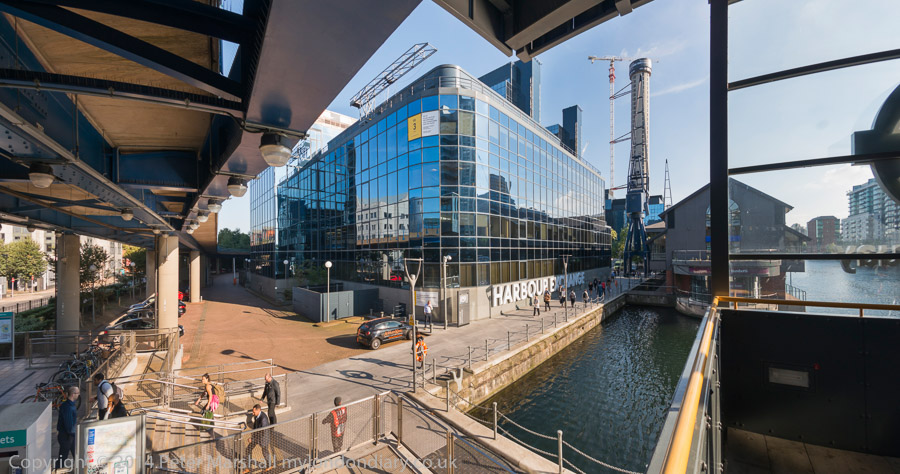
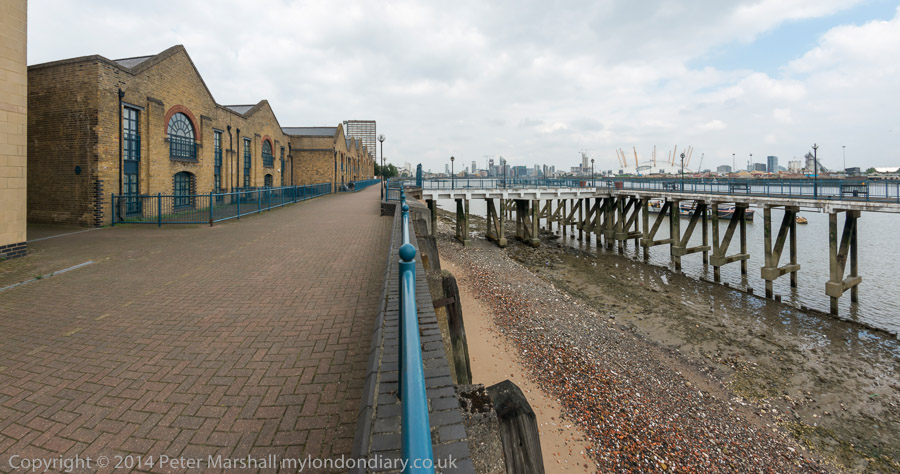
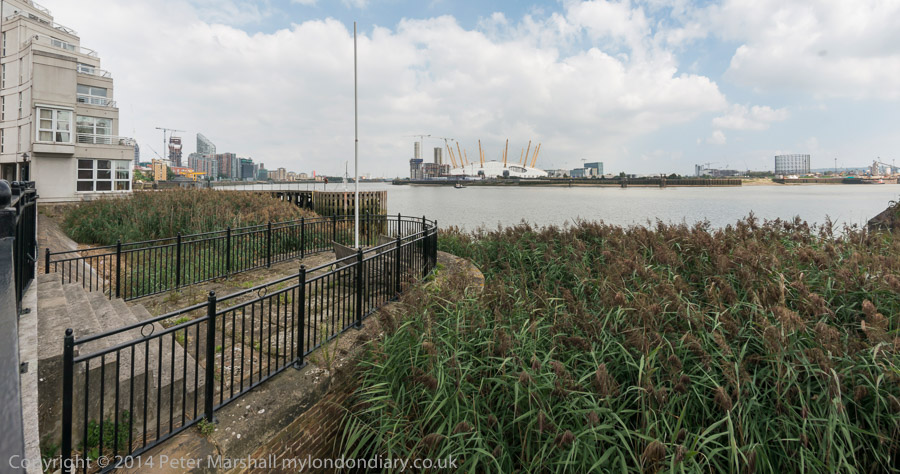
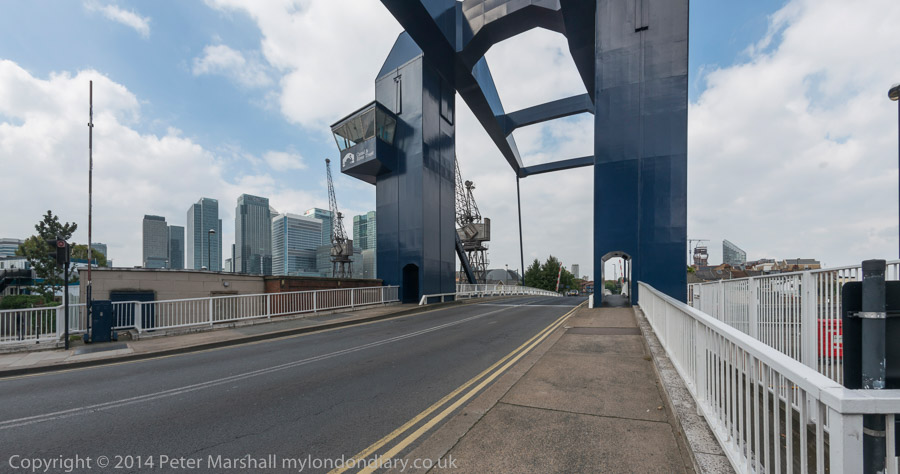
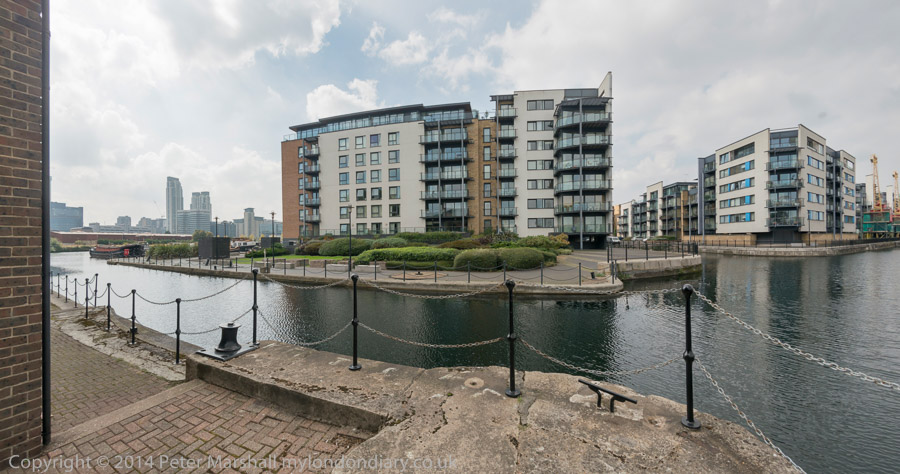
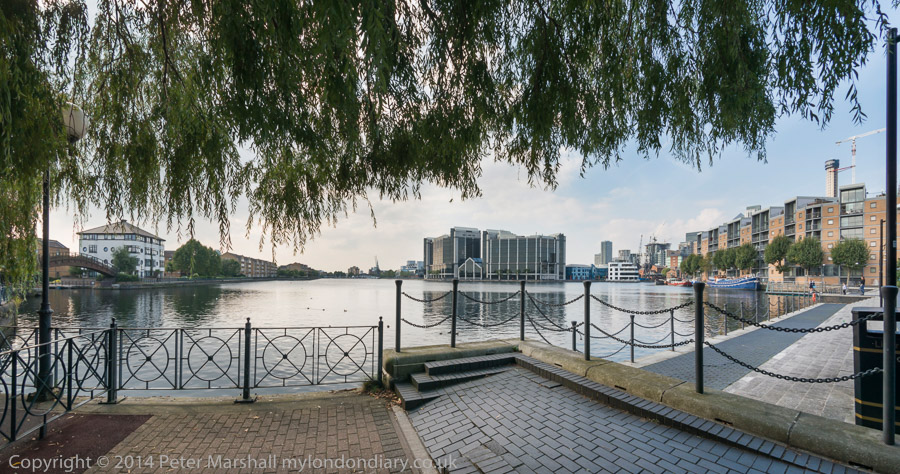
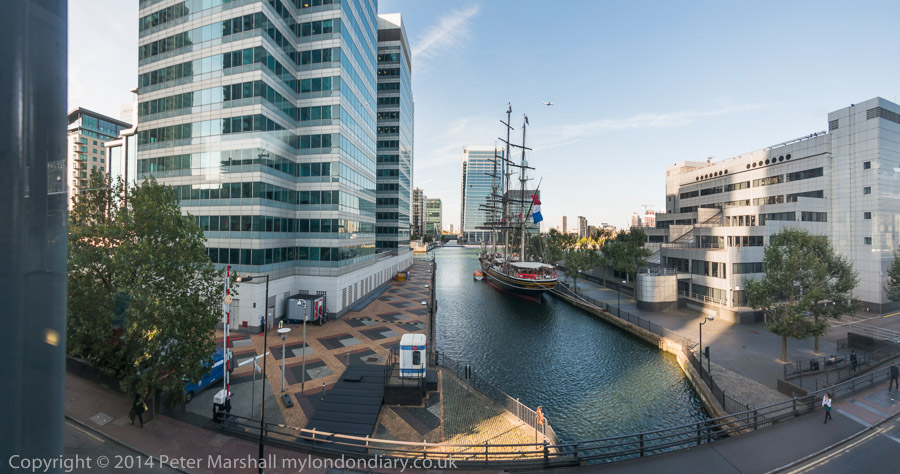
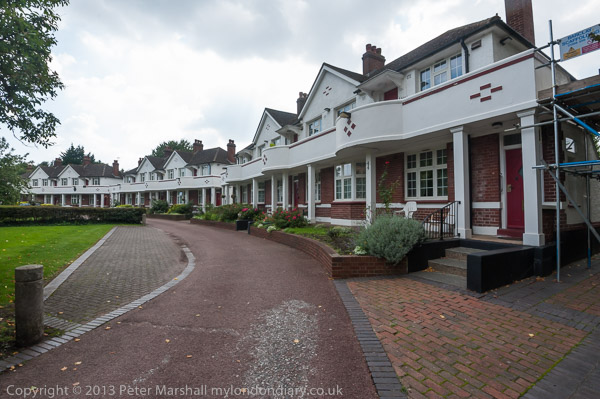
Isle of Dogs Panoramas – Island Gardens to South Quay
The main purpose of my visit to the Isle of Dogs was to make panoramas of scenes which I had photographed more conventionally over the years, including the black and white images that I included in my book ‘City to Blackwall‘ and more of them are now in my albums on Flickr.
I had gone back so make some panoramas in the area in the 1990s and early 2000s, using various panoramic film cameras, but the switch to digital had made creating panoramic images much simpler for me.
Perhaps the most important change was in accurate viewfinding – with my first panoramic film camera the most accurate way to see the extent of my pictures was by viewing along two arrows on the top of the body – much more reliable than its viewfinder. But of course digital also gave a wider range of shutter speeds and ISO.
And to do this, the camera needed to be firmly mounted on a tripod – and I carried a rather heavy Manfrotto around with me. This also enabled me – with the aid of a spirit level – to ensure that the camera was level. The Nikon I used for these panoramas had level indicators in the viewfinder and was easy to use handheld.
However to make these on digital I needed to use a fisheye lens – the 16mm Nikon fisheye. Not the kind that gives a circular image, but a full-frame fisheye where the image circle goes through the corners of the frame. This gives a 180 degree image across the frame diagonal, but rather less horizontally and vertical, with considerable curvature of straight lines.
Software – I then used PTGUi for these – than comes to the rescue, converting the spherical perspective into a cylindrical one which rendered verticals upright (there are several ways this can be done with slightly different results.) Later I moved to simpler software.
With the 36Mp Nikon D800E there were far more pixels than necessary even after this stretching and this was no longer a problem. I could work with single exposures rather than stitching together several images as I had done earlier with digital cameras.
Although I had mainly gone to make panoramas I also took a Nikon D700 body and made pictures with a 16-35mm Nikon zoom. Not everything is best suited by the panoramic treatment.
Again there are many more pictures at Isle of Dogs.
Class War ‘Poor Doors’ picket Week 6 – Aldgate
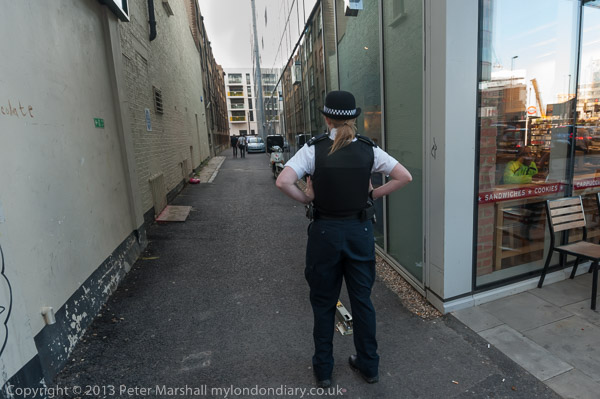
A police officer watches as people walk down the alley leading to the ‘poor door’ of the luxury development
Class War and friends held their sixth weekly protest outside 1 Commercial St in Aldgate and it was a relatively uneventful one.
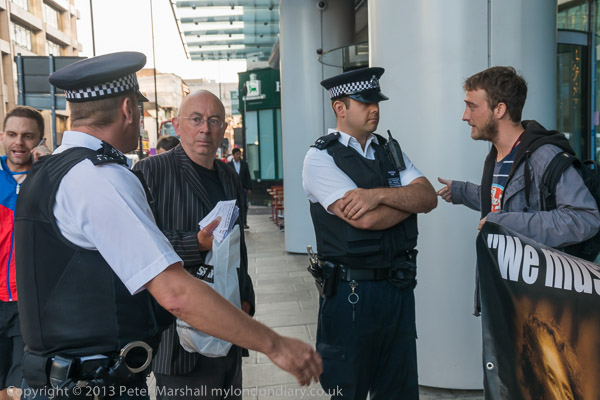
As the protesters arrived, two police officers came out from the building and talked with the protesters making clear that they expected the protesters not to block the doorway for people entering or leaving the building. More officers soon arrived to police the event.
There were a few heated arguments between protesters and police but nothing of any consequence. The protesters held their banner well in front of the door.
They talked and handed out leaflets to people leaving and entering the ‘rich door’ as well as to people walking past – and to at least one cyclist stopped at the traffic lights.
After keeping up the picket for an hour as intended, Class War packed up and left – until the next week.
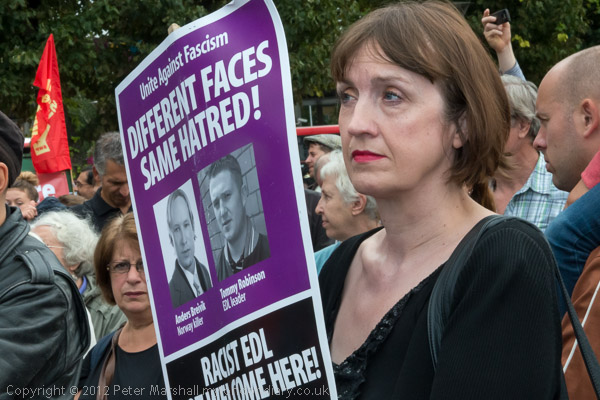
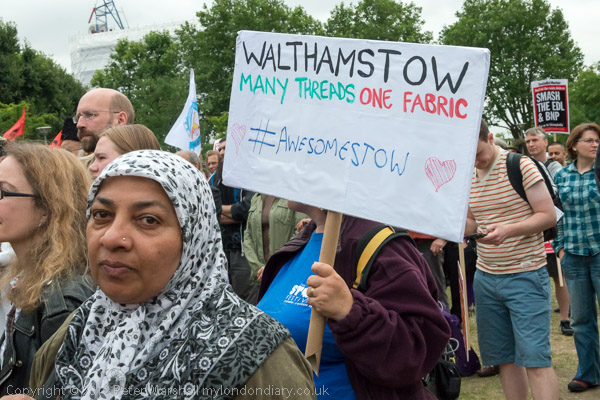
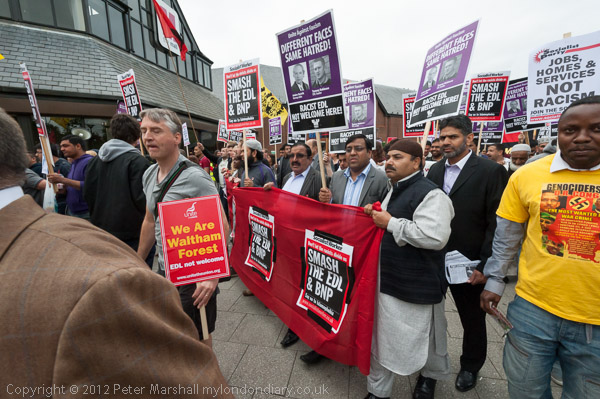
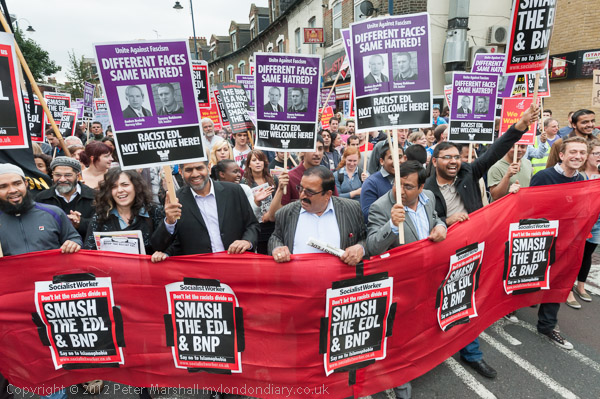
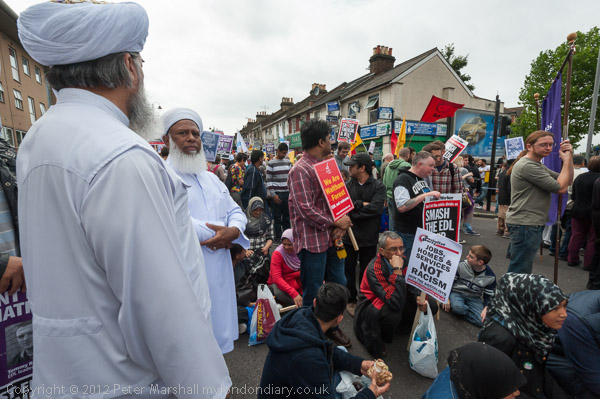
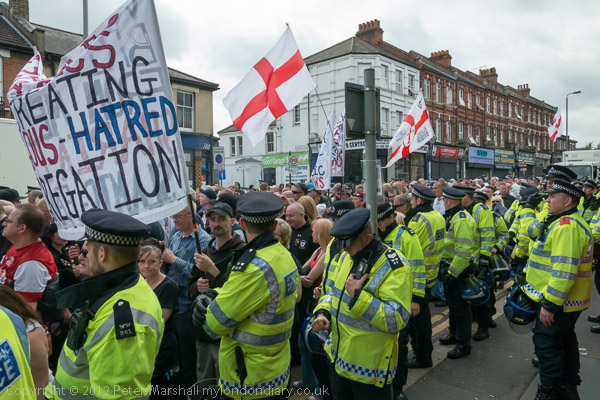
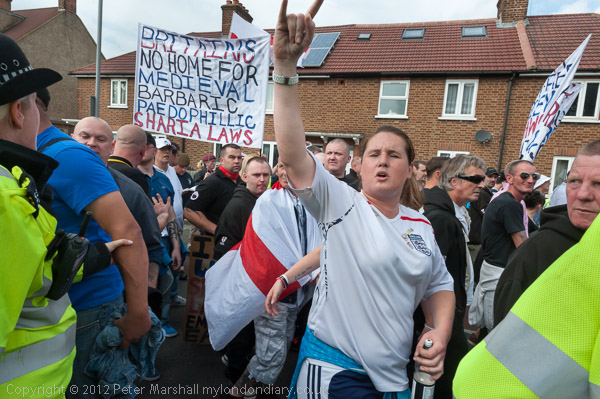
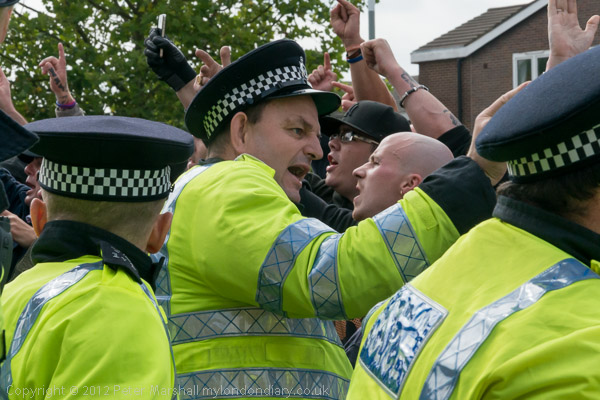
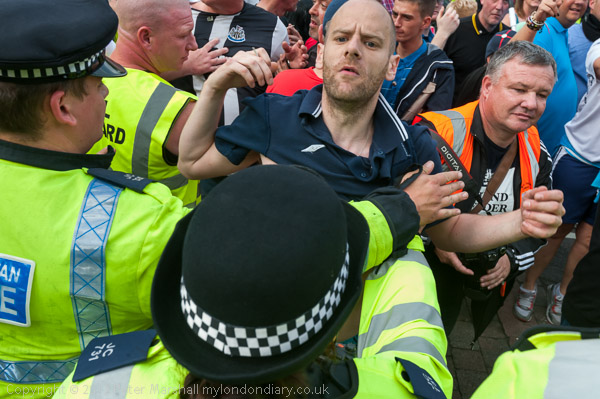
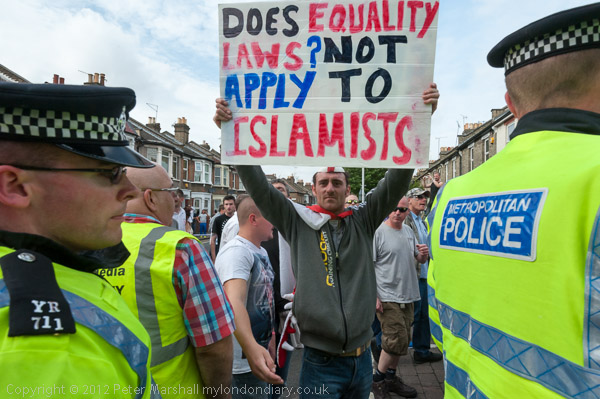
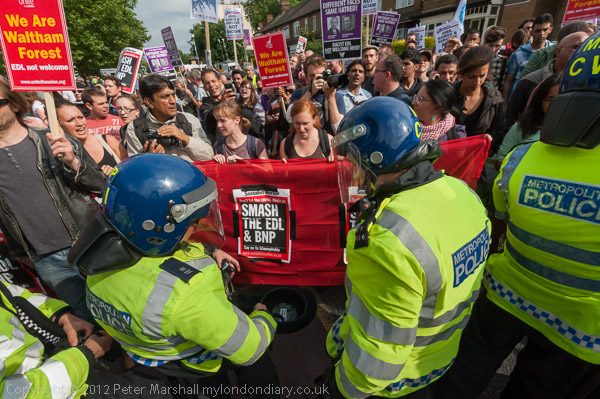
The Battle of Walthamstow: On Saturday 1st of September the extreme right English Defence League attempted to march into Walthamstow and hold a rally outside the Waltham Forest Civic Centre on Forest Road. Several thousand people from all of Walthamstow’s communities came together as ‘We are Waltham Forest’ determined to oppose them.
From a long rally in Walthamstow’s main square with speeches by many community leaders and performances by local drummers and singers, the people of Walthamstow marched to Forest Road, arriving an hour or so before the EDL march was due.
As they made their way along Hoe Street there was no doubt of their wide support from the community, with people coming out from virtually every shop and building, many waving and cheering in support.
When the march reached Forest Road many of the marchers sat down on the road at the key junction on the EDL march route. I left them there and walked back towards where the EDL march was to start.
When I saw the EDL march coming towards me, it looked more like a police march as the EDL were probably surrounded by more officers than there were supporters on the march. None of the main EDL leaders was on the march as they had gone separately to where they intended to hold a rally and were setting up the PA system.
It was hard to get a clear view of the marchers through the lines of police around them, and I only had a short telephoto when a much longer lens would have been useful.
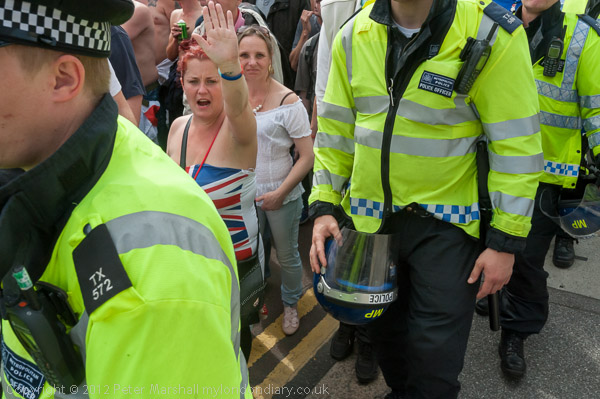
But I managed to take some pictures of the marchers and many of them saw me and shouted abuse or made offensive gestures. Others tried to hold up hands in front of their faces – in one case making a woman look as if she was giving a Nazi salute. One man even rushed through a gap between police officers and put his hand over my lens before police dragged him back into the march. Although they got in my way I was rather glad the police were there.
A few people had come out onto the side of the streets to watch the marchers. Most did so in silence, but some held posters against the marchers or shouted at them. I saw only one supporter, an elderly man who came out of his house to greet them and was greeted with cheers from the marchers. As I commented, “Clearly here the silent majority they claim to represent was overwhelmingly against them.”
As the crucial road junction was blocked, police diverted the march down a side road shortly before it. Some of the EDL were angry at leaving the route and wanted to get at those blocking the road and there were some minor scuffles between the EDL stewards and police.
I went to the junction where the EDL march was led across the Chingford Rd and joined other photographers who were photographing the march and residents who had come to oppose them. Here EDL stewards dragged back marchers who tried to attack us and police and managed to keep their march more or less in order.
Police halted the march in Farnan Avenue at the side of the Civic Centre, but it was now clearly impossible for them to continue to the planned rally location because of the mass of protesters opposed to the EDL who were mainly held by police behind barriers on the opposite side of the road.
Kevin Carroll
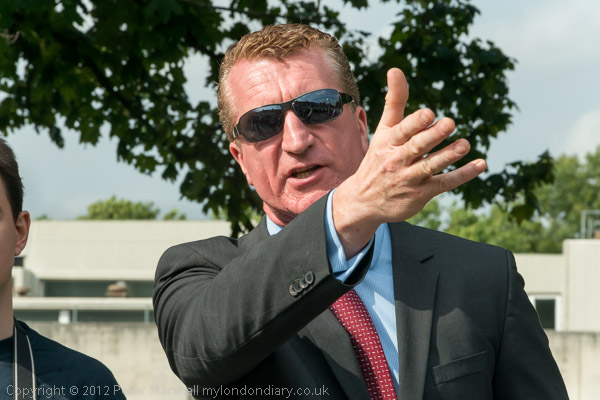
I went to where Tommy Robinson and Kevin Carroll had come with a few others to set up for the rally and took a few pictures before I was stopped by an EDL steward who insisted I was a Unite Against Fascism photographer and called over a police officer. I showed the officer my press card, but he still insisted I leave the area. I unhitched a barrier and went across to the other side of the road.
Facing them were hundreds of people from Waltham Forest with the message ‘EDL not welcome’
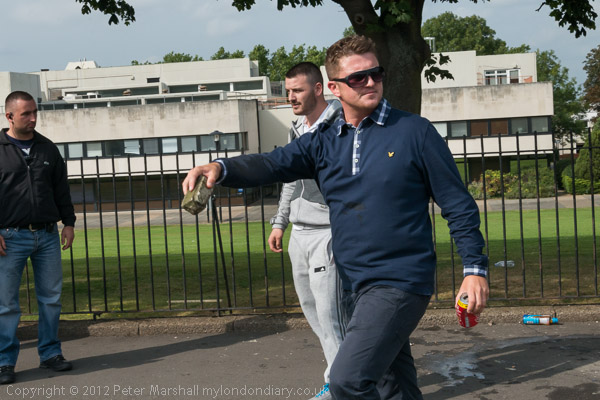
‘We Are Waltham Forest’ organisers had asked that the protest remain a peaceful one, but some had other ideas and a few sticks and other objects were begining to be thrown towards the EDL. A small brick landed a few yards from Robinson, and was picked up by him and handed to a police officer as evidence.
I moved to one side to avoid being hit as more objects began to be thrown – unlike many other photographers I wear no protective headgear. The situation appeared to be a stalemate, and although many of the counter-protesters had left it seemed unlikely that the EDL rally would be possible. When I left the EDL marchers were still surrounded by police in the side road.
Police later told the EDL that the rally could not go ahead, and the EDL leaders left. Police then kept the marchers surrounded for several hours for their own protection and after RMT members told police they would not allow hooligans to endanger the public by boarding trains, police decide to arrest them all and take them in vans to various police stations. They were apparently de-arrested and released in the early hours of Sunday morning.
This defeat was important in the demise of the EDL and you can see many more pictures at Waltham Forest Defeats the EDL.
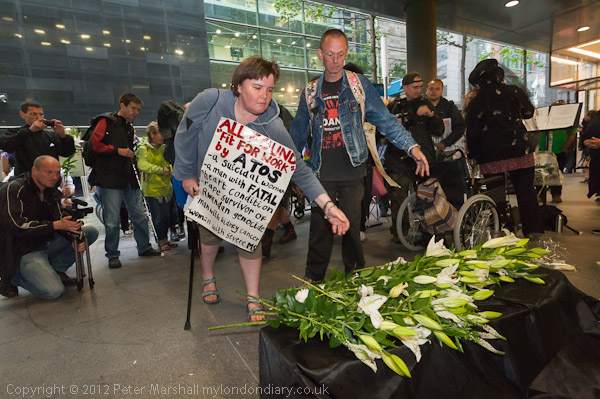
Disabled Protest Remploy Closures and Atos Deaths: On a wet Wednesday 29th August 2012, the opening day of the London 2012 Paralympic Games, I photographed two protests by disabled people. At Stratford, close to the Olympic site, Remploy workers and supporters protested at the closure the previous week of 27 Remploy factories which had employed disabled workers, and in Central London DPAC and other disabled activists took a coffin to the offices of Paralympic sponsor Atos, responsible for carrying out fitness to work tests which have driven many disabled people to suicide.
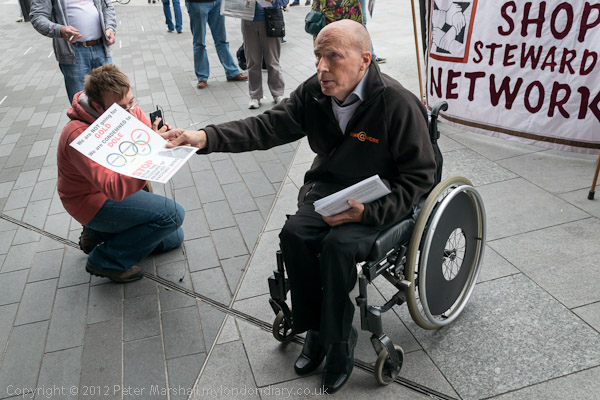
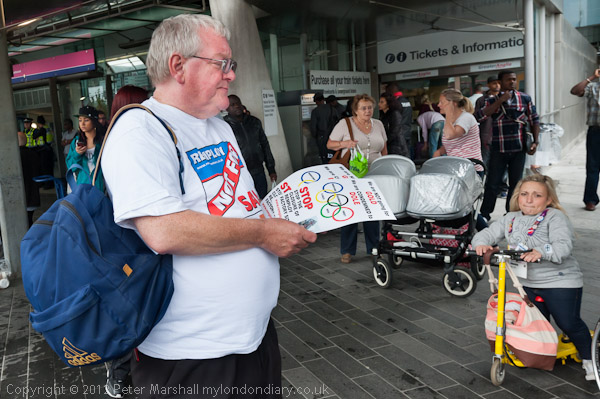
Remploy Protest at Stratford Station
Remploy, then the Disabled Person’s Employment Corporation, opened its first factory in 1946 to provide jobs for men and women who had been injured fighting for their country in the Second World War – just the kind of ex-servicemen who now make up a significant proportion of our Paralympic Team GB.
Remploy made it possible for disabled people to do useful and productive work including producing printed circuit boards and electrical assemblies, recycling used computers and much more. They gave disabled workers and those with special health conditions who would otherwise be unemployed useful jobs, a decent income and the satisfaction of working with others rather than being isolated in their homes.
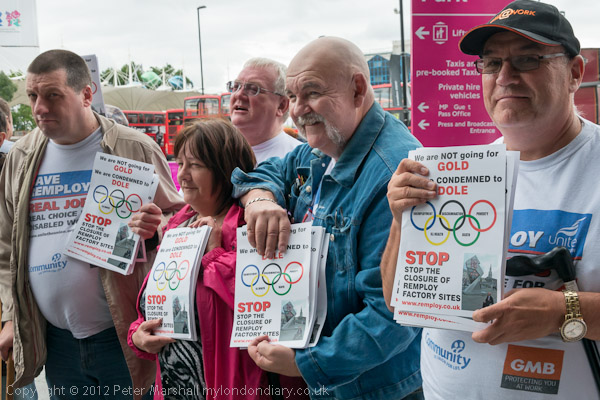
The leaflets being handed out had an Olympic theme, with the message ‘We are NOT going for Gold, We are Condemned to Dole’ and the five Olympic rings were labelled ‘Unemployment, Discrimination, Poverty, Ill Health and Death.’
All Remploy factories were closed by the end of 2013, with Remploy continuing only to provide employment placement services for disabled people. In 2015 it was privatised and became owned by US service provider Maximus. They continue to use the Remploy name in Scotland.
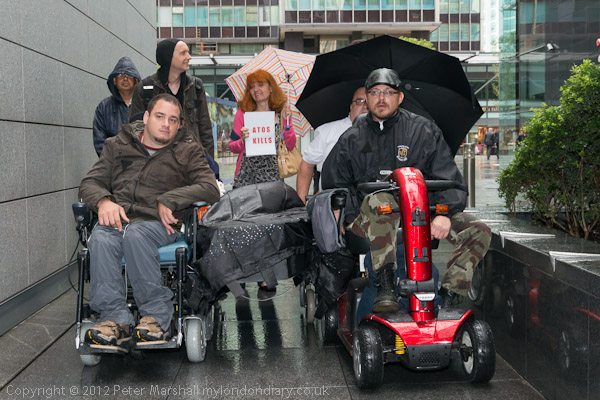
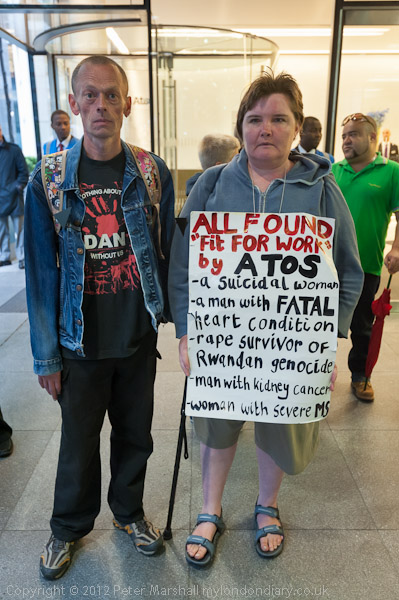
Disabled People Against Cuts (DPAC) were holding a national week of protests around the country against Paralympics sponsor Atos, whose computer based ‘fitness for work’ tests have led to stress, hardship deaths and suicides among the disabled.
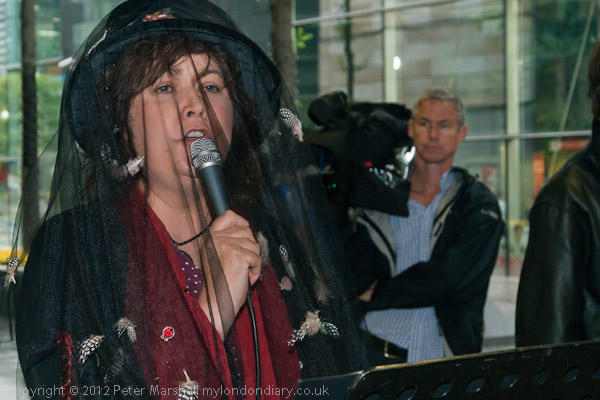
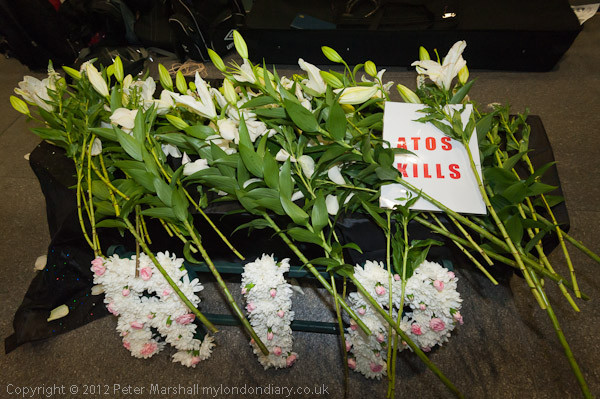
On the Wednesday 29th August I met the protesters in a café on Triton Square on Euston Road where they were meeting in preparation for a vigil to remember those who have died as a result of the deliberately unfair Work Capability Assessments carried out by Paralympic sponsor Atos, and to deliver a coffin on to them on the day the Paralympic Games was opening.
As we were told, Atos was delivering “a relentless health and disability assessment regime which has been used to slash vital benefits from hundred of thousands of sick and disabled people” with assessors told they have to reach strict targets in failing the great majority of claimants, which led them to often deliberately misinterpret the claimants responses and misrepresent their medical conditions.
“The was a solemn and moving reminder of the scandal of the work capability assessments and the terrible effect they are having on the disabled. Many are losing the allowances that enable them to travel to work, others housing benefits, and are being told they are fit to work when patently they are unable to do so.”
ATOS KILLS
And as I commented in 2012: “It really is a cruel paradox that at a time when the nation is celebrating the great achievements of disabled people in the sporting world, our government is trying to reverse the moves toward equality of treatment of disabled people, and that the company that is trying to take the credit for sponsoring the Paralympics is profiting from contracts to dishonestly deny benefits to the disabled who need them.”
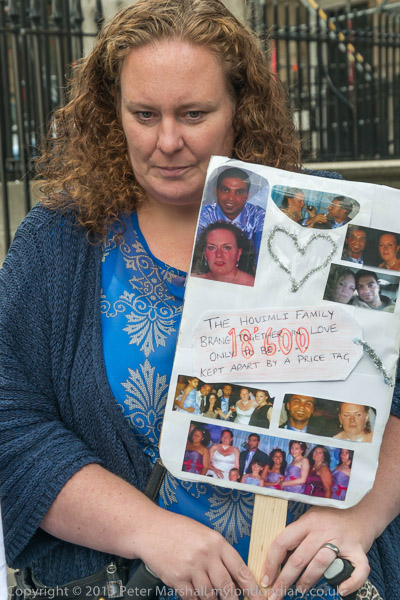
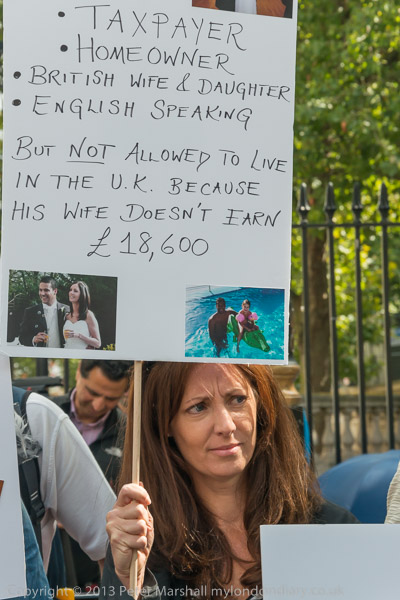
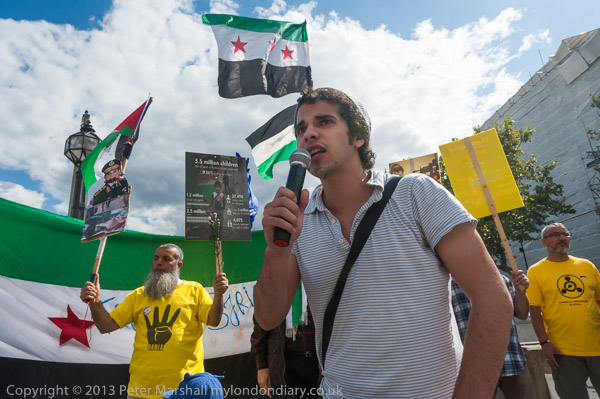
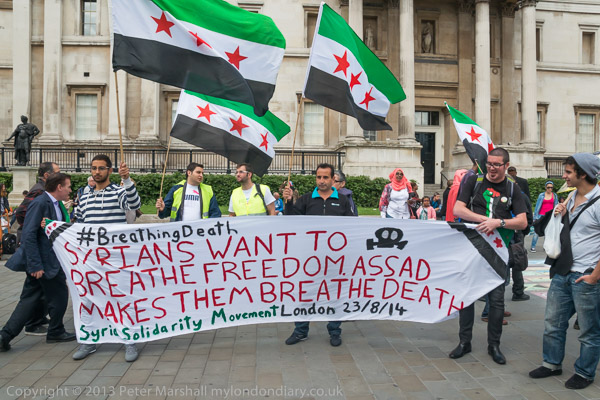
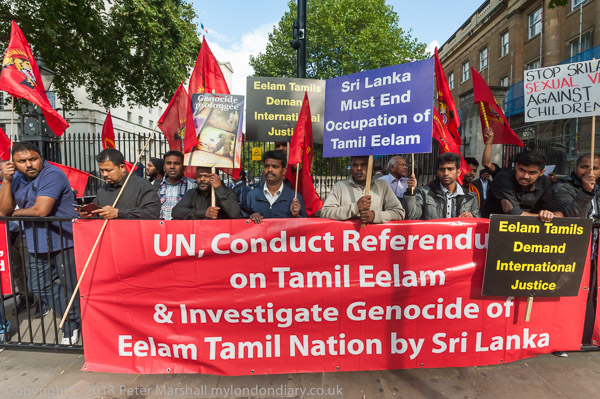
Divided Families, Gaza, Ghouta & Sri Lanka: Saturday 23rd August 2014 was a busy day for protests around Whitehall. I began at Downing Street with a protest by family members kept apart from their loved ones by Teresa May’s cruel and unfair immigration rules in a deliberate breach of the Universal Declaration on Human Rights, then photographed a protest against arms sales to Israel and an end to Israeli war crimes. Then in Trafalgar Square Syrians marked the first anniversary of The chemical massacre at Ghouta before marching to Downing Street, where Tamils were protesting the rapes and killing in Sri Lanka.
Divided Families protest over cruelty – Downing St
The Universal Declaration on Human Rights states:
'No one shall be subjected to arbitrary interference with his privacy, family, home or correspondence, nor to attacks upon his honour and reputation. Everyone has the right to the protection of the law against such interference or attacks.'
But British citizens who are married to foreign nationals from outside the EU and may have children with them can only bring their partners to the UK if they are in well-paid jobs. And even then the visas needed are expensive and there are tough English Language tests, a need to prove greater attachment to the UK than of any other country and a five year probationary period.
The rules are complex and hard to understand and have changed since 2014, particularly by Brexit. Then those earning less than £18,600 a year were unable to bring on-EU spouses to join them – and couples with two children needed an annual income of £24,800. Visa application was also (and still is) very expensive.
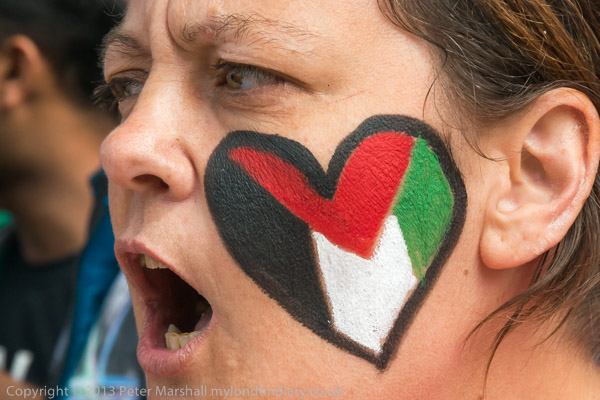
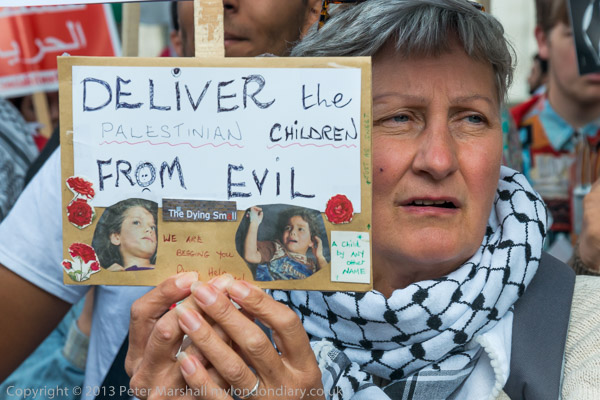
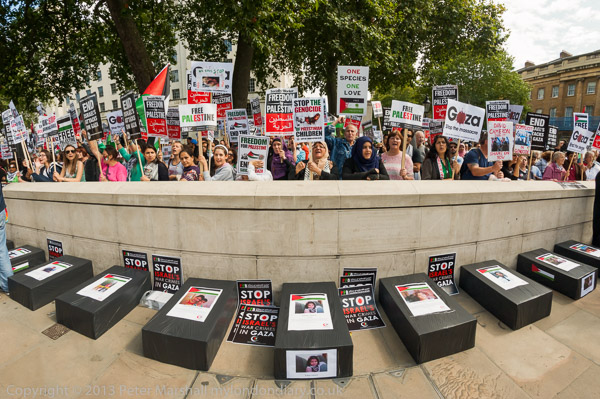
Back in 2014 as now people were calling for an end to UK arms sales to Israel and for an end to Israeli war crimes.
The 2014 conflict in Gaza resulted in over 2000 Palestinians being killed including almost 1500 civilians and many more injured, leaving around a thousand children with life-changing disabilities.
Fighting lasted 50 days with many schools and health centres being damaged and over 12,600 homes being destroyed and around a further 6,500 seriously damaged. At the time of this protest UNRWA was housing around 300,000 internally displaced people in the roughly half of its school buildings which had not been destroyed or seriously damaged.
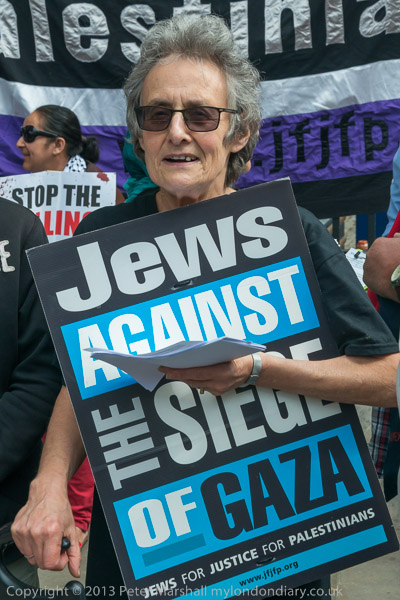
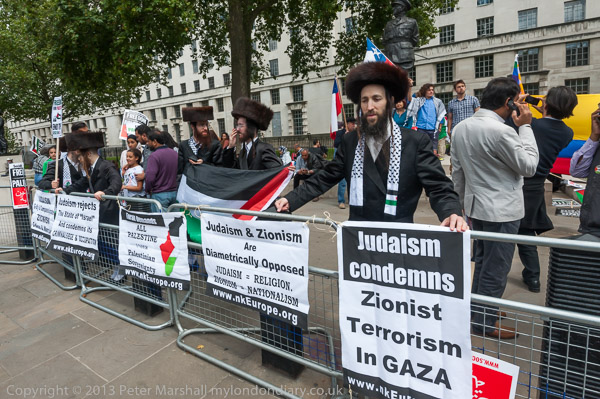
Among the protesters were several groups of Jews, including ‘Jews for Justice for Palestinians’. Also there were Neturei Karta Orthodox Jews with banners opposing Zionism and the idea of a Jewish political state; they call for all to live peacefully together in Palestine – as Jews and Arabs did before the partition and formation of Israel.
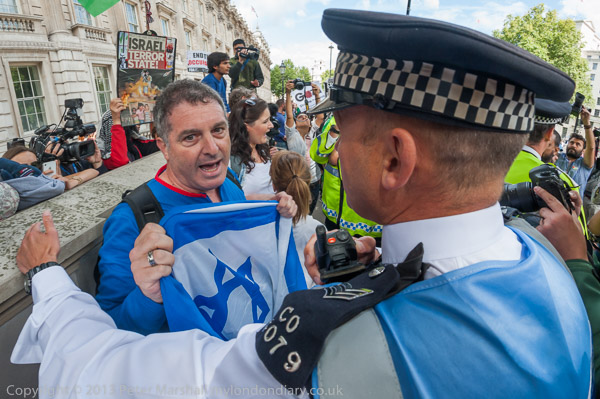
A small group of pro-Israel protesters, one dressed as Superman, tried to disrupt the protest but after a short while were led away by police.
Syria Chemical Massacre Anniversary – Trafalgar Square
The chemical attack using the nerve gas Sarin by the Assad regime on Ghouta on 21st August killed 1,477 residents including over 400 children in this Damascus suburb.
Leaders in countries around the world expressed outrage at the attack, called for action to be taken. Pressure did lead to Syria agreeing to sign the Chemical Weapons Convention and the US and Russia agreed on a framework to eliminate Syria’s chemical weapons, and much of Syria’s stock was destroyed in the year following the massacre.
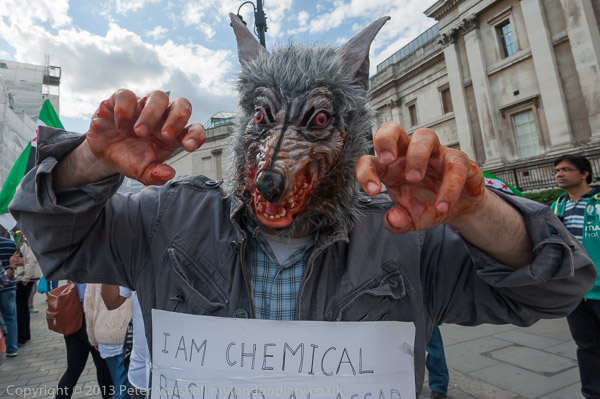
‘I am Chemical Bashar Al Assad and one year on I am still gassing Syrian children. Thank you for UN veto’
But Assad continued to use chemical weapons, including many attacks with chlorine gas which was not covered by the framework because of its widespread chemical uses, as well as some attacks involving Sarin or a similar nerve gas. In 2023 the UN Security council declared that Syria’s chemical weapons declaration was incomplete and demanded full disclosure and cooperation with the Organisation for the Prohibition of Chemical Weapons.
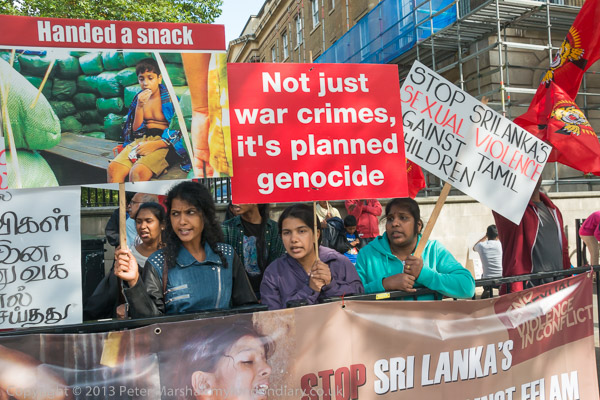
Tamils protest Sri Lankan rapes & killing – Downing St
Following the Sri Lankan military defeat of the Tamil Tigers in 2009, Tamils allege that the Tamils who make up around 11% of the population of Sri Lankan have been the subject of a continuing genocide by the government and the Sinhalese majority.
The protest called for the UN to conduct a referendum over setting up a Tamil state and investigate Sri Lankan genocide of Tamils. The Sri Lankan government had not kept the promises it made to the international community at the time of the Tamil defeat and has subjected the Tamil region to military occupation, rapes and killing.