June 1986

I had a busy month in June 1986. Of course there was the teaching, though by that time of year my A Level students were busy sitting exams, which took some of the pressure off for me, though there were the practical exams. And of course exam invigilation, a time of extreme boredom.
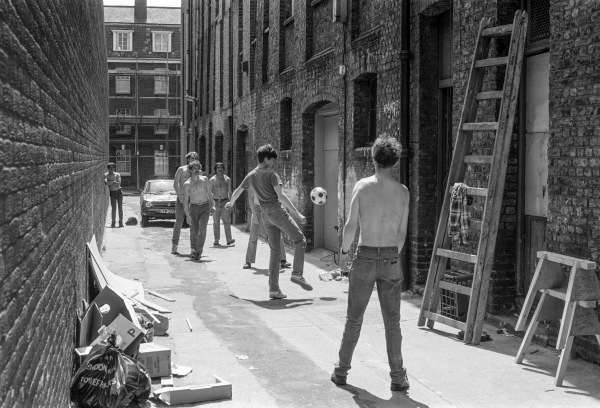
At home there will have been strawberries to pick and other little jobs around house and garden, as well as two young boys to help looking after. And sometimes I would take one or both of them out for long walks with me, as I went out taking pictures at the weekends, mainly in that month in Tower Hamlets, occasionally straying into Hackney.
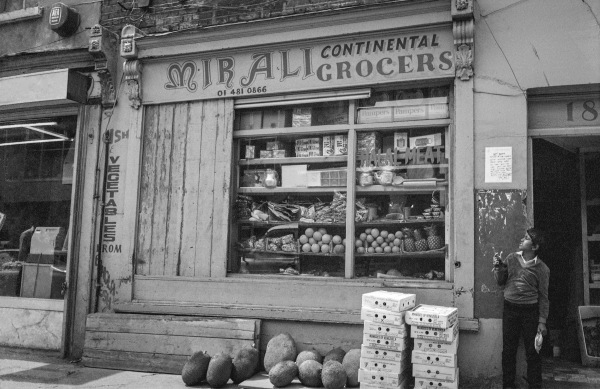
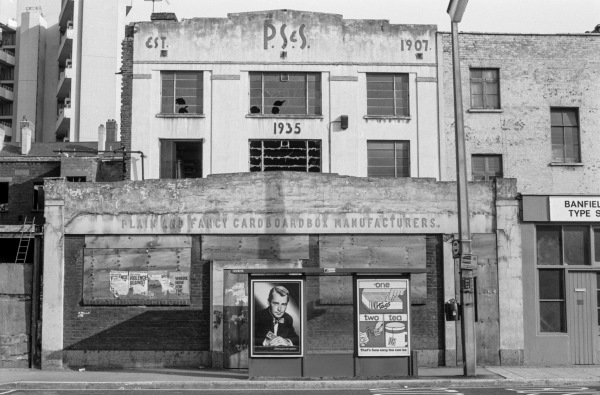
During that month I made over 500 exposures on black and white film, seldom taking more than one exposure of each scene, and perhaps half that number in colour. It was around this time that I started seriously to produce some kind of comprehensive document of the fabric of London which I had been photographing in a less concentrated and asystematic fashion since 1973.

What had previously been largely dérives from a particular starting point now became carefully planned, with research in books on the city and poring over maps. Where previously it might have been the delightful whimsy of Geoffrey Fletcher that lead me to picturesque corners, this was now replaced by the duller encylopaedic prose of writers such as Harold Clunn, whose 1951 ‘The Face of London’ revised his earlier work to take account of wartime losses and attempted to be a complete guide to Greater London from his fifty years of perambulations.
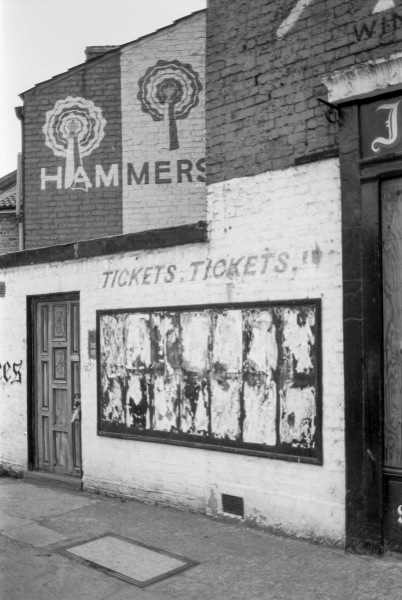
Of course I seldom stuck to those carefully made plans, often being diverted by the lure of the streets, but I did begin making notebooks of where I walked, noting down street names and important details, marking up where I had walked on street maps (many of which have now fallen to pieces.)
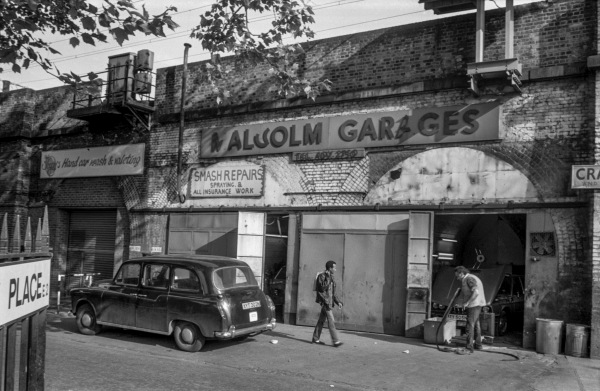
After developing the films I would as usual make contact sheets, but I would then mark these up with Indian ink in a Rotring pen (and small writing I now often need a loupe to read) with street names and map references. In later years the A-Z came with the National Grid superimposed and my contacts included grid references too.

Of course, nothing is perfect, and sometimes I got street names wrong, and my writing and abbreviations are not always legible. I’ve now put around 140 of the pictures from June 1986 into my Flickr album ‘1986 London Photographs‘, almost all of them with at least a street name to identify the location. It took a few days to make and retouch the digital files, and once I had done that, over a day’s work to confirm the locations where possible using Google Street View. Some areas of course changed completely between 1986 and the earliest information from Street View – usually 2008, making it impossible in a few cases to be completely sure of where images were taken.
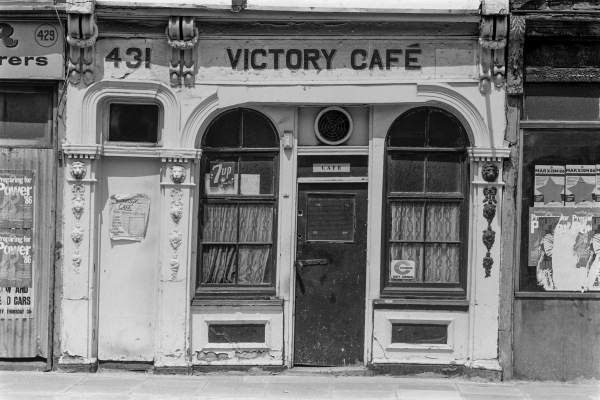
All of the images on Flickr have a longest side of 2400 pixels, four times the size of those in this post (- and landscape images only display at 75% unless you double click to open them.) Although I’m happy for people to share them and use them with proper attribution on personal blogs and non-commercial personal web sites, in student essays etc, they remain copyright, and a licence from me is required for any commercial or editorial use.

You can view the complete album 1986 London Photographs, but June’s pictures start here. Pictures for later in 1986 will follow shortly.
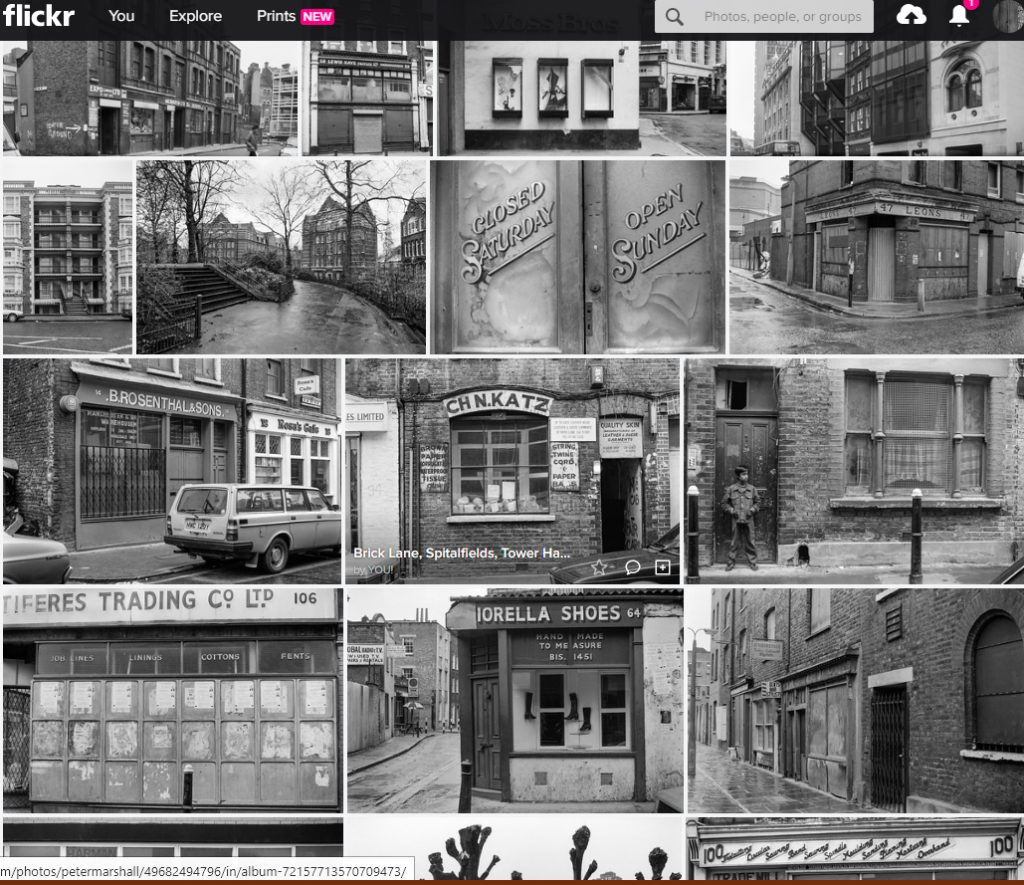

London 1986 on Flickr

I’ve just uploaded the first tranche of 112 of my black and white pictures from 1986 on to Flickr. These are some of the pictures I took in the first four months of the year.

In 1986 I made around 5500 exposures on black and white film, the great majority of them being photographs taken on the streets of London, concentrating on the fabric of the city – the buildings and shop fronts in particular. At the same time I was also taking colour film, with a greater focus on shops and window displays.

A few of those black and white exposures were taken outside London on holidays and visits to family and friends, and rather more on a project in the industrial areas beside the Thames in Kent from Dartford to Cliffe.

Most motifs were taken with a single frame, carefully thought out and executed much as if I was using a large format camera, rather than the 35mmm Olympus fitted with a shift lens which I used for most of these images. A few received a second exposure, perhaps to concentrate on detail or where I could see an alternative approach and even more rarely I became excited enough to take more.

The almost a thousand images which will eventually be in this album represent about a quarter or a third of this work – the images I now find more interesting. Some of the scans have minor technical problems that annoy me but are probably not apparent to most viewers. Most were made while I was learning to use a DSLR to photograph negatives.

Although I had been walking around London with a camera since 1973 it was really in 1986 that I made a serious start on photographing the city as a whole, much as I had previously concentrated on various areas of docklands. Photographically I was inspired by the work of Eugène Atget in Paris, recording the old city he saw disappearing, but also by the encyclopedic work of Pevsner and his co-workers in ‘The Buildings of England‘, the original series of which were published between 1951-74. These both inspired and infuriated me by their omissions and the sometimes crass judgements and in particular what seemed to be a disdain for the vernacular, the commercial and the industrial. I decided my own view would be more comprehensive and I would photograph any building I found significant or interesting as well as exemplars of the typical.

Later I would often go into the library at the National Building Record, then in Saville Row, and while waiting for my appointment pull one of their London files from the shelves and leaf through its contents. For most areas it was church after church after church, occasionally enlivened by some ancient house or stately home. Perhaps the odd old pub, but little else to reflect where the ordinary people of London lived, worked or shopped. A few of my images helped to widen their collection, much of the older work in which I was told was donated by Church of England clergy with time on their hands and the money to indulge in photography as a hobby.

I had of course set myself an impossible task, and I realised this from the start, but made it even more so by widening my view in later years to take in the whole of Greater London. I kept at work for almost 15 years, by which time I had covered most of those areas that particularly interested me. But it had also become clear to me that times had changed and in particular that technology was changing.

I had already made use of the web to put some of my work online – in my Buildings of London website first put online in 1996 (with later revisions but never brought up to date as I decided it was impossible to scale it up) and this continued with London’s Industrial Heritage in 1999. The images on these sites reflect the But by 2000 it was clear to me that the impact of digital photography would lead to the city becoming on-line as a whole in a new way that made the continuance of my project redundant.

Google brought this to fruition with the launch of Street View in 2007, though I think it only came to London in 2008. When you view an area on this now, you can probably see it as it was some time in the last year, but, if you are fortunate, can also go back to various other views taken as far back as 2008. But for those relatively few areas and buildings in my pictures you may be able to go back to 1986. Much of London has changed dramatically since then.

Richmond Ave, Islington 86-2d-42_2400

You can watch them here, but its better to go to Flickr and watch them at a larger size.


XR Westminster

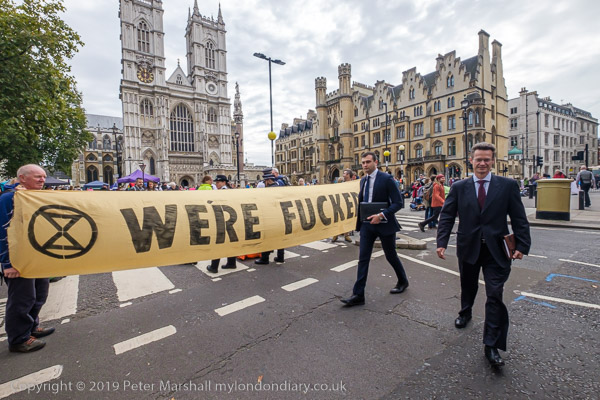
I don’t know who these two men were, striding purposefully with their document cases but I think they had emerged from a government ministry and they were probably making their way to another or possibly the Tory party HQ. It’s possibly quite unfair, but to me they seemed to epitomise the reason why we are in the situation we are in, a determination to carry on ‘business as usual‘ when it is quite clear that to survive we need drastic system change. We can’t trust men in suits.

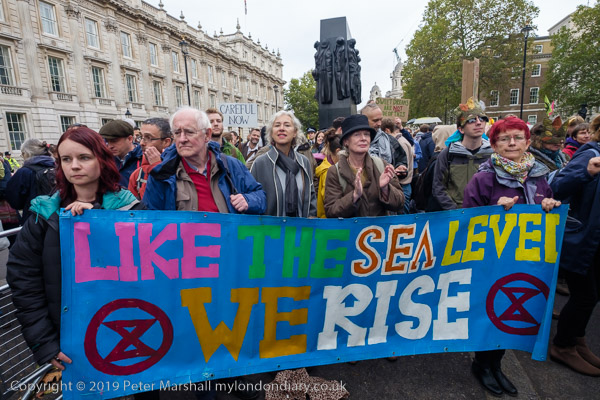
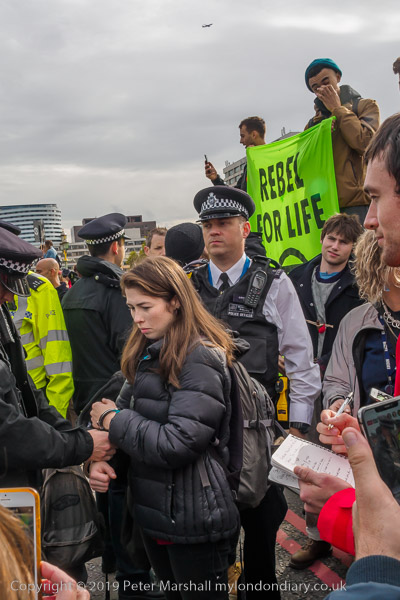
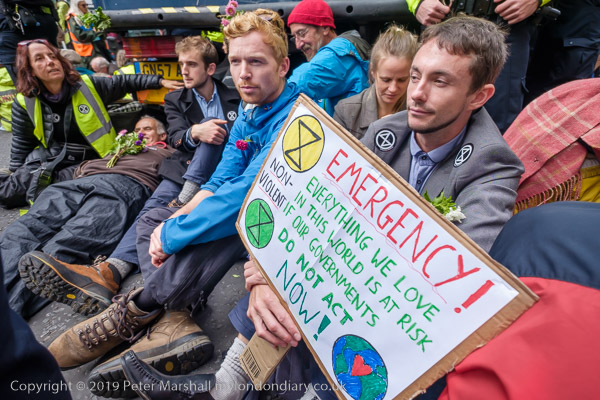
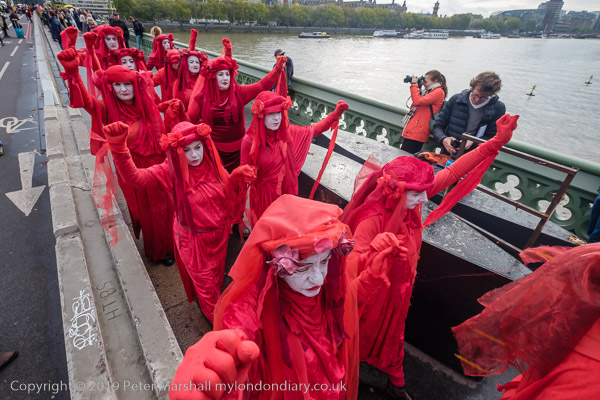
XR were protesting across Westminster, and it was hard to keep up with what was happening at I think eleven locations, but I did quite a lot of walking around and taking pictures, with a pretty total shutdown of all the roads in the area. Police made movement a little more difficult by setting up some road blocks of their own, which seemed totally pointless but made my job more difficult when they wouldn’t even let me walk across Lambeth Bridge although I showed my press card.

They seemed also to be making the very occasional and almost totally random arrests, picking on small groups or individuals when hundreds were blocking roads. It seemed a simply pique at being unable to control the situation of mass peaceful civil disobedience.

Although it was taking place in London, the XR protest was not a London protest, with the huge bulk of the protesters having come into the city from small towns across the country. XR has been very successful at motivating a largely white mainly middle class and highly educated population but rather less so with the urban working class, and there were far fewer from London’s ethnic communities than at most London protests, and who are well represented in movements such as the Youth Climate Strike and of course anti-racist and anti-fascist protests.

It will of course be the poor and those who have to struggle most to make a living in our cities who will be the first to suffer as the effects of global heating kick in, just as it is the countries of the majority world who are now feeling it most severely. But perhaps it is hard to persuade people who are living in precarious situations of the efficacy of the kind of apolitical and non-violent approach that appeals to XR supporters.
More at Extinction Rebellion occupy Westminster.


All photographs on this and my other sites, unless otherwise stated, are taken by and copyright of Peter Marshall, and are available for reproduction or can be bought as prints.

There are no adverts on this site and it receives no sponsorship, and I like to keep it that way. But it does take a considerable amount of my time and thought, and if you enjoy reading it, please share on social media.
And small donations via Paypal – perhaps the cost of a beer – would be appreciated.


Defending the Indefensible

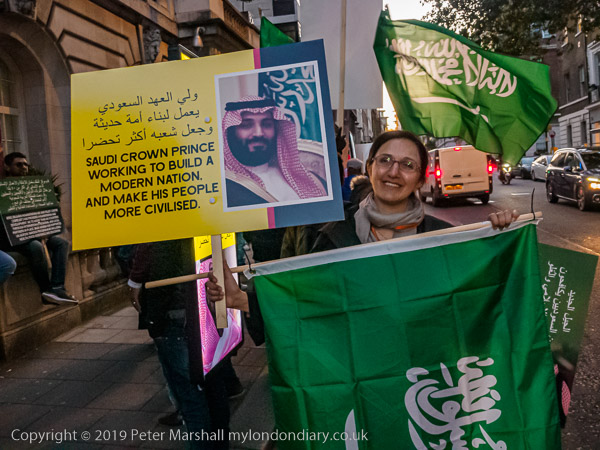
It just hadn’t occurred to me that there would be protesters defending Saudi Crown Prince Mohammed bin Salman bin Abdulaziz Al Saud, hereafter MbS, the man responsible for sending a team of assassins to kill and then dismember with bone saws the body of journalist Jamal Khashoggi in the Saudi consulate in Istanbul on October 2nd 2018.

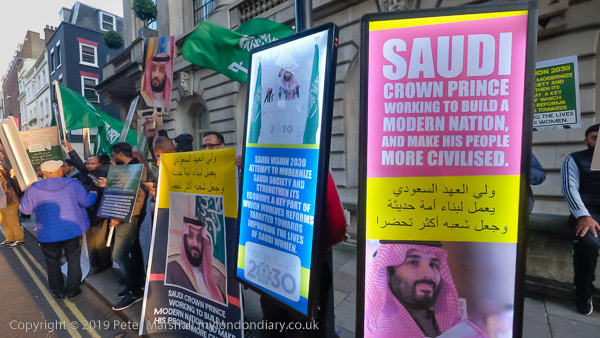
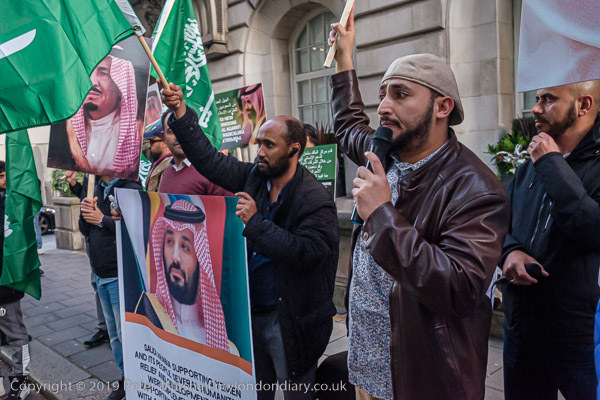
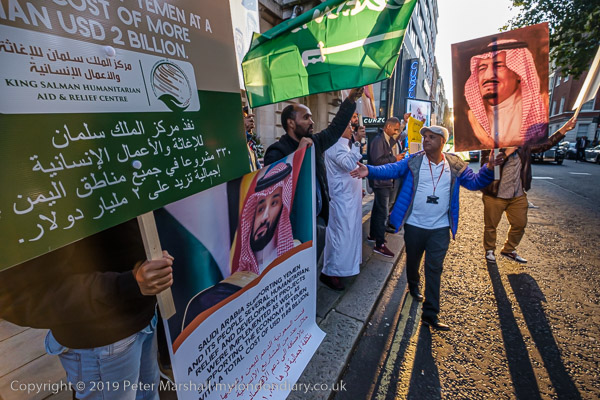
Of course their state-sponsored posters and placards – including two large electronic screens strapped to two men didn’t mention the killing, nor MbS’s other purges, including the 2017 arrest of business leaders and other prominent Saudi figures in what he called an anti-corruption campaign, the kidnapping of former Lebanese Prime Minister Saad Hariri in 2017 and more – including recent arrests of yet more leading Saudi figures who he sees as possible rivals.

So when I first walked up to their noisy protest I misunderstood their reason for being there. I couldn’t of course understand what they were shouting, and it was only after I read the posters that I realised they had come to support MbS and not to protest against a cruel dictator.

Of course some of them may have had good personal reasons for supporting MbS. Saudi businessmen operating in the UK may well be profiting from his economic reforms and support his Vision 2030 for a Saudi Arabia that in some respects will modernise, largely in the interests of business. Some of those taking part will be working for the Saudi government and companies such as Saudi Aramco, supposedly the most profitable company in the world, though this position is perhaps under threat by MbS’s current oil war with Russia. And some may have been paid for their evening’s work.

Certainly if you are a Saudi citizen and have any intention of returning to that country in the future, being seen as a supporter of MbS rather than an opponent will be vital for your health – as the brutal Khashoggi murder testifies. You need to be seen (and filmed) to be on the right side.


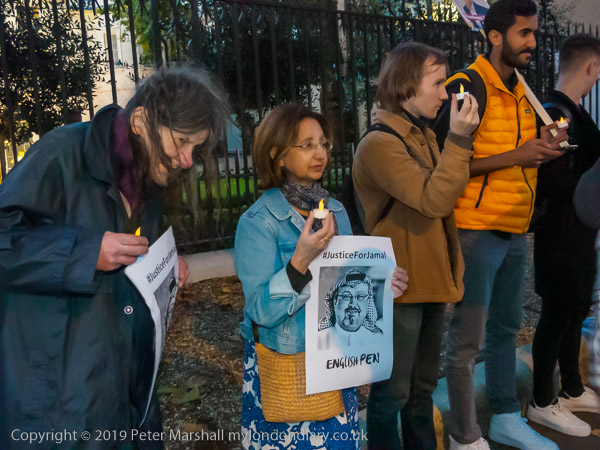
Justice for Jamal Khashoggi

On the anniversary of Khashoggi’s death, a small group of protesters on the opposite side of the road stood in a quiet line in front of the Embassy garden holding posters, and later burning nightlights, in a silent vigil for the cruelly murdered journalist. It was a small but dignified and rather more impressive display than the PR event taking place opposite.


More on both events:
Saudis support killer Prince MBS
Justice For Jamal Khashoggi


All photographs on this and my other sites, unless otherwise stated, are taken by and copyright of Peter Marshall, and are available for reproduction or can be bought as prints.

London October

I don’t go out a great deal at night now, and mainly its when I’m out with friends and taking few pictures. I like to be at home and sitting down to a good dinner and a glass or two of a decent red wine. I quite like eating out, but the food at home is usually better and the wine almost always so, even at prices for a bottle you might pay for a large glass in a restaurant.

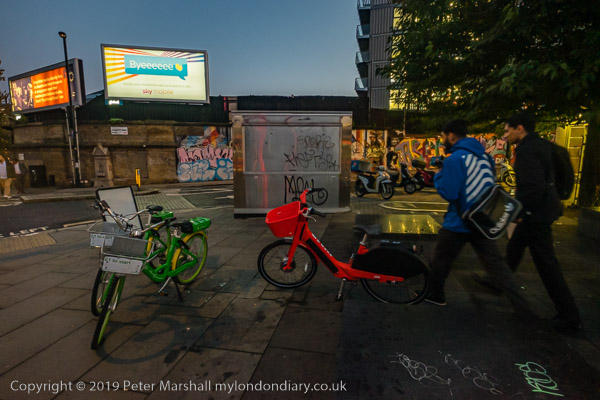
I’d hoped to be at home and at table by the time I left the protest in Chalk Farm. I left partly because there wasn’t a great deal going on, but mainly because the light had sunk to levels where working without flash had become more or less impossible and I was hungry. I don’t like winter and shorter days, but at least you don’t have to stay out so late if you want to take night pictures.

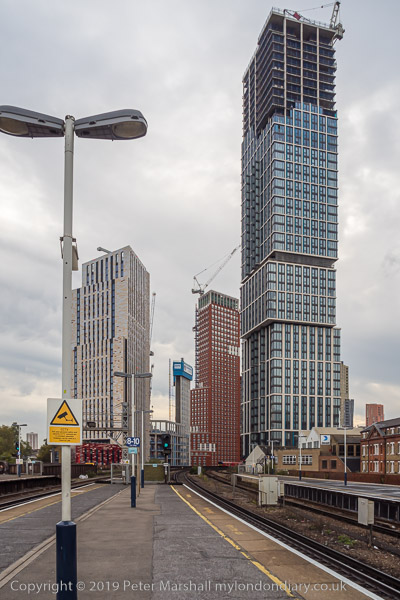
There is I think only one picture taken from the train as it goes through Vauxhall or Nine Elms in this month’s selection; perhaps the train windows were dirtier this month. But there are other pictures of the fast-changing area still under development, even the one above on Vauxhall Station itself. It gives a good idea of how vertical parts of the city are becoming.

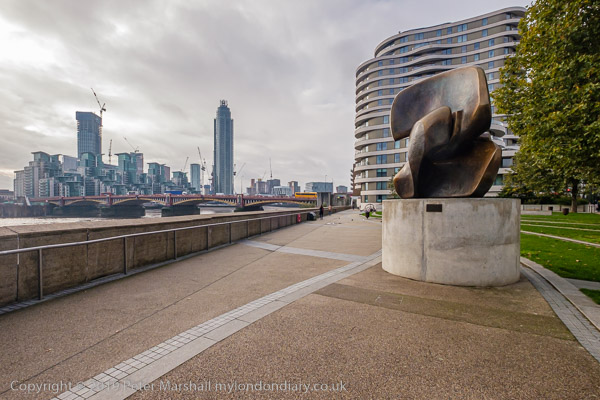
There are several of Vauxhall and Lambeth across the river, including one with this Henry Moore piece in the foreground. I think the only thing still visible from when I first walked this way is Vauxhall Bridge itself, even the walkway and the river wall have been rebuilt.

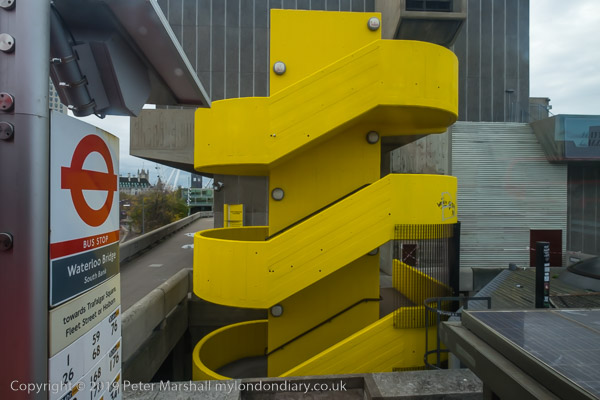
London’s buses give a unique viewpoint on the city, and there is no need to spend large sums on open-top private operators to enjoy it. London’s buses are cheap, and a travelcard gives you a day’s unlimited access, though pictures like that above will fall foul of TfL’s over-zealous legalistic protection of its copyright symbol. Were I making some commercial use of it rather than posting an image on a non-commercial blog there might be a case to answer.

Many more pictures, including some slightly different views of a few well-known landmarks as well as some of London’s more obscure streets, such at the one above.

London Images


All photographs on this and my other sites, unless otherwise stated, are taken by and copyright of Peter Marshall, and are available for reproduction or can be bought as prints.

There are no adverts on this site and it receives no sponsorship, and I like to keep it that way. But it does take a considerable amount of my time and thought, and if you enjoy reading it, please share on social media.
And small donations via Paypal – perhaps the cost of a beer – would be appreciated.

Students Strike for climate justice

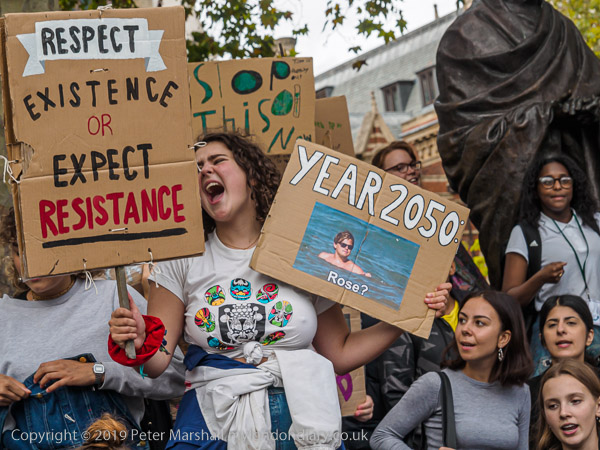
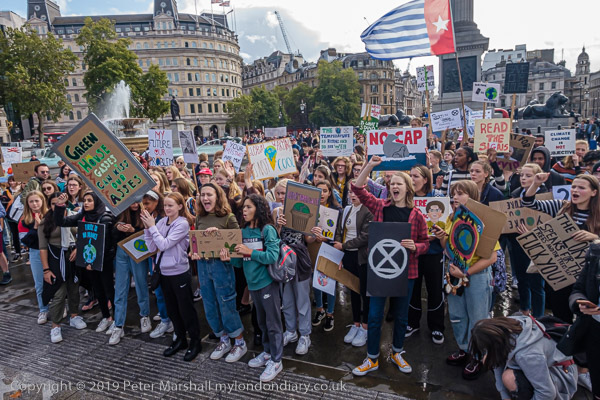
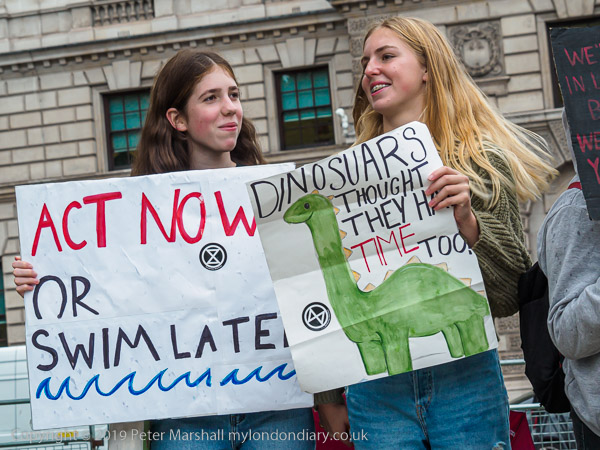
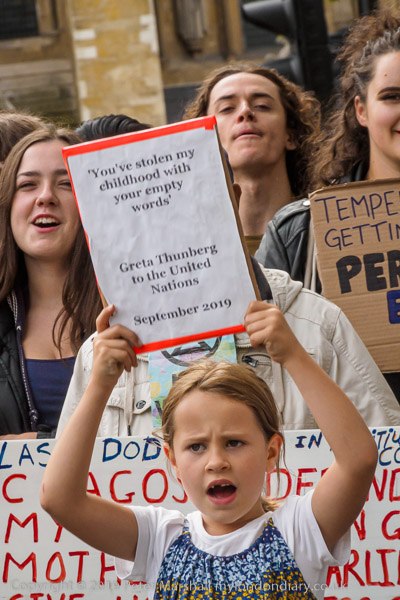
The young get it, and inspired by the actions of Greta Thunberg as well as the words of David Attenborough and the overwhemlming conclusions of scientists, school students around the world are coming out on the streets to demand yhat governments take the necessary action to decrease carbon dioxide emissions and act in accordance with the Paris Agreement and the IPCC report, though many recognise that even these are insufficient to deal with the problems we face.

Fridays for Future London started out as a small group, but now together with Youth Climate Strike and other groups there has been an impressive turnout for protests taking place during a Friday in school terms. Some came with parents or grandparents and there were a few other older protesters, but the great majority were with others from their schools and school classes.

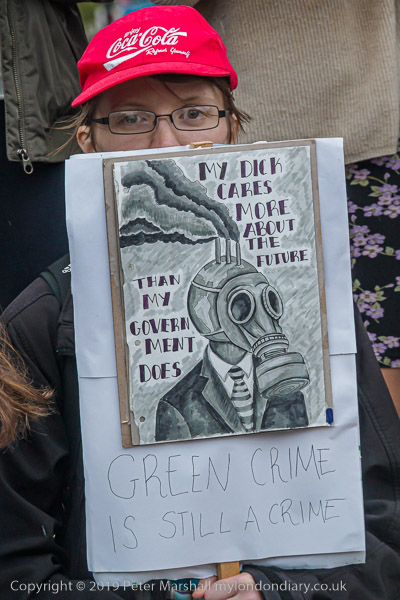
Notable by their almost complete absence were the mass-produced placards of so many protests, produced by left groups such as the Socialist Workers Party or Socialist Party. Clearly the climate catastrophe is now a major inspiration for the work of school art departments as well as many obviously home produced posters and placards.

The protesters are deadly serious about the existential crisis they face, with messages on some posters addressed to the older generations who run our country like ‘YOU will die from old age – WE will die from Climate Change’ but there are many more humorous though also deadly serious.

If the world was run by the youth it would have a future. But unfortunately it is largely run by the old and extremely rich. Billionaires who largely can’t see beyond their immediate short-term interests and are doing very well from business as usual. They’ll be OK in the short-term when the sea-level rises or we get more and more storms and floods, when millions (or even billions) die in the majority world and thousands in countries like ours.

Of course in the longer term even the filthy rich will suffer. They are huge hoggers of resources, particularly those made by the poor who mine the metals, grow the crops etc. The world doesn’t need the rich, but the rich do need the rest of the world to support them.

More pictures at Students Strike for climate justice.


All photographs on this and my other sites, unless otherwise stated, are taken by and copyright of Peter Marshall, and are available for reproduction or can be bought as prints.

There are no adverts on this site and it receives no sponsorship, and I like to keep it that way. But it does take a considerable amount of my time and thought, and if you enjoy reading it, please share on social media.
And small donations via Paypal – perhaps the cost of a beer – would be appreciated.


WeWork doesn’t pay

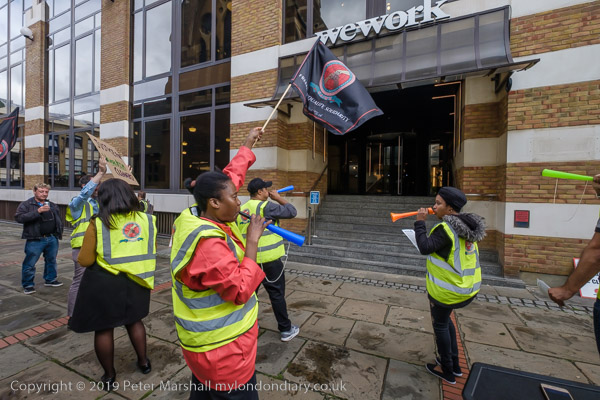
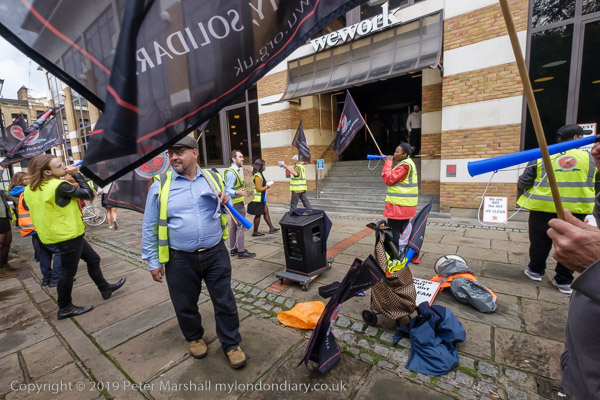
I’d never heard of WeWork before I received an Facebook post inviting me to photograph a protest outside one of their London premises in Shoreditch. The company began in 2010, has its HQ in New York and provides flexible working spaces for companies from 1 to 500 people, equipped, serviced and ready to move in. In London alone it has 49 locations providing shared facilities.

When we started WeWork in 2010, we wanted to build more than beautiful, shared office spaces. We wanted to build a community. A place you join as an individual, ‘me’, but where you become part of a greater ‘we’. A place where we’re redefining success measured by personal fulfillment, not just the bottom line. Community is our catalyst.

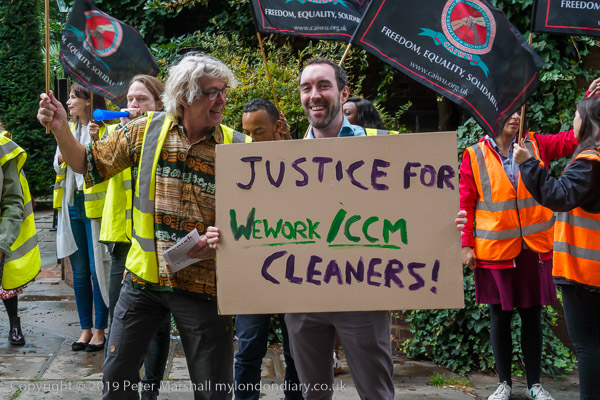
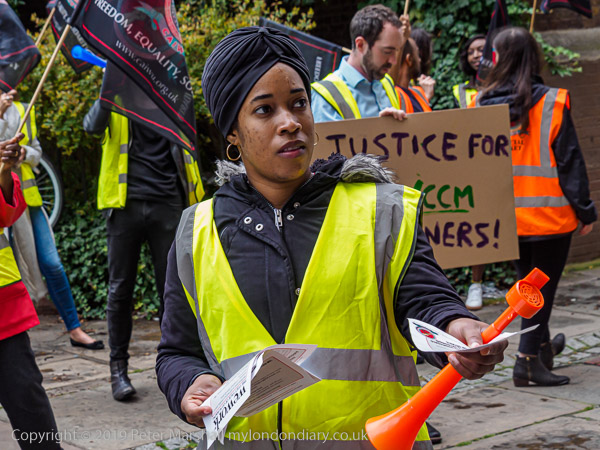
But community doesn’t extend to all that work there, and in particular not to the cleaners who keep these shared office and community spaces beautiful. WeWork outsource their cleaning to cleaning company CCM.

Outsourcing is always a bad deal for workers. The companies bid for contracts almost entirely on price, and they pare down prices by screwing the workers. Low pay, high workloads, the legal minimum terms and conditions and often a lack of equipment and concern over safety combined with bullying management enable outsourcing companies to keep costs to the bone and profits to the company owners.

Trade unions are anathema to such companies, and also to many US based firms, and grass roots unions such as CAIWU who manage the difficult job of unionising marginal and often immigrant workers find it hard to get basic rights for their members. Workers who stand up for their rights get victimised, and CAIWU were protesting here as five CAIWU members have been dismissed here in the past few months, with Wework staff members involved in getting CCM to dismiss them.

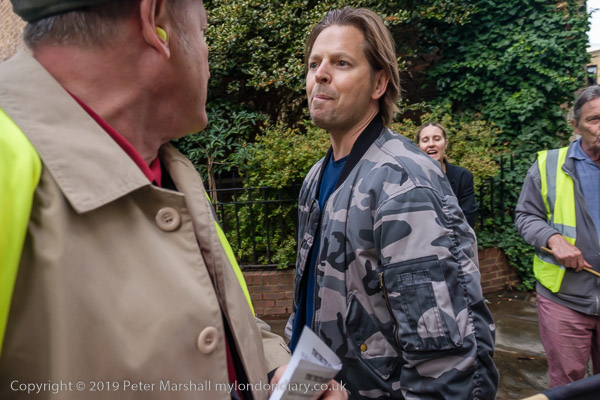
The loud protest outside the offices attracted a great deal of attention, with one local business owner coming to ask them to keep quiet and one man stopping to argue with the protesters, getting quite angry and pushing some of them. But these were the exceptions and many others read the fliers that the protesters were handing out and expressed support, including one team of workers who came out from the building and join the protest.

More at: Wework stop victimising cleaners


All photographs on this and my other sites, unless otherwise stated, are taken by and copyright of Peter Marshall, and are available for reproduction or can be bought as prints.


Old Street New Photos

I live just a couple of miles outside the Greater London boundary, two miles that cost me around £1500 a year in travel costs, though I might be saving a little in council tax. I live in the only area of what used to be Middlesex which wasn’t included in Greater London when the boundaries were established in the 1960s, though the town I live in is fairly typical of outer London. But the posh Tories down the road who ran the local council at the time rose up against becoming a part of the London Borough of Hounslow and opted the whole area to become part of Surrey with their wealthy chums across the river.

So while Londoners of my age got a Freedom Pass, now valid at all times on London Underground, London Overground, Bus, Tram, and Docklands Light Railway services in Greater London as well as rail services between 9.30am and 11.30pm, instead I got a national bus pass, giving free rides only on the buses. And where practicable my normal mode of travel around London is by bus.

When time is limited or bus journeys far to slow I do use the Underground (or Overground or Rail) to get around London and pay. And on days where the traffic is paralysed by large-scale protests or sporting events I’ll take the tube as well, either using a London-wide Travelcard or using a contactless card.

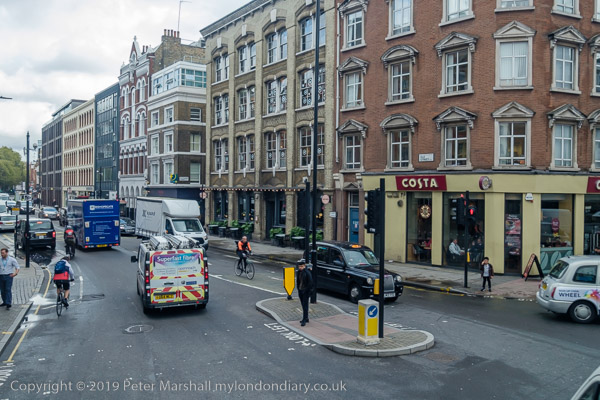
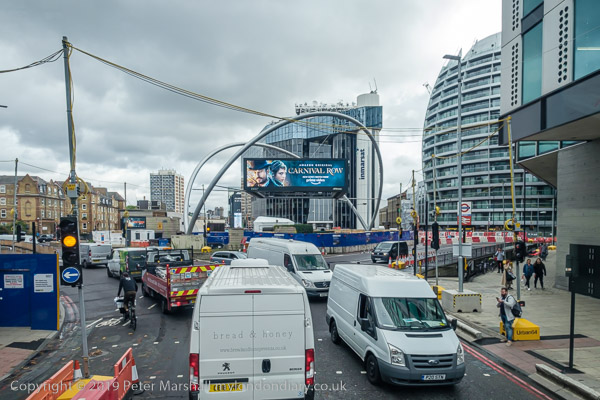
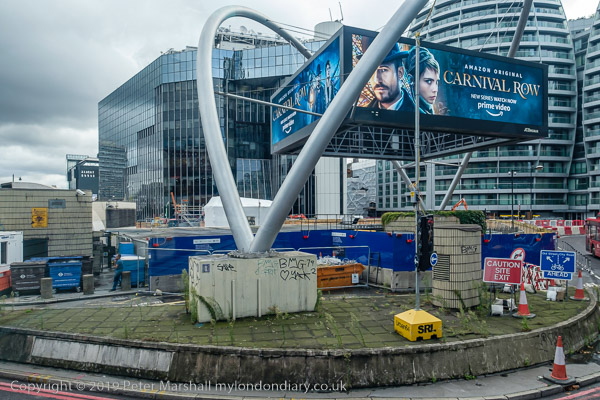
Other than cost, and for some journeys speed (though it can be quicker to use the bus or walk) there are some advantages to bus travel. Thanks to most London routes being served by double-deckers you are treated to some splendid views of the capital from viewpoints that would otherwise be impossible. It’s a poor man’s cherry-picker, and these pictures of the Old Street roundabout and some nearby locations show this well.

The Old Street roundabout was constructed at the height of brutalist architecture in the 60s, with some very odd concrete shapes at its core on top of Old Street Tube station, some underground shops and a public toilet in an area known as St Agnes Well. It’s an area I’ve often visited for convenience and travel, and sometimes for photography over the years.

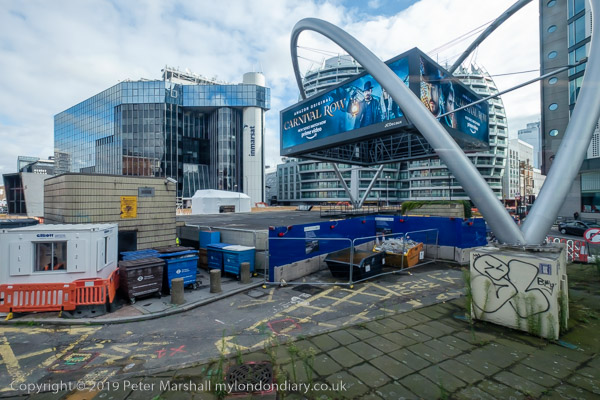
Work has been going on for some time to replace the roundabout by a smoother two-way traffic flow with improved cycling and pedestrian routes and a new public open space and is due for completion later this year. The area around the roundabout has also changed in recent years with new large blocks on the south side as well as a gigantic suspended advertising block. A cluster of software houses in some of these new buildings have led to a new name, Silicon Roundabout.

I was able to photograph from the bus going through the now ex-roundabout both west to east and in the reverse direction along Old St after photographing a protest not far away. And with various traffic lights and queues in operation the bus stopped several times at convenient locations for my pictures.

More pictures at Clerkenwell Road & Old St.


All photographs on this and my other sites, unless otherwise stated, are taken by and copyright of Peter Marshall, and are available for reproduction or can be bought as prints.

There are no adverts on this site and it receives no sponsorship, and I like to keep it that way. But it does take a considerable amount of my time and thought, and if you enjoy reading it, please share on social media.
And small donations via Paypal – perhaps the cost of a beer – would be appreciated.


South Circular Protest

London’s air quality is a disgrace with around 2 million people living in areas which have illegal levels of air pollution. Academic studies suggest that there are almost 10,000 premature deaths every year due to the high levels of pollution, and huge levels of pollution related illness.

I can just about remember hearing at the time about the 1952 Great Smog in London, when visibility went down to around a foot and traffic simply had to stop. It was thought to have killed around 12,000 people and the severity led to a Clean Air Act that outlawed coal fires in the city – and we had to switch to Coalite and coke. The smog wasn’t quite so dramatic on the outskirts of the city where we lived, but it was certainly unpleasant, and wrapping scarves around your face if you had to go out wasn’t very effective. And even inside the house, the air wasn’t quite clear.

The air looks much cleaner now, though I still get dirty shirt collars from trips into the city, but the dangers are there if invisible. High levels of nitrogen oxides and other gases, as well as particles too small to be visible. And there are local hot spots around major road junctions and busy roads, often creating up to five times the legal limit for air pollution in Central London and around major roads elsewhere. Road traffic is a major factor in these illegal levels which peak at certain times during the day, particularly during the rush hours. Another peak occurs not far from where I live, around Heathrow and any airport expansion would bring extra road traffic to add to this as well as the pollution from more aircraft.

Boris Johnson when London Mayor failed to take any effective action, but under Sadiq Khan there have been some reductions, with a change to hybrid diesel-electric buses, regulations for new taxis to be electric and the setting up of Ultra-Low Emission Zones, currently covering the inner-city congestion zone, but withe a Low Emission Zone for heavy goods vehicles extending to a wider area of Greater London later this year.

The effects of air pollution and particularly bad for the elderly and those with pre-existing lung conditions who largely make up those who die prematurely, but also for children whose lungs and other organs are still growing and are stunted by pollution, with up to 10% lower capacity than those who live in cleaner air. Many primary and secondary schools in London are in areas with high pollution.

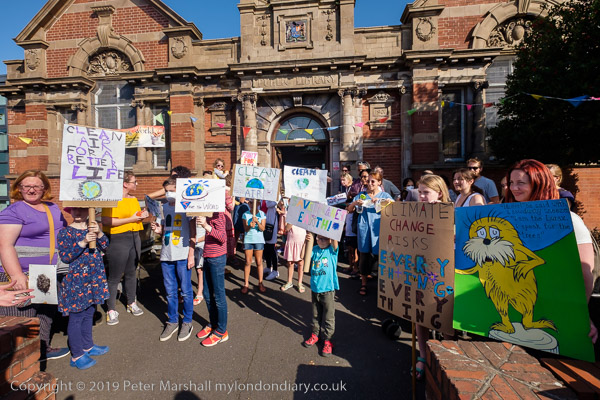
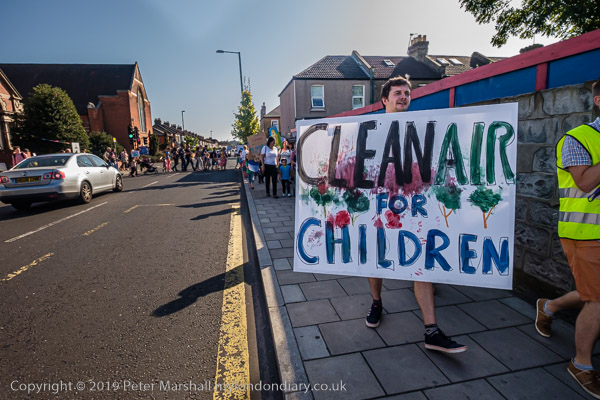
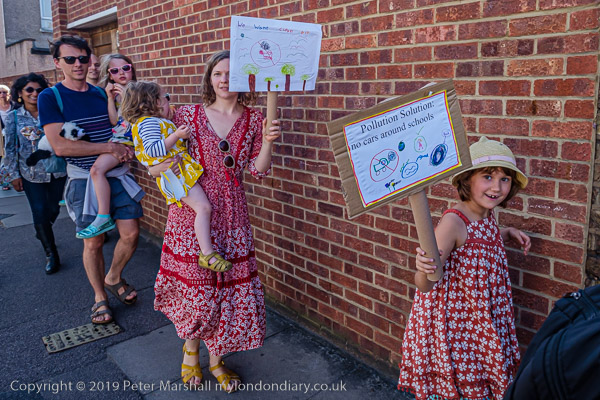
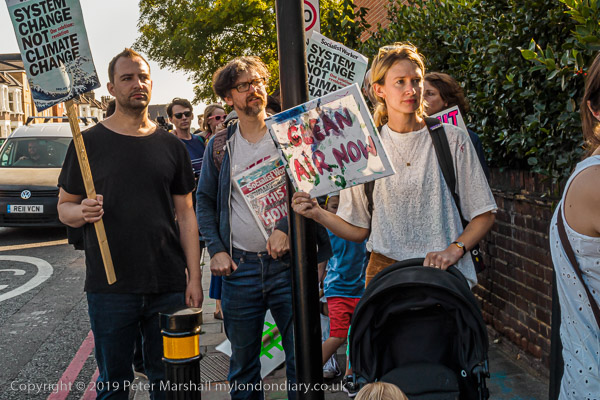
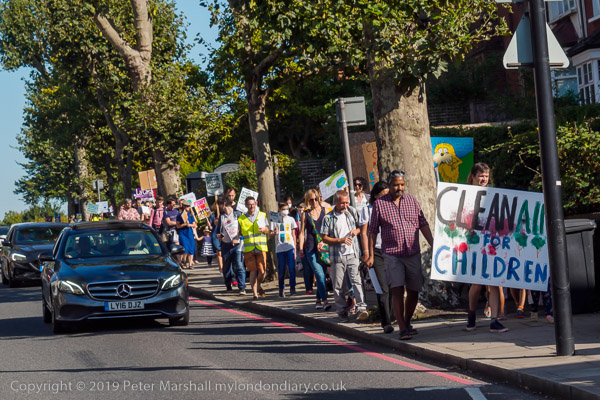
Parents in Catford in South East London whose children live and go to schools close to the South Circular Road are concerned for the health of their children and organised a march and rally calling on Lewisham Council to take bolder and faster action to reduce air pollution, particularly around schools.  Although Lewisham isn’t responsible for the high traffic levels on the route there are remedial measures that can reduce local levels of pollutants such as planting screens of trees and hedges which can drastically reduce the levels of minute particles in particular. Putting barriers on some roads near schools to prevent through traffic would also help. Better cycling provision and bus services can also help to reduce traffic and thus pollution.

More at Clean Air for Catford Children.


All photographs on this and my other sites, unless otherwise stated, are taken by and copyright of Peter Marshall, and are available for reproduction or can be bought as prints.

There are no adverts on this site and it receives no sponsorship, and I like to keep it that way. But it does take a considerable amount of my time and thought, and if you enjoy reading it, please share on social media.
And small donations via Paypal – perhaps the cost of a beer – would be appreciated.


London’s longest running protest

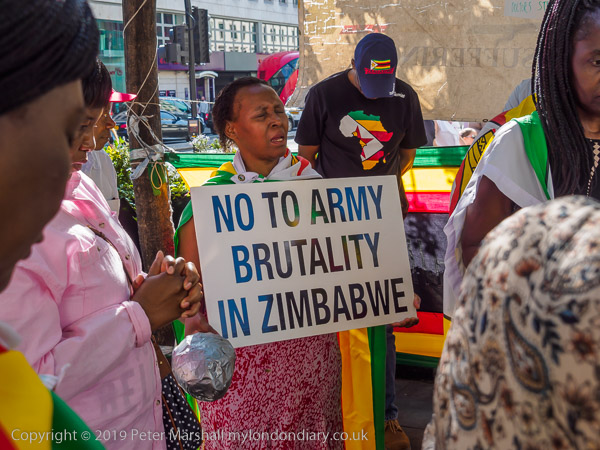
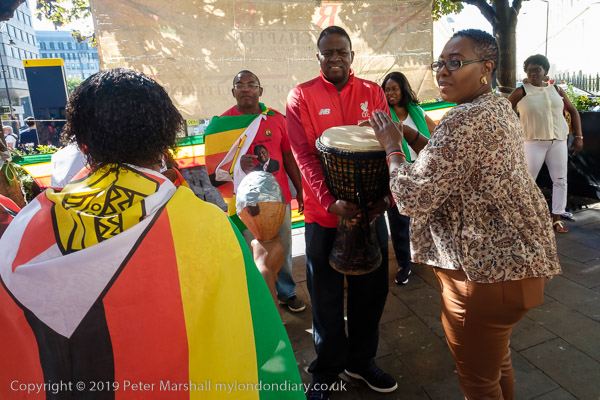
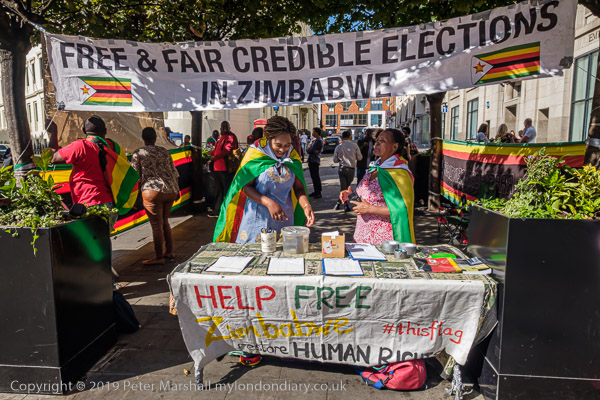
The weekly vigil outside the Zimbabwe Embassy at 429 Strand has been taking place since 12th October 2002, and I’ve occasionally visited it and usually taken photographs, including on its 15th anniversary in 2017. But with long-running events such as this it’s always difficult to find a reason to make it news and to provide something visually different.

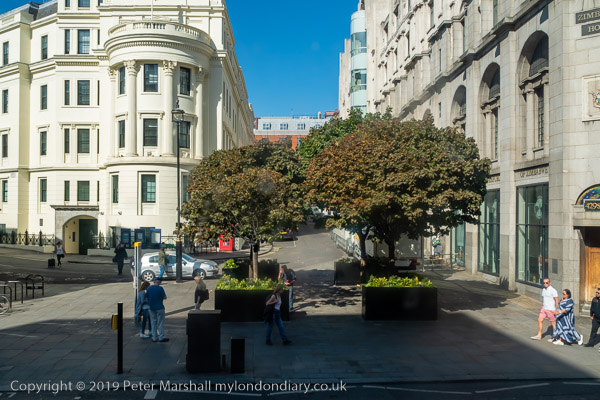
I’d been reminded of it as the bus I was on earlier in the day passed the area in which it is held, a small square of flower beds and trees on a wide pavement, quite unlike anywhere else I can think of in London, with the embassy at its right, and after photographing a protest in Trafalgar Square it was only a few yards out of my way to Charing Cross Station where I was to catch a train to cover another event, so I went to take a few more pictures.

What gave the event a little more news interest was the death of former President Mugabe two weeks earlier at the age of 95. There had been some hope that his removal from office in November 2017 would lead to reforms – and his successor Emmerson Mnangagwa promised them.

But Mnangagwa had been Mugabe’s right-hand man for 40 years, and stands accused of the genocide of over 20,000 Ndebeles in the 1980s. Despite his promises, he has delivered state terrorism and protesters have been killed, beaten, tortured and raped by the security forces.

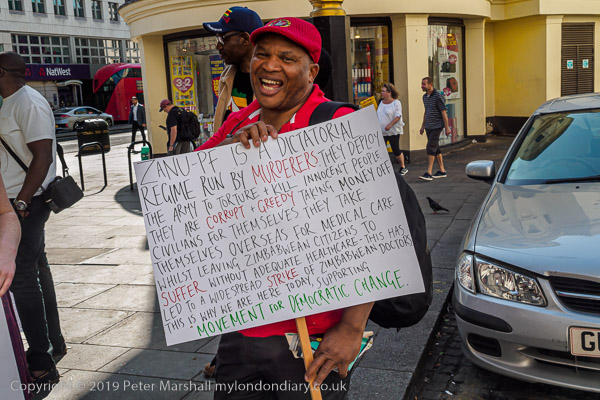
One man held up a placard with a long indictment of the ruling ZANU-PF party, “a dictatorial regime run by murderers“. It goes on to say they “are corrupt and greedy,” and that while they go overseas for medical care they leave “Zimabawean citizens to suffer without adequate healthcare – this has led to a widespread strike of Zimbabwean doctors. This is why we are here today, supporting Movement for Democratic Change“.

I couldn’t stay long or I would have missed by train, You can see a few more pictures at Zimbabwe protests continue.


All photographs on this and my other sites, unless otherwise stated, are taken by and copyright of Peter Marshall, and are available for reproduction or can be bought as prints.