Demand a New Normal

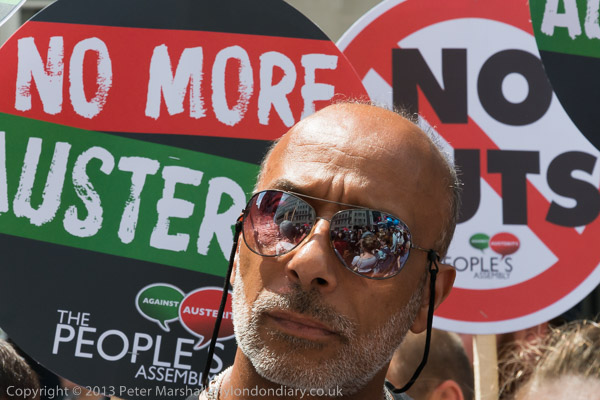
This Saturday, 26 June 2021 at noon people will assemble on Portland Place, London, outside the BBC for The People’s Assembly Against Austerity national demonstration, marching from there to a rally in Parliament Square.
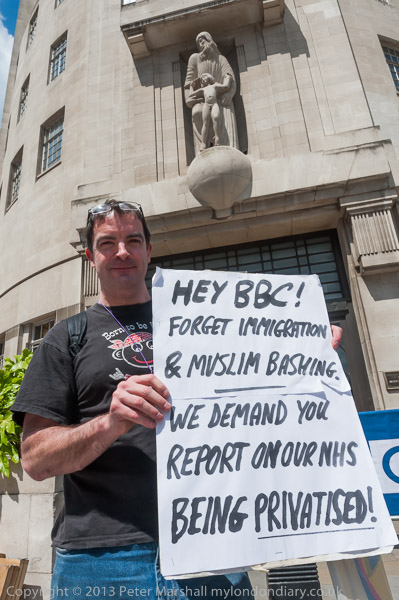
I hope to be there and taking photographs, though I’ve been a little unwell for the last few weeks and may still have to take things easy – which isn’t how I take pictures.
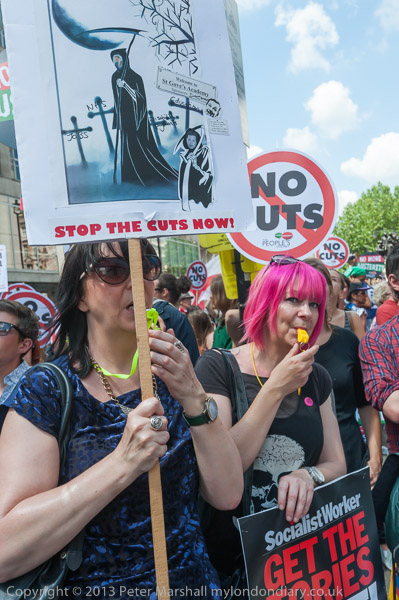
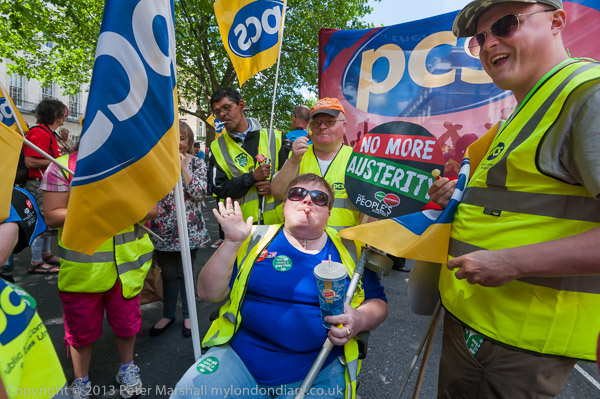
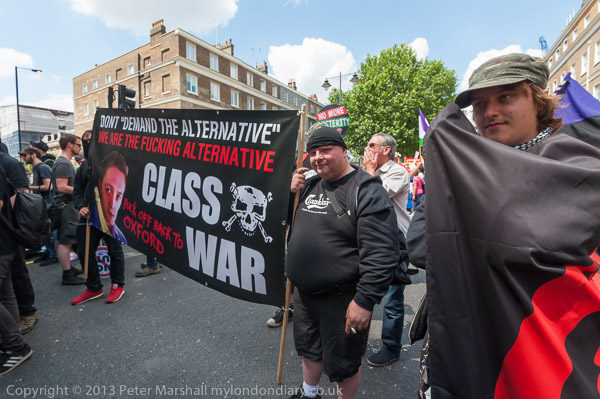
The pictures with this post are from The People’s Assembly national march 7 years ago on Saturday 21 June 2014, when tens of thousands marched from a rally at the BBC to another in Parliament Square. Speakers then included John McDonnell, Jeremy Corbyn, Dianne Abbot, Carolyn Lucas, Len McCluskey, Matt Wrack and other leading figures – and you can find pictures of almost all of them on My London Diary – though I couldn’t be bothered to wait for Russell Brand who came an hour late.
The event was planned to take place after the lifting of Covid restrictions which has has now been postponed. But protests are still legal, protected by Human Rights legislation which overrules Covid restrictions, though they must observe social distancing. So put on a mask and come and make your views clear.
This is what the People’s Assembly says about what is happening now:

This government has made it clear it wants working people to pay for the coronavirus crisis. Its pitiful offer to the nurses, the public sector pay freeze, lack of sick pay, while contracts are granted to their friends and cronies tells you that. Meanwhile there are further subsidies to companies while we are facing mass unemployment levels when furlough ends. Employers are going on the offensive, especially with notorious fire and rehire policies -but there has been widespread opposition to this including strike action.

There is visceral anger over the multitude of government failures during the pandemic, with one of the highest Covid death rates in the world. This government has failed us and this will be our first opportunity to take to the streets in opposition.

The Tories are also attempting to use the cover of the pandemic to sneak through the draconian ‘Police, Crime, Sentencing and Courts Bill’. Due to reach its final reading in June this bill is an affront to democracy, an assault on our rights to protest and an attempt to silence dissent & opposition to the government. The Tories want to take away our rights to demonstrate for our rights! We cannot let that happen.

https://www.facebook.com/events/1014040739128410/

The march invitation lists a dozen key demands of the protest:

  • Renationalise Key Services
  • Decent Housing For All
  • Sack The Corrupt Politicians
  • Properly Funded, Fully Publicly Owned NHS
  • End The Marketisation Of Education
  • Act Now! Tackle The Climate Emergency
  • Support International Justice
  • Safe Workplaces, Save Jobs
  • End Fire And Rehire
  • Fully Funded Social Care
  • End Institutional Racism
  • Kill The Police, Crime, Sentencing And Courts Bill

More from 2014:
People’s Assembly Rally
No more Austerity – demand the alternative


All photographs on this and my other sites, unless otherwise stated, are taken by and copyright of Peter Marshall, and are available for reproduction or can be bought as prints.
The Deep State?

Anyone who writes about “the Deep State” will surely be accused of being a conspiracy theorist, but if you start with Wikipedia’s description of “a type of governance made up of potentially secret and unauthorised networks of power operating independently of a state’s political leadership in pursuit of their own agenda and goals” it seems clear to me that many aspects of British life can only be understood in such terms. Of course I don’t mean illuminati or freemasons (though they may play some part); the networks and forces in this country are largely those often thought of as public servants, including the police, the civil service, the security services, along with the royal family, press and media barons and other major capitalists – and the City of London.

Many of their activities are also very public, though the agendas behind them usually carefully hidden. Some are authorised – such as the City of London Remembrancer, a lobbyist representing the City’s interests inside parliament and employing six lawyers to help influence government and members of parliament. Others brag openly about some of their acheivements – as in the 1992 General Election headline “It’s The Sun Wot Won It“.

Several official documents have made me think about the deep state in recent days. Perhaps most obviously is the report into the investigation of the 1987 axe murder of Daniel Morgan in the car park of the Golden Lion in Sydenham. I’ve not read the long report, but have been interested in the media coverage of it, which has centred on the accusation of “a form of institutional corruption” by the Metropolitan Police. It’s perhaps a new label for it, but it describes a culture of deliberate lying and misleading the public, feeding false information to the press, and protecting the team which has been so obvious in so many cases, notably that of a totally innocent Brazilian electrician who walked into a tube station and boarded a train on his way to work.

If you’ve relied on the mainstream press you are likely to have little idea of why Daniel Morgan was killed, and certainly know little or nothing of the involvement of the state, the press and others in the cover-up that followed. You can find out more by watching the DoubleDown News Video by Peter Jukes,
EXPOSED: Daniel Morgan Murder links Corrupt Cops & Murdoch Empire to the Heart of Government‘. It doesn’t give all the answers – and almost certainly the vital evidence related to the murder itself has long been destroyed – but it does make convincing links and raise much wider questions than the mainstream media.

A second fairly recent publication is into the Manchester Arena bombing, and as with most such reports it tells us what was already clear within days of the event about the failures of police and security – thanks to some good investigative journalism.

According to Wikipedia, Salman Abedi was born in Manchester to Libyan-born refugees given asylum here, as his father had been a member of the Libyan Islamic Fighting Group, a Salafi jihadist organisation proscribed by the United Nations. Salman Abedi returned to Libya with his father to fight to overthrow Muammar Gaddafi in 2011, and when the war ended following the death of Gaddafi, he returned to the UK while his parents remained in Libya. He returned to Libya with his brother Hashem in 2014, again fighting for an Islamist group. The two brothers were rescued from Tripoli and returned to the UK along with other British citizens when the Libyan Civil War erupted.

Various reports about the danger posed by Salman had been made to the authorities, but these appear to have been ignored. Possibly this was because of his earlier activities in 2011 and 2014 which seem likely to have been facilitated by our security services, perhaps as some have alleged, with government backing, particularly in the war against Gadaffi.

Finally I’d like to mention the failure after 4 years to take any effective action over the guilty parties behind the Grenfell Tower, some of whom are said to have spent millions on lawyers to help them evade justice. Slowly, tediously slowly we are hearing damning testimonies from a few of those responsible as Phase II of the inquiry continues, now in Week 41, with some of the Kensington & Chelsea Tenant Management Organisation giving evidence this week.

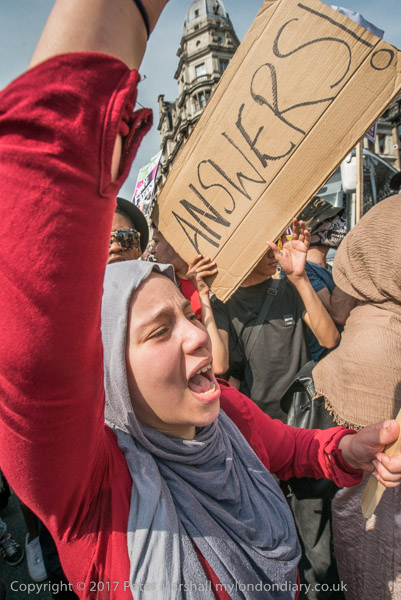
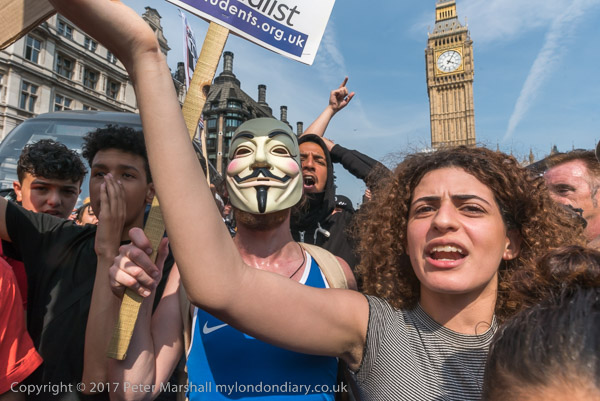
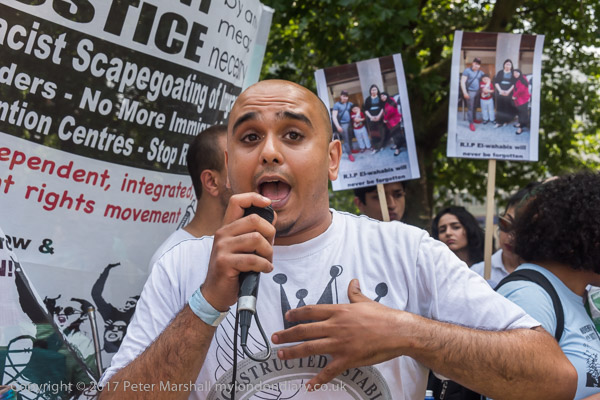
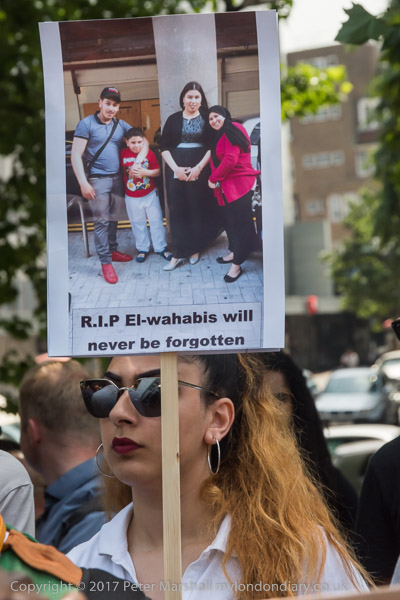
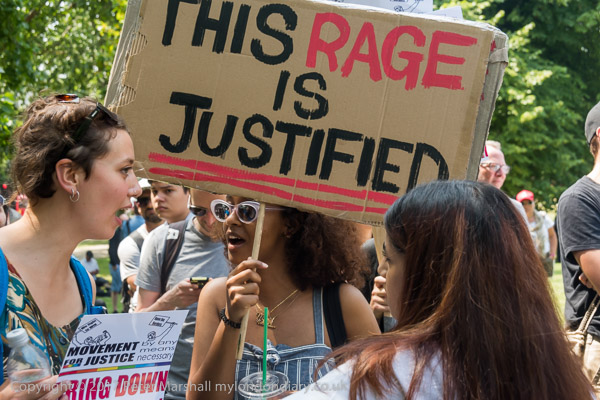
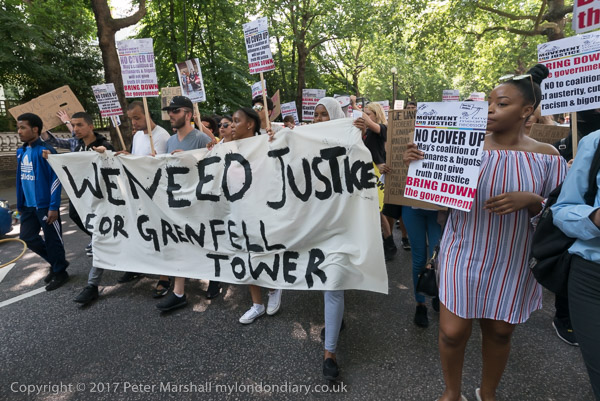
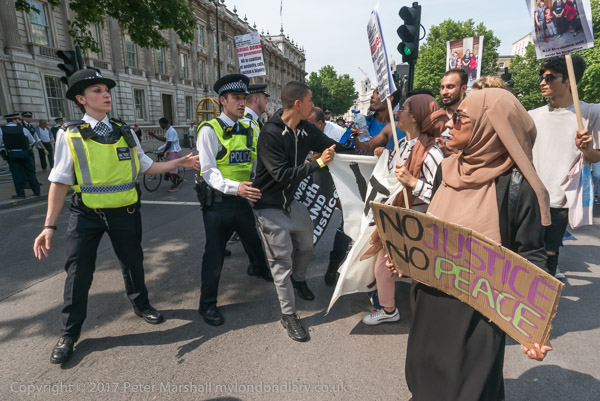
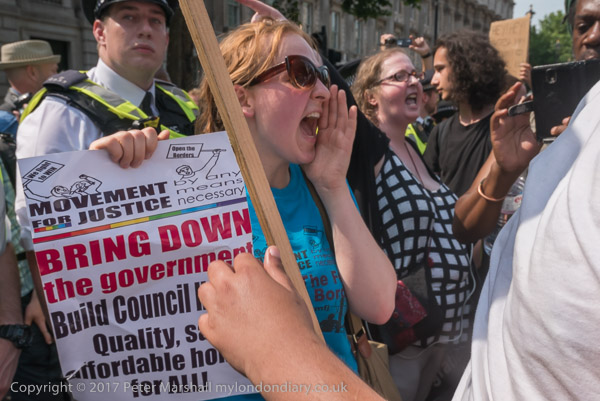
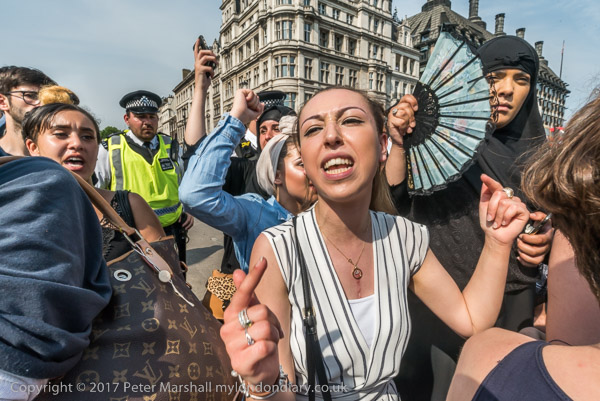
The pictures with this post come from the ‘Day of Rage’ march for Grenfell which took place seven days after the fire on 21st June 2017. The media had a field day over the title, with a fantasy extravaganza imagining violent insurrection, although it was organised by a group with a long history of peaceful protests, mainly over the UK’s iniquitous and illegal treatment of refugees and asylum seekers. And I think as usual police fed them some lurid lies.

At the time it was already clear that the fire was a result of the systemic failure to care about the provision of safe social housing; it wasn’t then clear exactly how many had been killed, as there were a number of Grenfell residents who were not recorded on any official lists.

The march was entirely peaceful – as journalists who knew anything about it had been sure it would be. It did briefly block traffic in Whitehall outside Downing St and went on to do the same for a short while in Parliament Square. I don’t think there were any reports of the actual event in mainstream media.

Four years later, the prospect of any prosecutions over the crimes that led to the fire still seems remote. But four years ago we knew who should be in the dock, and I wrote this comment back then:

People want answers, while Theresa May seems to be trying to focus just on one small technical matter of the nature of the cladding. But it is obvious that the cladding would burn and would spread fire – and for that reason there were regulations about where it could be used and how it had to be applied to be safe. But these regulations were not enforced. When they should have been tightened they were not. Inspections were privatised and there was no strict quality control. RKBC paid for a consultant to help them avoid proper fire inspections. Government ministers cut essential safety regulations as a matter of policty calling them ‘red tape’ , and failed to implement the recomendations made after earlier fires.. Structural modifications were approved for Grenfell that cut the number of exits from two to one. Gas supplies were improperly fitted to save costs. Fire doors were apparently removed, plastics which produce toxic cyanide fumes on burning are permitted…. No sprinkler systems, no water available to fight fires in the top floors and so on. Many of the faults that were a port of the disaster at Grenfell are common to many other high rise buildings, particularly those which are a part of our social housing stock.

More pictures: ‘Day of Rage’ march for Grenfell

One Law for All

Islam is now the UK’s second largest religion, with 2018 Office of National Statistics figures for Great Britain of 3,372,966, around 5.2% of the population, still considerably lower than the 36 million who declared themselves Christian in the 2011 census.

Along with the rise in numbers we have also seen a dramatic rise in Islamophobia, partly driven by the exploitation of the fear and hate against the terrorism of small groups of extremists here as well as in the US and France, and more recently by the rise of ISIS in Syria – where many of those who fought against and defeated ISIS there were also Muslims.

The ‘Prevent’ strategy introduced by the Labour Government after the London bombings as an aspect of counter-terrorism was essentially aimed at de-radicalising young Muslims through community-based programmes. It stigmatised the entire Muslim community – and did so at a time when extreme right-wing organisations were growing strongly and provoking racial tensions, and removed any real attention from their illegal behaviour – and the terrorist threat they posed.

The coalition government changed ‘Prevent’ radically. No longer was it concerned with attempts to promote integration though community programmes but shifted to a police-led system to indentify individuals who might be vulnerable to ‘radicalisation’ and to provide intervention packages for them. Unfortunately there seem to be no reliable indicators of such vulnerability.

The 2015 Counter-Terrorism and Security Act (CTSA) made it a legal duty for “teachers, doctors, social workers and others to monitor and report people they consider vulnerable to extremism, embedding discrimination in public services.” As https://www.libertyhumanrights.org.uk/fundamental/prevent/ Liberty point out, “The definition of extremism under Prevent is so wide that thousands of people are being swept up by it – including children engaging in innocuous conduct, people protesting climate change, and a nurse who began wearing a hijab.” They say the Prevent duty must be scrapped.

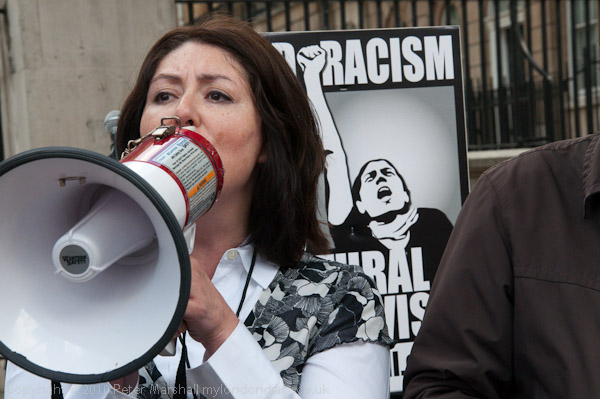
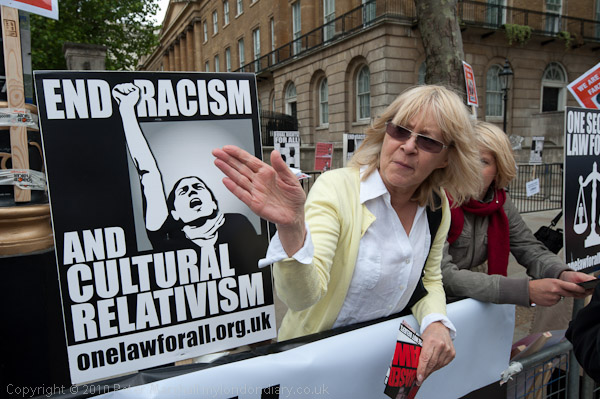
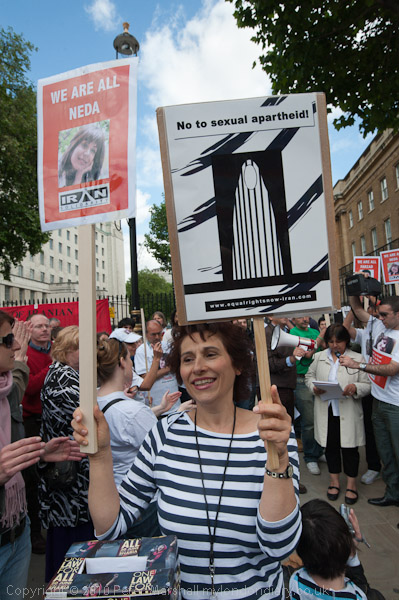
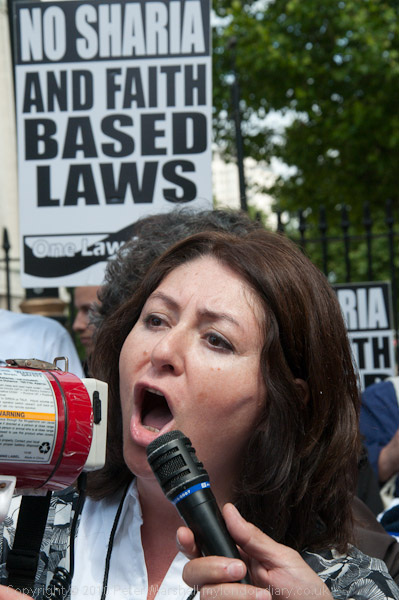
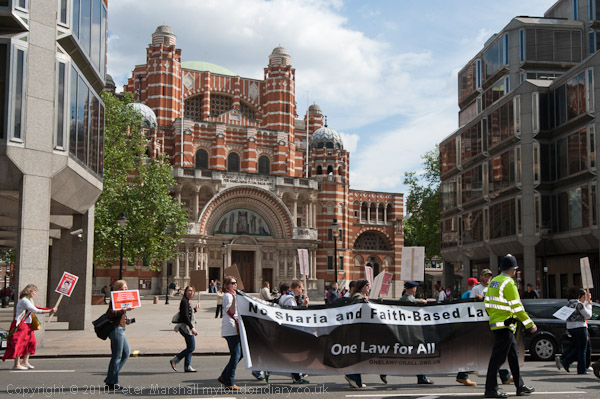
One Law for All, a campaigning organisation against religious based laws and in defence of equality and secularism, and in particular calling on the UK government to put an end to all Sharia courts and religious tribunals, and had organised a rally opposite Downing St om Sunday 20th June 2010.

Although the Church of England’s courts are now restricted to matters inside the church, courts based on Islamic Sharia Law and Jewish Beth Din courts still have official recognition as arbitration tribunals, particularly related to marriage. The Jewish courts work under the principle that “the law of the land is the law”, giving precedence to English law, but this is not always the case with Sharia courts.

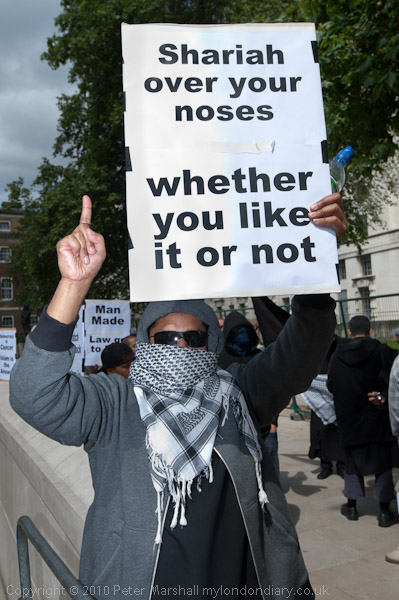
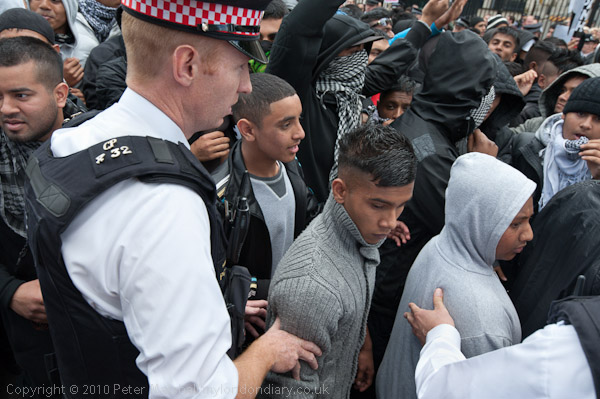
A small group of Muslims dressed in black with a very powerful public address system had come to oppose the One Law for All protest. The claimed to be ‘Muslims Against the Crusades’ or ‘Muslims Against Crusaders’, a group widely thought to be a reincarnation of the banned ‘Islam4UK’ (itself a relaunch of the banned Al-Muhajiroun.)

Maryam Namazie of One Law for All made clear they were not anti-Muslim:

“The battle against Sharia law is a battle against Islamism not Muslims, immigrants and people living under Sharia law here or elsewhere. So it is very apt for the Islamists to hold a counter-demonstration against our rally. This is where the real battleground lies. Anyone wanting to defend universal rights, secularism and a life worthy of the 21st century must join us now in order to push back the Islamists as well as fringe far Right groups like the English Defence League and the British National Party that aims to scapegoat and blame many of our citizens for Islamism.”

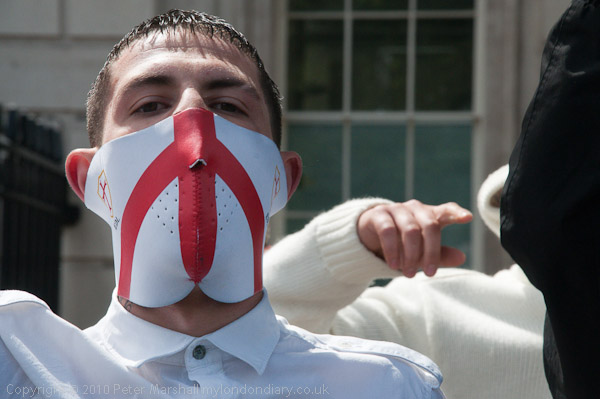
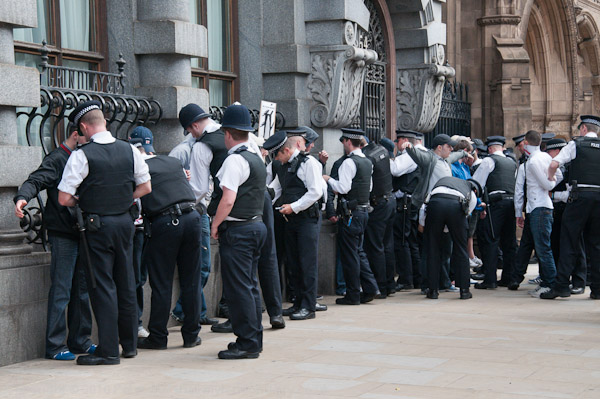
And around 20 members of that fringe right-wing group the EDL were there to protest against the Muslims.

After a while police took them to one side and searched them, threatening me with arrest when I went to take pictures, before leading them away.

Half an hour later several hundred young British Asians arrived from a rally in Whitechapel against the EDL – but they were too late to confront them as the EDL had already been removed by police.

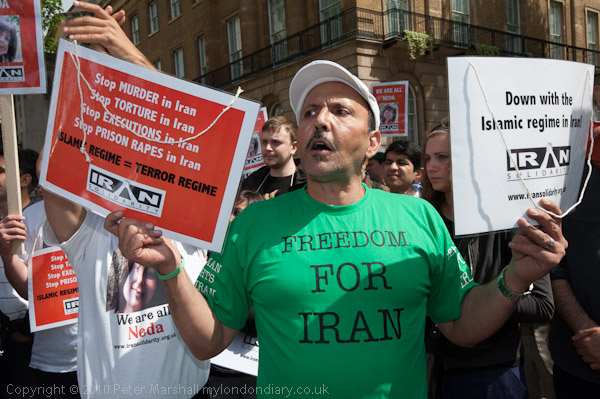
Soon the One Law for All rally ended and they marched off towards the Iranian Embassy in Kensington. I walked with them to Victoria and then went home.

UAF Arrive to Oppose EDL
EDL Oppose Muslims Against Crusades
Muslim Crusaders For Sharia
No Sharia – One Law For All

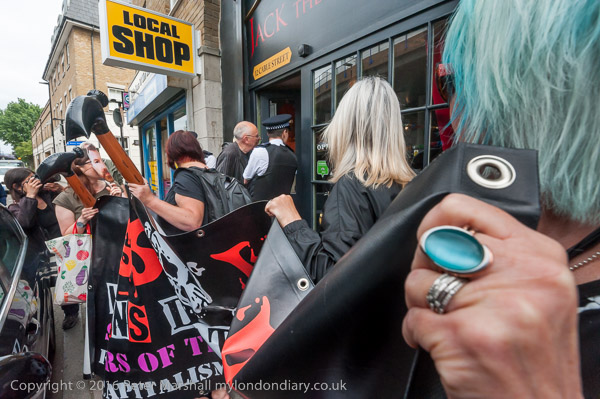
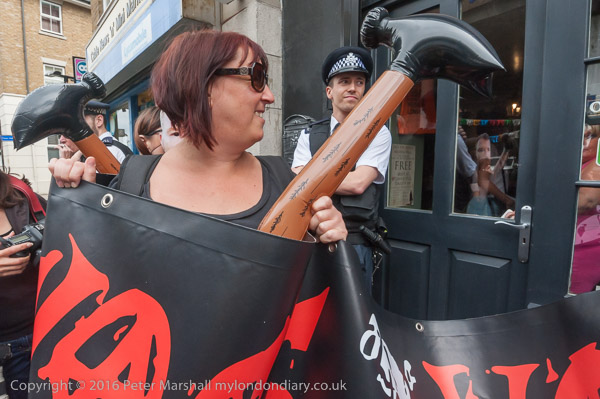
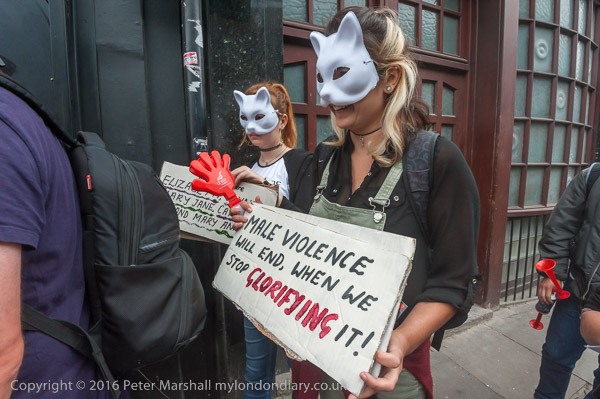
Jack the Ripoff

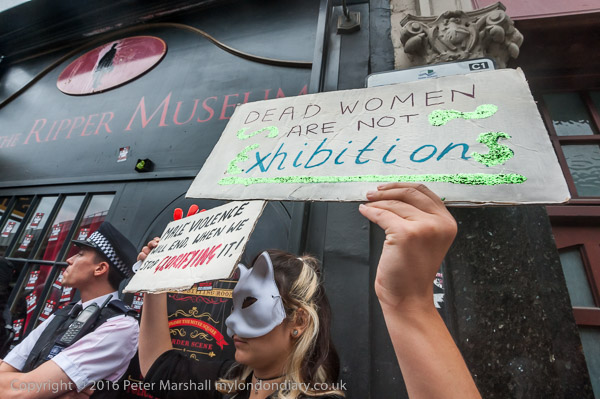
Tower Hamlets council were pleased to apporpve a planning application in 2014 to convert an empty Victorian building in Cable St into a ‘Museum of Women’s History’, particularly since Whitechapel’s Women’s Library had closed the previous year. Owner Mark Palmer-Edgecumbe’s application featured pictures of suffragettes and trade union campaigners and promised the museum would be “the only dedicated resource in the East End to women’s history” and “recognise and celebrate the women of the East End who have shaped history, telling the story of how they have been instrumental in changing society. It will analyse the social, political and domestic experience from the Victorian period to the present day.” (Quoted in Wikipedia.)

On the basis of these promises the architects were persuaded to carry out the work for a lower than normal fee, and various others provided consultancy services at no cost. All, including the council, where shocked and felt duped when the covers were removed from the site in 2015 to reveal instead a ‘Jack the Ripper’ museum glorifying the unknown murderer of a number of working class women in the East End in 1888.

There were various protests organised outside the museum including some backed by the Mayor of Tower Hamlets, who found his council unable to take any real action over the deception, various women’s groups and Class War. Finally the local council did refuse retrospective planning permission for the shop front and ordered changes to the shop’s signage and the removal of a metal roller shutter installed after a window was broken during protests in 2015. The shop owner appealed against the decision and lost. The projecting sign was removed at some time in 2017-8 but I think the shop has failed to comply with some other aspects.

On Sunday 19 June 2016 Class War and supporters including London Fourth Wave Feminists in cat masks, protested outside with toy plastic hammers offering to take down the shutter which had been declared illegal.

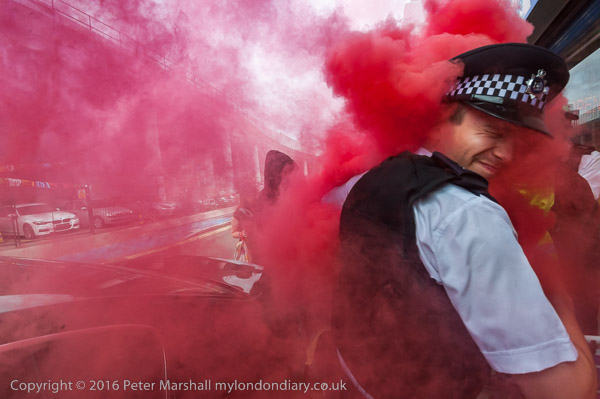
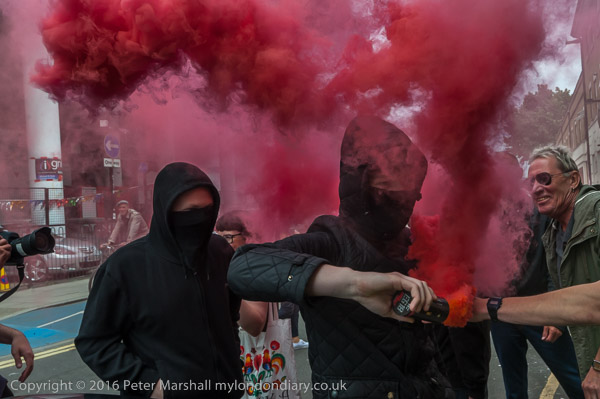
Police guarded the shop and prevented the protesters going inside but seemed generally fairly relaxed about the protest, with at least one making clear his distaste for the tacky tourist attraction they were having to protect. At one point they and the protesters were engulfed in red smoke after a couple of black-clad men arrived to join the protest, quickly fading away as the smoke cleared, with the protest then continuing in good spirits.

The good news is that the shop was put up for sale in April 2021 and is expected to close and take on some new use once sold. I’m not aware of any plans for its use and it will quite likely end up as some kind of offices, but it would be rather more satisfactory if it were bought and actually opened as a ‘Museum of Women’s History’. As I write it appears to still be unsold.

Rip Down the Ripper Facade!


All photographs on this and my other sites, unless otherwise stated, are taken by and copyright of Peter Marshall, and are available for reproduction or can be bought as prints.

Central Hill and more

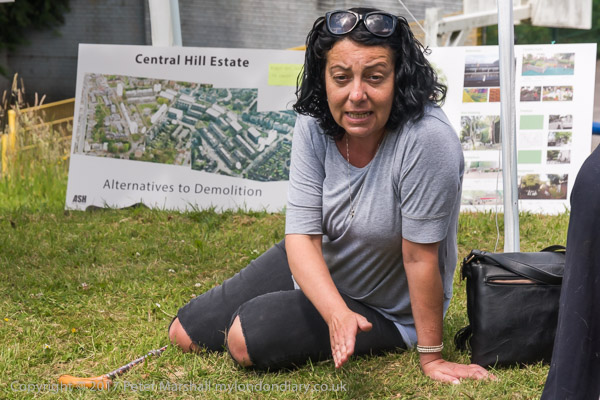
One of the original tenants comes to talk with me She tells me she dreads having to move

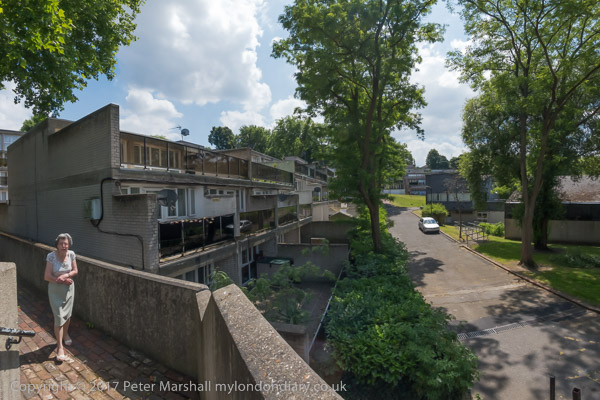
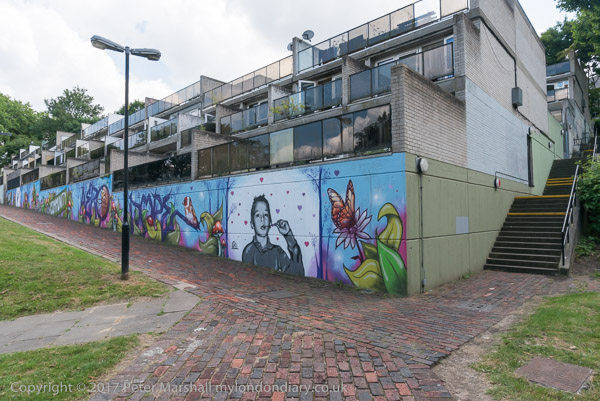
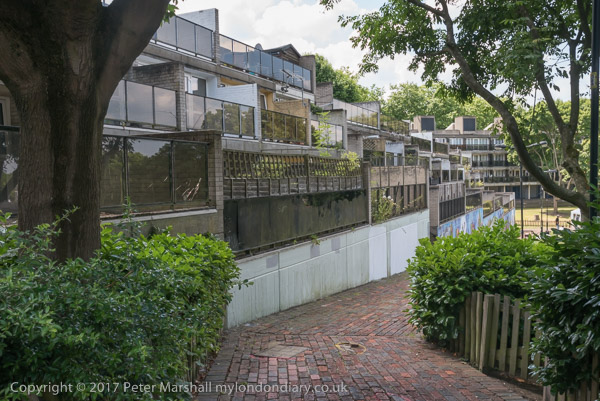
I began work on Sunday 18th June 2017 on the Central Hill Estate at the south-east tip of Lambeth, built on a hill with splendid views towards central London. Across the road (also Central Hill) at the top is Norwood in LB Croydon, a few yards down from the estate takes you in to the LB of Southwark, while 5 minutes walk east brings you to Crystal Palace in the LB of Bromley.

As Ted Knight, the leader of Lambeth Council from 1978 until disqualified for refusing to cap rates in 1985 and demonised by the press as ‘Red Ted’, told us later in the morning when he came to express his support, the estate was designed and built in 1967-74 when Labour believed that “nothing was too good for the working people” and the estate was built to high specifications and is still in sound condition. Borough Architect Ted Hollamby had earlier brought in Rosemary Stjernstedt from the LCC where she was their first senior woman architect, and she was the team leader, working with structural engineer Ted Happold from Arup & Partners and architect Roger Westman.

The scheme was seen from the start as a living community, and included a burses’s hostel, a day card centre and a doctor’s surgery as well as a small row of shops, a club centre and community hall. It also had a district heating system, though this is no longer in use. The plans made great use of the sloping site and the estate is certainly one of the finest of that era. It has remained a popular estate, with relatively low crime rates, and quite a few of the original residents still live there and wish to stay.

It’s an estate that clearly should be listed, but Historic England decided not to do so in 2016, probably under pressure from politicians, particularly because of the scale of the site and the very attractive possibilities it presents for developers. The Twentieth Century Society were dismayed that their application was dismissed – and you can read their application on-line.

In 2017 Lambeth decided to completely demolish the estate and develop it with an extra 400 homes, roughly doubling the size, most of which will be for private sale. Many residents objected and Architects for Social Housing have developed alternative plans showing how the extra capacity could be achieved at lower cost retaining the existing housing and the main features of the estate.

Nicola Curtis, one of the elected representatives the council refuses to talk with

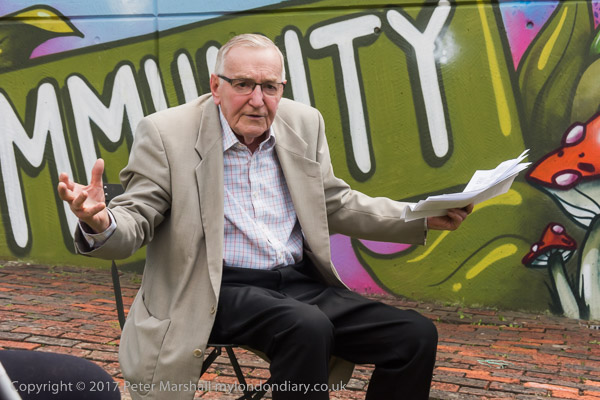
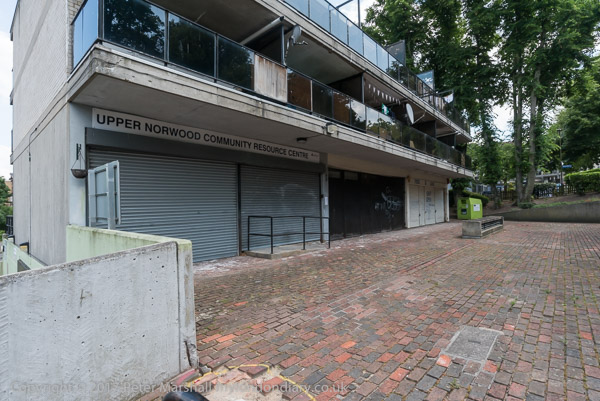
The council seem to have little concern for the current residents of the estate or their wishes. They have been banned from using the community resource centre on the estate, which was locked. A large mural was painted with council agreement on one of the walls in the estate – but the council then insisted that they remove the name ‘Central Hill’ from it. The council refused to talk with the two representatives of the residents elected to the Resident Engagement Panel. Normal maintenance of the paths and other aspects of the estate appears to have been stopped, and I found examples of very shoddy work by the council on the estate.


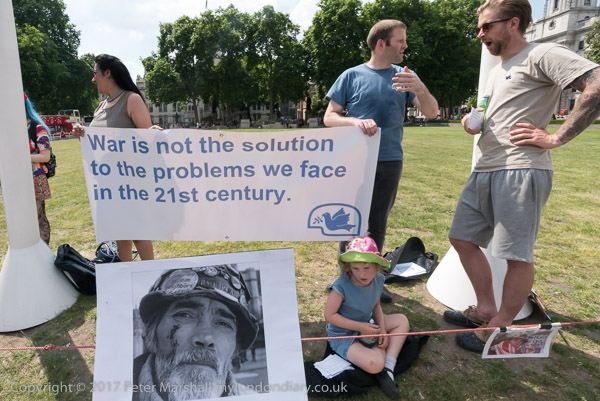
I took the train back into central London and to Parliament Square, wherre Veterans for Peace had organised a remembrace of Brian Haw on the 6th anniversary of his death. They held a small banner with the message ‘War is is not the solution to the problems we face in the 21st century’

Brian Haw began his camp here on 2 June 2001, and remained in place despite many attempts, legal and otherwise to remove him for almost 10 years, leaving only when arrested, for court appearances and to speak at protests at Trafalgar Square and Downing St until 1 January 2011 when he left England to receive treatment for his lung cancer in Berlin. He died in Germany in the early hours of 18 June 2011.

His ten years of protest and the frequent and repeated harassment undoubtedly hastened his decline and death. His protest in Parliament square was continued by Barbara Tucker who had joined him in 2005 and had been imprisoned twice for her role in the protest and arrested 48 times. The level of harassment increased and she went on hunger strike on 31st December 2012. Late in January 2013 she was taken into hospital close to death, and was treated for frostbite and exposure. Her protests continued on-line.

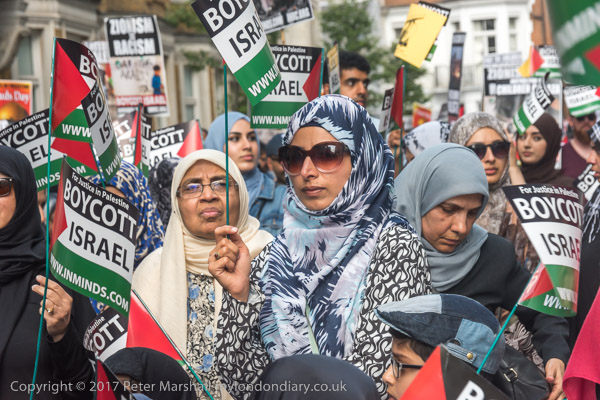
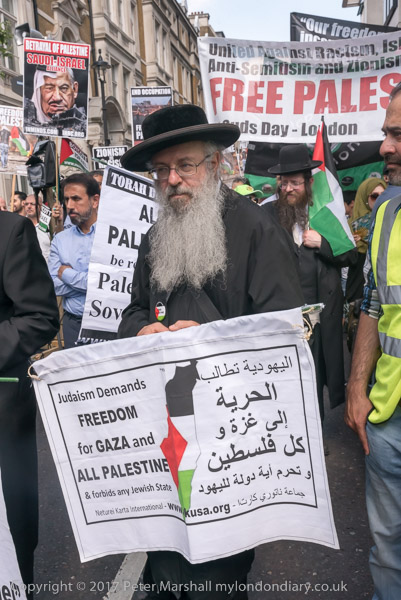
It was also the day of the annual Al Quds (Jerusalem) Day march in London, attended by several thousand from all over the country. Led by Imams and Neturei Karta anti-Zionist Jews, it called for ‘Freedom for Palestine’, and for all oppressed people’s across the world, and for a boycott of Israel.

As usual the march met with opposition from a small group of Zionists with Israeli flags and they were better organised than in previous years, with around 20 of them managing to block the route for around a quarter of an hour before police managed to move them on and allow the march to continue, though rather more slowly than usual.

Al Quds Day was inaugurated by Ayatollah Khomeini and some of the groups which support it may still receive support from the Iranian regime. Some of the protesters carried a small flag with both the Palestinian flag and that of Hezbollah and the message ‘Boycott Israel’. Hezbollah, a Lebanese Shia Islamist political party and militant group uses the same flag for both, and the militant wing is a proscribed group in the UK. The flag carried by some on the protest made clear in the small print it was in support of the political party.

Al Quds march
Zionists protest Al Quds Day March
Brian Haw remembered
Ted Knight speaks for Central Hill


All photographs on this and my other sites, unless otherwise stated, are taken by and copyright of Peter Marshall, and are available for reproduction or can be bought as prints.

More Belgravia 1988

Chesham House, Lyall St, Chesham Place, Belgravia, Westminster, London, 1988 88-3f-34-positive_2400
Chesham House, Lyall St, Chesham Place, Belgravia, Westminster, London, 1988 88-3e-34

Chesham House was the Russian Embassy in London from 1853 until 1927, when we ceased to have a Russian Embassy after the foundation of the USSR. Now it hides away in Kensington Palace Gardens. The area was developed in the 1830s on land where leases had been obtained a century earlier by the Whig politician William Lowndes (1652–1724) who acquired the manor of Chesham Bury in Hertfordshire in 1687 and rebuilt the original Bury and manor house of Great Chesham in 1712.

Chesham House, Lyall St, Chesham Place, Belgravia, Westminster, London, 1988 88-3e-33-positive_2400
Chesham House, Lyall St, Chesham Place, Belgravia, Westminster, London, 1988 88-3e-33

In 2007 a large family flat occupying the third floor of this building was featured by Forbes in a listing of London’s Most Expensive Flats – at the time it was valued at a mere £17.5 million. Lowndes is said to be the origin of the phrase “Take care of the pence, and the pounds will take care of themselves” and that is an awful number of pence.

Hans Crescent, Knightsbridge, Kensington & Chelsea, 1988 88-3e-36-positive_2400
3 Hans Crescent, Knightsbridge, Kensington & Chelsea, 1988 88-3e-36

You can see the rear of Harrods at the right hand edge of this picture. This area was rebuilt completely between around 1890 and 1910, partly becuase of the huge expansion of Harrods and is in a vaguely Queen Anne style. This building has become very familiar to me in more recent years as the home of the embassies of both Colombia and Ecuador, each with a small suite of rooms in a rather impressive building and sharing the entrance with the other occupants.

It was of course from June 2012 to 11 April 2019 the temporary home of Julian Assange, at first granted asylum by Ecuador and then, after a change of government, handed over to the British police and since kept in solitary confinement by the British establishment who clearly hoped he would die in Belmarsh prison. Keeping a police guard outside this building to prevent Assange’s escape cost us a totally unnecessary £12.6 million.

Chelsea House, Lowndes St, Belgravia, Kensington & Chelsea, 1988 88-3e-42-positive_2400
Chelsea House, Lowndes St, Belgravia, Kensington & Chelsea, 1988 88-3e-42

Chelsea House, a tall, curved block on the corner of Lowndes St and Cadogan Place, has around ten residental floors above this street entrance and the luxury shops of its ground floor. There is a second entrance like this around the corner in Lowndes St, and both look to me rather as posh noses stuck on to a rather more utilitarian facade. Above the 7th floor the upper reaches are set back in a largely unsuccessful attempt to disguise the height of the builsing.

Sloane St, Knightsbridge, Kensington & Chelsea, 1988 88-3e-43-positive_2400
Sloane St, Knightsbridge, Kensington & Chelsea, 1988 88-3e-43

Sloane St is full of shops seliing expensive clothes to those who think labels are more important than utility, and some seem rather ridiculously styled.

Danish, Peruvian, Embassy, Sloane St, Knightsbridge, Kensington & Chelsea, 1988 88-3e-44-positive_2400
Danish & Peruvian Embassies, Sloane St, Knightsbridge, Kensington & Chelsea, 1988 88-3e-44

The Danish embassy at left was one of very few modern buildings of distinction in the area and designed by the famous Danish architect Arne Jacobsen, and completed by his practice after his death. It was commisioned in 1969 and existing buildings were demolishes, but the Danes ran out of cash and for four years the site was a car park. Work began again and the foundation stone was laid in 1975 with the building – with added security measure included after the beginning of the IRA attacks was completed in 1977. To its right is a dental practice and then the Peruvian Embassy and another building with adjacent doors.

The Jeeves Ladies, Kate McGill, Pont St, Belgravia, Kensington & Chelsea, 1988 88-3e-46-positive_2400
The Jeeves Ladies, Kate McGill, Pont St, Belgravia, Kensington & Chelsea, 1988 88-3e-46

There is still a Jeeves Dry Cleaners in Pont St, on the corner of Cadogan Lane, but its facade no longer displays the once well-known logo designed for them by Derrick Holmes. The statue by Irish Sculptor Kate McGill was commissioned by Sydney Jacob, who in 1969 founded Jeeves of Belgravia with David Sandeluss. Seven foot tall and weighing around a ton, it appeared on the street overnight in 1974 and is still there, outside a smaller shop on the opposite side of the road and rather obscured by fenced brick boxes around each of a short row of trees.


Clicking on any of the above images will take you to a larger version in my Flickr Album 1988 London Photos, where you can browse forward or back through the pictures in the album.


All photographs on this and my other sites, unless otherwise stated, are taken by and copyright of Peter Marshall, and are available for reproduction or can be bought as prints.

Housing Awards – 2016

A resident of the Aylesbury Estate in Southwark speaks about the council’s terrible record

Most people have never heard of the annual Municipal Journal Local Authority Awards, a kind of self-congratulatory back-slapping beanfeast for local authorities on the lines of the Oscars and a dinner at the Hilton, doubtless on our council tax.

Protesters ignore hotel staff and police who tell them they must move

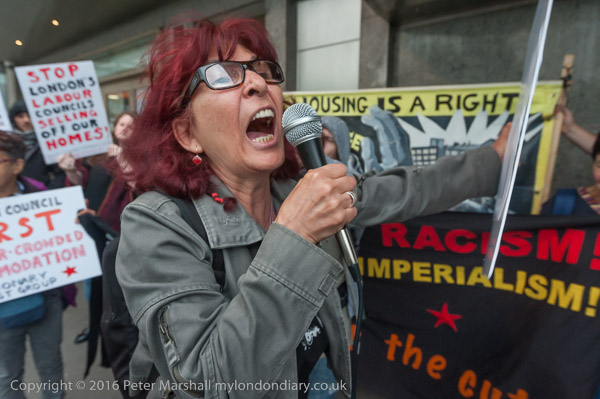
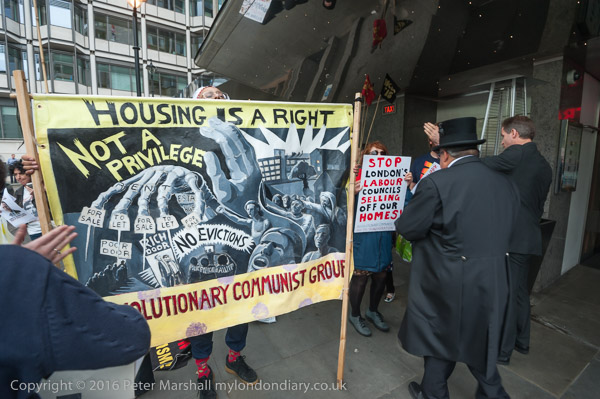
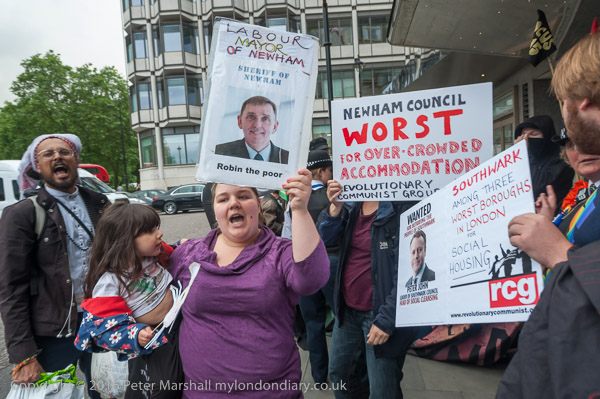
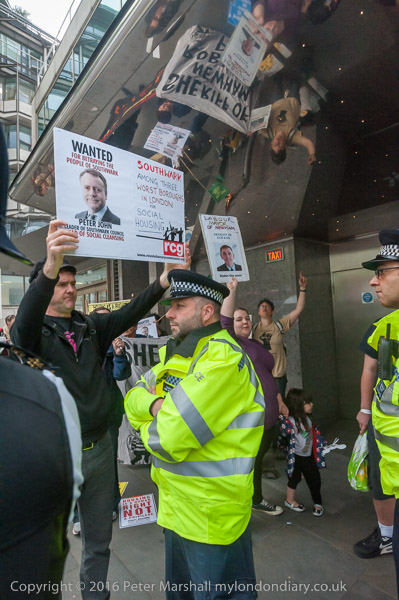
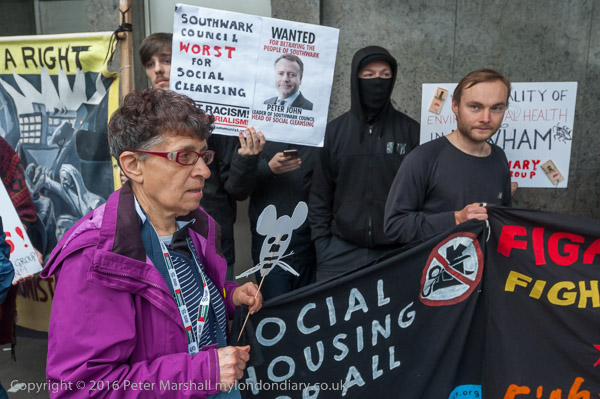
The news in 2016 that two of London’s councils with the worst records for housing were nominated for awards angered London housing protesters and Focus E15, the Revolutionary Communist Group, Class War, Architects 4 Social Housing and others organised a protest outside the Park Lane Hilton including a rather different awards ceremony.

Protesters from Newham blame Labour Mayor Robin Wales ‘Robin the poor’

They pointed out that Southwark had by 2016 demolished 7,639 units of social housing, sold off public land to developers, and evicted people unlawfully and accuse Newham of social cleansing, rehousing people in distant parts of the country while council properties remain empty, and of causing mental health problems through evictions, homelessness and failure to maintain properties.

Simon Elmer of Architects for Social Housing objects to being assaulted by a police officer.

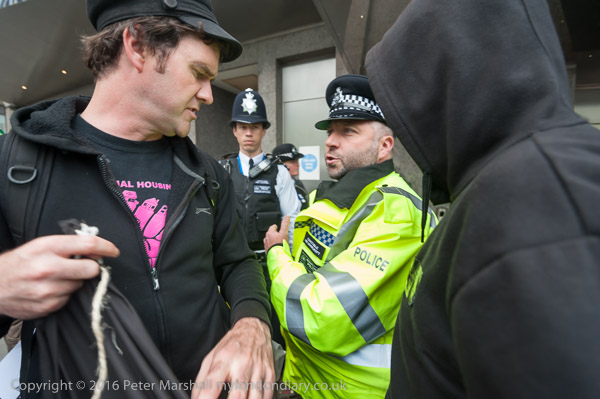
Police tried to move the protesters away from the hotel entrance and across the service road, but most resisted and held their ground, with police keeping the entrance clear, A few did move across the road were they could hand out flyers people arriving by taxi. There were a a few minor incidents when police pushed a protester holding a banner and again when several protesters held banners and placards in front of the restaurant windows.

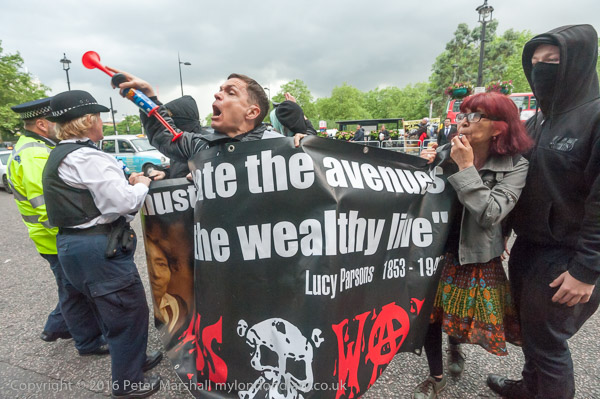
Class War had brought their banner with a quote from US anarchist Lucy Parsons “We must devastate the avenues where the wealthy live” particularly appropriate for a protest in Mayfair and outside the Hilton. Police made a rather unwise and ineffectual attempt grab this from them but soon gave up.

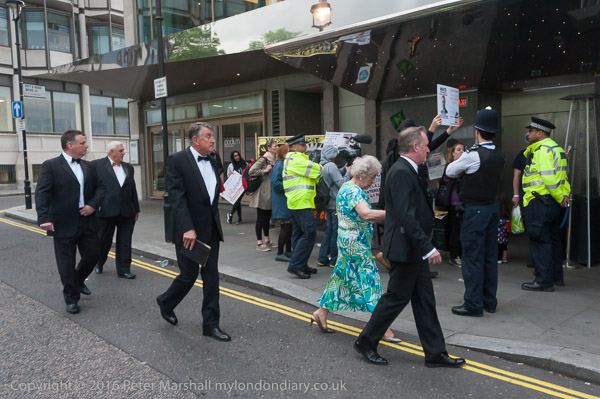
People continued to arrive for the event and to walk past the protesters. Many had come from towns and cities across the UK for the event and where probably not particularly away of the situation in London boroughs.

I played around a little with the reflections in the polished metal canopy above the Hilton entrance, which was doing a good job in keeping the light rain off most of the protesters, though I was getting a little wet.

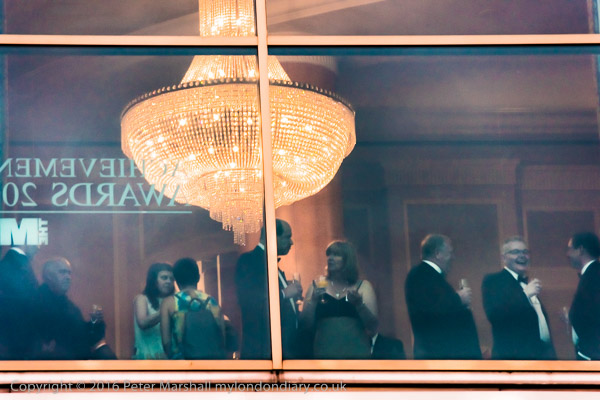
Looking up from the service road we could see those attending the awards ceremony talking and drinking before the dinner, while outside the protesters were beginning their own awards.

There were quite a few speeches from various of the activists, and Southwark won the award as London’s worst council, with Newham a close second.

Hyde Park Corner & Belgravia

St Georges Hospital, Royal Artillery, Memorial, Hyde Park Corner, Westminster, 1988 88-3d-22-positive_2400
St Georges Hospital, Royal Artillery, Memorial, Hyde Park Corner, Westminster, 1988 88-3d-22

I can’t recall why on this particular March Day in 1988 I decided to photograph these major military meorials at Hyde Park Corner. I think I’d probably emerged from the tube there, or perhaps got off a bus from Victoria Station and thought the lighting looked right. Non-photographers often see me going out on bright sunny days with a blue sky and no trace of cloud and say to me “Good weather for it!” and I usually just give a faint smile, while thinking to myself it might have been better to have left the cameras at home. For subjects like these, a bright overcast day with no shadows is generally the best, enabling you to chose your viewpoint to bring out the best in your subject.

Machine Gun Corps, Memorial, Hyde Park Corner, Westminster, 1988 88-3d-43-positive_2400
Machine Gun Corps, Memorial, Hyde Park Corner, Westminster, 1988 88-3d-43

St George’s Hospital is a good backdrop for the . The hospital opened next door in 1733 and was expanded with this building in 1830, to provide 300 beds. Its medical school moved to Tooting in1970 and the hospital finally closed here in 1980. Part had clearly moved much earlier and the Nightingale Ward in which I stayed for a couple of weeks at St George’s in 2003 were clearly from the 19th century and falling to pieces. The Grade I listed Royal Artillery Memorial designed by Charles Sargeant Jagger, with architectural work by Lionel Pearson, was unveiled in 1925, to commemorate the 49,076 soldiers from the Royal Artillery killed in the First World War and to my mind is the finest sculptural piece of the several around.

Wellington Arch, Memorial, Apsley Way, Hyde Park Corner, Westminster, 1988 88-3d-44-positive_2400
Wellington Arch, Memorial, Apsley Way, Hyde Park Corner, Westminster, 1988 88-3d-44

The Machine Gun Corps Memorial was also erected in 1925, but rather further to the south in Grosvenor Place. It was dismantled to enlarge the roudabout in 1945 and only replace in its current position at the north of the isolated square in 1963, By Derwent Wood, it shows David holding Goliath’s sword and at a lower lever are two real Vickers machine guns covered with bronze and with laurel wreathes. The Grade I-listed triumphal arch by Decimus Burton was built nearby in 1826-30 to celebrate the victory over the French and moved to its curent location in 1882-3. At the same time a huge and ugly equestrian statue of Wellington which had been placed on top in 1846 was removed and sent to Aldershot, being replace by the more fitting Quadriga by Captain Adrian Jones. Until 1992 the arch was home to London’s smallest police station but it now houses an exhibition about Waterloo.

Wellington statue, Memorial, Apsley House, Hyde Park Corner, Westminster, 1988 88-3d-46-positive_2400
Wellington statue, Memorial, Apsley House, Hyde Park Corner, Westminster, 1988 88-3d-46

When the eyesore huge Wellington statue was taken from the top of the arch to Aldershot, Joseph Boehm was commisioned to make a replacement, which was installed on a plinth facing the Duke of Wellington’s house, Apsley House, at Hyde Park Corner. Below on the four corners of the plinth stand four foot-soldiers, one from each of the four nations of the united kingdom.

Hans Crescent, Knightsbridge, Westminster, 1988 88-3e-22-positive_2400
Hans Crescent, Knightsbridge, Westminster, 1988 88-3e-22

Hans Crescent in Knightsbridge is a little to the west of Hyde Park Corner, between the back of Harrods and Sloane St. Part of the Cadogan Estate, this building at 2-4 Hans Crscent on the corner of Pavilion Road stands out in the area both for its white finish – and is know at the White House among so much red brick and is home to the Holy Carrot vegan restaurant, described by some as London’s best vegan restuarant and also to Urban Reatreat, “a one stop shop for all things to do with beauty” also with a restuarant but not vegan who are responsible for a large pink and gold plastic creature on its balcony.

Chester Square, Belgravia, Westminster, 1988 88-3e-24-positive_2400
Chester Square, Belgravia, Westminster, 1988 88-3e-24

Edward Walford in his contribution ‘The western suburbs: Belgravia’, to Old and New London: Volume 5 (London, 1878), pp. 1-14. has a lengthy description of Belgravia, much a which is still relevant today. You can read it in full at British History Online but the rest of today’s text come from this volume:

This mine of wealth—the present suburb, or rather city, of Belgravia, for such it has become—passed into the possession of the Grosvenor family in 1656, when the daughter and sole heiress of Alexander Davies, Esq., of Ebury Farm, married Sir Thomas Grosvenor, the ancestor of the present Duke of Westminster. This Mr. Davies died in 1663, three years after the Restoration, little conscious of the future value of his five pasturing fields.

Edward Walford, ‘The western suburbs: Belgravia’, in Old and New London: Volume 5 (London, 1878), pp. 1-14. British History Online http://www.british-history.ac.uk/old-new-london/vol5/pp1-14
Chester Square, Belgravia, Westminster, 1988 88-3e-25-positive_2400
Chester Square, Belgravia, Westminster, 1988 88-3e-25

“In Queen Elizabeth’s time,” observes a writer in the Belgravia magazine, “this sumptuous property was only plain Eabury, or Ebury Farm, a plot of 430 acres, meadow and pasture, let on lease to a troublesome ‘untoward’ person named Wharle; and he, to her farthingaled Majesty’s infinite annoyance, had let out the same to various other scurvy fellows, who insisted on enclosing the arable land, driving out the ploughs, and laying down grass, to the hindrance of all pleasant hawking and coursing parties. Nor was this all the large-hearted queen alone cared about; she had a feeling for the poor, and she saw how these enclosures were just so much sheer stark robbery of the poor man’s right of common after Lammas-tide. In the Regency, when Belgrave Square was a ground for hanging out clothes, all the space between Westminster and Vauxhall Bridge was known as ‘Tothill Fields,’ or ‘The Downs.’ It was a dreary tract of stunted, dusty, trodden grass, beloved by bull-baiters, badger-drawers, and dog-fighters.

Edward Walford, ‘The western suburbs: Belgravia’, in Old and New London: Volume 5 (London, 1878), pp. 1-14. British History Online http://www.british-history.ac.uk/old-new-london/vol5/pp1-14
Chester Square, Belgravia, Westminster, 1988 88-3f-16-positive_2400
Chester Square, Belgravia, Westminster, 1988 88-3f-16

There can be little doubt that, in right of his Manor of Ebury, the Duke of Westminster enjoys one of the largest rent-rolls, if not the very largest, in the kingdom. The current rumour of the day sets it down at £1,000 a day, or £365,000 a year. Other noblemen, especially the Dukes of Sutherland, Buccleuch, and Northumberland, are thought to approach very nearly to a like rental.

Chester Square, which almost abuts upon the north side of Eaton Square, was commenced about the year 1840, and was so called after the City of Chester, near which place Eaton Hall is situated. The picturesque Gothic church of St. Michael, which stands in a commanding position at the western end of the square, was erected in 1844, the foundation-stone being laid by Earl Grosvenor, father of the present Duke of Westminster; and it was built from the designs of Mr. Thomas Cundy in the Decorated style of the fourteenth century. Its principal external feature is the tower, with a lofty spire, which, till some additions to the body of the church were made in 1874, appeared to be somewhat out of proportion to the remainder of the fabric.

Edward Walford, ‘The western suburbs: Belgravia’, in Old and New London: Volume 5 (London, 1878), pp. 1-14. British History Online http://www.british-history.ac.uk/old-new-london/vol5/pp1-14

All photographs on this and my other sites, unless otherwise stated, are taken by and copyright of Peter Marshall, and are available for reproduction or can be bought as prints.

1984 Remembered

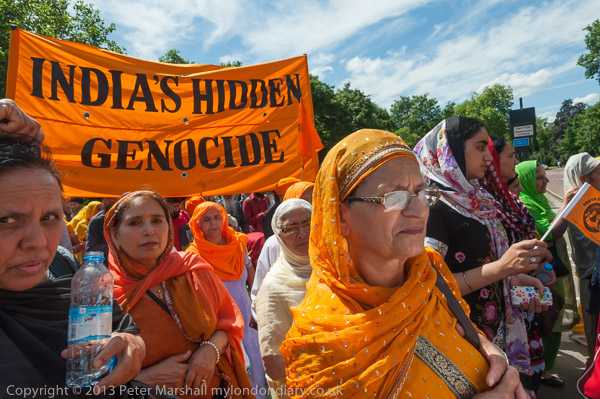
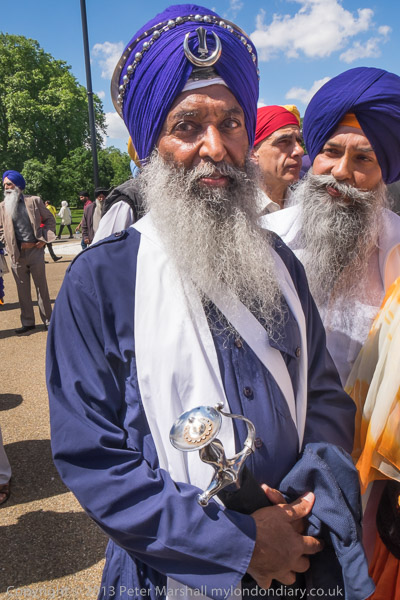
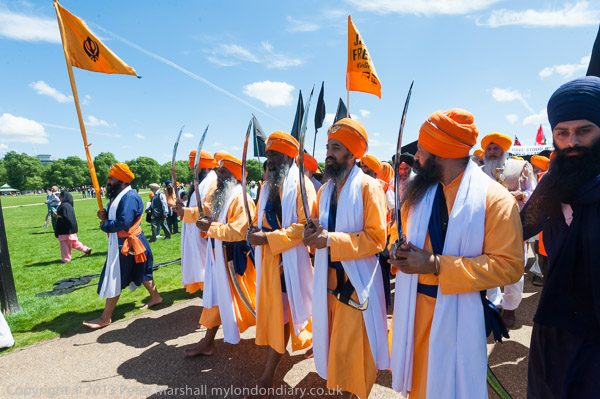
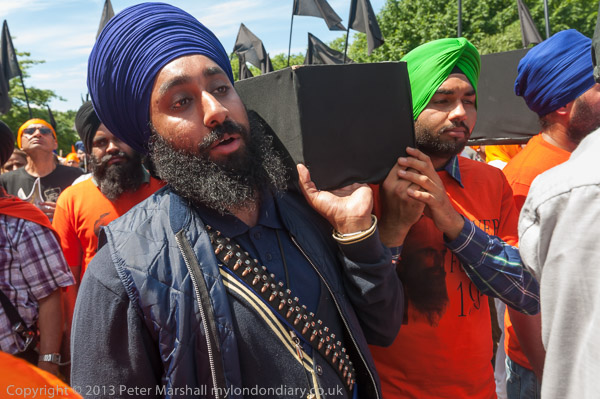
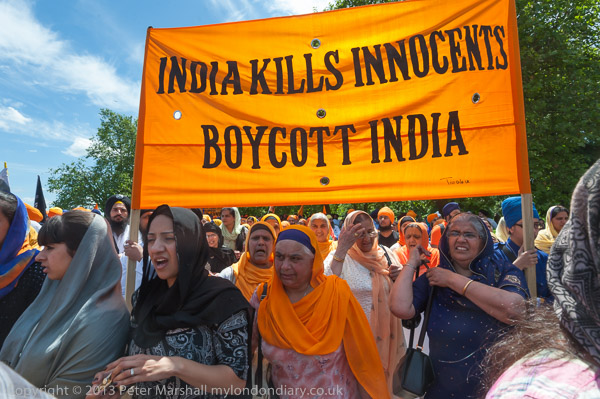
Every year around the 8th June, Sikhs march in London to remember the 1984 destruction at the Golden Temple in Amritsar. The Soviet government forged documents in 1982 to show that Sikh militants were getting CIA support for their plans to establish an independent Sikh state of Khalistan in the Punjab and these were taken seriously by Indian intelligence services and prime minister Indira Gandhi, who on June 1st 1984 sent in the Indian Army in Operation Blue Star, attacking scores of Sikh temples across the Punjab.

On 3rd June Indian forces surrounded the Golden Temple in Amritsar where many of the militants who were well armed had taken refuge, along with thousands of pilgrims who were there for the anniversary of the death of the fifth guru, Arjan Dev Ji. The siege lasted several days and many were killed, mostly pilgrims who had been allowed by the army to enter on the 3rd June but not allowed to leave later that day. As they secured the Temple, the army carried out many executions of those they detained and fired on men and women as they were trying to follow army orders to leave.

Acoording to Rajiv Gandhi, around 700 Indian Army soldiers were killed in the attack, although the official figure was 83. There are also huge discrepancies between the official figures of those who died inside the Temple, with an official figure of 554 casualties and independent estimates of 18-20,000.

Many Sikhs resigned from official positions and soldiers left the Indian Army after this assault on their religion, and five months later Indira Gandhi was assassinated by her Sikh bodyguards in an act of revenge. This in turn led to anti-Sikh riots in which thousands of Sikhs were killed.

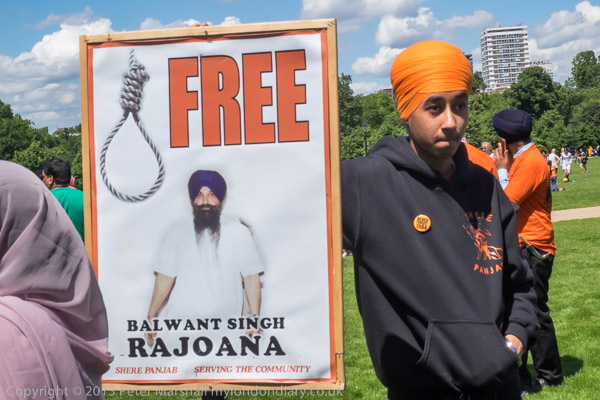
Many Sikhs still continue to call for an independent Sikh homeland, Khalistan, combining parts of the Punjab in both India and Pakistan that were severed at partition in 1947 when the whole area was divided between the two and Sikhs, along with other minorities were sidelined. Both political and military activities continue as does their repression by the Indian government, with many Sikhs held in Indian prisons, some under threat of hanging.

Feelings still run very high, and in 2013 four Sikhs were found guilty of attacking one of the generals who led the attack on the Temple, long retired and on holiday in London with his wife. Police have often taken a very keen interest in the annual march and prevented people from carrying some placards and posters which support the proscribed organisation Babbar Khalsa. The pictures here are from the march on Sunday 8th June 2014, which I left as the last of the protesters went down Park Lane on their way to a rally in Trafalgar Square

Sikhs march for Truth, Justice & Freedom


Protest Against Egypt Death Sentences

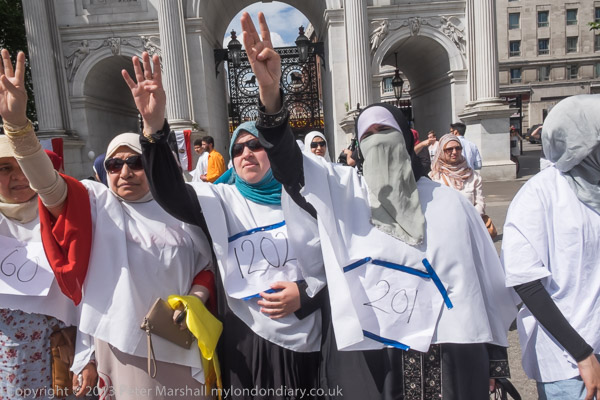
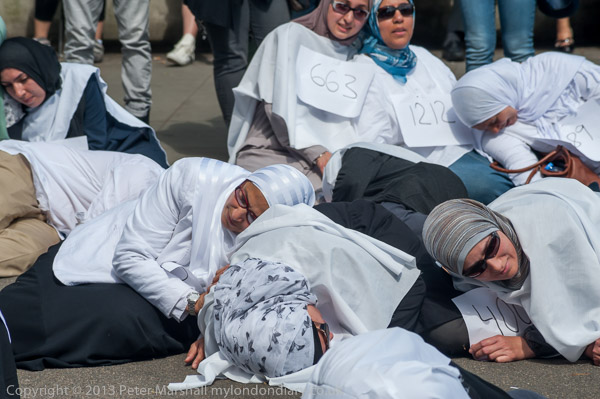
Also taking place on Sunday 8th June 2014 was a protest against the the 1,212 death sentences imposed on Islamists in Egypt, which was taking place as the new Egyptian president, Abdel Fattah el-Sisi, was sworn in. These included 529 members of the Muslim Brotherhood sentenced in 2014 following an attack on a police station in 2013.

There was a mock trial. People wearing numbers to represent the prisoners made the Islamist R4BIA (Rabia) sign and the event ended with a die-in in front of Marble Arch.

Protest Against Egypt Death Sentences


All photographs on this and my other sites, unless otherwise stated, are taken by and copyright of Peter Marshall, and are available for reproduction or can be bought as prints.

Human Rights, NHS and Gold Mining

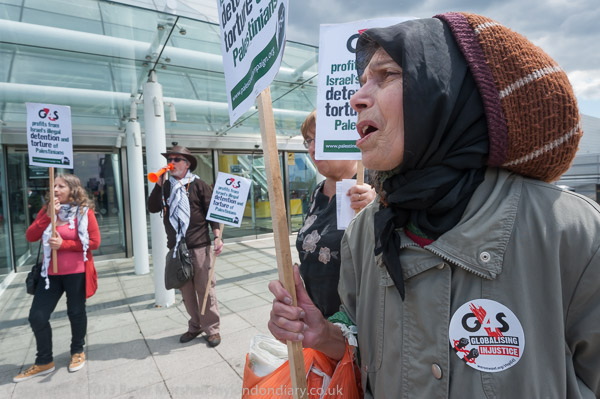
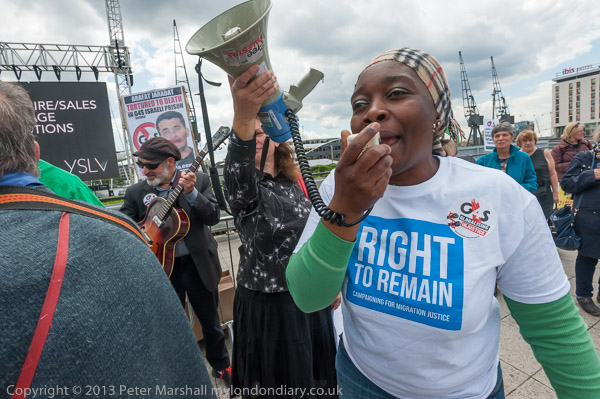
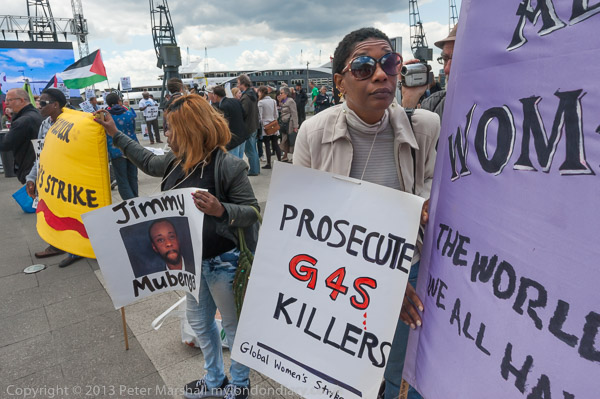
Thursday 5th June 2014 was the day of the AGM of G4S, a company deeply involved in the privatisation of prisons, policing, education and other public services and in human rights abuses both in the UK and in Palestine where it helps to run the Israeli prison system. So unsurprisingly a number of groups had come to protest outside the Excel Centre at Royal Victoria Dock in Newham where the AGM was taking place, and there were also a number of people who had bought shares so they had a right to attend the AGM and also to ask questions, challenging the company’s human rights record.

Among the various groups who had come to protest were the Boycott Israel Network, Boycott Workfare, Campaign to Close Campsfield, Corporate Watch, Friends of Al Aqsa, Inminds.com, Jews for Justice for Palestinians, Palestine Solidarity Campaign, Right to Remain, War on Want, Right to Remain and Global Women’s Strike, though as the protest was on a working day, the numbers representing each group were fairly low.

The protesters sang and handed out leaflets to shareholders attending the meeting, giving details of some of the human rights abuses that G4S has been responsible for or is complicit in. There were also apparently some nasty scenes when shareholders were ejected forcibly from the AGM for insisting on asking awkward questions, but the press was not allowed to photograph inside the venue.

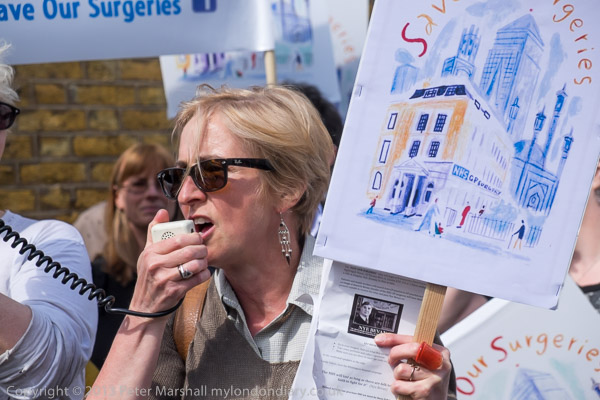
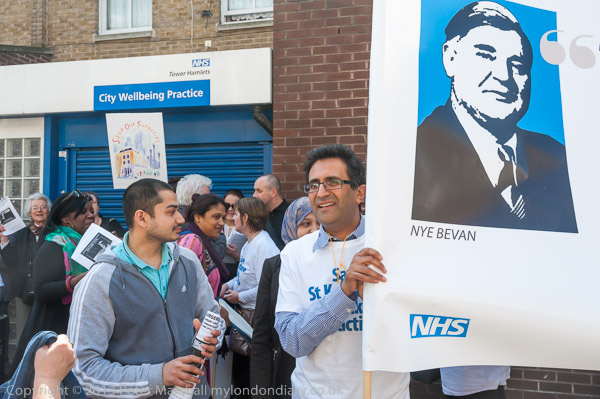
I joined a march in Tower Hamlets, which includes some of the most deprived areas of England, where medical staff and supporters had organised a ‘Nye Bevan’ march to ‘Keep Our NHS Public’, walking around the health practices in the borough. Medical practices were able to give a good level of service in deprived areas by the MPIG, the Minimum practice income guarantee, which was introduced for this purpose in 2004 following negotiations between the government and the BMA to recognise the higher health needs of both some inner city and rural areas. In 2014 the Coalition Government announced this was to be scrapped, with one seventh of it removed each year until 2021.

Many leading politicians (and their family members) have financial interests in healthcare companies, and NHS campaigners see the loss of MPIG as a part of the continuing privatisation by stealth of the NHS. Many GP practices are now run by large healthcare services, who lower costs by providing reduced services and diverting money which should be used for serving the needs of patients into providing profits for shareholders.

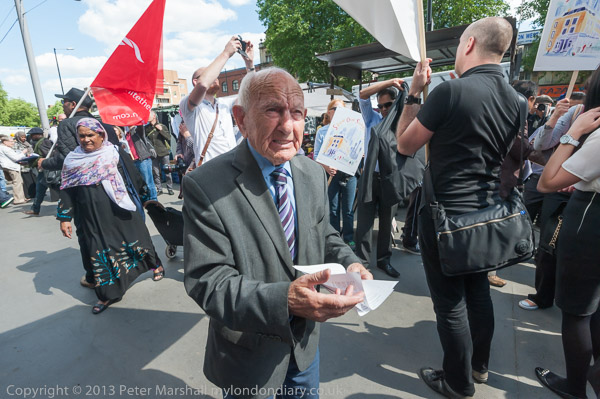
As the marchers arrived at each medical practice they were met by health workers and patients who came out to support them. Among those at the health centre on the Whitechapel Road was veteran anti-fascist and former Communist councillor Max Levitas, who had celebrated his 99th birthday 4 days earlier. I left before the march finished and the rally to go to the Colombian embassy.

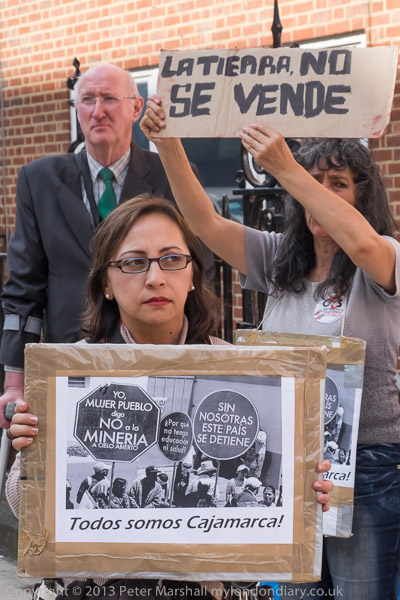
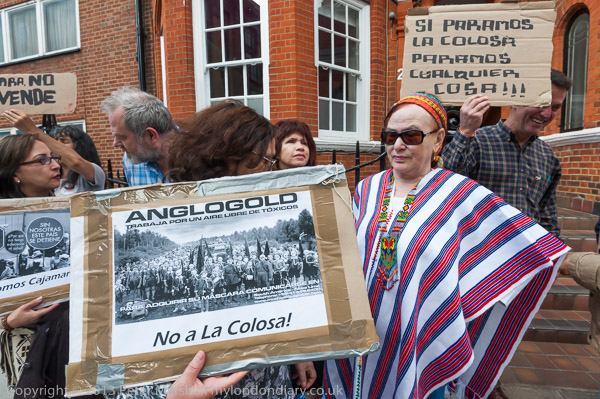
At the Colombian embassy protesters were condemning the vast La Colosa & Santurbán gold mines which endanger water sources in the high mountain regions and could wreck their fragile ecosystems. The London protests on UN World Environment Day and follow protests and carnivals by thousands of people in Ibague, the closest city to the mines as well as in other cities in Colombia. In Bucaramanga the whole city turned out in protests to stop the Santurbán gold mine owned by Canadian company Greystar Resources, and in 2019 there was a protest by 50,000 against the United Arab Emirates backed Soto Norte gold project which would be the largest underground gold mine in Colombia. Gold mining would releases large quantities of cyanide and arsenic into the water supplies of several million people.

The posters were in Spanish as they were aimed at the embassy staff. The Colombian Embassy is a relatively small section of a building just to the rear of Harrods, which also houses the Ecuadorian Embassy, where while this protest was taking place Julian Assange was still in political asylum in their small part of the building, and regular protests were still taking place calling for his release. Unfortunately he was instead handed over to the UK police and now seems likely to die as a political prisoner either in the UK or, if extradited, in the USA.

Colombian Mines – World Environment Day
Tower Hamlets – Save our Surgeries
G4S AGM Protest Against Human Rights Abuses


All photographs on this and my other sites, unless otherwise stated, are taken by and copyright of Peter Marshall, and are available for reproduction or can be bought as prints.