BBC Bans Gaza Appeal – 2009

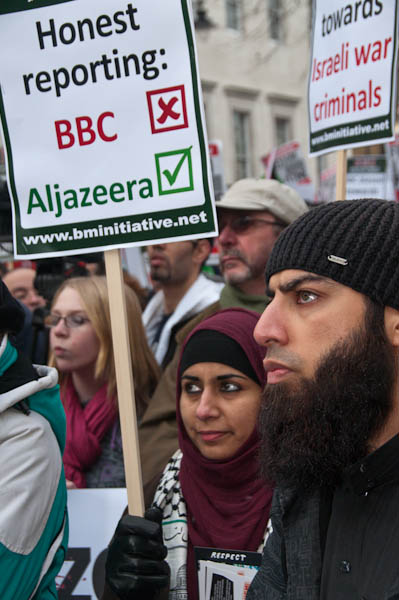
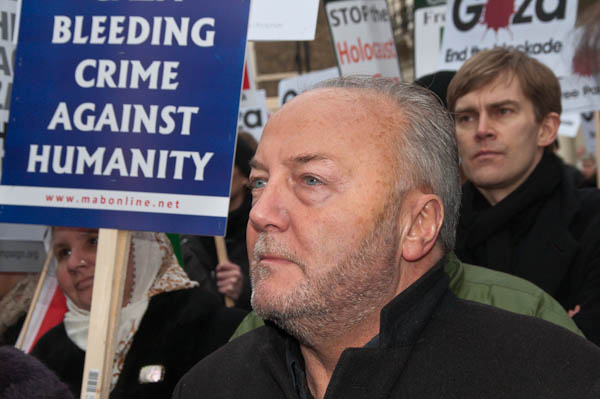
BBC Bans Gaza Appeal: On Saturday 24th January 2009 marchers gathered outside the BBC in Portland Place to draw attention to the biased reporting of the Israeli attack which had begun on 27 December 2008 and had ended with a ceasefire by Israel on 18th January.
BBC Bans Gaza Appeal

The attack, known by Israel as Operation Cast Lead but in Arabic as the Gaza Massacre had killed around 1300 Palestinians and 13 Israelis and had destroyed over 46,000 homes in Israel. It had begun with air attacks but was followed on January 3rd by a ground attack.
BBC Bans Gaza Appeal

The protest called for for an end to the Israeli blockade of Gaze and for the UK to stop its arms sales to Israel, and for a free Palestine and demanded Israli war criminals to be brought to justice. It also castigated the BBC which although claiming to be impartial had accepted and broadcast much Israeli propaganda during the war while not giving a proper hearing to the views and aspirations of the Palestinians.
BBC Bans Gaza Appeal

After the war, the United Nations Fact Finding Mission and human rights organisations criticised Israel for the large number of civilian casualties and having a deliberate policy of disproportionate force aimed at the civilian population. Among the war crimes that they found evidence for was the use of children and other civilians as ‘human shields’ forcing them “blindfolded, handcuffed and at gunpoint to enter houses ahead of Israeli soldiers during military operations.”
BBC Bans Gaza Appeal

International media were denied access to the war zone by Israel in defiance of a ruling by the Israeli Supreme Court and many details only emerged later and the media in Gaza itself came under military attack. The Israeli foreign minister “instructed senior ministry officials to open an aggressive and diplomatic international public relations campaign to gain support for Israel Defense Forces operations in the Gaza Strip” and the BBC was among those news organisations who lapped up their offerings.
As the ceasefire was announced, humanitarian organisations around the world launched campaigns to bring much-needed humanitarian aid to Gaza. In the UK, the the Disasters Emergency Committee (DEC) which includes Oxfam, Save the Children and the Red Cross launched a nation-wide appeal, but the BBC (and Sky) refused to broadcast it although it went out on ITV, Channel 4 and Channel Five.
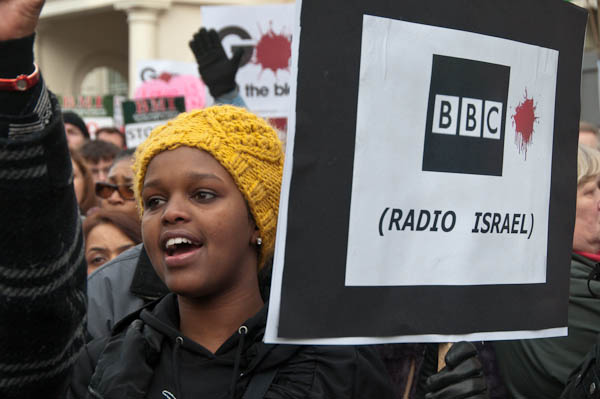
It was a decision which clearly made the BBC management’s pro-Israel position crystal clear to the nation and was widely seen, including by many BBC journalists as a failure by the BBC to uphold its reputation for impartiality.
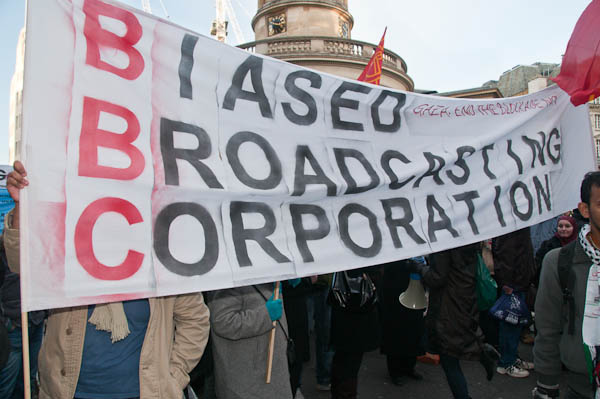
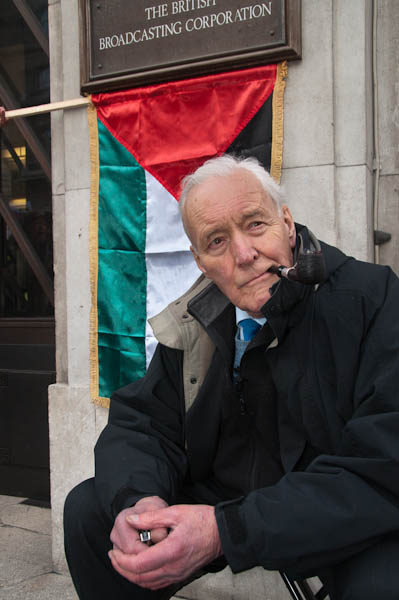
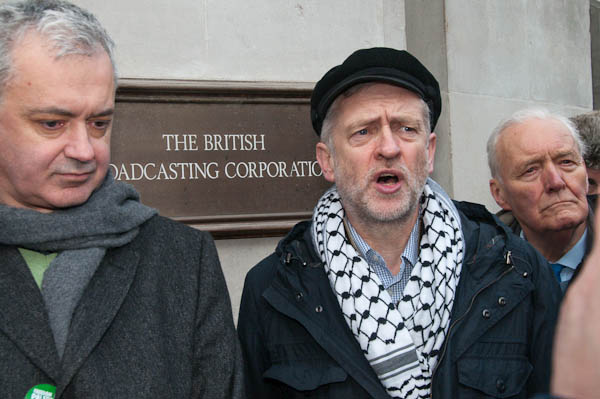
Which is perhaps why Tony Benn was invited onto the Today programme that morning to talk about the decision – and he came on and read the appeal for them. At the start of the protest I photographed him before and after he went in with a deputation to deliver a letter of protest to the BBC – police stopped me going in with him. Among those who also spoke outside the BBC was Jeremy Corbyn.
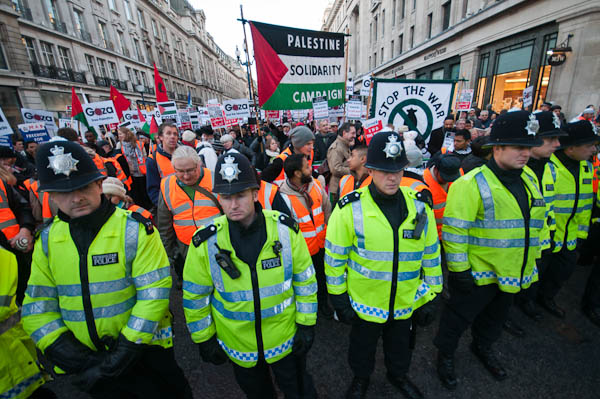
Pro-Israel press bias continued with the Press Association, who reported this press conference as the protest, giving the number present as 400. Even the police gave a figure of 5,000 – as usual roughly half of the actual number.
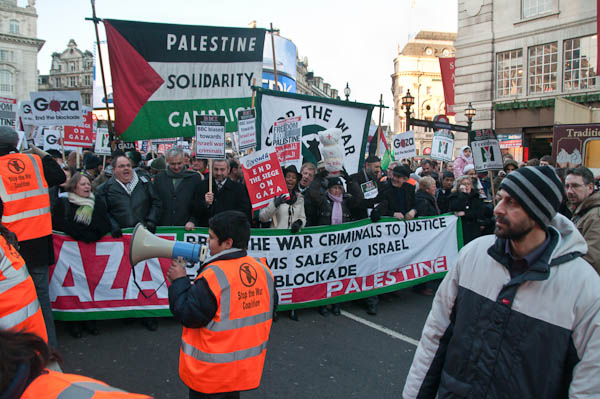
The protest was largely peaceful, though some had brought shoes to throw at Broadcasting House, but policing outside there was rather heavy-handed. When police made a few arrests when the march approached Piccadilly Circus the march halted and threatened to stay blocking traffic until the arrests stopped. They did and the march moved on to its final rally in Trafalgar Square.

More on My London Diary at Gaza: Protest March from the BBC.


FlickrFacebookMy London DiaryHull PhotosLea ValleyParis
London’s Industrial HeritageLondon Photos

All photographs on this page are copyright © Peter Marshall.
Contact me to buy prints or licence to reproduce.
Freedom Protests in London – 2010

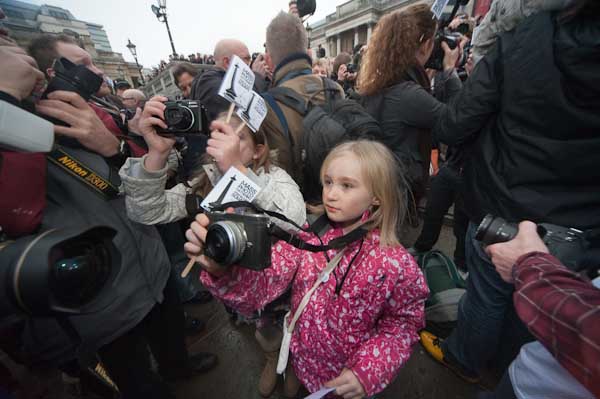
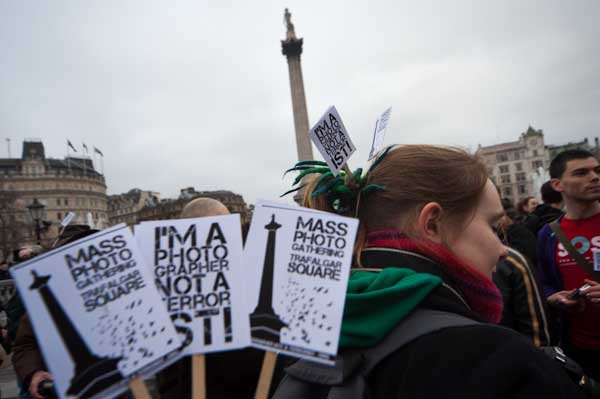
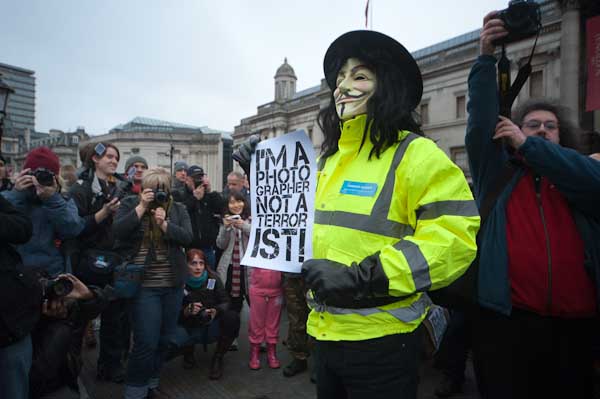
Freedom Protests in London: Two protests on Saturday 23rd January, 2010 were against the increasing powers which have been given to police and misused by them to control and harass lawful actions on the street.


I’m A Photographer Not A Terrorist – Tragalgar Square

Freedom Protests in London

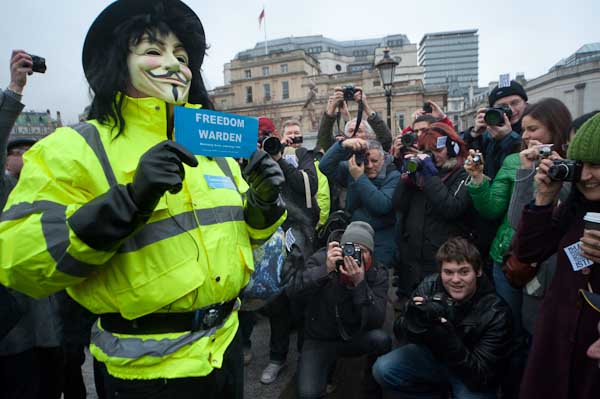
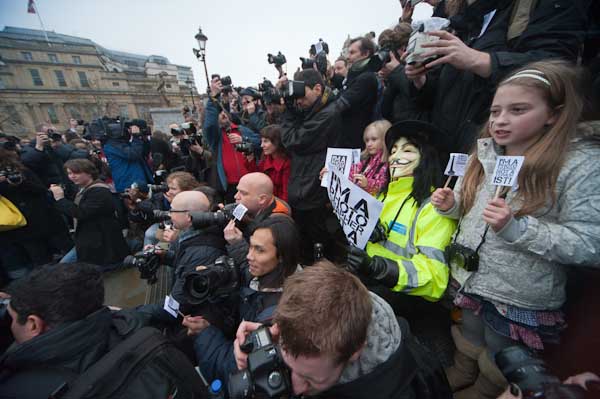
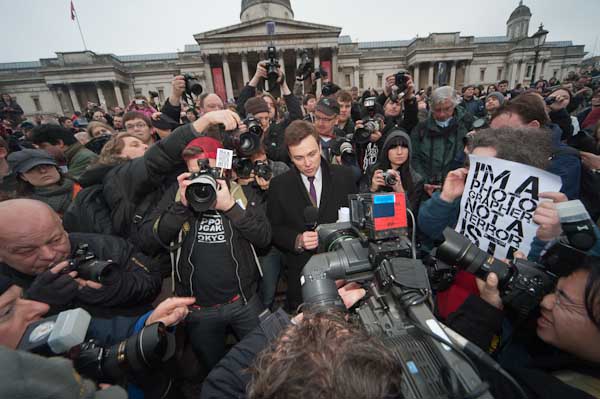
Around 1,500 photographers and supporters turned up to the I’m A Photographer Not A Terrorist rally in Trafalgar Square to protest at the increasing harassment of people taking photographs by police, and in particular their abuse of powers under the Terrorism Act.

Freedom Protests in London

I think those there included virtually every photographer who works in London as well as many amateurs. Almost all of us who work on the streets have been approached by police, questioned and then subjected to a search, usually under Section 44 of the Terrorism Act 2000 (S44.)

Freedom Protests in London

As I commented in 2010:

These stop and searches appear to have continued unabated despite a Home Office Circular in September that made it clear they should not be used to target photographers. Searches can also be carried out under Section 43 of the act, but for this officers must have reasonable grounds to suspect someone of being a terrorist. S44 stops can only be carried out in “authorised areas”, which although intended by Parliament to apply in very restricted areas for short lengths of time have been used by police – for example – to permanently to cover central London and some other areas.

I’m a Photographer Not a Terrorist

Freedom Protests in London

The Press Card that we carry has the text “The Association of Chief Police Officers of England Wales and Northern Ireland and the Association of Chief Police Officers in Scotland recognise the holder of this card as a bona-fide newsgatherer.” But despite this, one of my colleagues was the subject of roughly 30 searches in 2009.

Personally although I’ve been approached and asked why why I’m taking pictures on a number of occasions I’ve only been been subjected to a S44 stop once. Being a still photographer I tend to work fast and keep on the move and I think videographers who stay around longer have suffered more. But certainly there was a lack of cooperation from the police and I was often finding my Press Card being unrecognised by offiers. Others told me that they didn’t regard those issued through the NUJ, one of the recognised gatekeepers to the system, as being valid. And most months if not most weeks I would be threatened with arrest when taking pictures.

Perhaps the most distressing aspect of this protest was listening to a BBC News reporter, standing in the middle of a crowd of experienced journalists and giving a report in which he gave the number attending the protest as “three hundred“. It drew immediate shouts of protest from those of us standing around him and was certainly “not a good advertisement for the competence or impartiality of the BBC who appear to have a policy of playing down dissent.” It’s a policy which still seems to govern the BBC reporting of protests in the UK which are either simply ignored or very much played down.

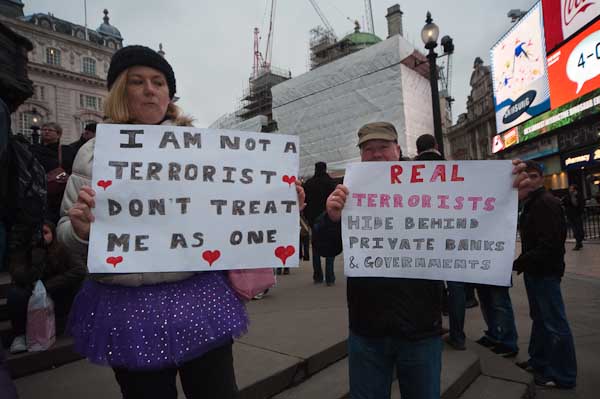
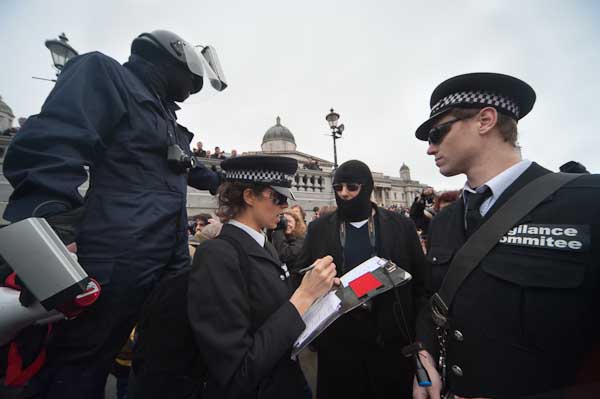
Among the protesters was a small “Vigilance Committee with a man on stilts wearing a number of CCTV cameras accompanied by a male and female vigilance officer, who picked on individuals and questioned them, taking their fingerprints before finding them guilty and sentencing them to a choice of six years hard labour or contributing to the Vigilance Committee.”

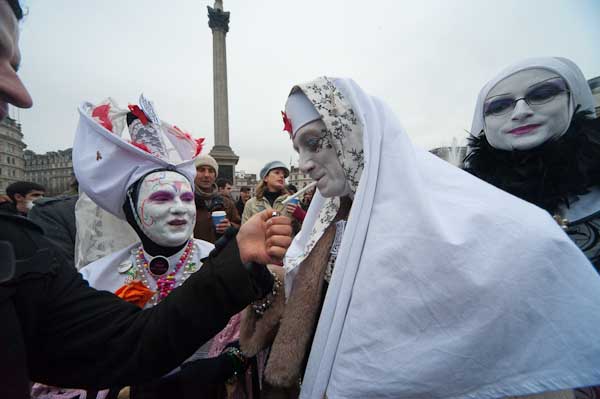
Also present were three Sisters of Perpetual Indulgence, but police and ‘heritage wardens’ largely kept away. Although this had been planned as an illegal protest taking place without the permission from the Mayor required by the bylaws, the authority had put in an application for it without any reference to the protesters.

More pictures at I’m a Photographer Not a Terrorist.


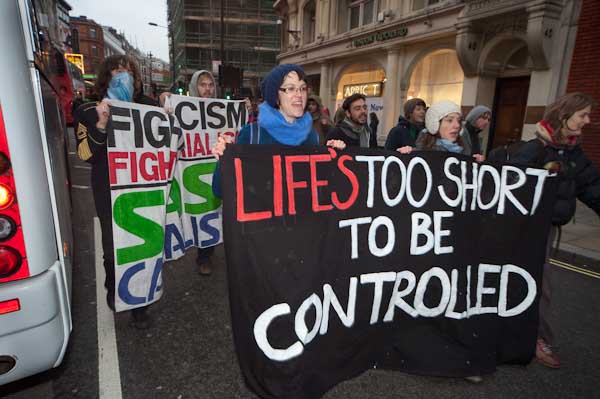
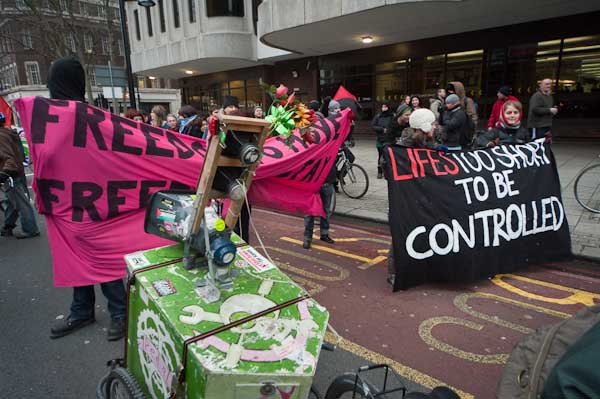
Life Is Too Short to be Controlled – St Pancras to Piccadilly Circus,

Later in the day protesters met at St Pancras for the ‘Life Is Too Short to be Controlled’ protest against the increasing control over our lives through increased police powers to stop and search, increased surveillance and controls on freedom of movement.

The protest, organised by ‘London NoBorders’ began outside St Pancras Station where the Border Authority detains migrants arriving by Eurostar and marched to Piccadilly Circus, beneath which Westminster’s CCTV HQ keeps a constant watch on the streets of London, the “City of CCTV”. Across the city there were then over 500,000 CCTV cameras watching us, installed by councils, public bodies, companies and individuals and on a typical day the average person in London will be recorded by 300 of them.

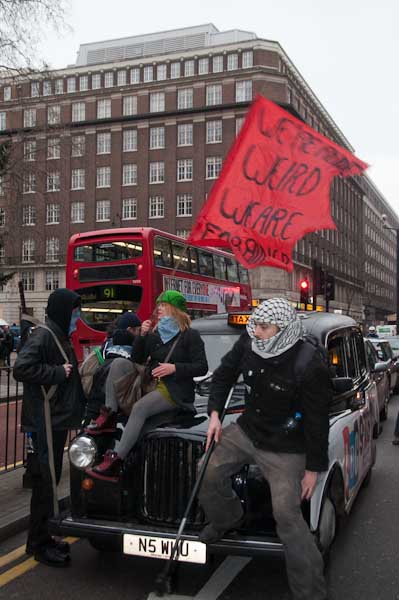
Police kept a relatively discrete watch on the event, with police vans parked out of site and even when the group marched along the busy Euston Road, holding up traffic for a few minutes not a single officer appeared. The march was well-ordered “and when an ambulance answering an emergency came along, the whole march cleared the road for it with remarkable speed. At Russell Square, one taxi driver decided to try to force his way through the marchers, but was soon stopped, with several people sitting on the bonnet of his vehicle.”

At Piccadilly Circus there was a short token road block before the protesters moved to the pavement around Eros for more speeches and some dancing. A Police Community Support Officer appeared briefly after someone climbed up and taped a Palestinian flag to Eros’s bow and tried to identify who had done this. The statue is rather fragile and could have been damaged. He soon gave up and went away and was replaced a few minutes later by a single police officer who was embarrassed by being greeted with hugs, and moved back a few yards to watch.

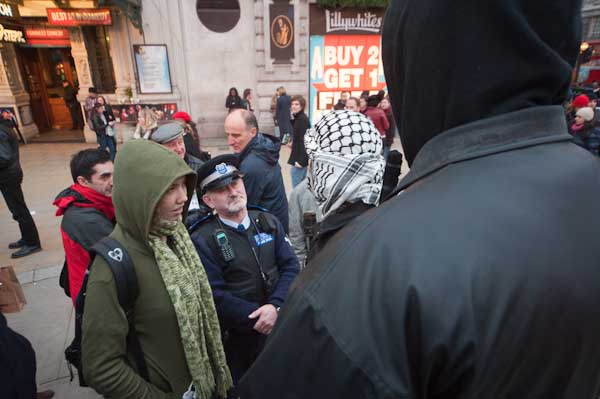
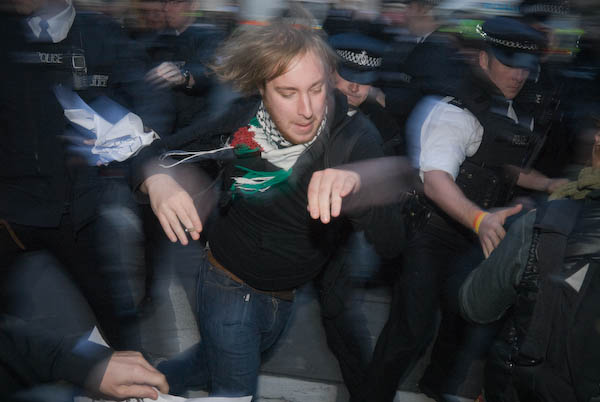
“Not me officer, someone borrowed my scarf”

The police had monitored the progress of the protest as it marched through London, both from some distance on the streets and also on CCTV. It had been peaceful and had caused only very minor disturbance. Few protests do, and the kind of heavy policing sometimes employed often means police cause more disruption that the protest, as well as sometimes provoking a response from protesters who would otherwise have protested peacefully.

More at Life Is Too Short to be Controlled.


FlickrFacebookMy London DiaryHull PhotosLea ValleyParis
London’s Industrial HeritageLondon Photos

All photographs on this page are copyright © Peter Marshall.
Contact me to buy prints or licence to reproduce.

Ed Davey Privatises the Royal Mail – 2011

Ed Davey Privatises the Royal Mail: 2011 is a year Liberal Leader Ed Davey would like to forget, particularly now that the scandal around the persecution of postmasters wrongly convicted because the Post Office and Fujitsu refused to admit the Horizon software had serious faults, long exposed by Private Eye and Computer Weekly, has now emerged into public view.

Ed Davey Privatises the Royal Mail

In 2011 Lib-Dem MP Edward Davey, MP for Kingston & Surbiton as was heading the Tory/Lib-Dem coalition’s plans to sell off our postal services as Minister for Employment Relations, Consumer and Postal Affairs. Before becoming an MP he had worked as a management consultant in Sweden, Taiwan, Belgium, South Africa and elsewhere, who specialising in postal services.

Ed Davey Privatises the Royal Mail

His then boss, Business Secretary Vince Cable, was the Lib-Dem MP for the neighbouring constituency of Richmond & Twickenham, so the plans to sell off the publicly owned Royal Mail came from Lib-Dems in this small area of West London.

Ed Davey Privatises the Royal Mail

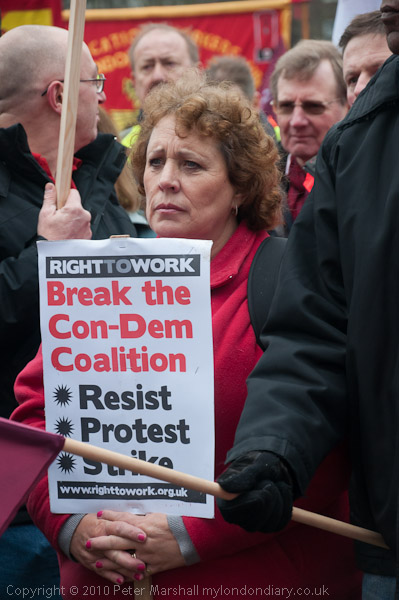
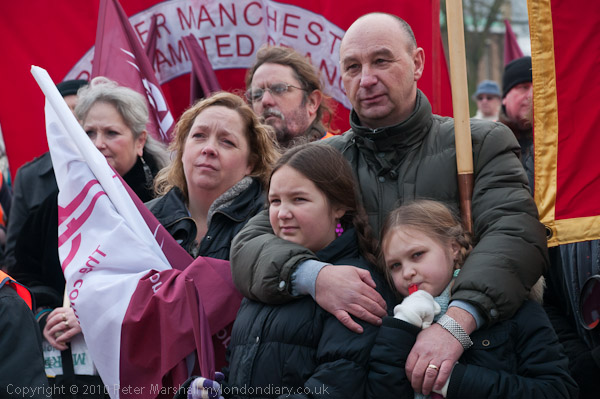
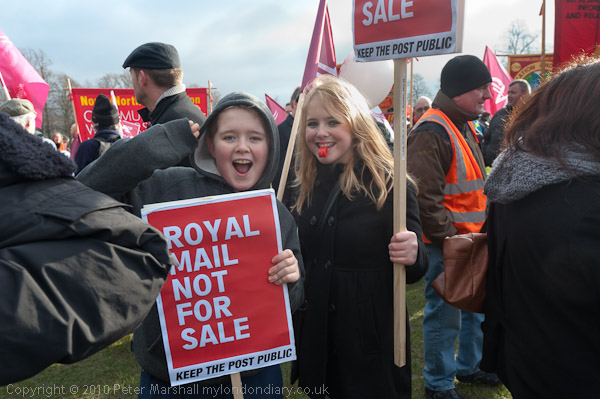
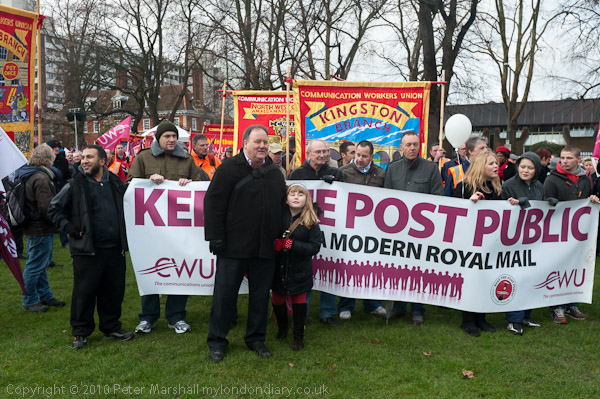
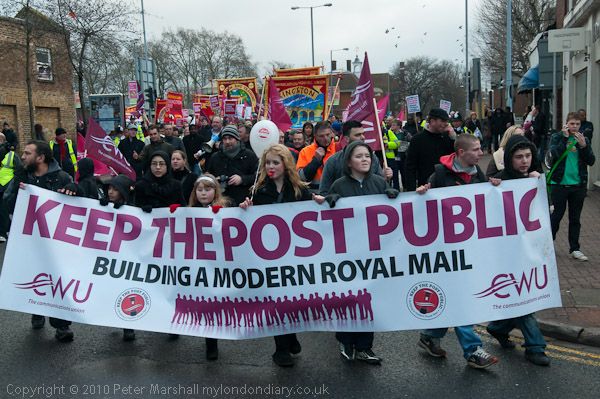
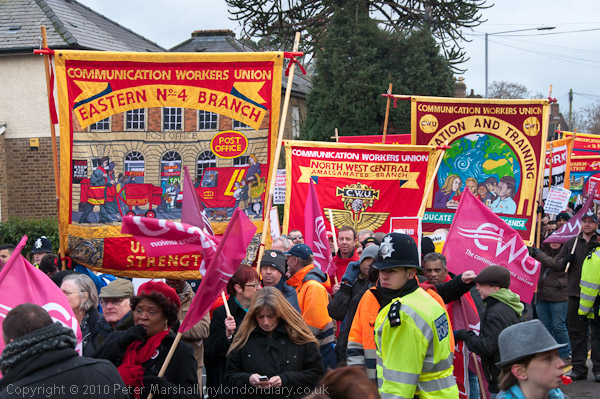
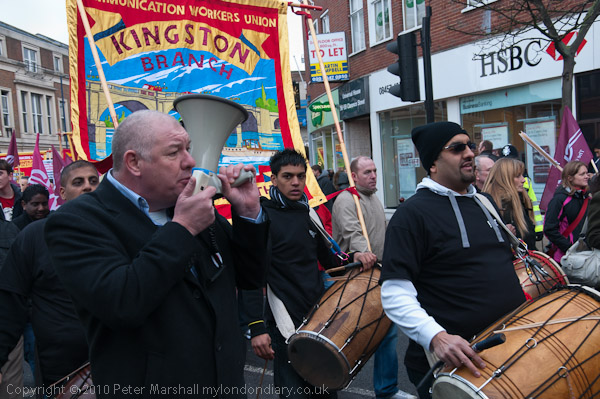
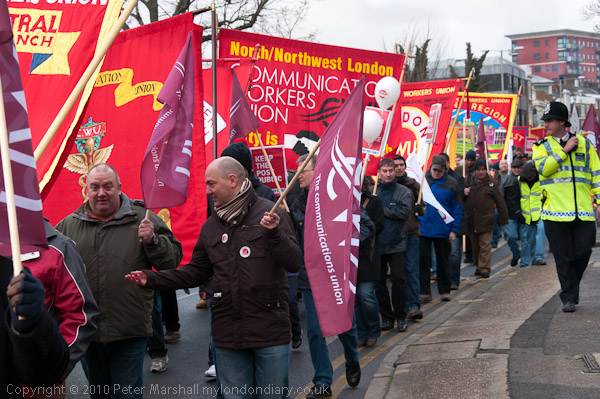
So Kingston was the obvious place for the national ‘Keep the Post Public’ protest on Saturday 22nd January 2011 and over a thousand came from across the nation for a rally and march there.

Ed Davey Privatises the Royal Mail

Kingston-on-Thames was also relevant for the royal connections incorporate in its name. Kingston is a Royal Borough and the town where many of the earliest Kings of England were crowned, and the march passed within a few yards of the Coronation stone in front of Kingston Guildhall before ending by the River Thames.

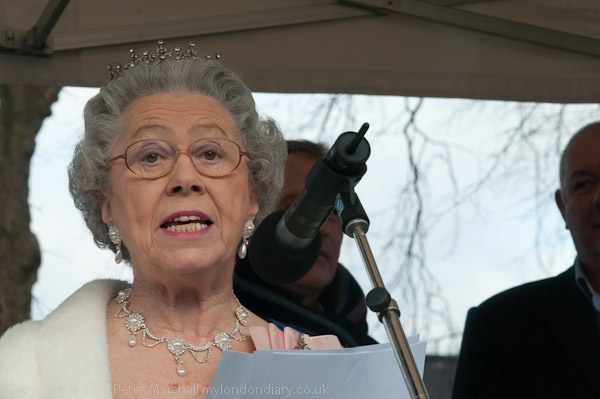
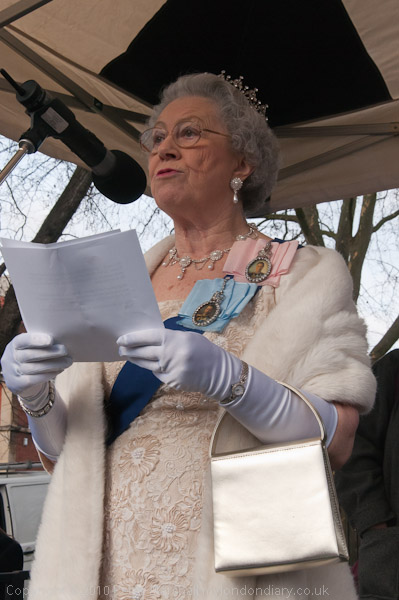
And although the Queen herself was unable to come and defend her Royal Mail, a fairly convincing royal look-alike came suitably dressed to give a royal address against selling off her Royal Mail.

Also there to speak were a number of trade union leaders including CWU general secretary Billy Hayes, Dave Ward of the CWU Postal department, Jim Kirwan, CWU London regional secretary, Christine Quigley of London Labour Youth and Christine Blower, the NUT General Secretary. Others speaking included the local Labour candidate and a school student who got huge applause for telling the rally how they had organised and occupied their local school against government cuts and fees increases.

Speakers pointed out that privatisation would result in price rises and the abandonment of the universal service which requires the Royal Mail to deliver and collect to all of the 28 million UK addresses six days a week at the same cost. And we have since seen this happen although not officially; we now get deliveries of mail on perhaps four or five days in a typical week and the collections have become far more erratic.

The cost of a First Class Stamp was then 41p. Presumably as a sweetener for buyers of the privatised company there was already to be a 5p rise in a few months time. If prices had risen simply according to the Bank of England’s inflation calculator, the stamp should now cost 58p but the actual cost now is over double that at £1.25 – a huge increase. And although using a First Class stamp was supposed to mean next-day delivery, First Class letters now regularly take 2 or 3 days or more to arrive.

There were fears that the privatisation would have negative effects on Post Offices, which had been separated from the Royal Mail delivery service since the 1969 Post Office Act, but there were still strong business connections. So far this has not led to many post office branch closures, although many branches are now part of larger stores such as W H Smith. It remains to be seen what effect the closure of many of this company’s high street outlets as it moves towards a focus on travel will have.

In 2011 I wrote “An ICM poll in 2009 found that 78% of us believed selling Royal Mail would be a bad deal for the taxpayer and 82% thought prices would go up.” And it’s clear that we were right. I (and the coalition government) also thought that “the Royal Mail represents rich pickings for the rich supporters of the government“. Its operating profits since 2013 have been over £400 million in every year except 2020 and in 2022 were £758 million. We are paying through the nose for a reduced service. That’s privatisation for you.

More about the march and pictures of the speakers and marchers on My London Diary at Keep Royal Mail Public.


FlickrFacebookMy London DiaryHull PhotosLea ValleyParis
London’s Industrial HeritageLondon Photos

All photographs on this page are copyright © Peter Marshall.
Contact me to buy prints or licence to reproduce.

Peckham & Stockwell Protests – 2017

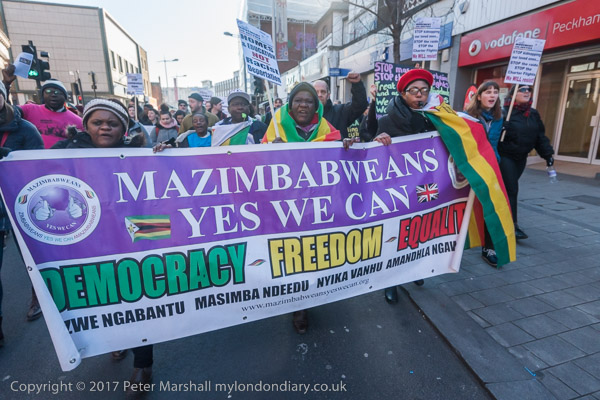
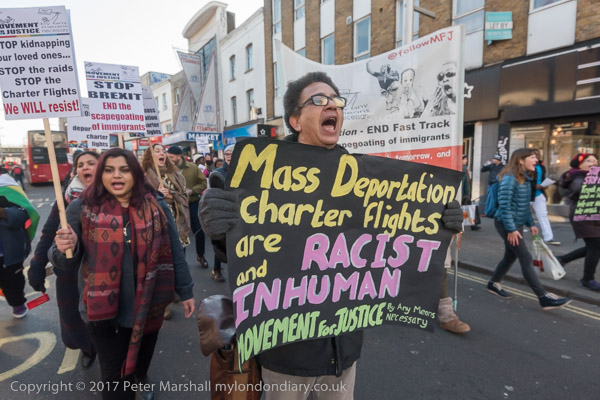
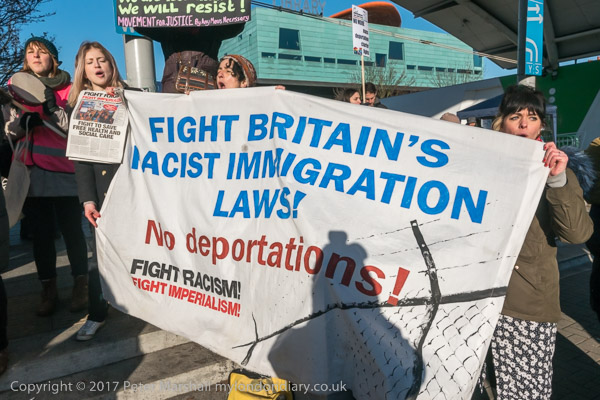
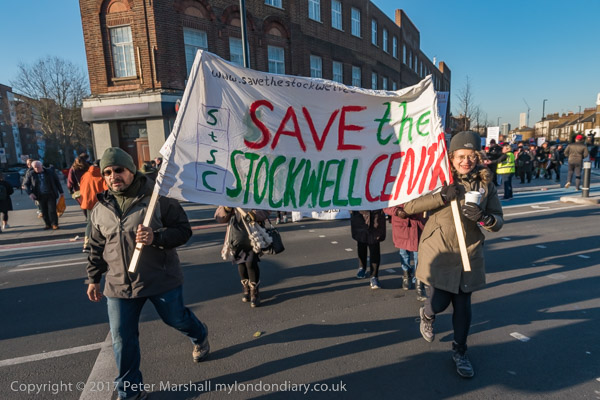
Peckham & Stockwell Protests – on Saturday 21st January 2017 I spent the day in South London, photographing protests in Peckham and Stockwell.


Peckham welcomes march against deportations

Peckham & Stockwell Protests - 2017

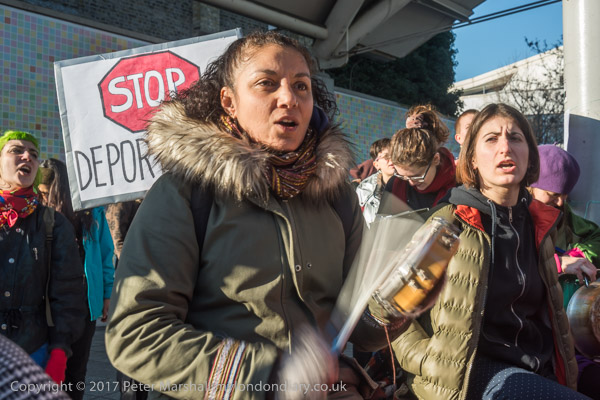
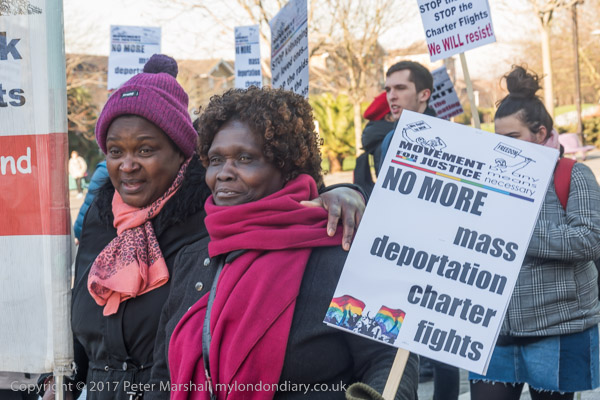
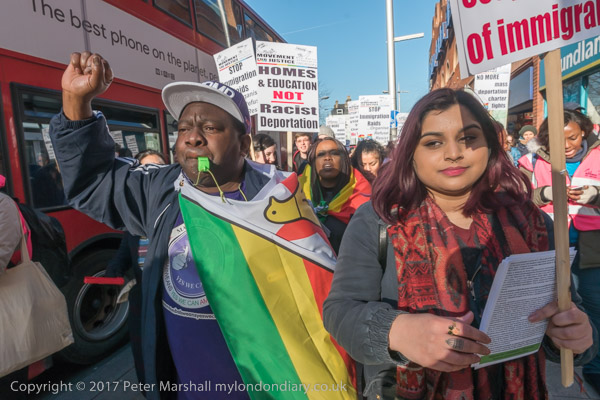
Immigration raids in south London had target long-established African, Asian and Caribbean communities, dividing families, deporting people who have built lives in the UK with parents, partners and children here. Protesters compared the deportation flights which followed with slave ships, with deportees shackled with a guard on each side in a cruel and divisive act of racist discrimination.

Peckham & Stockwell Protests - 2017

The Home Office had carried out many of these forced deportations unlawfully, and the High Court had decided that their use of the ‘detained fast track’ procedure from 2005-2014 was unlawful and went beyond their legal powers. Had we as individuals had acted illegally for so long and so persistently there would be little doubt that we would now be in prison.

Peckham & Stockwell Protests - 2017

But the government gets away scot-free. The 10,000 or so asylum seekers deported under the old system could in theory ask for the decision made on their cases to be set aside and lodge a new appeal, although very few are likely to be in a position to do so.

Peckham & Stockwell Protests - 2017

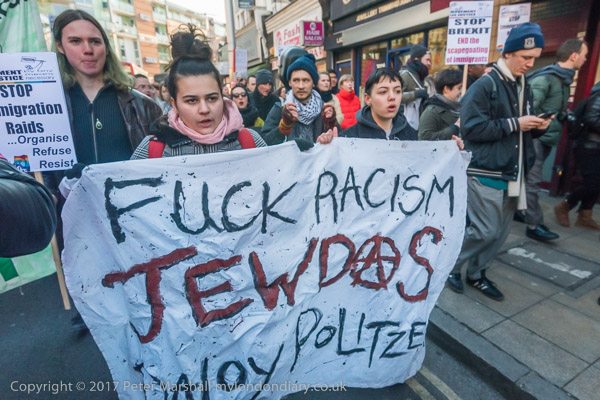
The protest was organised by Movement for Justice, but supported by many other groups including including SOAS Detainee Support (SDS), Anti Raids Network, Zimbabwe Human Rights Organization Mazimbabweans, Jewdas, BLMUK, London Mexico Solidarity, Fight Racism – Fight Imperialism (FRFI), Sisters Uncut – South East London and Lesbians and Gays Support the Migrants.

After a short rally the protests marched down Rye Lane, the main shopping street in Peckham, attracting a great deal of support from shoppers on the crowded street.

Some went into shops and handed out leaflets there and on the street. They held a short rally at the south end of the street before returning for another in the square by Peckham Library.

Peckham march against deportations


Oh! Mother march against knife crime – Peckham

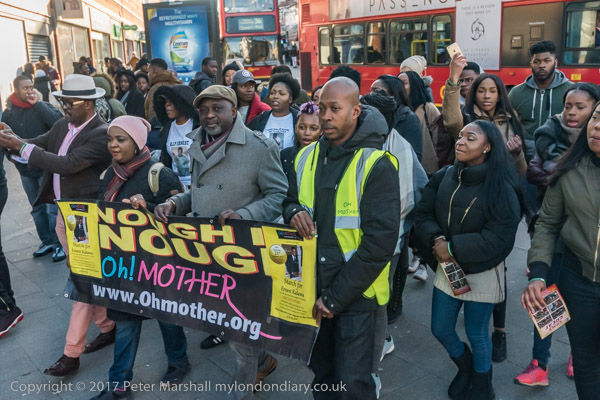
Another protest march was taking place in Peckham during the afternoon. Oh! Mother, A Christian organisation based in South London which campaigns for change in communities was protesting to put an end to gun and knife crime.

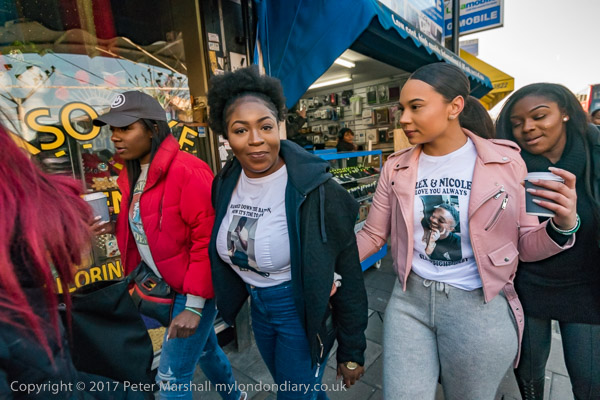
Their march followed the stabbing to death in Peckham on 30th December 2016 of 24 year old Ernest Kalawa. Among the marchers were members of the dead man’s family, some of whom wore t-shirts commemorating him.

Oh! Mother march against knife crime


March against closing community centres – Stockwell

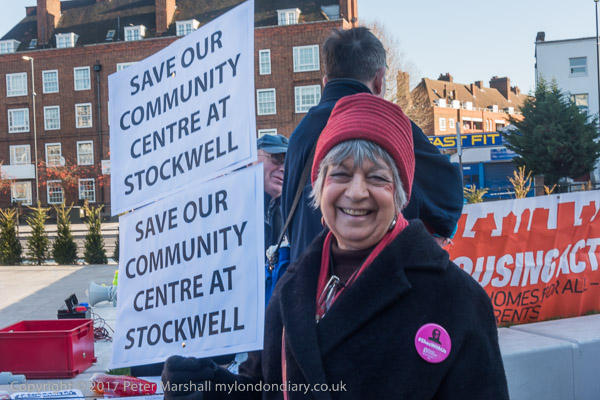
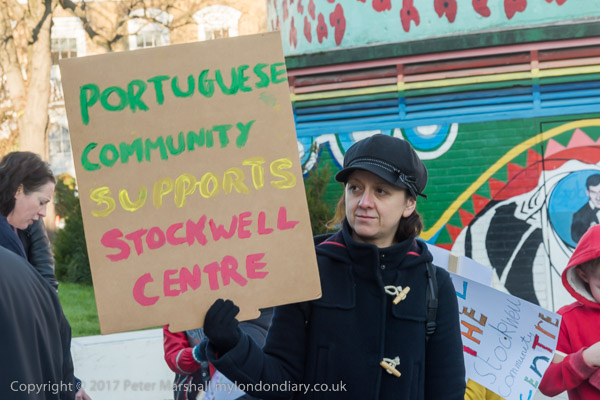
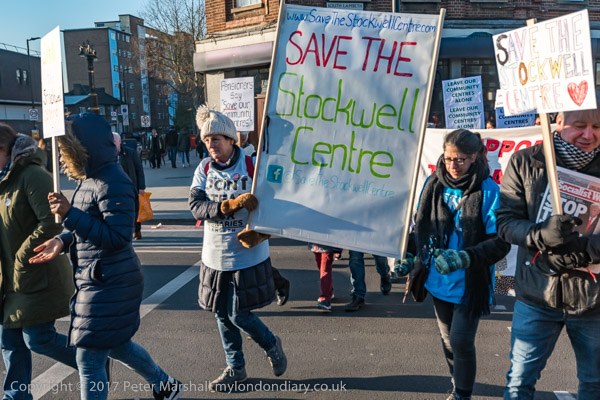
Members of Lambeth Labour were meeting in Stockwell to march to Stockwell Community Centre, one of two local community centres in Stockwell and Kennington Park which are run by Hyde Housing Association which were threatened with closure.

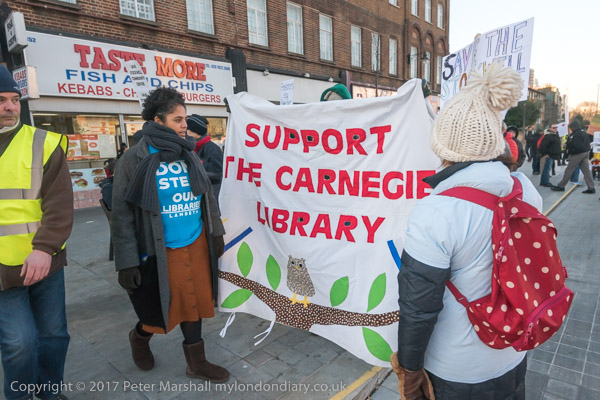
Lambeth Council is spending £50 million on a new town hall and had pledged £20 million to support the vanity Garden Bridge project, but the Labour-run council had made drastic cuts in community services, including library closures and selling off council estates to developers but has refused to support these community centres.

Lambeth Labour Council is one of a number of London Labour councils dominated by right-wing members who appear to have lost any sense that councils exist for the benefit of their residents rather than of the councillors.

Lambeth appear to follow in the footsteps of neighbouring Southwark, here journalist Anna Minton found that “20 per cent of Southwark’s 63 councillors work as lobbyists” for developers in the planning industry and that a significant number of Councillors and Council officers are making use of a ‘well-oiled revolving door’ to the industry.

March against closing community centres


FlickrFacebookMy London DiaryHull PhotosLea ValleyParis
London’s Industrial HeritageLondon Photos

All photographs on this page are copyright © Peter Marshall.
Contact me to buy prints or licence to reproduce.

Bread & Roses, Morales & Russian anti-fascists – 2019

Bread & Roses, Morales & Russian anti-fascists: Three events I photographed on Saturday 19th January 2019.

Bread & Roses is again relevant now in January 2024, with the release of a new version of the song a few days ago by the ‘Orchestra of Cardboard‘, part of the amazing ‘Every street a POWER STATION campaign‘, a project of Walthamstow’s community interest company Optimistic Foundation CIC set up by artist and filmmaker Hilary Powell and filmmaker and musician Dan Edelstyn. The recording is a part of their fundraising campaign and your can read, see and hear more about it and their other campaigns which are already having an effect in the area on their crowdfunder page.

But back to January 2019, five years ago today.


Women’s Bread & Roses protest

Bread & Roses, Morales & Russian anti-fascists - 2019

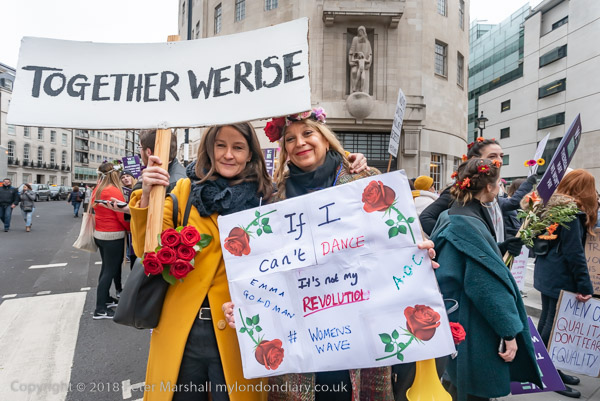
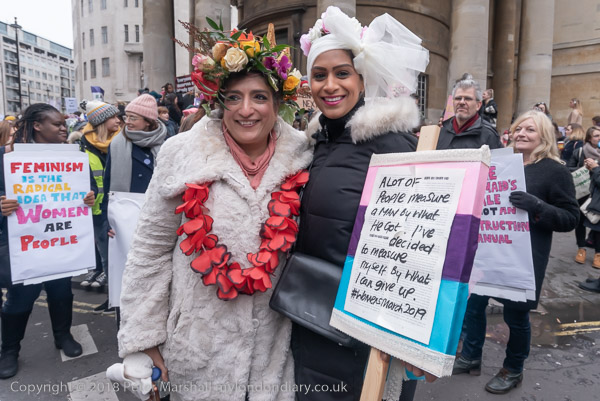
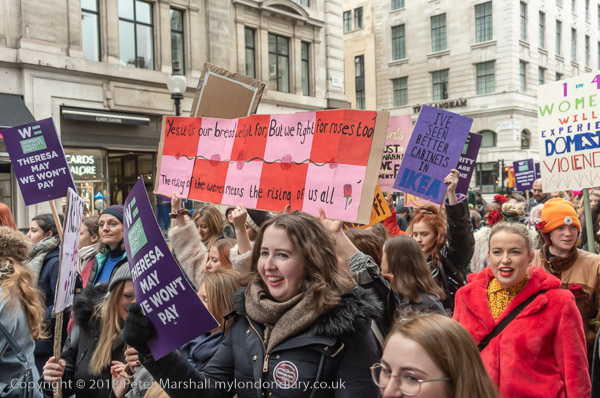
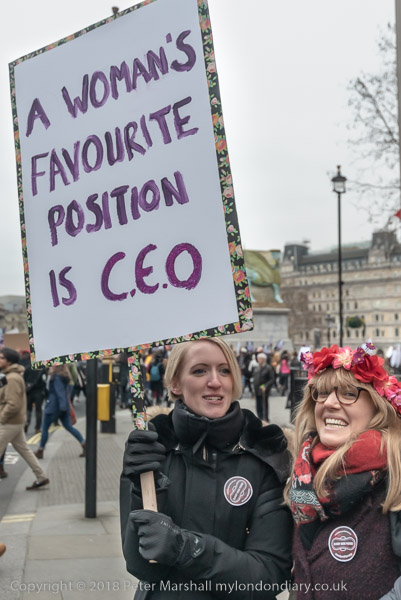
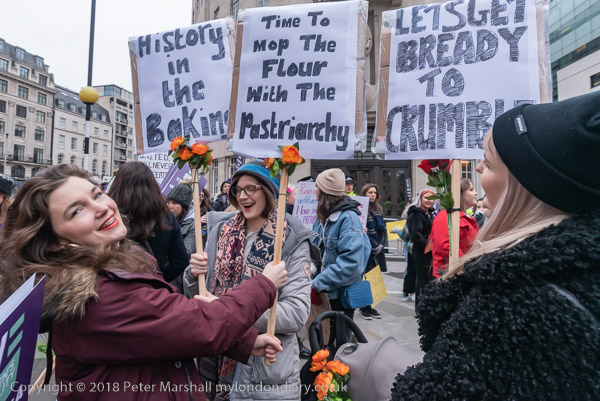
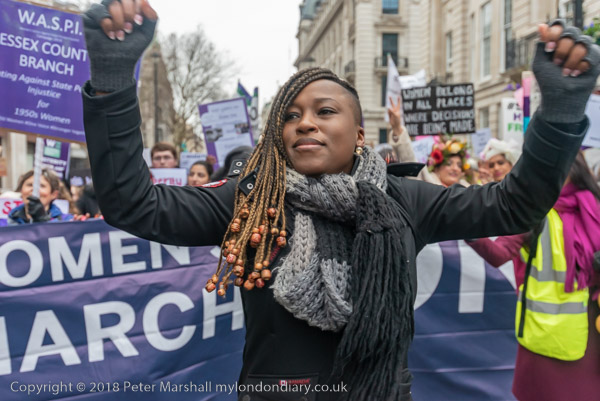
Inspired by the Bread & Roses protests which revolutionised workers’ rights for women in 1912, Women’s March London marched from the BBC to a rally in Trafalgar Square against economic oppression, violence against women, gender pay gap, racism, fascism, institutional sexual harassment and hostile environment in the UK, and called for a government dedicated to equality and working for all of us rather than the few.

Bread & Roses, Morales & Russian anti-fascists - 2019

The London march was part of an international day with women marching in many countries around the world, particularly in cities across the USA.

Bread & Roses, Morales & Russian anti-fascists - 2019

At the start of the march was opposite the BBC on the steps of Langham Place a few of the women organising the event were being directed and filmed by a BBC film crew. Supposedly this was a documentary but it seemed to be more a scripted drama closely controlled by the director and with the women involved holding orange folders from which they read.

Bread & Roses, Morales & Russian anti-fascists - 2019

But there were a rather larger group of women (and just a few men with them) standing around outside the BBC building and largely ignoring the filming that was taking place. Many had made placards especially for the event, with some using words from the poem ‘Bread and Roses‘ written by James Oppenheim and published at the end of 1911. The phrase ‘Bread and Roses’ came from a speech the previous year by Helen Todd, speaking about the need for laws to regulate wages, working hours and conditions.

A few days later a strike was started by textile workers, largely immigrants, in Lawrence, Massachusetts. The strike was organised by the IWW, the Industrial Workers of the World, led largely by women and they took up Oppenheims poem and sang it at their meetings and marches, as well as apparently marching with a banner ‘We want Bread, and Roses too!’ during their three-month strike.

Eventually, when the BBC had finished making their movie the women gathered for a march and I walked with them to Trafalgar Square.

Many more pictures on My London Diary at Women’s Bread & Roses protest.


Bolivians protest against Morales – Trafalgar Square

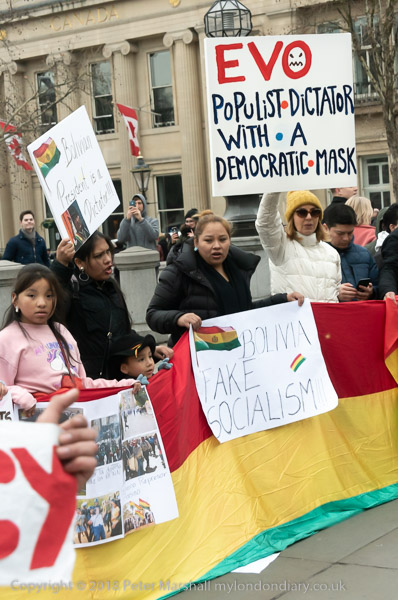
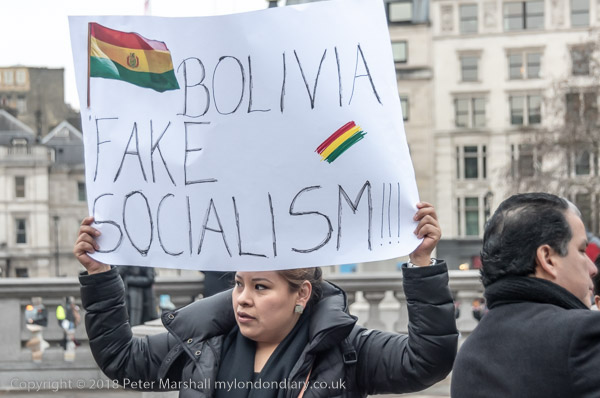
A small group of Bolivians had come to protest following a decision in December by the Electoral Commission that President Evo Morales could stand for a fourth term in office in the October 2019 elections which were starting with primaries at the end of January 2019. But I was not convinced that this was truly a protest about democracy rather than simply against his socialist policies.

Morales, Bolivia’s first president to come from the indigenous population was first elected in 2005. He supported the 2009 constitution which allowed only two consecutive terms in office but was able to stand for a third term as his first term had been before the limit was imposed. In 2016 tried to increase the limit to three terms by a referendum which was narrowly defeated. But after this the courts ruled that the limitation infringed the human rights of citizens, allowing him to stand for a further term.

Morales won the October 2019 but their were widespread protests alleging electoral fraud, although later investigations suggested he had indeed gained the 10% lead required for a first-round victory. But the protests grew and he was endangered by armed groups; eventually he resigned on 10th November 2019, fleeing to Mexico where he was granted political asylum. Allegations made against him of sedition and terrorism were later found to be politically motivated and in 2020 a Bolivian court found his rights had been violated and judicial procedures breached.

His successful policies which reduced poverty and illiteracy and combated the influence of the USA and multinational companies made him very unpopular among the middle class and particularly the groups accustomed to running the country. Many in the USA encouraged and financed the opposition to him as he was widely seen to have shown a successful alternative to the growth of international capitalism.

Bolivians protest against Morales


Solidarity with Russian anti-fascists – Whitechapel

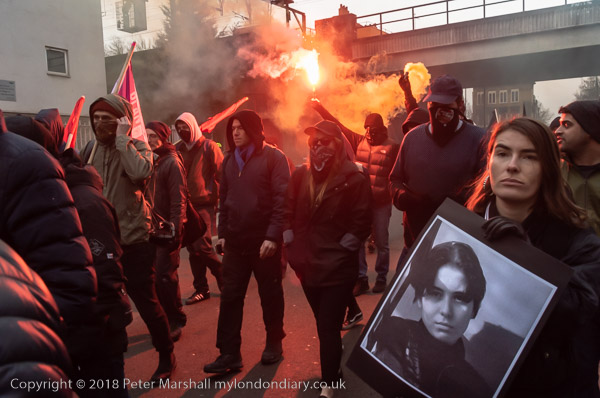
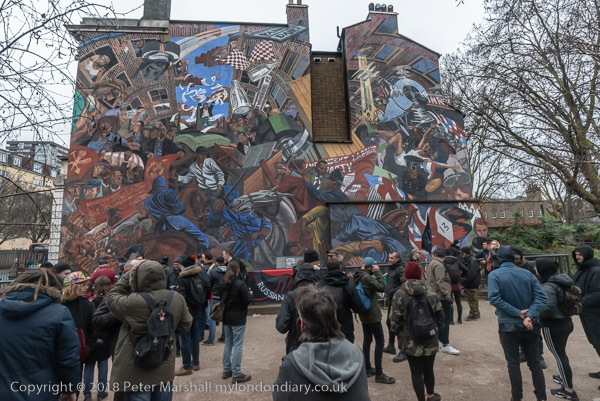
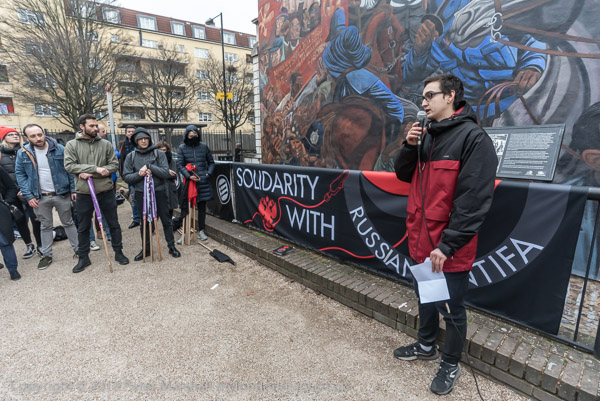
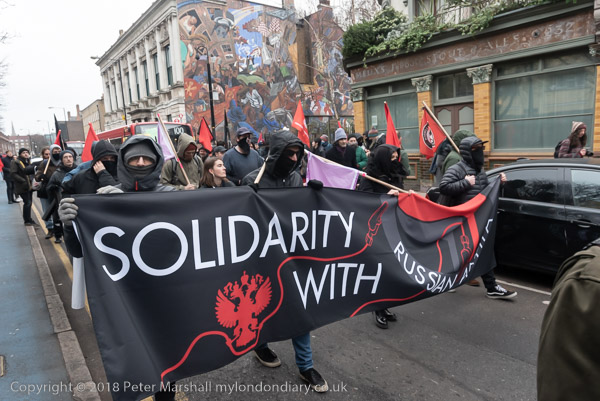
Finally I went east to the Cable Street Mural where anarchists and anti-fascists were meeting l to oppose racism, xenophobia, fascism and the upsurge of far-right populism and to show solidarity with Russian anti-fascists who have been arrested, framed and tortured in a brutal wave of repression.

Russian and Ukranian comrades spoke at the rally. telling us of the persecution taking place. The Russian Federal Security Service (FSB) arrested six in Penza in 2017, charging them with belonging to a non-existent organisation, ‘The Network’. Beatings and torture before their trial were used to make them give false confessions.

Two others were arrested in 2018 in St Petersburg and charged with belonging to the same fictional network and again tortured into making confessions and further similar arrests have followed. A total of 11 where then in prison for belonging to’The Network’, facing 5 to 25 years in jail.

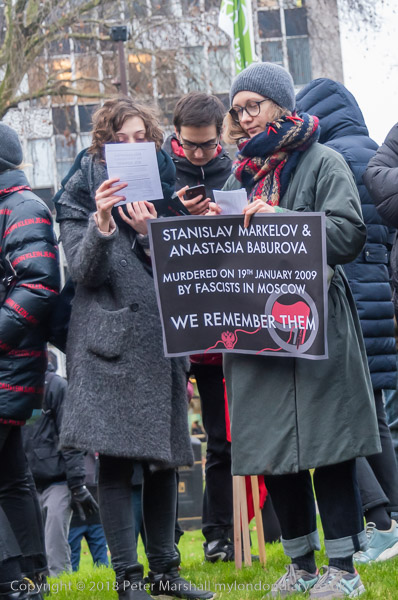
The date for the protest was chosen as the anniversary of the brutal murder of two Russian anti-fascists, journalist Anastasia Baburova and lawyer Stanislav Markelov, by fascists in broad daylight on the streets of Moscow on January 19th 2009. Russian anarchists and anti-fascists hold events to remember them on this day every year.

There was then a march to a further rally in Altab Ali Park, named for the 24-year-old clothing worker murdered in a nearby street on 4 May 1978.

More pictures at Solidarity with Russian anti-fascists.


FlickrFacebookMy London DiaryHull PhotosLea ValleyParis
London’s Industrial HeritageLondon Photos

All photographs on this page are copyright © Peter Marshall.
Contact me to buy prints or licence to reproduce.

Massive London Protest Over Gaza Genocide – 13 Jan 2023

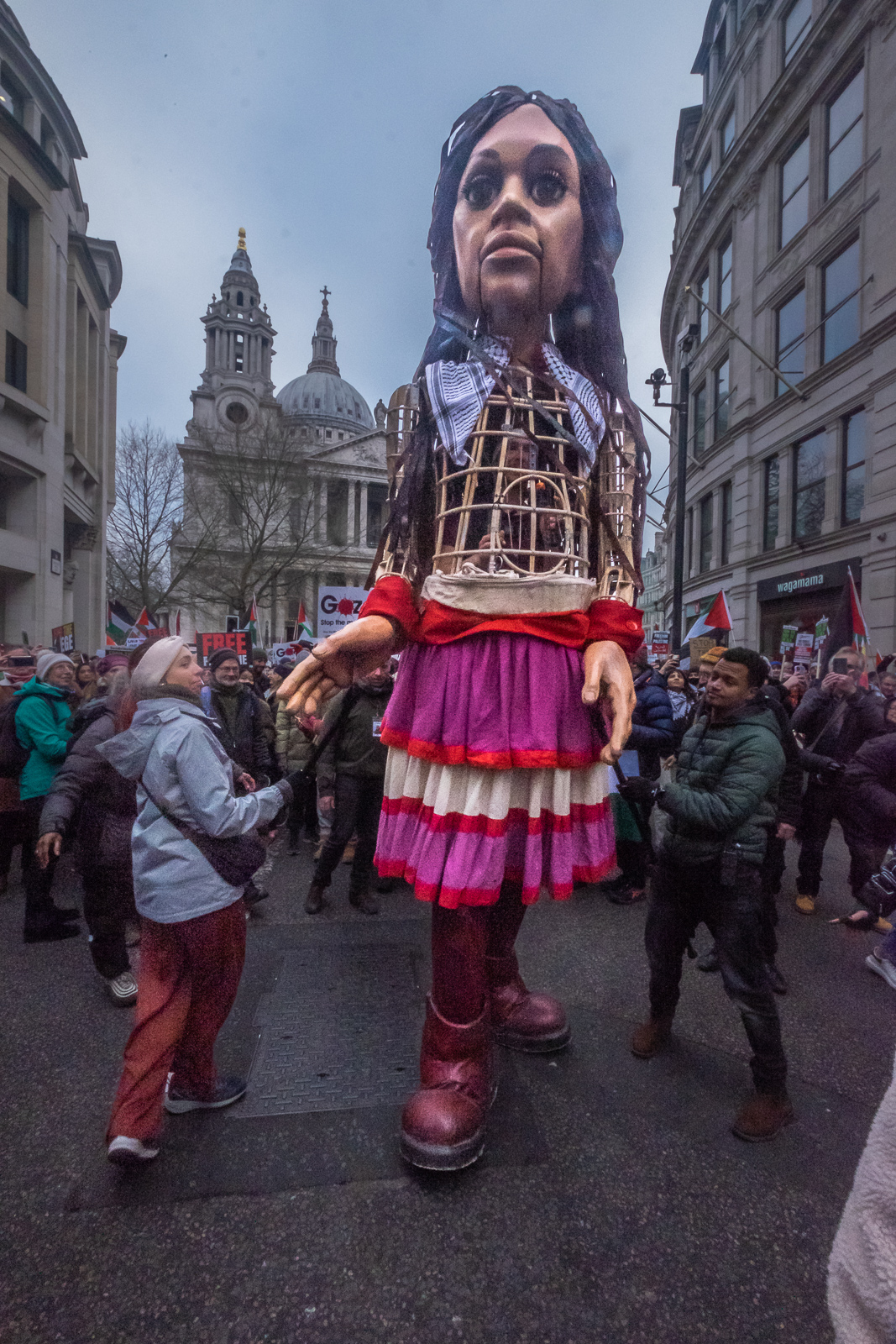
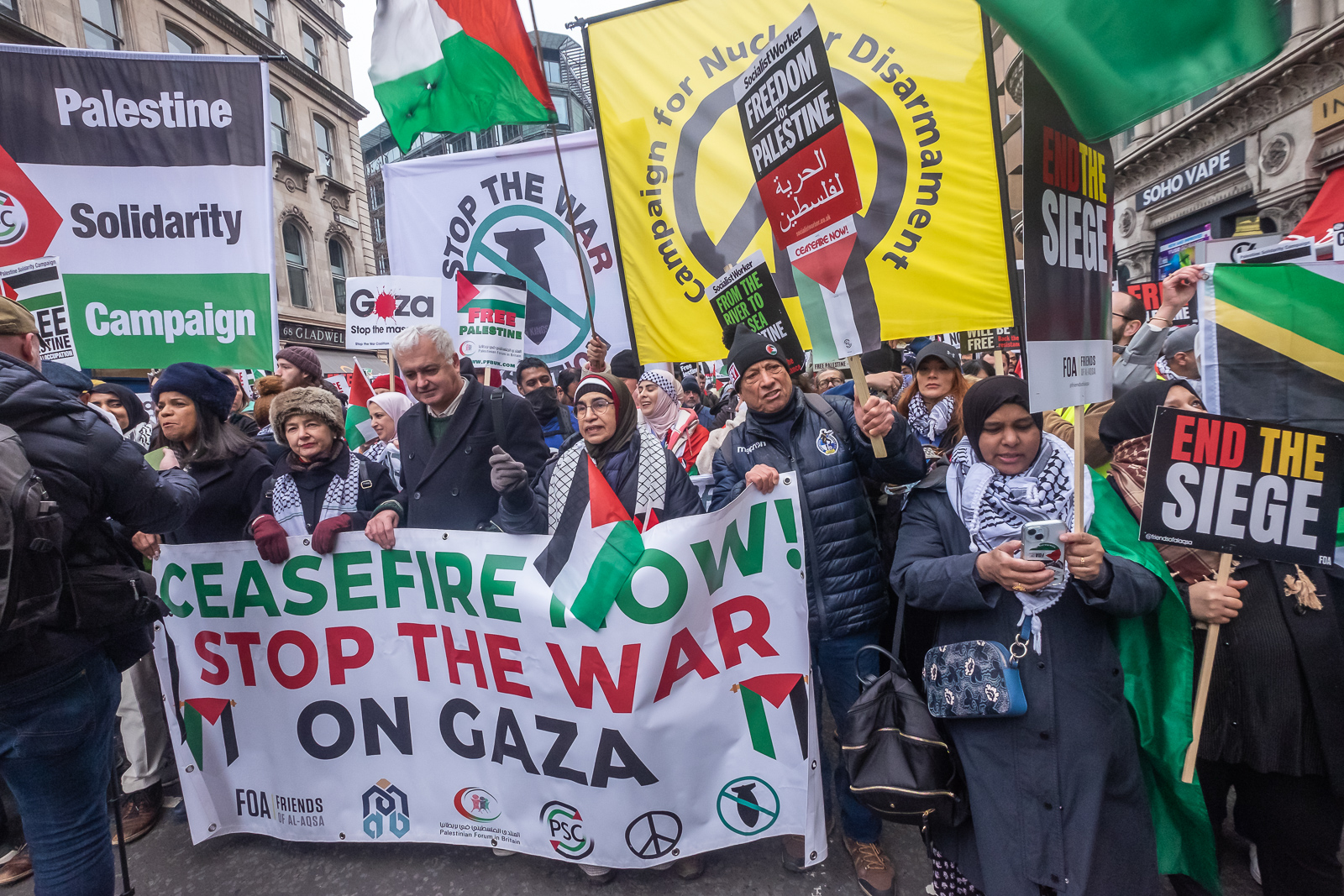
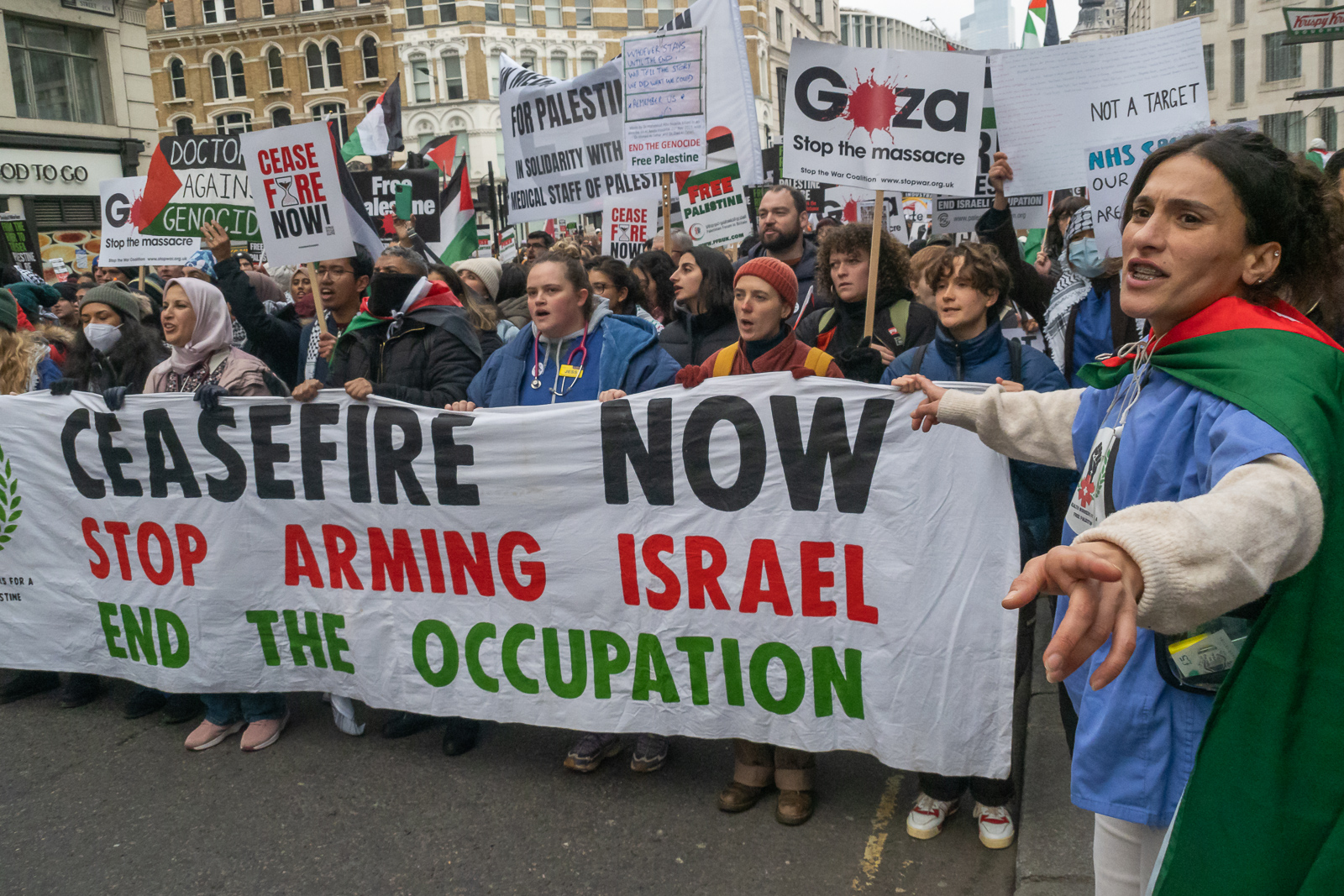
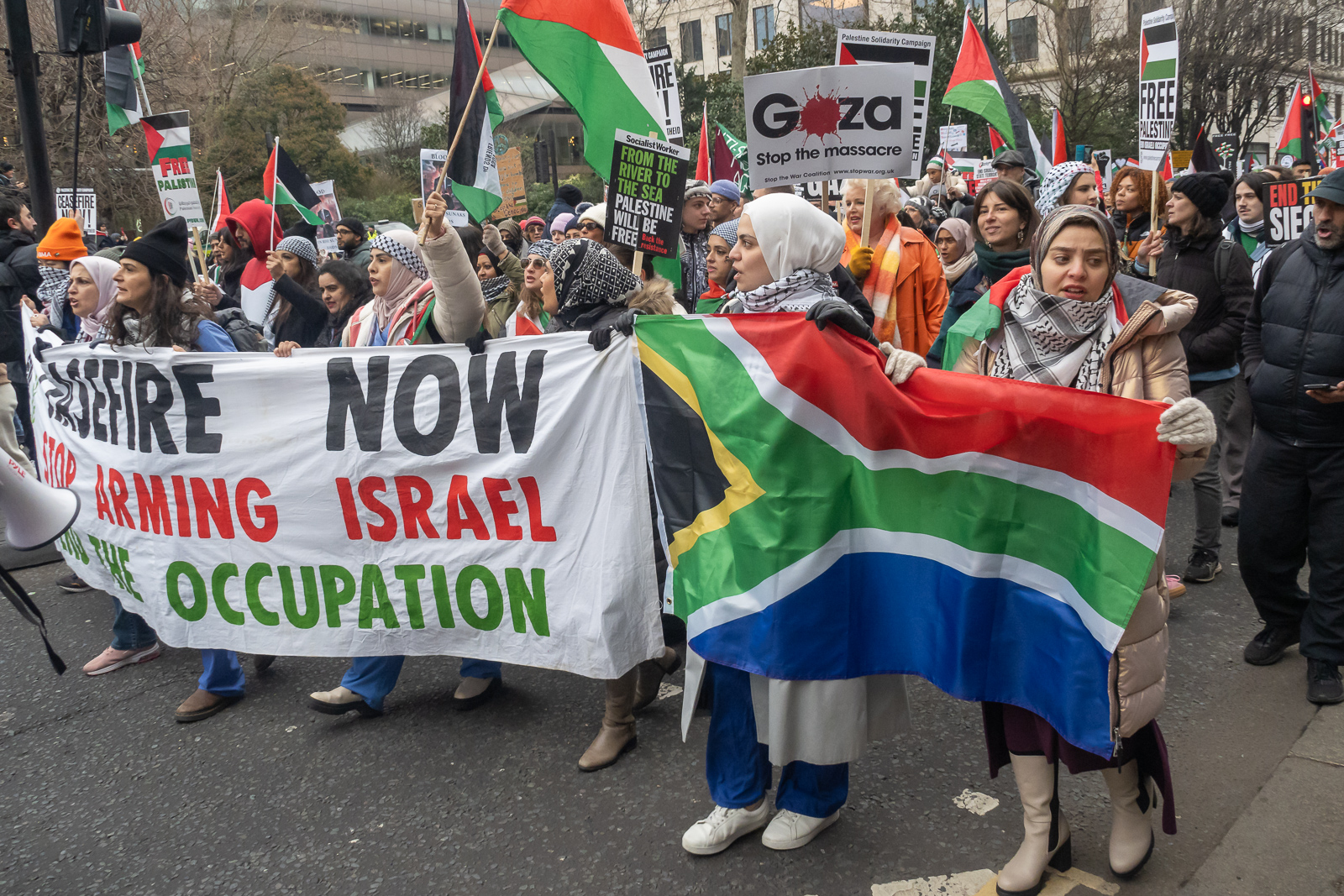
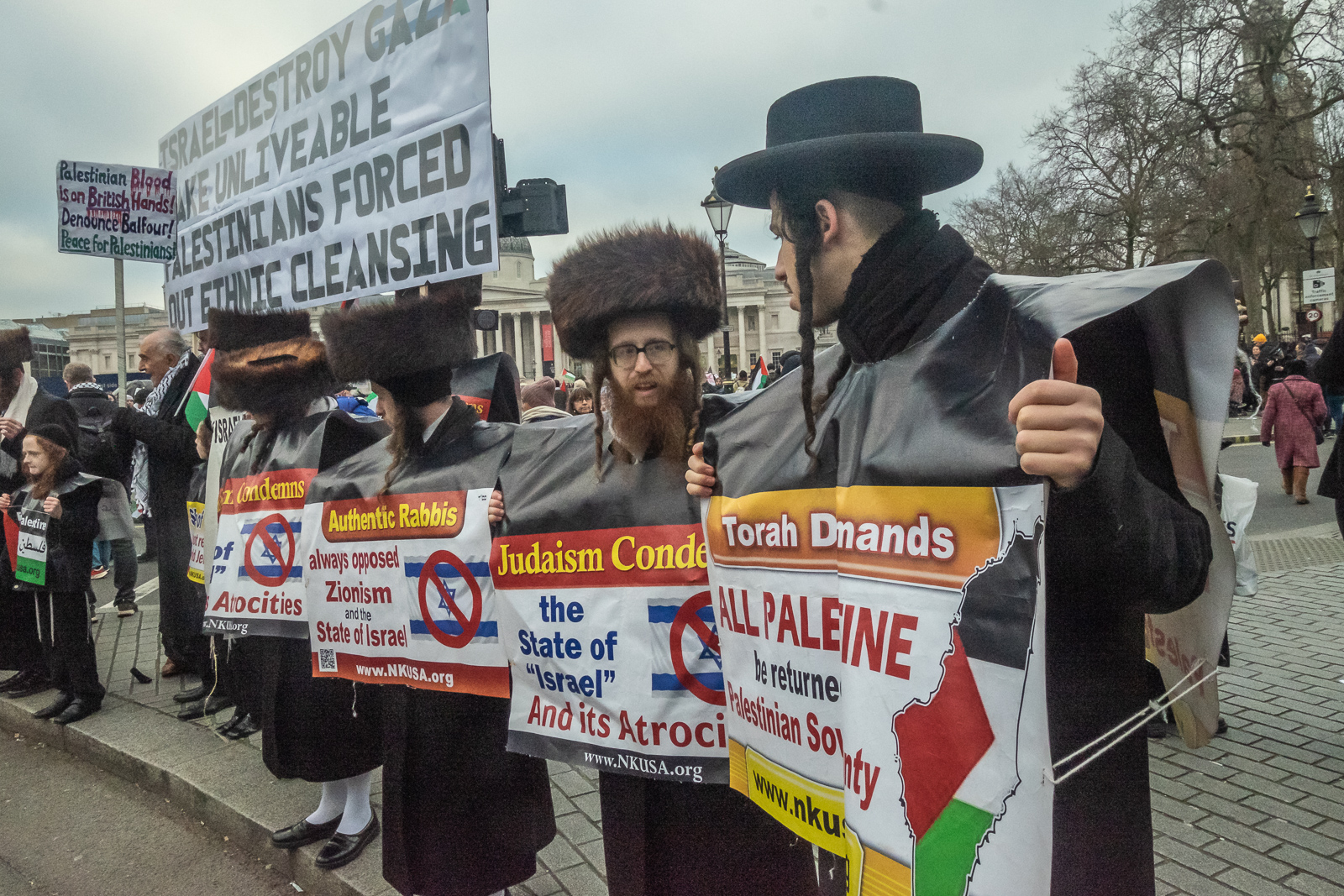
Massive London Protest Over Gaza Genocide: Last Saturday I photographed the march in London when over 200,000 marched from Bank calling for an immediate ceasefire in Gaza. Among those on the march, Little Amal, a 12ft giant puppet of a Syrian child refugee stood out. As usual there was a strong Jewish representation both on the main march and on a separate feeder march for families and children I photographed as they set off from outside Kings College on Strand.

Massive London Protest Over Gaza Genocide

This was the seventh large protest in London and reflects the feelings of a large majority of the British public but unfortunately this and other huge protests around the world, including in the USA, seem unlikely to have any effect on our or the US governments polices. They will continue to give support to Israel while making weak statements about the need to reduce the killing which Israel will continue to ignore while denying the effects of its actions and blaming Hamas for the death and destruction they are causing.

Massive London Protest Over Gaza Genocide
The front of the march waiting to start.

The march took place on the 99th day of the Israeli attack on Gaza which has so far killed over 23,000 people, mainly civilians including more than 10,000 children, with many bodies still under the rubble. The bombing and shelling has made humanitarian aid and medical treatment impossible and widespread deaths from disease and starvation now seem inevitable.

Massive London Protest Over Gaza Genocide
Doctors Against Genocide.

Israeli forces have attacked hospitals, schools, refugee camps and have killed many doctors and arrested others. Only one hospital remains operating in the whole of Gaza and there are desperate shortages of medicines with many amputations having to be carried out without anaesthetics. Few of the 60,000 severely injured so far by the Israeli attacks have been able to get proper treatment.

Massive London Protest Over Gaza Genocide
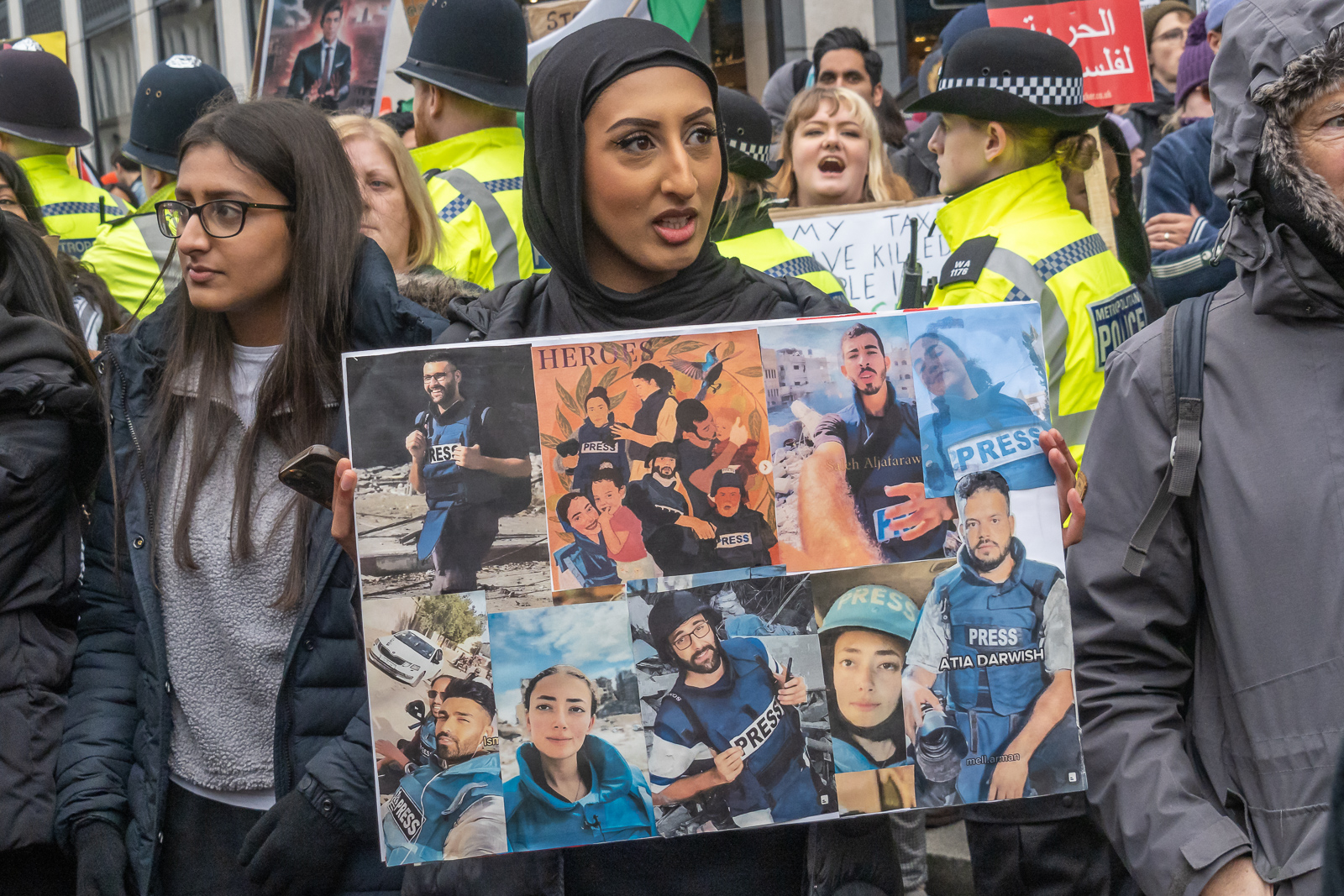
A few of the Palestinian press who have been killed by Israel

Gaza’s journalists appear to have been especially targeted and more have now been killed by the IDF than journalists were killed in the whole six years of the Second World War.

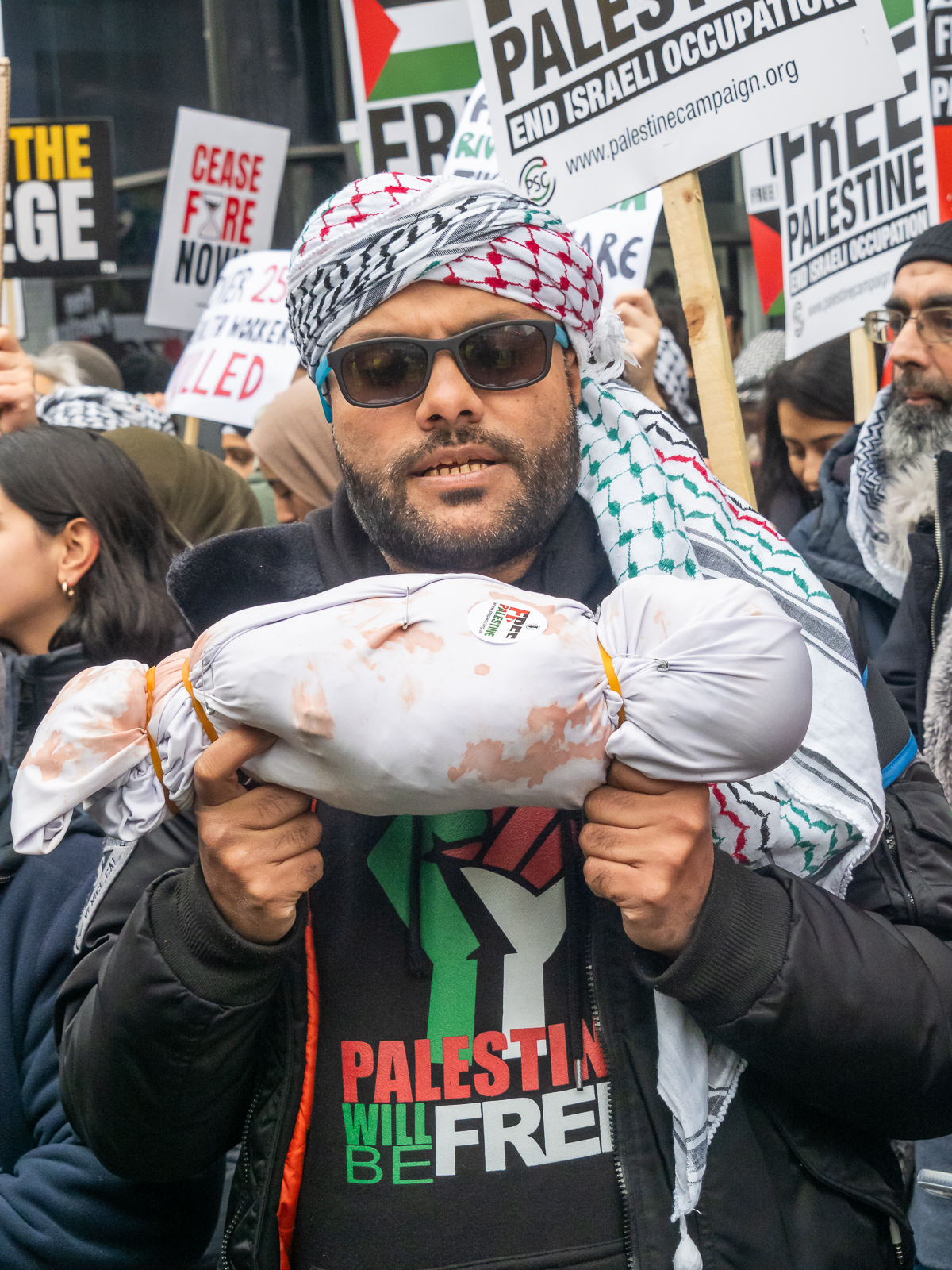
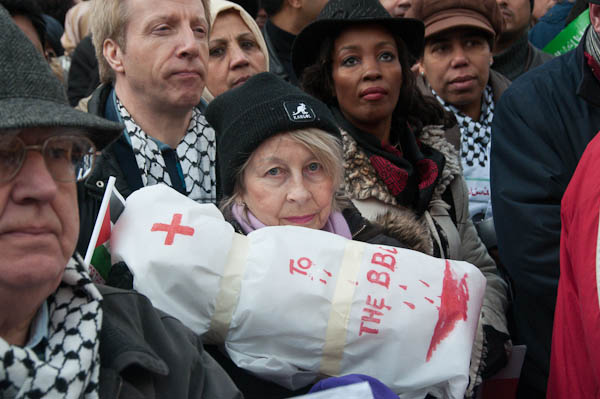
A man holds a bloodstained bundle representing a dead child

As well as calling for a ceasefire, protesters also demand a just solution with freedom for Palestine, an end to the military occupation of the country and an end to Israeli apartheid.

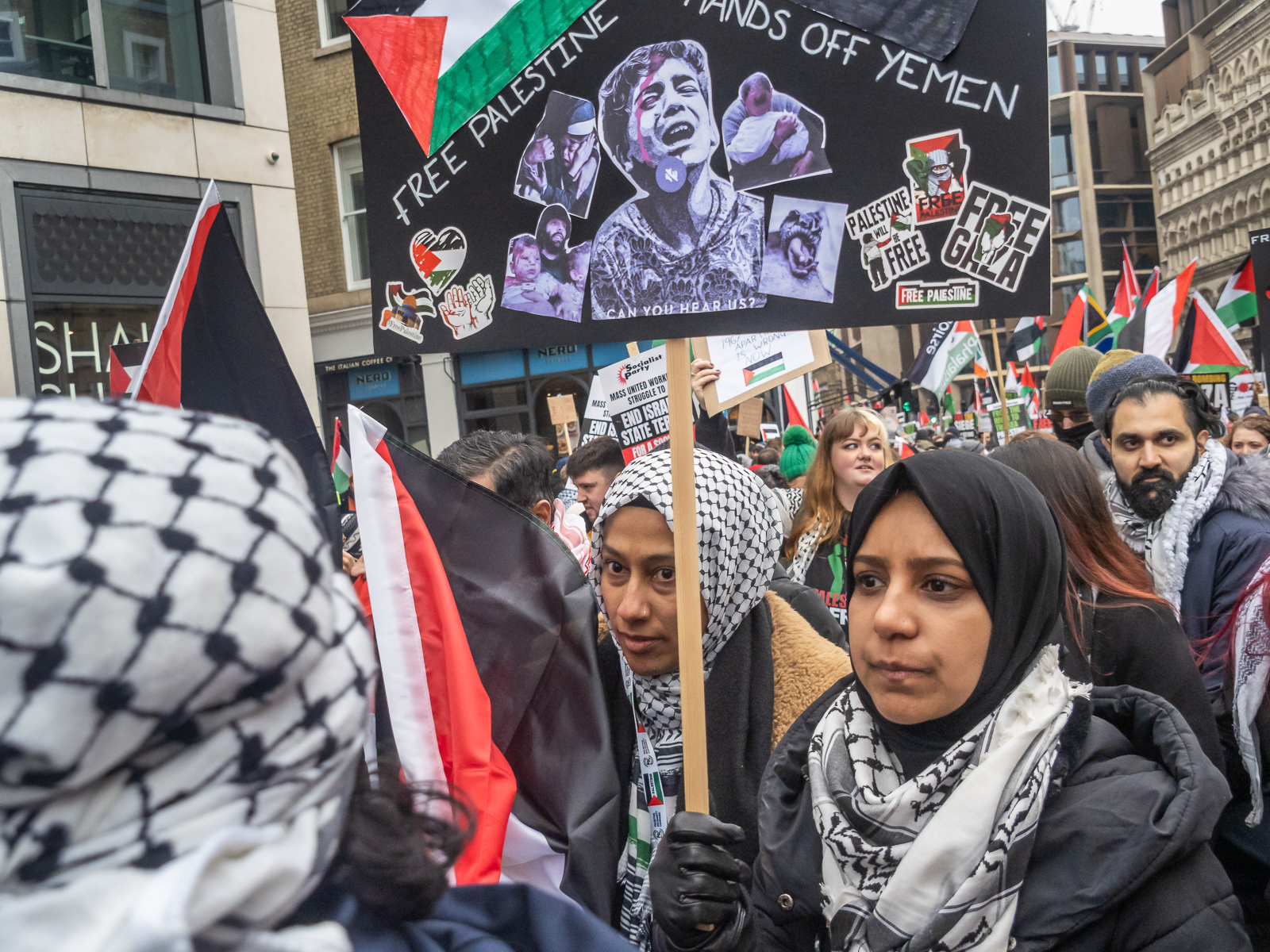
Free Palestine Hands Off Yemen

Two events in the previous week added to the demands of protesters. Some had placards praising the Houthi forces in Yemen for their attacks on ships in the Red Sea and their were chants such as “Yemen, Yemen, make us proud, turn another ship around” following the US and UK air attacks. The Houthi are now in control of much of Yemen following the October 2022 ceasefire and peace talks led by the UN began it December 2023, but they continue to be referred to in UK media as rebels or terrorists.

Last week South Africa stated the case at the International Court of Justice accusing Israel of genocide. It got rather less attention in the UK media than the response the following day by Israel, which appeared largely a continued recital of the widely condemned attacks of October 7th and the long-discredited assertion that their actions in Gaza are self-defence. Israel also denied having bombed any hospitals and claimed they were facilitating humanitarian aid, lying in the face of mountains of evidence the world has read.

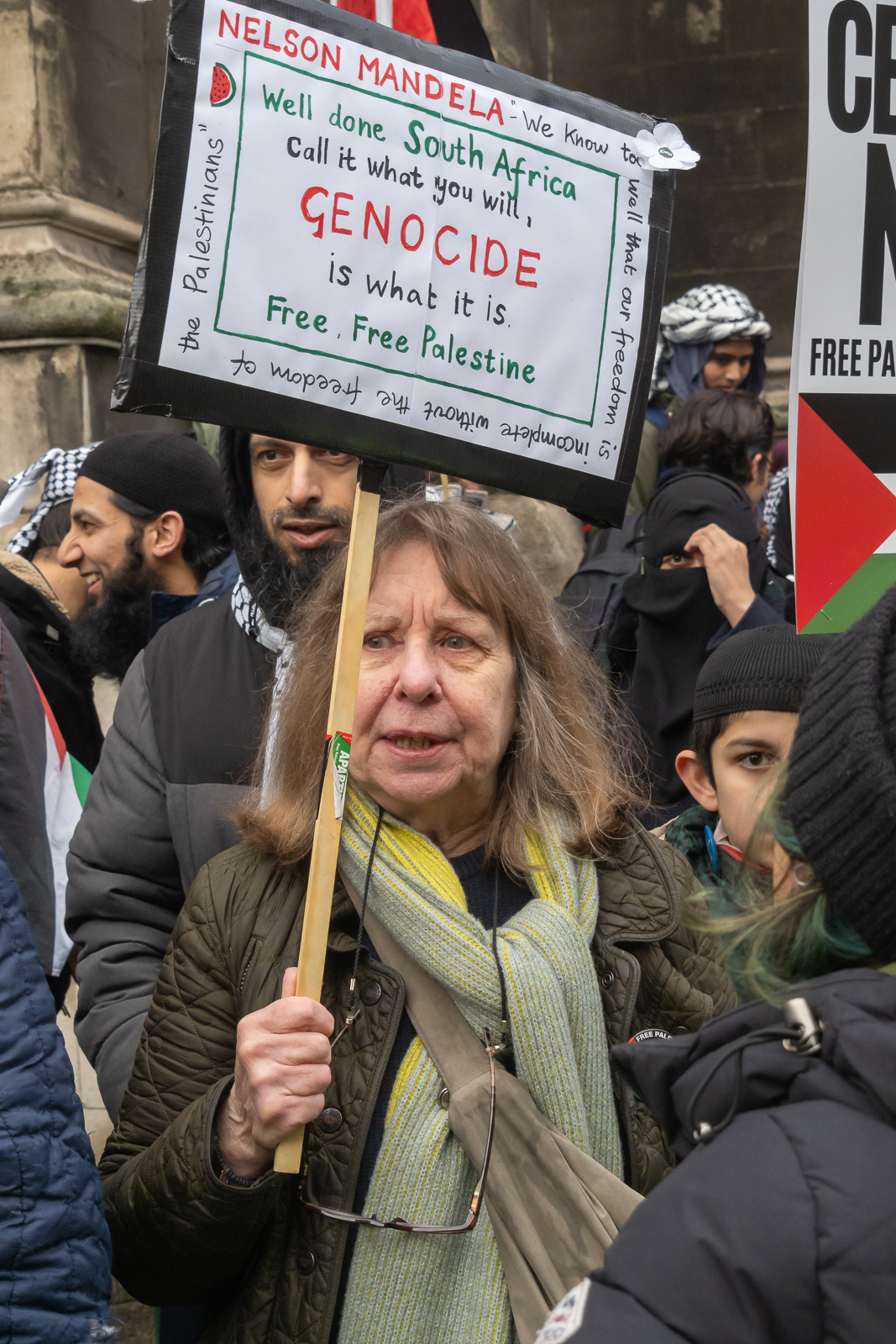
A woman holds a placard ‘Well Done South Africa’.

Many on the protest praised South Africa for taking Israel to court. The moral case seems clearly proven, but I suspect the case may be lost on some legal technicality. ICJ verdicts are in any case not binding and I think the majority of the world has already reached their conclusion.

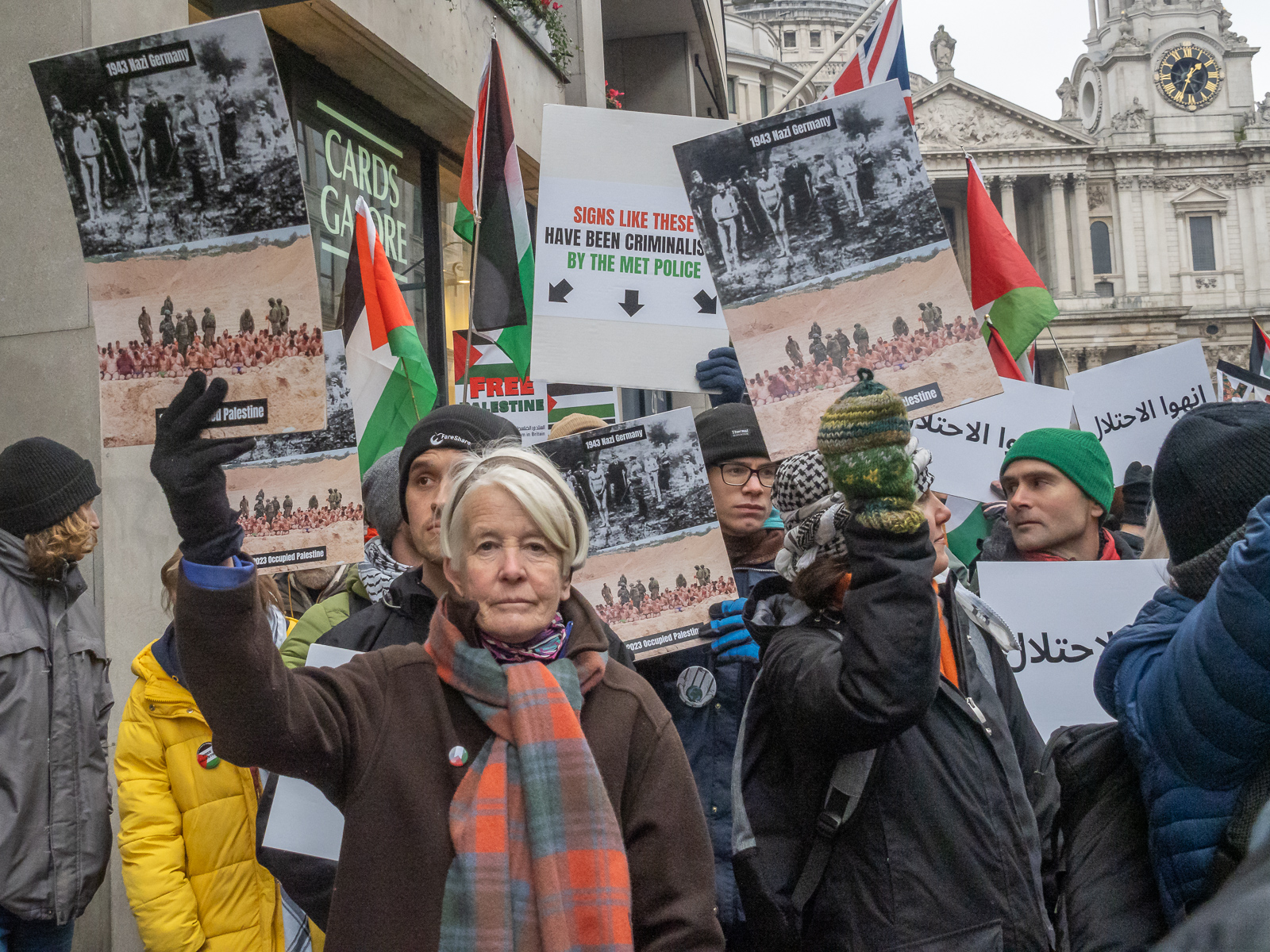
People hold up posters showing Nazi Germany and Palestine with a poster saying ‘Signs Like These Have Been Criinalised by the Met Police

There were apparently 1,700 police on duty for the protests and a handful of people were arrested for carrying placards or handing out leaflets which the police decided were possibly “showing support for a proscribed organisation which is an offence under the Terrorism Act.” The flyer, published by the Met, stated their “unconditional and wholehearted support and solidarity for the Palestinian struggle, which is once more breaking out into armed resistance” but made no explicit mention of Hamas. Other groups in the Palestinian struggle are not proscribed in the UK.

With so many taking part, the march ended with rallies in both of London’s major central squares, Trafalgar Square and Parliament Square, though I only got to the first of these. I was quite tired having walked from London Bridge station to Bank and then along with the march going back and forth taking pictures and decided to get a train from Charing Cross rather than go on to Parliament Square.

There are around 50 more of my pictures from the march at Massive London Protest Over Gaza Genocide.


FlickrFacebookMy London DiaryHull PhotosLea ValleyParis
London’s Industrial HeritageLondon Photos

All photographs on this page are copyright © Peter Marshall.
Contact me to buy prints or licence to reproduce.

Focus E15 Mothers Party Against Eviction – 2014

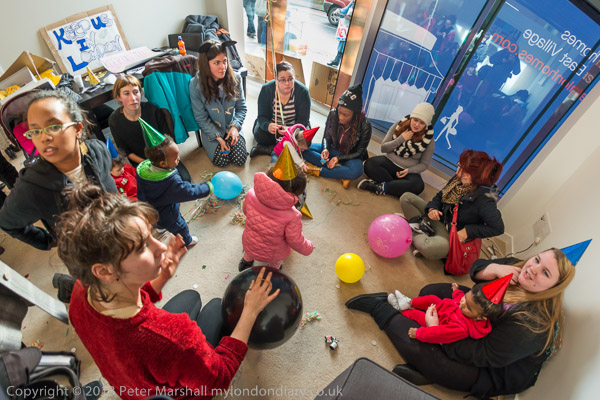
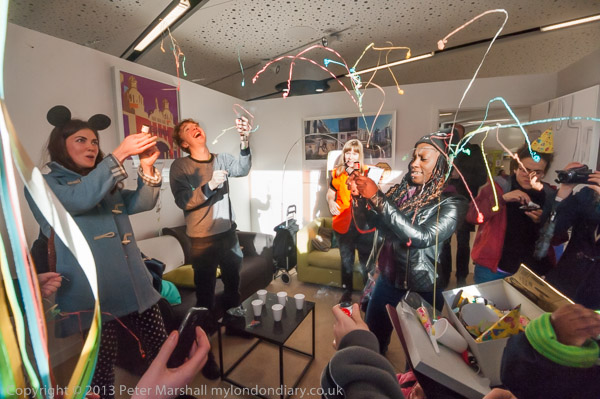
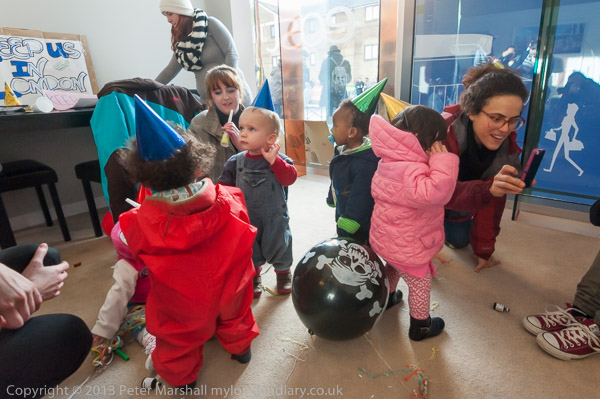
Focus E15 Mothers Party Against Eviction: Ten years ago today, on Friday 17th January 2014 I went to Stratford to photograph and support mothers threatened with eviction from their hostel.

Focus E15 Mothers Party Against Eviction

Focus E15 Mothers Party Against Eviction – East Thames Housing, Stratford

Focus E15 Mothers Party Against Eviction

The eviction threat came when Newham Council withdrew funding from the Focus E15 Foyer run by East Thames Housing Association. Rather than accept the evictions and be rehoused by the council in private rented flats in far-flung areas of the UK – including Wales and Liverpool, the women in the hostel decided to join together and fight.

Focus E15 Mothers Party Against Eviction

They fought to be rehoused near to friends, families and support including nurseries close to their local area to avoid distress and dislocation for themselves and their children – and eventually they won.

Focus E15 Mothers Party Against Eviction

The fight by Focus E15 brought national publicity to the scandals around local authority housing, and was a inspiration to others around the country. They continue their fight with their ‘Housing For All‘ campaign and remain an active campaign against evictions in Newham, including a weekly street stall every Saturday on Stratford Broadway.

Their campaign against Newham Council and its right-wing Labour Mayor Robin Wales who seemed to regard the London borough as a personal fiefdom led to some devious and at times illegal attempts to silence them and was almost certainly a factor in fomenting the revolt by Labour Party members that eventually led to him being deposed. Though his replacement as Mayor, Rokhsana Fiaz, is perhaps only a slight improvement.

All local authorities have suffered under cuts by central government, and in particular attacks on social housing provision, begun under Thatcher and continued by all governments since. The cuts made by the Tory-led coalition following on from the financial crash of 2008 tightened the screw on them still further.

Newham under Robin Wales appears to have decided that they needed to attract a wealthier population to the area and get rid of some of their existing population and had decided in the early 2000s to sell off a well-located and popular council estate close to the centre of Stratford to whoever they could. They began the process of ‘decanting’ people from the Carpenters estate around 2004, with many properties being left empty for years despite having – together with Lambeth – the largest housing waiting lists in Greater London – around 3.5 times the average among London authorities.

One of the Focus E15 slogans was ‘Repopulate the Carpenters Estate’ and it was in part due to their actions, alongside those of other campaigners, that the estate was not sold off and demolished. The estate is now being regenerated by the council although Focus E15 find much to criticise in the council’s plans.

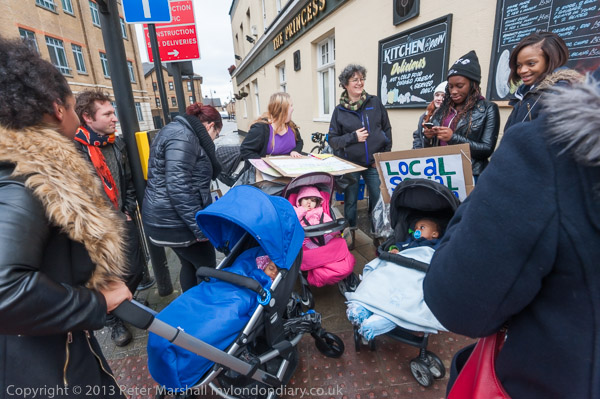
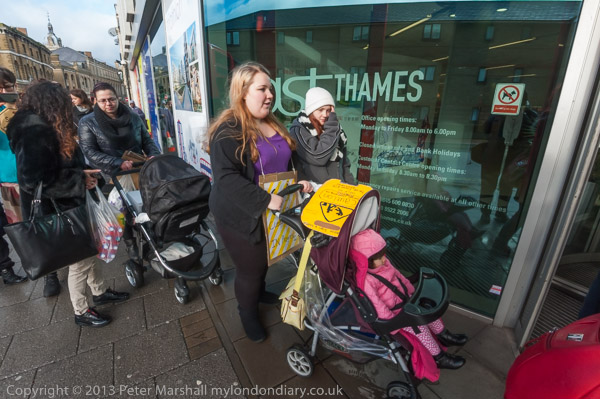
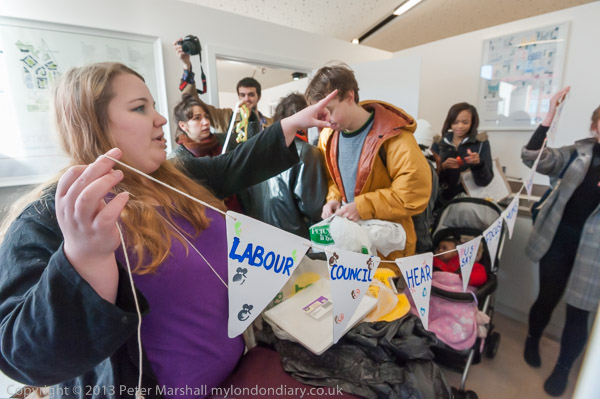
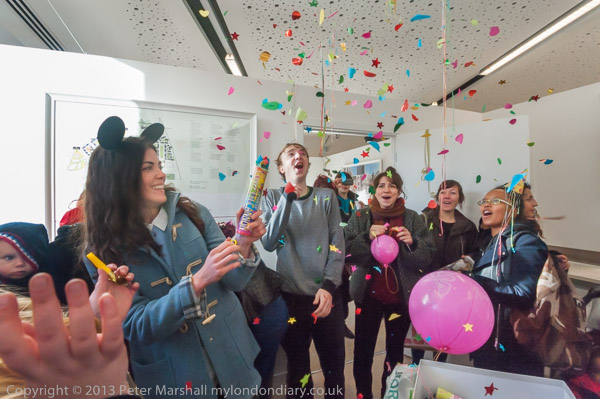
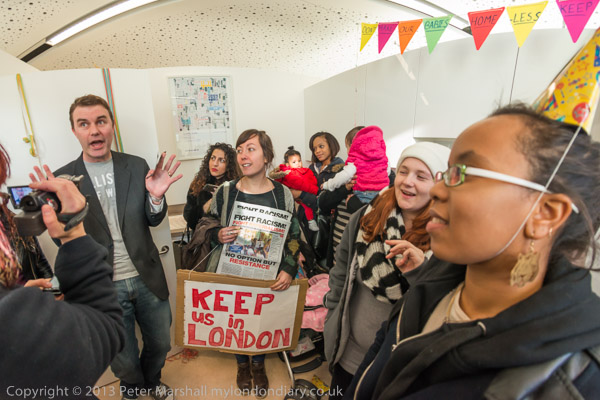
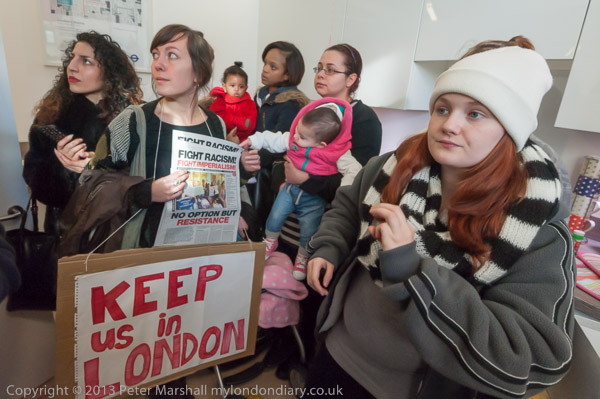
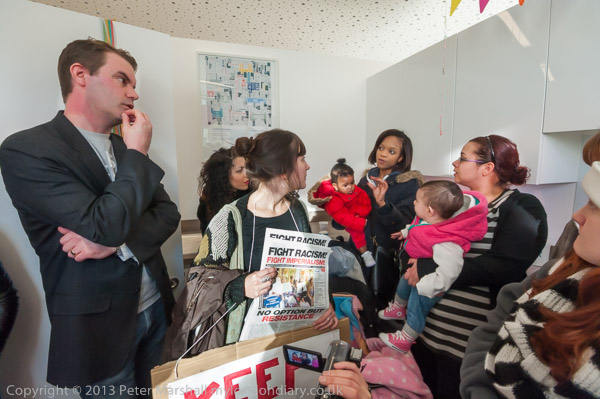
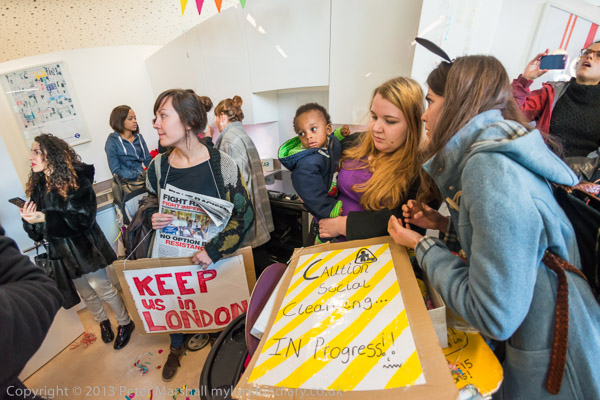
The Focus E15 had begun in September 2013 and the action ten years ago was one of their earliest. I met with them and supporters, including those from the Revolutionary Communist Group, on a street corner near the offices of East Thames and walked with them into the large foyer, where they posed for a photograph for one of the local newspapers.

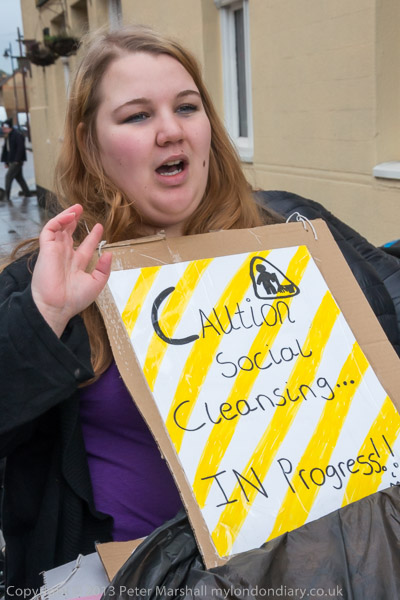
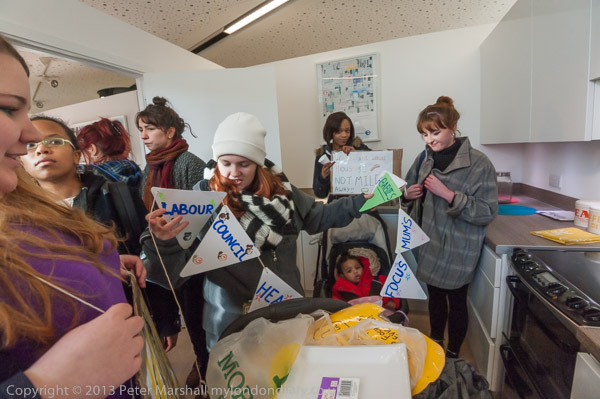
Then some of the mothers and children moved into the show flat at the front of the offices, with others remaining on the street outside with banners and placards, handing out leaflets to people walking by and using a megaphone to explain why the mothers were protesting.

The member of East Thames staff who had been dealing with the mothers came to talk with them. He assured them that they would be allowed to remain until satisfactory accommodation had been found for them.

The mothers pointed out that East Thames had large numbers of homes available, including many on the former Olympic site in Stratford, but were told that East Thames could not allocate affordable properties directly, but had to work with Newham council.

He seemed genuinely suprised to hear from the mothers that Newham had made offers involving rehousing away from London, in Hastings, Birmingham and elsewhere, away from friends, families, colleges, nurseries and support networks, and stated that East Thames intended to see them rehoused in London.

Later the Group Chief Executive of East Thames, June Barnes arrived and talked with the mothers telling them the same. East Thames seemed clear that the real problem was with Newham Council and not with them, though the campaigners were not really convinced.

You can read a longer account of the protest and party with many more pictures on My London Diary at Focus E15 Mothers Party Against Eviction.


FlickrFacebookMy London DiaryHull PhotosLea ValleyParis
London’s Industrial HeritageLondon Photos

All photographs on this page are copyright © Peter Marshall.
Contact me to buy prints or licence to reproduce.

Red Army & Chinese Torture Victims – 2005

Red Army & Chinese Torture Victims – 2005: Events in London on 15th January 2005 connected with China and Russia.


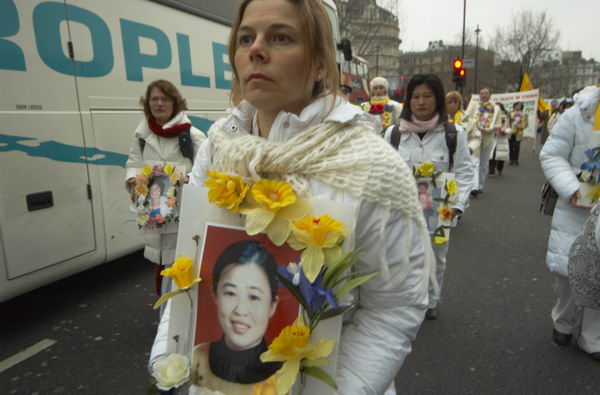
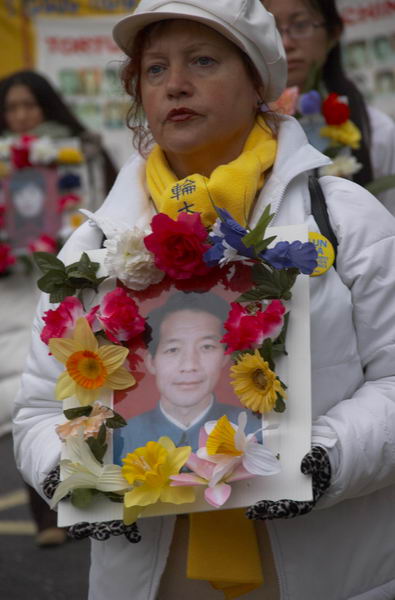
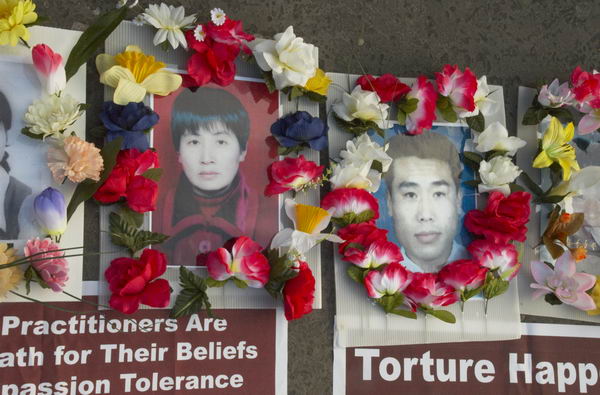
Falun Gong Demonstrate – Chinese Torturers. Westminster – Portland Place

Red Army & Chinese Torture Victims

Back in 2005 I wrote “to me, Falun Gong seems a harmless form of meditation exercises, available to anyone without charge and following the admirable principles of truthfulness, compassion and tolerance, but the Chinese government seem to regard it as the most dangerous form of terrorism.”

Red Army & Chinese Torture Victims

Now I’m less positive although still shocked by the accounts of “physical tortures, including beatings, electric shocks, immersion, chaining for hours and days and the infamous ‘tiger bench’ are used together with psychological attacks including humiliation and sleep deprivation by the Chinese government to suppress the practice.”

Red Army & Chinese Torture Victims

According to Wikipedia, while Falun Gong is a new religion based on Buddhism, its founder in the early 1990s Li Hongzhi gave it some highly reactionary characteristics, such as the rejection of modern scientific ideas including evolution and medicines, racism, and opposition to homosexuality and feminism. More recently it has promoted conspiracy theories including QAnon and anti-vaccination misinformation and supported Trump and extreme-right movements in Europe.

Red Army & Chinese Torture Victims

The Wikipedia article also carries an account of a 2018 report that “highlights Falun Gong’s extensive internet presence, and how editors who have to date contributed to English Wikipedia entries associated with Falun Gong to the point where ‘Falun Gong followers and/or sympathizers de facto control the relevant pages on Wikipedia‘”. Perhaps Wikipedia has now managed at least to some extent to prevent this, but although a number of academics have criticised Falun Gong as a cult, this word and the criticisms appear nowhere in the article.

Li Hongzhi now lives with hundreds of supporters close to a 427 acre compound in New York State, Dragon Springs which is the training ground for its Shen Yen performers. The organisation describes itself as “the world’s premier classical Chinese dance and music company” and whose performances around the world provides significant funding for Falun Gong including a press group The Epoch Times and a PR firm.

Falun Gong has also received considerable funding from the US government particular for the development of free software intended to circumvent Chinese government internet censorship. Their activities have certainly been incorporated in the US’s fight to retain dominance over China.

More pictures


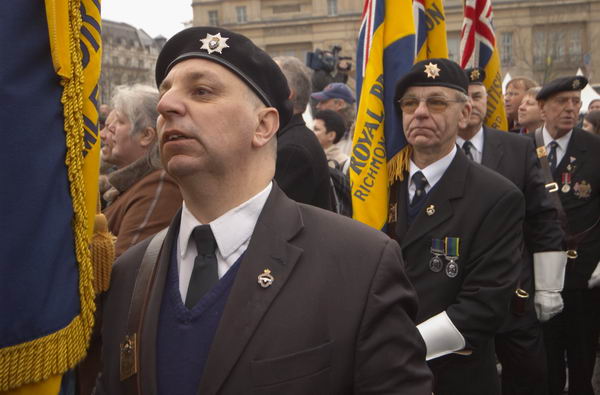
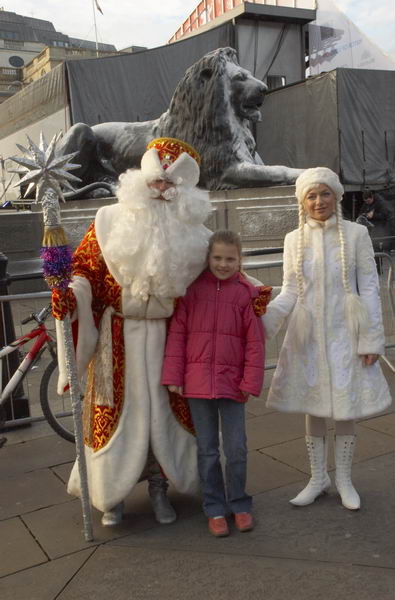
Red Square, SW1- Russian Winter Festival – Trafalgar Square

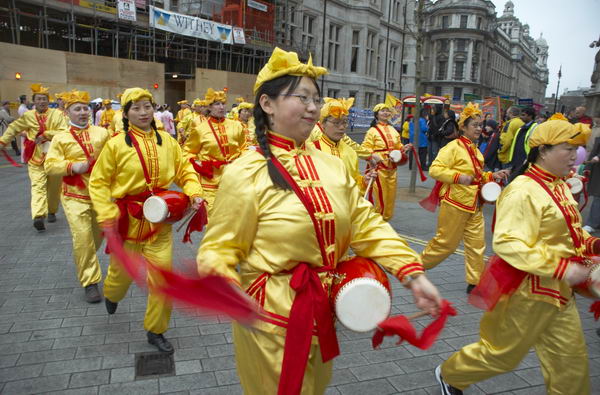
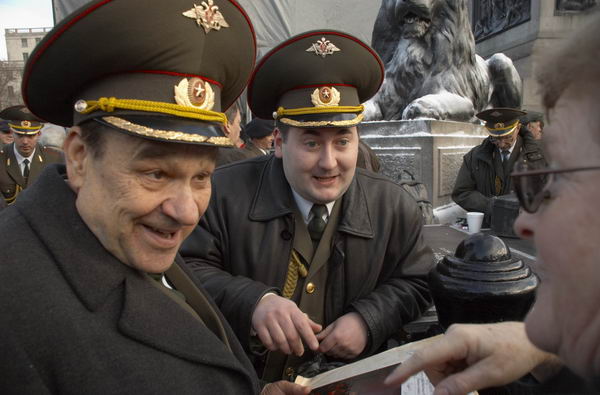
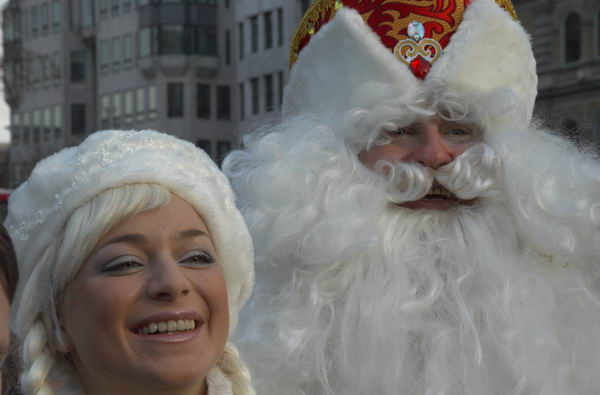
Red square, SW1 was a Russian winter festival celebrating the Russian Old New Year, January 1st according to the Julian Calendar used in Russia until the Revolution and still by the Russian Orthodox Church – which falls on 14th January for the rest of us.

This was a spectacular event, run in cooperation with Moscow city government and many Russian businesses trading in the UK, and I only photographed it for the first few hours, missing the big celebrations, the rock concert, the ice skating at Somerset House and more. As well as the audience at the event it was also going out to 20 million listeners on Russian radio, as well as to anyone who could put up with an inane presenter from some UK radio station.

Both London Mayor Ken Livingstone and Moscow’s Mayor opened the show, though I decided to take a rest at that point from taking pictures and instead try “a fine but overpriced Baltika beer, imported from St Petersburg – at a sensible price i could develop a taste for it.” But I could still hear the speeches and learn that Ken’s father had taken part in the Baltic convoys in WW2.

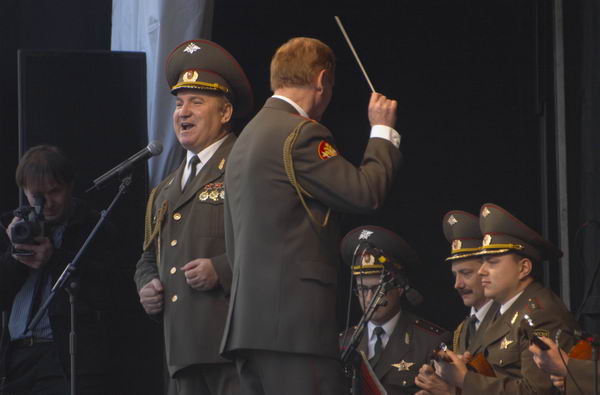
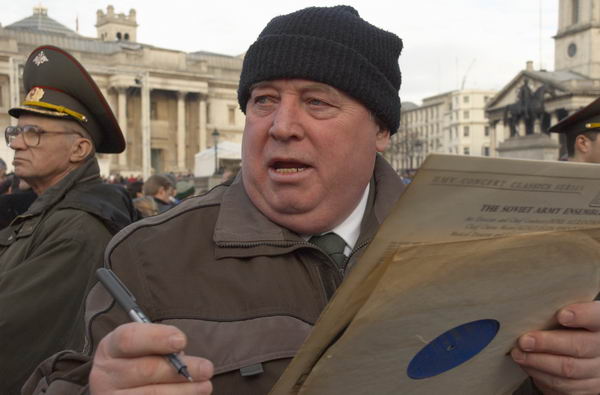
But for me the cultural highpoint was the performance of the Alexandrov Red Army Choir, founded in 1928 to glorify the revolution by the composer of the Soviet national anthem. Though I found little to photograph during the performance I was able to take quite a few pictures of the men later and of a Irish woman who had attended a red army choir performance in Dublin in the 1950s as a schoolgirl,and had brought a record of them from 1956 for them to sign.

The record cover had a picture of the choir and some of those who had sung on it were still with the choir 49 years later. A younger member of the choir brought some of them across, including the fantastic bass soloist who treated us to a little of his voice and signed the cover – using the Stabilo ‘Write-4-all’ pen I carried to do so on the glossy cover when an ordinary pen failed.

And in 2005 I concluded:

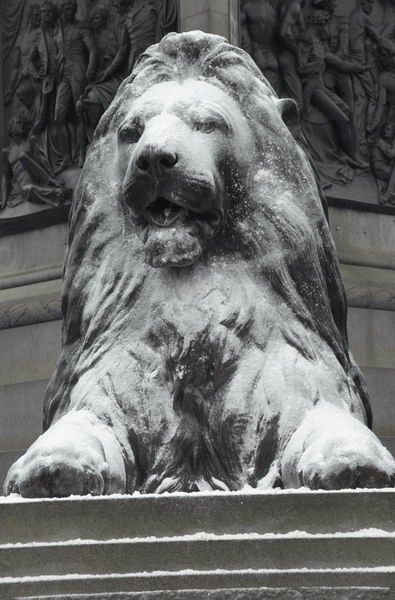
Oh yes, there was fake snow on the lions, some very weird folk dancing involving things that looked rather like dustbin lids wielded by fur-coated women with a lot of heavy breathing rather than singing, Russian dolls, food and more.

My London Diary

What I failed to record was that in the crush to see the Red Army Choir I had forgotten to zip up my camera bag and later found that the cheap telephoto zoom was missing from it. I wasn’t too bothered, as I had already realised it had been a mistake to buy it as it was rather a poor performer and I rather welcomed the need to replace it with something better.

I wrote rather more and there are more pictures, particularly of the choir on My London Diary


FlickrFacebookMy London DiaryHull PhotosLea ValleyParis
London’s Industrial HeritageLondon Photos

All photographs on this page are copyright © Peter Marshall.
Contact me to buy prints or licence to reproduce.

Protest Under Threat – 2008 and 2024

Protest Under Threat – On Saturday 12th January 2008 I photographed six protests in London, and two of them were against the increased restrictions on public protest introduced by SOCPA, the Serious Organised Crime and Police Act 2005 which considerably increased the powers of arrest of police, criminalised trespass at designated ‘Protected Sites’ which included nuclear sites and a long list of royal, parliamentary, and government sites.

Protest Under Threat - 2008 and 2024

But most controversially it seriously restricted our right to demonstrate within a “designated area” of up to one kilometre from any point in Parliament Square. Although Trafalgar Square was excluded from this, it was a wide area which included areas on the south bank of the river including County Hall, the Jubilee Gardens, St Thomas’ Hospital and the London Eye and extended west on the north bank as far as Tate Britain.

Protest Under Threat - 2008 and 2024

These sections of the act were repealed or rather replaced in 2011 by the Police Reform and Social Responsibility Act 2011 which narrowed its scope to prohibiting some activities in Parliament Square, more specifically aimed at protests such as that by Brian Haw.


Hizb ut-Tahrir protest Bush’s Middle East tour – Marble Arch – Saudi Embassy

Protest Under Threat - 2008 and 2024

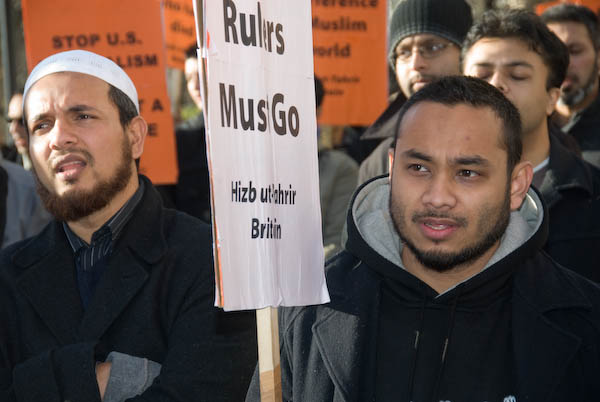
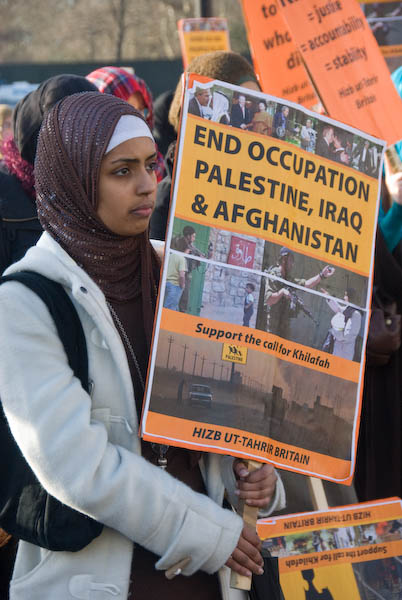
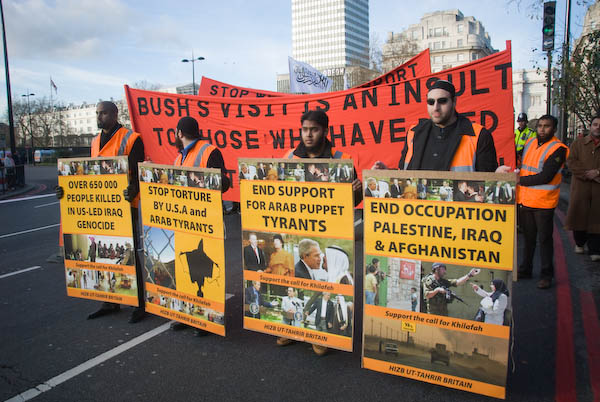
Other protests on the day included a march by supporters of Hizb ut-Tahrir Britain from Marble Arch to the Saudi Embassy in Mayfair to show their opposition to George Bush’s Middle East tour and American policies in the region as well as against the current corrupt ruling elites in the area.

Protest Under Threat - 2008 and 2024

Although I don’t support the ideology of Hizb ut-Tahrir and was certainly worried by their global intentions which we later saw put into practice by Islamic extremists in ISIS in Syria and others elsewhere as well as uneasy about their treatment of the women who were at their protests clearly as second-class citizens (and who I was often requested by stewards not to photograph), this like their other protests was extremely tightly managed by the organisation.

Clearly the protest presented no real threat to public order and it was hard to see why there was such a large police presence, when all that was needed was some traffic control and perhaps a few officers to monitor the speeches for any illegal content – though I don’t think there were any present who could understand those not in English.
more pictures


Young Rich Protest Siena Airport Expansion

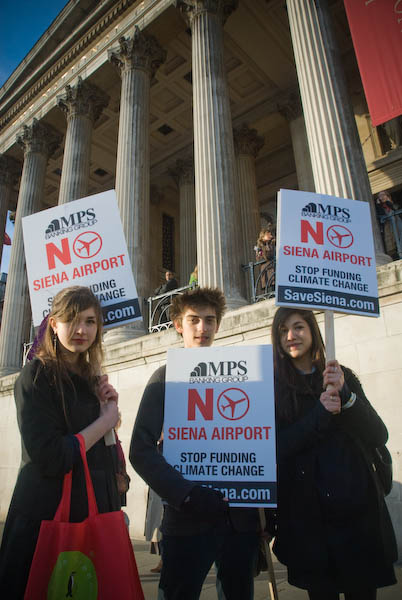
There were two protests taking place around Trafalgar Square, and one of them I found it a little hard to take seriously. This was what I described as a “small but very select” protest against the expansion of Sienna airport “led by the young grandson of a Lord” by “models and young people from some of the richest families around (the kind of people who own Guinness rather than drink it)” who enjoy their times at nice big villas there and don’t “want all sorts of riff-raff coming in on cheap flights“. Of course we should all be against airport expansion.
more pictures


 CSG Freedom to Protest Border Post – Trafalgar Square/Whitehall

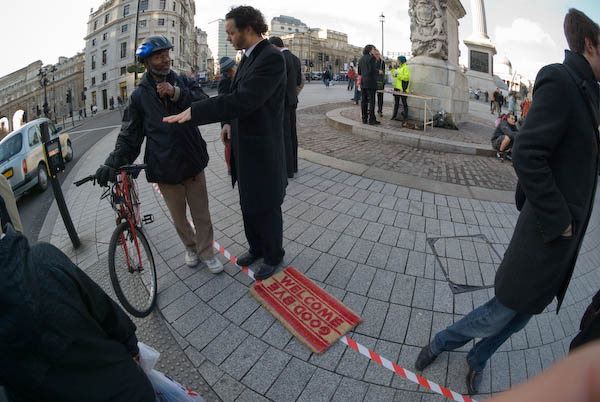
On the traffic island at the south of Trafalgar Square and the top of Whitehall a group calling themselves the CSG (Citizens Supporting Government – rather than the Met’s TSG, sometimes said to stand for Thugs Supporting Government rather than its official Territorial Support Group) set up a ‘Freedom to Protest Border Point’ again on Saturday on the edge of the SOCPA zone to advise the public about the danger of passing into the an area where freedom is severely restricted.
more pictures


Freedom to Protest – outside Downing Street

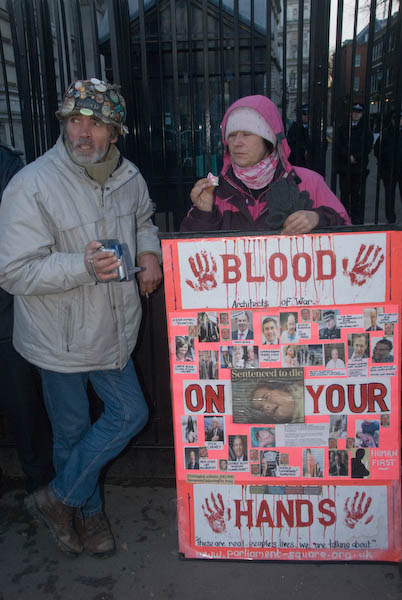
But the main Freedom To Protest demonstration was taking place at the gates of Downing Street with a couple of hundred protesters. Although police usually try to move protesters away from the gates, things as I arrived seemed fairly relaxed.

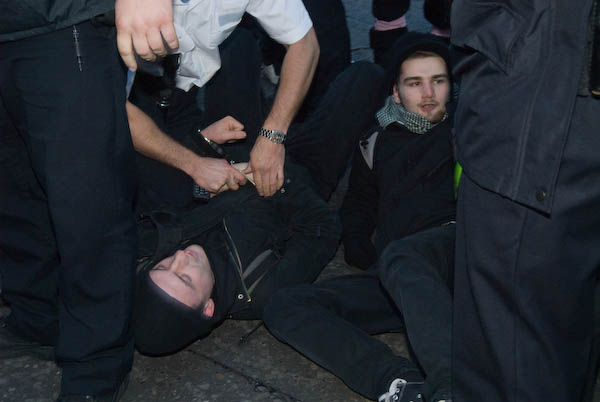
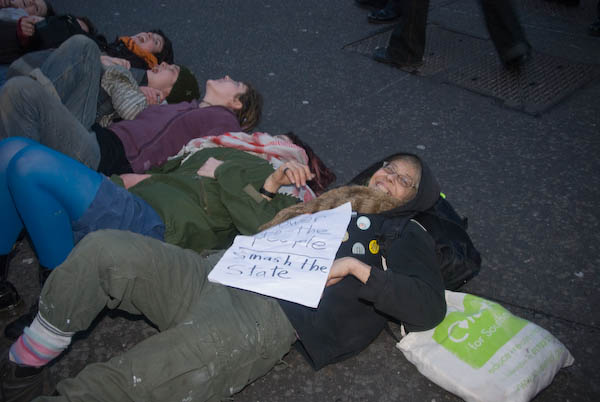
But when a number of protesters decided to sit or lie down in the middle of the road this prompted the police to take action. “They grabbed the first couple of guys who went down on the tarmac and handcuffed them as well as seeming to try out a few strange holds.”

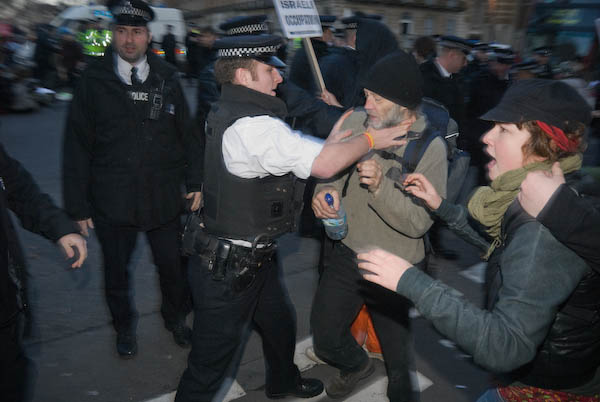
And when a dozen or so laid down in a neat line along the carriageway a squad of around 20 officers who had been waiting 50 yards down the road rushed in and began by clearing photographers and others standing on the road back onto the pavement. “Any who showed a reluctance to move were given a hand, sometimes with what seemed like unnecessary force. I was almost knocked flying when they threw one man bodily backwards – and I was in his way, probably rather luckily for him, as otherwise he could well have cracked his head open on the pavement.”

They then carried those sitting or laid on the ground back to the pavement, warning them they would be arrested if they returned to the road. Some who had linked arms were separated with some of the police clearly seeming to be enjoying themselves using pain compliance holds and inflicting unnecessary pain as they twisted arms behind backs and generally pushed the guys around.

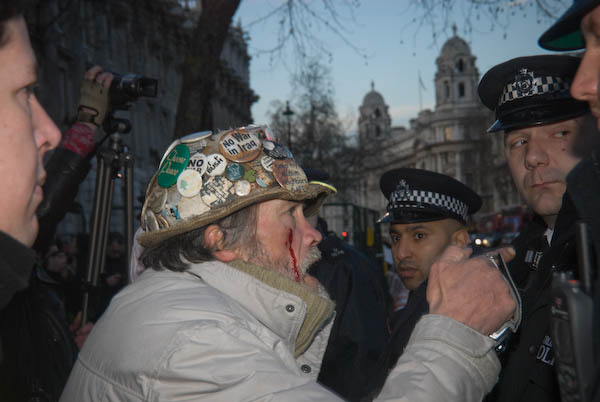
Brian Haw – whose continuing peace protest in Parliament Square had been one of the main targets of SOCPA – was there using a small video camera to record the police violence and I photographed him with a nasty trickle of blood running down his left cheek after an officer had forcefully pushed the camera into his face. When he tried to complain to the officers in charge he was ignored and finally told to go to a police station if he wished to complain. Some of the police were rather obviously amused at both his injury and his complaints.
more pictures


Kenyans Demand Justice after Election Fraud

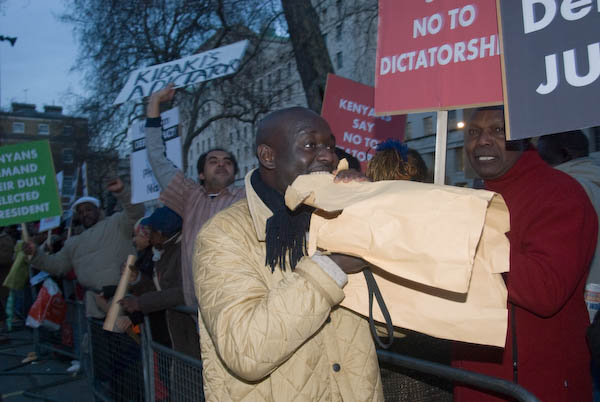
Across Whitehall in the designated protest area there were two protests taking place. Kenyans were protesting against election fraud in their country, where the man who had almost certainly lost the vote set up an electoral commission that was certain to declare him as the winner, and he remains President. SOCPA was having an effect on their protest as my picture shows, with a man using a megaphone hidden under brown paper!
more pictures


End the Siege on Gaza

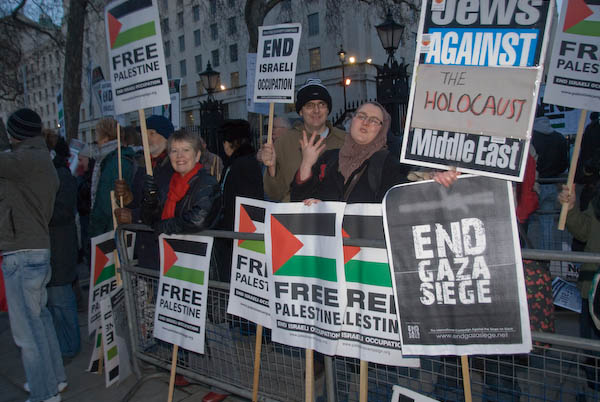
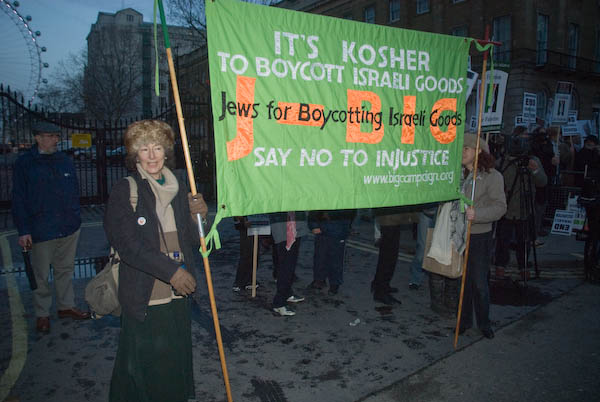
Also across Whitehall from Downing Street were a group of protesters calling for an end to the Israeli siege of Gaza which severely limits the supply of essential goods including medicines and for an end to the military occupation of Palestine.

Among the protesters still present when I arrived rather late to photograph it were Jewish activists supporting Palestine and a boycott of Israeli goods, part of the growing campaign for BDS – Boycott, Divestment and Sanctions. In 2024 the UK government is putting through a Bill to stop “businesses and organisations–including those affiliated with Israel-being targeted through ongoing boycotts by public bodies” because of the increasing success of this campaign. If passed it will stop public bodies, “including universities, local authorities, and government departments, from making investment decisions that align with their human rights responsibilities and obligation.” They will be unable “to avoid causing or contributing to human rights abuses and international crimes” such as “the Chinese government’s systematic repression of Uyghurs, Israel’s crimes of apartheid or war crimes in Israeli settlements, Saudi Arabia and UAE’s war crimes in Yemen, or the Myanmar junta’s crimes against humanity.
more pictures


FlickrFacebookMy London DiaryHull PhotosLea ValleyParis
London’s Industrial HeritageLondon Photos

All photographs on this page are copyright © Peter Marshall.
Contact me to buy prints or licence to reproduce.

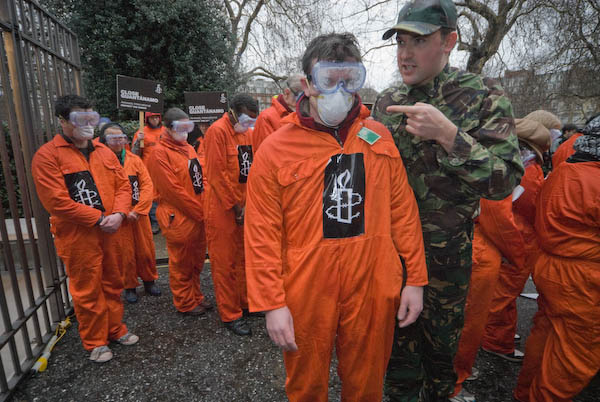
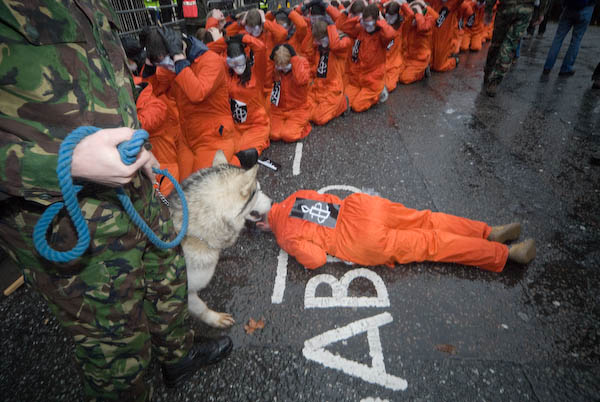
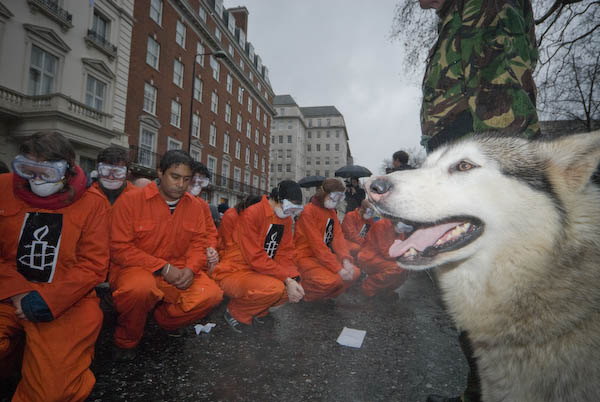
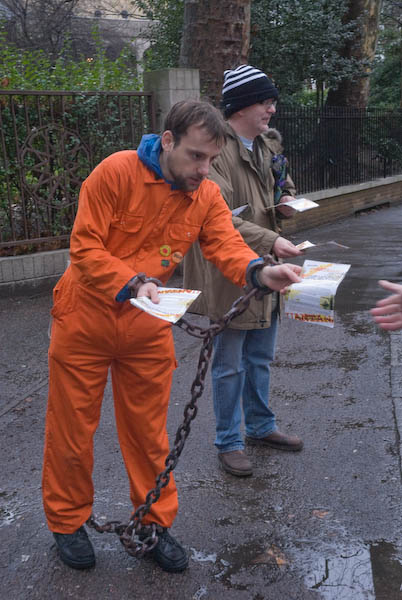
Guantanamo Day – 11th January

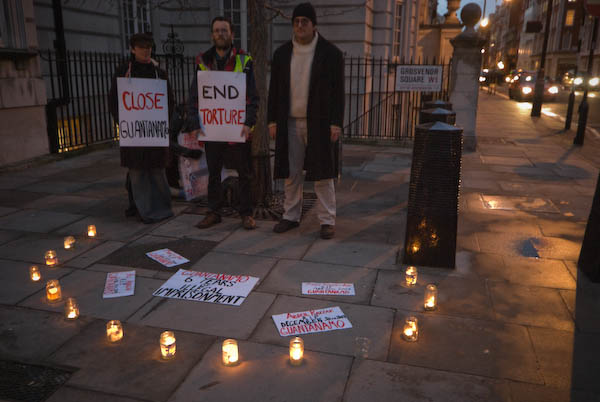
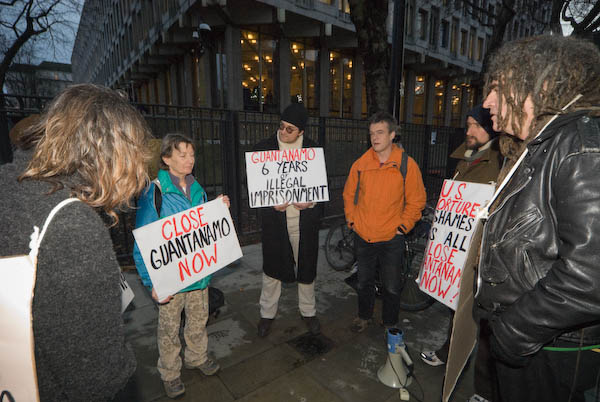
Guantanamo Day – 11th January. It was on January 11, 2002 that George W Bush set up the detention camp on the disputed US Navy base at Guantanamo Bay, after he had been advised by lawyers that the US courts would be unable to offer detainees held there the normal legal protection that detention in the US would have enabled.

Guantanamo Day - 11th January

Camp X-Ray, a temporary facility, began with 22 detainees on that day, and others were soon filling this and the other camps which make up Guantanamo the largest of which was Camp Delta. At first the details of those sent there were kept secret, but eventually the US Department of Defense was forced to respond to a Freedom of Information from the Associated Press and to say that 779 prisoners were being held there.

Guantanamo Day - 11th January

The world got to know considerably more about what had been going on inside the torture camp in 2011 with the publication of documents by Wikileaks including 779 secret files on the prisoners. Among other revelations was “that more than 150 innocent Afghans and Pakistanis, including farmers, chefs, and drivers, were held for years without charges.”

Guantanamo Day - 11th January

The US government asserted that those held there were not entitled to any of the protections of the Geneva Conventions, though later they lost the case in the US courts which found that they were entitled to protection under Common Article 3 which applies to armed conflicts “not of an international character”.

Guantanamo Day - 11th January

From the start the US had claimed to be treating “all detainees consistently with the principles of the Geneva Convention.” This was of course a complete lie. Guantanamo was set up as a torture camp and detainees were routinely abused and tortured, humiliated and kept under inhumane conditions in what an Amnesty International report ‘called the “Gulag of our times.“‘ As various reports by them and others including the Red Cross state it was a human rights scandal. There is much more about this in the Wikipedia article.

When President Obama came to power he had promised to close the camp, but his efforts to do so in 2009 were opposed by the military at Guantanamo and funds to transfer or release the prisoners were blocked by the US Senate. Further opposition from the US Congress against moving prisoners to the US for detention or trial prevented Obama from clearing the camp, but by the end of his administration only 41 men remained detained there.

By the end of 2023, 30 men were still being held at Guantanamo, with over half having been cleared for release. 11 of them have been charged with war crimes and are awaiting a military trial and 1 has been convicted. Some are still there because if sent to their home country they are likely to be subject to further imprisonment or death despite their innocence.
British interest in Gunatanamo decreased sharply after the release in October 2015 of Shaker Aamer, the last British resident there. A Saudi national who had permission to stay in the UK he was able at last to return to his wife and children in Battersea after having been held and tortured since 2002. He had never been charged or faced trial.
The Guardian reported following the publication of the book ‘The Secret History of the Five Eyes‘ by Richard Kerbaj in 2022, that in 2004 “Tony Blair’s government was given special access to US intelligence files on Guantánamo Bay which revealed there was no credible evidence against the British detainees“. Yet Aamer was held for another 11 years.

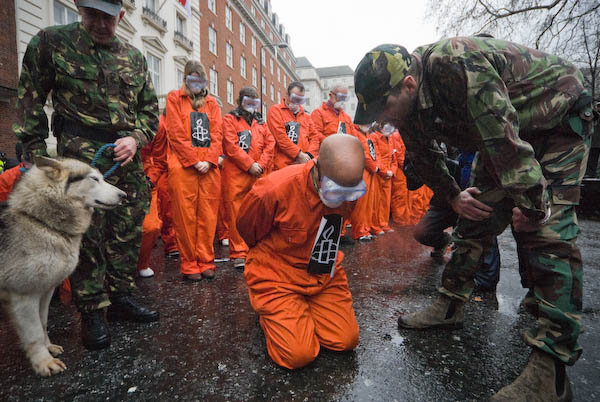
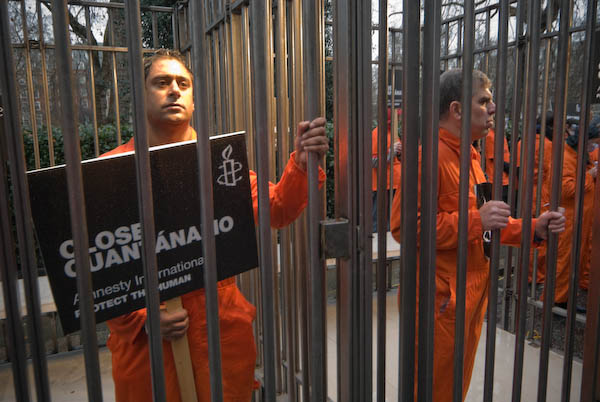
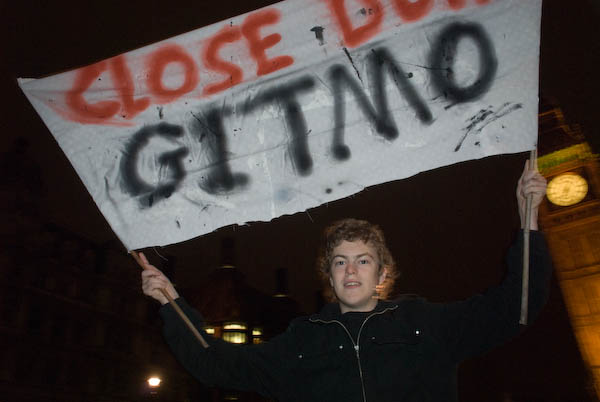
Since Aamer’s release protests on the anniversary of the setting up of Guantanamo have continued, but on a rather smaller scale as you can see from Vigil marks 17 years of Guantanamo torture in 2019. The pictures on this post are from 2008 when I photographed four different events in London on January 11th.

Six years of Guantanamo: Amnesty
London Guantanamo Campaign / Cageprisoners
Guantanamo – London Catholic Worker
Guantanamo – Parliament Square Rally