Hampstead Alley, Hospital, Baths, House, Heath – 1990

Hampstead Alley, Hospital, Baths, House, Heath: My walk on Sunday 9th April 1990 continues. The walk began at my post A Hampstead Walk -1990.
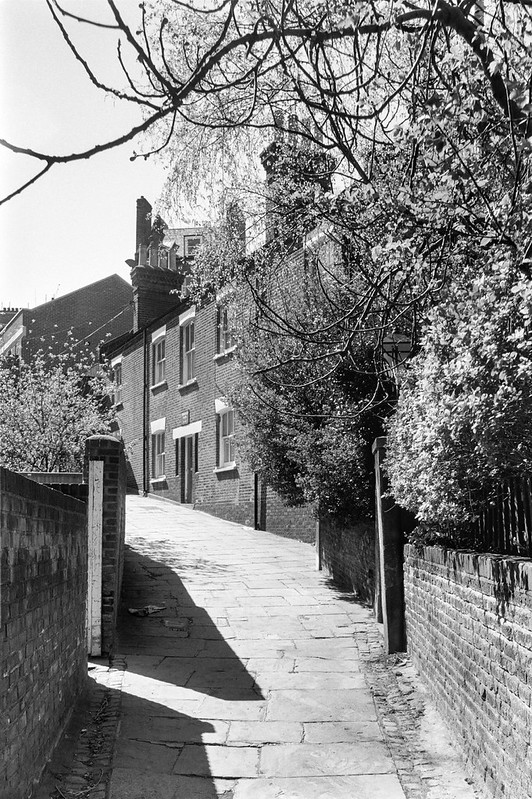
Streatley Place, Hampstead, Camden, 1990, 90-4d-26

Another picture of Streatley Place. The narrow width of this alley makes it difficult to photograph, and it still retains some of the character of the rural path through fields which had still still been at the end of the 18th century. By the time of the 1860s OS Map it was completely surrounded by buildings – and was then known as Brewhouse Lane.

For reasons unknown to me its name changed around 1890 to Streatley Place. Some of the 19th century buildings of what began as Hampstead Workhouse, later New End Hospital, which backed onto Streatley Place were converted to flats around 1990.

As you can see the path slopes fairly steeply up here.
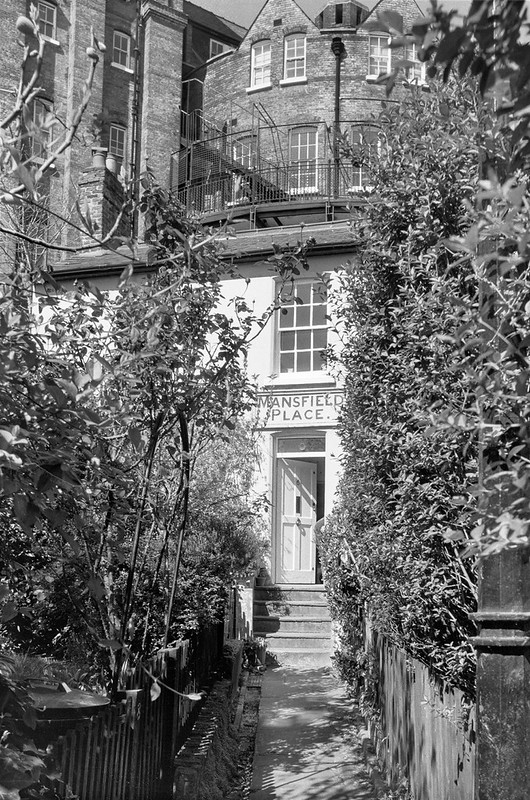
Mansfield Place, Hampstead, Camden, 1990, 90-4d-15

As Camden Council’s Conservation Appraisal states, Mansfield Place, built in 1860-61, is a “secluded quadrangle of low, two storey cottages approached down a narrow path between long front garden plots” making “a dramatic contrast between the cottage type gardens and the former hospital buildings looming up behind them” which you can see in this picture. Mansfield Place is Grade II listed.
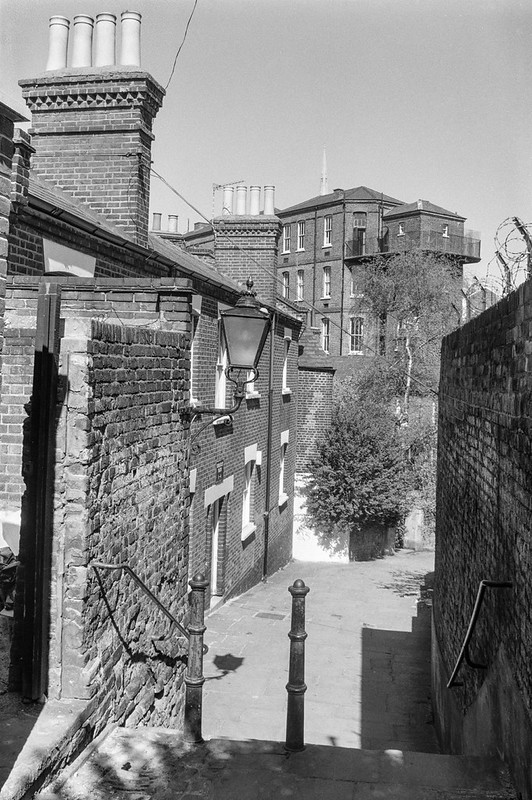
Streatley Place, Hampstead, Camden, 1990, 90-4e-65

More steps on Streatley Place, I think looking down to the row of houses in a previous picture, part of the development around the alley around 1860.

New Hospital, New End, Hampstead, Camden, 1990, 90-4e-51

There is an extensive description of the history of New End Hospital which began life in 1800 as Hampstead Workhouse on the Lost Hospitals of London web site.

At left of picture is the 1878 building for the vestry then responsible for the hospital. Its architect Henry Edward Kendall was also responsible for the Vestry Hall built in the same year which later became Hampstead Town Hall. It was named Kendall Hall. The ‘New Hospital’, a slightly plainer block, was added in 1896. The hospital closed in 1986, and most of it was converted to flats.

The Wells and Campden Baths, Wash House, 71, Flask Walk, Hampstead, Camden, 1990, 90-4e-55

The Grade II listed Wells and Campden Baths were built in 1888 by architect Henry Simpson Legg for the Wells and Campden Charity, close to the site of the original Hampstead spring in Flask Walk though I think they relied on the local water supply then provided by a private water company, but later by the Metropolitan Water Board.

At the time it opened few of the homes where the working-class lived had bathrooms, often just a single cold tap, sometimes shared with other households, and public baths such as as this provided a much needed facility with many coming here and to other public baths for a weekly bath – soap and towels provided as well as hot water.

The Wells and Campden charity built baths in Kilburn and here. As well as the nine private baths in the building there was also a laundry and drying room. The baths was leased and run by the council (who had also opened their own baths) in 1906 as the charity found them too expensive to continue running. Perhaps surprisingly the baths continued in use until around 1978. The were converted to private flats in the 1980s.
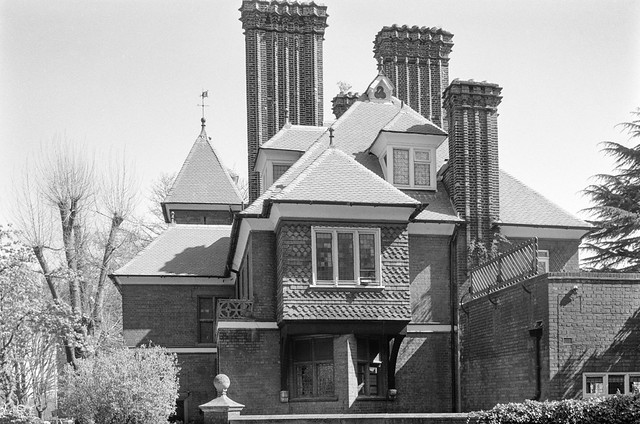
House, Well Walk, East Heath Rd, Hampstead, Camden, 1990, 90-4e-56

Architect Ewan Christian designed this house at 50 Well Walk on the corner with East Heath Road in 1881 for his family and called it Thwaitehead, but later it became known as Klippan House. It was built by Norfolk builders Cornish and Gaymer. Christian (1814-95) was a well-known and extremely prolific church architect who became President and Gold Medallist of the Royal Institute of British Architects, and was the architect of the National Portrait Gallery.

You can read more about it and see a rather better picture of this house and of its interiors from Belsize Architects who refurbished the house in 2010, converting the Grade II listed building back into a single residence for Daniel and Gaynor Harris and their daughters who had bought it for £11 million. They restored many of its original features, but could not restore the view it had when built of Hampstead Heath.
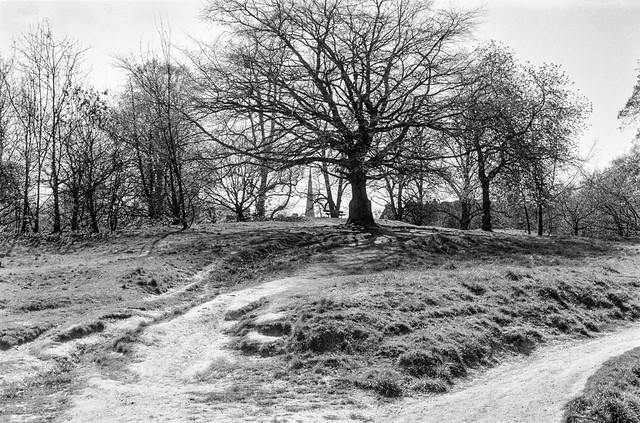
Hampstead Heath, Hampstead, Camden, 1990, 90-4e-43

But a short walk from that house took me to Hampstead Heath, where you can see a church spire and some rooftops over a small hillock.

My walk continued – more posts later.


Flickr – Facebook – My London Diary – Hull Photos – Lea Valley – Paris
London’s Industrial Heritage – London Photos

All photographs on this page are copyright © Peter Marshall.
Contact me to buy prints or licence to reproduce.


A Hampstead Walk -1990

A Hampstead Walk: On Sunday 9th April 1990 I took the North London Line to Hampstead Heath Station and began wandering around the streets near there. Of course I’d been to Hampstead before, walked on the Heath and visited some of the better known attractions, but I’d rather put off taking many photographs there. I’ve always felt more comfortable on the streets of the more plebeian areas of London.

Gate, 29, Hampstead Hill Gardens, Hampstead, Camden, 1990, 90-4c-11

On Hampstead Hill Gardens the morning light was just right for the gateway and porte-cochère at number 29, a simple but satisfying iron and glass structure on very solid gate posts. The house is of course still there, but it lost this distinctive feature some time around 2010.

Hampstead Hill Gardens was developed around 1870 with stucco houses like this and completed with a number of red-brick Queen Anne Revival houses designed by Thomas Batterbury and W.F. Huxley further around the street around the end of the decade. A number of those are Grade II listed but they failed to interest me enough to photograph them.

St John's, Church, Downshire Hill, Hampstead, Camden, 1990, 90-4d-65
St John’s, Church, Downshire Hill, Hampstead, Camden, 1990, 90-4d-65

St John’s Church, technically a proprietary chapel of the Church of England, was built in 1823 and in 1832 became the subject of an ecclesiastical dispute between the Calvinist evangelical John Wilcox and the perpetual curate of the parish Samuel White who refused permission for Wilcox to preach there. Wilcox lost the case and the church was closed until 1835 when Wilcox died and was replaced by another more mainstream minister, while the “church’s name remained infamous in ecclesiastical circles for some years following“.

Something about the building reminded me of the wooden building blocks I played with as a child – before the advent of Lego. In a neo-Classical style and Grade II listed I was not surprised to read in the listing “Possibly by CR Cockerell or designed by its builder, William Woods” and it looks like a builder’s idea of a church in that style.

Figurehead, House, 8, Pilgrims Way, Hampstead, Camden, 1990, 90-4d-51
Figurehead, House, 8, Pilgrims Lane, Hampstead, Camden, 1990, 90-4d-51

I was amused by the figurehead on the house apparently looking down at the white-stockinged legs of a child standing on the pavement. On the house is a Hampstead Plaque Fund Plaque stating:

William Johnson Cory
Ionicus
Teacher, scholar and poet. Lived in this house. An assistant master at Eton College 1845 – 1872, he composed the Eton Boating Song.

In 1872 a letter Cory wrote to one of his pupils was found by his parents and shown to the Headmaster of Eton; Cory was forced to resign. Widely regarded as one of Eton’s best masters, he was well-known “for encouraging a culture of intimacy, possibly non-sexual, between teachers and pupils“.

Cory (1823-92) wrote the words for the Eton Boating Song during the Christmas break in 1862 and it was first performed in the following year to the setting of his former pupil Captain Algernon Drummond. In later years it has been much parodied, notably in the obscene song “The Sexual Life of the Camel“, a popular song in the after-match bath and changing rooms when I played rugby many years ago.

After a few years abroad following his resignation Cory came to live in this Queen Anne style house on Pilgrims Lane until his death. For some years the front of the house has been hidden behind a tall wooden fence, probably with extensive building work being carried out. Some of the houses in Pilgrim’s Lane were not well built and it may be one. According to Camden Council, “No.8 is an interesting Arts and Crafts influenced house. It has a gable with decorative brickwork and distinct chimneys.”

Pilgrims Lane gets its name from a former Hampstead resident James Pilgrim who bought land here in 1787 and died in 1813 (or possibly his son Charles Pilgrim who held on to a small part of his estate.) Too many famous people have lived on the street to list here.

Albany House, Flask Walk, Hampstead, Camden, 1990, 90-4d-3
Albany House, Flask Walk, Hampstead, Camden, 1990, 90-4d-31

Albany House was one of first purpose-built blocks of flats in the area when it was built around 1873. It is still flats.

Boades Mews, Hampstead, Camden, 1990, 90-4d-22

Boades Mews is a short pedestrian street with some granite steps and setts, some name signs, a high brick school wall and a couple of residential properties. It links Flask Walk to New End. Once it was an actual mews.

New End Primary School, Streatley Place, Hampstead, Camden, 1990, 90-4d-23

New End Primary School in Streatley Place is still in use as “a happy and diverse school situated in Hampstead Village.” The flamboyant Edwardian baroque Grade II listed school was built in 1906, architect T J Bailey. It is said to be his best building.

Streatley Place, Hampstead, Camden, 1990, 90-4d-24

Streatley Place begins just off the busy Heath Street as a narrow alley off Back Lane and only widens a little by the school, whose playground is over the wall at the left of this picture. The chimney was for the boiler house of New End Hospital, founded in 1869 as the infirmary for the Hampstead Union workhouse which was closed and sold for redevelopment in 1986.

More on my walk in later posts.


Flickr – Facebook – My London Diary – Hull Photos – Lea Valley – Paris
London’s Industrial Heritage – London Photos

All photographs on this page are copyright © Peter Marshall.
Contact me to buy prints or licence to reproduce.