Hampstead Alley, Hospital, Baths, House, Heath: My walk on Sunday 9th April 1990 continues. The walk began at my post A Hampstead Walk -1990.
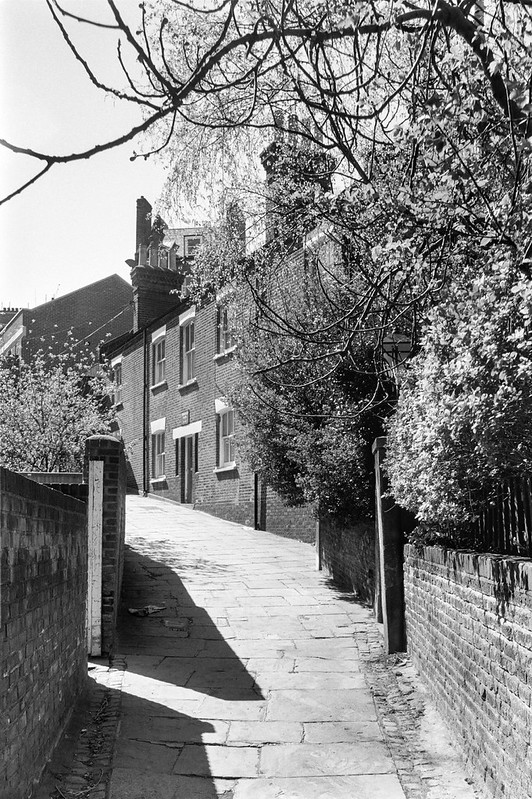
Another picture of Streatley Place. The narrow width of this alley makes it difficult to photograph, and it still retains some of the character of the rural path through fields which had still still been at the end of the 18th century. By the time of the 1860s OS Map it was completely surrounded by buildings – and was then known as Brewhouse Lane.
For reasons unknown to me its name changed around 1890 to Streatley Place. Some of the 19th century buildings of what began as Hampstead Workhouse, later New End Hospital, which backed onto Streatley Place were converted to flats around 1990.
As you can see the path slopes fairly steeply up here.
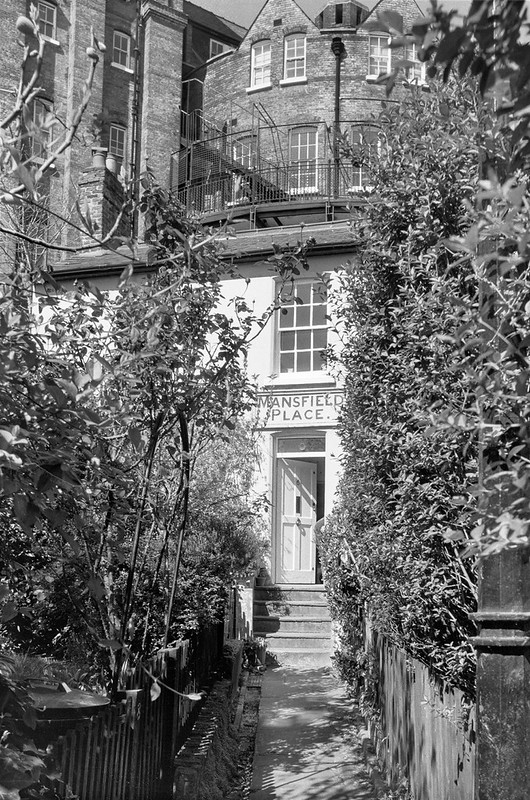
As Camden Council’s Conservation Appraisal states, Mansfield Place, built in 1860-61, is a “secluded quadrangle of low, two storey cottages approached down a narrow path between long front garden plots” making “a dramatic contrast between the cottage type gardens and the former hospital buildings looming up behind them” which you can see in this picture. Mansfield Place is Grade II listed.
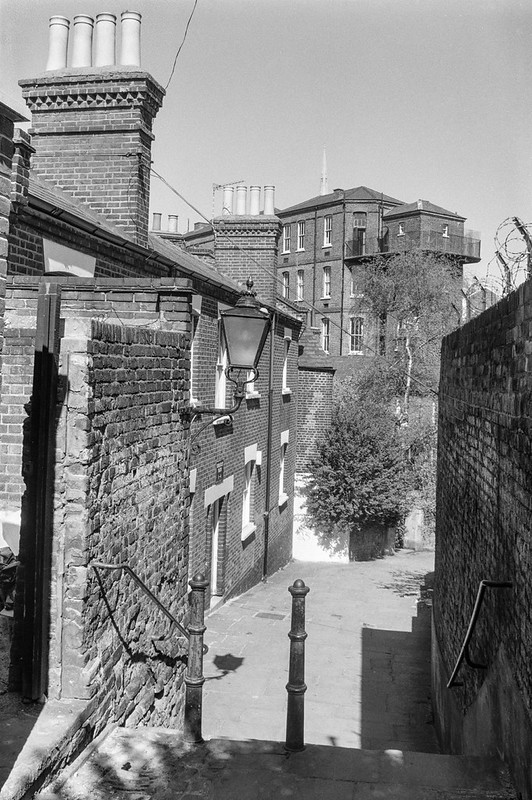
More steps on Streatley Place, I think looking down to the row of houses in a previous picture, part of the development around the alley around 1860.

There is an extensive description of the history of New End Hospital which began life in 1800 as Hampstead Workhouse on the Lost Hospitals of London web site.
At left of picture is the 1878 building for the vestry then responsible for the hospital. Its architect Henry Edward Kendall was also responsible for the Vestry Hall built in the same year which later became Hampstead Town Hall. It was named Kendall Hall. The ‘New Hospital’, a slightly plainer block, was added in 1896. The hospital closed in 1986, and most of it was converted to flats.

The Grade II listed Wells and Campden Baths were built in 1888 by architect Henry Simpson Legg for the Wells and Campden Charity, close to the site of the original Hampstead spring in Flask Walk though I think they relied on the local water supply then provided by a private water company, but later by the Metropolitan Water Board.
At the time it opened few of the homes where the working-class lived had bathrooms, often just a single cold tap, sometimes shared with other households, and public baths such as as this provided a much needed facility with many coming here and to other public baths for a weekly bath – soap and towels provided as well as hot water.
The Wells and Campden charity built baths in Kilburn and here. As well as the nine private baths in the building there was also a laundry and drying room. The baths was leased and run by the council (who had also opened their own baths) in 1906 as the charity found them too expensive to continue running. Perhaps surprisingly the baths continued in use until around 1978. The were converted to private flats in the 1980s.
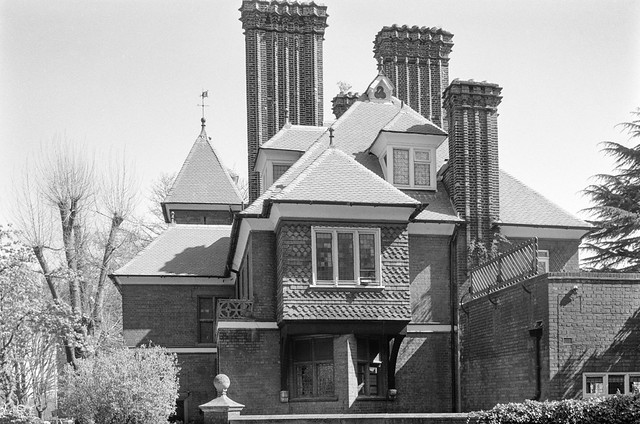
Architect Ewan Christian designed this house at 50 Well Walk on the corner with East Heath Road in 1881 for his family and called it Thwaitehead, but later it became known as Klippan House. It was built by Norfolk builders Cornish and Gaymer. Christian (1814-95) was a well-known and extremely prolific church architect who became President and Gold Medallist of the Royal Institute of British Architects, and was the architect of the National Portrait Gallery.
You can read more about it and see a rather better picture of this house and of its interiors from Belsize Architects who refurbished the house in 2010, converting the Grade II listed building back into a single residence for Daniel and Gaynor Harris and their daughters who had bought it for £11 million. They restored many of its original features, but could not restore the view it had when built of Hampstead Heath.
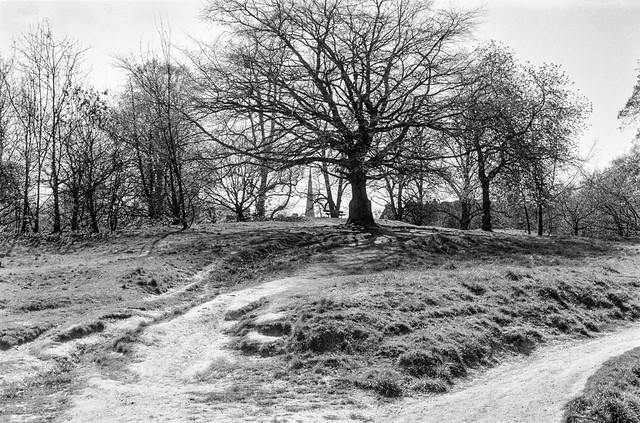
But a short walk from that house took me to Hampstead Heath, where you can see a church spire and some rooftops over a small hillock.
My walk continued – more posts later.
Flickr – Facebook – My London Diary – Hull Photos – Lea Valley – Paris
London’s Industrial Heritage – London Photos
All photographs on this page are copyright © Peter Marshall.
Contact me to buy prints or licence to reproduce.