BDS and Gaza: London 2nd August 2014

Wood Green

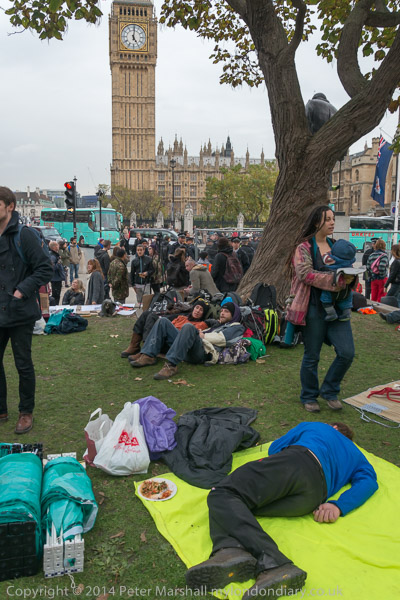
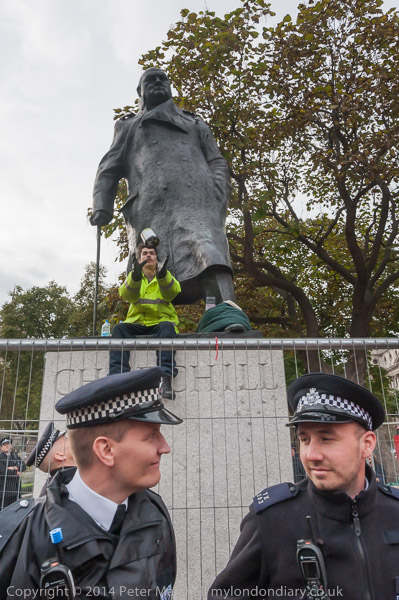
Many of the protests I photograph are in Westminster and concentrated around Downing Street and the Houses of Parliament. There are obvious reasons for this, particularly during the week when Parliament is in session, though on Saturdays there are few people around other than tourists, with MPs back in their constituencies, government offices closed and the Prime Minister seldom if ever at home and these locations are purely symbolic.

Brixton

Trafalgar Square is a good site for large rallies, and often the end point for larger marches, though this century has seen the epicentre for protest move to Parliament Square, I think influenced by the permanent presence there for around ten years of Brian Haw’s Parliament Square Peace campaign. It can I think hold larger crowds than Trafalgar Square and Jeremy Corbyn drew them there on various occasions and issues, though of course Hyde Park is on a very much larger scale.

Brixton

But protests do take place elsewhere across London and over the years I’ve travelled to most London boroughs to cover them, thanks to London’s public transport system, which also brings me into the capital from my home on its western edge. On Saturday 2nd August there were two protests I wanted to cover, one in South London and the other at its northern end, connected both by the underground and in that they were both related to the illegal occupation of Palestine by Israel.

Sainsbury’s Brixton

I met with protesters outside Brixton Tube where they were gathering to march to the Sainsbury’s store half a mile to the south. I could have chosen several other locations in London and others around the country as this was a part of protests at a number of Sainsbury’s locations around the country because they sell products produced in illegal settlements inside the occupied Palestinian areas. I’d chosen Brixton partly because I expected there to be a slightly larger protest than some other locations, but also because it was beginning at a convenient place, two stops on the tube from Vauxhall where I could travel direct from my home.

Sainsbury’s Brixton

The protest was a part of the ongoing international BDS (Boycott, Divestment, Sanctions) campaign, the protesters also wanted to show their anger and disgust at the horrific attack on Gaza then taking place, in which by this date over 1200 Palestinians, mainly innocent civilians including many children, had been killed by Israeli forces.

Sainsbury’s Brixton

The protest – along with those at other Sainsbury’s branches – had been widely publicised in advance and both police and store staff were waiting for the protesters, and the few that managed to walk inside the shop were soon asked to leave. The manager came out to talk with the protesters, telling them they had to leave the ramp in front of the store, which prompted them to hold a sit-in.

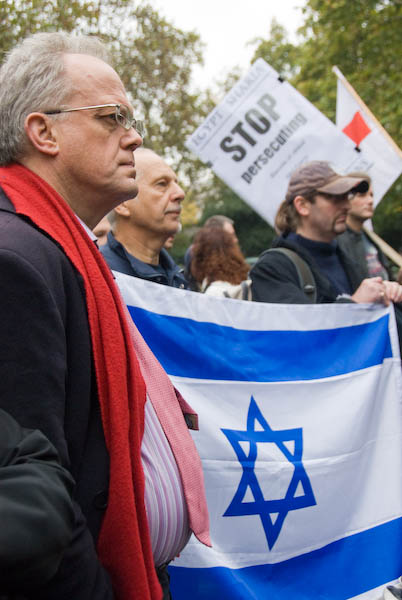
I had to leave before the protest ended to get back to Brixton tube station and make my way up to Turnpike Lane station in Haringey, where a larger protest was gathering on Ducketts Common opposite the station for a rally and march to show their anger over the Israeli invasion of Gaza and the killing of civilians including many children. I arrived shortly before the march began.

Haringey

Haringey is one of London’s most ethnically diverse areas, with around 65% of the population in non-white-British ethnic groups. Many are of Cypriot or Turkish origin, including Kurds, but there are also large Black African and Black Caribbean populations. The crowd that came to the rally reflected this and the strong local trade union movement led by the Haringey Trades Council.

Haringey

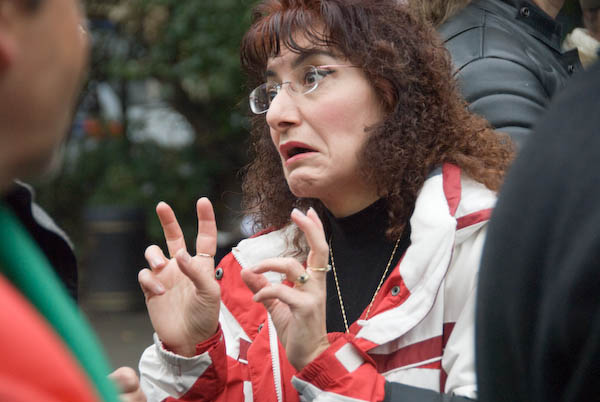
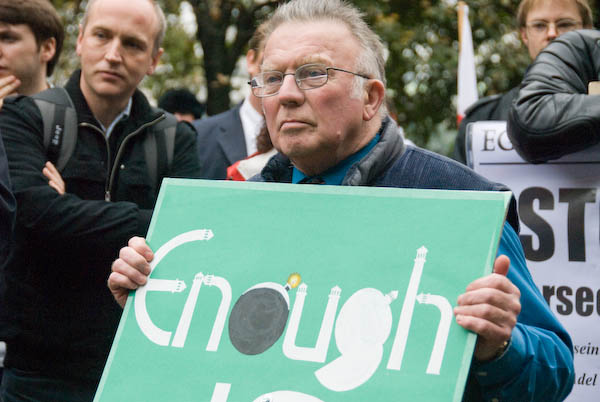
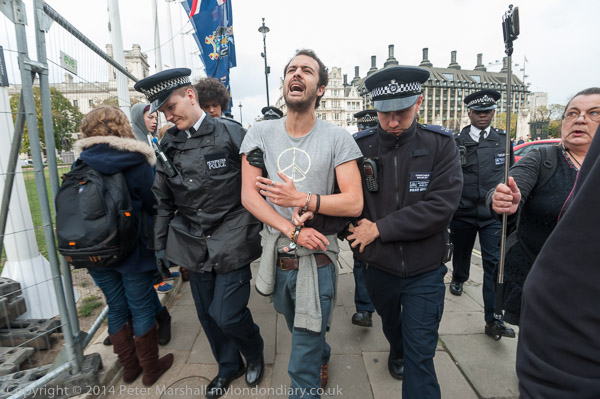
As the march walked up through the Wood Green shopping centre one Jewish man came to shout his support for the Gaza invasion – and police stepped in to shield him from the marchers – who included many Jews, some of whom came to argue with him. But there were many others who stopped to applaud the march, which was greeted at one location on its route by a group of Turkish Popular Front members.

Haringey

The march was again fortunately a short one and ended around three-quarters of a mile with a rally opposite the Haringey Civic Centre on Wood Green High Road. After listening to a few of the speeches I only had a quarter of a mile to walk to Wood Green Station to start my journey home.

More at:

Haringey March & Rally for Gaza
Sainsbury’s protest at illegal Israeli Goods


All photographs on this and my other sites, unless otherwise stated, are taken by and copyright of Peter Marshall, and are available for reproduction or can be bought as prints.


Afrikan Emancipation Day Call for Reparations

2014

Seven years ago on August 1st 2014, the centenary of the foundation by Marcus Garvey of the Universal Negro Improvement Association, I photographed Rastafarians meeting in Windrush Square for speeches and ceremonies before a march to Parliament demanding reparations for the descendants of those taken from Africa by the Atlantic Slave Trade.

2014

August 1 was chosen as the founding date for the UNIA and for the Madison Square meeting and this protest as it was the 1 August 1834 was Emancipation day, following the Slavery Abolition Act 1833, when slavery was ended in the British Empire.

2014

Since then, similar events have taken place each year in Brixton each Afrikan Emancipation Day – August 1st – with the event growing in support each year. Last year the organisers changed the format of the event, as the supporters of the event felt it was having little impact and their demand to the UK Government to establish an All-Party Parliamentary Commission of Inquiry for Truth & Reparatory Justice (APPCITARJ) and to commit to holistic reparations taking into consideration various proposals for reparations in accordance with the United Nations Framework on a Right to a Remedy and Reparation was being ignored.

2014

The decided to hold a series of events in Brixton, blocking local roads to do so, an Afrikan Emancipation Day Reparations Rebellion Groundings event. This gained far more attention in the media and the Stop The Maangamizi Campaign and the Afrikan Emancipation Day Reparations March Committee have decided to hold a similar rebellion on Sunday 1st August 2021.

2019

With some help from Extinction Rebellion who have supported previous events they intend to lock-down Brixton Road for the day, and to establish a series of ‘Grounding spaces’ for public action and learning on various aspects of the struggle under the general theme of ‘Uniting to Stop the Maangamizi for Our Very Survival: Planet Repairs Now’.

2019

Maangammizi is a Swahili word annihilation, used to describe the genocide and ecocide which has taken place over centuries and is still causing huge damage across the planet. Climate change disproportionately effects Africa and the Global South.

2019

The UK Government continues to turn a deaf ear to the demand for reparations, writing in response to a petition in 2018 “we do not believe reparations are the answer” and that they “should focus on challenges that face our countries in the 21st century” rather than historic events such as the Transatlantic slave trade. Unfortunately it hasn’t been doing well on those challenges as a recent deliberately misleading report on racial disparity and our current rise in average temperatures demonstrate.

More at:
Rastafari demand reparations for slave trade
Afrikans demand reparations

Rich Door, Poor Door: 2014

A foot in the Rich Door

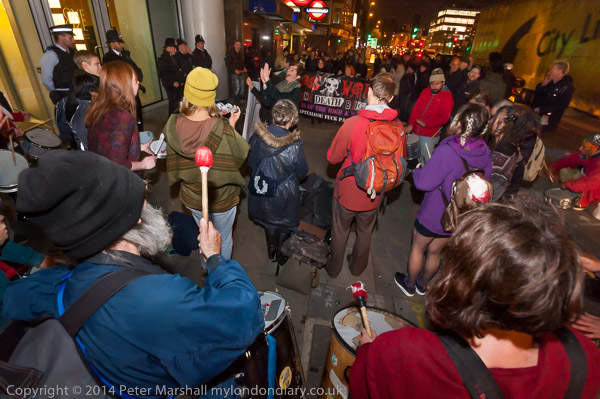
I used the text for this protest on 30th July 2014 as the opening text for my ‘zine’ ‘Class War: Rich Door. Poor Door‘ published in 2015 and still available from Blurb. It was the first in a series of around 30 weekly protests (and a couple of special events, pictures from most of which are in the zine, by Class War at this block in Aldgate where the small proportion of social housing tenants have to use a door down a side alley rather than the plush entrance on the main road for those in the private flats.

Class War arrive for their first protest

The series of protests had some success – it had immediately resulted in the alley being cleaned up and later it was given much better lighting and it placed the whole idea of ‘poor doors’ firmly on the national and architectural agenda – but eventually failed to resolved the issue for this particular building.

And put up posters and stickers

Here’s that text, written on 30 July 2014:

Class War, including three of their candidates for the 2015 General Election, protested at 1 Commercial St in Aldgate against London’s new appartment blocks providing separate ‘poor doors’ for the affordable flats they have to include to gain planning permission for the development. Class War characterise this as ‘social apartheid.’

The building manager removes a poster

The front entrance on Whitechapel High St (One Commercial St is the name of the block) has a hotel-like reception desk, and is staffed. It leads to the lifts for the expensive flats, many owned by overseas investors. Like most such buildings, some of them are empty and seldom used, while others are short term holiday lets.

Arguments continue over the door

There is apparently no internal connection* between this part of the building and that containing the social housing, which has been given a different name and a separate door some way down the alley on the west side of the building. Their door, the ‘poor door’ has a card entry system which leads to a bare corridor with some mail boxes on one side.

Lisa makes her views clear

The alley is dark at night, and even though today it was unusually clear of rubbish, it smelt strongly of urine. Certainly a far less friendly place than the well lit main street on which the ‘rich door’ opens. There seems to me to be no reason why all those who live in the building cannot share the same entrance even if their flats are on different floors or different sides of the building, and certainly no reason at all to hide the poor door down a mean alley like this.

Police try to persuade the protesters to move across the road

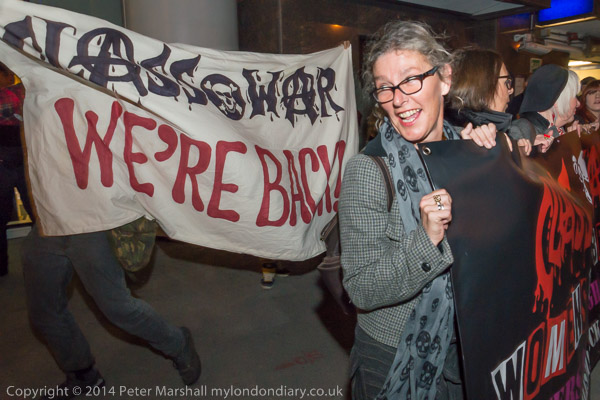
The protesters arrived with a banner carrying a quotation from the radical US labour activist Lucy Parsons (1853-1942) “We must devastate the avenues where the wealthy live“. The Class War posters – with their skull and crossbones – had the message “We have found new homes for the rich” and showed long rows of grave crosses stretching into the distance, and they were stuck on the windows around the poor door using Class War election stickers with their promise of a 50% mansion tax.

But the protesters are unmoved by the police arguments

A few people were still entering and leaving the building, with the protesters talking and shouting at them but not actually stopping them, and at one point the protesters grabbed the door when it was open. There followed a brief tug of war with several from inside the building, including one of the residents as well as those from the ‘concierge’ attempting without success to close it. The protesters made little attempt to enter the building but wanted those inside to be able to hear the protest through the open door.

The Poor Door. When I visited a few days earlier the alley was filthy

By the time a couple of police arrived and hurried into the building to talk to the people inside around a quarter of an hour the protesters had stopped holding the door. The police came out a few minutes later and tried with little success to get the protesters to move further away from the door.

The rubbish had gone but it still stank of urine and had no lighting

The protest continued until after an hour or so Class War decided they had made their point and left, some for the pub. I went around the building to find the poor door and photographed it and the alley it was in.

Class War – Rich Door, Poor Door

* This was a lie by the building manager. On a later occasion I was taken inside the building by one of the private residents, and after taking me to her flat we then went down and out through the ‘poor door’ which she told me she used when taking her dog for a walk.


All photographs on this and my other sites, unless otherwise stated, are taken by and copyright of Peter Marshall, and are available for reproduction or can be bought as prints.


End Gaza Invasion: 2014

Israel ‘disengaged’ from Gaza in 2005, but retained many controls in what international bodies still consider a form of occupation. It has maintained a blockade, controlling access by sea and air to the area which has a closed border with Egypt and strict border controls to Israel. With 1.85m Palestinians on under 140 square miles it is the third most densely populated area in the world. (See Wikipedia for most of the figures in this post.)

The Israeli and US-led economic blockade of Gaza, imposed after Hamas gained a majority in the area in the 2006 elections and too over from Fatah in 2007 has stopped the import and export of many goods, and together with damage caused by Israel air raids and invasions has led to severe shortages of water, medicine and power.

The protest in London on July 26th 2014 came during the Israeli ‘Operation Protective Edge’, which had begun on July 8th with bombing and artillery fire and escalated to a ground invasion on July 17th, with the aim of killing as many Palestinian militants as possible. It was sparked by the murder of three Israeli teenagers by Hamas members but the Israeli response was quite disproportionate.

Estimates of deaths and damage vary slightly, but agree that over two thousand Palestinians were killed, with the UN suggesting that 1,462 of these were civilians. 67 Israeli soldiers were killed and 6 civilians were killed by Palestinian rockets.

The damage to properties was similarly disproportioate. While around 18,000 homes were destroyed or seriously damaged in Gaza, Palestinian rockets only destroyed one in Israel. Gaza also lost over 200 places of worship, and almost three hundred primary schools and 73 medical facilities were badly damaged or destroyed. The attacks are said to have produced around 2.5 million tons of rubble in Gaza.

Jeremy Corbyn on the march in Whitehall

This is of course not the only year in which there were attacks by Israel on Gaza. “008-9 saw ‘Operation Cast Lead’ which also produced incredible devastation and over a thousand Palestinian Deaths and 13 of Israelis. In 2018 there were border protests in which over 13,000 Palestinians were seriously wounded by Israeli snipers and many killed. A UN Human Rights Council’s independent commission examined 489 cases of Palestinian deaths or injuries and found that only two were possibly justified as responses to danger and the rest were illegal. And most recently in May 2021 there were ten days of attacks by Israeli forces resulting in more destruction and deaths.

The protest on July 26th began on the main road close to the Israeli Embassy, tucked away in a private street in Kensington. Soon themain road was packed with people many too far away to hear the speeches despite the amplification. Finally it moved off on its way to Parliament Square.

There was a long list of speakers at the rally, including a number of well-known musicians and other public figures, but I began to feel rather tired, having been on my feet too long covering this and another protest, and I left before the end. But you can see pictures of many of the speakers as well as the crowd in My London Diary.

As usual there were many Jewish supporters of Palestine on the march, and a small group of the ultra-orthodox Neturei Karta anti-Zionist Jews who had walked from north London to join the rally.

Stop the Massacre in Gaza Rally
End Gaza Invasion March to Parliament
Israeli Embassy rally – End Gaza Invasion

Telling the Story – 19 July 2019

I often find myself thinking about my role as a documentary photographer when I’m taking pictures of protests. And of thinking about how I can carry out that role.

Clearly I’m not their to take part in the protest – though often I support the cause of the protesters I’m making pictures of. I’m an observer rather than a participant, though there are occasions when I will intervene in some way, largely the kind of actions that I would expect anyone to take, like stopping people walking into traffic or helping someone who has fallen down or dropped something.

There have been times too when I reminded police of the law (not always advisable) or protested at their use of unnecessary force. And on some occasions when marches have got lost or taken a wrong turning I’ve pointed this out to the marchers. Some embassies and companies are quite hard to find.

I never set up people or groups, though sometimes when photographing people I may ask or gesture them to look at me or to hold their poster or placard higher or lower. But it isn’t a portrait session and I don’t ask them to smile or scowl or act up for the camera. It would have been much easier to make the picture of the XR symbols in those dark glasses in the studio and it took a number of attempts to catch him looking in exactly the right direction and catch those reflections from a banner which I’d noticed moving across them earlier.

But it isn’t just a matter of passive observing. I’m choosing my position, framing my pictures, selecting the moment, working to try to present the story clearly and effectively.

It isn’t essentially about making dramatic or attractive pictures, though I always hope some might be.

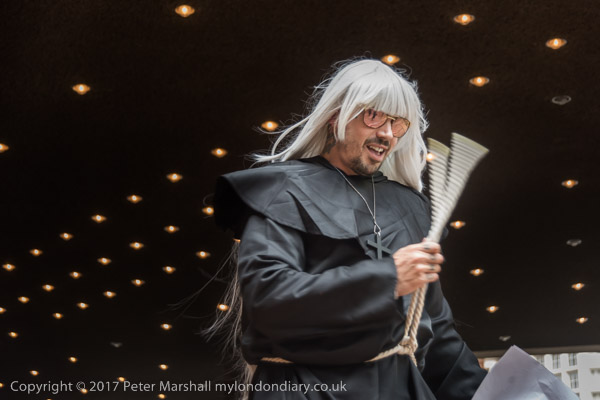
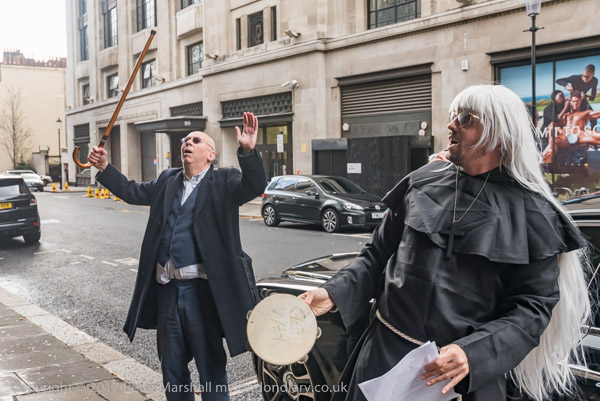
Extinction Rebellion’s ‘Requiem for a Dead Planet’ at Northcliffe House, home of the Daily Mail, Independent, Mail on Sunday, London Live and Evening Standard demanding they publish truth and end lies about climate change was a tricky one to cover, with heavy rain falling much of the time and a very limited area under cover for protesters and photographers. As we’ve seen in the past week, the weather is becoming more violent and this seemed appropriate if making the job more difficult.

Here’s some of the text I wrote at the time – the link below has more and more pictures:

“XR say avoiding climate & ecological devastation needs the media to tell the truth and stop publishing fake science denying climate change as well as advertising and editorial material that promotes high-carbon lifestyles, whether about fashion, travel food or other consumerist content so government can take the drastic action needed.

The protest included suitable requiem music by a small group of musicians in XR Baroque, a eulogy for lost species by a priest, speeches, poems, skeletons, banners and a die-in.”

Requiem for a Dead Planet at Daily Mail

All photographs on this and my other sites, unless otherwise stated, are taken by and copyright of Peter Marshall, and are available for reproduction or can be bought as prints.


XR London Tax Rebellion

Extinction Rebellion launched their campaign for a tax strike against the Greater London Authority, withholding the GLA element of their council tax until they abandon projects which will cause environmental degradation and hasten ecological collapse with a protest outside City Hall on Thursday 18th July 2019.

They were particularly concerned about three major GLA projects, the Silvertown tunnel under the Thames, the Bow East concrete plant in Newham, and the Edmonton incinerator in Enfield, and called for a citizen’s assembly to formulate an “Emergency London Plan”, replacing the current 2020 London Plan with sustainable policies on air quality, land development and transport for the City of London and 32 London Boroughs.

Sian Berry, Green Party

The rebellion called on London residents to withhold the average proportion of their council tax – 22% – which goes to the GLA and to pay that into a special fund which would be used for climate related projects. To have any impact it would have to be supported by large numbers of London council tax payers, and XR set a threshold of 2,700 for it to go ahead – needing the support of around 15% of their London members.

Although some other XR actions involving tax are proceeding, I’ve been unable to find any more announcements about the London Tax rebellion from XR, and suspect that they may not yet have managed to sign up enough supporters for this action which is no longer listed on the on-line platform which was being used to carry the forms concerned.

Possibly the reluctance to take part may have been influenced by the change in policy towards those arrested for minor offences at XR protests. Normally only a fairly small fraction of those arrested are actually charged and brought to court, but political pressure from Home Secretary Priti Patel, who called XR criminals threatening the “UK way of life” has resulted in almost 100% of those arrested during the 2019 protests being brought to court. There is now a very long back-log of cases awaiting trial.

Many more pictures at XR London Tax rebellion.

All photographs on this and my other sites, unless otherwise stated, are taken by and copyright of Peter Marshall, and are available for reproduction or can be bought as prints.


End Austerity, No to Racism, Tories Out! 2016

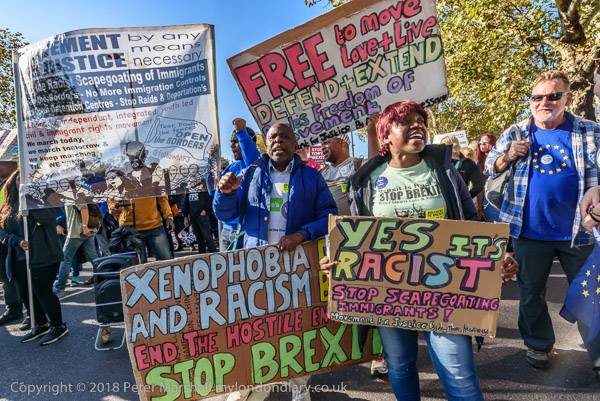
Five years ago the People’s Assembly and Stand Up To Racism organised a march through London as a response to the referendum campaign conducted by many Brexit campaigners on an anti-immigration platform which had provoked an upsurge in racism and hate attacks on Black and particularly Muslim people online and on the streets of Britain.

The marchers met outside the BBC, as I wrote ” in the forlorn hope that they might for once cover a protest in Britain properly” but of course they ignored the thousands on their doorstep. Probably they were too busy giving Nigel Farage a quite disproportionate amount of publicity and air-time, along with the Labour plotters against Jeremy Corbyn – who sent a message of support to the marchers and like them showing solidarity with refugees and asylum seekers.

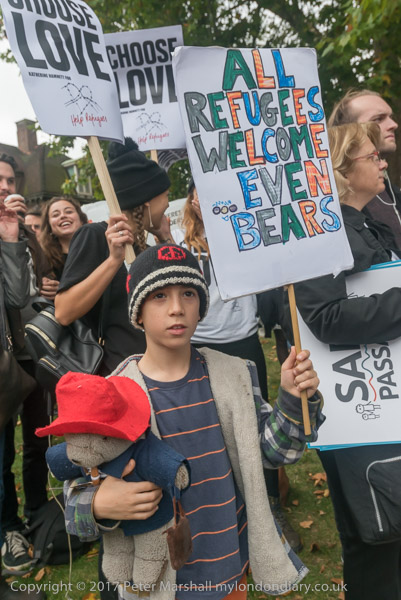
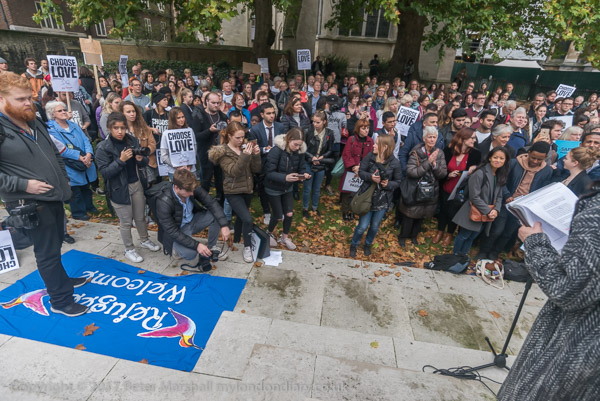
This banner and the placards for me summed up the message of the march, a demand for ‘Hope Not Hate’ and for people of all backgrounds to join hands in love and respect and say ‘No Racism’. We’ve recently seen a huge backlash against racist remarks against footballers in the English team showing that people across the country oppose racism, whether from the far right or Tory ministers and MPs who denigrate footballers who ‘Take the Knee’.

Later I managed to get to Parliament Square for the rally at the end of the march with speakers from many organisations, including an asylum seeker as well as politicians and activists. It was a sunny day and there was a warm and pleasant atmosphere in the large crowd listening and applauding the speakers.

I’d waited on Regent St as the march set off for some time until the last of the several thousand marchers had passed me, then hurried off to the HQ Offices of CBRE in Henrietta Place, where cleaners from the strike at 100 Wood St, managed by CBRE, had broken away from the march to stage a flash mob, along with supporters including United Voices of the World General Secretary Petros Elia and Bakers Union (BFAWU) National President Ian Hodson.

I’d arrived too late to go with them into the foyer, whose large glass doors were firmly locked when I arrived, but after a few minutes photographing through glass the doors were opened I was able to take a few more pictures as they got ready to leave. They went on to rejoin the march, but I went off to look for the English Defence League whose protest had been called to oppose that by the People’s Assembly.
I don’t like photographing extreme right-wing groups such as the EDL. It gives them publicity, which they don’t deserve as it exaggerates their importance. Generally their protests are small and their extremism represents a very small fringe of our society, though racist attitudes unfortunately are much more widespread. But rather more directly they are generally not nice people to be near. They shout and scream messages of hate, often in vile language, and routinely threaten me as I take photographs. I’ve been spat at and even, fortunately not often, grabbed, pushed and punched.

While with most protests I can move freely through the event, at these I need to keep a safe distance away. I’m usually glad that police are present, and without them I would be assaulted and my equipment smashed, but police sometimes make any photography virtually impossible. While I’d managed to cover the march I could only see brief glimpses of the rally which followed through several lines of police with several hundred of them surrounding perhaps a hundred protesters. I gave up then and took the tube to cover the anti-racist rally.

EDL march and rally
Cleaners Flash Mob at CBRE London HQ
End Austerity, No to Racism, Tories Out!


All photographs on this and my other sites, unless otherwise stated, are taken by and copyright of Peter Marshall, and are available for reproduction or can be bought as prints.


Clean Air – 1990 cyclists and 2019 XR East London

Cyclists protest, Whitehall, Westminster, 1990, 90-11c-14
‘Let London Breathe’ – Cyclists ride down Whitehall to a Trafalgar Square rally – November 1990

Back in 1990, I rode with hundreds of cyclists from the London Cycling Campaign and others protesting about the terrible air quality in London from Battersea Park to a well-attended rally in Trafalgar Square. Following the rally, some MPs raised the issue in Parliament.

XR East London marches for clean air – 12 July 2019

Almost 30 years on there has not been a great deal of progress – and the statistics now show almost 10,000 excess deaths per year in the city due to air pollution, and untold misery from various respiratory conditions, some crippling. In 2019 XR East London met at Bethnal Green on Friday 12 July to march to Hackney behind a banner ‘The Air That We Grieve’, calling for a rapid end to the use of fossil fuels.

Much of the pollution comes from road traffic, and the already announced end to the sale of new trucks, vans and any other combustion-powered vehicle from 2030 onwards will do a little to improve air quality, but existing petrol and diesel vehicles will continue to be used for many years, though we may see more stringent ultra-low emission zones to restrict their use in cities.

But although the switch to electric will cut down pollutants such as nitrogen oxides as well as reducing climate changing carbon dioxide, it will still leave other harmful substances such as particulates from tyres and brakes in the air. And the carbon footprint is only lowered so long as the electricity used to charge those car batteries comes from truly renewable generation.

Cleaner air in cities also needs us to move away from the car to more eco-friendly means of transport – such as public transport and bicycles. Even electric scooters and electric bikes also have a part to play.

Better public transport means more trains, light rail, trams and buses. The simplest and most cost-effective solutions are probably more dedicated bus lanes and bus-only routes, and giving buses greater priority in traffic. Many years ago I cycled in French cities where buses had priority and motorists (and cyclists) had to give way whenever they wanted to pull out from a stop, and changes like this to our Highway Code and traffic rules would make a difference.

In 1990 cyclists were calling for 1000 miles of dedicated cycle routes through London. We do now have some ‘cycle superhighways’ and ‘quietways’, although many of these – we are now supposed to call them ‘cycleways’ – still involve sharing with often dangerous traffic. Progress is still slow, and there is bitter opposition from some interest groups, particularly black cab drivers.

We need too an overhaul of London’s taxi system, with rules still made in the days of horse-drawn Hackney cabs. I’ve often stood at bus stops in the City waiting for my bus, held up by traffic while 20 or 30 or more black cabs drive by, the great majority of them empty. A move away from ‘ply for hire’ to smartphone based systems summoning a cab from a nearby taxi rank would hugely cut both congestion and pollution in the centre of London.

More at XR East London marches for clean air. You can click on the black and white image above to go to the album with more pictures from the 1990 cyclists protest.

As always I was travelling around London on public transport (I sometimes bring up a folding bike on the train) and as the march neared its end I boarded a bus in the opposite direction back to Bethnal Green where I took the tube back to Holborn, then took the short walk to the University of London’s Senate House, where exploited outsourced workers were holding a noisy protest after the newly appointed Vice-Chancellor Wendy Thomson had failed to reply to a request to meet them and discuss their grievances. You can see more about this at IWGB welcome new Vice Chancellor.


All photographs on this and my other sites, unless otherwise stated, are taken by and copyright of Peter Marshall, and are available for reproduction or can be bought as prints.


Black Lives Matter – Brixton 9th July 2016

Five years ago on July 5th 2016, Alton Sterling, a 37 year old black man selling videos outside a convenience store in Baton Rouge, Louisiana was shot and killed by police at close range. The incident was filmed by several bystanders and their mobile phone video clip shocked and enraged viewers around the world.

The following day, July 6th, 32-year-old Philando Castile was driving with his girlfriend in a suburb od St Paul, Minnesota, when police stopped the car and asked to see his driving licence. His girlfriend video the events which ended in Castile being shot five times at point-blank range, dying 20 minutes later. The officer who fired was later charged with second-degree manslaughter and two counts of dangerous discharge of a firearm but found not guilty by a jury.

These two cases provoked protests around the world, including this event in Brixton. Shootings of people by police remain common in the USA at around a thousand a year and Black people are around two and a half times as likely to be shot as White. These cases stood out both because the two men shot were not involved in any crime but also because there was clear evidence from the videos that there was no justification for the shootings. Later the families were to be awarded compensation running into millions of dollars in both cases.

Although policing in this country is generally not carried out at the point of a gun, with an average of around 3 people killed by police shooting a year, there have been many cases of deaths at the hands of police, again disproportionally affecting Black people. As I wrote in my account of the protest:

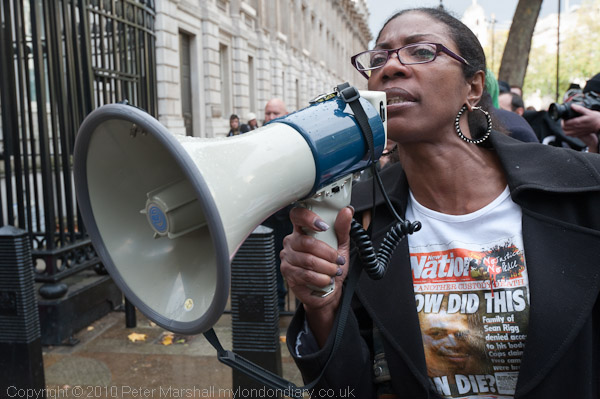
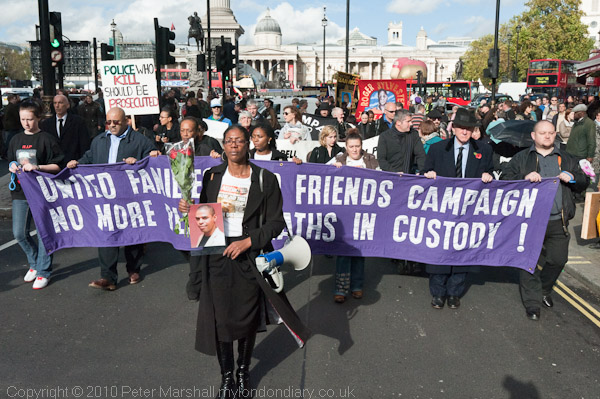
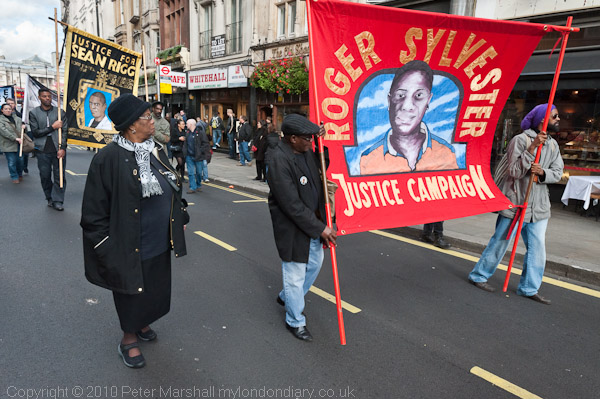
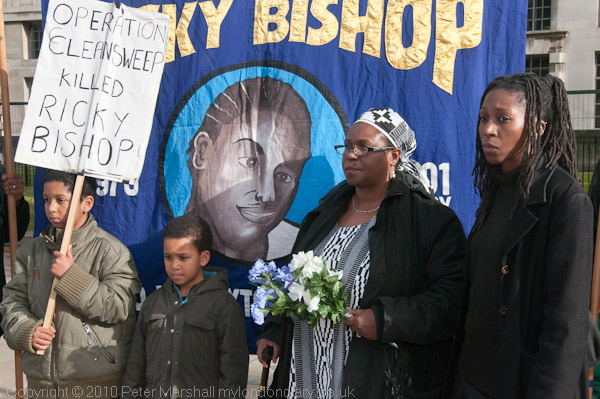
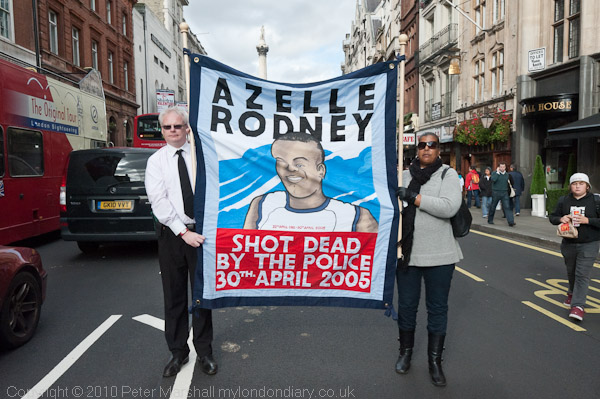
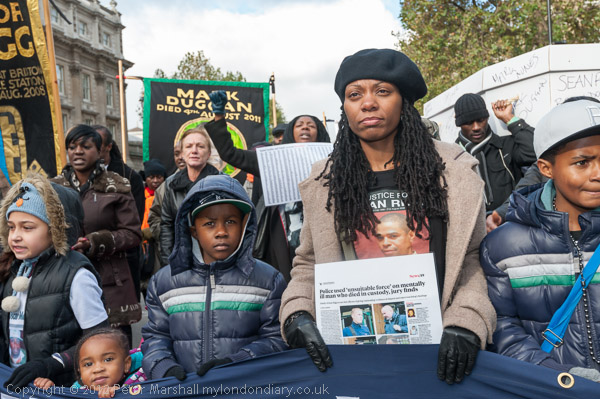
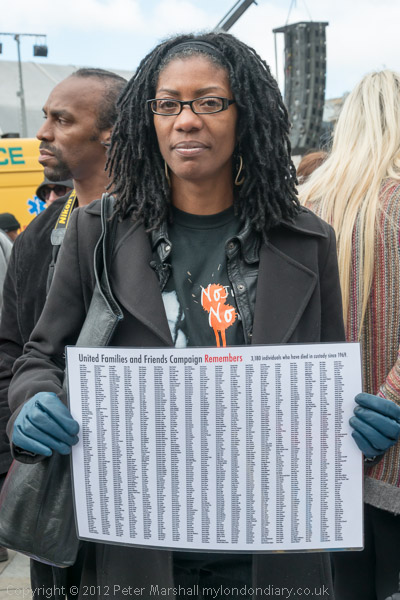
Brixton Police station has been the scene of a number of black deaths in custody, including that of Sean Rigg, Wayne Douglas and Ricky Bishop, and one of the organisers who spoke wore a t-shirt listing just a few of those who have been killed by police in the UK, with young black men in particular being far more likely to die after arrest – or to be shot rather than arrested. Last year police stripped the tree in front of the police station of its deaths in custody memorials on the day of the annual march in central London against deaths in custody.

My London Diary

The crowd that gathered in Windrush Square (aka Windswept Square after Lambeth Councils re-landscaping to make it deliberately less hospitable) was largely black, and the protest had been called by local black organisers. Most of those who spoke talked about their own experiences of police racism in the local community as well as the shootings that had provoked the protest.

So many people wanted to have their say that the event continued for several hours, eventually going on to march up the Brixton Road to Brixton Police Station and bringing traffic to a standstill for several hours.

But it had come at the end of a long day for me and I had gone home well before that. Earlier in the day I’d photographed protests against the nonsensical ‘Garden Bridge’ across the Thames and the demolition of council estates by Labour Councils, both in Waterloo, in Hackney against domestic violence, at Downing St against Brexit, the scapegoating of immigrants and Islamophobia and a Green Park Brexit picnic and I was exhausted. You can find more about the Black Lives Matter protest and these other events on My London Diary.

Brixton stands with Black victims
Green Park Brexit Picnic
Europe, Free Movement and Migrants
East End Sisters Uncut-Domestic Violence
Housing Protest at ‘Progress’ conference
Garden Bridge ‘Progress’ protest


All photographs on this and my other sites, unless otherwise stated, are taken by and copyright of Peter Marshall, and are available for reproduction or can be bought as prints.


Blair lied, Millions Died – 6th July 2016

Labour scraped in at Batley and Spen by a few hundred votes, which was enough to take the pressure of calls for a replacement for Keir Starmer off the boil for at least a few months. And for the media to call upon some of the more grisly figures from the Labour past to come on and repeat their vilification of Jeremy Corbyn, and call for a return to those policies which had made Labour – New Labour – unelectable.
It had started with a great burst of support and enthusiasm in May 1997, when we really believed that ‘Things Can Only Get Better‘, but soon the disillusion set in. One of the major early problems came with PFI, launched by John Major in 1992, but taken up and expanded greatly under New Labour. Private companies were contracted to build and manage major public projects, enabling some very flashy announcements but failing to say we would be paying through the nose for them for many, many years – and in many cases for another 20 years or more from now.

‘Blair’ and ‘Bush’s’ bloody hands – and the cash.

It essentially privatised many public projects, with often poor negotiating skills by civil servants unschooled in such matters resulting in excessive profits for the companies involved. There were many critics of PFI at the time, and in 2011 a critical Treasury report. In 2018 then Chancellor Philip Hammond stopped any new PFI projects.

PFI has been particularly disastrous for the NHS, causing huge financial problems and leading to the cutting down an closures of hospitals. The 127 PFI schemes had a total repayment cost (according to Wikipedia) of £2.1m in 2017 and continuing to rise until 2029. In 2012 seven NHS Trusts had to be given emergency financial support as even with cuts they were unable to meet their PFI repayments.
But, as the recent death of Donald Rumsfield reminded us, the most clear public failure of New Labour was to support what was largely his personal vendetta in the disastrous invasion of Iraq. Richard Wolffe, writing in he Guardian headlined his article ‘Rumsfeld’s much-vaunted ‘courage’ was a smokescreen for lies, crime and death‘ – and Blair colluded whole-heartedly in the deception, with the ‘dodgy dossier’ and various other statements and decisions. His was a special relationship with Bush most politely described as brown-nosing.

This of course is Britain, so instead of taking action we eventually had an inquiry, with Chilcot taking over seven years to allow the long grass to grow. Set up by Gordon Brown in 2009, six years after the invasion, it produced its report on 6 July 2016, when the protest here took place. Wikipedia quotes Richard Norton-Taylor of The Guardian as describing it as “an unprecedented, devastating indictment of how a prime minister was allowed to make decisions by discarding all pretence at cabinet government, subverting the intelligence agencies, and making exaggerated claims about threats to Britain’s national security”.

A banner uderestimates Blairs crime – there were millions who died

Clearly Blair was a war criminal. But of course no legal action followed – and that war criminal and proven liar continues to be invited to give his opinions in the media – and there are even those who suggest he should be brought back to lead the Labour Party. Financially he has done well out of his time as Prime Minister – and probably even better from his property investments, with an estimated net worth according to some of £100m. But as the placards say, ‘Blair lied, Millions Died’ and if there was any justice he should have gone to jail.

More at Blair lied, Millions Died – Chilcot


All photographs on this and my other sites, unless otherwise stated, are taken by and copyright of Peter Marshall, and are available for reproduction or can be bought as prints.