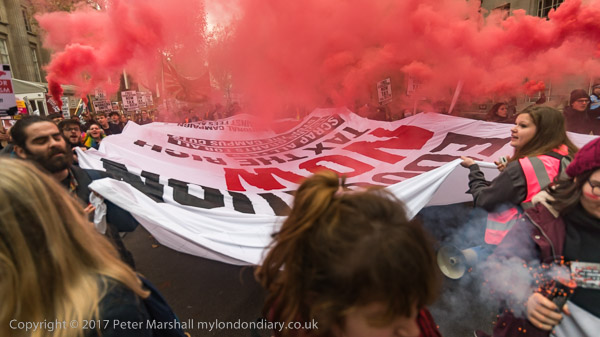
Die-In and March for Palestine: Saturday 2nd November saw another huge march in London in support of the Palestinian people calling for urgent action by the by the international community to end brutal attacks on civilians, hospitals and schools in Gaza and an end the deliberate starvation of Palestinians.
Examining what had happened from October 2023 to July 2024 in Gaza, the occupied Palestinian territory and the occupied Syrian Golan they state: “Since the beginning of the war, Israeli officials have publicly supported policies that strip Palestinians of the very necessities required to sustain life — food, water, and fuel, These statements along with the systematic and unlawful interference of humanitarian aid make clear Israel’s intent to instrumentalise life-saving supplies for political and military gains.”
London, UK. 2 Nov 24.
“Through its siege over Gaza, obstruction of humanitarian aid, alongside targeted attacks and killing of civilians and aid workers, despite repeated UN appeals, binding orders from the International Court of Justice and resolutions of the Security Council, Israel is intentionally causing death, starvation and serious injury, using starvation as a method of war and inflicting collective punishment on the Palestinian population.”
London, UK. 2 Nov 24. Health Care Workers.
You can read more about the report on the UN web site. It is to be presented to the 79th Session of the UN General Assembly today – 18 November 2024, calling on “all Member States to uphold their legal obligations to prevent and stop Israel’s violations of international law and hold it accountable.”
London, UK. 2 Nov 24.
Doubtless there will be a few countries including the USA and Britain who will uphold the freedom of the state of Israel to continue its genocide and keep on supplying the weapons that enable them to do so.
London, UK. 2 Nov 24.
I was intending to write something more about what is happening in Gaza, Lebanon and elsewhere – and about the urgent need for a ceasefire, the release of hostages and the start of longer term negotiations to bring about a just and permanent solution which would enable both Palestinians and Israelis to live in peace.
London, UK. 2 Nov 24.
But it would largely be repeating things I’ve written many times before and I’ve decided to leave it to the UN committee and a few of the many pictures I took on the march to tell the story.
London, UK. 2 Nov 24
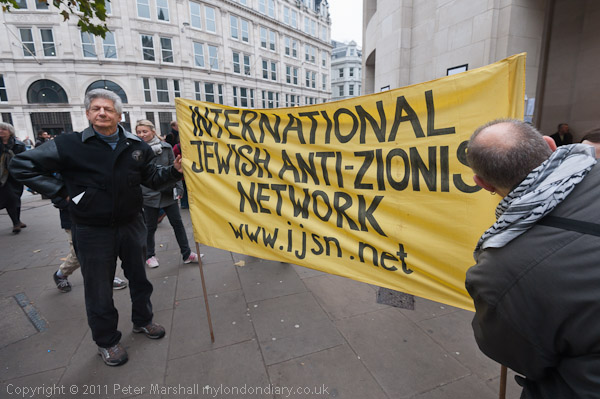
As usual there was a Jewish block on the protest as well as many Jewish indivuals elsewhere in the march, along with the small group of anti-Zionist Jews who have always supported freedom for Palestine. There was also a small protest against the march at the north end of Vauxhall Bridge which curiously included those calling for he release of hostages – which a ceasefire and negotiations has the strongest chance of acheiving.
London, UK. 2 Nov 24. Neterei Karta Anti-Zionist JewsLondon, UK. 2 Nov 24
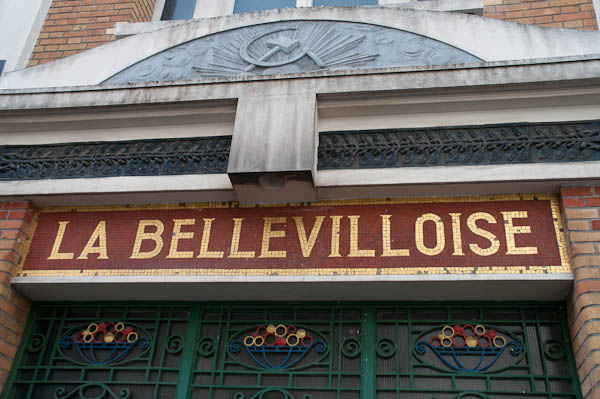
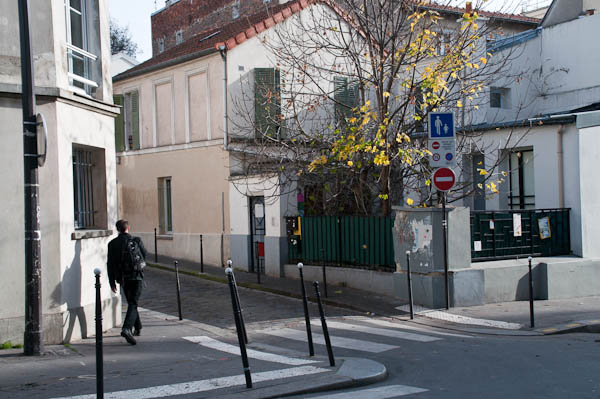
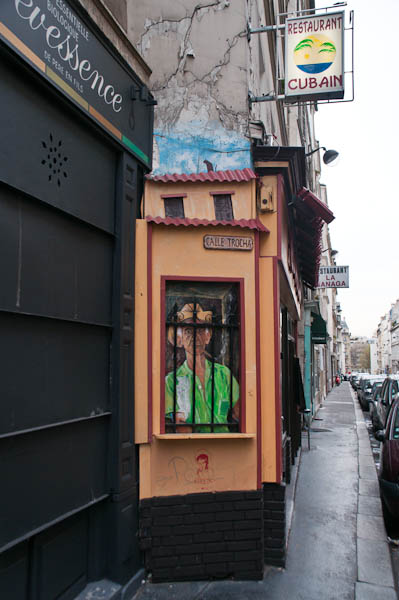
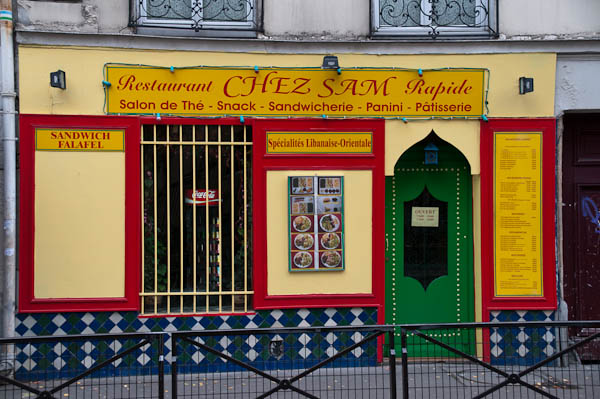
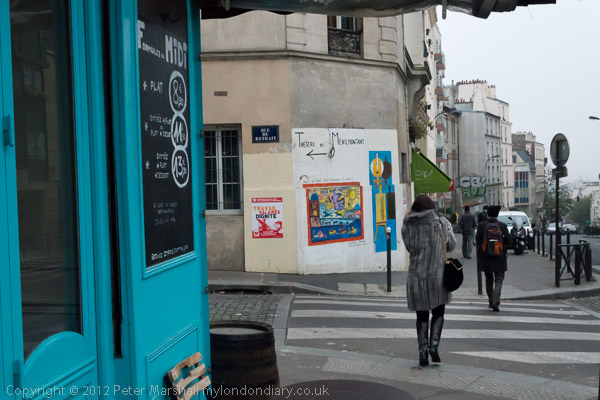
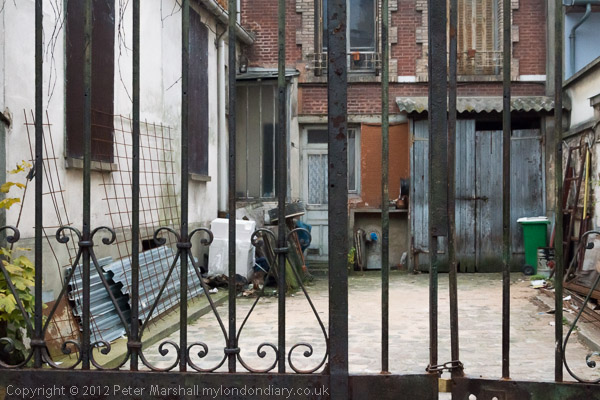
Buttes Chaumont and Belleville Traversée: Monday 17th November 2008 was the last day of our stay in Paris where I had come with my wife for a week for me to go to Paris Photo and for the two of us to enjoy the city and the huge number of photographic shows that were taking place there. On My London Diary you can read PARIS SUPPLEMENT, my diary of our week there.
Rue de Tanger, 19e
We had arrived in Paris the previous Monday and the first thing we did on arriving there was to buy our weekly tickets – then Carte Orange – for bus and metro transport across the city – incredible value for those used to UK transport prices.
Parc de Buttes Chaumont
But that of course had finished on Sunday. And the only real way to see any city is on foot, so we decided to spend the day before our Eurostar train left for London at 17.13 taking a walk around some of our favourite places, booking out but leaving our cases in the hotel foyer to collect later.
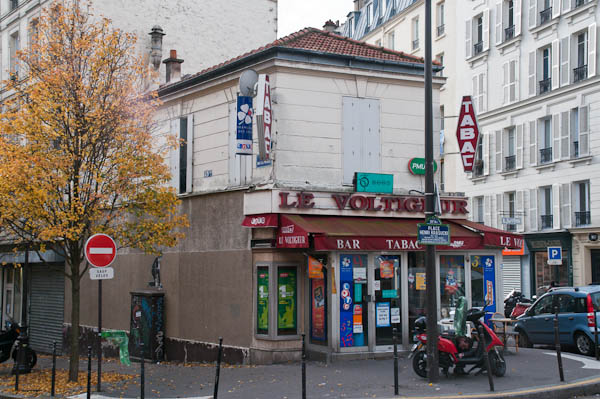
Le Voltigeur on the courner of rue des Couronnes
As you will see from the pictures here we first made our way to Paris’s most fantastic park, Buttes Chaumont, a former gypsum quarry and waste tip converted into gothic fantasy, and then on to Belleville.
Earlier in our stay we had visited the Bar Floreal where I had been given a free copy of a small book produced some years earlier for a show there by Willy Ronis (1910-2009), one of my several favourite photographers of Paris, ‘la traversée de Belleville’ which describes his favourite walk around the area.
Rue Laurence Savart, 20e
Linda was keen to use this and find exactly the scenes in his pictures, while I was more interested in making my own pictures, and had followed a quite similar route some years earlier. But it was interesting to see it through his eyes, although considerable redevelopment had changed the area since he walked it in 1990. And more since 2008.
Rue de la Fontaine au Roi, 11e
Rather more atmospheric than my pictures is the video which Ronis appears and speaks about some of his pictures in made at the time of the show in 1990.
Rue de la Fontaine au Roi, 11e
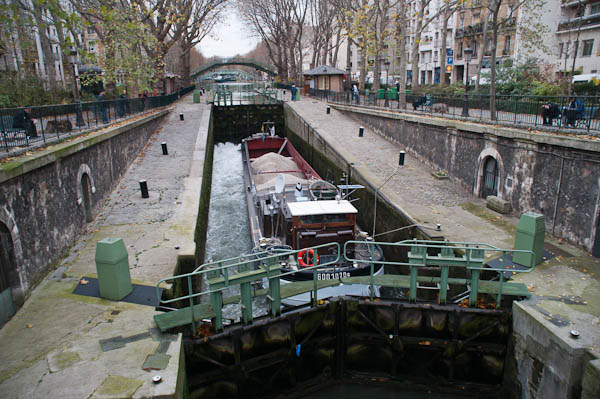
Unfortunately the restaurant ‘Aux Monts D’Auvergne’ at which we ate a splendid three course lunch had been replaced by another by the time we next came to Paris. After the large meal we struggled a little but did just about manage to finish the ‘Traversée’, walk back to the hotel to collect our luggage and catch our train and were back home on the outskirts of London by 8pm.
Canal St Martin
There is more detail about the day in the text on My London Diary as well as in the picture captions – and as usual many more pictures.
Stroud Green to Grand Parade: Continuing my walk on Sunday 5th November 1989 from where the previous post left me on Stroud Green Road close to Finsbury Park Station.
Boys Entrance, Stroud Green Primary School, Ennis Rd, Stroud Green, Haringey, 1989 89-11d-46
The Girls Entrance to Stroud Green Primary is still there on the corner of Perth Road and Woodstock Road, but the BOYS was recently removed from above the gate at the other end of the school site in Ennis Road, where extensive building work was taking place – so perhaps it will return. The two entrances were over a 100 metres apart, an unusually safe distance. There is also a similar gate for INFANTS on Woodstock Road.
I think most of the school dates from 1897, although Google’s AI unhelpfully told me “Stroud Green Primary School was established in 1997” when I asked when it was built. The Grade II listing text for Woodcock Road School begins “Late C19 building of shallow U-shape with projecting gabled wings and slightly projecting 5 bay centrepiece under higher hipped roof crowned by cupola.” The area had fairly recently been developed with housing, some of which had to be demolished to build the school.
I turned left into Woodstock Road and then right into Oxford Road, heading for the Oxford Road Gate to Finsbury Park.
On the right just before the gate is Oxford House. In the 1960s this was the cinematographic film processor Kay Laboratories, later absorbed into MGM (possibly via Rank Xerox). For some years it was a studio and office space and housed a private college. For some years this 1930s Art Deco building was in a poor state but has recently been refurbished as offices and co-working space.
Pipe Bridge, New River, Houses, Endymion Road, Harringay, Haringey, 1989 89-11d-23
I walked through Finsbury Park on what is now part of Section 12 of the Capital Ring a circular walking route around London, first put forward as an idea the following year but only completed in 2005, but turning north onto the New River Path to exit onto Endymion Road where the houses on this picture are.
These south-facing houses on Endymion Road were lit by early afternoon winter sun. The road was the first constructed in the area after Finsbury Park was established and the development was begun by the Metropolitan Board of Works around 1875. The road goes around the northwest and north sides of the park, giving the houses attractive views over it. Development of the area to the north, West Harringay, began shortly after.
Endymion was in one of several Greek myths a handsome shepherd prince who moon goddess Selene fell in love with and persuaded Zeus to make immortal and to put in eternal sleep so she could visit him every night. John Keats wrote a famous extremely long poem in four sections, each around a thousand lines base on the myth and first published in 1818.
But the name more likely came to Harringay from HMS Endymion, “the fastest sailing-ship in the Royal Navy during the Age of Sail“, built in 1797 and in active service during the Napoleonic Wars and until the First Opium War around 1850 and only finally broken up in 1868.
Building, Green Lanes area, Haringey, 1989 89-11d-25
I think this building was probably on Warham Road, just a few yards down from Green Lanes, but if so there is no trace of it now. I wonder what it was built for, but there are few clues in the picture – perhaps someone local to the area can tell us in the comments.
Shop Window, Grand Parade, Green Lanes, Haringey, 1989 89-11d-11
The Grand Parade on the east side of Green Lanes of shops with middle class flats above them was developed by J C Hill and completed in 1899, with its relatively consistent facades interrupted only by an earlier bank, built five years earlier.
I can’t think who the peculiar bedroom suite in the window of this shop might appeal to, but it seemed like something out a a peculiar nightmare to me, but I guess it was someones’ dream.
Tory Scum, Grand Parade, Green Lanes, Haringey, 1989 89-11d-13
Also and rather more prosaically on Grand Parade on an empty shop front, fly-posting and the carefully stencilled graffiti:
TORY SCUM OFF OUR BACKS WE CAN’T PAY WE WON’T PAY NOPOLLTAX
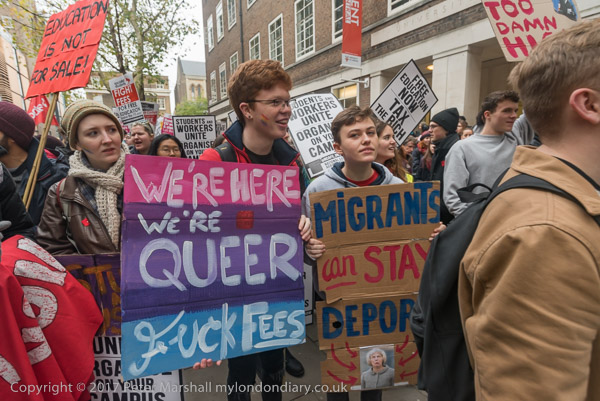
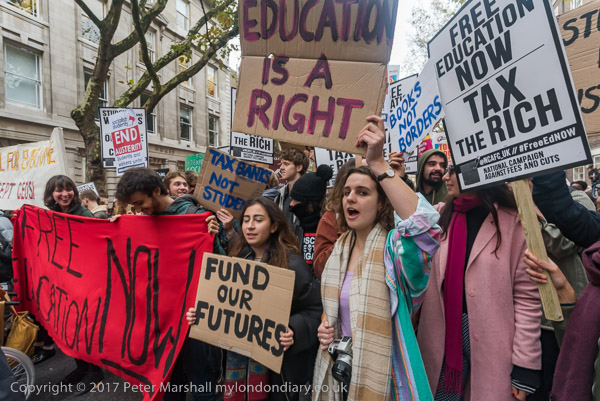
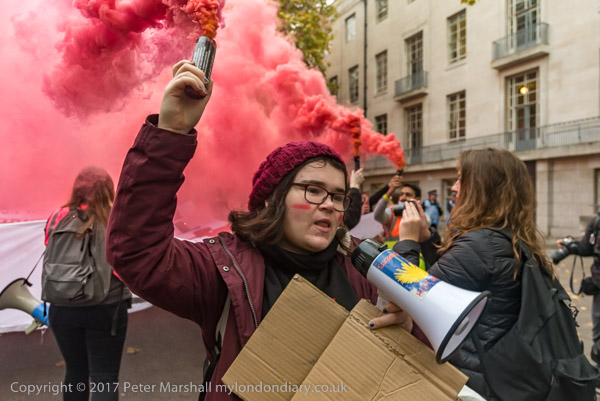
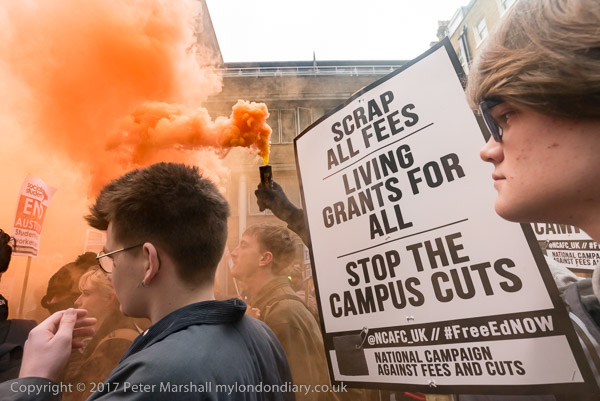
Students march for free education: Several thousand students marched from Malet Street to Parliament on Wednesday 15th November 2017 calling for an end to all tuition fees, for living grants for all and an end to all government cuts.
Around 60% of 18 year-olds now continue their education in either universities or FE colleges, with just under 40% at university – though rather more women than men. This figure has increased massively since the 1960s when only around 4% of us went to university.
But back then we paid no fees and there were means-tested maintenance grants which gave those of us whose parents were on low incomes enough to live on during term-time though parents who could afford it were expected to make a contribution.
Many of us needed to find jobs in the long Summer Vacation or over Christmas when many students were needed by the Post Office to deal with the huge volume of Christmas cards, but universities generally prohibited working in term-time – and those students that needed to because their parents didn’t cough up with their contribution had to keep their work a secret.
My full grant was I think £300 a year which had to cover rent, meals, travel, books etc over the 30 weeks at university – equivalent, allowing for inflation to around £5,300 now, though I think it would be impossible to survive on that now. The maximum student loan for living expenses for 2024/5 for those living apart from their parents is now £10,227 – or £13,348 for those in London.
Students now also have to pay tuition fees for which they can also get loans up to the full amount – currently £9,250 but with a recently announced increase to £9,535 for the 2025-26 academic year.
So for a normal 3 year degree course those taking out the full loans possible will end up owing around £60,000. I ended my course with a degree and around £7 in the bank.
Of course student loans are not like other loans, and students only start repayment when there income exceeds a certain threshold – currently around £25,000, though this depends on when students took out their loan. And after 30 or 40 years (again depending on this) any remaining loan is wiped out. But still the amounts are daunting.
Because these are loans, the government is still essentially paying out the cost of tuition and maintenance for current students. But they hope eventually to get some of the money back – again the forecast of how depends on the scheme in place when students took out their loan.
I’ve been unable to find a figure for the amount of repayment the student loans company is currently receiving, but I think it is fairly low compared with the amount they are giving out in new loans. The total debt owed is expected to rise to around £25 billion.
With this background its perhaps not surprising that students now – and in 2017 when I took the pictures here that students are angry about the cost of their education and that several thousands took part in the student march organised by the National Campaign Against Fees and Cuts despite it not being supported by the National Union of Students.
But this was not their only concern. They also marched to condemn the increasing marketisation of the education system that is resulting in cuts across university campuses and a dramatic reduction in further education provision across the country. They also say that the Teaching Excellence Framework which was supposed to ‘drive up standards in teaching’ has instead intensified the exploitation and casualisation of university staff as a part of the marketisation agenda.
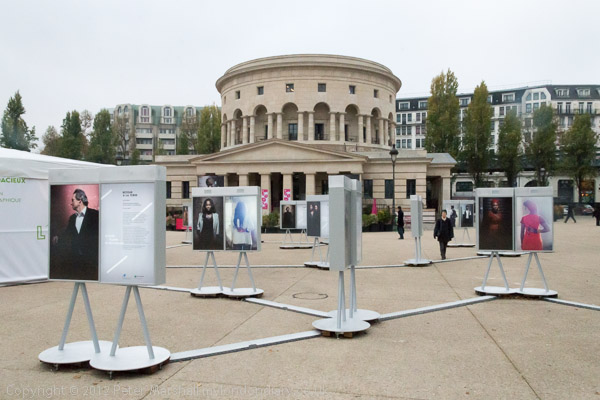
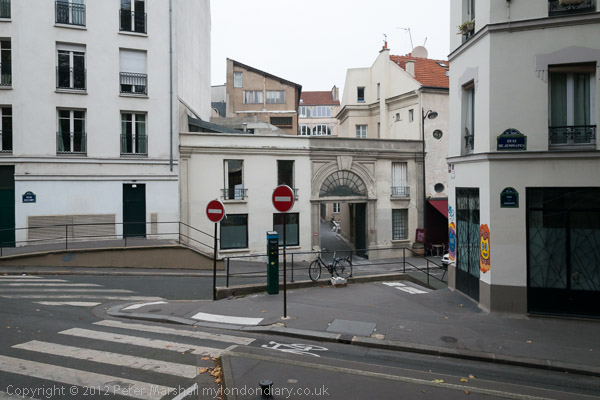
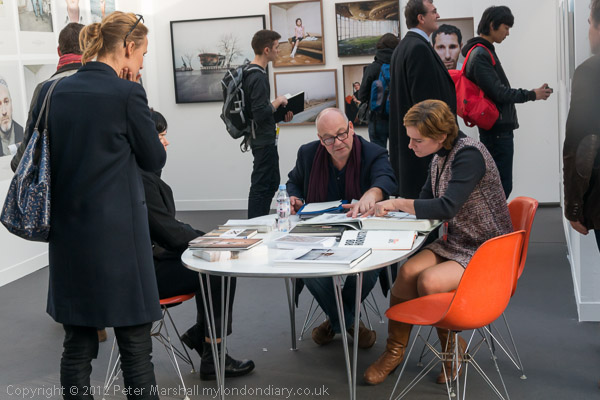
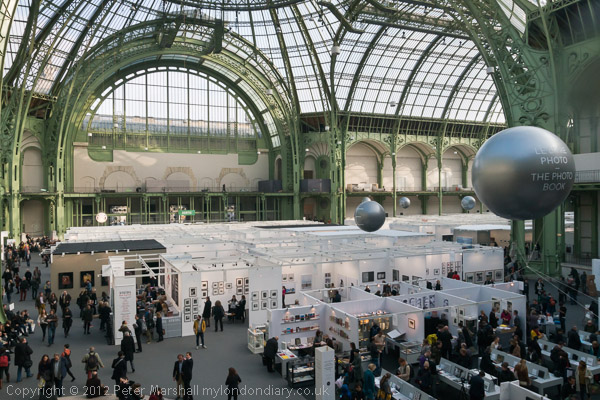
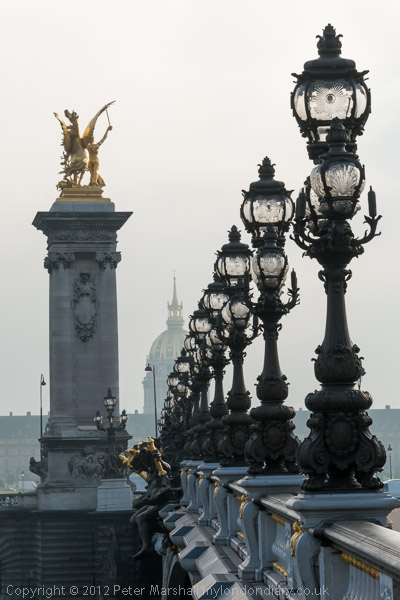
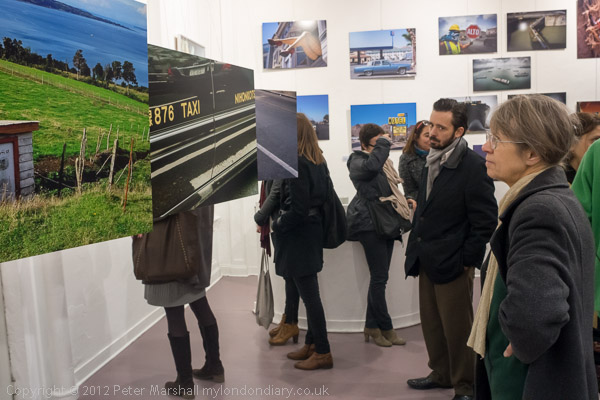
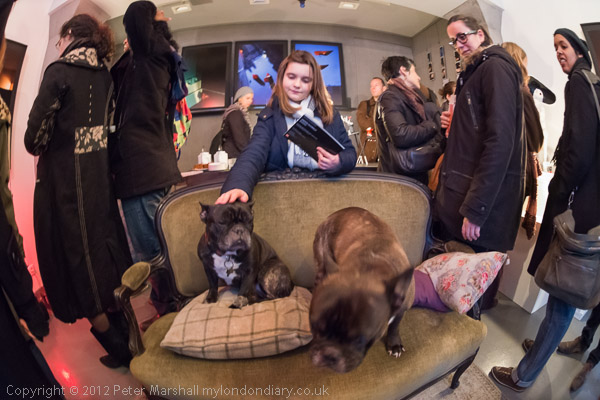
Paris Photo 2012: I’ve missed Paris Photo again – the 2024 ‘edition’ took place from November 6th – 10th and it was deliberate.
Magnum at the Rotonde de la Villette
By 2012 when these pictures from my Paris Photomonth Diary were made I’d been to around half a dozen of these annual events and had become rather bored by them though Paris was always enticing. Something of which I tried to capture in my book of a similar name, PHOTO PARIS, colour images I made there in 1988.
But the actual Paris Photo had lost its appeal for me, and while I still went dutifully around the many stalls I was finding less and less to attract my interest. Many dealers seemed to have more or less the same work on show each year, and more and more of the space seemed to be taken up by huge prints dedicated to commercial decor rather than having much photographic interest.
Of course I always met a few old acquaintances – and occasionally met some interesting people, but I also found myself more and more being treated with disdain by some of the exhibitors; I was too clearly a poor photographer rather than a rich collector.
I’ve never been convinced that photography becoming part of the art market has been a good thing. It has certainly produced a great deal of pretentious and empty work though it has provided an income for those few photographers who have learnt how to play it – with some becoming millionaire celebrities.
Of course there is no merit to starving in garrets but most of the photographers whose work interests me have made relatively modest livings from their work, some relying on income from other sources such as teaching or writing to supplement their income from photography. They were driven by vision and conviction rather than dollars.
From the start of my visits to Paris Photo it wasn’t the actual trade show that I found of most interest, but the huge explosion of photography across the city around it, in galleries, museums, shops and various public places. For the month around the show Paris was awash with photography.
More recently here we have had Photo London, but this has not attracted the city-wide festival of photography that takes place in Paris. The nearest we have had to that was the East London Photomonth organised by Alternative Arts which I think last took place in 2018. I organised several shows over the years which were included in this.
Photography has never enjoyed the kind of widespread cultural regard that our medium commands in France, nor has it developed the relationships that exist there. My friend John Benton-Harris often bemoaned the lack of any real photographic culture in Britain compared with that in his native city of New York.
On My London Diary in 2012 I wrote at length about the limitations of Paris Photo which is about photography as a commodity. Dealers can only show what they have for sale – and so for example despite his enormous importance in the history of photography and his encylopaedic work in Paris, Atget was almost invisible and that the search for novelty by contemporary galleries “All too often this seems to be a turning against the peculiar link with reality which to me is at the root of interest in our medium.“
And I commented, “After a few minutes walking around the great hall containing the photo fair I never wanted again to see work in which people had painted on their photographs, punched holes in them, cut them up, processed them deliberately badly and so on. I’ve never thought showing contempt for the photograph a likely way to produce worthwhile results, but there were rather too many photographers and galleries at Paris Photo who seem to think so.”
But otherwise there was plenty of work in Paris; “around 80 exhibitions in the Mois de la Photo, another 100 or so in the fringe festival, the Photo Off, over 50 in the Saint-Germain-des-Pres Photo Festival, and what seemed to be countless other shows outside of these events, as well as shows of work for the Prix Pictet, the Prix de Photographie Marc Ladreit de Lacharrière – Académie des beaux-arts, the Prix Arcimboldo for creation of digital images, the Prix Carmignac Gestion for photojournalism.” And that was not all, apart from Paris itself, always fascinating.
Many more pictures on My London Diary from the week we spent in Paris in November 2012 in my PARIS PHOTOMONTH DIARY.
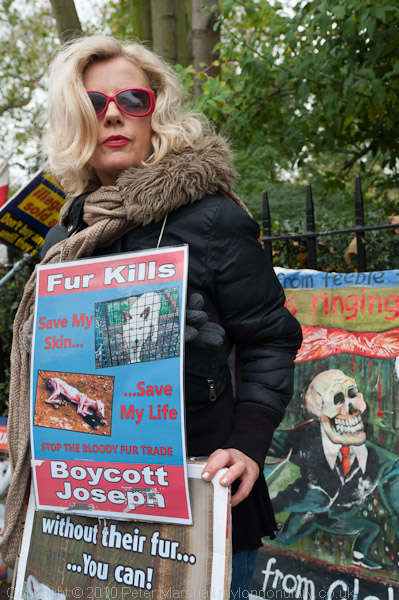
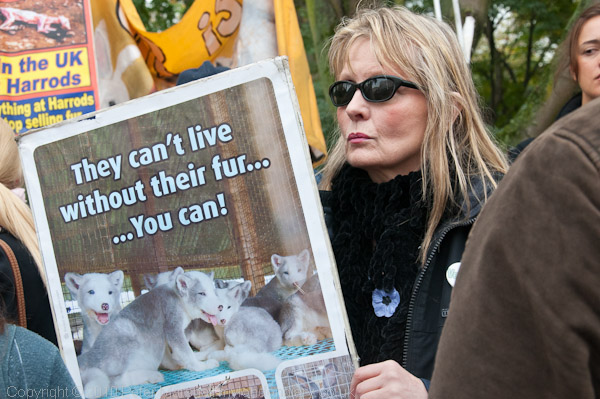
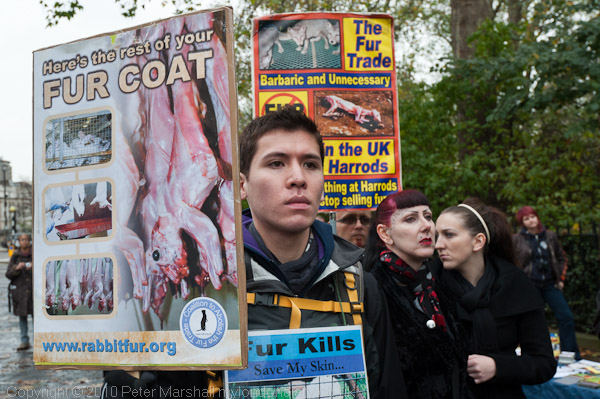
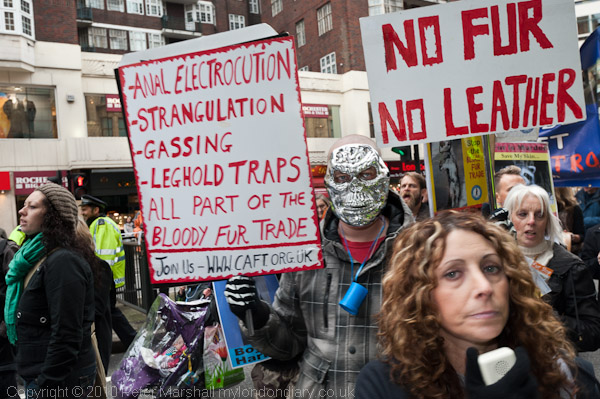
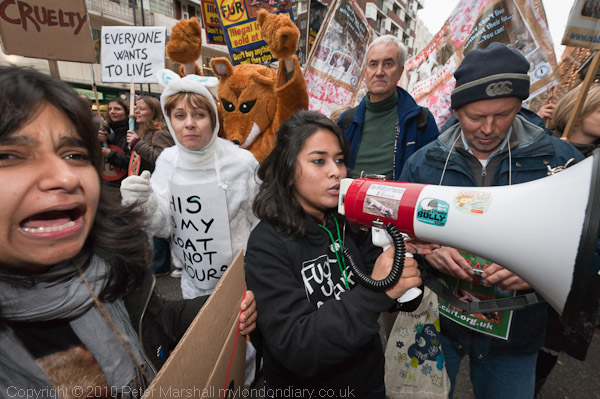
National Anti-Fur March: The march on began with a short rally in Belgrave Square before moving off to protest outside many of the luxury shops in the area that still sell fur products, including Harrods.
Protests like this one organised by the Coalition to Abolish the Fur Trade (CAFT) had played an important part in making the public aware of the terrible cruelty to animals taking place in fur farms which led to fur farming being made illegal in the UK in 2001.
But it remains legal to sell fur in the UK – so supporting the cruelty in fur farms overseas. And the protesters demonstrated at many of the best known names in exxpensive fashion – including Armani, Gucci, Fendi, Joseph, Prada, Versace, Gianfranco Ferre, Dolce and Gabbana, Christian Dior, Roberto Cavalli and Nicole Farhi in Sloane St, and Burberry and Harrods in Brompton Road still selling fur products.
It seems only logical that when the government passed the law banning fur farming they should also have banned the sale of fur.
But perhaps a significant reason for not doing so was the fact that fur is still used in some military uniforms, notably the bearskins worn by the guards. Worn at ceremonial events including the changing of the guards in London and Windsor, these stupidly large headdresses each requires the killing of a black bear in licensed hunts in Canada and cost over £2,000 each. They could be replaced by false fur at a hugely lower cost.
Many leading figures including the former and current Queen have announced they will not buy fur, but others among the uncaring rich continue to do so.
According to PETA, in a 2020 “YouGov opinion poll commissioned by animal protection charity Humane Society International/UK… Only 3% said they would wear the cruelly obtained material.“
They say “Designers such as Calvin Klein, Stella McCartney, Vivienne Westwood, and Tommy Hilfiger have pledged never to use fur in their collections. The majority of high-street and online stores – including Topshop, AllSaints, and ASOS – are also fur-free.“
Others to have recently made the change to faux fur in their collections “include Saint Laurent, Dolce & Gabbana, Gucci, Versace, Coach, and Prada” and “in 2018, London Fashion Week became the first major fashion week not to show any fur on its catwalk” according to an Independent article.
But among those still selling fur, still part of the truly horrific trade, are “Dior, Louis Vuitton, Fendi, Max Mara, Harrods, Alberta Ferreti, Carolina Herrera, Roberto Cavalli.“
You can read a long account of the protest and see many more pictures from the event on My London Diary at National Anti-fur March.
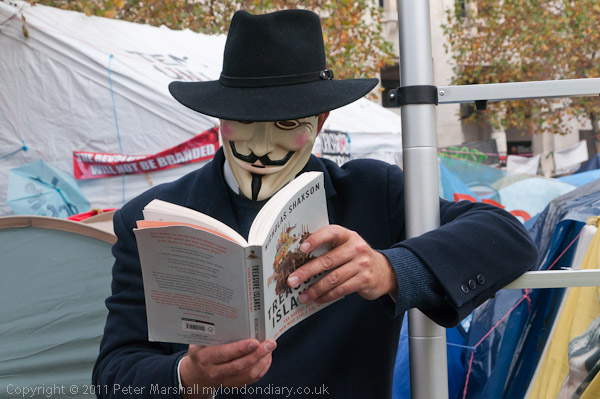
St Paul’s, Lord Mayor’s Show, Somalia, Egypt & Abortion: Occupy London were still encamped at St Paul’s Cathedral on the day of the annual Lord Mayor’s Show which made the day a little more interesting than usual. But also on Saturday 12th November 2011 I visited the cathedral, went with Occupy to protest against UK arms supplies to the Egyptian Army and covered a protest about the continuing war in Somalia and a ‘500 crosses for Life’ anti-abortion procession.
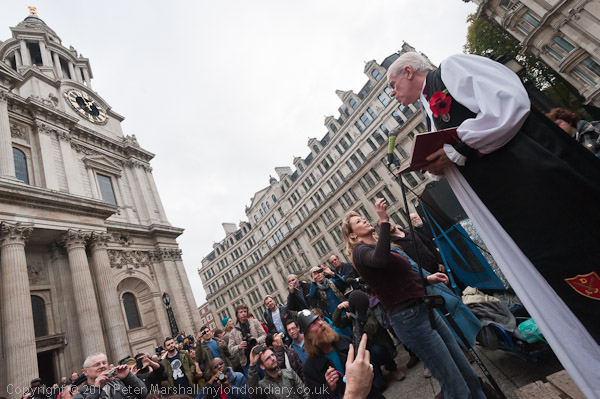
The Lord Mayor’s Show & Occupy
After blessing the Lord Mayor, St Paul’s Canon in Residence Rt Revd Michael Colclough came at their request and blessed Occupy LSX in front of St Paul’s Cathedral. Later the camp hosted a ‘Not the Lord Mayors Show‘ festival of entertainment.
Occupy had set up a polling booth close to the route to point out the uniquely undemocratic nature of the City of London, where ordinary voters are outnumbered 4 to 1 by the votes of corporations which results in it promoting “a radical bankers’ agenda at odds with the interests and democratic desire of the British people.”
Occupy also received many more visitors than usual because of the crowds who had come up for the procession and after the official event had ended put on their own ‘NOT The Lord Mayor’s Show’, “a festival for the people, which aims to place the celebratory atmosphere of the traditional event in a non-hierarchical and community-focused environment.”
On the web site a supporter stated “We will not have golden carriages, we will not have military costumes, we will not have a marching band, but we are going to enjoy ourselves. This is about valuing people and community, rather than privileging the undemocratically elected Lord Mayor of the City of London.”
Before I left there was a show with comedians, spoken word artists and singers in a show compèred by stand-up comedian Andy Zaltzman. Later there was to be a special general meeting with speakers including John McDonnell MP. And as it was also Remembrance weekend, in the evening the camp was hosting the UK première of ‘The Welcome’, an award-winning US documentary film about a project for dealing with post-traumatic stress involving ex-soldiers and their family members.
I took some time away from Occupy to photograph the rather strange mix of floats and walking groups that make up the Lord Mayor’s Show.
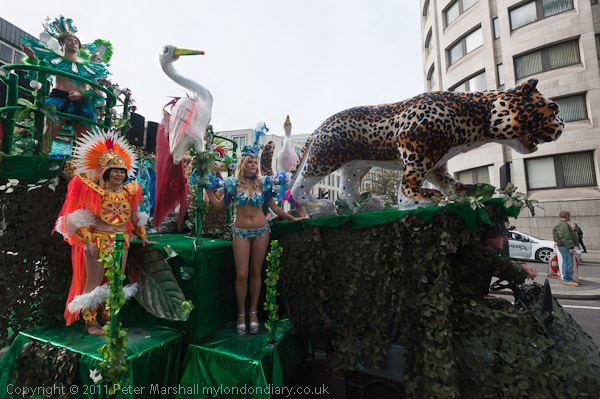
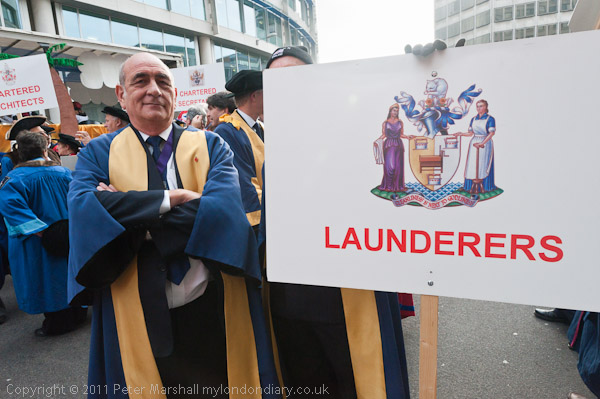
There were the various groups from London’s guilds – including the Launderers in the picture, though the only laundering that goes on in London these days is of money with London being the world capital for making dirty money seem respectable.
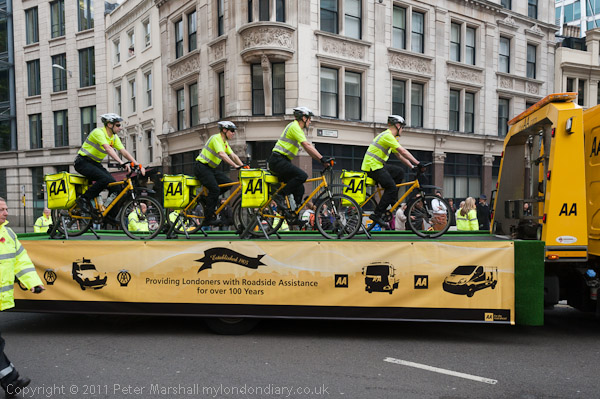
And floats for a wide range of organisations – and there were some which it was rather harder to know quite what they represented with more carnival costumes.
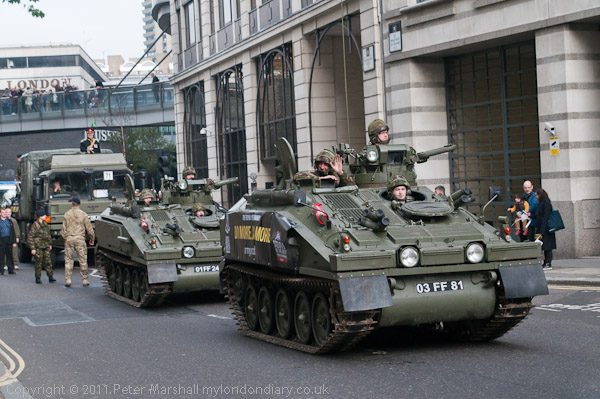
Together with many of those at OccupyLSX who were also watching, I found the marching servicemen, military vehicles and weapons and military bands that are a major element of it disturbing. Like much of the celebration they look back to when Britain ruled the world.
The City of London is of course an anachronism, though now one that hides the ruthless pursuit of profit by any means it can get away with, including the now clearly immoral support of highly polluting industries such as fossil fuels which now threaten the future of many species on Earth including our own.
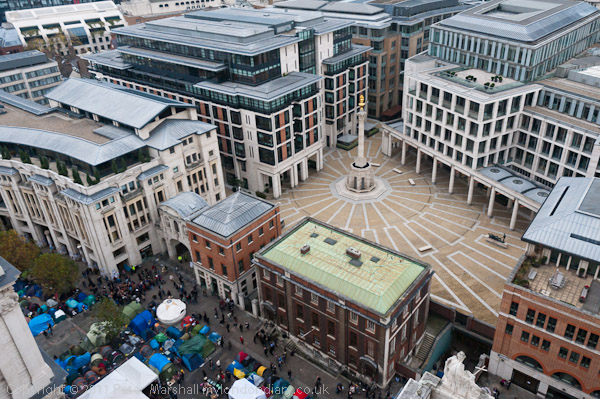
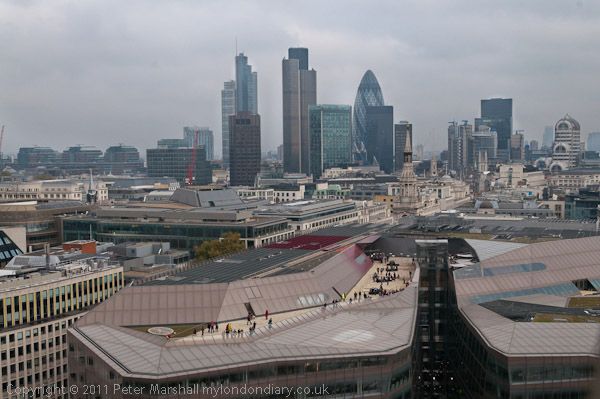
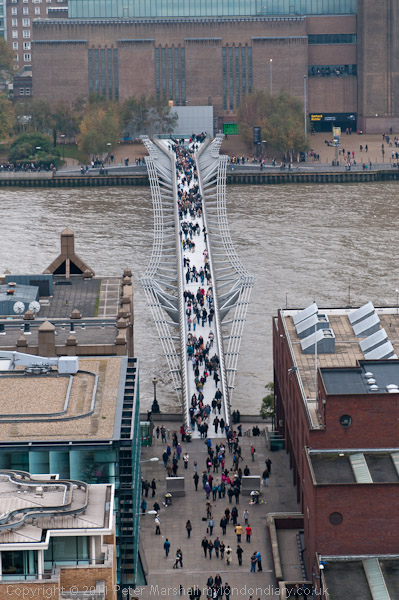
Entry to St Paul’s Cathedral except to attend services normally costs what they describe as a “small fee”, now £25 per adult, though only £14.50 in 2011. But entry is free on the day of the Lord Mayor’s show (though slightly restricted) and I took advantage of this to go the ‘Stone Gallery’ around the bottom of the dome where photography was allowed.
And I took full advantage of this, making rather a lot of pictures in every available direction, a few of which I’ve put online.
International Day to Defend the Egyptian Revolution
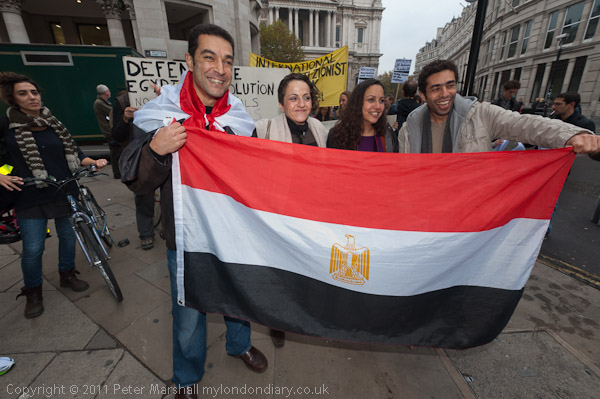
The Egyptian Revolution had begun with high hopes as a part of the Arab Spring and toppled the Mubarek regime, but since then things had not gone well for the coutry, with the army taking charge.
Since then there had been over 2000 trials in military courts, without the ability to call witnesses or access to lawyers in a programme of repression against any opposition. Many have been sentenced to death, and torture remains widespread. Many of those imprisoned are underage and women have been subjected to rapes and sexual assault.
The UK government supported the Egyptian military and UK arms manufacturers supply the army and police there with the weapons needed to maintain their repression.
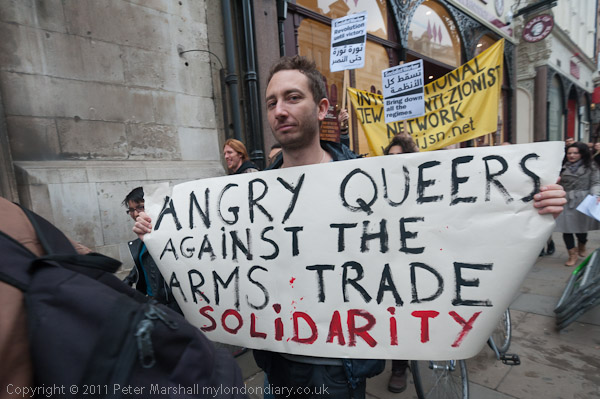
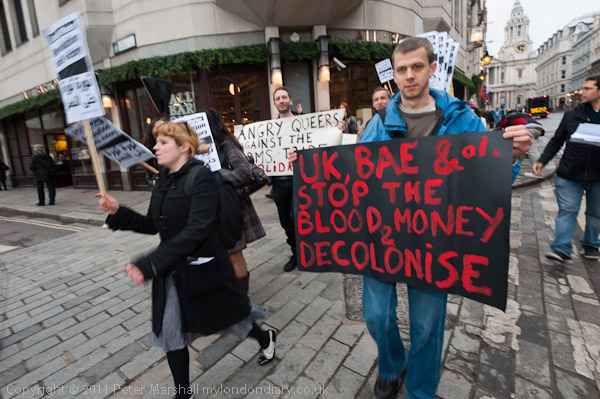
A group of protesters from OccupyLSX as well as some Egyptians and Sam Weinstein of the US Utility Workers Union left for a ‘march of shame’ to the offices of 3 arms dealers, Qinetiq, BAE and Rolls Royce, who had gone to Egypt with Prime Minister David Cameron in February 2011 to sell arms to the Egyptian army.
The protesters condemned the violence against the people of Egypt and called on the UK government to withhold support to Egypt and stop arms sales until a civilian government dedicated to freedom and civil rights is in power in Egypt.
I left them at Ludgate Circus on their way to the offices.
Somalis Protest Obama’s War – Old Palace Yard, Westminster
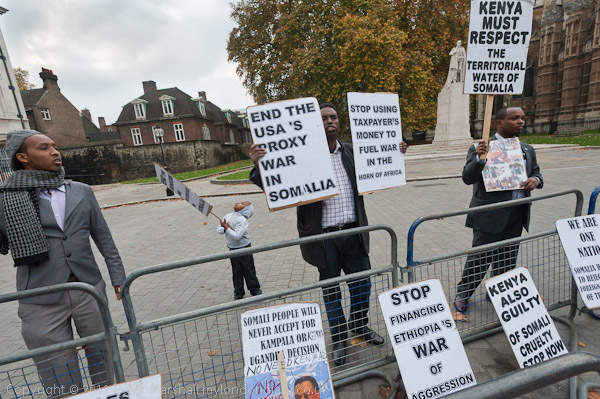
I paid a brief visit to Old Palace Yard opposite the House of Lords where a protest had been announces against the US-backed proxy war by Ethiopia against Somalia.
But when I arrived at the time the protest was supposed to start I found only three men and a boy there, with a number of placards. The men assured me more would arrive later, and I did return two hours later but found the place deserted. I think by then the protesters might have left to protest at the Ethiopian embassy in Kensington rather than outside an empty Parliament.
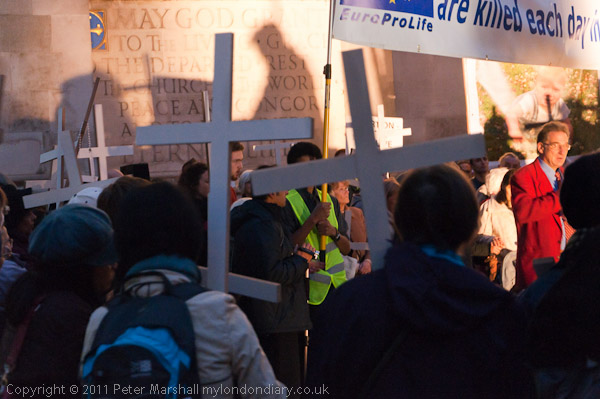
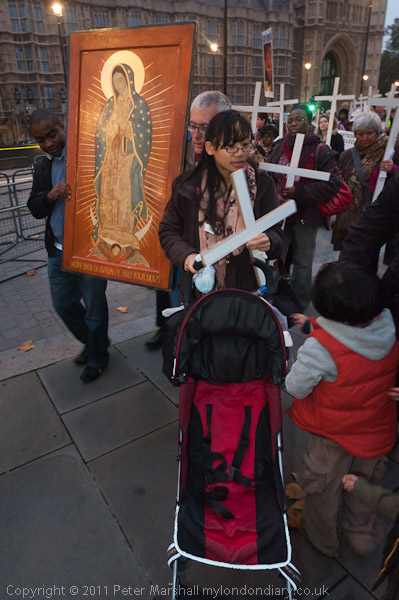
But my return to Westminster was not fruitless as I came across another protest, with several hundred people carrying white crosses in an anti-abortion ‘500 crosses for Life’ prayer procession.
This had started at Westminster Cathedral and when I met it was leaving Old Palace Yard and walking towards its end at Westminster Abbey.
I went with them in the fading light around 4.30pm and took some pictures. As I wrote back in 2011, “I don’t share the views of the Catholic Church on abortion and find the use of the term ‘pro-life’ by those opposed to abortion to describe themselves offensive. It’s an area where we need clear and unpredjudiced thinking and where all – whatever their view on abortion – are concerned with life and the quality of life.”
A speaker at the rally gave thanks for the activities of those in Germany who were protesting outside abortion clinics. I’m pleased by the recent announcement that these activities are now to be severely restricted in England and Wales with safe access zones.
In 2011 I commented “isn’t harassing women who go to clinics at what is almost certainly for them a very stressful time morally offensive, a demonstration of an un-Christian lack of love as well as a statement of lack of faith in the power of prayer?”
XR Zombie System Collapse Action: On Wednesday 30th October I returned to Trinity Square Garden to cover the third day and final day of Extinction Rebellion’s actions demanding the insurance industry end their support of new fossil fuel projects – part of a week of world-wide action, including protests the following two days in other UK cities. I’d missed Day 2 where they had marched with a giant potato.
XR had posted: “We Predict a Riot – mass action…..a zombie apocalypse! A wide range of creative actions will highlight what social collapse will look like in the UK as the population begins to panic in the face of repeated floods and food shortages over the next decade.”
And we had been promised a “Zombie die-in with flashmob, zombie insurers stumbling around” as well as a “Zombie Mass Dance Discobedience – This is the undead dance for life! – wear business suits with a zombie twist. We are the undead, dancing our way through the halls of power to expose the profiteers of destruction!”
I arrived to find a group of around 20 people practising the Zombie dance in Trinity Square, and a giant bomb of CO2 with protesters in business suits holding red boxes with the words WAR, FAMINE, EXTINCTION and FLOOD and a man reading a special copy of the ‘Daily Fail’.
Eventually the several hundred protesters set off on a march heading to Tower Palce, the home of insurers MarshMcLennan, where there was loud music from the Samba band, a short speech calling on them to end the insuring of new fossil fuel projects, a die-in, a few zombies runnning around and then the Zombie Mass Dance Discobedience.
Reading The Crimes outside insurers MarshMcLennan
Next stop was insurers AIG where a small group went inside the building to deliver a letter, but were soon ushered out.
The march continued around the City, before stopping for a lunch break outside the Howden Group offices on the corner with Bevis Marks.
After lunch the march continued, going back past Lloyds and on to the Sky Garden building in Fenchurch St, home to home to insurers Ascot, Talbot, Chaucer, Markel, Allied World, CNA Hardy, Tokio Marine Kiln, Sirius International and Lancashire Syndicates.
Here a small group had arrived before us to poster the windows with large signs, ‘INSURING FOSSIL FUELS = CLIMATE CHAOS’ and three campaigners were perched on top of the main entrance porch.
I’d been on my feet too long and things seemed to be at an end, so I sloped off for a pint of Brains (it was Halloween) in the Crosse Keys before making my way home. You can read about the protest in a press release from XR, and see more of my pictures here.
Car Park, Angel, Works, Off-Sales, Co-op & Carnival Hats: I started my walk on Sunday 5th November 1989 at Walthamstow Central Station, and walked west down Selbourne Road.
Car Park, Selbourne Rd, Vernon Rd, Walthamstow, Waltham Forest, 1989 89-11b-15
This is Sainsbury’s multistory Car Park on the corner of Selbourne Rd and Vernon Rd and there is a very solid looking rectangular box brick building under the curves of the incline up to the parking space, with anther rectangle, the back of the sign and a very small circle of a car tyre at the extreme right.
I think I walked into Walthamstow cemetery to photograph the chapel there which I’ve not digitised but I also photographed several memorials including this one which I think attracted me because of the feathers on the wing and roses.
There is still a Lennox Trading Estate here, and I think the same gates, although the writing on it is smaller and more regular but otherwise everything looks much the same.
Lennox Road is a short street and its southern side has no buildings but simply the fence of Thomas Gamuel Park, which was re-designed in the 1990s. So the consecutive numbering 82-83 made some sense. The area to the west of the trading estate and the park has been comprehensively redeveloped with low rise housing around Lennox Road.
Thomas Gamuel “was a rich London grocer living in Walthamstow who bequeathed six acres of land known then as Honeybone Field and Markhouse Common, to six trustees, so that rent and profits from this land would be paid to the poor of the parish.”
Chelmsford Road runs down the east side of Thomas Gamuel Park and this former off-license on the corner looked as if it had recently closed with a notice on its side ‘SHOP / YARD & GARAGE STORE TO LET NO PREMIUM’.
The sign and the lamp at the corner suggested to me it had once been a pub rather than just an off-licence though the building seemed too small, but I can find no evidence for this. Both these and the shop front have now gone and the property is now residential including a first floor flat.
Former Co-op, Hoe St, Walthamstow, Waltham Forest, 1989 89-11d-42
I walked down Collingwood Road into St Barnabas Road where I photographed the Safford Hall and the church (not digitised) and then made my way north to Queens Road to cross the railway line and get to Hoe Street, where I made this image.
The beehive was a common cooperative symbol and appears several times on this building along with its date, 1915. For many years it was all the London Co-operative Society store but now only a small section at the northern end is a part of the Co-op, Wathamstow Funeralcare. The London Co-operative Society was formed in 1920 by the merger of the Stratford Co-operative Society and the Edmonton Co-operative Society and I think this was built for the Stratford society.
A few yards north along Hoe Street I took a couple of pictures of the business on the corner with Albert Road
I loved the detailing here with a rather glum looking face holding up a column beside the door. Unfortunately I can’t read the first word of the name of the company here from the angle I photographed this or the next frame, just DISTRIBUTORS LTD. But it did seem a slightly unusual trade to be WHOLESALERS OF CARNIVAL HATS & NOVELTIES.
This property is now entirely residential a has a new fence on top of a low wall around it with a small garden area.
House, 62a, Stroud Green Road, Finsbury Park, Haringey 1989 89-11d-45
At this point I went to Walthamstow Central Station and took the Victoria Line to Finsbury Park. I can’t now remember why I decided to move to a different area but perhaps I simply thought the park at Finsbury Park would be a pleasant place eat my sandwich lunch. I left the station by the Wells terrace entrance and walked along to Stroud Green Road.
As well as the slightly unusual doorway, it seemed to be almost barricaded by the plants growing in front to the door, but the stairs on the outside suggested an alternative entry.
Chiswick House & Gardens: On Wednesday 1st November 1989 I took the train to Chiswick and walked around the gardens of Chiswick House, making a brief detour to the Thames at Chiswick Mall and then returning to the gardens and then walking back to the station.
Obelisk, Chiswick House Gardens, Chiswick, Hounslow, 1989 89-10j-11
It was a place we often took our photography students for a day’s outings early in their one or two year course, a public park where they could wander freely and safely with a brief to take pictures. The park is owned by the London Borough of Hounslow and surrounds the house and the gardens are open every day and free to enter, but English Heritage charge for entry to the house. We never took the students inside.
The obelisk was erected here in 1732, but the classical sculpture on the base is much older, and had been given to Lord Burlington in 1712. It was replaced by a copy in 2006, with the original now inside the house.
Classic Bridge, Chiswick House Gardens, Chiswick, Hounslow, 1989 89-10j-14
The gardens changed greatly over the years as Lord Burlington and his friend William Kent who had helped in design the house in a neo-Palladian style – completed in 1729 – put in their ideas. Kent later became largely responsible for the gardens, which are one of the earliest examples of a grand English landscape garden.
But this bridge only arrived after Burlington’s death in 1753, added in 1774 to the designs of James Wyatt for Georgiana Spencer, the wife of William Cavendish, 5th Duke of Devonshire who then owned the property. It is over the Bollo Brook which runs through the gardens and was used to fill its lakes and run fountains, but later became too polluted so was culverted under the lake to continue towards the Thames close to Chiswick Bridge.
The house was probably never a comfortable place to live, having been designed primarily as a place to show off the considerable classical purchases Burlington had acquire during his three ‘Grand Tours’ as a young man and to demonstrate his devotion to the architectural ideas of Andrea Palladio which had begun on his tour of the Venice region in 1719.
Chiswick House Gardens, Chiswick, Hounslow, 1989 89-11a-53
Development of the gardens continued under the Cavendish family, including the building of a 300ft long conservatory in 1813 for the cultivation of camelias, then incredibly expensive and thought to be tender plants – though they grow quite well in the icy winters of Japan and the Himalayas. A formal garden in an Italian style was built around it. But this formal arrangement of hedges dates from Burlingtons own plans for the garden with vistas and statuary and columns.
Sphinx, Chiswick House Gardens, Chiswick, Hounslow, 1989 89-11a-43
The Cavendish family let out the property to various tenants and in 1892 it became a mental hospital for wealthy patients, the Chiswick Asylum until 1929 when it was sold to Middlesex County Council. After war damage the house became run by the Ministry of Works in 1948, latter English Heritage and in 2005 they formed the Chiswick House and Gardens Trust with Hounslow Council to bring management of house and gardens together.
I’d visited the house and gardens at intervals over the years, often with my family, and by 1989 the gardens were in rather better shape having been rather let go a little wild in some earlier years. On Flickr there is a very different picture taken from more or less the same viewpoint in 1978, and you can also find more pictures from a visit with my family in 1984 and with students in 1988.
I think this is another classical relic in at the entrance front of the house.
An urn in a very formal garden area. The next frame on Flickr shows the entire urn. I also made a very similar image in colour.
Urn, Chiswick House Gardens, Chiswick, Hounslow, 1989 89-11b-43
During the day there I made over 60 black and white exposures of the house and gardens, but most were rather similar to pictures I had made in earlier years and so I haven’t bothered to digitise them.