Egypt’s Arab Spring – 2011

Saturday 5th February 2011
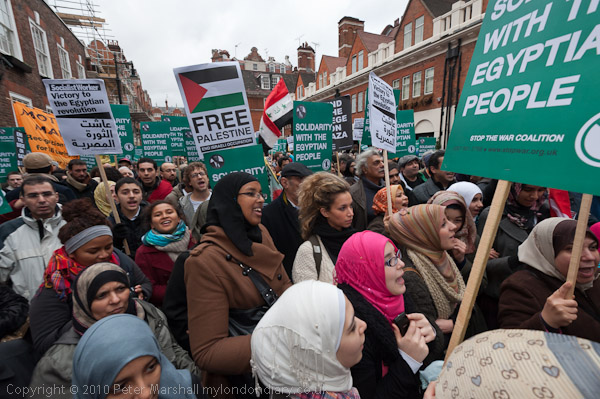
US Embassy Rally For Egypt – Grosvenor Square
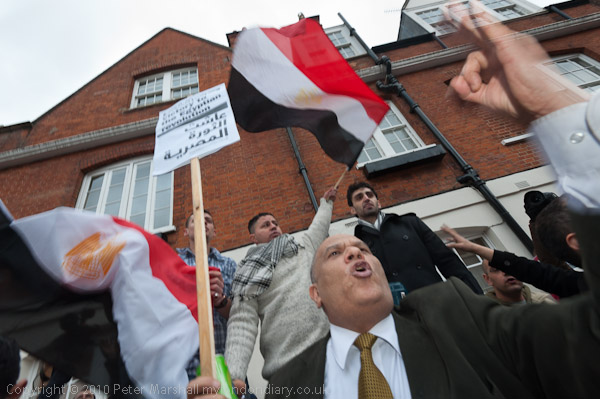
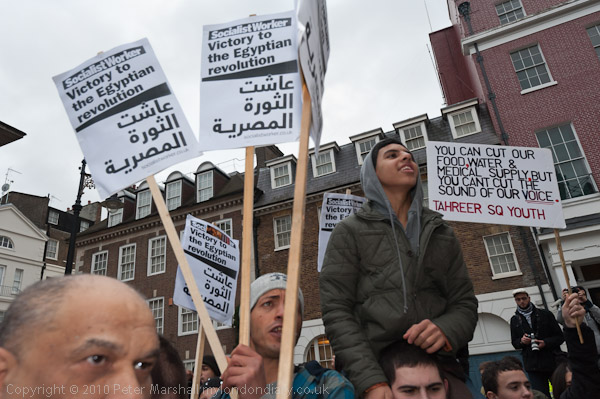
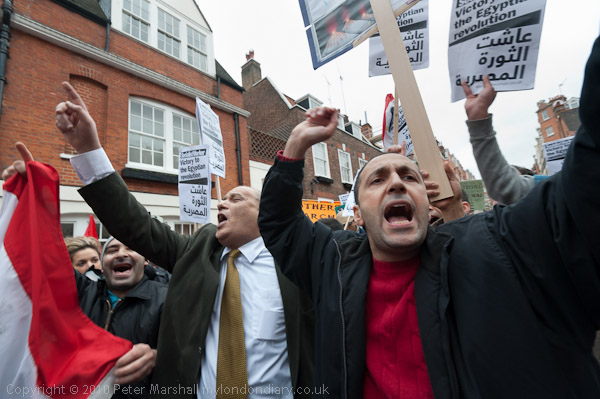
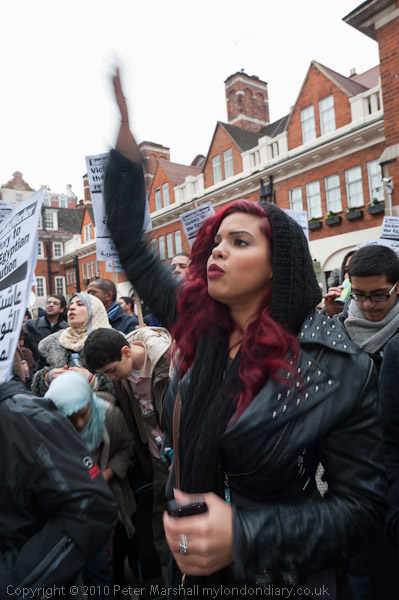
Egyptian Embassy Demonstration – South St
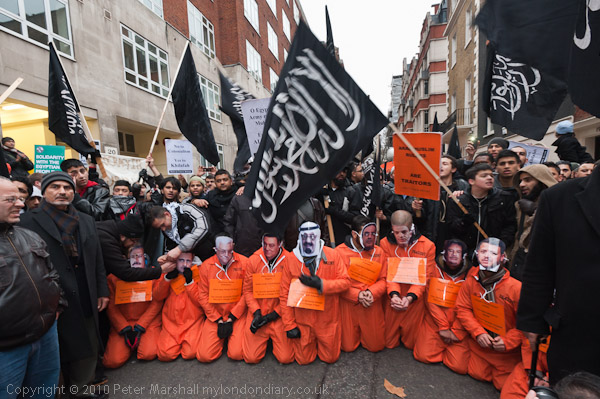
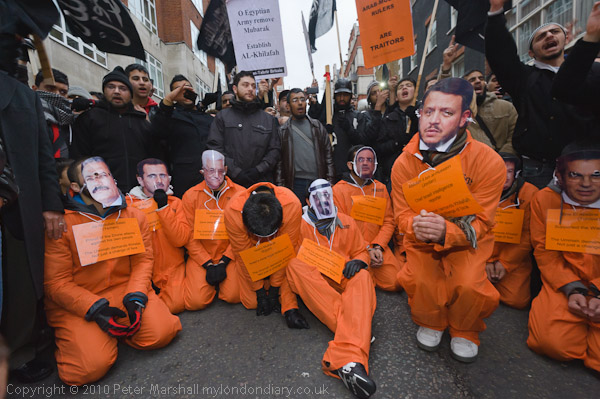
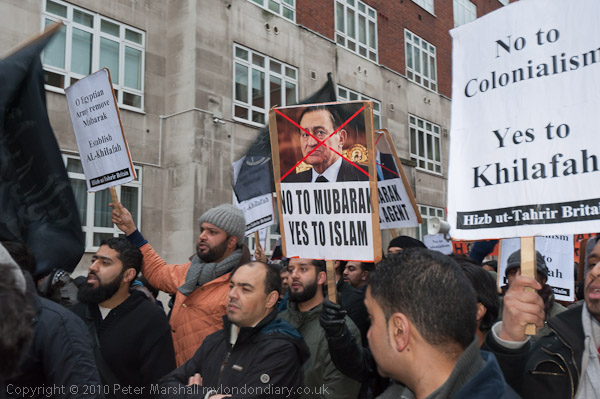
Hizb ut-Tahrir Britain at Egyptian Embassy – South St

Egypt's Arab Spring - 2011
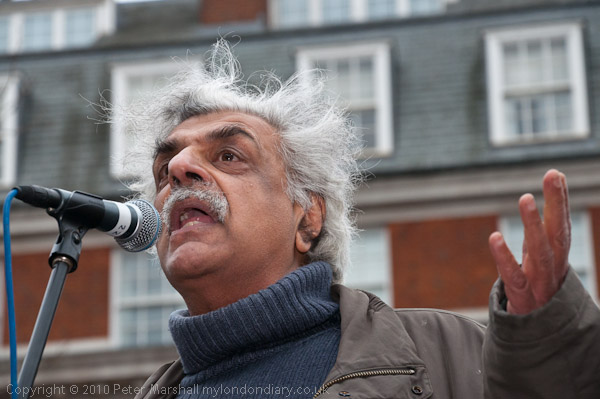
Tariq Ali speaking at the rally at the US Embassy

Egypt’s history is long and complex, going back to the back to the 6th–4th millennia BCE when it was one of the cradles of Western civilisation. Wikipedia has a lengthy article which even so skims over the many details, and certainly I won’t go into much here.

Egypt's Arab Spring - 2011

For many years Egypt was a part of the Ottoman Empire, but after the building of the Suez Canal in 1869 France and Britain played a more important role in its history and in 1882 the UK invaded the country which became occupied and it became a de facto British protectorate, breaking away completely to become a UK protectorate during the First World War after the UK military deposed the ruling Khedive, replacing him with his pro-British brother Hussein Kamel, who declared himself Sultan of Egypt.

Egypt's Arab Spring - 2011

Elections at the end of the war led to a majority for the Egyptian nationalist movement, so the British exiled their leaders to Malta in 1919, starting the first modern Egyptian revolution. The UK caved in and granted Egypt independence, though largely nominally as the country remained under British military occupation until 1936 when the UK withdrew its troops except those around the Suez Canal.

During World War Two, Egypt tried to remain neutral despite considerable UK pressure and the presence of large numbers of British troops, who in 1942 surrounded the palace in Cairo and forced King Farouk to change his government.

Egypt's Arab Spring - 2011

In 1951, Egypt demanded all remaining British troops who were then around the Suez Canal to leave the country, but the UK refused. British soldiers killed 43 Egyptian police officers in an police station at Ismalia and extensive riots followed. On 22-23 July 1952 military officers launched a coup d’état against King Farouk and took power; in June 1953 they declared Egypt a republic, with Gamal Abdel Nasser becoming Prime Minister, becoming President in 1956.

After Nasser nationalised the Suez Canal that year the UK and France together with Israel launched a disastrous attack – the Suez Crisis. The UK and France were humiliated after they were forced to withdraw by pressure from the UN, USA and Russia. The event is widely seen as marking the end of Great Britain’s role as one of the world’s major powers. Perhaps why we cling on to a hopelessly ineffectual “nuclear deterrent”.

Egypt's Arab Spring - 2011
At the Egyptian Embassy

After Nasser’s death in 1970, Anwar Sadat took over as president until 1981, when he was assassinated by an Islamic extremist. Sadat expelled the Soviet advisers and attempted to modernise Egypt, encouraging foreign investment but his policies mainly benefited wealthier Egyptians.

Hosni Mubarak became president in 1981 following a referendum in which he was the only candidate. Under him draconian laws against freedom of expression and association were enacted, and political activities largely outlawed. In 2005 he enacted reforms which allowed for multi-candidate elections of the presidency but with severe restrictions on who could stand – and the candidate who got most votes after Mubarak was imprisoned after the vote.

Human rights organisations in 2006-7 had detailed serious violations, including outine torture, arbitrary detentions and trials before military and state security courts, and naming Egypt as an international centre for torture in the US led ‘War on Terror’. In 2007 the constitution was altered, giving the president dictatorial powers, prohibiting religious political parties and authorising extreme powers of arrest and surveillance by the police, with a new anti-terrorism law.

When the Arab Spring began in Tunisa in December 2010, it was hardly a surprise that it spread to Egypt along with other countries including Libya, Yemen, Syria and Bahrain. It began on 25 January 2011 with massive demonstrations, marches, occupations of public squares, acts of non-violent civil disobedience and strikes, with millions of protesters demanding the resignation of Mubarak.

Wikipedia lists the following causes:

  • Police brutality
  • State-of-emergency laws
  • Electoral fraud
  • Political censorship
  • Corruption
  • Unemployment
  • Food price rises
  • Low wages
  • Demographic structural factors
  • Other regional protests
  • Authoritarianism
  • Political repression.

Tahrir Square became the centre of the revolution, with over 50,000 protesters occupying it on 25 January, and later growing to perhaps 300,000. The revolt continued there for 18 days until finally the military who had held the real power in Egypt at least since 1952 removed Mubarek from office on 11 February 2011.

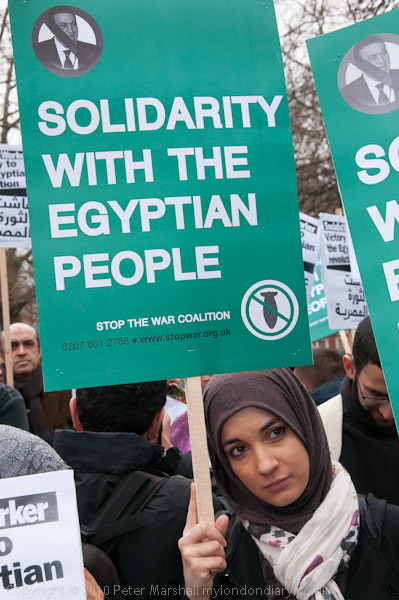
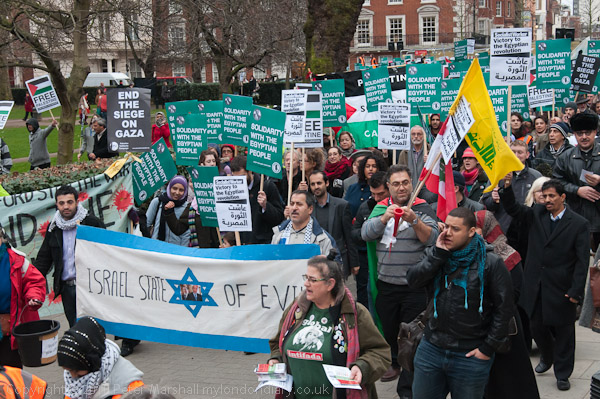
In London on Saturday 5th February 2011 I photographed three protests related to the Egyptian Revolution. The first was a protest at the US Embassy where speakers from Stop the War, the British Muslim Initiative and the Palestine Solidarity Campaign and others castigated the USA for its support of the Mubarak government over the years and called for his immediate departure.

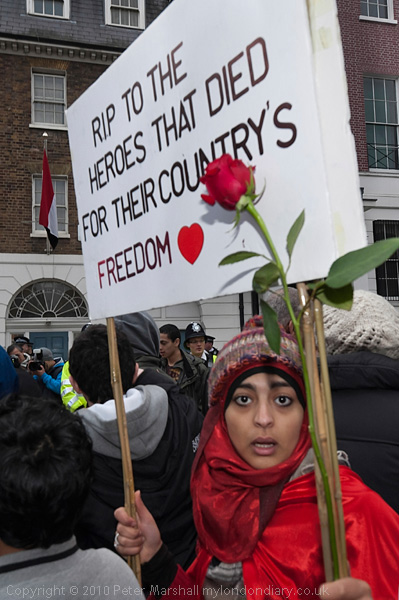
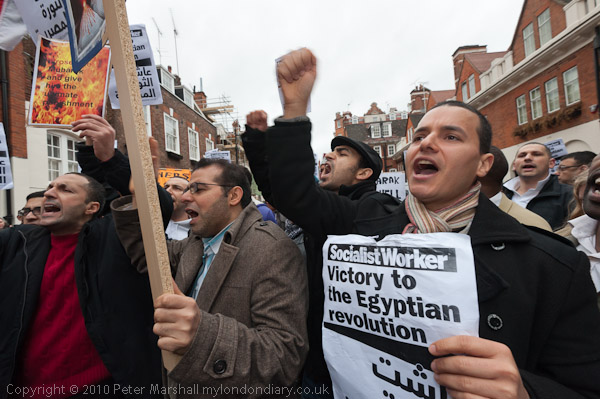
From there I went with the protesters to join others at the Egyptian Embassy in Mayfair, to join the Egyptians who had been protesting there all week.

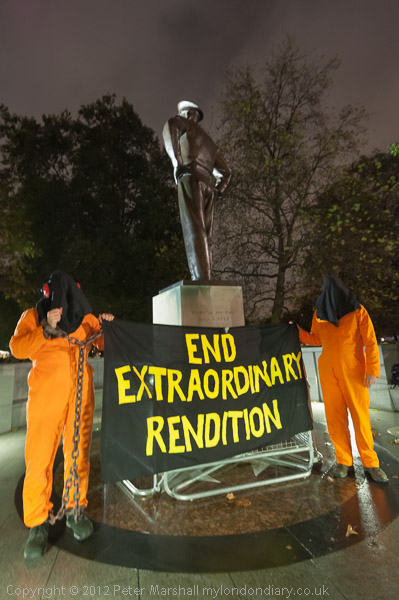
While I was photographing at the Embassy I heard the noise of another protest a hundred yards or so down the street, where supporters of Hizb ut-Tahrir had turned up in force. As usual most were dressed in black, but there was a group of men dressed in orange Guantanamo jump suits and wearing the masks of the corrupt rulers of Arab states.

Their rally was not in support of the current protests in Tahrir Square and elsewhere, but for a different Arab revolution, calling on the Egyptian army to remove Mubarek but in its place not to establish democracy and freedom, but to set up a Caliphate, theocratic rule rather like that in Iran.

You can read more about the London protests in the three links below to My London Diary where there are many more pictures. Sadly although Mubarek was removed, events in Egypt have not led to the increased freedoms the 2011 revolution was demanding. You can read more about the Arab Winter and the Egyptian Crisis that followed in various articles on Wikipedia and elsewhere online.

Hizb ut-Tahrir at Egyptian Embassy
Egyptian Embassy Demonstration
US Embassy Rally For Egypt


Stop Trident & Occupy Democracy

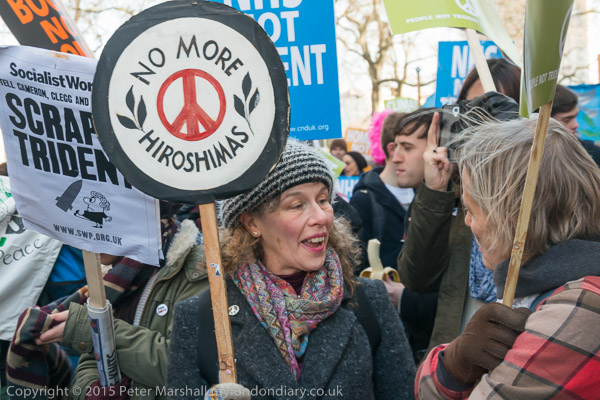
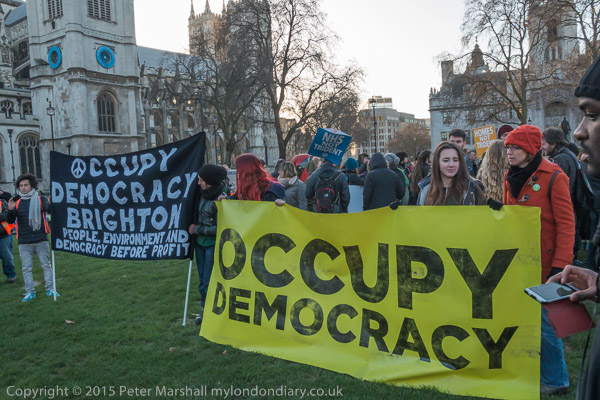
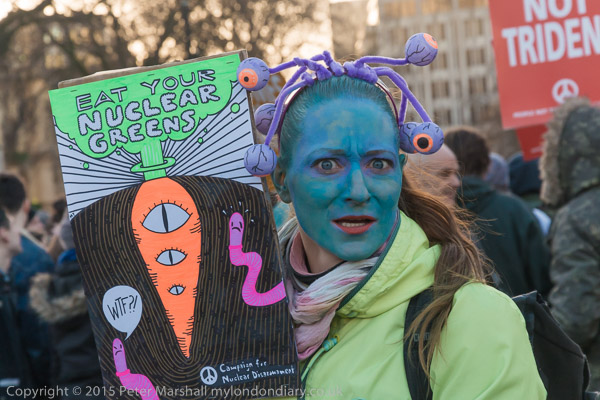
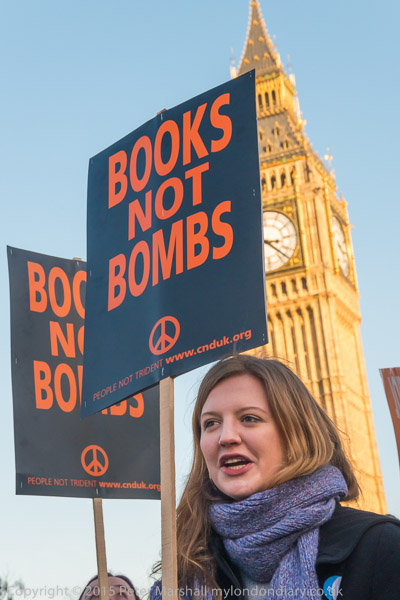
On Saturday 24th January 2015, eight years ago, I photographed three protests against the replacement of our so-called independent nuclear deterrent, Trident with new nuclear submarines and missiles and Occupy Democracy asserting the right to protest and challenging the attempt by then London Mayor Boris Johnson to prevent protests in Parliament Square.


Christian CND against Trident Replacement – St Martins-in-the-Fields to Whitehall

Stop Trident & Occupy Democracy

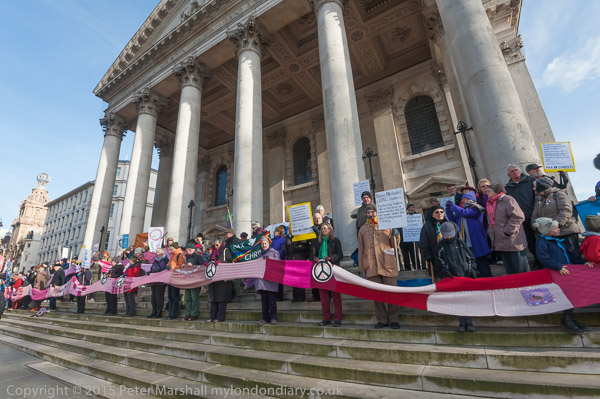
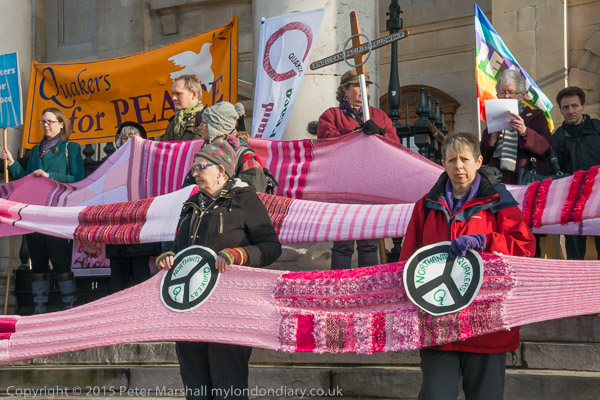
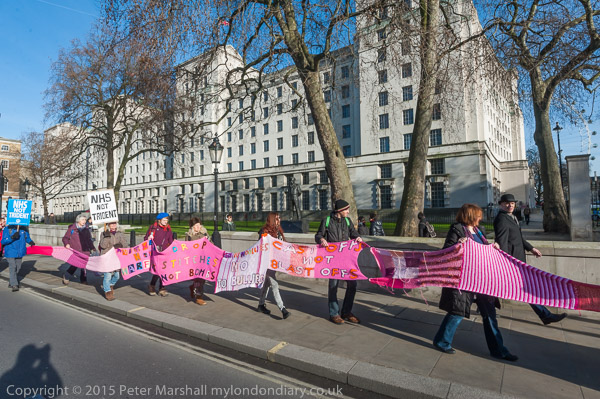
I began work at St Martin-in-the-Fields in Trafalgar Square with a Christian CND service. Thet held a long piece of the seven mile knitted pink peace scarf which had been joined together the previous August between the UK atomic bomb factories at Burghfield and Aldermaston on Nagasaki Day in a protest against the senseless waste of £100bn in replacing Trident missiles, which would clearly breach the nuclear non-proliferation treaty.

Stop Trident & Occupy Democracy

CND has since revised the figure of the costs of this senseless programme, which was stated by the defence minister in the parliamentary debates and in the November 2015 National Security Strategy and Strategic Defence and Security Review to be £31 billion. This turned out to be simply the estimate for the four new submarines. Using government figures CND later calculated the total cost to be £205 billion, well over a year’s total spending on the NHS. And of course like all defence programmes it will end up costing considerably more. Of course cost is not the main reason why people oppose nuclear weapons but this is an entirely senseless waste of resources that should be put to better use.

Stop Trident & Occupy Democracy

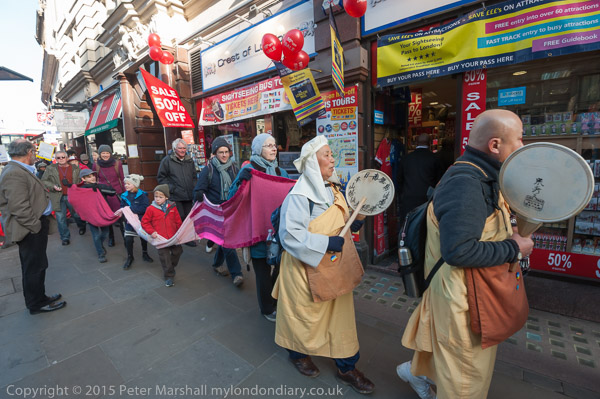
After their brief service they walked with the part so the scarf to the main CND protest against Trident replacement outside the Defence Ministry.

Christian CND against Trident Replacement


Wrap Up Trident’ surrounds Defence Ministry – Whitehall

Stop Trident & Occupy Democracy

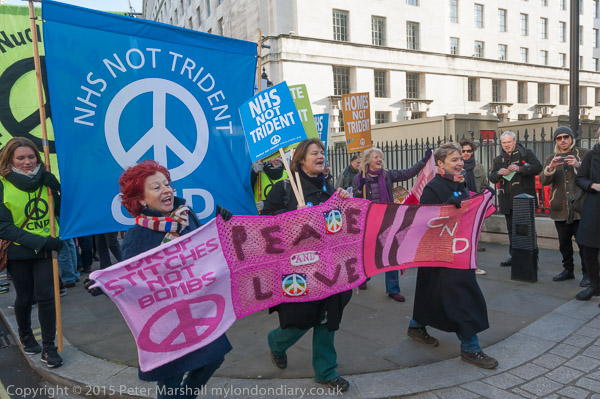
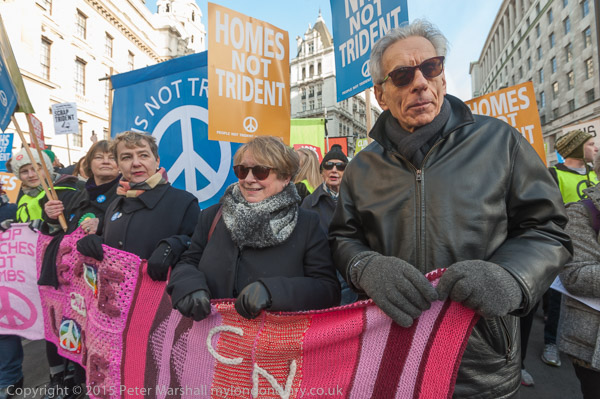
Several thousand CND supporters met at the Defence Ministry before surrounding the block with a knitted peace scarf and then moving off for a rally opposite the Houses of Parliament calling for the scrapping of the UK’s Trident missiles.

A group held the front of the scarf outside the Ministry of Defence building in Horseguards Avenue and then led off down Whitehall, left into Bridge St and left again up the Embankment and back to the MOD. While the leaders set off with the scarf at a cracking pace, gaps soon developed further back as those adding lengths from the many rolls of scarf were unable to keep up. So while there was far more scarf than needed to wrap the whole block – and it went back and forth on the river side of the ministry – it may never have entirely joined up completely.

When the leading group arrived back at the MOD there where certainly people spread out along the whole of the course holding parts of the knitting, and most seemed at a loss of what they were supposed to do next. Eventually the message came for them to walk on and take their pieces of knitting back to the MOD.

Here the knitted and crocheted lengths of scarf were rolled up. Rather than being wasted most of it was later turned into blankets for refugees, with just a few of the more interesting lengths being retained for further protests and displays.

The CND supporters then marched the short distance down Whitehall and Parliament Street and on to Old Palace Yard where they were to hold a rally.

Many more pictures at ‘Wrap Up Trident’ surrounds Defence Ministry.


CND Scrap Trident rally at Parliament – Old Palace Yard,

Lindsey German of Stop the War

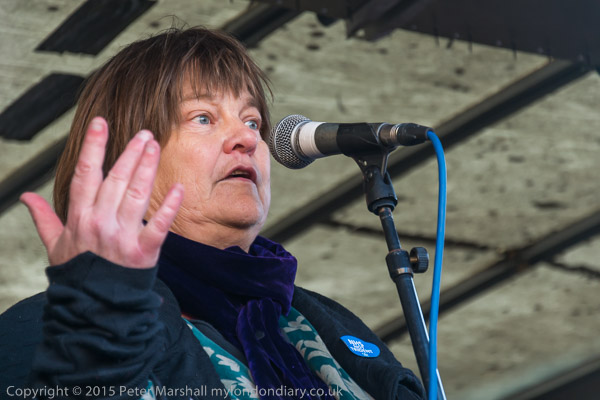
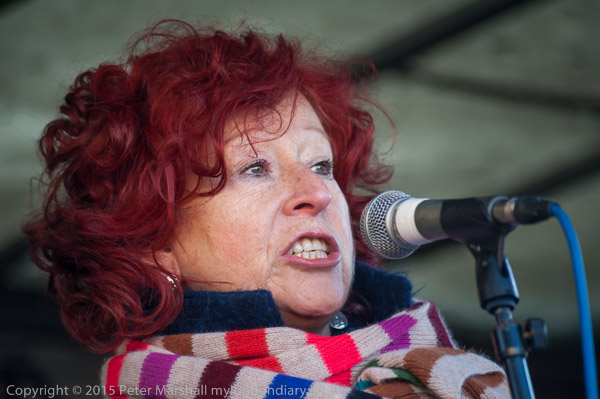
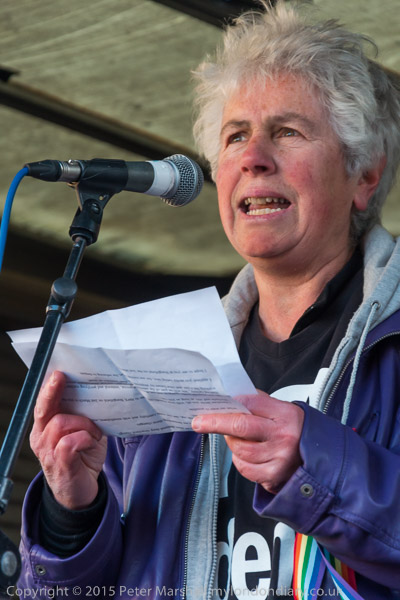
Among the speakers were at the rally were Lindsay German,

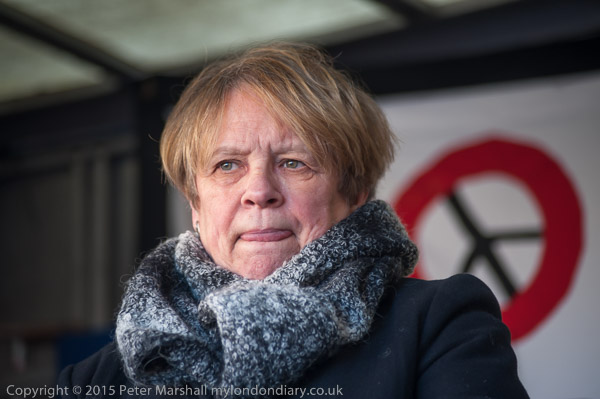
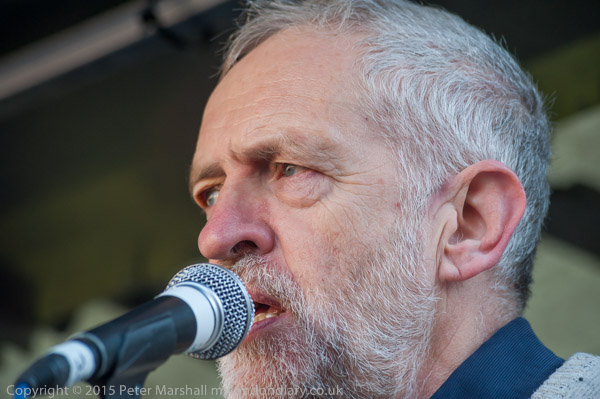
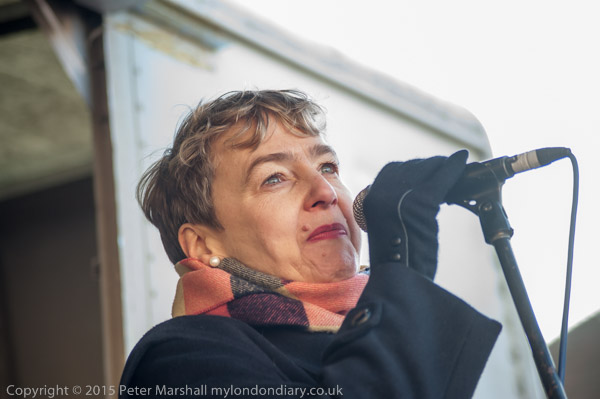
Jeremy Corbyn, Labour MEP Julie Ward, Shahrar Ali, the Deputy Leader of the Green Party,

Kate Hudson and

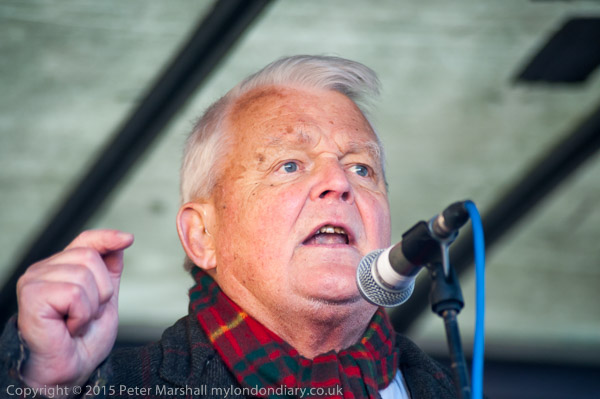
Bruce Kent of CND,

Rebecca Johnson, an internationally-recognized expert on nuclear disarmament and non-proliferation,

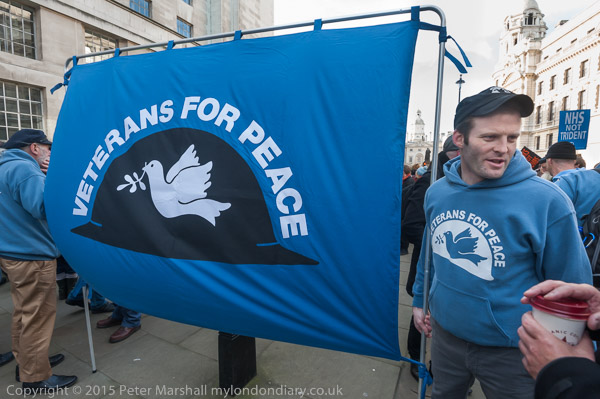
Heather Wakefield of UNISON, the Rt Revd Alan Williams, Bishop of Brentwood, Khalil Charles from the Muslim Association of Britain, Ben Griffin, of Veterans for Peace,

and Angie Zetter, who thought up the idea of the peace scarf.

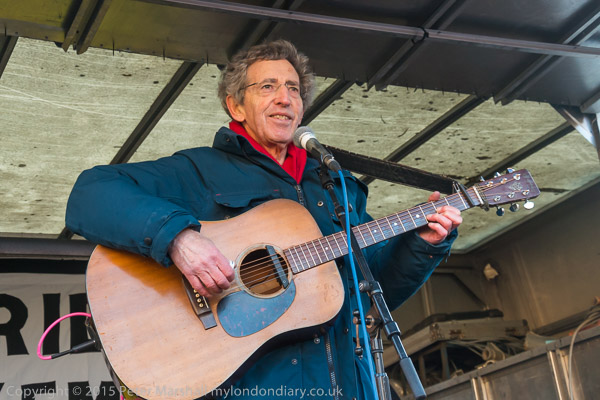
The rally ended with a new song composed for the occasion by Leon Rosselson. There are more pictures including all the speakers and those in the crowds at the rally at CND Scrap Trident rally at Parliament.


Occupy defy GLA ban on Democracy – Parliament Square

As people streamed away from the CND Trident protest, several hundred supporters of Occupy Democracy most of whom had been at the CND protest walked on to the grass of Parliament Square to hold discussions on foreign relations and war as the GLA private security guards (Heritage wardens) and police watched.

This was one of a series of monthly events in which Occupy are asserting the right to protest and challenging the attempt by London Mayor Boris Johnson to prevent protests in Parliament Square.

Police and the Mayor’s ‘Heritage Wardens’ watched the protest. I followed the wardens as they went across to the police and asked them to take action to stop the protest. Police lacked the officers needed to take effective action and if they had tried to do so many more of those leaving the CND protest would have joined those on the square. They told the wardens that the protesters would eventually leave of their own accord, which apparently they did a few hours later.

More pictures at Occupy defy GLA ban on Democracy.


Stop the Gaza Massacre – National March

National March, Hyde Park to Israeli Embassy, London, Saturday 10 January 2010

Stop the Gaza Massacre - National March

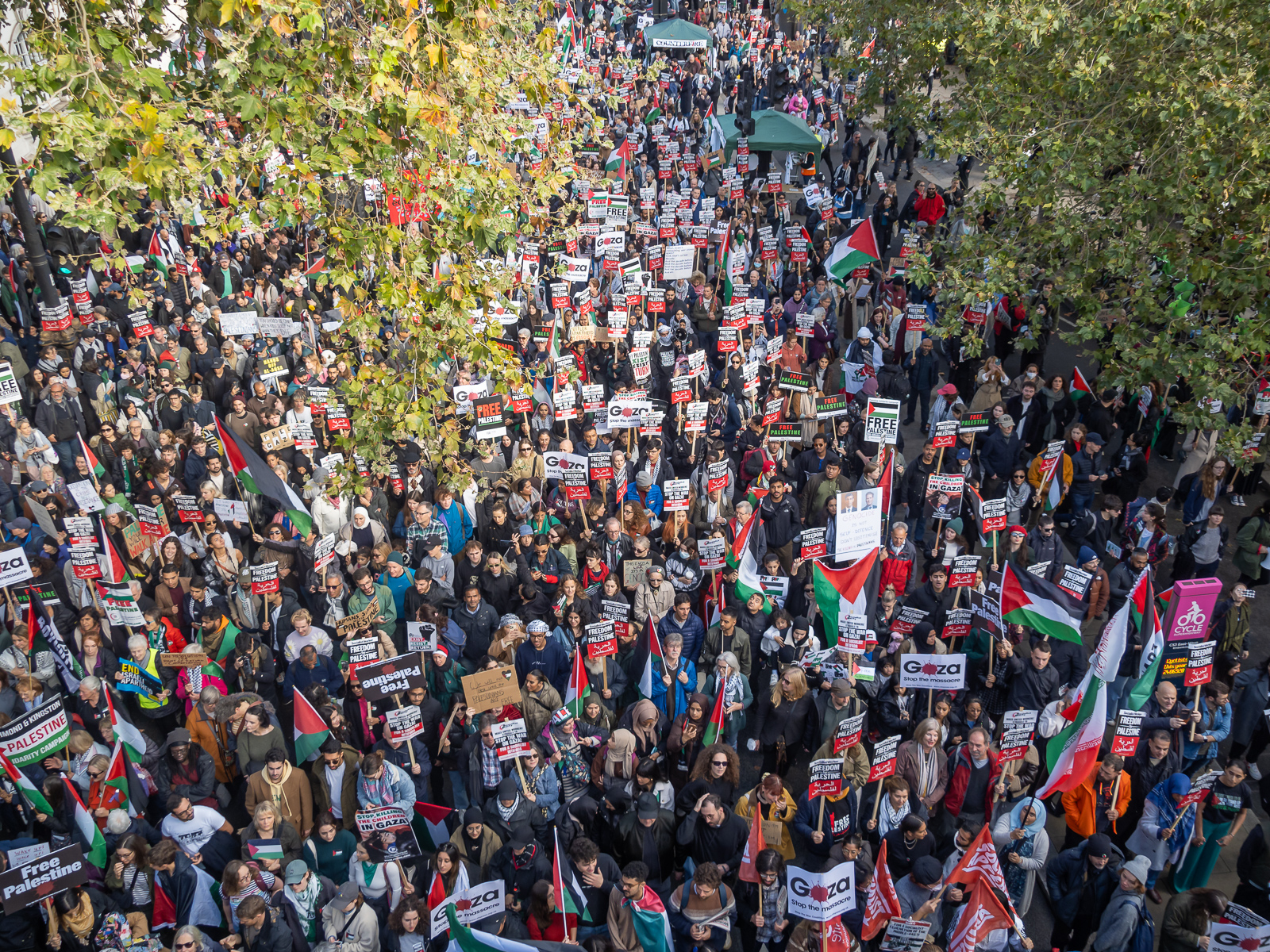
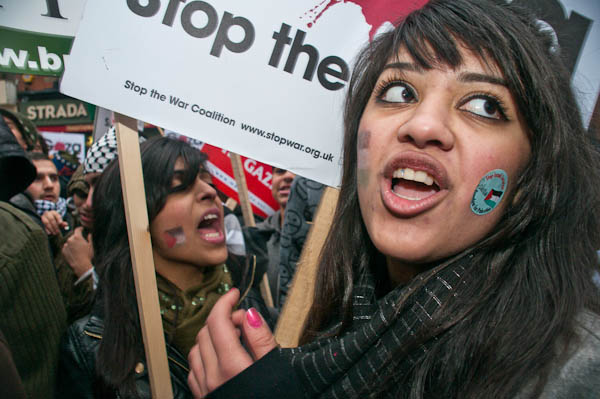
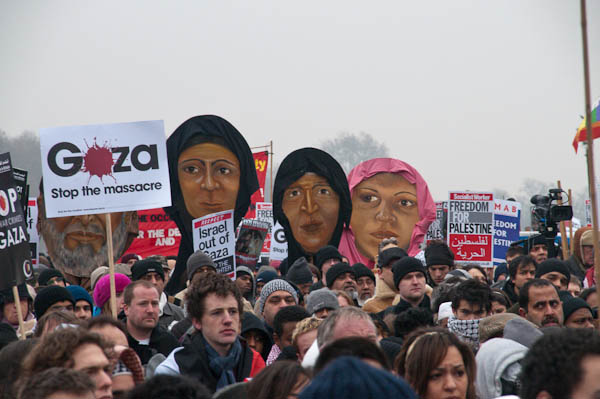
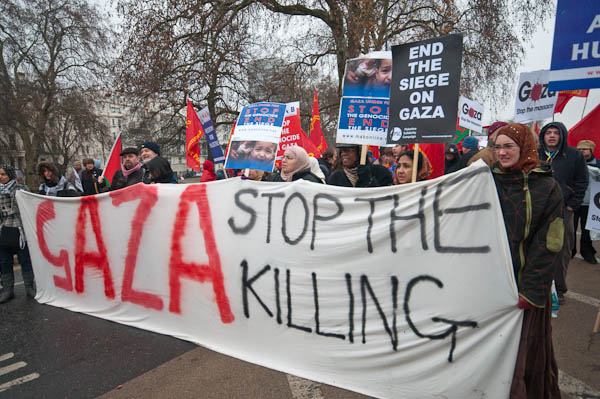
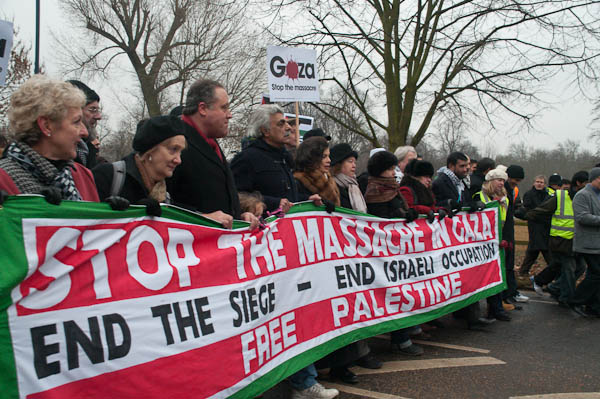
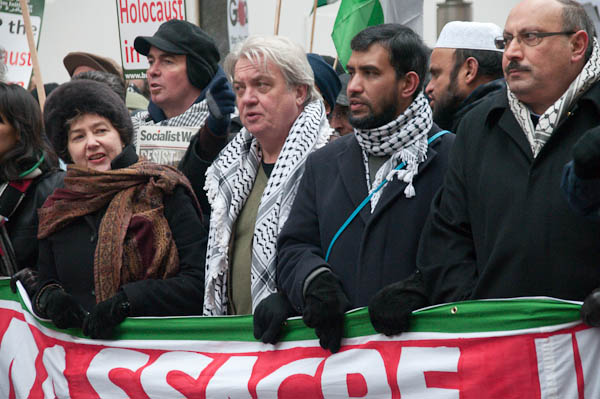
Well over 100,000 marchers turned up to Hyde Park in London on Saturday 10 January 2010 to show their opposition to the Israeli attacks on Gaza and call for an end to the killing there. After a rally there they marched

Stop the Gaza Massacre - National March

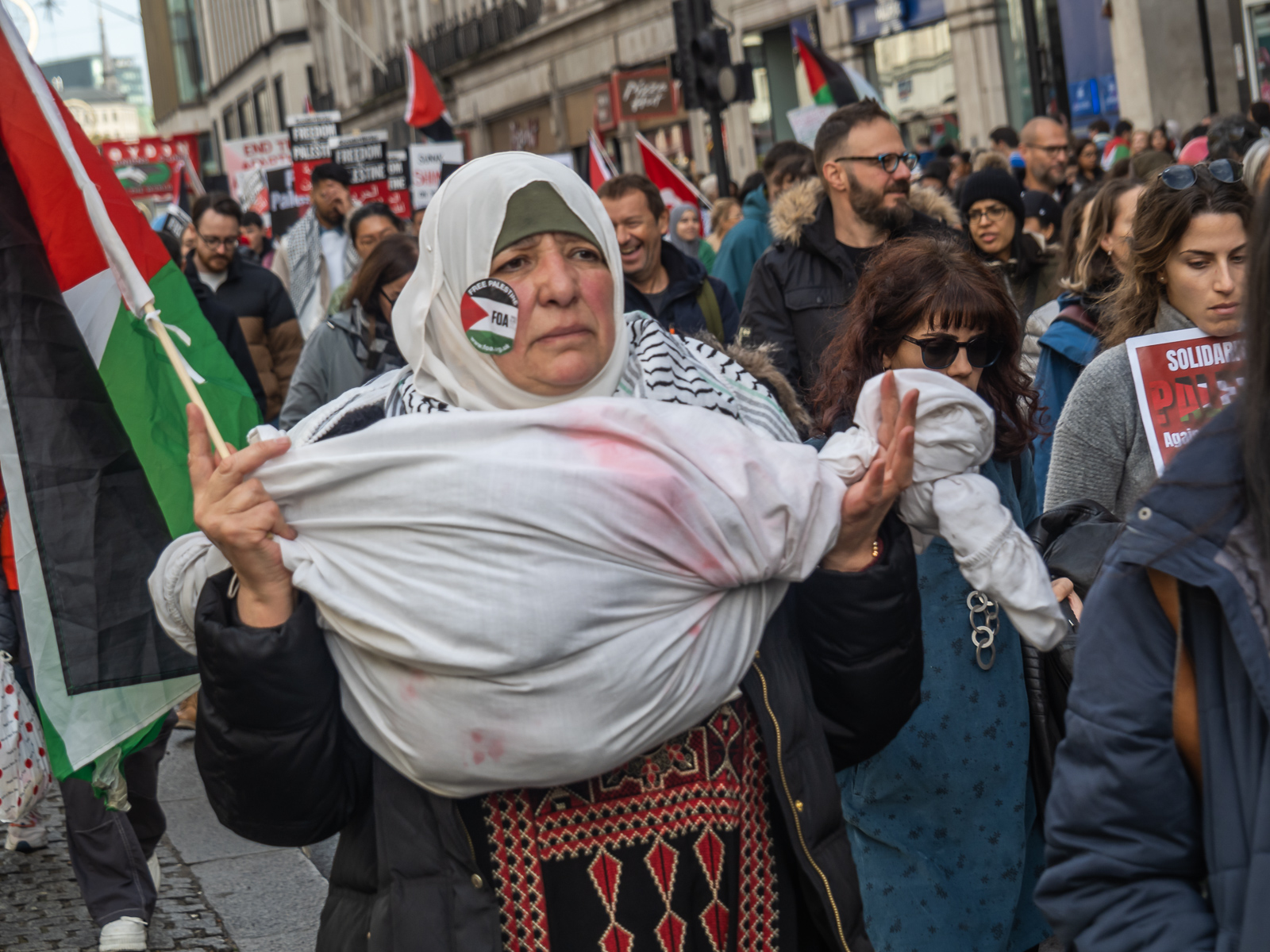
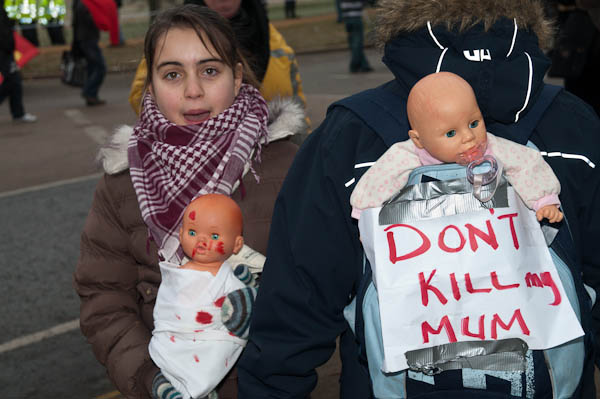
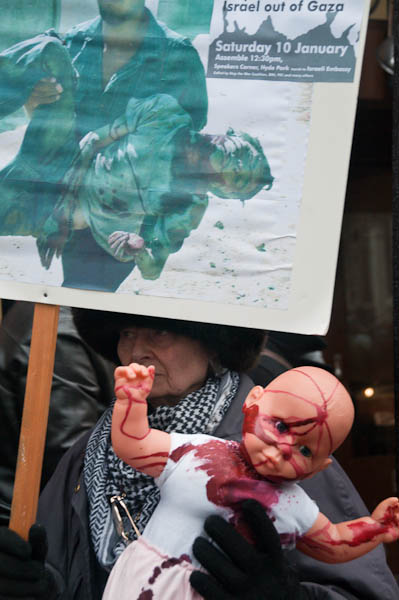
As well as posters and banners, some carried dolls as a reminder of the 300 or so children already killed by the Israeli attacks in the current offensive, the Israeli Operation Cast Lead which had begun on 27th December 2008 and was still continuing.

Stop the Gaza Massacre - National March

The Gaza Massacre ended with Israel declaring a ceasefire eight days after this protest on 19th January 2009, by which time the Israeli attacks and killed (figures from Wikipedia) between 1,166 and 1,417 Palestinians. There had been 13 Israeli deaths, four of them killed by their own Israeli forces.

Stop the Gaza Massacre - National March

Many children were among the Palestinians killed and some protesters carried dolls or bundles of blood-stained clothing to represent the 300 already known to have died at the time the protest took place. It remains unclear exactly how many civilians were among the killed as Israel allowed few international workers into the area and denied access to journalists. Around a sixth of those killed were police officers in Gaza.

The attacks severely damaged half of Gaza’s hospitals and health facilities. A survey by the United Nations Development Programme estimated that 14,000 homes, 68 government buildings, and 31 non-governmental organisation offices were either totally or partially destroyed. The Israeli blockade on Gaza meant that it was not possible to import the building materials needed for essential repairs and rebuilding.

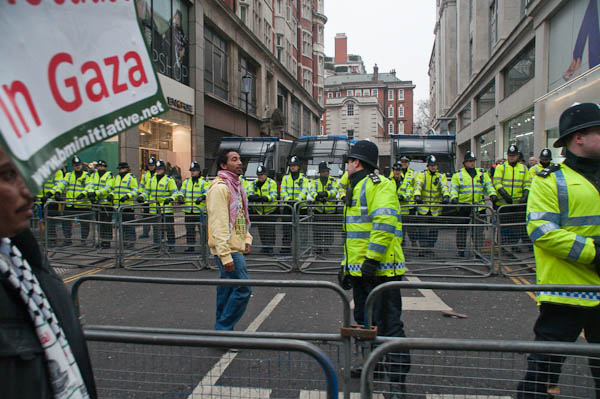
The police had severely under-estimated the likely size of the protest, failing to believe the figures suggested by the march organisers. They had planned for a much smaller protest and this led to problems. Quite rightly, feelings run very high over Gaza and there were many who wanted to get to the Israeli Embassy and make their feelings clear.

I had no problems with the police, but was assaulted close to the Embassy by several Stop the War stewards some of whom do seem to have a real problem with the press. They pushed me around and tried to stop me from working, although other stewards who who saw what happened did apologise to me for the treatment I received.

The official front of the march – well behind some of the angrier protesters eventually arrived and paused briefly close to the embassy, safe down a private road behind barriers and police before moving on and dispersing. But many of those on the march remained in the area and the street soon became completely blocked. I could only watch from a distance over the heads of the densely packed crowd as there seemed to be some fighting with police as demonstrators tried to climb the barriers. Placards, sticks and shoes were being thrown either towards the embassy or at the police.

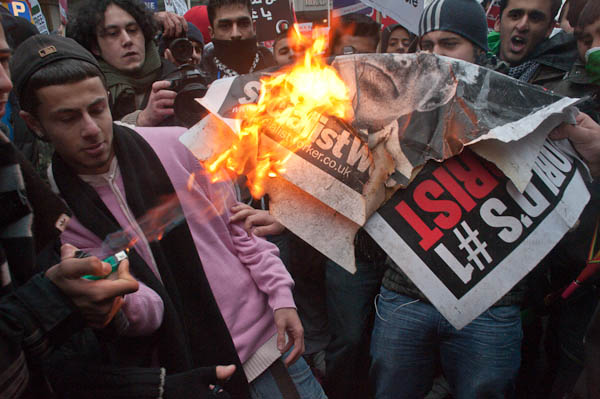
I walked a few yards further down the road where a group of young men burning placards with a picture of the “World’s #1 Terrorist”. A little further still things were much quieter with some Muslim men saying prayers. It looked as if there would be protests here continuing long into the night, but I had to leave as I had promised to take pictures elsewhere at a private event.

Much more at Gaza Massacre – National March.


Cost of Living Protest – 2022

Cost of Living Protest – 2022
Last Saturday, 2nd April 2022, I photographed a protest opposite Downing Street organised by The People’s Assembly Against Austerity and Stop the War Coalition. The People’s Assembly said on their web page:

Public outrage over the Cost of Living Crisis is growing fast and our response is gaining momentum. Right now is the time for us all to come together in unity and build our collective resistance.
Now is the time to get out onto the streets to send a clear message to the government that we refuse to pay for their crisis.

The People’s Assembly Against Austerity

Cost of Living Protest - 2022

The protest in London was one of 25 in cities around the country against the price increases and National Insurance contribution raise which will mean the largest fall in living standards since records began 80 years ago and a fall in real wages greater than ever in the past 200 years.

Cost of Living Protest - 2022

The Spring Statement by Chancellor Rishi Sunak made clear that it is the lower paid workers (and students), pensioners, those on benefits and the public sector workers in particular who will pay the price, while putting in place measures to protect big business and high earners.

Pay inequality in the UK – the ratio between what the average worker earns and the pay (including bonuses) of the bosses of leading companies – has risen spectacularly in recent years. Had the minimum wage kept up the the rise in what they are paid it would now be over £25 an hour – but went up on April 1st to £9.50 an hour for those aged 23 and over – with lower rates for younger workers.

Cost of Living Protest - 2022

Food banks are now struggling to keep up with demand, and report that some people coming to them are turning down anything which requires heating up as they cannot afford gas or electricity. Advice workers say more and more people are coming to them who have to chose between heating and eating – and many can only eat basics on alternate days and are depriving themselves of food to feed their children.

Cost of Living Protest - 2022
London, UK. 2 Apr 2022

I listened to the UK’s leading money-saving expert saying he had run out of tips to help people cope – and most of the advice he and others have given on energy saving are things we have always done in our household.

My wife and I have relatively low outgoings, living in a house we own and choosing not to own a car. Over the years we’ve been able to invest large amounts in double-glazing and insulation – and a few solar panels to supply a little of our electricity needs. When we moved in 48 years ago to a small Victorian semi built for agricultural workers we replaced the draughty rattling windows and draught-proofed doors. We decided central heating would be wasteful, so our energy bills are relatively low. Even so, they have now roughly doubled from what they were a year ago, with more increases coming later in the year. But we will be able to get by even though our income is low. Others are much less fortunate.

Jeremy Corbyn - Cost of Living Protest - 2022
London, UK. 2 Apr 2022. Jeremy Corbyn.

And in particular the effects on disabled people are savage and shameful. Research shows they are five times as likely to be at risk of food insecurity and twice as likely to be living in cold homes as the non-disabled. And in a particularly targeted cruel and inhuman decision around 210,000 people on disability benefits have now been barred from claiming the Warm Home Discount payment despite the fact that they often have greater than normal needs for heating, hot water and energy to run specialist equipment.

More pictures from the event online at Downing Street Cost of Living Protest, London, 2 Apr 2022


CND Protest US Star Wars Programme

CND Protest US Star Wars Programme – 20th March 2002, twenty years ago today.

CND Protest US Star Wars Programme

The US under President Bush was in 2002 intent on achieving what it termed ‘Full Spectrum Dominance’ and not content with ruling the planet on earth were developing a system to ensure their dominance in space. At the heart of this was their ‘Star Wars’ programme, using lasers to form a protective shield and destroy any incoming missiles before they reached US soil, enabling the US to launch a nuclear attack with impunity, knowing they could survive a retaliatory attack.

CND Protest US Star Wars Programme

It was a weapons system that would have destroyed the idea of nuclear deterrence, the mutual assured destruction (MAD) doctrine of military strategy which had supposedly prevented nuclear war since Hiroshima and Nagasaki, and put the US in a position to threaten Russia with nuclear attack. The Cold War may have ended with the breakup of the USSR, but it was still the basis for US military strategy – with consequences were are now seeing in Ukraine.

But like most military spending and wars, it was a policy with great prospects for the arms industry, and in particular Lockheed Martin, the US’s large weapons manufacturer, with deep roots in the US administration – including at the time the wife of the US vice-President Dick Cheney, whose wife Lynn just happened to be on their board.

The UN had early seen the dangers of war in space with the 1976 Outer Space Treaty which made it an area solely for peaceful uses. And in November 2001 they passed a new UN resolution ‘Prevention Of An Arms Race In Outer Space’ with only the US, Israel and Micronesia abstaining.

The US began its weaponisation of space by setting up the US Air Force Space Command in 1982. The UK lends a helping hand with allowing both Menwith Hill and Fylingdales to be used as a part of the Star Wars programme. I’ve not been to the various protests at these bases but I did photograph the march from Hyde Park to a rally in Trafalgar Square organised by CND against Star Wars on 30th March 2002, twenty years ago today.

CND were joined by Stop The War protesting against the planned invasion of Iraq, as well as by pro-Palestine protesters following the publication of the Arab peace initiative which had been published two days earlier, but overshadowed by a Palestinian attack on a hotel during a Passover seder the previous day in which 30 Israeli citizens were killed. The initiative was in any case rejected as a “non-starter” by Israel.

Demonstrations back in 2002 still took place largely in black and white – and I was unable at the time to digitise any of the colour film I took. One day I hope to get around to it. Police acted as usual during the march, threatening at times to beat the marchers badly if they got out of hand, and large numbers protected the US embassy in Grosvenor Square to prevent any action there. They issued the usual estimate of numbers present, apparently unable to see half of the crowd.

I only put around a dozen images online – so most of them are here. The link to them is at the bottom of this page, from which you can also view the other events I photographed in March 2002.


Stop The War – 2nd March 2002

Stop The War – 2nd March 2002. Along with many thousands of others I went to Hyde Park to join the march from there to a rally in Trafalgar Square against any British involvement in the invasion of Iraq by the USA that seemed to be increasingly inevitable.

It certainly wasn’t the first march against the Iraq War I had photographed, and not the first protest against it I had taken part in. As well as those that I photographed there were also local protests close to where I live where we stood with placards and a banner on the busy road bridge across the River Thames at rush hours each Friday.

Tony Benn

Almost a year later came the largest protest the UK has ever seen – and I was unable to take part or photograph, having only been discharged from hospital the previous day. The operation had gone well, but I’d collapsed the following night thanks to a problem with a drug which had taken my blood pressure dangerously low, and when I came out several days later I was still weak and shaking. I was devastated to miss the protest, left alone at home while the others went, but walking more than a few yards was still a problem.

Despite the protests – and the clear indications that Tony Blair was lying and the evidence he stressed was fabricated, we went to war with Iraq, and destroyed the country. As with most if not all wars the only people to gain were the arms manufacturers – and the oil giants.

In March 2002, my My London Diary web site was in its early infancy, though I had put up a few pictures from the previous couple of years to fill a few pages. But the Stop The War protest on 2nd March was I think the first story to be covered in any real depth, with a short text and a couple of dozen pictures. I photographed the event on film in black and white and colour, but at the time my scanner could only scan in black and white so there are no colour pictures on line.

Here’s the complete text (apart from some picture captions) and this post is illustrated with a few of the pictures. On the web site these are posted three or four to a page, as internet connections then went at a snail’s pace and pages with more pictures took too long to load.

the Stop the War, Hands off Iraq demonstration on 2 march as a large sign of public opinion. people were still leaving hyde park at the start of the march when trafalgar square was full to overflowing two and a half hours later.

police estimates of the number were risible as usual – and can only reflect an attempt to marginalise the significant body of opinion opposed to the war or a complete mathematical inability on behalf of the police.

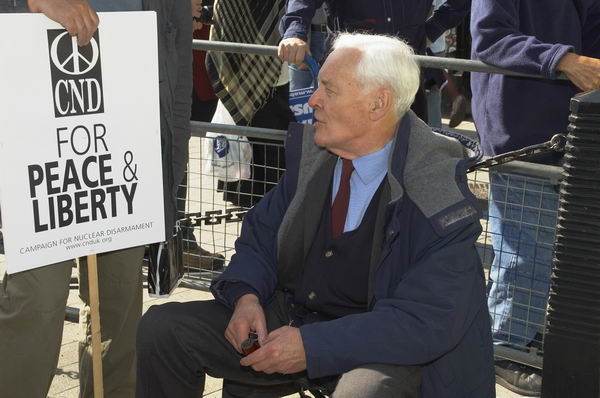
tony benn told us it wasn’t worth taking his picture – ‘it won’t get in the papers unless i go and kick a policeman’ but he didn’t and was quite right

My London Diary March 2002

Follow the link from the March 2002 page for more pictures.


For Refugee Rights and Against Trident

For Refugee Rights and Against Trident. I covered two marches in London on 27th February 2016, the first calling for safe passage for refugees seeking protection in Europe and following this a much larger march against government plans to waste £180 billion or more on replacing the UK’s Trident nuclear weapons.

European March for Refugee Rights

The European March for Refugee Rights was part of a day of protests in cities across Europe demanding action by governments to provide secure safe passage routes for all refugees and asylum seekers seeking protection in Europe. They want an end to deaths at borders and drownings and for refugees to be allowed to keep their possessions and be reunited with their families.

Among those taking part were people who had been to aid refugees in Lesvos and at the Calais camps and others who had volunteered with Medicins Sans Frontiers in Syria. The protest was supported by many groups including the Syria Solidarity Campaign, Solidarity with Refugees, London2Calais, Migrants’ Rights Network, SOAS Solidarity with Refugees & Displaced People Soc, Wonder Foundation, Calais Action, UK Action for Refugees, Refugee Aid Initiative, No Borders and the Greece Solidarity Campaign.

This was a short march taking place unusually inside Hyde Park, gathering at Hyde Park Corner and walking up to Speakers Corner where there was a rally. This made it possible for those taking part to join the Stop Trident Rally which was starting from Marble Arch, and going down Park Lane on its way to Trafalgar Square. Some of the marchers decided to form a block to march in front of the main Stop Trident banner and march on to Trafalgar Square.

Stop Trident march stewards tried briefly to stop them but then gave up and halted their march for around ten minutes to create a gap between the two groups.

European March for Refugee Rights


Stop Trident March

According to CND there were 60,000 people marching from Marble Arch to a mass rally in Trafalgar Square, and although their estimate may have been a little on the high side, this was definitely a very large protest, starting with a densely packed crowd on Park Lane. When the rally began in Trafalgar Square the tail of the march was still around half a mile away, and I think many gave up before reaching the rally as the streets leading to it became blocked.

Few people outside the military and arms manufacturers – probably the most powerful of all lobbies in the country can really believe the expenditure of £180 billion or more on replacing the UK’s Trident nuclear weapons is either necessary or cost-effective. The huge majority of nations in the world have no nuclear capability, and by December 2021, 59 states had ratified or acceded to the UN Treaty on the Prohibition of Nuclear Weapons (TPNW) which entered into force on 22 January 2021.

Lindsey German, Stop the War, Kate Hudson, CND General Secretary, Nicola Sturgeon, SNP First Minister, Scotland and Green Party MP Caroline Lucas hold the Stop Trident banner

A national survey by Survation at the start of 2021 for CND showed 59% of the public supported the UK government signing up to the TPNW, including 50% of Conservative voters and 68% of Labour voters. An even higher 77% supported a ‘total ban on all nuclear weapons globally’ with majority support from young and old, in all regions of the country, from Conservative as well as Labour voters, leavers and remainers. The government remains resolutely opposed to the treaty.

This widespread opposition to nuclear weapons isn’t largely a matter of their cost but on both moral and pragmatic grounds. As CND say, using nuclear weapons would cause catastrophic global damage; these weapons of mass destruction don’t keep us safe and divert resources from essential spending on services like the NHS, schools and housing and “it is clearer than ever that real security for Britain requires addressing the risks posed by the climate emergency and pandemics on a global scale.

Stop Trident March


Stop Trident Rally

Trafalgar square was unusually packed for the long rally that followed the march, with people listening and applauding a long list of speakers, including Nicola Sturgeon, Caroline Lucas, Leanne Wood, Vanessa Redgrave, Bruce Kent, Christine Blower, Mark Serwotka and Tariq Ali, as well as many less well-known names. There were many marchers who found it impossible to get into the square.

Nicola Sturgeon First Minister Scotland

All the speakers opposed the spending of an estimated £180 billion or more on renewal of Trident which they dismissed as out of date, totally irrelevant to our defence and a complete waste of money which could be put to so much better use providing proper jobs and services.

It was a long wait, around two hours standing in the cold for the final speech by Jeremy Corbyn who had earlier in the day been speaking in Sheffield and whose train had been a little delayed. He was greeted by a tremendous response from the crowd, and gave a rousing speech to end the protest on a high note. Despite the dismissive remarks from many political commentators on the media, Corbyn is one of the most powerful political speakers of current years.

Stop Trident Rally


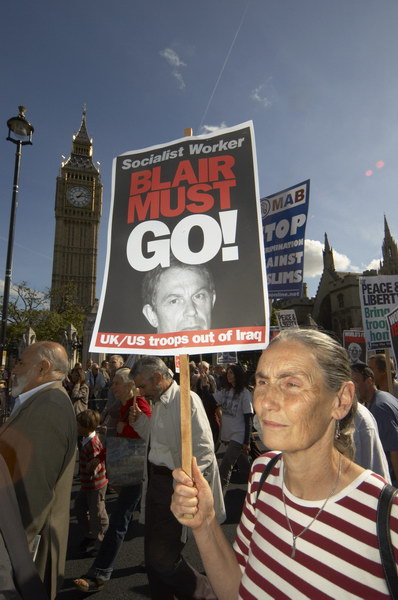
Stop Trident, Troops out of Iraq – 2007

Stop Trident, Troops out of Iraq – 2007. On Saturday 24th February 15 years ago I spent a long afternoon photographing around 50,000 protesters marching through London calling for an end to Britain’s nuclear weapons and for our troops to be withdrawn from Iraq.

The march was organised by Stop The War, the Campaign For Nuclear Disarmament and the British Muslim Initiative, and on My London Diary – back then still only in lower case – I made clear my support for the marchers:

i’ve for many years been opposed to the so-called independent british nuclear weapons. even at the height of the cold war they were never credible as an independent deterrent. if they have ever had any justification it was that they made the usa feel less guilty, although american guilt at its huge nuclear arsenal and at being the only country ever to have used nuclear weapons has always been an incredibly stunted growth.

i was also firmly against the invasion of iraq. it was always clear to those who didn’t want to be deluded that the so-called ‘intelligence’ on weapons of mass destruction was laughable. blair was either a liar or a fool as he misled a minority of the british people and a majority of their mps. or most probably both. (saddam may also have been deluded and certainly was an evil dictator, but we had long failed those who tried to oppose him.) the invasion was criminal, but the lack of planning for the occupation that inevitably followed even more so.

My London Diary – Feb 2007

My account also points out the ridiculously low estimate of the numbers taking part given by the police of 4,000 – though I think they were eventually forced to increase this somewhat – and gives my own method of assessing numbers on such large demonstrations as this. The marchers took 90 minutes to pass me as I photographed them in Park Lane. My usual rule of thumb was to double the police estimate, but on this occasion they surpassed themselves, being an order of magnitude out.

There certainly is always a policy by our establishment, backed up by the BBC and the press, except on rare occasions to minimise dissent, particularly left-wing dissent, in this country while often exaggerating any protests against left-wing governments abroad. It’s a bias which has been very obvious in the coverage of events in Latin-American countries such as Venezuela.

Tony Benn

The BBC and some of our newspapers have some excellent reporters and correspondents, and it is more in the selection of what they are asked to report on and the editing of their reports and the context in which they are placed that the bias occurs. Some things are just not ‘news’, while others, often trivial or flippant, get major attention.

Fortunately there are other sources with different biases, including the almost invisibly small left-wing press in the UK (the two daily papers – the Communist Morning Star and Workers Revolutionary Party’s The News Line together have a circulation probably well under 10,000), but more importantly large news organisations such as the Russian-funded RT International and the Qatari Al Jazeera English – the latter particularly interesting about current events in the Ukraine.

Every journalist has a point of view and while we may strive to be factual I don’t think there is such a thing as objectivity. Our reporting is always subjective, based on what we feel and what we think is of importance. Every photograph I take involves choice – and the rejection of other things I don’t photograph – even at times things I think would make eye-catching images but would misrepresent people or the event. Further choices come in the selection of which images to send to an agency, and also which I choose to put on My London Diary.

On this occasion I chose rather too many to put on-line, with 17 pages of pictures, though this reflects the typical internet speeds of 15 years ago, when pages with more than ten small images were too slow to load even though I compressed the images as lower quality jpegs than I would now. But the number of pictures also reflected my intention to tell the story of the event as fully as possible rather than creating a single image for the event that might appeal to a picture editor.

Julie Felix

Looking at the report now I feel there are rather too many images particularly of some of the well-known faces I photographed at the rally. Perhaps also I made too many of the marchers, some of which might be of far more interest to the people shown in them than the general public. But if people make an effort to make an interesting placard or banner I think it deserves a little recognition.

You can read more of my report of the event and see another 160 or so pictures on My London Diary, beginning on the February 2007 page, though you will need to scroll a long way down the page to reach this march and rally.


A Threatened Hospital, Riverside Walk, Syria & Mali

A Threatened Hospital, Riverside Walk, Syria & Mali – pictures from nine years ago on February 15th 2013.

Fight to Save Lewisham Hospital Continues

My work began at a lunchtime rally opposite Lewisham Hospital where the whole local community is fighting to save their hospital with both a legal challenge and further mass demonstrations including a ‘Born in Lewisham Hospital’ protest a few weeks later. Parts of the hospital across the main road are in the picture.

People were appalled by then Health Minister Jeremy Hunt’s decision to accept the proposals for closure, and to ignore the mass protests by local residents. Not only are the proposals medically unsound and will lead to patient deaths, but they also represent short-term thinking that will result in a huge waste of public funds.

Lewisham was a sucessful and financially sound hospital and had received sensible public investment to provide up to date services, and the services to be cut will have to be set up again at other hospitals. Closing Lewisham would not only incur high costs, but would waste the previous investment in its facilities.

Closure was only considered because of huge debts inherited when it was merged into a group which had earlier made a disastrous PFI (private finance initiative) agreement to build a new hospital a few miles away. Both the hospital group and Jeremy Hunt had been shown to be telling lies about the scope and cost of the replacement A&E and maternity facilities which would be needed if Lewisham were closed.

The well-attended protest was organised by the Save the Lewisham Hospital campaign which was raising funds for a legal challenge as well as a new poster and leaflet campaign and the forthcoming mass demonstration. But this was not just a campaign for Lewisham, but one that is vital for the whole of the NHS. Behind the speakers was a banner for the South-East London ‘Save Our Local NHS Hospitals’ campaign quoting Nye Bevan: ‘The NHS will last as long as there are folk left with the faith to fight for it.‘ They certainly had the faith in Lewisham.

Fight to Save Lewisham Hospital Continues


Thames Path Greenwich Partly Open

Here’s what I wrote back in 2013:

I had some time to spare between protests and it was a nice day, around 10 degrees warmer than we’d been having and sunny, so I decided to take a bus to North Greenwich and walk along the Thames Path, having heard that parts of it had re-opened. The weather changed a little and there were some dramatic skies.

There is still a section of the walk that is closed, a giant building site where Delta Wharf once was up to Drawdock Road, but on each side of this the walk is open. although the council sign on the footpath leading from Tunnel Avenue still indicates it is closed. At the river the path north is blocked, but you can walk south to Greenwich.

A panorama – the same path in opposite directions at both sides

At first the walk goes alongside a giant manmade landscape of sand and gravel, like some alien planet – and behind the conical hills the Dome and the gas holder, with occasional lighting towers and cranes add to the scene. Most of this is behind tall fences, but fortunately these have gaps between the posts allowing you to see and photograph. Years ago the path here went through a working container dock, the Victoria Deep Water Terminal, with yellow lines marking the route, though occasionally it was blocked by crane operations, and we waited rather than have heavy containers overhead. There are a couple of my pictures of this and others from the riverside path in the 1980s on my London’s Industrial Heritage site.

Beyond there the riverside path seems rather empty, with many structures having dissappeared, including the huge concrete silo I photographed. But something new has appeared, ‘guerilla knitting’ on some of the trees and posts along the path.

Many more pictures at Thames Path Greenwich Partly Open on My London Dairy


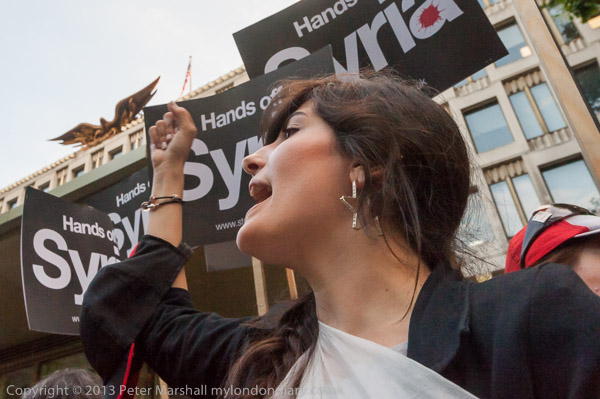
Stop Western Intervention in Syria & Mali

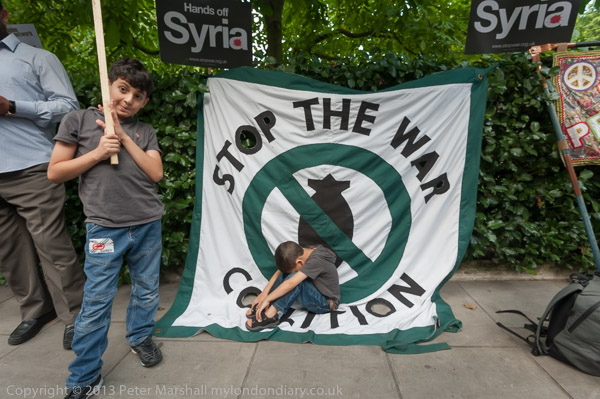
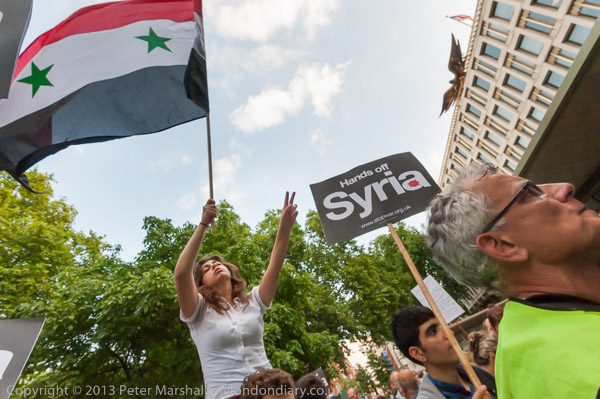
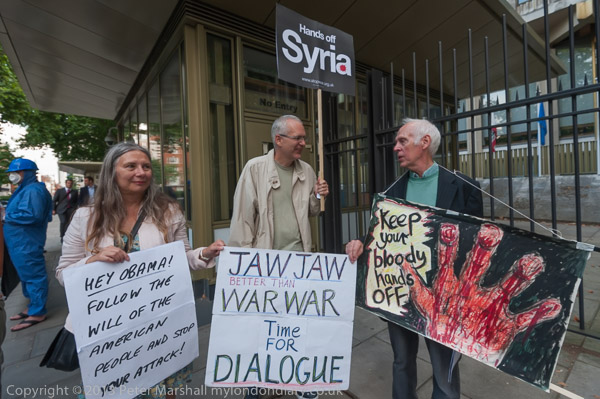
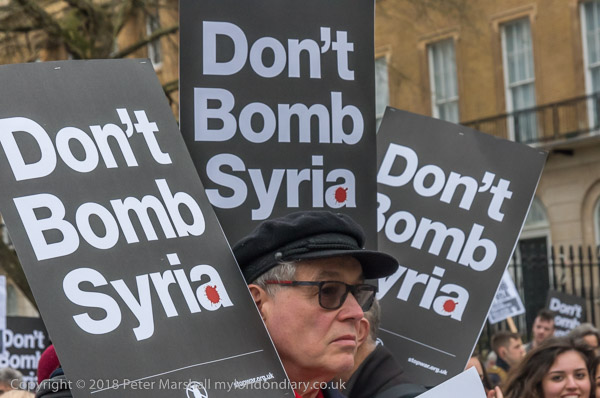
It was the 10th anniversary of the march by 2 million against the Iraq war, Stop the War organised a small protest at Downing St calling for a stop to Western intervention in Mali and Syria and against the possible attack on Iran.

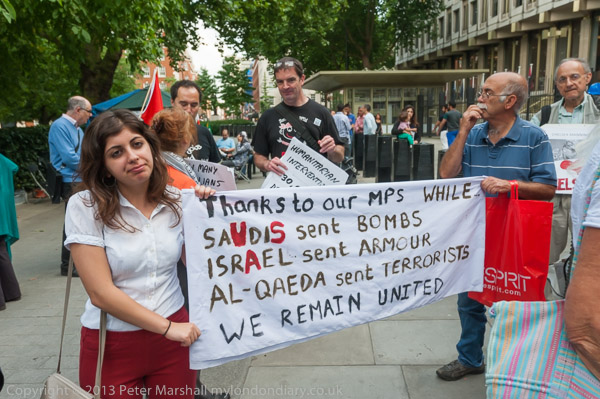
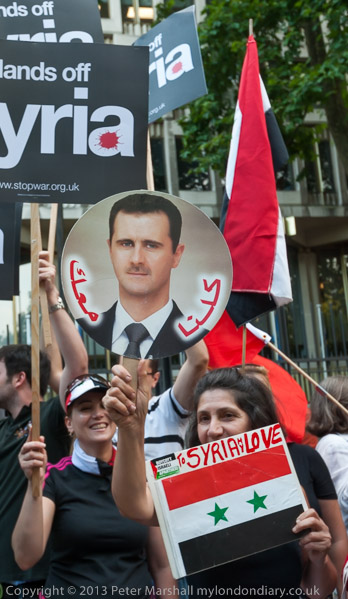
Many on the left feel that the failure of that huge protest to actually prevent the UK taking part in the invasion of Iraq showed a failure in the leadership of Stop The War to make any quick and efffective action to follow it up. Stop The War have also failed to convince the public at large with their more recent campaigns against intervention in Libya and now against the support being given to the Free Syrians and the Mali government. As the upper picture shows there were some supporters of the Assad regime, from a small left group, the Communist Party of Great Britain (Marxist-Leninist), taking part in the protest. Almost certainly the great majority of supporters of Stop The War while against UK military intervention would like to see more support being given in other ways to the Syrian rebels.

Stop Western Intervention in Syria & Mali


October 13th 2001-2015

Thinking about events I had photographed on October 13th I found rather a lot over the years – so here are links to some of them from 2001-2015.

There are just a few black and white pictures from the October 2001 Stop The War March in London. Back in 2001 I was still working on film, and although I had taken pictures in both black and white and colour I only had a black and white scanner.


By 2003 I was working with a digital camera, a Nikon D100, and on the 13th October I joined another thousand or so people from around the country to say ‘No to GMO’. Most of the work being done on genetic modification was aimed at increasing the profits of companies and at locking farmers into using patented seeds which had to be purchased from them and which required expensive chemical inputs and would penalise or even lead to prosecutions of those who continued with traditional methods, particularly organic farmers, and severely reduce bio-diversity. The protesters were largely concerned about the possible risks of genetic modifications that were not being subjected to thorough long-term testing. The government seemed simply to be preparing to give way to commercial pressures.

The protesters went first to the National Farmers Union, then to Downing Street (or rather outside the gates to Downing Street) then on past the Houses of Parliament to the Department for Environment, Food and Rural Affairs (DEFRA) in Smith Square. The digital pictures I was making then seem rather dark and muted and processing software then was still rather poor.


It was 2007 before I photographed anything at all relevant on 13 October again, and this time I was on a walk about The Romance of Bethnal Green, a book by Cathy Ross, which had included a number of my pictures from the 1980s.

In 2008 came ‘Climate Rush – Deeds Not Words’:


Exactly 100 years ago, more than 40 women were arrested in the ‘Suffragete Rush’ as they attempted to enter The Houses of Parliament. To mark this centenary, women concerned with the lack of political action to tackle climate change organised and led a rally in Parliament Square, calling for “men and women alike” to stand together and support three key demands:

  No airport expansion.
  No new coal-fired power stations.
  The creation of policy in line with the most recent climate science and research.

Those attending were asked to wear white, and many dressed in ways that reflected the styles of a century ago, and wore red sashes with the words ‘Reform Climate Policy’, ‘No New Coal’ ‘Climate Code Red’ and ‘No Airport Expansion’, with campaigners against a second runway at Stansted having their own ‘Suffrajets’ design. We were also offered fairy buns with ‘Deeds Not Words’ and ‘Climate Bill Now’

It was a protest that brought together some fairly diverse groups, including the Women’s Institute and the Green Party as well as Climate Rush, who, led by Tamsin Omond tried to storm their way in to the Houses of Parliament like their Suffragette predecessors, but were stopped by police. She was later arrested, not for this action but for breach of her bail conditions from the ‘Plane Stupid’ roof-top protest at the Houses of Parliament 8 months earlier.


On 13th October 2012, Zombies invaded London in a charity event, to “raise the dead and some dough in aid of St. Mungo’s“, a charity which reaches out to rough sleepers and helps them off the streets.

I went on from there to the steps of St Pauls, where on the first anniversary of their attempt to occupy the Stock Exchange, Occupy London joined a worldwide day of protest, #GlobalNoise, by the Occupy movement, to target the “political and financial elites who are held responsible for destroying our communities and the planet, resonating the ongoing wave of anti-austerity protests in Europe and around the world. At the same time #GlobalNoise is a symbol of hope and unity, building on a wide variety of struggles for global justice and solidarity, assuring that together we will create another world.

From a rally at St Paul’s they went on to sit down at a few places around the City, before crossing London Bridge heading for an undisclosed location to occupy for the weekend. Some wanted to occupy the ‘Scoop’ next to City Hall, but others felt it wasn’t suitable. A group went on to block Tower Bridge, but then returned to join others at Scoop.

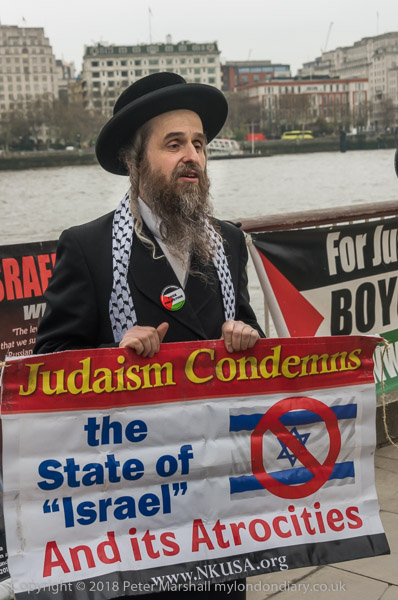
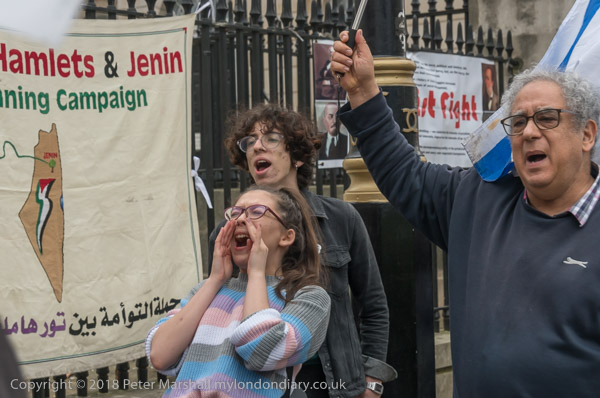
In 2015 the Zionist Federation organised a protest outside the Palestinian Authority UK Mission against the stabbings of Jews in Israel. Jewish and other groups supporting Palestinian resistance to occupation and Israeli terror came along to protest against all violence against both Jews and Palestinians in Israel and for an end to the Israeli occupation of Palestine.


I left while the two protests were continuing to shout at each other to join the candlelit vigil at Parliament by Citizens UK calling for 1000 Syrian refugees to be resettled in the UK before Christmas and 10,000 a year for the next 5 years. Six children froze to death in the camps last year and many in the UK have offered homes and support.