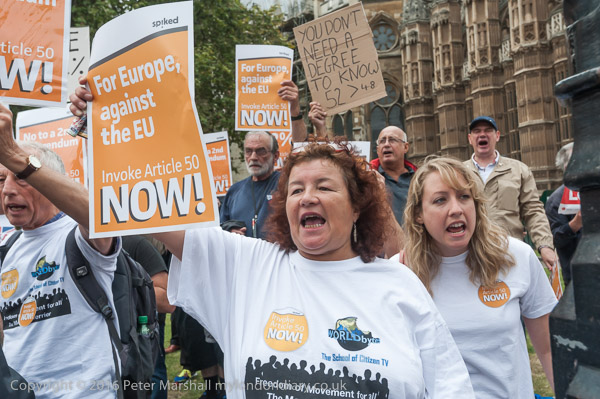
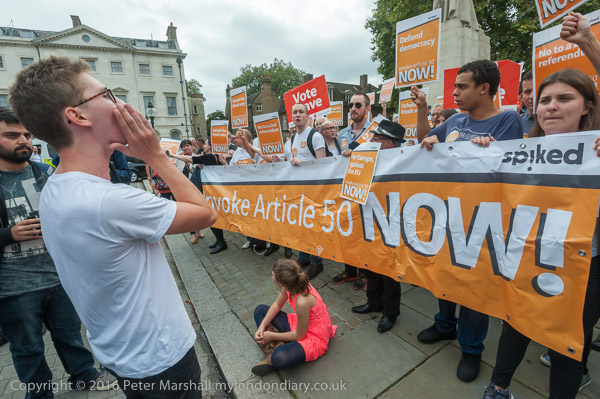
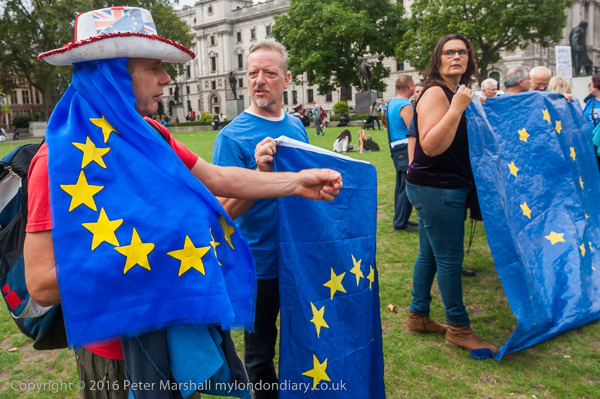
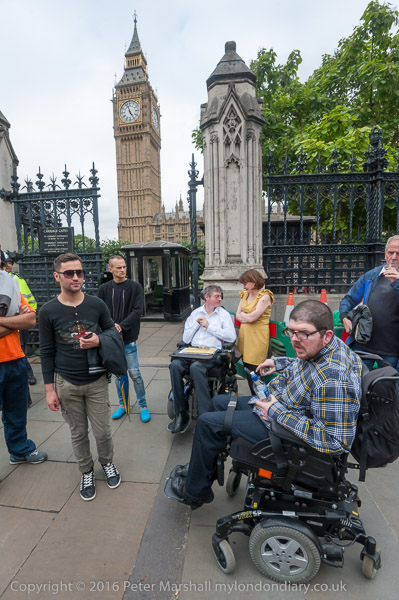
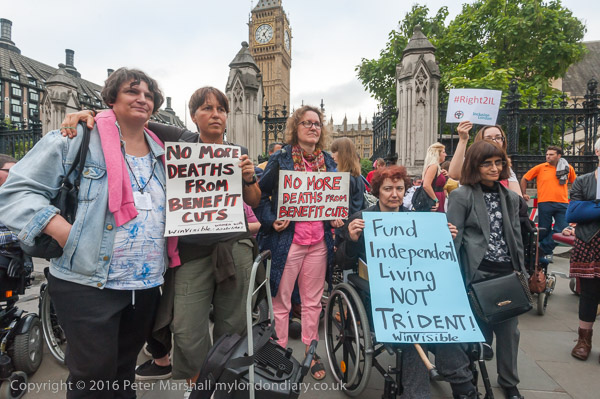
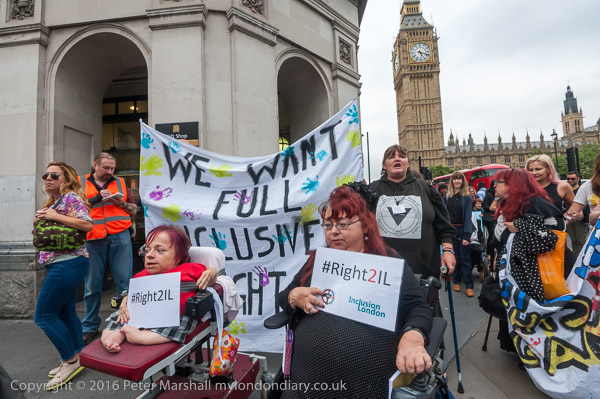
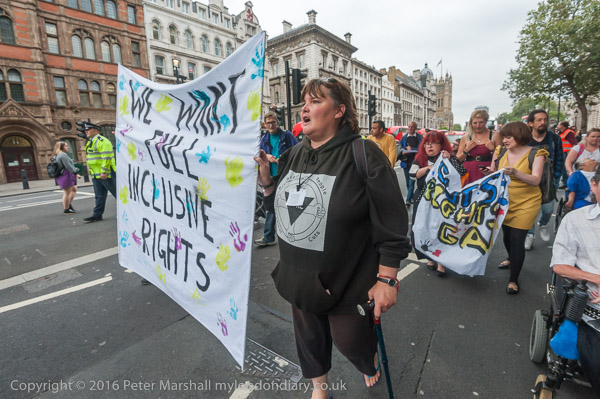
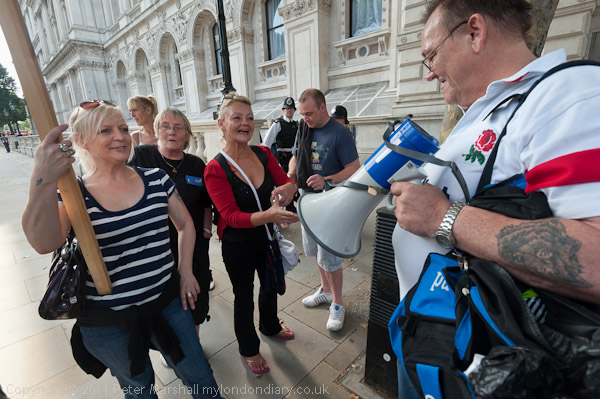
Brexit, Inclusion London & Fracking: Protests in Westminster I photographed on Monday 5th September 2016 were for and against Brexit, Disabled People Against Cuts who had been lobbying at Parliament over the Inclusion London report and a vigil by pagans against fracking.
Rival Brexit protests at Parliament
Parliament was debating a petition on the EU referendum signed by over 4 million people calling for a second referendum as there had only been a 52% vote in favour of leaving Europe, with 48% voting against. They argued that this was far too close for such a major constitutional change and at least a 60% vote should have been required for the referedum to be decisive.
Spiked magazine had organsed a protest by pro-Brexit campaigners in Old Palace Yard and they shouted loudly for Theresa May to ‘Invoke Article 50 Now!
A small group who wanted us to stay in Europe had come to Parliament Square where they held flags and banners.
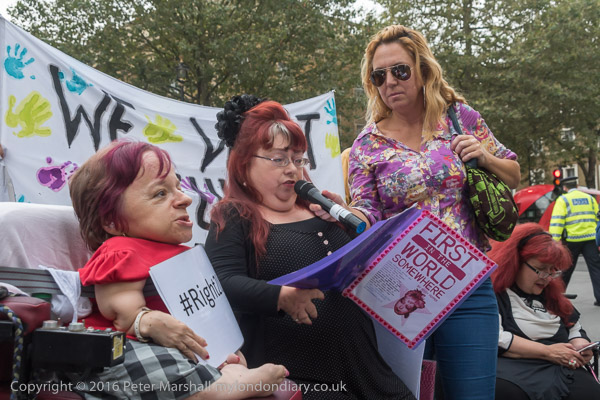
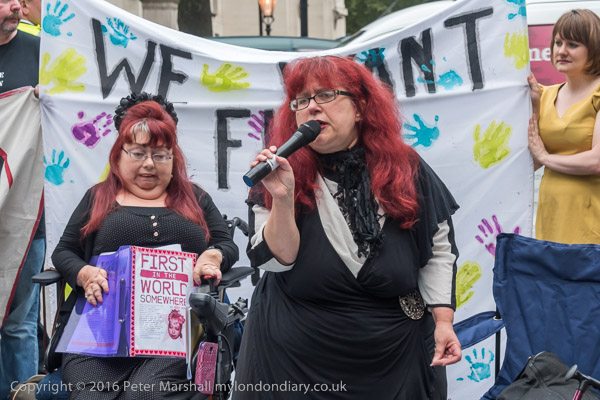
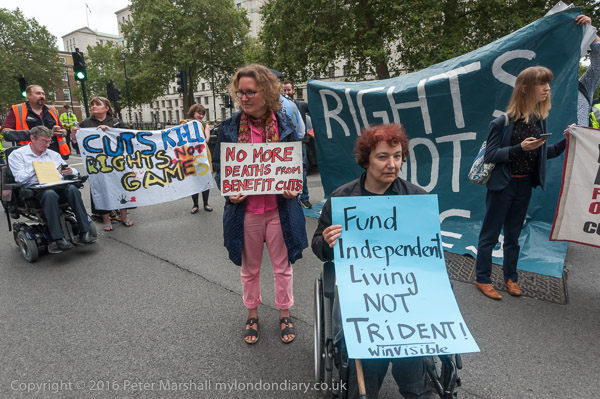
Disabled People Against Cuts (DPAC) had come to Parliament to lobby MPs and to present the Inclusion London report which had highlighted the disastrous effects of cutting care and support funding for personal assistance by the closure of the Independent Living Fund in 2015.
After the lobby they posed on the pavement outside Parliament for photographs and then on the road opposite.
before marching to Downing St.
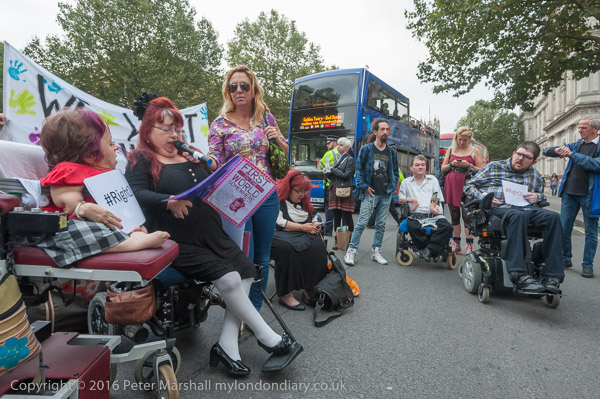
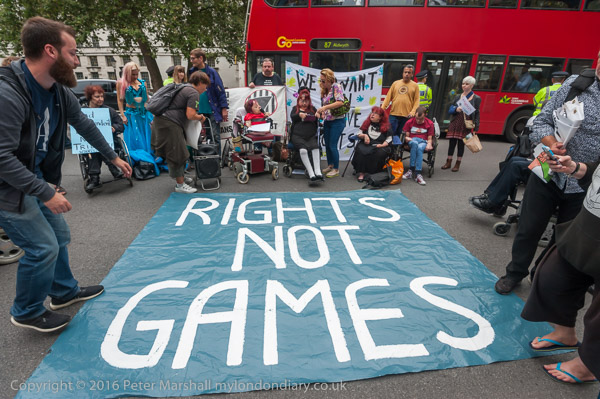
In front of Downing Street the march came to a halt on the roadway.
Police directed traffic around them as they held a ‘Pop-Up Street theatre‘ performance there.
There were short speeches, poetry and songs from some of the DPAC members, showcasing the creativity of disabled people and the contribution they can make to society with proper support.
Others talked about their physical and mental health problems and the difficulties that they had suffered because of the closure of the Independent Living Fund.
DPAC were supported by other groups and individuals including Winvisible.
The protest was part of a series of protests at the same time as the Rio Paralympics, and a large banner read ‘Rights Not Games’.
On the other side of Whitehall opposite Downing Street pagans were staging a 24 hour vigil against fracking.
Pagans believe that nature is sacred and find spiritual meanings in natural cycles of birth, growth and death and Druidic and other rituals are linked to the seasons. Humans, animals, trees, plants and all of the earth are part of nature, and fracking disrupts the natural order.
A banner with a tree had the message ‘Druids against Fracking – One (heart) for Mother Earth‘ while another had more esoteric symbols with the message ‘We are Nature protecting ourselves‘. One of the Druids was wearing a t-shirt with the sigil ‘The Warriors Call‘, a magic symbol widely adopted as an anti-fracking device.
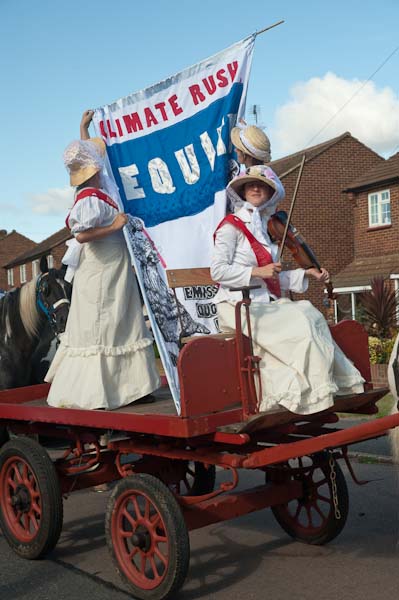
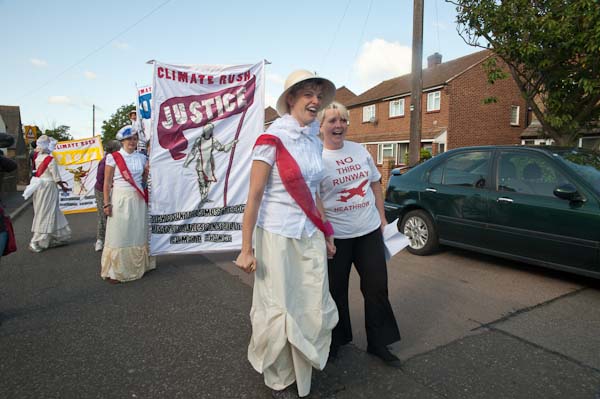
Climate Rush Protest Heathrow: On 4th September 2009 I joined Climate Rush at Sipson, one of the villages immediately north of Heathrow under threat from the plans to build a third runway.
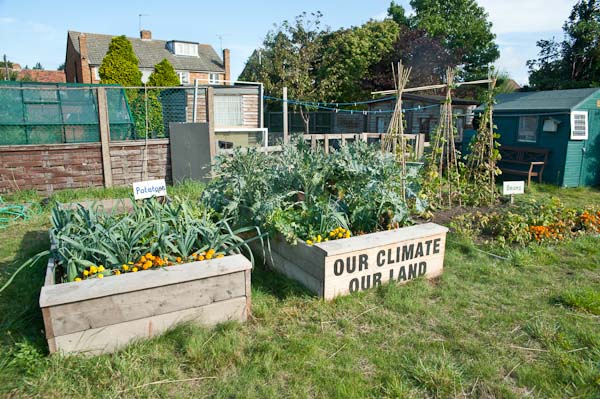
Their 3 day stay here was their first stop on a one month tour of South West England and they were staying at the Sipson ‘Airplot’, bought by Greenpeace in what was planned to be the centre of the new runway. The legal owners of the plot were now “Oscar winning actress Emma Thompson, comedian Alistair McGowan and prospective Tory parliamentary candidate Zac Goldsmith and Greenpeace UK.”
Greenpeace had invited others to sign up to become ‘beneficial owners’ of small 1 metre square plots within the site and I was among the many who did so. They had hoped this would make it harder for the developers as they thought we would all need to be served with legal notices for the development to go ahead.
I’d long been opposed to the expansion of Heathrow. It remains clear that this is an airport that was set up in the wrong place, to close to London in a fairly densely populated area and with flight paths over the centre of London. And with the increasing threat of climate change and global extinction one of the last things we should be doing is increasing the carbon emissions and pollution from aviation; instead we should be looking at ways to cut down both the number of flights and the pollution from traffic and congestion in the area surrounding the airport.
I’ve lived most of my life close to Heathrow. As I wrote on My London Diary:
“I grew up under the main flight path in use for landing a couple of miles from touchdown. Although I was a plane spotter at an early age, all of us living there felt the disruption it caused in our lives, even back in the 1950s.
My teachers often had to stop and wait in mid-sentence for a plane to go over. We could often smell the fuel, and see and feel the oily grime although I don’t think the term “pollution” had then really entered normal vocabulary.
At a deeper level, I still sometimes have nightmares about planes going over in flames (as they sometimes did) and crashes, although since Terminal 4 blocked one of the existing runways (Heathrow was built with six though only two are now used) thankfully planes no longer shake my present house as they come in low on landing or take off. “
I wrote more about this back in 2009, as well as the continuing history of lies and deceit by which the airport was established and has since grown and grown. And also about the area as it was before the airport, rich agricultural land with market gardens and orchards. Of course I didn’t know it myself but my father did and cycled through it.
In the 1950s on my own bikes I cycled through the villages which would be destroyed by a third runway, particularly Harmondsworth which has retained much of its original charm, with a village green with a pub and church and, a few yards away, one of the finest medieval tithe barns (2 pictures at bottom of this page.) There is much more to read on My London Diary.
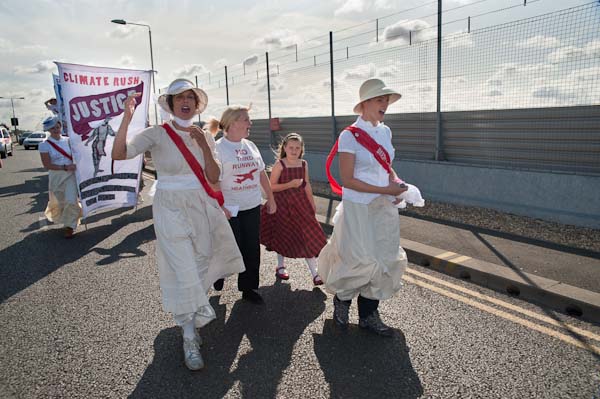
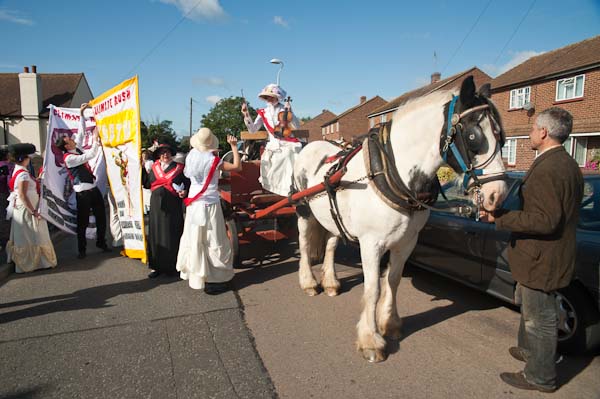
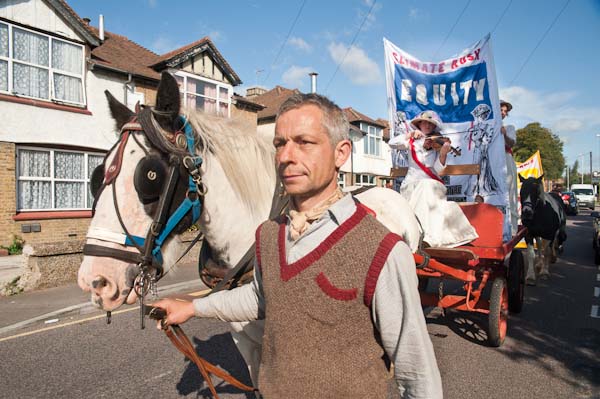
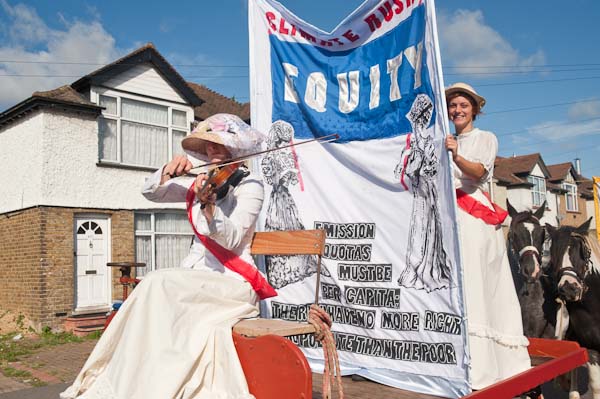
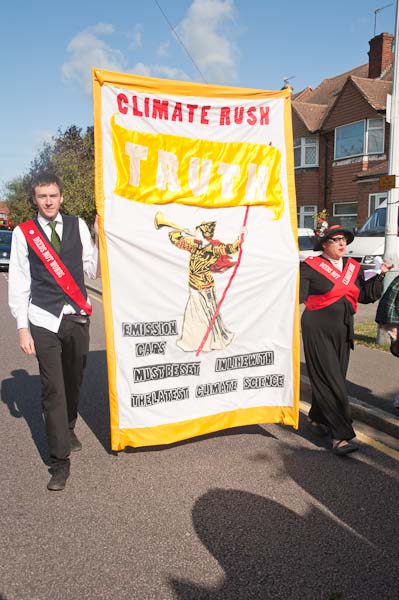
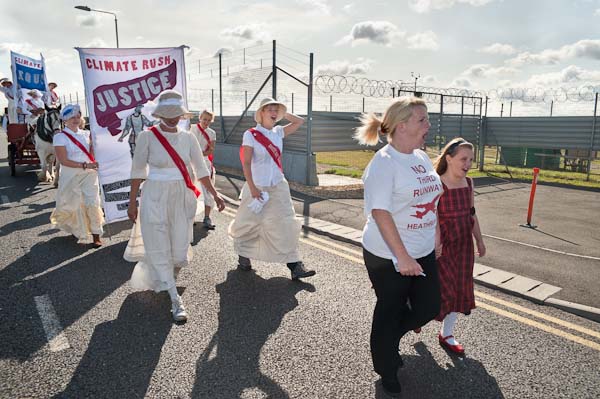
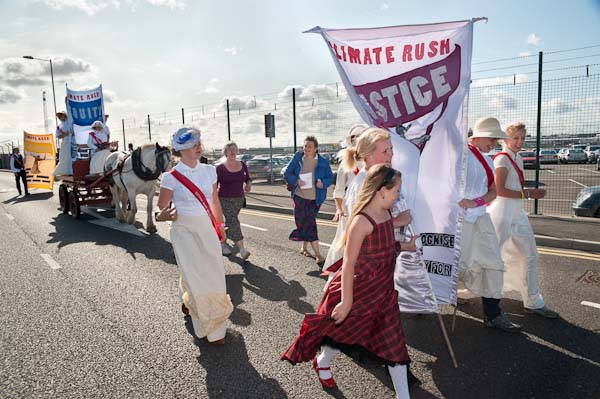
Climate Rush had organised a procession from the Sipson Airplot, led by local residents from NoTRAG, though most were at work today – more were expected later in the day and at the ‘Celebration of Community Resistance’ at Sipson the following day. “Suffragettes (including a ‘token’ male) wearing ‘Deeds Not Words ‘ and ‘Climate Rush’ red sashes carried three banners, Justice, Equity and Truth; Equity traveled on a horse-drawn cart along with a violinist. “
The banners read: JUSTICE: Rich Countries must recognise historic responsibility for climate change. EQUITY: Emission quotas must be per capita; the rich have no more right to pollute than the poor. TRUTH: Emission caps must be set in line with the latest climate science.
The procession went down the Heathrow and along the Northern Perimeter Road beside the perimeter fence, where we were joined by a police car, which stopped traffic for us before retuning to the Airplot.
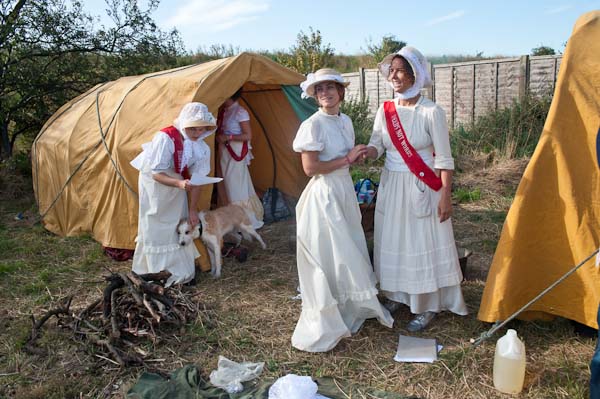
There it was time to rest, and to eat some of the apples from the side of the plot. “A couple of the suffragettes climbed a tree to pick some more, but they turned out to be cookers. The kettle had been hanging over the embers of a wood fire and a few more sticks soon brought it to the boil for tea.”
I’d come to Sipson on the bike which I had ridden through there fifty years earlier – a present on my thirteenth birthday – and had got a puncture just a few hundred yards short of my destination.
“I sat down to mend my puncture. Unfortunately I its a while since I checked the repair kit in my pannier, and having found two largish holes found I didn’t have a large enough patch to cover the two of them and the rubber solution had dried up. It was time for me to walk the six miles home.”
Brian Haw, Syria And EDL Stopped: My working day on Saturday 3rd September 2011 began in Parliament Square, then an extreme right protest in Westminster, Syrians at Downing Street and finally to Whitechapel where several thousand came to stop the EDL entering Tower Hamlets.
Brian Haw Peace Protest Continues
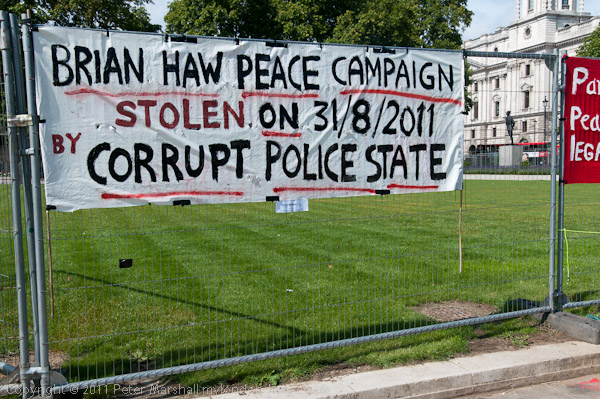
Three days earlier, police had come to Parliament Square and taken away all of the material in the permanent 24/7 peace protest there begun by Brian Haw in 2001 and now continued after his death in June 2001 by Barbara Tucker and other supporters.
Despite the protestation by those carrying on the protest there, the police claimed the material had been abandoned and removed it. The police have for years been under pressure from politicians to end the protest and took advantage of the fact that Barbara Tucker was then being held in Holloway Prison. But a team of others had kept up the protest while she was away and were there when the police came are were still continuing the protest.
This was not the first time that the display here has been stolen by police, the most famous being in May 2006, after which a reconstruction by an artist was controversially put on display at Tate Britain. Since 2006 there had been restrictions on the size of the display allowed there and continuous harassment and arrests of Brian Haw, Barbara Tucker and others involved.
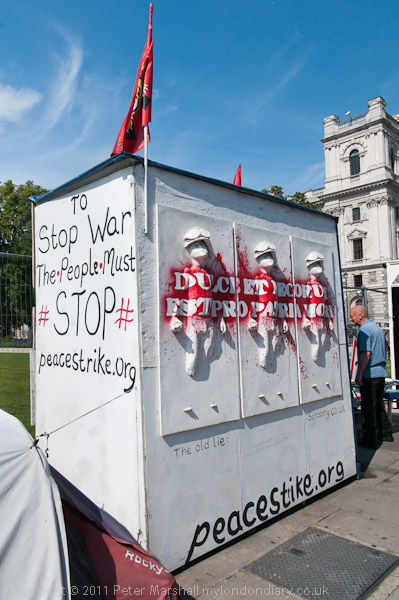
Parliament Square had then been fenced off to the public for some time, with the public denied access to the statues of Churchill, Lloyd George and others, with protests and public limited to the pavements around two sides of the square. But the fencing was useful to display a number of banners. Police did not touch the other peace protest on the pavement by Peace Strike.
Alternative Action brought together “patriot activist groups” from the far-right who had previously taken part in EDL protests. They said they wanted to dissociate themselves from the loutish behaviour, violence and racism of EDL protests and in particular from the inflammatory incursion into Tower Hamlets the EDL were intending later in the day.
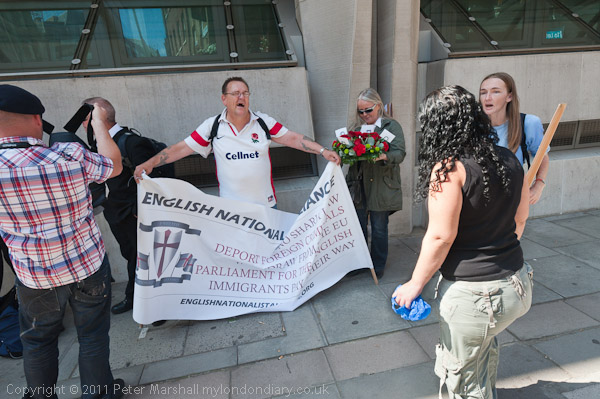
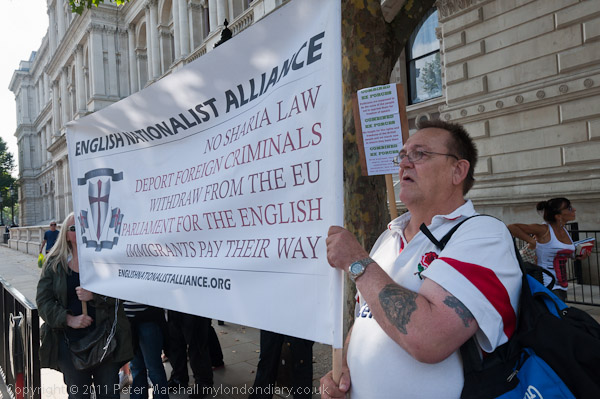
Among the groups involved were the English Nationalist Alliance, the British Patriotic Alliance, the Combined Ex Forces, the Ex EDL Association and the National League of Infidels. ‘Tommy Robinson’ had been reported as saying that the EDL would come to disrupt the peaceful march they had organised but this did not happen.
The setting up of Alternative Action reflects various bitter disputes over the leadership and policies of the EDL, in particular over the lack of accountability in the organisation and the behaviour of some of its self-appointed leaders, including Robinson and the ‘Jewish division’ of the EDL.
They had come to march from the Ministry of Justice to Downing Street to hand in a letter calling for one system of law in the UK and an end to Sharia courts. The march was peaceful although there was one minor incident when English Nationalist Alliance leader Bill Baker shouted at Syrian protesters, mistaking them for Islamic extremists, but others soon persuaded him to stop. Later some of those on the march expressed the view that it was inappropriate to allow protests involving foreign flags so close to the Cenotaph with its flags honouring our military dead.
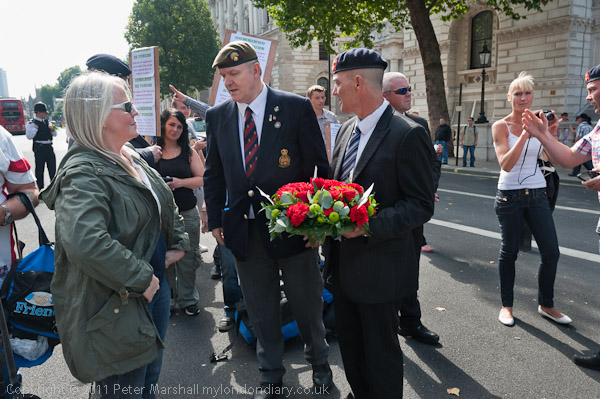
Although well over a hundred had indicated on Facebook that they would march, only around 20 turned up. The march paused at the Cenotaph to lay a wreath and observe a minute’s silence in memory of the soldiers who have given their life for their country before continuing to the gates of Downing Street.
Although they had earlier made arrangements with the Downing St police liaison officer to deliver their letter, police at the gate refused to let them do so and would not take the letter. Other protests have had the same reception, which seems to me to be against the letter and spirit of democracy. The marchers then stopped on the pavement just past Downing Street for a rally and after a few minutes I left.
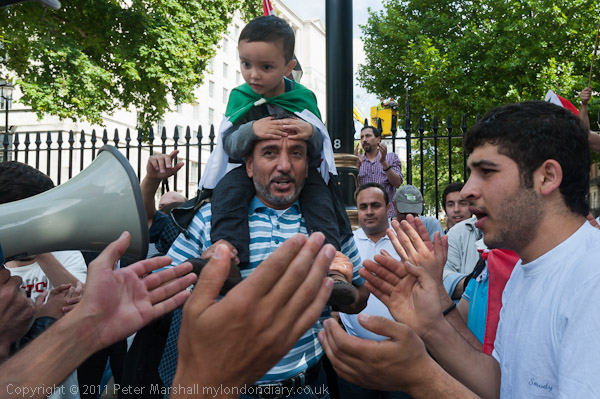
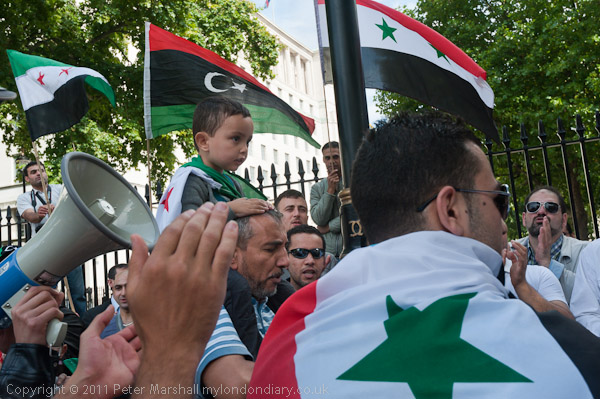
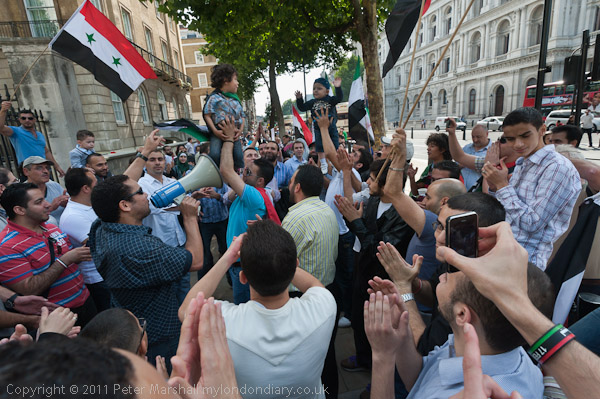
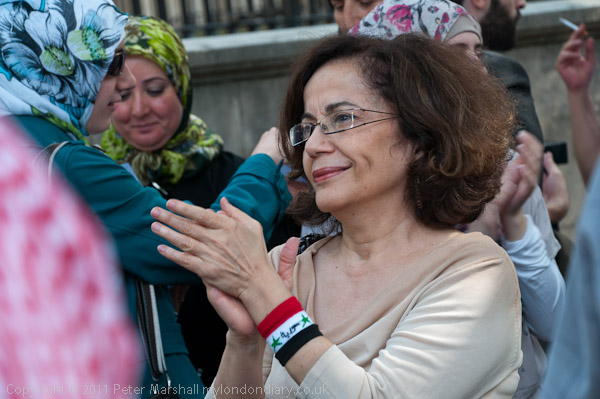
Around a hundred members of the Syrian Community in London had marched from the Syrian Embassy to hold a noisy protest at Downing St calling for freedom in Syria and an end to oppression, atrocities and humiliation by the Assad regime.
They called on the UK to support further sanctions and bring diplomatic pressure to support the peaceful protests in Syria against the Assad regime which had begun on 15th March 2011 and had met with brutal repression.
Marches has been met with tanks, cities and villages attacked by helicopter gunships, men, women and children tortured and more than 1800 people killed, including many children. Soldiers who refused to open fire on civilians or take part in torture have been themselves killed.
Many of the women taking part wore Muslim headscarves, but there were others who did not, and although most of the drumming, dancing and flag-waving was by the men, this was not a rigidly segregated event although men and women mainly stood it separate groups. The variety of Syrian flags suggested that those taking part included those from various groups opposing the Assad regime.
The protest in Tower Hamlets by residents and their supporters against the plans by the English Defence League to hold a rally somewhere in their borough had started around 11am, but I only arrived later at the time the EDL rally was scheduled to start close to Aldgate East Station.
The street there was empty but blocked by a row of police who refused to let me through despite showing my press card, and I was prevented from going to where the EDL were holding their rally a short distance to the west, just inside the City of London.
Initially the EDL had planned to march through Whitechapel but home secretary Theresa May had banned marches. The EDL then tried to have a static demonstration on a supermarket car park close to the East London Mosque, but the supermarket and other possible sites in the area refused them. Pubs in the area where they intended to meet up for the protest also said they would deny access, and the RMT announced they would close the Underground stations because of the danger to staff.
Police stopped some EDL supporters and turned them back as they tried to enter London. Others got lost wandering around London trying to find pubs that would serve them, and the numbers at the EDL rally were apparently considerably less than the organisers or police had anticipated.
I gave up trying to get to the EDL rally and went instead to the large crowds who had come to Whitechapel High Street and Brick Lane to stop them, and then on to another large crowd who had come to defend the the East London Mosque. The community had clearly united to stop the EDL and there was a huge cheer when it was announced that EDL leader Stephen Yaxley-Lennon (aka Tommy Robinson) had been arrested after speaking at the EDL rally, where he had apparently boasted of having broken his bail conditions.
There was more jubilation when the crowd heard that police were moving the EDL away from the rally at Aldgate to Liverpool street and their coaches waiting across the river in Tooley Street.
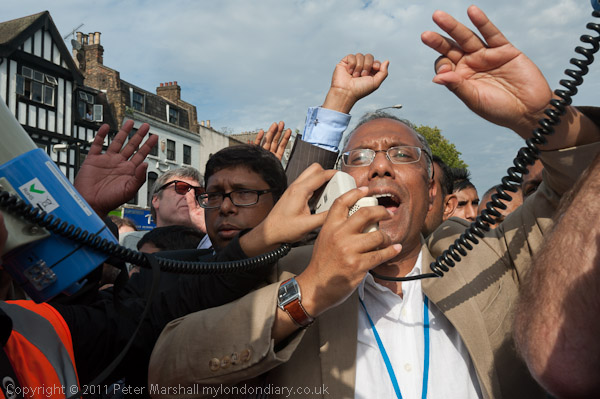
The protesters began a ‘Victory March’ from the bottom of Brick Lane along Whitechapel High St, led by the Mayor, councillors and others who linked arms across the width of the road.
It stopped at the East London Mosque, but some activists decided to continue and were briefly stopped by police who told them their march was illegal because of the ban in place in Tower Hamlets.
They walked around the police who tried to stop them but a few hundred yards on stewards and some of the protest leaders including Mayor Lutfer Rahmen managed to bring the march to a halt, telling them to enjoy their victory and not continue as arrests now would become the story of the day for the press rather than it being one of a community victory over racism. They calmed down, some took up the offer of a cup of tea back in the Muslim Centre, while others, including myself, went home.
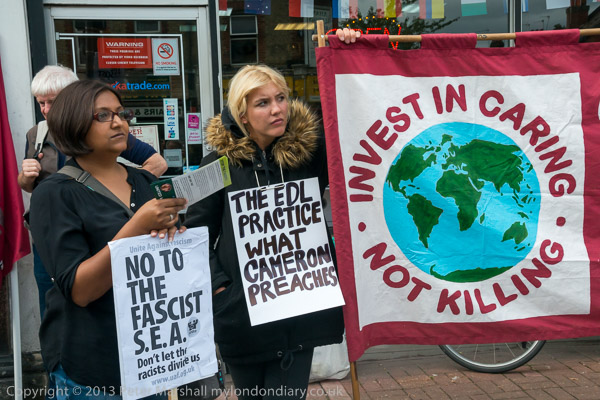
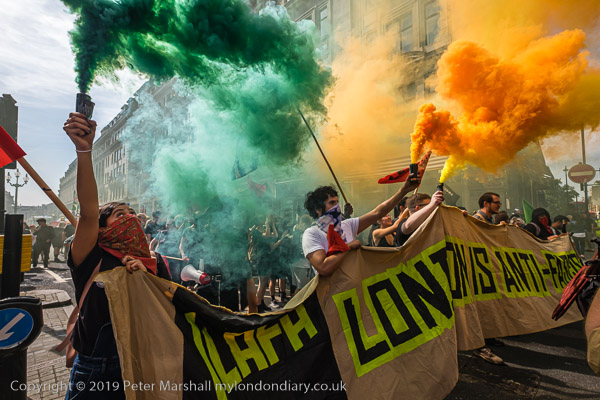
Racist Thugs Not Welcome: Recent events in Southport and elsewhere have brought racist thugs to the attention of politicians and police, but many of the same people have been out on our streets for many years, under various different names – the National Front, BNP, EDL, Football Lads and more, their activities largely ignored by the media and sometimes assisted by police.
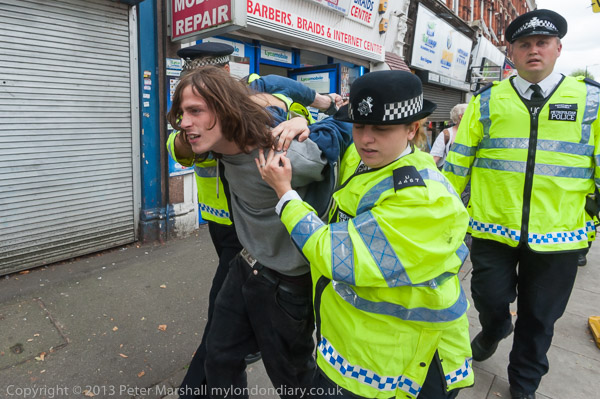
An anti-fascist protester sends a clear message to the South East Alliance as police drag her away
They represent a small rotten mouldy patch on the skin of our society, which inside and at its core is decent and open-minded, but they have been encouraged by the red-top newspapers of the right and also by the speeches and actions of politicians of both our leading parties in their ever rightward rhetoric around “illegal immigrants“, hostile environments and more, and the attacks on Muslims as a whole while refusing to take Islamophobia seriously.
As many – including Amnesty International point out, there is no such thing as an illegal immigrant. The term is a “pejorative term of uncertain meaning“. As the Migrant Rights Network puts it more directly, it is “dehumanising, immoral, and contributes to the demonisation of migrant communities.” It is a clearly racist term and one that politicians and media should be treating in the same way as the ‘N‘ word, the ‘P‘ word and others.
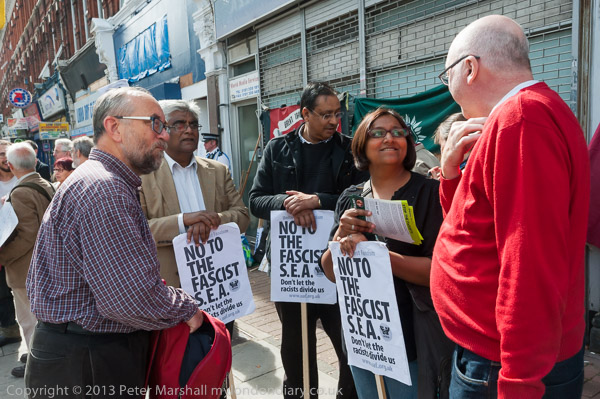
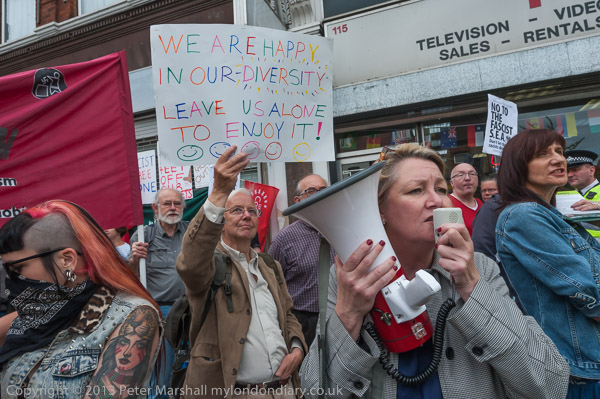
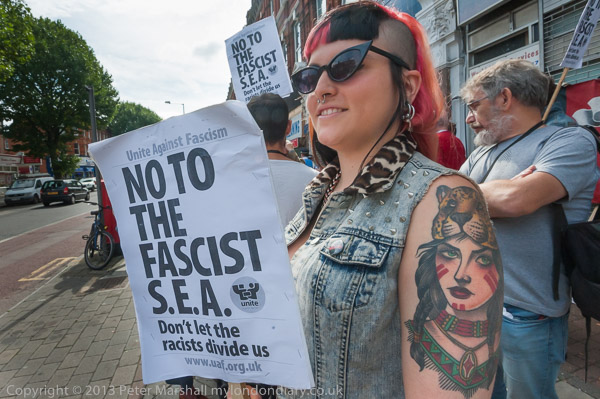
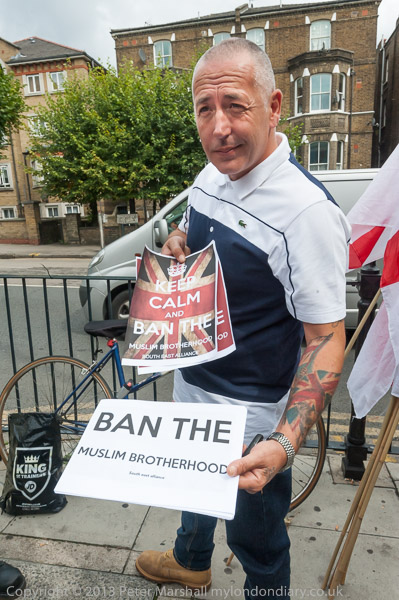
Ten years ago today, on Saturday 30th August 2014, racist thugs who then called themselves the ‘South East Alliance’ (SEA) came to Cricklewood to protest close to the empty offices they say are used as a recruiting centre by the Muslim Brotherhood.
They were a small group, perhaps around 30 people and a much larger group which grew to several hundred organised by ‘North West London United’ had come to oppose their protest.
The office had been that of World Media Services, run by Egyptians who supported the Muslim Brotherhood, an organisation set up in their country in 1928 which had set up hospitals, schools and businesses as well as preaching Islam. In 2012 its candidate Mohamed Morsi had become the first Egyptian president to gain power through a democratic election, but a year later had been overthrown by a military coup and the group was banned in Egypt. World Media Services had, along with other publishing services, produced an unofficial English Language web site about the Brotherhood.
Police were also out in force and from the bus from Kilburn along the route the SEA were to march later saw around a dozen police vans as well as a row of motorcyclists. Outside the offices on Cricklewood Broadway I found people had already started to gather with banners around 90 minutes before the march was due to arrive – and by the time I got on the bus to go back to the start of the march there were around 150 there, with more arriving.
At Kilburn Station it was very different. The SEA were supposed to be arriving from 12 and the march setting off at 1pm, but when I arrived there were only a small group of police. Ten minutes later, SEA leader Paul Pitt (I met him before when he was the Essex EDL organiser) arrived with three others. There were still only four when the march set off at 1.15pm and after photographing them marching I got on a bus back to Cricklewood.
By this time a few SEA protesters had arrived directly in Cricklewood and been directed into a pen on the pavement opposite the offices, and police were keeping the two groups well separated. But around 30 anti-fascists moved towards the march – now up to 11 people – as they saw its flags in the distance. Police stopped both groups in “an uneasy confrontation, with just a double line of police separating the two groups, and photographers milling around.“
At one point Paul Pitt who had refused to stop shouting foul abuse was warned by police and then when he tried to push through the police line was handcuffed and cautioned.
But another officer then intervened and he was was freed. Police then escorted the 11 to the pen with the other SEA protesters.
A few minutes later another small SEA march came down a side street, with a few holding up posters, banners and flags. They used the poles holding the flags to try to injure photographers, but police did nothing to stop them.
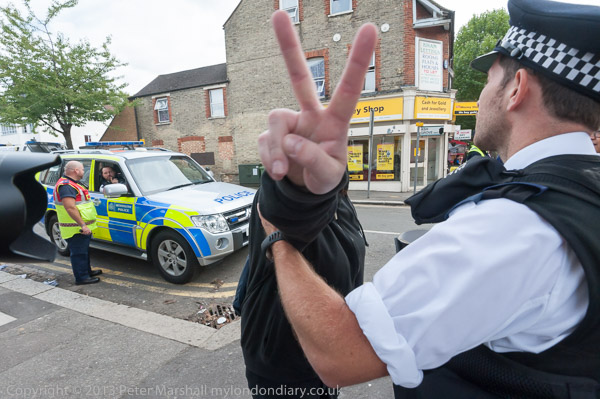
Later when I was photographing them inside the pen they again used these long bamboo poles as weapons. Rather than warn them or take away the poles, police moved photographers back and set a small line of police to keep us out of range. I complained to the officers but as usual they took no notice.
While I was there a number of the anti-fascists were arrested and taken away by police, but none of the SEA were arrested and the police made it clear to them that they were ‘facilitating their protest‘. The extreme right often complain about “two-tier policing” and this did seem to be a clear example of this, but with the SEA being awarded kid glove treatment.
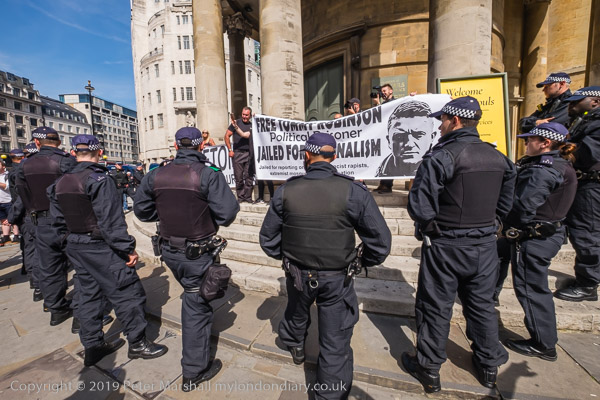
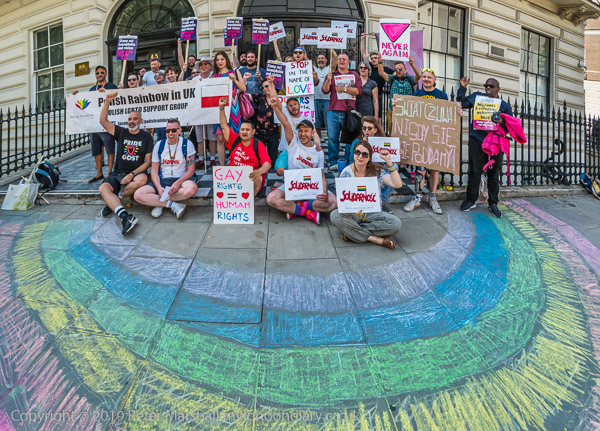
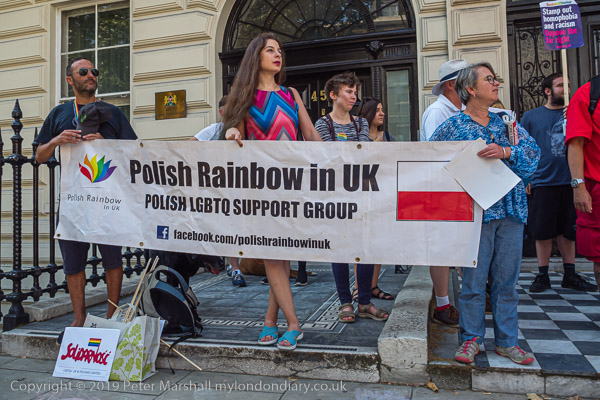
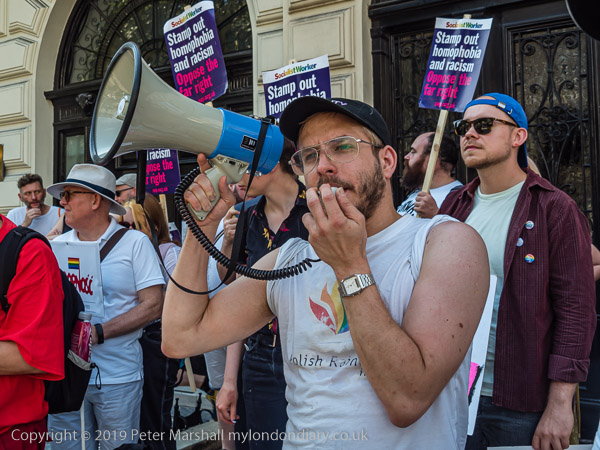
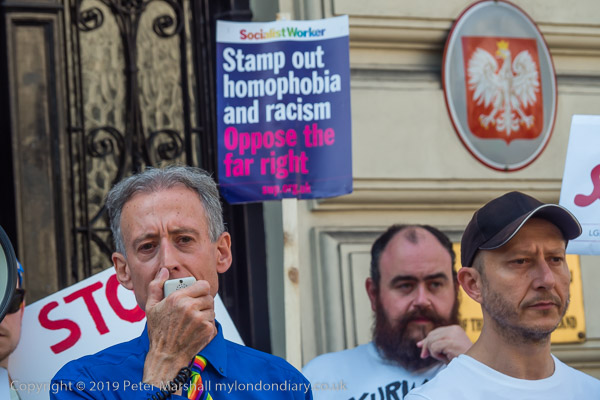
‘Tommy Robinson’ & Poland: Five years ago today, Saturday 24th August 2019 I covered two protests in London against the extreme right. Anti-fascists opposed a protest outside the BBC after far-right activist Stephen Christopher Yaxley-Lennon, better known as Tommy Robinson was jailed for violating a court order, and there was a protest at the Polish Embassy in solidarity with LGBTQ+ people in Poland whose lives are under threat from the right-wing Law & Justice Party and the Catholic Church.
Anti-fascists outnumber ‘Free Tommy’ Protest
Robinson was sentenced to 9 months for 3 offences outside Leeds Crown Court which could have led to the collapse of a grooming gang trial, and has previous convictions for violence, financial and immigration frauds, drug possession and public order offences.
The claim by his supporters that he was imprisoned for ‘journalism’ and in some way is a defender of free speech is simply ludicrous. He knew he was breaking the law and pleaded guilty.
Free Tommy supporters shout at the opposition
All journalists know that they have both rights and responsibilities and we are governed by the laws of the country, particularly with respect to the publication of material. Good journalists often publish material that some people would not want published, citing the public interest in doing so, but in this case Robinson’s actions were clearly against any public interest and could have led to a serious criminal prosecution having to be abandoned.
Two groups of protesters came to oppose the protest outside the BBC by Robinson supporters. I met the London Anti-Fascist Assembly and others at Oxford Circus and accompanied them as they marched up Regent Street towards the BBC.
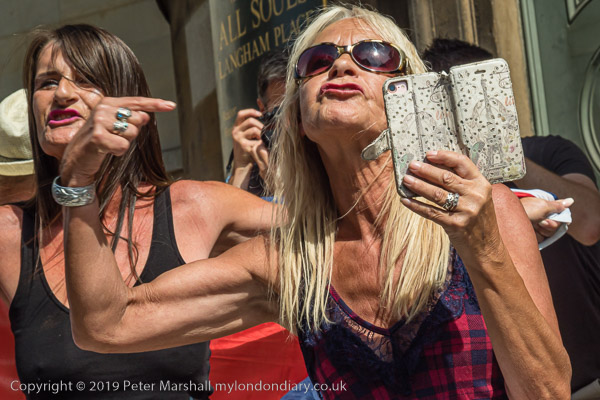
Police marched with them too, and stopped them a few yards from the Robinson protest. When we arrived there were only a handful of ‘Free Tommy’ supporters waiting on the steps of All Souls Langham Place. They shouted back as the Anti-Fascists shoted at them and a police officer warned one of the women about her language as the police moved the Anti-Fascists back to the other side of the road
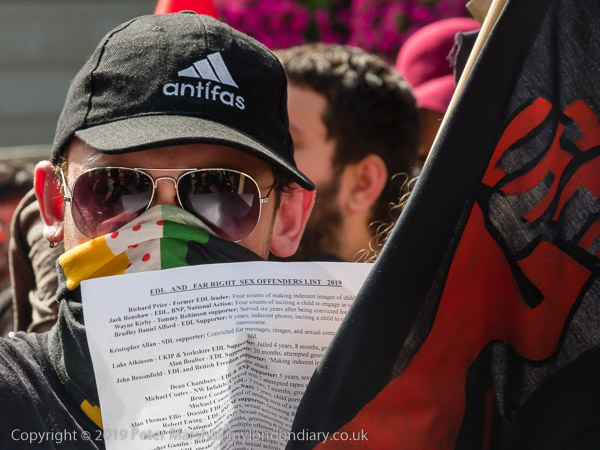
After some considerably shouting at the extreme right they were pushed by police into a pen on the opposite side of the road. Here they continued to shout at the extreme right protesters and a long list of EDL and Far Right convicted sex offenders was handed out.
Shortly after a large group of Stand Up to Racism supporters arrived to stand beside the Antifa protesters. A couple of police horses came as well as a few more Free Tommy supporters who had marched from Trafalgar Square protected by a police escort.
But theirs was still a small protest, greatly outnumbered by those opposed to them.
The stand-off shouting match continued, with police largely keeping the two groups apart. I left for 45 minutes to cover another protest, and returned to find little had changed, but saw one anti-fascist being led away to a police van after being arrested for refusing to get off the road when ordered by police.
Solidarity with Polish LGBTQ+ community – Polish Embassy
Conveniently the Polish Embassy where protesters had gathered to show solidarity the LGBTQ+ community in Poland is only a few minutes walk from the BBC
LGBTQ+ people in Poland are currently living in fear, their lives threatened under the rule of the right-wing Law & Justice Party which together with the Catholic Church have accused them of being a threat to children and to Poland itself.
Some local authorities have declared ‘LGBT Free Zones’ and nationalists groups have actively attacked members of the LGBTQ+ community and Pride events.
Among those who came to speak at the rally alongside Polish gay rights activists were Nicola Field of Lesbians and Gays Support The Miners, Peter Tatchell and Weyman Bennett of Stand Up to Racism
Sean Rigg Memorial – 4 Years – Brixton Tuesday 21st August 2012
There is a lengthy piece on Wikipedia about the death of Sean Rigg whic states that his “case became a cause célèbre for civil rights and justice campaigners in the United Kingdom, who called for “improvement and change on a national level” regarding deaths in police custody and the police treatment of suspects with mental health issues.”
It goes into some detail of the circumstances of his death and the various enquiries that followed but fails to properly represent the huge effort investigating and campaigning by his family, particularly by his sister Marcia Rigg, which brought to light the many lies and failures of the police.
In 2023, the Independent Office for Police Conduct (IOPC) made an unprecedented apology in a letter to Marcia Rigg which you can read in full with her response on the Inquest site.
The Inquest post also has a clear brief summary of Sean’s arrest and the detention that killed him ad the failures of the IPCC investigation, along with a comment by Inquet’s director Deborah Coles, as well as the background to the case.
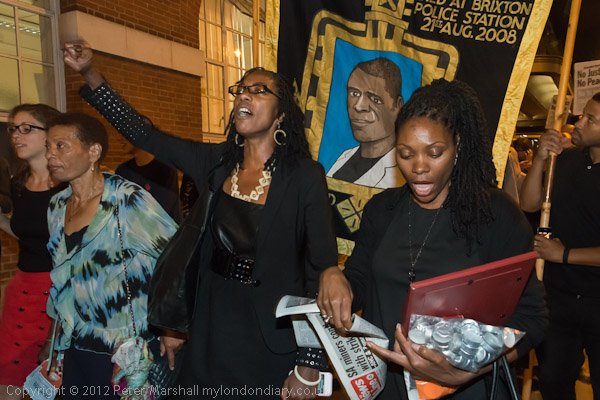
Mona Donle, Sean Rigg’s mother and his sisters Marcia and Samantha lead the march
I’ve written on a number of occasions about the case – and of other suspicious deaths in police custody, including others involving Brixton Police Station, in particular the death of Ricky Bishop in 2001. Here I’ll simply write about the events in Brixton on the evening of Tuesday 21st August 2012.
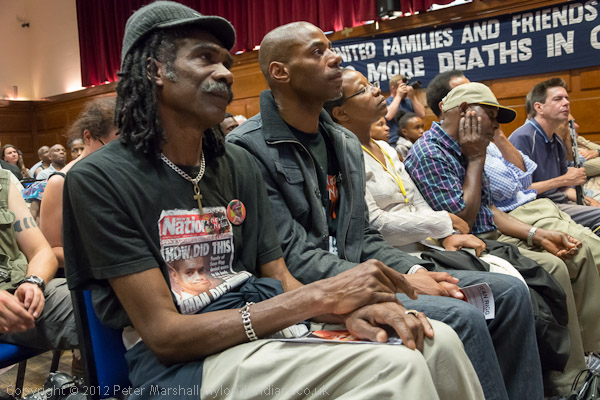
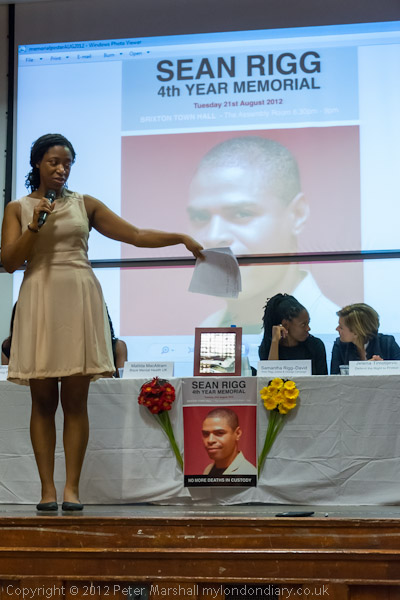
Fortunately I did not want a seat in the Assembly Hall inside Lambeth Town Hall as every one was filled for the memorial event four years to the day after his death. By the time this was over people were standing around the side of the hall and others waiting outside for the vigil.
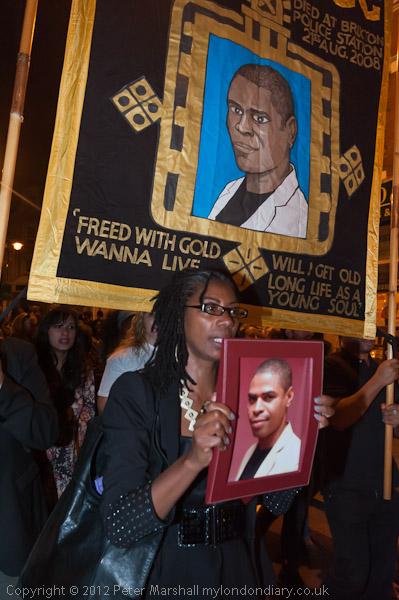
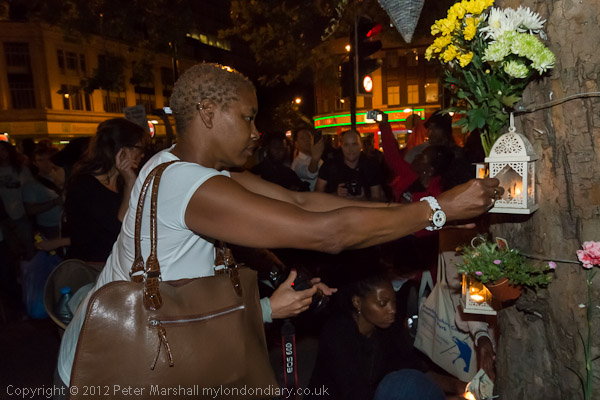
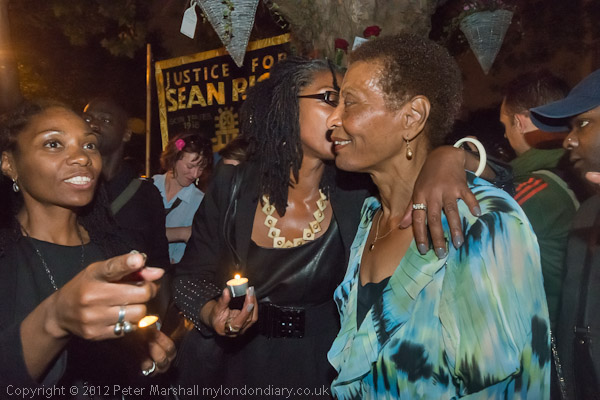
Around 200 people lined up behind Mona Donle, Sean Rigg’s mother and his sisters Marcia and Samantha to march with the Sean Rigg banner to the memorial tree outside Brixton Police Station. Some held placards and carried flowers with his sisters carrying a framed portrait of Sean.
People laid flowers and lit candles at the memorial tree and put up Sean’s portrait and there were some speeches.
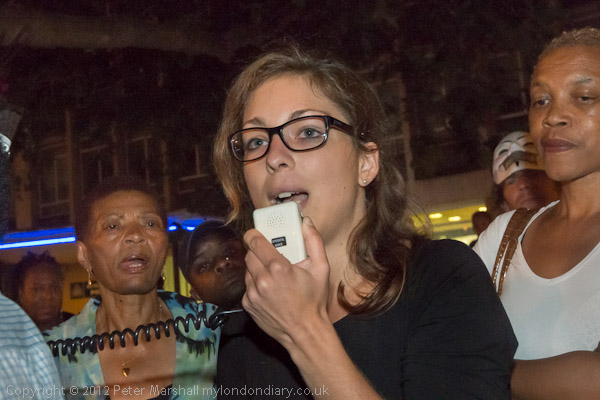
Mona Donle, a Brixton resident described a disturbing incident the previous Sunday in Windrush Square when three police officers violently assaulted a man who was clearly disturbed and acting unpredictably: “One officer choked him by holding his forearm across the man’s throat. Then another officer stamped on him. The foot was on his face and then the man passed out – we kept telling them to call an ambulance.”
As I noted, “The police account reads differently, making no mention of the violence and suggesting that the ambulance arrived ‘approximately’ five minutes after the arrest.” An eye witness told me it was around 20 minutes before the ambulance came and that the man had only just come round.
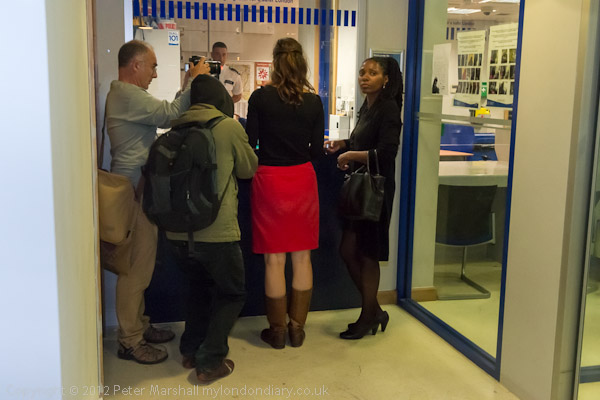
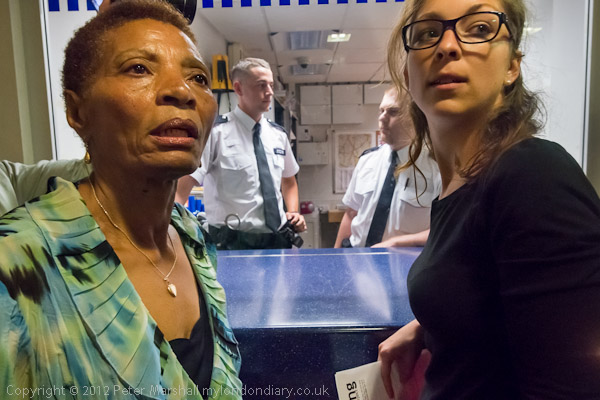
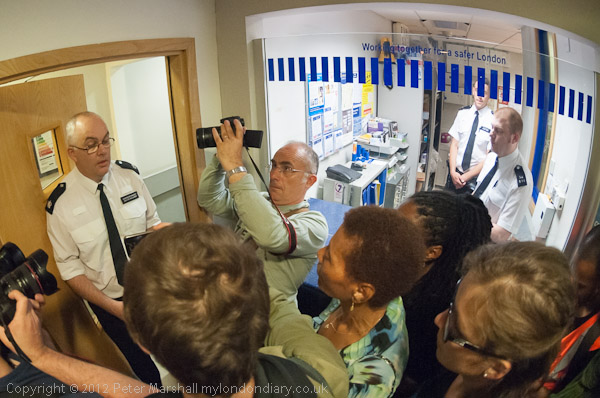
Sean’s mother spoke briefly and then Mona Donle went in to take in a formal complaint about the incident she had seen. At first I watched them from the doorway but when others piled in I joined them.
It was very crowded inside the police station lobby. The complaint was handed in, and a signed and dated copy was returned to the complainant.
But they demanded to hear from a senior officer about what had happened, and after a few minutes Superintendent David McLaren came out, gave a short statement and tried to answer some of the questions, though clearly no-one was satisfied with his answers. The lobby was very crowded and getting hot and it was soon time for me to leave.
It didn’t seem likely that there would be much more happening. One of two people had tried to stir up a little trouble but the Rigg family had made it clear that they wanted this to be an occasion where respect was show for Sean and with others had helped to quieten things down.
No New Coal Rally and March: On Sunday 3rd August I took a train to Rochester in Kent to photograph a rally in the town of Rochester from which people were marching to the Climate Camp was at Kingsnorth on the Hoo Peninsula in Kent where E.ON were intending to build the country’s first new coal-fired power station in 30 years.
I wasn’t able to attend the Climate Camp itself as I was leaving for Glasgow early the following morning so I left the marchers on their way to the site, seven miles away.
There was a large police presence at the rally and for the march, and later at Kingsnorth a number of protesters were arrested, with others assaulted by police who carried out a repressive action against the campers.
Press who had gone to cover the event were stopped and searchers, some multiple times and were subjected to both obvious and secret filming, as well as being pushed and shoved by police who demanded unnecessary personal information. Months later Kent Police admitted they had been wrong to film journalists, but claimed it was hard to tell them from the protesters – despite the fact that they all wore or showed the police-recognised UK Press Cards.
E.ON’s proposals to build a new and highly polluting power station at Kingsnorth had gone largely unnoticed in the media until the Climate Camp brought the issue to national attention. The over-reaction by the police helped to raise its profile, as did the trail of the Kingsnorth Six, activists arrested for causing an alleged £30,000 damage to one of the chimneys of the existing coal-fired in October 2007 and charged with criminal damage.
The activists claimed they had “lawful excuse” for their actions in that they carried it out to help prevent the much greater damage that a new coal-fired power station would cause by accelerating climate change.
Their trial heard evident from five defence witnesses, one of them Professor James Hansen, a former climate change adviser to the US White House, who stated that the social cost of emitting a tonne of CO2 was around £50. He estimated that a new coal-fired power station would cause around £1 million worth of damage per day it ran.
In truth the activists had not actually damaged the chimney significantly, but had simply painted the word ‘Gordon‘ on it, but they were acquitted in September 2008 because the jury found the damage they did to the smokestack was outweighed by the harm done to the planet by emissions from the power station.
E.ON was forced to abandon its plans largely because of the substantial public protests and criticism much of it arising from the publicity given to the Climate Camp and the trial.
The UK establishment were appalled by the verdict, and we have recently seen part of their reaction to this in the recent trial of Just Stop Oil activists who were judged to have committed contempt of court for attempting to introduce similar issues in their defence and then given draconian sentences for their peaceful protest. The law is meant to protect the interests of the rich and powerful not the planet.
You can read more about the rally in Rochester and the march towards Kingsnorth on My London Diary. One Climate Camp Caravan had started from Heathrow a week ago and another, the Stop Incineration Climate Camp Caravan had been travelling from Brighton, both demonstrating at various related sites along their routes and they met on Sunday morning in the middle of Rochester for a ‘No New Coal’ Rally attended by around 300 people.
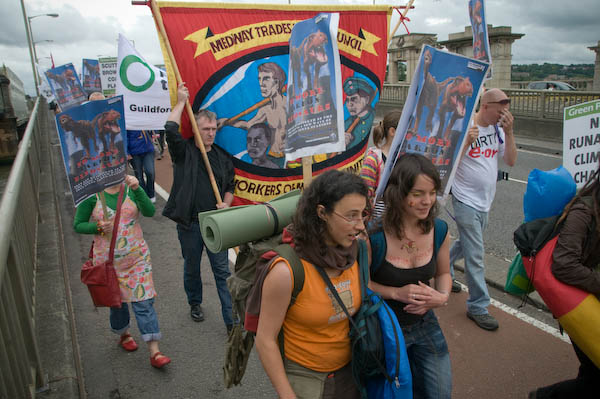
After the rally the protesters set off to march to Kingsnorth and I went with them across the Medway and up the long hill in Strood before leaving them and returning to Strood station.
Muslim Extremists March For Sharia Zones: Today Anjem Choudary is due to be sentenced after having been found guilty of directing and encouraging support for the terrorist organisation al-Muhajiroun banned in the UK in 2005. Choudary whose home is in Ilford could face a life sentence.
The prosecution came about after a joint investigation by MI5, Scotland Yard, the New York Police Department, and Canadian police collecting evidence. His home had been bugged and online events were monitored. Police had been conducting separate investigations into his activities in the UK, US and Canada and came together leading to his trial at Woolwich Crown Court where he and a follower were found guilty last week.
Choudary had been a student of Omar Bakri Muhammad and had helped form the Islamist al-Muhajiroun organisation in Britain in 1996. This was proscribed in the UK in 2005 following the London Bombings, but Choudary carried on his activities under groups with various other names, including Al Ghurabaa, proscribed in 2006, and Islam4UK, banned in 2010.
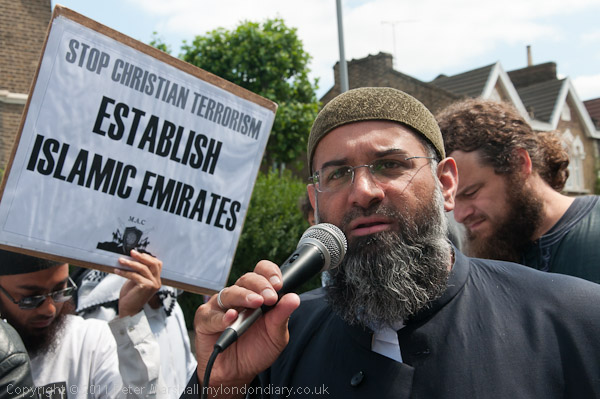
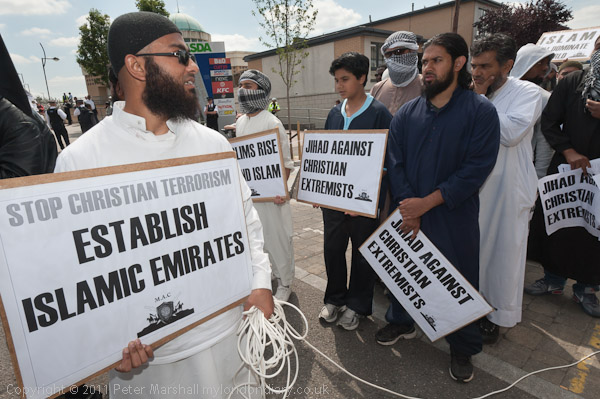
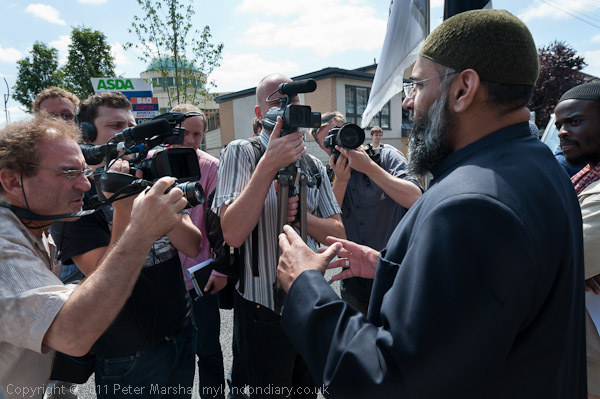
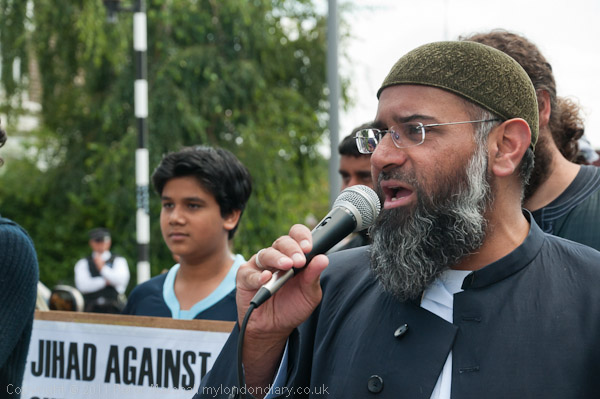
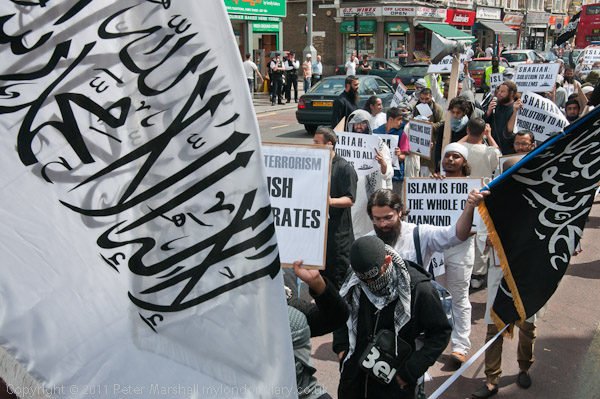
These groups carried out a number of controversial protests to gain wide media coverage, and the East London protest by Muslims Against Crusades on Saturday 30th July 2011 by around 70 men was outnumbered by the press covering it – including me.
This was one of quite a few events where I photographed Choudary, and it appeared to many of us that Choudary, if not actually encouraged by MI5 was certainly being allowed to continue his activities as a way the authorities could keep tag on Islamist activities in the UK.
I heard Choudary speaking in public and was sceptical about the claims he made about ‘Muslim Armies’ but a couple of years later ISIS made them reality. And in June 2014 or shortly after, “Choudary pledged allegiance to the Islamic State’s “caliphate,” and its “caliph” (Abu Bakr al-Baghdadi) “‘via Skype, text and phone’ during dinner at a restaurant in London.”
This was a step too far for the British state and in August 2015 he was charged under section 12 of the Terrorism Act 2000 for inviting support of a proscribed organisation and finally convicted in July 2016. He was sentenced to 5 years six months in prison.
He left prison in October 2018, but there were many conditions attached to his release and it was only in October 2021 that he was fully able to resume his campaigning online. The current conviction relates to his actions since then.
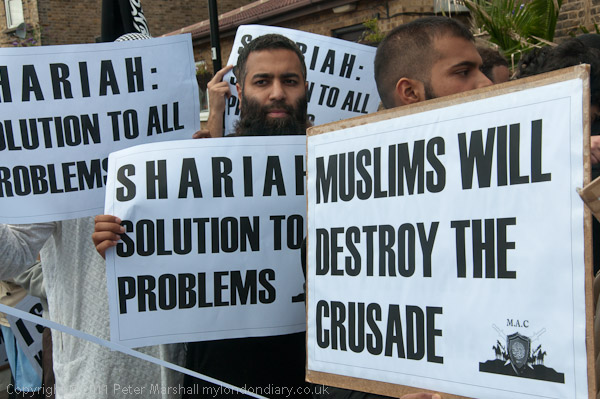
My London Diary has a long account of the march march from Leyton to Walthamstow calling for Sharia Zones by ‘Muslims Against Crusades’, calling for the setting up of Sharia Controlled Zones in the UK which ‘Islamic rules’ would be enforced by Muslims, along with many photographs.
Although the organisers had told the press there would be a thousand marchers, there were well under a hundred. And although the leaflet handed out by the marchers claimed support from a wide range of organisation, as I explained it was in fact “only supported by a very small circle of him and his fellow extremists.” Very few of the Muslims on the streets it went through showed support and rather more made clear that they were opposed.
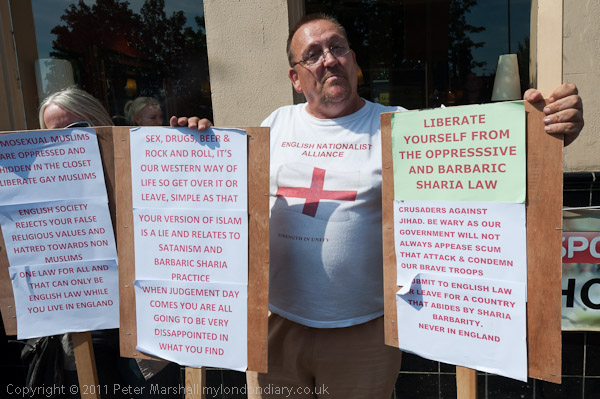
My report also has some coverage of several small counter-demonstrations by the English Nationalist Alliance and other right-wing groups, some of which were stopped by police. As the march arrived for the final rally there were some offensive shouts by some ENA supporters but their protest was otherwise peaceful.
During the final rally there were some minor scuffles in a large crowd of Muslim youths as some objected to the speeches by Muslims Against Crusades, but police moved in quickly. Some photographers close to the scene had their cameras grabbed or were pushed as they tried to photograph what was happening, but I was some distance away.
Of course there were no Sharia Controlled Zones in London, just a few notices like these put up by this small group which had no effect. But my picture was widely pirated on at least 86 web sites around the world, used by right-wing extremists to spread the myth that such things existed. DCMA requests got some of them taken down, but they just appeared elsewhere.
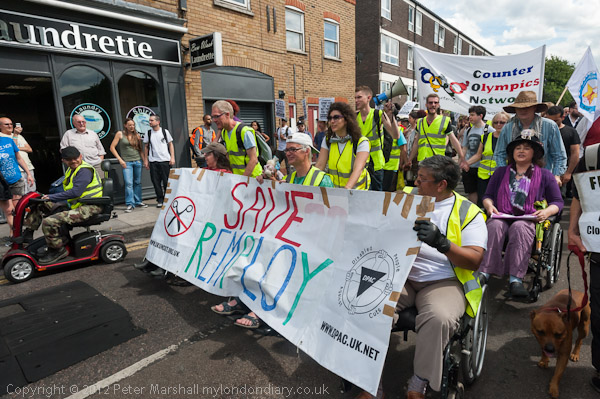
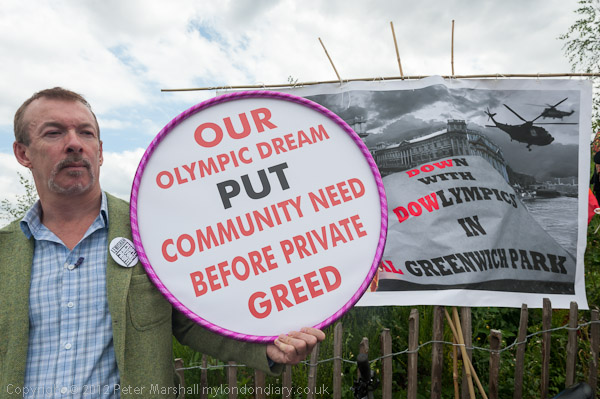
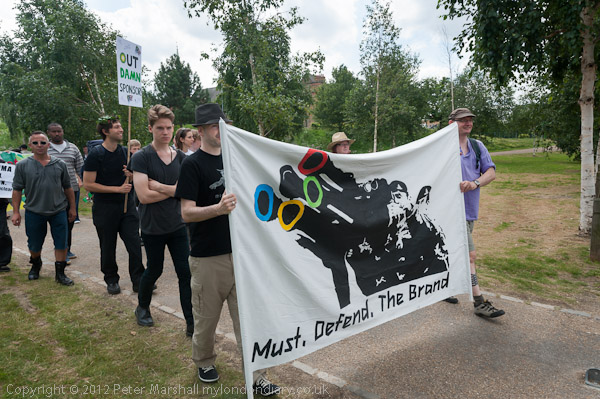
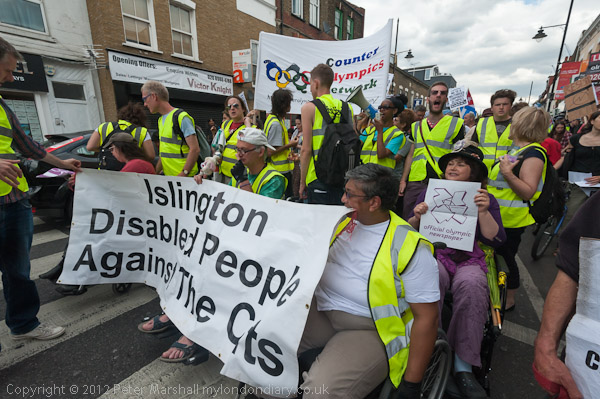
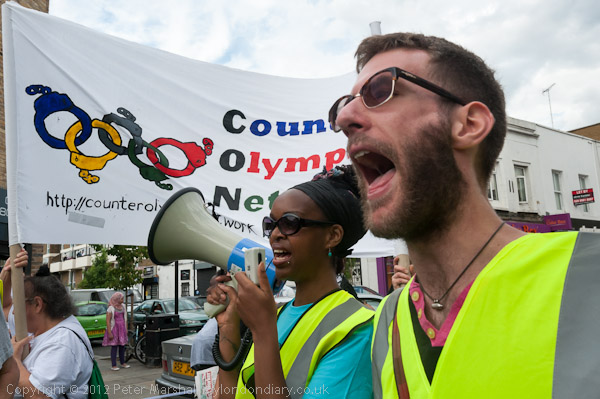
March for a People’s Olympics: Twelve years ago on Saturday 28th June 2012 the London Olympics was in full swing and London was suffering from huge restrictions on the activities of ordinary Londoners.
Although the modern Olympic movement was started in 1894 by Pierre de Coubertin with high aims it has changed over the years to something very different. He intended them to help build a peaceful and better world by educating young people through sport and stated “The important thing in the Olympic Games is not to win, but to take part; the important thing in life is not triumph, but the struggle; the essential thing is not to have conquered but to have fought well.”
Instead what we now have is a fiercely nationalistic event, with countries devoting huge resources into training a small elite of athletes and expenisve and highly detailed scientific research to find legal ways to enhance their performances – as well as at least in some countries to find ways to circumvent the tests designed to prevent the use of illegal drugs.
The games have also seen a corporate takeover to provide some of the huge sums needed to stage such events, although taxpayers have also suffered. London 2012 cost £8.77 billion, around three and a half times its original budget, around two thirds from general taxation, a quarter from the National Lottery and the remainder from the Mayor of London and the London Development Agency.
The money for the games in London meant there was less to spend in other areas or the country, and even diverted money from grass roots sport. And huge amounts were spent on infrastructure designed for the needs of a few weeks in 2012 rather than the best interests of the future for the Olympic area.
London in 2012 saw a huge military presence, in part aimed at reducing the risk of terrorist attacks and draconian policing largely aimed at the protection of the brands of the various sponsors.
The ‘Whose Games? Whose City?’ protest had at first been totally banned by the authorities as its start point was only just over 2km from the Olympic stadium. Transport for London had refused permission for them to march along roads which had been designated as emergency backup Games routes. Eventually the march organisers came to an agreement with the police that should an emergency arise the marchers would simply go on to the pavement – something that regularly happens with marches when ambulances and other emergency vehicles are allowed to pass.
The endpoint of the march, Wennington Green, was also around 2km as the crow flies from the stadium, and Tower Hamlets Council, owners of Wennington Green attempted to ban speeches or other events there.
Marchers were also threatened with arrest should they display placards, hold banners or even wear t-shirts with political slogans. But on the day there were no arrests although police did at one point stop and search a man who had cut a piece of police tape. He was released after a large and noisy crowd of marchers gathered around and demanded his release.
The attempts by the authorities to stop the march taking place had led to a great deal of media publicity and press and TV from around the world came to cover the start in Mile End Park.
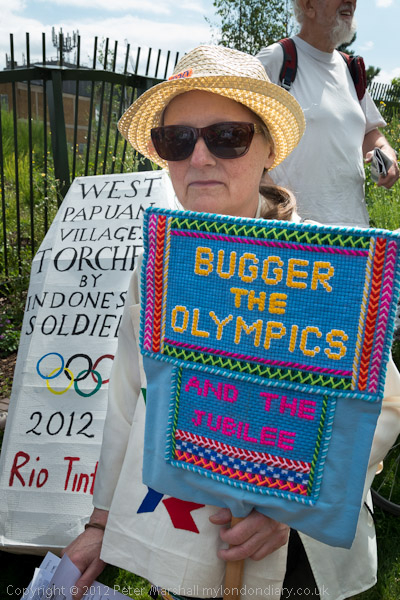
The march organisers, the Counter Olympics Network (CON) pointed out strongly that this was not an anti-Olympics march, but one that protested at the way what should be a sporting event of noble origins has been taken over by corporate interests.
They pointed out that the games sponsors included “serial polluters, companies which seriously damage the environment and which wreck or take lives, Coca Cola, Rio Tinto, BP, Dow Chemical” as well as stating “G4S, Cisco, and Atos deny people their human rights in a variety of situations while Macdonalds helps to fuel the obesity epidemic. London2012 provides benefits at taxpayers’ expense while receiving little in return.”
They also pointed out the many broken promises and pointed out the doubts about the legacy of the games for East London in particular: “the lack of benefits for local people and businesses, the fantastic expansion of security into our daily lives, the deployment of missiles and large numbers of troops, the unwarranted seizure of public land at Wanstead Flats, Leyton Marsh and Greenwich Park.“
As the march went past the former match factory soldiers on top of the flats watched the marchers who chanted “Hey Ho, Sebastian Coe Get your missiles out of Bow“
Another popular chant also mentioned Coe: “Seb Coe, Get Out, we know what you’re all about! Missiles, job losses, Olympics for the bosses!”
Chris Nineham of the Stop The Olympic Missiles Campaign was one of the first speakers at the final rally. He pointed out that the London Olympics had already set a number of records, including the largest ever number of arrests on the first day – including 182 cyclists taking part in a ‘Critical Mass’ ride the previous day – the highest ticket prices, the most intensive application of branding rules and the highest level of militarisation of any Olympic games, with far more being spent on security that even in China.
There were, he said, more troops in London than at any time since World War 2, and more than at any time in Afghanistan, and that it was our presence there which made us a terrorist target, calling for the immediate withdrawal of our troops.
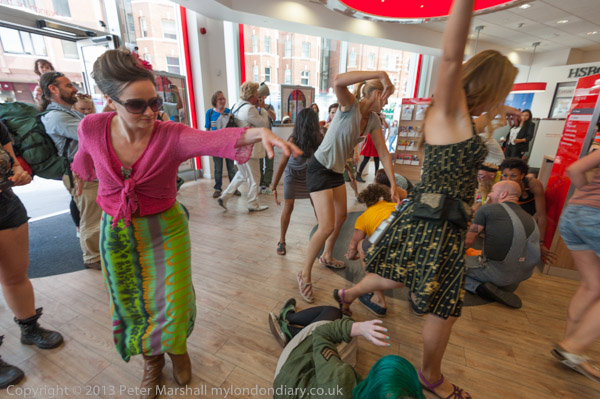
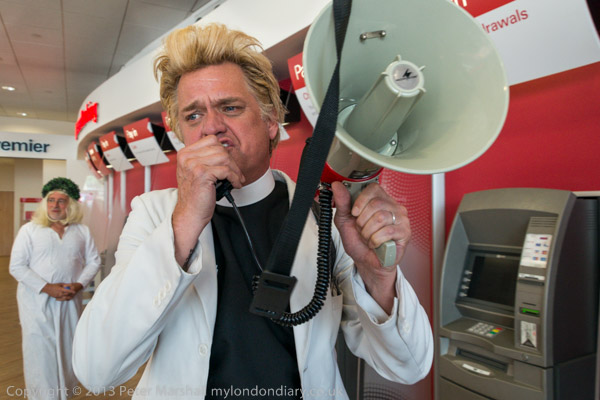
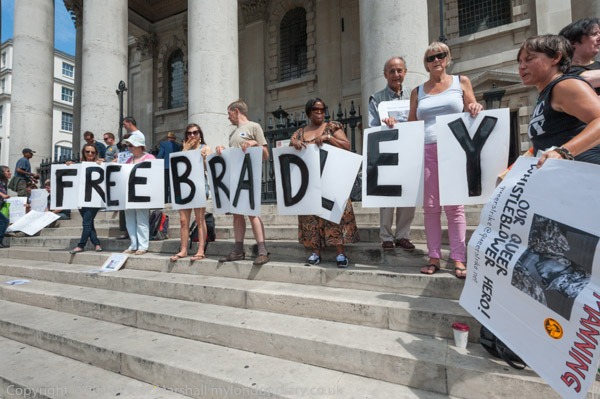
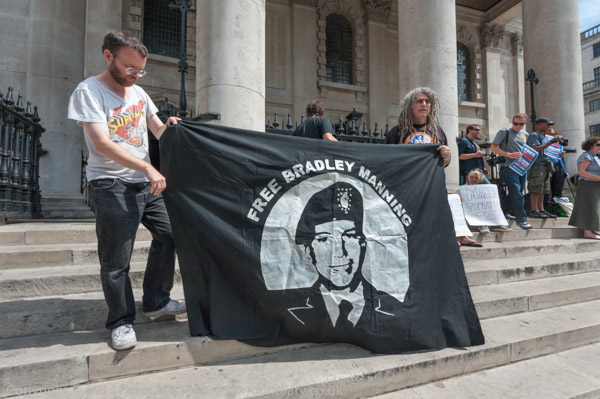
Rev Billy, Chelsea Manning & Global Racism – On Saturday 27th July 2013 I followed the amazing Reverend Billy and the Stop Shopping Choir into a branch of HSBC to protest over their support for fossil fuels, went to a vigil supporting whistleblower Bradley (now Chelsea) Manning and then a march and rally against Global Racism and Injustice
Rev Billy at HSBC Victoria,
If you’ve not come across Reverend Billy and the Stop Shopping Choir, a radical performance community based in New York City led by Billy Talen you have missed something. They perform guerrilla theatre actions which amuse and entertain while also highlighting the serious problems the world is facing and calling for action.
The performance in London was one of many at various JP Morgan Chase and HSBC banks in 2012 and 2013 which had begun in New York, a “radicalized midsummer cloud forest dream” against the support given to fossil fuels and climate chaos by the banks and the City of London.
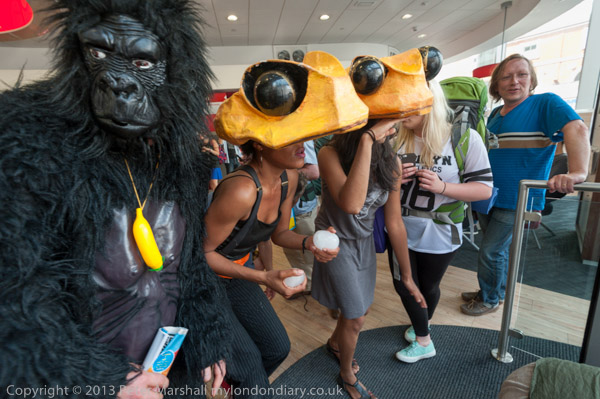
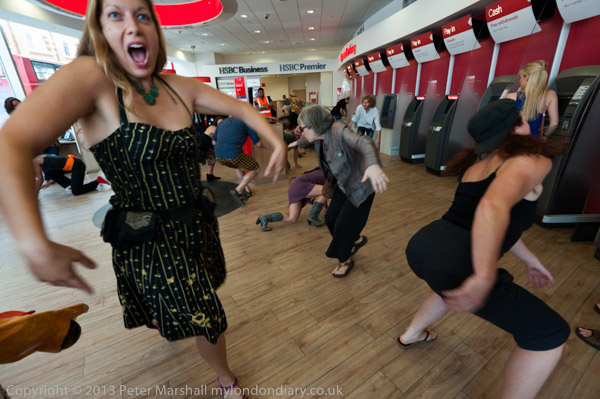
Golden Toads had become extinct in their home in Costa Rica, one of many species that have already become extinct because of climate change. The message of the performance “was a simple one. Fossil Fuels are killing life on this planet. Already many species have suffered extinction, and the continuing huge investment in fossil fuel use backed by the banks and the stock exchange is driving climate change, threatening us all with extinction.“
As I wrote “London’s banks and the London Stock Exchange are playing a key role in the destruction of life on the planet, with over £900 billion of Fossil fuel shares on the London Stock Exchange – a quarter of the value of all the holdings and representing fossil fuel reserves of over 200 time the UK’s annual carbon emissions. Burning of all these reserves would create catastrophe. Between 2010-2012 … the top five UK banks raised £170 billion for fossil fuel companies, and the largest of these was the HSBC.”
On My London Diary you can read how I met the group as they trained for the performance opposite New Scotland Yard and then more about the performance which as well as the Golden Toads people also played moneys, eagles and jaguars and were joined by a gorilla. with the Rev Billy preaching about the need for the banks to repent and change their ways as the animals dropped dead on the branch floor.
One member of the team was there to reassure the bank staff and customers that there was no threat to them or property and that the performers would leave as soon as the event finished. And they did, leaving behind only some leaflets and small pools for water on the floor from the large ice eggs the Golden Toads had brought with them to help cool the planet down.
After leaving the bank the performance carried on for a few minutes on the wide pavement outside. A couple of police officers arrived and went inside the Bank to talk with the staff, and by the time they came out the Rev Billy and others were leaving to celebrate a successful action at a café and bar in Victoria station.
Free Bradley Manning Vigil – St Martin’s, Trafalgar Square
People were begining to arrive to take part in a silent vigil on the steps of St Martin-in-the-Fields on Trafalgar Square as a part of the international day of action by the Bradley Manning Support Network.
Bradley – now Chelsea – Manning’s court-martial for passing classified documents to Wikileaks had begun over a month earlier and an inevitable ‘guilty’ verdict was expected shortly.
The documents had exposed a great deal of illegal and immoral actions by the US and other governments and Manning had been celebrated in countries across the world and awarded the Sean MacBride Peace Prize.
On July 30th 2013 Manning was sentenced to 35 years in the maximum-security U.S. Disciplinary Barracks at Fort Leavenworth, but in 2017 her sentence was commuted by President Obama to seven years and she was released. In 2019 she was again imprisoned for a year for contempt of court after refusing to testify at a grand jury investigation into WikiLeaks founder Julian Assange.
Against Global Racism and Injustice – US Embassy to Whitehall
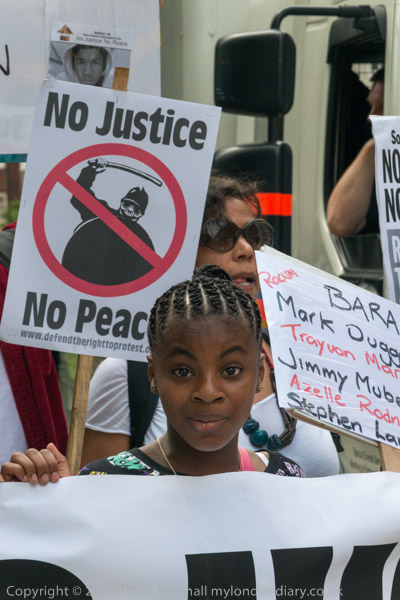
Black Activists Rising Against Cuts (BARAC) UK organised a march and rally against Global Racism and Injustice in solidarity with families of Trayvon Martin, Stephen Lawrence, Azelle Rodney, Jimmy Mubenga and many others to highlight the reality of racism and seek justice, both in the UK and US.
The event began with a rally outside the US Embassy, then still in Grosvenor Square, led by Zita Holbourne and Lee Jasper, founders and national co-chairs of BARAC, an anti-austerity, anti-racist campaigning organisation, with various other activists and poets speaking.
The event was supported by a wide range of anti-racist groups including Operation Black Vote, the National Black Students Campaign, Global Afrikan Congress, PCS, RMT Black Members, Counterfire, UAF, Love Music Hate Racism, Lambeth TUC, Lambeth People’s Assembly.
The protest was in part because of the global outcry over the acquittal in Florida of the murderer of Trayvon Martin under the Florida ‘Stand Your Ground’ law. But it was a protest against global racism and injustice, with a particular emphasis on several well-known cases in this country.
One was the attempt by the Metropolitan Police to smear both the Lawrence family and its supporters through a covert police surveillance unit while failing to properly investigate the racist murder of Stephen Lawrence.
Lee Jasper stated “We march for Jimmy Mubenga, Mark Duggan, Kingsley Burrell, Smiley Culture and Azelle Rodney. We march for justice and equality in the 50th anniversary year of Dr Martin Luther King’s 1968 March on Washington. The truth is that his dream is a threadbare vision here in the UK where racism is on the rise amplified by austerity.”