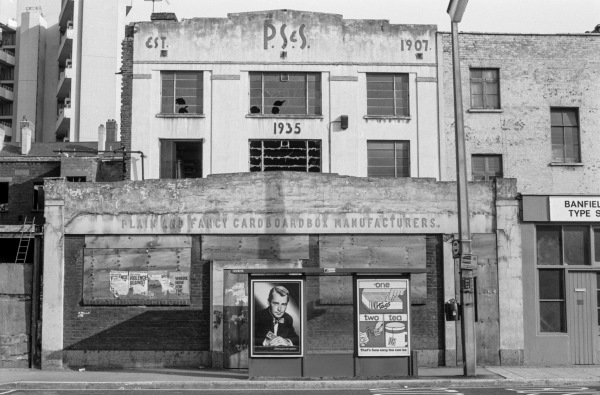
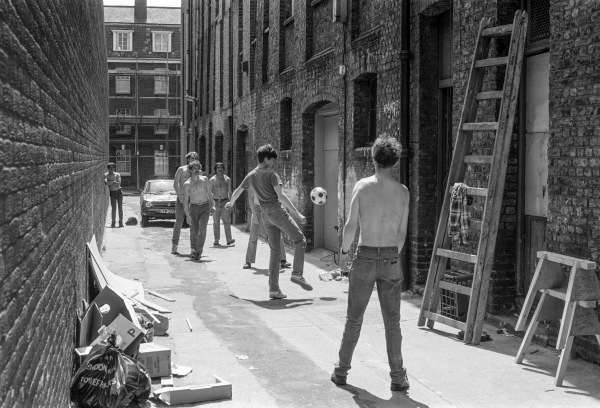
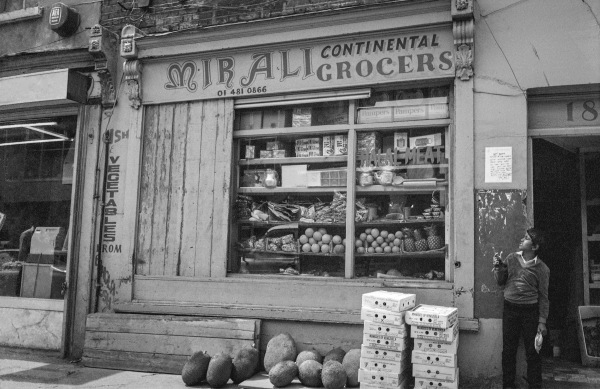
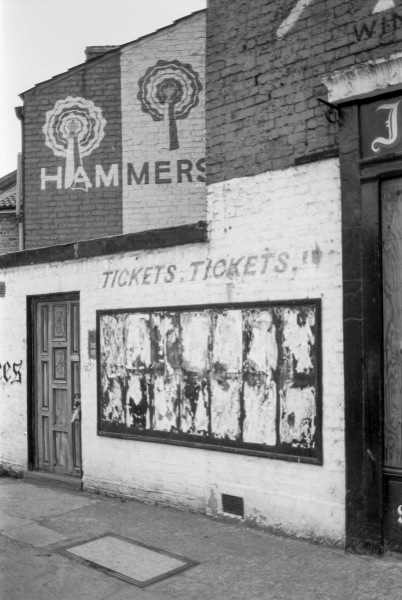
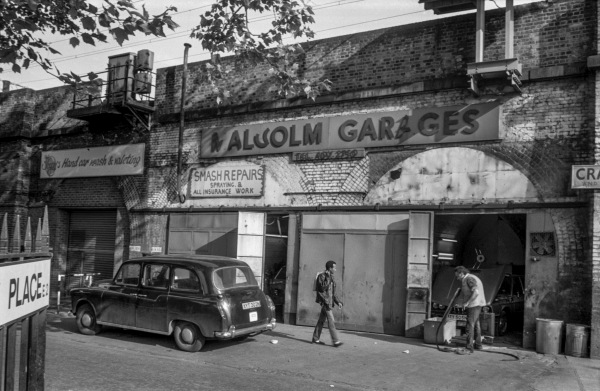
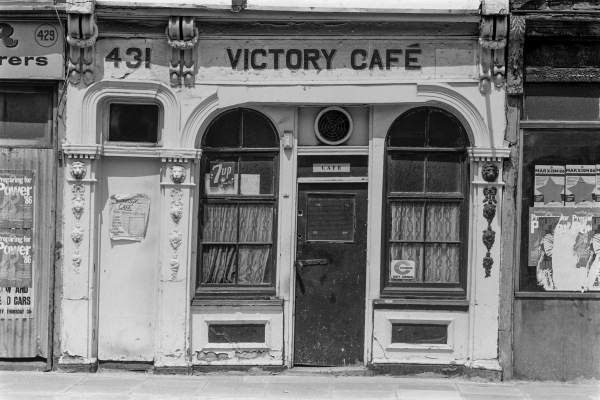
I had more time to take pictures in July as my teaching came to an end for the summer vacation around halfway through the month. This meant I could go up to London on some weekdays, though I still had two small boys to look after on days my wife was working. That usually meant staying at home, but sometimes I took them both out with me to London.
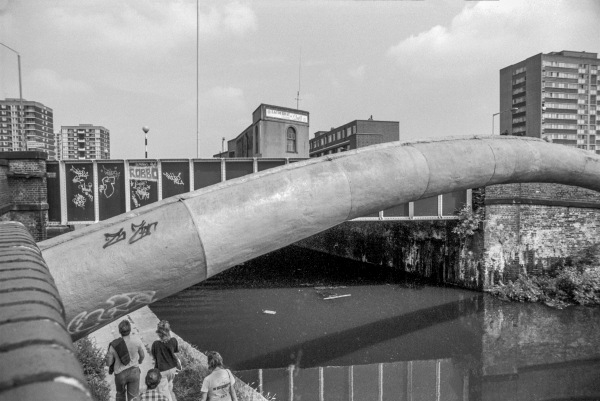
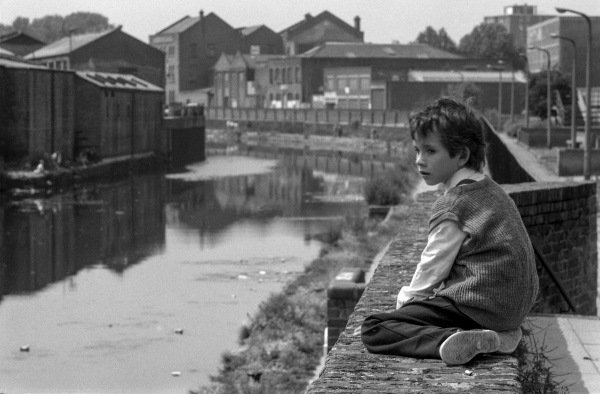
Regent’s Canal
I spent some time in Shadwell and Bethnal Green, but also further north in Shoreditch, Hoxton and Dalston, occasionally wandering into Islington. Though I obviously photographed on foot, I had to travel from my home outside London and then around London to the starting point for my walks, and the One Day Capitalcard, valid on all public transport in London after 9.30am made this much simpler after its introduction in June 1986 – the one-day Travelcard launched in 1984 had been for bus and tube only.
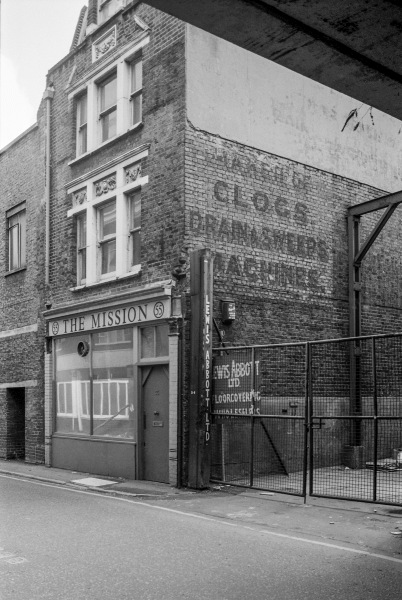
The Mission, Holywell Lane, Shoreditch, Hackney
Towards the end of the month I moved my focus to the City of London, even easier for transport then as the Waterloo and City line was still run by British Rail and my ‘London Terminals’ ticket was valid all the way to Bank.
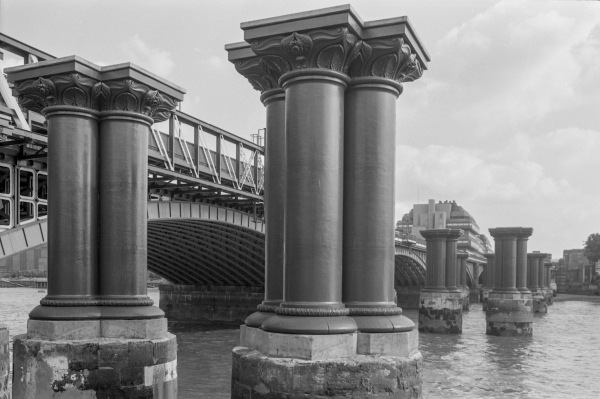
Blackfriars Rail Bridges
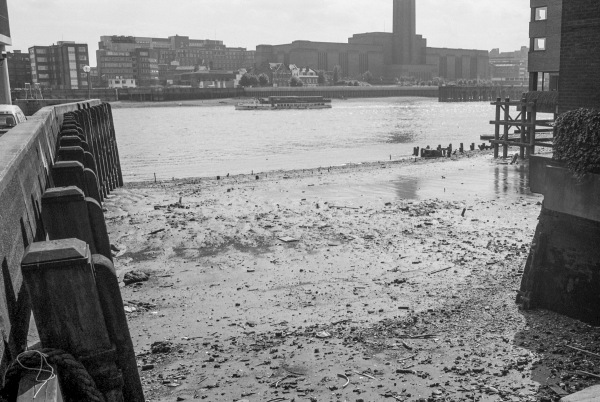
When I began photographing London there were two railway bridges across the River Thames at Blackfriars, but all that remained of one of these by 1986 were the pillars that had supported it. And while these were rather a fine set of pillars they were (and remain) a rather curious river feature, presumably left in position simply to save the cost of removing them.
Queenhithe and the River Thames
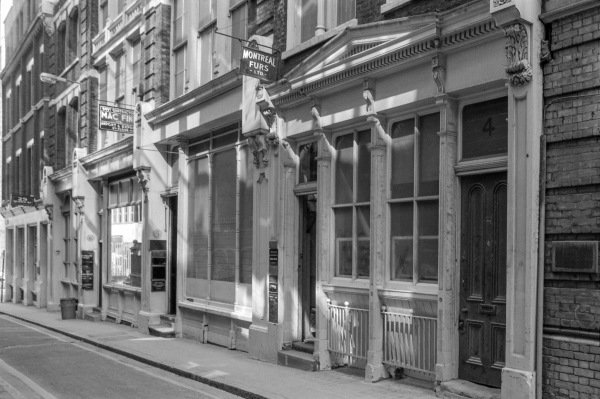
Queenhithe, a small inlet on the City side of the river has a long history. The Romans built a quay here, and buried deep down in the wet mud some of the timbers they put here survive, as do remains of the dock contructed when Alfred the Great, King of Wessex re-established the City of London aroudn 886 AD. It got the name Queenhithe (a hythe is a small harbour) when Henry I gave the right to levy dues on goods landed there to his wife Matilda around the time of their marriage in 1100. Queenhithe was still a major harbour for the city hundreds of years later and remained in use, with lighters bringing skins for the fur trade which was based a short distance to the north until the Second World War.
Fur shops in Great St Thomas Apostle
Around 300 of the black and white pictures I took in July 1986 are now online: Peter Marshall: 1986 London Photographs on Flickr. July’s pictures start here.
The images are copyright but may be shared on non-commercial personal social media. A licence is required for any corporate, commercial or editorial use.
All photographs on this and my other sites, unless otherwise stated, are taken by and copyright of Peter Marshall, and are available for reproduction or can be bought as prints.
There are no adverts on this site and it receives no sponsorship, and I like to keep it that way. But it does take a considerable amount of my time and thought, and if you enjoy reading it, please share on social media. And small donations via Paypal – perhaps the cost of a beer – would be appreciated.
A few months back I was lying prone inside a giant metal tube on a flat bed which moved me slowly backwards as successive slices across my body were scanned for the purposes of research, and the CT scan reminded me of a project on London which I began in the 1980s.
Nowadays we are all familiar with the idea of geotagging and some cameras can add geotags to the Exif date as you photograph, while gadgets can be fixed onto other cameras to add the data. Smartphones do the same, as they always track you position. The web site https://www.geograph.org.uk Geograph was set up in 2005 to “collect geographically representative photographs and information for every square kilometre of Great Britain and Ireland” and so far 13,114 contributors have submitted 6,397,064 images covering 280,384 of the 1km grid squares, still leaving around 15% should you wish to strike new ground.
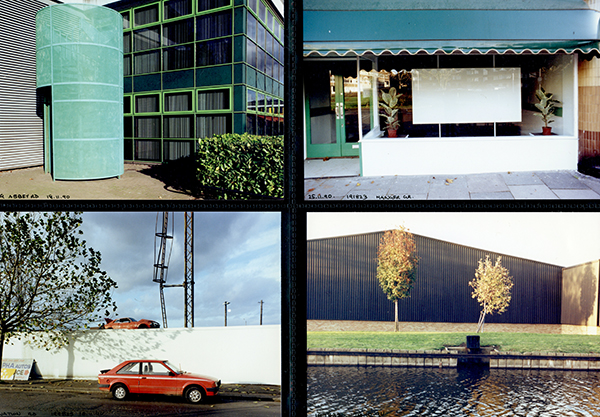
TQ2083
I’ve occasionally added geotags to my own landscape pictures in Lightroom, using a free little phone app by one of my sons, ‘Easy GPS Logger’ which records GPS location and time data to a file. You load this into LR along with the pictures, match up any one of them with a particular place on a map and LR then uses the file to add the information to the other pictures. There are only two problems – remembering to turn on the logger at the start of your walk, and secondly to turn it off when you finish!
TQ1982
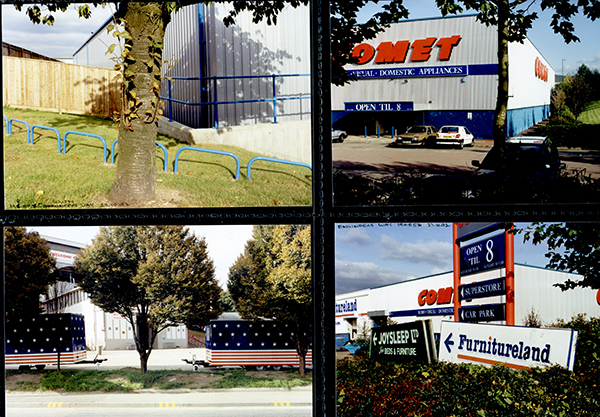
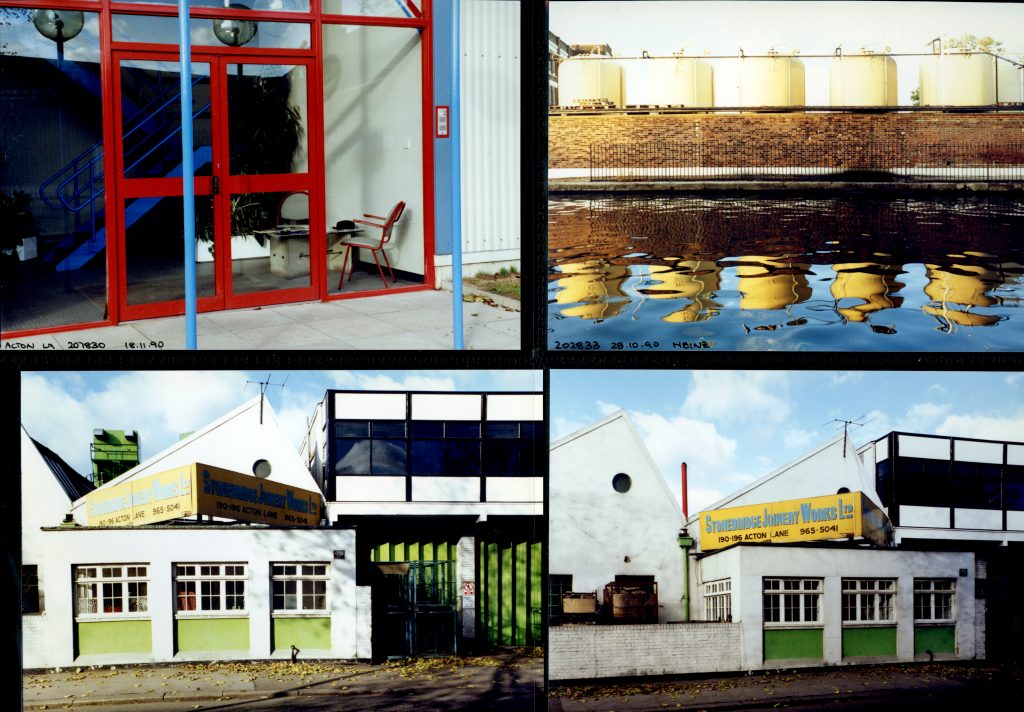
Back in 1986, the only way to add location data to your photographs was by hand, using a map to find the grid reference. Of course you had to know where you were to do so. I had the idea of doing a series of South to North cross-sections of London based on the Eastings and Northings of the National Grid using colour negative film.
Rather than attempting a series of south-north walks, I simply took a camera with colour negative film on more normal walks while I was photographing London in black and white, then sent the films for processing and printing 6×4″ enprints. When these came back from processing I’d sort out those I wanted to keep and use a map to find the grid references and add these and the date with a technical pen along the lower edge of the print. The date meant (at least in theory) I could find the negatives in my files.
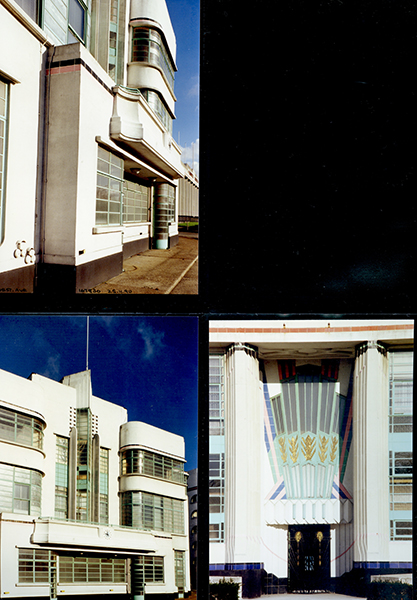
TQ1683
At first I glued the prints onto card sheets to file them under the grid reference in a set of A4 files, but this soon became tedious and I bought filing sheets which held 8 prints, four on each side. Each of the kilometre grid squares had its own filing sheet, and some soon had several, with the series expanding to fill around a dozen A4 files. Each file holds around 50 double-sided sheets and so could hold around 400 prints, though many sheets are not full, so the project probably has around 3,000 or 4,000 prints.
TQ1978
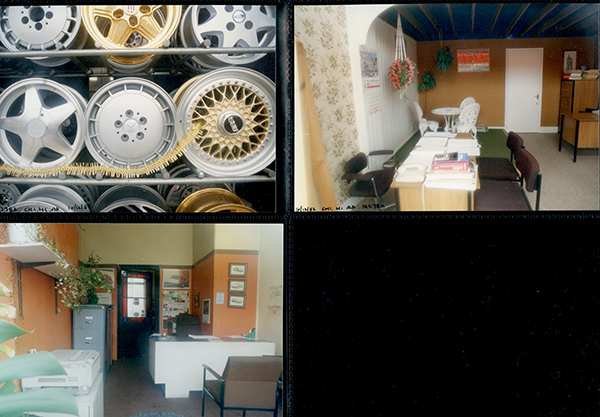
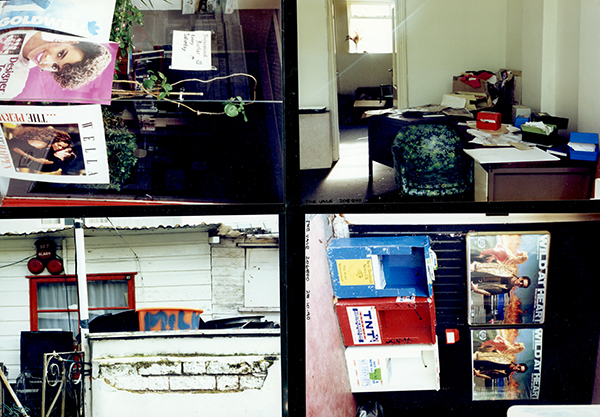
Of course what was more important were the scenes I chose to photograph. I carried in my wallet a reminder of things I was interested in photographing (an idea picked up from reading a list made by Walker Evans), in a small zipped pocket together with a folded £20 note for emergencies. Of course colour was important, not just for itself, but as an illustration of how and why colour was used, and I had a great interest in representations of people and things, in ethnic differences and in the evolution and fashion of colour.
I can’t remember exactly when I ended the project, though it certainly continued well into the 1990s. But at some point I stopped sending colour negative film to be processed and began developing it myself, and producing enprints wasn’t really an option. Instead I made 8×10″ contact prints and worked from these, producing very many fewer but larger prints.
TQ2080
Over the years I’ve probably published or shown only around a hundred of these pictures, the largest group from 1986-90 in the book dummy and web site ‘Café Ideal, Cool Blondes, and Paradise‘
As with my black and white images of London, this is a body of work which I think has a great deal of historical interest as well as some photographic interest and it would be good to see it in some permanent museum or similar collection rather than simply gathering dust on my shelves.
There are no adverts on this site and it receives no sponsorship, and I like to keep it that way. But it does take a considerable amount of my time and thought, and if you enjoy reading it, please share on social media. And small donations via Paypal – perhaps the cost of a beer – would be appreciated.
I had a busy month in June 1986. Of course there was the teaching, though by that time of year my A Level students were busy sitting exams, which took some of the pressure off for me, though there were the practical exams. And of course exam invigilation, a time of extreme boredom.
At home there will have been strawberries to pick and other little jobs around house and garden, as well as two young boys to help looking after. And sometimes I would take one or both of them out for long walks with me, as I went out taking pictures at the weekends, mainly in that month in Tower Hamlets, occasionally straying into Hackney.
During that month I made over 500 exposures on black and white film, seldom taking more than one exposure of each scene, and perhaps half that number in colour. It was around this time that I started seriously to produce some kind of comprehensive document of the fabric of London which I had been photographing in a less concentrated and asystematic fashion since 1973.
What had previously been largely dérives from a particular starting point now became carefully planned, with research in books on the city and poring over maps. Where previously it might have been the delightful whimsy of Geoffrey Fletcher that lead me to picturesque corners, this was now replaced by the duller encylopaedic prose of writers such as Harold Clunn, whose 1951 ‘The Face of London’ revised his earlier work to take account of wartime losses and attempted to be a complete guide to Greater London from his fifty years of perambulations.
Of course I seldom stuck to those carefully made plans, often being diverted by the lure of the streets, but I did begin making notebooks of where I walked, noting down street names and important details, marking up where I had walked on street maps (many of which have now fallen to pieces.)
After developing the films I would as usual make contact sheets, but I would then mark these up with Indian ink in a Rotring pen (and small writing I now often need a loupe to read) with street names and map references. In later years the A-Z came with the National Grid superimposed and my contacts included grid references too.
Of course, nothing is perfect, and sometimes I got street names wrong, and my writing and abbreviations are not always legible. I’ve now put around 140 of the pictures from June 1986 into my Flickr album ‘1986 London Photographs‘, almost all of them with at least a street name to identify the location. It took a few days to make and retouch the digital files, and once I had done that, over a day’s work to confirm the locations where possible using Google Street View. Some areas of course changed completely between 1986 and the earliest information from Street View – usually 2008, making it impossible in a few cases to be completely sure of where images were taken.
All of the images on Flickr have a longest side of 2400 pixels, four times the size of those in this post (- and landscape images only display at 75% unless you double click to open them.) Although I’m happy for people to share them and use them with proper attribution on personal blogs and non-commercial personal web sites, in student essays etc, they remain copyright, and a licence from me is required for any commercial or editorial use.
February’s event are now completed on ‘My London Diary‘ thanks to a few days I’ve taken off going out to take more photographs. It’s getting harder for me to go out and take pictures at night or in bad weather and I’m also getting a little pickier about what I cover. This month’s list is around half as long as some others.
I’ve also been busy with some other things – getting a small show of work ready for next month (here’s the invite) and putting quite a few more of my old pictures at a decent size on Flickr.
All photographs on this and my other sites, unless otherwise stated, are taken by and copyright of Peter Marshall, and are available for reproduction or can be bought as prints.
There are no adverts on this site and it receives no sponsorship, and I like to keep it that way. But it does take a considerable amount of my time and thought, and if you enjoy reading it, please share on social media. And small donations via Paypal – perhaps the cost of a beer – would be appreciated.
Unfortunately we have had to cancel the private view, but we still expect the show to take place as scheduled – and you can come along any time from 19th March to 22 April to view it.
Perhaps not the best time to be having an opening, as the whole country could well be in lock-down by then. But I hope there will be no problems in going ahead with this. The hospital main entrance is just across the top of Tottenham Court Road from Warren St station; turn right immediately you enter for the show, which you will have seen through the windows as you walk along to the entrance.
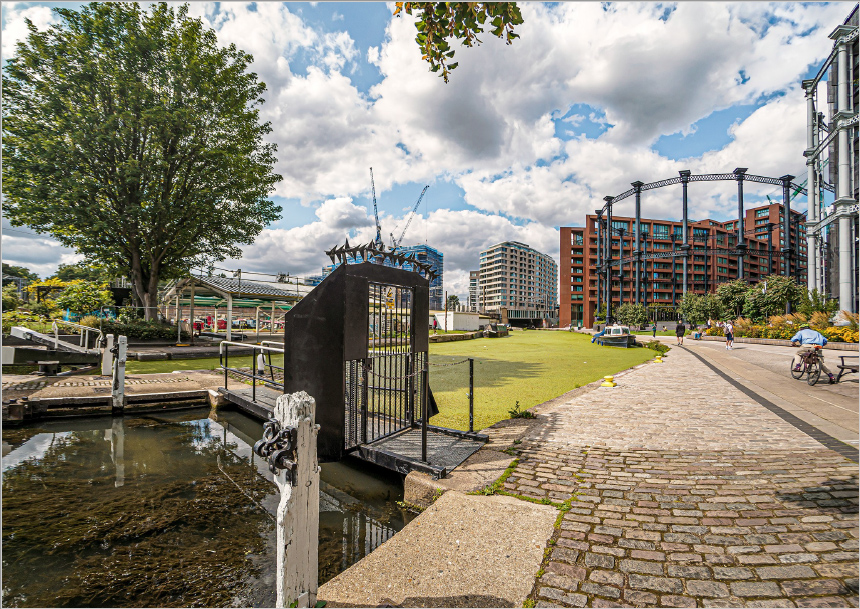
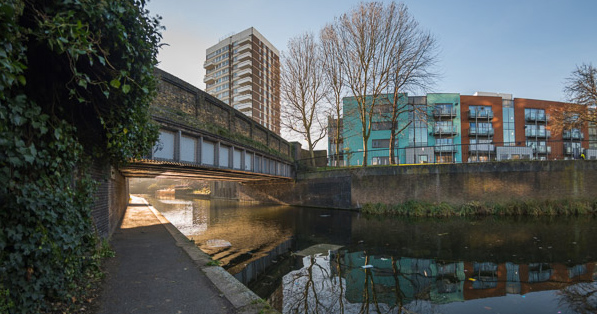
My contribution is 12 panoramic images taken on a number of walks along the Regent’s Canal over the past year as a small celebration of the 200th anniversary of its opening.
If you can come, please RSVP to help planning for snacks and wine etc. But anyone can just turn up at the event – or go and see the show any time until 22nd April.
If you would like to print out the invitation you can download a PDF.
If you are in London next month you are invited to the private view of the exhibition ‘2020 Vision – Vistas and Views’ at The Street Gallery, University College Hospital, 235 Euston Road, London, NW1 2BU. The gallery is along an area at the front of the hospital – turn right immediately you go through the main entrance – and will be on show until 22nd April 2020.
As well as paintings by Hilary Rosen the show includes a dozen pictures from a project I’ve been working on when I’ve had time over the past year, ‘Regents Canal 200‘.
The Regent’s Canal, which runs from Little Venice on the Paddington Arm of the Grand Union Canal to Limehouse Dock was completed and opened in 1820, 200 years ago this year. There are other, more official, celebrations later in the year but I began this project in complete ignorance of these.
I’ve photographed the Regent’s Canal occasionally over the years since the late 1970s, and have hundreds or probably thousands of pictures from it, both in black and white and colour. But since space is limited in the gallery I will only be showing a small selection of the several hundred colour panoramas I’ve made over the past year.
Please RSVP to Laura Bradshaw – laura.bradshaw7@nhs.net 020 3447 7146 – though you will be welcome anyway, and Hilary and I will be pleased to see you there. If you want to print out a copy of the invitation you can open it as a PDF.
December is always a fairly light month for protests, but I did even fewer than usual last month. Partly this was because of the lousy weather – I don’t like working in the dark and in the rain and only cover those events that for some reason particularly interest me. Then there was an election, which I made a decision not to cover, and with a result that, though I wasn’t surprised, still left me seriously depressed for a few days.
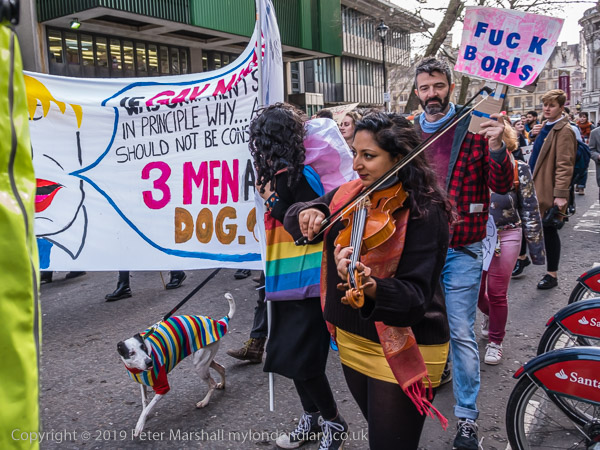
But there were good things too last month. I did enjoy Christmas, and a trip up to Matlock, and a fourth grandchild was born as the election results were being announced. And some protests, like the wedding of three men and a dog were fun to be at.
All photographs on this and my other sites, unless otherwise stated, are taken by and copyright of Peter Marshall, and are available for reproduction or can be bought as prints.
There are no adverts on this site and it receives no sponsorship, and I like to keep it that way. But it does take a considerable amount of my time and thought, and if you enjoy reading it, please share on social media. And small donations via Paypal – perhaps the cost of a beer – would be appreciated.
The 14th and last of the series of posts of selected black and white pictures I made in 1980 with the comments I posted more recently daily on Facebook. Larger versions of the pictures are now available on Flickr.
Apologies for some earlier posts in this series that were titled as London 1990 – and I hope I have now corrected all these. It will be a little while before I have caught up with my work from 1990! This is the final post of pictures that I made in London in 1980.
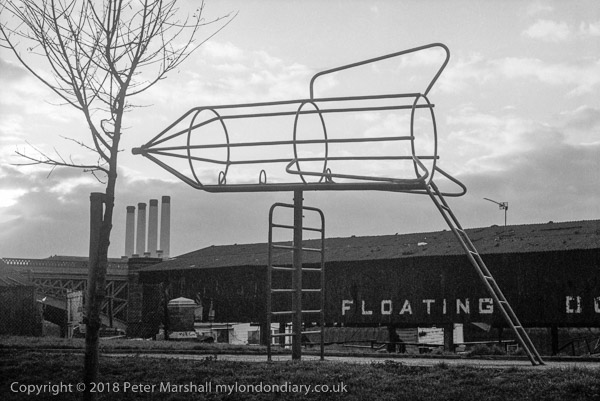
Playground, Battersea. 1980 26r-24: spaceship, playground power station, bridge,
Behind the spaceship in a childrens’ playground are the four in-line chimneys of Fulham Power Station, decommissioned in 1978 and one of the first power stations that the CEGB was made redundant and sold for redevelopment. The demolition in the early 1980s became controversial over the safety of the removal of around 1,000 tons of asbestos by the new owners. Because of this the government announced that the CEGB would strip asbestos before selling power stations in future.
The Regent on the River apartments that replaced the power station in the 1980s supposedly were designed to reflect the architecture of the power station.
I carefully framed the word ‘FLOATING’ underneath the spaceship, thinking of it floating in space. I think this was a floating dry dock. At left you can see a small part of the Battersea Rail Bridge, now used by London Overground services between Clapham Junction and Willesden Junction, then I think solely a goods line. I’m fairly sure the playground where I took this is now underneath a large block of riverside flats, Groveside Court on Lombard Rd, though some open space remains a little further north in Vicarage Gardens.
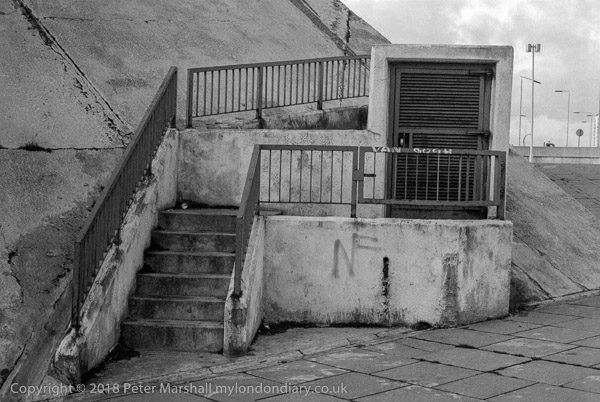
Another picture of the inside of the roundabout which was completed around 1972 and has appeared on record covers as well as being used as a film location – famously where Alex and his droogs beat up a singing drunk in Kubrick’s adaption of A Clockwork Orange. I have no idea why someone has painted Van Gogh on the railings -the Serbian rock group of that name was only founded six years later, but perhaps there may have been an earlier more local manifestation. And the National Front have been here too. There is a sinister look to this structure and doorway, and though I have no idea what is inside this concrete structure, it could well be a torture chamber.
The roundabout now has a rather odd metal structure on it, the ‘Atom’ monument, with two circular metal rings holding up a box with advertising screens for JCDecaux. If – as the firm who erected it claim – the adverts on it attract a great deal of driver attention, then they clearly decrease road safety at this critical junction. I can find no evidence for a local rumour that famed Brazilian architect Oscar Niemeyer had any part in its design. Wandsworth Council includes the structure on its list of works of art in the borough.
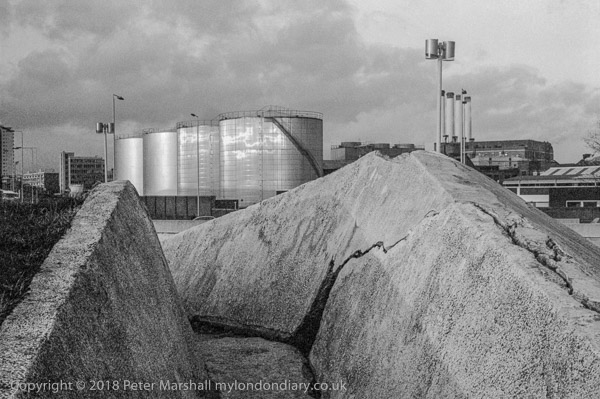
This view from a higher level path inside Wandsworth roundabout shows some of its surroundings more clearly, including the storage tanks which I think were for Charrington’s Fuel Oils next to the river on the south bank immediately downstream of the bridge; incorporated in 1895, the company was dissolved in 1995. Charrington’s began in 1731 and was acquired in 1997 as a part of CPL Distribution Ltd, a company bought out by management from the British Coal Corporation in 1995. Charrington’s were one of the largest UK fuel oil distributors and also had a wharf downstream on Blackwall Way in E14, developed by Ballymore in 2002.
Also visible, on the other side of the river is Fulham Power Station, with its row of four chimneys.
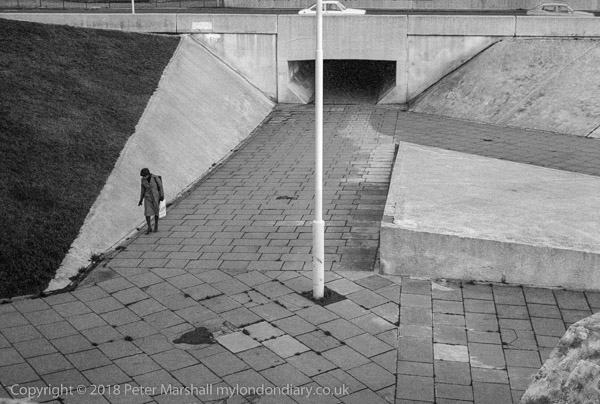
The final picture from the roundabout in 1980 shows a single figure walking in a concrete waste, walking away from one of the four underpasses which led to the central area. It emphasizes the modernist geometry of the construction and the sense of alienation the environment creates, something which has rather softened over the years as more vegetation has grown since it was built in 1969.
More recently it has been considerably tidied up with re-turfing and minor alterations which might prevent the flooding of the underpasses and with the intention of better maintenance, including a contract for the grass to be cut six times a year, though it remains to be seen how long this will last.
St Agnes Place, Kennington. 1980 26s-31: house, rastafarian
Houses in St Agnes Place were occupied by squatters from 1969 and survived Lambeth Council’s eviction attempt in 1977, which made the national news and eventually led to the fall of the then Conservative council.
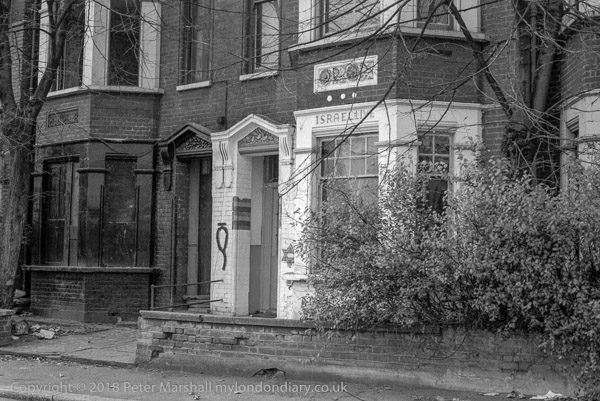
Many of the occupants were Rastafari, as in this house, with its painted symbols and the message ‘ISRAEL: LIVE’ above the window. Many of the squatted properties were kept in good order, and the residents paid utility bills etc and for some years were a part of a housing co-op.
Some other properties were derelict and in a poor state, and the house on the left is boarded up.
St Agnes Place, Kennington. 1980
26s-32: house, rastafarian, fire damage, derelict,
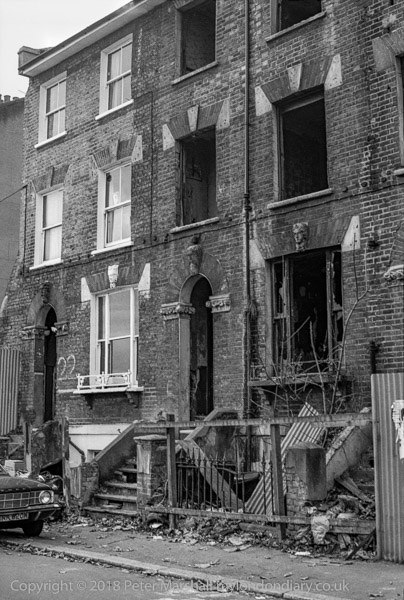
Although No 22 looks in good condition and occupied, the house at right has been gutted by fire.
We walked through here fairly often when visiting friends who lived in Key House, just across the main road from here on the other side of the park, but I didn’t often stop to take photographs. We came to Kennington Park next to St Agnes Place for our children to play and sometimes took a little walk around.
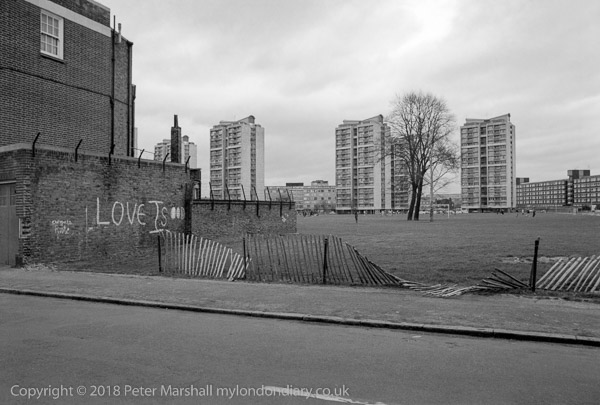
St Agnes Place, Kennington. 1980 26s-42: house, graffiti, fence,
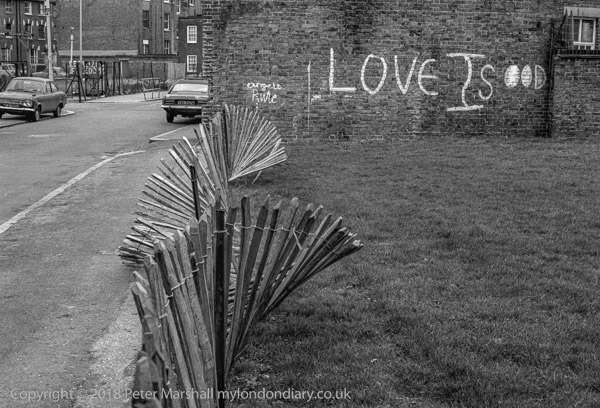
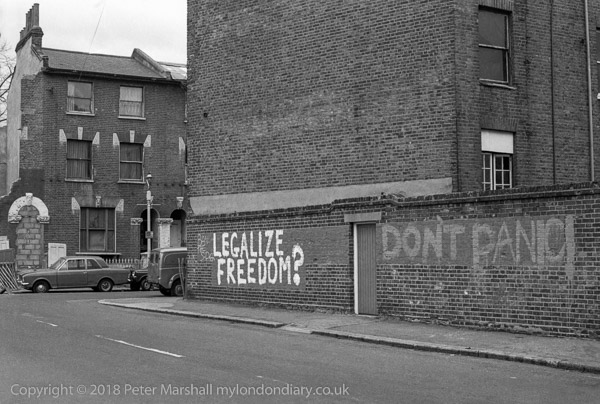
Graffiti on the end of a house I think once read ‘LOVE IS GOD’ but the G has been painted over to convert it to an O. But I don’t think OOD makes any sense. To its left is ‘angelo Rule’.
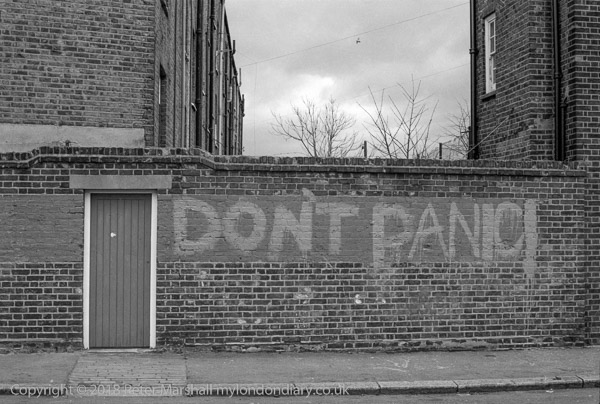
There are more graffiti on a wall across the road, including ‘LEGALISE FREEDOM?’ and a rather faded ‘DON’T PANIC’.
The fence has clearly seen better days.
St Agnes Place, Kennington. 1980 26s-43: house, graffiti
St Agnes Place in 1980 began here, and the previous image was was taken in what was then Bolton Crescent looking towards St Agnes Place, but is now St Agnes Place. I had walked closer to photograph the wall with its graffiti ‘LEGALISE FREEDOM?’ and ‘DON’T PANIC!’.
There had previously been just one more house at the left of the picture which has been demolished, along with another building at an angle on the turn of the street. The doors leaning against the wall on both sides of the blocked up door probably came from this. Next to ‘Legalise Freedom?’ and rather smaller is the message ‘Ban The SPG’. The Special Patrol Group, a Met Police unit for dealing with public disorder and who the previous year had murdered Blair Peach at an Anti-Nazi League protest in Southall. They were found to have been using a number of unauthorised weapons, including a sledge-hammer and a crowbar. They were replaced in 1987 by the Territorial Support Group (TSG), though many think little was changed except the name.
St Agnes Place, Kennington. 1980 26s-44: house, graffiti
Going a little closer still I photographed ‘DON’T PANIC!’ on its own, head on.
I think that some earlier graffiti had been painted out on this wall, and that this and the ‘LEGALISE FREEDOM?’ out of picture at the left had been painted on top of this, with the painter having a little problem squeezing the IC in at the end of the word before adding the oversize exclamation mark with some relief.
St Agnes Place, Kennington. 1980 26s-54: house, graffiti, park, flats
The flats seen across the playing field are on the Brandon Estate in Hillingdon Rd and Meadcroft Rd, and include Prescott House, Cruden House, Bateman House, Walters House and Cornish House, built in 1958 by the London County Council. Many of the early residents were delighted; they had been moved in more or less a whole street at a time and kept their community spirit in flats built to much higher standards than the slums that were demolished, a community-based approach that has been abandoned to allow private developers to profit from estate demolition.
20 Years later the estate had gone down-hill, partly because of bad management and the removal of caretakers, but mainly because council housing became a service for problem families rather than a more general approach to providing rented properties at a fair price.
This part of the street was still Bolton Crescent when I took the picture, but St Agnes Place now extends further south.
This is the final post in the series of selected images that I made in London in 1980. You can now see all the pictures (and a few more) at a larger size and with the descriptions here on Flickr.
All photographs on this and my other sites, unless otherwise stated, are taken by and copyright of Peter Marshall, and are available for reproduction or can be bought as prints.
There are no adverts on this site and it receives no sponsorship, and I like to keep it that way. But it does take a considerable amount of my time and thought, and if you enjoy reading it, please share on social media. And small donations via Paypal – perhaps the cost of a beer – would be appreciated.
The 13th of the series of posts of selected black and white pictures I made in 1980 with the comments I posted more recently daily on Facebook. Larger versions of the pictures are now available on Flickr.
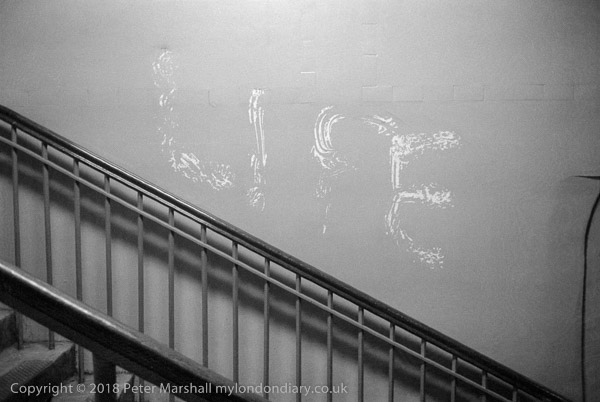
I used often to walk past this scrawled message on my way into Waterloo Station, though I can’t remember exactly where it was, but these stairs are long since demolished or hidden away from the public. The area was dimly lit and I think I photographed it on several occasions before getting a satisfactory result.
There was a certain desperation about the lettering which looked as if it had been made quickly by someone who dipped a hand into white paint to make these marks. And I pondered on what message was intended, as I stopped to photograph it in the rather dim light.
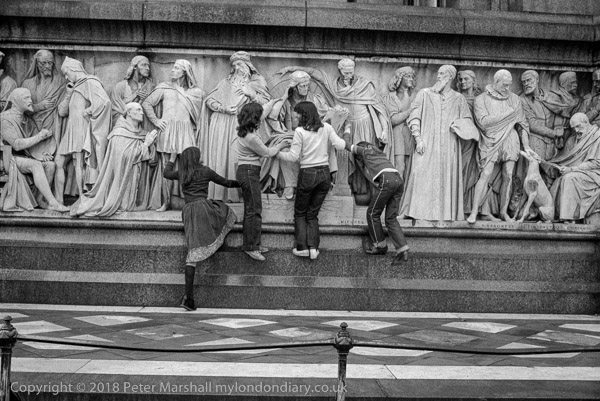
Albert Memorial, Kensington. 1980 26i-62: monument, girls
Back in 1980 on my way to the Serpentine Galley I stopped to look at the Albert Memorial, then open to the public in much the same way at Nelson’s column still is, with tourists and their children climbing on the lower levels to have their photographs taken with the sculptures at its four corners and surrounding it.
As I was photographing a group of four girls came and climbed up on the low ledge to put their hands on the figures of the great artists – including Masaccio, Raphael, Michael Angelo and others – along the base of the memorial. This was the second of two frames I took of them.
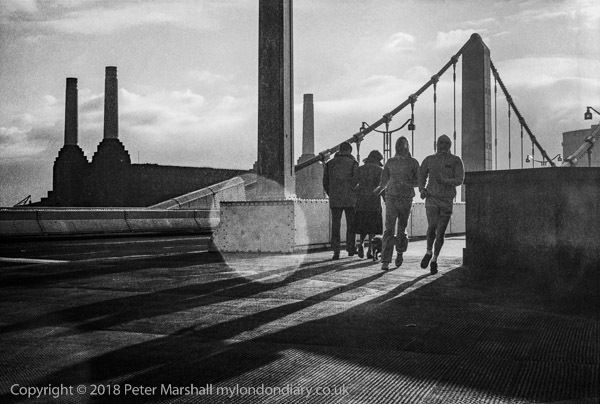
Chelsea Bridge, Chelsea. 1980 2l-55: power station, bridge, runners, people
In December 1980 it was my turn to organise the month’s photographic outing for the small group of photographers I was involved in. Somehow my plan for a walk from Victoria to Battersea and Wandworth lacked appeal and I was the only person who turned up for it.
Taken with the Leitz 35mm f1.4 Summilux, the large circular flare patch is something of an enigma. I think it likely that the lens was well-stopped down, since I was working on ISO400 film (Ilford XP1) and the negative is quite underexposed. The low December sun has resulted in long shadows and a dramatic image, with Battersea Power Station and the people in near silhouette.
The sun was just out of picture at top right, and this negative was virtually unprintable in the darkroom
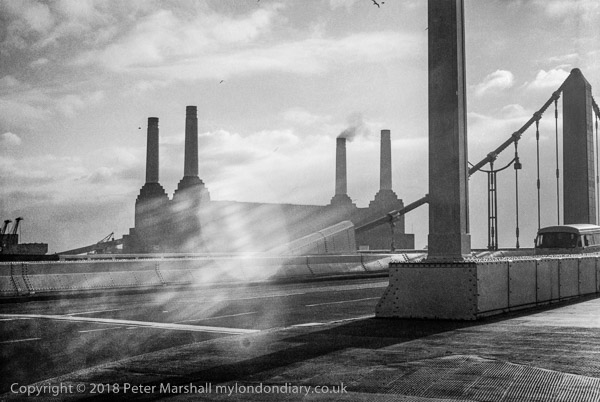
Chelsea Bridge, Chelsea. 1980 26l-56: power station, bridge,
Another picture from almost the same place, but without people and with different flare. As well as a couple of large ellipses there are also some rather vague ‘rays’ and a small black spot… The specks in the sky are birds.
One of Battersea Power Stations four chimneys was hidden behind a part of the bridge in the previous picture, but here we can see it clearly with smoke emerging. The western half of the power station was closed in 1975, but the eastern half, where smoke is emerging from the rear chimney remained in operation until 1983.
Earlier in 1980 the whole power station had been listed Grade II as there were grave concerns for the future of the building. Unfortunately listing failed to save more than the shell of the building and its roof was removed in the late 1980s. Various development schemes fell through and the building was left to rot. The listing was revised to Grade II* in 2007, and the redevelopment of the whole area began in 2012.
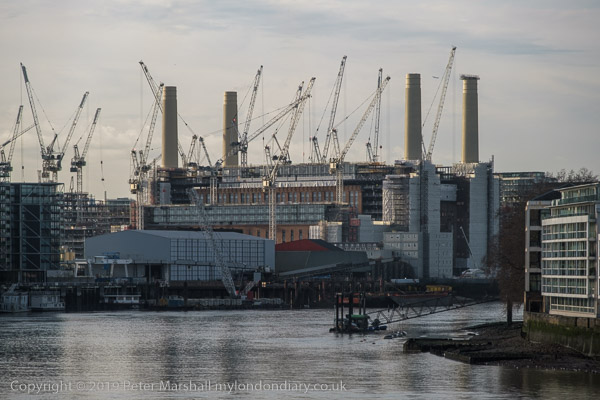
The four chimneys were removed by the Malaysian-owned developers in 2014 because they were heavily corroded, but have now been replaced by near identical replicas. The power station development is due for completion in 2019, providing 254 homes along with offices and retail space, with the whole 42 acre redevelopment being completed by 2025. It is part of the huge 561 acres Nine Elms development – almost 0.9 square miles.
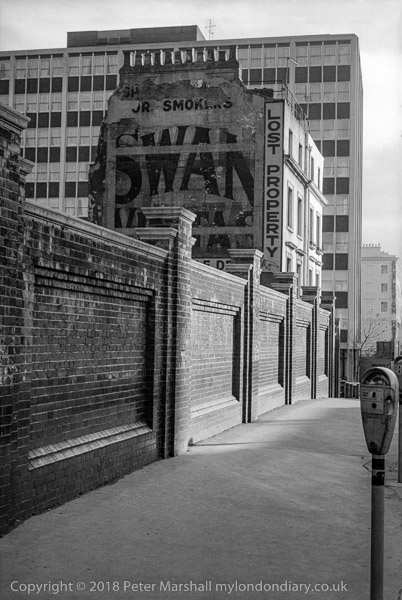
The Lost Property office was on Eccleston Bridge, on the corner of Bridge Place; the building is still there but the Swan Vestas advert has long been painted over and the building passed to other uses.
The foreground wall and the office building in the background are still there though the offices have been slightly updated.
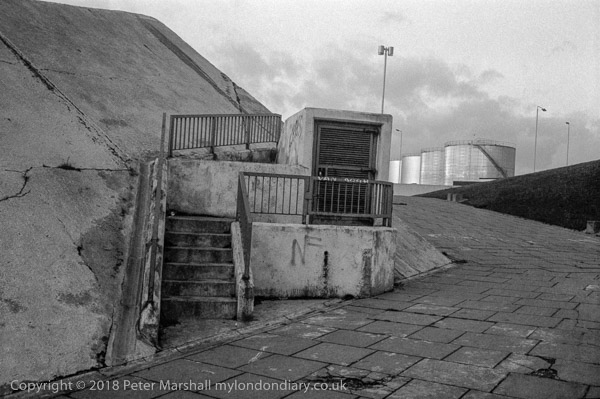
I pass this roundabout every time I take the train into Waterloo. It was the location where Alex and his Droogs attack a tramp in Stanley Kubrick’s A Clockwork Orange. The roundabout links Trinity Road with Wandsworth Bridge.
Back in 1980 all of the riverside around here was industrial. NF graffiti were common over London. I think the tilt in this picture was deliberate, perhaps to increase a sense of unease in the scene.
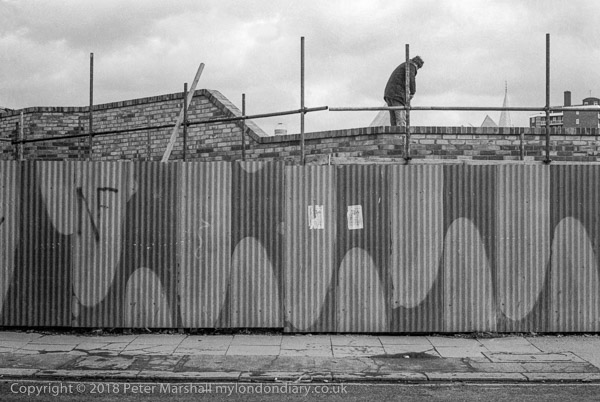
Fence with NF graffiti, Wandsworth. 1980 26r-21 fence graffiti, worker
Some effort has been made to make the corrugated iron fencing more attractive by painting it in two colours. I can’t read the flyposted notices, which do appear to have a radioactive hazard symbol on them but the National Front graffiti is clear and was unfortunately common across London at this time.
I’m not sure exactly where this was taken, although the wall behind the fence is fairly distinctive, as are the steeple and flats at right. It was probably on or close to Vicarage Crescent or Lombard Rd.
All photographs on this and my other sites, unless otherwise stated, are taken by and copyright of Peter Marshall, and are available for reproduction or can be bought as prints.
There are no adverts on this site and it receives no sponsorship, and I like to keep it that way. But it does take a considerable amount of my time and thought, and if you enjoy reading it, please share on social media. And small donations via Paypal – perhaps the cost of a beer – would be appreciated.
Continuing the series of post about the black and white pictures I made in 1980, with the pictures and the comments I posted more recently daily on Facebook.
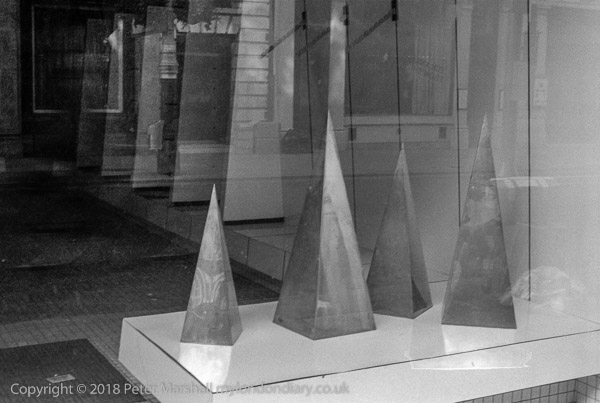
I’m fairly sure this was somewhere in Fitzrovia, where a few frames earlier I had been outside the Northumberland Arms, at the corner of Charlotte St and Goodge St, recently renamed The Queen Charlotte, perhaps to avoid confusion with another Northumberland Arms on Tottenham Court Rd.
Why a shop window should have these four pyramids at its front is now certainly a matter of mystery at least to me, though presumably they were some kind of display stands. Apart from this what drew me to take four very similar frames was clearly the mix of reflections and interior which make the image difficult or impossible to decode.
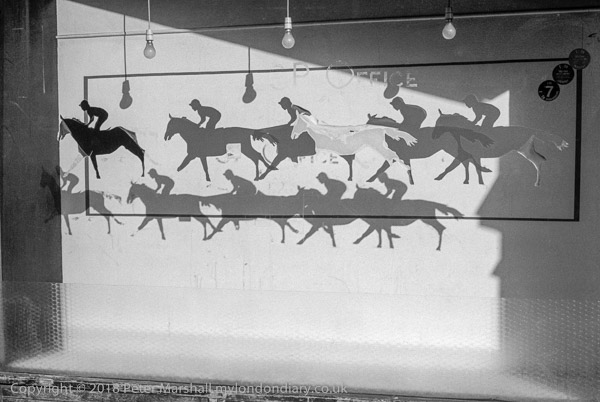
Another shop window in Fitzrovia which again poses something of a conundrum. It is clearly the window of a betting shop, which a fairly small distance between the glass and a screen behind, required then by law to prevent us seeing the inside of the betting shop. And the picture clearly has a mix of actual objects – the light bulbs and some peeling pictures of racing horses on the back of the window glass – and their shadows from late afternoon evening sun ( it was taken in July or August.)
The upper row of horses and riders are on the rear of the glass, with some peeling away more than others, and where they have peeled away slightly they now appear like shadows (though because they are closer to my camera are slightly large than the shadows), and the almost white riderless horse appears to have no shadow at all and nor does the lettering ‘P OFFICE’.
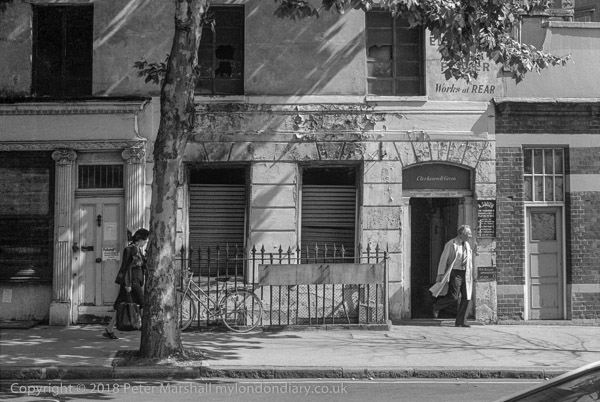
Clerkenwell Green, London. 1980 25f-31: houses, works
The Farringdon Enamelling and Plating Works of A Smith were, along with Upholsterer R H Dillon on Clerkenwell Green as the window above the door helpfully informs us, and another business with a name beginning with ‘EN ‘and ending ‘P…..R’ has its ‘Works at Rear’.
Attracted doubtless both by the signage and the peeling paint, emphasised by the glancing sun, I had already made two frames when this man in a dirty white coat and striped tie walked out.
This little section of the street can still be recognised, but has gone up considerably in the world. One of the windows has been converted to a door, the paint no longer peels and the signage has disappeared. The building at right has been replaced by a modern structure with giant glass windows, The door from which a man is emerging is now for the Hammond Cox Casting Agency, the next window has been converted into a door for the Provision Trade Benevolent Institution and others, while the door at left, then a typesetter, is now for the Royal Philharmonic Orchestra. The tree is still there.
Behind me as I took this picture were public conveniences, which may well have been the reason for my visit, but which have been long closed.
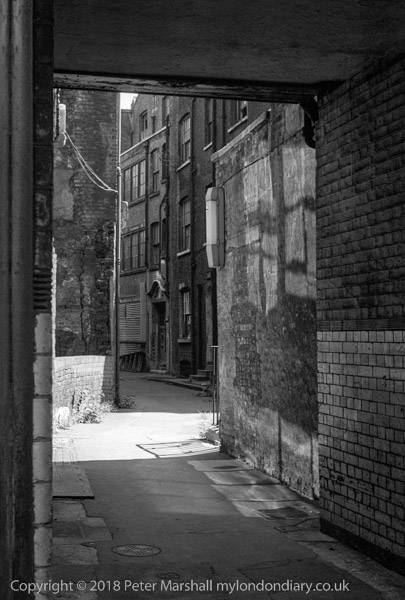
Cross Keys Square, Little Britain, London. 1980
25f-42: passage, houses
Inside ‘Little Britain’, I think this is part of Cross Keys Square, and shows some clearly fairly elderly buildings, one of which, its windows now covered with corrugated iron, had previously been a Hairdressing Salon.
Much of the area was derelict when I took this picture and parts were inaccessible, with demolition or building work being carried out. The reflections on the brickwork at left interested me, and part of one of them rather looks like a shield or coat of arms, not dissimilar to the City of London’s which were on the light fittings.
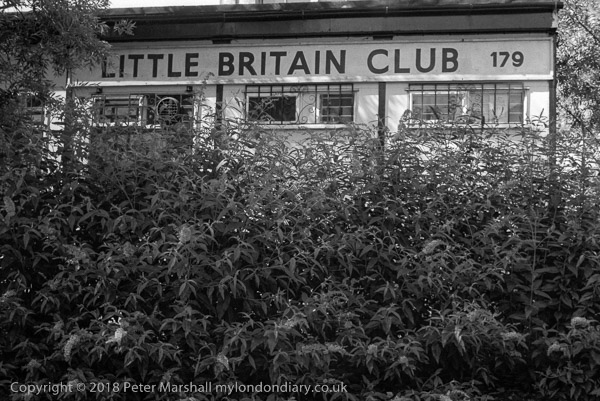
Little Britain Club, City of London. 1980 25f-53: club, waste ground
Somewhere in the middle of ‘Little Britain’ was this club, and a patch of really overgrown waste ground, either formed by wartime bombing or later demolition.
Little Britain a century earlier had been famous for its ‘The Roaring Lads of Little Britain.’ who held weekly sessions at a pub “bearing for insignia a resplendent half-moon, with a most seductive bunch of grapes” run since “time immemorial” by the Wagstaff family and whose current landlord member presided over its singing and story-telling, according to Washington Irving in 1886.
The street number, 179, is almost certainly for Aldersgate St, and this was one of the many addresses listed in the planning application for demolition in January 1982, which was I think approved the following year:
“Demolition of all properties listed below, per dwg. ME/1: 11, 12, 13, 15, 16 Bartholowmew Close, 1 & 2, 7, 8, 4 & 11, 5 & 10, 6 & 9 Albion Buildings, 179 Aldersgate Street, *3 Little Montague Court, 1,2,3, Westmoreland Buildings, 4 Little Britain, 14, 15 Albion Buildings, 2a, 3, 4 Cox’s Court, 2, 2a, 3, Cross Key Square, Crown Buildings, Cox’s Court. The Garage on site of 21 Albion Buildings, 20, 21, 22, 23, 24, Little Britain, part of pedestrian walkway link to Rotunda * also 2 Little Montague Court.”
I think it was on a part of the site now occupied by London House, 172 Aldersgate St. These flats, “high-standard, fully serviced accommodation in London for the international business traveller”, have beside the entrance plaques stating it was the former site of London House. This was built for Henry Pierrepont, 1st Marquess of Dorchester (also the 2nd Earl of Kingston-upon-Hull) 1606-80, apparently a thoroughly unpleasant character, and after 1660 became the home of the Bishops of London.
After the bishops moved out it was let out to various tenants before briefly becoming in 1750–1751 the ‘City of London Lying-in Hospital for married women and sick and lame Outpatients’; it burnt down in the 1760s.
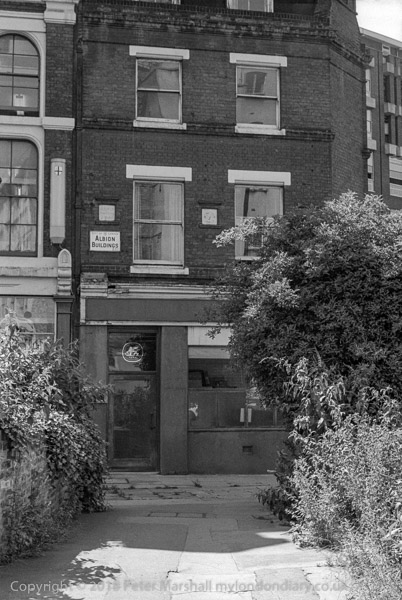
Albion Buildings, City of London. 1980 25f-54: shop, waste ground
Also a part of ‘Little Britain ‘ was Albion Buildings, dating according to a stone in its frontage from 1766 (a second stone to the right is unreadable.) The sign above the door, which shows a stylized animal, a winged lion, with one of its front paws on what I think is an open book, is dated 1903. It perhaps reflects the time when this area was still the centre of the London publishing and secondhand book trade, which had been here since at least the 17th century. Pepys records a visit to Duck Lane (as Little Britain was then called) where he “kissed bookseller’s wife and bought Legend“. As well as going there to see the bookseller’s wife he is also recorded as buying several other books.
Albion Buildings (according to Webb – see comment below) were built in 1764 on the site of a 16th century house and gardens. In 1628 they were occupied by the Earl of Westmoreland and known as Westmorland Buildings, getting their name later from the Albion Tavern. Previous to 1764 the passage they are on was called Porridge Pot Alley.
The building on the left edge still has a fluorescent light on and appears to be still in use.
There is a very detailed account of the buildings and history of the area in E A Webb, ‘The parish: The close precinct and glebe houses‘, in The Records of St. Bartholomew’s Priory and St. Bartholomew the Great, West Smithfield: Volume 2 (Oxford, 1921), pp. 213-231 on British History Online. The map at the National Library of Scotland collection from 1896 is useful in understanding the layout of the area, though much had changed by 1980.
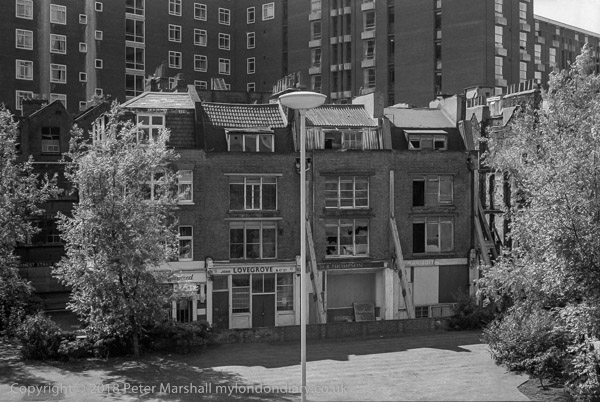
Albion Buildings, City of London. 1980 25f-62: shop, waste ground
This small row of shops and businesses were I think empty – some clearly so, when I made this picture, I think from the elevated walkway along the side of the Barbican estate.
At left was a button maker ‘H R C….’ on the first floor and ‘Ernest Stark’ on the ground, then a business whose name is obscured by a three. At 6 was John Lovegrove & Co Ltd, then H R Thompson (with an unlikely ‘To Let’ sign) and ‘Basinghall Elect…’ presumably Electrics or Electrical… I have been unable to find any information about any of these.
All photographs on this and my other sites, unless otherwise stated, are taken by and copyright of Peter Marshall, and are available for reproduction or can be bought as prints.
There are no adverts on this site and it receives no sponsorship, and I like to keep it that way. But it does take a considerable amount of my time and thought, and if you enjoy reading it, please share on social media. And small donations via Paypal – perhaps the cost of a beer – would be appreciated.