XR London Tax Rebellion

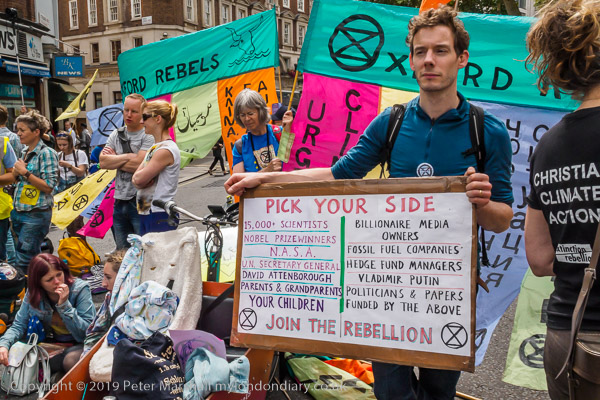
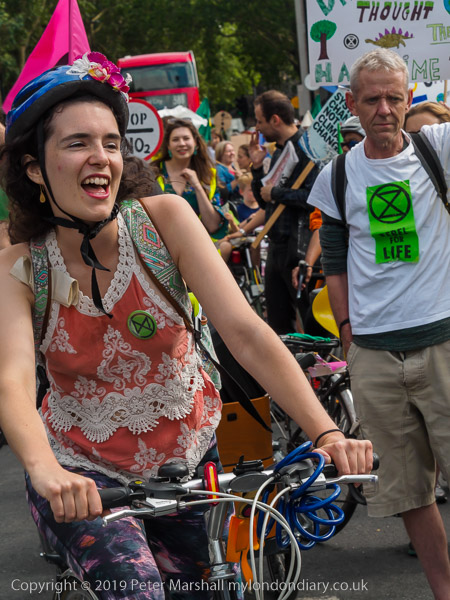
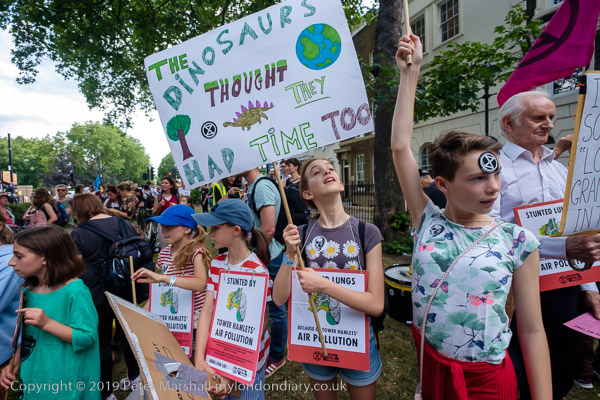
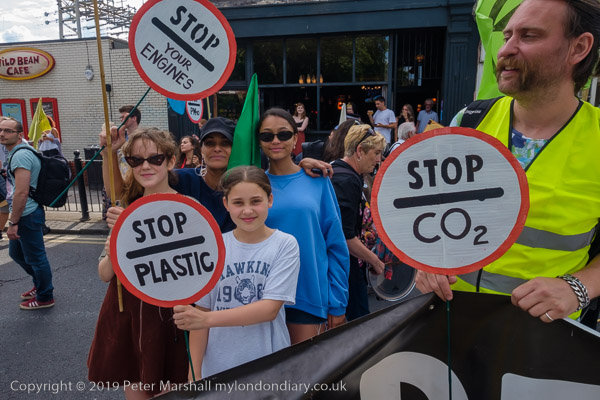
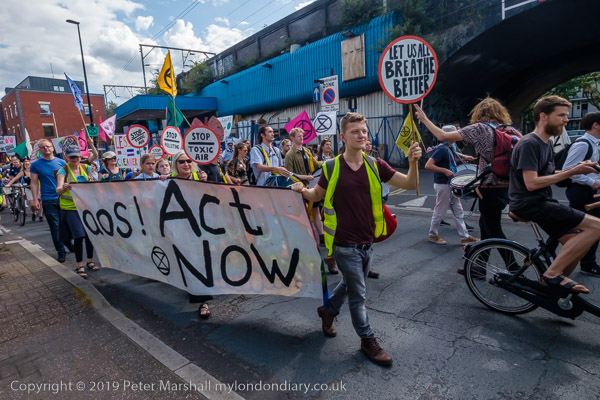
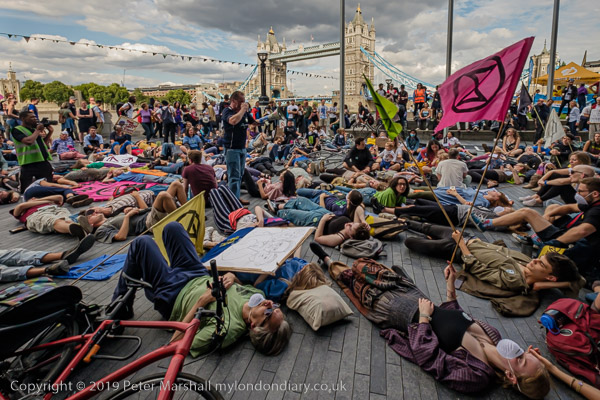
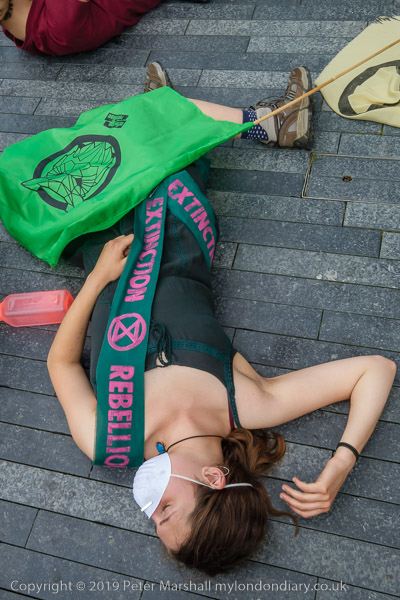
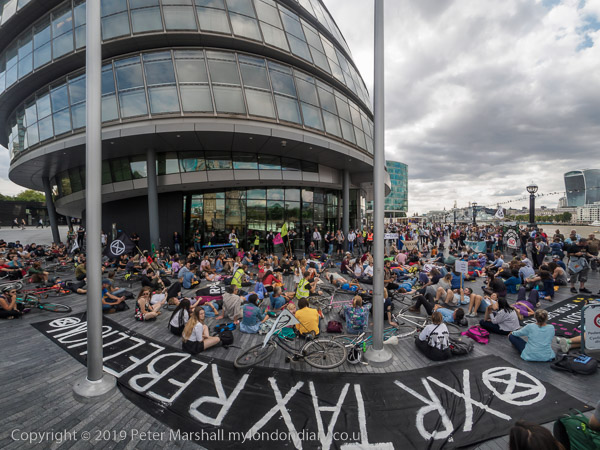
Extinction Rebellion launched their campaign for a tax strike against the Greater London Authority, withholding the GLA element of their council tax until they abandon projects which will cause environmental degradation and hasten ecological collapse with a protest outside City Hall on Thursday 18th July 2019.
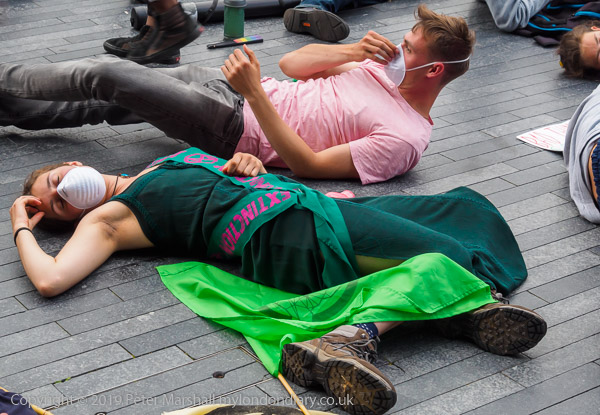
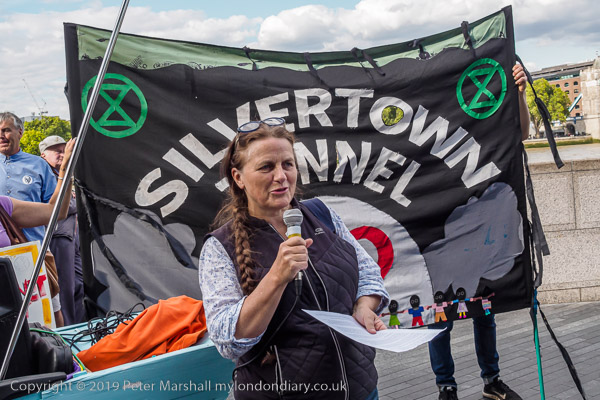
They were particularly concerned about three major GLA projects, the Silvertown tunnel under the Thames, the Bow East concrete plant in Newham, and the Edmonton incinerator in Enfield, and called for a citizen’s assembly to formulate an “Emergency London Plan”, replacing the current 2020 London Plan with sustainable policies on air quality, land development and transport for the City of London and 32 London Boroughs.
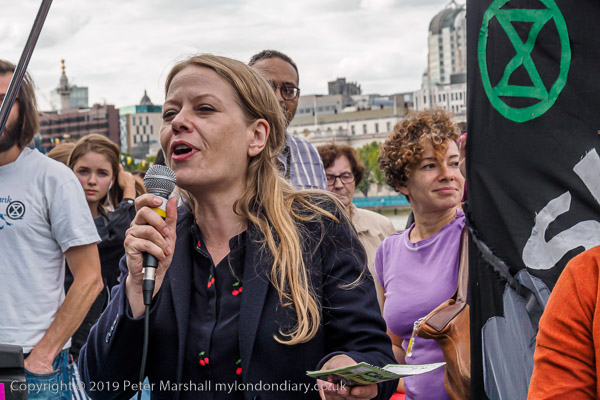
Sian Berry, Green Party

The rebellion called on London residents to withhold the average proportion of their council tax – 22% – which goes to the GLA and to pay that into a special fund which would be used for climate related projects. To have any impact it would have to be supported by large numbers of London council tax payers, and XR set a threshold of 2,700 for it to go ahead – needing the support of around 15% of their London members.
Although some other XR actions involving tax are proceeding, I’ve been unable to find any more announcements about the London Tax rebellion from XR, and suspect that they may not yet have managed to sign up enough supporters for this action which is no longer listed on the on-line platform which was being used to carry the forms concerned.
Possibly the reluctance to take part may have been influenced by the change in policy towards those arrested for minor offences at XR protests. Normally only a fairly small fraction of those arrested are actually charged and brought to court, but political pressure from Home Secretary Priti Patel, who called XR criminals threatening the “UK way of life” has resulted in almost 100% of those arrested during the 2019 protests being brought to court. There is now a very long back-log of cases awaiting trial.
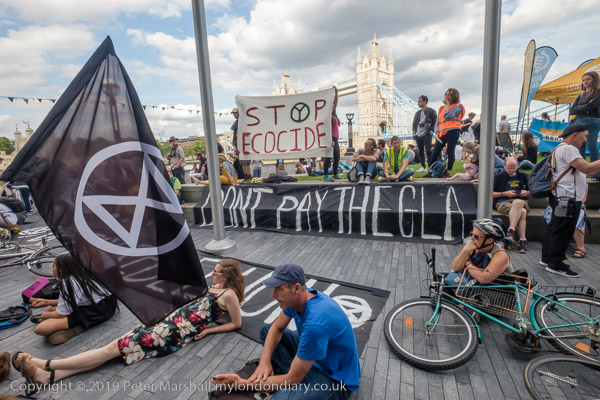
Many more pictures at XR London Tax rebellion.


All photographs on this and my other sites, unless otherwise stated, are taken by and copyright of Peter Marshall, and are available for reproduction or can be bought as prints.


Around Gloucester Rd – 1988

Cornwall Gardens area, Kensington, Kensington & Chelsea, 1988 88-4f-02-positive_2400
Cornwall Gardens, Kensington, Kensington & Chelsea, 1988 88-4f-02

I never felt quite at ease when photographing the plusher areas of Kensington, but it was something I felt I had to do if my work was to reflect the whole of London. And certainly these streets showed an enormous diversity and and incredible amount of craftsmanship made possible by the wealth of London, particularly in the Victorian era, largely dependent on our exploitation of the British Empire as well as the working class of this country.

Cornwall Gardens was built between 1862, when Queen Victoria’s eldest son who was the Duke of Cornwall had the title Prince of Wales added to his portfolio and 1879 and is a series of three linked rectangular garden squares to the west of Gloucester Rd. This building is later and I think not actually in Cornwall Gardens (as my contact sheet says) but close to it, though I can’t actually find it.

Queen's Gate Terrace, South Kensington, Kensington & Chelsea, 1988 88-4f-12-positive_2400
Queen’s Gate Terrace, South Kensington, Kensington & Chelsea, 1988 88-4f-12

Helpfully 56 Queens Gate Terrace has its address on it. It is part of a Grade II listed pair at 56-58 on the corner of Gloucester Rd built by architect Charles Gray in 1863–65.

Queen's Gate Terrace, South Kensington, Kensington & Chelsea, 1988 88-4f-16-positive_2400
Queen’s Gate Terrace, South Kensington, Kensington & Chelsea, 1988 88-4f-16

This is the side of 58 Queen’s Gate Terrace which adjoins the Gloucester Rd, which has been occupied since 1972 by Da Mario Kensington, described on Google as “Family friendly trattoria in Venetian-Gothic building, serving thin-crust pizza and other classics.”

Elvaston Place, South Kensington, Kensington & Chelsea, 1988 88-4f-33-positive_2400
Elvaston Place, South Kensington, Kensington & Chelsea, 1988 88-4f-33

The out-of-focus posts at left and extreme right lend this fenced yard in front of a Queen’s Gate Lodge on Elvaston Place a rather sinister feel, quite different from the next picture in the album (not in this post) which you can see if you click on the above and then to the right.

The house is on the corner of Elvaston Mews, entered through a rather grand arch like many in the area.

Launceston Place, Kynance Mews, Kensington, Kensington & Chelsea, 1988 88-4f-42a-positive_2400
Launceston Place, Kynance Mews, Kensington, Kensington & Chelsea, 1988 88-4f-42

Kynance Mews also has its entrance arch, in this case from Launceston Place, though rather more rugged and business-like, and it faces a similar arch across Launceston Place into the east section of the mews.

Back in 1988 the house to its right was occupied by Hairdressers Simon and Peter St John but now appears to be residential.

Launceston Place, Kynance Mews, Kensington, Kensington & Chelsea, 1988 88-4f-62-positive_2400
Launceston Place, Kynance Mews, Kensington, Kensington & Chelsea, 1988

And this is the facing archway on the east side of Launceston Place.

88-4f-63-positive_2400
Launceston Place, Kensington, Kensington & Chelsea, 1988 88-4f-63

Next to the hairdressers on Launceston Place is this rather fine villa. Along with its neighbours it is Grade II listed and described as a semi-detached stucco house, circa 1830, distinguished from the others in the row by its circular tower and dome

Kynance Place, Kensington, Kensington & Chelsea, 1988 88-4f-65-positive_2400
Kynance Place, Kensington, Kensington & Chelsea, 1988 88-4f-65

There are several shops in Kynance Place which is off Gloucester Road immediately north of Kynance Mews, but I can’t remember which of them had this window display. It appears to feature a number of brushes, some things I think might be small genuine sponges, a tortoise (or turtle?) and an advert for eyelash dye, something I never knew existed, but apparently in demand in Kensington.

There are quite a few more pictures around the area in my album 1988 London Photos which you can access by clicking on any of the above images to get a larger version from where you can browse the album.


All photographs on this and my other sites, unless otherwise stated, are taken by and copyright of Peter Marshall, and are available for reproduction or can be bought as prints.


End Austerity, No to Racism, Tories Out! 2016

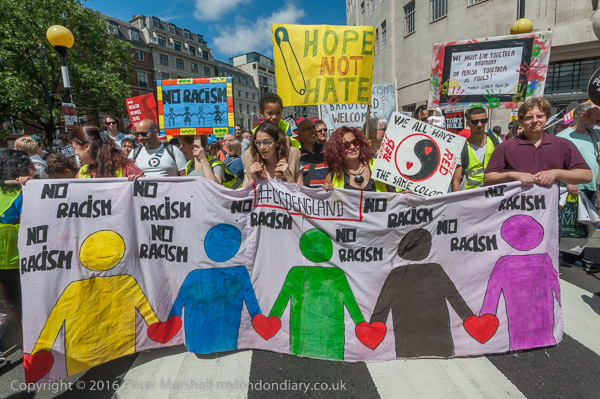
Five years ago the People’s Assembly and Stand Up To Racism organised a march through London as a response to the referendum campaign conducted by many Brexit campaigners on an anti-immigration platform which had provoked an upsurge in racism and hate attacks on Black and particularly Muslim people online and on the streets of Britain.

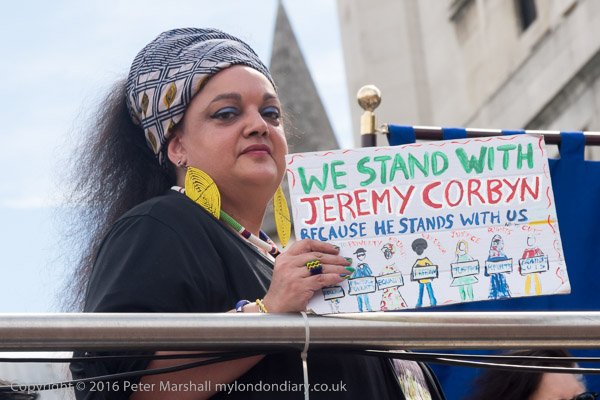
The marchers met outside the BBC, as I wrote ” in the forlorn hope that they might for once cover a protest in Britain properly” but of course they ignored the thousands on their doorstep. Probably they were too busy giving Nigel Farage a quite disproportionate amount of publicity and air-time, along with the Labour plotters against Jeremy Corbyn – who sent a message of support to the marchers and like them showing solidarity with refugees and asylum seekers.

This banner and the placards for me summed up the message of the march, a demand for ‘Hope Not Hate’ and for people of all backgrounds to join hands in love and respect and say ‘No Racism’. We’ve recently seen a huge backlash against racist remarks against footballers in the English team showing that people across the country oppose racism, whether from the far right or Tory ministers and MPs who denigrate footballers who ‘Take the Knee’.

Later I managed to get to Parliament Square for the rally at the end of the march with speakers from many organisations, including an asylum seeker as well as politicians and activists. It was a sunny day and there was a warm and pleasant atmosphere in the large crowd listening and applauding the speakers.

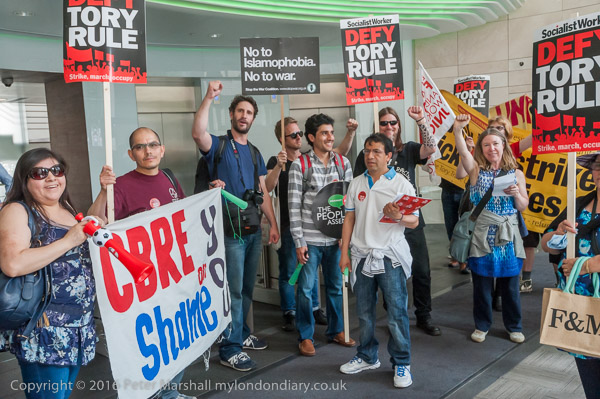
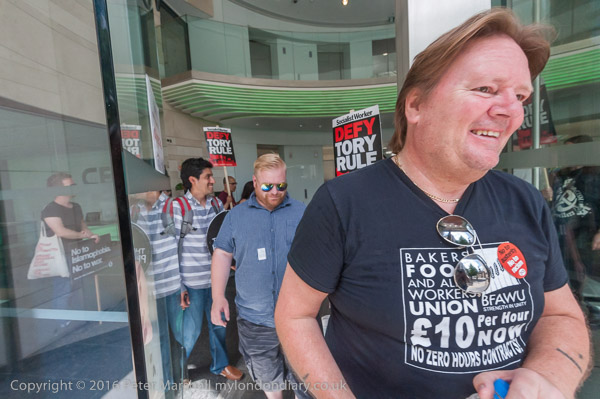
I’d waited on Regent St as the march set off for some time until the last of the several thousand marchers had passed me, then hurried off to the HQ Offices of CBRE in Henrietta Place, where cleaners from the strike at 100 Wood St, managed by CBRE, had broken away from the march to stage a flash mob, along with supporters including United Voices of the World General Secretary Petros Elia and Bakers Union (BFAWU) National President Ian Hodson.

I’d arrived too late to go with them into the foyer, whose large glass doors were firmly locked when I arrived, but after a few minutes photographing through glass the doors were opened I was able to take a few more pictures as they got ready to leave. They went on to rejoin the march, but I went off to look for the English Defence League whose protest had been called to oppose that by the People’s Assembly.

I don’t like photographing extreme right-wing groups such as the EDL. It gives them publicity, which they don’t deserve as it exaggerates their importance. Generally their protests are small and their extremism represents a very small fringe of our society, though racist attitudes unfortunately are much more widespread. But rather more directly they are generally not nice people to be near. They shout and scream messages of hate, often in vile language, and routinely threaten me as I take photographs. I’ve been spat at and even, fortunately not often, grabbed, pushed and punched.

While with most protests I can move freely through the event, at these I need to keep a safe distance away. I’m usually glad that police are present, and without them I would be assaulted and my equipment smashed, but police sometimes make any photography virtually impossible. While I’d managed to cover the march I could only see brief glimpses of the rally which followed through several lines of police with several hundred of them surrounding perhaps a hundred protesters. I gave up then and took the tube to cover the anti-racist rally.

EDL march and rally
Cleaners Flash Mob at CBRE London HQ
End Austerity, No to Racism, Tories Out!


All photographs on this and my other sites, unless otherwise stated, are taken by and copyright of Peter Marshall, and are available for reproduction or can be bought as prints.


Cake, Yacht and Dodo

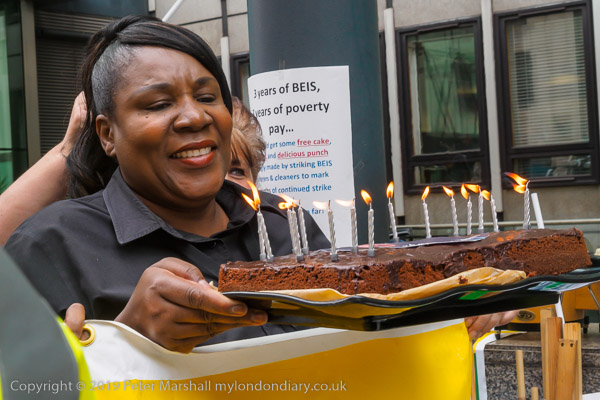
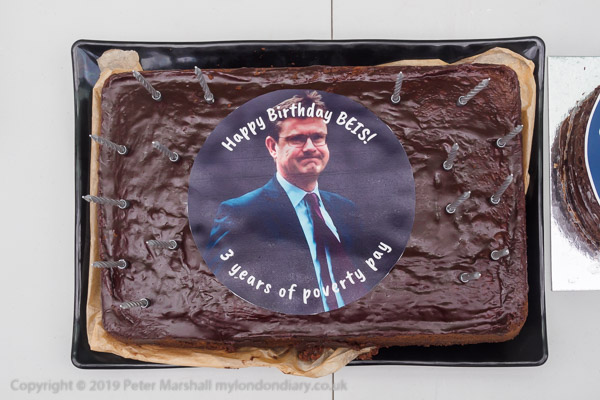
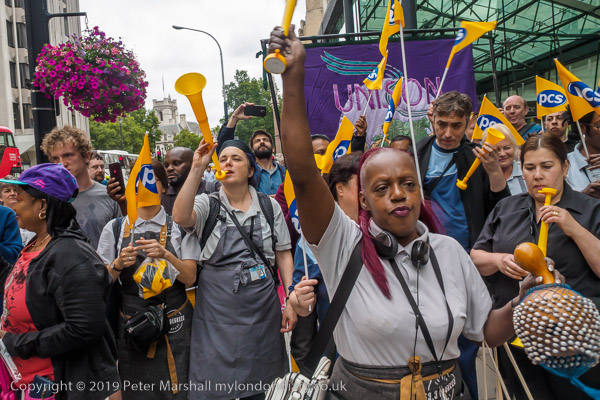
The cake came outside the Department for Business, Energy and Industrial Strategy (BEIS) where PCS members who work as cleaners and catering workers were beginning the first ever indefinite strike at a government ministry, demanding they be paid the London Living Wage, and get decent conditions of employment.

It was the third anniversary of the founding of the BEIS, and also the third anniversary of the campaign to get the workers there decent pay and to be employed directly by the BEIS, rather than outsourcing companies ISS and Aramark whose only concern is cutting costs to the bone by exploiting the workers so they can undercut competitors for the contracts and make profits at the workers’ expense.

A crowd of around a hundred supporters was there to cheer the strikers when they came out of the BEIS to begin their strike and there were speeches from trade unionists including PCS General Secretary Mark Serwotka, RMT General Secretary Mick Cash, and UCU’s Jo Grady as well as then Shadow Chancellor John McDonnell MP and some of the BEIS workers. I did manage to get a piece of the cake before I had to leave for the Royal Courts of Justice.

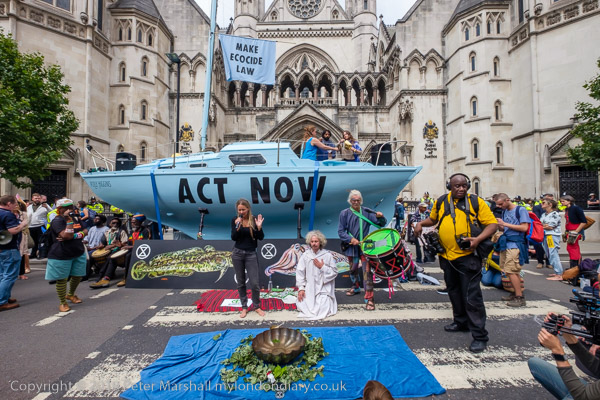
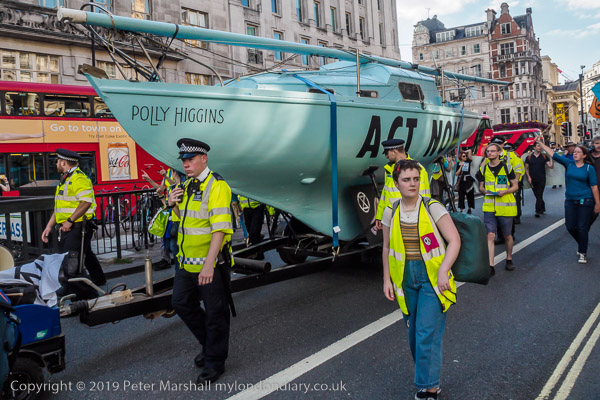
Extinction Rebellion had brought the yacht to to court to begin their ‘Summer Uprising’, another series of protests in five major cities against the criminal inaction by the government on climate and ecological collapse. The yacht was named Polly Higgins after the Scottish barrister who fought for years for an Ecocide Law and had died of cancer 3 months earlier, only 50.

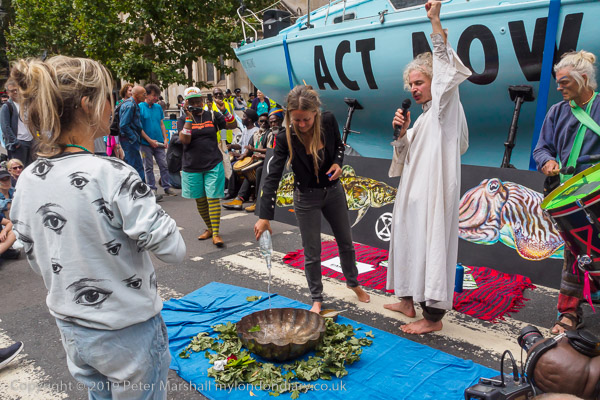
When I arrived some kind of new age ceremony was taking place with people bringing water from across the country to pour into a large bowl and a Druid celebrant in long white robes. It’s one of the kind of things that makes it hard for many to take XR seriously as a movement.

But of course it is serious and the crisis that we face is existential. An ecocide law would be a powerful way to restrain some of the worst excesses of companies that are driving us to extinction. There were some good speeches at the event, with some very clear thinking, but also a few which made me cringe a little.

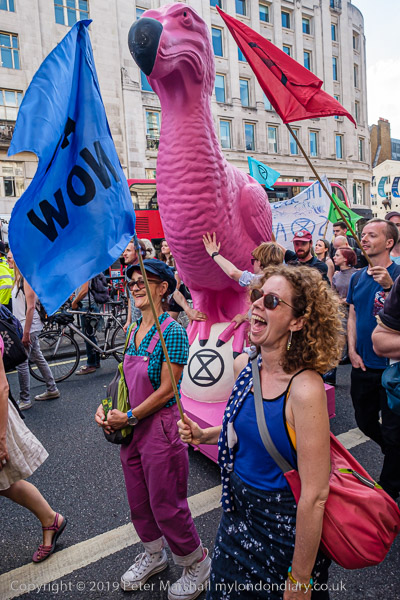
Eventually it was time to march, with the pink Dodo and the yacht, making our way across the river towards Waterloo where XR was to set up a camp on Waterloo Millenium Green.

There really is a climate and ecological emergency, with too many species going the way of the dodo, and we do need governments to tell the truth and make real and difficult actions to halt what seems an inevitable slide into irreversible heating which will make the world uninhabitable for many species, probably including our own. It’s time to end the kind of lip-service which has our government setting targets long into the future while ramping up disastrous policies like Heathrow expansion, road-building and coal mines.

The yacht went with them at the back of the procession, which halted for some time to block Waterloo Bridge, remembering the many arrests there in the previous XR protests, before continuing. It was then stopped by police on Waterloo Rd, causing far more rush hour traffic chaos than necessary by completely blocking the Waterloo roundabout. Eventually they were allowed to continue and occupy the green space they were heading for, but by that time I had left and walked into Waterloo station to catch my train home.

XR Summer Uprising procession
XR call for Ecocide Law
BEIS workers begin indefinite strike


All photographs on this and my other sites, unless otherwise stated, are taken by and copyright of Peter Marshall, and are available for reproduction or can be bought as prints.


Five Years Ago – 13th July 2016

Wednesday was a busy day for me on 13th July 2016, photographing five events in London.

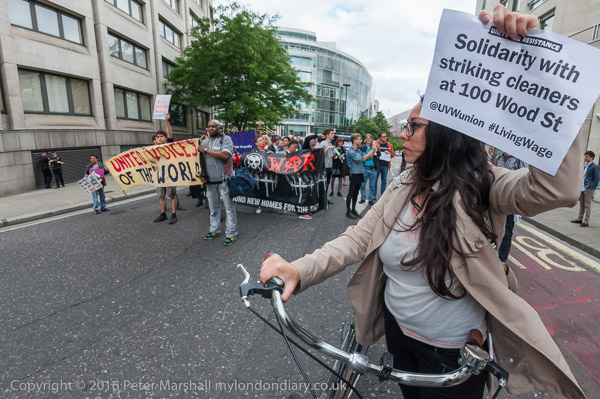
Cleaners at the 100 Wood St offices were still on strike against the anti-union cleaning contractor Thames Cleaning, by then the longest running industrial dispute in the history of the City of London and supporters including Unite the Resistance, the Haldane Society of Socialist Lawyers, Class War and others held a rally in support of the action by the United Voices of the World trade union, beginning on Wood St and then moving on to the street outside CBRE who manage the offices.

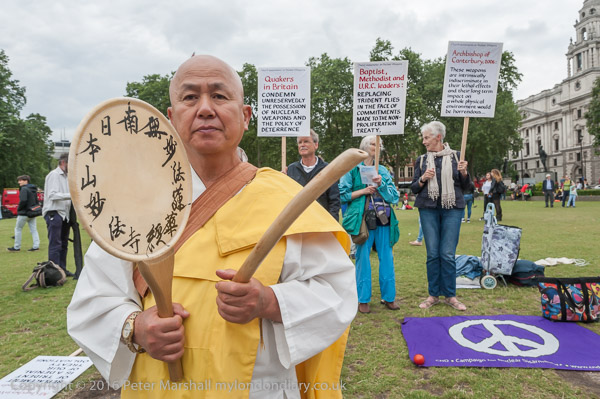
CND members and supporters had come to Parliament to lobby MPs against the plans to replace Trident at a cost of at least £205 billion, and held a ‘Mad Hatters Tea Party’ in Parliament Square where members of Faith groups including both Christians and Buddhists held placards. Church leaders had written to The Times stating ‘The Government must take a lead – cancelling Trident would be a momentous step – Britain can lead the way!’ The government was instead led in its decisions by the lobbyists from those arms companies that profit greatly from these totally redundant weapons.

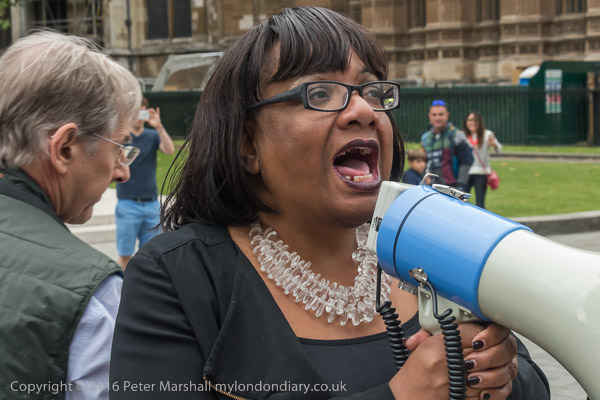
Also on Parliament Square was a protest supporting Labour MP for Wirral West Margaret Greenwood’s ‘Ten Minute Rule Bill’ with cross-party support to stop the privatisation of the NHS and return it to its founding principles. Among those who spoke was Shadow Health Minister Diane Abbot.

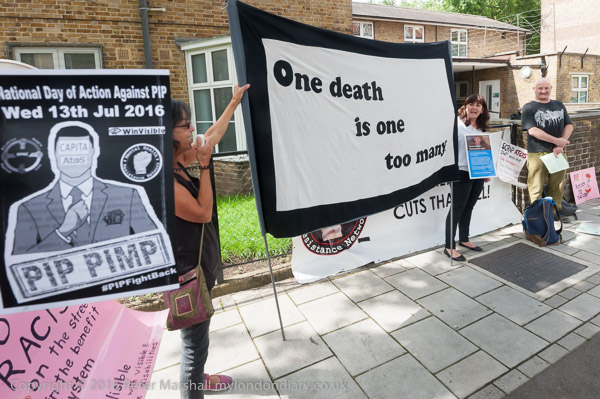
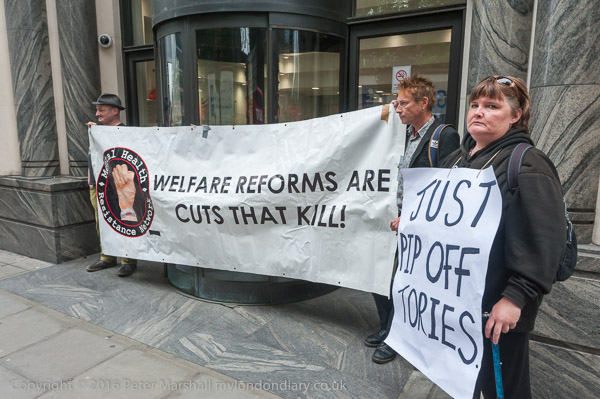
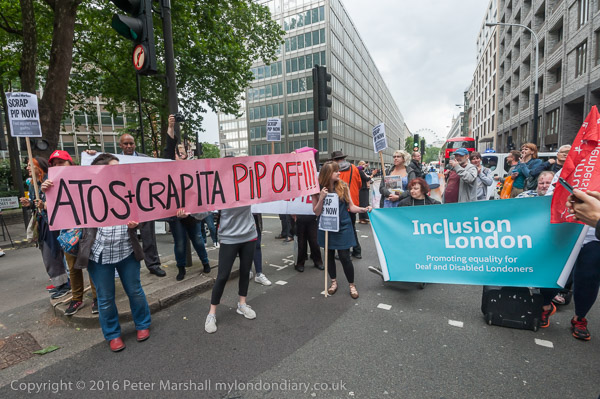
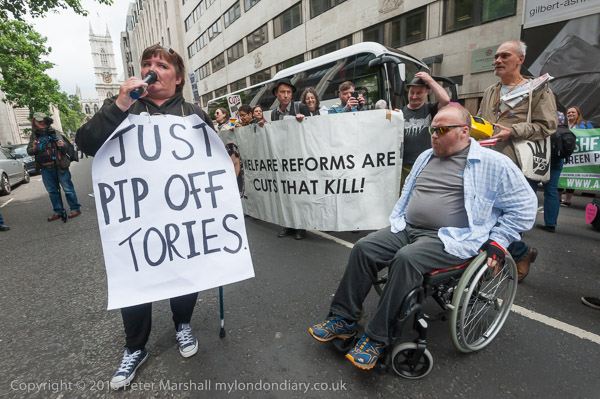
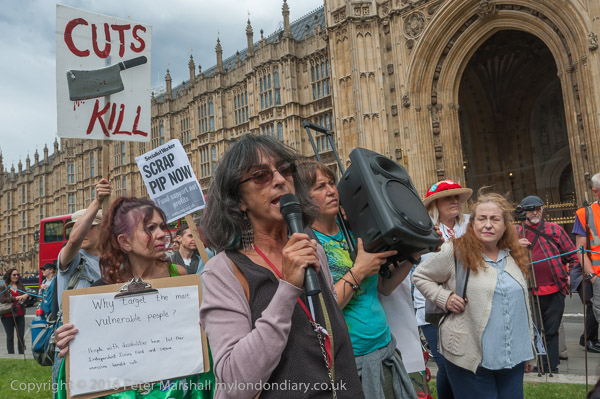
The day was also a ‘#PIPFightback’ National Day of Action against the Personal Independence Payments which disabled people say are a totally inadequate replacement for the Disabled Living Allowance. These rely on systematically flawed assessments carried out by private firms Capita and Atos which make no allowances for many variable conditions and ignore medical evidence. Administered by poorly qualified staff, many are overturned at tribunals after disabled people have suffered for months, sometimes leading to hospitalisation or suicide.

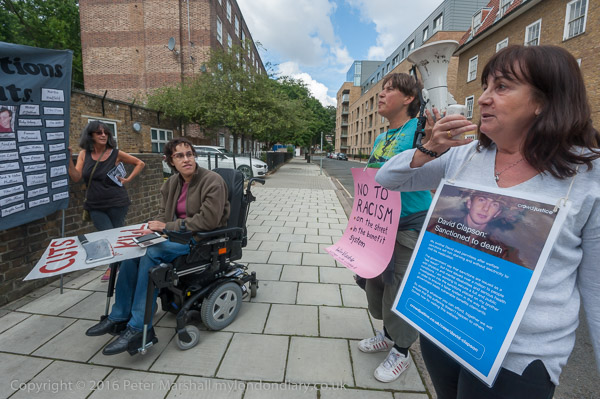
I’d started the day outside the Vauxhall PIP Consultation Centre run by ATOS in a back street with a small group of protesters including Gill Thompson, whose brother David Clapson, a diabetic ex-soldier died in July 2013 after his benefits were ‘sanctioned’. He was left starving without money for food or electricity to keep the fridge containing his insulin running. Like many his benefits had been stopped for trivial reasons and she was calling for a full and public inquiry into cases like those of her brother and to ensure a fairer system for vulnerable claimants.

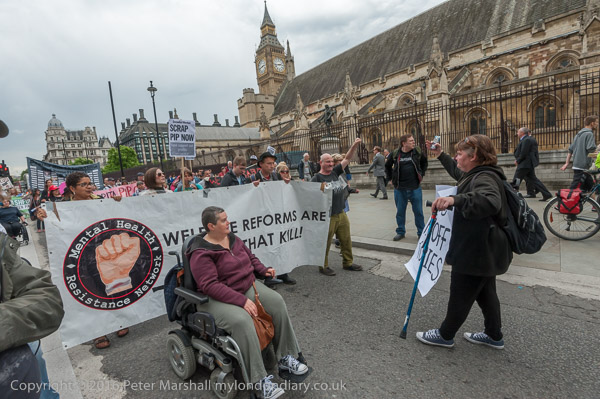
Later people from the Mental Health Resistance Network (MHRN), Disabled People Against Cuts (DPAC) and Winvisible (Women with Invisible and Visible Disabilities) and other supporters met outside the Victoria St offices of Capita PLC, one of the companies responsible for PIP assessments and held a rally on the busy pavement there.

After some speeches they moved from the narrow pavement to the busy road to continue their protest, holding up traffic for a few minutes, though they quickly moved to one side to allow an ambulance to drive through.

From there the moved to hold a short protest outside the Department of Work & Pensions offices at Caxton House, and then on to Parliament Square for another short rally.

Finally they decided to go to College Green where a media village was present with politicians being interviewed on TV over the appointment of Theresa May as Prime Minister. Police tried to stop them going into the area, but after some moved in eventually allowed them to stand on a path in the middle of the area a few yards away from the TV crews, who almost all totally ignored the protesters. Disabled people suffering and even dying apparently isn’t news.

Solidarity for Wood St cleaners
Trident Mad Hatters Tea Party
Disabled PIP Fightback blocks Westminster
NHS Bill protest at Parliament
PIP Fightback at Vauxhall


All photographs on this and my other sites, unless otherwise stated, are taken by and copyright of Peter Marshall, and are available for reproduction or can be bought as prints.


Clean Air – 1990 cyclists and 2019 XR East London

Cyclists protest, Whitehall, Westminster, 1990, 90-11c-14
‘Let London Breathe’ – Cyclists ride down Whitehall to a Trafalgar Square rally – November 1990

Back in 1990, I rode with hundreds of cyclists from the London Cycling Campaign and others protesting about the terrible air quality in London from Battersea Park to a well-attended rally in Trafalgar Square. Following the rally, some MPs raised the issue in Parliament.

XR East London marches for clean air – 12 July 2019

Almost 30 years on there has not been a great deal of progress – and the statistics now show almost 10,000 excess deaths per year in the city due to air pollution, and untold misery from various respiratory conditions, some crippling. In 2019 XR East London met at Bethnal Green on Friday 12 July to march to Hackney behind a banner ‘The Air That We Grieve’, calling for a rapid end to the use of fossil fuels.

Much of the pollution comes from road traffic, and the already announced end to the sale of new trucks, vans and any other combustion-powered vehicle from 2030 onwards will do a little to improve air quality, but existing petrol and diesel vehicles will continue to be used for many years, though we may see more stringent ultra-low emission zones to restrict their use in cities.

But although the switch to electric will cut down pollutants such as nitrogen oxides as well as reducing climate changing carbon dioxide, it will still leave other harmful substances such as particulates from tyres and brakes in the air. And the carbon footprint is only lowered so long as the electricity used to charge those car batteries comes from truly renewable generation.

Cleaner air in cities also needs us to move away from the car to more eco-friendly means of transport – such as public transport and bicycles. Even electric scooters and electric bikes also have a part to play.

Better public transport means more trains, light rail, trams and buses. The simplest and most cost-effective solutions are probably more dedicated bus lanes and bus-only routes, and giving buses greater priority in traffic. Many years ago I cycled in French cities where buses had priority and motorists (and cyclists) had to give way whenever they wanted to pull out from a stop, and changes like this to our Highway Code and traffic rules would make a difference.

In 1990 cyclists were calling for 1000 miles of dedicated cycle routes through London. We do now have some ‘cycle superhighways’ and ‘quietways’, although many of these – we are now supposed to call them ‘cycleways’ – still involve sharing with often dangerous traffic. Progress is still slow, and there is bitter opposition from some interest groups, particularly black cab drivers.

We need too an overhaul of London’s taxi system, with rules still made in the days of horse-drawn Hackney cabs. I’ve often stood at bus stops in the City waiting for my bus, held up by traffic while 20 or 30 or more black cabs drive by, the great majority of them empty. A move away from ‘ply for hire’ to smartphone based systems summoning a cab from a nearby taxi rank would hugely cut both congestion and pollution in the centre of London.

More at XR East London marches for clean air. You can click on the black and white image above to go to the album with more pictures from the 1990 cyclists protest.


As always I was travelling around London on public transport (I sometimes bring up a folding bike on the train) and as the march neared its end I boarded a bus in the opposite direction back to Bethnal Green where I took the tube back to Holborn, then took the short walk to the University of London’s Senate House, where exploited outsourced workers were holding a noisy protest after the newly appointed Vice-Chancellor Wendy Thomson had failed to reply to a request to meet them and discuss their grievances. You can see more about this at IWGB welcome new Vice Chancellor.


All photographs on this and my other sites, unless otherwise stated, are taken by and copyright of Peter Marshall, and are available for reproduction or can be bought as prints.


Knightsbridge – Around Hyde Park

Rutland Gate, Westminster, 198888-4c-55-positive_2400
Rutland Gate, Westminster, 1988 88-4c-55

The Rutland Gate to Hyde Park from Knightsbridge is just to the west of Hyde Park Barracks, and Rutland Gate is a rather strange double square with bits that extends south from there. These houses are at its south-west extremity, and that in the right is called Clock House, though I think you have to imagine the clock in the circular window above the door. It does have a statue on its roof, or possibly on that of an adjoining building, which appears to be some kind of classical figure. The frontage dates from its conversion to a ‘bijou residence’ between the wars, and the statuary arrived in the 1960s when Austin Blomfield remodelled the house for a former Lord Mayor of London, Sir Henry Aylwen.

Asia, John Henry Foley, Albert Memorial, Hyde Park,Westminster, 1988 88-4d-02-positive_2400
Asia, John Henry Foley, Albert Memorial, Hyde Park,Westminster, 1988 88-4d-02

Down the road at the Albert Memorial there is no shortage of sculptures, although I’m unsure why this rather large and half-dressed woman seated on an elephant should have been chosen to represent Asia. I suspect she more represents the fantasies of the sculptor than anything else.

Victoria Grove, Kensington, Kensington & Chelsea, 1988 88-4d-12-positive_2400
Victoria Grove, Kensington, Kensington & Chelsea, 1988 88-4d-12

Albert is also remembered in Albert Mews, through the archway on this picture of Victoria Grove. Victoria Grove runs from Gloucester Road to Victoria Road.

Kensington Court Place, Kensington & Chelsea, 1988 88-4d-16-positive_2400
Kensington Court Place, Kensington & Chelsea, 1988 88-4d-16

Kensington Court Gardens is a large mansion block built on the site of the Kensington Lawn Tennis Club in 1887-9 which was bought by Albert Barker. The block was designed by Henry Peck and built by Frederick Moir of Moir, Wallis and Company who moved into a flat there. The street, then Charles St, was renamed to Kensington Court Place in 1908. Flats then were advertised at between £195-£250 per year – equivalent allowing for inflation to £25,000 to £33,000. Some are quite large – one recent advertised had 4 bedrooms, 2 reception rooms, a large study, large kitchen/breakfast room and 3 bathrooms.

The flats have a blue plaque for T S Elliot who moved to flat 3 after his secret marriage to his secretary and editor Valerie in 1957 when he was 68 and she was 30. He died in 1965 but she continued to live her until her death in 2012

Hyde Park Gate,Kensington & Chelsea, 1988 88-4d-21-positive_2400
Hyde Park Gate,Kensington & Chelsea, 1988 88-4d-21

The blue plaque to sculptor Jacob Epstein is on a tall house at 18 Hyde Park Gate where he lived from 1929 until his death in 1959. Almost opposite is another blue plaque for novelist and playwright Enid Bagnold, and a little further down the road one for Winston Churchill who bought the house as his London base after his election defeat in 1945. Widely regarded as a hero for leading the country through the war, he is also vilified for his attacks on miners in Tonypandy, the deaths of millions of Indians in the Bengal famine, his approval of area bombing of German cities – surely a war crime – and many other actions.

Hyde Park Gate,Kensington & Chelsea, 1988 88-4d-22-positive_2400
Hyde Park Gate,Kensington & Chelsea, 1988 88-4d-22

The flag outside 45 Hyde Park Gate is the Australian flag as this is the Australian High Commissioners official residence. The house has been greatly altered and enlarged since it was built in 1838 as Stoke Lodge by Robert Thew, a major in the East India Company’s artillery.

Hyde Park Gate,Kensington & Chelsea, 1988 88-4d-31-positive_2400
Hyde Park Gate,Kensington & Chelsea, 1988 88-4d-31

Hyde Park Gate also includes sections running along the south side of Kensington Road as well as a road leading south. These modern flats are on the north east corner I think date from around 1972 when I think the houses on both sides of the entrance to the street were demolished.

Hyde Park Gate,Kensington & Chelsea, 198888-4d-32-positive_2400
Hyde Park Gate,Kensington & Chelsea, 1988 88-4d-32

Reading the list of well-known people who have lived in Hyde Park Gate in the Survey of London and on Wikipedia it seems almost every house could have a blue plaque. This one is for Lieutenant General Robert Stephenson Smyth Baden-Powell, 1st Baron Baden-Powell, OM, GCMG, GCVO, KCB, KStJ, DL though there isn’t room for all that on the plaque at 9 Hyde Park Gate, which simply records “Robert Baden-Powell 1857-1941 Chief Scout of the World lived here”.

All pictures are from my album 1988 London Photos. Clicking on any of the images will take you to a larger versinon in the album from where you can navigate forward or backward through all the images.


All photographs on this and my other sites, unless otherwise stated, are taken by and copyright of Peter Marshall, and are available for reproduction or can be bought as prints.
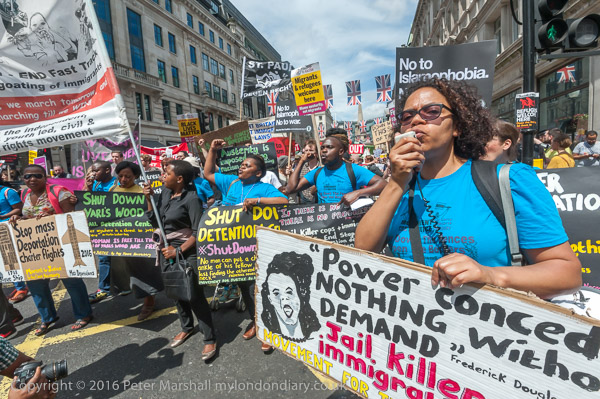

Black Lives Matter – Brixton 9th July 2016

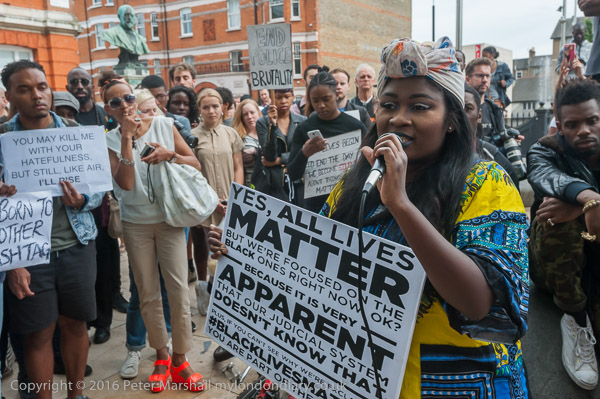
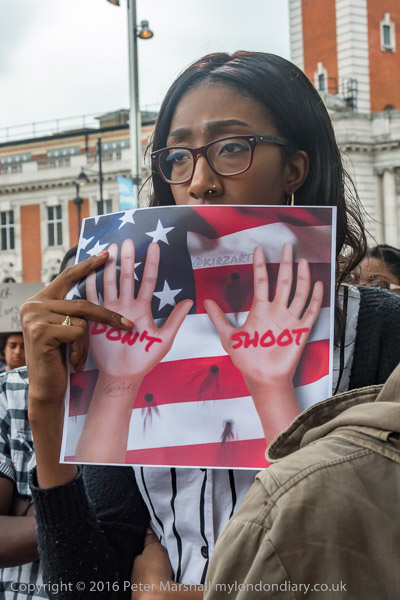
Five years ago on July 5th 2016, Alton Sterling, a 37 year old black man selling videos outside a convenience store in Baton Rouge, Louisiana was shot and killed by police at close range. The incident was filmed by several bystanders and their mobile phone video clip shocked and enraged viewers around the world.

The following day, July 6th, 32-year-old Philando Castile was driving with his girlfriend in a suburb od St Paul, Minnesota, when police stopped the car and asked to see his driving licence. His girlfriend video the events which ended in Castile being shot five times at point-blank range, dying 20 minutes later. The officer who fired was later charged with second-degree manslaughter and two counts of dangerous discharge of a firearm but found not guilty by a jury.

These two cases provoked protests around the world, including this event in Brixton. Shootings of people by police remain common in the USA at around a thousand a year and Black people are around two and a half times as likely to be shot as White. These cases stood out both because the two men shot were not involved in any crime but also because there was clear evidence from the videos that there was no justification for the shootings. Later the families were to be awarded compensation running into millions of dollars in both cases.

Although policing in this country is generally not carried out at the point of a gun, with an average of around 3 people killed by police shooting a year, there have been many cases of deaths at the hands of police, again disproportionally affecting Black people. As I wrote in my account of the protest:

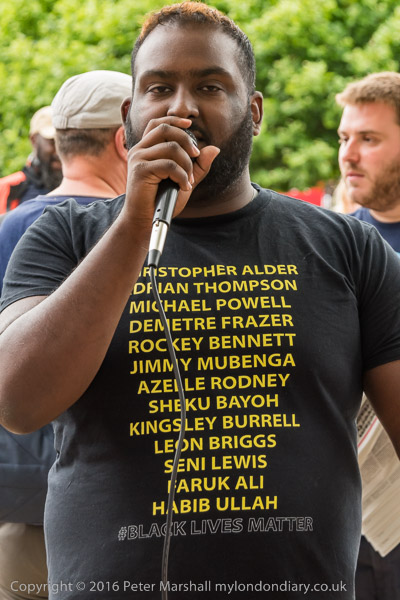
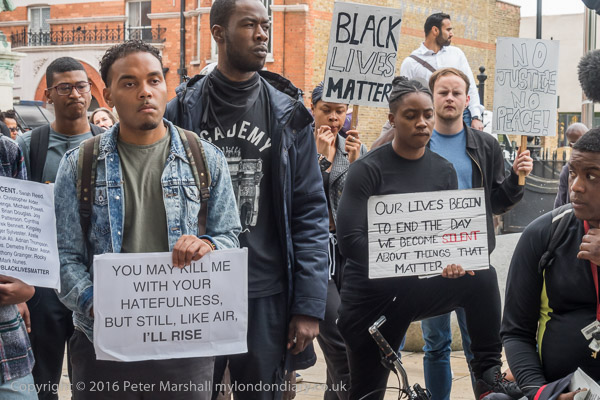
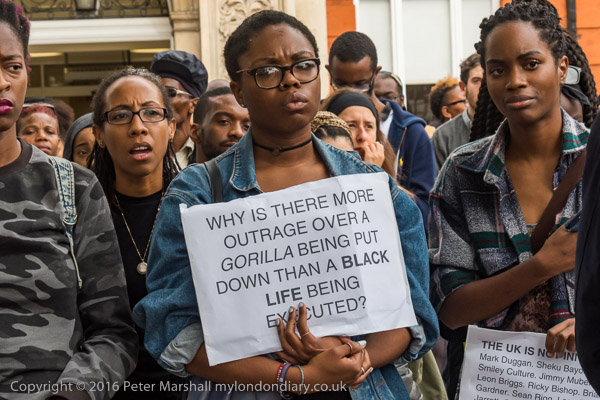
Brixton Police station has been the scene of a number of black deaths in custody, including that of Sean Rigg, Wayne Douglas and Ricky Bishop, and one of the organisers who spoke wore a t-shirt listing just a few of those who have been killed by police in the UK, with young black men in particular being far more likely to die after arrest – or to be shot rather than arrested. Last year police stripped the tree in front of the police station of its deaths in custody memorials on the day of the annual march in central London against deaths in custody.

My London Diary

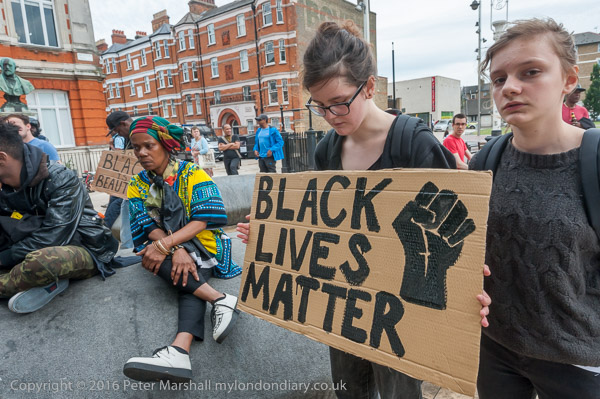
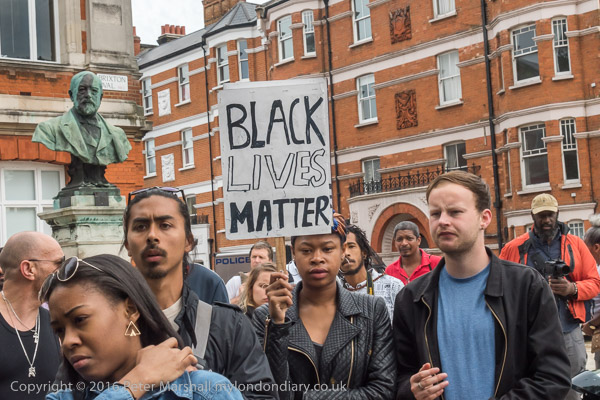
The crowd that gathered in Windrush Square (aka Windswept Square after Lambeth Councils re-landscaping to make it deliberately less hospitable) was largely black, and the protest had been called by local black organisers. Most of those who spoke talked about their own experiences of police racism in the local community as well as the shootings that had provoked the protest.

So many people wanted to have their say that the event continued for several hours, eventually going on to march up the Brixton Road to Brixton Police Station and bringing traffic to a standstill for several hours.

But it had come at the end of a long day for me and I had gone home well before that. Earlier in the day I’d photographed protests against the nonsensical ‘Garden Bridge’ across the Thames and the demolition of council estates by Labour Councils, both in Waterloo, in Hackney against domestic violence, at Downing St against Brexit, the scapegoating of immigrants and Islamophobia and a Green Park Brexit picnic and I was exhausted. You can find more about the Black Lives Matter protest and these other events on My London Diary.

Brixton stands with Black victims
Green Park Brexit Picnic
Europe, Free Movement and Migrants
East End Sisters Uncut-Domestic Violence
Housing Protest at ‘Progress’ conference
Garden Bridge ‘Progress’ protest


All photographs on this and my other sites, unless otherwise stated, are taken by and copyright of Peter Marshall, and are available for reproduction or can be bought as prints.
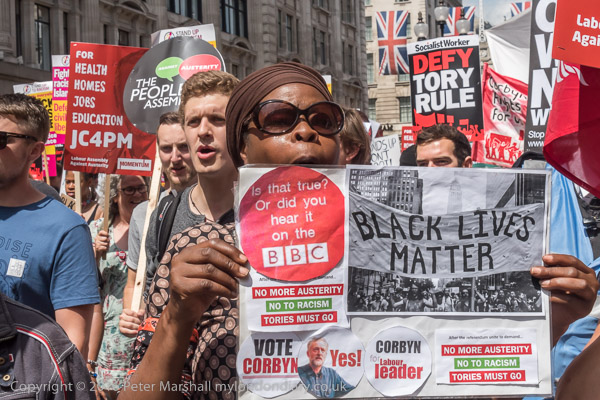

Anti-Racist & Migrant Rights Reclaim Pride – 2017

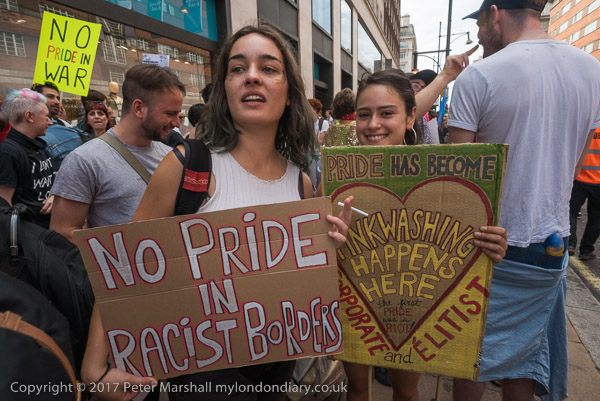
I’ve almost given up on photographing the annual Pride Parade in central London, which has become such a corporate event, though as in this event in 2017 there are sometimes things happening around it which still have some political edge – and even inside it, generally relegated to well behind the corporate razzmatazz.

As I wrote on 8th July 2017:

“Pride over the years has degenerated from the original protest into a corporate glitterfest led by major corporations which use it as ‘pinkwashing’ to enhance their reputation and it includes groups such as the Home Office, arms companies and police whose activities harm gay people in the UK and across the world.”

My London Diary – July 2017

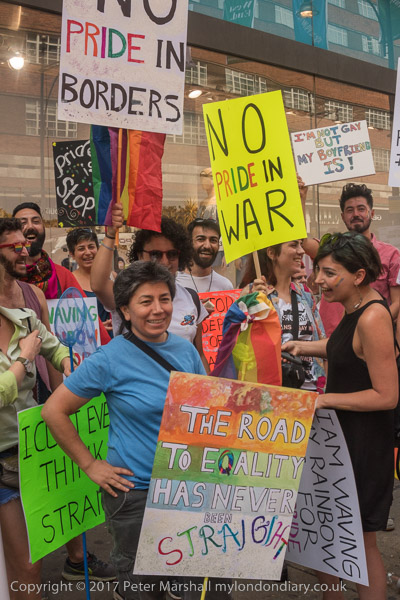
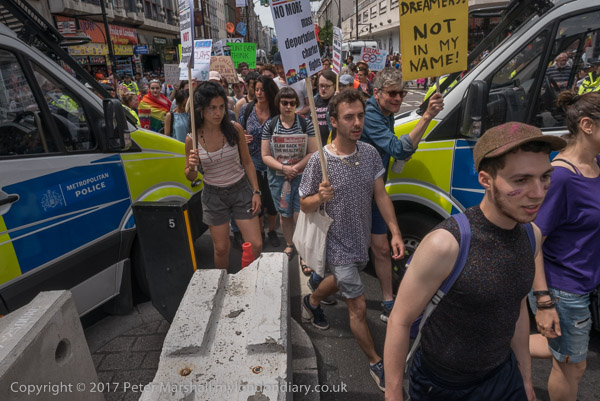
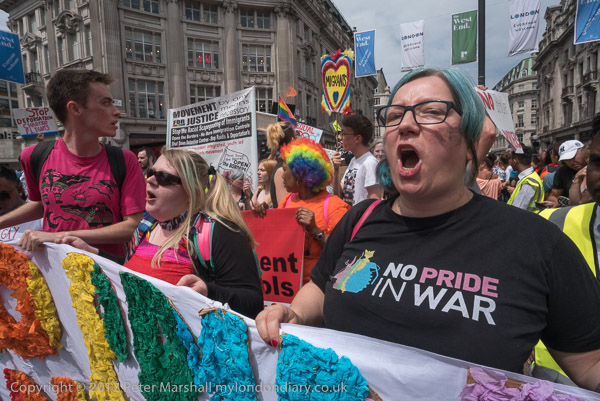
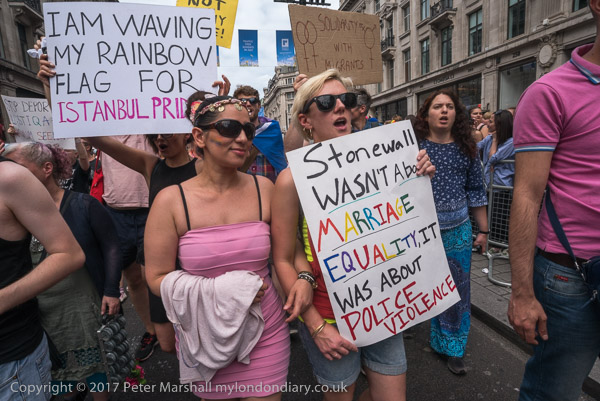
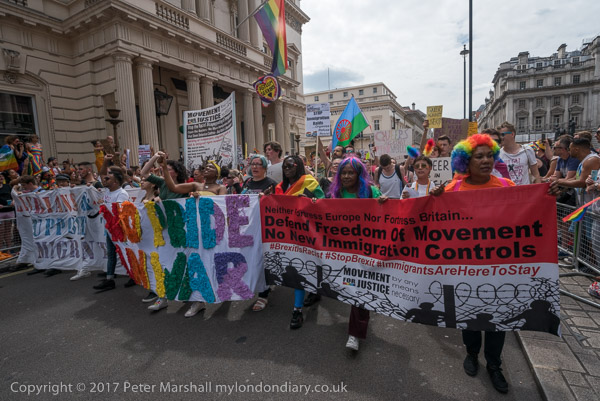
In 2017 the commercialisation of Pride had reached new heights, with participation limited to those groups who had officially applied and got pride armbands being allowed to join the procession. At least in part this seems to have been an attempt to exclude groups such as the Migrants Rights and Anti-Racist Bloc organised and led by Movement for Justice and including Lesbians & Gays Support The Migrants, No Pride in War and London Supports Istanbul Pride who had joined in towards the back of the 2016 parade.

I don’t know if the bloc had made an application, but I think probably not, and they certainly didn’t have the armbands. They marched between police vans that were blocking the entrance to Oxford Circus in front of the march with others lifting up barriers and tried to make their way past the front of the march to join in further back but were stopped by Pride stewards.

This left them immediately in front of the heavily stewarded front of the official parade, and they refused to move unless they were allowed to make their way into the parade. A stalemate ensued, with Pride stewards insisting that they had to leave the area, and the Migrants Rights and Anti-Racist Bloc refusing to shift. Police tried to get them to move and also tried to get the Pride stewards to let them into the march, but they remained adamant.

It was time for the parade to start, but it couldn’t. Eventually police sorted out the issue by holding back the official parade while the Migrants Rights and Anti-Racist Bloc marched along the parade route past the large crowds to a great deal of applause and some aggravation from Pride stewards along it.

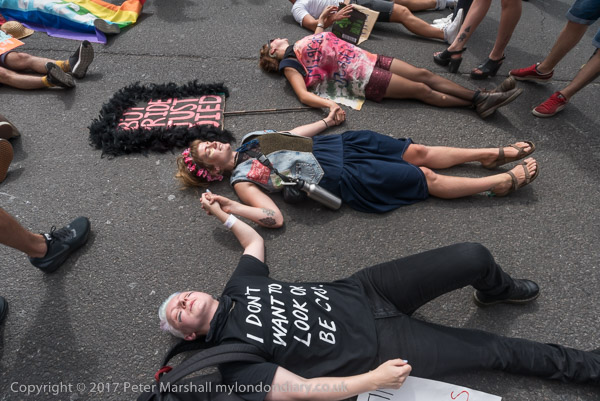
Around a quarter of an hour later, the official parade started, following them along the route. But it was again held up as the front of the procession reached Whitehall, as some of the No Pride in War protesters lay down on the tarmac in front of it. The procession was held up for another 15 minutes as police tried to persuade them to leave – and eventually I think they all got up when finally threatened with arrest.

The Migrants Rights and Anti-Racist Bloc had made a stand and had reclaimed Pride as a protest – with a separate official Pride following behind – and the No Pride In War had also made their point against the inclusion of the military in the official event. But “curiously” for such a high-profile protest in an event covered by huge numbers of press from around the world I think it went totally unreported in the mainstream media. For them, Pride is just a colourful spectacle.

Anti-Racist & Migrant Rights reclaim Pride

Save St Helier Hospital – 7 July 2018

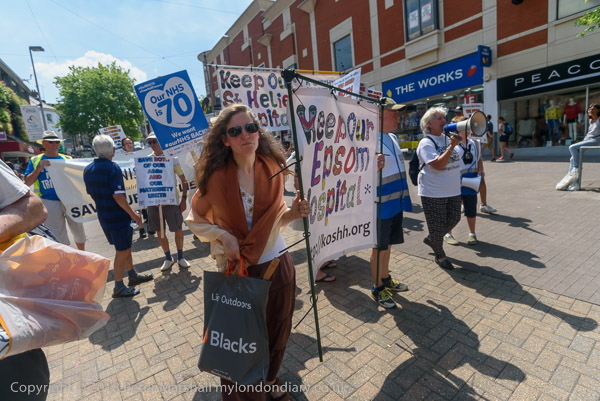
The battle by local campaigners against the closure of acute facilities at Epsom and St Helier Hospitals in south London has been hard fought and illustrates many of the problems faced by the NHS as the government has called for huge savings from hospital trusts, many made paupers by PFI repayments.

The situation continues to develop after the march which I photographed on Saturday 7th July 2018, and in July 2020 plans were approved to build a new smaller Specialist Emergency Care Hospital in Sutton which will bring together six acute services, A&E, critical care, acute medicine, emergency surgery, inpatient paediatrics and maternity services.

The trust say in the documentation for the first phase of public consultation which closed on 30th June 2021 that “85% of current services will stay at Epsom Hospital and St Helier Hospital. There will be urgent treatment centres open 24 hours a day, 365 days a year at both of these hospitals.”

But health service unions and campaigners are worried by the proposals, which they say will strip acute services including two fully functioning A&E departments. The proposed urgent treatment centres will not have the capacity to treat life threatening illness. They say the downgrading of the two major hospitals will endanger the lives of people living in the area.
The new unit is one of 40 across the country which have been announced several times as a part of the governments increased investment in the NHS. Many see this and other similar schemes as being designed to increase privatisation and make involvement in the health service more attractive to healthcare companies.

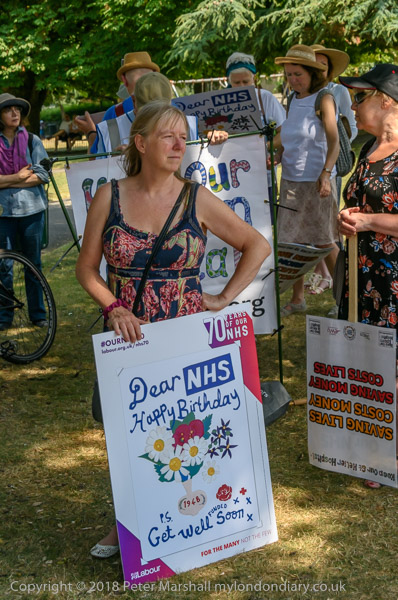
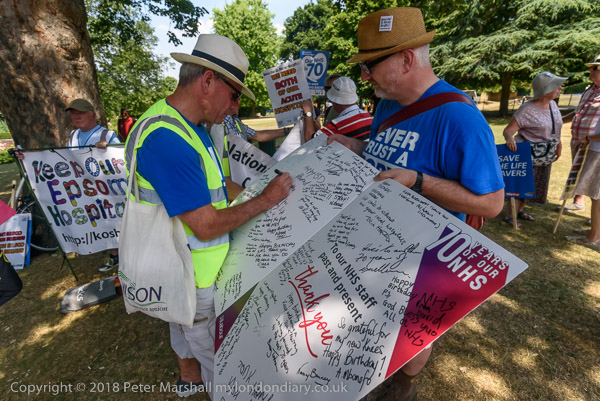
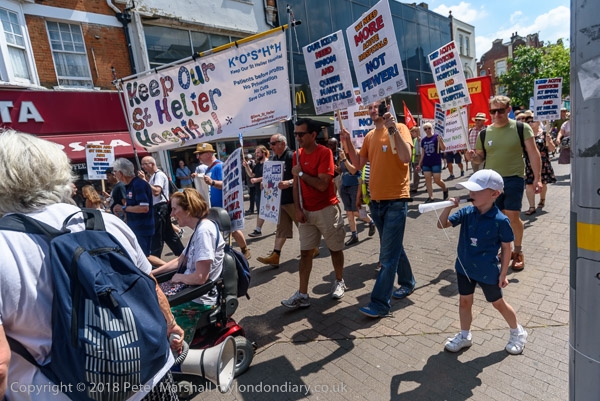
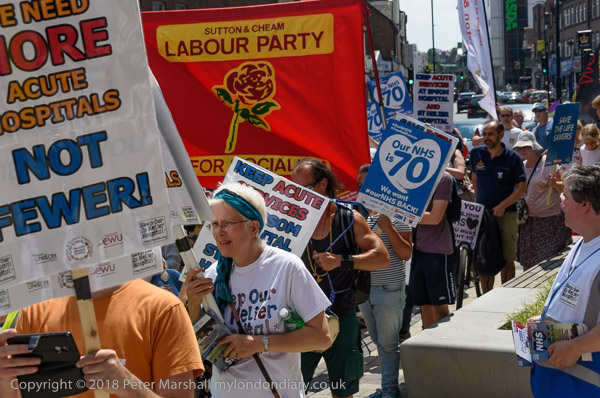
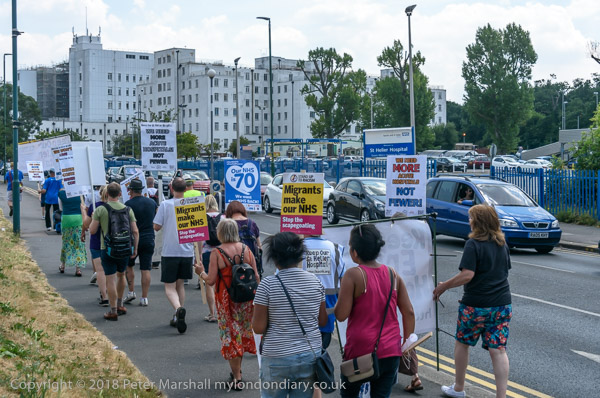
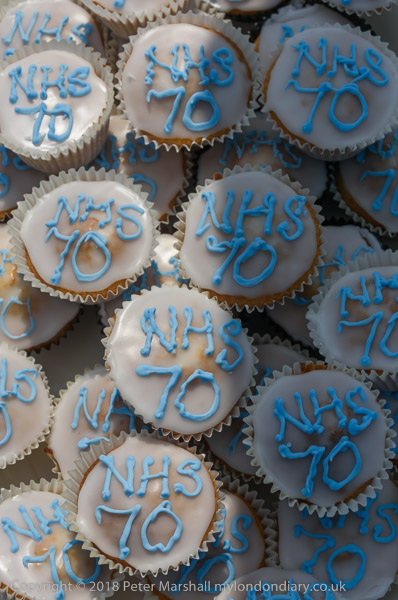
July 7th was a sweltering hot day in London, and the walk from a park in the centre of Sutton to the St Helier Open Space in front of the hospital went through Sutton High St, fairly crowded with shoppers and then along hot, dusty streets with few people around. Walking was tiring, and taking photographs even more so. It was a difficult event to photograph, where I found relatively little to work with. But I was pleased to be there, supporting the campaign to keep the hospitals open and serving the community, part of a National Health Service that was celebrating 70 years of being brought into existence by a Labour Government.

It took a huge and deterimined fight by Nye Bevan to get the National Health Service Act passed, with Tories denouncing it as bringing National Socialism to the country and opposing it in parliament at every opportunity. But on 5th July 1948 we got the NHS, although almost ever since the Conservative party when in power has been looking for and finding ways to convert it from a universal public health care system to a service run for private profit.

NHS at 70 – Save St Helier Hospital