11 October 2008

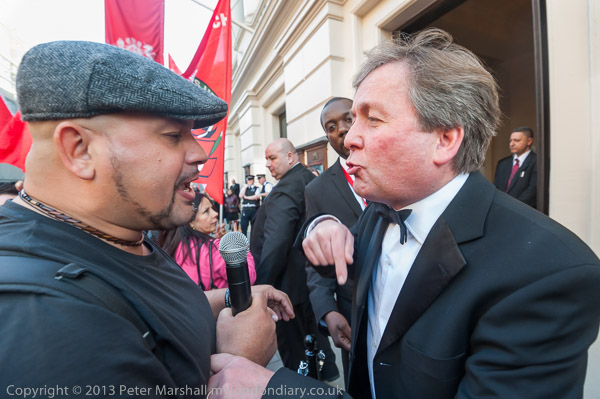
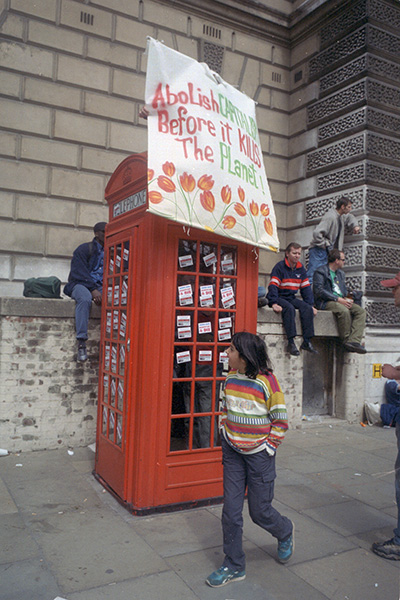
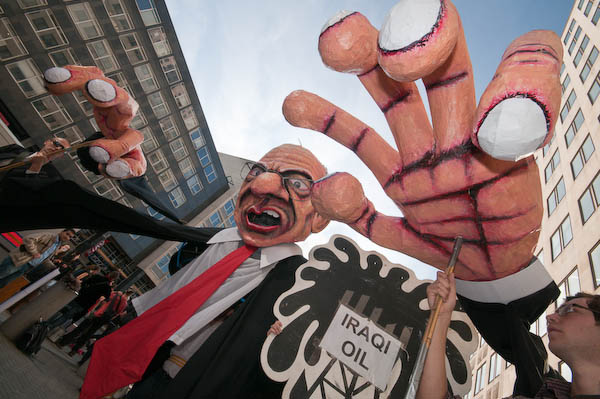
It was the start of the final 100 days of the Bush adminstration and the ‘Hands off Iraqi Oil’ coalition whose members included Corporate Watch, Iraq Occupation Focus, Jubilee Iraq, PLATFORM, Voices UK, and War on Want and was supported by the Stop the War Coalition and others had come to Shell’s UK headquarters at Waterloo to protest against plans by Britain and the USA for Iraq to hand over most of the country’s oil reserves to foreign companies, particularly Shell and BP.
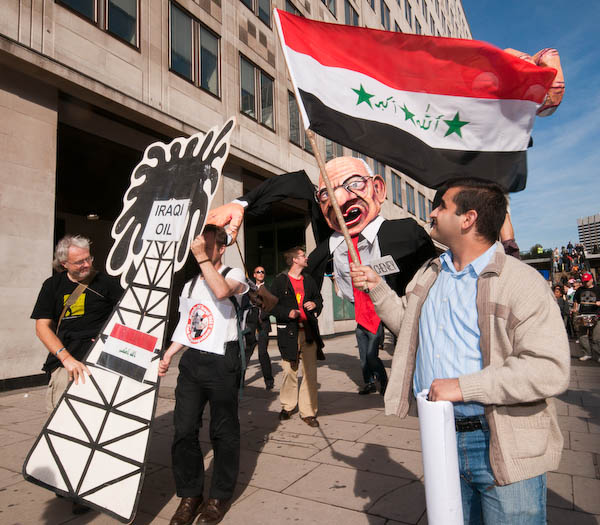
Iraq had nationalised its oil by 1972, and it provided 95% of its government income. Many had seen the invasion of Iraq by the US and UK (along with Australia and Poland) as largely driven by the desire to gain control of Iraq’s huge oil reserves and the US had engaged consultants to help it write a new oil law which it got the Iraqi cabinet to approive in 2007 which would give foreign oil companies – including Shell and BP, long-term contracts within a safe legal framework. But large-scale popular opposition meant the Iraqi parliament failed to approve the new law. But in June 2008, the Iraqi Oil Ministry went ahead with short-term no-bid contracts to the major foreign oil companies – including Exxon Mobil, BP, Shell, Total and Chevron and later these and other contracts were made more favourable to the oil companies.
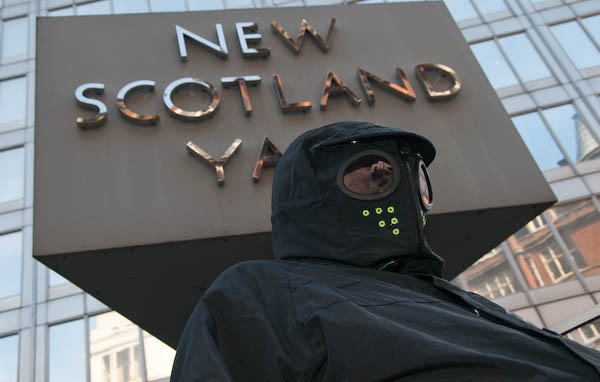
After the protest at Shell’s offices the protesters marched to protest outside the BP HQ in St James’s Square and then to the US Embassy, and I left to cover the London Freedom not fear 2008 event outside New Scotland Yard. Similar protests were taking place in over 20 countries to demonstrate against excessive surveillance by governments and businesses, organised by a broad movement of campaigners and organizations.
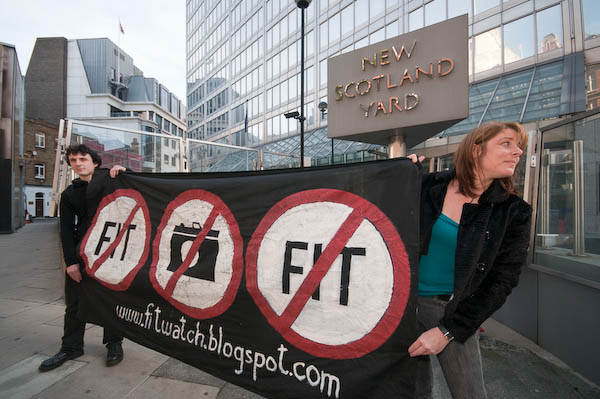
The London event highlighted the restrictions of the right to demonstrate under the Labour government’s The Serious Organized Crime and Police Act 2005, (SOCPA),, the intimidatory use of photography by police Forward Intelligence squads (FIT), the proposed introduction of ID cards, the increasing centralisation of personal data held by government, including the DNA database held by police, the incredible growth in surveillance cameras, ‘terrorist’ legislation and other measures which have affected our individual freedom and human rights.
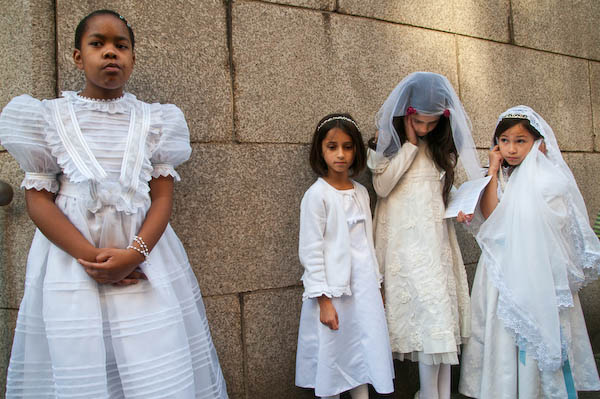
For something completely different I walked a quarter of a mile down Victoria Street to Westminster Cathedral where people were assembling for the Rosary Crusade of Reparation, one of the larger walks of public witness by Catholics in London.
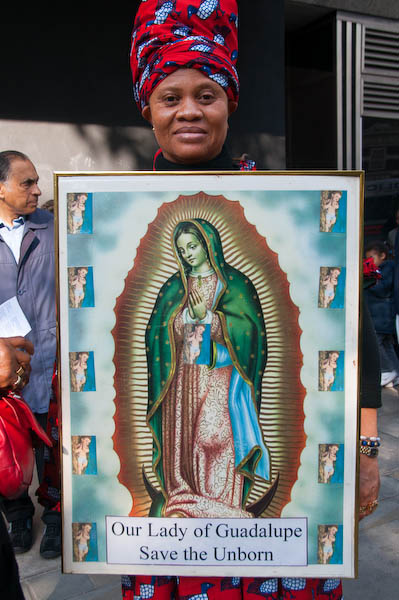
This tradition began in Austria in 1947 with the roasary campaign begun by a priest praying for his country to be freed from the communist occupiers. The first annual parade with the statue of Our Lady of Fatima took place in 1948 in Vienna on the feast of the Name of Mary, Sept 12, which had been established by Pope Innocent XI in 1683 when Turkish invaders surrounding Vienna were defeated by Christian armies who had prayed to the Blessed Virgin.
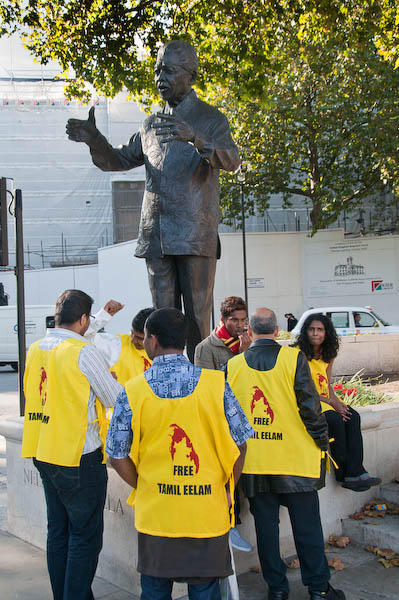
As the procession to a service at Brompton Oratory began I walked back up Victoria St to Parliament Square, where a number of other small protests were in evidence. All over the centre of London there were people giving out leaflets about the growing problems faced by Tamils in Sri Lanka, where they allege a program of ethnic cleansing is being carried out by the government. International media are banned from the Tamil areas of the country and NGOs have been ordered out of some areas, so there are few reports of the war. Worse was to come and in 2009 in the final stages of the war conservative estimates are that 70,000 civilians were killed in the the Mullivaikkal massacre.
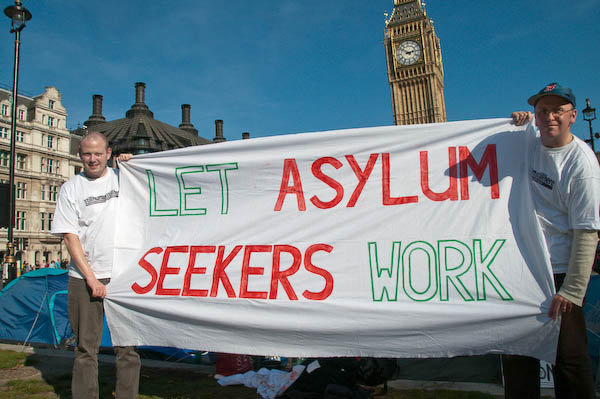
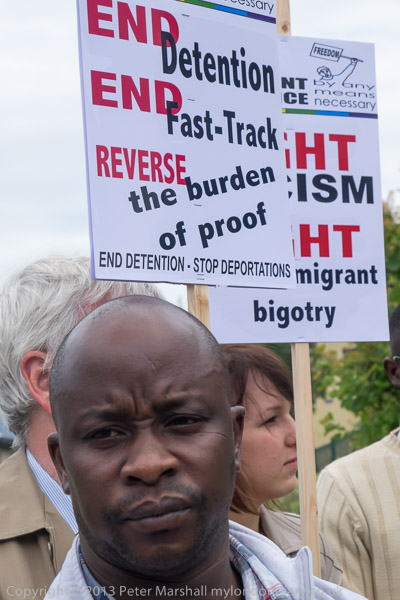
Others in the square were protesting against the UK’s scandalous treatment of asylum seekers and calling for the asylum detention centres to be closed down.
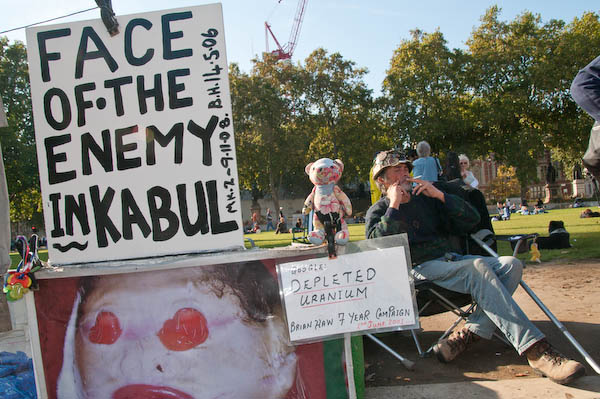
Brian Haw was still there, and I wrote:

Facing Parliament, Brian Haw‘s peace protest continues – he has been there for almost 2700 days – over 7 years – and it will soon be his 60th birthday. Brian says that now the police seem to have largely abandoned attempts to get rid of him legally there have been a number of odd attacks against him and others in the square – which the police have ignored. I took some time talking to a man who smelt of alcohol, was talking nonsense and acting unpredictably – and who then went and started to insult Brian. One of the other demonstrators stood between him and Brian who was filming him. I put down my bag as I took photographs in case I needed to step in and help, but fortunately he eventually moved away.
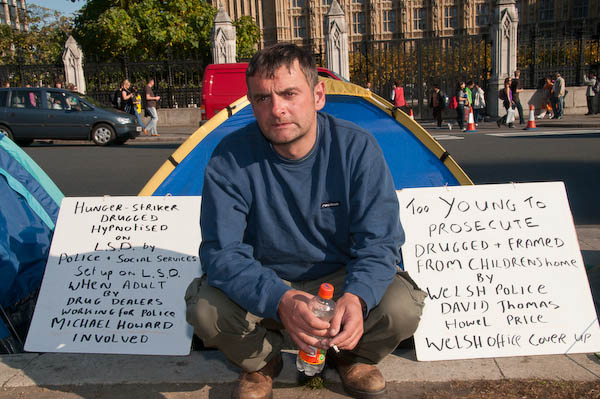
There were others protesting in Parliament Square, including one man who asked me to take his picture. He told me his name was Danny and that he had been there on hunger strike for two weeks, protesting over his failure to get his case investigated. He claimed to have been abused by police and social services following an incident in which as a seven year old child in Llanelli he was implicated in the death of a baby brother. I was unable to find any more information about his case.
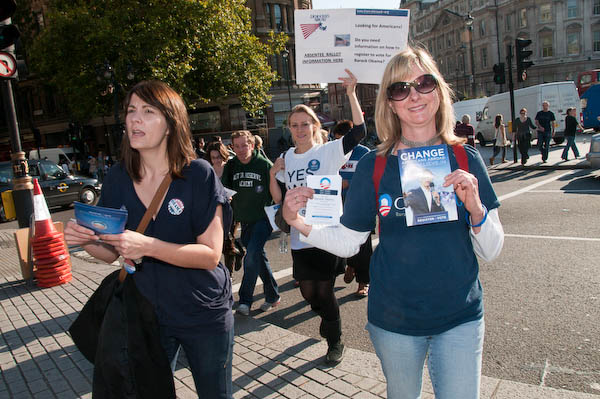
Finally I saw a group of people walking past holding leafelts with the the word CHANGE on them and rushed after them to find they were Obama supporters hoping to persuade Americans they met to register and vote in the election. It was time for me to go home.

Parliament Square
Rosary Crusade of Reparation
Freedom not Fear 2008
Bush & Cheney’s Iraq Oil Grab
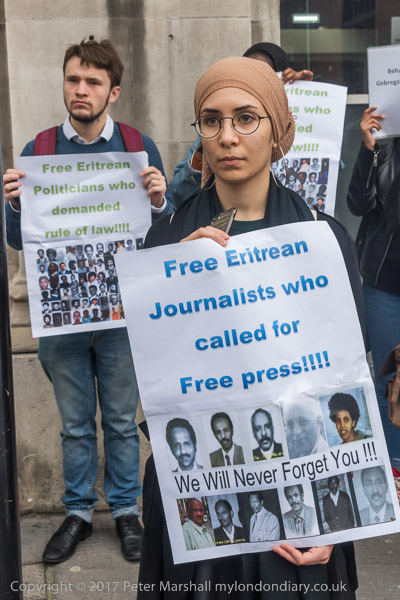
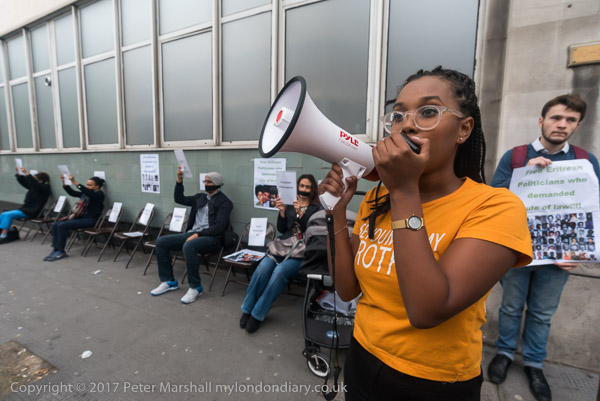
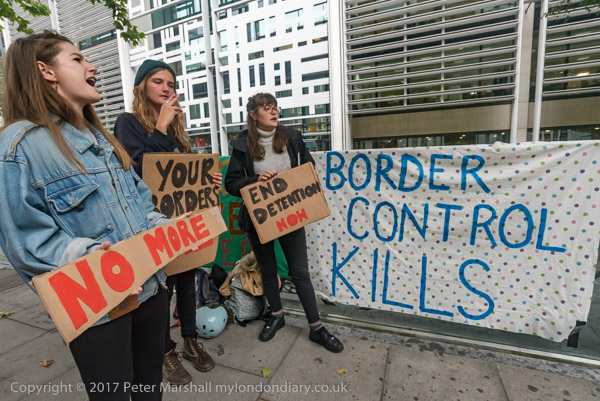
Deaths in Eritrea & the UK and a Peace March 2017

Most embassies are in the most expensive parts of London, with a large number around Belgrave Square and others in Mayfair. Eritrea’s is in Islington and I can only recall once having been to a protest outside it. There should be more, particularly by jounalists, as Eritrea, a one-party state ruled by presient Isais Afwerki since independence in 1993, has one of the worst human rights records and, according to Reporters Without Borders, has the worst press freedom in the world. In 2001 all independent media in the country were banned and politicians and ten leading journalists were arrested and thrown into isolation without charge, without trial and without contact with the outside world. Nobody knows their whereabouts and only four were thought to be still alive in 2017.

Those still alive are still in jail and have now been held for 20 years, along with other journalists imprisoned since then. Very little is known about most of them with no official information being released, other than government denials that some have been tortured, which are widely disbelieved. They are held in jails where torture is commonplace. In December 2020, 28 Jehohova’s witnesses, some of whom had been in jail for 26 years were released, raising hopes of the families of journalists, but there have been no further releases.

On Thursday 21st September 2017 there were 12 chairs set out at the protest across the street from the Eritrean Embassy, one four each of the journalists jailed in 2001, with photographs of them all. Protesters sat on four of the chairs, representing those thought still to be alive.

I went to another protest about deaths in prisons, this time in the UK. It was called at short notice after a Chinese man in Dungavel immigration detention centre. This followed the death earlier this month at Harmondsworth detention centre of a Polish man who took his own life after the Home Office refused to release him despite the courts having granted him bail. There have been thirty-one deaths in immigration removal centres since 1989.

Britain is the only EU country which holds refugees and asylum seekers to indefinite detention, and both official reports and media investigations have criticised the conditions at these immigration prisons. The protest outside the Home Office called for an end to immigration detention, which is inhumane and makes it difficult or impossible for asylum cases to be fairly assessed.

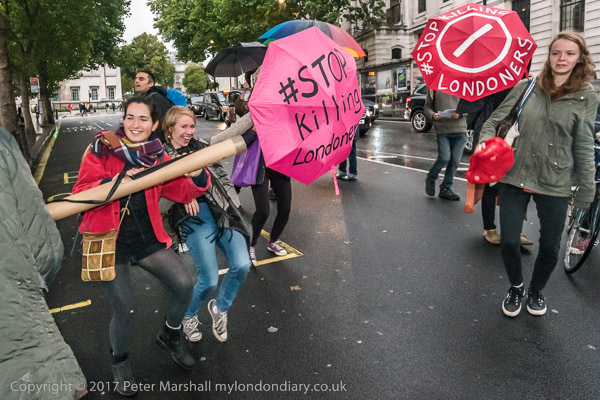
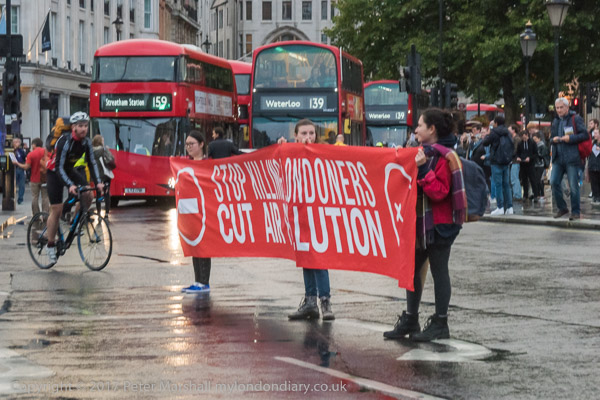
Stop Killing Londoners blocked traffic briefly in a carefully planned operation in Trafalgar Square, which involved the simultaneous stopping of traffic at all five entrances to the road system. As in previous events, it was a token block, holding up traffic for less time than it gets halted by congestion on some busy days, and around ten minutes after it began they moved off the road, returning a few minutes later for a short ‘disco protest’, dancing on the road on the east side of the square for a few minutes until police asked them to move.

The protest was to publicise the illegal levels of air pollution in the capital which result in 9,500 premature deaths and much suffering from respiratory disease. It was one of a series of similar protests in various areas of London.

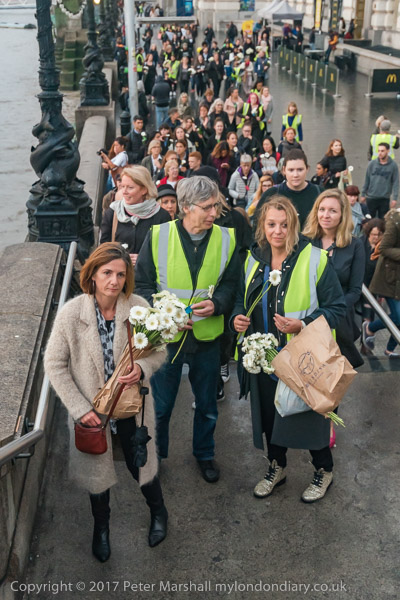
I hurried down from Trafalgar Square to Westminster Bridge, going across it just in time to meet the World Peace Day Walk as several hundred campaigners walk arrived having walked beside the Thames from Borough Market carrying white flowers. The London Peace Walk was one of a number takeing place in Barcelona, Paris and other cities around the world on World Peace Day.

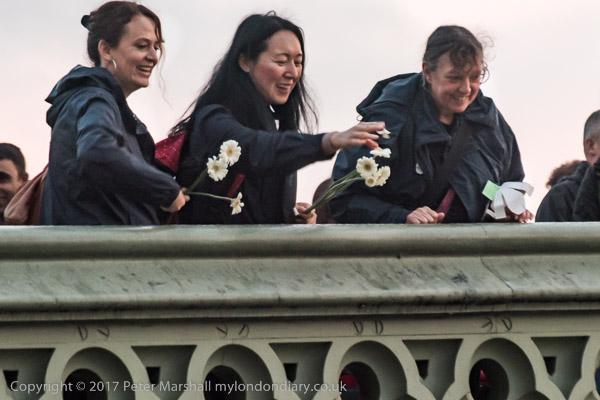
The marchers wore black and walked in silence to grieve for the recent loss of precious life due to violence in all forms, including terrorist, state, corporate, domestic. They stated that there can be no peace without justice, equality and dignity for all and that “We stand together against the forces of hate and division – for peace.” At the end of their march they went onto Westminster Bridge and threw flowers and petals into the Thames.

More at:
World Peace Day Walk
Trafalgar Square blocked over pollution
No More Deaths in immigration detention
Free forgotten jailed Eritrean Journalists


All photographs on this and my other sites, unless otherwise stated, are taken by and copyright of Peter Marshall, and are available for reproduction or can be bought as prints.


DSEI Arms Fair Protests 2015

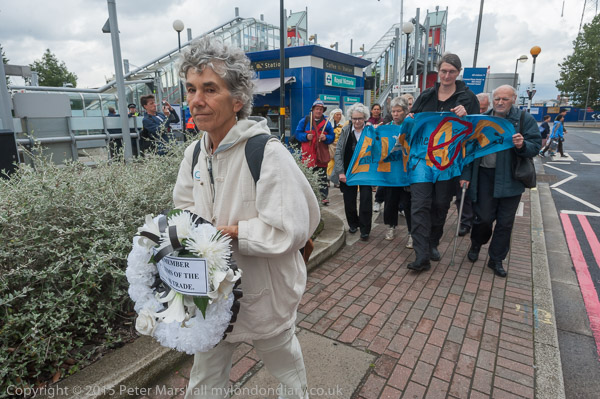
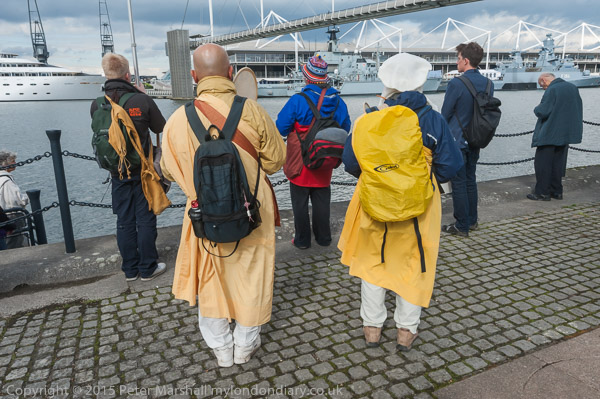
The final protests against the 2015 DSEI arms fair at the Excel Centre on the Royal Victoria Dock in East London took place on 15th September 2015, the day that the arms fair opened. British and foreign warships were lined up alongside the Excel Centre inside which weapons were being sold that would be used to kill people in wars around the globe and to repress, kill and torture in many countries.

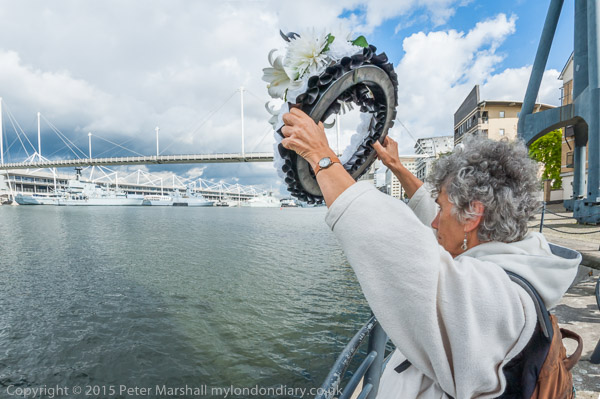
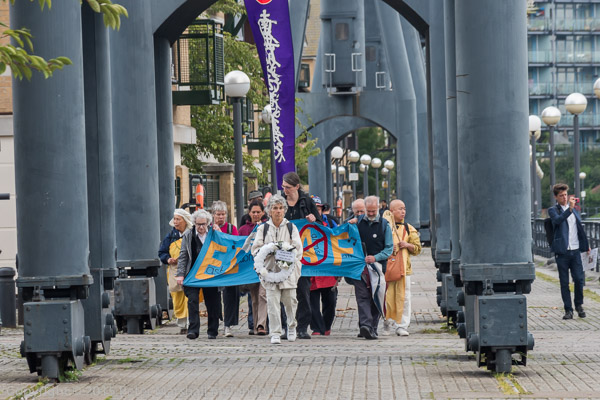
East London Against Arms Fairs held a procession around the Royal Victoria Dock floating a wreath oppposite the fair and holding a silence for victims of the arms trade, ending with a Buddhist prayer. They met with two Buddhist monks and supporters and some from the Stop the Arms Fair coalition who had been protesting against the Arms Fair at ExCel over the last week at Royal Victoria DLR station.

The procession was led by a woman wearing white and carrying a white wreath with the message ‘Remember Victims of the Arms Trade’ followed by the East London Against Arms Fair (ELAAF) banner with its dove of peace. It slowly made its way around the west end of the dock and then along its south side until it got close to the end of the dockside path, almost opposite the arms fair.

There was then a ceremony with the wreath being floated on the water of the dock and a two minute silence in memory of those killed by the arms from deals made at the previous fairs and those who will die from the weapons being sold at this DSEi fair. This was followed by a period of prayer by Japanese Buddhist monk Reverend Gyoro Nagase, the guardian of the Peace Pagoda in Battersea Park.


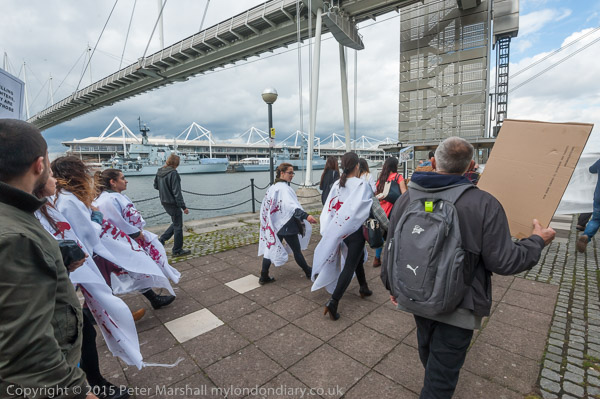
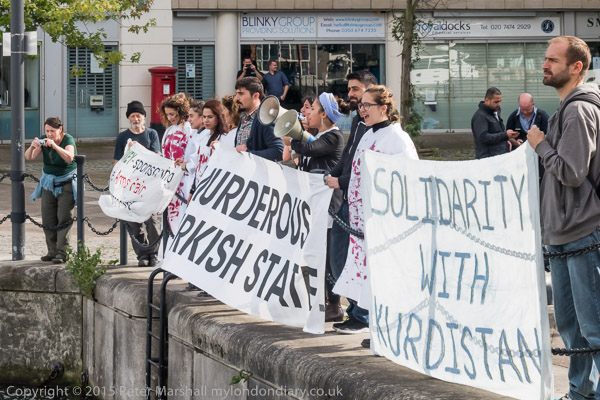
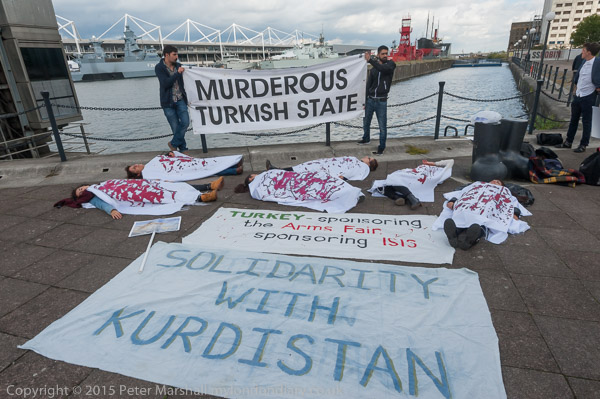
As the first protest lefit, another group came marching along the dockside to take their place. Kurdish Youth Organisation Ciwanen Azad UK and Stop the Arms Fair supporters had also marched around the Royal Victoria Dock and were staging a ‘die-in’ and rally opposite the Excel centre.

The Turkish government’s Defence and Aerospace Industry Exporter’s Association is one of the international partners of the DSEi Arms Fair, and sales of their weapons at DSEi help fund the the vicious attacks on the Kurdish population in Turkey. A week earlier a relentless assault by Turkish military and police on the town of Cizre killed many people, including children. Attacks have increased since the pro-Kurdish HDP party passed the 10% threshold in the general elections in June 2015, winning seats in the Turkish parliament.

The sales of weapons at the arms enables the Turkish arms industry to continue its development of new weapons, including new drones, new MPT rifles and the Altay battle tank which will be used to continue the massacre of Kurds.

The protesters set up a display of banners and six Kurds in bloodstained white robes stages a ‘die-in’ on the dockside against the Murderous Turkish state opposite the DSEi arms fair.

Kurds say Stop arms sales to Turkey
Wreath for Victims of the Arms Trade


All photographs on this and my other sites, unless otherwise stated, are taken by and copyright of Peter Marshall, and are available for reproduction or can be bought as prints.


Organised Crime – Public & Private Sector

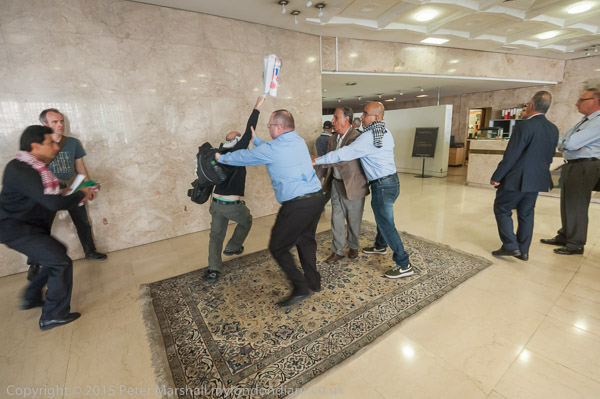
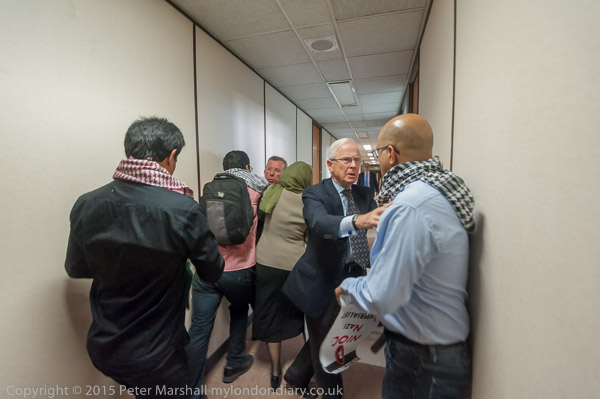
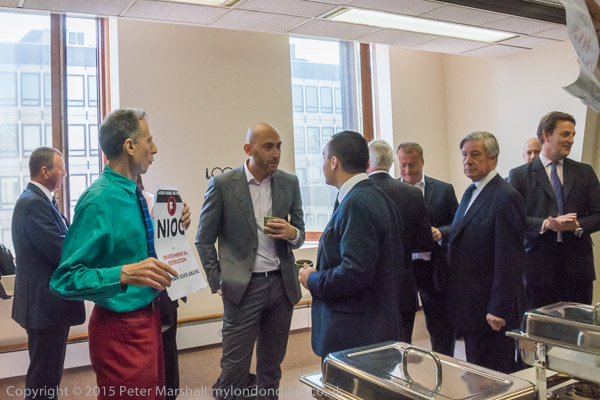
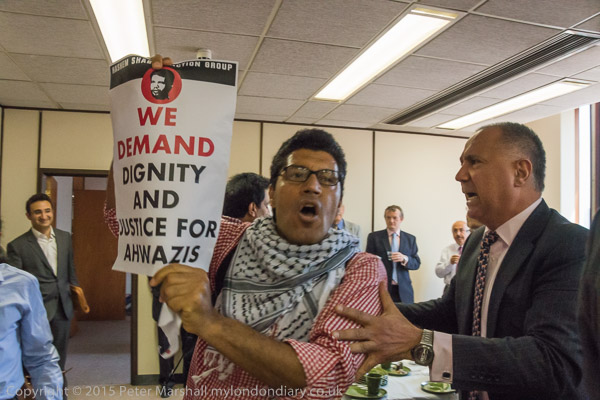
I don’t know who drew the often published cartoon which shows a young boy talking with his father and saying “Dad, I’m considering a career in organised crime” to which his father replies ‘Government or Private Sector”, but it comes to mind when thinking about the secret UK-Iran business meeting which I photographed Ahwazi activists and Peter Tatchell gate-crashing on July 3rd 2015. Though the UK-Iran crimes involve both sectors.

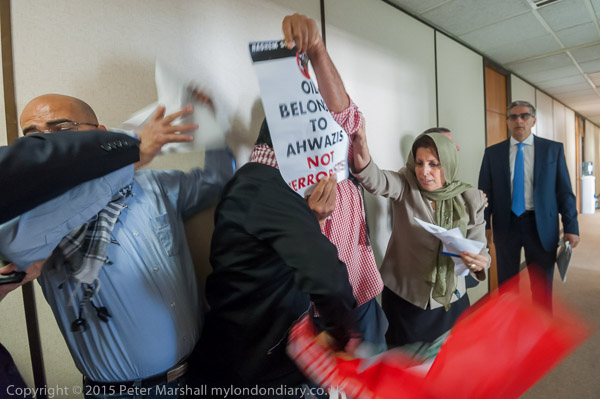
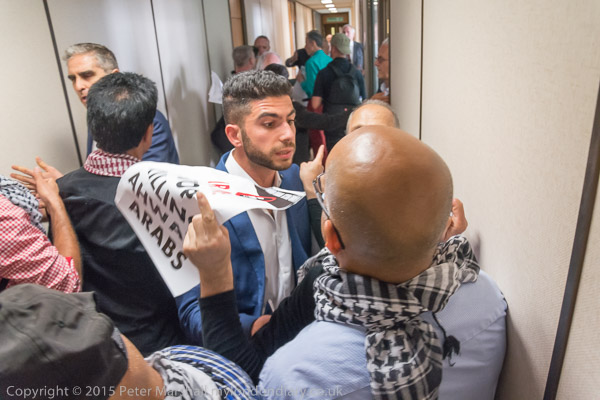
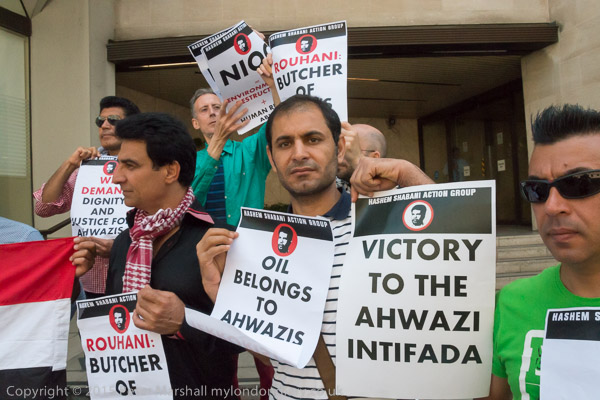
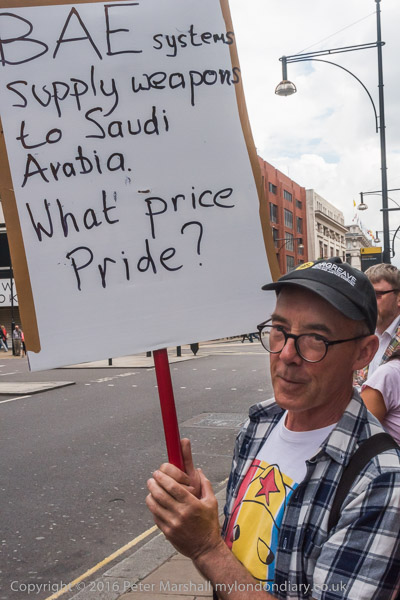
To take pictures I had to rush in with the group of protesters to the National Iranian Oil Company offices in Westminster, which are clearly private property and I Would probably be committing an offence, but I felt there was a clear public interest in covering the protest by the Hashem Shabani Action Group against the exploitation and environmental destruction of their homeland by Iran and the UK and the long history of anti-Arab oppression by the Tehran regime.
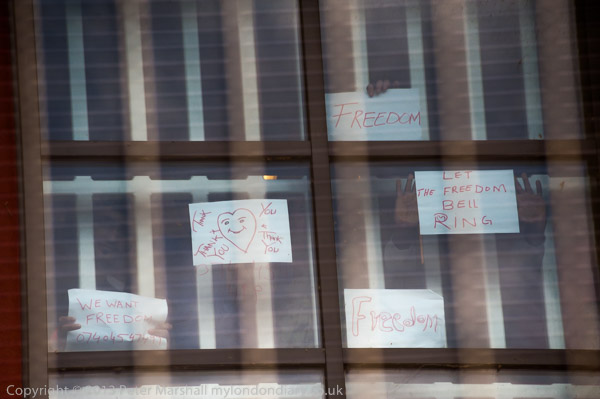
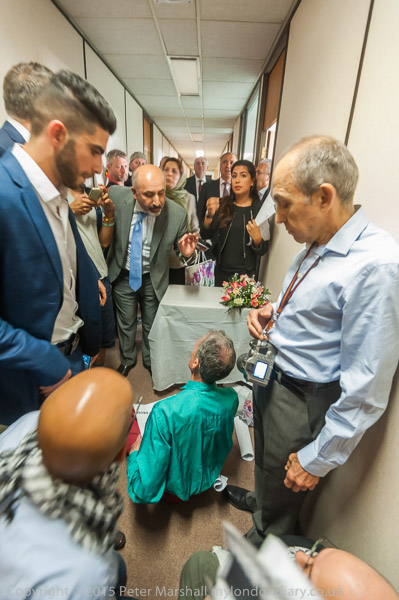
Fortunately I was able to enter the building without being personally confronted by the security staff who were busy trying to grab some of the protesters, and along with two other photographers and a couple of videographers was able to run up the six flights of stairs to the floor where the secret meeting was taking place, though I was in a pretty poor state by the time I reached the top landing, worried I might collapse. I was after all probably around 20 years older than most of the others, though only seven older than Peter Tatchell.
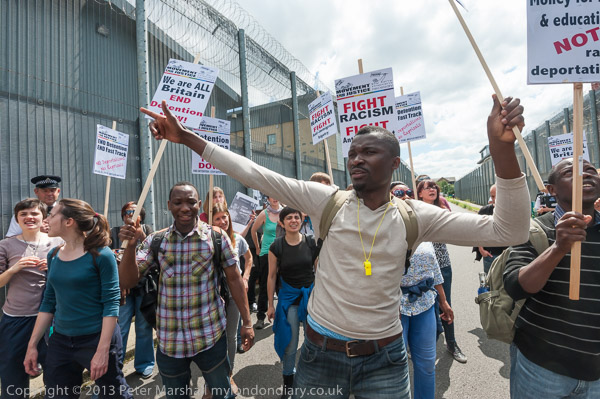
I did manage to photograph the peaceful protest inside the meeting, where most of those present were enjoying a buffet lunch, and to take some pictures of the confrontation in the corridor outside, where one youngish man in a blue suit, thought by the protesters to be an Iranian military officer, became rather violent and assaulted another of the photographers. But the corridor was dimly lit and some of my pictures were less than sharp, mainly blurred by moving subjects with the slowish shutter speed I needed.

I may have mentioned in other posts that I very seldom watch TV. I last lived with a TV back in 1968, when I got married and moved into a flat without one, and since then it’s been something I just don’t have time for in my life. Of course I’ve watched TV elsewhere – and can do so now by computer, but its never become a regular habit. One of the consequences of this is that there are many celebrities and public figures that I don’t easily recognise, only hearing them on radio or seeing the occasional picture in the press. So although Lord Lamont or Tory MP Richard Bacon, leader of the All Party Parliamentary Group on Iran, both leading the call for the peaceful and non-violent Hashem Shabani Action Group, (motto ‘Our weapons are pens. Our bullets are words‘), to be banned as a terrorist group were present, I failed to get newsworthy pictures of them.

Having made their point, the protesters decided to leave and I went with them, only to be stopped by police in the foyer of the building. We were prevented from leaving despite showing our press cards, but told we were not under arrest. The photographer who had been assaulted complained to the police, who went upstairs to ask questions, returning after a few minutes to say that the perpetrator probably had diplomatic immunity, and the photographer decided not to press charges.

Eventually after around 45 minutes – during which the building manager brought us fruit juice – press and protesters were allowed to leave and join those outside who had been unable to get past security for more photographs.

More on My London Diary about the dubious history of Britain and Iranian oil and the protest at Ahwazi crash secret UK-Iran business meeting.


All photographs on this and my other sites, unless otherwise stated, are taken by and copyright of Peter Marshall, and are available for reproduction or can be bought as prints.


Migrant Pride and Pride 2016

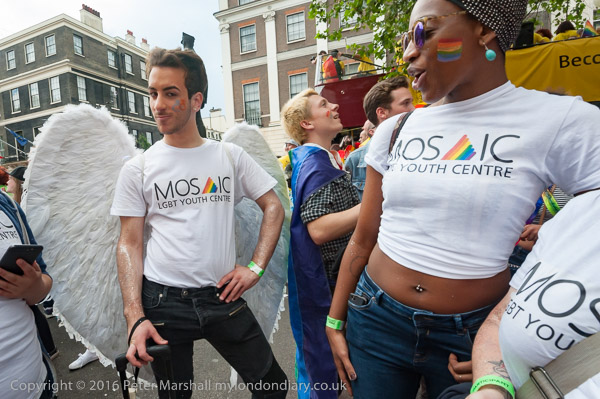
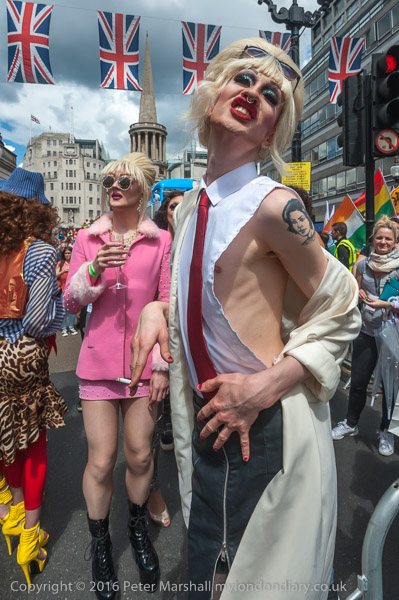
I first photographed London’s annual Pride in 1993, when it was a much smaller and more political event than it has become. Back then it was still a protest an since then it has become a parade, dominated by large corporate floats, from various large companies, armed forces and police.

Of course there is still some of the old spirit, with many groups from the gay community and even some protesters still taking part, but largely hidden at the back of the very long line-up.

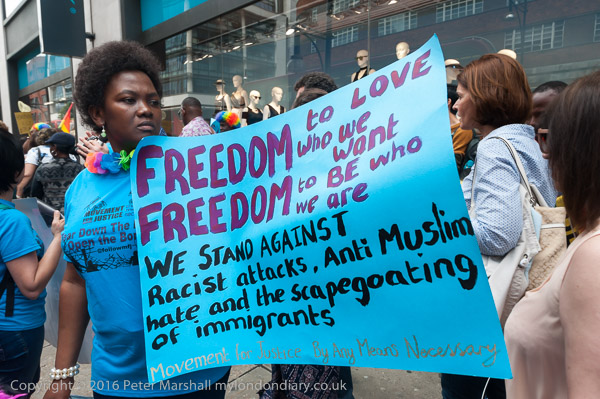
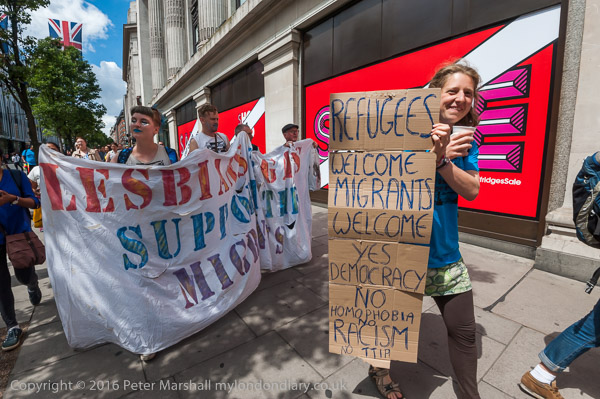
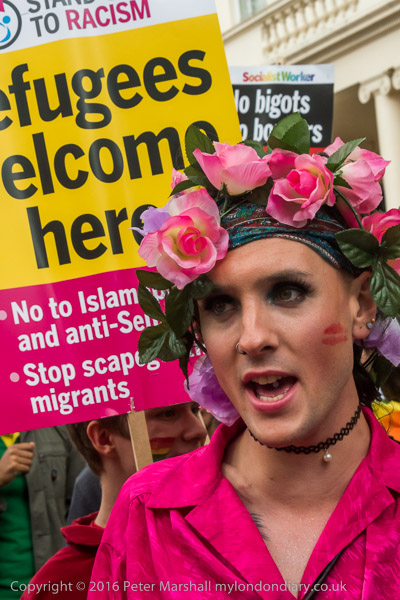
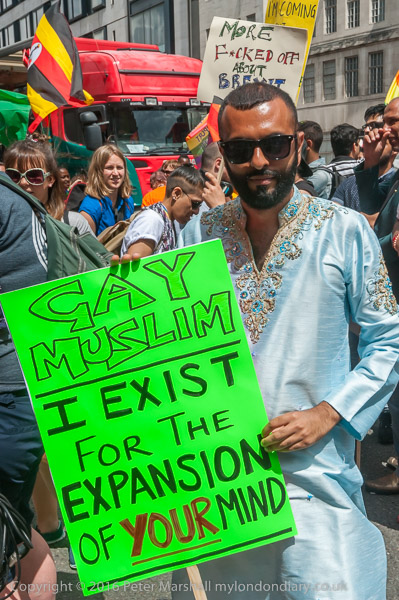
The Migrant Rights & Anti-Racist Pride march to the official Pride London procession organised by Movement for Justice and joined by others, including London in Solidarity with Istanbul LGBTI Pride and Lesbians and Gays Support the Migrants brought back some of the original spirit.

It gathered on Oxford St and then went on to join the main march, along with others behind the corporate floats.

The following year Pride organisers reacted by closing the march to only those who had officially applied to march and had official armbands – and refused entry to the Migrants Rights and Anti-Racist Bloc who then sat down in front of the march before police decided they could march along the route before the main procession.

This year Pride in London has been postponed until 11 September, but Peter Tatchell this May called for an alternative LGBT+ rights march to take place in June, He stated:

“For too long we have been conned by vested interests into believing that it is hugely expensive to hold a Pride march. It is not costly at all if we run the no-frills march that I am proposing.

“It would mirror the informality and spontaneity of the first Pride march in 1972, which I and 40 others helped organise. All we need to do is publicise it and people will turn up.

“Pride in London has become depoliticised. This Pride can change that. As well as being a joyful celebration, it should also profile LGBT+ human rights issues, such as the government stalling on a conversion therapy ban, blocking reform of the Gender Recognition Act and failing to end the detention of LGBT+ asylum seekers.

“It’s time to get back to the original roots of Pride, with everyone encouraged to bring a placard highlighting the LGBT+ issues that concern them. Let’s make this an event where our on-going demands for LGBT+ rights can be seen and heard.

https://www.petertatchellfoundation.org/call-for-alternative-reclaim-pride-london-march-in-late-june/

So far as I’m aware it has not been possible to organise an event like this for June 2010, although the London Trans Pride is still billed to take place on June 26, beginning at 2pm at Hyde Park. Perhaps next year it will be possible to organise such a “no frills” march with “no floats, no stage and no speakers at the end. Totally open, egalitarian and grassroots.” which “would reclaim Pride for the community.”

Pride London 2016
Migrant Rights & Anti-Racist Pride

Immigration Detention – a National Shame

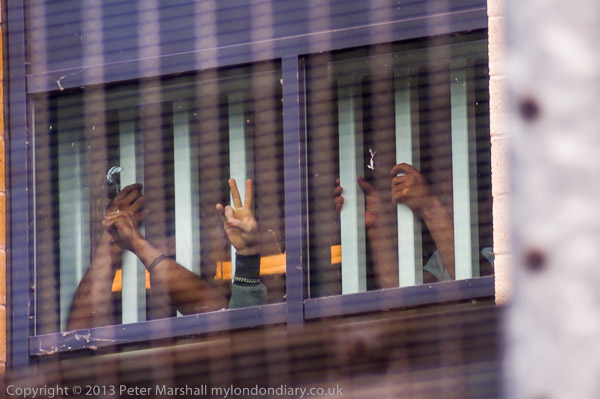
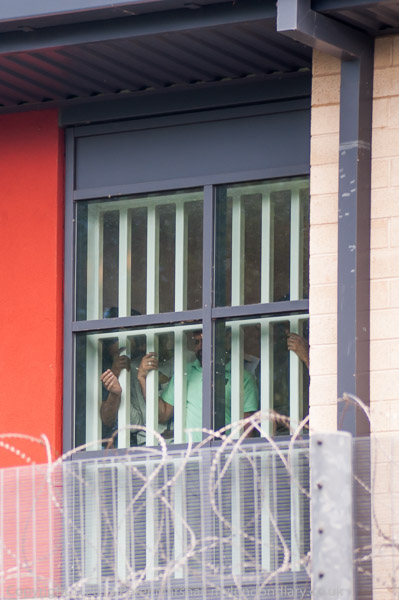
Detainees seen through the wire fence, Harmondsworth Detention Centre, Sat 7 Jun 2014

Recently the Home Office under Priti Patel got its knuckles rapped in court, when the High Court ruled it broke the law by housing cross-channel migrants in the run-down Napier barracks in Folkestone, Kent. Public Health England had earlier warned that the barracks were unsuitable for accommodation for asylum seekers during the Covid pandemic, and with 380 detained in poorly sectioned off rooms of 12-14 with shared bathrooms and toilets the spread of infection was clearly inevitable, with around 200 people catching Covid-19.

The Immigration and Asylum Act 1999 requires the Home Office to provide “support” for asylum seekers who are unable to support themselves, including if needed accommodation, but this must be adequate for their needs. Clearly in this case they were not, and the situation was worsened by employing a private contractor to run the barracks, who in turn outsourced much of the work required.

John McDonnell MP speaking

Many of those sent to the barracks were clearly unsuitable to be housed there because of pre-existing mental health issues arising from trafficking and/or torture before their arrival in the UK – and the Home Office’s own assessment criteria should have prevented them being sent to the barracks.

The whole judgement is complex and lengthy but reading the evidence it examines leaves the impression of a total lack of concern for human rights and common humanity in the operation of our asylum system, and one which is evident across the whole range of how we deal with migrants and asylum. In 2020 over 23,000 people were held in detention centres in the UK, around a third held for more than a month; but it is indefinite detention with no limit to the time they may be held and for some their stay has lasted around three years. Over half of those detained have claimed asylum.

Of those detained in 2019, just over a third were deported, some illegally. A small number – just over 300 in the year ending 2019 – received compensation, averaging £26,000, after proving their detention was illegal. (figures from https://migrationobservatory.ox.ac.uk/resources/briefings/immigration-detention-in-the-uk/ The Migration Observatory.)

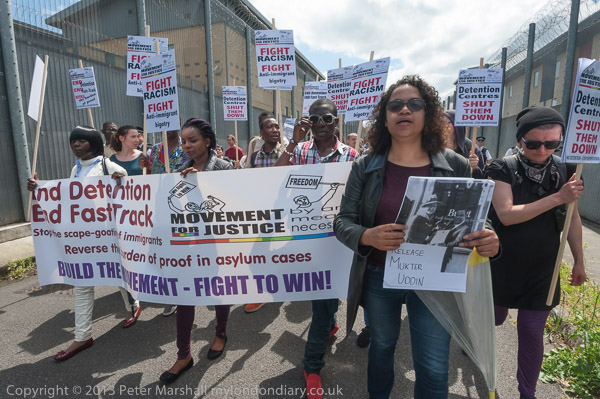
On Saturday 7th June 2014 I went to the neighbouring detention centres (a polite name for these immigration prisons) of Harmondsworth and Colnbrook, just across the A4 Bath Road north of Heathrow Airport, along with campaigners organised by Movement for Justice, who had come to protest with prisoners inside the immigration prison against the unjust ‘Fast Track System’ and mistreatment of detainees by private security firms.

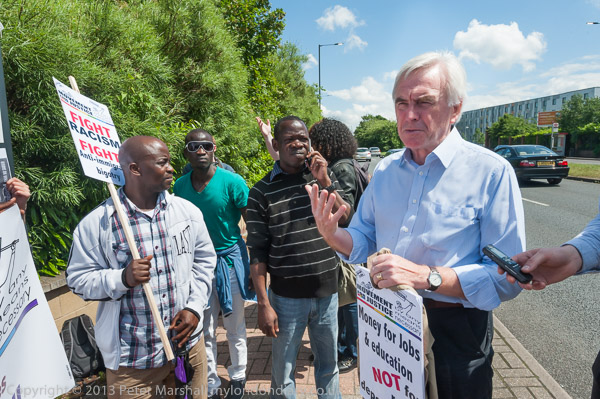
The were joined outside the prisons by local MP John McDonnell who has a long record of supporting asylum seekers, who told us that when he first became MP for the area in 1997 the immigration detention centre was only a small building housing a dozen or so detainees. Now these two large blocks house several thousands – and their are other large immigration prisons across the country.

After the rally on the pavement outside, the protesters – who included many former detainees – marched onto the site and began to make a circuit on the roadway which goes around the Harmondsworth centre, most of which is enclosed behind tall fences. The stopped at places on the way where they knew that those inside the prison would be able to see and hear them, making a lot of noise chanting and shouting as well as with whistles and other noise-makers.

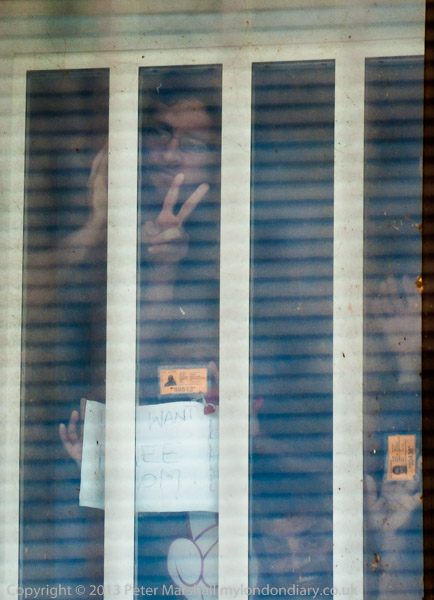
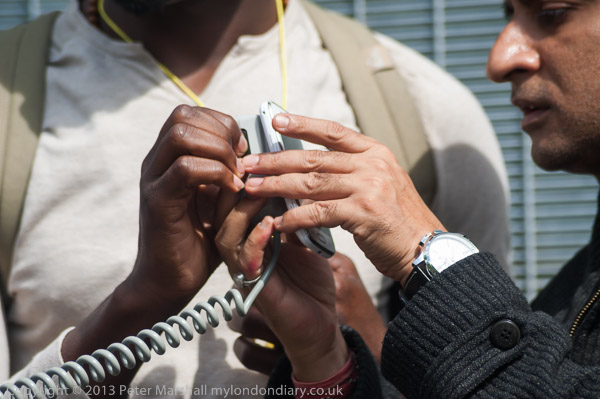
Detainees are allowed to have mobile phones and the protesters were able to contact a number of those inside, some of whom were able to speak by holding the phone they were calling to a microphone of the protesters’ megaphone. Many inside feel they are forgotten and all had complaints about the way they were treated by the detention centre staff and the poor conditions.

At later events here that I photographed, police prevented the protesters marching around the 20ft fences that surround it, limiting them to an area in front of the administration block. Clearly the tall fences mean there was no security risk, but the sight and sound of the protest was important in raising the morale of those held in the centres – and something those private contractors running the jails wished to avoid in future.

More pictures at Support Detainees in Harmondsworth

Human Rights, NHS and Gold Mining

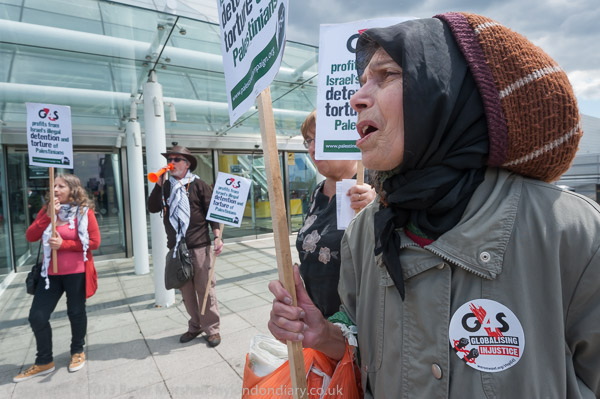
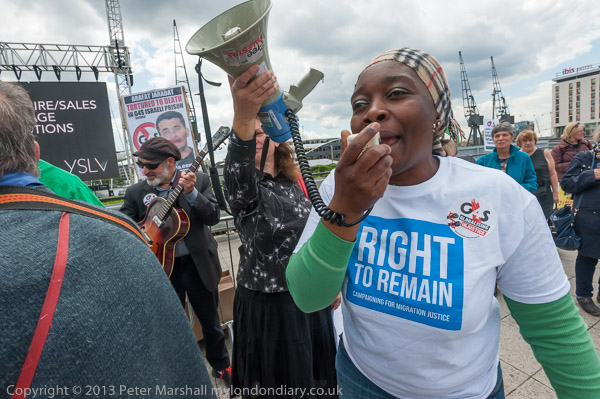
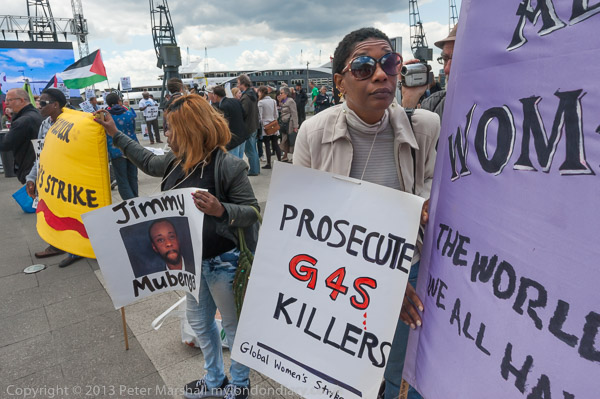
Thursday 5th June 2014 was the day of the AGM of G4S, a company deeply involved in the privatisation of prisons, policing, education and other public services and in human rights abuses both in the UK and in Palestine where it helps to run the Israeli prison system. So unsurprisingly a number of groups had come to protest outside the Excel Centre at Royal Victoria Dock in Newham where the AGM was taking place, and there were also a number of people who had bought shares so they had a right to attend the AGM and also to ask questions, challenging the company’s human rights record.

Among the various groups who had come to protest were the Boycott Israel Network, Boycott Workfare, Campaign to Close Campsfield, Corporate Watch, Friends of Al Aqsa, Inminds.com, Jews for Justice for Palestinians, Palestine Solidarity Campaign, Right to Remain, War on Want, Right to Remain and Global Women’s Strike, though as the protest was on a working day, the numbers representing each group were fairly low.

The protesters sang and handed out leaflets to shareholders attending the meeting, giving details of some of the human rights abuses that G4S has been responsible for or is complicit in. There were also apparently some nasty scenes when shareholders were ejected forcibly from the AGM for insisting on asking awkward questions, but the press was not allowed to photograph inside the venue.

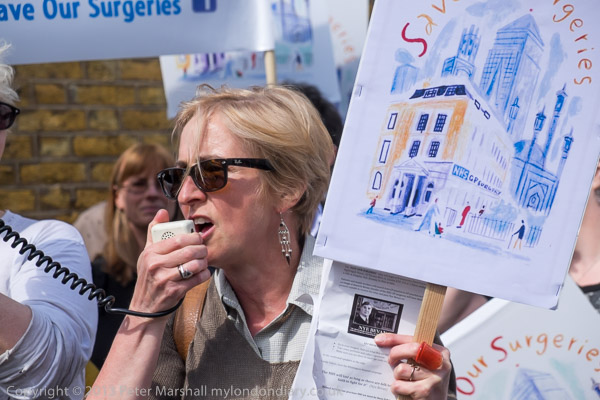
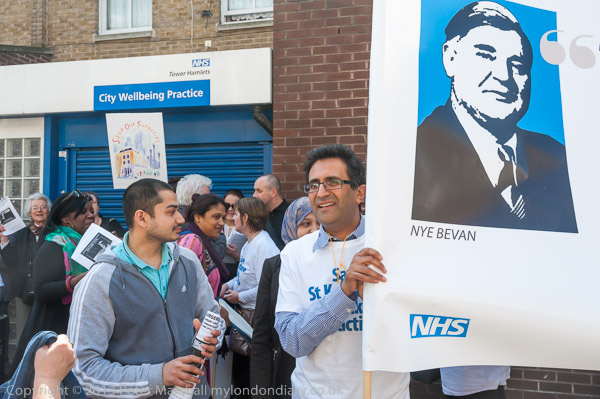
I joined a march in Tower Hamlets, which includes some of the most deprived areas of England, where medical staff and supporters had organised a ‘Nye Bevan’ march to ‘Keep Our NHS Public’, walking around the health practices in the borough. Medical practices were able to give a good level of service in deprived areas by the MPIG, the Minimum practice income guarantee, which was introduced for this purpose in 2004 following negotiations between the government and the BMA to recognise the higher health needs of both some inner city and rural areas. In 2014 the Coalition Government announced this was to be scrapped, with one seventh of it removed each year until 2021.

Many leading politicians (and their family members) have financial interests in healthcare companies, and NHS campaigners see the loss of MPIG as a part of the continuing privatisation by stealth of the NHS. Many GP practices are now run by large healthcare services, who lower costs by providing reduced services and diverting money which should be used for serving the needs of patients into providing profits for shareholders.

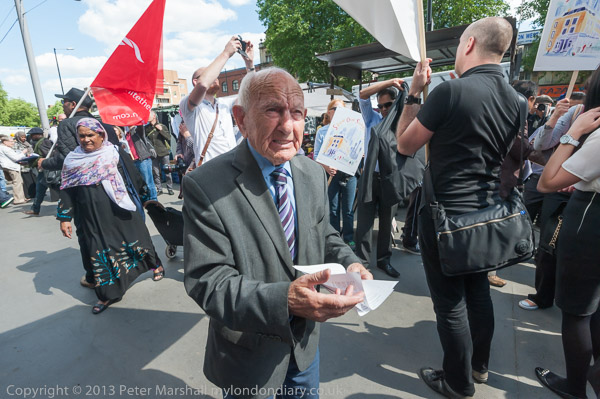
As the marchers arrived at each medical practice they were met by health workers and patients who came out to support them. Among those at the health centre on the Whitechapel Road was veteran anti-fascist and former Communist councillor Max Levitas, who had celebrated his 99th birthday 4 days earlier. I left before the march finished and the rally to go to the Colombian embassy.

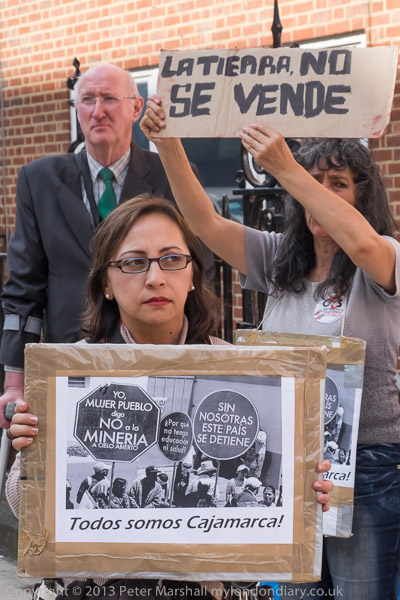
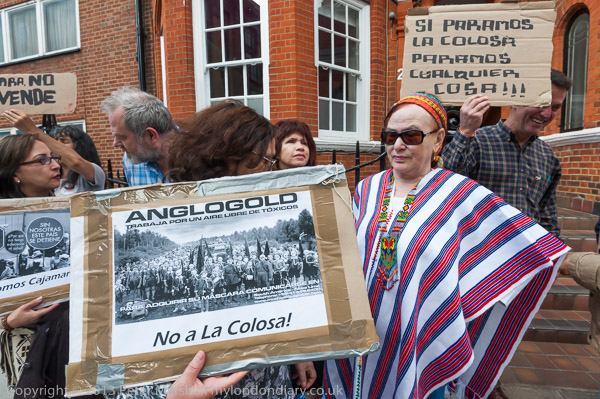
At the Colombian embassy protesters were condemning the vast La Colosa & Santurbán gold mines which endanger water sources in the high mountain regions and could wreck their fragile ecosystems. The London protests on UN World Environment Day and follow protests and carnivals by thousands of people in Ibague, the closest city to the mines as well as in other cities in Colombia. In Bucaramanga the whole city turned out in protests to stop the Santurbán gold mine owned by Canadian company Greystar Resources, and in 2019 there was a protest by 50,000 against the United Arab Emirates backed Soto Norte gold project which would be the largest underground gold mine in Colombia. Gold mining would releases large quantities of cyanide and arsenic into the water supplies of several million people.
The posters were in Spanish as they were aimed at the embassy staff. The Colombian Embassy is a relatively small section of a building just to the rear of Harrods, which also houses the Ecuadorian Embassy, where while this protest was taking place Julian Assange was still in political asylum in their small part of the building, and regular protests were still taking place calling for his release. Unfortunately he was instead handed over to the UK police and now seems likely to die as a political prisoner either in the UK or, if extradited, in the USA.

Colombian Mines – World Environment Day
Tower Hamlets – Save our Surgeries
G4S AGM Protest Against Human Rights Abuses


All photographs on this and my other sites, unless otherwise stated, are taken by and copyright of Peter Marshall, and are available for reproduction or can be bought as prints.


Occupy Gandhi – 4 May 2015

All pictures from Occupy Ghandi – Stop Fossil Fuel Criminals, 4 May 2015

Successive UK governments have legislated in various ways to restrict the right to protest, particularly concentrating on the area of Westminster close to the Houses of Parliament, and the current Police, Crime, Courts and Sentencing Bill amends the “Police Reform and Social Responsibility Act 2011 to expand the “controlled area” around Parliament where certain protest activities are prohibited” as well as creating a new prohibited activity of “obstructing access to the Parliamentary Estate”.

The 2011 Act (which was also amended by the Anti-Social behaviour, Crime and Policing Act 2014) replaced previous restrictions which had been brought in under SOCPA, the Serious Organised Crime and Police Act 2005 which the New Labour government had brought in as an attempt to stop the long-term protest in Parliament Square by Brian Haw who had set up his camp there on 2 June 2001 in protest against the effect of economic sanctions which were resulting in child deaths in Iraq.

Haw’s campaign widened into a more general protest against war and became the Parliament Square Peace Campaign, and he was joined by other long term protesters as well as receiving support from many others which enabled him to remain in the square. Various attempts to remove him legally failed and SOCPA was passed in an attempt to stop his protest. But poor drafting led to the eventual failure to achieve this, though Haw had to apply for permission which was granted subject to strict conditions – which he and his supporters failed to adhere to.

Police carried out a major raid in May 2006, removing most of the placards and other material and Haw was taken to court for breach of SOCPA. But after several hearings he was acquitted as the judge found the conditions lacked clarity and were not workable. He was assaulted on numerous occasions by police and by others believed to be working for the security services and arrested again on the day of the State Opening of Parliament for the Tory-LibDem coalition in 2010. But his protest was continued even after he left for cancer treatment in Berlin on New Years Day 2011, by his colleague Barbara Tucker who had joined him in 2005, and stayed in Parliament Square until 2013, despite being denied the use of tent, blankets and eventually even a chair and umbrella in 2012.

The whole grass area of Parliament Square was fenced off and the protest moved onto the pavement in 2011 after Boris Johnson gained a High Court injunction. Early in 2013 more protesters had arrived to support Tucker who had begun a hunger strike in December 2012. She left the square for urgent medical treatment and the Westminster Council removed the tents which supporters had brought there in March 2013, reopening the square for public use in May.

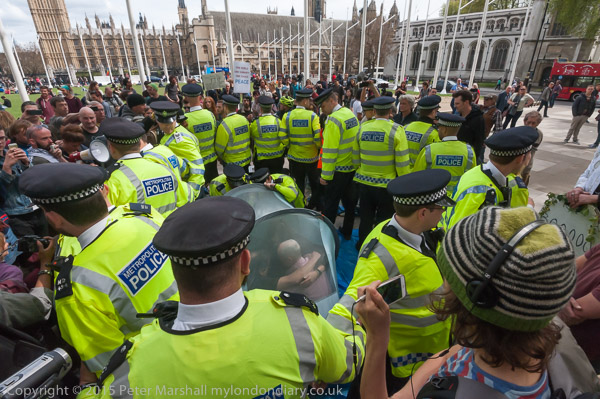
In October 2014, Occupy Democracy arrived to occupy Parliament Square “for 9 days in October, to broadcast and demand the solutions we already know exist, to inspire people to be the active citizens required to take back democracy from powerful economic interests.” They were met by police and private security ‘Heritage Wardens’ (outsourced by the GLA) and signs put up the previous day stating the grass was ‘closed for repair’, and there was considerable harassment with the police seizing anything they thought might be ‘camping equipment’ the occupied the square. The following day, much larger numbers of protesters turned up, including a number of MPs and some celebrities, and after trying hard to stop them, the police melted away and the camp was set up.

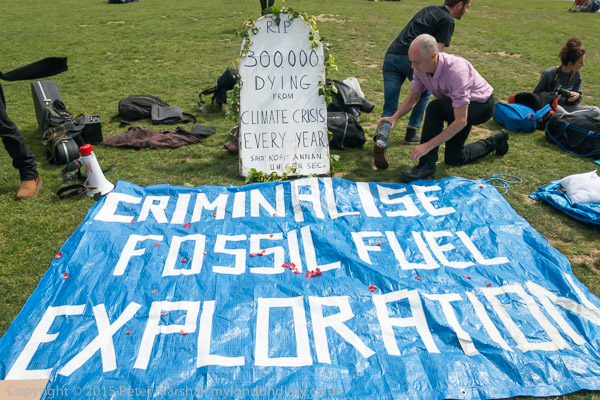
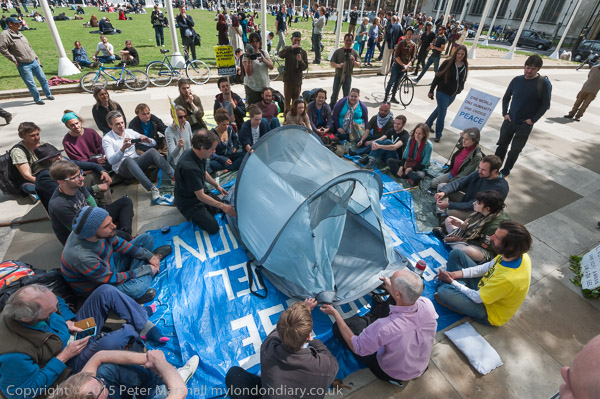
Over the following three days there were a number of arrests and police moved protesters off the main grass areas, but the various workshops and activities continued until the whole square was cleared. There had been a number of battles between police and protesters over large squares of blue plastic tarpaulin they had used to sit on the wet grass and mud, and the Democracy Camp had gained the name ‘Tarpaulin Revolution’ (#tarpaulinrevolution).

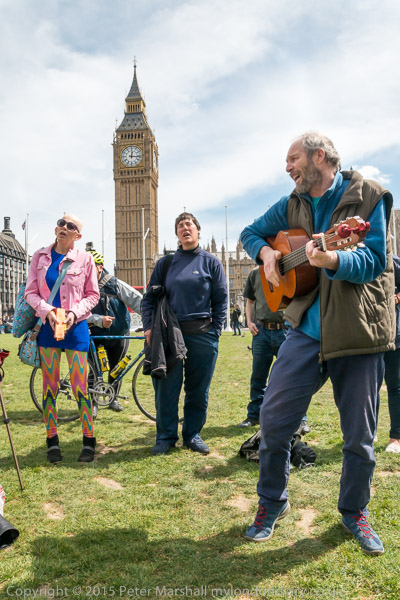
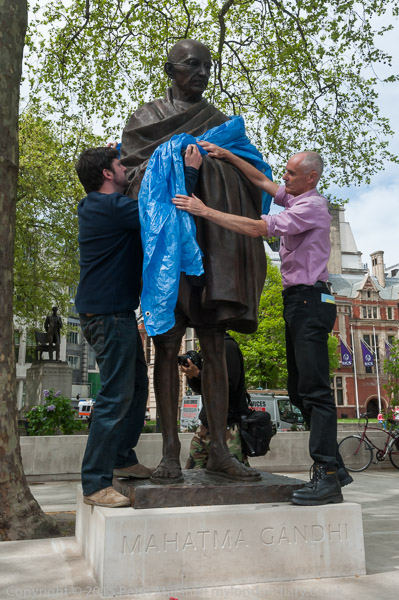
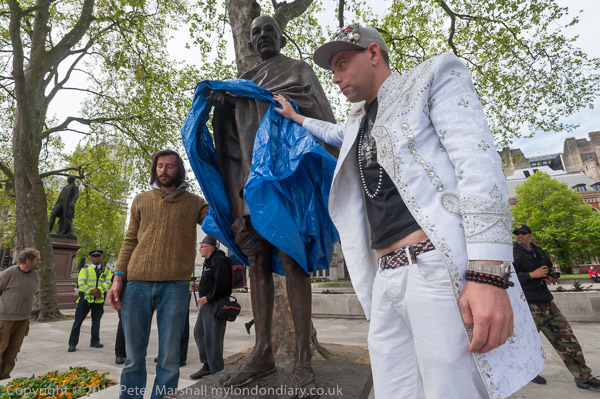
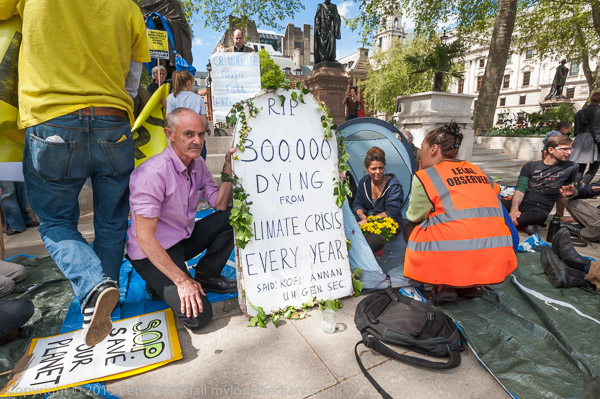
On May Day 2015, Occupy Democracy returned for a 10 day ‘Festival of Democracy’ in Parliament Square “building a movement for real democracy: free from corporate control, working for people and planet!” just a few days before the general election. On Monday 4 May there was a rally and meditation by Occupy Democracy at the statue of Gandhi, noted for his direct action civil disobedince, called for fossil fuel exploration and investment to be made a crime, and defied the ban on tarpaulin and tents in Parliament Square.

After short speeches there was a period of meditation, and the protesters wrapped a blue tarpaulin around the statue. Heritage wardens demanded its removal, and seized it when their request was ignored. Other protesters then stood with another blue tarpaulin, holding it around the statue but taking care not to touch it.

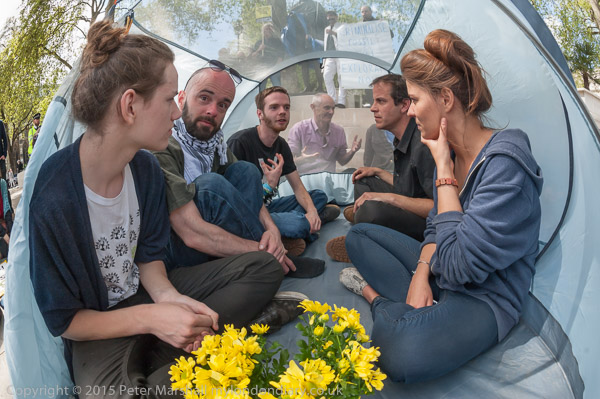
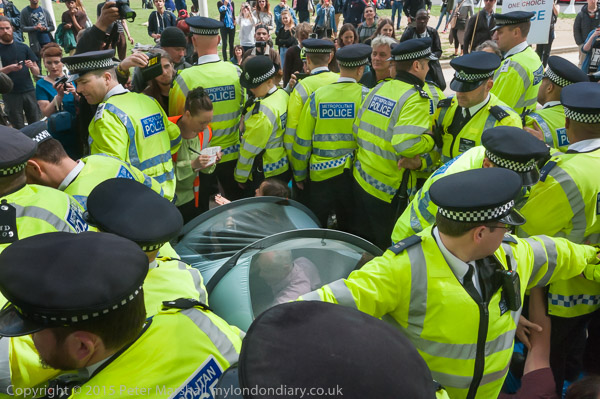
At the end of the mediation, Donnachadh McCarthy who had been leading it announced an act of civil disobedience and pulled a folding tent onto the tarpaulin on the pavement in front of him and erected it. Several people then came and sat inside it, and the protest continued. Police came and told them they were committing an offence and might be arrested if they failed to leave. Shortly after 20 police came and surrounded the tent and arrested those who refused to leave.

Occupy Gandhi – stop fossil fuel criminals
Occupy Festival of Democracy

A Mixed Day – May 3rd, 2014

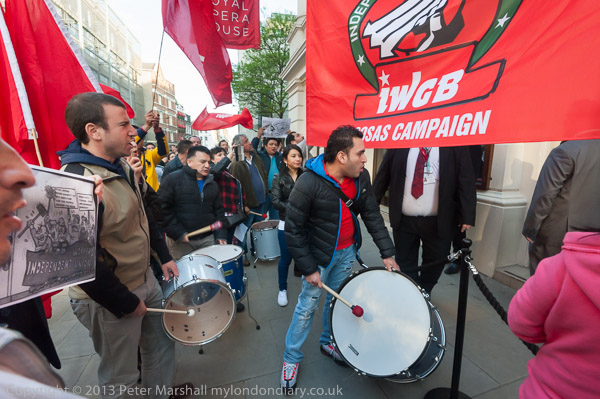
Saturday May 3rd 2014 provided me with quite a range of events to photograph around London, finishing with a protest against the abuse of staff employed by MITIE at the Royal Opera House. IWGB members including the workplace rep have been sacked or lost work, with others being brought in to take their places.

This protest was one of the “noisy” events that the Police, Crime, Sentencing and Courts Bill 2021 being pushed through parliament would criminalise, a very successful non-violent tactic used by smaller unions such as the IWGB (Independent Workers Union of Great Britain) to shame managements into talking with them. MITIE and the Royal Opera House had been refusing to talk with the union to which the majority of the cleaners belong, and instead recognise a large union with few members at the ROH which has come to an agreement with them which fails to address any of the workers grievances.

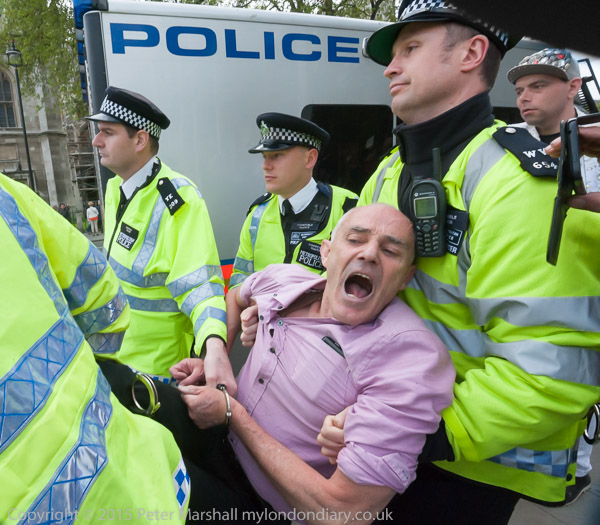
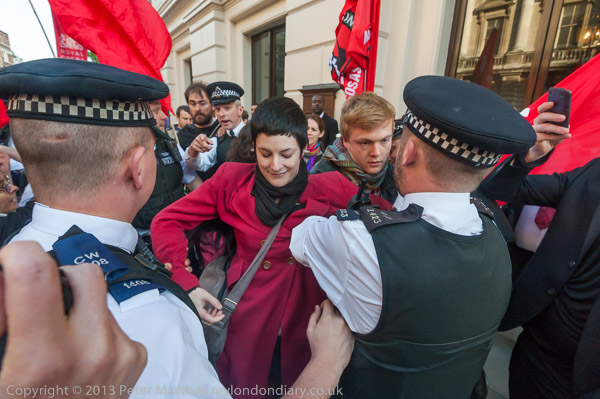
There were angry scenes with some of the opera goers who seemed to feel that the workers had no right to protest, and ROH security staff intervened when one man began assaulting union organiser Alberto Durango. When a large group of police arrived there was an ugly scene when they tried to grab one of the protesters, but she was pulled away by her colleagues, and the police then withdrew to form a line around the opera house. After an hour there were some short speeches, including one by another woman protester complaining that she and others had been assaulted by the police officer in charge, Inspector Rowe, and other officers.

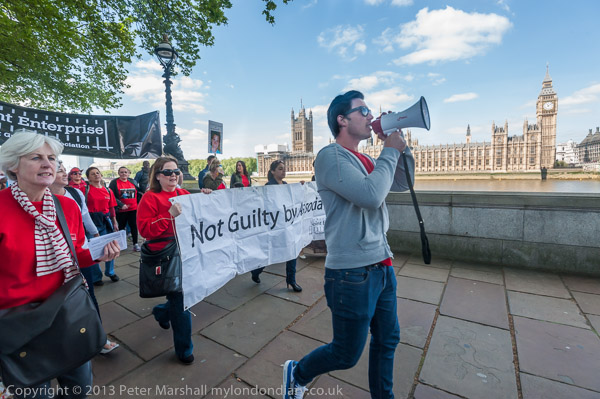
My first event had been to cover a march to Parliament by Families fighting to abolish the 300 year old law of ‘Joint Enterprise’ that has wrongfully imprisoned family members in a gross breach of human rights. Under this people are convicted of crimes they took no part in for having almost any connection with those who actually committed the criminal act – without any real evidence being required or given. Originally intended to enable doctors and seconds who attended duels to be arrested as well as the actual duellists, it is now disproportionately used against Afro-Caribbean young men following stabbings and other street violence. As well as its inherent injustice, the sentences can be extremely long, in some cases up to 30 years in jail. In 2015 police attempted to use it against a protester after they could find no evidence of her committing the ‘criminal damage’ she had been accused of, but the court sensibly refused to consider the charge.

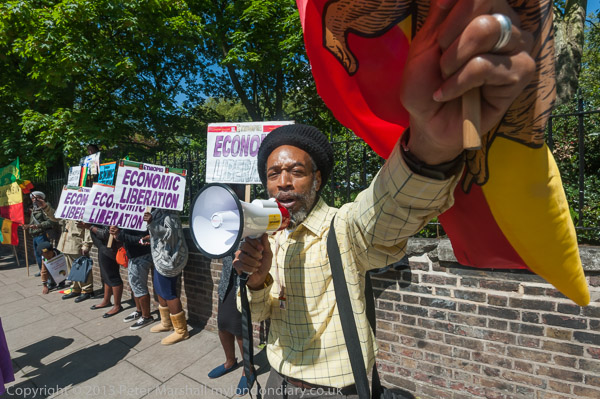
Next I went to the Ethiopian Embassy in Kensington, where Rastafarians from the Church of Haile Selassie I in Cricklewood were holding their annual protest calling for the restoration of the Dynasty of Emperor Haile Selassie 1st to bring about economic liberation of the country. Selassie died following an economic crisis which led to a coup in 1974 at the age of 83. Under his leadership Ethiopia, the only African country to defeat the European colonialists, was the first independent African state to become a member of the League of Nations and the UN.

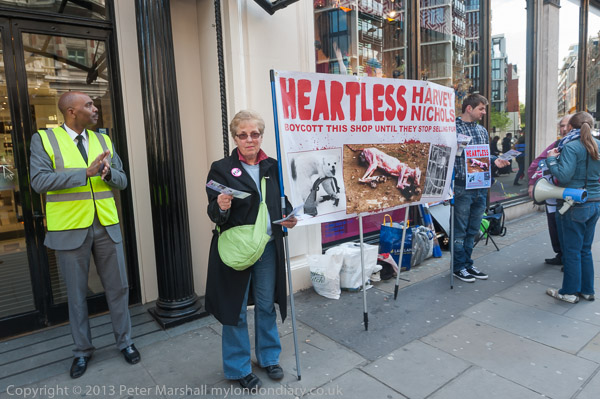
I stopped off on my way back to the centre of London at Knightsbridge to photograph the weekly vigil outside fashion store Harvey Nichols calling on shoppers to boycott them for selling animal fur products, which come almost entirely from farms with exceedingly cruel practices banned in the UK. It is hard to see why using fur from these farms is not also banned here.

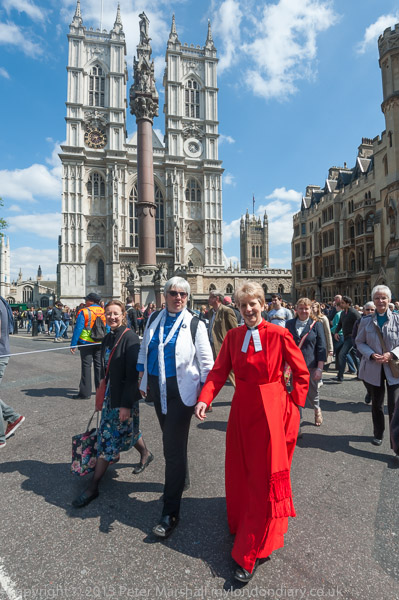
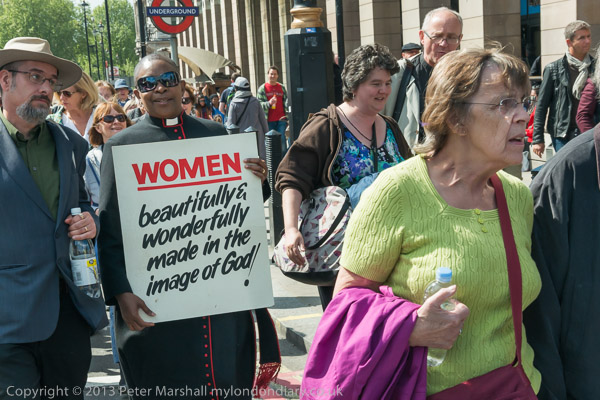
The largest event taking place was the celebration of the 20th anniversary of the first women to be ordained by the Church of England, and a thousand or more women priests went to a rally in Dean’s Yard before marching to St Paul’s Cathedral for a service.

I was brought up in the Congregational tradition, and the Congregational Church had its first women minister in 1919, but it took the Church of England another 75 years before they caught up. They ordained their first women as priests in 1994, and women now make up a large proportion of the church. Among those on the march was the Rev Rose Hudson-Wilkin, the Jamaican-born vicar of Holy Trinity Church, Dalston and All Saints Church, Haggerston (and also finding time to be Speaker’s chaplain at the House of Commons, priest vicar at Westminster Abbey and chaplain to the Queen.) She marched with the same placard she carried when the church was making its decision to ordain women in 1994, with the message “Women – beautifully & wonderfully made in the image of God!” and became Britain’s first black female bishop in 2019.

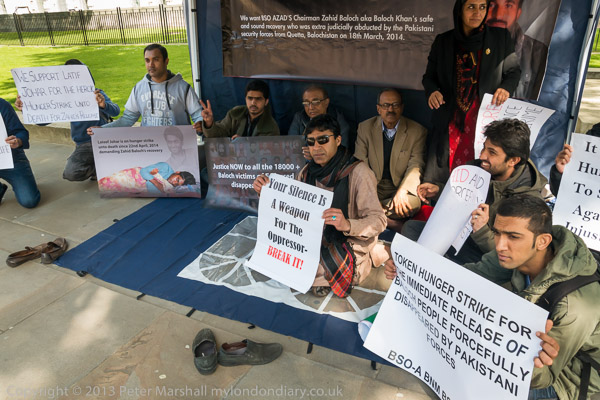
I left the women priests marching along Whitehall to photograph a protest opposite Downing St, where Balochs were staging a token hunger strike on Whitehall calling for the immediate release of all those forcefully disappeared by Pakistani forces. The action was in solidarity with the hunger strike by student activist Latif Johar of the Baloch Students Organisation-Azad (BSO-A) who began a hunger strike outside the Karachi Press Club on April 22 in protest at the disappearance by Pakistan security forces of the BSO-A chair Zahid Baloch in March.

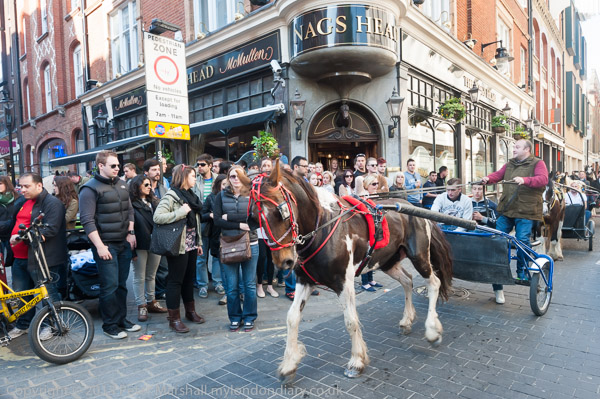
From Westminster I walked to Covent Garden where I was to meet the IWGB for their protest at the Royal Opera House, and sat and waited for them to arrive. To my surprise as I sat reading I heard the sound of hooves clattering on the road, and looked up to see half a dozen horse-drawn traps coming towards me up the street. They stopped briefly and appropriately at the Nags Head, where some of the drivers went in to refresh themselves, and I talked with those left holding the horses outside, and they told me the ride had started at Forest Gate and they had already visited Borough Market on their route around London.

More on all these events:
IWGB Cleaners at Royal Opera
Horse Traps at the Nag’s Head
Baloch Hunger Strike
20 years of Women Vicars
Anti-Fur Picket at Harvey Nichols
Restore the Ethiopian Monarchy
Joint Enterprise – NOT Guilty By Association


All photographs on this and my other sites, unless otherwise stated, are taken by and copyright of Peter Marshall, and are available for reproduction or can be bought as prints.


May Day #KillTheBill

May Day 2000

Unfortunately May Day is not a public holiday in the UK, and when I was in full time teaching it was usually just a normal working day for me and I was unable to celebrate it except in those years where it fell at a weekend. Even when I cut my teaching to 30% for a few years, that 30% seemed always to include May Day, and it was only from 2003 that I began to attend May Day in London every year – until 2020, when it went online.

This year, when May Day is on a Saturday, the official May Day celebrations are also taking place online, but May 1st is now a nationwide day of action against the Police, Crime, Sentencing and Courts Bill 2021 with which the government is attempting to severely limit the right to protest and in particular to criminalise “noisy” protests and prosecute people in the Gypsy and Roma communities. Noisy protests shaming businesses have been vital in recent years in gaining better wages and conditions for low paid workers particularly in the City of London.

The Bill will give the police much greater powers to place conditions on protest – and to make it a crime to break these conditions if they “ought to have known” they were in place but didn’t. They introduce a new offence of “intentionally or recklessly causing public nuisance” which can lead to a sentence of up to ten years.

Police also gain greater powers to stop and search on the streets under a new Serious Violence Reduction Order, an arbitrary power that removes even the need for any suspicion and will doubtless lead to an even more racist implementation of stop and search, worse than the old ‘Sus’ law that led to the Brixton riots 40 years ago.

As a knee-jerk reaction to Black Lives Matter protests there is a new offence of causing damage to statues and memorials which could also lead to sentences of ten years, twice the maximum sentence for assault causing actual bodily harm.

The bill also seeks to create a wide “controlled area” around parliament where protests would not be allowed – and so MPs and ministers would no longer be made aware of any public opposition to their actions. Many see the bill as denying our right to freedom of assembly and association under Article 11 of the European Convention on Human Rights .

A long list of organisations are coming to Trafalgar Square at noon today for a MayDay #KillTheBill protest (and to similar protests in Sheffield, Leeds and Manchester.) They include Sisters Uncut, Women’s Strike Assembly, Black Lives Matter UK, Disabled People Against Cuts, the Independent Workers Union of Great Britain, Lesbians and Gays Support the Migrants and Docs not Cops. With the current large Tory majority in the House of Commons the bill is likely to pass with only minor amendments, and the fight will move to the streets where with strong opposition much of the new law will be unenforceable.

Seconds later an officer knocked this man offering plants flying

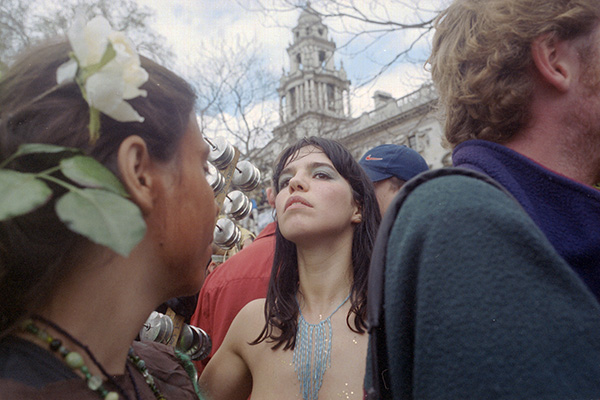
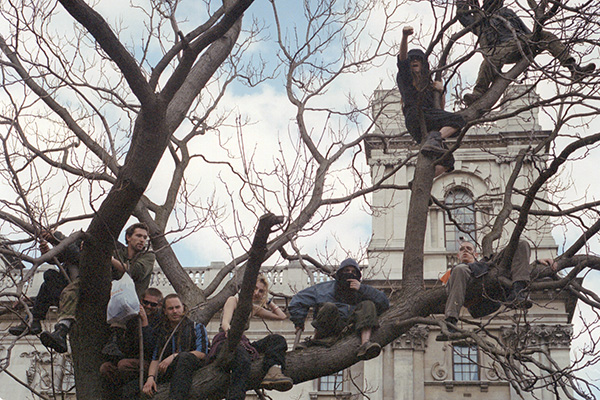
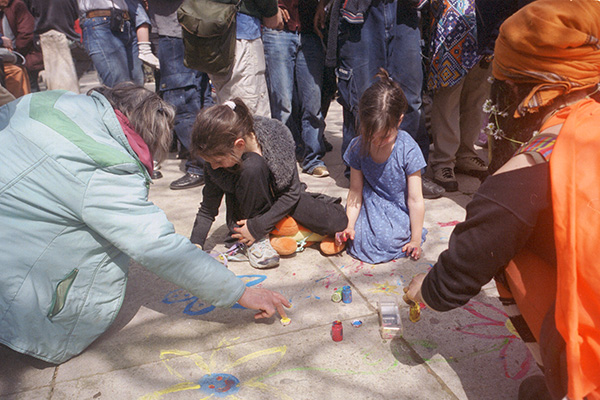
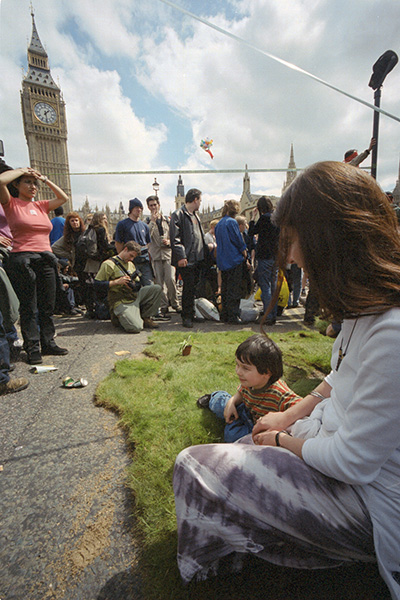
Pictures are from 21 years ago, May Day 2000. There are some black and white pictures from the same day on My London Diary.


All photographs on this and my other sites, unless otherwise stated, are taken by and copyright of Peter Marshall, and are available for reproduction or can be bought as prints.