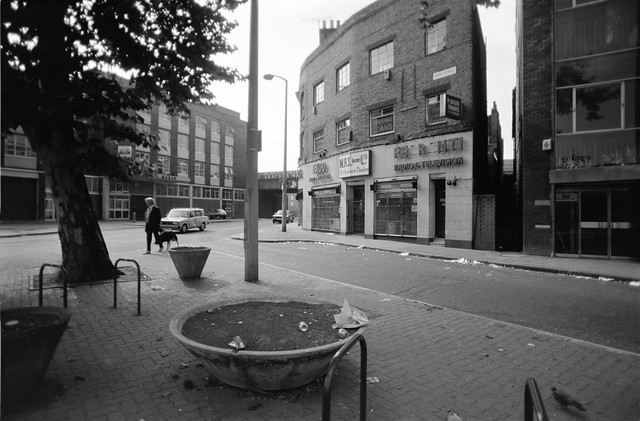
South Stokey & Hornsey Detached

Stoke Newington or ‘Stokey’ has a well-deserved reputation for non-conformity of all kinds. The area from the middle-ages attracted many religious dissenters, Quakers and other non-comformists. Among them have been Isaac Watts, Daniel Defoe, John Howard, Edgar Allan Poe and Joseph Conrad. More recent years have seen many squatters, artists and bohemians, as well as political radicals, including Angy Brigade and IRA bombers. You can see a long list on Wikipedia. Although its now become rather gentrified, at least in parts, there are still signs of its more anarchic past. Parts of the area I walked around in the south weren’t even in the area until 1900, but were ‘Hornsey Detached’ – and Hornsey is several miles to the northwest.

School, Smith & Sons, Wordsworth Rd, Hackney, 1988 88-10a-42-Edit_2400
School, Smith & Sons, Wordsworth Rd, Hackney, 1988 88-10a-42

St Matthais C of E Primary is still in use at the rear of Smith & Sons at 22-32 Matthias Rd, N16, Ironmongers & Builders Merchants. This writing has now gone, but the building was still there and in a similar use as one of the more Travis Perkins showrooms until around 2019.

New Coach & Horse, pub, Matthias Rd, Stoke Newington, Islington, 1988 88-10a-44-Edit_2400
New Coach & Horse, pub, 69, Matthias Rd, Stoke Newington, Islington, 1988 88-10a-44

The Coach and Horses was in business here at least since the 1850s and in one early record the street was called Coach and Horse Lane. I’m not sure when it got the New in its name, perhaps after it stopped being a Reid & Co pub and serving their ‘Entire’. The company was founded to take over a brewery in Clerkenwell in 1757 by Richard Meux and Mungo Murray and only picked up Andrew Reid as a partner in 1793, becoming Reid& Co in 1816. They stopped brewing in 1899 after becoming a part of Watney, Combe, Reid & Co. Ltd in the first big merger in the UK brewing industry, but Watney continued for years to use the brand name for some beers.

At a glance the pub appears open, but the two long brackets without pub signs are presumably a sign that it had closed. Shortly after it was converted into flats.

Milton Grove, Stoke Newington, Hackney, Islington, 1988 88-10a-32-Edit_2400
Milton Grove, Stoke Newington, Hackney, Islington, 1988 88-10a-32

I took a couple of pictures at Newington Green (not online) before being attracted up the narrow passage of Church Walk and through the footpath to Howard Road and then taking Milton Grove, home of five times world professional darts champion Steve Bristow who lived at 97.

I don’t know of any particular link with Milton and Stoke Newington but when these streets but when the National Freehold Land Society laid out the streets in the area in 1852 they created Milton Grove along with Shakespeare Walk and Spenser Grove. Much of the area was destroyed in the war and rebuilt as the Milton Gardens Estate. And behind me as I took this picture was an open space, once a bomb site but kept as Butterfield Green. Bombs came into Milton Groves story again some years later in 1975, when an IRA bomb factory was discovered in a top floor flat at no 99.

A little to the south is an alley, Town Hall Approach, but you will find no sign of a town hall should you walk down it. This was the site of the Italianate South Hornsey Town Hall built by E Fry in 1881 which became the town hall of the Metropolitan Borough of Stoke Newington when this was created in 1900. Stoke Newington was only half the required size for a London borough, but the authorities granted it borough status to avoid “intolerable and interminable feuds” had it been subsumed into Hackney – which it eventually became part of, apparently without a revolution in 1965. But the old town hall was too small and after 37 years the borough opened a new one designed by John Reginald Truelove on Church Street – now a listed building – but the ‘approach’ is still there.

I wondered why No 72 was built with this large window and imposing door – perhaps it was a former chapel long converted to residential use. A few doors down, just visible over the cab of this recovery vehicle is the only listed building in the street, No 66, described (in part) as “Mid C19 villa of 2 storeys and basement, 3 windows. Stock brick….” Certainly a pleasant enough house but nothing in the text seems to justify the listing or greatly differentiate it from others in the area.

Nevill Rd, Stoke Newington, Hackney, Islington, 1988 88-10a-33-Edit_2400
Nevill Rd, Stoke Newington, Hackney, Islington, 1988 88-10a-33

It was quite a long walk before I made my next exposure at 29 Neville Road, once home to G Howell Upholsterer, but in 1988 flyposted against the Poll Tax. Something about the doorway at right of this image screams “Pub!”, and this was then The Nevill or The Nevil Arms.

Once specialising in Smith, Garrett’s Special Mild Ale, it had a moment of fame in May 1915 when a bomb dropped in its back garden during London’s first Zeppelin raid. A large incendiary bomb, it failed to ignite and did no damage. It was thought at one time to have been the first bomb dropped on London, but that fell a short distance away in Alkham Road. The pub was on this site since the 1870s and latterly a Charrington’s pub. I think it closed shortly after I made this picture and was converted to residential use around 2000.

A photograph after the raid shows that No 21 on the other side of the shop was quite badly damaged, certainly its windows blown out, while the shop, then selling confectionary and advertising local Clarnico along with Rowntrees Chocolates and (I think) R Whites Ginger Beer appears undamaged with a woman looking out of the second floor window as the crowd gawping at the damage next door.

Stoke Newington Rd,  Hackney, 1988 88-10a-34-Edit_2400
Stoke Newington Rd, Hackney, 1988 88-10a-34

This and the picture below were from a window of the same shop, protected by a strong wire grill. And while I may have known more when I took them, they are now a mystery to me.

What is on sale here? Is it wigs? The strange prints are part of a collection and have reference numbers at the lower left, but what collection? The name appears to start BI or even BII and end IERTON but the wire prevents me seeing the letters between and I can find nothing which fits between to make sense to me.

Stoke Newington Rd,  Hackney, 1988 88-10a-35-Edit_2400
Stoke Newington Rd, Hackney, 1988 88-10a-35

The second picture simply adds more confusion. Are these wigs or examples of hair styles or some curious sculptural art? I was always attracted by representations of the human form or face and photographed the window of many hairdressers and some shops selling wigs, but these just don’t seem to fit the pattern.

Imperial Avenue, Stoke Newington Estate, Stoke Newington, Hackney, 1988 88-10a-21

The fine 1903 Stoke Newington Estate by the Four Per Cent Industrial Dwellings Company in Coronation Avenue and Imperial Avenue (and still run by the IDS) was the site of one of the greatest civilian tragedies of the London blitz, when on 13th October 1940 it received a direct hit from a high-explosive bomb, probably a parachute mine. The Coronation Avenue block of the estate collapsed into the large communal air-raid shelter in its basement; many were killed directly while others were unable to make their escape as the cellar flooded with water. At least 160 people are thought to have died.

Azizye Mosque, Stoke Newington High St, Stoke Newington, Hackney, 1988 88-10a-23

The Apollo Picture House opened in 1913, becoming the Ambassador Cinema in 1933 and in 1966 became a bingo hall but was reopened as the Astra Cinema in 1974. It was soon converted into a cinema club showing martial arts and softcore sex films until it closed in 1983. It was then converted into a Turkish mosque, with its interior features being gutted and its exterior covered in highly coloured mozaic. The cinema had already had a Moorish look with the two domes at each end of the facade.

To be continued in a later post.


Paragon, Fashion, Morning Lane & Nautilus 1988

Paragon, Fashion, Morning Lane & Nautilus 1988 is the third and final post on my walk in on a Sunday in late September 1988. The first post was South Hackney Walk 1988 and it continued with the equally unimaginative title More South Hackney 1988. So I could have called this ‘Yet More South Hackney’. But the end of the walk took me further north towards the centre of Hackney – and I felt readers deserved something more interesting for a change.

Paragon Rd, Hackney, 1988 88-9d-34-Edit_2400
79-83 Paragon Rd, Hackney, 1988 88-9d-34

At 69-83 Paragon Road are four linked pairs of early-mid C19 houses with a Greek key pattern above the ground floor windows. My picture shows the east end of the row. They are Grade II listed as 71-83. The Buildings of England London 4 North states they were built in 1809-13 and suggests as the land was owned by St Thomas’s Hospital the design, which they suggest was inspired by Blackheath’s Paragon, may have been by the hospital’s surveyor Samuel Robinson or its builder Robert Collins

Bestglare Ltd, Esme Ltd, Ram Place, Hackney, 1988 88-9d-21-Edit_2400
Bestglare Ltd, Esme Ltd, Ram Place, Hackney, 1988 88-9d-21

I’m not sure that these same industrial units are still in Ram Place or have been replaced. The block closed to Chatham Place became AquaScutum when the area on Morning Lane was funded as a fashion quarter following the 2011 riots. But a few years later most of the stores had closed down. Aquascutum was one of the last to go, selling off £750 macs in its final sale for £75 – still more than I’d want to pay.

Hackney has strong links with fashion – but not so much with the higher end as with street and sweatshop, and many doubted the project from the start.

Sawyer Sewing Machines, Morning Lane, Hackney, 1988 88-9d-26-Edit_2400
Sawyer Sewing Machines, Morning Lane, Hackney, 1988 88-9d-26

The sewing machine shop at 99 Morning Lane was still in business, though from what we can see mainly dealing in more industrial than domestic machines, though a sign in the window does state ‘DOMESTIC MACHINES SERVICED & REPAIRED’. But next door at 101 the High Class Shoe Repairs have closed and the windows above are bare of glass, looking blind.

By 2008 the Sewing Machine shop was selling car spares, but next door was even more derelict and for sale. It was being refurbished in 2011 and was part let as residential the following year. By 2012 the ground floor was coffee & tea and car spares had given way to Morning Bedzzzzz and then fashion took over with The Hackney Shop and brew for two. But fashion changed and moved from Hackney with 2021 seeing the corner shop be transformed into ‘Beauty by Saima’. Brew for two branched out to sell garden plants as well as being a café.

Mini Cab Office, Morning Lane, Hackney, 1988 88-9d-12-Edit_2400
Mini Cab Office, Morning Lane, Hackney, 1988 88-9d-12

The Mini Cab Office was on a short road leading north from Morning Lane, and along with another property I photographed, Doreen’s Pet Centre (not online) this land was bought by Tesco in 1997 and is now underneath their store and car park.

Security Centre, Mare St, Hackney, 1988 88-9d-14-Edit_2400
Security Centre, Mare St, Hackney, 1988 88-9d-14

H & S Security Centre at 232 Mare St claimed to be specialists in all forms of security and had some rather fancy wrought iron railings, though would weld in rather plainer forms of protection. They had left a rather wide open area for some misguided youth to chalk in the word Sex, though there was something desperate in that last letter as if the culprit had been caught in the act.

You can still see the railings on the steps leading up to the front door but there is no sign of any business operating from here, part of a Grade II listed early 19th century terrace.

Mare St, Hackney, 1988 88-10a-61-Edit_2400
Diver, Mare St, Hackney, 1988 88-10a-61

Inside a shop window on Mare St I found a diver, or a least a diving suit with a rather realistic hand and hanging up to the left a selection of Solent divers neoprene dry suits. This was Collins & Chambers Ltd at 197-199 Mare Street with a shop named Nautilus immediately south of Cyntra Place, demolished in 2012, listed as supplying Scientific Equipment, Divers Equipment Supplies, Diver Equipment. Mare St Star Night supermarket opened there around 2018 supplying all your pan-Asian grocery needs.

I turned around somewhere near here and walked back up towards Hackney Central Station and the end of my walk, pausing briefly to photograph the side of the Hackney Empire (not on line) on my way.


Reclaim Brixton – Arches, Markets & More

Reclaim Brixton – Arches, Markets & More – 25th April 2015

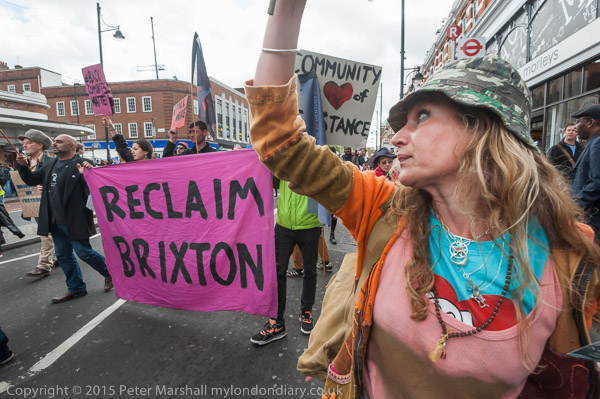
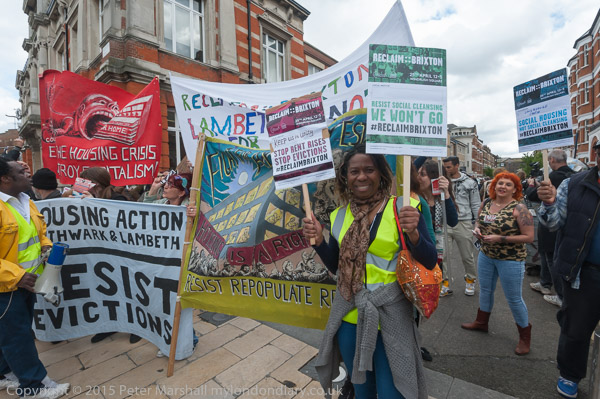
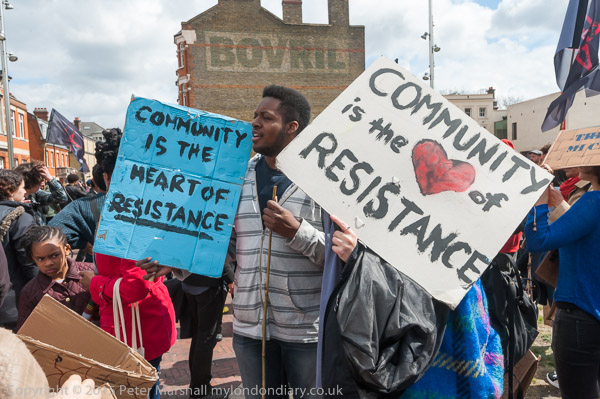
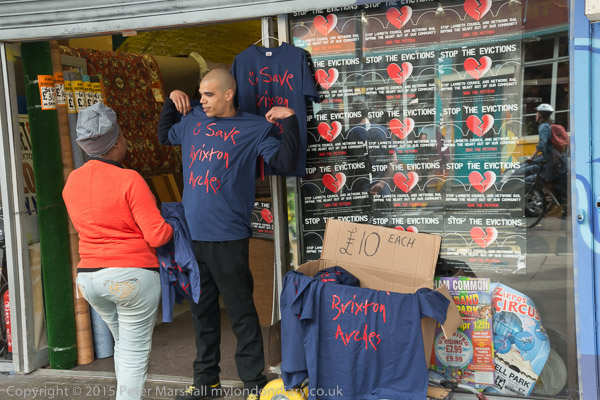
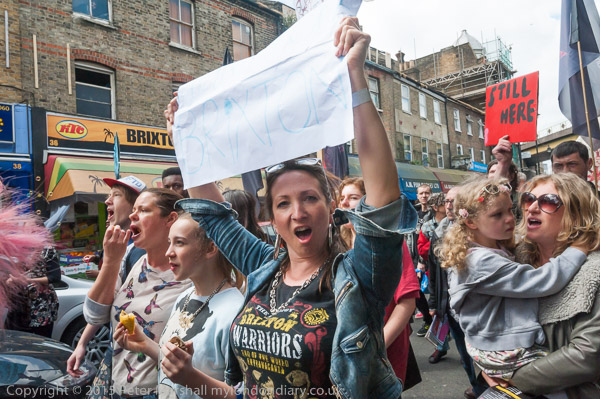
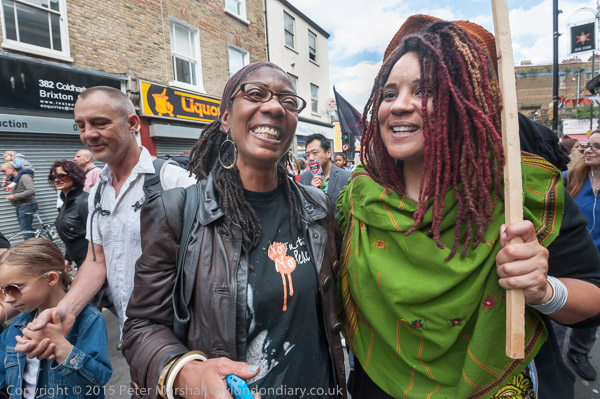
A day of events in central Brixton on Saturday 25th April 2015 celebrated its social & cultural diversity, increasingly under threat as increasing rents and property development are forcing out local businesses and residents.

Brixton boomed after the railways arrived here in the 1860s, the new transport links making it both a popular middle-class suburb and the major shopping centre of South London; it had the first purpose built department store in the UK, Bon Marché, opened in 1877 and continuing in business until 1975 and probably the first street market in the world to be lit by electricity in Electric Avenue. While the wealthier moved out in the first half of the twentieth century to leafier areas, the increasingly working-class population grew, as did the markets, cinemas, pubs and other facilities.

After the war Brixton became increasingly multiracial. Arrivals on the Windrush were given temporary housing in the Clapham South deep shelter, and found jobs from the nearby Brixton Labour Exchange and housing in rooms and flats in the area. Though many had intended to go back to the Caribbean, most remained here, bringing over family to joint them and over the years Brixton became a centre of the British African-Caribbean community. In 1981 locals rose up against heavy handed policing but the conclusions of the Scarman report were largely ignored and it was only after the death of Stephen Lawrence that the police were declared “institutionally racist.”

There was further unrest after the death of Wayne Douglas in police custody in 1995, and there was an increasing attempt by Lambeth Council to change the nature of the area seen by them as regeneration but by many in the area as gentrification.


Brixton Arches tenants protest eviction

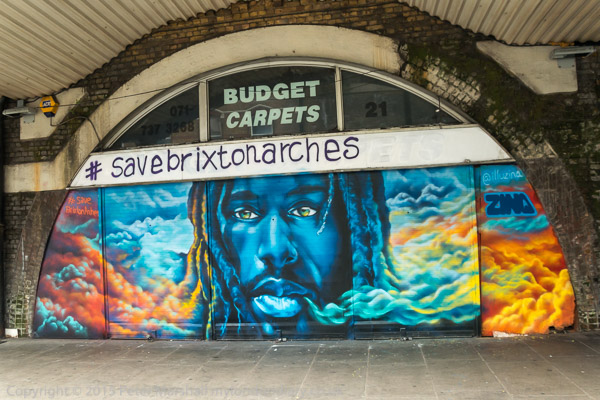
The railways run on viaducts through central Brixton, and the arches below them, particularly along Atlantic Road and Brixton Station Road have long provided low cost spaces for local businesses.

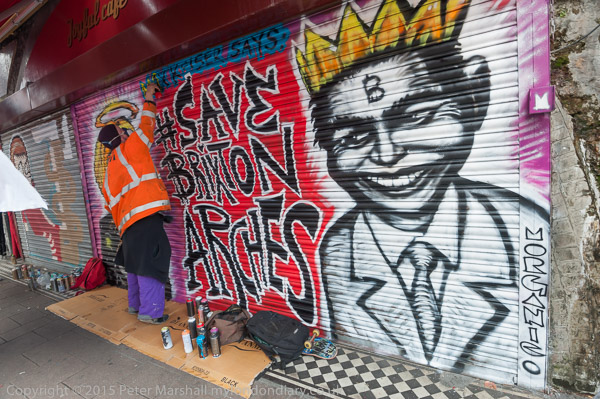
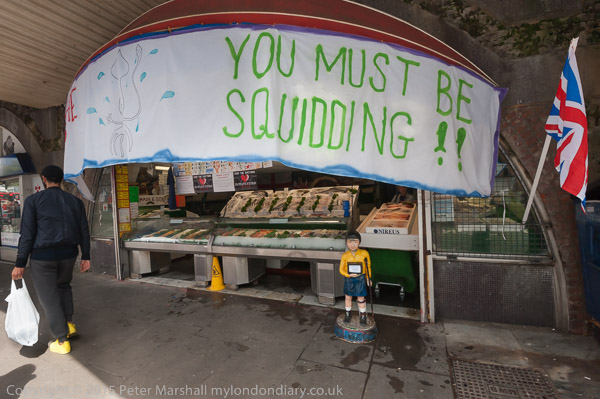
But Network Rail decided to increase the income from these spaces and the existing tenants were threatened with eviction and then a tripling of rent for the refurbished space. One of the businesses, fishmongers L S Mash & Sons, had been trading here since 1932 and others since shortly after the war.

The businesses closed for two hours on Saturday lunchtime, many hanging white sheets with messages across the frontage and others inviting graffiti artists to decorate the shutters. These businesses, the arcades and the market really are the heart of Brixton.

Brixton Arches tenants protest eviction


Take Back Brixton against gentrification

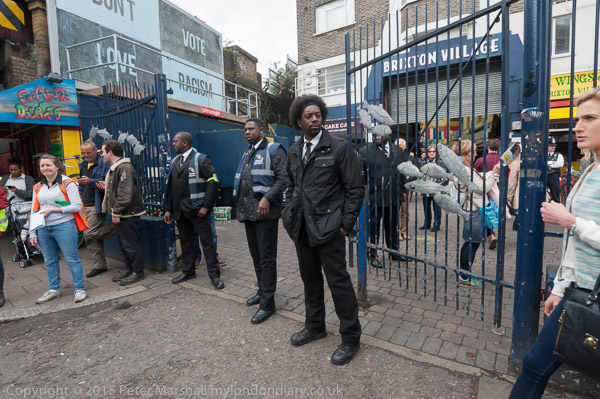
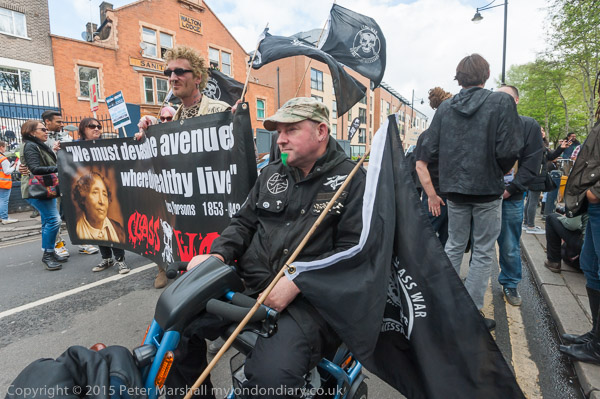
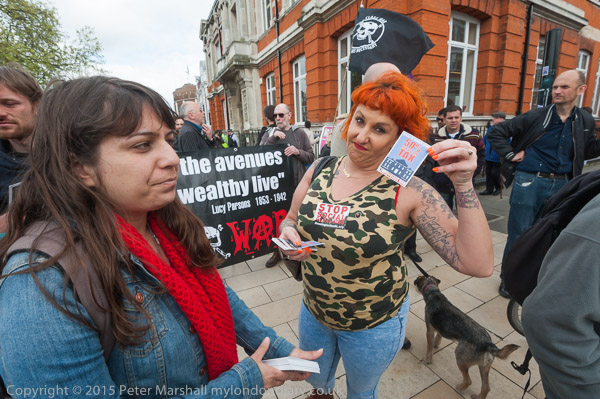
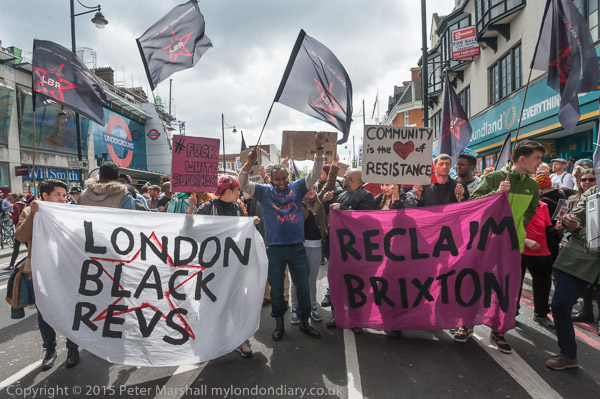
Brixton Black Revs (revolutionaries rather than reverends) had wanted to march peacefully through the gentrified ‘Brixton Village’, but police and security guards blocked their way into the arcade, and instead it became a very short march to take housing and other activists directly to the Reclaim Brixton gathering in Wind rush Square

Granville Arcade which links Coldharbour Lane, Atlantic Road and Popes Road was built in 1937 with over 100 shops in its covered avenues, and was named after its developer, P Granville-Grossman. The site had previously been the Lambeth Carlton Club, a large Georgian-style mansion buit in the 1870s and home to the Brixton Conservative Association.

It was renamed Brixton Village around 2005 and was saved from demolition by a powerful local campaign which resulted in it and Reliance Arcade, Market Row being given Grade II listing. The listing text makes much of the importance of the Afro-Caribbean nature of the markets, but although listing saved them from demolition it has not protected them from gentrification and the replacement of much of this character by trendy restaurants and boutiques.

Take Back Brixton against gentrification


Reclaim Brixton celebrates Brixton

The area in front of the Tate Library and Brixton Ritzy was renamed Windrush Square in 1998. It had long been a popular meeting place for locals and local events, but Lambeth Council with offices in the town hall opposite clearly saw that as something of a threat, and spent a large amount on turning it into a desolate, bleak and unwelcoming windswept area to discourage the informal gatherings that took place there.

Although today the area was reasonably crowded, there seemed to be nothing very organised happening. Unite Community had a microphone at one side and there were a speeches, but few seemed to be taking any notice of them. When I walked around there was a group playing classical music, another of African drummers, and the Revolutionary Communist Group had its own megaphone and speakers, while people were having a light-hearted limbo competition to a musical accompaniment from the Unite ‘stage’. And some of my friends had disappeared to a nearby pub.

Reclaim Brixton celebrates Brixton


London Black Revs ‘Reclaim Brixton’ march

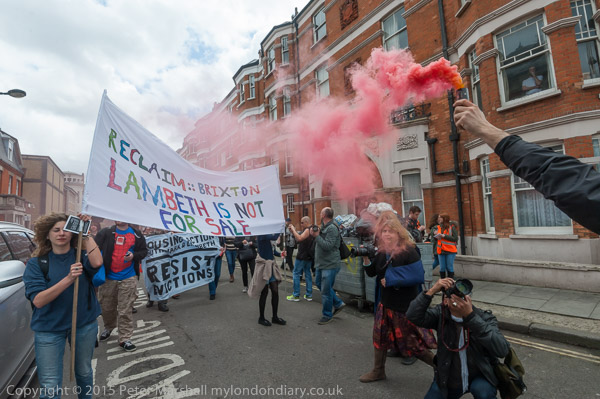
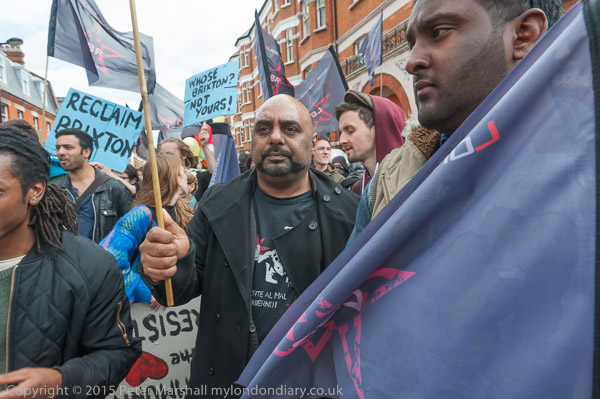
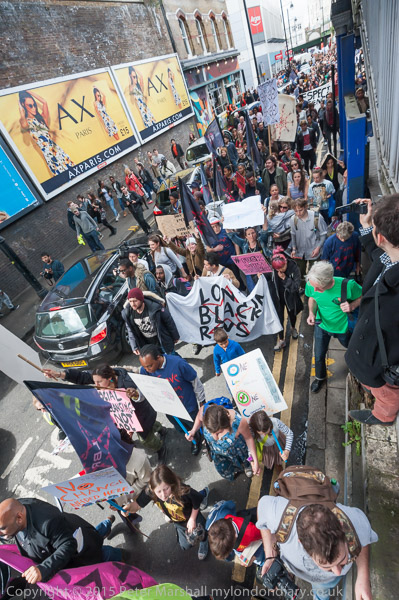
After an hour or two hanging around in Windrush Square, activists again took to the street for a lively march around Brixton.

Rather to my surprise, the march simply returned to Windrush Square. I hung around for a bit but everything seemed very peaceful and I mistakenly thought that perhaps nothing more would happen and decided to take a bus to begin my journey home.

Shortly after I left some people stormed and briefly occupied Lambeth Town Hall and a large window at Foxton’s estate agents was broken, and a few activists went into Brixton Village with banners.

Marcia Rigg whose brother Sean Rigg was killed in Brixton Police Station in 2008

London Black Revs ‘Reclaim Brixton ‘march


Things in Brixton have got worse since 2015. In 2018 Hondo Enterprises owned by Texan property developer and part-time DJ Taylor McWilliams bought Brixton Market which includes the arcades and the following year announced plans for a 20 storey office block, which were approved by Lambeth Council in November 2020. Hondo now brand the whole market area as Brixton Village.

More from the protests:
London Black Revs ‘Reclaim Brixton ‘march
Reclaim Brixton celebrates Brixton
Take Back Brixton against gentrification
Brixton Arches tenants protest eviction


More South Hackney 1988

More South Hackney 1988

Bucknell House, Victoria Park Rd, Hackney, 1988 88-9c-13-Edit_2400
Bucknell House, Victoria Park Rd, Hackney, 1988 88-9c-13

After eating my lunch in Victoria Park where I finished my previous post on this walk I went back to Victoria Park Rd and photographed No 78, Bucknell House, which seemed to be the site of a great deal of building activity, though I suspect not by Barry Bucknell who had been the great DIY expert on TV in the 50s and 60s with “Do it Yourself” and then “Bucknell’s House”.

Back then TV was broadcast live, and the programmes often ended in disaster, much to the viewers amusement. The street was built after Victoria Park, bought by the Crown, opened in 1845, stimulating development in the area which had before been slow.

Warneford St, Hackney, 1988 88-9d-64-Edit_2400
Warneford St, Hackney, 1988 88-9d-64

Much of the land in the area belonged to St. Thomas’s hospital and the trustees of the Sir John Cass Foundation (hence the name Cassland Rd.) I think these houses in Warneforde Street probably date from around the 1880s.

Victoria Park Rd, Hackney, 1988 88-9d-52-Edit_2400
Victoria Park Rd, Hackney, 1988 88-9d-52

These are some of a row of six very similar detached houses on the north side of Victoria Park Road just to the west of Clermont Road, numbers 69-81, I think these are probably 73 to 69. No house numbers are visible in the picture as is often the case, with properties either not having a number or these being too small to be visible. There were seldom bins visible back in 1988 with large house numbers on them, though now we all have wheelie-bins these are often the easiest way to find house numbers.

The Triangle, Mare St, Hackney, 1988 88-9d-53-Edit_2400
The Triangle, Mare St, Hackney, 1988 88-9d-53

I’d walked past The Triangle where Mare St and Westgate Street meet earlier and had taken one picture (not online), but coming back later I made three more, another similar to this one and a third from a few yards further back including a large three-legged notice board telling me the is as the London borough of Hackney and a couple of modern telephone booths. But my main interest was in the building housing M.R.S.[Hackney]Ltd., T.V.s & Appliance Dealers and above them Baker Finance offering Personal Loans.

Just a few yards away I found more large graffiti, urging ‘Don’t mug me. MUG A YUPPIE!!!MUG A YUPPIE!!!’ but so far I’ve not scanned that frame.

Fashions, Mare St, Hackney, 1988 88-9d-43-Edit_2400
Fashions, Mare St, Hackney, 1988 88-9d-43

I walked further up Mare St, past the Cordwainer’s College, now part of the London College of Fashion but originally built in 1877 as Lady Hollis’s School for Girls, which moved to Hampton as Lady Eleanor Hollis in 1936 and it later turned down my sister for having working class parents (picture not online.) I then photographed this entrance, I think on the west side of Mare St, to Le Duman – Fashions of London – Ladies Fashions Factory Shop. It claimed to be ‘Now Open To The Public’ but that was only Monday-Friday, and it was Sunday.

Darnley Rd, Hackney, 1988 88-9d-46-Edit_2400
Darnley Rd, Hackney, 1988 88-9d-46

Further on up Mare St I photographed another block with an interesting corner on Darnley Rd and then this rather narrow alley leading to some industrial premises which I think was between two more interesting buildings on Darnley Road I failed to photograph!

Darnley Rd, Hackney, 1988 88-9d-31-Edit_2400
Darnley Rd, Hackney, 1988 88-9d-31

In Darnley Road I came across these houses which although they seemed to be in poor condition were still lived in. I wondered at their wide double doors. They are still there, though I think most have now been extensively refurbished into expensive flats. Darnley Road dates from 1853 and was one of the areas in which the well-to-do late Victorians lived.

Darnley House, Darnley Rd, Hackney, 1988 88-9d-33-Edit_2400
Darnley House, Darnley Rd, Hackney, 1988 88-9d-33

And also in Darnley Rd, No 57, the last house before the corner with Brenthouse Road was certainly very much in the middle of its complete refurbishment, and I was unsure if it was to be demolished. It looks very smart now, except that its gateposts do not quite match. That on the left has a low pyramidal cap with the word DARNLEY on its front edge, while at the right of the entrance is much flatter and wordless – and the brickwork below is not quite the same. The wall and posts are separately Grade II listed to house, and the listing of the posts mentions the inscribed word HOUSE – which isn’t there. My picture only shows a side of the left post. In 1927 this was the home of Dinshaw Phiroze, physician & surgeon, about whom I can tell you nothing more.

More pictures from this walk in South Hackney to follow in a later post, Paragon, Fashion, Morning Lane & Nautilus 1988.


St George’s Day 2016

April 23rd 303 was not a good day for George from Cappadocia. Diocletian, then the senior Roman Emperor had previously purged the Roman Army of Christians but had not really otherwise bothered too much about them, but he was persuaded by fellow emperor Galerius to take a harder line, and after consulting the oracle of Apollo began a general persecution across the empire on February 23, 303, which continued for the next 10 years or so.

For some reason George had escaped the previous army purge was was still serving as a member of Emperor Diocletian’s personal bodyguards. Tradition has it that he refused to recant his faith and was sentenced to death, being beheaded at Nicomedia on 23rd April. Rather different versions of his life (and death) grew up in the Greek and Latin churches. But certainly many Christians were killed by the Romans and George certainly represents one of many brave men who died rather than recant, most probably in the earlier years of Diocletian’s reign.

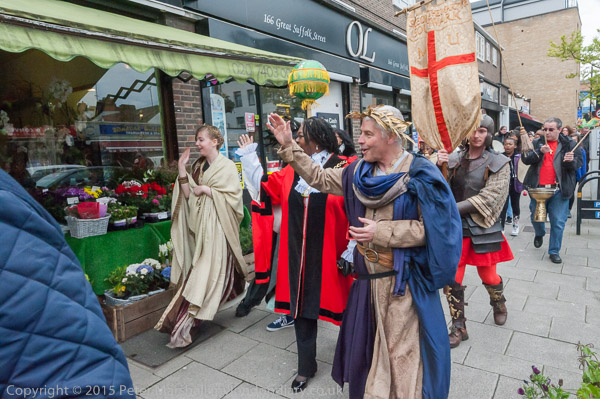
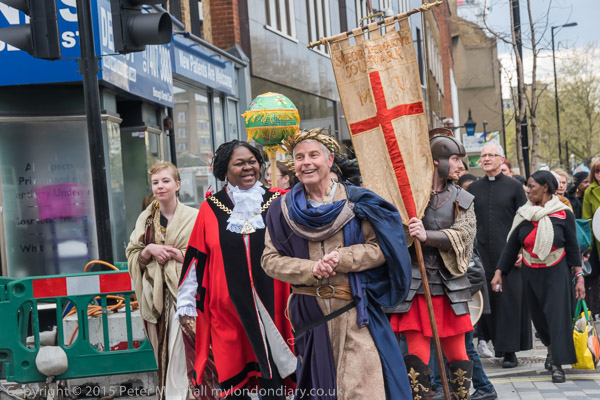
St George, Emperor Diocletian, the priestess or haruspex and the emperor’s daughter

Legends built up around him, few of which like that of the dragon (an 11th century addition) will have been true. It’s unlikely that he was subjected to more than twenty separate tortures over the course of seven years or that his martyrdom led to “40,900 pagans were converted to Christianity, including the empress Alexandra.” You can read more about him on Wikipedia.

His martydom began to be celebrated in Lydda in Palestine where he was thought to have died, and pilgrims came there and later to Cappadocia where he is thought to have come from. He was made a saint by Pope Gelasius I in 494, who said his was one of those “whose names are justly reverenced among men, but whose actions are known only to God“.

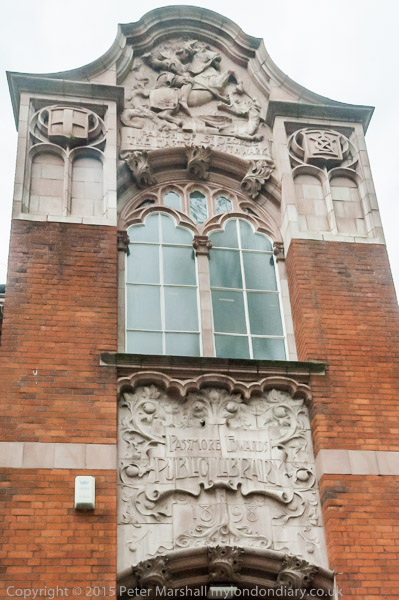
St George fights the dragon on the Passmore Edwards Public Library, long closed

His fame spread across Christendom, though it was only in the ninth century that the first church was dedicated to him in England – and not until 1152 that he displaced Edward the Confessor as the patron saint of England, although he had become a part of some English battle cries in the Hundred Years War (1337-1453) and among the Crusaders, when many went from England to fight against the Muslims in Palestine between 1095 and 1291.

St Georges Day was made a major feast here in 1415 and 1421, a holiday where church attendance was compulsory and other festivities took place. Later its celebration declined, particularly after the union with Scotland, and had more or less died out by the 20th century.

In recent years there has been something of a revival, spurred on in part by the increasing festivals of other communities, sometimes supported by local councils. There has been an increasing emphasis too on our national teams, particularly the English Football and Rugby teams, with minor fixtures being promoted through the mass media in a way that in earlier years was reserved for the major sporting events – the Grand National, the FA Cup FInal and the Boat Race.

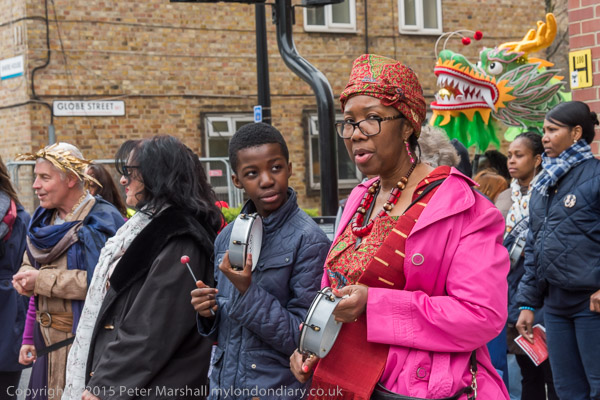
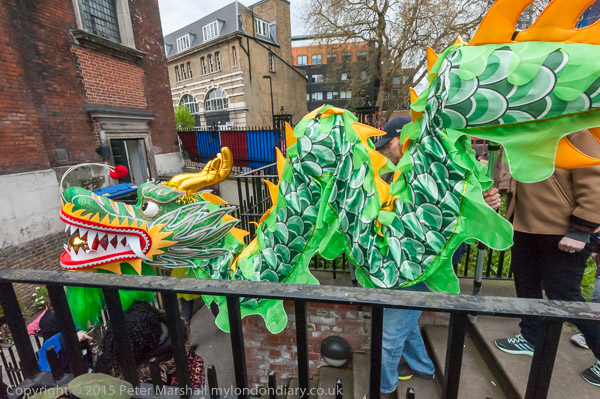
London’s dragons are mainly Chinese

The St George’s Flag had become something seldom seen outside football matches, except in the hands of small racist right-wing groups who called themselves patriots. Unfortunately recent years have seen a growth in these, and some have organised celebrations of St George’s Day, but there has also been a growth in less political events, with even English Heritage encouraging celebrations. Radio 3 has celebrated it, and both Conservatives and the Labour Party have campaigned for it – with Labour calling for it to become a public in both 2017 and 2019 manifestos.

The pictures here are from 23rd April 2016, I started the day photographing a couple of protests over the sale of illegal ‘blood diamonds’ from Sierra Leone at Selfridges in Oxford Street and Tiffany in Sloane Square before going on take pictures about St George’s Day, beginning around lunchtime in Trafalgar Square, where despite the support of mayor Boris Johnson little was happening. I went to the Roman Catholic St George’s Cathedral in Southwark, calling in briefly at the peace garden in the Imperial War Museum across the road as I waited for people to arrive for the St George in Southwark Procession.

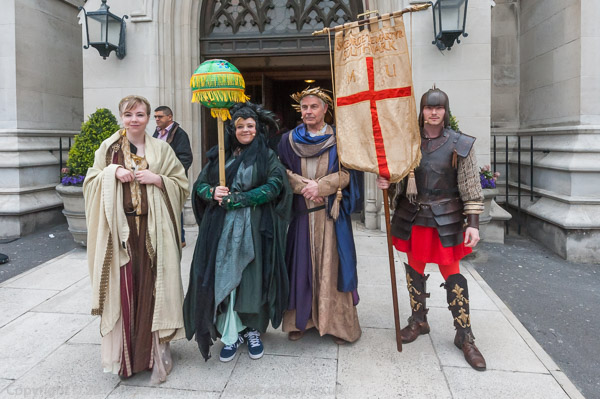
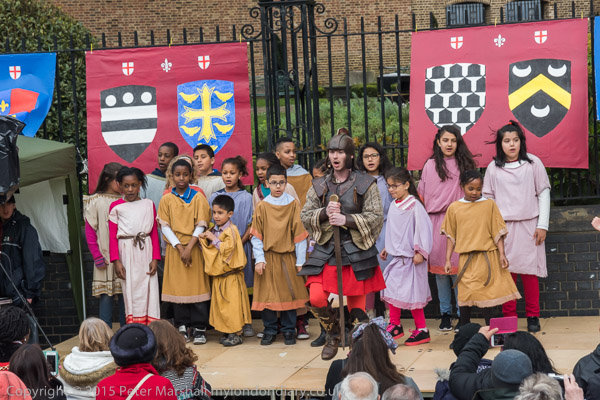
This, led by led by St George, a Roman Emperor, the Mayor of Southwark and others and with a dragon at its rear made its way from the St George’s RC Cathedral to the Church of England St George the Martyr in Borough High Street.

I’d not been inside this before and went in with those taking part for a short address before we came out and the procession formed up. It wound its way through the back streets of Southwark and I was pleased as we went past the Priory on Webber Street to be able to tell the mayor something about Bert Hardy who had recently got a blue plaque there. I’d only met Hardy a couple of times, but one of my friends had worked at Grove Hardy as a printer.

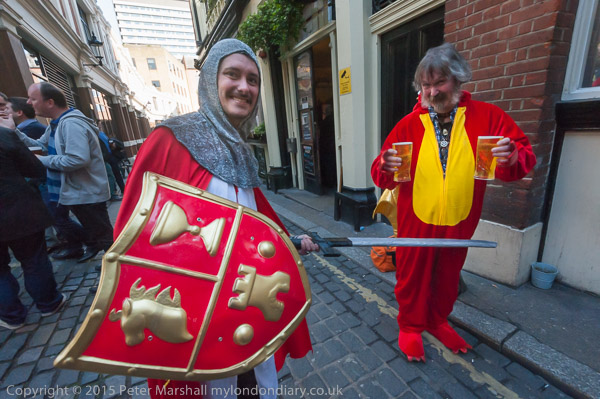
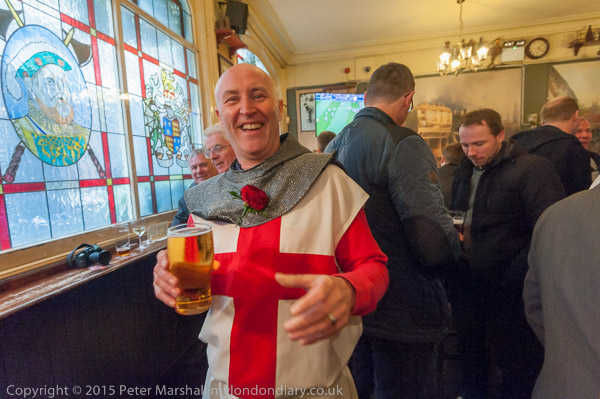
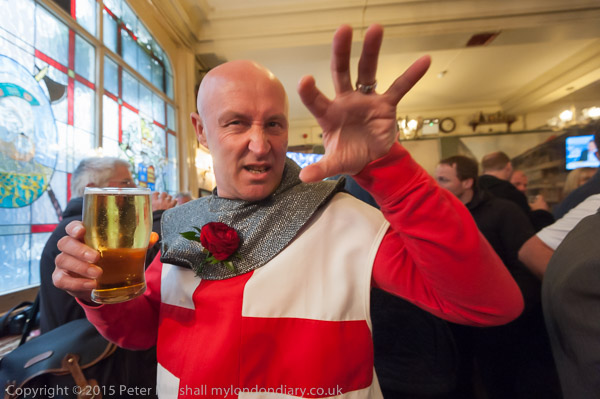
The procession ended with a play in the yard beside St George the Martyr, but I left before it finished. Earlier I’d agreed to meet a couple of photographer friends at the start of the procession, but I think they had got lost on the way there, but I’d now arranged to find them on London Bridge. There seemed to be little going on at the George Inn on Borough High St, but at the King’s Head we walked into the bar and were seated by the window when St George walked in with a few mates. It obviously wasn’t the first pub they had visited. After he had got a pint I went and asked if I could take a few pictures, and he began posing, though moving rather too much in the low light.

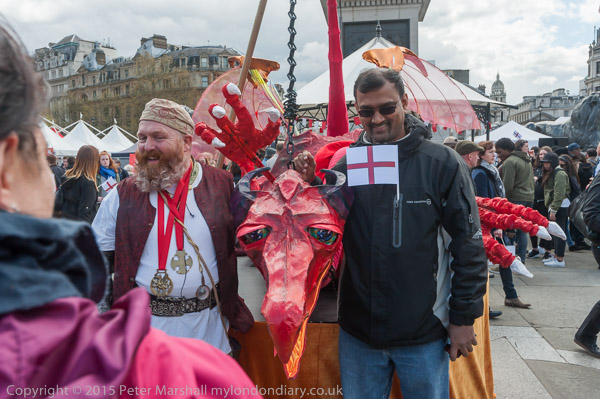
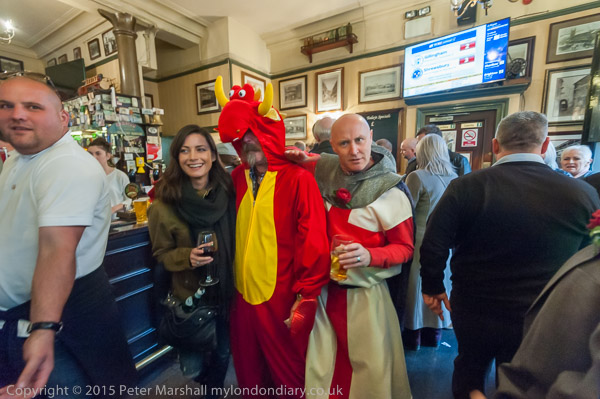
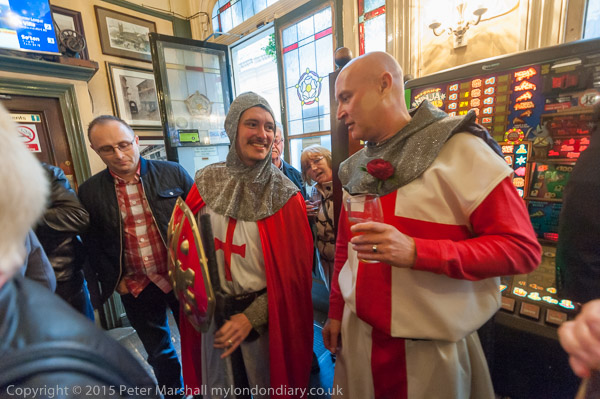
After I had taken his picture a rather friendly dragon came up to the bar, followed by a second St George, and I photographed the two St Georges together. And as we left the bar, there in the street was the second of them with his dragon friend – and I took a few more frames.

More on most of these events and the other two protests I photographed that day:
St George in Southwark Procession
Peace Garden at War Museum
St Georges Day in London
Sierra Leone Blood Diamonds at Tiffany
Sierra Leone Blood Diamonds at Selfridges


Scientists Demand Politicians Listen, Family Justice & Chechnya

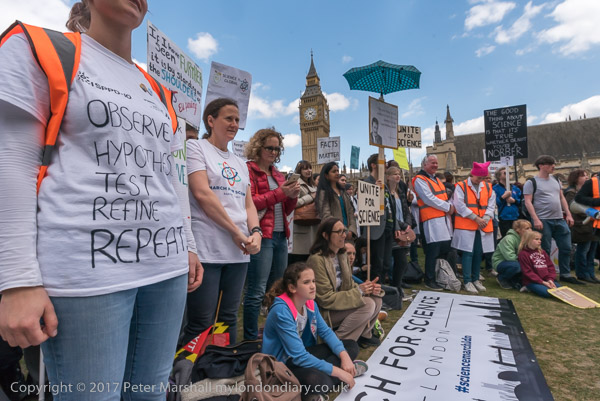
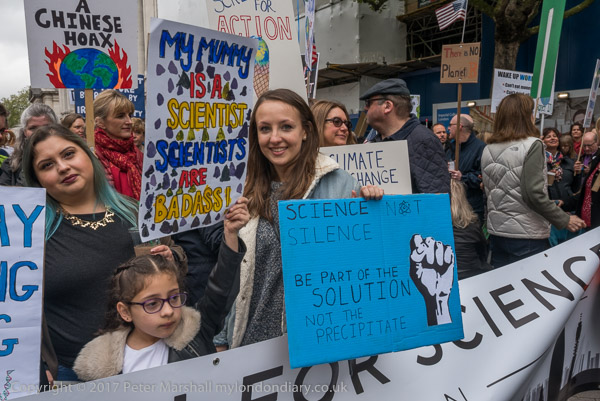
Scientists Demand Politicians Listen, Family Justice & Chechnya – Five years ago on Saturday 22nd April 2017, thousands of scientists marched from outside the Science Museum to a rally at Parliament to demand policies based on proven research rather than fake news and fake science. Elsewhere in London people called for urgent reform of our secretive Family Courts and against the torture and killing of gay men in Chechnya.

Scientists Demand Politicians Listen, Family Justice & Chechnya

Scientists march for Science – Kensington

Scientists Demand Politicians Listen, Family Justice & Chechnya

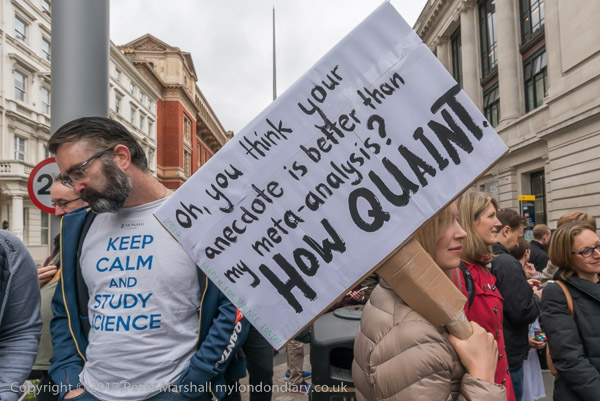
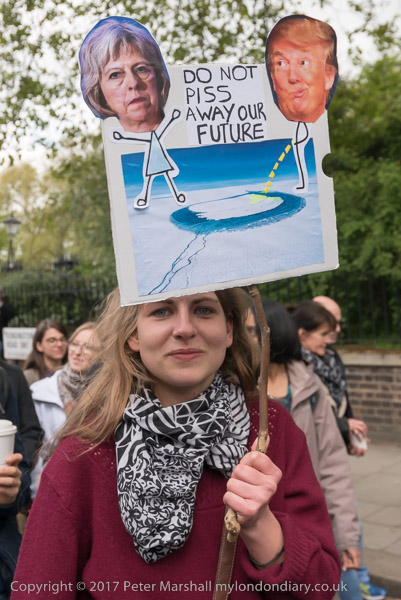
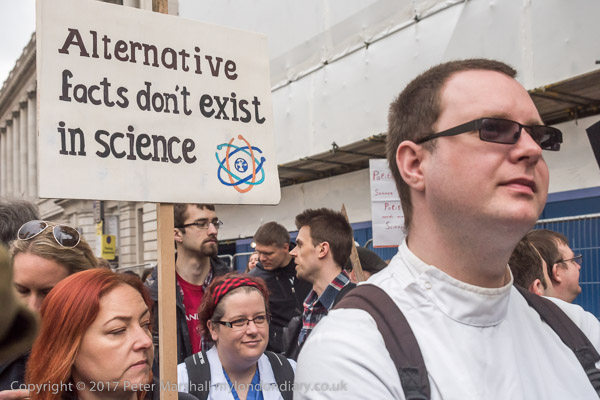
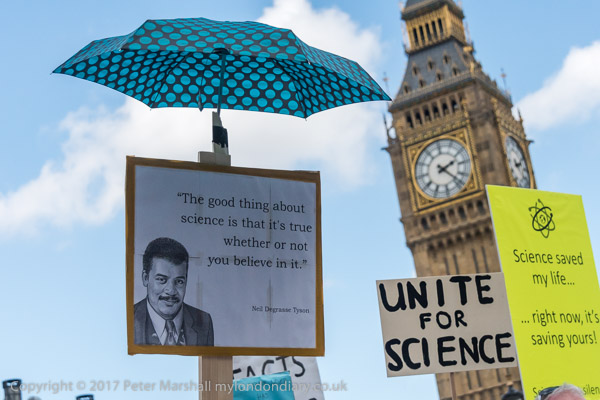
I began my working day on Exhibition Road outsed the Science Museum where a large crowd of people was gathering, many wearing white lab coats, to clebrate the vital role of science in our lives and to demand that the UK and other governments stop listening to fake news and fake science and base policies on proven research.

Scientists Demand Politicians Listen, Family Justice & Chechnya

They saw a particularly dangerous situation in the USA, where President Trump was promoting climate denial and other policies in the face of the well-established science and giant US companies particularly the fossil fuel producers have been spending unimaginable sums over the years to promote biased research and lobby to produce doubt over established facts – just as the tobacco lobby did to undermine the science behind the cancer risks of smoking.

‘The New Greenwashing’, an article just published by Nick Dowson’s article in the May-June 2022 issue of New Internationalist spells out the 6 ‘Tricks’ that Big Oil has used to prevent any meaningful action to make the drastic reductions needed in fossil fuel use and ensure that they continue to make massive profits from oil and gas as we move closer and closer to extinction.

They “Distract, delay and obfuscate” by setting distant targets and coming up with vague ideas like ‘net zero’ when what is needed is an end to fossil fuels, “Sell false solutions” such as carbon credits, carbon offsets, ecosystem services, “Greenwash gas” as being natural and clean, “Peddle futuristic-sounding fictions” particularly around hydrogen use, “Divert subsidies from renewables to unproven technologies” in particular carbon capture and storage and “Individualise, demobilise” making us feel it is our personal responsibility through gadgets such as the carbon footprint calculator invented by BP rather than a problem caused by their activities

Here in the UK Brexit is threatening our international cooperation in science and the BBC uses the excuse of impartiality to give equal billing to accepted and tested science and fake science often presented by non-scientists.

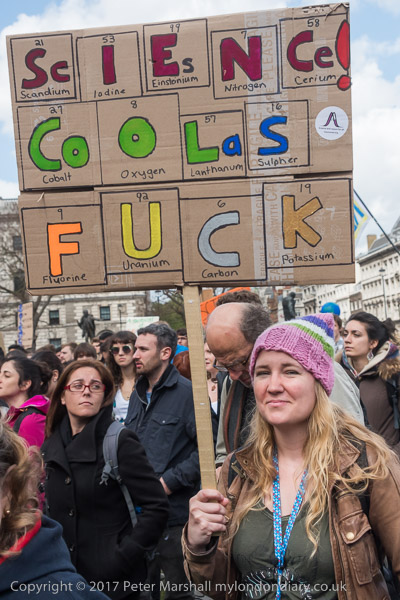
I spent some time watching the march go past, turning into Kensington Road on its way to Parliament Square, wondering what people who saw them going past would make of some of the slogans, such as like ‘Do I have large P-value? Cos I feel Insignificant‘ or ‘dT=α.ln(C1/C0)‘. Many scientists do seem to have a problem in communicating with the rest of us. Fortunately there were others easier to understand.

Scientists march for Science


Scientists Rally for Science -Parliament Square

I rejoined the scientists rather later than hoped after the rally in Parliament Square had begun, missing quite a few of the speeches.

Scientists Rally for Science


Reform Family Courts – Kensington Gardens,

When the scientists marched off from Kensington to Parliament I went in search of another group of protesters who had marched in the opposite direction, from Parliament Square to the statue of Peter Pan in Kensington Gardens.

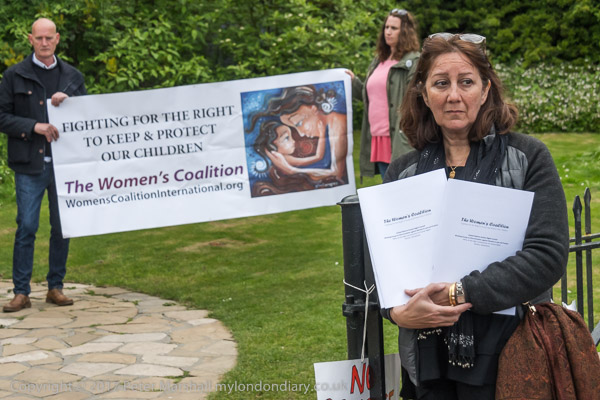
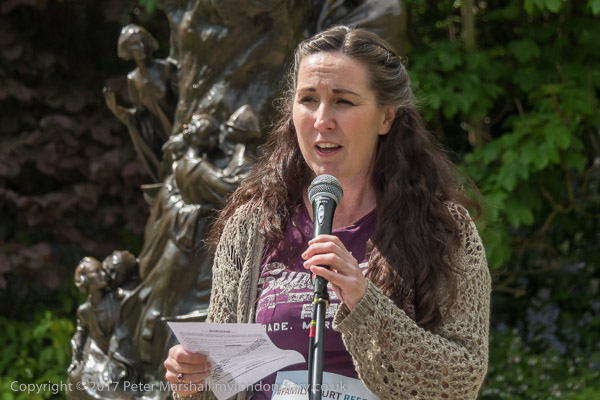
The had come to protest against the injustices perpetrated by our secret Family Court system and police and social services, and several told horrific real stories of children being taken away from victims of domestic violence, mothers who had reported child abuse by partners or former partners, and other cases of what appeared to be miscarriages of justice. Among those taking part were some unable to speak because they had been gagged by court orders. One woman was being forced to live away from friends, job and family. Another told us how the battle to regain her daughter had taken 7 years and cost her £14,000.

One of the organisers explains why we cannot mention the name of the woman the protest was organised to support

The protest had been arranged, along with another taking place in Nottingham to support a woman currently involved in a family court case. But on the afternoon before this protest, a family court judge had ruled her name could not be mentioned. Although everyone at the protest knew it, we had to refer to her only as ‘S’ to avoid committing an offence and the protest had to be renamed as ‘Justice4S’.

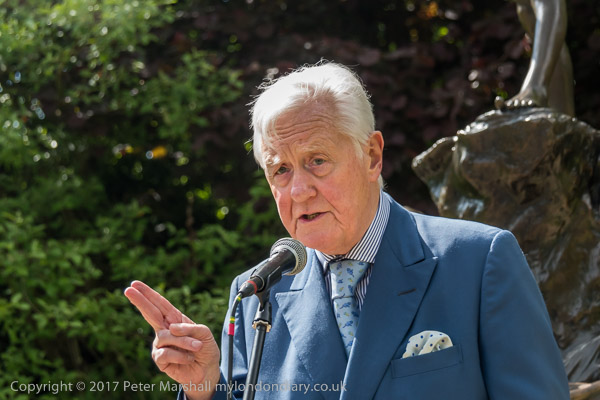
Also present was Sir Benjamin Slade, the owner of two castles in Somerset who had hit news headlines earlier in the week by advertising for a young wife to serve his needs. He had fought the case for one of his former workers whose children had been taken away by social services for what appeared to be trivial reasons, getting a friend who was a major newspaper editor to run a campaign which eventually got them returned. He came to the protest together with a young woman whose case he was currently involved in who was being forced against her will to live in Torquay.

Reform Family Courts


LGBT rights abuses in Chechnya – Russian Embassy, Kensington

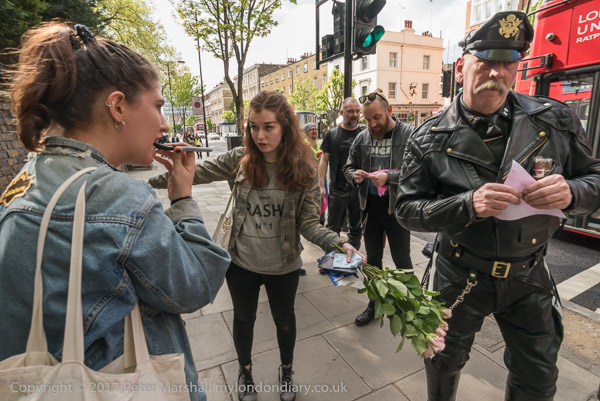
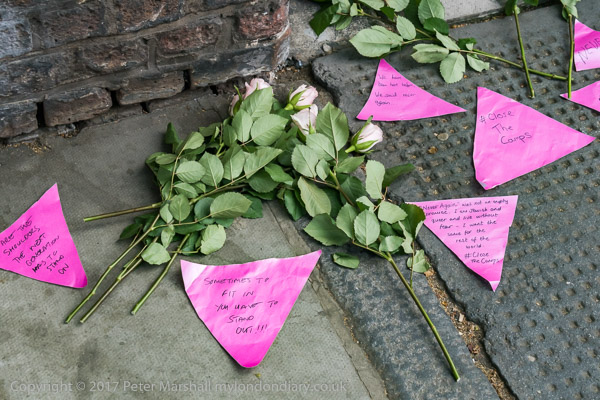
After rushing back by tube from Kensington Gardens to Westminster for the Scientists Rally, as soon as that ended I was back on the tube to the Consular Section of the Russian Embassy on Bayswater Road where people had brought pink flowers and wrote messages on pink triangles to leave outside the tall gates of the Consular department of the Russian Embassy in a vigil to show solidarity with LGBT people in Chechnya.

The vigil was one of several taking place across the UK after over a hundred men, suspected by the authorities of being homosexual have been rounded up an put into camps and tortured, with three thought to have been killed. Those held include many well-known in the country, including TV personalities and religious figures. An Amnesty petition stated “The Chechen government won’t admit that gay men even exist in Chechnya, let alone that they ordered what the police call ‘preventive mopping up’ of people they deem undesirable”.

LGBT rights abuses in Chechnya


South Hackney Walk 1988

South Hackney Walk 1988
It was not until Sunday 18th September 1988 that I had the time for another walk with my cameras around London, taking a train and tubes to Bethnal Green Station and walking north up Cambridge Heath Road to Mare St in Hackney.

Victoria Buildings, Mare St, Hackney, 1988 88-9c-53-Edit_2400
Victoria Buildings, Mare St, Hackney, 1988 88-9c-53

I stopped to take another photograph of the fine late Victorian commercial building with its row of shops at ground level and a bricked up doorway, particularly attracted by the multiple identities of No 7 as Aarons Van & Car Rental with Doris Car Service partly covering yet another. In the top left corner of the shop window it tells us ‘UNDER NEW MANAGEMENT’ while a rather drunken notice lower down states ‘YOU DRINK WE DRIVE’. Above Simply Seconds at No 9 were peeling posters and the upper floors appeared largely unoccupied.

Rich Scum out of Hackney!!, Westgate St, Hackney, 1988 88-9c-56-Edit_2400
Rich Scum out of Hackney!!, Westgate St, Hackney, 1988 88-9c-56

A little further up Mare St I wandered briefly down Westgate St, to record the graffiti on its railway bridge, which above the advert for LEATHER MERCHANTS gave the clear message ‘RICH SCUM OUT OF HACKNEY!!’. The bridge has been regularly repainted over the years, but I think later graffiti has been non-political.

King Edwards Rd, Hackney, 1988 88-9c-43-Edit_2400
King Edwards Rd, Hackney, 1988 88-9c-43

On King Edwards Road off to the west of Mare Street I came across a fine piece of architectural decoration with peeling paint and shrubs growing from it at No 6. The house next door, No 8 had a similar feature in better condition and a little more ornate which I also photographed but is not on-line.

Synagogue, Ainsworth Rd, Hackney, 1988 88-9c-31-Edit_2400
Synagogue, Ainsworth Rd, Hackney, 1988 88-9c-31

The South Hackney Federation Synagogue or Yavneh Synagogue at 25 Ainsworth Rd was founded in 1904 and was an Ashkenazi Orthodox synagogue incorporated into Clapton Federation Synagogue in the 1990s. It was demolished and replaced by a block of flats.

Church Crescent, Hackney, 1988 88-9c-21-Edit_2400
Southborough Road area, Hackney, 1988 88-9c-21

I often made use of framing a view through some kind of arch – in this case of trees – which had been emphasised by the writers for Amateur Photographer when as a grubby teenager I spent hours perusing it in my local library. And while it can be a useful device it is certainly a cliché and is often used ironically in my work. I’ve also here carefully joined together a 22 storey tower block and the rather grand porch of an older house.

I think the block could be Clare House in Hawthorne Avenue, on the other side of Victoria Park where I was standing on a street corner, somewhere not far from Church Crescent where I made a previous exposure and the next on the corner of Southborough and Lauriston Roads. But I cannot find its precise location

Derby Rd, Hackney, 1988 88-9c-24-Edit_2400
Derby Rd, Hackney, 1988 88-9c-24

These houses were on Derby Road, awaiting demolition as well as those in the image below. There is now a modern two-story housing development on this side of the street.

J Roler, Derby Rd, Hackney, 1988 88-9c-25-Edit_2400
J Roler, Derby Rd, Hackney, 1988 88-9c-25

J Roler was at the corner of Derby Rd though I think its address as No 6 may have been in Rutland Road. It appeared long closed when I made this picture. Perhaps someone reading this will remember visiting the shop and tell us all more in a comment to this post.

Shelter, Victoria Park, Hackney, 1988 88-9c-26-Edit_2400
Shelter, Victoria Park, Hackney, 1988 88-9c-26

A curiously organic shelter in Victoria Park with a generous coating of graffiti, none of any interest. In the background people are sitting beside the lake. I don’t think I walked far into the park and although I can’t identify and of the buildings in the background I think this is somewhere close to Victoria Park Road on the north side of the lake.

I suspect I sat here or somewhere close by drinking a cup of coffee and eating my sandwiches for lunch. Back in 1988 there were still relatively few places you could rely on getting a decent cup of coffee and my camera bag always included a space for a thermos. After a short rest I will have continued my walk – and there will be more pictures in a future post.


Chiswick House & Gardens 1988

Chiswick House & Gardens 1988

Classic Bridge, Chiswick House Gardens, Chiswick, Hounslow, 1988
Classic Bridge, Chiswick House Gardens, Chiswick, Hounslow, 1988 88-9b-56

I think we managed to get most of our students together at Kew Bridge after our walk along Brentford Riverside to take the train for the single stop to Chiswick, from where we walked the third of a mile or so to Chiswick House Gardens.

Sphinx, Chiswick House, Chiswick House Gardens, Chiswick, Hounslow, 1988 88-9b-35

As it says on the web site, “Chiswick House and Gardens is one of the most glorious examples of 18th-century British architecture and landscaped gardens, with over 300 years of discovery, inspiration and delight.” The house and gardens were created between 1725 and about 1738 by William Kent working for his friend Richard Boyle, the third Earl of Burlington and represent the birth of the English Landscape Movement and the house one of the finest examples of neo-Palladian architecture in England.

Lion, Exedra, Chiswick House Gardens, Chiswick, Hounslow, 1988 88-9b-32

I don’t think we told the students a great deal about this, but we had showed them some pictures before the outing, including some fine photographs by Bill Brandt and Edwin Smith, and perhaps even some of my own.

Steps, Chiswick House, Chiswick, Hounslow, 1988 88-9b-14

Over the years the grounds and the house had deteriorated and before it had been sold to Middlesex County Council in 1929 had been a mental health institution. The house was taken over by the Ministry of Works (now English Heritage) in 1948, and they embarked on a major project to restore both house and gardens to their original state.

Bust, Chiswick House Gardens, Chiswick, Hounslow, 1988 88-9b-15

The gardens at the time of our visit in 1988 were in parts rather less restored than they are now, and I think access was a little less restricted and we could wander freely around them. The park is open free of charge to the public every day and is well worth a visit. Back in 1988 there were relatively few visitors and apart from our group they were mainly locals walking their dogs. Now after another major restoration with £12m of national lottery money and a new café completed in 2012 it gets rather more visitors.

Bust, Chiswick House Gardens, Chiswick, Hounslow, 1988 88-9b-16

The café was the London Building of the year in 2011, and the ‘artisan’ food isn’t bad if you like that sort of thing, though back in 1988 we brought sandwiches.

Burlington Lane, Chiswick, Hounslow, 1988 88-9c-63
From Station footbridge, Burlington Lane, Chiswick, Hounslow, 1988 88-9c-63

We didn’t get all of the students back to catch the train home from Chiswick station on any of the occasions we took them there. I think this may have been the year when police held two of them as they ran across the park to try and get to the train on time and held them for several hours without allowing them to contact anyone. But normally when we took students out some would disappear and go clubbing in London, coming back bleary-eyed to college the following morning to sleep in our lessons.


Brentford, Lot’s Ait and the Thames, 1988

Brentford, Monument, pillar, Ferry Lane, Brentford, 1988 88-9a-56
Battles of Brentford, Monument, pillar, Ferry Lane, Brentford, 1988 88-9a-56

I had to go back to my full-time work as a teacher at the start of September 1988, and the start of a new year always kept me fairly busy. Back then we had large groups of beginners taking photography courses – it was one of the most popular course in the college, partly because many thought it would be an easy option to make up the number of subjects they were required to take.

Red Lion, pub, Brentford High St, Brentford,  Hounslow, 1988 88-9a-32
Red Lion, pub, Brentford High St, Brentford, Hounslow, 1988 88-9a-32

We spent a week or two instructing them in the basics – shutter speeds and apertures, and then took them out en masse each with a camera an a 36 exposure film to some local area for a day out to take some pictures so they would then have a film to learn how to develop and print. They would also get a very loose brief suggesting the kind of things they might look for in making pictures.

Dock, River Thames, Brentford, Hounslow, 1988 88-9a-41

In 1988 we chose to take them to Brenford riverside and then on to Chiswick Park and I think we had around 30 students with myself and another member of staff. Things were a lot easier then – no such things as risk assessments and having students who were all over 16 we simply told them a few very basic safety rule and that if they missed the train back home they would have to find their own way.

Boatyard, Lot's Ait, River Thames, Brentford, Hounslow, 1988 88-9a-21
Boatyard, Lot’s Ait, River Thames, Brentford, Hounslow, 1988 88-9a-21

It wasn’t unknown back then for myself and the other member of staff having set the students into action to find a convenient place for a pint or two, though I don’t think we did on this outing.

Boatyard, Lot's Ait, River Thames, Brentford, Hounslow, 1988 88-9a-24
Boatyard, Lot’s Ait, River Thames, Brentford, Hounslow, 1988 88-9a-24

I think on this occasion I walked along the riverside with the students, taking a few pictures myself and giving advice to anyone who needed it. It was low tide, and even if they took few photographs many of the students enjoyed walking in the mud, though I tried to keep my own shoes reasonably clean and dry, keeping to the shingle.

Decaying Boat, Lot's Ait, River Thames, Brentford, Hounslow, 1988 88-9a-13
The Good Ship Variety, Decaying Boat, Lot’s Ait, River Thames, Brentford, Hounslow, 1988 88-9a-13

The stretch of riverfront we took them down to, by Lot’s Ait, was then lined with largely derelict industrial buildings, but is now lined with luxury flats. On Lot’s Ait itself there was a boatyard, opened in the 1920s by The Thames Lighterage company to build and repair lighters; it was one of the last on the tidal Thames when it closed down in the early seventies. Fortunately it has so far escaped redevelopment and was reopened a few years ago as John’s Boat Works, with the island now linked to Brentford by a footbridge.

Lot's Ait, River Thames, Brentford, Hounslow, 1988 88-9a-12
Brentford Ait, Lot’s Ait, River Thames, Brentford, Hounslow, 1988 88-9a-12

We came off the river to go along the High St to Kew Bridge station, where we took another train for the second half of our day out in Chiswick Park which you will see in a later post.

Genocide, Football, Bikes, TTIP, Climate Change and NHS

Genocide, Football, Bikes, TTIP, Climate Change and NHS – another varied day of events around London on Saturday 19th April 2015.


Centenary of Armenian Genocide, Piccadilly

Genocide, Football, Bikes, TTIP, Climate Change and NHS

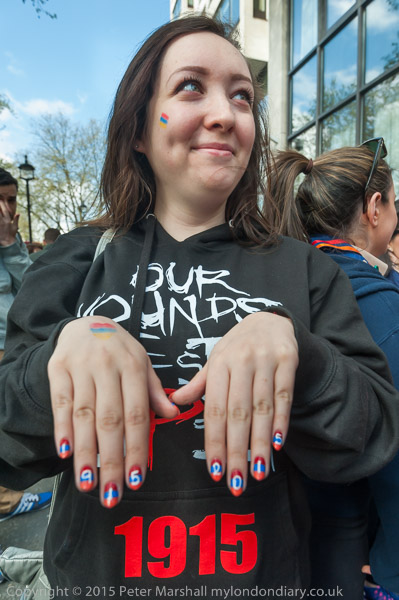
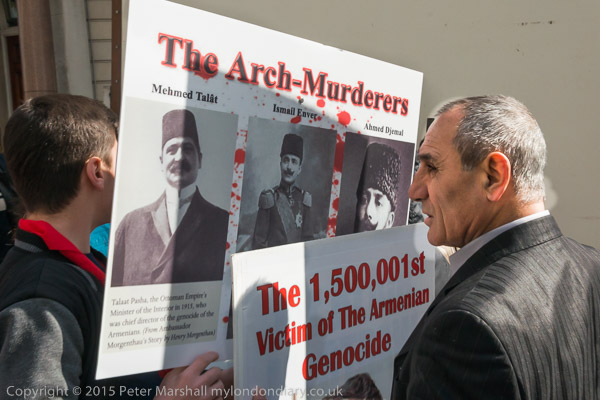
Armenians met to march through London on the 100th anniversary of start of the killing of 1.5m Armenians by Turkey between 1915 and 1923. Turkey still refuse to accept the mass killings as genocide and the UK has not recognised the Armenian genocide.

Genocide is defined as deliberate killing of a large number of people from a particular nation or ethnic group with the aim of destroying that nation or group, and it seems beyond doubt that this was the Turkish aim. I left just before th march began, going to lay flowers at the Cenotaph and then hold a service on the steps of steps of St Paul’s Cathedral.

Centenary of Armenian Genocide


Football Action Network Manifesto, Westminster

Genocide, Football, Bikes, TTIP, Climate Change and NHS

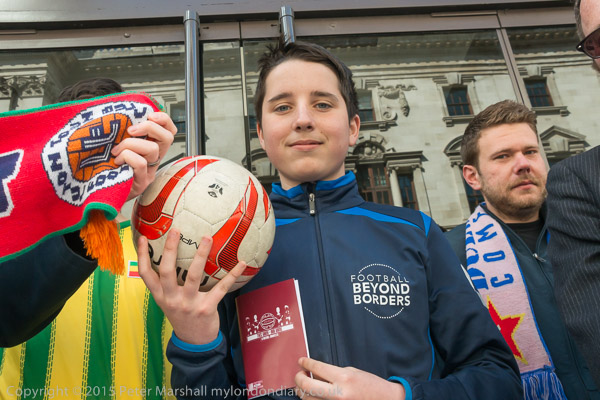
Football fans in the Football Action Network took copies of its manifesto to the Labour, Tory and Lib-Dem offices in Westminster. Its demands include a Football Reform Bill, a living wage for all staff, fair ticket prices, safe standing, and reforms to clubs & FA. I met and photographed them on the steps of the Lib-Dem offices in Great George St.
Football Action Network Manifesto


Tweed Cycle Ride, Westminster

Genocide, Football, Bikes, TTIP, Climate Change and NHS

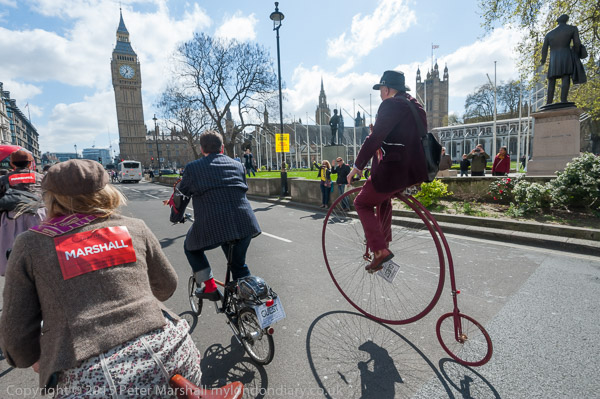
The Tweed Cycle Ride came past as I photographed the football fans and I ran down the road next to them into Parliament Square. This vintage-themed “jaunty bike ride around London in our sartorial best” stops for tea and a picnic and ends with “a bit of a jolly knees-up.” It’s a charity event, raising money for the London Cycling Campaign.
Tweed Cycle Ride


Stop TTIP rally, Shepherds Bush Green

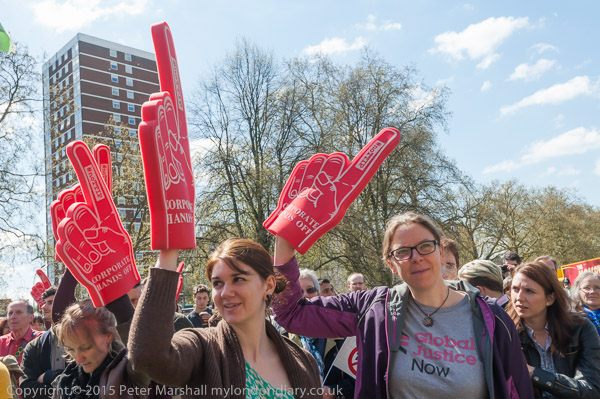
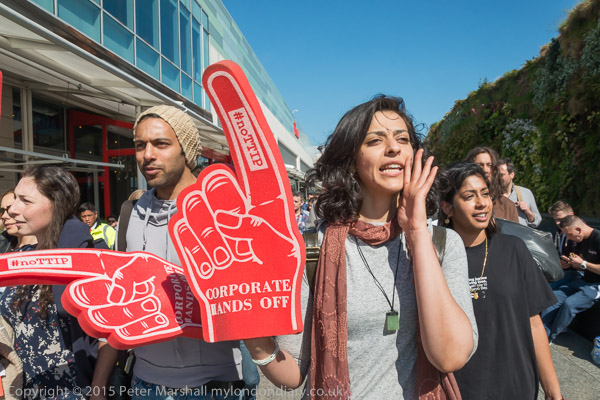
A tube journey took me out to Shepherds Bush Green in West London for a Day of Dissent rally against the TTIP treaty being secretly negotiated by governments and corporations poses and the threat this trade treaty poses to democracy and all public services.

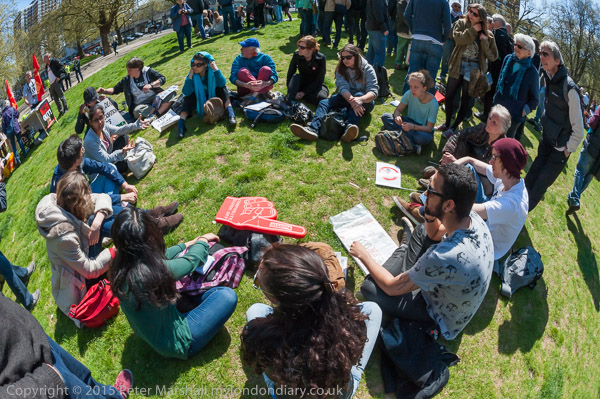
After a number of powerful speeches the protesters split into participatory discussion groups to discus the risks and plan further action.

Stop TTIP rally


KFC protest over TTIP – Shepherds Bush Green

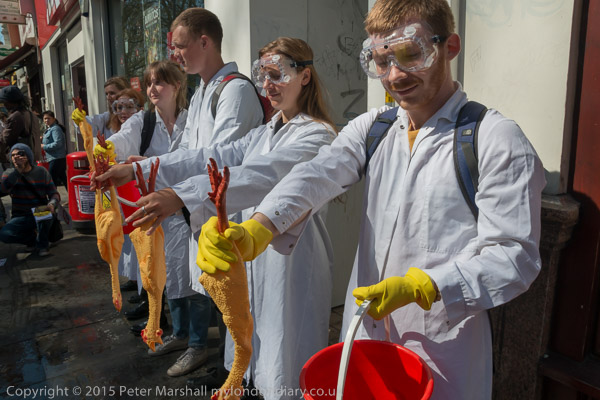
TTIP will force countries to accept food from the US which uses practices considered unsafe in other countries – including chlorine-washed chickens. This is needed in the US as chickens are kept in cages with very poor standards of hygiene that would not be permitted here, and drastic treatment of the carcases is essential. A row of protester stood in front of KFC and wearing white coats and yellow rubber gloves dipped rubber chickens into buckets and passed them along the processing line.


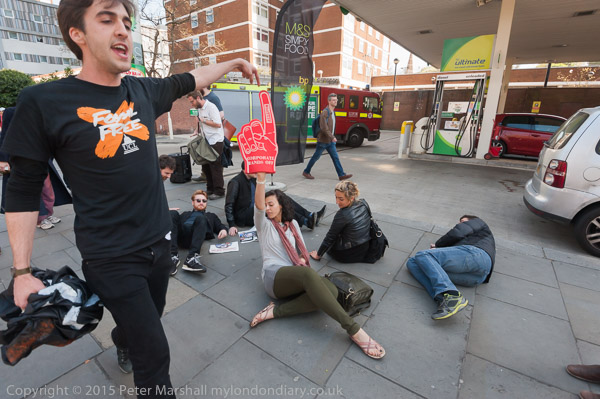
BP die-in against Climate Change, Shepherds Bush Green

Another group of protesters marched across the the BP garage on the other side os Shepherd Bush Green, where they staged a ‘die-in’ over TTIP, which would force countries to use dirty fuels including coal, tar oil and arctic oil and seriously delay cutting carbon emissions and the move to renewable energy. After several speeches, the protesters got up and walked back across the road to the grassed area of the green.

BP die-in against Climate Change


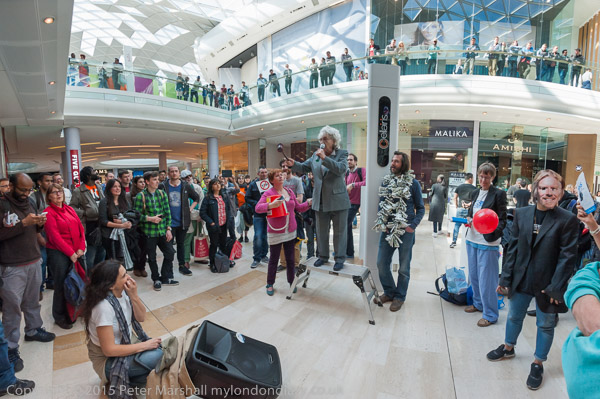
Westfield ‘Save our NHS’ protest, Westfield, Shepherds Bush

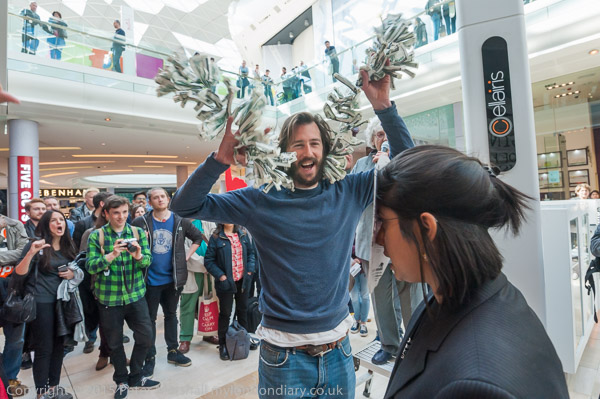
Finally a group of protester marched into London’s Westfield centre to point out the danger that TTIP poses to our NHS, allowing corporations to force the privatisation of all public services. Police and security stood back and watched as they gave out leaflets and put on a short street theatre performance.

Like many shopping centres, Westfield hava a ‘no photography’ policy, and some of those taking pictures and recording videos were asked to stop. I don’t think I was, but would have claimed a clear public interest in recording the event and kept on photographing.

The protesters were considering further protest in the area, but I decided I had been on my feet to long and caught the tube to take me towards home.

Westfield ‘Save our NHS’ protest


More on My London Diary on all the day’s protests:
Westfield ‘Save our NHS’ protest
BP die-in against Climate Change
KFC protest over TTIP
Stop TTIP rally
Tweed Cycle Ride
Football Action Network Manifesto
Centenary of Armenian Genocide