Kensal Town & Notting Hill 1988

Emslie Horniman's Pleasance, Park, East Row, Kensal Town, Kensington & Chelsea, 1988  88-2c-34-positive_2400
Emslie Horniman’s Pleasance, Park, East Row, Kensal Town, Kensington & Chelsea, 1988

Who you might ask was Emslie Horniman? You may recall the name ‘Horniman’s Tea’, though the company, founded in 1826 in Newport, Isle of Wight by Emslie’s grandfather, the more prosaically named John. It was tea that made the family’s fortune, particularly after the company moved to London in 1852. The family were Quakers and determined not to cheat their customers were the first to sell tea in sealed packets, ensuring it was not contaminated with contrary materials used by many others to increase profits, and by the end of the Victorian era under Emslie’s father Frederick John Horniman they had become the largest tea company in the world.

Emslie Horniman's Pleasance, Park, Kensal Town, Kensington & Chelsea, 1988 88-2c-22-positive_2400
Emslie Horniman’s Pleasance, Park, Kensal Town, Kensington & Chelsea, 1988

It was the money from tea that enabled Frederick Horniman, an inveterate collector of curiousities, to set up the Horniman Museum in south London which opened in 1901 and was extended after his death by his son Emslie, also a collector. Born in 1863 Emslie had been educated by private tutors before attending the Slade School of Art and travelling around the world and became a Liberal party politician in London. From 1906-10 he was Liberal MP for Chelsea and in 1911 he planned and donated the park in Kensal Town, Emslie Horniman’s Pleasance, to the London County Council. He probably had little interest in the tea business, which was sold in 1918 to J Lyons & Co and is now owned by Jacobs Douwe Egberts; the brand is apparently still popular in Spain.

The walled garden shown in these two pictures was designed for Horniman by C.F.A. Voysey and Madeline Agar and is Grade II listed.

Ladbroke Grove area, Notting Hill, Kensington & Chelsea, 1988  88-2c-31-positive_2400
Ladbroke Grove area, Notting Hill, Kensington & Chelsea, 1988

Perhaps someone will remember where Rose’s Fresh Fruit and Vegetables were sold somewhere in Notting Hill. The house number, 222, should be a good clue, as relatively few streets aspire to such high numbers, but it doesn’t appear to match those I have looked at. The previous frame was taken on Ladbroke Grove, close to Barlby Rd, and the next on Southern Row.

88-2c-15-positive_2400
Sculpture, Portobello Rd, Notting Hill, Kensington & Chelsea, 1988

A mannequin holds a light fitting to illuminate a shop sign at the north end of Portobello Rd, close to Bonchurch Rd. I can’t read the sign because of the angle of the picture, but it later years at least it read ‘3 4 5’, the number (and name) of the shop below. Back in 2019 this figure was still on the wall, in a different pose and with its left arm and the sign missing.

Cobden Working Mens Club and Institute, Kensal Rd, Kensal Town, Kensington & Chelsea, 1988  88-2c-12-positive_2400
Cobden Working Mens Club and Institute, Kensal Rd, Kensal Town, Kensington & Chelsea, 1988

The Grade II listed Cobden Working Men’s Club and Institute at 170-172 Kensal Road was built in 1880, as a part of a Fabian initiative to educate the working classes and is the earliest known surviving purpose-built working men’s club and apparently retains many original features. These include an upper floor song room, probably where Bill Clinton played his saxophone as a student, and where Christmas parties were held for local children until the club closed at the end of the last century.

Architects for the building were Nathan Glossop Pennington and Thomas Edward Bridgen, and recently a ceremonial mallet awarded to Pennington on the opening of the building was presented back to Golborne Life by a woman from Texas who had bought it some years ago, possibly in the market on Portobello Rd.

Opinions seem to differ over whether the building was named after 19th-century radical politician Richard Cobden or a Fabian philanthropist, Lord William Cobden, who is said to have put up the money for the club. After it closed money was raised in 1995 to open it as a restaurant and night club; this closed in 2010 and the building was bought as a private residence by American businesswoman, model, actress, and television personality Caprice Bourret.

Bramley Rd, North Kensington, Kensington & Chelsea, 1988 88-2b-16-positive_2400
Bramley Rd, North Kensington, Kensington & Chelsea, 1988

Roseblades were brass or non-ferrous metal founders, incorporated in 1962 and struck off in 2004 several years after the company ceased operation. The firm was run by Ron Roseblade and his two sons John and Martin. Wilkinsons were also metal founders, but with a longer history, having been founded in 1793 as Philip Wilkinson and Sons and trading in Westminster, becoming just P Wilkinson & Sons in 1936.

The two companies became associated in 1972 when Wilkinsons moved out of Tottenham Mews and Tottenham Street to Stanmore – though the also appear to have had a part of this building. Roseblades also moved to works at 18 Minerva Road, Park Royal, Brent. The two companies made a number of memorials etc together “Four bronze servicemen on the War memorial outside Euston Station, the Wreath on the Cenotaph in Whitehall as well as the external lantern work at Victoria and Albert Museum”, some possibly with G W. Lunts of Birmingham.

Malton Rd,  North Kensington, Kensington & Chelsea, 1988 88-2b-12-positive_2400
Malton Rd, North Kensington, Kensington & Chelsea, 1988

Malton Road runs parallel to Westway, seen at the right of the picture, and is a service road for the businesses underneath the elevated roadway here between St Mark’s Road and Ladbroke Grove. The buildings at right are of the London Ambulance Service. At left of picture are the backs of the houses in Cambridge Gardens.

See larger versions by clicking on any of the above images, all of which are in my album 1988 London Photos.


All photographs on this and my other sites, unless otherwise stated, are taken by and copyright of Peter Marshall, and are available for reproduction or can be bought as prints.


North Kensington 1988 (1)

I continued my personal exploration of London in January 1988 with some extended walks around the north of Kensington. It was an area I was largely unfamiliar with, though I had walked just outside its northern edge on the towpath of the Grand Union in Kensal Town – and had been to a few meetings and workshops in a studio in that area.

In the following years I would come every August to carnival and photograph it on Ladbroke Grove – and you can see many of those pictures in the album ‘Notting Hill Carnival – the 1990s’, but in 1988 my version of Notting Hill was still coloured by the memories of the press reports of the Notting Hill riots 30 years earlier – and the continuing misrepresentation of the carnival in the media as a hotbed of violence.

St Mark's Rd, North Kensington, Kensington & Chelsea, 1988  88-2c-65-positive_2400
St Mark’s Rd, North Kensington, Kensington & Chelsea, 1988

These pictures come from the area north of the Westway, the most destructive of all road projects in Greater London, laying waste a wide swathe through the area when it was constructed in 1964-1970. Part of a plan for ‘Ringway 1′, the London Motorway Box’ conceived in the 1950s when the car was seen as the future, and the development seen as so obviously beneficial that the GLC didn’t even bother to present evidence to justify the case for it and the huge expense involved.

St Mark's Rd, North Kensington, Kensington & Chelsea, 1988  88-2c-62-positive_2400
St Mark’s Rd, North Kensington, Kensington & Chelsea, 1988

But it was the social destruction caused by the Westway that awakened many to the huge impact of road-building and the end of the massive road building plans for a number of concentric ring motorways in London that had come from the drawing boards of our post-war planners. The only ring that was completed was of course the M25, mostly passing through rural land on the outskirts of the city, providing perhaps the most accurate boundary to London.

Ladbroke Grove, North Kensington, Kensington & Chelsea, 1988  88-2c-46-positive_2400
Ladbroke Grove, North Kensington, Kensington & Chelsea, 1988

I find it hard to look down on this wide expanse of largely empty street and recognise it as Ladbroke Grove, that place where I’ve so often stood since inside crowds of people standing and watching and dancing along behind the carnival floats.

Paul House, Ladbroke Grove, North Kensington, Kensington & Chelsea, 1988  88-2c-45-positive_2400
Paul House, Ladbroke Grove, North Kensington, Kensington & Chelsea, 1988

Back in 1988 most blocks of council flats were still entirely open to the public, with no security doors or entry systems, and even the few that had these, the doors were largely wedged open by residents to make access easier. I was able to walk in and walk up to take views from the stairways and balconies – as in this picture and that above of the street.

Saint Michael, North Kensington, Ladbroke Grove, Kensington & Chelsea, 1988  88-2c-44-positive_2400
Saint Michael, North Kensington, Ladbroke Grove, Kensington & Chelsea, 1988

Saint Michael and All Angels, the Anglican Parish Church here on Ladbroke Grove is Grade II listed, as the listing text states was built in 1871 to the designs of J and JS Edmeston in a Rhineland Romanesque style though in London stock brick with terracotta, red Mansfield and Forest of Dean stone dressings, and clay roof tiles.

St Charles Square, Ladbroke Grove, North Kensington,  88-2c-43-positive_2400
St Charles Square, Ladbroke Grove, North Kensington, 1988

Sean’s poorly written tag also appears on the previous picture which shows the same building taken a yard or two further from the corner of Ladbroke Grove. The house is a substantial one facing onto Ladbroke Grove, the main thoroughfare in the area, and these steps are up to a second front door for its sizeable rear extension. The main house has five floors including a basement (which explains the steps) and an attic. The next house on Ladbroke Grove, behind me as I took this picture, has a blue plaque for Hablot Knight Browne, better known as ‘Phiz’, whose illustrations enlivened the novels of Charles Dickens and who lived here from 1874-80.

Ladbroke Grove, Notting Hill, Kensington & Chelsea, 1988  88-2c-41-positive_2400
Ladbroke Grove, Notting Hill, Kensington & Chelsea, 1988

There was something of a brooding, menacing atmosphere of these house-fronts on Ladbroke Grove, with shuttered lower windows and bushes and trees in the narrow space in front of the basement. The house looks much more open now as the last tree here was taken down around ten years ago and the whole row of houses is in much better condition. These houses which were pretty run-down back in 1988 are now almost all flats, perhaps eight to a house, and a nearby basement flat sold for over £1million in 2017.

All these pictures are from my album 1988 London Photos. Clicking on any will take you to a larger version in the album which you can the explore.


All photographs on this and my other sites, unless otherwise stated, are taken by and copyright of Peter Marshall, and are available for reproduction or can be bought as prints.


More Battersea 1988

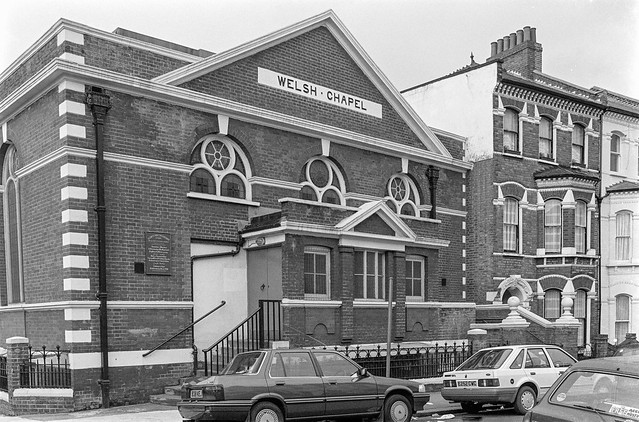
Welsh Chapel, Beauchamp Rd, Battersea, Wandsworth, 1988 88-2d-56-positive_2400
Welsh Chapel, Beauchamp Rd, Battersea, Wandsworth, 1988

The only one of my four grandparents I ever knew was a small lady dressed always in black, who seldom moved far from the fire and range in the back room of their house. I don’t remember her ever saying much, though I think she was still very much in charge in the house where she lived with my three maiden aunts, where our Sunday afternoons were strictly observed with only quiet activities and good books allowed, though I think we children sometimes escaped to the wilder parts of the large garden where we were out of sight. She was a Baptist, though the church she and the aunts were members of was a few miles further out of London, though having been born in Llansaintfred, Radnor she would have been home at the Welsh Chapel. Eliza Ann Davies came up to London to work in a Welsh Diary on the Kings Cross Road owned by an uncle, and it was there that she met my grandfather, Frederick Marshall, a young wheelwright and blacksmith, came into the shop some time in the late 1880s and they were married in 1890. I never met him as he was killed in a road accident 12 years before I was born.

Lavender Hill, Battersea, Wandsworth, 1988 88-2d-54-positive_2400
Lavender Hill, Battersea, Wandsworth, 1988

This impressive range of shops can still be seen on Lavender Hill, just to the east of Clapham Junction station – the pub glimpsed in the distance is The Falcon on the corner of Falcon Rd. But while the Falcon is still in business, every single shop has I think changed hands since I took this in 1988. I took a few other pictures on the main shopping streets, including St John’s Hill and St John’s Road some of which I’ve posted in the Flickr album these pictures come from.

St John's Rd, Battersea Rise, Battersea, Wandsworth, 1988 88-2d-35-positive_2400
St John’s Rd, Battersea Rise, Battersea, Wandsworth, 1988

The corner of St John’s Rd and Battersea Rise still looks much the same, and the Northcote Arms is still there, though with some new signage. Rhino sports has gone and in its place you can now get acupuncture and other health and beauty treatments. The place of Angel shoes has been taken by a hairdressers, its hanging sign gone, though the iron bracket from which it hung is still in place. And pedestrians are no longer fenced in at the junction.

Aliwal Rd, Battersea, Wandsworth, 1988 88-2d-33-positive_2400
Aliwal Rd, Battersea, Wandsworth, 1988

Many quite ordinary houses such as these were finished with interesting detail as on these houses in Aliwal Road. It was I suppose then a relatively inexpensive way to add a touch of class, or perhaps a builder’s edpression of pride in his work.

Broomwood Rd, Battersea, Wandsworth, 1988 88-2d-15-positive_2400
Broomwood Rd, Battersea, Wandsworth, 1988

65 Broomwood Road is no longer a dentists, and has lost all those signs, as well as the details of its glazing, but the door and the side panels remain as well as the decoration above. It is at the end of a short row of similar houses on the street,

Webbs Rd, Shelgate Rd, Battersea, Wandsworth, 1988 88-2d-13-positive_2400
Webbs Rd, Shelgate Rd, Battersea, Wandsworth, 1988


Like many corner shops in London, Sacha Wines on the corner of Webbs Rd and Shelgate Rd has now been converted for residential use and customers have to go elsehwere for ‘Food, Wines, Beers, Spirits’ etc. Most of these photos were probably taken as I wandered towards Webbs Rd, not for Sacha Wines, but for the Wandsworth Photo-Co-op.

Bellson & Co,  Battersea Rise, Battersea, Wandsworth, 1988 88-2d-26-positive_2400
Bellson & Co, Battersea Rise, Battersea, Wandsworth, 1988

You can still fine the ball on top of a pillar on Battersea Rise, a few yards up on the south side from Northcote Road, but it takes a little imagination to recognise the scene in my 1988 photograph. The shopfront has gone and 73a is now a house, while Bellson & Co has added an extra floor, though still retaining the bay windows and porch. The changes have been made in a way that integrates pretty seamlessly and without that ball (the pillar is now exposed brick) I would have found it hard to convince myself that this was indeed the same place.

Clicking on any of the pictures in this post will take you to a larger version in my album 1988 London Photos.

Battersea 1988

Tool shop, Northcote Rd, Battersea, Wandsworth, 1988 88-2e-63-positive_2400
Northcote Rd, Battersea, Wandsworth, 1988

Clapham Junction is claimed to be Europe’s busiest station with over 2000 trains a day passing through and around 60% of them stopping, including all of those I take into London. And like many others, I’ve often changed there to trains for destinations across the south of London and further afield, and less often exited to take buses.

Service Centre, Northcote Rd, Battersea, Wandsworth, 1988 88-2e-65-positive_2400
Service Centre, Northcote Rd, Battersea, Wandsworth, 1988

But in February 1988 I left the train with the intention of taking photographs of the area around the station – which is not in Clapham which is a 10 minute bus ride away, but in Battersea. Over the years the area has also become referred to as Clapham Junction, and parts are also called by the names of some of the major streets, such as Lavender Hill and Northcote Road, but I’ve simply called it Battersea in the captions to my images, which also include the name of its London Borough, Wandsworth, the area a mile or so to its west.

Tool shop, Northcote Rd, Battersea, Wandsworth, 1988 88-2e-63-positive_2400
Tool shop, Northcote Rd, Battersea, Wandsworth, 1988

In the short days of February I tended to photograph more in the areas that were within easy reach of my home so as to make the most of the light; I could leave home and be standing on the street at Clapham Junction in around 35 minutes.

Northcote Rd, Battersea, Wandsworth, 1988 88-2e-55-positive_2400
Northcote Rd, Battersea, Wandsworth, 1988

The area to the south of the station, particularly down St John’s Road is a major shopping centre for this area of London, so it is perhaps not surprising that many of my pictures were of shops.

Belleville Rd, Northcote Rd, Battersea, Wandsworth, 1988 88-2e-51-positive_2400
Belleville Rd, Northcote Rd, Battersea, Wandsworth, 1988

It was also a time when I was finding an increasing interest in how shop interiors, particularly those of small businesses with low set-up costs, reflection the areas and customers they served. Hair-dressers, shoe repairs and other independent small businesses very much came from the communities they served.

Northcote Rd, Battersea, Wandsworth, 1988 88-2e-53-positive_2400
Northcote Rd, Battersea, Wandsworth, 1988

Many of these businesses are now gone. Few people now get their shoes repaired – and like some other areas they are now largely served by franchises. Tastes in various areas have changed, often dramatically, and of course in recent years shops have been hit by a move to on-line in many areas.

Lavender Hill, Falcon Road, Battersea, Wandsworth, 1988 88-2e-43-positive_2400
St John’s Rd, Battersea, Wandsworth, 1988

My apologies for some technical deficiencies in some of these images, most noticeable in some of the skies. Unfortunately this is a result of considerable under-development, probably resulting from an exhausted or incorrectly replenished developer. Digital retouching could improve them, though probably not entirely eliminate the effect and it very time-consuming. But the blemishes, though annoying, don’t prevent you seeing the subject, so I’ve published these here and on the web despite the blemishes, though I have never shown prints from them.

St John's Rd, Battersea, Wandsworth, 1988 88-2e-42-positive_2400
St John’s Rd, Battersea, Wandsworth, 1988

If you walk down these streets today – or when the ‘non-essential’ shops re-open, expected to be on 12 April you will see the differences from 1988. The streets around Clapham Junction now look rather more like those in any main street around the country and the area has been considerably more gentrified.

All from my album https://www.flickr.com/photos/petermarshall/albums/72157715589148871/with/50254685063/ 1988 London Photos – and clicking on any of the images here should take you to larger versions there from which you can browse the album.

Earls Court & South Ken: 1987

Melbury Rd, Holland Park, Kensington & Chelsea, 1987  87-12d-63-positive_2400
Melbury Rd, Holland Park, Kensington & Chelsea, 1987

Another of those artists houses in Melbury Rd, just a short walk north from Earls Court. The house, now Grade II* listed, was commissioned by painter and illustrator Marcus Stone from achitect Richard Norman Shaw and completed in 1875. Stone’s best work was probably his illustrations for books by Charles Dickens, Antony Trollope and others, and his paintings, particularly his later works, though technically superb have been described as “a particular type of dainty sentiment, treated with much charm, refinement and executive skill” or more bluntly, “chocolate box.” The many windows of the studio were probably more to light his work for clients than for painting, as the larger group shown here are east-facing.

Collingham Gardens, Earls Court, Kensington, Kensington & Chelsea, 1987  87-12e-31-positive_2400
Collingham Gardens, Earls Court, Kensington, Kensington & Chelsea, 1987

Collingham Gardens is one of a number of streets on the edge of Earls Court and South Kensington which together have a wide range of late Victorian architecture, sometimes rather overdone.

Collingham Gardens, Earls Court, Kensington, Kensington & Chelsea, 1987  87-12e-26-positive_2400
Collingham Gardens, Earls Court, Kensington, Kensington & Chelsea, 1987

Many of the houses in this area were built by Peto Brothers to the plans of Ernest George (1839-1922) and the younger Harold Ainsworth Peto (1854–1933). These architectural partners also designed houses for the Cadogan Estate before Peto decided to leave London in 1891. Many of the leading architects of the early 20th century trained in George’s London office, includint (according to Wikipedia) “Herbert Baker, Guy Dawber, John Bradshaw Gass, Edwin Lutyens and Ethel Charles”, who was the first woman to be admitted to the RIBA.

Collingham Gardens, Earls Court, Kensington, Kensington & Chelsea, 1987   87-12e-46-positive_2400
Collingham Gardens, Earls Court, Kensington, Kensington & Chelsea, 1987

George and Peto added a remarkable range of vernacular elements derived from across Northern Europe to the basically Queen Anne design of the hourses in the area, particularly in Harrington Gardnes and Collingham Gardens, based on the sketches they had made of houses in Holland, Germany and elsewhere. It was an eclecticism that was not always admired, either at the time or now.

Harrington Gardens, Earls Court, Kensington, Kensington & Chelsea, 1987  87-12e-35-positive_2400
Harrington Gardens, Earls Court, Kensington, Kensington & Chelsea, 1987

These houses are large and many have been converted into flats. Some are listed but many are not. The overall effect of wandering these streets is overpowering and best taken in small doses. A 2-bed flat in the area may cost you a million, and houses perhaps £15m.

Kenway Rd, Earls Court, Kensington & Chelsea, 1987  87-12e-41-positive_2400
Kenway Rd, Earls Court, Kensington & Chelsea, 1987

Coming out of Earls Court Station I often crossed Earls Court Road and made my way down Hogarth Road and then along the narrow Hogarth Place past shops onto Kenway Road as a short cut to a friend’s studio not far away. Or rather than wait for the crossing I might walk a few yards north and then cross directly to Kenway Road, where this shop was at No 9 on the north side of the street, with Arabic script on the window and its illuminated sign, together with an animal I was never sure was a sheep, cow or goat.

Kenway Rd, Earls Court, Kensington & Chelsea, 1987  87-12e-42-positive_2400
Kenway Rd, Earls Court, Kensington & Chelsea, 1987

I think Kashmir Stores was more or less opposite, where a short alley leads off to a rear yard. The owner saw me taking photographs and was very keen not to be left out.

There are a few more pictures of the area in my 1987 London Photos.


All photographs on this and my other sites, unless otherwise stated, are taken by and copyright of Peter Marshall, and are available for reproduction or can be bought as prints.


Wealthy Kensington – 1987

The London I grew up in, on the outskirts of the capital was an area of small late Victorian terraces and Edwardian and inter-war two or three-bed semis, interspersed with the occasional factory, church and municipal buildings, with few or any sizeable private houses of any age. It was largely working class, poor and largely honest but not particularly deprived. And back then we had the NHS, free education and the welfare state.

Walking around Holland Park and other wealthy areas of Kensington is a completely different world; another country of large detached house and large blocks of mansion flats, an opulence based both on the exploitation of the British Empire and of the exploitation of the workers in the mass of England. I wrote first “our country”, but I think it was never really our country, but their country, “England” or “Great Britain” a deception that sent many working people to toil in factories or die in the trenches – as well as profiting from slavery and working in mines and plantations across the world.

Looking at these pictures now, it’s hard not to think of the times I have walked past some of these and similar places more recently, often on my way to Grenfell Tower or to join the monthly silent marches in memory of those who died there, some of which have passed through this area, walking from Kensington Town Hall.

Vintage car, Philbeach Gardens,  Earls Court, Kensington, Kensington & Chelsea, 1987 87-12c-65-positive_2400
Vintage car, Philbeach Gardens, Earls Court, Kensington, Kensington & Chelsea, 1987

The Addison Road area was the first to be developed, on 200 acres of farmland belonging to Lord Holland, beginning in the 1820s. The estate was sold off in parts for development from 1823 to 1930.

Royal Crescent, Holland Park, Kensington & Chelsea, 1987 87-12d-12-positive_2400
Royal Crescent, Holland Park, Kensington & Chelsea, 1987

Royal Crescent to the north of Holland Park Avenue was built in 1846, and the whole crescent of houses is Grade II* listed. The picture shows the eastern corner of the crescent with Holland Park Avenue.

St Anns Villas, Notting Hill, Kensington & Chelsea, 1987 87-12d-15-positive_2400
St Anns Villas, Notting Hill, Kensington & Chelsea, 1987

The road leading north from the centre of Royal Crescent is St Ann’s Villas and is lined with substantial houses. After a few in stucco and a road junction it is lined with a development of 12 similar but not identical semidetached houses in a red brick Tudor style, with attractive stonework and blue brick diapering, built in 1852 and Grade II listed. The blue plaque here is for music hall artist Albert Chevalier, born here and best remembered for one of his many songs “My Old Dutch”. Although he wrote and performed in cockney as a costermonger and was called ‘the coster’s laureate’, he was from a rather more middle-class background, his father being the French master at Kensington School, Jean Onésime Chevalier, and Albert was christened Albert Onésime Britannicus Gwathveoyd Louis Chevalier. His mother was Welsh, which accounts for the Gwathveoyd, more usually spelt Gwaithfoed.

87-12d-23-positive_2400
Debenham House, Peacock House, Addison Rd, Holland Park, Kensington & Chelsea, 1987

Debenham House, also known as Peacock House, is the only Grade I listed building in the Addison Rd, designed by architect Halsey Ricardo for department store owner Ernest Ridley Debenham and completed in 1907. it became known as Debenham House after it was sold following Debenham’s death in 1952. The exterior, designed to retain its appearance despite the ravages of London’s soot with coloured tiles and glazed bricks is in an Italianate style, but the interiors are Arts and Crafts, with work by some of the leading designers of the time. Unfortunately we can only see them in photographs and in several films made using it as a location.

87-12d-31-positive_2400
Holland Rd, Holland Park, Kensington & Chelsea, 1987

Holland Road is a long straight street largely lined with 4 storey terraces of substantial houses like the one in this picture. Expect to pay something around £4m for one of them – or perhaps £700,000 for a 1-bed flat.

Addison Rd, Holland Park, Kensington & Chelsea, 1987  87-12d-35-positive_2400
Addison Rd, Holland Park, Kensington & Chelsea, 1987

This house at 77 Addison Road is opposite Debenham House and I rather prefer its more restrained manner.

Addison Rd, Holland Park, Kensington & Chelsea, 1987  87-12d-41-positive_2400
Addison Rd, Holland Park, Kensington & Chelsea, 1987

One of a row of similar houses on Addison Rd, in a neo-Gothic style dating from around the 1850s. The next door house is listed but for some reason this one is not.

Addison Rd, Holland Park, Kensington & Chelsea, 1987 87-12d-42-positive_2400
Addison Rd, Holland Park, Kensington & Chelsea, 1987

And this is the house next door, rather hidden behind its more impressive gate

All pictures are from page 8 of my album 1987 London Photos.

Holland Park, Earls Court & West Kensington: 1987

Melbury Rd, Kensington, Kensington & Chelsea, 1987 87-12c-13-positive_2400
Melbury Rd, Kensington, Kensington & Chelsea, 1987

Grade II listed 18 Melbury Road is now distinguished by two blue plaques, neither of which appear in my picture. Like many houses in this street in Holland Park it was home to a noted artist, in this case William Holman Hunt (1827-1910), one of the founders of the Pre-Raphaelite Brotherhood in 1848. The house was built in 1877, but Hunt only moved here in 1903 and it was here that he died. His widow was still living here when the plaque to him was added to the front of the house in 1923.

Cetshwayo (c.1832-1884) King of the Zulus enjoyed a rather shorter stay, arriving in August 1882 after his defeat and capture in the Anglo-Zulu War of 1879, an entirely uncalled for attack on Zululand by British forces, who at first suffered an ignominious defeat at Isandhlwana before finally winning the war and taking Cetshwayo prisoner. He was brought to London together with his chiefs, where he was welcomed by inquisitive crowds and met with both the Prime Minister and Queen Victoria, and they agreed to re-instate him as King of Zululand, to where he was secretly returned the following January.

His reinstatement did not go well and he returned to a bloody civil war and had to seek refuge in a British reserve. He died, officially of a heart attack, but possibly poisoned in February 1884 and two months later his heir became king. The English Heritage blue plaque commemorating his stay, just above that of Hunt’s was only unveiled in 2006, long after I took this picture.

Tower House, Melbury Rd, Kensington, Kensington & Chelsea, 1987 87-12c-15-positive_2400
Tower House, Melbury Rd, Kensington, Kensington & Chelsea, 1987

In 1875 noted architect William Burges began the building and furnishing of the Tower House in a French Gothic Revival style as his home, but died as it was more or less completed in 1881 and was inherited by his brother-in-law, who later sold it. After several owners and tenants, and Grade I listing in 1949 John Betjeman inherited the remaining lease in 1962, but found the property needed expensive repairs and moved out without extending the lease. He claimed that after this it was deliberately left empty and left it to rot and be vandalised, hoping to be allowed to demolish it and develop the site.

Lady Jane Turnbull bought the house in the mid-60s to save it and began its restoration, selling it to actor Richard Harris for £75,000 in 1969 who continued the work. Three years later he sold it to Jimmy Page of Led Zeppelin (who outbid David Bowie for the property) for £350,000 and Page still owns it and has in recent years carried out a long legal battle with his neighbour Robbie Williams over his plans for underground excavations to develop his property that might threaten the structure of Tower House.

Earls Court Rd, Kensington, Kensington & Chelsea, 1987 87-12c-35-positive_2400
Earls Court Rd, Kensington, Kensington & Chelsea, 1987

Christmas was coming as I took these pictures in December as the multi-lingual messages on The Canning School suggest.

Moscow Mansions, Cromwell Rd,  Kensington, Kensington & Chelsea, 1987 87-12c-44-positive_2400
Moscow Mansions, Cromwell Rd, Kensington, Kensington & Chelsea, 1987

Pineapples, brought to Europe by Christopher Columbus soon became a symbol of wealth and status – and were apparently available for hire to be displayed (but now consumed) at posh dinner parties in the 18th century. Only the incredibly rich could afford to eat them at around the equivalent of £5,000 a fruit. And although they are now commonplace in supermarkets and market stalls, back in my working-class youth they only came in tins as rings or chunks. They can be seen on many buildings across London from St Paul’s Cathedral down – and here on the gateposts of Moscow Mansions.

Hoarding, car, West Cromwell Rd,  Kensington, Kensington & Chelsea, 1987 87-12c-54-positive_2400
Hoarding, car, West Cromwell Rd, Kensington, Kensington & Chelsea, 1987

The queues of traffic dawdling into London on the A4 were greeted by a car in an unusual parking place on this hoardiing.

87-12c-55-positive_2400
Railway, West Cromwell Rd, Kensington, Kensington & Chelsea, 1987

Looking over a wall or fence you can still see these railway lines, at left is now the London Overground going down to West Brompton Station, but in 1987 this line was only in use for goods trains, with passenger services only being resumed in 1994 and the Network Rail platforms at West Brompton only coming into use in 1999. At lower level is the District Line of the London Underground, coming from Olympia behind me and West Kensington at right. Behind that is the Lillie Bridge Railway and Engineering Depot; missing now from the right of centre is the large bulk of Earls Court Exbition Centre, but the Metropolitan Police tower at right is still present.

87-12c-56-positive_2400
Ashfield House, London Underground, West Cromwell Rd, Kensington, Kensington & Chelsea, 1987

Out of the previous picture to the right is Ashfield House in West Kensington, a block of offices for London Underground, which now includes a mock Underground Station, West Ashfield, used for training purposes. The building was purpose-built for London Underground and opened in 1983. It is likely to be demolished as a part of the redevelopment plan for the area.

Clicking on any of the pictures above will take you to a larger version on my Flickr album 1987 London Photos from where you can browse through over 750 black and white pictures I made that year – these are all on Page 8.


All photographs on this and my other sites, unless otherwise stated, are taken by and copyright of Peter Marshall, and are available for reproduction or can be bought as prints.


Earls Court & Brompton – 1987

Old Brompton Rd, West Brompton, Fulham, Kensington & Chelsea, 1987 87-12b-01-positive_2400
Old Brompton Rd, West Brompton, Fulham, Kensington & Chelsea, 1987

As a sign indicated, the Fulham Training Workshops on the Old Brompton Road seem to lie on the very boundary of the London Borough of Hammersmith and Fulham – and if so I was probably standing in Kensington and Chelsea to take this picture from outside West Brompton staion. Hidden behind the building at the time were the two builsings of the huge Earls Court exhibition centre – a site which when I last visited was a large empty expanse with dust clouds blowing around awaiting redevelopment.

Nevern Place, Earls Court, Kensington & Chelsea, 1987 87-12b-12-positive_2400
Nevern Place, Earls Court, Kensington & Chelsea, 1987

A whole block along the south side of Nevern Place, between Earls Court Road and Templeton Place has around 15 doorways each framed by a pair of these spiral columns. As my picture shows, the twists on each side of the door are in opposing directions.

Twisted columns were brought to Rome, probably from Greece in the 4th century by Roman Emperor Constantine the Great for the first St Peter’s Basilica. Legend grew that they came from the Temple of Solomon in Jerusalem, though they were probably made several centuries after that was destroyed, but their use in Byzantine architecture may possibly have been based on the oak tree used for the Ark of the Covenant. ‘Barley sugar’ columns became popular in Baroque architecture thanks to Bernini and were known as Solomonic columns. I’m not sure whether this is the correct term for these, which are made of a series of spiral elements around a central core.

Nevern Place, Earls Court, Kensington & Chelsea, 1987 87-12b-14-positive_2400
Nevern Square, Earls Court, Kensington & Chelsea, 1987

Nevern Place leads into Nevern Square where I photographed this impressive pair of doors.

Richard Tauber, grave, Brompton Cemetery, West Brompton, Kensington & Chelsea, 1987 87-12b-22-positive_2400
Richard Tauber’s grave, Brompton Cemetery, West Brompton, Kensington & Chelsea, 1987

Brompton Cemetery was one of seven large private cemeteries set up around 1840 when London’s churchyards and existing cemeteries were full to overflowing. This Grade I listed cemetery is now owned by the Crown and managed by the Royal Parks. Among the over 200,000 buried there (and there is space for more) are a number of well-known people – Wikipedia has a long list, though most of them I’ve never heard of.

Back in 1987 people were clearly coming to the grave of Austrian tenor and film actor Richard Tauber (1891-1948) and most of them had probably attended his concerts or had his voice on gramophone records.

Emmeline Pankhurst, memorial, Brompton Cemetery, West Brompton, Kensington & Chelsea, 1987 87-12b-24-positive_2400
Emmeline Pankhurst memorial, Brompton Cemetery, West Brompton, Kensington & Chelsea, 1987

Emmeline Pankhurst (1858 – 1928) is remembered by a rather fine memorial by Julian Phelps Allan, a woman sculptor born Eva Dorothy Allan, who changed her name to a more masculine version probably because it was hard for women sculptors to get work and continued to use the title ‘Miss’ and feminine pronouns.

Benjamin Webster, memorial, Brompton Cemetery, West Brompton, Kensington & Chelsea, 1987 87-12b-31-positive_2400
Benjamin Webster memorial, Brompton Cemetery, West Brompton, Kensington & Chelsea, 1987

I knew nothing about Benjamin Webster when I took several pictures of his gravestone, although it tells me he was an actor. I find that there have been two well-known actors called . This one was an actor-mnaager and dramatist and was born in Bath so I don’t know why he had Nottingham in his name though it doesn’t appear on the gravestone. It can be a little of a shock to see him still staring out at you with one eye.

Benjamin Webster, memorial, Brompton Cemetery, West Brompton, Kensington & Chelsea, 1987 87-12b-32-positive_2400
Benjamin Webster memorial, Brompton Cemetery, West Brompton, Kensington & Chelsea, 1987

Benjamin Nottingham Webster named his son William Shakespeare Webster, and his son was Benjamin Nottingham Webster III who also became an actor, though more normally known as Ben Webster. There is also another actor Ben Webster, still so far as I know living, but for me Ben Webster is a guy with a tenor sax who I spent an unsuccesful afternoon trying to entertain in Manchester many years ago trying to keep him sober enough to play. He got through a bottle of whisky and seemed more or less incapable, but then got up on stage and played so beautifully I cried.

Brompton Cemetery, West Brompton, Kensington & Chelsea, 1987 87-12b-45-positive_2400
Brompton Cemetery, West Brompton, Kensington & Chelsea, 1987

The Colonade around the Great Circle, designed by the cemetery’s architect, Benjamin Baud and based on the piazza in front of St Peter’s Basilica in the Vatican. It was made for people to walk around – and a stroll around the cemetery was popular among well-off Victorians who would hold family picnics in the grounds.

Brompton Cemetery, West Brompton, Kensington & Chelsea, 1987 87-12b-52-positive_2400
Brompton Cemetery, West Brompton, Kensington & Chelsea, 1987

Nowadays it remains a popular place to go, particularly for film crews and photographers – and you may have to wait some time if you want to avoid others in your pictures. According to Wikipedia, “The cemetery has a reputation for being a popular cruising ground for gay men”.

Brompton Cemetery, West Brompton, Kensington & Chelsea, 1987 87-12b-65-positive_2400
Brompton Cemetery, West Brompton, Kensington & Chelsea, 1987

Clicking on any of the pictures above will take you to a larger version in my Flickr album 1987 London Photos from where you can browse forwards or back through the pictures.

Back to Kensington – 1987

Iverna Court, Kensington, Kensington & Chelsea, 1987 87-11e-32-positive_2400
Iverna Court, Kensington, Kensington & Chelsea, 1987

I returned to Kensington and took a few more pictures in November 1987. In my project on London I liked to go back to walk around areas a second time, often walking along the same streets in the opposite direction or on the opposite side of the streets to perhaps see things I had not noticed on my walk. There were some areas too that I found of more interest that I’d return to every few years, and others that I visited regularly for reasons other than photography, perhaps to visit friends or go to particular shops etc.

Scarsdale Place, Kensington, Kensington & Chelsea, 1987 87-11e-34-positive_2400
Scarsdale Place, Kensington, Kensington & Chelsea, 1987

I can’t at this remove remember what took me back to Kensington only a short time after I’d previously walked there. It may have been that there were some pictures I’d taken that I wasn’t entirely happy with, though there were probably plenty I thought that about. Perhaps I had some business not far away, or an exhibition I went to see, and it’s an area not far from where a friend had a studio. But what impresses me now is the variety of the architecture I found there.

Cheniston Lodge, Cheniston Gardens, Kensington, Kensington & Chelsea, 1987  87-11e-35-positive_2400
Cheniston Lodge, Cheniston Gardens, Kensington, Kensington & Chelsea, 1987

Cheniston Gardens was given its name by its developers and derives from the spelling of Kensington in the Domesday Book when ‘Chenesitone’ had18 villagers, 7 slaves and one priest. Chenistone Lodge, the single red brick and terracotta Queen Anne building in a sea of stucco was the last building to be completed on the street in 1885. It was on the site of Abingdon House, where in 1874 Archbishop Manning set up a Catholic University College run by Thomas Capel, which was a failure as wealthy Catholics preferred to continue to get special dispensation to send their sons to Oxbridge, and because of Capel’s poor finanacial management, which led to his bankruptcy in 1878. More problems were to follow for him, and the following year Monsignor Capel was found guilty of having sex with three women (one a servant of one of the others); on his appeal to Rome there was no verdict on his guilt or innocence but he was sentenced to continue his career in the Catholic Church in the United States. Abingdon House was sold to the developers in 1879.

Cheniston Lodge was let to a number of tenants in the years up to the First World War and later had two longer term residents, probably as private owners. In October 1940 Kensington Council purchased the freehold for £2000 to use it as an air raid materials store, and after the war it became Kensington Registry Office. It was Grade II listed shortly before they sold it to a developer in 1981 for £250,000 to be converted into offices. In around 2012 it was converted back into a single residence.

St. Sarkis, Armenian Church, Iverna Gardens, Kensington, Kensington & Chelsea, 1987 87-11e-46-positive_2400
St. Sarkis, Armenian Church, Iverna Gardens, Kensington, Kensington & Chelsea, 1987

Not far from Cheniston Lodge is the Grade II* listed St. Sarkis Armenian Church in Iverna Gardens which is the only church in the country in the traditional Armenian style, inspired by a 13th century monastery which looks remarkably similar but rather squatter, but it was designed by English architect Arthur Joseph Davis. The building was a gift of the oil baron Calouste Gulbenkian in 1922–23, and conveniently his father had been named after the Armenian St Sarkis the Warrior and it was built as a memorial for his parents, and apparently contains sculptures of his family members inside. Like Cheniston Lodge it was also listed in 1981, possibly as a part of the comprehensive review after developers Trafalgar House demolished the art deco Firestone Tyres building on the Great West Road during the August Bank Holiday in 1980 to prempt its listing the following day.

Baptist Church, Kensington Place, Kensington, Kensington & Chelsea, 1987  87-11e-61-positive_2400
Baptist Church, Kensington Place, Kensington, Kensington & Chelsea, 1987

Rather plainer than St Sarkis is Bethesda Baptist Chapel in Kensington Place, suitably austere for ‘strict bapists’.

It was The Chapels Society ‘Chapel of the Month in May 2017, where Dr Jennifer Freeman writes:

The Church in Kensington Place was built in 1866 for baptised believers who subscribe to ‘Restricted Communion’ ( i.e. with communion being exclusively available to professing, baptised Christians), to ‘Particular Redemption’ and to the teachings of the Authorised Version of the Bible, under the oversight of a Pastor.

Apparently the facade is now illuminated: “in the evening delicate floodlighting pinpoints the building“, though when I photographed it there was only a broken light fitting over the door – and I think it had once been for a gas lamp. Inside Dr Freeman describes it as “dignified modest and reverent, in spirit with Baptist thinking.”

Kensington Church St area, Kensington, Kensington & Chelsea, 1987  87-11e-63-positive_2400
Kensington Church St area, Kensington, Kensington & Chelsea, 1987

Although at first sight these long Victorian stucco terraces look the same, closer inspection shows significant differences, enough for me to decide that this is not any of the Kensington streets I’ve looked at. But it is number 15 on a street in Kensington – and if you can be sure which street please click on the image to go into it in my Flikr album and write a comment to let me know.

HyperHyper, Kensington High St, Kensington, Kensington & Chelsea, 1987 87-11e-66-positive_2400
HyperHyper, Kensington High St, Kensington, Kensington & Chelsea, 1987

I don’t think I had any real reason to revisit Hyper Hyper and photography these leftover caryatids from its previous incarnation as an antiques supermarket as my previous image was I think satisfactory. But when you are in the area and walk past something like this it isn’t easy or even necessary not to indulge in another photograph.

These images are all from page 8 of my Flickr album 1987 London Photos.


All photographs on this and my other sites, unless otherwise stated, are taken by and copyright of Peter Marshall, and are available for reproduction or can be bought as prints.


More Around the City

Bassishaw High Walk, City, 1987 87-11c-16-positive_2400
Bassishaw High Walk, City, 1987

There is still a section of the pedestrian route above traffic level here, leading from the yard behind the Guildhall and to a bridge across London Wall, though the bridge is now a more recent construction a little further west and crossing at an angle and leading on to the high walks that were built into the Barbican Estate. This area next to City Tower looks rather different now. Britannic House, one of the original six towers built along the new London Wall was refurbished in 1990 and renamed City Tower.

Highwalk, Moor Lane, City, 1987 87-11c-21-positive_2400
Highwalk, Moor Lane, City, 1987

Looking down Moor Lane with the Barbican at the right on a section of the high walk that has now gone, but which used to lead from close to Moorgate station. I think this gateway was roughly above the junction with Silk St. Empty when I took this picture (possibly on a Sunday) it was sometimes quite crowded during the rush hours with office workers making their way to the tube. The high walks were useful routes, avoiding the often dangerous traffic on the streets and also providing good vantage points for photographers, and I’m saddened at their loss. But I think they took up space that could be sold expensively as offices.

Ropemaker St, Islington, 1987 87-11c-31-positive_2400
Ropemaker St, Islington, 1987, City

This building on Ropemaker St was one of my favourite examples of modern office architecture when it was built, and I photographed it on several occasions. I suppose it doesn’t quite belong in this post as it was on the north side of the road and thus in Islington rather than the City, where I was standing on a section of high walk to take the picture.

Ropemaker Place, a 60m high block was completed in 1987 shortly before I made this picture. It didn’t last long and was demolished only 18 years later in 2005.

Holland House, Bury St, City, 1987 87-11c-51-positive_2400
Holland House, Bury St, City, 1987

Holland House in Bury St has lasted rather longer and is protected by its Grade II* listing. The only London building by leading Dutch architect Hendrik Petrus Berlage it was built in 1916 for the Dutch company Wm H Müller & Co, complete with a granite prow by Dutch sculptor J. Mendes da Costa.

More recently when I’ve photographed here I’ve stepped a little to the left to bring the ‘Gherkin’ into view – but construction of 30 St Mary Axe only began in 2001.

Cutler St area, City, 1987 87-11c-53-positive_2400
Cutler St area, City, 1987

I think this is a part of Devonshire Square, a private area of the City which was developed by the East India Company, then sold to St Katharine’s Dock and bought in 1909 by the Port of London Authority. The warehouses here were used to store the more valuable commodities imported from across the empire. The site was acquired by Standard Life Assurance together with Greycoat Estates Ltd in 1978 and became offices, but still remained something of a private enclave, if no longer used for the secure storage of “Ostrich feathers, chinaware, oriental carpets, cigars, tortoiseshell, silks, mother of pearl, clocks, watches, cameras, drugs, spices, musical instruments, perfumes, tea and other prized artefacts.”

Baltic Exchange, St Mary Axe, City, 1987 87-11c-63-positive_2400
Baltic Exchange, St Mary Axe, City, 1987

The Provisional IRA left a van packed with explosives outside the Baltic Exchange in St Mary Axe shortly before 9pm on 10 April 1992, and then made a call to the police warning them that a bomb was about to explode at the Stock Exchange – 370 metres away in direct line, but about half a mile by road. The bomb wrecked this facade and caused a total of £800 million worth of damage to this and surrounding buildings.

Perhaps the bombers were confused and looking for the old Stock Exchange building in Capel Court, off Bartholomew Lane, just to the east of the Bank of England, while the Stock Exchange had moved in 1972 to a new tower on Old Broad St.

21 New St, Cock Hill, City, 1987 87-11c-55-positive_2400
21 New St, Cock Hill, City, 1987

This listed archway with a Merino Ram was built in 1863 for Cooper’s Wool Warehouse. By the 1900s the wool storage business had largely moved further east closer to London Docks and in 1907 the warehouse was sold and used for other storage. It was converted into offices in 1981.

Newsprint, Bouverie St, City, 1987 87-11d-01-positive_2400
Newsprint, Bouverie St, City, 1987

Some newspapers were still being printed in ‘Fleet Street’ and the picture shows a lorry delivering newsprint to one of the printing works on Bouverie St.

The Seven Ages of Man, Richard Kindersley, sculpture, Baynard House, Queen Victoria St, City, 1987 87-11d-41-positive_2400
The Seven Ages of Man, Richard Kindersley, sculpture, Baynard House, Queen Victoria St, City, 1987

This sculpture stands in front of one of London’s bleaker Brutalist buildings, and for once its hard to disagree with Pevsner over a modern building, when he describes this a “acutely depressing.” But it does include a section of high-level pedestrian walkway with seating and this rather fine sculpture based on ‘As You Like It’. And it’s a pleasant enough place to sit and read a newspaper with a view of St Andrew by the Wardrobe, the last city church rebuilt by Sir Christopher Wren after the Great Fire of London.

All from Page 7 of my 1987 London Photos.


All photographs on this and my other sites, unless otherwise stated, are taken by and copyright of Peter Marshall, and are available for reproduction or can be bought as prints.