Guantanamo & Nanas Against Fracking – 2018

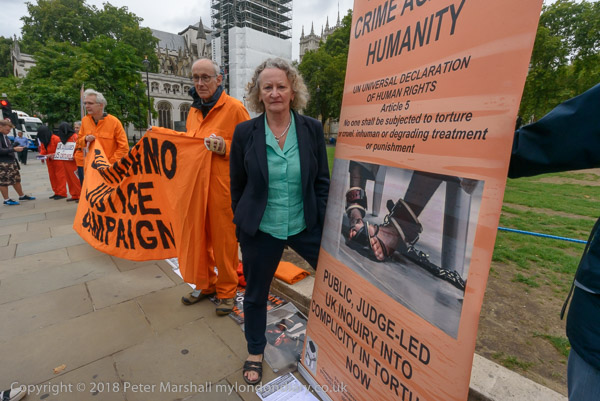
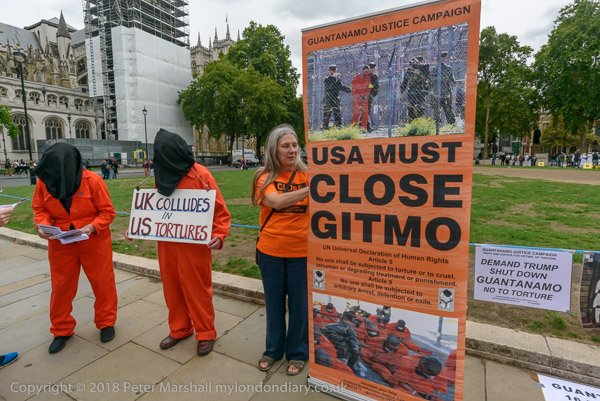
Guantanamo & Nanas Against Fracking: On Wednesday 12th September 2018 I went to Parliament Square where the Guantanamo Justice Campaign was holding a monthly vigil calling for an end to the illegal torture camp at Guantanamo and Nanas from Lancashire with others were calling for the government to end fracking. Later I went with the Nanas who marched to protest at the Department for Business, Energy and Industrial Strategy in Victoria St.


Trump told to close Guantanamo

Parliament Square
Guantanamo & Nanas Against Fracking - 2018
Baroness Jenny Jones came to visit the vigil

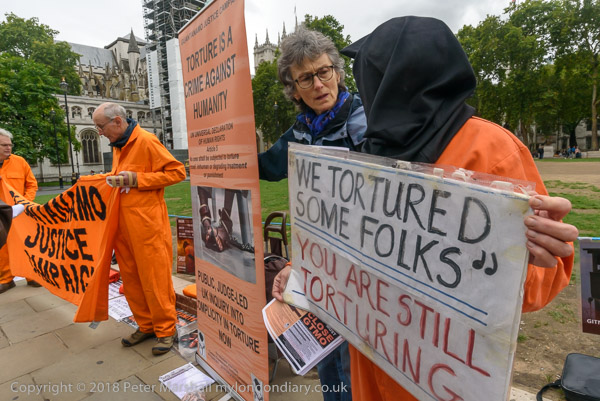
Another monthly vigil opposite Parliament called on UK Prime Minister Theresa May to make urgent representations to President Trump to close Guantanamo and end the brutality and torture which is continuing against the 40 men then still held there in indefinite detention.
Guantanamo & Nanas Against Fracking - 2018

They demanded Trump respect human rights and internation law, saying the illegal camp is a legal and moral outrage and a symbol of US torture and injustice.
Guantanamo & Nanas Against Fracking - 2018

The protesters were joined briefly by Green Party member of the House of Lords Jenny Jones, Baroness Jones of Moulsecoomb.

Trump told to close Guantanamo


#100Women against fracking

Parliament Square
Guantanamo & Nanas Against Fracking - 2018
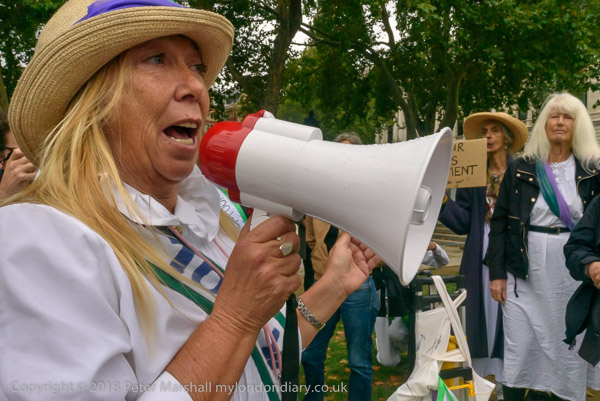
Lancashire Nana Tina-Louise Rothery speaks at the protest

Following 3 months of “Love & Defiance” that took place from April-June in Lancashire by the Nanas they came to London to tell the government to stop ignoring science and the will of the people and ban fracking.
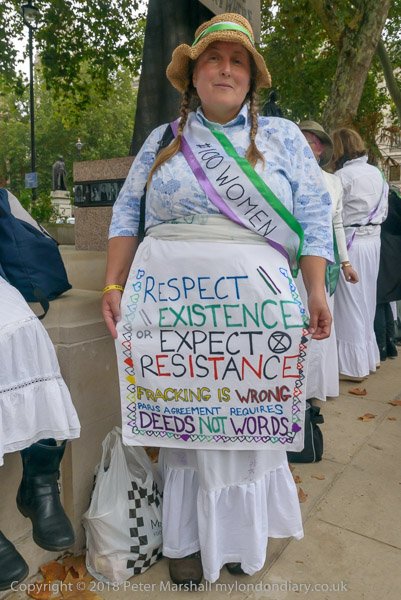
Guantanamo & Nanas Against Fracking - 2018

As well as threatening the areas of the country in which it was taking place with earthquakes and pollution, fracking is also a threat to the future of the planet through its high level of carbon emissions.

Guantanamo & Nanas Against Fracking - 2018

Many of the protesters wore suffragette costumes to mark the 100th anniversary of women first getting the vote in 1918 and called on the government now to make voting mean something. The rally took place in front to the statue of suffragist campaigner Millicent Fawcett.

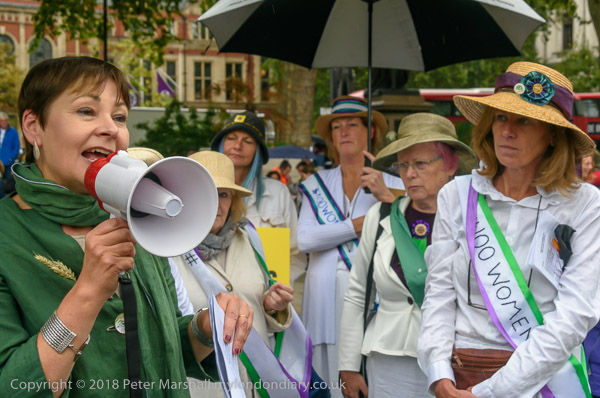
Green Party MP Caroline Lucas

Speakers at the rally included Ruth George, Labour MP for High Peak, Jenny Jones, Baroness Jones of Moulsecoomb, Mike Amesbury, Labour MP for Weaver Vale, Lancashire Nana Tina-Louise Rothery, Shadow Chancellor John McDonnell and Green Party Deputy Leader Amelia Womack.
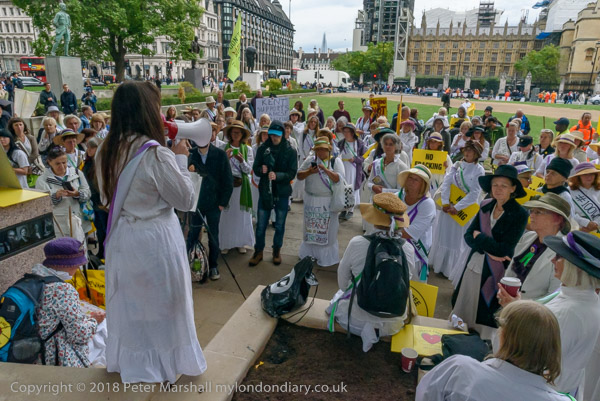
Also speaking at the rally were women against a proposed move of the statue of suffragette Emmeline Pankhurst, funded by suffragettes in 1930, from Victoria Tower Gardens next to the House of Lords to Regent’s Park, which they described as an “act of vandalism against women’s history“.

More pictures including most of the speakers at 100Women against fracking.


100Women protest at BEIS

Dept for Business, Energy & Industrial Strategy
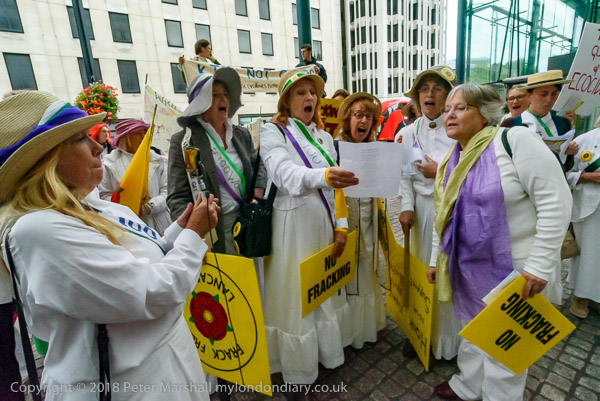
Nanas sing in protest against fracking at the BEIS

At the end of the rally in Parliament Square, the anti-fracking women protesters in Suffragette dress marched around the square and on to the Department for Business, Energy and Industrial Strategy in Victoria St for a noisy protest there.

Women get ready to march to the Department for Business, Energy and Industrial Strategy in Victoria St
Outside the Department for Business, Energy and Industrial Strategy

One woman climbed on the low wall in front of the delivery bay at the centre of the frontage and others followed with more moving inside behind to support them.

The protest continued between the two wings of the offices and on the pavement in front with much shouting and singing.

100Women protest at BEIS


Flickr – Facebook – My London Diary – Hull Photos – Lea Valley – Paris
London’s Industrial Heritage – London Photos

All photographs on this page are copyright © Peter Marshall.
Contact me to buy prints or licence to reproduce.


Earls Court & Brompton – 1987

Old Brompton Rd, West Brompton, Fulham, Kensington & Chelsea, 1987 87-12b-01-positive_2400
Old Brompton Rd, West Brompton, Fulham, Kensington & Chelsea, 1987

As a sign indicated, the Fulham Training Workshops on the Old Brompton Road seem to lie on the very boundary of the London Borough of Hammersmith and Fulham – and if so I was probably standing in Kensington and Chelsea to take this picture from outside West Brompton staion. Hidden behind the building at the time were the two builsings of the huge Earls Court exhibition centre – a site which when I last visited was a large empty expanse with dust clouds blowing around awaiting redevelopment.

Nevern Place, Earls Court, Kensington & Chelsea, 1987 87-12b-12-positive_2400
Nevern Place, Earls Court, Kensington & Chelsea, 1987

A whole block along the south side of Nevern Place, between Earls Court Road and Templeton Place has around 15 doorways each framed by a pair of these spiral columns. As my picture shows, the twists on each side of the door are in opposing directions.

Twisted columns were brought to Rome, probably from Greece in the 4th century by Roman Emperor Constantine the Great for the first St Peter’s Basilica. Legend grew that they came from the Temple of Solomon in Jerusalem, though they were probably made several centuries after that was destroyed, but their use in Byzantine architecture may possibly have been based on the oak tree used for the Ark of the Covenant. ‘Barley sugar’ columns became popular in Baroque architecture thanks to Bernini and were known as Solomonic columns. I’m not sure whether this is the correct term for these, which are made of a series of spiral elements around a central core.

Nevern Place, Earls Court, Kensington & Chelsea, 1987 87-12b-14-positive_2400
Nevern Square, Earls Court, Kensington & Chelsea, 1987

Nevern Place leads into Nevern Square where I photographed this impressive pair of doors.

Richard Tauber, grave, Brompton Cemetery, West Brompton, Kensington & Chelsea, 1987 87-12b-22-positive_2400
Richard Tauber’s grave, Brompton Cemetery, West Brompton, Kensington & Chelsea, 1987

Brompton Cemetery was one of seven large private cemeteries set up around 1840 when London’s churchyards and existing cemeteries were full to overflowing. This Grade I listed cemetery is now owned by the Crown and managed by the Royal Parks. Among the over 200,000 buried there (and there is space for more) are a number of well-known people – Wikipedia has a long list, though most of them I’ve never heard of.

Back in 1987 people were clearly coming to the grave of Austrian tenor and film actor Richard Tauber (1891-1948) and most of them had probably attended his concerts or had his voice on gramophone records.

Emmeline Pankhurst, memorial, Brompton Cemetery, West Brompton, Kensington & Chelsea, 1987 87-12b-24-positive_2400
Emmeline Pankhurst memorial, Brompton Cemetery, West Brompton, Kensington & Chelsea, 1987

Emmeline Pankhurst (1858 – 1928) is remembered by a rather fine memorial by Julian Phelps Allan, a woman sculptor born Eva Dorothy Allan, who changed her name to a more masculine version probably because it was hard for women sculptors to get work and continued to use the title ‘Miss’ and feminine pronouns.

Benjamin Webster, memorial, Brompton Cemetery, West Brompton, Kensington & Chelsea, 1987 87-12b-31-positive_2400
Benjamin Webster memorial, Brompton Cemetery, West Brompton, Kensington & Chelsea, 1987

I knew nothing about Benjamin Webster when I took several pictures of his gravestone, although it tells me he was an actor. I find that there have been two well-known actors called . This one was an actor-mnaager and dramatist and was born in Bath so I don’t know why he had Nottingham in his name though it doesn’t appear on the gravestone. It can be a little of a shock to see him still staring out at you with one eye.

Benjamin Webster, memorial, Brompton Cemetery, West Brompton, Kensington & Chelsea, 1987 87-12b-32-positive_2400
Benjamin Webster memorial, Brompton Cemetery, West Brompton, Kensington & Chelsea, 1987

Benjamin Nottingham Webster named his son William Shakespeare Webster, and his son was Benjamin Nottingham Webster III who also became an actor, though more normally known as Ben Webster. There is also another actor Ben Webster, still so far as I know living, but for me Ben Webster is a guy with a tenor sax who I spent an unsuccesful afternoon trying to entertain in Manchester many years ago trying to keep him sober enough to play. He got through a bottle of whisky and seemed more or less incapable, but then got up on stage and played so beautifully I cried.

Brompton Cemetery, West Brompton, Kensington & Chelsea, 1987 87-12b-45-positive_2400
Brompton Cemetery, West Brompton, Kensington & Chelsea, 1987

The Colonade around the Great Circle, designed by the cemetery’s architect, Benjamin Baud and based on the piazza in front of St Peter’s Basilica in the Vatican. It was made for people to walk around – and a stroll around the cemetery was popular among well-off Victorians who would hold family picnics in the grounds.

Brompton Cemetery, West Brompton, Kensington & Chelsea, 1987 87-12b-52-positive_2400
Brompton Cemetery, West Brompton, Kensington & Chelsea, 1987

Nowadays it remains a popular place to go, particularly for film crews and photographers – and you may have to wait some time if you want to avoid others in your pictures. According to Wikipedia, “The cemetery has a reputation for being a popular cruising ground for gay men”.

Brompton Cemetery, West Brompton, Kensington & Chelsea, 1987 87-12b-65-positive_2400
Brompton Cemetery, West Brompton, Kensington & Chelsea, 1987

Clicking on any of the pictures above will take you to a larger version in my Flickr album 1987 London Photos from where you can browse forwards or back through the pictures.