Central Hall, South London Mission, Methodist Church, Bermondsey St, Bermondsey, Southwark, 1988 88-11a-53
A Mission, More Bermondsey St & Guinness
Bermondsey Central Hall, BCH has been on the corner of Bermondsey Street and Decima Street since 1900 and still boasts a thriving congregation. The Methodist South London Mission has been in the area a little longer, beginning in 1889 and still providing vital services for the community, supporting mothers and children and runnning a 32 room hostel offering low cost accommodation to both working people and students.
Central Hall, South London Mission, Methodist Church, Bermondsey St, Bermondsey, Southwark, 1988 88-11a-54
Back in 1988 it was offering ‘Free Beef and Butter’ to those in need and it now is a partner and distribution center for the Southwark Foodbank PECAN, a local charity, based in Peckham.
I walked again up Bermondsey St. It was earlier in the day than my previous visit and the low sun was shining obliquely on the properties on its west side, among them George, a hairdressers at 126 and The Three Day Service Ltd, Printers and Stationers at 124. A stone higher up on these buildings has the initials PD and date 1828 and they are Grade II listed. The gate at the right of the picture led to Black Eagle Yard with several workshops, but the gap in the street was filled in 2015 with a passable imitation of the listed frontages and is now called Renaissance Court, though seven years later the wide gate area still looks unfinished.
The corner of Morocco St, leading off to the left of the picture and Bermondsey St, with the Grocery shop of M & K Co Ltd, trading as R E Dawson. On the left you can just see one of the horses heads on the frontage of the garage on Morocco St. This is another place where a gap has been filled in with a new building in a very similar styl. The two brick-filled windows are now actual windows – Window Tax ended in 1851 and this building, now called Lantern House, may date from before this. The hoarding, then with a cigarette advert, has also of course gone.
I couldn’t resist taking more pictures of these fine listed properties – my favourite building on the street which I’ve written more about on an earlier walk.
Ash & Ash Ltd are still listed in trade directories on the web at this address, and appear to have been printers, later moving into the sale of computer peripherals. But other companies have their offices in these buildings.
A little way along are these fine tenement blocks. There is an extensive history of the Guiness Trust online. In 1889, philanthropist Sir Edward Cecil Guinness, the great grandson of the founder of the Guinness Brewery, gave £200,000 to set up The Guinness Trust in London as well as another trust in Dublin. This was a huge sum of money, the equivalent of around £20 million allowing for inflation.
The money enabled them to build eight tenement estates in the first 11 years, providing 2,597 homes for London’s working class, or at least those working men who were earning around 20 shillings a week, although they wanted to make homes that even the poorest families could afford.
Their Snows Fields estate opened in 1898, with 355 tenements including 830 rooms and by 1900 there were almost 1600 people living here. They had cost around £78,000 to build, including tht cost of the land. The South Eastern Railway provided £4,000 as presumably some of its workers were to live there. The flats were modernised in the 1950s and 1970s.
I Still Quite Like Peckham. Every time I visit Peckham I’m impressed by the vibrancy of Rye Lane, though perhaps if I lived there I might sometimes want to get away from the music, both live and recorded that assailed me from almost every street corner and some places between when I walked down to the Peckham Rye Station a few Saturdays ago.
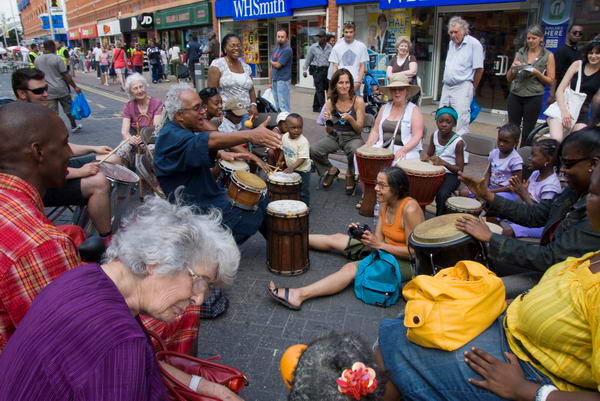
I didn’t take any photographs then – I was hurrying to catch a train, nor on my previous visit a few weeks earlier on my way to Nunhead Cemetery, but I have on some previous occasions, particularly on Saturday 11 Aug, 2007 when things were rather different and the ‘I love Peckham’ festival was in full swing. Here’s the piece I wrote about this on My London Diary and just a few of the pictures I also posted – you can see many more on the web site. The links I’ve left in the piece are all to other posts on that site, and I’ve kept the lower case only style I then used, but have corrected the odd typo.
I Love Peckham
Peckham, Saturday 11 Aug, 2007
‘i love peckham’ is a festival backed by southwark council and based around the centre of peckham. although peckham has had a bad press – particularly over the murder of young damilola taylor in november 2000, and more recent violence on the streets, many parts of it are pleasant streets and vibrant shopping areas. recent investment – particularly since the murder – has led to a number of improvements.
one of the more succesful regeneration projects has been in the bellenden road area which is home to a number of artists including tom phillips and antony gormley, both of whom have been involved in brightening up the streets.
but there are still estates with corners that can hide dangers, and times when its wise to cross the road to avoid the dealers in their cars. it’s an area where it pays to be streetwise.
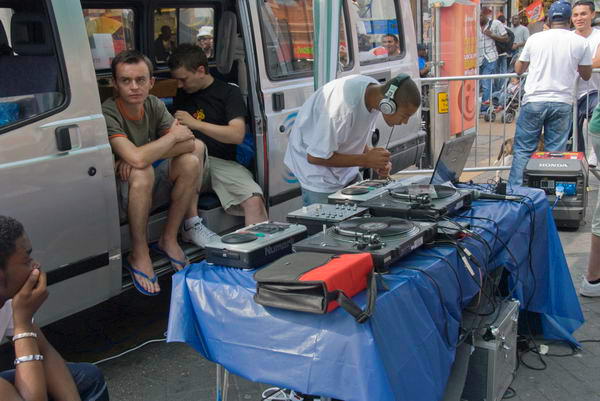
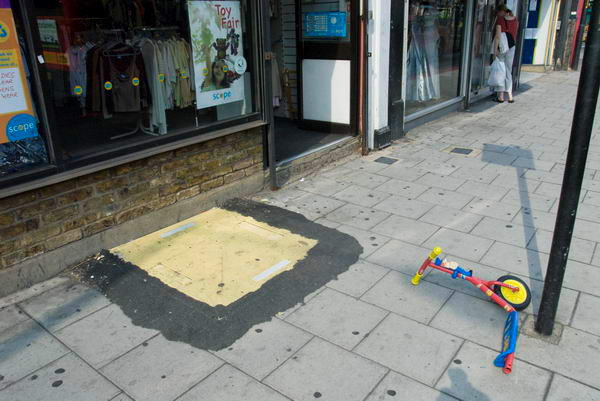
as well as the activities in the square by the library and at the top of rye lane i photographed on saturday there were also other events, including a series of shop window displays.
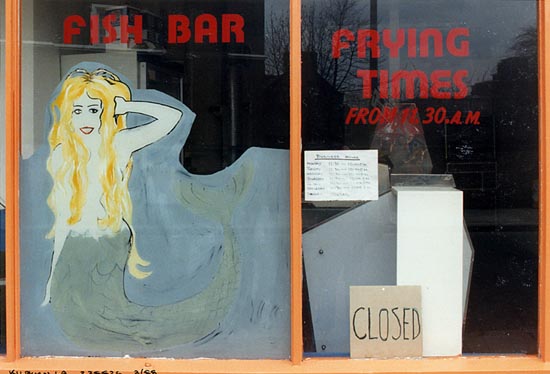
Like the other folks carrying built-in cameras on their latest mobile phones i did photograph some of these, but often felt that some of the other windows which had their normal displays were more interesting. but then i’ve always had an interest in shop windows, which feature strongly in projects such as ‘ideal café, cool blondes and paradise.
Kensal Green, 1988 from Ideal Café, Cool Blondes & Paradise
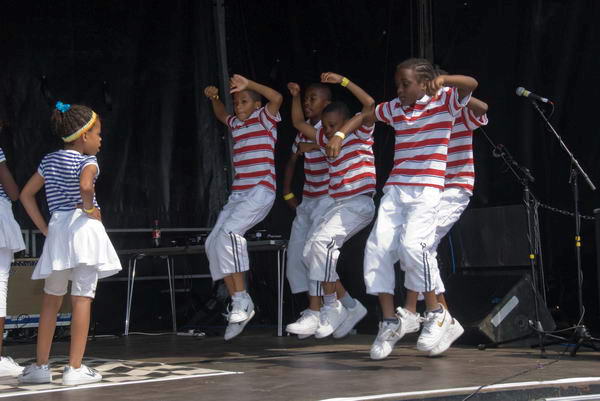
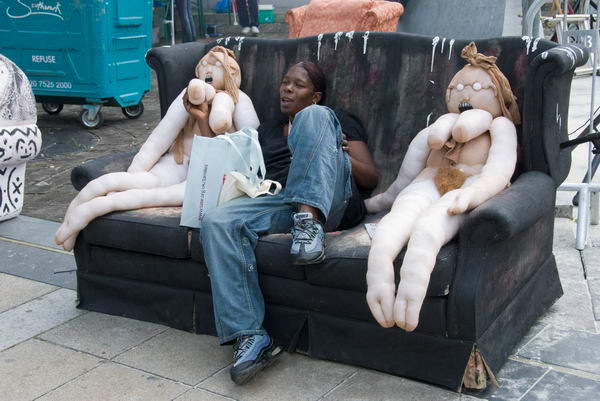
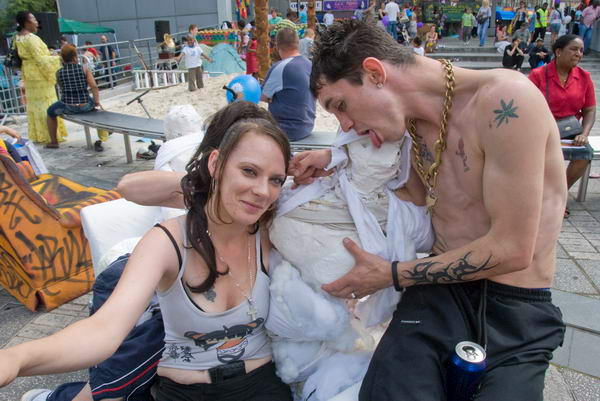
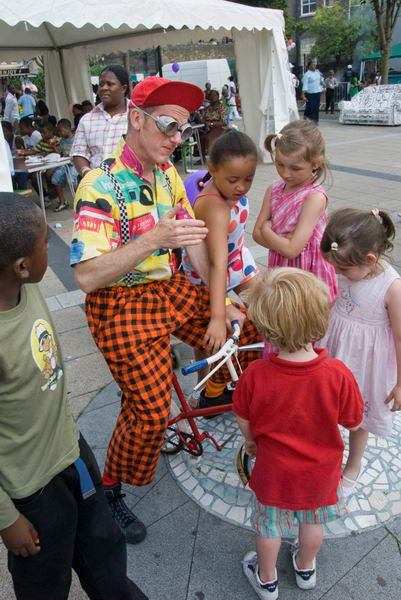
on the main stage by peckham library were performances by indian musicians, a samba group and some young dancers from peckham. around the square were a number of sofas specially decorated for the occasion, many of which were greatly appreciated.
this was the third annual i love peckham festival, but the previous ones had been blighted by british weather; today the sun shone on us at least most of the time, and the beach at times looked almost tropical.
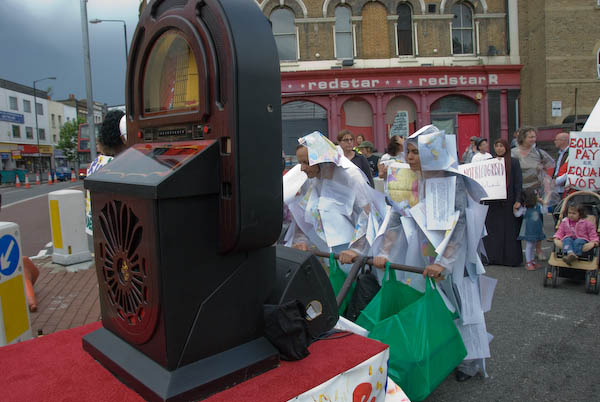
The Human Rights Jukebox at Camberwell Green, 16 June 2007
i stopped off on the way home at the south london gallery, where the installation of isa suarez‘s human rights jukebox was coming to an end. i was pleased i’d stopped by to watch the video of the event and to have a beer and talk to a few of those involved with the project, including isa herself. i still find it mildly amusing to see myself on film, and there were glimpses of me (mainly my back) taking pictures, walking in the march, generally scurrying around and rather too lengthy a shot as i munched on a wholemeal sandwich.
despite these few moments, it was interesting to see the event again and from a different viewpoint. i was sorry i had to rush off to be home with friends. more pictures
The Tanners Arms, pub, Willow Walk, Bermondsey, Southwark, 1988 88-11d-36
Fellmongers, Kennels, Snakes and Thomas A’Becket 1988
The Tanners Arms at 61 Willow Walk on the corner with Crimscott Street was closed in 2003 and demolished the following year. There had been a pub here since at least 1822 under its previous name, The Fellmongers Arms. Fellmongers were dealers in fells – animal skins – who scraped the hair or wool from the pelts and then sold or passed over to the tanners who continued to process of cleaning and preparing them for the final tanning to produce leather.
The building in the picture is a rather attractive ‘streamlined’ design, presumably dating from around 1930, and is far more interesting than its replacement, essentially a large storage shed.
Pet Shop, Old Kent Rd, Walworth, Southwark, 1988 88-11d-22_2400
I think this pet shop and the next door tailor were on a site which is now a part of the Tesco car park, unless the numbering on the street has changed since 1988. I think the tailor’s Ben Beber was closed and empty and the shop unit on the extreme left was clearly derelict and flyposted.
I was impressed by the display of kennels of different sizes as well as the other goods on the pavement outside the shop.
Old Kent Rd, Walworth, Southwark, 1988 88-11d-23
My reason for making this picture was clearly the bust about the shopfront with its ‘WE ARRANGE HOUSE CLEARANCES’ sign, but I also liked the sign to the left above ‘ANTIQUES WANTED’ which has a snake wriggling around the name MANTLE.
There is still a Blue Mantle Antiques on the Old Kent Road, but now in the Old Fire Station at 306-312 rather than this shop, and the history page on its site shows a picture of this shop where the business began in 1969. It is the UK leading supplier of antique fireplaces also selling modern replicas.
Old Kent Rd, Walworth, Southwark, 1988 88-11d-25
I think these poster were on the empty shops not far from Blue Mantle Antiques, possibly some of those later taken over by the company before they moved to the former Firestation. I thought these were an interesting selection of imagery in various styles.
The Old Kent Road here is perhaps the dividing line between Bermondsey and Walworth.
Thomas A’Becket, pub, Old Kent Rd, Walworth, Southwark, 1988 88-11d-26
The Thomas A’Becket on the corner of Albany Street is a fine Victorian pub and became famous for its gym on the first floor where among many others Henry Cooper trained and Mohammed ALi visited – and the floor above was the rehearsal venue for David Bowie and the ‘Spiders from Mars’. The building dates from 1898, replacing an earlier 19th century building on the site, but probably it had been a pub since long before that was built. It photograph shows ‘Established 1757’ on its Albany Street frontage.
But its iconic stature failed to save it from closure, at first briefly in 1983 after boxing promoter and landlady Beryl Cameron lost her fight with the brewery to keep it open, and more permanently after ex-boxer and promoter Gary Davidson ran it for 4 years from 1985. It became an estate agents, an artists studio, and the upper floors were converted to flats. It reopened briefly in 2017-8 as the Rock Island Bar & Grill, and then in 2019 as Vietnamese restaurant Viêt Quán. There is much more about the pub and its boxing history on the web, so I won’t bother to add more.
Beyond the pub at the right of the picture is the Old Fire Station, then looking in poor condition, now considerably restored by Blue Mantle Antiques
Grange Rd, Bermondsey, Southwark, 1988 88-11a-64
Another picture of the Grade II listed 8 Grange Road. Unfortunately the listing did not include the striking wheels and part of a car body which- together with the fine doorway made it impossible to pass without me taking another picture.
My walk on Sunday November 13th 1988 in Bermondsey will continue in a later post.
This is the first post about my walk in Bermondsey and other parts of south London on Novermber 13th 1988. My previous walk at the end of October ended with the post Around the Abbey in Bermondsey.
Rothsay St, Bermondsey, Southwark, 1988 88-11d-41
Bricklayers Arms, Page’s Walk and Birds of the World 1988
Rothsay Street is not far from the Bricklayers Arms roundabout on the New Kent Road to where I think I probably got a bus from Waterloo to start my walk.
This long block of council housing is still there, part of the Meakin Estate managed since 1996 by the Leathermarket JMB which manages around 1500 homes in Borough and Bermondsey. The block was built in 1935 to high standards for the time by the Metropolitan Borough of Bermondsey.
The building at left on the corner with Alice St is also still there, but there is now no sign of a door at this corner. It was a public house, The Jolly Tanners, dating from before 1851, though renamed in 1985 as Uncles and later as Sherwoods, finally closing in 1997. A couple of storeys were added when it was converted into Tayet Towers
The Victoria, pub, Page’s Walk, Bermondsey, Southwark, 1988 88-11d-42
Not far away I photographed another pub on the other side of Tower Bridge Road on the corner of Page’s Walk. The Victoria is still there, still very much open and still looking much the same except for a paint job and a large climbing plant on its right corner. The pub was built in 1886 when workers from the Bricklayers’ Arms railway depot across the street probably supplied much of its custom.
CAMRA gave the pub a good write-up in 2008 and in 2017. Of course Truman, Hanbury, Buxton & Co no longer supply the beer – they stopped brewing in 1989 though various mergers had set them on a downhill path since 1971.
You can see The Victoria pub at the right of this picture on Willow Walk, where in 1988 Balfour Beatty and Jones Lang Wooton were busy on Tower Bridge Business Park, “Business, production and warehouse units … available from August 1988”.
Bricklayers Arms began life as alternative terminus opened by the London and Croydon Railway and the South Eastern Railway in 1844 to London Bridge, but was soon converted to a goods station which closed in 1981. The sidings are now built over for housing but the former stables remain in place on Page’s Walk.
Grange Rd, Bermondsey, Southwark, 1988 88-11d-32
Birds of the World was at the read of a shop, possibly a pet shop which my contact sheet states was on Grange Road, and probably either on the corner of Pages Walk or Fendall Street. I liked the paintings of the birds and was amused by the shadow which put them on a tree.
Sapphire Laundry Ltd still own the buildings at 29-31 Page’s Walk and are still an active company, though they are their business is now registered with the classification ‘Buying and selling of own real estate.’ This building is next to a rather more substantial one, Sultra House.
The “roadline” premises at the corner of Willow Walk and Page’s Walk were part of the former British Road Services Parcels Ltd which had been created as a nationalised road haulage industry in 1948. This was one of the first of Thatcher’s privatisations in 1982 when the company was sold to its employees changing from the National Freight Corporation to the National Freight Consortium. I think it probably went out of use after the Bricklayer’s Arms goods depot closed in 1981.
Another picture showing more of the Bricklayers Arms stables with their roofs with clerestory windows which were also a common feature on some early railway carriages, highly useful when coach lighting – if any – was provided by oil lamps, but not needed once carriages had electric lighting.
I will continue this walk from Sunday 13th November in a later post.
Around the Abbey in Bermondsey 1988 Railway arches have played an important role in the economy of London and other cities, but particularly in London south of the river, where from the start around 1840 lengthy viaducts were built, beginning with this long one east from London Bridge which cut a gap through Bermondsey. The arches provided relatively low cost premises for small businesses, giving something back to the area in compensation for the damage the railways caused.
This particular business had closed and despite the fence had become a hand area for fly-tipping, with many houses in the area being cleared as gentrification was setting in. Furniture and other items that once would have gone to secondhand shops was simply being disposed of as cheaply as possible.
Unfortunately railway arches are now being refurbished as Network Rail sees them as a real opportunity to profit from its large estates, with often long-term tenants being forced out and the refurbished arches being let at three or more times the previous rents. A long battle was fought against this recently in central Brixton, where most of the previous businesses were forced to close.
Abbey St, Bermondsey, Southwark, 1988 88-10r-23
Former warehouses are boarded up and awaiting demolition on Abbey Street close to the junction with Maltby Street.
Maltby St, Bermondsey, Southwark, 1988 88-10r-24
All these buildings in Maltby Street have been demolished and it is hard to locate the exact location which I think was on the part of the road leading from Abbey St to Grange Walk. The sign on one of this range of commercial buildings was for ‘DIAMOND GLASS-FIBRE’.
Bermondsey United Charity School for Girls, Grange Walk, Grigg’s Place, Bermondsey, Southwark, 1988 88-10r-11
The BERMONDSEY UNITED CHARITY SCHOOL FOR GIRLS was, according the the text on its side, ERECTED A.D.1830 and was more recently used as St Mary’s youth centre. It and the terrace along Grange Walk to the east remain and the school has been converted into flats.
This row of late seventeenth century houses on the right hand side of the street are all Grade II listed and Nos 5-7 at right of picture apparently include in their structure part of one side of a late medieval stone gatehouse to Bermondsey Abbey. However I don’t think any of this is visible, and despite various accounts elsewhere they are not the abbey gatehouse, though they show its position.
The more modern structure at the extreme right was recently demolished. On Tower Bridge Road it used to advertise itself as ‘The Bermondsey Indoor Antique Market’ on the Tower Bridge Road frontage withe the message ‘Open Every Friday’ on a board above its Grange Walk side.
Walter Coles, Tanner St, Bermondsey, Southwark, 1988 88-11d-65
Although these last two pictures are filed in my contact sheets under November, my note on the sheet says they were taken earlier than the first November sheet and I think they were taken on this walk.
Walter Coles & Co Ltd sold polythene bags from this warehouse at 47-9 Tanner St, just a few yards east of Tower Bridge Road. Since 2012 it has been an arts venue, Ugly Duck.
The buildings to the right of the warehouse were all on Tanner Street, which turns round towards the north, and have all been demolished and replaced.
Abbey St, Bermondsey, Southwark, 1988 88-11d-51
Two notices had once been here but both had gone. One was replaced in 2019 letting us know this was St Saviours Estate and Purbrook Estate. This is Attilburgh House on the corner of Abbey St and Riley Road, a seven storey council block built on the site of five large houses on the street as a part of the St. Saviours Estate and I think dates from the 1960s. Its name probably comes from the old name for Attleborough, a market town in Norfolk not far from Thetford which gave its name to a neighbouring block.
Like most council housing, many of the flats here have been bought by tenants under Thatcher’s popular but disastrous ‘right to buy’. Many who did buy were unable to keep up with mortgage repayments and repair costs, and so many were fairly quickly sold, often to ‘buy to let’ investors who let them out at several times the council rents, enough to more than pay the costs of the mortage or bank loan, the new tenants buying the flats for those investors. A few years ago this estate featured in a court case after Southwark Council found that fire doors required replacement and tenants too them to court over the charges they imposed.
I think this was probably the end of my walk on 30th October 1988. Two weeks later I was back in Bermondsey taking more pictures, the subject of my next series of posts.
I walked back up Bermondsey Street. There was slanting light across many of the frontages on the east side of the street and I stopped to take pictures of several of the more interesting buildings. Turner Whitehead were in these tall warehouses at 65-71, now renamed Bramah House. As I noted in an earlier, Turner Whitehead described themselves as ‘polythene converters’ meaning they made and sold a wide range of polythene products including bags etc.and these fine late Victorian buildings were said to have been tea warehouses.
I’d photographed 65-71 Bermondsey St before together with this building next door at No63 and was pleased to have better lighting to take another picture. This site was occupied by the Green Dragon pub from at least 1822, probably much earlier. The building probably dates from around the end of the nineteenth century and the pub appears to have closed and been converted to commercial use in the 1920s. Now the ground floor is an estate agents.
The Green Dragon was an emblem of the Earls of Pembroke, one of whom, Japer Tudor, born around 1431 was the son of Catherine of Valois, the widow of King Henry V (and mother of Henry VI) and her Welsh clerk of the Wardrobe Owen Tudor. The couple were said to have married secretly in 1429 and managed to have at least five children before their marriage was discovered; then Owen Tudor was imprisoned and Catherine de Valois sent to live in Bermondsey Abbey. She died in disgrace in 1437 but was still buried in Westminster Abbey.
Next going up Bermondsey street on the other side of what is now Vintage Yard is this fine Grade II listed 3 storey building at No 59, built as a new police station for the Metropolitan Police in 1851. When a new Tower Bridge Police Station opened in 1904 it briefly became a police section house and in 1906 was converted to commercial use. At least until the 1960s it was occupied by Read & Partners Ltd. Since I took this picture in 1988 it has been internally refurbished as offices.
I walked back up Bermondsey Street, pausing to photograph this image in the window of a barber’s shop. That long-haired figure seemed strangely familiar.
The light now made for a much better picture of Thomson Bros Ltd Knightrider Mills, the gateway shared by Tempo Leather Co Ltd, not to mention Rilling Hills Ltd and Marchant Hills Ltd.
As the notice states, these had been ‘ACQUIRED BY THE ELEPHANT HOUSE CO PLC AND DUNLOW HOUSE PLC – PROPOSED DEVELOPMENT – ALL ENQUIRIES’. Fortunately the development has retained the frontage more or less intact, almost certainly because it is Grade II listed, with gates now leading to ‘Shiva Building – Studio/Offices and ‘The Tanneries – www.lordshiva.net’, which address tells you a little about what goes on inside. It was built in 1873 to the designs of George Legg.
This street apparently gets its name from a pub which had the sign of St Christopher who was the bearer of the cross on which Christ was crucified. The pub, named ‘The Cross of Bermondsey’ was apparently demolished in 1559.
More demolition came with the railway, which runs in a wide swathe across Bermondsey, built for the London and Greenwich Railway Company with construction beginning in 1834.
Guys Hospital was founded in 1721 by Thomas Guy who had made a fortune printing Bibles and a killing by speculating on the South Sea Bubble. An early private-public partnership it had been granted a monopoly by the to supply African slaves to South America and the South Sea Islands. Because Spain and Portugal controlled most of South America it did very little business with slaves, but in 1720 pushed up its share price by rumours of support from King and Parliament, rising from £128 to £550 in five months, before rapidly collapsing back. Guy apparently sold his shares before the collapse.
Guy’s Tower was built in 1974 and was then the tallest hospital building in the world, with 34 floors and almost 150 metres tall. According to Wikipedia it is now the world’s fifth-tallest hospital building.
Enid St, Bermondsey, Southwark, 1988 88-10r-35
You can see the railway viaduct in the background of this picture on Enid St, which appears to be both the name of the street beside the viaduct and some side-streets on the Neckinger Estate. I can no longer find either the buildings and chimney but I think this may have been taken from around Enid St Playground.
I walked back to the eastern end of Bermondsey Wall West in 1988, where the road had been cut in two in the 1930s by the building of the giant Chambers Wharf cold store. This shows the warehouses to the east of East Lane on the river side of the street. On the https://maps.nls.uk/view/101201658 1896 OS Town plan this was named as Vestry Wharf, which had a dock, and beyond it East Lane Wharf.
I can’t remember if the East Lane Stairs leading down to the foreshore were still open here in 1988. They are Grade II listed and still exist but are now behind a locked gate and look unsafe. Vestry Wharf was opened in 1874 and the vestry – then the local authority – used it and East Lane Wharf to ship out refuse collected in the area. The dock there was previously a dry dock.
These buildings have now been replaced by modern buildings and when I walked around here in 2019 it was possible to walk out to a riverside patio here, the street now ends at the Thames super-sewer works on the former cold store site.
Taken from roughly the same spot as the previous image but facing in the opposite direction along Bermondsey Wall West, so the range of buildings on the right of the picture are on the river side.
The warehouses on the left of the street – of which only a small corner is in my picture have been replaced by a modern building, while the row along the left still at least look fairly similar, although there has been extensive refurbishment between the street and the river wall. I think these are all now a part of the Tempus Wharf redevelopment, though in 1896 they were Brunswick Wharf (Grade II listed as Chambers Wharf at 29), Seaborne Coal Wharf and an unnamed wharf closest to camera. East Lane Stairs went down beside the wall of this wharf at the extreme right of the image, though I think they may have been closed by a gate, as otherwise I would probably have gone down them.
George Row, Bermondsey Wall West, Bermondsey, Southwark, 1988 88-10p-56
Prominent on the left is St Saviour’s House on the corner of George Row and Bermondsey Wall West, written about in a previous post on this walk. The three or four storey 20th century building at the centre has now been replaced by a block of flats, River View Heights, a modern gated development with 24-hour porterage on the former site of Slate Wharf.
Closer to camera, the street name is handwritten as Chambers Wharf, though this was and is Chambers Street. The site is now occupied by a modern brick building. You can see from the wall in the picture that this building predates Chambers St, cut through here when Bermondsey Wall was split in two by the huge Chambers Cold Store in the 1930s.
I can’t read the notice on the wall entirely. At the top I think it has two words, the first ‘Daily’ but the second illegible. Under that are two sails and the word ‘Mailboat’ and below more clearly ‘COLLECTION CENTRE’. Perhaps the top line once read ‘Daily Mail’, and this advertised a mail service for sailors moored at the wharves nearby, some of which served vessels from the North of England and the continent – and once the cold store opened further afield.
Moorings, Jacobs Island, River Thames, Tower Bridge, Bermondsey, Southwark, 1988 88-10p-45
Back in 1988 there were only two boats moored at what are variously known as the Downings Road, Reeds Wharf or Tower Bridge Moorings off Jacobs Island, close to the mouth of St Saviour’s Dock. By the last time I was there this had grown to a cluster of around 40 houseboats and a few smaller vessels stretching around 165 metres downstream from the narrow access at the corner of Bermondsey Wall West and Mill Street.
The ancient moorings were bought by architect Nicholas Lacey in the 1980s and he “is committed to maintaining their historical usage” as moorings. The interconnected boats have a series of roof gardens and there is a stage for cultural and arts events. They also still provide temporary moorings for other boats.
Southwark Council fought a long an mostly legal battle to get rid of the barges, issuing eviction orders in 2003 and 2004. They were rebuffed by London Mayor Ken Livingstone who told Southwark that moorings fitted in with the London Plan and that these ones were broadly acceptable to long as appropriate amenity and environmental safeguards were in place. It was probably a great disappointment to Labour Southwark Council’s property developer friends, but welcome to most Londoners who like the colour the moorings provide.
New Concordia Wharf, Mill St, Bermondsey, Southwark, 1988 88-10p-41
In 1988 there was no Thames Path – it was approved in 1989 but only opened in 1996, and the bridge across the mouth of St Saviour’s Dock only built in 1995. Instead I turned down Mill Street to photograph the splendid chimney and warehouses of the nicely preserved New Concordia Wharf.
Built as a St. Saviour’s Flour Mill in 1882, the mill had to be rebuilt after a fire twelve years later. These Grade II listed premises were converted to residential use in 1981-3, one of the earliest warehouse conversions in the area.
Works, W & R Jacobs, Biscuit Manufacturers, Wolseley St, Bermondsey, Southwark, 1988 88-10p-34
I’d previously photographed the OFFICER and WORKERS entrances to the former biscuit factory of W & R Jacobs on Wolseley St, but this time took a picture of the entire frontage. Jacobs had at least two factories in the area as well their main works in Aintree, Liverpool, and on the wall it also names Manchester and Dublin where the brothers William and Robert moved to shortly after founding the business in Waterford in 1851. This factory was an extension of their earlier works in 1907 and has been demolished. The building at the end of the street on the right of picture is still there.
I’d long been confused over this building being in Wolseley St but the next street to the north off of Mill St being Jacob Street – getting its name from that of the area, Jacob’s Island. Biscuits were also made in Jacob St but for dogs, by Spillers.
Workers Entrance, W & R Jacobs, Biscuit Manufacturers, Jacob St, Bermondsey, Southwark, 1988 88-10p-21
The Workers entrance was rather small on the previous image, so I took another picture of it.
Tower Finishers is on the corner of Mill St and Wolseley St, and its address is I think 1 Wolseley St. The street got its name from the Field Marshall parodied as a ‘modern major general’ in the Pirates of Penzance. “Field Marshal Garnet Joseph Wolseley, 1st Viscount Wolseley, KP, GCB, OM, GCMG, VD, PC (4 June 1833 – 25 March 1913)”, had many victories in Canada, West Africa and Egypt and modernised the British Army and was Commander-in-Chief from 1895-1900. For a time the phrase “everything’s all Sir Garnet” became a common way of saying everything was in order.
Tower Finishers were cutter makers and printing trade finishers. The building is still on the corner, very much tidied up and I suspect rather different behind its exterior wall.
My 1988 walk around Bermondsey will continue in a later post.
I walked up George Row, following what had been the main course of the River Neckinger to Bermondsey Wall and St Saviour’s House, where I made one of my favourite images of London. The building, as No 21 Bermondsey Wall West, gets a short mention in Southwarks St Saviours Dock Conservation area appraisal from 2003 which notes it “has recently been restored and extended, losing some of its character“, though perhaps the main loss has been of its view of Tower Bridge with all that is now visible being the street side of modern riverside luxury flats.
Information I’ve been able to find on-line tells me only what the eye can see (though not all in my picture) which is that it has a “white rendered wall punctuated only by a large door with a classical segmental pediment, and a simple circular window above it.” It obviously gets its name from St Saviour’s Monastery and from its appearance I think was possibly a Catholic institution of some nature. When I posted on-line a view showing the rear of this building (since obscured by an extension) in 1983 a year or two ago I wrote:
“Google maps describes St Saviour’s House as a ‘Religious institution’ and it looks rather like a convent or convent school but it appears now to be expensive flats – around £1m for 2 bed – and one estate agent describes it as a ‘warehouse conversion’.
The road by St Saviour’s House is still narrow and with a slight curve rather like that in the picture, possibly originally following the bank of the river or a tidal canal. The front of St Saviour’s House is on George Row, where the River Neckinger ran, with a bridge over it here. The tidal canals had water let in every few days to for the mill immediately to the west, and the Neckinger, the Thames, St Saviour’s Dock and a canal alongside Wolseley St (then London St) formed the boundaries of the slum notorious in the early 19th century as Jacob’s Island, used by Dickens in Oliver Twist.
Much of the riverside here is now full of luxury flats and is private here. On Bermondsey Wall West there is an area where you can look out along the river to Tower Bridge but a new block on the end of the older warehouses restricts the view.
This warehouse block, now converted to flats and offices as Tempus Wharf is still there at 29 Bermondsey Eall West, just to the east of the junction with Flockton St. This five storey warehouse dating dating from 1865-70 and is Grade II listed as Chambers Wharf, a rather confusing name as there was a much larger building known as Chambers Wharf a short distance to the east.
On the 1896 OS Town plan this is named as Brunswick Wharf. It was built on the former site of Murrell’s Wharf as a granary. Later it was combined with the Seaborne Coal Wharf next door on the east as Sterling Wharf for paper and card. Chambers bought up many of the wharves along here in the 1930s and erected their large cold store (demolished in 2008-9) a little to the east. I think the name Tempus Wharf is just a little bit of Latin added to give it a little more class.
A more distant view of the east side of St Saviour’s House from Bermondsey Wall West shows the large area of blank white rendered flat wall. In the redevelopment this was stepped out into George Row and perforated with windows and garage doors, with only a short section of the original now visible. It also gives an impression of the state of the area back in 1988
This building and the taller ones behind were a part of the Chambers Wharf Cold Stores site.
When Chambers Wharf and Cold Stores Ltd built their giant cold stores in the 1930s they were in a vaguely Deco style, but those parts rebuilt after wartime bomb damage were rather plainer. The buildings were huge, and resulted in the closing of a section of Bermondsey Wall, dividing it into West and East, with the frontage here on Chambers St. The river frontage had 3 berths and there were frequent services from the continent bringing meat and other perishable goods here. It closed as a cold store in the 1980s and was briefly used as a gold bullion & document store.
Various plans were put forward for its redevelopment, including as a heliport for London, which the graffiti here, ‘BUILD YOUR HELIPORT IN YOR BACK GARDN NOT OURS’ shows was not welcome in the area and a strong local campaign by CHOP saw an end to that proposal. Finally planning permission was given for a residential development. The cold stores were demolished around 2008 but progress on the site has been held up by the Thames Tideway Tunnel super-sewer works for which it it a major site.
A final picture for this post of another part of the Chambers Wharf site, still with its sign. I turned around and walked back to Bermondsey Wall West, where the next post on the walk will begin.
Most mornings when I sit down to write a post for >Re:PHOTO I start by searching on My London Diary for events I photographed on that particular day (or rather the day two or three ahead when I will schedule the post to appear.)
Occasionally there may be something else I feel moved to write about – some new development in photography, discovery about the history of photography, ethical debate or cataclysmic event – but these seem to come up less frequently than they used to, though I’m not entirely sure why this should be.
Perhaps it’s because I spend more time now looking at my own old work, digitising images I made on film in the 1970s, 1980s and 1990s and worrying about what will happen to all this work after my death and rather less on going out, taking new work and meeting other photographers. Covid meant that for a long period there were few exhibitions to go to, and I haven’t yet got back into the habit.
My bookshelves have long all been full and overcrowded and I seldom buy new books unless they are by personal friends, and have cancelled my subscription to most of those expensive magazines I could never bring myself to throw away – the shelves once allocated to them are also full. I’m beginning also to wonder about the future of this large library – whether to try and set up an on-line bookshop to sell it, or to try to find some worthy institution to gift it to.
Fortunately almost all of the posts in My London Diary give their date somewhere making it easy to locate the pictures I took on July 19 from around 1999 until 2021 using the Freefind search box on many of the site’s pages. Though in the early years of this period when I was still using film there were many events that didn’t make the site as I hadn’t digitised them, and the search somehow misses the occasional thing.
But searching for ’19 Jul’ and ’19th July turns up events in 2008, 2014, 2015, 2017 and 2019 and I open the pages from those years and look through them to see what I photographed on those days. This gives me a choice of things to write about, either picking one or two of the twelve events, or about all those I did on a particular day.
So how do I choose? Perhaps I eliminate some topics I know I’ve already written about too often or too recently. I don’t want to rant yet another time – at least for a while – on Israel’s attacks on Gaza and seasonal events like the Swan Upping which happen on a particular day of the week perhaps don’t merit more than one post through the 7 dates on which they can occur.
Then there are some events I have very little to say about and others where I think the photographs are rather run-of-the-mill. Very occasionally some where what I would like to say might be legally unwise.
So you can choose if you want to read more about any of them – there are more pictures and text about them which I wrote at the time I took them on My London Diary.
The previous episode of this walk was Bermondsey Street & Guideline Stores, 1988, and the first two pictures complete my post on that. Two days later I began a new walk a little to the north in Bermondsey.
This row of frontages, rather tidied up, is still present on Bermondsey St, though I think there may have been considerable changes behind the facades. That at the right of my picture, then No 151 was a part of A E Bickel and Co Ltd, offering ENGINEERS TOOLS AND EQUIPMENT, INDUSTRIAL RUBBER GOODS and MANUFACTURERS OF INDUSTRIAL LEATHER AND CANVAS GOODS. This private limited company is still in business but describes this at Companies House as ‘Buying and selling of own real estate’ and there is a large development, Bickel’s Yard, with a private courtyard to the east of Bermondsey St along the north side of Bell Yard Mews.
At the centre of the picture on the corner of Newham’s St is Bermondsey Market Antiques Warehouse, in a Grade II listed early 19th century cloth factory, described as “Brown brick with stone Tuscan cornice and pediment. The building now houses a pan-Asian cocktail bar and grill. You can see from the signs at the left edge of the picture that a great deal of gentrification was in progress back in 1988.
John Felton Rd, Bermondsey, Southwark, 1988 88-10o-31
My walk had ended at the south end of Bermondsey St, where I took a bus towards Waterloo, but two days later I was back in Bermondsey, this time getting of a bus on Jamaica Road and walking northe up George Row. Google Maps does not include John Felton Road, which was a short street running east from George Row and has been renamed Sugar Lane. This wall with a mural around some temporary open space has long disappeared with new building, but it is hard to know why Bermondsey has lost a reference to a man who stood up for his Catholic faith and paid dearly.
Catholic martyr John Felton was given a cruel execution for fixing a copy of Pope Pius V’s Bull ‘Regnans in Excelsis’ excommunicating Queen Elizabeth, to the gates of the Bishop of London’s palace near St. Paul’s. Felton’s family came from Norfolk but he lived at Bermondsey Abbey. His action was seen as a great threat to the Queen continuing to reign, an act of High Treason.
After being arrested and taken to the Tower of London he spoke of his glory in having made the Bull public, and took the diamond ring from his finger and sent it to Elizabeth to show he bore her no personal malice, but insisted she was a Pretender with no right to the throne.
He was tortured on the rack but refused to falsely implicate the Spanish Ambassador in his actions and four days later was drawn on a hurdle to St Paul’s Churchyard where he was hung briefly before being cut down alive for quartering. His daughter’s account of the event alleges that after the hangman had pulled out the heart from his body and was holding it alive he managed once or twice to utter the holy name of Jesus. His severed head and body parts were ‘carried to Newgate to be parboiled, and so set up, as the other rebels were’ as a warning to others. He was beatified in 1886 by Pope Leo XIII.
Felton had been a man of considerable wealth, and his wife had been childhood friends with Queen Elizabeth and a maid of honour to Queen Mary. As well as the diamond rign, said to be worth £400, his plate and jewels, valued at £33,000 were seized for the queen.
East Lane, John Felton Rd, Bermondsey, Southwark, 1988 88-10o-34
This long block of council flats on the Dickens Estate is Oliver House, now at the corner of Sugar Lane and East Lane, though there is no longer a mural on the wall as it was painted over around 2010. It was no great work of art and had faded badly but it seems a pity it has not been replace by something more colourful than a blank brown wall.
St Josephs, Primary School, George Row, Bermondsey, Southwark, 1988 88-10o-21
The Fosters pub on George Row was The George at 19 George Row, on that site since at least 1824. Still open in 1988 on the corner of George Row and John Felton Rd and Flockton Street it closed in 2001 was demolished in 2003.
St Joseph’s RC Primary School remains in use. The Convent of the Sisters of Mercy in Bermondsey was established around 1838 to serve the growing Irish Catholic population in the area and they set up a primary school in the area. Later they educated older children too. St Joseph’s was completed in 1913, and served for years as an All Age Mixed RC School. Catholic education in the area was reorganised in 1949 and it then became St Joseph’s RC Primary School. It now has some extensive new buildings as well as the old school.
George Row, Bermondsey, Southwark, 1988 88-10o-22
The building on my right is Fleming House on George Row, part of Bermondsey Council’s Dickens Estate. At the centre of the picture is the fine warehouse still on the corner of Jacob Street, and at left the seven floors of Peter Butler House, built for Bermondsey Council in the mid-1950s as a later addition to the Dickens estate.